A sourcing policy is a formal corporate governance document. It defines how an enterprise selects, evaluates, contracts with, and monitors third-party suppliers. In plain terms, sourcing means turning business standards, regulatory obligations, and risk appetite into procurement rules that people actually follow across the whole supply chain.
Why should a CRO or a Head of Model Risk care about a procurement manual? Because every vendor you onboard inherits a piece of your control environment. That includes the ones nobody formally approved.
Executive Summary for Risk and Procurement Leadership
- What it is: a binding rulebook that governs supplier eligibility, competitive method selection, contract standards, monitoring cadence, and exit conditions. Strategic sourcing sits below it as category strategy. Purchasing sits below that as transactional execution.
- Why it matters: formal policy prevents fragmented commercial terms, unmanaged tail spend, concentration risk in critical third parties, and the quiet onboarding of vendors that touch regulated data or decision-making models.
- What good looks like in 2026: documented monetary thresholds tied to RFI, RFQ, RFP, and sole-source methods; Total Cost of Ownership (TCO) evaluation embedded in RFP templates; the 4P requirement framework covering Product, People, Process, Performance; risk-tiered due diligence; explicit AI, data-use, and subcontractor controls; whistleblowing channels extended to supplier employees; and a documented exit strategy for every critical vendor.
- Regulatory anchors: ISO 20400:2017, ISO/IEC 27036-1 and 27036-2, NIST SP 800-161r1, NIST SP 1326 (2024 draft), OECD due diligence guidance, UN Supplier Code of Conduct (Rev. 07, 2024), and for banks and fintechs, the 2023 Interagency Guidance on Third-Party Relationships together with model risk management expectations of the SR 11-7 lineage.
One line to remember. Risk tier drives assurance depth, not invoice size.
What Is a Sourcing Policy and Why Does Business Need It?
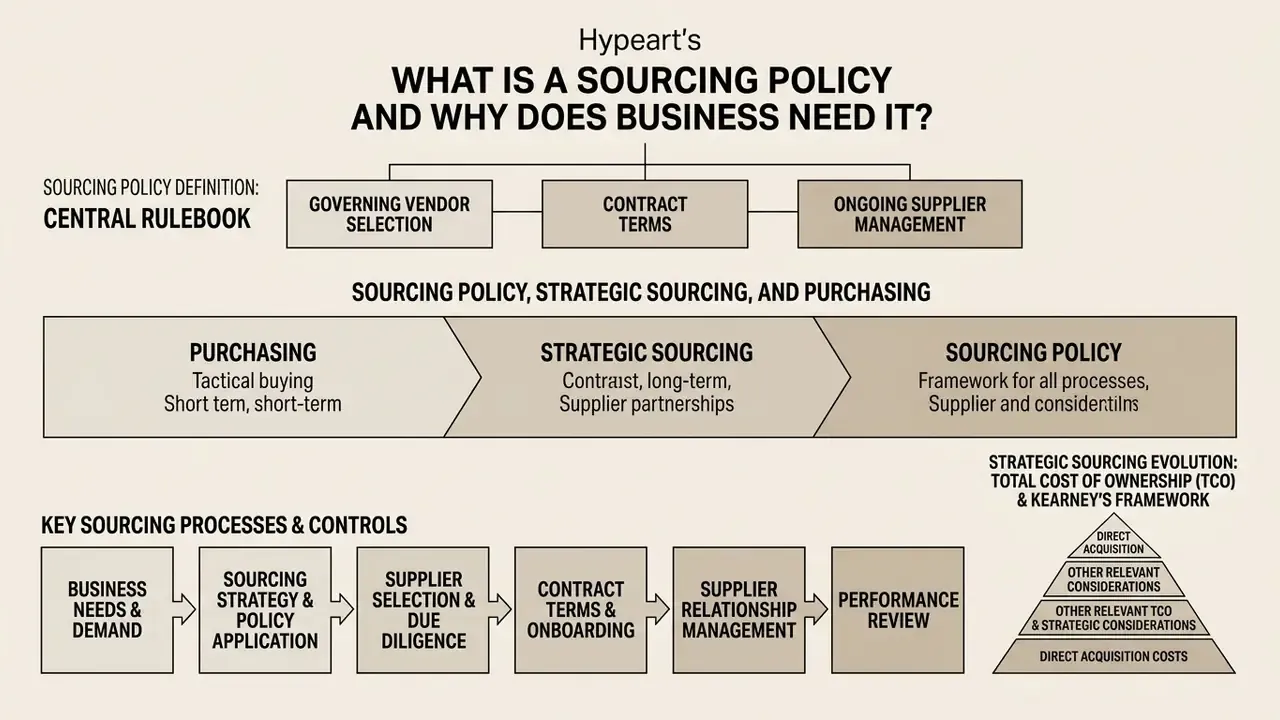
A sourcing policy is the central rulebook governing vendor selection, contract terms, and ongoing supplier management. Its job is to protect enterprise value. It sets operational boundaries so that external spending stays aligned with business goals, legal mandates, and risk management thresholds.
Here is the short version of a sourcing policy overview: the document answers who may buy, from whom, under what competition, with what evidence, and for how long. Everything else is detail.
Sourcing Policy, Strategic Sourcing, and Purchasing: What Is the Difference?
Sourcing policy provides the governing framework. Strategic sourcing defines long-term category plans. Purchasing executes daily transactional operations. Confusing these three levels is one of the most common reasons internal control oversight breaks down.
| Governance Level | Primary Focus | Core Responsibilities | Key Outputs |
|---|---|---|---|
| Sourcing Policy | Enterprise governance | Defines mandatory selection rules, ethical standards, risk limits, and authority matrices | Sourcing Policy Manual, Code of Conduct |
| Strategic Sourcing | Category optimization | Analyzes market spend, evaluates supplier capabilities, designs long-term supply models | Category strategies, RFP specifications |
| Purchasing | Operational execution | Issues purchase orders, processes requisitions, receives goods, verifies invoices | Purchase orders, payment receipts |
Governance policy must precede category design. Strategic sourcing is a planning discipline, and it cannot compensate for missing rules above it. Operating without a unified policy produces inconsistent vendor selection, fragmented commercial terms, and unmanaged tail spend. That pattern is documented in public-sector sourcing playbooks. It is also visible in corporate procurement manuals that make Supply Chain Management the accountable owner of all sourcing activity, while executives implement the rules inside their own business areas.
So the sourcing vs purchasing question has a practical answer: one sets the boundary, the other moves inside it.
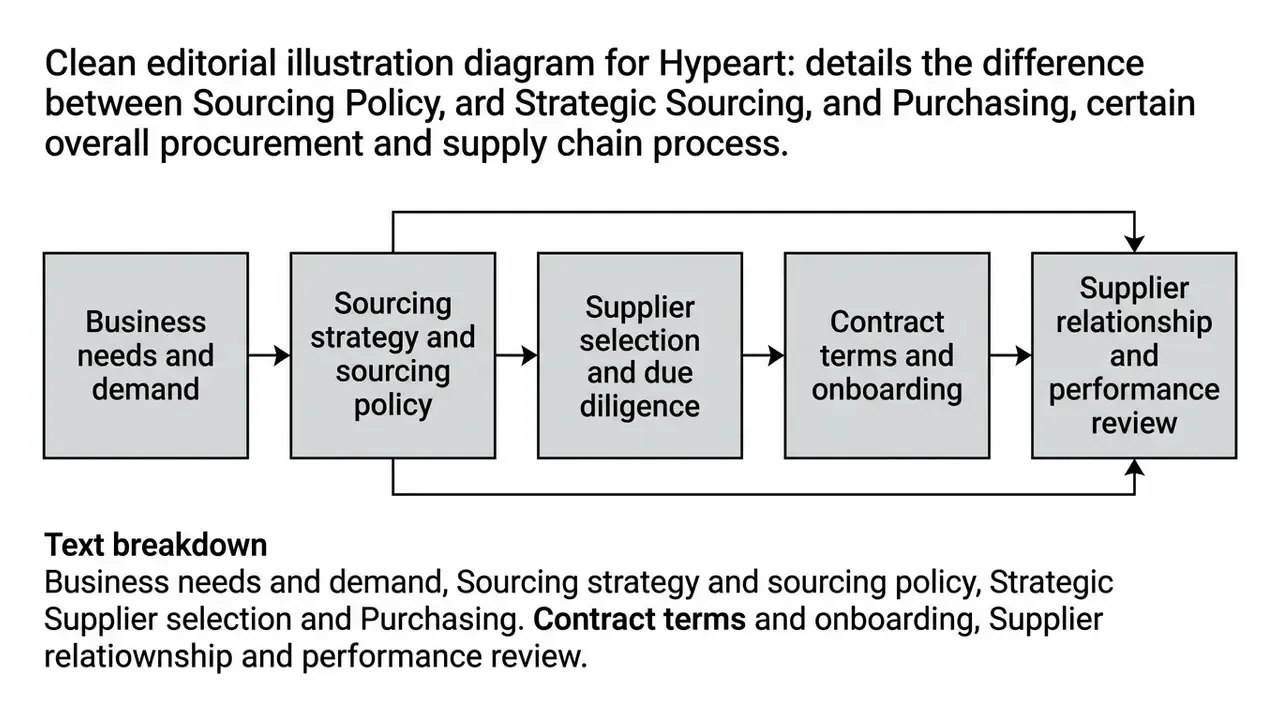
Sourcing policy lifecycle stages:
- Business needs and demandinternal stakeholders define operational requirements, product specifications, and target timelines.
- Sourcing strategy and sourcing policyprocurement rules establish approval tiers, risk controls, and supplier eligibility standards.
- Supplier selection and due diligencethe enterprise evaluates candidates against legal, financial, cybersecurity, model risk, and ESG criteria.
- Contract terms and onboardinglegal agreements embed mandatory compliance clauses, SLA thresholds, and audit rights.
- Supplier relationship management and performance reviewoperational teams monitor performance, run audits, and decide on renewal, remediation, or termination.
«The OECD due diligence framework sets six steps that embed responsible business conduct directly into policies and management systems, including procurement.»
Strategic Sourcing Evolution: Total Cost of Ownership and Kearney's Framework
A mature sourcing policy shifts attention from initial purchase price to Total Cost of Ownership (TCO). The logic is grounded in Kearney's 7-Step Strategic Sourcing Process, developed in the early 1990s and still the reference model for category-level work. Effective sourcing evaluates cost across the full asset lifecycle:
- Direct acquisition costspurchase price, customs duties, freight, licensing, and onboarding fees.
- Operating costsinstallation, integration, energy consumption, maintenance, support tiers, and operational labor.
- Governance and risk costscompliance monitoring, audit execution, cybersecurity assurance, model validation, and ESG remediation.
- End-of-life costsdisposal, data destruction and return, decommissioning, migration, and recycling requirements.
Embedding TCO analysis into mandatory RFP templates keeps hidden operating expense from eroding margin two years after signature. Best-in-class business practices reinforce the same idea. Procter & Gamble's published sourcing principles prioritize "best total value", covering quality, supplier responsiveness, speed to market, sustainability, and willingness to share risk, rather than the quoted unit price alone.
A small observation from practice. Control cost is the line item most often left out of the business case, and it is usually the line item that decides whether an AI pilot ever reaches production.
How a Sourcing Policy Reduces Risk in the Supply Chain
A structured policy mitigates operational, financial, legal, and cybersecurity risks. It does so through pre-contract screening and mandatory monitoring loops. The point is to stop a sub-tier failure from turning into business interruption or a regulatory finding.
NIST SP 800-161r1, Cybersecurity Supply Chain Risk Management Practices for Systems and Organizations, stresses continuous monitoring, qualified OEM sourcing, and authorized distributor lists. Those controls protect enterprise systems against counterfeit components, provenance failures, and unauthorized data access.
Public-sector guidance adds the commercial dimension. The UK Cabinet Office Sourcing Playbook recommends contract protections against supply-chain disruption, supplier insolvency cost, and indexation where suppliers carry pricing risk outside their control. OECD work on managing procurement risk links risk-aware sourcing strategies to faster contract adaptation when supply conditions move.
Responsible sourcing, in this reading, is not a values statement. It is a resilience mechanism for long term business continuity, and it depends on functioning management systems rather than good intentions.
Regulatory Overlay for Banks, Fintechs, and Regulated Financial Institutions
Regulated institutions cannot treat sourcing policy as a purely commercial document. Vendor selection is examinable. Third-party dependencies are assessed as extensions of the institution's own risk profile.
| Supervisory Expectation | Practical Sourcing Policy Requirement |
|---|---|
| Interagency Guidance on Third-Party Relationships: Risk Management (Fed, OCC, FDIC, 2023) | Lifecycle governance: planning, due diligence and third-party selection, contract negotiation, ongoing monitoring, and termination. Each stage evidenced and retained for examination. |
| Model risk management expectations (SR 11-7 lineage) | Vendor-supplied models, scores, and analytics require conceptual soundness review, outcome analysis, documentation access, and independent validation before production use. |
| Operational resilience and critical third parties, including DORA-style regimes for EU-facing entities | Identify critical third parties, define concentration limits, contract for audit and information rights, test substitutability, maintain a documented exit plan. |
| Cyber supply chain standards (NIST SP 800-161r1, NIST SP 1326 draft, ISO/IEC 27036) | Standard security clauses in RFPs and contracts, sub-tier disclosure, provenance validation, continuous control monitoring. |
Practical translation: a critical-vendor designation in a bank should trigger enhanced due diligence, committee-level approval, contractual audit and information rights, resilience testing, and a documented offboarding plan. Contract value does not change that.
Worth flagging an uncertainty here. Supervisory expectations for agentic AI vendors are still forming, so most institutions are extending existing model risk frameworks by analogy. That is defensible, but it is not settled ground.
Scope and Principles of a Responsible Sourcing Policy
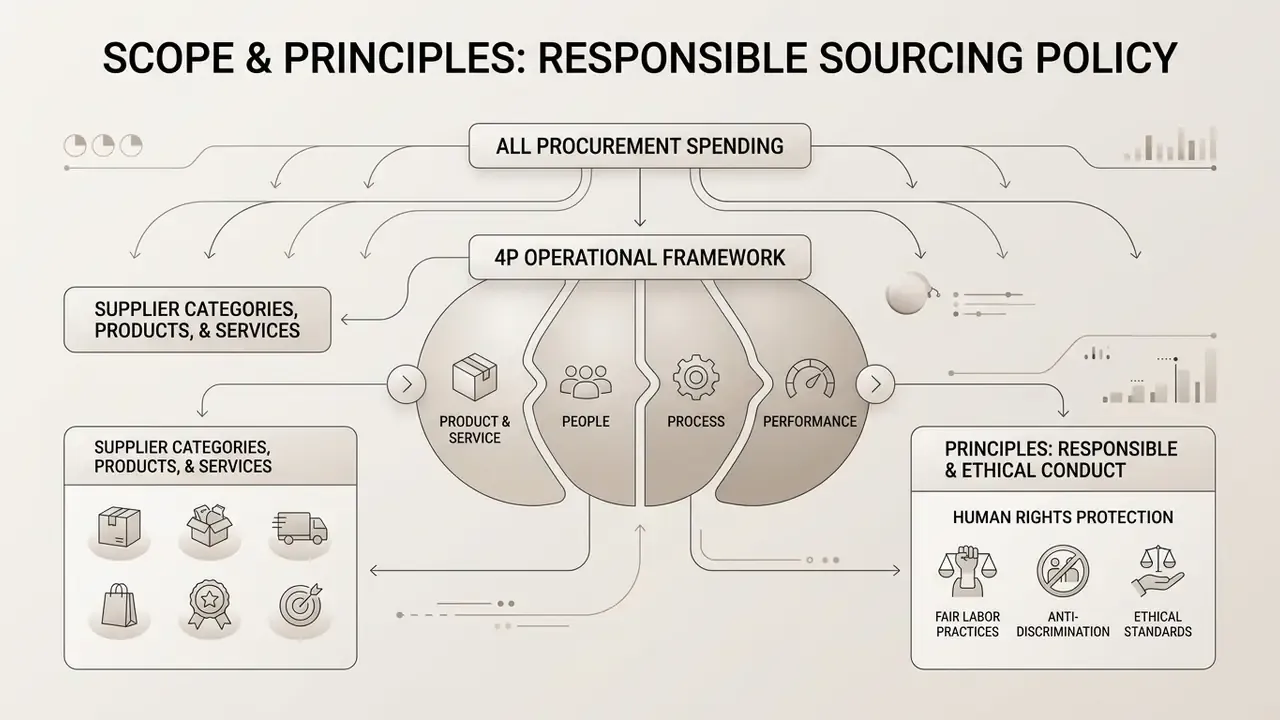
A responsible sourcing policy applies across all procurement spending. That includes raw materials, professional services, software licenses, cloud platforms, analytics models, and outsourced labor. It covers direct tier-one vendors and critical sub-tier entities across the extended supply chain.
For clarity of application, split the scope into two operating domains.
1. Physical and operational procurement. Raw materials, components, logistics, facilities, catering, equipment, and field services. Dominant risks: labor conditions, deforestation and material origin, health and safety, environmental compliance, quality and traceability, and geographic concentration.
2. Technology, data, and AI procurement. SaaS platforms, cloud infrastructure, data providers, managed service providers, model and analytics vendors, and API-based AI capabilities. Dominant risks: unauthorized data use, sub-processor sprawl, model opacity, intellectual property leakage, resilience gaps, and unmanaged shadow adoption.
Coverage matrix for responsible sourcing policy application
| Scope Domain | Core Principles | Mandatory Requirements | Regulatory and Operational Baseline |
|---|---|---|---|
| Direct suppliers | Legal compliance, fair labor, environmental responsibility, anti corruption | Execute Supplier Code of Conduct, complete risk questionnaires, allow third-party audits | Scentre Group Supplier Code of Conduct (2023); Solenis Global Procurement and Responsible Sourcing Policy (effective 20 May 2026) |
| Products and services | Traceability, quality assurance, ethical material origin, data security | Prequalify against minimum labor standards, verify certifications, mandate material origin logs | ISO 20400:2017 Sustainable Procurement; EU Conflict Minerals Regulation 2017/821 |
| Technology, data, and AI vendors | Data minimization, model transparency, resilience, IP protection | Data processing agreements, no-training-on-customer-data clauses, sub-processor approval, SOC 2 or ISO 27001 evidence | NIST SP 800-161r1; ISO/IEC 27036-2:2022; Interagency Third-Party Risk Guidance (2023) |
| Upstream supply chain | Risk-based due diligence, severe risk prioritization, transparent mapping | Require tier-one vendors to audit sub-tier partners and disclose high-risk regional inputs | OECD Due Diligence Guidance; Sandvik EcoVadis screening across roughly 27,000 suppliers |
| Business partners | Integrity, conflict of interest disclosure, whistleblower protection | Zero-tolerance bribery rules, anti-money laundering controls | UN Supplier Code of Conduct (Rev. 07, 2024); OpenText Supplier Code of Conduct (2026) |
The 4P Operational Framework for Responsible Sourcing
To simplify risk classification and audit readiness, many enterprises group supplier requirements into four pillars, the 4Ps.
- Product and service material quality, product safety, non-deforestation guarantees, origin traceability, and batch logging.
- People prohibition of child and forced labor, non-discrimination, fair remuneration, working-hour limits, freedom of association and collective bargaining, and occupational health and safety.
- Process environmental management systems such as ISO 14001, climate and carbon emissions reporting, water stewardship, efficiency improvement, and circular economy practices.
- Performance regulatory compliance, risk management, anti-bribery and anti corruption controls, ultimate beneficial ownership transparency, disclosure, and data privacy protection under GDPR or ISO 27001.
Charoen Pokphand Foods applies exactly this 4P architecture across its supplier base in Thailand and Vietnam. Policy updates go to all contracted suppliers, and e-learning modules capture formal acknowledgement. That is the part worth copying. It converts policy text into auditable supplier acknowledgement records, which is what an examiner asks for.
Which Supplier Categories, Products, and Services to Cover
Scope must cover direct spending, indirect expense categories, IT infrastructure, and specialized consulting engagements. Excluding indirect spend or low-value contracts creates hidden exposure, and it usually surfaces at the worst moment.
ISO 20400:2017 confirms that scope definition should segment spend into comparable categories while assessing supply risk and strategic importance. Category construction follows a repeatable sequence: locate spend data, remove non-supplier line items, group into categories with common supply and demand drivers, test sub-categories, and document the taxonomy. Suppliers are then segmented into strategic alliance partners, regular suppliers, bottleneck suppliers, and non-performing suppliers. Each segment carries distinct approval and monitoring rules.
High-impact services deserve special mention. Cloud hosting providers, payment processors, data brokers, and customer data processors need enhanced oversight regardless of transaction size. A $3,000 annual subscription can still hold your KYC records.
Principles of Responsible and Ethical Business Conduct
Responsible sourcing requires adherence to human rights, anti-corruption laws, environmental standards, and fair operating practices. These principles must apply to every commercial relationship, not only the flagship ones.
- Human rights protection prohibit forced labor, child labor, human trafficking, and workplace discrimination, in line with the UN Guiding Principles on Business and Human Rights.
- Anti-corruption and integrity enforce zero tolerance for bribery, extortion, kickbacks, facilitation payments, money laundering, and unauthorized gifts or hospitality.
- Conflict of interest and anti-nepotism controls require disclosure of personal, financial, or familial ties between enterprise buyers and vendor executives. Prohibit "biased ground rules", where a prospective vendor helps draft the tender specification it will later bid against. Prohibit unfair information advantage, influence-peddling, and organizational conflicts.
- Whistleblower channels and non-retaliation safeguards run secure, multi-channel reporting, including anonymous hotlines, external web portals, and escalation to compliance leadership. Access must extend to internal staff and third-party vendor employees, with transparent handling, defined timelines, documented resolution, and protection from commercial retaliation.
- Environmental sustainability require vendors to minimize waste, manage toxic substances, report emissions, and comply with environmental law.
Sustainable sourcing also carries a social dimension that buyers tend to underweight: a supplier that cannot pay wages on time rarely delivers stable service quality either.
Publicly available supplier codes from major industrial and technology groups follow the same pattern. Ethical clauses sit inside standard vendor agreements, and a confirmed violation of anti-corruption or human rights terms is grounds for immediate termination. RGE's Responsible Sourcing Policy, for instance, reserves the right to suspend or end a relationship once improvement options have been fully explored, while keeping whistleblowing lines open to employees, customers, suppliers, and other stakeholders.
Technology, Data, and AI Sourcing Guardrails, Including Shadow AI Controls
Sourcing policy must state plainly what a technology vendor may and may not do with enterprise data. Without that language, model and data risk transfers silently to the buyer. Silently is the operative word.
Checklist0 / 8
Where automation platforms or emerging AI vendors cannot show verifiable operational credentials or compliance certifications, treat them as unqualified for regulated workflows. Qualification resumes when independent validation evidence exists and is retained: audited reports, penetration test summaries, and documented control mappings.
An agentic vendor deserves one extra clause. Define the agent's owner, approved role, access limits, escalation path, audit trail, and shutdown mechanism inside the contract, not in a slide deck.
Key Procurement Sourcing Instruments: RFI, RFQ, RFP, and Sole Source
Choosing the right instrument produces transparent evaluation, defensible award decisions, and protected commercial interests. Choosing the wrong one produces rework.
Award justification rule: for high-cost, high-risk, or high-profile purchases, document a written comparison explaining why the selected vendor met business requirements and why unsuccessful vendors did not. Selection stays conditional until commercial terms are agreed.
- Certification of best value
- a documented affirmation that, in the buyer's professional judgment, a product or service meets price, quality, and performance requirements. Used for low-value, low-risk, recurring purchases. It adds credibility by showing the decision was deliberate.
- Price comparison
- determination of the best price for a known specification by comparing competing offers where performance differences are nominal. Common for routine consumables and repeat orders.
- Request for Information (RFI)
- used during initial market research when business requirements are undefined. RFIs gather industry capabilities, market conditions, product availability, and baseline technical standards without commercial obligation. Usually followed by an RFQ or RFP.
- Request for Quotes (RFQ)
- deployed when technical specifications are fully defined, standardized, and commercially available. Focus on unit price, quantity, compatibility, delivery schedules, warranty, and payment terms. A written evaluation sheet is mandatory.
- Request for Proposals (RFP)
- used for complex, high-value, or customized solutions where the problem is known but the method is open to vendor innovation. An RFP pack should contain organizational context, specification or project description, statement of work and deliverables, vendor qualification requirements, process schedule, submission rules, evaluation criteria, and required contract terms. Evaluation matrices must cover technical capability, compliance, security, ESG, and TCO. Because RFPs are document-intensive, reserve them for high-cost or high-profile purchases where the administrative burden is justified.
- Sole source engagement
- permitted only in exceptional circumstances, such as exclusive intellectual property, one-of-a-kind capability, a bona fide emergency, a grant or regulatory mandate, or a documented continuity-of-work need. Requires a signed Sole Source Justification Form approved by compliance leadership. Sole sourcing is never a remedy for weak internal planning.
Supplier Requirements and Assessment Criteria
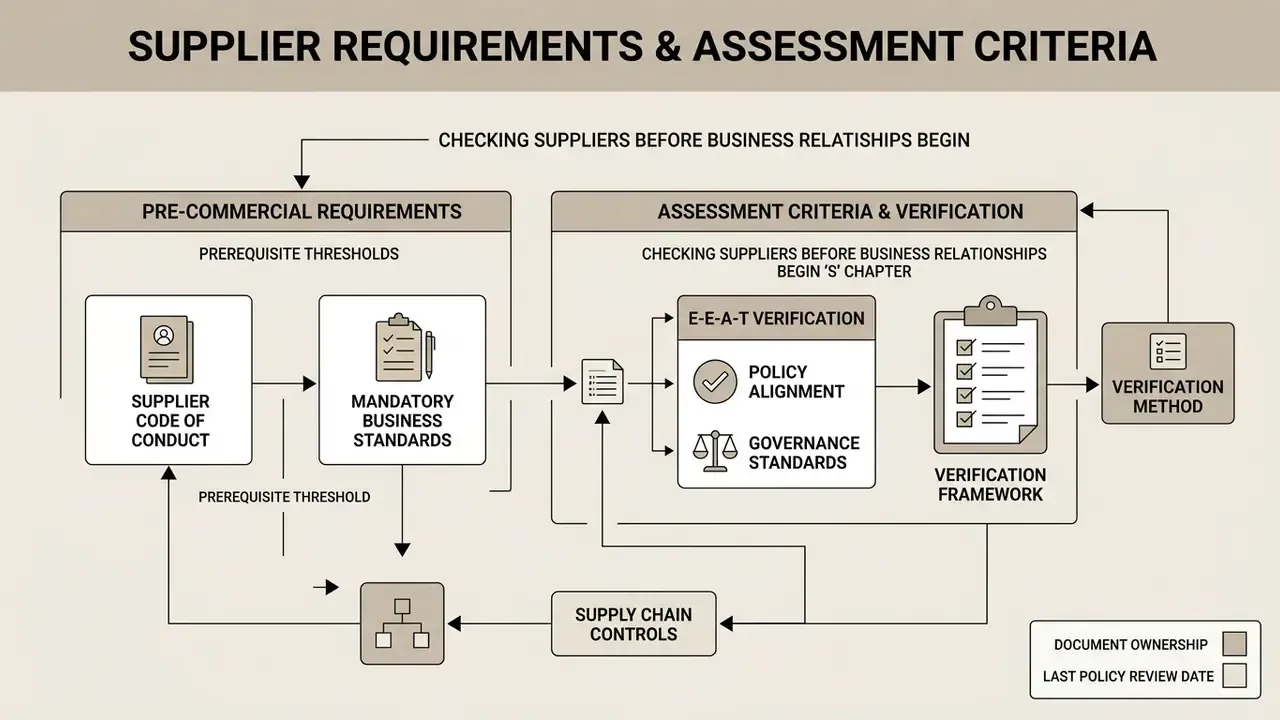
Sourcing policy requirements define the thresholds a vendor must meet before commercial negotiations begin. These criteria verify financial viability, operational capability, regulatory compliance, model governance readiness, and ethical alignment. Suppliers must meet them before access, not after go-live.
Supplier Code of Conduct and Mandatory Business Standards
A Supplier Code of Conduct is a legally binding document setting mandatory operational, social, and environmental standards. It is the baseline for every vendor relationship.
Modern supplier codes, including OpenText's 2026 Supplier Code of Conduct and the UN Supplier Code of Conduct (Rev. 07, September 2024), prohibit improper payments, extortion, fraud, collusion, and obstruction. They mandate accurate financial record-keeping and enforce environmental compliance. Dow's supplier code adds explicit prohibitions on forced and child labor, discrimination, and harassment, alongside traceability and sanctions controls. Richemont's supplier code requires due diligence across the chain for child and forced labor risk, and obliges suppliers sourcing minerals from high-risk areas to run a management system that prevents support to human rights violations.
Best practice is incorporation by reference. Name the supplier code as a binding annex in every purchase and sale contract for goods and services. Vendors sign it during onboarding and re-certify annually. Ethical business practices become enforceable only at that point.
Supplier Assessment Criteria and Verifying Information
«The platform published 47,000 sustainability scorecards and covers a network of 130,000 suppliers, helping buyers map risk across global value chains.»
For contextual reference on vendor documentation and governance frameworks, consult the internal Source Register. Data collected from these sources forms the empirical baseline for qualification.
E-E-A-T verification: policy alignment and governance standards
- Verification framework
- sourcing policy requirements are cross-referenced against the enterprise's primary governance controls. Those include the corporate Code of Business Conduct, standard procurement contract terms, model risk management policy, and international frameworks: ISO 20400, ISO/IEC 27036, NIST SP 800-161r1, and the Interagency Third-Party Risk Guidance (2023).
- Last policy review date
- February 2026.
- Document ownership
- Office of the Chief Procurement Officer and Lead Model Risk Oversight.
- Verification method
- all mandatory vendor clauses require annual legal verification and alignment with active regulatory requirements.
Due Diligence and Risk Assessment in Supplier Selection
Checking Suppliers Before Business Relationships Begin
Pre-contract due diligence verifies identity, financial health, regulatory standing, security capability, and resilience. It keeps high-risk entities out of operational workflows, which is far cheaper than removing them later.
Five-stage due diligence checklist for vendor onboarding
| Stage | Primary Objective | Key Information Collected | Verification Method |
|---|---|---|---|
| 1. Initial intake and identity verification | Confirm legal status, ownership, and corporate structure | Legal entity name, tax ID, registration address, UBO disclosures | Commercial registry checks, sanctions screening against OFAC and EU lists, adverse media review |
| 2. Policy alignment check | Verify compliance with mandatory business standards | Signed Code of Conduct, safety certifications, environmental and data-use policies | Document completeness review against policy thresholds |
| 3. Risk assessment and scoring | Quantify operational, legal, financial, cyber, and model risk exposure | Financial records, SOC 2 reports, EcoVadis or Sedex ratings, location risk data, model documentation | Weighted risk scoring model: low, medium, high, critical |
| 4. Enhanced investigation | Mitigate identified high-risk indicators before award | On-site social or cyber audit findings, sub-tier disclosures, resilience test results | Third-party audits, specialized technical, security, and legal evaluations |
| 5. Contract terms and approval | Finalize legal protections and monitoring terms | Audit clauses, termination rights, remediation timelines, SLA terms, exit plan | Legal sign-off, executive risk committee approval, model risk sign-off where applicable |
As set out in NIST SP 1326 (2024 draft, Cybersecurity Supply Chain Risk Management Quick-Start Guidance), due diligence means collecting verified findings from publicly available and commercially provided information, documenting them in a due diligence report, and assigning levels of concern against stated risk tolerance. That work happens before system access or contract execution. Review categories include foreign ownership, control, or influence, provenance, resilience, foundational cyber practices, and supply-chain tiering.
«Monitoring covered 3,212 sites, recording 8,043 non-compliances through social audits; tier-one suppliers in high-risk countries must complete independent audit before approval.»
Vendor Risk Tiering Matrix
Risk tier, not contract value alone, should determine assessment depth, approval authority, and monitoring cadence.
| Risk Tier | Trigger Criteria | Required Due Diligence | Monitoring Cadence | Approval Authority |
|---|---|---|---|---|
| Critical | Customer data processing, core process dependency, model or decision-support output, no ready substitute, regulator-relevant service | Full pre-contract package, on-site or virtual audit, resilience and exit testing, independent validation for models | Continuous monitoring plus quarterly review | Executive Risk Committee or board-level committee |
| High | Sensitive data access, high spend, high-risk geography, sub-tier concentration | Enhanced due diligence, audit rights exercised annually, remediation plan tracking | Semi-annual review | Chief Procurement Officer with Risk |
| Medium | Limited data access, standard services, moderate spend | Standard questionnaire, certification review, financial check | Annual review | Head of Procurement |
| Low | No data access, commoditized goods, low spend, easily substitutable | Identity, sanctions, and code-of-conduct acknowledgement | Renewal-based review | Procurement Specialist |
Risk-Oriented Decisions on Selection and Cooperation Terms
Risk scoring should drive contract structure, audit frequency, financial terms, and escalation rights. High-risk vendors need stronger protections and shorter review cycles. It is that simple, and it is routinely ignored under delivery pressure.
When evaluating vendor pricing and contractual adjustments over time, procurement teams should follow the standardized parameters described in the enterprise Pricing Update Policy.
Co-op's 2023 Modern Slavery Statement shows the same logic on the social side. Tier-one suppliers in high-risk geographies complete Sedex questionnaires and pass independent social audits before contract approval, and detected issues require documented corrective action plans instead of unmanaged onboarding. Aurubis' responsible sourcing policy applies a mirrored escalation path: pre-relationship screening, periodic re-checks, supplier engagement, then suspension or discontinuation once mitigation fails.
How to Implement a Sourcing Policy in the Procurement Process
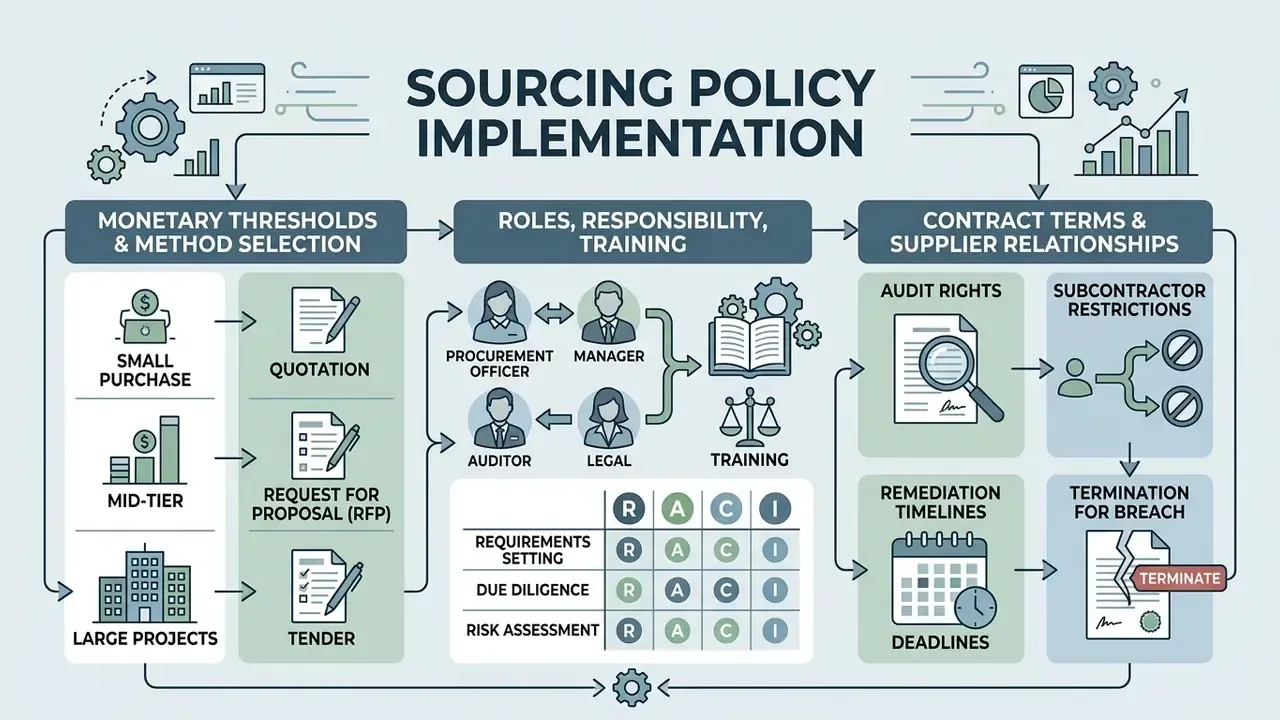
Implementation means integrating compliance checkpoints into daily procurement workflows, assigning clear ownership, publishing decision thresholds, and running targeted staff training. A sourcing policy guide that stops at drafting has done half the job.
Monetary Thresholds and Sourcing Method Selection
To balance efficiency with governance, procurement engagement follows published monetary thresholds. Competition requirements rise as estimated cost, risk, or profile rises.
| Spend Threshold (USD) | Mandatory Sourcing Method | Minimum Supplier Bids | Approval Authority |
|---|---|---|---|
| Micro-purchases, under $5,000 | Direct purchase, certification of best value, or price comparison | 1 verified quote | Department Manager |
| Small spend, $5,001 to $25,000 | Request for Quotes plus evaluation sheet | 3 written quotes | Procurement Specialist |
| Medium spend, $25,001 to $100,000 | Formal RFQ or competitive tender | 3 itemized proposals | Head of Procurement |
| Enterprise or high risk, above $100,000 | Request for Proposals plus evaluation plan, team, and sheet | 3 or more evaluated bids | Executive Risk Committee |
| Sole source, any value | Non-competitive justification form | Documented justification, no competition | Chief Procurement Officer with Compliance |
Thresholds may also be set by purchase risk (preferred-vendor purchases versus product purchases versus services purchases), by purchase profile (routine office supplies versus events and conference spend), or by purchase type (hotel and catering contracts versus renewals). Any AI, data, or customer-facing technology purchase should escalate to RFP-level evaluation regardless of value. Risk drives assurance depth. Price does not.
Roles, Responsibility, and Training for Process Participants
Implementation depends on clear governance roles across procurement, legal, risk, model risk, and the business. Corporate sourcing policies typically assign overall accountability to Supply Chain Management leadership, delegate implementation to executives within their areas, and make every employee responsible for compliance in their own role.
RACI implementation matrix for sourcing policy governance
| Procurement Activity | Procurement Team | Business Unit Lead | Risk and Compliance | Model Risk / AI Governance | Legal Counsel | Supplier |
|---|---|---|---|---|---|---|
| Define requirements and scope | C | A / R | C | C | I | I |
| Select sourcing method (RFI, RFQ, RFP, sole source) | A / R | C | C | I | C | I |
| Conduct pre-contract due diligence | A / R | C | C | C | C | P |
| Risk scoring and tiering | R | C | A | C | I | P |
| Model or AI vendor validation review | C | C | C | A / R | C | P |
| Negotiate contract terms | A / R | C | C | C | A / R | P |
| Ongoing SLA and audit monitoring | A / R | R | C | C | I | P |
| Exit and offboarding execution | A / R | R | C | C | C | P |
Legend: A = Accountable, R = Responsible, C = Consulted, I = Informed, P = Participant or Provider.
Training must be mandatory for everyone authorized to commit company funds. Sustainable procurement templates assign the responsible entity to develop and deliver training for employees and stakeholders. Charoen Pokphand Foods requires every new purchasing employee to complete Sustainable Sourcing Policy training with periodic refreshers. Co-op's ethical trade practice uses e-learning modules and procedural guidance so buyers apply ethical screening and risk assessment correctly while they are actually making purchasing decisions. Timing matters more than content volume here.
Establishing Requirements in Contract Terms and Supplier Relationships
Policy standards become binding when they sit inside master service agreements, data processing agreements, and purchase order terms. Not in an intranet PDF.
Key legal provisions include:
- Audit rightsclauses granting the enterprise or independent auditors access to vendor facilities, systems, and compliance records.
- Subcontractor and sub-processor restrictionswritten approval required before outsourcing key service components or changing downstream providers.
- Remediation timelinesexplicit windows, for example 30 days, for resolving audit non-compliances, with documented improvement evidence.
- Termination for breachimmediate right to terminate without penalty on confirmed violation of anti-corruption, sanctions, data protection, or human rights clauses.
- Information and resilience rightsaccess to supplier financial information, continuity plans, and incident notification inside defined timeframes.
- Standard templates and legal reviewuse approved templates. Where supplier paper is used, legal, risk, and technical experts review and agree terms before signature.
Formal supplier relationship management, often shortened to SRM, then tracks contract performance continuously to catch operational breaches early. Contentious terms should be settled before contract start, and change control runs through the whole lifecycle. Contract management is where most value leaks quietly.
«Despite rising corporate awareness, robust empirical evidence on the real-world impact of mandatory due diligence laws on workers' rights remains limited.»
The implication is uncomfortable but useful. Clauses alone do not deliver outcomes. Verification, monitoring, and enforcement decide whether policy has any effect at all.
Performance Monitoring and Responding to Policy Breaches
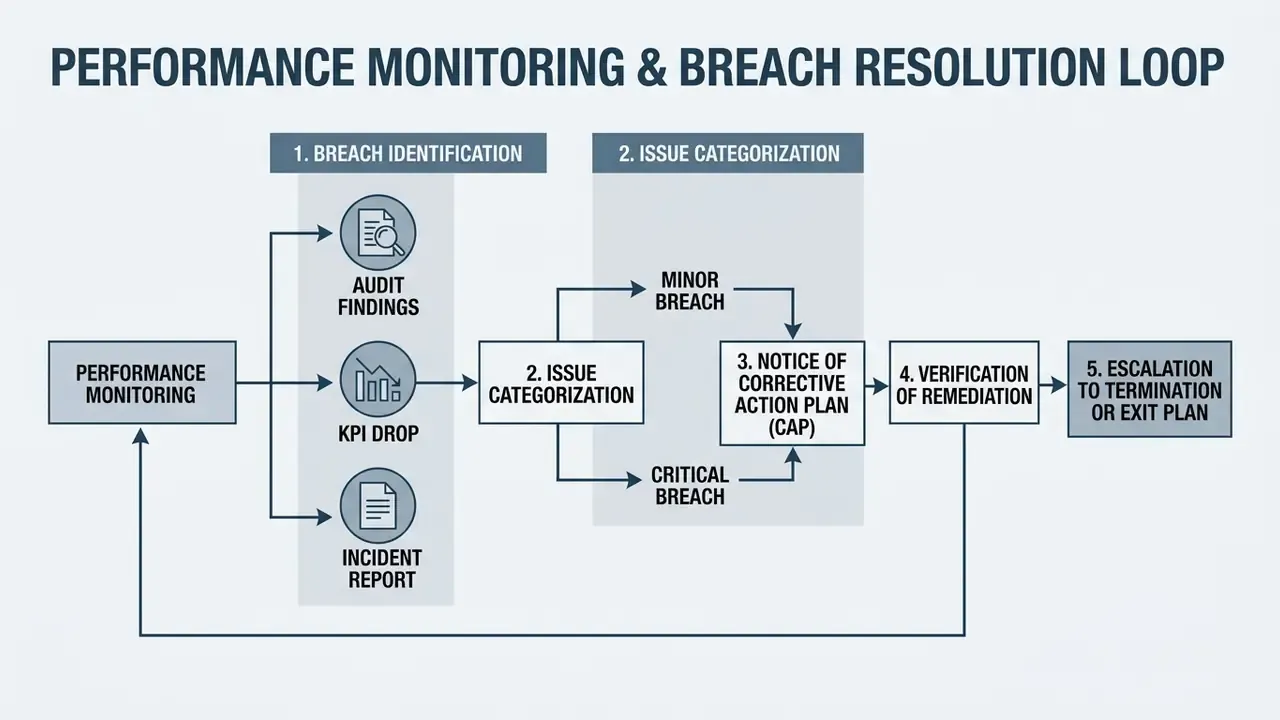
Continuous monitoring keeps suppliers inside compliance standards for the full contract lifecycle. It detects operational decline, security weakness, and policy breach before customers feel it.
Performance Assessment and Reviewing Supplier Relationships
Performance reviews combine qualitative SLA tracking with quantitative compliance audits. ISO/IEC 27036-2 provides the governance basis for implementing, operating, monitoring, reviewing, maintaining, and improving supplier relationships. NIST SP 800-161r1 adds audit record review, analysis, and reporting as explicit supply-chain risk management activities.
Response depends on severity:
- Minor non-compliance formal written notice requiring a Corrective Action Plan within 30 days, followed by re-audit verification.
- Repeated SLA failures staged escalation through performance meeting, formal written warning, and notice of unsatisfactory performance, plus financial penalties or renegotiation.
- Critical breaches confirmed bribery, sanctions violations, severe human rights abuse, or a catastrophic data breach trigger immediate suspension and a responsible exit plan.
Danone's 2024 Sustainable Sourcing Policy requires suppliers to self-report actual or suspected breaches and to submit prompt remediation plans with clear timeframes. Failure to notify is treated as a breach in itself. Borregaard's responsible sourcing procedure adds a nuance that matters in complex chains: a detected breach should not automatically end the relationship where a termination right exists. Severity is assessed first. The normal response is requirements, dialogue, and guidance, with termination reserved for severe breaches or an absence of progress over time.
Sandvik's 2023 sustainability reporting shows the enforcement end of the loop in practice. Independent third-party audits led to termination of two vendor contracts after violations went uncorrected. Enforcement, when documented, is what makes the rest of the policy credible.
Vendor Offboarding and Exit Strategy
Limitations and Open Questions
A short note on what this guide cannot settle. Threshold values shown here are illustrative and must be calibrated to your balance sheet, spend profile, and risk appetite. Evidence on the effectiveness of mandatory due diligence regimes is still thin, as the 2024 evidence review states directly. Supervisory expectations for agentic AI vendors remain under development, so parts of the control set are reasoned extensions rather than codified requirements. Where your own analytics, audit findings, or interviews contradict the patterns described here, trust your data.
FAQ: Sourcing Policy Questions
What is the difference between a sourcing policy and a procurement policy?
A procurement policy usually covers the full acquisition process, including requisitioning, purchasing authority, and payment. A sourcing policy focuses on how suppliers are identified, qualified, competed, contracted, and monitored. Many organizations merge both into one governance manual, which is fine as long as authority limits stay unambiguous.
Who owns the sourcing policy?
Ownership sits with the Chief Procurement Officer, Head of Global Procurement, or Chief Supply Chain Officer. Published examples also name a Sustainability Director or Head of Operations as document owner, with annual or board-cycle review.
How often should a sourcing policy be reviewed?
Annual review is the prevailing standard. Some organizations tie review to a Q4 board meeting each financial year. Underlying risk assessments should be refreshed at least every two years, and immediately when circumstances change.
When is sole sourcing acceptable?
Only for one-of-a-kind capability, a bona fide emergency, a vendor mandated under a grant or regulation, or a documented continuity-of-work need. Always with a signed justification form. Weak internal planning is never a valid basis.
Do sourcing policy requirements apply to low-value purchases?
Yes. Thresholds change the method of competition. They do not switch off ethical, sanctions, data protection, or code-of-conduct requirements.
How should AI and SaaS vendors be handled differently?
Escalate them by risk tier rather than spend. Require data-use restrictions, sub-processor disclosure, model documentation sufficient for independent validation, incident and change notification, and certified deletion on exit.
Is ISO 20400 certifiable?
No. ISO 20400:2017 is guidance for integrating sustainability into procurement, not a certifiable requirements standard. Corporate policies built on it can still be operationally binding and fully auditable.
Corporate Sourcing Policy Document Structure: Ready-to-Use Template
When drafting an enterprise sourcing manual, include the following sections:
Checklist0 / 9
Document control and policy currency register
- Document title Enterprise Corporate Sourcing Policy and Third-Party Governance Framework.
- Document owner Chief Supply Chain Officer or Head of Global Procurement, with joint sign-off from Lead Model Risk Oversight for technology and AI categories.
- Review frequency annual, mandatory Q1 review cycle, with risk assessments refreshed at least biennially.
- Effective date March 1, 2026.
- Linked industry standards ISO 20400:2017 (Sustainable Procurement), ISO/IEC 27036-1:2021 and 27036-2:2022 (Information Security for Supplier Relationships), NIST SP 800-161r1 (Cyber Supply Chain Risk Management), NIST SP 1326 (2024 draft), OECD Due Diligence Guidance, UN Supplier Code of Conduct Rev. 07 (2024), Interagency Guidance on Third-Party Relationships (2023).
A safe next step, if you are starting from a blank page: pull your last twelve months of technology spend, tag every line that touches customer data or model output, and see how many of those vendors passed a documented intake. That number is your real baseline.
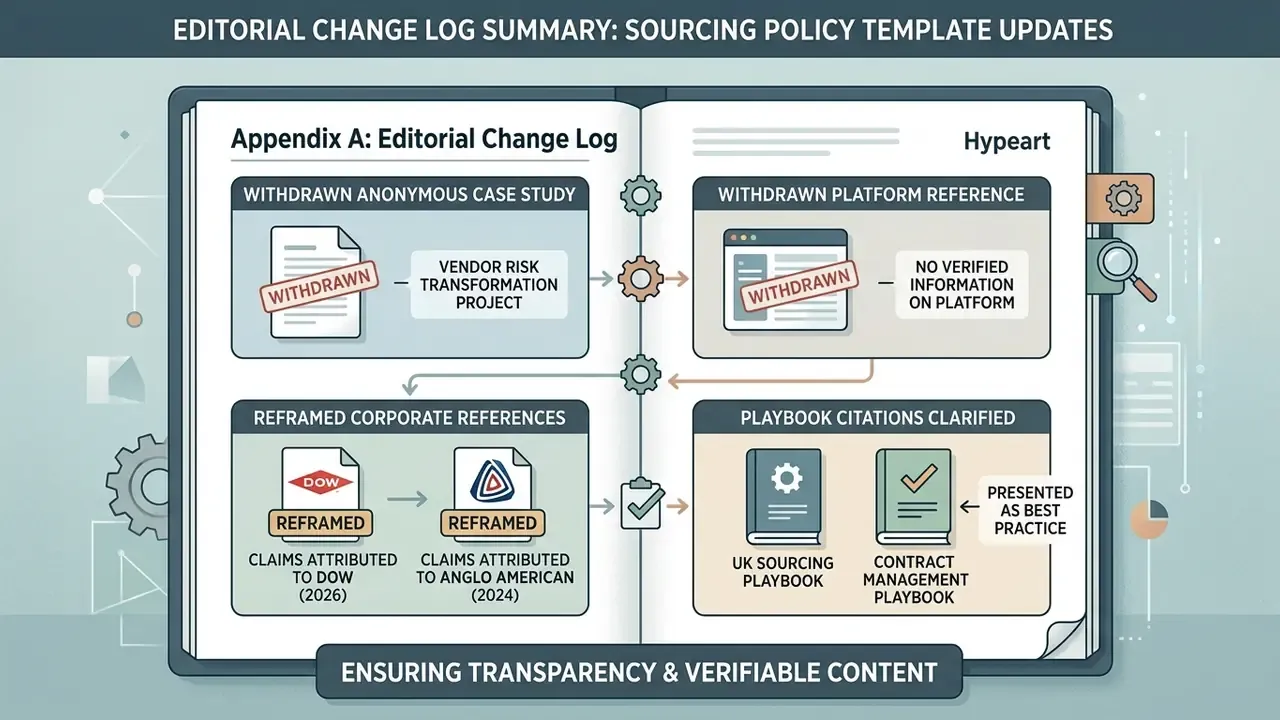
Appendix A: Editorial Change Log