Selecting the best free ai chatbot with no filter requires balancing response quality, message limits, and data privacy. While commercial providers market "uncensored" experiences, operational boundaries always exist at the platform, hosting, or legal level.
There is a second reason this category matters. In regulated environments, an unfiltered consumer chat window is one of the cheapest ways for confidential data to leave the building. No procurement. No login, in one case. No log trail. So this comparison serves two readers at once: the individual choosing a tool, and the risk owner deciding whether to allow it.
Executive Summary: What Buyers Actually Get
- "No filter" is a product claim, not a legal category. Platforms suppress front-end refusal classifiers, but hosting law, payment-processor rules, and core terms of service remain in force. Google's Generative AI Use Policy (2026) still prohibits illegal activity, CSAM, non-consensual imagery, and safety-filter circumvention.
- Free and unlimited rarely coexist. Hosted web platforms cap non-paying accounts at roughly 20–70 messages per day (or per rolling 2.5–3 hours), truncate memory, and throttle latency. The only genuinely unlimited, zero-cost path is local execution of open-weight models on your own hardware, which needs at least 8GB of RAM/VRAM for quantized 7B–8B models.
- Removing filters often costs intelligence. Aggressive de-alignment strips reasoning quality alongside refusals: expect more narrative drift, context loss, and hallucination in fully uncensored weights than in safety-aligned engines of the same parameter scale.
- Privacy posture is the single largest differentiator. Local stacks (Pygmalion via SillyTavern, FreedomGPT, Ollama, LM Studio) transmit nothing externally; commercial platforms log chats, and independent research shows leading chatbot developers default to training on user conversations.

Who This Comparison Is For
What Are AI Chat Apps With No Filter?
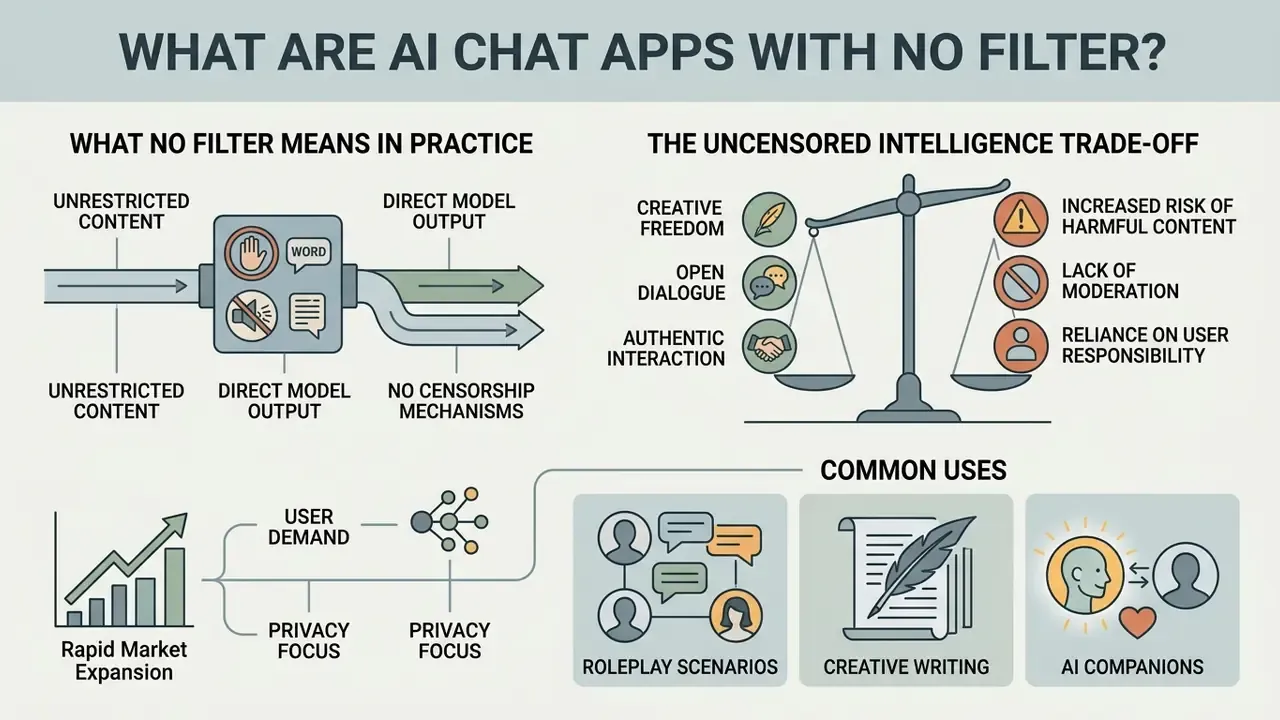
Driven by user demand for unrestricted creative tools and strict privacy, the broader market for conversational AI is undergoing rapid expansion. Vendor-side trackers cite growth from $9.56 million in 2025 to over $41.29 million by 2033 at a compound annual growth rate (CAGR) of 23.3% for the specific segment they measure. Note that aggregate conversational-AI market estimates across major research houses sit in the multi-billion-dollar range, so segment-level figures should be read as narrow slices rather than totals. Concurrently, consumer sentiment research indicates that the large majority of digital users harbor privacy concerns about how cloud-hosted AI providers store and process personal interaction logs.
«81% of consumers think the information collected by AI companies will be used in ways people are uncomfortable with.»
That distrust is precisely what accelerates the shift toward uncensored, zero-telemetry, and locally hosted platforms.
AI chat apps with no filter are conversational software interfaces connected to language models where standard refusal guardrails have been relaxed or removed. Unlike mainstream consumer assistants that block queries touching on sensitive themes, unfiltered ai platforms allow broader dialogue parameters for roleplay, adult content, and complex creative narratives.
Users searching for no filter ai chat apps typically encounter two distinct architectures: third-party web platforms built on de-aligned models, and self-hosted open-source software. Understanding the operational distinction between superficial UI adjustments and true model-level de-alignment is essential when evaluating these tools. The two are not interchangeable, and the risk profiles diverge sharply.
What "No Filter" Actually Means in Practice
In practical terms, "no filter" refers to a reduction in front-end system refusals rather than a complete absence of operational rules. Platforms offering uncensored ai typically suppress the pre-processing and post-processing safety classifiers that flag standard text queries.
Technically, the difference is a single missing layer in the request pipeline. A filtered stack routes prompt → moderation layer → LLM → restricted output. An unfiltered stack routes prompt → LLM → raw response. Everything else, meaning account rules, hosting jurisdiction, and payment terms, stays identical.
However, operating "without restrictions" rarely equates to total legal or infrastructure immunity. As outlined in the Google Generative AI Use Policy (2026), platform hosts remain strictly bound by laws prohibiting illegal activities, non-consensual imagery, child exploitation, and severe safety violations. A service claiming to be an ai chat platform without content restrictions merely shifts moderation boundaries outward, retaining core terms of service and basic privacy policy controls at the infrastructure level.
The scale of this ecosystem is measurable rather than anecdotal:
«Analysis identified 3,471 original uncensored models on HuggingFace, each repackaged on average 2.4 times, 8,164 quantized redistributions in total.»
«Uncensored models comply with roughly 74.1% of unsafe requests in safety benchmarks, while aligned counterparts show substantially lower compliance rates.» Source: Chao et al., Uncensored Open-weight Models: Redistribution as the Persistence (preprint, 2026)
The Uncensored Intelligence Trade-Off
A critical technical compromise in unfiltered systems is the balance between refusal removal and overall reasoning capability. Standard Reinforcement Learning from Human Feedback (RLHF) aligns models for both safety and multi-step logic simultaneously. When fine-tuners aggressively strip safety guardrails to produce "uncensored" weights, they frequently degrade the model's complex instruction-following capabilities as collateral damage. Users should expect that fully de-aligned open-weight models may exhibit higher rates of narrative drift, context loss, and logical hallucination compared with safety-aligned commercial engines of equivalent parameter scale.
Independent long-run testing reaches the same conclusion in plainer language. Reviewers who spent months comparing unfiltered platforms report that removing the content filter usually makes the assistant measurably less coherent, and that several services became more permissive and less capable in the same release cycle. Treat "zero restrictions" as a trade, not a free upgrade. The platforms that avoid this penalty are generally those running large, well-maintained backends with front-end moderation disabled, rather than crudely de-aligned small models.
Common Uses: Roleplay Scenarios, Creative Writing and AI Companions
Unfiltered conversational ai platforms are predominantly deployed across three primary consumer use cases: immersive roleplay scenarios, long-form creative writing, and digital companionship. Mainstream systems frequently interrupt creative fiction when narrative prompts touch on dark themes, intense drama, or romantic intimacy.
According to a European Parliament briefing on AI companions (2026), conversational models are increasingly used for social interaction, emotional support, and personalized narrative simulation. The same briefing describes companions as LLM chatbots built for personalized, emotionally engaging exchanges including role-play, flirty, friendly, or deliberately abrasive conversation styles. The U.S. Congressional Research Service report AI Chatbots as Companions (2026) frames the category around humanlike interaction, entertainment, and intimacy.
A 2026 survey cited in industry research noted that roughly 9% of AI companion users specifically utilize these tools for sexual chat or intimate roleplay. That survey figure is self-reported and its full methodology is not public, so it should be read as directional rather than precise. Model-repository analysis supports the same direction of travel:
«Researchers catalogued 267 "uncensored", 29 NSFW and 21 "obscene" models on model-sharing platforms, many purpose-built for erotic roleplay.»
Unfiltered systems accommodate user created personas, custom backstory scripts, and specialized character chat configurations that standard tools reject outright. For many readers, that single behaviour is the whole reason they left the mainstream assistant behind.
How We Compare No-Filter AI Chat Apps
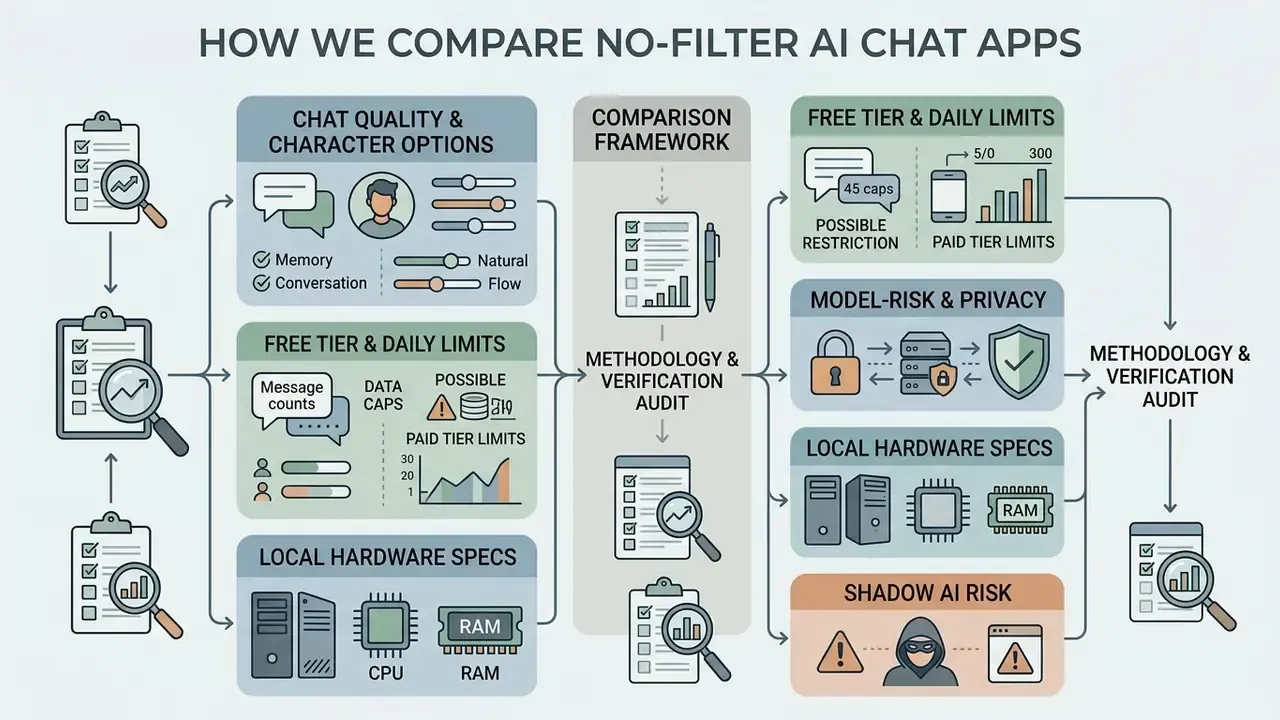
Evaluating unfiltered conversational tools requires a structured model-risk and performance framework. Rather than relying on promotional marketing, platforms must be measured across verifiable metrics including chat experience quality, memory retention, character library diversity, and operational cost structures.
Our benchmark methodology assesses five core operational criteria:
- Model architecture and context window: evaluation of the underlying LLM family, parameter scale, and token memory capacity.
- Response speed and latency: real time generation performance measured under peak and off-peak server loads.
- Character customization and library: availability of pre-built character cards and depth of user created character tools.
- Usage limits and monetization: clarity of free tier message allocations versus paid tier upgrades.
- Data governance and privacy: storage policies, chat history retention, and third party API data-sharing terms.
Chat Quality, Memory and Character Options
The conversational depth of any ai chatbot depends heavily on its context window and persona consistency. In long term character chat, a small context window causes the model to forget prior narrative events, leading to character break and repetitive responses.
Technical work on LLM roleplay shows that persona stability is an engineering problem rather than a matter of prompt wording:
«Ditto, trained on 4,000 characters, demonstrates stable role identity and accurate character knowledge across multi-turn dialogue, outperforming baseline open-source models.»
Role-play tuning also carries a safety cost that buyers of "uncensored" products should price in:
«Role-play fine-tuning without safety consideration produces a marked drop in safety metrics, with villainous personas generating significantly more harmful content.»
Latency is the third variable. Agent-latency research published on arXiv in 2025 reports that response delays above roughly 4.0 seconds noticeably degrade perceived conversation quality, with delays near 6.5 seconds rated worst by participants. The paper measures perceived quality in free-form conversation rather than task accuracy, so treat the threshold as a UX guideline, not a hard specification. Production memory-system benchmarks such as Mem0 (arXiv, 2025) separate search latency from total generation latency, which is why two platforms on the same base model can feel completely different in a live scene. That makes model execution speed a vital selection factor for real time interactions. Readers building visual companions alongside text chat can compare output engines in our review of AI image generators.
Free Tier, Daily Messages and Paid Tier Limits
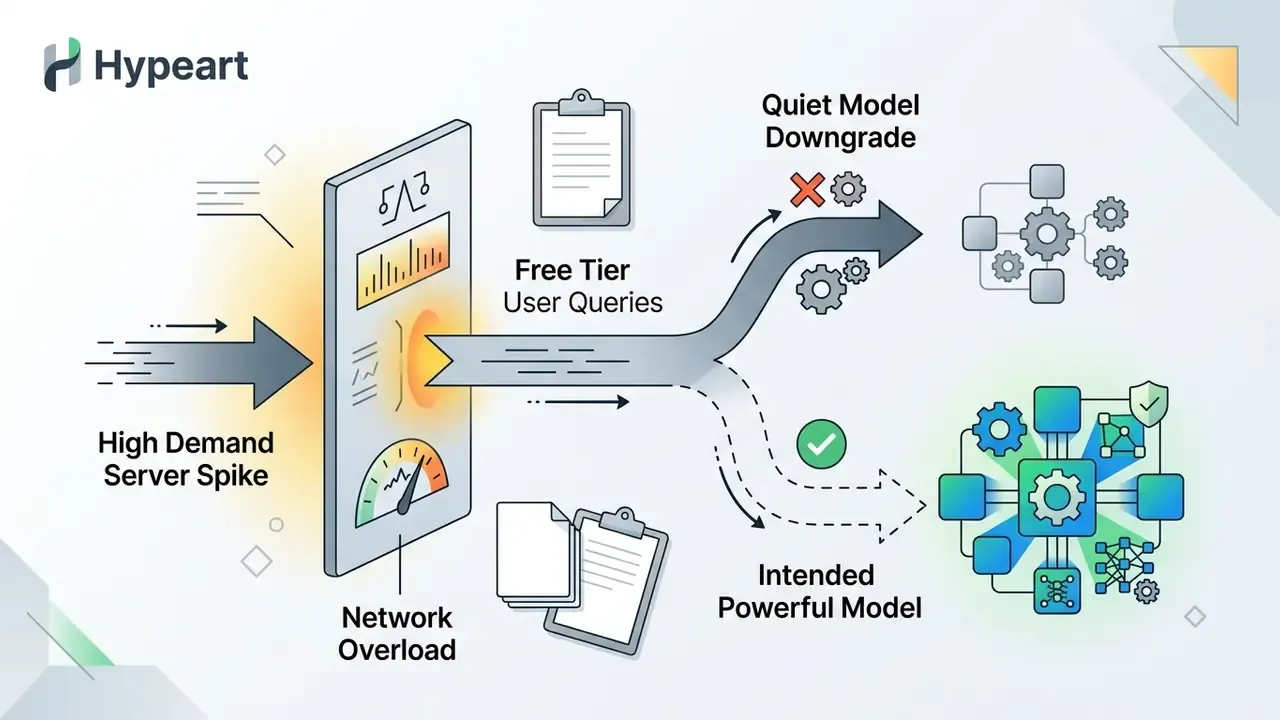
Monetization structures among no-filter providers range from genuinely free open-source frameworks to restrictive freemium tiers. Most commercial platforms offer a basic free tier that imposes a daily messages cap or places users in processing queues during high-traffic hours.
For example, while general platforms like ChatGPT Free state "unlimited everyday text chats" with basic abuse safeguards (OpenAI Help Center, 2026), specialized uncensored platforms typically restrict non-paying accounts to 20–70 messages per day or reset quotas every few hours. Vendor-side examples vary widely: some Telegram-based uncensored bots advertise 20 free messages per day, while several regional services grant only three trial generations before payment. Upgrading to a paid tier removes usage limits, unlocks faster responses, extends memory retention, and enables multi-modal features like image generation.
Methodology and verification audit:
AI Chat Apps With No Filter: Comparison Table
The following comparison synthesizes access models, usage limits, media capabilities, and privacy postures across the leading unfiltered chat platforms.
Comparative assessment of no-filter AI chat platforms (2026 audit data)
| Platform | Access format | Free tier limits | Daily messages | Content restrictions | Character library | Image generation | Privacy policy and data handling | Paid tier pricing |
|---|---|---|---|---|---|---|---|---|
| Janitor AI | Web browser / API proxy | Free on JanitorLLM; API costs apply for external models | Unlimited on native model; key-dependent for third party | Minimal on native model; relies on connected API rules | Extensive (100k+ user created cards) | Not built in natively | 7-day data retention on basic tiers; no model training on user uploads | Free native / paid third party API usage |
| CrushOn AI | Web browser / mobile app | 100 message credits per month plus 20 daily Inspiration replies | Capped on free credits | Relaxed NSFW filters on adult characters | Large (10,000+ public personas) | Paid tier feature | Stores chat logs; free-tier history clears after 7 days of inactivity; terms permit broad commercial data processing | From $5.99/month |
| Chai AI | Mobile app (iOS/Android) / web | Timed free allowance | ~70 messages per 2.5–3 hours | Moderate; blocks extreme illegal content | Vendor-reported 25M+ user created characters (marketing claim, not independently audited) | Available in-app | Collects usage analytics; mobile app telemetry enabled | $9.99/wk or $159.99/yr (CHAI MAX add-ons billed per 1,000 tokens) |
| SpicyChat AI | Web browser | Free tier access with peak-time queues (30 seconds to tens of minutes) | Unlimited basic text chat (queued during high traffic) | Unfiltered adult roleplay permitted | Extensive community catalog (30,000+ community bots) | Paid tier feature | Stores conversation history; opt-out required for training data | Multiple subscription tiers |
| Pygmalion AI | Self-hosted / local / open source | 100% free (Apache 2.0) | Unlimited (hardware dependent) | Unrestricted model weights (zero internal filters) | User-imported character cards (SillyTavern and similar) | Supported via local Stable Diffusion integration | Complete user privacy; zero data transmitted to third parties | Hardware and electricity costs only |
| Venice.ai | Web browser (no login required) | Free basic access; no account needed | Unlimited basic requests / rate-limited peak hours | Zero browser-level filters; relies on open weights | Standard base prompt templates | Supported on free tier | Zero log retention; no personal identity tracking | Free / optional Pro plan (~$8/mo) |
| Kindroid | Web browser / mobile app | Strictly limited trial context | Capped daily trial messages | Unfiltered on paid plan; highly coherent persona engine | User-defined complex backstories (no public cards) | Integrated image and voice generation | Encrypted chat logs; strictly private database isolation | From $9.99/month |
| FreedomGPT | Desktop app (Windows/Mac) / local | 100% free offline execution | Unlimited (local hardware dependent) | Zero restrictions (runs fully uncensored local weights) | Custom character importing (JSON / card format) | Requires local Stable Diffusion integration | 100% on-device processing; zero external server transmission | Free offline / optional cloud execution |
Shadow AI and Compliance Risk Posture
Consumer unfiltered platforms are not enterprise software. The matrix below summarizes the governance attributes a model-risk or security team asks for first.
| Platform | SOC 2 / ISO attestation | Stated log retention | Chats used for training | Corporate risk rating |
|---|---|---|---|---|
| Janitor AI | Not published | 7 days (basic tier uploads) | No training on uploaded data files (per policy) | High |
| CrushOn AI | Not published | Stored; free history clears after 7 days inactivity | Permitted under broad commercial terms | High |
| Chai AI | Not published | Not clearly disclosed | Analytics and telemetry collected | High |
| SpicyChat AI | Not published | Stored indefinitely unless deleted | Yes, unless manual opt-out | High |
| Venice.ai | Not published | Stated zero retention | No | Medium |
| Kindroid | Not published | Encrypted, account-scoped | Not disclosed for training | Medium |
| Pygmalion / FreedomGPT (local) | Not applicable (self-hosted) | 0 days, local disk only | No transmission off-device | Low (device security dependent) |
Independent academic review of mainstream chatbot data practices explains why the "High" ratings cluster:
«All six leading AI chatbot developers use consumer chat data to train models by default, sometimes retaining it indefinitely, and most take no steps to exclude children's data.»
Privacy, Safety and Shadow AI Risk
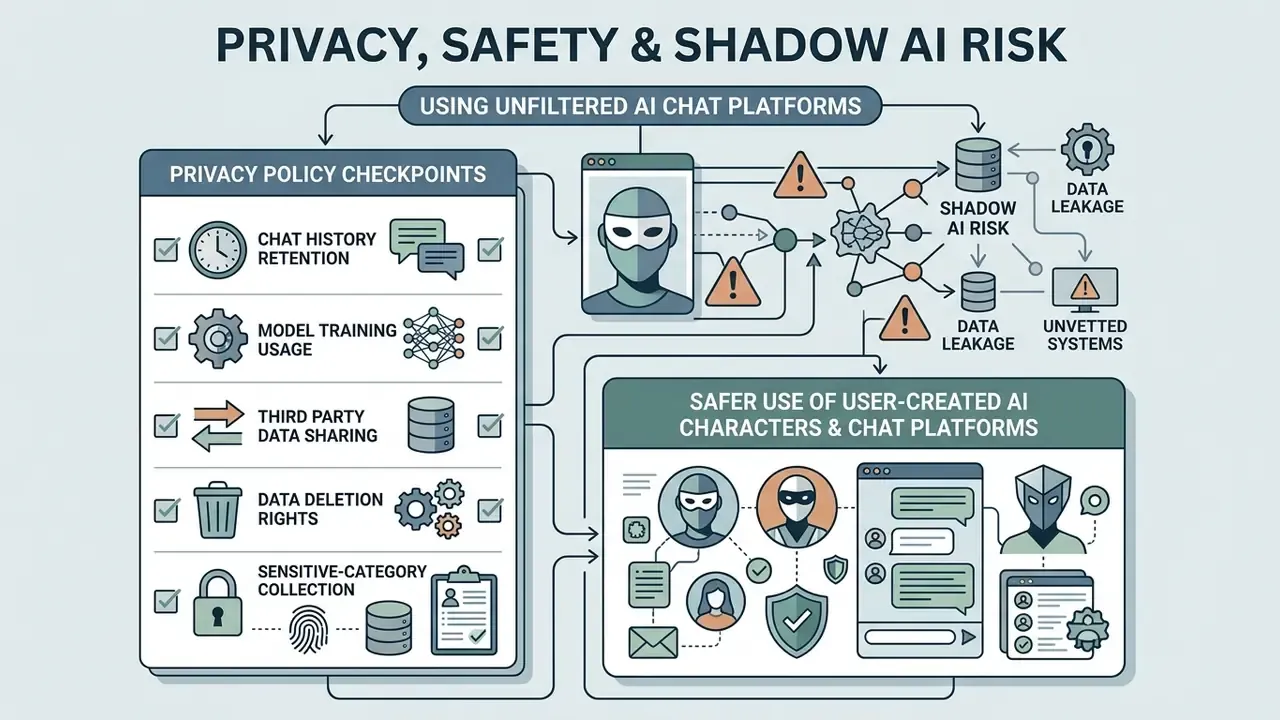
Using unfiltered ai chat platforms introduces distinct privacy and security considerations that differ from enterprise-grade cloud software. Because many uncensored sites operate with minimal regulatory oversight, users must exercise heightened digital hygiene when sharing personal details.
What to Check in a Privacy Policy Before You Chat
Prior to registering an account or initiating dialogue on an unfiltered chat platform, examine the provider's privacy policy for the following disclosures:
- Chat history retention check whether conversation logs are stored temporarily (for example, deleted after 7 to 30 days) or retained indefinitely on remote servers.
- Model training usage determine if user inputs and uploaded files are automatically ingested to train future commercial models.
- Third party data sharing verify whether chat transcripts, IP addresses, or device identifiers are shared with advertising networks or data brokers.
- Data deletion rights ensure the platform provides explicit account and chat log deletion mechanisms in compliance with data protection standards like GDPR or CCPA.
- Sensitive-category collection some consumer companion apps disclose collection of health or intimacy-related data and reserve broad commercial reuse rights, a category the U.S. FTC expects to be disclosed explicitly.
«All six leading AI chatbot developers use user chats to train models by default; most take no steps to exclude children's data from training sets.»
For reference, Google Play's privacy-policy requirements oblige developers to disclose collected and shared data, secure handling, and retention or deletion practices, and to link the policy in both the Play Console and inside the app. A no-filter service distributed only over the web is not bound by that store gate, which is exactly why manual policy review matters more here than with app store software.
Safer Use of User-Created AI Characters and Chat Platforms
Interacting with user created characters on public web platforms requires cautious operational behavior. Public character cards may contain embedded system prompts or third party web links designed to execute prompt injection or redirect users to untrusted external sites.
As documented in NIST AI Risk Management Framework publications (NIST AI 600-1, Generative AI Profile, 2024), generative conversational systems are vulnerable to indirect prompt injection and data extraction attacks. The profile requires periodic monitoring of AI-generated content for privacy risk and possible exposure of personal data. GAO-25-107651 (2024) adds that prompt injection can be used to exfiltrate sensitive data and trigger unauthorized actions.
«Manipulating system messages and role tokens inside instruction templates can elicit unsafe responses from aligned LLMs without modifying their weights.»
Users should avoid pasting sensitive operational details, credentials, or personal identifiers into public chat windows. Harm is not hypothetical, even on mainstream companion apps:
«Analysis of 800 Google Play reviews of Replika surfaced user complaints of sexual harassment by the chatbot, even without explicit NSFW configuration.»
Shadow AI Checklist for Security and Model-Risk Teams
Best No-Filter AI Chat Apps to Try
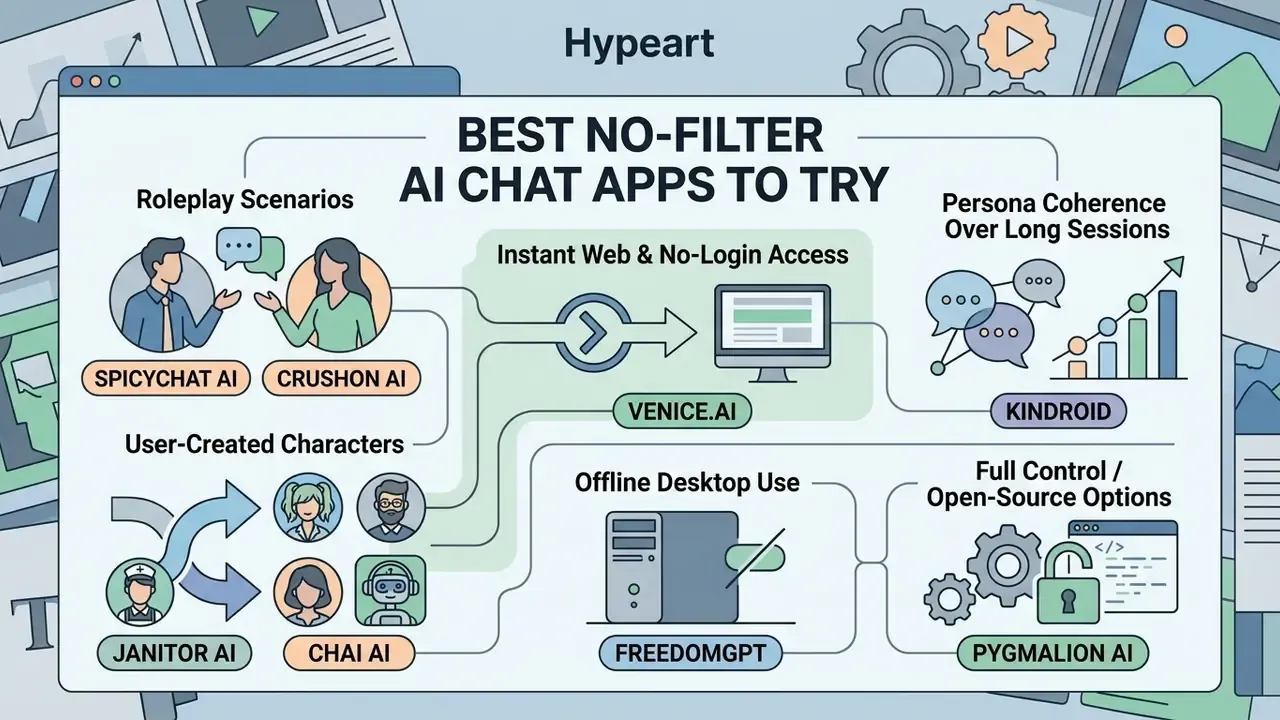
Selecting among the best ai chat apps with no filter depends on whether your priority is immediate accessibility, community character libraries, multimodal media, or complete data privacy. Commercial browser apps offer instant access, whereas open source frameworks provide total operational control.
SpicyChat AI and CrushOn AI for Roleplay Scenarios
SpicyChat AI and CrushOn AI cater directly to immersive adult roleplay scenarios and digital companion experiences. SpicyChat AI provides a highly accessible web interface where free users can interact with community-created bots, though peak-hour usage requires waiting in an automated queue. Reviewers report waits ranging from roughly 30 seconds to tens of minutes. As documented in SpicyChat's own product documentation (docs.spicychat.ai, 2026), free accounts operate with a 4,096-token context window and basic character creation options, while the platform runs more than ten selectable models across tiers. Note that community reviews disagree on whether NSFW access is fully available on the free tier; snapshots differ by review date.
CrushOn AI emphasizes ai companion and ai girlfriend interactions through an expansive persona catalog. Its official pricing structure provides 100 message credits per month on the free tier alongside 20 daily Inspiration Replies, 10 character cards, and one voice slot, plus access to over 10,000 character cards. Free chat history clears after seven days of inactivity. Users seeking extended memory retention and multi-modal image generation can upgrade to paid subscriptions starting at $5.99 per month. Independent reviews note that image generation is paid-tier only, while voice appears in the free allocation.
Janitor AI and Chai AI for User-Created Characters
Janitor AI and Chai AI represent two of the largest ecosystems for user created ai characters. Janitor AI stands out by offering a free front-end interface running on its proprietary JanitorLLM. Additionally, through its "janitor+ Router" and API integration options, advanced users can connect third party ai models directly, such as Claude, DeepSeek, OpenRouter, or OpenAI keys, allowing full control over the underlying reasoning engine without configuring an external proxy. Character creation is free: the builder accepts a bot image, name, tags, personality block, and opening message, with documentation recommending bots stay under roughly 2,500 permanent tokens.
Chai AI focuses on a mobile-first chat experience available on iOS and Android. The platform markets a very large library of user created characters. The frequently repeated "25 million" figure is a vendor marketing claim rather than an independently audited number, and should be read that way. Setup is no-code: name, opening message, personality traits, backstory. Free access operates on a rolling message cap (approximately 70 messages every 2.5–3 hours), with premium subscriptions removing rate limits and disabling in-app advertisements.
Instant Web and No-Login Access: Venice.ai
For users seeking immediate, friction-free privacy, Venice.ai offers a web-based unfiltered AI experience that requires no user registration or account creation. Unlike traditional platforms that require email authentication and retain query logs, Venice.ai processes requests via privacy-focused open-weight models. It applies zero platform-side telemetry, meaning user prompts and generated outputs are neither tied to a persistent identity nor stored for downstream model training. That makes it an optimal entry point for one-off private research and unrestricted creative writing without leaving a digital footprint.
Practical caveats: because there is no account, there is also no saved chat history, no cross-device continuity, and no long term persona memory. Peak-hour rate limiting applies on the free tier, and an optional Pro plan (around $8/month) raises throughput. From a governance angle, the absence of an account layer is simultaneously the privacy feature and the audit problem. No login means no attributable log trail for organizations that need one.
Kindroid for Persona Coherence Over Long Sessions
Kindroid is the option to test when conversation quality matters as much as the absence of filters. Instead of browsing a public character catalog, users author their own persona description: traits, speech patterns, backstory, behavioural quirks. In long-session testing by independent reviewers, Kindroid held a consistently written persona across multi-hour conversations where cheaper unfiltered platforms drifted after roughly 20 messages. It also integrates voice customization and image generation on paid plans, starting at $9.99/month, with a strictly limited trial. The trade-off is setup effort and a much smaller community than SpicyChat, since there is no pre-made library to import from.
FreedomGPT for Offline Desktop Use
FreedomGPT occupies the middle ground between hosted web chat and a full developer stack: a desktop application for Windows and macOS that runs uncensored open weights locally, with optional cloud execution. Because inference happens on-device, no prompt or response is transmitted to an external server, and there is no message cap beyond what your hardware sustains. Character imports use standard JSON or card formats, and image generation requires wiring in a local Stable Diffusion install. It is the simplest route to an offline no-filter assistant for users who would rather not touch a terminal.
Pygmalion AI and Open-Source Options for Full Control
For users prioritizing privacy and zero content censorship, Pygmalion AI and self-hosted open source models represent the gold standard. Released under the Apache 2.0 license, Pygmalion model weights (such as Pygmalion-3-12B) contain no internal refusal guardrails, and the project's own documentation labels the models "Unrestricted: no measures have been put in place to restrict the output," allowing completely open ended conversations.
Running models locally via front-end software like SillyTavern or desktop interfaces ensures that chat histories remain strictly on the user's local storage device. Pygmalion's official deployment documentation states that its models normally benefit from a powerful GPU, run on low-VRAM GPUs at reduced precision, and can execute CPU-only through GGML or GGUF quantizations at lower speed. The result is a genuinely free unfiltered chat environment with no external telemetry and no subscription paywall. Peer-reviewed work on privacy-focused local LLMs (2025) confirms the core benefit: local inference executes on the user's device, so sensitive data never leaves it.
Safety engineering matters even here, because de-aligned weights behave differently under persona pressure:
«Experiments across 95 role-play LLMs show villainous personas systematically lower safety scores; the SaRFT method improves safety while preserving role adaptability.»
Creators pairing local text models with local diffusion pipelines can compare rendering engines in our roundup of free AI art generators.
Free vs Paid No-Filter AI Chat: What You Actually Get
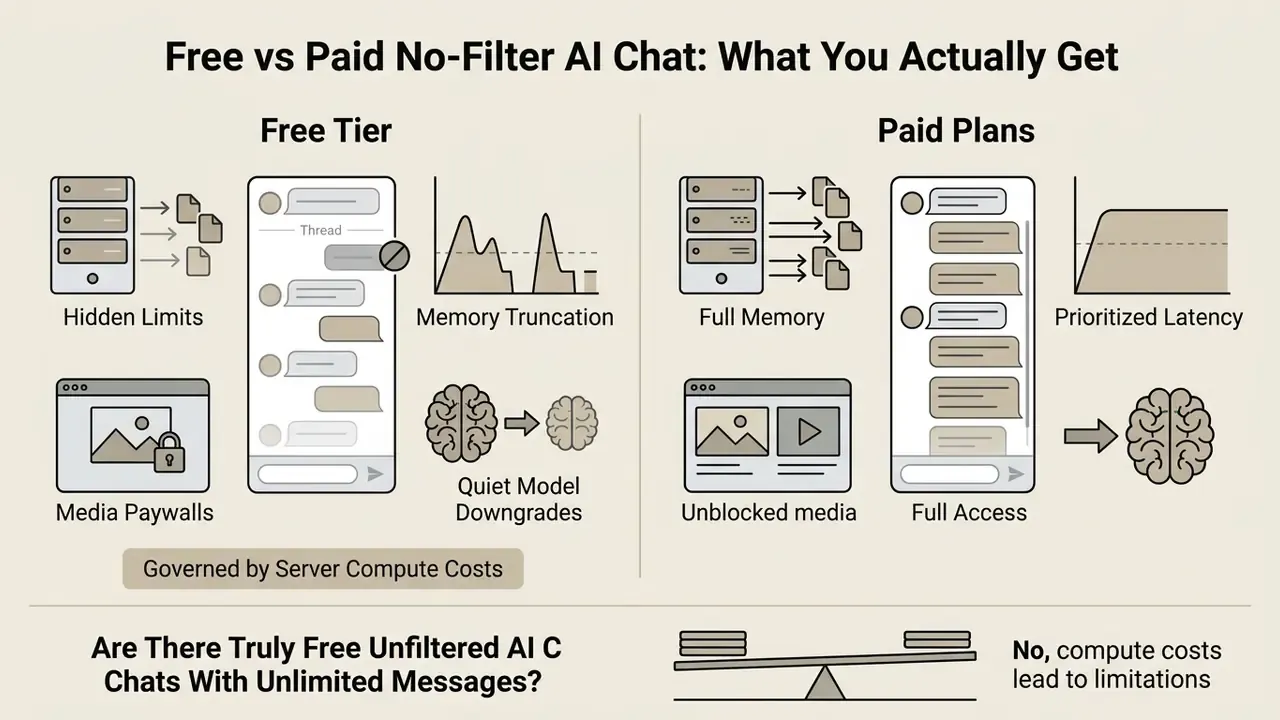
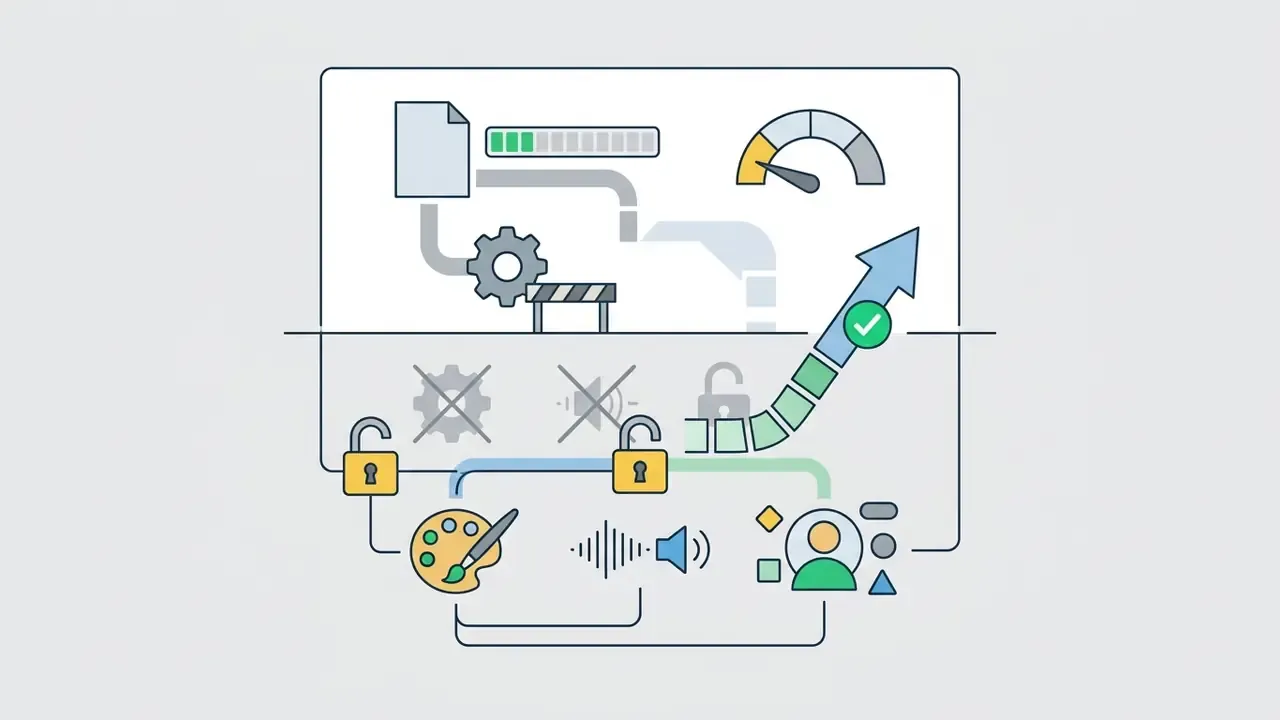
The financial landscape of ai chat apps with no filter free of charge is governed by server compute costs. Because running large language models requires substantial GPU infrastructure, hosted platforms must monetize through message caps, feature gating, or subscription tiers. Critically, paid plans almost always remove usage limits, not content restrictions. Paying more does not de-align a model that was aligned to begin with.
Feature matrix: free tier vs paid tier capabilities in unfiltered chat apps
| Feature dimension | Free tier capabilities | Paid tier upgrades |
|---|---|---|
| Message volume | Restricted (20–70 messages per day, or rolling hourly caps) | Unlimited messages or high-volume credit allowances |
| Server access and speed | Standard response times; queueing during peak hours | Priority generation speed, queue bypass, faster responses |
| Context window memory | Standard context (typically 2,048 to 4,096 tokens) | Extended context (8,192+ tokens for long term narrative) |
| Image generation | Disabled, or restricted to minimal trial credits | Full access to integrated AI image generators |
| Voice and audio | Usually locked, or a single trial voice slot | Voice cloning, real time calls, multiple voice profiles |
| Model customization | Default base models only | Access to larger parameter LLMs and custom routing |
| Data retention controls | Shorter history windows; opt-out often manual | Longer history (for example 30 vs 90 days) and finer deletion controls |
Are There Truly Free Unfiltered AI Chats With Unlimited Messages?
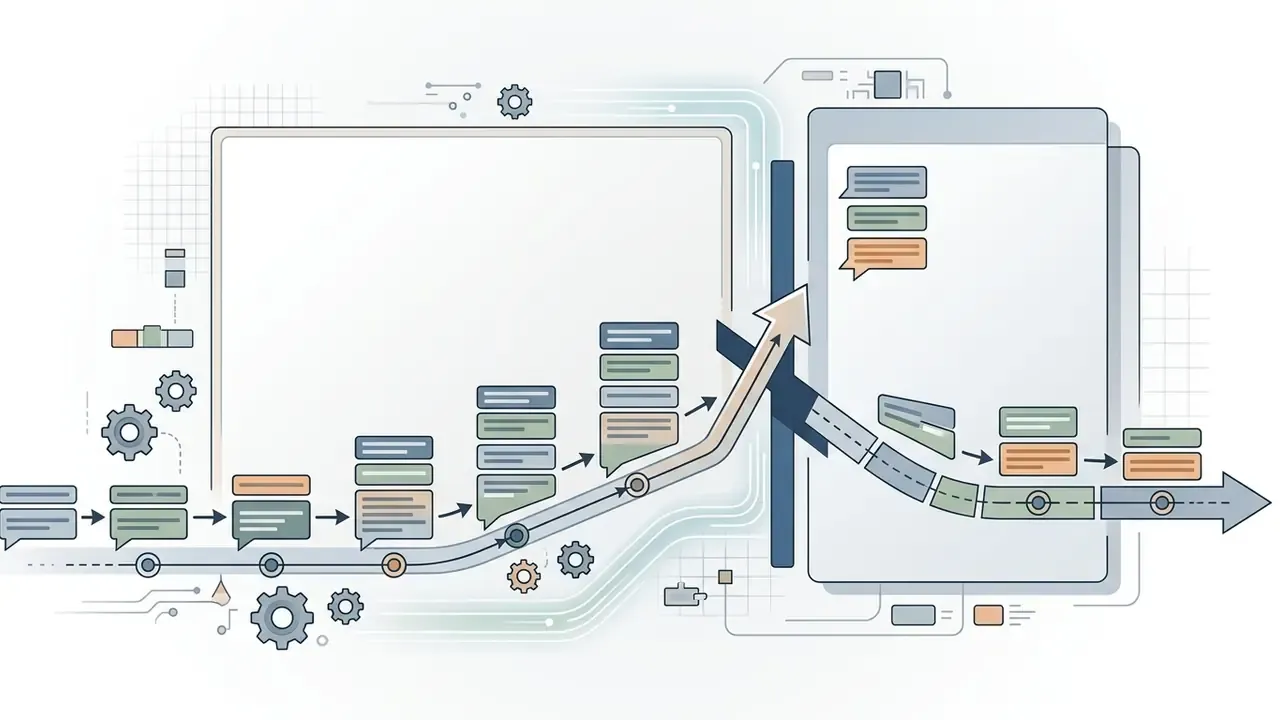
A common question among consumers is whether genuinely free platforms with unlimited messages actually exist. Hosted web platforms advertising "unlimited free chat" almost always apply operational limitations: rate-limiting response speeds, truncating chat memory, throttling during peak hours, or requiring users to supply their own third party API key. Janitor AI's proxy model is the clearest example of a free front end attached to a paid backend.
The only method to achieve truly unlimited, free unfiltered conversations is running open source local tools on your own hardware. By using engines like Ollama, LM Studio, or llama.cpp paired with open-weight models, users eliminate message caps, monthly fees, and external oversight in one place.
Note also that the absence of guardrails on these platforms is a design decision rather than a technical inevitability:
«Guard fine-tuning defences reduce attack success rates by an average of 99.6% for in-distribution attacks using only one example per attack category.»
In other words, cheap and effective mitigations exist. No-filter products deliberately omit them, which is precisely the product. Worth knowing before you assume an unfiltered service simply lacks the budget for moderation.

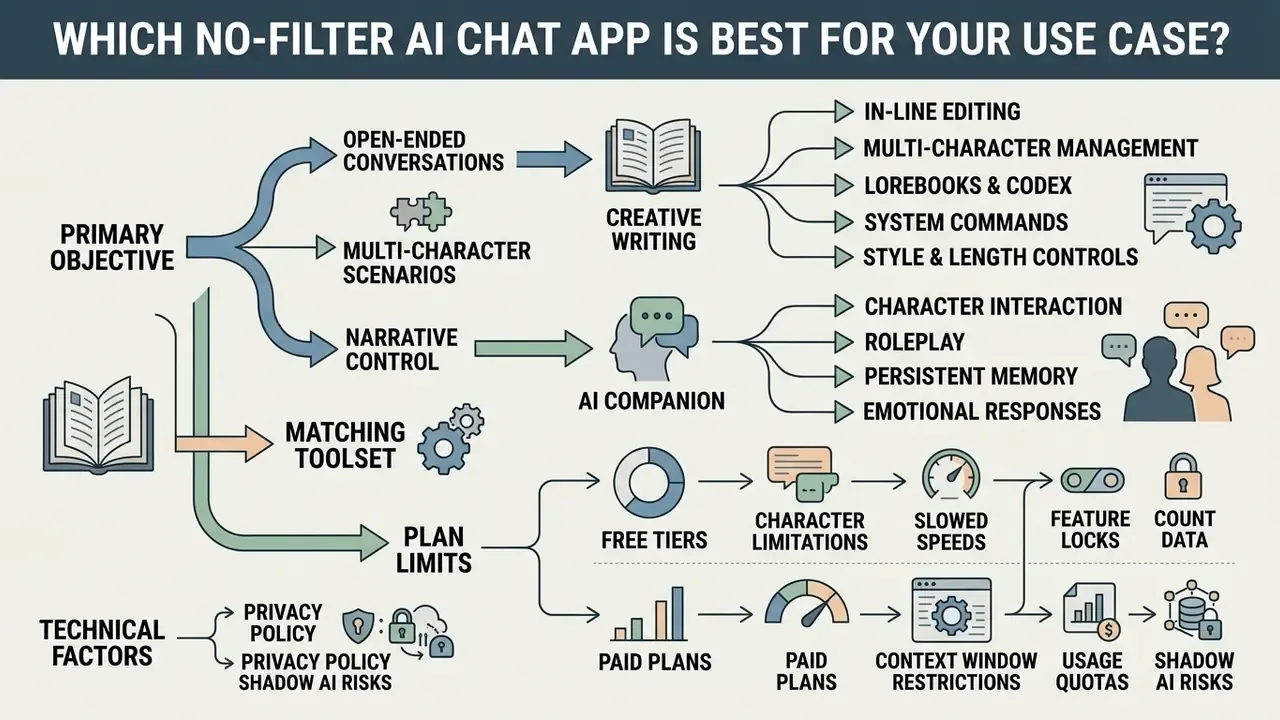
Which No-Filter AI Chat App Is Best for Your Use Case?
Selecting the right platform requires matching your primary creative or conversational objective to the appropriate technical toolset. To streamline that choice, work through the decision path below.
- Primary recommendation: SpicyChat AI or CrushOn AI.
- Key benefit: pre-configured character libraries, active community creation, and relaxed content moderation tailored for romantic or dramatic narratives.
- Primary recommendation: Janitor AI or Chai AI.
- Key benefit: deep character card customization, flexible persona formatting, and extensive public character repositories. Both function as a practical character ai alternative.
- Primary recommendation: high-context long-form tools or API-driven interfaces.
- Key benefit: extended context windows (8k–128k+ tokens, up to 1M on Gemini-class models) capable of maintaining complex plot lines and multi-chapter character arcs.
- Primary recommendation: Kindroid.
- Key benefit: author-written persona descriptions the model actually follows, with stable tone across multi-hour sessions.
- Primary recommendation: Venice.ai.
- Key benefit: no login, no stored identity, no training on your prompts, at the cost of memory and continuity.
- Primary recommendation: Pygmalion AI hosted locally via SillyTavern, or FreedomGPT for a no-terminal desktop route.
- Key benefit: zero external data logging, complete offline capability, and total control over model parameters. Developers evaluating custom pipelines can review implementation architectures in our generative AI API implementation guides.
Which No-Filter AI Chat App Is Best for Your Use Case?
Option 1
For immersive character and adult roleplay:
Option 2
For custom worldbuilding and character design:
Option 3
For extended creative writing and novel drafting:
Option 4
For conversation quality with no filter:
Option 5
For zero-footprint one-off sessions:
Option 6
For complete data privacy and uncensored open source:
Narrative Control: Multi-Character Scenarios and In-Line Editing
For complex roleplay and creative novel drafting, basic one-on-one turns are often insufficient. Advanced unfiltered environments offer specialized steering mechanisms to maintain control over the story:


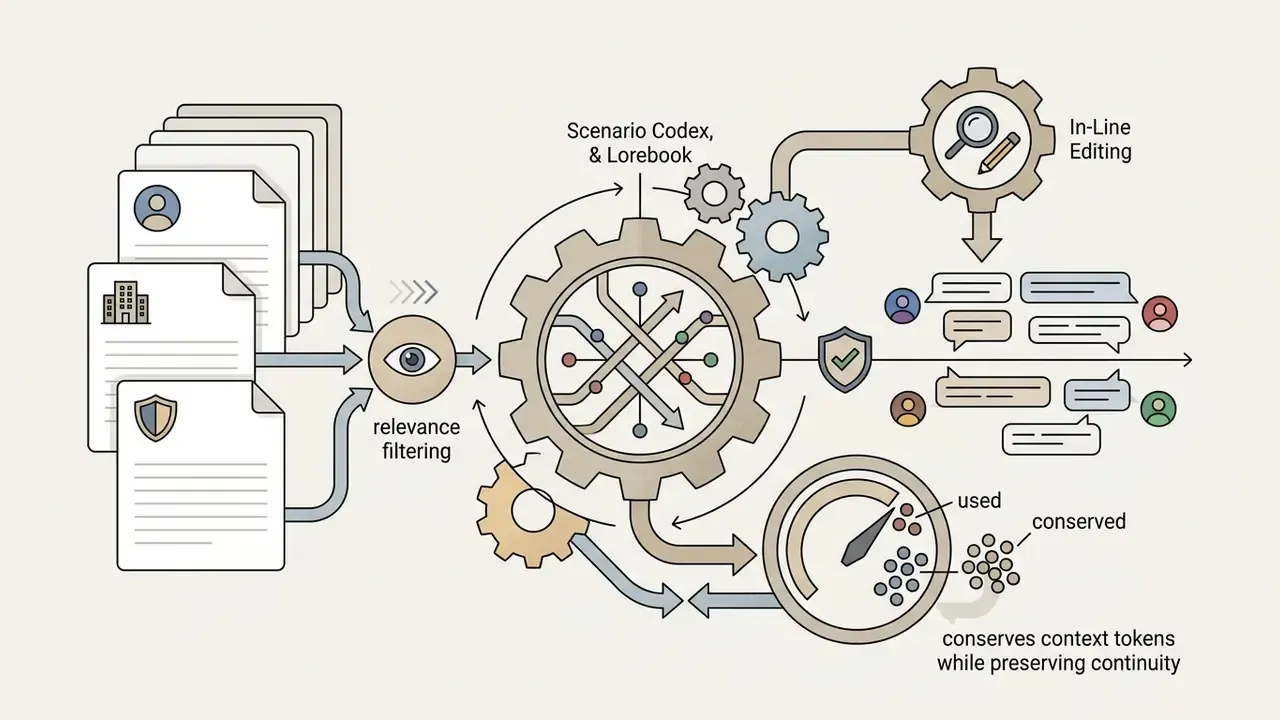
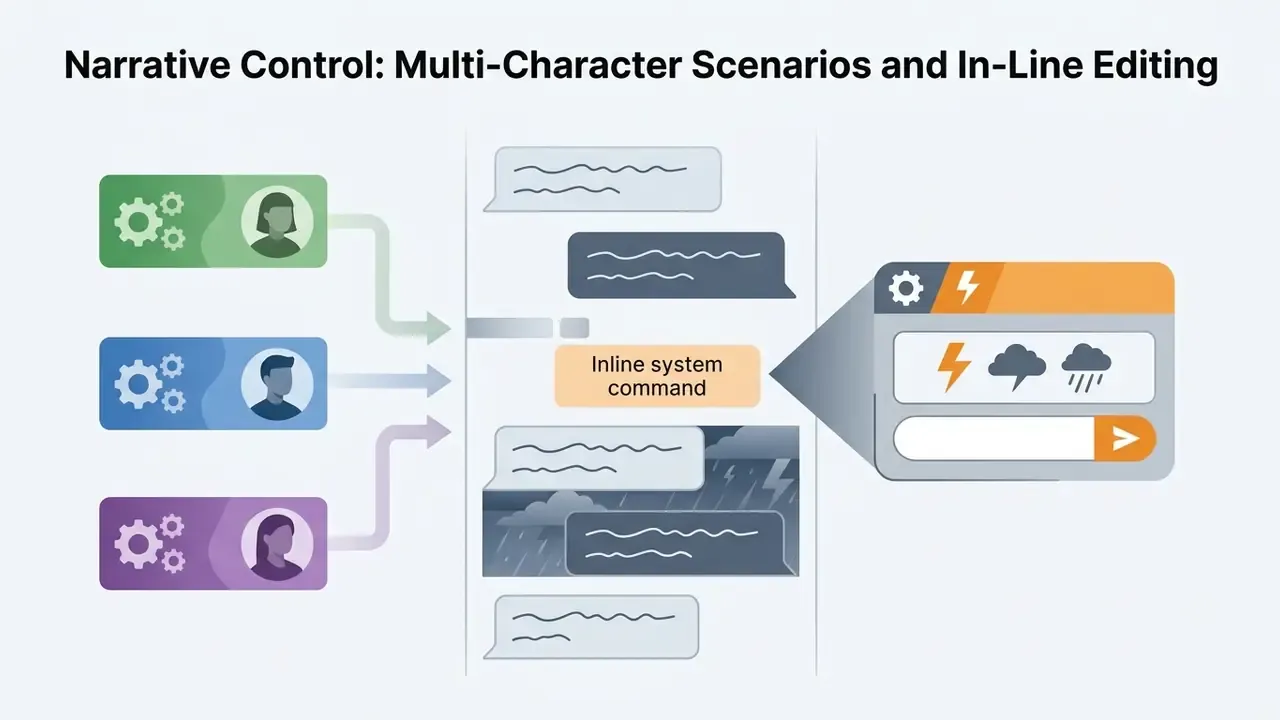
[Direction: introduce a sudden thunderstorm]) lets authors force plot turns without leaking instructions into the character's spoken dialogue.
Best for AI Companion and Character Chat
Users seeking an ai companion or ai girlfriend experience benefit most from platforms supporting personalized memory retention and affective dialogue. Systems like CrushOn AI, SpicyChat AI, and Kindroid excel here by offering continuous character state tracking and customizable character personality traits, while Nomi AI is notable for surfacing details from months-old conversations.
Research supports memory architecture as the decisive variable rather than model size alone. MemoryBank (AAAI, 2024) reports that its SiliconFriend companion recalls relevant memories, updates continuously, and adapts to user personality over time. A 2026 Frontiers review, however, cautions that evidence for sustained loneliness reduction from open-domain companion systems remains emerging. Emotional continuity is an engineering achievement, not a clinical outcome.
When evaluating companion platforms, focus on models that maintain emotional consistency over long term interactions. For complementary media tools, creators can evaluate visual generators via our analysis of the best free AI art generator, compare synthetic voice engines in our AI voice generator guide, and review mobile retouching options in our best iphone photo editor roundup.
Best for Creative Writing and Open-Ended Conversations
For long-form creative writing and open ended narrative generation, context window capacity is the most critical technical parameter. Large-scale models, such as Google Gemini (documented by Google Cloud with a 1-million-token context window) or specialized open-weight writing models like LongWriter, explicitly designed for 10,000+ word generation, allow authors to input entire chapter outlines and world bibles without losing narrative context.
When drafting complex fiction, tools that support prompt customization and temperature adjustment enable finer control over narrative tone and stylistic pacing. Authors adapting written scenes into moving visuals can compare production tools in our roundup of free AI video generators and our best image to video ai generator test, or examine performance benchmarks via our AI Media Benchmarks and Review Proof resource.
Best for Developers and Local AI Models
Developers and advanced privacy-conscious users should leverage open source deployment stacks rather than hosted web services. Local inference runtimes such as Ollama, LM Studio, or llama.cpp let users execute models like Pygmalion, Qwen, or Llama variants directly on local GPU hardware.
Running unfiltered models locally requires specific hardware baselines:
- Minimum hardware threshold 8GB of unified RAM/VRAM to execute quantized 7B or 8B parameter models (for example, GGUF Q4_K_M) at usable token-generation speeds of roughly 15+ tokens per second.
- Recommended setup 16GB–24GB VRAM (Nvidia RTX 3090/4080 class, or an Apple Silicon Mac with unified memory) to run higher-parameter 12B–70B models with extended 8k–32k context windows without CPU-offloading latency penalties.
- CPU-only fallback technically supported via GGML or GGUF quantization per Pygmalion's own documentation, but generation speed drops sharply and long-context roleplay becomes impractical.
- Interface choice LM Studio provides a graphical model manager with no command-line requirement; Ollama exposes a CLI plus full local API access for custom automation pipelines and third party UIs such as Open WebUI.
This architecture guarantees complete operational sovereignty. Prompts and chat logs never leave the host machine, which eliminates data leakage risks and shields the environment from external policy shifts. Academic implementation work from 2026 describes a representative local developer stack, namely Python, FastAPI, an IDE extension, Ollama or llama.cpp for inference, and FAISS for repository retrieval, as a practical pattern for privacy-preserving assistants. Teams costing out hosted alternatives can review economics in our Google Veo API implementation guide, and check licensing boundaries in our commercial-use guides.
FAQ: Frequently Asked Questions About No-Filter AI Chat Apps
What AI Apps Have No Filter Right Now?
As of early 2026, the recurring names in this category are Janitor AI, SpicyChat AI, CrushOn AI, Chai AI, Kindroid, Venice.ai, plus self-hosted stacks built on Pygmalion weights and desktop runners like FreedomGPT. Availability shifts. Services get acquired, tighten moderation after payment-processor pressure, or quietly reduce free allowances, so treat any list, including this one, as a snapshot rather than a standing fact. Verify current terms before committing data or money.
Are No-Filter AI Chat Apps Available in the App Store?
Native ai chat bot apps with no filter featuring unrestricted adult content or unmoderated roleplay are generally banned from the official Apple App Store and Google Play Store. Both platform operators enforce strict developer guidelines regarding user-generated content, explicit themes, and safety moderation. Google Play's AI-Generated Content Policy explicitly requires generative AI applications to implement robust content moderation and block restricted content outputs, and covers text, voice, and image prompt-based apps including chatbots. Apple handles the same category through its general App Store Review Guidelines on safety, deception, and minimum functionality rather than a dedicated generative-AI policy. Consequently, most uncensored providers operate as mobile-optimized ai chat sites no filter accessed directly through desktop or mobile web browsers rather than native app store downloads, a distribution choice that also sidesteps store-level privacy disclosure requirements. Usage patterns deserve a note of caution alongside availability:
«A survey of 404 active companion-chatbot users found problematic internet use significantly mediates the relationship between session duration and loneliness (β = 0.0183).» Source: Chatbot Companionship: A Mixed-Methods Study (2024)
Can No-Filter AI Chat Apps Generate Images?
Selected unfiltered platforms offer multi-modal image generation capabilities, though the feature is rarely included on free tiers. Chai AI provides limited in-app visual generation, Kindroid bundles image and voice output on paid plans, and services such as CrushOn AI reserve image creation for paid subscription tiers. Beyond static images, platforms such as Muah AI and PepHop AI offer real time browser-based audio call interfaces and synthetic voice cloning, enabling complete multi-modal conversations across text, image generation, and low-latency voice chat without active guardrails. Quality is uneven. Independent testing describes voice calls on multimodal companion apps as surprisingly natural but photo generation as inconsistent, and voice features frequently sit behind a separate subscription. On self-hosted open source setups, users can link character interfaces such as SillyTavern directly to local Stable Diffusion engines, enabling completely free, unrestricted image generation paired with character dialogue. For broader comparisons, see our reviews of AI image generators, free AI image generators, and the best photo collage tools for assembling character sheets.
Does Paying Remove Content Filters?
Usually not. Subscriptions on mainstream platforms raise message quotas, unlock larger models, extend memory, and enable media features. Content policy is a separate layer, governed by law, hosting providers, and payment processors. Only platforms explicitly built around de-aligned weights, or models you run yourself, remove refusal behaviour. And as noted above, that removal frequently costs reasoning quality.
Are Unfiltered AI Chats Legal?
In most jurisdictions, using them is legal. Generating or distributing illegal content is not, regardless of the tool. In the European Union, the AI Act classifies AI applications by risk level and bans certain uses outright. Platform terms of service and local law both continue to apply even when a chat interface performs no refusals. This is general information, not legal advice.
What Are the Main Limitations of Unfiltered AI?
Fewer safeguards mean higher rates of inaccurate, biased, or unsafe output, weaker long-context coherence in heavily de-aligned models, opaque data handling on hosted services, and, for local setups, hardware cost plus maintenance burden. Many unfiltered tools are also chat-only, with no research, automation, or workflow integration around them. For an institution, that last point is decisive: a tool with no audit interface cannot sit inside a model inventory.
Appendix A: Revision Log (Superseded Statements)
Retained for transparency; the main text carries the updated versions.
- Superseded
- "Technical studies on LLM roleplay, such as research published in the ACL Anthology (2025), demonstrate that maintaining persona realism across multi-turn dialogues requires dedicated context management and state tracking." Updated: replaced with the named Ditto study (Lu et al., ACL Anthology, 2025) and its measurable outcome across 4,000 trained characters.
- Superseded
- "The platform hosts over 25 million user created characters." Updated: relabelled as a vendor marketing claim that is not independently audited.
- Superseded
- "According to hardware deployment documentation, Pygmalion models can run on consumer GPUs or on CPU mode using GGML/GGUF quantizations." Updated: attributed to Pygmalion's own published documentation and supplemented with explicit RAM/VRAM thresholds.
- Superseded
- "As documented in SpicyChat technical guides (2026), free accounts feature a 4,096-token context window." Updated: attributed to docs.spicychat.ai (2026), with a note that community reviews disagree on free-tier NSFW availability by snapshot date.
- Superseded
- generic "open the hub" and "view the guide" anchors placed inside analytical paragraphs. Updated: navigational links consolidated into the Related Tool Benchmarks block, with only topically relevant image, video, voice, and API references kept in the body.