Editorial oversight: reviewed against enterprise model-risk-management (MRM) practice for drafting, verification, and audit-trail controls. Marcus Hale, author.
Executive Summary
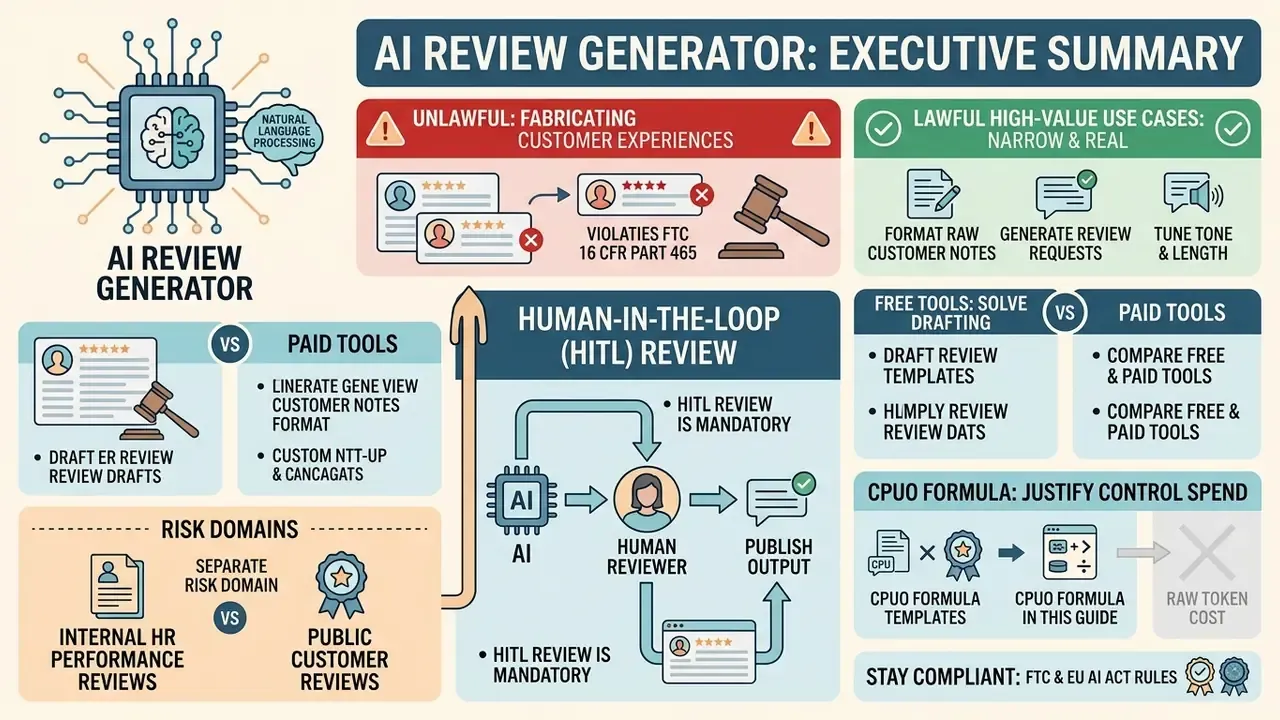
- An ai review generator is a natural language processing system that drafts, summarizes, and structures customer feedback. It is a drafting assistant, not an autonomous publisher.
- Fabricating customer experiences is unlawful in the United States under FTC 16 CFR Part 465, and it violates Google, Amazon, and Trustpilot platform rules. Synthetic testimonials expose firms to civil penalties, ranking demotions, and listing suspension.
- Lawful, high-value use cases are narrow but real: formatting raw customer notes, generating review request templates, drafting support replies for human approval, and summarizing verified feedback at scale.
- Human-in-the-loop (HITL) review is mandatory. Every draft requires fact-checking, provenance logging, and named approver sign-off before publication.
- Free tools solve drafting. Enterprise tiers solve governance. The decision variable is not price but data retention, auditability, and role-based access control.
- Internal HR performance reviews and public customer reviews are different risk domains. The first is PII and GDPR-governed employment data. The second is consumer-protection-governed marketing content. Never run them through one undifferentiated workflow.
- Use the cost-per-usable-output (CPUO) formula in this guide to justify control spend instead of raw token spend.
How to Read This Guide
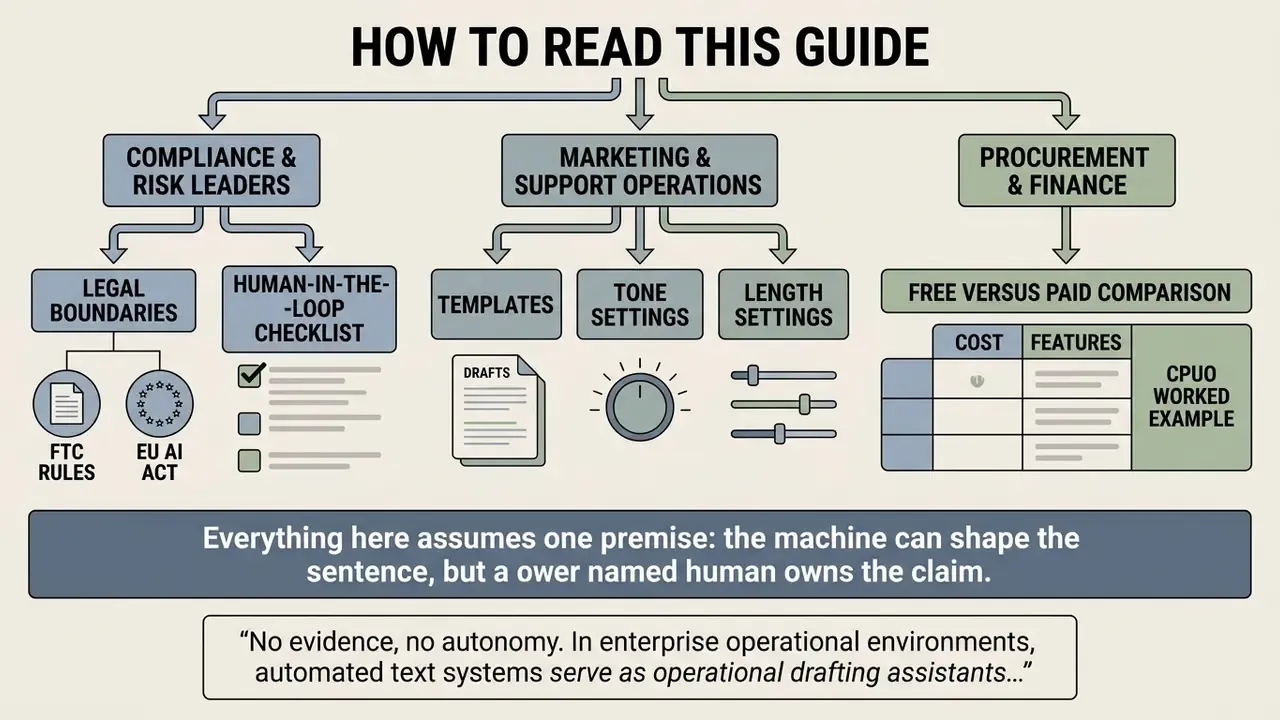
Three audiences tend to arrive here with different questions, so it helps to say upfront which parts matter to whom.
- Compliance and risk leaders should start with the legal boundary section and the human-in-the-loop checklist. Those two blocks contain the enforceable controls.
- Marketing and support operations will get more from the templates, the tone and length settings, and the four collection tactics for genuine feedback.
- Procurement and finance should jump to the free versus paid comparison and the CPUO worked example, where the real cost of verification labour is quantified.
Everything here assumes one premise: the machine can shape the sentence, but a named human owns the claim.
An ai review generator is specialized natural language processing software designed to draft, summarize, and structure customer feedback and evaluation templates. Organizations use these systems to process customer inputs, generate initial response drafts, and construct standardized feedback workflows. Some call the same category an ai review maker, an ai customer review generator, or simply a review generator. The label changes. The accountability does not.
In enterprise operational environments, automated text systems serve as operational drafting assistants rather than autonomous writers. Research suggests that modern large language models now produce evaluation texts that readers cannot reliably separate from human-written feedback.
That finding reframes the entire governance problem. If neither readers nor moderators can reliably tell synthetic from authentic text, authenticity cannot be enforced downstream through detection alone. It has to be enforced upstream, at the point of input, through purchase verification, provenance logging, and human accountability. Deployers must therefore balance speed gains against strict compliance baselines, regulatory oversight, and data lineage integrity.
What Is an AI Review Generator and What Is It Used For?
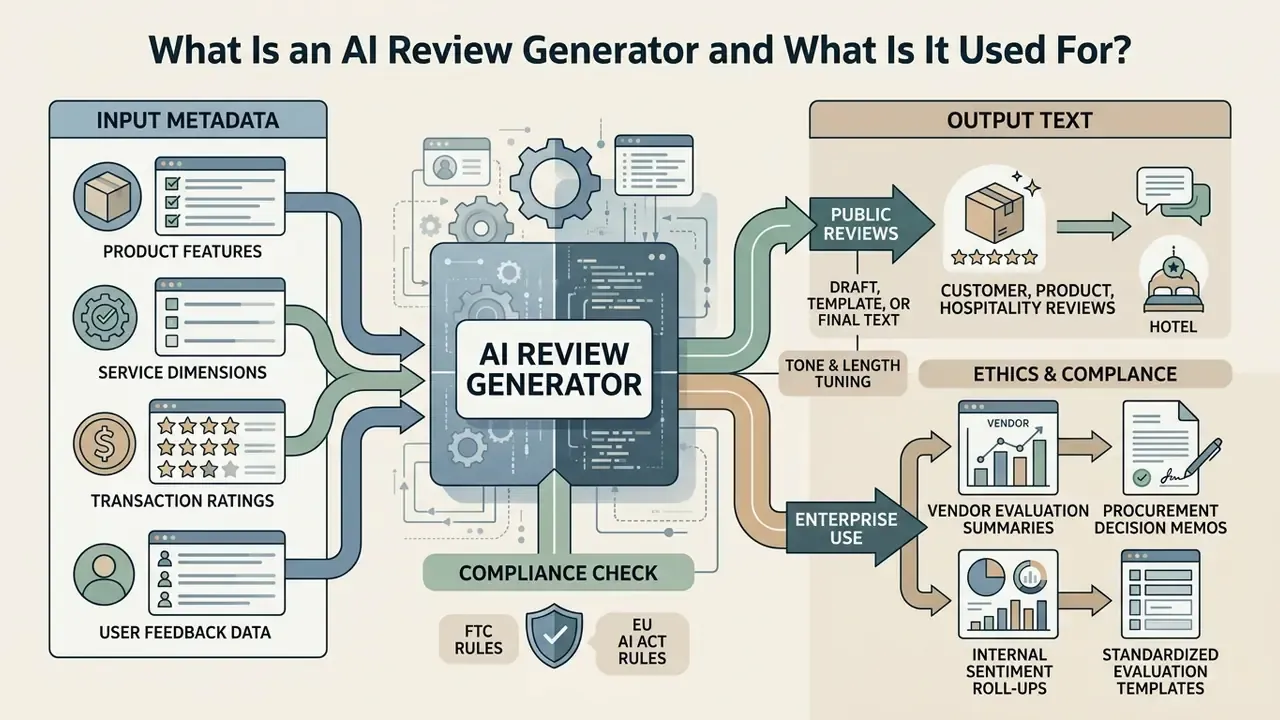
In two sentences: An AI review generator converts structured metadata, including product features, service dimensions, and transaction ratings, into readable draft text. It compresses drafting time but transfers no accountability, because the publisher remains fully responsible for factual accuracy and authenticity.
An ai review generator functions as an automated text drafting system that turns structured metadata (product features, service dimensions, or transaction ratings) into coherent text drafts. It addresses operational bottlenecks in customer support, marketing template preparation, and internal performance management.
Enterprise users deploy an ai generator for reviews to create standardized review template outlines and accelerate feedback synthesis. Rather than substituting for human judgment, an ai feedback generator or ai opinion generator works as an interactive assistant inside ai writing pipelines. Regulatory guidance from Singapore's Guide for Using Generative AI in the Legal Sector and the European Commission's Living Guidelines on the Responsible Use of Generative AI in Research both require that generative outputs undergo systematic review and verification before official reliance. The European Commission guidance lists seven operational requirements that map directly onto review workflows: human oversight, robustness, privacy and data governance, transparency, fairness, environmental and societal well-being, and accountability.
Enterprise Internal Feedback, Procurement, and Vendor Evaluation
In B2B and regulated environments, review generation is rarely about marketing. It is about compressing evaluation evidence into a defensible written record. Typical enterprise applications include:
- Vendor and supplier evaluation summaries built from uptime logs, SLA breach counts, and pricing tiers.
- Procurement decision memos that consolidate multiple stakeholder assessments into a single structured draft.
- Internal sentiment roll-ups that convert thousands of verified support tickets into executive-readable themes.
- Standardized evaluation templates that force reviewers to answer the same questions across cycles, improving comparability.
The Guidelines for Technical Reviews of Software Products framework applies well here. Reviews identify issues, reviewers prepare in advance, and the session opens with a brief producer overview. AI can prepare the pre-read. It cannot replace the reviewer.
Public Customer, Product, and Hospitality Reviews
An ai product review generator tailors outputs based on item specifications, performance benchmarks, and user scenarios. When processing a product review, the system relies on measurable criteria such as model numbers, technical performance data, and physical design attributes. ERIC's A Guide for the Developer of Basic Skills Products recommends defining review guidelines before a product ships and specifying exactly which aspects reviewers must comment on. That principle translates directly into prompt design.
Service and hospitality evaluations work differently. They require tracking process flows, customer service interactions, and delivery timelines. An ai hotel review generator processes specific stay parameters, amenities, and service touchpoints. Evaluating a business service or a hotel stay requires a clear distinction between tangible product metrics and subjective service perception.
Practically, that means hospitality operators should assume platforms are already fingerprinting stylistic patterns in submitted text. Synthetic hotel reviews are not merely unethical. They are increasingly detectable at scale, and detection keeps improving faster than evasion.
Draft, Template, or Final Text: What AI Actually Produces
The primary output of an ai review maker is an unverified ai text draft or a detailed review template requiring human editorial oversight. Edinburgh University Press states that all AI outputs should be treated as drafts and thoroughly checked and verified by a human before incorporation into a final manuscript. Sage's publication-ethics policy requires disclosure of AI content that affects methodology, analysis, results, or conclusions, so editors can evaluate it.
That quality signature is the operational tell. Unedited synthetic drafts skew positive, skew short, and skew abstract, which happens to be the exact profile that both readers and spam filters penalize. Editing is therefore not cosmetic polish. It is the step that restores specificity, balance, and verifiable detail.
Deploying an ai generator review model lets teams establish structured templates without bypassing human accountability. Organizations comparing governance frameworks can see the overview to evaluate model validation strategies. Teams that also verify visual assets alongside text should review how AI image detectors handle synthetic-content provenance, since review pages frequently combine generated text with generated imagery.
Copy-Paste Review Templates You Can Use Today
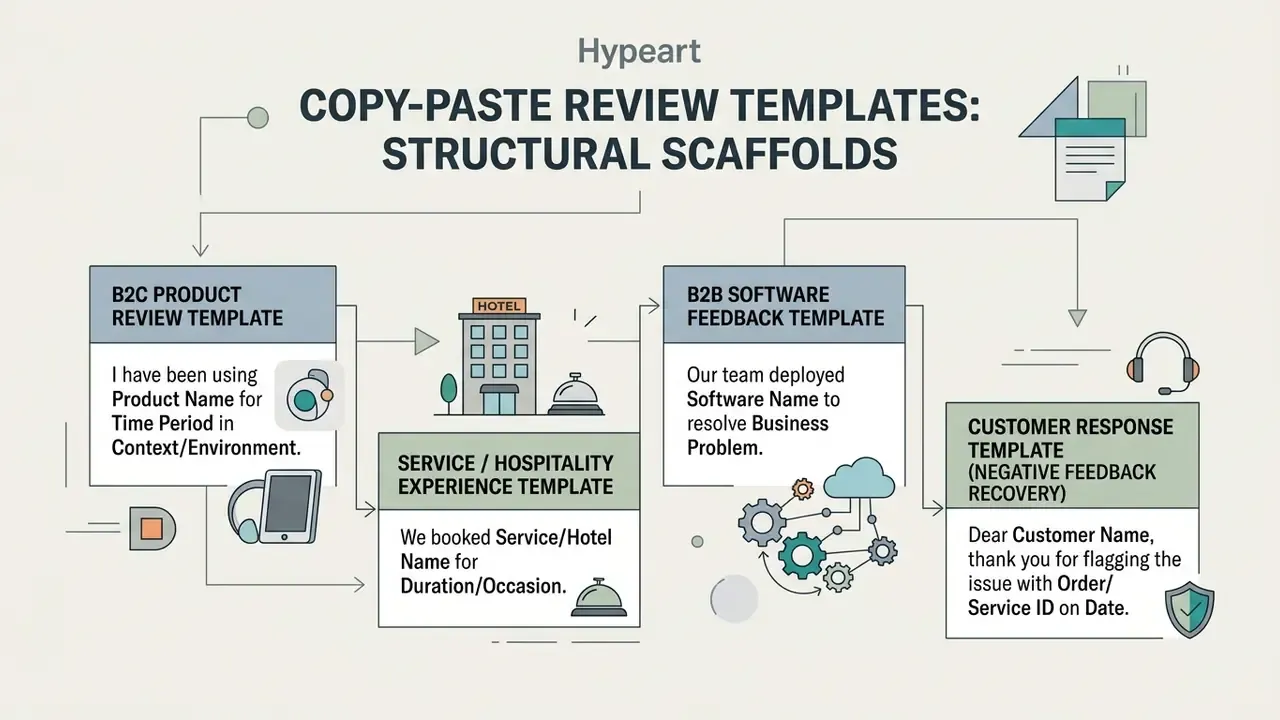
These templates are structural scaffolds, not finished reviews. Fill every bracketed variable with verified, first-hand facts. If a bracket cannot be filled from real experience, the review must not be published. That rule is simple enough to audit.
1. B2C Product Review Template
"I have been using [Product Name] for [Time Period] in [Context/Environment].
Pros: [Feature 1] noticeably improved [Specific Metric], and [Feature 2] worked reliably.
Cons: [Constraint/Limitation].
Overall rating: [X/5]. Recommended for [Target Audience]."
2. Service / Hospitality Experience Template
"We booked [Service/Hotel Name] for [Duration/Occasion].
The delivery/check-in process was [Speed/Quality Attribute].
Key highlight: [Specific Staff Action or Feature].
One area for improvement: [Minor Issue].
Ideal for [Business/Leisure] users."
3. B2B Software Feedback Template
"Our team deployed [Software Name] to resolve [Business Problem].
Implementation took [Timeframe].
Result: Reduced [Process] overhead by [X]%.
Support responsiveness was [Rating].
Mandatory feature request: [Missing Integration]."
4. Customer Response Template (Negative Feedback Recovery)
"Dear [Customer Name], thank you for flagging the issue with [Order/Service ID] on [Date].
We sincerely apologize for [Specific Failure].
We have initiated [Corrective Action] and would like to offer [Resolution Path].
Please contact [Email/Direct Line] to finalize this."
5. Vendor Evaluation Template (Procurement / Model Risk)
"Vendor: [Vendor Name]. Evaluation window: [Start Date] to [End Date].
Contracted SLA: [Uptime %]. Observed availability: [Measured %]; incidents: [Count].
Integration effort: [Engineering Days]. Security posture: [SOC 2 / ISO status].
Residual risks: [Risk 1], [Risk 2]. Recommendation: [Approve / Approve with conditions / Reject]."
6. Review Request Template (Compliant Outreach)
"Hi [Customer Name], you received [Order/Service] on [Date].
We would value an honest review, positive or critical.
Two quick questions: What worked best? What should we improve?
Leave feedback here: [Direct Link].
Note: we never condition rewards on the rating you give."
7. Google Business Profile Reply Template
"Thanks for the [X-star] feedback on your [Service/Visit] on [Date], [Customer First Name].
You mentioned [Specific Point]. Here is what changed since: [Concrete Fix or Timeline].
If anything is still unresolved, reach us at [Direct Contact].
[Business Name], [Location]"
That last one matters more than it looks. An ai google review generator workflow is usually deployed for replies, not for reviews, and replies are the only side of a Google Business Profile you are actually allowed to author.
How AI Review Generators Work: From Prompt Input to Editorial Oversight
In two sentences: The pipeline runs input context, parameter configuration, draft generation, fact verification, then human editorial sign-off. Skipping stage four is the single most common cause of compliance incidents.
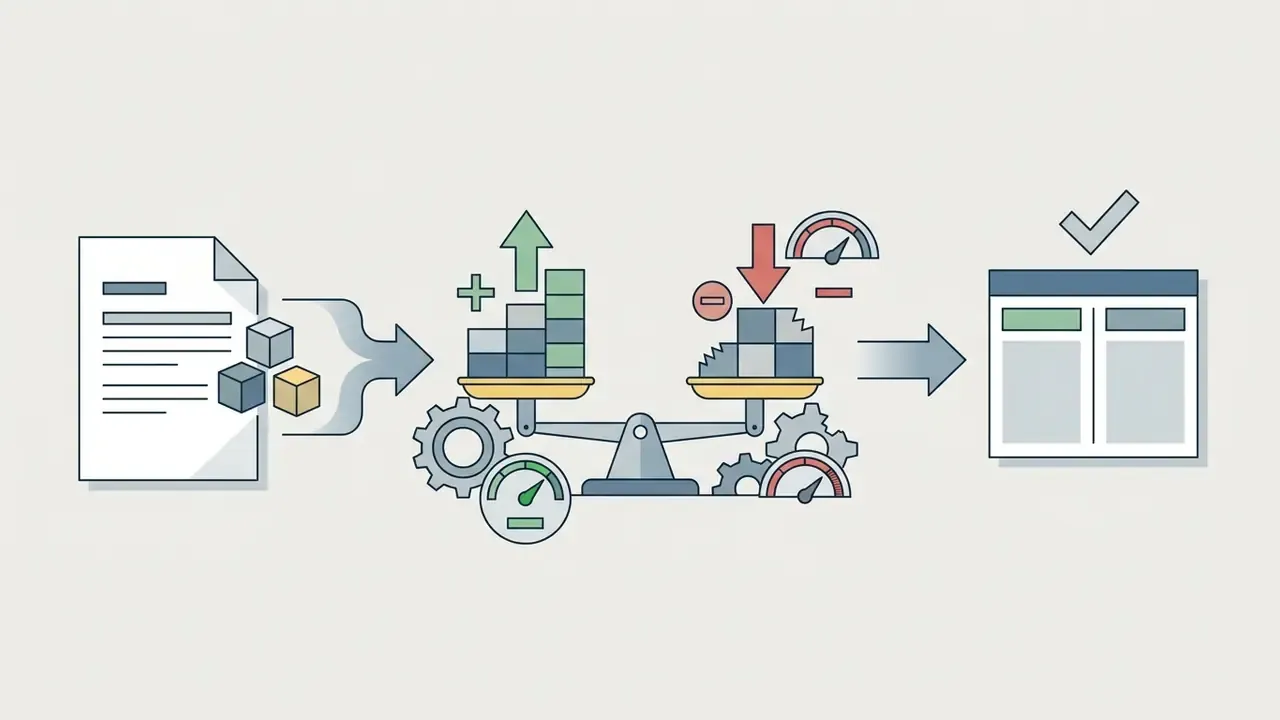
An ai generator review process follows a structured pipeline: ingesting input context, applying style and language parameters, executing model generation, performing fact verification, and conducting human editing.
When using ai for drafting, users supply domain details to a description generator module. The model maps those parameters against trained patterns to structure the draft. Fact verification remains a critical operational control before final export. NIST's generative AI profile explicitly instructs organizations to "deploy and document fact-checking techniques" to verify accuracy and veracity of generative output, particularly where sources are multiple or unknown.
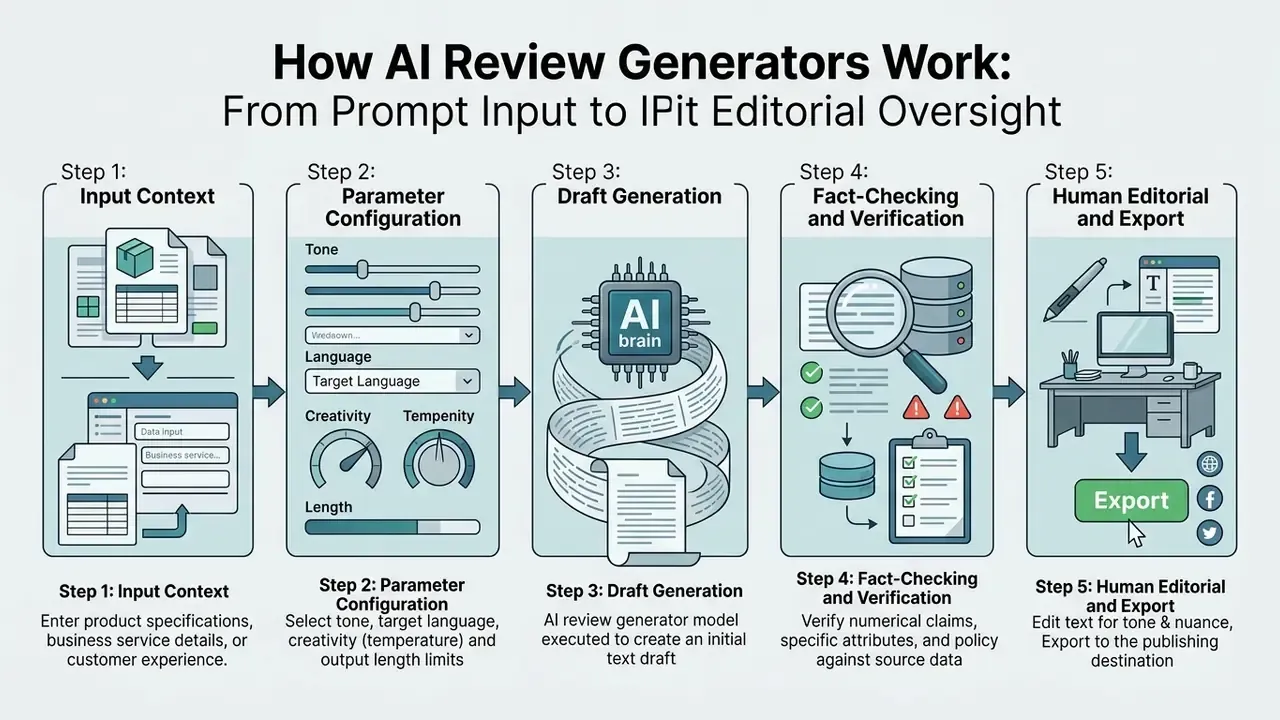
Figure 1: Operational sequence for AI review generation and verification.
Enterprise Prompt Engineering Matrix for Review Drafting
| Role / Persona | Input Data Provided | Required Tone and Rules | Output Target |
|---|---|---|---|
| B2B procurement lead | Technical specs, 30-day downtime logs, pricing tier | Objective, critical, bulleted pros and cons, no marketing adjectives | Detailed vendor evaluation draft |
| E-commerce shopper | Purchase receipt date, product dimensions, 2 usage flaws | Casual, authentic, no hype adjectives, mention one limitation | Product review draft of roughly 100 words |
| Hospitality manager | Guest complaint regarding late check-in | Empathetic, professional, offer a concrete resolution path | Customer support response draft |
| Support operations lead | 1,200 verified tickets, category tags, CSAT scores | Analytical, aggregated, no individual PII | Executive sentiment summary |
| HR business partner | Goal attainment data, peer feedback, review period | Balanced, behavioral, non-speculative, PII-restricted | Internal performance review draft |
A usable prompt always contains four components: role, verified input data, tone and prohibition rules, and output format with a length limit. Prompts missing the prohibition rules are the ones that produce generic, over-positive text. In practice, the prohibition list is the shortest part of the prompt and the highest-leverage one.
Which Details to Supply for a High-Quality Review
Generating a balanced and realistic draft requires comprehensive, factual input across five categories.
Supplying detailed context prevents the model from producing generic, overly positive statements that undermine credibility. Thin input, thin output.

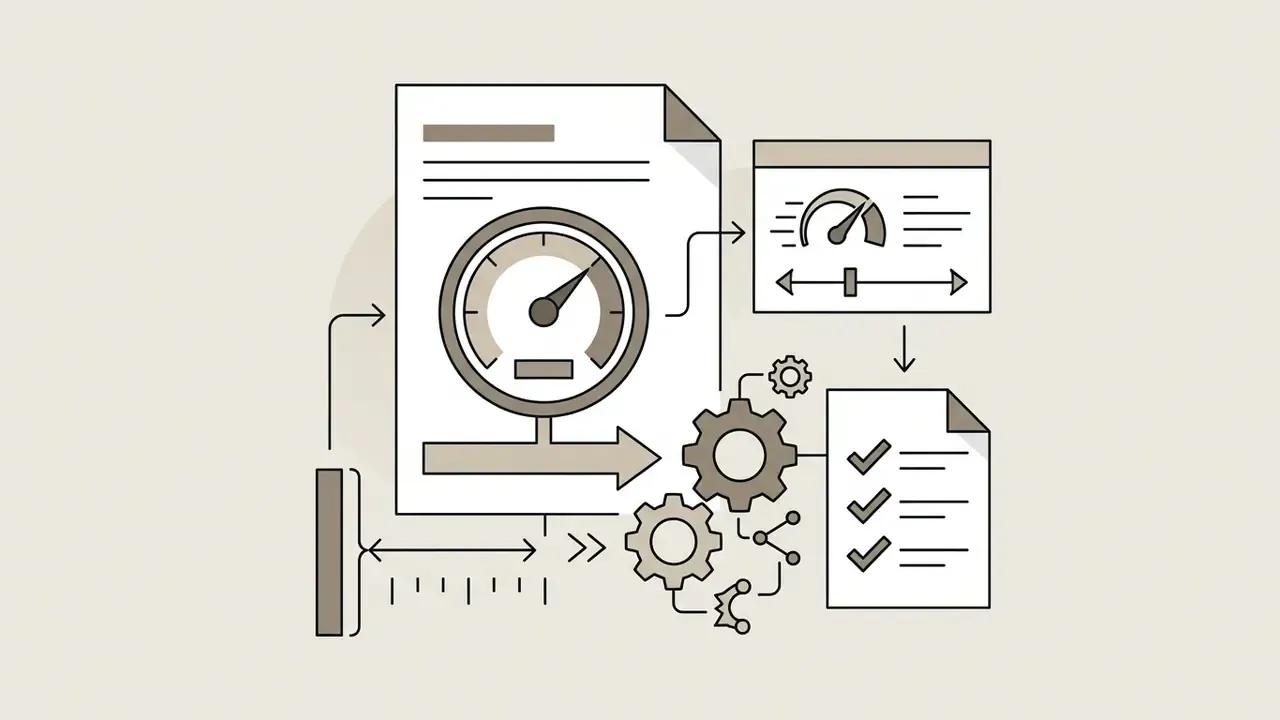
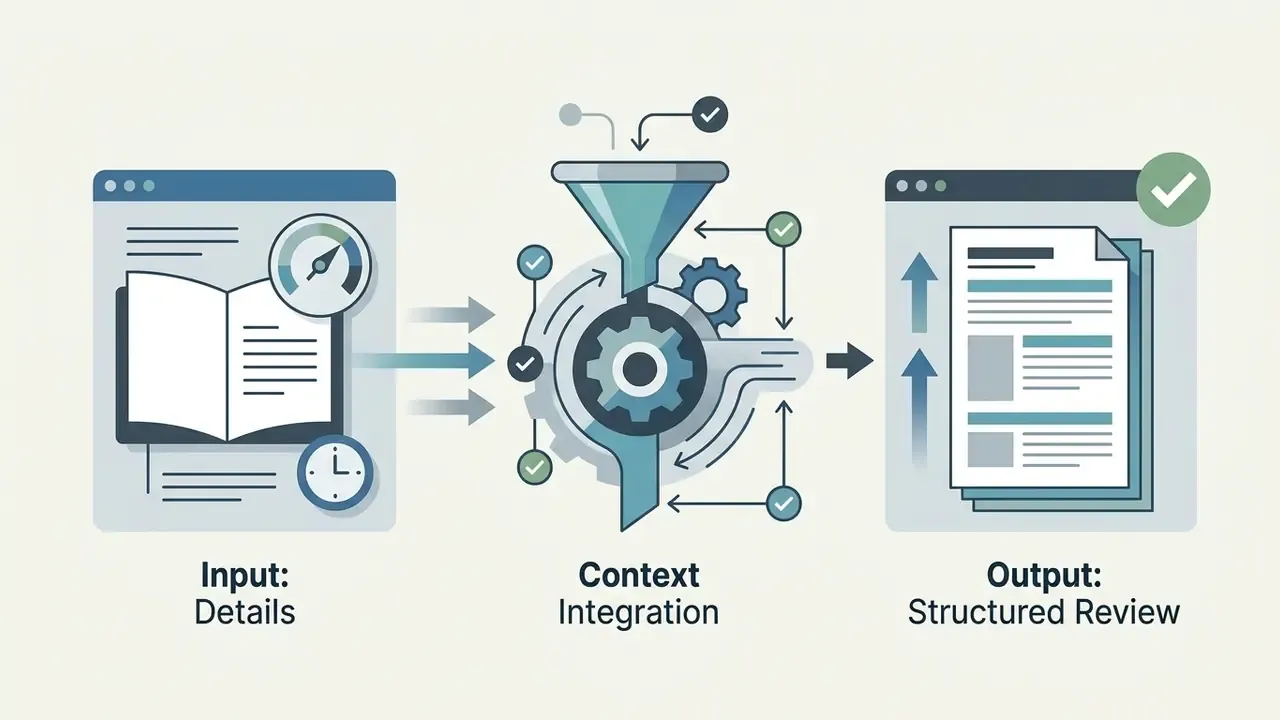
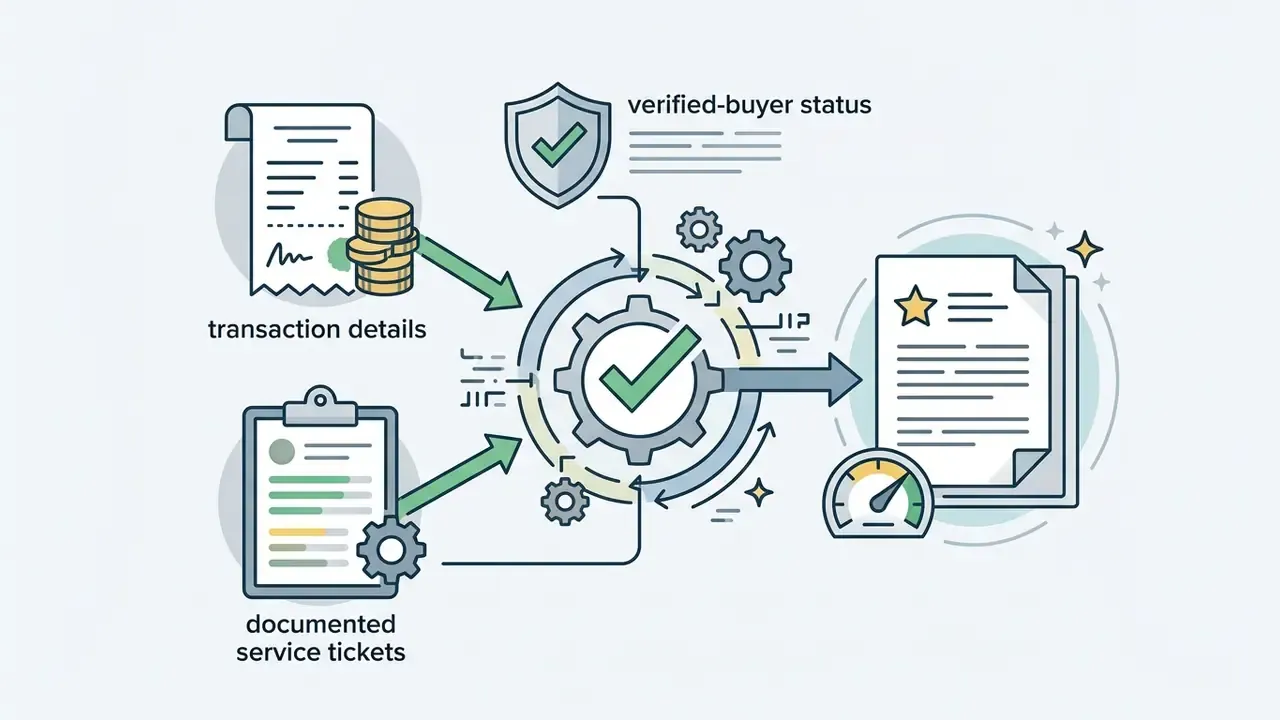
The practical implication is measurable. Short output reads as synthetic, and short output is usually the symptom of a starved prompt. Teams that require a minimum of five factual input fields per draft consistently produce text that survives both reader scrutiny and platform filters.
Tone, Length, and Creativity Settings
Modern ai writing tools offer precise tone and creativity control through system parameters and prompt settings. Rather than a vague "formal to casual" slider, treat tone as a fixed preset library.
Available tone presets for AI prompting
- Professional / Corporate: B2B vendor reviews, formal SLA assessments, procurement memos.
- Formal: regulated communications and official records.
- Constructive / Balanced: highlights both pros and cons with operational evidence.
- Empathetic / Service Recovery: support replies to negative feedback.
- Casual / Conversational: consumer products and social proof snippets.
- Convincing / Persuasive: testimonial polish for verified customers.
- Critical / Analytical: strict focus on performance benchmarks and technical flaws.
- Informative / Neutral: factual summaries without evaluative language.
- Humble: understated first-person accounts.
- Inspirational / Passionate: brand storytelling contexts. Use sparingly, since hallucination risk peaks here.
- Humorous / Funny: lifestyle and social channels only.
- Joyful: celebratory post-event feedback.
Output length controls
- Short snippet (3 to 5 sentences, roughly 50 words): quick star-rating descriptions, Google Local Guides entries.
- Standard draft (5 to 8 sentences, roughly 150 words): e-commerce product page testimonials.
- Comprehensive evaluation (10 or more sentences, 300+ words): detailed breakdown with specs, usage scenarios, and a final verdict.
Review sentiment modes
- Positive: verified satisfied customers only.
- Neutral / Balanced: the default recommendation for credibility.
- Negative / Critical: documented service failures and internal post-mortems.
Creativity is controlled through model temperature. Higher temperature values increase output variety but raise the risk of factual hallucination. Vendor documentation, such as Writer's text-generation reference, confirms that temperature drives output divergence while max-token settings cap length.
This is why high-temperature settings are a governance concern rather than a stylistic preference. Text that evades external classifiers also evades your own internal quality controls. For published customer-facing review content, cap temperature at a documented low-to-moderate value, and record that value in the audit log. If you cannot say what temperature produced a published sentence, you do not have a control. You have a habit.
Human-in-the-Loop Verification Checklist
Every draft must clear all ten items before publication. Georgia's SS-25-001 policy requires human-in-the-loop review by qualified personnel, with explicit checks for inaccuracies, bias, inappropriate content, and clear labeling of GenAI-assisted content. NIST AI 600-1 adds provenance verification.
- Source groundingevery factual claim traces to a verified transaction, log, or document.
- Numerical verificationall figures, dates, percentages, and model numbers matched against primary data.
- Authenticity checkthe underlying experience is real and attributable to a verified user.
- No fabricated identityno invented reviewer names, personas, or locations.
- Balance testat least one limitation or trade-off is stated where applicable.
- PII scanno customer or employee personal data exposed in public-facing text.
- IP and trademark checkno reproduced training data, plagiarism, or unlicensed brand usage.
- Disclosure checkincentives, employee relationships, and AI assistance disclosed where required.
- Platform policy checkoutput compliant with Google, Amazon, Trustpilot, or app-store rules.
- Named approver sign-offa qualified human accepts accountability in writing.
Minimum audit log format
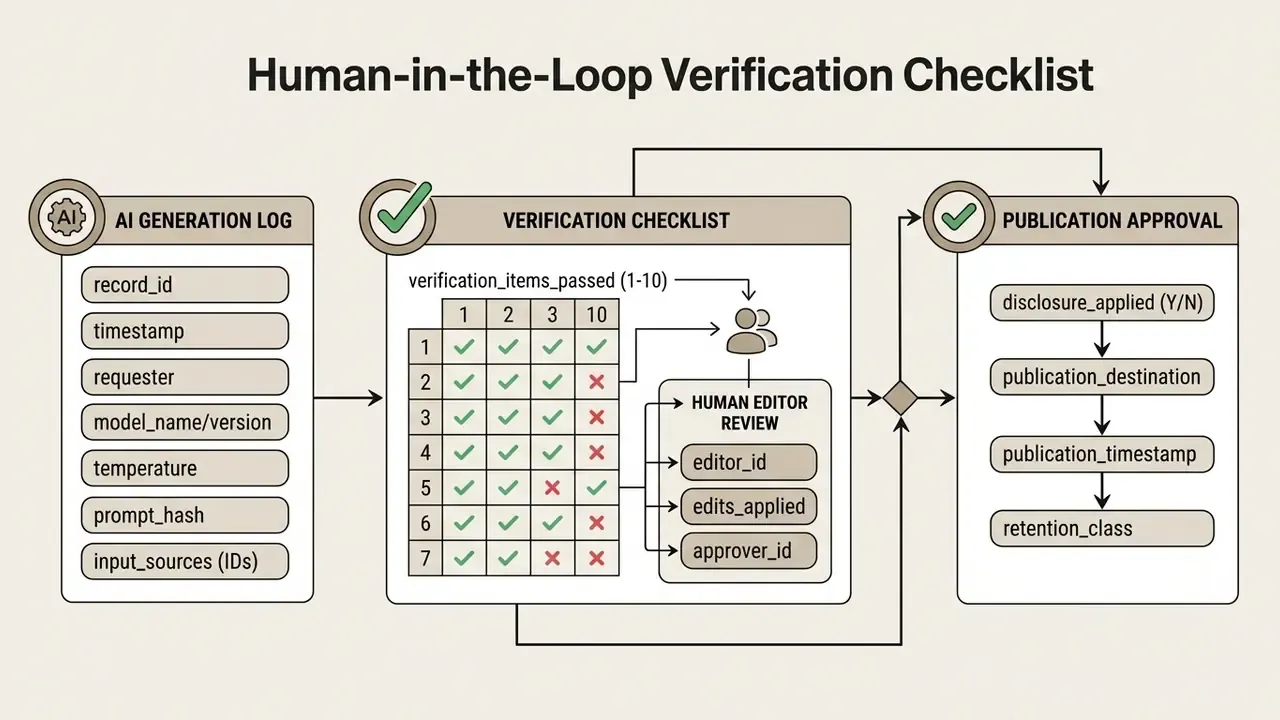
Role model: the requester supplies inputs, the verifier checks facts against source systems, the editor rewrites for accuracy and tone, and the approver, who must not be the requester, signs off. Escalation rule: any hallucinated fact, invented citation, or fabricated experience triggers an immediate halt, incident logging, and a governance review of the prompt template that produced it. One bad template usually explains dozens of bad drafts.
Ethical and Safe Use of AI Review Generators: Legal Compliance
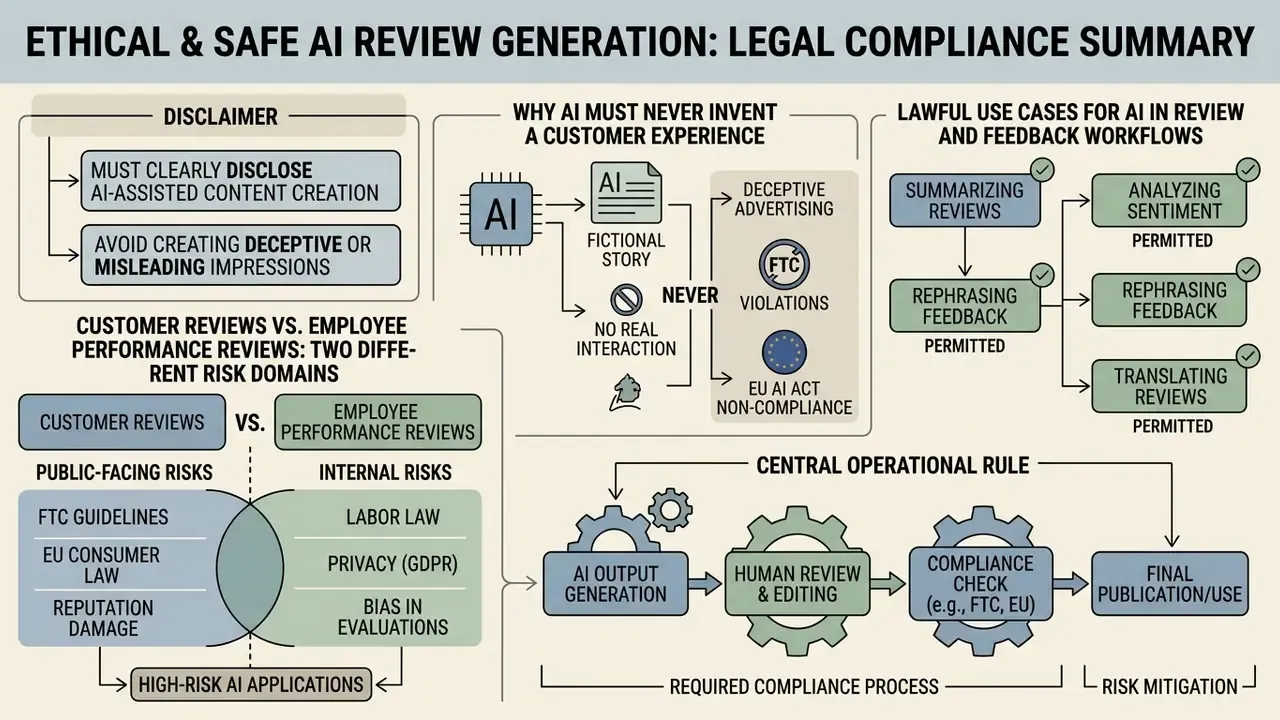
In two sentences: AI may format, structure, and summarize real experiences, and it may never invent them. The dividing line is the authenticity of the underlying experience, not the authorship of the sentence.
An ai review generator can be used ethically only when restricted to drafting, formatting, and refining real customer experiences, rather than fabricating feedback that never existed.
Publishing synthetic testimonials that claim real user experience where none exists violates deceptive practice laws and platform rules. FTC 16 CFR Part 465 prohibits writing, creating, buying, or selling fake reviews and testimonials, including AI-generated ones, and also prohibits buying fake followers, likes, or views. UK CMA guidance (GOV.UK, 2025) makes reviews unlawful where they are fake or where incentives are concealed. A 2026 European Parliament study confirms that Commission proposals categorically prohibit submitting or commissioning false consumer reviews or endorsements. Organizations must enforce explicit controls to protect corporate integrity and preserve organic social proof.
That figure explains why enforcement has accelerated. Fake reviews are no longer treated as a marketing infraction. They are treated as large-scale market distortion, which is a very different conversation with a regulator.
Why AI Must Never Invent a Customer Experience
Inventing customer experiences with generative models creates severe legal, regulatory, and search penalty exposure. The U.S. Federal Trade Commission Final Rule, effective October 21, 2024, explicitly prohibits creating, buying, or selling fake consumer reviews, including AI-generated testimonials, that misrepresent actual user experience (FTC 16 CFR Part 465).
The Sitejabber order matters precisely because no text was fabricated. The deception was contextual: real ratings presented at the wrong point in the customer journey. An AI workflow that requests feedback at checkout rather than after delivery reproduces exactly that violation, only faster and at scale.
Fabricating customer review records damages corporate reputation and triggers search engine demotions. Empirical research confirms that humans and automated detectors both struggle to identify fake negative or positive reviews, which makes external purchase verification necessary rather than optional.
Detection accuracy that collapses to roughly two-thirds on synthetic text means detection cannot be the primary control. Provenance can. Teams building a broader synthetic-content verification stack can review how AI image detectors apply the same provenance-first logic to visual assets.
Lawful Use Cases for AI in Review and Feedback Workflows
To compare operational options across enterprise tools, managers can compare options for risk-adjusted resource allocation.
Table: Ethical matrix of permissible and impermissible AI review practices.
| Use Case Scenario | Operational Description | Compliance Status | Regulatory Baseline |
|---|---|---|---|
| Drafting from real experience | AI formats a verified customer's raw notes with human review before posting. | Permissible | Meets FTC authentic experience standards and platform transparency rules. |
| AI-assisted response drafting | Support teams generate reply templates to address real user complaints. | Permissible | EU AI Act human-in-the-loop requirement; NIST AI RMF controls. |
| Labeled sample reviews | Published examples shown as guidance, clearly marked as illustrative. | Permissible | No misrepresentation of authorship or experience. |
| Insider review without disclosure | Employee or affiliate posts a review without stating the relationship. | Impermissible | FTC requires clear disclosure of material connections. |
| Fabricating fake reviews | AI generates testimonials claiming user experience where none occurred. | Impermissible | Prohibited under FTC 16 CFR Part 465; exposes the firm to civil penalties. |
| Point-of-sale review inflation | Point-of-sale ratings presented as post-experience customer reviews. | Impermissible | Violates the FTC Sitejabber enforcement order (2024). |
| Suppressing honest negatives | Filtering or hiding genuine critical feedback to raise average rating. | Impermissible | Prohibited review suppression under the FTC rule; UK CMA equivalent. |
| Buying engagement signals | Purchasing followers, likes, or views to simulate social proof. | Impermissible | Fake social-media indicators banned under FTC 16 CFR Part 465. |
Read across the table and one pattern stands out. Every impermissible row involves a misstatement about who had the experience or when, not about how the sentence was written.
Customer Reviews vs. Employee Performance Reviews: Two Different Risk Domains
A recurring governance failure is treating an ai performance review generator and a public ai product review generator as the same tool class. They share a model. They do not share a risk profile.
| Dimension | Public customer / product reviews | Internal employee performance reviews |
|---|---|---|
| Primary regulator | Consumer protection (FTC, UK CMA, EU consumer rules) | Data protection and employment law (GDPR, local labour codes) |
| Data category | Marketing content, limited personal data | Employee PII, potentially special-category data |
| Core risk | Deceptive practice, ranking penalty, listing suspension | Unlawful processing, automated-decision challenge, discrimination claim |
| Transparency duty | Disclose incentives and material connections | Inform the data subject; disclose AI involvement in evaluation |
| Retention | Public and indefinite | Purpose-limited, minimized, access-restricted |
| Model input rule | Verified transaction evidence required | Never paste identifiable employee data into public-model tools |
| Human oversight | Editorial approval before publication | Manager accountability, no fully automated decisions |
Operational rule: run the two workflows on separate tenants, with separate retention classes and separate approval chains. Internal HR drafting should use zero-retention or self-hosted endpoints only. Public review drafting may use commercial tooling, but it must log provenance.
Free vs. Paid AI Review Generators: Feature Comparison
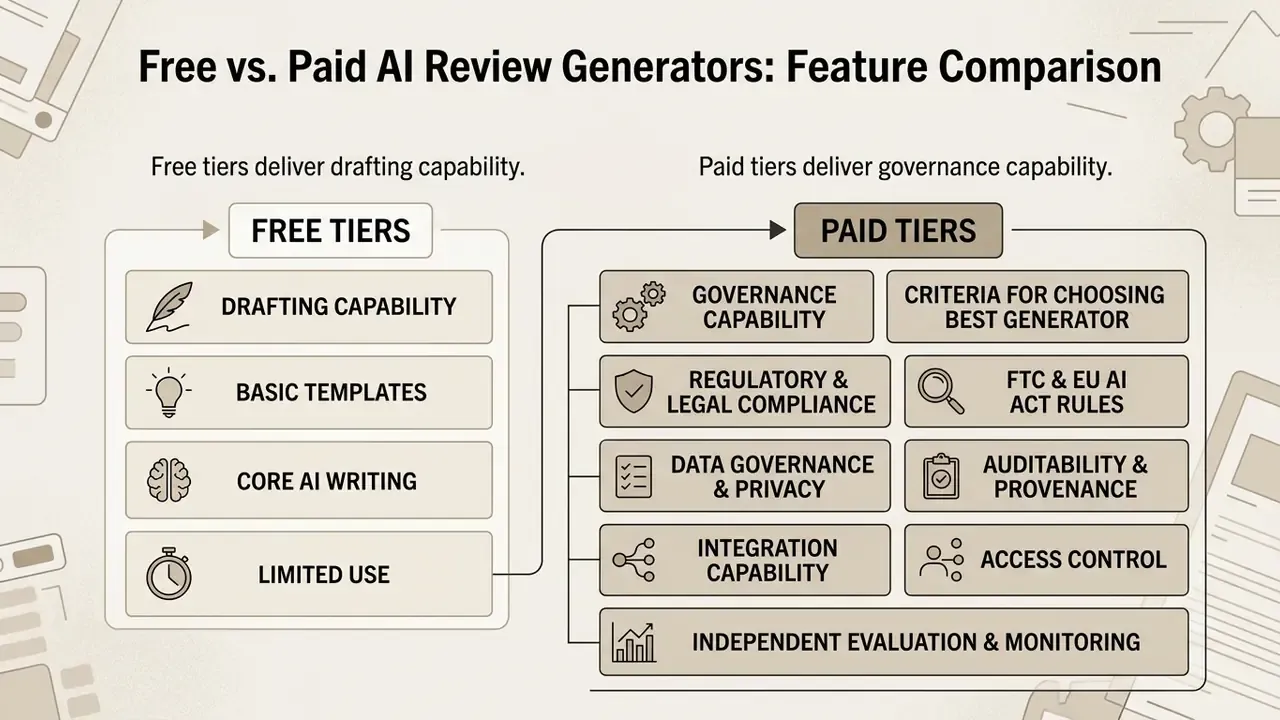
In two sentences: Free tiers deliver drafting capability, while paid tiers deliver governance capability. Choose based on data retention, auditability, and access control rather than on output quality alone.
Evaluating a free ai review generator against a paid enterprise platform depends on generation limits, security guarantees, data privacy controls, and multi-user management. Readers applying the same selection logic across other tool categories can see how the criteria play out in a comparable market in our breakdown of the best AI image generators.
While a free ai review generator, a free ai feedback generator, or an ai feedback generator free tier provides basic drafting functionality, enterprise deployments require dedicated model risk governance, audit trails, and data security guarantees.
Detection capability is now a purchasable feature, not only a platform-side function. Enterprise tiers that bundle authenticity scoring materially reduce the chance of publishing a non-compliant draft.
Table: Free AI review generators compared with paid enterprise platforms.
| Evaluation Criterion | Free AI Review Generator Tier | Paid / Enterprise AI Platform Tier |
|---|---|---|
| Usage and generation limits | Capped generations (documented examples: 2 reviews per day; 50 reviews per month; 2K review ceilings; 10MB file inputs). | High-volume or unlimited API access; custom enterprise quotas. |
| Indicative pricing | $0, often ad-supported or trial-limited. | Roughly $10 to $45 per month at entry tiers; roughly $199 to $649 per month for multi-location business suites. |
| Tone and language control | Basic presets (5 tones typical, automatic language matching); some tools expose 16 presets. | Custom brand voice controls; 100+ localized languages; explicit temperature tuning. |
| Data privacy and confidentiality | Inputs may train public models; no custom SLAs; no confidentiality warranty. | Zero data retention SLAs; SOC 2 Type II; HIPAA and GDPR compliance options; DPA available. |
| Export and team features | Clipboard copy, TXT or PDF export; single-user access; downloads sometimes locked. | CSV and JSON API exports; multi-seat access; role-based access controls (RBAC). |
| Audit trail and provenance | None, or session-only history. | Immutable logs, model and version capture, approver records, provenance metadata. |
| Support and SLA | Community or best-effort email. | Contractual uptime SLA, named support, incident response commitments. |
What Free Tiers Typically Include
A free ai review generator typically offers a standard web interface, daily output caps, and fixed tone presets. Users can draft individual free ai review snippets or generate basic review generator templates without financial commitment. Documented free-tier patterns include limits of roughly two businesses and two review links per account, two generated reviews per day, a basic template library, multi-platform support, and a simple analytics dashboard.
Free tools often train public models on user inputs, though, and they lack data privacy protection. They also omit workflow management, bulk processing, download rights, and reproducible audit logs. For regulated firms the decisive gap is not the generation cap. It is the absence of a contractual retention guarantee, which turns casual use into a Shadow AI data-leakage event.
One more thing worth flagging during vendor selection. Many suites bundle the review module with a title generator, a meta description generator, a paragraph generator, a paragraph rewriter, a sentence rewriter, an acronym generator, a slogan generator, an idea generator, a business name generator, a code generator, and sometimes an AI website builder. Each additional module is another data surface and another retention question. Convenience for a content creator writing blog posts is not the same thing as a defensible control boundary for a bank.
Criteria for Choosing the Best AI Review Generator
Selecting the best ai review generator requires evaluating core risk and technical controls. NIST AI RMF 1.0 requires governance of legal and regulatory requirements, while U.S. federal memorandum M-24-10 requires pre-deployment impact assessment, real-world testing, independent evaluation, ongoing monitoring, and plain-language documentation.
- Regulatory and legal compliance documented adherence to consumer protection rules and transparency policies.
- Data governance and privacy guaranteed non-retention of input prompts for public model retraining, a signed DPA, and regional data residency.
- Auditability and provenance clear lineage tracking that shows whether text was generated, edited, or human-written, consistent with NIST AI 100-4 provenance controls.
- Integration capability connectivity with GRC, MRM inventory, CRM, and customer support systems.
- Access control RBAC, SSO, least-privilege defaults, and segregation between HR and marketing workflows.
- Independent evaluation and monitoring third-party testing evidence and continuous drift monitoring after deployment.
- Exit and portability export of prompts, drafts, and logs in open formats, with no vendor lock-in on your own review corpus.
- Cost per usable output total control costs measured against manual editing hours saved.
To calculate real operational efficiency gains, teams can evaluate the Cost per Usable Output Benchmark across automated drafting tools.
Risk-Adjusted ROI and Cost per Usable Output
The licence price is the smallest line item. The dominant cost is verification labour, and the dominant risk is residual non-compliance.
Cost per Usable Output (CPUO)
CPUO = (Licence cost + Generation cost + Verification labour + Rework labour) ÷ Number of approved outputs
Verification labour
Verification labour = Drafts generated × Average review minutes × Loaded hourly rate ÷ 60
Risk-adjusted ROI
Risk-adjusted ROI = (Baseline manual cost − CPUO total − Expected residual risk cost) ÷ CPUO total

Expected residual risk cost = Probability of compliance incident × Estimated incident cost
Worked example. A support team drafts 1,000 replies per month. Manual authoring takes 12 minutes each at a loaded rate of $45 per hour, so the baseline cost is $9,000. With AI drafting, 1,000 drafts are generated at a $250 platform cost, and verification plus editing takes 4 minutes each, which is $3,000 of labour. Rework on 8% of drafts adds roughly $240. Total is about $3,490 for 1,000 approved outputs, so CPUO is roughly $3.49 against a manual $9.00. If the residual compliance-incident probability is 0.5% with an estimated $40,000 impact, expected residual risk cost is $200, and risk-adjusted ROI works out to about (9,000 − 3,490 − 200) ÷ 3,490, or roughly 152%.
The instructive part is the sensitivity. If verification time rises from 4 to 9 minutes per draft, CPUO climbs above $7 and the business case nearly collapses. Prompt quality and input completeness are the real ROI levers, because they directly determine verification minutes. Teams that save time by skipping input discipline usually pay it back twice during review.
How to Use AI Feedback Generators for Real Customer Reviews
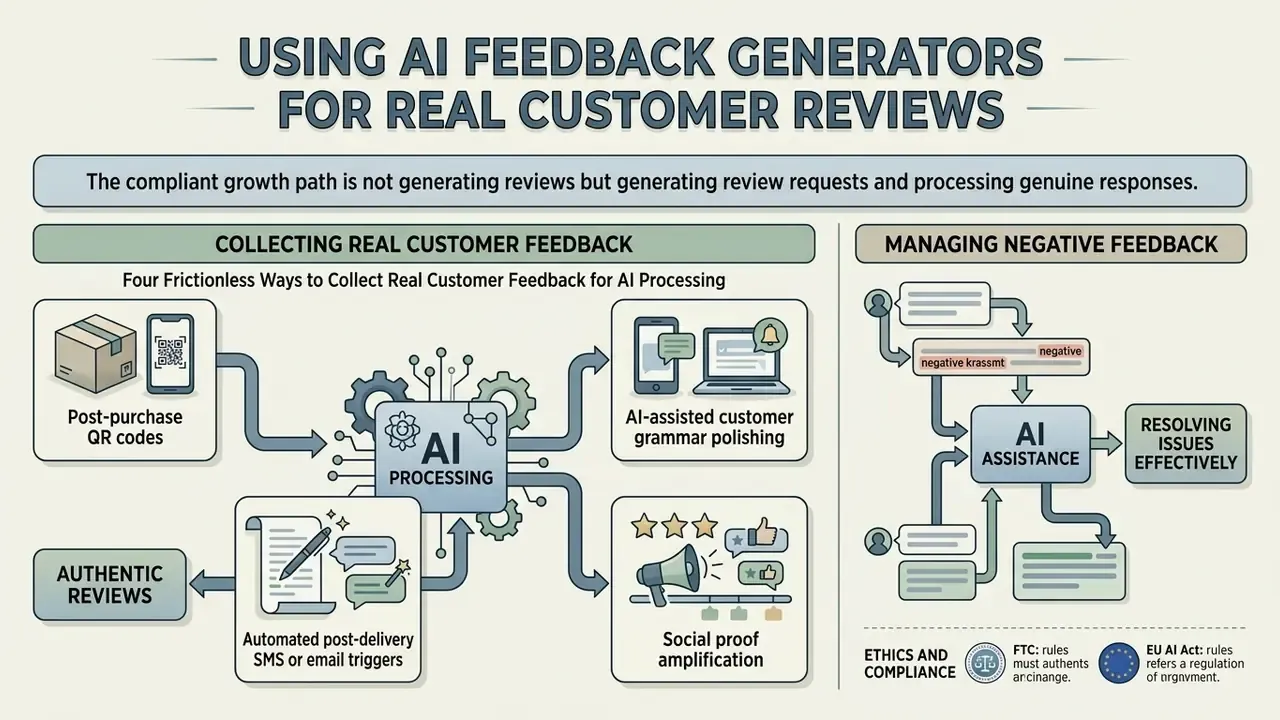
In two sentences: The compliant growth path is not generating reviews but generating review requests and processing genuine responses. AI adds leverage at collection, classification, and response drafting, never at authorship of the customer's experience.
Deploying a feedback generator ai model allows organizations to collect, categorize, and address real customer feedback at scale. Vendors also market the same capability as a feedback ai generator, which can confuse procurement more than it should.
Modern feedback architectures use multi-stage pipelines: acquiring customer feedback, preprocessing text, running LLM-based aspect classification, and outputting structured sentiment metrics. A 2025 arXiv study of user feedback on AI-powered apps documents exactly that sequence, from collection and cleaning through feature extraction, LLM classification, aspect extraction, sentiment labelling, and structured JSON output. Google's PAIR "Feedback + Control" guidance distinguishes implicit from explicit feedback and lists collection channels including app reviews, email, call centres, social posts, and push notifications.
Authenticity is therefore not only a compliance requirement. It is a conversion advantage. Substituting synthetic summaries for genuine voices measurably reduces purchase intent, which should settle most internal debates about "just filling the page".
How to Ask a Customer for an Authentic Review
Four Frictionless Ways to Collect Real Customer Feedback for AI Processing
- Post-purchase QR codes.Place dynamic QR codes on physical receipts, packaging inserts, table tents, menus, or checkout counters that route directly to your review intake form. Frictionless scanning converts more in-the-moment satisfaction into written feedback.
- Automated post-delivery SMS or email triggers.Send a request 24 to 48 hours after delivery or service completion, asking two questions: "What worked best?" and "What can we improve?" Test subject lines, channel, and send time rather than increasing message frequency.
- AI-assisted customer grammar polishing.Let customers submit raw bullet points or voice notes, then use an AI review assistant to tidy tone, structure, and flow before submission. The experience stays theirs, and only readability changes. Teams handling voice submissions can review capture quality considerations in our guide to AI voice generators.
- Social proof amplification.Re-share verified positive reviews on business social media channels, on the website, and in marketing materials, embedding a direct link for future buyers to leave their own feedback. Responding publicly to every review, positive and negative, signals that feedback is actually read and raises subsequent submission volume. It also strengthens online presence in a way no synthetic text ever will.
A fifth operational habit deserves a place on that list: close the loop. When a recurring complaint gets fixed, tell the reviewers who raised it. That single act converts critics into the most credible advocates a brand can have, and it generates genuine new user generated content without a single fabricated sentence.
How AI Helps Respond to Negative Feedback
Addressing critical feedback requires calm, empathetic, structured responses. An ai bad review generator framework drafts initial response templates that acknowledge customer concerns, accept responsibility where appropriate, and offer direct resolution paths. Service-recovery research indicates that effective replies to negative reviews combine three elements: apology, acceptance of responsibility, and an invitation to direct contact.
Human oversight remains essential here, and the reason is more specific than "quality".
An earlier revision of this section leaned on an unverified trust study, which we have since withdrawn (see Appendix A). The verified finding is narrower but more useful: AI-mediated negative content imposes higher cognitive load on readers, which is precisely why the final reply should be human-edited into plain, direct language.
Governance requirements reinforce that. EDPS guidance on human oversight (2025) states that effective oversight requires operator intervention and override capability, access to relevant information, and meaningful transparency about whether the oversight is genuine or symbolic. AWS responsible-AI guidance places human review at points where output quality is hard to judge, and requires reviewers to see explanations, contributing factors, confidence scores, and similar-case examples. Australia's NHMRC policy permits generative AI to refine reviewer comments for clarity, grammar, and structure while keeping human oversight with the reviewer, which is a workable model for support teams as well.
FAQ: Frequently Asked Questions About AI Review Generators
Can I generate multiple review variants for the same product?
Yes. An ai reviews generator can produce multiple draft variants for a single product by adjusting context inputs, focus features, and perspective parameters. NIST's 2024 GenAI pilot evaluation confirms that text-to-text systems generate multiple variants from the same prompt and must be evaluated for human-likeness. Every variant, though, must be grounded in a distinct verified customer experience, and NIST AI 300-1 requires documenting the algorithms, procedures, and synthetic-generation details behind each output.
"Fake reviews are defined as texts that do not reflect the reviewer's genuine subjective opinion, a form of opinion spam."
Source: Data Augmentation for Fake Reviews Detection in Multiple Languages and Multiple Domains, arXiv (2025). https://arxiv.org/
Producing several synthetic variants from one prompt without distinct user experiences creates deceptive content that breaches platform spam rules and FTC authenticity standards. Variation is not the same as evidence.
Does an AI review generator support multiple languages?
Most modern generative models cover major global languages. Vendor documentation confirms limited but usable scope. Adobe's generative AI features, for example, support English, French, German, Spanish, Italian, Brazilian Portuguese, and Japanese, while some review tools advertise 100+ languages on paid tiers only.
"Researchers generated fake reviews in English and Chinese across books, restaurants, and hotels, demonstrating multilingual LLM capability."
Source: Data Augmentation for Fake Reviews Detection in Multiple Languages and Multiple Domains, arXiv (2025). https://arxiv.org/
Vendor specifications state scope, not quality. Localized outputs still require human verification for natural phrasing, grammar, and regional context. A practical validation protocol is human annotation on a 1 to 5 scale, scoring fluency, grammar and syntax, and word choice separately from semantic plausibility, which is the approach used in NIST's generative-AI text evaluation work.
Can AI text be published without editing?
No. Unedited ai text should never be published directly. Published content requires strict checks for factual accuracy, hallucinated details, trademark compliance, and platform policy alignment, per NIST AI 600-1 and Georgia's SS-25-001 policy requiring human-in-the-loop review by qualified personnel. Reported limitations reinforce the point: 2025 and 2026 evaluations of automated review generation found weaker weakness identification, more generic feedback, more factually incorrect items than human reviewers, and errors reading equations and tables. Teams validating both text and imagery before publication can cross-check assets with AI image detectors.
Organizations evaluating platform-specific validation performance can review the synthesia ai training benchmark and consult specialized ai performance review generator analyses. For detailed verification logs across specific vendors, see the Review Proof for tool repository.
Is it legal to use an AI review generator at all?
Yes for drafting, formatting, summarizing, and responding. No for creating testimonials that misrepresent whether a reviewer exists or actually used the product. FTC 16 CFR Part 465 draws the line at misrepresentation, not at machine assistance. Under the EU AI Act (Regulation (EU) 2024/1689), the operative requirements are human-centric oversight, transparency, and protection of fundamental rights.
Are free AI review generators safe for business data?
Only if the provider contractually guarantees non-retention. Many free tiers reserve the right to train public models on submitted inputs. Never paste customer PII, employee performance data, contract terms, or unreleased product specifications into a free consumer tool. Where confidentiality obligations exist, as Elsevier's generative-AI policy emphasizes for manuscripts and reviews, uploading the material at all may itself be the breach.
Should AI-assisted reviews be disclosed?
Disclose whenever a reader could reasonably be misled about authorship or independence, and whenever internal policy or a publisher rule requires it. Sage requires disclosure of AI content affecting methodology, analysis, results, or conclusions. The NIH generative-AI usage toolkit requires verifying AI-generated insights and disclosing AI use in the process. NIST AI 100-4 calls for transparency policies and documented origin and history of generated data.
Can AI write employee performance reviews?
It can draft them from manager-supplied factual inputs, but the output is employment documentation subject to data-protection law, not marketing copy. Keep the workflow on zero-retention infrastructure, avoid fully automated evaluative decisions, inform the data subject where required, and make sure a named manager accepts accountability for the final text. Check the customer-versus-employee risk matrix above before selecting a tool.
How many reviews should a business realistically expect to collect?
Volume depends on request coverage, timing, and friction rather than on generation capability. Vendor benchmarks report meaningful review growth within the first 90 days of automated request programmes, with a majority of participating businesses sustaining 4+ star averages. Treat such figures as vendor-reported and verify them against your own baseline before setting targets. The controllable inputs are request coverage per transaction, response rate, and reply rate.
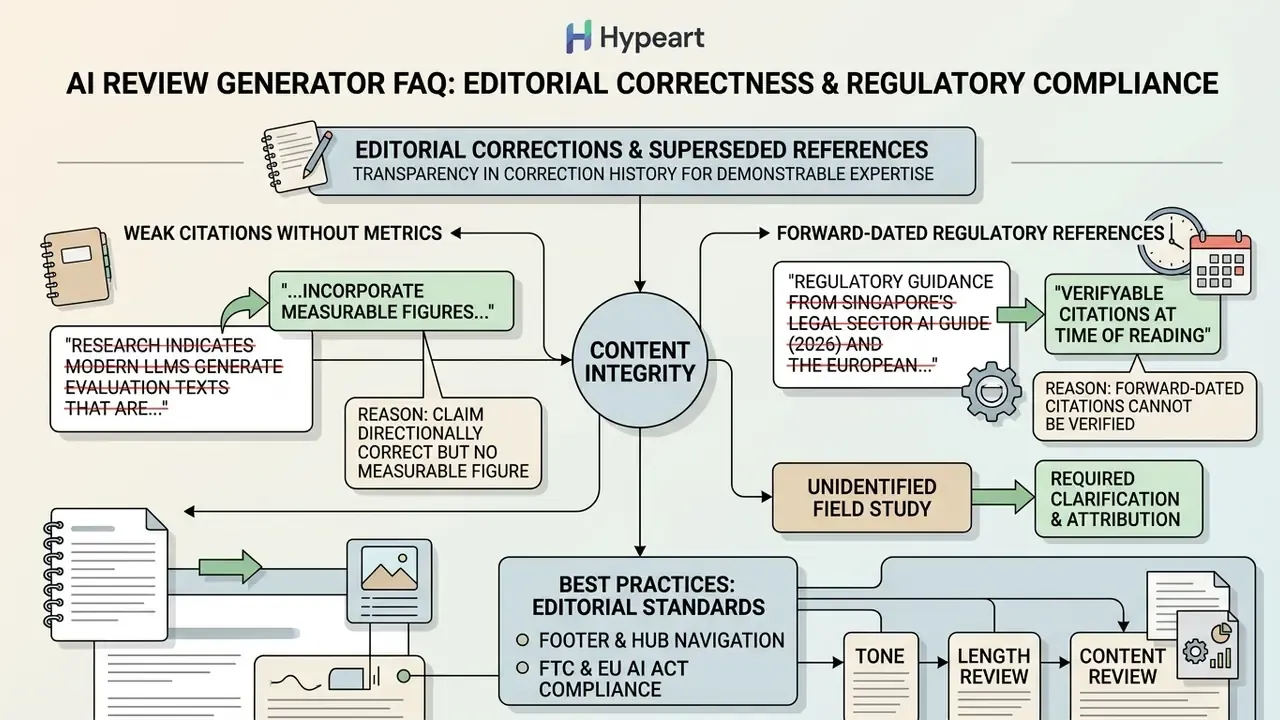
Appendix A: Editorial Corrections and Superseded References