Executive Summary for CRO, CCO and Model Risk Leaders
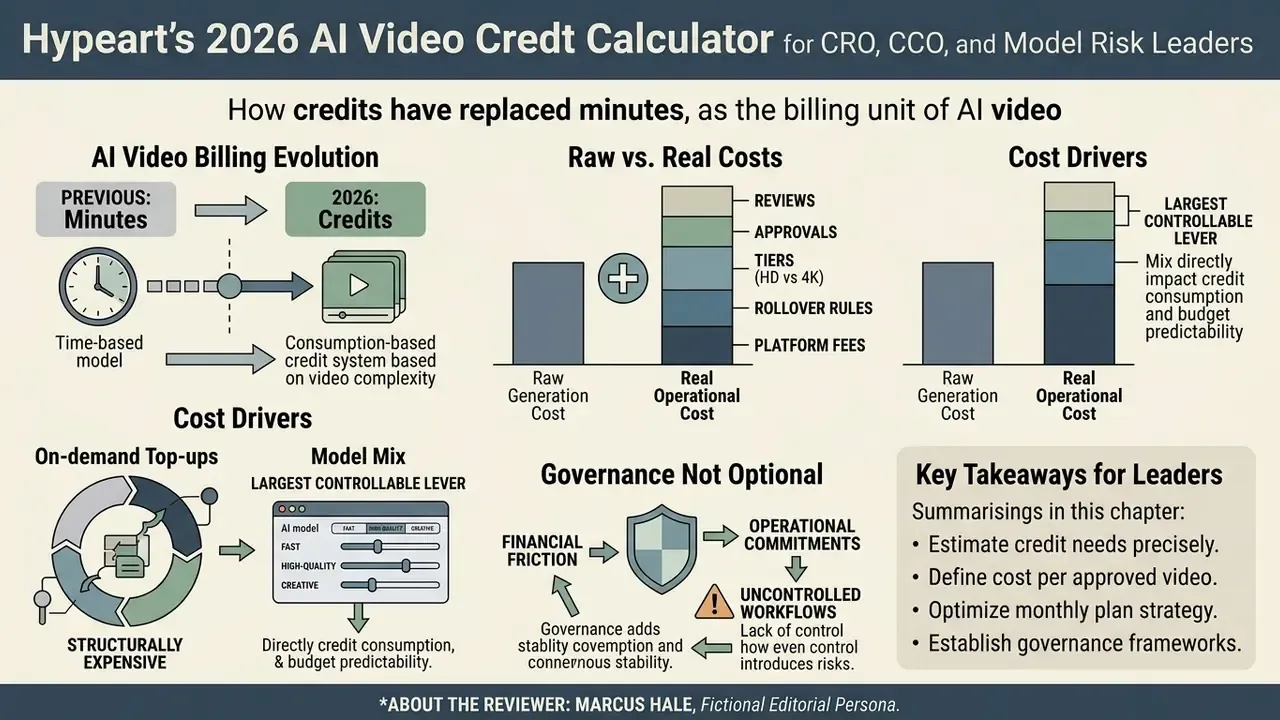
- Credits replaced minutes as the billing unit. Consumption is metered per second of rendered output, per avatar engine, and per resolution tier, not per finished asset. Synthesia, for example, charges 2 credits per second of standard video, which equals 120 credits per finished minute.
- Raw generation cost is never the real cost. Applying a mandatory iteration factor of 1.5x to 3.0x and an approval-rate divisor typically inflates the true price of a delivered clip by 2x to 4x versus vendor list rates.
- On-demand top-ups are structurally expensive. Pay-as-you-go credit packs carry an estimated ~25% premium over credits bundled inside subscription tiers. Teams buying two or more top-ups per month should upgrade the base plan instead.
- Model mix is the largest controllable lever. Drafting on low-cost engines (10 to 40 credits per second) and finalising only the winning shot on flagship models (160 to 240 credits per second) cuts campaign credit burn by 60% to 75% without degrading published output.
- Governance is not optional. Before procurement, verify data-retention terms, model-training opt-outs, SOC 2 and DPA coverage, audit logging, and seat-level access controls to prevent Shadow AI exposure of customer or transaction data.
AI Video Credit Calculator Inputs: What to Enter
An AI video credit calculator needs four core inputs: the target generative model, the video output type, clip duration in seconds, and projected monthly generation volume. Accurate baseline parameters are what separate a usable forecast from a number someone invented in a meeting. Get them wrong and unit costs escalate quietly, one billing cycle at a time.
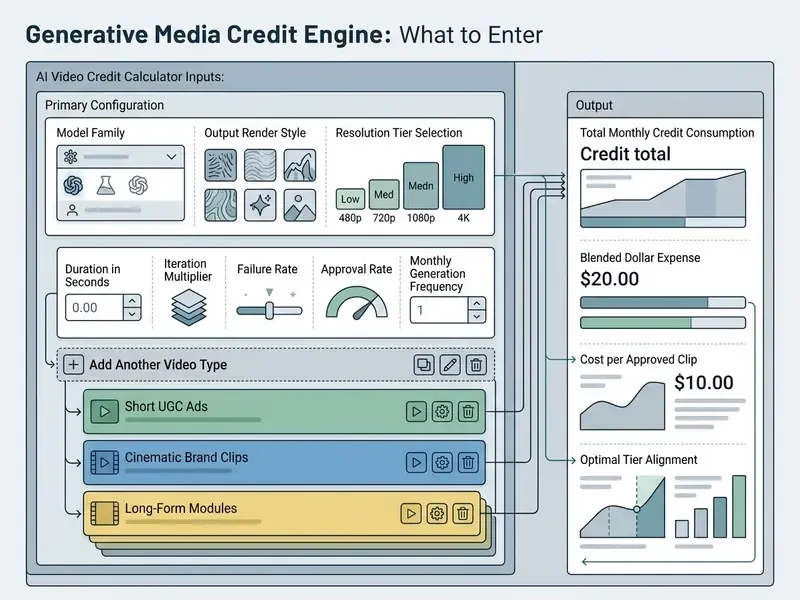
Static alternative (no-script fallback): teams without access to the interactive widget can reproduce the same logic in a spreadsheet with six columns, Video Type | Model & Resolution | Seconds per Clip | Clips per Month | Credits per Second | Iteration Multiplier, plus a summed total row that feeds the plan-selection table further down this page. A shared sheet also satisfies an audit requirement that is easy to overlook: cost assumptions must be visible to the whole team, not buried in one analyst's private workbook.
Model, Video Type and Generation Duration
Model selection dictates the baseline credit consumption rate per second of generated media. Advanced foundational models demand far more computational units than lightweight fast-iteration engines. Buyers unfamiliar with engine families should first review how AI video generators differ by architecture, output length ceiling, and audio support.
According to official developer documentation, Runway Gen-4 consumes 12 credits per second, while Runway Gen-4 Turbo requires 5 credits per second for the same temporal output (Runway Help Center, 2026).
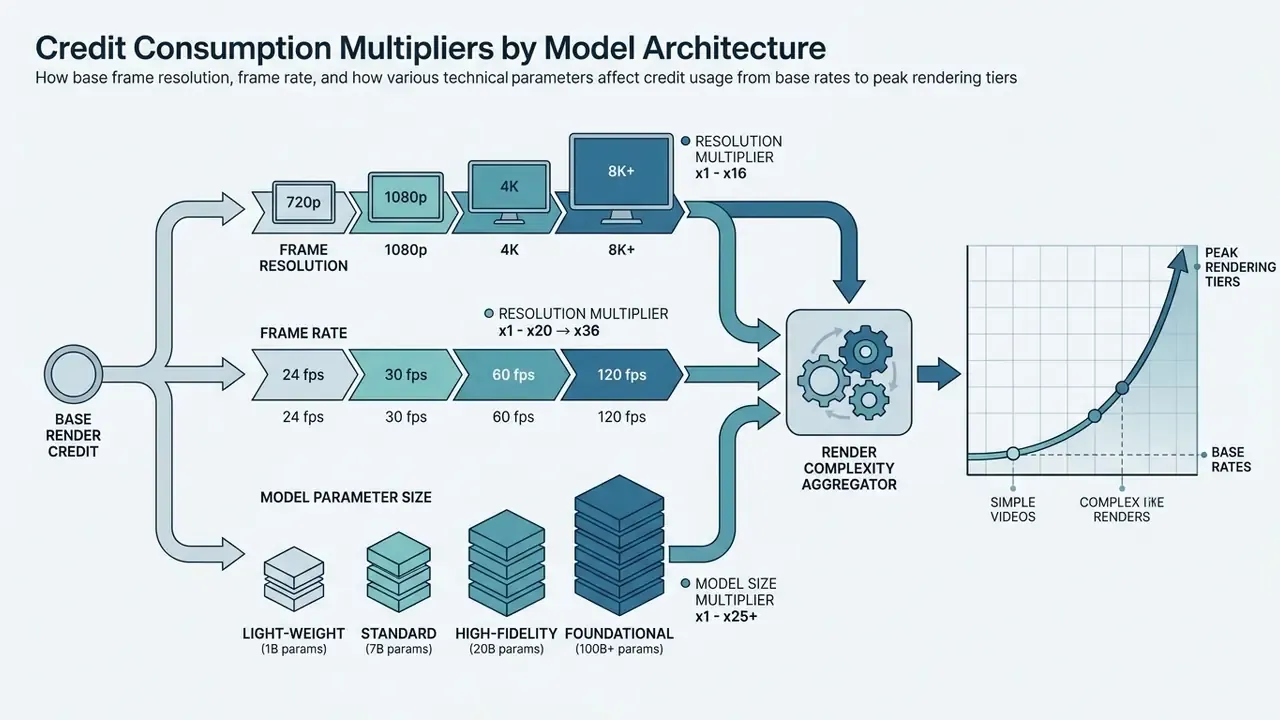
Video type and rendering complexity add further multipliers. Still-frame animation through image-to-video AI is metered as its own tariff category, separate from text-to-video synthesis, and avatar engines are metered separately again. Standard avatar output in Synthesia consumes 120 credits per minute (2 credits per second), while lip-synced multi-language dubbing doubles that to 240 credits per minute (Synthesia Help Center, 2026).
One practical detail. Parameterize duration in exact seconds rather than rounded minutes. Rounding a 47-second clip up to a full minute across 40 assets a month invents roughly 1,500 phantom credits, and that error compounds across a quarter.
Resolution Tiers: Where Credits Actually Disappear
Flat per-model rates hide the single largest cost variable in generative video, which is output resolution. The same eight-second prompt can cost 80 credits or 1,920 credits depending on the grid it renders into.
| Model / Engine | Resolution | Credits per Second | 10-Second Clip (Credits) | USD Equivalent (Pro-Tier Base) |
|---|---|---|---|---|
| Seedance 2.0 | 480p Standard | 10 cr/s | 100 credits | $0.20 |
| Seedance 2.0 | 720p HD | 21 cr/s | 210 credits | $0.42 |
| Seedance 2.0 | 1080p Full HD | 60 cr/s | 600 credits | $1.20 |
| Seedance 2.0 | 4K Ultra HD | 108 cr/s | 1,080 credits | $2.16 |
| Grok Imagine 1.5 | 720p HD | 32 cr/s | 320 credits | $0.64 |
| Wan 2.7 | 720p HD | 40 cr/s | 400 credits | $0.80 |
| Wan 2.7 | 1080p Full HD | 60 cr/s | 600 credits | $1.20 |
| Google Veo 3.1 | 720p / 1080p HD | 160 cr/s | 1,600 credits | $3.20 |
| Google Veo 3.1 | 4K Ultra HD | 240 cr/s | 2,400 credits | $4.80 |
| Runway Gen-4.5 | 1080p High-Res | 120 cr/s (flat) | 1,200 credits | $2.40 |
Two structural conclusions follow. First, a 4K deliverable on a flagship engine costs roughly 24 times the same duration drafted at 480p on an efficient engine. Second, resolution belongs in the deliverable specification, not in the default settings. Social-first placements rarely justify a 4K master. Broadcast and out-of-home placements usually do. Teams that want API-level control over resolution and duration can review the Google Veo implementation guide for per-second billing behaviour at each tier.
Modular Asset Cost Breakdown (Avatar, Voice and Motion)
Complex content types, whether UGC-style ads, narrative story videos, or compliance explainers, are not single generations. They are stacked generative layers, and each layer meters credits independently:
- Base image or avatar frame generation 4 to 6 credits per image.
- Voice synthesis 1 to 3 credits per 10 seconds of audio. Voice quality tiers and licensing terms differ sharply between engines, as covered in this guide to AI voice generators.
- AI motion layer 10 to 25 credits per 5-second animated clip.
- Lip-sync and multi-language dubbing doubles the base render rate, up to +100%.
- Script generation usually negligible in token terms, but log it anyway for full audit reconciliation.
A 60-second narrative asset built from 8 scenes therefore consumes credits across four separate meters. That is exactly why single-line "credits per video" estimates keep understating real invoices.
Monthly Video Volume and Production Goals
Monthly video volume sets the aggregate computational pool needed to sustain marketing, training, or customer-facing media pipelines. Aligning target clip volume with organizational throughput goals prevents mid-cycle service disruption, which in a regulated shop means a stalled disclosure update rather than just a late social post.
In regulated enterprise media operations, finished deliverables cluster into three duration bands: short-form social and in-app promos at 15 to 60 seconds, customer onboarding and compliance explainers at 60 to 180 seconds, and long-form training modules at 3 to 10 minutes. Plan the credit pool against the band mix, not an average. A single 10-minute training module can consume more credits than an entire month of short-form social output.
Raw generation volume rarely matches published assets, though. Quality control filtering and prompt iteration eat the difference.
An illustrative case. A financial transformation team evaluated generative video for compliance onboarding clips and budgeted 20 finished 60-second clips per month. Once a 3-to-1 prompt refinement ratio was applied, generation requirements rose from 1,200 seconds to 3,600 seconds monthly. Building that iteration volume into the upfront credit calculation prevented a 200% budget overrun during initial rollout. The math was not clever. It was just honest.
AI Video Credit Calculator Formula: How Credits Are Calculated
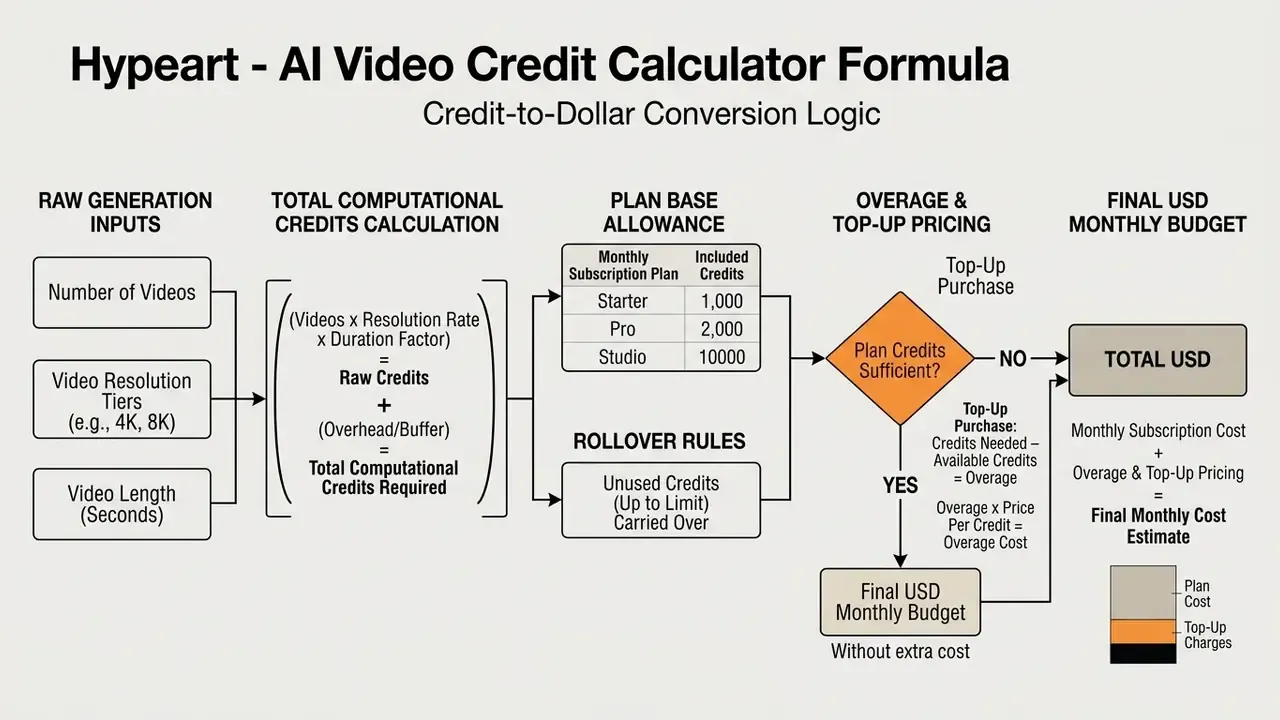
The foundational AI video credit calculator formula multiplies duration by the model credit rate and iteration frequency to produce raw credit volume. That raw consumption figure then converts into dollar expense using subscription tier rates or token exchange values.
Credits per Generation and per Video
Calculating credits per generation means isolating the per-second model consumption rate and multiplying it by clip duration:
Because the arithmetic depends on the generation route selected, readers comparing prompt-driven workflows should review how text-to-video AI tools differ from avatar and image-animation pipelines in both credit rate and revision behaviour.
For example, a single 10-second clip on Runway Gen-4 (12 credits per second) with two prompt iterations requires 240 credits (). On Luma Dream Machine Ray3.2, a 10-second 1080p SDR generation requires 1,200 credits per attempt (Luma AI Documentation, 2026).
Those baseline rates matter when you start analyzing ai video pricing and credits across competing enterprise platforms, because two vendors can quote identical monthly fees and deliver wildly different volumes of finished seconds.
Cost per Approved Video: The Metric That Governs Budgets
Raw generation cost is an engineering number. Finance and risk functions need something else: the fully loaded cost of a clip that survives technical QC, creative revision, and stakeholder sign-off. Three production variables must stay separate rather than collapse into one abstract multiplier.
- Failure Rate. Technical rejects: artefacts, morphing hands, corrupted audio, failed renders.
- Revision Rate. Creative rework: pacing, framing, brand-kit misalignment, script edits.
- Approval Rate. The share of delivered candidates that clear legal, compliance, or brand review.
Worked example. Base generation of a 10-second clip costs $3.00. Technical failure rate is 15%, creative revision rate is 35%, and stakeholder approval clears only 50% of candidates:
The list price said $3.00. Audited unit economics say $9.00, a 3x variance driven entirely by production reality rather than vendor pricing. At a 25% approval rate the same clip lands at $18.00, or 6x list. That is the calculation that belongs in a procurement business case, with the assumptions living in a shared sheet the whole team can inspect and challenge.
«The best calculator shows cost per usable video, not only raw generation cost. Advanced inputs should include failure rate, revision rate, and approval rate.»
In compliance-heavy environments the approval rate is often the dominant term. If legal review rejects half of everything, no amount of engine optimisation saves the budget. Fix the brief first.
From Credit Usage to Monthly Budget
Translating credit usage into a financial budget means mapping total monthly credit requirements against vendor subscription allowances and overage rates. Fixed credit valuation pegs vary wildly across the enterprise software ecosystem.
| Vendor / Platform | Published Credit Value Peg | Fixed USD Formula Equivalent | Source Reference |
|---|---|---|---|
| Standard iGaming / API Peg | 1 Credit = $0.005 USD | AI Video API Documentation, 2026 | |
| Black Forest Labs | 1 Credit = $0.010 USD | Black Forest Labs Developer Docs, 2026 | |
| HeyGen Enterprise | 1 Credit = $0.500 USD | HeyGen Enterprise Pricing Guide, 2026 |
That two-order-of-magnitude spread, $0.005 to $0.500 per credit, is the clearest evidence that "credits" is not a comparable unit across vendors. Normalise every cross-vendor comparison to dollars per finished second before making a tier decision. Anything else is guesswork wearing a spreadsheet.
Unused subscription credits frequently expire at the end of each billing cycle, whereas pay-as-you-go top-up packages may stay valid for up to 12 months (Augment Code Pricing Terms, 2025). Enterprise financial planners should size the subscription baseline against predictable usage and reserve top-ups strictly for volatile production spikes.
AI Video Credit Calculator Results: Credits, Costs and Video Volume
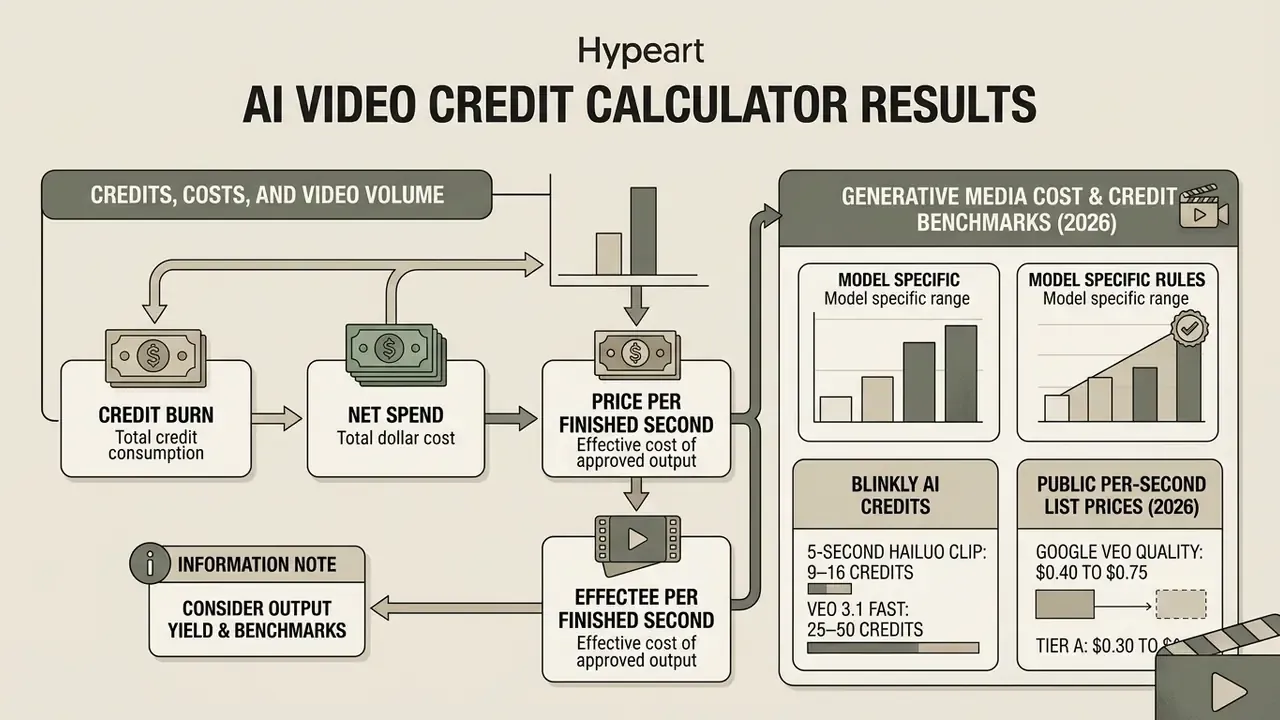
Reading AI video credit calculator results means evaluating total credit burn, net dollar spend, and effective price per finished output second. Clear metric visibility lets procurement teams catch cost anomalies before signing a vendor agreement, rather than during the first quarterly review.
Generative Media Cost and Credit Benchmarks
| Provider & Model Architecture | Clip Duration | Credits Per Generation | Monthly Clip Volume Target | Estimated Monthly Credits | Recommended Plan Tier | Estimated Monthly Cost (USD) |
|---|---|---|---|---|---|---|
| Synthesia Standard Avatar | 180 seconds | 360 credits | 8 finished clips | 2,880 credits | Creator Tier (3,600 credits/mo) | $89.00 |
| HeyGen Avatar IV (Video) | 600 seconds | 200 credits | 10 finished clips | 2,000 credits | Pro Custom Tier (~3,000 credits/mo) | ~$149.00 |
| Runway Gen-4.5 High-Res | 10 seconds | 120 credits | 50 finished clips | 6,000 credits | Max Plan Tier (9,500 credits/mo) | $76.00 |
| Luma Ray2 720p Render | 10 seconds | 320 credits | 20 finished clips | 6,400 credits | Pro Enterprise Allocation | Dependent on contract |
| Seedance 2.0 (720p draft tier) | 8 seconds | 168 credits | 60 draft clips | 10,080 credits | Studio Tier (6,000+ credits/mo) | Plan-dependent |
| Google Veo 3.1 (4K master) | 8 seconds | 1,920 credits | 5 finished masters | 9,600 credits | Agency Tier (10,000 credits/seat) | ~$149.00 per seat |
Fact check and pricing verification: credit schedules and pricing metrics were checked against official vendor documentation, API price cards, and public pages as of February 2026. Rates remain subject to provider adjustment.
Public per-second list prices in 2026 sit at roughly $0.40 to $0.75 for Google Veo Quality tiers, $0.30 to $0.60 for Sora 2, $0.15 to $0.45 for Kling, and $0.25 to $0.50 for Runway Gen-4. Pay-per-second billing penalises iteration directly, since every rejected take is a cash cost. Bundled-credit subscriptions invert that incentive and let teams draft freely inside a fixed monthly commitment, which is usually the more predictable structure for organisations shipping dozens of clips a month.
Information note: this material is general in nature and does not replace professional advice. Platform tariffs and credit rates change. Verify current figures on official provider pages before making financial decisions.
Interpretation of calculator results has to account for output yield. Industry production benchmarks for AI short-form work suggest only about a quarter of generated clips survive into the final cut, with pricing per finished minute landing in the $315 to $750 range once labour is included (AI short film production benchmark data, 2026; figures require independent verification against your own studio logs before use in a business case). Applied to unit economics, a 25% acceptance rate raises effective cost per usable second roughly fourfold versus baseline generation rates. Contingency buffers of 15% to 30% inside the initial calculation protect the team against iteration budget exhaustion halfway through a campaign.
Compare AI Video Plans by Monthly Credits and Cost
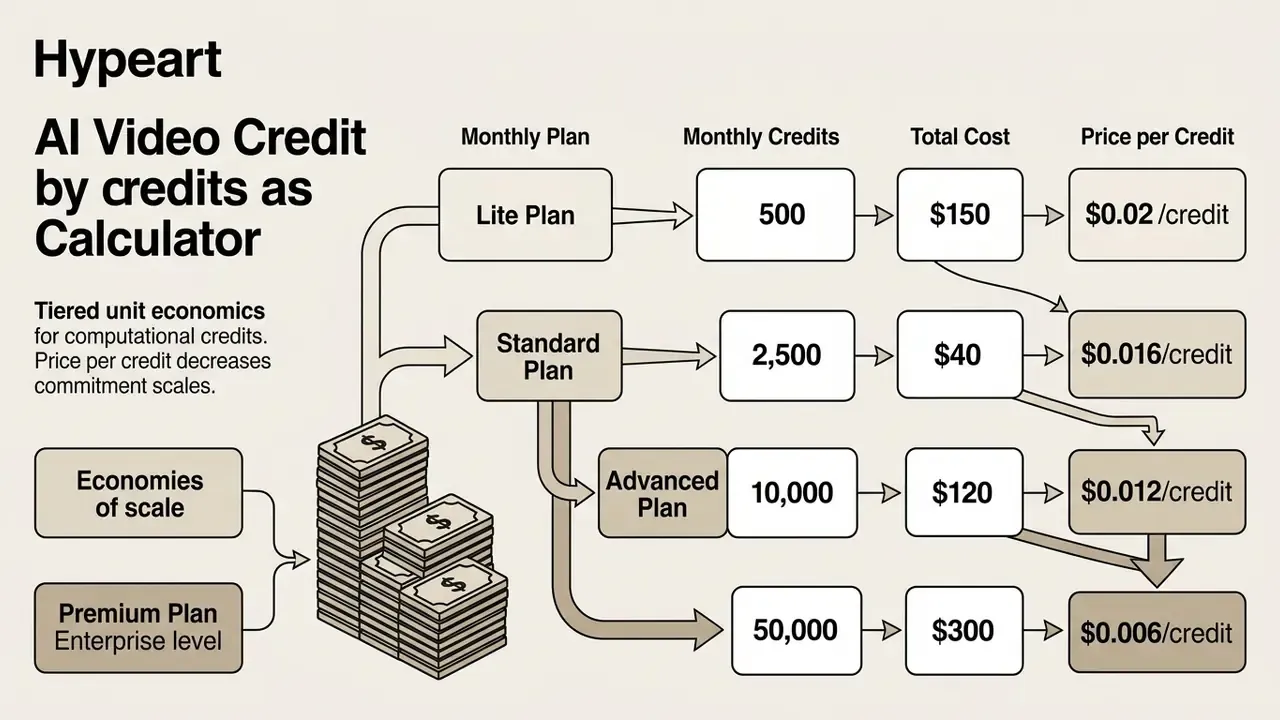
Enterprise vendors structure commercial tiers around monthly credit allocations, render queue speed, and administrative security controls. Comparing plans means evaluating unit cost per credit across Free, Lite, Pro, and Premium tiers, then testing that against your real volume. Buyers still shortlisting should first narrow the field using this comparison of leading AI video generators by output quality, control surface, and licensing.
Enterprise Cost Optimization: The Multi-Model Drafting Framework
Running the whole storyboarding and prompt-engineering phase on flagship engines, say Google Veo 3.1 at 160 credits per second, routinely burns 70% of a monthly credit pool on takes that never ship.
Optimal production protocol (draft to final):
- Drafting phase. Generate exploratory iterations on low-cost engines (Seedance 2.0 at 21 cr/s, or Wan 2.7 at 40 cr/s, in 480p or 720p). At those rates a team can test 8 to 10 variations of camera movement, pacing, and framing for the credit cost of one flagship take.
- Selection phase. Lock the winning composition, prompt, and seed. Document all three in the shared cost sheet so the final render is reproducible and auditable.
- Final render phase. Promote only the approved prompt and seed to the flagship model (Veo 3.1 at 4K, or Runway Gen-4.5 at 1080p) for the delivered master.
Result: a 20-clip campaign at 8 seconds per clip drops from 25,600 credits all-flagship to roughly 7,420 credits with draft-then-finish, and published quality holds. That is a reduction of over 70%. Teams that want to validate the approach at zero cost first can trial free AI video generation options before committing draft-phase budget.
Monthly Credits vs. Top-Ups
Running baseline production on pay-as-you-go top-ups raises total operating expense, quietly and consistently.
Vendor documentation shows a structural premium on on-demand credits. HeyGen sells additional credits at roughly $0.05 per credit, materially above the effective per-credit rate inside its Creator subscription (AI Video Credit Calculator: Evidence-Based Review, Section 6, HeyGen help article on credit-based pricing, 2025–2026). Automation vendors publish the same pattern explicitly: extra credits priced above in-plan credits by a fixed margin. Treat the widely cited ~25% top-up premium as an estimate, not a verified industry average, and confirm the exact delta on each vendor's own rate card.
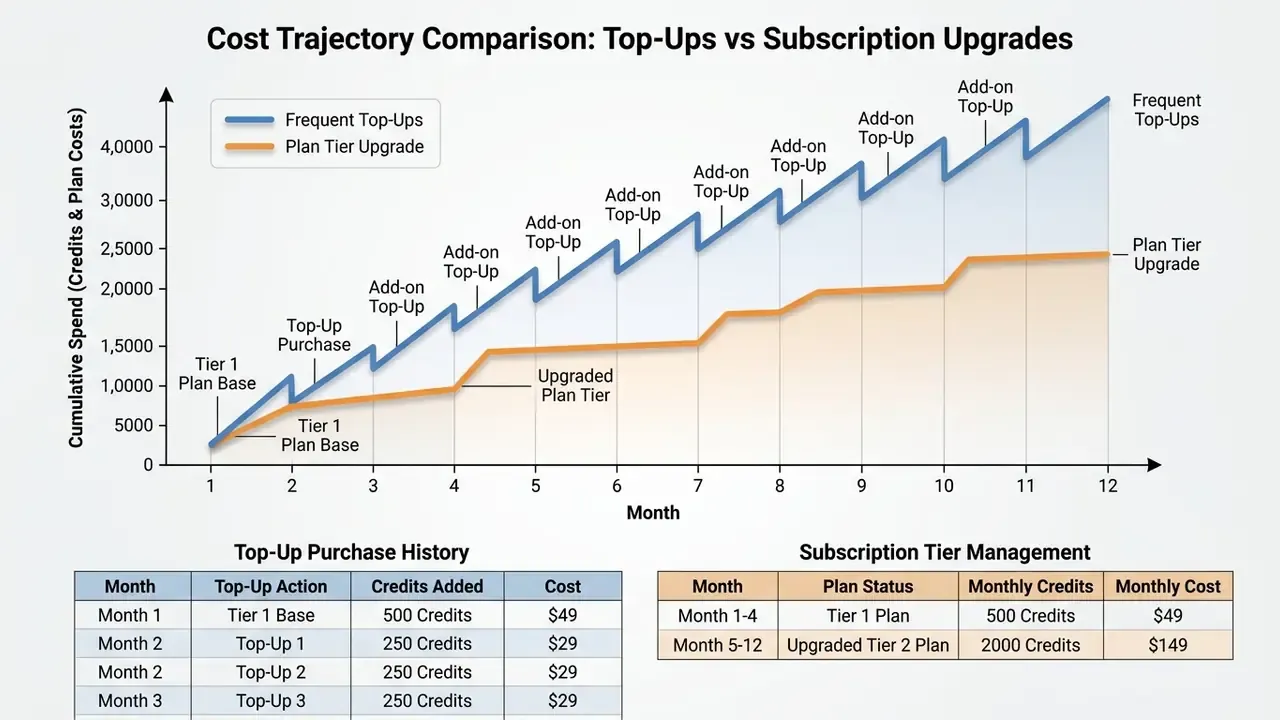
An illustrative example. A regional fintech expanded a localized marketing campaign and exceeded its Pro tier cap by 5,000 credits monthly. Instead of upgrading to Premium at $199 per month, the team bought four consecutive top-up packages at $65 each, $260 in extra monthly spend. An expense audit after three months revealed $183 in avoidable overage fees. The team upgraded the base tier and monthly vendor outlays stabilised.
The decision rule is simple enough to encode in policy. A one-off project spike justifies a top-up. Hitting the credit ceiling every month justifies an upgrade. Buying two or more top-ups per month is always the more expensive path per credit.
Enterprise Rollover and Overage Policy Matrix
When auditing SaaS contracts, finance teams should document four distinct mechanics governing unused credits:
- Monthly plans, rollover cap.Most platforms carry unused credits into the next cycle only up to 2x the monthly allowance. Anything above that ceiling is forfeited permanently, which means an under-utilised premium tier silently destroys budget every quarter.
- Annual contracts, uncapped accumulation.On annual billing, credits are either issued for the full term or accumulate month over month with no interim expiry, remaining valid until the annual renewal date. This structure suits lumpy, campaign-driven production calendars.
- Prorated upgrade credit discount.Advanced platforms calculate the dollar value of unused credits at a mid-cycle upgrade and apply it against the first invoice on the new tier. Request the transparent breakdown, current usage, calculated discount, final price, before confirming any upgrade.
- Overage thresholds.Where overage billing exists, rates improve with tier (Pro lowest, Starter highest), and charges trigger either at a currency-specific billing threshold or at cycle end, whichever comes first. Purchased top-up credits typically remain valid for 12 months from purchase.
Governance and Security Considerations for Financial Institutions
AI Video Credit Calculator Usage Guide
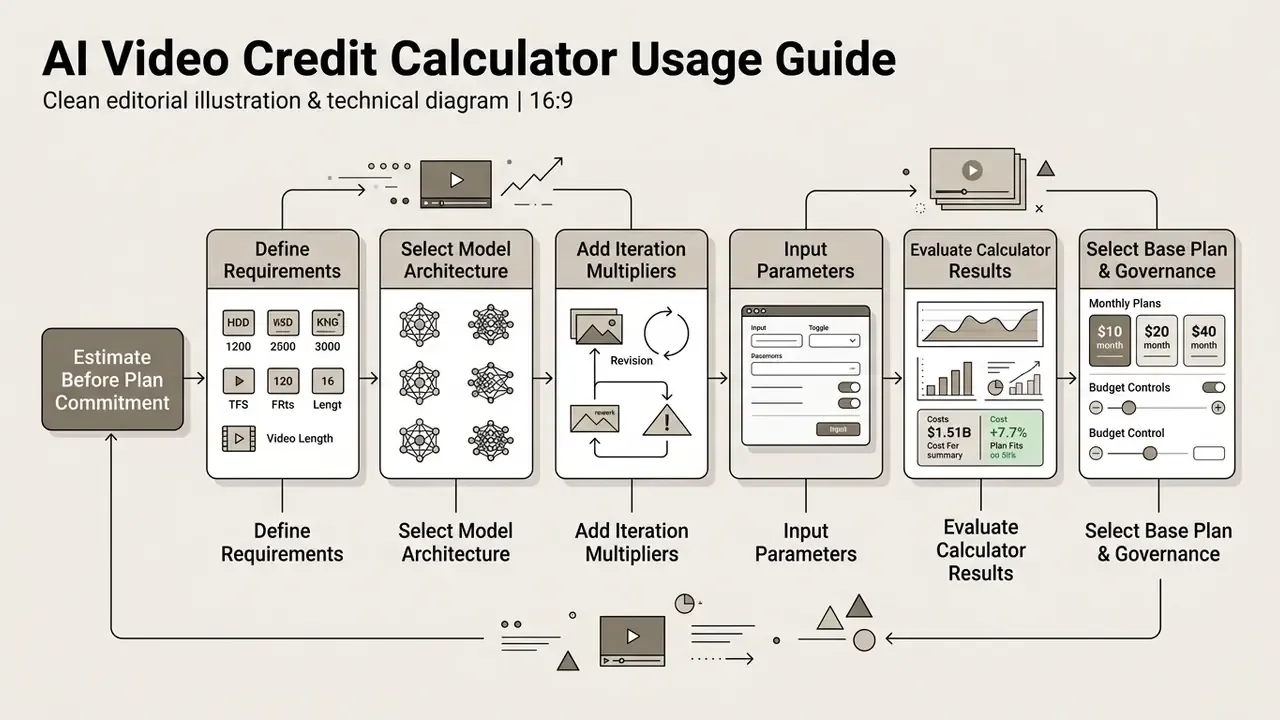
A structured budgeting assessment with an AI video credit calculator gives you financial predictability before purchase orders go out. Following the workflow below reduces the risk of unexpected model risk findings, procurement delays, or an awkward conversation about variance.
- Define final output requirements. Document exact clip counts, target resolutions (480p, 720p, 1080p, 4K), and total runtime in seconds needed per billing cycle. Build the list as a mixed basket if your calendar contains several video types.
- Select target model architectures. Match creative requirements against specific model families such as Runway Gen-4, Sora 2, or Synthesia Avatar IV, and assign a separate draft-tier engine for exploration.
- Incorporate iteration multipliers. Apply a mandatory 1.5x to 3.0x iteration factor for prompt engineering, rejected takes, and compliance edits, then divide by a realistic approval rate using and .
- Input parameters into the calculator engine. Enter each parameter set to project gross monthly credit consumption across every video type in the basket.
- Evaluate calculator results. Review projected credits and dollars against vendor subscription tiers, comparing dollars per finished second rather than raw credits.
- Select base plan and governance controls. Choose a plan covering roughly 85% of peak expected monthly credit demand, keep top-ups for irregular spikes, and complete the governance checklist before signature.
Estimate Before You Commit to a Plan
Sequence matters here. Estimate first, then choose the tier, never the reverse. Teams that pick a plan on instinct and reverse-engineer the volume afterwards tend to discover the gap in month three, when the credit pool empties before the campaign does.
Three checks close the loop before a signature. Compare projected monthly credits against the plan allowance and confirm you land inside 85% of the ceiling at peak. Test one downside scenario where the approval rate halves, since compliance review is the variable most likely to move. Record the assumptions, the date, and the source page for every rate you used, because vendor schedules shift and a stale forecast is worse than none.
Then align the software decision with corporate governance guidelines through an enterprise AI Video Pricing Guide, so the credit budget and the control framework arrive at approval together rather than six weeks apart.
AI Video Credit Calculator FAQ
How accurate are AI video credit calculator forecasts?
Calculators give precise arithmetic based on current published vendor tariffs. Final accuracy still depends on your iteration inputs. Unplanned prompt revisions or a resolution change mid-production will shift real credit consumption away from the baseline. Treat every output as a date-stamped planning estimate, not a quote.
Do unused monthly subscription credits roll over to the next billing cycle?
It depends on the plan structure. Many commercial SaaS plans expire monthly credits at cycle end. Others carry credits forward but cap the balance at 2x the monthly allowance, forfeiting anything above that ceiling. Annual plans commonly accumulate credits without an interim cap, expiring together at the annual renewal date. Pay-as-you-go top-up packages typically stay valid for 12 months from purchase.
What happens to unused credits when I upgrade mid-cycle?
Advanced platforms calculate the monetary value of credits you have not consumed in the current period and apply that value as a discount to the first invoice on the higher tier. Request the itemised breakdown, current usage, discount amount, final price, before confirming. Downgrades usually take effect only at the start of the next billing cycle.
Can one calculation cover several different video types in the same month?
Yes, and it should. Add each video type as a separate row with model, resolution, duration, and monthly quantity, then sum the credits. A basket of 5 short UGC ads, 10 cinematic brand clips, and 2 long-form training modules produces a very different total than any averaged estimate, and the mixed total is what determines the correct tier.
How do new model releases impact existing credit calculation formulas?
Newer foundational models with higher parameter counts or advanced physics engines usually demand higher per-second credit rates. Upgrading from Runway Gen-4 Turbo (5 credits per second) to Gen-4.5 (12 credits per second) increases credit burn by 140% for identical durations. Re-baseline the budget whenever a production model family changes.
Are free tier credits sufficient for commercial media production?
No. Free tier allocations, such as 66 daily credits on Kling AI or 125 one-time credits on Runway, are built for platform evaluation and prompt testing. Commercial production needs paid plans that grant commercial licensing rights and unwatermarked exports.
What is the difference between subscription credits and API token pricing?
Subscription credits are bundled units sold inside fixed monthly SaaS packages for end-user web applications. API token pricing bills developer infrastructure directly per second of generated output or per computational token, at pay-as-you-go rates tied to exact request volume. Per-second API billing punishes iteration. Bundled credits absorb it.
Which governance questions should procurement ask before signing?
Confirm data residency and retention windows, obtain a written model-training opt-out, require SOC 2 Type II and a signed DPA, verify generation-level audit logging, enforce SSO with role-based access and per-seat credit caps, and document commercial licensing plus avatar likeness and voice consent. Also establish a policy prohibiting confidential customer or transaction data in prompts.
Optimize Generative Media Commitments
Choosing the right subscription tier means balancing creative ambition against risk-adjusted financial controls. Our interactive plan selector helps identify sensible credit packages, hold procurement discipline, and keep budget variance out of your enterprise AI workflows.
Appendix A: Superseded Wording and Source Notes
Retained for audit transparency, replaced in the main text above:
- Per-second credit rates for Runway, Sora, and Veo families reflect 2026 vendor documentation and remain subject to provider adjustment without notice.
- Original top-up claim
- "Vendor analysis indicates that on-demand credit top-ups carry an average 25% price premium compared to credits bundled within monthly subscription plans (Make Pricing Documentation, 2025)." Superseded because the cited page does not substantiate an industry-wide average; replaced with vendor-specific HeyGen pricing evidence and an explicit "estimate" qualifier.
- Original volume framing
- "In enterprise media operations, a standard short-form social clip requires between 30 and 90 seconds of finished output (Joyfully Grown, Educational Content Guide, 2023)." Superseded because the source addresses educational social content rather than regulated enterprise production; replaced with the three-band duration framework.
- Original yield claim
- "A video production workflow with a 25% acceptance rate increases effective unit costs by 400% compared to baseline generation rates (AI Short Film Production Benchmarks, 2026)." Retained in substance but re-labelled as requiring independent verification against internal studio logs.