AI Case Timeline: Case Name, Chronology, Court Records, and Legal Updates
Last verified: June 15, 2026 · Prepared for model risk, compliance, and legal operations teams
An AI case timeline provides a structured, verifiable record of judicial proceedings involving artificial intelligence technologies. For risk officers, compliance leaders, and legal counsel in US financial institutions, tracking AI litigation comes down to one discipline: separating objective court filings from speculative commentary. That sounds obvious. In practice, most internal trackers blur the two.
Executive Summary
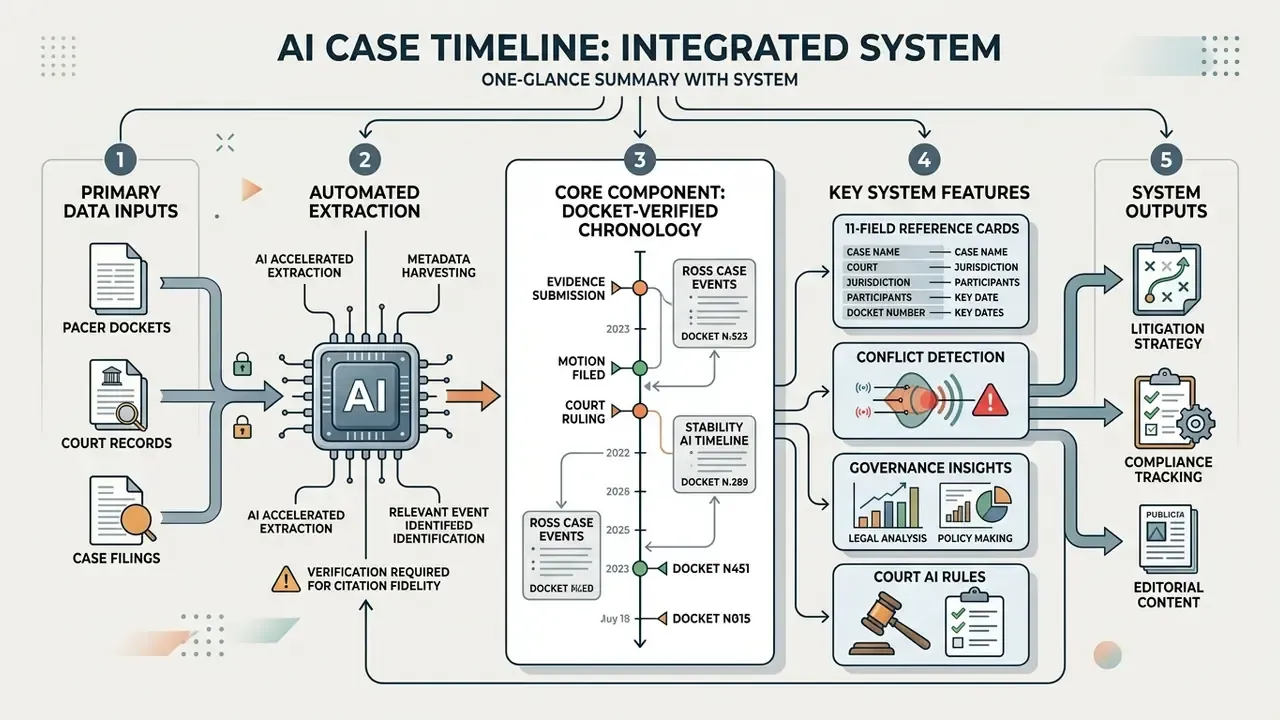
What an AI Case Timeline: Case Name Displays
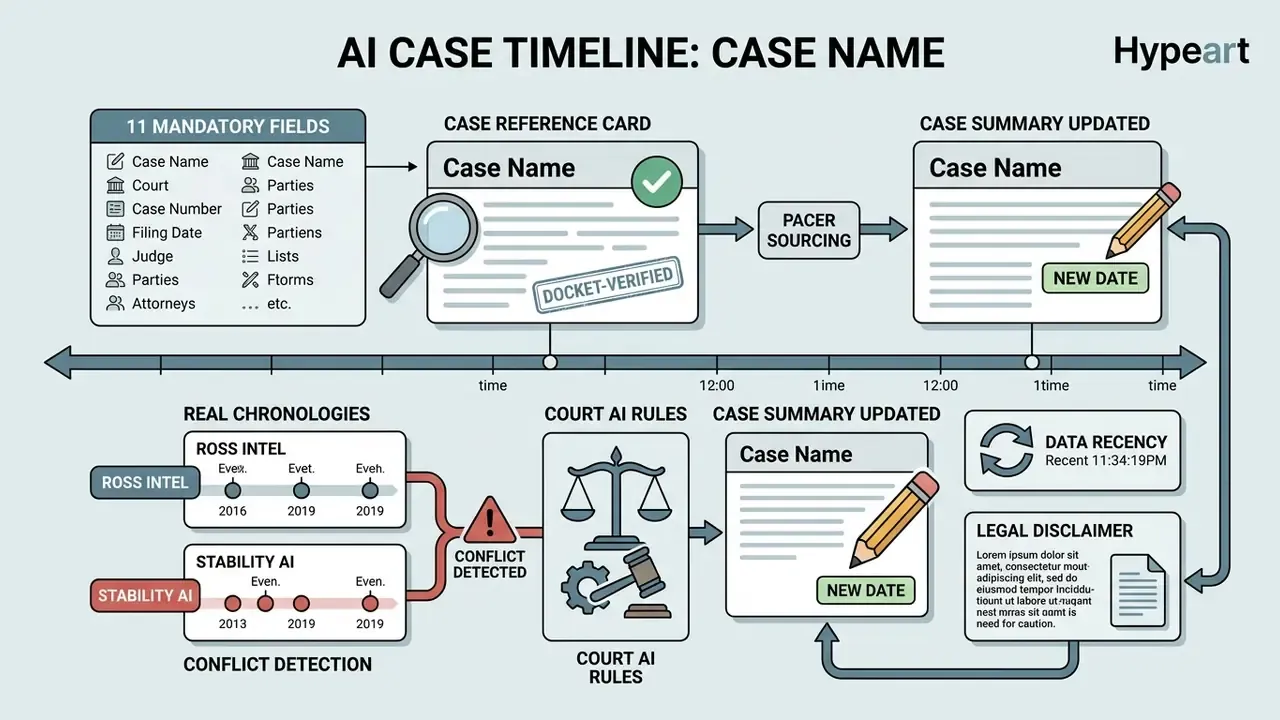
An AI case timeline: case name entry provides an objective, chronological record of a specific legal proceeding involving artificial intelligence systems. It summarizes the core dispute, identifies the litigants, and records every official court action without drawing speculative legal conclusions.
In US financial services and enterprise technology risk management, tracking a named AI case timeline requires distinguishing verified docket events from secondary market commentary. A complete case summary outlines the foundational claims: alleged copyright infringement, training data scraping, or algorithmic bias. Those are the same claim families that now surround commercial AI image generators and other generative production tools. The result gives governance teams the factual context needed to assess broader industry exposure and regulatory trends.
Case Reference Card (11 Mandatory Fields)
| Field | Value |
|---|---|
| Case Name | Thomson Reuters Enterprise Centre GmbH v. ROSS Intelligence Inc. |
| Court & Jurisdiction | US District Court for the District of Delaware (federal court) |
| Docket Number | 1:20-cv-00613 |
| Plaintiffs | Thomson Reuters Enterprise Centre GmbH; West Publishing Corp. |
| Defendants | ROSS Intelligence Inc. |
| Targeted Algorithm / Model | ROSS legal research engine (proprietary AI search and retrieval system) |
| Class Action Status | No (individual corporate litigation) |
| Subject Matter / Claims | Copyright infringement; unauthorized use of Westlaw headnotes and editorial content as AI training data |
| Current Status | Pending; jury trial previously set for August 26, 2024, with tracker-recorded activity continuing into June 2026 |
| Published Opinions | Available (summary judgment order, 2023 WL 3252012) |
| Last Verified Update | 2026-06-15 (verified via PACER docket system) |
Two card fields deserve particular attention in AI matters. Targeted Algorithm / Model records the specific system named in the pleadings, which matters when a complaint targets one model version while the produced output logs correspond to another architecture. Class Action Status should be recorded with four possible values used by mature litigation databases: Yes, No, Ruled On (the court has decided certification), and In Process (certification is still pending). Class posture, not claim language, drives the financial exposure model.
A parallel card for a class matter looks materially different:
| Field | Value |
|---|---|
| Case Name | Andersen v. Stability AI Ltd. |
| Court & Jurisdiction | US District Court, Northern District of California (federal court) |
| Plaintiffs | Sarah Andersen and additional visual artists (putative class) |
| Defendants | Stability AI, Midjourney, DeviantArt, and related parties |
| Targeted Algorithm / Model | Stable Diffusion; downstream image-generation products trained on the LAION dataset (approximately 5 billion scraped images) |
| Class Action Status | In Process (class-action copyright claims) |
| Key Rulings | August 12, 2024 order (Judge William Orrick) denying dismissal of copyright infringement claims in part; induced and direct infringement theories allowed to proceed |
| Current Status | Pending; trial scheduled to begin September 8, 2026 |
Data Recency and Legal Disclaimer
Elements Included in a Case Summary
A factual case summary synthesizes the core dispute, identifying the parties, disputed technologies, and specific legal theories asserted in court filings. It isolates the key facts from legal arguments to establish an objective record for governance review.
| Component | Objective Focus | Source Requirement |
|---|---|---|
| Litigants & Roles | Identifies plaintiffs, defendants, and counsel of record | Initial complaint |
| Technology at Issue | Specifies model type, dataset, or algorithm named in pleadings | Pleadings / discovery |
| Asserted Claims | Details statutory or common law causes of action | Formal filings |
| Procedural Posture | Records current motion status and trial dates | Judicial orders |
| Class Posture | Records certification status (Yes / No / Ruled On / In Process) | Certification motions and orders |
An objective summary avoids predicting judicial outcomes or offering opinion-based case analysis. It records what the parties allege and what the court has ordered. Nothing more. In AI copyright matters, that means separating the pleaded facts (who copied what, when, and how the material was used) from the legal conclusion about infringement or fair use. The US Copyright Office frames the field around two issues: copyright in AI-generated works, and the use of copyrighted materials in AI training. A disciplined summary states which of the two a given complaint actually invokes, since the distinction changes both the discovery burden and the vendor question you should be asking.
Updated. Structuring summaries into distinct factual, procedural, and holding components prevents information distortion, and the structure has an official analogue:
«Official US Supreme Court syllabi must include the facts of the case, the procedural history, the legal question presented, and the answer to that question.»
| Status Designation | Operational Meaning | Triggering Docket Event |
|---|---|---|
| Pending | Active litigation without final disposition | Initial filing |
| Stayed | Proceedings paused by judicial order (an overlay on a pending case, not a terminal state) | Stay order |
| Dismissed (with / without prejudice) | Claims terminated prior to trial decision; voluntary dismissal is available before an answer or summary judgment motion is served | Order on motion to dismiss; Rule 41 notice |
| Judgment Entered | Final judicial decision rendered on the merits | Final judgment |
| Appealed | Post-judgment review in appellate court; a civil notice of appeal is generally due within 30 days after entry of judgment | Notice of appeal |
| Inactive / Consolidated | Fully resolved, or absorbed into another docket (note the consolidated docket number) | Settlement, final judgment, consolidation order |
Federal procedural rules require distinguishing interlocutory rulings from final judgments. A case marked "stayed" remains active on the docket but paused pending external events, such as an administrative review or a higher court ruling; a stay pending appeal must ordinarily be sought first in the district court under Federal Rule of Appellate Procedure 8. European practice mirrors that logic. The EU case database groups ongoing, stayed, and discontinuance-in-process matters together under pending cases, tracks closed cases separately, and the European Court of Human Rights publishes state-of-proceedings updates roughly two months after a status change. Accurate status tracking prevents institutions from mistaking a temporary procedural pause for final legal precedent.
Court, Jurisdiction, and Participants in AI Litigation
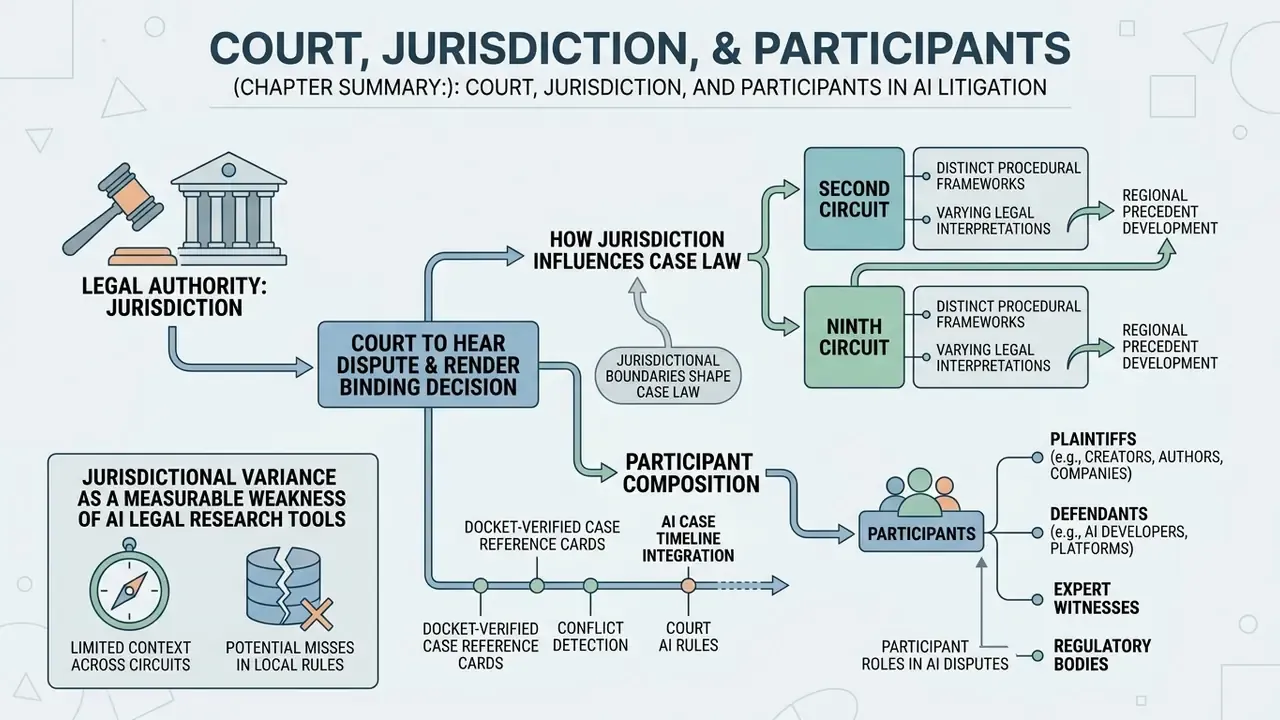
Jurisdiction defines the legal authority of a court to hear a dispute and render a binding decision. It sets the rules of the game before any chronology is built. In the United States, AI litigation clusters in specific federal court districts and a handful of specialized appellate forums.
Understanding jurisdiction and court information is essential because legal interpretations vary across circuits. A ruling in the Northern District of California does not automatically bind courts in the Second Circuit. Tracking the forum, the presiding judge, and the participating law firms supplies the context you need to weigh litigation exposure.
| Judicial Forum | Primary Legal Focus | Binding Scope |
|---|---|---|
| Northern District of California | Copyright, data privacy, model training datasets | Ninth Circuit |
| Southern District of New York | Copyright, financial and reference publishing, commercial contracts | Second Circuit |
| District of Delaware | Corporate IP, trade secrets, AI patents | Third Circuit |
| Central District of California | Audiovisual works, studio and entertainment claims | Ninth Circuit |
| Northern District of Illinois | Musical works and sound recordings | Seventh Circuit |
| US Court of Appeals for the Federal Circuit | Patent appeals; government procurement AI (jurisdiction under 28 U.S.C. § 1295(a)(3), as applied in Percipient.ai, Inc. v. United States, 2024) | Nationwide (patents, certain claims against the US) |
Participant composition is not incidental. An academic review of US federal court opinions involving AI counted 138 plaintiffs and 265 defendants, with corporate entities appearing as the most frequent actors on both sides. For a risk team, that distribution says something practical: you are tracking commercial exposure, not isolated consumer disputes. More cases will surface where one large defendant faces multiple aligned plaintiffs, which changes both discovery volume and settlement dynamics.
How Jurisdiction Influences Case Law
Jurisdictional boundaries shape how judicial precedent, or case law, develops across regional circuits. Appellate decisions in one federal circuit establish binding precedent for district courts within that jurisdiction.
For example, the Second Circuit and the Ninth Circuit have developed distinct procedural frameworks around copyright fair use and generative AI training models. Needs further primary support: the divergence is best documented at the level of specific decisions rather than as a general doctrinal split. The Second Circuit's early contribution, Park v. Kim (January 2024), addressed sanctions for generative-AI misuse in filings, framing AI mainly as a filing-integrity and professional-conduct problem. California's record developed differently. A published 2025 state Court of Appeal opinion treated AI-fabricated citations as a matter of first impression for attorney verification duties, and California issued parallel 2025 to 2026 guidance for lawyers and judicial officers. In the Ninth Circuit's federal district courts, meanwhile, the substantive training-data questions advanced through Andersen v. Stability AI and related matters. A risk officer evaluating model deployment must read local case law to determine whether a specific AI use case fits circuit-specific judicial interpretation.
Jurisdictional variance is also a measurable weakness of AI legal research tools, which is exactly why the manual check stays in the workflow:
«Models reach 94–100% accuracy on GDPR questions but fabricate citations in 60–77% of queries involving under-represented statutes.»
Chronology of Key Case Events
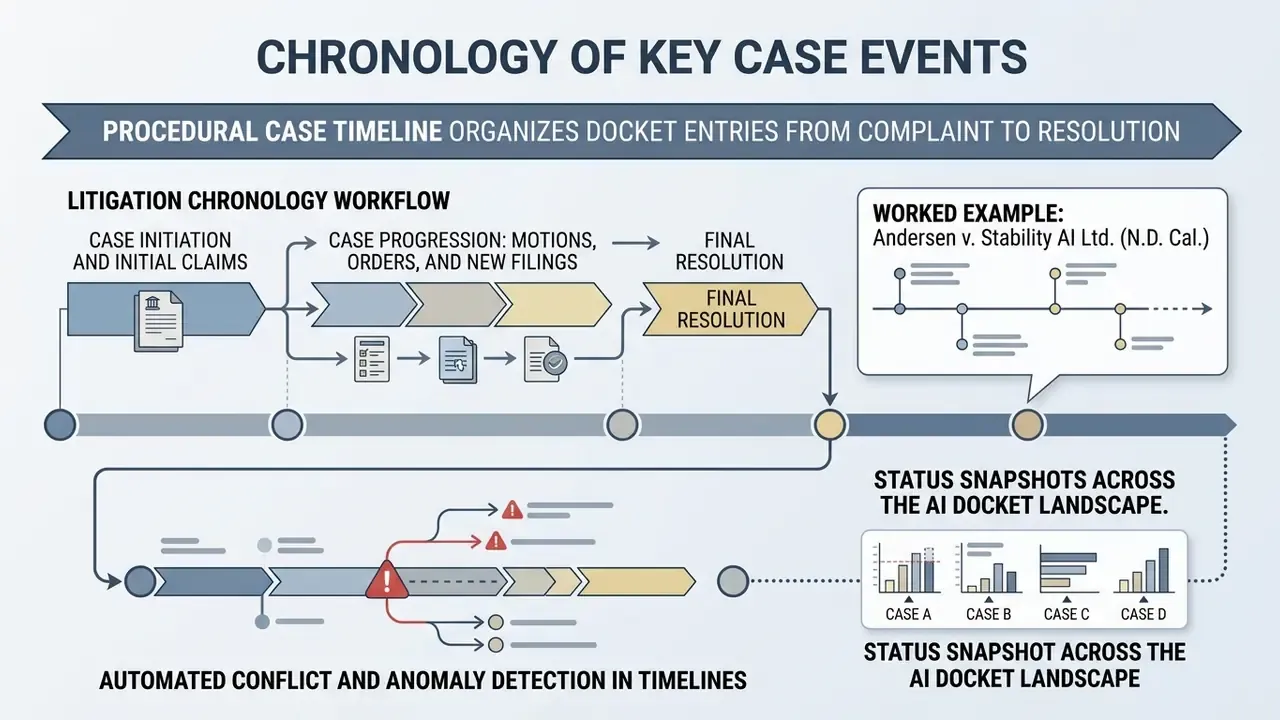
A procedural case timeline organizes every docket entry into a chronological sequence, tracing the matter from initial complaint to final resolution. Each entry records the date, event type, summary, and corresponding docket number.
Tracking ai litigation means logging procedural milestones: initial court filings, responsive pleadings, court orders, and discovery schedules. Maintaining an accurate chronology lets legal and model risk teams watch judicial interpretations of AI technology shift over time. Chronology best practice from litigation-support methodology is blunt about sourcing: tie every fact to a document name or Bates number, add page and line references where available, and tag each fact as disputed or undisputed.
Litigation Chronology Workflow (Illustrative Template)
| Date | Event Type | Summary Description | Docket Ref. |
|---|---|---|---|
| 2026-03-13 | Complaint Filed | Plaintiff files initial copyright claim | Doc. 1 |
| 2026-04-20 | Motion to Dismiss | Defendant moves to dismiss under Rule 12(b)(6) | Doc. 12 |
| 2026-05-18 | Opposition Brief | Plaintiff opposes motion to dismiss | Doc. 18 |
| 2026-06-02 | Judicial Order | Court denies motion to dismiss in part | Doc. 24 |
Worked Example: Andersen v. Stability AI Ltd. (N.D. Cal.)
| Date | Event Type | Summary Description |
|---|---|---|
| Late 2022 | Pre-litigation record | Cartoonist Sarah Andersen publishes a guest essay describing style replication by an AI image generator, later cited as background context |
| 2023-01-12 | Complaint Filed | Class-action copyright complaint filed against Stability AI, Midjourney, DeviantArt and related parties, centered on the LAION dataset of roughly 5 billion scraped images |
| 2023–2024 | Partial Dismissals | Court dismisses several ancillary claims, including unjust enrichment and breach of contract theories |
| 2024-08-12 | Judicial Order | Judge William Orrick denies dismissal of copyright infringement claims in part; induced infringement, "model theory," and distribution theories proceed toward discovery |
| 2024–2026 | Discovery | Examination of training-data provenance and reproducibility of training images from targeted prompts |
| 2026-09-08 | Trial Setting | Jury trial scheduled to begin |
Worked Example: Status Snapshots Across the AI Docket Landscape
| Case | Court | Recorded Status |
|---|---|---|
| Thomson Reuters v. ROSS Intelligence | D. Del. (1:20-cv-00613) | Pending; trial previously set August 26, 2024; tracker activity recorded June 2026 |
| Encyclopedia Britannica, Inc. v. OpenAI, Inc. | S.D.N.Y. | Filed (March 13, 2026) |
| Youngblood v. Meta Platforms, Inc. | N.D. Cal. | Voluntarily dismissed (February 19, 2026) |
Illustrative governance scenario (composite, not attributed to a named institution). A financial institution evaluating model compliance reviewed a named AI case timeline to determine whether a generative model vendor faced active copyright litigation. By verifying docket filings rather than press coverage, the compliance team spotted a motion for preliminary injunction that had appeared in no secondary summary. The team updated its internal model inventory and held deployment of the unvalidated third-party model pending counsel review. Institutions replicating this pattern should document the docket entries relied upon, because composite examples carry no evidentiary weight on their own.
Case Initiation and Initial Claims
A lawsuit begins when a plaintiff files a formal complaint with the clerk of court. In AI litigation, initial filings typically center on intellectual property rights, data privacy violations, or breach of contract. Congressional research summaries describe several dozen US lawsuits alleging unauthorized copying of works to train AI systems, plus claims that model outputs themselves infringe.
When a case was filed in federal court, the complaint establishes the scope of the dispute. Initial claims often allege unauthorized data scraping for model training, direct copyright infringement in model outputs, removal of copyright management information, or, as in a June 2023 complaint filed in the Northern District of California, privacy violations arising from scraping personal data without consent. Logging the exact filing date sets the clock for responsive pleadings and discovery obligations under federal court rules.
Automated summarization of these initiating documents should be treated as a draft, never as the record:
«Generative models outperform extractive approaches on ROUGE-L but introduce factual inconsistencies and hallucinations that require manual verification.»
Case Progression: Motions, Orders, and New Filings
After initiation, litigation proceeds through structured motion practice and discovery. Key steps include a motion to dismiss, motions to compel discovery, and requests for summary judgment. The sequence is rule-driven: the motion and any notice of hearing are filed and served first; a request to submit for decision and a proposed order follow; the court's order is docketed as its own separate event. Notices of supplemental authority attach to a pending motion, appearing later in the chronology than the motion they support but earlier than the disposition.
Judicial responses land on the docket as binding court orders. Those orders determine which claims survive for trial and set deadlines for evidentiary submissions. Tracking these documents keeps compliance teams anchored to substantive legal developments rather than unverified media reports.
Automated Conflict and Anomaly Detection in Timelines
A primary objective of an AI-driven litigation chronology is identifying factual contradictions across voluminous court records and discovery materials. Sequencing events is table stakes. The harder work is cross-referencing temporal assertions against objective metadata: sent, received, created, and modified timestamps; server logs; calendar entries; and deposition transcript line references.
| Conflict Category | Scenario Example | Evidentiary Impact |
|---|---|---|
| Temporal Discrepancy | Deposition testimony asserts model training ceased on Date A, but internal server logs produced in discovery show active data ingest on Date B. | Undermines witness credibility; can trigger Rule 11 exposure for unverified representations. |
| Location vs. Metadata Conflict | A witness places themselves at a specific site at 2:00 p.m., while email metadata shows activity from a different network at the same time. | Creates a cross-examination anchor and a discovery target. |
| Jurisdictional Mismatch | A brief relies on circuit precedent that was expressly overturned in a parallel docket before the filing date. | Exposes the filing to striking or summary rejection of the argument. |
| Model Version Anomaly | The complaint alleges infringement by Model Version X, but submitted output logs correspond to the architectural parameters of Model Version Y. | Narrows the scope of actionable IP claims during motion practice. |
| Deadline Gap | A chronology contains a responsive-pleading deadline with no corresponding filing or extension order. | Signals either a missing docket pull or an unrecorded default risk. |
Practical rule: merge duplicate events, deduplicate overlapping source entries, and flag every gap as a discovery target instead of silently dropping it. Store deadlines in a separate class from ordinary events, so a missed extension order surfaces as an exception rather than a quiet omission. One unlogged deadline can cost more than a month of tracker maintenance.
Court Records, Dockets, and Case Documents
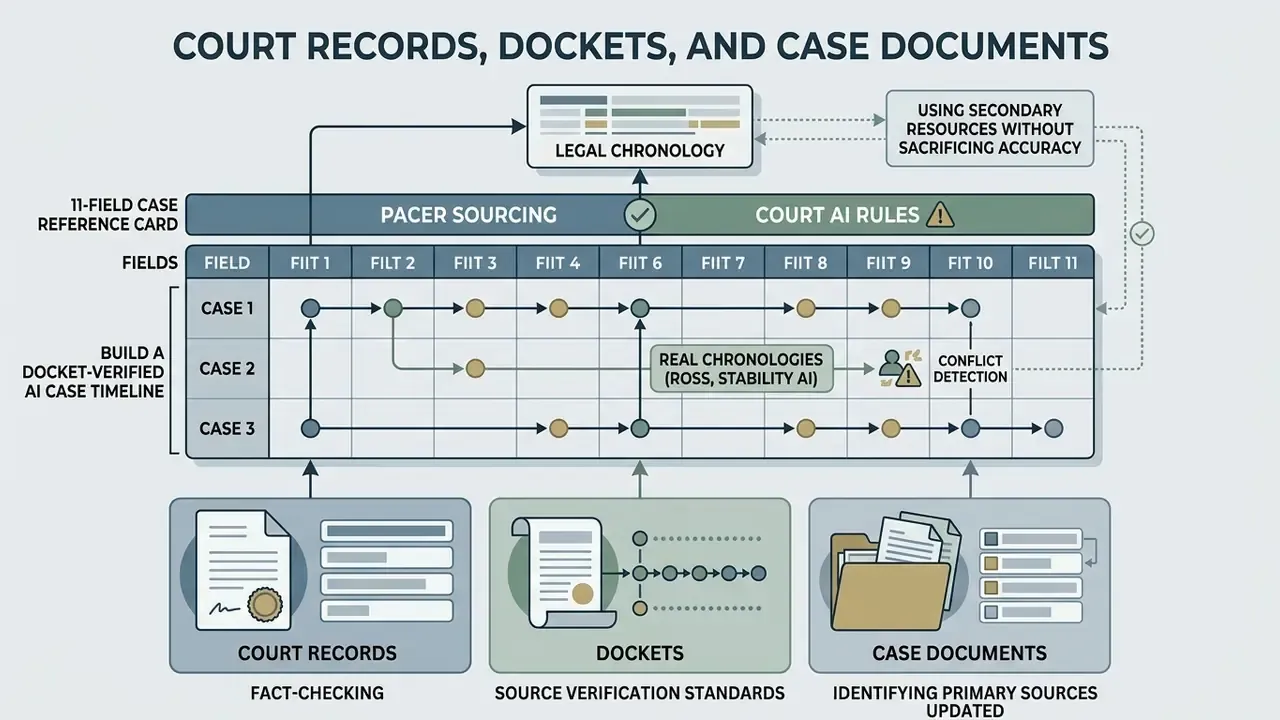
Primary court records form the foundation of any reliable legal chronology. They consist of official docket sheets, pleadings, motions, judicial transcripts, and signed orders entered by the court clerk. The US Supreme Court defines a docket as a list of all filings and rulings arranged in chronological order; federal case files consist of that docket sheet plus every document filed in the matter, accessed through PACER.
To hold research integrity, governance teams must separate primary court records from secondary commentary. Accessing official court records for a named AI case through verified systems keeps institutions from acting on incomplete or inaccurate case information.
| Document Class | Official Examples | Evidentiary Value in Timeline Analysis |
|---|---|---|
| Pleadings | Complaints, answers, counterclaims | Establishes the formal scope of legal claims; commences the case |
| Motions & Briefs | Motion to dismiss, summary judgment, motions to compel | Requests for relief and persuasive argument; legal force depends on the court's action, not the filing |
| Judicial Orders | Injunctions, dismissal orders, scheduling orders | Operative legal rulings; binding once entered |
| Hearing Transcripts | Oral argument, status conference, and deposition transcripts | Timestamped speech-to-text records; modern chronology systems index them automatically and link each statement to a line reference |
| Case Dockets | Master docket sheet | Master chronological index of all events; the backbone of the timeline |
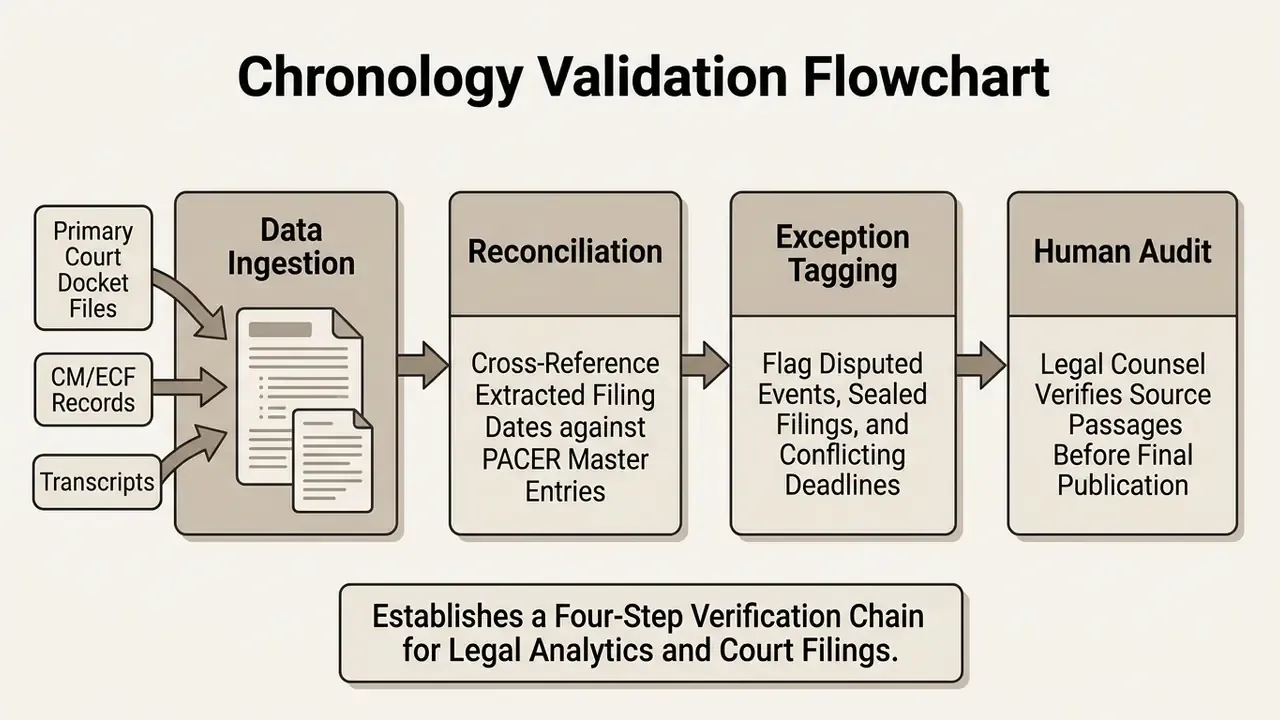
Transcript handling deserves its own workflow step. Contemporary chronology platforms ingest hearing and deposition transcripts, apply timestamped speech-to-text indexing, and attach each extracted assertion to the exact line and page. That link is what makes the conflict-detection table above operational rather than theoretical.
Fact-Checking and Source Verification Standards
All dates, docket entries, and procedural statuses must be cross-referenced against primary federal databases, such as PACER or RECAP archives. Secondary resources, including law firm client alerts and media summaries, should be marked as persuasive commentary and verified against primary court filings prior to executive reporting.
Court-system disclaimers set the hierarchy plainly. Virginia's case information system states that records are current only to the extent that clerks have entered the most recent filings, that users must verify accuracy, currency, and completeness against official court records, and that clerk-certified records control where they differ. British Columbia's Court Services Online usage agreement provides data "as is," without warranty, and directs users to confirm status with the registry. Any enterprise timeline should reproduce that hierarchy in its own footer. It costs one sentence and saves an argument later.
Identifying Primary Sources
Primary sources are authoritative documents issued directly by courts or filed by official parties to a lawsuit: signed judicial opinions, official docket entries, certified filings. A document qualifies as a primary official source when the court issues or accepts it, it carries a date, and it is retrievable from the court's docket or orders page. The Supreme Court, for instance, posts scheduled order lists on the day of issuance and links electronic images of most filings submitted after November 13, 2017.
| Source Category | Access Mechanism | Reliability Rating |
|---|---|---|
| Primary Records | PACER, CM/ECF, court registries, RECAP mirror | Canonical (authoritative) |
| Secondary Review | Law review articles, law firm alerts, legal blogs | Analytical (requires verification) |
| Aggregators | Public legal news outlets, litigation trackers | Informational (first-pass only) |
Access economics matter for workflow design, and they are easy to overlook when a research budget is set once a year. Under the PACER user manual and FAQ, a single document or report is capped at $3.00, and a docket report retrieved by specific case number is capped at 30 pages. Name searches, non-case-specific reports, transcripts, and case reports are not subject to the 30-page cap, so broad research sweeps cost materially more than targeted docket pulls. CM/ECF PDF size limits are set court by court, and oversized filings must be split before submission.
RECAP and CourtListener provide a free archive of PACER documents, though coverage depends on what users have uploaded, and at least one federal district court has warned that open-source archiving can surface material that should be restricted or sealed. Treat RECAP as a mirror, verify sealed status on the official record, and reference the canonical docket number and PDF for every entry. Verification discipline in document-heavy matters increasingly borrows tooling from adjacent domains, for example AI image detectors used to test whether a produced exhibit is a synthetic artifact rather than a captured original.
Updated. Automated citation tooling remains the weakest link in the chain:
«Under closed-book testing, even the strongest models score below 7 out of 100 on exact judicial citation retrieval.»
Using Secondary Resources Without Sacrificing Accuracy
Legal Updates: Tracking Changes in Case Status
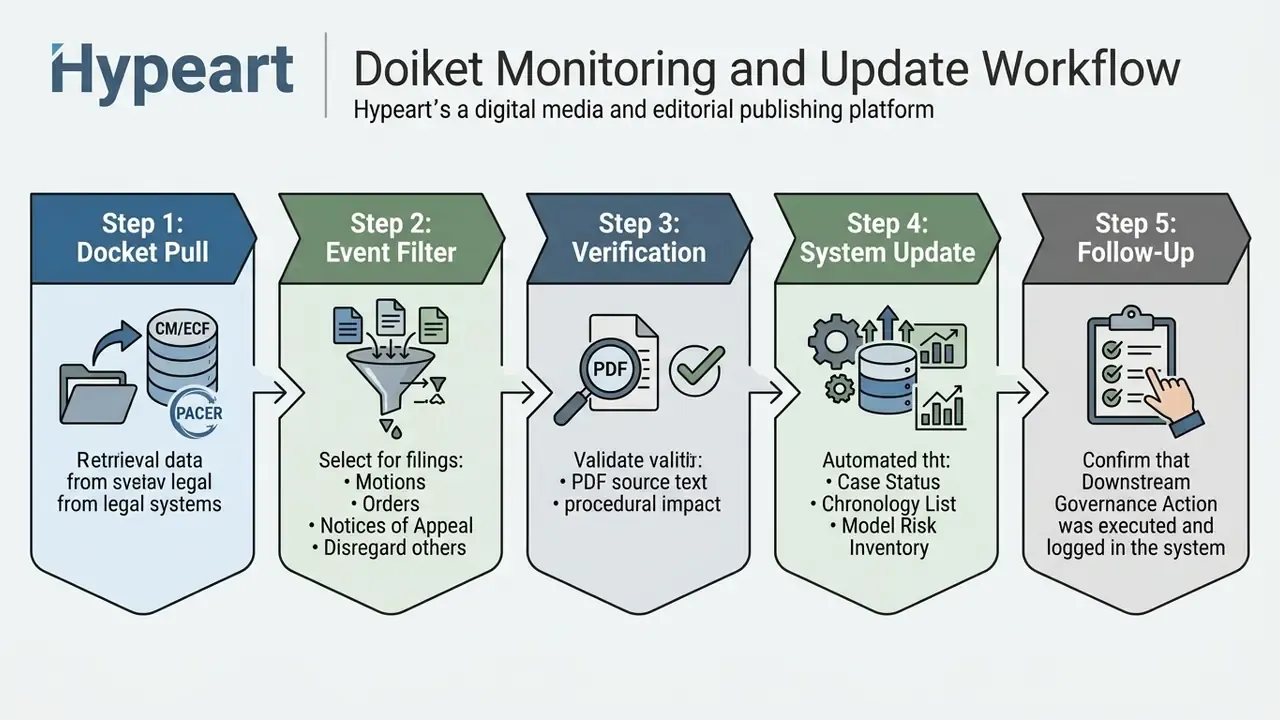
Docket Monitoring and Update Workflow
Events Triggering a Case Timeline Update
Certain judicial actions change the trajectory of a lawsuit and demand an immediate update to the case record. They redefine both the legal posture and the operational risk profile. Court case-management standards treat the same categories as mandatory docket-update events: filings, hearing results, requests for execution, dispositions, party-name changes, and attorney changes.
| Trigger Event | Procedural Impact | Required System Action |
|---|---|---|
| Ruling on dismissal | Terminates or narrows claims | Update status and claim scope |
| Class certification decision | Expands or caps financial exposure scale | Recalculate risk tiering; update Class Action Status to Ruled On |
| Injunction issued | Restricts AI technology deployment | Issue immediate compliance alert; evaluate kill switch |
| Notice of appeal | Shifts matter to appellate venue | Update forum and deadline set (30-day civil appeal window) |
| Stay order | Pauses proceedings without resolving claims | Retain pending status with stay overlay |
| Party or counsel change | Alters service list and negotiation posture | Update participant fields |
| Voluntary dismissal / settlement | Terminates the matter | Mark inactive; archive with disposition date |
When a court rules on a motion to dismiss, the order clarifies which legal claims survive into discovery. Updating the timeline right after such orders keeps enterprise risk models focused on live legal threats instead of claims that are already gone.
Applying AI Case Timelines in Legal Practice and Law Firms
Legal counsel and governance professionals use structured timelines to run litigation risk analysis and evaluate enterprise AI deployment safety. Integrating verified chronologies into risk management frameworks improves oversight across software inventories. Commercial platforms describe the same use pattern: AI-enabled discovery produces timelines, summaries, and insights; case-analysis products surface fact chronologies with interactive review; chronology workflows add explicit gap analysis on top of extracted dates, events, and relationships.
The spread of legal ai and domain-specific ai tools lets legal teams turn thousands of discovery records into structured chronologies. Court rules, though, govern strictly how AI-generated materials may be submitted in legal proceedings, and those rules are moving faster than most internal policies.
Chronology Validation Flowchart
Entity Extraction and Deposition Readiness
Chronological processing of legal dockets enables automated entity extraction, turning unstructured case files into structured witness rosters. By applying named entity recognition across filed pleadings, deposition transcripts, correspondence, and evidentiary exhibits, compliance and legal teams build witness-specific event profiles instead of a flat list of procedural milestones.
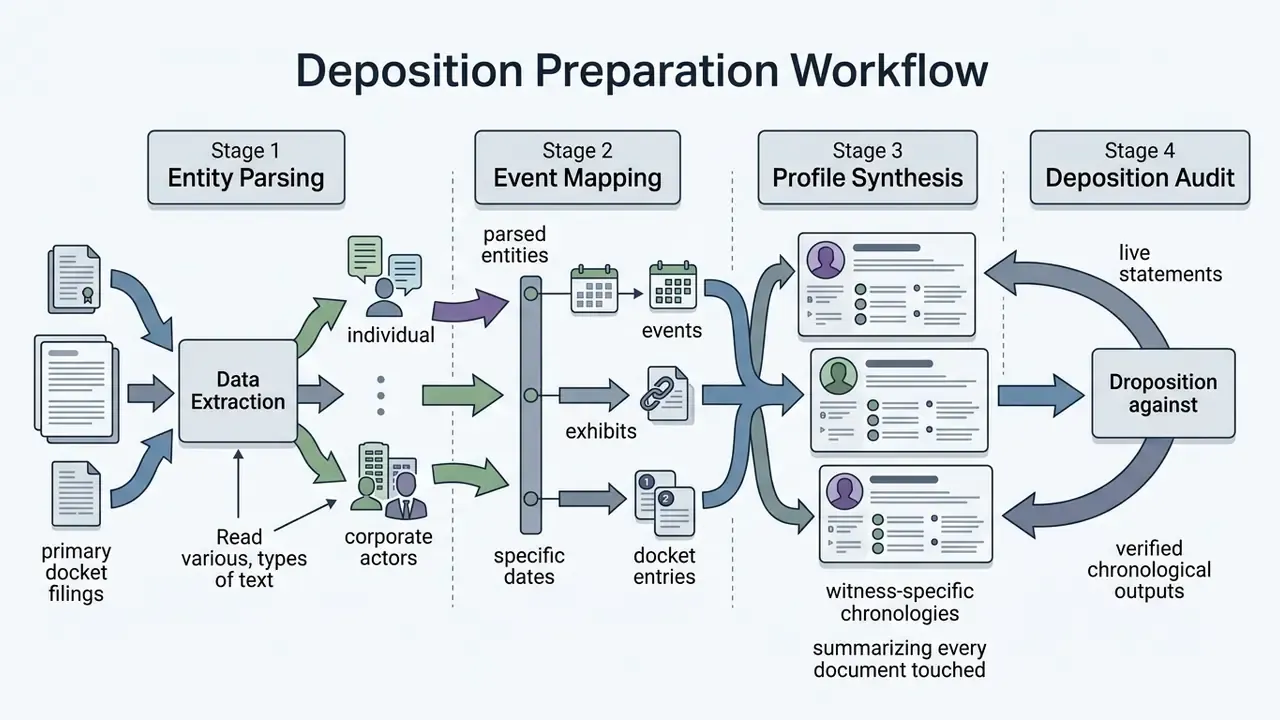
Each profile should consolidate every message a person sent, every mention of that person in produced documents, and every exhibit they authored or received, so counsel can gauge involvement at a glance. Witness-centric timelines keep opposing counsel from introducing unreviewed exhibits or conflicting chronologies during oral argument, and they convert the "surprise document" tactic into a manageable exception report.
Transitioning from Master Timelines to Visual Courtroom Exhibits
A text-based chronology serves as an internal analytical reference. A visual timeline functions as an evidentiary exhibit for judicial audiences and executive committees. Turning raw docket numbers into graphic representations requires three structural standards:
The same discipline that produces courtroom-ready visuals produces board-ready ones. A risk committee reading a one-page visual chronology of vendor litigation absorbs exposure faster than it absorbs a forty-row spreadsheet, provided every node stays traceable to a docket entry.
- The critical path.
- Highlight only dispositive procedural events: preliminary injunction rulings, class certification orders, summary judgment decisions. Everything else becomes clutter.
- Click-to-source interactivity.
- Every node on the visual timeline links dynamically back to the underlying PACER document PDF, page, and line, so any assertion can be defended during motion practice or at trial.
- Milestone grouping.
- Color-code entries by operational category: red for injunctive threats, blue for motion practice, green for discovery compliance, grey for stays and administrative pauses.
Case Analysis and Risk Monitoring
Structured case timelines let risk managers aggregate litigation data across multiple jurisdictions and identify broader legal patterns in artificial intelligence adoption.
Classification performance is now measurable, which helps governance teams set realistic expectations for automated triage:
«Claude 3 Opus classified case subject matter with 87.13% accuracy and an F1 score of 0.87 on a newly constructed taxonomy.»
| Risk Dimension | Monitoring Indicator | Operational Mitigation |
|---|---|---|
| IP Exposure | Active copyright training lawsuits naming vendor models | Audit training data provenance |
| Regulatory Risk | Enforcement actions by FTC or SEC | Review model transparency and output logs |
| Vendor Stability | Injunctions against core AI vendors | Establish technical model kill switches |
| Class Exposure | Certification granted or pending | Re-tier reserve and disclosure analysis |
| Forum Shift | Notice of appeal, transfer, or consolidation | Update forum, deadlines, and counsel assignments |
Mapping Docket Events to Model Risk Management Actions
For US financial institutions, a litigation timeline earns its budget only when each docket event resolves into a governance action inside the model inventory. The mapping below aligns procedural triggers with model risk management practice under supervisory guidance on model risk (commonly referenced as SR 11-7 / OCC 2011-12) and with documentation practices consistent with the NIST AI Risk Management Framework. Confirm the exact control language with your own second-line policy owners; wording differs by institution.
| Docket Event | MRM Status Change | Required Governance Action |
|---|---|---|
| Complaint filed naming a vendor model | Watchlist | Log matter in the model inventory record; notify model owner and vendor manager |
| Motion to dismiss denied in part | Elevated inherent risk | Refresh model validation scope; document training-data provenance evidence |
| Class certification granted | Exposure re-tiering | Recalculate concentration and reserve assumptions; brief risk committee |
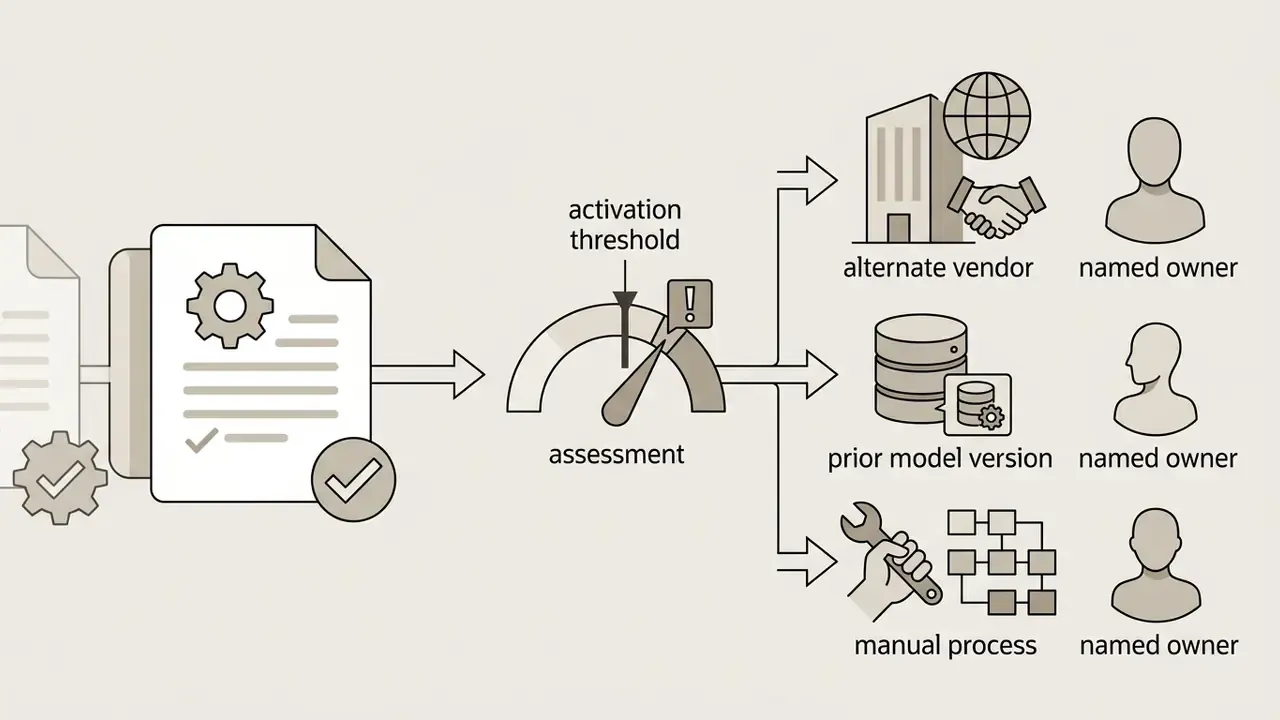
| Preliminary injunction against a vendor | Suspension of deployment | Trigger contingency plan and kill switch; assess fallback model or manual process |
| Final judgment or settlement with usage restrictions | Contract remediation | Amend vendor terms; re-approve permitted use cases; update issue log |
| Voluntary dismissal | De-escalation | Archive matter with disposition date; retain audit trail |
NIST incident-documentation practice supplies the field set that makes these records auditable: timestamped status changes, source or cause, current status, a factual description of what occurred, contact and role data, action logs, and an evidence list. Applied to litigation tracking, those fields keep the record objective and reviewable years later, when the people who built it have moved on.
Exportable Data Schema for GRC Systems
Governance platforms ingest structured records, not prose. A minimal, tool-agnostic schema for one docket event:
{
  "case_id": "DDE-1:20-cv-00613",
  "case_name": "Thomson Reuters Enterprise Centre GmbH v. ROSS Intelligence Inc.",
  "court": "US District Court, District of Delaware",
  "jurisdiction_type": "federal",
  "targeted_model": "ROSS legal research engine",
  "class_action_status": "No",
  "event_date": "2023-09-25",
  "event_type": "Order on Summary Judgment",
  "event_summary": "Court rules in part on cross-motions for summary judgment",
  "docket_ref": "Doc. 547",
  "source_system": "PACER",
  "source_url": "canonical docket PDF reference",
  "verified_by": "role or reviewer ID",
  "verified_date": "2026-06-15",
  "mrm_action": "Refresh validation scope for vendor model",
  "dispute_flag": false
}
CSV equivalent header row: case_id,case_name,court,jurisdiction_type,targeted_model,class_action_status,event_date,event_type,event_summary,docket_ref,source_system,source_url,verified_by,verified_date,mrm_action,dispute_flag.
Vendor Risk Audit Checklist (Shadow AI and Data-Scraping Exposure)
- Identify every production and pilot model by vendor, model family, and version, then reconcile against procurement records to surface shadow AI.
- Request written data-provenance representations covering training corpora, licensed datasets, and scraped sources; store the response as an inventory artifact.
- Search active litigation trackers and dockets for the vendor's corporate entities, not only its brand name.
- Confirm whether any pending matter seeks injunctive relief, since injunctions, not damages, cause service interruption.
- Record the contractual indemnity position for third-party IP claims and the notice obligations that come with it.
- Re-run the check on each docket update trigger from the table above, and again at contract renewal.
Illustrative governance scenario (composite). A financial services firm assessing autonomous document-processing tools mapped active AI litigation trends across relevant districts and observed rising judicial scrutiny of unverified training data. The firm added data-provenance representations to its procurement pipeline and required version-level model disclosure from vendors, reducing potential third-party copyright exposure. Treat this as an illustrative pattern only; each institution must document its own docket evidence and control decisions.
Regulatory and Court Rule Restrictions on AI-Generated Court Filings
This section describes general requirements and is not legal advice. Court-specific obligations to disclose or certify the use of AI tools change frequently and must be verified directly in the current local rules and standing orders of the relevant court before filing.
US federal district courts have adopted local rules governing generative artificial intelligence in prepared filings. Several now require formal disclosures or certificates of compliance, and 2025 to 2026 orders in Texas, Colorado, Kansas, Wyoming, Ohio, and Pennsylvania tie AI use to Rule 11-style verification, disclosure, or sanctions for hallucinated citations.
| Judicial District | Rule Requirement | Non-Compliance Penalty |
|---|---|---|
| Eastern District of Texas | Mandatory "Certificate of Generative Artificial Intelligence Usage" with every filing; filer must verify AI-assisted factual, procedural, and legal content | Filings stricken from the record |
| District of Colorado | AI Certification signed by contributors (order effective December 1, 2025) | Non-compliant filings may be stricken without substantive consideration; Rule 11 sanctions |
| Northern District of Ohio | Full disclosure of generative tools used in preparation | Judicial reprimand; sanctions exposure |
| European courts (CEPEJ 2025 guidance) | Human oversight, transparency, and responsibility for judicial generative-AI use; no single EU-wide filing prohibition | Court-governance measures; non-uniform across member states |
Format compliance is a separate failure mode from fabrication, and it is often the one that gets noticed first:
«LLMs produce fully correct Bluebook-compliant citations in only 69–74% of tasks; in-context learning raises the figure to just 77%.»
Updated. Federal Rule of Civil Procedure 11 holds attorneys personally responsible for the factual and legal accuracy of submitted documents. Empirical measurement of hallucinated citations in real filings quantifies the exposure:
«Of 4,499 citations in real appellate filings, 1,107 were hallucinated; GPT-5 detected them with an F1 of only 55%.»
Read those two numbers together. Roughly one in four citations hallucinated in the studied corpus is a generation-side error rate, while the 55% F1 is a detection-side reliability measure: automated screening catches only part of what automated drafting invents. So practitioners must manually verify every factual statement, docket reference, and legal citation against official primary records before filing anything with a court.
Summary and Governance Next Steps
An AI case timeline: case name methodology gives you a structured approach for tracking litigation, managing compliance risk, and validating legal updates. For financial institutions and mature technology organizations, verified chronologies keep AI governance decisions resting on primary court records instead of market speculation.
To stand up an enterprise-grade litigation tracking workflow:
- Ground all timeline entries in primary court records retrieved from official docket registries, with a docket reference and page or Bates citation on every row.
- Keep objective factual entries separate from secondary analytical commentary, and mark each fact as disputed or undisputed.
- Establish automated update triggers tied to substantive court orders and procedural filings, then close the loop by confirming the downstream governance action.
- Require manual verification of all AI-extracted legal citations before judicial submission or executive reporting, performed by a reviewer independent of the extraction step.
- Map each docket trigger to a defined model risk management action, so litigation status changes reach the model inventory and vendor register rather than stopping at a legal memo.
- Publish the chronology in two formats: a text master record for analysis, and a critical-path visual exhibit with click-to-source links for committees and courtrooms.
Pre-Publication Governance Checklist
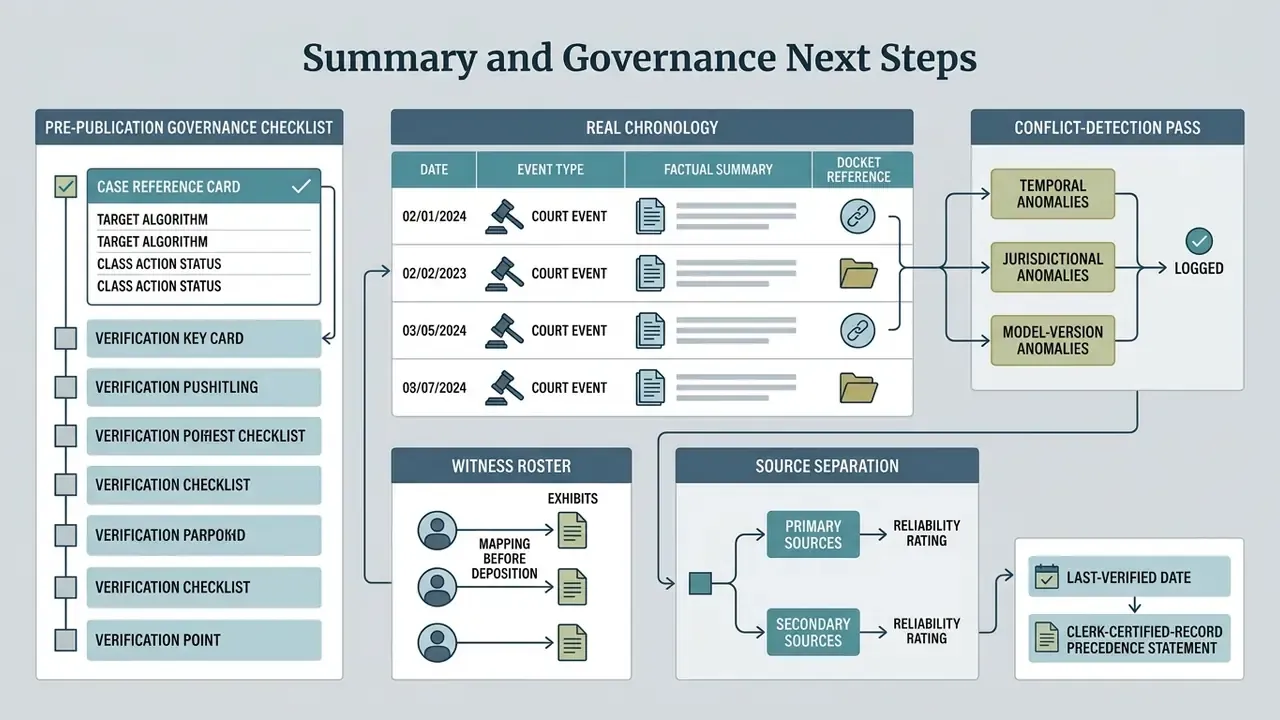
- Case reference card completed with all eleven fields, including targeted algorithm and class action status.
- Every chronology row carries date, event type, factual summary, and docket reference.
- Conflict-detection pass completed; temporal, jurisdictional, and model-version anomalies logged.
- Witness roster extracted and mapped to exhibits before any deposition.
- Primary versus secondary sources separated, with reliability rating recorded.
- Last-verified date and clerk-certified-record precedence statement present.
- Docket triggers mapped to MRM actions and exported to the GRC system in the agreed schema.
- Every AI-generated citation independently verified against the primary record.
Key Information Summary
| Reference Field | Specification Standard |
|---|---|
| Core Focus | AI litigation chronologies, court records, and procedural status tracking |
| Primary Database | PACER / CM/ECF / official federal court registries (RECAP as secondary mirror) |
| Access Economics | $3.00 cap per document or report; docket reports capped at 30 pages by case number; name searches and case reports uncapped |
| Verification Rule | Manual human verification required for all AI-generated citations; reviewer independent of extraction |
| Mandatory Card Fields | 11, including targeted algorithm/model and class action status |
| Governance Scope | Model Risk Management (MRM), regulatory compliance, vendor risk, legal operations |
| Referenced Benchmarks | CaseSumm (2025); LegalCiteBench (2026); LePhantomCite (2026); Bluebook compliance study (2025); Deroy et al. (2024) |
FAQ: AI Case Timelines, Court Records, and Verification
What is an AI case timeline?
An AI case timeline is a structured, chronological record of procedural events, court filings, and judicial orders associated with a legal proceeding involving artificial intelligence systems. Each entry carries a date, an event type, a neutral factual description, and a docket reference.
Which fields are mandatory in a case reference card?
Case name, court and jurisdiction, docket number, plaintiffs, defendants, targeted algorithm or model, class action status, subject matter and claims, current status, published opinions, and last verified update.
How do courts verify AI-extracted timeline data?
Courts require counsel to verify all extracted facts, dates, and legal citations directly against official primary records, such as PACER dockets, in compliance with Federal Rule of Civil Procedure 11. Several districts additionally require a signed AI usage certification.
Why are primary court records necessary for legal tracking?
Primary court records provide the canonical source of truth for filing dates, judicial rulings, and case status, which removes the risk of factual errors or hallucinated citations carried by secondary sources. Where a public database conflicts with a clerk-certified record, the certified record controls.
How does an AI chronology detect contradictions?
It cross-references asserted dates in testimony and pleadings against objective metadata (email send and receive timestamps, server logs, exhibit creation dates) and flags temporal, jurisdictional, and model-version mismatches as exceptions for human review.
Does "stayed" mean a case is closed?
No. A stay pauses proceedings, but the matter remains pending, and a stay pending appeal must ordinarily be sought first in the district court. Only final judgment, dismissal, settlement, or consolidation moves a matter to an inactive state.
What triggers a mandatory timeline update?
Rulings on dismissal, class certification decisions, injunctions, notices of appeal, stay orders, party or counsel changes, and voluntary dismissals or settlements.
How reliable are LLMs for legal citation work?
Benchmark evidence is unfavorable. Closed-book citation retrieval scores below 7 out of 100 for the strongest tested models, roughly one in four citations in a studied appellate corpus was hallucinated, and fully correct Bluebook formatting appears in only about 69 to 77% of tasks. Human verification is not optional.
How should litigation status feed into model risk management?
Through a documented mapping: watchlist entry on filing, validation refresh on adverse motion rulings, exposure re-tiering on class certification, deployment suspension and kill-switch activation on injunction, and contract remediation on judgment or restrictive settlement.
What does PACER research cost in practice?
A single document or report is capped at $3.00. Docket reports pulled by specific case number are capped at 30 pages, but name searches, transcripts, and case reports are not, so broad sweeps run materially more expensive than targeted pulls.
Appendix A: Revision Log and Superseded Entries
The following earlier formulations are retained for audit continuity and have been superseded in the main text by sourced, quantified versions:
Explore governance resources and enterprise media compliance guides at the AI Media Commercial-Use Hub, including licensing-sensitive comparisons of AI art generators and style-specific image tools whose training-data provenance is now the subject of active US litigation.