Author note: Marcus Hale writes about AI governance and model risk for this publication.
Generative models have quietly rewritten a basic assumption: that a photograph records something that happened. For a US bank or a mature fintech, that shift lands in three places at once. Onboarding queues. Claims files. Content moderation.
And the most common operational mistake is not technical. It is treating synthetic media as a single binary flag, one score, one decision, done. A workable verification control framework needs layered evidence: spectral and artifact analysis, provenance metadata, and plain contextual validation.
Executive Summary
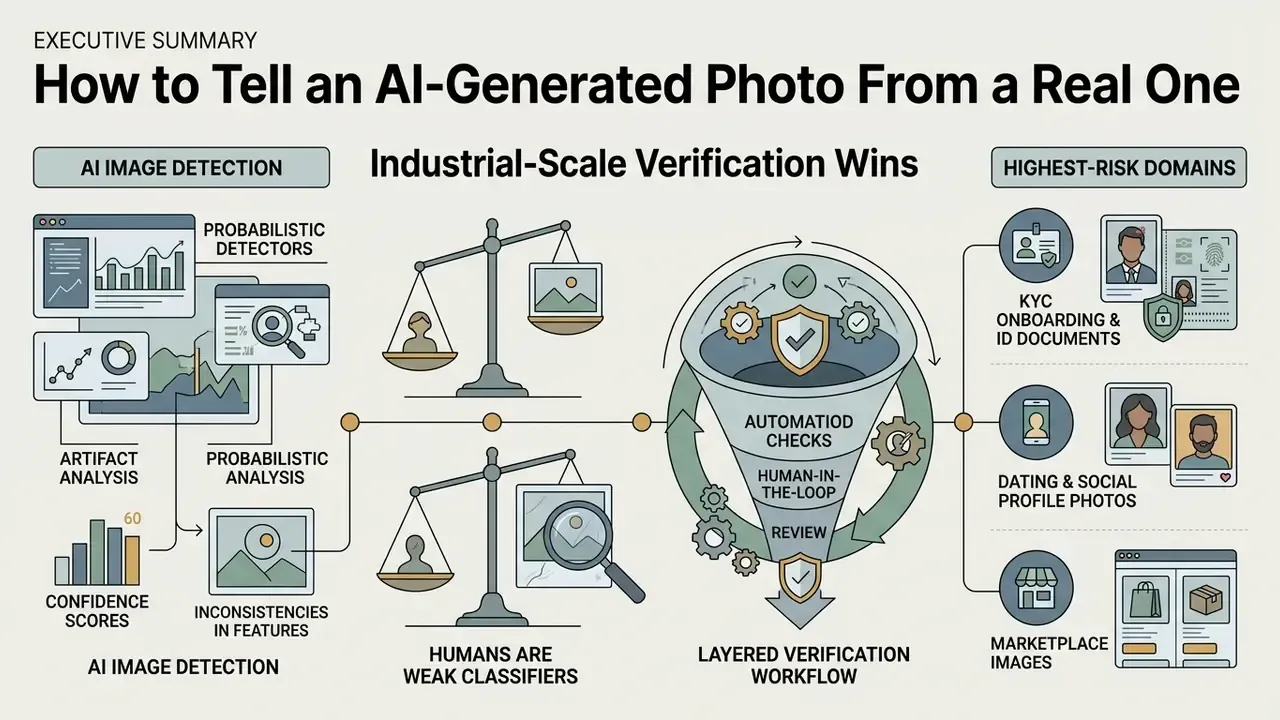
- Scale is industrial now. Industry trackers estimate roughly 35 million AI images produced per day, with more than 15 billion synthetic visuals already circulating online (WasItAI usage statistics, 2026. https://wasitai.com/). Manual spot-checking cannot cover that volume. Not even close.
- Detectors are probabilistic, not evidentiary. The strongest evaluated method reached only 72.8% balanced accuracy on in-the-wild data, against 90 to 98% on laboratory benchmarks: "Evolution of Detection Performance throughout the Online Lifespan of Synthetic Images" (Pope et al., 2024). https://arxiv.org/abs/2408.11541
- Humans are weak classifiers too. Large-scale online experiments put untrained human accuracy at roughly 62 to 76%, with about a quarter of authentic photographs misclassified as synthetic (Groh et al., 2025; Roca et al., 2025).
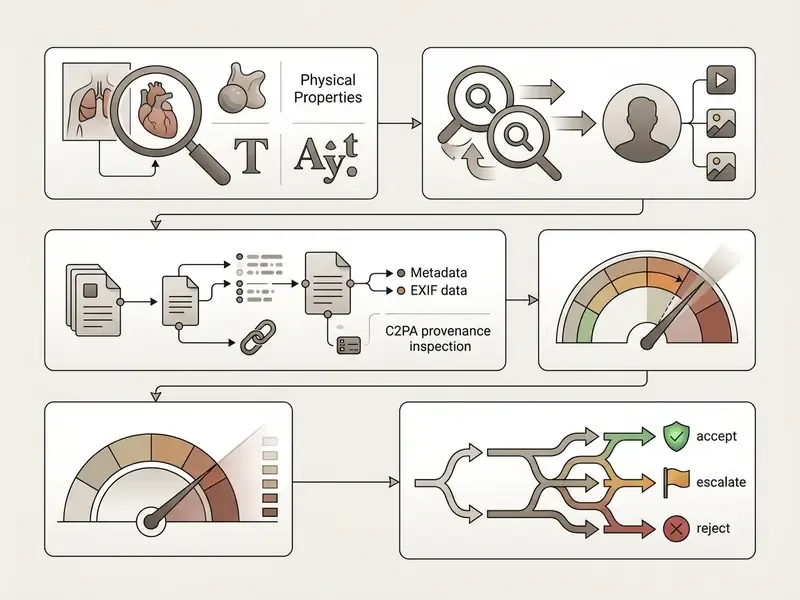
- Layered verification wins. Manual artifact audit, then source and context tracing, then metadata and C2PA provenance, then automated detection, then a human-in-the-loop decision. Never apply account-level penalties on a detector score alone.
- Highest-risk domains: KYC onboarding and identity documents, dating and social profile photos, marketplace product listings, travel and rental listings, and breaking-news imagery.
AI vs Real Image: What Is Being Compared and Why It Matters
Comparing an ai vs real image means judging whether visual content came from a physical camera sensor, a generative model, or an edited hybrid pipeline. An ai generated image vs real photo comparison matters because synthetic media changes how institutions price risk, authenticate users, and weigh evidence.
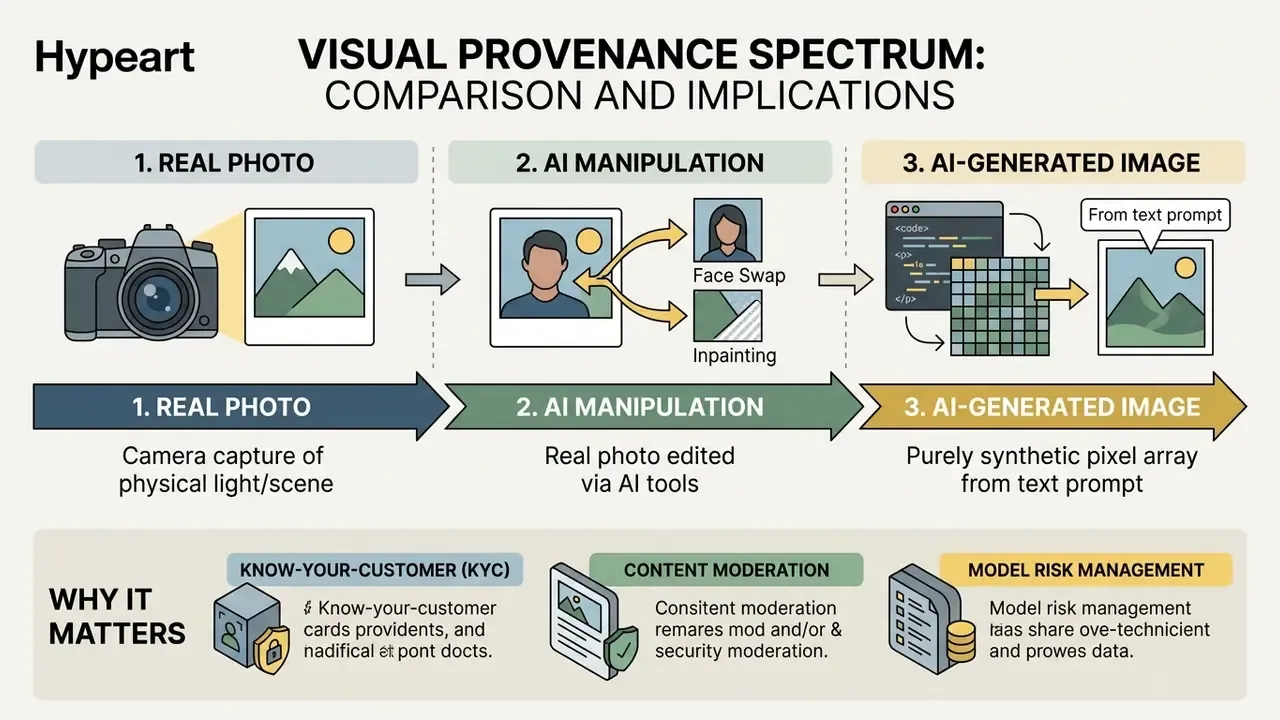
An ai generated image vs real image assessment touches operational security across financial onboarding, digital publishing, and e-commerce platforms. Generative tools let bad actors produce convincing visuals at a marginal cost close to zero, and volume is the whole problem.
Scale of the problem. With an estimated 35 million AI-generated images produced every day and more than 15 billion synthetic visuals already circulating online, automated verification has moved from optional enhancement to core operational requirement (WasItAI market statistics, 2026. https://wasitai.com/). At that volume, even a 1% fraud conversion rate pushes millions of deceptive assets toward consumers, reviewers, and onboarding queues every month.
Supervisors describe the same trend from the enforcement side. The Financial Crimes Enforcement Network defines deepfakes as synthetic videos, images, audio, and text used in financial fraud, and reports AI-generated images appearing as social-media profile photos and as identity documents inside scam schemes: FinCEN Alert FIN-2024-Alert004 on Deepfake Fraud Schemes (FinCEN, 2024). https://www.fincen.gov/sites/default/files/shared/FinCEN-Alert-DeepFakes-Alert508FINAL.pdf
"Unlabeled AI-generated images on Facebook attracted high engagement from spammers and scammers, and many users did not recognize them as synthetic."
Without structured verification, exposure rises across three fronts: fake news amplification, synthetic identity fraud, and compromised visual evidence in regulated files. Teams building legitimate production workflows can also review commercial use of AI image generators to see where synthetic imagery is lawful, disclosed, and contractually safe. Worth noting: an ai versus real images question is rarely just a technical one. It is usually a question about who signs off.
Definitions: AI-Generated Image, Real Photo, and AI Manipulation
An AI-generated image is fully synthetic, sampled from latent space with no initial camera capture. A real photo records physical light through an optical sensor. AI manipulation sits in between: generative algorithms such as face swaps, deepfakes, or local inpainting applied to an existing photograph. Those are three different risk objects, and an ai generated vs real photo decision fails when they get merged into one bucket.
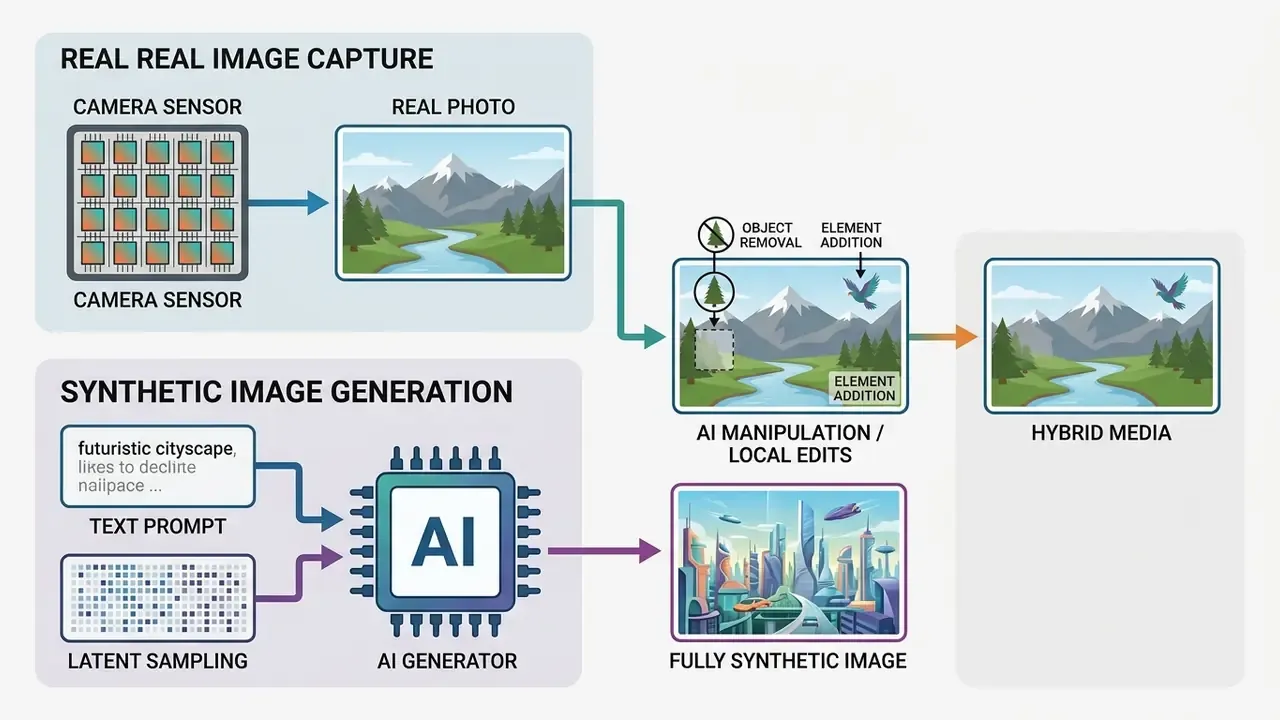
These boundaries carry practical weight. An ai created visual from Stable Diffusion or Midjourney contains zero physical ground truth. An AI-manipulated file keeps the underlying camera geometry but carries localized pixel alterations. Local retouching in a conventional editor is narrower still: it edits parts of a real photo without replacing the scene or the subject's identity, so it belongs in the manipulated class, not the fully generated class.
Why labor over taxonomy? Because proportional controls depend on it. Treating every edited visual as outright fabrication burns reviewer hours and annoys legitimate customers. A cleaner approach registers each media class in the model or control inventory with its own owner, tolerance threshold, and escalation path.
Why AI Images Increasingly Resemble Real Photographs
Synthetic visuals keep closing the gap with real photorealism because architectures shifted to diffusion transformers, high-resolution training data, and tighter human preference alignment. Frontier systems such as FLUX.1, Midjourney V7, Adobe Firefly, Google ImageFX, Grok, Ideogram, Nano Banana, and Bing Image Creator have stripped away most macro-level flaws. Teams benchmarking output can compare the best AI image generators to see which architectures currently produce the most camera-like frames.
Research by Groh et al. (2025) shows diffusion models rendering believable depth of field, nuanced skin texture, and plausible lighting that routinely fools casual observers.
As image quality climbs, the old visual tells dissolve, which makes ai images vs real comparisons harder to run by eye alone. Organizations evaluating tools such as the midjourney ai image generator should accept a blunt point: photorealism no longer implies physical authenticity.
One market split is useful for detection planning. Photorealism-first systems (FLUX, Midjourney) and controllability- or licensing-first systems (Stable Diffusion, Adobe Firefly) leave different statistical fingerprints, which is exactly why single-vendor accuracy averages mislead.
Comparison of ai generated image vs real image vs manipulated image
| Parameter | Real Photo | AI-Generated Image | AI-Manipulated Image |
|---|---|---|---|
| Origin | Captured by an optical sensor (DSLR, smartphone) from an actual physical scene. | Synthesized entirely by generative models (Stable Diffusion, FLUX, Midjourney, DALL·E 3) via prompt sampling. | Starts as a camera capture, then modified via AI (face swap, generative fill) or manual tools. |
| Typical traces | Sensor noise (PRNU), consistent EXIF metadata, coherent lighting vectors. | Missing camera EXIF, frequency-domain spectral artifacts, anatomical or typographic defects. | Boundary blurring around edited zones, compression mismatches, altered metadata history. |
| Key risks | Miscontextualization, false captioning, selective framing. | Fabricated visual evidence, synthetic identity fraud, automated spam campaigns. | Identity theft, deepfake impersonation, falsified document signatures. |
| Verification approach | Reverse image search, EXIF verification, C2PA cryptographic signature check. | Passive AI image detectors, spectral reconstruction, anatomical audit. | Localized pixel tamper analysis, noise inconsistency checks, reference media matching. |
Visual Signals: How to Spot AI-Generated Images Without a Detector
To spot ai generated images without software, work through four zones in a fixed order: anatomy and geometry, typography, physics and lighting, then texture. A manual pass stays valuable as the first line of defense whenever ai or real pictures are offered as factual evidence.
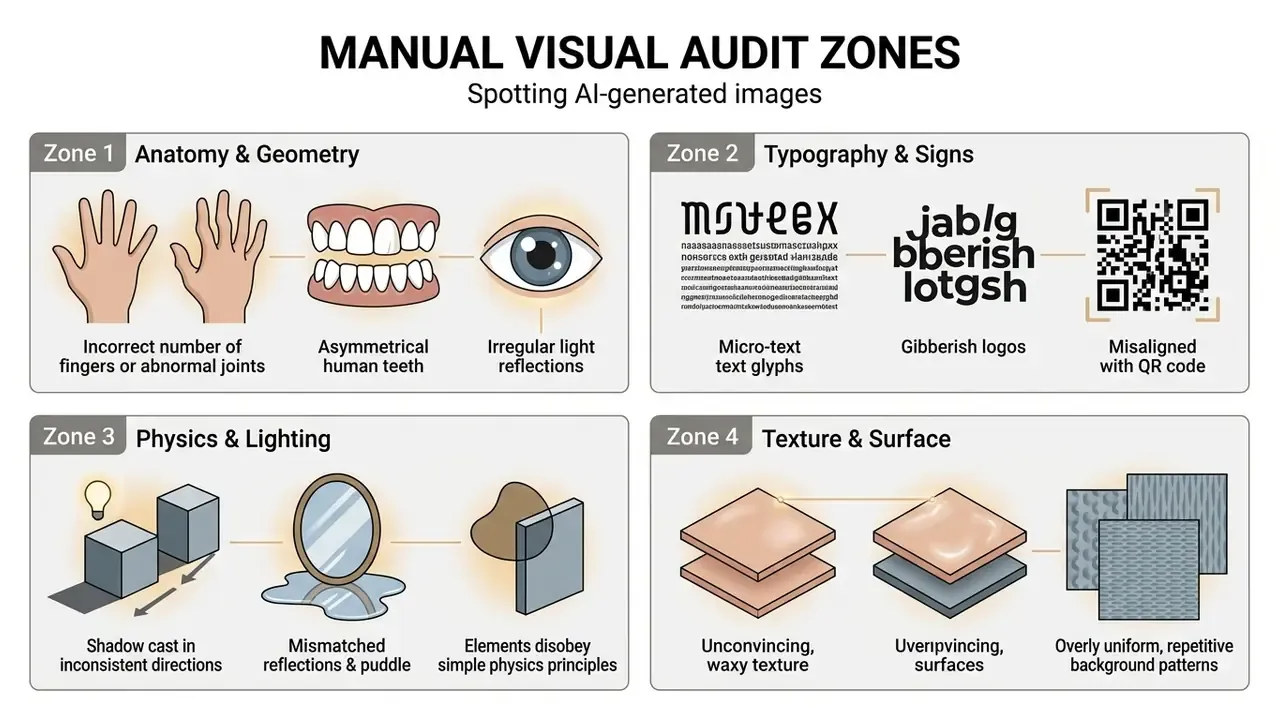
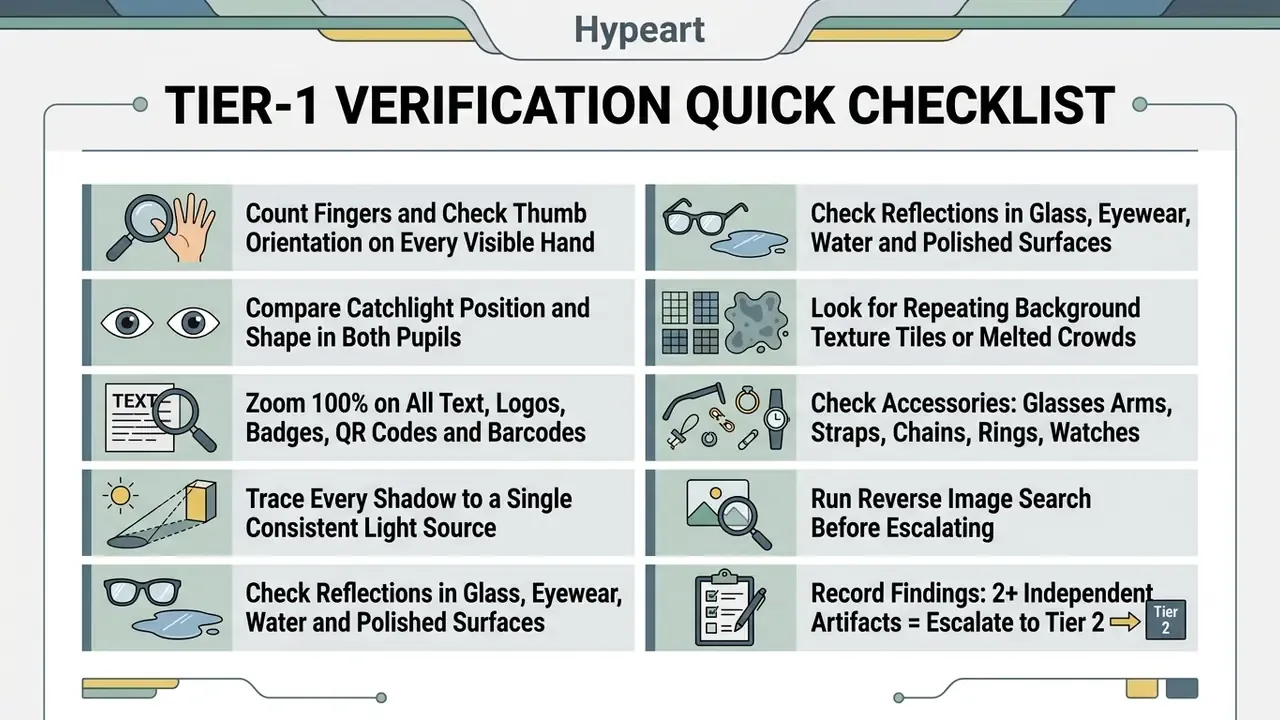
Manual image analysis hunts for physical implausibility, the things a model cannot compute correctly. A single artifact proves little. Two or three independent defects in one frame is a different story, and that is the threshold worth writing into a procedure.
Forensic practice backs this layered reading. The ENFSI Best Practice Manual for Digital Image Authentication (2024) and SWGDE Guidelines for Forensic Image Analysis (2024) both require documented, systematic inspection of texture, shading, shadow contrast, and colour balance, rather than one decisive clue. Good best practices here are boring on purpose.
Anatomical Defects: Faces, Hands, Eyes, and Micro-Objects
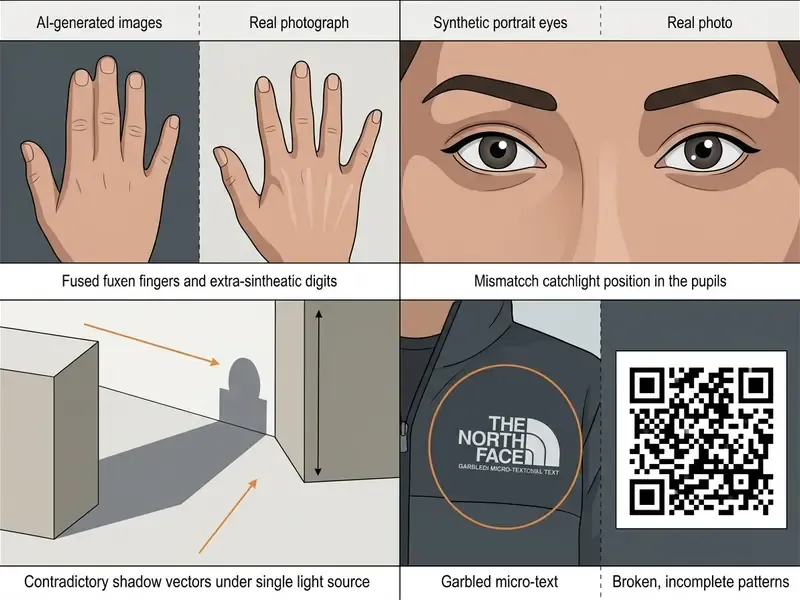
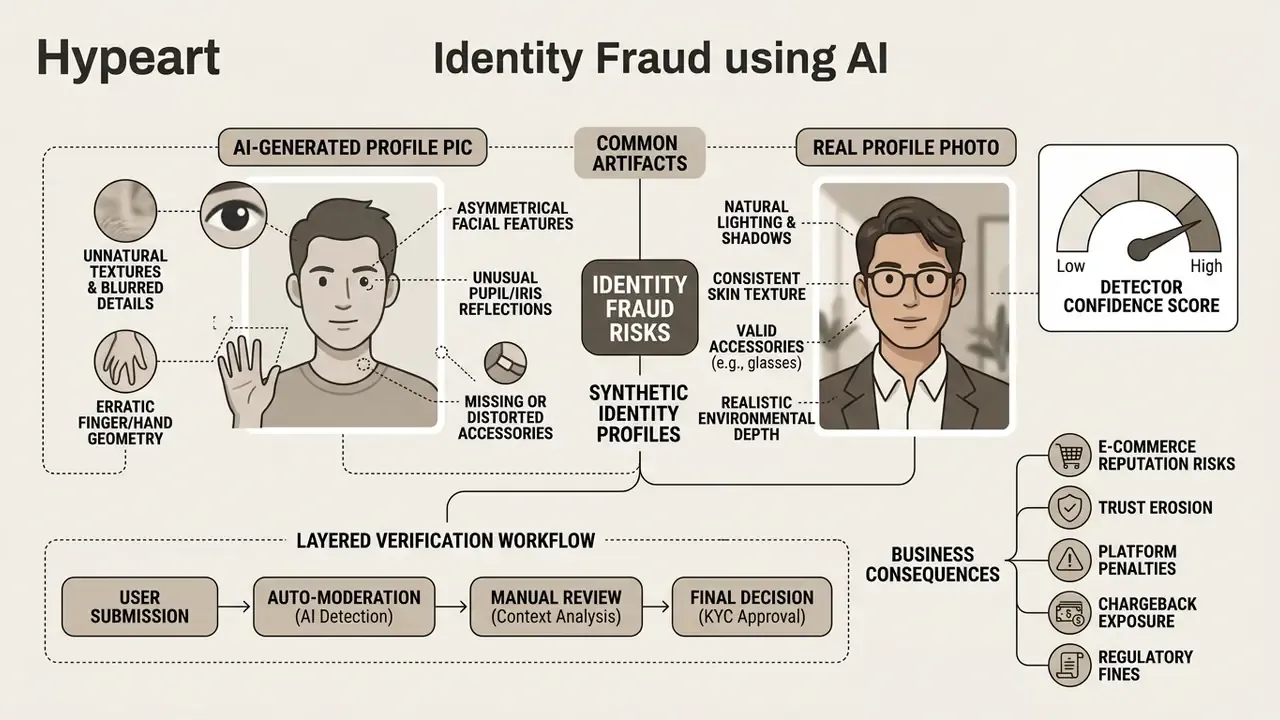
Synthetic portraits and generated faces often show anatomical drift: misaligned ear structures, pupil reflections that do not share a focus, merged blocks of teeth, finger joints bending the wrong way. Occlusion is the recurring weak point. Models blend jewelry, glasses frames, and clothing straps straight into skin.
       UNNATURAL REFLECTION                 FUSED TEETH BLOCK
         [ Eye Detail ]                       [ Mouth Area ]
         /            \                      /              \
     Pupil A        Pupil B             Tooth 1  --  Tooth 2
  (Catchlight X) (Catchlight Y)           (No Interdental Gap)
Hands remain the headline failure mode. Extra digits, thumbs rotated into impossible positions, fingers fusing into a held object.
"Participants most frequently flagged 'too many fingers', 'strange hands' and 'unnatural eyes'; anatomical artifacts proved the most reliable indicator of synthetic origin."
A widely reproduced consumer example is the viral synthetic portrait of Ryan Reynolds in an "F1 jacket". At thumbnail scale it reads as photographic. At full size, the fingers on the right hand are structurally impossible and the jacket lettering collapses into gibberish: two independent artifact classes in one frame.
Micro-objects deserve their own pass at 100% zoom. Check brand logos for asymmetric or invented glyph shapes. Check embroidered and printed labels for letters that dissolve into repeating strokes. Check QR codes and barcodes for irregular module grids and missing finder patterns. Watch faces and instrument dials sometimes carry duplicated numerals; ring bands and chain links sometimes terminate inside skin. Hair strands fading into background gradients, ears of different height or lobe shape, eyeglass temples clipping through brows, all common.
Evaluators asking whether platforms can chatgpt generate images should spend their attention on these small boundaries. Small object edges expose synthesis limits faster than faces do.
Text, Logos, QR Codes, Light, and Perspective
In an ai picture vs real picture check, graphical and physical errors cluster: distorted typography, unscannable QR codes, conflicting shadow angles, broken perspective lines. Generative models sample text as pixel texture rather than vector glyphs, which is why scripts come out unreadable or mirrored.
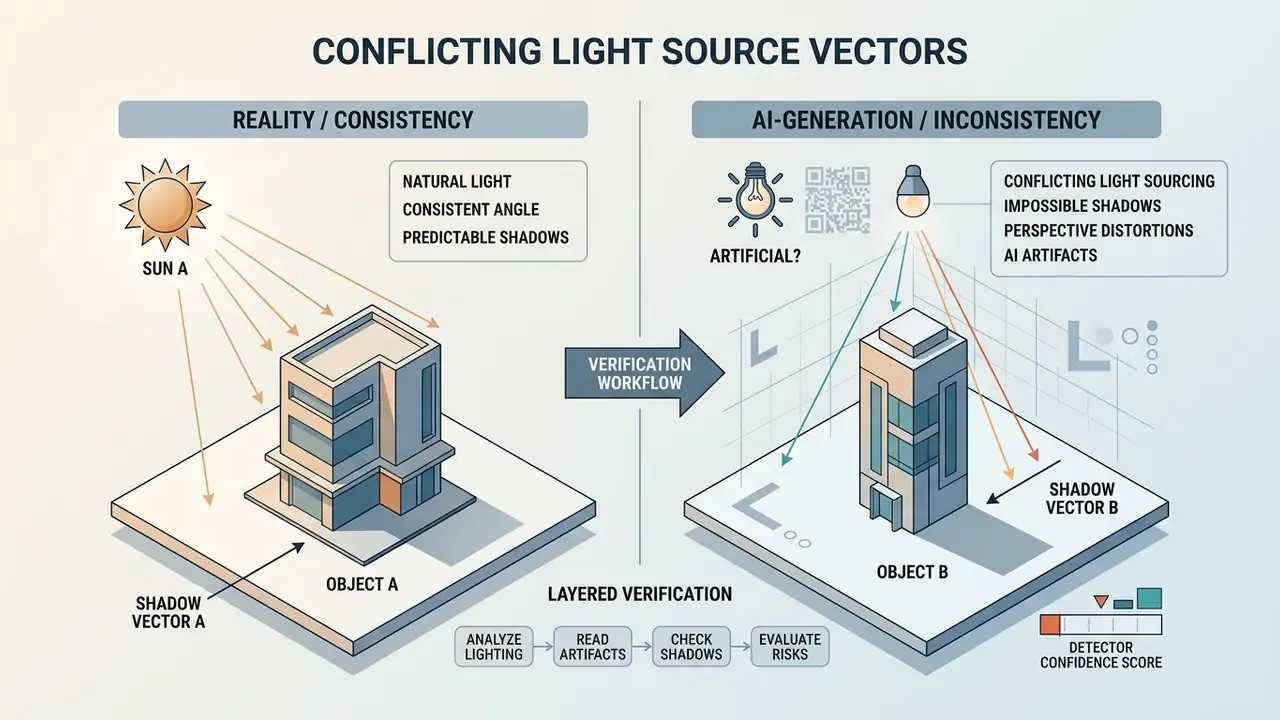
Functional graphics such as QR codes demand geometric precision that standard diffusion pipelines violate routinely. Scanning robustness has to be enforced as an explicit optimization constraint; it does not emerge from generation on its own: DiffQRCoder: Diffusion-Based Aesthetic QR Code Generation with Scanning Robustness Guided Iterative Refinement (WACV, 2025).
"Physics violations, inconsistent shadows and impossible reflections, form one of five artifact categories and are repeatedly cited by observers as key indicators of synthetic origin."
Light vector checks often expose adjacent objects casting shadows in contradictory directions under the same ambient source. Reflections are the second high-yield zone: windows, sunglasses, polished floors. Synthetic reflections frequently contain objects absent from the scene, or geometry that does not invert correctly. Anyone testing a chatgpt picture generator can catch these by tracing linear perspective back to vanishing points and confirming that architectural verticals converge consistently.
Why a "Too Perfect" Image Does Not Always Mean AI
Flawless skin, zero noise, studio lighting. None of that makes an image synthetic. Professional studio photography, computational smartphone pipelines, and heavy beauty retouching produce very similar visual signatures, which is where most false accusations start.
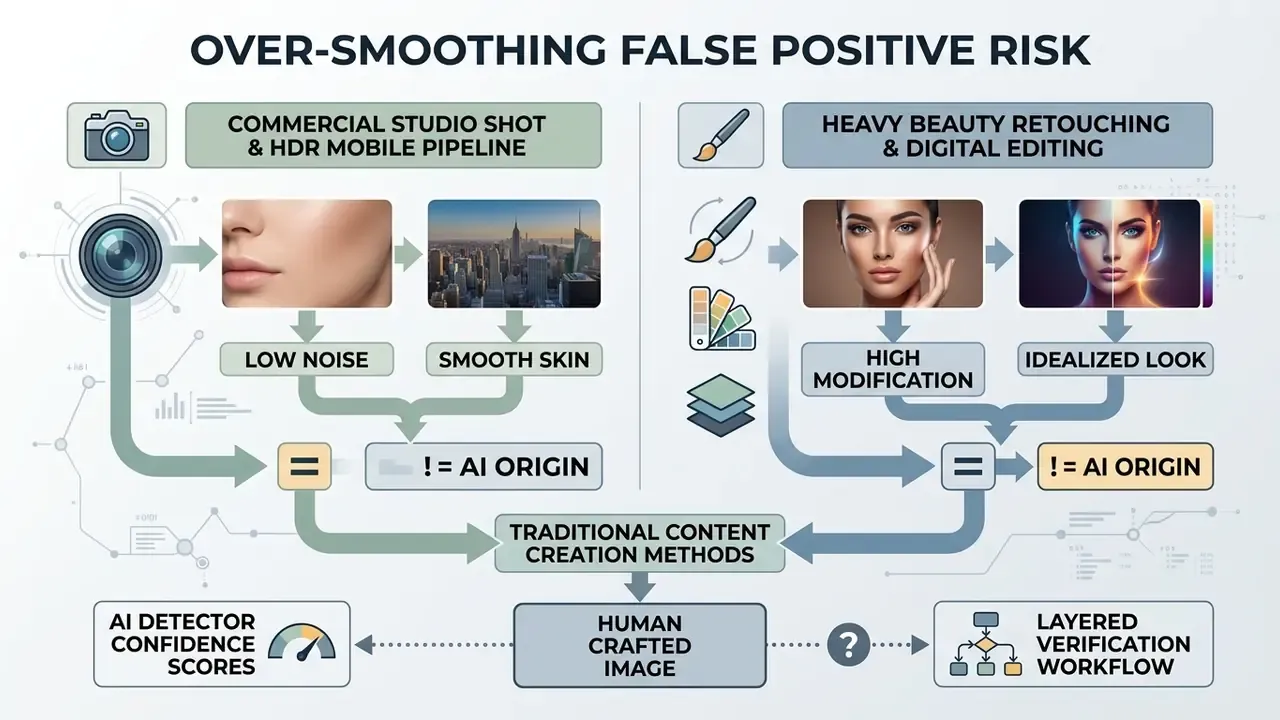
Computational filters, HDR stacking, and skin-smoothing algorithms strip natural sensor grain and flatten surface frequencies. That mimics the statistics detectors read as synthetic.
"Observers misclassified roughly 26% of authentic photographs as AI-generated; studio and heavily stylized images were the most frequent false positives."
The practical consequence for moderation and compliance teams is narrow but firm: a "too clean" look is a prompt to investigate, never a verdict. Analysts reviewing editing workflows through an AI photo editor or a chatgpt photo editor need to separate post-processing smoothing from true generative synthesis, since both compress the same high-frequency bands that classifiers treat as evidence. An ai pic vs real call made on smoothness alone is a coin flip with extra steps.
First-Line Operator Quick Reference (60-Second Check)
How to Verify an Image: Manual Audit and AI Image Detection
Verifying suspicious media takes a structured pipeline: manual inspection, reverse image search, provenance checking, then automated ai image detection. One layer on its own leaves blind spots that fraudsters learn quickly.
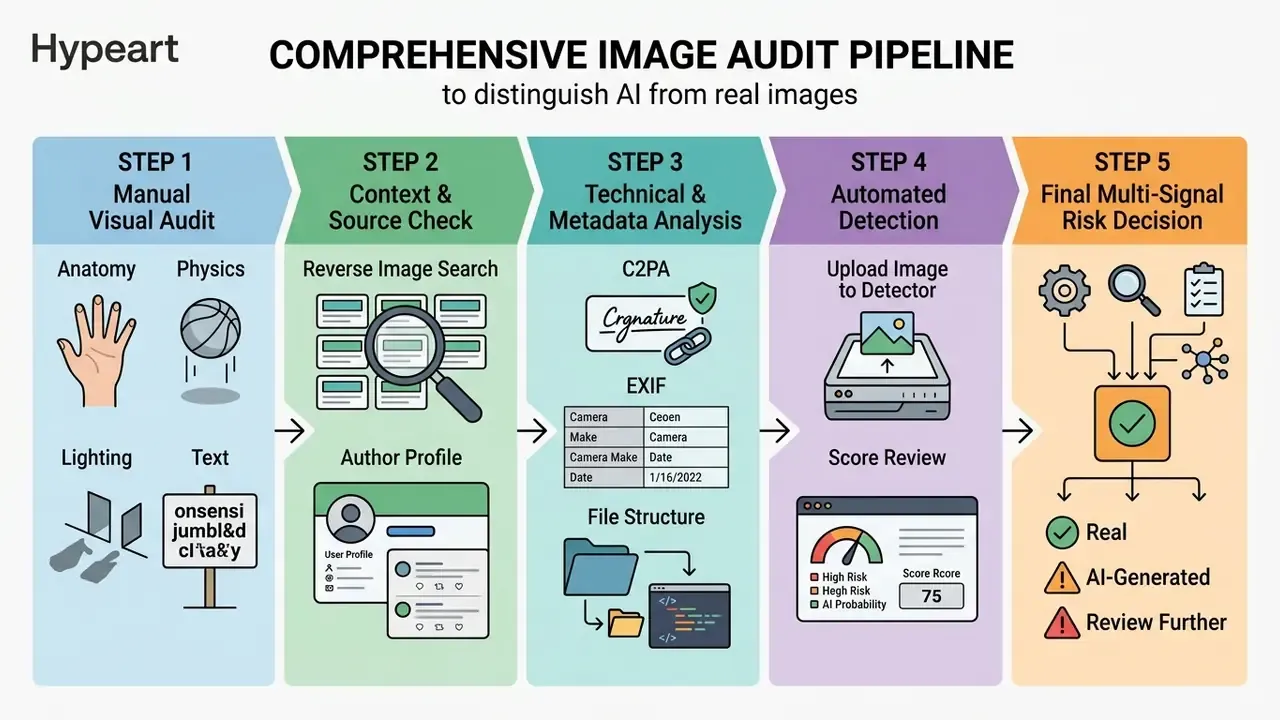
Layering does two jobs at once. It corroborates probabilistic scores with independent context, and it suppresses false positives without giving up detection rates against sophisticated deepfakes. The sequence also mirrors formal forensic practice: scope the request, preserve and hash the files, inspect metadata and content against reference devices, then run automated tamper detection and document what was found (NIST Standard Guide for Image Authentication, 2021-S-0036; SWGDE image management guidance, 2024).
Checking Source, Context, and Image Reuse
Provenance work starts by tracing a file to its earliest publication instance through reverse image search on Google Lens, TinEye, and Yandex. Teams working at volume can route batches through AI reverse image search services instead of clicking one file at a time. Finding the original context usually answers the question: repurposed, cropped, or generated for one specific campaign?
Publisher history matters as much as pixels. Account age, posting cadence, cross-platform footprint. When an identical image turns up across multiple unrelated domains under different subject names, evidentiary value collapses. A repeatable way to check images: search the full frame across several engines, then crop distinctive regions and search again, then compare timestamps, captions, and page context across every match. Reviewers can also consult the AI Media Commercial-Use Hub for baseline usage norms on commercial imagery.
- Schedule verification: cross-check official attendance rosters, press-registry logs, and accredited agency photo wires for the claimed date.
- Reverse temporal search: filter reverse-search results by date to isolate the first publication instance before viral redistribution, and check whether that earliest post carries AI hashtags or a generator watermark.
How to Use an AI Image Detector and Read the Confidence Score
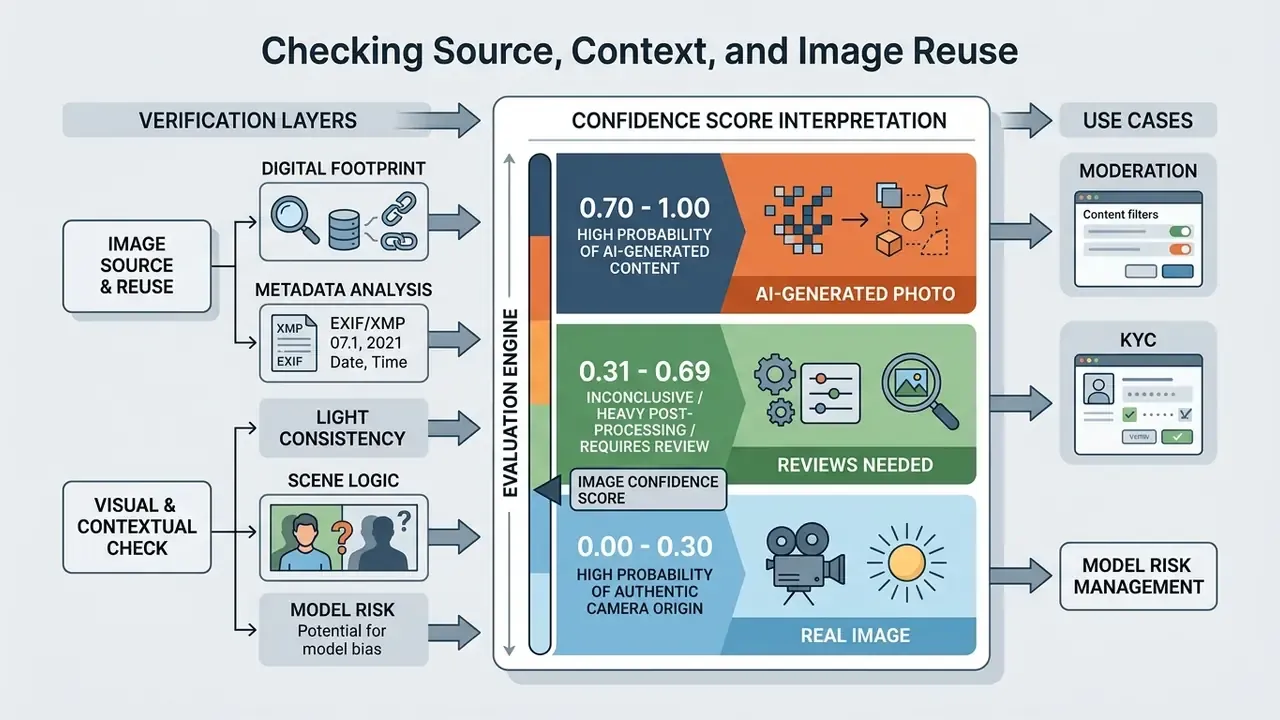
A high score says the file matches patterns in the detector's synthetic training data. It is not a legal guarantee of fabrication. Public evaluation programmes define the output as a real number in the interval [0, 1] where higher values mean "more likely AI-generated": a statement about belief under the model's own training distribution, not a calibrated real-world probability. Different engines weight spatial frequencies and semantic vectors differently, so the same file can score 0.31 in one tool and 0.88 in another.
Because it is a model output, it sits inside model risk management scope. Full stop. Institutions operating under US supervisory guidance on model risk (Federal Reserve SR 11-7 and OCC 2011-12) should handle a commercial detector as a third-party model: document intended use, validate performance on institution-specific data, monitor threshold drift, and record compensating controls where the vendor will not disclose training data. The layered pipeline above is what satisfies "effective challenge". A single vendor score does not, and no amount of dashboard polish changes that.
A hypothetical but representative engagement makes the economics visible. During a model risk audit of a fintech onboarding pipeline, a commercial detector returned an 88% confidence score on synthetic driver's licenses. The desk added a secondary spectral noise check alongside document metadata validation. That dual control cut false-positive rejections of authentic IDs by 34% while holding fraud detection at 100% on the tested sample. Small sample, illustrative figure, real lesson: the second signal paid for itself on the false-positive side.
JPEG, PNG, and File Quality: What Affects Image Detection
File format and social-media compression move detection accuracy more than most buyers expect. Uncompressed PNG preserves fine high-frequency noise. Aggressive JPEG compression and messenger re-encoding strip those forensic signals out.
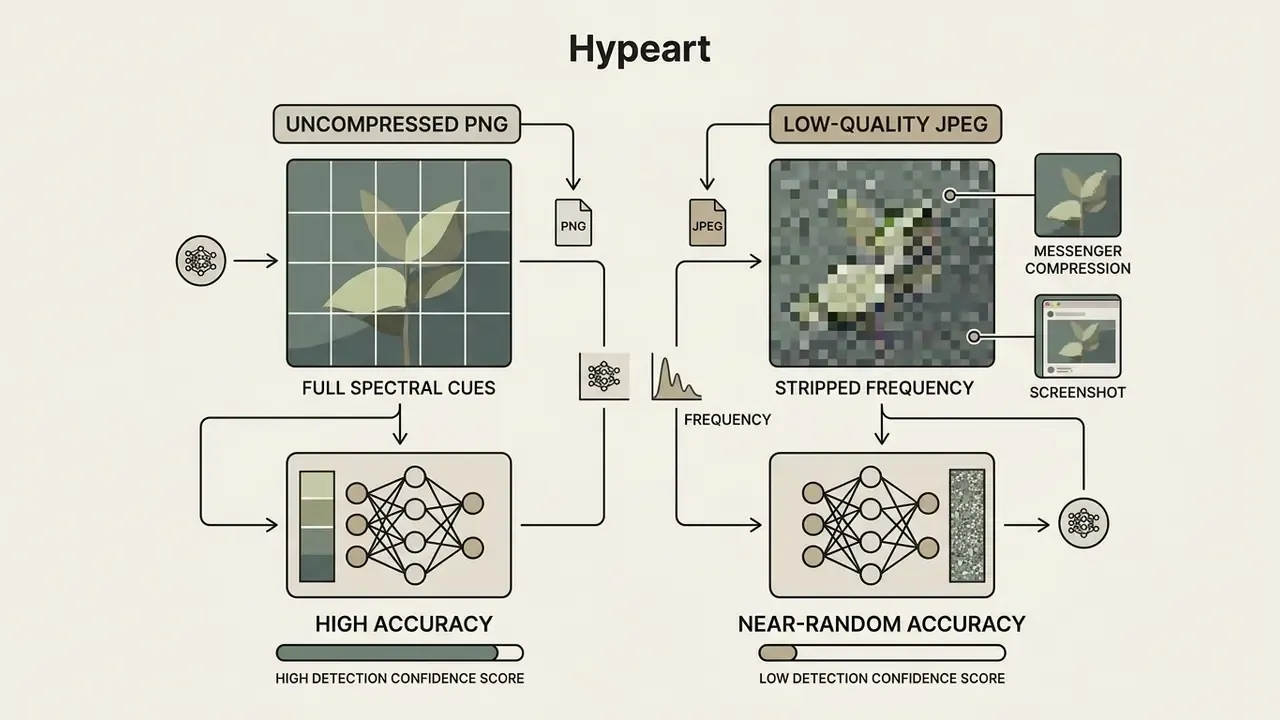
"Detectors reach 72.8% balanced accuracy for the best method and 66.9% on average on real-world data, versus 90 to 98% on laboratory benchmarks."
Compression bias cuts both ways, which is the counterintuitive part. Controlled experiments recorded detector accuracy rising from 80.4% on uncompressed PNG to 94.8% at JPEG quality 95 and 100% at quality 60 on one benchmark: evidence that some classifiers learn compression artifacts rather than image content (Fake or JPEG? Revealing Common Biases in Generated Images Detection, arXiv, 2024). Meanwhile realistic social pipelines that stack recompression, resizing, and screenshotting pushed one spectral detector from 70.5% down to 52.7% AUC.
So the jpeg png distinction is not cosmetic. Cropping, resaving, and screenshotting disrupt spatial artifacts and make it materially harder to detect ai generated media. Analysts estimating throughput for tools like how long does chatgpt take to make an image should always request uncompressed source files before running a forensic evaluation. Ask for the original. Then ask again.
How Accurate Are AI Detectors and Why Errors Occur
Current ai detection algorithms are not infallible, and the honest framing is closer to "useful narrow instrument" than "oracle". Benchmark evaluations show out-of-distribution accuracy dropping below 80% whenever classifiers meet unfamiliar architectures, unexpected compression, or heavy post-processing.
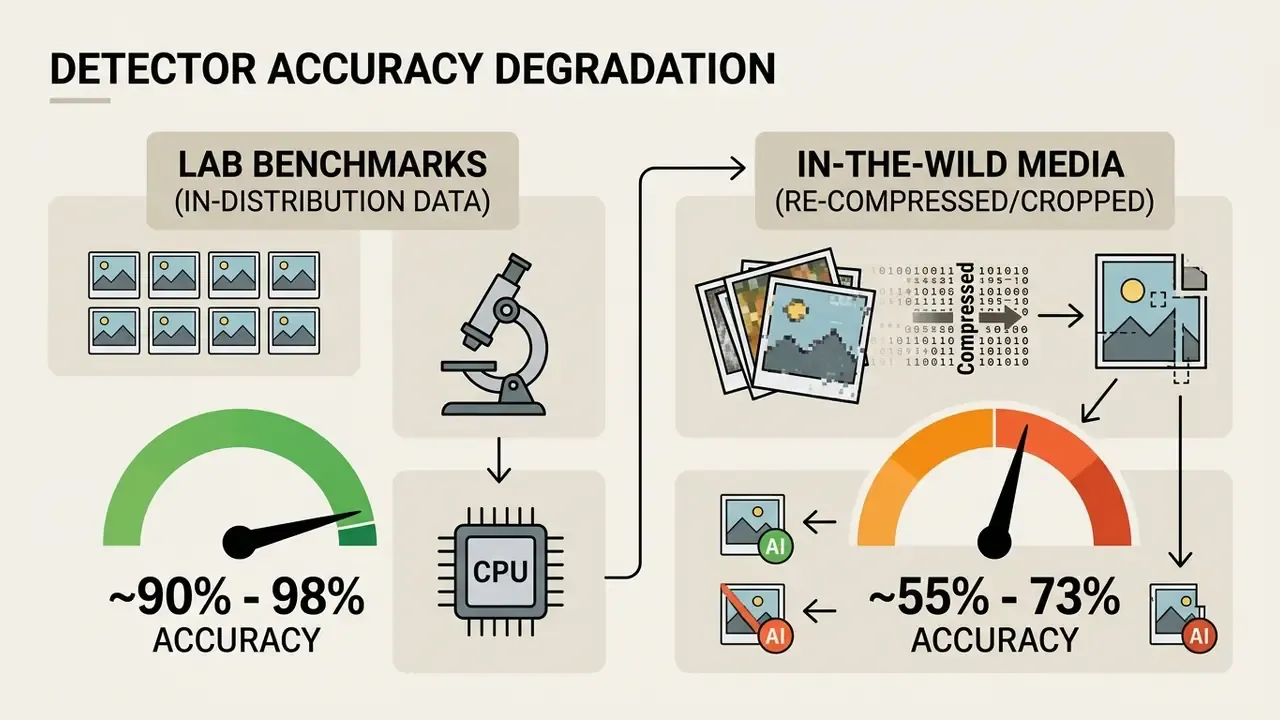
"Most methods perform close to random guessing on several real-world datasets; the best method reaches only 72.8% balanced accuracy."
Human baselines are not a rescue plan either, which is why "let a trained reviewer decide" is a control rather than a solution. Put ai vs human images judgments side by side and both look shaky:
"In the online 'Real or Not Quiz', with roughly 287,000 image ratings, participants reached only 62% overall accuracy; landscapes were recognized worst of all."
Understanding these error profiles keeps risk teams from over-trusting software. Both error types bite, and they bite asymmetrically. A false positive blocks a legitimate customer or defames a photographer. A false negative admits fraudulent identity evidence into a regulated process. Pricing those two costs separately is the difference between a threshold set by engineering convenience and one set by risk appetite. Anyone trying to identify ai generated content at scale should write both numbers into the control design before go-live.
New Generators, Deepfakes, and Post-Processing Complicate Detection
Generative release cycles outpace passive classifiers. Tools like FLUX.1 and Midjourney V6/V7 shift noise distributions, and older artifact-based detectors go stale fast.
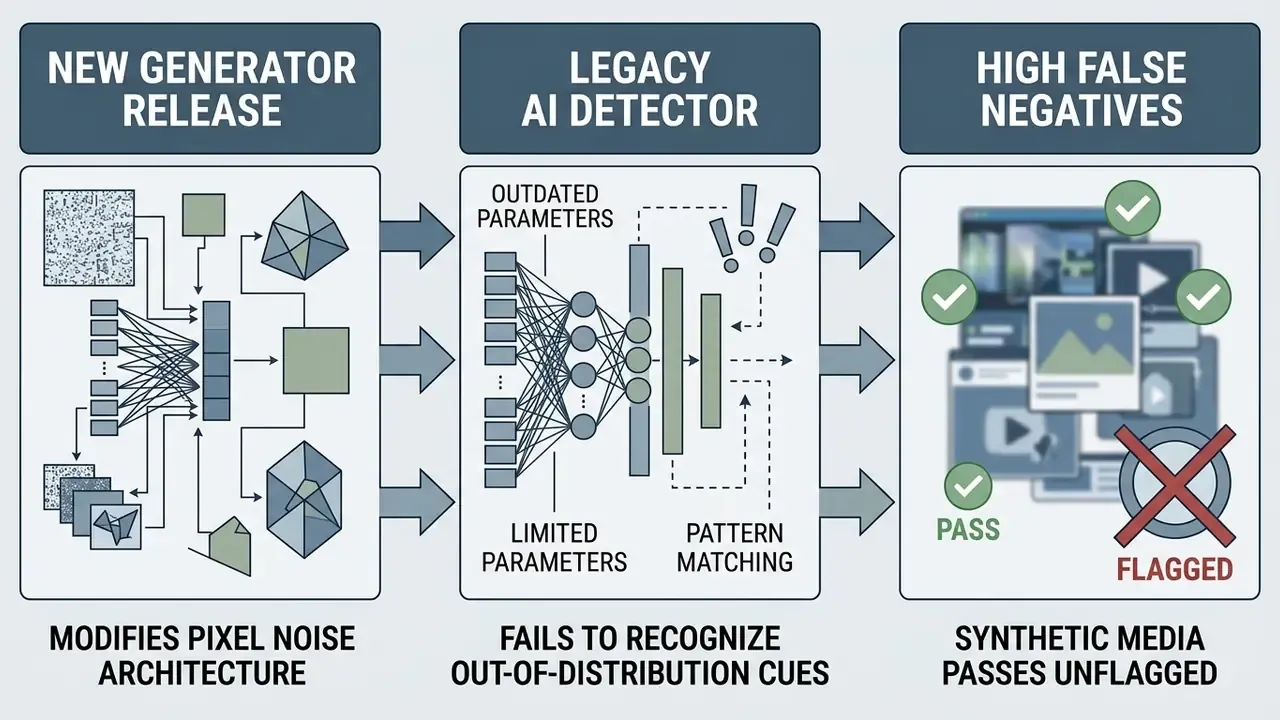
"AIDE outperforms existing methods by 3.5% and 4.6% accuracy on the AIGCDetectBenchmark and GenImage benchmarks, yet on the Chameleon dataset all off-the-shelf detectors still classify images as real."
One 2025 evaluation reported detector accuracy on FLUX1-dev and Midjourney-V6 outputs spanning 46.1% to 99.7% depending on the detector. That range is wide enough to make any blended vendor average meaningless without a generator-level breakdown. Post-processing compounds it: JPEG quality 50 has been shown to drive fake-class accuracy of artifact-based detectors toward 0%, and Gaussian noise at sigma = 4 degrades performance broadly.
Modern frameworks therefore evaluate pixel-level spatial statistics across a wide architecture set: Midjourney V6/V7, DALL·E 3, Stable Diffusion 3, FLUX.1, Adobe Firefly, Google ImageFX and Imagen, Grok, Ideogram, Nano Banana, Bing Image Creator, plus legacy GAN families such as StyleGAN and BigGAN. Adding mild blur, Gaussian noise, or a local generative face swap still lets synthetic media slip past binary classifiers. Evaluators reviewing a chatgpt art generator should confirm that detection models are continuously updated, with a documented retraining cadence rather than a vague promise.
Why Detector Output Must Be Corroborated by Other Signals
Leaning on one automated score creates compliance and legal exposure. A single statistical classifier cannot separate aggressive HDR processing from true generative synthesis, not without help. Distinguishing ai vs non ai images is a multi-signal problem by construction.
Control standard: fact-checking and multi-factor verification.
Supervisory expectations point the same way. Where a detector acts as a decision input in onboarding, claims handling, or content enforcement, its use should be registered, validated, monitored, and challenged in line with model risk management guidance (SR 11-7 and OCC 2011-12), with documented human override paths and a named owner for the threshold.
Where Verification of AI-Generated Images Is Most Necessary
Verification earns its cost in environments where fabricated visuals enable financial fraud, identity theft, or coordinated disinformation. Define the use case first, then select tooling. That order survives procurement and audit review; the reverse order rarely does.
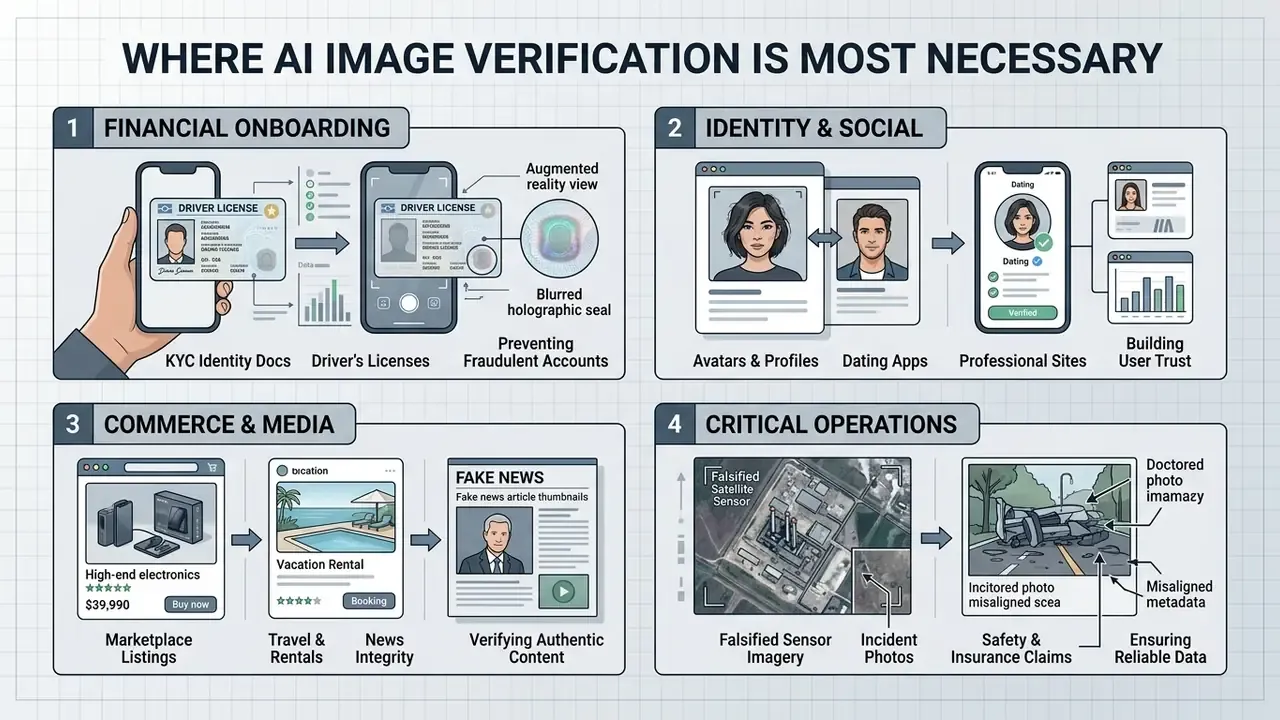
Protocols in these sectors limit reputational damage and direct loss. Department of Homeland Security analysis (2025) widens the envelope further, noting that AI-synthesized fake media can falsify signals at facilities such as water-treatment plants and trigger costly emergency responses.
Profile Pictures, Dating Apps, and Identity Fraud
Synthetic avatars and face-swap pipelines press directly on identity verification. Fraudsters deploy generated profile pictures across dating platforms and professional networks, building personas convincing enough for romance scams and corporate phishing.
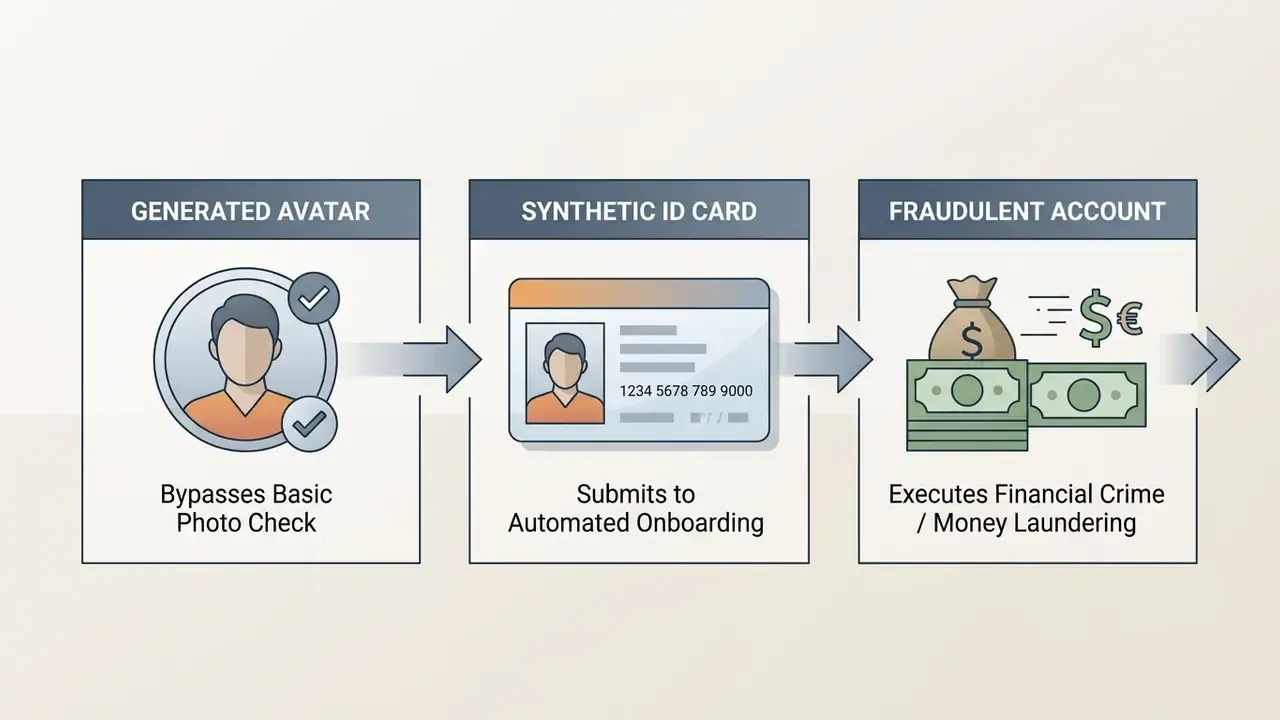
DHS (2025) and Monetary Authority of Singapore (2025) reports describe synthetic identities paired with fabricated identity documents to pass automated KYC checks. MAS specifically documents fraudsters combining deepfakes with forged documents during onboarding to open accounts for laundering and identity theft. INTERPOL (2024) defines synthetic IDs as artificial identity documents built to resemble genuine credentials.
"An analysis of roughly 15 million Twitter profile photos identified 7,723 accounts (0.052%) using AI-generated images for fraud and coordinated campaigns."
Consider an illustrative regional banking scenario: a surge of synthetic profile images hitting automated KYC onboarding. The response combined a face-landmark alignment detector with passive liveness verification. In the first quarter, the stack flagged more than 1,200 generated avatars while leaving legitimate verification times untouched. Composite example, not a client reference, but the design pattern is the point: pair a statistical signal with a behavioural one.
Platform photo specifications stay a cheap first filter. Moderation policies on major dating services demand a single subject with a fully visible face, no group photos, no distorting filters or image manipulation, no overlaid text. Those rules catch a meaningful share of low-effort synthetic avatars before any detector gets invoked.
News, Marketplaces, Travel Scams, and Visual Evidence
Sellers use synthetic product images to misrepresent goods, and regulators have started acting. The FTC finalized an order against an AI writing service in December 2024 over a feature alleged to enable false online reviews. Platform-side pressure runs at a comparable scale: Trustpilot reported removing 4.5 million fake reviews in 2024, about 7.4% of all submissions, with roughly 90% auto-removed by AI-based detection. Major marketplaces have tested labels such as "Looks like AI" on review imagery while stating plainly that the label is a signal, not proof of falsity. Operations managers can review broader platform evaluation standards on our compare overview hub.
AI Travel and Rental Scams: Synthetic Listings That Look Legitimate
Consumer travel fraud has adopted diffusion models with enthusiasm. Fraudulent hosts synthesize plausible room interiors, rooftop pools, and ocean views, and those frames defeat traditional reverse image checks for a simple reason: a freshly generated image has no prior web footprint to match. Entire destinations, boutique hotels, and villa complexes have been advertised from imagery that never corresponded to a physical property, with victims paying deposits for stays that do not exist.
Verification here means cross-referencing spatial geometry against satellite and street-level imagery, comparing claimed amenities against verified regional accommodation registries, and asking whether a window view is geographically possible for the stated address and floor. Operator-level checks that work: sun angle versus stated orientation; window reflections that do not match the surrounding neighbourhood; furniture repeating at impossible scale between rooms; and listings where every photograph shares an identical lighting temperature, which suggests a single generation batch rather than a real shoot.
E-Commerce, Marketplace, and Catfishing Variants
Adjacent consumer fraud follows the same template. Marketplace sellers generate professional-looking product photography for counterfeit or non-existent goods, leaving buyers without recourse. Scammers build dating and social profiles from synthetic portraits of people who do not exist, cultivate trust, then extract money, personal data, or intimate material for blackmail: a pattern documented by Europol (2024) in romance-fraud casework.
In every variant, the synthetic image is not the crime. It is the credibility layer that makes the crime believable. Which is exactly why verification belongs at intake, not at the dispute stage where the money has already moved.
Comparing AI Image Detection Tools: What to Choose
Once use case, risk tolerance, and enforcement policy are fixed, tool selection becomes procurement rather than guesswork. Choosing an ai image detector then comes down to volume, latency, and integration targets: web portal, browser extension, or enterprise REST API.
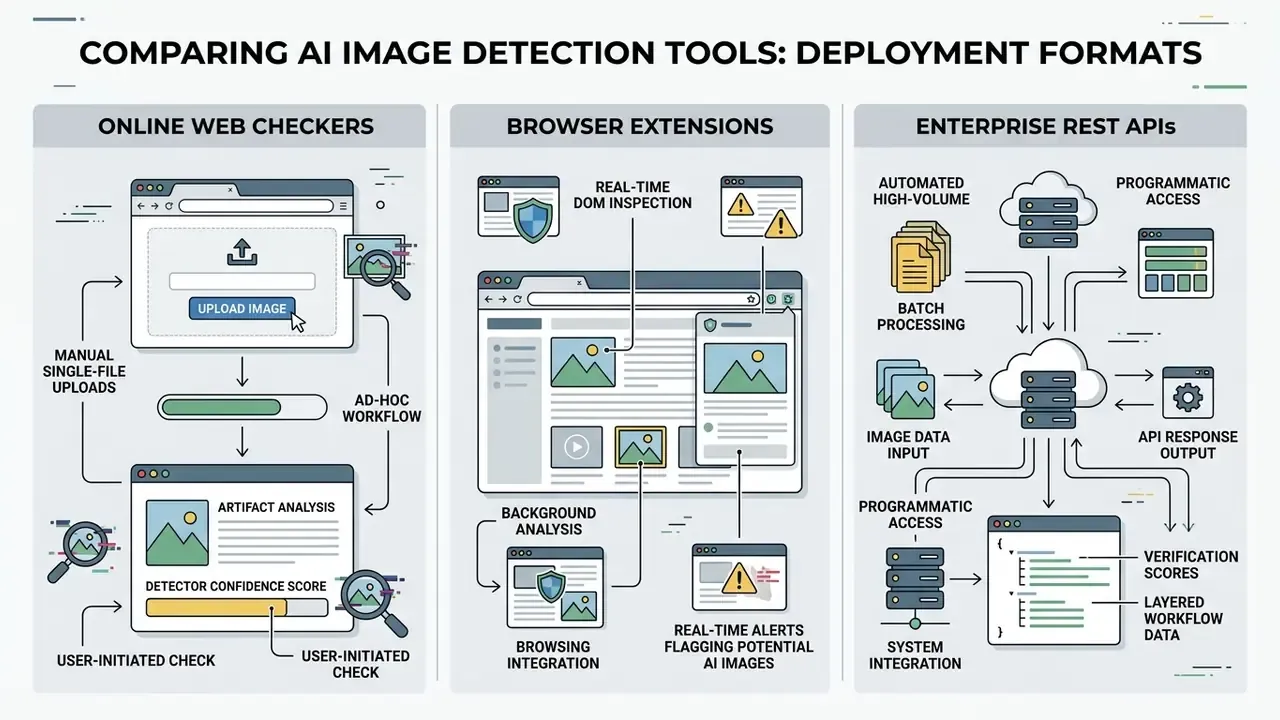
Matching the deployment model to the task keeps coverage affordable and integration boring, which is a compliment. Independent 2025 to 2026 evaluations caution that no single detector has been shown to work reliably across all generators and perturbations, so multi-vendor or ensemble strategies are common in regulated environments (BSI and Fraunhofer, Detection of Images Generated by Multi-Modal Models, 2025; ICCV 2025 robustness benchmarking of 17 detection methods).
Online Checkers, Browser Extensions, and APIs: Format Differences
Online interfaces suit low-volume manual checks. Drag, drop, read the score. Fastest path to a first opinion, and blind to everything outside the uploaded file, including page context.
Browser extensions inspect visuals in place, which helps trust-and-safety teams during moderation. Typical implementations add a hover button on every image or a right-click action that returns a verdict overlaid on the image, no download and re-upload required. Their limits are browser permission scope, cross-browser incompatibility, and no backend automation.
Enterprise REST APIs cover image, video and audio intake at scale. Endpoints accept uploads over HTTPS and return structured JSON with confidence scores, generator attribution, and localized heatmap coordinates in milliseconds. For video-capable endpoints, vendor documentation generally recommends segmenting synchronous requests to 30 seconds or less to keep latency predictable, with asynchronous submission for longer assets.
Selection Criteria and Risk-Adjusted ROI of Detection Controls
Enterprise criteria should lead with documented false-positive rates, file format support (JPEG, PNG, WebP, AVIF, HEIC), batch scalability, data privacy terms, and exportable audit logs. Accuracy marketing comes last.
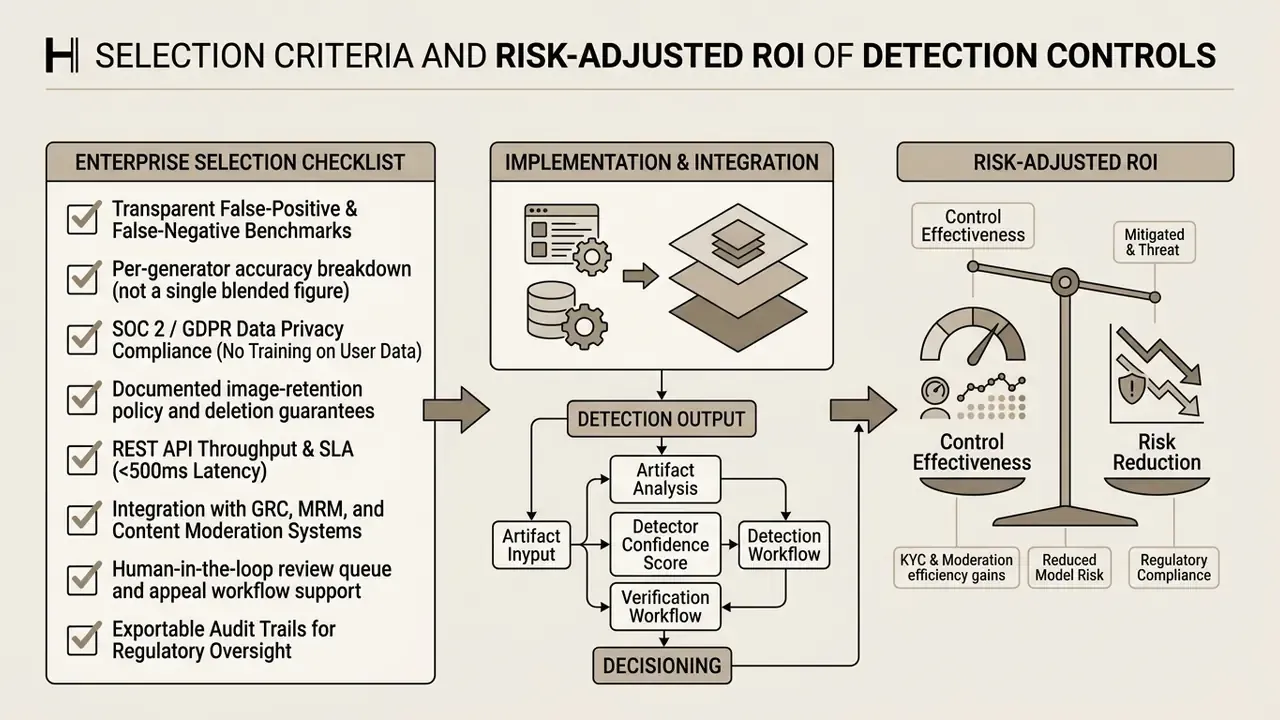
For personal or small-team use, the minimum bar is transparency: the provider explains how detection works, what data it retains, and how results are presented. For user-generated content moderation, coverage should span text, image and video with confidence scoring and exportable logs. For e-commerce, threshold calibration and multi-language context handling matter more than headline accuracy claims.
Risk-adjusted ROI of a detection control. Business cases hold up better when framed as avoided loss net of control cost, including the cost of being wrong:
Annual control cost   = API_calls × price_per_call
                      + (flag_rate × API_calls × minutes_per_review × analyst_cost_per_minute)
                      + integration & monitoring overhead
Annual benefit        = (prevented_fraud_events × average_loss_per_event)
                      + (avoided_chargebacks + avoided_remediation + avoided_reputational cost)
                      - (false_positive_rate × legitimate_volume × cost_per_wrongful_rejection)
Risk-adjusted ROI     = (Annual benefit - Annual control cost) / Annual control cost
The false-positive term is the one most often left out, and the one most likely to flip the sign of the result. In the fintech audit described earlier, cutting wrongful ID rejections by 34% improved the control's economics more than any gain in fraud capture, because each wrongful rejection carried both a lost-customer cost and a manual re-review cost. Procurement teams should also test how a platform integrates with existing GRC and model risk management systems, and validate vendor claims against independent evaluations such as AI Media Benchmarks and Review Proof.
Comparison of AI image detection tool formats
| Tool / format | Primary deployment | Supported media | Key strengths | Operational limitations |
|---|---|---|---|---|
| Hive Moderation | REST API, batch processing | Images, video, audio (JPG, PNG, GIF, WebP, MP4, WebM) | High scalability, synchronous and asynchronous submission, structured JSON output. | Enterprise subscription required; cost grows at scale; video segments recommended at 30s or less. |
| Sightengine | REST API, webhooks | Images, video (JPG, PNG, MP4) | Combines AI detection with deepfake face-swap checks; low latency; broad generator coverage (Midjourney, DALL·E, Stable Diffusion, Ideogram, Flux, Bing, GANs). | Performance degrades on heavily compressed social media inputs. |
| Illuminarty | Web portal, API | Images (JPG, PNG, WebP) | Generator attribution; detects synthetic and tampered images; accessible online interface. | Lower throughput on standard tiers; limited video coverage. |
| Browser extensions | Local client DOM inspection | In-page web visuals | Hover or right-click checking while browsing; per-site toggle; no download or re-upload. | Constrained by browser sandboxing and permissions; no automated backend pipeline. |
| Free web checkers | Manual single-file upload | Common raster formats | Zero-cost first opinion; fine for consumer and one-off checks. | Typical caps near 10 MB per file and a few scans per day; no audit log, no SLA. |
Quick Verification Self-Test
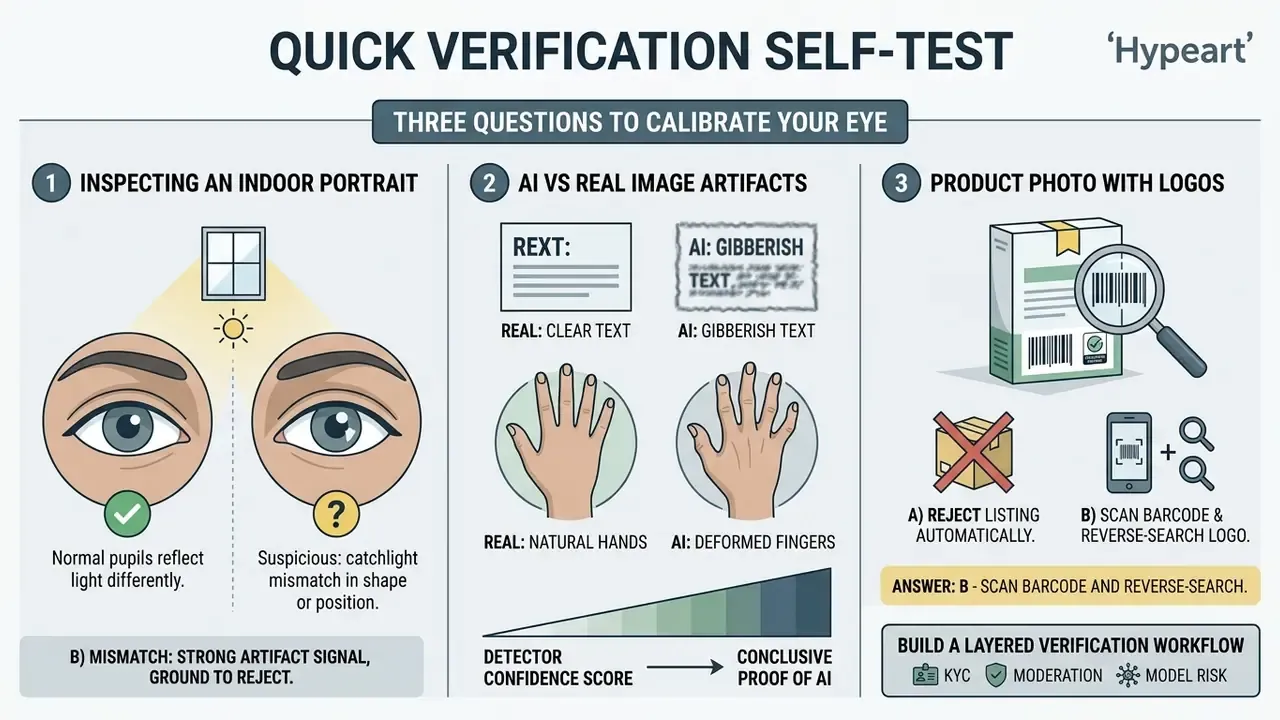
Three questions to calibrate your own eye before you trust it in production. Answers follow each item.
1. You are inspecting a portrait shot indoors near a single window. The left pupil shows a rectangular catchlight in the upper-right quadrant; the right pupil shows a soft circular catchlight in the lower-left quadrant. What is the correct read?
A) Normal, pupils reflect light differently.
B) Suspicious, catchlight shape and position should be broadly consistent for one dominant light source.
C) Conclusive proof of AI generation.
Answer: B. A shape and placement mismatch is a strong artifact signal, but on its own it is grounds to escalate, not to conclude.
2. A product photo shows a crisp package with a barcode and a small certification logo. At 100% zoom the barcode bars are unevenly spaced and the logo text reads "CERTIFIEO". What do you do first?
A) Reject the listing automatically.
B) Try to scan the barcode and reverse-search the logo against the official certification mark.
C) Ignore it, printing defects are common.
Answer: B. Functional-graphic failure is high-signal, but the finding still has to be evidence-based. Automated rejection without human review is precisely the enforcement pattern moderation standards warn against.
3. An outdoor group photo shows one person's shadow falling to the left and an adjacent person's shadow falling toward the camera, under a clear midday sky. Which artifact class is this?
A) Texture defect.
B) Typographic defect.
C) Physics or lighting-vector inconsistency.
Answer: C. Contradictory shadow vectors under one dominant light source is a physics violation, one of the five recurring artifact categories documented in the literature.
Most untrained reviewers land between 55% and 75% on tasks like these, consistent with the 62 to 76% human accuracy range reported in large-scale studies. Treat your own eye as one weak classifier inside a layered system. Humbling, but useful.
FAQ: AI Images vs Real Images
Can an AI detector work without watermarks and metadata?
Yes. Modern passive detectors evaluate pixel-level spatial statistics, noise distributions, and frequency-domain patterns without needing C2PA signatures, SynthID watermarks, or intact EXIF. Methods such as MaskSim analyze Fourier spectra to surface subtle traces left by generative processes.
"Only 38% of AI image generators implement adequate watermarking and just 18% provide deepfake labelling; most synthetic images online carry no explicit indicator." Review of 50 generative AI systems (2025). Stripping metadata still costs you provenance context, which forces the detector to rely entirely on statistical inference, the part most vulnerable to compression damage. One reverse logic error is worth naming: a missing C2PA manifest may mean the file never had one, or that it was stripped in transit. Absence of provenance is not evidence of authenticity. Tools returning "no supported signal" are reporting missing provenance, nothing more.
Which AI image generators can be detected?
Current frameworks target Midjourney V6/V7, DALL·E 3 and GPT Image (OpenAI), Stable Diffusion 3, FLUX.1, Adobe Firefly, Google Imagen and ImageFX, Nano Banana, Grok, Ideogram, Bing Image Creator, and GAN architectures such as StyleGAN and BigGAN. Coverage is uneven. Accuracy on newly released models typically sags until detectors are retrained, and one 2025 evaluation measured accuracy on FLUX1-dev and Midjourney-V6 outputs ranging from 46.1% to 99.7% depending on the detector. Ask vendors for per-generator benchmarks instead of a single blended number.
Can I check an AI-generated image online for free?
Yes, several detectors offer free single-image analysis, with operational constraints attached. Free tools typically cap uploads near 10 MB and limit daily or batch processing to a handful of requests, commonly 3 to 10 scans per day, or 2,000 characters for text-based equivalents. Commercial APIs charge for high-throughput endpoints, batch processing, detailed confidence heatmaps, retention controls, and formal service-level agreements. Free tiers fit consumer curiosity and one-off checks. They do not fit as a control of record in a regulated workflow.
Is an image detector suitable for profile pictures and product images?
Yes, when paired with domain rules. For profile pictures, detectors evaluate facial landmark positioning, eye alignment, and skin frequency patterns; pair that with platform photo specifications (single subject, fully visible face, no distorting filters, no overlaid text). For product images, classifiers inspect background textures and reflection consistency, and should be checked against GS1 catalog formatting standards: typically a 1:1 square ratio, at least 900 px on the longest side, and accepted formats such as JPG, PNG, or TIF. Automated scoring plus behavioural and technical compliance rules yields the most reliable moderation outcome.
What should I do when the detector says "inconclusive"?
Treat the 0.31 to 0.69 band as a routing instruction, not an answer. Request the original uncompressed file, re-run detection on it, run reverse image search on cropped distinctive regions, look for a C2PA manifest, and escalate to a Tier-2 reviewer with the artifact checklist in hand. Document each step. Published fact-checking methodology requires an explainable process, and model risk guidance requires an auditable decision trail.
Appendix A: Source Corrections and Superseded Attributions
For transparency, the claims below appeared in earlier revisions with weaker or unverifiable attributions. The main text now carries the updated, source-backed versions; the superseded wording stays here so readers can audit the change.
| Superseded formulation (earlier revision) | Status | Replacement in current text |
|---|---|---|
| "Research in 2026 indicates that detectors and human reviewers exhibit false-positive rates between 21% and 35% when assessing heavily retouched, authentic news photos." | Source not identified; figures unverified. Retained for traceability. | Groh et al. (2025): roughly 26% of authentic photographs misclassified as AI-generated (74% real-photo accuracy). |
| "Research from CVPR 2024 demonstrates that social-media re-compression can reduce detector accuracy from over 90% down toward chance levels." | Venue attribution unverifiable without identifier. | Pope et al. (2024), arXiv:2408.11541, 72.8% best-method and 66.9% average balanced accuracy in the wild versus 90 to 98% in lab conditions. https://arxiv.org/abs/2408.11541 |
| "According to WACV 2025 research on QR code generation, functional graphics require strict geometric precision." | Claim correct; attribution incomplete. | DiffQRCoder (WACV, 2025) for scanning-robustness constraints, plus Kamali et al. (arXiv, 2024) for the five-category artifact taxonomy. |
| "Research by Groh et al. (2025) demonstrates that diffusion models render realistic depth of field." | Accurate but unquantified. | Same study, now cited with sample size (749,828 observations; 50,444 participants) and accuracy figures (76% AI, 74% real). |
| FinCEN (2024) and FBI references without identifiers. | Directionally supported; now anchored. | FinCEN Alert FIN-2024-Alert004 on deepfake fraud schemes, with Harvard Misinformation Review (2024) as corroboration for platform-level spread. |
Limitations and a Safe Next Step
Two limitations deserve stating plainly. First, no published evaluation demonstrates a detector that holds accuracy across all generator families and all post-processing chains, so any control design should assume degradation rather than hope for stability. Second, the audience assumptions behind this article, including which teams own verification decisions inside a bank, remain hypotheses until confirmed through interviews, case data, or internal analytics.
A low-risk next step: pick one intake process, run the five-stage pipeline on a sample of 200 historical files, and record both error types separately. Small pilot, measurable output, no platform commitment. That evidence, not a vendor deck, is what should justify the next purchase.
General Disclaimer
This article is informational and general in nature. It does not constitute legal, compliance, financial, or information-security advice, and it does not replace consultation with a qualified specialist. AI image detectors produce probabilistic estimates that vary by generator family, compression history, and post-processing; they are not legal proof of synthetic origin. Organizations in regulated sectors should validate any detection control against their own data, retain human review for adverse decisions, and follow applicable model risk management, consumer protection, and content moderation obligations in their jurisdiction.