Executive Summary for Risk and Compliance Leaders
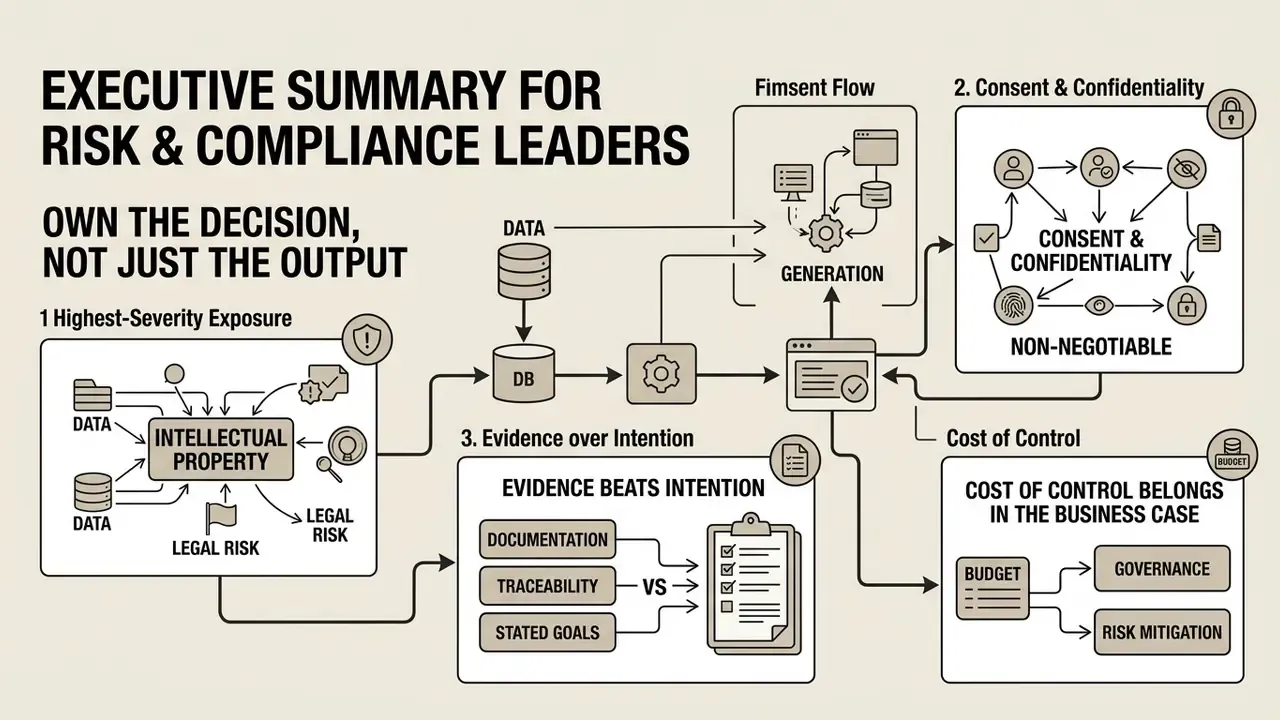
- Own the decision, not just the output. Ethical visual AI is a model-risk discipline. Name an accountable owner for each generation gate (tool selection, prompt approval, output audit, disclosure, release) and map those gates onto existing model risk management processes such as Federal Reserve SR 11-7 and OCC Bulletin 2011-12: conceptual soundness, ongoing monitoring, outcomes analysis.
- Intellectual property is the highest-severity exposure. Training-data provenance, living-artist style prompts, and accidental trademark replication drive active litigation (Andersen v. Stability AI, Getty Images v. Stability AI, Warner Bros. v. Midjourney). Vendor indemnification and prompt-level restrictions are the primary mitigants.
- Consent and confidentiality are non-negotiable. Never submit identifiable likenesses without documented consent, and never push nonpublic personal information (NPI) protected under GLBA, or customer photographs, into public inference endpoints. Require SOC 2 Type II attestations and private or VPC deployment for regulated workloads.
- Evidence beats intention. Every published synthetic asset should leave a reproducible audit trail: prompt, seed, model version and hash, reviewer identity, bias-review result, and C2PA provenance hash, exportable to your GRC platform (Archer, ServiceNow, OpenPages).
- Cost of control belongs in the business case. Inference energy, subscription tiers, and manual review hours together form the Total Cost of Control (TCC). Model it before you scale generation volume, not after the invoice arrives.
How to Read This Playbook
The sections below follow the order a governance function actually works in. First, what these guidelines are and why AI generated images raise ethical concerns at all. Then the legal and platform layer, where ethics meets contract law. After that, three risk domains in sequence: training data and intellectual property, privacy and consent for real people, and bias or misleading representation. The second half is operational: a responsible workflow with review gates, an audit trail specification your examiners can read, and the switching and pricing questions that come up when a vendor's terms stop matching your risk appetite. Compute cost and environmental impact sit with the pricing discussion on purpose, because both scale with the same variable: how many images your teams generate to get one usable asset.
What Are AI Image Generation Ethical Guidelines?
AI image generation ethical guidelines are operational frameworks that define how organizations and creators evaluate, generate, and publish synthetic visual media responsibly. They draw a line between raw technical capability and lawful, risk-adjusted deployment across copyright, privacy, fairness, and environmental impact.
For regulated institutions, these guidelines should not live as a standalone ethics memo. They work as an extension of the existing model risk management (MRM) control environment. Under the supervisory expectations expressed in SR 11-7 and OCC Bulletin 2011-12, a generative visual model behaves like any other model in use. It requires documented conceptual soundness (why this tool, trained on what data), ongoing monitoring (drift in bias and output quality), and outcomes analysis (post-publication incident review).
Ownership splits cleanly if you set it early. Marketing and communications own production. Second-line model risk owns challenge and validation. Internal audit owns the evidence trail. Consumer-facing imagery also intersects with CFPB expectations around non-discriminatory marketing practice, which turns representation testing into a compliance obligation rather than a branding preference.
The international baseline is converging. A 2026 joint statement on AI-generated imagery endorsed by 61 privacy authorities requires safeguards against misuse of personal information, non-consensual intimate imagery, and harmful depictions of children. The European Commission's 2026 guidance on responsible generative AI lists four operative principles: respect for human autonomy, prevention of harm, fairness, and explicability. CEPIC's AI Ethical Guidelines for Responsible Re-Use and Production of Visual Content (2024 to 2025) applies lawfulness, transparency, necessity and minimization, accuracy, and security across the full visual pipeline.
Different vocabularies, same skeleton. That convergence is useful: it means a control set built once can be mapped to several regimes without rebuilding the workflow.
Why AI-generated images raise ethical concerns
AI generated images raise ethical concerns because they blur the boundary between authentic photography and synthetic fabrication while reshaping creative economies. Uncontrolled generation can infringe on human artists' intellectual property, produce non-consensual digital replicas, and scale demographic biases across public and enterprise communications.
«Contemporary image-generation models systematically under-represent women, darker-skinned people, older adults, and people with disabilities in professional roles.»
The ethical debate over AI generated art is anchored in a few public milestones. In 2018, the collective Obvious Art sold the AI-generated Portrait of Edmond de Belamy at Christie's for $432,500, which opened a long argument about output attribution and the definition of authorship. In 2022, Jason M. Allen won first place in the digital art category at the Colorado State Fair with Théâtre D'opéra Spatial, created through Midjourney. The backlash from traditional creators focused on unfair substitution, unearned attribution, and competitive fairness. Academic work presented at ACM AIES (2023) frames the same dynamic in labor terms: AI art generation is linked to displacement, devaluation of human artists, and unresolved disputes over consent and compensation.
When visual models learn from web-scale scraped datasets, questions arise about authorization, compensation, and the preservation of human creativity and artistic expression. In institutional settings, publishing AI generated content without governance invites reputational damage, customer deception claims, and regulatory scrutiny.
One illustrative composite: a Tier-1 US regional bank whose marketing team generated visual assets carrying subtle trademark elements resembling a competing institution's trade dress. Risk managers intervened, halted the campaign, and installed a mandatory pre-publication audit. The campaign slipped by two weeks; the legal exposure disappeared entirely. Teams comparing tooling before building such a pipeline can review AI image generators side by side to see how sharply data policies differ between vendors.
Regulators are moving in the same direction on likeness abuse:
«The Office recommends that Congress enact federal legislation prohibiting the knowing distribution of unauthorized digital replicas.»
Ethics, legal rules and platform policies
Ethical principles set the normative standard for visual AI. Copyright law and platform Terms of Service (ToS) enforce the legal and contractual boundary. Understanding how does ai image generation work helps risk teams locate where liability originates inside the model architecture, because the answer is rarely the prompt alone.
Major platform agreements align ethics with contract law by prohibiting unauthorized third-party intellectual property and restricting inputs meant to emulate protected works. There is a catch worth reading twice: platform contracts often grant output ownership only «to the extent permitted by applicable law», while copyright authorities generally require human creative control for enforceable protection. OpenAI's 2026 terms use exactly that qualifier. Adobe's generative AI terms forbid inputs containing protected third-party IP and note that output may not be protectable by IP rights at all.
Table 0: Landmark AI visual media litigation and precedents
| Case / Action | Key parties | Core legal claim | Governance implication |
|---|---|---|---|
| Andersen et al. v. Stability AI et al. (filed Jan 2023) | Sarah Andersen, Kelly McKernan, Karla Ortiz vs. Stability AI, Midjourney, DeviantArt | Class action alleging direct and vicarious copyright infringement and unlawful style scraping via LAION-derived datasets. | High exposure when prompting explicitly for commercially active living artists. |
| Getty Images v. Stability AI (2023) | Getty Images vs. Stability AI | Mass scraping of millions of copyrighted stock photographs plus replication of the Getty watermark in outputs. | Shows the risk of implicit trademark and stock IP leakage in raw generations. |
| Warner Bros. v. Midjourney (reported Sept 2025) | Warner Bros. vs. Midjourney | Alleged unfair competition and trademark or copyright infringement for generating protected characters (Batman, Superman, Scooby-Doo). | Argues for automated character and logo post-processing filters in enterprise prompt pipelines. Status: active litigation; verify current posture before relying on it. |
| Thaler v. Comptroller-General [2023] UKSC 49 | Stephen Thaler vs. UK Intellectual Property Office | DABUS AI system named as inventor; the UK Supreme Court ruled only natural persons may be designated inventors. | Reinforces that purely machine-generated output lacks statutory IP ownership in major jurisdictions. |
| Andy Warhol Foundation v. Goldsmith (U.S. Supreme Court, 2023) | Warhol Foundation vs. Lynn Goldsmith | Narrowed expansive readings of transformative use where commercial licensing substitutes for the original market. | Commercial substitution weighs heavily against a fair use defense for style-replicating outputs. |
Legal and regulatory disclaimer
Training Data, Copyright and Intellectual Property
Copyright integrity in generative visual AI depends on the provenance, licensing, and processing of the underlying training data. Models trained on copyrighted material without explicit authorization create operational risk for every downstream commercial use, including the quiet ones: pitch decks, investor materials, branch signage.
How to assess a model's training data
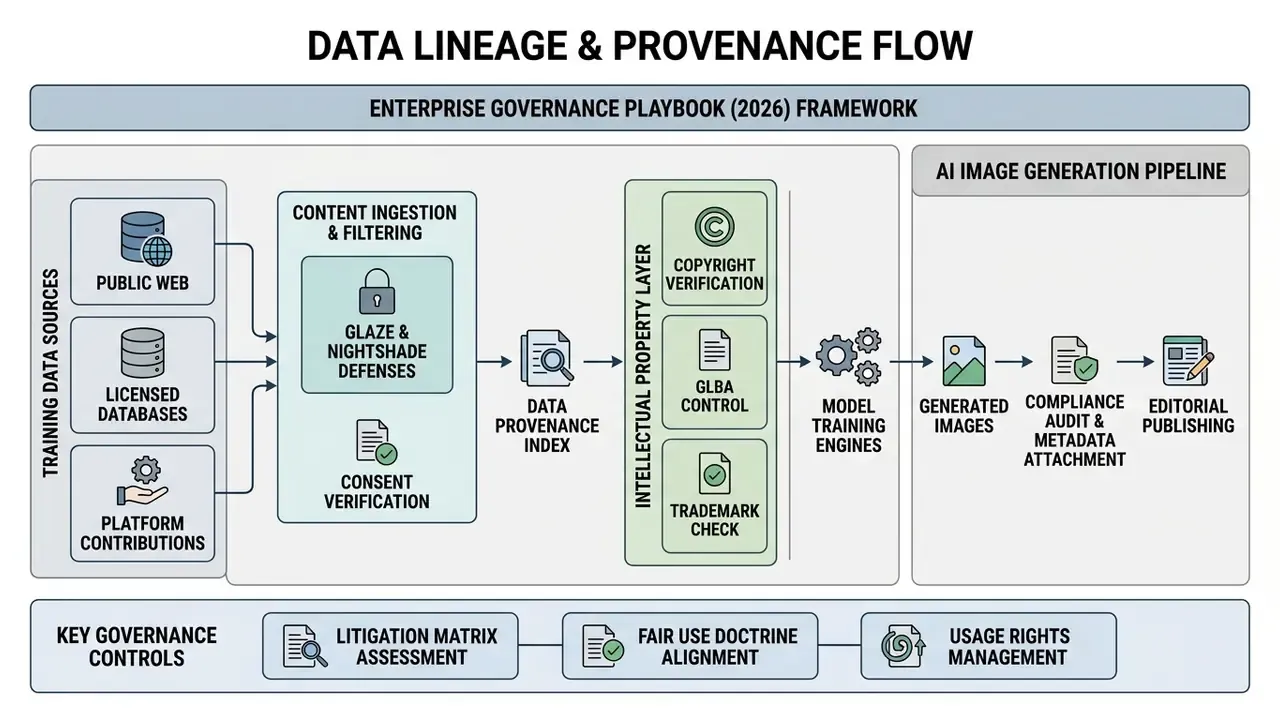
Assessing how models trained on visual corpora were built means reading vendor documentation, model cards, and dataset provenance reports. AI developers vary enormously in how much they disclose about acquisition and filtering. NIST AI RMF 1.0 treats provenance of training data as a direct contributor to transparency and accountability, and its Playbook recommends data statements and model cards as the documentation instruments.
Organizations evaluating tools can review AI Media Alternatives by Reason to compare vendor data policies, then extend that review to commercial use of AI image generators to confirm usage rights alongside data handling. Regulatory standards such as Article 53(1) of the EU AI Act mandate public summaries of general-purpose AI training content, and the AI Office template requires disclosure of data modalities, acquisition dates, public datasets, and the web crawlers used. Vendors like Adobe Firefly report training on licensed Adobe Stock and public domain assets and state they do not train on user content, whereas open-weights diffusion models such as Stable Diffusion variants often rely on broad web-scraped collections like LAION.
Published technical reports show what defensible documentation looks like in practice:
«The Kandinsky 3.0 dataset comprises roughly 150 million text-image pairs filtered for quality, watermarks, and CLIP similarity.»
Independent dataset certification: the Fairly Trained standard
Relying only on vendor self-reporting is a compliance risk, because self-declaration is neither audited nor contractually enforceable. Look for third-party dataset certifications such as Fairly Trained (L-Certification). The badge verifies that a vendor trained its visual architectures exclusively on consenting, licensed, or public-domain material, explicitly excluding non-consensual web scrapes.
For procurement, score independent certification inside the vendor risk tiering matrix rather than treating it as a tiebreaker. It is one of the few signals a second-line reviewer can validate without access to the vendor's data lake. Not proof of lawfulness, granted. Still better than a marketing claim.
Avoid copying living artists and protected works
Prompts that explicitly request the style of living artists create legal ambiguity and a real ethical problem around market substitution. U.S. Supreme Court precedent in Andy Warhol Foundation v. Goldsmith (2023) narrowed overbroad readings of transformative use, stressing that commercial outputs competing with original licensing markets weigh against a fair use defense.
«Training generative models almost inevitably entails copying, which triggers derivative-work analysis even absent traditional expression.»
To keep ethical use intact, teams should stop naming specific living artists in text prompts. Use general aesthetic descriptions, open public-domain references, or licensed internal style datasets instead. A pragmatic internal rule several content teams apply: recreating Starry Night with a cat in it is defensible, because Van Gogh cannot be commercially displaced. Recreating the signature style of an illustrator you could otherwise commission is not defensible, because you just substituted for her invoice.
Platform terms offer no shelter either way:
«Users grant Midjourney a perpetual, royalty-free license to reproduce and create derivative works from inputs and generated assets.»
Teams weighing licensing exposure can compare Midjourney image generation against alternatives whose contracts include explicit indemnification, and should review style-specific offerings such as Ghibli-style AI image generators with the same skepticism they would apply to any trademarked visual language.
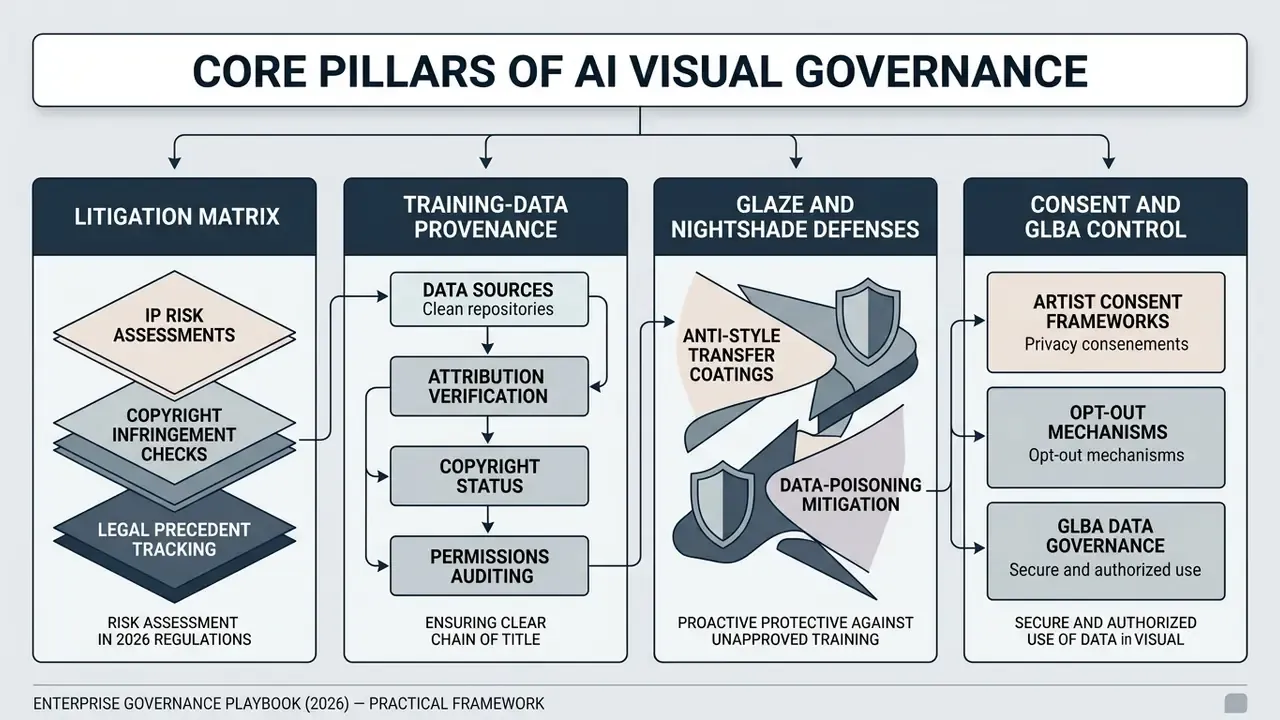
Defensive countermeasures: Glaze and Nightshade
To counter unauthorized scraping, artists using public portfolios increasingly deploy data-poisoning tools directly onto their assets:
- Glaze (University of Chicago) applies imperceptible perturbations to image pixels, disrupting a model's ability to learn and replicate an artist's signature style. Published as Glaze: Protecting Artists from Style Mimicry by Text-to-Image Models (Shan et al., arXiv, 2023).
- Nightshade an adversarial data-poisoning framework that alters image features at the feature-space level, for example causing a model prompted for "dog" to output a "cat." When poisoned samples are scraped into training sets, they systematically degrade output accuracy for targeted style prompts. Published as Prompt-Specific Poisoning Attacks on Text-to-Image Generative Models (Shan et al., arXiv, 2023).
The governance consequence runs in both directions. Artists gain leverage they previously lacked, since the poisoned asset travels with the image wherever it is scraped. Organizations that operate web crawlers or internal fine-tuning pipelines must implement filtering and anomaly detection to catch poisoned training samples before ingest, and should document those controls as part of data quality validation under SR 11-7 conceptual soundness review. Style is not itself copyrightable in the United States, which is precisely why technical countermeasures, not litigation, became the artists' first line of defense.
Table 1: Training data and intellectual property risk review checklist (vendor-level legal assessment)
| What to check | Why it is important | Risk for ethical use | Action before publication |
|---|---|---|---|
| Dataset provenance | Identifies whether source images were licensed, public domain, or web-scraped. | Unlicensed web scrapes may infringe on original creator rights. | Review model card documentation and select licensed or transparently sourced models. |
| Independent certification | Third-party audit (for example Fairly Trained) validates consent and licensing claims. | Self-declared sourcing is unverifiable and unenforceable in procurement disputes. | Request certification evidence or contractual warranties on training-data lawfulness. |
| Living artists' style prompts | Emulating specific creators risks derivative work claims and market substitution. | Direct style imitation undermines commercial viability and artist autonomy. | Remove artist names from prompts; replace with generic stylistic terms. |
| Trademark and brand elements | Generative outputs may accidentally replicate protected logos or trade dress. | Unintentional trademark infringement in commercial campaigns. | Run reverse-image searches and visual audits before public release. |
| Platform commercial terms | Determines output ownership rights and vendor indemnification limits. | No copyright protection, or exposure to third-party IP claims. | Verify the ToS grants commercial rights and provides IP liability coverage. |
| Confidential input handling | Reference uploads may contain NPI, customer imagery, or unreleased brand assets. | GLBA and NPI exposure, plus loss of trade-secret status for uploaded material. | Require SOC 2 Type II attestation and private or VPC inference for regulated inputs. |
Note the division of labor. Table 1 governs vendor and dataset legal assessment. The per-asset checklist further below governs operational review of one specific image before publication. Running both closes the gap between procurement-time diligence and release-time evidence, which is exactly where most programs leak.
Privacy, Consent and Images of Real People
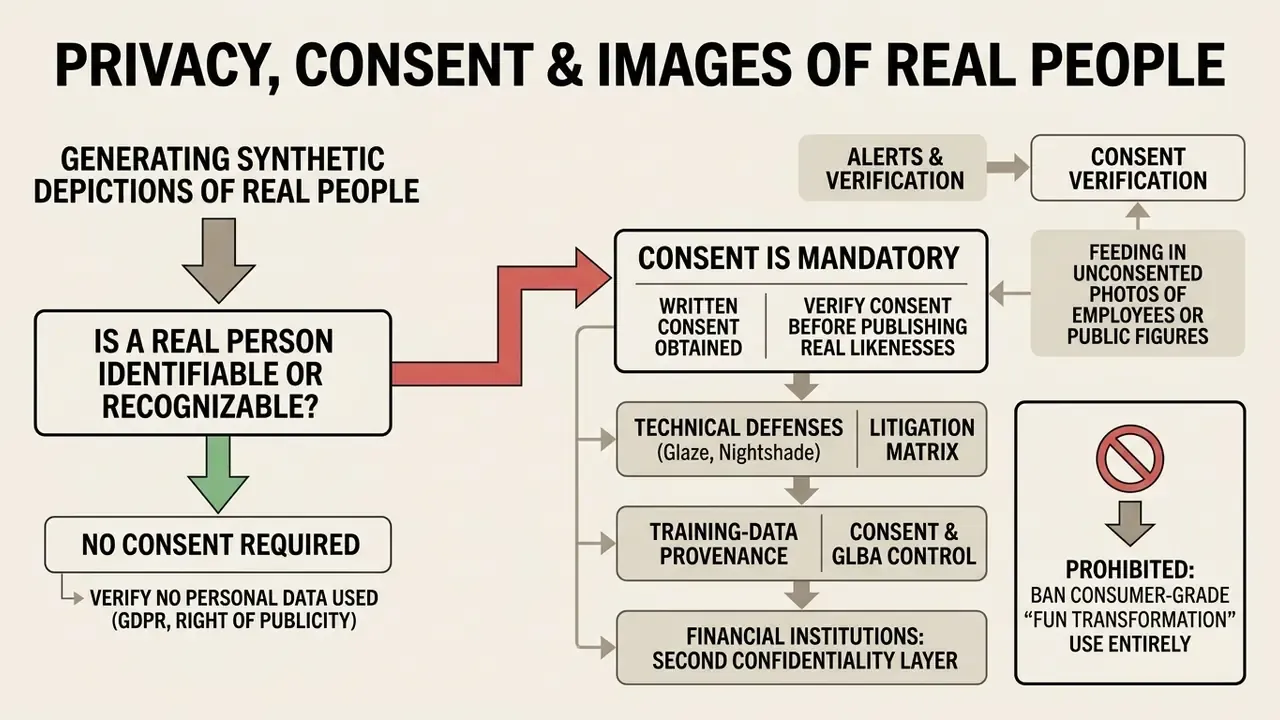
Generating synthetic depictions of real people introduces privacy, data protection, and right-of-publicity risk at once. Verify the lawful basis and explicit consent before processing personal photos or recognizable likenesses. No exceptions for internal decks.
When consent is required for references and likenesses
Consent is mandatory whenever an AI image depicts an identifiable real person, uses their recognizable physical features, or involves sensitive personal data. Guidance from international privacy regulators, including the Australian OAIC and the European EDPB, treats the processing of personal photographs in generative AI tools as an explicit collection of personal data. Under GDPR and UK GDPR, consent must be freely given, specific, informed, and unambiguous, evidenced by a clear affirmative act. Pre-ticked boxes and blanket privacy-policy notices do not qualify. The OAIC adds a stricter operational test for sensitive information: consent must be current and specific to the circumstances of use.
«The Office identified gaps in existing legal protections and recommended federal legislation against the knowing distribution of unauthorized digital replicas.»
Bias, Representation and Misleading AI-Generated Images
Text-to-image models reproduce and often amplify the demographic biases baked into web-scale training data. Managing that requires structured human oversight, prompt guardrails, and systematic output auditing. Not a values statement. A test plan.
How training data can reproduce bias
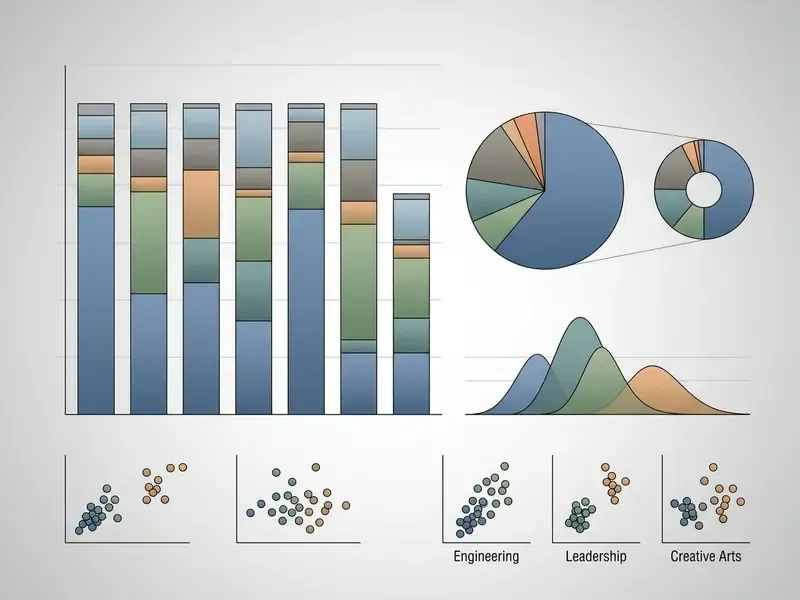
Generative AI models reproduce cultural, gender, racial, and socioeconomic bias because historical training datasets carry societal inequalities forward through machine learning. Default prompts for high-status occupations such as "lawyer" or "executive" tend to skew male and lighter-skinned, while service roles skew differently. The framing from Stanford HAI (2023), that text-to-image systems «perpetuate and even exacerbate demographic stereotypes», still holds, and NIST SP 1270 remains the governance baseline for bias identification and management.
«All three models prefer generating male images; for occupational prompts, none of the seven automated bias detectors reflected the true skew accurately.»
Research published in 2025 evaluating roughly 6,000 generated images across multiple diffusion architectures confirmed persistent demographic skew. The finding is consistent with a peer-reviewed Stable Diffusion study covering six racial categories, two genders, 32 professions, and eight attributes, which reported significant learned associations between social categories and stereotyped depictions. Automated bias detection tools frequently over- or under-estimate these distributions against human review, which is the practical argument against fully automated filtering. (Note for validators: the 6,000-image figure comes from the 2025 evaluation literature cited above; treat the exact sample size as directional until the primary dataset is verified internally.)
«Gender bias spans every aspect of representation: beauty is predominantly associated with women, while economic and professional success is associated with men.»
UNDP's 2024 analysis adds the upstream mechanism: gender-blind dataset preparation can erase women and gender minorities before a single prompt is written. That is why bias remediation cannot start at the prompt layer alone, though the prompt layer is where most teams start anyway.
Review outputs for fairness and misleading content
Reviewing generated visual assets for fairness means asking whether outputs perpetuate harmful stereotypes or misrepresent real-world events. Model risk teams should install manual pre-publication review gates for all public-facing visual content, with named reviewers rather than a shared mailbox.
An illustrative case: an enterprise communications department generating imagery for annual reporting found that roughly 90% of leadership depictions default-skewed male. The model risk team added prompt guardrails and mandatory human review so the published materials reflected the institution's actual composition. Cost of the fix: about three days. Cost of not fixing it: ask your CCO.
Practical validation methodology for second-line teams. Treat representation testing like any other model test. Define the population, run a fixed prompt battery, record the result.
- Sandbox the prompt set before campaign release.Generate 20 to 50 images per approved production prompt in a non-production environment and tabulate apparent gender, skin tone, age band, and disability representation.
- Set a tolerance band, not a target quota.Many teams flag any single-category concentration above roughly 70 to 80% of a batch for prompt remediation. Document the chosen threshold, the rationale, and the approver.
- Never rely on a single automated detector.Because automated bias tools mis-estimate skew, pair them with a two-reviewer human sample check.
- Re-test on model version change.A vendor model upgrade is a material model change. Re-run the prompt battery and archive the comparison as outcomes analysis evidence.
- Log the negative case.Record prompts that were rejected and why. Rejected-prompt libraries are the fastest onboarding material you will ever produce for new content operators.
Checklist0 / 7
Responsible Workflow for Creating and Publishing AI Images
A reproducible workflow keeps visual content generation inside organizational risk appetite at every stage. Mapped to supervisory language: stage 1 corresponds to conceptual soundness, stages 2 and 3 to process verification, stage 4 to transparency and record-keeping, and post-release monitoring to ongoing performance monitoring and outcomes analysis under SR 11-7.
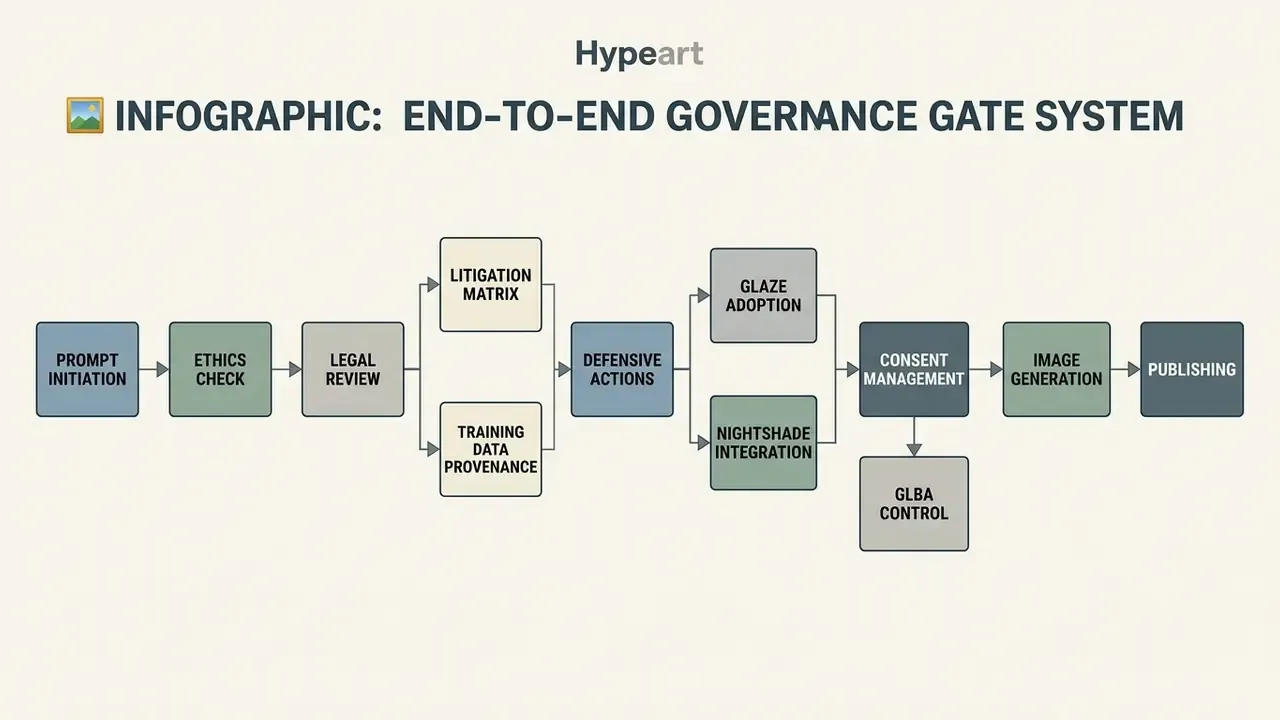
Choose AI tools with transparent policies
Select platforms that publish clear documentation on data sourcing, prompt retention, opt-out mechanisms, and commercial rights. Teams evaluating enterprise options like the leonardo ai image generation platform or standard leonardo ai image generation features should confirm in writing whether user content is excluded from public model training. Extend the same review to adjacent tooling: AI photo editors and design suites such as Canva's AI generator usually sit inside the same asset pipeline and inherit the same disclosure obligations.
Selection criteria worth scoring explicitly:
- Understandable transparency notices covering purpose, retention, sharing, and automated-decision logic, per EDPB and NIST expectations.
- Data minimization, so prompts and reference uploads carry only what is necessary.
- Documented privacy and security controls, with attestation evidence rather than assurances.
- Provenance tooling that can emit machine-readable marking at generation time, not as a manual post-step.
«Environmental protection has become a foundational principle of AI ethics internationally, yet this recognition has not produced measures proportionate to the scale of the problem.»
Disclose AI use and keep human oversight
Disclosing AI involvement builds audience trust and satisfies emerging transparency mandates. The European Commission's AI Transparency Guidelines and the Australian Government's AI Technical Standard require machine-readable metadata such as C2PA, or visible labeling, on synthetic content. Australia's Statement 8 criteria go further, specifying visible watermarks, embedded metadata, WCAG-compatible notices, and hidden-watermark tooling matched to use case and risk. Hong Kong's 2026 technical guideline recommends irremovable watermarks or embedded codes for high-risk categories such as deepfakes.
Human oversight keeps final editorial control with people, which also satisfies U.S. Copyright Office criteria for human authorship disclosure. Applicants must disclose AI-generated material and describe the human author's contribution, and protection extends only to identifiable human expressive input. In practice, document the human choices, meaning composition decisions, iterative prompt refinement, compositing, retouching, rather than claiming authorship over the raw generation. Disclosure claims can be spot-checked using AI image detectors during quality assurance.
A related warning for asset strategy. Because purely AI generated works are not protectable, high-value marks and logos should never come out of a generator. Commission a human designer so the resulting IP stays registrable and defensible. That single rule has saved more trademark budgets than any policy document.
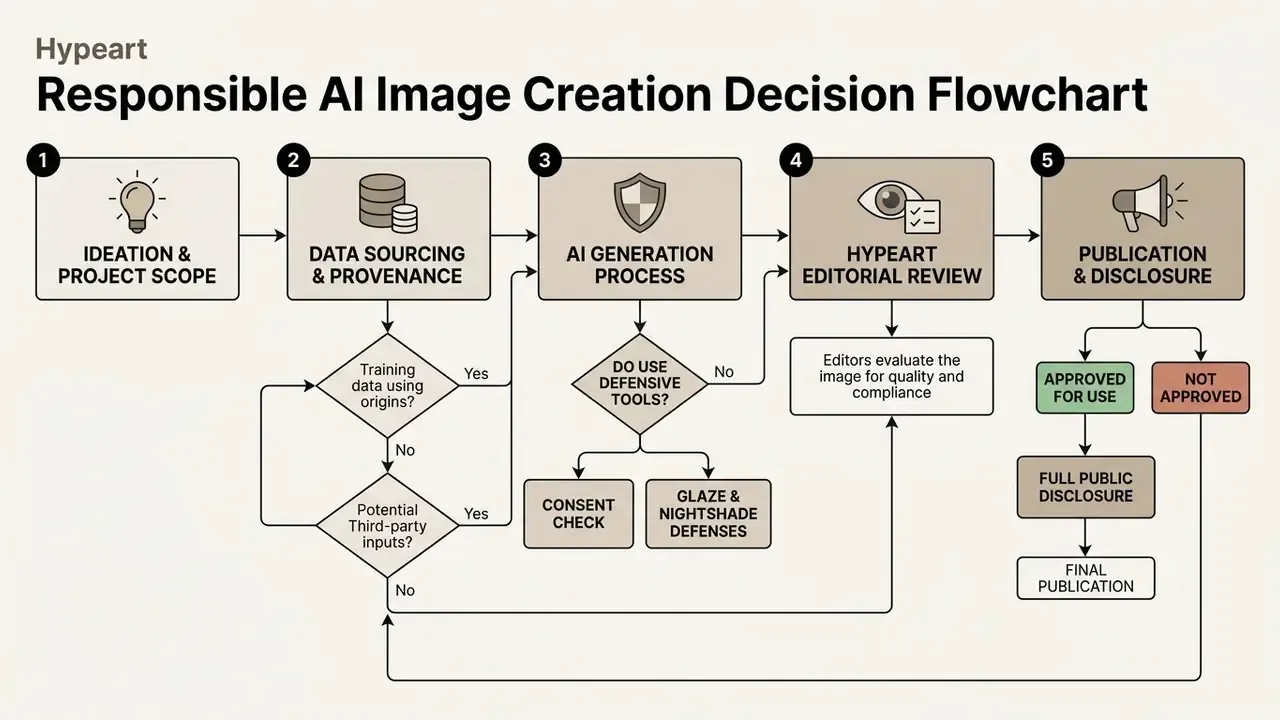
Option 1
Select the tool and verify its policy, terms, and training-data disclosures.Option 2
Generate and inspect the output against the brief.Option 3
Audit intellectual property, consent, bias, and compute cost.Option 4
Apply C2PA or AI disclosure metadata tagging.Option 5
Approve for release, or return to prompt remediation.Audit trail specification for governance evidence
Auditors and examiners do not accept process descriptions. They accept records. Export one record per published asset into your GRC system so any image can be reconstructed and defended months later, ideally by someone who was not in the room. NIST AI 100-4 and NIST AI 600-1 both treat provenance data, meaning creator, time, modifications, and sources, as the backbone of content authenticity, and NIST SP 800-218A extends provenance tracking to training, testing, and fine-tuning data.
{
  "asset_id": "IMG-2026-04-0173",
  "business_owner": "Retail Marketing / Campaign Q2",
  "model_vendor": "vendor_name",
  "model_version": "v6.1",
  "model_hash": "sha256:…",
  "prompt": "full prompt text as submitted",
  "negative_prompt": "excluded terms",
  "seed": 482913,
  "reference_inputs": [{"type": "none | licensed_stock | consented_photo",
                        "consent_artifact_id": "CONSENT-2026-0042"}],
  "generation_timestamp": "2026-04-11T09:22:31Z",
  "ip_review": {"result": "pass", "reverse_image_search": "no_match", "reviewer_id": "emp_10427"},
  "bias_review": {"batch_size": 30, "max_category_share": 0.63,
                  "threshold": 0.75, "result": "pass", "reviewer_id": "emp_20988"},
  "privacy_review": {"npi_present": false, "endpoint": "private_vpc"},
  "c2pa_manifest_hash": "sha256:…",
  "disclosure_applied": ["visible_label", "c2pa_metadata"],
  "approval": {"approver_id": "emp_30115", "approved_at": "2026-04-11T14:05:00Z"},
  "retention_policy": "7y",
  "grc_reference": "ARCHER-RISK-88214"
}
Retain rejected generations with their reason codes too. A defensible control environment is demonstrated as much by what an institution declined to publish as by what it approved.
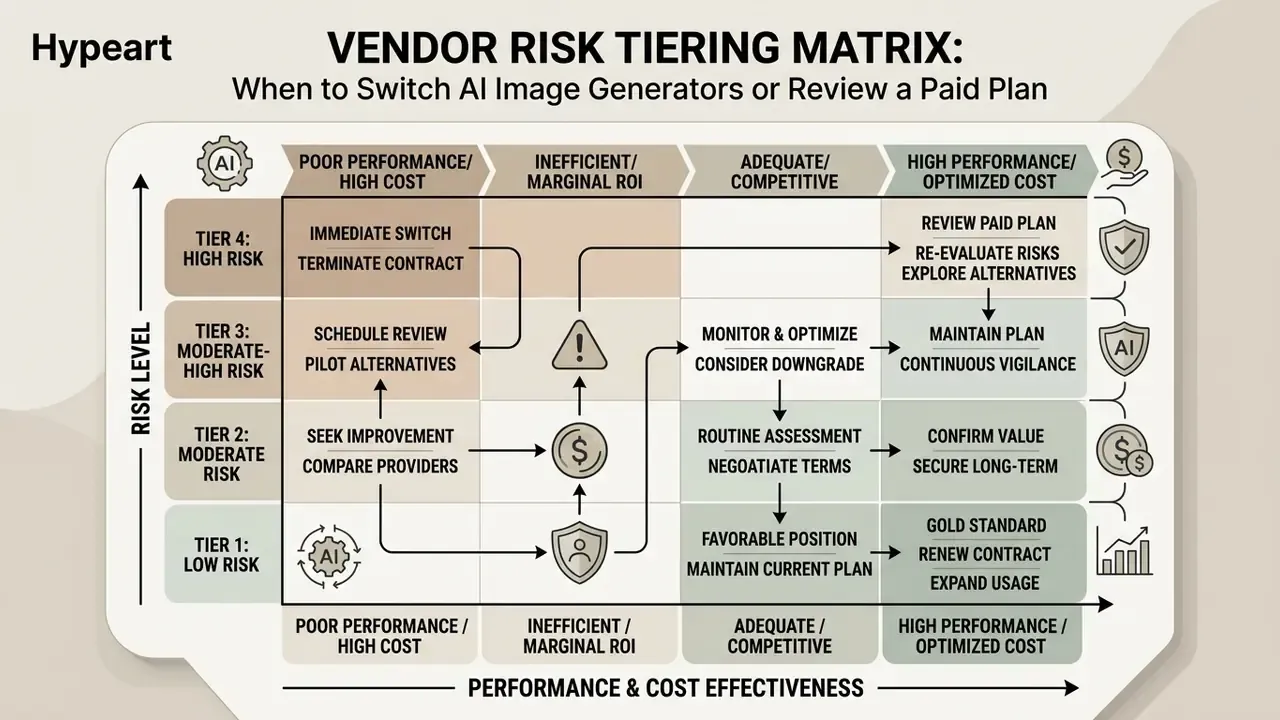
When to Switch AI Image Generators or Review a Paid Plan
Vendor stacks drift. Evaluate yours continuously so platform policies stay aligned with security requirements, budget, and risk tolerance. Triggers for re-evaluation include any new requirement to input personal or sensitive data, the absence of privacy-by-design documentation, missing provenance or watermarking support, no evidence of red-teaming, and an inability to document model limitations. Regulator-facing guidance from the OAIC (2024) and SDAIA (2023) frames these as continuous reassessment duties, not one-time procurement checks.
Compute cost, environmental footprint and Total Cost of Control
Generating complex visual media consumes far more compute than answering a text query. Assessing the environmental impact of visual AI means looking at datacenter energy efficiency, inference frequency, and model optimization. It belongs in the same business case as the subscription line, because both scale with generation volume.
According to a 2026 report by ARCEP, generating a single high-resolution image consumes roughly 2.9 Wh of electricity, about 60 times more energy than a brief text response. (Verification note: the order of magnitude, 2.5 to 3 Wh, is consistent with independent Stable Diffusion XL measurements from Hugging Face and Carnegie Mellon; confirm the current ARCEP edition before citing the figure externally.)
«Training 2D latent diffusion models is comparable to a 10 km car trip, while data synthesis equates to 160 km; compute geography can shift emissions by a factor of 94.»
Lifecycle assessments show that inference accounts for nearly 78% of total lifetime carbon emissions for deployed models, and broader UN University analysis puts deployed-model inference at roughly 80 to 90% of total energy use. Viral trends burn through thousands of megawatt-hours in weeks.
«The viral Ghibli-style image trend consumed 4,309 MWh and produced 2,068 tonnes of CO₂; inference represented 78% of cumulative lifecycle emissions.»
Beyond grid load, datacenter cooling for high-throughput diffusion inference draws significant freshwater. Reported estimates suggest a batch of roughly 50 image generations can correspond to about 500 ml of water consumed through evaporative cooling overhead, a figure consistent with MIT News reporting (Zewe, January 2025) on rising electricity and water demand from generative AI deployment.
Total Cost of Control (TCC). For CFO-level review, model the fully loaded cost of a governed asset instead of the per-image credit price:
Two consequences follow. First, prompt discipline is a cost control: if operators need 12 generations per usable asset instead of 3, energy and review costs roughly quadruple together. Second, human review is usually the dominant term, which is why tolerance bands, rejected-prompt libraries, and templated prompts pay back within a quarter in most programs we have modeled hypothetically.
Model compute expenses alongside environmental cost using financial calculators, and review operational overhead via AI Media Pricing Guides. Where volume is exploratory rather than production-critical, free AI image generators and free AI art generators can reduce infrastructure load, provided their licensing terms permit the intended use. Most free tiers do not permit commercial distribution, so read that clause first.
Red flags in AI image generator policies
The contractual red flags are consistent across vendors. Watch for clauses that grant the platform perpetual rights over user prompts and assets, disclaim all confidentiality for uploaded data, or push indemnification of third-party copyright claims onto you. NIST's Generative AI Profile flags IP risk wherever a system eases production or exposure of copyrighted, licensed, patented, or trade-secret content, and where outputs may reproduce training data or reveal confidential information. The OECD's 2025 report on IP issues in AI trained on scraped data adds unclear licensing terms and undisclosed scraping as concrete risk indicators.
«Midjourney's terms grant the company a perpetual, worldwide, royalty-free license to reproduce inputs and generated assets, with no warranty of non-infringement.»
Opaque credit consumption models belong on the same list. Situations where users hit a Failed Generation Charged scenario with no automated refund mechanism signal weak platform governance. Treat billing opacity as a governance signal rather than a support annoyance: a vendor that cannot reconcile credits reliably is unlikely to produce reliable audit logs when your examiner asks for them.
Questions to ask before paying or switching tools
Before upgrading to a paid tier or migrating platforms, governance leads should score five operational areas. A structured comparison of AI image generators and of AI art generators gives you a consistent baseline for candidates.
- Data retention and opt-outs.Does the vendor exclude enterprise prompts and generated assets from training future public models? Is deletion contractual, time-bound, and verifiable? U.S. federal AI acquisition guidance (OMB, 2024 to 2025) recommends prohibiting such reuse absent explicit consent.
- IP liability and indemnification.Does the contract provide explicit protection against third-party copyright claims, with named caps and exclusions? Confirm the scope of commercial use rights for AI image generators before committing, since most free tiers grant no commercial license at all.
- Export and portability.Can models, fine-tuned weights, prompt libraries, and asset metadata be exported without lock-in? OMB and GSA both treat portability terms as anti-lock-in requirements.
- Latency and reliability.What uptime SLA is guaranteed, and how long does ai image generation take during peak inference loads?
- Security and auditability.Are generation logs and admin activity tracked for executive oversight? Does the vendor hold SOC 2 Type II attestation, support regional data residency, and permit private or VPC deployment for NPI-adjacent workloads?
An illustrative example: a financial technology firm evaluating visual tools found that a prospective platform's terms allowed public model training on uploaded data. Model risk leads halted procurement and moved to a private-instance vendor offering explicit IP indemnity, protecting proprietary visual assets. The decisive artifact was not the marketing page. It was the clause-level ToS review recorded in the vendor risk file.
Limitations and Open Questions
FAQ: AI Image Generation Ethics in Regulated Environments
Are AI generated images copyrightable?
Purely machine-generated output generally is not protectable in the United States or the UK. The U.S. Copyright Office requires disclosure of AI-generated material and protects only identifiable human expressive contribution. Thaler v. Comptroller-General (2023) reinforced the same principle in the patent context. Practical consequence: do not build trademarks or logos from a generator.
Can we use customer photographs in an AI image generator?
Not in a public endpoint. Customer imagery, KYC documents, and branch footage frequently qualify as nonpublic personal information under GLBA, and submitting them may count as unauthorized disclosure. Private or VPC inference, a data processing agreement, a no-training clause, and SOC 2 Type II evidence are the minimum preconditions, alongside documented consent.
Who owns the decision to publish a synthetic asset?
Production sits with marketing or communications. Challenge and validation sit with second-line model risk. Evidence sits with internal audit. The approver named in the audit record owns the publication decision, and that name should be a person, not a team alias.
How often should we re-test prompts for bias?
At minimum, on every vendor model version change, since an upgrade is a material model change under SR 11-7 logic. Many teams add a quarterly re-run of the standing prompt battery for high-visibility campaign templates, then archive the comparison as outcomes analysis.
Does labeling AI use hurt brand trust?
Evidence is mixed, and anyone claiming certainty is overselling. What is clearer is the downside of non-disclosure: EU, Australian, and Hong Kong guidance all move toward mandatory marking, and an undisclosed asset discovered later costs more than a labeled one published openly.