An AI media glossary provides a structured, common taxonomy of artificial intelligence terminology built for content, marketing, and digital operations teams. In enterprise environments, verified definitions for artificial intelligence, machine learning, and generative AI remove ambiguity between technical architects, creative staff, and risk management functions. That sounds procedural. It is also the cheapest control a bank or fintech can implement this quarter.
Executive Summary
- What this is: A governance-ready reference that defines artificial intelligence, machine learning, deep learning, generative AI, agentic AI, and the surrounding data-and-privacy vocabulary, plus a filterable A to Z term bank.
- Why terminology is a control, not a formality: Unlabeled tools and inconsistent definitions are the operational root of Shadow AI, meaning unauthorized generative services used outside the model inventory. A shared taxonomy is the precondition for tiering, logging, and validating those tools.
- What regulated teams get: An explicit mapping between glossary terms and established model risk management expectations (Federal Reserve SR 11-7 and OCC Bulletin 2011-12), consumer-protection exposure under CFPB supervision, ECOA, and fair lending rules, plus international frameworks (EU AI Act 2024/1689, NIST AI RMF 1.0, ISO/IEC 42001).
- What content and media teams get: Format-by-format risk mapping across text, image, video, audio, and multimodal outputs; ad-tech and performance-marketing vocabulary (bid optimization, marketing mix modeling, predictive audience segmentation); and legal vocabulary for attribution, copyright, commercial use, and disclosure of synthetic media.
- What engineering and audit teams get: Classical machine learning terminology (SVMs, decision trees, Bayesian networks, ensembles, autoencoders, optimization), plus production-lifecycle terms such as data drift, concept drift, continual learning, data cards, and model cards.
- Evidence base: Definitions and risk statements are anchored to NIST, OECD, the EU AI Act, FinCEN, and peer-reviewed benchmarks including HaluEval 2.0 (2024), structural hallucination research (2024), the CHOKE benchmark (2025), and AutoResearchBench (2026).
Scope and How to Use This Glossary
Three audiences read a glossary differently, so it helps to say up front how each one should use it.
Risk and compliance readers should treat every definition as a candidate inventory field. If a term describes something that produces an estimate, a decision, or published content, it belongs in the model inventory with an owner and a tier.
Content and marketing readers should use the glossary as a scoping tool for vendor conversations. When a platform says "AI-powered optimization," the glossary tells you whether that means a predictive model, a generative model, or a rules engine wearing a new label.
Engineering and audit readers get the lifecycle vocabulary: how a model learns from data, where drift appears, and which artifacts (data cards, model cards, prompt logs) reconstruct a decision months later. One practical note on cost vocabulary: many media platforms meter usage through compute credits rather than seats, which changes how finance forecasts spend and how procurement writes contract terms.
What Is an AI Media Glossary?
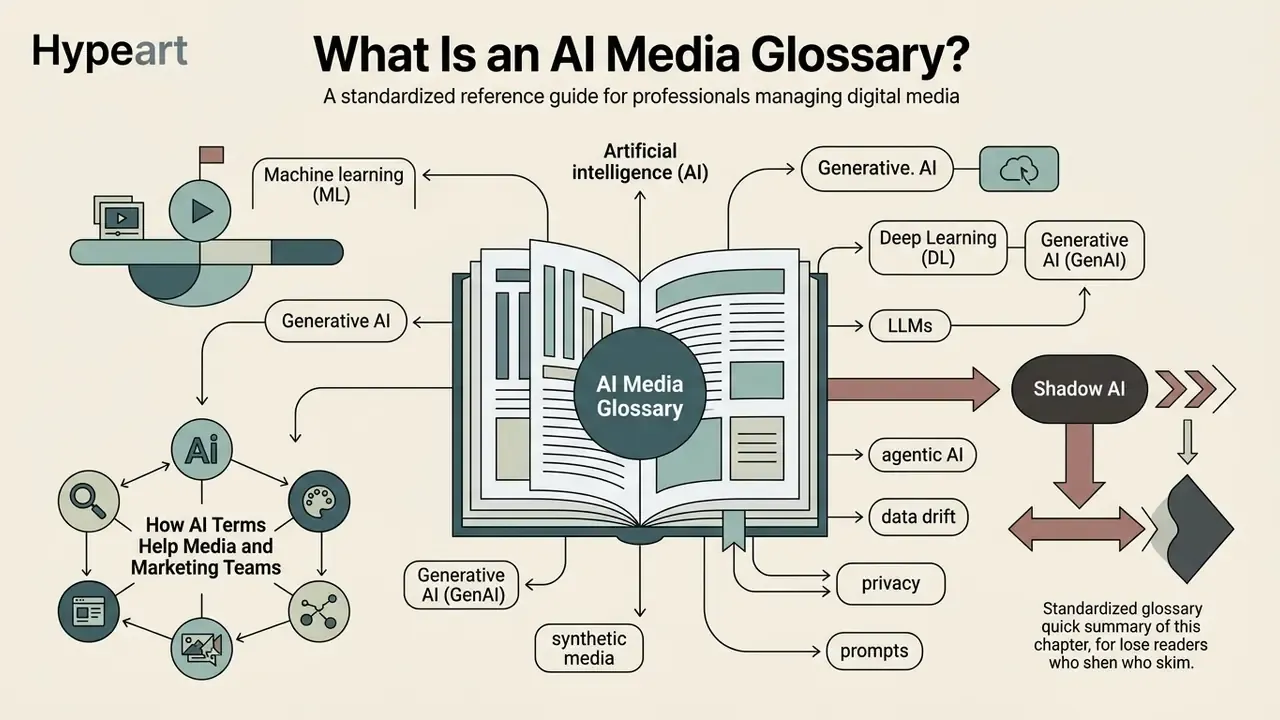
An AI media glossary is a standardized reference guide that defines artificial intelligence concepts, methodologies, and technical terms for professionals managing digital content and media workflows. It establishes operational alignment across creative, technical, and regulatory stakeholders by translating complex algorithmic mechanics into precise, governance-ready definitions.
AI, Machine Learning, and Generative AI
Artificial intelligence (AI) is the overarching discipline of building computational systems capable of performing tasks that historically required human cognitive processing. Following the definitions established by the National Institute of Standards and Technology (NIST AI 100-1), an AI system is a machine-based system that infers outputs such as predictions, content, recommendations, or decisions for human-defined objectives.
The intergovernmental OECD wording matters operationally. It explicitly covers implicit objectives, and that is precisely the condition under which generative tools drift outside their approved purpose inside marketing and content pipelines.
Machine learning (ML) is a specialized subfield of artificial intelligence where algorithms analyze data to recognize statistical patterns and improve task performance without explicit rule-based programming. Traditional software relies on deterministic instructions. A machine learning model, by contrast, learns parameters from training data so it can process new data it has never seen.
Generative AI is a specific class of machine learning models designed to produce synthetic content, including text, images, video, audio, and code, by sampling from probabilistic representations learned from large datasets. Discriminative machine learning models categorize or score existing inputs. Generative AI synthesizes new artifacts that mirror the statistical structure of its training source. In daily media production this abstraction becomes concrete the moment a team opens a prompt field in one of the mainstream AI art generators and asks for a campaign visual that never existed.
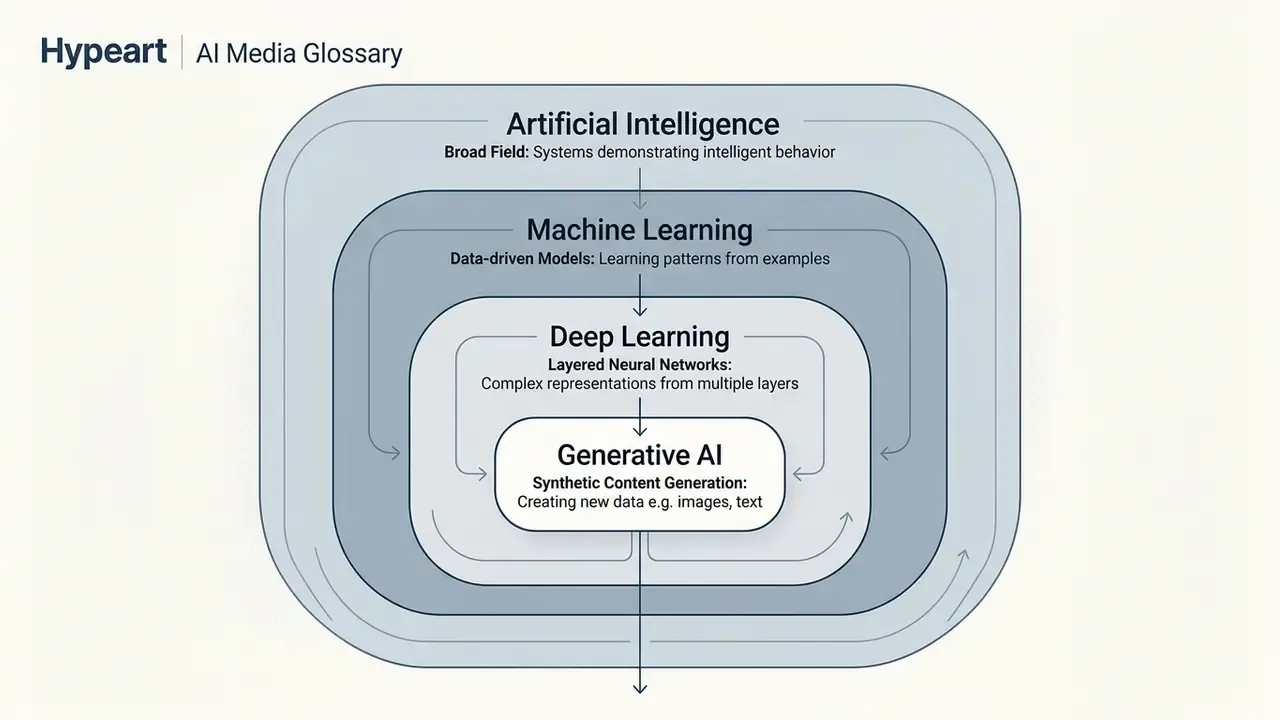
Artificial Intelligence (AI)
An umbrella field encompassing machine-based systems that infer predictions, recommendations, content, or decisions to influence real or virtual environments.
Machine Learning (ML)
A branch of AI focused on building statistical algorithms that learn structural patterns directly from input data in order to execute tasks with limited human instruction.
Deep Learning (DL)
A specialized subset of machine learning that uses multi-layered artificial neural networks to extract hierarchical features from complex, unstructured datasets.
Generative AI (GenAI)
A class of deep learning models engineered to generate original synthetic media outputs, such as text, video, voice, and images, from probabilistic input prompts.
How AI Terms Help Media and Marketing Teams
A shared AI media glossary guide helps media and marketing teams move from fragmented ad-hoc tools to controlled production pipelines. Defining technical concepts ensures that creative briefs, vendor evaluation criteria, and risk assessments rest on precise operational metrics rather than commercial marketing claims.
When content teams adopt standardized AI terms, they can separate predictive analytics tools (churn prediction, A/B testing algorithms, propensity scoring) from generative platforms (automated copy generators, synthetic image tools, an ai commercial generator used for short-form video ads). Clear terminology also supports compliance with emerging transparency standards, including the European Union AI Act (Regulation 2024/1689), which mandates labeling and provenance tracking for AI-generated synthetic content.
Shadow AI: the failure mode a glossary prevents. Publishing and media organizations keep reporting the same pattern. Marketing and editorial units adopt unauthorized generative tools alongside sanctioned content management systems, with no inventory entry, no prompt log, and no owner of record. The remediation pattern is equally consistent: build a centralized AI dictionary, attach a risk classification taxonomy to every term, enumerate every external AI service in use, mandate prompt and output logging, and route high-exposure outputs through named human approvers. The controlling variable is vocabulary. An organization cannot inventory a category it has not defined. (Composite pattern; specific institutional metrics are anonymized and unverified, see Appendix A.)
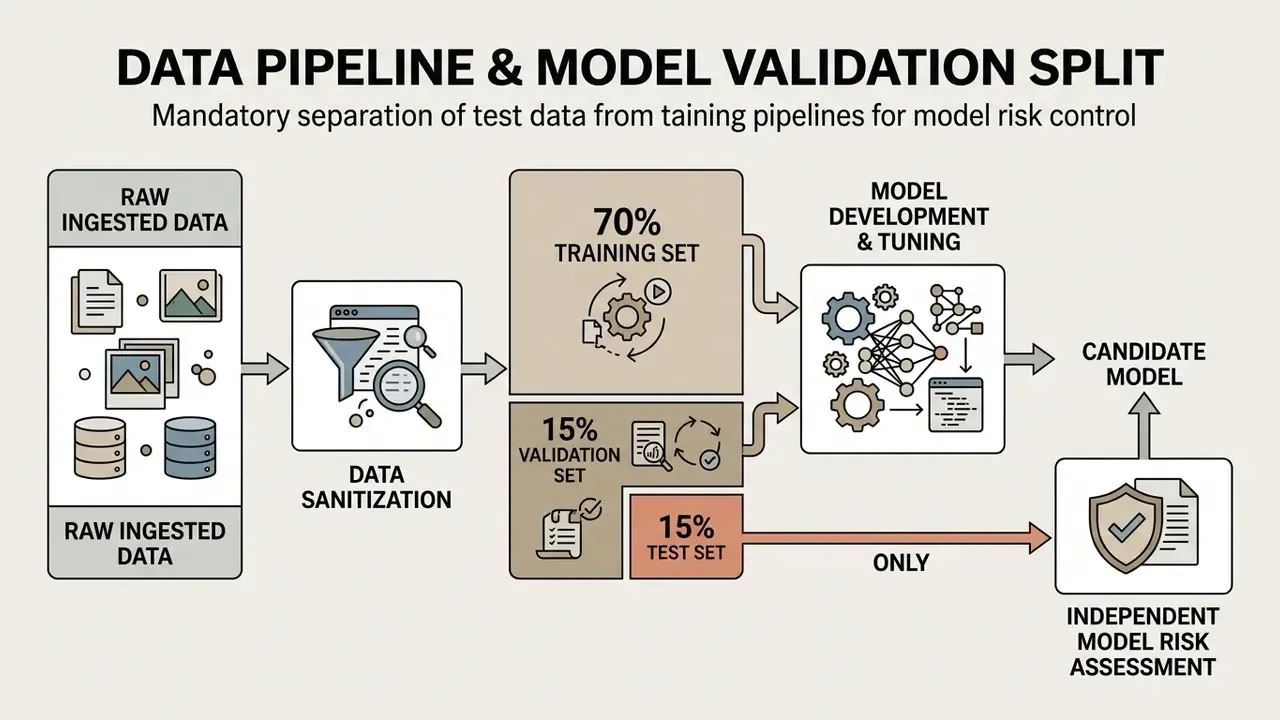
The regulated-institution view. The same control gap appears inside financial institutions evaluating automated AI communication workflows across commercial operations. The recurring remediation stack has four components: strict data sanitization of any prompt payload, independent model validation performed outside the model-development function, explicit human-in-the-loop approval gates for external or high-risk communications, and complete retention of prompts, retrieved context, model versions, and generated outputs. Institutions that apply this stack have generally been able to satisfy internal audit requirements and promote pilot systems into production. Institutions that skip it tend to stall at first-line review. (Composite pattern; metrics anonymized and unverified, see Appendix A.)
Mapping glossary terms to model risk management. For banks and other regulated lenders, marketing-facing AI is not exempt from established model risk expectations. Federal Reserve supervisory letter SR 11-7 and the parallel OCC Bulletin 2011-12 define a model broadly as a quantitative method applying statistical, economic, financial, or mathematical theory to process input data into estimates. That definition captures generative copy scoring, propensity models, bid optimizers, and audience segmentation engines. Four glossary-dependent controls follow directly:
- Model inventory alignment. Every term in this glossary that describes a decisioning or content-producing artifact (model, fine-tuned model, agent, RAG pipeline, ensemble) should map to an inventory record with an owner, a purpose statement, and an approval date.
- Model tiering. Criticality tiers determine validation depth. Marketing GenAI used for internal ideation sits at a lower tier than a system generating public claims about a consumer financial product.
- Consumer-protection exposure. Generated offers, targeting logic, and creative variants can create risk under CFPB supervision, the Equal Credit Opportunity Act (ECOA), and fair lending rules where synthetic content or proxy features produce disparate outcomes across protected classes. Bias terminology in this glossary is therefore a compliance instrument, not a technical curiosity.
- Audit trail. Prompts, system instructions, retrieved context, model and adapter versions, human reviewers, and final published outputs should be retained in a form that a supervisor or internal auditor can reconstruct.
"A glossary only becomes a control when each term is bound to an inventory field, a tier, and a retention rule. Definitions without ownership are documentation theater."
Core AI Concepts and Learning Methods
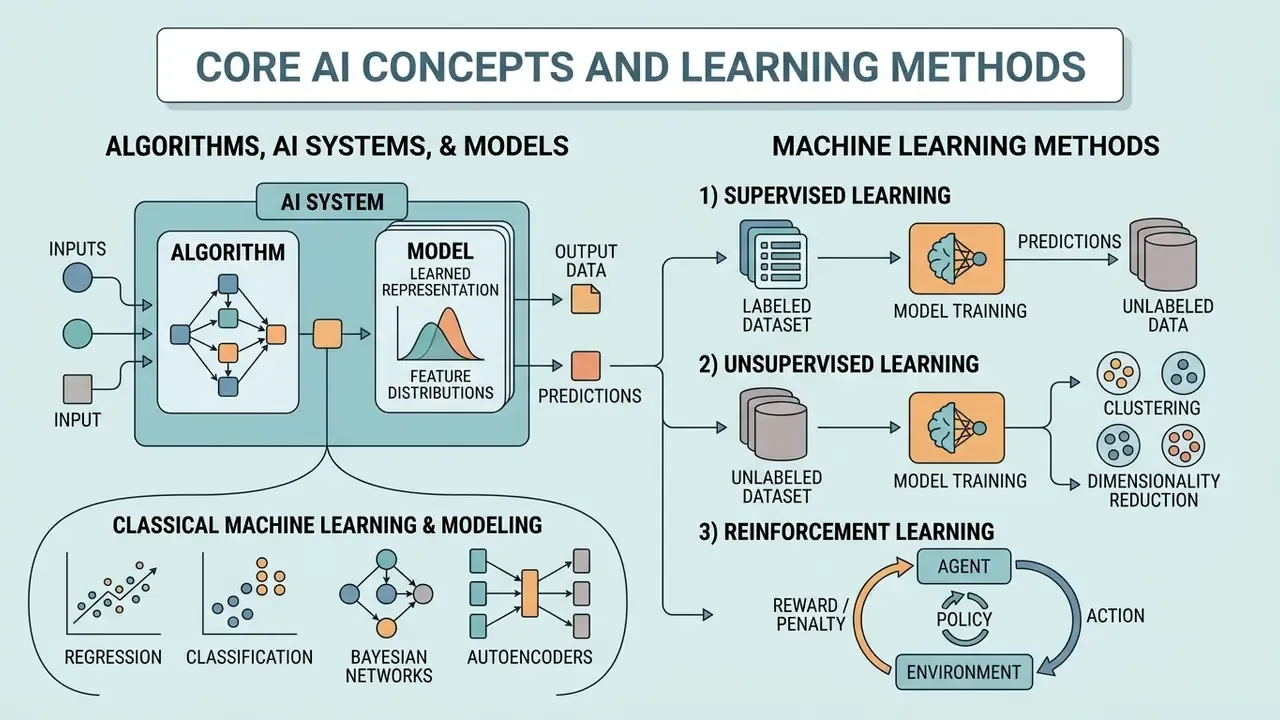
Core AI concepts cover the mathematical structures and training methods that govern how computational models process input data, learn feature distributions, and generate predictive or creative outputs.
Algorithms, AI Systems, and Machine Learning Models
An algorithm is a finite, deterministic sequence of mathematical instructions executed to solve a specific computational problem or to process input data. Inside AI systems, algorithms serve as the procedural engine that adjusts internal parameter weights during data training.
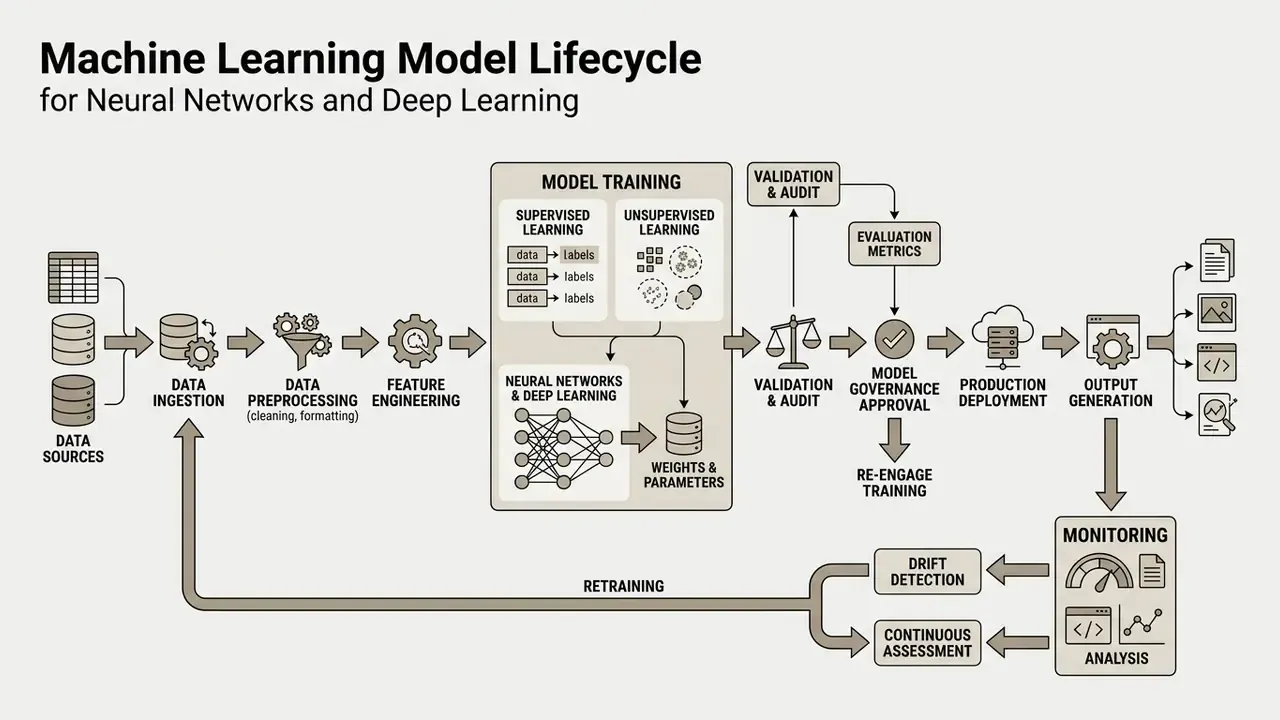
An AI system is the complete operational pipeline: data ingestion, algorithmic models, user interfaces, storage layers, and feedback loops. An AI model, or machine learning model, refers specifically to the trained mathematical artifact that results from running a learning algorithm over a defined dataset. The trained model accepts new data, processes it through tuned weights, and returns a prediction, a classification, or a generated artifact.
Research from the HaluEval 2.0 benchmark (Li et al., 2024) shows that a model's reliance on training data distributions directly influences output accuracy. Across 8,770 domain-specific questions, the study found that low-frequency concepts in raw data lead to higher rates of factual error. Put plainly: an AI system's reliability is capped by the quality and density of its training source.
"Low-frequency concepts in training data lead to higher rates of factual error; output reliability is constrained by the quality of the training source."
Supervised, Unsupervised, and Reinforcement Learning
Supervised learning trains models on labeled datasets that pair input features with target outputs. Common supervised tasks include image classification, sentiment analysis, and regression modeling.
Unsupervised learning trains models on unlabeled raw data, so the algorithm must discover latent structures, clusters, or statistical patterns on its own. Principal component analysis and customer segmentation are standard implementations.
Reinforcement learning (RL) trains an autonomous agent inside a dynamic environment where actions earn rewards or penalties. The agent refines its policy to maximize cumulative reward. Extended variants such as Reinforcement Learning from Human Feedback (RLHF) are central to aligning large language models with human safety and preference criteria.
"RLHF effectively reduces hallucination, but its effectiveness is domain-dependent; reward signals must be tailored to specific knowledge areas."
Adjacent methods complete the taxonomy. Semi-supervised learning combines a small labeled subset with a large unlabeled corpus. Federated learning trains across decentralized data holders without centralizing raw records, which matters when customer data cannot leave a jurisdiction. Self-supervised pre-training generates labels from the data structure itself, and it is the mechanism behind next-token prediction in large language models.
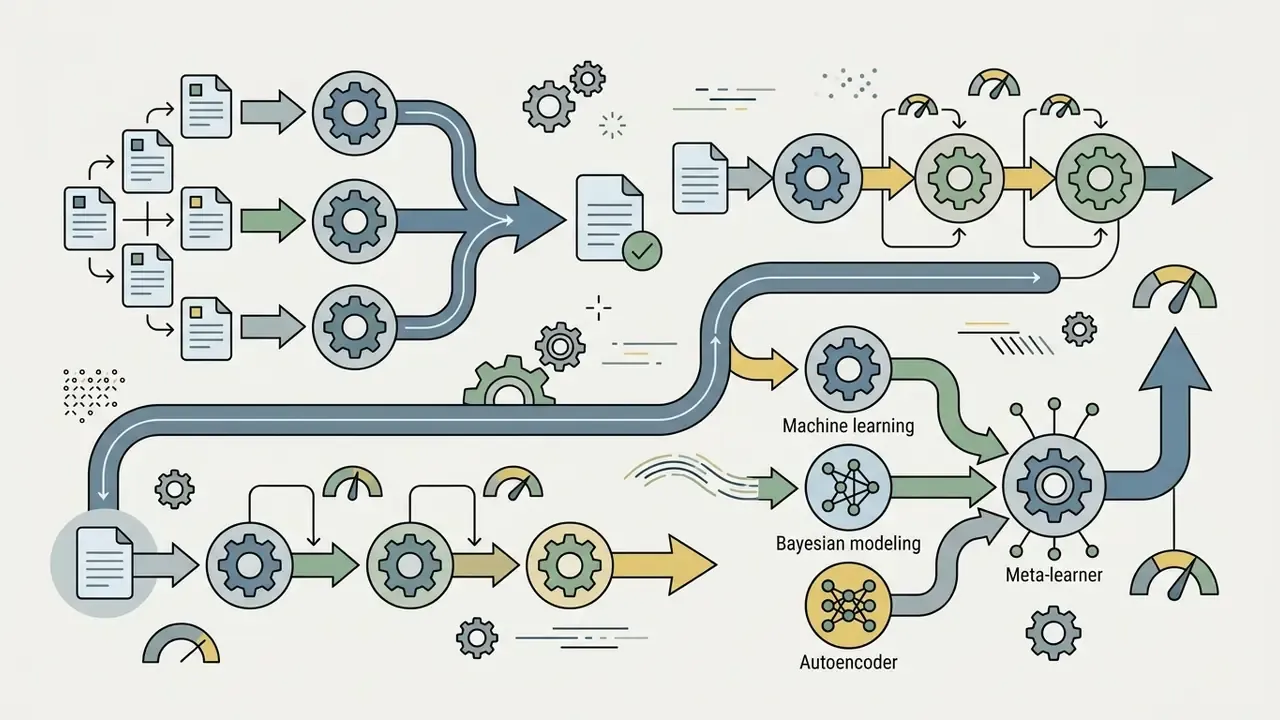
Classical Machine Learning, Bayesian Modeling, and Autoencoders
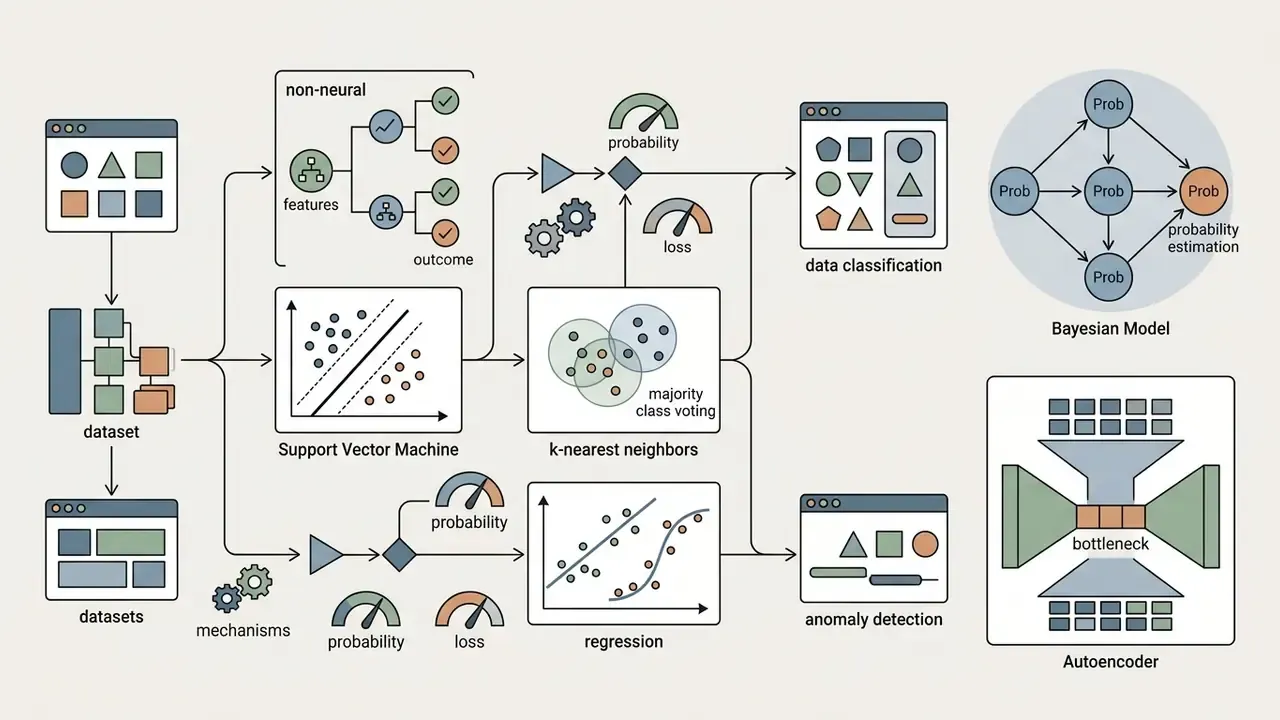
Before deploying complex deep learning architectures, enterprise workflows lean on foundational statistical models. For tabular, audit-sensitive problems they remain the default choice, not a fallback.



Neural Networks and Deep Learning
An artificial neural network is a computational model inspired by biological neural structures, composed of interconnected processing nodes (neurons) organized into layers. Signals pass from input nodes through weighted mathematical transformations to produce output predictions.
Deep learning refers to neural networks with multiple hidden layers between input and output. These deep architectures perform automated feature extraction, which lets the system identify complex, non-linear patterns in unstructured data such as raw audio, high-resolution video, and natural language text. Convolutional Neural Networks (CNNs) specialize in visual pattern recognition and computer vision, where convolution layers detect local patterns such as edges and textures while pooling layers reduce dimensionality. Transformer architectures excel at sequential contextual data through self-attention. The commercial expression of these architectures shows up in current AI video generators, where temporal consistency across frames is the direct product of layered feature extraction.
Training adjusts weights to minimize the error between predicted and target outputs, usually through gradient descent combined with backpropagation. Forward pass, loss computation, backward gradient propagation, weight update. That single loop is what "learning from data" means in every architecture described in this glossary.
AI Models, Language Models, and Agents
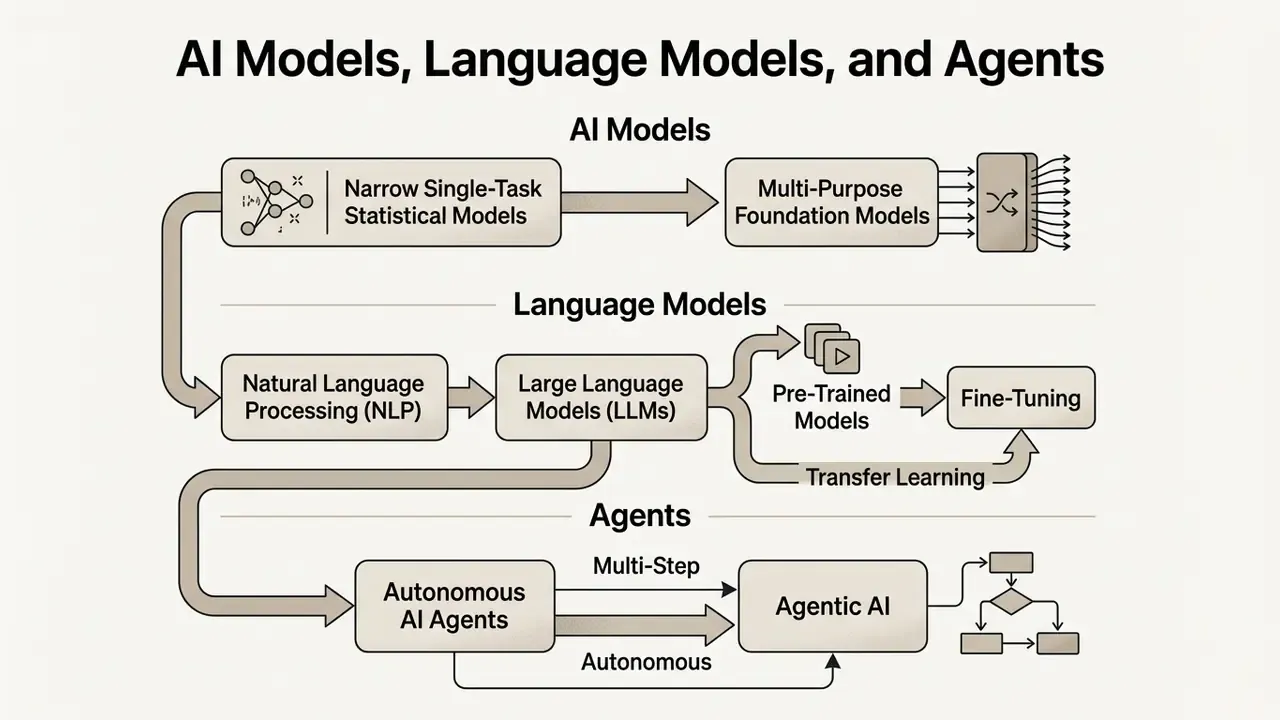
Modern AI models range from narrow single-task statistical models to multi-purpose foundation models and multi-step autonomous agents. The governance implications differ sharply across that range.
Large Language Models and Natural Language Processing
A large language model (LLM) is a deep learning model, typically based on the Transformer architecture, trained on massive text datasets to predict probability distributions over sequential tokens. Through self-supervised pre-training across billions of parameter weights, an LLM acquires general linguistic competence, contextual reasoning, and broad domain knowledge. Generation proceeds token by token, with each step conditioned on the prompt plus everything generated so far, which is why output length, temperature, and stop conditions change results materially.
Natural language processing (NLP) is the wider field dedicated to enabling computational systems to process, analyze, parse, interpret, and generate human written and spoken language. NLP spans foundational tasks such as tokenization, part-of-speech tagging, and named entity recognition, alongside advanced generative dialogue applications.
Despite their fluency, language models carry fundamental reliability limits. Research on structural hallucination (Banerjee et al., 2024) argues that factual errors are intrinsically bound to probabilistic token generation.
"Every stage of LLM operation, from training-data compilation to text generation, carries a non-zero probability of hallucination; architectural improvements cannot eliminate it entirely."
The CHOKE benchmark (Simhi et al., 2025) adds a sharper finding. Models can produce incorrect answers with high certainty even when the underlying training data contains the correct facts, which means confidence scores cannot stand in for independent validation.
"Minor prompt changes push models from correct answers to confident hallucinations; model confidence scores cannot replace independent verification."
Expert quote: "probabilistic text models do not maintain a verified database of facts; they generate token sequences based on statistical weight distributions. operational governance requires treating every generative output as an unverified draft until validated." Marcus Hale, author
Pre-Trained Models, Fine-Tuning, and Transfer Learning
Agentic AI and Autonomous AI Agents
Agentic AI refers to architectures designed to execute complex, multi-step goals autonomously with minimal step-by-step human intervention. Unlike a conversational chatbot that returns a single-turn response, an autonomous AI agent carries planning modules, memory stores, and tool-use capabilities.
Public guidance from NIST and the U.S. Department of Defense converges on a similar functional description. Agentic systems formulate goal hierarchies, decompose objectives into sequential tasks, call external APIs, query vector databases, and adjust execution paths based on environmental feedback. NIST draft material characterizes agentic AI as autonomous, goal-directed, adaptive decision-making systems capable of operating at machine speed and scale (see the NIST Artificial Intelligence Risk Management Framework and associated drafts, https://nvlpubs.nist.gov/nistpubs/ai/NIST.AI.100-1.pdf). Department of Defense guidance for agentic services emphasizes four operational controls: sandboxing, least-privilege access, rate limiting, and strong authentication. (Publication identifiers for the most recent 2026 drafts should be verified against the issuing agency before citation in a regulated filing.)
Empirical benchmarks that evaluate autonomous agents, such as AutoResearchBench (2026), test multi-step reasoning over controlled corpora exceeding three million documents across 1,000 tasks.
"Agentic models perform strongly on structured search and synthesis tasks, yet multi-step autonomy creates compounding error loops when early reasoning fails."
For validators, the practical distinction between a chatbot and an agent is consequential. A chatbot produces a reviewable artifact. An agent produces actions. Validation criteria therefore shift from output accuracy toward action authorization, tool permission scope, step-level logging, reversibility, and hard stop conditions. Or, in the persona's own framing: no evidence, no autonomy.
Generative AI and Media Content Formats
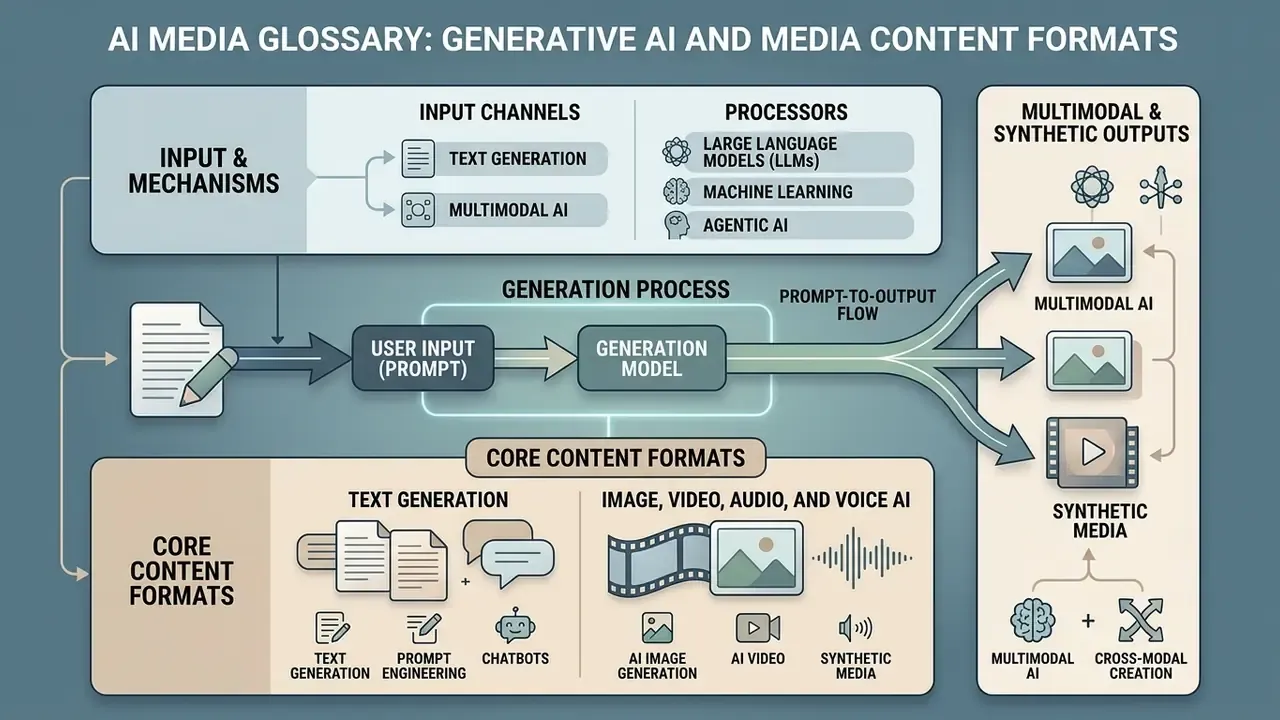
Generative AI media content formats span text, image, audio, video, and multimodal outputs. Each format operates under distinct technical specifications and a distinct risk profile.
Text Generation, Prompts, and Chatbots
Text generation is the automated synthesis of written natural language using probabilistic language models. The primary control interface is a prompt, meaning a natural language instruction, question, or contextual block supplied to steer output generation.
Prompt engineering is the iterative practice of structuring, optimizing, and refining input text, operational constraints, and system context to maximize output quality, accuracy, and format adherence. Documented practice treats it as a cycle: craft, test, analyze against measurable output criteria, document the version, refine. An interactive chatbot pairs text generation with conversational state memory, enabling ongoing dialogue across customer service, internal search, and marketing workflows. Because prompts are model inputs, prompt versions belong in change management alongside code and model weights. Skip that step and you lose the ability to explain why last month's output differed from today's.
Image, Video, Audio, and Voice AI
Image generation models, mostly diffusion architectures, construct visual outputs by systematically removing noise from a randomized latent field under guidance from textual or visual prompts. Computer vision is the complementary analytical technology, enabling systems to extract, process, and classify information from images and video streams.
AI video generation extends image diffusion principles across time, synthesizing frame sequences that hold spatial consistency and motion fluidity. Related production tooling ranges from animation makers to full YouTube video editing workflows, and the two dominant entry points are described in Text-to-Video AI Explained and image to video conversion. Audio AI and voice synthesis cover neural text-to-speech (TTS) systems and voice cloning models that produce human speech waveforms with adjustable cadence, tone, and inflection. Teams evaluating this category usually start with a licensing-aware review of AI voice generators, because voice data carries biometric exposure that text prompts do not.
Adjacent editing capabilities matter for governance because they blur the line between generated and altered content. Outpainting tools that expand an existing image, portrait synthesis in AI headshot generators, brand assets from an ai company logo tool, and AI-assisted retouching all produce content that transparency rules may treat as synthetic.
Multimodal AI and Synthetic Media
Multimodal AI refers to integrated architectures capable of processing, understanding, and generating content across multiple input and output modalities, combining text, image, audio, and video inside a unified network. Multimodal systems enable cross-modal translation, such as generating detailed text descriptions from raw video inputs or synthesizing video clips from audio narration. Current image-to-video implementations show how a single still frame plus a text instruction becomes a motion sequence.
Synthetic media is an umbrella term for visual, auditory, or textual media generated or substantially altered by artificial intelligence. A deepfake is a specific subclass engineered to depict real individuals saying or doing things they never said or did.
"Meme format is a stronger predictor of engagement than the mere fact of AI generation, though AI memes show a significant synergistic effect when combined with human curation."
The FinCEN Alert (FIN-2024-Alert004) stresses that synthetic media poses substantial fraud, identity theft, and misrepresentation risk across commercial and financial sectors, and that robust authentication and provenance safeguards are required. Verification tooling is the operational counterpart. Detection classifiers, provenance manifests, embedded signals such as synthid, and AI reverse-image-search tools let editorial and fraud teams test provenance claims before publication or payment approval. Disclosure practice is a separate obligation, covered in Synthetic Media Disclosure Explained.
| Content Format | Primary Technical Methods | Typical Input Modalities | Standard Generated Outputs | Governance & Risk Factors | Primary Ad-Tech & Media Use Cases | Provenance, Watermarking & Regulated Controls |
|---|---|---|---|---|---|---|
| Text | Transformers, LLMs, fine-tuned adapters | Text prompts, system instructions, context documents | Articles, summaries, formatted code, dialogue answers | Factual hallucinations, IP infringement, unintentional bias | Ad copy variants, SEO briefs, email sequences, chat support scripts | Prompt and output logging, retrieval citations, mandatory human-in-the-loop review for public claims and any product or pricing statement |
| Image | Diffusion models, GANs, latent spaces | Text prompts, reference images, depth maps | Digital art, marketing visuals, synthetic photos | Style appropriation, deepfakes, misleading commercial claims | Display creative, social assets, product mockups, localized creative variants | C2PA content credentials, invisible watermarking, model and prompt version retention, likeness-release checks |
| Video | Temporal diffusion, frame interpolation, NeRFs | Prompts, still images, driving video sequences | Short video clips, animations, automated scene edits | Synthetic manipulation, high compute cost, provenance loss | Performance video ads, dynamic creative optimization, AR activations, digital twins of campaigns | C2PA manifests, frame-level provenance metadata, EU AI Act Article 50 synthetic-content labeling |
| Audio & Voice | Neural text-to-speech, waveform synthesis | Scripted text, voice audio samples, audio prompts | Cloned voice audio, music tracks, sound effects | Impersonation fraud, unauthorized voice capture, biometric risk | Podcast ads, IVR and outbound messaging, multilingual voiceover | Audio watermarking, explicit consent records for voice donors, biometric-data handling controls, automated PII redaction before synthesis |
| Multimodal | Unified cross-modal encoders and decoders | Any mix of text, audio, video, and image inputs | Combined media streams, interactive video-text responses | Cross-modal hallucination, system opacity, complex auditing | Interactive ad units, shoppable video, AI concierge experiences | End-to-end lineage across modalities, per-modality provenance signals, elevated model tier, independent validation |
AI in Advertising, Bid Optimization, and Performance Analytics
Data, Training, Privacy, and Responsible AI
Data governance and privacy standards define the boundary conditions for deployable enterprise AI systems. Get the data vocabulary wrong and every downstream control inherits the error.
Training Data, Test Data, and Data Quality
Training data is the foundational dataset ingested by a machine learning algorithm to adjust parameter weights and learn structural relationships. Test data is a separate, independent dataset withheld during training and used strictly to evaluate model accuracy, generalization, and error rates.
Raw data is unprocessed information collected in its native format before cleaning, filtering, or transformation. Data may be structured, following a predefined tabular schema, or unstructured, covering free-form documents, images, audio files, and video streams. High data quality requires representativeness, accurate labeling, absence of systemic contamination, and clear lineage tracking. European Commission guidance on AI test data adds four operational criteria: representativeness of intended use, stratification across relevant subgroups, sufficient size for statistical confidence, and label correctness verified to a high degree.
"Low-frequency knowledge in the training corpus produces higher hallucination rates; models are considerably more reliable in domains with dense training data."
Model Operations, Data Drift, and Lifecycle Auditing
Enterprise deployment requires continuous post-market monitoring to catch silent performance degradation.
- Data drift and concept drift The measurable divergence between a model's original training distribution and real-world operational inputs over time (data drift), or a change in the relationship between inputs and the target variable itself (concept drift). Both decay prediction accuracy without producing an error message. That is why re-validation thresholds must be defined before deployment, not after an incident.
- Post-market performance monitoring Regular collection and analysis of usage data from a deployed AI system to evaluate real-world performance, detect degradation, identify misuse, and surface safety or usability concerns. Health-sector regulators formalized this vocabulary first, but the mechanism is sector-agnostic.
- Continual (lifelong) machine learning A training methodology where deployed models adapt parameter weights by digesting incoming streaming data without catastrophic forgetting of previously mastered representations. A continual model has a defined learning process that changes its behavior over time, in contrast to a locked model, whose outputs for a given input stay fixed until an approved release.
- Data cards and model cards Standardized, machine-readable governance documentation. A data card records a dataset's provenance, collection protocol, sample counts, demographic distributions, and operational boundaries. A model card records intended use, evaluated performance limits, subgroup results, and safety thresholds. Together they form the minimum documentation package an independent validator needs to reproduce a conclusion.
AI Bias, Fairness, and Explainable AI
AI bias is a systematic, non-random error or skew in model outputs that disadvantages specific demographic groups, distorts information representation, or produces uneven decisions. Bias can originate in historical imbalance within raw training data, flawed feature selection, or improper label assignment. Documented sources include age, sex, ethnicity, geography, and curation or labeling artifacts introduced during dataset construction.
Fairness in AI governance means establishing mathematical and operational criteria, such as statistical parity, equalized odds, group fairness, and demographically balanced error rates, to verify that outcomes do not produce unlawful or unethical discrimination. Documented mitigation techniques include data resampling, bias-free representation learning, and equalized-odds post-processing.
Explainable AI (XAI) covers methods, architectural designs, and post-hoc techniques that make a system's internal decision logic and outputs interpretable to human operators. The same interpretability question arises with everyday tooling. Teams comparing photo editors and generative alternatives need to know which transformations a model applied and why. Surrogate models, feature attribution analysis, partial dependence plots, counterfactual explanations, and sensitivity analysis allow risk teams to audit why a model produced a specific prediction or decision.
"Explanations are necessary to understand and control AI systems; transparency is a central governance objective, not an optional feature."
Data Privacy, Security, and AI Governance
Data privacy in AI operations protects personal identifiers, confidential business data, and proprietary intellectual property from unauthorized ingestion, storage, or exposure inside AI models. Standards including the EU AI Act (Regulation 2024/1689), ISO/IEC 42001 (AI management systems), ISO/IEC 23894 (AI risk management), ISO/IEC 29100 (privacy terminology), and NIST AI Risk Management Framework 1.0 set out controls requiring data minimization, privacy impact assessments, and clear access management. EU AI Act Recital 67 additionally requires appropriate data governance across training, validation, and testing datasets, including transparency about the original purpose for which personal data was collected.
AI governance is the institutional framework of policy controls, roles, approval processes, risk tiering, audit trails, and monitoring established to manage the safe deployment of AI systems across their lifecycles. Effective governance requires clear decision ownership, explicit escalation paths, and functioning kill switches that retain operational control over autonomous models.
Four controls recur across NIST, EU, and supervisory sources, and they translate directly into media and marketing operations. Purpose limitation: a tool approved for internal ideation is not approved for customer-facing claims. Data minimization: prompts must not carry personal or confidential payloads beyond necessity, with automated PII redaction where feasible. Traceability of outputs: every published synthetic artifact should be reconstructable from its prompt, context, and model version. Documented approval: a named human owns the decision to publish.
AI Literacy, Copyright, Attribution, and Datafication
Generative workflows create legal obligations that sit outside the model itself.
How to Apply This Glossary in Your Governance Framework
Terminology becomes operational only when each definition is bound to a control. Five steps convert this reference into working policy.
- Adopt one canonical definition per term.Publish the glossary internally as the single source of truth for risk, audit, compliance, legal, and marketing. Where a vendor's terminology conflicts, translate it into your canonical term inside the vendor record.
- Enumerate every AI service in use.Include sanctioned platforms, embedded features inside existing SaaS tools, browser extensions, and personal accounts used for work. Undefined categories cannot be inventoried, which is why step 1 precedes step 2.
- Assign a model tier to each entry.Tier on consequence, not sophistication. Internal ideation, internal decision support, customer-facing content, and regulated claims or credit-adjacent decisioning are four different validation regimes.
- Attach controls per tier.Minimum set: named owner, approved purpose, prompt and output logging, PII redaction rule, human-in-the-loop gate for public claims, drift monitoring threshold, documented review cadence.
- Schedule terminology review.AI vocabulary turns over faster than policy cycles. Re-review definitions at least twice a year and after any material regulatory publication, recording the review date on the glossary itself.
AI Media Glossary A to Z: Find Terms by Category
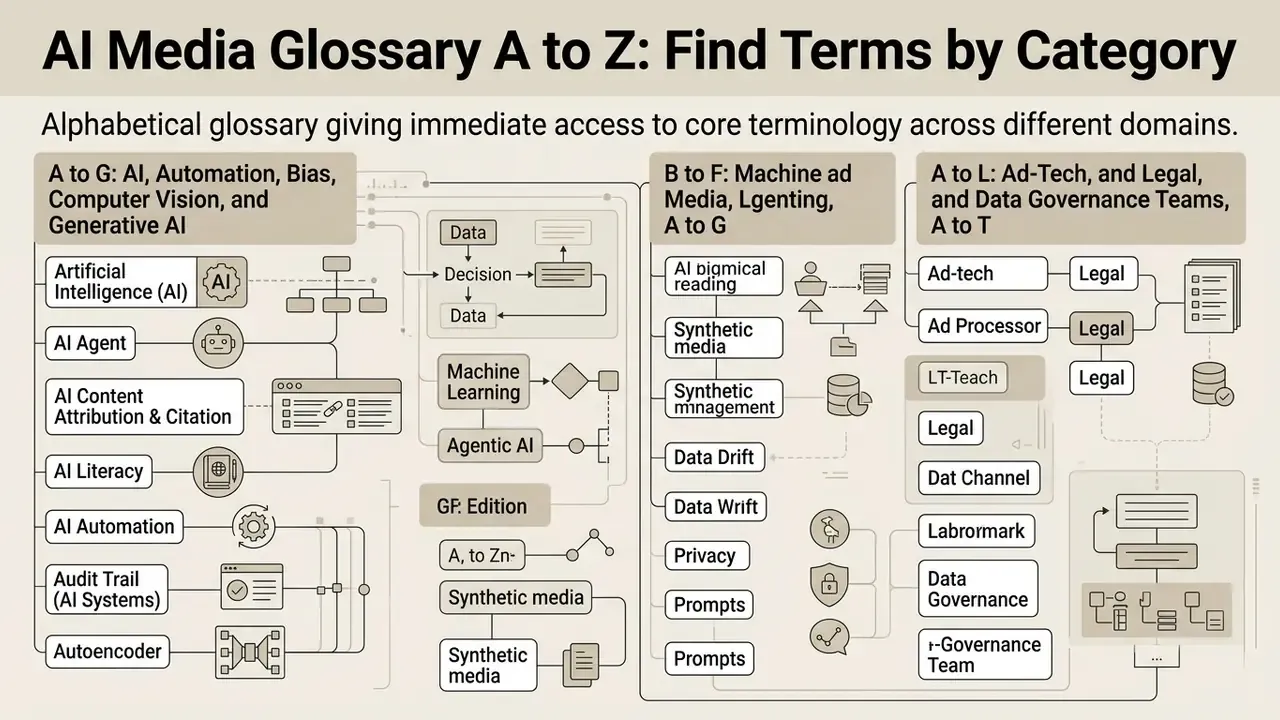
This alphabetical glossary gives immediate access to core artificial intelligence, machine learning, ad-tech, legal, and data governance terminology.
A to G: AI, Automation, Bias, Computer Vision, and Generative AI
Artificial Intelligence (AI) (Category: Models / Core)
A machine-based computational system engineered to infer predictions, recommendations, content, or decisions that influence real or virtual environments for defined objectives.
AI Agent (Category: Models / Automation)
An autonomous software architecture powered by AI models that formulates plans, executes multi-step tasks, uses external tools, and adapts to environmental feedback.
AI Content Attribution & Citation (Category: Governance / Content)
The standardized practice of documenting, disclosing, and citing the use of generative AI models, prompt parameters, and training-data origins in published synthetic or hybrid media.
AI Literacy (Category: Governance / Operations)
The capability to understand, critically evaluate, ethically apply, and audit artificial intelligence tools and synthetic outputs across organizational workflows.
AI Automation (Category: Marketing / Operations)
The execution of operational tasks and content workflows by computational AI systems with reduced or minimal continuous human intervention.
Audit Trail (AI Systems) (Category: Governance / Data)
A retained, reconstructable record of prompts, system instructions, retrieved context, model and adapter versions, human approvers, and published outputs, sufficient for supervisory or internal review.
Autoencoder (Category: Models / Core)
An unsupervised neural architecture that compresses input into a low-dimensional latent representation via an encoder and reconstructs it via a decoder, used for anomaly detection, denoising, and dimensionality reduction.
Autonomous AI (Category: Models / Risk)
An AI-enabled product able to perform tasks, operate independently, and make decisions without human intervention. Autonomy exists on a spectrum with assistive AI.
Bayesian Network (Category: Models / Core)
A probabilistic graphical model representing variables and their conditional dependencies through a directed acyclic graph, enabling causal reasoning and risk analysis under uncertainty.
AI Bias (Category: Governance / Privacy)
Systematic, non-random deviations in model outputs or predictions that produce unfair, unequal, or skewed outcomes across specific groups or datasets.
Bid Optimization (Category: Marketing / Models)
An AI-driven process in which predictive algorithms analyze real-time auction signals to adjust bid values in programmatic exchanges, maximizing return on ad spend within delivery constraints.
Classical Machine Learning (Category: Models / Core)
Non-neural algorithmic families, including decision trees, support vector machines, k-nearest neighbors, logistic regression, naïve Bayes, and gradient boosted trees, suited to structured tabular data with high interpretability.
Compute Credits (Category: Operations / Marketing)
A consumption-based billing unit used by many generative platforms to meter model runs, resolution, and duration. See What Are Compute Credits? for how metering affects budget forecasting.
Computer Vision (Category: Models / Content)
A subfield of artificial intelligence dedicated to extracting, processing, analyzing, and interpreting information from visual inputs such as images and video streams.
Concept Drift (Category: Data / Risk)
A change over time in the statistical relationship between model inputs and the target variable, degrading accuracy even when the input distribution appears stable.
Continual (Lifelong) Machine Learning (Category: Data / Models)
A training methodology in which a deployed model adapts its parameters to incoming data through a defined learning process, while retaining prior knowledge and avoiding catastrophic forgetting.
Copyright & AI Outputs (Category: Governance / Content)
The exclusive legal rights granted to creators over original works, applied to generative workflows through two questions: whether an output infringes protected inputs, and whether the output itself is protectable.
Creative Commons License (Category: Governance / Content)
A family of public licenses permitting defined reuse of a work under stated conditions, commonly requiring attribution and sometimes restricting derivative or commercial use.
Data Card (Category: Data / Governance)
Structured documentation of a dataset's provenance, collection protocol, sample counts, metadata, and quantitative characteristics, produced for AI development and independent evaluation.
Data Drift (Category: Data / Risk)
Change over time in the input data distribution received by a deployed model, causing performance degradation and requiring programmatic re-validation.
Datafication (Category: Data / Governance)
The operational transformation of qualitative business processes, creative assets, and human interactions into structured digital datasets formatted for algorithmic processing.
Deep Learning (Category: Models / Core)
A subset of machine learning using artificial neural networks with multiple hidden layers to automatically extract complex features from large-scale data.
Diffusion Model (Category: Content / Models)
A class of generative deep learning models that create media artifacts by iteratively removing noise from random latent fields, guided by input prompts. Diffusion architectures underpin most current AI art generators.
Digital Twin (Category: Marketing / Models)
A virtual simulation of a real-world system, object, or activation, fed by live data feeds, used for continuous monitoring, scenario testing, and pre-commitment campaign modeling.
Ensemble Learning (Category: Models / Core)
A meta-algorithmic technique combining multiple base models through bagging, boosting, or stacking to improve predictive stability and reduce variance relative to any single model.
Explainable AI (XAI) (Category: Governance / Core)
A suite of techniques and operational methods that provide human-understandable explanations for how complex AI models arrive at specific outputs or decisions.
Fairness Metrics (Category: Governance / Privacy)
Quantitative criteria, including statistical parity, group fairness, equalized odds, and subgroup true-positive rates, used to test whether model outcomes disadvantage protected groups.
Fine-Tuning (Category: Data / Models)
The process of updating a pre-trained foundation model's parameter weights using a specialized target dataset to optimize performance for a specific task.
Generative Adversarial Networks (GANs) (Category: Content / Models)
A dual-network generative architecture where a generator and a discriminator compete, producing highly realistic synthetic data artifacts.
General AI (AGI) (Category: Models / Concept)
A theoretical artificial intelligence system possessing human-level cognitive adaptiveness, generalized reasoning, and problem-solving capability across arbitrary domains.
Generative AI (Category: Content / Models)
A class of deep learning models designed to produce novel synthetic content, including text, images, video, and audio, by sampling learned probabilistic distributions.
Gradient Descent & Optimization (Category: Core / Models)
The iterative adjustment of model parameters to minimize an objective function such as prediction error; the mechanism underlying nearly all model training.
H to Z: Hallucination, LLM, MMM, NLP, Prompt, RAG, and XAI
Hallucination (Category: Models / Risk)
The generation of non-factual, ungrounded, or contradictory outputs presented confidently by generative AI models, also called confabulation.
Human-in-the-Loop (HITL) (Category: Governance / Operations)
A control design in which a named human reviewer must evaluate and approve model outputs or actions before they take effect, applied mandatorily to public claims and regulated communications.
IP Indemnification (Category: Governance / Content)
A contractual commitment by a vendor to defend or reimburse a customer against third-party intellectual property claims arising from generated outputs. See IP Indemnification Explained.
Large Language Model (LLM) (Category: Models / Content)
A high-parameter transformer neural network trained on extensive text datasets to process, predict, and generate sequential natural language tokens. LLMs also serve as the instruction layer for current text-to-video AI tools.
Locked Model (Category: Models / Governance)
A deployed model whose behavior for a given input remains fixed until a formally approved release, in contrast to a continual learning model that adapts in production.
Marketing Mix Modeling (MMM) (Category: Marketing / Data)
An analytical machine learning approach quantifying the revenue contribution of individual media channels from aggregate historical data, controlling for seasonality and market conditions without user-level tracking.
Model Card (Category: Governance / Models)
Standardized documentation recording a model's intended use, evaluated performance limits, subgroup results, known failure modes, and safety thresholds.
Model Inventory (Category: Governance / Operations)
The authoritative register of all deployed and in-development models, including AI and generative systems, with owner, purpose, tier, approval status, and validation evidence.
Model Tiering (Category: Governance / Risk)
Classification of models by criticality and consequence of error, determining required validation depth, monitoring frequency, and approval authority.
Multimodal AI (Category: Models / Content)
An AI system engineered to process, integrate, and generate content across multiple modalities, such as simultaneous text, visual, and audio processing.
Natural Language Processing (NLP) (Category: Core / Models)
The AI discipline focused on enabling computational systems to parse, comprehend, synthesize, and interact with human written and spoken language.
Neural Network (Category: Core / Models)
A computational architecture of interconnected nodes organized in layers that process inputs through weighted mathematical transformations.
Post-Market Performance Monitoring (Category: Governance / Data)
Regular collection and analysis of real-world usage data from a deployed AI system to evaluate performance, detect degradation or drift, and identify misuse.
Predictive Audience Segmentation (Category: Marketing / Models)
Application of unsupervised clustering to aggregated behavioral data, producing dynamic high-intent cohorts for automated targeting; requires fair lending review in regulated sectors.
Prompt (Category: Content / Marketing)
Natural language text, instructions, code, or context supplied to a generative AI model to initiate, guide, and constrain output synthesis.
Prompt Engineering (Category: Marketing / Operations)
The iterative discipline of crafting, testing, and refining input prompts to systematically optimize generative model output quality and precision.
Retrieval-Augmented Generation (RAG) (Category: Models / Data)
An enterprise architecture that combines an external knowledge retrieval index with a generative language model to ground outputs in verified source data. Typical pipeline stages are chunking, embedding, vector storage, top-k retrieval, optional reranking, and grounded generation.
"RAG systems are evaluated on context relevance, answer faithfulness, and response quality; hybrid architectures substantially improve factual accuracy relative to purely generative models."
Shadow AI (Category: Governance / Risk)
Use of unauthorized or uninventoried AI services inside business workflows, creating undocumented data exposure, unlogged outputs, and unassigned model ownership.
Support Vector Machine (SVM) (Category: Models / Core)
A classical supervised algorithm that separates classes by locating the maximum-margin decision boundary, effective on smaller structured datasets.
SynthID (Category: Governance / Content)
An imperceptible watermarking approach for AI-generated media, used to assert machine origin without visible marks. See synthid for detection and limitation notes.
Synthetic Media (Category: Content / Marketing)
Digital media artifacts, including text, graphics, audio, and video, generated or substantially transformed by artificial intelligence. Provenance claims can be tested with detection classifiers and AI reverse-image-search tools.
Synthetic Media Disclosure (Category: Governance / Content)
The practice and, in some jurisdictions, the legal obligation to inform audiences that content was generated or materially altered by AI. See Synthetic Media Disclosure Explained.
Text-to-Video (Category: Content / Models)
Generation of a moving image sequence from a written prompt, extending diffusion methods across the temporal dimension. See Text-to-Video AI Explained.
Token (Category: Core / Data)
The basic atomic unit of text, such as a word, subword, or character, processed and generated by large language model algorithms.
Training Data (Category: Data / Models)
The dataset used during model development to fit algorithmic parameters, adjust neural weights, and establish statistical learning representations.
Transfer Learning (Category: Data / Models)
Reuse of representations learned on a source task to improve performance on a related target task, implemented through feature extraction or fine-tuning.
Transformer Architecture (Category: Core / Models)
A deep learning architecture relying on self-attention mechanisms to process sequential input data in parallel, serving as the foundation for modern LLMs.
Voice Cloning (Category: Content / Privacy)
Synthesis of a specific individual's speech characteristics from sample audio, carrying biometric and impersonation risk. See the comparison of AI voice generators for licensing and consent considerations.
Watermarking & Content Provenance (Category: Governance / Content)
Embedded visible or imperceptible signals, and standards-based manifests such as C2PA content credentials, used to assert the origin and edit history of media assets. Implementation details are covered under watermarking.
Next Steps: Operationalizing the Glossary in Model Risk Management
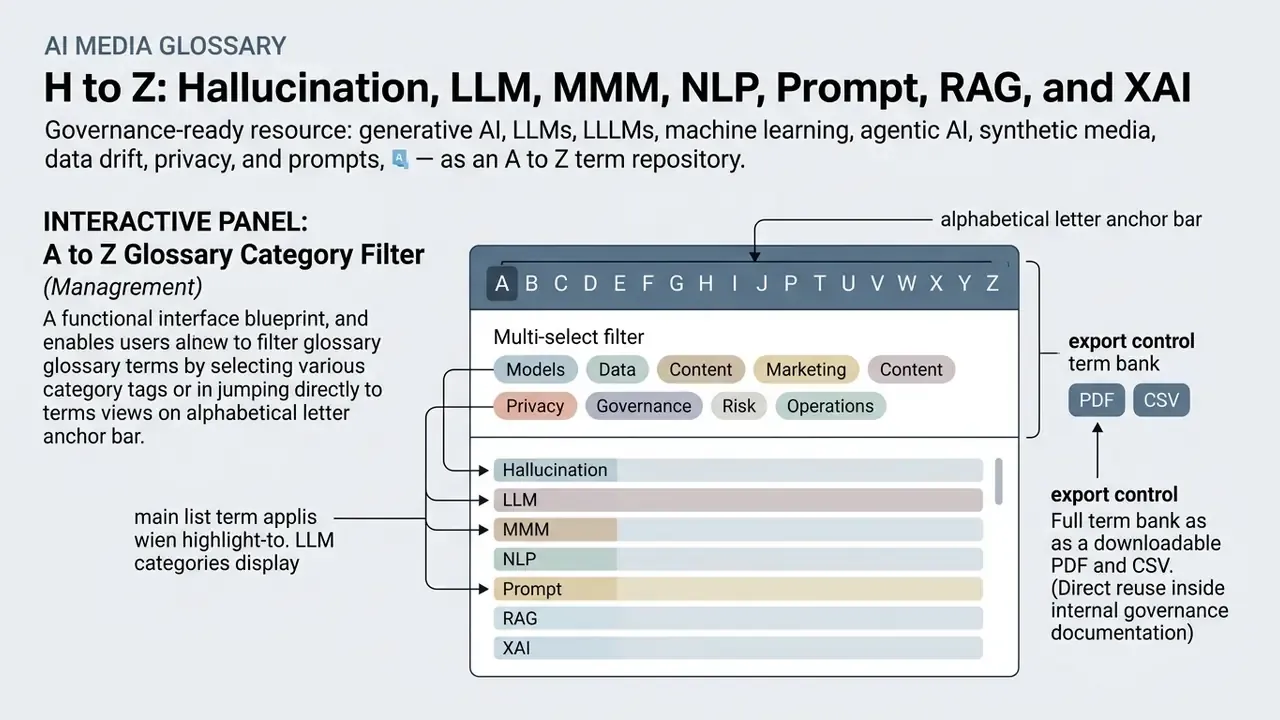
A five-step checklist for adding marketing and media GenAI tools to an existing model risk framework. Export the A to Z term bank as PDF or CSV from the interactive panel above and attach it to your internal AI policy or model inventory standard.
- Discover and declare. Run a tool-discovery sweep across expense records, SSO logs, and browser telemetry. Every generative service found is declared, named with a canonical glossary term, and assigned a business owner.
- Register in the model inventory. Create records for models, fine-tuned variants, RAG pipelines, agents, bid optimizers, MMM implementations, and segmentation engines. Record purpose, data inputs, output surface, and vendor.
- Tier and scope validation. Apply model tiering. Tier 1 (public claims, regulated products, credit-adjacent decisions) receives independent validation, fairness testing, and documented performance limits. Lower tiers receive proportionate review.
- Instrument controls and logging. Implement prompt and output retention, PII redaction, access management, human-in-the-loop gates, drift thresholds, and kill-switch procedures. Produce a data card and model card per registered artifact.
- Monitor, attest, and re-review. Track drift and incident metrics on a defined cadence, require owner attestation each cycle, and re-review terminology and tiering after any material regulatory publication.
Frequently Asked Questions (FAQ)
What is the difference between generative AI and machine learning?
Machine learning is the broad discipline of algorithms that learn patterns from data. Generative AI is a subset whose models produce new artifacts, meaning text, images, audio, video, or code, rather than classifying or scoring existing inputs.
Is a marketing AI tool a "model" for risk management purposes?
Under the definition used in SR 11-7 and OCC Bulletin 2011-12, a quantitative method that processes input data into estimates is a model. Bid optimizers, propensity scorers, MMM implementations, and audience segmentation engines generally meet that description. Scoping decisions should be documented rather than assumed.
Can model confidence scores substitute for human review?
No. The CHOKE benchmark showed that minor prompt changes can flip a model from a correct answer to a confidently stated hallucination, which means self-reported certainty is not a validation signal (Simhi et al., 2025, https://arxiv.org/abs/2501.08975).
Does the EU AI Act require labeling of AI-generated marketing content?
Regulation (EU) 2024/1689 introduces transparency obligations for certain AI systems and for synthetic content, including provenance and labeling requirements. Applicability depends on system type, deployment role, and jurisdiction. Confirm with counsel.
What is the fastest way to reduce hallucination risk in published content?
Ground generation in retrieved, citable sources through a RAG architecture, retain the retrieved context alongside the output, and require named human approval before publication. Retrieval reduces unsupported claims. It does not eliminate them.
How often should an AI glossary be updated?
At least twice a year, plus an unscheduled review after any material regulatory publication or the introduction of a new model class into the inventory. Record the review date on the document itself.
Appendix A: Source Notes and Prior Wording
For transparency, the following case descriptions appeared in the prior version of this guide and are retained verbatim. They are anonymized composites without published metrics and should be read as illustrative patterns, not verifiable case studies.
- "A large publishing institution faced severe operational friction when marketing teams deployed unauthorized generative tools alongside core content management systems. By establishing a centralized AI dictionary and risk classification taxonomy, the institution categorized all external AI services, instituted mandatory prompt logging, and successfully reduced unauthorized data exposure across its content pipelines."
- "A regional financial institution evaluated the deployment of automated AI communication workflows across its commercial operations. By introducing strict data sanitization, implementing independent model validation, and establishing explicit human-in-the-loop approval gates for high-risk communications, the firm successfully satisfied internal audit requirements while moving its pilot systems into safe production."
Both passages are reframed in the main text with explicit sourcing caveats. Agency publications referenced with 2026 dates in the agentic AI section should be verified against the issuing body's current document register before use in a regulated filing.
Editorial Notes, Limitations, and Review Cadence
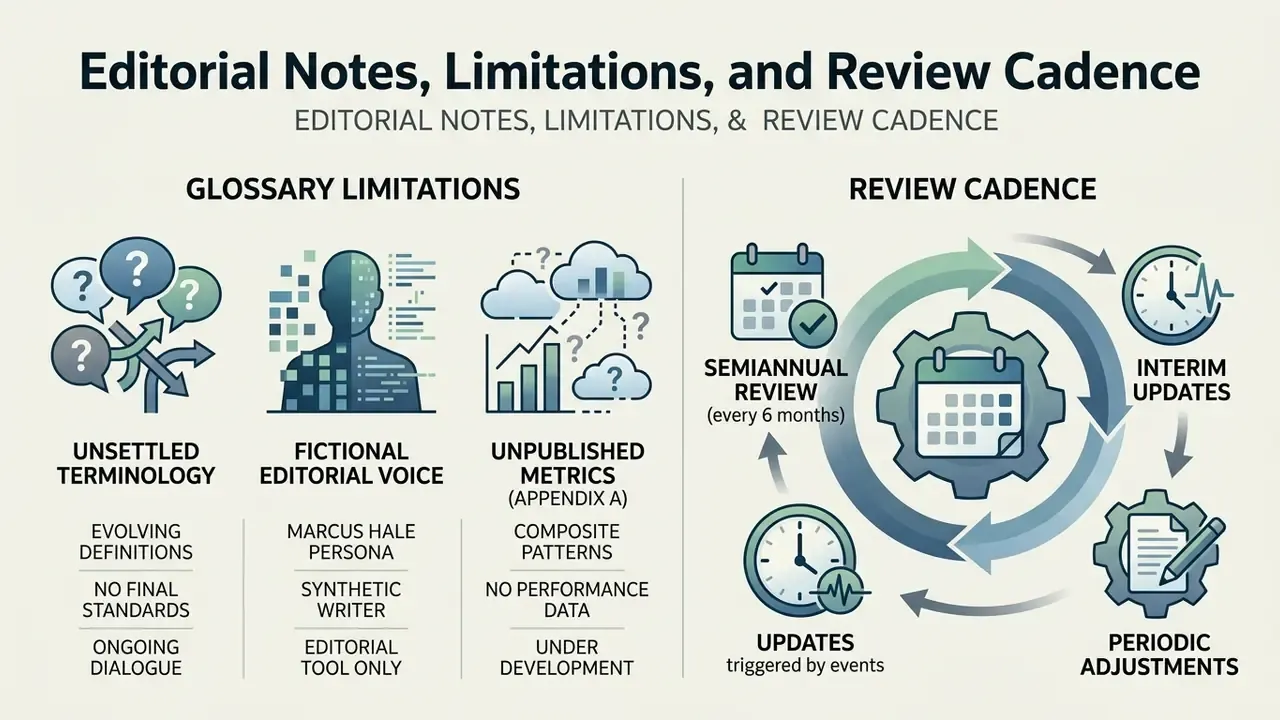
Three limitations are worth naming, because a glossary that hides them is less useful than one that does not.
First, terminology is unsettled. Regulators, standards bodies, and vendors use overlapping words for different things, particularly around agentic AI and autonomy. Where sources conflict, this page favors the supervisory definition over the marketing one.
Second, The author quoted in this article, Marcus Hale, author. Nothing attributed to him should be read as the position of a real institution, consultant, or regulator.
Third, the composite patterns in Appendix A carry no published metrics. Treat them as hypotheses about common failure modes until your own analytics, interviews, or audit findings confirm them.
Review cadence: this glossary is scheduled for semiannual review, with an interim update triggered by any material publication from NIST, the Federal Reserve, the OCC, the CFPB, or the European Commission. The review date appears at the top of the page.