Last updated: August 2026 · Reviewed by: Editorial Lead for AI Governance & Model Risk Management · Scope: enterprise procurement, model validation, L&D, marketing, and regulated-industry communications.
Executive Summary for Decision-Makers
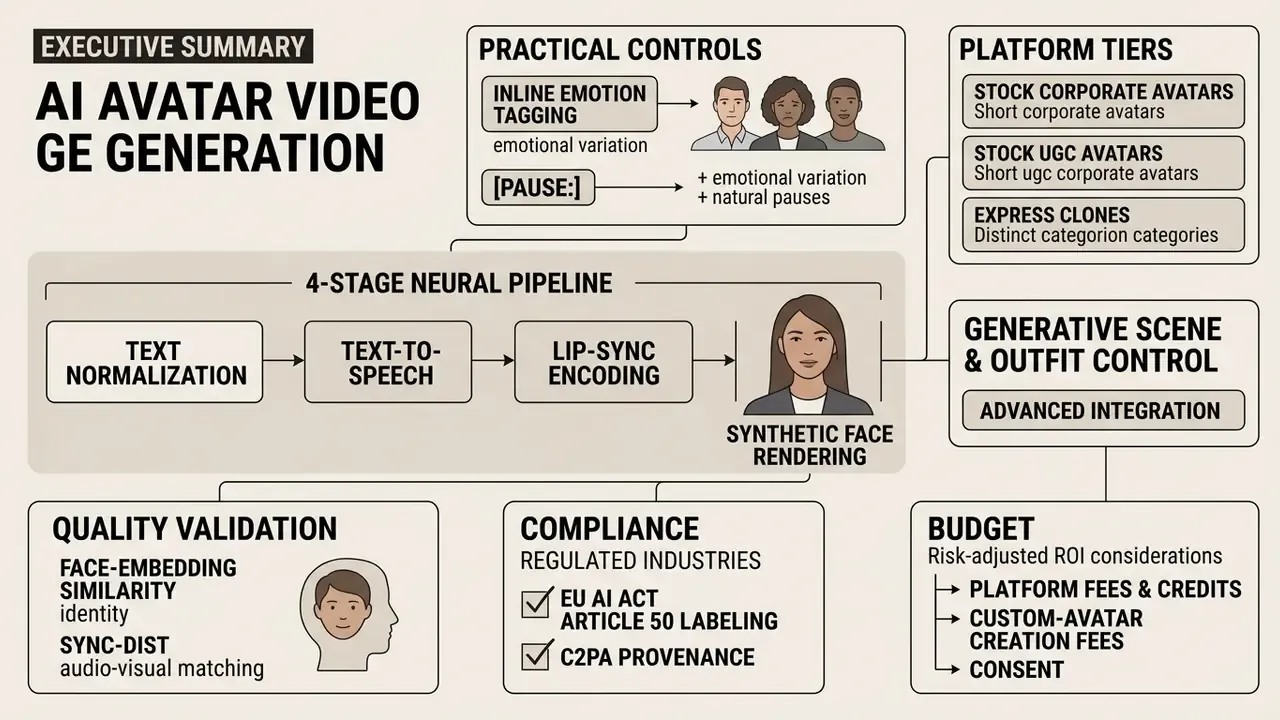
- An AI avatar video generator converts a script into video featuring a synthetic presenter through a four-stage neural pipeline: text normalization, text-to-speech, phoneme-to-viseme alignment, then frame rendering and encoding.
- The presenter market has split into five tiers: stock corporate avatars, stock UGC avatars, express clones (webcam or YouTube URL, under 5 minutes), pro custom avatars from studio footage, and fully governed digital twins.
- Next-generation platforms bolt generative scene and outfit control (for example, Google Veo 3 integration) onto the avatar renderer, replacing green-screen reshoots with natural-language prompts.
- Quality should be validated with objective metrics: face-embedding cosine similarity for identity, Sync-Dist or Sync-Conf for lip sync, DNSMOS for voice naturalness. Vendor claims of "unmatched realism" are not a test result.
- Compliance is the gating factor in regulated industries: EU AI Act Article 50 labeling, C2PA provenance plus imperceptible watermarking, SOC 2 Type II, GDPR Article 4(11) biometric consent, and model-risk documentation aligned to SR 11-7 / OCC 2011-12 expectations for third-party models.
- Budget on a risk-adjusted ROI basis: platform fees plus credits, custom-avatar creation fees, consent administration, legal review, and audit-trail storage.
- Practical output controls now include inline emotion tagging in the script (
[Emotion: Excited],[Pause: 1.5s]), which materially changes perceived authenticity without changing the avatar.
One caveat before the detail. Most published effectiveness data comes from education and workplace-learning settings, not from regulated client communications. Treat the transfer as a working hypothesis.
What Is an AI Avatar Video Generator and How Does It Work?
An ai avatar video generator is a software system that converts text scripts or audio files into video containing a synthetic human presenter using neural speech-to-video synthesis. The software aligns visual phonemes with synthesized voices to produce realistic talking head videos without manual camera recording or studio production. For a wider view of the surrounding tool category, see our reference on AI video generators.
Modern ai avatar video generation platforms replace traditional production workflows, which require cameras, lighting, actors, and manual editing, with an automated neural pipeline. Users input a script, select a visual presenter, and configure synthesized voice parameters. The platform's underlying deep learning model then generates frame-by-frame facial movements, eye blinks, head poses, and precise lip sync aligned to the generated voice narration.
The technical architecture relies on generative neural networks: generative adversarial networks (GANs), NeRF-based renderers, or diffusion transformers. These networks process text input through text-to-speech (TTS) engines to generate an audio waveform. The model then maps speech phonemes to visual visemes (mouth shapes), synthesizing photorealistic facial movements. Advanced architectures, such as the Avatar V framework (2026), condition diffusion models on full video reference sequences to preserve speaker identity and generate 1080p video of unlimited duration while holding temporal visual consistency.
«Avatar V conditions a diffusion transformer on a full reference-video token sequence via Sparse Reference Attention, generating unlimited-length 1080p video and outperforming Seedance 2.0, Kling O3 Pro, and OmniHuman 1.5 on identity preservation and lip synchronization.»
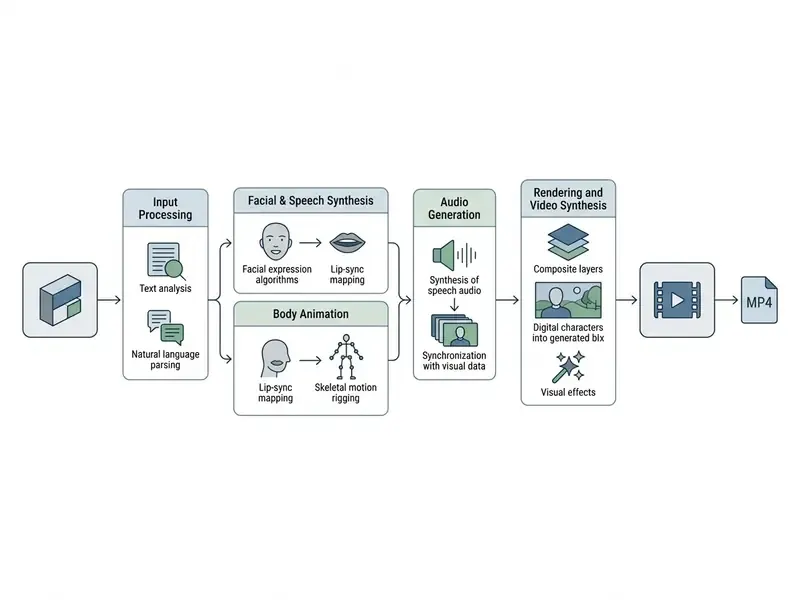
From Script and Voice to a Talking Avatar Video
Transforming a written script into a talking avatar video relies on an automated four-stage neural pipeline: text normalization, text-to-speech synthesis, phoneme-to-viseme temporal alignment, and frame rendering.
- Text normalization and TTS processing.The platform ingests text, normalizes numbers and abbreviations, and synthesizes audio using customizable ai voices. Research systems such as Ada-TTA (2023) explicitly disentangle text, timbre, and prosody before neural rendering begins.
- Phoneme-to-viseme alignment.The system breaks the generated audio into distinct acoustic phonemes. Algorithms map these sound units to corresponding visual visemes. Vendor documentation describes the same mechanic: audio is decomposed into phonemes, mapped to mouth shapes, and the face is re-rendered frame by frame.
- Facial motion generation.Neural rendering models generate frame-by-frame facial movements, head poses, and natural eye blinks. Research models such as FastLips (2024) use end-to-end networks to generate co-verbal facial movements alongside speech synthesis.
- Video encoding.The platform composites the animated presenter onto a selected background, overlays captions, and encodes the entire video into standard formats such as MP4.
This pipeline lets organizations create videos in minutes and removes the logistical bottlenecks of physical production. Teams evaluating adjacent automation should also review text-to-video AI tools, which share the same generation backbone without a human-likeness layer.
One practical observation from reviewing internal drafts: the stage that breaks most often is not rendering. It is normalization. Currency symbols, ticker codes, and regulatory acronyms get read aloud incorrectly, and nobody notices until a regional reviewer flags it.
Stock Avatars, Custom Avatars, UGC Presenters, and Digital Twins
Video platforms no longer offer three presenter tiers but five: off-the-shelf corporate stock avatars, social-native UGC stock avatars, express clones built in minutes, studio-grade custom avatars, and data-linked digital twins for verified identity applications.
| Presenter type | Source material required | Primary enterprise use cases | Governance and risk profile |
|---|---|---|---|
| Stock corporate avatars | Pre-built in the platform avatar library | Internal announcements, generic explainer content, prototype videos | Low risk; platform holds commercial usage rights |
| Stock UGC avatars | Pre-licensed social-creator presets filmed in handheld, selfie-style setups | TikTok, Instagram Reels, YouTube Shorts, UGC-style performance ads | Low risk; platform-licensed, but requires synthetic-media disclosure on social channels |
| Express custom clones | 60-second webcam recording or an existing YouTube URL plus a short selfie consent capture | Fast drafts, personal brand channels, internal test videos, high-velocity social output | Medium risk; rapid consent flows must still be logged and revocable |
| Pro custom avatars | 2 to 10 minutes of recorded studio video (1080p/4K, 25+ fps) | Scalable marketing campaigns, localized training modules, brand presenters | Medium risk; requires explicit identity consent records |
| Digital twins | High-definition multi-angle reference video, voice training samples, recorded consent statement | Executive updates, verified spokesperson communications, real-time interactions | High risk; demands strict access control, voice cloning policies, auditable consent |
Stock avatars provide immediate access to diverse presenters across age, gender, and ethnicity. A custom avatar or custom ai avatar requires uploading recorded footage of a specific individual, so the platform can train a bespoke neural representation. A digital twin is a fully calibrated digital asset that mirrors an executive's likeness and vocal timbre across languages, and it demands strict identity verification protocols.
Modern platforms split custom creation into express clones, generated in under five minutes from webcam footage or an existing video URL, and studio-grade pro digital twins, which need multi-angle high-resolution footage, longer performance takes (30 minutes of source material measurably improves fidelity on some vendors), and multi-modal consent recording. Express clones lower the barrier for solo creators and internal communicators. They also compress the consent step into a short on-screen statement, so risk teams should mandate that express-clone consent artifacts carry the same retention and revocation guarantees as studio twins. No exceptions for speed.
UGC stock avatars deserve a separate governance line. These presenters are deliberately imperfect: handheld framing, informal cadence, domestic backgrounds. They exist because polished corporate delivery underperforms in social feeds. From a compliance standpoint, though, they are the highest-exposure class for consumer-deception claims, because their whole visual grammar signals "a real person filmed this on their phone." Disclosure labeling is non-negotiable for this tier.
Vendor-neutral framing helps here too. In formal standards, the distinction between avatars and digital twins turns on whether measurable correspondence to a real-world entity, traceable source data, and lifecycle validation are required. Stock and UGC presenters are appearance models. Executive digital twins behave, for governance purposes, like identity-linked assets, closer in character to a credential than to a graphic.
Define Requirements Before Choosing an AI Avatar Video Platform
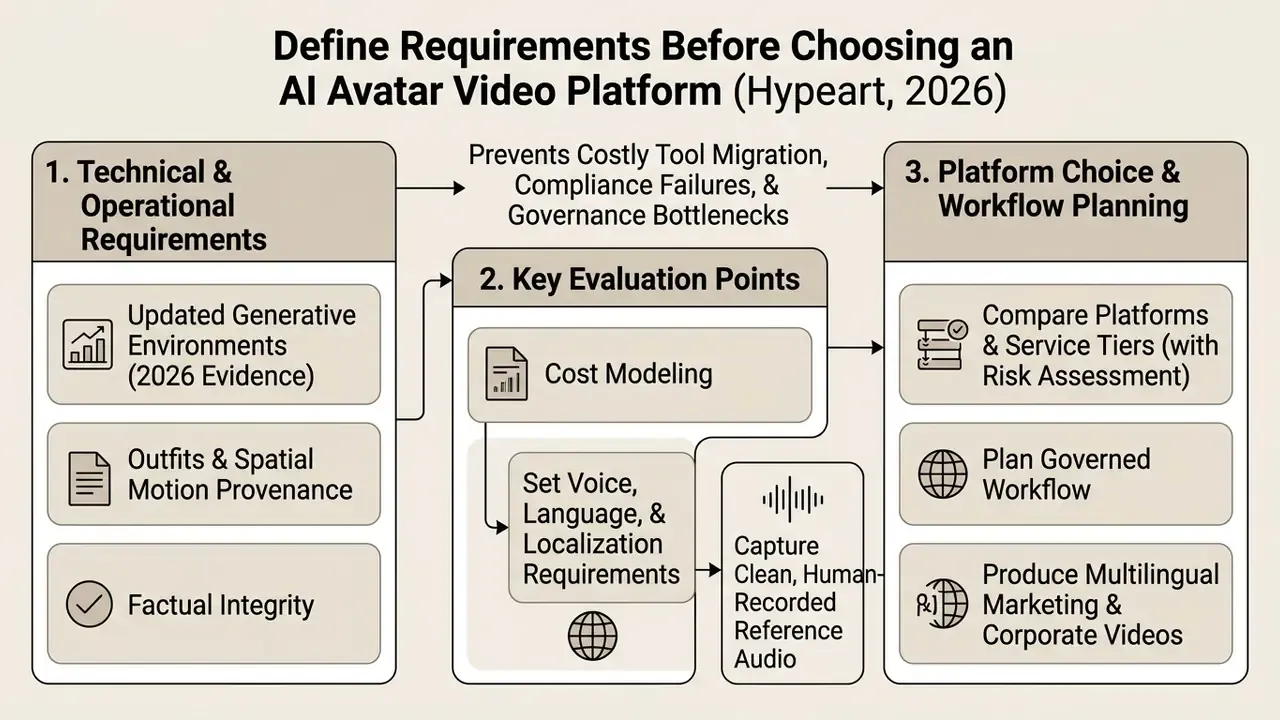
Setting technical and operational requirements before platform evaluation prevents costly tool migration, compliance failures, and governance bottlenecks. Enterprise teams must align avatar fidelity, voice cloning capability, localization targets, and export standards with institutional risk appetite and audience expectations.
Before selecting an ai avatar video creation platform or ai avatar video generation platform, audit your content goals. Requirements differ sharply between internal compliance training, public marketing launches, and interactive customer support. Clear functional criteria also keep the chosen platform compatible with existing Learning Management Systems (LMS), Content Management Systems (CMS), and corporate governance frameworks.
A requirements-first approach is the accepted method in AI systems engineering. Describe the complete set of expected operating situations in operational terms first, then translate them into functional and technical design requirements. For video specifically, accessibility obligations differ by content class: video with audio requires captions and, where needed, audio description; audio-only assets require transcripts; live streams require live captions. These are requirement inputs, not post-production afterthoughts, and they decide which tariff tier is actually viable.
Three questions save weeks of evaluation time. Who owns the published asset if the presenter leaves the company? Which team pays for re-rendering when a regulation changes? And who can technically create a new twin at 2 a.m. without a ticket? If any answer is "unclear," the platform choice is premature.
Match Avatar Realism and Style to the Video Format
«A randomized experiment with 90 students found AI avatars delivered visual attention comparable to human instructors, achieved higher declarative-knowledge learning outcomes, and produced lower perceived social presence.»
In step-by-step procedural training, however, the presence of any visual presenter increased viewer cognitive load. That suggests streamlined visuals or voice-first narration can be superior for technical instruction. Independent workplace research points the same way: a study of 500 adult learners found no significant difference in engagement or retention between an AI-avatar video and a human-instructor video, with viewers completing the AI version roughly 20% faster.
For public-facing marketing training and product demos, photorealistic presenters (realistic ai avatars) reinforce brand authority. For informal internal updates or short social media content, stylized 3D or semi-realistic digital presenter styles cut production costs while avoiding uncanny-valley distraction. Documented educational interventions usually select a neutral, professional appearance rather than maximal likeness, which suggests restraint is the safer default for instructional formats.
When photorealism is not required, or when brand guidelines dictate a stylized aesthetic, teams use generative avatar builders. These engines synthesize 2D line-art, editorial-portrait, 3D claymation, glossy 3D, comic, flat-geometric, or anime-style presenters from text prompts or reference illustrations. A named character can then be paired with a voice from the platform's library and reused across a video series in every supported language. Stylized characters bypass the uncanny valley entirely, which makes them a good fit for gamified employee onboarding, children's educational modules, brand mascots, and any scenario where a photoreal human would imply false personal testimony. Standard content moderation and disclosure rules still apply to stylized characters. Teams building fully illustrated sequences should also review our guide to animation makers.
Generative Environments, Outfits, and Spatial Motion
Next-generation platforms integrate spatial video models, such as Google Veo 3, directly into the avatar renderer. Creators can modify presenter attire, from corporate suits to high-visibility safety gear, hard hats, safety glasses, lanyards, or branded uniforms in company colors, and generate dynamic background environments through natural-language prompts. Green-screen post-production and manual graphic layering largely disappear.
In practice this collapses three former line items into one prompt: wardrobe, location scouting, and compositing. A safety-training module that previously required a shoot at an industrial site can be produced by prompting the same licensed presenter into a plant environment wearing compliant PPE, then applying the corporate brand kit so logos and colors propagate across every scene. Vendors also expose prompt-driven on-screen action control, so the presenter can walk, gesture toward an object, or turn to a product while lip sync stays locked to the script.
Three procurement cautions apply:
- Provenance. Generative backgrounds inherit the same Article 50 labeling duty as the avatar itself. Multimodal outputs require synchronized marking across video, audio, and text layers.
- Factual integrity. Prompting a presenter into PPE or a laboratory implies an operational context. In regulated communications that can constitute an implied claim, and it should pass the same review as the script.
- Cost modeling. Scene generation is usually metered separately from avatar rendering. Teams integrating at the model layer should read our Google Veo implementation guide for API-level cost and quota mechanics.
Worth flagging: because these scenes are fully synthetic, reviewers can no longer rely on "does this look like a real place" as a sanity check. If your organization cares about that, see our note on how to identify AI-generated visual assets and build the check into review rather than instinct.
Set Voice, Language, and Localization Requirements
Multi-market video deployment requires platforms with cross-lingual voice cloning and localized speech synthesis, so brand voice identity survives translation.
Enterprise localization needs more than text translation. Teams building a shared narration layer across formats should review our reference on AI voice generators. Advanced ai voice cloning models preserve the original speaker's timbre, pitch, and cadence across languages. Research on the DS2ST-LM direct speech-to-speech translation model (2026) reports that modern timbre-controlled vocoders reach speaker-similarity scores of 0.83, against 0.32 to 0.43 in legacy systems, and DNSMOS naturalness ratings of 3.54, approaching human reference audio at 3.86.
«DS2ST-LM combines a Whisper encoder, a projection module, a Qwen2-0.5B language model, and a timbre-controlled vocoder, reaching 0.83 speaker similarity versus 0.32-0.43 for competing systems across seven language pairs.»
Operational localization requirements documented by cross-lingual voice-cloning practitioners are stricter than most teams expect:
- Store language and region separately from the voice ID, use full locale tags, and define pronunciation fallbacks before launch. Track quality by locale, not by language.
- Ensure consent covers the planned languages, markets, channels, use cases, storage, sublicensing, and revocation terms.
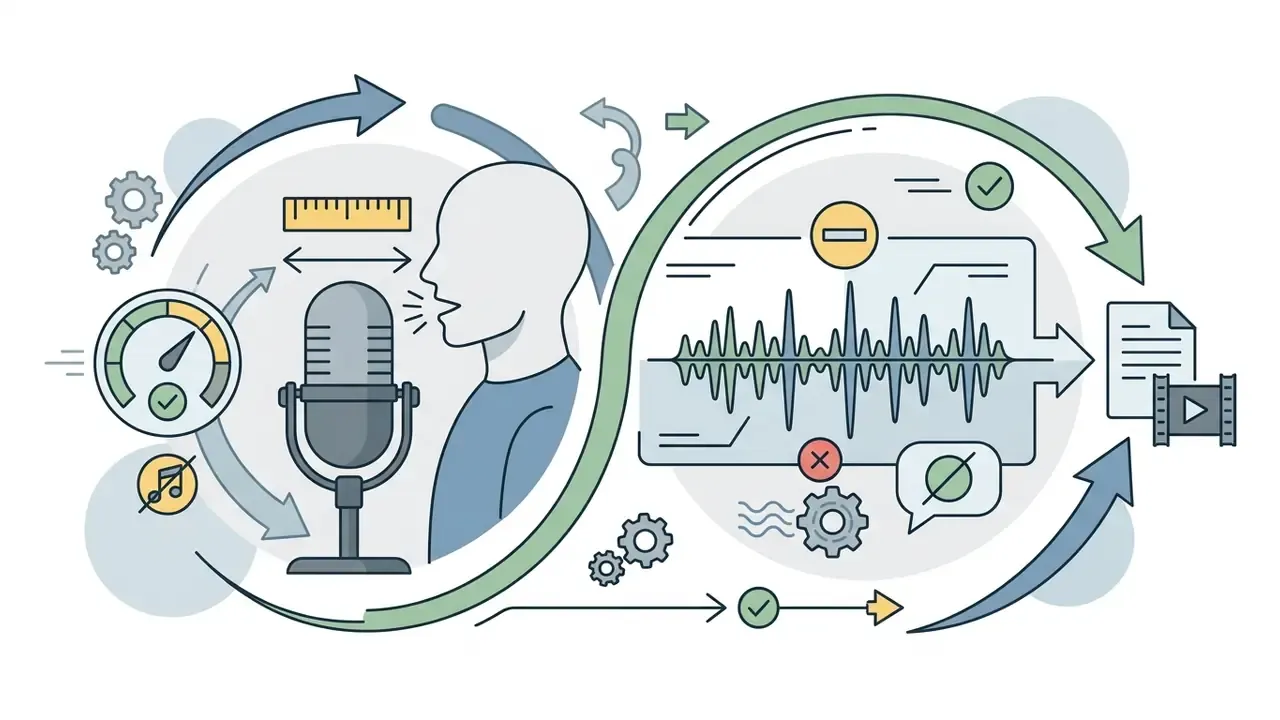
«Consent must cover planned languages, markets, channels, use cases, storage, sublicensing, and revocation terms.»
Automatic dubbing research describes the pipeline as ASR or transcription, then translation, then voice cloning or TTS synthesis, then time alignment back to picture. It evaluates identity similarity, pronunciation, intelligibility, naturalness, latency, and consistency as separate scores (IWSLT proceedings, 2024-2026, https://aclanthology.org/2024.iwslt-1.2.pdf). A 2025 survey of voice cloning frames the core challenge as preserving cross-lingual speaker identity across monolingual, multilingual, few-shot, and zero-shot regimes (arXiv, 2025, https://arxiv.org/pdf/2505.00579).
When evaluating localization features, verify:
- Support for multiple languages and regional dialects, including a real distinction between US, UK, and Australian English.
- Automatic visual re-alignment, so the avatar's lip sync adapts to target-language visemes rather than keeping the source mouth shapes.
- Locale-aware voice storage and explicit fallback options for unmapped pronunciation dictionaries.
- Per-locale QA sampling, because aggregate "160+ languages" claims conceal wide quality variance across low-resource locales.
How to Compare AI Avatar Video Generator Platforms
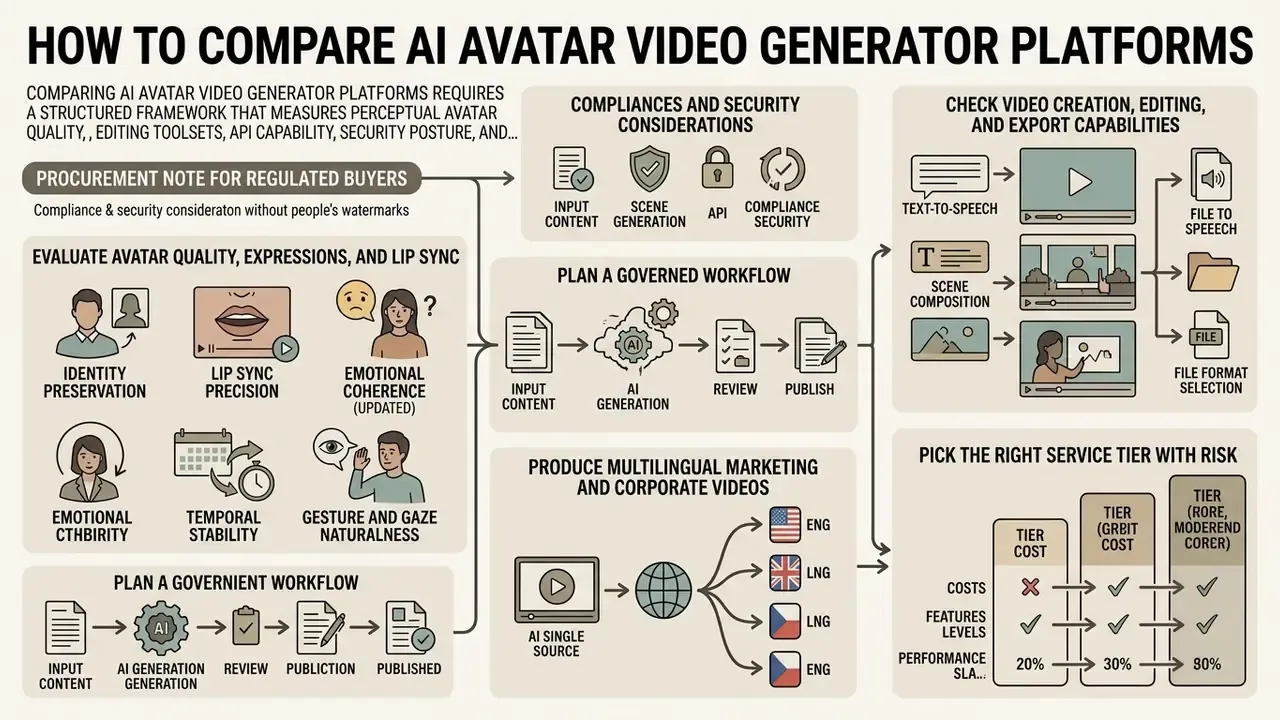
Comparing ai avatar video generator platforms requires a structured framework that measures perceptual avatar quality, editing toolsets, API capability, security posture, and scaling efficiency against enterprise control standards.
To evaluate ai avatar video generator software and ai avatar video creation software, procurement teams should analyze functional capability, security posture, and rendering performance together. Buyers running a parallel shortlist can cross-reference our comparison of leading AI video generators.
A defensible methodology uses three axes: perceptual quality, feature coverage, and scalability. Score each on a fixed scale, with at least two blinded reviewers, as published avatar benchmarks do. Avatar V (2026) rates generated clips on six perceptual dimensions: identity consistency, lip-sync accuracy, motion naturalness, motion consistency, artifact control, and visual quality. Generic video benchmarks such as VBench (CVPR 2024) supply the appearance-consistency and temporal-quality layer, while talking-head frameworks add paired comparison against reference footage. A 2025 survey of AI-generated video evaluation reduces the requirement to two criteria: alignment with human perception and alignment with human instructions. In plain language, does it look right, and does it do what the brief said.
Enterprise evaluation matrix for AI avatar video creation platforms
| Platform | Avatar library and custom options | Lip sync and visual realism | Generative scenes / outfits | Language and voice capability | Editing and captioning tools | API and enterprise scaling | Security, compliance, data retention |
|---|---|---|---|---|---|---|---|
| HeyGen | 1,100+ stock avatars including stock UGC presets; custom avatars from studio footage; photo-based avatar creation | Phoneme-level lip sync; high facial expression detail; emotion presets (Original, Excited, Broadcaster, Angry) | Prompt-driven scene and background variation; image-to-video avatar animation | 177+ languages and dialects; voice cloning; Voice Director and Voice Mirroring controls | Built-in Web Studio; auto-generated avatars captions; caption objects exposed via API | REST API for automated batch rendering and template integration; credit-metered enterprise billing | States SOC 2 Type 2, GDPR, CCPA, DPF and EU AI Act alignment; explicit consent required for any likeness; active content moderation policy |
| Synthesia | 240+ enterprise stock avatars; personal avatars from a single photo or video; Avatar Builder for prompt-generated realistic and stylized characters | High temporal visual consistency; expressive avatars with script-synced body language; multi-style rendering | Prompt-to-scene and outfit changes powered by Veo 3; brand-kit asset injection across scenes | 160+ languages; 1,000+ voices; multiple emotional voice styles; voice cloning from a recorded sample | Core timeline editor; slide, PDF and URL-to-video conversion; animations, captions, interactivity | Enterprise workspace controls, SSO, LMS integrations, workspace-level avatar and voice sharing | SOC 2 and GDPR compliance stated; dedicated Trust & Safety team; human plus AI content moderation; live consent video required, no third-party consent uploads |
| Colossyan | 300+ stock presenters; tailored workplace avatars; custom avatar creation | Natural conversational lip sync; tuned for learning modules | Scene templates and background libraries; limited generative scene control | 100+ languages; auto-translation features | Built-in video editor; automated subtitle generation; branching interactive learning | SCORM export support; API access for corporate training workflows | Enterprise plans with workspace roles; verify DPA, data residency, and biometric deletion terms at contract stage |
| D-ID | Specialized in photo-to-talking-head animation; head-only photo avatars | Fast single-photo visual synthesis; lightweight head movement | Background replacement; no full generative scene engine | Wide language support via integrated TTS engines | Basic web studio editing interface | Robust real-time streaming API for interactive applications | Enterprise agreements available; confirm streaming-session data retention and consent verification for uploaded faces |
| Elai.io | Stock catalog; custom presenter cloning capability | Standard audio-driven facial alignment | Template-based scene composition | 75+ supported languages for automated dubbing | Text-to-video scene editor; automated script generation | Template-based scaling and API access | Publicly verifiable enterprise security documentation is limited; request the SOC 2 report and a DPA before procurement |
| invideo (Express / Pro Avatars) | AI actor library plus "AI Twins": express clones from a 60-second webcam clip or a YouTube URL, and Pro Avatars from 30+ minutes of footage | Express tier prioritizes speed; Pro tier improves fidelity as source footage increases | Multiple presenter setups require new footage per setup | 50+ languages and tones | Full studio editor; social-format presets | Template scaling for UGC ad variants and product ads | On-screen recorded consent required before twin creation; validate commercial-use terms for YouTube-sourced footage rights |
Procurement note for regulated buyers. Where an avatar platform is treated as a third-party model, banks and insurers should map the vendor into their model-risk inventory and document intended use, limitations, monitoring, and human review in line with supervisory expectations for model risk management (SR 11-7 / OCC 2011-12). Also request SSO and SCIM support, audit-log export, configurable data residency or private-VPC deployment, biometric-template deletion SLAs, and written confirmation that likeness and voice models are not used for vendor model training.
A short reality check on the matrix. Language counts and avatar counts are the easiest numbers for a vendor to grow and the least predictive of production quality. Treat them as inventory, not as evidence.
Evaluate Avatar Quality, Expressions, and Lip Sync
Evaluating avatar realism means measuring objective dimensions: face-recognition cosine similarity for identity preservation, audio-visual distance metrics for lip sync, emotional facial coherence, and temporal frame stability. This subsection is the acceptance-testing layer beneath the vendor matrix above. The table tells you what a platform claims. These metrics tell you what it delivers on your own scripts.
- Identity preservation.Measured with face-recognition embeddings, such as cosine similarity between source and rendered frames, to confirm the avatar does not drift visually across long videos.
- Lip sync precision.Evaluated with Landmarking Distance or Sync-Dist metrics, verifying that visemes match synthesized phonemes without visual jitter.
«Lip synchronization is defined as the correspondence of mouth movements to speech at phonetic and semantic levels; quality is measured by the distance between audio and visual speech embeddings η_a(·) and η_v(·).»
Practitioner note: Sync-Conf and LSE variants are also common. A 2024 speech-driven avatar study rated output with 23 participants on expressiveness, emotion coherence, global realism, and lip synchronization, which is a workable template for a small internal acceptance panel.
- Emotional coherence (updated). Advanced platforms integrate emotion-aware architectures that infer affect from the audio track rather than from explicit labels alone.
«MSEF+AATU extracts implicit emotional features from audio, concatenates them with MFCCs and facial landmarks, and generates photorealistic talking-head frames, significantly outperforming prior methods on the MEAD dataset.»
Comparative VR research (2023) found facial tracking outperformed lip-sync approximation for conveying sadness, disgust, fear, and happiness, with no measurable difference for anger and surprise. Useful context when judging whether an emotion feature is genuinely expressive or just pitch modulation.
- Temporal stability. Assess the absence of background flickering, edge tearing, and unnatural head movement during long exports.
- Gesture and gaze naturalness. Score body motion, head motion, and gaze separately from mouth articulation. Talking-agent studies isolate these dimensions precisely because a high lip-sync score can coexist with mechanical, repetitive body language.
Set thresholds before the pilot, not after. Otherwise the acceptance decision drifts toward whoever is most enthusiastic in the review meeting.
Check Video Creation, Editing, and Export Capabilities
Production efficiency depends on platform support for timeline editing, automated aspect-ratio reframing, subtitle burn-in, and sidecar file exports.
Modern video teams need integrated video editing inside the generation platform; our reference on video-editing tools covers the baseline feature set to expect. That removes the round trip into external post-production. Key functions include:
- Multi-track timeline assembly, combining avatar footage with screen recordings, slides, and background music.
- One-click canvas resizing, adapting landscape 16:9 into vertical 9:16 for social channels, 1:1 for corporate feeds, and 4:5 for feed-optimized placements.
- Automated subtitle generation with editable closed captions, exporting sidecar files in SRT, VTT, or TTML for accessibility compliance (WCAG 2.1), plus burned-in MP4 export where the destination platform strips sidecars.
- Editor-integration exports, for example FCPXML or AVID markers, where the avatar clip is one element inside a larger edit.
- Delivery-side compression control, since 1080p avatar masters are frequently re-encoded for LMS hosting; see our reference on video compressors.
For further technical evaluation of automated media tools, review our AI Media Comparison Matrices.
AI Avatar Video Creation Workflow: From Brief to Published Video
A standardized ai avatar video creation workflow runs through six stages: brief preparation, script structuring, avatar and voice selection, neural generation, compliance and audit logging, then post-production editing and export. The point is reproducible output without manual filming.
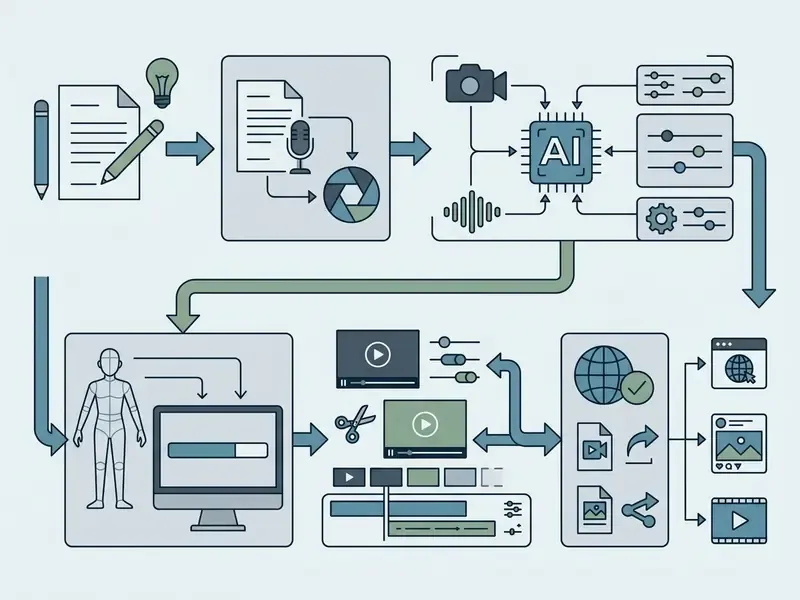
Specialized ai avatar video creation apps shorten content delivery cycles. A structured procedure prevents costly re-renders and secures brand alignment before publishing. Vendor documentation converges on the same shape: prompt or script, avatar selection or capture, rendering, review, publish. Capture specifications differ by vendor, from short reference clips for some engines to multi-take performance plus a separate consent video for studio-grade twins.
Prepare the Script, Message, and Visual Style
Authoring scripts for synthetic presenters means structuring the message into explicit visual and audio prompt parameters, so pacing feels natural and instruction stays clear.
Effective scriptwriting for AI avatars differs from traditional copy. Writers should build in explicit pacing cues, phonetic spelling for specialized technical terms, and structured narrative breaks. Published prompt guidance recommends sequencing the message as goal, audience, style, pacing, shots, transitions, sound, and defining visual style through lighting, tone or mood, artistic style, and ambiance.
Prompt engineering frameworks recommend defining six script elements:
The last element is where most teams leave value on the table. Platform features such as Voice Director and Voice Mirroring, plus emotion presets like Original, Excited, Broadcaster, and Angry, are driven by markup in the script, not by a separate "make it better" setting. A workable house style looks like this:


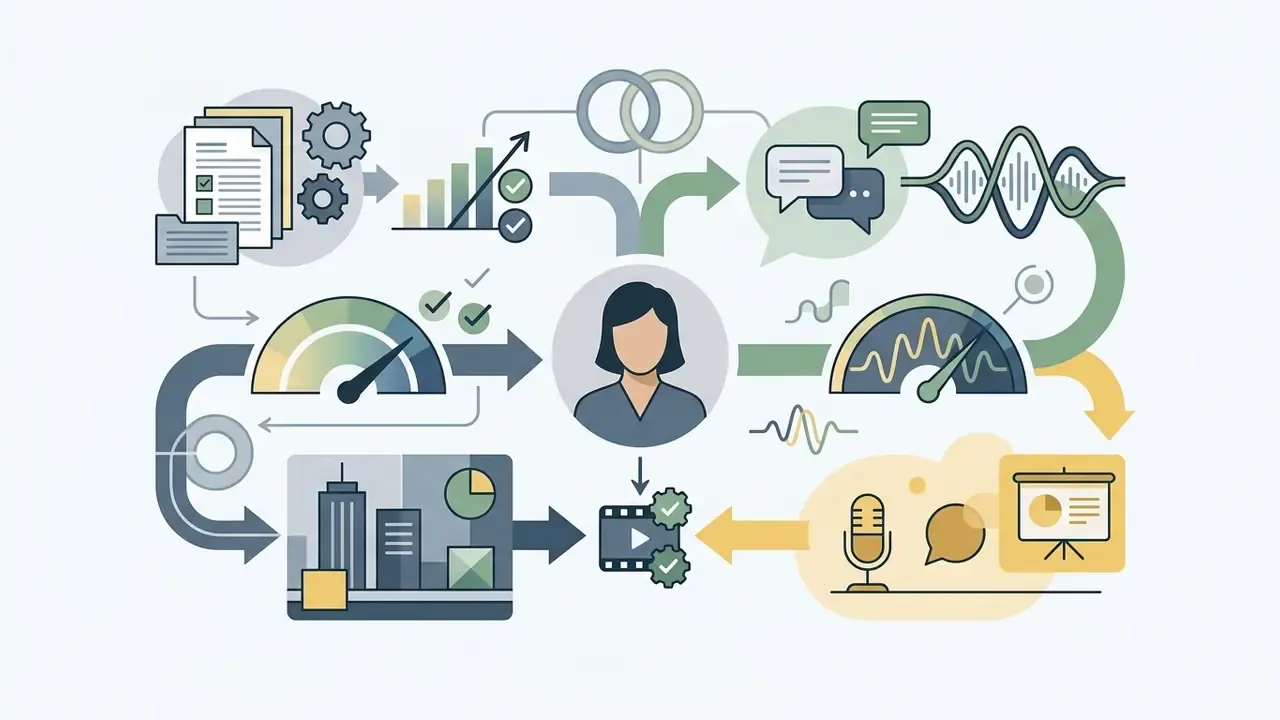

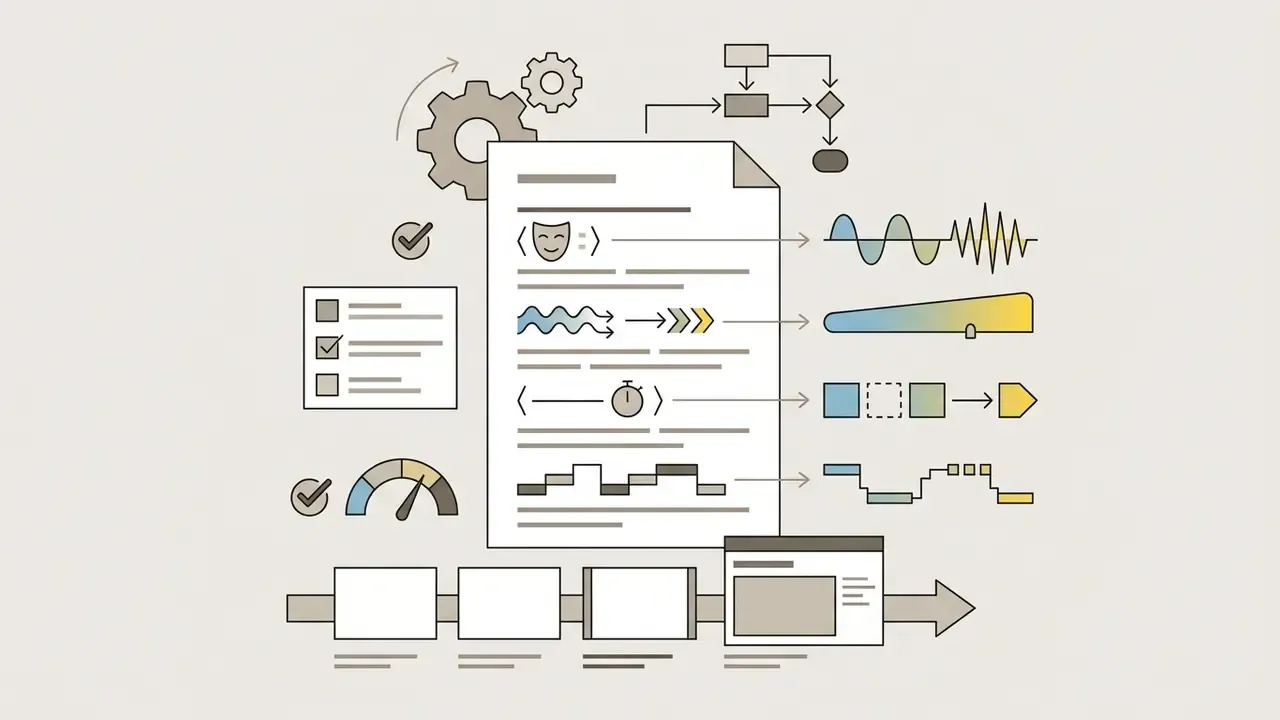
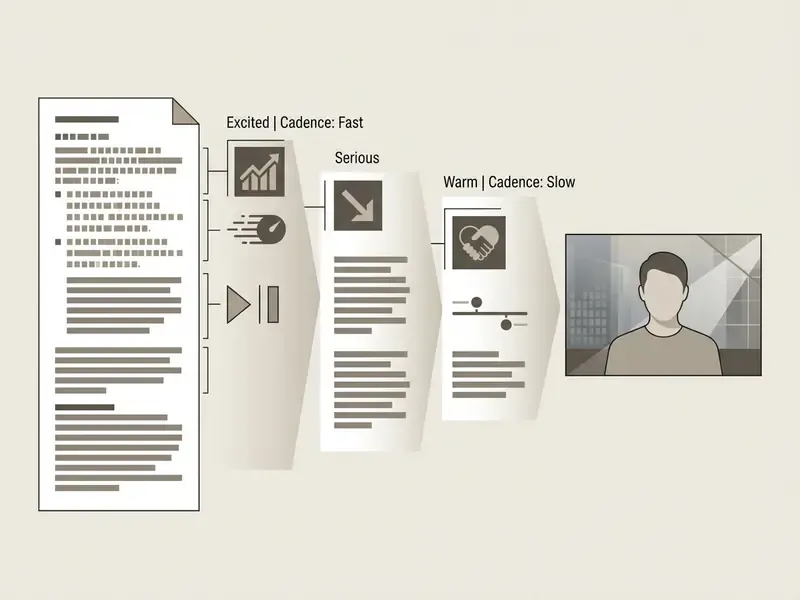
Three drafting rules make emotion tagging reliable in practice. Change emotion at paragraph boundaries rather than mid-sentence. Insert explicit pauses of 0.8 to 2.0 seconds before any numeric claim or obligation. And respell product names and acronyms phonetically on first use, so the TTS engine does not spell them letter by letter.
For additional media generation techniques, read our guide on how to generate images with chatgpt.
Choose a Preset Avatar or Create a Custom AI Avatar
Choosing between a prebuilt stock actor and a bespoke custom avatar depends on brand identity requirements and consent governance constraints.
When you choose an avatar, weigh speed against identity control:
- Preset stock avatars. Ideal for immediate deployment. Select a pre-licensed presenter from the catalog and skip video capture entirely.
- Stock UGC presenters. Use when the destination is a social feed and the required register is informal and creator-native rather than corporate.
- Express clones. Created in minutes from a 60-second webcam recording or an existing video URL, followed by an on-screen consent capture. Fine for internal drafts, personal channels, and rapid iteration. Not appropriate for regulated customer-facing claims until a governed twin exists.
- Custom AI avatars. Required when a company spokesperson, executive, or professional instructor must deliver the message. Creating one involves recording 3 to 10 minutes of high-definition video (1080p/4K at 25+ fps), reading a standardized consent script under uniform studio lighting. Some enterprise pipelines fine-tune on roughly 10 minutes of footage and require MP4 or MOV input at 1920×1080 or higher and at least 25 fps. Longer source footage generally improves fidelity.
A typical studio capture sequence: three performance takes plus one separate consent video, then upload of the best takes for processing. To create avatar assets from static images, see our resource on how to make a video from a photo and our reference on image-to-video AI tools. Teams producing executive still assets alongside avatars may also find our AI headshot generator guide useful.
Run Compliance Review and Build the Audit Trail
Before any avatar video leaves the workspace, regulated organizations should complete a documented compliance gate that produces retrievable evidence, not an informal thumbs-up in a chat thread.
Minimum artifacts to capture per video:
This gate is cheap to implement and disproportionately valuable. The operational failure mode for synthetic media is not bad rendering. It is an inability to prove, months later, that a specific likeness was authorized for a specific use.
- Consent linkageconsent video ID, signer identity, permitted channels, permitted languages, expiry date, revocation route.
- Script provenancefinal approved script version, reviewer name, review date, any legal or regulatory redlines applied.
- Disclosure evidencescreenshot or metadata proof that machine-readable marking and the visible AI label are present on the published asset.
- Model and platform recordplatform name, avatar ID, voice ID, rendering engine version, generation timestamp.
- Distribution logdestination channels, publication dates, and the owner responsible for takedown if consent is withdrawn.
- Retention rulewhere artifacts are stored, for how long, and who can retrieve them for supervisory or litigation requests.
Generate, Edit, Caption, and Export the Video
Finalizing the video means initiating neural rendering, validating viseme alignment, generating editable closed captions, and exporting master files at target resolutions.
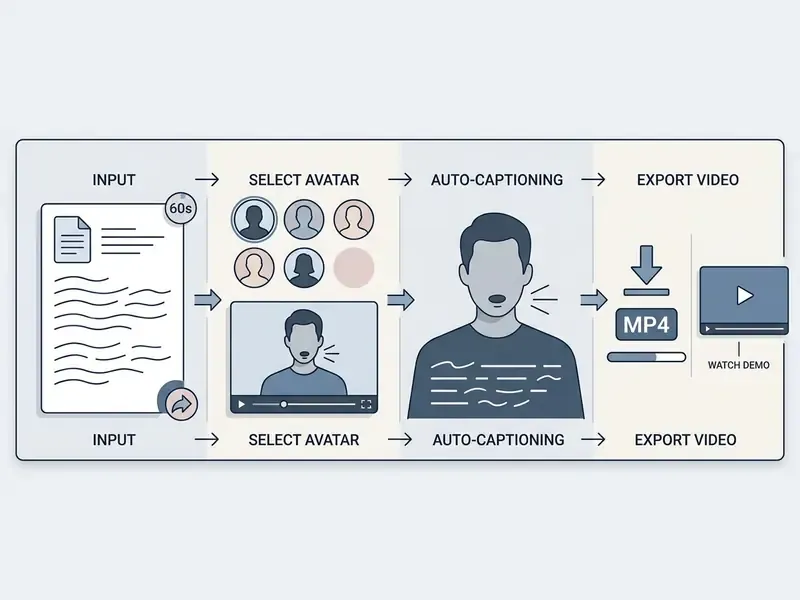
Once script and presenter assets are locked, the operator triggers video generation. Pre-generation checks recommended by vendor documentation include verifying speaker assignment, framing, tone, and constraints, then confirming lip sync, identity, framing, and gesture on a short test render before committing a full batch. After the first render, review output for lip-sync alignment and visual artifacts. Built-in subtitle tools auto-generate avatars captions from the audio track and allow manual correction of technical acronyms. Finally, export the completed file as a high quality 1080p MP4, or download subtitle sidecars (SRT/VTT) for LMS or platform integration, choosing file name, resolution, format, and quality at the export step.
Small habit that pays off: render one 15-second test per locale before batching 40 modules. It costs a few credits and catches pronunciation failures that no aggregate language count will warn you about.
AI Avatar Use Cases for Corporate, Marketing, and Video Teams
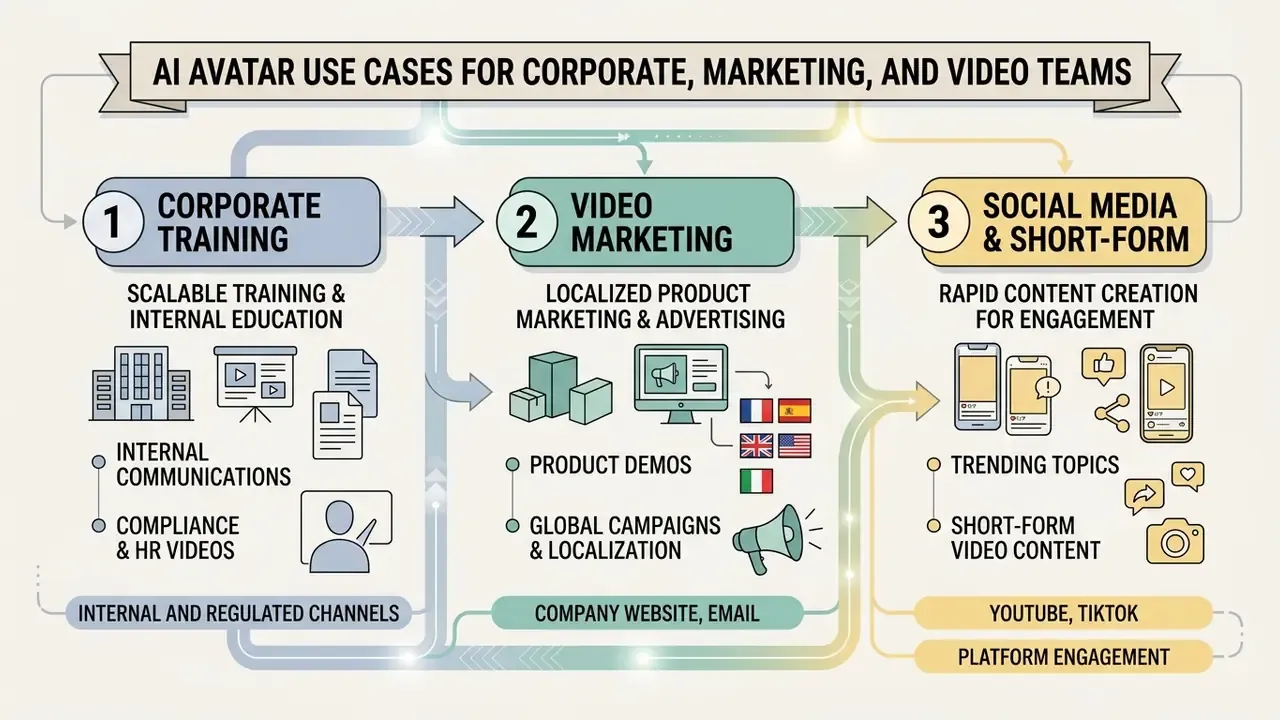
Enterprise adoption of AI video avatars concentrates in three high-ROI applications: scalable corporate training, localized product marketing, and rapid social media video production.
Using an ai avatar creator for corporate videos or an ai avatar generator for marketing videos cuts per-video production budgets and enables fast content iteration across global business units.
Corporate Training, Internal Communications, and Education Video
Organizations use AI presenters for workplace learning and internal communications to compress production cycles and update compliance modules without re-shooting footage.
"Replacing recurring studio shoots with controlled AI avatar templates reduced our regulatory compliance video update cycle from weeks to under 48 hours." - Financial Services L&D Director (illustrative composite).
In enterprise environments, training materials need frequent updates because regulatory standards keep moving. Traditional production makes re-shooting training content cost-prohibitive. With AI avatar platforms, Learning & Development teams update the text script and regenerate the training video in place.
Regulated-industry example. A retail bank maintaining AML and KYC refresher training across twelve markets faces a structural problem: typology updates and threshold changes invalidate modules faster than a shoot cycle can replace them. An avatar-based workflow decouples content from filming. The compliance team edits the script, regenerates the module in each locale with a licensed presenter, exports SCORM packages to the LMS, and files consent and script-approval artifacts against the audit trail described above. The same pattern fits operations onboarding for branch staff and wealth-management product briefings, provided the videos stay educational and do not drift into personalized, legally binding advice delivered by a synthetic presenter without human involvement.
Empirical studies support this operational shift:
- A 2025 study in the Journal of Workplace Learning tested synthetic humanlike spokespersons in employee training. It found no statistically significant difference in training effectiveness or knowledge retention between human trainers and AI avatars. It also reported no significant difference in perceived effectiveness or brand impression, while higher perceived "syntheticness" slightly reduced both. That is an argument for disclosure plus quality, not for concealment.
- Research published in Frontiers in Education (2026) showed AI-avatar-led modules improved knowledge acquisition and academic motivation without increasing cognitive load.
- A 2025 experimental evaluation reported post-test scores 5 to 6 percentage points higher with 9% less learning time, a modest effect size of g = +0.26.
- A 2026 JMIR study found substantial short-term learning gains for both AI-avatar and human-presenter videos, with no statistically significant between-group difference.
Interpretation for L&D leaders: workplace studies cluster around equivalence with human trainers, while education-focused studies report small positive effects. The practical conclusion is narrow but useful. Avatars rarely beat a great human instructor on learning outcomes. They reliably beat the realistic alternative, which is an outdated module nobody had budget to reshoot.
Marketing Videos, Product Demos, and Advertising
Marketing teams use synthetic avatars to turn whitepapers, slide decks, and product documentation into localized video walkthroughs and personalized video advertisements at scale.
Rather than relying on static email campaigns, teams convert scripts and landing pages into dynamic video presentations. Updated: according to trade press reporting, multinational media network Publicis used HeyGen to generate a reported 100,000 customized thank-you messages for employees. The figure is cited by Digiday (2024) and presented here as vendor-adjacent reporting, not independently audited data (https://digiday.com/media/marketers-balance-creepiness-and-realism-as-more-ai-generated-avatars-come-online/). The directional point holds regardless of the exact count: personalized synthetic video scales to volumes that filming cannot.
«Four experiments show virtual influencers become as effective as humans when explicitly affiliated with a brand or nonprofit; donations peak when institutional affiliation is present.»
«Digital humans perceived as more humanlike elicited stronger positive consumer responses in AR advertising when narrative fit with the product was high.» - Psychology & Marketing (2023), EEG plus behavioral measures.
Common marketing applications include:
- Automated product demos, converting technical PDFs, slide decks, scripts, and URLs into guided software walkthroughs, optionally combined with screen recordings and avatar-guided narration.
- Dynamic explainer video creation for landing pages.
- Scalable video ad variations with localized presenters speaking target consumer languages natively, and multiple creative variants generated without reshooting.
- UGC-style performance ads built on stock social presenters, tested at volume against polished corporate cuts.
Enterprise reporting from 2024 onward documents the same commercial logic. Digital presenters lowered production and editing costs while accelerating multilingual delivery across in-house communications, employee training, how-to manuals, and customer-facing marketing video (Computerworld, 2024, https://www.computerworld.com/article/1611603/the-rise-of-synthetic-media-get-ready-for-ai-avatars-at-work.html).
For teams building interactive decks, consult our workflow guide on how to make a video presentation.
Scale AI Avatar Video Generation Safely Across Teams and Languages
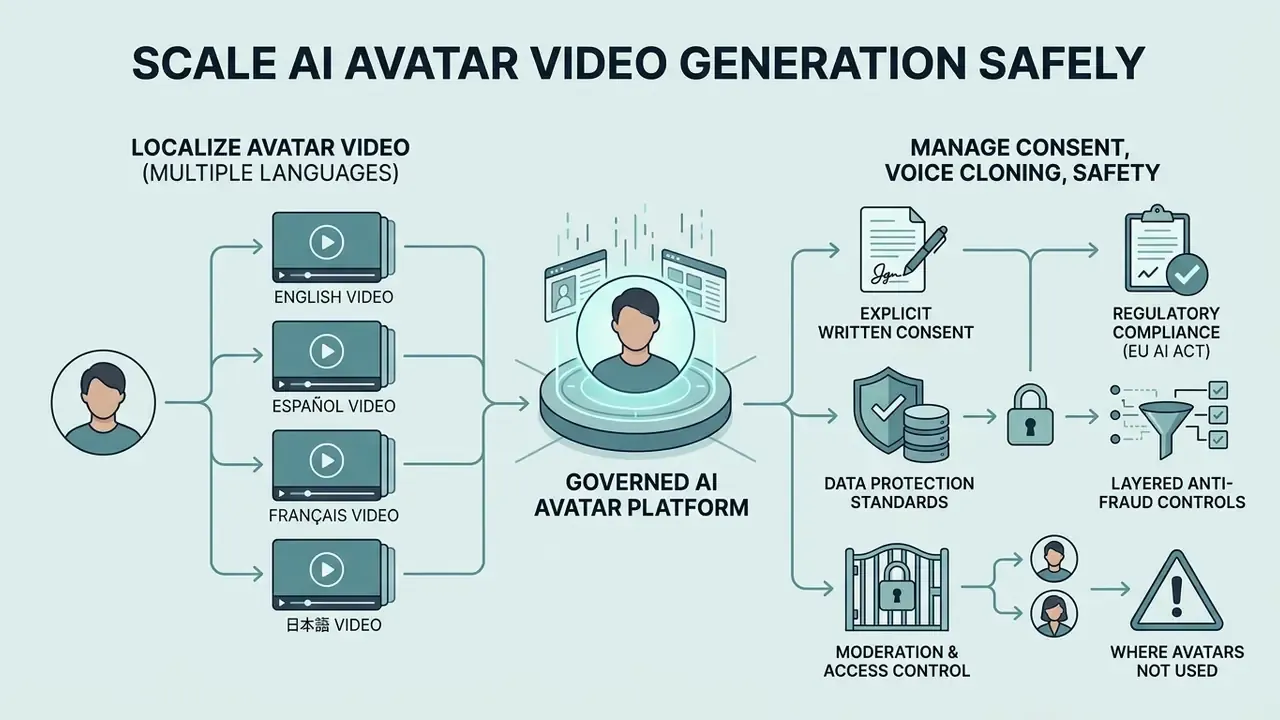
Scaling synthetic video production across global business units requires explicit consent management, strict access control for voice cloning, and automated AI labeling aligned with global regulatory mandates.
Deploying an ai avatar video generation service or ai avatar video generation software across enterprise teams introduces data privacy, copyright, and brand security considerations that need centralized oversight. Decentralized enthusiasm is how shadow AI starts.
Localize One Avatar Video for Multiple Languages
Automated localization translates source scripts into target languages using zero-shot speech-to-speech translation, then aligns new audio tracks with re-rendered visemes to preserve speaker identity.
With zero-shot translation models, such as RosettaSpeech or ElevenLabs Dubbing Studio, organizations can localize a single source video into 90+ target languages while keeping the presenter's vocal identity. The software translates the text, synthesizes cloned speech in the target language, and re-renders the avatar's lip movements to match new-language phonemes.
«RosettaSpeech reaches ASR-BLEU 25.17 for German-English and 29.86 for Spanish-English while training only on monolingual data; voice-similarity of ~0.36 exceeds CVSS dataset reference targets.»
Commercial dubbing stacks span a wide range. Adobe Firefly documents dubbing into 15+ languages while matching the original speaker's voice. ElevenLabs Dubbing Studio applies an automatic voice model of the original speaker across 90+ languages to preserve identity, pitch, and tone. Rask documents 135+ languages with optional lip sync. VEED documents original-voice cloning plus optional lip sync in the same workflow. Multilingual scaling under EU rules adds one non-obvious requirement: multimodal outputs need synchronized marking across video, audio, and text, and the visible "AI" label may need to appear in the national language where English conflicts with local language-law rules.
Manage Consent, Voice Cloning, and Content Safety
Disclaimer: this section is general in nature and does not replace consultation with a qualified legal or compliance professional. Regulatory requirements change frequently and vary by jurisdiction.
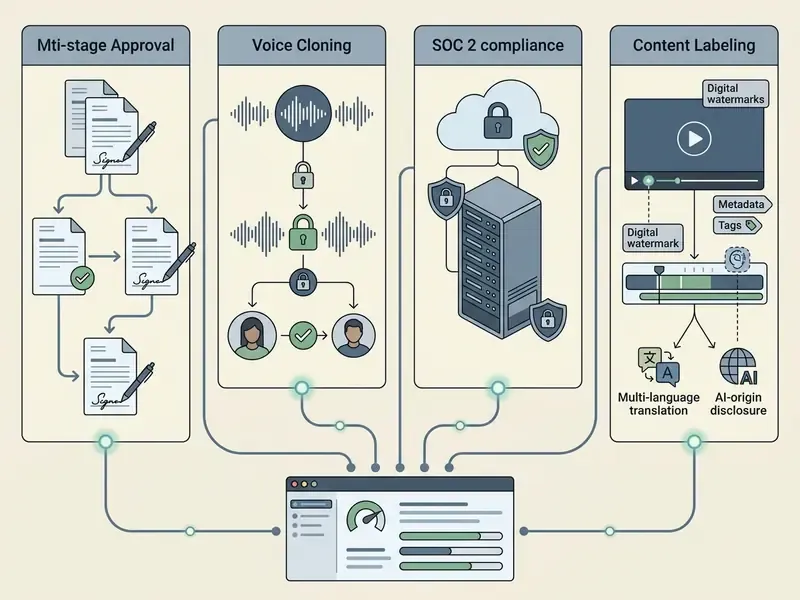
Mitigating reputational and legal risk from voice cloning and synthetic likenesses requires explicit written consent records, encrypted biometric storage, and automated moderation filters.
To prevent unauthorized deepfakes and identity theft, robust enterprise platforms implement layered safety mechanisms:
- Explicit written consent.Platforms require verified video recordings of real individuals consenting to digital twin creation and specifying allowed usage channels. Leading vendors prohibit uploading a pre-recorded consent clip on someone else's behalf, and require that the person in the consent video be the same individual shown in the avatar footage. Deepfake-specific government guidance goes further: consent should be explicit and written, and consent records should be encrypted, backed up, auditable, and retrievable for legal verification (SDAIA Deepfakes Guidelines, 2026).
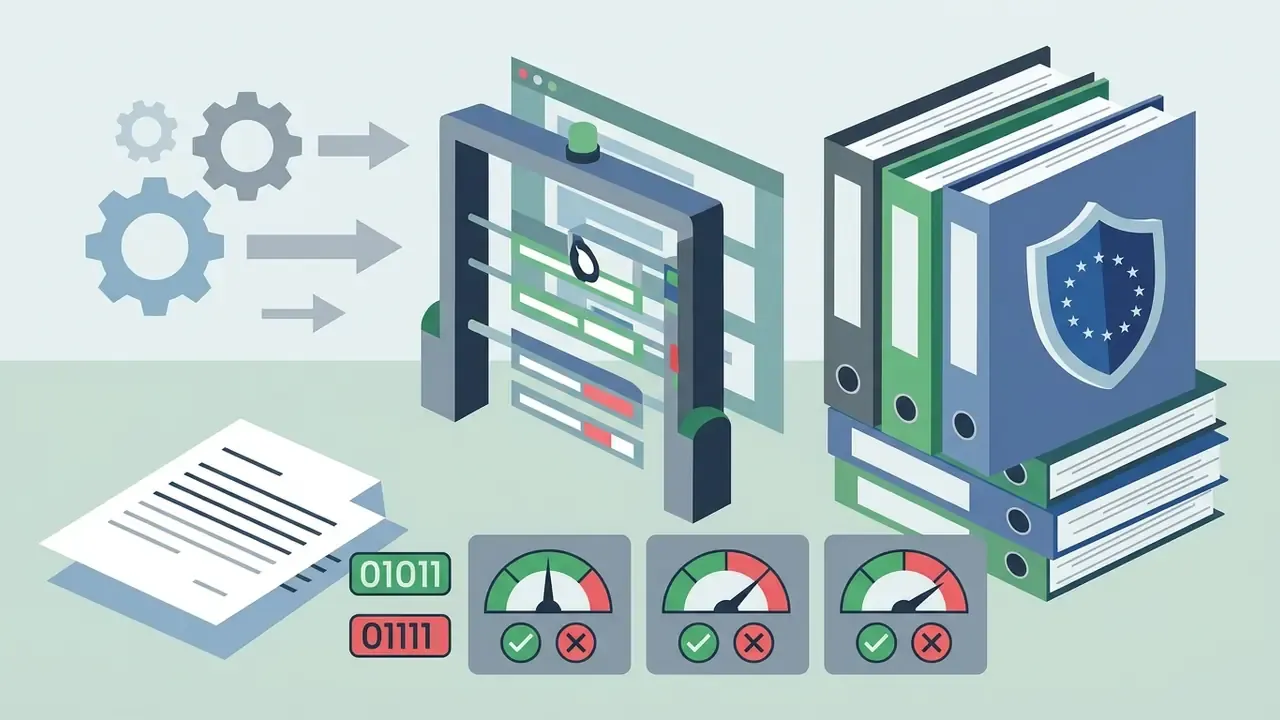
- Regulatory compliance (EU AI Act).Article 50 mandates that synthetic video outputs carry robust, interoperable machine-readable tags and visible labels informing viewers of artificial generation. The associated code of practice specifies provenance via metadata plus imperceptible watermarking for image, video, and audio, precisely because metadata is frequently stripped during copying, reformatting, or re-uploading.
«Newly emerging deepfakes created by neural rendering from scratch lack the artifacts that detectors rely on, making provenance and watermarking more dependable than post-hoc detection.»

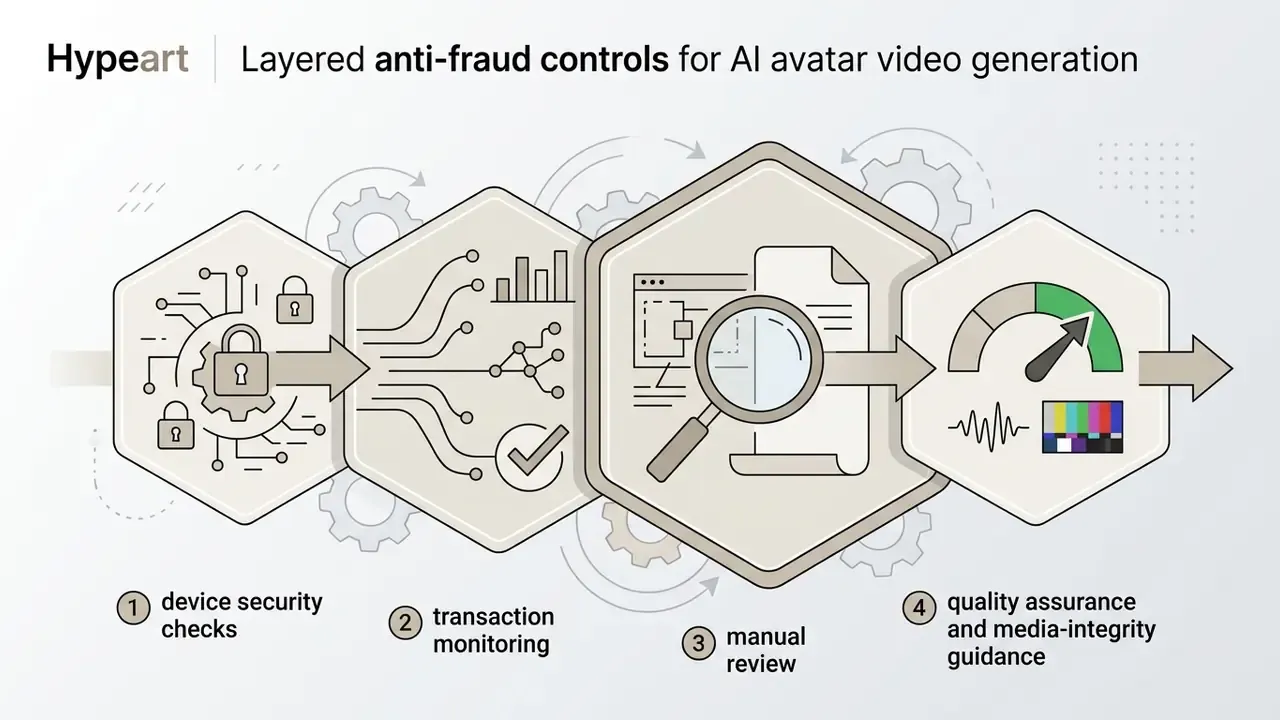
Where avatars should not be used. Current practice in regulated sectors excludes synthetic presenters from legally binding client advice delivered without human involvement, individualized suitability or creditworthiness decisions communicated as if by a human adviser, identity-verification flows where a synthetic face could be replayed, and any content where the presenter's implied first-hand experience is material to the claim. These are boundary conditions, not soft preferences.
Assign Ownership: Who Approves, Who Can Shut It Down
Scaling fails on ownership more often than on technology. A digital presenter behaves, operationally, like a digital worker: it has an owner, an approved role, access limits, an escalation path, an audit trail, and a shutdown mechanism. If any of those six are missing, the program is not ready for volume.
A workable ownership split for a mid-size bank looks like this. Marketing or L&D owns content quality and channel fit. Compliance owns script approval and disclosure. Model risk owns registration, acceptance thresholds, and revalidation. Information security owns access, residency, and biometric retention. One named executive owns the kill switch, meaning the authority to suspend all twin creation and publication within one business day.
Escalation triggers should be written down in advance: a consent withdrawal, an impersonation report, a vendor model upgrade that changes output behavior, or a localized script that misstates a regulated term. Each trigger gets an owner and a response window. That single page does more for audit readiness than any platform feature.
Pricing, Risk-Adjusted ROI, and Commercial Evaluation of AI Avatar Video Creation Services
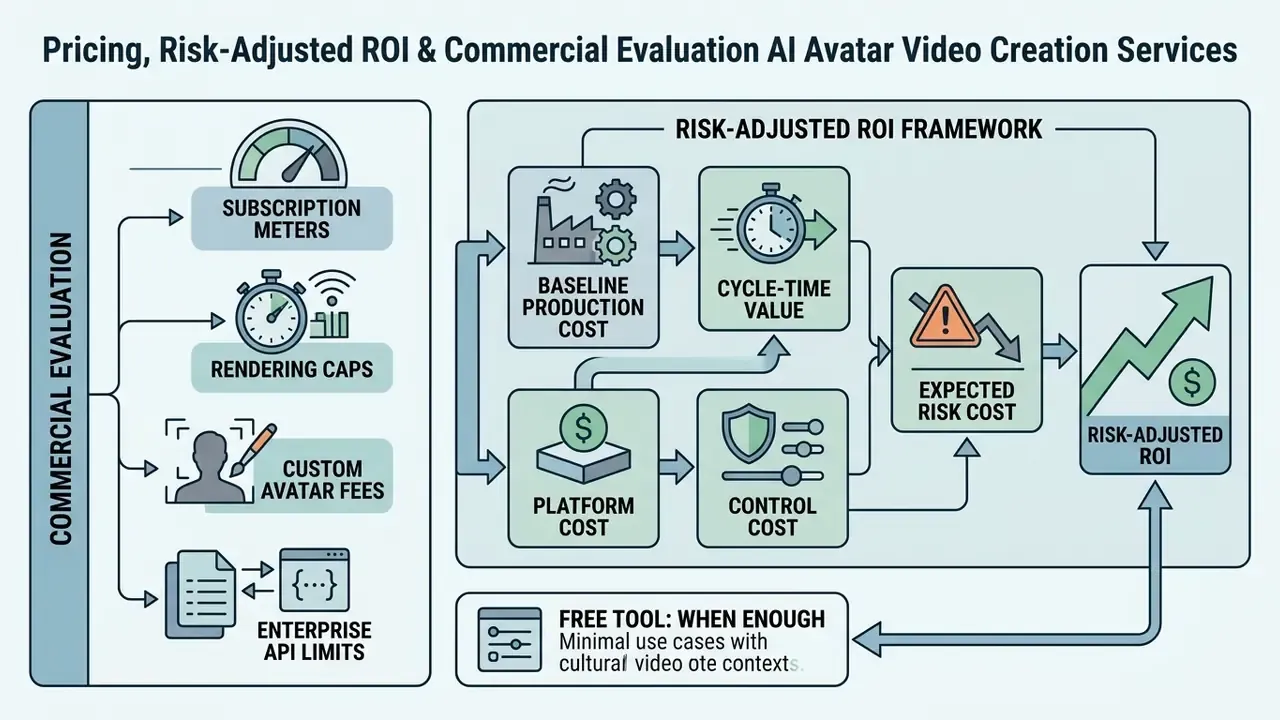
Commercial evaluation of AI avatar video creation software means assessing subscription credit meters, rendering speed caps, custom avatar creation fees, and enterprise API query rates against real volume demand.
Choosing an ai avatar video creation service requires understanding vendor pricing structures, which usually combine fixed monthly platform fees with usage-based credit consumption. Three billing models dominate: subscription with bundled monthly credits, enterprise credit billing, and usage-based add-ons. Published examples span consumer tiers near $29 per month, API plans in the $99 to $299 per month range for 500 to 2,000 credits, credit rates around $0.50 per credit, and per-duration metering such as 5 credits per 30 seconds of avatar video or 10 credits per second on high-usage platforms. Direct price comparison is rarely one-to-one, because vendors quote per-second, per-30-second, per-minute, or per-seat units.
Commercial tariff matrix for AI avatar video creation services
| Plan tier | Target volume and use case | Key features included | Limitations and governance constraints |
|---|---|---|---|
| Free / trial tier | Ad-hoc testing, individual short video output, initial interface evaluation | 1 to 3 watermarked videos; basic stock avatars; standard 720p export | No custom avatars; commercial usage restrictions; no API access; quotas typically do not roll over |
| Creator / Pro tier | Regular social media content, individual instructors, team prototypes | Monthly credit allotment (for example 15 to 30 minutes of video per month); 1080p export; auto-captions; express clones | Limited seat count; standard rendering queues; extra charges for custom avatars and generative scenes |
| Enterprise / custom tier | Global corporate training, multi-language marketing, high-volume API rendering | Unlimited or high-volume credits; custom digital twins; SSO and SCIM; audit logs; workspace avatar sharing; dedicated support | Requires formal contract negotiation; custom DPA and SOC 2 oversight required; usage frequently billed separately from seats |
Practical forecasting tip: convert every vendor quote into cost per finished minute at your own expected volume, including one re-render per asset. Teams that skip the re-render assumption underestimate annual spend by roughly a third, in our experience reviewing draft business cases.
Risk-Adjusted ROI Framework
Standard vendor ROI math compares a studio shoot against a subscription fee, then stops. For regulated buyers that understates cost, because control activities are real work performed by real people. A defensible model looks like this:
Risk-adjusted ROI = (baseline production cost + cycle-time value) − (platform cost + control cost + expected risk cost)
Each term is populated as follows:
- Baseline production cost current fully loaded cost per finished minute, covering crew, talent, studio, editing, translation, and reshoots, multiplied by annual output.
- Cycle-time value monetized value of faster updates. For compliance content, the practical proxy is the cost of operating with an out-of-date module, meaning remediation effort, exam findings, and repeated incidents, multiplied by the number of update cycles avoided.
- Platform cost subscriptions plus credit consumption at realistic volumes, per-avatar creation fees, generative-scene metering, and localization credits per locale.
- Control cost consent administration and storage, legal and compliance review hours per asset, audit-trail tooling, per-locale QA sampling, model-risk documentation and periodic revalidation, plus vendor due diligence.
- Expected risk cost probability-weighted cost of adverse events, including undisclosed synthetic content, consent revocation requiring takedown across channels, a biometric-data incident, or reputational damage from a poorly localized message.
Two practical rules follow. First, control cost is largely fixed per program and only partly variable per asset, so ROI improves sharply with volume. The same consent and audit machinery amortizes across ten videos or ten thousand. Second, never book savings from removing human review. The review step is the reason the savings are defensible in the first place.
To estimate operational cost savings across automated creative workflows, explore our suite of calculators.
When a Free AI Avatar Tool Is Enough
When Teams Need a Paid AI Avatar Video Platform
Organizations should upgrade to paid or enterprise plans when scaling output, requiring custom digital twins, needing multi-user role-based access control, or automating high-volume API rendering. Before committing, benchmark the shortlist against free AI video generator options to confirm the upgrade is driven by capability gaps rather than habit.
Enterprise upgrades become mandatory at specific bottlenecks:
- Removing vendor watermarks for public-facing commercial campaigns.
- Dedicated custom ai avatar creation representing internal company executives.
- API integration for automating ai video creation directly from CMS or CRM databases.
- Compliance requirements demanding Single Sign-On, SCIM provisioning, audit logs, data residency, custom DPA or BAA terms, and SOC 2 validation.
- Seat scale and spend predictability. Enterprise contracts commonly separate seat access from usage billing and allow organization- and user-level spend limits, which is the mechanism finance teams need for forecastable cost.
FAQ About AI Avatar Video Generators
Can AI avatar generators create 2D, animated, or stylized character avatars?
Yes, and this is now a first-class feature rather than a workaround. Modern platforms ship generative avatar builders covering the full range from photorealistic people to fully illustrated characters. Starter libraries commonly include line art, editorial portraits, anime, 3D clay, glossy 3D, comics, flat-geometric, and non-human creature styles. A custom character can be produced by describing it in a prompt, or by uploading a reference image to match a specific look. Once generated, the character is named, paired with a voice from the platform's voice library, and reused consistently across videos in every supported language. Brand kits can layer logos, colors, and assets automatically. Style-conditioned generative networks also animate existing 2D illustrations and stylized 3D models, letting brands keep visual alignment with animated corporate mascots or informal educational themes. Standard content moderation and synthetic-media disclosure rules apply to stylized characters exactly as they do to photoreal ones.
Is it possible to generate a talking avatar video from a single image?
Yes. Photo-to-talking-head generators, such as D-ID or Microsoft Photo Avatar, synthesize a moving presenter from a single static image. These systems predict facial landmark depth maps from the photo, then drive facial movements using an audio file. Enterprise documentation describes photo avatars as a distinct avatar type, typically head-only, available in standard and custom variants and supporting batch as well as real-time synthesis. API-level flows are straightforward: create the avatar from a photo, then submit a render request with the script or audio. Single-image avatars render quickly, but they offer less natural turning motion and gestural expression than digital twins built from multi-minute studio recordings.
How fast can I create a clone of myself, and what is the quality trade-off?
Two tiers exist. Express clones are produced in under five minutes from a 60-second webcam recording, or by sharing a link to an existing video, followed by an on-screen consent capture. They suit drafts, personal channels, and rapid social output. Pro avatars need substantially more source footage, where 10 minutes is a common minimum and 30+ minutes measurably improves fidelity, recorded at 1080p or higher and at least 25 fps under consistent lighting. The trade-off is predictable. Express clones handle head-and-shoulders delivery acceptably but degrade on large gestures, profile turns, and long monologue. Pro avatars hold identity and motion quality across extended runtimes. Note that generating the same presenter in a materially different physical setup traditionally required new footage, which is exactly the constraint generative outfit and scene control is designed to remove.
What are real-time interactive AI avatars, and how do they function?
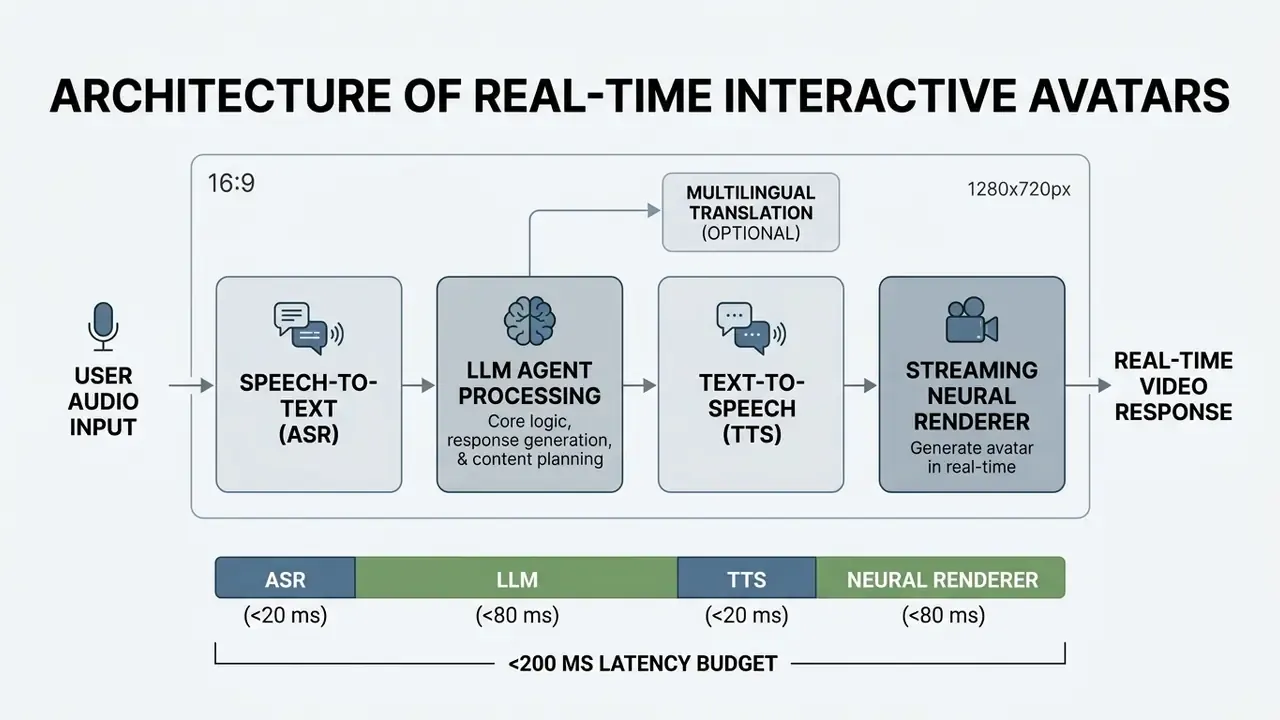
Real-time interactive avatars are streaming digital agents capable of bidirectional conversation. Operating through low-latency streaming APIs, they combine Automatic Speech Recognition (ASR), large language models, and streaming neural diffusion renderers such as InteractiveAvatar. The avatar listens to user speech, processes semantic intent, and streams synchronized visual responses in real time. Useful for virtual customer support, interactive kiosks, and digital training simulations. Platform documentation describes bidirectional audio and video streaming sessions, and several vendors let organizations connect their own LLM or agent while the platform supplies only the avatar layer. That architecture keeps proprietary reasoning inside the enterprise boundary, which matters when the conversation touches customer data.
«InteractiveAvatar employs a Reasoning-Reaction module and a Long-Short Visual Memory mechanism to maintain temporal coherence of the avatar across unbounded streaming sessions.» - InteractiveAvatar preprint (2026), streaming diffusion. Latency budgeting matters more than raw visual quality in this class. ASR, agent reasoning, TTS, and rendering each consume part of a sub-200-millisecond conversational target. Any single component that overruns its allocation makes the avatar feel unresponsive, however photorealistic it looks.
How do I control emotion and delivery without re-recording?
Through script-level markup and voice-direction features rather than regeneration. Practical controls include emotion presets (for example Original, Excited, Broadcaster, Angry), voice mirroring that reproduces the cadence of a reference performance, inline pause insertion, cadence tags, and per-paragraph emotional styling. Some voices expose multiple emotional styles natively, so tone can shift from calm instructional delivery to energetic announcement without switching presenters. Change emotion at sentence or paragraph boundaries, add explicit pauses before numbers and obligations, and keep one emotion per claim.
How does the video industry enforce authenticity and prevent malicious deepfakes?
An ai avatar generator for video industry use is now expected to ship provenance, not just pixels. The industry counters unauthorized synthetic media through cryptographic provenance standards and automated detection. Frameworks such as C2PA (Coalition for Content Provenance and Authenticity) and watermarking systems like Google SynthID embed invisible, tamper-evident metadata into generated video files. Enterprise avatar platforms additionally enforce identity verification, requiring individuals to record explicit video consent before a custom digital twin is created. Because purely neural renderings increasingly lack the compression and blending artifacts classifiers were trained on, provenance-at-creation is now considered more reliable than post-hoc detection. That is why Article 50 pairs machine-readable marking with visible labeling instead of trusting detectors alone.
Do I need video editing experience to use these platforms?
No. Current platforms accept a document, a prompt, a PowerPoint file, a URL, or a blank canvas, then generate a script, select scenes, and produce a finished avatar video with lip sync and voice included. Editors allow optional refinement afterwards: animations, images, music, captions, motion graphics, interactivity. Most users produce a first avatar video within minutes of signing up, which is why editing skills are no longer the constraint. The skill that actually matters is scriptwriting discipline and review governance. For comprehensive assessments of media generation software, visit our AI Media Commercial-Use Hub and review verified technical criteria in our AI Media Benchmarks and Review Proof. Developers planning integrations should reference our dedicated AI Media API Guides.
Enterprise Avatar Safety Checklist
Copy this checklist into your procurement or model-risk template, and require written vendor answers rather than marketing-page assertions.
Checklist0 / 22
Limitations, Open Questions, and a Safe Next Step
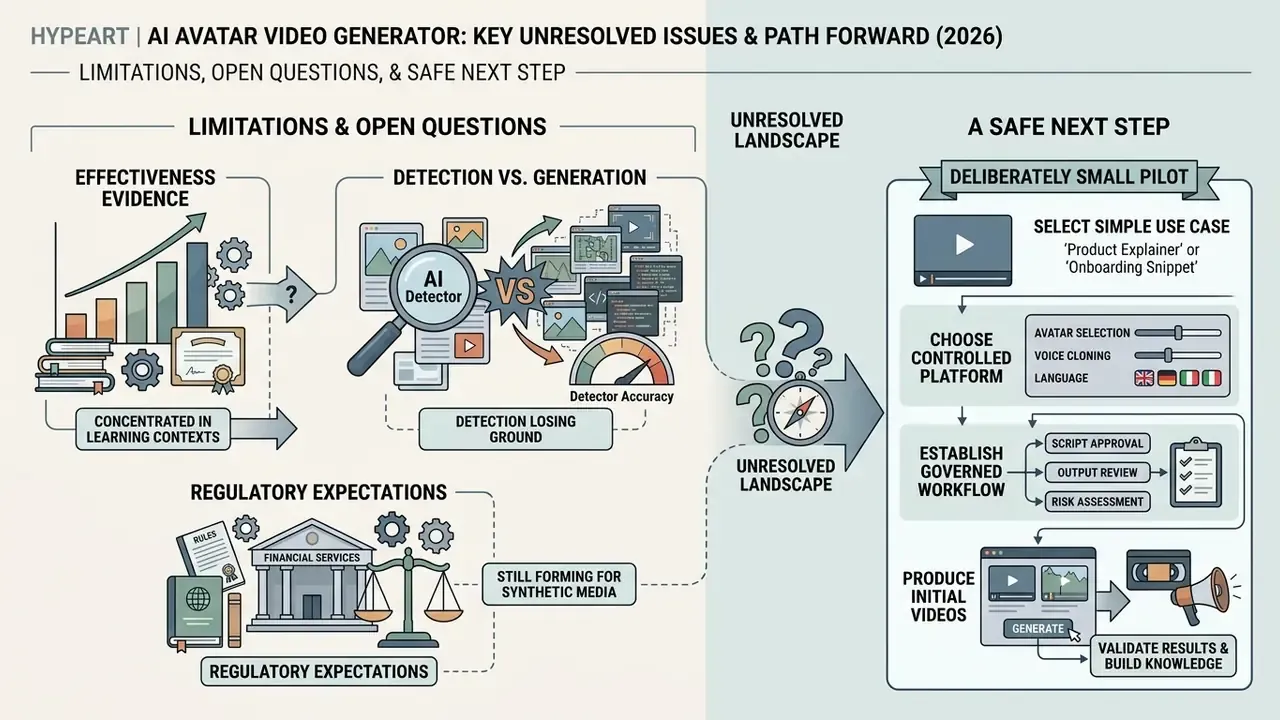
Three things remain genuinely unresolved, and it would be dishonest to present them as settled.
First, effectiveness evidence is concentrated in learning contexts. We have reasonable data on knowledge retention and almost none on how synthetic presenters affect trust in regulated client communications over a multi-year horizon. Treat marketing performance claims as hypotheses to test on your own channels.
Second, detection is losing ground to generation. Provenance and watermarking are the better bet, but watermark robustness under re-encoding, cropping, and platform recompression varies, and independent long-term testing is thin.
Third, supervisory expectations for synthetic media in financial services are still forming. SR 11-7 and OCC 2011-12 give you a defensible frame for third-party models, yet neither was written with generative presenters in mind. Document your reasoning, because the reasoning is what an examiner will ask to see.
A safe next step is deliberately small. Pick one low-risk, high-repetition content class, for example internal AML refresher training in two locales. Run it through the full control chain: consent, script approval, labeling, acceptance thresholds, audit artifacts. Measure cycle time and control cost honestly. Then decide about scale with numbers you produced yourself, rather than numbers a vendor produced for someone else.
Appendix A: Superseded Formulations and Verification Notes
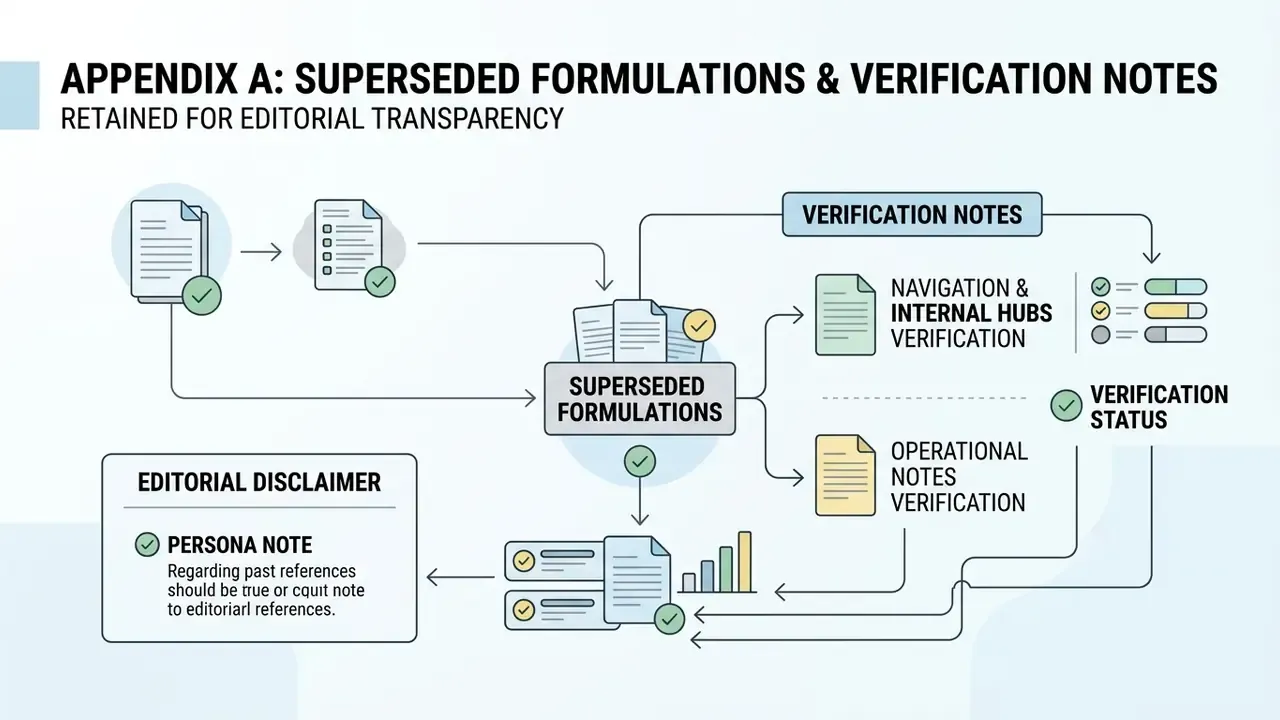
Retained for editorial transparency. The main text carries the updated, better-sourced versions.
Superseded formulation 1, educational effectiveness. Earlier wording: "A 2026 study published in Educational Technology evaluated AI-generated instructors in university lectures. The study found that while human instructors produced higher perceived social presence, AI avatar instructors delivered comparable visual attention and achieved higher objective learning outcomes in declarative knowledge modules." That description omitted sample size and method. The updated text specifies a randomized experiment with n = 90 using eye-tracking.
Superseded formulation 2, emotional coherence. Earlier wording: "Advanced platforms integrate emotion-aware architectures, such as the MSEF+AATU model, which extracts emotional cues from audio to generate context-appropriate facial expressions (for example subtle smiles or serious tones)." That omitted method and evaluation dataset. The updated text specifies feature concatenation with MFCCs and facial landmarks, benchmarked on MEAD.
Verification notes.
- Avatar V (2026) and InteractiveAvatar (2026) are research preprints. Treat cited capabilities as benchmark results, not as universally shipped commercial features.
- The DS2ST-LM figures (0.83 speaker similarity, DNSMOS 3.54 versus 3.86 human reference) are consistent with 2025-2026 multimodal vocoder reporting.
- EU AI Act Article 50 labeling obligations, and the associated code-of-practice provisions on synchronized multimodal marking and watermarking, reflect the finalized transparency framework. Earlier 2023 parliamentary briefings describe the draft and are less specific.
- Platform-specific rollout details, including YouTube Shorts avatar tools, SynthID and C2PA application, and retention windows, derive from vendor support documentation and secondary reporting. Verify against current policy pages before campaign launch.
- The Publicis figure of 100,000 personalized messages originates in trade press reporting rather than an audited disclosure.
Verification and Operational Notes
- Verification status. As of August 2026, references to operational parameters for unverified third-party entities remain labeled as hypothetical scenarios, in line with strict governance guidelines.
- Author note. Marcus Hale, author. Any associated views, examples, or frameworks are illustrative and do not imply real employment, clients, regulatory authority, or documented business results.
- Editorial disclaimer. This material is prepared for educational and informational risk-assessment purposes and does not constitute formal legal, regulatory, or investment advice. Consult qualified legal, compliance, and information-security professionals before deploying synthetic presenters in regulated communications.
Social Media, YouTube, and Short-Form Content
Short-form teams deploy AI avatar generators to produce high-velocity YouTube Shorts, Instagram Reels, and TikTok clips while meeting platform-mandated synthetic media disclosures. For regulated organizations the operative question here is not reach but disclosure exposure. Social channels are where an unlabeled synthetic presenter is most likely to trigger a consumer-deception complaint.
Creators and social media managers use avatars to keep publishing frequency high without constant camera availability. Major video platforms, however, enforce strict disclosure requirements for synthetic content.
Key social platform rules for AI avatars:
To see how static imagery becomes animated social assets, read our tutorials on how to make a video a live photo and how to make a live wallpaper. Channel-specific editing considerations sit in our guide to YouTube video editors.