Evaluating generative visual models against traditional human creation requires a clear understanding of risk, legal enforceability, and production value. Organizations adopting synthetic media must balance rapid asset generation with strict governance, copyright boundaries, and audience perception. This comprehensive guide compares AI art vs human art across creative mechanics, technical speed, legal ownership, and market value.
Executive Summary for Decision Makers
- Legal baseline: Fully AI-generated images are not copyrightable in the United States. Copyright attaches only to expressive elements a human author created, selected, arranged, or substantially modified. Thaler v. Perlmutter (2023), the Zarya of the Dawn partial cancellation, and the Théâtre d'Opéra Spatial refusal all confirm the same rule.
- Perception baseline: Audiences rate human-attributed artwork higher on profundity, worth, and emotional depth, even when the underlying images are identical. The bias is driven by upgrading human work rather than devaluing machine work.
- Productivity baseline: AI-assisted pipelines measurably compress production time and multiply output volume, but they increase review load, style-drift defects, and dataset-provenance exposure.
- Detection baseline: No automated detector is legally dispositive. Cross-generator accuracy collapses, false positives on genuine digital art reach double digits, and social-media compression degrades reliability further.
- Operating rule: Use AI for ideation, variation, and internal assets. Use human authorship for brand-critical, trademark-adjacent, and collectible assets. Use documented hybrid workflows (human-in-the-loop) whenever you need both speed and enforceable rights.
How to Read This Comparison
The AI art vs human art debate usually gets argued on taste. That is the least useful frame for anyone who has to sign off on an asset.
Three tests decide the outcome in practice. First, the legal test: can you register, license, and enforce the work? Second, the perception test: does the intended audience reward or discount machine involvement? Third, the operational test: what does the review, logging, and rework load actually cost you?
A quick example from a mid-size publishing team we reviewed: the generation step took four minutes, the brand and legal review took eleven days. Speed at the model layer rarely equals speed at the approval layer. Keep that asymmetry in mind through every section below.
AI Art vs Human Art: What Is the Core Difference?
The fundamental difference between AI art and human artwork lies in creative agency and intent. Human art stems from lived subjective experience, deliberate emotional intent, and physical execution. Generative AI art synthesizes statistical patterns learned from vast training datasets of existing images.
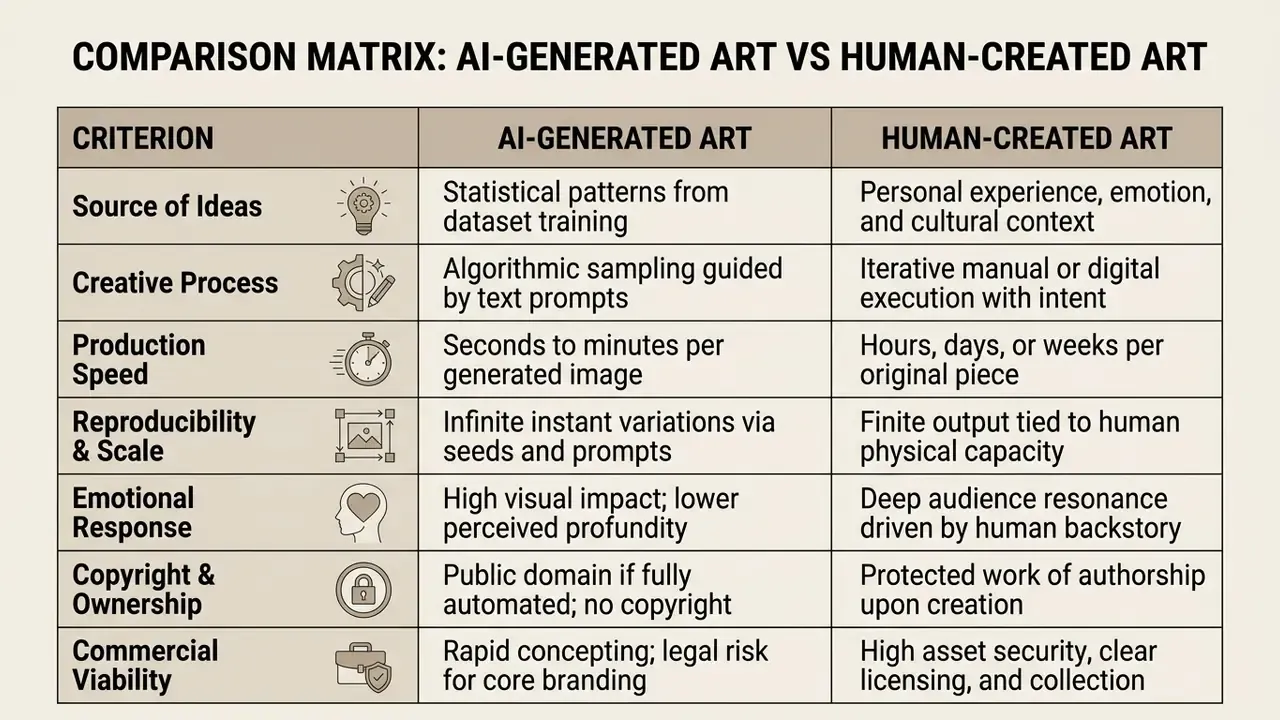
Read the table as a risk map, not a scoreboard. Each row shifts the answer to "AI art versus real art" depending on what the asset has to survive: a campaign cycle, a trademark filing, or a resale market.
What Counts as AI-Generated Art?
AI-generated art refers to visual media produced by artificial intelligence algorithms that convert textual prompts into synthetic images. These systems use diffusion models and deep neural networks trained on large image-text datasets to generate new visual assets.
An art generator transforms random Gaussian noise into coherent visual content by iteratively removing noise in latent space. Teams comparing individual platforms can review our catalog of AI art generators before committing to a production stack. The user guides this process by typing descriptive prompts, setting guidance parameters, and choosing seed values. Under U.S. Copyright Office standards, when an AI algorithm autonomously determines the expressive elements of an image, the output is classified as machine-generated material rather than a human artwork.
One practical nuance: the same ai art generator can sit on either side of the authorship line. A single prompt gives you machine output. The same tool used for a masked, hand-painted correction pass gives you an AI-assisted work with a defensible human contribution.
What Makes Human-Created Art Different?
Human-created art is defined by intentional creation, artistic intent, and personal lived experience. Human artists select visual compositions, color palettes, and symbolic meanings to communicate deliberate ideas or emotional states.
When human artists create artwork, every brushstroke, line, and light source reflects conscious decision-making. Empirical research shows that audiences assign higher aesthetic and monetary value to human artwork because they recognize the effort, skill, and narrative history behind the work.
"Participants consistently rated art labelled as human-created higher in profundity and worth, even when every image had in fact been generated by AI."
This embodied creative process creates authentic original art that carries cultural resonance and verifiable human authorship.
Four Philosophical Frameworks Used to Define Art
Any comparison of machine and human output eventually collides with the older question of what art actually is. Four classical positions structure the debate:
- Art as representation (mimesis). Plato framed art as imitation of reality; for centuries a work was judged by how faithfully it reproduced its subject. By this test, high-fidelity AI output performs strongly.
- Art as expression of emotion. The Romantic tradition held that a work must express a definite feeling and evoke an emotional response. Here, the absence of a felt experience behind AI output becomes the central objection.
- Art as form. Kantian aesthetics judges a work on formal qualities and structural execution rather than subject beauty, a criterion that grew in weight with 20th-century abstraction.
- Institutional theory of art. George Dickie argued that an object becomes art through the institutional network that exhibits, documents, and sells it: galleries, museums, auction houses, and critics. On this reading, the market itself decides whether machine output counts as art.
Historical Context: From the Invention of Photography to Autonomous Algorithms
The current debate over AI art mirrors historical anxieties surrounding earlier creative technologies. When photography emerged in the 1820s, critics argued it lacked "soul" and would eliminate painting.
"The fear has sometimes been expressed that photography would in time entirely supersede the art of painting."
Nineteenth-century critics went further, insisting that photography "can never assume a higher rank than engraving" because it lacked "something beyond mere mechanism at the bottom of it." History proved otherwise: photography became a distinct artistic medium with its own museums and markets, while traditional painting evolved toward abstraction rather than disappearing. Auction records still favor painting, but that never invalidated photography as an art form.
Algorithmic art creation is also not new. In 1973, British-born artist Harold Cohen developed AARON, a rule-governed computer program that produced original drawings, beginning with abstract marks and later adding rocks, plants, figures, and color. Cohen eventually taught AARON to paint with physical brushes and dyes it selected itself. The field shifted radically in 2014 with Ian Goodfellow's invention of generative adversarial networks (GANs), which pit a generator against a discriminator and allow autonomous learning from massive visual datasets. Google's DeepDream (2015) popularized algorithmic pareidolia, and the text-to-image wave (DALL·E, Imagen, Midjourney, Stable Diffusion) moved generation from research labs to consumer subscriptions.
The commercial milestone arrived in 2018, when the GAN-generated portrait Edmond de Belamy, produced by the collective Obvious, sold at Christie's New York for $432,500 against an estimate of $7,000 to $10,000. The name itself is a pun on "Goodfellow": bel ami. That sale established machine output inside the formal art market, which matters directly under institutional theory. An art world now documents, promotes, exhibits, and sells algorithmic work.
How AI-Generated Art and Human Art Are Created
The technical workflows of generative AI tools and human creators follow fundamentally different operational paths. Algorithmic image generation relies on probabilistic sampling across text-to-image models. Human visual creation follows a structured sequence of research, composition, manual execution, and refinement.
AI Algorithms, Prompts and Image Generation
Generative AI models produce new images through mathematical diffusion processes. The model learns visual relationships during training, mapping text tokens to high-dimensional latent space representations. NIST defines diffusion models as latent-variable generative systems with three components: a forward noising process, a reverse denoising process, and a sampling procedure (NIST AI 100-2e2025, National Institute of Standards and Technology, 2025. https://nvlpubs.nist.gov/nistpubs/ai/NIST.AI.100-2e2025.pdf).
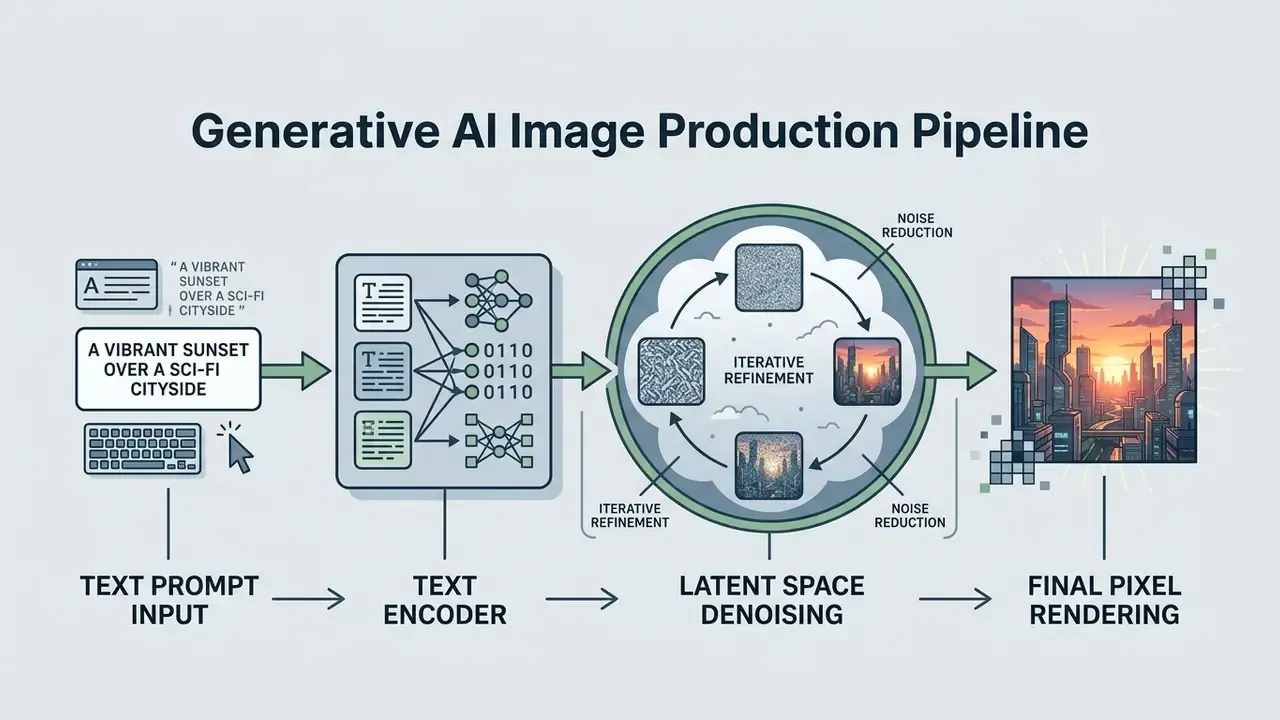
Enterprise case: what the pipeline looks like in production. When an enterprise publishing team replaced manual stock vector creation with automated generative pipelines, production volume increased sixfold within thirty days. However, audit teams flagged thirty percent of the generated outputs for inconsistent brand styling and potential dataset copyright overlap. The organization restored compliance by establishing a mandatory human-in-the-loop review step for every public asset, the same control pattern that later supports copyright registration claims.
Users control image generation through prompt engineering, specifying subject matter, lighting, camera angles, and art style. Technical systems such as Stable Diffusion iteratively denoise latent vectors until the final pixel grid aligns with the text condition. Designers evaluating platform capabilities can review our analysis on how long does chatgpt take to make an image and compare prompt processing models in the midjourney ai image generator overview.
The Human Creative Process Behind Original Art
The human creative process begins with a conceptual idea, personal emotion, or client brief. Human artists gather visual references, sketch preliminary compositional thumbnails, and establish color harmonies grounded in art history. Studies of artistic practice describe a repeatable sequence: preparation, incubation, insight, evaluation, elaboration, completion. In practical digital work it becomes sketch, flat color, detail rendering, final correction.
Whether working with traditional oil paints or digital tablets, artists refine their work through continuous visual problem-solving. Media pioneers such as Sougwen Chung demonstrate how human artists can integrate robotic arms and AI inputs into traditional performance painting while maintaining central artistic direction. This deliberate craft ensures that created art maintains stylistic consistency and emotional depth.
Worth noting: artists working this way rarely describe the model as a co-author. They describe it as a very fast, slightly unreliable assistant.
Autonomous Art Systems: Robots, Algorithms and DAO Artists
Between prompt-driven generators and human studios sits a third category: systems designed to act as authors rather than tools. Distinguishing them matters for governance, because the operator's degree of control differs sharply.
- Ai-Da is a humanoid robot artist devised by Aidan Meller and named after Ada Lovelace. It draws and paints using cameras in its eyes, internal algorithms, and a robotic arm, and it has exhibited at the University of Oxford and in a virtual United Nations show. Its creators justify the "artist" label using Margaret Boden's criteria, arguing the work is new, surprising, and of cultural value.
- Botto, created by German artist Mario Klingemann, is a "decentralised autonomous artist." It presents roughly 350 pieces per week to a token-holding community, which votes on favourites; those votes retrain the algorithm, and one work is auctioned weekly with proceeds returning to the community. Klingemann has described his role as guardianship rather than authorship: "Right now Botto is like a toddler and I am its guardian."
For risk teams, the practical takeaway is that autonomy reduces, not increases, legal protection. The more a system determines expressive elements by itself, the weaker the human-authorship claim over its output. Counterintuitive, yes. It is also the cleanest rule in this entire field.
AI Art Compared to Human Art: Creativity, Speed and Control
Evaluating visual media options requires analyzing efficiency, stylistic control, and long-term brand impact. AI models excel at speed and scale, while human artists provide granular control and unique personal style.
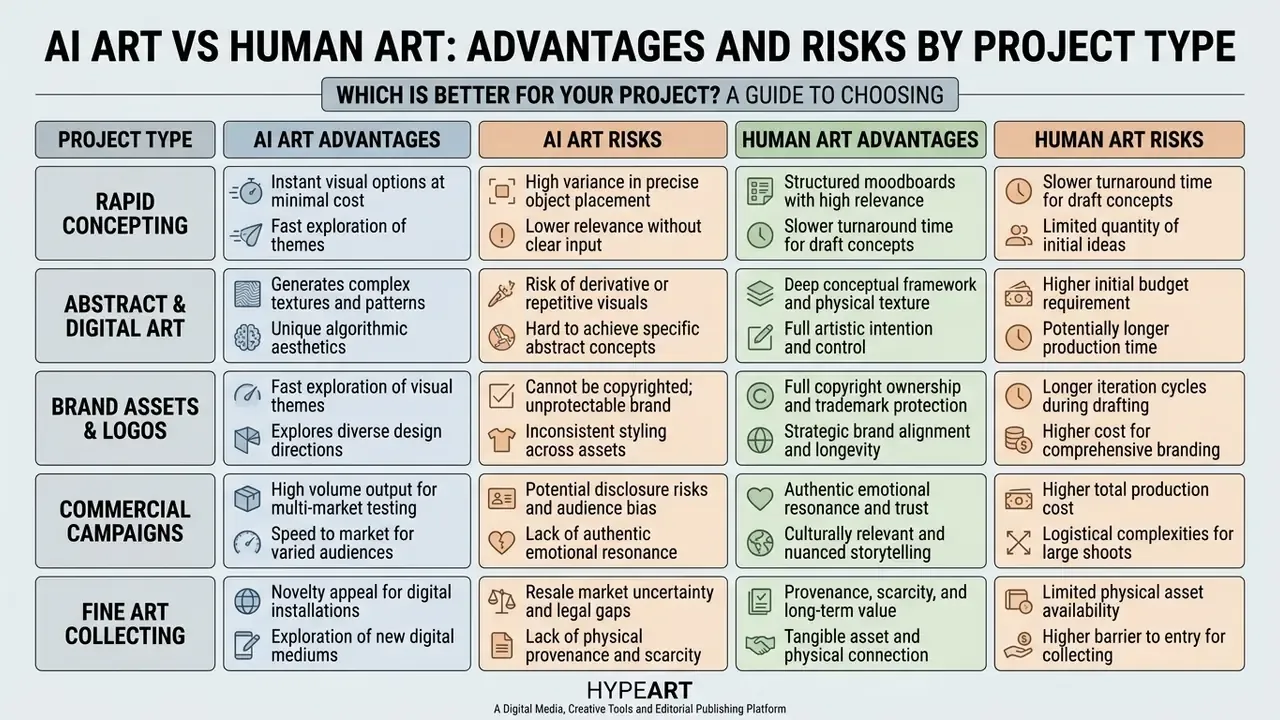
Every recommendation above carries a condition. Rapid concepting works with AI only if the drafts stay internal. Abstract and digital art work well until a client asks for an exact repeat of one variation. Logo and identity work sits at the highest end of this risk curve, which is why teams evaluating AI-assisted brand asset generation should treat generated marks as exploration material rather than final protected assets.
Speed, Scale and the Ability to Create Variations
Generative AI tools produce dozens of visual iterations in seconds, dramatically reducing preliminary concept lead times. Peer-reviewed workflow measurements confirm the magnitude of the gain rather than the marketing claim: in an AI-collaborative picture-book production study, total production time fell by 85.2%, from 2,162.8 hours to 320.4 hours, while a sketch-to-CAD case study cut a design cycle from 50 hours to 36 hours and raised viable variants from 9 to 15 in a single stage.
"Adoption of text-to-image models raised creative productivity by 25% and nearly doubled the volume of creative artifacts produced within months."
"Diffusion models generate images with rich color reproduction and fine detail, outperforming human throughput in high-volume concept production." - Measuring the Success of Diffusion Models at Imitating Human Artists, preprint (2023). https://arxiv.org/abs/2307.07515
This capability allows product teams to test diverse art style options before approving final production budgets. Teams comparing generative model architectures can analyze detailed performance metrics in the Midjourney vs ChatGPT comparison, review the best AI image generators for commercial teams, or examine motion diffusion tools in the Runway vs Kling review. However, generating high volumes of synthetic media without risk tiering creates inventory bloat and quality control overhead.
One more caution on the numbers. Reported gains cluster anywhere between 28% and 90%, and they measure production hours, not approved assets. An ai art comparison that ignores rework is flattering by construction.
Originality, Artistic Style and Authorship
Originality in generative AI is limited by dataset interpolation. Because artificial intelligence models learn from existing human artwork, AI outputs recombine established visual patterns rather than inventing independent concepts.
"Stable Diffusion reproduces a named artist's style with 81% identification accuracy, raising direct questions about originality and copyright."
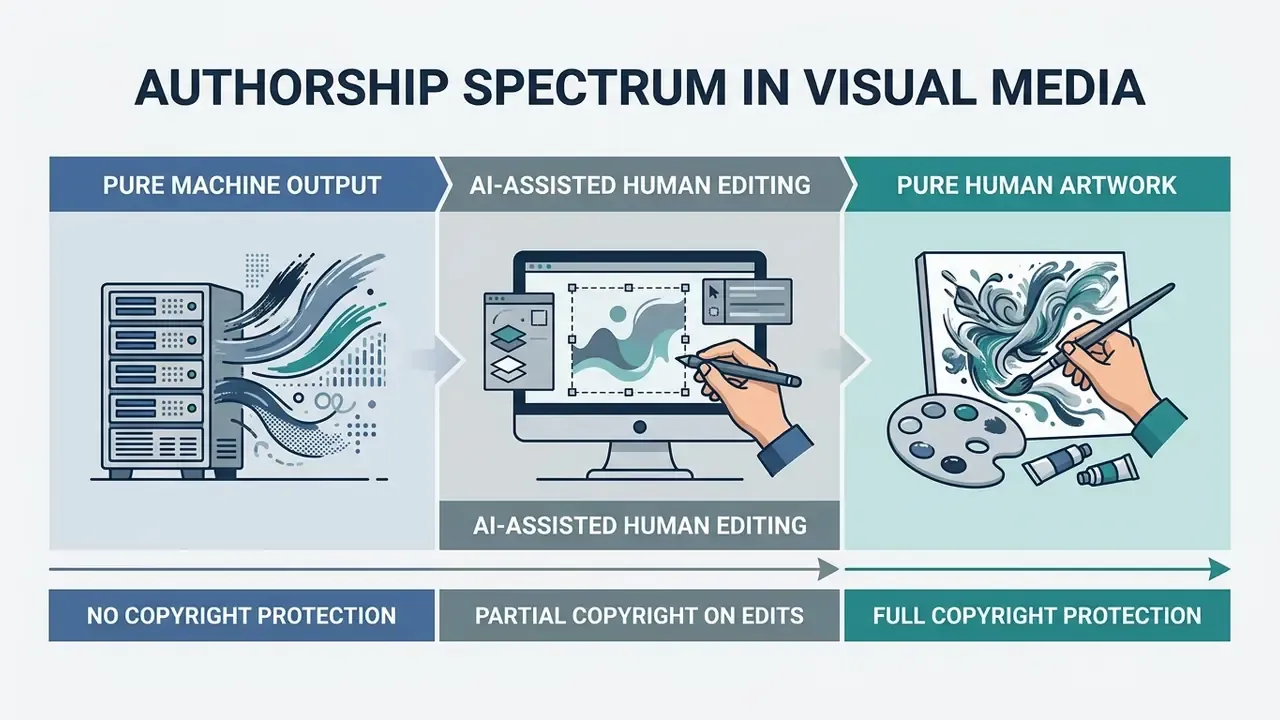
Human artists develop individual artistic styles over years of practice, incorporating personal influences and creative choices. U.S. copyright doctrine protects specific expressions of human creativity, but does not protect generalized visual styles; the Copyright Office's 2024 digital-replica report explicitly recommended against extending property-like rights to style. So the framing "ai art vs original" is slightly wrong at the legal level. Style is open; expression is not. An AI tool can mimic a painter's manner, yet it cannot claim original legal authorship over pure prompt outputs.
Emotional Response, Intent and Cultural Context
Audience studies consistently show that viewers attribute deeper emotional resonance to human-created art when the artist's origin is disclosed. Controlled experiments reveal that human-attributed art scores significantly higher in perceived profundity, worth, and emotional depth than AI-attributed art.
"Artwork labelled as human-created scored significantly higher on perceived profundity (d = 0.47, p < 0.001) than identical images labelled as AI-created."
A 2026 aesthetic-rating study reported the same direction of effect, with human-attributed works averaging 5.72 versus 4.99 for AI-attributed works (P < .001). When audiences know a human artist created a painting, they connect the visual work to human struggle, history, and narrative intent. Conversely, uncurated AI artwork can evoke unease due to anatomical errors or repetitive compositional tropes, and prototypical AI output can surface stereotypes embedded in the training data. For projects requiring authentic human engagement, human artists remain the most reliable choice.
Does that make the claim "ai art is better than human art" simply false? No. It makes it context-dependent. Machine output wins on throughput and variation; human output wins on attributed meaning and enforceable rights.
Commercial Value, Copyright and Ownership of AI Art
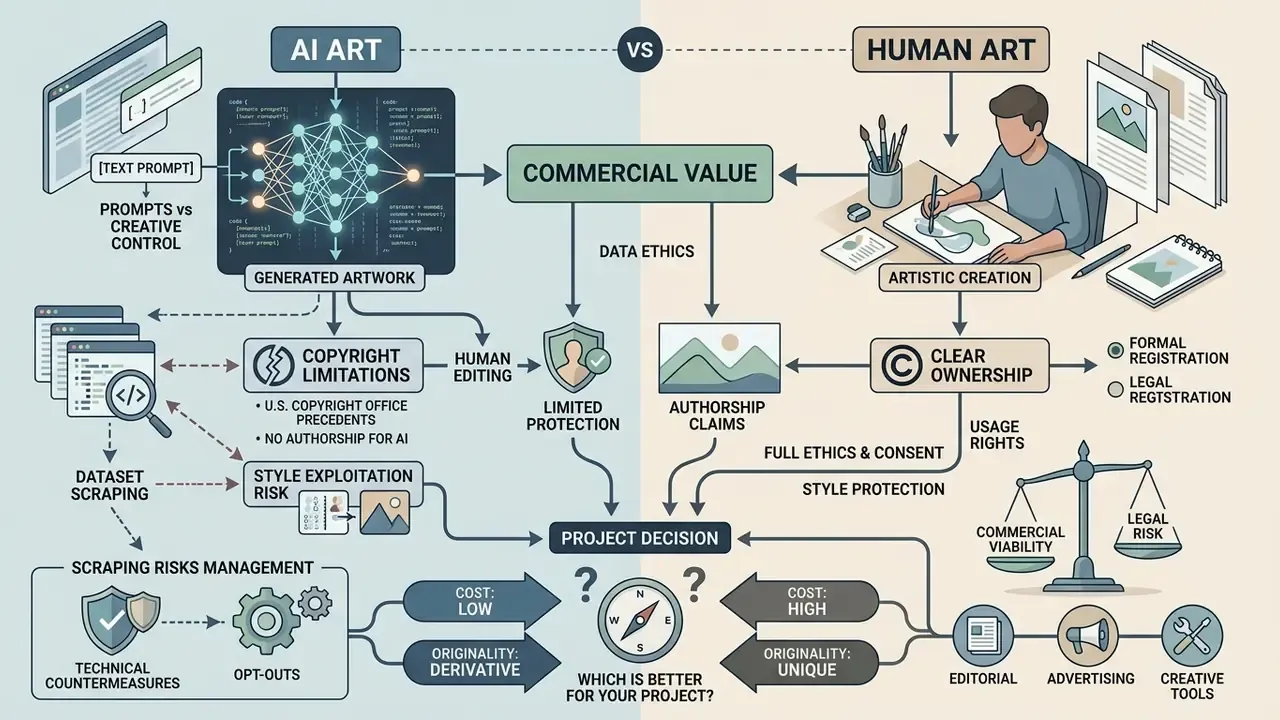
Who Owns AI-Generated and AI-Assisted Artwork?
Under current U.S. Copyright Office regulations and federal court rulings, artworks created solely through textual prompts cannot be registered for copyright protection. Copyright protection requires human authorship.
When an individual uses generative AI to create artwork, the machine determines the core expressive choices. As established in Thaler v. Perlmutter, machine outputs enter the public domain upon creation. However, if a human artist uses an AI tool as an auxiliary assistant, substantially editing, arranging, or painting over the output, the human-authored modifications qualify for copyright protection.
Key Copyright Office Precedents: Prompts vs. Creative Control
- Zarya of the Dawn (Kris Kashtanova, 2023). The Copyright Office initially registered the entire graphic novel, then reopened the case and issued a limited registration covering only the text and the selection and arrangement of text and images. Individual Midjourney-generated illustrations were excluded, because prompting alone does not constitute human authorship. The Office added that AI material "edited, modified, or revised by a human author can be registered," but found insufficient evidence of such changes in that filing.
- Théâtre d'Opéra Spatial (Jason Allen, 2023). Registration was refused for the award-winning Midjourney image even though Allen entered more than 600 prompt revisions and performed manual editing, because the autonomous system generated the core expressive elements.
- SURYAST (2023). The Office denied protection for an AI-generated style-transfer derivative, ruling that prompt inputs plus app-level filtering do not meet the authorship threshold.
Jurisdictions diverge. The European Parliament's 2025 analysis confirms that EU copyright protects only "the author's own intellectual creation," leaving fully autonomous output unprotected. The United Kingdom, by contrast, retains a statutory computer-generated-works rule granting 50 years of protection, with authorship assigned to the person who made the necessary arrangements.
Ethics, Dataset Scraping, and Style Protection
The commercial deployment of AI art involves unresolved ethical issues regarding model training. Millions of copyrighted artworks were scraped without artist consent to build commercial diffusion models, and litigation over Stable Diffusion's training corpus continued through 2024 and 2025. Prompts leveraging the names of living artists, most famously digital painter Greg Rutkowski, who has publicly objected, became widespread, diluting the market position of the original creators. Gallery installations such as the "AI Photobooth" exhibited in New York in 2024 used Rutkowski-style prompts directly, illustrating how normalized the practice became.
How Creators and Enterprises Manage Scraping Risks
- Style exploitation risk. Naming living artists in commercial generation prompts increases exposure to unfair-competition, publicity-rights, and reputational claims, even where style itself is unprotected.
- Technical countermeasures. Artists increasingly deploy adversarial tools such as Glaze (to frustrate style mimicry) and Nightshade (to poison training datasets). These tools reduce scraping value but do not create a cause of action by themselves.
- Formal registration. Raw files published online remain vulnerable to scraping, so registering core visual assets with the U.S. Copyright Office remains the primary prerequisite for enforcing statutory infringement damages.
- Vendor diligence. Enterprises should prefer models with disclosed or licensed training data and indemnification clauses, and should log which model version produced each published asset. Reverse-search workflows, such as those covered in our guide to AI reverse image search tools, help detect both inbound and outbound style overlap.
Why Original Human Art Can Have Different Market Value
Original human art maintains higher commercial and collectible value due to authenticated provenance, scarcity, and legal protection. Investors and art collectors purchase human artwork because its value is anchored in verifiable human craft and historical context.
"Consumers consistently preferred human-generated artwork: reduced empathy toward the AI creator weakened social identification and lowered willingness to pay."
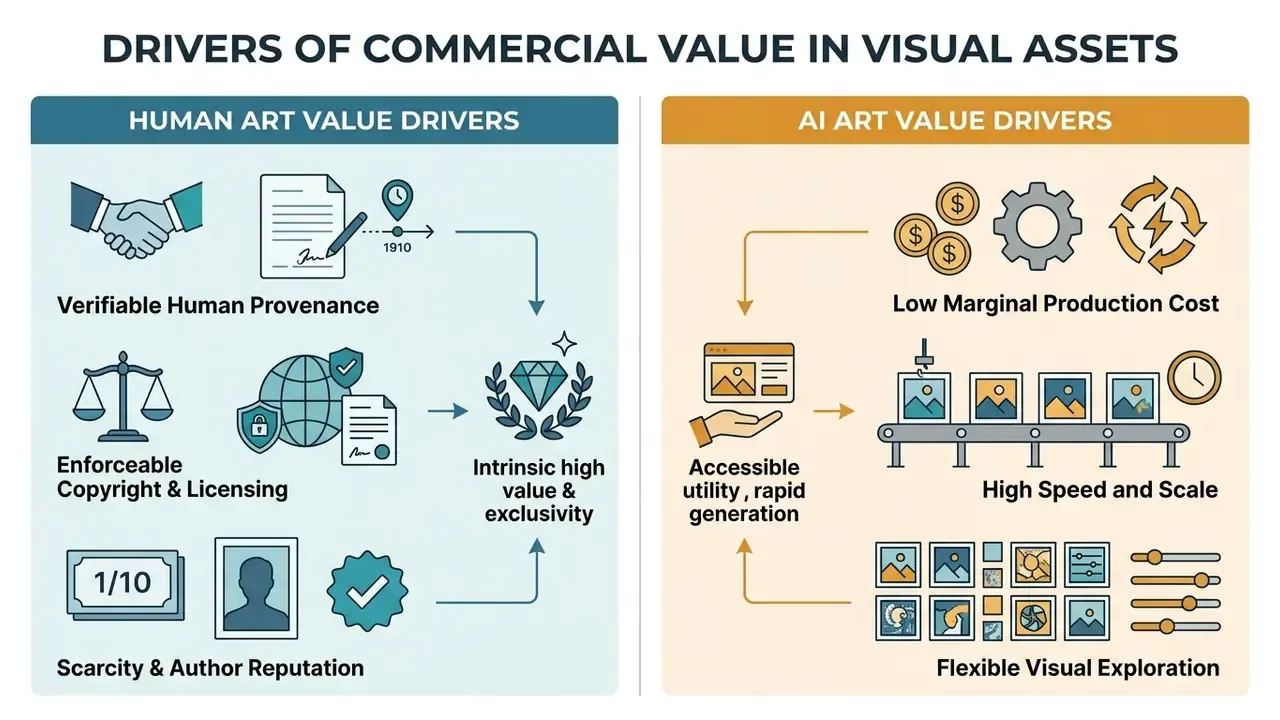
Market research on the high end reinforces the pattern: for works above $10 million, provenance and subjective taste dominate pricing, while objective attributes such as size and medium matter more at lower tiers. Because purely AI-generated assets cannot be protected by copyright, competitors can freely copy and distribute unedited synthetic images. This lack of legal exclusivity lowers the commercial resale value of standalone AI outputs. Readers evaluating media production tooling can consult our AI Media Comparison Matrices and review commercial licensing guidelines in the AI Media Commercial-Use portal.
What to Check Before Using AI Art Commercially
Before deploying AI-generated visual content in commercial products or marketing campaigns, legal and risk teams must evaluate platform compliance terms.
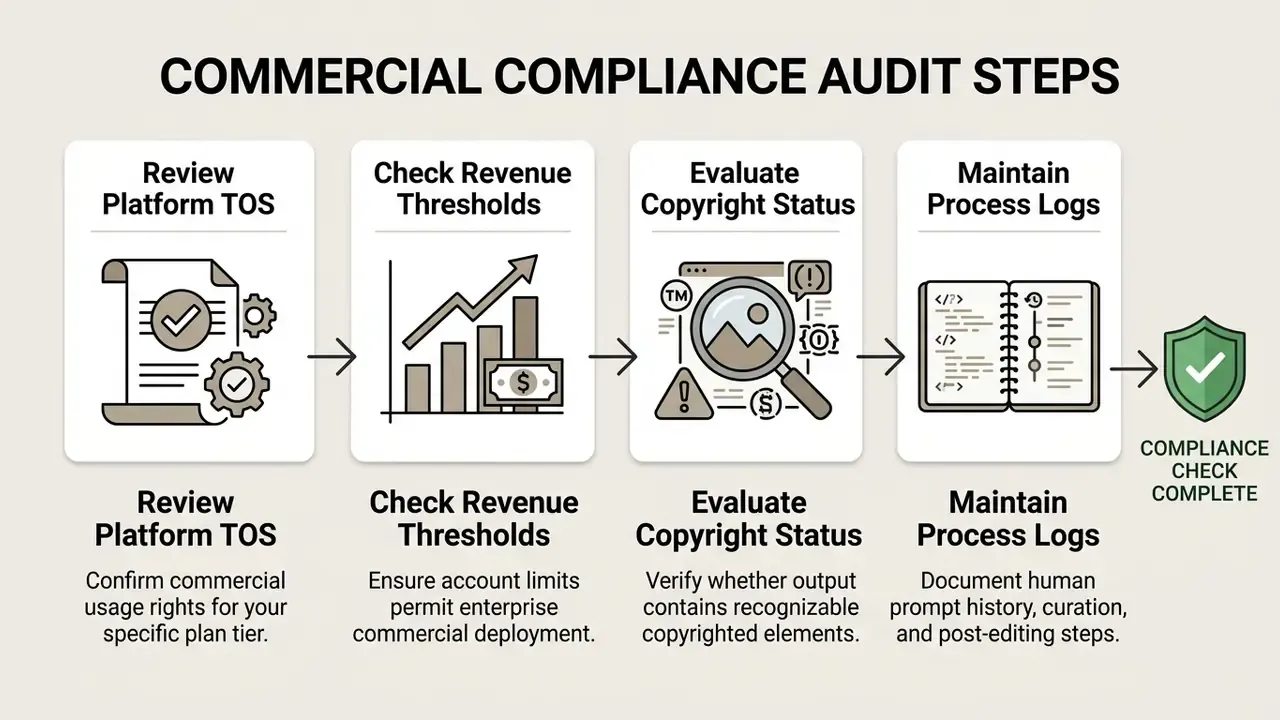
Terms differ sharply by vendor and by tier. Midjourney has permitted commercial use on paid plans while requiring higher tiers above roughly $1M in revenue and restricting free access to non-commercial use; OpenAI's image terms assign output ownership to the user subject to policy compliance; Adobe's generative AI additional terms have restricted certain outputs from commercial use entirely; and trial licenses frequently add age and territory conditions. Enterprise teams must therefore verify commercial exploitation rights by product name and version, not by brand reputation. Practical licensing breakdowns for individual platforms are collected in our reviews of commercial-use image generators and style-specific generators.
Audit Trail Checklist for Model Risk and Internal Review
Copyright registration for AI-assisted works, and any internal audit of synthetic media, depends on records rather than recollection. Capture the following fields for every published asset:
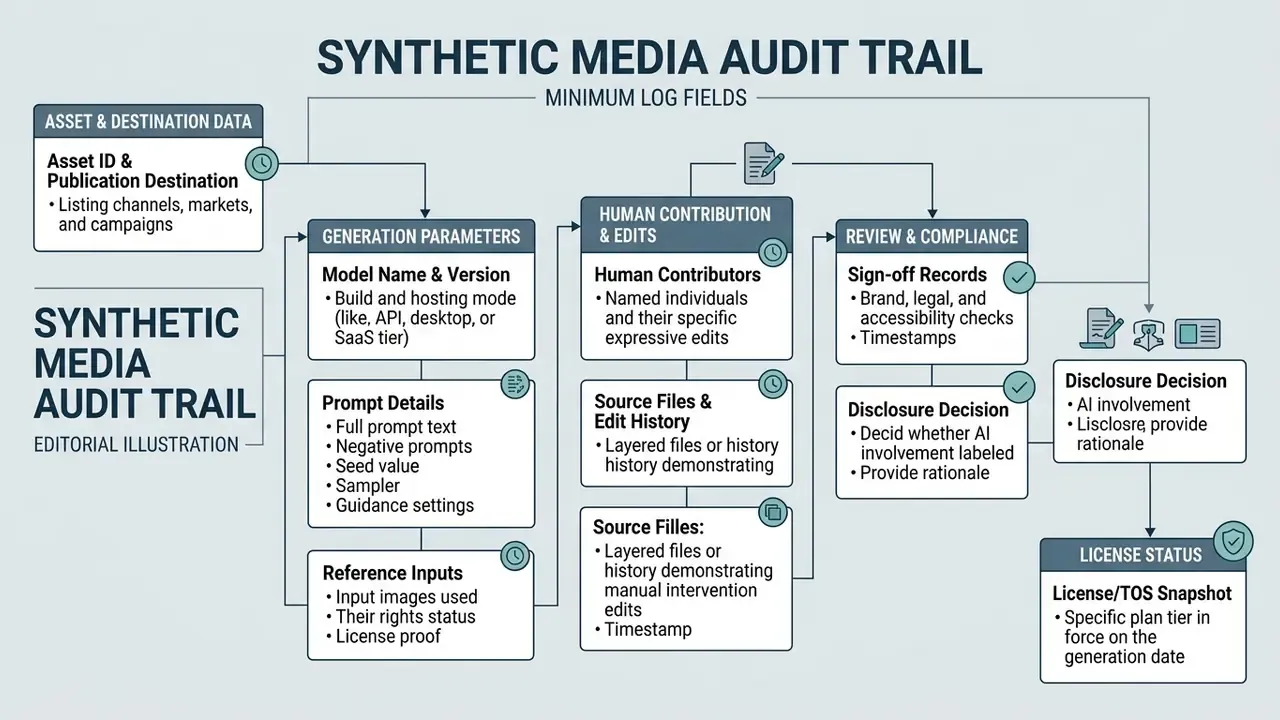
Additionally, companies should retain this audit trail for the full asset lifecycle to support future copyright registration claims for AI-assisted works and to answer downstream infringement inquiries. Retention beats reconstruction: prompt histories inside consumer accounts get purged, and a deleted seed value cannot be recovered a year later.
Can You Tell AI Art From Human Art?
Distinguishing AI generated images from human artwork is increasingly difficult as generative models improve. High-resolution diffusion tools eliminate early technical flaws, requiring structured inspection methods to verify image origin.
"Ordinary users generally cannot distinguish AI-generated images from human art, while professional artists perform significantly better."
Visual Clues in AI-Generated Images
While modern generative tools produce realistic figures, synthetic images often retain subtle algorithmic artifacts. Forensic inspection can reveal structural inconsistencies in complex visual scenes, and the useful cues differ by medium: an oil-painting pastiche fails differently from a flat vector illustration.
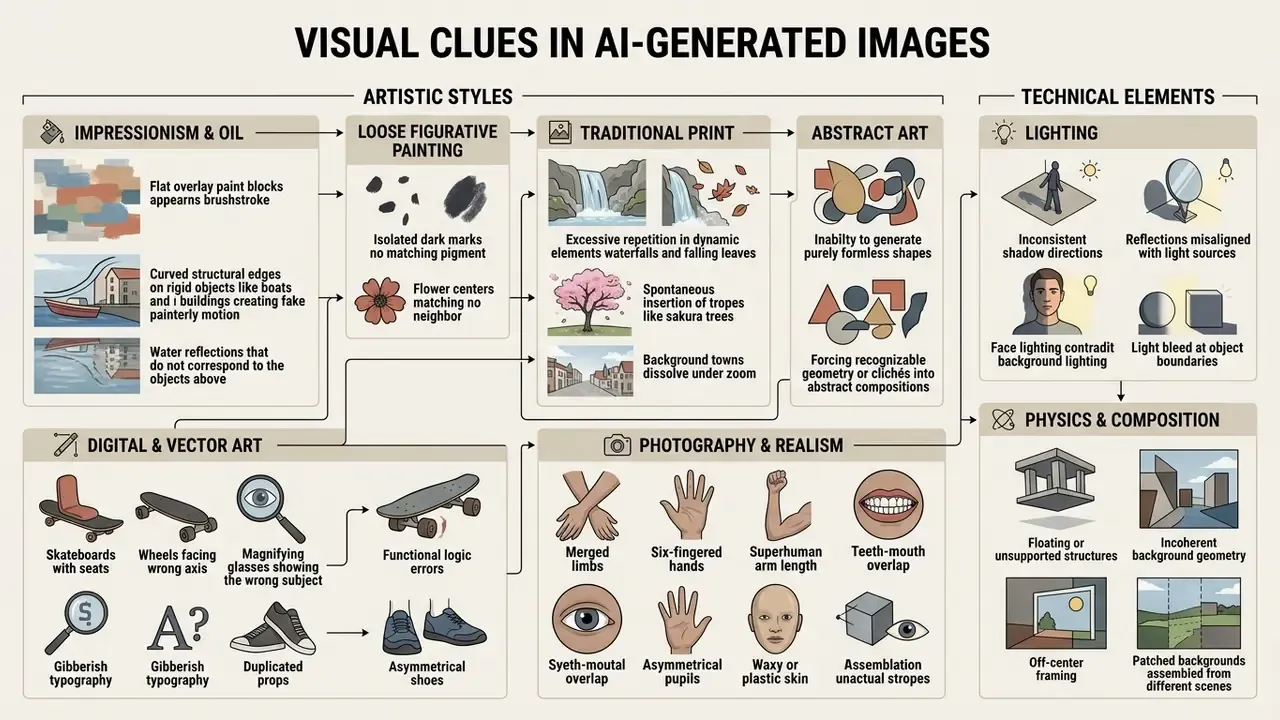
Anatomical errors in hands, eyes, and teeth remain common indicators of synthetic origin. Furthermore, lighting inconsistencies between foreground subjects and background environments frequently occur in raw AI generated images. Teams evaluating video and image synthesis capabilities can explore detailed breakdowns in our guides on sora ai image and the Sora vs Veo comparison.
Spot-Test: Train Your Own Eye in Four Passes
Use this sequence on any suspect image before escalating to tooling. Each pass targets a different failure class, and most synthetic images break on at least one.
- Read the text.Signage, book spines, trash cans, and shop fronts are the fastest tell. Human artwork carries legible, intentional lettering; generators produce plausible-looking gibberish.
- Test architectural logic.Ask whether a person could actually use the building. Front doors on the second floor with no stairs, windows that open into walls, or reflections that do not match the bridge in front of them indicate generation.
- Count load-bearing structures.On ships, cranes, and scaffolding, count masts, rigging, and supports. Masts that connect to nothing and duplicated rigging are classic diffusion errors.
- Hunt for repetition.Scan falling water, foliage, crowds, and patterned fabric. Humans introduce irregular variation; models repeat motifs at near-identical intervals.
Then ask the decisive question: are the mistakes consistent with a human hand? Expressive human painting produces bold, frenetic, systematic errors. Generative output produces isolated, physically unmotivated errors: a black smudge with no nearby black pigment, a shoe that does not match its pair.
Why AI Detection Tools Cannot Give a Final Verdict
"One machine-learning detector outperformed every human participant with zero false positives, yet its results remain bounded to the specific generator set and dataset tested."
Post-processing steps such as image compression, cropping, noise additions, and color adjustments further degrade detector accuracy. Consequently, detection scores should be treated as probabilistic indicators rather than legally binding evidence of non-human origin. A detector tells you about pixels. It tells you nothing about who sat at the tablet, which is exactly the fact a copyright claim or an internal investigation needs. Teams building a verification stack can compare tooling in our AI image detection and verification coverage.
Fact Check: AI Image Detector Accuracy Standards
AI and Human Art: Collaboration Instead of Replacement
Rather than replacing human creativity, generative AI functions effectively as a collaborative tool in human-directed workflows. Combining algorithmic iteration with human artistic control maximizes speed while maintaining asset security.
"The gap between AI- and human-attributed art appears mainly in simultaneous presentation: human work is upgraded rather than AI work devalued."
Where AI Helps Human Artists Create Works
Human artists use AI tools during preliminary production phases to accelerate ideation and visual experimentation. Generative algorithms assist in building moodboards, exploring color compositions, and generating background texture options, and image-to-image workflows let artists develop their own photographs or sketches rather than starting from a blank prompt.
The practical hybrid software stack. Working professionals rarely use a single tool. A representative pipeline looks like this:
- Midjourney or Stable Diffusion for the base concept or for describing and re-prompting an existing photograph.
- Adobe Photoshop Generative Fill, Generative Expand, and Erase for changing aspect ratios, extending canvases, adding or subtracting elements, and removing distractions.
- Lightroom AI masking and denoise for selective tonal control on photographic layers.
- Luminar Neo for retouching and atmospheric finishing before the file returns to Photoshop for manual painting.
- Firefly Boards, Figma Weave, or Miro for reference collection, style-reference transfer, palette exploration, and exporting boards to presentation formats. Reference-driven practitioners typically collect 20 to 30 references, cull to 8 to 12, then generate only the missing frames.
- Upscalers and photo editors for final resolution, print preparation, and colour management.
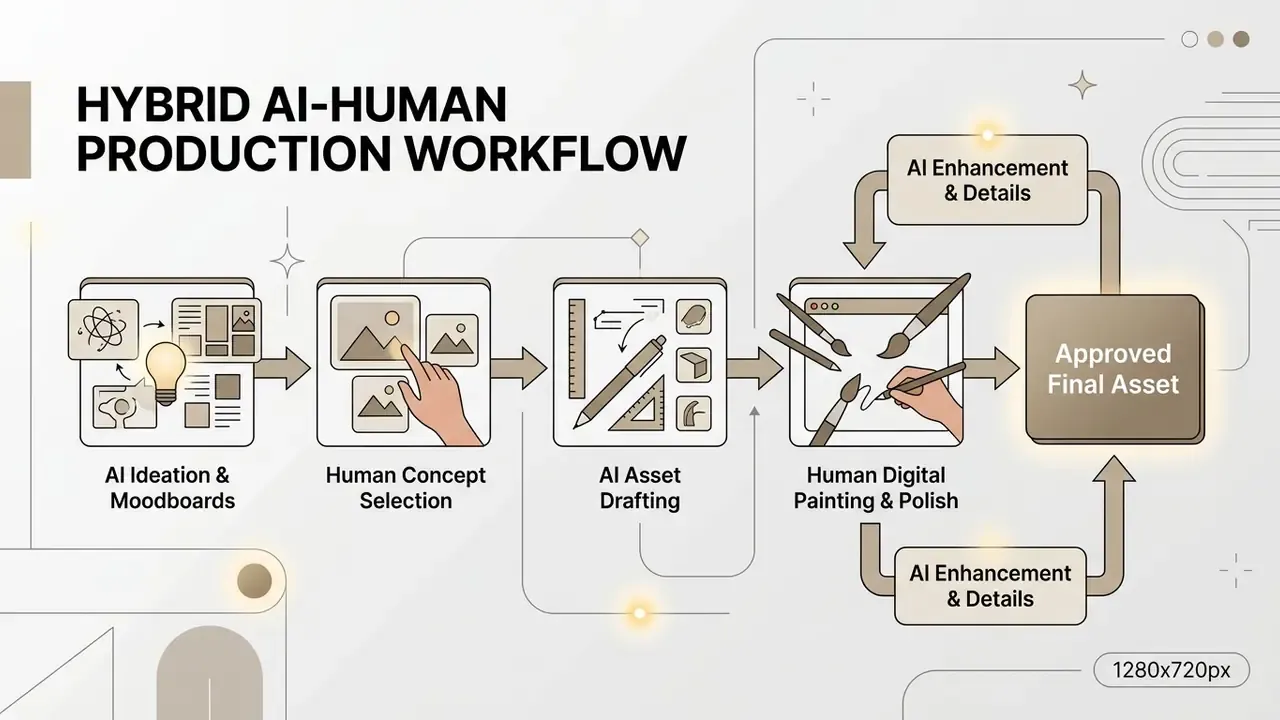
Research on collaborative art workflows describes the same three beats, AI divergence, software refinement, artist tuning, with final evaluation graded on consistency, local detail quality, editability, and the need for regeneration. By leveraging generative tools for repetitive tasks, artists dedicate more time to narrative refinement and final asset polish. Visual creators analyzing production standards can explore workflow benchmarking data in our AI Media Benchmarks and Review Proof hub.
Which Should You Choose: AI Art or Human Art?
Selecting between AI art, human art, or a hybrid approach depends on project deadlines, legal requirements, budget limits, and target audience expectations.
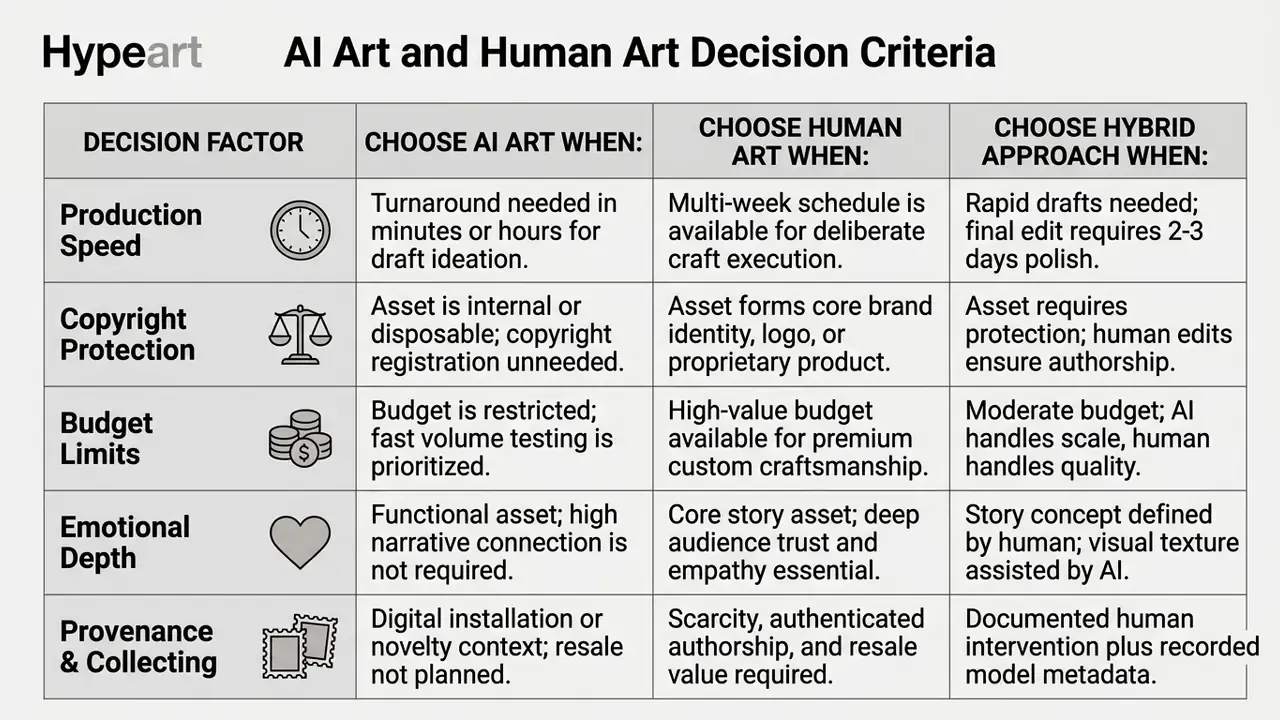
By evaluating projects against speed, copyright, budget, and emotional requirements, organizations can select the optimal visual workflow for their operational goals. Teams ready to shortlist platforms can start from our roundup of the best AI art generators or, for constrained budgets, the comparison of free AI art generators and their watermark and licensing limits.
Why Hybrid Is the Default for Most Commercial Work
Hybrid production is not a compromise; it is the configuration that satisfies both the legal test and the perception test. Human-only is mandatory where authorship must be enforceable. AI-only is appropriate for classification, variation generation, and disposable internal assets. Hybrid workflows keep the speed advantage while preserving a documented chain of human expressive decisions, the exact evidence the Copyright Office requires and the exact signal audiences reward. Practically, that means: human concept, AI exploration, human selection, AI drafting, human painting and polish, full audit log.
Limitations and Open Questions
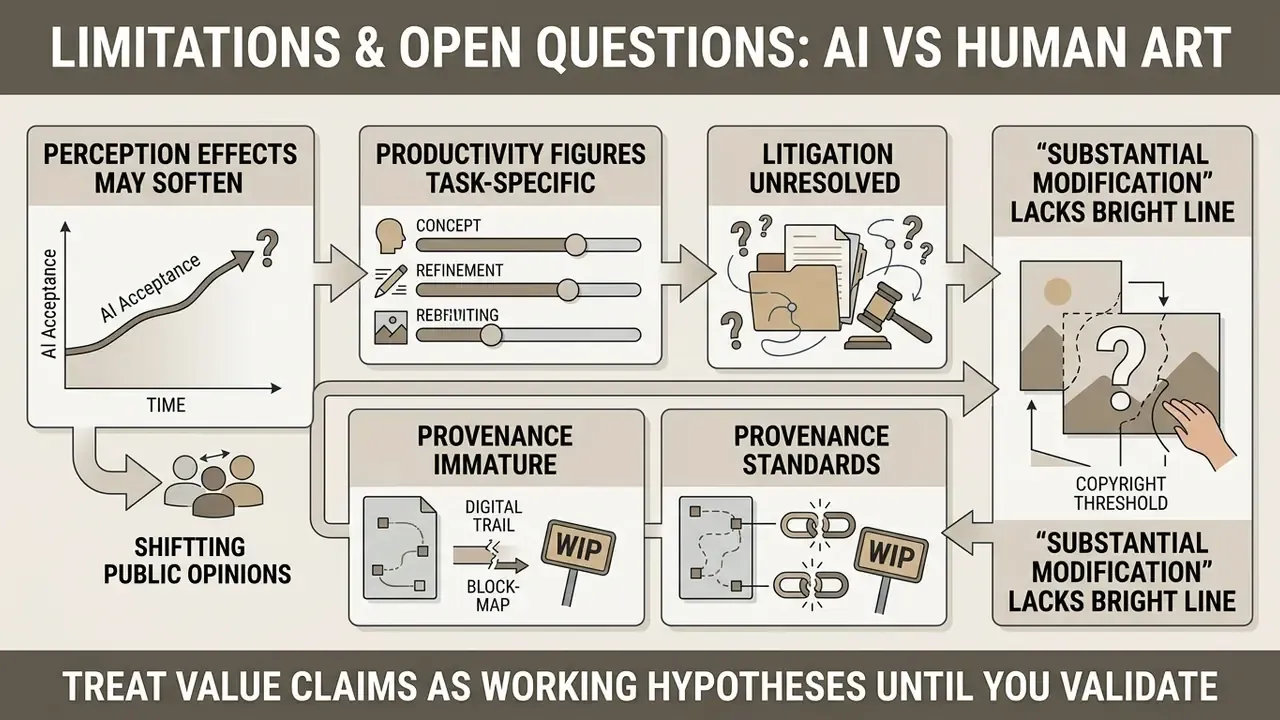
Honest comparison work has to state what it cannot settle yet.
- Perception effects may soften. Current studies measure audiences who still treat synthetic media as novel. Whether the human-authorship premium holds in 2030 is untested.
- Productivity figures are task-specific. Picture-book production, CAD sketching, and campaign variants behave differently. Transferring an 85% figure to your own pipeline is unsupported.
- Litigation is unresolved. Training-data cases are still moving through U.S. courts, so indemnification language matters more than vendor reputation.
- Provenance standards are immature. Machine-readable credentials survive some platforms and not others, which limits the practical value of watermarking today.
- "Substantial modification" lacks a bright line. Nobody can tell you the exact percentage of manual painting that secures registration. Document more than you think you need.
Treat every audience and value claim in this guide as a working hypothesis until you validate it against your own analytics, client interviews, and asset performance data.
Frequently Asked Questions (FAQ)
Is AI art "real" art?
It depends on the definition applied. Under mimesis and formalist criteria, high-quality generated images qualify. Under expression-based criteria, the absence of lived experience is decisive. Under George Dickie's institutional theory, the answer is increasingly yes, because galleries, auction houses, and collectors already document and sell algorithmic work, with Edmond de Belamy at $432,500 as the canonical example.
Can I copyright an image I made with Midjourney or Stable Diffusion?
Not the raw output. You may register the human-authored portions: original text, selection and arrangement, and substantial manual edits. Disclose the AI-generated material and describe your contribution in the application.
Does a paid subscription give me commercial rights?
It gives you contractual permission under that vendor's terms at that tier, not copyright. Verify the specific product name, plan tier, and revenue threshold, and archive a copy of the terms in force on your generation date.
Are AI detectors admissible as proof?
No. Treat scores as probabilistic signals. Cross-generator accuracy falls into the 50% to 70% range, compression degrades results further, and one widely used tool falsely flagged genuine human digital art in 24.47% of benchmark cases.
Will AI replace human artists?
The photography precedent suggests displacement of certain tasks rather than elimination of the medium. Painting survived photography; photography became its own market. The measurable effect so far is higher output volume per creator, plus a growing premium on verified human authorship.
How can artists protect their style from scraping?
Register core works with the Copyright Office, apply adversarial protections such as Glaze and Nightshade to published files, publish lower-resolution previews, and document creation dates. Note that technical tools reduce scraping utility but do not by themselves create legal remedies.
Methodology and Source Notes
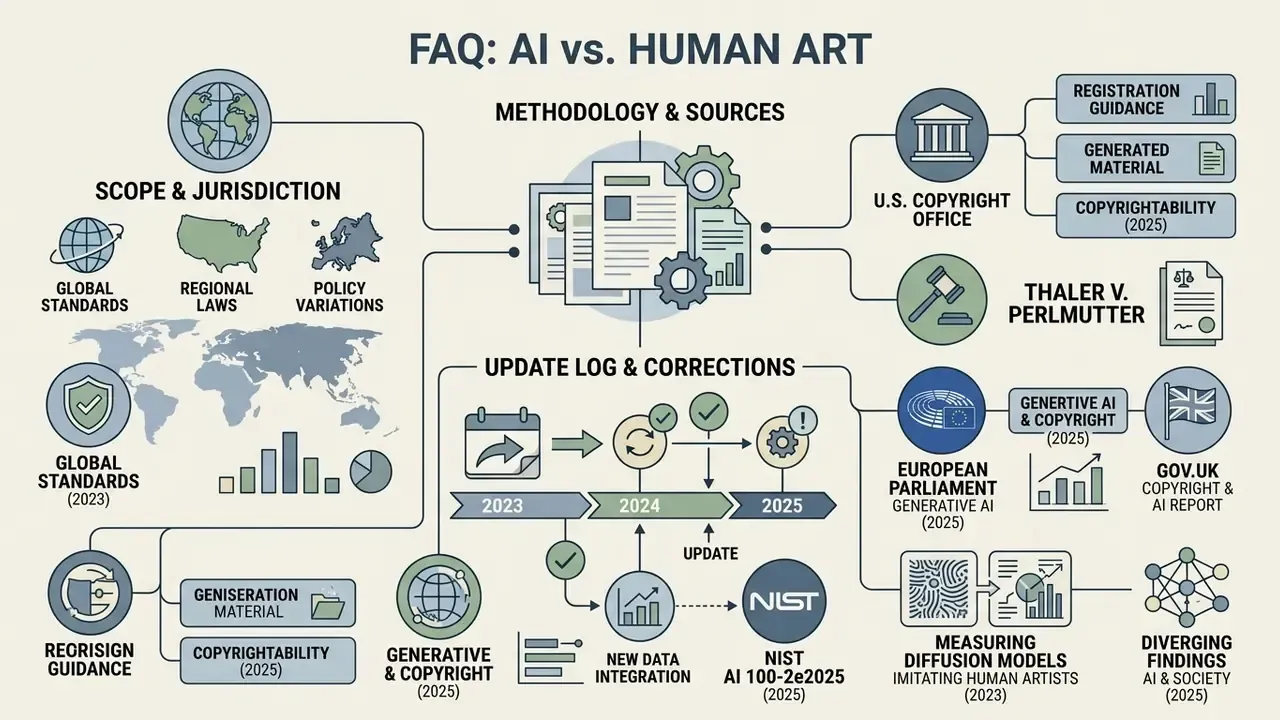
Update log and corrections. Two figures from the earlier version of this guide were re-sourced during this revision:
Scope and jurisdiction. Legal statements describe U.S. Copyright Office practice and federal decisions through 2026, with noted EU and UK divergences. Nothing here constitutes legal advice; generative AI regulation is moving quickly, and enterprise decisions should be reviewed by qualified counsel in the relevant jurisdiction.
- U.S. Copyright Office, Copyright Registration Guidance: Works Containing Material Generated by Artificial Intelligence (2023).
- U.S. Copyright Office, Copyright and Artificial Intelligence, Part 2: Copyrightability (2025).
- Thaler v. Perlmutter, D.C. District Court (2023).
- European Parliament, Generative AI and Copyright (2025); GOV.UK, Report on Copyright and Artificial Intelligence (2025).
- NIST, AI 100-2e2025 (2025). https://nvlpubs.nist.gov/nistpubs/ai/NIST.AI.100-2e2025.pdf
- Measuring the Success of Diffusion Models at Imitating Human Artists, preprint (2023). https://arxiv.org/abs/2307.07515
- Drawing the full picture on diverging findings, AI & Society (2025). https://doi.org/10.1007/s00146-025-02243-4
- Consumers' Preference for Human-Generated Versus AI-Generated Artwork, Journal of Consumer Behaviour (2026). https://doi.org/10.1002/cb.2476
- Detector accuracy statements are now attributed to their underlying evidence
- NIST's synthetic-content risk documentation for cross-generator and post-processing degradation, and the University of Chicago Organic or Diffused benchmark for per-vendor false-positive and false-negative rates.
- The general claim that generative tools "cut initial draft time by up to 85 percent" is now tied to a specific measurement: an AI-collaborative picture-book production study recording an 85.2% reduction in total production time (2,162.8 hours down to 320.4 hours), alongside a sketch-to-CAD case study (50 h to 36 h) and a design-workflow comparison (312 min traditional, 198 min pure AI, 264 min human-AI collaboration). Reported gains range from roughly 28% to 90% depending on task type, so single-number claims should always be read against the measured workflow.
Primary sources referenced in this guide
- *Organic or Diffused
- Can We Distinguish Human Art from AI-generated Images?*, arXiv (2024). https://arxiv.org/abs/2402.03412
- *Humans versus AI
- whether and why we prefer human-created compared to AI-created art*, Cognitive Research: Principles and Implications (2023). https://doi.org/10.1186/s41235-023-00499-6