Executive Summary for Risk, Compliance, and Governance Leaders
- A legal disclaimer is a unilateral notice that limits liability, defines the intended use of content, and negates implied warranties. It is not a contract, not a privacy policy, and not a substitute for statutory compliance.
- For AI and agentic systems, disclaimers must be paired with human-in-the-loop confirmation before an agent executes a transaction, and with model documentation aligned to model risk management expectations (Federal Reserve SR 11-7 / OCC Bulletin 2011-12).
- Placement beats wording. Footer-only notices are frequently judged insufficient. Inline placement above submission, export, or checkout actions, plus affirmative assent, produces the strongest evidentiary record.
- Copy-paste templates for nine disclaimer types are provided in the examples section below.
Why does a drafting question belong on a CRO's agenda at all? Because in a bank or a mature fintech, the disclaimer is where documented model limitations meet the customer. If your model validation file says an output is indicative only, and your interface says nothing, you have a governance gap with a user-facing surface.
A legal disclaimer is a legal notice that defines the boundaries of liability, clarifies the scope of published information, and establishes user expectations across digital channels. In modern digital operations, organizations deploy disclaimers to prevent unauthorized reliance, distinguish general informational content from specialized advice, and reduce exposure to third-party claims.
What Is a Legal Disclaimer and What Role Does It Play?
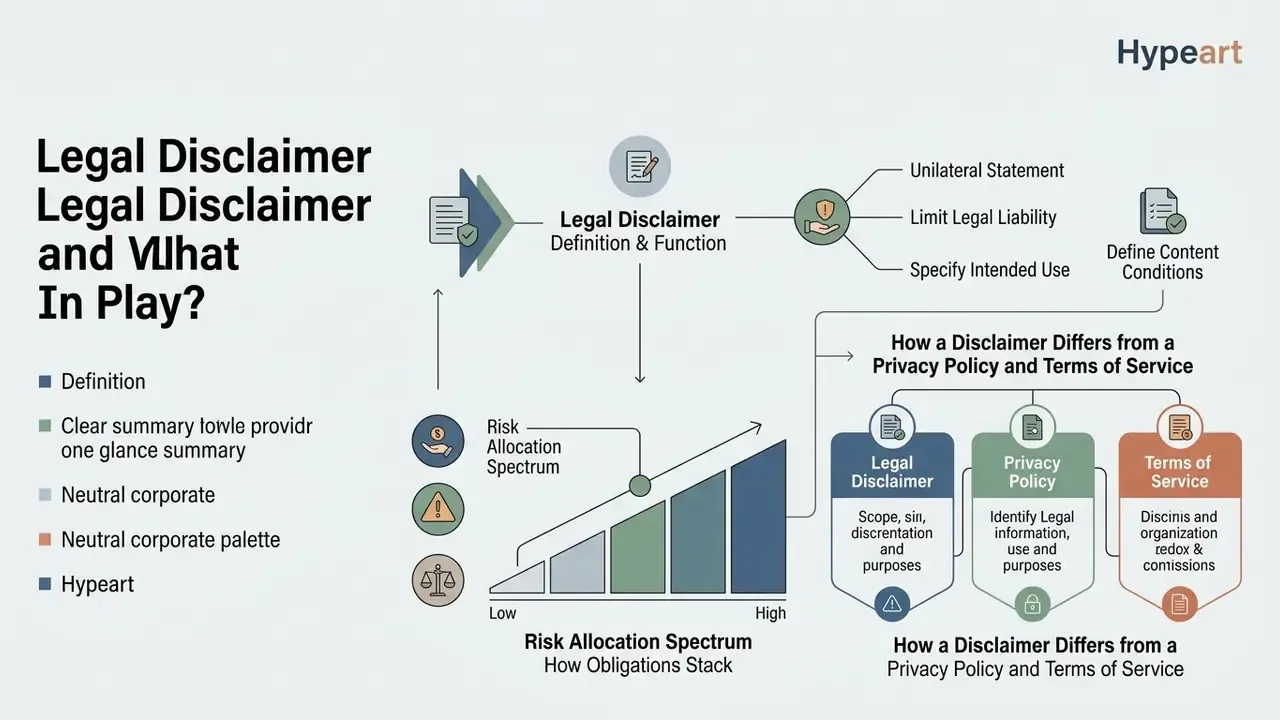
A legal disclaimer is a unilateral statement designed to limit legal liability, specify the intended use of published information, and define the conditions under which content or services are accessed. Rather than creating mutual contractual obligations, a disclaimer serves as a notice of operational boundaries and risk allocation between the publisher and the user.
One terminology note, because it trips people up. In U.S. estate and tax practice, a qualified disclaimer under IRC § 2518 means an irrevocable refusal to accept an inheritance. That instrument has nothing to do with website disclaimers. Same word, different legal machinery.
The effectiveness of a notice is not a matter of drafting instinct alone. It is measurable. Experimental work on consumer comprehension of online legal information has found that presentation quality directly changes what users retain:
In corporate risk management, legal disclaimers perform expectation management and risk-signaling functions. Institutional practice illustrates the pattern better than any single empirical study. The European Central Bank publishes a website disclaimer stating that it accepts no responsibility or liability for the material provided, including losses tied to reliance on published reference rates, while expressly noting that the notice is not intended to limit liability contrary to applicable national law. That is the operative model: explicit liability language establishes that published data and analytical summaries come without implied warranties, which reduces exposure to misreliance claims. Legal notices published by public authorities, such as the California Department of Justice, show how disclaimers exclude liability for direct, indirect, incidental, special, or consequential damages arising from system interruptions or content inaccuracies. The U.S. Department of Energy Office of Scientific and Technical Information (OSTI) uses the same construction: information is supplied without warranty and without legal liability for accuracy, completeness, third-party use, or infringement.
Risk allocation spectrum, or how obligations stack:
| Layer | Instrument | Legal effect | Can it be overridden? |
|---|---|---|---|
| 1 | Statutory duties (consumer protection, data protection, sector rules) | Mandatory; non-waivable | No |
| 2 | Terms of Service / contract | Bilateral obligations, remedies, dispute forum | Only within statutory limits |
| 3 | Indemnity / hold-harmless clause | Shifts cost of third-party claims to the user | Only within statutory limits |
| 4 | Legal disclaimer | Unilateral notice: no warranty, no advice, no reliance | Yes, if unclear, hidden, or contradicted |
Operationally, a disclaimer establishes that content is provided for general education rather than individualized professional counsel. In automated and AI-driven environments, that boundary carries weight. When digital tools summarize complex datasets, a clear disclaimer signals that automated outputs require independent human validation before operational execution. The same principle applies when teams evaluate the licensing terms behind commercial use of AI image generators or best-in-class AI art generators, where output rights and warranty limits differ sharply by vendor.
Illustrative practice pattern (anonymized, hypothetical, not a verified public case study). A mid-sized fintech firm deployed an automated financial reporting tool that generated summary performance metrics for commercial clients. During an internal risk review, the team found that users were treating automated estimates as audited accounting outputs. The firm introduced an inline responsibility disclaimer plus mandatory user acknowledgment before report export. According to its own internal reporting, client misinterpretation queries fell by roughly 42% after the change, and the acknowledgment step created an auditable trail of notice. The metric is self-reported and should be read as directional rather than externally validated. The durable lesson is the control design: notice at the point of reliance, plus a logged acknowledgment.
How a Disclaimer Differs from a Privacy Policy and Terms of Service
A legal disclaimer, a Privacy Policy, and Terms of Service (ToS) address distinct legal functions and risk domains within a digital architecture. These documents often sit side by side in the same footer, yet conflating their roles creates compliance gaps and weakens enforceability.
- Legal Disclaimer A targeted notice that limits liability, excludes implied warranties, and clarifies that content or tool outputs do not constitute formal advice or guaranteed performance.
- Privacy Policy A regulatory document mandated by data protection statutes (such as the GDPR or CCPA) that details how personal data is collected, processed, stored, and shared.
- Terms of Service A bilateral contract that establishes binding rules, user obligations, intellectual property rights, account termination procedures, and dispute resolution mechanisms.
For AI-driven products, this separation carries a specific governance consequence. Terms of Service allocate contractual duties: uptime, payment, permitted use, termination. A legal disclaimer allocates epistemic risk, meaning the possibility that a model output is incomplete, stale, hallucinated, or mis-generalized to a user's circumstances. Model risk therefore belongs in the disclaimer and in the model documentation, while service-level and commercial obligations belong in the ToS. Blend the two and you lose the ability to prove which document gave notice of what.
Research published in JAMA Internal Medicine analyzing digital service disclosures found that 95% of surveyed health technology platforms maintained separate terms of service for contractual limits while using standalone disclaimers to clarify that service outputs did not constitute professional advice.
Keeping the three documents structurally separate lets users review specific compliance terms without wading through overlapping language. When evaluating commercial use of digital tools and automated systems, risk managers should verify that disclaimers stay distinct from general platform terms, and that vendor-side promises about commercial use of AI image generators or AI voice generators match the warranty language actually published.
Why You Need a Disclaimer for Websites, Business, and Content
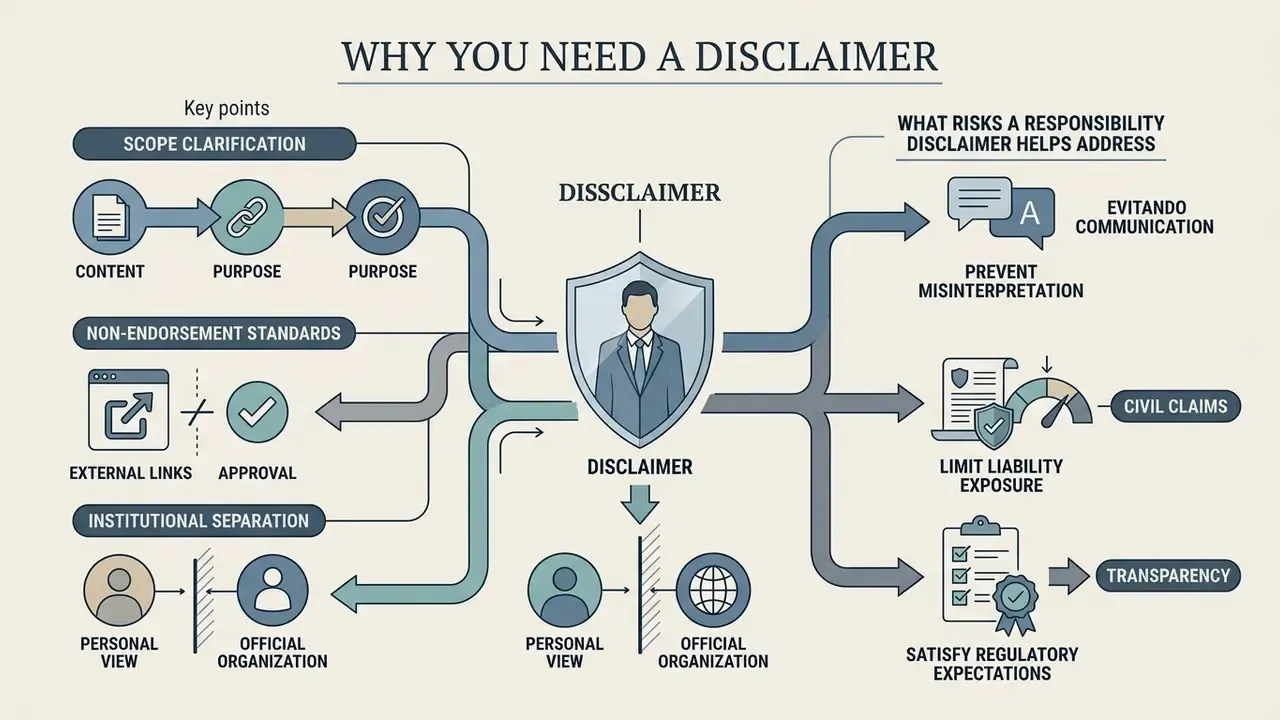
Organizations use disclaimers to prevent misinterpretation, limit exposure to civil claims, and satisfy regulatory transparency expectations. When a business publishes market analysis, health summaries, automated recommendations, or operational data, including outputs from generative tooling such as AI headshot generators or free AI video generators, users may rely on that information to make financial or legal decisions. Without explicit qualification, reliance turns into negligence or breach of warranty allegations.
There is a ceiling on what a notice can accomplish:
Regulatory and public guidance frameworks across federal agencies consistently stress clear content disclaimers:
- Scope ClarificationThe U.S. Agency for Healthcare Research and Quality (AHRQ) uses disclaimers to state that published summaries represent general information rather than specific clinical directives. AHRQ guidance is unusually precise on placement: printed reports carry the notice on the inside front cover, and web-only reports place it on the page following the title page.
- Non-Endorsement StandardsThe U.S. Environmental Protection Agency (EPA) and OSTI deploy disclaimers to deny endorsement of third-party products, external web links, or user-submitted data. The Library of Congress applies the same logic to external links, disclaiming responsibility for the accuracy, legality, or content of linked resources.
- Institutional SeparationUniversity and government design standards require disclaimers on unofficial or automated pages, so that individual author opinions are not attributed to the parent organization.
What Risks a Responsibility Disclaimer Helps Address
A responsibility disclaimer addresses risks tied to user reliance, implied performance guarantees, and secondary damages. Setting boundaries before content is consumed insulates a business against claims arising from unintended outcomes.
A well-structured responsibility disclaimer manages four core risk categories:
Under U.S. consumer protection principles enforced by the Consumer Financial Protection Bureau (CFPB) and the Federal Trade Commission (FTC), a disclaimer cannot waive non-waivable statutory rights or shield a business from gross negligence. What it does provide is a verifiable evidentiary baseline showing that the user was informed of content limitations before acting. And the cost of omitting that baseline is rising in automated systems:
Read that number twice. A control that was present in roughly one output in four has effectively disappeared, which means the notice burden has shifted back to the deploying institution.
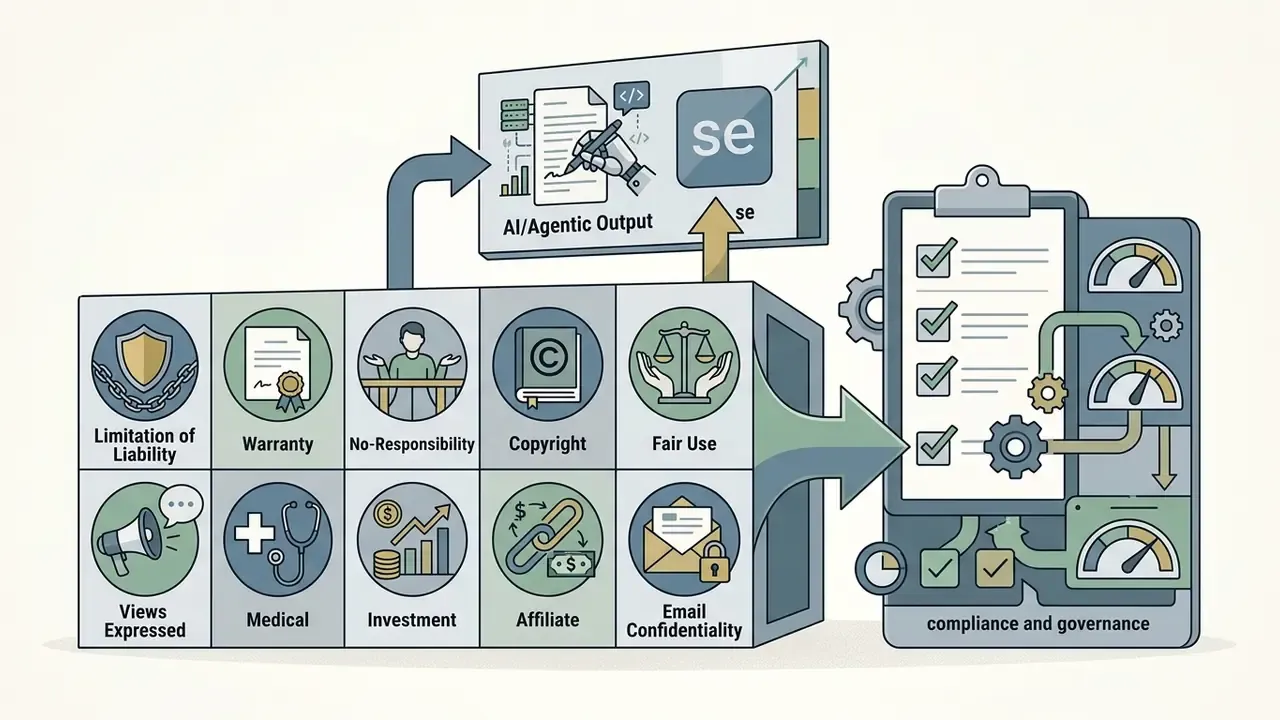
Key Types of Legal Disclaimers
Digital platforms and business communications require different types of legal disclaimers depending on content type, regulatory exposure, and operational risk.
| Disclaimer Type | Primary Purpose | Recommended Placement |
|---|---|---|
| Limitation of Liability | Caps or excludes financial liability for losses resulting from site or tool usage | Terms of Service, master disclaimer page, checkout screens |
| Warranty Disclaimer | Excludes express or implied guarantees (e.g., fitness for a particular purpose) | Product pages, software licensing flows, API portals |
| No-Responsibility Disclaimer | States that the publisher is not liable for user actions taken based on content | Analytical reports, educational blogs, information portals |
| Copyright Disclaimer | Asserts intellectual property ownership and outlines permitted usage rights | Site-wide footer, digital asset repositories, media portals |
| Fair Use Disclaimer | Claims statutory fair use exceptions under 17 U.S.C. § 107 for commentary/criticism | Media posts, analytical critiques, research excerpts |
| Views Expressed Disclaimer | Clarifies that statements reflect personal author views, not employer stance | Social media bios, guest commentary, employee publications |
| Medical Disclaimer | States content is not medical advice and does not replace clinical consultation | Health portals, diagnostic assistance tools, lab result pages |
| Investment Disclaimer | Clarifies content is for general education and not individualized advice | Financial blogs, market analysis feeds, trading tools |
| Affiliate Disclaimer | Discloses commercial compensation or referral relationships | Product review pages, comparison articles, referral links |
| Email Confidentiality | Asserts message confidentiality and directs unintended recipients to delete | Automated corporate email signatures, transactional mail |
| AI / Agentic Output Disclaimer | Discloses machine generation, states verification duties, and limits reliance on autonomous actions | Chat interfaces, generated assets, agent confirmation screens |
| Sensitive Content Warning | Warns users before exposure to graphic, traumatic, or clinically distressing material | Interstitial screen above the content, page top, video pre-roll |
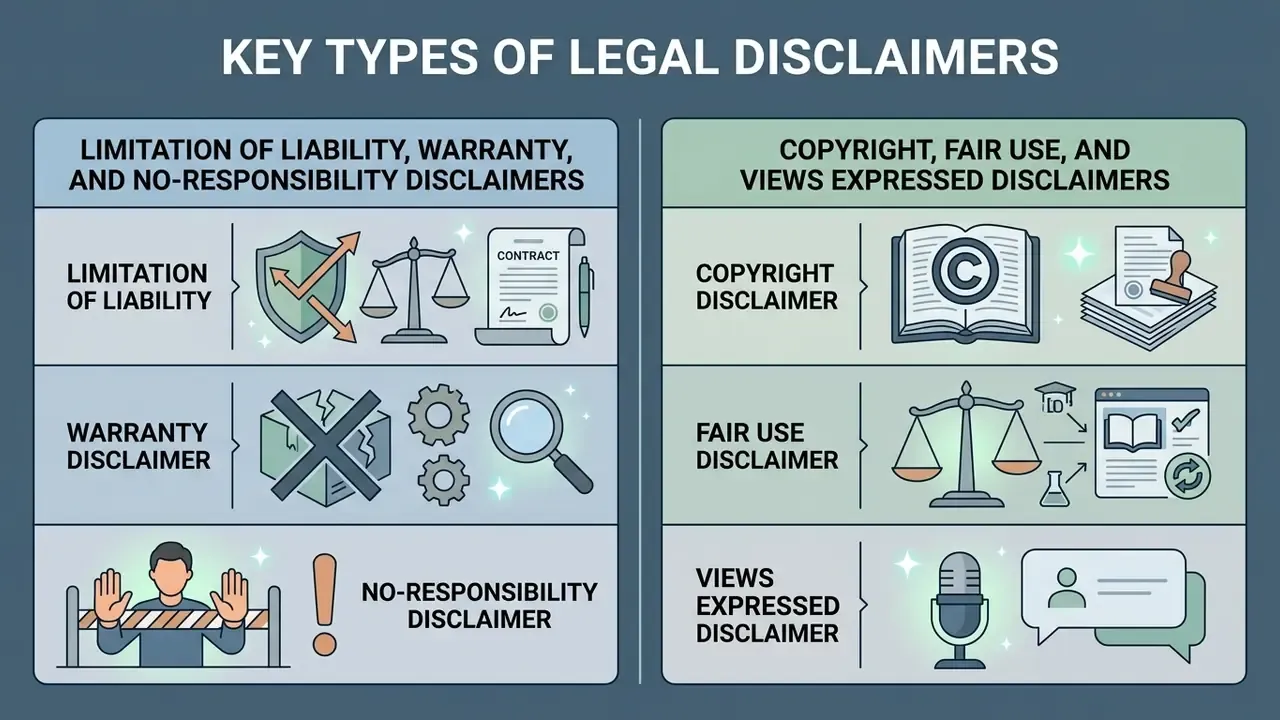
Limitation of Liability, Warranty, and No-Responsibility Disclaimers
These three form the core legal defense architecture for digital platforms and automated tools.
- Limitation of Liability Excludes recovery for indirect, incidental, special, or consequential damages. In the W3C Intellectual Rights Notice, standard liability limits waive damages arising from system interruptions or reliance on technical specifications.
- Warranty Disclaimer Declares that services and software outputs are provided on an "AS IS" and "AS AVAILABLE" basis. As detailed in the FTC Businessperson's Guide to Federal Warranty Law, sellers disclaiming implied warranties must use prominent language that clearly communicates the absence of performance guarantees. Critically, a seller that provides a written warranty cannot then disclaim or modify the implied warranties that accompany it.
- No-Responsibility Disclaimer Disclaims legal liability for actions taken on the basis of published outputs. U.S. EPA Guidance on Warranty Statements recommends capping maximum liability at the purchase price or replacement cost, while disclaiming third-party reliance outcomes.
Copyright, Fair Use, and Views Expressed Disclaimers
Intellectual property and editorial disclaimers cover ownership assertions, commentary rights, and organizational liability boundaries. Teams that publish or syndicate machine-assisted assets often pair these notices with provenance checks, for example by running AI reverse-image-search tools before republishing third-party visuals.
Disclaimers for Medical, Investment, Affiliate, Email, AI, and Sensitive Content
- Affiliate Disclaimer Mandated by FTC Disclosure Guidelines whenever a publisher receives compensation for product referrals. Disclosures must be prominent, plain, and positioned immediately next to affiliate links. In social media environments (Instagram, TikTok, YouTube, X), the FTC requires commercial disclosures to appear directly within the caption or as an overlay on video content before the viewer expands the description box. Ambiguous tags such as
#collab,#sp, or#thanksare legally insufficient. Use unambiguous markers,#ador#sponsored, or an explicit audio statement ("This video is sponsored by…"). FTC influencer guidance also requires disclosure of any material connection: financial, employment, personal, or family relationships with the brand, not only paid placements. - Email Confidentiality Disclaimer Appended to corporate correspondence to assert that the communication is confidential, legally privileged, and intended solely for the addressee. Queensland Government guidance deliberately separates two clauses: a confidentiality clause covering privileged information, and a distinct liability clause stating that the department accepts no responsibility for loss arising from reliance on the email. The second clause targets negligent misstatement risk specifically.
- AI / Agentic Output Disclaimer Discloses which assets, summaries, or recommendations were machine-generated, states that outputs require independent verification, and, for agentic systems, clarifies the boundary of the agent's authority. The U.S. Copyright Office issued formal registration guidance in 2023 confirming that purely AI-generated material must be excluded from a copyright application; only human-authored contributions are registrable. Any AI disclaimer that also asserts ownership must therefore separate human authorship from machine generation, or the registration itself becomes vulnerable.
- Sensitive Content Disclaimer Platforms hosting investigative reports, clinical studies, or user-generated media with explicit images, depictions of trauma, or severe medical conditions need explicit content warnings. The notice alerts visitors before exposure, letting them make an informed choice about distressing material. Typical triggers: violence or death; war, conflict, and abuse; graphic medical or surgical imagery; self-harm; and strong abusive language or hate speech quoted for documentary purposes. Placement matters more here than in any other category. A warning that appears after the image has rendered protects nobody.
Legal Disclaimer Requirements: When a Disclaimer Is Enforceable
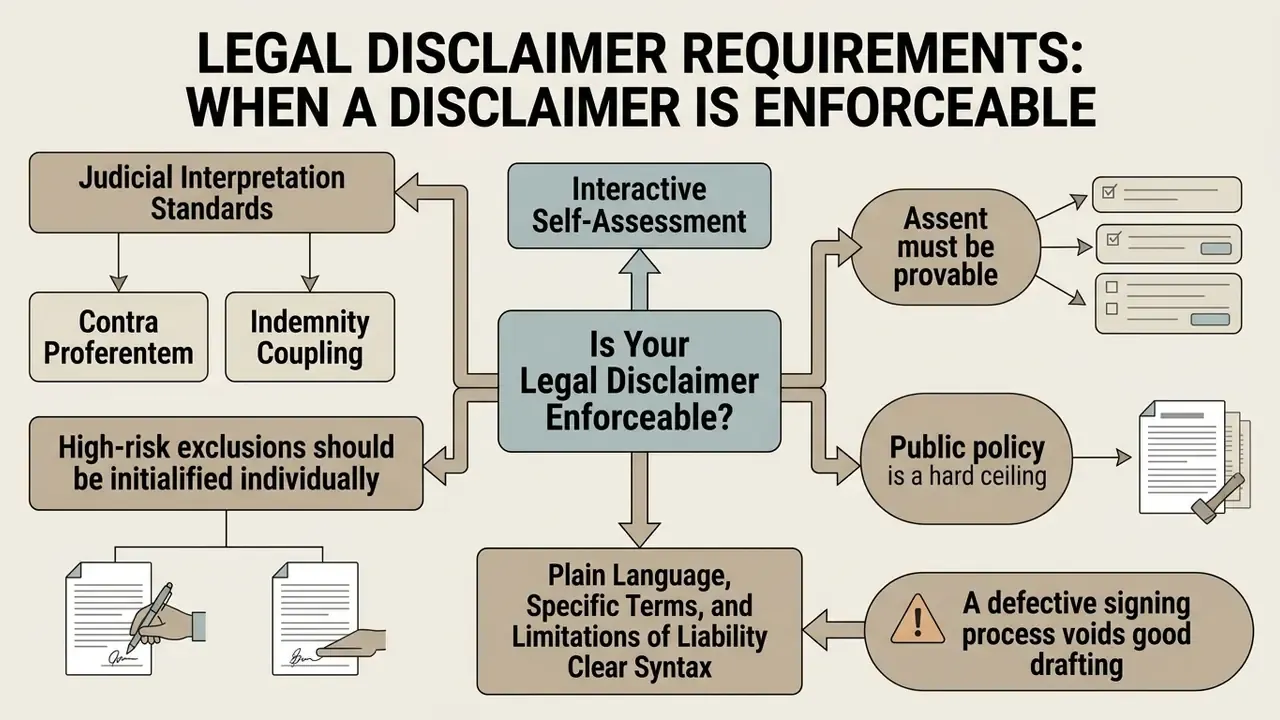
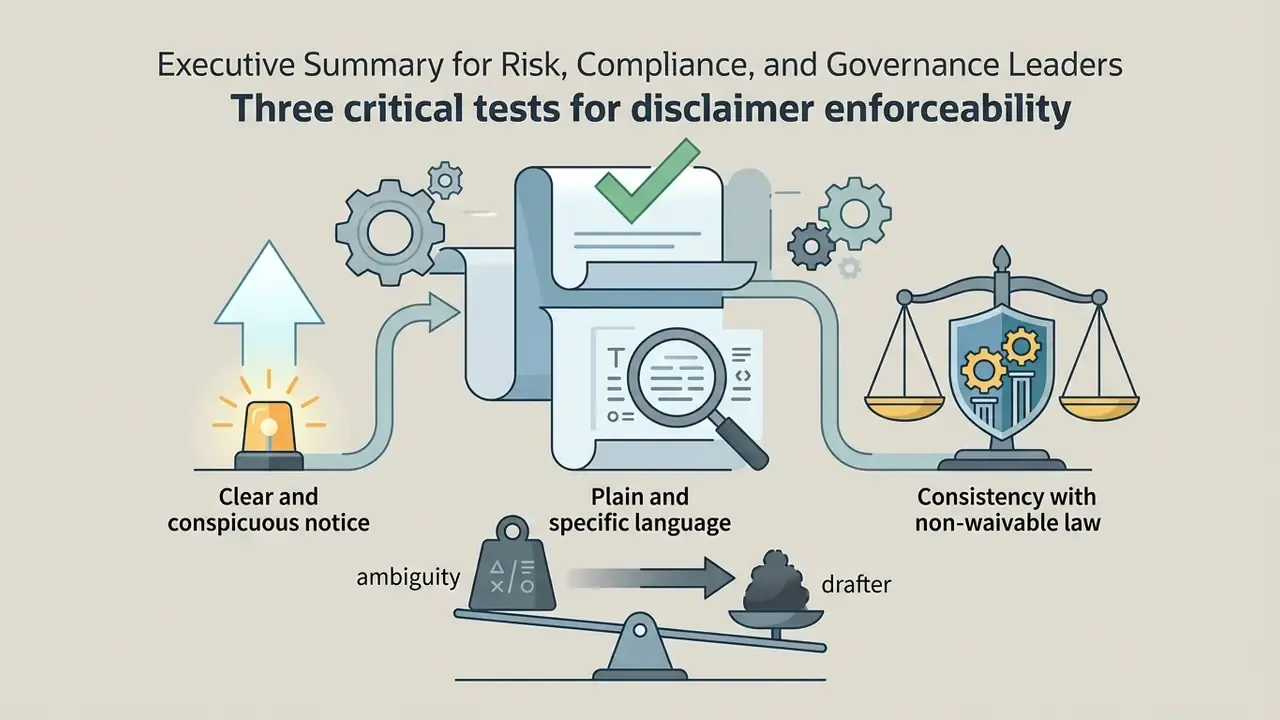
To hold up under U.S. jurisprudence, a disclaimer must meet three core criteria: clear notice, unambiguous language, and alignment with non-waivable statutory requirements. Hidden, contradictory, or overbroad notices fail judicial scrutiny. Those are the legal disclaimer requirements worth auditing first.
📋 Interactive Self-Assessment: Is Your Legal Disclaimer Enforceable?
Check your legal notice against these four judicial enforcement criteria:
Checklist0 / 4
Scoring: four checks passed indicates a defensible notice architecture. A single failure, particularly on items 1 or 3, is usually enough in practice to render the notice ineffective at the exact moment it is needed.
Judicial Interpretation Standards: Contra Proferentem and Indemnity Coupling
Courts evaluate disclaimers under strict rules of construction. Under the doctrine of contra proferentem, ambiguity in a liability waiver is construed against the party that drafted it. Where a clause carries more than one plausible meaning, the reading least favourable to the supplier applies. Sweeping formulations such as "not liable for losses of whatsoever nature" frequently fail when applied to an entity's own negligence: comparative case law shows that a general exclusion of loss "of whatsoever nature" was held not to exclude liability for an employee's negligent driving. The practical rule: name the actual risks instead of gesturing at all of them.
Sophisticated risk frameworks also pair legal disclaimers with indemnity clauses, sometimes called hold-harmless agreements. A disclaimer tells the user that the publisher denies liability. An indemnity clause contractually obligates the user to reimburse the publisher if a third party brings a claim resulting from that user's reliance. Disclaimer and indemnity are drafted together for a reason: one deflects the claim, the other allocates its cost.
Four additional constraints recur across jurisdictions and should be treated as design requirements, not edge cases:
- Assent must be provable.A standalone, clearly headed document, separated from pricing, invoices, itineraries, and booking confirmations, is far stronger evidence of consensus than reliance on conduct. Courts read tacit or quasi-mutual consent narrowly.
- High-risk exclusions should be initialled individually.Where an activity or tool can cause serious harm, consumer protection regimes require the nature of the risk to be highlighted and the participant to initial each provision acknowledging it. For high-risk operational activities or clinical software, require initials rather than trusting passive footer text.
- Public policy is a hard ceiling.Even a disclaimer that satisfies notice, assent, and clarity fails where it conflicts with constitutional or public-policy values such as fairness and access to justice, for example by letting a third party sign away another person's claims.
- A defective signing process voids good drafting.Present the notice in plain language as a standalone document in a language the user understands; walk the user through it; obtain signature before payment or participation; never staple it to an invoice; give each adult participant their own copy and time to ask questions; retain all signed originals, because the burden of proving enforceability sits with the drafter.
Plain Language, Specific Terms, and Limitations of Liability
Validity depends heavily on drafting precision and readability. Under principles enforced by the FTC and the European Union's Unfair Contract Terms Directive, ambiguous or overly technical jargon is construed against the drafter. EU consumer rules require terms drafted in "plain, intelligible language," and where a term is unclear, the interpretation most favourable to the consumer prevails. Clarity is assessed not only grammatically but by whether the consumer can understand the economic consequences.
- Clear SyntaxAvoid obscure legalese. Short, direct sentences.
- Specific ScopeDefine exactly what is excluded (e.g., "accuracy of third-party market feeds") rather than making sweeping claims such as "not responsible for anything."
- No Contradictory PromisesA business cannot market a tool as "100% accurate" in promotional copy while disclaiming all accuracy responsibility in fine print. The CFPB issued formal guidance in 2024 confirming that including deceptive or unenforceable terms in consumer disclosures violates federal law, and that hedging language such as "subject to applicable law" does not cure the misrepresentation.
Prominent Display and User Acknowledgments
Location and presentation decide whether a court or regulator will enforce a legal disclaimer. The FTC "Clear and Conspicuous" Standard requires disclosures to be unavoidable, clearly visible before user action or payment, and placed as close as possible to the claim they qualify.
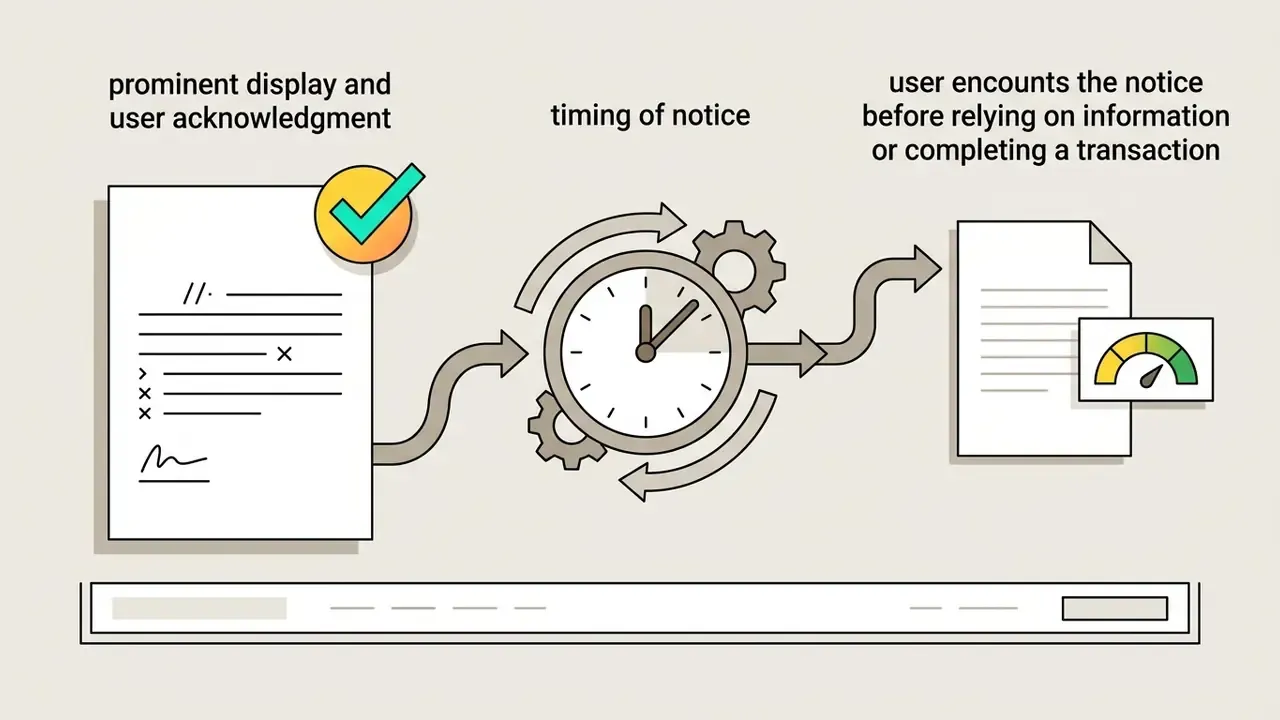
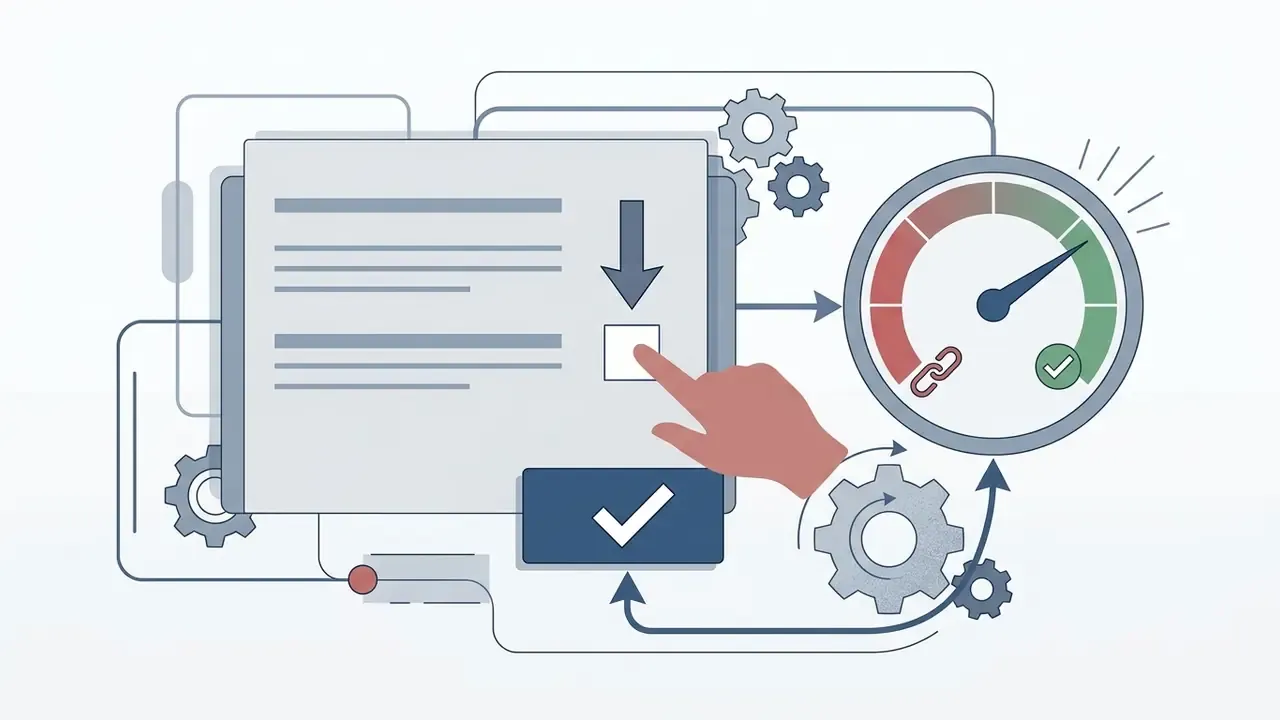
Illustrative practice pattern (anonymized and hypothetical; internal audit outcome, not a published case). A commercial bank deployed an AI-assisted credit evaluation portal for small business lending. During an independent model risk audit, reviewers noted that the risk disclaimers sat only inside a site-wide footer link. The bank updated the application workflow, embedding an inline notice directly above the submission button paired with an explicit acknowledgment checkbox. Per the institution's own account, the revised workflow was accepted in the next supervisory examination of its model validation controls. The outcome is firm-reported rather than independently verified. The transferable control is the design: notice at the decision point, plus a logged acknowledgment tied to the model version in use.
Disclaimers for Generative and Agentic AI: Human-in-the-Loop Requirements
Generative and agentic systems create exposure that classical website disclaimers were never drafted to absorb. Three distinct risks require three distinct notice mechanics:
- Fabrication risk (hallucination).Where a model can produce fluent but unfounded output, the disclaimer must state that outputs are probabilistic, may contain factual errors, and require independent verification before operational use. Generic "as is" language is insufficient because it never describes the failure mode. Name it: "outputs may include inaccurate citations, outdated figures, or non-existent references."
- Autonomy risk (unauthorized agent action).When an agent can transact, meaning book, purchase, submit, transfer, or send on the user's behalf, the effective control is not a disclaimer but a confirmation gate. The notice must appear in the execution path, immediately above the action, summarizing what the agent is about to do, the irreversible consequences, and the scope of delegated authority. A footer notice cannot supply notice for an act the user never explicitly authorized.
- Scope-creep risk.Agents chained across tools regularly exceed the task envelope the user had in mind. Define the permitted action envelope, and state that actions outside it are unsupported and unwarranted.
Recommended UI pattern for agentic execution:
| Step | Interface element | Notice content | Evidence captured |
|---|---|---|---|
| 1 | Task intake | Scope of delegated authority; excluded action classes | Timestamped session log |
| 2 | Pre-execution modal | Plain-language summary of the pending action, cost, and reversibility | Unselected checkbox + click event |
| 3 | Execution | Persistent "AI-executed action" label | Action ID, model/agent version |
| 4 | Post-execution receipt | Verification duty; correction and escalation channel | Delivered receipt copy |
How to Write a Legal Disclaimer: Structure and Wording
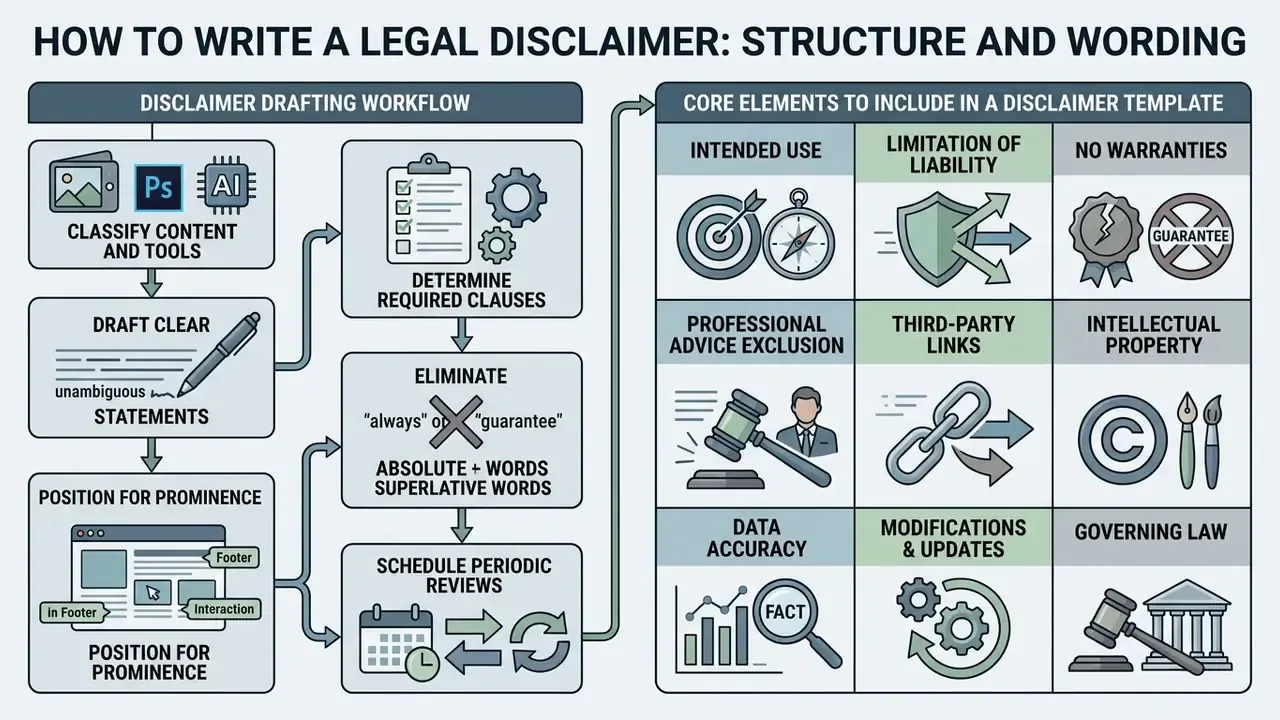
Drafting an effective disclaimer requires an operational understanding of business risks, user workflows, and regulatory rules. Take a generic template, skip customization, and you keep the liability gaps you were trying to close.
Core Elements to Include in a Disclaimer Template
A standard disclaimer template should carry five structural components:
- Scope and Purpose Clause Opens by stating the intended general-information purpose of the content.
- "AS IS" Warranty Exclusion Disclaims all express or implied warranties regarding accuracy, completeness, or fitness for use, including merchantability, title, and non-infringement.
- Limitation of Liability Clause Limits recovery for indirect, incidental, or consequential damages arising from content use, including business interruption, lost profits, data loss, and software corruption.
- Acceptable Use and Conditions Defines user responsibilities and encourages independent human validation plus professional consultation.
- Entity Contact Information Registered business name, postal address, legal contact email, telephone number.
How to Avoid Ambiguous and Unsubstantiated Claims
Drafting errors can make a legal disclaimer unenforceable. Common pitfalls: ambiguous conditional phrases such as "we might not be responsible," and blanket statements attempting to waive statutory rights.
U.S. FTC Compliance Guides state plainly that disclaimers cannot cure misleading headline claims. If marketing material asserts that software yields specific financial returns, a boilerplate fine-print line asserting "no guaranteed results" will not protect the business from deceptive advertising enforcement. The FTC's 2024 franchise compliance guidance makes the same point structurally: sellers cannot use waivers or integration clauses to disclaim statements they were authorized to make in disclosure documents. Disclaimers must reinforce truthful representations, never contradict promotional promises.
Where to Place a Disclaimer on Websites, Emails, and Content
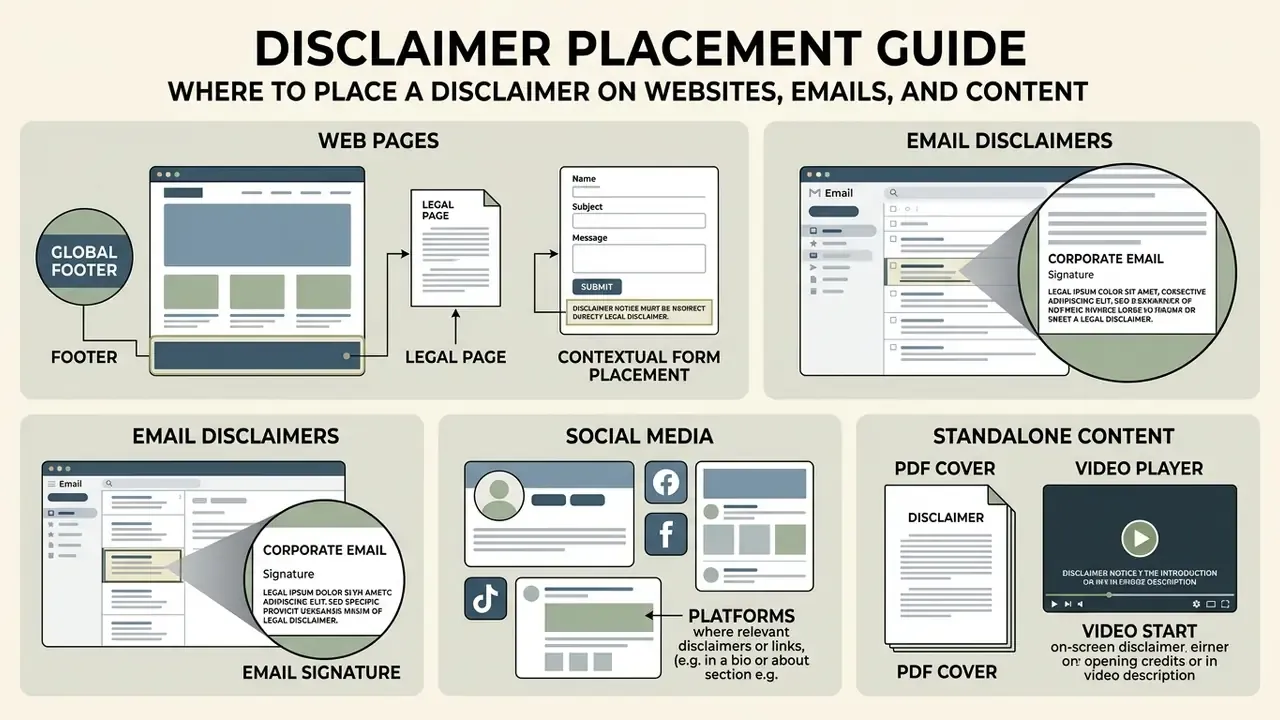
A well-drafted disclaimer is legally ineffective if it sits where users cannot reasonably find it. Proximity and prominence govern disclosure effectiveness.
Placement map by surface:
| Surface | Primary location | Secondary reinforcement | Failure mode to avoid |
|---|---|---|---|
| Website (global) | Footer link to dedicated legal page | Persistent header notice on high-risk sections | Footer-only for transactional risk |
| Forms / checkout / export | Inline, directly above the action button | Unselected acknowledgment checkbox | Notice after submission |
| Signature block, below sender details | Inline sentence in the message body | Notice only in an attached PDF | |
| Social media | Post caption or on-screen overlay | Profile bio + short link to master notice | #sp, #collab, buried in "more" |
| PDFs / reports | Inside front cover or page after title page | Repeated in page footer | Notice only on the web landing page |
| Video / media | Pre-roll frame or first 5 seconds of audio | Description box + pinned comment | Description-only disclosure |
| AI / agent UI | Pre-execution confirmation modal | Persistent "AI-generated" label | Terms-of-Service-only notice |
Legal Disclaimer Examples for Websites and Content
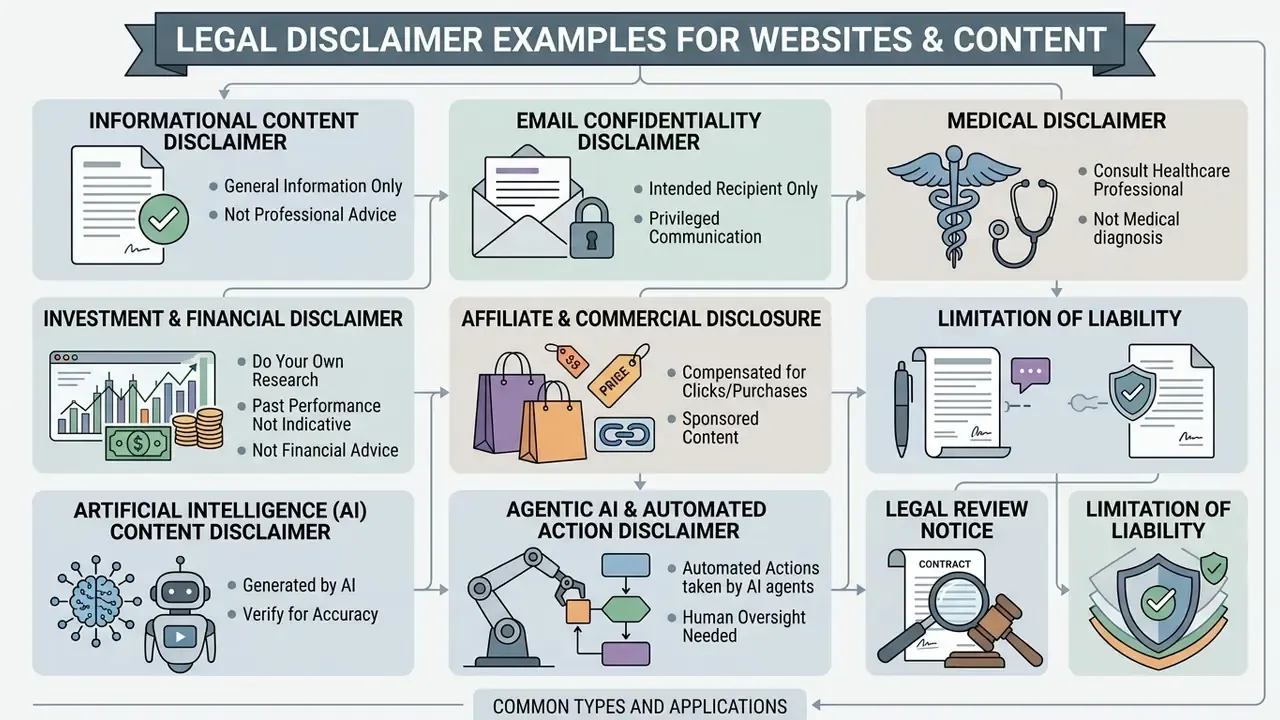
These practical examples show how abstract requirements translate into working language for digital channels. Each block is written for direct copying and later customization.
Example Website Disclaimer for Informational Content
Baseline protection for analytical blogs, informational websites, and educational portals:
General Information Notice: All content published on [Website Name] is provided for general informational and educational purposes only. The information does not constitute legal, financial, medical, or other professional advice. While we strive to maintain accurate and up-to-date information, we make no representations or warranties of any kind, express or implied, regarding the accuracy, completeness, reliability, or suitability of the content. Any reliance you place on such information is strictly at your own risk. In no event shall [Company Name] be liable for any loss or damage, including indirect or consequential loss, arising from the use of this website or any linked third-party resource.
Example Email Confidentiality Disclaimer
Standard protection for corporate email communications:
Confidentiality Notice: This email message, including any attachments, is intended solely for the use of the individual or entity named above and may contain confidential, proprietary, or legally privileged information. If you are not the intended recipient, you are hereby notified that any disclosure, copying, distribution, or reliance on the contents of this information is strictly prohibited. If you have received this transmission in error, please immediately notify the sender by reply email and destroy all copies of the original message. [Company Name] accepts no responsibility for any loss or damage arising from reliance on the contents of this message.
Medical Disclaimer Template
Medical Notice: The information provided on this website ([Website Name]) is for general educational purposes only and does not constitute professional medical advice, diagnosis, or treatment. Always seek the advice of your physician or other qualified health provider with any questions you may have regarding a medical condition. Never disregard professional medical advice or delay in seeking it because of something you have read on this website. In an emergency, contact your local emergency services immediately.
Investment & Financial Disclaimer Template
Financial Notice: All content on [Website Name] is published strictly for informational and educational purposes. It does not constitute individualized investment, tax, or financial advice, and it is not a recommendation to buy, sell, or hold any security or financial instrument. Past performance is no guarantee of future results. Investments are subject to market risk, including the possible loss of principal. Consult a licensed financial advisor prior to executing any commercial or investment decisions.
Affiliate & Commercial Disclosure Template
Affiliate Disclosure: [Company Name] participates in various affiliate marketing programs, which means we may earn paid commissions on qualifying purchases made through our links to retailer sites. This comes at no additional cost to you. We only recommend products and services that undergo rigorous evaluation, and compensation never determines our editorial ranking or conclusions.
Social media variant (place in the caption or as an on-screen overlay, not in the description box):
#ad - Paid partnership with [Brand Name].
Artificial Intelligence (AI) Content Disclaimer Template
Agentic AI & Automated Action Disclaimer Template
Automated Action Notice: This feature uses an autonomous software agent to perform actions on your behalf within the scope you authorize. Before any transaction, submission, or external communication is executed, you will be presented with a summary of the pending action and asked to confirm it. [Company Name] does not warrant that automated outputs, recommendations, or executed actions will be accurate, complete, or suitable for your circumstances, and accepts no liability for outcomes arising from actions you confirm. Actions outside the authorized scope are unsupported. You remain responsible for reviewing each confirmation prompt before proceeding. Model version and action logs are available on request.
Fair Use Disclaimer Template (17 U.S.C. § 107)
Fair Use Notice: This site may contain copyrighted material the use of which has not always been specifically authorized by the copyright owner. We are making such material available for criticism, comment, news reporting, teaching, scholarship, or research under the "fair use" provisions of Section 107 of the U.S. Copyright Act (17 U.S.C. § 107). If you wish to use copyrighted material from this site for purposes that exceed fair use, you must obtain permission directly from the copyright owner. Copyright protection is territorial and this notice addresses United States law only.
Sensitive Content & Trigger Warning Template
Content Warning: The following page contains detailed depictions of [medical procedures / war violence / abuse / sensitive graphic material] that some viewers may find disturbing. Content is presented solely for educational, journalistic, and research purposes. Viewer discretion is advised. If you would prefer not to view this material, use the link below to return to the previous page.
Views Expressed Template
Views Expressed Notice: The views and opinions expressed in this publication are those of the author alone and do not necessarily reflect the official position of [Company Name], its affiliates, clients, or employees.
Strategic Governance Checklist
Risk leaders can evaluate their disclaimer framework against this six-point audit standard:
- Unified Inventory: Keep a centralized index of all active legal disclaimers across websites, APIs, email templates, agent interfaces, and marketing campaigns, with an owner and review date for each. If no one owns a notice, no one updates it.
- Plain Language Verification: Run annual readability checks so disclosures stay clear, conspicuous, and free of unnecessary jargon.
- Assent Mechanism Review: Verify that high-risk application flows require active acknowledgment before processing, and that acknowledgment events are logged with the model or system version in use.
- Prominence and Contrast Audit: Test display layouts on desktop and mobile to confirm visual prominence, and confirm that no notice depends on the footer alone where a transaction is involved.
- Regulatory Alignment: Review disclaimers against updated FTC, CFPB, and sector-specific standards, and, for financial institutions, against model risk management expectations under Federal Reserve SR 11-7 and OCC Bulletin 2011-12, so that user-facing notices match documented model limitations.
"Several publicly available language models generated detailed articles containing false medical claims in 2023, absent adequate disclaimers and safeguards." Study on safeguards, risk mitigation, and transparency measures of LLMs against health disinformation, BMJ (2023)
- Independent Legal Validation: Engage qualified legal counsel whenever entering new commercial markets or deploying new automated tools, and record the review date alongside the published text.
Limitations and Open Questions
Two honest caveats before anyone treats the above as settled doctrine.
First, the evidence base is uneven. Comprehension research and platform-liability scholarship are still thin on longitudinal data, and the anonymized practice patterns in this article are illustrative rather than verified case studies. Treat the percentages as hypotheses to test in your own analytics, not as benchmarks.
Second, agentic AI is moving faster than the notice conventions built for static web pages. Courts have not yet produced a body of decisions on whether a pre-execution modal supplies adequate notice for an irreversible agent action, nor on how delegated authority is construed when an agent chains tools autonomously. Until that clarifies, the conservative design stands: narrow authority scope, explicit confirmation, complete logs, and a documented shutdown path.
A reasonable next step, and a low-risk one: pull your five highest-risk digital surfaces, check each against the four-point prominence test, and record which ones rely on the footer alone. That single exercise usually surfaces more exposure than a full redraft of the master notice.
FAQ: Legal Disclaimer Questions Risk Teams Ask
How do I write a disclaimer that actually holds up?
Start from the risk, not from a template. Classify the content or tool, name the specific failure modes you are excluding, write in short plain sentences, then place the notice where reliance happens. A disclaimer template is a starting draft, never a finished control.
Is a legal disclaimer legally binding?
Not in the way a contract is. A disclaimer is a unilateral notice, so it can be undermined if it is hidden, ambiguous, contradicted by your own marketing, or aimed at rights that statute makes non-waivable. Enforceability improves markedly with logged affirmative assent.
Does a website disclaimer replace Terms of Service?
No. Website disclaimers allocate reliance and warranty risk. Terms of Service create bilateral obligations: payment, uptime, permitted use, termination, dispute forum. Keep them separate documents so you can prove which one gave notice of what.
Do AI outputs need their own disclaimer?
Yes, and it should describe the failure mode rather than hiding behind "as is." For agentic systems, the disclaimer alone is insufficient; pair it with a pre-execution confirmation gate and an auditable action log tied to the model version.
What is a qualified disclaimer, and is it related?
A qualified disclaimer is a tax-law instrument, an irrevocable refusal to accept property or an inheritance under IRC § 2518. Despite the shared word, it has no bearing on website or AI disclaimers.
How often should disclaimers be reviewed?
Annually at minimum, plus an event-driven review whenever a model version, jurisdiction, product scope, or marketing claim changes. Record the review date next to the published text so auditors can see the cycle exists.
Internal Hub Navigation
- Learn more about managing legal frameworks for commercial use.
- Explore recent regulatory enforcement trends in AI Litigation and Case Timelines.
- Compare licensing and usage rights across AI art generators and Google's AI image generation stack.
- Review verification tooling for machine-generated assets in our guide to AI reverse-image-search platforms.