Executive summary: what a comparison matrix must prove
What AI media comparison matrices are and what they are used for
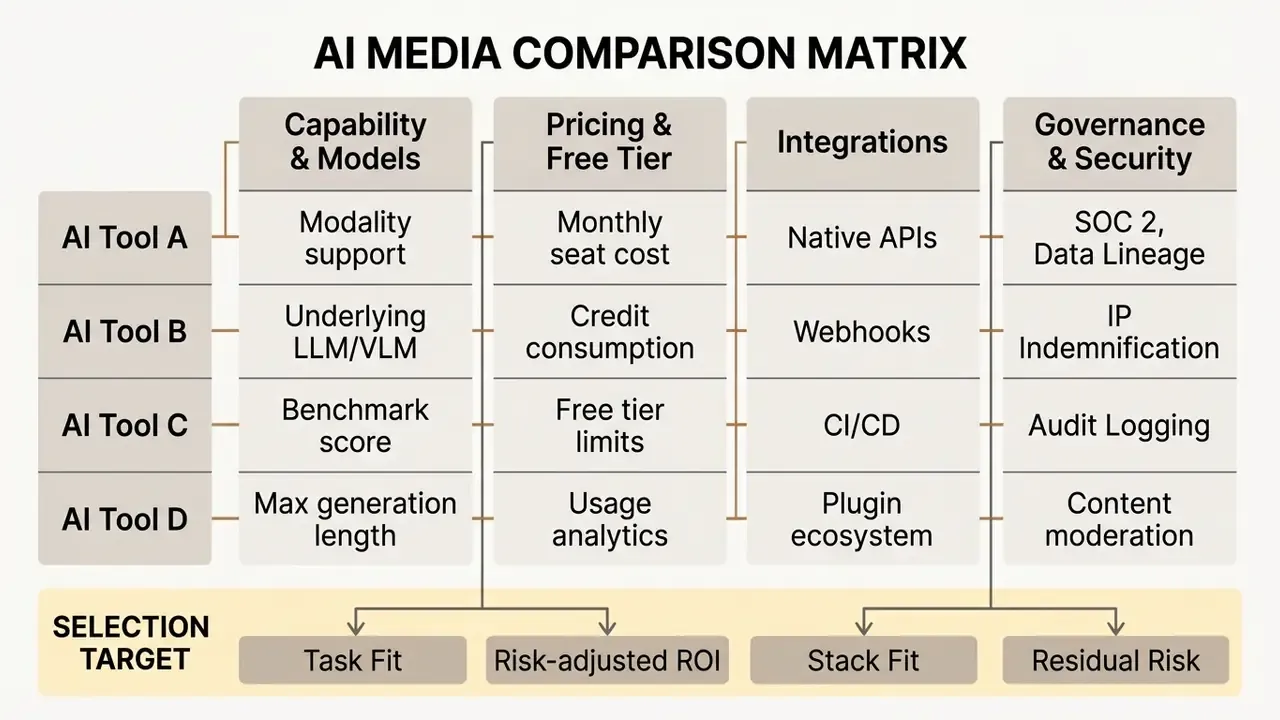
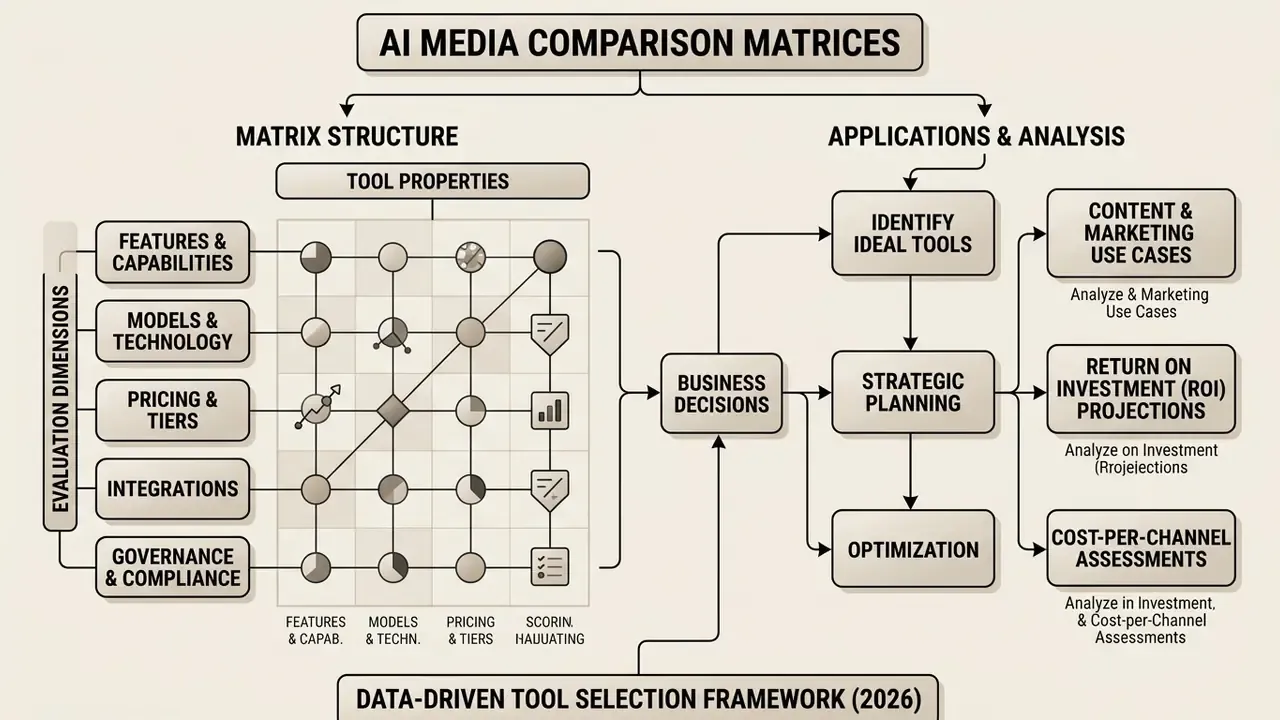
An AI media comparison matrix is a structured, multi-dimensional decision scorecard that evaluates ai tools and ai systems across capability, risk, cost and workflow integration parameters. It works as an objective evaluation layer that prevents unvetted software deployment and reduces shadow AI adoption across enterprise teams.
«VBench decomposes video generation quality into 16 hierarchical dimensions, from temporal consistency to text alignment, producing a matrix view of model strengths and weaknesses.»
By mapping software capabilities against organizational requirements, a comparison matrix standardizes how institutions analyze artificial intelligence ai software. Rather than relying on vendor marketing, teams evaluate intelligence artificial capabilities using objective benchmarks. The method applies directly to high-volume operational workflows: content creation, performance marketing, corporate social media management, and everything from copy drafting to AI voice generation for campaign audio. Evaluating software at the system level ensures each ai tool integrates safely within broader IT architectures and governance boundaries.
Quick trust check before you read any matrix: confirm the exact model version, the date of the pricing snapshot, the prompt set used, and whether affiliate relationships are disclosed. Four questions. The full verification protocol sits in section [11].
What problems an AI tool comparison matrix solves
An AI comparison matrix establishes a repeatable methodology for selecting an ai tool aligned with specific content creation and marketing workflows. It separates passive text generation (generative ai) from interactive assistance (ai assistant) and autonomous task execution (agentic ai).
«UniBench defines 13 tags and 81 subtags for image generation evaluation, allowing models to be compared on precise, measurable parameters.»
Extended matrix of AI architectures by autonomy and risk
| Architecture | Core behavior | Autonomy | Human input | Typical media/marketing use | Dominant risk to score |
|---|---|---|---|---|---|
| Generative AI | Produces text, image, video, or audio from a direct prompt | Low | Required per task | Copy drafts, visuals, ad variants | Hallucination, IP provenance |
| AI Assistant | Conversational support inside a defined workspace | Low to medium | Required, iterative | Research summaries, editing, briefs | Prompt leakage, unverified claims |
| Agentic AI | Executes multi-step goals with tool use and feedback loops | High | Exception-based | Scheduled publishing, campaign QA, competitor monitoring | Unbounded action, audit gaps |
| Adaptive AI | Retrains or re-weights on incoming data in real time without a full model rebuild | Medium to high | Semi-independent | Dynamic price parsing, fraud signals, personalization | Model drift, silent behavior change |
| Compound AI | Coordinates several specialized components (LLM + retriever + rules engine) | Medium to high | Coordinated | Regulated content pipelines, diagnostics-grade workflows | Error propagation between components, ownership ambiguity |
No matching rows Clear one or more filters to restore the matrix.
Adaptive and compound configurations matter most for regulated buyers. Adaptive systems change behavior between audits, and compound systems distribute accountability across components, so both require explicit lineage documentation inside the matrix. One practical rule from the model risk side: if you cannot name the owner of a component, you cannot validate it.
How AI-enhanced analysis differs from manual comparison
AI-enhanced data analysis accelerates software selection by processing unstructured vendor documentation, release notes and benchmark dataset time data in real time, cutting research cycles from weeks to days. Manual governance oversight stays mandatory, though, to validate accuracy and prevent evaluation bias.
Empirical studies show AI-assisted research workflows reduce total decision-making time from 7 to 8 days down to 1 to 2 days while improving parameter matching accuracy by 10% to 20% (Quantilope, 2026; corroborated by statistical-production evidence reporting 10 to 20% higher indicator accuracy and update cycles shortened from 6 to 12 months down to 1 to 3 months, ISI-Next abstract, 2026). Despite the speed, automated evaluation alone cannot replace human verification.
«GPT-4o reaches only 49.19% accuracy when predicting human preference between pairs of generated media, barely above random guessing.»
Comparative timing: manual analysis vs AI-enhanced matrix
Traditional manual process, 8 steps, about 8.5 hours per report
- Identify products and competitors for comparison, 1.0 h
- Define comparison criteria and weighting parameters, 1.0 h
- Research competitor features and capabilities, 2.5 h
- Extract pricing tiers, quotas and seat limits, 1.5 h
- Build the comparison matrix with differentiators, 1.0 h
- Validate data accuracy with subject-matter experts, 0.5 h
- Design the visual comparison format, 0.5 h
- Review and finalize the report, 0.5 h
AI-enhanced process, 2 steps, about 25 minutes
- Automated collection, price normalization and feature mapping by an AI agent, 15 min
- Generated comparison report with dynamic visualization and variance flags, 10 min
Result: a 94 to 95% reduction in analyst hours with end-to-end traceability, provided every claim carries a source tag, timestamp and confidence score, and low-confidence rows are routed to a human analyst before publication. Without those three attributes the saving is illusory; you have simply moved the error downstream.
Illustrative scenario (hypothetical, composite): in a review of enterprise content tools for a mid-sized financial group, an evaluation team tests five multimodal models using standardized prompts to establish baseline accuracy. Mapping failure rates in legal disclaimers eliminates three vendors before contract commitment. The screening avoids roughly $140,000 in unviable seat licenses and removes a post-deployment remediation cycle. Numbers here are illustrative and not audited results.
Criteria for comparing AI tools in a media matrix
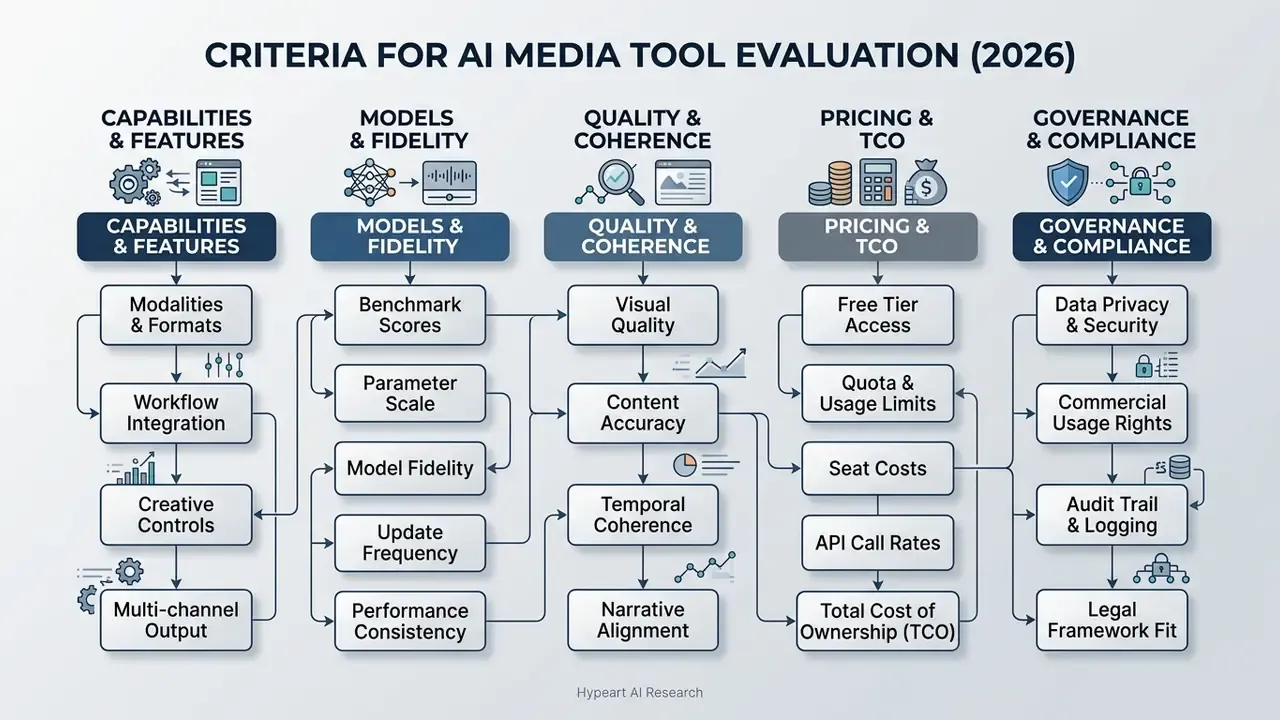
Objective evaluation of ai tools requires scoring core features, ai models quality, commercial pricing, free tier quotas and governance controls. This multi-axis assessment protects institutions from hidden operational costs and compliance failures. NIST's benchmark-evaluation draft (2026) frames model quality around documented tasks, metrics and test conditions, while the European Commission's 2026 AI transparency guidance adds effectiveness, robustness, reliability and interoperability as system-level quality requirements.
Features, models, and the quality of AI-generated content
Content quality in generative ai is judged through modality-specific benchmarks measuring prompt fidelity, visual coherence and narrative consistency. Modern ai systems range from single-prompt ai assistant interfaces to complex agentic ai pipelines.
Text-to-image fidelity relies on standardized benchmarks. GPT Image 1.5, for example, reaches an 85% to 90% fidelity rate on embedded text rendering, which directly affects graphic design accuracy. Worth checking that against practical workflows such as Ghibli-style image generation or AI image expansion and outpainting. In video generation, frameworks like VBench score models across 16 hierarchical dimensions, including temporal consistency and motion smoothness (VBench, 2023).
«AIGVE-Bench collected 21,870 human ratings across 9 quality dimensions for 2,430 AI-generated videos, exposing concrete strengths and weaknesses per model.»
Stanford's AI Index (2026) notes that no current video model has reached the human baseline of 74.4% on overall accuracy in Video-MMMU, and identifies motion effects as the weakest subdimension across nearly all models. Gen-3 and Kling led early-2026 quality rankings for image quality, aesthetics, temporal consistency and motion. Updated: treat those leaderboards as version-bound snapshots rather than stable rankings, and re-run them against your own prompt set before procurement. Visual modalities still need strict quality checks and human review before publication, including downstream tasks such as YouTube editing workflows.
One caveat I would flag for model risk teams. Benchmark deltas of two or three points rarely survive a change in prompt formatting, so weight them accordingly.
Pricing, free tier, and value for the team
Calculating total cost of ownership for an ai tool means auditing subscription fees, API volume tiers, hidden integration costs and free tier constraints. Real business value shows up in risk-adjusted ROI that factors in ongoing compliance and oversight expense.
Pricing models generally fall into fixed monthly seats, credit-based consumption, or usage tiers. The baseline financial return uses the standard formula:
Total costs include seat licenses, API overages, employee training and model risk validation. Teams evaluating media tools can review the AI Video Pricing and Credits Comparison and, for entry-level budgets, the comparison of free AI video generators to weigh usage-based credit models against fixed enterprise subscriptions.
What belongs inside "Total Control Costs" (audit checklist)
Checklist0 / 10
Financial gates and the cost-per-managed-channel metric
For social and martech stacks, headline seat price distorts real spend. Use a blended metric instead:
- AI-included plans Buffer lists paid plans from $5 per channel per month on annual billing, with the AI Assistant available on every tier including free. Canva Pro at $15 per month includes 500 AI uses per user, and the free plan includes 50 AI uses.
- AI-gated plans Hootsuite Professional starts at $99 per month for one user and ten accounts, while Talkwalker-powered listening (Blue Silk AI) requires the Business plan at $739 per month or higher. Sprout Social's Standard tier prices at $249 per seat per month with AI Assist sentiment included, and Advanced at $399 per user per month. Enterprise listening widens the spread further: Brandwatch is reported between $800 and $15,000 per month.
- Practical rule a matrix row is comparable only when the AI capability sits on the same tier. Two tools at identical headline prices can differ by 7x once listening, analytics, or multi-brand voice sits behind a gate.
«Academic benchmarks, VBench, WritingBench, GenAI-Bench, measure model quality in detail but systematically omit pricing, free-tier limits and ROI for marketing teams.»
Extended AI tool comparison matrix with governance columns (2026)
| Category | AI Tool | Key features | Content types | Models / context | Free tier limits | Pricing | Governance & security | Best use case |
|---|---|---|---|---|---|---|---|---|
| LLM & research | ChatGPT / Gemini | Multimodal reasoning, code execution, web research | Long-form text, research, image drafts | GPT-4o (128K), Gemini 1.5 Pro (up to 2M) | Usage-capped access | Free tier; paid from $20/user/month | Training opt-out on Team/Enterprise; admin controls; audit logs on enterprise tiers | General research and draft copywriting |
| LLM & research | Claude 3.5 Sonnet | Long-document analysis, code review | Long-form text, code, summaries | Claude 3.5 / 200K tokens | Daily message cap | About $20/user/month | SOC 2 posture; Pro/Team data not used for training by default | Long-read analysis, complex code |
| LLM & research | Perplexity | Cited real-time answers, source lists | Research briefs, competitive scans | Multimodal / about 127K tokens | About 5 Pro queries/day | About $20/user/month | Source citation by default; enterprise data controls | Competitive intelligence, fact-checking |
| LLM & research | Microsoft Copilot | Microsoft 365 integration, tenant grounding | Docs, email, decks | 128K tokens | No standalone free enterprise tier | About $30/user/month | Tenant-bound data, compliance and eDiscovery integration | Regulated enterprises on the Microsoft stack |
| LLM & research | Z.ai (GLM family) | Open-weight and hosted access, low-cost inference, coding plans | Text, code, agent workflows | GLM-class long-context models | Limited free web access | Low-cost hosted plans; self-host at infrastructure cost | Deployment-dependent: verify residency, retention and cross-border terms before use | Budget-sensitive drafting and self-hosted pilots |
| LLM & research | Llama 3.1 (self-hosted) | Open weights, on-prem deployment | Text, code | 128K tokens | Free weights | Infrastructure cost only | Full data residency; controls are the deployer's responsibility | Data-localization-constrained workloads |
| Image | Adobe Firefly | Commercially safe generation, editing | Images, vectors, video frames | Firefly Image 3 | Generative credits on free plan | From about $5/month or bundled in Creative Cloud | Licensed training data; commercial-use terms and IP indemnification on eligible tiers | Commercial design with reduced IP risk |
| Image | Midjourney | Highest aesthetic consistency | Concept art, campaign visuals | Proprietary | None | $10 to $120/month | Commercial rights on paid plans; public-by-default galleries on basic tiers | Art direction and concepting |
| Image | DALL·E 3 | Prompt adherence, embedded text | Illustrations, social graphics | Integrated with ChatGPT | Via capped free ChatGPT access | Included from $20/month | Content filters; enterprise data controls via API tier | Prompt-accurate marketing imagery |
| Image | Stable Diffusion | Local control, fine-tuning | Images, upscales | Open weights | Free (self-hosted) | Infrastructure cost | Self-managed retention; license review required per model checkpoint | Custom pipelines, private data |
| Image | Ideogram / Leonardo.ai | Text-in-image, asset consistency | Graphics, game and product assets | Proprietary | Limited daily credits | $7 to $48/month | Commercial use on paid tiers; verify per-plan terms | Typographic graphics, asset series |
| Video | Runway Gen-3 | Cinematic generation, motion tools | Short promos, b-roll | Gen-3 Alpha (about 10 s clips) | 125 one-off credits | $12 to $76/month (credit-based) | Watermarking and content provenance; commercial use on paid plans | High-quality short-form video |
| Video | Veed | Text-to-video, auto-subtitles, clean voice, brand kits | Marketing video, social snippets | Proprietary video models | Watermarked, export-limited | From $12/user/month | Team permissions; brand-kit governance; review retention terms | Rapid video editing and social clips |
| Video | Synthesia | AI avatars, multilingual dubbing | Training, internal comms | Proprietary avatars | Trial only | $22 to $67/month | Avatar consent workflows, enterprise SSO | Corporate and L&D video at scale |
| Video | Pika | Fast short clips | Social snippets | Proprietary | Limited credits | $10 to $35/month | Verify commercial terms per tier | Rapid social experimentation |
| Audio | ElevenLabs | Voice synthesis and cloning, 29 languages | Voiceover, podcasts, localization | Multimodal audio | 10k characters/month | $5 to $330/month | Voice-cloning verification and consent controls | Localization and narration |
| Audio | Suno / Descript | Music generation; audio-video editing with transcripts | Soundtracks, podcasts | Proprietary | Limited free tier | $8 to $24/month | Licensing terms vary by tier; check redistribution rights | Soundtracks and podcast production |
| Design & social | Canva AI (Magic Studio) | Magic Write, brand kit, automated layout, scheduler | Images, short video, social templates | Proprietary, FLUX, partner models | 50 AI uses/month | From about $15/user/month (500 AI uses) | Brand controls, team roles; enterprise admin and SSO | Social asset production for teams |
| Copywriting | Jasper | Brand Voice, audience profiles, campaign templates | Copy, ads, blogs | Multiple third-party LLMs | Trial only | From $39/seat/month annual (Creator) | Brand-voice governance; enterprise controls; human review required for YMYL claims | Multi-brand voice consistency |
| Copywriting | Copy.ai | Content Agent Studio, workflow automation | Copy variations at volume | Multiple LLMs | Free tier exists | From $36/month annual (Pro, up to 5 seats) | Workflow permissions; output review remains the buyer's duty | High-volume production workflows |
| Marketing suite | HubSpot Marketing Hub | AI Brand Voice, campaign workflows, CRM integration | Copywriting, email, landing pages | GPT-4o integration, in-house LLMs | Basic CRM and entry tools | Starter from $20/seat/month | CRM-grade permissions, data retention settings, audit logging | Full-funnel marketing automation |
| Scheduling | Buffer | AI Assistant, best-time-to-post, 11 networks | Captions, scheduled posts | Proprietary assistant | 3 channels, 10 posts/channel, AI included | From $5/channel/month annual | Channel-level permissions; no native listening | Solo and small-team scheduling |
| Suite & listening | Hootsuite | OwlyWriter AI, AI content calendar, listening | Captions, calendars, listening reports | Proprietary + Blue Silk AI | No free tier | $99/month Professional; $739+/month for listening | Enterprise roles, approval workflows, audit trails | Mid-market all-in-one management |
| Suite & sentiment | Sprout Social | AI Assist sentiment, reply suggestions | Posts, care replies, analytics | Proprietary ML | No free tier | $249/seat/month Standard; $399 Advanced | SOC 2 posture, role-based access, retention policies | Support-heavy social operations |
| Enterprise listening | Brandwatch | Iris AI consumer intelligence, influencer, search | Listening dashboards, reports | Proprietary Iris engine | No free tier | About $800 to $15,000/month | Enterprise DPAs, data residency options, audit logging | Enterprise-scale listening |
| Analytics | Factors.ai | Account identification, attribution, ABM analytics | Analytics reports, audience insights | Proprietary ML models | Demo access only | From $399/month | Identity-data handling review required; retention controls | B2B attribution and ABM |
| Code | GitHub Copilot / Cursor | IDE-native completion, tests, refactors | Code, tests, docs | Codex-class / IDE-native | None (Copilot); limited (Cursor) | $10 to $20/user/month | IP indemnification on Business tiers; code-retention controls | Engineering enablement around AI stacks |
Pricing and quotas above are snapshots for the stated period. Re-verify each cell against vendor documentation on the date the matrix is published.
Two reading notes. Rows with open weights, Llama and the Z.ai GLM family among them, shift cost from licenses to infrastructure and shift risk ownership onto your own team. And any row without a governance entry is not a candidate yet, it is a research note.
Comparing AI tools by media content type
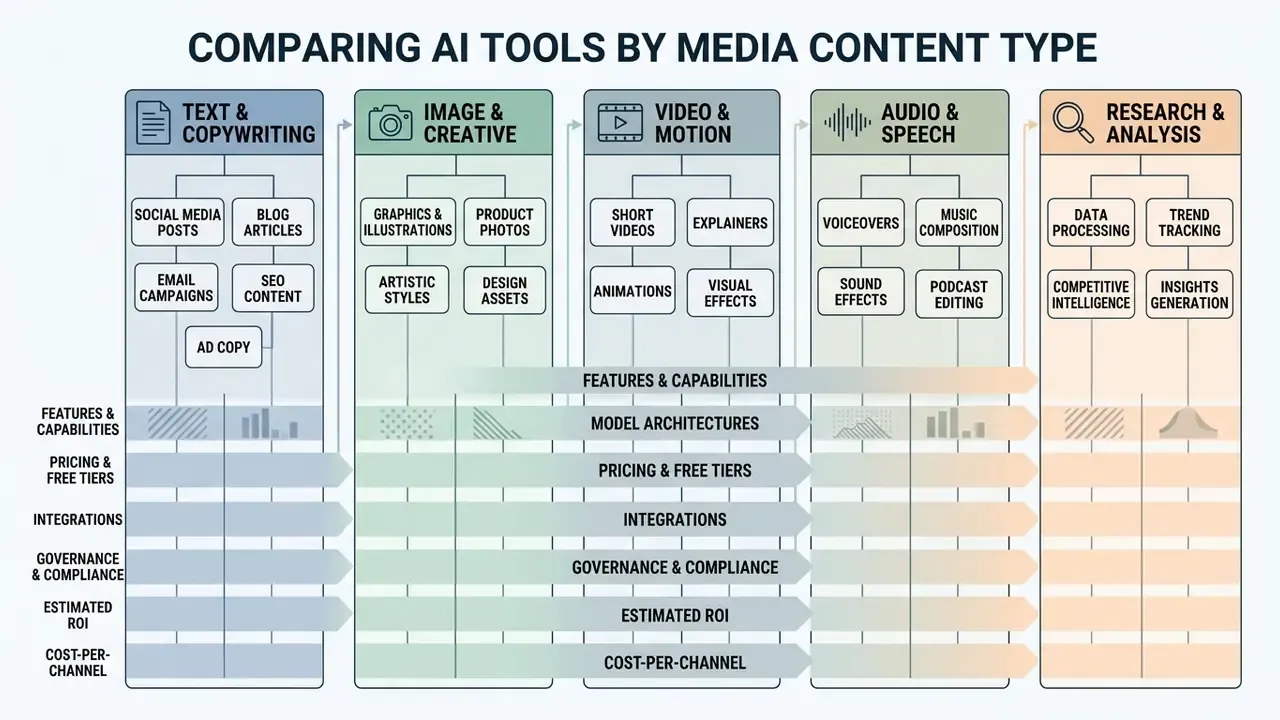
Categorizing ai tools by media type lets organizations align model architecture with output requirements across text, image, video, audio and research. This structural split prevents performance bottlenecks in multi-channel content creation, where the main content pipeline usually fails at the weakest modality rather than the average one.
AI tools for images, video, and audio
Visual and audio generation tools require strict evaluation of commercial usage rights, rendering fidelity and asset license origin. Selecting appropriate AI Video Tools depends on motion consistency and legal indemnification guarantees. For still assets, compare shortlists such as the best AI art generators and platform-specific options like the Canva AI generator or the Microsoft AI image generator.
Commercial deployment of generative media carries regulatory obligations. Under the European Union AI Act (applicable 2 August 2026), providers and deployers of generative AI must ensure outputs are identifiable and marked with machine-readable watermarks. Adobe Firefly offers commercially safe image and video generation trained on licensed data, and Adobe's Generative AI User Guidelines state that outputs may be used commercially unless a specific beta feature is marked personal-use only. Review the Commercial-Use AI Tools Comparison to verify licensing structures, copyright indemnification and watermarking capability before integrating generative visual tools into marketing pipelines.
«The CPDM dataset contains 21,000 images for assessing copyright-infringement risk in diffusion models: 2,100 anchor images and 18,900 generated images across potentially protected styles.»
AI tools for research, analysis, and competitive intelligence
Specialized research engines use intelligence artificial models to ingest market data, summarize competitor movements and automate data preparation. These systems turn raw market signals into usable intelligence while lowering analytical overhead.
Tools like Perplexity, Crayon and Klue automate market monitoring by extracting data from corporate filings, web updates and customer reviews. Peer-review platforms such as G2 Compare and TrustRadius add satisfaction and intent data that can be folded directly into matrix rows. In technical evaluations using DocVQA (50,000 QA document pairs), multimodal understanding models achieve high accuracy in extracting data from complex charts and tables, the same capability behind practical reverse image search workflows used to verify asset provenance. Strategy teams can therefore run competitive analysis in hours rather than days.
«Li et al. catalogue more than 200 benchmarks for multimodal LLMs, grouped by perception, reasoning and specialized domains, and none provides complete coverage.»
How to read reviews and validate AI media comparison matrices
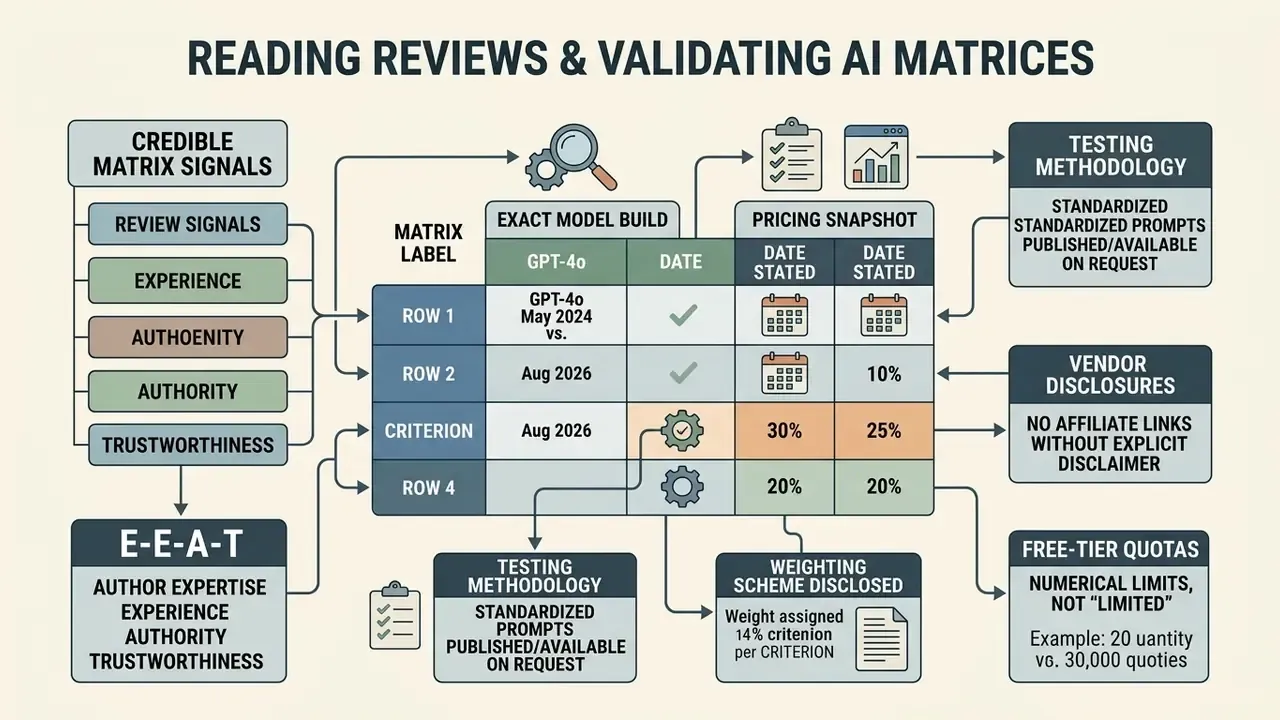
Critical evaluation of ai media comparison matrices reviews requires auditing the testing methodology, prompt consistency and vendor disclosures behind published ratings. Independent verification keeps procurement decisions grounded in empirical evidence rather than sponsored content.
E-E-A-T block. Fact check and verification methodology: Matrix validity checklist (interactive-widget ready):
Checklist0 / 8
- Standardized prompt sets: ensure the review uses identical, version-controlled prompts across all evaluated software.
- Fixed model versions: confirm the exact model version and release date are documented, for example GPT-4o May 2024 versus the August 2026 build.
- Real workflow validation: verify tools were tested on multi-step operational tasks rather than single demo prompts.
- Total cost inspection: audit hidden fees, including API token overages, seat minimums and premium export charges.
- Conflict disclosure: check whether rankings are tied to affiliate commissions or vendor sponsorship.
- Vendor existence check: confirm active DNS resolution, corporate registration and verifiable documentation before a vendor enters the shortlist. Example from editorial screening: as of August 2026, checks for
hypeart.aireturned no active DNS resolution and no verified US corporate registration, and no verifiable information was available regarding its commercial claims or proprietary features. Grounds for automatic exclusion from procurement.
What signals indicate a credible comparison matrix
A reliable comparison matrix lists the exact ai models version, standardized test prompts, pricing dates and evaluation limits. Methodological transparency, of the kind Stanford HELM formalized, separates rigorous analysis from promotional ranking.
According to Stanford HAI's Holistic Evaluation of Language Models (HELM), evaluations must state their exact objective, run multiple metrics per scenario, and test all models under identical conditions. Public procurement frameworks add a second layer. Washington State WaTech guidelines mandate listing the exact technology vendor, model version and intended operational use case before software approval, while the DC AI Procurement Handbook requires market research, an independent estimate and objective price scoring, which is the procurement analogue of a transparent weighting scheme.
«GenAI Arena aggregated more than 9,000 human votes to build Elo ratings for generative models, an example of transparent methodology with explicit sample sizes and metrics.»
How to choose an AI tool from the matrix for your task
Selecting an ai tool from a matrix means mapping organizational requirements against model capabilities, budget limits and risk tolerance. Following an ai media comparison matrices guide helps individual authors, marketing teams and regulated institutions pick software they can sustain. NIST's AI Playbook logic applies: verify the use case, organizational capability, market research and the proprietary versus open-source trade-off before acquisition.
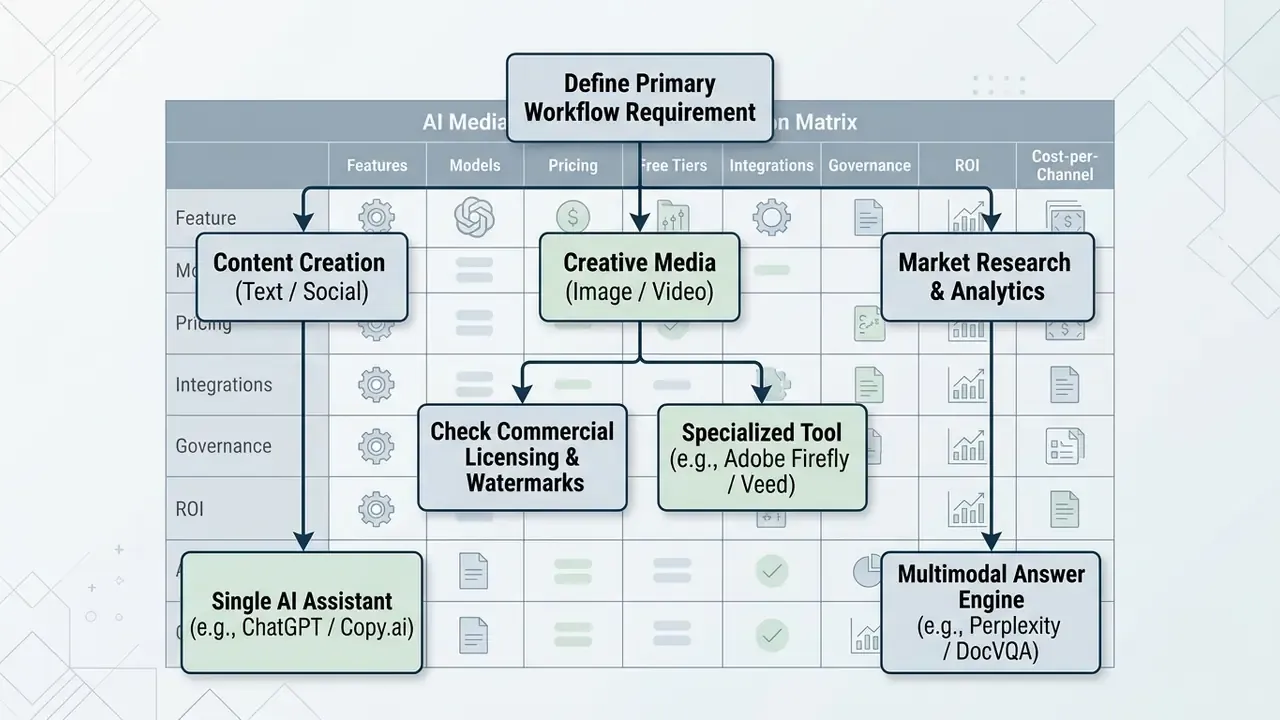
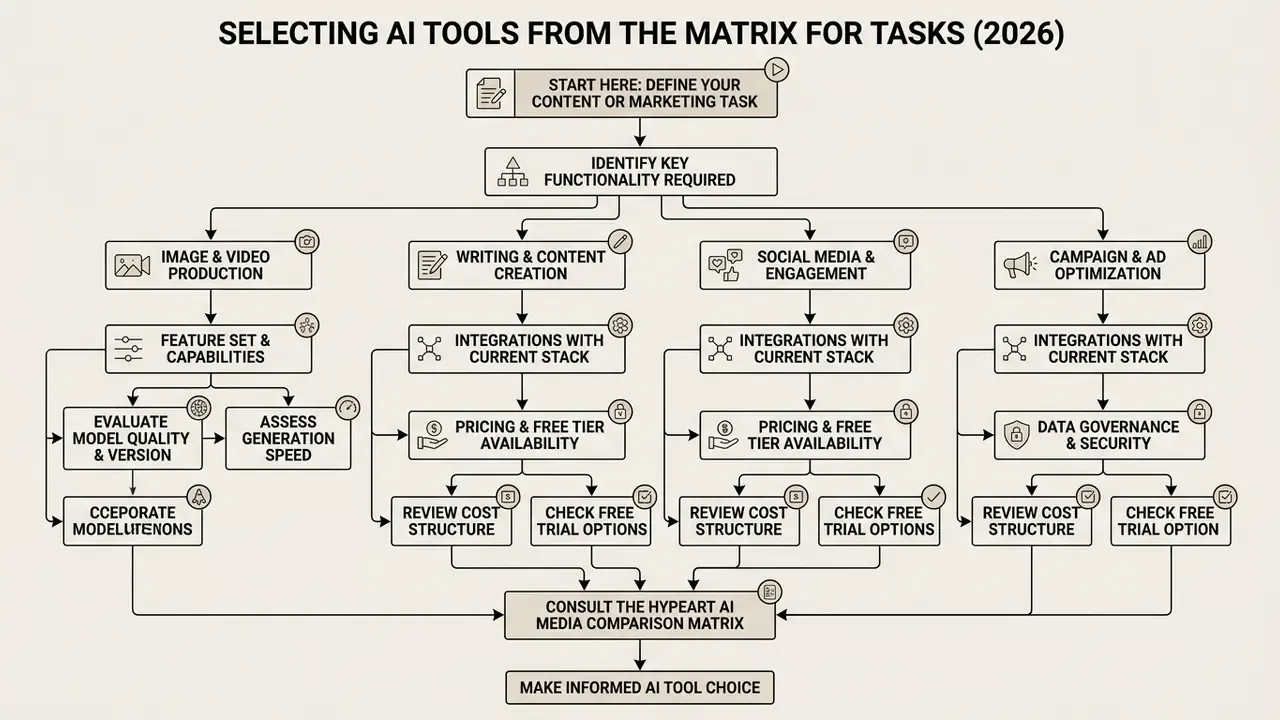
Budget, task and team scale act as sequential gates. Budget determines whether credit-based or seat-based pricing is viable. Task type determines modality. Team scale determines whether governance overhead can be absorbed at all. Public-sector guidance adds two further gates: capacity to build, buy, or adopt into the existing environment, and the ability to sustain the required budget and staff. For image-first teams, compare shortlists such as the best free AI art generators before committing to paid seats.
When to choose one universal AI tool and when to assemble a stack
Single ai systems simplify policy enforcement, entitlement management and audit trails across departments. A best-of-breed stack combining specialized ai agents and dedicated tools yields higher output quality in niche workflows, at the cost of higher integration overhead and more seams to log.
Illustrative scenario (hypothetical, composite): during a model-risk review for a wealth management firm's marketing division, a weighted evaluation scorecard compares single-tenant LLMs against best-of-breed agentic workflows. By quantifying integration complexity and data lineage requirements, the team selects a dual-vendor architecture that satisfies internal compliance guidelines, and the deployment clears production approval ahead of the original plan. The example is illustrative, not a documented client outcome.
«MMMG covers 49 tasks across 4 modalities and shows that no single model dominates image, audio and video generation simultaneously; performance varies substantially.»
A practical compromise many teams adopt: one governed general assistant for reasoning and drafting, plus two or three specialized tools for the highest-volume modality. Is AI a powerful lever in that arrangement? Yes, but the leverage comes from the governance layer, not the tool count. Where video is the dominant modality, evaluate options against comparisons of free video and photo editing alternatives before adding another paid seat.
Constraints to verify before deploying AI technology
Before deploying any ai technology, organizations must assess data privacy frameworks, API integration capability and commercial IP rights. Ensuring that input data is protected against training reuse is a primary regulatory requirement, not a nice-to-have clause.
European Data Protection Supervisor (EDPS) guidance stresses that personal data transmitted to external generative models needs a clear legal basis and strict retention controls, with collection, sharing and further processing limited to what is necessary. Developers building custom integrations should consult the AI Video API guide and the Google Veo implementation guide to review endpoints, security authentication, cost limits and data privacy protocols. The U.S. Copyright Office also maintains that purely AI-generated material without human authorship cannot be registered, which requires human-in-the-loop editing for commercial assets, and applicants must disclose and exclude AI-generated portions from a registration claim.
Data-localization requirements deserve their own matrix column. Where residency is mandated, self-hosted open-weight models or region-pinned enterprise deployments may be the only compliant options. Provenance and watermarking capability must survive every integration hop, so that generated, modified and shared content stays traceable end to end.
«OmniGenBench defines 57 subtasks for evaluating multimodal models, but excludes cost, integration and legal constraints, parameters that require separate verification.»
FAQ on AI media comparison matrices
Operational questions about matrix maintenance, model lifecycle tracking and the functional boundaries of intelligence ai systems help governance committees keep software inventories accurate. A stale inventory is where shadow AI usually hides.
How often should a comparison matrix be updated?
An ai media comparison matrices scorecard should be refreshed monthly or quarterly, given the release cadence of underlying ai models and vendor pricing changes. Continuous tracking stops decisions from resting on obsolete specifications. Model updates land frequently. OpenAI release notes reflect continuous model iterations and parameter adjustments within multi-week windows, with product-level updates logged within days of each other. Commercial pricing shifts just as fast, as when Google adjusted Workspace plan structures on 15 January 2025, with existing customers affected from 17 March 2025. Monthly reviews keep seat costs, usage caps and capability scores accurate; quarterly reviews re-run the weighting.
«Claude Opus 4.6 leads the text leaderboard at 1504, ahead of Gemini 3.1 Pro at 1500; rankings shift with each release.» - Automated Survey of Generative Artificial Intelligence (2024 to 2025). https://arxiv.org/abs/2507.04411
Can a single AI tool cover all content creation tasks?
No single ai tool currently excels across every modality. Specialized models keep distinct advantages in long-form text, high-resolution imagery and temporal video consistency. Enterprise teams get better results from targeted integration than from single-vendor reliance. Benchmark evidence across WritingBench, VBench and UniBench shows consistent trade-offs. A model optimized for conversational reasoning may produce high error rates in video temporal coherence or vector layout. Recurring technical limits reported across multimodal platform reviews include modality-alignment failures, inconsistent narrative across outputs, identity drift in long video, high inference cost and concurrency constraints.
«LongGenBench shows that even strong models make substantial instruction-following errors in outputs up to 128,000 tokens; long-form content requires separate validation.» - LongGenBench: Long-context Generation Benchmark (2024). https://arxiv.org/abs/2410.04199 A team that uses AI daily tends to converge on the same pattern: dedicated text, image and video tools governed by one central data security framework, supported by utility layers such as video compression and animation production where output formats demand it.
How do we guarantee data accuracy inside an automated matrix?
Tag every claim with a source and timestamp, assign confidence scores, and route low-confidence rows to a human analyst. Re-run the pipeline on a fixed schedule rather than on demand, so the evidence trail stays reproducible for audit.
Can criteria vary by segment?
Yes. Maintain criteria libraries per ICP, region, or business unit, and apply different weights to the same axes. Publish the weighting so results remain reproducible, and version it like any other model input.
How does the matrix support sales enablement?
Matrix output converts directly into battlecards, objection handlers tied to differentiators, and one-page summaries, provided the source tags travel with the claim. Strip the tags and you have marketing again.
What happens when vendor packaging changes?
Lock an authoritative pricing source per vendor, monitor plan and SKU changes, and flag variances as exceptions rather than silently overwriting cells. Silent overwrites destroy the audit trail you built the matrix for.
Implementation roadmap: from framework to governed matrix
| Phase | Duration | Key activities | Deliverable |
|---|---|---|---|
| Assessment | Weeks 1 to 2 | Define candidate set, use cases, comparison taxonomy and weighting | Comparison framework and source map |
| Integration | Weeks 3 to 4 | Connect data pipelines, configure confidence rules and pricing monitors | Automated evidence pipeline |
| Calibration | Weeks 5 to 6 | Standardize prompt sets, align brand-voice and quality thresholds | Version-controlled prompt library |
| Pilot | Weeks 7 to 8 | Score 2 to 3 categories, validate accuracy with subject-matter experts | Pilot matrices plus review log |
| Scale | Weeks 9 to 10 | Roll out per business unit, automate refresh cadence | Versioned matrices per segment |
| Optimize | Ongoing | Expand sources, refine weights, add win/loss and incident feedback | Continuous improvement loop |
No matching rows Clear one or more filters to restore the matrix.
Limitations and open questions
Pre-deployment audit checklist
Checklist0 / 14
A safe next step
Pick one category, not the whole market. Score three candidates on the four axes, publish the weighting, and run the pilot with a named owner and a documented rollback. If the matrix survives an internal audit review, extend it to the next category. If it does not, you have learned something cheaper than a failed rollout.
This material is informational and does not constitute legal, audit, or Model Risk Management advice. Verify all pricing, licensing and regulatory details against primary vendor and regulator documentation before procurement.