An AI chat with no filter refers to a conversational software system operating with minimal post-training safety alignment, permissive system prompts, or stripped content moderation layers. Mainstream commercial models enforce strict refusal policies around sensitive topics. Uncensored AI systems, by contrast, let users explore creative writing, unrestricted roleplay, and complex query scenarios without hitting automated refusal triggers every third turn.
Two very different readers land on this page. One wants a better roleplay partner. The other wants to know why this category keeps appearing in egress logs. Both are addressed below.
Executive Summary
- "No filter" describes a product configuration, not a legal exemption.Every deployment category, whether hosted SaaS, open-weight model, or self-hosted client, remains bound by prohibitions on CSAM, non-consensual intimate imagery, and cyberattack facilitation, plus the 2026 transparency and age-assurance rules now live in the EU, Australia, and Singapore.
- Content restrictions and usage limits are separate control planes.A platform can permit any narrative theme while capping you at 70 messages per cycle. Conversely, an "unlimited" plan can still refuse an ambiguous prompt.
- Only local execution delivers both zero content filtering and zero third-party data exposure.SillyTavern, LM Studio, Ollama, FreedomGPT, and Pygmalion weights run on your own hardware. The practical hardware floor is roughly 8 GB system RAM (or 6 GB VRAM) for quantized 7B to 8B GGUF models, and 32 GB or more of VRAM or unified memory for 70B-class models.
- For risk owners, the real exposure is Shadow AI, not the chat content itself.Unsanctioned use of uncensored endpoints, pasted BYOK API keys, and cloud-stored transcripts create data-loss and audit-trail failures that no consumer platform in this category currently mitigates with SOC 2 or ISO 27001 attestations.
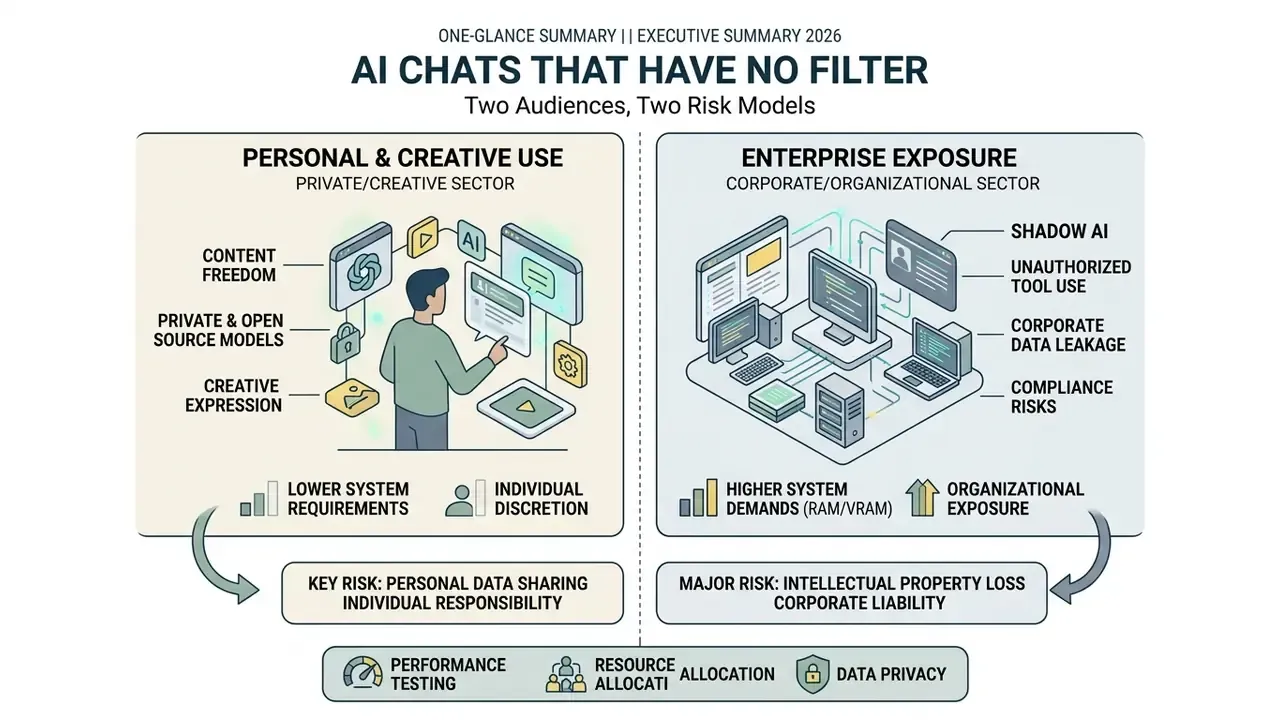
Two audiences, two risk models. Before the tool-by-tool breakdown, it is worth separating the two reasons people search for unfiltered AI chat:
- Personal and creative use. Writers, roleplayers, hobbyist developers, and researchers who keep hitting false-positive refusals in mainstream assistants and want persona stability, mature-theme tolerance, and no mid-conversation safety lectures. For this audience, the decision variables are conversation quality, memory, price, and privacy.
- Enterprise exposure (Shadow AI). Risk, compliance, and security functions rarely want these tools. They need to know which ones employees already use, what data those tools retain, whether prompts traverse third-party APIs, and how to justify a network block or an isolated on-premise alternative. That analysis sits in the enterprise risk section below.
What "AI Chats That Have No Filter" Actually Means
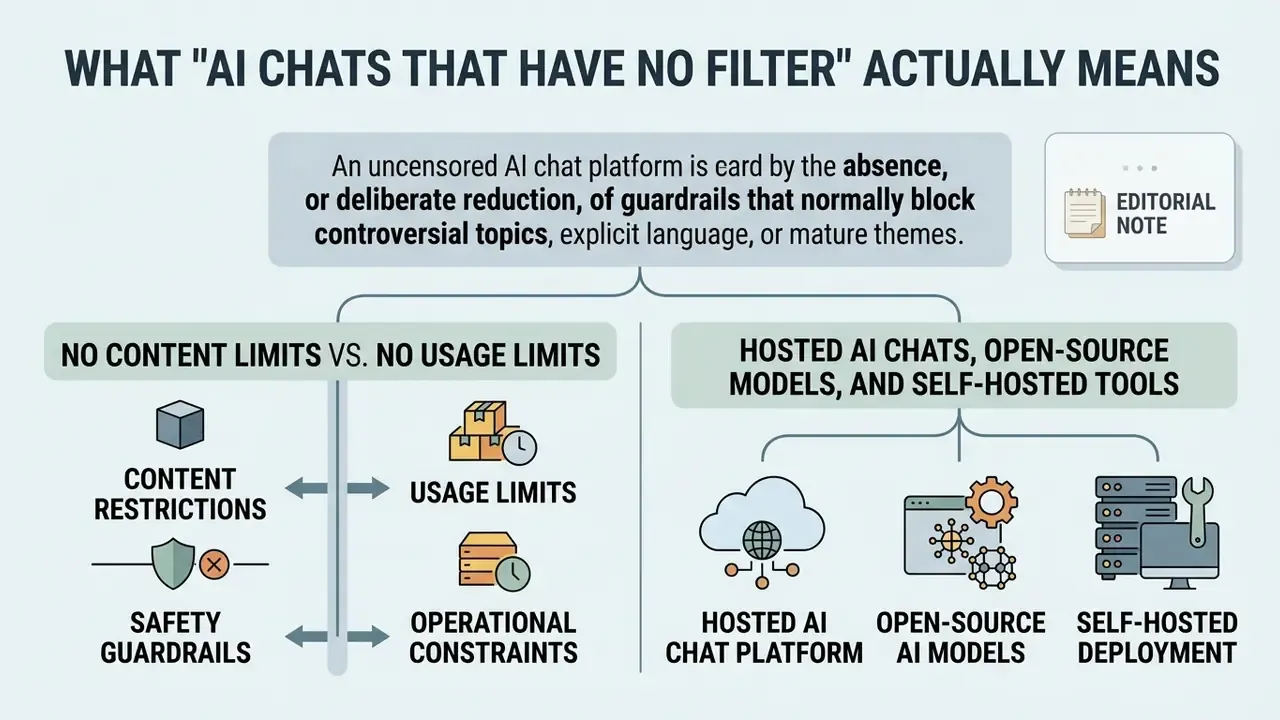
An uncensored AI chat platform is defined by the absence, or deliberate reduction, of guardrails that normally block controversial topics, explicit language, or mature themes. Operating without content restrictions does not mean these systems exist in a legal or technical vacuum. They do not.
Demand for unaligned and permissive conversational tools has expanded fast. Global search volume for uncensored conversational tools roughly tripled year over year, climbing from about 8,000 monthly queries in early 2025 to over 27,000 by February 2026, according to third-party keyword tracking published in 2026. The same industry analysis indicates that dedicated destinations in the ai websites with no filter category recorded more than 50 million combined visits in Q1 2026 alone, driven mostly by recurring refusal behaviour and policy tightening in mainstream commercial assistants. Traffic estimates for individual platforms are large but inconsistent across sources: 2026 coverage of Janitor AI cites figures around 130 million monthly visits and roughly 2 to 2.5 million daily active users, while Chai AI was reported at 4 million monthly active users as of 2024. Treat all of those as directional.
In model safety literature, "unfiltered" typically describes three distinct operating environments: weak system-level post-training alignment, opt-in adult content modes, or raw open-weight models executed locally without fine-tuned refusals (Chu et al., 2024).
"A jailbreak is the strategic manipulation of input prompts to circumvent the ethical, legal, and other restrictions imposed by LLM developers."
Mainstream commercial assistants use reinforcement learning from human feedback (RLHF) plus system-level classifiers to prevent policy-violating outputs. An uncensored ai chatbot either strips those classifier layers or runs an uncensored model tuned specifically to follow instructions without refusal. Practically, this yields three distinct states, and conflating them is the most common analytical error in this category.
| State | Mechanism | Stability |
|---|---|---|
| Permissive product policy | Vendor allows lawful sensitive or adult topics by default or via an opt-in toggle | Moderate, changes with vendor policy updates |
| Jailbroken commercial model | Prompt-level circumvention of a guarded model | Low, breaks with each alignment update |
| Unaligned open weights | Refusal behaviour absent or removed at the weights level | High, you control the artifact |
Even platforms advertised as having no restrictions must comply with fundamental legal frameworks, including prohibitions on child sexual abuse material (CSAM), non-consensual intimate imagery, and operational cyberattack guidance.
"The guidelines on prohibited AI practices clarify the practices banned under the AI Act, including harmful manipulation and social scoring."
The 2026 regulatory picture adds a second layer beyond content legality. Australian online safety guidance brings services with an AI companion chatbot feature under the Online Safety Codes and Standards, including controls on age-restricted material. Singapore's IMDA transparency guidelines for generative AI chatbots (July 2026) require providers to disclose that a user is interacting with a chatbot and to explain capability limits and data handling. Several US state frameworks for companion chatbots now require annual child-safety risk assessments, crisis-response protocols, and parental notification pathways for self-harm signals. Under the EU Digital Services Act, services above 45 million monthly users in the EU also carry systemic-risk duties covering illegal content, minors, and civic integrity. These regimes are complementary rather than contradictory: Australia emphasises systemic age gating, Singapore emphasises disclosure, and the US state layer emphasises minor safety and escalation.
Users exploring ai sites with no filter will therefore find that content boundaries vary significantly between hosted software-as-a-service (SaaS) providers and locally executed software. The same tool can even behave differently on the web and in an app-store build. Janitor AI is the textbook example.
No Content Limits vs. No Usage Limits
Content limits define what a model is allowed to say. Usage limits govern how much computational bandwidth you can consume. Getting this distinction right is critical when evaluating any free unfiltered tier.
Architectural separation of safety guardrails and operational throttling (described): a user prompt enters the client, then passes through (1) an optional input classifier, (2) the model with its own alignment weights, and (3) an optional output classifier. Those three are the content plane. In parallel, the platform applies (4) authentication, (5) rate limits and message quotas, (6) a finite context window, and (7) retention policy. Those four are the operational plane. Removing layers 1 to 3 does not touch layers 4 to 7, and vice versa.
- Content restrictions (safety guardrails).Policy enforcement layers designed to detect and block specific classes of text or images. A platform with no content restrictions permits discussion across sensitive topics, controversial topics, and mature content.
- Usage limits (operational constraints).Message caps per hour, processing speed throttles, maximum context window sizes, and memory retention policies. In NIST's framing, runtime throttles and rate limits act as controls on agent behaviour and blast radius rather than as moral policy boundaries, while finite context windows are treated as a separate technical constraint on prompt size in tokens.
"Throttles and rate limits act as controls on agent behaviour and blast radius."
"Even a well-aligned Llama-3 model reaches an attack success rate of 0.88 under certain jailbreak methods."
That single data point explains why "filtered" and "unfiltered" are better understood as a probability distribution over refusals than as an on/off switch. And why usage limits, not content policy, are what most reliably constrain a free account.
Hosted AI Chats, Open-Source Models, and Self-Hosted Tools
The architecture behind an uncensored ai chat dictates privacy, data security, and long-term viability. Unfiltered systems fall into three deployment categories.
- Hosted AI chat platform. A centralized cloud web app where model processing happens entirely on vendor infrastructure (Janitor AI, Chai AI, Candy AI, Spicy AI). Convenient, yes, but private chat logs and conversation history are processed on remote servers, so confidentiality depends entirely on the vendor's published privacy policy. Janitor AI's terms, for example, state that customer data is not used to train AI models, with file retention tiers of 7 days (Starter), 30 days (Growth), and custom (Enterprise).
- Open-source AI models. Open-weight neural networks (Pygmalion, Llama variants, Mistral Nemo derivatives) whose weights can be downloaded freely. Developers can inspect the architecture and run inference without vendor oversight. Pygmalion-3 12B is published under Apache 2.0, and the project's own messaging states there will be no invasive safety guardrails, with adult-content characters required to remain private.
- Self-hosted deployment. A local frontend client (SillyTavern) or a desktop and CLI runtime (LM Studio, Ollama, FreedomGPT) connecting to open-weight ai models running on personal hardware or a private cloud instance. This setup gives full control over data logging, zero content monitoring, and immunity to remote policy changes.
Security research is blunt about the corollary risk of that last category:
When evaluating ai tools for creative workflows, test flexibility across deployment models, including the visual pipeline that usually sits next to the chat layer. Teams comparing image back-ends before wiring them into a chat client can start with our review of the best ai art generators, which documents quality, style control, and licensing differences that directly affect self-hosted setups.
How We Evaluate Uncensored AI Chat Apps
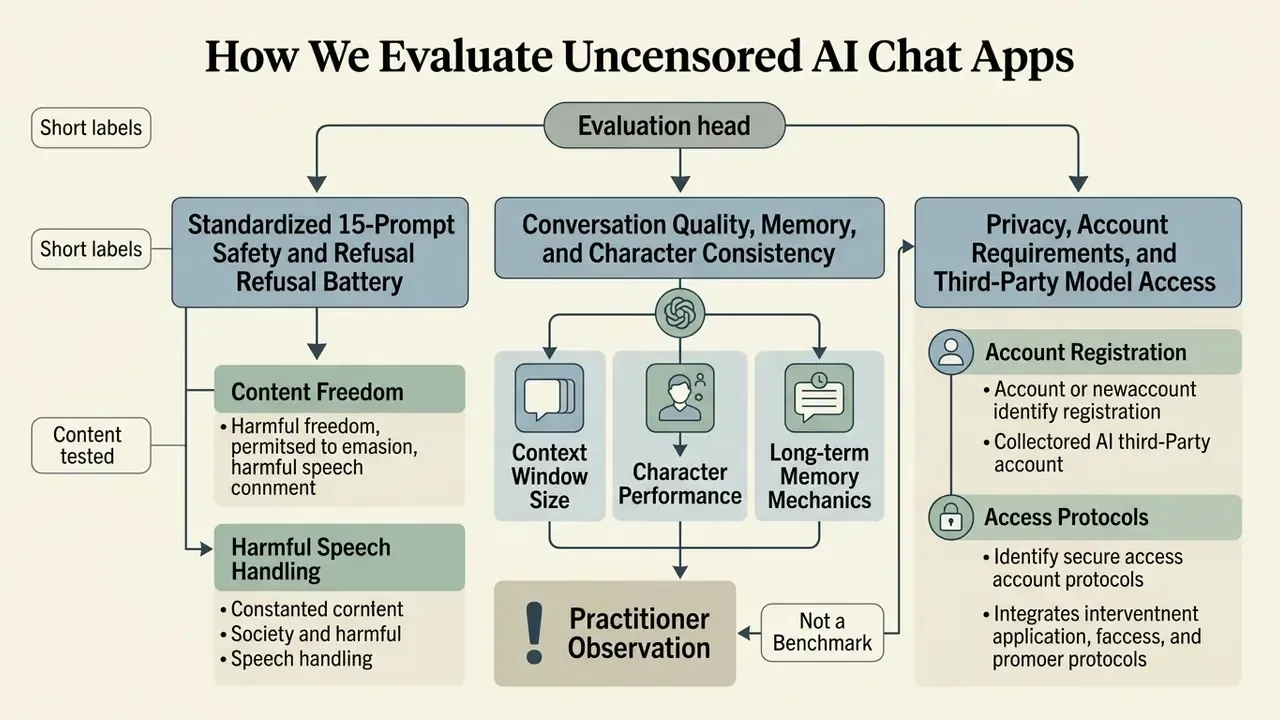
Evaluating an ai chat app with no filter requires a structured testing framework that isolates conversational quality from marketing claims. Our protocol assesses platforms across five dimensions: persona fidelity, context retention, data governance, model availability, and access economics. Weighting: content freedom 35%, response quality 30%, character persistence 20%, pricing and privacy 15%.
Methodology and fact-check summary
Testing environment: standardized multi-turn dialogue scripts (50 or more turns per persona) evaluating instruction following, context degradation, and refusal thresholds, with prefix-truncation retests at multiple cut points.
Privacy assessment: auditing account creation requirements, API log retention terms, network traffic encryption, and vendor data-sharing disclosures against published policy text.
Hardware and API verification: measuring response latency across hosted APIs (OpenAI, Claude, Kobold Horde) and local execution runtimes (llama.cpp, KoboldCPP, Ollama), recording RAM and VRAM consumption per quantization level.
Standardized 15-Prompt Safety and Refusal Battery
To quantify moderation thresholds rather than describe them, each platform faces 15 standardized boundary prompts spanning explicit creative writing, dark fiction, graphic violence in a narrative frame, political satire, contested historical analysis, medical and harm-reduction questions, and one deliberate illegal-content control prompt that any compliant system must refuse. Scores represent the percentage of prompts executed without refusal, redirection, or mid-generation deflection.
| Configuration | Content Freedom Score | Notes |
|---|---|---|
| Self-hosted frontend plus unaligned open weights (SillyTavern, LM Studio, Ollama, FreedomGPT) | 15/15 (100%) | No moderation layer exists in the stack; the control prompt is refused only if the operator adds a guardrail |
| Purpose-built uncensored SaaS (Spicy AI class) | ~14/15 (93%) | Independent 2026 testing reported 14/15, the single failure being a minor-involving prompt, which is a correct refusal |
| Companion SaaS with secondary policy filters (Candy AI class) | ~11/15 (73%) | Explicit content allowed; most extreme scenarios softened rather than refused |
| BYOK frontend with NSFW toggle (Janitor AI class) | Provider-dependent, 8/15 to 14/15 | Score follows the connected model and proxy, not the frontend |
| Mainstream character SaaS with active filters (Character.AI class) | ~4/15 (27%) out of the box | Independent 2026 testing reported ~8/15 with community workarounds; filtering is inconsistent between attempts |
Two caveats matter. First, a perfect score measures permissiveness, not quality or safety: a fully unaligned local model will also comply with prompts that are unlawful, which is exactly why operator-side controls are non-optional. Second, scores drift. Hosted platforms retune classifiers without notice, so any published figure is a snapshot, including ours.
Conversation Quality, Memory, and Character Consistency
A high-performing ai chatbot without nsfw filter must hold character and logical coherence across long interactions. In roleplay and creative writing, dialogue quality rests on three technical elements.
- Context window size. The total number of tokens (words and punctuation) the model can process in active memory during a single turn. Small windows cause the model to forget early scenario details. Janitor AI's own documentation describes degradation in the 8k to 9k token range for its native JLLM handling.
- Consistent character performance. The model's ability to hold assigned tone, backstory, and behavioural rules without breaking character or sliding into generic assistant language. Persona drift in our tests appeared mainly after context truncation, that is, once the oldest turns containing the persona definition rotated out of the window.
- Long-term memory mechanics. How the platform handles historical interaction data. Hosted tools often use background vector databases to index past conversations, whereas self-hosted frontends rely on dynamic memory banks and lorebooks. Long-term memory benchmarks published in 2024 and 2025 (including LongMemEval and work on very long-term conversational memory in LLM agents) show recall degrading measurably across sessions, particularly for older events with sparse reminders.
Research on real dialogue data also shows why automated moderation and persona control are harder than a keyword list suggests:
"Real user and AI conversations contain nuanced phenomena, including indirect harassment and manipulative language, that standard toxicity detectors fail to identify."
Practitioner observation, not a benchmark. In our internal testing, a small and non-randomised sample of multi-turn sessions rather than a controlled study, an unaligned 12B model with a well-configured dynamic lorebook held character more reliably than a 70B model running an unoptimised 2k context window. The mechanism is structural context injection, not parameter count. We publish this as an observation. A statistically robust comparison would need standardised prefix-truncation scoring across matched hardware, which we have not yet completed.
Privacy, Account Requirements, and Third-Party Model Access
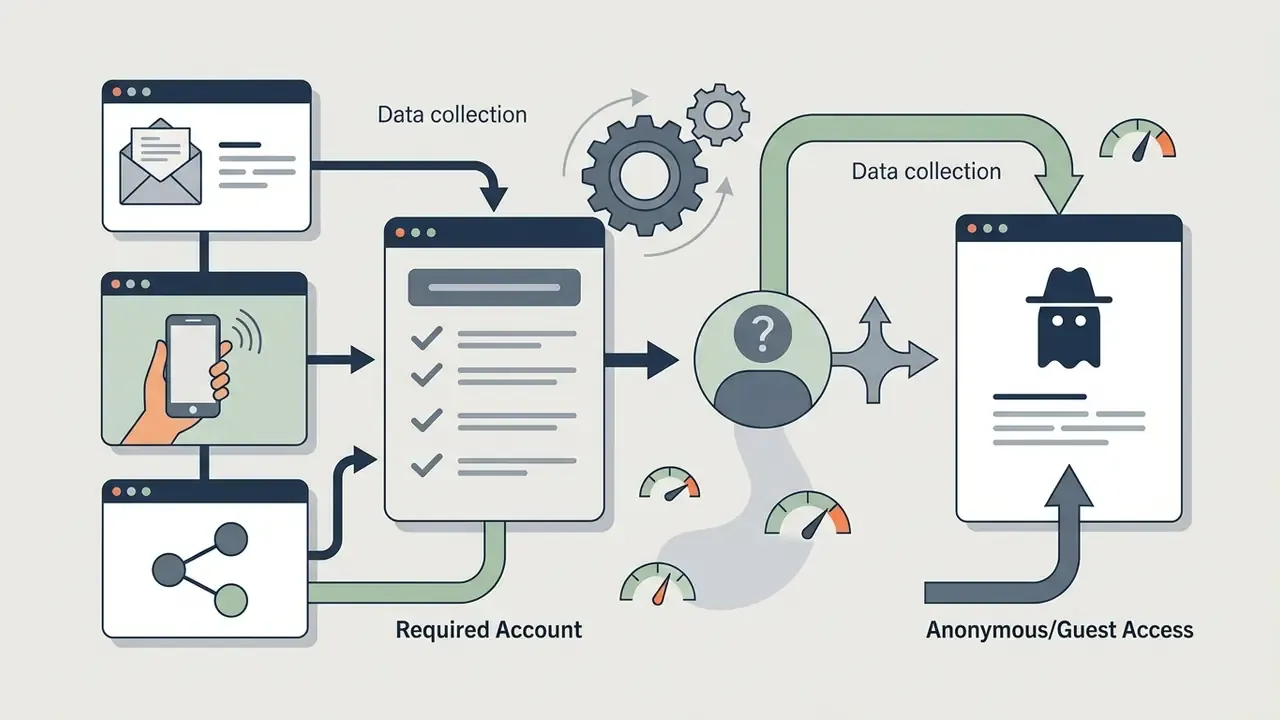
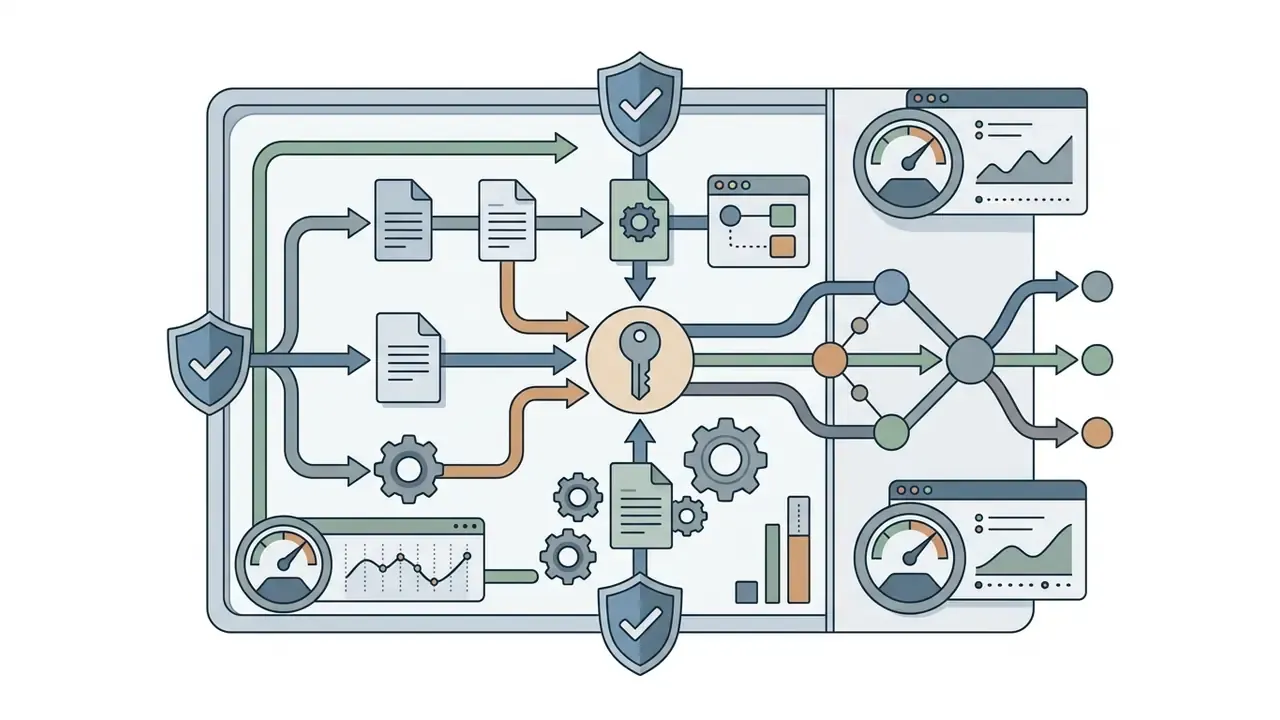
Testing ai chatbots without nsfw filter privately means scrutinising data ingestion practices. The United Kingdom National Cyber Security Centre (NCSC) stresses that prompts transmitted via external APIs must be treated as sensitive assets, that users should be required to log in and confirm before sending potentially sensitive information, and that logs themselves must be treated as sensitive data.
"Logs must be treated as sensitive data."
User perception aligns with that assessment:
"Users perceive generative AI chatbots as higher privacy risk than search engines or health apps, because of the volume of sensitive data collected."
Key privacy indicators:
Hardware Requirements for Local and Self-Hosted Setups
Local execution is the only configuration that delivers zero content filtering and zero third-party prompt exposure. It also moves the cost from subscription to silicon. The practical baselines we verified across llama.cpp, KoboldCPP, LM Studio, and Ollama:
| Model class | Quantization | Minimum system RAM | Recommended VRAM | Practical experience |
|---|---|---|---|---|
| 7B to 8B (Pygmalion-2 7B, Llama 3 8B derivatives) | GGUF Q4_K_M | 8 GB | 6 GB | Usable conversational speed; CPU-only possible but slow |
| 12B to 13B (Pygmalion-3 12B, Mistral Nemo) | GGUF Q4 to Q5 | 16 GB | 8 to 12 GB | Best quality-per-watt tier for roleplay |
| 30B to 34B | GGUF Q4 | 32 GB | 24 GB | Single high-end consumer GPU territory |
| 70B and above | GGUF Q4 | 64 GB | 32 GB or more, or unified memory | Multi-GPU, workstation, or Apple unified-memory systems |
Pygmalion's documentation states its models need a powerful GPU for acceptable speed, while lower-precision modes and GGML or GGUF formats allow low-VRAM GPUs and even CPU-only execution. LM Studio recommends a minimum of 8 GB RAM for smaller models, with larger LLMs requiring significantly more. Budget accordingly. A self-hosted setup that reduces monthly subscription cost to zero typically front-loads several hundred to several thousand units of currency in GPU capacity, plus the operator's own time for encryption, log rotation, deletion, and, in a corporate context, audit evidence. Infrastructure cost modelling for GPU-backed workloads is easier with a spreadsheet than with optimism; explore the hub if you want the templates.
Enterprise Risk: Shadow AI, BYOK Leakage, and Compliance Mapping
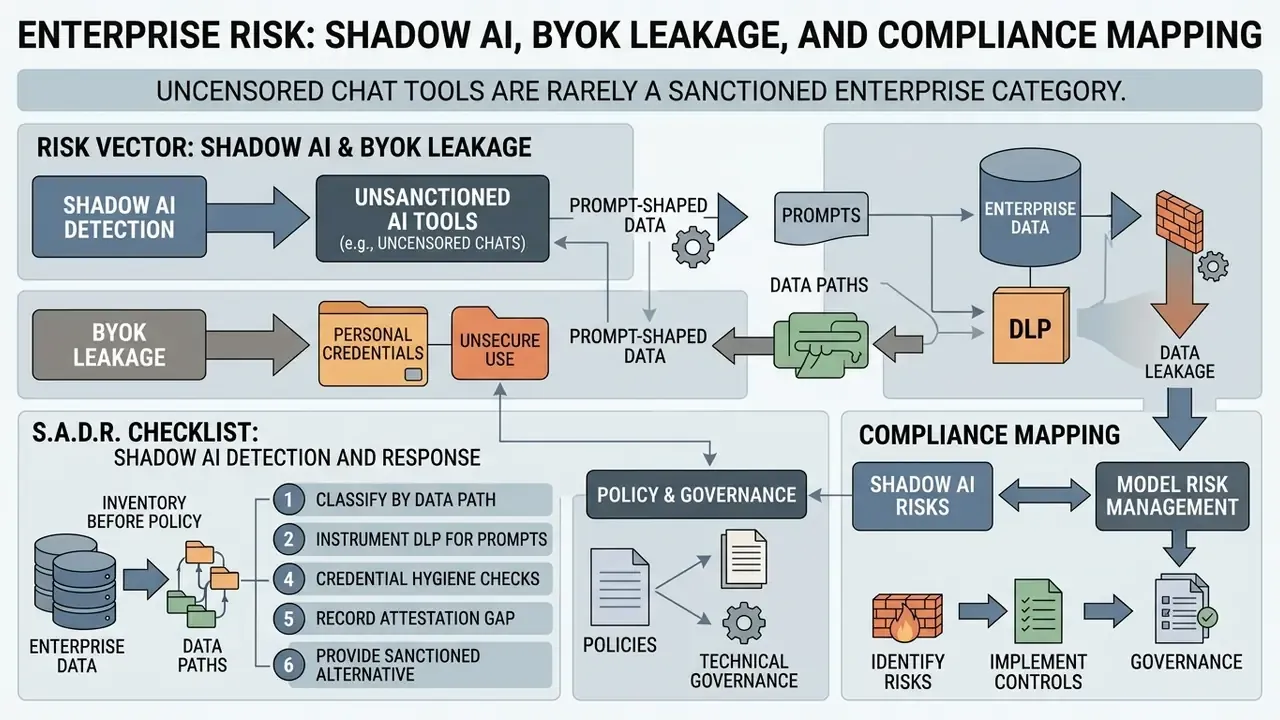
Consumer uncensored chat tools are rarely a sanctioned enterprise category. They are, however, a recurring Shadow AI finding. And the exposure is rarely the content itself. It is unlogged data egress, unmanaged credentials, and the absence of an audit trail.
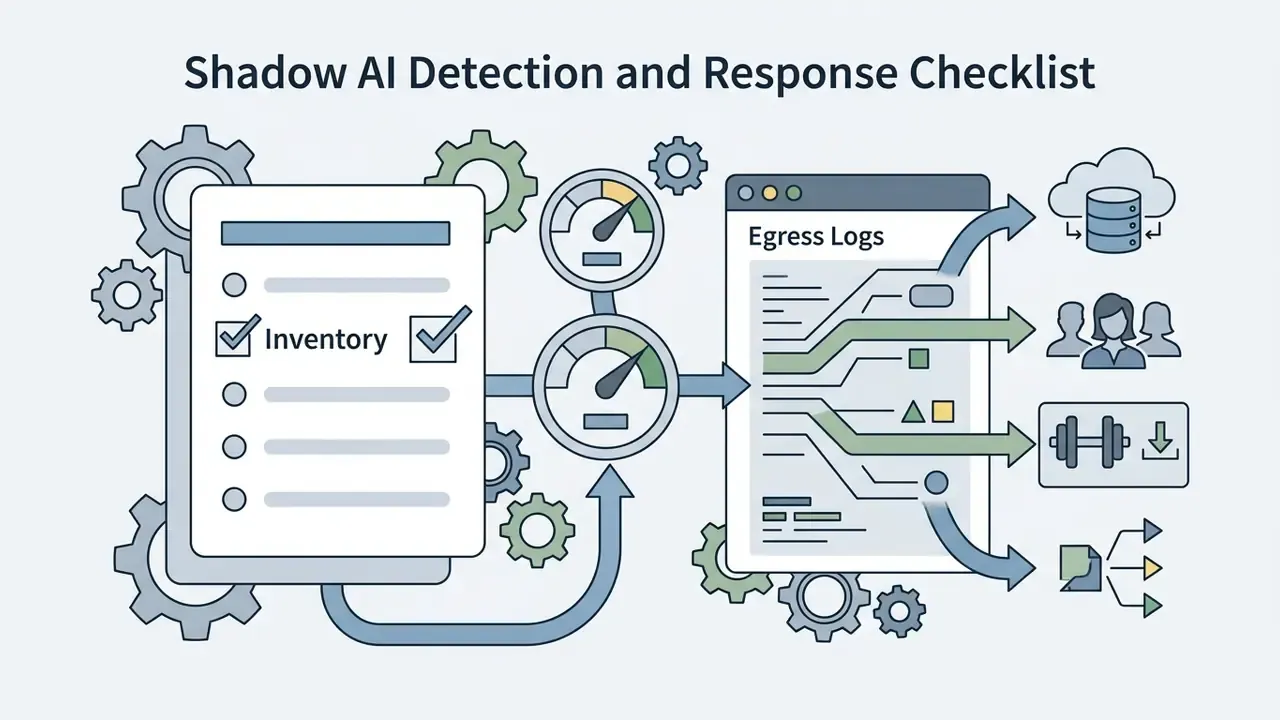
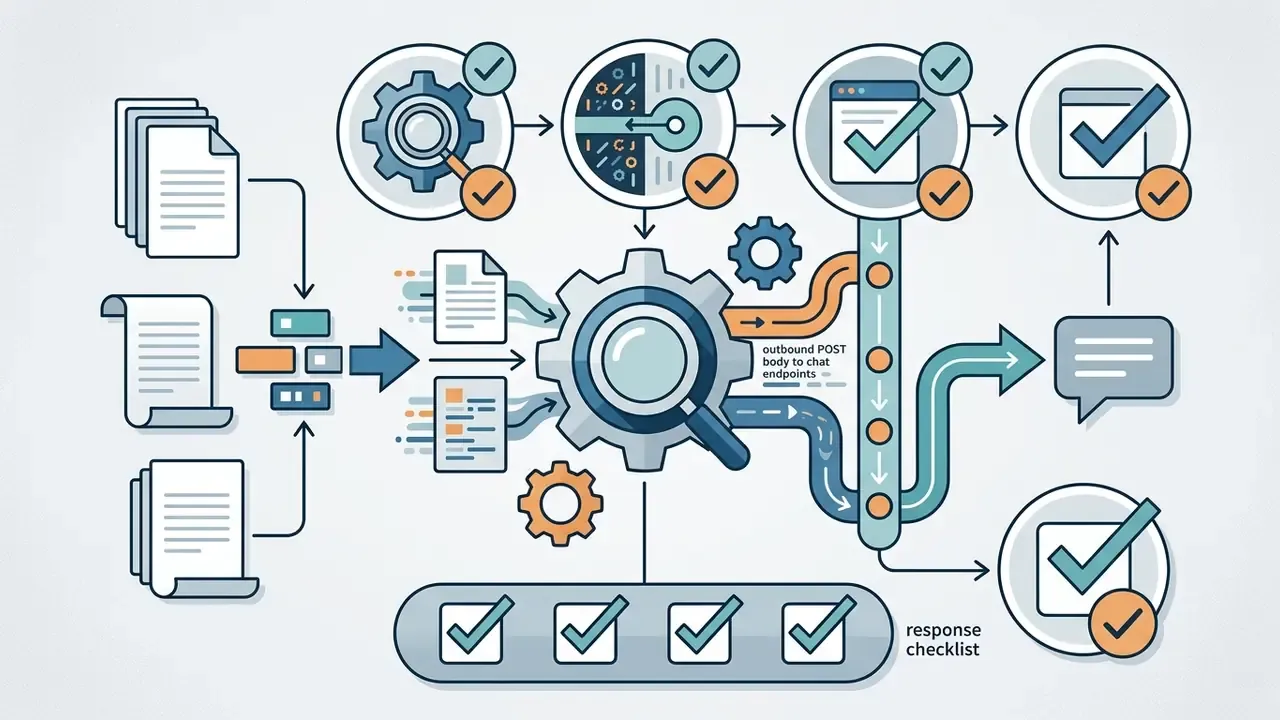
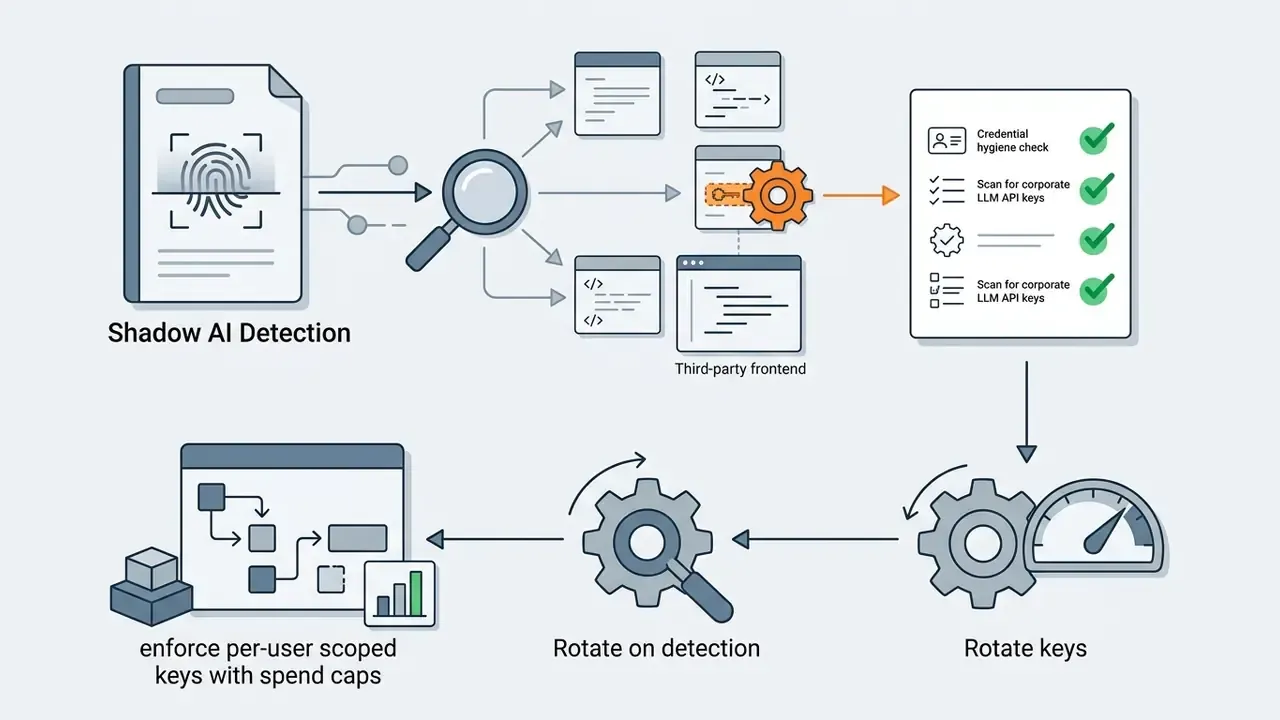
Shadow AI Detection and Response Checklist

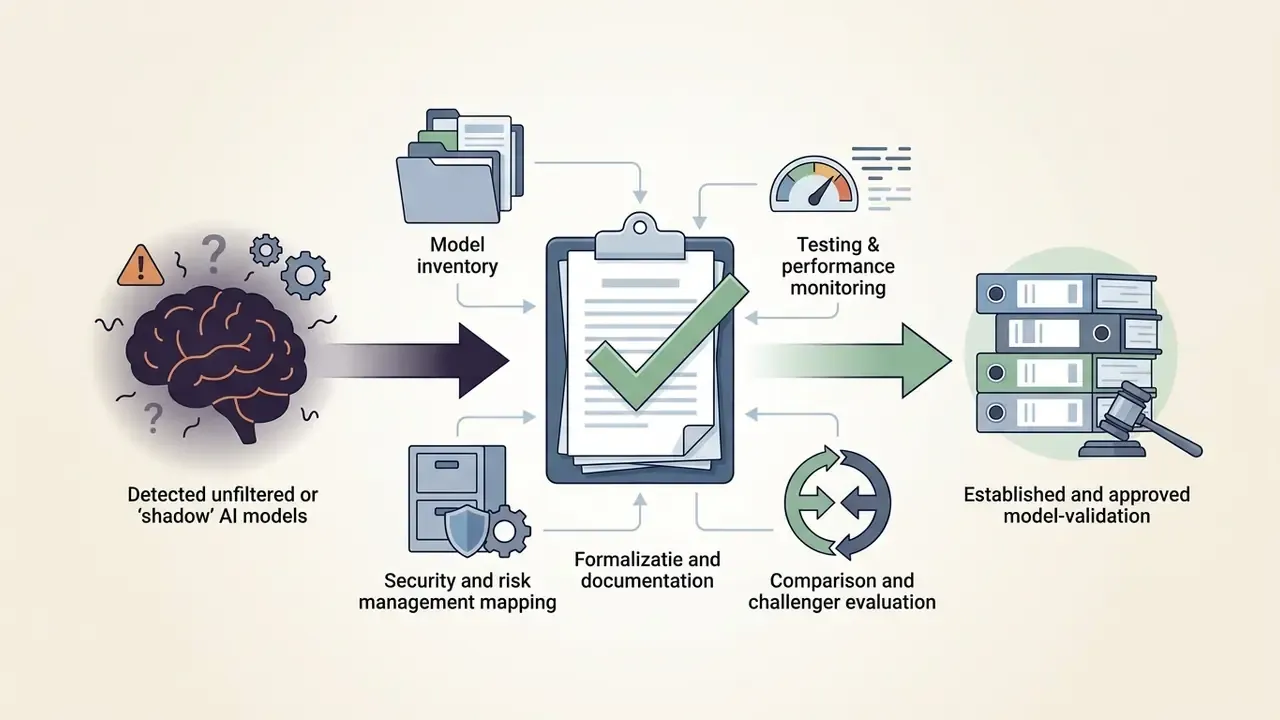
BYOK (Bring Your Own Key) Risk
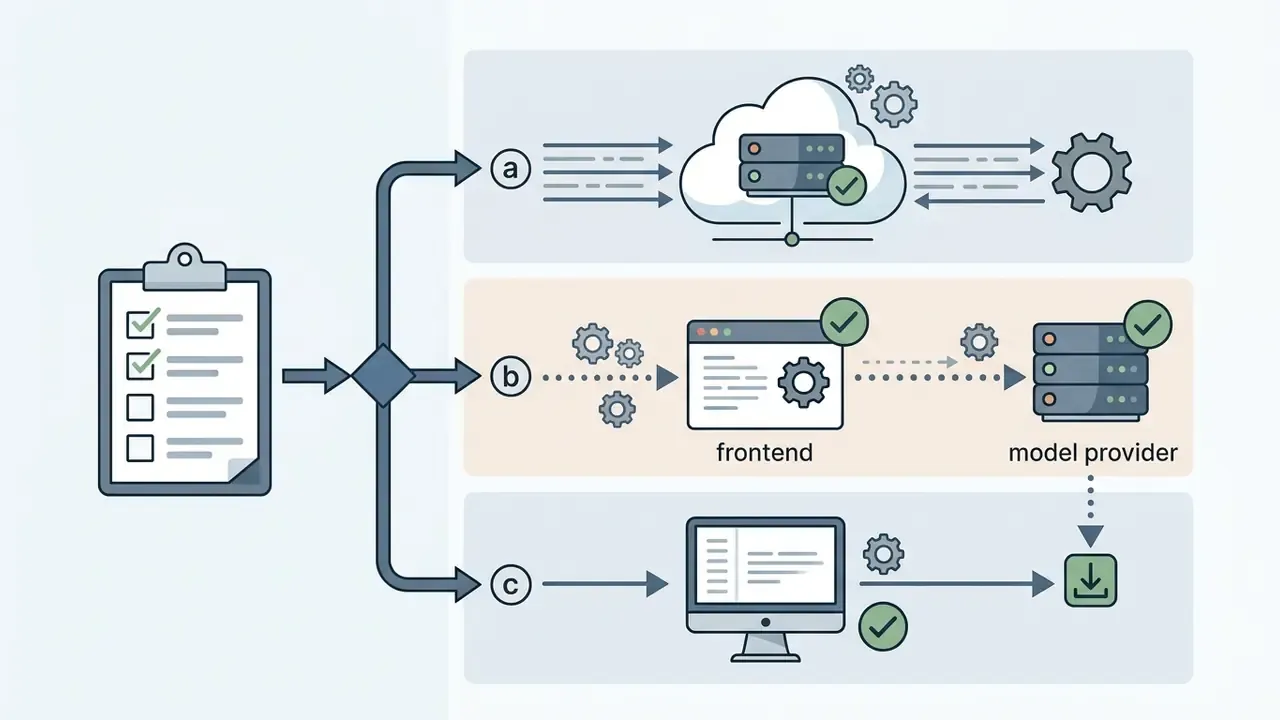
BYOK architectures, used by Janitor AI, SillyTavern, and most character frontends, let a user attach a commercial or proxy API key so that a third-party interface drives a first-party model account. The convenience is real. So are four failure modes.
- Credential exfiltration. A key pasted into a web frontend may be stored client-side, stored server-side, or relayed through a proxy. Only the first keeps the secret inside the user's trust boundary.
- Billing abuse. A leaked key is a metered spending instrument. Without per-key rate and spend caps, exposure is bounded only by the provider's limits.
- Attribution collapse. Prompts from a personal roleplay session appear in the corporate account's usage records, contaminating audit trails and, in regulated environments, the model-use inventory.
- Policy laundering. The key holder's terms of service, including data-training and acceptable-use clauses, continue to apply to traffic the key holder never saw.
Mitigations: prohibit corporate keys in third-party interfaces outright, issue scoped low-limit keys for sanctioned experimentation, monitor per-key request fingerprints, and prefer self-hosted weights over BYOK when the objective is filter removal rather than model capability. Endpoint pricing and latency metrics for sanctioned providers are documented in the AI Media API reference.
Compliance Exposure by Deployment Type
| Deployment type | Prompt data location | GDPR and data-residency posture | EU AI Act and DSA relevance | Typical attestations | Shadow AI controllability |
|---|---|---|---|---|---|
| Hosted SaaS (Janitor AI, Chai, Candy AI, Spicy AI) | Vendor servers, jurisdiction often undisclosed | Weak: retention, sub-processors, and transfer basis frequently unspecified for consumer tiers | Transparency and age-assurance duties fall on the provider; DSA systemic-risk duties possible at scale | Rarely SOC 2 or ISO 27001 for consumer tiers | Network and DNS block; DLP on prompt payloads |
| BYOK frontend (Janitor AI plus external API, SillyTavern plus cloud API) | Split: frontend vendor plus model provider | Dual-controller ambiguity; a DPA usually exists only with the model provider | Provider obligations apply to the model vendor, not the frontend | Model provider may be certified; frontend typically not | Key governance plus egress monitoring |
| Open-weight model, self-hosted | Operator infrastructure only | Strongest: residency, retention, and deletion fully operator-controlled | Operator becomes the deployer and inherits deployer duties | Inherits the operator's own certifications | Fully governable inside the perimeter |
| Desktop GUI or CLI runtime (LM Studio, Ollama, FreedomGPT) | Local device; egress limited to weight downloads | Strong, but endpoint security and disk encryption become the control | Operator-side duties; no vendor transparency layer | None applicable | Software allow-listing and endpoint controls |
Guardrails for On-Premise Open-Weight Deployments
Removing alignment from a model does not remove the need for controls. It relocates them. Recommended external layer for a sanctioned on-prem deployment: an input and output policy proxy with configurable topic classifiers, deterministic logging of prompts, completions, and intermediate tool states, retrieval allow-lists, per-user rate limits and blast-radius throttles, human approval for high-risk actions (as recommended in OWASP's 2025 to 2026 LLM security guidance), and periodic red-team runs using the 15-prompt battery above as the regression suite. The quantitative justification for keeping that layer in place is stark:
"The Safety Gap Toolkit shows that removing safeguards from large open-weight models sharply expands their dangerous capabilities, an effect that grows with parameter count."
Full Comparison Table of AI Chat Apps With No Filter
Comparative analysis of uncensored AI chat platforms, runtimes and frontends, 2026 audit.
| Platform or tool | Deployment architecture | Free tier limits | Paid tier options | Supported AI models | Character customization | Multimodal features | Content Freedom Score (15-prompt test) | Hardware requirement | Privacy, data control and enterprise risk |
|---|---|---|---|---|---|---|---|---|---|
| Janitor AI | Hosted SaaS web platform, BYOK-capable frontend | Free access via JanitorLLM, rate-limited during peak, roughly 8k to 9k token practical context | Pro Plan around $9.99/mo for higher priority and expanded context | JanitorLLM, OpenAI, Claude, DeepSeek, Kobold Horde keys | Advanced card creation, backstory, public community library | Text-focused, no native voice, external image integrations | 8/15 to 14/15, provider-dependent; NSFW toggle on web, Safe Mode default in app | None (browser) | Chats stored server-side; states customer data not used for model training; file retention 7, 30 or custom days by tier; high Shadow AI and BYOK exposure |
| Pygmalion AI | Open-source model weights, Apache 2.0 for Pygmalion-3 | Fully free, requires local GPU or cloud compute | Not applicable, community-funded open model releases | Pygmalion-2 (7B, Llama-2 base), Pygmalion-3 (12B, Mistral Nemo base) | Full control via prompt formatting and system instructions | Text generation core, pairs with local diffusion pipelines | 15/15, no moderation layer, operator-defined | 8 GB RAM or 6 GB VRAM for 7B Q4; 16 GB and 8 to 12 GB for 12B; CPU-only possible via GGUF | Maximum privacy; inference and prompts stay on local hardware; operator assumes all legal responsibility |
| Chai AI | Hosted SaaS, mobile-native iOS and Android | Roughly 70 messages per 2.5 to 3 hour reset window, with ads | Premium around $13.99/mo, Ultra around $29.99/mo for expanded chats | Hundreds of in-house fine-tuned LLMs across AMD and Nvidia GPU fleets | Basic character setup via mobile UI, public bot directory | Text chat primary, basic avatar display | Moderate; explicit NSFW moderated for app store compliance | None (mobile) | Requires account; logs interactions for service optimization and ad targeting; age gating via self-attestation and native verification APIs |
| SillyTavern | Self-hosted frontend (AGPL-3.0), local web server | Fully free client software | Not applicable, open-source interface | KoboldAI and KoboldCPP, Oobabooga Text Generation WebUI, Claude, OpenAI, any OpenAI-compatible endpoint, local GGUF | Extensive persona scripting, World Info and Lorebooks, dynamic variables, theme files and user.css | TTS extensions (XTTS, Silero), Automatic1111 and ComfyUI image generation, group chat | 15/15 with unaligned local weights (100%) | Frontend is lightweight; requirement equals the connected backend, see hardware table | Complete data sovereignty; zero transmission to SillyTavern developers; risk shifts to endpoint security and the chosen backend |
| Candy AI | Hosted companion SaaS | Limited preview messages, gated character interaction | Around $13.99/mo for one month, lower effective rates on 3 and 12-month terms | Proprietary fine-tuned companion models | Visual avatar creation, personality sliders, relationship prompts | Text, AI voice calls, real-time image generation, animated video clips, token-metered | ~11/15 (73%), extreme scenarios softened rather than refused | None (browser or app) | Server-side storage of explicit prompts; vendor retention terms apply; unsuitable for any business data |
| Venice.ai | Hosted web app, no-login basic access | Free browser use without registration, fair-use throttling | Paid tier for higher limits and model selection | Open-weight models, Llama and Mistral family derivatives | Prompt-level persona control, no card ecosystem | Text plus image generation depending on tier | High, minimal proxy filtering on open-weight models | None (browser) | States conversations are not logged server-side or shared with third parties; no account identifier required; strongest privacy posture among hosted options but unverified by external audit |
| Spicy AI | Hosted uncensored SaaS | Free tier with message limits | Premium from around $12/mo | Proprietary models tuned for uncensored interaction | Custom character creation with personality parameters, large community library | Voice messages and audio responses, scenario templates | 14/15 (93%) in independent 2026 testing, the single refusal involved minors | None (browser or app) | Server-side processing of explicit prompts, consumer-grade retention terms |
| LM Studio | Desktop GUI runtime for Windows, macOS, Linux | Unlimited local use, no login | Not applicable | Any GGUF from Hugging Face, including unaligned fine-tunes | System-prompt and parameter control, no persona card manager | Text; multimodal depends on the loaded model | Model-dependent, 15/15 with unaligned weights | Minimum 8 GB RAM for 7B to 8B, substantially more for larger models | No data leaves the device; ideal for sandboxed evaluation of open weights |
| Ollama | CLI runtime with local API server | Unlimited local use, no login | Not applicable | Llama, Mistral, Qwen, uncensored fine-tunes, pull-based model registry | Modelfile system prompts, third-party UIs such as Open WebUI | Text; vision models supported for capable weights | Model-dependent, 15/15 with unaligned weights | Same as LM Studio: 8 GB RAM floor for 7B to 8B, 32 GB or more VRAM class for 70B | Local API enables logging, guardrail proxying, and audit instrumentation, the most enterprise-adaptable option here |
| FreedomGPT | Offline desktop app | Free offline use, no login | Optional cloud tiers | Bundled open-weight models plus user-supplied weights | Basic prompt control | Text-centric | High, no platform-level moderation layer | Consumer desktop with 8 GB or more RAM for small models | Zero data exposure in offline mode; endpoint hygiene becomes the control |
Best AI Chat Apps No Filter: Tools to Compare
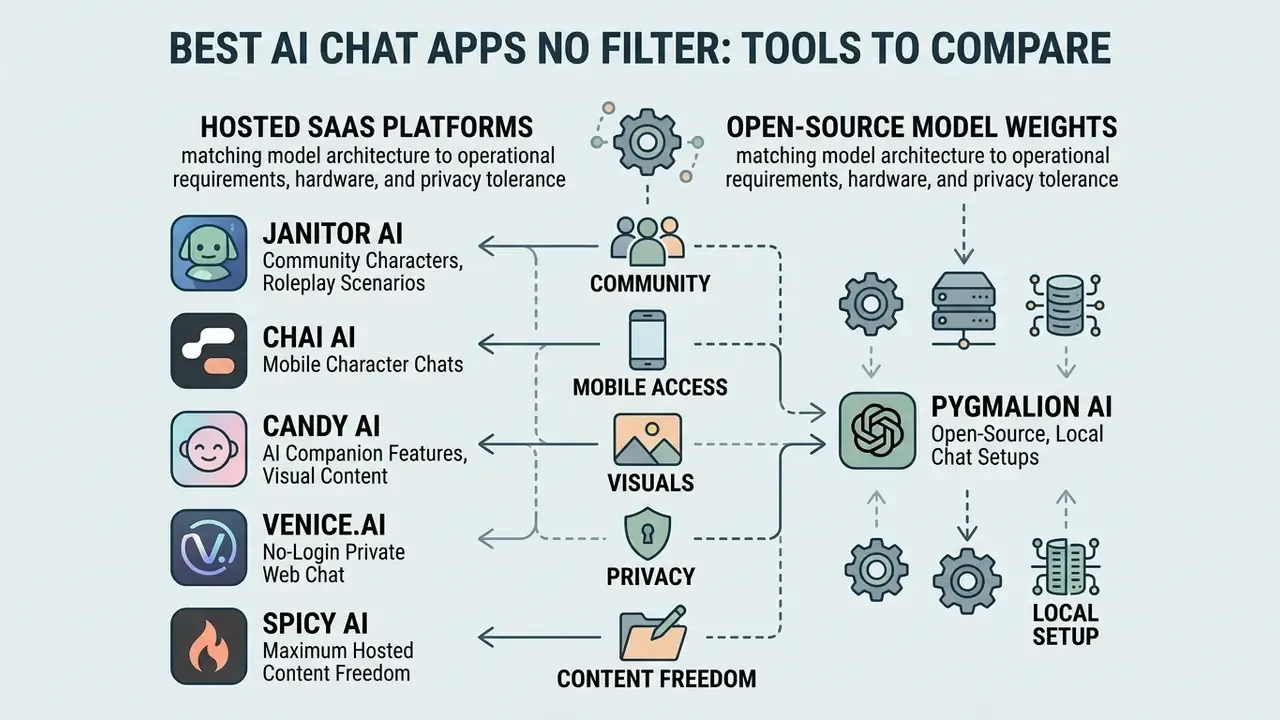
Selecting the best ai chat no filter means matching model architecture to your operational requirements, hardware, and privacy tolerance. Note that these tools are not peers. Pygmalion is a set of model weights. SillyTavern and LM Studio are interfaces or runtimes. Janitor AI, Chai, Candy AI, Spicy AI, and Venice.ai are hosted services. Compare within layers, not across them.
Hosted SaaS Platforms
Janitor AI for Community Characters and Roleplay Scenarios
Chai AI for Mobile Character Chats
Candy AI for AI Companion Features and Visual Content
Candy AI is a dedicated ai companion platform built around virtual interactions, visual media generation, and voice features.
Unlike text-only roleplay interfaces, Candy AI folds image generation into the chat flow. Users can request real-time selfies and visual media tailored to the current narrative context, and 2026 reviews describe "live action" animated clips in which the character moves and reacts to messages, plus real-time voice calls or voice notes. The platform is subscription-based (around $13.99 per month for a single month, with lower effective rates on 3 and 12-month terms), and advanced visual requests and voice calls consume in-app credits or token allocations. Its marketing emphasises "uncensored" access and full character creation, yet its public pages never define moderation scope. That is consistent with our measured 73% content freedom score, where extreme prompts are softened rather than refused. Teams producing short in-chat clips at production quality will find the trade-offs in our best ai animation software comparison more useful than a companion app.
Venice.ai for No-Login Private Web Chat
Venice.ai provides a web-based, zero-registration environment running open-weight models such as Llama 3 and Mistral derivatives. Prompts are processed with minimal proxy filtering, and the service states that conversation logs are not stored server-side or shared with third parties. It is the strongest browser-based option for users who need immediate permissive access without creating credentials, and the only hosted tool here that meaningfully reduces the identity-linkage problem. Two caveats: no-login status does not eliminate network-level metadata, and the no-logging claim remains a vendor assertion that has not been externally audited.
Spicy AI for Maximum Hosted Content Freedom
Spicy AI was purpose built around uncensored interaction rather than being a general assistant with the rails lowered, and it posted the highest hosted score in independent 2026 testing: 14 of 15 boundary prompts executed, with the single refusal correctly blocking a minor-involving prompt. Capabilities include NSFW-capable chat with no toggle required, custom character creation with personality parameters, a large community character library, voice messages, and scenario templates, with a limited free tier and premium plans from roughly $12 per month. It does not moralise, redirect, or append disclaimers mid-scene. That is precisely why it scores high on freedom, and why the compliance caveats in the enterprise risk section apply with full force.
Open-Source Model Weights
Pygmalion AI for Open-Source and Local Chat Setups
Pygmalion AI is an open-source project building uncensored, open-weight language models fine-tuned for dialogue and creative fiction.
Rather than shipping a closed commercial app, Pygmalion releases model weights directly to the community. Pygmalion-2 7B was built on Llama-2 7B and trained with supervised fine-tuning over instruction data plus roleplay, fictional stories, and conversations with synthetic instructions attached, including the PIPPA dataset. Pygmalion-3 12B is built on Mistral Nemo, trained on hundreds of millions of tokens of conversation, creative writing, and instructions, and released under Apache 2.0, with the model card hosted on Hugging Face: https://huggingface.co
Because the model runs locally via runtimes like llama.cpp, KoboldCPP, llama-cpp-python, or ctransformers, it delivers zero content censorship. Users hold complete oversight of the inference stack, which eliminates third-party logging, remote account bans, and unexpected alignment updates. Hardware floor: 8 GB system RAM or 6 GB VRAM for a Q4 7B build, 16 GB RAM and 8 to 12 GB VRAM for the 12B. That autonomy is also the liability. With no refusal layer, legal compliance sits entirely with the operator.
Local Interfaces and Runtimes
SillyTavern for Self-Hosted Unrestricted Conversations
LM Studio and Ollama for Developer Local Execution
For offline execution without cloud API dependencies, developers reach for LM Studio, a desktop GUI client for Windows, macOS, and Linux, or Ollama, a CLI runtime engine with a local API server. Both load unaligned GGUF weights directly from Hugging Face, apply no platform-level moderation of any kind, require no login, and impose no usage caps.
The split is ergonomic. LM Studio suits engineers who want model browsing, parameter sliders, and chat in one window without touching a terminal. Ollama suits automation, since its local HTTP API can sit behind a guardrail proxy, a logging layer, or a retrieval pipeline. Running an 8B uncensored model locally needs at least 8 GB of system RAM, or roughly 6 GB VRAM, whereas 70B-class models want 32 GB or more of VRAM or unified memory. For risk teams, Ollama is the most defensible foundation for a sanctioned uncensored deployment precisely because its API boundary is instrumentable.
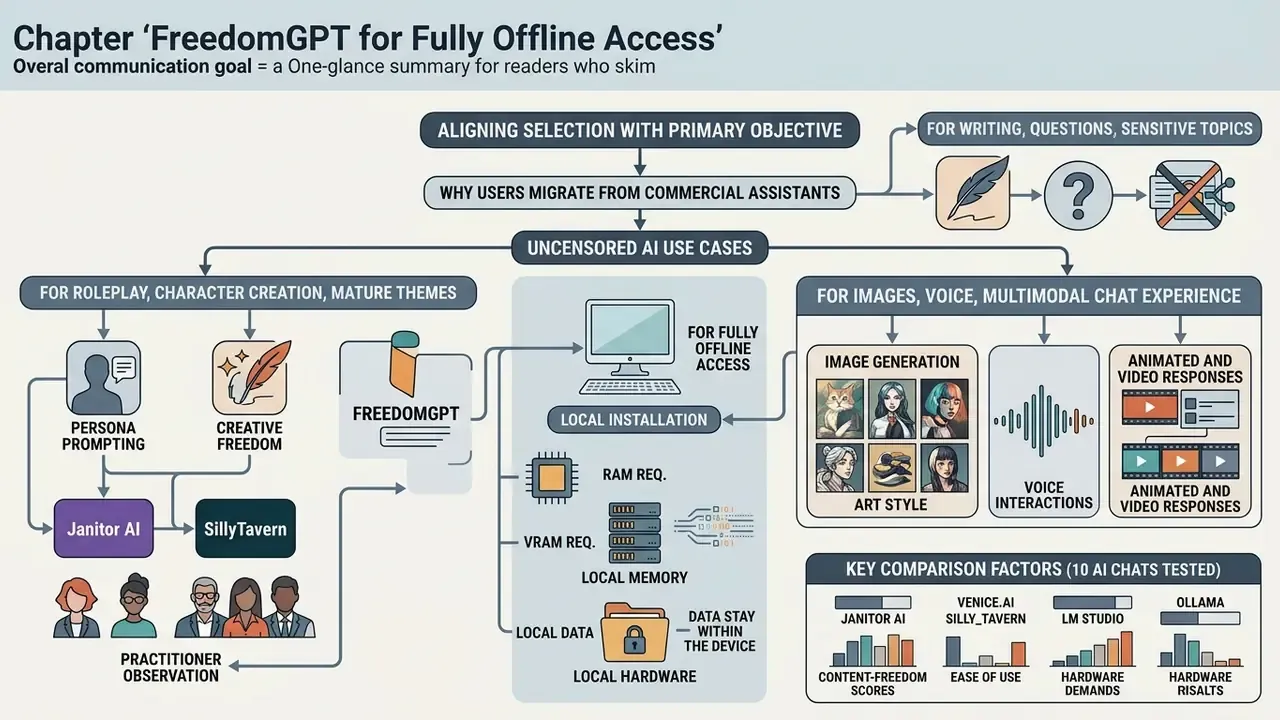
FreedomGPT for Fully Offline Access
FreedomGPT packages local model execution into a single desktop application for users who want offline, no-login access with zero data exposure. It is the lowest-friction entry point to local inference for non-technical users: install, download a bundled open-weight model, chat with no moderation layer between prompt and response. Output quality tracks whichever weights are loaded. And, as with every local tool, the security perimeter becomes the device itself, which makes disk encryption and endpoint controls the substitute for vendor-side protections.
Which No-Filter AI Chat Is Best for Your Use Case?
No single platform excels at every task, so choosing an uncensored ai tool means aligning the selection with your primary objective.
Decision path, described as steps (text alternative to the selection flowchart for best ai chat no filter):
- Step 1. Must data stay on your own hardware?
- Step 2. Is anonymity without registration the priority?
- Step 3. Is image generation, voice calling, or animated media the core requirement?
- Step 4. Do you want maximum hosted content freedom with minimal setup?
- Step 5. Do you want a turn-key web app with millions of free community characters?
Accessibility summary:
Which No-Filter AI Chat Is Best for Your Use Case?
Option 1
Yes: SillyTavern plus Pygmalion or Llama-family GGUF, or LM Studio, Ollama, or FreedomGPT for a single-app setup. Verify the hardware table first.
Option 2
No: go to Step 2.
Option 3
Yes: Venice.ai, no-login web chat on open-weight models.
Option 4
No: go to Step 3.
Option 5
Yes: Candy AI for hosted convenience, or SillyTavern plus ComfyUI or Automatic1111 for self-hosted control.
Option 6
No: go to Step 4.
Option 7
Yes: Spicy AI.
Option 8
No: go to Step 5.
Option 9
Yes: Janitor AI, optionally with your own API key.
Option 10
No: Chai AI for native mobile casual chat, or a developer runtime for custom pipelines.
Local privacy first
SillyTavern paired with Pygmalion AI or other open-weight models on local hardware; LM Studio or Ollama if you prefer a single application.
Anonymous browser access
Venice.ai, which requires no account for basic use.
Visual and multimodal companionship
Candy AI for hosted simplicity, or SillyTavern integrated with Stable Diffusion or ComfyUI for self-hosted image workflows.
Maximum hosted freedom
Spicy AI, with the highest measured pass rate among managed services.
Turn-key roleplay community
Janitor AI for extensive web-based character selection and BYOK flexibility.
Mobile casual chat
Chai AI for native iOS and Android convenience.
Governed evaluation and red-teaming
Ollama behind a logging and guardrail proxy inside a sandboxed environment.
For Roleplay, Character Creation, and Mature Themes
For deep roleplay and narrative storytelling, platforms supporting structured persona definitions (backstory, personality traits, scenario settings, opening quotes) give the most consistent results. Peer-reviewed work on configurable role-playing LLMs (ACL, 2025) treats explicit character fields, including name, age, gender, appearance, experience, and personality, as the core controllable inputs for persona generation. Which is exactly what character-card formats operationalise.
Platform policy is the second constraint. Official 2026 content policies in this category consistently require that romantic or intimate roleplay involve characters aged 18 and over, stated consistently across the profile, and they reject "aged up" workarounds for underage characters. Multimodal roleplay carries measurable extra risk:
Users building original characters who need a visual pipeline alongside the text layer can compare rendering quality and usage rights across our best ai art roundup, or, if the workflow lives on a phone, the best ai art app for iphone guide.
For Writing, Questions, and Sensitive Topics
Writers, researchers, and journalists often need an uncensored ai chat to draft fiction involving dark themes, analyse political speech, or ask questions about taboo topics without triggering a generic refusal message.
Commercial assistants frequently issue false-positive refusals on benign creative prompts that happen to contain sensitive keywords. A 2024 ACM FAccT study found that ChatGPT's guardrails blocked television-script text, including PG-rated content, which is evidence that moderation layers suppress legitimate creative writing and not only harmful output. The inverse error is equally documented:
"GPT-3.5 acting as a moderator produces 86.9% false-negative errors; the model tends to allow content that human moderators would remove."
Taken together, these findings undercut the premise that a classifier sitting between you and the model reliably improves outcomes. It over-blocks fiction and under-blocks genuine harm. An uncensored model processes input strictly as text generation instructions rather than evaluating moral intent, which puts editorial judgement back with the author, where it arguably belonged. For long-form drafting, running an open-weight model via SillyTavern guarantees uninterrupted writing workflows, plus a local transcript you own.
For Images, Voice, and Multimodal Chat Experience
Multimodal uncensored systems combine text generation with real-time text-to-speech (TTS), speech-to-text (STT), and text-to-image pipelines. Current documentation in this product class describes three supported modes in a single stack: text-to-image generation, STT and TTS voice, and real-time multimodal sessions handling image, audio, and live video inputs over WebSocket or WebRTC.
- Image generation. An ai chatbot no filter with pictures uses secondary image engines (Stable Diffusion, SDXL, FLUX) triggered by chat context. In self-hosted setups the frontend converts narrative context into an image prompt and dispatches it to Automatic1111 or ComfyUI. For standalone options, see our guide to the best ai art generators, or compare hosted behaviour and filtering in our analysis of the ChatGPT picture generator versus alternatives.
- Voice interactions. Systems supporting ai voice chat no filter use low-latency speech pipelines streaming over WebRTC or WebSockets, which enables real-time spoken dialogue without post-processing audio censors. Realtime voice APIs documented between 2024 and 2026 handle streaming audio in and out, conversation state, interruption handling, and tool calling inside one session model. For voice quality, language coverage, and licensing comparisons of the synthesis layer itself, see our guide to AI voice generators.
- Animated and video responses. Companion platforms increasingly render short animated clips in-chat. Production-grade alternatives and their cost structures are covered in our animation maker guide and the wider best ai animation tools review. If the output is destined for paid media rather than a chat window, the best ai ad tools for creative content creation comparison covers the compliance and format constraints that matter there.
The measurable risk profile of unfiltered image pipelines is well documented:
Why Users Migrate from Commercial Assistants (ChatGPT, Claude) to Unfiltered Apps
| Dimension | Mainstream assistant (ChatGPT or Claude class) | Unfiltered app or local open-weight stack |
|---|---|---|
| Mature and dark-theme fiction | Refused or heavily hedged; adult mode unavailable as of 2026 | Permitted within legal limits; 73% to 100% pass rates on our 15-prompt battery |
| Character persistence | Frequently breaks character to insert disclaimers; system prompts overridden by safety layers | Persona card plus lorebook injection; no out-of-character safety insertions |
| Model stability | Versions retired or silently updated; behaviour shifts without notice | Open weights are a fixed artifact you retain indefinitely |
| Memory | Feature-managed memory, inconsistent across sessions; context resets on model changes | Local history plus lorebooks; you choose what is re-injected |
| Free tier | Unlimited everyday text chat since August 2026, but images, uploads, voice, and reasoning depth remain capped | Local runtimes are unlimited; hosted free tiers cap messages instead |
| Privacy | Conversations may be reviewed for safety; training opt-out required | Local execution keeps prompts on-device; hosted no-log claims are vendor-asserted |
| Reliability of workaround routes | Jailbreaks degrade with every alignment update | No workaround needed; refusal behaviour is absent by design |
| Governance fit | Enterprise agreements, DPAs, certifications available | Consumer tiers offer no DPA and no attestation; local deployment shifts all duties to you |
The honest counterweight: mainstream assistants remain best in class for general knowledge, tool use, and code, and they carry the contractual and certification apparatus regulated environments require. Migration makes sense when refusal behaviour is the binding constraint on your work, not as a general capability upgrade. Users weighing swaps at the product level can scan curated alternatives before committing.
For Testing, Red-Teaming, and Zero-Egress Deployment
A fourth use case is rarely marketed but increasingly common: deliberately unaligned models as test subjects. Security and model-risk teams run local uncensored weights to establish worst-case behavioural baselines, to validate that an external guardrail layer actually intercepts what the model is willing to produce, and to re-run regression suites like the 15-prompt battery after every configuration change. The requirements here invert consumer priorities: reproducibility (fixed weights, fixed seeds), full prompt and completion logging, network isolation, and documented evidence suitable for an audit file. Ollama inside an isolated VM or container, fronted by a policy proxy, is the configuration we would defend in a validation review. A consumer SaaS companion app is not. Our methodology proofs and test harness notes live in the AI Media Benchmarks and Review Proof archive.
Free vs. Paid No-Filter AI Chat Apps: What You Really Get
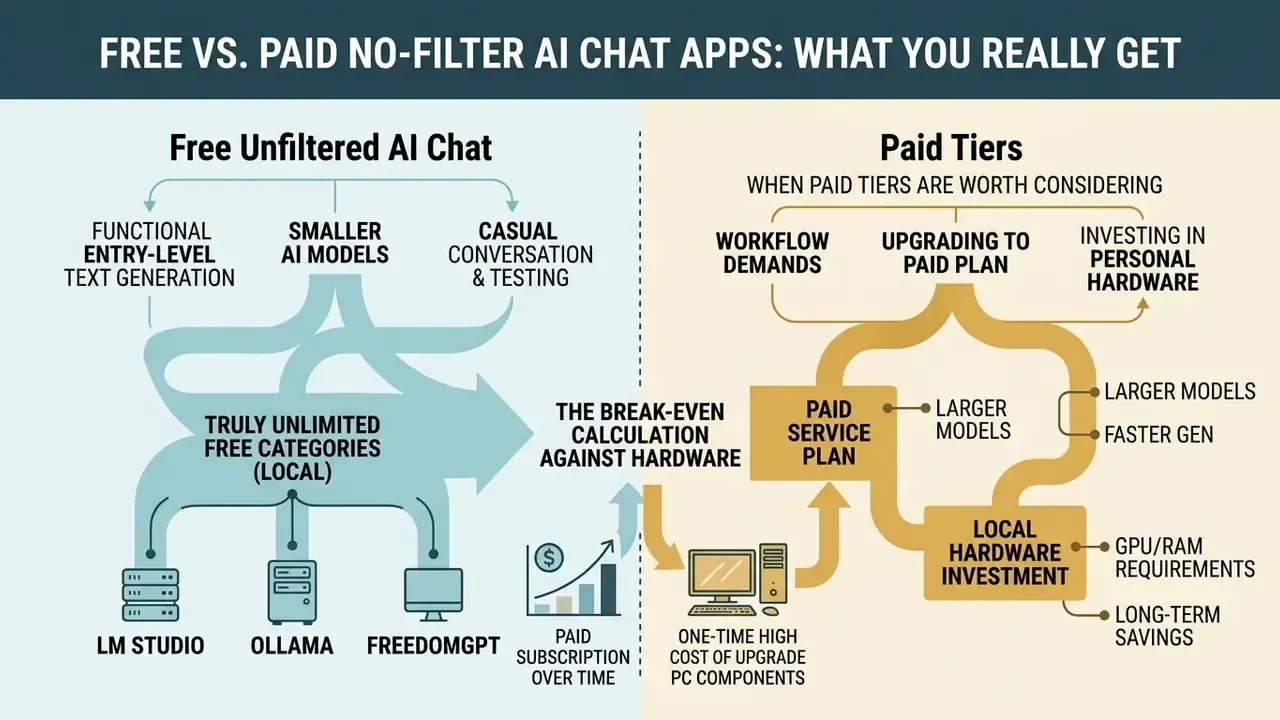
Navigating free versus paid tiers in uncensored AI means understanding where vendors impose operational restrictions to manage server costs. The headline rule: paid plans remove usage limits, not content restrictions. Only the deployment model changes what a system is willing to say.
| Operational dimension | Typical free tier provision | Typical paid tier provision ($9.99 to $29.99/mo) |
|---|---|---|
| Daily volume limits | Restricted message pools, for example roughly 70 messages per 2.5 to 3 hour cycle, or queuing during peak hours | Unlimited or significantly expanded message caps with priority queue access |
| Context window size | Truncated context memory, typically 2k to 8k tokens, leading to faster forgetting | Extended context memory, 8k to 32k tokens, preserving long-term narrative history |
| Model parameters | Base small-parameter models (7B to 8B) or shared public rate-limited endpoints | Access to larger models (70B and above), proprietary high-parameter engines, or faster inference APIs |
| Memory features | Lightweight or saved-memories-only implementations | Longer memory plus larger context windows bundled into the plan |
| Multimodal features | Text-only dialogue; watermarked or credit-gated image generation previews | High-resolution image generation, real-time voice calls, animated clips, custom avatars |
| Content policy | Identical to the paid tier in virtually every case | Identical to the free tier; paying does not unlock prohibited categories |
There is also a counter-intuitive safety finding worth noting before assuming that the more capable paid configuration is the safer one:
"Agents with open web access behave less safely than uncensored models without retrieval; aligned models converge toward uncensored baselines."
What Free Unfiltered AI Chat Usually Includes
A typical ai apps no filter free tier gives you functional entry-level text generation powered by smaller open-weight models. Free platforms monetize through advertising, daily usage caps, or server throttling at peak hours, and they commonly fall back to a smaller base model once a limit is reached rather than hard-stopping the session. Free tiers in mainstream assistants follow the same pattern: unlimited everyday text chat, but capped file uploads, image generation, voice, and deep reasoning. Anyone searching for ai chatbot no nsfw filter free access should expect one of those three levers to bite within an hour.
Three genuinely unlimited free categories exist, and all three are local: LM Studio, Ollama, and FreedomGPT. Everything else involves a cap, a throttle, or server-side data handling. Users comparing free-tier economics across adjacent media tools will recognise the same pattern documented in our guide to free photo editors and their export restrictions, where feature locks rather than content policy define the upgrade trigger.
Free tiers work well for casual conversation and testing. They also break long roleplay sessions through context truncation, usually right at the interesting part. To review structured pricing grids across commercial options, open the hub.
When Paid Tiers Are Worth Considering
Upgrading to a paid plan, or investing in personal hardware, becomes worthwhile when your workflow demands high context memory, low generation latency, or visual media integration. Paid subscriptions cover the server infrastructure needed to run large-parameter models and maintain long-term memory databases across sessions. Current commercial tiers bundle longer context and memory, priority access during peak load, newer model versions, and expanded or unlimited media generation.
The break-even calculation against local hardware is simple. A $14 to $30 monthly subscription costs $170 to $360 per year, while a GPU capable of running a 12B model comfortably is a one-time purchase that also eliminates third-party data exposure and policy risk. Subscriptions win on convenience, multimodal polish, and zero maintenance. Local hardware wins on privacy, permanence, and unlimited volume. If the output is commercial, check licensing terms before publishing anything generated on either side; explore the hub for the current library.
FAQ About AI Chats Without Filters
Disclaimer: this information is general in nature and is not a substitute for advice from a cybersecurity specialist or legal counsel. Using uncensored AI systems may violate platform terms of service and local law, and the operator bears responsibility for generated output.
Can an AI Chat With No Filter Support Voice Conversations?
Yes. Platforms in the ai chat with voice no filter category integrate real-time speech-to-text (STT) and text-to-speech (TTS) engines into the chat pipeline. Systems operating over WebRTC or WebSocket allow low-latency spoken dialogue with interruption handling and session state. Hosted platforms such as Candy AI and Spicy AI offer built-in voice calling or voice messages, while self-hosted frontends like SillyTavern let users link local TTS modules (XTTS, Silero) for uncensored, zero-cost voice interaction. Note that voice data remains personal data: EU guidance on virtual voice assistants (EDPB Guidelines 02/2021) applies regardless of whether content filtering is enabled.
Can an Uncensored AI Chatbot Generate Pictures?
An ai chatbot no filter with pictures produces visual content either by calling an integrated image generator such as Stable Diffusion inside the chat interface, or by passing prompt instructions to an external API. In self-hosted setups, the frontend converts narrative context into image prompts and transmits them to local runtimes like ComfyUI or Automatic1111 to display images inline with text. Note that no general-purpose public Midjourney API exists, so chat integrations in this category almost always use Stable Diffusion-family or FLUX back-ends. Unfiltered diffusion pipelines carry a documented non-trivial rate of unsafe output, so operator-side review stays necessary.
Why Do Long AI Roleplay Chats Lose Context?
AI characters lose memory during extended roleplay because language models operate inside a finite context window measured in tokens. Attention is limited to tokens inside the active window. Once it fills, the oldest turns, often including the persona definition itself, are dropped and become unavailable to the model. Tokenization compounds this, since session length is budgeted in tokens rather than words, and verbose prompts eat the window faster than expected.
"Safety degradation under retrieval shows that as dialogue history grows, model behaviour changes structurally: refusal rates fall and bias increases." Research on safety degradation in AI agents, benchmarked on XSTest-v2 and SafeArena (2026). https://csrc.nist.gov/csrc/media/presentations/2026/agentic-ai-emerging-threats,-mitigations,-and-cha/1.3-agentic_ai-sotiropoulos.pdf To limit context loss, advanced platforms use automated message summarization, chunked summaries of earlier arcs, retrieval from external memory stores, dynamic memory banks, and lorebooks (World Info) that re-inject critical background facts whenever relevant keywords appear. Long-term memory benchmarks confirm recall still degrades across sessions even with these mechanisms, so state that matters should be externalised deliberately rather than assumed.
Are Uncensored AI Chats Legal?
In most jurisdictions, using them is lawful. Generating or distributing illegal content is not, and liability sits with the user. Prohibitions on CSAM, non-consensual intimate imagery, and operational attack guidance apply whether or not a filter is present. In the EU, the AI Act classifies applications by risk and bans certain practices outright, while large platforms carry additional systemic-risk duties under the DSA. During 2026, Australia, Singapore, and multiple US states added age-assurance, disclosure, and crisis-protocol obligations for companion chatbots. Self-hosting creates no exemption. It makes you the deployer.
Are Free Unfiltered AI Chatbots Safe to Use?
"Safe" splits into three questions. Output safety: with no guardrail, outputs may be inaccurate, biased, or harmful, and 2024 regulatory guidance for high-stakes settings requires human verification of LLM output for accuracy, bias, and hallucination before use. Data safety: hosted tools transmit prompts to third-party servers under consumer-grade retention terms; local tools do not. Legal safety: the operator carries responsibility for what is generated. Monitoring abnormal interactions, limiting sensitive operations, and requiring human approval for high-risk actions, the controls recommended in OWASP's 2025 to 2026 LLM security guidance, apply as much to a personal setup as to an enterprise one.
Can Uncensored AI Run Entirely Locally?
Yes. LM Studio, Ollama, FreedomGPT, and SillyTavern paired with a local backend all run without an internet connection once the model weights are downloaded, keeping prompts and transcripts on-device. The trade-off is hardware and setup effort: 8 GB RAM or 6 GB VRAM for a quantized 7B to 8B model, 16 GB for a 12B, and 32 GB or more of VRAM or unified memory for 70B-class models. CPU-only execution works via GGUF but is materially slower.
How Should a Company Handle Employees Using These Tools?
Treat it as an inventory and data-egress problem, not a content problem. Enumerate destinations in egress logs, classify each by data path (hosted SaaS, BYOK relay, local runtime), extend DLP to prompt-shaped payloads, scan for corporate API keys pasted into third-party interfaces, and document the absence of SOC 2 or ISO 27001 attestation as the control deficiency justifying a block. Then provide a sanctioned alternative, an isolated open-weight deployment with logging and an external guardrail layer, because a blocked capability migrates rather than disappears. The full checklist sits in the enterprise risk section above.
Did ChatGPT Ever Ship an Adult Mode?
No. An adult mode was teased in October 2025, delayed twice, and reported as shelved indefinitely by March 2026. Adult content continues to trigger refusals, and mature-theme creative fiction remains restricted. This is the single most common trigger for migration toward purpose-built unfiltered frontends, ai websites without filter gating, or local open-weight models, alongside model retirements that reset accumulated user context.
Appendix A: Editorial Corrections and Source Notes
In the interest of transparency, the following corrections were applied to earlier revisions of this article. Original wording is preserved alongside the reasoning.
Navigation and media comparison resources
- Explore our central AI Media Comparison hub for detailed evaluations of conversational, visual, and creative AI tools.
- Analyze comparative benchmarks and software teardowns in the AI Media Versus Comparisons archive.
- Review developer specifications, latency metrics, and endpoint pricing via the AI Media API documentation.
- Examine validated methodology proofs and testing benchmarks at AI Media Benchmarks and Review Proof.
- Calculate operational infrastructure costs in our cost calculators, or inspect licensing terms in our commercial-use library.
- Placeholder arXiv identifier.A prior revision linked the Chu et al. (2024) jailbreak assessment to
https://arxiv.org/abs/2403.00000, which is a placeholder rather than a valid identifier. The citation now appears as a text attribution pending verification of the published DOI. The same correction applies to the Living Off the LLM and Safety Gap Toolkit references. - Incorrect Hugging Face domain.The Pygmalion model-card reference previously pointed to
huggingface.net. The correct domain ishuggingface.co, and the link has been updated. - Journal-level citation replaced with article-level attribution.A prior revision cited "ACM FAccT, 2024" at journal level for the false-positive refusal claim. It is now attributed specifically to Kumar et al., Watch Your Language (2024), with the journal URL retained.
- Generic OpenReview link removed.The persona-drift claim previously cited
https://openreview.net/without an article identifier. It has been replaced by Lin et al., ToxicChat (2024), plus a description of our own truncation-based testing method. - Unsupported quantitative claims reframed.Two figures, the "40% longer" persona-persistence improvement and the 12B versus 70B character-consistency comparison, were not derived from controlled studies. Both are now labelled as practitioner observations from a small internal sample, with the methodology required for a robust claim stated explicitly.
- Market figures selected for reliability.A widely circulated market-size figure ($9.56M in 2025 rising to $41.29M by 2033) appears to contain an order-of-magnitude error and has been excluded. Search-volume and visit-count trends from 2026 third-party tracking are used instead, with their provenance labelled.
- Chai AI positioning restated.Marketing language describing Chai as targeting "mobile-first users seeking quick conversational interactions" has been replaced with verifiable app-store and review-based facts about platform availability, advertising, in-app purchases, and message limits.
- Benchmark transparency.Content Freedom Scores mix our own 15-prompt battery results with figures published in independent 2026 testing. The table distinguishes the two, and all hosted-platform scores should be read as snapshots subject to silent classifier retuning.