Executive Summary for Design, Risk and Finance Leaders
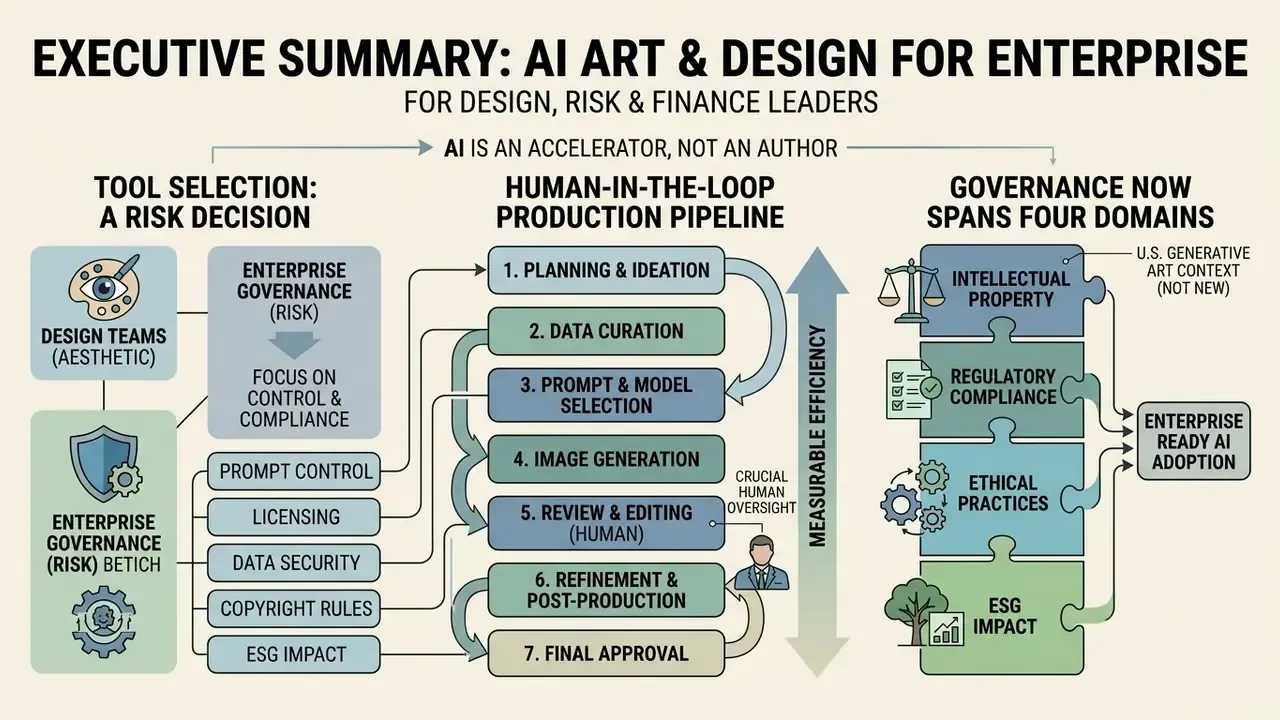
- AI is an accelerator, not an author. Copyright attaches only to human creative choices. Fully machine-generated visual elements must be disclaimed. Keep an audit trail (prompt logs, layered source files, timelapses) to prove human agency.
- Tool selection is a risk decision, not an aesthetic one. Assess prompt adherence, seed and structural control, plugin integration, licensing indemnification, data-retention policy, and certification posture (SOC 2 / ISO 27001) before you fall in love with the output.
- Human-in-the-loop pipelines deliver measurable efficiency. Structured briefs, batch generation, curation quality gates, and hybrid post-processing turn raw candidates into production-grade assets across raster, vector, print, and 3D/VFX pipelines.
- Governance now spans four domains: intellectual property (U.S. Copyright Office, Thaler v. Perlmutter), transparency (EU AI Act Articles 50 and 53, C2PA provenance), information security (Shadow AI, prompt leakage of confidential brand assets), and environmental impact (data-center energy and water use).
- Generative art is not new. The discipline spans more than fifty years of art history, from Harold Cohen's AARON (1973) to GANs (2014), DeepDream (2015), the $432,500 Christie's sale of Edmond de Belamy (2018), and today's robotic and decentralized autonomous artists.
Who this guide serves, and how to read it
Three readers usually land here at once, and they want different things.
A creative director wants to know which art generator holds style across a campaign series. A risk or compliance officer wants to know where confidential assets can leak and what evidence survives an audit. A finance lead wants the real cost, not the sticker price of a seat.
The sections below run in that order: what AI art actually is, how the systems work, where the output is useful, how to select a tool, how the main platforms compare, how to run the pipeline, and what the legal, ethical, and environmental constraints look like in 2026. If you are only evaluating vendors, start at the selection checklist and the comparison tables. If you are drafting internal policy, the data-security and copyright sections carry the operative controls.
One framing point before the detail. Every claim about productivity gains in this field is context-dependent. Baseline cycle times, brief quality, and review capacity differ so widely between institutions that borrowed benchmarks should be treated as hypotheses, not targets.
What is AI art and how does it fit into design?
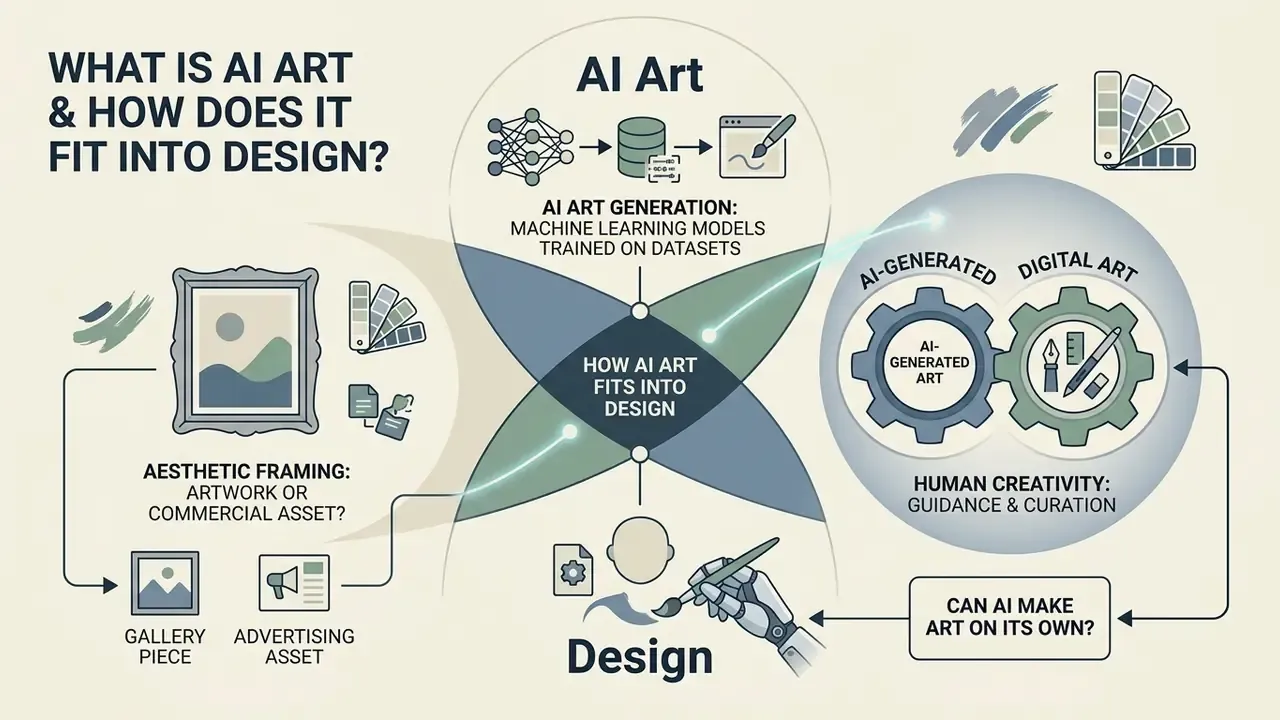
AI art refers to visual media generated or significantly assisted by machine learning models trained on large-scale image datasets. In commercial design, AI art functions as a controlled instrument for rapid prototyping, asset drafting, and visual experimentation. Rather than acting as a standalone creative agency, artificial intelligence sits inside design pipelines and translates textual or visual constraints into parametric image candidates.
Where does the boundary between human-authored digital art and machine-synthesized output actually sit? Not in the pixels. It sits in where expressive control resides.
That perceptual ambiguity is exactly why legal and procedural criteria, not visual inspection, must define authorship. According to the U.S. Copyright Office Policy Guidance (2025), copyright protection attaches only to human creative choices. When a designer works on a drawing tablet or in vector software, every line, composition, and color selection is executed by the human author. When a generative system renders an image from a single prompt, the algorithm determines the expressive detail. To compare options across creative software categories, teams can review AI image generators for commercial use and test the available tool classes against internal procurement criteria.
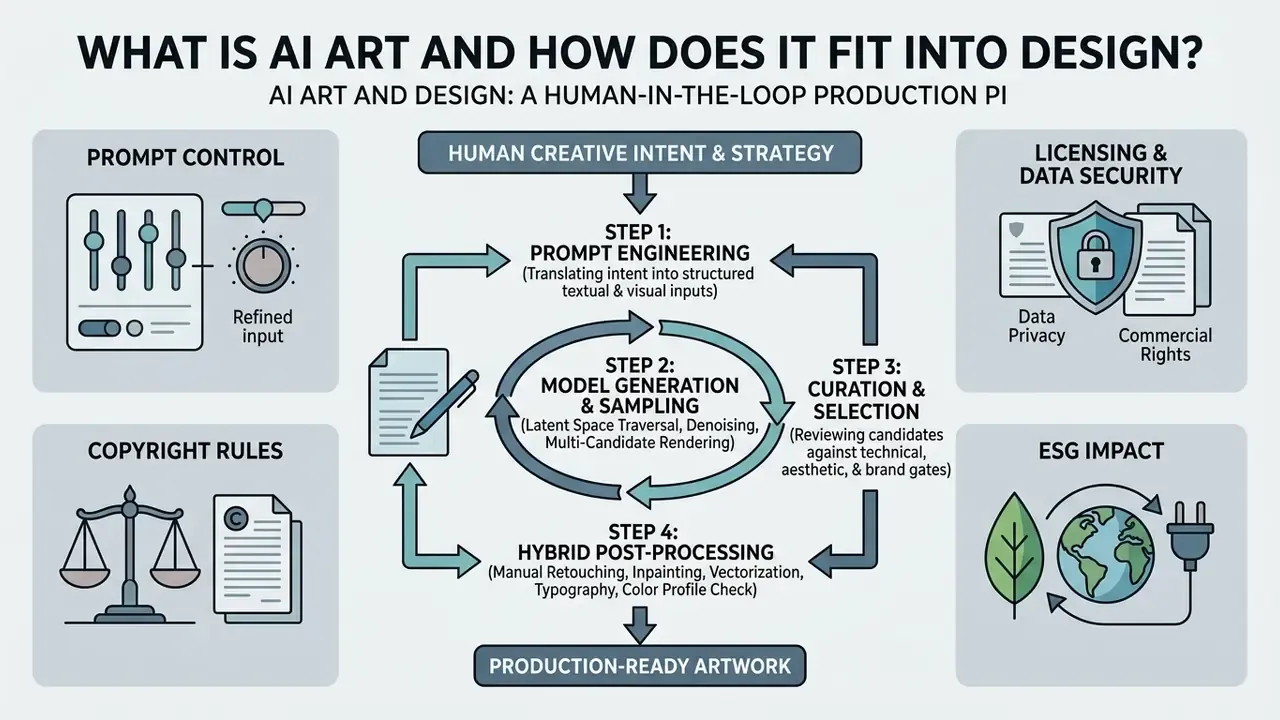
Figure 1: Visual schema of the human-in-the-loop AI art and design process. Stage descriptions remain available as text in the DOM structure for indexing under ai art and design.
AI-generated art, digital art and human creativity
AI-generated art is a specific subset of digital art in which machine learning algorithms build pixel structures from dataset distributions. The human contribution shifts from manual rendering toward high-level task formulation, curation, and iterative refinement. In classical drawing and digital painting, execution is continuous: stroke, form, and shading are under direct physical control.
A 2025 comparative study on divergent creativity (Journal of Creative Behavior, N=255) produced a clear hierarchy. Expert visual artists scored highest, then non-artists, then human-guided generative AI, and finally unguided models working on their own. Volume, in other words, is cheap. Value tracks the structure and depth of human input.
"Visual artists received the highest creativity scores, followed by non-artists, then human-guided AI, and finally unguided AI."
Can AI make art on its own?
AI cannot make art entirely on its own. Generative models remain dependent on human prompts, seed selection, and training-data structure to establish visual form and meaning. Empirical evaluations show that in self-guided or low-guidance modes, output narrows stylistically and drifts away from the brief.
"Under low human guidance, AI generation scored significantly below even non-artists on creativity; guided AI approached, but did not exceed, the non-artist baseline."
A benchmark study at Carnegie Mellon University (2025), built on more than 1.95 million prompt-image pairs, confirmed that output characteristics track the specific tokens, artist tags, and parameter constraints supplied by the operator. The same benchmark tested held-out artist names, rising prompt complexity, multi-artist prompts, and several text-to-image backbones. Stylistic identity consistently behaved as a function of prompt conditioning and training-data composition. Without human initiation, contextual framing, and final curation, these systems run probability functions across latent space. Impressive, yes. Autonomous creative expression, no.
How AI art systems create images
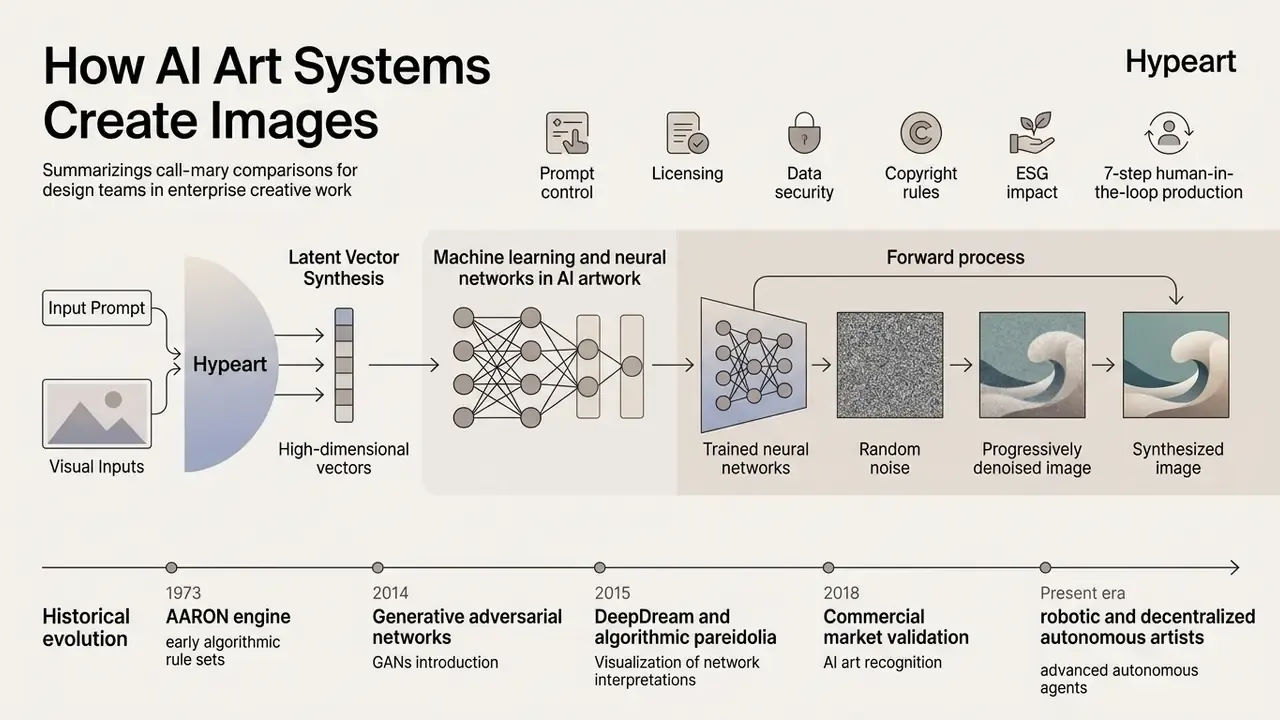
AI art systems synthesize images by translating text or visual inputs into high-dimensional latent vectors, then using trained neural networks to progressively denoise random mathematical representations into coherent compositions. Modern text-to-image generators rely on deep learning architectures trained on billions of image-caption pairs. That training builds statistical associations between words and visual concepts such as color, texture, geometry, and lighting.
Historical evolution: from algorithmic rule sets to autonomous agents
Generative visual synthesis is not a 2020s invention. It is the convergence of a fifty-year algorithmic progression, and the milestones matter:
- 1973 (AARON engine) Created by British-born artist Harold Cohen, AARON was the first autonomous rule-based drawing system, executing physical brush strokes from hard-coded cognitive visual rules. Early versions produced abstract drawings. Representational elements such as rocks, plants, and human figures arrived through the 1980s, with color in the 1990s.
- 2014 (Generative adversarial networks) Ian Goodfellow and colleagues introduced GANs, launching automated image synthesis through competing generator and discriminator networks.
- 2015 (DeepDream and algorithmic pareidolia) Google released DeepDream, created by engineer Alexander Mordvintsev. It visualised neural network layer activations by amplifying pattern recognition into surreal, hallucinatory imagery.
- 2018 (Commercial market validation) The GAN-generated portrait Edmond de Belamy, by the collective Obvious, sold at Christie's in New York for $432,500, far above its $7,000–$10,000 estimate. The work referenced roughly 15,000 historical portraits, and the name "Belamy" is a translated pun honouring Goodfellow ("bel ami" means "good friend").
- Present era (robotic and decentralized autonomous artists) Humanoid systems such as Ai-Da, named after Ada Lovelace, draw and paint using ocular cameras, onboard algorithms, and a robotic arm. Decentralized agents such as Botto, created by Mario Klingemann, produce self-directed works governed by community feedback and blockchain auctions. Botto presents roughly 350 pieces weekly; community votes retrain the model and decide which single work goes to auction.
Why does this lineage matter operationally? Because questions of authorship, autonomy, and market recognition have been litigated in practice for decades. Current legal frameworks are refining a boundary between human and machine agency, not inventing one from scratch.
Enterprise practice follows the same pattern. In documented corporate rebranding workflows inside regulated industries, internal design teams that standardize an approved brand-asset dataset and apply structured prompt inputs report compressing preliminary campaign concept cycles from several weeks to a few days, while staying aligned with brand guidelines. These figures are directionally consistent with published productivity research. Still, benchmark your own baseline cycle times first. Results depend on brief quality, review capacity, and post-processing overhead.
Machine learning and neural networks in AI artwork
Machine learning architectures for image generation pair text encoders, usually transformer models such as CLIP, with generative visual backbones such as latent diffusion networks. The encoder converts natural language prompts into continuous vector embeddings that steer the backbone.
According to NIST Special Publication AI 100-2e2025, modern diffusion models operate through a two-phase mathematical process:
- Forward processGaussian noise is added to training images step by step until they become pure random static.
- Reverse denoising processDeep neural networks (U-Nets or transformer backbones) are trained to predict and remove that noise incrementally, guided by textual embeddings, until a clean image emerges from latent space.
In latent diffusion architectures, a first-stage autoencoder compresses images into a compact latent representation before denoising begins. That compression is what makes high-resolution synthesis tractable on commercial hardware. NIST GCR 23-039 also documents variational autoencoders (VAEs) and GANs as parallel generative families used to generate new images. Readers evaluating specific implementations can compare leading AI image generators against these architectural distinctions, and developers wiring models into internal services can view the guide on API integration patterns.
Generative adversarial network and other AI approaches
Generative adversarial networks, introduced in 2014, formed the foundation of early neural art generation. Two networks compete: a generator that creates synthetic images and a discriminator that judges whether an image is real or artificial. Through minimax optimization, the adversarial network GAN family achieved high-resolution synthesis and powered early style-transfer platforms such as DeepArt.io and Google Deep Dream.
GANs still excel at focused image-to-image transformation and synthetic data creation. Most production design systems, however, have moved to latent diffusion models and autoregressive transformers. Diffusion architectures train more stably, scale better with multi-modal inputs, and avoid the "mode collapse" that plagued GAN training. The practical payoff for designers is control over complex, text-conditioned scenes. Surveys from 2024 to 2026 keep GANs in the picture for synthetic data generation, security research, and medical imaging, while assigning diffusion and autoregressive models higher status for creative production.
Where to use AI art in creative work and design
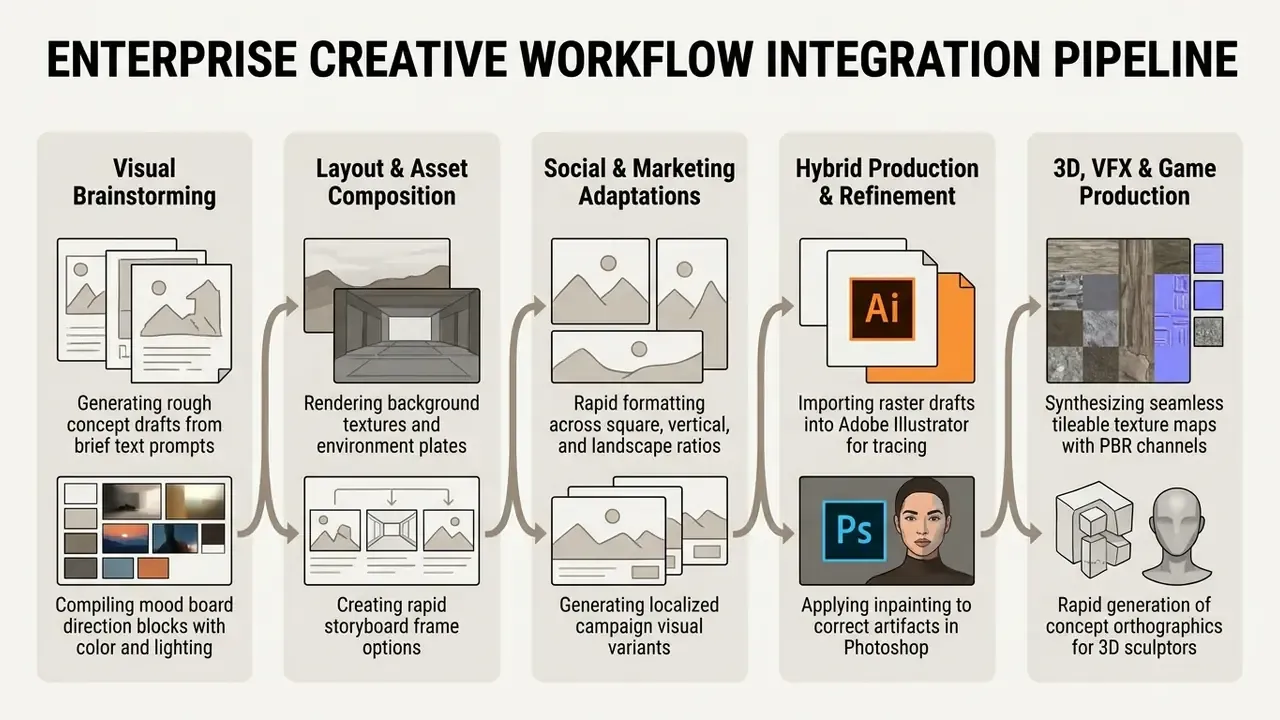
Commercial design workflows use AI tools in specific production phases where speed, visual variation, and rapid prototyping deliver measurable efficiency. Enterprise teams rarely ship synthesized assets untouched. They use AI-generated images as base layers, visual references, and preliminary mockups inside broader pipelines.
The planning implication is precise. Generative tools converge reliably on simple, form-driven objects and degrade on complex, detail-dependent products. That is exactly why curation and manual refinement gates stay mandatory.
Teams weighing broader digital media software choices can review AI image generator comparison frameworks before standardizing a toolchain.
Concept development and visual brainstorming
Early in a project, designers use generative image tools to widen visual direction options without spending manual rendering hours. Feed structured parameters covering lighting, perspective, subject matter, and color theory, and a creative director can assemble multi-option mood boards in minutes.
Controlled feasibility testing with professional designers suggests that pairing a large language model for brief expansion with a text-to-image model for mood board assembly increases the number of distinct directions explored per session. The reason is unglamorous: variant cost drops to near zero. In the six-designer study cited above, Midjourney was judged better for divergent brainstorming, while DALL·E 2 performed better on convergent, specification-driven work. That split is worth writing into internal tool policy rather than leaving to taste.
A repeatable mood board methodology used in professional studios defines five input categories: color palette, textures, photographic style, typography, and visual metaphors. Three to five variants are generated per category, then the survivors are assembled in Figma, Canva, or a shared collaborative canvas for stakeholder voting. For concept art, prompts follow a consistent structure of subject plus environment plus lighting plus composition plus style signals, with 10 to 15 drafts generated before refinement tags (cinematic lighting, highly detailed, engine-render references) are layered in.
Generative pipelines also reach beyond two dimensions. 3D artists and environment designers use diffusion engines to produce seamless Physically Based Rendering (PBR) texture maps, covering albedo, normal, and roughness channels, from text prompts. Concept artists generate multi-angle orthographic views of characters and props, which speeds up blocking and digital sculpting in ZBrush or Blender. Design-research pipelines documented at CAADRIA combine LLMs, image generators, photogrammetry, NeRFs, and image-to-3D conversion across art objects, architectural facades, and urban scenarios. Multi-tool chains, not single generators, define professional practice. Downstream stages still demand human technical labour: UV unwrapping, retopology, rigging, and shader authoring remain manual disciplines, and generated concept sheets act as reference input rather than production geometry.
Using AI for artwork alongside manual design
Professional pipelines are hybrid by design. Algorithmic generation sits next to manual vector crafting, retouching, and typographic work. Designers export raster output into image editors to fix structural details, grade color, or vectorize elements into scalable SVG files for branding. Post-processing stacks commonly include AI image enhancers for detail recovery alongside conventional photo editors for masking and compositing.
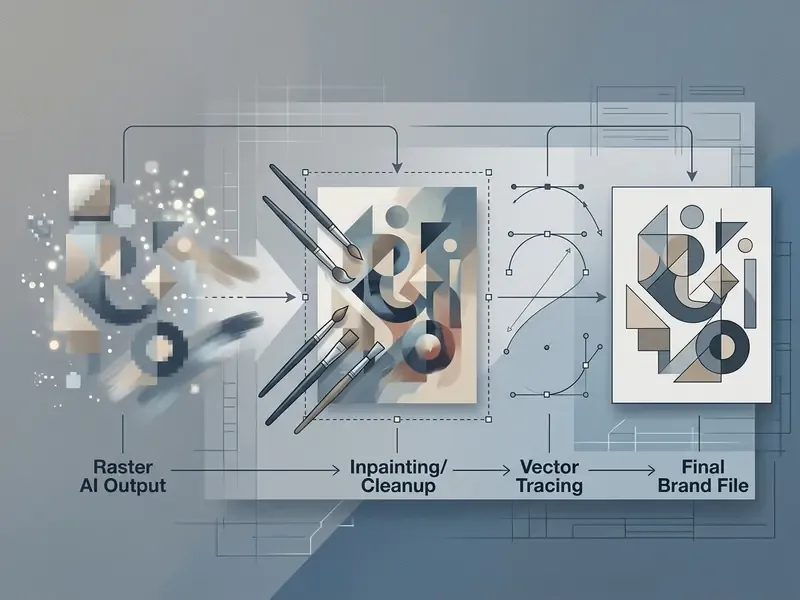
Documented studio practice in packaging and consumer-goods design follows that chain closely. Complex organic background patterns are generated with latent diffusion software, imported as raster assets into vector editing software, then processed through medial-axis extraction and cubic Bézier curve fitting before being combined with hand-crafted typography to produce a compliant, high-resolution print file. Peer-reviewed vectorization research describes the same technical sequence: raster preprocessing, vectorization, medial-axis extraction, curve fitting into cubic Bézier splines. That is why this hybrid route is reproducible rather than anecdotal. Architectural and interior teams apply an analogous pattern: build a precise grey-box scene in CAD software, generate the visual treatment with a diffusion model, then reconcile geometry and materials manually in Photoshop. Treat the studio examples here as representative industry patterns, not verified single-client metrics.
How to choose an AI art generator for design tasks
Choosing a generative image tool means evaluating functional requirements rather than surface rendering quality. Decision-makers should assess prompt adherence, parameter control, integration with the existing creative stack, pricing structure, data-handling guarantees, and commercial licensing safety. The NIST AI Risk Management Framework (2023) and its Generative AI Profile (2024) supply the governance scaffolding, Govern, Map, Measure, Manage, under which these criteria should be documented.
Choose a tool by output: illustrations, concepts or artwork
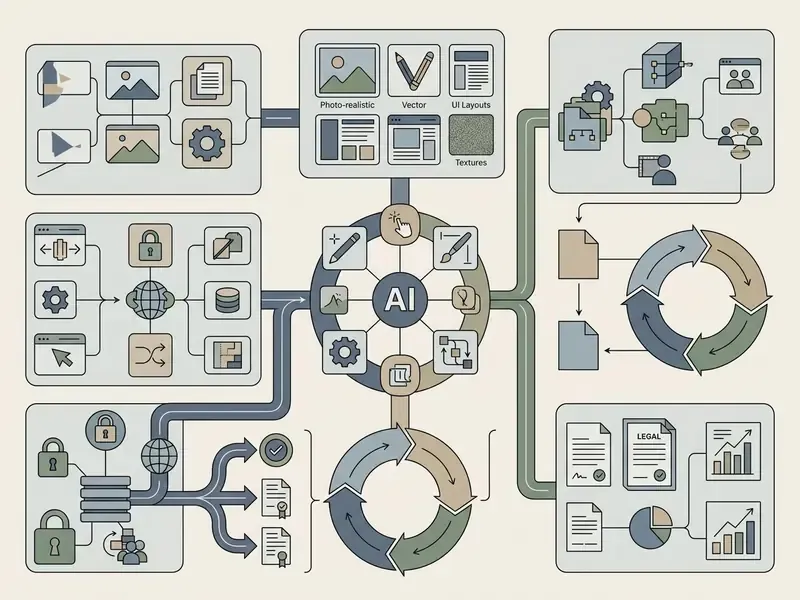
Different engines are tuned for different visual domains, shaped by training architecture, dataset curation, and default aesthetic bias. Match capability to the primary deliverable:
- Stylized illustrations and vector assets Platforms such as Recraft and specialized Adobe Firefly modules handle vector structure generation well, with clean line control and flat-color exports.
- Photorealism and product renders Midjourney V7 and DALL·E 3 model light reflection precisely, control camera depth of field, and render complex texture suitable for architectural or product visualization.
- Concept art and environmental exploration High-fluidity diffusion engines build rich atmospheric compositions, detailed background plates, and imaginative lighting for game and film pre-visualization.
- Web, UI and presentation layouts Workflow-integrated tools (Figma AI, Canva AI) prioritize template structure, component reuse, and export flexibility over fine-art aesthetics.
When surveying the wider ecosystem, creative departments can review the best AI art generators for paid procurement, shortlist free AI art generators for pilot testing, or open the hub to map substitutes for a tool already under contract.
Control over style, prompts and generated images
Commercial design needs predictable, repeatable outcomes. A bare text box is not a control surface. Prioritize platforms that expose real parameters:
- Seed controlFixing the initial noise seed lets designers adjust a prompt incrementally without rebuilding the scene. Research on diffusion sampling shows that changing the seed alters output substantially, while deliberately chosen seeds can recover rare visual concepts without retraining.
- Prompt weighting and guidance scaleNumerical parameters such as classifier-free guidance dictate how strictly the network follows text versus exploring latent space. Published experiments commonly fix CFG near 7.5 and vary seeds to produce comparable candidate sets.
- Inpainting and outpaintingLocalized editing lets artists modify sub-regions or extend canvas boundaries while keeping surrounding elements intact. Teams extending canvases for multi-format campaigns can review dedicated AI outpainting and image expansion tools.
- ControlNet conditioningStructural inputs such as edge detection (Canny), depth maps, or pose skeletons enforce exact compositional geometry on the output.
- Reference-image style injectionModern diffusion methods extract style from a single reference image and inject it during denoising through style encoders, reference networks, or attention key-value replacement. This is the backbone of brand-consistent series production.
Accessibility for beginners and professional artists
Tool choice has to match the technical proficiency of the people who will actually use it. Simplified chat interfaces lower the barrier for non-designer marketing staff who need a quick draft and have no formal art training.
User studies from 2024 to 2026 show a consistent split. Non-professionals rate simple text-box interfaces higher on ease of use. Professional artists get better results from structured, controllable interfaces, and report more confidence with less trial and error when prompting is guided. A 2026 experimental study also found that professional artists used generative tools more effectively than laypeople even under restricted tool conditions. Domain expertise remains a multiplier, not a redundancy.
Senior designers, then, need modular interfaces: multi-layer editing, custom parameters, style training through LoRAs, and direct plugin integration into Adobe Creative Cloud or Figma. Matching software to skill level prevents workflow friction and reduces abandonment. Practitioners refining output downstream often pair a generator with AI photo editors or, on a zero budget, a free photo editor.
Enterprise data security, Shadow AI and confidentiality controls
In regulated sectors, banking, insurance, healthcare, defence contracting, the dominant risk in generative design is not copyright. It is information leakage. Shadow AI appears when designers or marketing staff upload confidential packaging comps, unreleased product renders, pre-announcement campaign concepts, or customer imagery into public consumer tiers, community Discord servers, or free web front-ends whose terms permit training on submitted content.
A defensible control set includes:
NIST's Generative AI Profile (2024) places privacy, intellectual property, provenance, and human-AI interaction inside lifecycle risk management. That makes these controls easy to map onto existing enterprise governance registers rather than standing up a parallel process.
Enterprise data security, Shadow AI and confidentiality controls
Approved-tool allowlist.
Publish a short list of sanctioned generators with documented terms. Block or monitor unsanctioned endpoints at the network layer.
Zero Data Retention contracting.
Procure enterprise or API tiers that contractually exclude prompts, reference uploads, and outputs from training and from extended server-side retention.
Deployment isolation.
For high-sensitivity assets, use private-instance, VPC-hosted, or self-hosted open-weight models, for example Stable Diffusion family deployments, so confidential inputs never leave controlled infrastructure.
Certification evidence.
Require SOC 2 Type II or ISO 27001 attestation, sub-processor lists, data-residency commitments, and breach-notification terms before onboarding.
Input hygiene rules.
Prohibit uploads of personally identifiable information, unreleased financial data, client-confidential artwork, and third-party licensed stock into any public generator.
Logging and attribution.
Route generation through team workspaces or API keys tied to identifiable users. The result is an auditable record of who generated what, from which inputs.
Total cost of ownership: budgeting beyond the subscription
Licence fees are a fraction of real spend. A defensible TCO model for generative design covers five components:
- Direct licence cost seats, credit packs, or usage-based API charges (per image, per megapixel, or per GPU-second).
- Refinement labour designer hours on inpainting, artifact removal, vectorization, typography, and colour management. Usually the largest hidden line item.
- Upscaling and compute add-ons tensor upscaling passes, high-resolution re-renders, and storage for large candidate batches.
- Review and governance overhead brand review gates, legal clearance, provenance metadata application, and disclosure labelling.
- Risk reserve indemnification premium where offered, plus contingency for asset replacement if a licence or dataset dispute emerges.
Model those five before procurement and you avoid the classic failure mode: a $10 to $70 monthly subscription gets approved while dozens of unbudgeted refinement hours pile up per campaign. Pricing metrics vary widely across creative software categories, so compare AI art generator pricing models, check current pricing tiers, evaluate commercial AI image generator options against projected monthly volumes, and view the guide to cost calculators if you need a repeatable spreadsheet.
AI tools for art and design: comparison by use case
Evaluating enterprise generative image software means analysing operational parameters: prompt adherence, editing control, workflow integration, pricing model, data-handling posture, and commercial licensing safety.
Table 1 - Active enterprise procurement candidates
| Platform | Primary Output Specialization | Control Capabilities | Ease of Use | Enterprise Pricing Metric | Data Privacy & Enterprise Security | Commercial Rights & Safety Profile |
|---|---|---|---|---|---|---|
| Midjourney (V7) | Concept art, photorealism, high-aesthetic illustrations | Moderate (Vary Region, Pan, Zoom, Image Prompts, Seed) | Moderate (Web UI / Discord) | Subscription ($10–$120/mo) | Public-by-default galleries on lower tiers; Stealth Mode on higher tiers; no self-hosting | Commercial usage allowed on paid tiers; public dataset risk |
| DALL·E 3 (OpenAI) | Descriptive prompt execution, conversational edits | Low-Moderate (Inpainting in ChatGPT, prompt rewriting) | Very High (Natural language) | Usage-based API ($0.04/img) or ChatGPT subscription | Enterprise/API tiers offer no-training-by-default and Zero Data Retention options; SOC 2 attestation available | Users own outputs; contractual license grants; public dataset training |
| Adobe Firefly | Commercially safe vector assets, stock editing, design layers | High (Structure Reference, Style Reference, Inpainting) | High (Photoshop/Illustrator integration) | Credit system / CC Suite ($69.99/mo) | Enterprise agreements, content credentials embedded, no customer-content training by default | Indemnified commercial safety; trained exclusively on licensed Adobe Stock |
| Stable Diffusion family (self-hosted / cloud-hosted) | Fully customizable raster generation, LoRA style training, PBR texturing | Very High (seeds, ControlNet, LoRAs, samplers, negative prompts) | Low-Moderate (technical setup required) | Infrastructure cost (GPU-hours) or hosted API | Highest control: on-premise or VPC deployment means inputs never leave controlled infrastructure | Output commercial use generally permitted; verify model-weight licence for commercial deployment separately |
| Jasper Art | Marketing visual collateral, ad creative copy-alignment | Moderate (Style dropdowns, medium presets) | High (Marketing template UI) | Seat subscription ($39–$125/mo) | Business-tier controls; depends on third-party backend model terms | Commercial rights included; built on third-party backend API models |
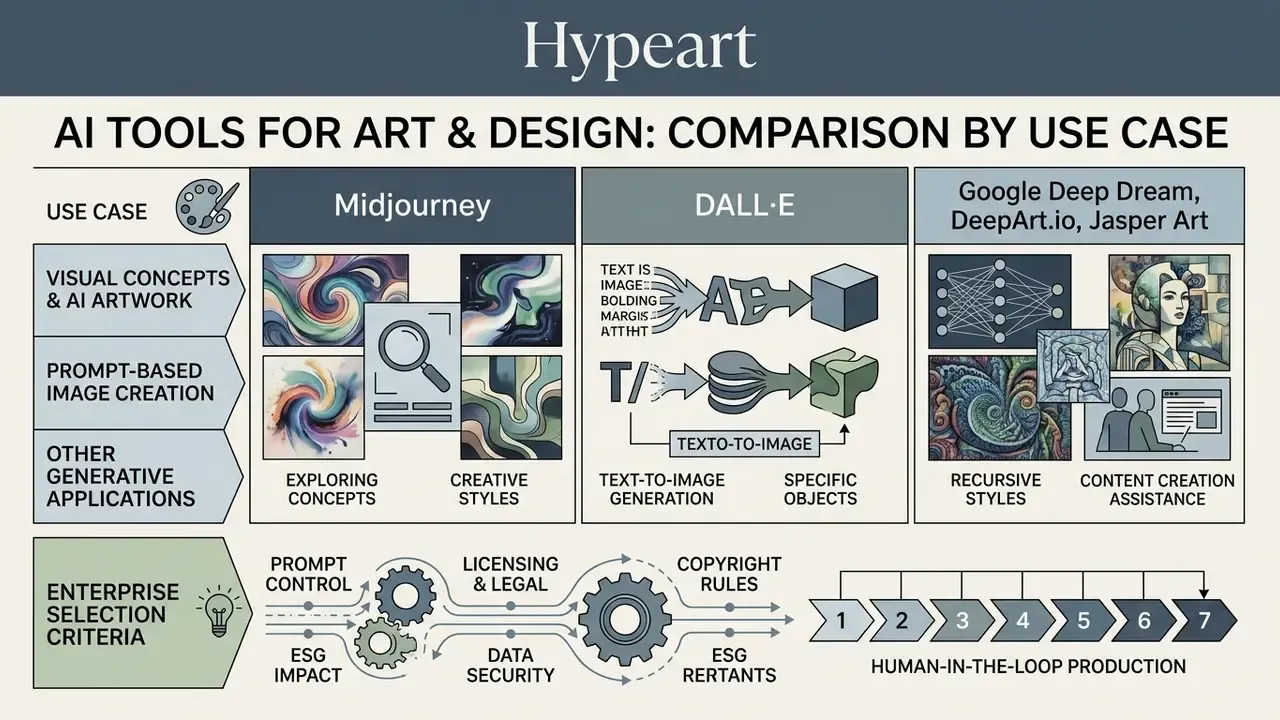
Table 2 - Legacy and archival systems (historical reference, not recommended for 2026 procurement)
| Platform | Primary Output Specialization | Control Capabilities | Ease of Use | Pricing Metric | Commercial Rights & Safety Profile |
|---|---|---|---|---|---|
| Google Deep Dream | Historical neural feature visualization, pattern amplification | Low (Layer activation parameters) | Technical | Open-source / Free research access | Public domain / Experimental research focus |
| DeepArt.io | Neural style transfer, painterly texture mapping | Low (Content + Style image input pair) | High (Image upload interface) | Pay-per-render / Service fee | User retains rights to uploaded content; legacy platform profile |
Alignment at that level means procurement teams can legitimately use published evaluation scores as pre-screening evidence, then validate finalists on internal brand-specific prompt sets. You still need the second step. Published benchmarks do not know your brand guidelines. Teams that want scored results side by side can compare options in our benchmark library, and organizations weighing platform-native suites can review Microsoft's AI image generator, Google's AI image generator, and Canva's AI generator.
Midjourney for visual concepts and AI artwork
DALL·E for prompt-based image creation
OpenAI's DALL·E 3 is engineered for natural language comprehension and close prompt adherence. Integrated into ChatGPT image generation and available through the API, it expands brief user prompts into detailed descriptive instructions so that complex multi-object scenes render accurately. The published system card confirms that ChatGPT rewrites submitted text both to improve fidelity and to enforce policy constraints, such as generic treatment of branded objects.
DALL·E 3 also supports conversational inpainting. Designers can highlight a sub-region of a generated image and request targeted changes in plain language, and edits can be requested without a selection tool simply by naming the region in the prompt. That makes it effective for non-technical users who need fast iterations and no parameter syntax. One operational note: the standalone DALL·E GPT has been retired in favour of native ChatGPT image creation and editing. Teams evaluating Microsoft-hosted access paths can review our Bing AI image overview.
Google Deep Dream, DeepArt.io and Jasper Art
Google Deep Dream and DeepArt.io are foundational milestones in the evolution of neural art generation, kept here as archival reference rather than active procurement candidates. Released by Google in 2015, Deep Dream demonstrated neural feature visualization by amplifying patterns recognized inside convolutional layers, producing hallucinatory visuals through algorithmic pareidolia. Google Arts & Culture documents its use in 2016 exhibition work. DeepArt.io systematized neural style transfer, letting users apply the painterly texture of a reference artwork onto a content image, with adjustable brightness, contrast, colour correction, and cropping. Between them they established the aesthetic vocabulary, style transfer and pattern amplification, that later diffusion platforms absorbed as features rather than products. For contemporary stylistic transfer, teams typically evaluate current options such as Ghibli-style AI image generators instead.
Jasper Art targets marketing teams by embedding text-to-image capability directly into copy workflows. It is not aimed at fine art synthesis. Template-driven controls produce ad banners, blog featured images, and social collateral aligned with marketing text generation. Its value comes from workflow proximity to copy production, not from a distinctive signature style.
How to create AI art: from idea to final design
Taking a commercial AI art project from concept to publication requires a disciplined pipeline. Random prompting produces inconsistent results. Systematic execution requires structured prompts, rigorous candidate curation, and professional post-processing.
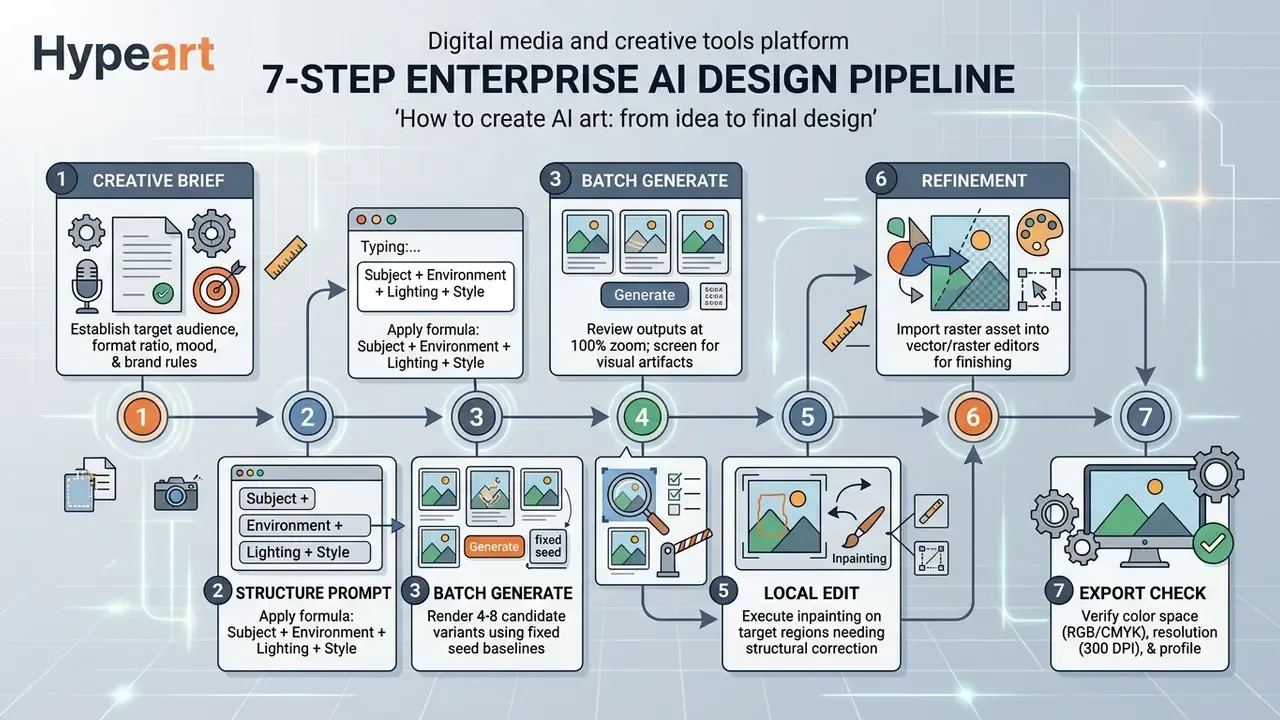
Published workflow research describes the same loop in turn-taking terms: analyze the target, write a prompt, generate, assess similarity, revise, repeat. Commonly up to ten iterations before a candidate meets the brief.
Turn a visual idea into a clear AI prompt
Translating a design concept into a working prompt is structured engineering, not vague description. Leading prompt frameworks recommend explicit visual parameters:
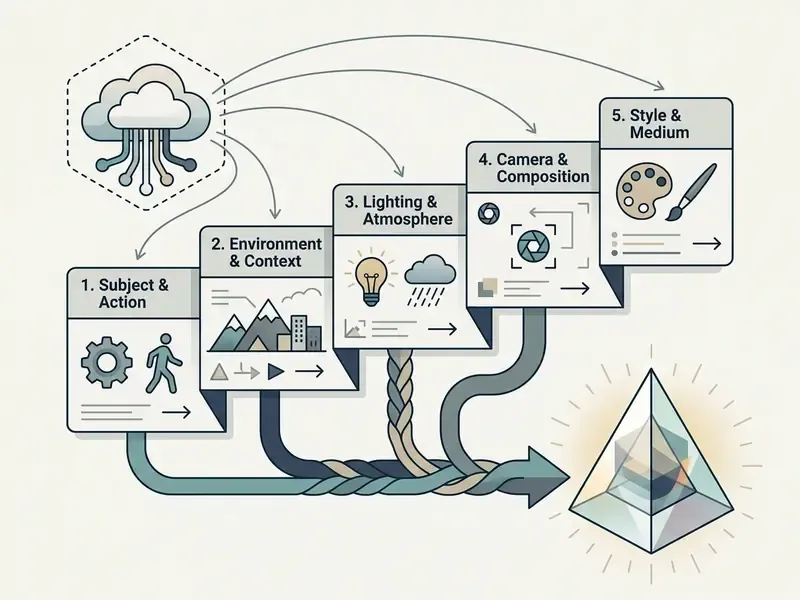
- Poor prompt "A cool modern bank building."
- Structured prompt "An architectural exterior shot of a modern sustainable bank branch, glass facade with timber accents, soft morning sunlight, 35mm lens angle, eye-level perspective, minimalist corporate aesthetic, neutral color palette."
Swap subjective words such as "cool" or "amazing" for concrete camera angles, lighting conditions, and material specifications, and you gain predictable control over latent space sampling. Vendor guidance converges on the same discipline: put instructions first, separate instruction from context with delimiters, specify output format explicitly, and prefer concrete lighting and composition detail over aesthetic adjectives.
The practical consequence is easy to miss. Prompt libraries are institutional knowledge assets. Version them, annotate them with seed values, and share them across the department instead of leaving them buried in disposable chat history.
Refine AI-generated art and prepare it for use
Raw output rarely meets final technical specifications for high-resolution print or web. Refinement requires systematic validation:
Content teams expanding static assets into motion media can explore our free AI video generators evaluation and the best free ai video generator app roundup. Developers integrating video models programmatically can review the Google Veo implementation guide. For narration and audio layers, see our AI voice generators overview and the best free ai voice generator comparison. Teams animating static generative output can consult our animation maker guide, and delivery engineers managing file weight can use the video compressor reference.
Copyright, ethics and responsible use of AI art
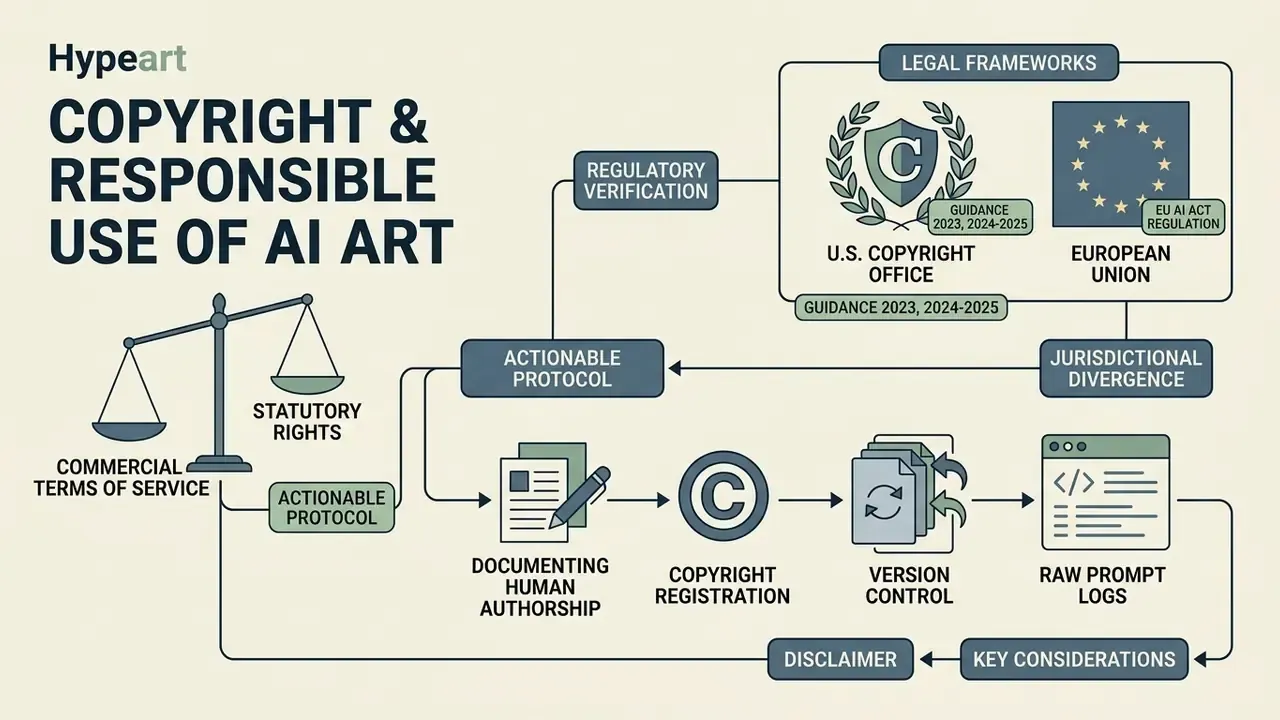
Deploying generative AI inside commercial creative operations means navigating legal, regulatory, and ethical requirements at the same time. Establish internal governance protocols for copyright ownership, training data sourcing, information security, environmental impact, and public disclosure before volume ramps up, not after.
To review commercial licensing models and compliance structures across software categories, risk officers can compare options and examine commercial licensing of AI image generators as a starting reference set.
Legal and regulatory verification: generative AI copyright frameworks
Environmental footprint and resource sustainability of generative models
High-throughput generative architectures carry measurable environmental and infrastructure costs. Training large latent diffusion models and processing multi-candidate 4K renders requires dense GPU clusters, which draw substantial energy from regional grids and demand extensive liquid cooling.
According to data center operational benchmarks, generating a single high-resolution image through complex multi-pass diffusion can consume power comparable to fully charging a mobile device, while enterprise-scale automated pipelines consume megawatt-hours daily. Independent commentary from the creative community puts it bluntly:
"These models rely on powerful data centers that use vast amounts of electricity and water (to cool off the servers), often sourced from non-renewable energy."
Corporate governance frameworks should include environmental impact assessment when selecting model providers, favouring vendors that run carbon-neutral data centers and optimized architectures such as quantized inference backbones. Practical mitigations sit within a design team's own control: cap batch sizes during exploration, draft at low resolution before committing to high-resolution renders, cache and reuse approved seeds instead of regenerating from scratch, choose speed-optimized distilled models for volume social assets, and report generative compute inside existing ESG disclosure processes.
Training data, existing images, and artist concerns
Scraping public web images to train multi-billion parameter networks has created significant ethical and legal friction across the creative industries. Artistic communities and professional design organizations argue that non-consensual scraping harms livelihoods and enables unauthorized style imitation. A 2024 University of Nottingham report found that 95% of surveyed artists believed they should be asked before their works are used for training, while industry practice largely defaults to opt-out. The U.S. Copyright Office's 2025 training report, by contrast, still treats opt-out as a workable governance mechanism. Opt-in versus opt-out remains the central unresolved policy dispute, and it is unlikely to settle quietly.
Vendors have responded with ethically sourced model architectures. Adobe Firefly, for instance, was trained exclusively on licensed Adobe Stock images and public domain content, and offers corporate customers indemnification against infringement claims.
In parallel, open technical standards such as the Coalition for Content Provenance and Authenticity (C2PA) let creators attach tamper-evident metadata to files, marking an asset as human-authored, AI-assisted, or fully synthesized. ITU reporting from 2024 confirms that provenance for digital assets can be recorded through Content Credentials built on the C2PA open standard. Verification teams can also deploy AI image detectors and AI reverse-image-search tools to screen inbound assets and monitor unauthorized reuse of their own artwork.
That inversion has a direct operational consequence. If value migrates toward prompt formulation while protection still attaches to human expressive choice, organizations must do two things at once: treat prompt libraries as confidential business assets under trade-secret-style controls, and keep investing in demonstrable human transformation so finished deliverables remain defensible property. Artists will keep debating whether that trade is fair. The governance requirement stands either way.
FAQ about AI art and design
Can AI make art on its own?
No. Current systems lack autonomous creative intent, contextual awareness, and physical agency. A generative image system is a mathematical prediction engine that synthesizes latent representations strictly in response to human prompts, parameters, seed configurations, and curated training data. Empirical creativity research confirms that unguided output scores lowest on divergent creativity measures, below both non-artists and human-guided conditions.
What AI makes art?
Visual art and design assets are produced mainly by latent diffusion models such as Midjourney, DALL·E 3, Stable Diffusion, and Adobe Firefly, plus the foundational generative adversarial network family. These platforms combine natural language processing encoders with vision backbones to translate text into high-resolution raster or vector images. Variational autoencoders handle latent compression inside diffusion pipelines.
Can artists use AI without losing their unique style?
Yes. Professional artists preserve a distinct visual identity by treating generative AI as an auxiliary tool inside a hybrid pipeline. Controlling composition, training custom LoRA styles on their own catalog, retouching manually, and combining algorithmic drafts with hand-crafted vector or raster elements keeps authorial control where it belongs. Publishing sketches, iterations, and process timelapses further evidences that the style originates with the human author.
How can AI artwork be legally used in commercial design?
AI-generated assets can be deployed commercially provided the Terms of Service grant commercial rights, the underlying model respects training data copyright standards, and deployers comply with disclosure rules such as EU AI Act Article 50. To secure copyright in the final design, the human author must contribute substantial creative input through selection, arrangement, or material manual post-processing, and must disclaim more-than-de-minimis AI-generated content in registration filings. For open-weight models, note that commercial use of the output and commercial deployment of the model weights are separate licence questions.
Is AI-generated art bad for the environment?
Training and inference both carry real resource costs. Large-scale training and high-resolution multi-candidate rendering need dense GPU clusters that consume grid electricity and cooling water, frequently from non-renewable sources. Organizations can reduce impact by drafting at low resolution, capping exploratory batch sizes, reusing approved seeds, selecting distilled or quantized inference models for high-volume social assets, choosing providers running carbon-neutral data centres, and including generative compute in ESG reporting.
How long has AI art existed?
More than fifty years. Harold Cohen's AARON produced autonomous rule-based drawings from 1973. GANs arrived in 2014. Google released DeepDream in 2015. The GAN-generated portrait Edmond de Belamy sold at Christie's for $432,500 in 2018. Contemporary autonomous practice includes the humanoid robot artist Ai-Da and the decentralized generative agent Botto, which auctions one community-selected work each week.
How do we prevent confidential design assets leaking into public AI tools?
Publish an approved-tool allowlist and block unsanctioned endpoints. Procure enterprise or API tiers with Zero Data Retention and no-training-by-default terms. Require SOC 2 Type II or ISO 27001 evidence. Deploy self-hosted or VPC-isolated open-weight models for high-sensitivity assets. Prohibit uploads of personal or pre-announcement material into consumer tiers. Route all generation through identity-linked workspaces so activity stays auditable.
Can generative AI be used for 3D, game and VFX production?
Yes, mainly at the reference and texturing layers. Diffusion engines generate seamless PBR texture maps (albedo, normal, roughness) and multi-angle orthographic concept sheets that speed up blocking and digital sculpting in ZBrush or Blender. Documented research pipelines also combine LLMs, image generators, photogrammetry, NeRFs, and image-to-3D conversion. Production-critical stages, including retopology, UV unwrapping, rigging, shader authoring, and technical validation, remain human-executed.
Summary and next steps in AI design implementation
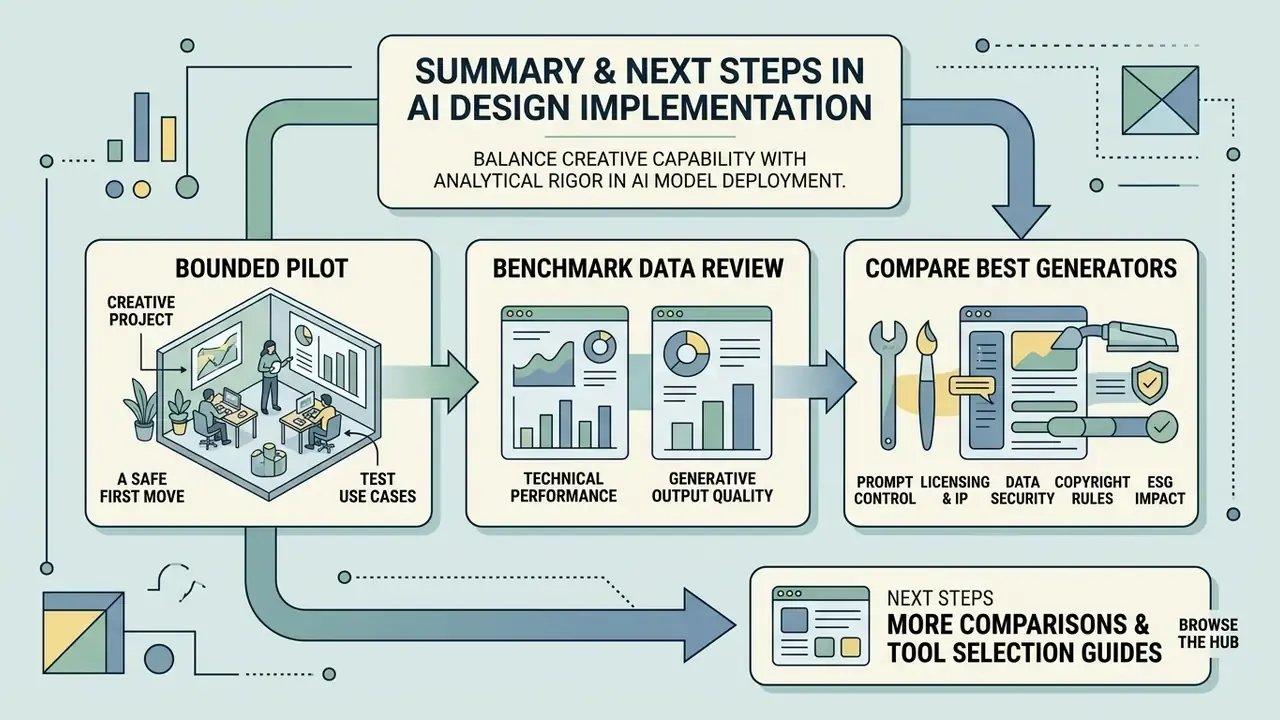
Working through the landscape of AI art and design calls for the same analytical posture you would bring to any other model deployment: balance creative capability against governance, information security, and legal exposure. Generative tools deliver real efficiency in concept development, mood board assembly, texture synthesis, and asset drafting. They deliver maximum value only inside disciplined, human-led workflows.
So the practical agenda for design leaders, creative directors, and governance officers is short. Standardize prompt engineering frameworks. Install strict curation quality gates. Maintain authorship documentation trails. Enforce data-retention and deployment controls for confidential assets. Select platforms with transparent commercial licensing and genuine editing control. Human strategic direction stays at the centre; the art of AI, in an enterprise context, is mostly the art of constrained delegation.
A safe first move is a bounded pilot. Pick one asset class, one approved tool, one named owner, and one review gate. Measure cycle time, refinement hours, and rework rate against your current baseline for a single quarter, then decide whether to widen scope.
To review benchmark data across technical performance metrics, compare the best AI art generators across evaluated categories. Enterprise developers building custom asset generation pipelines can review leading AI image generators and their integration protocols. For definitions, capabilities, and pricing structures across the wider category, consult our AI art generator guide, or start low-risk testing with free AI art generators before committing procurement budget.
More comparisons and tool selection guides: browse the hub.