Executive summary for risk, data, and compliance leaders
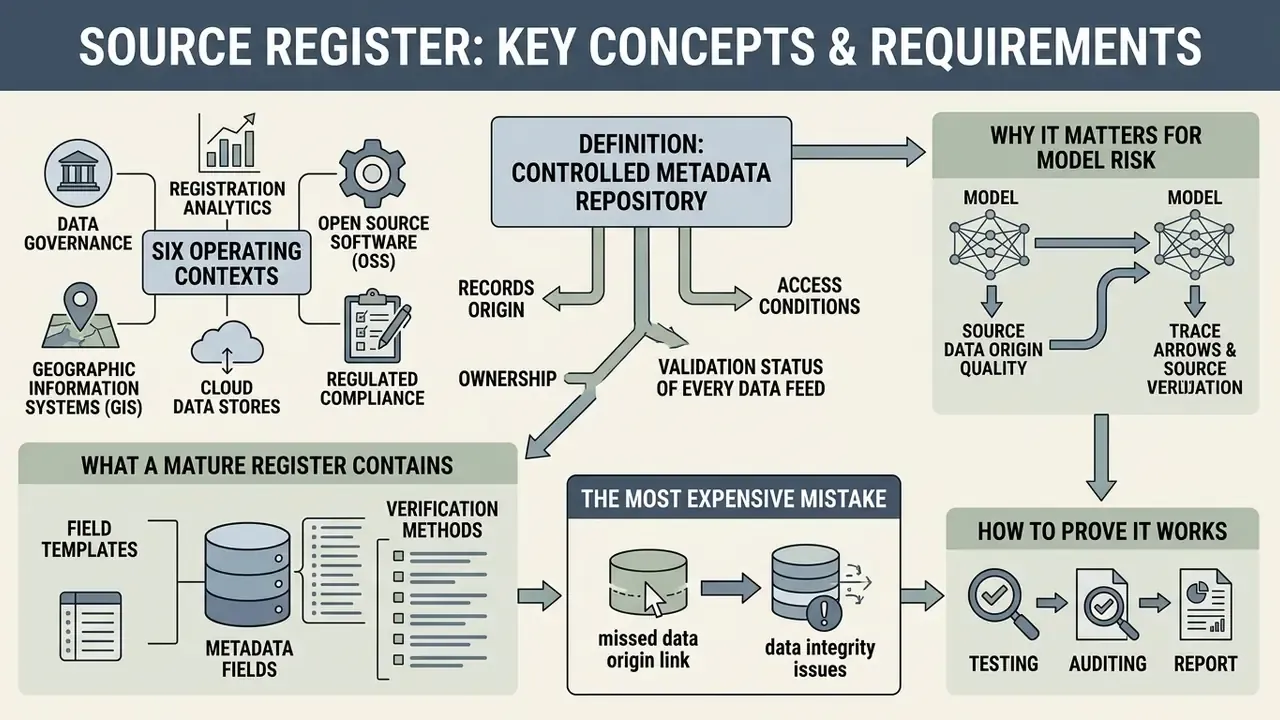
Terms used in this guide, and who should read it
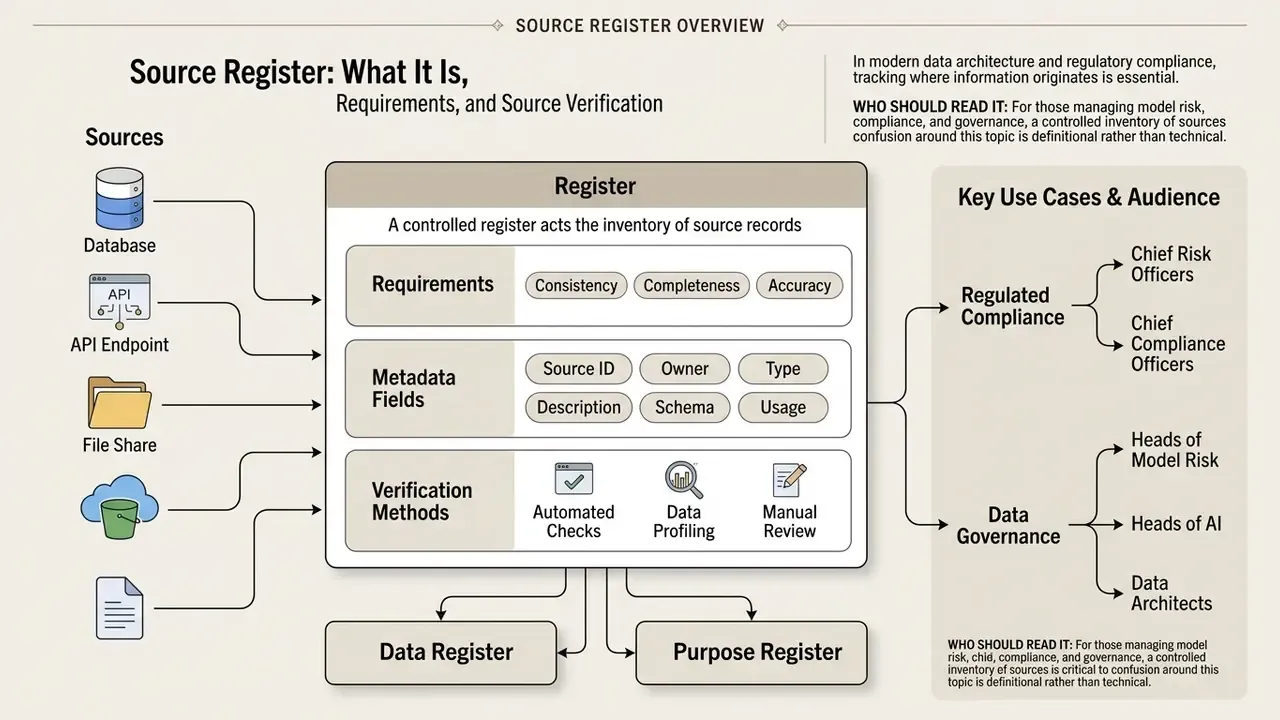
What is a source register and in what contexts is the term used
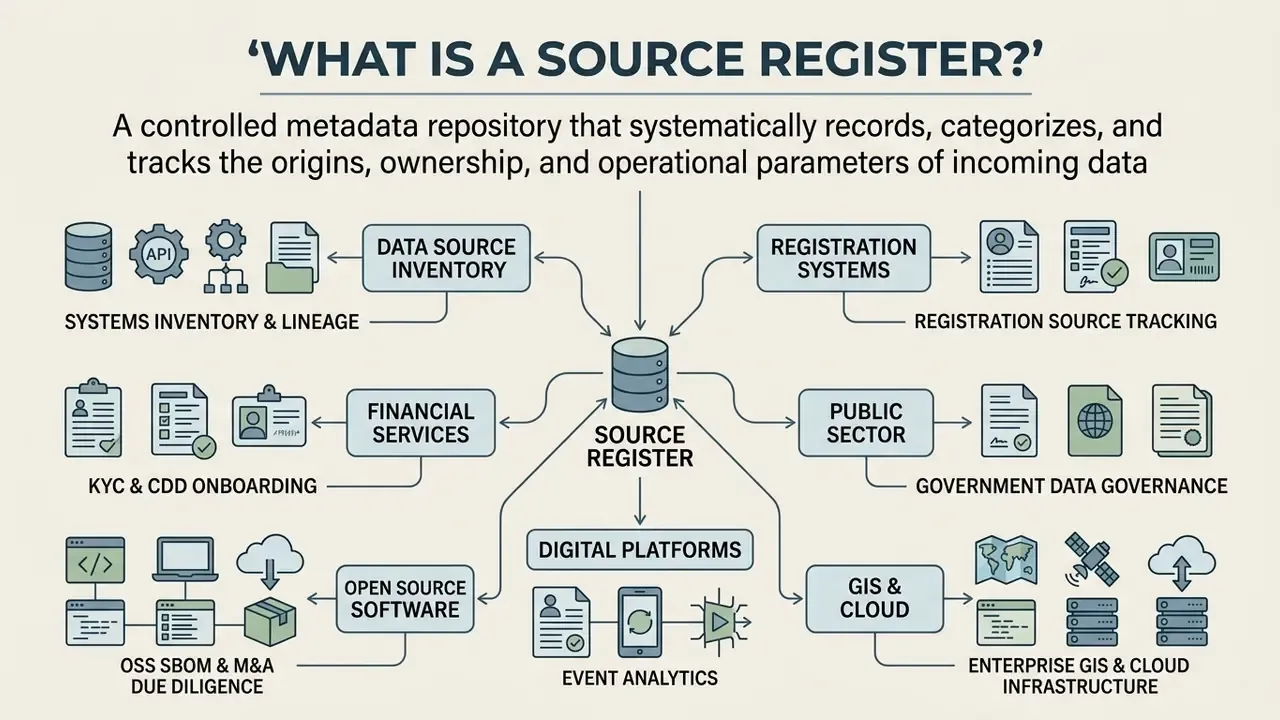
Source register as a data source inventory
In data governance, a source register functions as an authoritative metadata catalog that records every external and internal system feeding an enterprise data architecture. Standardized under frameworks such as ISO/IEC 11179, the metadata registry records dataset identifiers, system-of-record status, semantic definitions, and refresh cadences. Rather than storing raw operational data, the data register stores structured information about the data source, enabling data stewards to verify lineage and track system dependencies across complex analytical pipelines.
«Statistical business registers are the main source for business demography statistics and the authoritative backbone for coherent European business statistics.»
When a register contains validated details regarding primary feeds, downstream analytics engines can automatically confirm whether a specific data source meets organizational quality thresholds. For instance, the U.S. Department of the Interior requires datasets to be registered in a metadata catalog to confirm provenance and public access permissions before deployment in public models (U.S. DOI Metadata Implementation Guide, 2025. https://pubs.usgs.gov/tm/16/a1/tm16a1.pdf). Maintaining a clear data register ensures that every ingested pipeline input remains traceable to its primary origin.
Source register in registration systems and registration source tracking
In customer onboarding, user management, and election administration, a source register tracks the origin channel through which individual records or signups enter a database.
Financial services example (KYC and CDD onboarding). In a US bank or fintech, the registration source field classifies whether a customer record originated from a mobile application, a branch-assisted flow, an aggregator API, a referral partner, or a bulk migration from an acquired portfolio. Because Customer Due Diligence (CDD) escalation rules and fraud models weight channels differently, the register must retain the channel code, the onboarding timestamp, the verification vendor used, and the identity-proofing tier applied. When a synthetic-identity ring is detected, analysts pivot on the registration source code to isolate the affected cohort within minutes instead of reconstructing lineage from application logs. Minutes versus days. That gap is the whole business case in miniature.
Public sector example. In election governance, state frameworks mandate pre-populated source codes to track whether a voter registration originated from public assistance agencies, military recruitment offices, or online portals. The Arizona Elections Procedures Manual requires that registration source codes remain confidential and be used solely by election officials to monitor compliance with federal and state law (Arizona Elections Procedures Manual, January 2024. https://azsos.gov/sites/default/files/2024-01/2024_EPM_FINAL.pdf). These confidential source codes are stored directly within the registrant's record to audit statutory compliance while protecting voter privacy.
Digital platforms and event analytics. In SaaS products, webinar platforms, and marketing operations, a registration source (often captured via a registration_source parameter or UTM tags) identifies the specific path or campaign that generated a new user account. Tracking registration pathways allows organizations to attribute conversions accurately and detect suspicious signup patterns. In practice, a mature platform registry classifies incoming payloads into a discrete taxonomy rather than a free-text string:
Table 1. Registration source values and their operational meaning.
| Registration source value | What it means operationally |
|---|---|
registration_modal | The user completed the form directly on the landing page after arrival. |
added_by_presenter / added_by_admin | An administrator or host created the record manually inside the management console. |
series_registration | Registration cascaded from a parent series or program to a child session. |
platform_domain / custom whitelabel domain | The visitor navigated across internal pages or a branded domain before converting. |
registration_widget | The form was embedded on an external page or partner site. |
External domain (for example, google.com) | The referrer indicates the registrant arrived from a search engine or third-party website. |
match_registration_field | A cross-session match rule enrolled an existing contact into an additional session. |
public_api | The record was created programmatically through an authenticated API call. |
auto_enter | The user was registered automatically upon entering a room or environment. |
invitation_email | The registrant clicked a tracked link inside an invitation email. |
one_click | One-click registration was enabled and the user converted without a form. |
utm_bmcr_source / campaign parameter | A campaign-specific URL parameter was captured and persisted to the record. |
| Integration name (CRM or MAP) | The registrant was imported through a connected marketing or CRM integration. |
BLANK_PRIVACY_RESTRICTED | Browser, network, or device privacy settings blocked referrer transmission. |
The last state deserves particular attention. When ad-blockers, zero-cookie policies, or tracking-prevention features strip referrer data, the register must explicitly record a BLANK_PRIVACY_RESTRICTED status rather than silently dropping the payload. Preserving the record with an explicit "untraceable" flag keeps total volume metrics accurate, isolates unattributable traffic for fraud analysis, and prevents analysts from mistaking privacy loss for a channel collapse. Vendor documentation is blunt about the consequence: when the field is blank because the browser, network, or device blocked the information, that data cannot be recovered retroactively, which is precisely why the register must capture the state at ingestion time.
While web analytics documentation often refers to "registration source" rather than a formal "source register," the operational goal remains identical: maintaining a structured audit trail of entry channels.
Source register for open source software
In software engineering and DevSecOps, a source register acts as a Software Bill of Materials (SBOM) or code inventory that documents open-source software (OSS) components, dependencies, and licensing terms. Governance frameworks, such as the OSPO Alliance Good Governance Handbook, emphasize that organizations must inventory third-party libraries to maintain supply chain security and fulfill legal licensing requirements (OSPO Alliance, 2024). Government directives, including U.S. Executive Order 14028 and CISA guidance, require formal SBOMs to track component vulnerabilities across federal software acquisitions.
«The Chief Information Officer shall maintain a continuous inventory of all custom-developed source code, re-evaluated at intervals not exceeding 12 months.»
An OSS source register catalogues repository URLs, software versions, maintainer credentials, export control classifications (such as encryption attributes under ECCN 5D002), and license obligations. By maintaining a comprehensive inventory of third-party software assets, engineering teams ensure compliance with open-source licenses and quickly identify systems exposed to newly disclosed vulnerabilities. The White House Open-Source Software Security Initiative (OS3I) highlighted the propagation of known-vulnerability information across the global software supply chain as a core recommendation, reinforcing why component inventories must be machine-readable rather than spreadsheet-based (OS3I briefing and RFI summary, 2023 to 2024. https://www.whitehouse.gov/oncd/briefing-room/2024/08/09/open-source-software-security-initiative-os3i/).
SBOM formats and M&A due diligence. Beyond runtime security, an OSS source register is decisive during corporate mergers and acquisitions (M&A) and intellectual-property risk assessment. Automated export of the register into machine-readable SBOM standards, either SPDX (Software Package Data Exchange) or OWASP CycloneDX, allows legal teams to audit copyleft obligations (GPL, LGPL, AGPL), confirm attribution and notice files, and verify that third-party code does not jeopardize proprietary intellectual property or violate export controls. Acquirers routinely treat the absence of a maintained OSS register as a valuation discount, because it converts a bounded technical review into an open-ended legal liability. A clear register of open-source assets makes it materially easier for counterparties to assess compliance posture, security exposure, and overall software value, which shortens negotiation and integration cycles. It also enables reuse: teams that can see which components already exist internally avoid duplicating effort and standardize on vetted versions.
Beyond organizational benefits, a published or partially disclosed OSS register contributes to the wider open-source ecosystem. It provides visibility into how components are used in real-world production systems and lets organizations share improvements, upgrade experiences, and cautionary findings about specific packages back to maintainers.
Source register in enterprise GIS and cloud infrastructure
In geospatial architecture and cloud engineering, a source register functions as a data store catalog that maps spatial layers, relational databases, and object storage buckets to active web services. Registering infrastructure endpoints allows application servers to resolve and adjust data paths dynamically, across publisher machines and server machines, without hardcoding credentials. That in turn guarantees that raster analytics and enterprise feature layers read from validated storage environments.
Typical registrable data store types include:
- Folders and file shares containing shapefiles, file and mobile geodatabases, locator files, and imagery. Registering a parent folder normally registers its subfolders; registering an entire drive is discouraged for security reasons.
- Databases and database services referenced through a connection file (for example, a
.sdeconnection). If the connection uses database authentication, the stored account must hold the privileges required by the published service, including create and update privileges for editable feature services. If operating-system authentication is used, the server account itself must be granted access. - Cloud data warehouses, accessed through a database connection but with different publishing and capability constraints than an operational database.
- Cloud object stores, such as Amazon S3 buckets, Azure Blob Storage containers, Google Cloud buckets, or Alibaba Cloud Object Storage Service (OSS), registered for tile and image caches and raster stores. Cache directories in cloud storage should generally be used only when the server site runs on the same cloud platform.
- Raster stores, an output-oriented store type (file share or cloud store) that holds imagery layers produced by raster analysis tools.
A critical governance nuance: registering a location does not grant permissions to it. For folder stores and certain database connection types, the server service account must be separately granted filesystem or database permissions. For cloud stores and credential-based connections, the credentials stored with the entry must themselves carry the necessary rights. The register records the intent and the path; the platform still enforces the access. It is a small distinction that produces a surprising number of production incidents.
Legal source notes and industrial source registers
In statutory compliance and environmental engineering, "source register," "source registration," and "source note" carry strict legal meanings that differ from enterprise metadata usage.
1. Regulatory source notes (legal lineage of a rule). In U.S. legal research, a source note traces a regulation from the Code of Federal Regulations (CFR) back to its publication in the Federal Register. The note usually appears at the head of a Part or Subpart, and sometimes in brackets after an individual provision, and supplies one or more citations. A citation such as "77 FR 58945, Sept. 25, 2012" encodes the volume (77), the page (58945), and the issue date, establishing the statutory lineage of the rule. Occasionally the note points not to the final rule but to a relocation or re-codification notice, in which case the researcher must look up the provision in its former CFR position to reach the original final-rule publication. Conceptually, this is the same control a data register performs: an immutable pointer from a current record to its authoritative origin.
2. Environmental and industrial emission source registers. Under environmental protection frameworks, facility operators must formally register physical pollution sources. For example, U.S. EPA rules for minor sources in Indian country required owners or operators of an existing true minor source (as defined in 40 CFR 49.152(d)) to register the source with the reviewing authority within 18 months of the program's effective date, by March 1, 2013. Non-oil-and-gas sources commencing construction in a defined window had to register within 90 days after beginning operation, while later sources satisfied registration through permit application data under 40 CFR 49.160(c)(2). The registration is a one-time filing of estimated actual and allowable emissions, not an annual return, and data already collected under 40 CFR 49.138 could be reused to satisfy it. Related rulemaking illustrates how definitional changes ripple through registers: EPA's final rule at 66 FR 59161 (effective November 27, 2001) changed which categories must count fugitive emissions when determining "major source" status under 40 CFR Part 70.
The lesson for enterprise architects is that "registration" in regulated contexts is a legally operative act with deadlines, defined authorities, and prescribed content. That makes it a useful model for internal registers, which should likewise define who approves an entry, by when, and with what mandatory fields.
Table 2. Comparison of source register applications across technical and regulatory domains.
| Context domain | Primary governance objective | Core information contained | Primary stakeholders |
|---|---|---|---|
| Data governance and analytics | Establish authoritative system-of-record status, enable data lineage tracking, and enforce factual accuracy across pipelines. | System IDs, schema definitions, data owners, update frequencies, cryptographic hashes, and primary origin URIs. | Chief data officers, data stewards, model risk managers, analytics engineers. |
| Registration systems and analytics | Track entry channels for signups, KYC and CDD onboarding, or legal registrations to monitor statutory compliance and conversion attribution. | Registrant ID, channel source codes (API, modal, widget, invitation, integration, NVRA agency), method, timestamp, privacy-blocked flag, status. | Compliance officers, fraud analysts, election recorders, growth analytics leads, product managers. |
| Open source software (OSS) governance | Manage software supply chain risk, verify license compliance, and support M&A and IP due diligence. | Repository URLs, SBOM component IDs (SPDX, CycloneDX), OSI license terms, version history, export control tags, maintainer details. | DevSecOps teams, open source program offices (OSPOs), legal counsel, CISOs, M&A diligence teams. |
| Enterprise GIS and cloud infrastructure | Map validated storage endpoints to live web services and allow dynamic path resolution across machines. | Registered folders, database connection files (.sde), cloud object stores (S3, Azure Blob, Google Cloud, Alibaba OSS), raster and cache directories, credential scope. | GIS administrators, platform publishers, cloud infrastructure engineers, SREs. |
| Environmental and industrial compliance | Register stationary emission sources and report allowable versus actual emissions to the reviewing authority. | Facility identity, source classification, allowable and actual emissions estimates, construction and operation dates, permit references. | Environmental compliance managers, permit engineers, regulators. |
| Legal and regulatory tracing | Trace a codified rule back to its authoritative publication and reconstruct regulatory history. | CFR part and subpart, Federal Register volume, page, and date citations, re-codification notices. | Regulatory counsel, policy analysts, law librarians, compliance researchers. |
Why a source register is needed
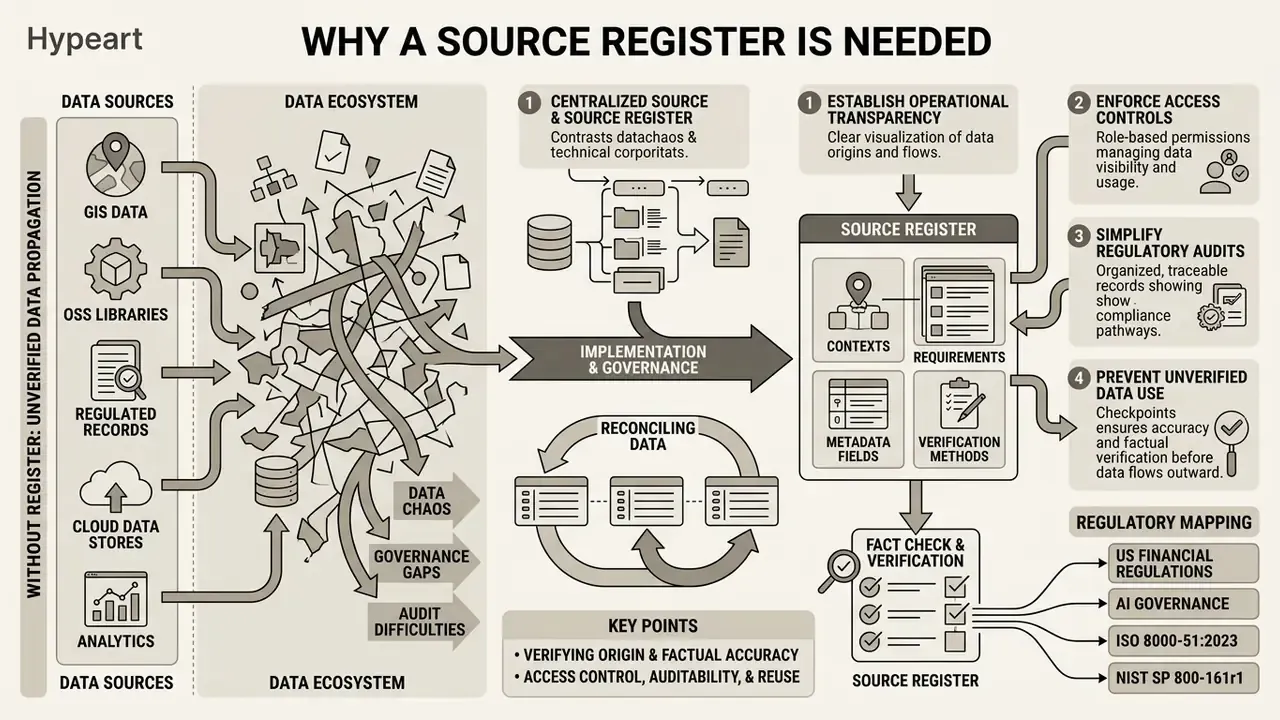
Organizations implement a source register to establish operational transparency, enforce access controls, simplify regulatory audits, and prevent the propagation of unverified data across enterprise systems. In risk-sensitive industries such as US financial services, an unmanaged data feed, an unregistered vector index, or a shadow software dependency presents severe operational, legal, and regulatory risks. Maintaining an authoritative inventory provides the structural control necessary to validate inputs before they reach production applications.
Verifying origin and factual accuracy of data
A primary function of a source register is enabling rigorous factual verification by establishing verifiable data lineage from ingestion to model output. When downstream applications or AI models process information, verifying that the data is sourced from an approved primary record prevents model drift and algorithmic hallucination.
«A substantial share of widely used fine-tuning datasets carries incomplete provenance and licensing documentation, creating legal exposure for enterprise deployment.»
One clarification on that finding, since it is often over-read: it comes from an observational audit of widely used open-source fine-tuning collections, tracing licensing and origin documentation across thousands of dataset entries. Treat it as evidence of systemic documentation gaps rather than a single vendor's failure rate.
A structured register links each record to its origin URL, collection date, quality rating, and cryptographic hash (such as SHA-256). This metadata enables automated lineage checks across data pipelines. If an input feed is altered or corrupted at the source, automated control scripts flag the anomaly against the register before bad data propagates into core analytics.
Illustrative scenario (composite, not a named client). During an internal risk review at a mid-sized fintech, unverified external market data feeds introduced baseline drift into an automated credit scoring model. To fix this, the risk team cataloged all input feeds into a centralized source register with daily cryptographic validation checks. This established traceable lineage, eliminating feed-related validation errors within ninety days. The scenario is presented as a representative pattern rather than an audited case study; organizations should validate comparable metrics in their own environment.
Access control, auditability, and information reuse
Maintaining a validated register simplifies enterprise access governance and audit preparation by providing a single point of control for permission management. NIST SP 800-53 Rev. 5 mandates strict access control and auditing mechanisms to restrict who can view, modify, or publish sensitive information assets (NIST SP 800-53 Rev. 5, 2020. https://csrc.nist.gov/publications/detail/sp/800-53/rev-5/final). By linking access management policies directly to the source register, organizations implement Role-Based Access Control (RBAC) at the dataset level, protecting confidential records during external reviews or internal due diligence.
Furthermore, centralized purpose registers, the inventories that record not only what a source is but for which approved business purposes it may be used, promote efficient information reuse across organizational business units. Under the U.S. Foundations for Evidence-Based Policymaking Act (the Evidence Act), federal agencies must maintain comprehensive data inventories to prevent duplicate data collection and streamline cross-agency data sharing. When registers can be used as shared catalogs, enterprise teams avoid building redundant data pipelines, reducing infrastructure overhead while maintaining consistent compliance standards.
«SBOMs capture software supply-chain component details and relationships, enabling agencies to track dependencies and confirm license compliance.»
Reconciling data across different registers versus a single register
Because register architecture is an early design decision, not an afterthought, the trade-off between federated and consolidated registers belongs at the start of any program.
When enterprise workflows combine information across different registers, data reconciliation complexity increases significantly.
«Combining several administrative registers requires reconciling differences in conceptual definitions, reference dates, population coverage, and data quality standards.»
When datasets originate from separate inventories, match failures, uncertain matches, and duplicate records frequently occur, and each linkage step must be classified as match, unmatch, or uncertain before use. Retrospective harmonization then has to resolve syntax, structure, and semantics before records can be merged or mapped.
Conversely, utilizing a consolidated same register architecture minimizes cross-source reconciliation errors by enforcing unified metadata schemas and shared entity identifiers. While a single register shifts governance effort toward internal consistency management, it eliminates the complex semantic transformations required when linking disparate systems. Organizations should establish standardized mapping tables when cross-register linking is unavoidable, and should document, for each link, the identifier used, the match rule, and the residual uncertainty accepted. Is one central register always the right answer? Not in a bank that has absorbed three platforms in five years. But federation should be a documented decision, never a default.
Regulatory mapping for US financial institutions and AI governance
For banks, credit unions, and regulated fintechs, a source register is not a documentation nicety. It is the artifact examiners request first. The mapping below shows how register fields translate into supervisory expectations.
Table 3. Regulatory expectations mapped to source register fields.
| Framework or expectation | What supervisors look for | Source register field that supplies the evidence |
|---|---|---|
| Federal Reserve SR 11-7 and OCC Bulletin 2011-12 (Model Risk Management) | A complete model inventory with documented inputs, data quality assessment, and independent validation of data suitability | source_identifier, validation_status, model_risk_tier, last_verification_date, linkage from model ID to every input feed |
| NIST AI Risk Management Framework 1.0 (Map, Measure, Govern functions) | Documented context, provenance, and known limitations of training, tuning, and retrieval data | provenance_origin_uri, data_collection_date, known_limitations, pii_masked_status |
| U.S. Evidence Act and OMB inventory expectations | A comprehensive, maintained inventory of data assets with owner, location, update date, and access restrictions | asset_owner_curator, access_classification, update_frequency |
| Executive Order 14028 and CISA SBOM guidance | Machine-readable component inventory with dependency relationships and license terms | SPDX or CycloneDX export, license_terms, component_version |
| NIST SP 800-53 Rev. 5 (AC and AU control families) | Restriction of who can view, modify, or publish assets, with immutable audit logging | access_classification, RBAC binding, change log entries |
| NIST SP 800-161r1 (Cyber Supply Chain Risk Management) | Supplier identification and automated supply-chain recordkeeping | Supplier and source profile fields, endpoint health checks |
| EBA access control expectations (EU-regulated entities) | A register of all users requesting or holding access, with decisions, changes, and withdrawals justified | Registration metadata, approving authority, permission change log |
Fact check and verification
- ISO 8000-51:2023 requires formal data governance registers to state issuing legal entities and record provenance metadata explicitly (ISO, 2023. https://www.iso.org/standard/81745.html).
- NIST SP 800-161r1 links automated supply chain recordkeeping with enterprise risk reduction (NIST, 2024).
- DAMA-DMBOK2 defines data governance as formal control over data assets, designating enterprise inventories as mandatory operational controls (DAMA International, 2024).
- DHS Policy Directive 142-04, rev. 02 establishes a Source Code Inventory Process (SCIP) with re-evaluation at least every 12 months (DHS, 2023. https://www.dhs.gov/sites/default/files/2023-11/23_1102_ocio_directive-142-04-open-source-software.pdf).
Every claim about the purpose of a register above traces to a primary instrument: platform documentation, registration rules, or a published data policy. Where a source is silent, the text says so.
- iso.org
- - ISO 8000-51:2023 requires formal data governance registers to state issuing legal entities and record provenance metadata explicitly (ISO, 2023.
- evaluation at least every 12 months (DHS, 2023.
- - DHS Policy Directive 142-04, rev. 02 establishes a Source Code Inventory Process (SCIP) with re-evaluation at least every 12 months (DHS, 2023.
What information a source register must contain
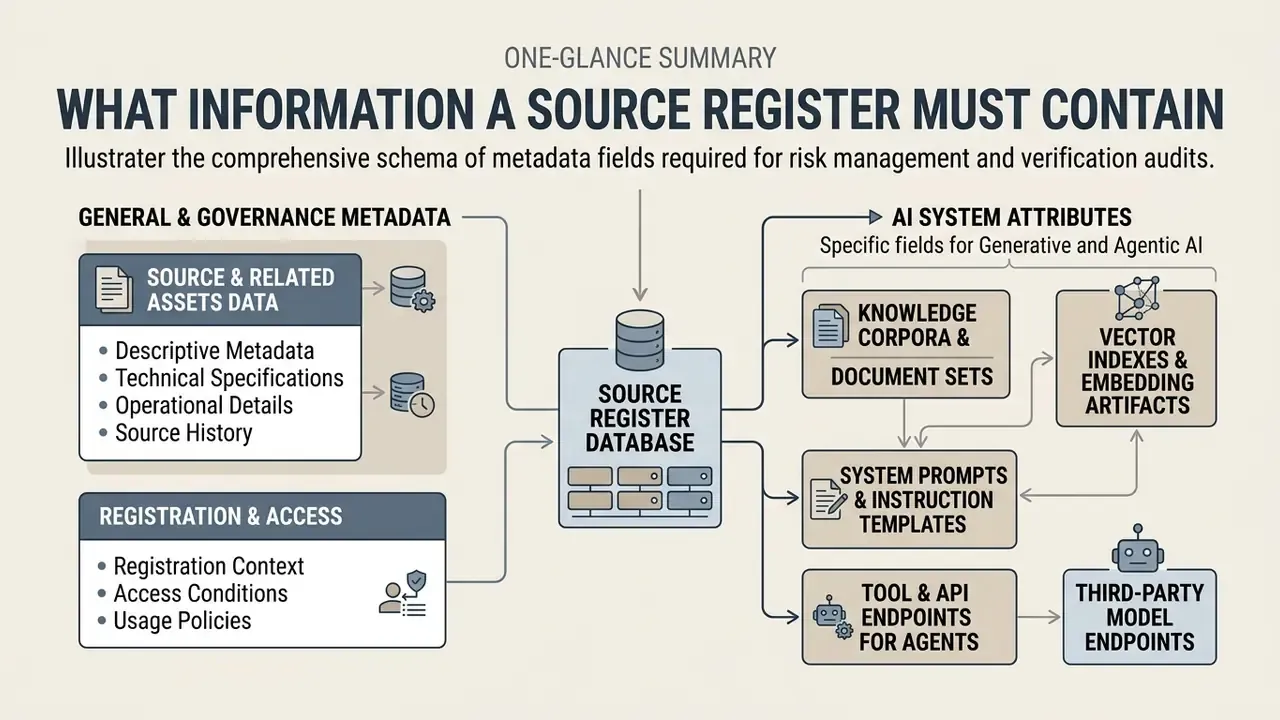
To effectively support risk management and verification audits, a source register must maintain a comprehensive schema of descriptive, technical, and operational metadata fields. Incomplete records limit an organization's ability to verify data provenance or enforce appropriate access boundaries. Standardizing core attributes ensures that every entry provides actionable information for both human auditors and automated governance scripts.
Registration metadata and access conditions
Every entry within a source register must record operational onboarding details and clear access rules. The European Banking Authority (EBA) standard on access control and authentication requires a formal user registration and de-registration procedure plus a maintained register of all users requesting or holding access, evidencing each request, decision, implementation, modification, and withdrawal with documented reasons (EBA Standard on Access Control and Authentication, 2024). Registration records must log the onboarding timestamp, approving authority, and system environment, whether development, staging, or production.
In addition, the register must distinguish between new and existing sources while recording explicit access rights such as public, internal, restricted, or confidential. Defining clear access parameters ensures that sensitive datasets, including Customer Due Diligence (CDD) records or voter source codes, remain protected behind appropriate authorization layers. Some register entries will hold little more than a pointer and a permission scope, and that is fine, provided the pointer is authoritative.
Source register attributes for generative and agentic AI systems
Generative and agentic systems widen the definition of a "source." A retrieval-augmented generation (RAG) pipeline consumes unstructured corpora, embedding indexes, system instructions, and tool endpoints, each of which is a source with its own provenance and risk profile. A register that stops at relational tables leaves the highest-risk inputs uninventoried, which is exactly how Shadow AI accumulates.
Register the following as first-class entries:
- Knowledge corpora and document sets used for retrieval, with copyright and licensing status, collection date, and redaction rules applied.
- Vector indexes and embedding artifacts, recording the embedding model and version, chunking strategy, refresh cadence, and the upstream corpus identifier they were derived from. When the embedding model changes, the index is a new source version, not an update.
- System prompts and instruction templates, versioned and hashed, because a prompt change alters model behavior as materially as a data change.
- Tool and API endpoints available to agents, including authentication scope, rate limits, data egress classification, and whether the endpoint can perform write actions.
- Third-party model endpoints, recording provider, model version, region of processing, retention policy, and whether inputs may be used for provider-side training.
- Human feedback and evaluation datasets, since reinforcement and eval data influence outputs and carry their own PII exposure.
Each of these entries should carry pii_masked_status, model_risk_tier, and compliance_review_date so that validators can answer, in one query, which production agents depend on unreviewed or high-tier sources. No evidence, no autonomy. An agent without a registered source list is not a digital worker; it is an unowned process.
Table 4. Standard metadata field template for source registers.
| Metadata field name | Data type or schema format | Operational purpose | Verification and audit requirement |
|---|---|---|---|
source_identifier | UUIDv4 or persistent URI | Provides a persistent, globally unique key for the source asset. | Verify uniqueness across the enterprise catalog; ensure key persistence across system migrations. |
source_name_title | String (UTF-8) | Records the formal human-readable name of the dataset, channel, or software component. | Cross-check title against official vendor documentation, repository READMEs, or system manifests. |
asset_owner_curator | String plus directory ID reference | Identifies the designated internal team, business unit, or individual responsible for asset maintenance. | Confirm active employee status in directory services; review ownership assignments annually. |
distribution_format | Enum or IANA media type | Specifies the technical data format or interface (JSON, Parquet, REST API, SPDX, CycloneDX). | Automate schema syntax checks; confirm compatibility with pipeline ingestion specs. |
update_frequency | Enum or ISO 8601 duration | Defines the expected refresh schedule using controlled code lists (daily, monthly, asNeeded). | Monitor actual feed arrival times against defined SLAs; trigger alerts on missed refresh windows. |
access_classification | Enum (public, internal, confidential, restricted) | Categorizes security levels and legal restrictions on use and redistribution. | Validate alignment with enterprise GRC policy; confirm RBAC implementation in data gateways. |
provenance_origin_uri | URI | Logs primary source URLs, vendor endpoints, storage buckets, or physical collection points. | Verify endpoint availability via automated health checks; check SSL and TLS certificate validity. |
content_hash | String (SHA-256 hex) | Fixes the integrity baseline for a specific snapshot or component version. | Recompute on ingestion; alert on unexplained mismatch before downstream consumption. |
validation_status | Enum (new, under_review, approved, deprecated) | Tracks the operational state of the entry through its lifecycle. | Require formal approval sign-off in GRC workflow before transitioning status to approved. |
last_verification_date | String (ISO 8601 date-time) | Records when the entry was last re-validated against the live source. | Flag entries exceeding the governance window (for example, 12 months) as stale and block production use. |
pii_masked_status | Enum (none, tokenized, masked, synthetic) | Declares whether personal data has been removed, tokenized, or masked before downstream or AI use. | Validate against DLP scan results; require privacy sign-off for any none value in AI pipelines. |
rag_embedding_model | String (model name plus semantic version) | Identifies the embedding model and version that produced a vector index from a source corpus. | Treat model version change as a new source version; re-run retrieval quality evaluation before release. |
model_risk_tier | Enum (Tier 1, Tier 2, Tier 3) | Aligns the source with model risk classification so validation depth matches materiality. | Confirm tier assignment with independent validation function; escalate Tier 1 changes to model risk committee. |
compliance_review_date | String (ISO 8601 date) | Records the date of the most recent legal, privacy, or licensing review of the source. | Block approved status where the review date is missing or outside policy window. |
dependency_map_ref | Array of service or model IDs | Lists downstream services, dashboards, models, and agents that consume this source. | Mandatory precondition for deprecation or unregistration; regenerate automatically from lineage telemetry. |
Source register requirements for verification and trust
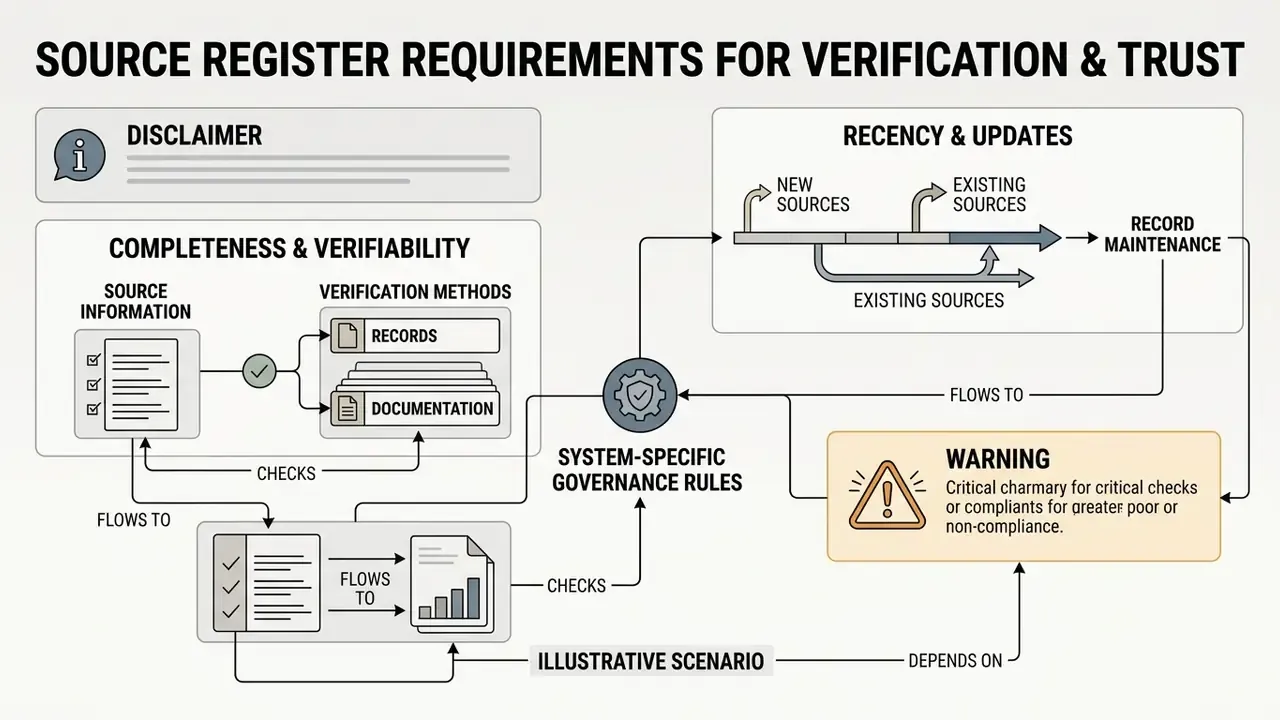
For a source register to be accepted as a reliable control mechanism by internal auditors and external regulators, it must fulfill strict operational requirements. A poorly maintained register containing stale or unverified entries increases organizational liability by creating a false sense of security. Reliable management requires continuous data validation, clear lifecycle governance, and immutable change logging.
Completeness and verifiability of source information
«Missing attributes must be explicitly documented and addressed through automated queries rather than filled with default values.»
Ensuring complete and verifiable records prevents downstream analytical errors and makes the register's own quality measurable. Completeness rate per mandatory field is, in my experience, the single most useful metric to report to an audit committee, mainly because nobody can argue with it.
Illustrative scenario (composite, not a named client). In a systems consolidation across two merged banking platforms, missing origin metadata caused cross-system customer record matching errors. The lead risk architect updated the source register requirements to mandate explicit publisher, schema version, and ownership details before ingestion. This raised record completeness to 99.4% and significantly reduced manual reconciliation overhead. Figures describe a representative outcome pattern; they are not audited third-party results.
Recency and record updates for new and existing sources
Maintaining information currency requires defined versioning policies and real-time audit logging for both new and existing asset entries. The U.S. National Archives and Records Administration (NARA) Universal Electronic Records Management Requirements dictate that any administrative action altering, moving, or updating a record must be tracked in an immutable audit log (NARA ERM Requirements v3.0, 2023). Periodic reviews must be enforced to re-validate active sources against operational realities.
«The Source Code Inventory Process (SCIP) comprises the tools, policies, and mechanisms for re-evaluating existing and new code at least annually.»
How to create and maintain a source register
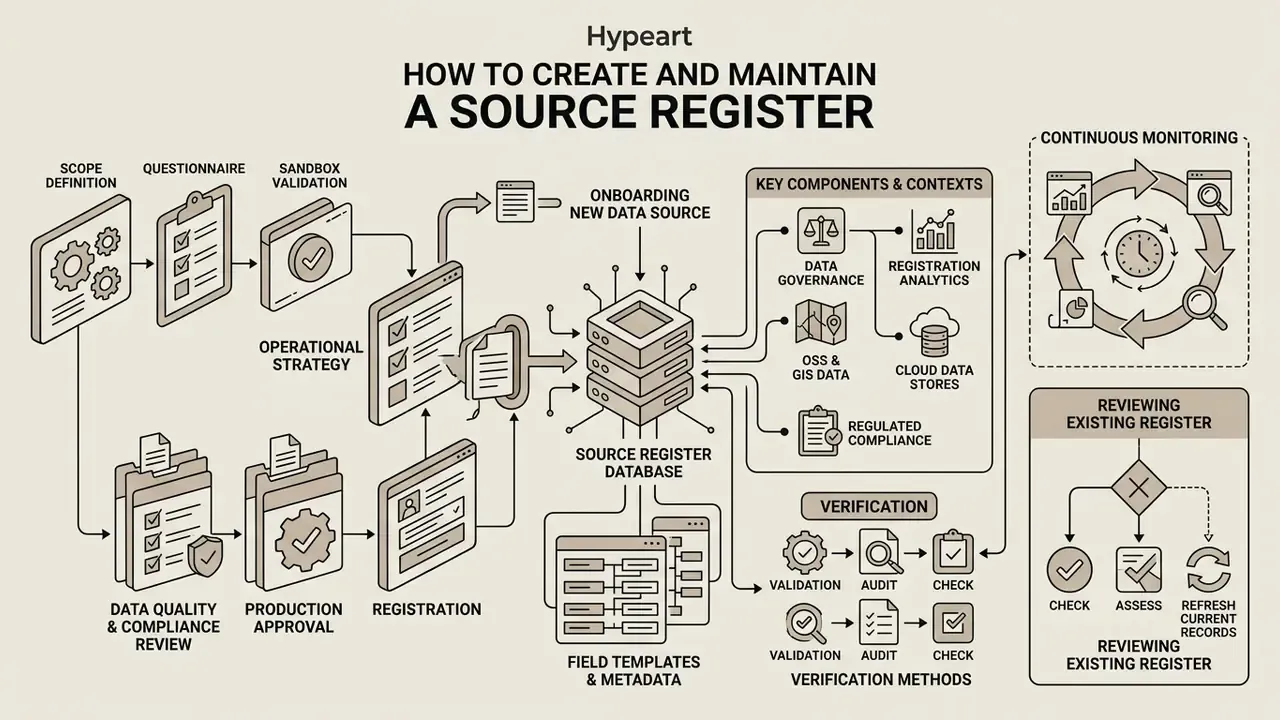
Implementing an enterprise source register requires an operational strategy covering the full asset lifecycle. From initial onboarding to routine audits, processes must be structured to minimize manual intervention while enforcing strict verification gates. Integrating automated registry checks directly into CI/CD pipelines and data ingestion frameworks ensures ongoing compliance.
Onboarding and registering a new data source
Onboarding a new asset into the enterprise architecture requires a structured, multi-stage workflow to verify quality before production deployment. In clinical and public health onboarding frameworks, such as the Oregon ALERT IIS guidance, new data submitters proceed through four distinct phases: formal registration, development and testing, production approval, and continuous quality monitoring (Oregon IIS Onboarding Guide, 2024).
- Scope definition and questionnaire.
- The asset owner submits initial metadata, including business purpose, data lineage, technical format, security classification, and, for AI use cases, whether the source will feed training, tuning, or retrieval.
- Sandbox validation.
- Governance tools run automated syntax checks, schema validation, and test data evaluations to confirm format adherence.
- Data quality and compliance review.
- The risk team reviews sample records for missing values, verifies licensing obligations, checks export-control and copyleft exposure, and confirms access permission rules.
- Production approval and registration.
- Upon formal sign-off, the source receives an
approvedstatus in the register, generating a persistent unique identifier (source_identifier) and an initialcontent_hashbaseline. - Continuous monitoring.
- Ingested pipelines are continuously monitored against the registered update frequency, hash baseline, and data quality SLAs, with dependency maps regenerated automatically.
Reviewing an existing register before using data
Before consuming data from an existing register, analytical teams and software developers must conduct a systematic verification review. European Commission guidance describes a two-level validation approach before using administrative data: individual record validation for completeness and internal consistency, followed by aggregate-level checks across the whole dataset (European Commission, Practical Guidance on Data Collection and Validation, 2016, cited here as foundational historical guidance; where a more recent national or sectoral validation standard applies, follow the newer instrument).
Teams should execute a pre-use checklist to confirm asset viability:
- Verify that the asset status is marked as
approvedand active within the data register. - Check that the
last_verification_datefalls within the required governance window, for example within the past 12 months. - Review access classification parameters to ensure intended usage aligns with legal and regulatory constraints.
- Confirm that the primary source endpoint matches registered URI parameters and SSL cryptographic hashes.
- Confirm that stored credentials for database and cloud store entries are still valid and carry the privileges the consuming service requires.
- Confirm that the dependency map is current, so no consumer is invisible to the reviewer.
Figure 1. Sequential lifecycle of registering, validating, monitoring, and safely retiring assets within an enterprise source register.
- Identify context and purpose of the register entry.
- Source intake and questionnaire completed by the asset owner.
- Sandbox schema and quality validation.
- Compliance and access approval.
- Register the asset and issue a persistent identifier.
- Continuous production ingestion and monitoring against SLAs.
- Periodic re-evaluation with immutable audit logging.
- Controlled deprecation, dependency check, then unregistration.
How to verify that a source register is fit for purpose
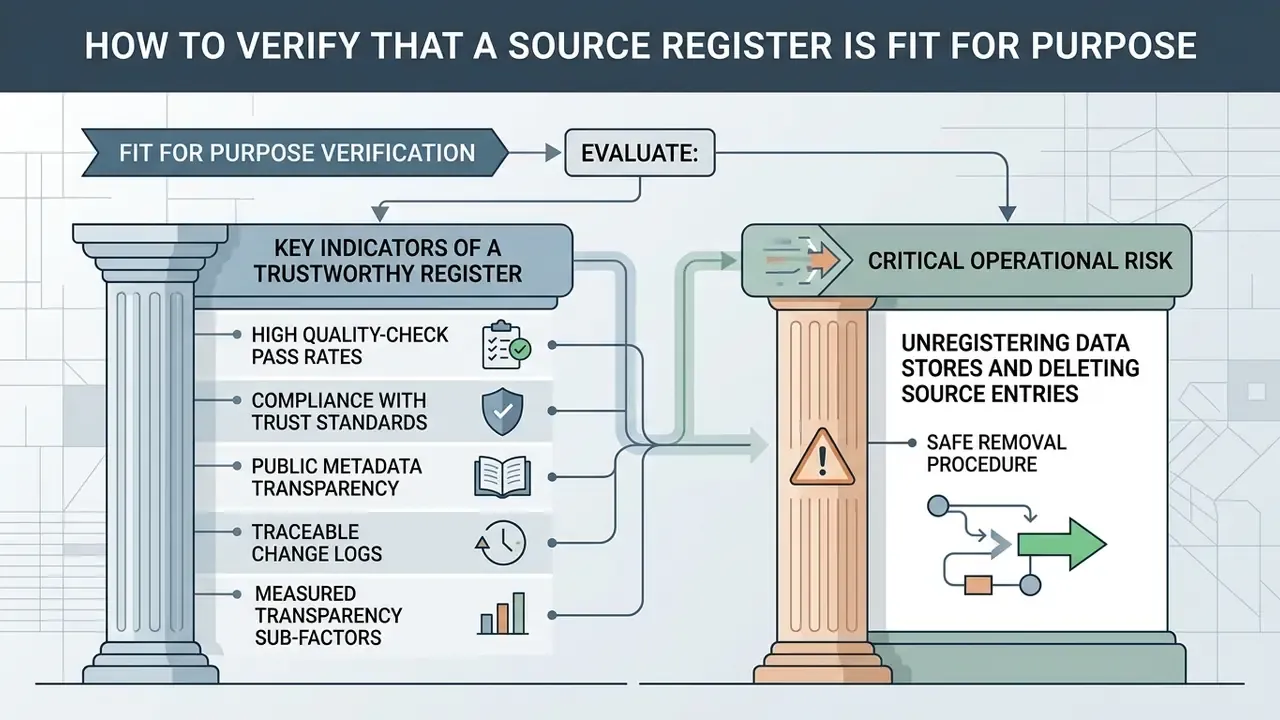
Determining whether a source register is fit for operational use requires evaluating its transparency, structural harmonization capabilities, and verification pass rates. Analytical teams must confirm that a target registry provides sufficient fidelity to support high-stakes decision-making without introducing unquantified residual risk. Sectoral guidance takes the same approach: registry-based study frameworks assess suitability through feasibility analysis, core-data availability, missing-data review, and documented governance before a registry may support a regulatory decision.
Key indicators of a trustworthy register
Auditors and analytics leaders rely on objective quantitative metrics to evaluate the overall trustworthiness of a source register. A highly reliable register exhibits robust documentation, active quality control, and verifiable audit trails.
- High quality-check pass rates. Reliable registries publish historical validation pass rates.
«4,441 targeted quality checks were carried out in 2024, with 83% of checked registrations found to be of satisfactory quality.»
Evaluating platforms and building the risk-adjusted ROI case
Selecting or building a register is a budget decision, so the evaluation criteria must be explicit before vendor demonstrations begin.
- Platform and vendor neutrality. Can the register catalog sources across clouds, warehouses, and model providers without locking the organization into a single AI or storage vendor? Independence protects against forced migration costs when a provider changes terms.
- GRC integration. Does it write evidence directly into the enterprise GRC or ITSM stack, for example integrated risk management and service management platforms, rather than requiring manual export?
- Automated evidence generation. Can it produce, on demand, the artifact an examiner requests: inventory extract, lineage graph, approval trail, and change history for a named model or report?
- Machine-readable export. Native SPDX and CycloneDX export for software components; open lineage event ingestion for data pipelines.
- Dependency mapping. Does it maintain the downstream consumer map automatically, so deprecation risk is visible before removal?
- AI-native fields. Support for corpora, vector indexes, prompts, tool endpoints, and model versions as first-class entries.
- Immutable audit logging. Append-only change history with actor, timestamp, and justification, aligned to records-management requirements.
- Access control granularity. Row-level and field-level RBAC, so restricted entries can coexist with a broadly discoverable catalog.
- Total cost of control. License plus integration plus steward time, compared against the residual risk that remains after implementation.
Framing the financial case. Build the ROI argument from four measurable lines rather than a single savings claim:
Present the result as risk-adjusted ROI with the assumptions visible, and pair it with the register's own quality metrics, namely completeness rate, stale-entry percentage, and quality-check pass rate, so the board can see whether the control is actually working, not just funded.
Evaluating platforms and building the risk-adjusted ROI case
Audit preparation effort.
Hours spent assembling inventory, lineage, and approval evidence per examination cycle, multiplied by blended internal cost, before versus after automated evidence generation.
Rework and reconciliation.
Analyst and engineer hours consumed reconciling records across unlinked registers, plus incident hours caused by feed changes discovered downstream.
Time-to-production for AI initiatives.
The cost of delay when a pilot waits for provenance, licensing, or privacy clearance. Faster clearance is revenue pulled forward, not merely expense avoided.
Residual risk reduction.
Expected loss from unverified inputs, license violations, or broken services after controls, expressed as probability multiplied by impact and compared against the control's annual cost.
Limitations and open questions
Three honest caveats, because the evidence base here is uneven.
First, none of the frameworks cited above prescribe a complete field schema for agentic AI sources. Prompt versioning, tool-scope registration, and embedding lineage are emerging practice, not settled supervisory expectation. Second, the ROI lines above depend on internal baselines most institutions have never measured; without a before-state, the after-state is a story. Third, register coverage does not equal register accuracy. A 100% inventory with stale verification dates is arguably worse than a partial inventory that everyone knows is partial, because it invites misplaced confidence.
A safe next step is narrow: pick one Tier 1 model or one production agent, register every input it touches, and time how long it takes to produce examiner-ready evidence. That single measurement usually settles the internal debate faster than a framework deck.
Audit-readiness checklist
Before an internal audit or supervisory examination, confirm that the register can answer each of the following without manual assembly:
Checklist0 / 10
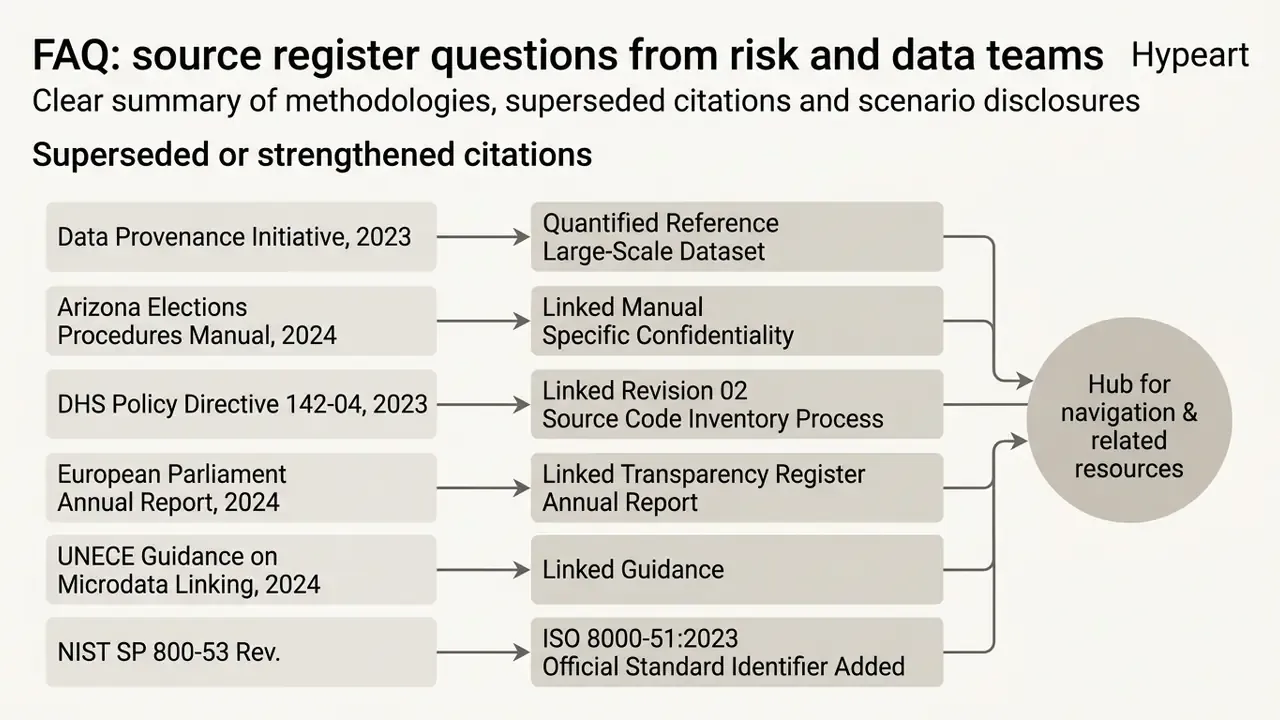
FAQ: source register questions from risk and data teams
Is a source register the same thing as a data catalog?
They overlap but answer different questions. A data catalog is oriented toward discovery, helping users find and understand assets. A source register is oriented toward control, establishing which origins are approved, who owns them, under what access conditions they may be used, and whether they are currently validated. Many organizations implement the register as a governed layer inside the catalog.
What is the difference between a "register" and a "data source"?
A data source is the origin system, feed, bucket, or repository itself. A register is the controlled inventory of records about those sources. The register never stores raw operational data; it stores identifiers, provenance, status, and access metadata.
Who owns the source register?
Ownership is typically shared. The data governance or CDO function owns the schema and lifecycle rules; asset owners own individual entries; independent validation or internal audit tests the register's effectiveness. In regulated financial institutions, the model risk function is usually the most demanding consumer.
How often must entries be re-verified?
Twelve months is the most common ceiling in official guidance. DHS software governance policy, for example, mandates re-evaluation of code inventories at intervals not exceeding 12 months. High-materiality entries such as Tier 1 model inputs, externally licensed corpora, and credential-bearing connections warrant shorter cycles.
Should we run one central register or several domain registers?
A single register minimizes cross-source reconciliation error by enforcing shared identifiers and definitions. Federated registers are sometimes unavoidable for legal or acquisition reasons. In that case, publish standardized mapping tables and document match rules, unmatched rates, and uncertain-match handling, as linkage guidance requires.
What happens if we delete an entry we no longer think is used?
Assume something depends on it. Removing a registered store does not delete the underlying data, but it breaks the services, APIs, and pipelines that reference it. Credential rotation afterward can render those services permanently non-functional until the store is re-registered and services republished. Always deprecate with a dependency check first.
Does a source register help with M&A?
Substantially. A maintained OSS register with SPDX or CycloneDX export lets diligence teams audit copyleft obligations, confirm attribution requirements, and verify that third-party code does not compromise proprietary IP or export-control compliance, which compresses negotiation and integration timelines.
How does a register reduce "Shadow AI"?
By making registration a gate rather than a formality. No corpus, vector index, prompt template, or third-party model endpoint may serve production traffic without an approved register entry. Unregistered sources are then detectable as policy violations rather than invisible defaults.
Appendix A: methodology notes, superseded citations, and scenario disclosures
https://arxiv.org/abs/2310.16787