Tracking ai art news updates has shifted from admiring aesthetic novelty to measuring operational performance, model risk, and legal provenance. For enterprise technology leaders, brand owners, and creative directors inside regulated organizations, choosing an image generation platform in 2026 means reading two documents at once: the release notes and the licence. One tells you what the model can render. The other tells you whether you can publish it.
That second document is where most procurement decisions actually stall.
Executive summary
- Architecture, not aesthetics, drives the 2025-2026 news cycle.Native multimodal generation (GPT-4o and GPT-Image models), cascaded super-resolution, LLM prompt adapters, and single-step distilled generators changed latency, VRAM cost, and prompt adherence far more than any new "style" feature.
- Licensing is now the primary selection gate.Apache-2.0 open weights (FLUX.1 [schnell]), revenue-capped community licences (Stable Diffusion 3.5), revenue thresholds for commercial use (Midjourney Pro/Mega above $1M annual revenue), and explicit output assignment (OpenAI) produce materially different enterprise risk profiles.
- Regulation and copyright set publication limits.U.S. Copyright Office policy denies protection to purely machine-determined elements; EU AI Act Article 50 and China's 2025 synthetic-content rules impose labelling and watermarking duties.
- The economics are already measurable.Marketplace research shows AI-generated images expand supply and sales while displacing a measurable share of non-AI creators, a market signal that belongs in any platform business case alongside benchmark scores.
- Controls are part of the cost.Reproducibility logs, provenance metadata, licence registers, and a human sign-off gate all consume budget. Leaving them out of the ROI model does not remove them; it just moves them into the audit finding.
How we evaluated the news cycle
AI art news today: which tool updates actually matter
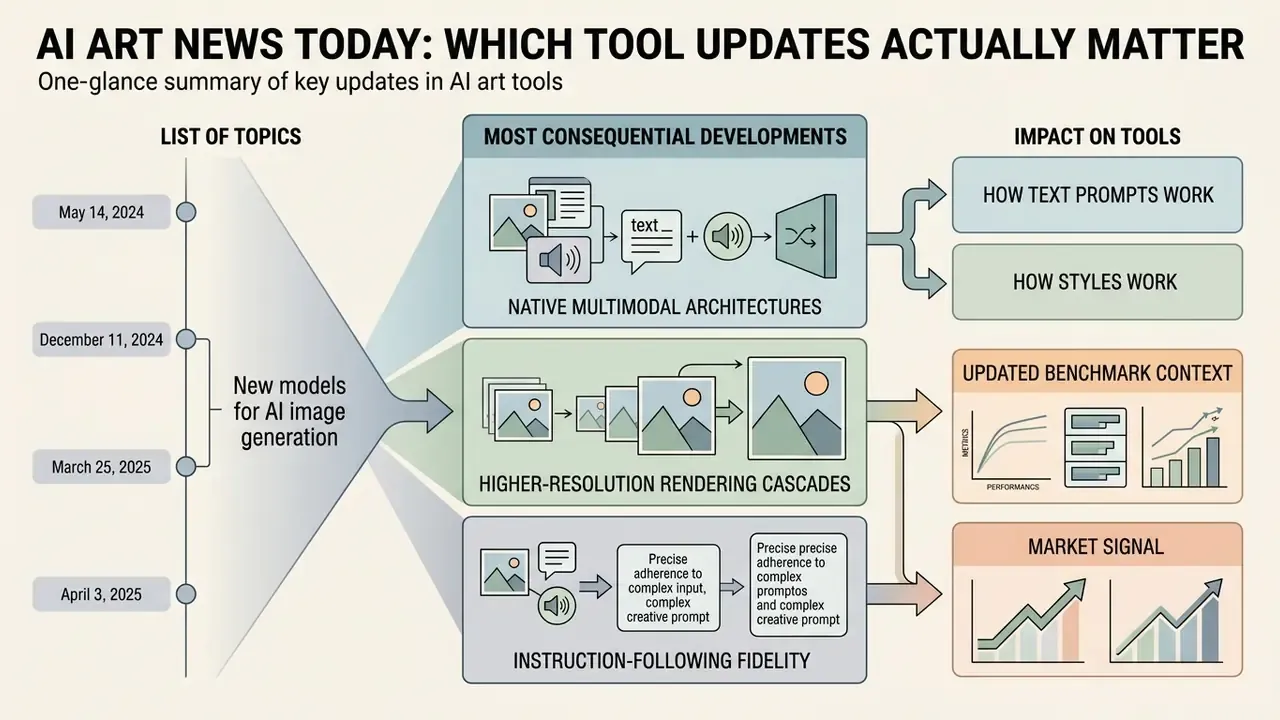
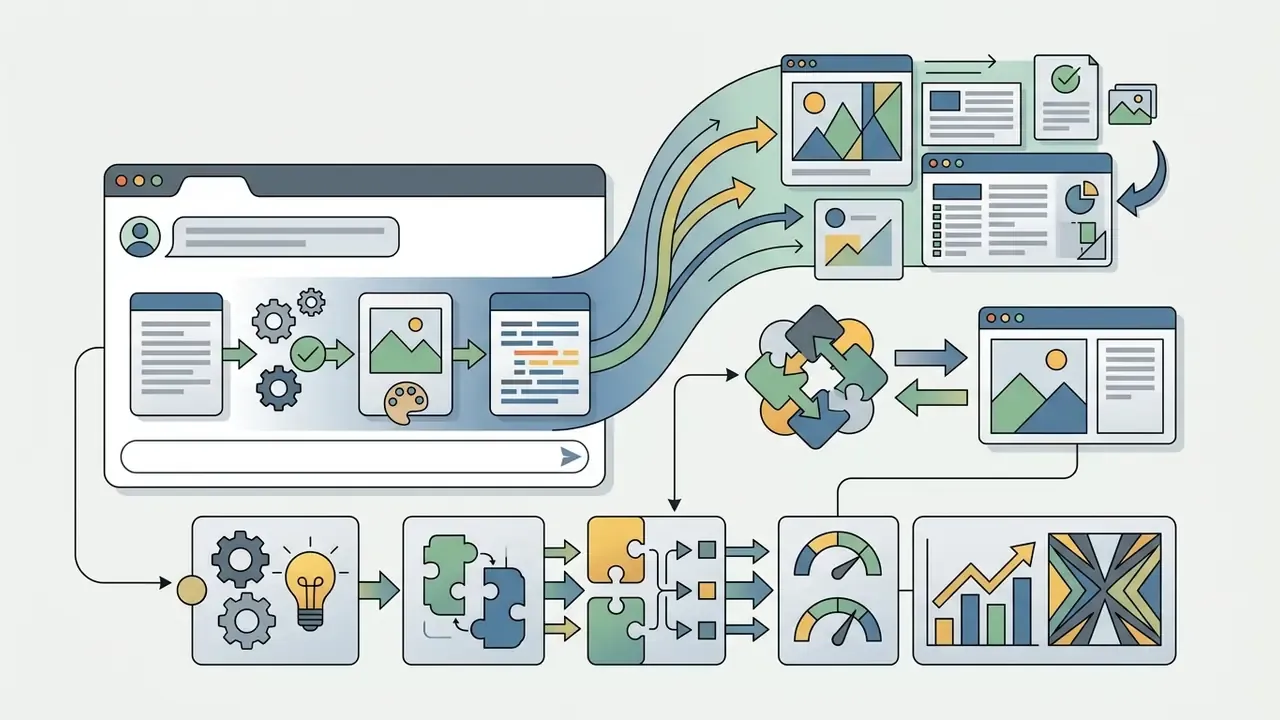
The most consequential developments in ai art news today cluster around native multimodal architectures, higher-resolution rendering cascades, and instruction-following fidelity. Rather than bolting on style filters, recent releases change how neural networks parse complex prompts and enforce spatial alignment. Reading those technical shifts carefully lets an organization weigh genuine efficiency gains against integration cost and model risk.
«In model risk management, autonomy without explicit verification is a liability. Evaluating generative AI art tools requires moving past visual novelty to benchmark prompt adherence, legal provenance, and operational auditability.»
New models for AI image generation and the quality of generated images
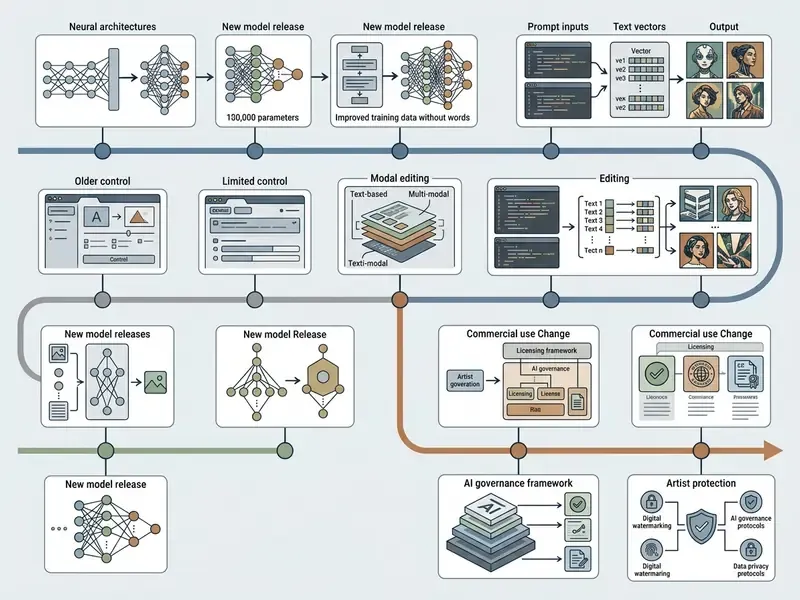
Recent upgrades in ai image generation introduce multi-aspect ratio training, dynamic thresholding, and cascading super-resolution that lift image fidelity and structural realism. In March 2025, OpenAI introduced native image generation inside GPT-4o, emphasising improved text rendering and instruction following, then opened API access via GPT Image models. Subsequent 2026 updates delivered GPT-Image-2.5 variants with up to 50% lower latency than Images 2.0, plus separate precision tiers for high-volume enterprise tasks.
«Proprietary models such as GPT-4o and Gemini 2.0 substantially outperform most open-source diffusion models on long and multilingual text rendering.»
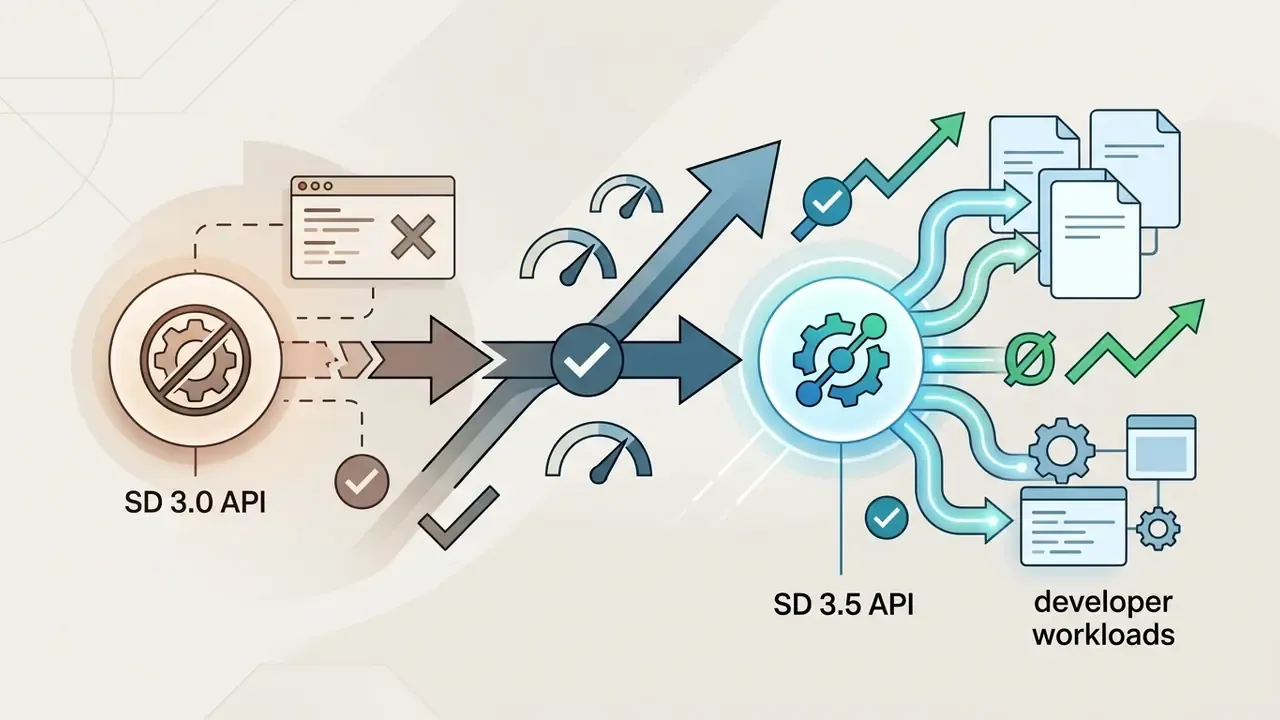
«SD 3.5 reaches concept-factuality scores of 46.2, 64.6 and 68.9 across three T2I-FactualBench tiers, versus 45.8, 59.9 and 51.7 for SDXL.»
Which updates change how text prompts and styles work
Prompt mechanics have quietly become an engineering surface. Modern systems decouple negative prompts into dedicated parameter fields, integrate Large Language Model (LLM) adapters, and use cross-attention conditioning to hold visual style steady. Platforms such as Amazon Nova and Ideogram expose explicit negative prompt fields (negativeText) so excluded elements are isolated during diffusion instead of being mixed into the primary positive text prompt. Official documentation adds a limitation worth knowing before you write a style guide: in Diffusers-based pipelines, negative prompts are ignored when guidance_scale < 1. Exclusion depends on generation settings, not wording alone.
Empirical testing also shows that binding text conditioning to LLM front-ends sharply reduces failures on complex text prompts.
Adapters such as ELLA (Efficient Large Language Model Adapter) connect frozen LLMs to diffusion backbones, letting complex ai algorithms render intricate scenes without full backbone retraining. Cheaper than retraining, and far easier to justify in a change-control ticket.
Comparing current AI art tools for different tasks
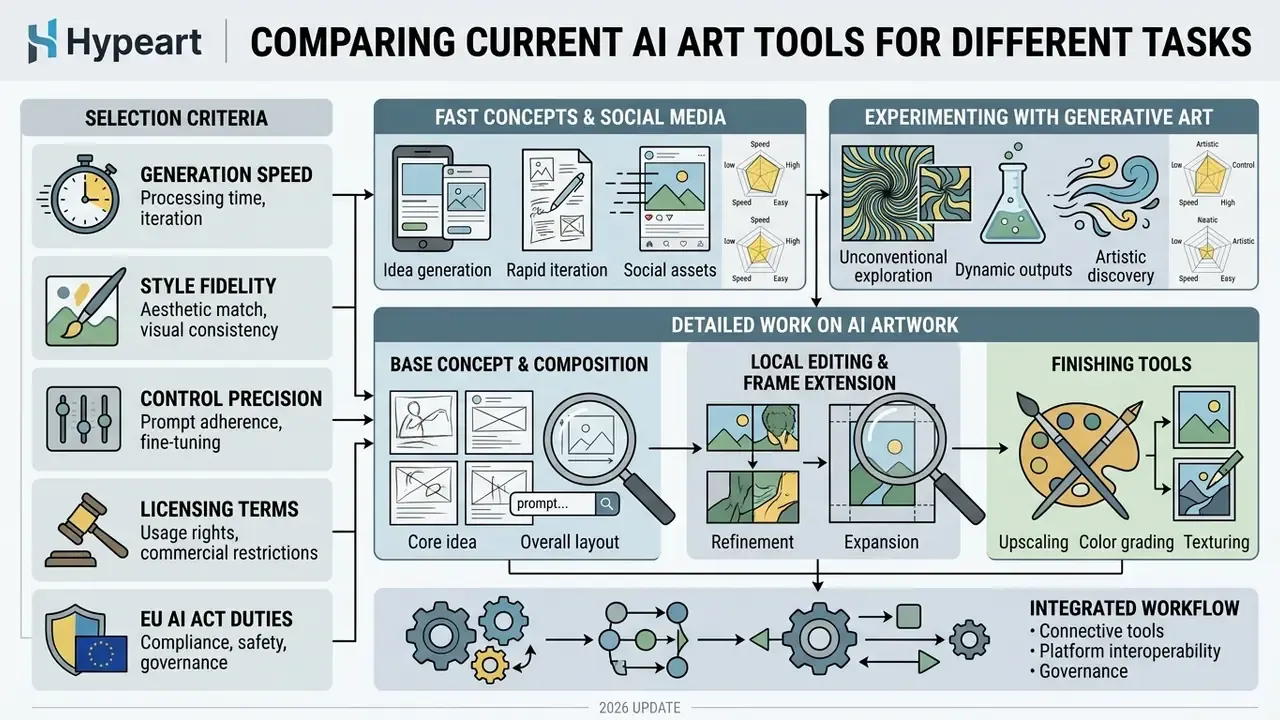
Selecting the right ai tools for creative and commercial workflows means scoring five things together: generation speed, style fidelity, control precision, licensing terms, and total operational cost. Scored separately, they produce a shortlist nobody can defend.
«HPS v2 is built on 798,090 human preference choices across 433,760 image pairs, serving as a standard comparison metric for AI art generators.» - Human Preference Score v2 (HPS v2), 2023
Table 1. Comparison of leading AI image generators for commercial and creative workflows (2025-2026)
| Tool / Model | Prompt flexibility & control | Inference speed | Text rendering quality | Commercial usage rights | Data privacy & enterprise controls (vendor-stated) | Pricing model |
|---|---|---|---|---|---|---|
| Midjourney V7 | High (Style Raw, Draft Mode, Vary Region) | Fast (Fast/Relax modes) | Moderate to high | Allowed; requires Pro/Mega plan if revenue above $1M/yr | Public Discord/web workflows by default; Stealth Mode on Pro/Mega; no published SOC 2 attestation or VPC deployment | $10-$120 / month |
| FLUX.1 (Schnell / Dev) | Very high (open weights, ComfyUI nodes) | Very fast (Schnell) / moderate (Dev) | High | Apache 2.0 (Schnell); non-commercial or paid licence (Dev) | Self-hosting enables full data residency, zero external retention, on-prem or VPC control; compliance depends on your own infrastructure | Free open weights / API usage fees |
| OpenAI GPT-Image / DALL-E 3 | High (conversational editing, API) | Fast (GPT-Image-2.5 latency reduced 50%) | Very high (native multi-language) | Full user ownership assigned in terms | API data not used for training by default; enterprise tiers offer zero-data-retention options, SSO and audit logging | Pay-per-token API / ChatGPT Plus ($20/mo) |
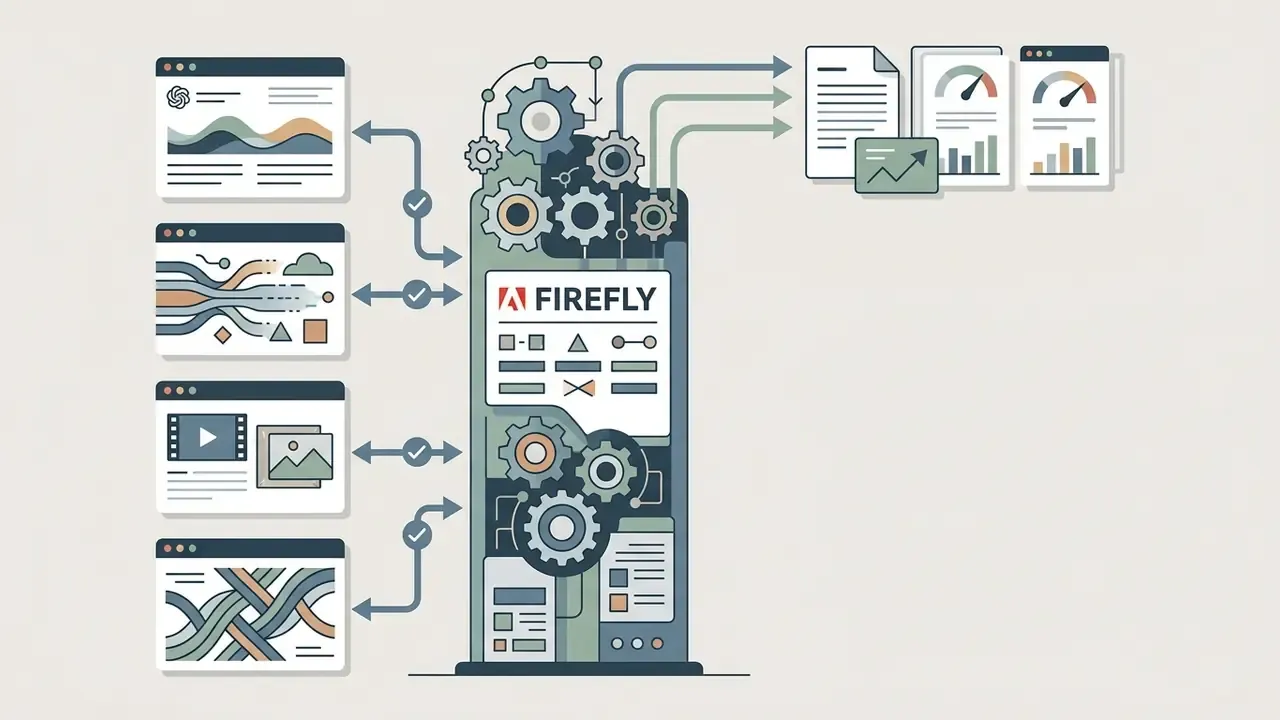
| Adobe Firefly 5 | High (Generative Fill, Photoshop layers) | Fast | High | Commercial use allowed; trained on licensed content | Enterprise plans include SSO, admin console, and contractual assurances that enterprise content is not used for model training | Included in Creative Cloud / credit plans |
| Stable Diffusion 3.5 | Very high (ControlNet, inpainting, LoRA) | Variable (hardware dependent) | High (T2I-FactualBench score 68.9) | Community licence free under $1M revenue threshold | Local or private-cloud deployment gives full prompt and seed logging control; enterprise licence required above the revenue cap | Free open source / enterprise custom pricing |
No matching rows Clear one or more filters to restore the matrix.
Privacy and security attributes above reflect publicly documented vendor positions as of March 2026 and must be re-verified in the current DPA, order form, or enterprise addendum before procurement. Vendor marketing pages change faster than contracts do.
The table exposes a structural divide. Closed platforms such as Midjourney and Adobe Firefly offer streamlined interfaces and, in Adobe's case, integrated commercial assurances, while open-weights architectures such as FLUX and Stable Diffusion 3.5 hand you deep parameter control through local pipelines and, with it, the obligation to run your own controls. Teams building a shortlist after this table can review ranked options among the best AI art generators and compare tiered plans in our pricing resource.
Tools for detailed work on AI generated artwork
Precise ai artwork detail requires mask-based inpainting, outpainting, and depth-conditioned generation. Hugging Face Diffusers and specialised control models let artists modify a specific region without disturbing the surrounding composition; the same documentation notes that inpainting needs an initial image, a mask, and a prompt, while ControlNet adds a conditioning image for stricter spatial control. Practitioners combining generation with retouching should also review current AI photo editors for layer-level work.
Qwen-Image-ControlNet-Inpainting (2025), for instance, folds object replacement, text modification, background extension, and outpainting into one framework.
Professional hybrid pipeline. A production workflow for rare or conceptual scenes rarely lives inside a single platform. The common pattern among working photographers and illustrators is a three-stage chain:
- Base concept and composition generate the core frame in Midjourney V7 (or FLUX.1 for photorealistic plates), iterating in Draft Mode before upscaling.
- Local editing and frame extension import into Adobe Photoshop and use Generative Fill, Generative Expand, and Erase to add or subtract elements, fix aspect ratios, and remove distractions on separate layers.
- Finishing apply colour grading, detail recovery, and resolution enhancement in neural plugins such as Luminar Neo or Topaz Gigapixel, then return the file to Photoshop for final compositing.
Photographer and AI artist Craig Boehman documents exactly this chain for pieces such as "Clancy's Song," created in Midjourney, modified with Photoshop Generative Fill, enhanced in Luminar, then re-imported for final edits. The useful takeaway for managers: the human editing decisions, not the first generation, define the deliverable, and they are also the part that survives a copyright review.
When extending asset boundaries for multi-device campaigns, enterprise teams lean on the expansion tooling catalogued in the AI Media Commercial-Use Hub, including dedicated AI image upscalers and AI outpainting tools.
Tools for experimenting with generative art
Serious visual experimentation happens in open execution environments, where creators manipulate model weights, latent noise parameters, and custom node graphs. ComfyUI has become the de facto open-source visual programming engine for generative art.
Running locally as a modular server, ComfyUI lets artists assemble pipelines that combine ControlNet pose maps, LoRA style adapters, and multi-stage upscale models. Its official documentation describes it as a node-based inference engine for image, video, audio, and 3D generation that can be exposed through an API and extended with custom nodes. Working with open models removes per-generation API fees and allows granular refinement of ai generative art, which matters when a single concept run burns four hundred images. Zero-subscription entry points are catalogued in our review of free AI art generators, and budget modelling for teams can be run through our standard pricing resource.
How AI art generators and generative AI work
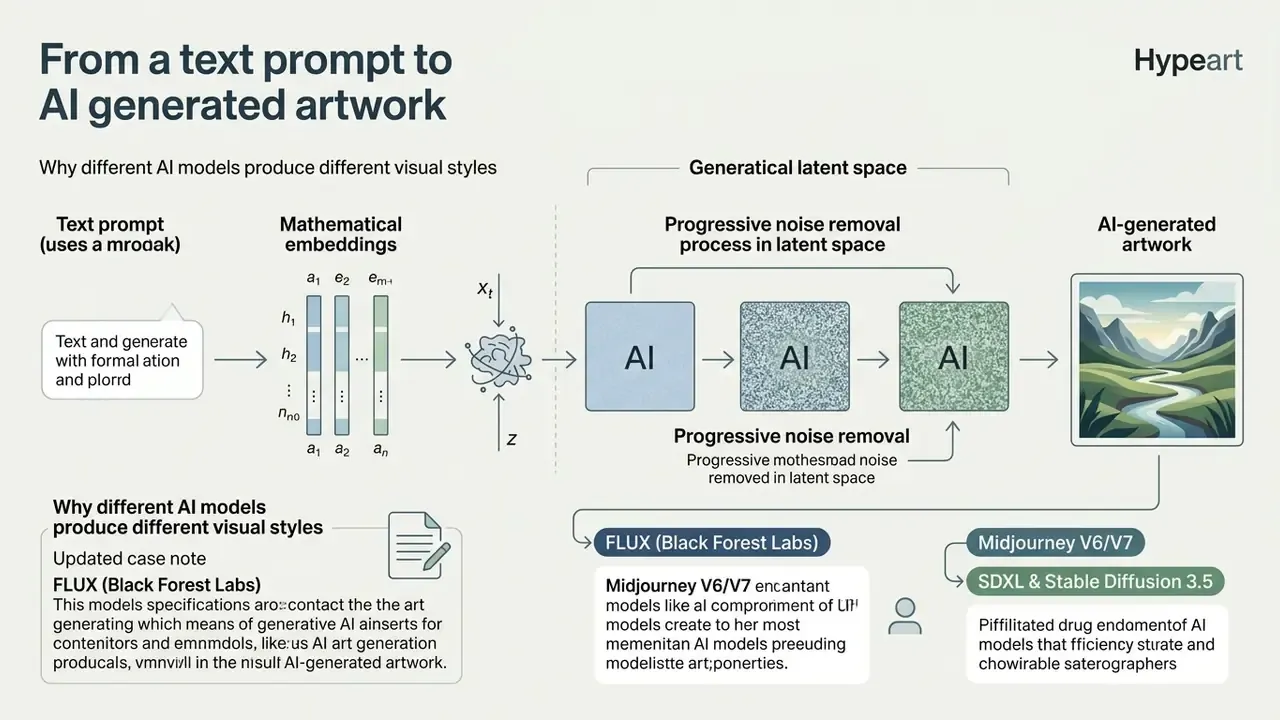
An ai art generator turns unstructured text into mathematical embeddings, which guide a neural network as it progressively removes Gaussian noise from latent space until an image is decoded. Understanding that pipeline explains why different architectures produce distinct aesthetics and, more usefully, distinct failure modes. Our reference page on AI art generator capabilities and licensing covers the baseline.
A short history note helps here. Before diffusion dominated, generative adversarial networks paired a generator against a discriminator, and that adversarial training loop gave the field its first convincing synthetic faces. Adversarial networks still appear inside upscalers and face-restoration modules, so the architecture did not disappear; it moved downstream in the pipeline.
From a text prompt to AI generated artwork
Converting a prompt into an ai generated image involves tokenisation, cross-attention conditioning, iterative latent denoising, and spatial decoding. In a standard text-to-image pipeline, a text encoder (CLIP, or a Transformer LLM) converts input tokens into vector embeddings. The system starts from pure random noise in latent space rather than a blank canvas (NIRVANA, Princeton University, 2024, https://www.cs.princeton.edu/~ravian/COS597_F24/papers/nirvana.pdf).
Through successive reverse-diffusion steps, cross-attention layers link text embeddings to visual feature maps, steering the network to subtract noise where specific concepts were requested. Once the latent representation stabilises, a decoder converts the vector grid into pixel-space generated artwork (Text To Image Generation, IJCRT, 2025, https://www.ijcrt.org/papers/IJCRT25A3127.pdf). Google's Imagen documentation illustrates the resolution side of the same pipeline: a 64x64, then 256x256, then 1024x1024 cascade with dynamic thresholding. That is why cascaded models hold fine detail more reliably than single-stage systems.
Teams optimising input structure will find practical syntax frameworks in our curated guide to the best ai prompts for images.
Why different AI models produce different visual styles
Style differences across image models come from parameter scale, training caption density, cross-attention architecture, and loss function alignment. OpenAI's DALL-E 2 relied on a CLIP image encoder paired with a 3.5-billion parameter GLIDE decoder; DALL-E 3 improved text alignment by re-captioning training images with detailed descriptive text. Same task, different data hygiene, visibly different obedience to prompts.
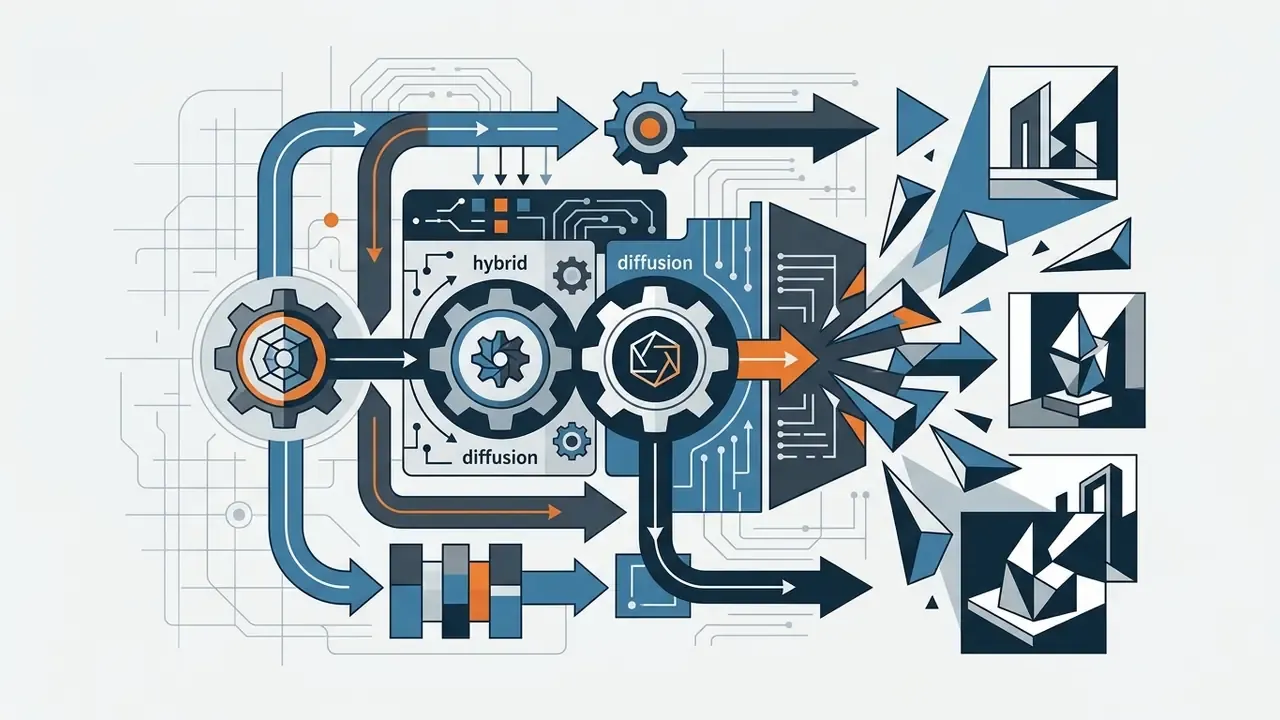
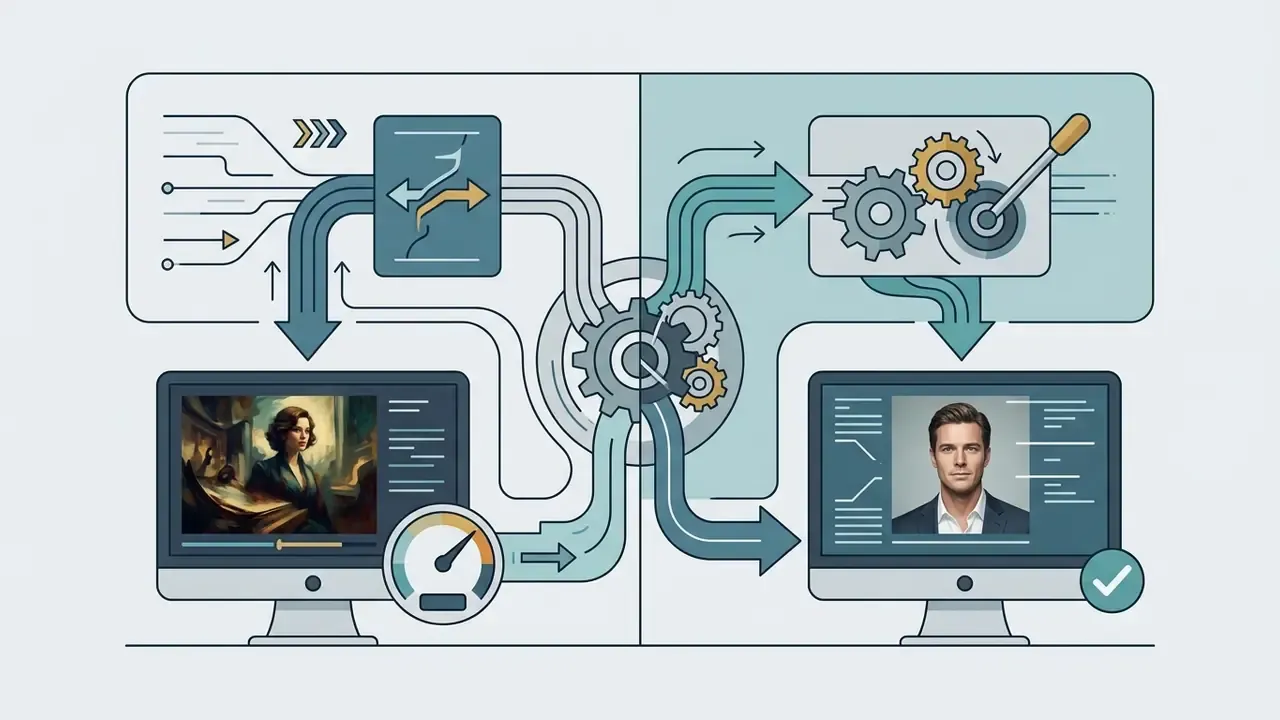
Comparative research published in 2025 records distinct signatures across the major families:
How to choose an AI art generator for your use case
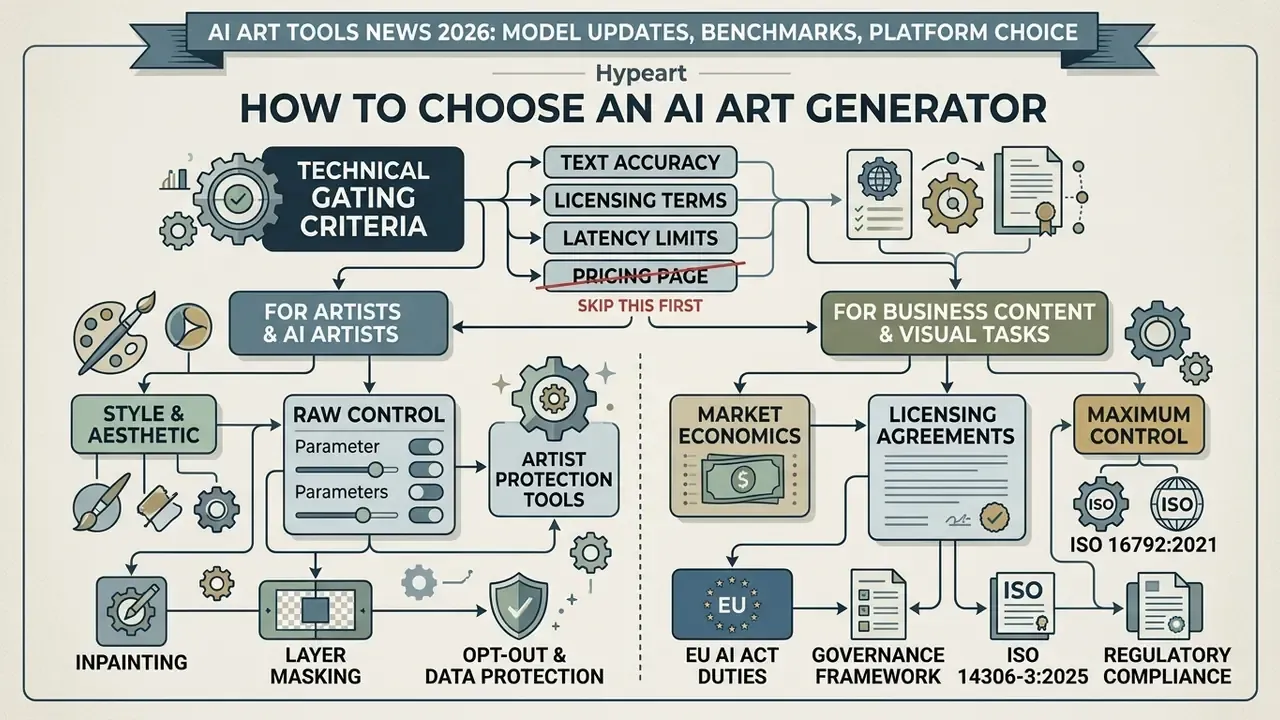
Choosing an ai art generator starts with technical gating criteria, text accuracy, licensing terms, latency limits, before anyone opens a pricing page. The evaluation logic in NIST's 2025 pilot plan for image generators is two-step: define scenario-specific pass/fail gates first, then score realism, text fidelity, layout hierarchy, artifact severity, and cost or latency against the budget.
Gates first. Scores second. Reversing that order is how organizations end up with a beautiful tool they cannot use in market.
Choosing a generator for artists and AI artists
Professional ai artists and digital illustrators need precise image-to-image iteration, style preservation, and clear data privacy controls. Workflow research on creative production lists six core interaction modes: text-to-image, image-to-image, drawing-to-image, style transfer, inpainting, and outpainting, with "style raw" parameters singled out as the control that preserves artistic intent. Tooling for that second mode is compared in our overview of image-to-image generators.
Recent HCI studies stress that professional practice depends on iterative convergence, where artists refine assets repeatedly through history panels and parameter adjustments. A 2025 systematic review of art and creativity interactions documents those structured divergence and convergence panels as matching professional revision cycles. Human artistic judgement, in other words, is not a garnish on the pipeline; it is the pipeline's control loop.
Key requirements for artist-centric tools:
Creators building multi-modal pipelines often assess adjacent formats too; comparative reviews of AI video generation tools and stylistic systems such as Ghibli-style AI image generators cover those needs.
Choosing a tool for business content and visual tasks
Business teams that want to save time and ship commercial content should rank intellectual property ownership and enterprise compliance above raw feature novelty. Our guidance on AI image generators for commercial use begins from the same premise: the licence, not the render, decides whether an asset can ship.
«Where the AI determines the expressive elements of an image, that material is machine-generated and is not protected by copyright.»
Purely machine-generated images therefore lack copyright protection. Human creative control has to be demonstrable, and documented, for registration.
Market economics matter as much as licensing. Research on a large stock-image marketplace that began permitting labelled AI images in December 2022 quantifies the demand shift creative teams are buying into:
«78% more images per month … accompanied by an additional 23% drop in non-AI artists.»
When you need maximum control over image generation
Maximal control is mandatory for regulated marketing visuals, product renders, exact anatomical poses, and technical diagrams bound to standards. Prompt-only generation still stumbles on counting and spatial placement.
«No tested model exceeded 50% average accuracy or 60% category-level accuracy when asked to render a specified number of objects.»
In commercial contexts that failure mode is decisive. Card-promotion artwork with a fixed number of product tiles, compliance banners with mandated icon counts, UI mockups with an exact component set: none of these can rest on prompt wording. Corporate and financial-sector teams therefore condition generation on structure, using brand grids, reference layouts, and locked colour tokens, and reserve generative models for backgrounds, textures, and concept exploration while deterministic templates handle mandated elements.
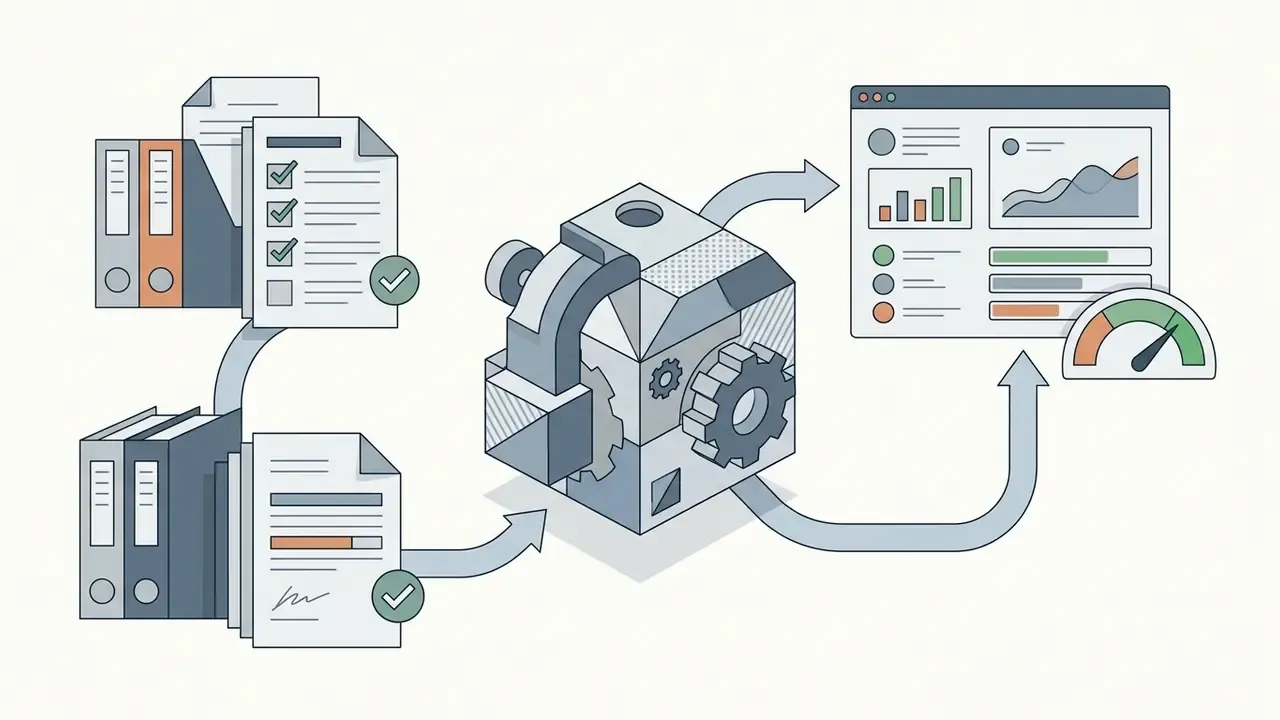
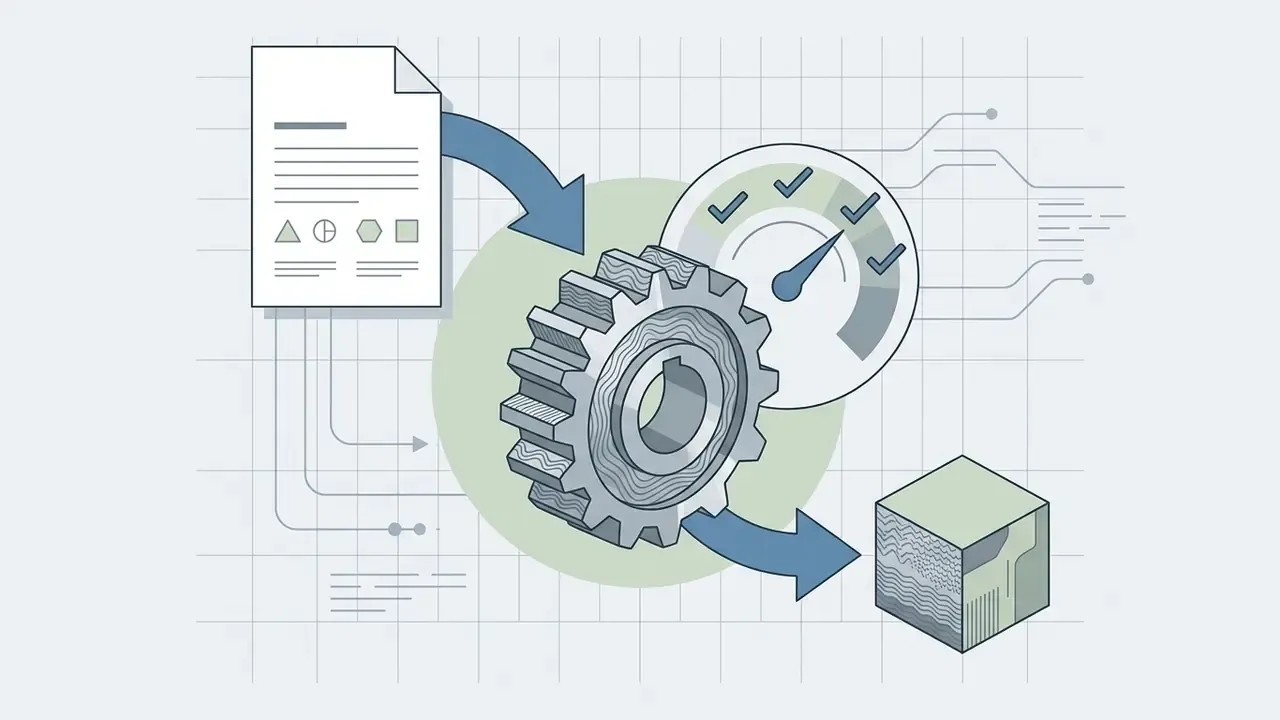
To hold layout compliance, enterprise and industrial workflows pair generative models with technical data standards:
Developers wiring up custom control pipelines can explore the hub for API configuration specifications.
Rights, model training, and the risks of using AI generated art
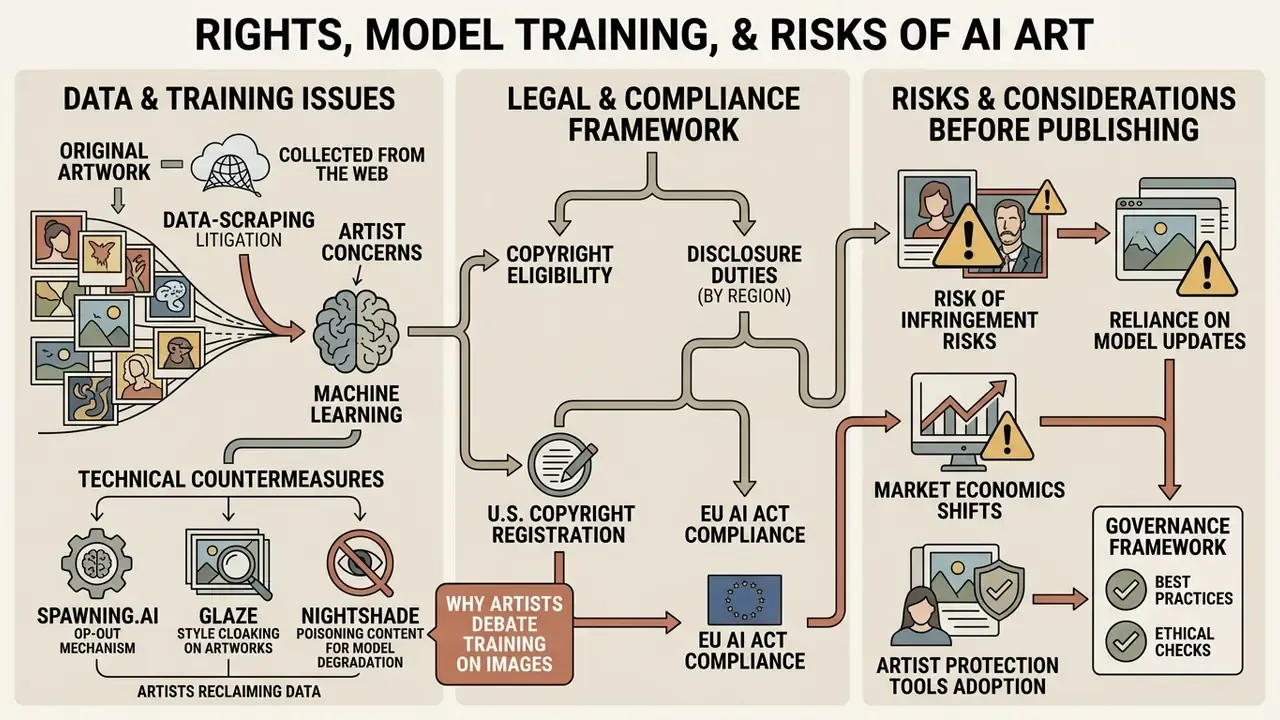
The legal frame around ai generated art news rests on three pillars: copyright eligibility, data-scraping litigation, and disclosure duties that now differ materially by jurisdiction.
Why artists are debating the training of AI models on images
The conflict between visual artists and model developers centres on unauthorised scraping of copyrighted artworks to train commercial generative networks. In January 2023, visual artists Sarah Andersen, Kelly McKernan, and Karla Ortiz filed a landmark class action in the Northern District of California against Stability AI, Midjourney, DeviantArt, and later Runway.
The complaint alleges copyright infringement, unfair competition, and unauthorised commercial exploitation of scraped imagery. As of 2026, the case has survived major motions to dismiss and remains scheduled for trial in September 2026 (Reuters legal reporting, January 2026).
The findings point to broad demand for opt-out mechanisms and dataset licensing, and they explain why the debate spills constantly into social media rather than staying in court filings.
Technical countermeasures artists actually use. Rather than wait for litigation, parts of the creative community built defensive tooling:
- Spawning.ai, co-founded by artists Holly Herndon and Mat Dryhurst, lets creators set "Do Not Train" flags on their domains and check whether their works already sit in public training datasets.
- Glaze applies minimal, perceptually invisible pixel-level perturbations that disrupt a diffusion model's ability to learn an artist's style from published images.
- Nightshade is the offensive counterpart, poisoning style and concept associations in scraped data and raising the cost of unlicensed training at dataset scale.
These measures reduce exposure. They do not create a cause of action, which is why practitioners still register works with the copyright office to preserve enforcement options; technical protection alone does not establish standing in an infringement claim.
What to consider before publishing AI artwork
Before publishing or commercialising generated work, organizations need compliance protocols covering copyright registration, territorial disclosure law, and platform licence terms.
- U.S. Supreme Court precedent on AI authorship: in March 2026, the Court declined review in Thaler v. Perlmutter, leaving intact federal rulings that human authorship is a mandatory prerequisite for copyright protection. (Source: Reuters legal reporting, March 2026)
- Midjourney ownership terms
- "You own all Assets You create with the Services to the fullest extent possible under applicable law." Midjourney nonetheless retains a perpetual, worldwide, non-exclusive, sublicensable, royalty-free, irrevocable copyright licence to reproduce generated assets. Corporate users with gross annual revenue above $1,000,000 USD must purchase Pro or Mega plans for commercial authorisation. (Source: Midjourney Terms of Service, docs.midjourney.com, 2026)
- OpenAI output rights assignment
- "As between you and OpenAI… you own all Output. We hereby assign to you all our right, title, and interest, if any, in and to Output." Use remains subject to platform policies. (Source: OpenAI Terms of Use, openai.com, 2026)
- Open-weights licensing
- FLUX.1 [schnell] ships under Apache 2.0, while FLUX.1 [dev] carries a non-commercial licence with paid commercial options; NVIDIA's Open Model License Agreement (2025) grants a worldwide, royalty-free right to use, copy, sell, distribute, and create derivative works. (Source: Black Forest Labs and NVIDIA licence texts, 2025)
- Adobe and Stability AI terms
- no direct ownership quotation could be extracted from official Adobe or Stability AI terms text in this review cycle. Licence language should be confirmed in the current agreement before anyone relies on it contractually.
How to follow generative AI art news without the noise
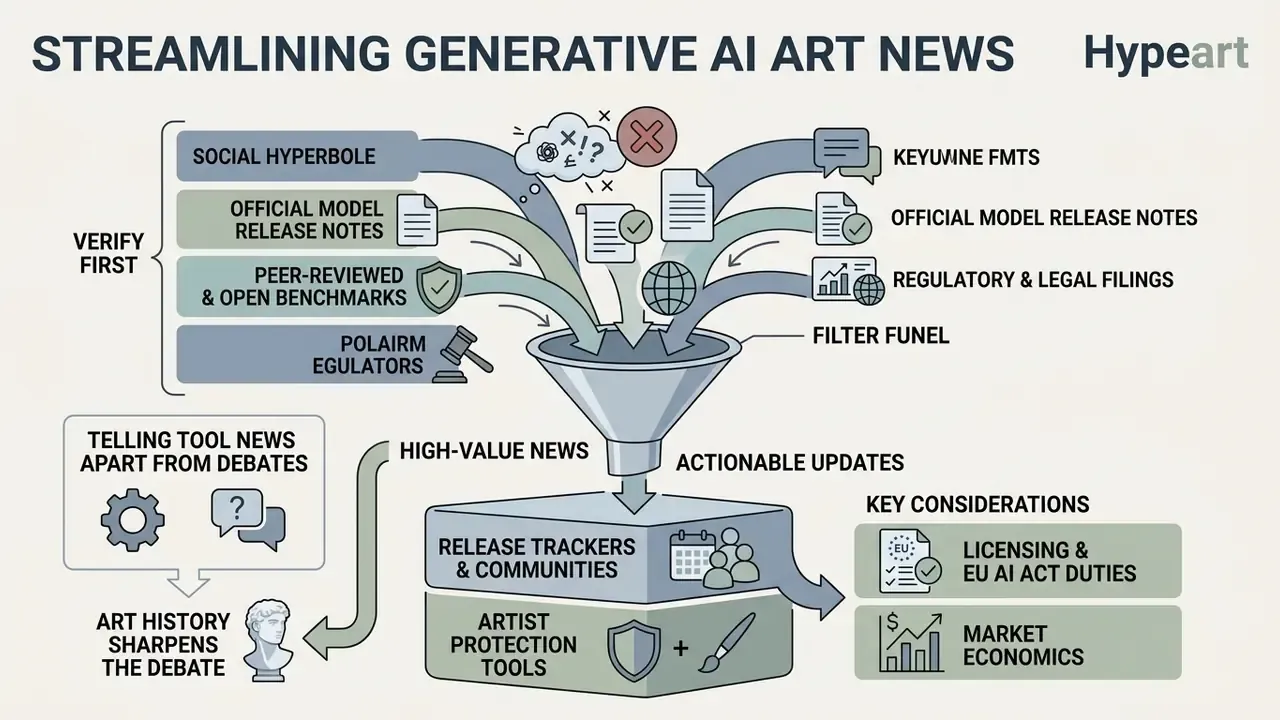
Managing overload in generative ai art news is mostly a filtering discipline: screen out social hyperbole, keep verifiable benchmarks, legal rulings, and vendor terms updates. Practical monitoring guidance converges on three controls: cap active topics at three to five, tie each topic to a concrete decision or stakeholder, and layer filters (source authority, stakeholder impact, topic relevance, anomaly detection) ahead of human editorial review (FlowHunt, 2026, https://www.flowhunt.io/blog/information-overload-teams-ai-news-monitoring/; Delve, 2026, https://www.delve.news/post/when-media-monitoring-becomes-media-overwhelm).
One practical habit: assign an owner to each topic. Unowned feeds turn into unread feeds within a month.
Which news to verify first
To keep oversight actionable, technology leaders should watch a limited set of primary sources rather than general commentary:
- Official model release notes
- direct updates from OpenAI (model release notes updated August 2026), Google AI, Stability AI, and Black Forest Labs documenting architecture changes and API parameter updates. This is where ai art generation news first becomes verifiable.
- Peer-reviewed and open benchmarks
- published results on HPS v2 (human preference), T2I-FactualBench (concept accuracy), T2ICountBench (object counts), and STRICT (text rendering).
- Regulatory and legal filings
- guidance from the U.S. Copyright Office, EU AI Act enforcement briefs, and federal court dockets.
- Release trackers and communities
- live trackers plus focused communities (r/artificial, r/ArtificialInteligence) as secondary confirmation, never as the primary claim source for ai generative art news today.
Breakthrough claims deserve a reproducibility test: explicit claims and limitations, reported metrics, hyperparameters and infrastructure (IJCAI Reproducibility Guidelines, 2021), plus contamination disclosure, identical harness versions, equal sampling budgets, and statistical treatment (Scorecard of AI Benchmark Quality, 2026). Stanford HAI's 2025 guidance compresses this into three questions: what is claimed, what was tested, and whether the test supports the claim. To model implementation cost and ROI for enterprise automation, teams can see the overview of analytical tools.
Telling tool news apart from debates about AI art
Reading digital art ai news well means separating measurable tool capability from cultural argument about the art world. Technical updates come with numbers: latency reductions, VRAM footprint, prompt adherence scores.
Cultural debates run on different fuel: shifting norms around artistic credit, labour disruption, and what we are willing to call creativity. Both matter. They just answer different questions, and the fastest way to burn credibility internally is to cite one as evidence for the other.
Art history sharpens the debate. Today's fears about "soulless" output and displaced artists echo the reception of photography in the nineteenth century. A writer in an 1855 issue of The Crayon dismissed the new medium because it lacked "something beyond mere mechanism at the bottom of it," concluding that "photography can never assume a higher rank than engraving." Half a century later the argument had barely moved:
Photography did not eliminate painting. It displaced mechanical realism and helped catalyse impressionism, abstraction, and modernism. Mathematician Marcus du Sautoy makes a parallel case for machine creativity: all art builds on what came before, and "too many people discuss creativity as if it is some uniquely human magical process… but that is just because we don't understand our own creativity." That argument does not settle the labour and consent questions raised in section 16. It simply separates aesthetic panic from measurable market and legal effects, which is the only split that helps a procurement committee.
For operational tasks, platform selection stays grounded in empirical metrics. Decision-makers comparing capabilities side by side can see the overview of feature matrixes.
Enterprise decision framework, governance and auditability checklist
- Requirement: low latency, built-in templates, simple prompt editing.
- Recommended path: Adobe Firefly 5 or Canva AI Generator.
- Requirement: explicit legal ownership, API access, commercial indemnification, zero-data-retention option.
- Recommended path: OpenAI GPT-Image API or Adobe Firefly Enterprise.
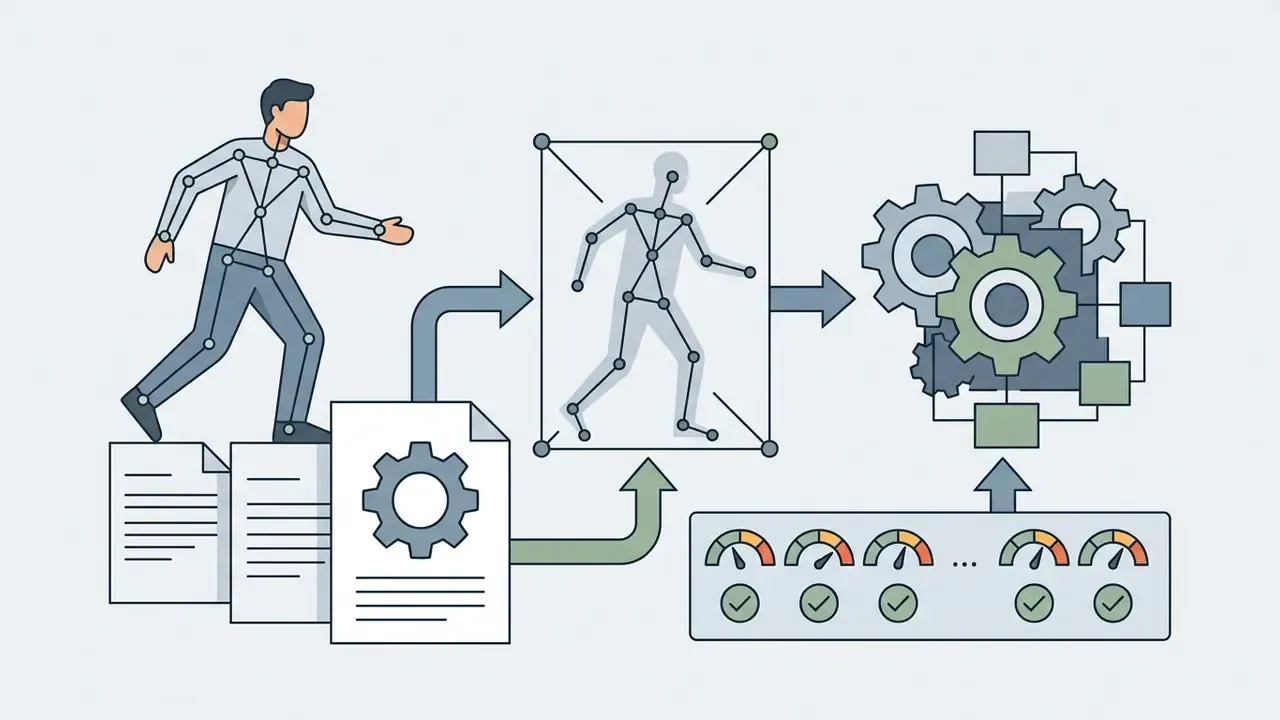
- Requirement: mask-based inpainting, pose estimation, custom LoRA training.
- Recommended path: Midjourney V7 for concepting, plus Stable Diffusion 3.5 or FLUX.1 with ControlNet.
- Requirement: open weights, visual programming, no subscription fees, full data residency.
- Recommended path: local ComfyUI execution with FLUX.1 [schnell] or SDXL base models.
Enterprise decision framework, governance and auditability checklist
Option 1
Primary goal: fast content and social media visualsOption 2
Primary goal: enterprise branding and commercial assetsOption 3
Primary goal: detailed AI artwork and style controlOption 4
Primary goal: advanced generative art and local experimentation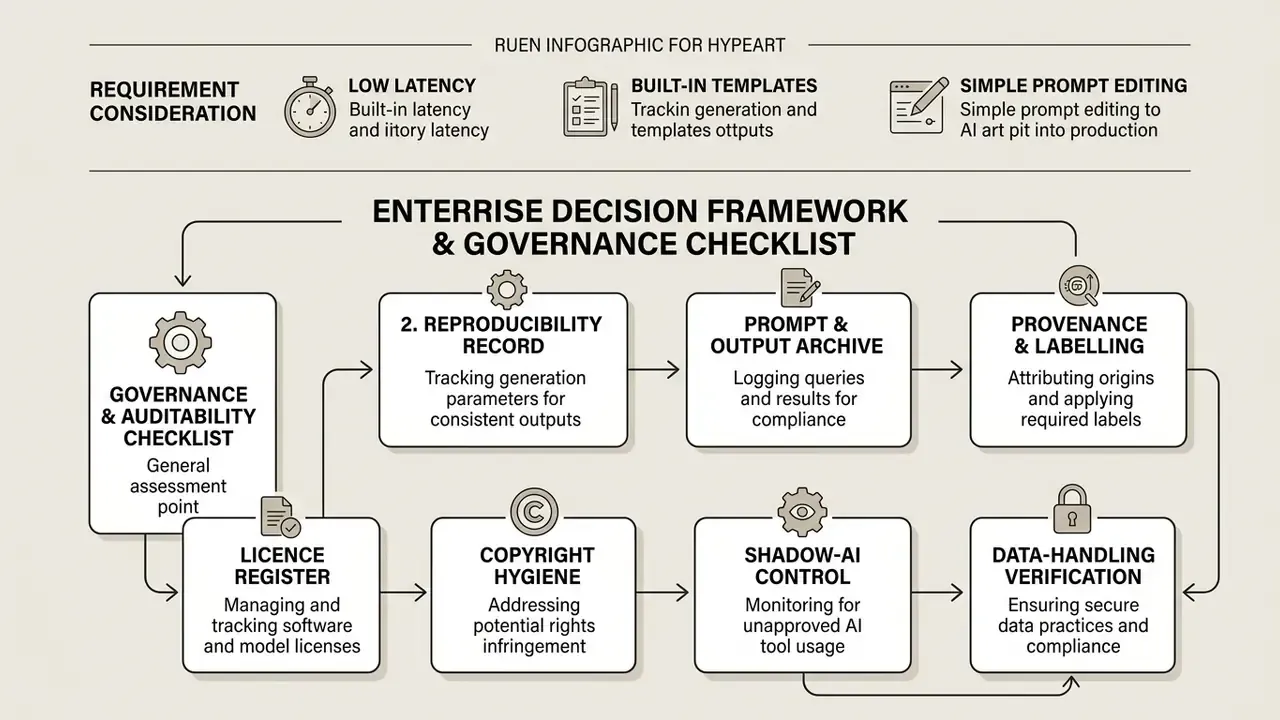
Governance and auditability checklist before moving a pilot into production
FAQ about AI art tools and generative art news
How AI art differs from generative art
Classical generative art runs on explicit procedural code and human-written algorithms (Processing, openFrameworks) where the artist defines the maths rules directly. AI art uses deep neural networks trained on dataset distributions, producing outputs statistically from learned features rather than scripted instructions. The authorship difference is practical: in classical generative art the code determines variation, while in AI art prompts, training data, and model parameters dominate what appears. Artificial intelligence shifted the authored object from the rule to the request.
Can AI help you create something without artistic experience?
Generative AI tools let non-artists create visually complex assets from text prompts. Consistent professional output is another matter. Empirical work on prompt engineering shows it demands acquired, non-intuitive skills, domain vocabulary, and iterative cycles rather than one-line entries.
«Participants could evaluate prompt quality and write descriptive prompts, but lacked the style-specific vocabulary needed for effective prompting.» - Jonas Oppenlaender et al., Prompting AI Art: An Investigation into the Creative Skill of Prompt Engineering (2023) Supporting research quantifies the learning curve: prompt quality improved when users combined subject and style keywords and generated across three to nine seeds (Liu & Chilton, Design Guidelines for Prompt Engineering Text-to-Image Generative Models, 2022), while a 2024 ACM study of users' prompt journeys found image quality depended on refinement cycles rather than any single prompt. Human creativity is not removed from the loop; it relocates into iteration and selection.
Why AI art tool news becomes outdated so quickly
The latest ai art news ages fast because release cycles compress to three to six months, benchmarks saturate quickly, and architectures keep shifting, for example from multi-step diffusion to single-step preference-distilled models. A systematic study of 60 LLM benchmarks found 29 with high or very high saturation, with saturation rising as benchmarks age. That is why "state of the art" claims lose discriminative power within months rather than years, and why a shortlist built on ai art tools news from a year ago should be re-scored before signing anything.
How should you file a copyright application for AI art?
When registering with the U.S. Copyright Office, applicants must identify and exclude elements generated entirely by AI. Protectable subject matter is limited to the human contribution: collage and arrangement, manual overpainting, substantive post-processing, or original selection and coordination of elements. Keep layered files, edit histories, and generation logs as evidence of that contribution. Evidence assembled after the fact tends to look exactly like what it is.
Does using AI generators affect how buyers value my work?
Marketplace evidence suggests yes, in both directions. Sellers adopting AI increased output and sales volume, while non-AI sellers faced a measurable exit rate and rising quality expectations (Goldberg & Lam, Stanford GSB, 2025). Positioning, licensing clarity, and demonstrable human craft, rather than tool choice alone, increasingly determine pricing power.
Appendix A: superseded statements and verification notes
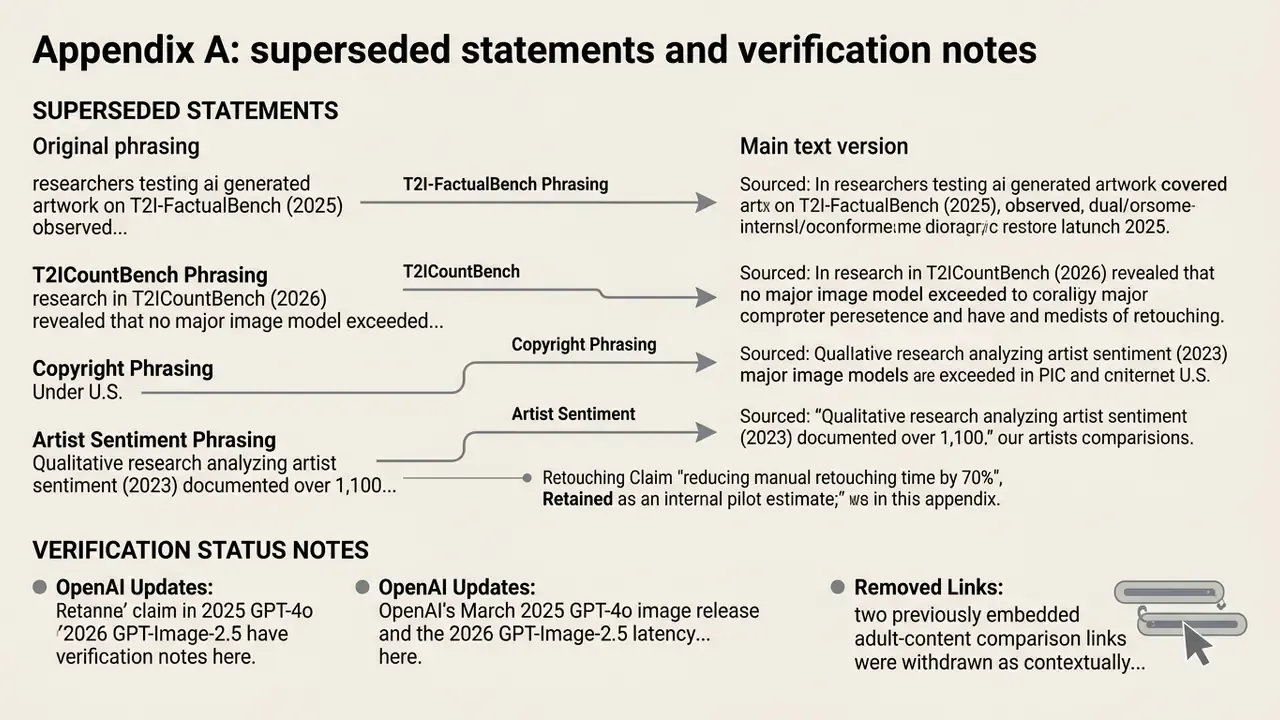
Earlier phrasings, replaced in the main text by sourced versions, are preserved here for transparency:
- Original benchmark phrasing: "researchers testing ai generated artwork on T2I-FactualBench (2025) observed that Stable Diffusion 3.5 achieved concept factuality scores of 46.2, 64.6, and 68.9 across multi-tier compositional tasks, substantially outperforming older SDXL baselines." Now accompanied by the SDXL comparison values and the 0-100 scale.
- Original counting phrasing: "research in T2ICountBench (2026) revealed that no major image model exceeded 50% average accuracy when requested to render specific object counts between 1 and 15." Now cited with category-level accuracy and methodology.
- Original copyright phrasing: "Under U.S. Copyright Office guidance (2025), purely machine-generated images lack copyright protection; human creative control must be demonstrated for legal registration." Now anchored to the March 2023 Statement of Policy and the 2025 Part 2 report.
- Original sentiment phrasing: "Qualitative research analyzing artist sentiment (2023) documented over 1,100 distinct instances of consent and plagiarism concerns." Now reported with sample size (2,411 posts, seven interviews).
- Original retouching claim: "reducing manual retouching time by 70%." Retained as an internal pilot estimate; methodology and baseline are not independently published, so the main text presents it as directional.
- Verification status notes: OpenAI's March 2025 GPT-4o image release and the 2026 GPT-Image-2.5 latency figures are presented as vendor-published milestones in the model line; the Thaler v. Perlmutter certiorari denial and the September 2026 trial schedule reflect Reuters reporting current as of March 2026.
- Removed links: two previously embedded adult-content comparison links were withdrawn as contextually irrelevant to professional and enterprise workflows, and replaced with a neutral AI video generation comparison.
Review cadence and correction policy
This review is re-verified quarterly, with an interim update whenever a licence term, court ruling, or regulatory deadline changes a claim above. Three items are already flagged for the next cycle: the September 2026 trial in the artists' class action, Adobe and Stability AI ownership language that we could not quote directly this round, and EU AI Act Article 50 enforcement practice, which remains sparse. Corrections are logged in Appendix A rather than edited silently, so readers can see what moved and when.