A pricing update policy is a structured governance framework. It defines the conditions, approval workflows, notice timelines, marketplace compliance guardrails, and communication standards for modifying product or service prices. In practice it does two jobs at once: it protects gross margin from cost inflation, and it protects customer trust from surprises. Both matter. Lose the second and the first stops mattering.
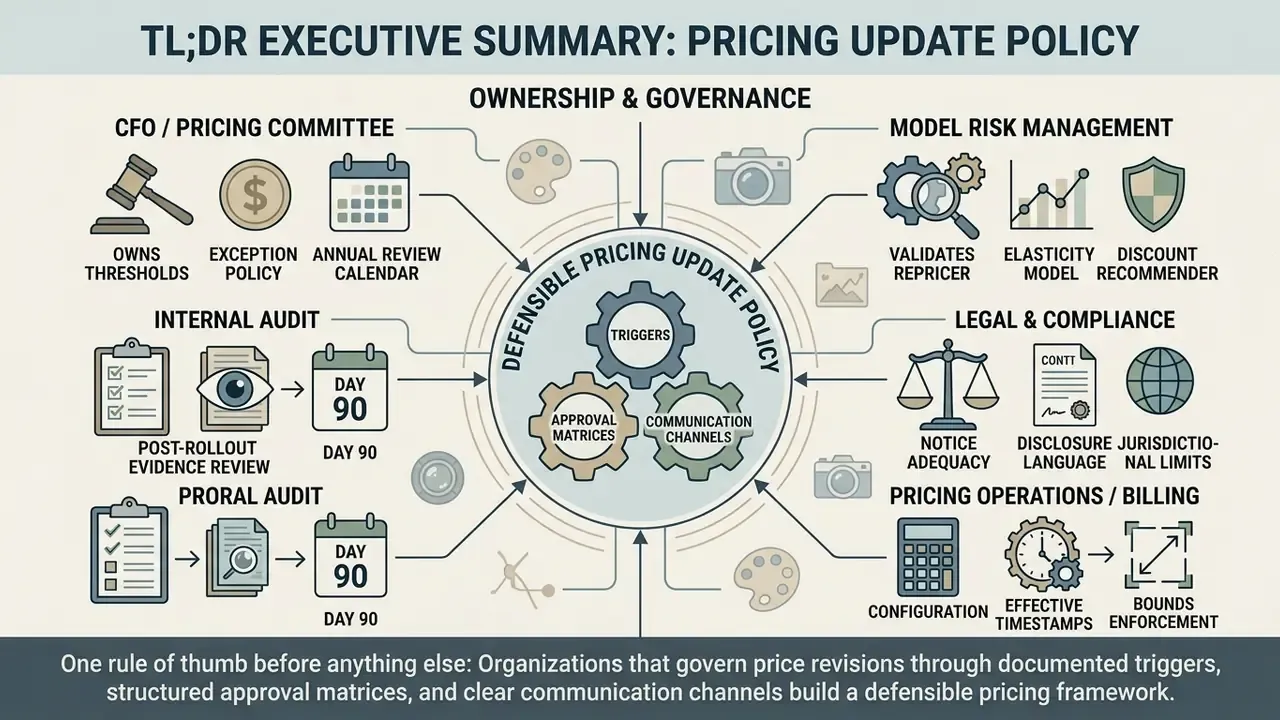
TL;DR Executive Summary for C-Level Readers
- Governance beats intuition.A documented policy defines triggers, delegation of authority thresholds, mandatory notice windows (30/60/90 days), audit logging, and exception handling. Without it, sales discounts and unpassed cost increases silently compress gross margin. Silently is the operative word.
- Transparency is a retention instrument, not a courtesy.A field experiment with a subscription provider found that market-based explanations for price increases cut contract termination by 29.5% versus no justification, while vague reasons performed no better than silence.
- Automation needs circuit breakers.Dynamic and algorithmic repricing require hardcoded upper price caps (), margin floors (), a Cost Lock Window for procurement inputs, human-in-the-loop override, and, in banks and fintechs, model validation aligned to SR 11-7 / OCC 2011-12 plus fair-lending bias testing.
- Marketplace rules are now a compliance surface.Amazon, Walmart, and comparable platforms algorithmically validate reference prices, multi-pack markups, and shipping fees. A non-substantiated "List Price" costs you the strike-through display, the Featured Offer, or the account.
- Not all customers should be repriced identically.Segment accounts into Core, Opportunistic, Marginal, and Service Drain tiers, then apply differentiated indexation, notice periods, and discount floors. Keep a three-step Plan of Action (POA) ready for enforcement events.
Who Should Own This Document Before You Read Further
What Is a Pricing Update Policy and Why Businesses Need It
Pricing Policy, Pricing Rules, and Pricing Strategy: Key Differences
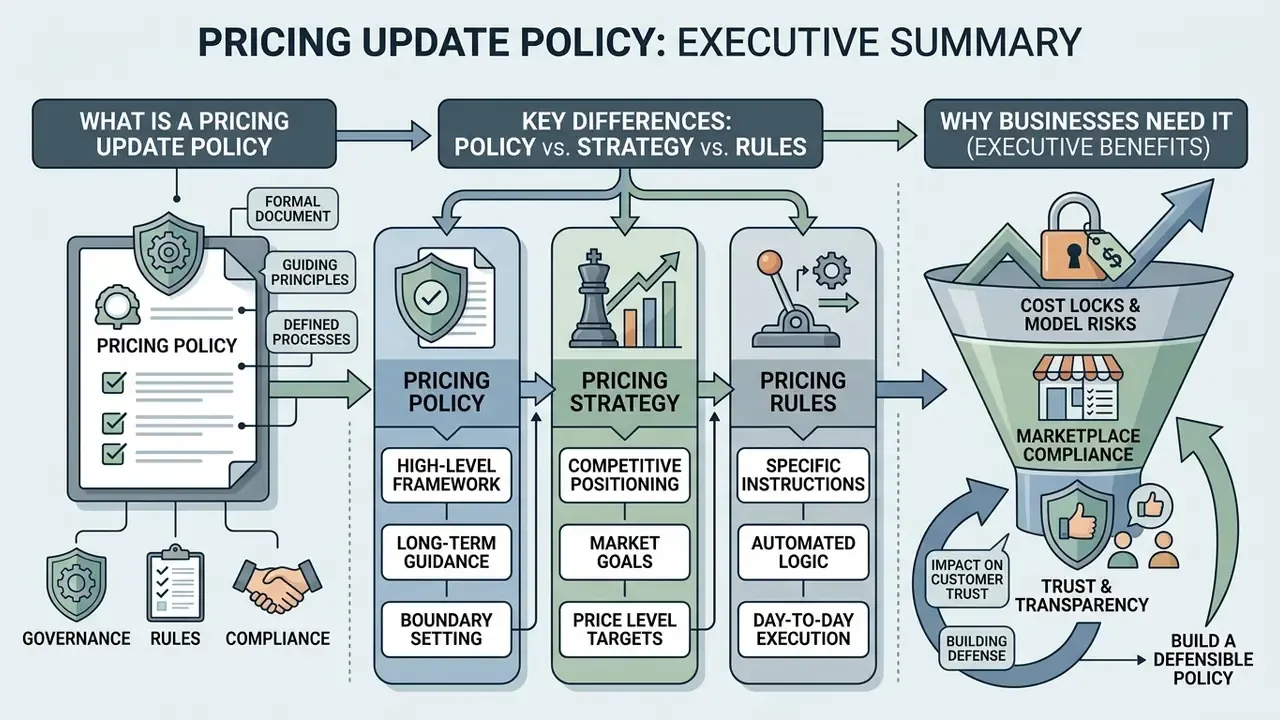
A pricing policy establishes the overarching principles and governance rules for setting and altering prices. A pricing strategy selects the specific market-facing logic (value-based, cost-plus, or competitive positioning) to hit business targets. Pricing rules are the operational constraints and automated algorithms that execute the policy every day. These distinctions sound academic. They stop sounding academic the first time a rep discounts 22% because nobody wrote down the floor.
- Pricing Policy the corporate governance framework defining who can authorize a price change, what notice periods are mandatory, and what audit trails must be recorded.
- Pricing Strategy the long-term commercial positioning method chosen to capture market share or maximize margin, such as penetration pricing, premium value pricing, or dynamic yield management.
- Pricing Rules the discrete execution conditions, such as automated margin floor alerts, maximum allowable discount thresholds by sales tier, or currency conversion refresh rates.
| Layer | Question It Answers | Owner | Change Frequency |
|---|---|---|---|
| Policy | Who may change prices, under what evidence, with what notice and audit trail? | CFO / Pricing Committee / Compliance | Annual review |
| Strategy | What market logic do we price against: cost, value, or competition? | CRO / Product and Commercial leadership | Annual to biennial |
| Rules | What is the executable price, discount floor, and cap for this SKU or account today? | Pricing Ops / Revenue Ops / Billing | Continuous |
A worked example makes the hierarchy concrete. Take a mid-market financial software provider facing a 12% increase in cloud infrastructure costs. The firm's pricing strategy targets premium value positioning. The pricing policy requires that any annual subscription adjustment above 5% gets CFO sign-off, a documented cost-benefit rationale, and 60 days of advance notice to existing account holders. The operational pricing rules then recalculate the renewal price automatically at term expiration, so sales representatives cannot quietly override the baseline rate without a formal exception.
How Transparent Pricing Changes Impact Customer Trust
Transparent pricing changes preserve customer trust by giving a clear, verifiable rationale for adjustments and avoiding unannounced billing increases that drive churn. Research keeps pointing at the same finding: churn during price updates is driven less by the absolute increase and more by procedural opacity and perceived unfairness.
«Consumers' perception of transaction equity and their understanding of pricing policy contribute roughly equally to perceived price fairness, while violation of the equality principle has the strongest effect on perceived unfairness.»
In a large-scale field experiment with a subscription storage provider, researchers tracked attrition after price increases. Transparent market-based explanations reduced contract termination by 29.5% against a no-justification baseline. Generic or vague explanations, meanwhile, performed no better than saying nothing at all. That second result is the one most communication teams underweight.
«Market-based justifications for price increases reduced customer churn by 29.5% versus a no-explanation control condition, regardless of how specific the wording was.»
Adjacent research reinforces the mechanism. Voluntary cost transparency increased purchase interest by more than 20% in controlled studies (Mohan, Buell & John, Marketing Science, 2020), and a large European online retailer that published price-history charts observed no overall sales damage while relationship quality improved (Crestini et al., EMAC Proceedings, 2023). Communicating adjustments through standardized, logical rules removes billing surprises, and removing surprises is most of retention work.
EXPERT COMMENTARY | E-E-A-T "Unified price-review rules reduce commercial friction and account churn because they replace unstructured internal debate with documented triggers. When fee structures, escalations, and modification schedules are established in advance, customers view price adjustments as routine contract governance rather than arbitrary value extraction."
- Jochen Wirtz, Author of 'Pricing Services and Revenue Management' (2021)
Practitioner guidance lands in the same place. A repeatable review process "helps you avoid freeform debates" by documenting what was reviewed, what was decided, and why, with churn tracked as a baseline pricing metric (Stripe, Pricing Review Framework, 2025). Calendarized reviews, documented fences, an approval matrix, and a dedicated price-related churn KPI: these are the operational bridge between transparency research and actual retention outcomes.
What Requirements Should a Pricing Update Policy Include
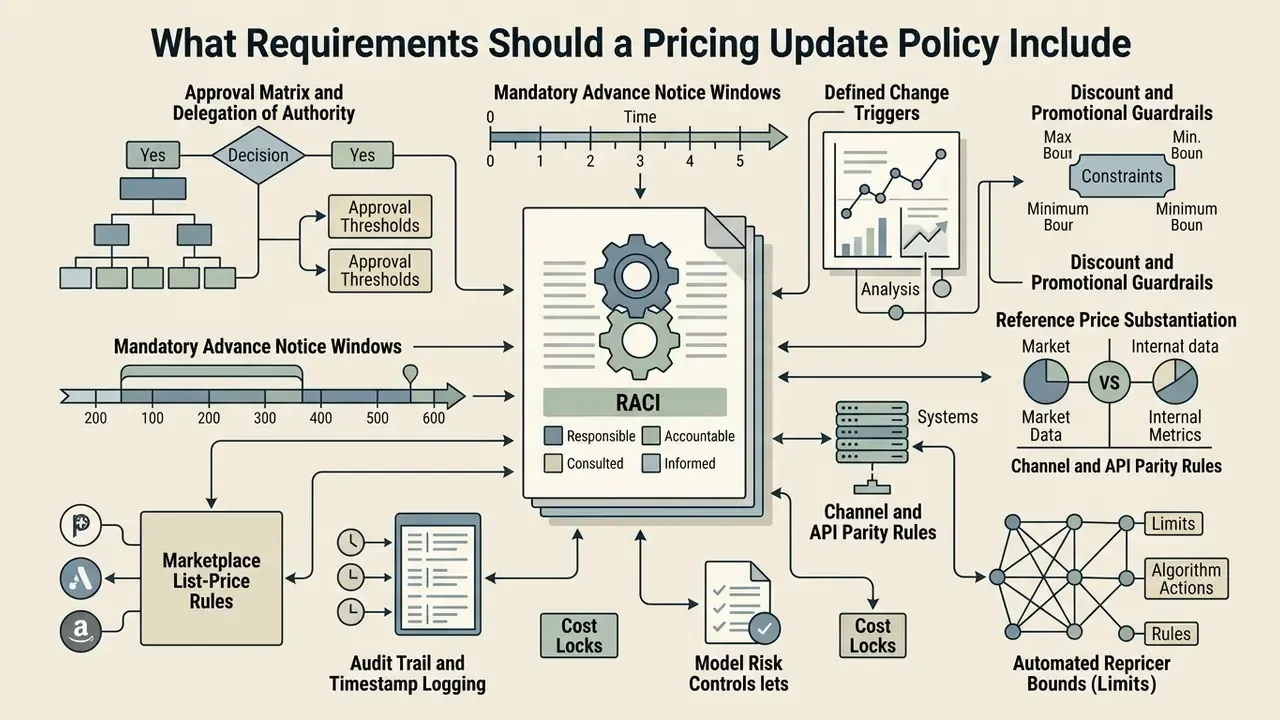
A comprehensive pricing update policy requirements document must specify decision rights, approval matrices, mandatory advance notice windows, audit logging rules, marketplace compliance guardrails, and exception handling protocols. To keep operational control, the policy should delineate roles across sales, finance, customer success, model risk, and executive leadership using a formal RACI (Responsible, Accountable, Consulted, Informed) matrix.
Price-change control records should capture request context, impact analysis, policy mapping, named approvers with timestamps, and copies of external communications (FitGap, price-change governance and auditability guidance, 2026). Public-sector change-control practice states the same requirement in stricter form: written documentation for each change, a detailed pricing basis, and pre-established rates or contract terms (Washington State Auditor, Change Order Best Practices, 2023).
Multimedia block: audit checklist. Render as a semantic text list, fully present in the DOM, no image substitution.
Pricing Update Policy Audit and Verification Checklist. Verify that your organization's policy contains all mandatory governance and compliance controls before implementation:
- Defined change triggers explicit criteria for initiating price reviews (annual CPI indexing, 8%+ input cost shift, competitive repositioning).
- Approval matrix and delegation of authority tiered signature authority mapped to contract volume, discount depth, and margin impact.
- Mandatory advance notice windows contractual notice terms (30 days for monthly B2C/SaaS, 60 to 90 days for B2B enterprise agreements).
- Discount and promotional guardrails pre-approved discount floors, maximum promotional durations, stacking restrictions.
- Reference price substantiation evidence rules for List Price, "Was" price, and strike-through displays across marketplaces and owned channels.
- Channel and API parity rules controls preventing price divergence across direct sales, digital portals, and automated reseller feeds.
- Automated repricer bounds hardcoded / limits, Cost Lock Window, and a named kill-switch owner.
- Audit trail and timestamp logging rationale, financial impact analysis, approver ID, and effective timestamps logged in enterprise CRM/ERP systems.
- Exception and dispute escalation workflow formal protocol for enterprise contract exceptions, customer price pushback, and platform enforcement events (POA).
- Model risk validation independent validation, bias testing, and documentation for any algorithmic pricing model, aligned to SR 11-7 / OCC 2011-12 where applicable.
Marketplace Fair Pricing and Strike-Through Rules (Amazon, Walmart, E-commerce)
| Compliance Requirement | Marketplace / E-commerce Retail | B2B Enterprise SaaS |
|---|---|---|
| Reference price evidence | Mandatory: verifiable sales history or third-party retailer proof for List/Was price | Not applicable; discounts governed by contract and order form |
| Advance notice of increase | Effectively immediate; governed by platform display rules | 30 days (monthly), 60 to 90 days (annual/enterprise) |
| Anti-gouging monitoring | Automated, algorithmic, cross-platform price comparison | Contractual caps (CPI-U indexing, fixed percentage ceilings) |
| Shipping / ancillary fees | Must reflect carrier plus handling reality; inflation is a violation | Overages and usage fees must be disclosed in the rate card |
| Bundle / multi-pack pricing | Per-unit price must not exceed single-unit price | Tiered volume pricing expected to improve with commitment |
| Enforcement consequence | Suppression, Buy Box loss, FBM shipping block, account suspension | Contract dispute, credit note, renewal loss, procurement escalation |
| Remediation instrument | Plan of Action (POA) submitted to platform | Amendment, true-up credit, executive escalation memo |
Teams selling creative-software licences, template packs, or asset bundles across marketplaces face the same reference-price scrutiny as physical goods sellers. Category benchmarks, including those in the Canva AI Generator overview, help substantiate "typical price" claims with third-party evidence rather than internal assertion.
Price Update Conditions for Products and Services
Conditions for price changes differ fundamentally between physical products and digital services or SaaS subscriptions, because the cost dynamics and contract structures differ. For physical products, adjustments track raw material costs, freight tariffs, and supply chain lead times. In digital services, they track infrastructure scaling costs, feature additions, regulatory compliance overhead, and labor.
| Dimension | Physical Goods (Products) | Digital Services and SaaS |
|---|---|---|
| Primary cost drivers | Bill of materials (BOM), freight, warehousing, supply chain tariffs | Cloud compute, API usage, engineering overhead, regulatory compliance |
| Contractual price fixing | Often fixed per purchase order or seasonal catalog cycle | Subscription term locking; fixed during active term, adjustable on renewal |
| Regulatory constraints | Public price displays, statutory 30-day prior price rules for discounts (EU Price Indication Directive) | Contractual advance notice rules (30/60/90 days), automatic renewal disclosure laws |
| Price adjustment mechanics | Surcharges, list price catalog updates, quantity tier adjustments | Indexation clauses (CPI-U), plan tiering changes, usage-based consumption updates |
| Enforcement surface | Marketplace fair-pricing algorithms, consumer protection authorities | Contractual dispute, procurement escalation, renewal churn |
Block A: physical goods and regulated categories. Regulatory frameworks impose rigid display and fixing standards. Under Russian Federation newspaper subscription rules, for instance, the subscription price is statutory-fixed for the entire subscription period (Government Decree on Subscriptions, effective 1 September 2025). A useful reminder that in some regulated categories a mid-period increase is simply unlawful, whatever the cost curve did. Distribution and wholesale operations then layer supplier rebates, freight surcharges, and quantity-tier rules on top of the catalog price.
Block B: digital services, SaaS, and AI infrastructure. US SaaS municipal and enterprise contracts frequently embed automatic annual escalation clauses tied to CPI-U growth or capped percentage increases, for example "the greater of 5% or CPI-U," to maintain baseline margins without renegotiating full terms (California municipal SaaS contracting standards). Public-sector SaaS contracts commonly require 30 days' prior notice of any increase before the end of the current term (Montana state SaaS contract terms). For AI and API-metered services, three additional variables belong in the policy: token or inference unit cost, model version deprecation schedules, and vendor concentration risk. Where a single upstream provider can reprice tokens unilaterally, the buyer's total cost of ownership shifts with no internal decision at all. Contracts should therefore include index caps, notice floors, and a documented substitution path. Procurement teams pricing AI workloads can benchmark unit economics against implementation guides such as the Google Veo implementation and API cost guide and the AI Video API Pricing Guide.
Review Cadences, Customer Notifications, and Team Responsibilities
Predictable review cadences and advance notice timelines let price adjustments run systematically without wrecking renewal cycles. B2B enterprise contracts typically require a 60 to 90 day notification window before renewal, giving clients time to move budget. Monthly subscription software and B2C services generally use a 30-day window. Sector-specific rules override those defaults in both directions: five business days in some energy retail rules, 25 days for certain utility terms, and up to six months for specified public-service price changes.
Operational responsibilities should be assigned before the first letter goes out:
- Executive leadership / Pricing Committeeholds final approval authority for macro list price revisions, annual strategy updates, and high-value contract exceptions.
- Finance and Model Risk Managementruns cost structure analysis, elasticity modeling, gross margin verification, and independent validation of pricing algorithms before proposals move forward.
- Sales and Account Managementcommunicates updated schedules, manages renewal conversations, and logs client feedback during the notice window.
- Billing and Operationsconfigures rate cards in ERP and billing engines, executes system updates, and keeps complete audit records of every modification.
- Legal and Complianceconfirms notice adequacy, disclosure language, marketplace policy alignment, and jurisdictional constraints on personalization.
Illustrative 90-day enterprise notice sequence (composite operating model, not a single named client). On Day 0, executive leadership approves a 7% list price increase supported by infrastructure enhancement evidence. On Day 1, Account Management produces the churn-risk list. On Day 7, formal written notices reach client procurement teams. Reminder outreach follows on Day 60, final billing confirmations go out on Day 83, and the new price takes effect on Day 90. In documented pricing-governance practice, this cadence is associated with renewal rates in the low-to-mid 90% range and net ARR expansion. Validate that figure against your own cohort data before treating it as a benchmark; it is a shape, not a promise.
Customer Segmentation Strategy for Price Adjustment Rollouts
Price updates should not land identically on every account. Frontline teams that see only cost of goods sold and gross margin lack the context to defend a number, so the policy should map adjustments to a four-tier customer matrix and attach explicit pricing rules to each tier:
| Segment | Profile | Indexation Rule | Notice and Motion |
|---|---|---|---|
| Core accounts | High margin, high loyalty, strategic reference value | Minimal CPI indexing; protected discount floor | 90+ days notice, executive-led value review before the letter |
| Opportunistic accounts | Low commitment, transactional, price-shopping | Full list price update at renewal; strict discount floors | Standard 30 to 60 days, no negotiated exceptions below floor |
| Marginal accounts | Low volume, standard support consumption | Automated increase via system notification | Automated notice; migrate to standardized self-service tiers |
| Service drain accounts | High support cost, low or negative gross margin | Aggressive adjustment (15%+) to restore baseline margin | Structured conversation with an offboarding path if declined |
Segmentation turns a blunt across-the-board increase into a margin-repair instrument. Revenue gets recovered where recovery is cheapest, and relationship capital gets spent only where lifetime value justifies the spend.
What Data Should Drive Price Update Decisions
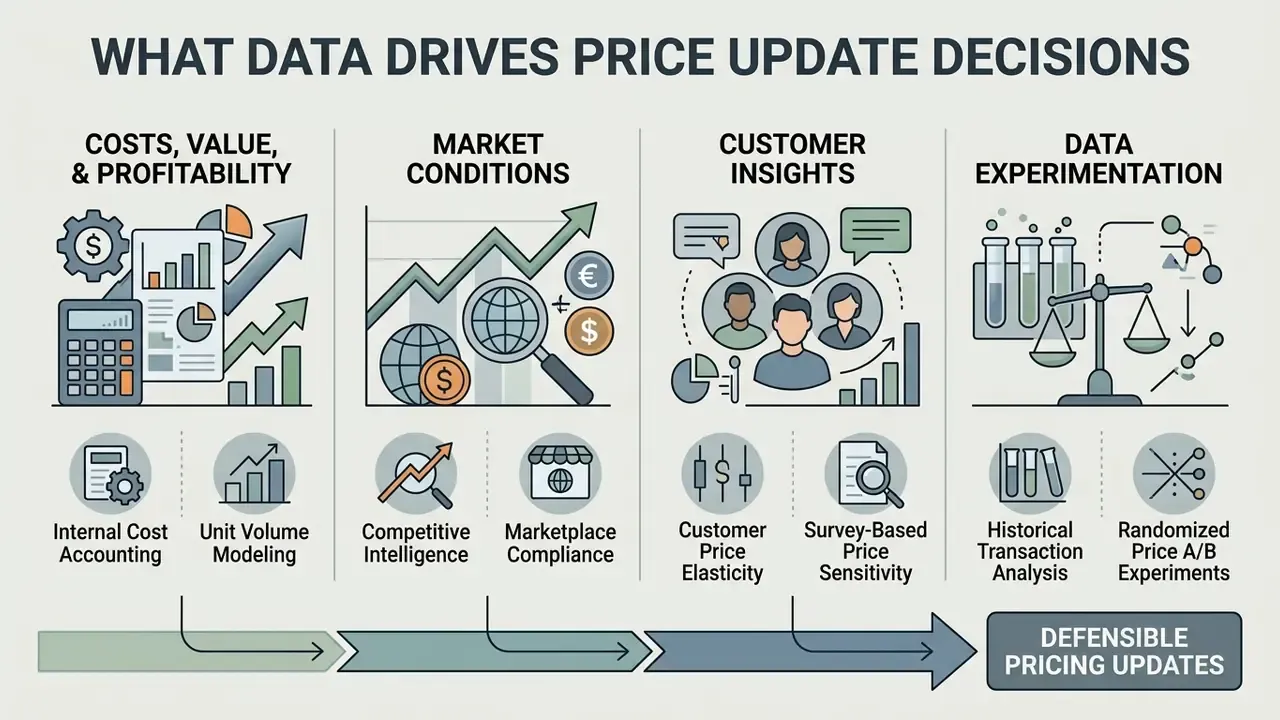
Price update decisions must rest on empirical data: internal cost accounting, competitive intelligence, customer price elasticity, and unit volume modeling. Intuition and isolated sales feedback tend to produce mispriced offerings that either surrender gross margin or trigger avoidable attrition.
Multimedia block: comparative table. Render as a semantic table with a caption; a short textual summary follows the table.
Table: Data Factors Driving Price Revision Decisions
| Factor Category | Primary Data Indicators | Operational Impact on Price Adjustment | Fairness and Retention Risk |
|---|---|---|---|
| Operating cost analysis | Direct labor, cloud hosting per user, API token costs, raw material COGS, compliance and control costs | Sets the absolute minimum price floor needed to preserve target gross margin | Low when tied to verifiable input cost inflation |
| Market and competitive landscape | Competitor list prices, cross-price elasticity, market category growth rate | Determines external positioning and benchmark boundaries | Medium; spikes above market peers require value justification |
| Customer perceived value | Feature usage analytics, willingness-to-pay (WTP) surveys, Net Promoter Score | Establishes the maximum ceiling for value-capture tiering | Low when paired with demonstrable feature additions |
| Sales volume and elasticity | Own-price elasticity of demand, historical conversion rates, unit sales volume | Models volume drop-off against margin expansion to verify net revenue gain | High if elasticity is miscalculated, causing severe volume contraction |
Summary. Cost data defines the floor you cannot compromise. Perceived customer value defines the ceiling. Market dynamics and competitor offers set the acceptable range between them. A price update is economically viable only when projected margin expansion exceeds the expected loss in unit volume implied by own-price elasticity modeling.
Costs, Value, and Profitability in Price Reviews
Price calibration means examining how direct operating costs, perceived value, and gross margin targets interact. A standard corporate calibration framework uses three validation stages, with control and compliance costs explicitly capitalized into the floor instead of being absorbed quietly by operations:
First, direct variable costs, overhead allocations, and the cost of running controls (monitoring, validation, audit, notice logistics) establish the absolute cost floor. Second, perceived value gets evaluated using economic value estimation (EVE), measuring the net monetary benefit delivered relative to alternatives: net value equals perceived benefits minus all perceived outlays. Third, target gross margins are applied across projected sales volumes.
Research from the Higher School of Economics notes that formal price setting requires aligning cost calculation procedures with economic value assessments and target return metrics (HSE Pricing Governance Guidelines, 2025).
«Mean pricing was perceived as fair by 43% of participants and square equity by 36%, whereas value-based and cost-based pricing were judged fair by only 20% and 19% respectively.»
The implication is uncomfortable, and useful. The pricing logic that maximizes captured value is not the logic customers instinctively read as fairest. That gap is precisely what the communication layer of a pricing update policy has to close. When input costs rise, leaning purely on cost-plus markup without checking customer value pushes buyers toward cheaper competitors. Go the other way, capturing extra value while ignoring variable cost scaling, and service delivery quality starts slipping.
Market Conditions, Competitive Prices, and Customer Insights
Analyzing market conditions and competitive benchmarks keeps a pricing policy tethered to industry reality. Demand elasticity measures how quantity demanded shifts against a price modification:
Consumer-facing categories such as AI voice generators and free photo editors show elasticity extremes in practice. Freemium anchors compress willingness to pay at the entry tier, while professional export and licensing features stay comparatively inelastic.
To estimate elasticity with reasonable confidence, companies use three main methods:
Cross-price elasticity, the percentage change in demand for your product given a 1% change in a competitor's price (USDA technical bulletin definition), tells you how much of a rival's move you actually need to match. Household-panel studies estimate own-price and expenditure elasticities from purchase data using expenditure as an income proxy (NIESR, 2022); differences between those estimates and regulatory ones are methodological, not contradictory. One cautionary counter-example is worth keeping in the policy appendix. Firms that infer elasticity from a single promotional period systematically overestimate price sensitivity, because promotional lift bundles in stockpiling and category-switching that never repeat at a permanent price point. A permanent increase calibrated on that inflated elasticity leaves margin uncollected, sometimes for years.
When evaluating developer tool deployment or API integration costs, engineering teams should model consumption volume against documented tiering structures. Consumer-facing teams can sanity-check perceived-value ceilings against category comparisons such as the best AI art generators and free AI video generators.
How to Choose a Pricing Strategy for Price Updates
Selecting a pricing update strategy depends on product differentiation, market concentration, regulatory constraints, and long-term margin objectives. Businesses choose between cost-based, value-based, competitive, or dynamic pricing models, and then, crucially, write down the operational guardrails for each.
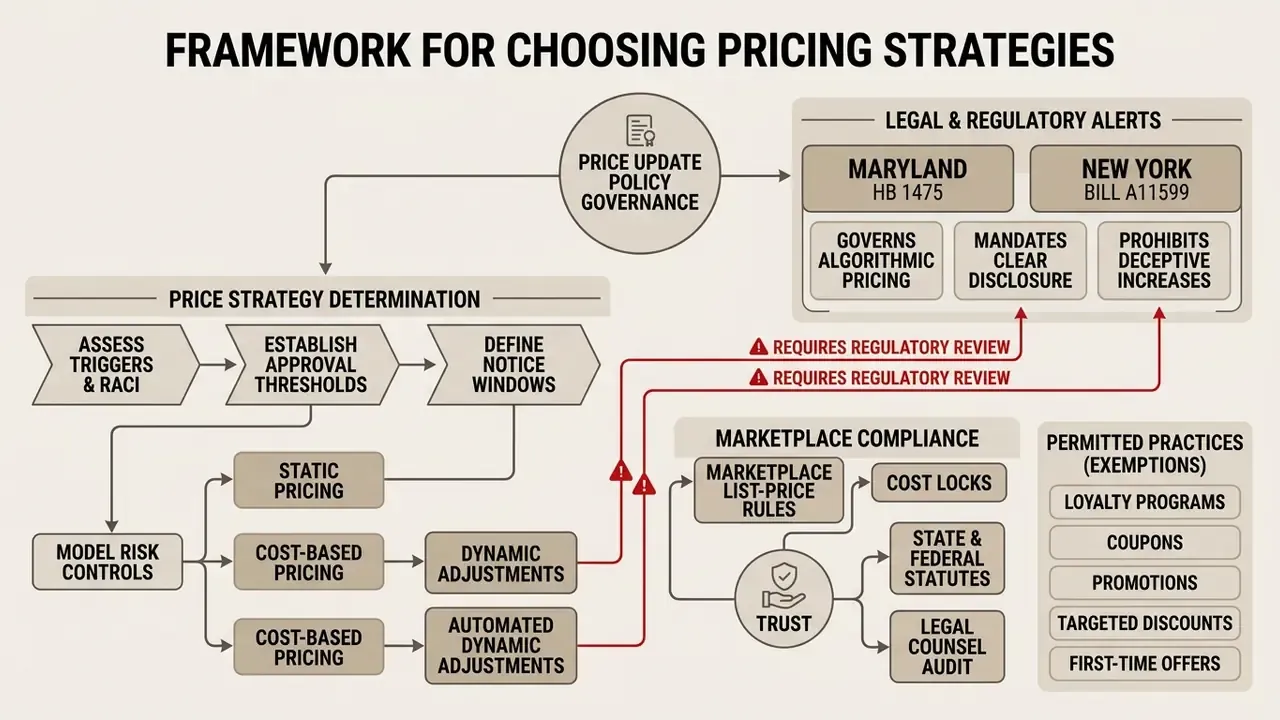
Disclaimer. This material is general in nature and does not replace advice from qualified legal counsel. Pricing disclosure obligations, notice periods, and restrictions on algorithmic or personalized pricing vary by jurisdiction, sector, and contract type, and proposed legislation may change before enactment. Validate every rule in this guide against current statutes and your own contractual terms before implementation.
When to Apply Cost-Based, Value-Based, and Competitive Pricing
The choice among cost-based, value-based, and competitive pricing frameworks governs how a firm executes price updates over time.
- Cost-based pricing. Updates tie directly to cost shifts plus a fixed markup percentage (). Best for standardized commodity goods, distribution wholesale, and cost-pass-through contracts. Pros: simple to calculate and easy to defend to clients. Cons: ignores willingness to pay and leaves value on the table.
- Value-based pricing. Updates calibrate to the economic value and efficiency gains generated for the customer. Optimal for differentiated B2B software, specialized consulting, and proprietary hardware. Pros: maximizes long-term gross margins and aligns price with utility. Cons: demands continuous market research and non-trivial segmentation. Competitive categories such as animation makers show how feature depth and licensing clarity, not unit cost, set the ceiling.
- Competitive pricing. Updates mirror benchmark shifts and competitor moves. Necessary in high-density, low-differentiation markets. Pros: protects share against peers. Cons: invites price wars and industry-wide margin compression.
- Marginal cost pricing. Price equals marginal supply cost, welfare-maximizing in regulated utility contexts but destructive of margin in commercial settings unless used tactically for capacity fill.
- Peak load pricing. Higher prices in constrained peak periods, lower off-peak prices, with peak users bearing capacity plus energy cost. This is the legitimate, disclosable form of demand-based variation.
Two lifecycle-linked update rules belong in the policy document:
- Penetration price adjustments. Formalize scheduled step-ups (for example, +10% every six months) as market-share milestones are hit, moving customers from acquisition rates toward long-term target margins. Publish the escalation path at signature so the increase is expected rather than discovered.
- Price skimming reductions. Define the volume and margin thresholds that trigger reductions, expanding capture into price-sensitive lower tiers once premium adopter demand saturates. Pair each reduction with a tier redesign so early adopters do not read it as retroactive unfairness.
Multimedia block: strategy matrix. Render as a semantic table with a caption.
Table: Strategic Pricing Framework Comparison for Price Revisions
| Strategy Framework | Optimal Business Context | Impact on Long-Term Gross Margin | Customer Acceptance |
|---|---|---|---|
| Cost-plus markup | Commodities, logistics, physical manufacturing, raw material supply | Fixed and static; inflation-protected but capped on upside | High; easily understood when input cost data is transparent |
| Value-based | Enterprise SaaS, proprietary AI tools, specialized healthcare, professional services | High expansion; captures more margin as utility increases | Moderate; accepted when ROI and product enhancements are clear |
| Competitive parity | E-commerce retail, standardized consumer goods, saturated SaaS categories | Compressed; constrained by competitor floors and matching | High; aligns with prevailing market expectations |
| Dynamic / peak load | Travel, energy, logistics capacity, ride-hailing, event-driven demand | High short-term yield; erosion risk if trust breaks | Low to moderate; acceptance depends entirely on disclosure quality |
Dynamic Pricing, Cost Locks, and Model Risk Safeguards
Dynamic pricing uses algorithms to adjust prices continuously against real-time demand, inventory levels, competitor activity, or behavioral signals. It optimizes short-term yield in travel, energy, and ride-hailing. Unconstrained, it also introduces severe risks to brand trust and legal compliance, and those risks arrive faster than the yield.
Empirical work on dynamic pricing complexity shows that as the number of criteria used to vary prices grows, perceptions of unfairness and manipulation rise sharply.
«As the number of price-differentiation criteria grows, up to dynamic pricing with many opaque parameters, consumers perceive price differences as increasingly complex and unfair, and all differentiation types evoke a sense of manipulation.»
When customers discover they paid noticeably more than peers with no clear logical justification, such as peak load timing or a service tier difference, repeat purchase intent drops.
«Framing tactics that emphasize differences in transaction contexts increase perceived price fairness, trust, and repurchase intention even when the price received is objectively disadvantageous.»
«Consumers perceive individual-level prices as less fair than segment-level prices, and location-based pricing as less fair than purchase-history-based pricing, with privacy concern amplifying these effects.» — Priester, Robbert & Roth, A special price just for you: effects of personalized dynamic pricing on consumer fairness perceptions, Journal of Revenue and Pricing Management (2020). https://link.springer.com/article/10.1057/s41272-019-00224-z
Operational Safeguard: Implementing a Fixed "Cost Lock" Window
Many distributors and B2B sellers compute customer price straight from cost of goods sold. Because procurement costs move for reasons that have nothing to do with market value (a bulk discount, a freight anomaly, a one-off supplier promotion), that formula produces unstable customer prices and quietly hands earned savings to buyers.
To stop this automated chaos, the policy should enforce a Cost Lock Window of 30, 60, or 90 days. During the window, internal COGS inputs are frozen inside the pricing calculator. Fluctuations in raw material or supplier costs within the locked period go into a variance buffer and get reviewed at the next calendarized evaluation cycle. Revisit the lock at expiry and decide whether an adjustment is warranted. What you get: price predictability for buyers, protected purchasing gains for the seller, and far fewer awkward calls about why yesterday's quote no longer holds.
Model Risk Management for Algorithmic Pricing (Banks, Fintechs, Regulated Lenders)
For banks, lenders, and mature fintechs, an automated pricing engine is a model. It must be governed as one. Extend the enterprise model risk management (MRM) framework, as articulated in Federal Reserve SR 11-7 and OCC Bulletin 2011-12, to pricing update engines:
- Independent validation. Pricing models are validated by a function organizationally separate from the business owner, covering conceptual soundness, input data quality, outcome analysis, and benchmarking against a challenger model.
- Bias and disparate impact testing. Test pricing outputs for proxy discrimination and disparate impact across protected classes, consistent with fair-lending expectations. Document the methodology, the thresholds, and the remediation triggers.
- Model inventory and ownership. Register every repricer, elasticity model, discount recommender, and LLM-assisted pricing assistant in the model inventory, with a named owner, validation date, and next review date. Unregistered shadow AI spreadsheets and prompts used to set or approve prices are a governance breach, not a productivity hack.
- Ongoing monitoring. Maintain a documented monitoring framework with adequate data infrastructure, override logging, and performance thresholds. European supervisory guidance takes the same line: pricing frameworks must be documented, owned by a governance body such as a pricing committee, linked to risk appetite and product characteristics, and kept under robust ongoing monitoring (EBA Guidelines on loan origination and monitoring, 2020; EBA Guidelines on product oversight and governance, consolidated text).
- Change control. Any change to model logic, feature set, or bounds follows the same approval, documentation, and audit-trail rules as a manual list price revision. No exceptions for "small" parameter tweaks; those are where drift hides.
- Control cost accounting. Validation, monitoring, and disclosure cost real money per unit. Put that cost in the price floor formula instead of treating governance as free overhead.
Process for Implementing and Auditing a Pricing Update Policy
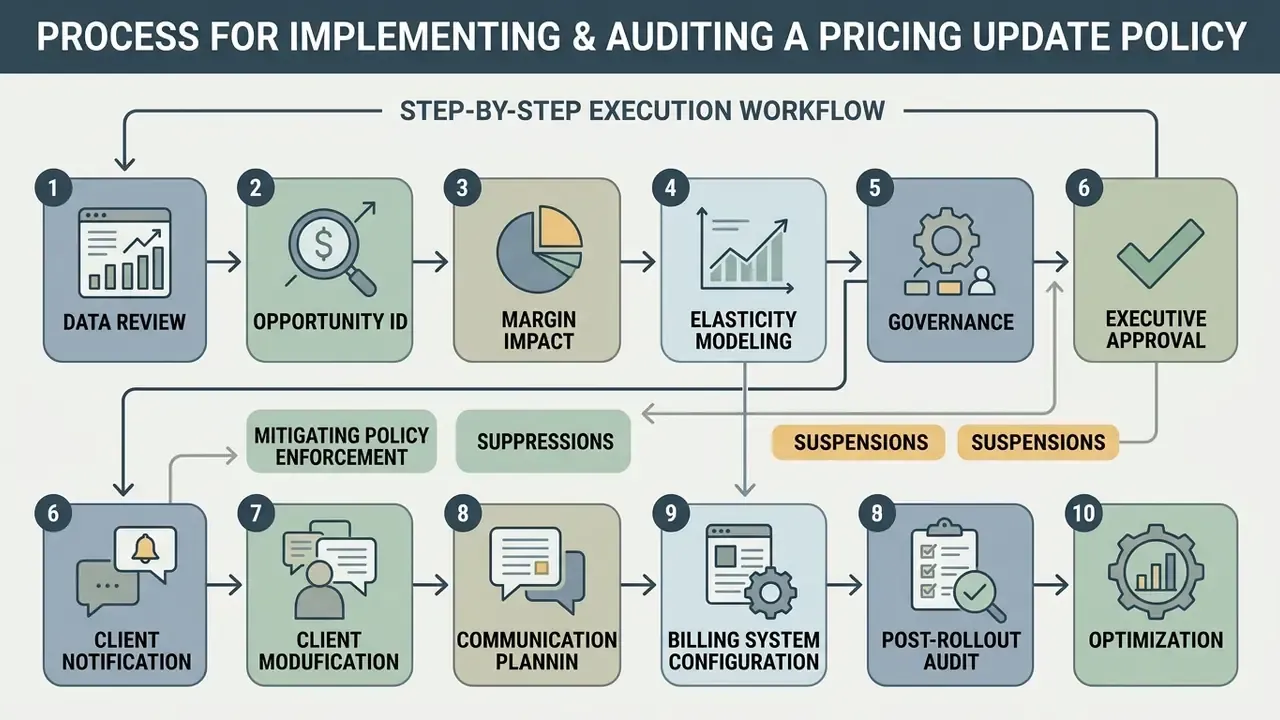
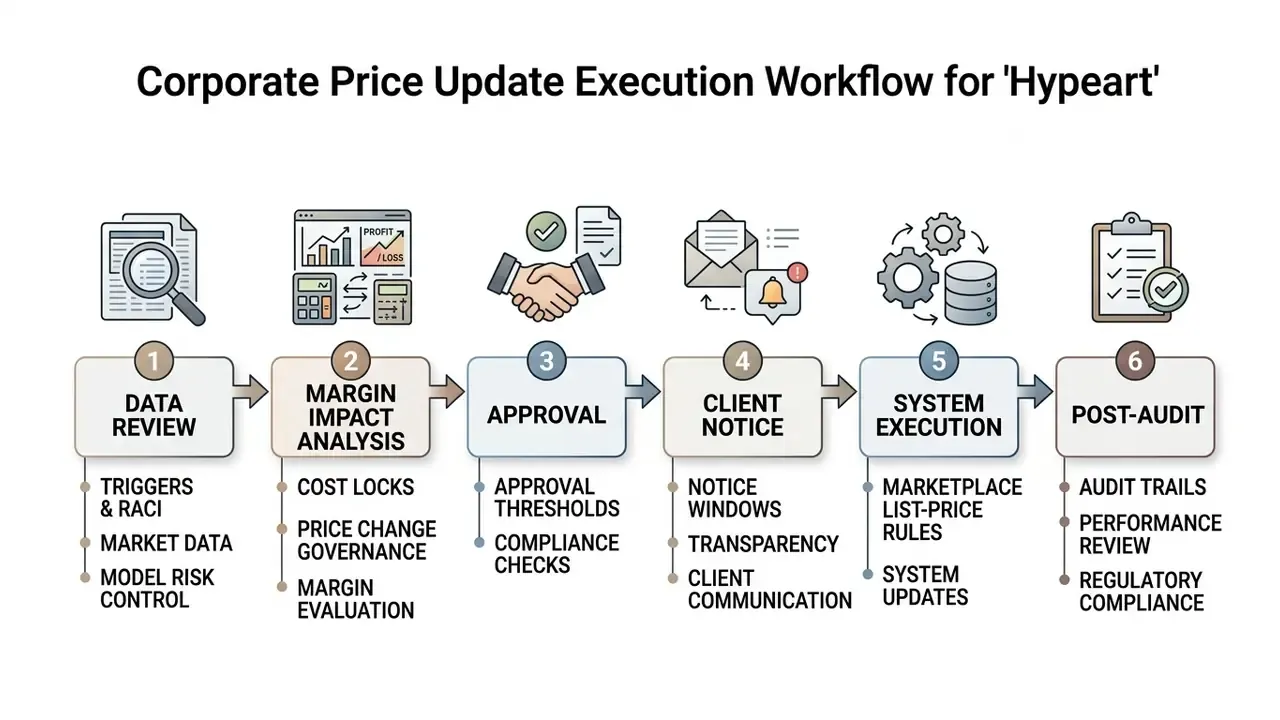
Implementing a pricing update policy needs a structured operational process, moving from data analysis through executive approval, client notification, system execution, and post-rollout audit.
Multimedia block: process flow. Render the stages as a numbered text list in the DOM alongside any diagram; diagram alt text should include the phrase "pricing update policy".
| # | Stage | Primary Owner | Required Artifact | Gate to Proceed |
|---|---|---|---|---|
| 1 | Data review and opportunity identification | Finance / Pricing Ops | Cost, inflation, competitor and usage analysis | Documented rationale filed |
| 2 | Margin impact and elasticity modelling | Finance / Model Risk | Net revenue and churn simulation | Model validated, assumptions logged |
| 3 | Governance and approval | Pricing Committee / CFO | Approval record with named approver and timestamp | Threshold-appropriate signature obtained |
| 4 | Customer notification | Sales / Account Management | Written notice per contractual lead time | Notices dispatched and logged |
| 5 | System execution | Billing and Pricing Ops | ERP / CPQ / repricer configuration with effective date | Parity and bounds checks passed |
| 6 | Post-rollout audit | Internal Audit / Finance | 90-day KPI and churn report | Findings closed or escalated |
Step-by-Step Execution Workflow
- Data review and opportunity identification.Analyze direct costs, inflation indices, competitor movements, and usage analytics to shape a preliminary revision proposal.
- Margin impact and elasticity modeling.Run financial simulations estimating net revenue change, with projected churn derived from elasticity calculations.
- Governance and executive approval.Submit the proposal to the CFO or Pricing Committee per the approval matrix and delegation-of-authority thresholds.
- Client notification and communication.Issue formal written notices inside the required contractual lead times (30, 60, or 90 days), differentiated by customer segment.
- Billing system configuration.Update billing rules, ERP product catalogs, marketplace feeds, and sales CPQ (Configure, Price, Quote) engines with effective timestamps and repricer bounds.
- Post-rollout audit and optimization.Track renewal rates, revenue realization, sales feedback, marketplace health metrics, and account churn across a 90-day window from the effective date.
Mitigating Policy Enforcement, Suppressions, and Suspensions (Plan of Action Framework)
When automated repricing tools or manual errors breach platform or statutory guardrails, triggering price-gouging warnings, strike-through removal, Buy Box loss, shipping-option blocks, or account suspension, the operations team should execute a three-part corrective Plan of Action within 24 hours. Enforcement is algorithmic, frequently arrives with no warning, and rarely identifies the offending SKU for you. Speed and evidence discipline decide the outcome.
- Root cause identification. Audit ERP price adjustment logs, repricer algorithm bounds, freight and handling tables, and recent bundle or shipping changes to document the exact system failure, for example an automated repricer surge during a supply disruption or a stock-out. Pull business reports to isolate anomalies by ASIN/SKU and date.
- Immediate remediation. Revert flagged SKU prices to the prior verified baseline, reinstate missing Featured Offers, correct multi-pack per-unit pricing, or fix shipping fee schedules in the billing engine. Preserve screenshots and pricing history as evidence before anything changes again.
- Preventative safeguards. Hardcode strict upper-bound caps () and mandatory human approval triggers in the CPQ/ERP or repricer for any shift above 15%. Add stock-out price freezes, cost-lock enforcement, and a weekly parity report.
POA submission discipline. Write it fact-based, specific, and non-defensive. State what happened and why, what was fixed and when, and what structural control now prevents recurrence. Include affected identifiers, invoices, cost breakdowns, pricing-history screenshots, and market comparisons. Never attribute fault to the platform. Submit through the account health or performance notification channel, reread the appeal for vague sentences before sending, and follow up professionally if nothing arrives within 48 to 72 hours.
Escalation ladder for B2B disputes. Where the enforcement event is contractual rather than platform-driven, say a customer disputes an increase or invokes a cap, the equivalent three-step response applies: reconstruct the contractual basis, issue a corrective credit or amendment if the notice was defective, then close the gap in the notice template so the same defect cannot repeat next quarter.
Testing Price Changes and Reviewing Results
Before rolling out major modifications across an entire customer base, run controlled pricing A/B testing or regional pilots. For subscription software and digital services, tests usually go to new sign-ups or isolated geographic markets, which prevents billing inconsistencies inside existing cohorts. Distribution and wholesale operations get the same effect by picking one or two representative pilot branches, applying the new rules there, running what-if margin analyses, and debriefing frontline sellers before general release. Freemium-anchored categories such as free AI video generators show how entry-tier limits shape the price expectations any test has to fight.
Key performance indicators for evaluating a price update test:
- MRR / ARR expansion. Net change in recurring revenue after adjustment.
- Conversion rate shift. Percentage change in visitor-to-paid conversion at the new price point.
- Cohort churn rate. Cancellations measured at 30, 60, and 90 days post-notice, plus MRR churn and downgrade rate.
- Customer lifetime value impact. Long-term net revenue output, calculated as .
- Price-related churn. Cancellations explicitly attributed to price in exit reasons, the single most diagnostic signal for policy calibration.
- Marketplace health. Buy Box share, suppression events, and reference-price validity for e-commerce channels.
Illustrative modelled scenario (not attributed to a named client). A B2B SaaS team tests a 15% increase on an enterprise feature bundle across 20% of new inbound traffic. Front-end lead conversion falls by roughly 3%, while higher ARPU lifts net MRR by a low double-digit percentage with no measurable rise in 90-day account churn. In that shape of result, the financial case supports expanding the new structure across all acquisition channels. Treat the figures as a decision template, meaning the conversion-versus-ARPU trade-off you should measure, not as an industry benchmark. Statistically powered internal data first. Rollout second.
Best Practices for Price Consistency and Optimization
Consistency across multi-channel distribution prevents channel conflict and customer erosion. Enterprise pricing performance guidance published by McKinsey recommends improving visibility into pricing performance, operating one common pricing system across brands, channels, and segments, and empowering a central pricing group that integrates the model without owning every individual decision. Academic modelling of omnichannel retail reaches a compatible conclusion by constraining the same product to the same price across all virtual storefronts (MIT omnichannel pricing model, 2019).
Practices worth institutionalizing:
Organizations evaluating comprehensive media creation software and creative subscription tiers can review detailed cost breakdowns in the AI Video Pricing Guide and workflow-level structures in the YouTube video editor workflow guide to build cost-effective procurement plans.
FAQ
What should we do when inflation spikes mid-contract and our cost lock is still active?
Absorb the variance into the buffer for the remainder of the locked window, document it, and bring it to the next calendarized review. If the shock exceeds the buffer, invoke the contractual extraordinary-cost clause with evidence, index data and supplier notices, and give the longest notice your contract permits. Breaking a published cost lock without documented cause destroys the predictability that made the lock worth having.
What is the minimum acceptable notice period for a price increase?
Thirty days is the practical minimum for monthly and consumer-facing subscriptions. Sixty days is standard for retained and contract customers. Ninety days is the norm for annual B2B agreements with procurement cycles. Sector rules override defaults: some utility and public-service regimes demand materially longer notice, and some regulated subscription categories forbid mid-period changes outright.
Can we personalize prices using customer data?
Only with legal review, explicit disclosure, and exclusion of sensitive attributes and inferred economic status. Loyalty programs, coupons, promotional pricing, and first-time-customer discounts are generally treated differently from individualized price inflation. Research consistently finds individual-level pricing is perceived as less fair than segment-level pricing, so the commercial upside is often smaller than the trust cost.
Our marketplace listing lost its strike-through display. Is that an enforcement action?
Usually it means the reference price could not be substantiated, either because the item never sold at that price on the Featured Offer for a sustained period, or because a long-running promotion reset the computed typical price. Fix the evidence base and display eligibility returns. Treat it as an early warning before harder enforcement lands.
How do we handle a customer who refuses the new price?
Route by segment. Core accounts get an executive value review and, if needed, a phased increase. Opportunistic and marginal accounts get the floor, not a bespoke exception. Service drain accounts get the full adjustment with a graceful offboarding path. Every exception granted outside the matrix must be logged with a rationale and an expiry date.
Who owns the automated repricer?
A named individual with authority to pause it, plus an independent validator who did not build it. If nobody can answer that question in one sentence, the control does not exist.
Technical Glossary and Regulatory Terms
- Article 6a (EU Price Indication Directive) regulatory mandate requiring public price reductions to display the lowest prior price applied during the previous 30 days.
- Own-price elasticity of demand metric measuring the percentage change in quantity demanded resulting from a 1% change in the product's price.
- Cross-price elasticity the percentage change in demand for one product resulting from a 1% change in the price of another.
- RACI matrix responsibility assignment chart mapping roles as Responsible, Accountable, Consulted, or Informed across business workflows.
- Delegation of Authority (DoA) documented financial thresholds determining which role may approve a given price or discount change.
- EVE (Economic Value Estimation) pricing methodology calculating the total monetary value delivered to a customer relative to the next best alternative.
- CPI-U (Consumer Price Index for All Urban Consumers) inflation index frequently used in enterprise contracts to set automated annual escalation limits.
- List price verification evidence process substantiating a displayed reference or "was" price via historical sales at that price or verified third-party retail proof.
- Typical price platform-computed reference price derived from actual sales, promotions included, over a rolling window.
- Price gouging pricing an item materially above prevailing market value, or inflating shipping and bundle prices to the same effect, especially during demand surges.
- Cost lock fixed window (30/60/90 days) during which COGS inputs are frozen in the pricing calculator to stabilize customer-facing prices.
- POA (Plan of Action) three-part remediation document covering root cause, corrective action, and preventative measures, submitted to resolve a platform enforcement event.
- Markup pricing price set as cost plus a percentage markup, commonly expressed as .
- Marginal cost pricing price set equal to marginal supply cost; welfare-maximizing in regulated settings.
- Peak load pricing higher prices during capacity-constrained peak periods and lower off-peak prices, with peak users bearing capacity plus energy cost.
- SR 11-7 / OCC 2011-12 US supervisory guidance on model risk management requiring independent validation, documentation, model inventory, and ongoing monitoring.
- Fair lending / disparate impact testing testing pricing model outputs for proxy discrimination against protected classes, with documented thresholds and remediation.
- Shadow AI unregistered AI tools, prompts, or spreadsheets used in pricing decisions outside the model inventory and change-control process.
- / hardcoded upper and lower bounds constraining automated repricing engines.
Appendix A: Superseded Formulations (Retained for Audit Trail)
- Original unattributed performance claims (superseded)"This structured notice cadence achieved a 94% account renewal rate while successfully expanding annual recurring revenue (ARR)." and "While front-end lead conversion declined by 3.2%, the higher ARPU increased net MRR by 11.4% with zero measurable increase in 90-day account churn." Both now appear as illustrative composite scenarios in the main text with explicit caveats, because no verifiable named-client source is available.
- Original citation without URL (superseded)"Further research on price fairness highlights that a consumer's understanding of procedural fairness contributes equally to perceived fairness as transaction equity (Journal of Revenue and Pricing Management, 2018)." Replaced with the full attribution and link to What is a fair fare? (2018).