Why should a chief risk officer at a US bank care about a method borrowed from clinical science? Because your examiners ask the same question a journal editor asks: show me how you decided.
Executive Summary
- Core pipeline: define a focused PICO/PCC question, register a protocol, run a reproducible multi-source search, screen and extract in duplicate, assess risk of bias, synthesize, rate certainty with GRADE, then report against PRISMA 2020.
- Seven review formats matter: Systematic, Scoping, Rapid, Narrative, Umbrella, Mixed-Methods, and Methodological reviews each answer a different class of question. They also consume radically different resources (weeks versus 6 to 18 months).
- Team governance is non-negotiable: evidence synthesis needs a minimum of three researchers, two independent screeners plus a senior adjudicator.
- Volume never substitutes for validity: pooling many high-risk studies produces a very precise estimate of the wrong effect.
- Governance translation: the architecture behind clinical evidence synthesis maps almost line for line onto AI model validation and model risk management (SR 11-7, NIST AI RMF, ISO/IEC 42001, EU AI Act): protocol, search, appraisal, certainty, audit trail.
- Reporting baseline: PRISMA 2020 (27 items), AMSTAR 2 and ROBIS for review quality, RoB 2 and ROBINS-I for primary studies, GRADE for certainty per outcome.
What this guide covers, in order: definitions, AI governance and model risk mapping, choosing a review type, scope and question frameworks, search, screening and extraction, risk of bias, synthesis and certainty, reporting and updating, common mistakes, decision ownership, audit readiness checklist, FAQ.
What Is Review Methodology and Why Does It Matter?
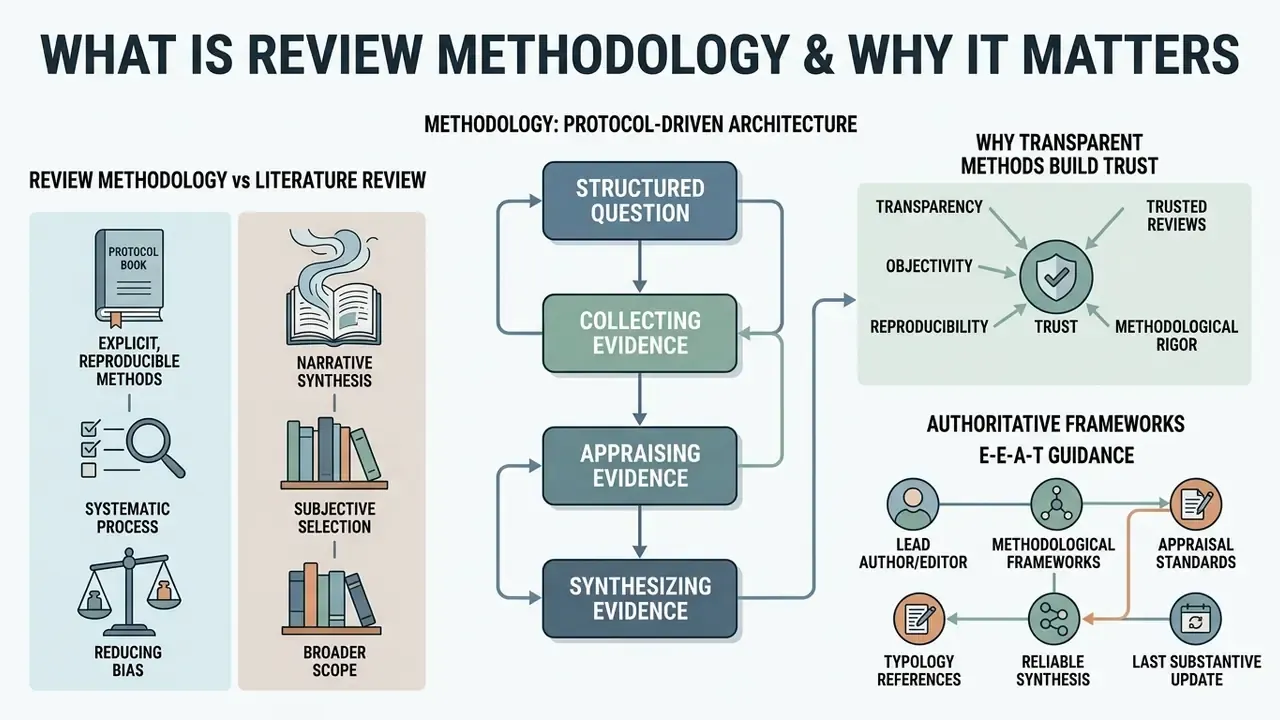
«A systematic review uses explicit methods to identify, select, critically appraise and analyse data from all relevant studies.»
Review methodology explained simply: it replaces subjective summaries with audited processes. In technical, financial, and clinical disciplines, evidence synthesis has to maintain a transparent chain of evidence. Unstructured reviews slip into selective bias almost by default, because the pleasant studies are the memorable ones. Formal methodologies blunt that risk through pre-registered protocols, exhaustive search queries, and systematic appraisal.
According to the Cochrane Handbook for Systematic Reviews of Interventions (version 6.5, 2024), systematic review methodology requires a clearly formulated research question, explicit eligibility criteria, and a comprehensive multi-source search strategy. Adherence to these standards means the findings represent the complete body of evidence, not a handful of isolated observations. Parallel guidance from the Institute of Medicine standards and the NICE evidence-review manual says the same thing in different words: reviews must be explicit and transparent across protocol, selection, appraisal, extraction, synthesis, and certainty assessment.
Evidence synthesis is a broader family than any single review format. The World Health Organization describes it as collating and integrating quantitative and qualitative results using systematic, explicit, and accountable methods. That definition applies equally to a clinical intervention review and to a vendor-model evaluation inside a regulated institution.
Review Methodology vs Literature Review
| Criterion | Literature (Narrative) Review | Systematic Review Methodology |
|---|---|---|
| Reproducibility | Search rarely documented; cannot be repeated | Full Boolean strings, databases, and dates published; independently repeatable |
| Selection bias | High, since inclusion decisions are made after seeing results | Controlled, since eligibility is fixed a priori in a registered protocol |
| Purpose | Conceptual framing, teaching, historical overview | Identify, appraise, and synthesize all relevant evidence for a focused question |
There is a middle option worth naming. The structured (systematized) review applies selected elements of the systematic process, such as documented search strings and formal inclusion criteria, without full duplicate screening. It shows up constantly in postgraduate work and internal institutional assessments. Label it honestly rather than dressing it up as a full systematic review.
Why Transparent Methods Build Trust in Reviews
Transparent methods build trust because they let independent researchers audit, evaluate, and replicate the synthesis process, from search string to final outcome.
When a review publishes its exact search queries, screening rules, and analytical tools, third parties can audit the evidence chain for reporting bias or selective extraction. Transparent protocols also lock inclusion decisions in before anyone sees study results, which blocks post-hoc cherry-picking. It is the same verification logic organizations use when they check provenance claims with AI image detectors before publishing derived assets.
Empirical meta-research puts a number on the problem:
«Of 43 self-declared AMSTAR 2-compliant systematic reviews, 35 were rated critically low confidence, 7 low, and only 1 high.»
Read that ratio twice. One review in forty-three earned high confidence, and every one of them claimed compliance.
Cochrane guidance explains the mechanism behind such failures: studies must be selected using predetermined criteria fixed in the protocol, with reasons for every exclusion recorded. That structure physically blocks the later selection of favourable results. Methodological transparency, then, is the proof of rigor that institutional adoption, regulatory review, and internal audit sign-off all depend on.
E-E-A-T Guidance & Authoritative Frameworks
Applying Review Methodology to AI Model Governance and Model Risk Management
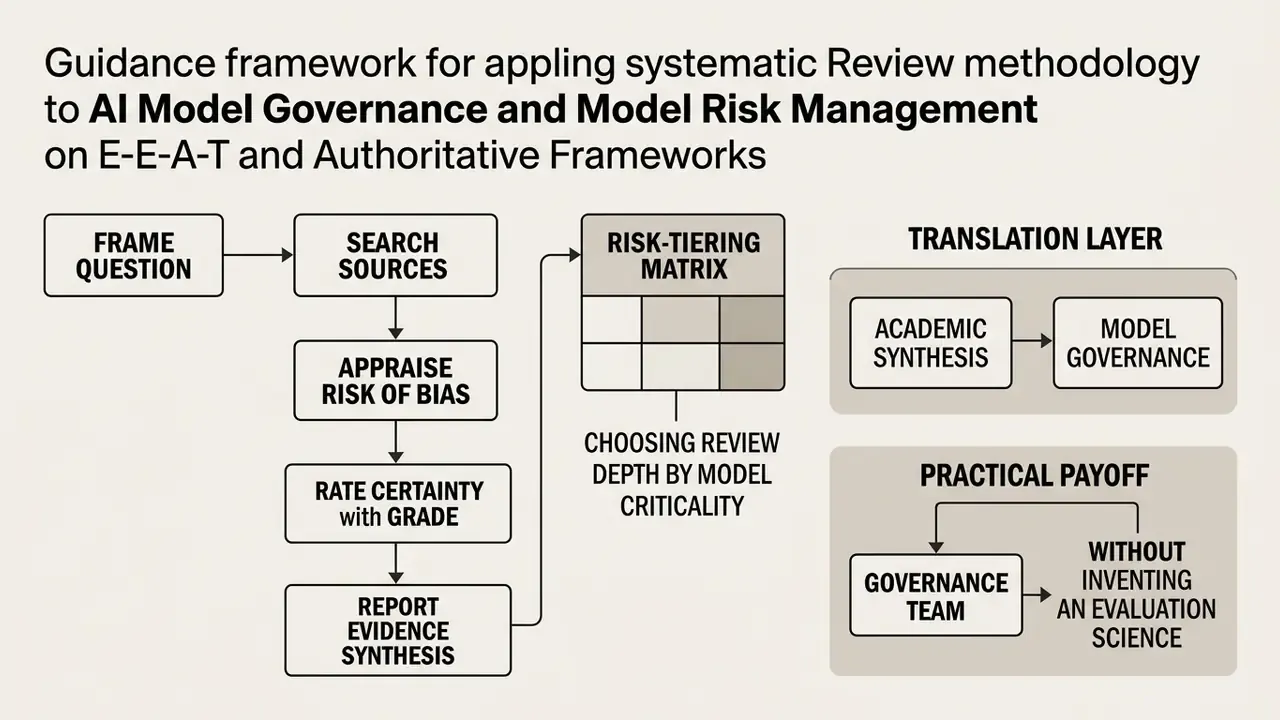
| Evidence synthesis concept | AI governance / MRM equivalent | Regulatory anchor |
|---|---|---|
| PICO / PCC question framing | Model use-case definition: population served, model intervention, challenger or baseline comparator, performance and harm outcomes | SR 11-7 model definition and intended use |
| Registered protocol | Validation plan approved before testing begins | SR 11-7 independent validation; NIST AI RMF Govern |
| Comprehensive multi-source search | Full inventory sweep: model registry, vendor documentation, benchmark datasets, code repositories, red-team reports, incident logs, shadow-AI discovery scans | NIST AI RMF Map; ISO/IEC 42001 clause on AI system inventory |
| Eligibility criteria fixed a priori | Pre-declared evidence admissibility: dataset versions, evaluation windows, acceptable benchmark suites | NIST AI RMF Measure |
| Risk-of-bias appraisal (RoB 2 / ROBINS-I) | Data lineage, sampling bias, label leakage, proxy-discrimination testing, evaluation-set contamination checks | CFPB fair-lending expectations; EU AI Act high-risk data governance |
| Certainty of evidence (GRADE) | Confidence rating attached to each model claim: accuracy, robustness, fairness, hallucination rate | NIST AI RMF Manage; internal risk appetite statements |
| PRISMA-style reporting flow | Auditable evidence package with a full decision trail for internal audit and examiners | SR 11-7 documentation standard; ISO/IEC 42001 records |
| Scheduled review updates | Ongoing monitoring, re-validation triggers, drift thresholds | SR 11-7 ongoing monitoring |
The practical payoff: a governance team does not have to invent an evaluation science. It can inherit a peer-reviewed one that is four decades old and simply re-label the unit of analysis. Instead of a randomized trial, the included "study" becomes a benchmark run, an internal validation report, a vendor technical dossier, or a red-team exercise. The appraisal question does not change at all: could the design or execution of this evidence source systematically distort the observed result?
Risk-tiering matrix: choosing review depth by model criticality. Selecting depth by tier prevents two opposite failures, over-engineering a harmless pilot and under-testing a consequential system.
| Model / system tier | Example | Recommended review format | Typical elapsed time | Minimum evidence set |
|---|---|---|---|---|
| Tier 1, consequential and customer-impacting | Credit decisioning, AML transaction monitoring, capital models, GenAI in adverse-action reasoning | Full systematic review of validation evidence, duplicate appraisal, certainty rating per outcome | 3 to 9 months | Protocol, exhaustive evidence search, RoB-style appraisal, fairness testing, GRADE-equivalent certainty table, sensitivity analyses |
| Tier 2, material internal or advisory | Underwriting decision support, RAG assistants over policy documents, forecasting aids | Structured or systematized review with dual screening on a documented sample | 6 to 12 weeks | Protocol, defined evidence sources, appraisal of key sources, documented residual uncertainty |
| Tier 3, low materiality with human in the loop | Internal employee chatbot, meeting summarization, drafting aids | Rapid review with explicit, documented methodological shortcuts | 2 to 6 weeks | Time-boxed search, single screener with verification, stated limitations |
| Discovery, unknown or shadow AI | Unregistered tools surfaced by network or expense discovery | Scoping review or evidence map to chart volume, categories, and gaps | 2 to 4 weeks | Inventory map, categorization, gap register, escalation list |
| Cross-portfolio assurance | Consolidating multiple prior validations of similar models | Umbrella review (overview of reviews) with overlap quantification | 4 to 10 weeks | Review-level extraction, AMSTAR 2 or ROBIS-style appraisal of prior validations, CCA overlap calculation |
Tool selection in production workflows depends on the job rather than brand loyalty, the same logic that drives any credible AI image generators comparison. Review format selection works identically: it follows the decision the evidence has to support.
How to Choose the Right Type of Review
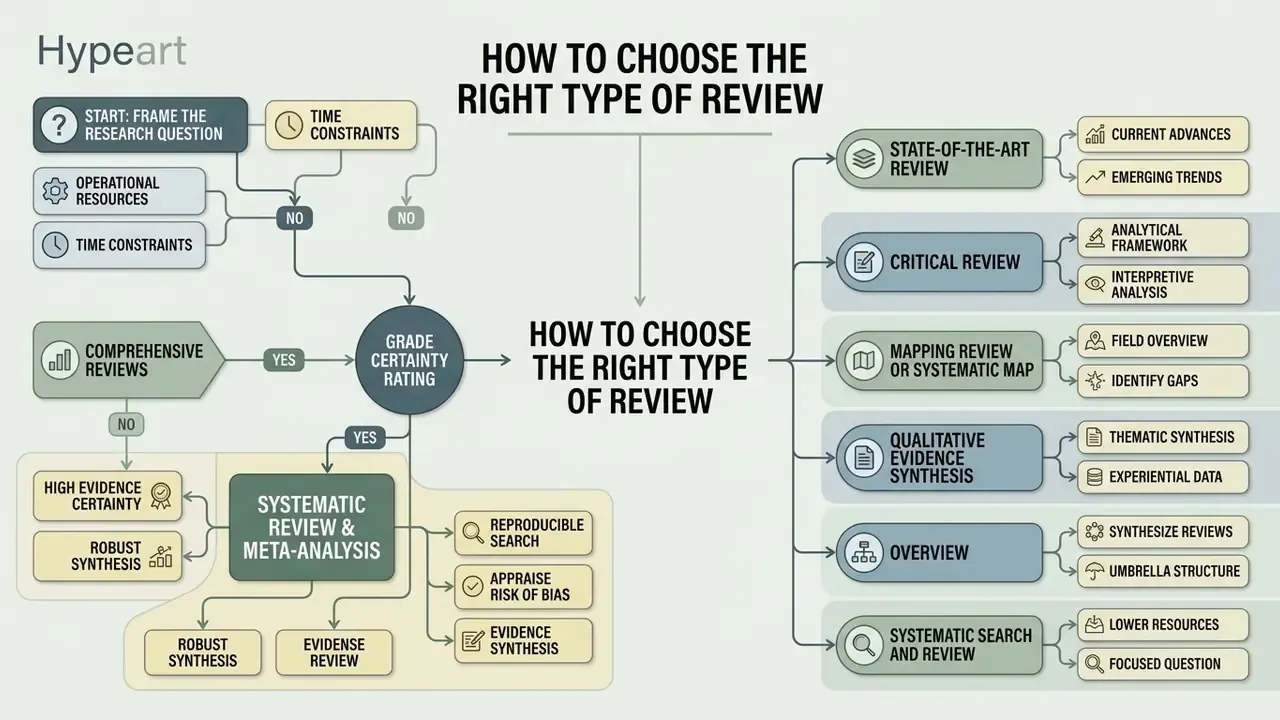
Choosing the correct type of review means matching the primary research question with available operational resources, time constraints, and the level of evidence certainty you actually need.
Different review types serve distinct governance and scientific objectives. A narrow intervention question demands a systematic review with meta-analysis. Broad evidence mapping calls for a scoping review. An urgent operational deadline may justify a rapid review, provided the trade-offs are written down. Matching review methods to the core objective prevents wasted resources and structural misalignment. Published typologies map question type to review type directly across effectiveness, qualitative or experiential, cost and economic, prevalence and incidence, diagnostic accuracy, etiology and risk, and methodological practice (Munn et al., 2018; Sutton et al., 2019).
| Review Type | Primary Objective | Research Question Format | Search Depth | Synthesis Method | Strengths | Limitations | Application in AI Governance / MRM |
|---|---|---|---|---|---|---|---|
| Systematic Review | Estimate precise intervention effects | Structured PICO (Population, Intervention, Control, Outcome) | Comprehensive across multiple databases plus grey literature | Quantitative meta-analysis or structured narrative | High internal validity; suitable for formal guidelines | Resource-intensive; typical timeline 6 to 18 months | Tier 1 models: credit scoring, AML, capital, adverse-action GenAI |
| Scoping Review | Map key concepts, evidence volume, and knowledge gaps | Broad PCC (Population, Concept, Context) | Wide coverage across multidisciplinary databases | Descriptive mapping and tabular classification | Rapidly identifies evidence gaps and structural themes | Does not formally assess study risk of bias or effect sizes | Shadow-AI discovery; mapping the enterprise model inventory and control gaps |
| Rapid Review | Provide accelerated evidence for time-sensitive decisions | Targeted PICO or policy question | Restricted databases, date limits, single-reviewer screening | Simplified narrative or abbreviated tabular summary | Delivers structured synthesis in weeks to months | Methodological shortcuts introduce potential selection bias | Tier 3 pilots, low-materiality internal assistants, urgent vendor triage |
| Narrative Review | Provide broad conceptual or historical topic summary | Open-ended or thematic questions | Non-systematic or selective database search | Qualitative narrative discussion | Flexible; useful for theoretical framing | High risk of selection bias; low reproducibility | Board-level orientation material; never a validation artifact |
| Umbrella Review | Synthesize evidence from existing systematic reviews | Broad overarching questions across multiple reviews | Systematic search for secondary reviews and meta-analyses | Aggregated review-level synthesis with overlap mapping | High-level synthesis of complex domains | Dependent on the methodological quality of underlying reviews | Portfolio-wide assurance across multiple prior model validations |
| Mixed-Methods Review | Integrate quantitative effects with qualitative experiences | Combined effectiveness and implementation questions | Parallel systematic searches for quantitative and qualitative data | Convergent or sequential mixed-methods synthesis | Provides comprehensive operational context | Methodologically complex; requires multi-disciplinary appraisal | Pairing benchmark metrics with operator interviews and override logs |
| Methodological Review | Summarize the state of design, conduct, and reporting practice in a field | Question about methods, not about outcomes | Systematic search targeted at method sections and synthesis pipelines | Methodological charting and best-practice recommendations | Exposes systemic flaws in how evidence is produced | Does not estimate effect sizes | Auditing the quality of the institution's own validation and testing practices |
Systematic, Narrative, Scoping and Rapid Reviews
These four differ in three respects: search comprehensiveness, appraisal depth, and execution speed.
A systematic review runs exhaustive queries across databases such as PubMed, Embase, and Scopus, or, in an institutional setting, across model registries, vendor dossiers, and benchmark repositories, then adds dual-reviewer extraction and formal risk-of-bias evaluation. Rapid reviews trim that pipeline. They limit database counts, narrow the publication window, rely on published material only, or use single-reviewer screening with verification, all to hit a tight operational deadline (Cochrane Rapid Reviews Methods Group, 2024).
«Cochrane rapid reviews should be completed within six months, using explicit and systematic methods with all limitations documented.»
Scoping reviews follow frameworks such as the JBI Manual for Evidence Synthesis (2024) and the original Arksey & O'Malley (2005) framework, charting the scope and character of available literature without estimating effects. Completeness of a scoping search is usually bounded by time, and work in progress may legitimately be included. Narrative reviews stay in their lane: qualitative overview tasks where strict reproducibility was never the requirement.
Integrative, Mixed, Umbrella and Methodological Reviews
Integrative, mixed-methods, umbrella, and methodological reviews extend synthesis by combining heterogeneous designs, summarizing higher-level review bodies, or interrogating research practice itself.
Mixed-methods reviews. Mixed-methods systematic reviews synthesize quantitative trial data alongside qualitative user experience studies, using convergent or segregated design frameworks. In a convergent segregated design, the quantitative and qualitative streams are synthesized separately, then integrated at the interpretation stage. The dual approach shows both whether an intervention works and why stakeholders adopt or quietly reject it. The governance analogue is a benchmark score paired with operator override logs and frontline interviews.
Integrative reviews. Integrative reviews allow simultaneous inclusion of experimental (quantitative) and non-experimental (qualitative and theoretical) methodologies, clarifying complex operational concepts (Whittemore & Knafl, 2005). The five-stage framework runs: problem identification, literature search, data evaluation, data analysis, presentation. Authors must apply separate critical appraisal tools tailored to each design, for example RoB 2 for trials, MMAT for mixed designs, and qualitative checklists for interpretive work, before converging findings thematically. Integrative reviews earn their keep where published trials are scarce, which is why they became standard practice in nursing research. They fit emerging AI-assurance literatures for the same reason: controlled evidence is thin.
Umbrella reviews (overviews of reviews). Umbrella reviews treat the systematic review as the primary unit of searching, inclusion, and data analysis, not the individual trial (Pollock, Fernandes, Becker, Pieper & Hartling, Cochrane Handbook Chapter V, updated 2023). A compliant overview contains five components: a clearly formulated objective tied to a specific question; an intent to search for and include only systematic reviews; explicit reproducible methods for identifying those reviews and appraising their quality; collection and presentation of descriptive characteristics, primary-study risk of bias, quantitative outcome data, and GRADE certainty for pre-defined important outcomes; and a discussion of completeness, applicability, and evidence quality.
Authors need a two-tier extraction strategy: record broad review-level summary statistics while mapping primary-study inclusion across reviews to quantify overlap. Overviews may present outcome data exactly as reported in the included reviews, or re-analyse those data differently. Where the underlying reviews use conflicting analytical methods, incompatible effect measures, or divergent inclusion windows, umbrella authors should re-analyse primary study outcome data directly from the original trial reports rather than stacking irreconcilable summary estimates. Informal indirect comparisons between interventions that were never compared head-to-head are best avoided entirely.
«Umbrella reviews must systematically assess primary study overlap and integrate conclusions using strength-of-evidence systems such as GRADE.»
Corrected Covered Area (CCA) formula
Where N is the total number of included publications across all reviews (counting duplicates), r is the number of unique primary studies, and c is the number of included systematic reviews. Interpretation thresholds: CCA below 5% is slight overlap; 5 to 10% moderate; 11 to 15% high; above 15% very high, which demands explicit adjustment so the same primary study is not weighted several times in the aggregated conclusion (Pieper et al., 2014).
Methodological reviews. A methodological review is systematic secondary research that summarizes the state-of-the-art methodological practices of a substantive field rather than pooling outcome effects (Chong & Reinders, 2021). Munn et al. (2018) note that methodological reviews «can be performed to examine any methodological issues relating to the design, conduct and review of research studies and also evidence syntheses.» Guided by the Cochrane Handbook Appendix A protocol structure for methodology reviews (Clarke, Oxman, Paulsen, Higgins & Green) and by best-practice recommendations for producers and users of methodological literature reviews (Aguinis, Ramani & Alabduljader, 2023), the format exposes systemic flaws in primary studies or synthesis pipelines and produces actionable recommendations for future trialists. Inside an institution, a methodological review is the natural instrument for auditing your own validation practice. How consistently are baselines defined? How often is evaluation-set contamination checked? How frequently is uncertainty reported at all? Those three questions alone tend to be uncomfortable.
Define the Review Scope and Research Question
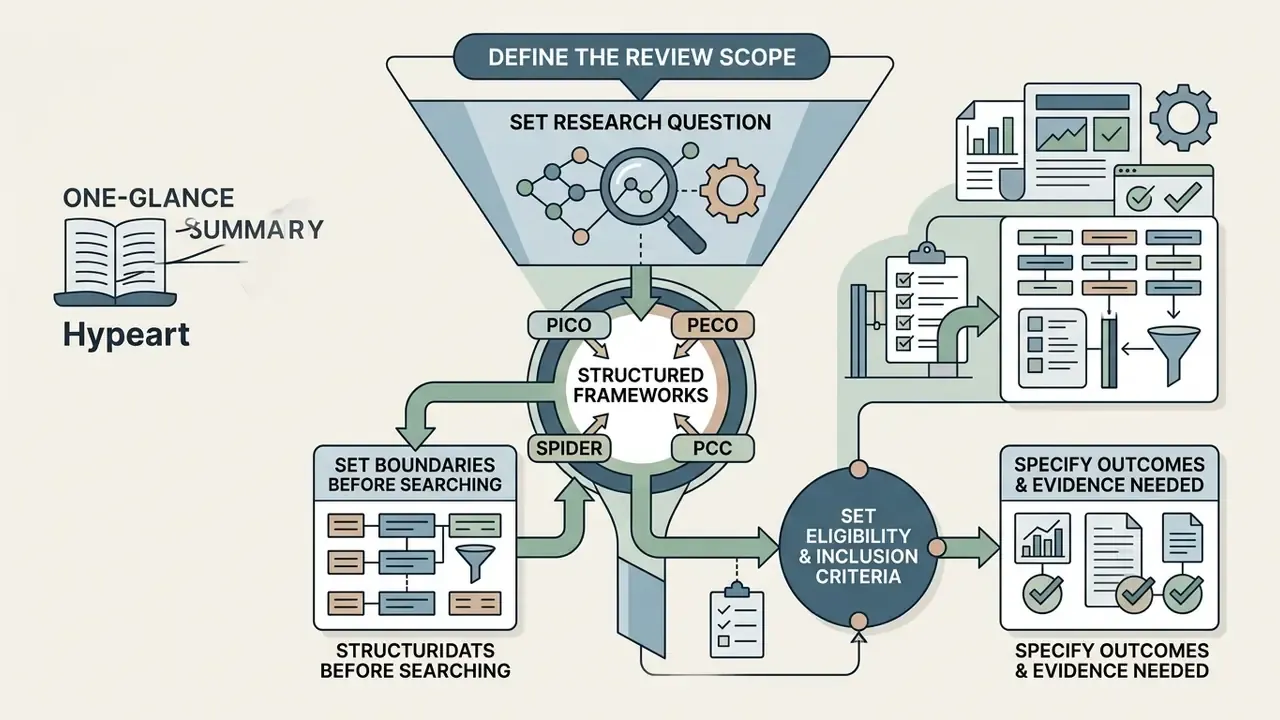
Defining scope and question means applying structured frameworks such as PICO, PECO, SPIDER, or PCC to set rigid boundaries before any searching starts.
An ill-defined scope produces unmanageable search output and inconsistent study selection. Explicit boundaries let search queries retrieve highly relevant literature while filtering out-of-scope domain noise. Standardized models clarify population targets, intervention parameters, and the outcome metrics you will actually report.
- PICO Population, Intervention, Comparison, Outcome. The default for effectiveness questions.
- PECO replaces Intervention with Exposure, for observational and risk-factor questions.
- SPIDER Sample, Phenomenon of Interest, Design, Evaluation, Research type. For qualitative and experience-oriented questions.
- PCC Population, Concept, Context. The JBI framework for scoping reviews, where Concept sets breadth and Context fixes setting, geography, or circumstances.
In one illustrative deployment, an evaluation team framed an AI risk model review using a strict PICO architecture. Population: retail borrowers within a specified product segment. Intervention: a named machine-learning validation protocol. Comparator: the incumbent scorecard. Critical outcomes: discriminatory power, calibration drift, and subgroup error disparity. Bounding the intervention to specific validation protocols and declaring critical outcomes before retrieval cut the volume of records requiring full-text screening, while retaining every relevant benchmark study. The size of that reduction is study-specific and depends on how broad the original query was, so measure and report your own screening yield instead of borrowing someone else's efficiency figure. (Precise screening-reduction percentages require internal measurement data and should not be generalized.)
Set Eligibility and Inclusion Criteria Before Searching
Eligibility and inclusion criteria belong in a registered protocol, fixed a priori, to keep post-hoc bias out of screening.
Pre-defined criteria dictate acceptable study designs, publication date ranges, language constraints, and setting specifications. Change eligibility rules after glancing at preliminary results and you have handed reviewers a lever for manipulating sample composition. That is severe selection bias, whatever the intention behind it.
Practical rules drawn from current guidance:
- Every criterion must flow directly from the review question, and the rationale for each must be recorded.
- Date restrictions apply only when the eligibility criteria genuinely require them (Cochrane Handbook, v6.5).
- Publication-format restrictions should generally be avoided unless justified; excluding conference abstracts or preprints without rationale tends to remove null results systematically.
- Language limits are permissible, though restricting to English introduces bias. If translation is impossible, declare the limitation.
Specify Outcomes and Evidence Needed for the Review
Review Process: Search, Selection and Data Collection
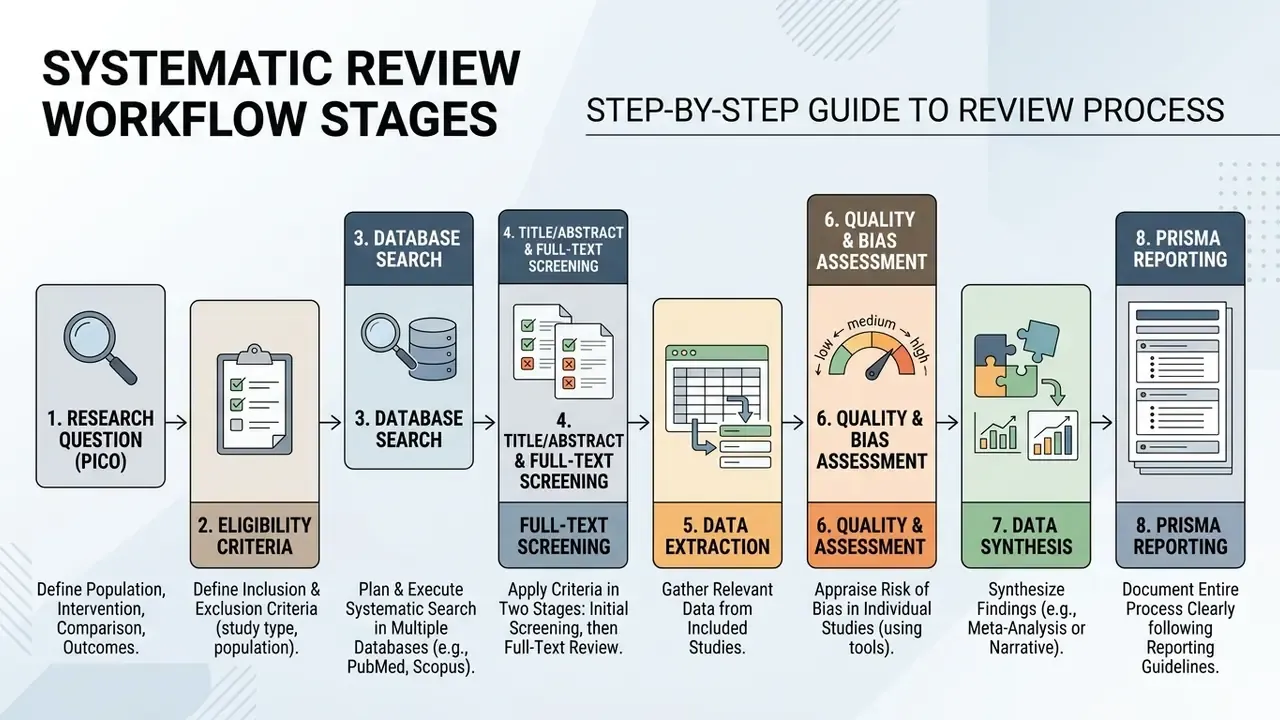
The review process runs as a sequential eight-stage workflow built to protect data integrity and procedural traceability, from search execution to final reporting.
Conducting a review means executing structured steps: question formulation, criteria specification, database searching, dual screening, standardized data extraction, risk-of-bias appraisal, evidence synthesis, and PRISMA-compliant reporting. Skip or merge steps and the audit trail breaks, which quietly undermines the credibility of everything downstream.
Search Literature Across Relevant Databases
Literature searching means reproducible, Boolean-controlled queries across a minimum of two to three primary academic databases.
A comprehensive search strategy combines subject headings, MeSH in PubMed or Emtree in Embase, with free-text keywords, truncation, phrase searching, and proximity operators. A common master-strategy pattern pairs a controlled-vocabulary block with a free-text keyword block, joining synonyms with OR and concept blocks with AND. Scopus and Web of Science use the same Boolean logic with quoted phrases and truncation; IEEE Xplore adds nested queries and proximity operators such as NEAR/5. Record every query in full so someone else can reproduce it. Where evidence exists only as scanned reports or screenshots, image-to-text tools can make it machine-searchable before extraction begins.
PRISMA 2020 requires authors to publish full search strings for all databases, plus the exact date each search ran, so the process stays auditable end to end. Trial registries (ClinicalTrials.gov, WHO ICTRP) and regulatory document sources (EMA, Drugs@FDA) should be searched routinely to surface unpublished results. In institutional settings the equivalents are internal incident registers, vendor change logs, and decommissioned-model archives. That last source is underrated: models retired quietly often carry the most instructive failure evidence.
Select Studies and Extract Data Consistently
Study selection and data extraction call for standardized, pre-tested collection forms, administered by dual independent reviewers.
Screening runs in two stages, title and abstract first, then full-text evaluation against the inclusion criteria. Duplicates go before stage one. Disagreements resolve through consensus or third-reviewer adjudication.
Operational governance mandates a minimum team of three researchers: two independent screeners for title/abstract and full-text screening, plus a designated senior third reviewer to adjudicate unresolved discrepancies (Emory Evidence Synthesis Guidelines, 2024; Cochrane Handbook, v6.5). A two-person team has no structural mechanism for breaking deadlock, so it tends to resolve disagreements by seniority rather than by method. Anyone who has sat in that meeting recognizes the pattern.
«Double-screen 20% of records at title/abstract level; if agreement reaches ≥80%, single screening with verification is acceptable.»
For extraction, the dominant recommendation is full independent double extraction. An acceptable variant in resource-constrained reviews is single extraction with a second reviewer independently verifying accuracy and completeness against the source reports. Minimum extraction fields: author, year, location, design, setting, participants, sample size, intervention or model details, and all outcome estimates with dispersion measures.
The JBI Manual for Evidence Synthesis (2024) stresses that standardized forms capture participant demographics, intervention variables, methodological characteristics, and quantitative outcome data consistently, which reduces plain human transcription error.
Assess Methodological Quality and Risk of Bias
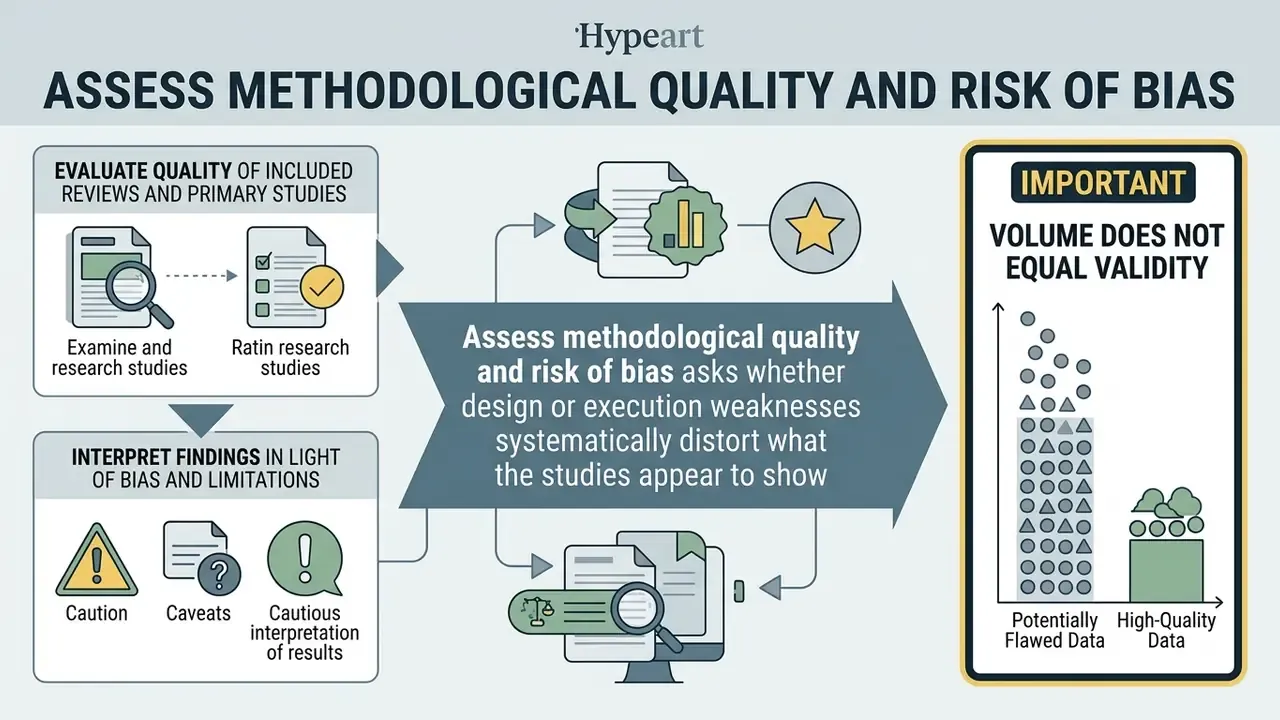
Assessing methodological quality and risk of bias asks whether design or execution weaknesses systematically distort what the studies appear to show.
Quality assessment separates high-rigor evidence from flawed primary studies. A large pile of included studies does not offset structural flaws. Reviews that ignore risk of bias end up pooling compromised data and producing conclusions that are precise and wrong.
In one illustrative risk management evaluation, a synthesis team appraised a body of validation studies for a machine-learning control framework. Formal risk-of-bias appraisal flagged that a substantial share carried high risk of selection bias, chiefly non-representative sampling frames and evaluation sets contaminated by training data. A sensitivity analysis excluding the high-risk subset moved the summary estimate materially. That single step stopped the institution from adopting a control framework whose apparent performance was an artefact of biased evidence. Counts and effect shifts stay internal to that engagement, so replicate the procedure, appraise and then re-run the synthesis without high-risk studies, rather than importing figures from another review. (Study-level counts here are reported as procedure, not benchmark.)
Evaluate Quality of Included Reviews and Primary Studies
Pick validated appraisal tools that match the designs you actually included.
| Evidence type | Recommended tool | What it assesses |
|---|---|---|
| Randomized controlled trials | RoB 2 (Cochrane) | Five domains: randomization process, deviations from intended interventions, missing outcome data, outcome measurement, selection of reported result, judged per outcome |
| Non-randomized studies of interventions | ROBINS-I (Sterne et al., 2016) | Confounding, selection, classification of interventions, deviations, missing data, outcome measurement, reported-result selection |
| Observational cohort or case-control (legacy) | Newcastle-Ottawa Scale | Selection, comparability, exposure and outcome ascertainment |
| Mixed-methods evidence | MMAT (2018) | Design-specific criteria across five study categories |
| Systematic reviews (in umbrella reviews) | AMSTAR 2 (Shea et al., 2017) / ROBIS (Whiting et al., 2016) | 16-item conduct and reporting quality; four ROBIS bias domains plus overall judgement |
| Body of evidence per outcome | GRADE (2024) | Certainty rating: high, moderate, low, very low |
Keep three questions separate instead of collapsing them into one verdict: does the design fit the question, is there risk of bias in the conduct, and is the statistical analysis valid. Reporting domain-level judgements rather than a single numeric total is now standard practice for observational evidence too. The same rigour that governs claim verification in AI image detectors accuracy testing applies here: an aggregate score hides which specific failure mode is driving the result.
«Domain-level risk-of-bias ratings provide substantially greater analytical clarity than aggregated numerical scales, which often mask critical methodological flaws.»
Interpret Findings in Light of Bias and Limitations
Conclusions must reflect the limitations and bias risks found across the primary evidence pool. Explicitly, not in a closing hedge nobody reads.
Where primary studies show high risk of bias, high statistical heterogeneity, or imprecision, qualify the summary findings accordingly. Run sensitivity analyses to test whether removing high-risk studies changes the direction or magnitude of effect. PRISMA 2020 requires a summary of limitations in the included evidence, covering risk of bias, inconsistency, and imprecision, plus limitations of the review processes themselves. ROBIS phase 3 asks bluntly whether the interpretation addresses every concern raised in the preceding domains.
Analyse and Synthesise Review Findings
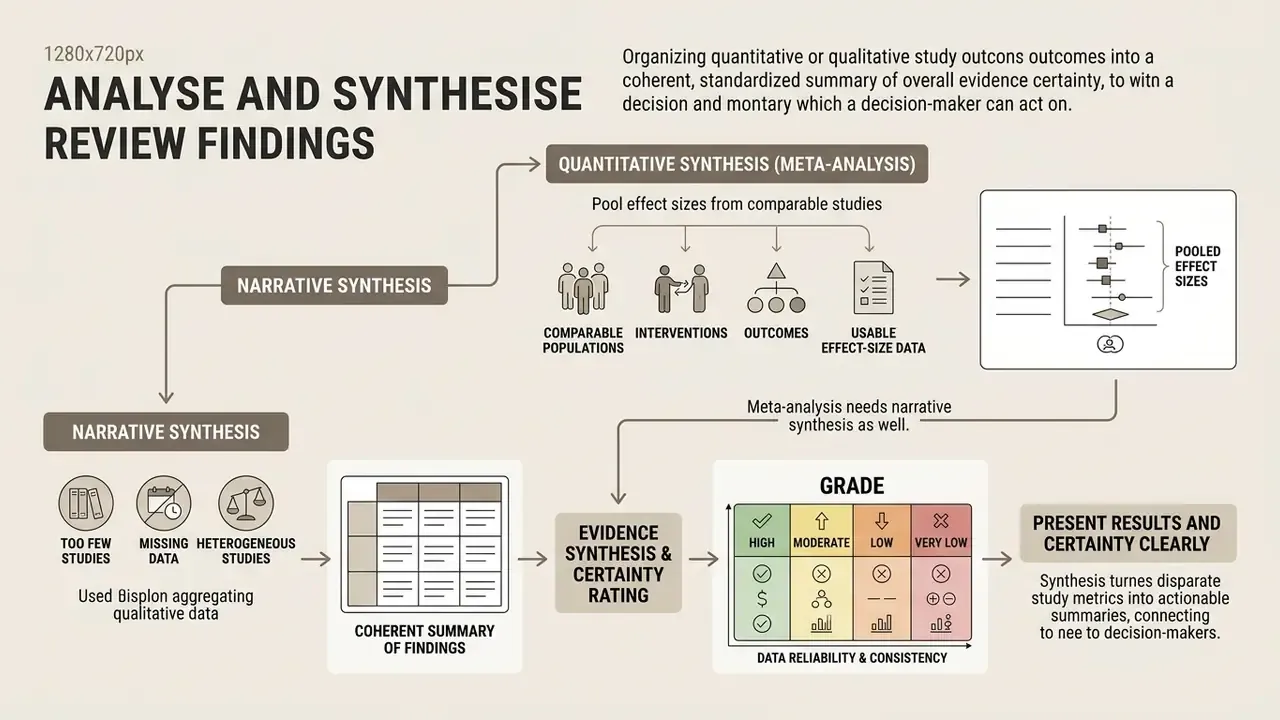
Analysing and synthesising review findings means organizing quantitative or qualitative study outcomes into a coherent, standardized summary of overall evidence certainty.
Synthesis turns disparate study metrics into something a decision-maker can act on. First judgement call: are the included studies homogeneous enough for quantitative pooling, or does clinical and statistical heterogeneity make a structured narrative synthesis the honest option?
Narrative and Quantitative Data Synthesis
Quantitative synthesis (meta-analysis) pools effect sizes from comparable studies. Narrative synthesis structures heterogeneous data using descriptive framework matrices.
Meta-analysis needs comparable populations, interventions, and outcomes, plus usable effect-size data, with statistical homogeneity evaluated through the statistic. According to the Cochrane Handbook (2024), the interpretive bands are: 0 to 40% may be unimportant, 30 to 60% moderate, 50 to 90% substantial, and 75 to 100% considerable. Substantial or considerable heterogeneity pushes you toward random-effects modeling, subgroup analysis, meta-regression, or a decision not to pool at all.
Narrative synthesis is the right call when studies are too few for pooling, when essential data are missing, when outcomes arrive in incompatible formats, or when clinical heterogeneity was judged too high a priori. Where statistical pooling is inappropriate, apply structured narrative standards, the Synthesis Without Meta-analysis (SWiM) guidelines and the York CRD narrative synthesis framework, rather than drifting into informal discussion.
Present Results and Certainty of Evidence Clearly
Present results alongside clear certainty ratings, using a standardized system such as GRADE.
The GRADE framework evaluates certainty across four tiers: high, moderate, low, very low. Ratings start high for randomized trials and low for observational evidence, then move on five downgrading domains, namely risk of bias, inconsistency, indirectness, imprecision, and publication bias. Upgrading remains possible for large effects, dose-response gradients, and residual confounding that would work against the observed effect.
«GRADE requires certainty to be rated separately for each critical outcome; all patient-important outcomes must receive a certainty rating.»
Summary of Findings (SoF) tables show outcome-specific effect estimates next to their GRADE certainty ratings, giving decision-makers a transparent evidence summary. In a governance setting the same table structure carries model claims: outcome (say, subgroup false-negative rate), estimate, evidence base, and certainty. A risk committee then sees not only the number, but how much confidence that number deserves. Those are different things, and conflating them is how bad decisions get signed off.
Methodology Requirements for Reporting and Updating a Review
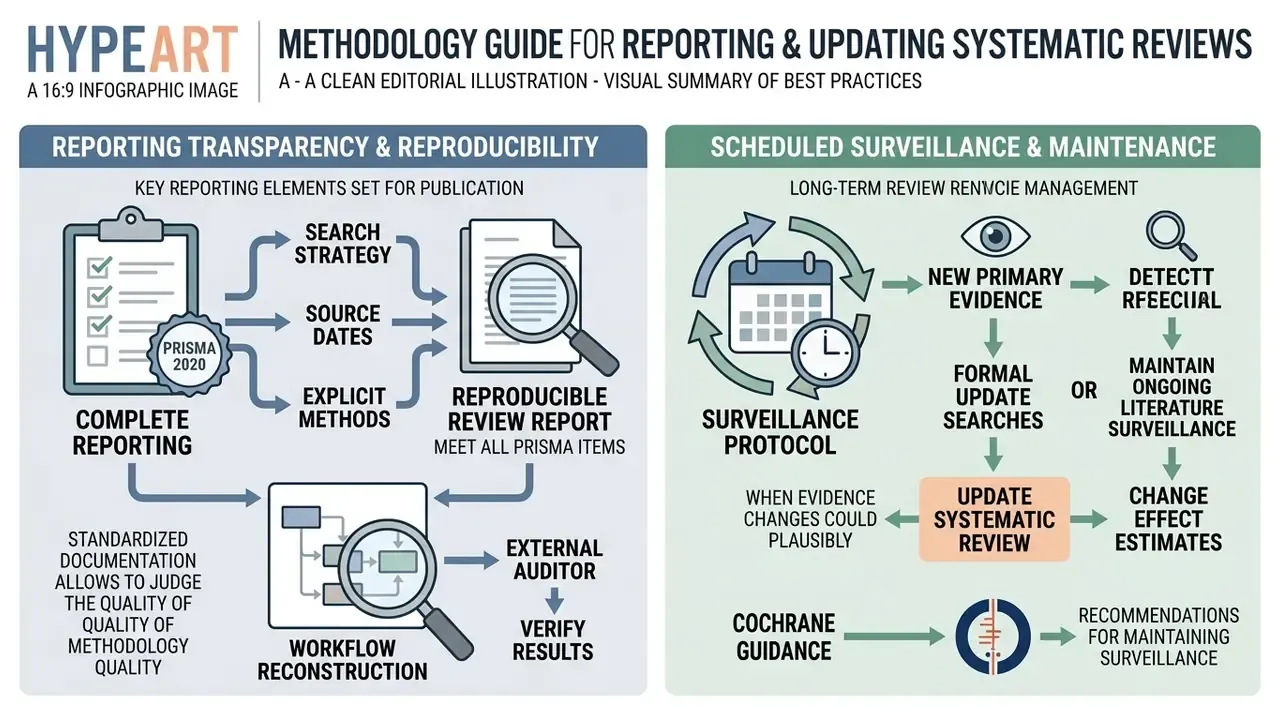
Meeting review methodology requirements takes complete reporting transparency at publication and a scheduled surveillance protocol for long-term maintenance.
Standardized reporting lets peer reviewers and institutional users judge methodology quality for themselves. And since the literature keeps moving, reviews need defined update triggers to stay relevant to decisions.
What to Report for a Reproducible Review
A reproducible review report satisfies every item on the PRISMA 2020 27-item checklist, protocol documentation and open data sharing included.
«PRISMA 2020 comprises 27 items covering objectives, eligibility criteria, information sources, risk-of-bias assessment methods, and synthesis methods.»
Key reporting elements: the complete search strategy with the date each source was last searched, explicit screening logic, data extraction templates, risk-of-bias tools and reviewer procedures, synthesis models, included-study characteristics, individual study results, certainty of evidence, funding, competing interests, and a statement of which review materials are publicly available. PRISMA 2020 Item 27 specifically advocates uploading raw extraction sheets and analytical scripts to public open-science repositories. PRISMA 2020 also replaces PRISMA 2009 outright, adding an abstract checklist, an expanded checklist, and revised flow diagrams for both original and updated reviews.
Complete documentation lets an external auditor reconstruct the analytical workflow and verify published findings independently. That is the whole test, really.
When a Systematic Review Should Be Updated
Update a systematic review when new primary evidence could plausibly change effect estimates, evidence certainty, or operational conclusions.
Guidance from Cochrane (2024) suggests teams maintain literature surveillance or run formal update searches every two years, and that the search date for a published update fall within twelve months of publication. Surveillance programmes at AHRQ have assessed reviews at six-month intervals and found that some needed updating within one to two years of the original search. Guideline systems commonly set review-by dates of three to five years, with earlier triggers when new evidence contradicts a current recommendation.
«Living systematic reviews use continuous search pipelines to integrate new evidence immediately upon publication.»
PRISMA-LSR also requires living reviews to be identified as "living" in the title and to carry a version number. Key update triggers include major new randomized trials, changes in practice guidelines or regulation, discovery of a previously unknown safety signal, or, in a model governance context, a new model version, a material data-source change, or a monitoring breach.
Common Review Methodology Mistakes to Avoid
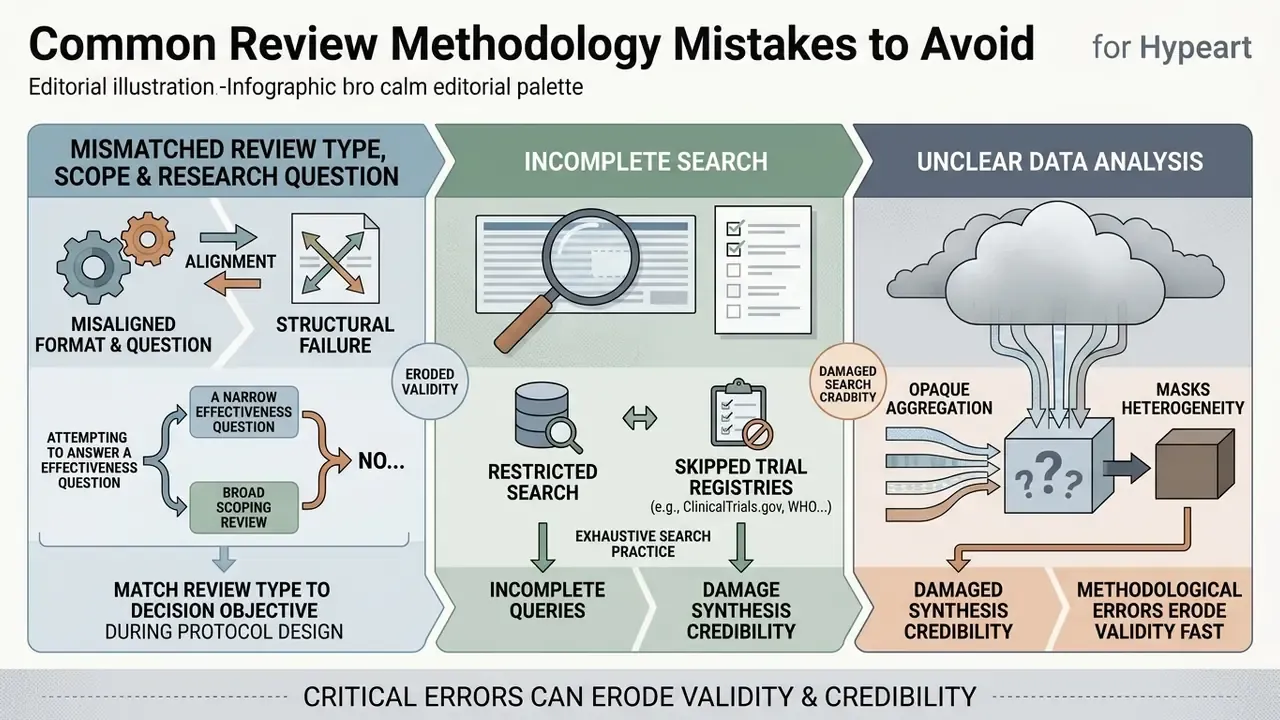
Avoiding the usual errors means aligning review scope with review type, holding the line on exhaustive search practice, and keeping data aggregation transparent.
Methodological errors erode validity fast. The recurring failures: choosing the wrong review format, applying post-hoc eligibility criteria, skipping grey literature, running a two-person team with no adjudicator, and hiding heterogeneity behind averaged summary metrics. ROBIS organizes these into four bias domains: eligibility criteria, identification and selection of studies, data collection and appraisal, and synthesis and findings.
Mismatched Review Type, Scope and Research Question
Misalign the format with the question and the synthesis fails structurally, whatever the effort behind it.
Try to answer a narrow effectiveness question through a broad scoping review and you end up with no risk-of-bias assessment and no defensible effect estimate. Push a rigid systematic format onto an exploratory mapping question and the restrictive criteria exclude the very evidence you set out to chart. Both mistakes are common, and both are cheap to prevent at protocol stage.
Match the review type to the decision objective during initial protocol design. Not later.
«Rapid reviews are appropriate when decisions are urgent and methodological limitations are justified and documented; they must not be chosen merely for convenience.»
Incomplete Search and Unclear Data Analysis
Incomplete queries, or opaque aggregation that masks heterogeneity, both damage synthesis credibility.
Restricting a search to a single database, or skipping trial registries such as ClinicalTrials.gov and WHO ICTRP, introduces severe publication bias by leaving out unpublished negative trials. AHRQ guidance requires reviewers to search registries routinely, consult regulatory documents, and present transparent, reproducible methods for identifying reporting bias, including cross-tabulation of registered trials against reported outcomes. JBI guidance requires publication bias to be explored, diagrammed, and discussed, not merely mentioned in passing. Grey literature decisions must be recorded in full, with grey findings reported separately unless both evidence streams hold comparable status (Adams et al.).
In synthesis, presenting pooled effect sizes without confidence intervals or heterogeneity measures conceals the variance underneath. Comprehensive multi-database queries and published analytical code prevent both errors at once.
Decision Ownership: Who Signs What
Unclear ownership is the failure mode that no checklist catches. A review can be methodologically sound and still stall, because nobody knows who is allowed to say yes. The table below sets a workable split for a regulated institution; adapt it to your charter and committee structure.
| Decision | Owner | Consulted | Escalation trigger |
|---|---|---|---|
| Review question, tier, and format | Model owner with Model Risk | Business sponsor, Internal Audit | Tier disputed, or materiality reassessed upward |
| Protocol and validation plan approval | Head of Model Risk | Compliance, Security, Legal | Protocol amended after evidence collection starts |
| Evidence admissibility rulings | Lead validator | Data governance, vendor manager | Vendor refuses to disclose training data provenance |
| Screening disagreements | Senior adjudicator (third reviewer) | Lead validator | Disagreement rate above pre-set threshold |
| Certainty ratings and residual risk | Validation lead with Model Risk | Risk committee | Any critical outcome rated low or very low |
| Production deployment or hold | Risk committee or CRO | CCO, COO, Internal Audit | Certainty below appetite, or fairness testing incomplete |
| Re-validation and retirement | Model owner | Model Risk, monitoring team | Drift threshold breached, or new model version shipped |
One principle keeps this honest: no evidence, no autonomy. An agentic system without an owner, an approved role, access limits, an escalation path, an audit trail, and a shutdown mechanism is not ready for a production decision, regardless of how well it benchmarks.
AI Governance Review Readiness Checklist
Use this as an evidence-package checklist before an internal audit or a regulatory examination. Each line has a direct systematic-review analogue.
Checklist0 / 13
A safe next step, if the list looks daunting: pick one Tier 1 model and build the package retrospectively. You will learn more from that single reconstruction than from another policy document.
Frequently Asked Questions (FAQ)
Which review type should I use for a broad question with no time pressure?
A systematic review if the question is a narrow effectiveness question. A scoping review if the goal is mapping breadth and identifying gaps. A systematic search and review if the question is broad but still needs a comprehensive search paired with critical appraisal.
How does review methodology help surface shadow AI?
Treat discovery as a scoping review. Define the concept (any system producing model-derived outputs used in a business process), the context (all business units and vendor channels), and the population (owners and users). Search systematically across expense records, network telemetry, SaaS admin consoles, and interviews, then chart categories, volume, and gaps. Scoping is the right format because the objective is mapping, not effect estimation.
How do PRISMA and GRADE map onto SR 11-7 expectations?
PRISMA supplies the documentation completeness standard: every decision traceable, every source dated, every exclusion justified. That satisfies the SR 11-7 requirement for documentation sufficient to allow independent replication. GRADE supplies the certainty layer, converting "the model scored 0.82" into "we hold moderate confidence in a 0.82 estimate, downgraded for indirectness because the evaluation population differs from the production population." Together they hand validators a reproducible package and examiners an explicit statement of confidence.
Can a rapid review support a Tier 1 model decision?
Only as an interim measure, with limitations documented and a full review scheduled. Cochrane guidance is explicit that rapid methods are justified by decision urgency, not convenience. Every shortcut taken should be listed alongside its likely bias direction.
What is the difference between an umbrella review and a meta-analysis of meta-analyses?
An umbrella review's unit of searching, inclusion, and analysis is the systematic review itself. It appraises those reviews with AMSTAR 2 or ROBIS, quantifies primary-study overlap using CCA, and re-analyses primary data only when the underlying reviews used incompatible methods. Pooling overlapping meta-analyses without overlap correction double-counts the same primary trials, which inflates apparent precision.
How do I evaluate GenAI and agentic systems when there are no randomized trials?
Use an integrative or mixed-methods design. Combine quantitative benchmark and red-team results with qualitative operator evidence, such as override logs, incident narratives, and reviewer interviews, appraising each stream with a design-appropriate tool (MMAT, qualitative checklists, benchmark validity criteria) before converging findings, per the five-stage Whittemore & Knafl framework. For agentic systems, define outcomes at the trajectory level, meaning task completion, unsafe-action rate, and escalation accuracy, not only at the level of a single response.
How many databases or evidence sources are enough?
The operating minimum for academic reviews is two to three databases plus registries and grey literature. For institutional reviews, the equivalent minimum is the model registry, the vendor documentation set, and at least one independent evidence stream (internal testing or a third-party benchmark), plus incident and monitoring records.
Disclaimer
This article describes general methodological frameworks for evidence synthesis and their mapping to AI governance and model risk management practice. It is not legal, regulatory, medical, or investment advice, and it does not constitute a compliance opinion. References to SR 11-7, NIST AI RMF, ISO/IEC 42001, the EU AI Act, and supervisory expectations are illustrative; obligations vary by jurisdiction, charter, product, and model materiality. Any framework described here must be adapted to the risk appetite, governance structure, and applicable regulatory perimeter of the individual institution, in consultation with qualified legal, risk, and clinical or technical specialists as relevant. Clinical examples are drawn from published methodological guidance and are not clinical recommendations. Audience characterizations and operational examples remain hypotheses until supported by analytics, interviews, CRM data, or verified customer research.