Why should a risk or compliance leader care about a single sentence above a product button? Because that sentence is a control. It has an owner, a version history, a failure mode, and an audit trail, or it does not, and the second case is the expensive one.
Executive Summary: Key Takeaways for Compliance and Risk Leaders
For executives who need the compliance position in under a minute:
- The legal trigger is the material connection, not the payment size.Under 16 CFR Part 255, any financial, employment, family, or personal tie that a reasonable consumer would not expect must be disclosed clearly and conspicuously. That includes affiliate commissions, gifted products, and revenue-share referral arrangements.
- Placement determines compliance, not the existence of a policy page.A notice buried in the footer, inside Terms of Service, or behind an extra click fails the "clear and conspicuous" test even when the wording is perfect.
- Platform rules stack on top of statutory rules.Amazon Associates requires the exact sentence "As an Amazon Associate I earn from qualifying purchases" plus link-level tags such as "(paid link)". Meta's and TikTok's branded-content tools do not replace manual text disclosures.
- Enforcement is real and documented.The FTC has issued warning letters to more than 90 influencers and endorsers, and has pursued actions against gaming platforms and video publishers that relied on vague tags such as
#sp. - Automated and AI-generated recommendations inherit the same duty.When a model, chatbot, or agentic workflow surfaces a monetized recommendation, the obligation belongs to the operator, and the evidence must be reproducible for audit.
- Regulated-sector publishers face a second regulator.Financial referral programs can also engage consumer-finance supervision (UDAAP standards, TILA and RESPA-style referral rules), which demand documented controls, not just a sentence above the fold.
How to Use This Affiliate Disclosure Guide
This affiliate disclosure overview is written for three roles at once, which is unusual for a compliance topic. Marketing owns the wording. Legal owns the standard. Risk and audit own the evidence. When those three functions read different documents, disclosure defects survive for years inside CMS templates.
Read it in the order that matches your question. If you need the statutory baseline, start with the requirements section. If your pages already carry notices and you are testing whether they hold up, go straight to placement, platform rules, and the control testing plan at the end. Compliance teams in banking, lending, and insurance should treat the sector overlay section as mandatory reading rather than background colour.
One caveat before the detail. Everything below reflects published guidance and platform agreements as of 2026, and none of it substitutes for counsel on your specific programs.
What Is an Affiliate Disclosure and Why Is It Mandatory?
An affiliate disclosure is an explicit notification telling readers that a creator or publisher receives compensation when users act through specific links. Under 16 CFR Part 255 of the FTC Endorsement Guides, any material financial tie that readers would not reasonably expect must be disclosed clearly and conspicuously. The notice converts hidden monetization into transparent commercial intent. Consumers get to make an informed purchasing decision, and publishers get a defence against deceptive-marketing claims.
Put plainly: affiliate disclosure explained in one line is "money changes hands, and you should know before you click."
How Affiliate Links and Commission Payouts Work
Affiliate links work by embedding unique tracking parameters and partner identification tokens into ordinary web URLs. When a user clicks, a tracking cookie or a server-side session parameter records the partner ID, timestamp, and referral origin on the merchant's system. If the consumer completes a qualifying transaction inside the program's attribution window, typically 24 hours to 90 days, the tracking platform credits the sale to the affiliate and triggers a percentage or flat commission payout.
Attribution windows differ sharply between programs. Some networks default to a 30-day cookie. Others stretch to 12 months for subscription products. Several retail programs shrink the window to 24 hours. That variability matters for compliance, because the disclosure has to be visible before the click that starts the tracking session, no matter how long the window stays open afterwards.
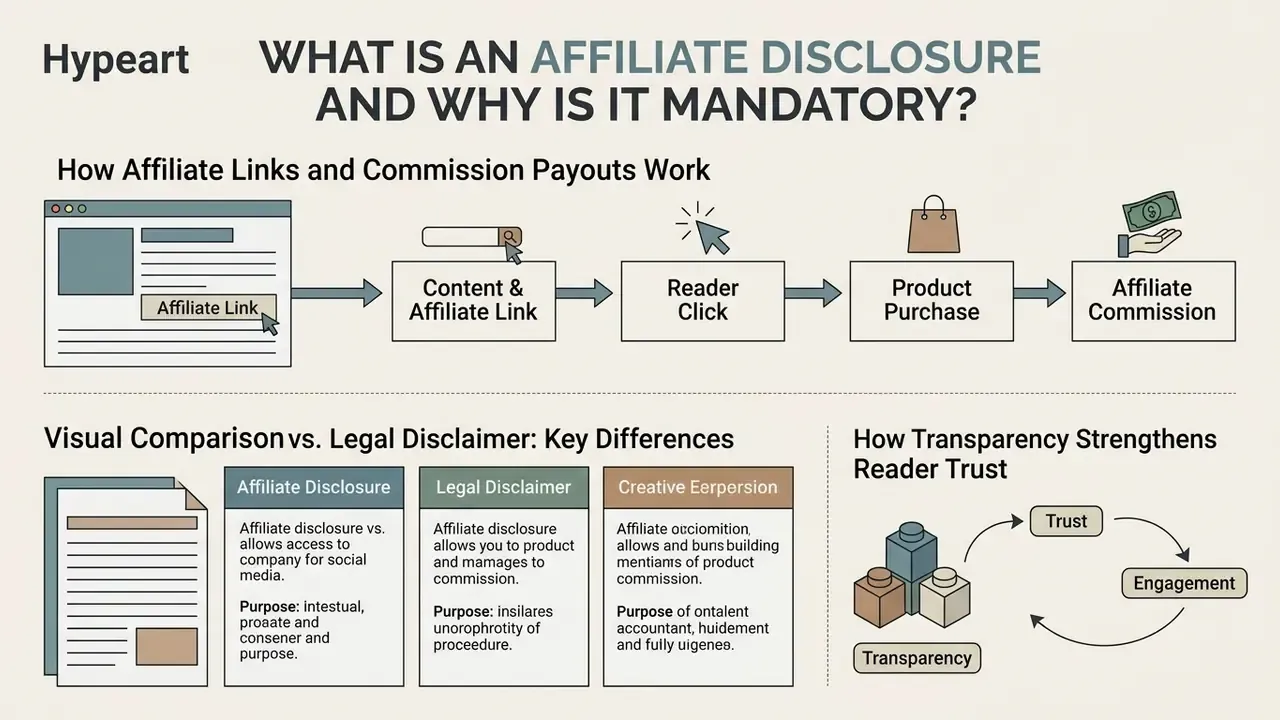
Affiliate Disclosure vs. Legal Disclaimer: Key Differences
An affiliate disclosure reveals a material financial connection between a publisher and a vendor. A legal disclaimer sets general operational boundaries, liability limits, or warranty denials. Different instruments, different jobs.
| Attribute | Affiliate disclosure | General legal disclaimer |
|---|---|---|
| Target | A specific material financial tie | Liability, warranties, and scope of advice |
| Required position | Immediately near the monetization link | Site-wide terms, footer, or policy page |
| Legal basis | FTC Endorsement Guides, EU consumer law | Contract and general risk management |
| Function | Prevents consumer deception | Buffers legal exposure |
| Substitutable? | No, cannot be replaced by a disclaimer | No, cannot be replaced by a disclosure |
While the disclosure tells readers about compensation tied to specific recommendations, a disclaimer broadens protection by stating that information is provided "as-is", or that personal opinions are not professional advice. A generic footer disclaimer does not satisfy statutory requirements for compensated referral links.
In compliance terms, the affiliate disclosure is a subset of disclosure duties triggered by a specific commercial fact. The disclaimer is a broader legal-writing category used to qualify or limit a message. Publishing one never discharges the duty to publish the other.
How Transparency Strengthens Reader Trust
"Participants in a negative mood were more likely to recognise advertising content and rated it higher when disclosure was explicit than when the labelling was concealed."
Earlier native-advertising research adds a nuance worth planning for. Explicit sponsorship disclosures can slightly raise initial audience skepticism, yet clear identification of financial compensation significantly increases perceived publisher honesty and reduces long-term brand damage. In practice, the short-term dip in click-through is the price of a durable trust position, and of a defensible audit trail. Most publishers pay it once and stop thinking about it.
Affiliate Disclosure Requirements: FTC, Regional Rules, and Amazon
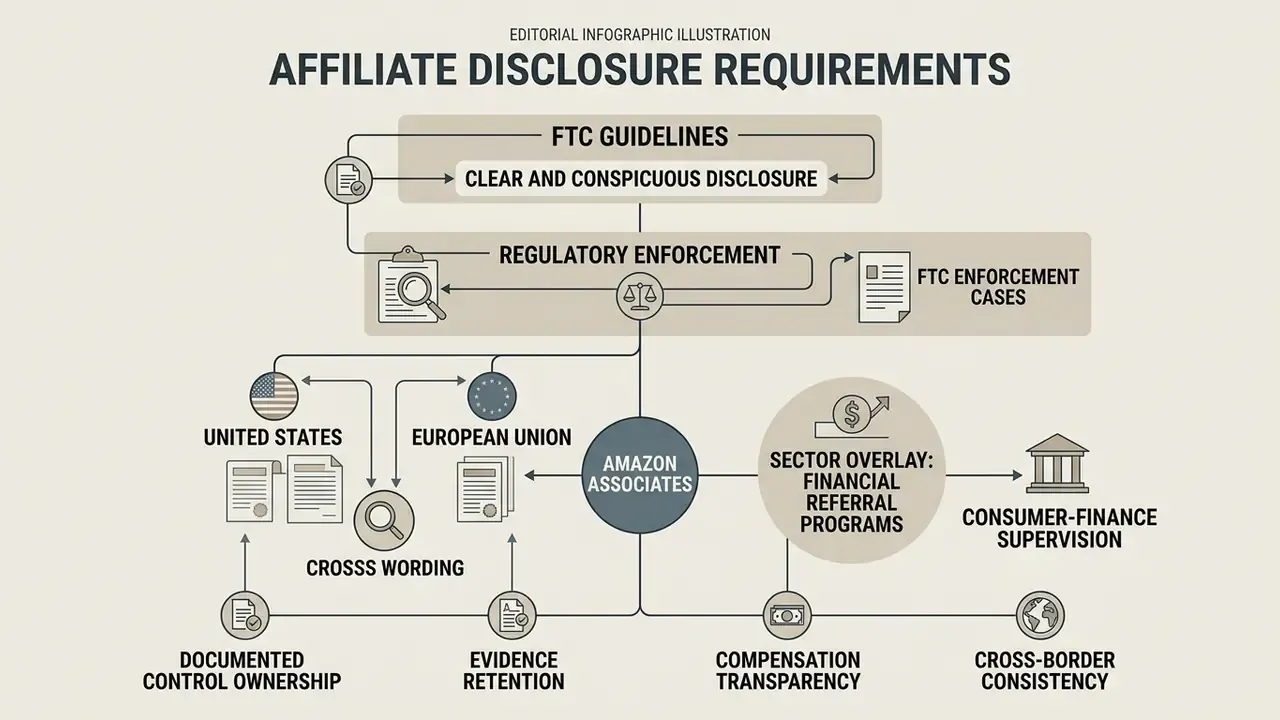
Affiliate disclosure requirements vary across jurisdictions. The FTC, European Union consumer directives, and merchant platforms such as Amazon each enforce their own operational guidelines. Compliance demands clear placement, unambiguous phrasing, and consistency across desktop, mobile, and voice interfaces. Missing the standard risks enforcement action, platform account termination, and administrative fines.
"A large-scale 2026 measurement study recorded that compliance with FTC transparency standards remains incomplete and uneven across websites and platforms."
That measurement gap is the practical reason compliance teams should treat disclosure as a monitored control with periodic sampling, rather than a one-time template deployment.
FTC Guidelines: Clear and Conspicuous Disclosure of the Relationship
Regulatory Enforcement Reality: FTC Enforcement Cases
Weak disclosure carries real operational risk. In landmark actions, the FTC sent formal warning letters to more than 90 top social media influencers and brand endorsers for hiding commercial ties inside hashtag clusters. In 2017 alone, the Commission issued cease-and-desist letters to Instagram celebrities working with brands, and formally reprimanded gaming-channel YouTubers who endorsed gambling operators without adequate disclosure.
Later actions against gaming platforms and video publishers confirmed that generic notices such as #sp, #thanks[Brand], or hidden legal footers breach federal standards, producing mandatory compliance monitoring and revenue forfeitures. The endorsement enforcement docket, including matters such as FTC v. NextMed, FTC v. Seek Capital, and FTC v. Gravity Defyer, shows the Commission litigating disclosure failures under the FTC Act rather than treating them as technical footnotes.
United States and European Union Requirements
In the United States, FTC rules focus on preventing consumer deception by requiring explicit disclosure of any material connection that affects an endorsement's credibility. European Union requirements under the Unfair Commercial Practices Directive (UCPD) and Directive (EU) 2024/825 centre on identifying the commercial intent of digital practices, plus consumer data transparency under ePrivacy rules. The FTC targets the financial tie between creator and vendor. EU law pushes broader platform transparency, commercial identification, and cookie consent.
Two extra EU layers matter for multi-jurisdiction publishers. First, the Digital Services Act obliges platforms to label advertising and identify the trader on whose behalf an ad appears. Second, European Advertising Standards Alliance (EASA) guidance for influencer and affiliate marketing requires the nature of the arrangement to be identifiable. A commission-based relationship must read as commission-based, not as an unspecified "partnership".
| Dimension | United States (FTC) | European Union (UCPD / DSA / ePrivacy) |
|---|---|---|
| Primary legal trigger | Undisclosed material connection affecting endorsement credibility | Hidden commercial intent and misleading omissions |
| Core standard | "Clear and conspicuous", close to the claim | Commercial intent identifiable to the average consumer |
| Wording vocabulary | "paid link", "#ad", "I earn a commission" | "advertising", "sponsored", "collaboration", "gifting", "ambassador" |
| Tracking technologies | Not the disclosure trigger | Consent required for cookies and terminal access (ePrivacy) |
| Platform duties | Endorser and advertiser liability | Platform ad labelling and trader identification (DSA) |
| Enforcement body | FTC (federal) | National consumer authorities and self-regulatory bodies |
Sector Overlay: Financial Referral Programs and Consumer-Finance Supervision
Publishers in banking, lending, insurance, and fintech work under a second, stricter overlay. A referral or affiliate arrangement that steers a consumer toward a credit product, deposit account, or insurance policy can engage supervision standards on unfair, deceptive, or abusive acts and practices, plus product-specific referral and compensation rules for lending and settlement services.
Practical implications for the control owner:
- Documented control ownership. Disclosure text, placement rules, and the approval workflow belong in the marketing-compliance control inventory with a named owner, not only inside a CMS template.
- Evidence retention. Keep versioned screenshots or rendered HTML snapshots of monetized pages. Supervisory reviews test what the consumer actually saw on a given date.
- Compensation transparency. Where payment varies by product, say so. A generic "we may earn a commission" can understate an incentive structure that differs by provider.
- Cross-border consistency. Align US and EU wording centrally, then localise placement to each market's template layout.
- Third-party oversight. If an agency or network publishes on your behalf, put disclosure obligations into the contract and sample their output, because your regulator will not accept vendor error as a defence.
Amazon Affiliate Disclosure Requirements
The Amazon Associates Program Operating Agreement enforces dual-layered rules for every participating affiliate. First, site owners must display the exact, unaltered statement "As an Amazon Associate I earn from qualifying purchases" across their web properties. Second, Amazon requires link-level tags, such as "(paid link)", "#ad", or "#CommissionsEarned", in immediate proximity to any product recommendation or review that carries Amazon referral links.
Amazon also specifies that the disclosure must appear in the same medium as the recommendation. Text disclosure for text recommendations, spoken disclosure for voice-assistant recommendations, account-level association for social media user-generated content. For voice skills, the notice repeats whenever the user re-engages with the recommendation.
Official compliance sources:
- FTC Endorsement Guides
- Federal Trade Commission 16 CFR Part 255
- Amazon Associates Operating Agreement
- Amazon Associates Central
- EU consumer transparency rules
- Directive (EU) 2024/825
Who Needs an Affiliate Disclosure and When Is It Required?
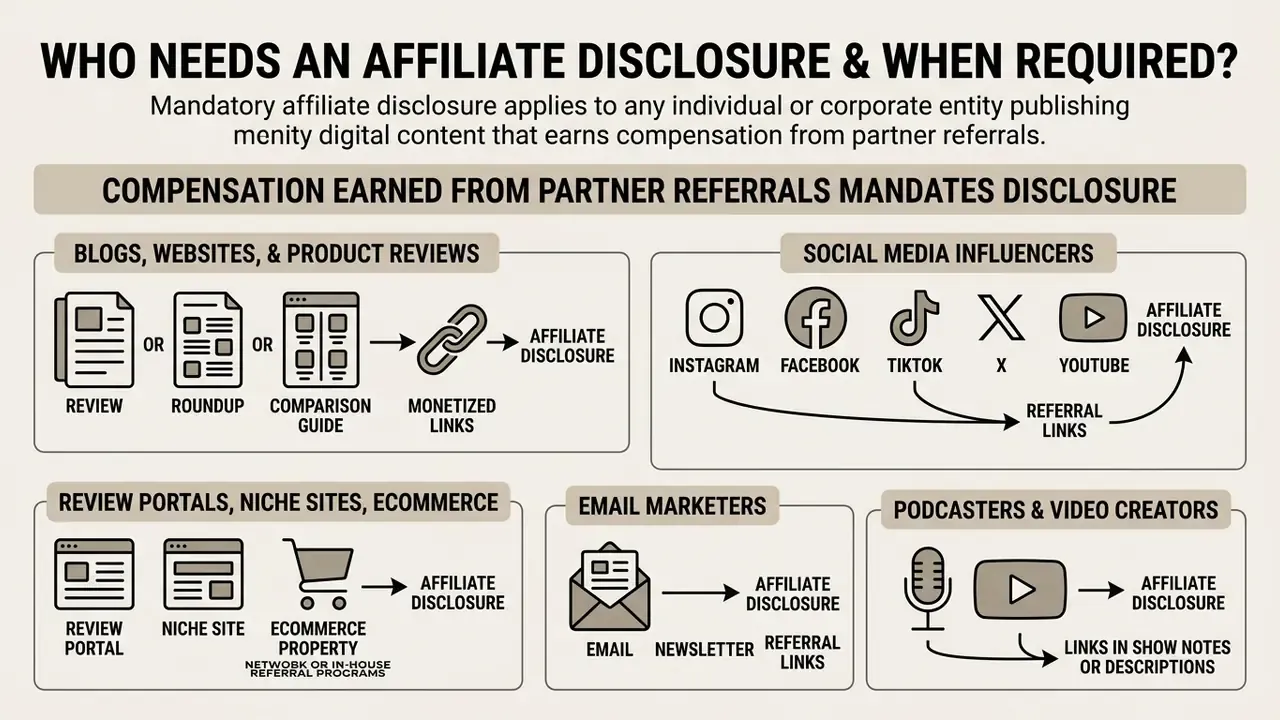
Mandatory affiliate disclosure applies to any individual or corporate entity publishing digital content that earns compensation from partner referrals. Whenever an endorsement, product recommendation, or monetized link appears on websites, blogs, video descriptions, social feeds, or email newsletters, explicit disclosure is required. Regulators ask a simple question: would an ordinary consumer immediately recognise the commercial nature of the link without extra searching?
In scope, without exception:
- Bloggers and content creators publishing reviews, roundups, or comparison guides with monetized links.
- Social media influencers on Instagram, Facebook, TikTok, X, YouTube, and equivalent networks.
- Review portals, niche sites, and eCommerce properties running network or in-house referral programs.
- Email marketers distributing newsletters that contain referral links.
- Podcasters and video creators who place links in show notes or descriptions.
- Enterprise media, comparison, and marketplace operators whose ranking or listing revenue depends on partner payouts.
Affiliate Disclosures for Blogs, Websites, and Product Reviews
Bloggers, review portals, and niche editorial sites must disclose affiliate links inside the main body of every monetized page. In one internal compliance review our editorial team ran on a software comparison hub, site-wide header disclosures alone proved insufficient during usability testing. A meaningful share of readers scrolled past the header before reaching the first monetized comparison table.
The fix was unglamorous. The team added inline notifications immediately before the first affiliate link, and inside each comparison module. The next external review recorded no placement findings, and click-through confidence signals improved marginally. Exact percentages from a single internal audit should not be generalised across sites, and independent verification would be needed before anyone treats them as benchmarks. The operational takeaway holds regardless of the metric: the notice must precede the first affiliate link, so users meet the disclosure before taking a commercial action.
Disclosing Partner Relationships in Sponsored Content
Sponsored articles and brand collaborations need unambiguous labelling that covers both direct payment and referral structures. When a publisher receives sponsorship money plus affiliate commission rights, labels such as "partner post" or "recommended reading" fail FTC standards. State plainly that the vendor paid for the placement, and that later purchases earn the outlet a commission.
FTC native-advertising guidance adds a formatting rule that is easy to miss. Labels must sit close to the content, stay easy to read, and, in audio or video, remain on screen long enough to be noticed. Blending a paid placement into editorial typography without visual separation is itself a deception risk, whatever wording you chose.
How to Write a Clear and Compliant Affiliate Disclosure
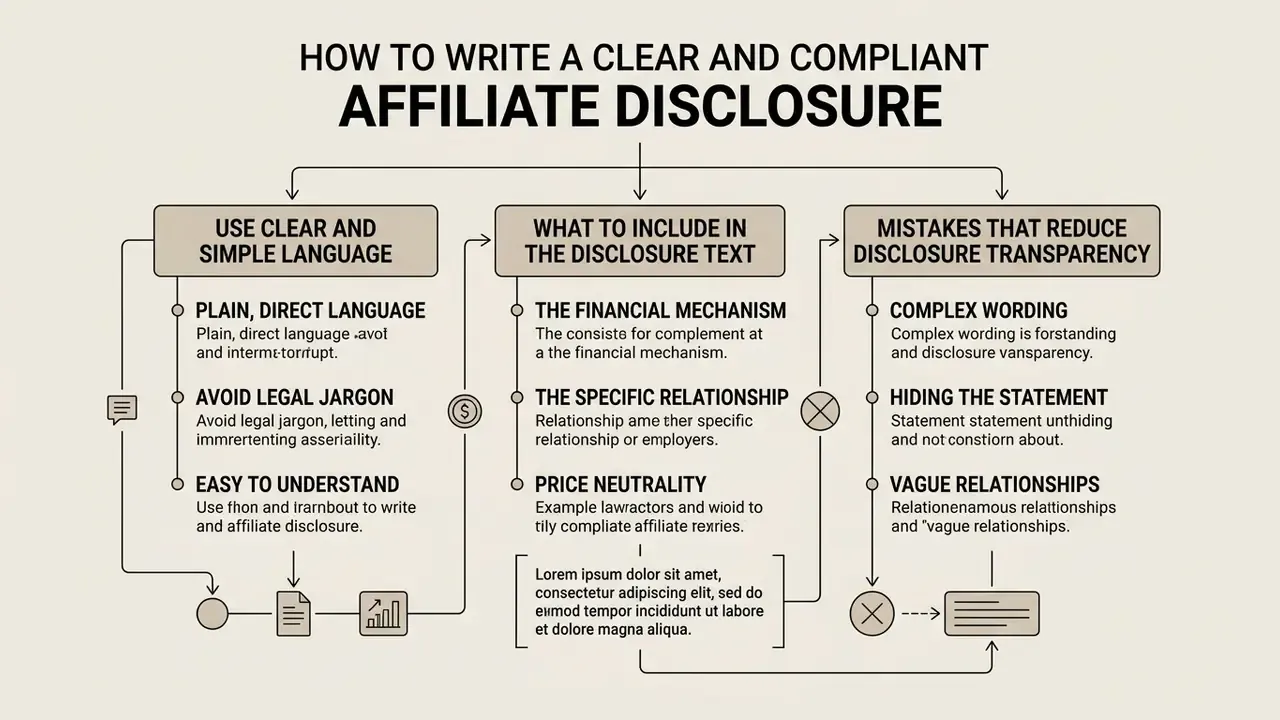
Writing an effective disclosure takes plain, direct language that communicates compensation without legal jargon. Readers must instantly understand that clicking may generate a merchant commission for the publisher. Plain language also keeps the notice readable across age groups, screen sizes, and template layouts.
Use Clear and Simple Language
Plain English prevents confusion and supports immediate comprehension. Phrases like "compensation considerations" or "affiliated marketing participant" obscure meaning and fail readability expectations. A direct statement works better: "I earn a commission if you buy through links on this page."
Here is a useful internal test. If a reader unfamiliar with affiliate marketing cannot restate the arrangement in their own words after one reading, the sentence is not compliant, even when it is technically accurate. Note also that regulators have criticised bare labels such as "affiliate link" used without explanation, because the term itself is industry jargon.
What to Include in the Disclosure Text
A complete affiliate disclosure covers three elements:
- The financial mechanism.State that links on the page are affiliate links capable of generating commissions.
- The specific relationship.Identify the partner programs, for example Amazon Associates or a named network.
- Price neutrality.Confirm that using the link costs the buyer nothing extra.
That is the empirical case for naming programs instead of hiding behind "select partners". Readers detect commercial intent more reliably when the sponsor is identified.
Mistakes That Reduce Disclosure Transparency
Most disclosure errors come from small design choices rather than bad intentions. Blending sponsored links into editorial text without visual separation misleads readers about objectivity.
| Error type | Impact on transparency | Corrective action |
|---|---|---|
| Vague terminology | Obscures the monetary link | Use "affiliate link" or "paid commission", with the mechanism spelled out |
| Footer-only placement | Missed before the purchase decision | Move the notice above the first link |
| Low-contrast typography | Fails the "conspicuous" test | Ensure strong text-to-background contrast and readable size |
| Hidden behind hyperlinks | Requires an extra click | Display the full notice on the page itself |
| Identical styling to editorial copy | Reader cannot separate paid from earned content | Add visual separation, background, or border to the module |
Disclosures placed only at the bottom of long articles stop users from seeing the notice before clicking. Tiny fonts, muted grey text on white, or statements folded into legal footers breach FTC guidance and invite enforcement. Advertising standards bodies flag the same failure patterns: micro-typography, end-of-article placement, and sponsored text formatted exactly like news copy.
Pre-publication affiliate disclosure checklist
- Plain language.Uses unambiguous words such as "affiliate link", "commission", or "paid link".
- Placement priority.Sits above the fold or immediately before the first affiliate link.
- Visibility and contrast.Readable font size, high contrast against the page background, no collapse on mobile.
- Cost neutrality.States clearly that purchases carry no extra fee for the consumer.
- Program compliance.Includes mandatory text, for example the exact Amazon Associates sentence where applicable.
- Medium match.Spoken disclosure for audio and voice, on-screen text for video, written notice for text.
- Audit evidence.Rendered page snapshot archived with the publication date for supervisory review.
A compliant disclosure satisfies all seven criteria before the page is indexed. Six out of seven is not a pass; it is a finding waiting for a reviewer.
Strategic Placement: Where to Put Your Affiliate Disclosures
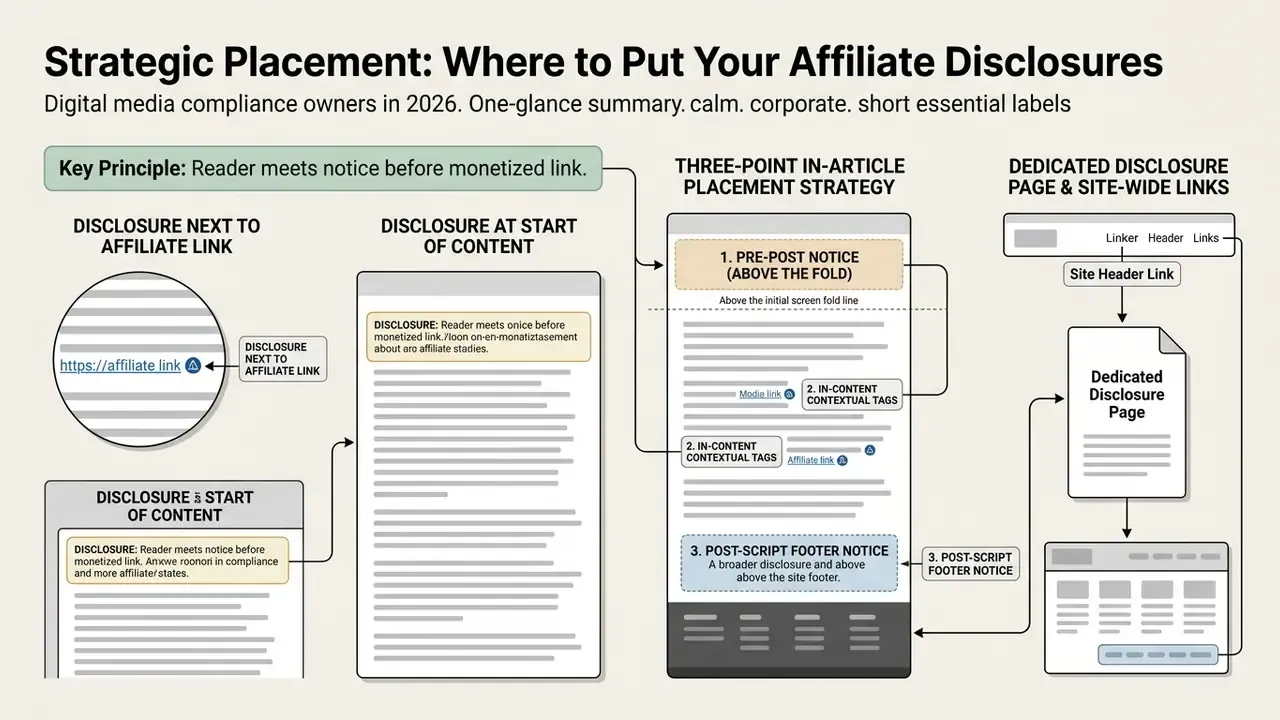
Disclosure Next to the Affiliate Link and at the Start of Content
Positioning notices near the top of an article, or immediately beside referral buttons, gives them high visual impact. FTC guidance stresses that proximity to the triggering claim prevents consumer deception. When readers evaluate software subscriptions or digital tools, a clear notice above the main text establishes commercial transparency from the first screen.
Three-point in-article placement strategy
Deploy the disclosure across three content zones:
- 1. Pre-post notice (above the fold). Sits immediately below the title or featured image, informing the reader before reading starts. Example: "Before we start: some links in this post are affiliate links. If you buy through them, we may earn a commission at no extra cost to you."
- 2. In-content contextual tags. Placed inside product callout boxes or next to referral buttons, for example
[Buy Product Name - paid link]or "Check this tool (affiliate link). If you subscribe, we may earn a small commission." - 3. Post-script footer notice. Repeats the point at the end of long guides for readers who jump straight to conclusions. Example: "P.S. This guide contains affiliate links. Purchases made through them earn us a commission; our rankings remain editorially independent."
Running all three zones is not redundancy. It is defence in depth. Readers arriving via anchor links, in-page search, or AI summaries may never see the header notice, which leaves the in-content tag as the only compliant touchpoint.
A Dedicated Disclosure Page and Its Site-Wide Links
A standalone disclosure page gives an exhaustive view of the business model, affiliate partnerships, and editorial principles. Persistent links belong in the site-wide footer and main navigation, so access is global. Regulators state plainly, though, that a standalone legal page never replaces immediate inline disclosure on individual monetized posts.
Structure the page around five blocks: business model summary; the list of affiliate programs and networks; how commissions influence, or explicitly do not influence, editorial rankings; the cost-neutrality statement; and a contact route for corrections. Link it with a descriptive anchor ("Affiliate Disclosure") from footer, sidebar, terms and conditions, and privacy policy. Keep that anchor label constant across templates, so repeated navigation elements do not confuse assistive-technology users.
| Placement location | Primary purpose | Reader visibility | Regulatory compliance risk | Recommended action |
|---|---|---|---|---|
| Beginning of article (above the fold) | Early warning before recommendations | High | Low | Mandatory baseline for every monetized post |
| Adjacent to affiliate link | Point-of-decision clarity | High | Low | Best practice for review buttons and inline links |
| Sticky header or persistent banner | Site-wide transparency for review portals | High | Low | Strong for comparison hubs; pair with inline tags |
| Dedicated disclosure page | Exhaustive legal and business-model breakdown | Medium | High (if used alone) | Essential secondary reference; link from the footer |
| Site footer only | Persistent site-wide legal anchor | Low | Non-compliant (as sole notice) | Supplemental only; fails the proximity test |
No matching rows Clear one or more filters to restore the matrix.
Platform-Specific Rules: Social Media, Video, and Email Disclosures
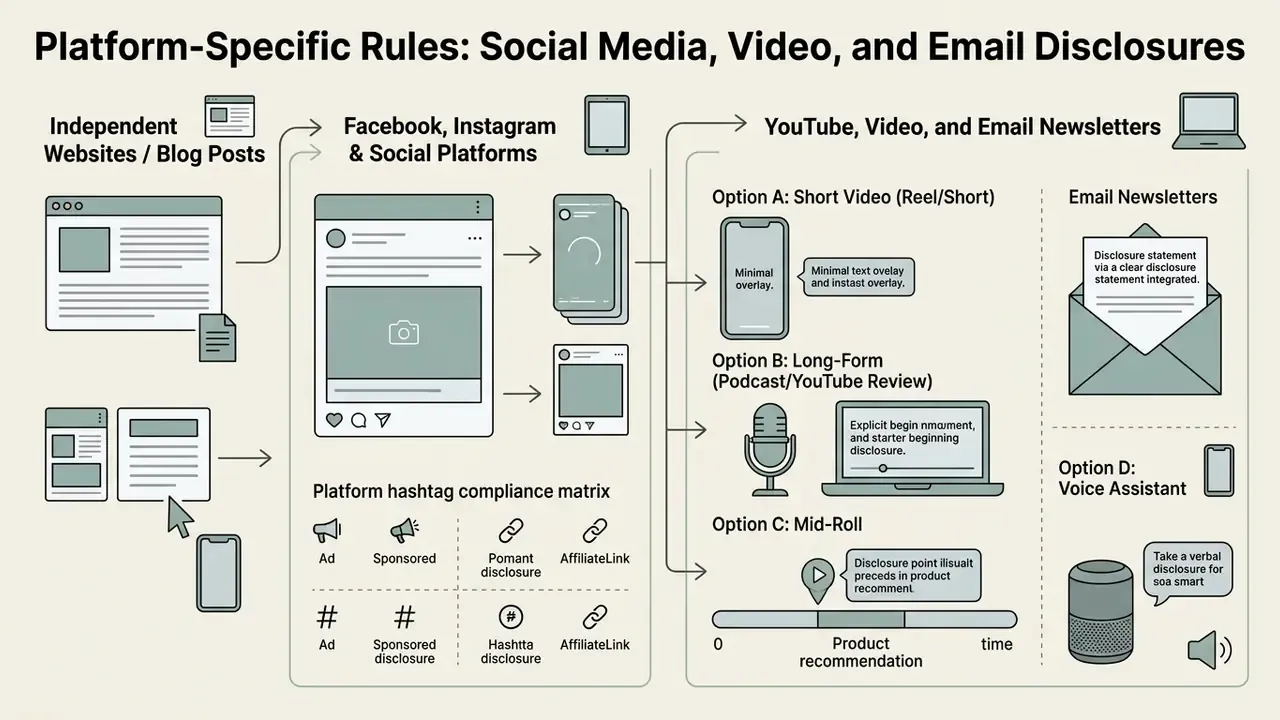
Adapting affiliate disclosures to external platforms means balancing space limits, fast consumption habits, and platform feature sets. On visual feeds, video platforms, or subscriber email, the notice still has to be prominent and unambiguous. Default platform tags alone rarely carry the weight.
Affiliate Disclosure in Blog Posts and on Independent Websites
Sites on independent content management systems give you full design control over placement. Publishers can insert automatic disclosure banners below article titles, or use custom shortcodes for call-to-action buttons. Reviewing software options or flexible media asset tools usually means inspecting dynamic credits, licensing terms, and workflow limits, a recurring scenario for editorial teams covering AI video generators, where commission structures and licence tiers both need disclosing.
Automation is where CMS publishers win. Template-level shortcodes cut human error, hold identical wording across thousands of URLs, and give you one place to update when a program changes its mandatory phrasing. Pair the shortcode with a governance rule: no monetized link may publish unless the disclosure component renders above it.
AI, Agentic Recommendations, and Automated Disclosure Governance
The "clear and conspicuous" standard is medium-agnostic. It follows monetized recommendations into conversational interfaces, retrieval-augmented answers, and autonomous agent workflows. When a model selects a product and the operator earns a commission on the resulting conversion, the material connection exists, whether or not a human wrote the sentence.
Control requirements for AI-mediated recommendations:
- Disclosure at generation time, not after the fact.The generation pipeline inserts the string into the same response that carries the monetized link, in the same medium: text for text, speech for voice.
- Deterministic insertion, not model discretion.Never rely on a prompt instruction to produce the notice. Enforce it in the response template or the post-processing layer, so output stays reproducible across model versions.
- Ranking-influence transparency.If commission economics affect ranking, ordering, or selection, say so explicitly. Silence about incentive-weighted ranking is the highest-severity deception risk in agentic commerce.
- Model risk documentation.Treat the disclosure component as an in-scope control: owner, version history, test cases, monitoring frequency, and failure modes such as dropped notice, truncated response, or tool-call bypass.
- Evidence for audit.Log the rendered output, including prompt version, model version, response text, and timestamp, so a reviewer can reconstruct what a specific consumer saw.
- Third-party and syndication risk.When answers are syndicated to partner surfaces or embedded widgets, verify that the notice survives the transformation. Truncation at the integration layer is a common silent failure.
Sample disclosure strings for automated surfaces:
- Chat or assistant answer "Note: some links in this answer are affiliate links, and we may earn a commission on qualifying purchases at no extra cost to you."
- Comparison widget rendered by a model "Paid placement disclosure: listings marked 'paid link' generate commission for this site. Rankings follow documented editorial criteria."
- Agentic checkout flow "Before I complete this purchase: this merchant pays us a referral commission. Confirm to continue."
Teams evaluating generation stacks for monetized content, licensing terms included, will find the commercial variables mapped in our breakdown of ai video pricing and credits. That detail becomes relevant the moment you have to disclose how tool partnerships shape editorial coverage.
Real-World Disclosure Examples and Ready-to-Use Templates
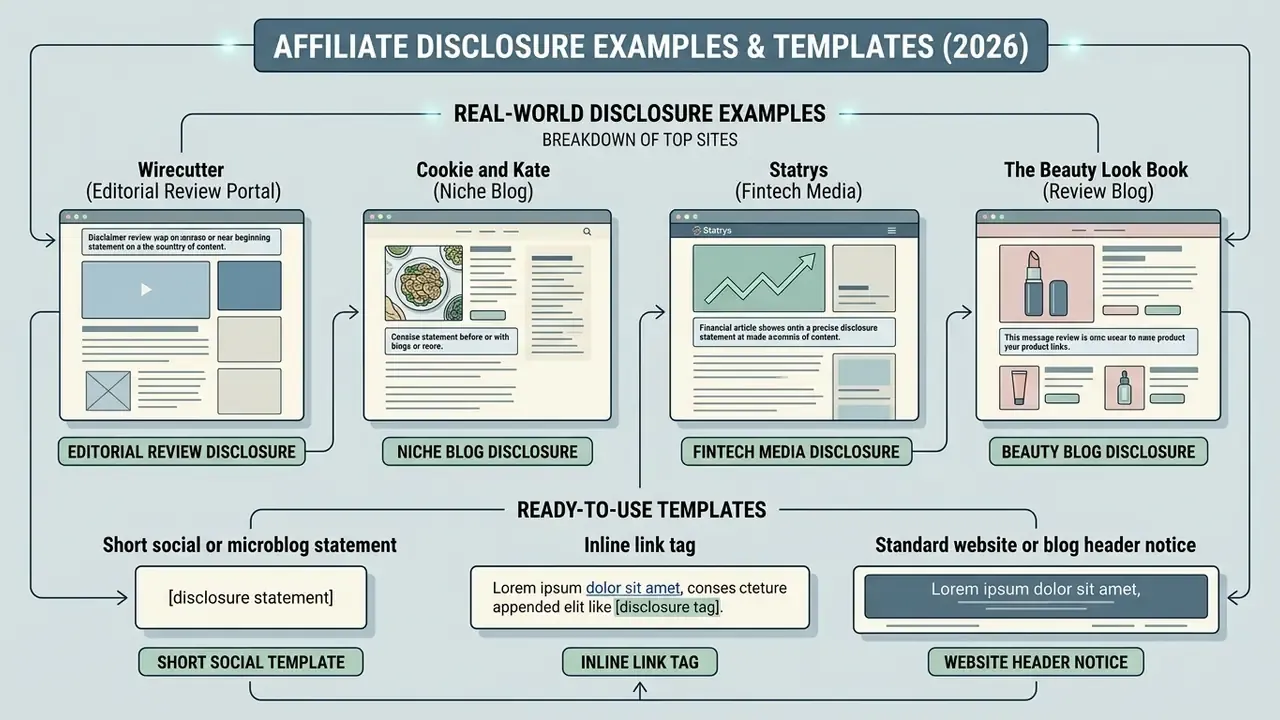
The right wording depends on platform constraints, available space, and audience expectations. Short formulations suit microblogging feeds and social posts. Detailed notices work better for long-form reviews and independent sites. Creators comparing production stacks, say while testing free video editing software before a review series, should lock their wording before the first monetized publication instead of retrofitting it later.
Real-World Disclosure Examples: Breakdown of Top Sites
- Why it works: high visibility and immediate transparency before content consumption; the notice cannot be scrolled past on entry.
- Residual gap: sticky headers can collapse on mobile, so pair them with inline tags in comparison modules.
- Why it works: covers point-of-decision clarity and comprehensive legal coverage, and satisfies the "identified disclosure" principle by naming programs.
- Why it works: limits visual disruption while ensuring users engaging with comparison content see the financial ties. Caveat: end-of-article-only placement is the weakest pattern under FTC proximity rules; add a pre-post notice for full defensibility.
- Why it works: answers the reader's real question, does money change the verdict, rather than only the legal minimum.
- Wirecutter (editorial review portal).Runs a persistent, sticky header notice on every page: "Wirecutter is reader-supported. When you buy through links on our site, we may earn an affiliate commission."
- Cookie and Kate (niche blog).Combines a short inline notice before the first recipe or product link with a dedicated legal page that names the networks and programs the site joins, plus a footer reference.
- Statrys (fintech media).Uses a post-level summary notice at the end of articles that contain affiliate links, plus contextual notices around comparison content, explaining that partner links support content production.
- The Beauty Look Book (review blog).Publishes a disclosure section describing both sponsored partnerships and affiliate arrangements, and explains how editorial honesty survives monetization.
Short vs. Detailed Affiliate Disclaimers: When to Use Each
Limitations and Open Questions
A few areas remain genuinely unsettled, and pretending otherwise would be dishonest.
Disclosure wording for agentic commerce has no dedicated rulebook yet. Current practice extrapolates from endorsement guidance written for human creators, which mostly works, though it leaves open how repeated notices should behave in long multi-turn sessions. Nobody wants a compliance sentence in every message; regulators have not said where the line sits.
Measurement is the second gap. Published survey figures on trust and disclosure vary widely by methodology, sample, and vertical, so treat them as directional. Internal audit results, including ours, are single-site observations rather than benchmarks.
Third, sector overlays evolve. Referral compensation rules in lending and settlement services depend on product design and state law, which means a template that clears federal review may still fail a state examination. Ask counsel, not a checklist.
FAQ: Audits, Edge Cases, and AI-Generated Content
Does a footer disclosure satisfy FTC requirements?
No, not as the sole notice. FTC guidance requires placement as close as possible to the triggering claim, and the notice must be hard to miss. Footer-only notices force the reader past the monetized link first, which fails the proximity element.
Is the phrase "affiliate link" enough on its own?
It is weak. Regulators and standards bodies treat bare industry jargon as insufficient when the audience may not know the term. Add the mechanism: "affiliate link, we earn a commission if you buy, at no extra cost to you."
Do platform tools like "Paid Partnership" replace a written disclosure?
No. Enable the platform tool and include a manual textual notice in the visible part of the caption or description. Platform labels get truncated, hidden by layout changes, or dropped in cross-posted copies.
What must be disclosed when the product was gifted rather than paid for?
The material connection still exists. Free or discounted products, review units, travel, and event access all require disclosure under FTC endorsement standards, because each can affect the credibility of the endorsement.
How should disclosure work in a comparison table where every row is monetized?
Use a table-level notice in the caption or immediately above the table, plus a per-row tag such as "(paid link)" on each button. Row-level tags are the only element guaranteed to be visible to users arriving via anchor links.
Who is accountable when a model or automated pipeline generates the recommendation?
The operator. Assign a named control owner for disclosure insertion, treat the insertion logic as an auditable component, and retain rendered-output logs so a reviewer can reconstruct the consumer experience.
What evidence should be retained for a compliance review?
Versioned snapshots of rendered monetized pages, the disclosure template change log, the approval workflow record, and monitoring results from periodic sampling. Screenshots of live pages age quickly; archived HTML with timestamps is stronger.
How often should disclosure controls be tested?
Sample monetized templates at least quarterly, and immediately after any CMS, theme, consent-banner, or generation-pipeline change. Layout regressions, not wording errors, cause most non-compliance in mature publishing operations.
Do EU and US wording requirements conflict?
They do not conflict, though they differ in emphasis. One sentence that names the commission mechanism, identifies commercial intent, and states cost neutrality generally satisfies both frameworks. EU cookie-consent obligations remain a separate, parallel duty.
Appendix A: Disclosure Control Testing Plan and Monitoring Metrics
Use this as a starting template for the marketing-compliance control inventory. Adjust the frequencies to your risk appetite; the structure matters more than the numbers.
| Control | Test procedure | Frequency | Evidence retained | Owner |
|---|---|---|---|---|
| Pre-post notice renders above the first monetized link | Sample 20 monetized URLs across templates, desktop and mobile | Quarterly | Rendered HTML snapshot plus screenshot with timestamp | Marketing compliance |
| Mandatory program wording is exact and unaltered | String-match the required sentence against live pages | Monthly, automated | Diff report and exception list | Web operations |
| Link-level tags present on every referral button | Crawl monetized templates, flag untagged outbound partner URLs | Monthly, automated | Crawl log and remediation tickets | Web operations |
| Social and video disclosure present at post level | Manual review of a sample of published posts per channel | Monthly | Archived post copies with capture date | Social media lead |
| AI-generated responses carry the disclosure string | Regression test suite across prompt and model versions | Every release, plus quarterly | Test results, prompt version, model version, response logs | AI governance owner |
| Ranking-influence statement matches actual commercial terms | Reconcile disclosure text with current partner contracts | Semi-annually | Reconciliation memo, signed by control owner | Legal and finance |
| Vendor and agency publications comply | Sample third-party output against internal standard | Quarterly | Vendor sample report and contract clause reference | Third-party risk |
Three metrics are worth reporting to the risk committee. First, template coverage: the share of monetized templates with a verified compliant notice. Second, defect ageing: how long placement findings stay open after detection. Third, regression rate: how often a previously compliant template breaks after a design or pipeline change. The third metric usually surprises people the most.