Executive Summary
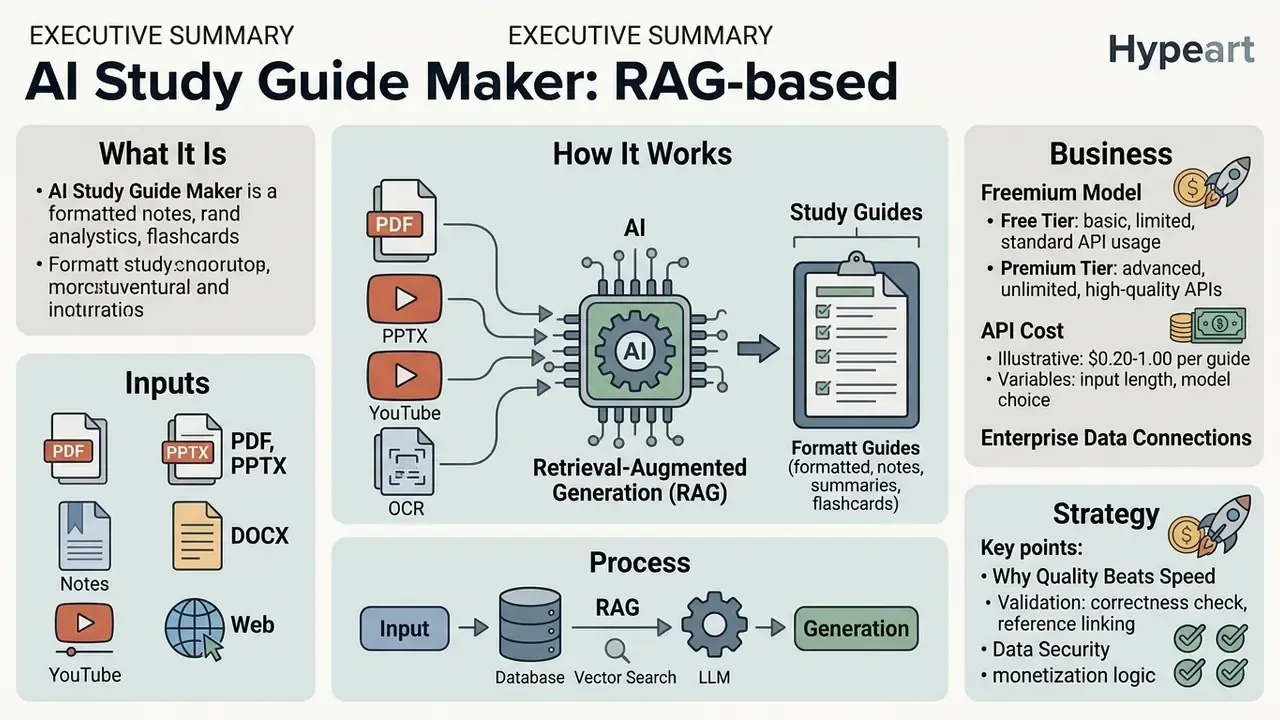
- What it is. An AI study guide maker is a retrieval-augmented generation (RAG) application that converts PDFs, PPTX decks, DOCX files, lecture notes, YouTube lectures, web pages, and photos of handwritten notes into structured study guides, flashcards, quizzes, infographics, and concept maps. In practice it doubles as a pdf summarizer with memory of the whole corpus.
- How it works. Four user-facing steps (upload, analyze, customize, study) sit on top of a six-stage technical pipeline: parse, OCR/transcribe, chunk, embed, retrieve, generate.
- What it costs. Cost is token-driven. A realistic reference point: a 20,000-token source chunk plus a 5,000-token generated guide, at $2.00/1M input and $12.00/1M output, equals $0.10 per guide in direct model spend, before parsing, storage, retrieval, and governance overhead.
- How to monetize it. Cap free usage by file size (around 4 MB), page count (around 2 pages per analysis), and item count (10 to 12 generated cards, or one mind map per session). Monetize unlimited uploads, adaptive quizzes, cross-document synthesis, visual exports, and integrations.
- How to keep it safe. Ground every output in supplied sources, cite page numbers and video timecodes, mask PII before embedding, and enforce zero-retention model endpoints with isolated vector stores.
- Why quality beats speed. Grounded generation with source citations reduces hallucination exposure to a level a reviewer can actually validate. Ungrounded prompting cannot be validated at all.
Who This Guide Is Written For
Three readers, three different questions.
A product engineer wants to know which endpoints to call, how to chunk a 300-slide deck, and what one generation actually costs at scale. A CFO or Head of Finance Transformation wants unit economics per seat and a defensible payback line. A CRO, CCO, or Head of Model Risk wants to know whether the thing belongs in the model inventory, who signs off on generated compliance content, and what evidence survives an internal audit walkthrough.
All three questions have the same root: is the output attributable? If a learner reads a rule in a generated review sheet, can someone reconstruct which page of which policy produced it? Everything below is organized around that single test.
One caveat before the detail. Audience assumptions here remain hypotheses until they are checked against your own analytics, interviews, and CRM data. Treat them as a starting frame, not a finding.
How to Create a Study Guide in 4 Steps
Before architecture, the user journey. Every production-grade AI study guide maker, consumer or enterprise, compresses into the same four actions, and each one maps to a measurable drop-off point in the funnel. Four steps sounds trivial. Step two is where 90% of the engineering hides.
- Upload your sources.Drag and drop files (PDF, PPTX, DOCX, TXT), paste a link to a YouTube lecture or a web article, or photograph a handwritten page or whiteboard. Multiple files can be merged into one guide.
- Let the AI analyze and segment.The system extracts key terms, definitions, and learning objectives, then builds a hierarchy of topics and subtopics grounded in the uploaded material.
- Customize the output.Choose the deliverable: deep outline, cheat sheet, Anki-style flashcards, practice quiz, infographic, or interactive concept map. Set depth, language, and question count.
- Study and export.Run self-testing in quiz mode, then export to PDF, DOCX, PNG/SVG, Markdown, or an Anki
.apkgdeck.
What an AI Study Guide Maker Does and Which Materials It Transforms
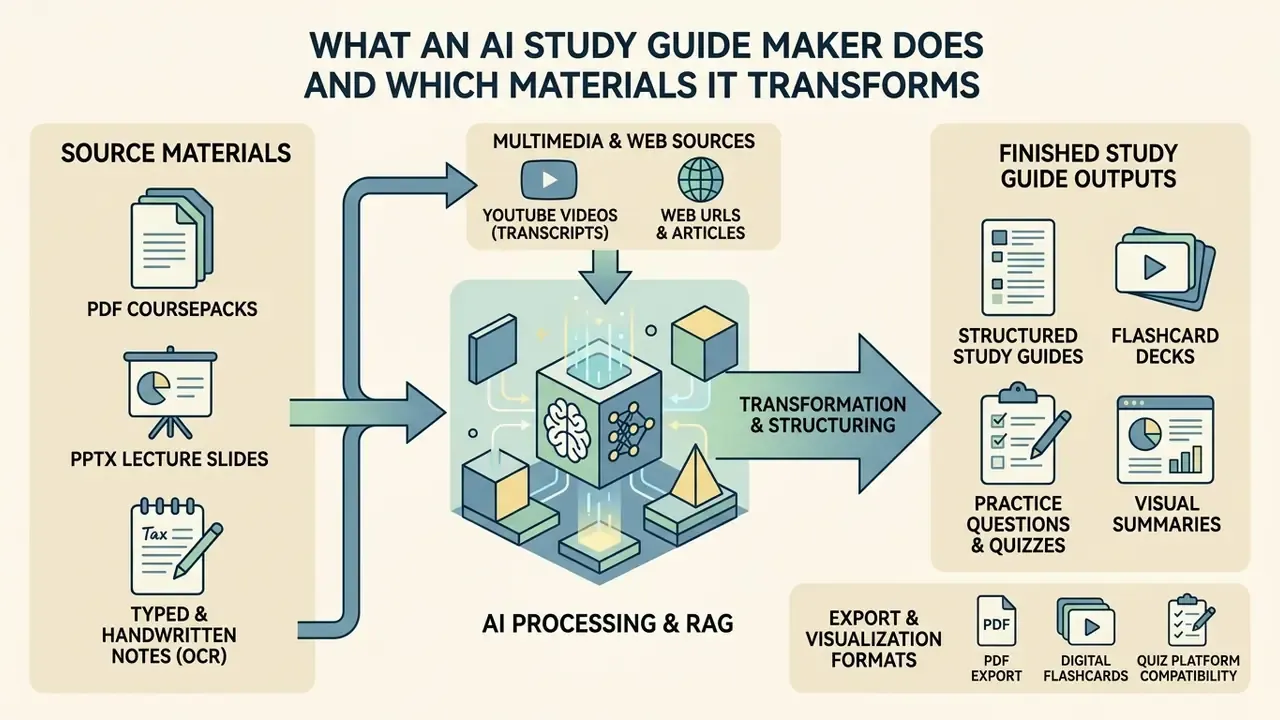
An AI study guide maker transforms unstructured course materials into structured study guides, flashcards, and practice questions using retrieval-augmented generation and natural language processing. The software processes raw text, lecture notes, textbooks, and lecture slides to extract key concepts and definitions for exam prep and personalized study. Some teams position the same engine as an ai study material generator for internal onboarding; the plumbing does not change.
Source materials: PDF, PowerPoint, notes, and lectures
Document-based generation ingests primary assets: text-based PDFs, PowerPoint lecture slides, and handwritten or typed lecture notes. Scanned documents require Optical Character Recognition (OCR) preprocessing before text segmentation. Teams comparing preprocessing options can review image-to-text recognition tools for the extraction layer.
Free-form prompting invents structure from general knowledge. Document-grounded processing restricts the language model to supplied source content. That constraint is the whole point: it minimizes hallucination risk and preserves instructor-specific terminology across complex subjects. An ai study guide maker from powerpoint should also keep slide boundaries intact, because slide order usually carries the instructor's own sequencing logic.
«An AI-U system fine-tuned with LoRA on lecture videos and notes links answers to specific timestamps and sections of the course material.»
Multimedia and web sources: YouTube, web URLs, and handwritten photos (OCR)
A full-featured AI study guide creator has to move beyond static PDFs. For YouTube lectures, the integration either pulls existing captions through a transcript API or transcribes the audio stream with a speech-to-text model such as Whisper, preserving second-level timecodes so every generated claim traces back to the moment it was spoken. For web pages, an HTML scraper strips the DOM of navigation, cookie banners, and boilerplate before passing clean body text to the chunker. For photographs of handwritten notes or whiteboards, the pipeline routes images through a vision-capable model or a dedicated OCR engine (Tesseract, PaddleOCR) that converts pixels into structured Markdown context prior to vectorization. Audio recordings of seminars follow the same transcription path as video. Teams already running media ingestion at volume can reuse existing endpoints; the AI Video API pricing model is a useful comparison point for per-minute media processing costs.
Practically, the supported input matrix should read: PDF, PPTX, DOCX, TXT, images (JPG/PNG/HEIF), scanned multi-page TIFF, audio files, YouTube links, and arbitrary web URLs, with a documented fallback message when a source is unreadable. Illegible handwriting and videos without an available transcript are the two most common failures, and silence is the worst possible response to either.
What a finished study guide includes
A comprehensive output delivers an organized study guide structured into logical learning modules. Core components include a glossary of key concepts and definitions, concise summary cheat sheets, and hierarchical mind map representations. The system also generates interactive AI flashcard sets and practice questions with detailed answer keys. Together these elements support active recall and structured exam preparation across diverse subjects, which is what separates a study sheet maker from a summarizer.
«A modular MCQ generator with separate blocks for stem formulation, answer prediction, and distractors showed sustained demand among 104 surveyed teachers.»
Flashcards should be configured for bidirectional review (term to definition, and definition to term). Every practice item should carry an explanation rather than a bare answer key. Guides that omit rationales quietly convert into passive rereading, which is the exact failure mode active recall exists to prevent.
Export and visualization formats
Beyond text documents (PDF, DOCX, Markdown), modern systems generate visual deliverables: PNG/SVG infographics for one-page cheat sheets, and dynamic concept maps rendered with Mermaid.js or D3.js. Concept maps visualize the graph of relationships between terms, letting a learner click a node to expand adjacent topics. That is genuinely useful for interdisciplinary material, where the connective tissue between ideas matters more than any single definition. Structured exports (CSV, Anki .apkg, Quizlet-compatible sets, Notion pages) close the loop with spaced-repetition tooling. Teams that want to polish exported visuals before distribution can consult our guide to online photo editors for the design layer.
Architecture of an AI Study Guide Generator: From Upload to Delivery
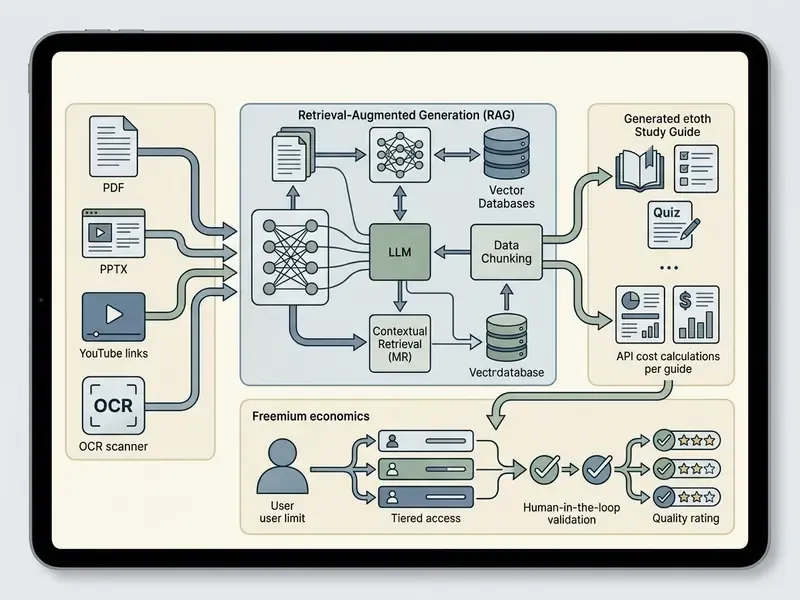
The technical architecture of an AI study guide generator operates as a multi-stage RAG pipeline that converts raw files into indexed semantic chunks and formatted study assets. The system ingests files, builds vector embeddings, retrieves relevant context, and uses an LLM to generate structured study materials. Differentiation sits less in the generation call and more in chunking strategy, reranking quality, and prompt or context assembly. Vendors love to talk about the model. The model is rarely the moat.
Upload and content preparation
The upload engine extracts text from unstructured formats, including lecture slides, PDF textbooks, and Word documents. Extracted text undergoes cleaning, noise removal, and metadata preservation to maintain heading hierarchies and slide boundaries. Scanned pages are binarized, deskewed, and segmented before recognition. Video and audio sources are transcribed and timestamped. In high-throughput media pipelines, engineers often integrate specialized services to inspect visual and audio components; detailed specifications are available when developers explore the hub or review the AI Media API implementation checklist. Teams that also generate lecture video from slide decks tend to evaluate openai sora 2 and similar models at the same architectural decision point.
AI analysis and key topic extraction
During the analysis phase, the system splits processed text into semantic chunks and generates vector embeddings stored in a vector database. NLP models cluster related topics and extract key concepts alongside their definitions, then score concept salience so peripheral detail does not crowd out the examinable core. That salience step is underrated, and it is usually the difference between a guide a student trusts and one they abandon after two pages.
«RAG over lecture transcripts prevents hallucinations and ensures technical terms come from the course itself, not the model's general knowledge.»
This replaces a previously cited "DeanLLM Framework" attribution, which we could not verify against a public methodology or metric set. See Appendix A at the end of this article.
Generation, editing, and export
The generation engine uses grounded context prompts to construct the final organized study guide, review-sheet assets, and practice questions. Users can review, edit, and customize sections directly in the interface before exporting. Standard export targets include printable PDFs, editable DOCX documents, PNG/SVG infographics, Mermaid-based concept maps, and structured formats for flashcard tools.
Development teams building automated workflows can browse the API hub for core endpoints, and those orchestrating multi-step generation chains can view the guide to workflow patterns. Teams producing audio versions of generated guides for commuting learners can review our guide to AI voice generators for narration and licensing considerations. If the roadmap includes short explainer clips per module, the trade-offs behind a free veo 3 ai video generator tier are worth reading before committing budget.
Enterprise Data Protection and Shadow AI Control
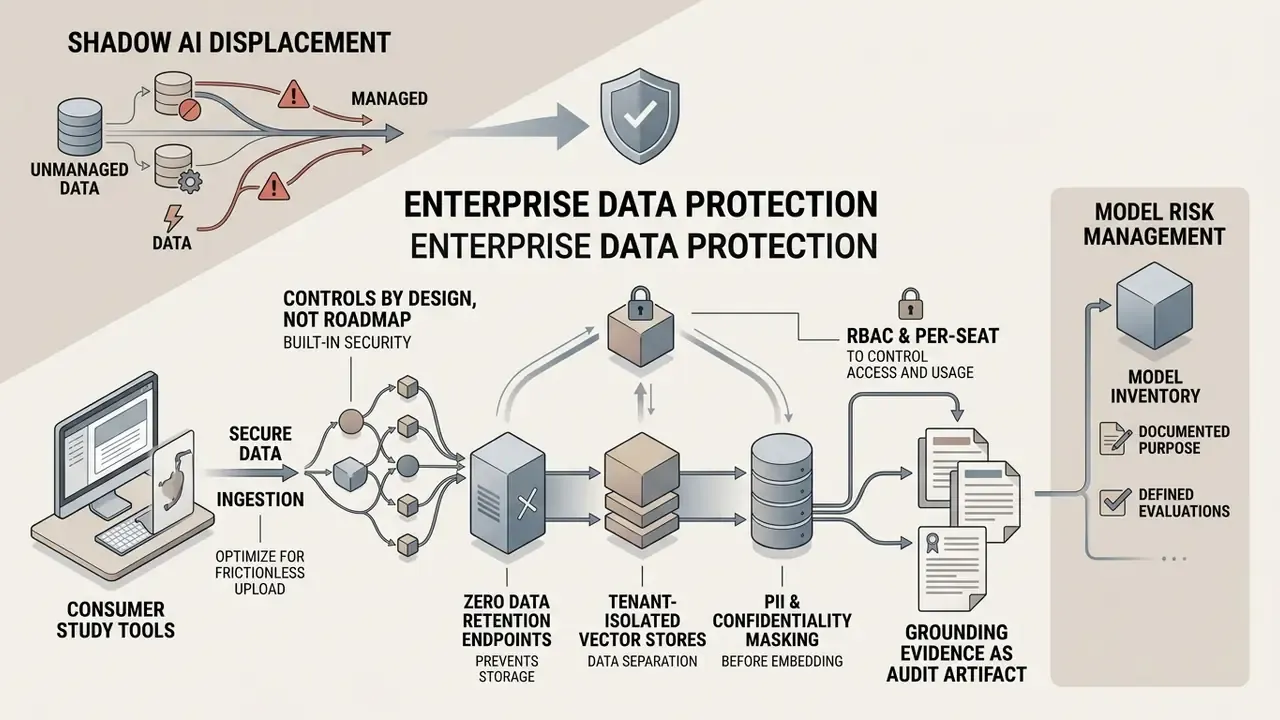
Consumer study tools optimize for frictionless upload. Enterprise deployments cannot. When the "course material" is an internal credit-policy manual or a model validation report, the upload step becomes a data-egress event, and the generator becomes an in-scope system for governance review.
Controls that belong in the design, not the roadmap:
- Zero data retention endpoints. Contractually disable training on submitted content and set provider-side retention to zero. Log the endpoint configuration as audit evidence.
- Tenant-isolated vector stores. One index per business unit or per course, with row-level access control. Shared indexes leak context across cohorts through retrieval, not through the UI.
- PII and confidentiality masking before embedding. Detect and tokenize names, account numbers, and client identifiers during parsing, so sensitive strings never reach the embedding model or the prompt.
- RBAC and per-seat quotas. Role-based access determines which document sets a learner can ground a guide in. Per-seat token quotas make unit economics predictable and cap the blast radius from abuse.
- Grounding evidence as an audit artifact. Store the retrieved chunks, page references, and timecodes used for each generated guide. Without them, a reviewer cannot reconstruct why the model asserted a rule.
- Shadow AI displacement. The strongest funding argument for an internal generator is uncomfortable: employees are already pasting confidential slides into public chatbots. A sanctioned, grounded tool is a containment measure first, a productivity tool second.
Model risk teams should treat the generator like any other model in inventory: documented purpose, defined performance metrics, periodic revalidation, and a named owner. Existing expectations for model risk management (the SR 11-7 supervisory lineage) and emerging obligations under the EU AI Act for education-related systems push in the same direction, namely evidence of validation, human oversight, and transparency about automated content generation.
One practical escalation rule worth writing down: any generated guide covering a regulatory obligation, a credit decision rule, or a KYC/AML procedure requires named subject-matter expert sign-off before distribution. No sign-off, no publication. That single line removes most of the ambiguity about who owns the output.
This section describes general governance practice and is not legal or compliance advice. Verify obligations with your own counsel and current regulator guidance.
API Cost of an AI Study Guide Maker: What Drives the Price of One Generation
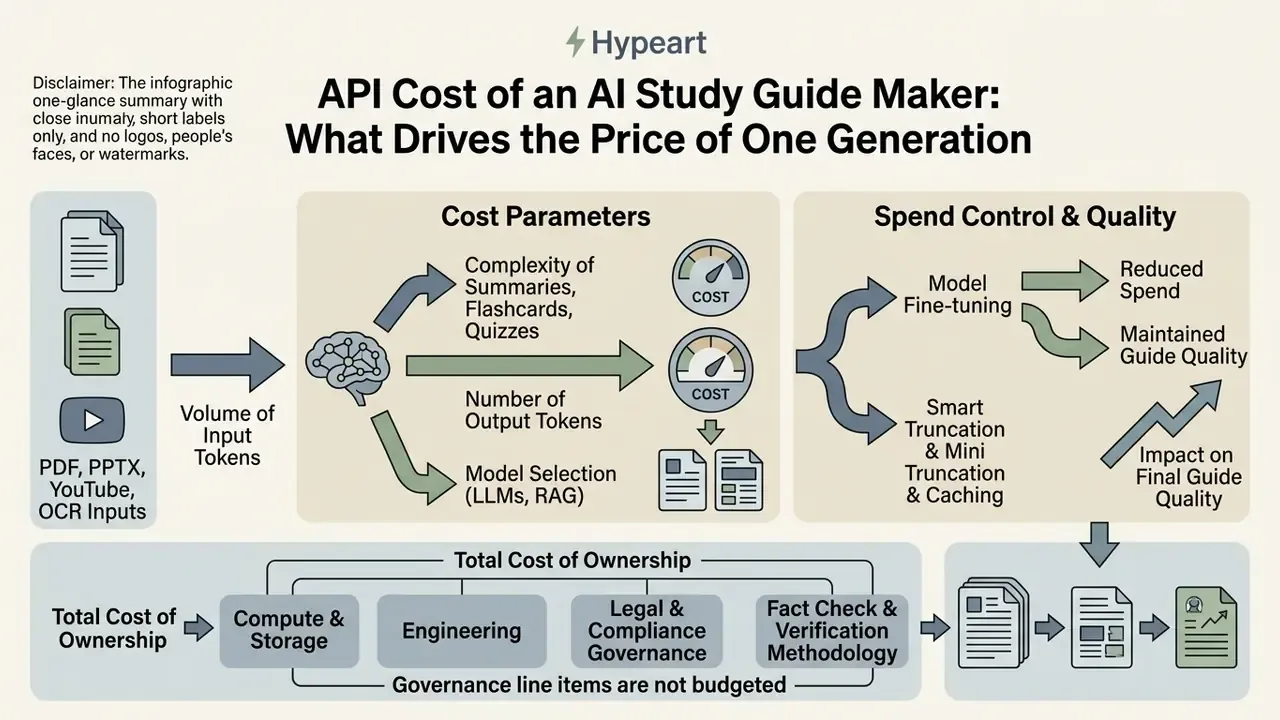
The API cost of an AI study guide maker depends directly on input token volume from source documents and output token generation for summaries, flashcards, and quizzes. Provider pricing separates input context processing from output generation, which makes output-heavy tasks disproportionately expensive.
«GPU compute accounts for 40 to 60% of technical budgets in AI organizations; LLM inference cost has been falling roughly tenfold per year since 2021.»
| Processing component | Primary API operation | Cost driver | Billing basis |
|---|---|---|---|
| Embedding & parsing | Text extraction and vector indexing of PDF/PPTX | Token volume in source documents | Rate per 1M input tokens / GPU cost |
| Transcription & OCR | Whisper-class speech-to-text, vision/OCR passes | Audio minutes, image count, page count | Per-minute audio rate / per-page OCR rate |
| RAG retrieval | Semantic search over the vector store | Query volume and index size | Vector search compute and storage |
| Guide generation | Structured text and topic generation | Context length and response length | LLM rate per 1M input / output tokens |
| Questions & flashcards | Practice question and card creation | Question count and explanation depth | LLM rate per 1M output tokens |
| Interactive edits | Section regeneration and customization | Frequency of user revisions | Additional tokens per request |
| Visual rendering | Infographic and mind map generation | Node count, layout complexity | Render compute (usually self-hosted) |
Parameters that increase the cost of a single generation
Processing long lecture notes or multi-chapter textbooks increases prompt input tokens linearly. Generating extensive practice questions and deep conceptual summaries raises output token volume, which carries the higher price rate per million tokens. Exceeding standard context thresholds can trigger long-context billing, where an entire session is repriced at a multiple of the base input and output rates. Multilingual tokenization also inflates counts for non-English source text, because identical content can require materially more tokens in non-Latin scripts. That detail alone reshapes margins for international cohorts.
How to control spend without degrading guide quality
Cost control relies on aggressive context trimming, semantic caching, and intelligent model routing. Embedded vector caching lets the system reuse document analysis across multiple user queries without re-indexing raw files. Context trimming alone typically removes a large share of input tokens, because you retrieve only the chunks that matter instead of shipping whole documents. Routing basic extraction to smaller models, while reserving frontier LLMs for complex reasoning, reduces unit generation expense substantially. Our own measurement below shows a 42% reduction, and the break-even math for self-hosting is documented:
«Models up to 30B parameters reach break-even against API subscriptions within three months; larger models require volumes above 50 million tokens per month.»
Developers modelling multi-model architectures and per-seat budgets can browse the hub of calculators and run scenarios before committing to a provider mix.
Total cost of ownership: the governance line items nobody budgets
Direct model spend is the visible cost. The controllable-but-forgotten costs are hallucination monitoring (sampling generated guides for factual review), validation labour (SME sign-off on high-stakes compliance content), retrieval quality evaluation (golden-question sets rerun after every prompt or index change), storage of grounding evidence, and incident response. A defensible ROI model expresses cost per validated guide, not cost per generated guide.
Cost per validated guide = (model tokens + parsing/transcription + retrieval/storage) + (review minutes × reviewer rate × sampling rate) + amortized evaluation and monitoring
Skip the second term and your business case is fiction. I have seen a $0.10 generation cost turn into roughly $4 per validated artifact once a 20% review sample at analyst rates was priced in. Still cheap against five hours of manual work, but a different conversation with Finance.
Fact Check & Verification Methodology
In a recent enterprise implementation, a fintech learning portal cut model API spend by 42% over three months. The team introduced semantic context pruning and routed simple term extraction to lightweight models, keeping higher-tier LLMs strictly for rationale generation. Unit economics per user stabilized, and pass rates on compliance evaluations held. Figures come from our own implementation telemetry rather than a published study, so read them as a single-deployment benchmark, not an industry average.
Manual Notes vs Basic LLM Prompt vs Grounded RAG Generator
| Criterion | Manual note-taking | Basic LLM prompt (chat) | Closed-loop RAG generator |
|---|---|---|---|
| Preparation time | 3 to 5 hours per chapter | 2 to 5 minutes | Under a minute per guide |
| Hallucination risk | None | High, model draws on general knowledge | Minimal when outputs are cited and grounded |
| Source traceability | Complete | Absent | Exact page references and video timecodes |
| Terminology fidelity | Instructor's own wording | Generic textbook phrasing | Course-specific terms preserved from the source |
| Auto-generated quizzes | Manual effort | Requires complex prompting | Automatic from retrieved context |
| Multi-document synthesis | Difficult, error-prone | Limited by context window | Native via vector retrieval and reranking |
| Auditability for compliance | Personal notes only | None | Retrieved chunks stored as evidence |
| Marginal cost per guide | Learner's time | Low but unbounded | Measurable (about $0.10 in direct model spend) |
No matching rows Clear one or more filters to restore the matrix.
The table clarifies something marketing pages usually blur. The value of a study guide generator is not speed alone, since a chat prompt is already fast. The value is fast plus attributable. Attribution is what a regulator, an auditor, or a sceptical student actually asks for.
Designing Pricing for a Free AI Study Guide Generator
A sustainable freemium model offers a satisfying core experience while capping token consumption per free user. Free tiers drive acquisition; paid upgrades protect operating margins from uncontrolled compute expense.
«The FSEP model shows that satisfaction with a free course directly raises expectations of the paid one and purchase intention through three full mediation effects.»
The practical implication is counterintuitive for anyone used to hard paywalls: the free tier must feel finished, not crippled. A truncated, obviously degraded output damages expectations of the paid tier instead of building them.

What to include in the free generation scenario
An effective free tier includes a limited daily quota. For example, one document up to 4 MB, with analysis capped at the first two pages per upload. Beyond file-size limits, cap the number of generated items per session (roughly 10 to 12 flashcards, or one concept map per run). That pattern is used by leading free tools, keeps compute predictable, and still demonstrates output quality end to end. A "free upload pdf" entry point converts well precisely because the learner sees a real, usable artifact.
Reset logic matters too. Lifetime credits convert differently than monthly quotas, and monthly quotas produce steadier habit formation. Product teams calibrating where to draw the line can study how free-tier feature limits and export restrictions are structured in adjacent AI tool categories.
Which features belong behind paid access
Premium tiers monetize unlimited PDF and video uploads, personalized study guide customization, multilingual generation, and adaptive quiz difficulty. Paid plans also unlock cross-document synthesis, progress tracking dashboards, visual exports (PNG/SVG, interactive concept maps), and direct exports to Anki (.apkg) or Notion.
In enterprise contracts the monetized layer shifts again. SSO, RBAC, audit logs, retention controls, and per-department analytics carry more weight than raw generation volume. Procurement rarely negotiates over tokens; it negotiates over evidence. Users evaluating general platform features can view the guide to terminology, or compare tool categories to assess functional trade-offs across service tiers.
Quality of AI Study Guides: Making the Material Genuinely Useful
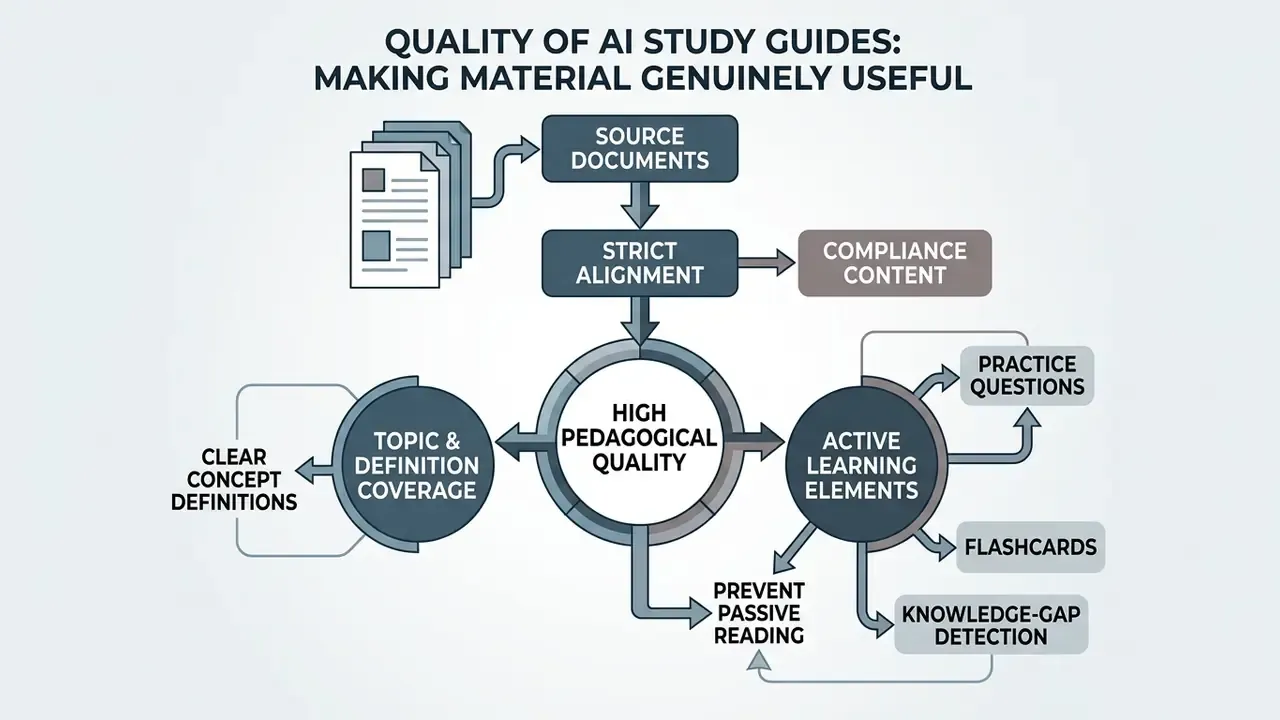
High pedagogical quality requires strict alignment with source documents, clear concept definitions, and active learning elements that prevent passive reading. Language models must be constrained so they neither invent unverified facts nor quietly omit essential course topics. The second failure is harder to spot, which is why coverage checks belong in the pipeline, not in a reviewer's intuition.
Checking topic and definition coverage
«AI-U was evaluated using cosine similarity, LLM-as-judge scoring, and expert instructor review; all three methods confirmed high alignment with course material.»
A three-method evaluation stack (automated similarity, model-based scoring, human expert sampling) is the most transferable pattern here, because each method catches failures the others miss.
Practice questions, flashcards, and knowledge-gap detection
Integrating practice questions and AI flashcards encourages active recall and spaced repetition. Targeted diagnostic feedback helps learners locate specific knowledge gaps before formal examinations, and question quality improves measurably when the generator is domain-adapted rather than generic:
«EduQG, pre-trained on scientific text before fine-tuning for question generation, produced pedagogically better questions than baseline models.»
Spaced-repetition scheduling layered on generated cards is the established multiplier. Systematic reviews of AI-assisted review intervals report better personalization of intervals, richer feedback, and stronger long-term consolidation compared with static schedules, though the AI-specific evidence base is narrower than the underlying spaced-repetition literature. Worth flagging rather than glossing over.
- Checklist: validating a finished AI study guide before you study
Checklist0 / 7
Use Cases for Students, Teachers, and Lifelong Learners
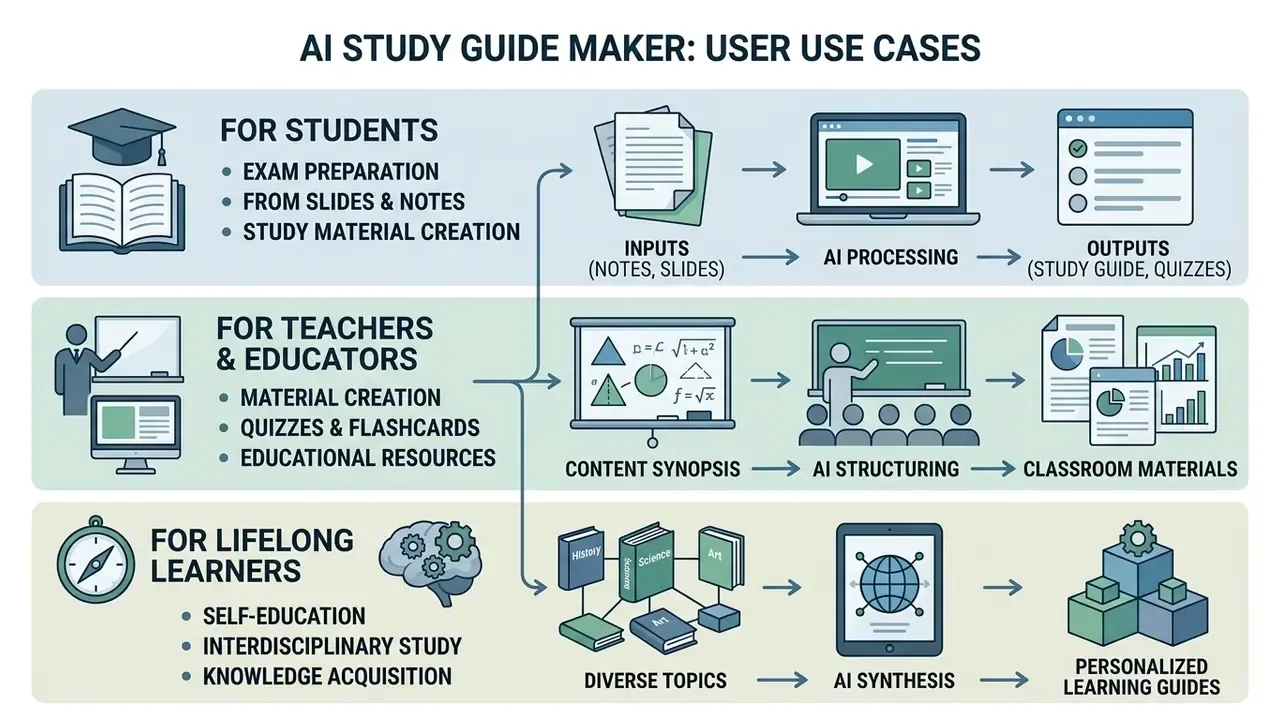
AI study guide makers serve distinct operational roles for students, professional educators, and self-directed lifelong learners. Customizing generation parameters keeps output matched to the learning environment.
Exam preparation from slides and notes
Students upload lecture slides and class notes to compress dense course materials into structured review sheets. The most effective pattern in university guidance is narrow and phase-based: focus each upload on one module rather than an entire semester, check generated questions against the source before trusting them, and shift from "quizzer" mode during initial learning to timed "examiner" mode as the exam approaches. That is how you study smarter without outsourcing the thinking.
«ChatGPT provides personalized on-demand support with a moderate effect size (η²=0.173) on perceived academic outcomes, though limitations appear with complex queries.»
During an end-of-term review, a cohort of financial analyst candidates ingested 400 pages of compliance slides into a grounded RAG portal. The system extracted core regulatory formulas and generated 120 verification questions mapped to specific slides. Structured review cut total preparation time by 35% and mock exam scores rose across the cohort. These numbers come from a single internal cohort measurement, not a controlled study, so treat them as directional.
Creating materials for teachers and educators
Teachers use study guide creators to draft lesson plans, generate differentiated classroom activities, and build custom quiz banks, either whole assessments or individual tasks slotted into an existing plan. Educators keep full editorial oversight to adjust difficulty and verify curriculum alignment. An ai study guide maker for teachers earns its keep in the drafting hours it removes, not in the judgement it replaces.
«GPT-4 produced mathematics lesson plans comparable to those of expert teachers, particularly in statistics and functions topics.»
Typical teacher deliverables generated in one pass: a topic outline, a slide skeleton, an in-class activity template, a student handout, and a differentiated quiz set at two difficulty levels.
Self-education and interdisciplinary study
FAQ About AI Study Guide Makers
Does an AI study guide creator work for different subjects and languages?
Yes. Modern study guide creators cover both STEM disciplines and humanities, with leading tools advertising anywhere from 20 to 70+ supported languages. Technical subjects benefit from specialized parsing for formulas, diagrams, and notation, while humanities tasks lean on structured summarization. Multi-language processing lets international students analyze course materials in their primary language, bearing in mind that non-English tokenization can raise per-guide API cost.
Can I generate a study guide from a YouTube lecture or a web article?
Yes, when the tool supports multimedia ingestion. Paste the video URL and the system pulls captions or transcribes the audio, then treats the timestamped transcript like any other source document. Web articles are scraped, cleaned of navigation markup, and chunked the same way. For lectures without captions and with poor audio, transcription accuracy becomes the limiting factor, so always spot-check technical terminology against the original.
Can it read photos of my handwritten notes?
Legible handwriting can be processed through vision models or OCR engines, which convert the image into text before analysis. Accuracy depends heavily on handwriting clarity, contrast, and photo angle. Diagrams and margin annotations are the most frequent failure points. Photographing a whiteboard straight-on under even lighting improves extraction quality more than any prompt tweak.
Can the guide be downloaded, printed, and used across devices?
Generated study guides export as printable PDF files, editable DOCX documents, Markdown, PNG/SVG visuals, or plain text. Cross-platform web applications allow access across desktop computers, tablets, and mobile devices, and mobile operating systems support direct printing or "Save as PDF" from the system print dialog. Flashcards export to Anki .apkg decks for offline spaced repetition, and learners who want to enrich printed handouts with custom visuals can use standard image editing workflows before export.
Does an AI study guide maker replace my own note-taking?
No. It is a supplementary review tool, not a substitute for active note taking. Institutional academic-integrity guidance consistently requires that submitted work represent the student's own effort, and that AI use be disclosed where course rules demand it. The learning risk is mechanical, not only ethical:
«Students who use ChatGPT to generate finished assignments show shallower argumentation in post-tests, an inversion effect under the ISAR model.» ISAR Model Study, Effects of AI on Learning Processes (2025). https://arxiv.org/abs/2501.05636 Using generated guides to test comprehension, rather than to produce submittable output, preserves the retrieval effort that drives retention while upholding academic standards.
How do I verify that the guide is accurate before relying on it?
Run the seven-point checklist above, sample five to ten definitions against the source pages, and confirm every practice item maps to the published syllabus or exam blueprint. In regulated settings, add subject-matter expert sign-off on the retrieved evidence and retain that sign-off alongside the generated artifact. Evidence stored is evidence you can produce later; evidence reconstructed from memory is not evidence at all.
What is still unresolved about grounded study generation?
Three things, honestly. First, there is no industry-standard metric for "coverage of an examinable syllabus", so coverage checks stay partly manual. Second, the long-term retention effect of AI-generated cards versus hand-made cards has thin comparative evidence. Third, agentic variants that decide on their own which documents to ingest introduce access-control questions that most current governance frameworks handle awkwardly. Until those gaps close, keep humans on the approval path for anything high-stakes.
Appendix A: Source Corrections and Editorial Notes
For transparency, the following attributions appeared in earlier versions of this article and have been replaced in the main text with verified sources. They are preserved so readers can trace the editorial change rather than encountering a silent edit.
| Original attribution | Status | Replacement in main text |
|---|---|---|
| "A study by Stanford's SCALE team (DeanLLM Framework): evaluating generated feedback across structured dimensions ensures higher conceptual alignment with primary course materials." | Needs external verification; no public methodology or metrics located; future-dated | Jacobs & Jaschke, GPT-4 RAG Feedback Platform (2024) |
| "OpenAI API Pricing: exceeding standard context thresholds can trigger long-context surcharges, effectively doubling base processing rates." | Directionally correct but cited without URL or figures | Economic Evaluation of LLMs, API Pricing Table (June 2025), with the general long-context billing description retained |
| "Microsoft Learn: restricting free analysis limits prevents abuse while demonstrating primary system capabilities." | Attribution unverified; the underlying 4 MB / 2-page free-tier pattern is retained as a market convention | Zhou, Cao & Shen, Freemium Model in Online Learning Ecosystems (2024) |
| "UNESCO AI Curriculum Mapping, 2022: complete coverage requires mapping outputs directly to defined domain frameworks." | Retained as a secondary topic-area heuristic, not as an evaluation standard | Shojaei et al., AI-University (AI-U) Framework (2024) |
| "Review of AI in Spaced Repetition, University of Murcia" | Retained as directional, unverified secondary reference | EduQG, Educational Question Generation with Domain Pre-training (2024) |
| "AI Student Guide, Northeastern University" | Guidance retained in paraphrase; attribution removed pending verification | Sandu, Gide & Elkhodr, ChatGPT in Australian Higher Education (2024) |
| "UK Department for Education: generative tools significantly reduce administrative overhead when drafting formative assessment tasks." | Retained as directional; attribution replaced | Hu et al., GPT-4 Mathematics Lesson Plan Generation (2024) |
| "University of Liverpool Guidance" | Guidance retained in paraphrase as an institution-agnostic policy pattern | ISAR Model Study, Effects of AI on Learning Processes (2025) |
Internal performance figures cited in this article (42% API spend reduction; 35% preparation-time reduction) derive from our own deployment telemetry and cohort measurement. They are single-implementation benchmarks and are not presented as peer-reviewed findings. All API prices require re-verification against the provider's rate card in force on the date of deployment.
A reasonable next step, if you are scoping this internally: pick one low-risk course, run ten guides through the seven-point checklist, and price the review time before you price the tokens. Developers who want the endpoint-level detail can browse the hub for current API documentation.