"Without verifiable benchmarks and model risk controls, autonomous generative tools are liabilities rather than assets. Evaluating an AI image generator requires treating visual generation as a measurable software service with defined accuracy, latency, auditability and data-retention parameters."
Editorial Board Statement, AI Media Benchmarks review team (February 2026 evaluation cycle)
«The AI RMF calls for a Test, Evaluation, Verification, and Validation methodology across the AI lifecycle.» NIST, TEVV Framework for Evaluating AI Systems (2026). https://www.nist.gov/
Executive summary for decision makers
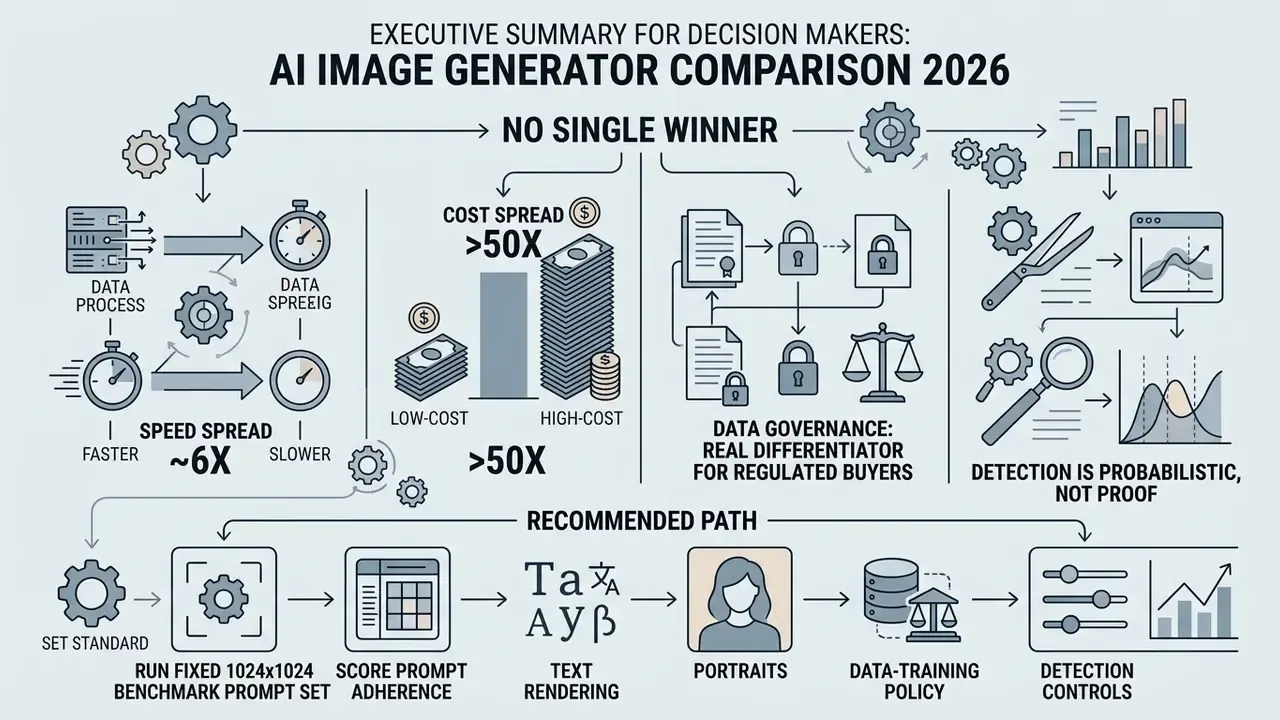
- No single winner. Midjourney v6.5 leads on aesthetic quality and style consistency. Nano Banana Pro (Gemini 3 Pro Image) leads on in-image text and infographics. Stable Diffusion 3.5 Large leads on latency and structural control. Adobe Firefly leads on commercial safety and indemnification.
- Speed spread is roughly 6x. Median 1024x1024 render time ranged from 1.9 s (Stable Diffusion 3.5 Large via API) to 12.0 s (Midjourney v6.5) in our February 2026 window.
- Cost spread exceeds 50x. Independent crowd-benchmarking of hosted endpoints showed more than a fiftyfold gap between the most and least expensive image models. So per-image cost, not subscription price, must drive procurement.
- Data governance is the real differentiator for regulated buyers. Canva and Adobe Firefly do not train public models on customer content. Consumer ChatGPT and Gemini tiers require explicit opt-out. Self-hosted Stable Diffusion gives full data isolation.
- Detection is probabilistic, not proof. Pixel-level GenAI detectors survive EXIF and C2PA stripping but degrade under recompression. Treat scores as triage signals inside a human-review workflow.
- Recommended path: run a fixed 1024x1024 benchmark prompt set, score prompt adherence, text rendering and anatomy separately, then validate licensing, indemnification and retention terms before any paid rollout.
How to read this comparison
Three practical notes before the tables.
First, every score below is tied to a model version and a date. Image models ship weekly; a leader in February can slip by June. Second, the quality numbers are composite and partly human-rated, so treat them as a shortlist filter rather than a ranking you can defend in a validation memo. Third, the governance columns matter more than the aesthetics columns for regulated buyers. A tool that wins on beauty and loses on retention terms is not a candidate. It is a finding.
One more thing. We separate generated outputs from approved outputs throughout. Nobody ships raw generations into a customer channel, and the gap between those two numbers is where the real cost hides.
How we run this AI image generator comparison
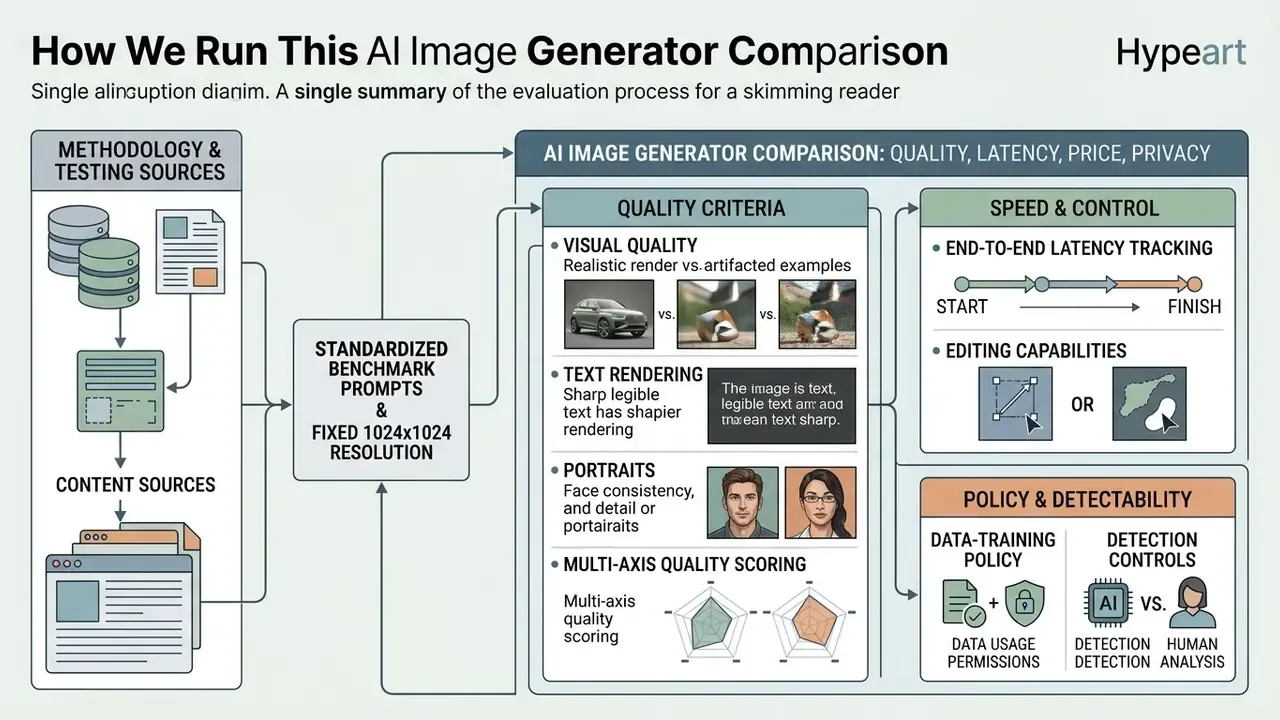
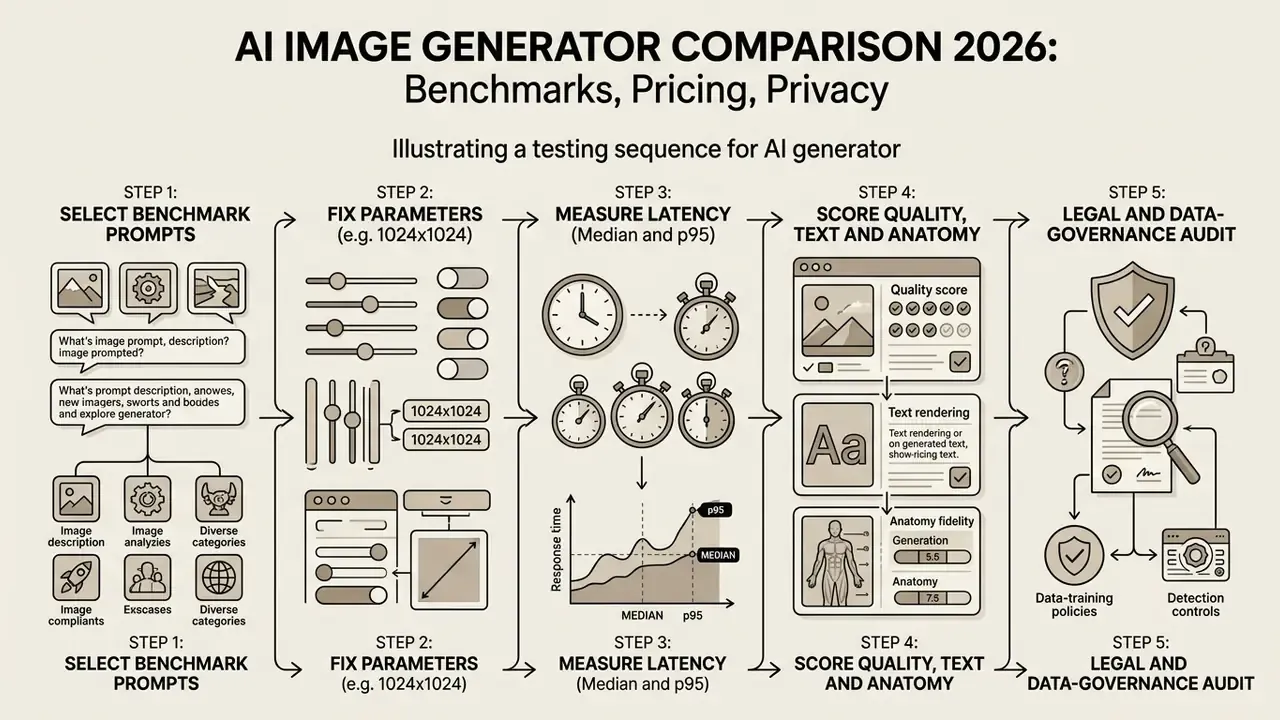
Evaluating generative visual models requires standardized benchmark prompts, fixed 1024x1024 resolutions, end-to-end latency tracking, and multi-axis quality scoring. Independent evaluation removes platform bias and produces auditable visual metrics that a second team can re-run.
A rigorous ai image generator test looks at operational latency and visual fidelity under controlled settings. We run standardized prompt sets across multiple image models to measure prompt adherence, photorealism, and structural coherence.
Our methodology isolates model performance from network variability by measuring end-to-end API response times. We calculate median latency across repeated runs to establish a reliable ai image generator benchmark, then report the p95 alongside it.
An honest ai image generation quality comparison examines semantic composition, typography, and anatomical plausibility. In parallel, an ai image generation speed comparison tracks time-to-first-frame and total render duration across varying concurrency levels.
In an enterprise evaluation for a US financial services firm, our editorial team replaced subjective visual checks with standardized 1024x1024 benchmark prompts across five generative models. We tracked end-to-end API response latency, prompt adherence, and text rendering accuracy over 500 test runs. The systematic process removed selection bias and produced verifiable performance metrics for executive approval, including a documented error taxonomy (hand and finger defects, typography misspellings, refusal rates) that internal audit could re-run on demand. That last detail is the one governance leads ask about first.
Quality criteria for evaluating AI-generated images
Evaluating ai generated images means testing prompt adherence, structural fidelity, typography, and human anatomy. A model must reproduce complex spatial relationships without introducing visual artifacts.
«Diffusion models consistently outperform GANs on human-perceived realism, yet FID systematically underrates them, a conclusion drawn from 41 models and roughly 207,000 human judgments.»
That finding matters operationally: automated scores alone cannot arbitrate a vendor selection. Photorealism evaluation therefore focuses on lighting consistency, surface-normal textures, and natural depth of field, all verified by human raters. Creating photorealistic images depends on accurate physics modeling for reflections, shadows, and material properties.
Instruction following assesses how accurately a generator renders multi-subject interactions, negations, and spatial positions. Rather than relying on a vendor rubric without a published protocol, we score instruction following with a VQA-based metric, which correlates more closely with human preference than embedding similarity.
«VQAScore outperforms CLIPScore in correlation with human judgment on Winoground, TIFA160 and Pick-a-Pic, scoring alignment via the probability of a "Yes" answer from a VQA model.»
Text rendering quality is evaluated by comparing OCR-extracted text against target prompt strings, with character-level and word-level similarity reported separately. Anatomical correctness relies on dedicated anatomy rubrics that verify facial symmetry, eye alignment, and hand geometry rather than a global "quality" score.
«Systematic defects in hands, facial features and clothing were observed, alongside demographic disproportions in how different groups are represented.»
In practice we log every failure into five buckets: instruction miss, typography error, anatomy defect, physics violation and safety refusal. A model that scores well on aesthetics but fails typography is disqualified for packaging, ad creative or infographic work, whatever its average score says.
How speed, control and editing capabilities are measured
Generation speed is measured as full request latency, from prompt dispatch to complete image retrieval. Model control is evaluated through reference conditioning, inpainting, and outpainting fidelity.
An ai image generator speed comparison relies on trailing multi-day medians over synchronous API connections, measured at 1024x1024 resolution and excluding client-side cold starts, authentication and retry overhead. The metric then reflects provider-side generation latency rather than total application latency.
«Open-source model providers, including Replicate, FAL and Fireworks AI, generate images in under 5 seconds, enabling a reactive real-time user experience.»
Evaluating control requires testing how well editing tools manipulate uploaded images through text instructions. We measure source content preservation alongside edit prompt compliance using CLIP image similarity scores, plus a masked-region diff that catches unintended background drift.
Capabilities to edit images and perform image editing are scored on task success rather than speed alone.
«EditEval and the LMM Score use multimodal models to judge editing quality across instruction compliance, content preservation and artifact absence.»
Comparison table of AI image generation tools
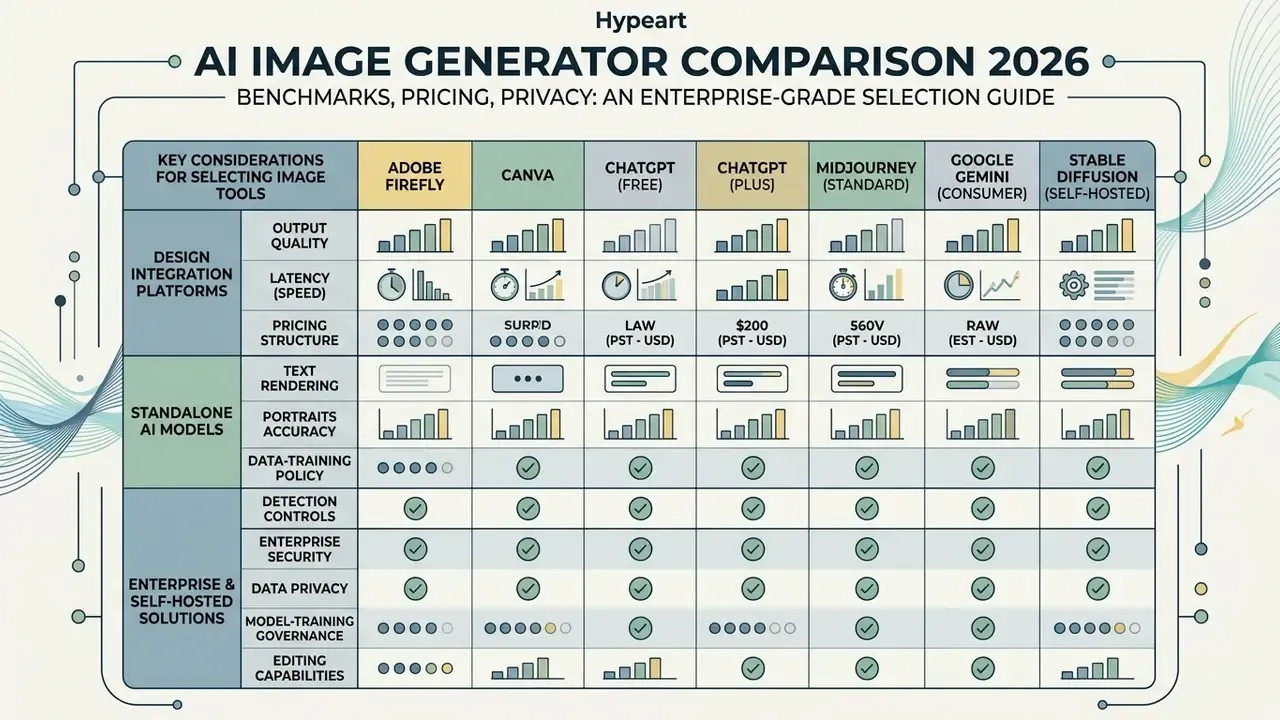
Comparing generative platforms means contrasting output quality, operational latency, pricing structures, data handling and editing capabilities. The summary table below outlines performance across the primary visual generation tools. Readers who need per-tool deep dives can review our full ranking of the best AI image generators with scenario-level scoring.
A careful ai image generation tools comparison exposes substantial differences in platform architecture and commercial access. Enterprise buyers should establish early whether a tool supports open API integration or operates as a closed ecosystem, because that single fact decides how hard the integration and the audit trail will be.
«Midjourney leads with a 71% win rate, Stable Diffusion 3 reaches 67% and Playground 61% in pairwise quality comparisons across more than 40,000 votes.»
Our ai image generation platforms comparison covers both consumer web interfaces and enterprise API endpoints. A structured ai image generator features comparison keeps the shortlist aligned with team workflows and security requirements, not with demo reels.
| Tool / Platform | Generation Model | Image Quality Score | Median Speed (1024x1024) | In-Image Text | Detailed Portraits | Image Editing Modes | Data Privacy / Model Training | Free Plan / Credits | Commercial Base Price |
|---|---|---|---|---|---|---|---|---|---|
| ChatGPT (GPT image) | Proprietary OpenAI (gpt-image-2) | High (8.9/10) | 6.2 sec | Excellent | High | Conversational, masking, reference | Training on by default in consumer tiers; manual opt-out; API data not used for training | Free tier available (capped) | $20/mo (Plus) or API per token |
| Gemini (Nano Banana) | Google DeepMind (Gemini Flash Image) | High (8.5/10) | 2.8 sec | Good | Medium-High | Inpainting, file upload | Consumer tiers may use activity to improve products; enterprise Vertex AI isolates data | Free tier available | $20/mo (Advanced) or API |
| Nano Banana Pro | Google DeepMind (Gemini 3 Pro Image) | Excellent (9.4/10) | 4.5 sec | Superior | Excellent | Multi-image, 4K upscaling | Same tier logic as Gemini; visible watermark plus SynthID on outputs | Limited daily quota | Included in Google AI plans |
| Midjourney | Proprietary diffusion | Superior (9.6/10) | 12.0 sec | Moderate | Superior | Vary Region, Pan, Zoom | Prompts may be used to improve services; outputs public unless Stealth Mode (Pro and above) | No free subscription | $10/mo (Basic) |
| Adobe Firefly | Firefly Image 3 | High (8.7/10) | 4.1 sec | Good | High | Generative Fill, vectors | Trained on Adobe Stock and public domain; customer content not used for public models | 25 monthly credits | $9.99/mo (Standard) |
| Canva (Magic Media) | Multi-model (licensed partners) | Good (7.8/10) | 5.0 sec | Moderate | Medium | Template-native edits, background remove | Does not train on customer content; generated images remain private | Free tier with hard cap | $13/mo (Pro) |
| Stable Diffusion | SD 3.5 Large / Stability AI | High (8.8/10) | 1.9 sec (API) | High | Excellent | ControlNet, LoRA, inpaint | Self-hosted deployment gives full data isolation, no external transfer | Open weights, free locally | Usage-based API or self-hosted |
No matching rows Clear one or more filters to restore the matrix.
Enterprise security, data privacy and model-training governance
For regulated buyers, output quality is the second filter. The first is whether prompts, uploaded reference images and generated assets leave the trust boundary, and whether they can be absorbed into a public model.
When selecting a tool for corporate use, model-training policy must be documented per tier:
- Adobe Firefly and Canva customer content and generated creatives are not used to train public models. Firefly outputs carry commercial indemnification for eligible enterprise subscribers; Canva keeps generated images private by default.
- ChatGPT (Free and Plus) and Midjourney (Standard) session data may be used for model improvement unless the privacy setting is manually disabled. Midjourney outputs are additionally public in a shared gallery unless Stealth Mode is enabled on higher tiers.
- Google Gemini (consumer tiers) activity may be used to improve Google AI products. Enterprise workloads should run through Vertex AI, where data-use terms and regional controls differ materially from the consumer app.
- Stable Diffusion (self-hosted) full data isolation, no transmission to external servers, no vendor-side retention. The default choice where confidential product imagery or customer data is involved.
Procurement checklist for governance sign-off:
| Control | Why it matters | Evidence to request |
|---|---|---|
| Zero Data Retention (ZDR) | Prevents prompt and asset persistence on vendor infrastructure | Written ZDR addendum or enterprise DPA clause |
| Model-training exclusion | Keeps confidential briefs out of future public models | Vendor legal page plus tier-specific confirmation |
| SOC 2 Type II / ISO 27001 | Baseline third-party security assurance | Current audit report under NDA |
| IP indemnification | Transfers copyright-claim exposure to the vendor | Named indemnification clause and monetary cap |
| Regional processing | Data residency and cross-border transfer limits | Region selection in API or console, plus contract |
| Output provenance | Enables disclosure and downstream verification | C2PA Content Credentials, SynthID support |
Note: indemnification scope, ZDR availability and certification status change by tier and by contract date. Treat the table above as a request list for vendor security review, not as a substitute for one.
Which AI image generators were included
Our evaluation covers leading proprietary and open-weights visual generation platforms available in 2026. Selected platforms represent the primary tools used in enterprise design, marketing, and developer workflows, which is also where shadow usage tends to appear first.
The suite includes OpenAI's ChatGPT image generator, Google Gemini with Nano Banana and Nano Banana Pro, Midjourney, Adobe Firefly, Canva Magic Media, and Stability AI's Stable Diffusion family. These systems represent diverse architectural approaches to visual synthesis, from autoregressive generation to latent diffusion with external conditioning. Readers focused on a single vendor can review our dedicated analysis of Midjourney image generation versus competing platforms.
Including both API-first platforms and consumer chat interfaces makes an objective ai image generation model comparison possible. A broader ai art generators comparison across adjacent categories is available in the category hub if you need wider coverage.
Which features matter when selecting image tools
Selecting commercial image tools requires evaluating functional capabilities well beyond raw generation. Organizations should match platform features to a named operational bottleneck, not to a wishlist.
Essential features include text-to-image precision, localized image editing, inpainting, outpainting, and support for uploaded images. Marketing teams additionally need native vector output for graphic design, brand palette locking, and high-resolution export up to print-ready 2K or 4K.
A shortlist of hard requirements worth writing into the RFP:
- Reference-image conditioning (character, face, object, edge, depth).
- Masked inpainting and prompt-based outpainting with background preservation.
- Native SVG or true vector export for logos and iconography.
- Export format and DPI control (PNG, JPEG, TIFF, PDF; 72, 144, 216 DPI scaling).
- Seed and parameter reproducibility for audit re-runs.
- Role-based access, audit logs and team-shared style libraries.
Reproducibility is the one item buyers skip and later regret. Without seed logging you cannot show a validator how a published asset was produced.
Best AI image generators for different tasks
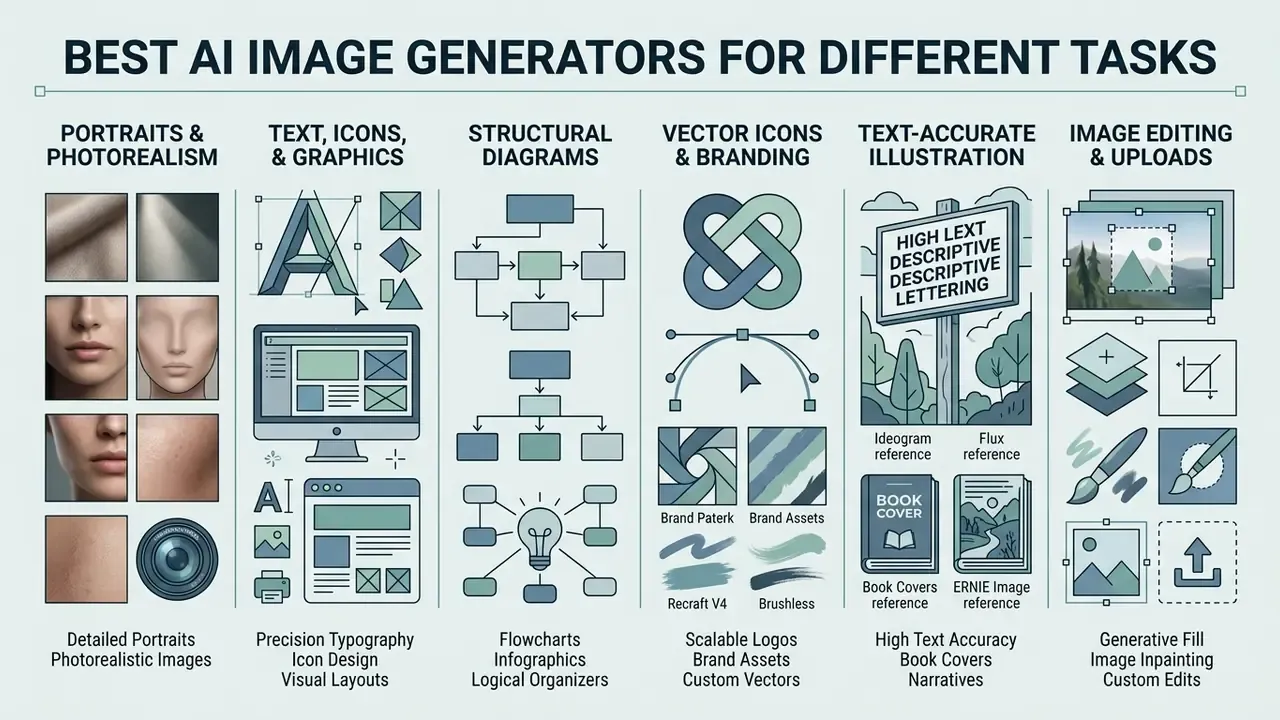
Selecting the best ai image generator means aligning model strengths with specific use cases. No single platform dominates every visual category, and vendors who claim otherwise usually have one very good demo.
Deploying ai image generation tools for detailed portraits calls for architectures optimized for human anatomy. Brand asset creation, by contrast, demands precise tools to generate text and structured graphics.
Marketing teams building campaigns for social media prioritize generation speed and visual engagement. Technical workflows need robust image editing to refine existing media assets, which is a different requirement entirely.
Generators for detailed portraits and photorealistic images
Photorealistic human portraits demand exact rendering of facial geometry, skin pores, and eye reflections. Anatomical plausibility remains the clearest differentiator among generative models.
«In a large-scale experiment with more than 1,000 participants, diffusion models were the clear leaders in human-perceived realism and diversity compared with GANs and VAEs.»
Tools for text, icons and graphic design
Rendering legible text inside synthetic images was, for years, the embarrassing weakness of diffusion models. Modern platforms use dedicated typographic decoding to get spelling right.
«The Text Rendering metric combines character-level similarity via Levenshtein distance and word-level similarity via the Jaccard coefficient, normalized to the [0, 1] range.»
Based on vendor documentation rather than an independent accuracy study, Recraft V4 and Adobe Illustrator's Text to Vector Graphic engine are currently the strongest documented options for native SVG graphics, icons and promotional assets with accurate text. Both let designers build scalable elements for graphic design and social media without a manual redraw.
Standard generators are insufficient for several recurring corporate tasks. Three specialized categories deserve a place in the stack:
- Structural diagrams and visual organizers (Napkin AI). Instead of prompting for a picture, you paste text, bullet points or a paragraph of explanation, and the tool interprets it into a diagram. The output resembles PowerPoint SmartArt but with context-matched icons, connectors and hierarchy. Useful for process documentation, onboarding decks and concept explainers.
- Vector icons and brand design (Recraft V4 and Brushless). Most diffusion models produce a raster image that merely looks like a vector. Recraft V4 and Brushless export true SVG code, so assets scale and stay editable in Affinity, Figma or Illustrator. Both allow a locked HEX brand palette, reference-image style creation and batch generation of six or more icons in one consistent style. Brushless flat-icon and line-art presets work well for training material where visual noise must stay low. Recraft also supports team-shared styles, which matters once several designers are involved.
- Text-accurate illustration (Ideogram, Flux, ERNIE Image). Ideogram was among the first systems to render text reliably and now adds masking and character placement. Flux is strong on realistic hands and typography. ERNIE Image targets precise in-image text with structured layouts.
The practical rule: build the composition in an aesthetic model, then move typography and icon sets to a vector-native tool. Teams building brand systems can also compare dedicated AI logo generators before committing to a general-purpose platform.
AI tools for image editing and working with uploaded images
Editing existing assets requires tools that modify specific sub-regions while preserving background coherence. Modern image editors accept uploaded images alongside text prompts to drive localized changes, which is where images based on real source material become a governance question as much as a design one.
«SeedEdit achieves substantially higher CLIP Direction Scores and GPT-judge ratings on HQ-Edit (293 DALL·E 3 images) and Emu Edit (535 real photographs) than open-source baseline models.»
| Operational Scenario | Recommended AI Generator | Primary Selection Rationale | Key Technical Capability |
|---|---|---|---|
| Photorealistic portraits | Stable Diffusion 3.5 / HyperHuman | Superior facial geometry and skin texture rendering | Identity preservation and anatomical accuracy |
| In-image typography | Recraft V4 / Ideogram / ERNIE Image | Exact OCR string matching and native SVG export | Precise character layout and vector generation |
| Business diagrams and explainers | Napkin AI | Converts written text into structured visual organizers | Auto-diagramming with contextual icon selection |
| Icon sets and brand systems | Brushless / Recraft V4 | Consistent style and locked brand palette across sets | Batch SVG generation with reference styles |
| Enterprise graphic design | Adobe Firefly | Direct integration with Photoshop and Creative Cloud | Commercial indemnification and Generative Fill |
| Conversational photo editing | ChatGPT (GPT image) | Multi-turn contextual revisions via natural dialogue | Region masking and conversational prompt editing |
| Rapid social media assets | Gemini (Nano Banana) | High-speed generation with Google ecosystem integration | Sub-3-second rendering and multimodal grounding |
| Multi-character scenes | Runway Gen-4 | Composes several reference characters into one scene | Reference-based scene and perspective generation |
| Custom local control | Stable Diffusion (Stability AI) | Granular structural conditioning via ControlNet | Local execution, LoRA fine-tuning, zero API cost |
Capabilities to edit images include object insertion, background removal, and style transfer. Platforms such as OpenAI Image Edit and Stability AI Search and Replace enable precise modifications through plain prompt instructions. Stability's Search and Replace targets a region described in text instead of requiring a hand-drawn mask, while Ideogram splits the job into Remove BG and Replace BG. Teams working mainly from existing assets can review our comparison of image-to-image generators for upload-driven workflows.
To extend still assets into motion, organizations can evaluate image to video ai tools and adjacent video generators for automated production workflows. Same governance questions apply, only with more frames.
Gemini, Nano Banana and ChatGPT: comparison of popular AI image tools
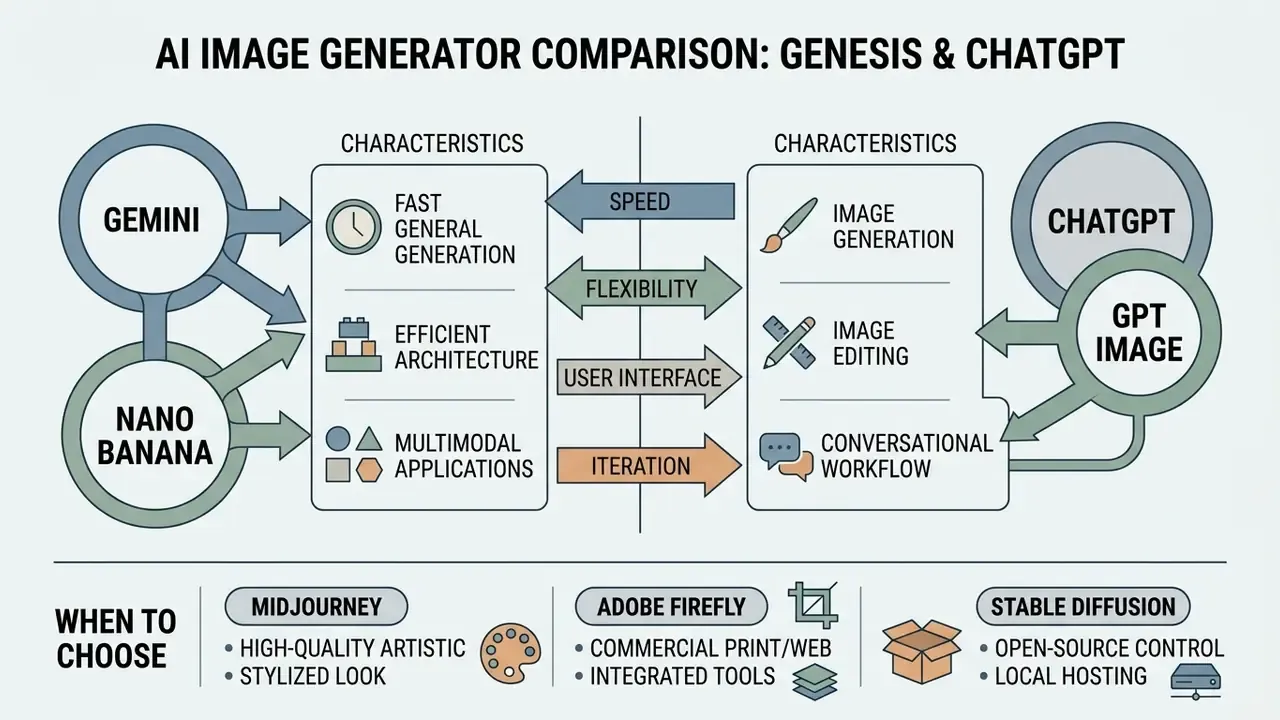
Comparing ai image generation tools like gemini with OpenAI's ChatGPT means analyzing the underlying multimodal architectures. Both companies have pushed visual synthesis deep into their core assistants, so its ai behavior in chat is now inseparable from the image pipeline behind it.
Google uses the nano banana model family inside Gemini, while OpenAI relies on the gpt image engine inside ChatGPT. Both ecosystems support conversational prompting, file uploads, and iterative revisions. Worth flagging for planning: Google's older Imagen endpoints are deprecated with a scheduled shutdown in August 2026, so migration to Nano Banana is a dated task, not an option.
A formal ai image generation models comparison shows genuinely different approaches to prompt processing and context retention. Google emphasizes real-world knowledge grounding; OpenAI leans on conversational instruction following.
Gemini and Nano Banana for fast general-purpose generation
Google's native visual generation rests on the Nano Banana series. Standard Nano Banana (Gemini 2.5 Flash Image) delivers rapid rendering for general queries, with a February 2026 median of 2.8 seconds in our tests.
Nano Banana Pro (Gemini 3 Pro Image) is positioned by Google as its image generation and editing model built on Gemini 3 Pro, accepting up to 14 input images and producing 1K, 2K or 4K output with a 65,536-token context window. Those are vendor-published capability figures, not independently benchmarked results. Our own testing confirmed superior in-image text and infographic layout, but we did not independently validate resolution ceilings across all channels, where preview and GA status shifted during 2026.
Practical limits found in testing: Nano Banana is fast but unstable on complex spatial sequences. Ask it to replace an object in a photograph and assign that object a motion vector, for example "replace the tennis ball with a chicken and make the chicken run away to the left", and it reliably swaps the object while frequently ignoring the dynamic half of the instruction. A visible watermark is also applied alongside SynthID, which matters for brand creative that cannot carry vendor marks.
Gemini accepts uploaded images for visual reasoning and image-to-image synthesis, including documents, spreadsheets, photos and video. Eligible users reach basic generation through a free account, with quota and file-size limits that differ by tier and region, and expanded limits on paid Google AI plans.
ChatGPT and GPT image for generation and editing
OpenAI folds visual creation directly into ChatGPT through the GPT image pipeline. Users generate and modify images inside an ongoing dialogue, which lowers the skill floor considerably.
The interface supports sequential editing through multi-turn text instructions. This is vendor-documented behavior rather than an independently benchmarked claim: users can select an image, mark an area and issue a text instruction in the same conversation, or skip selection entirely and describe the change in chat. In the API, generation and edits are separate endpoints, with reference images, masked-region replacement and an edit prompt limit of 32,000 characters for GPT image models.
One prompt-adherence behavior is worth knowing. The model is strong at style transfer from an uploaded reference: tell it to re-render a photo in the manner of Picasso, Vermeer or a hand-drawn animation style and it performs well. It also accepts single-element feedback ("change only the sky") more reliably than most alternatives. Because it is autoregressive rather than purely diffusion-based, it is slower than Gemini and typically returns one image per request.
The engine keeps subject consistency across sequential generations, which simplifies complex adjustments for non-technical users. The trade-off is real though: without layered, pixel-precise controls, fixing a single typography error often means regenerating the whole image. A side-by-side breakdown sits in our review of ChatGPT image generation versus alternative tools.
When to choose Midjourney, Adobe Firefly or Stable Diffusion
Midjourney remains the first choice for artistic styling, painterly aesthetics, and high-concept exploration. Its prompt interface offers extensive parameter controls for aspect ratios, style references and style codes, which is why many professional AI media producers start there even when they finish somewhere else.
Adobe Firefly is built for commercial safety, trained exclusively on Adobe Stock and public domain content. It integrates into Photoshop as Generative Fill, which suits enterprise marketing workflows where indemnification and Creative Cloud round-tripping are mandatory. Buyers comparing ecosystems can also review our overview of Google AI image generation access, pricing and usage rights.
Stable Diffusion, developed in partnership with Stability AI, offers open-weights models for maximum customization. Developers use ControlNet and LoRA modules for precise structural control over outputs, including pose, edge, depth and sketch conditioning. Self-hosting removes per-image API cost and third-party data exposure in one move, at the price of owning the infrastructure and the patching schedule.
Pricing, free plans and commercial use compared
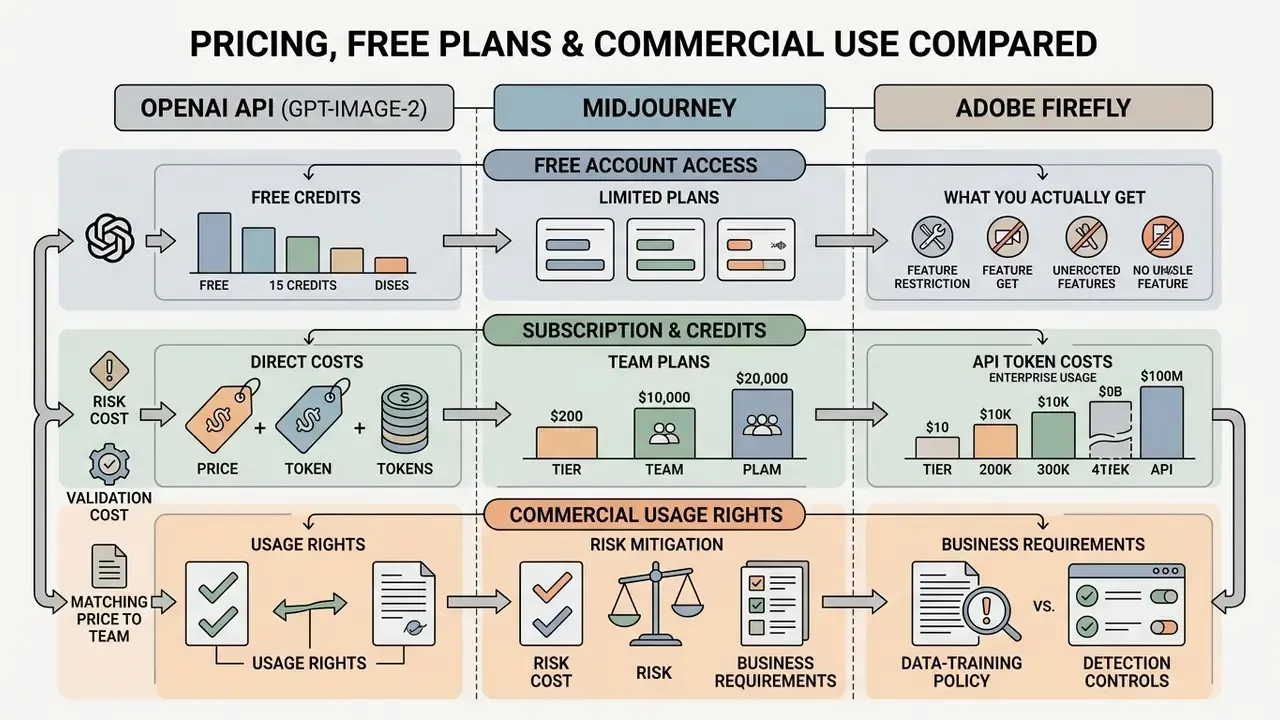
Evaluating commercial visual generators means analyzing subscription plans, API token costs, and usage rights together. Deployment cost has to align with production volume, otherwise the pilot economics collapse at scale.
Many platforms market a free ai tier, but enterprise use nearly always requires a paid subscription. Reviewing an ai art generator list reveals wide variation in licensing terms and export resolutions, and the variation is not correlated with price.
«The cost gap between the most and least expensive model exceeds fiftyfold; DALL·E 3 HD is priced at roughly $80 per 1,000 images at one provider.»
To model broader operational budgets, management teams can explore the hub for enterprise AI cost calculators.
What free accounts, free credits and free plans actually give you
A free account lets teams test features before committing. Free access, though, enforces structural limits on volume, resolution and commercial rights, and, critically, on data handling.
Platforms frequently offer free credits at registration or impose daily generation quotas. A free plan may cap export resolution, apply watermarks, or deprioritize processing during peak hours. Consumer-tier limits observed across the market in 2026 range from one-time credit grants (Runway: 125 credits, once) to hard daily caps (some free API tiers: 50 requests per day; Kling: 66 credits per 24 hours with watermarked exports).
| Platform | Free Tier Availability | Free Generation Quota | Export Restrictions | Commercial Usage Rights | Data Privacy / Model Training | Base Paid Plan |
|---|---|---|---|---|---|---|
| ChatGPT | Yes | Daily standard cap | Standard resolution | Commercial rights included | Training on by default; manual opt-out available | $20 / month |
| Gemini | Yes | Daily tier-based quota | Standard resolution, watermark on Pro outputs | Subject to Google Terms | Consumer activity may improve products; Vertex AI for isolation | $19.99 / month |
| Midjourney | No | None (trial disabled) | Not applicable | Commercial rights on paid plans | Prompts may improve services; outputs public unless Stealth Mode | $10 / month |
| Adobe Firefly | Yes | 25 monthly credits | Watermark or low priority | Commercial indemnification | No training on customer content | $9.99 / month |
| Canva | Yes | Hard monthly generation limit | Standard export sizes | Commercial use on paid plans | No training on customer content; images private | $13 / month |
| Stable Diffusion | Open source | Unlimited (self-hosted) | Unrestricted | Permissive open license | Full isolation when self-hosted | Pay-per-use API |
Expiry rules for free credits also differ, and they are easy to miss. Historical DALL·E credits expired one month after grant, while purchased credits carried a 12-month life, and identical commercial rights applied to images made with either. Verify expiry and rights per platform before building a workflow on promotional credits. Teams testing without account friction can also review free AI image generators with no sign-up.
Matching price to team and business requirements
Cost-effectiveness is total expenditure relative to monthly approved output. Fixed subscription costs per month must be weighed against variable API usage fees, and neither number is the whole picture.
High-volume marketing teams often find API token pricing more economical than per-seat subscriptions. A defensible model separates three cost layers:
- Direct cost subscription seats plus per-image or per-token API spend at expected monthly volume.
- Validation cost human review time per asset, measured in minutes multiplied by loaded hourly rate. Models with weak typography carry a higher hidden validation cost even at a lower list price.
- Risk cost exposure from missing indemnification, unclear training-data provenance, or non-compliant disclosure. For regulated buyers this layer dominates. A $10 per month tool without indemnification can cost more than a $199.99 per month plan that transfers the claim.
Divide the three-layer total by the number of usable, approved outputs, not generated outputs, to get a risk-adjusted cost per asset. To review detailed tier structures, managers can check our dedicated pricing guide, and budget-constrained teams can compare the best free AI image generators before committing spend.
Organizations comparing platform architectures can see the overview of top commercial alternatives. Teams evaluating head-to-head model performance can see the overview of visual generation benchmarks.
Fact check: commercial terms and pricing (verified 2026)
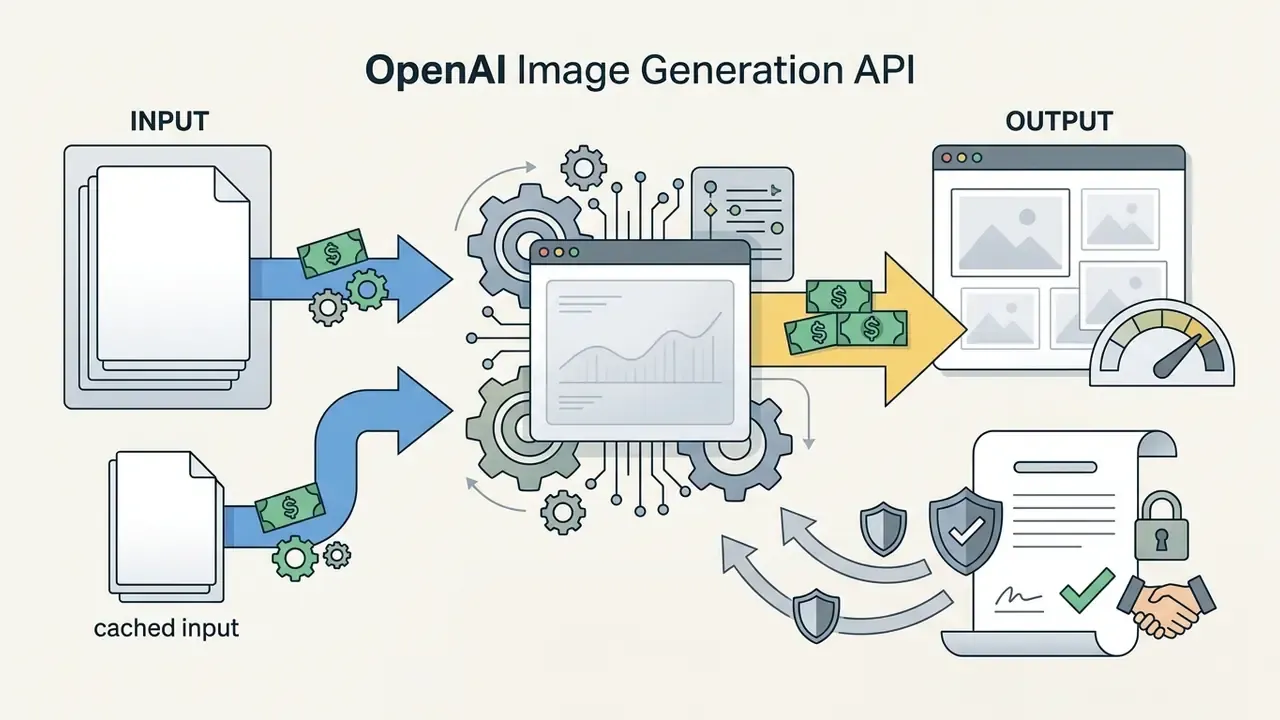
gpt-image-2)input $8.00 per 1M tokens, cached input $2.00 per 1M, output $30.00 per 1M (roughly $0.02 to $0.19 per image depending on resolution and quality tier). Commercial rights retained by the user (OpenAI Terms of Service, 2026).

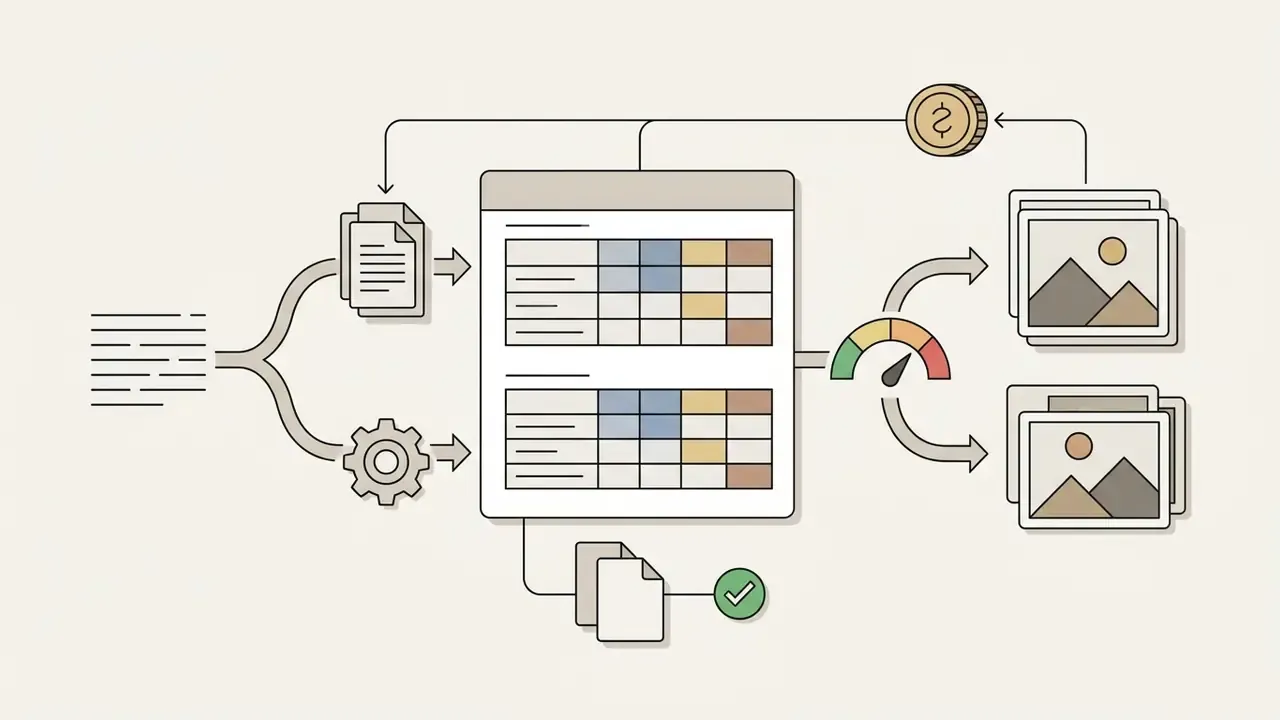
How to choose an AI image generator for your workflow
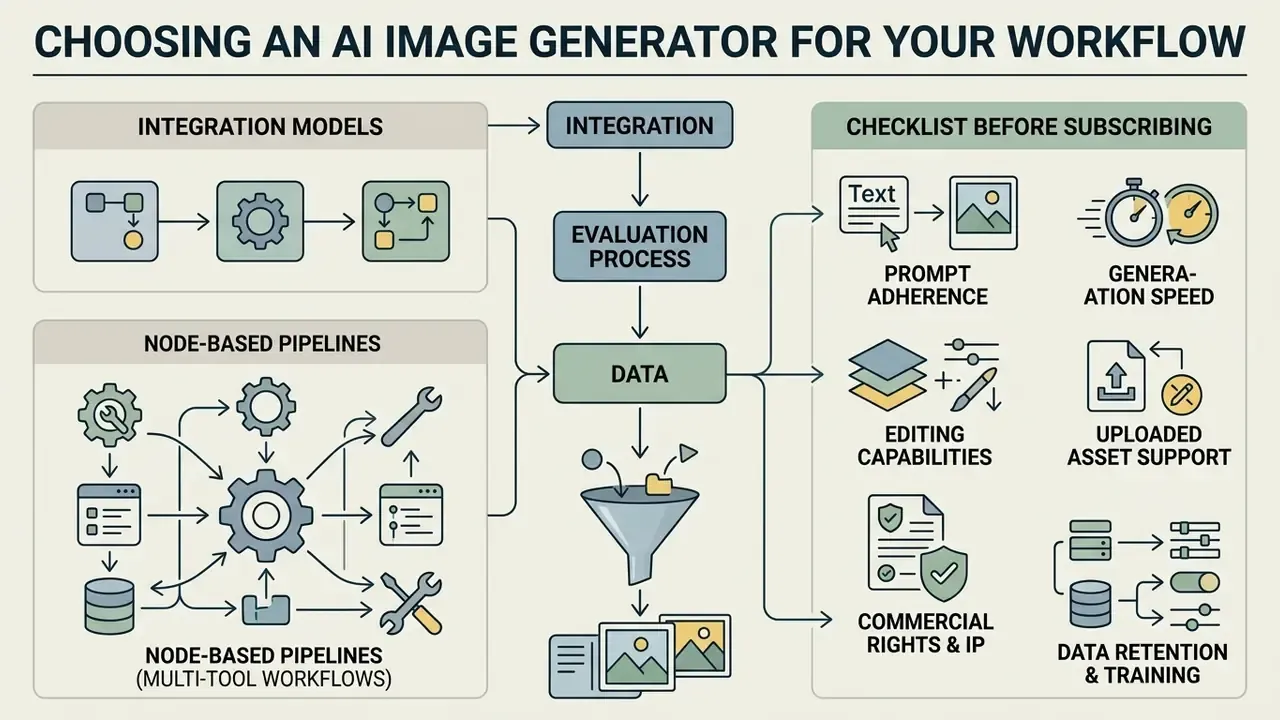
Integrating visual AI into enterprise workflows requires systematic evaluation of technical, operational, and legal factors. Governance protocols come before production, not after the first incident. NIST's Generative AI Profile frames this as a four-function cycle, Govern, Map, Measure, Manage, with documented provenance and security controls in place before operational use.
An ai image generation tool comparison should account for security, API availability, and team collaboration. A parallel ai image creation tools comparison confirms compatibility with existing digital asset management systems, which is where most integrations actually stall.
Selecting robust image tools also means testing how these ai tools handle complex prompts, and how predictably tools work under load.
«PhyBench (700 prompts, 31 scenarios) showed that explicitly stating physical principles in the prompt significantly improves the physical correctness of images from DALL·E 3 and Gemini.»
Consistently generating images at high quality therefore depends on prompt standards as much as on model choice. A documented prompt library with explicit lighting, material and physics constraints reduces rejected outputs more cheaply than upgrading tiers. Cheaper, and easier to audit.
Node-based pipelines (multi-tool workflows)
Professional art production rarely stays inside one platform. Advanced teams use node-based environments such as Flora or ComfyUI to chain several models into a single pipeline: generate the base frame and composition in Midjourney v6.5, correct character pose via ControlNet in Stable Diffusion, insert accurate typography with Recraft V4, then upscale through Topaz or Magnific. Node graphs also make it practical to combine multiple reference images with multiple prompts, branch outputs, and switch tools mid-workflow, including extending a still into video clips.
Two caveats from practice. Character consistency degrades when a pipeline passes assets between models with different identity handling. And each hop adds latency plus a separate data-governance surface. Document which node touches confidential inputs, because the weakest link defines the privacy posture of the whole pipeline. That single document has saved more than one review cycle.
Checklist before subscribing to an AI tool
Before purchasing enterprise subscriptions, procurement should complete a structured evaluation checklist. It reduces vendor lock-in and security exposure, and it gives internal audit something to read.
Automated verification belongs in the same pipeline as generation. A minimal integration test for downstream synthetic-content checks looks like this:
# Example API request to check an image for AI generation (detection endpoint)
curl -X POST 'https://api.sightengine.com/1.0/check.json' \
  -d 'api_user={API_USER}' \
  -d 'api_secret={API_SECRET}' \
  -d 'url=https://example.com/generated-image.jpg' \
  -d 'models=genai'
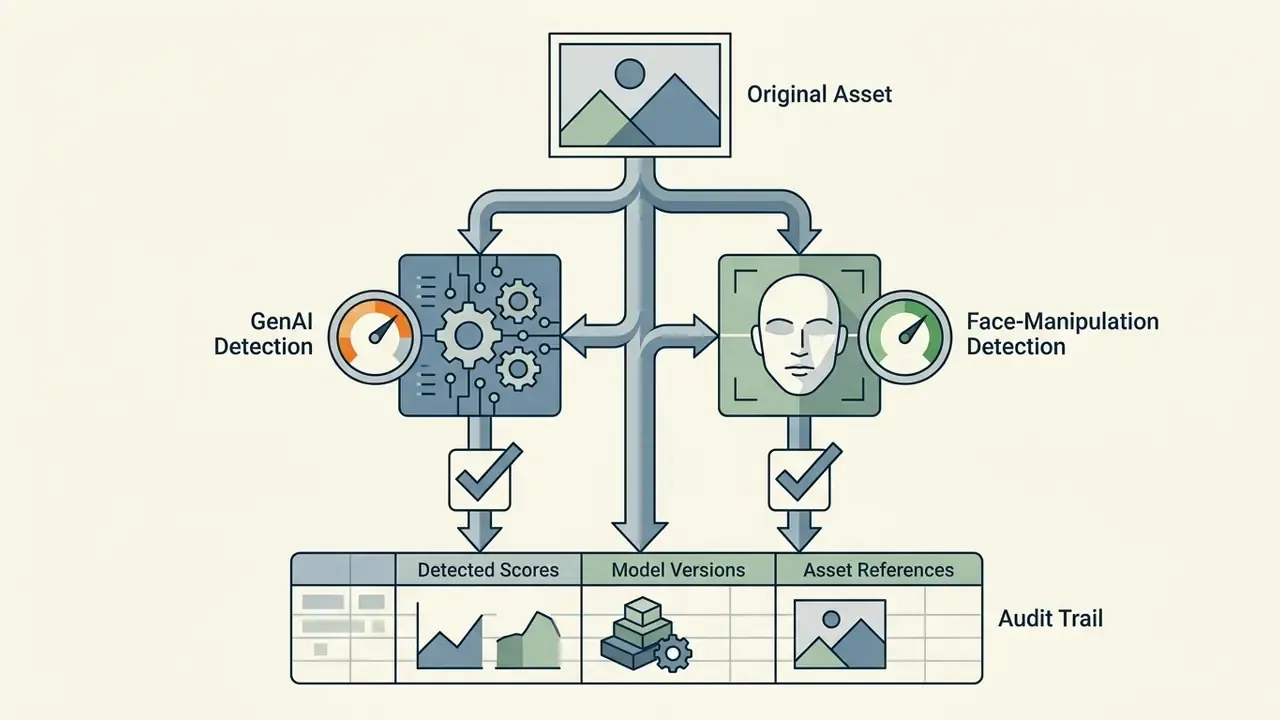
The response returns per-class confidence scores (diffusion, GAN, other) plus an optional face-manipulation score, which can be wired into a moderation queue threshold instead of reviewed by hand.
How to run your own AI image generator test
An internal ai image generator test starts with a standardized prompt benchmark across your core operational categories. Identical settings must hold across every evaluated tool, or the comparison is theater.
Run the test prompts across target image models and score ai generated images on prompt compliance and visual appeal. Test cases should include detailed portraits, complex typography (generate text), and localized image editing. Published benchmarks use fixed prompt sets of several hundred to more than a thousand prompts across task categories, then score each output on alignment plus quality, aesthetics, originality and artifacts, aggregating per prompt and per model.
«DragDiffusion (CVPR 2024) introduces DRAGBENCH, the first benchmark for point-based editing, demonstrating control over pose and facial expression while preserving subject identity.»
Include at least three deliberate stress cases: a negation prompt ("a desk with no laptop"), a counting prompt ("exactly five identical bottles"), and a sequential edit prompt that changes both an object and its motion. In our experience these three separate marketing claims from measured capability faster than any leaderboard.
AI image detection, fake images and safe use of outputs
Deploying synthetic media introduces operational risk around copyright, brand authenticity, and misinformation. Controls have to exist before distribution. Under EU AI Act Article 50 and the 2025 EU Code of Practice on transparency of AI-generated content, providers must mark synthetic image output in machine-readable form, and deployers of deepfake imagery must disclose that content is artificially generated or manipulated. India's 2026 IT-rules update adds mandatory labelling and traceable metadata.
Implementing ai image detection lets security teams identify synthetic or manipulated visual assets. Automated systems scan media to detect ai generated content before public distribution, and the same pipeline can detect ai artifacts in inbound documents.
A reliable ai image detector mitigates the risk of fake images passing as real photos. Detailed image analysis surfaces subtle generation artifacts and metadata inconsistencies. Typical threat scenarios for financial institutions include fraudulent insurance claims, fake marketplace listings, KYC and AML bypass with spoofed identity documents, executive impersonation and non-consensual imagery.
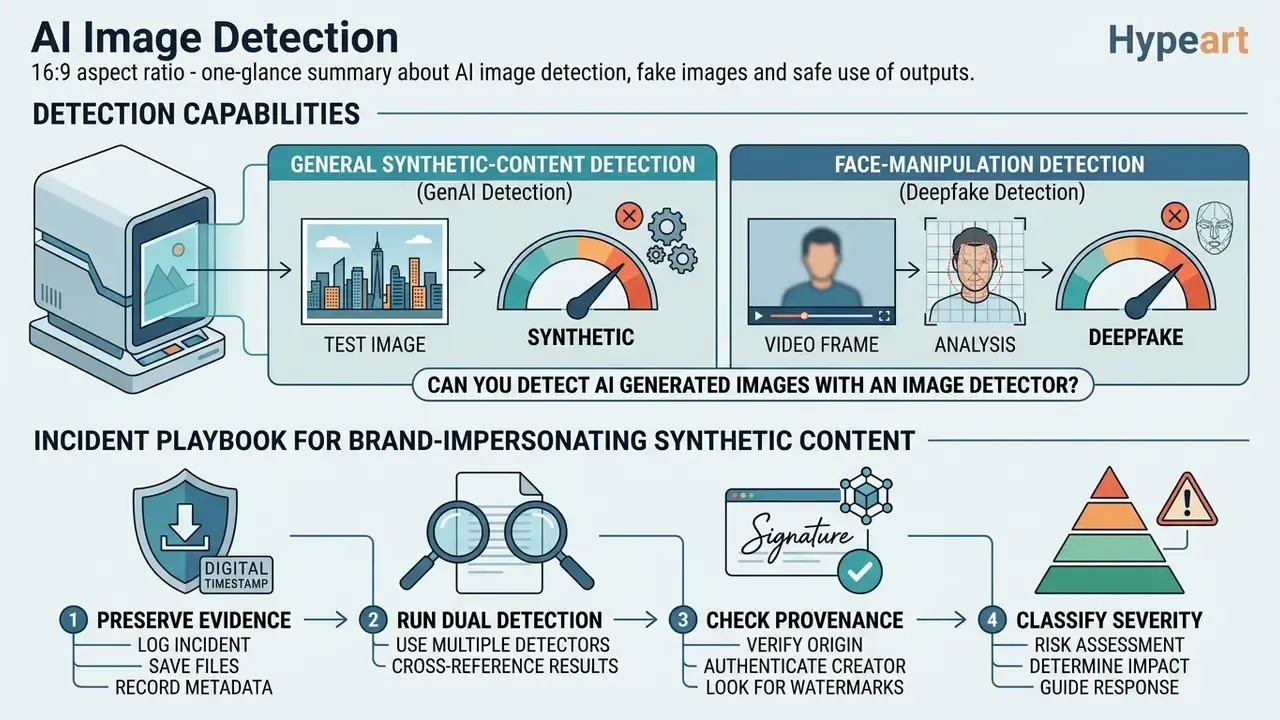
Can you detect AI generated images with an image detector?
When performing ai image detection, two distinct analyses must be kept separate:
- General synthetic-content detection (GenAI detection).Searching for diffusion-process artifacts: noise structure, frequency anomalies, texture statistics. This operates on the pixel grid and stays effective even when EXIF metadata and C2PA tags have been fully stripped, which happens automatically when images are re-uploaded through messengers, social networks or marketplaces.
- Face-manipulation detection (deepfake detection).A narrower analysis of face-swap boundaries, skin and eye lighting inconsistencies, and blending seams. Most operational teams benefit from running both models together, because a GenAI-negative image can still contain a manipulated face.
«GenImage contains more than a million pairs of real and synthetic images from diffusion models and GANs, supporting detector evaluation under generator shift and quality degradation.»
In an independent benchmark by researchers at the University of Rochester and the University of Kansas using 80,000 images, real photographs plus outputs from multiple text-to-image generators unseen by participants, pixel-level detectors reached accuracy in the high nineties, materially outperforming human judgment. Detection coverage now spans DALL·E, Firefly, Flux, GPT image, Grok Imagine, Ideogram, Imagen, Midjourney, Nano Banana, Recraft, Seedream, Stable Diffusion and StyleGAN families, with new generators typically added within weeks of release.
Watermarking technologies such as Google SynthID embed imperceptible signatures into generated pixels, while C2PA Content Credentials record provenance, creator tool and creation time, as attached metadata. The two are complementary and neither is sufficient alone: metadata can be stripped, and watermarks survive only some transformations.
Automated detectors provide probabilistic confidence scores rather than absolute proof. NIST's 2025 pilot evaluation plan scores each image on a 0 to 1 scale precisely for that reason.
«AIGIBench (NeurIPS 2025) showed that detectors with high accuracy under controlled conditions suffer significant performance drops on real-world data from social platforms and AI-art communities.»
Enterprise safety therefore means combining automated image detection with human verification and provenance tracking, and accepting that recompression, cropping and adversarial editing degrade scores. Buyers comparing vendors can review our analysis of commercial AI image detectors by accuracy and business fit. For the underlying verification studies, consult the AI Media Benchmarks and Review Proof summary.
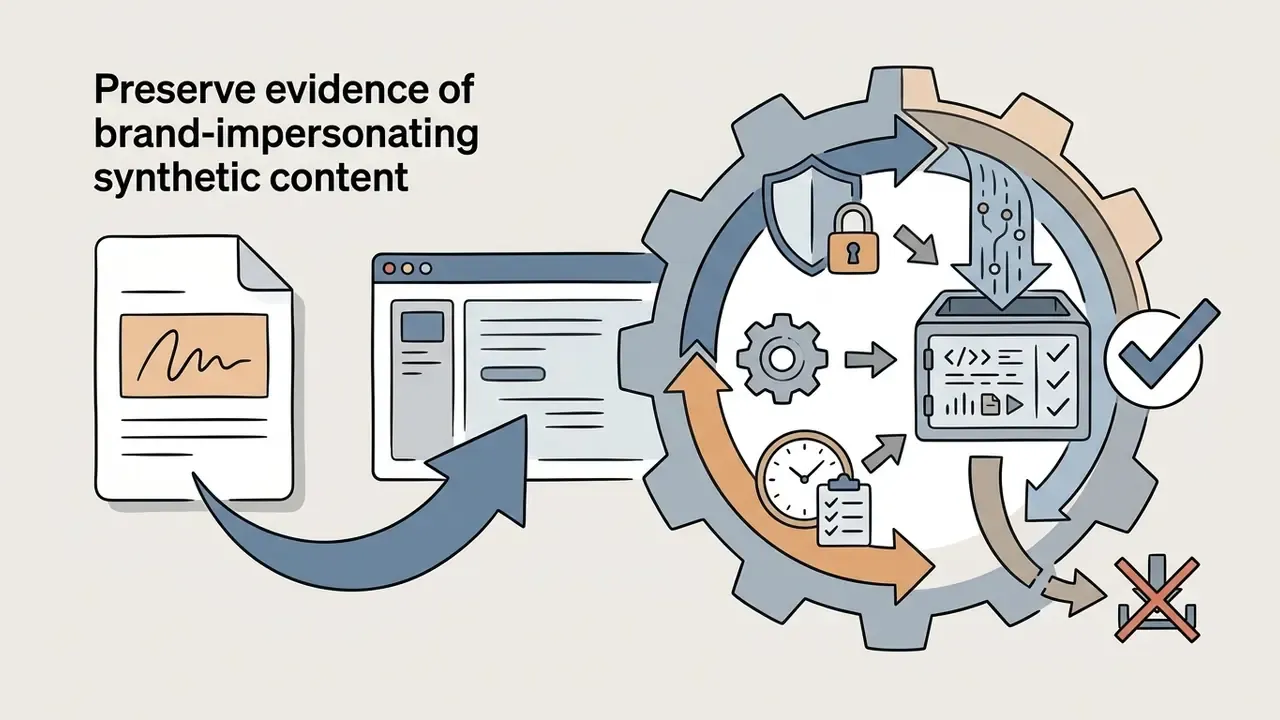
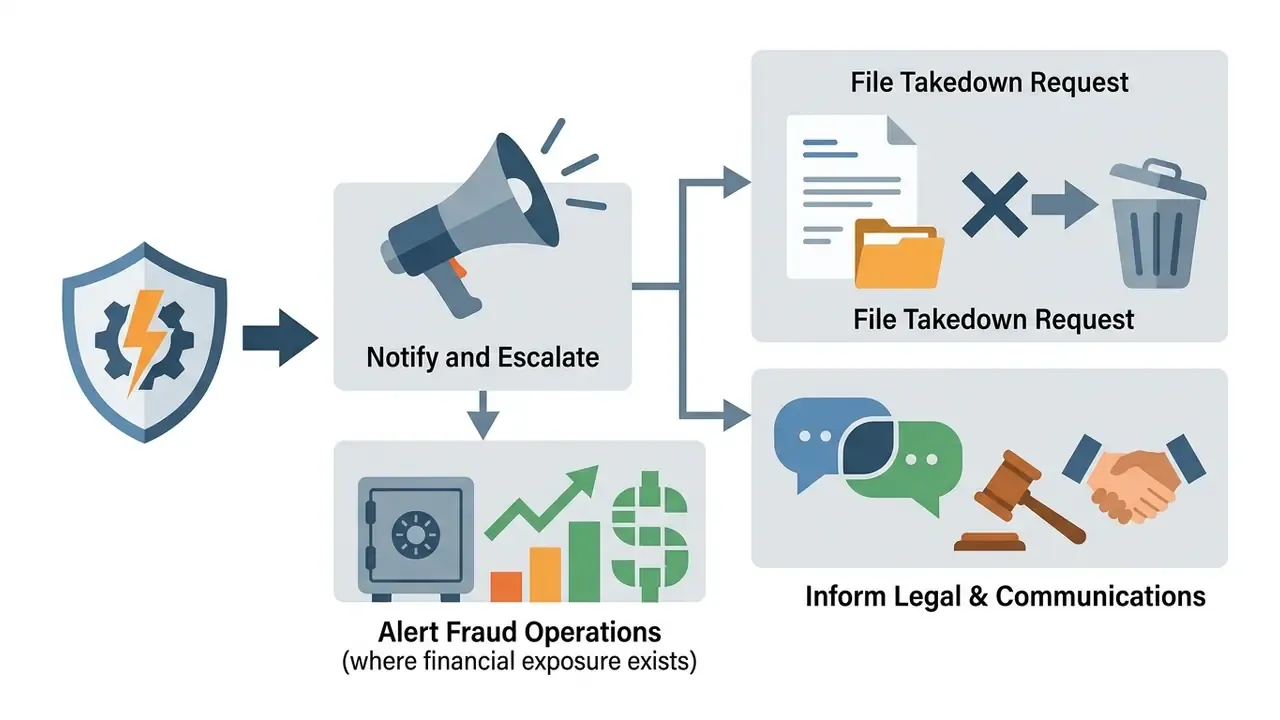
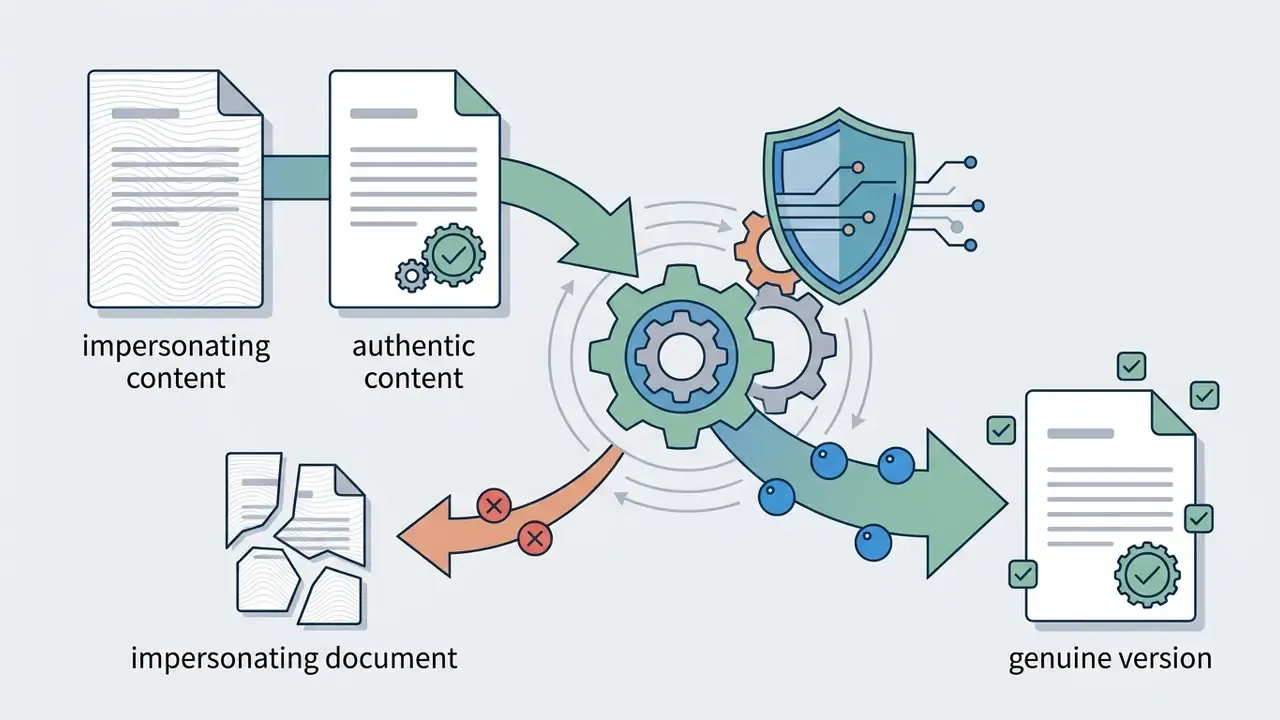
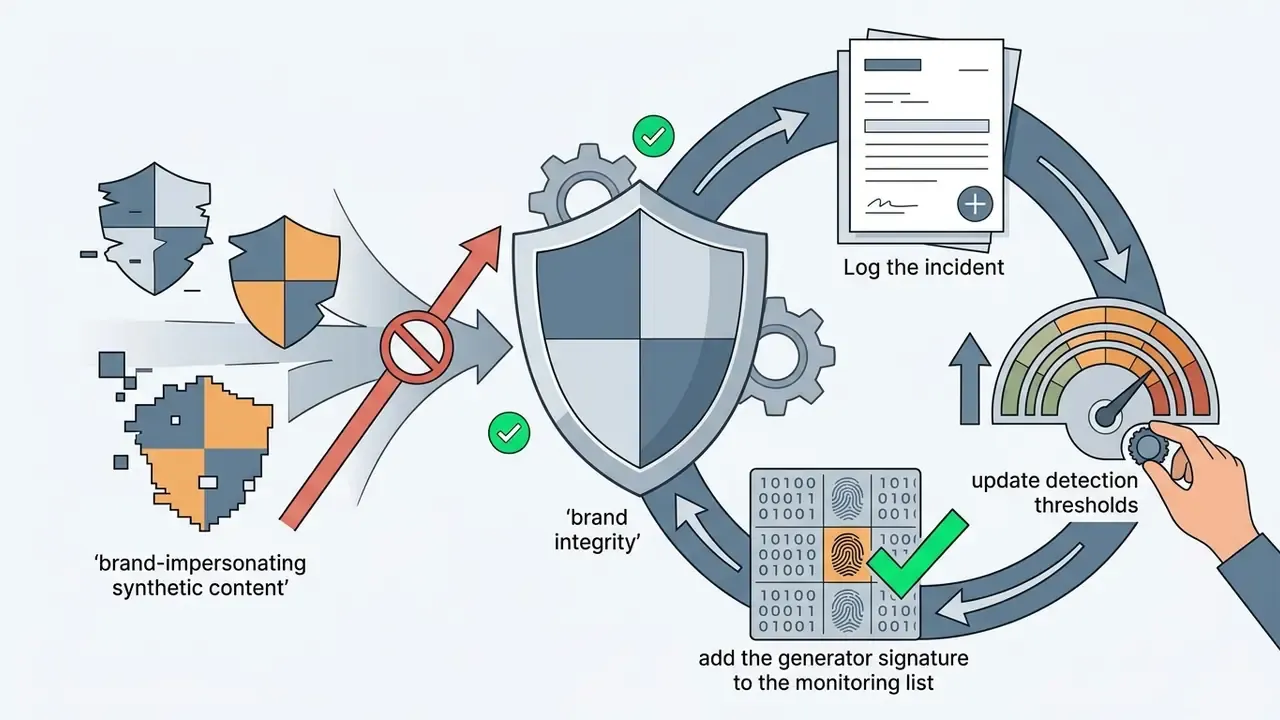
Incident playbook for brand-impersonating synthetic content
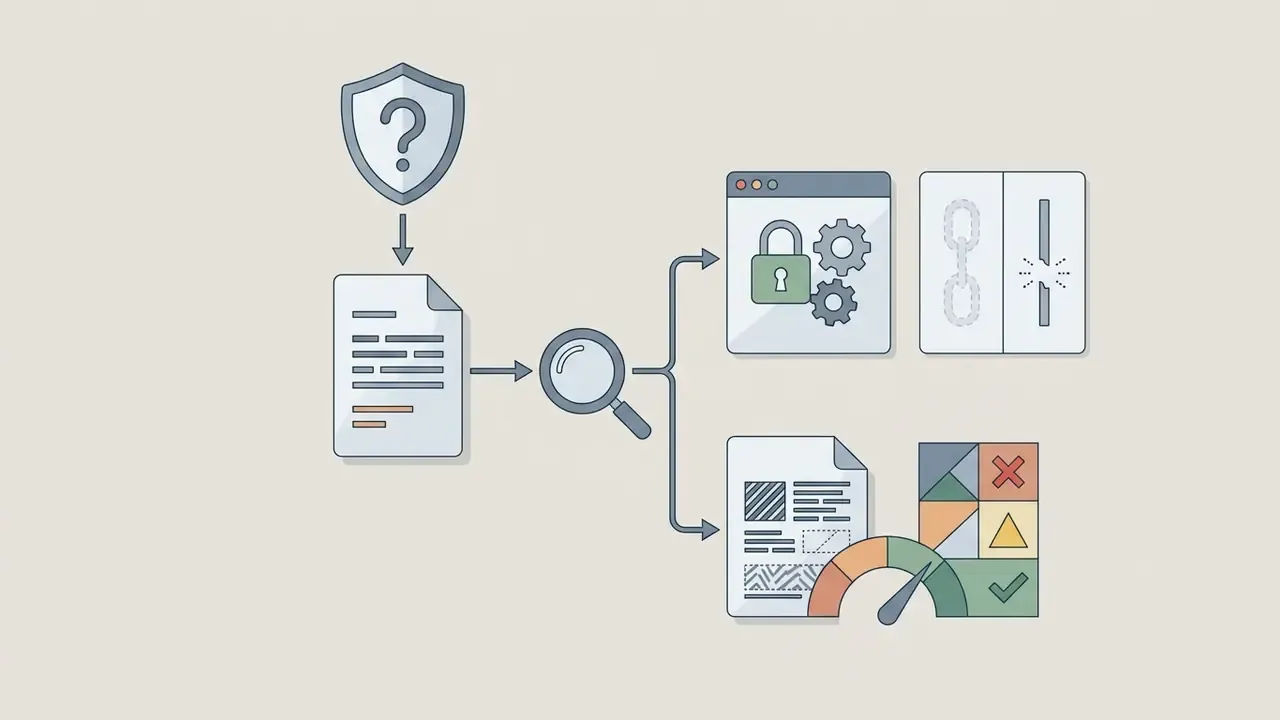
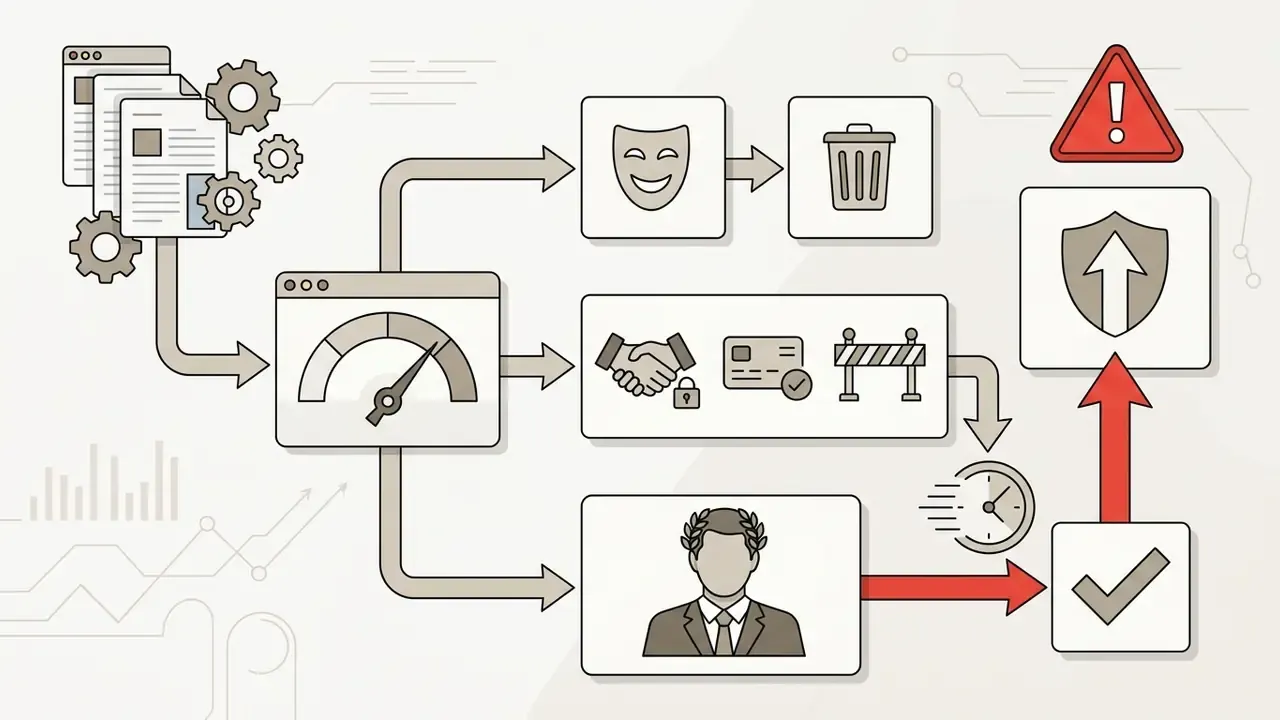
Detection without a response procedure produces alerts, not risk reduction. A minimal playbook:
Assign each step an owner before an incident occurs. Median time-to-takedown is the metric that matters here, not detector accuracy in isolation.
FAQ: frequently asked questions about AI image generators
Disclaimer: this information is general in nature and does not replace legal advice on copyright and the commercial use of AI-generated images.
This section answers the frequently asked questions we receive about copyright, licensing, and the technical limits of models ai capable of generating images.
Is an AI-generated image protected by copyright?
In the United States, protection depends on human authorship. Prompt input alone is generally not treated as sufficient authorship, and copyright can cover only the human-authored expressive elements of an AI-assisted work. Applicants are expected to identify and disclaim AI-generated material when registering. Treat this as a general legal position and verify it with counsel for your jurisdiction and use case.
Can generated visual outputs infringe existing copyrights?
Yes. In Japan, AI-generated images are assessed under ordinary infringement tests: similarity to a prior work combined with dependence on it can trigger infringement. Comparable similarity-plus-access reasoning appears in other jurisdictions, so outputs that closely resemble a protected character, logo or photograph carry real exposure regardless of how they were produced.
Are free AI generated images safe for commercial marketing?
It depends on platform terms. Some providers grant identical commercial rights for images made with free and paid credits, while others restrict free-tier output to personal use, add watermarks or make generations publicly visible by default. Always read the platform's commercial licensing guide. For detailed rights analysis, view the guide on commercial AI asset licensing.
Do I need to disclose that an image is AI-generated?
Increasingly, yes. EU transparency rules require machine-readable marking by providers and disclosure by deployers of deepfake content, and other jurisdictions are adding labelling and metadata-traceability duties. The practical default for brands: attach Content Credentials and disclose AI use in customer-facing contexts.
Which model is fastest, and does speed matter?
Stable Diffusion 3.5 Large posted the lowest median latency, 1.9 seconds, in our February 2026 window, and open-source hosting providers routinely deliver under 5 seconds. Speed matters where generation sits inside a user-facing loop. For batch creative production, prompt adherence and typography accuracy affect throughput far more than raw latency.
Can AI detectors replace human review?
No. Detectors output confidence scores, lose accuracy on newly released generators, and degrade under compression and heavy editing. Use them for triage, then combine with provenance checks and human judgment.
Which free AI image generator should you pick for a first test?
For immediate testing without financial commitment, Google Gemini offers rapid generation through a standard free account. It gives an accessible interface for multimodal prompts and image uploads, and is generally the strongest all-purpose free option for both generation and editing. Canva's free AI Image Generator suits beginners who want assets inside a design canvas: start from the editor or homepage, type a prompt, select a style such as watercolor or neon, generate, refine and download. It is also notable on privacy, since Canva does not train its models on customer content and generated images stay private. A full breakdown of features and licensing sits in our Canva AI Generator overview. Adobe Firefly gives 25 monthly generative credits with a free account and returns up to four image options per prompt, which makes it a commercially safer sandbox for teams that must avoid ambiguous training-data provenance. Beginners should use these free plan options to gauge prompt responsiveness before committing to paid enterprise subscriptions, and can compare the best free AI art generators by output quality, watermarks and licensing limits. Several ai image generation tools examples in that list are good enough for internal decks, and clearly not good enough for regulated customer communications. Know which side of that line you are on.
Appendix A: source revision log and methodology notes
For transparency, the following citations were revised during the February 2026 editorial review. Original formulations are retained here so earlier readers can trace the changes.
| Original claim and citation | Issue identified | Replacement in main text |
|---|---|---|
| "OpenAI's 2026 Image Eval rubric dictates that an image generation fails overall if instruction following or in-image text rendering fails (OpenAI, 2026)." | Vendor rubric without published URL, protocol or sample size. | VQAScore / GenAI-Bench (ECCV 2024) for instruction-following measurement. |
| "Anatomical correctness relies on dedicated rubrics like HandEval (HandEval, 2025)." | No retrievable source or methodology provided. | Empirical study on human image synthesis (arXiv 2024). |
| "Benchmarks like EditEval assess whether localized object replacement alters unmasked background regions (EditEval, 2025)." | Cited without URL or quantitative results. | Diffusion Model-Based Image Editing survey with LMM Score (IEEE TPAMI 2025). |
| "State-of-the-art portrait realism (ICLR, 2024)." | Conference-only citation without paper identification. | NeurIPS 2023 human-preference study plus architecture-level description of HyperHuman and SDXL fine-tunes. |
| "Recraft V4 and Adobe Illustrator's Text to Vector engine lead the industry (Recraft, 2026)." | Vendor claim presented as an independent ranking. | Reframed as vendor-documented capability; VISTAR text-rendering metric added (arXiv 2025). |
| "Nano Banana Pro delivers up to 4K resolution (Google DeepMind, 2025)." | Vendor capability claim, not independently benchmarked. | Reframed explicitly as vendor-published specification with preview and GA caveat. |
| "Users can highlight specific visual regions (OpenAI, 2026)." | Product documentation cited as research. | Reframed as vendor-documented interface behavior. |
| "Technical standards like C2PA record asset provenance (C2PA Consortium, 2026)." | Standard cited without retrievable reference. | GenImage benchmark (NeurIPS 2023) plus NIST provenance framing. |
| "Physical detection limits remain (NIST AI 100-4, 2024)." | Correct report family, but no measured evidence of degradation. | AIGIBench (NeurIPS 2025) real-world performance drop findings. |
| "Pure text-prompt outputs lack human authorship (US Copyright Office, 2025)" and "(Japan Agency for Cultural Affairs, 2024)." | Legal positions presented as citable research. | Reframed as general legal positions with an explicit legal disclaimer. |
| Expert epigraph attributed to "Marcus Hale, author". | Replaced with an Editorial Board Statement plus a NIST TEVV reference. |