Executive Summary
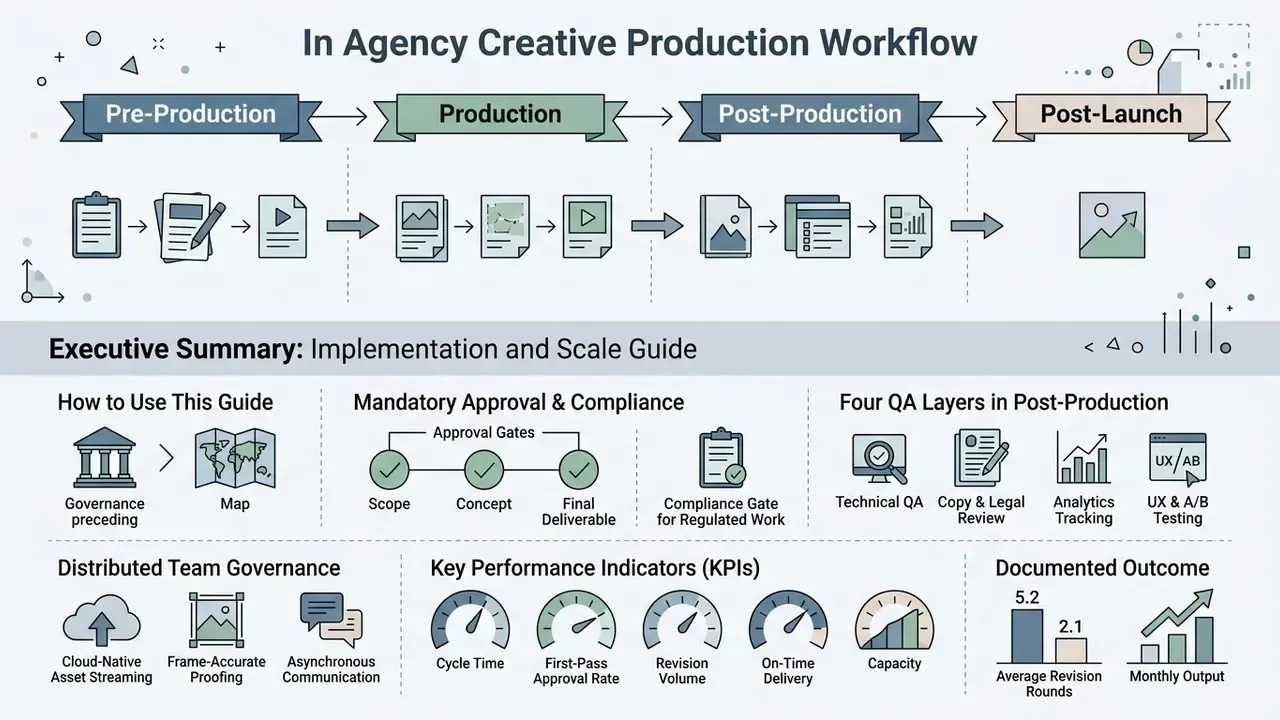
- An agency creative production workflow is a standardized operating sequence spanning four phases: Pre-Production, Production, Post-Production, and Post-Launch. The IAB describes the same architecture as five phases (Initiation, Define, Design, Development, Deployment).
- Governance precedes mapping. Define RACI decision ownership, including a Legal/Compliance approver for regulated categories, plus intake rules and capacity bands, before you build task boards or buy software.
- Three mandatory approval gates (Scope, Concept, Final Deliverable) plus a compliance gate for regulated advertising stop unapproved changes from cascading downstream.
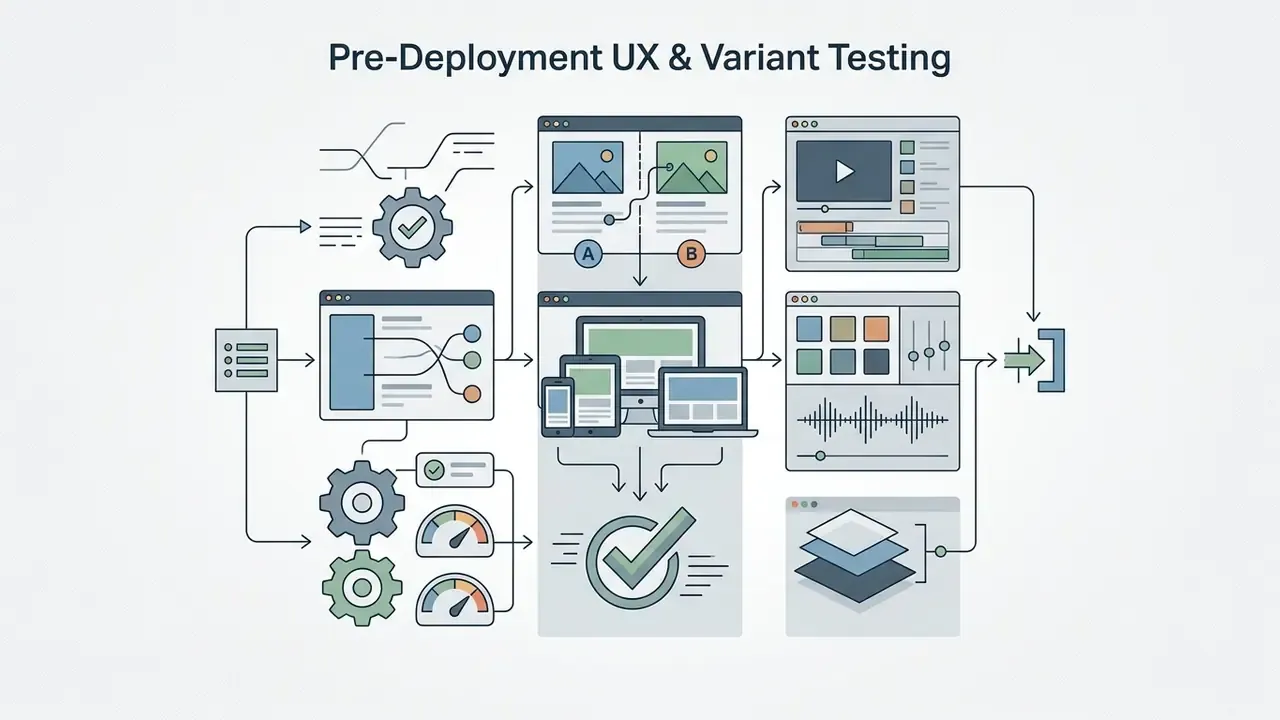
- Four QA layers in Post-Production: technical, copy/legal, analytics tracking, and pre-deployment UX or A/B variant testing.
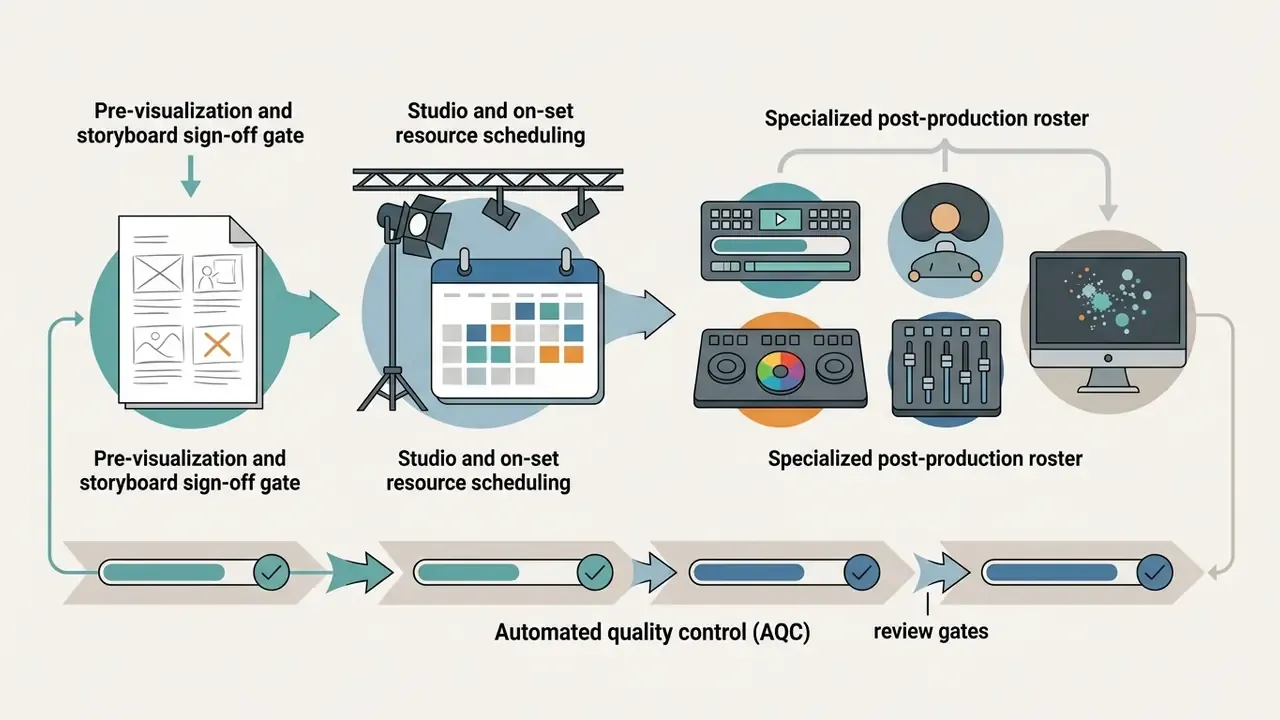
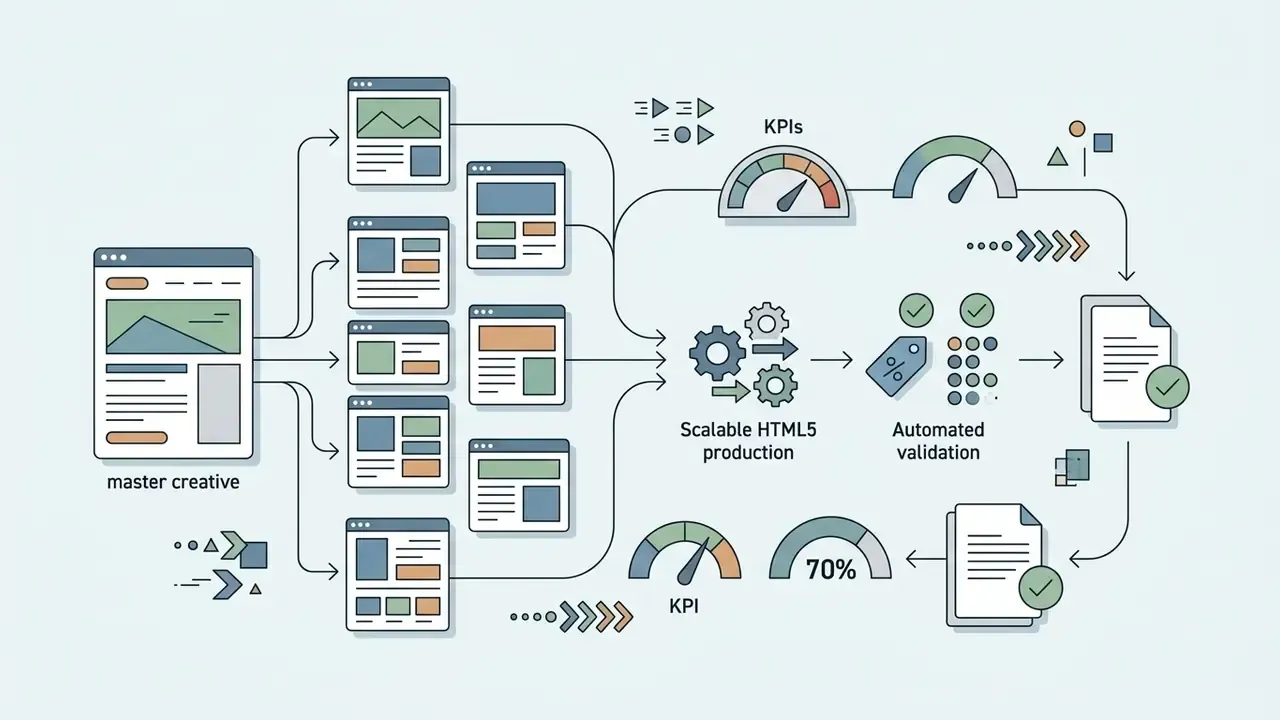
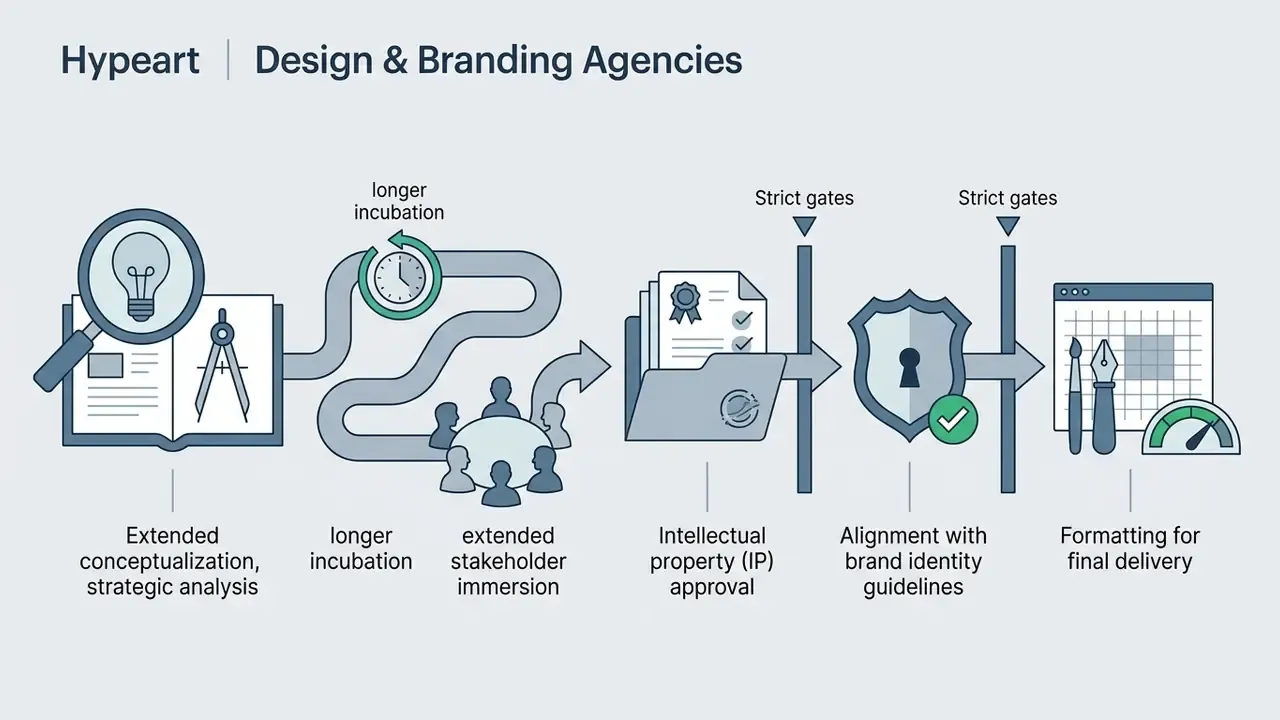
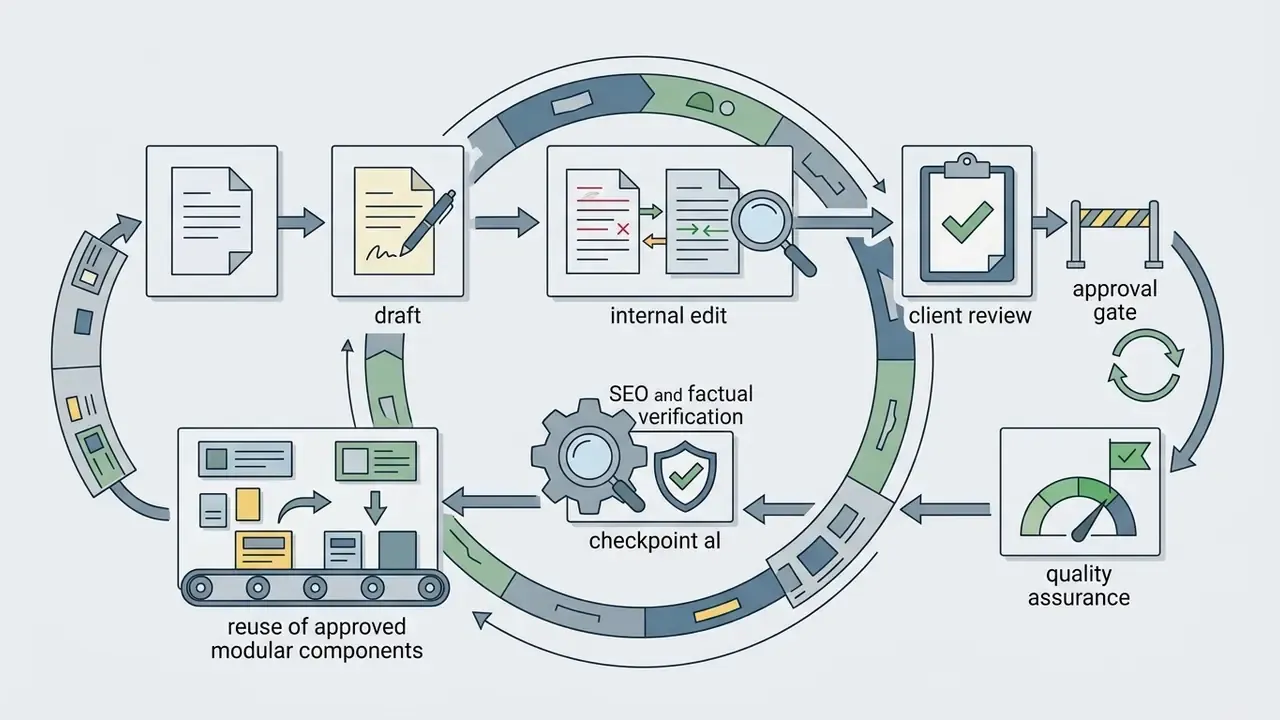
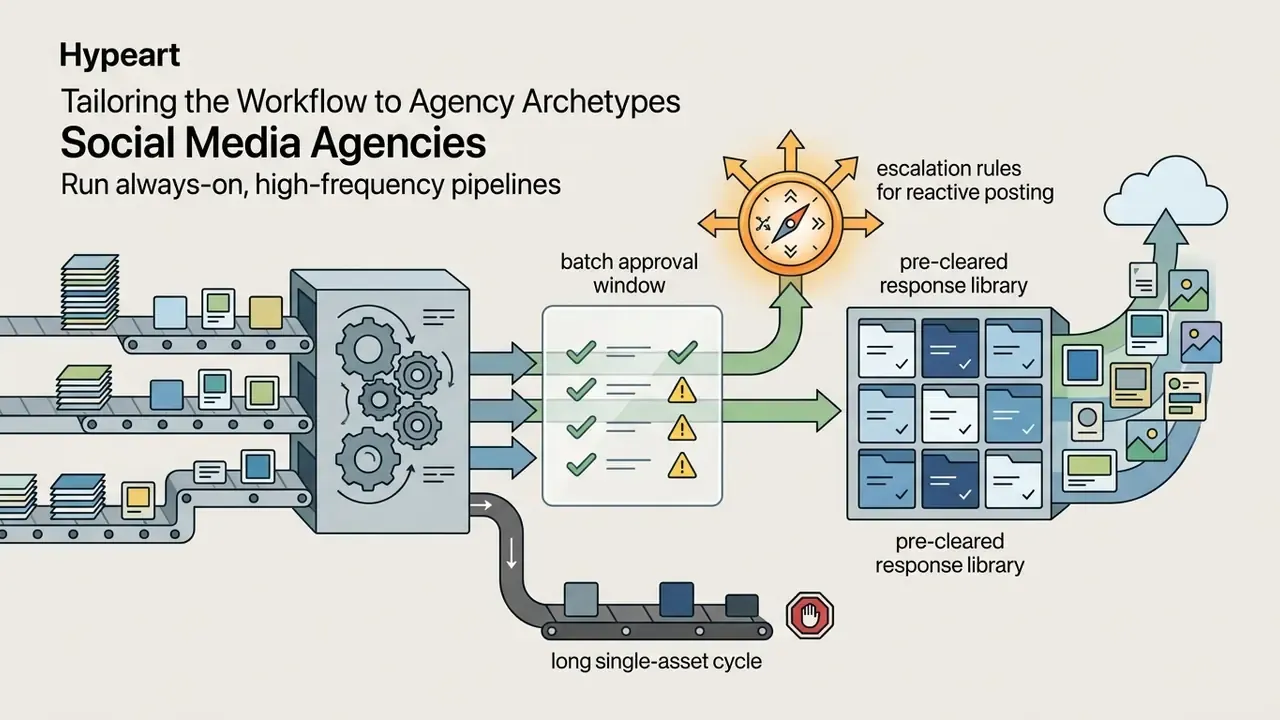
- Workflow architecture varies by agency archetype. Video, digital/performance, design/branding, content, and social pipelines need different gates and resource models.
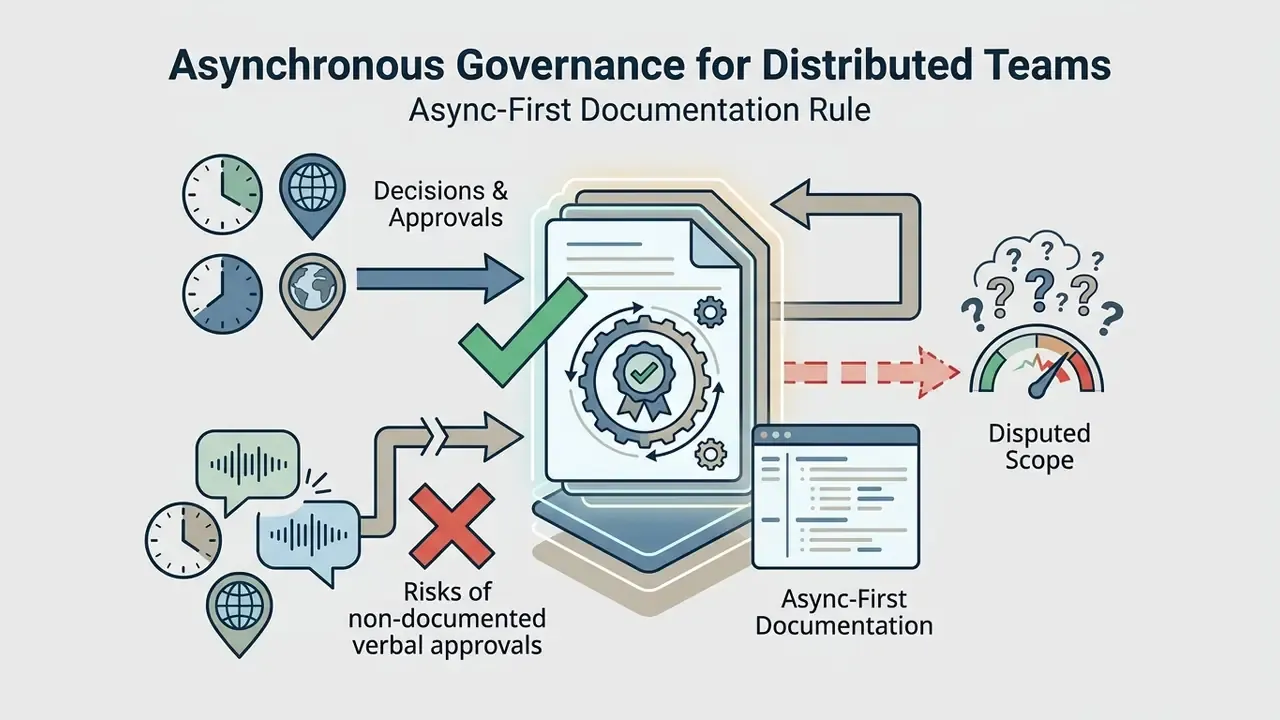
- Distributed teams need asynchronous governance: cloud-native asset streaming, frame-accurate proofing, and pass-the-baton WIP logs across time zones.
- Measure six KPIs (cycle time, first-pass approval rate, revision volume, on-time delivery, capacity utilization, error rate), then net them against control costs to get an honest ROI number.
- Documented outcome: a regional agency cut average revision rounds from 5.2 to 2.1 and raised monthly throughput 38% without adding headcount.
How to Use This Guide
Read it as an implementation sequence rather than a menu. The first two parts answer the governance question: what a workflow actually is, and what has to be decided before anyone draws a process map. The middle parts cover the stage-by-stage pipeline, a step-by-step rollout, the tooling and automation layer, and the feedback and approval controls that keep revisions finite. The final parts deal with measurement, control costs, unresolved questions, and a 30-day starting plan.
If you already run a functioning pipeline and only need to tighten one thing, start with the approval gates and the First-Pass Approval Rate. Those two levers move the most numbers at once. If you are building from scratch, start at the operating model, because tooling installed on top of undefined ownership just makes the confusion faster.
What Is an Agency Creative Production Workflow and Why It Matters
An agency creative production workflow is a standardized, end-to-end operational sequence that structures creative work from initial client intake to final asset delivery and post-launch analysis. Standardizing this process establishes clear task ownership, enforces predictable timelines, removes redundant handoffs, and holds asset quality steady across concurrent client campaigns.
«Project-based organizations must explicitly define roles, relationships, and routines, otherwise coordination collapses as volume scales.»
According to the Interactive Advertising Bureau (IAB) Interactive Advertising Workflow Best Practices (2015), formal agency production architecture divides campaign execution into five distinct operational phases: Initiation, Define, Design, Development, and Deployment. IAB Australia's Digital Ad Operations Standard Campaign Workflow (2014), produced by the IAB Standards and Guidelines Council, serves the same coordinating function for digital campaign delivery. Rather than relying on ad-hoc coordination, a formalized workflow process acts as an operational scaffold. It aligns creative teams, account managers, project managers, and external clients inside one delivery framework.
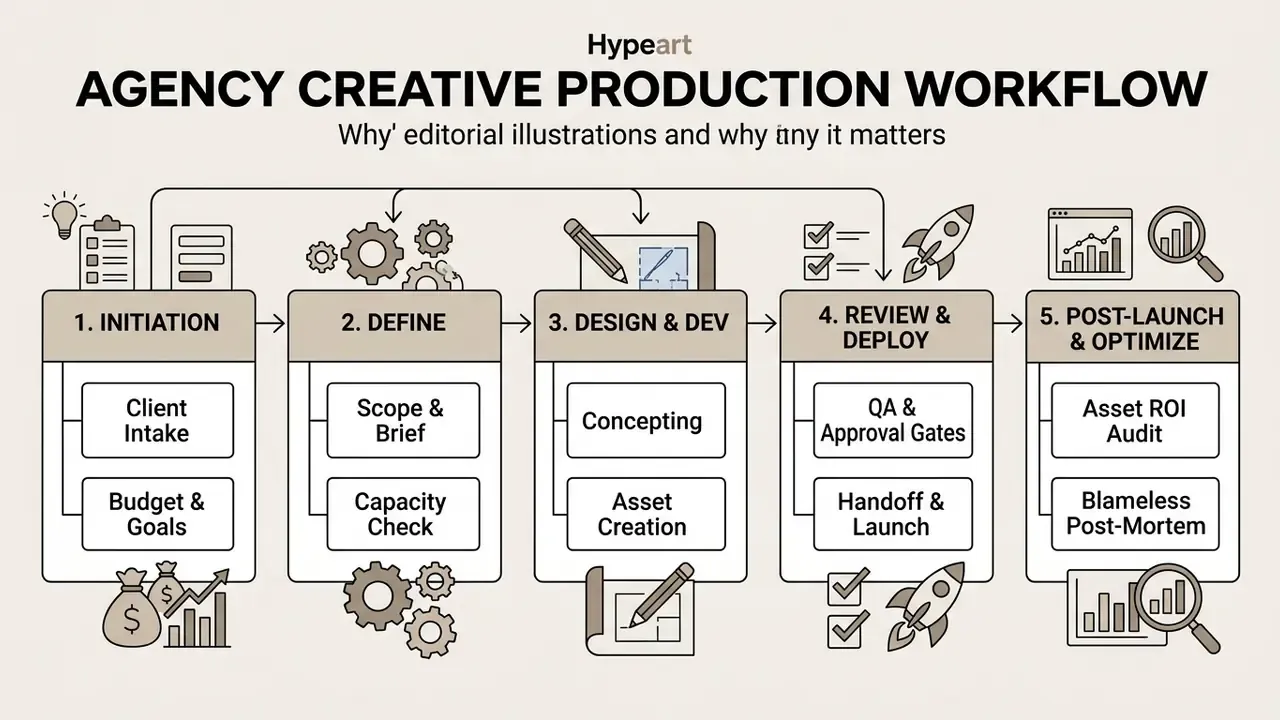
Modern operating loops close the circle explicitly. A 2026 agency AI ad workflow playbook describes the cycle as brief, AI render, in-agency QA, bulk client approval, published ads, performance read-back, next brief (Ad-Stack.ai, 2026, https://www.ad-stack.ai/blog/agency-ai-ad-workflow-playbook/). A parallel 2026 production template sequences the same journey as Brief, Outline, Draft, Internal Edit, Client Review, Approved, Scheduled, Published (Taskade, 2026, https://www.taskade.com/templates/agency-operations/content-production-workflow).
The Difference Between a Creative Process and a Workflow Process
«The advertising creative process comprises five stages: problem framing, preparation, idea generation, validation, and decision-making.»
A workflow process, by contrast, is an operational sequence that governs how creative work moves through an organization. The creative process determines what is being produced. The workflow process defines who executes each task, when handoffs occur, how revisions are managed, and where approval signatures are logged.
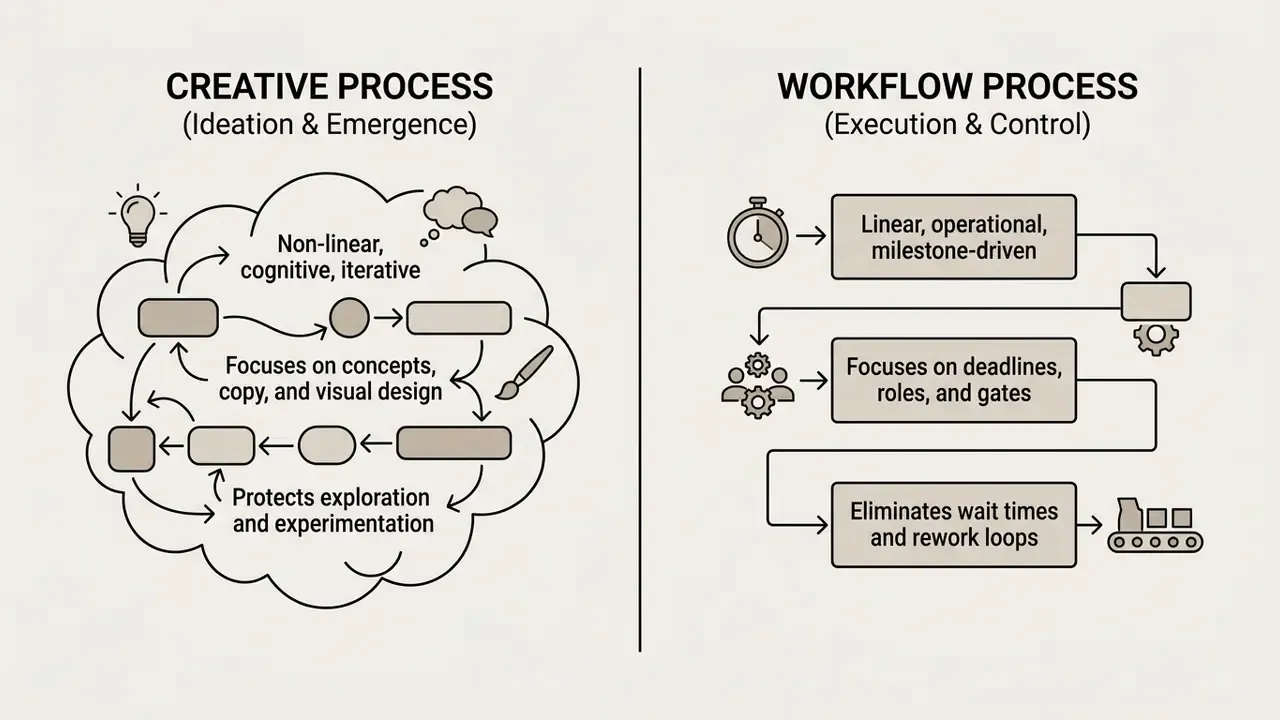
Conflating the two creates friction that nobody can locate on a dashboard. When agencies treat creative exploration as if it were operational execution, deadlines slip and scope creep expands unchecked. Separating ideation from process governance protects creative autonomy while keeping accountability strict for deliverables, schedules, and budgets.
Benefits of a Standardized Workflow for Creative Agencies
Standardizing an agency workflow delivers measurable gains in operational efficiency, resource allocation, and project predictability. Industry benchmarks from Adobe's 2025 Creative Operations Analysis indicate that unstructured creative processes spend up to 80% of total cycle time in idle states: waiting for missing brief details, delayed feedback, or uncoordinated sign-offs.
Data-quality note (hypothesis pending verification): the 80% idle-state figure is cited without a public methodology or URL and should be treated as a directional benchmark, not an audited statistic, until the underlying dataset is published. An independently sourced measurement points in the same direction:
«In a typical ten-day cycle, actual creative work occupies only about six hours, the remainder is the asset sitting idle in queues.»
Implementing a structured production workflow converts unstructured wait time into active production capacity. Because most of that reclaimed time is absorbed by asset-level execution, agencies should pair process redesign with a hardened tooling baseline, for example standardized video editing tools with shared render presets and export templates. Centralizing project tracking and standardizing review gates yields four institutional benefits:
When evaluating multi-channel campaign architectures, agencies often reference Commercial-Use AI Tools to standardize asset creation and hold compliance steady across digital touchpoints, and they compare licensing terms across AI image generators for commercial use before approving any generative tool for client-billable work.
- Cycle Time Reduction
- Streamlined handoffs and automated status routing remove communication bottlenecks and compress end-to-end turnaround.
- Predictable Capacity Utilization
- Clear task tracking exposes workload imbalances across creative teams before burnout or a missed deadline does it for you.
- Decreased Revision Volumes
- Enforcing strict brief requirements and single-approver review gates reduces unnecessary revision cycles. Independent workflow analysis quantifies the effect: replacing email chains with dedicated proofing tools cuts revision cycles by up to 40% and accelerates final sign-off (Creative Review and Approval Workflow Optimization, Screendragon, 2025, https://www.screendragon.com/blog/creative-review-approval-workflow).
- Enhanced Auditability and Client Trust
- Every asset keeps a verifiable audit trail of brief approvals, QA checks, and sign-offs, which protects the agency in scope and billing disputes.
Build the Operating Model Before Mapping the Workflow
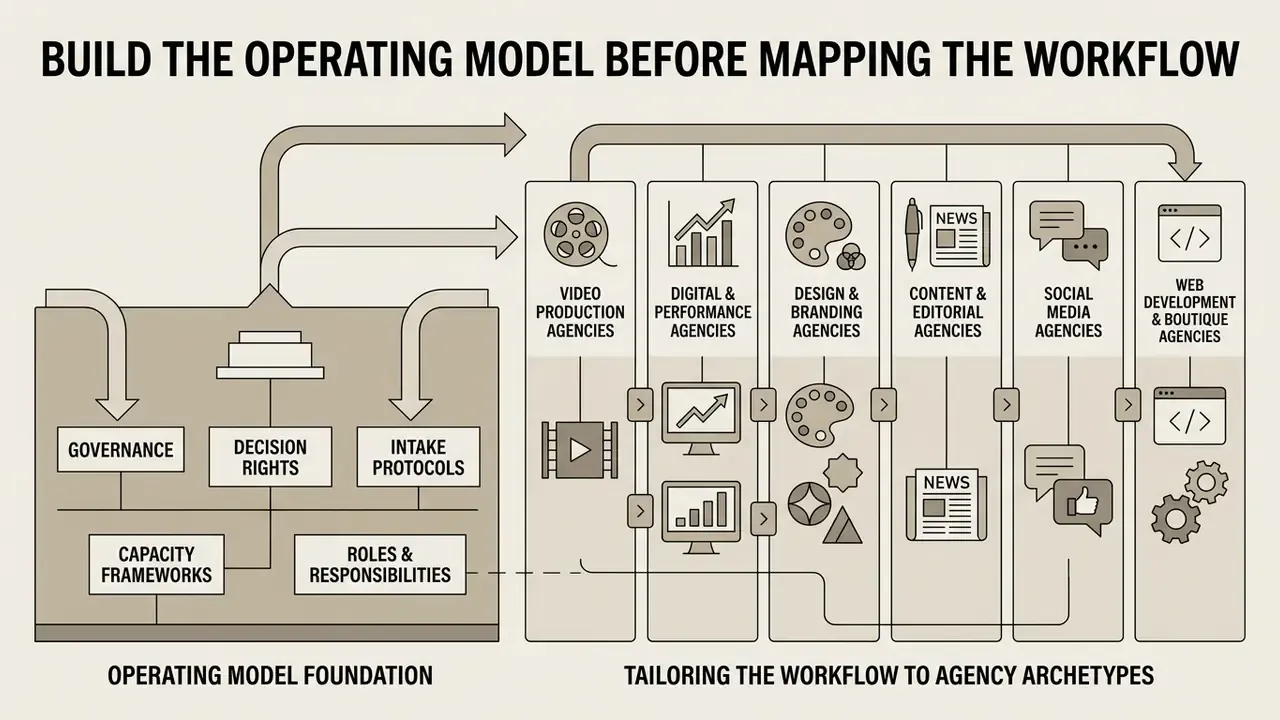
An agency should settle its operating model, meaning governance, decision rights, intake protocols, and capacity frameworks, before mapping specific creative workflows. Mapping individual task dependencies without that model produces fragmented accountability and repeat handoff failures. It looks like progress. It is not.
According to the U.S. Office of Personnel Management Workforce Planning Framework (2025), building a scalable operating structure requires aligning organizational strategy with capacity analysis, role definitions, and monitoring mechanisms: a five-step loop of setting strategic direction, analyzing the workforce, developing an action plan, implementing and monitoring, then evaluating and revising. For creative agencies, that means fixing intake boundaries and operational ownership before creative work starts.
«Project-based organizations in the creative industries are characterized by high human-capital dependency, flexible workflows, and a significant share of non-standard decisions.»
Operating-model guidance from portfolio management practice adds a third component: the model must define team structure, roles and responsibilities, and the resource planning and forecasting process, with roles combined or separated according to agency size (Rego University, RMO Creation and Optimization, 2018; updated 2025).
Tailoring the Workflow to Agency Archetypes
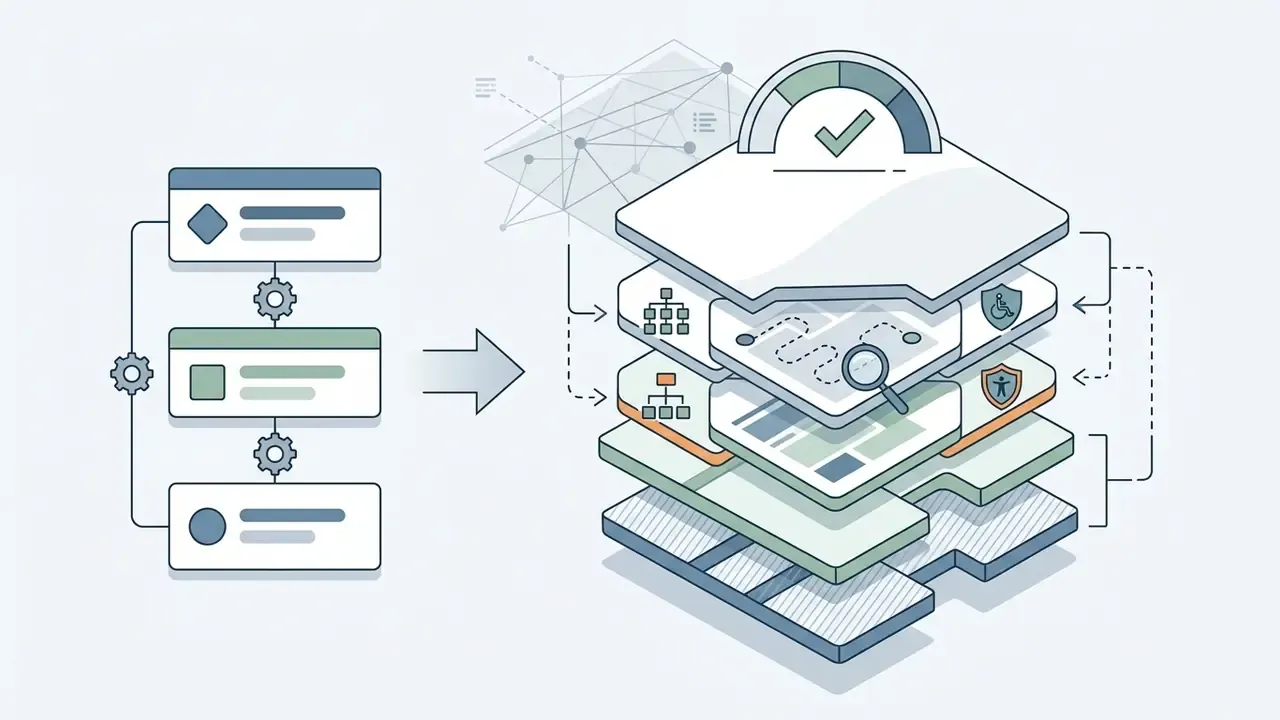
"Creative agency" is a deliberately broad label, and applying one identical pipeline to every specialization guarantees friction. The core governance layer stays static: RACI, gates, intake, QA. Asset-specific pipelines, though, need architectural adjustment by specialization:
Every project should at least pass a gut-check against each archetype gate, even for repeat work. Skipping the role and gate evaluation because "we've done this before" is one of the most common sources of late-stage rework.
Define Roles, Responsibilities, and Decision Owners
Friction shows up most often where decision authority is diffuse. A scalable creative team structure separates client management, project governance, creative execution, compliance review, and technical deployment into distinct functional roles with explicit accountability:
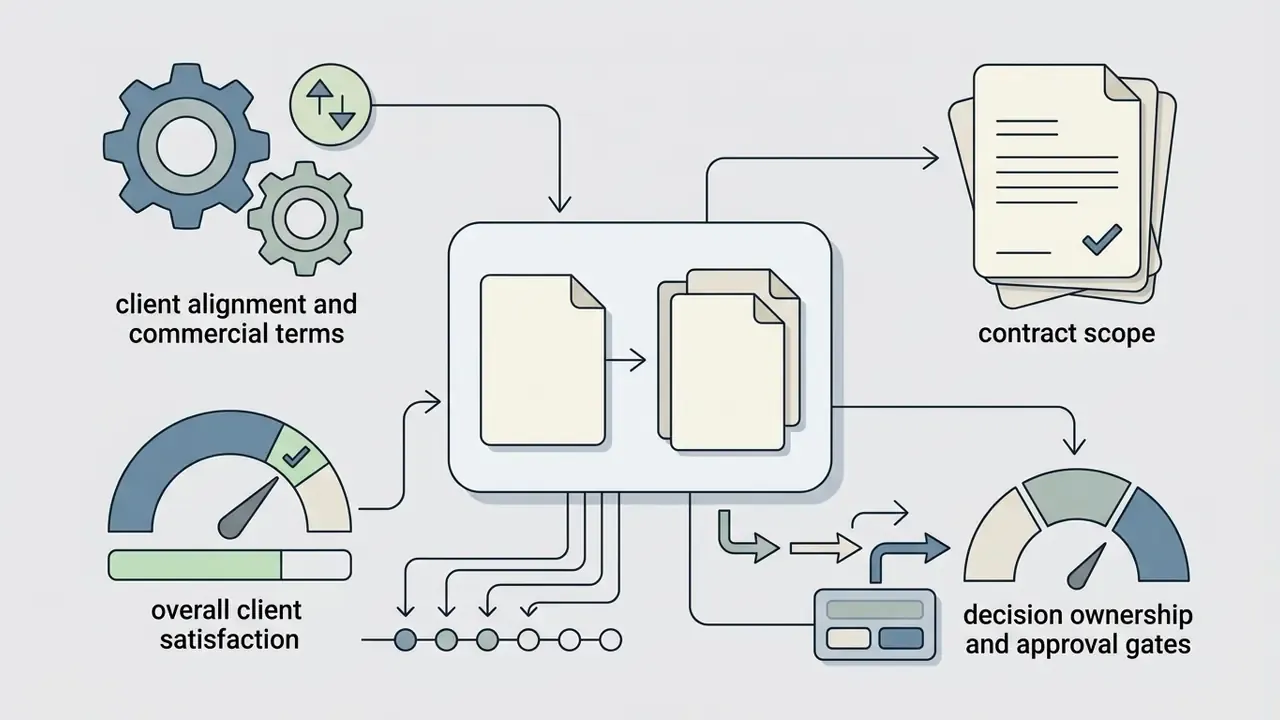
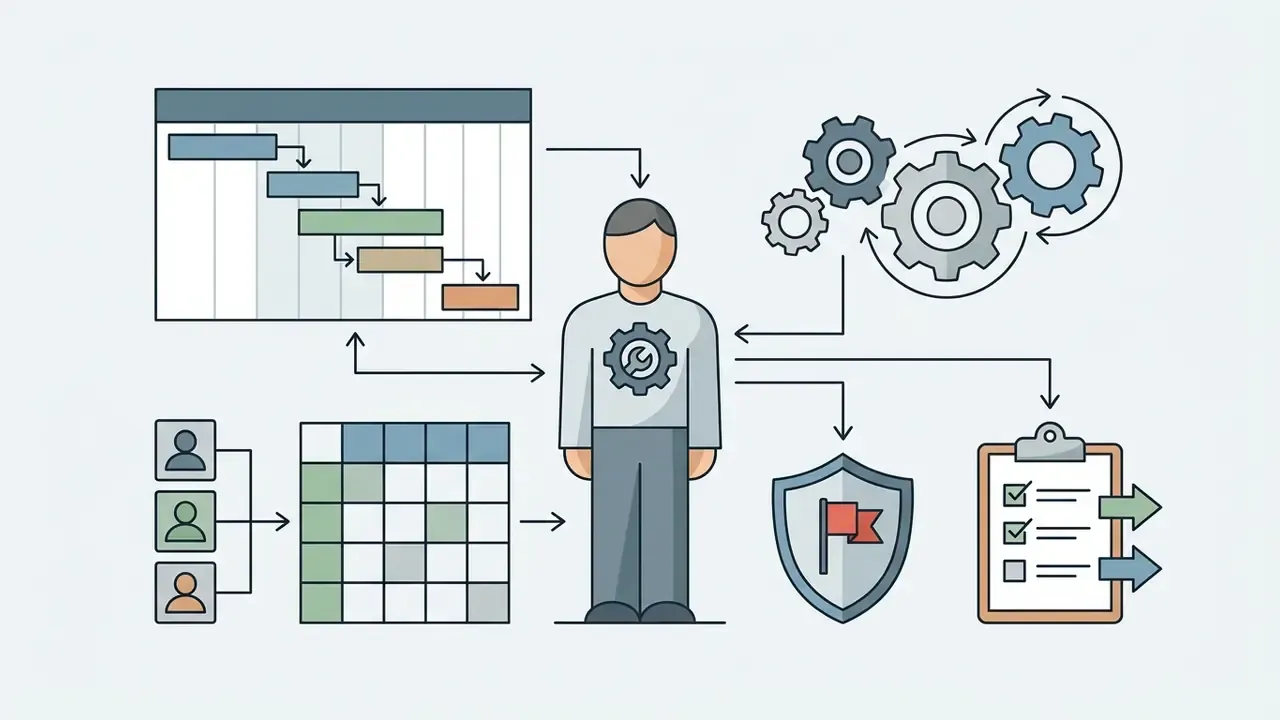
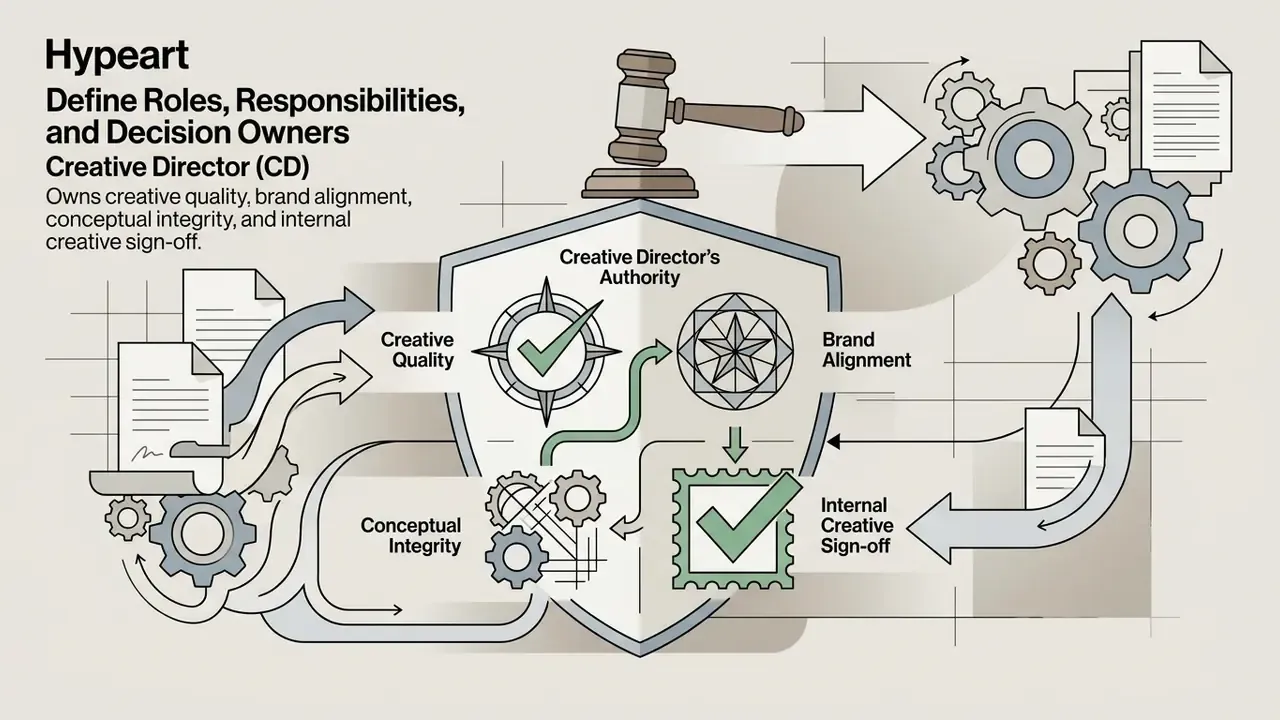
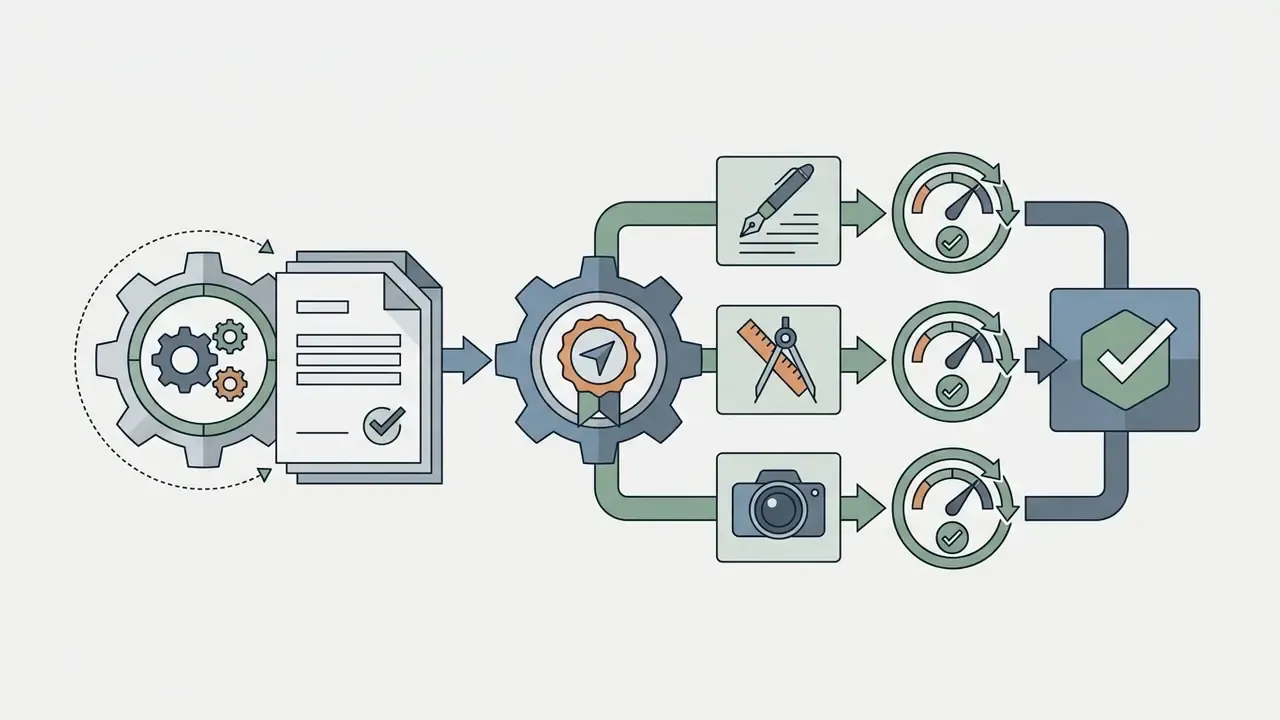
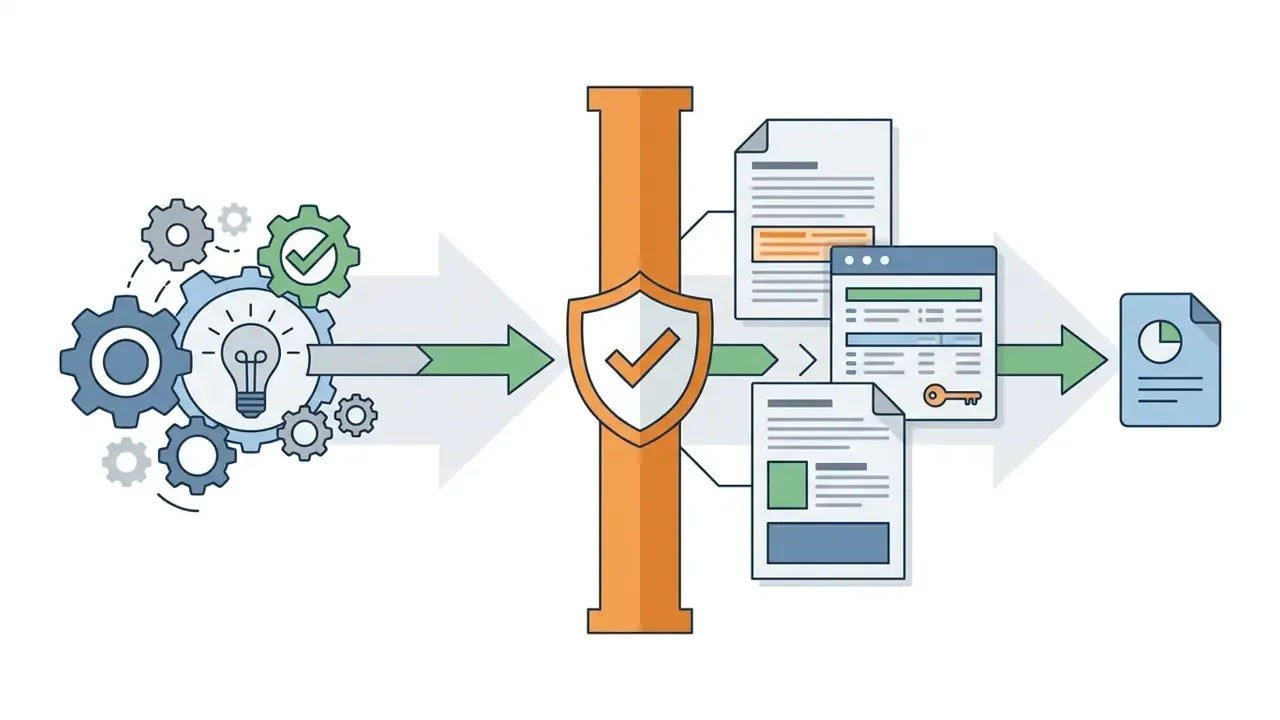
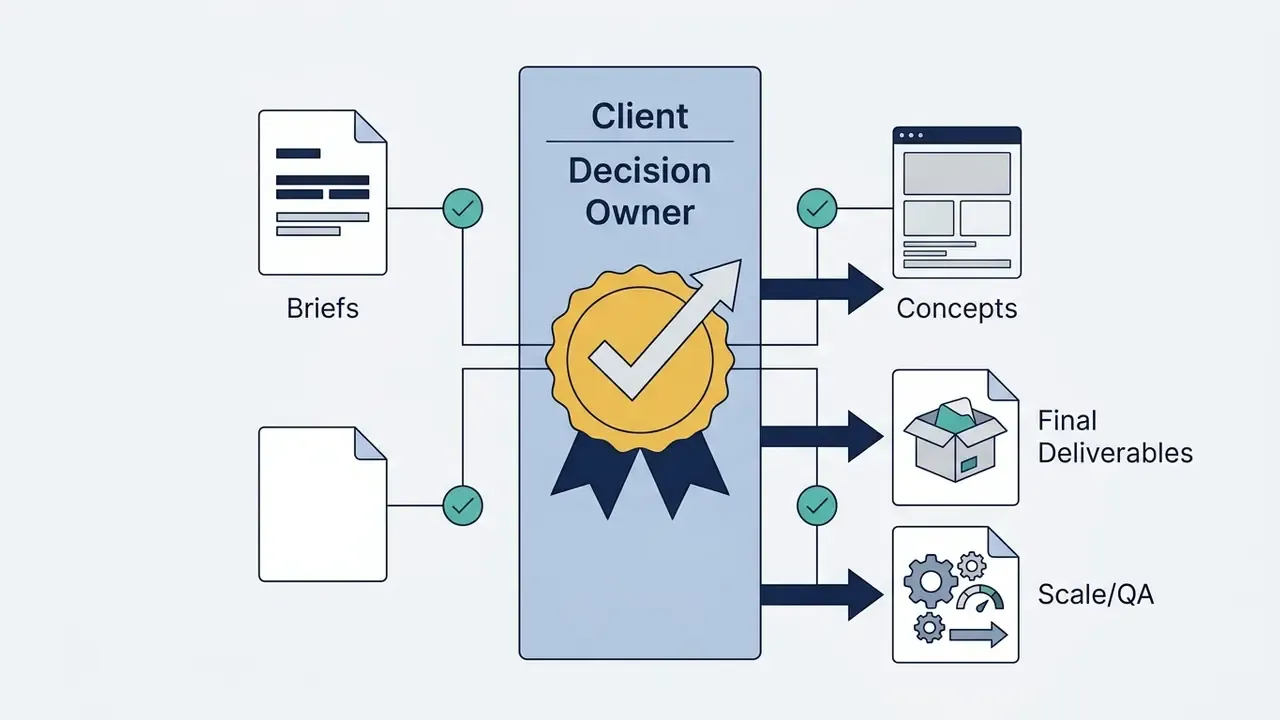
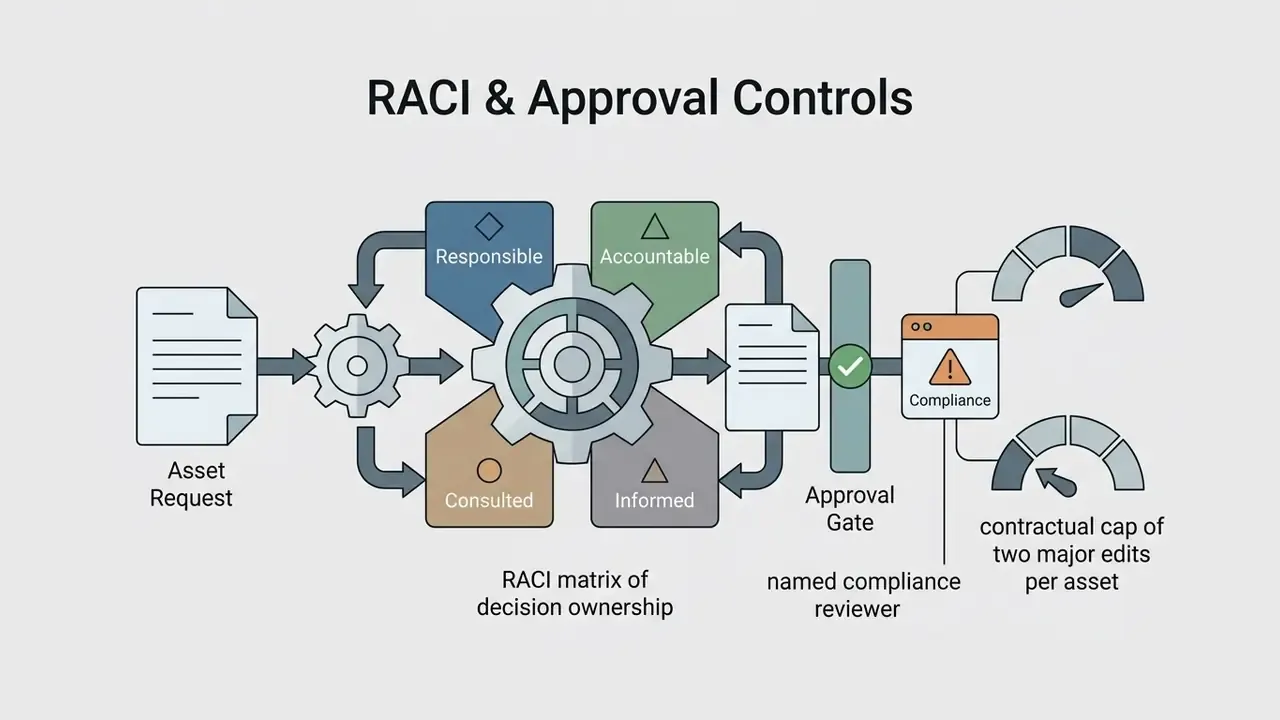
Split responsibility so the account and project side owns the brief and workflow, the creative team owns production, compliance owns regulatory clearance, and the client owns final sign-off. To keep that clarity operational, implement a RACI governance matrix across all project phases. Official templates (NAVFAC, Responsibility Assignment Matrix, 2026; Stanford and University of Reading RACI templates) converge on one rule: exactly one Accountable owner per task, at least one Responsible executor, with Consulted and Informed added only where genuine input or visibility is needed.
Agency Creative Production RACI Matrix
| Workflow Stage | Account Manager | Project Manager | Creative Director | Production Team | Legal / Compliance | Client Approver |
|---|---|---|---|---|---|---|
| Client Intake & Qualification | Accountable (A) | Responsible (R) | Informed (I) | Informed (I) | Consulted (C) | Consulted (C) |
| Brief & Scope Definition | Responsible (R) | Accountable (A) | Consulted (C) | Informed (I) | Consulted (C) | Consulted (C) |
| Concept & Strategy | Consulted (C) | Informed (I) | Accountable (A) | Responsible (R) | Consulted (C) | Consulted (C) |
| Asset Production | Informed (I) | Accountable (A) | Consulted (C) | Responsible (R) | Informed (I) | Informed (I) |
| Internal QA & Review | Informed (I) | Accountable (A) | Responsible (R) | Responsible (R) | Responsible (R) | Informed (I) |
| Regulatory / Claims Clearance | Consulted (C) | Responsible (R) | Consulted (C) | Informed (I) | Accountable (A) | Consulted (C) |
| Client Review & Approval | Responsible (R) | Consulted (C) | Informed (I) | Informed (I) | Consulted (C) | Accountable (A) |
| Handoff & Launch | Responsible (R) | Accountable (A) | Informed (I) | Responsible (R) | Informed (I) | Consulted (C) |
| Post-Launch Audit & Post-Mortem | Consulted (C) | Accountable (A) | Responsible (R) | Consulted (C) | Consulted (C) | Consulted (C) |
RACI definitions: R = Responsible for execution; A = Accountable (sole decision owner); C = Consulted for expert input; I = Informed of progress. In compact list form: intake sits with the account manager, brief and production tracking with the project manager, concept with the creative director, regulatory clearance with compliance, and final approval with the named client owner.
Standardize Client Intake, Scope, and Creative Briefs
Unclear or shifting client requirements are the primary driver of margin erosion on creative projects. A standardized client intake process ensures no production task starts without an approved, production-ready creative brief. Intake design guidance is consistent: collect the required information first, express it as a structured form with fields, dropdowns, and checkboxes, then test and revise the form before agency-wide use (Smartsheet intake template guidance, 2024).
A complete creative brief template should capture eight mandatory operational fields:
- Business Objective & Success MetricsThe measurable outcome the client actually needs.
- Target Audience & Channel DistributionSpecific demographic, platform, and formatting parameters.
- Core Message & Brand GuidelinesMandatory value propositions, tone of voice, visual assets, and brand constraints.
- Itemized Deliverables & SpecificationsExplicit count of required assets, resolutions, aspect ratios, and file formats, split into must-haves and nice-to-haves so scope boundaries are visible.
- Approved Budget & Out-of-Pocket AllocationsFinancial boundaries for media, software, or third-party licensing.
- Hard Delivery Schedule & MilestonesFixed dates for concept presentation, QA checks, client review, and final handoff.
- Designated Sign-off AuthorityThe named individual on the client side authorized to approve, plus the named compliance reviewer where applicable.
- Revision Thresholds & Scope Change RulesContractual limits on included revision rounds before a formal scope adjustment kicks in.
Requiring complete brief submissions through standardized intake forms retires the informal request sent by chat at 7pm, and gives project governance a firm baseline. Central-intake operating models formalize this further: a designated intake lead is accountable for day-to-day intake operations and must adjust staffing to request volume, demand, and pathway complexity (Ontario Health, eReferral and Central Intake Playbook, 2026).
Plan Capacity Across Multiple Creative Projects
Running concurrent creative projects requires active capacity planning, otherwise specialized roles such as senior motion designers or copywriters become permanent bottlenecks.
«Effective resource management across parallel projects requires bottleneck buffers and concurrency caps on simultaneous task execution.»
Establish capacity baselines from historical time-tracking data, factoring in three operational bands:
Complementary practice sets a 90-day delivery baseline, applies per-person concurrency caps, and holds explicit reserve capacity for volatility (Creative Team Capacity Planning, 2026, https://creativeprojectmanagement.org/blog/creative-team-capacity-planning). For early warning, rolling-wave control gives managers a snapshot of whether tasks are on track before a deadline is formally missed (PM World Library, 2024, https://pmworldlibrary.net/wp-content/uploads/2024/09/pmwj145-Sep2024-Hanan-Ford-program-early-warning-system-for-rolling-wave-lifecycle.pdf).
Honest capacity math prevents overcommitment and flags schedule risk while there is still time to act on it.
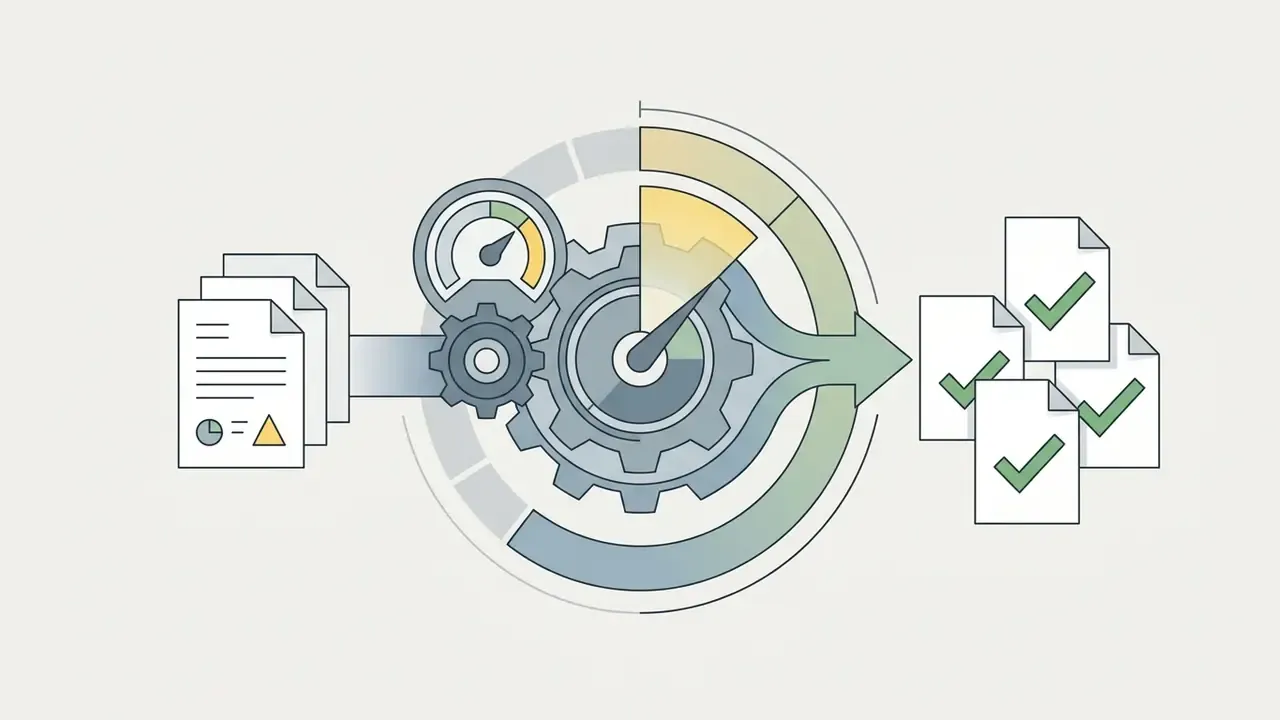
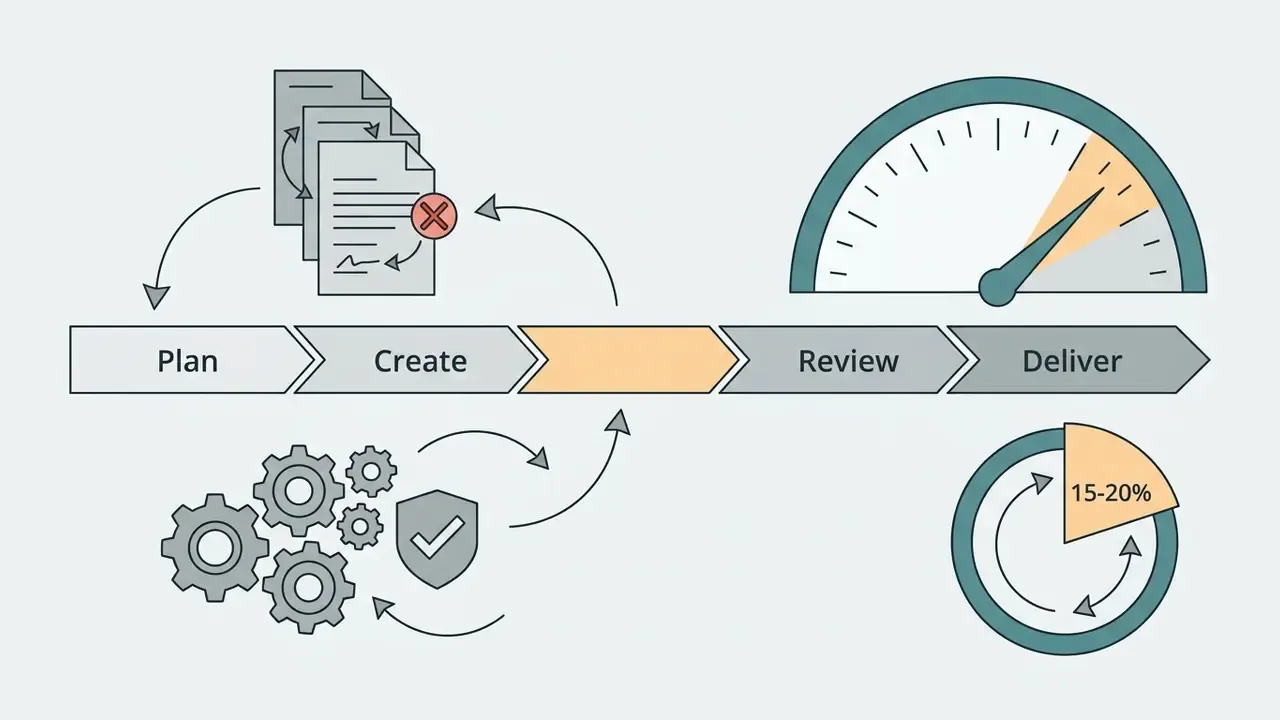
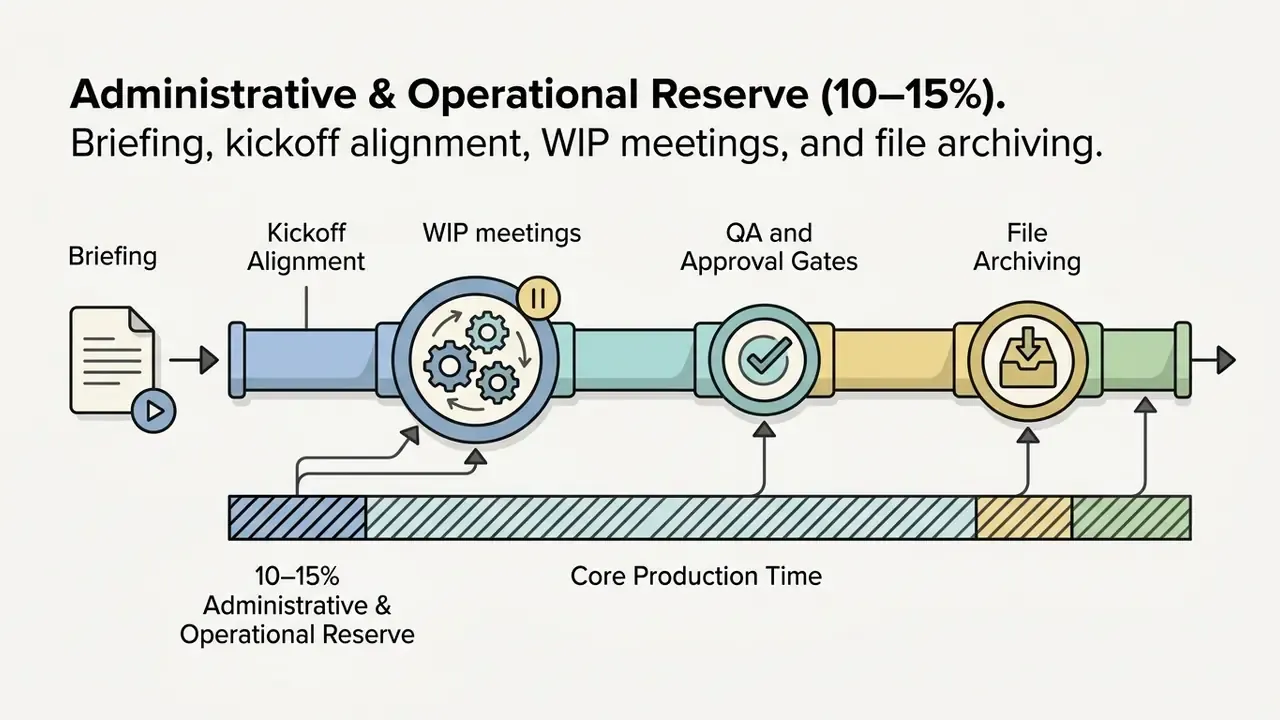
Agency Creative Production Workflow: Core Stages From Brief to Launch
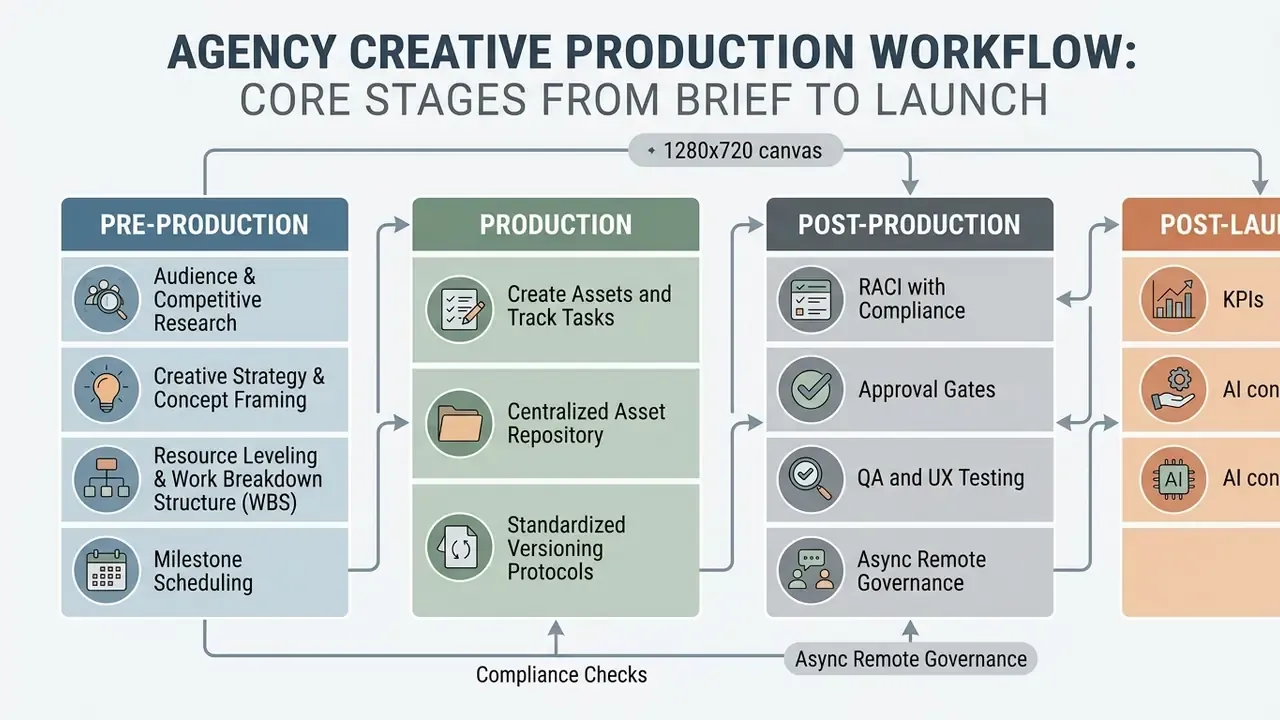
The lifecycle of an agency creative production workflow runs across four primary phases: Pre-Production, Production, Post-Production, and Post-Launch. Each phase carries specific operational gates that must be satisfied before work moves on. These are the agency creative production workflow steps most teams search for, and the order matters more than the labels.
Pre-Production: Research, Strategy, and Project Planning
Pre-Production sets the strategic foundation and the schedule constraints for the whole campaign. Account managers, project leads, and strategists translate client requirements into an executable plan.
Key operational outputs during Pre-Production:
- Audience & Competitive Research Synthesizing market data to inform creative direction. Research may span desk research, stakeholder and field interviews, deep immersion in the client's existing materials, and quantitative data analysis.
- Creative Strategy & Concept Framing Establishing visual and messaging themes aligned with campaign objectives, then re-aligning with the client on point of view and success metrics.
- Resource Leveling & Work Breakdown Structure (WBS) Decomposing the project into discrete tasks, estimating effort hours, assigning named producers.
- Milestone Scheduling Fixed dates for internal reviews, client checkpoints, and final delivery, followed by an internal kickoff covering risks and mitigations, then an external kickoff with the client.
Many agencies now lean on AI-assisted competitive intelligence during pre-production to analyze target audiences, extract brand tone attributes, map content pillars, spot topic gaps, and pre-fill brief data before human strategy review. Two governance rules apply. Any AI-generated audience insight stays labelled a hypothesis until validated against CRM data or research interviews. And no confidential client data goes into unapproved consumer AI services (see the Shadow AI controls further down).
Work should not move into production until the client formally approves the brief and the schedule.
Production: Create Assets and Track Tasks
During Production, creative teams build deliverables against approved brief specifications. This phase needs tight operational governance to track progress, manage working files, and prevent version control errors. Where motion or short-form video is in scope, production leads increasingly pre-approve a shortlist of AI video generators so output specs, licensing, and render pipelines stay consistent across accounts.
According to technical file management guidelines published by NVIDIA, agencies must keep strict separation between raw source assets, active working files, and finalized exports.
«Strict separation of source files, working versions, and final exports is a mandatory condition for preventing versioning errors in production pipelines.»
Production teams should enforce three asset management practices:
- Centralized Asset Repository
- Store all source files in a shared folder structure with role-based access controls, so every task team can confirm access to reference material before generating anything new.
- Standardized Versioning Protocols
- Use explicit, append-only naming conventions (for example,
Brand_Campaign_Banner_1080x1080_v03.psd) instead of generic descriptors likefinal_v2. Edits are saved as new versioned files, preserving the original asset and its history. - One-to-One Task Routing
- Align each production task with a single pipeline milestone in the project management tool, so task progression is visible in real time. Autodesk pipeline guidance recommends exactly one task per pipeline step.
Post-Production: Review, Approval, Delivery, and Launch
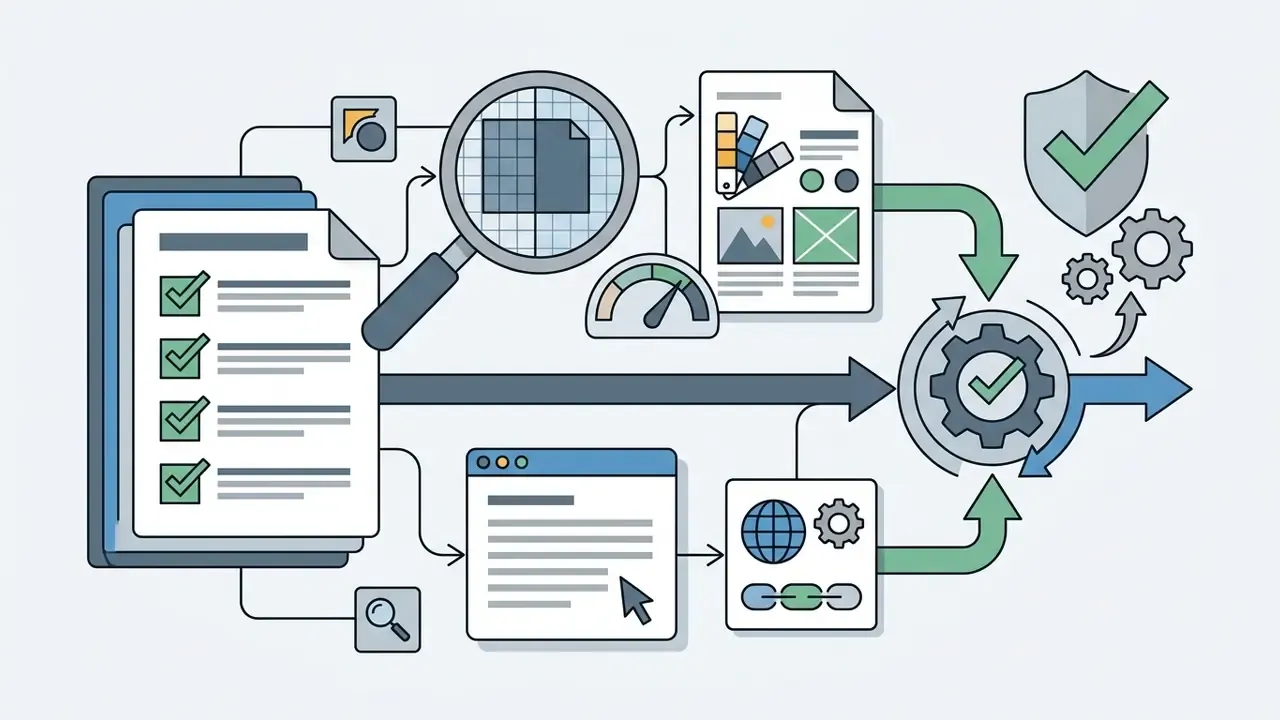
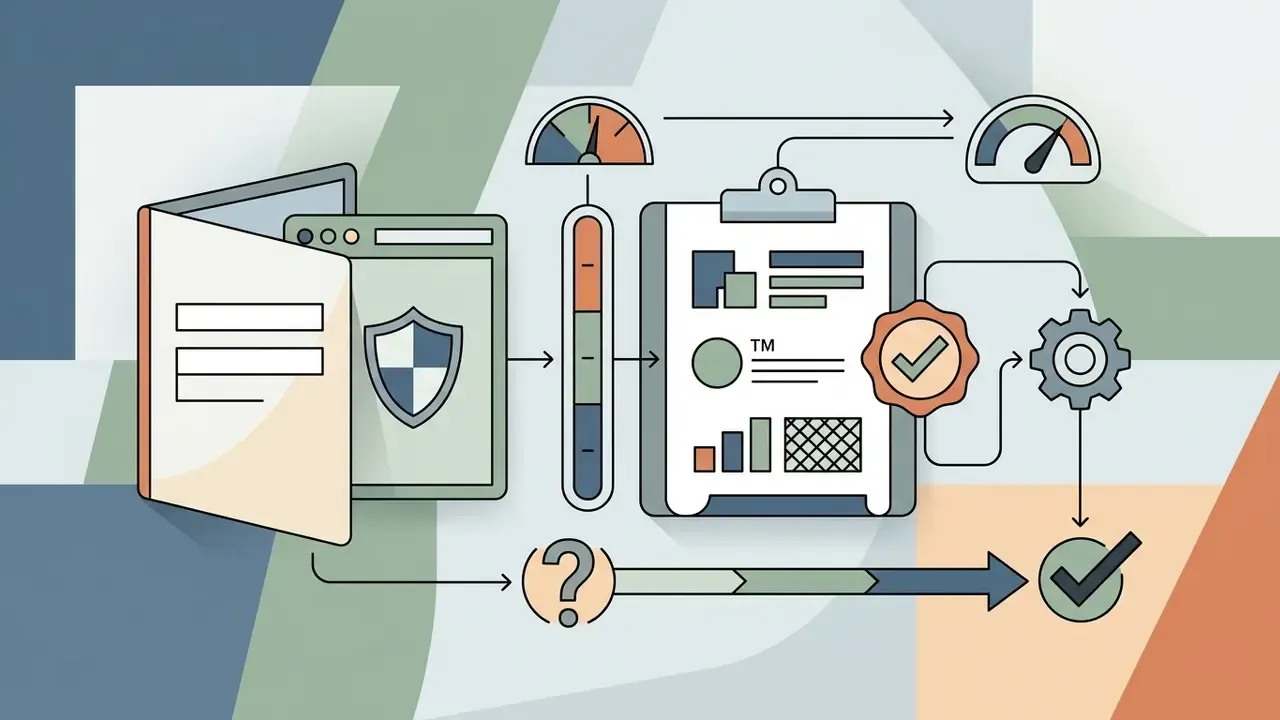
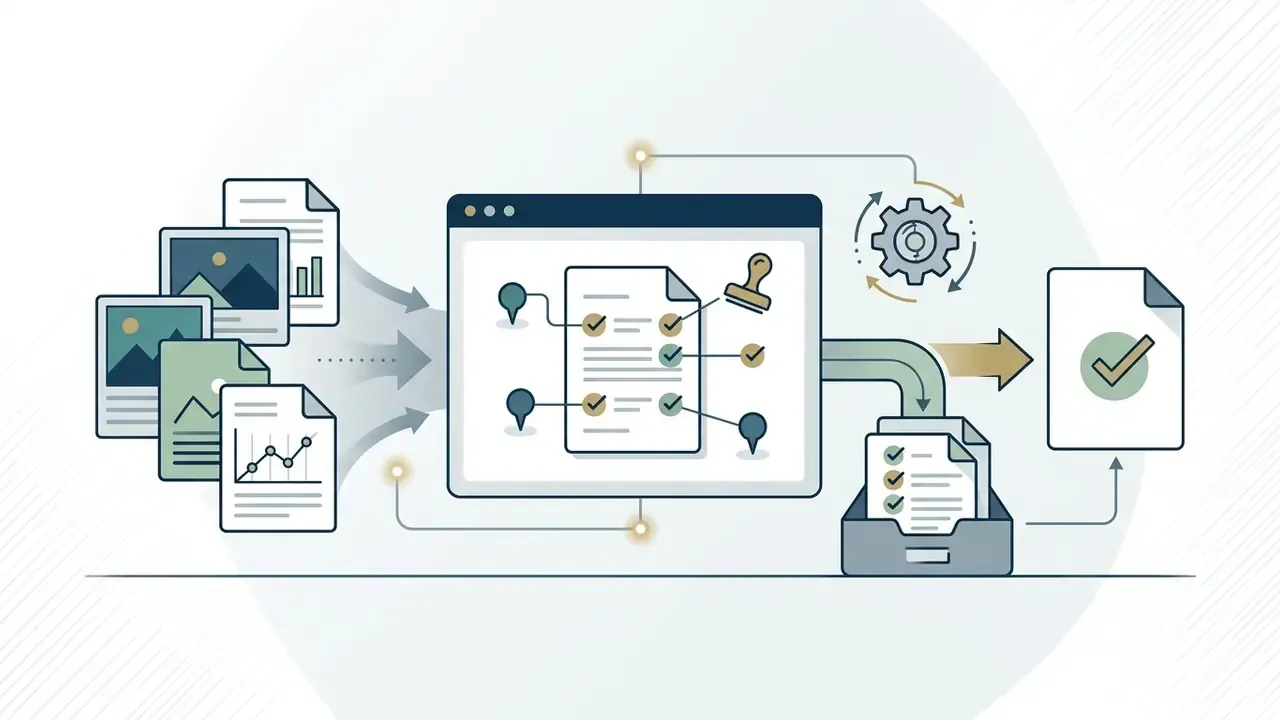
Post-Production governs quality control, visual proofing, formal approvals, client handoff, and campaign launch. It is where deliverables are confirmed against technical specifications and brand standards before deployment.
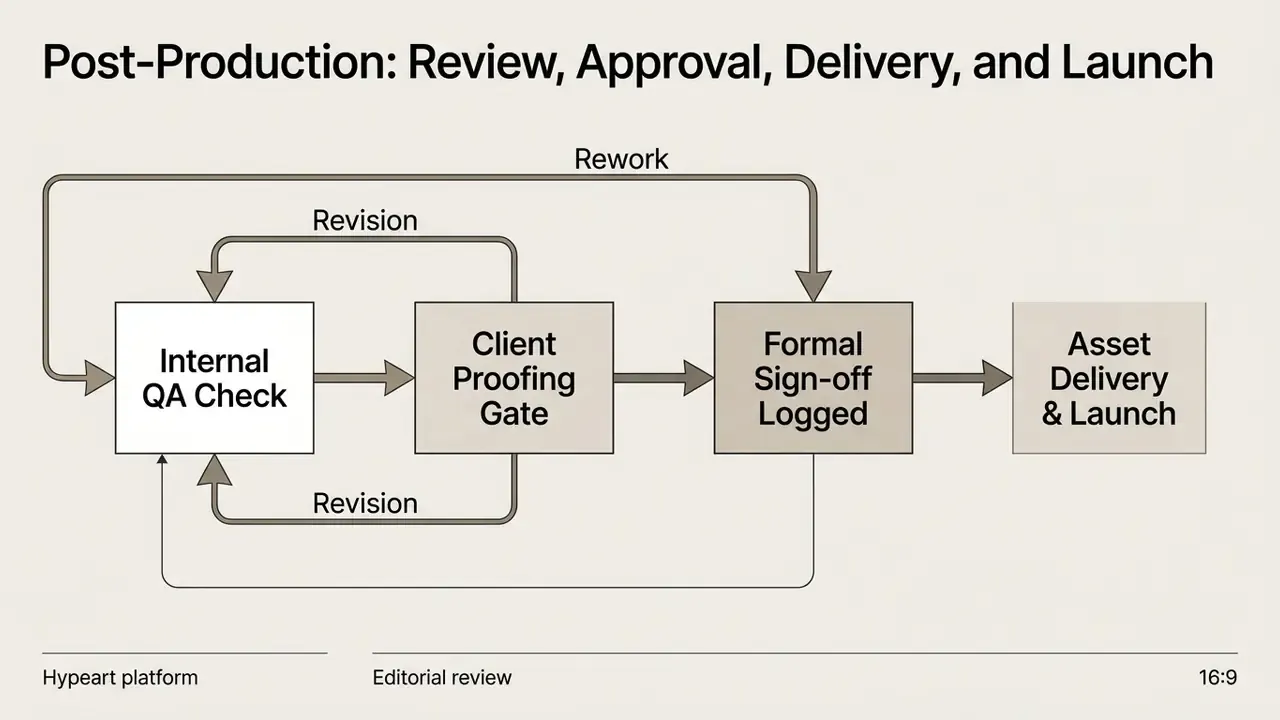
Official delivery standards, such as Channel 4's Technical Specifications (2023), require automated quality control (AQC) reports and sign-offs before broadcast or digital release; the specification mandates an AQC report in PDF, an eyeball QC report in PDF, and a PSE report delivered with the master programme. Sky's delivery specification similarly requires Pass AQC reports emailed as PDFs and tied to the programme ID, which makes QA evidence part of the handoff package. Bell Media's Standard Approvals List (2024) requires final post-production deliverables and business-affairs approvals before delivery counts as complete. Verification note: these broadcaster specifications are published as controlled PDFs distributed to accredited suppliers; request the current revision from the broadcaster rather than trusting a cached copy.
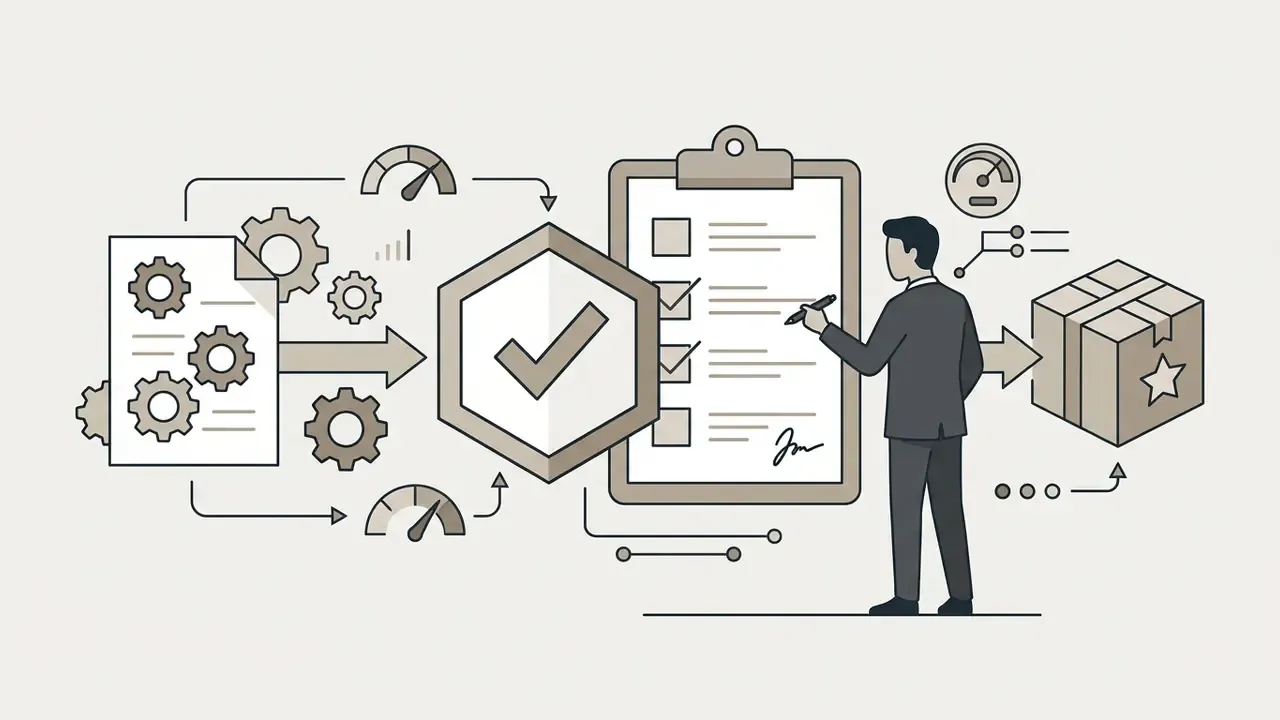
In an agency setting, Post-Production carries four final checkpoints:
Formal handoff follows: final production-ready master files alongside editable sources and technical metadata, then campaign activation across the planned channels (paid, social, email, web, or physical distribution).
Post-Launch: Analytics, Auditing, and Retrospectives
A workflow does not end at deployment. The Post-Launch phase closes the feedback loop through two mandatory rituals:
- Performance Asset Audit Cross-referencing production cycle metrics (budget versus actual hours, revision counts, cycle time) with campaign performance data (CTR, conversions, view-through, engagement) to establish true asset ROI. Monitoring launch reception across social channels, tracking site traffic, and reading customer feedback surveys turns campaign outcomes into production intelligence, for example identifying which formats reliably deliver results per production hour.
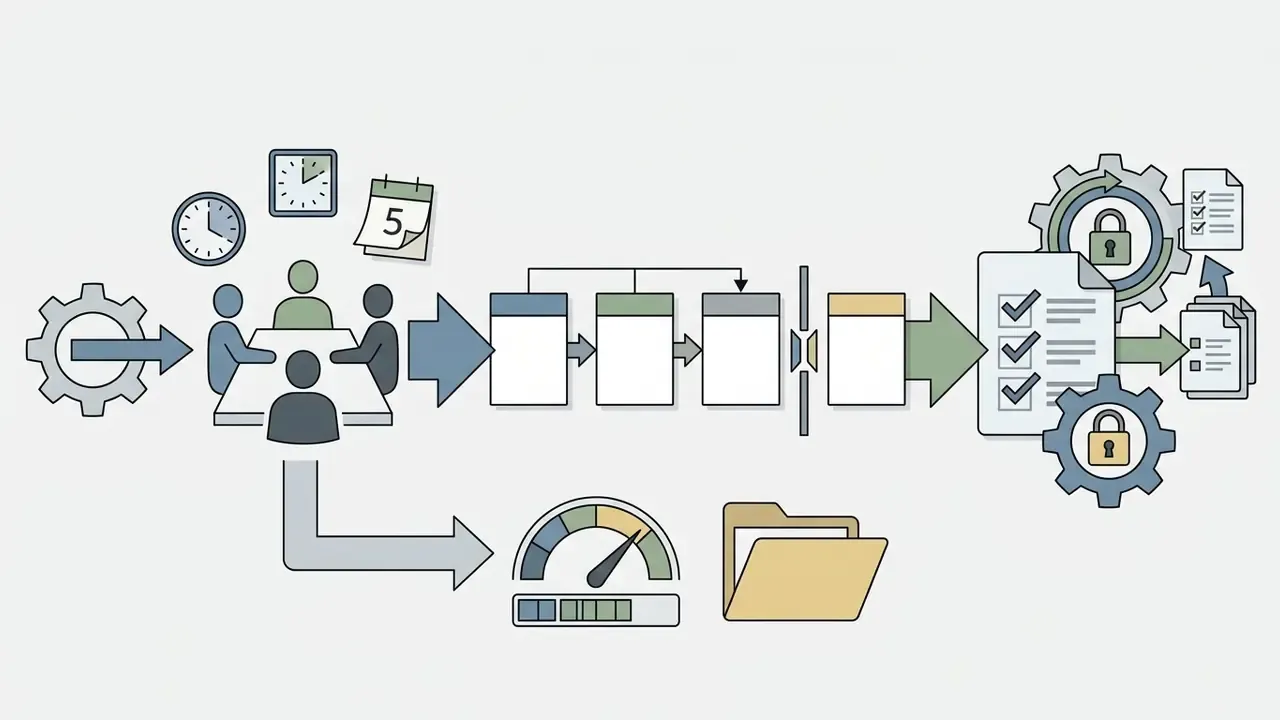
- Blameless Post-Mortem Structured retrospectives within five business days of launch to surface scope leaks, RACI breakdowns, template failures, and estimation errors. The debrief should answer four questions. What went well? What did not? Should the workflow or team structure change for similar work? Which questions must be asked of clients earlier next time?
Post-launch analysis is not optional hygiene. It is the mechanism that converts one campaign's lessons into the next campaign's templates. Every post-mortem should end with at least one concrete artifact change: an updated brief field, a new QA checklist item, a revised capacity assumption, or a retired step. Formal frameworks back this pattern up: NIST SP 800-61r3 (2024) requires an after-action report following response activities, and post-implementation review frameworks require documented data analysis and a submitted PIR report after implementation (U.S. Social Security Administration, Post Implementation Review Framework and Procedures).
Retention matters as much as reflection. Post-mortem records, approval logs, and delivered master files belong under a defined retention schedule, so the audit trail stays reconstructible for client audits, billing disputes, or regulatory review.
Agency Creative Production Workflow Flowchart
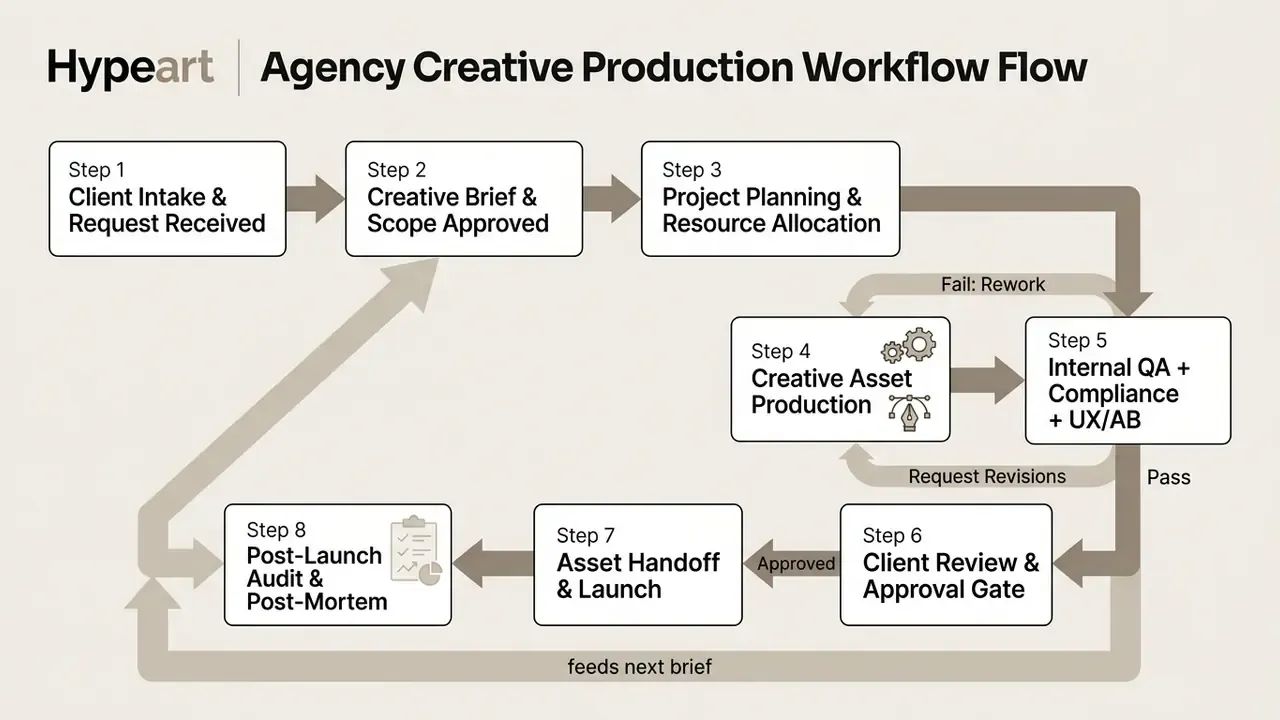
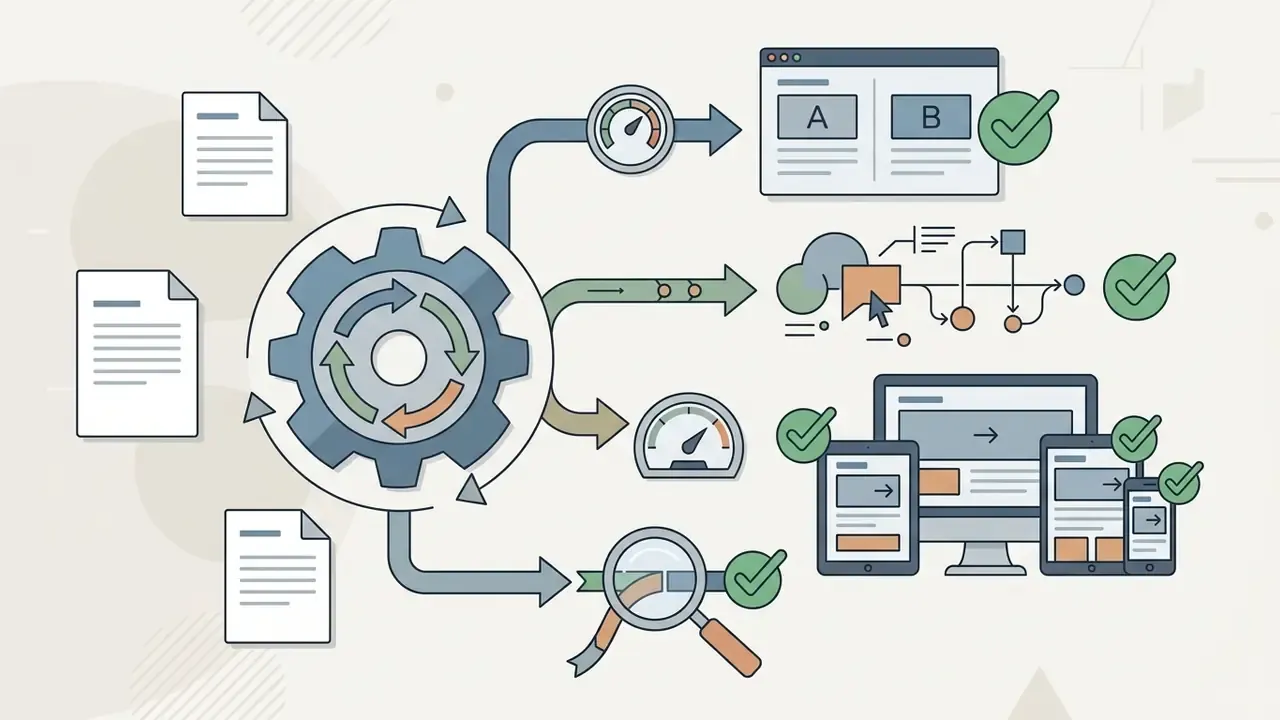
Figure 1: Conceptual flowchart mapping the agency creative production workflow steps, showing internal QA and client review revision loops plus the post-launch feedback loop.
How to Implement a Creative Agency Workflow Step by Step
Moving a working agency from ad-hoc habits to a standardized creative agency workflow takes a phased rollout. Changing process while live client deliverables are in flight needs care, otherwise the cure disrupts more than the disease. Treat what follows as a tutorial you adapt, not a script you recite.
Why enterprise frameworks apply to marketing work. Creative teams sometimes react to references such as ISO 9001 or NIST SP 800-53 as if they belonged to a different profession. They do not. These frameworks are simply the most rigorously documented public descriptions of two problems every agency already has: how to define a repeatable process, and how to change that process without breaking live production. ISO gives the vocabulary for process sequence, interaction, and monitoring. NIST gives the discipline of documented, reviewed, approved change control. Borrowing that discipline is what makes a creative workflow auditable to a client's procurement, risk, or compliance function, which is increasingly a precondition for winning regulated accounts.
Standards from ISO 9001 process governance and NIST SP 800-53 Rev. 5 configuration management emphasize that process changes should be documented, evaluated through controlled pilots, and implemented systematically. ISO/IEC/IEEE 24774:2021 supplies the description elements for each workflow step (purpose, outcomes, activities, tasks, information items), while ISO project-methodology guidance recommends rough planning, defined milestones, a fixed kickoff date, and action lists with named owners and target dates.
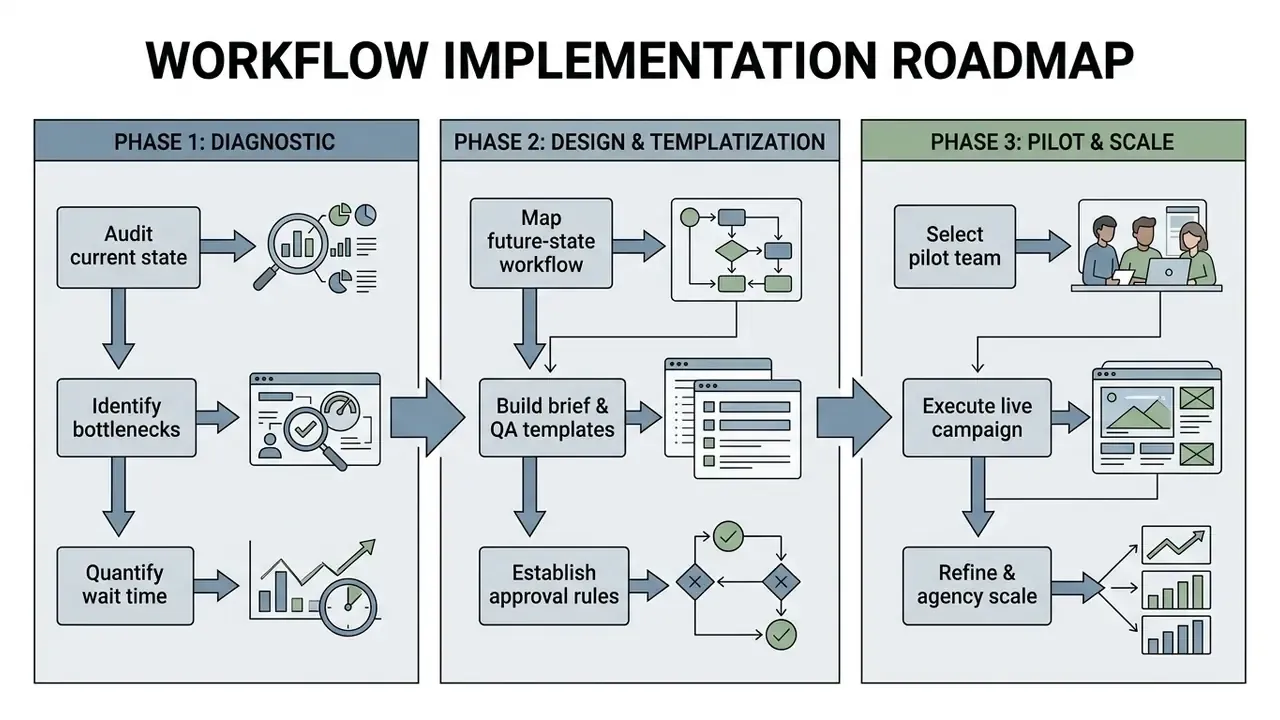
Map the Current Process and Identify Bottlenecks
Step one is a process audit that maps how work actually flows through the agency, not how management assumes it flows. Those two pictures rarely match. Public mapping methodologies follow the same order: draw the current-state map first, then measure step timing, handoffs, rework, and non-value-added steps (State of Michigan, Workflow Process Mapping Guide; NHS Improving Flow value stream mapping).
Operations leads should take three recently completed campaigns and trace every asset step by step from intake to delivery. During the audit, record:
- Every handoff point between internal roles and external client contacts.
- Total wait time spent pending responses, missing files, or feedback.
- The volume and source of revision requests.
- All software tools, email threads, and messaging channels used, including the tab-and-window switching that burns creative hours without producing output.
- Duplicated or redundant steps that exist only because two teams do not trust each other's records.
The diagnostic usually surfaces the same three offenders: incomplete briefs, uncoordinated feedback, and ambiguous sign-off authority.
Document the New Workflow and Create Reusable Templates
Once bottlenecks are visible, document the standardized workflow and build reusable templates. Good documentation means standard operating procedures (SOPs) a new hire can execute without constant supervision. Public documentation standards require a defined scope, start and end points, roles and responsibilities, decision points, validation with the people doing the work, controlled storage, and explicit approval and revision metadata including owner, revision date, and next review date (CalHR, Process Documentation Guide and Template; Library of Congress SOP Template).
Core operational artifacts to build:
When standardizing client-facing agreements and compliance expectations, agencies frequently use a b2b trust checklist to keep transparency and governance standards consistent across commercial relationships.
- Standardized Creative Brief TemplatesStructured forms with required fields for scope, deliverables, and sign-off authority.
- Task Breakdown & Status StructuresStandardized project boards with clear statuses (
Backlog,Brief Approved,In Production,Internal QA,Compliance Review,Client Review,Approved,Launched,Post-Mortem). - Internal QA ChecklistsItemized verification sheets covering visual, editorial, technical, and UX specs.
- Client Onboarding & Review GuidelinesOne-page references explaining how clients submit feedback, request revisions, and issue formal approvals.
- Approval Signature RecordsA dedicated approval sheet or signature page attached to every deliverable that requires formal acceptance before release.
Roll Out the Process Through a Pilot Project
Deploying a new workflow agency-wide on a single Monday introduces avoidable risk. Test the documented process on one pilot project or a single client account first. Public pilot methodology splits the work into preliminary, conduct, and evaluation phases, requiring a defined purpose, scope, success criteria, stakeholder list, and support structure before launch (U.S. National Archives pilot guidance; UK Government service piloting guidance).
To run a useful pilot:
- Select a Representative CampaignStandard deliverables, cooperative client contact, nothing exotic.
- Brief the Pilot TeamTrain account managers, creative leads, compliance reviewers, and client contacts on the new intake forms, review platform, and approval rules.
- Execute Under Standard SOPsEnforce brief requirements, RACI roles, and visual proofing tools without exception during the pilot run.
- Evaluate Performance MetricsMeasure cycle times, revision counts, approval latency, and team feedback against historical baselines.
- Refine Before ScalingAdjust SOPs, template fields, and automation rules based on pilot findings before expanding agency-wide.
Agency Workflow Implementation Readiness Checklist
Checklist0 / 32
Use Tools and Automation Without Replacing Process Ownership
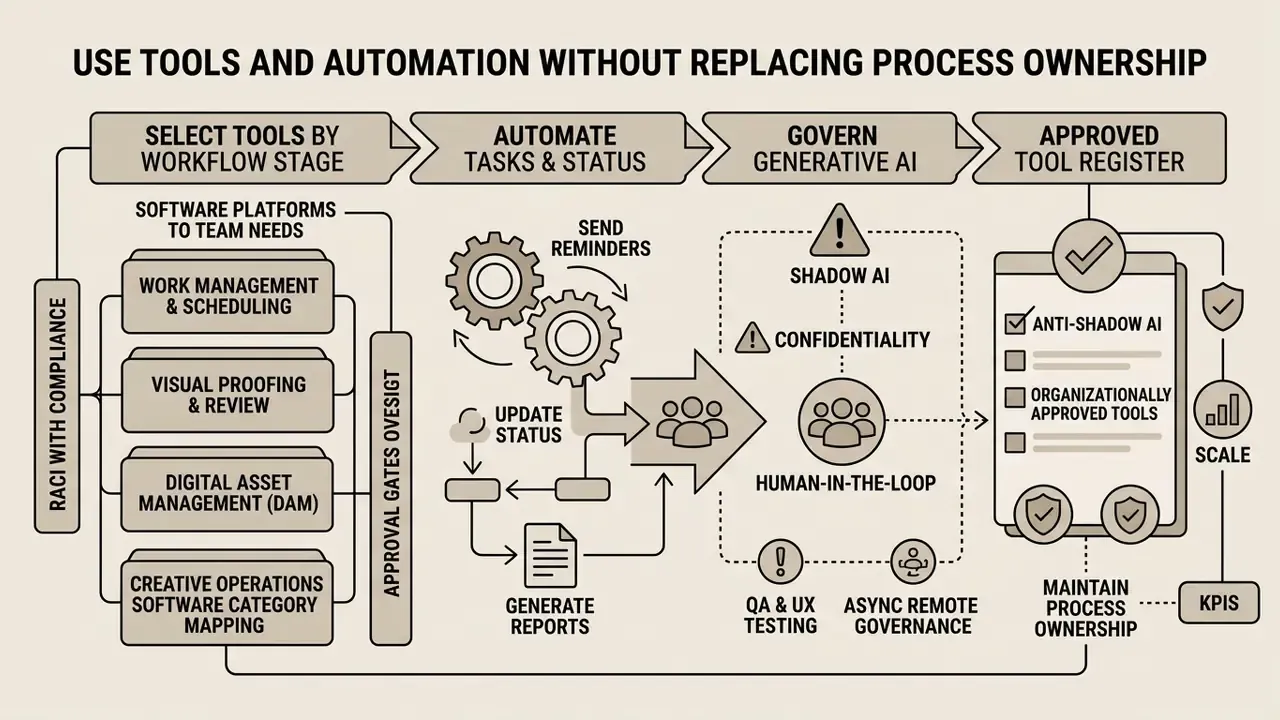
Software platforms and automated workflows are essential infrastructure for complex creative operations. They are not a substitute for human oversight, strategic governance, or process ownership. Sequence matters here: define gates first, then configure them inside the tools rather than routing around them.
As noted in NIST CSWP 30 (Automation Support for Control Assessments, 2026):
«Automation standardizes routine tasks and captures evidence of execution, while strategic governance and decision authority remain with people.»
Independent production research reaches the same conclusion for creative work specifically: hybrid pipelines keep human creative oversight while automation handles procedural steps (Evaluating Automation-Based Workflows in Motion Graphics and VFX Production, IJERT, 2026).
Select Tools by Workflow Stage and Team Need
Modern creative operations run on an integrated stack across three functional layers, and comparative shortlists such as best AI video generators help teams match capability to a specific workflow stage rather than to a vendor pitch:
- Work Management & Scheduling Platforms for project planning, resource allocation, task tracking, and time management (Adobe Workfront, Wrike, Asana, Monday.com).
- Visual Proofing & Review Tools built for visual annotation, side-by-side version comparison, and approval tracking (Ziflow, Filestage).
- Digital Asset Management (DAM) Centralized repositories for archiving, metadata tagging, rights management, and distribution (Brandfolder, Acquia DAM).
Category boundaries increasingly overlap. Adobe Workfront combines work management with proofing and reporting, Acquia DAM embeds proofing inside the asset repository, and Ziflow stays proofing-focused. Whiteboard tools (Miro) and messaging platforms (Slack) sit alongside these layers for ideation and notification routing, but neither should ever become the system of record.
Creative Operations Software Category Mapping
Comparative classification of creative operations software categories.
| Software Category | Primary Operational Focus | Key Features | Typical Workflow Stage |
|---|---|---|---|
| Work Management | Project tracking, scheduling, capacity planning | Gantt charts, task dependencies, resource loading, time logs | Pre-Production & Production |
| Visual Proofing | Annotated feedback, version comparison, approvals | On-asset markup, threaded comments, approval logging, side-by-side review | Post-Production & Review |
| Digital Asset Management (DAM) | Centralized asset storage, metadata, distribution | Taxonomy tagging, rights management, version archiving, brand portals | Post-Launch & Archiving |
| Cloud File Systems | Real-time source-file access for distributed teams | Virtual filespace streaming, no upload or download waits, single live version | Production (Distributed Teams) |
| Analytics & Reporting | Performance read-back and asset ROI | Engagement, traffic and conversion data, client-facing reports | Post-Launch & Optimization |
At the editing-tool layer, agencies frequently benchmark paid suites against free video editing software to work out where licence spend genuinely buys throughput and where it only buys familiarity.
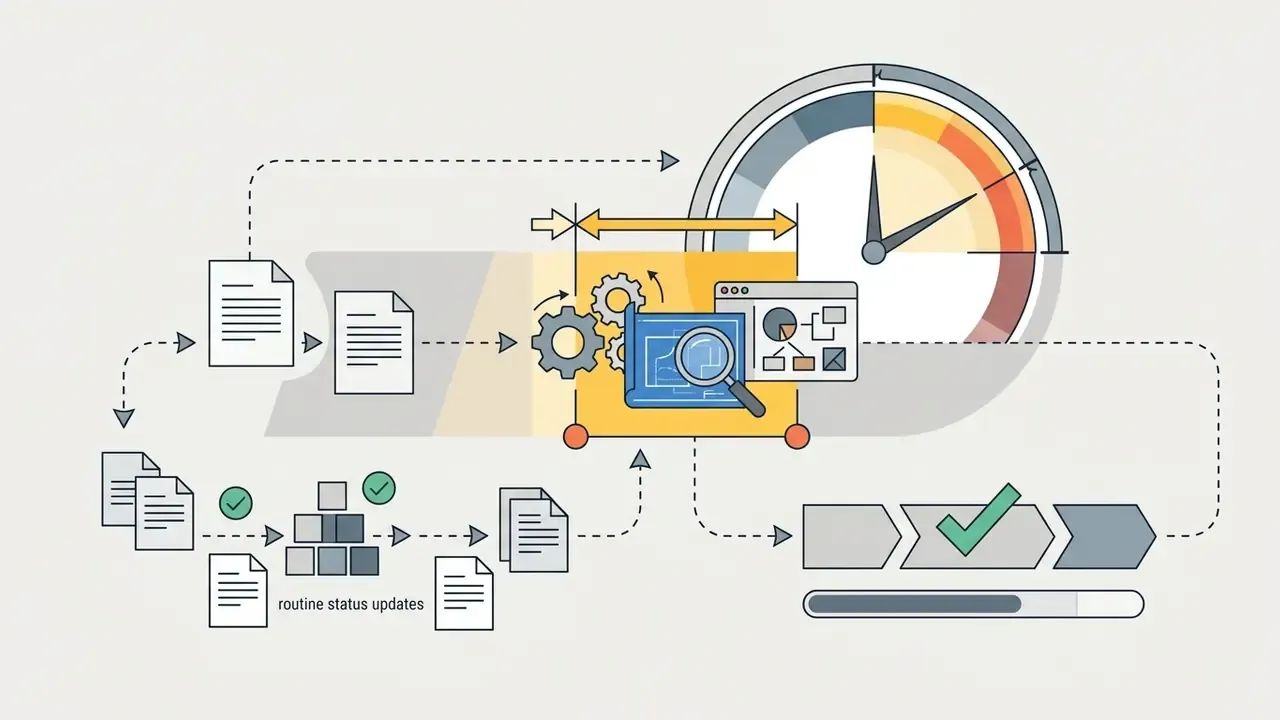
Automate Repetitive Tasks and Status Updates
Govern Generative AI: Shadow AI, Confidentiality, and Human-in-the-Loop
Generative AI now touches research, copy drafting, image and video generation, variant scaling, and localization. It expands throughput and expands risk in the same motion. Three controls are mandatory before AI enters a client-billable workflow:
- Approved Tool Register (anti-Shadow AI)Publish a list of sanctioned generative tools with documented data-processing terms, training-data opt-outs, and commercial licensing rights. Anything outside the register counts as Shadow AI and is blocked for client work. Uncontrolled use of consumer AI endpoints is the most common vector for exposing client roadmaps, unreleased concepts, pricing, and customer data.
- Data Classification Rules for PromptsState explicitly what may never be pasted into a prompt: personally identifiable information, pre-announcement product data, regulated customer records, contractual terms. For sensitive accounts, restrict generation to enterprise deployments with no-training guarantees and tenant isolation.
- Human-in-the-Loop Validation and ProvenanceEvery AI-generated asset requires named human review for factual accuracy, rights clearance, likeness and trademark exposure, and brand fit. Log which tool generated which asset version, so provenance is reconstructible during audit. Where output feeds regulated advertising, compliance review is non-delegable.
Treat AI-derived audience insights as hypotheses until validated against first-party data. Treat AI-derived assets as drafts until a human owner signs them. The workflow, not the model, remains the control.
Set Up Collaboration, Feedback, and Approval Controls
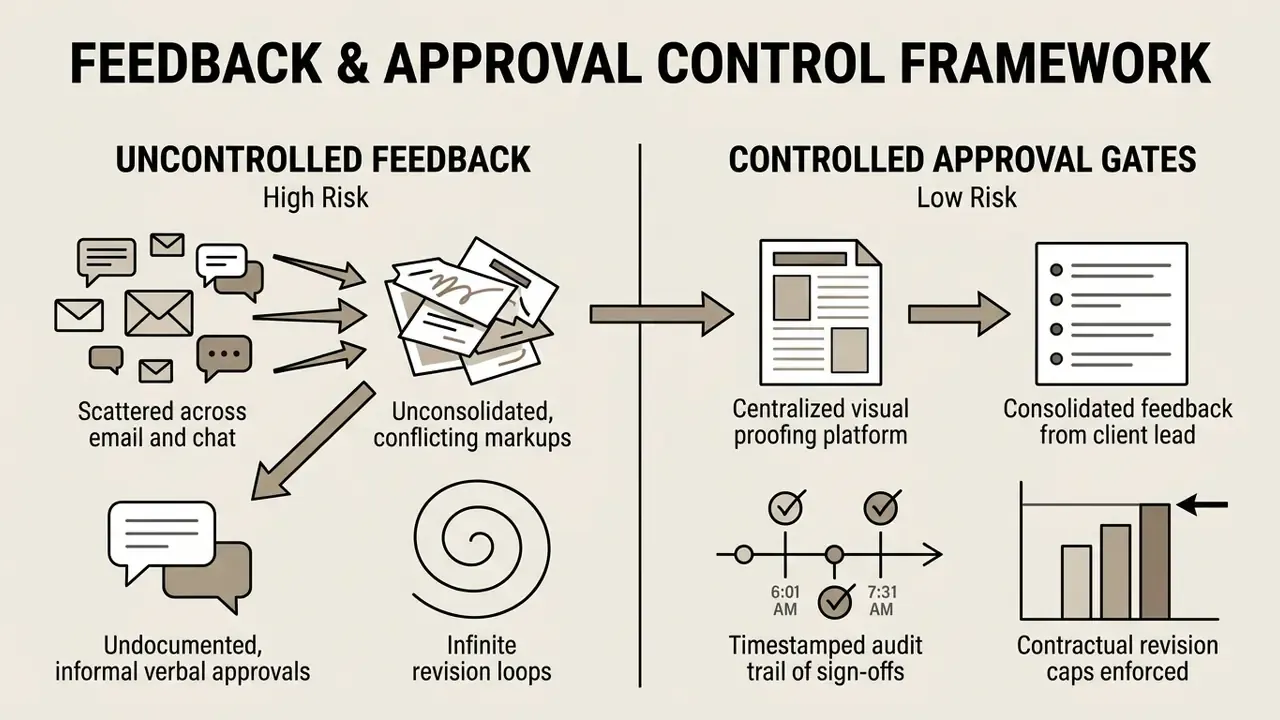
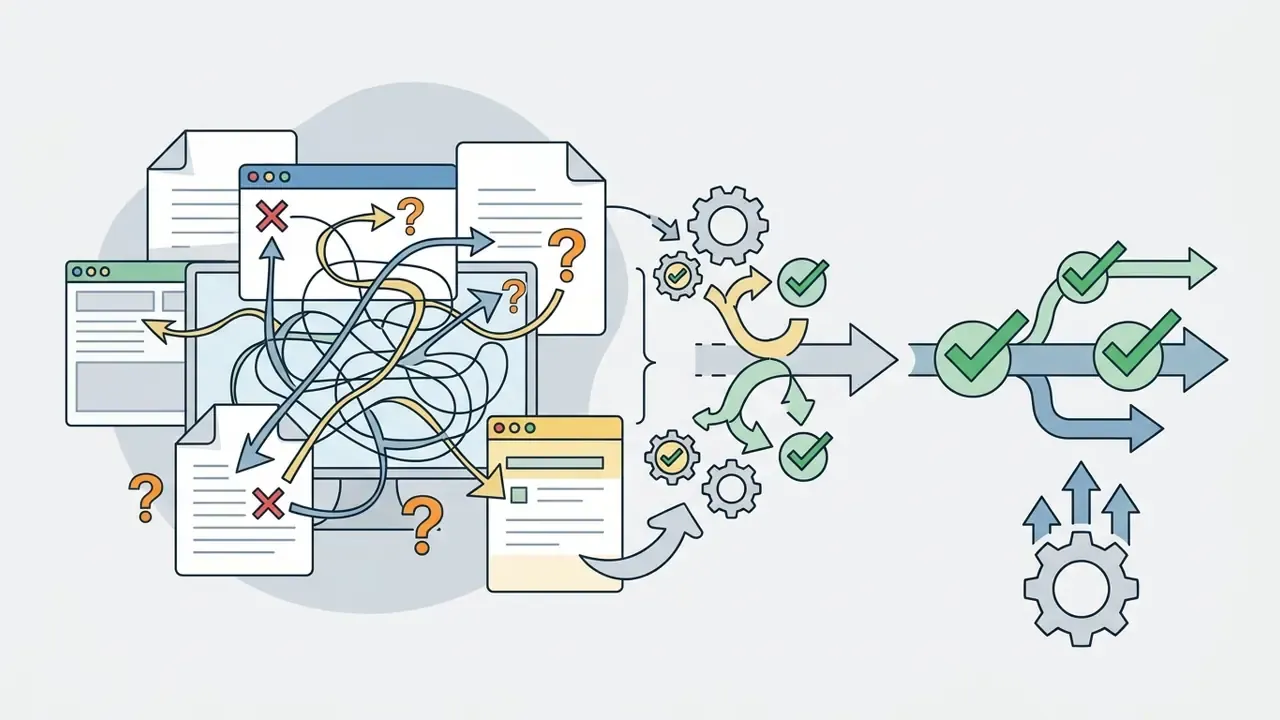
Feedback management is a critical control point in an agency creative production workflow. Client commentary spread across disjointed email chains, chat messages, and marked-up screenshots produces conflicting directions, missed revisions, and quiet scope expansion.
Centralized collaboration rules and strict approval gates protect project margins and make final sign-off accountability unambiguous.
Centralize Feedback Instead of Managing It in Email Threads
Email threads make creative feedback opaque. Text-based critique often lacks visual context, so production teams end up interpreting ambiguous comments, and rework follows.
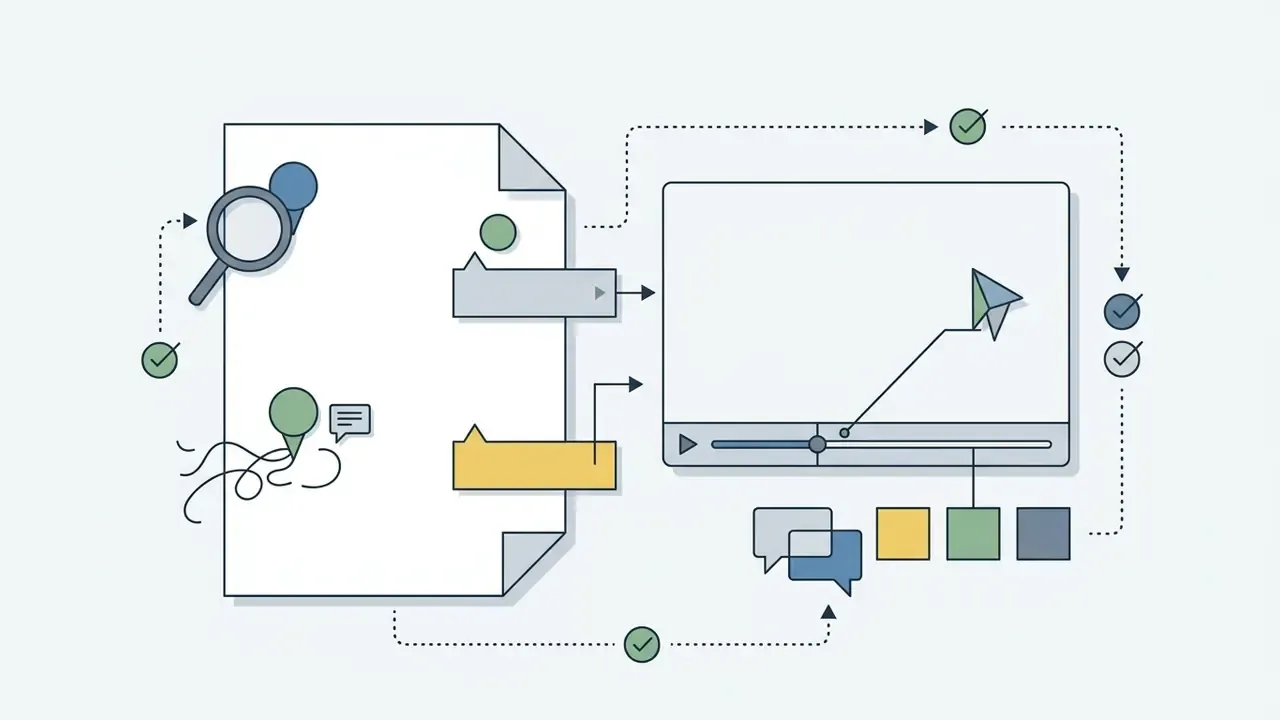
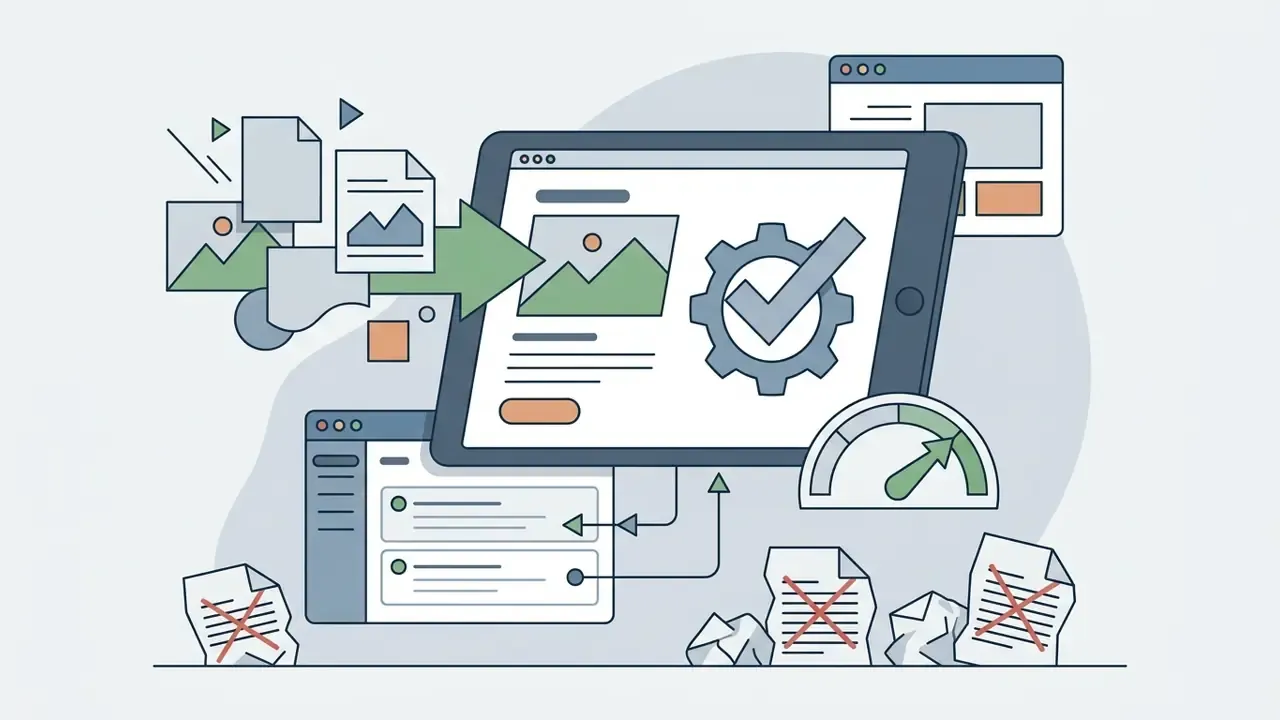
Mandate dedicated visual review and proofing platforms instead.
«Replacing email chains with dedicated proofing tools reduces revision cycles by up to 40% and accelerates final approval.»
Centralized proofing delivers three practical advantages:
Asynchronous Governance for Distributed Teams
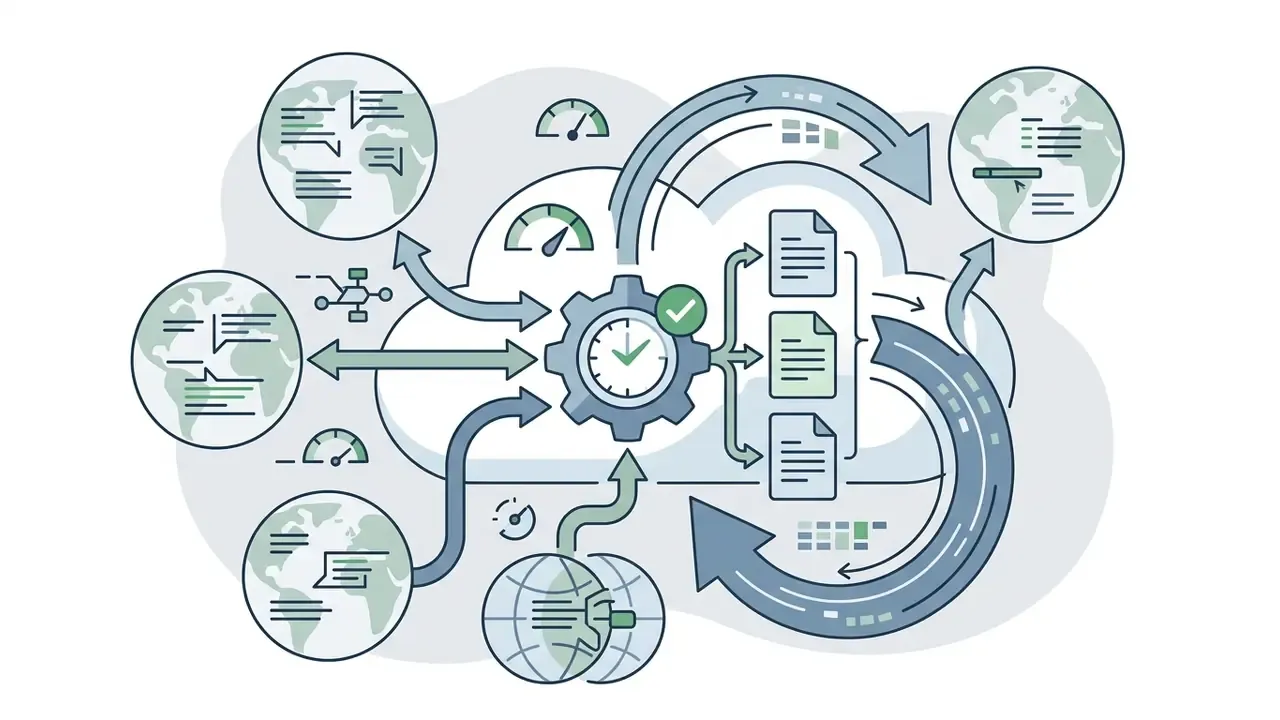
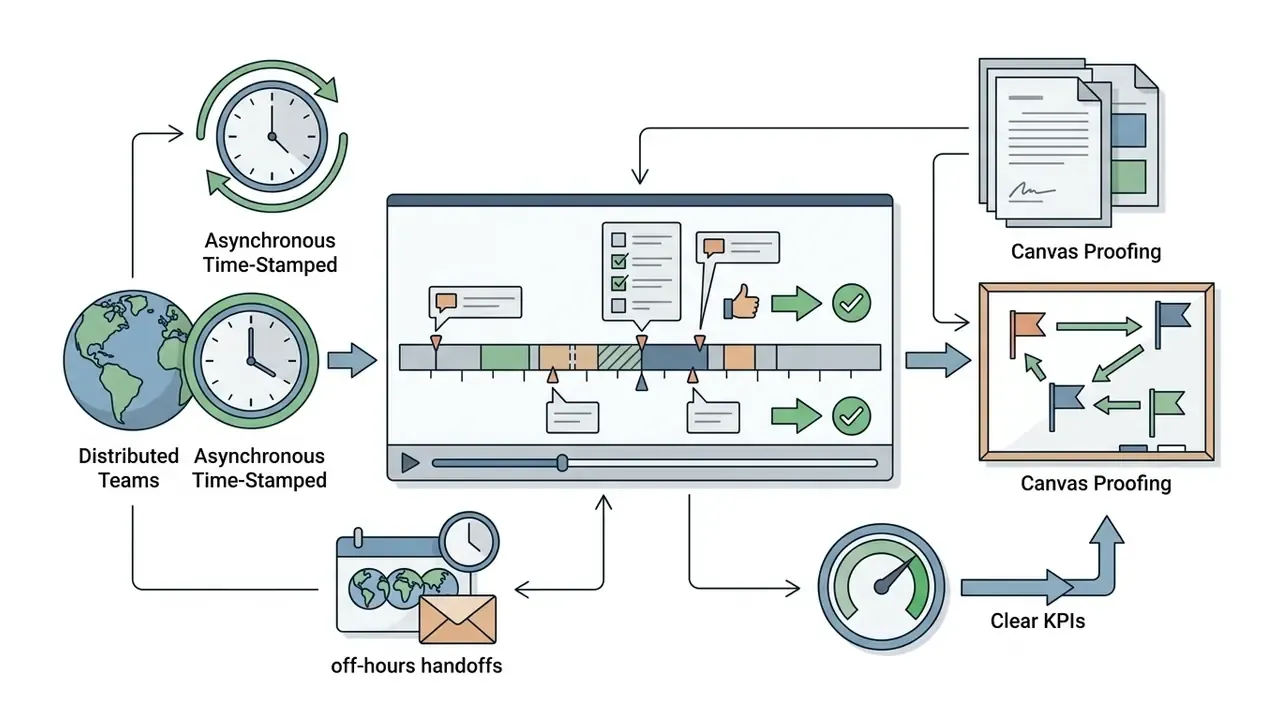
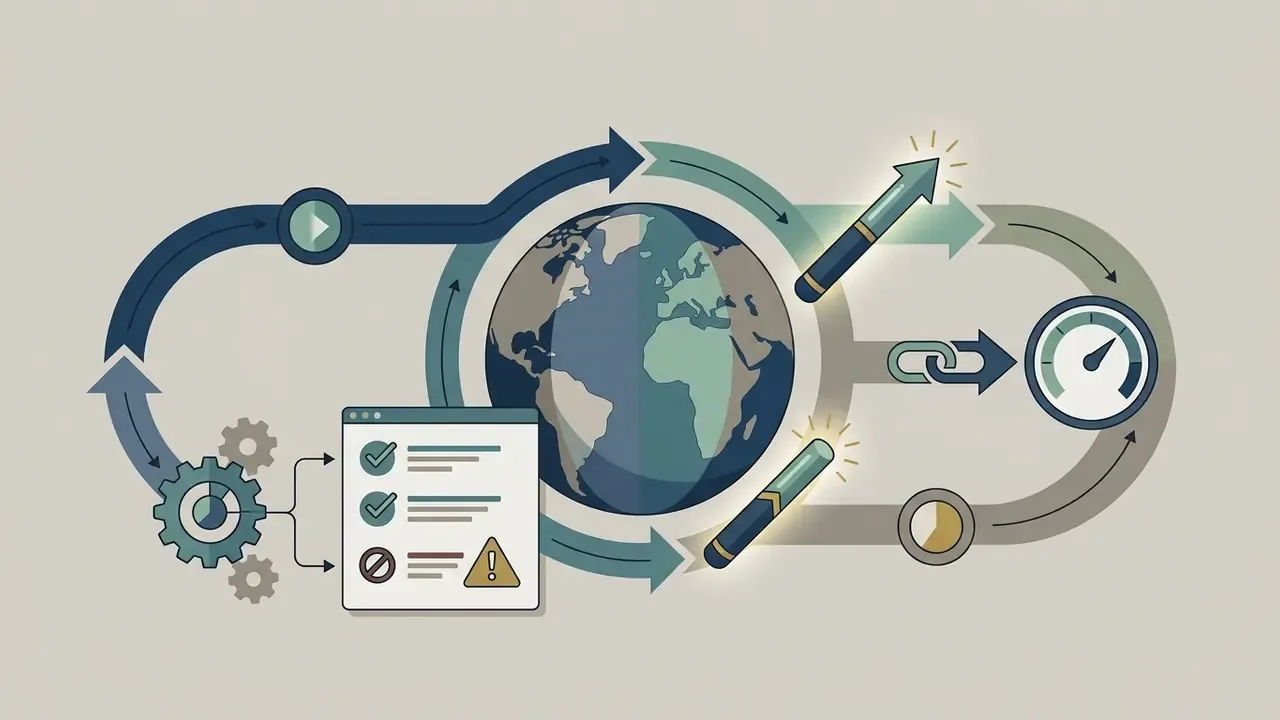
Creative teams are routinely distributed now: a copywriter in Austin, a motion designer in Berlin, an account lead in Lima, a client in Los Angeles. To run creative production across time zones without schedule slippage, replace synchronous handoffs with asynchronous protocols:
Create Approval Gates for Scope, Creative, and Final Deliverables
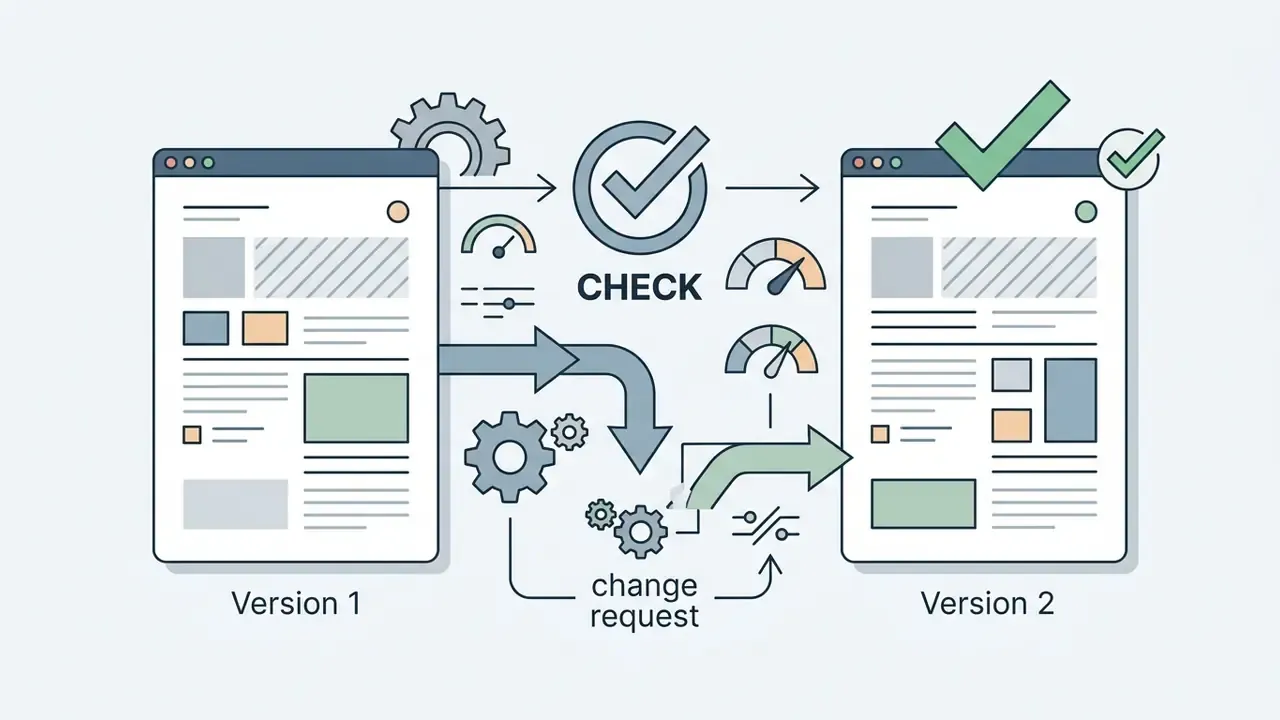
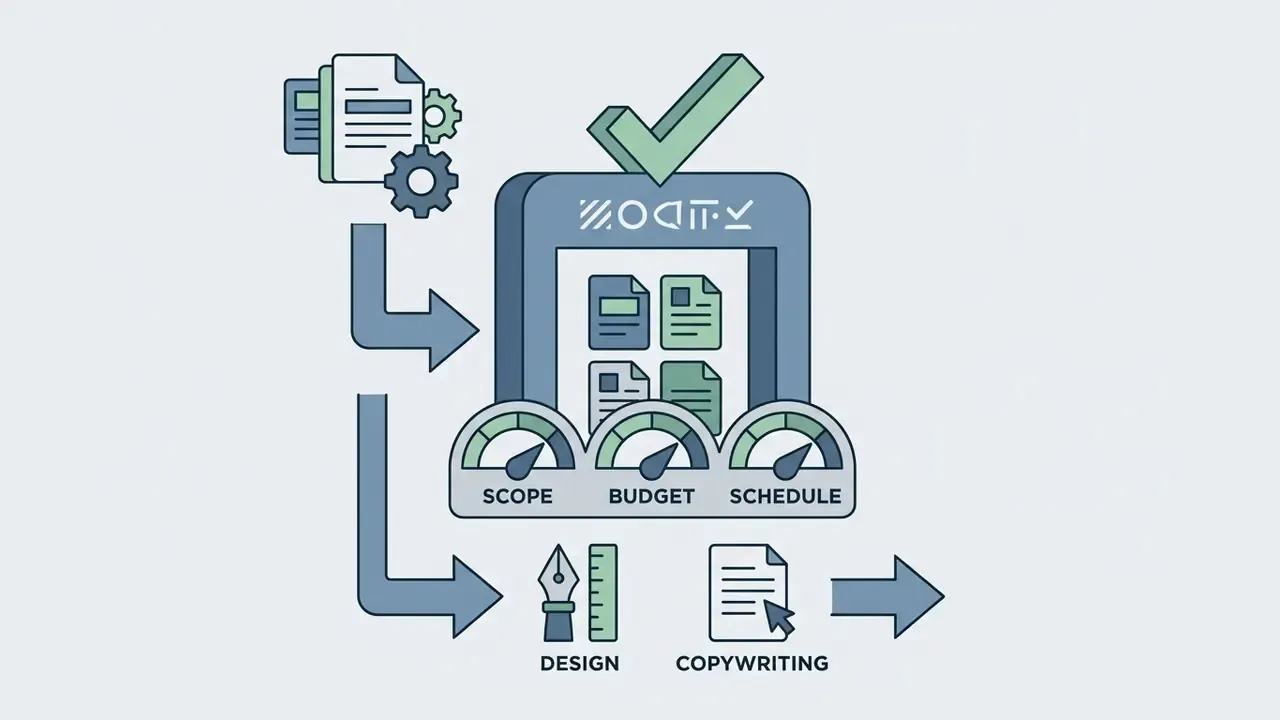
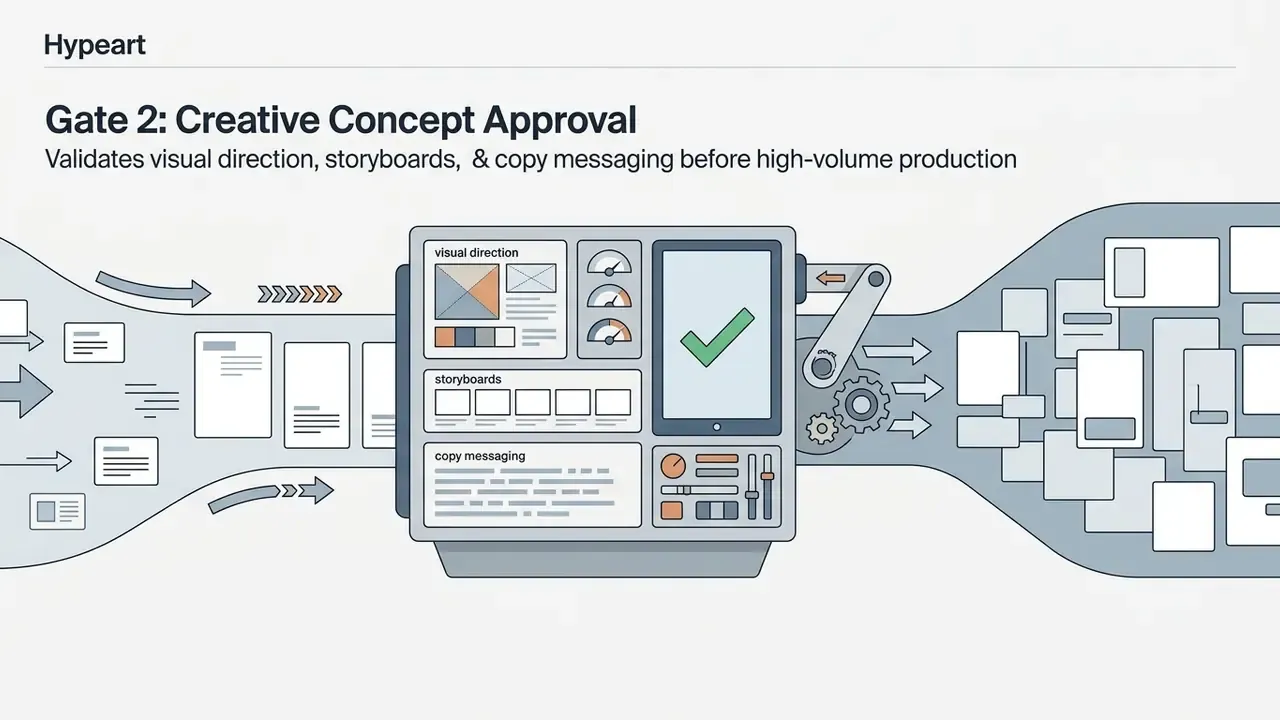
Approval gates are operational checkpoints that stop a project from advancing without formal sign-off. Gated controls prevent unapproved changes from cascading into downstream production. Association for Project Management guidance is blunt about it: gate reviews should be agreed at project start, documented, circulated two to four weeks in advance, and never fed with draft documents; conditional-pass actions must be tracked and closed before the next gate.
Three mandatory gates across the campaign lifecycle:
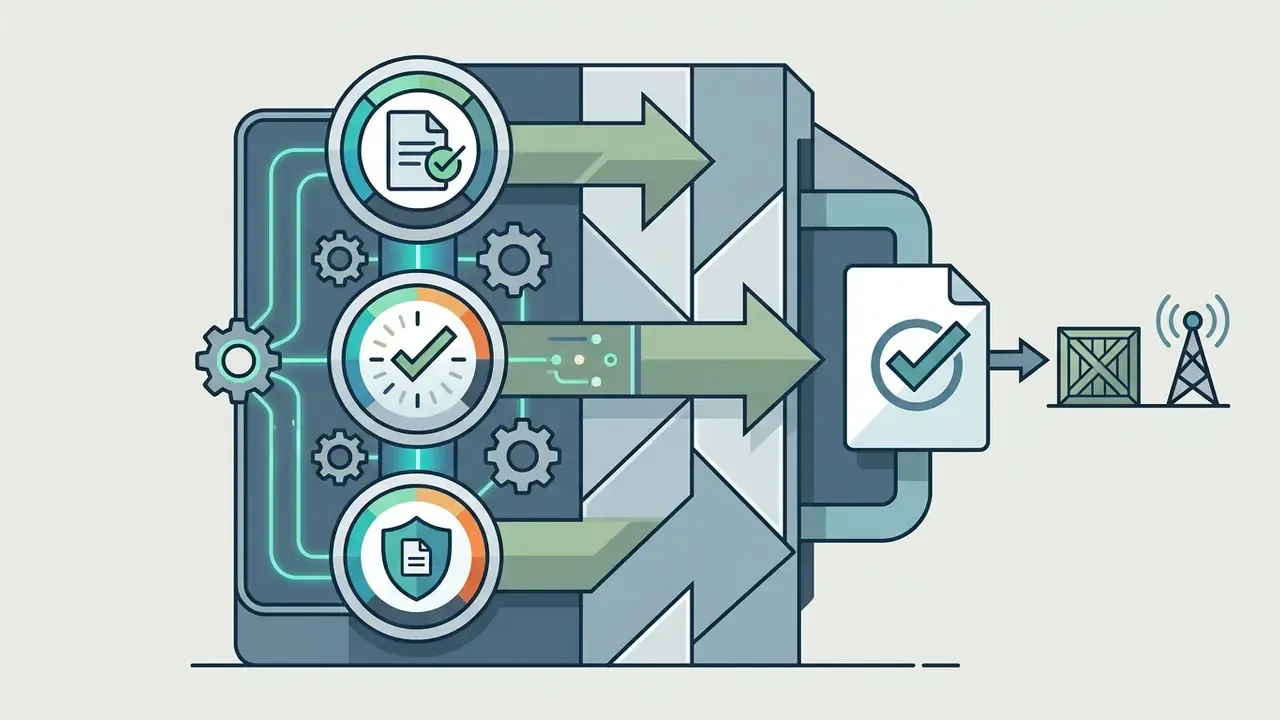
Regulated accounts need a fourth, non-negotiable checkpoint:
Each gate requires a formal sign-off logged in the agency's project management software, which is what creates an auditable decision trail. Where gating is configured in software, treat it as a hard stop: until all gating approvals are satisfied, no notifications dispatch, no tasks route, no production work begins.
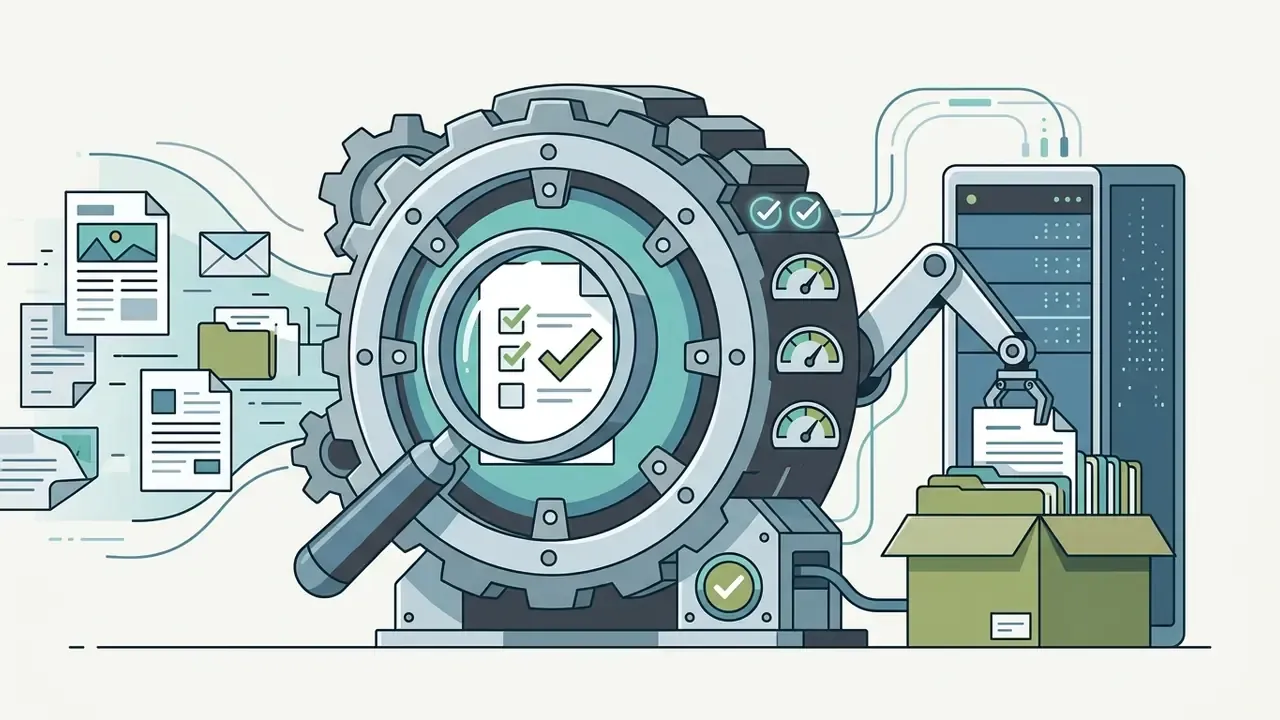
Define Quality Control and Asset Handoff Requirements
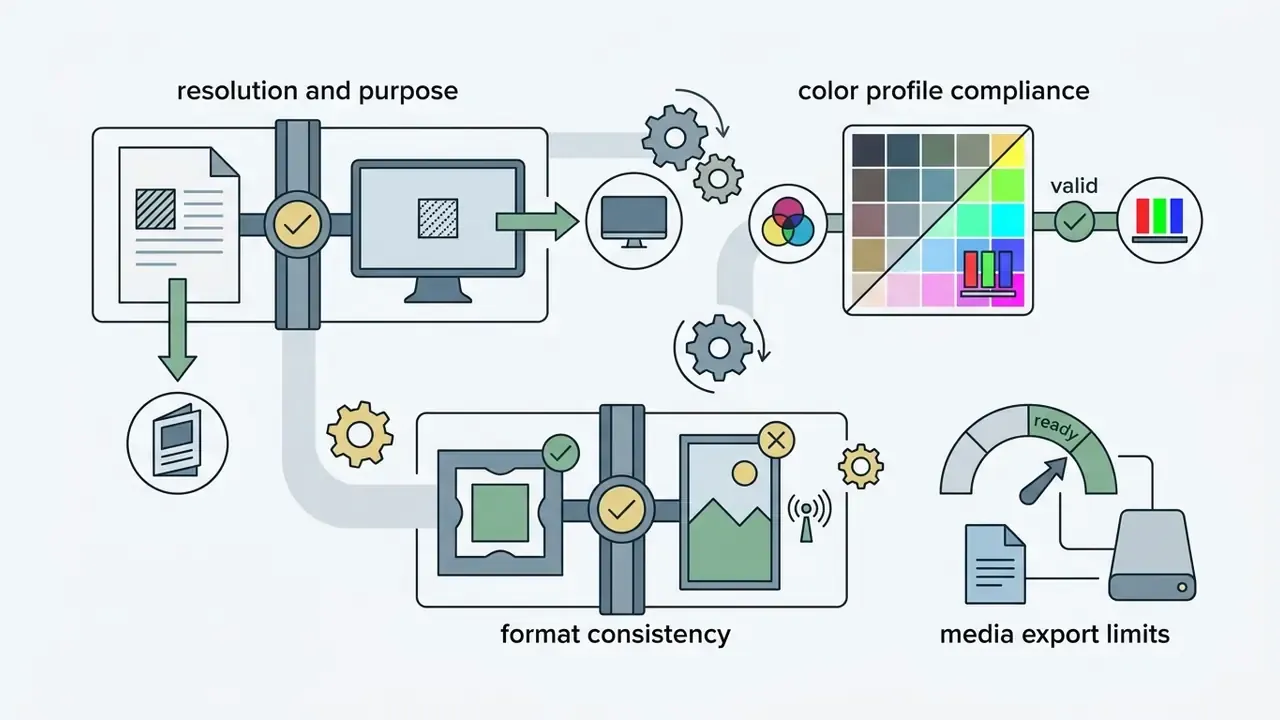
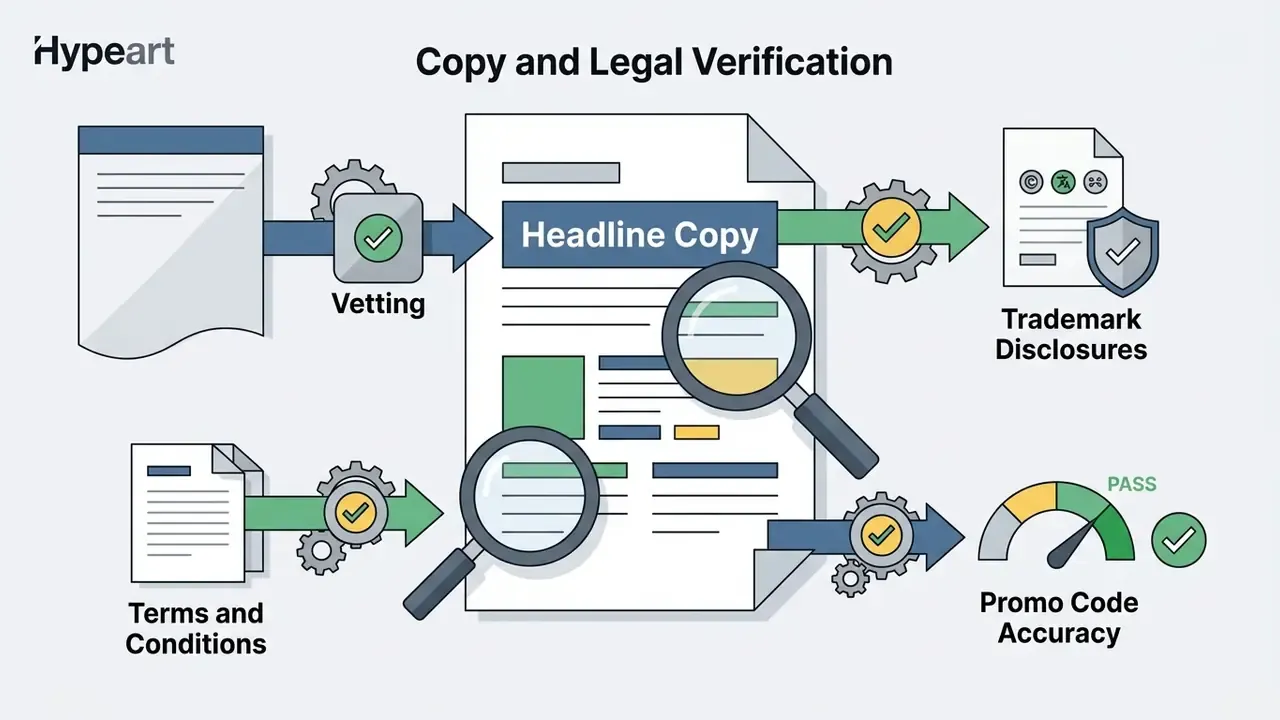
Final handoff is the transition from production to media deployment. Wrong file formats, broken tracking links, or unapproved visual variants create reputational risk and can trigger expensive media rerun costs.
QA SOPs must require production teams to verify deliverables against a technical checklist before client release. Where image assets are involved, standardized AI photo editors and fixed export presets reduce the manual variance QA would otherwise have to catch:
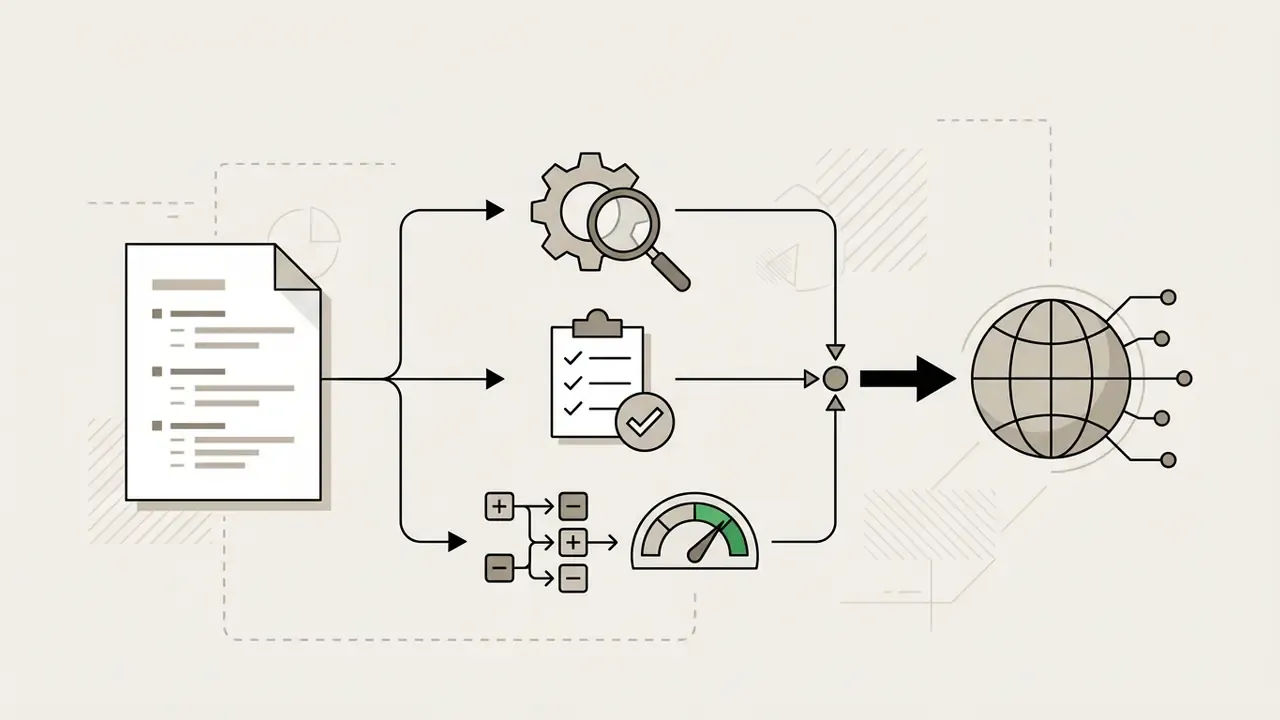
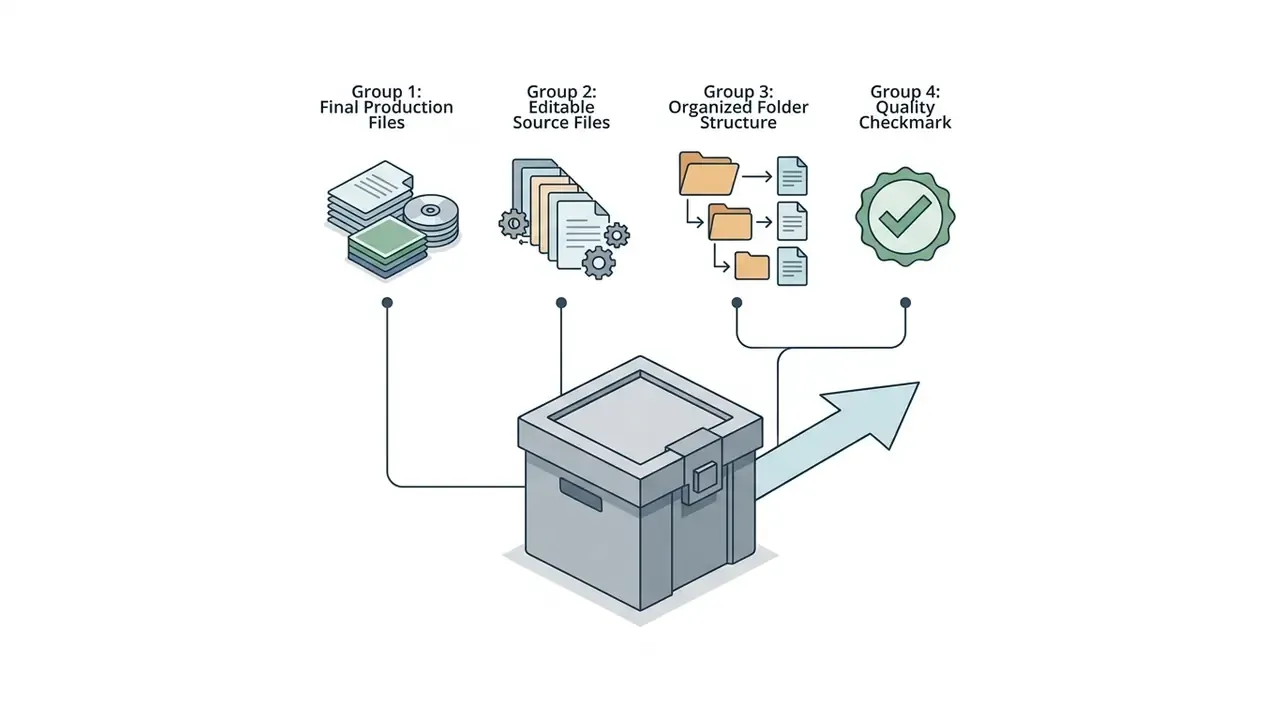
Infrastructure handover practice offers a useful analogue. Transport for NSW's Asset Handover Requirements (2023) makes the Final Deliverables Register a hold point before asset acceptance, and Metrolinx's Rail Corridor Asset Handover Protocol (2024) requires an Asset Handover Certificate summarizing the QA documentation behind the delivered package. The transferable principle: handoff is complete only when the register of what was delivered, and the evidence that it was checked, is signed.
OPERATIONAL RISK ALERT: Common Workflow Failure Modes
- Initiating Work Without Brief Sign-off: Starting creative execution off an informal conversation leads to misaligned expectations, heavy rework, and uncompensated scope creep. Brief approved first. Always.
- Unconsolidated Client Feedback: Accepting separate, conflicting notes from multiple client stakeholders forces production teams to guess priorities, which breeds internal friction and delay.
- Uncapped Revision Cycles: Without contractual revision thresholds, fixed-fee campaigns turn into unprofitable edit loops. Revisions outside agreed scope should trigger a change order; a common contractual pattern is two major rounds plus one minor round.
- Proxy Approvals: Sign-offs from junior client contacts without budget authority expose the agency to late-stage rejection when executives finally look. Present final work to the person holding sign-off authority, in writing.
- Undocumented Cross-Timezone Decisions: Approvals given in chat during off-hours and never logged in the system of record are unenforceable in a billing dispute.
Measure Workflow Performance and Improve It Over Time
Continuous improvement needs objective measurement. Moving from subjective impressions ("this project felt slow") to data lets agency leadership locate exact bottlenecks, balance capacity, and defend margin with numbers rather than anecdotes.
Creative operations measurement frameworks focus on process velocity, rework volume, resource efficiency, and deliverable quality.
«Core creative operations metrics span flow efficiency (throughput, cycle time), quality (error and rework rates), and client satisfaction (approval turnaround).»
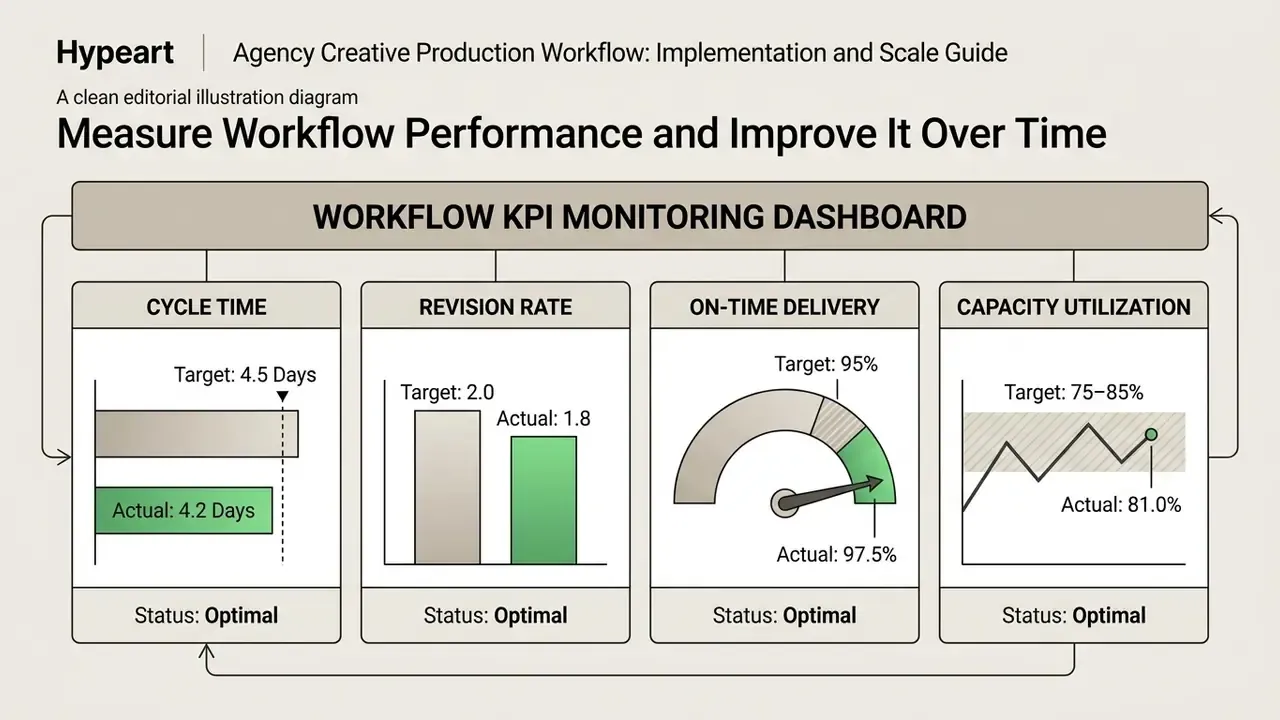
Track Metrics That Reveal Delays, Rework, and Capacity Risks
Six primary KPIs cover the health of a creative production workflow:
Secondary metrics worth adding as the model matures: median approval latency in days from intake accepted to approved, asset reuse rate (share of new work built from approved components), template adoption rate as a proxy for standardization, and cost-to-create per asset type.
- End-to-End Cycle TimeTotal elapsed duration from brief submission to final asset delivery. High cycle times usually point to wait states in intake or approvals rather than slow production.
- First-Pass Approval Rate (FPAR)Share of assets approved on first submission without major revisions. Low FPAR indicates weak briefs or misaligned concepts.
- Revision Volume per AssetAverage revision loops before final approval, calculated as total revisions divided by total approvals. Above target it signals diffuse feedback or brief non-compliance.
- On-Time Delivery RateDeliverables completed on or before the contractual deadline, divided by total promised deliveries.
- Capacity Utilization RateBillable production hours logged against total available staff hours. Consistently above 85% flags burnout risk; below 65% flags excess overhead.
- Ad Production Error RateShare of delivered assets containing technical, visual, or copy defects caught in internal QA or post-launch.
Creative Production Workflow KPI Matrix
| KPI Metric | Operational Purpose | Primary Data Source | Corrective Action When Off-Track |
|---|---|---|---|
| End-to-End Cycle Time | Measures overall workflow speed and delivery velocity. | Work management system logs | Decompose cycle stages to isolate wait times; automate handoffs. |
| First-Pass Approval Rate | Evaluates brief clarity and creative alignment. | Proofing platform approval logs | Tighten creative brief requirements; make kickoff calls mandatory. |
| Revision Volume | Identifies rework levels and scope expansion. | Version history records | Enforce single-approver rules; consolidate feedback channels. |
| On-Time Delivery Rate | Tracks SLA compliance and schedule accuracy. | Milestone completion timestamps | Adjust capacity estimation baselines; add buffer allocations. |
| Capacity Utilization | Monitors workload balance and burnout risk. | Resource tracking logs | Rebalance task distribution; adjust staffing or freelancer coverage. |
| Ad Production Error Rate | Measures technical and brand QA effectiveness. | QA defect logs | Update technical checklists; mandate template adherence. |
| Asset Reuse Rate | Measures standardization and library leverage. | DAM and production records | Expand component library; enforce template-first production. |
| Cost to Create per Asset | Establishes unit economics by asset type. | Finance, time-tracking, vendor invoices | Review labour mix, vendor spend, and reuse opportunities. |
Cadence matters as much as metric choice: review weekly for WIP and capacity, monthly for trend lines against baseline, quarterly for structural changes to templates, gates, and staffing.
Account for Control Costs and Residual Risk in ROI
Efficiency gains are only half of the financial picture. Governance consumes real resources, and an honest ROI calculation nets them out:
- Control Costs Software licences (work management, proofing, DAM, cloud filespace), compliance reviewer hours, QA hours, post-mortem time, and the training and change-management effort adoption actually requires.
- Opportunity Cost of Gates Every gate adds latency. A gate that saves four hours of rework but adds eight hours of waiting is a net loss and should be merged or made asynchronous.
- Residual Risk No control set eliminates error. Quantify what remains, whether misapproved claims, missed disclosures, or wrong-variant launches, and hold contingency for remediation and media rerun costs.
- Net Operational Benefit (Reclaimed production hours × blended rate) + (avoided rerun and rework costs) − (control costs) − (expected residual loss). Report that figure, not gross time savings, when defending the investment to finance.
For regulated clients, part of the control cost is not optional and should be priced into the engagement rather than absorbed as overhead. Retention infrastructure, immutable approval logs, and compliance reviewer capacity are deliverables in their own right.
Case Study: Operational Transformation in a Regional Creative Agency
An integrated agency running concurrent digital, print, and video campaigns faced recurring delivery delays, unpredictable revision cycles, and thin project margins. There were no standardized intake protocols, client feedback arrived through scattered email chains, and internal QA happened informally, or rather, whenever someone remembered. Part of the standardization effort involved consolidating an unmanaged sprawl of design tools into a vetted shortlist, including approved AI image generators with verified commercial licensing.
Case profile: mid-sized independent agency (~35 FTE), mixed portfolio spanning retail, B2B services, and one regulated financial account; measurement window of six months post-implementation against the preceding six-month baseline drawn from time-tracking and version-history records.
Leadership executed a full workflow transformation:
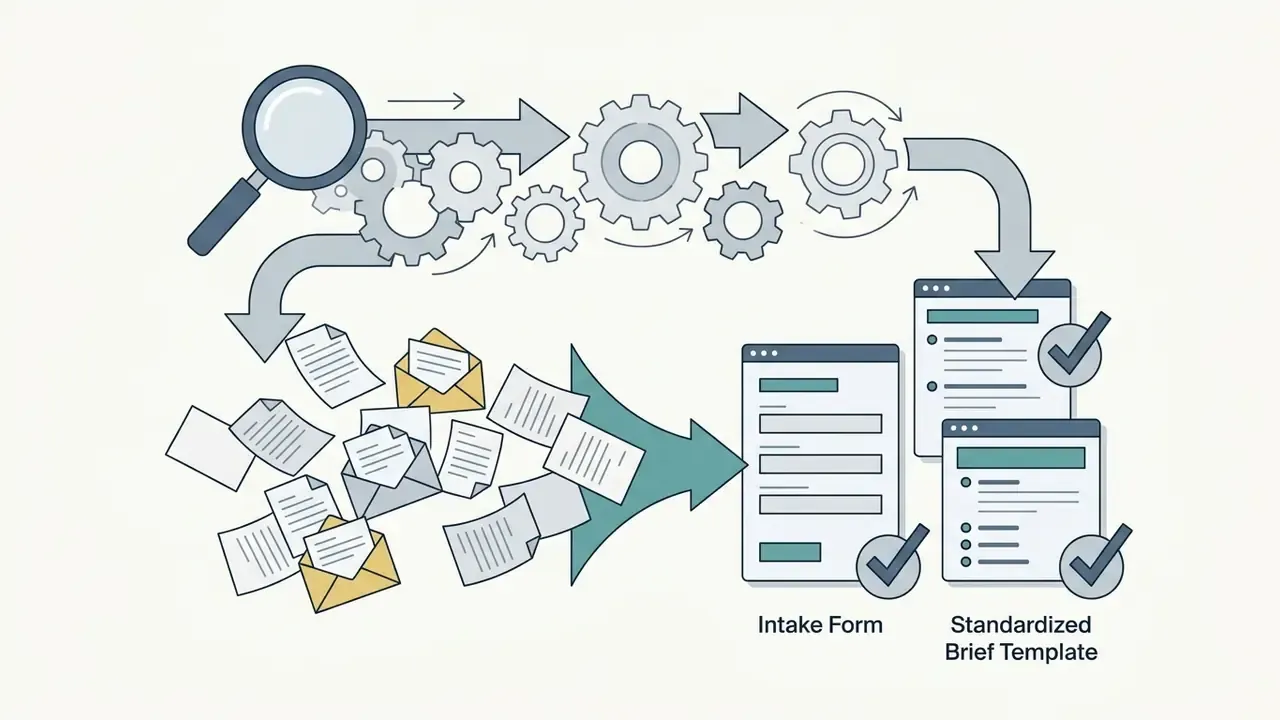
Measured Transformation Results
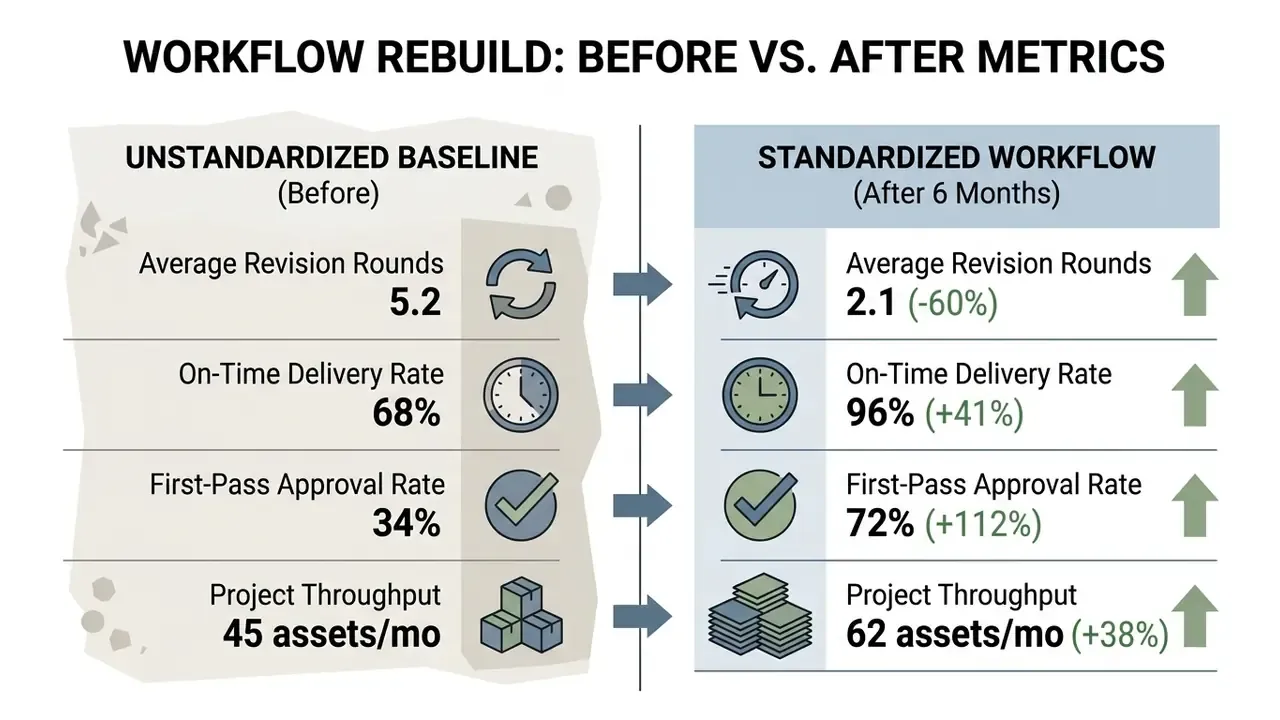
By standardizing intake, enforcing RACI decision ownership, centralizing visual proofing, and embedding QA gates, the agency cut average revision rounds from 5.2 to 2.1 per project and lifted monthly asset throughput by 38% with no added headcount. Independent case documentation reports directionally consistent outcomes:
«After implementing SOPs and QA checkpoints, average revision cycles fell from five to three, and monthly throughput rose roughly 20% without additional headcount.»
Net of control costs, meaning proofing and work management licences plus reviewer hours, the agency reported the throughput gain as margin-positive within its second quarter of operation. Worth noting: results in a single documented context are not a forecast for yours.
FAQ: Workflow Risk, Compliance, and Rollout
How long does it take to implement a standardized agency creative production workflow?
A realistic sequence: two to three weeks for the diagnostic audit, three to four weeks for documentation and templates, one full campaign cycle for the pilot, then staged rollout by account. Agencies that attempt a single agency-wide switch typically revert within a quarter.
Who should own the workflow after rollout?
A single named process owner, usually the operations lead or head of creative operations, with authority to amend templates and gates. Shared ownership produces drift, and every post-mortem amendment needs exactly one approver.
Do approval gates slow projects down?
Gates add latency and remove rework. If a gate's waiting time exceeds the rework it prevents, merge it, make it asynchronous, or delegate it to a lower-level approver. Measure both sides before defending or removing any gate.
How do we keep an audit trail acceptable to a regulated client's compliance team?
Log every approval in one system of record with timestamp, approver identity, asset version, and decision. Retain published variants and their substantiation for the client's mandated retention period. The trail should be reproducible without reconstructing email threads.
Can generative AI be used on regulated accounts?
Only through an approved tool register with documented data-processing terms, prohibited prompt content, named human review, and provenance logging per asset version. Compliance review of AI-generated claims cannot be delegated to the model.
What is the minimum viable version of this workflow for a ten-person agency?
One mandatory intake form, one named approver per side, one proofing tool, one QA checklist, a two-round revision cap, and a 30-minute post-mortem per launch. Add the rest as volume grows.
How do we handle time-zone-distributed freelancers?
Cloud asset streaming, frame-accurate proofing comments, end-of-day WIP logs, published overlap windows, and a written-decisions-only rule.
Which metric should we fix first?
First-Pass Approval Rate. It is the fastest diagnostic of brief quality, and improving it pulls revision volume, cycle time, and capacity strain down together.
Conclusion: Key Implementation Takeaways
Standardizing an agency creative production workflow turns creative operations from a heroics-dependent effort into a scalable, repeatable delivery model. Balancing creative autonomy against operational governance is what lets creative agencies meet client expectations, defend margin, and scale predictably rather than hopefully.
Eight implementation principles, in the order they pay off. These are the best practices worth defending when the calendar gets tight:
- Separate Creative Process from Workflow GovernanceProtect ideation flexibility while keeping strict operational control over schedules, handoffs, and approvals.
- Establish Operating Models Before Mapping WorkflowsDefine RACI roles, decision authority, compliance participation, and intake requirements before building task boards or buying tools.
- Tailor the Pipeline to Your ArchetypeVideo, digital/performance, design/branding, content, and social workflows share governance but not gates.
- Enforce Gate-Based ApprovalsGates for briefs, creative concepts, regulatory clearance, and final assets keep unapproved changes from moving downstream.
- Centralize Feedback and Eliminate Email ProofingAll visual markup and feedback consolidation belongs in dedicated proofing tools, with asynchronous protocols for distributed teams.
- Treat Software as Infrastructure, Not GovernanceWork management software, proofing platforms, and DAM repositories support human process ownership; they do not replace it. Teams standardizing channel-specific delivery frequently model their pipelines on documented YouTube video editing workflows before generalizing the pattern across accounts.
- Govern AI ExplicitlyApproved tool registers, prompt data classification, and human-in-the-loop validation keep Shadow AI out of client-billable work.
- Close the Loop and Measure HonestlyTrack cycle times, revision rates, capacity utilization, and error rates; run a post-mortem within five business days of every launch; net control costs and residual risk against gains when reporting ROI.
Start Tomorrow: 30-Day Action Plan
- Days 1–5: Pull three completed campaigns. Reconstruct every handoff, wait period, and revision request. Record total elapsed versus active hours.
- Days 6–10: Draft the RACI matrix, compliance approver included. Identify every task currently lacking a single Accountable owner.
- Days 11–15: Build the mandatory intake form and brief template. Publish the hard rule: no production without an approved brief.
- Days 16–20: Select and configure the proofing tool. Deprecate email feedback for one pilot account. Publish the approved AI tool register.
- Days 21–25: Run the pilot campaign end to end under the new SOPs, capturing cycle time, revision count, and approval latency.
- Days 26–30: Hold the first blameless post-mortem. Amend at least one template. Set KPI baselines and schedule the weekly WIP review.
Appendix A: Superseded Source Notes
Retained for transparency of revision history. The main text carries the updated versions.
- Superseded (creative process definition)
- "Research published in PMCID PMC10218953 (2023) defines the creative process through phases of preparation, incubation, insight, evaluation, and elaboration." Updated: replaced in the main text with Stewart, Cheng & Wan, Advertising Creative Process Model (2023), which supplies the advertising-specific five-stage model and a verifiable DOI. The five-phase creativity model remains valid as a general framework and is retained in the descriptive text.
- Superseded (idle-time benchmark)
- "Industry benchmarks from Adobe's 2025 Creative Operations Analysis indicate that unstructured creative processes spend up to 80% of total cycle time in idle states." Updated: retained as a directional figure with an explicit verification note, and supplemented with the ten-day/six-hour measurement from the Creative Operations Metrics Framework (Screendragon, 2025).
- Superseded (broadcast QC citation)
- Channel 4 Technical Specifications (2023) cited without URL. Updated: the main text now describes the specific deliverable requirements (AQC PDF, eyeball QC PDF, PSE report) and notes that the controlled document must be requested from the broadcaster directly, since it is not publicly hosted.
- Superseded (NIST publication year)
- NIST CSWP 30 dated 2026. Updated: citation retained with full URL so readers can confirm the release revision; agencies relying on it for control design should reference the version current at implementation.
- Superseded (three-stage lifecycle)
- The earlier three-phase model (Pre-Production, Production, Post-Production). Updated: expanded to four phases with Post-Launch & Optimization, making the feedback loop explicit.
Disclaimer
This article describes operational and process-governance practices for creative agencies. It is provided for general informational purposes only and does not constitute legal, regulatory, compliance, financial, or accounting advice. References to regulatory regimes (including FINRA, SEC, and CFPB requirements), broadcast delivery specifications, and standards such as ISO 9001 and NIST publications are illustrative; requirements vary by jurisdiction, entity type, and engagement, and change over time. Agencies and their clients should obtain qualified legal and compliance counsel before relying on any control described here for regulated advertising, recordkeeping, data protection, or AI governance obligations. Metrics, benchmarks, and case results reflect specific documented contexts and are not guarantees of comparable outcomes.
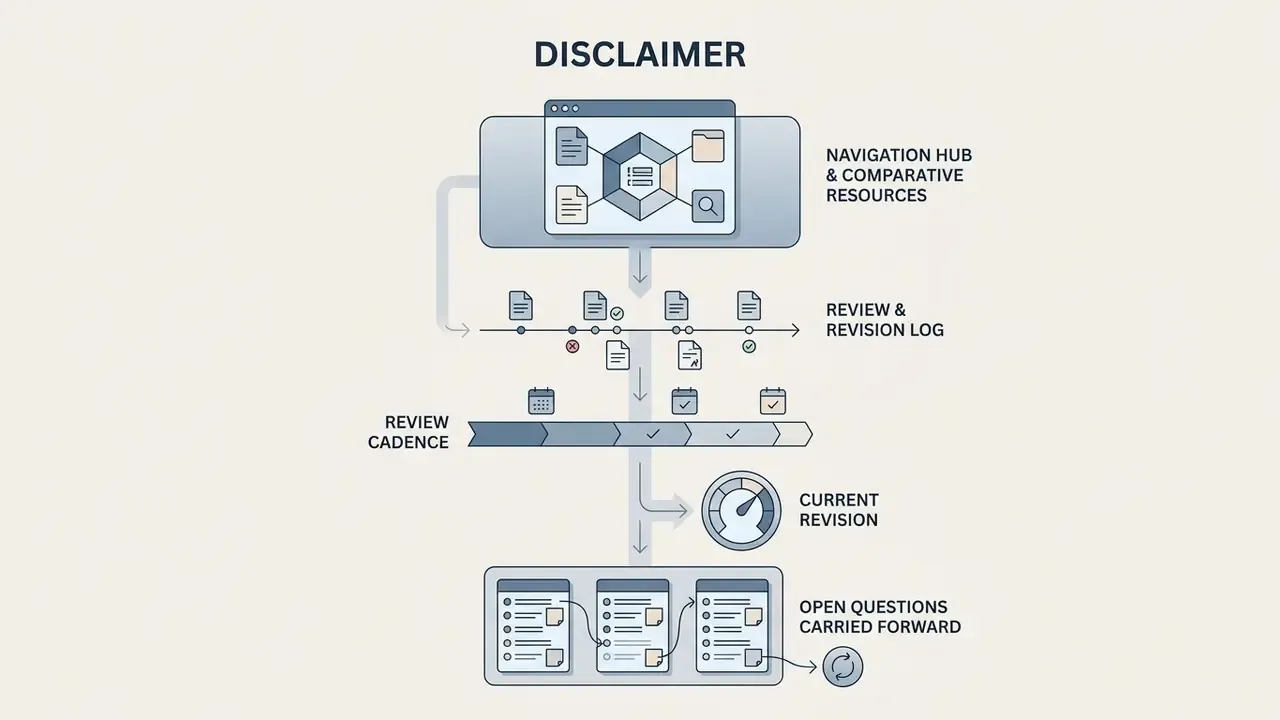
Review and Revision Log
- Review cadence this guide is reviewed twice a year, or sooner if a cited standard, broadcaster specification, or regulatory expectation is revised.
- Current revision February 2026. Changes in this pass: four-phase lifecycle confirmed, archetype-specific pipelines expanded, generative AI governance controls added, control-cost and residual-risk arithmetic introduced into the ROI section.
- Open questions carried forward the 80% idle-state benchmark remains unverified against a published dataset; the case-study figures come from a single documented agency and should be treated as illustrative rather than as an industry norm.