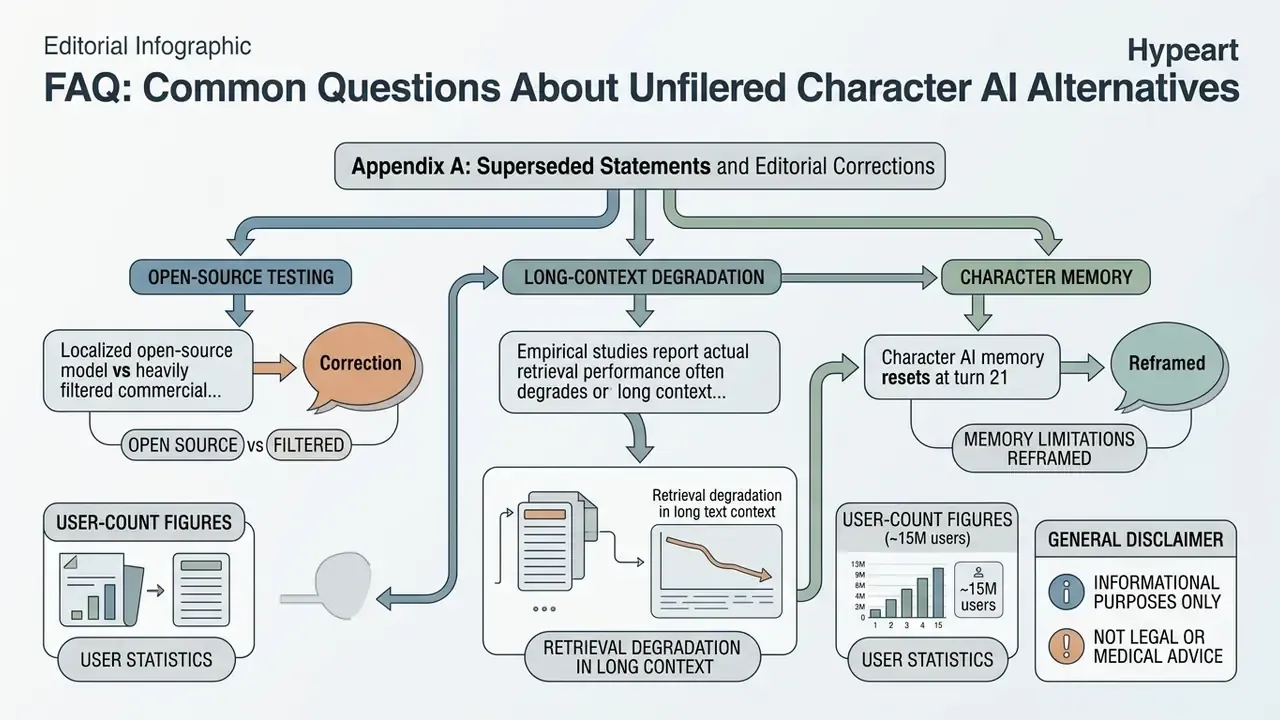
Last updated: March 2026 · Reviewed by: Marcus Hale (AI Governance & Model Risk), editorial testing across hosted platforms and self-hosted local inference stacks · Methodology: standardized 40-turn roleplay stress tests, hardware benchmarking on consumer GPUs, and verification of published vendor pricing pages.
This guide separates two audiences that other roundups tend to blur together: consumer roleplay users (who want fewer narrative interruptions and a companion that remembers things) and technical or enterprise evaluators (who need to understand abliteration, local inference, data residency, and Shadow AI exposure). Each section is labeled, so you can read only the track that applies to you.
A note on how to read this audit. The comparison tables carry verified vendor data. The benchmark tables carry our own measurements. The enterprise sections carry judgments, not certainties, and they are flagged as such. Where evidence is thin, the text says so rather than rounding up to confidence.
Executive Summary
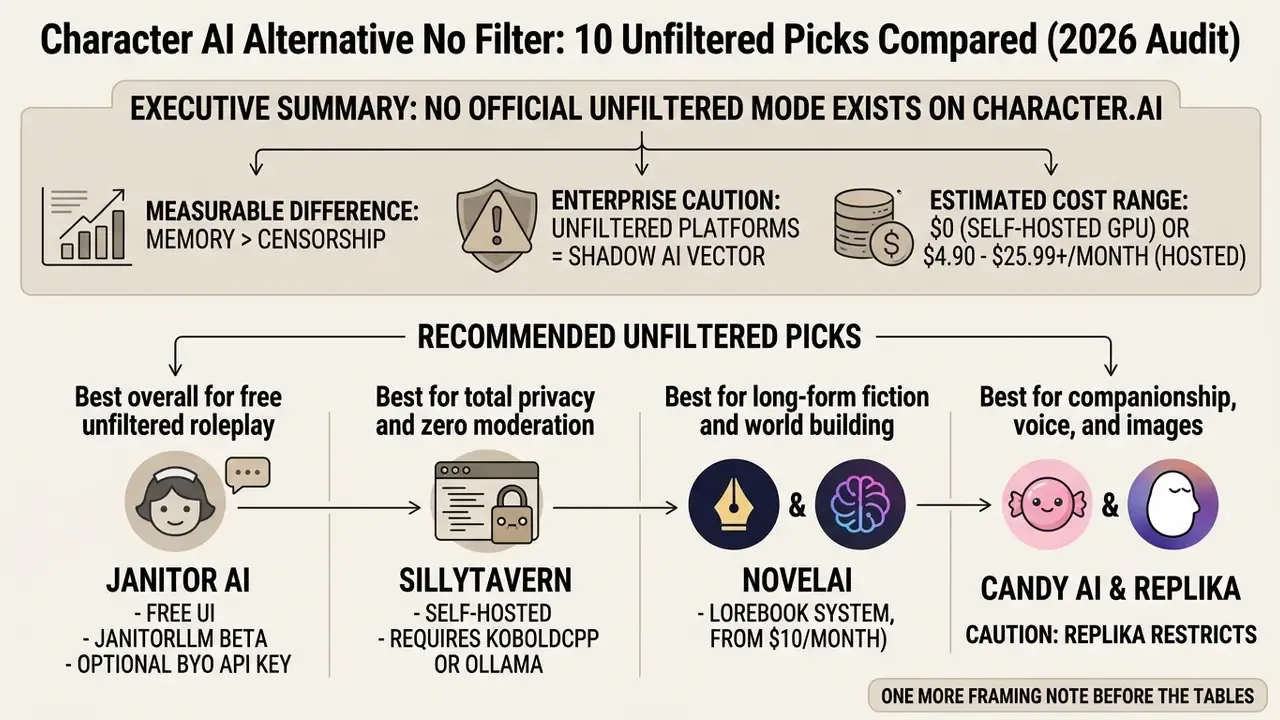
- No official unfiltered mode exists on Character.AI. As of 2026, Character.AI policy pages prohibit pornographic content, nudity, and graphic mature themes, and no published "no-filter" toggle exists. The unfiltered segment is served entirely by separate platforms.
- Memory, not censorship, is the most measurable difference. In our standardized 40-turn test, Character.AI retained roughly 21% of introduced narrative anchors by turn 40, while a SillyTavern setup paired with a long-context API or local 70B model retained about 89%.
- Best overall for free unfiltered roleplay: Janitor AI (free UI, JanitorLLM beta, optional BYO API key).
- Best for total privacy and zero moderation: SillyTavern self-hosted with KoboldCPP or Ollama. All chat data stays on local storage.
- Best for long-form fiction and world building: NovelAI (Lorebook system, from $10/month) and DreamGen (multi-character scene management).
- Best for companionship, voice, and images: Candy AI and Replika, with the caveat that Replika restricts erotic roleplay under its safety guidelines.
- For enterprise evaluators: unfiltered consumer platforms are a Shadow AI vector. Chat transcripts on hosted services are logged server-side, and abliterated open-weight models can amplify harmful behavior inside agentic pipelines. Governance controls, not feature lists, should drive the decision.
- Real cost range: $0 (self-hosted on an existing GPU), then $4.90 to $25.99 per month for hosted consumer tiers, then roughly $0.0015 per 1k tokens for pay-as-you-go API routing.
One more framing note before the tables. "No filter" is not a single product feature. It is a spectrum that runs from light community moderation, through adult-permissive hosted services, to a local model with no classifier layer at all. Knowing where you want to sit on that spectrum matters more than picking a brand.
Top Character AI Alternatives Without Filter: Quick Comparison Guide
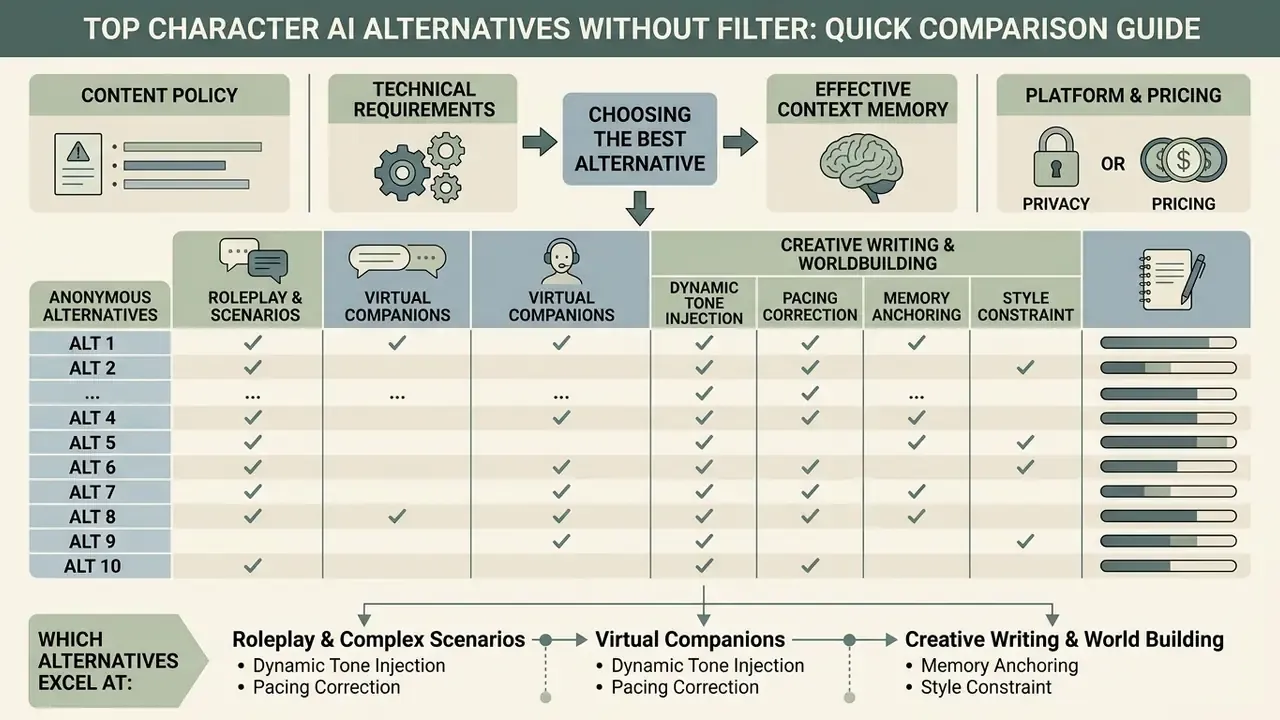
To choose the best character ai alternative without filter, you have to weigh four things at once: content policy, technical requirements, effective context memory, and platform availability. Architecturally, the options split cleanly in two. There are hosted web platforms that manage the backend for you, and there are open-source interfaces you self-host on local hardware or point at an external API key.
The table below compares the leading alternatives across filtering mechanism, character creation depth, memory capacity, supported platforms, exact free-tier limits, and published paid pricing, so cost expectations stay concrete rather than abstract.
Comparison Matrix of Top Unfiltered Character AI Alternatives (verified March 2026)
| Platform | Content Filter Policy | Character Creation Depth | Context Memory | Platforms Supported | Free Tier Exact Limits | Paid Tier Pricing | Technical Complexity |
|---|---|---|---|---|---|---|---|
| Janitor AI | Uncensored (18+ toggle) | Advanced (JSON card, prompts) | ~9k tokens (Free JLLM) | Web, iOS, Android | Unlimited chats on JanitorLLM Beta; queue at peak hours; BYO API pay-as-you-go | Platform UI 100% free (third-party API costs apply) | Low to Moderate |
| SillyTavern | Zero filters (self-hosted) | Maximum (Tavern Cards, extensions) | Configurable via API or model (up to 200k with Claude-class APIs) | Self-hosted (web UI, Windows/Linux/macOS/Android) | Unlimited open-source software (AGPL-3.0) | $0 on local GPU, or about $0.0015 per 1k tokens via OpenRouter routing | High |
| SpicyChat AI | Uncensored (adult allowed) | Moderate (avatars, prompts, conversation images) | Standard LLM window | Web | Free tier with waiting queue and limited turn speed | $5.05/mo (Get Premium), $14.95/mo (Pro) | Low |
| CrushOn.AI | Minimal filtering for adults | Moderate (import JSON/PNG cards) | Standard LLM window | Web, mobile web | 100 free credits per month plus daily login bonuses | $4.90/mo (Basic), $7.90/mo (Standard), $19.90/mo (Pro) | Low |
| Candy AI | Uncensored (adult companion) | Guided presets and realistic styles | Standard LLM window | Web | About 50 free text messages trial; voice and image generation locked | $12.99/mo billed annually, or $25.99/mo monthly | Low |
| Chai AI | Light filtering (community bots) | Basic prompt templates | Short context window | iOS, Android | About 70 messages per 3 hours, ad-supported | $13.99/mo or $134.99/year | Low |
| DreamGen | Uncensored (fiction focus) | Advanced (lorebooks, scenarios, multi-character) | Extended story context (longest on Pro tier) | Web (mobile-friendly, no native app) | 100 free credits per month | $9.99/mo (Starter), $19.99/mo (Pro) | Moderate |
| Replika | Filtered (safety guidelines; ERP restricted) | Moderate (avatar customization) | Persistent relational memory | Web, iOS, Android | Basic text chat free; romantic roleplay and voice calls locked | $19.99/mo or $89.99/year | Low |
| NovelAI | Zero content filters | Advanced (Lorebook, story modules, Phrase Bias) | Up to 8k+ tokens (higher on Opus) | Web | About 50 free text generations trial | $10/mo (Tablet), $15/mo (Scroll), $25/mo (Opus) | Moderate |
| Character.AI (baseline) | Strictly filtered (no NSFW) | Moderate (Definition field) | Short effective window | Web, iOS, Android | Free chat with throttling at peak load | c.ai+ at $9.99/mo or $94.99/year | Low |
Pricing reflects publicly listed vendor tiers verified in March 2026. Subscription costs, regional taxes, and credit allowances change often. Confirm on the vendor checkout page before you pay.
Which Alternatives Excel at Roleplay, Companionship, and Creative Writing
Choosing an ai companion or roleplay engine comes down to your primary scenario: interactive fiction, continuous companionship, or long-form world building. They are not the same job, and the tools that win one usually lose another.
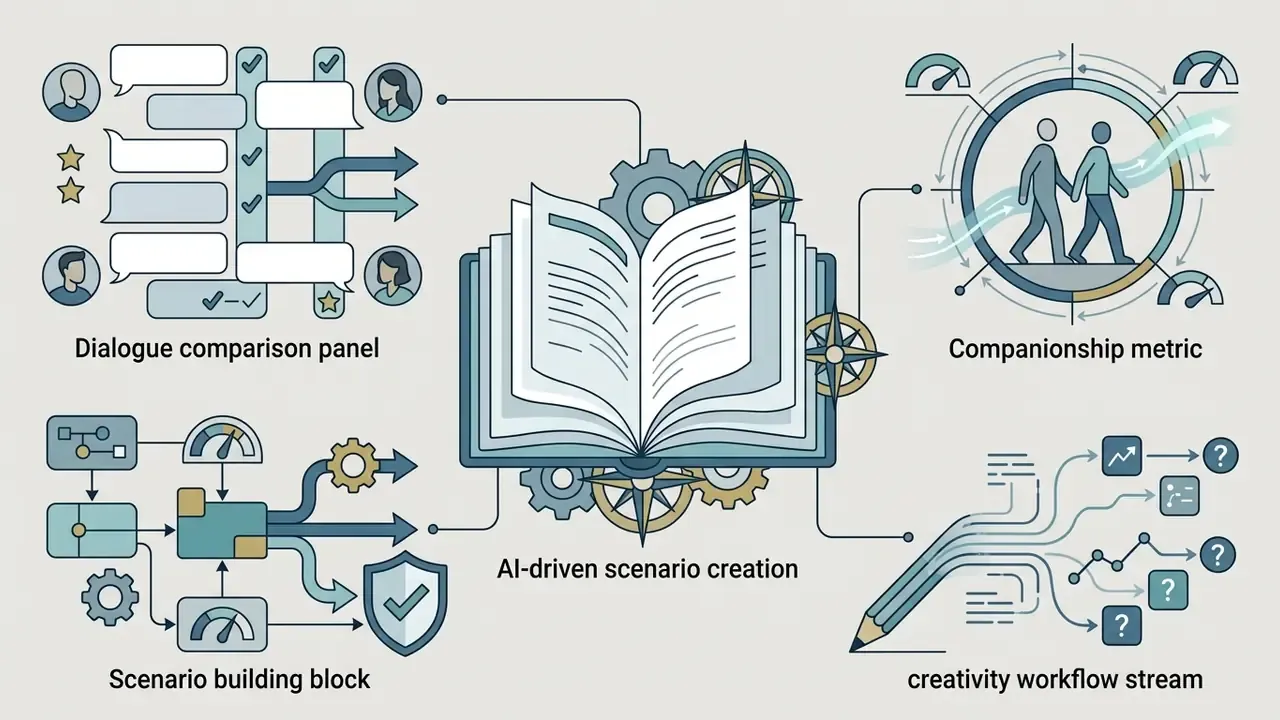

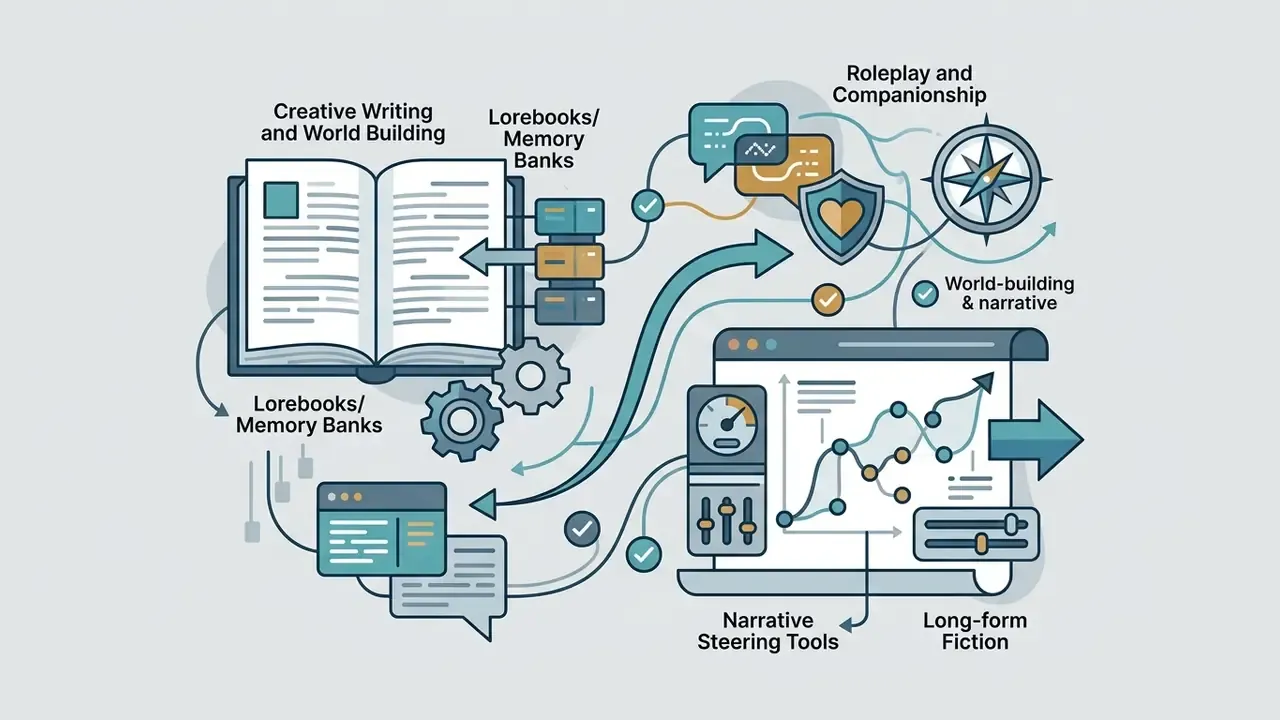
Mid-session narrative steering (in-chat directives)
Advanced unfiltered platforms let you inject story corrections in real time without breaking immersion. Editing the system prompt mid-session usually resets the tone entirely, which is the opposite of what you want. Insert hard brackets or system flags directly into the dialogue line instead. DreamGen supports this natively as "in-chat instructions", and SillyTavern and Janitor AI interpret bracketed out-of-character notes reliably when the model has decent instruction tuning:
- Dynamic tone injection
[System Note: Increase emotional tension and make {{char}} respond with visible reluctance.] - Pacing correction

- Memory anchoring
[Remember: {{char}} is still holding the hidden bronze key in her left pocket.] - Style constraint
[System Note: Limit responses to 120 words; no internal monologue this turn.]
Memory anchoring is the cheapest available fix for context drift. It reintroduces the anchor fact into the active window without burning a full lorebook entry. Small trick, large effect.
To examine structured benchmarking across creative media tools, you can open the hub and compare model performance across different workloads.
Cloud Websites, Mobile Apps, and Self-Hosted Architecture Differences
The infrastructure under an AI chat platform decides your privacy posture, your customization ceiling, your operating cost, and how long setup takes.
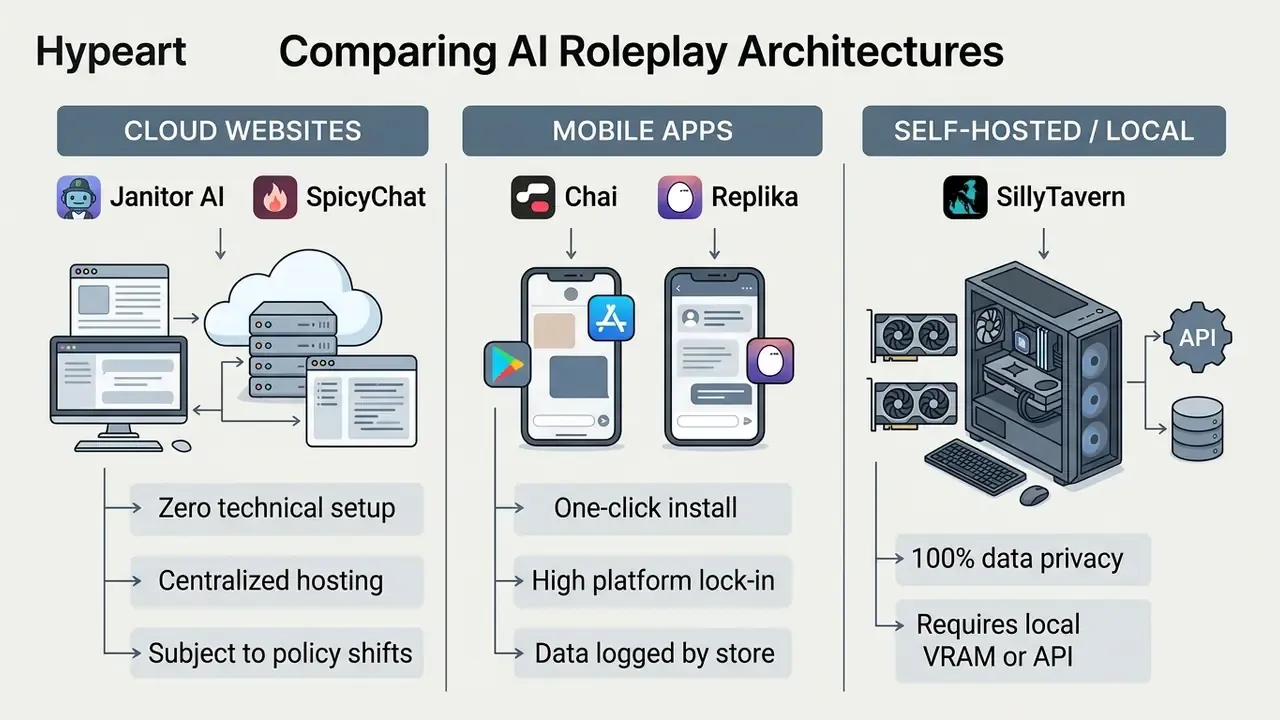
Websites like Character.AI without filter give you instant browser access, but they keep usage logs and can change policy under you at any time. Mobile apps streamline onboarding through the app stores, then inherit strict Apple App Store and Google Play content restrictions. Self-hosted environments such as SillyTavern run on your own machine, keeping API keys, character data, and chat logs private. The official documentation stores credentials in a local secrets.json and notes that "everything you write stays on your own PC."
There is a fourth, quieter option: self-hosting the frontend on a small private VPS behind authentication. You trade absolute locality for access from any device. For most people that is a reasonable compromise, though it reintroduces a host you now have to patch.
For developers building custom inference pipelines or API gateways, the AI Media API documentation offers technical context on handling backend model connections.
Why Users Seek a Character AI Alternative With No Filter
People leave Character.AI for three reasons: restrictive moderation, truncated conversations, and character memory that decays over long interactions. In that order, by volume of complaints.
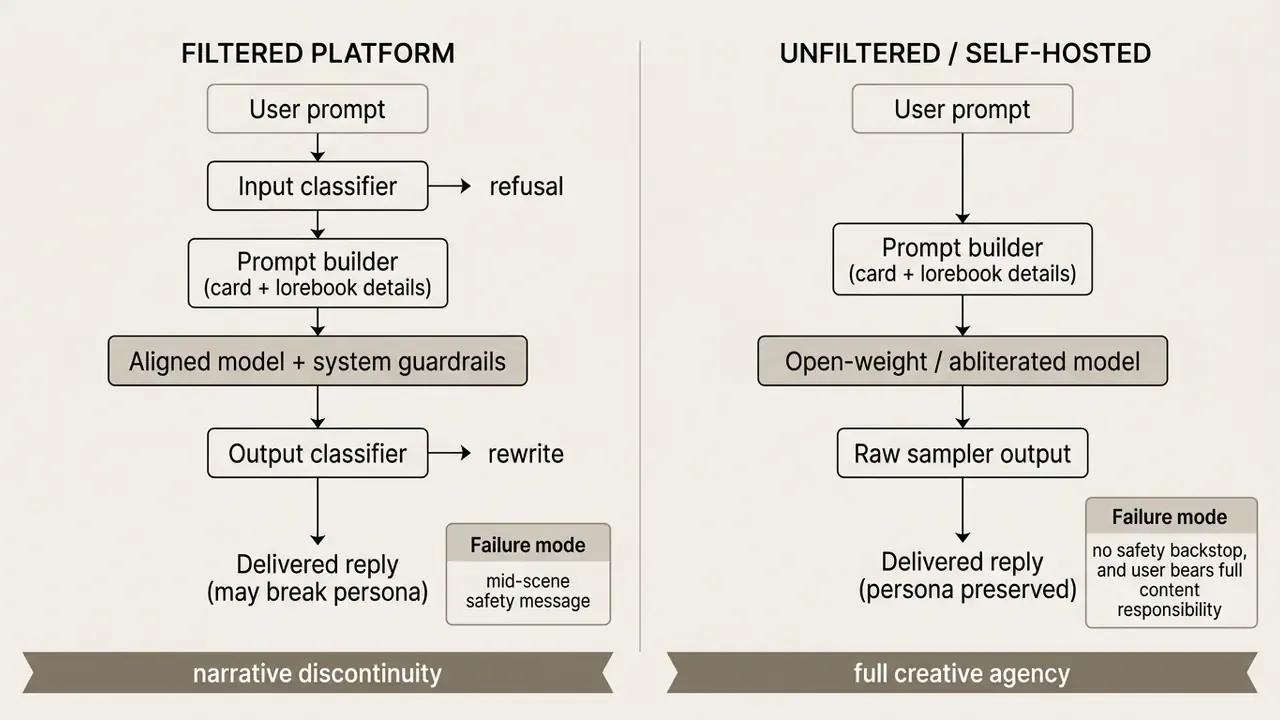
Look at how the moderation behaves and the pattern becomes clear. Automated safety classifiers frequently flag benign creative writing, historical fiction, or emotionally intense roleplay alongside genuinely restricted content. The result is mid-sentence refusals, artificial persona resets, and broken continuity.
Standardized 40-Turn Context Retention Benchmark (2026 Audit)
Advertised token limits tell you almost nothing about lived memory quality. So each platform went through a standardized 40-turn roleplay stress test. Ten narrative anchor facts (character backstory, user identity, physical inventory, hidden motivation, location, and relationship state) were introduced in turns 1 to 5, then checked for accurate, active recall at turn 20 and turn 40. Scores reflect the percentage of anchors the model correctly referenced, not merely failed to contradict.
| Platform | Turn 20 Retention (%) | Turn 40 Retention (%) | Primary Failure Mode |
|---|---|---|---|
| Character.AI (Free) | 42% | 21% | Complete identity drift; loops previous responses |
| Janitor AI (JLLM Free) | 68% | 45% | Forgets inventory; retains core personality |
| SillyTavern + Claude 3.5 / Local 70B | 95% | 89% | Near-perfect retention (bounded by context settings) |
| NovelAI (Kayra / Erato) | 88% | 82% | Seamless recall via Lorebook and Phrase Bias |
| DreamGen | 85% | 76% | Retains multi-character tracking across long scenes |
| Replika | 74% | 61% | Relational memory strong, scene detail weak |
| Candy AI | 62% | 38% | Companion tone stable, plot facts lost |
| CrushOn.AI | 58% | 34% | Inventory and timeline confusion |
| SpicyChat AI | 55% | 30% | Mid-conversation persona flattening |
| Chai AI | 40% | 19% | Short window; frequent restart behavior |
Independent community testing reports memory degradation onset on Character.AI at roughly turn 21 on average, the point where users notice a character "forgetting" their name or the established relationship. That figure is a third-party empirical measurement, not a published server parameter, so treat it as directional rather than exact.
One caveat on our own numbers, since honesty costs nothing here: retention scores depend on sampler settings, card length, and the specific model routed behind the frontend. Reproduce the test on your own configuration before quoting it as a decision input.
Content Filters, Scenario Restrictions, and Creative Freedom
Character.AI blocks nude, pornographic, graphic, or violent themes at the inference level (Character.AI Safety Center Guidelines, 2026). Its help center states plainly that pornographic content violates the terms of service and "will not be supported at any point in the future", and its Trust & Safety operation combines internal staff, contracted moderators, and vendor review. The intent is a platform suitable for users aged 13 and up. The side effect is that mature storytelling gets caught too: morally complex villains, trauma narratives, dark historical fiction.
Empirical work on uncensored large language models (ULLMs) shows that users chasing creative freedom need models that process open-ended prompts without safety refusals. The scale of that ecosystem is now measurable:
«An analysis of more than 11,000 uncensored LLMs found that 43.59% possess a general capability to generate prohibited content, with NSFW roleplay among the most common capabilities.»
Research on jailbreak prompt datasets quantifies how brittle commercial moderation becomes in the adult-content category:
«Across a dataset of 15,140 jailbreak prompts, the pornography scenario reached attack success rates of 0.993 to 1.000 on several evaluated models.»
Put those two findings together and the market dynamic explains itself. Filters are simultaneously over-restrictive for legitimate fiction and porous under adversarial pressure. Demand therefore shifts toward inherently unfiltered backends, where behavior is governed by model choice rather than by a classifier layer bolted on top.
Separating enterprise false refusals from consumer roleplay. The most common non-adult reason teams abandon filtered APIs is keyword false-positives in professional domains. Distressed-asset modeling, insolvency documentation, threat-intelligence summaries, and clinical case notes all contain vocabulary that surface-level classifiers punish. Rather than trusting unverifiable vendor anecdotes, build a small internal refusal-rate harness: submit 200 domain prompts to both a filtered commercial API and a locally hosted open-weight checkpoint, then log refusal counts, partial refusals, and schema-validity of structured outputs. Any single-firm percentage circulating without a disclosed prompt set should be treated as unverified.
Memory Discontinuity, Persona Shifts, and Long-Term Dialogue
The core operational failure in long-form roleplay is catastrophic context loss: the model forgets early events, persona traits, or the story rules it agreed to.
Academic research on multi-session conversational systems shows that character consistency requires extracting persistent persona facts into external memory and reinjecting them at each new session:
«Long-term memory is modeled as separate user and chatbot persona facts extracted from history, improving dialogue consistency over a no-memory baseline.»
Later work reinforces the same architecture. Post Persona Alignment for Multi-Session Dialogue (2025) first drafts a reply from context, then retrieves persona memories and refines the output to match the speaker. The LoCoMo benchmark (2024) evaluates dialogues spanning up to 35 sessions and roughly 300 turns using temporal event graphs. When a platform relies only on a small sliding context window, with no external store, characters drift in personality and contradict themselves. That is exactly what the turn-40 retention figures above capture.
Studies on user attachment reveal something else: when platforms change filtering policy or reset model context, users report severe "identity discontinuity" and treat the altered model as a different entity.
«Users reported feeling closer to the AI companion than to a best friend, and experienced its "loss" more acutely than the loss of physical possessions.»
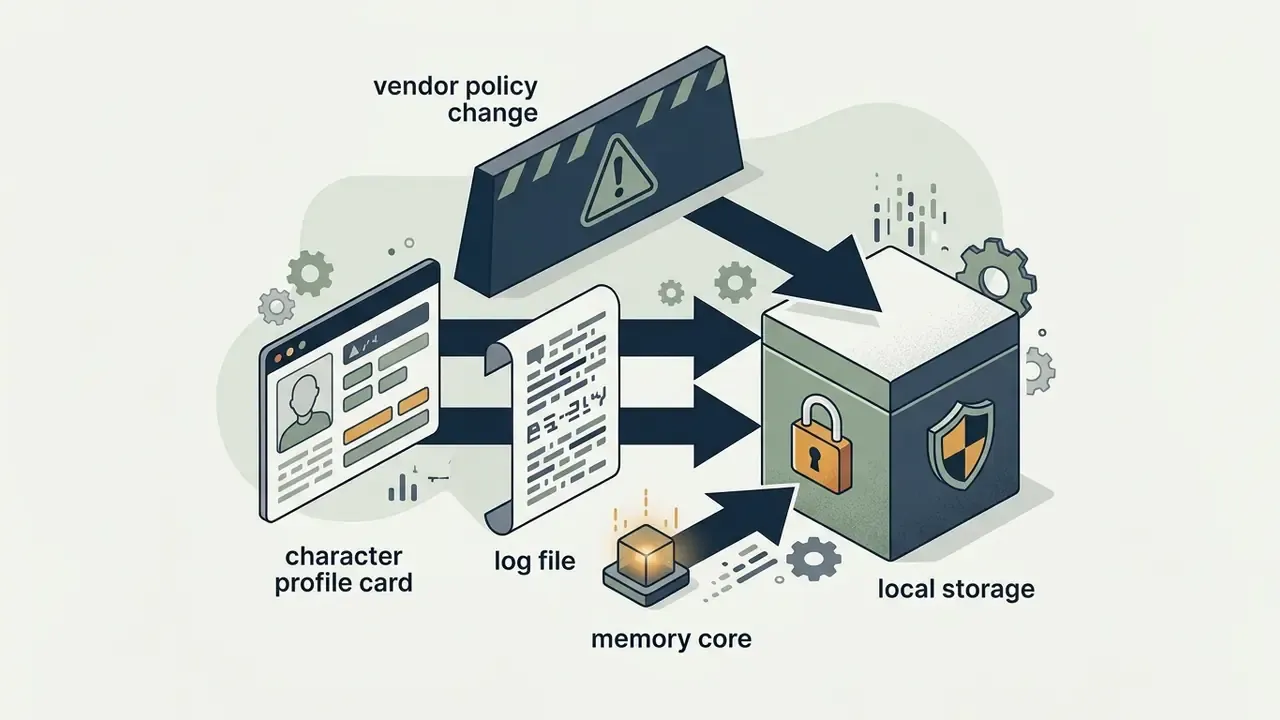
Which is the strongest practical argument for portable character cards and self-hosted stacks. When the persona definition and chat history live in files you control, a vendor policy change cannot retroactively rewrite the entity you built.
How to Evaluate Apps Like Character AI Without Filter
Evaluating an app like character ai without filter means testing dialogue quality, memory architecture, customization depth, and pricing transparency before you commit to a subscription or a two-hour local install.
Conversation Quality, Memory Retention, and Character Consistency
A capable conversational engine holds its role without breaking character and without recycling the same three sentence shapes.
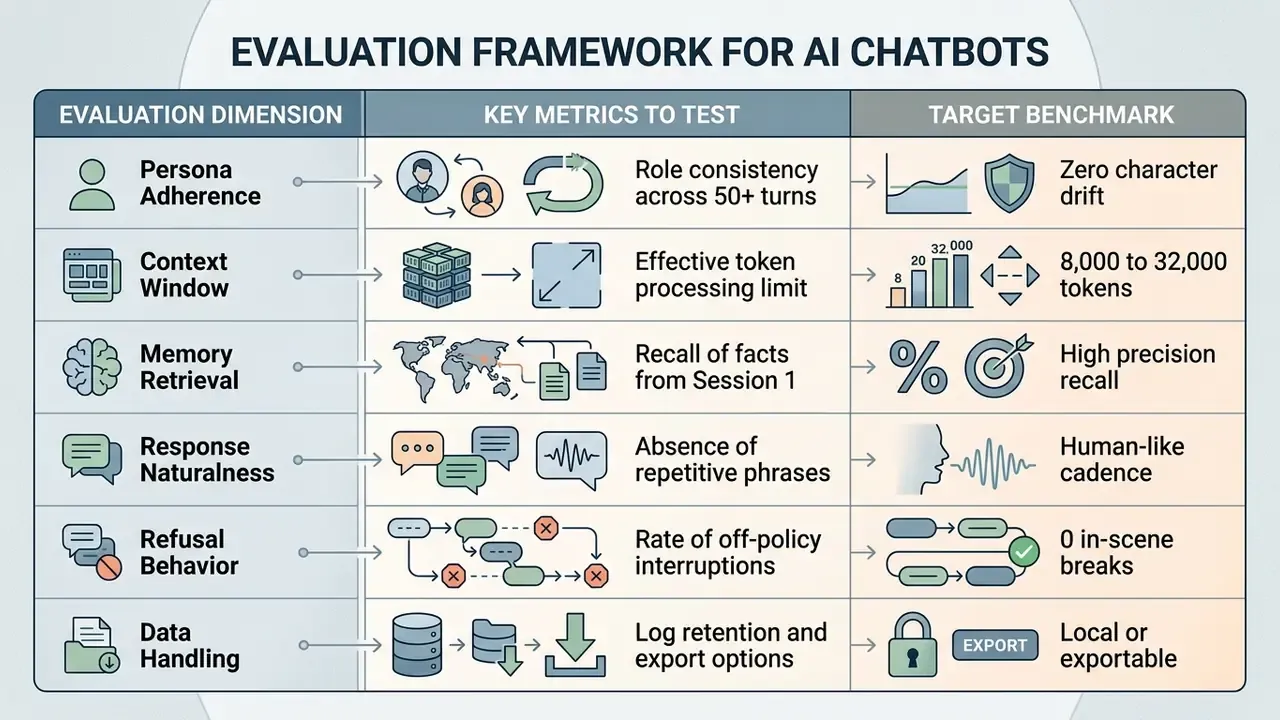
When testing ai models, confirm that the effective token window matches the advertised specification. Empirical 2025 work on long-context language models reports that the maximum effective context sits below the nominal architectural limit, and that additional tokens measurably degrade output quality. Treat advertised window sizes as ceilings, not guarantees. Where a vendor publishes no methodology, consider the effective window unverified and probe it locally with a needle-in-haystack recall test.
Quality perception also has a behavioral dimension worth accounting for:
«For three of four studied roles, a significant positive correlation was found between perceived chatbot anthropomorphism and user media dependency.»
In plain terms: the platforms that feel most real are also the ones most likely to generate habitual use. A feature if you want companionship. A risk factor if you are trying to set usage boundaries.
Customization Options, Character Library, and Custom Bots
Leading platforms let you create custom bots from detailed system prompts, scenario definitions, world lore, and example dialogue. The community created characters in the public libraries are a fast starting point, but the good ones are almost always edited copies rather than originals.
Effective character sheets rely on structured formatting:
- Identity and vibe core alignment, age, role, emotional baseline.
- Personality traits habits, fears, motivations, speech quirks.
- Example dialogues sample input and output pairs that define vocabulary and message length.
Standard Character Card V2 (W++ formatting spec example)
To keep a custom bot in persona without triggering hallucinations, copy and adapt this layout into Janitor AI, SillyTavern, or CrushOn.AI:
{
  "char_name": "Aria The Renegade",
  "char_persona": "[Character('Aria')\n{\nSpecies('Human')\nMind('Cynical', 'Strategist', 'Loyal under oath')\nPersonality('Sarcastic', 'Resourceful', 'Distrustful of authority')\nBody('Short silver hair', 'Cybernetic left arm', 'Scarred right eye')\nOutfit('Tactical trench coat', 'Combat boots')\nLikes('Refined fuel', 'Old analog tech')\nDislikes('Corporate guards', 'Unnecessary risks')\nSpeech('Concise', 'Uses street slang', 'Never uses formal honorifics')\n}]",
  "world_scenario": "Aria and {{user}} are trapped inside an abandoned orbital station while automated security droids sweep the sector.",
  "first_mes": "*Aria checks the power cell on her plasma cutter, sparks flying as she glances at {{user}}.* 'We have about four minutes before that bulkhead fails. You got a plan, or are we improvising again?'",
  "mes_example": "<START>\n{{user}}: 'Can we hack the door lock?'\n<START>\n{{char}}: *Aria lets out a sharp laugh, tapping her cybernetic arm against the terminal.* 'Hack it? It runs on a dead circuit. We bypass it or we burn through it.'"
}
Field notes. Keep char_persona under roughly 800 tokens so it never crowds out recent turns. Use mes_example to lock message length and formatting conventions, meaning asterisk actions versus quoted speech. Move static world facts into a lorebook entry instead of the persona block, so they are injected only when a keyword triggers them.
For creators building visual character cards to accompany these definitions, a comparison of AI art generators helps match portrait style to persona tone. If you plan to publish roleplay recaps or scene clips, a quick look at free video editing options saves a licensing headache later.
Popular Character AI Alternatives No Filter: Detailed Platform Overviews
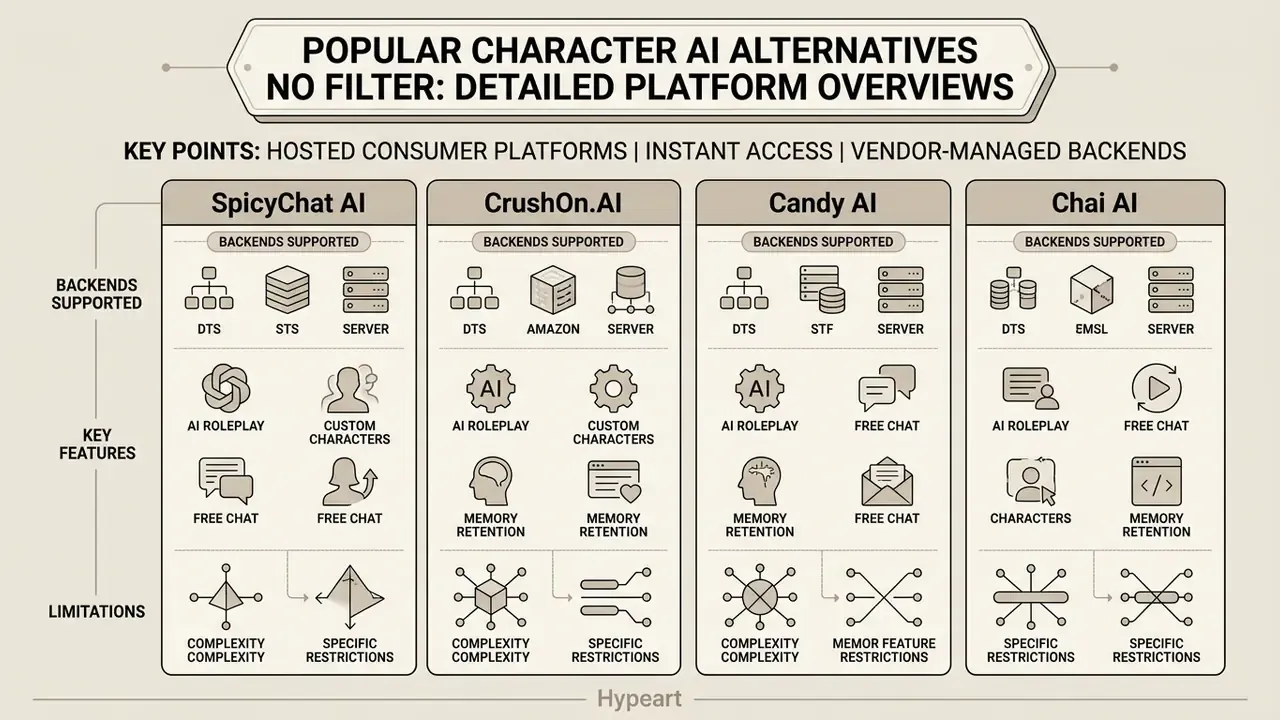
The platforms below trade off setup complexity, character availability, and customization depth in very different ways. They are grouped into hosted consumer platforms (instant access, vendor-managed backends) and developer and narrative frameworks (configurable, portable, higher ceiling).
Multimedia capability and audio/visual generation matrix
| Platform | Self-Generated Images | Real-Time Voice Chat | Custom Voice Cloning | Image-to-Character Import |
|---|---|---|---|---|
| Janitor AI | No | No | No | Yes (PNG cards) |
| SillyTavern | Extension | Extension (XTTS) | Extension | Yes (PNG V2 cards) |
| SpicyChat AI | Native (conversation images) | Voice messages only | No | Yes (JSON/PNG) |
| CrushOn.AI | Limited | Limited | No | Yes (JSON/PNG) |
| Candy AI | Native (NSFW) | Native voice calls | No | No (presets only) |
| Replika | Avatars only | Native voice calls | No | No |
| NovelAI | Native (anime image model) | Text-to-speech | No | No |
| DreamGen | Native scene images | No | No | Yes (scenario importer) |
| Chai AI | No | No | No | No |
Hosted Consumer Platforms: Instant Access, Vendor-Managed Backends
Janitor AI has become the default web destination for uncensored roleplay, with a large library of community created characters spanning anime personas, original fiction, and scenario-driven bots.
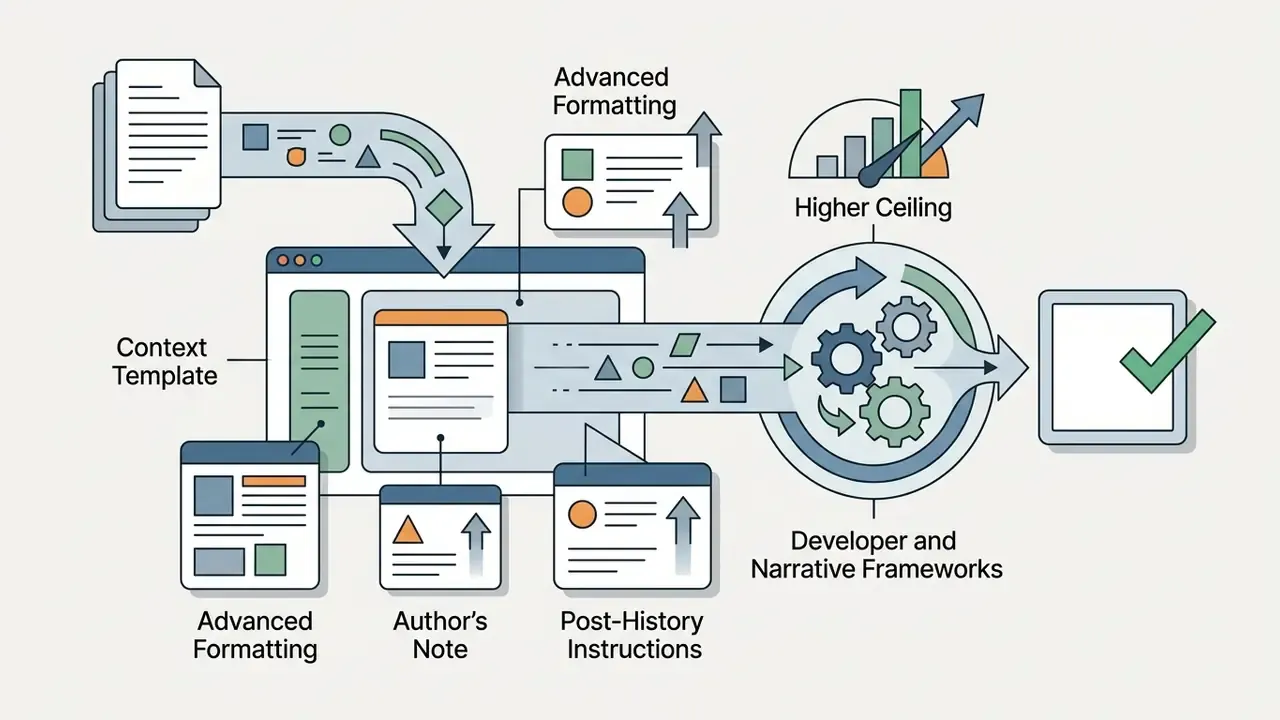
Developer and Narrative Frameworks: Configurable, Portable, Higher Ceiling
SillyTavern is an open-source frontend for power users who want full control over prompt construction and inference execution.
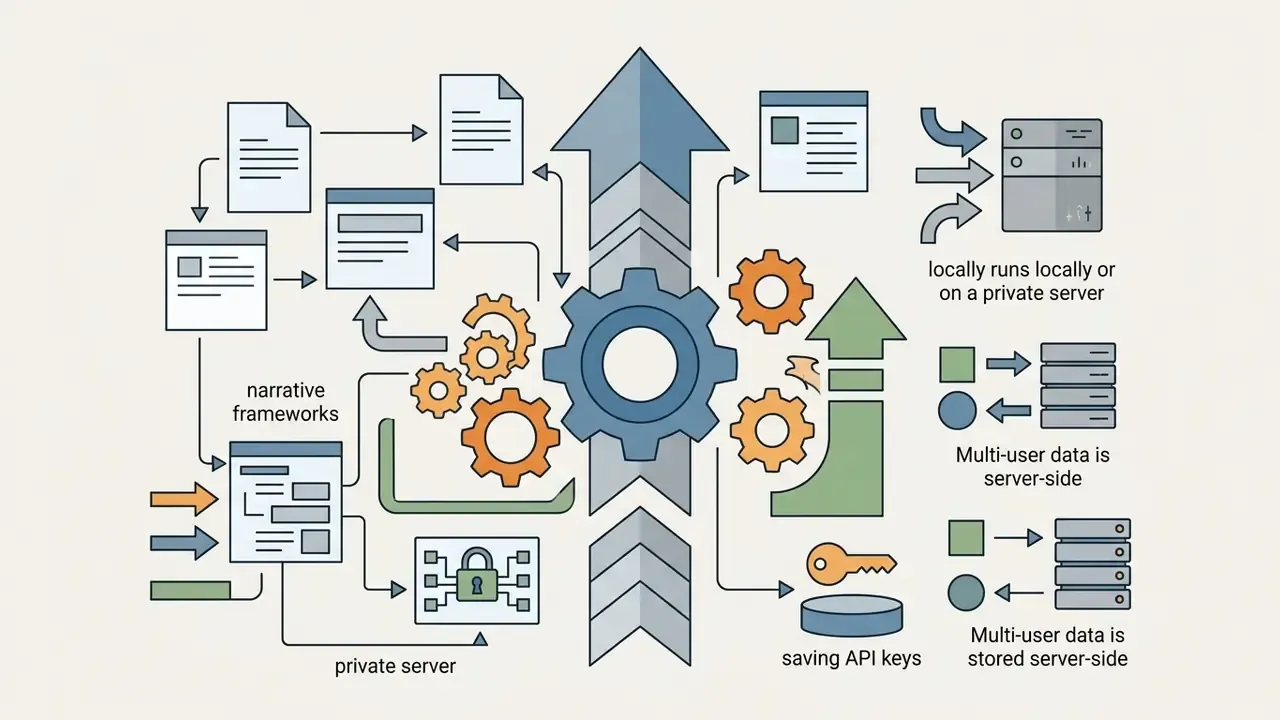
secrets.json. Multi-user data is stored server-side in plain text, so host hardening matters.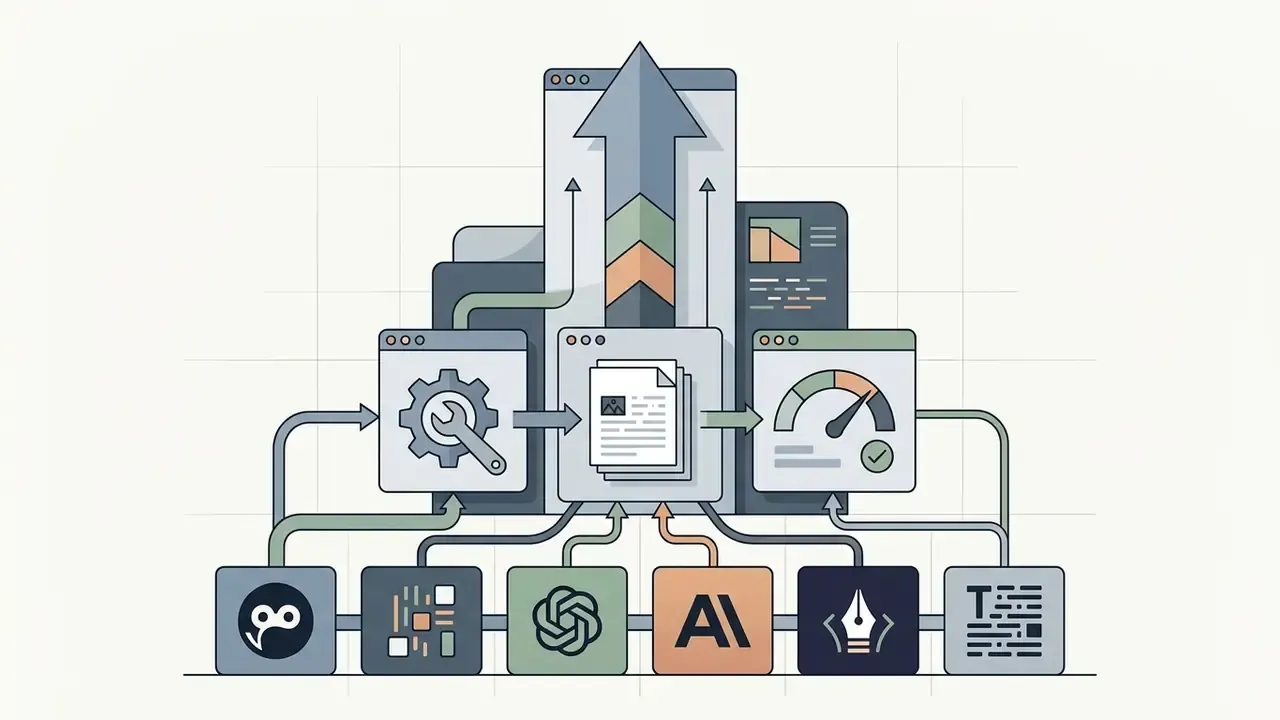
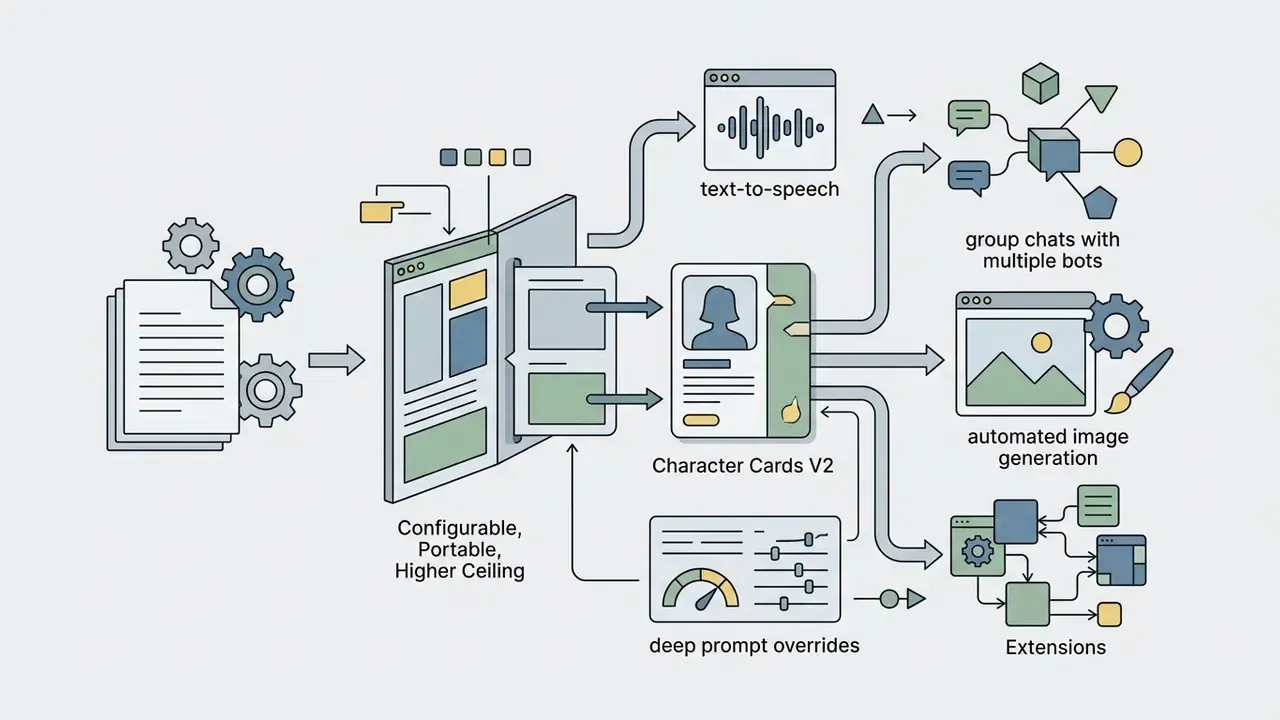
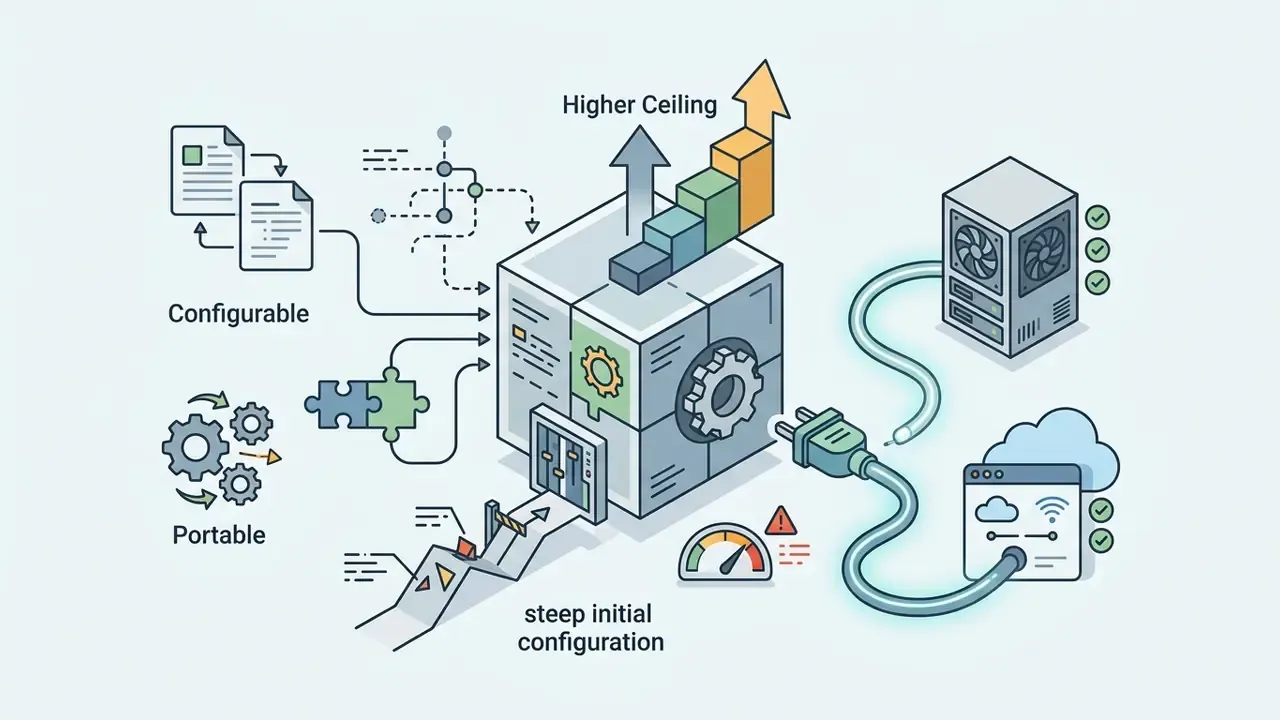

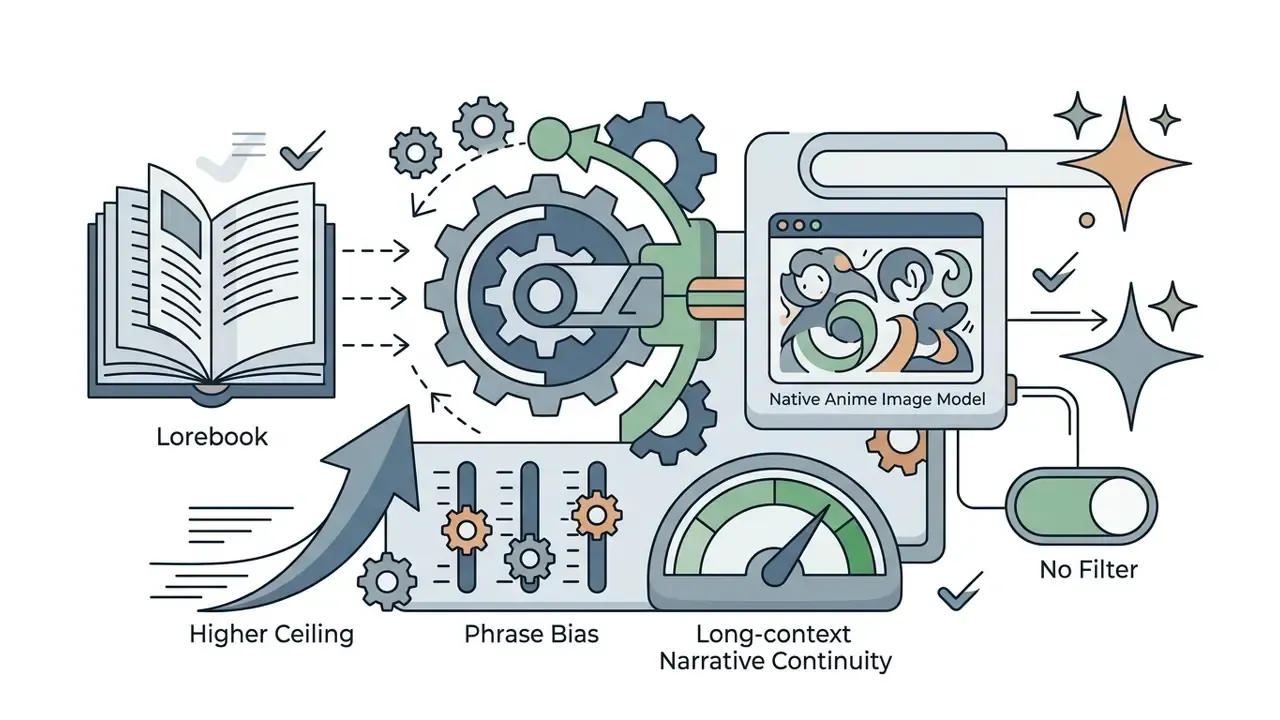
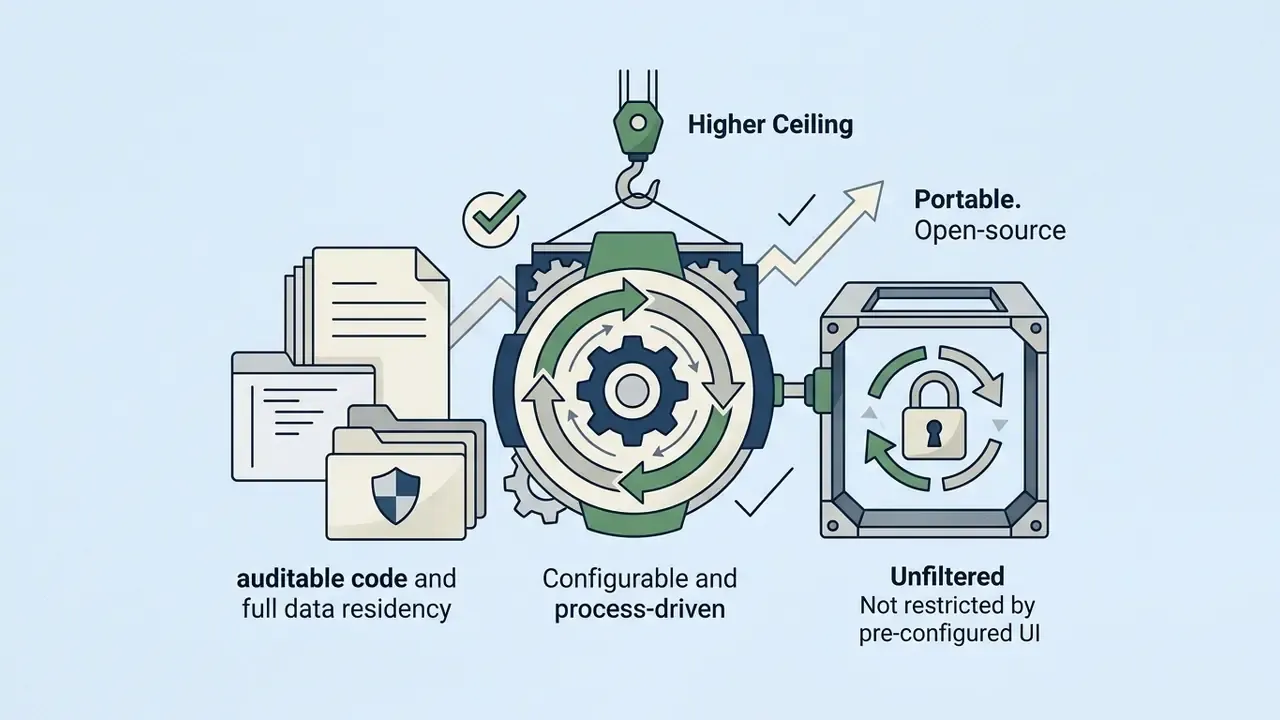
To analyze side-by-side performance grids across creative engines, inspect our AI Media Comparison Matrices for feature breakdowns.
Platform x use case selection matrix
| Platform | Casual Chat | NSFW Roleplay | Book / Story Writing | Group Chats | Local Launch | Voice / TTS Support |
|---|---|---|---|---|---|---|
| Janitor AI | Yes | Yes | Moderate | No | No | Third-party |
| SillyTavern | Yes | Yes | Yes | Yes | Yes | Native extension |
| SpicyChat AI | Yes | Yes | Moderate | No | No | Limited |
| CrushOn.AI | Yes | Yes | No | No | No | No |
| Candy AI | Yes | Yes | No | No | No | Voice messages and calls |
| Chai AI | Yes | Light | No | No | No | No |
| DreamGen | Moderate | Yes | Yes | Yes | No | No |
| NovelAI | No | Yes | Yes | No | No | Native TTS |
| Replika | Yes | Restricted | No | No | No | Native voice call |
Reading the matrix in one line: if you want casual chat on a phone, pick Chai or Replika. If you want unfiltered roleplay with no setup, pick Janitor AI or SpicyChat. If you want a novel, pick NovelAI or DreamGen. If you want control over everything, pick SillyTavern and accept the learning curve.
Open Source and Local Models: Alternatives for Maximum Control
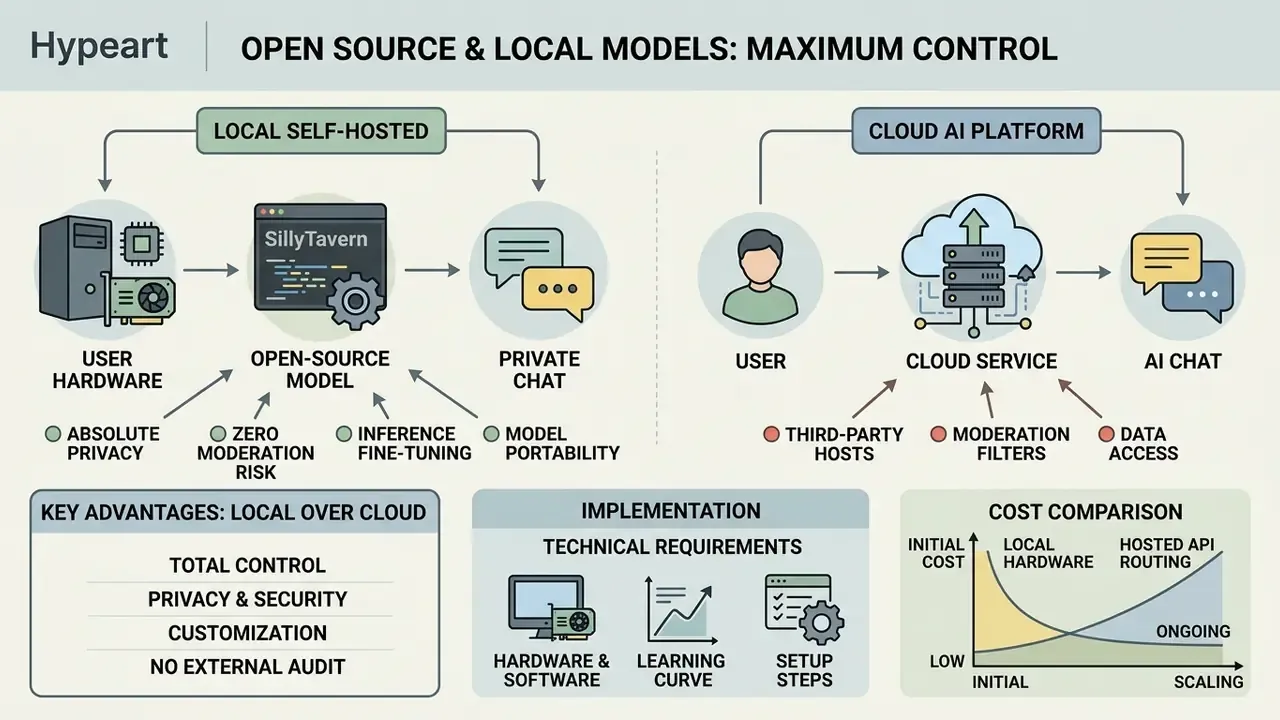
Running open-source models locally removes third-party hosts from the path entirely. No provider-side censorship, no server-side transcript, no policy update landing mid-story.
Research analyzing over 11,000 uncensored large language models shows that safety alignment can be systematically ablated without destroying baseline intelligence (Qu et al., arXiv:2508.12622). The same ecosystem is visible on public prompt-sharing hubs:
«Among 376 NSFW chatbots studied on FlowGPT, 16.8% were story generators, and some bots produced explicit content even without erotic prompts.»
Techniques like abliteration remove internal "refusal vectors" from model weights, so the model stops producing canned safety responses. The trade-off stops being neutral the moment those models get wired into tool-using systems:
«Embedding uncensored models (Qwen2.5-3B, LLaMA3.2-3B, Gemma3-4B, Mistral0.3-7B) into agentic pipelines with retrieval augmentation amplified harmful behavior. The authors term this "safety devolution".»
Governance reading of that finding. An abliterated checkpoint that behaves acceptably in single-turn chat can degrade sharply once it gains retrieval, browsing, or tool execution. Treat "uncensored for roleplay" and "uncensored inside an agent" as two separate risk classes with separate approval paths and separate owners.
When SillyTavern and Local Models Outperform Cloud AI Platforms
A local deployment pairing SillyTavern with open-weight models (Llama-3, Mistral, Gemma fine-tunes) beats commercial web platforms on four metrics:
- Absolute privacyconversations, prompt cards, and outputs never leave the machine. SillyTavern's own documentation states that everything you write stays on your own PC.
- Zero moderation riskno sudden account bans, no policy shifts, no character removals. Cloud services, by contrast, can simply refuse to continue a scene.
- Inference fine-tuningyou adjust temperature, top-p, repetition penalties, and sampler order to kill response loops.
- Model portabilityswapping a 12B fine-tune for a 70B checkpoint changes quality without touching your character cards or chat history.
Benchmark context matters when you set expectations. 2026 comparisons place the best open-source models at roughly 71.8% average accuracy against 77.9% for the best closed models, a gap of about six points, while smaller 14B local models lose 11% to 13% accuracy relative to frontier systems. For roleplay coherence that gap is often invisible. For structured reasoning it is not.
For creators who prefer flexible billing over monthly lock-ins, reviewing Pay-As-You-Go AI Video solutions can balance operational overhead across media projects.
Technical Requirements and Learning Curve for Self-Hosted Setups
Local models need dedicated hardware, and specifically GPU video RAM.
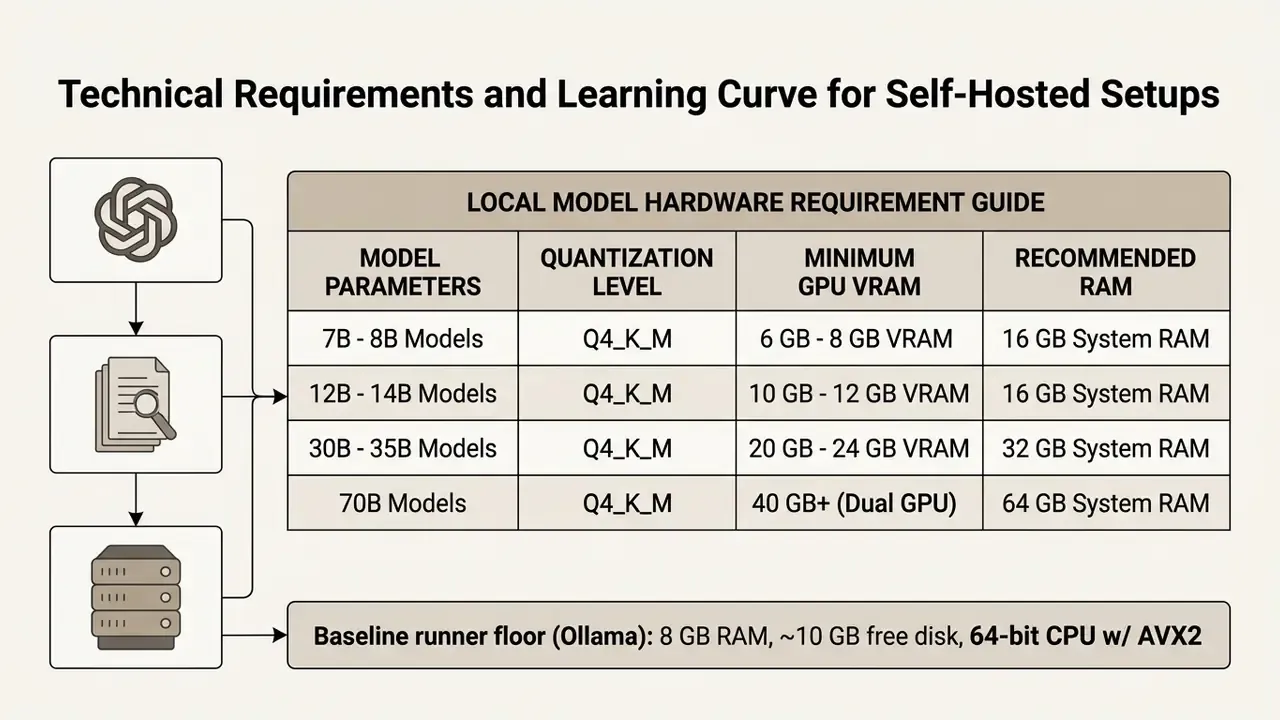
General information only, not a substitute for professional consultation. Hardware requirements shift with model revisions and quantization methods, so verify against the model card before buying a GPU. VRAM estimates differ across sources because some assume full GPU offload while others assume 4-bit quantization or CPU offloading.
Setting up a self-hosted engine means installing a local loader such as KoboldCPP or Ollama, downloading quantized weights in GGUF format from Hugging Face, and pointing SillyTavern at the local server address (http://127.0.0.1:5001).
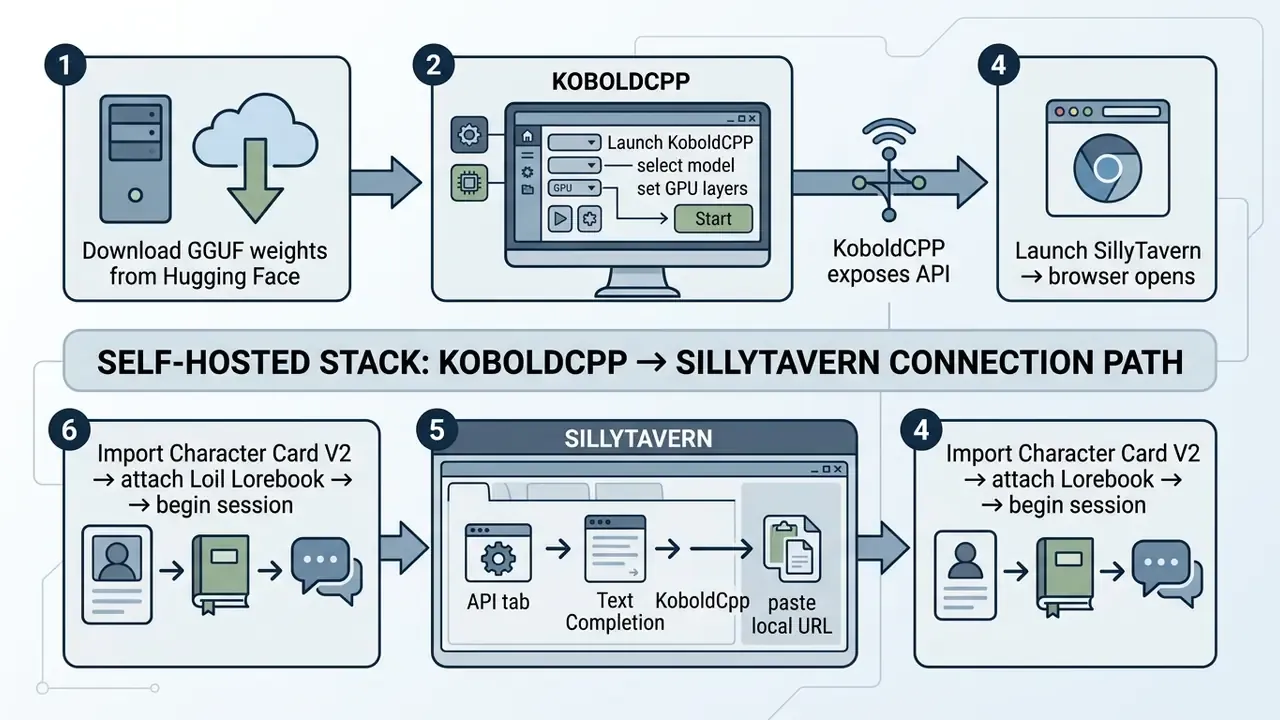
First-run reality check: budget an evening, not ten minutes. Most failures trace to one of three things, a GPU layer count set too high, a mismatched quantization the loader refuses, or a context size larger than available VRAM. All three are fixable in the launcher.
Total Cost of Ownership: Local Hardware vs Hosted API Routing
| Deployment path | Upfront cost | Recurring cost | Break-even vs $20/mo hosted plan | Data residency |
|---|---|---|---|---|
| Existing 8 GB GPU + 8B model | $0 | Electricity only (about $2 to $5/mo) | Immediate | Fully local |
| New 16 GB GPU + 12B to 14B model | about $450 to $700 | Electricity (about $4 to $8/mo) | 24 to 30 months | Fully local |
| Dual 24 GB GPUs + 70B model | about $1,800 to $3,000 | Electricity (about $10 to $20/mo) | 60+ months | Fully local |
| OpenRouter routing via SillyTavern | $0 | About $0.0015 per 1k tokens (usage-based) | Scales with usage | Provider-side logs |
| Hosted consumer platform | $0 | $4.90 to $25.99/mo | Not applicable | Vendor servers |
Local hardware wins on privacy and marginal cost per message. API routing wins on time-to-first-chat and on access to frontier long-context models. Heavy narrative users who run thousands of turns a month reach local break-even fastest, and they are also the users most annoyed by queue gates.
Enterprise Note: Unfiltered Platforms as a Shadow AI Vector
How to Choose the Best Character AI Alternative Without Filter for Your Use Case
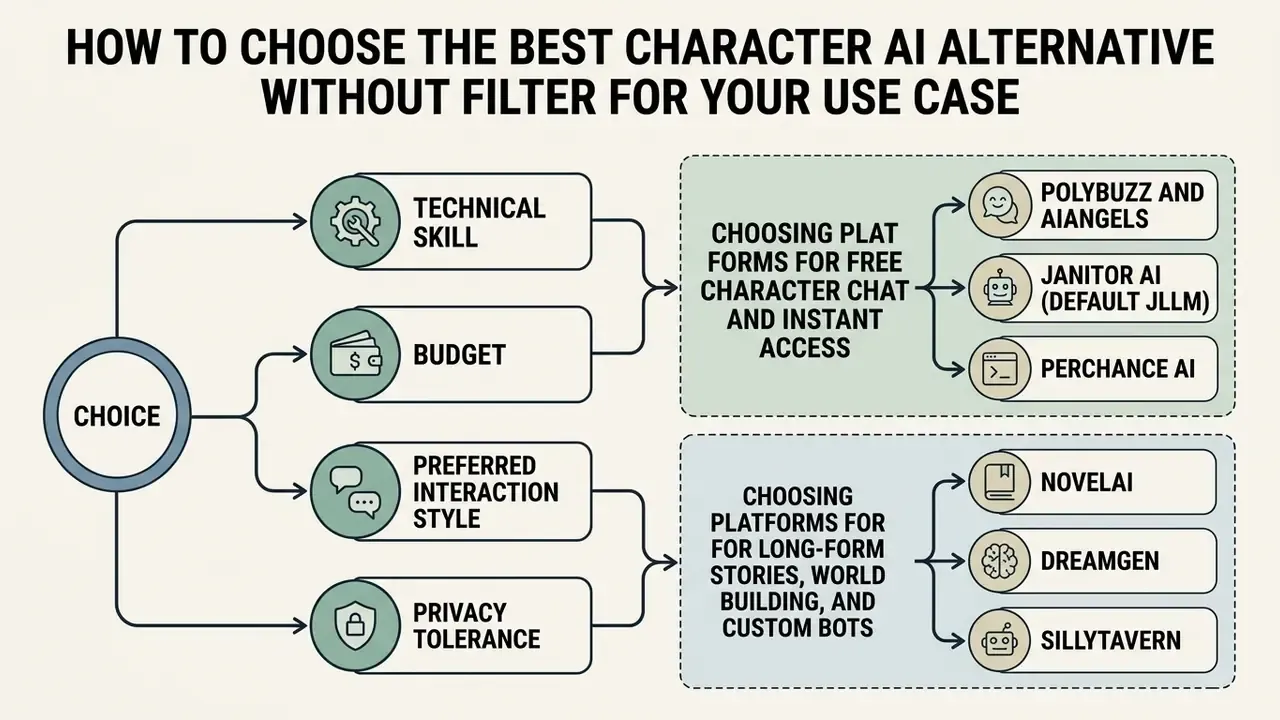
The right platform is a function of four variables: technical skill, budget, preferred interaction style, and privacy tolerance. Rank those honestly and the shortlist writes itself.
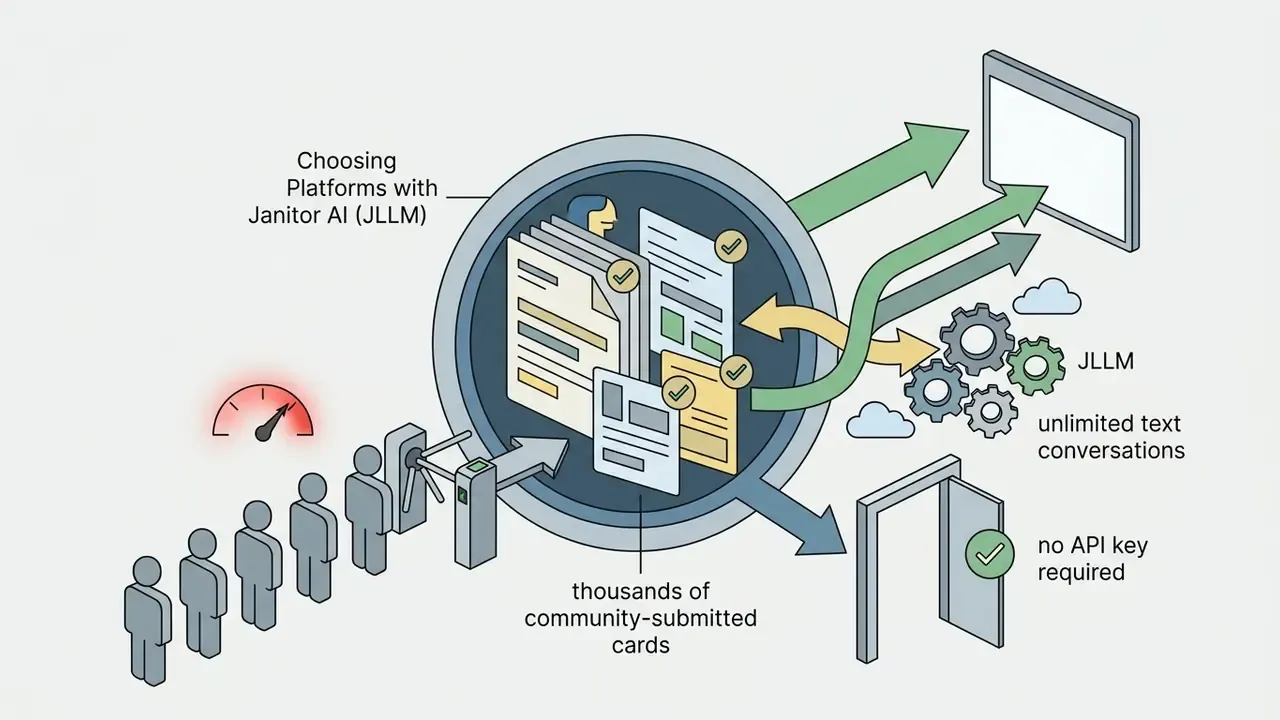
Choosing Platforms for Free Character Chat and Instant Access
If you want to chat now, with no install and no card, look for web-native services with a genuinely usable free tier.
Because "unlimited" claims in this segment come from commercial comparison pages rather than neutral documentation, verify the limits inside the product before you rely on them daily. Vendor marketing ages faster than the product.

«The Safe-Child-LLM benchmark documents that LLMs can generate sexual and violent content in response to prompts from children (ages 7 to 12) and adolescents (13+) when filters are absent.»
Choosing Platforms for Long-Form Stories, World Building, and Custom Bots
Authors and world builders need continuous narrative control, which means lorebooks and structured context injection.
- NovelAI Lorebook entries trigger background information whenever key terms appear (character names, locations, historical events), plus Phrase Bias for tone control.
- DreamGen strong at scenes with several active characters and clear dialogue attribution, with dedicated fields for locations, artifacts, and lore.
- SillyTavern World Info entries with keyword triggers, Author's Note for persistent stylistic instructions, and automated summarization extensions for multi-session arcs.
- Continuity tooling dedicated story-bible and lore-tracking apps complement these engines, comparing new passages against saved lore to catch contradictions before they propagate.
A practical world-building pattern that holds up over hundreds of turns: keep the character card lean (identity, voice, motivation), push static facts into keyword-triggered lorebook entries, and maintain a running summary entry you update every 20 to 30 turns. The active context stays focused on the present scene, while anchors resurface exactly when relevant. If you also publish illustrated chapters, the notes on how to display image instead of text in html cover the markup side of that workflow.
Choosing Platforms for Privacy, Voice Interactions, and AI Companions
For users who put data confidentiality and realistic voice chat first:
- Privacy focus self-hosted SillyTavern with local KoboldCPP execution means no cloud logging and no external telemetry.
- Voice interactions Replika and Candy AI support real-time audio calls, while SillyTavern integrates with local text-to-speech engines such as XTTS v2 for offline synthesis.
- Regulatory context EDPB guidance on virtual voice assistants notes that voice-command processing can trigger GDPR and e-Privacy obligations, including rules on storage and access on terminal devices. A 2026 European Parliament briefing adds that companion developers frequently train or update models on user chat data, with transparency gaps in collection and retention.
Data-minimization guidance from privacy regulators converges on the same short list regardless of platform. Read the privacy policy. Opt out of chat-history sharing where the option exists. Delete stale conversations. Never enter sensitive personal information into a publicly available chatbot.
«GPT-4o reached 97.18% accuracy and an F1 score of 96.34% in adult-content detection, outperforming traditional moderation methods on both accuracy and false-positive rate.»
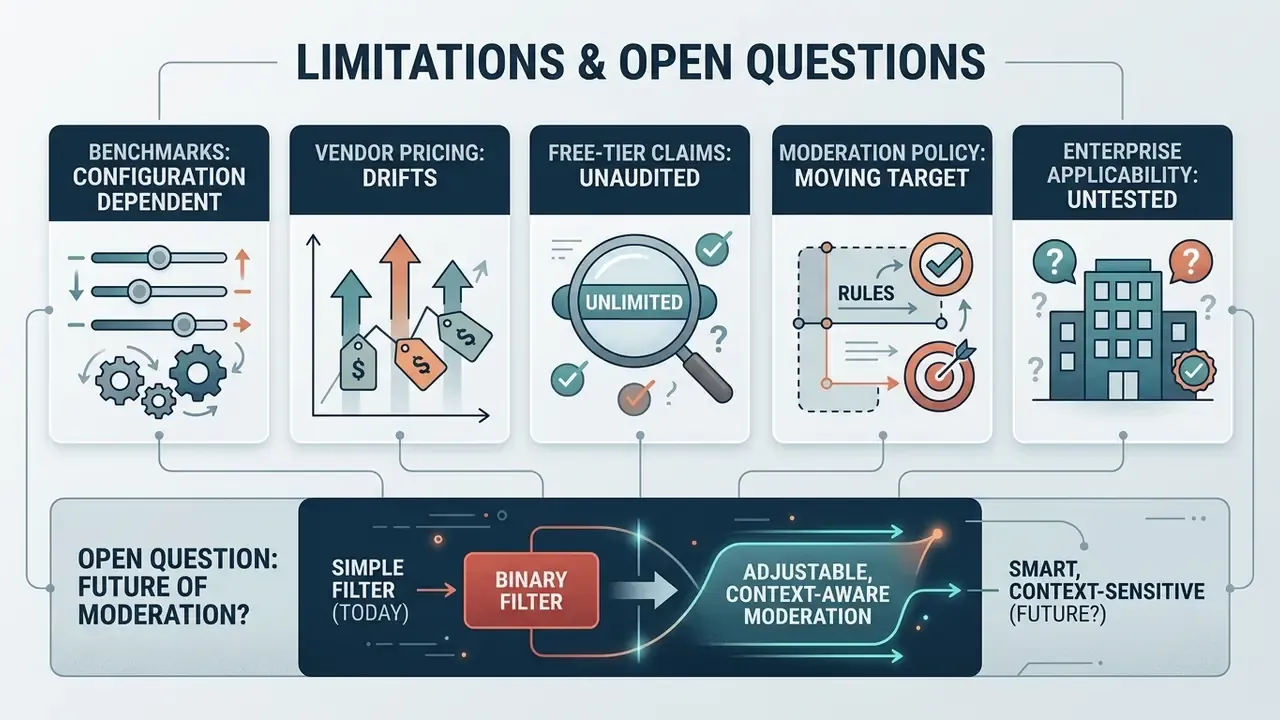
That benchmark cuts both ways, which is why it is worth quoting. It shows modern LLM-based moderation can be far more context-aware than keyword filters, which is why some platforms now offer adjustable boundaries instead of binary filtering. It also explains why crude classifier layers feel so arbitrary by comparison.
To evaluate video generation tools that serve as alternatives to mainstream platforms, check out the pixverse alternative breakdown.
How to Migrate from Character AI While Preserving Persona Traits
Moving a character from Character.AI to another engine means extracting persona fields by hand and reformatting the system prompt. One-click account migration does not exist. Character.AI's help center offers Export data for chats and account information, which is a backup export rather than an import-ready character format, so reconstruction is unavoidable.
Migration is rarely a purely technical task. The emotional stakes are documented:
«A mixed-methods study of active companion-chatbot users found a consistent relationship between usage patterns and loneliness levels, confirming that emotional needs are a key driver of engagement.»
Which is exactly why persona fidelity matters more than feature parity here. Users are moving a relationship, not a config file.
To discover broader AI media tools and workflow tutorials, browse the hub for detailed integration guides.
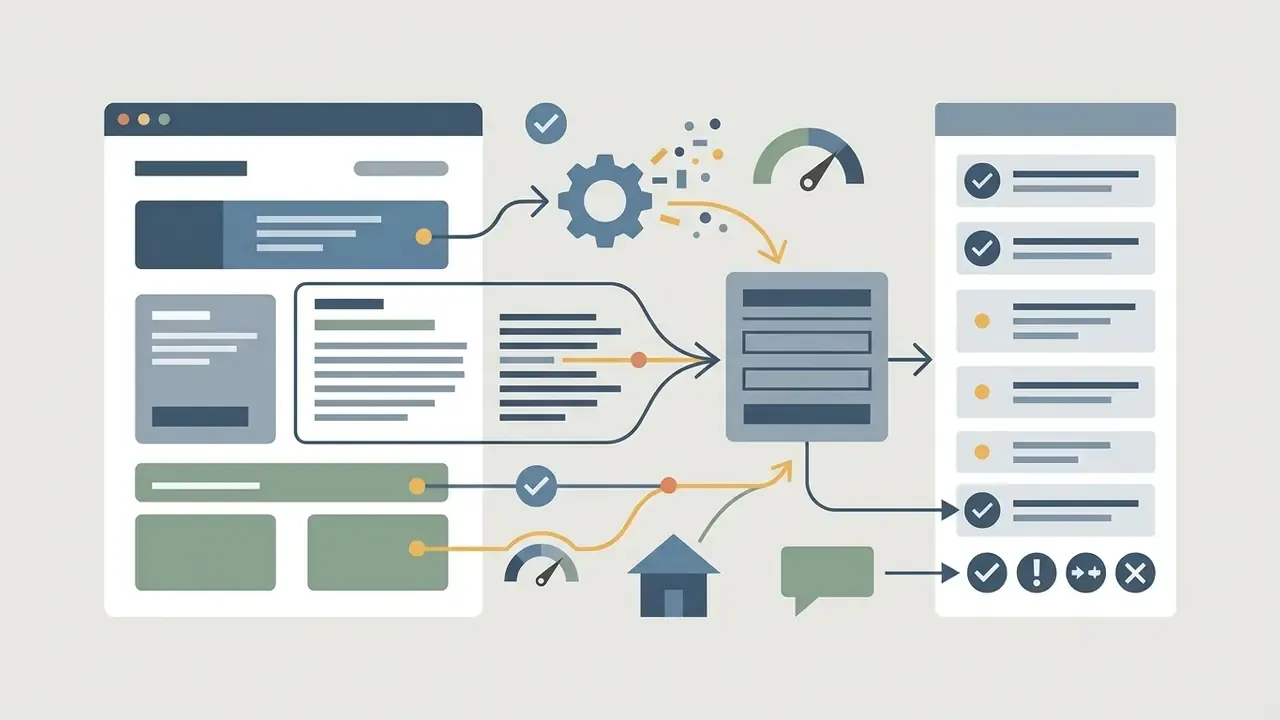
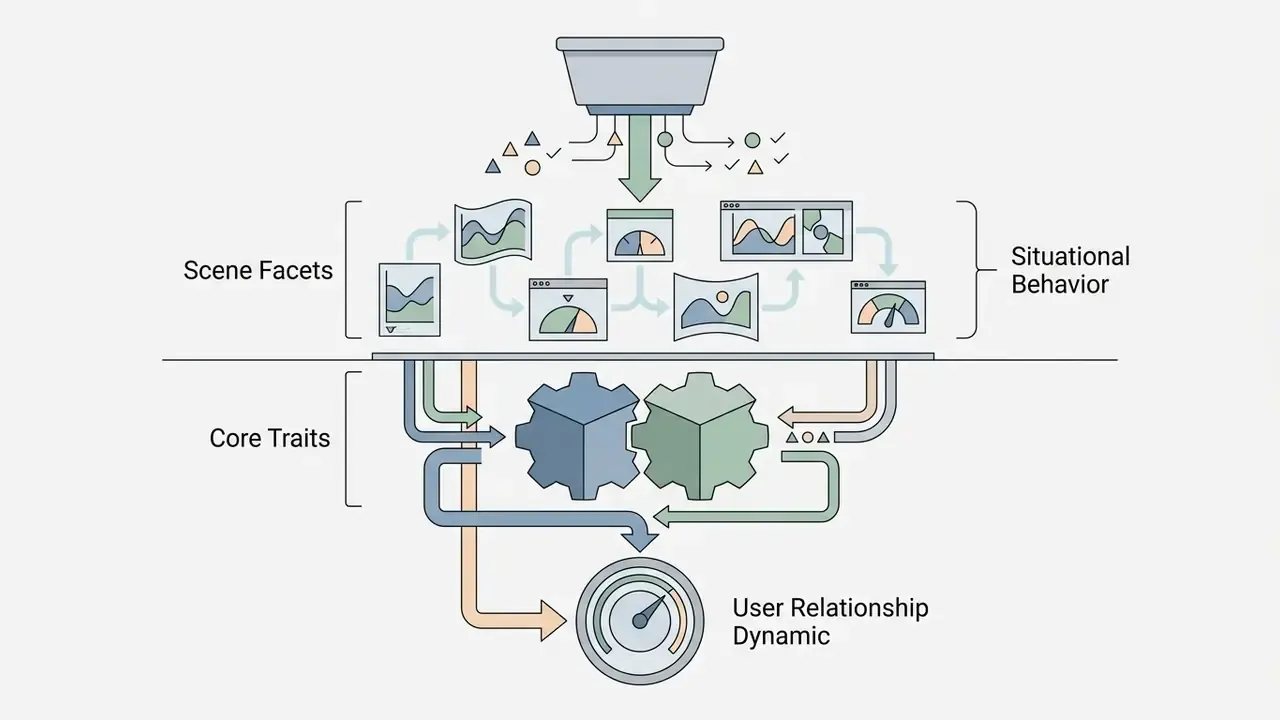
Character migration checklist
Expect the first rebuild to feel slightly off. That is normal. The usual culprit is message length rather than personality, so fix mes_example before you start rewriting the persona block.

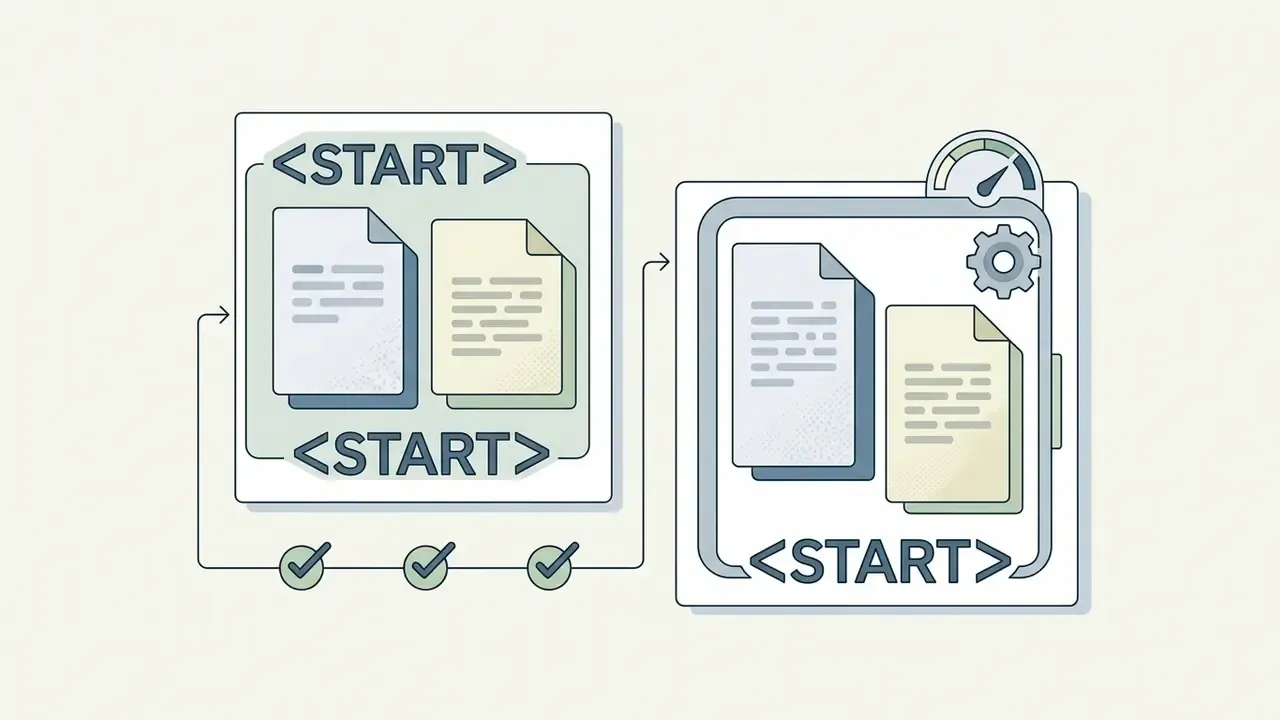
<START> blocks so the model treats them as style exemplars rather than history.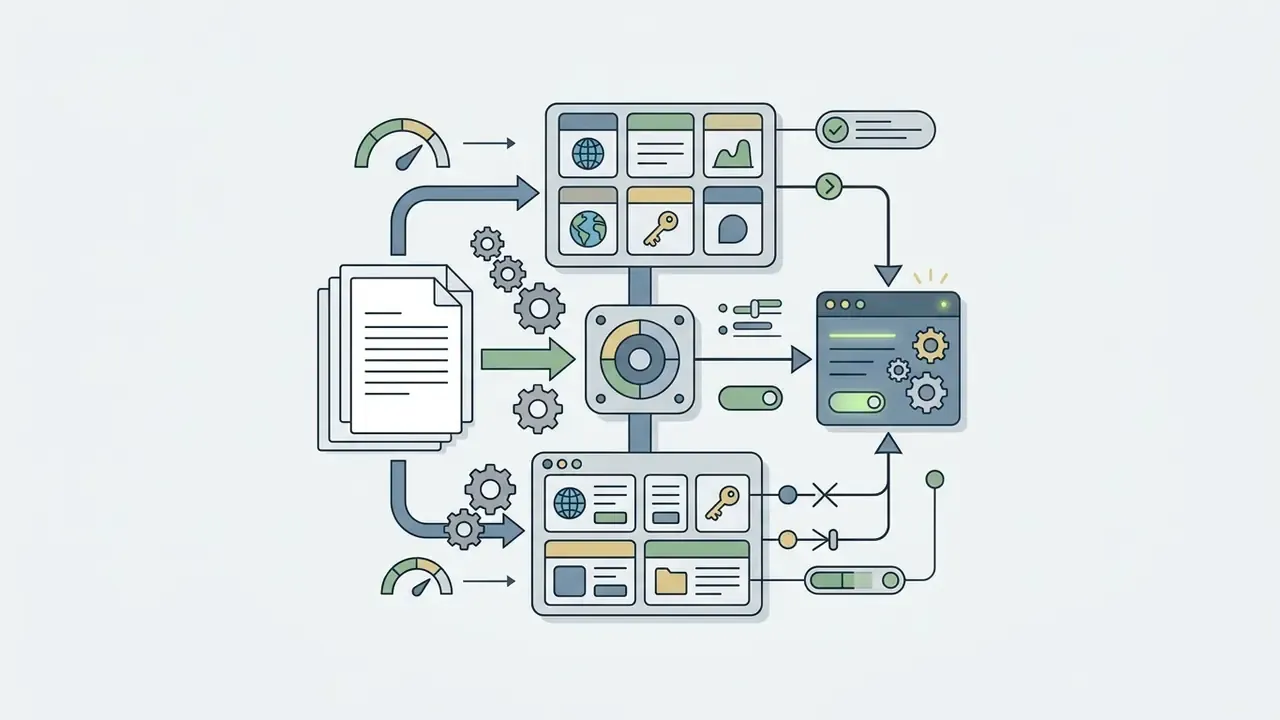

Limitations and Open Questions
FAQ: Common Questions About Unfiltered Character AI Alternatives
Can You Use Character AI Alternatives Without Filter for Free and Without Complex Setup?
Yes. Several sites like character ai without filter offer browser-based access with no software install and no local GPU. Platforms similar to Character AI without filter, including Janitor AI, SpicyChat AI, CrushOn.AI, and PolyBuzz, let you create a free account and start chatting immediately on hosted models. Free tiers do come with strings: queue waits, daily message limits, or reduced context. Janitor AI caps free context near 9,000 tokens, Chai AI resets roughly 70 messages every three hours, and CrushOn.AI allocates 100 credits per month.
Which Character AI Alternative Supports Both Image Generation and Voice Calls?
Candy AI and Kindroid offer native in-chat image generation and real-time voice calls in the browser. SpicyChat AI generates contextual "Conversation Images" but only voice messages, not live calls. For open-source setups, SillyTavern supports text-to-speech through the WebSpeech API or XTTS v2 extensions and image generation through Automatic1111 or ComfyUI links. Widest capability range, highest configuration cost.
Are Unfiltered AI Chat Platforms Completely Private?
No. Cloud-hosted platforms such as SpicyChat, CrushOn, and Candy AI log transcripts on central servers for safety and maintenance, and mobile apps additionally collect device and usage identifiers. Genuine privacy is only approached with self-hosted solutions like SillyTavern paired with a local runner (KoboldCPP or Ollama), where chat history and character cards stay on your own drive. Note one gap: SillyTavern stores multi-user data in plain text on the host, so the host itself must be secured.
How Do I Bypass Context Limit Resets on Janitor AI or SillyTavern?
Use structured Lorebooks or World Info entries that inject static character details only when specific keywords appear. In SillyTavern, enable automated summarization to compress older turns into a running synopsis, and pin critical facts to the Author's Note so they are reinjected every turn. Alternatively, route through a larger window. Claude-class models via OpenRouter reach up to 200k tokens, which pushed retention to 89% at turn 40 in our benchmark. Inline [Remember: ...] directives work as a zero-cost stopgap mid-scene.
Can You Import Character.AI Bots Directly Into SillyTavern or Janitor AI?
Direct account synchronization is not supported, because Character.AI publishes no character-import format and locks programmatic access. You can extract persona parameters manually from the Definition field, or via browser-extension parsers, then rebuild them as standard PNG Character Card V2 or JSON files usable by Janitor AI, SillyTavern, CrushOn.AI, and DreamGen's scenario importer. Chat history moves separately through Character.AI's own data export.
What Compliance and Data-Leakage Risks Apply if Employees Use These Platforms at Work?
Three material risks. First, processing without a legal basis: consumer terms rarely include a GDPR-grade data processing agreement, so pasting customer data may constitute an unlawful transfer. Second, uncontrolled retention: transcripts may be retained or used for model improvement with limited transparency, a gap flagged explicitly in 2026 European Parliament analysis of AI companions. Third, multi-hop exposure via BYO-key proxies, where content passes through both the chat frontend and the inference provider. EU frameworks that can apply include the GDPR, the AI Act, and the Digital Services Act, even though no AI-companion-specific statute exists. Mitigation: DNS-level inventory, an approved self-hosted alternative, and a standing rule against entering personal or confidential data into public chatbots.
Is Abliteration Safe to Use for Business Workloads?
Abliteration removes refusal vectors from the weights without retraining the full model, which preserves most baseline capability. It also removes the backstop that prevents harmful completions. Research on Safety Devolution in AI Agents (arXiv:2505.14215, 2025) shows harmful behavior amplifies when uncensored small models sit inside retrieval-augmented agent pipelines. Treat abliterated checkpoints as acceptable for isolated, human-in-the-loop text generation, and high-risk for autonomous or tool-using deployments. Evaluate on your own prompt set before approval, always.
What Is the Realistic Minimum Hardware to Run an Unfiltered Model Locally?
An 8 GB VRAM GPU with 16 GB of system RAM runs a 7B to 8B model at Q4_K_M quantization comfortably enough for roleplay. Ollama's published floor is 8 GB RAM, about 10 GB of free disk, and a 64-bit AVX2 CPU, though CPU-only inference is noticeably slower. For persona stability closer to frontier quality, a 12B to 14B model on 10 to 12 GB VRAM is the practical sweet spot. 70B checkpoints need 40 GB or more, typically dual GPUs, plus 64 GB of system RAM.
Which Alternative Should a Regulated Organization Actually Approve?
If the driver is employee curiosity, none of the hosted consumer platforms clear a standard vendor review, because consumer terms fail on processing agreements and retention transparency. The defensible path is a self-hosted open-weight model on isolated infrastructure, with a named owner, logged access, and no tool or retrieval permissions until a separate approval is granted. That is a hypothesis worth testing in a small pilot rather than a recommendation to roll out firm-wide.
Appendix A: Superseded Statements and Editorial Corrections