An AI Media Commercial-Use Hub acts as centralized governance infrastructure that unifies platform terms, asset usage rights, legal compliance, and model risk protocols. A structured repository is what lets US financial institutions and mature enterprises move experimental generative AI into controlled, auditable production workflows. Not a folder of screenshots. A register with owners, dates, and evidence.
Executive Summary for Risk, Legal, and Finance Leaders
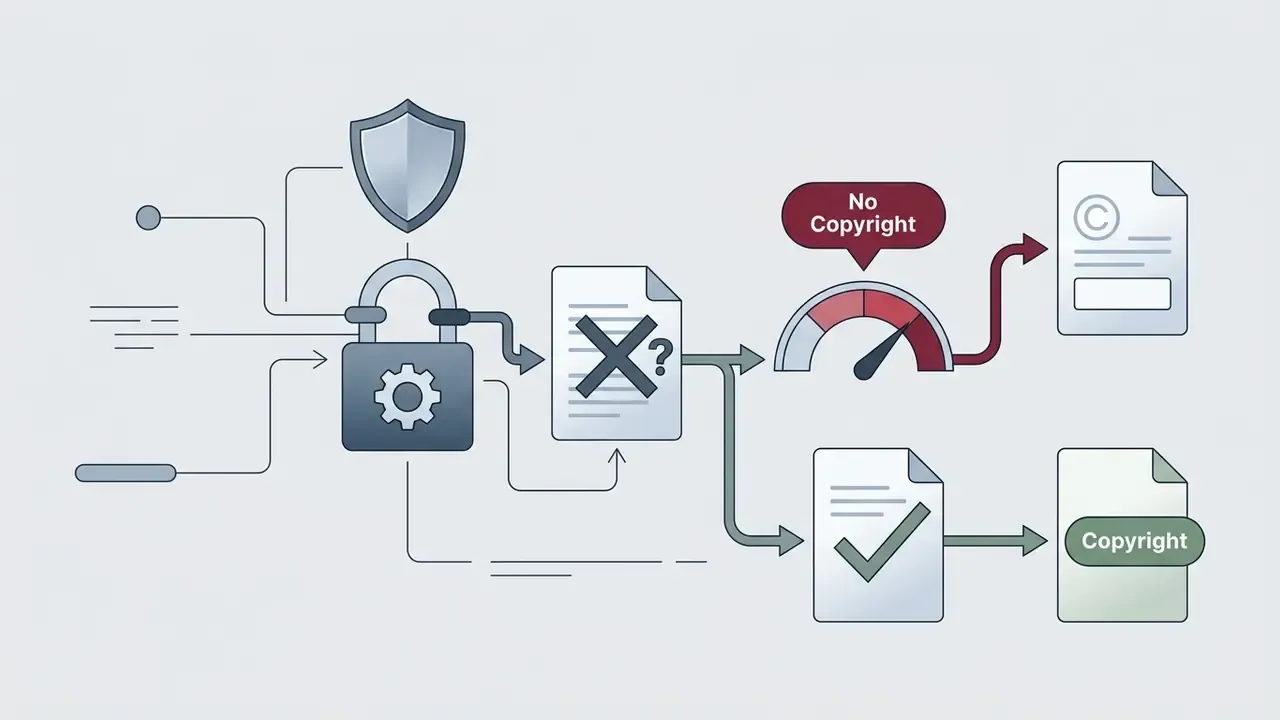
- A vendor license is not copyright.Platform Terms of Service grant contractual permission to monetize outputs; statutory copyright attaches only to human-authored expression. After the U.S. Supreme Court declined certiorari in Thaler v. Perlmutter on March 2, 2026, the human-authorship requirement is settled law in the United States.
- Indemnification is the single biggest vendor differentiator.Microsoft Copilot, Anthropic Claude, and Adobe Firefly offer IP indemnity under stated guardrails; Midjourney offers none and disclaims all IP warranties.
- Revenue thresholds are contract landmines.Any organization (or employee of an organization) grossing more than $1,000,000 in the prior calendar year must hold a Midjourney Pro ($60/mo) or Mega ($120/mo) plan to retain commercial asset rights, even if the individual seat is Basic or Standard.
- Four tiers of human modificationdetermine whether an asset is public domain or a protectable derivative work. Tier 1 (unmodified prompt output) carries zero statutory protection; Tier 4 (manual redraw using AI only as reference) is fully protectable.
- Governance must sit inside existing frameworks.Map the hub to NIST AI RMF 1.0, SR 11-7 / OCC Bulletin 2011-12 model risk expectations, and C2PA provenance metadata, then wire alerts into the enterprise GRC platform (Archer, ServiceNow).
- Disclosure becomes enforceable in the EU on August 2, 2026under EU AI Act Article 50: machine-readable marking of synthetic outputs plus deepfake labeling.
- Budget defensibly.Use a risk-adjusted ROI model that nets automation savings against control costs (legal review, moderation, provenance tooling) and expected loss avoidance from litigation, takedowns, and reputational events.
How to Use This Business Guide
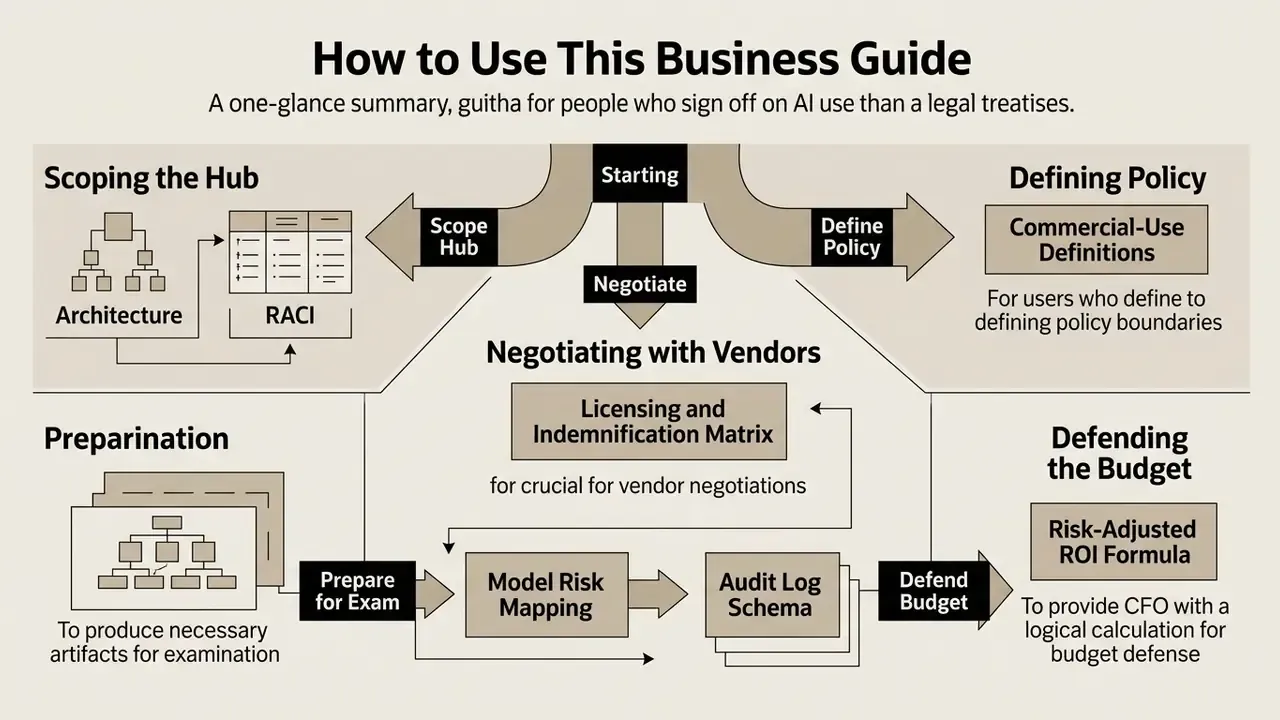
This is a working reference for people who sign off on AI use, not a legal treatise. Read it in the order your decision requires.
- If you are scoping the hub itself, start with the architecture and RACI sections. They answer the question of who owns which decision before a single asset is published.
- If you are defining policy boundaries, go to the commercial-use definitions. Most disputes we see in draft policies come from one gap: teams assume "internal" means "non-commercial." It usually does not.
- If you are negotiating with vendors, the licensing and indemnification matrix is the practical core. Read it next to your own contract abstracts.
- If you are preparing for examination, the model risk mapping and audit log schema produce the artifacts examiners request by name.
- If you are defending the budget, the risk-adjusted ROI section gives the CFO a formula rather than a slogan.
Scope note. Statements about audience needs in this guide are working hypotheses until confirmed by analytics, interviews, CRM data, or verified customer research. Where evidence is incomplete, we say so plainly instead of rounding uncertainty into confidence.
What an AI Media Commercial-Use Hub Includes for Enterprise Business
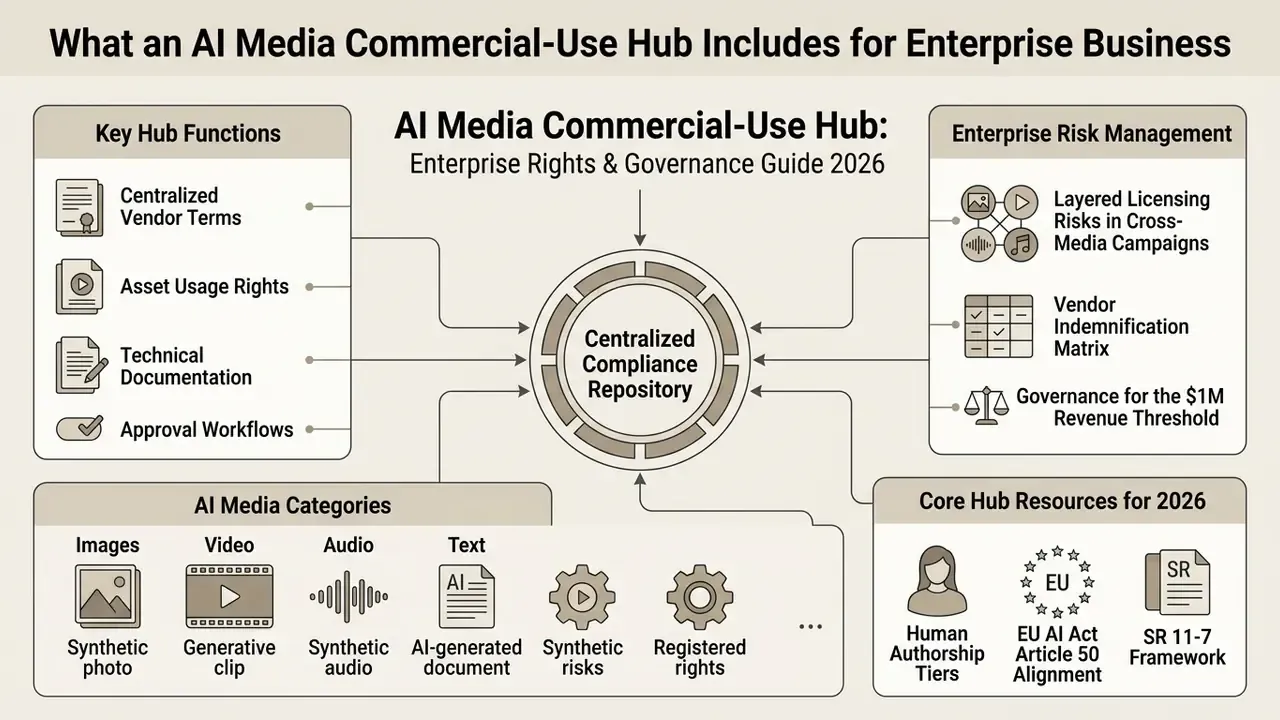
An AI Media Commercial-Use Hub is a centralized compliance repository that unifies vendor platform terms, asset usage rights, technical documentation, and approval workflows. It converts fragmented AI adoption into an auditable enterprise asset management system across text, visual, audio, and video outputs.
Organizing digital assets through a single governance layer helps companies manage contractual obligations and legal risks. According to Japan's AI Guidelines for Business Ver1.2 (2026), enterprise users remain fully responsible for downstream output deployment and must maintain transparent documentation when AI outputs influence commercial decisions. Centralization also suppresses shadow AI use and aligns cross-departmental operations with corporate risk tolerances.
«Purely autonomous AI outputs whose expressive elements are determined by a machine are not protected by copyright; legal protection remains anchored in meaningful human contribution.»
«For financial institutions and regulated enterprises, we recommend treating every AI-generated asset as a model output: log the generating tool, version, prompt, and any human modifications. This creates an audit trail that satisfies both internal compliance teams and external regulators.» HypeArt Editorial Team (source: Superbase / editorial guidance)
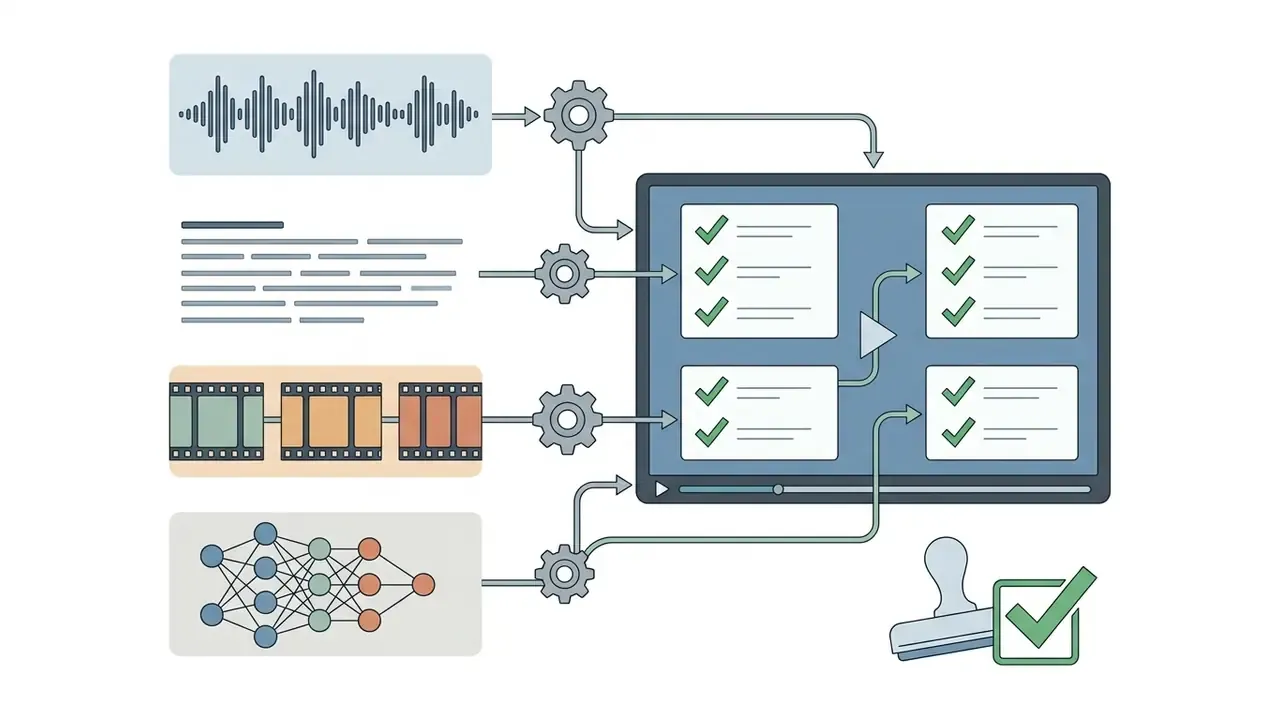
AI Media Categories: Images, Video, Audio, and Text
Different media categories carry distinct copyright, privacy, and licensing considerations that demand tailored operational controls. Categorizing outputs by format ensures that legal review protocols reflect the specific risk profile of each digital asset type.
- Synthetic Images Visual outputs present elevated risks regarding trademark infringement, trade dress duplication, and unauthorized likeness replication. Evaluating vendor terms with a structured Commercial-Use AI Tools matrix helps teams verify image licensing constraints before publishing, and reviewing AI image generators for commercial deployment clarifies which tiers actually convey monetization rights.
- Generative Video Audiovisual assets combine scripts, visual frames, synthesized motion, and soundtracks. Under EU AI Act Article 50 (effective August 2, 2026), synthetic video and deepfakes require machine-readable watermarking and explicit public disclosures. Benchmarking leading AI video generators against those disclosure duties should precede any production commitment.
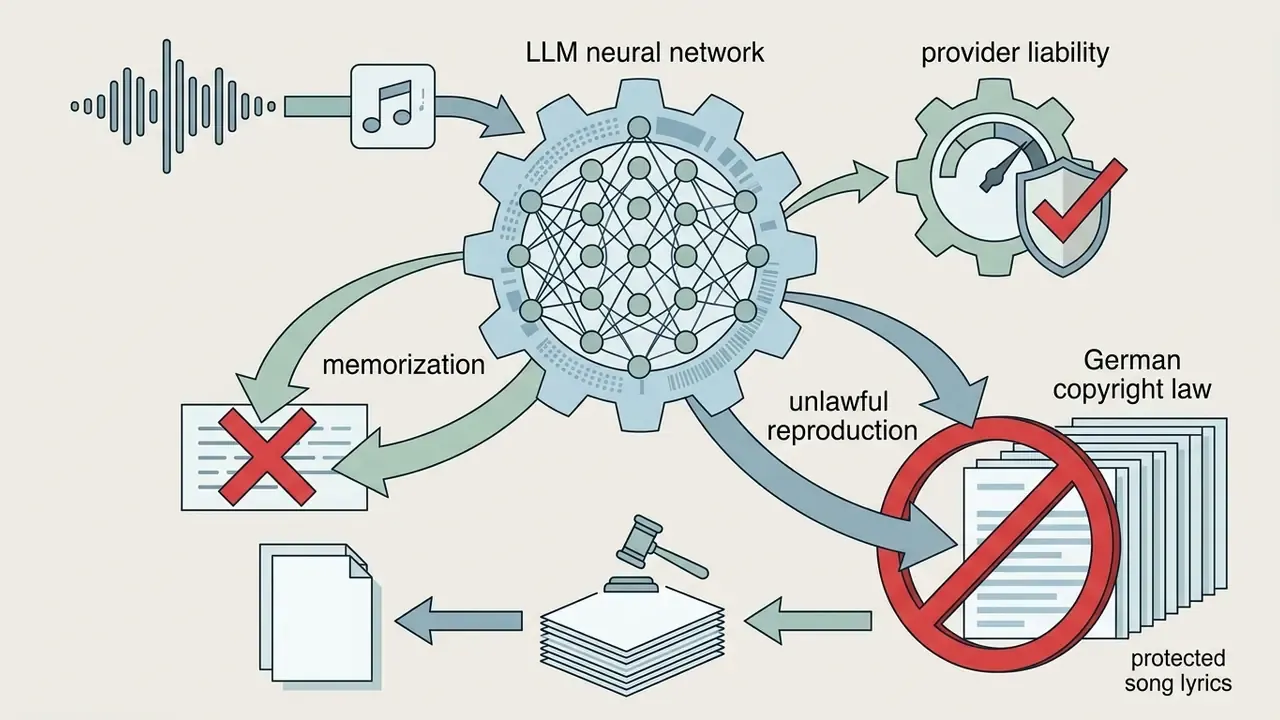
- Synthetic Audio and Music Audio outputs carry specific risks around voice emulation, personality rights, and musical memorization. Recent rulings by European courts highlight that generative audio models can memorize protected compositions, triggering copyright liability at the moment of output generation.
«The Munich I Regional Court (2025) held that memorization of song lyrics by GPT-4 and GPT-4o constitutes unlawful reproduction under German copyright law.»
- AI-Generated Text: Synthetic text and copywriting require scrutiny for factual hallucinations, training data memorization, and the absence of copyright protection. The U.S. Copyright Office explicitly excludes unedited machine-generated text from registration.
Layered Licensing Risks in Cross-Media Campaigns
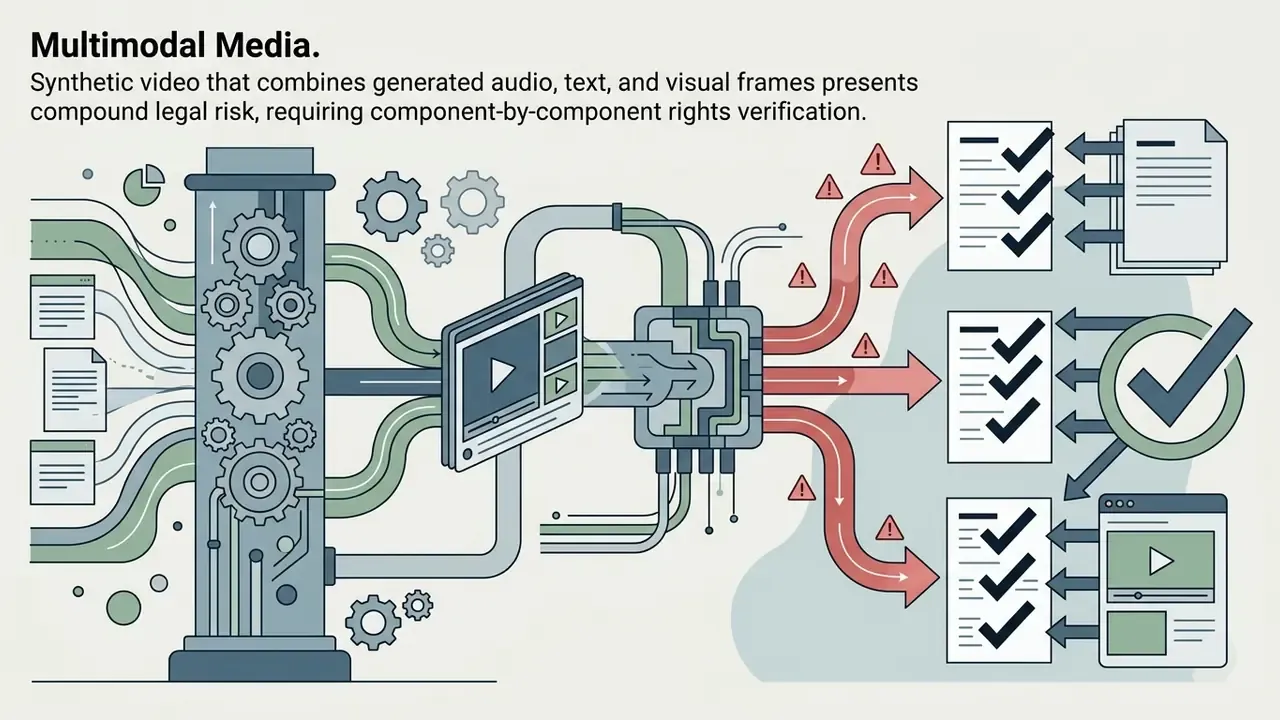
Modern marketing campaigns aggregate multiple AI outputs: an LLM-drafted script, a synthetic voiceover, generated background visuals, and AI video animation assembled into one deliverable.
Enterprise risk: each media layer operates under distinct contractual terms, revenue caps, attribution duties, and copyright thresholds. A single campaign may combine a platform offering full IP indemnification (for example, Adobe Firefly) with a voice synthesizer that grants no commercial rights on free tiers. Enterprise repositories must therefore execute Component-Level Clearing: every asset file carries an independent audit log documenting its format-specific license, subscription tier, and human-modification status before final campaign assembly. Clearing a finished video as a single object is not sufficient evidence. The composite inherits the weakest license in the stack.
Core Resources to Include in a Centralized AI Media Hub
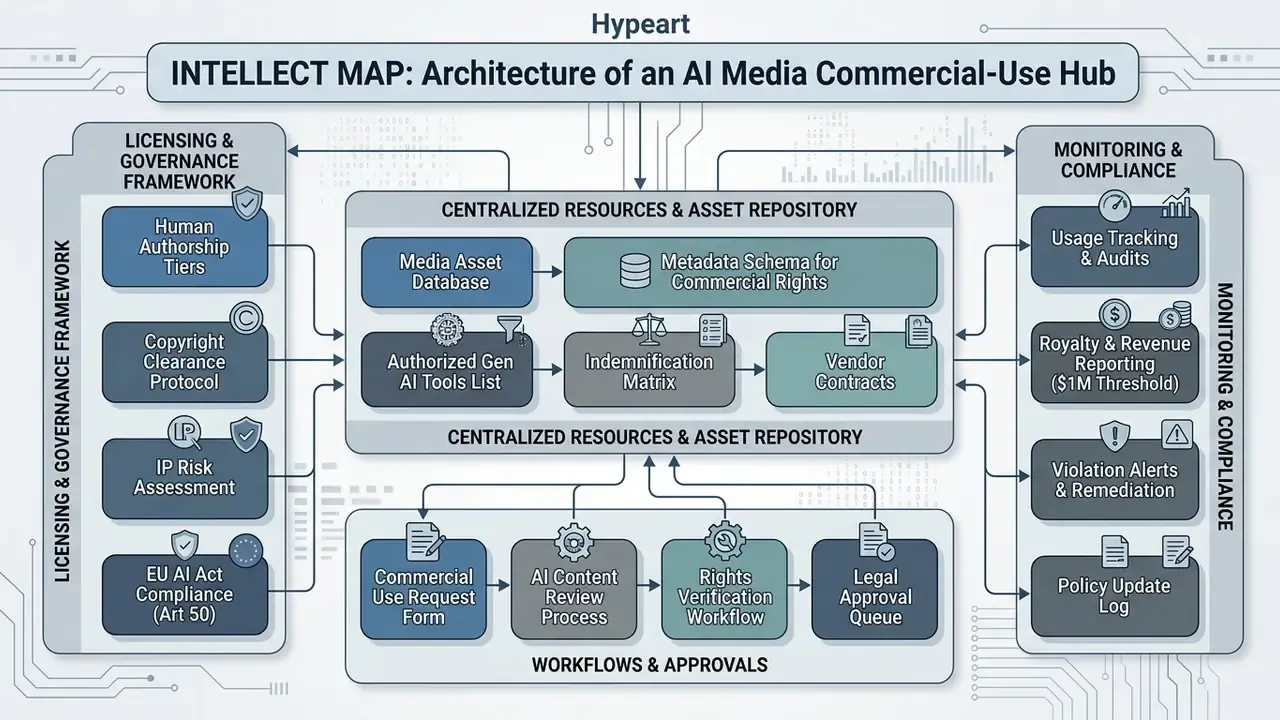
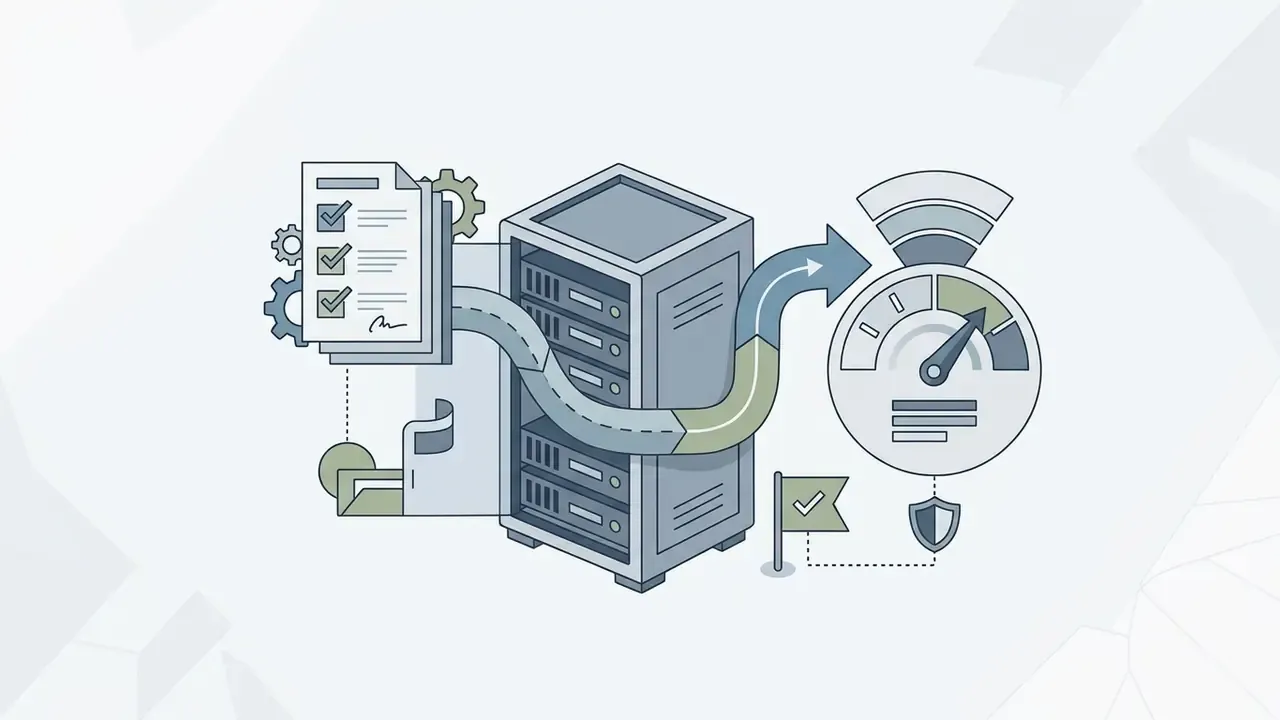
An enterprise AI media hub needs technical documentation, regulatory guidance, and operational policy frameworks working together to support auditable decisions. These resources give legal, risk, and marketing teams real-time visibility into tool capabilities and contractual boundaries.
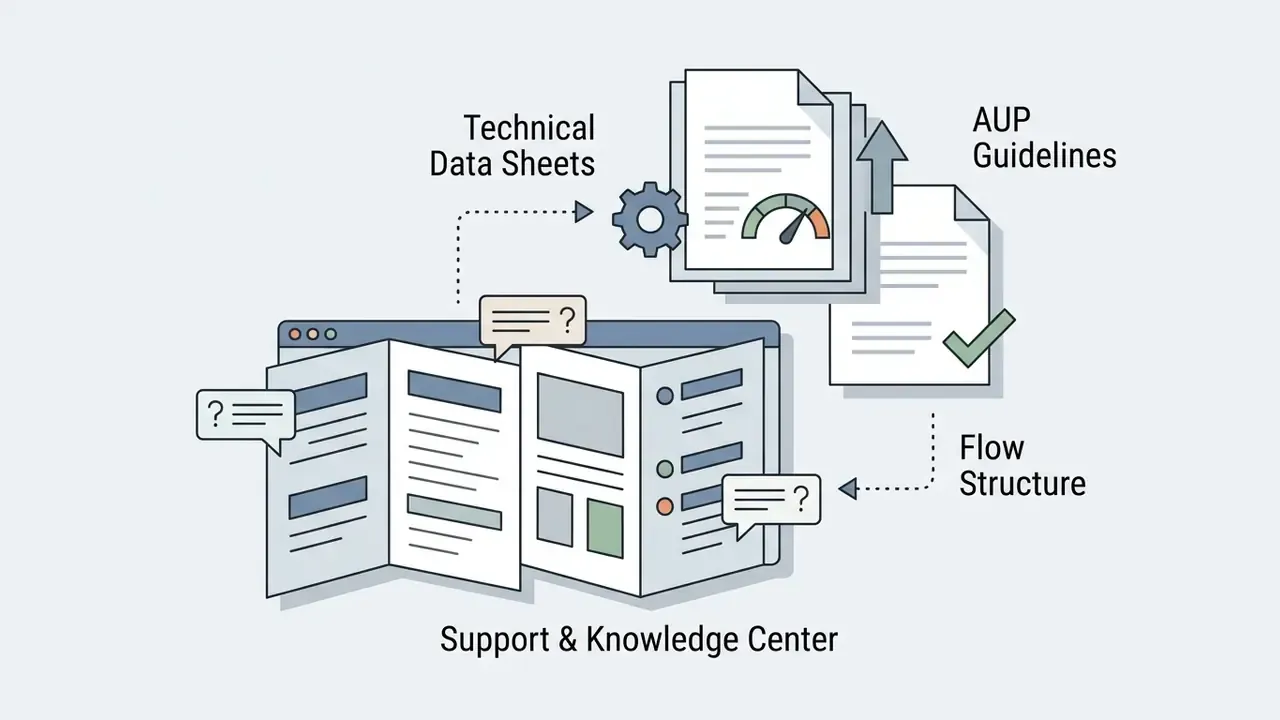
A complete hub must contain an approved vendor register covering AI art generators and their commercial-use implications, technical data sheets, usage guidelines, acceptable use policies, and escalation pathways. New Zealand's Responsible AI Guidance for Businesses (2025) stresses that tracking asset provenance and vendor licensing parameters in a central repository is essential for audit readiness and regulatory reporting.
«The AI RMF organizes risk management into four functions, Govern, Map, Measure, Manage, and calls for centralized asset inventories and continuous tracking of legal and technical risk.»
Hub Ownership: RACI Matrix and Shadow AI Escalation
Centralized repositories fail when accountability is diffuse. Assign decision rights before deployment and you avoid two familiar failure modes: stalled approvals and unlogged asset publication.
| Activity | Responsible | Accountable | Consulted | Informed |
|---|---|---|---|---|
| Vendor ToS intake & licensing audit | Procurement / Vendor Management | Chief Compliance Officer | Legal (IP), Information Security | Business Owners |
| AI media risk tiering (Tier 1/2/3) | Model Risk Management | Chief Risk Officer | Legal, Data Privacy | Internal Audit |
| Human-authorship documentation | Creative / Content Operations | Business Owner (Marketing, Product) | Legal (IP) | MRM, Internal Audit |
| Provenance metadata & C2PA logging | AI Platform Engineering | Head of AI Governance | Information Security, DAM Owner | Internal Audit |
| Pre-publication clearance sign-off | Legal Review Desk | Chief Compliance Officer | Brand Safety, Privacy | CRO, CMO |
| Shadow AI detection & escalation | Information Security (CASB/DLP) | Chief Information Security Officer | MRM, HR, Legal | CRO, Internal Audit |
| Regulatory disclosure (EU AI Act Art. 50) | Compliance Operations | Chief Compliance Officer | Legal, Marketing Ops | Regulatory Reporting |
Shadow AI escalation path: detection (DLP or CASB alert on an unapproved generative endpoint) → asset quarantine in the DAM → five business days for licensing and authorship reconstruction → tiering decision by MRM → remediation (regenerate on an approved tier, apply Tier 3 modification, or withdraw) → issue logged in the GRC platform with an owner and a due date.
Defining Commercial Use for AI-Generated Content
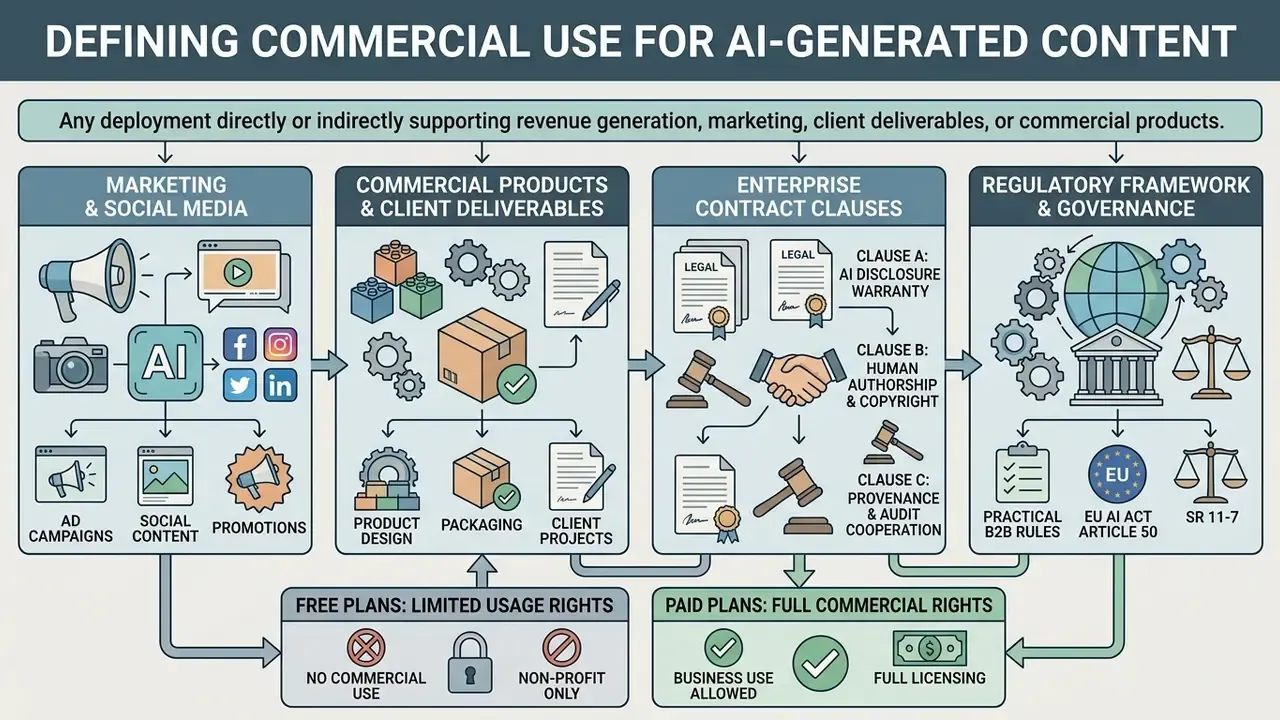
Commercial use of AI-generated content includes any deployment that directly or indirectly supports revenue generation, marketing, client deliverables, or commercial product development. Distinguishing personal, research, and commercial applications is necessary to prevent breach-of-contract claims and copyright liabilities.
Regulators evaluate commercial context by monetary gain and business advantage, not by distribution channel alone. The U.S. Copyright Office Notice of Inquiry on AI and Copyright (2023–2026) notes that commercial deployment by downstream business entities shifts liability assessments, which makes vendor licensing compliance an operational prerequisite rather than a legal nicety.
«Regulatory materials distinguish private from commercial use, but the boundary is porous: virtually any application of AI media in marketing, products, or client work qualifies as commercial.»
Practical B2B rules of thumb for regulated enterprises. Treat the following as commercial by default, whatever the channel: paid and organic brand social media posts later repurposed as advertising; investor and annual-report graphics; customer onboarding and servicing interfaces; internal training decks that are later licensed or resold; RFP and pitch materials; product UI assets; and any asset embedded in a fee-generating client deliverable. Non-commercial exceptions are narrow: internal ideation sketches that never leave a closed workspace, plus academic or charitable use explicitly permitted by the vendor's terms.
Integrating AI Media in Commercial Products and Client Deliverables
Incorporating synthetic media into products for resale or client projects introduces contract risk around indemnification, non-infringement warranties, and intellectual property ownership. Client agreements routinely demand explicit warranties of original authorship that pure AI outputs cannot satisfy.
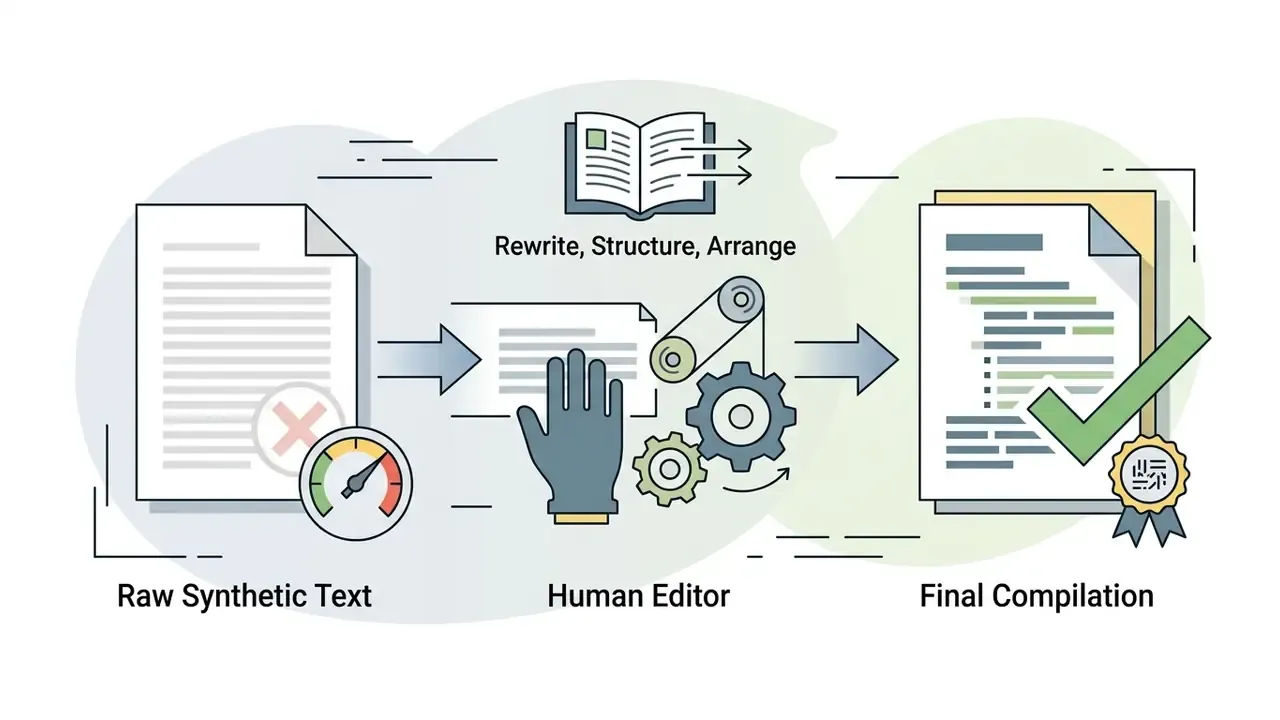
A hypothetical regional financial institution evaluated generative video for automated customer onboarding software. Its legal risk team found that while vendor terms permitted commercial deployment, the absence of underlying copyright protection exposed the institution to competitor duplication. The fix was procedural, not technical: human designers authored the visual storyboards and edited final outputs, securing human-authorship protection for the compilation as a whole.
Organizations deploying synthetic media in client deliverables need transparent approval processes. Using a vetted AI Video Generator inside approved agency workflows ensures output files retain complete generation metadata, which protects client projects from undisclosed copyright defects. A category overview of AI video generators also helps procurement compare retention and training-opt-out clauses side by side.
Standard Enterprise B2B Contract Clauses for AI Deliverables
Clause A: Agency AI Disclosure Warranty
"Contractor warrants that any synthetic media, AI-generated components, or machine-assisted assets included within Client Deliverables have been explicitly disclosed in writing. Contractor certifies that all underlying AI platform subscriptions used hold active commercial-use licenses appropriate to Client's gross-revenue tier."
Clause B: Human Authorship & Copyright Non-Infringement
"Contractor agrees that all final Deliverables subject to copyright registration shall undergo Tier 3 or Tier 4 human creative modification, as documented in the provenance log delivered with each asset. Contractor indemnifies Client against third-party copyright, trademark, and right-of-publicity claims arising from unedited platform output or training-data overlap."
Clause C: Provenance and Audit Cooperation
"Contractor shall deliver, for each AI-assisted asset, a machine-readable provenance record identifying the generating tool, model version, prompt text or prompt hash, subscription tier, and the nature of human modification, and shall cooperate with Client's internal audit or regulatory examination requests for a period of five (5) years."
Free vs. Paid Plans: Discrepancies in Commercial Usage Rights
Commercial rights granted by AI platform vendors vary sharply by subscription tier, annual corporate revenue, and pricing structure. Organizations cannot assume that rights granted under paid tiers apply retroactively to content generated during a free trial.
Midjourney's terms grant commercial usage rights exclusively to paid subscribers, while restricting free AI image generator trial generations to non-commercial use under a CC BY-NC 4.0 license. Midjourney also requires enterprise entities generating over $1,000,000 in gross annual revenue to purchase specific high-tier plans to secure commercial rights. OpenAI, by contrast, grants identical commercial exploitation rights for DALL·E outputs across free and paid API tiers. Same technology category, opposite contract logic. That is exactly why platform-specific audits are not optional.
Midjourney Tier Thresholds at a Glance (Terms of Service v. 2026, Section 4)
| Plan | Monthly Price | Commercial Rights | Applies To | Critical Condition |
|---|---|---|---|---|
| Free / Trial | $0 | None (CC BY-NC 4.0) | Experimentation only | Any monetized use breaches both the ToS and the CC license |
| Basic | $10 | Yes | Freelancers, solopreneurs, teams under $1M gross revenue | Insufficient once the employing entity crosses $1M |
| Standard | $30 | Yes | Small agencies and startups under $1M | Same $1M ceiling applies |
| Pro | $60 | Yes | Entities (and employees of entities) grossing over $1,000,000 in the prior calendar year | Mandatory tier; measured on gross revenue of the whole corporate entity, not profit |
| Mega | $120 | Yes | High-volume enterprise generation over the $1M threshold | Adds throughput capacity, not additional legal protection |
The threshold is entity-level, not seat-level. A designer employed by a $5M-revenue agency cannot rely on a personal Basic subscription. Organizations crossing $1M mid-term should upgrade proactively to preserve license continuity for assets already in market.
«Free-tier AI tools are a legitimate starting point for experimentation, but they are not a commercial deployment strategy. Any asset destined for commercial use must be generated on a verified paid plan, with the subscription tier and commercial rights documented in the asset metadata.»
«Licensing models for training data and outputs differ substantially: rightsholders may permit non-commercial use while prohibiting commercial exploitation or redistribution.» EUIPO, Study on Generative AI from a Copyright Perspective (2025). https://euipo.europa.eu/tunnel-web/secure/webdav/guest/document_library/observatory/documents/reports/2025_GenAI_from_copyright_perspective/2025_GenAI_from_copyright_perspective_FullR_en.pdf
Usage Rights, Ownership, and Licensing: Navigating AI Platform Terms
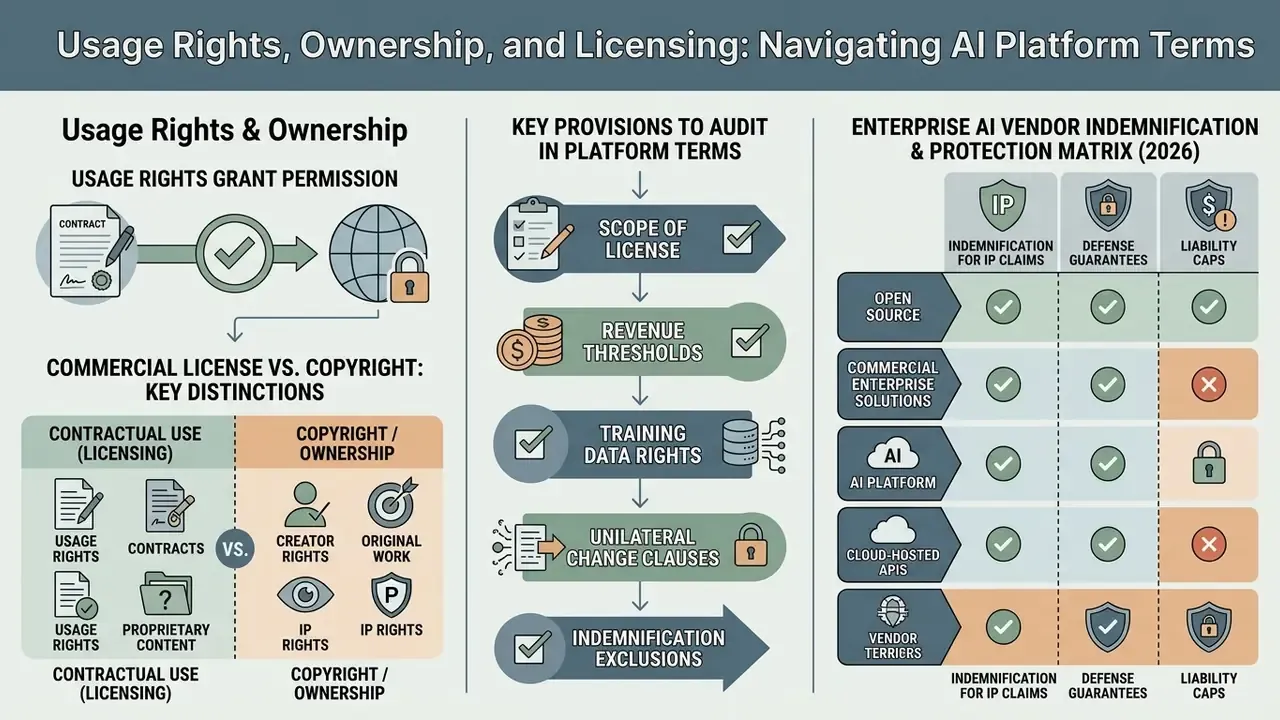
Usage rights grant contractual permission to use a service. Copyright ownership is a statutory property right reserved for human creative expression under federal law. Enterprise risk managers must evaluate the two separately, because a strong contract cannot manufacture a property right that the statute withholds.
Platform Terms of Service form a private contract between vendor and enterprise user. OpenAI's terms assign output rights to the user, yet that contractual assignment does not guarantee the output qualifies for federal copyright protection under U.S. law (U.S. Copyright Office Registration Guidance, 2023).
Commercial License vs. Copyright: Critical Legal Distinctions
«A license granted by an AI platform is contractual permission to use outputs; it does not create copyright in those outputs, particularly where human authorship is insufficient.»
So a vendor license shields a company from vendor claims. It does nothing to stop competitors from copying unprotected synthetic elements straight out of a public campaign.
Key Provisions to Audit in Platform Terms of Service
Legal and procurement teams should audit vendor agreements against a standardized framework before approving deployment. Five contractual areas carry most of the risk:
- Scope of LicenseVerify whether the grant is non-exclusive, global, sublicensing-eligible, and explicitly authorized for commercial deployment.
- Revenue ThresholdsIdentify gross corporate revenue caps that trigger mandatory enterprise tier upgrades.
- Training Data RightsConfirm whether the vendor retains rights to process customer prompts and generated outputs to train foundation models.
«The AI RMF emphasizes documenting the AI systems in use, the data involved, and contractual constraints, integrating that information into lifecycle risk management.»
- Unilateral Change ClausesEvaluate clauses governing terms modifications, required advance notice windows, and opt-out mechanisms.
- Indemnification ExclusionsAudit vendor IP infringement indemnities for exclusions tied to output similarity with pre-existing works.
Enterprise AI Vendor Indemnification & Protection Matrix (2026)
| Platform / Vendor | IP Infringement Indemnification | Commercial Use Rights | Revenue Threshold Restrictions | Key Enterprise Exclusions |
|---|---|---|---|---|
| Microsoft Copilot / Enterprise | Full IP indemnity (covers output claims where guardrails are followed) | Included in commercial tiers | Enterprise contract required | User must not intentionally prompt for infringing material |
| Anthropic (Claude Enterprise) | Full IP indemnity | Included in paid / enterprise tiers | Custom tiering | Excludes modified outputs and third-party datasets |
| OpenAI (ChatGPT Enterprise / API) | Limited indemnity (Business/Enterprise only) | Included across paid and API tiers | Not applicable | Excludes cases where the user had notice of infringement |
| Midjourney | Zero indemnification | Paid subscribers only | $1,000,000 gross revenue cap (Pro/Mega required) | Absolute disclaimer of IP warranties and legal defense |
| Adobe Firefly | Full IP indemnity (uncapped for enterprise) | Included in commercial plans | Metered credits | Covers only outputs from Adobe-Stock-trained models |
How to read the matrix. Indemnity is conditional, never absolute. Every covered vendor requires the enterprise to keep platform safety filters enabled, avoid prompting for named characters or living artists, and refrain from deploying outputs the user knows to be infringing. Where indemnity is absent, residual risk transfers entirely to the enterprise balance sheet, which is precisely the scenario a model risk committee must price before approving production use. A side-by-side read of Midjourney versus competing image generators is a useful supplement when the deciding factor is legal exposure rather than output style.
Copyright Eligibility and Human Authorship Standards
Why Human Creative Contribution Dictates Copyrightability
The Copyright Office requires applicants to identify AI-generated content within registration applications and limit claims strictly to human-authored contributions. Simple text prompting does not supply the creative control required for ownership.
The USCO Copyrightability Report (2025) compares text prompts to instructions given to a commissioned artist. Because the generative model determines visual or textual detail, the prompter does not exercise direct creative control over the final expression.
«Copyright extends only to those parts of a work over which a human exercised creative control of expressive elements, through selection, coordination, arrangement, or modification of AI outputs.»
Copyright attaches only when a human author makes creative modifications, edits, or selection and arrangement decisions that shape the final output.
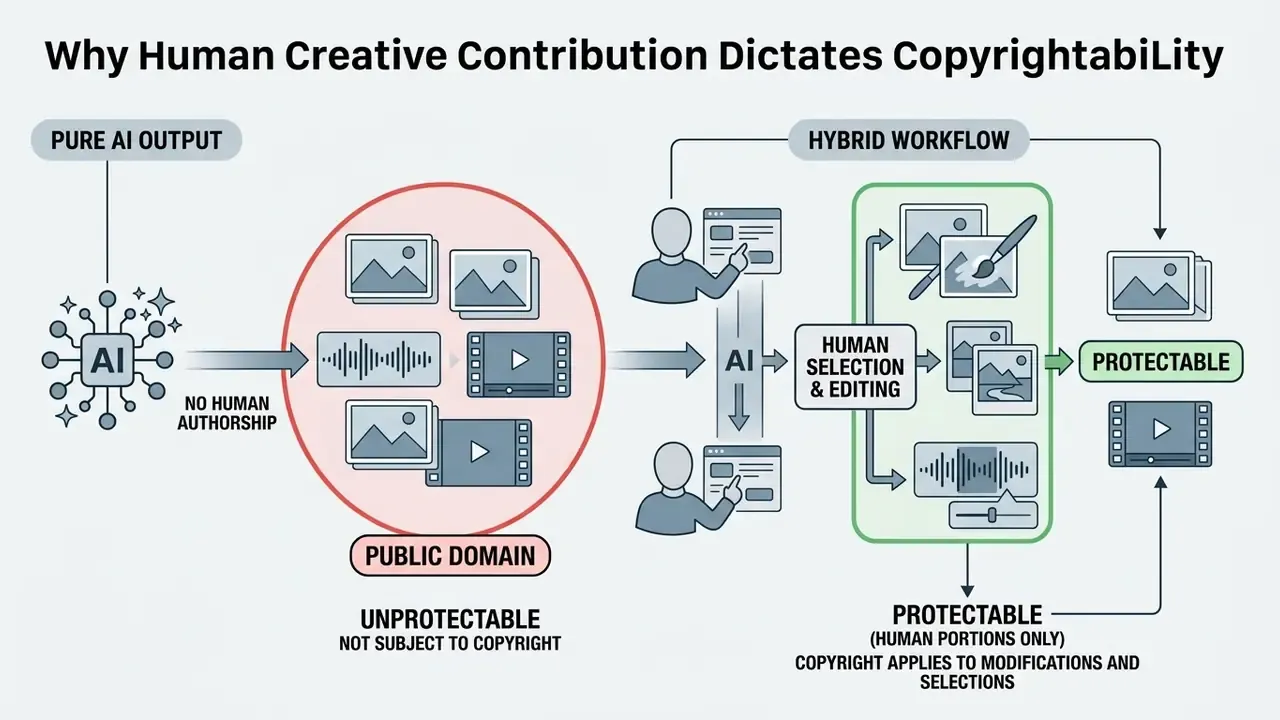
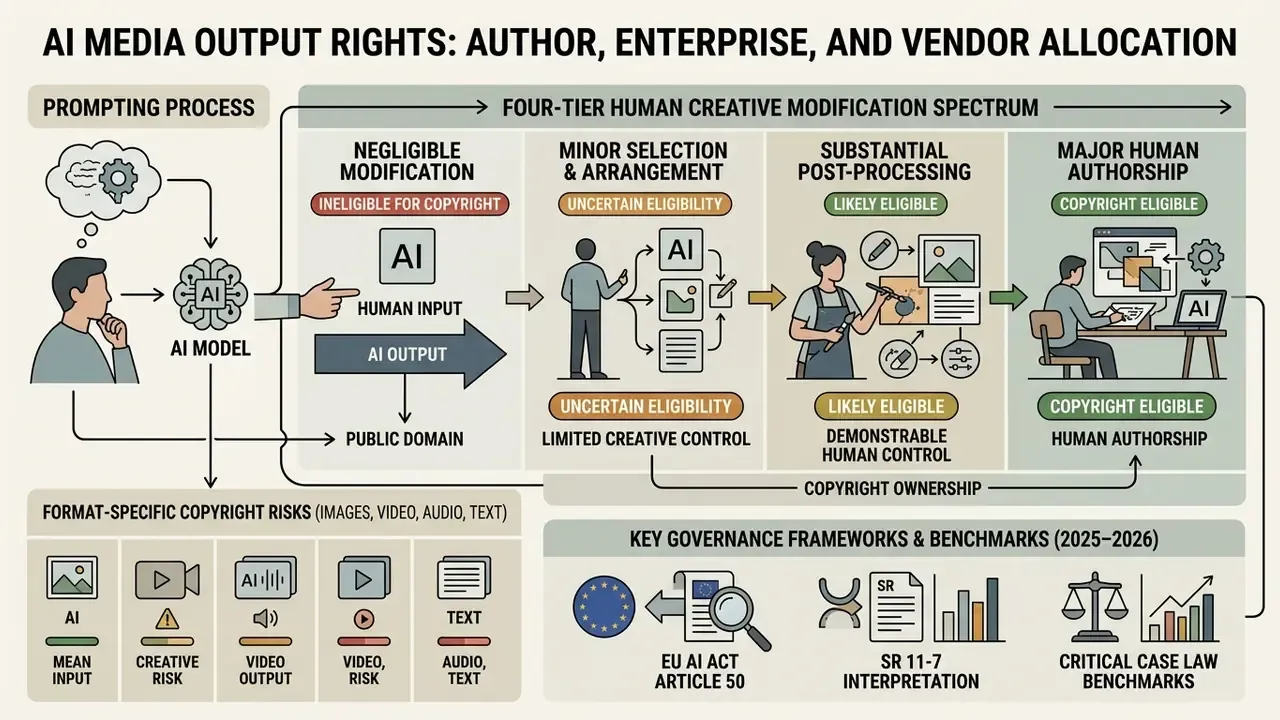
The Four-Tier Human Creative Modification Spectrum
To transform unprotectable AI outputs into copyrightable derivative works, creative teams should apply demonstrable human authorship according to this structured workflow, and record which tier each asset reached.
| Tier | Action | Typical Tooling | Protection Status |
|---|---|---|---|
| Tier 1: Unmodified Output | Direct prompt generation with no manual post-processing | Midjourney, DALL·E, Firefly (raw export) | Zero statutory protection. Contractual usage only; competitors may lawfully copy |
| Tier 2: Basic Post-Processing | Colour grading, cropping, global style filters | Lightroom, in-app editors, AI image enhancers | Weak. Protection limited to novel, non-de-minimis visual edits |
| Tier 3: Substantial Hybrid Composition | Multi-image compositing, manual repainting of elements, custom vector overlays, AI layers combined with human typography | Photoshop, Illustrator, Figma | Protectable derivative work. Copyright attaches to the human modifications and arrangement |
| Tier 4: AI-Assisted Manual Illustration | AI output used solely as concept sketch or pose reference, followed by a complete manual redraw | Illustrator, Procreate, traditional media | Fully protectable. Final output is an original human work; AI served as an unprotectable ideation tool |
Operational rule for regulated enterprises: any asset destined for a public-facing campaign, a client deliverable, or a trademark application should clear Tier 3 or higher, with the editing history captured in the provenance log. Tier 1 and Tier 2 assets may be used internally or as disposable performance-test creative. They should never be treated as defensible brand property.
Format-Specific Copyright Risks Across Images, Video, Audio, and Text
Different media formats present distinct challenges around copyrightability, substantial similarity, and infringement liability:
- Visual Images: The Guangzhou Internet Court (2024) ruled that an AI service provider infringed copyright when its system generated images retaining the original expression of protected artwork. Prompts referencing specific artists raise infringement risk sharply, which is why pre-publication screening with AI image detectors belongs in the clearance workflow.
«The court ordered the provider to cease the infringement and adopt technical measures, notably keyword filtering, to prevent generation of images substantially similar to protected works.»
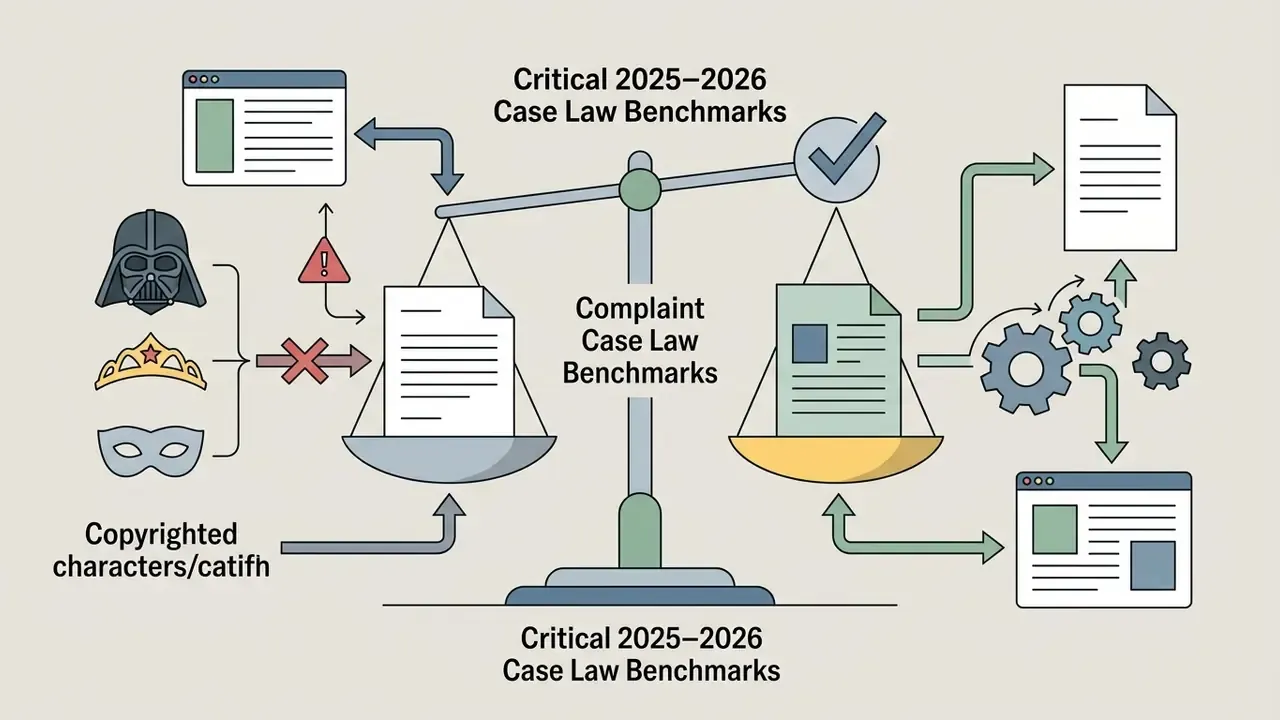
Critical 2025–2026 Case Law Benchmarks
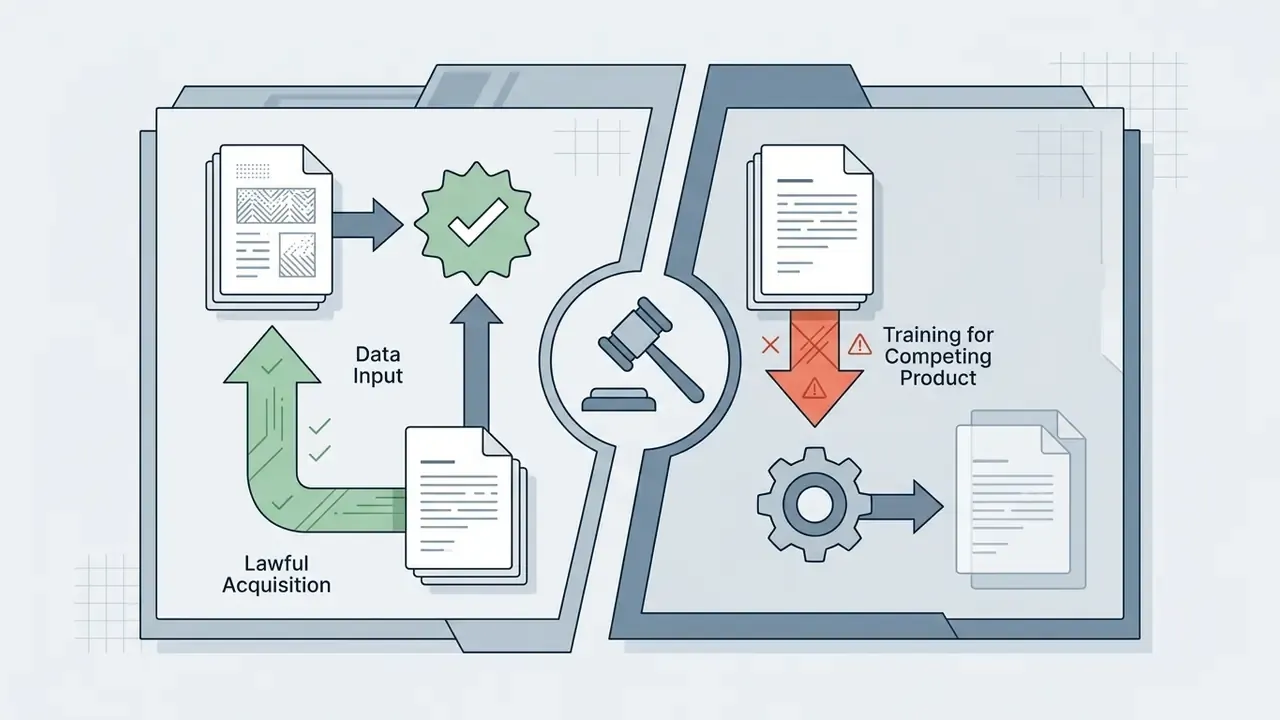
- Bartz v. Anthropic ($1.5B settlement, reached August 2025; preliminary approval September 2025): The largest U.S. copyright settlement on record. Anthropic agreed to pay at least $1.5 billion to compensate roughly 500,000 eligible pirated works, at an expected payment above $3,000 per work. The settlement grants no forward-looking training license, which establishes that pre-training data acquisition carries direct financial exposure.
Global Jurisdictional Divergence: US, EU, UK, and China Frameworks
National frameworks approach AI content, copyrightability, and platform governance through distinct mechanisms:
- United States (USCO) Focuses strictly on human authorship. Disclaims pure AI outputs while protecting human-authored selection, coordination, and arrangement (USCO Registration Guidance, 2023).
- European Union (EU AI Act) Regulation (EU) 2024/1689 enforces mandatory transparency duties from August 2, 2026. Providers must implement machine-readable marking for synthetic outputs, while deployers must label deepfakes and public-interest text. Article 53 mandates copyright compliance policies and a sufficiently detailed public summary of training content for General-Purpose AI models.
- United Kingdom (CDPA 1988) Section 9(3) retains a statutory category for "computer-generated works," granting 50-year protection to the person who undertakes the arrangements necessary for creation, though judicial review increasingly emphasizes human agency.
- China (CAC & Courts) The CAC mandates visible labeling for synthetic media. Chinese courts (Beijing Internet Court, 2023; Changshu Court, 2025) have nonetheless granted copyright protection to AI-assisted images where prompters demonstrated extensive parameter adjustment and creative iteration.
«Comparative analysis across 2026 shows that no major jurisdiction recognizes AI systems as authors; legal attribution remains tied to human control, originality, and creative intent.»
Official Regulatory Guidance Sources
- U.S. Copyright Office Registration Guidance for AI Content: https://www.copyright.gov/ai/ai_policy_guidance.pdf
- U.S. Copyright Office AI Report Part 2 (Copyrightability): https://www.copyright.gov/ai/Copyright-and-Artificial-Intelligence-Part-2-Copyrightability-Report.pdf
- EU AI Act Official Text (Regulation EU 2024/1689): https://eur-lex.europa.eu/legal-content/EN/TXT/?uri=CELEX:32024R1689
- UK Copyright, Designs and Patents Act 1988 (Section 9): https://www.legislation.gov.uk/ukpga/1988/48/section/9
- NIST AI Risk Management Framework (AI RMF 1.0): https://doi.org/10.6028/NIST.AI.100-1
- U.S. Copyright Office Registration Guidance for AI Content:
- - U.S. Copyright Office Registration Guidance for AI Content:
- U.S. Copyright Office AI Report Part 2 (Copyrightability):
- - U.S. Copyright Office AI Report Part 2 (Copyrightability):
- EU AI Act Official Text (Regulation EU 2024/1689):
- - EU AI Act Official Text (Regulation EU 2024/1689):
- UK Copyright, Designs and Patents Act 1988 (Section 9):
- - UK Copyright, Designs and Patents Act 1988 (Section 9):
- NIST AI Risk Management Framework (AI RMF 1.0):
- - NIST AI Risk Management Framework (AI RMF 1.0):
Legal Requirements and Operational Risks in Deploying AI Media
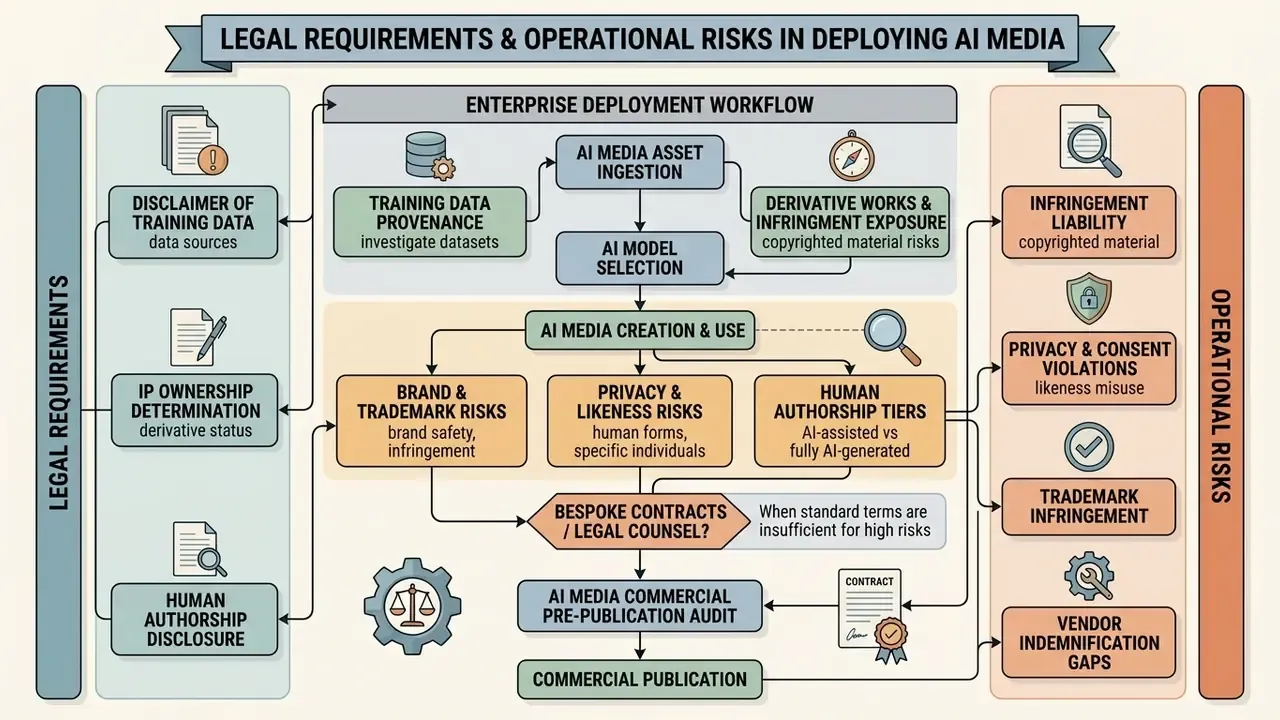
Operational risk in synthetic media deployment comes from four recurring sources: training data infringement claims, unauthorized use of personal likenesses, trademark dilution, and non-compliance with regional transparency mandates. Pre-publication review protocols exist to catch these defects before release, not after.
Deploying synthetic assets without rights clearance exposes an organization directly. Case law shows courts holding corporate users accountable when assets closely replicate copyrighted works or protected brand identifiers.
Training Data Provenance, Derivative Works, and Infringement Exposure
Training generative models on protected works involves making digital copies, which raises fair use and reproduction questions. If a model output retains memorized protected expression, downstream deployment can itself constitute infringement.
In Ross Intelligence (2025), the court determined that using proprietary headnotes to train a legal AI model was not protected by fair use. U.S. decisions involving Anthropic distinguished between training on lawfully acquired books and training on unauthorized pirated databases, a distinction quantified by the $1.5 billion Bartz v. Anthropic settlement (reached August 2025, preliminary approval September 2025), which compensated roughly 500,000 pirated works at over $3,000 each. Source-data legality therefore drives both infringement risk and settlement exposure.
«Existing text-and-data-mining exceptions were not designed for generative AI and may not cover commercial model training, potentially requiring explicit rightsholder permission.»
Enterprise implication: vendor due-diligence questionnaires should request the provider's training-data provenance summary (required for GPAI models under EU AI Act Article 53), documented opt-out honoring, and confirmation of whether outputs are filtered for memorized expression.
Privacy, Likeness, Brand Protection, and Trademark Risks
Generating synthetic media that incorporates real personal likenesses or registered brand elements creates significant liability outside copyright law entirely. Name, Image, and Likeness rights protect individuals from unauthorized commercial exploitation.
The USPTO (2026) confirmed that personal likenesses and unique voice signatures can receive trademark protection when used for commercial endorsements. Deploying synthetic media that mimics an individual's voice or appearance without formal release agreements can violate state right-of-publicity statutes and trigger federal false endorsement claims under the Lanham Act.
«AI-generated deepfakes in advertising can mislead consumers by depicting endorsements that never occurred, while personalized marketing may exploit consumer vulnerabilities, raising questions under EU consumer protection law.»
Brand-safety screening belongs before publication, not after a takedown request. Run AI reverse image search checks against registered marks, trade dress, and celebrity likenesses, then archive the negative results as clearance evidence.
When Commercial Deployment Demands Bespoke Contracts or Legal Counsel
Organizations should move from standard platform ToS to customized enterprise contracts once AI media enters high-risk commercial scenarios. Click-through agreements rarely offer adequate liability protection at enterprise scale.
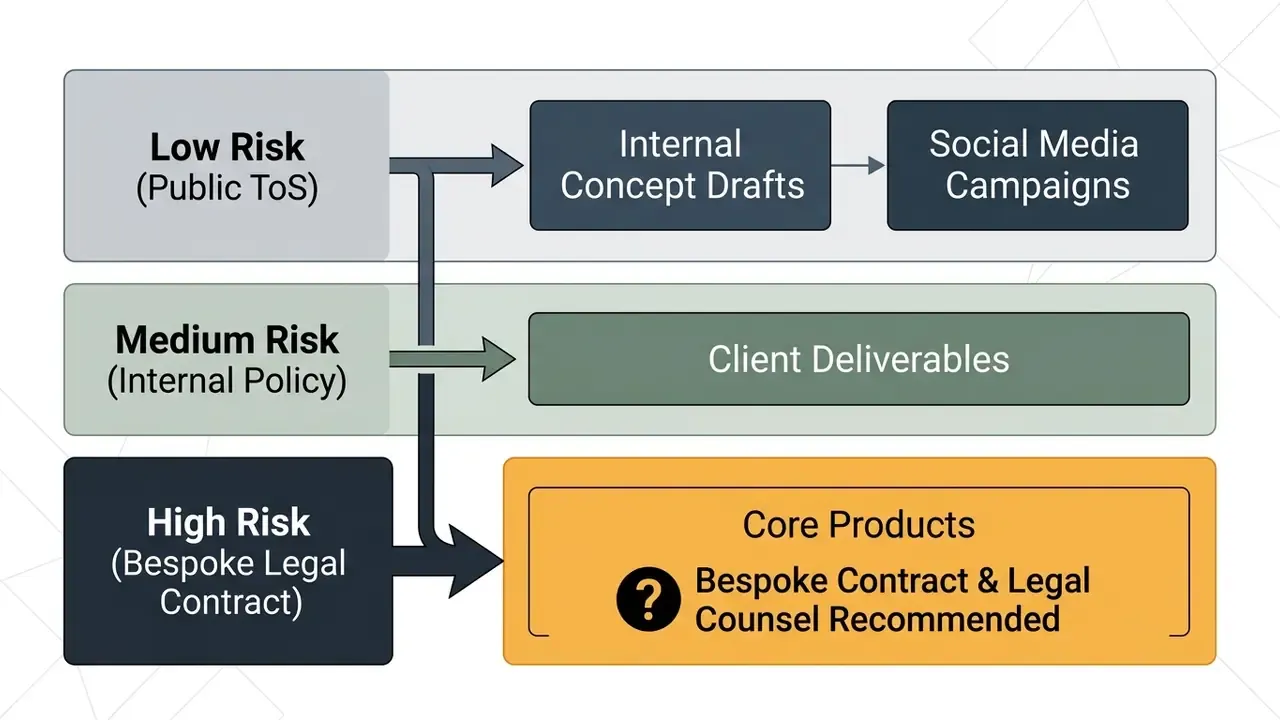
AI Media Commercial Pre-Publication Audit
Bespoke contracts and legal review become necessary when processing protected customer data, running marketing campaigns in regulated industries, licensing assets for core products, or handling high-volume client projects. UK Government AI Procurement Guidelines (2026) recommend custom contracting to establish clear warranties on IP ownership, indemnification caps, and model training opt-outs. No official source sets a numeric revenue trigger for bespoke contracting. The decision is risk-based, driven by personal-data processing, regulated-sector exposure, and customer-facing deployment.
Checklist0 / 8
Implementing Enterprise AI Media Governance and Operational Controls
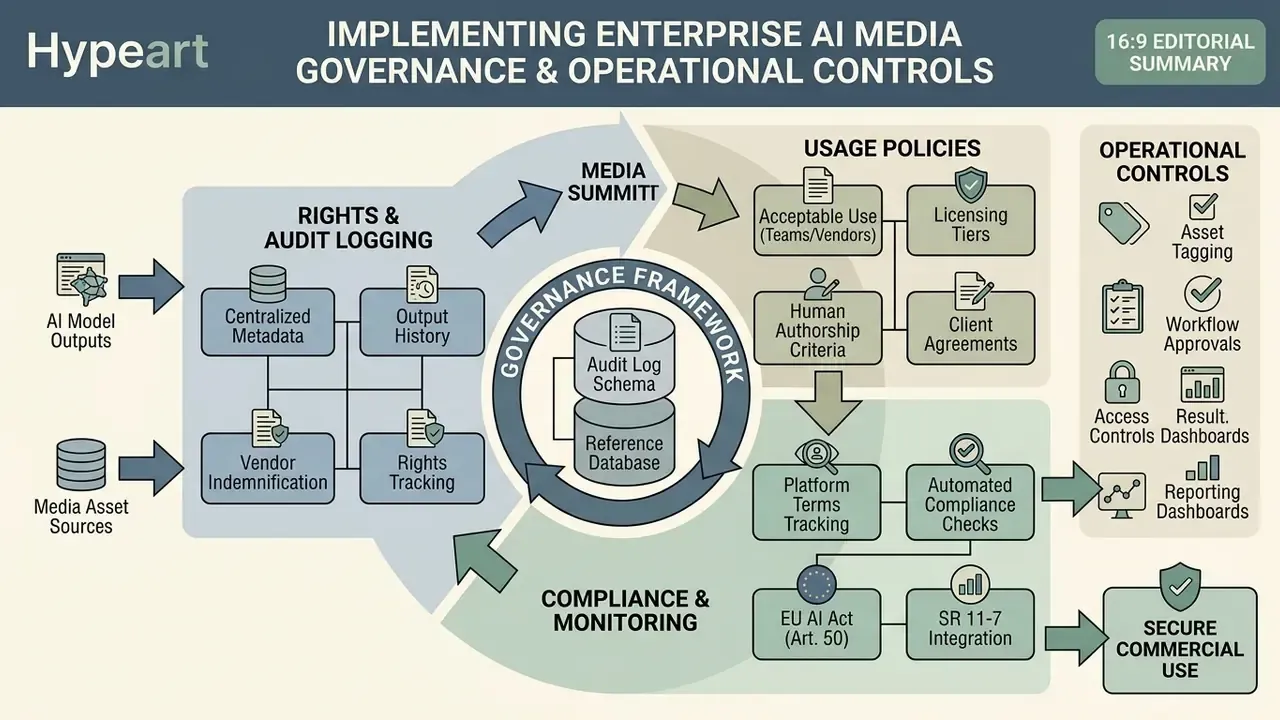
Enterprise AI media governance requires centralizing asset rights data, establishing clear usage policies, and tracking model outputs using auditable metadata. Aligning internal practice with established standards, notably the NIST AI Risk Management Framework (AI RMF 1.0), keeps compliance management systematic across the AI lifecycle.
NIST AI RMF 1.0 structures risk governance into four core functions: Govern, Map, Measure, and Manage. The NIST Generative AI Profile (2024) extends this to synthetic media, asking organizations to maintain central asset inventories and continuously track legal and technical risk.
«The AI RMF urges organizations to connect technical design aspects of AI systems to organizational values, legal obligations, and policies, documenting limitations across the lifecycle.»
Centralizing Rights Metadata and Output Generation History
Centralized metadata ties every synthetic asset to its generating prompt, platform version, licensing parameters, and human editing history. That record is what proves human authorship and answers audit requests without a scramble.
NIST SP 600-1 recommends cryptographic provenance standards such as C2PA (Coalition for Content Provenance and Authenticity) to embed immutable metadata into synthetic outputs. Enterprise repositories should log tool name, date stamp, prompt text, model version, and licensing terms alongside the asset file.
«Layered dataset documentation, from basic source URLs and timestamps to advanced fingerprinting with AcoustID or MusicBrainz, improves traceability and licensing compliance.»
«The EU AI Act's transparency requirements for synthetic media set a de facto global standard. Article 50's machine-readable watermarking obligation means enterprises need to build disclosure infrastructure into their content pipelines, not bolt it on after the fact.» HypeArt Editorial Team (source: Superbase / editorial guidance)
Reference Audit Log Schema for AI Media Assets
Auditors and examiners ask one question repeatedly: show me the record. A minimal, machine-readable schema makes that answer instant.
{
  "asset_id": "AIM-2026-08-004182",
  "business_owner": "Retail Marketing / Campaign Ops",
  "risk_tier": "Tier 2",
  "generation": {
    "tool": "Adobe Firefly",
    "model_version": "Image Model 4",
    "generated_at": "2026-08-14T09:22:41Z",
    "prompt_text_stored": true,
    "prompt_hash_sha256": "8f14e45fceea167a5a36dedd4bea2543...",
    "seed": 774193,
    "subscription_tier": "Enterprise (commercial rights: yes)"
  },
  "license": {
    "vendor_indemnification": "full_uncapped_enterprise",
    "revenue_threshold_applicable": false,
    "training_opt_out_confirmed": true,
    "tos_version_reviewed": "2026-06-30",
    "component_level_clearing": ["visual_layer", "voiceover", "music_bed"]
  },
  "human_authorship": {
    "modification_tier": 3,
    "editor": "employee_id:44219",
    "tools_used": ["Photoshop 26.2", "Illustrator 29.1"],
    "edit_description": "multi-image composite, element repaint, custom typography",
    "edit_evidence": "psd_version_history://dam/AIM-2026-08-004182"
  },
  "provenance": {
    "c2pa_manifest_id": "urn:c2pa:9d3f2b71-52aa-4c19-9d0e-77b1e2f5b8c4",
    "watermark_machine_readable": true,
    "eu_ai_act_art50_label": "applied"
  },
  "clearance": {
    "trademark_screen": "pass",
    "likeness_release": "not_applicable",
    "legal_reviewer": "employee_id:10877",
    "approved_at": "2026-08-16T15:04:00Z"
  },
  "retention": { "years": 5, "grc_issue_ref": "SNOW-AIG-3391" }
}
Structuring Acceptable Use Policies for Teams, Vendors, and Clients
An Acceptable Use Policy sets binding operational guidelines for employees, contractors, and third-party agencies using generative AI tools. Clear policies prevent unauthorized tool usage and protect confidential corporate data.
«AI risk management requires multidisciplinary participation and cannot be fully delegated to technical systems; governance structures such as AI risk committees are necessary.»
Automating Compliance Tracking and Monitoring Platform Terms
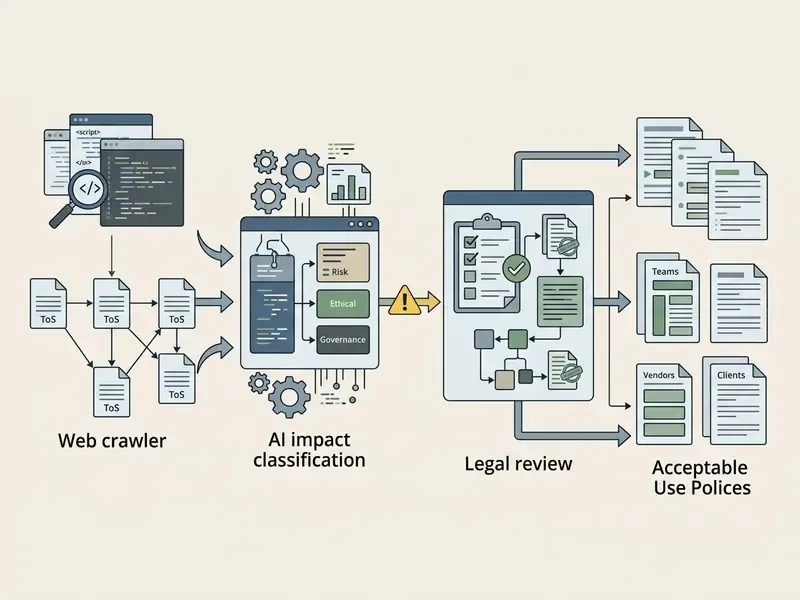
Tools such as Visualping ToS workflows, Terms Monitor, and Policy Change Radar continuously monitor vendor agreement URLs and analyze clause-level modifications. When a vendor alters commercial usage rights, introduces revenue caps, or changes model training rules, the system flags the change for legal review. Route every classified change into the GRC platform as a dated issue with an owner, so that "we did not know the terms changed" never becomes an audit finding.
Model Risk Management Integration: SR 11-7, OCC 2011-12, and GRC
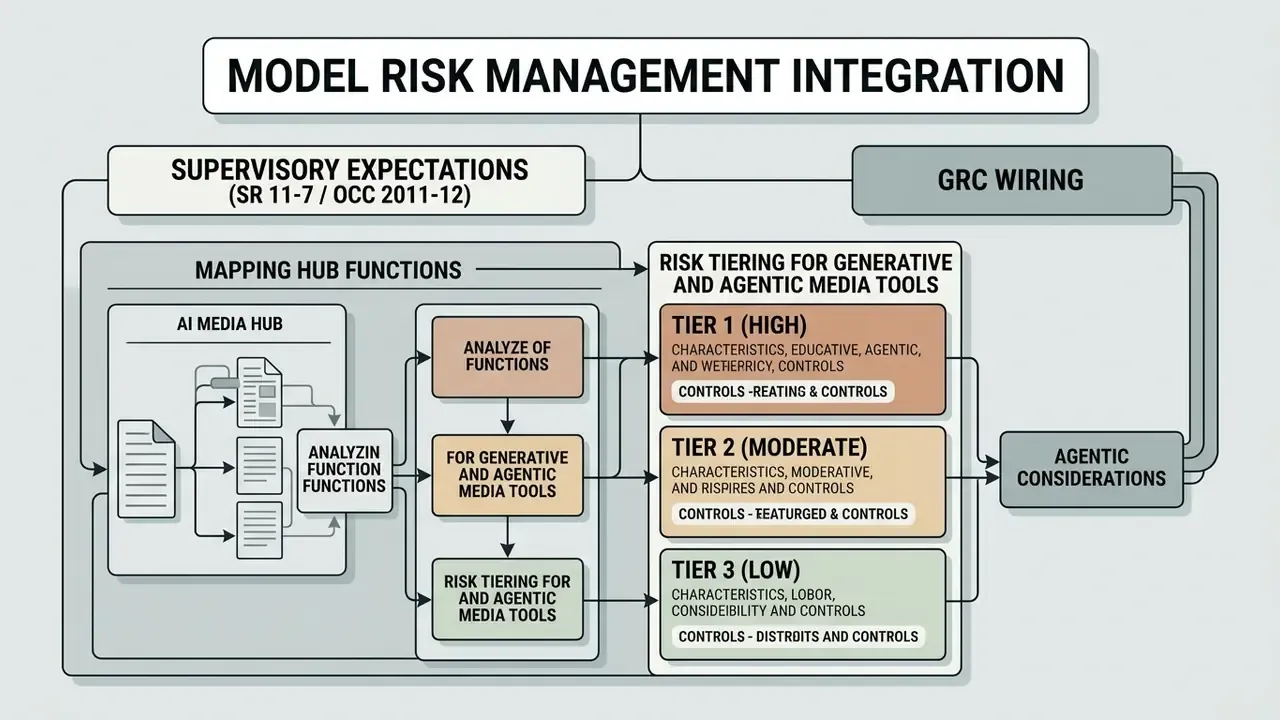
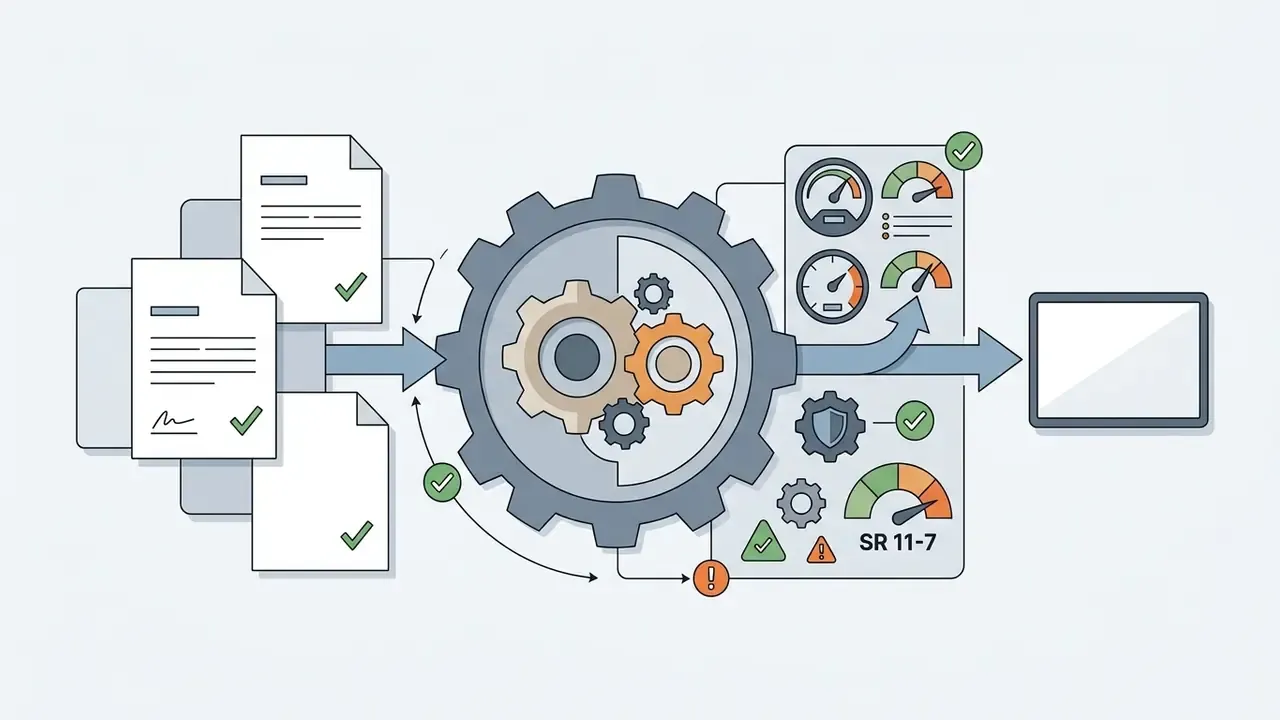
For US banks and mature fintechs, an AI media hub is defensible only when it plugs into the supervisory framework examiners already use. Federal Reserve SR 11-7 and OCC Bulletin 2011-12 set expectations for model development, implementation, validation, and governance. Generative media tools should be onboarded as third-party models or model-adjacent tools, not as marketing software that slipped through procurement.
Mapping Hub Functions to Supervisory Expectations
| Supervisory Expectation (SR 11-7 / OCC 2011-12) | AI Media Hub Control | Evidence Produced |
|---|---|---|
| Model inventory completeness | Central asset and tool registry covering every approved generative platform, tier, and business use case | Inventory extract with owners, tiers, and last review dates |
| Documentation of design, data, and limitations | Vendor technical data sheets, training-data provenance summaries, licensing terms, known failure modes | Vendor due-diligence file per platform |
| Independent validation and effective challenge | MRM review of output-similarity testing, memorization screening, and human-authorship sufficiency | Validation memo with findings and conditions of use |
| Ongoing monitoring | Automated ToS change detection, provenance completeness metrics, clearance exception rates | Monthly monitoring dashboard |
| Third-party and vendor model oversight | Indemnification matrix, exit and substitution plan, data-retention confirmation | Third-party risk assessment and contract abstract |
| Governance, policies, and controls | AUP, RACI matrix, escalation path, board or committee reporting cadence | Committee minutes and policy attestation |
Risk Tiering for Generative and Agentic Media Tools
- Tier 1 (High). Customer-facing outputs that influence financial decisions, disclosures, or identity representation: synthetic advisors, onboarding narration, product explainers, regulated advertising. Requires independent validation, a bespoke contract, Tier 3+ human modification, full provenance logging, and named legal sign-off per campaign.
- Tier 2 (Moderate). Brand marketing, social creative, event and recruitment assets. Requires an approved tier subscription, standardized clearance checklist, provenance logging, and quarterly sampling by MRM.
- Tier 3 (Low). Internal ideation, wireframes, non-published drafts. Requires approved-tool usage and data-class restrictions only; assets must be flagged non-publishable in the DAM.
Agentic considerations. Where agents chain tools autonomously, generating a brief, then imagery, then a voiceover, then publishing, the control point shifts from the individual prompt to the orchestration layer. Mandate four things: a human approval gate before any external publication action; per-step provenance capture so each artifact retains its own license record; hard tool allow-lists enforced at the API gateway; and kill-switch authority assigned to the CISO and Head of AI Governance. No evidence, no autonomy.
GRC wiring. Feed hub telemetry into the enterprise GRC platform (Archer, ServiceNow, or equivalent): inventory records as assets, ToS changes as issues, clearance exceptions as control failures, shadow-AI detections as incidents. Examiners accept dashboards. They rarely accept spreadsheets.
Risk-Adjusted ROI and the Total Cost of Control
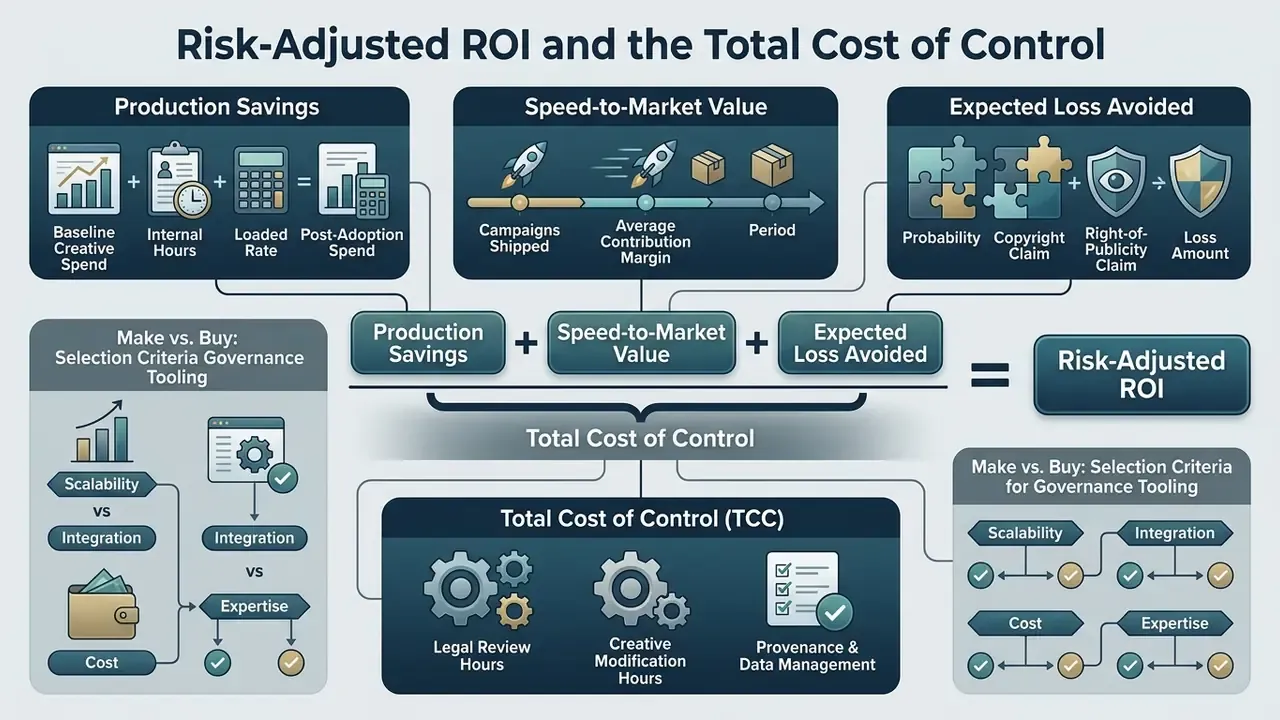
Finance leaders approve governance budgets when the model shows net value, not just avoided catastrophe. Use a transparent, auditable formula.
Risk-Adjusted ROI = ( Production Savings + Speed-to-Market Value + Expected Loss Avoided

                      - Total Cost of Control ) / Total Cost of Control
Component definitions
- Production Savings = (baseline external creative spend + internal hours × loaded rate) minus (post-adoption spend + AI subscription and compute costs).
- Speed-to-Market Value = incremental campaigns or releases shipped per period × average contribution margin per campaign.
- Expected Loss Avoided = Σ [ P(event) × Loss(event) ] across copyright claim, right-of-publicity claim, regulatory disclosure penalty (EU AI Act Article 50 non-compliance), forced campaign withdrawal, and brand-remediation cost. Where a vendor provides no indemnification, model the full legal-defense cost internally; where full indemnity applies under stated guardrails, apply a documented reduction factor.
- Total Cost of Control (TCC) = legal review hours + creative Tier 3/4 modification hours + provenance and C2PA tooling plus DAM metadata fields + ToS monitoring subscriptions + MRM validation effort + training and attestation + audit support.
Worked illustration (indicative, not benchmark data). A mid-market institution running 40 campaigns per year, shifting 60% of stock-and-agency imagery to an indemnified enterprise AI platform, adding two hours of Tier 3 modification per published asset, and funding provenance tooling plus quarterly legal review, will typically find that TCC consumes 25% to 40% of gross production savings. The decision therefore hinges less on generation cost than on which vendor absorbs IP risk. A zero-indemnity platform can invert the ROI the moment a single defense cost is modeled.
Make vs. Buy: Selection Criteria for Governance Tooling
Checklist0 / 7
Limitations, Open Questions, and a Safe Next Step
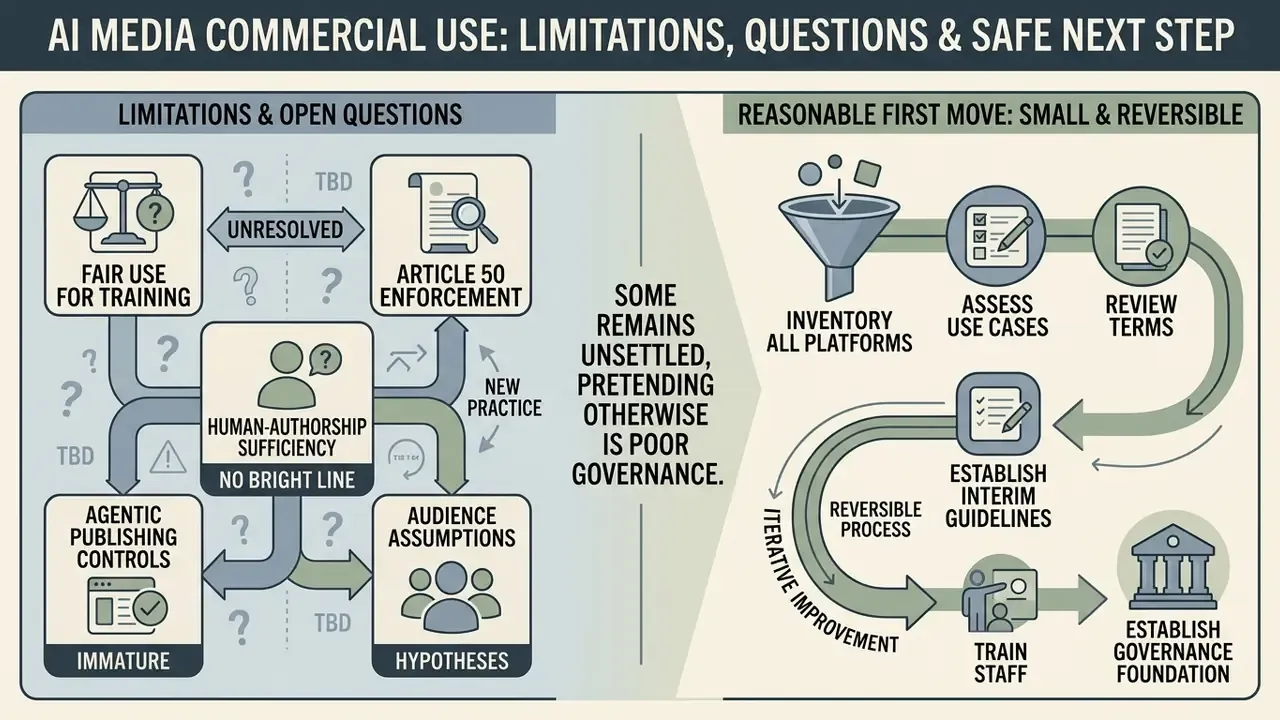
Some of this remains unsettled, and pretending otherwise would be poor governance.
- Fair use for model training is unresolved. Federal courts diverge, and a single appellate decision could reprice vendor risk across the market. Build contracts that survive either outcome.
- Article 50 enforcement practice is new. The obligation takes effect August 2, 2026, but supervisory interpretation of "machine-readable marking" will mature over the following quarters. Watermark now, expect to revise later.
- Human-authorship sufficiency has no bright line. Tier 3 is a working operational threshold, not a statutory one. The Copyright Office assesses contribution case by case.
- Agentic publishing controls are immature. Few vendors expose per-step provenance natively, so most institutions will stitch it together at the orchestration layer.
- Audience assumptions in this guide are hypotheses. Validate them against your own analytics, interviews, and CRM evidence before they become policy.
A reasonable first move is small and reversible: inventory every generative platform already in use, including unapproved ones, and record subscription tier plus indemnification status for each. Most teams find surprises in that first pass. Then tier the top ten use cases by customer impact and pick one Tier 2 workflow to instrument end to end with provenance logging. One workflow, fully evidenced, teaches more than a twelve-month program plan.
FAQ: Using AI Media Commercial-Use Hubs in Regulated Business
Is crediting the AI tool mandatory when publishing commercial synthetic media?
Mandatory crediting depends on vendor platform terms and applicable regional regulation. Many commercial vendor licenses do not require public attribution, yet frameworks like the EU AI Act (Article 50) enforce labeling for synthetic media, deepfakes, and public-interest text. Guidelines from international bodies such as the FAO specify that AI tools must not be listed as human co-authors, though their operational use should be disclosed in technical documentation. Australian AI safety guidance lists three acceptable disclosure methods: visible labeling, watermarking, and metadata recording.
How do enterprise teams obtain vendor support and technical documentation for compliance audits?
Request technical data sheets, SOC 2 Type II compliance reports, and model documentation directly through vendor enterprise support channels. Official resources, including NIST guidance documents (contactable via [email protected]), provide standardized templates for recording model provenance, data lineage, and the risk mitigation controls required during internal or external regulatory audits.
How often should a financial institution review AI vendor licensing terms?
Run automated continuous monitoring of vendor Terms of Service, then execute formal legal reviews quarterly. Because vendors frequently modify data retention policies, commercial revenue caps, and secondary training rights, change-detection systems should be integrated into the institution's model risk management framework and logged as dated GRC issues with named owners.
Which AI platforms indemnify enterprises against copyright claims?
As of 2026, Microsoft Copilot (commercial tiers), Anthropic Claude (paid and enterprise tiers), and Adobe Firefly (uncapped for enterprise) provide IP infringement indemnification, conditional on the customer following platform guardrails and not deliberately prompting for infringing material. OpenAI offers limited indemnity on Business and Enterprise plans, excluding cases where the user had notice of infringement. Midjourney provides no indemnification and disclaims all IP warranties, so residual legal-defense cost sits entirely with the enterprise.
Does the $1,000,000 revenue rule apply to individual employees?
Yes. Under Midjourney's Terms of Service (Section 4), the threshold is measured on the gross revenue of the corporate entity in the prior calendar year, not on individual earnings or profit. An employee of a company grossing over $1M must operate on a Pro ($60/month) or Mega ($120/month) plan to hold commercial asset rights, even if their personal seat is Basic or Standard. Companies crossing the threshold mid-term should upgrade proactively to preserve license continuity for assets already published.
How do we integrate an AI media hub with an existing MRM framework under SR 11-7?
Onboard each generative platform as a third-party model or model-adjacent tool: register it in the model inventory, collect vendor documentation on design, training-data provenance, and limitations, submit it for independent validation and effective challenge, then place it under ongoing monitoring. Map hub artifacts one to one against supervisory expectations (inventory extract, validation memo, monitoring dashboard, third-party assessment, committee minutes) and tier tools by customer impact: Tier 1 customer-facing, Tier 2 brand, Tier 3 internal.
How do we calculate ROI on an AI media governance hub for a CFO?
Use the risk-adjusted model: net production savings and speed-to-market value plus expected loss avoided, minus the Total Cost of Control (legal review, Tier 3/4 modification hours, provenance tooling, ToS monitoring, MRM validation, training, audit support), divided by TCC. Model expected loss avoided explicitly per risk event, covering copyright claim, right-of-publicity claim, Article 50 disclosure penalty, and forced campaign withdrawal, then apply a documented reduction where the vendor provides full indemnification. Zero-indemnity vendors should carry the full internal defense-cost assumption.
What evidence proves human authorship if a registration or dispute arises?
Retain the modification tier (1 to 4), the identity of the human editor, tools and versions used, a description of the creative choices made, and version history from the editing application, alongside prompt text or prompt hash, model version, subscription tier, and C2PA manifest ID. The Copyright Office requires applicants to disclose more-than-de-minimis AI content and describe the human contribution, so this record should be produced at creation time rather than reconstructed under deadline pressure later.