Deploying media-oriented generative models and multimodal vision tools into enterprise production requires moving beyond sandbox experimentation. Modern web architectures rely on programmatic interfaces to handle image generation, video synthesis, OCR, visual search, and content analysis at scale. This guide establishes a practical operational baseline for reading API documentation, provisioning access keys, building reliable integration pipelines, and orchestrating scalable AI media generation workflows.
One caveat before we start. Nothing here removes the need to read your provider's current specification. Vendors ship breaking changes quietly.
Executive Summary for CROs, CCOs, and Model Risk Owners
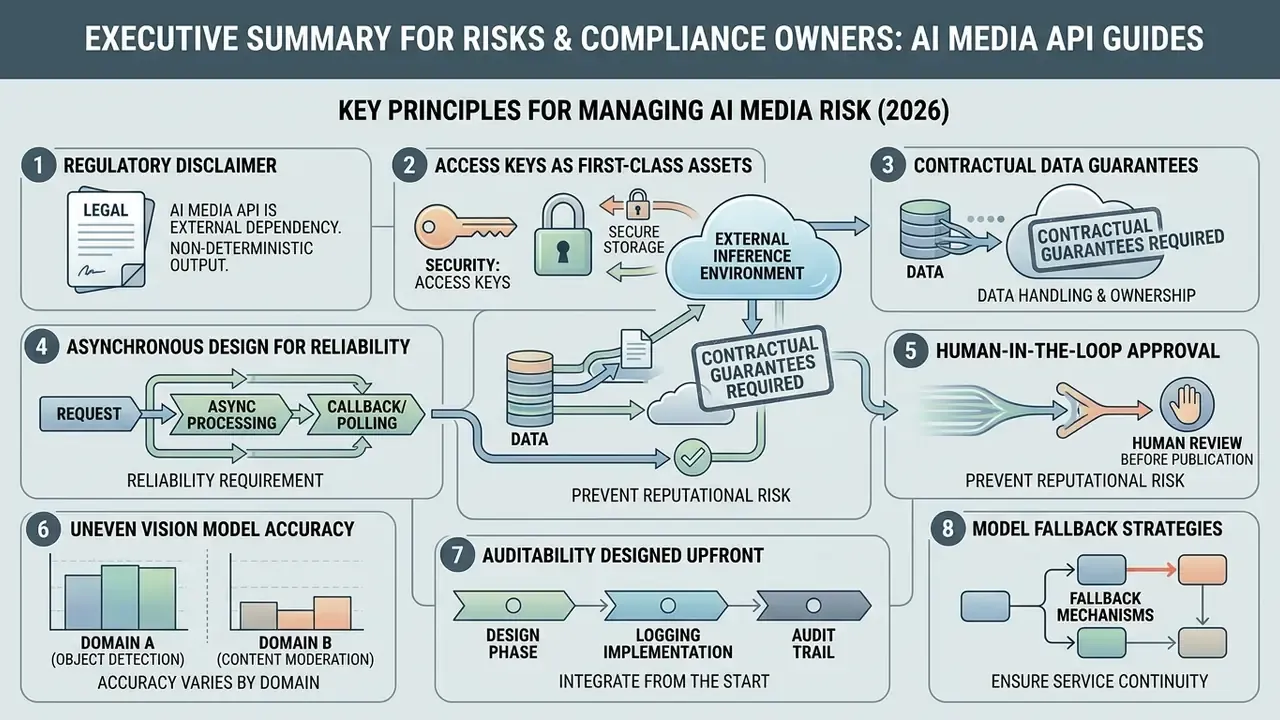
If you own control rather than code, eight points are enough.
- An external AI Media API is an external dependency with a non-deterministic output. The same prompt with the same
seedcan return a different result after the provider updates the model. Version control of the model (model,model_version,seed) must appear in every log record. - Access keys are first-class assets. Secrets live only in a secret manager or environment variables, never in a client bundle. That requirement is written into NIST SP 800-228.
- Data sent into someone else's inference environment needs contractual guarantees. Without an explicit Zero Data Retention or no-training SLA, shipping client documents, payment slips, or images to an external API is an uncontrolled leakage and secondary-use risk.
- Asynchronous design is a reliability requirement, not a convenience. Video and high-resolution generation take minutes; synchronous HTTP guarantees dropped connections and blind compute charges.
- Automated publication of AI content with no human in the loop is a reputational risk. The industrial pattern includes a waitpoint pause and editorial approval before anything reaches a production channel.
- Vision model accuracy is uneven across domains. On the KDEF dataset, a commercial emotion API scored 100% for joy and only 10% for sorrow. Any vendor metric needs independent validation on your own data.
- Auditability is designed upfront. Prompt, payload hash, model version, seed, cost, status, and the human decision belong in an immutable log with a defined retention period.
- TCO is not the provider price list. Total cost of ownership includes retry cost, validation infrastructure, manual moderation, and storage of audit artifacts.
What an AI Media API Is and Which Problems It Solves
An AI Media API is a programmatic interface that exposes machine learning models for synthesizing, transforming, or analyzing visual and auditory media assets via standardized network protocols such as HTTP REST or gRPC. It decouples complex GPU inference environments from core application logic. This decoupling enables client applications to submit asynchronous processing tasks or synchronous payloads through predictable endpoints.
By wrapping complex diffusion models, vision transformers, and multimodal large language models (LLMs), an AI Media API converts raw media inputs and textual prompts into structured JSON metadata or synthetic media outputs. Enterprise architectures use these APIs to automate manual content processing, scale product media generation, implement semantic visual search, and enforce automated moderation controls.
Formal industry specifications describe such a system as a three-block architecture: task scheduling, resource management, and the media processing itself, with storage and compute pushed into separate layers (ITU-T H.644.8, 2024; ISO/IEC 23090-8 NBMP, 2025). That is precisely why integration design starts with the request path, not with the prompt.
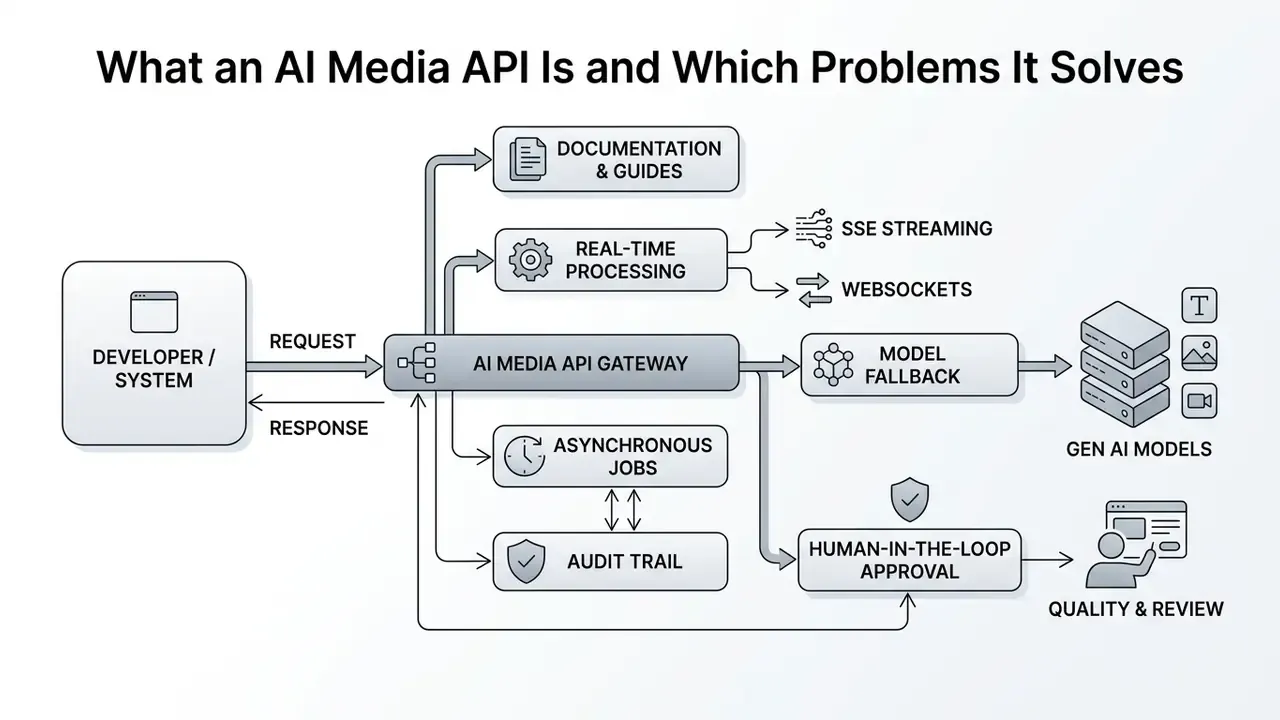
- Text transcript of the stages:

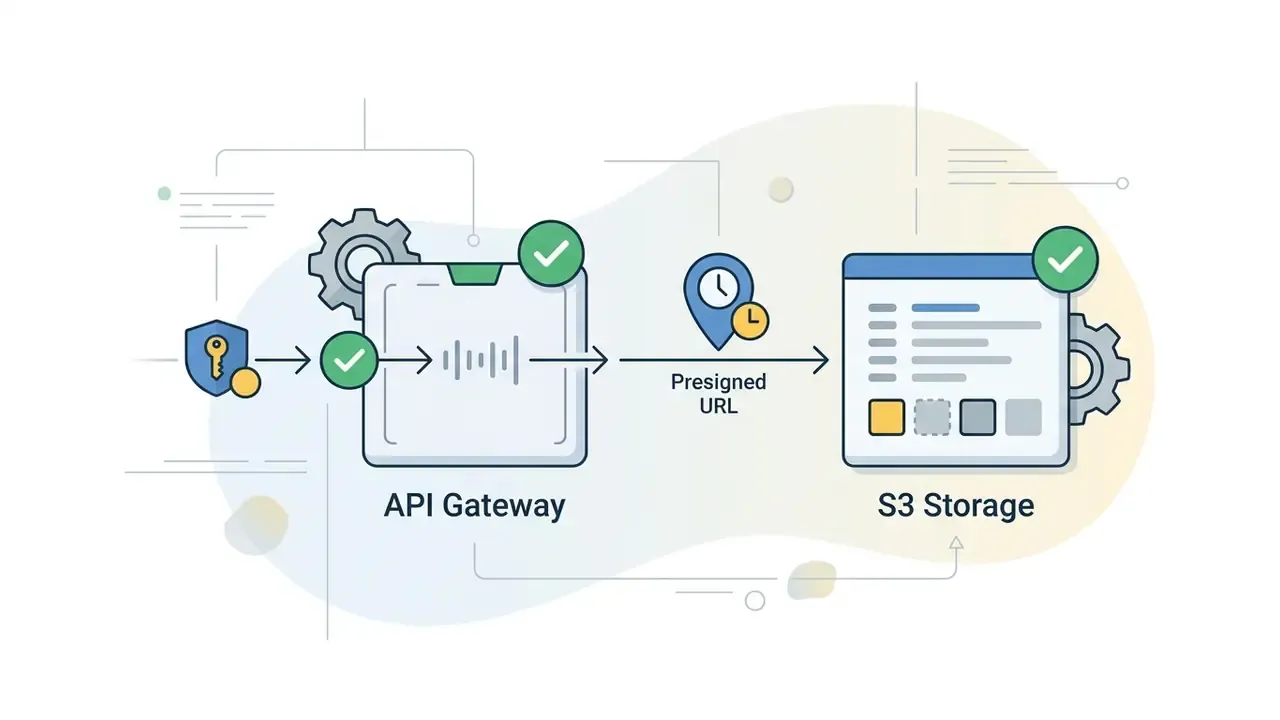
Authorization: Bearer and issues a presigned URL for S3 Storage.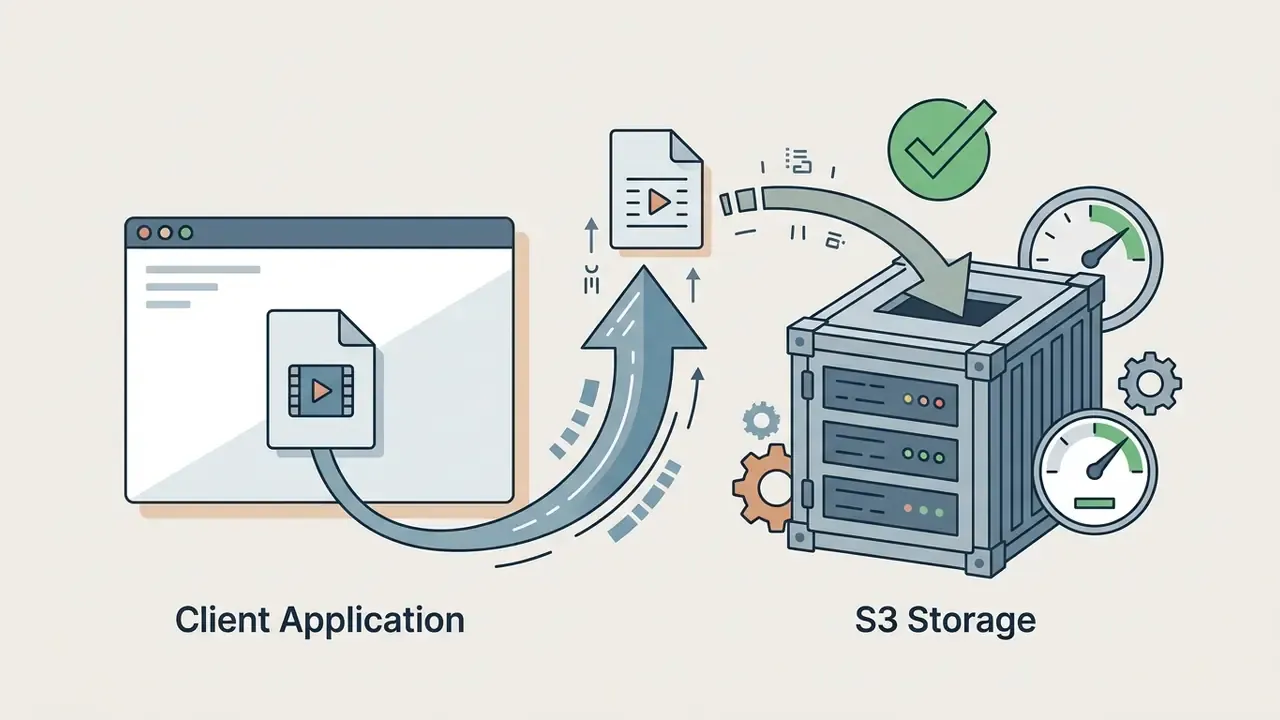
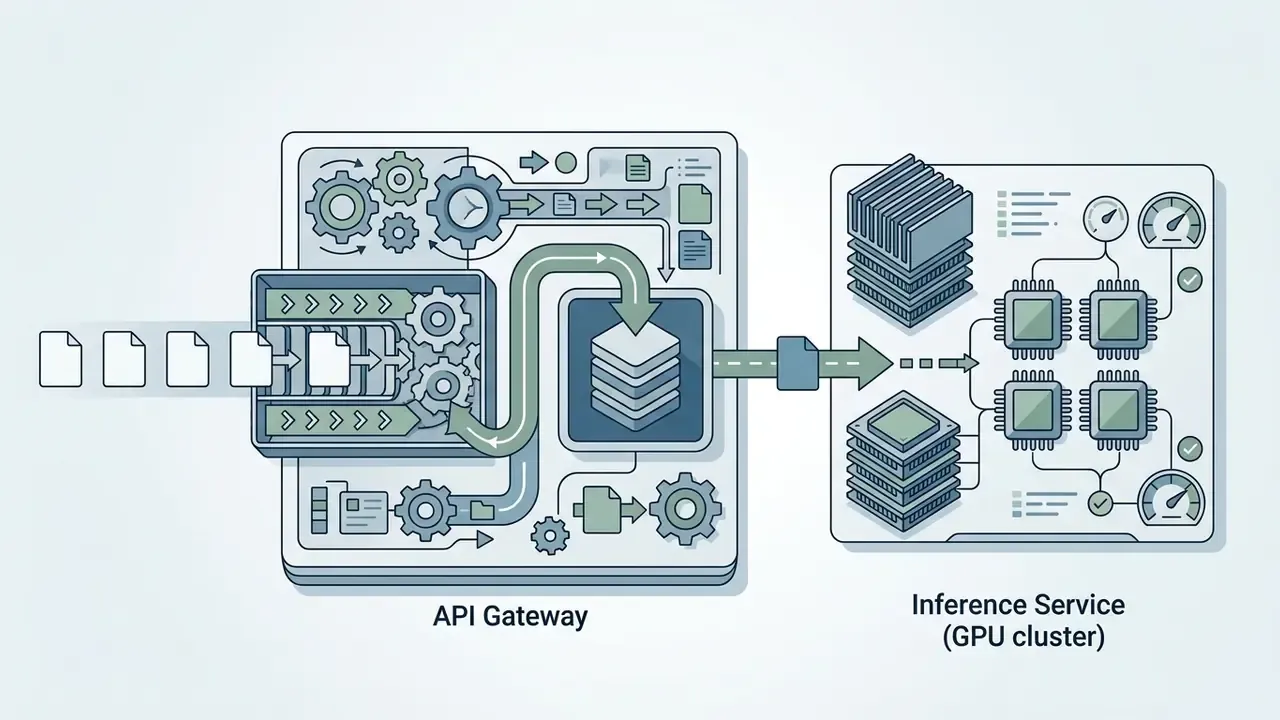
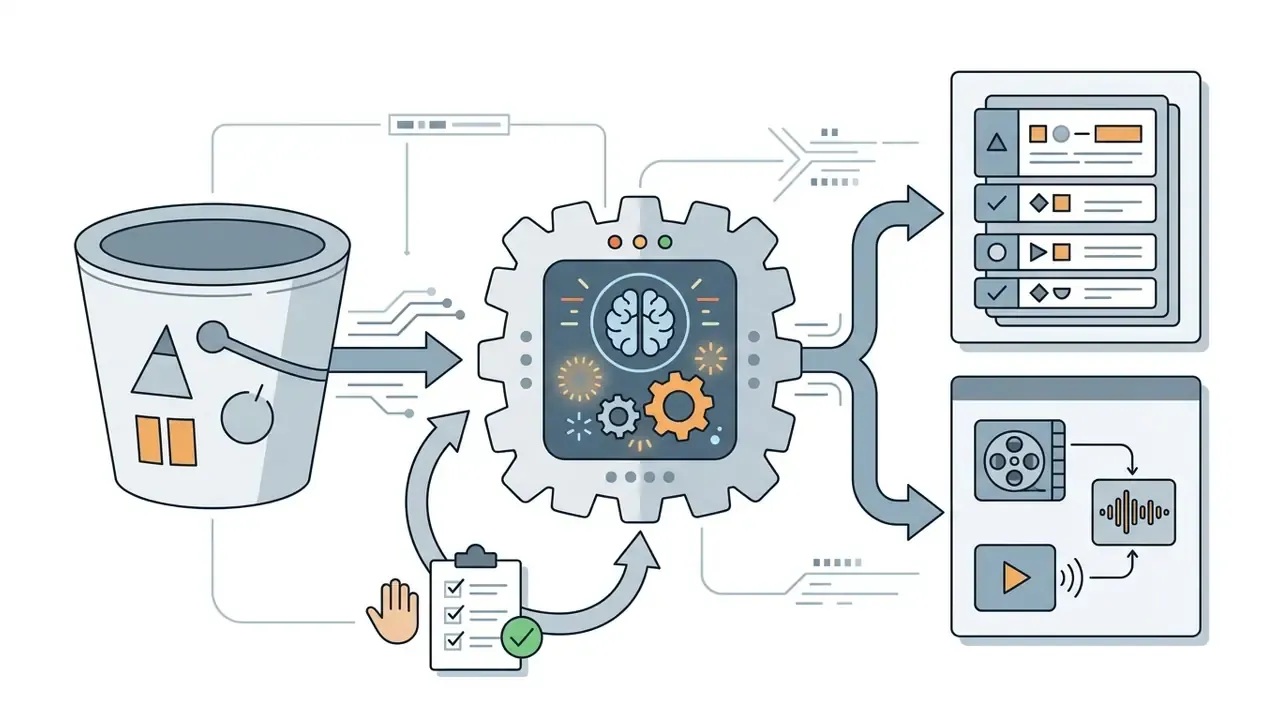
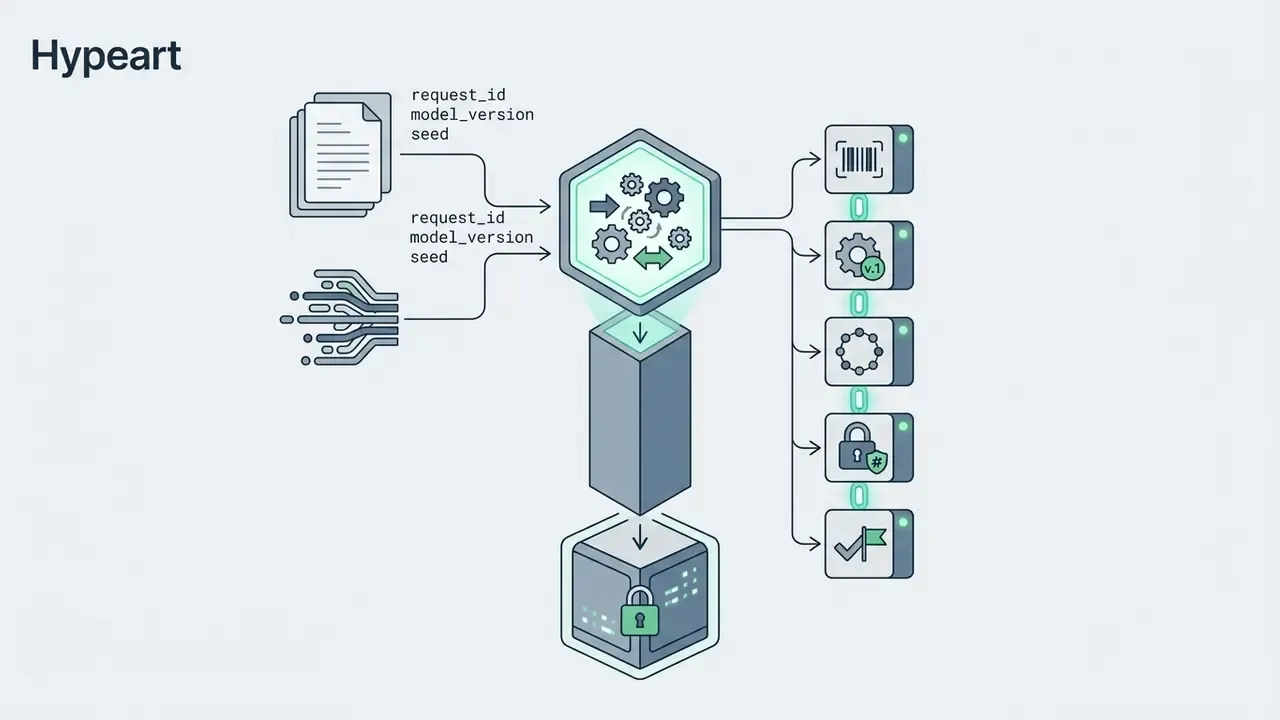
request_id, model_version, seed, the payload hash, and the terminal status in an immutable log.AI Models for Image and Video Generation
In short: modern generative models are built on diffusion transformers and rectified flow distillation, and model choice is a trade-off between quality, latency, and provider quotas. Below are verifiable limits and benchmarks you can design against.
Modern generative AI models synthesize high-fidelity images and video assets from textual prompts or seed media using diffusion transformer architectures and rectified flow distillation. These architectural claims are supported by public video generation benchmarks, which measure quality across distributed dimensions rather than one aggregate score.
"VBench++ decomposes video generation quality into 16 disentangled dimensions, from subject consistency to motion smoothness, validated on 6,984 videos."
Selecting an appropriate model requires balancing output quality against inference latency and provider concurrency quotas. The practical takeaway: compare models not by an overall score but by the specific VBench++ dimensions that matter to your scenario, for example temporal flickering for product clips and subject consistency for branded characters. For tooling context, see our review of the best AI video generators.
For image generation, modern APIs expose parameters for resolution, aspect ratio, seed control, and negative prompts. In video generation, service architectures handle strict technical limits. For instance, Google Vertex AI's Veo 3 API enforces a limit of 10 requests per minute per project, returning up to 2 videos per request with fixed 4-, 6-, or 8-second output durations and a 20 MB maximum input size for image-to-video tasks (Google Vertex AI Documentation, 2026); for a detailed breakdown of economics and quotas, see our implementation guide for Google Veo. Runway APIs set strict organization-level concurrency limits; Tier 3 access permits a maximum concurrency of 5 concurrent jobs and 1,000 to 2,000 daily generations with a rolling 24-hour reset (Runway Developer Docs, 2026). Recent distillation breakthroughs, such as Alice v1, demonstrate that a 14-billion parameter model can generate 5-second 720p videos at 24 fps in 8 seconds on an NVIDIA H100 GPU using 4 denoising steps, achieving a VBench overall quality score of 91.2 (Alice v1 Research, 2026).
"Alice v1 outperforms the closed systems Veo3 (~90) and Sora2 (~88) on automatic benchmarks while generating roughly seven times faster."
From this follows a simple routing rule. For draft iterations and prompt A/B tests, distilled models with 4 to 8 denoising steps are cheaper; full quality is switched on only for the final render of an approved variant.
AI Media Analysis and Structured Data Extraction
"Google Cloud Vision reaches 100% accuracy for joy, but only 10% for sorrow and 24.29% for surprise on the KDEF dataset."
Independent validation against target datasets remains necessary prior to deploying automated analysis models.
Model Risk and Hallucination Validation Checklist
A non-deterministic output demands a different acceptance method than a classic deterministic service. The minimum set of controls before a vision or OCR model enters production:
- Golden dataset.Build a closed labeled set from your real documents (at least a few hundred samples per class), including the dirty cases: skew, glare, stamps, handwritten corrections, low DPI.
- Per-class metrics, not averages.Record precision and recall for every extracted field separately. Average accuracy of 95% with 10% recall on a critical field is a failure disguised by an aggregate, as the KDEF distribution above shows.
- Hallucination test.Feed in documents where the requested field physically does not exist. The model must return
nullrather than invent a plausible value. The share of fabricated values is a control metric in its own right. - Output schema validation (guardrails).Every JSON response passes a strict schema (JSON Schema, Zod, or Pydantic): types, ranges, checksums, date and amount formats. An invalid response goes to rejection, not to the database.
- Cross-checks on critical fields.For financial values, use a second independent channel: a deterministic OCR parser, arithmetic reconciliation (line items equal the total), or comparison with a reference record in the system.
- Confidence threshold and human routing.Responses below the confidence threshold, or those failing a cross-check, are routed to a manual queue (see the human-in-the-loop pattern in the automated workflows section).
- Regression run when the model version changes.Any
model_versionupdate on the provider side is an event that triggers a fresh golden dataset run and a comparison against the previous baseline. - Drift monitoring in production.Track the confidence distribution, the schema rejection rate, and the human correction rate week over week. Any rising line signals degradation before complaints arrive.
- Documented boundary of applicability.Write down which media types and which fields the model serves, and which scenarios are excluded from automation.
- Named model owner and revalidation cadence.An assigned owner, a review interval (quarterly, for example), and defined triggers for an unscheduled review.
For provenance control over visual material arriving from outside, the same layer usually adds synthetic-content detection; see our overview of the AI image detector category.
How to Read AI Media API Documentation and Find the Right APIs
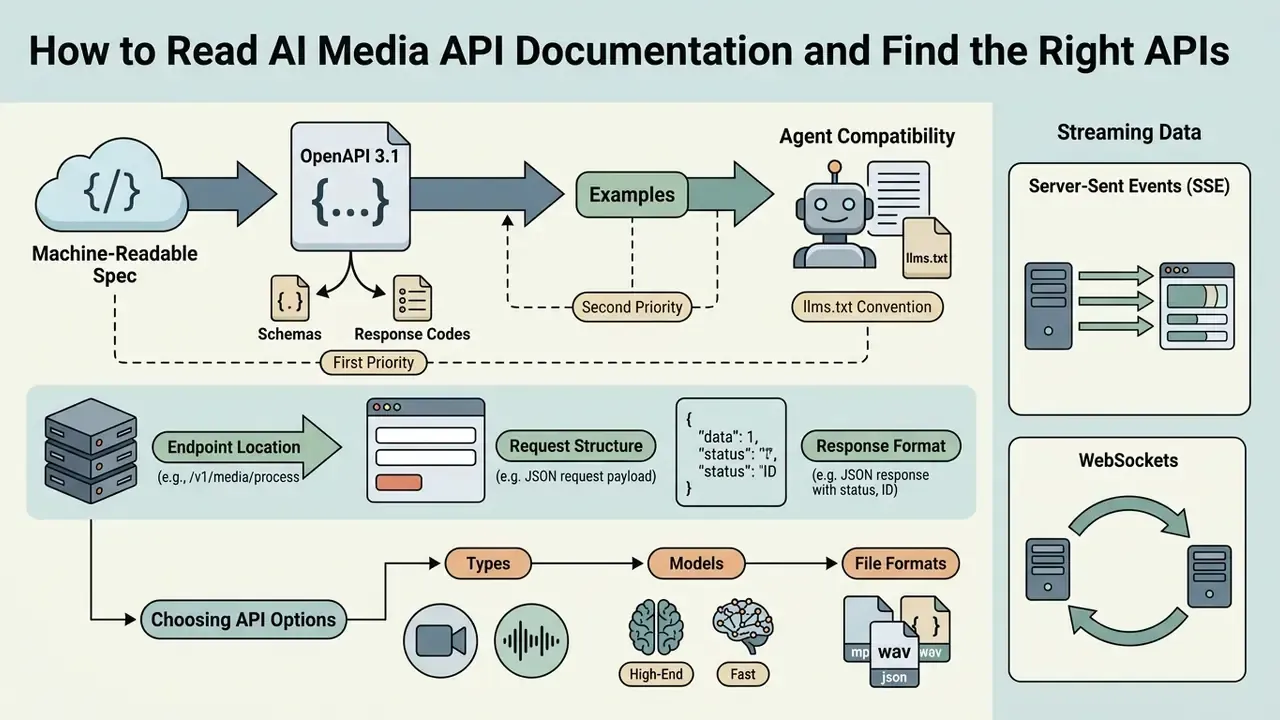
In short: documentation is read through the machine-readable OpenAPI 3.1 specification, schemas and response codes first, examples second. Below are navigation rules and the llms.txt format requirement for AI assistants.
Reading AI Media API documentation efficiently requires navigating machine-readable OpenAPI 3.1 specifications, path definitions, input payload schemas, and HTTP status code mappings.
"Government API engineering standards require full documentation of headers, payload schemas, status codes, and rate limit rules for every endpoint."
Standard engineering guidelines mandate that enterprise APIs fully document request headers, payload attributes, status codes, and rate limit rules, including API versions and version-to-version changes with deprecated properties.
Structured documentation indexes separate high-level integration guides from detailed reference documentation. Developers should review OpenAPI $ref references to inspect reusable schemas for media types, error objects, and response enums before writing client code. Formally, the specification describes a document through the info, servers, paths, parameters, schemas, and securitySchemes blocks, while binary and text representations of media are declared through content and contentEncoding (base64, base64url) (OpenAPI Specification v3.1.0, OAI).
Agent Compatibility: the llms.txt Convention
Contemporary developer documentation for an AI Media API has to be readable not only by a human, but by AI assistants such as Cursor, GitHub Copilot, and Claude Desktop. For that purpose, a structured text file /llms.txt sits at the documentation root, listing key endpoints, data types, required fields, and call examples in compact Markdown with no visual clutter. The file acts as a machine-readable index: the agent reads it end to end instead of guessing from HTML markup.
The practical value is direct. It lowers the hallucination rate in generated integration code, because the assistant stops inventing nonexistent parameters and stops substituting outdated field names. A minimum workable llms.txt for a media API:
# Media API - machine-readable index
## Base
- Base URL: https://api.provider.com/v1
- Auth: Authorization: Bearer <API_KEY>
- Content types: application/json, multipart/form-data
## Endpoints
- POST /images/generations - text-to-image. Required: model, prompt. Optional: size, seed, n, negative_prompt.
- POST /videos/generations - text-to-video (async). Returns 202 + job_id.
- GET  /jobs/{job_id} - job status. States: pending | processing | completed | failed.
- POST /uploads/presign - returns presigned PUT URL. Required: filename, content_type, size_bytes.
## Errors
- 400 invalid_payload | 401 invalid_key | 413 payload_too_large | 429 rate_limited | 5xx provider_error
## Notes
- Retryable: 408, 429, 5xx. Non-retryable: 400, 401, 403.
- Max inline base64 input: 5 MB. Above that use presigned upload.
If the provider does not publish such a file, generate your own internal version from its OpenAPI specification and keep it in the integration repository. That improves AI suggestion quality and doubles as an internal audit artifact.
Where to Find Endpoints, Request, and Response in the Documentation
To locate operational routes, examine the API Reference or Documentation Index for resource-based routes, supported HTTP methods (GET, POST, DELETE), and explicit status response definitions. Standard endpoint documentation lists parameter types, body schemas, authentication headers, and example payloads for both success and error conditions.
When exploring an unfamiliar API, start by scanning list endpoints (such as GET /v1/models or GET /v1/jobs) to verify access permissions and retrieve active resource IDs before initiating complex processing tasks.
"The Zalando RESTful API Guidelines recommend starting with list endpoints to verify access rights and obtain active resource IDs."
Ensure that status code definitions differentiate transport-level HTTP errors from application-level processing failures. HTTP 200 with a body of {"status":"failed"} is not a success, and your parser has to know the difference.
How to Choose Types, Models, and File Formats for Media
Selecting file formats and transport mechanisms depends on file binary size, latency requirements, and model input limitations. Binary media data can be transmitted inline via Base64 encoding, referenced via external HTTPS URLs, or uploaded using multipart/form-data.
Base64 data URIs expand binary payload size by approximately 33% (a consequence of packing 8-bit bytes into 6-bit characters), making them suitable only for small image files or inline thumbnails under a few megabytes (RFC 2397, IETF). Practical input-type limits are easy to sanity-check against our roundup of AI image generators. For larger images and video files, standard integration patterns require multipart/form-data uploads with a correct --boundary that does not occur inside the data body (RFC 7578, IETF), or pre-signed S3 upload URLs to prevent HTTP gateway memory saturation. Consult the AI Media API Implementation Checklist to confirm protocol and file payload requirements prior to development.
| Documentation section | Contents and entities | Functional purpose | Developer problem it solves |
|---|---|---|---|
| Models Index | Model IDs, capabilities, context limits, usage tiers | Inventory of available ML models and their specs | Choosing a model per task (image vs video generation, latency vs quality) |
| Endpoints / Routes | HTTP methods (POST, GET), URL paths, path parameters | Catalogue of available programmatic operations | Identifying the URL for an inference or analysis call |
| Request Schemas | Headers, JSON body properties, MIME types, required fields | Specification of request input | Building a valid JSON payload or multipart form |
| Response Schemas | Status codes, success and error JSON structures, field types | Description of the API response structure | Safe parsing of results (job_id, media URLs, structured JSON) |
| Files / Storage | Direct upload endpoints, presigned URLs, size caps | Rules for transferring heavy media files | Uploading files without exhausting server memory |
| Transport / Protocols | REST JSON, multipart/form-data, Base64 inline, SSE, WebSocket | Delivery mechanism for request and response | Choosing transport by payload size and latency requirements |
| Examples / SDKs | Code snippets (Python, Node.js), cURL samples | Ready-made call and integration examples | Standing up a minimal working proof of concept |
Read the table as a checklist: if a provider leaves any of these seven rows undocumented, treat that as an integration risk and record it in the vendor assessment.
Streaming Data: SSE and WebSockets
For real-time tasks such as frame-by-frame video generation, audio streams, or incremental structured responses, a classic REST HTTP POST with a single response creates critical Time-To-First-Token or Time-To-First-Frame delays: the client sees nothing until inference completes. Industry practice in documenting AI APIs treats streaming protocols as a separate requirement, because model outputs arrive in chunks rather than as one payload.
- Server-Sent Events (SSE)is a one-way stream from server to client over ordinary HTTP. It fits real-time inference progress and frame-by-frame rendering, survives proxies, and needs no separate handshake protocol.
- WebSocketsprovide a bidirectional, low-latency channel. Use them for interactive audio or video streaming, where the client refines or corrects the request mid-session.
| Transport | Delivery model | Typical media scenario | Constraints |
|---|---|---|---|
| REST + JSON | One request, one response | Images of a few MB, fast inference | Gateway timeouts on long tasks; no progress signal |
| REST + async job | Request, then job_id, then polling or webhook | Video, batches, high resolution | Latency equal to the polling interval; needs a state machine |
| SSE | Server to client stream | Generation progress, frame rendering, incremental JSON | One-way; requires correct reconnect handling |
| WebSocket | Bidirectional full duplex | Interactive audio and video streaming | Harder to balance and observe; sticky sessions |
An example of consuming an SSE generation stream in Python, with explicit timeouts and error handling:
import os
import json
import httpx
API_KEY = os.getenv("MEDIA_API_KEY")
async def stream_media_generation(prompt: str):
    url = "https://api.provider.com/v1/media/stream"
    headers = {"Authorization": f"Bearer {API_KEY}"}
    payload = {"prompt": prompt, "stream": True}
    timeout = httpx.Timeout(connect=5.0, read=120.0, write=10.0, pool=5.0)
    try:
        async with httpx.AsyncClient(timeout=timeout) as client:
            async with client.stream("POST", url, headers=headers, json=payload) as response:
                response.raise_for_status()
                async for line in response.aiter_lines():
                    if not line or not line.startswith("data: "):
                        continue
                    if line.strip() == "data: [DONE]":
                        break
                    try:
                        data = json.loads(line[6:])
                    except json.JSONDecodeError:
                        continue  # partial chunk, skip it
                    print(
                        f"Frame: {data.get('frame_index')}, "
                        f"Progress: {data.get('progress')}%"
                    )
    except httpx.HTTPStatusError as exc:
        print(f"Stream rejected: {exc.response.status_code} {exc.response.text[:200]}")
        raise
    except httpx.ReadTimeout:
        print("Stream stalled: read timeout exceeded, falling back to async job mode")
        raise
The client side of the same stream in JavaScript:
async function consumeStream(prompt) {
  const controller = new AbortController();
  const guard = setTimeout(() => controller.abort(), 120_000);
  try {
    const res = await fetch('https://api.provider.com/v1/media/stream', {
      method: 'POST',
      headers: {
        'Authorization': `Bearer ${process.env.MEDIA_API_KEY}`,
        'Content-Type': 'application/json',
        'Accept': 'text/event-stream'
      },
      body: JSON.stringify({ prompt, stream: true }),
      signal: controller.signal
    });
    if (!res.ok) throw new Error(`Stream error ${res.status}`);
    const reader = res.body.getReader();
    const decoder = new TextDecoder();
    let buffer = '';
    while (true) {
      const { done, value } = await reader.read();
      if (done) break;
      buffer += decoder.decode(value, { stream: true });
      const parts = buffer.split('\n\n');
      buffer = parts.pop();
      for (const part of parts) {
        if (!part.startsWith('data: ')) continue;
        const raw = part.slice(6);
        if (raw === '[DONE]') return;
        const evt = JSON.parse(raw);
        console.log(`progress=${evt.progress}% frame=${evt.frame_index}`);
      }
    }
  } catch (err) {
    console.error('SSE consumption failed:', err.message);
    throw err;
  } finally {
    clearTimeout(guard);
  }
}
The selection rule is simple. If expected inference time sits below a comfortable gateway timeout, use REST. If the user needs visible progress, use SSE. If the user needs a dialogue during generation, use a WebSocket. If the task runs longer than a few minutes, use the asynchronous job model with a webhook, described in the workflows section below.
What to Prepare Before an AI Media API Integration
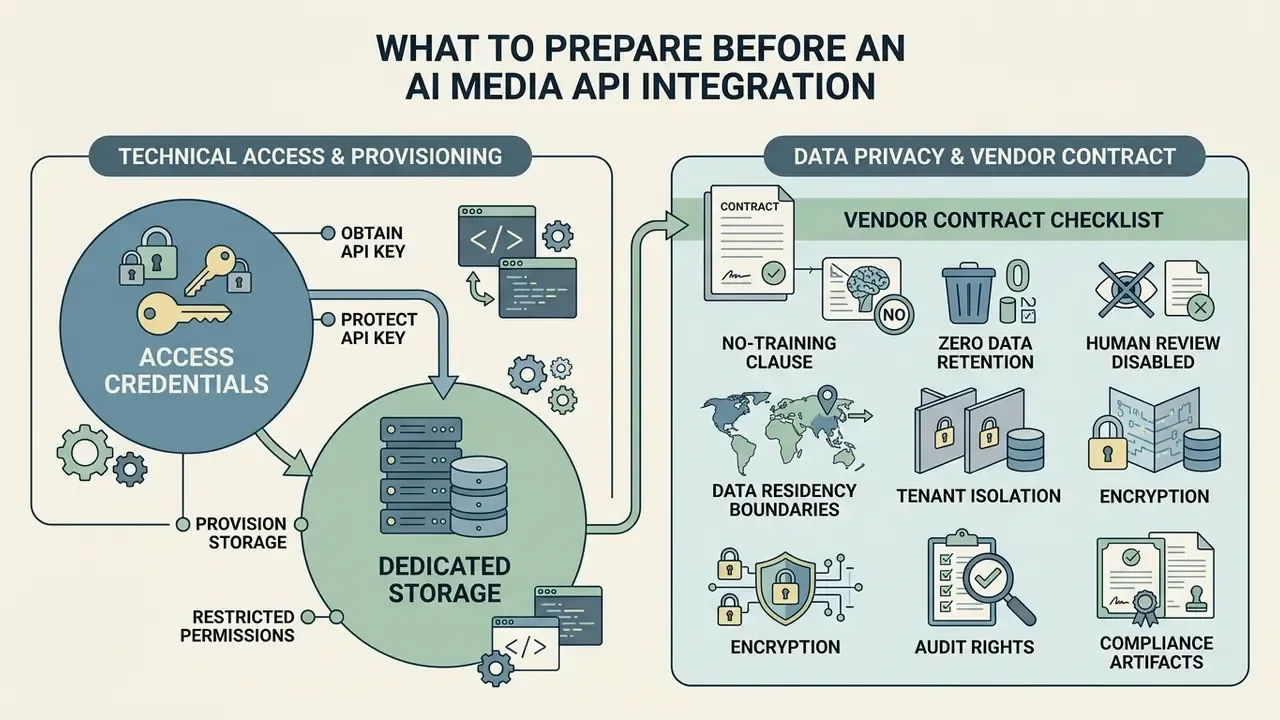
Technical preparation before integrating an AI Media API involves securing access credentials, provisioning dedicated storage locations with restricted permissions, and configuring server-side file validation logic. Performing these steps early prevents security vulnerabilities and unauthorized compute usage.
Obtaining Access and Protecting the API Key
Secure access management requires generating environment-scoped credentials, enforcing Bearer tokens, and isolating key material within dedicated secret managers.
According to cybersecurity guidelines, service authentication should utilize restricted API keys or short-lived OAuth2 tokens, and secret values must never be hardcoded into client-side source code or repositories. Earlier NIST SP 800-204 guidance goes further: for sensitive APIs, a key should not be the only control, and tokens should be short-lived or single use.
Keys should be loaded at runtime from environment variables or dedicated secret vaults. In client-facing applications, API calls must be proxied through a secure backend architecture to prevent public exposure of credentials. The practical minimum: a separate key per environment (dev, stage, prod), a separate key per consuming service, automated rotation on a schedule, and an alert when a key is used from an unexpected network segment.
Data Privacy and a Zero Data Retention SLA: What Belongs in the Vendor Contract
Key hygiene closes only half of the exposure. The other half is the fate of data you already sent into someone else's inference environment. For regulated institutions, that is a contractual review item, not a console setting.
The minimum requirement list for an agreement with an AI Media API provider:
- No-training clause.An explicit written prohibition on using submitted images, video, documents, and prompts to train, fine-tune, or otherwise adapt the vendor's base models, including training on derived or aggregated representations.
- Zero or limited data retention.A fixed, measurable retention period for input and output artifacts, ideally zero or bounded by the technical processing window, as in file-API models where uploads are deleted by TTL. Ask for a documented deletion confirmation mechanism.
- Human review disabled by default.If the vendor performs manual review of requests to improve quality, it must be contractually disabled for your tenant.
- Processing boundaries (data residency).The region of physical processing and storage, a ban on cross-border transfer outside an agreed list of jurisdictions, and a subprocessor list with a duty to notify changes.
- Tenant isolation and encryption.Encryption in transit and at rest, logical isolation from other customers, and key management, including customer-managed keys where applicable.
- Audit rights and compliance artifacts.Access to independent audit reports, the right to run a security questionnaire, and an obligation to notify incidents within an agreed window.
- Exit terms.Guaranteed deletion of all data on termination with written confirmation, plus the ability to export your own audit artifacts.
- Model version transparency.An obligation to give advance notice of model version changes or endpoint deprecation. This feeds directly into your regression testing and into parser stability in CI.
One organizational addition to the contract: minimize what you send. Mask personal data and account identifiers before transmission, send a crop of the relevant document zone instead of a full scan, and never rely on the assumption that "the provider does not store anything anyway" without that condition written down.
Preparing Media Files and Request Parameters
Media file preparation requires server-side validation of file extension, MIME type, file size, and magic numbers before uploading assets to cloud endpoints.
"The OWASP File Upload Security Cheat Sheet requires server-side validation of extension, MIME type, size, and magic bytes before a file is passed to the cloud."
OWASP additionally recommends not trusting the Content-Type header alone, storing uploads outside the webroot or on a separate host, and renaming files instead of accepting user-supplied names. To optimize model performance and avoid payload rejections, media assets should be pre-conditioned to match provider constraints regarding frame rate, bit rate, aspect ratio, and resolution. Worth remembering: object storage does not transcode or compress media, so compression and conversion happen before upload.
When using Amazon S3 direct uploads, the standard flow requires a two-step process: the application server requests a time-limited presigned PUT URL from the storage service using file metadata, and the client uploads the raw bytes directly to the storage bucket (AWS S3 Presigned URL Documentation, 2026). This is exactly the pattern used where a source image becomes the generation input, the typical case for image-to-image generators. The key parameters of the initiating JSON are filename or key, content_type, size_bytes, and link expiry; the uploaded object must match the issued object key exactly.
- AWS S3 Presigned URL Documentation, 2026
First AI Media API Integration: From Test Request to Result
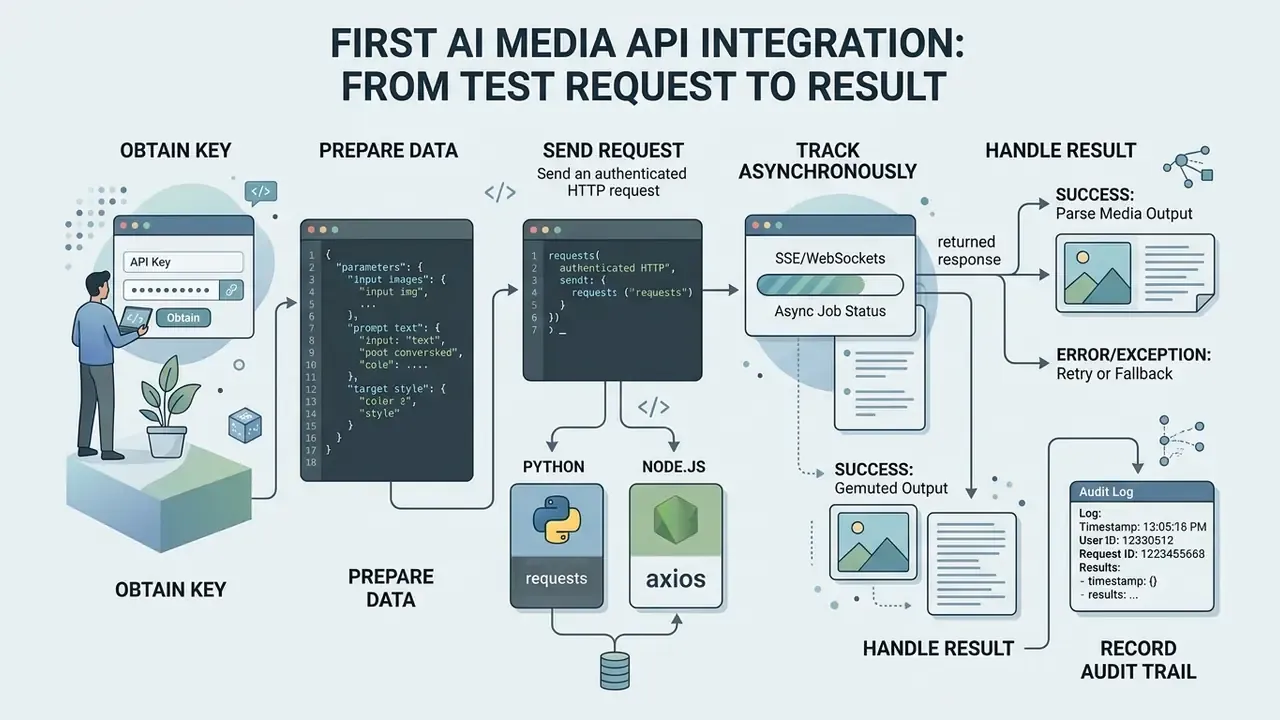
Executing an initial test integration requires submitting an authenticated HTTP request with structured JSON parameters and parsing the returned response for operational identifiers or media asset links.
How to Make the First Test Request and Check the Response
A minimal test call executes an authenticated POST request to an inference endpoint. The returned payload provides status information, execution metadata, or an asynchronous job identifier.
POST /v1/images/generations HTTP/1.1
Host: api.provider.com
Authorization: Bearer YOUR_API_KEY
Content-Type: application/json
{
  "model": "image-gen-v2",
  "prompt": "Studio portrait of an executive leader, neutral background, 8k",
  "n": 1,
  "size": "1024x1024",
  "response_format": "url"
}
A successful HTTP 200/201 response returns a JSON object containing the generation timestamp, execution metadata, and asset locations:
{
  "created": 1771488000,
  "data": [
    {
      "url": "https://storage.provider.com/outputs/img_987654321.png"
    }
  ]
}
For a quick proof of concept without billing integration, it can help to validate the scenario on public tools first; see our list of AI image generators with no sign-up, then move the proven prompt into the API pipeline.
If the request fails, client logic must inspect standard HTTP error codes.
"The HMRC API Reference Guide classifies 401 as a missing or invalid key, 429 as a rate limit breach, and 500 as provider infrastructure failure."
401 Unauthorized indicates missing or invalid API keys, including the wrong token type. 429 Too Many Requests signals rate limit saturation and requires a pause before retrying. 500 Internal Server Error indicates an issue on the provider's infrastructure. A standard error body should carry a machine-readable code and a human-readable message; route your handling on those fields, never on parsed prose.
Integrating an AI Media API in Python and Node.js
Enterprise implementations rely on asynchronous HTTP clients or official vendor SDKs to construct API requests and manage network timeouts.
Python implementation (using HTTPX):
import os
import httpx
import asyncio
API_KEY = os.getenv("MEDIA_API_KEY")
ENDPOINT = "https://api.provider.com/v1/videos/generations"
async def generate_video_job(prompt: str) -> str:
    headers = {
        "Authorization": f"Bearer {API_KEY}",
        "Content-Type": "application/json"
    }
    payload = {
        "model": "video-gen-v1",
        "prompt": prompt,
        "duration_seconds": 5,
        "aspect_ratio": "16:9"
    }
    timeout = httpx.Timeout(connect=5.0, read=30.0, write=10.0, pool=5.0)
    try:
        async with httpx.AsyncClient(timeout=timeout) as client:
            response = await client.post(ENDPOINT, headers=headers, json=payload)
            response.raise_for_status()
            data = response.json()
            return data.get("job_id")
    except httpx.HTTPStatusError as exc:
        # 4xx/5xx: code and body decide retry vs fail-fast
        print(f"API error {exc.response.status_code}: {exc.response.text[:300]}")
        raise
    except httpx.RequestError as exc:
        print(f"Transport error: {exc!r}")
        raise
# Example usage: job_id = asyncio.run(generate_video_job("Corporate office exterior day"))
Node.js implementation (using Axios):
const axios = require('axios');
const API_KEY = process.env.MEDIA_API_KEY;
const ENDPOINT = 'https://api.provider.com/v1/images/generations';
async function generateImage(prompt) {
  try {
    const response = await axios.post(ENDPOINT, {
      model: 'image-gen-v2',
      prompt: prompt,
      size: '1024x1024'
    }, {
      headers: {
        'Authorization': `Bearer ${API_KEY}`,
        'Content-Type': 'application/json'
      },
      timeout: 15000
    });
    return response.data.data[0].url;
  } catch (error) {
    if (error.response) {
      console.error(`API Error ${error.response.status}:`, error.response.data);
    } else if (error.code === 'ECONNABORTED') {
      console.error('Request timed out before the provider responded');
    } else {
      console.error('Network or client error:', error.message);
    }
    throw error;
  }
}
Refer to our detailed retry failure cost model to calculate network overhead and compute costs associated with retry loops in automated SDK clients. The retry strategy itself, exponential backoff with jitter and a clean split between retryable and non-retryable codes, is covered in the error handling section. Here the only thing that matters is budgeting upfront for the fact that some requests will run twice.
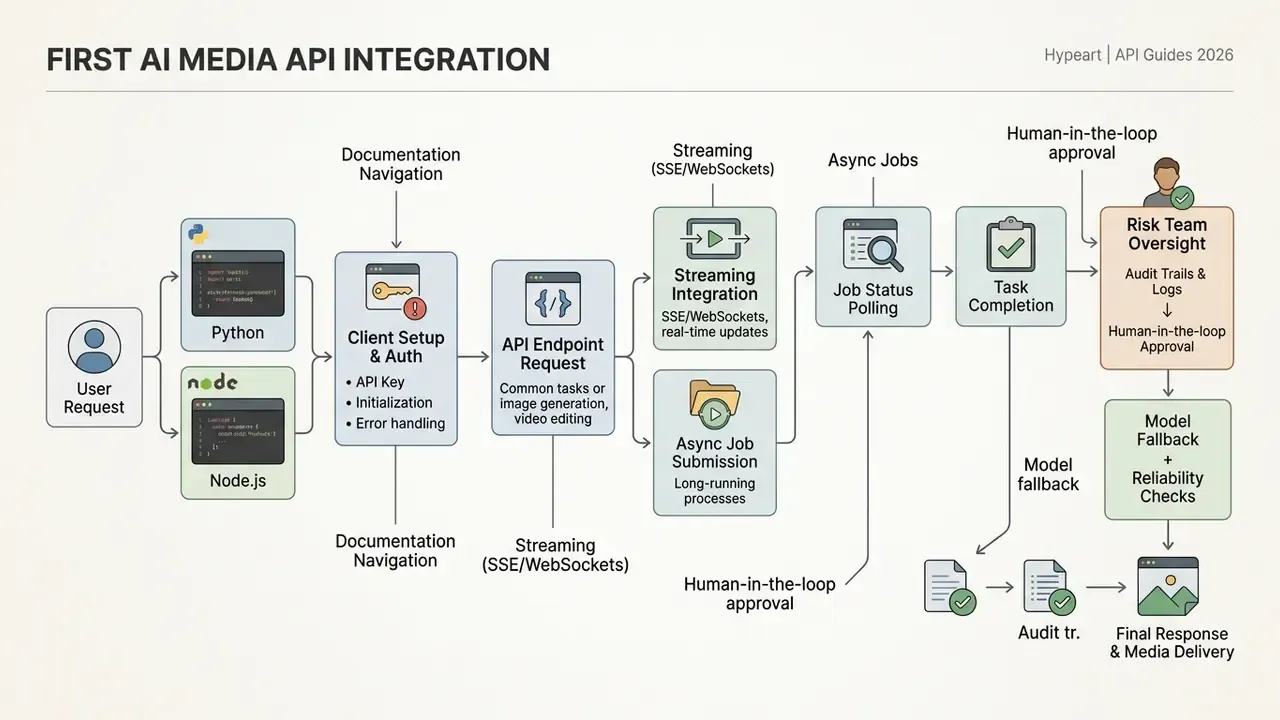
How to Build AI Media Generation Workflows
Building enterprise AI media generation workflows requires decoupled event-driven architectures. These architectures isolate long-running model inference jobs from front-end API gateways through queue-based orchestration and status messaging.
Asynchronous Generation Jobs and Status Handling
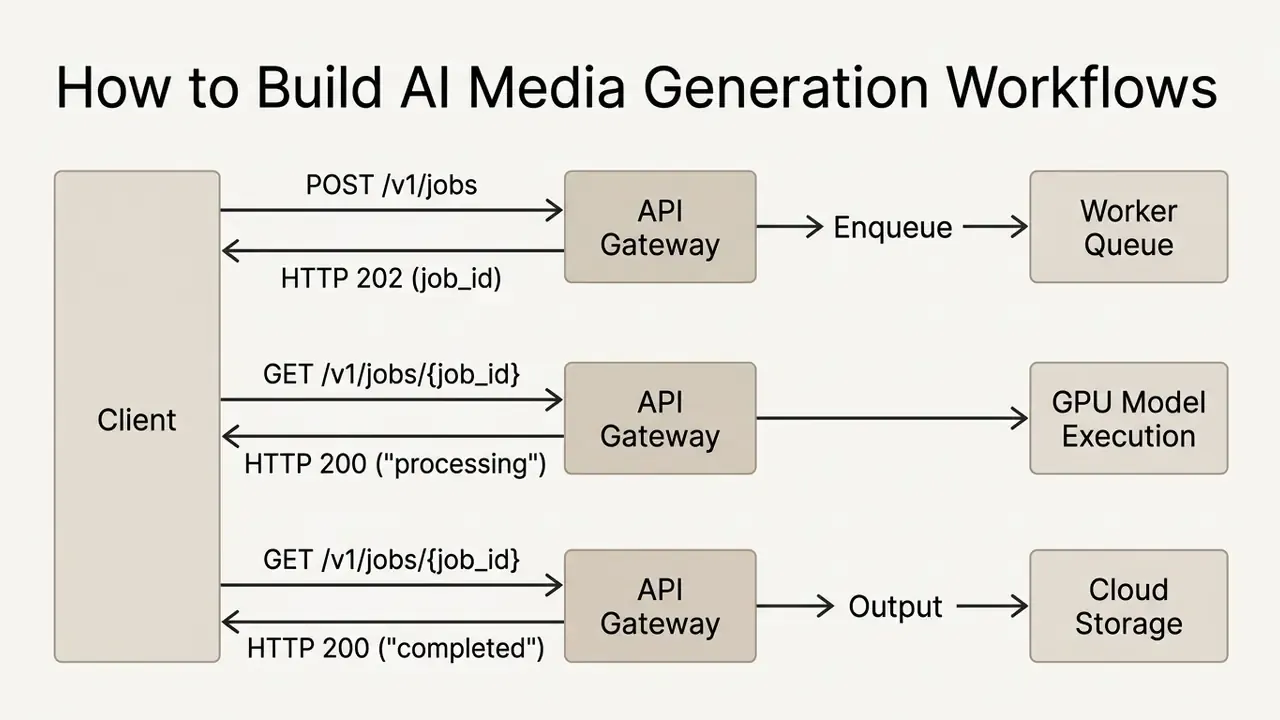
The asynchronous job model is the baseline pattern for text-to-video AI scenarios, where render time fundamentally exceeds any synchronous request window.
Client applications track progress using long polling or webhooks. The operational lifecycle of an asynchronous job follows a deterministic state machine: pending, then processing, then completed or failed.
"The IETF CoAP asynchronous task specification defines a deterministic task lifecycle: pending, processing, completed or failed."
One caveat for multi-provider integrations: status vocabularies are not standardized. Some APIs use PENDING / ACTIVE / COMPLETED / FAILED / ABORTED, others use queued / processing / succeeded, and others invent prefixed schemes such as esriJobSubmitted / esriJobExecuting / esriJobSucceeded. So the integration layer always introduces an internal normalized state machine, with provider statuses mapped into it by a lookup table. Terminal states must be enumerated explicitly, otherwise a worker will poll forever. Mandatory attributes of a job record include job_id, an idempotency key for the request, a deadline (to force failed on timeout), and an attempt counter.
Automated Workflows for Media and Data Processing
Automated media and data pipelines use event-driven triggers to execute extract, transform, and load (ETL) workflows whenever media assets enter cloud storage.
In automated AWS architectures, an S3 file upload generates an EventBridge event.
"AWS Media Lake Guidance describes the pattern: S3 event, EventBridge, Step Functions, Lambda validation, Bedrock or an external AI API, then JSON into a database."
This event triggers AWS Step Functions to coordinate parallel processing tasks: Lambda functions validate file boundaries, Amazon Bedrock or external AI Media APIs execute generation or analysis jobs, and structured JSON results are stored in database systems. Extra buffers such as SQS smooth out bursts, and a Distributed Map in Step Functions fans out bulk processing across parallel branches with controlled concurrency. The capabilities of the generative engines embedded in such a pipeline are covered in our AI video generator overview.
Supervisor Pattern with a Manual Approval Pause (Human-in-the-Loop)
Publishing AI content straight into production channels carries risks of hallucinations, visual artifacts, and brand safety breaches. The industrial orchestration pattern therefore includes a stop point, a waitpoint gate: the task generates an artifact, then pauses and waits for an approval token without holding expensive compute.
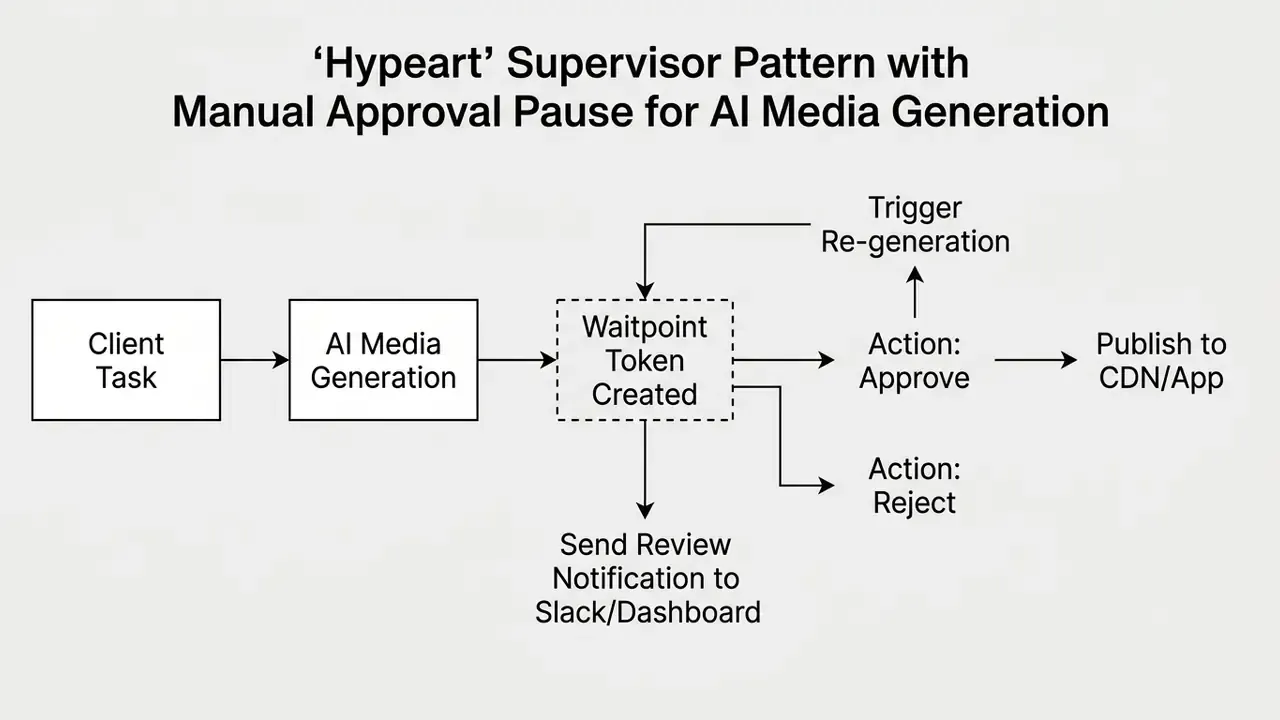
Properties of a correct implementation:
- A pause with no idle cost. Waiting for a human decision is implemented through checkpoint and resume, not through a held connection or a sleeping worker. Minutes and hours of waiting must not be billed as active compute.
- An approval token with a bounded lifetime. The waitpoint token is single use, bound to a specific
workflow_id, and carries a TTL plus an escalation deadline. TTL expiry becomes its own terminal status,expired, instead of a silent hang. - Authentication of the decision maker. The approval webhook accepts a decision only from an authenticated user with the right role; the request signature is verified, and identity plus timestamp go into the log.
- Feedback into the prompt. A rejection must carry a structured reason (artifacts, brand mismatch, broken text inside the image) that is translated into the negative prompt of the next iteration.
- Risk-based segmentation. Low-risk internal artifacts flow through automatically; anything reaching external channels or containing client data passes the gate without exception.
An example approval webhook integration in Node.js:
// Handler for an editor approval event
app.post('/api/workflows/approve', async (req, res) => {
  const { workflow_id, waitpoint_token, decision, reason } = req.body;
  try {
    const reviewer = await authenticateReviewer(req); // role + request signature
    await auditLog.append({
      workflow_id,
      actor: reviewer.id,
      decision,
      reason: reason ?? null,
      decided_at: new Date().toISOString()
    });
    if (decision === 'APPROVED') {
      await resumeWorkflow(waitpoint_token, { status: 'PROCEEDED' });
      return res.json({ status: 'Success: Asset published to production CDN' });
    }
    await triggerRegeneration(workflow_id, { negative_prompt: reason });
    return res.json({ status: 'Regeneration queued with negative prompt' });
  } catch (err) {
    console.error('Approval handling failed:', err.message);
    return res.status(err.statusCode ?? 500).json({ error: 'approval_failed' });
  }
});
Immutable Audit Trail: What to Log for the Auditor
Regulators and internal audit rarely ask whether the model works. They ask whether you can explain and reproduce a specific output from a specific date. For non-deterministic generative APIs, that means the log has to be sufficient to reconstruct the decision without calling the vendor.
The minimum content of an immutable record (append-only storage, WORM policy, retention agreed with compliance):
| Field | Audit purpose |
|---|---|
request_id, job_id | End-to-end correlation across stages and logs |
timestamp_utc | Chronology and retention compliance |
actor / service_account | Who initiated the call and on whose behalf |
prompt_full / prompt_hash | Input reproducibility; the hash where full text cannot be stored |
input_payload_hash, input_uri | Identifying the source media without duplicating the file |
model, model_version, provider | Which exact version produced the output |
seed, steps, guidance, negative_prompt | Determinization parameters and reproduction attempt |
output_uri, output_hash | Artifact immutability and tamper protection |
validation_result | Outcome of schema checks and guardrails |
human_decision, reviewer_id, reason | Who released the artifact to production and on what basis |
status, attempts, error_code | History of failures and retries |
cost_units, cost_currency | Call cost, retries included, feeding TCO |
One separate rule. The log is written at the moment of the event, not reconstructed afterwards from application logs, and integration service accounts hold no write-over permissions on existing records.
Production Approach to AI Media APIs: Scaling and Reliability
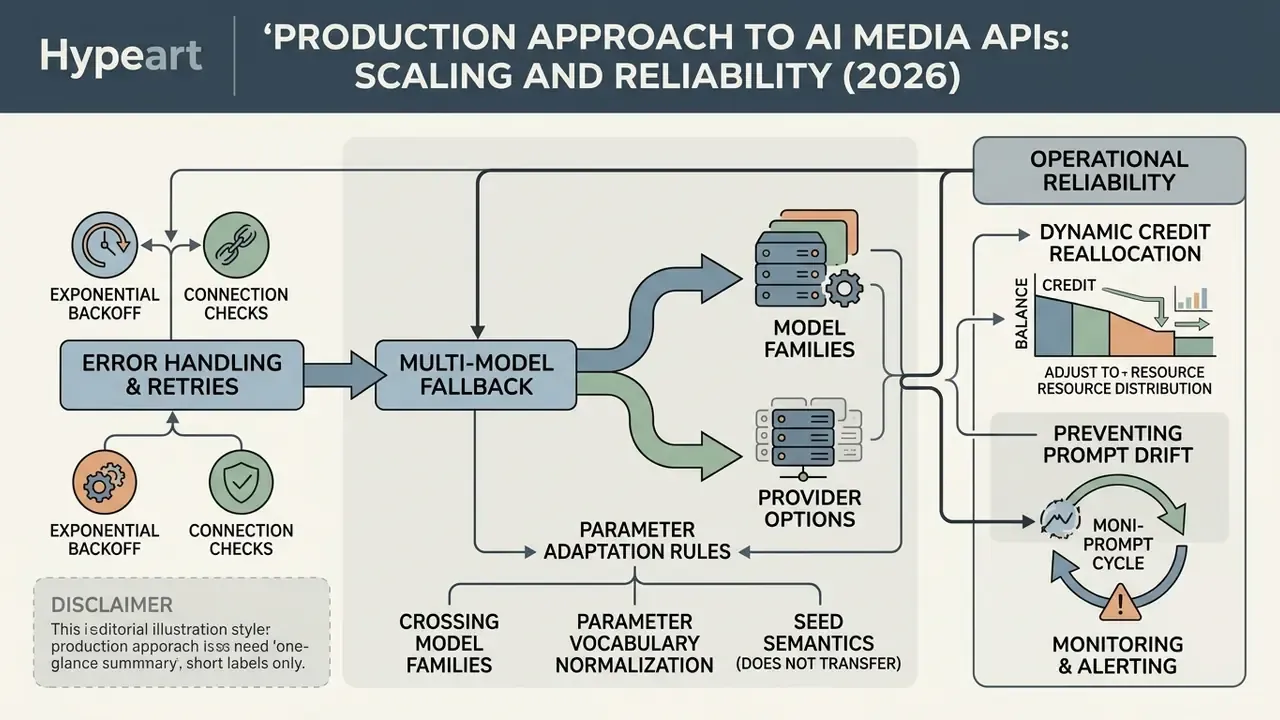
Transitioning AI Media APIs to production environments requires implementing resilient request workflows, controlling parallelism, and configuring system monitoring. The system design must account for cloud API operational risks, payload caps, and network timeouts (NIST SP 800-228, 2025). The recommended platform-level control set: timeouts on every request including application-level calls, payload size and bandwidth caps, and circuit breaking to bound concurrency. At the AI risk management level, this loop is complemented by the govern, map, measure, and manage functions of NIST AI RMF 1.0 (2023) and by the incident monitoring expectations of the Generative AI Profile (2024).
Error Handling and Retries for API Requests
Production systems must handle transient network disruptions and provider rate limits gracefully. When an API returns retryable status codes such as 408 Request Timeout, 429 Too Many Requests, or 5xx server errors, client logic should apply an exponential backoff algorithm with randomized jitter.
"The Google Gen AI SDK recommends an initial delay of 1 second, doubling up to a maximum of 60 seconds, with no more than 4 retry attempts."
Adding randomized jitter prevents synchronized retry spikes, the classic thundering herd problem, across distributed worker nodes. Non-retryable errors such as 401 Unauthorized or 400 Bad Request must fail immediately without retries. For paid inference calls, idempotency belongs in the same discussion: a retry without an idempotency key means paying twice for the same job.
Multi-Model Fallback and Preventing Prompt Drift
When a provider returns an unrecoverable error, for example 429 Quota Exceeded or 503 Service Unavailable, the system should reroute the request to a backup model automatically. Passing the identical JSON payload, however, degrades quality, because architectures differ: a prompt tuned for one model behaves differently in another. This effect is observable. A prompt polished in the web interface of an image model underperforms in a video model that lacks negative terms aimed at motion artifacts.
Parameter adaptation rules during fallback:
- Crossing model families. When switching from an image-oriented engine to a video-oriented one, automatically append negative prompts specific to video artifacts (
motion blur,flickering,warping), and convert the aspect ratio from a pixel format (1920x1080) into the symbolic standard (16:9). - Parameter vocabulary normalization.
sizebecomesaspect_ratioplusresolution;duration_secondsmaps to the discrete set the target model allows, for example 4, 6, or 8 seconds only;stepsmaps to the engine's own scale. Incompatible parameters are dropped deliberately and logged, never silently. - Seed semantics do not transfer. The same
seedin a different model does not yield a similar frame. On fallback, the seed is preserved for internal reproducibility only, not as a guarantee of visual continuity, and that limitation is stated in the audit record. - Dynamic credit reallocation. When the primary API exceeds its timeout, the service switches the route from High Quality to Fast or Turbo, reducing denoising steps from 50 to somewhere between 4 and 8, and flags the artifact as a draft.
- Shared credit pools at aggregators. If models are reachable through a single hub with one balance, spend across different engines competes for the same limit. Set budgets and alerts on the pool, not on an individual model.
- An explicit degradation flag in the response. A response served by the backup model is marked with a field such as
served_by: "fallback", so downstream logic and the human reviewer know quality may differ from baseline.
The fallback order is declared explicitly, priority 1 through N, with one constraint: no more than a single provider switch per original request, so you never trigger a cascade of expensive retries.
Batch Processing and Parallelism for High Media Volumes
High-volume media workflows must manage concurrency limits to avoid provider account throttling. Enterprise batch APIs separate batch processing quotas from real-time interactive rate limits.
"The OpenAI Batch API accepts up to 50,000 requests per file with a 200 MB limit, executing tasks in a separate 24-hour window at reduced cost."
For real-time parallel workers, system architectures must enforce concurrency limits using semaphore queues to remain within provider caps, such as Google Gemini Batch API's limit of 100 concurrent batch operations with a 2 GB input-file ceiling (Google Gemini API Docs, 2026). Keep in mind that providers count limits in different units: requests per second, tasks, tokens, or concurrent records. Some media platforms advertise tens of thousands of simultaneous jobs while capping how fast new ones can be submitted. Review our complete AI Video API Pricing Guide for a cost comparison across batch and real-time inference models, and use our comparison of AI video generators when picking a specific engine.
How to Calculate TCO Rather Than a Price List
For a budget owner, total cost of ownership has five components, and the provider price is only the first.
- Base inference.Price per image, per second of video, or per 1,000 tokens, multiplied by forecast volume, with batch and real-time tariffs kept separate.
- Retry cost.The share of requests that ended in 429 or 5xx and were retried. At 8% retries with no idempotency, you pay twice for every one of them.
- Rejection cost.Artifacts that fail schema validation or get declined by a reviewer are inference already spent, plus the cost of regenerating them.
- Control infrastructure.Queues, workers, artifact and audit log storage, observability, plus maintaining the golden dataset and running regressions when the model version changes.
- Human labor.Reviewer time at the human-in-the-loop gate and model owner time for periodic revalidation.
A practical reference point for the business case: compare not the cost per frame, but the cost per artifact accepted into production. That number absorbs every rejected attempt and every minute of manual review.
Monitoring, Logging, and CI/CD Integration
Maintaining production visibility requires exporting operational metrics to monitoring platforms like Prometheus and Grafana while tracing requests using OpenTelemetry protocols.
"The OpenTelemetry Specification 2026 defines the standard for request tracing and metric export in production systems with distributed infrastructure."
A workable configuration: metrics exposed through a scrape endpoint or remote_write authorized by an access policy token, and logs shipped over OTLP with trace context injected, so the log line for one generation ties back to the trace of its request.
Monitored metrics should track request volume, error rates by status code, generation latency distributions, and token or dollar usage per key. For media pipelines, add four domain-specific indicators: the share of responses rejected by schema validation, the share of artifacts rejected by humans, the share of requests served by a fallback model, and the average age of unfinished jobs in the queue. Provenance control over inbound visual material pairs well with tools in the AI image detector class.
CI/CD integration pipelines should execute automated integration tests against API staging environments before deployment to ensure schema changes or model version updates do not break downstream parsers.
"Grafana integration testing guidelines recommend automated tests in a staging environment to detect schema changes before a production deploy."
One more discipline item: contract tests against a stored copy of the provider's OpenAPI specification. The pipeline fails if a response field changes type or a required attribute disappears, well before a production parser meets it.
Production Readiness Checklist
A consolidated readiness list across four domains. Each line has a named owner before release.
Checklist0 / 23
AI Media API Guides Examples for Real Tasks
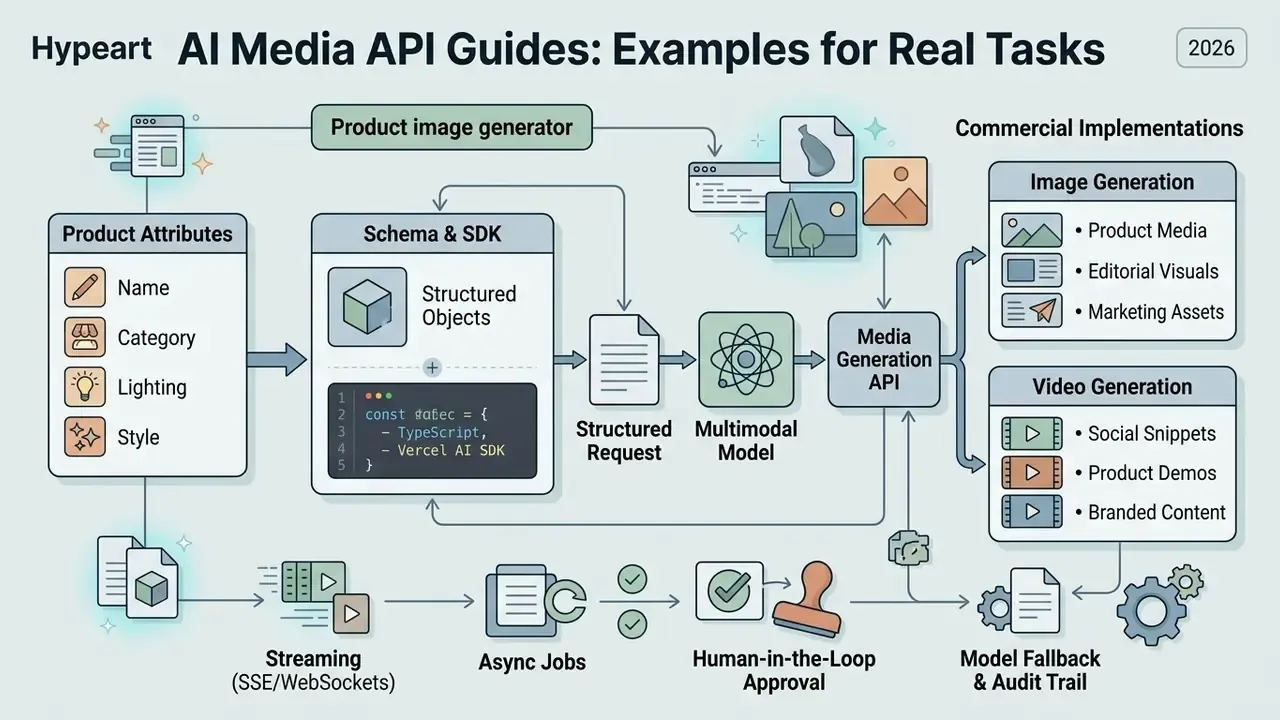
Practical deployment scenarios demonstrate how schemas, SDKs, and multimodal models integrate to solve specific business requirements.
Examples of Image, Video, and Product Media Generation
Commercial implementations use schema-driven outputs and modern SDK frameworks to build specialized tools: product image generators, visual document audit pipelines, and composite overlay utilities for branded material.
Using the Vercel AI SDK, developers can execute structured object generation and image synthesis in TypeScript apps:
import { experimental_generateImage as generateImage } from 'ai';
import { openai } from '@ai-sdk/openai';
export async function generateProductCard(promptText: string) {
  try {
    const { image } = await generateImage({
      model: openai.image('gpt-image-2'),
      prompt: `Professional e-commerce product display: ${promptText}. High resolution, clean background.`,
      aspectRatio: '1:1',
      seed: 42,
      abortSignal: AbortSignal.timeout(60_000),
    });
    return image.base64;
  } catch (error) {
    console.error('Image generation failed:', (error as Error).message);
    throw error;
  }
}
- Product image generator workflow: accepts product attributes (name, category, lighting), invokes structured image models, processes binary outputs, and returns direct CDN URLs for web display. The legal framing for using such material is covered in our review of AI image generators for commercial use.
- Document and payment slip visual audit workflow (regulated pipeline): accepts a scanned document or payment slip through a presigned upload, a multimodal model extracts fields into strict JSON (account details, amounts, dates, numbers), guardrails validate the schema and reconcile arithmetic so line items equal the total, discrepancies and low confidence go to a manual queue, and the approved record enters the accounting system while the prompt, model version, and reviewer decision enter the immutable log.
- Automated overlay and compliance watermark workflow: accepts a base image URL and text strings (disclaimer, license number, offer validity date), calculates layout boundaries, calls an image editing endpoint, and exports composited images with the mandatory legal plate. The same technical pattern serves fast internal communication assets, including meme-style overlay formats, but with a mandatory approval gate before publication.
- Multimodal SDK pipeline: combines the Vercel AI SDK
generateObjectcall with Zod schemas to generate structured product copy while simultaneously generating matching product images in one workflow. The natural continuation is animating the approved frame with image-to-video AI. - Example 1: Product Image Generator
- Input data: JSON (
{ "sku": "A-99", "title": "Ergonomic Chair", "style": "Minimalist Studio" }). - Model used: diffusion-based product model via REST.
- Technology stack: Python, FastAPI, Celery, Redis, AWS S3.
- Response format: HTTP 200 JSON with a link to a 4K PNG on the CDN.
- Control: metadata schema validation, approval gate before storefront publication.
- Example 2: Document / Payment Slip Visual Audit
- Input data: presigned S3 URL of the scan (
application/pdf,image/jpeg) plus a case identifier. - Model used: multimodal LLM with forced schema-bound JSON output.
- Technology stack: Python, Step Functions, Lambda validation, Pydantic or JSON Schema, WORM log storage.
- Response format: HTTP 200 JSON with extracted fields,
confidence,validation_result, and aneeds_human_reviewflag. - Control: golden dataset, hallucination test, arithmetic reconciliation, mandatory review below the confidence threshold.
- Example 3: Automated Overlay / Compliance Watermark Generator
- Input data: image URL, top and bottom text strings, mandatory disclaimer block.
- Model used: multimodal image-to-image or canvas overlay API.
- Technology stack: Node.js, Express, Axios, Sharp image transformer.
- Response format: HTTP 200 JSON with
image/jpegin Base64. - Control: waitpoint gate before publication to external channels.
- Example 4: Vercel AI SDK Image Integration
- Input data: text prompt from a web interface form.
- Model used: OpenAI
gpt-image-2or a Replicate provider. - Response format: async stream or Base64 image payload.
- Technology stack: Next.js App Router, TypeScript, Vercel AI SDK.
- Control:
seed,model_version, and the prompt recorded in the audit log.
FAQ: Regulatory Risk, SLA, and Auditing an AI Media API
Do we need streaming (SSE or WebSockets) if our model returns the full response at once?
Yes, if you plan to add streaming scenarios later. Most media and multimodal services eventually move toward streamed delivery for UX reasons, and migrating the transport layer mid-project costs more than supporting SSE from the start.
How can an SSE endpoint be tested without writing a separate script?
Use documentation platforms and clients with native SSE support that render the chunk stream in the browser. If that support is missing, testing has to move into an external environment, which is itself an argument when choosing documentation tooling.
What exactly should we demand from a vendor on Zero Data Retention?
A written no-training clause, a measurable retention period for inputs and outputs, human review disabled, the processing region, the subprocessor list, an incident notification duty, and verifiable data deletion on termination. A statement such as "we do not use your data" without a retention period and a confirmation mechanism is not a control.
How do we audit a model that returns a different answer for the same input?
You audit process reproducibility, not pixel reproducibility. The log needs the prompt or its hash, model, model_version, seed and generation parameters, the schema validation result, the human decision, and the final artifact with its hash. That is enough to explain a specific output and show which control released it.
How long should prompts and results be kept?
The period follows your retention policy and supervisory expectations for the underlying process, not technical convenience. Common practice: the audit log outlives the media artifacts, and where the full prompt cannot be stored because of personal data, you keep a hash plus a masked version.
How do we control hallucinations in OCR and vision tasks?
Three layers. A strict output schema, so invalid JSON is rejected. A cross-check of critical fields through a second independent channel. A confidence threshold with routing to a human. Plus a regular golden dataset run that includes documents where the requested field does not exist at all.
What should happen when the provider changes the model version?
Treat it as a change requiring revalidation: a golden dataset run, a baseline comparison, schema contract tests in CI, and a release decision by the model owner. The contractual duty to notify version changes and endpoint deprecation in advance belongs in the SLA.
Can AI content be published without manual approval?
For low-risk internal artifacts, yes. For anything reaching external channels, containing client data, or making legally meaningful claims, industry practice requires a waitpoint gate with an authenticated reviewer decision and the rationale recorded in the log.
How do we calculate the real cost of the integration?
Calculate the cost per artifact accepted into production: base inference, plus retries, plus rejections, plus validation and audit infrastructure, plus reviewer time. The provider price list on its own understates TCO.
What if the primary provider goes down?
A pre-declared fallback route with parameter adaptation (negative prompts matched to the target engine's artifacts, normalized aspect ratio and duration, reduced denoising steps) and an explicit served_by: "fallback" flag in the response, so downstream systems and the reviewer know quality may differ. Disclaimer: this material is informational and technical in nature and is not legal, compliance, financial, or investment advice. All numeric limits, quotas, and parameters reflect the state of the market as of 2026 and must be verified against the current documentation of the relevant provider before a production deployment.