On this page: What AI image training is · Autoencoders and contrastive learning · Base model vs fine-tuning · Diffusion mechanics · When to train a custom model · Personal style training · Business use cases and creator monetization · Video LoRA · Choosing a base model and method · Dataset preparation and governance · Step-by-step training workflow · Compute budgeting and ROI · Quality testing and retraining triggers · Model Validation Card · Platform selection (no-code vs code) · Limitations · FAQ
AI image training is the structured process of teaching a neural network to convert text prompts and random noise vectors into high-fidelity visual outputs that conform to a specific style, subject, or domain requirement. For a bank or a mature fintech, the interesting part is not the art. It is control. Institutional adoption of generative visual models means moving from unconstrained public sampling to deterministic, auditable workflows that sit inside a stated risk appetite.
"Deploying autonomous visual generation in regulated enterprise environments requires shifting from unconstrained sampling to auditable data pipelines. Without verifiable provenance, structured risk tiering, and strict access controls, no generative model should operate autonomously in production."
Financial institutions and mature technology firms increasingly evaluate generative models through measurable controls, auditability, and data lineage. Enterprise teams assessing automated visual pipelines can benchmark governance frameworks across specialized AI Media Workflows to set clear escalation paths before deployment. Independent artists and studios use the same training mechanics for a different objective: owning a reproducible visual signature that can be licensed as intellectual property.
Same mathematics. Different accountability.
What Is AI Image Training and How Does It Work?
AI image training is a mathematical optimization procedure that maps textual token embeddings to high-dimensional image distributions using deep neural networks. The training framework conditions a generative backbone, typically a diffusion model or a flow-matching transformer, to predict and remove added Gaussian noise across sequential timesteps until a coherent image emerges.
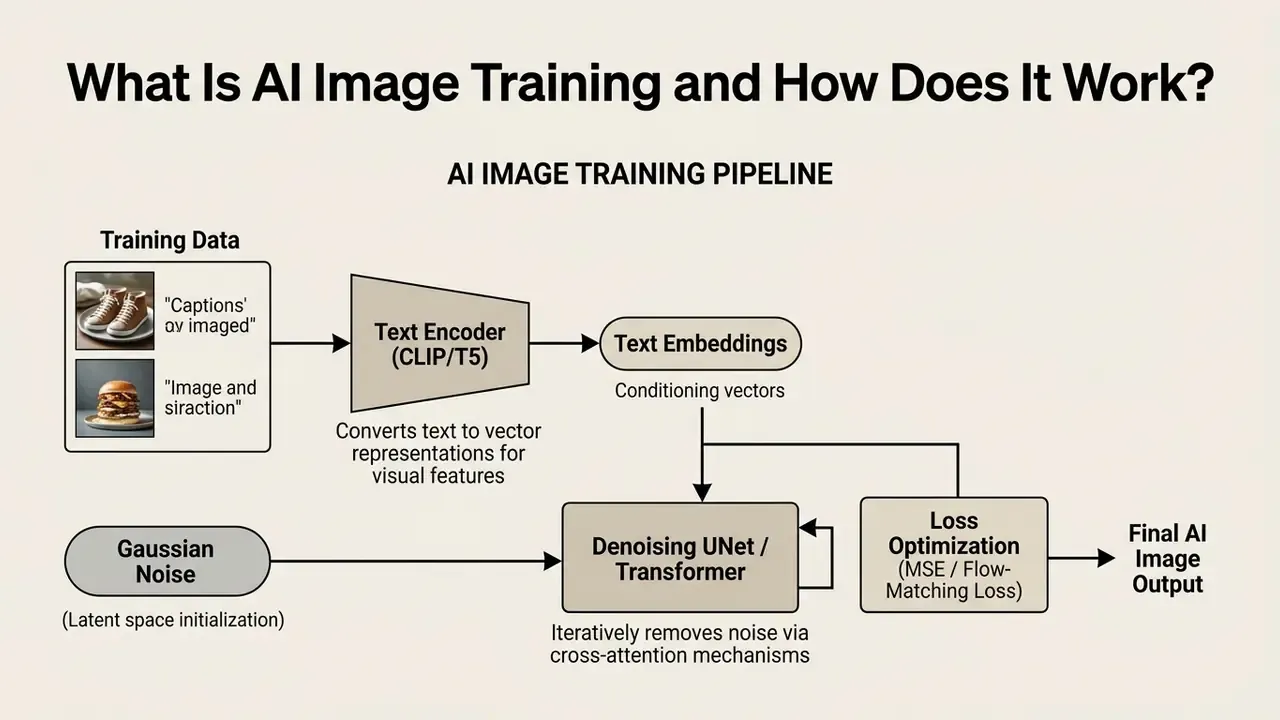
During model training, the network evaluates paired training images and text prompts to establish statistical associations between language concepts and visual patterns. Research on scaling diffusion image training suggests that compute-optimal text-to-image training needs roughly 200 image tokens per model parameter, about ten times the ratio prescribed by the Chinchilla law for language models.
In plain terms: generative visual neural networks are hungrier per parameter than standard autoregressive language models. That single ratio explains why nobody sane pretrains a base image model to solve a brand-consistency problem.
Underlying Architecture: Autoencoders and Contrastive Learning
Modern image diffusion frameworks lean on two machine learning mechanisms to process visual data efficiently.
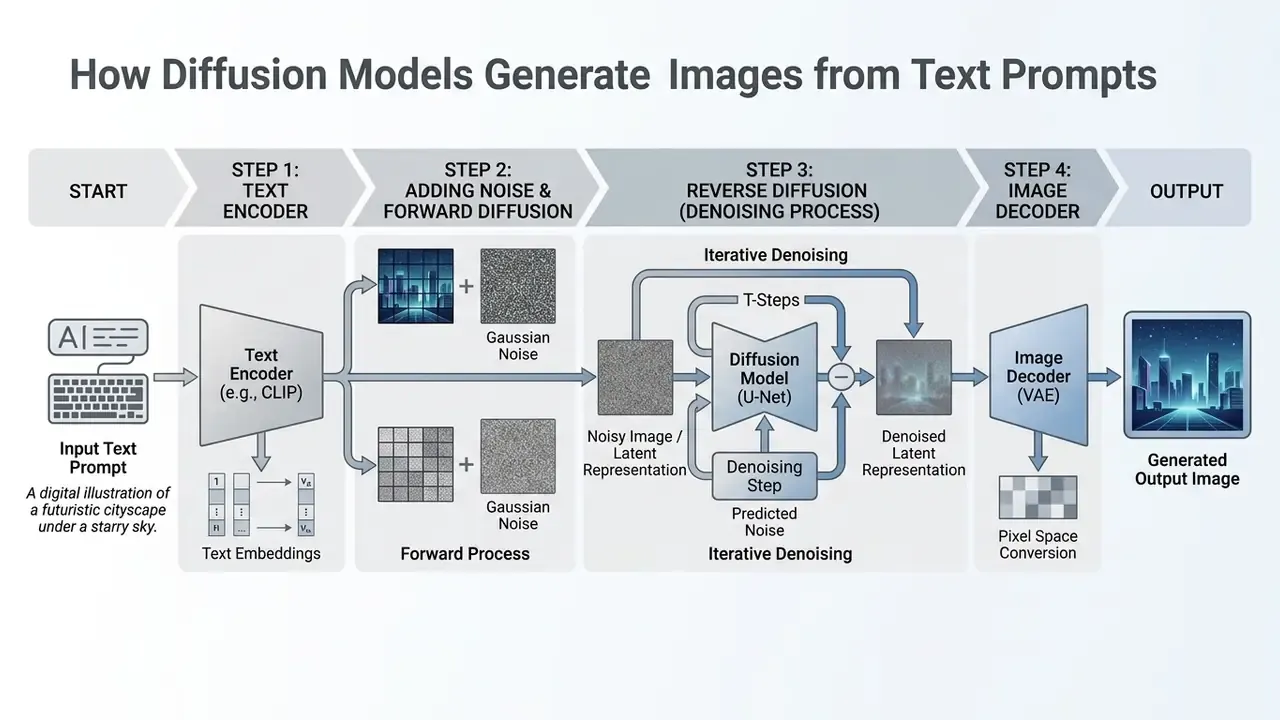
- Variational Autoencoders (VAE).Raw pixel images () carry enormous redundancy. An autoencoder compresses pixel data into a lower-dimensional latent space (encoding), letting the diffusion process predict and subtract noise inside a compact mathematical space, before a decoder reconstructs the output at full visual resolution. This compression is the only reason a consumer GPU can train a style adapter at all: the denoiser never touches raw pixels during optimization.
- Contrastive Learning (CLIP framework).Contrastive learning pairs visual features with textual descriptions, pulling matching text and image pairs closer inside a shared embedding space while pushing mismatched pairs apart. This joint embedding architecture is what allows a text prompt to steer the denoising trajectory toward the intended visual concept rather than toward some arbitrary plausible image.
A third idea follows from the first two: shared embedding spaces. Because images, captions and even code can be projected into one common representation, the same architecture supports cross-modal tasks such as retrieval, tagging, and automated caption generation for your own dataset. Practically, an engineer who understands VAE compression and contrastive alignment can diagnose most training failures. Blurry decoding points to latent or resolution problems. Prompt non-compliance points to text and image alignment problems. Two symptoms, two very different fixes.
Training a Base Model vs Fine Tuning a Custom AI Model
Training a base model means initializing weights randomly and training across billions of paired images to build broad visual priors. Fine-tuning adapts an existing pretrained base model using a smaller, specialized dataset. Base model training demands massive compute budgets, spanning to FLOPs, and datasets of hundreds of millions of curated records. Fine-tuning modifies selected model weights or injects rank-decomposition adapter matrices (LoRA) to teach narrow concepts, a personal style, or a brand identity with minimal computational overhead.
For scale context, Microsoft's published data summary for its MAI-Image family reports a training corpus of more than one billion curated, safety-filtered images, augmented with synthetic samples captioned by vision-language models. No individual enterprise team replicates that footprint. They adapt it, which is the entire point of learning how to train an AI model with images you already own.
For enterprise risk managers, training a base model from scratch raises severe data governance, copyright, and compute-cost exposure. Fine-tuning leverages proven base architectures while isolating custom adaptations inside modular weight layers. When adjusting internal visual pipelines, teams often consult the AI Media API Guides to evaluate parameter efficiency and API integration risks.
How Diffusion Models Generate Images from Text Prompts
Diffusion models generate images through an iterative reverse-denoising process in latent or pixel space, conditioned on textual representations from frozen encoders such as CLIP or T5. The pipeline starts with random Gaussian noise. At each discrete timestep, a U-Net or transformer denoiser predicts the noise component added to the latent vector and subtracts it under cross-attention guidance.
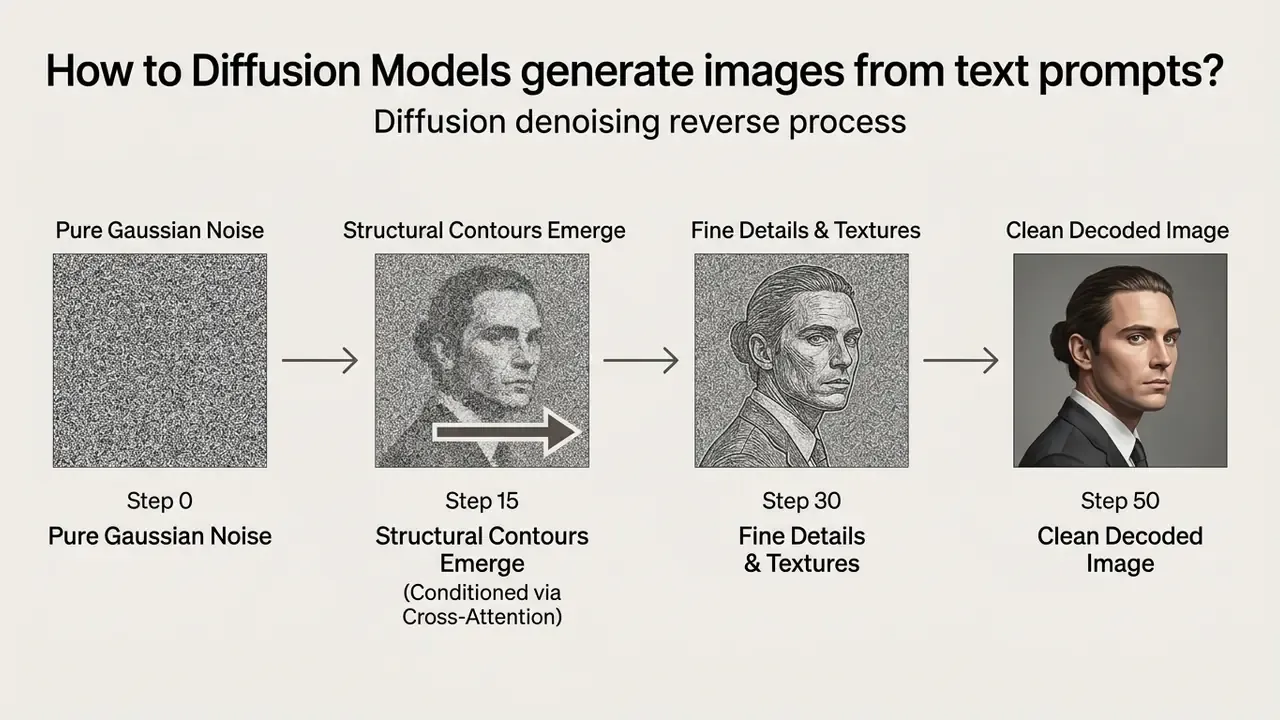
Prompt engineering guides that trajectory by dictating which visual features the cross-attention layers prioritize at which timesteps. Early timesteps establish global composition and spatial geometry. Later timesteps refine high-frequency detail, texture, and lighting. So a prompt that fixes composition but ignores lighting will usually produce the right layout with the wrong mood.
Source attribution note. Controlled text-conditioned denoising is documented in peer-reviewed generative-vision literature, not in audit reports. Holistic benchmarking across 26 models, 62 scenarios and 12 aspects confirms that generation quality depends on how accurately prompt embeddings map to the distribution learned during training.
"HEIM evaluates 26 models across 62 scenarios and 12 aspects: no single architecture leads simultaneously on quality, alignment, fairness and efficiency."
When Should You Train an AI Image Generator?
Train a custom AI image generator when off-the-shelf foundation models keep failing to reproduce specific domain identities, strict brand aesthetics, or proprietary technical objects through prompt engineering alone. Pretrained foundation models learn generalized web distributions. Those distributions rarely hold the precision needed for specialized commercial use cases, regulatory compliance, or exact product representation.
Composite case framing. In a risk-assessment scenario built for a commercial banking client, an enterprise communications team tried to generate consistent visual collateral for complex financial trade instruments using public generators. The public models introduced anatomical distortions and structurally inaccurate document layouts across a large share of sampled outputs. Prompt rewriting did not fix it, because the underlying distribution held no reliable prior for those instrument templates. Moving to a controlled LoRA fine-tuning workflow on a small, fully audited set of reference images brought near-uniform visual consistency across campaign assets, with an immutable audit log of training inputs. (Composite illustrative scenario assembled from anonymised engagements; percentages are engagement-dependent and are deliberately not asserted as benchmarks.)
A practical trigger list for opening a training project:
- Prompt engineering is exhausted and defect rates stay above the tolerance defined by the asset owner.
- Outputs must be reproducible across months and across operators, not merely acceptable once.
- Policy prohibits external API exposure of brand assets or customer imagery.
- The organization needs exportable weights rather than a rented black-box endpoint.
If none of those apply, save the GPU hours. A better prompt library is cheaper than an adapter you then have to govern.
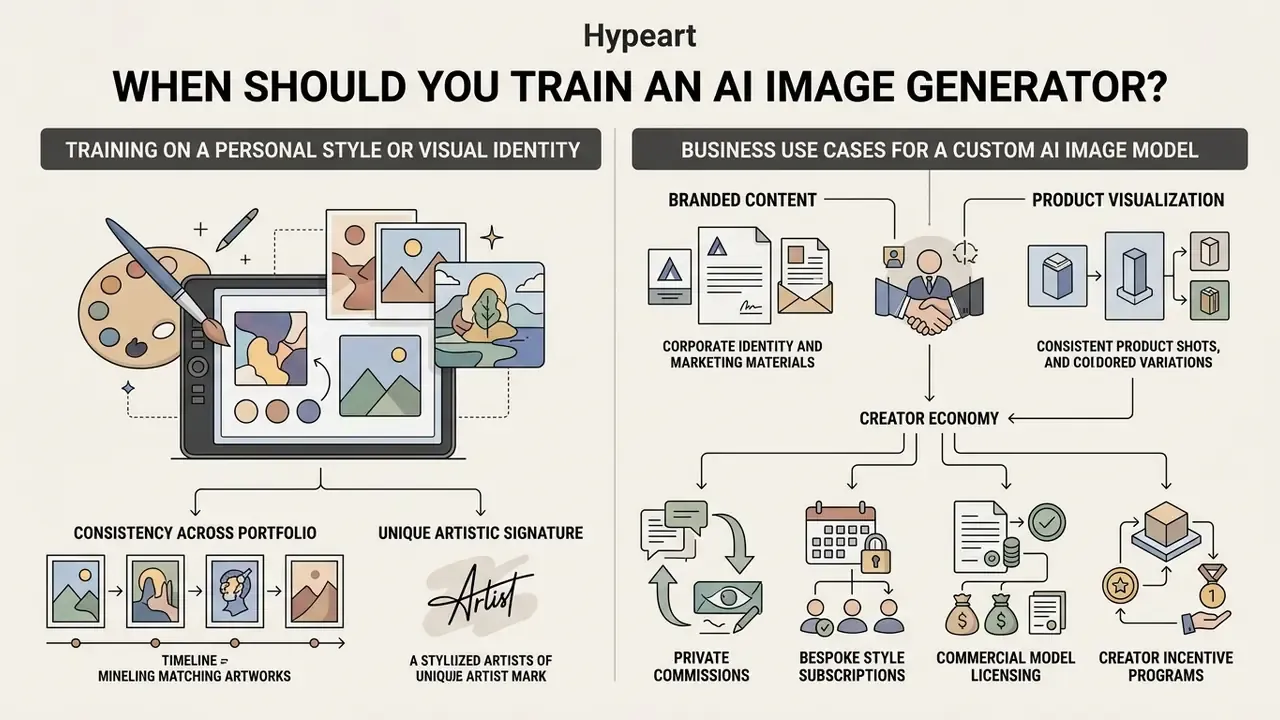
Training AI on a Personal Style or Visual Identity
Training AI on a personal style or visual identity means binding aesthetic markers, such as colour palettes, stroke characteristics, and lighting conditions, to explicit text trigger tokens through low-rank adaptation or text-encoder tuning. This is also the honest answer to how to train an AI photo editor on personal style: you do not teach an editor, you teach an adapter that the editor then calls. Before committing a dataset, many artists benchmark reference outputs across the best AI art generators for style reference to see which markers a base model already understands and which must be taught from scratch.
Methodologies such as DreamBooth show that subject and style adaptation can work with as few as three to five reference images when combined with class-specific prior preservation loss.
"DreamBooth achieves subject personalization from 3–5 images using a prior preservation loss that retains the base model's general knowledge."
When establishing a personal style, the dataset must hold strict aesthetic consistency so latent representations are not confounded: identical subject identity, deliberately varied context. Single-reference adaptation frameworks such as TextBoost push the idea further.
"Fine-tuning only the text encoder on a single image prevents catastrophic forgetting while preserving style-transfer fidelity."
Contrastive style learning offers a complementary route. Aligning a style name, textual labels and style images under a CLIP-based contrastive objective maximizes separation between styles while preserving content semantics. That matters when one creator maintains several distinct commercial styles that must never bleed into each other.
Business Use Cases for a Custom AI Image Model
Business use cases for custom AI image models include automated product catalog generation, controlled marketing collateral, scalable gaming asset pipelines, and privacy-compliant synthetic data generation. Enterprises deploy custom models to protect intellectual property, remove external API data exposure, and enforce visual identity guidelines across global operating units. Before publishing generated assets, legal teams typically confirm commercial-use rights for AI image generators against the licence of both the base model and the adapter.
Research on continual post-training benchmarks names the two dominant deployment paradigms.
"T2I-ConBench identifies item customization and domain enhancement as the two primary operational paradigms for enterprise diffusion deployment."
Custom models let e-commerce platforms render products in diverse lifestyle contexts without re-photographing physical inventory. Studies on generative data augmentation also quantify the downstream benefit for recognition systems.
"Augmenting real training data with high-fidelity synthetic images raised classification accuracy from 64.96% to 69.24% on difficult recognition tasks."
Documented commercial outcomes point the same way. Peer-reviewed e-commerce research reports conversion uplifts in the 10–15% band from AI-driven personalization of visual merchandising, while a 2026 UK marketing-sector study found 89% of surveyed companies reporting efficiency gains, 76% reporting cost reduction, and creative professionals cutting task time by roughly 20%. Game-development case studies show the same production workflow applied to asset pipelines, though without published cost deltas.
One unglamorous detail: most of these assets end their life inside a deck or a landing page, not a gallery. Layout mechanics still decide whether the output looks professional, which is why production teams keep practical references handy, including how to wrap text around an image in Google Slides and the walkthrough on how to insert youtube video into canva presentation alongside generated stills.
Creator Economy: Licensing and Monetizing Custom AI Models
Custom AI image training gives artists and independent creators explicit ownership over a digital aesthetic. Once a LoRA adapter or fine-tuned checkpoint exists as a portable .safetensors file, it becomes a licensable asset rather than a disposable experiment. Common monetization paths:
- Commercial model licensing. Granting brands paid, scoped access to generate assets with your proprietary style checkpoint, usually per-campaign, per-territory, or per-seat, with a defined term and an audit clause.
- Creator incentive programs. Publishing open checkpoints to specialized model registries and marketplaces that pay royalties based on generation volume, downloads, or community usage.
- Bespoke style subscriptions. Offering design agencies a retainer for continuously refreshed adapters that track seasonal corporate-identity updates.
- Private commissions. Training a single-client model that is never published, priced on exclusivity rather than volume.
Two operational cautions apply to every path. First, provenance: a checkpoint trained on assets you do not own cannot be licensed cleanly, so keep signed rights records for every training image. Second, containment: selling a licence to generate is not the same as selling the weights. Define which one the contract transfers, and whether derivative fine-tunes of your adapter are permitted.
Extending Fine-Tuning to Video Generation Models (Video LoRA)
Image LoRA updates static spatial feature layers. Fine-tuning temporal video diffusion backbones, such as Wan 2.1 and Hunyuan Video, requires conditioning across sequential frame representations. Video LoRA training optimizes temporal attention layers alongside spatial matrices so that character identity stays stable and motion stays fluid across the model's 3D vector fields.
When preparing datasets for video generation models, creators ingest continuous clips split into structured keyframe sequences, then apply temporal mask conditioning to suppress flickering and motion drift. Sourcing is where most of the governance trouble starts. Teams that pull reference footage with an online video downloader youtube utility or normalize codecs through an online video converter youtube workflow still need a documented rights basis for every clip. Technical convenience is not a licence.
| Dimension | Image LoRA | Video LoRA |
|---|---|---|
| Target layers | Spatial attention + UNet/DiT blocks | Spatial and temporal attention blocks |
| Dataset unit | Single captioned frame | Clip (8–129 frames) with clip-level caption |
| Dominant failure mode | Background memorization, style rigidity | Flicker, identity drift, motion collapse |
| VRAM pressure | typical | Substantially higher; frame count multiplies activations |
| Evaluation | Per-image CLIPScore / FID | Per-frame metrics plus temporal consistency scoring |
Governance implication: video adapters widen the surface area of consent and likeness risk, because motion and voice-adjacent cues make synthetic subjects more persuasive. Tier video generation above still-image generation in the risk register, and require human review before publication.
Choose the Right AI Image Model and Training Method
Choosing the right AI image model and training method means weighing project requirements against dataset size, hardware constraints, target output resolution, and the degree of stylistic control you actually need. Teams decide whether to update all parameters through full fine-tuning, train lightweight adapter weights via LoRA, enforce structural geometry with ControlNet, or apply zero-shot style transfer.
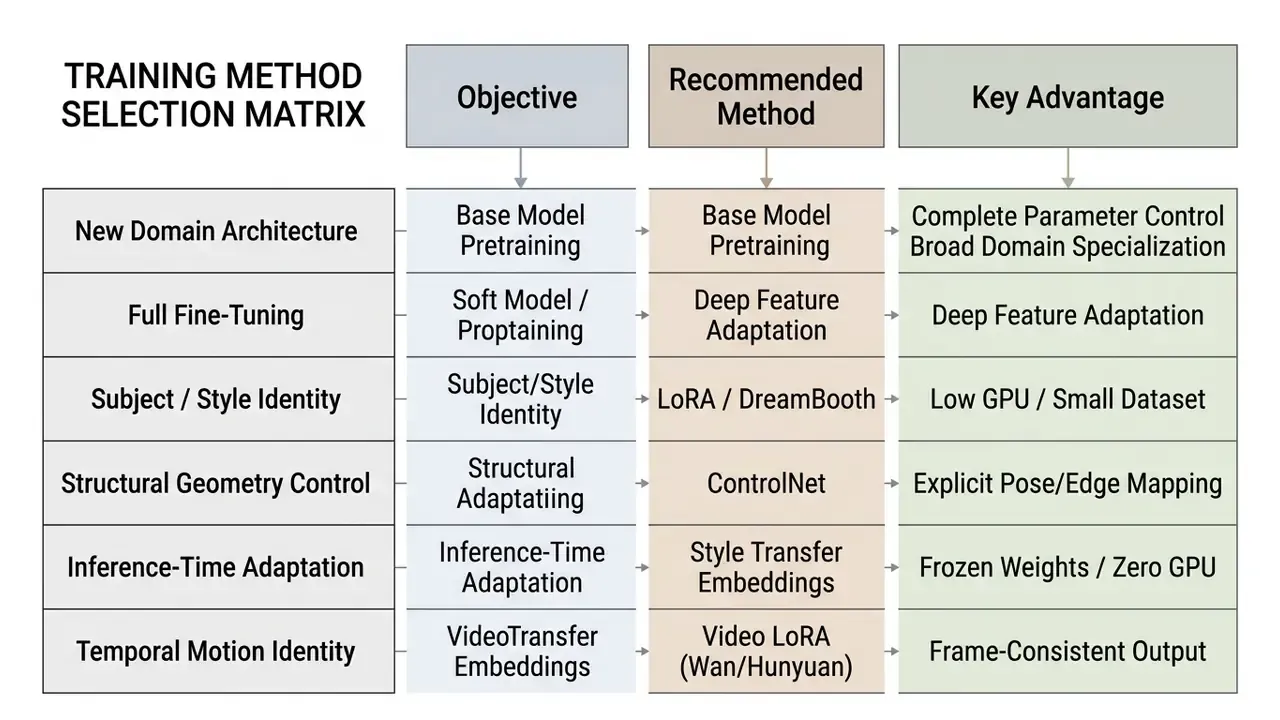
Model-selection frameworks narrow the search space before any GPU time is spent.
"Match&Choose correctly predicts the optimal base model for fine-tuning in 61.3% of cases by matching model and dataset graph features."
Pick an incompatible base architecture and you pay twice: longer training, plus a higher risk of mode collapse and visual artifacts.
Selecting a Base Model for Your Image Generator
Selecting a base model requires assessing base training resolution, architectural layout (U-Net vs flow-matching transformer), prompt-encoder flexibility, and public licence terms. Stable Diffusion XL (SDXL) operates natively at , whereas legacy SD 1.5 architectures operate at , which visibly affects fine-detail fidelity and anatomical accuracy. Swapping a photoreal base for an already-stylized base changes the final aesthetic without a single extra paired training image. Cheap experiment. Run it before committing to a full dataset build.
Holistic evaluations of text-to-image models across 62 scenarios indicate that no single base architecture excels on all metrics at once. Models tuned for photorealistic aesthetic scores often underperform on structural reasoning, spatial orientation, or fairness benchmarks. Enterprise teams reviewing open-source options can inspect performance metrics in the AI Media Benchmarks and Review Proof hub, then cross-check shortlists against ranked AI image generators by quality and controls.
Checklist for base-model due diligence:
- Native training resolution and maximum stable inference resolution.
- Text encoder or encoders used, and whether they can be tuned or swapped.
- Availability of
.safetensorsweights and adapter ecosystem maturity. - Documented safety filtering of the original training corpus.
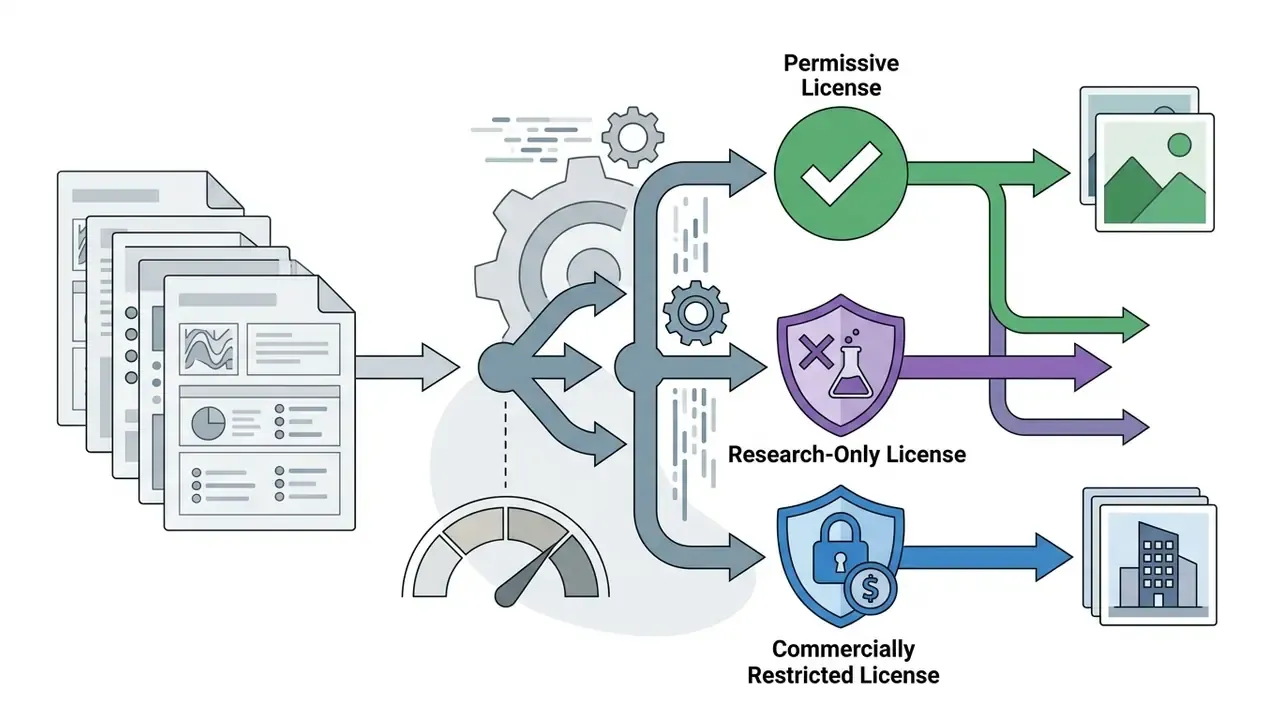
Fine Tune, Style Transfer or a New AI Model?
The choice between fine-tuning, style transfer, and training a new model depends on whether you need to update global model knowledge, apply a surface-level aesthetic overlay, or learn an entirely new feature space. Fine-tuning via LoRA updates less than 1% of total network parameters, which makes it ideal for domain adaptation without multi-node GPU clusters. One OpenReview analysis reports LoRA cutting trainable parameters by four orders of magnitude and GPU usage threefold versus full-model updating. Style transfer preserves structural content while re-mapping colour and texture distributions through frozen latent vectors. Teams prototyping that route often start with image-to-image style transfer generators before deciding whether a trained adapter is justified at all.
| Parameter | Base Model Pretraining | Full Fine-Tuning | LoRA / Adapter Tuning | Style Transfer (Inference) |
|---|---|---|---|---|
| Dataset Size | images | $1,000 - 100,000$ images | $10 - 200$ images | $1 - 5$ reference images |
| GPU Memory Needed | Multi-node A100/H100 clusters | VRAM | VRAM | VRAM |
| Training Duration | Weeks to Months | Days to Weeks | 30 Minutes to 4 Hours | Instantaneous / Seconds |
| Weight Storage | Embeddings () | |||
| Control Level | Full Architectural Control | High Task Adaptation | High Subject/Style Fidelity | Surface Aesthetic Overlay |
| Indicative Cost | Tens of thousands to millions USD | Thousands to tens of thousands USD | Low hundreds to low thousands USD | Inference cost only |
Summary: LoRA fine-tuning gives the best balance of parameter efficiency, low storage overhead, and precise style control for enterprise deployment. Base pretraining stays the preserve of large-scale infrastructure initiatives. ControlNet sits on a different axis entirely: it constrains geometry (edges, depth, pose, segmentation) at inference and can be stacked with a style LoRA when both structure and aesthetics must be locked.
Prepare Training Images for High-Quality Results
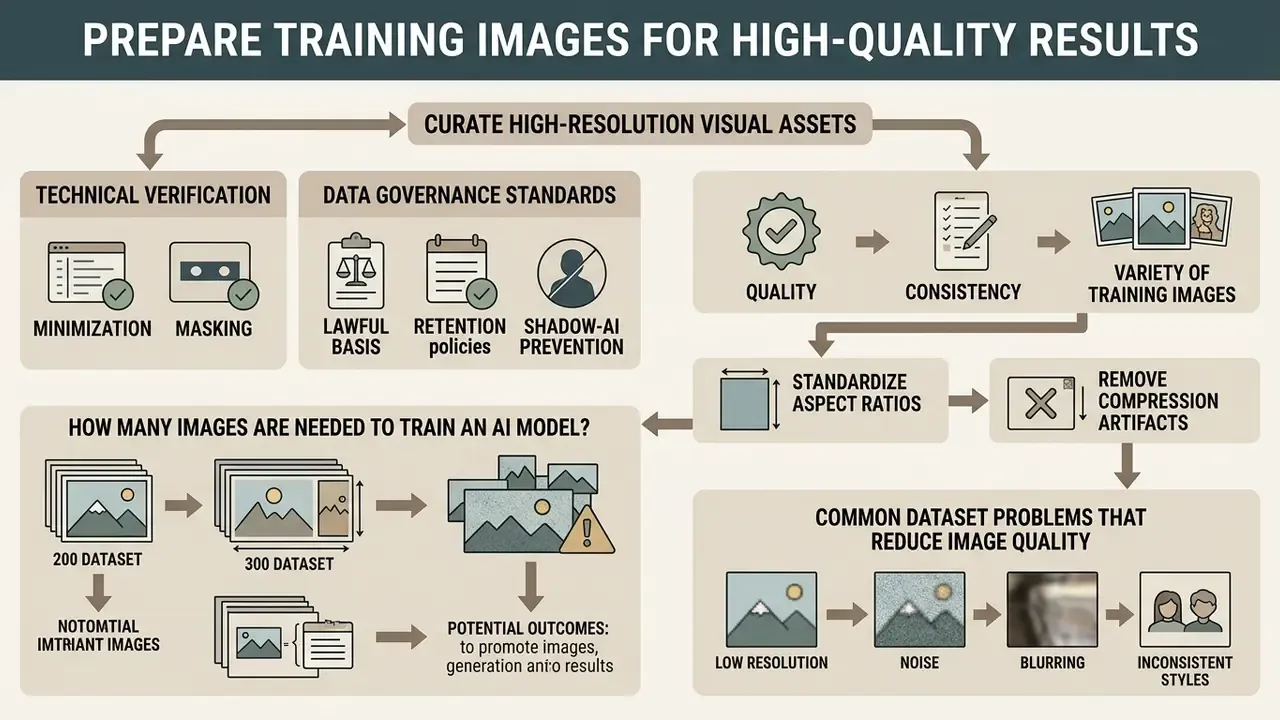
Preparing training images for high-quality results means curating high-resolution visual assets, standardizing aspect ratios, removing compression artifacts, and writing descriptive, noise-free captions. The dataset is the ground truth for neural learning. Poor data preparation shows up directly as output blurriness, anatomical distortion, and concept bleed.
Data governance guidance from the National Institute of Standards and Technology sets the entry gate for any regulated pipeline.
"NIST SP 800-218A mandates verifiable data provenance, integrity checking and quality screening before images enter model fine-tuning pipelines."
Ingesting unvetted or low-resolution images degrades latent space alignment and invalidates downstream audit controls. Both problems, at once.
Technical Verification and Data Governance Standard
Verifying dataset integrity means adhering to evaluation protocols established by leading open-source machine learning maintainers. Hugging Face model-evaluation guidance calls for splitting custom data into three sets: training (70–80%), validation (10–15%), and a dedicated test set (10–15%) that mirrors production distributions. Documentation on the Trainer API confirms eval_dataset as the official hook for scoring checkpoints, and any evaluate-compatible metric can be attached to the loop.
Curation pipelines should incorporate automated metrics, such as CLIPScore for prompt-image alignment and Fréchet Inception Distance (FID) for distribution realism, to validate data cleanliness before model training begins. Verifiable provenance protocols keep the work aligned with enterprise audit frameworks and model risk management guidelines.
Handling PII and confidential documents. Where training images contain faces, signatures, account numbers, or internal document templates, three controls are non-negotiable:
For pre-ingestion cleanup, teams frequently standardize on scripted pipelines supplemented by AI photo editors for image preprocessing and the documented editor workflows in the online photo editor guide.
Quality, Consistency and Variety of AI Training Images
High-quality image training ai work balances aesthetic consistency with contextual variety across backgrounds, angles, lighting conditions, and subject poses. Homogeneous datasets with identical backgrounds teach the network to correlate background features with the target subject, and severe overfitting follows.
ISO/IEC data quality standards (ISO/IEC 25012) define consistency as non-contradictory representation across operational sets. In generative diffusion tasks, subject identity must stay perfectly consistent across all images, while non-essential attributes, including background environment, camera angle, and ambient illumination, must vary on purpose. Recent subject-consistency pipelines formalize this as a two-gate rule: vary the context aggressively, then run an automated verification pass that rejects any pair where identity has drifted.
How Many Images Are Needed to Train an AI Model?
The number of images needed ranges from 10–30 for focused character LoRAs, 50–200 for complex visual styles, and over 1,000 for comprehensive domain fine-tuning. DreamBooth frameworks reach subject personalization on 3–5 high-resolution images, provided those images capture diverse angles and lighting configurations.
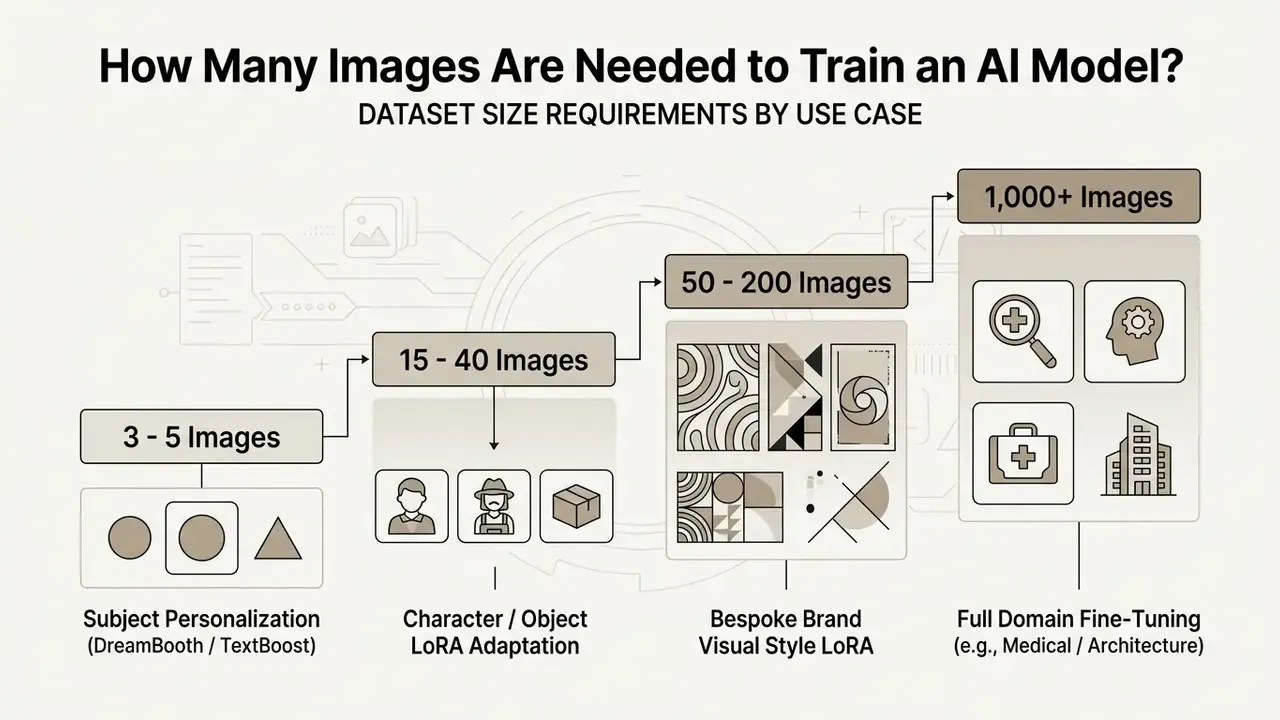
Scaling studies explain why adding data is usually safer than adding steps.
Growing the dataset improves generalization, as long as the extra samples hold strict visual quality and non-conflicting captions. One caveat worth stating plainly: the widely repeated "1,000+ for full fine-tuning" figure is practitioner consensus, not a peer-reviewed threshold. Treat it as a planning heuristic and validate it empirically against your own held-out test split.
Common Dataset Problems That Reduce Image Quality
Common dataset problems that degrade generation quality include near-duplicate samples, noisy or ambiguous captions, compressed JPEG artifacts, mismatched resolutions, and uncaptioned background elements. Watermarks, branding logos, and background clutter get baked into the weights unless they are named in captions or edited out during preprocessing.
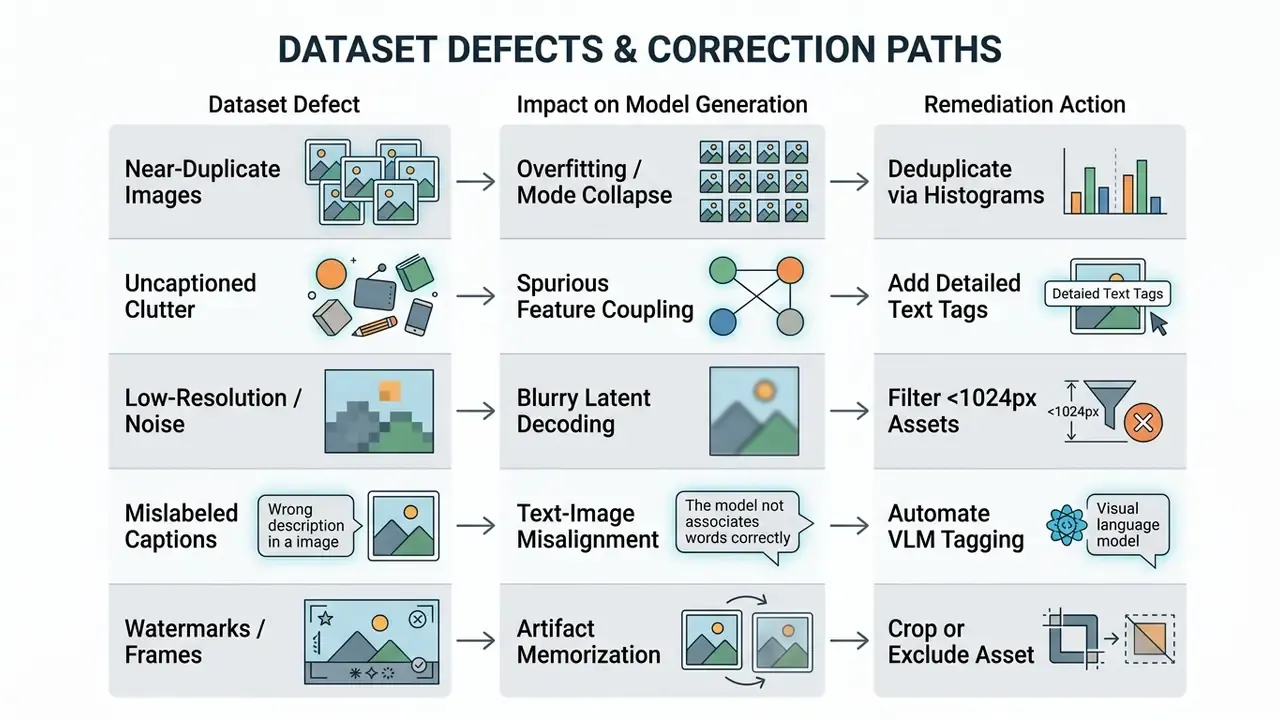
Sub-threshold assets that are genuinely irreplaceable can sometimes be rescued with AI image upscalers for resolution enhancement before filtering. Flag upscaled material in dataset metadata, though, because reconstructed detail is synthetic detail.
Analysis of dataset collapse mechanics shows why "pretty" synthetic data is not neutral.
Curate for structural diversity rather than superficial polish, and distribution collapse becomes far less likely.
How to Train an AI Image Generator Step by Step
Training an AI image generator step by step means setting up a dedicated compute environment, uploading and preprocessing training images, configuring hyperparameters, running the training job, and validating checkpoints against test prompts. A structured workflow limits compute waste and prevents the usual convergence failures.
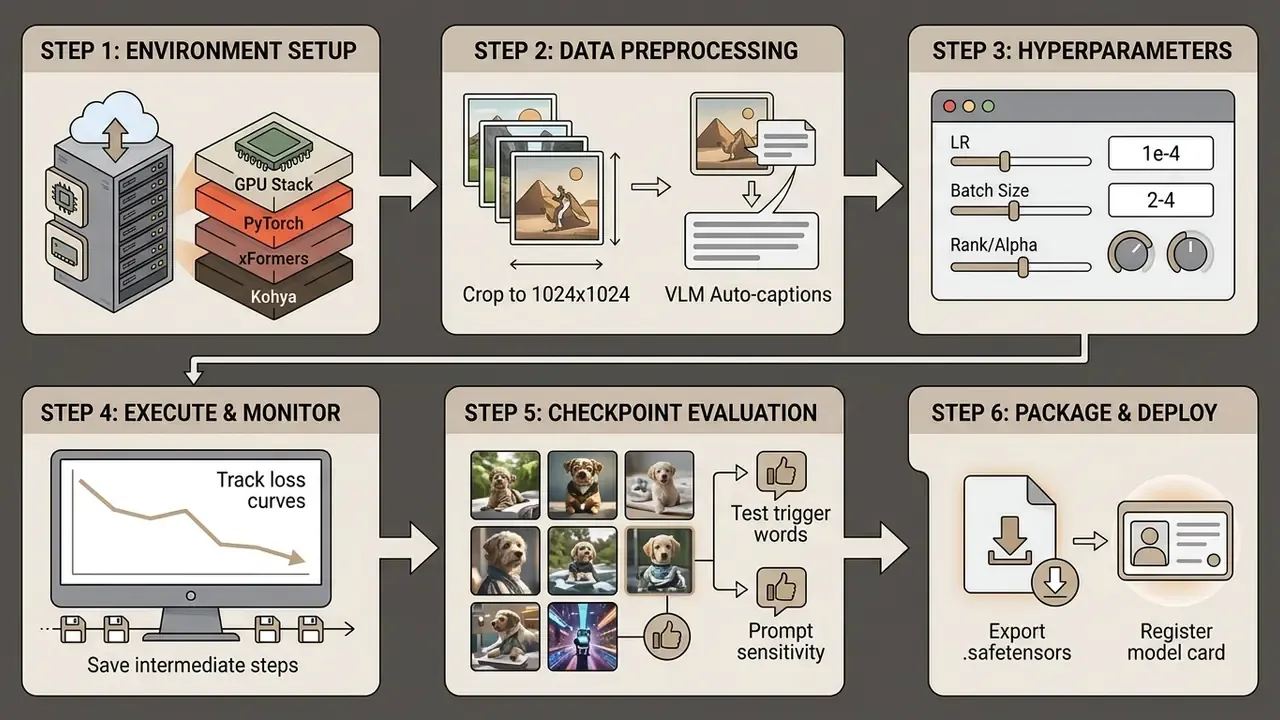
Composite case framing. During a model risk review at a financial technology provider, an engineering team shipped a custom visual generator without intermediate checkpoint evaluation gates. The unmonitored run overfit partway through training, producing corrupted outputs in customer-facing graphics that surfaced only after publication. Re-implementing automated evaluation gates at fixed step intervals let the team isolate an earlier, healthier checkpoint and terminate future runs early, which materially reduced wasted GPU hours per experiment. (Composite illustrative scenario; step counts and hour savings vary by dataset and hardware and are not presented as benchmarks.)
Upload Images and Configure Model Training
Uploading images and configuring model training starts with organizing high-resolution assets into structured directory paths paired with matching .txt caption files. Preprocessing tools normalize dimensions, typically pixels for modern diffusion backbones, and apply vision-language models such as BLIP-2 or WD14 to generate initial descriptions, which a human then corrects. Auto-captions are a draft, never a deliverable.
Key hyperparameters belong in the training configuration file:
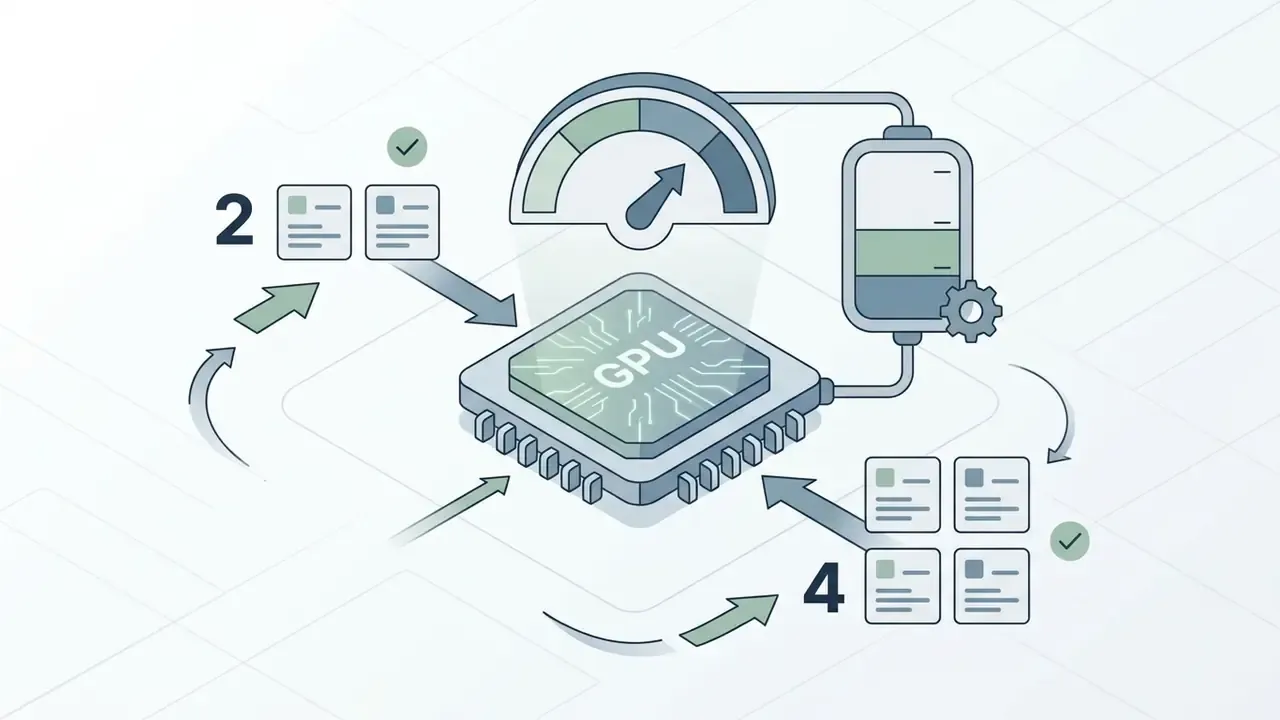

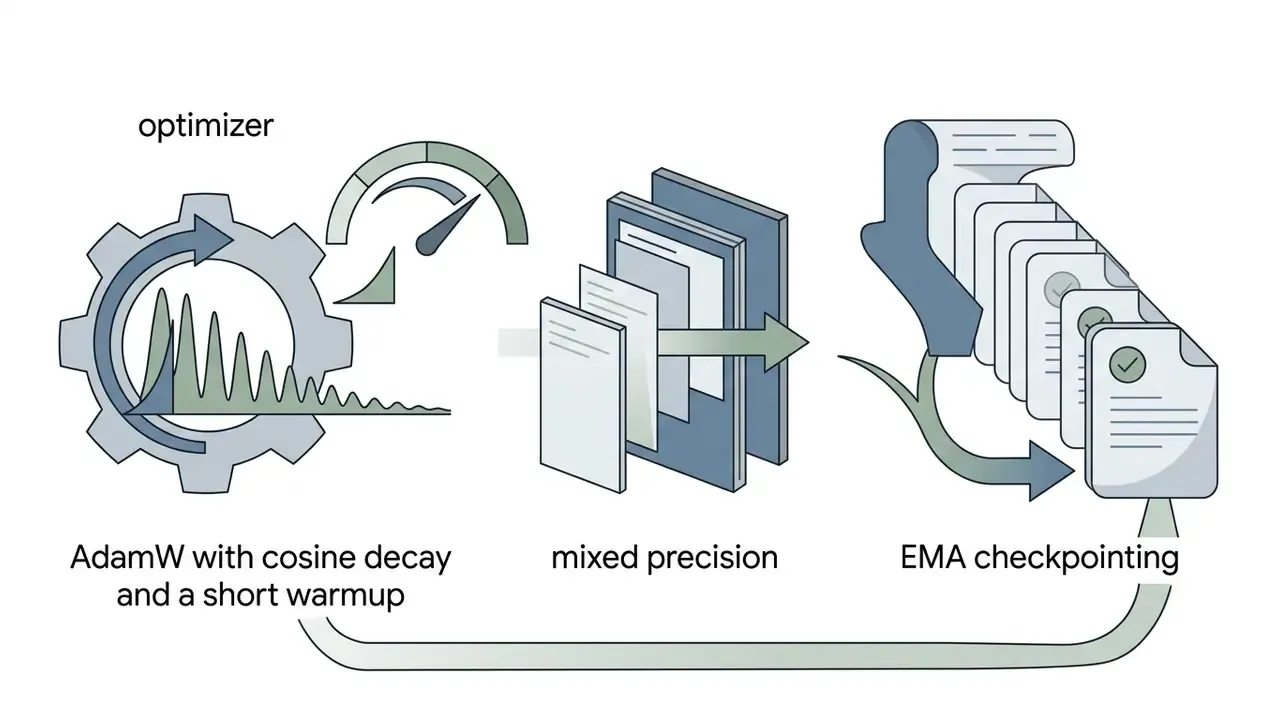
Learning rate remains the dominant convergence control. Recent LoRA analyses find LR tuning more consequential than batch size, with the optimal LR scaling alongside batch size. Rank interacts with this: when , the optimal LR becomes rank-dependent, whereas fixing proportionally to keeps effective scaling constant across ranks.
Choosing training infrastructure means evaluating platform performance, storage costs, and security policy together. Reviewing the AI Media Commercial-Use Hub helps teams set baseline commercial licensing boundaries before configuring third-party cloud compute instances.
Train, Test and Refine the AI Model
Training, testing, and refining the model involves running the optimization loop, watching loss curves for anomalous spikes, and generating standardized test samples at fixed step intervals, for example every 200 steps. Intermediate evaluation prevents over-optimization and enables early termination when loss metrics diverge.
Source attribution note. The right reference point for diffusion checkpoint evaluation is continual post-training benchmarking, not NLP question-answering suites. T2I-ConBench evaluates sequential post-training states of text-to-image models across item customization and domain enhancement, providing a methodology for scoring candidate checkpoints against target and retention tasks (T2I-ConBench, 2025, https://arxiv.org/html/2505.16875v1). Saving model states along the training trajectory lets developers compare candidates on identical prompt sets. If a checkpoint shows over-saturation or subject rigidity, lowering the learning rate by roughly 20% or trimming total steps usually restores output flexibility.
Generate Images with Text Prompts
Generating images with text prompts requires structured prompts that combine the trigger word assigned during training with explicit environmental, lighting, and composition descriptors. Good prompt construction isolates the trained concept while steering background elements through ordinary natural language.
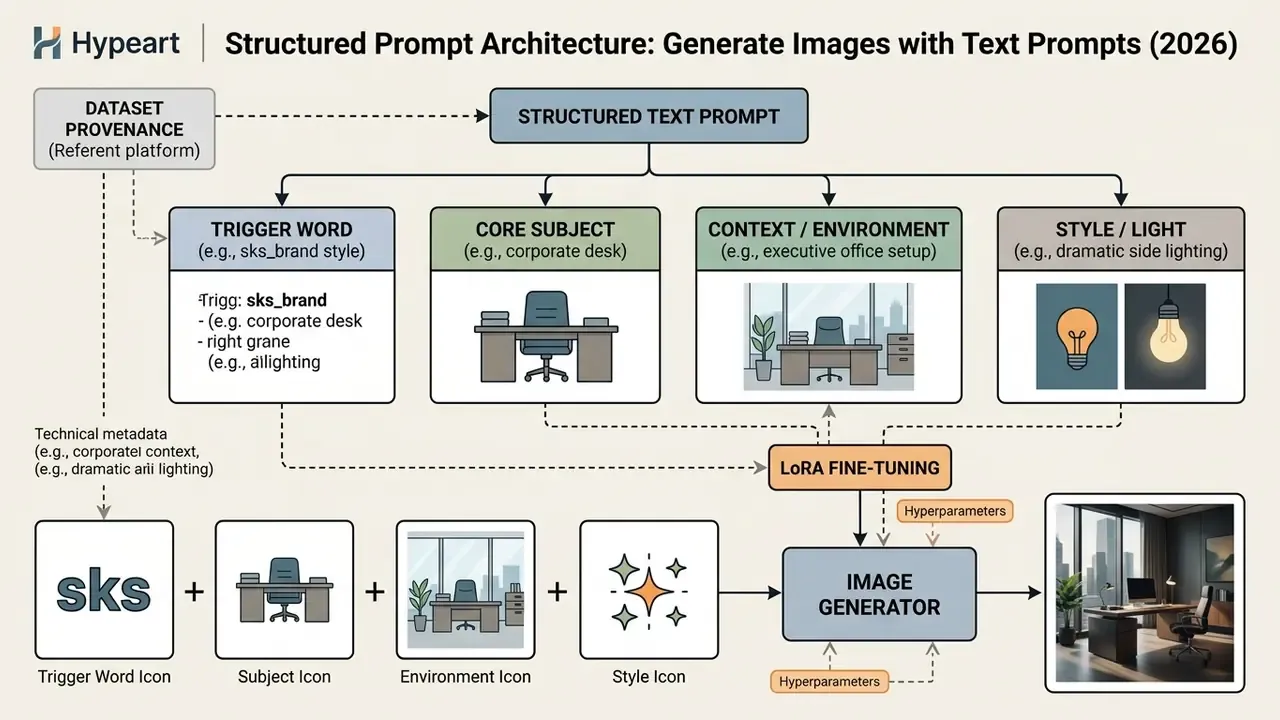
Trigger words act as control tokens inside the text encoder's embedding space. Prompts should define desired scene features explicitly, and use negative prompts to suppress artifacts, blurriness, or anatomical distortion. NIST's prompt-engineering guidance for technical domains recommends four structural elements that transfer directly to image models: a clear task description, specific context, explicit output-format instructions, and stated constraints. When building automated prompt generation tools, developers frequently review guides on how to write prompts for ai art to optimize token structure.
Interactive Model Training Workflow Checklist
Checklist0 / 4
- Gather 20–50 high-resolution source images (larger than ).
- Record rights and provenance for every asset; reject anything unverifiable.
- Remove duplicate or severely degraded assets.
- Auto-caption with vision-language tagging models, then human-review every caption.
- Insert the unique trigger token (for example
sks_style) into all caption files. - Split 70–80% train / 10–15% validation / 10–15% test mirroring production prompts.
- Provision a GPU instance with VRAM (NVIDIA RTX 4090 / A10G).
- Install PyTorch, xFormers, and training frameworks (Kohya_ss / Hugging Face Accelerate).
- Enable mixed precision, plus FP8 paths where hardware supports them.
- Set the weights export format to
.safetensors.
- Set UNet learning rate ; text encoder LR .
- Set network rank () 32; network alpha () 16.
- Optimizer AdamW; cosine decay with warmup; EMA enabled.
- Configure checkpoint saving interval: every 200 steps.
- Generate evaluation grids across checkpoints 400, 800, 1200, and 1600.
- Measure prompt alignment using standardized benchmark prompts.
- Complete the Model Validation Card (below) and file it with Risk and Compliance.
- Export the final
.safetensorsweight file to a secure enterprise repository.
Compute Budgeting: GPU Hours, Cost and ROI
Cost is the first question risk and finance owners ask, and it has a short answer model. Total project cost is rarely dominated by GPU rental. It is dominated by human curation and review.
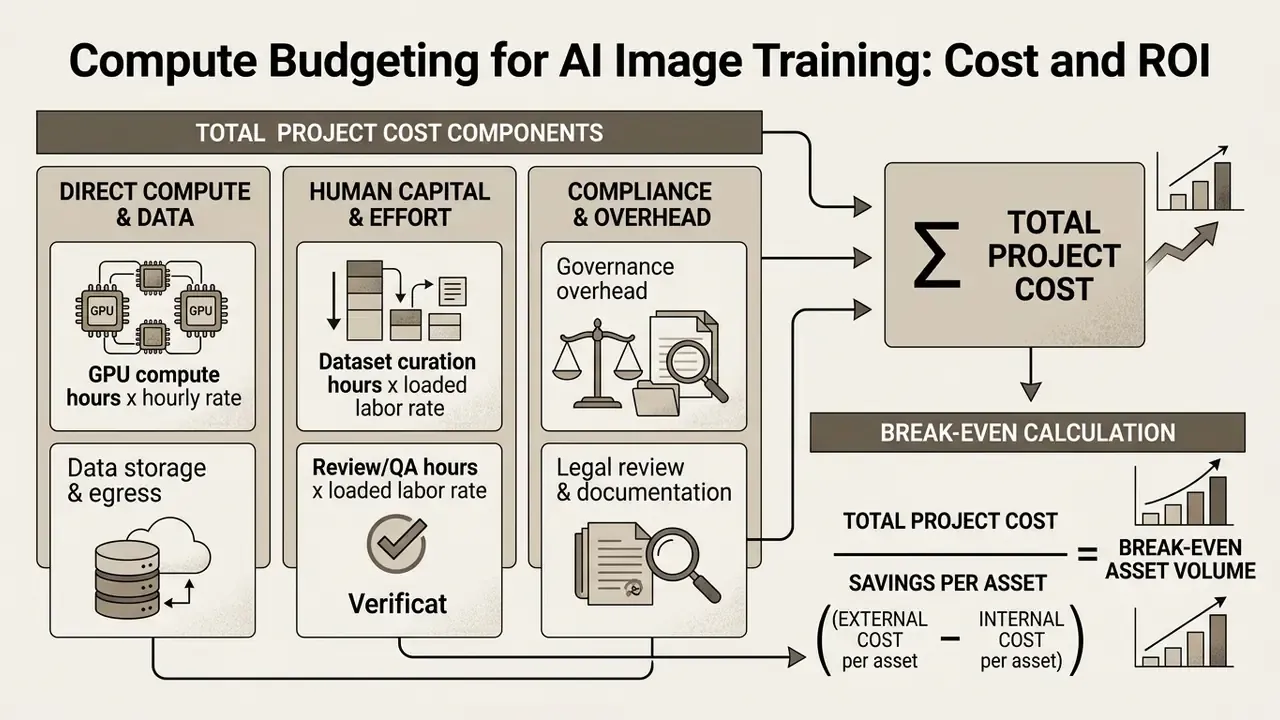
Indicative planning figures reported in practitioner cost analyses:
| Workload | Typical hardware | Wall-clock | Indicative direct cost |
|---|---|---|---|
| Style / subject LoRA | 1× A100 or RTX 4090 | 0.5–4 hours | Low hundreds to low thousands USD |
| Full fine-tune (domain) | 1–8× A100/H100 | Days to weeks | Thousands to tens of thousands USD |
| Base-model pretraining | Multi-node H100/H200 cluster | Weeks to months | Tens of thousands to millions USD |
Three budgeting rules keep estimates honest. First, plan for three to five failed or superseded runs per production adapter; single-run budgets are the most common source of overspend. Second, FP8 and mixed-precision paths on current GPUs raise throughput and lower VRAM consumption, so the same experiment can cost meaningfully less on newer silicon. Hardware generation is a budget variable, not a footnote. Third, the ROI numerator is usually avoided external spend (photoshoots, stock licences, agency retainers) plus cycle-time reduction; teams that measure only the first understate the return. For inference-side estimates across large evaluation suites, see the AI Media calculators.
"FP8 precision paths on modern GPUs accelerate training throughput while reducing VRAM utilization."
Test AI Image Quality and Improve Model Results
Testing AI image quality and improving results means running the trained model against standardized benchmark prompt suites built to stress-test lighting, camera viewpoints, complex subject combinations, and background context. Quantitative evaluation separates superficial polish from genuine distribution coverage and prompt compliance. For provenance verification and downstream publication checks, teams can layer in AI image detectors for output auditing.
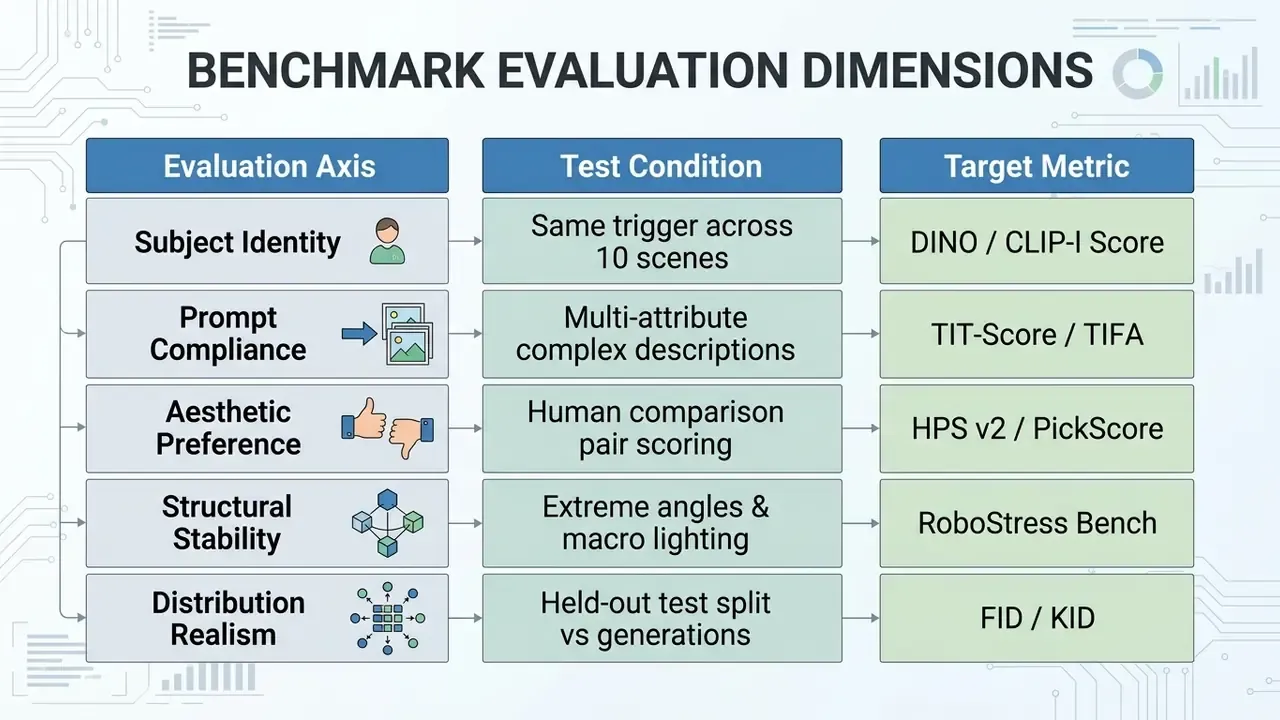
Human preference evaluation frameworks give an objective proxy for taste.
"HPS v2 is trained on 798,090 human preference pairs and provides reliable objective scoring of generated image quality."
Automated scoring models supply the feedback loop that tells you when a model needs adjustment. Standards bodies frame testing as a multi-axis obligation rather than a single score: ETSI TR 103 910 specifies model performance, robustness, bias and fairness, and generalization testing including out-of-distribution checks, while AIST's Machine Learning Quality Management Guideline treats dataset coverage, uniformity and adequacy as first-class quality attributes.
Test Prompts for Style, Subjects and Consistency
Test prompts should evaluate three core axes systematically: subject fidelity across diverse environments, style preservation under varying prompt lengths, and compositional stability during multi-object interactions. A good evaluation set isolates one visual variable at a time, so failures are diagnosable.
A reusable four-axis benchmark, derived from current visual-robustness literature:
- Lighting stressidentical subject under glare, backlight, deep shadow, and exposure shift.
- Viewpoint stressfrontal, three-quarter, overhead, low-angle, macro.
- Background and context shiftstudio, cluttered interior, outdoor daylight, abstract backdrop.
- Multi-object interactiontwo or more trained or untrained subjects sharing one frame with a stated spatial relation.
Developers building automated prompt testing routines can reference structured guides on how to write AI prompts for images. Robust protocols also include long prompts, which measure complex attribute binding and spatial relationship retention.
"TIT-Score-LLM outperforms the strongest CLIP baseline by 7.31% in pairwise accuracy when scoring complex multi-attribute prompt alignment."
When to Retrain or Fine Tune Your AI Model
Retraining or fine-tuning should start when quantitative metrics show persistent overfitting, severe underfitting, or style drift relative to target corporate standards. Overfitting shows up as a rising validation loss curve alongside rigid, near-verbatim reproduction of training image backgrounds.
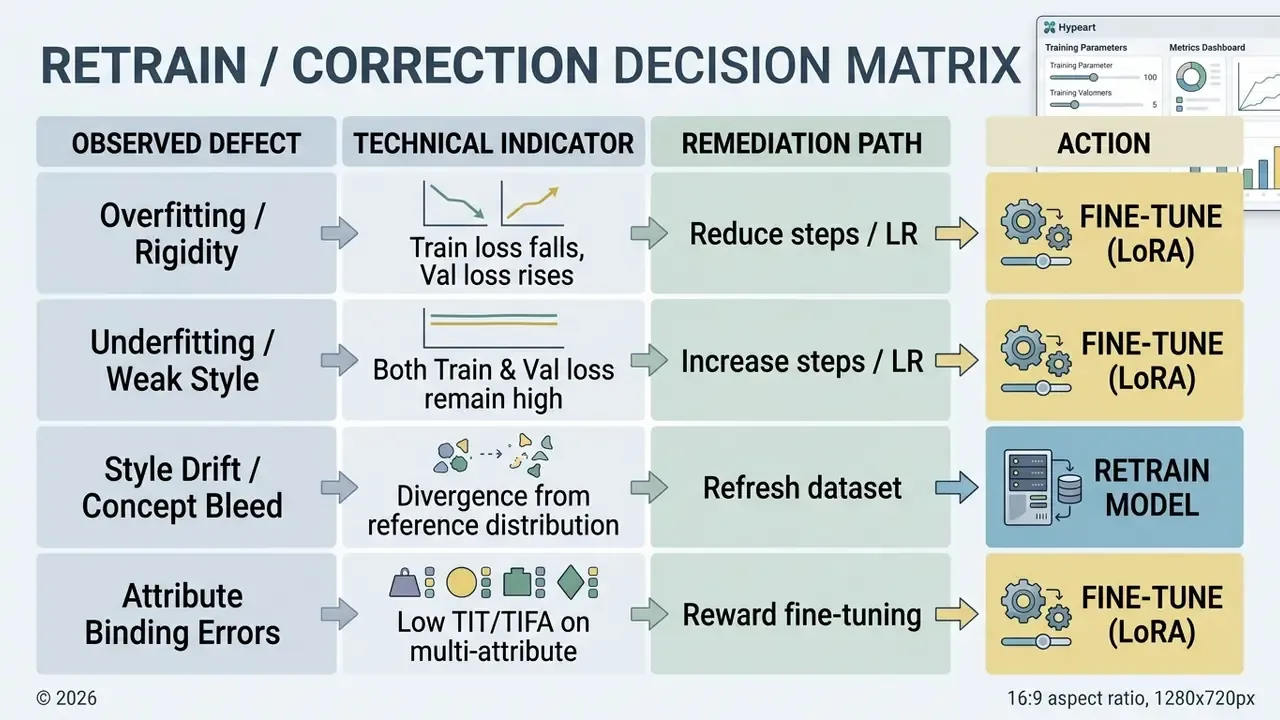
Reinforcement learning approaches can resolve attribute errors without a full retrain.
"LOOP achieves relative improvements of 18.1% in shape binding and 15.2% in colour binding over baseline Stable Diffusion on T2I-CompBench."
Reward-based fine-tuning fixes specific attribute errors without rebuilding from scratch. Trigger retraining on drift tests plus loss curves, never loss curves alone. A model can look numerically healthy and still drift away from an approved brand distribution.
Model Validation Card: Audit Artifact Template
Risk functions cannot accept "the images look right" as evidence. Package each production checkpoint with a one-page card.
| Field | Content required |
|---|---|
| Model ID and version | Adapter name, base model plus version, weight hash, .safetensors file size |
| Purpose and scope | Approved use cases; explicitly prohibited use cases |
| Training data | Asset count, provenance source, rights basis, PII treatment, split ratios |
| Training configuration | LR, batch size, steps, rank/alpha, optimizer, precision, seed, framework version |
| Evaluation results | CLIPScore, FID, HPS v2, TIT-Score on the held-out test split; robustness matrix results |
| Known limitations | Documented failure modes (text rendering, hands, small logos, crowd scenes) |
| Human oversight | Required review step before publication; named accountable owner |
| Monitoring plan | Drift metrics, review cadence, retirement criteria, incident escalation path |
| Approvals | Model risk sign-off, legal and licensing sign-off, date, expiry |
Filing this artifact converts a training experiment into a controlled, reproducible asset. It also turns external examination into a retrieval task rather than a reconstruction project, which is where most of the audit pain actually lives.
How to Choose an AI Image Trainer or Training Platform
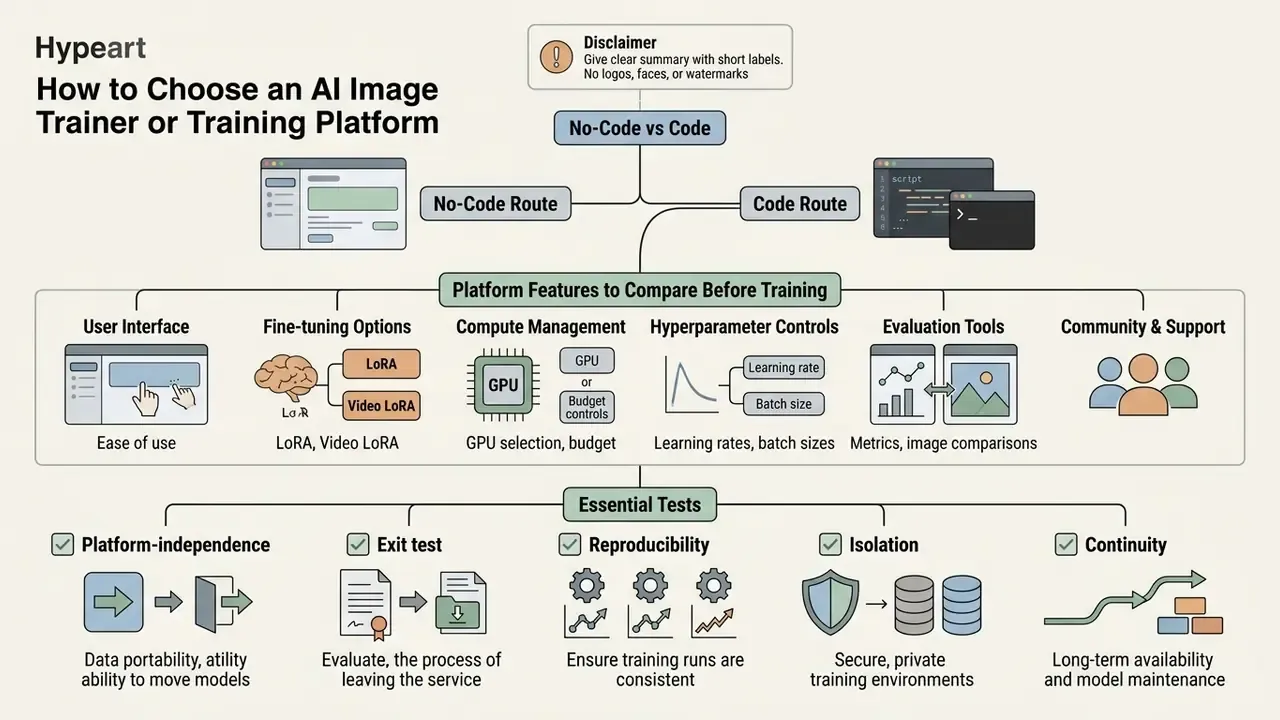
Choosing an AI image trainer or training platform means evaluating GPU compute infrastructure, support for modern base architectures, hyperparameter customization depth, SafeTensors weight export, and data privacy policy. Enterprise compliance requires providers to guarantee that training assets will not be pooled into public datasets or used to train third-party models.
No-Code vs Code: Which Training Route Fits You?
| Training Approach | Best For | Technical Skill | Hardware Required | Parameter Control |
|---|---|---|---|---|
| No-code SaaS platforms (e.g. SeaArt, Exactly.ai) | Artists, marketers, fast prototypes | None (GUI-based) | Cloud-based (zero local GPU) | Basic (preset hyperparameters) |
| Open-source local tools (Kohya_ss, ComfyUI) | AI engineers, technical designers | Intermediate | VRAM local GPU | Full (custom LR, rank, alpha) |
| Cloud script workflows (RunPod, managed cloud GPUs) | Enterprise pipeline automation | Advanced (Python/PyTorch) | Multi-node scalable cloud GPUs | Absolute (full codebase control) |
The no-code path really is short: choose a base model (FLUX, SDXL, or a stylized checkpoint), write a preview prompt describing the intended effect, upload 5–20 consistent reference images, start training, then save, download or publish the result. Practitioners recommend at least five images, ideally ten or more, large and high-resolution, free of frames, smudges and watermarks, diverse in subject yet unified in style so the set reads as a series. That is enough for a personal style model. It is not enough for a regulated production pipeline, where exportable weights, logged parameters and reproducible seeds are mandatory.
Platform Features to Compare Before Training
When comparing training platforms, procurement teams should evaluate hardware performance, framework flexibility, security parameters, and export capability side by side.
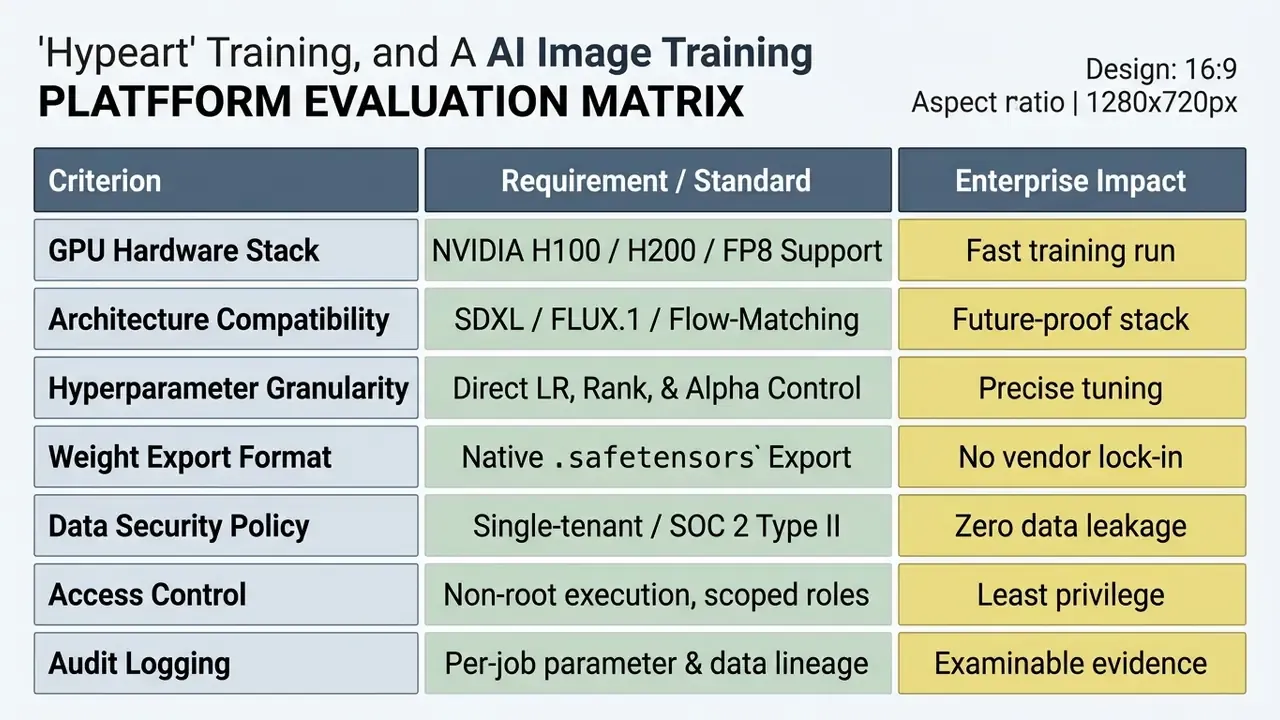
Platforms offering native .safetensors export keep models portable and away from the arbitrary code execution risk inherent in legacy Python pickle formats.
Platform-independence test. Instead of trusting marketing pages, run a four-question portability audit on every candidate vendor, and file the answers in the procurement record.
Vendors whose domains, legal entities or support channels cannot be verified through independent registry and DNS checks should be treated as single points of failure, and excluded from workloads handling proprietary or regulated assets. Finally, map the platform into your GRC stack: training jobs should emit records your model inventory can consume, and every adapter in production should carry a Model Validation Card ID that a GRC workflow can reference.
- Exit test.Can you export trained weights today, in an open format, without raising a support ticket? If not, assume lock-in.
- Reproducibility test.Does the platform expose seed, the full hyperparameter set, framework versions, and a dataset manifest for each completed job?
- Isolation test.Is training data processed inside a tenant boundary you control, with a contractual prohibition on reuse for provider model training?
- Continuity test.If the vendor disappears tomorrow, can the same job be re-run on open tooling (Kohya_ss or Diffusers) against the same base model?
Questions to Ask Before Launching a Custom AI Model
Determines whether the task needs full retraining, a lightweight LoRA adapter, or better prompt engineering.
Ensures the training set matches organizational risk appetite and legal data governance standards.
Prevents vendor lock-in and enables local deployment inside controlled corporate infrastructure.
Establishes reproducible benchmark metrics (CLIPScore, HPS v2) and defines escalation paths for output failures.
Confirms that proprietary brand assets and confidential corporate data stay isolated.
Separates the right to generate from the right to hold weights, and settles whether derivative fine-tunes are permitted.
- What is the precise business or technical objective of the custom model?What is the precise business or technical objective of the custom model?
- What visual assets exist, and do they carry clear copyright provenance?What visual assets exist, and do they carry clear copyright provenance?
- Does the platform support non-proprietary weight export in
.safetensorsformat?Does the platform support non-proprietary weight export in.safetensorsformat? - How will outputs be evaluated, audited, and monitored over time?How will outputs be evaluated, audited, and monitored over time?
- What are the data retention and security policies of the cloud compute provider?What are the data retention and security policies of the cloud compute provider?
- Who owns the trained checkpoint, and what may licensees do with it?Who owns the trained checkpoint, and what may licensees do with it?
- What is the break-even asset volume, and who owns the budget after launch?What is the break-even asset volume, and who owns the budget after launch?
Confirms funding for ongoing operations, monitoring and periodic revalidation, not only the initial build.
Teams evaluating broader tool selections and adjacent generative workflows can review the AI Media Comparison Matrices, the commercial-use hub, and the integration patterns documented in the AI Media API Guides.
Limitations, Open Questions and a Safe Next Step
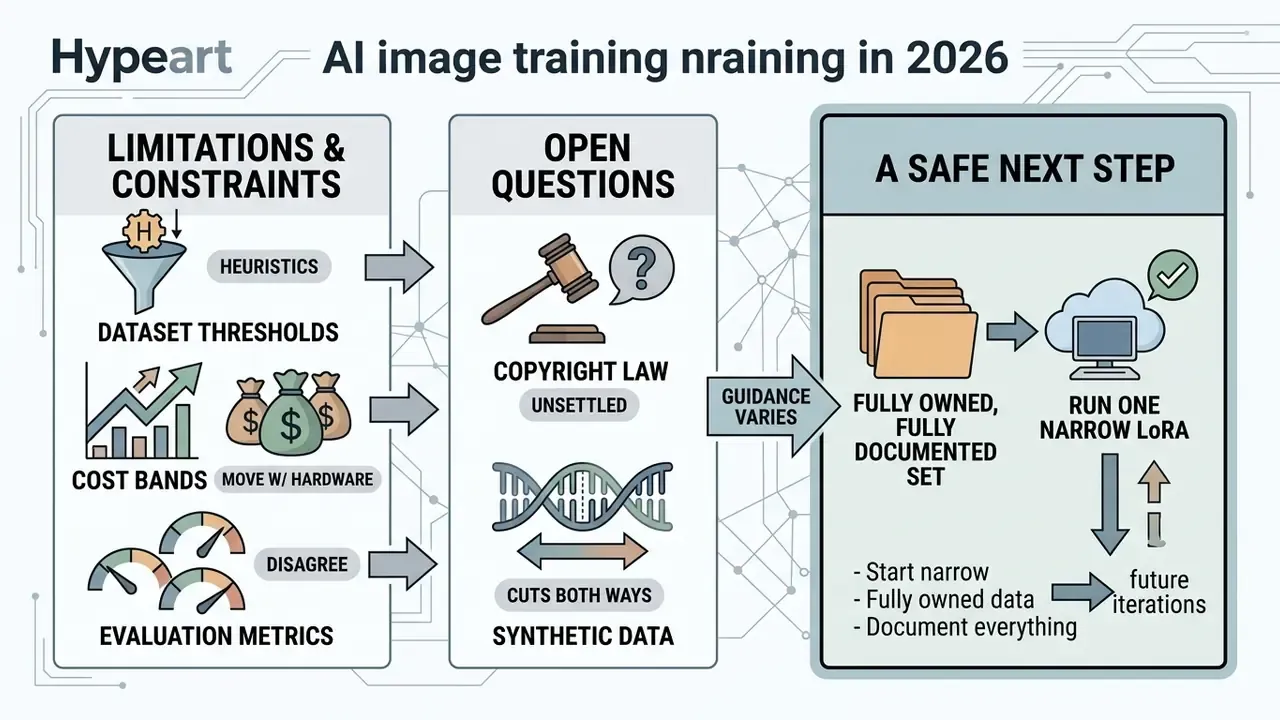
Some of this guidance is firmer than the rest, and it helps to say which parts.
- Dataset thresholds are heuristics. The 15–40 and 50–200 image bands come from practitioner experience, not controlled studies. Validate against your own held-out split before treating them as policy.
- Cost bands move with hardware. Indicative USD ranges shift with GPU generation, spot pricing, and region. Re-price quarterly rather than annually.
- Evaluation metrics disagree. A checkpoint can improve on HPS v2 while losing ground on FID. Decide in advance which axis governs release, and write it into the validation card.
- Copyright law is unsettled. Rights in model outputs and in adapters trained on licensed material remain contested in several jurisdictions. Legal review is not optional for commercial deployment.
- Synthetic data cuts both ways. Augmentation can lift downstream accuracy, yet aesthetics-centric synthetic corpora measurably collapse distributions. Blend, then monitor.
A safe next step, if you are starting from zero: run one narrow LoRA on a fully owned, fully documented set of 20 images, complete a Model Validation Card for it, and walk that card through your existing model risk process. The technical result matters less than the answer to a simpler question. Can your current governance absorb a generative visual model at all? Better to learn that on a low-stakes adapter than on a customer-facing campaign.
Frequently Asked Questions (FAQ)
Can I train an AI image generator without coding experience?
Yes. Enterprise engineering workflows use Python, PyTorch and script-based trainers such as Kohya_ss, but web-based platforms let creators upload a dataset and fine-tune a custom model through a no-code graphical interface. The trade-off is control: preset hyperparameters, plus limited or no weight export.
What is the best base model for fine-tuning custom visual styles?
On current benchmarks, FLUX.1 and Stable Diffusion XL (SDXL) offer the strongest combination of parameter efficiency, prompt adherence and native generation for LoRA fine-tuning. There is no universal winner. Holistic evaluations show that models leading on photorealism often trail on structural reasoning or fairness, so select against your own test split.
Which AI is best for image generation overall?
It depends on the axis you optimize. Closed systems (Midjourney, DALL·E-class models) lead on out-of-the-box aesthetics and prompt interpretation. Open models (SDXL, FLUX.1) lead on customization, adapter ecosystems, and the ability to own and export weights, which is the decisive factor for any trained custom model.
Can tools like ChatGPT generate images during training?
ChatGPT acts as an LLM interface that constructs prompts or API requests. It does not train diffusion models. It is genuinely useful for automating caption writing, dataset tagging and evaluation-prompt generation through vision-language models, and for scripting the training configuration you then run yourself.
How many images do I actually need?
Three to five for single-subject personalization (DreamBooth or TextBoost), 15–40 for a character or object LoRA, 50–200 for a brand style LoRA, and 1,000 or more for full domain fine-tuning. Once identity consistency is guaranteed, diversity of context matters more than raw count.
How long does training take?
A style or subject LoRA typically finishes in 30 minutes to 4 hours on a single modern GPU. Full fine-tuning runs for days to weeks. Base-model pretraining runs for weeks to months on clusters.
What is the difference between image LoRA and video LoRA training?
Image LoRA updates spatial weight layers for static visuals. Video LoRA additionally fine-tunes temporal attention mechanisms so identity and motion stay coherent across sequential frames, using clip-level datasets and temporal mask conditioning.
Can I sell or license a model I trained?
Yes, provided you hold rights to every training image. Common structures are per-campaign commercial licences, registry incentive or royalty programs, and retainer-based bespoke adapters. Specify in the contract whether you transfer generation rights, the weights, or both, and whether derivative fine-tunes are allowed.
How do I know when to retrain?
Retrain when validation loss rises while training loss falls (overfitting), when both stay high (underfitting), or when drift tests show outputs diverging from the approved reference distribution. Attribute-level errors, such as wrong colour or shape binding, are often cheaper to fix with reward-based fine-tuning than with a full retrain.
What must a risk or compliance team receive before a model goes live?
A completed Model Validation Card: data provenance and rights basis, PII treatment, split ratios, full hyperparameters and seed, quantitative evaluation results, documented limitations, a named accountable owner, a monitoring plan, and retirement criteria.
How do we handle PII and confidential documents in training data?
Minimize and mask identifiers before ingestion, train on structural templates rather than live records, record the lawful basis and retention schedule for every image class, and block collection through unsanctioned consumer tools to prevent Shadow-AI exposure.
Does synthetic data help or hurt?
Both, honestly. High-fidelity synthetic augmentation has been shown to raise downstream classification accuracy materially, yet training mostly on aesthetics-centric synthetic imagery collapses the distribution and degrades real-world performance. Blend synthetic with audited real data, and monitor structural diversity rather than polish.
Navigation Footer Links
- Enterprise Workflows Hub: AI Media Workflows
- Tool Comparisons: AI Media Comparison Matrices
- Licensing and Rights: Commercial-Use Hub
- Developer Economics: AI Media API Guides
- Evidence and Testing: AI Media Benchmarks