For a bank or a mature fintech, this is not a niche FinOps hobby. Retry behavior touches duplicate payments, model availability, audit evidence, and the credibility of every AI business case you present to the board.
Last updated: June 2026. Reviewed for alignment with RFC 6585, RFC 9110, the AWS Well-Architected Reliability Pillar, and the Google SRE Book chapter on cascading failures.
Executive Summary
- The unit of measurement is cost per successful transaction, not cost per request. Token price multiplied by tokens consumed is the floor, not the real number.
- The core coefficient is the retry cost multiplier: . A 15% failure rate with naive retry logic drives to 3.29×; the same failure rate under governed retries stays near 1.02×.
- The hard risk limit is a retry budget capped at roughly 10% of total traffic, combined with total attempts and an absolute wall-clock deadline for the entire call chain.
- Governance matters as much as engineering. Retry telemetry, idempotency keys, and retry-budget breach logs form auditable evidence for Model Risk Management (MRM) reviews under supervisory expectations such as SR 11-7.
Read the sections in order if you are building the model from scratch. Skip to the multiplier formula if you already have failure telemetry and just need a defensible budget number.
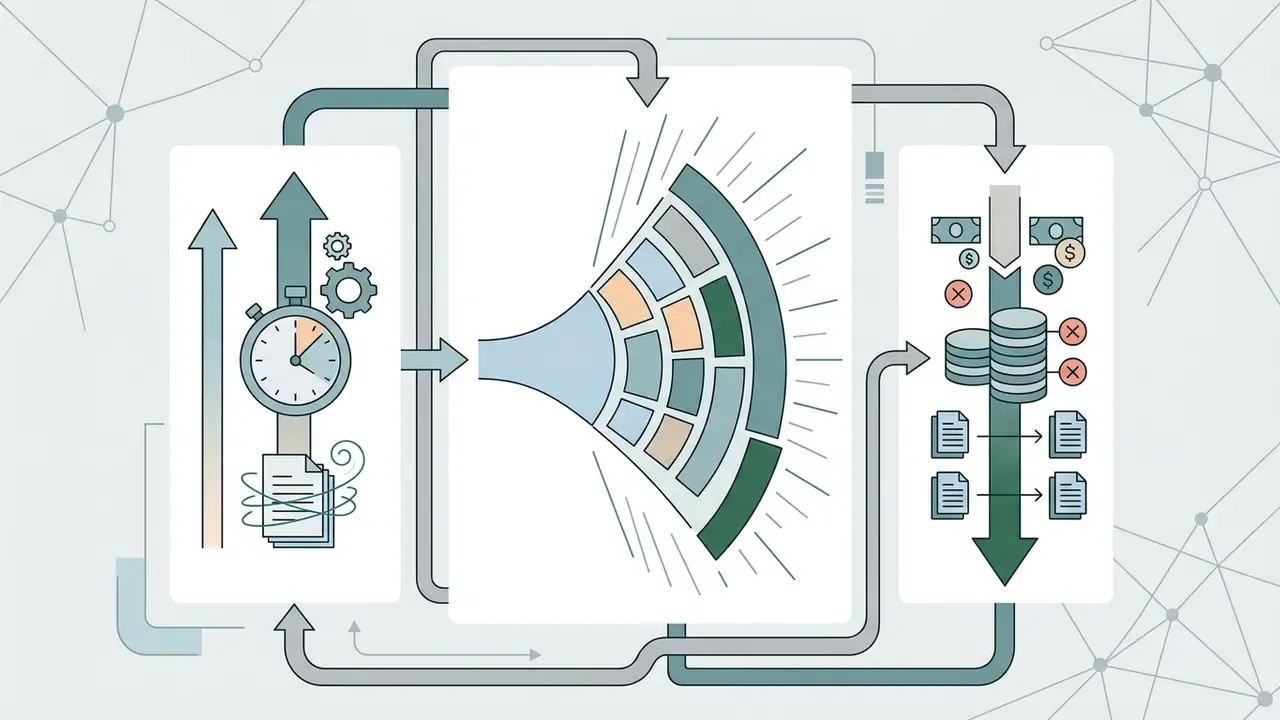
«Control and limit retry calls. Use exponential backoff to retry after progressively longer intervals, introduce jitter to randomize those intervals, and limit the maximum number of retries.»
«A retry-induced positive feedback loop can turn a small perturbation into a full outage; mitigate it with randomized exponential backoff, per-request retry limits, and a server-wide retry budget.» Google SRE Book, Addressing Cascading Failures. https://sre.google/sre-book/addressing-cascading-failures/
What an API retry and failure cost model shows
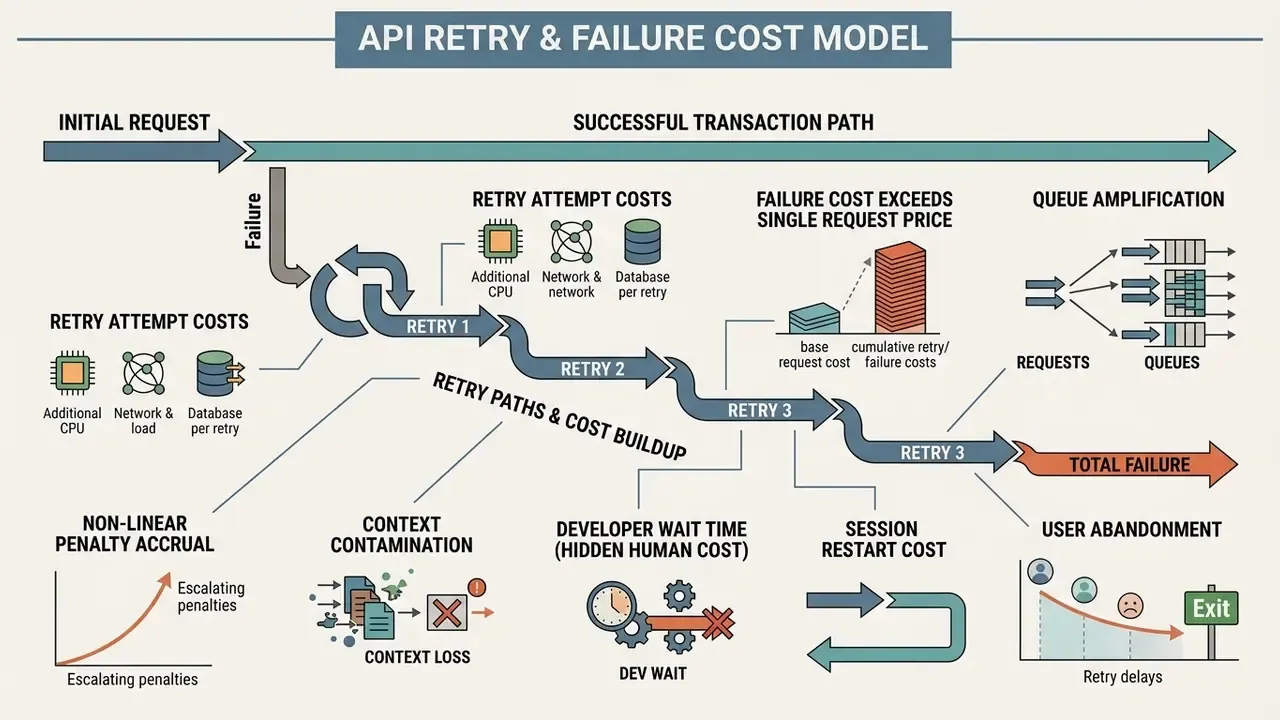
An API retry and failure cost model measures the monetary and operational impact of the repeated API calls needed to land one successful transaction. It links primary API failures, retry attempts, infrastructure consumption, human waiting time, and the net economic price of reliability.
The model separates direct infrastructure fees from indirect operational losses caused by failed requests. Direct expenses include compute execution time, API token billing, and network egress charges. Indirect losses cover extended user wait times, idle engineering hours, downstream process delays, and SLA violation penalties.
What costs each retry attempt creates
Every retry attempt consumes compute, network bandwidth, and time before a response arrives. In serverless and microservice architectures, each retry triggers a discrete function invocation or container thread that is billed independently. Nothing is free about a second try.
A failed API request repeated three times quadruples the network traffic and processing effort for that single transaction step. If the initial request fails after a 500-millisecond timeout and each subsequent attempt sees similar latency, the accumulated delay pushes back the whole downstream workflow. The total cost of a successful request equals the sum of all failed attempts plus the final successful invocation.
Not every failure carries an identical price tag, and mature FinOps models separate them:
| Failure signature | Billed? | Retry economics |
|---|---|---|
| DNS / TLS handshake failure before admission | No | Free to retry, cheap |
| HTTP 429 rejected at the edge before execution | Usually no | Retry only after Retry-After |
| HTTP 4xx validation error (400, 422) | Often yes (request accepted) | Never retry, route to DLQ |
| Fast 5xx (fail-fast, no compute) | Usually no | Safe retry candidate |
| Slow 5xx / read timeout after partial compute | Yes | Most expensive retry class, count against budget |
| Mid-stream connection reset on a streaming LLM call | Yes, partially | Charge accrues for tokens already emitted |
The last three rows are where budgets break. A read timeout on a long-running inference endpoint bills the full input context even though the client received nothing usable. That is money spent on silence.
Why failure cost exceeds the price of one failed request
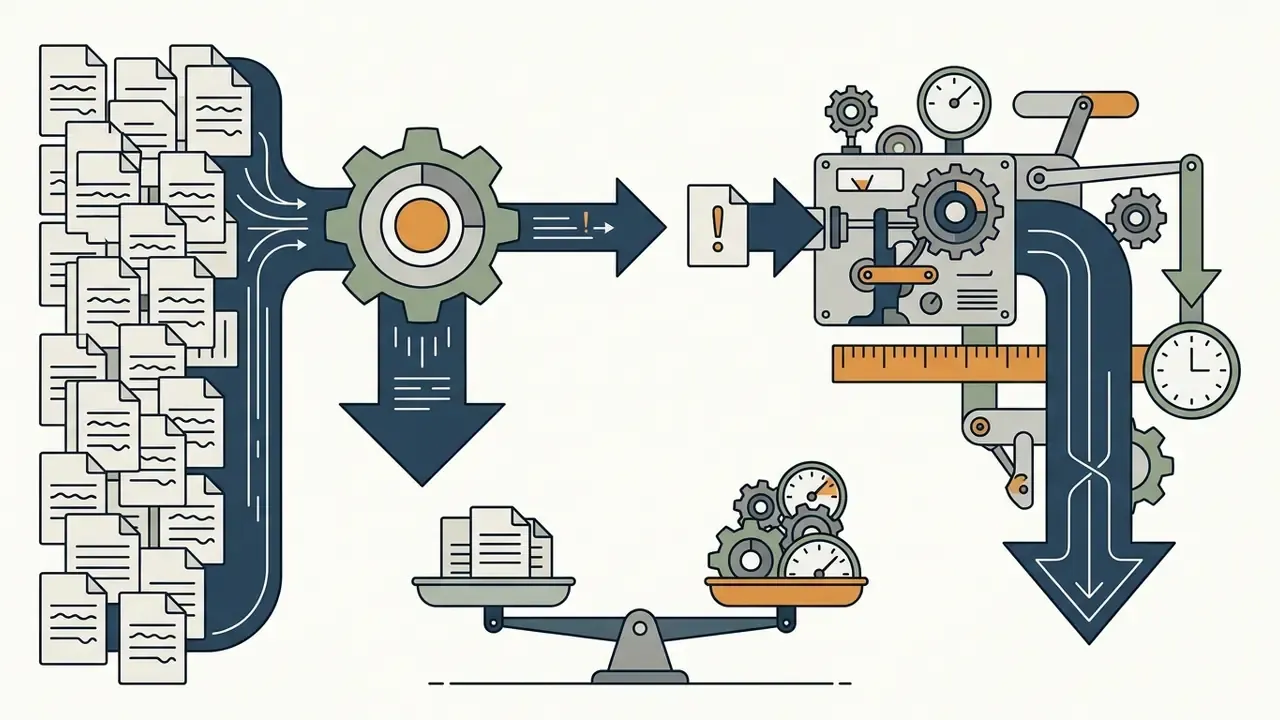
The total failure cost of an API error exceeds the nominal price of a single failed HTTP call, because uncoordinated retries trigger system-wide escalation. When a downstream service degrades partially, hundreds of upstream client instances start retry loops at the same second.
That synchronized volume creates a retry storm, saturates network queues, and forces cloud autoscalers to provision extra capacity. Updated: empirical evaluation of retry policies under controlled overload (AWS Lambda functions fronted by a Kubernetes/Istio ingress layer, driven to 150 to 200% of nominal capacity) shows that legacy, naive retry configurations averaged 2.09 retries per request and produced a resource bill of roughly 10.29× the baseline, with peak serverless invocation cost inflation exceeding 2,000% during a ~20-minute autoscaling window.
The failure cost compounds non-linearly for three structural reasons, each documented in the reliability literature:
- Queue amplification.Expected request lifetime grows rapidly with the retry limit ; once utilization exceeds unity (), each additional attempt lengthens the very queue that produced the failure (RetryGuard preprint, arXiv, 2025).
- Non-linear penalty accrual.In reliability-engineering cost models, the accumulated penalty for an offline customer rises non-linearly with outage duration, so a failure resolved on attempt 4 costs disproportionately more than one resolved on attempt 1 (Reliability Engineering & System Safety, 2023).
- Context contamination.In LLM agent pipelines, retrying after a failed attempt measurably raises the error rate of subsequent attempts, because the failed output is appended to context. The model must therefore treat as decreasing across attempts, not constant (Why Retrying Fails: Context Contamination in LLM Agent Pipelines, arXiv, 2026).
Which API failures can be retried, and which cannot
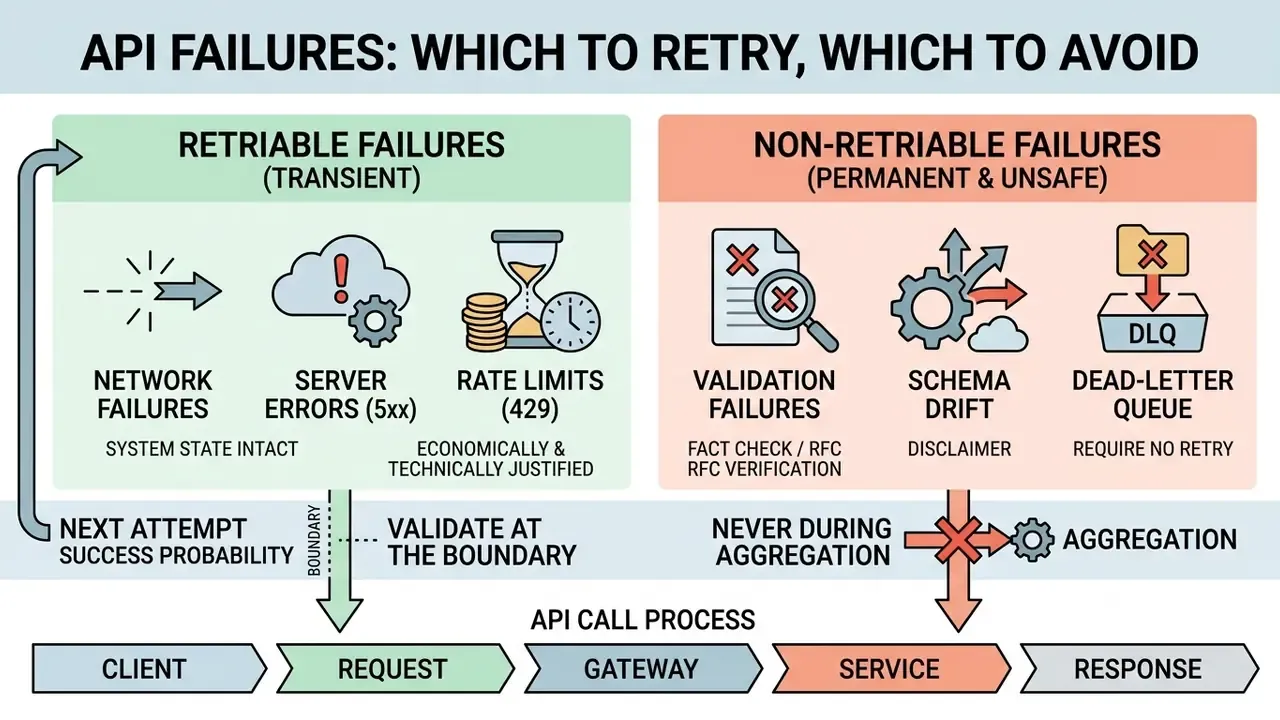
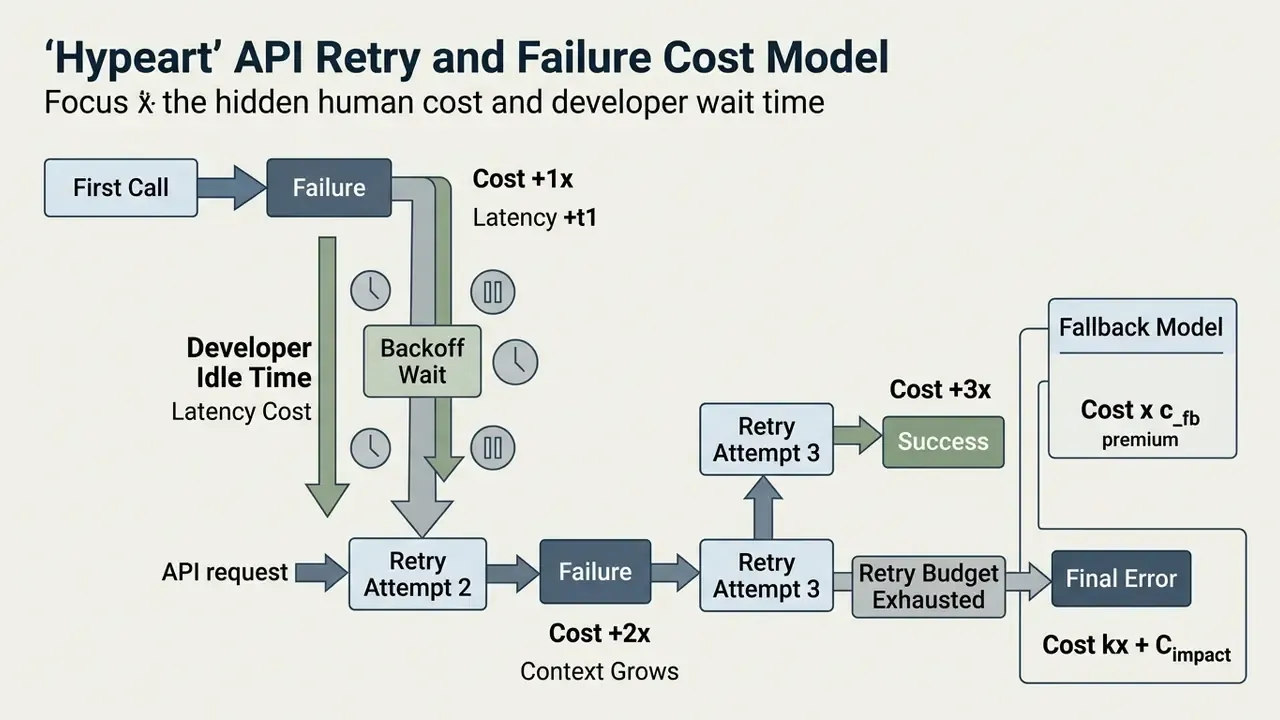
API retries are economically and technically justified only for transient errors, where system state stays intact and the next attempt has a non-zero probability of success. Retrying permanent errors or non-idempotent operations burns money and risks data corruption.
«Retries should be used only when the fault is transient and there is at least some likelihood that the operation will succeed on a later attempt.»
Engineering teams must classify error response codes at the client level before enabling any automated retry policy. Treating every failed call as a retry candidate depletes rate limits and inflates operational budgets without improving transaction success rates. A good retry taxonomy is cheaper than a good incident report.
Transient errors: network failures, server errors and rate limits
Transient failures are temporary conditions caused by brief network congestion, server capacity limits, or rate-limiting thresholds. Standard transient HTTP status codes include 408 (Request Timeout), 429 (Too Many Requests), 502 (Bad Gateway), 503 (Service Unavailable), and 504 (Gateway Timeout).
When handling HTTP 429 or 503 responses, clients must inspect the Retry-After response header and extract the recommended delay interval. According to RFC 6585 (which defines 429 and permits Retry-After) and RFC 9110 (which standardizes Retry-After as either an HTTP-date or a delay-seconds value, explicitly tied to 503 and 3xx semantics), respecting the header prevents client requests from colliding with an active rate-limit window. Firing a failure retry after a 429 without honoring server backoff signals leads to immediate rejection and wasted API spend.
«Adaptive client-side algorithms reduced HTTP 429 responses by 97.3% compared with plain exponential backoff, at only a marginal increase in completion time.»
«Only transient errors such as 408, 429, and 5xx responses should be retried; permanent errors must be logged and handled rather than repeated.» Google Cloud Storage, Retry strategy (2026). https://docs.cloud.google.com/storage/docs/retry-strategy
Permanent and unsafe errors that require no retry
Permanent client errors (4xx series) and non-idempotent state mutations must be flagged as non-retryable (no retry). HTTP statuses such as 400 (Bad Request), 401 (Unauthorized), 403 (Forbidden), and 422 (Unprocessable Entity) indicate structural problems in the payload or permissions that will not resolve on a later attempt.
Retrying a 401 authorization failure repeatedly processes an invalid token while wasting API call allocations. Worse, unbounded retries on non-idempotent POST or PUT endpoints create serious data-integrity risk. Repeating an unconfirmed payment charge can cause duplicate billing, then manual reconciliation, then a customer complaint that lands on a compliance desk.
Google's API Improvement Proposal AIP-194 draws the same line from the API-design side: clients should automatically retry only non-transactional unary requests that are safe to repeat, while permanent conditions such as INVALID_ARGUMENT and DATA_LOSS must be surfaced to the caller immediately.
Fact Check / RFC specification verification:
Validation failures, schema drift and the dead-letter queue
The most expensive retry is the one that can never succeed. Schema drift, meaning a renamed field, a null in a required metric, or a unit change in a usage export, produces payloads that fail deterministically on every attempt. Retrying them burns quota and, in cost-attribution pipelines, corrupts the ledger.
Validate at the boundary, never during aggregation. Enforce a strict contract at ingestion and quarantine violators in a dead-letter queue (DLQ) instead of raising an exception that halts the whole batch:
from decimal import Decimal
from datetime import datetime
from pydantic import BaseModel, ValidationError, field_validator
class ValidatedResponse(BaseModel):
    tenant_id: str
    resource_id: str
    quantity: Decimal
    unit_cost: Decimal
    timestamp: datetime
    @field_validator("quantity", "unit_cost")
    @classmethod
    def non_negative(cls, v: Decimal) -> Decimal:
        if v < 0:
            raise ValueError("cost dimensions must be non-negative")
        return v
def process_api_response(raw_payload: dict, dead_letter_queue: list):
    """Validate one payload. Quarantine schema drift instead of retrying it."""
    try:
        return ValidatedResponse.model_validate(raw_payload)
    except ValidationError as exc:
        # Schema errors are NOT retryable: isolate, alert, and keep the batch alive.
        dead_letter_queue.append({"payload": raw_payload, "errors": exc.errors()})
        return None
Two governance rules follow. First, a record missing its allocation tag (for example tenant_id) is not a valid record. It is untagged consumption that will silently inflate someone else's chargeback, so treat it as a partial-delivery fault and route it to the same DLQ. Second, monitor the quarantine ratio: if more than about 1% of a tenant's records are quarantined, cost decisions for that tenant rest on incomplete data and should be flagged rather than enforced.
Which parameters enter the retry cost model
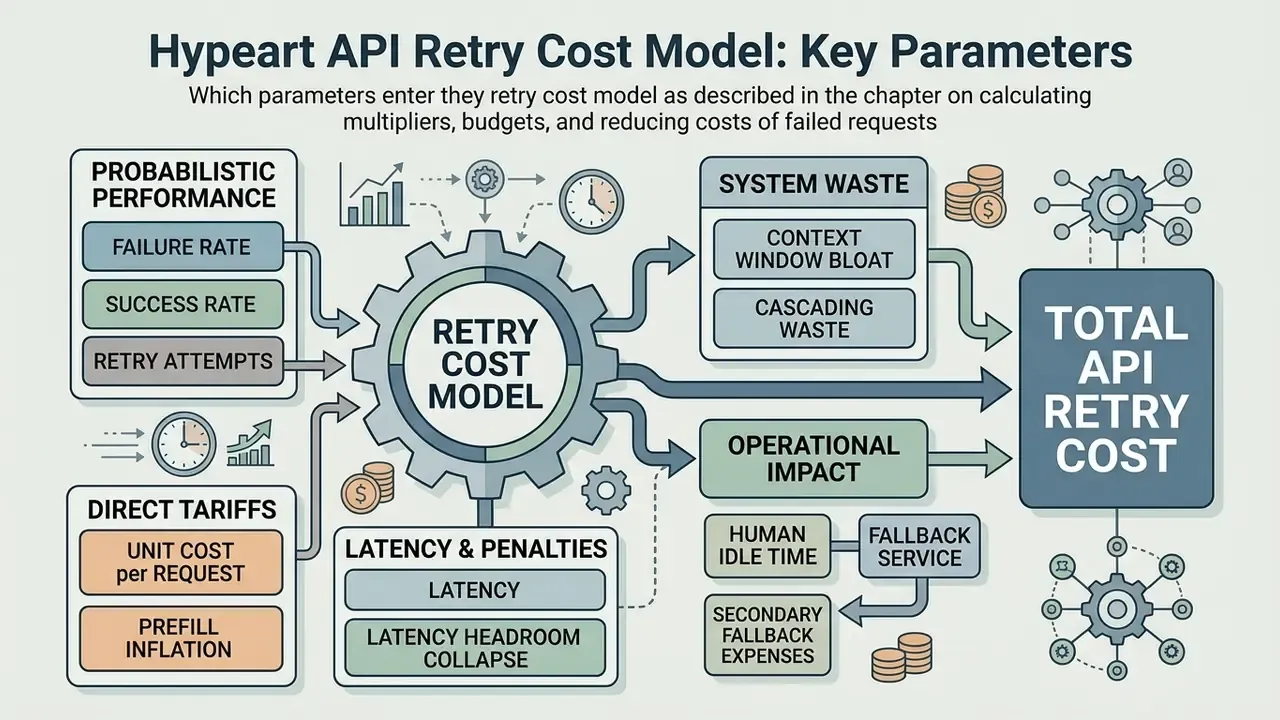
A complete API retry cost model combines probabilistic performance metrics, direct vendor unit tariffs, latency penalties, human idle time, and secondary fallback expenses. Measuring these variables lets model risk leaders and engineering directors calculate the true cost per successful transaction.
System designers must evaluate both the technical likelihood of request failure and the financial tariff applied by external providers. Omitting latency costs or fallback pricing leads to severe budget underestimation in high-throughput production environments. It is the most common gap we see in AI business cases, and it is usually a factor of two, not a rounding error.
The minimum viable parameter set is: attempt count cap (), per-attempt failure probability (, ), per-attempt latency, backoff schedule, absolute deadline, error-class mix, success-on-retry rate, throttle rate, retry-budget token consumption, and fallback unit price.
Failure rate, success rate and number of retry attempts
The mathematical core of the cost model rests on the initial failure rate (), the per-attempt success rate (), and the hard cap on the number of retries (). If an API provider exhibits a 5% baseline failure rate (), five out of every hundred initial calls fail and enter the retry loop.
As the system executes further attempts, cumulative success probability rises according to the truncated geometric distribution , where is the total number of attempts, and the expected attempt count is . However, when the service is structurally overloaded, decreases on later attempts. Raising the retry count without monitoring simply buys more retries and no additional success.
Multi-step pipelines make this brutal. With a 90% per-step first-attempt success rate, a five-step chain succeeds end-to-end only of the time. Allowing one retry per step lifts per-step reliability to and end-to-end reliability to roughly 95%, which is precisely why retries exist and precisely why their cost must be budgeted rather than assumed away.
AWS documents the practical drain threshold: with the SDK standard retry mode (500-token quota, 5 tokens per throttling retry, 14 per transient retry, max backoff capped at 20 s), the retry quota begins depleting once roughly 22% of requests sustain transient failures.
Request cost, latency and fallback service
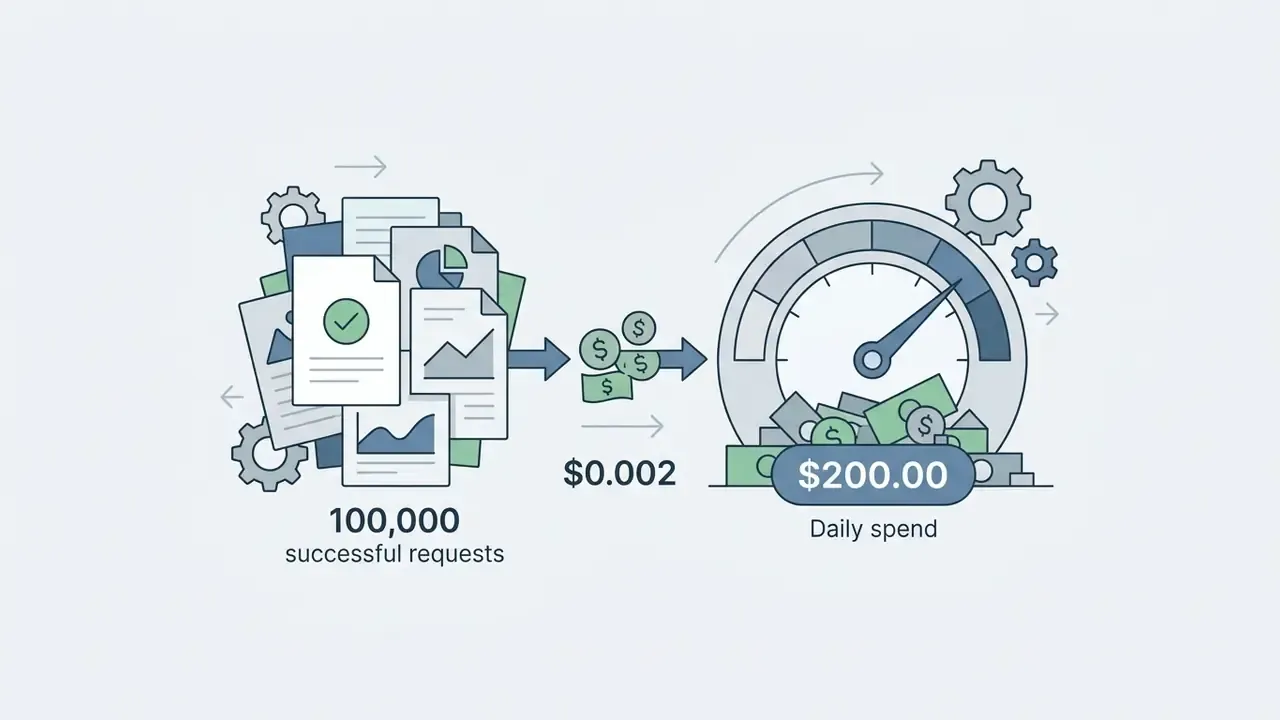
Calculating total request expense means adding direct API call fees, backoff latency penalties, fallback routing expenses, and developer idle time. Direct call cost () is the provider charge per request, for example $0.002 per generative AI model query, where published per-second and per-clip video pricing shows how quickly retried inference calls compound.
Latency cost () measures the business impact of delay during retry loops. If a financial pipeline stalls in an extended retry window, penalties accrue per second. When primary retries fail and traffic routes to an alternate fallback service or a secondary LLM, the model must account for the higher unit tariff () of the backup provider.
«Parallel racing across providers delivered P95 latency of 3.6 s at $0.000 per request, versus 14.0 s at $0.002 for single-provider and 20.5 s for sequential fallback.»
«Fallback is triggered on 5xx, timeout, or connection failure, then the next best provider is retried, with up to two retries.» LLM Gateway, Routing documentation (2026). https://docs.llmgateway.io/features/routing
Note the asymmetry documented in cost-and-latency routing research: cheaper routes are not automatically cheaper end-to-end, because scheduling and networking overhead can turn the low-price path into the slow path (Cost- and Latency-Constrained Routing for LLMs, Harvard, 2026, http://minlanyu.seas.harvard.edu/writeup/sllm25-score.pdf).
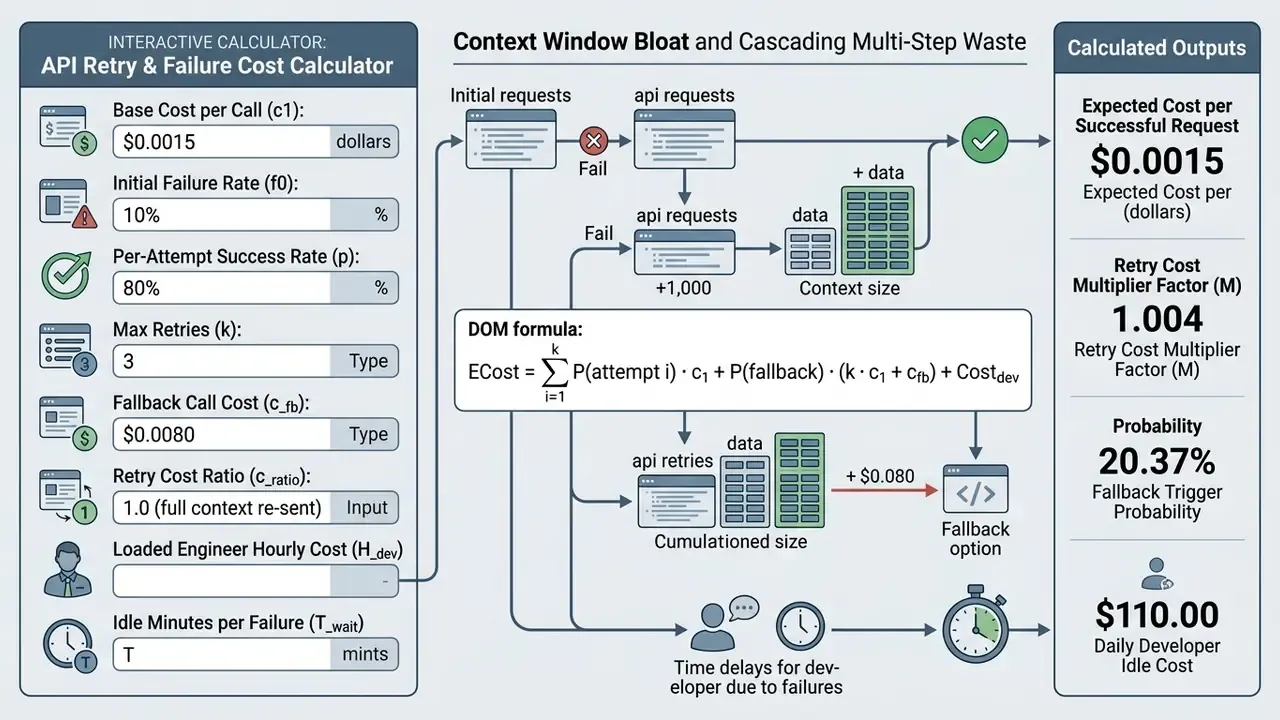
Context window bloat and cascading multi-step waste
In LLM and agentic workloads, the retry cost ratio is rarely 1.0. It is often greater than 1.0, because each retry appends the failed output plus an error message to the prompt. Three compounding effects follow:
- Prefill inflation.Longer contexts take longer to prefill, so attempt 3 is slower and more expensive than attempt 1.
- Cascading waste.In a ten-step task averaging 50K tokens per step, a failure at step 7 wastes 350K input tokens. Without checkpointing, the retry from step 1 consumes another 350K, so 700K tokens are wasted on a single cascading failure.
- Latency headroom collapse.If an inference call takes 8 seconds and the downstream tool has a 10-second timeout, only 2 seconds of headroom remain; a tool that normally completes in 3 seconds now times out and triggers another retry. Faster inference restores 9.5 seconds of headroom and removes the failure entirely.
The retry cost multiplier formula for APIs
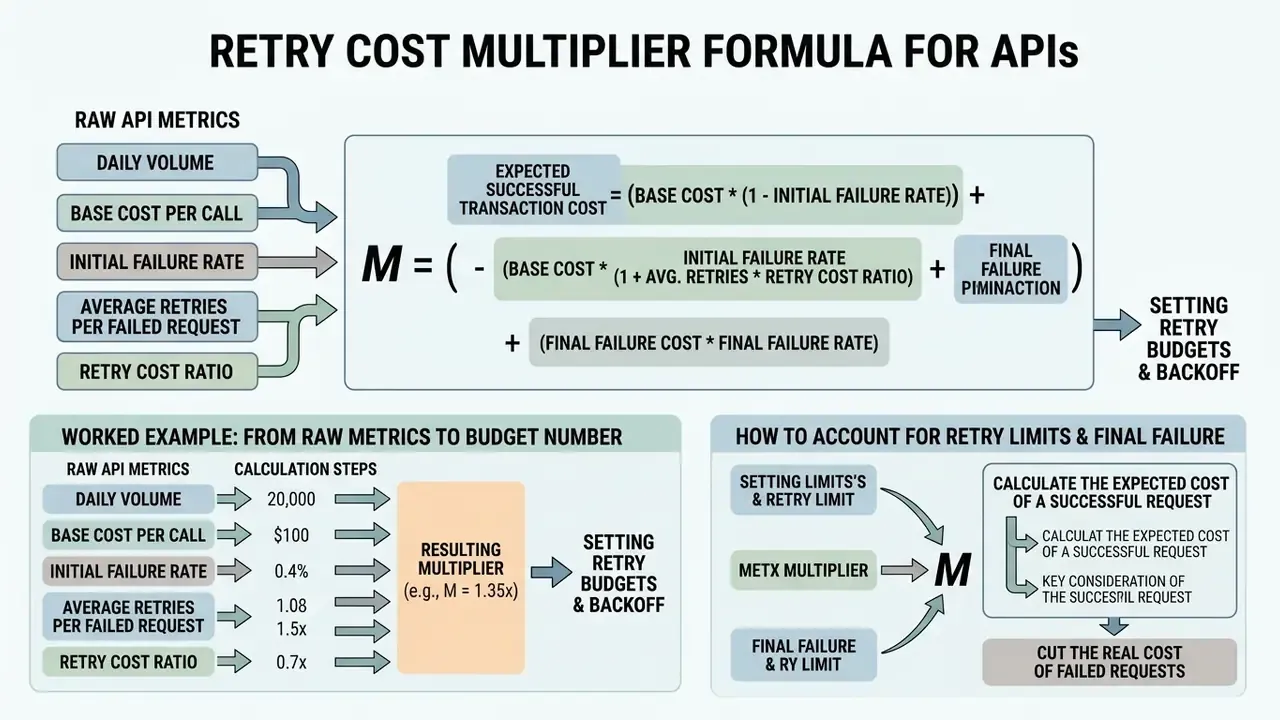
The retry cost multiplier () quantifies how much more expensive a successful API transaction becomes once failed requests, retry overhead, and final failure states are counted. It gives you a single coefficient for adjusting baseline budget forecasts against real reliability metrics.
When an API system runs with zero errors, . As failure rates climb, grows linearly or exponentially depending on the configured retry policy and the fallback architecture.
How to calculate the expected cost of a successful API request
For a system with constant per-attempt success probability (), an initial failure rate (), and a single request tariff (), the expected cost of achieving a successful request () without fallback is:
If retries are uncapped and independent, the expected number of attempts equals , making the baseline formula . In practical FinOps terms, the simplified operational multiplier is written as:
where is the average number of retry attempts executed per failed request, and is the relative cost of a retry attempt compared with the initial request.
Worked example: from raw metrics to a budget number
Assume a production inference workload with the following observed metrics:
- Daily volume 100,000 calls
- Base cost per call
- Initial failure rate
- Average retries per failed request
- Retry cost ratio (full context re-sent)

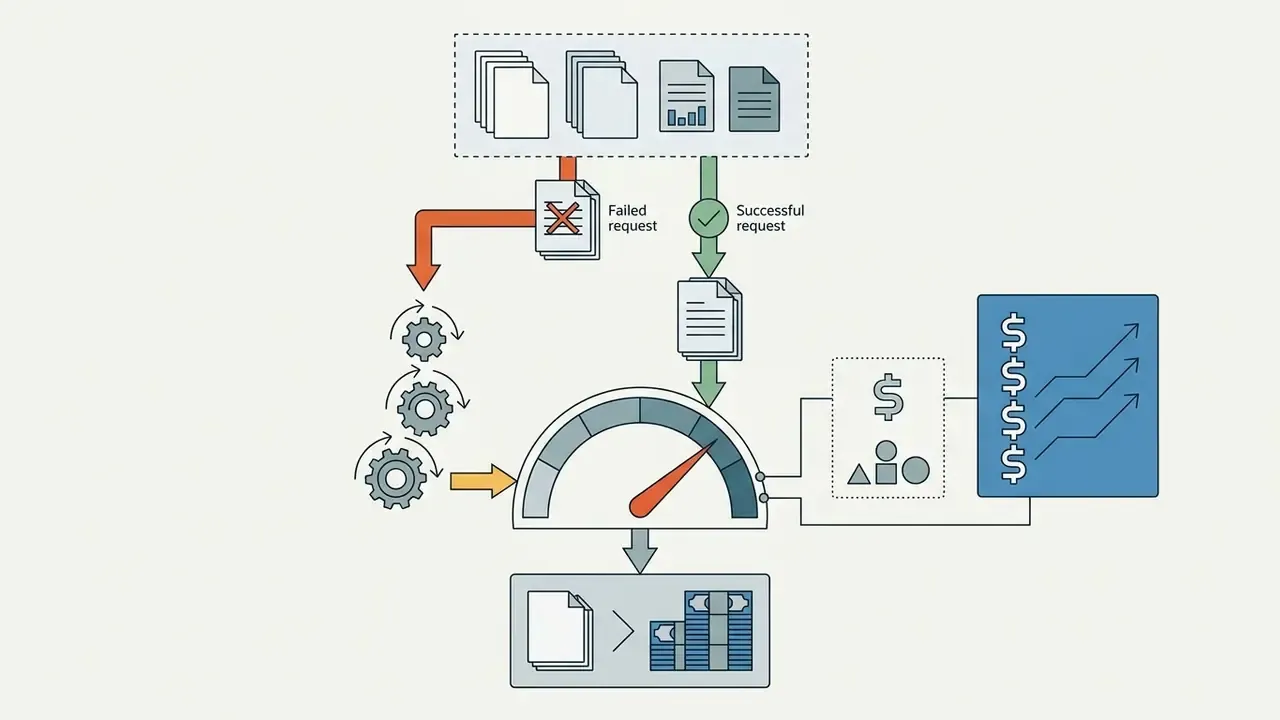
How to account for retry limits and final failure
When a transaction hits its configured retry limits without success, it reaches a final failure state. AWS documents this boundary explicitly: retries stop when the maximum attempt count is reached or the retry quota is depleted, at which point the SDK returns the error without retrying. The cost model must account for the capital already spent on exhausted retry attempts plus the downstream operational impact cost ().
The total financial loss () for a transaction that exhausts its retry budget across attempts is:
A probabilistic form used in risk reporting expands this to , where is attempts made and is the probability of final failure.
If an enterprise pipeline processes 100,000 daily API calls with a 5% ultimate failure rate after 3 retries, the system absorbs 15,000 wasted retry calls per day alongside the operational impact of 5,000 broken business workflows.
API retry and failure cost model examples across scenarios
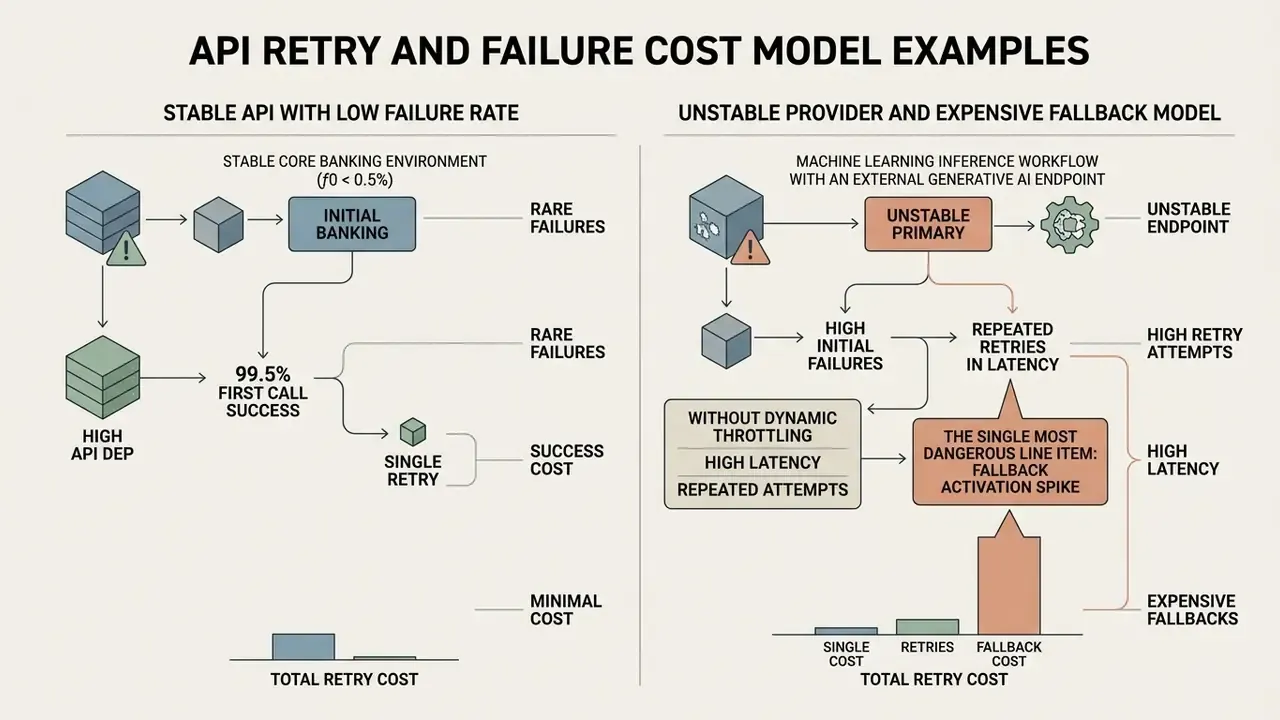
Applying the cost model to different architecture profiles shows how stability and fallback routing change financial exposure. Comparing a highly stable enterprise service with an unstable third-party LLM provider explains why one retry strategy cannot serve both.
Stable API with a low failure rate
In a stable core banking environment, primary API services hold an initial failure rate below 0.5% (). The system uses a strict retry limit () with exponential backoff.
Because initial failures are rare, 99.5% of requests succeed on the first call, and a single retry is triggered in fewer than 5 out of 1,000 transactions. The resulting retry cost multiplier stays near . Operational costs are predictable, and financial variance is comfortably covered by vendor SLA service credits.
Two contractual anchors matter here. A 99.9% availability SLA permits roughly 43 minutes of downtime per month (about 8.76 hours per year), while a 99.99% target leaves just over 4 minutes per month. Vendor remedies are capped: both AWS compute and commercetools publish credit ladders starting at 10% of monthly fees, rising to 25 to 50% only in severe breach bands. An SLA credit reimburses a fraction of the subscription, never the business loss. The retry cost model is what covers that gap.
Unstable provider and expensive fallback model
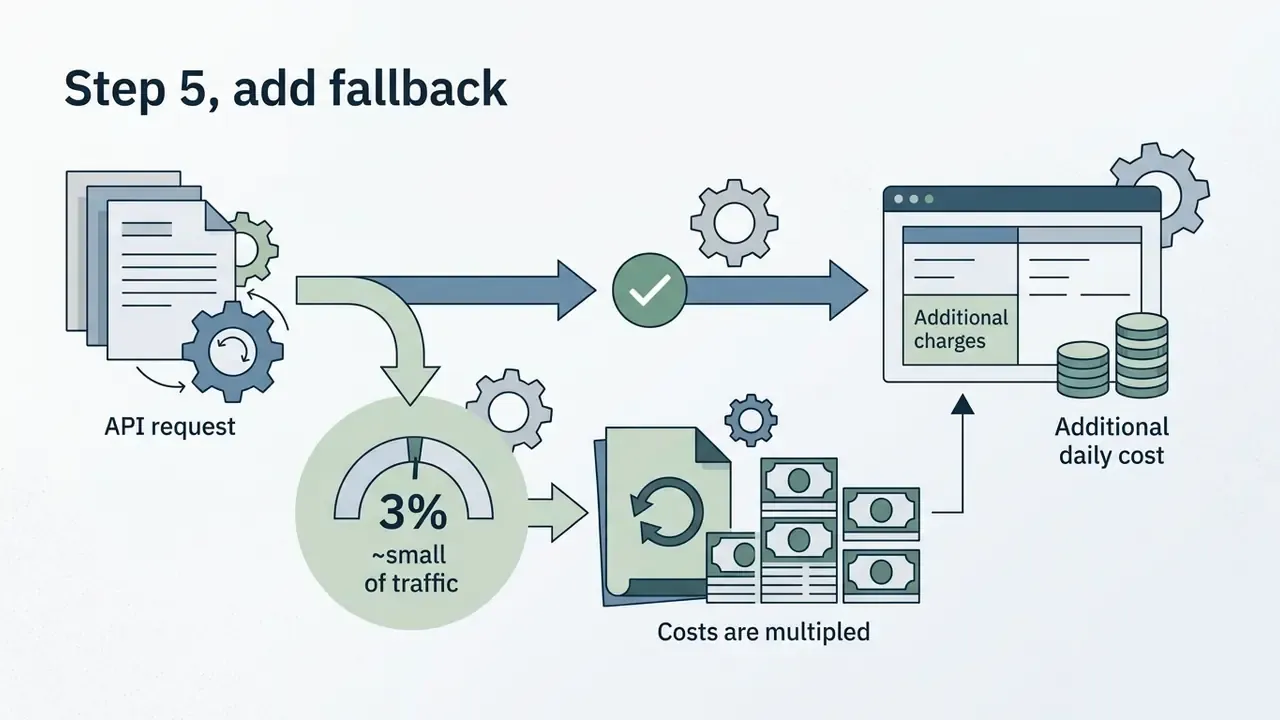
Consider a machine learning inference workflow that depends on an external generative AI endpoint running at a 15% failure rate under high market volatility. The application executes up to 3 retries before switching to a premium secondary fallback model priced four times higher per request.
Without dynamic retry throttling, repeated attempts against the unstable primary generate high latency and burn billing tokens. Once the failure threshold triggers the fallback service, transaction costs rise fast. Under this scenario, the effective cost multiplier reaches , raising operational spend by 145% against the baseline budget.
The single most dangerous line item is a fallback activation spike. On a normal day with 95% primary and 5% fallback routing, blended spend looks modest; on an outage day at 50/50 routing, the same workload can cost 6× a normal day. Fallback ratio must therefore be an alerted metric, not a silent config value.
| Scenario Profile | Initial Failure Rate () | Avg Retries / Request | Tail Latency (P95) | Eventual Success Rate | Effective Cost Multiplier () |
|---|---|---|---|---|---|
| 1. Stable Banking Core API | 0.5% | 0.01 | 180 ms | 99.99% | 1.01x |
| 2. Unstable Provider (Naive Retries) | 18.0% | 2.09 | 4,200 ms | 81.20% | 3.29x |
| 3. Unstable Provider + Fallback Model | 15.0% | 0.85 | 2,100 ms | 98.50% | 2.45x |
| 4. Governed Enterprise API (budgeted + adaptive) | 15.0% | 0.05 | 450 ms | 81.50% | 1.02x |
| 5. Agentic 5-Step Chain (20% per-step failure) | 20.0% | 1.37 avg/step | 27,500 ms | ~95% | 2.2 to 2.5x |
Interpretation: the comparative model shows that active retry suppression plus adaptive routing preserves budget stability even when provider failure rates spike to 15%. Row 5 is the warning case for agentic AI: a chain of tool calls multiplies the multiplier, and an agent looping across several APIs in sequence can burn a month of budget in an afternoon. We have seen sandbox runs do it in ninety minutes.
How to implement retry policy with backoff, jitter and retry budgets
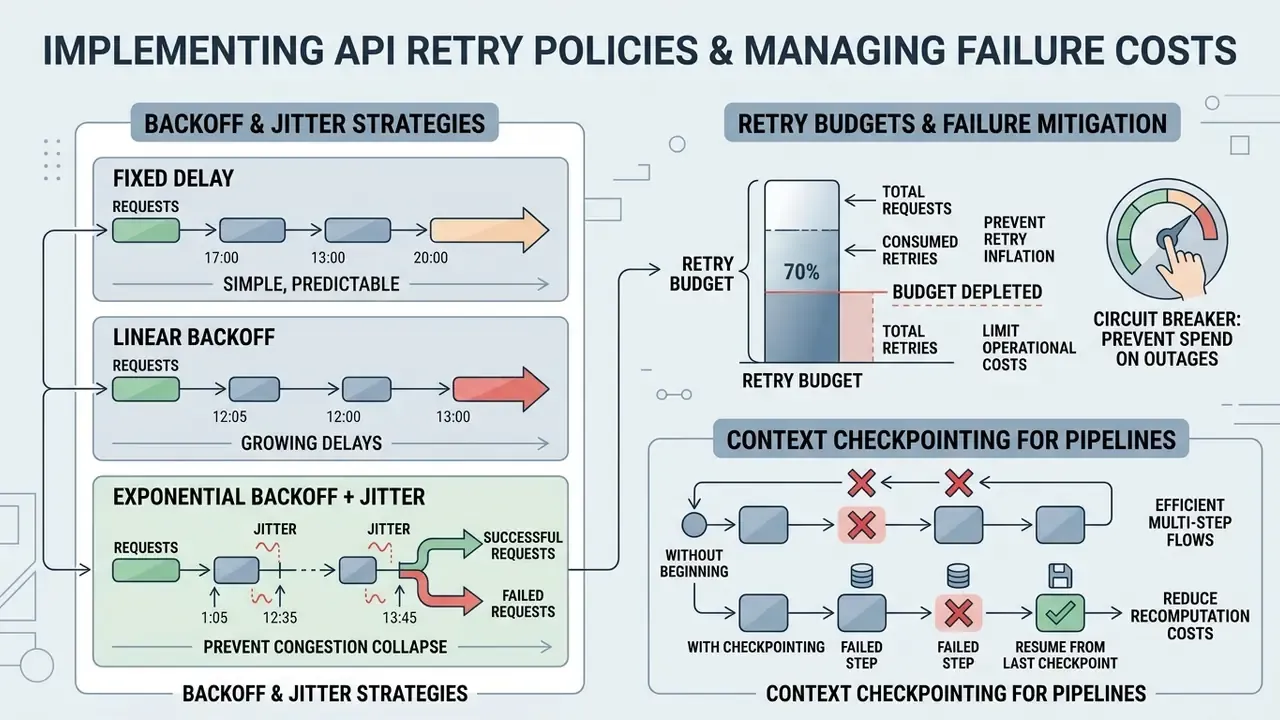
To keep retries from inflating operational costs, engineering teams must implement retry policy frameworks with dynamic backoff delays, decorrelated timing jitter, and centralized retry budgets. Unregulated retry loops generate synchronized traffic spikes that make provider outages worse.
Modern resilience management caps both individual request attempt counts and aggregate system-wide retry volumes. Implementing retry guardrails maintains availability while bounding compute expense.
Fixed, linear and exponential backoff: when to use each
Choosing the correct delay strategy controls client concurrency and downstream load during partial failure:
- Fixed delay suspends execution for a constant interval (for example 500 ms) between attempts. Retry traffic stays steady and never adapts to ongoing failure, so it is useful only for simple background tasks with zero client concurrency.
- Linear backoff increases the interval by a static increment (500 ms, 1000 ms, 1500 ms). It provides mild congestion relief but remains vulnerable to client synchronization.
- Exponential backoff multiplies the interval after each failed attempt (for example ). Retry frequency falls quickly, which makes it the industry-standard retry pattern for high-throughput enterprise APIs.
To prevent synchronized client retry storms, add randomized jitter to the exponential calculation:
A full-jitter variant used in cost pipelines multiplies the capped delay by instead of adding to it: .
«Fixed retry intervals produced synchronized request waves and proxy failures; exponential backoff with jitter eliminated failover errors across 750 stateful switchover events.»
Randomizing the delay desynchronizes client retry loops and lets downstream rate-limit windows reset naturally.
How to set retry budgets, time limits and retry counts
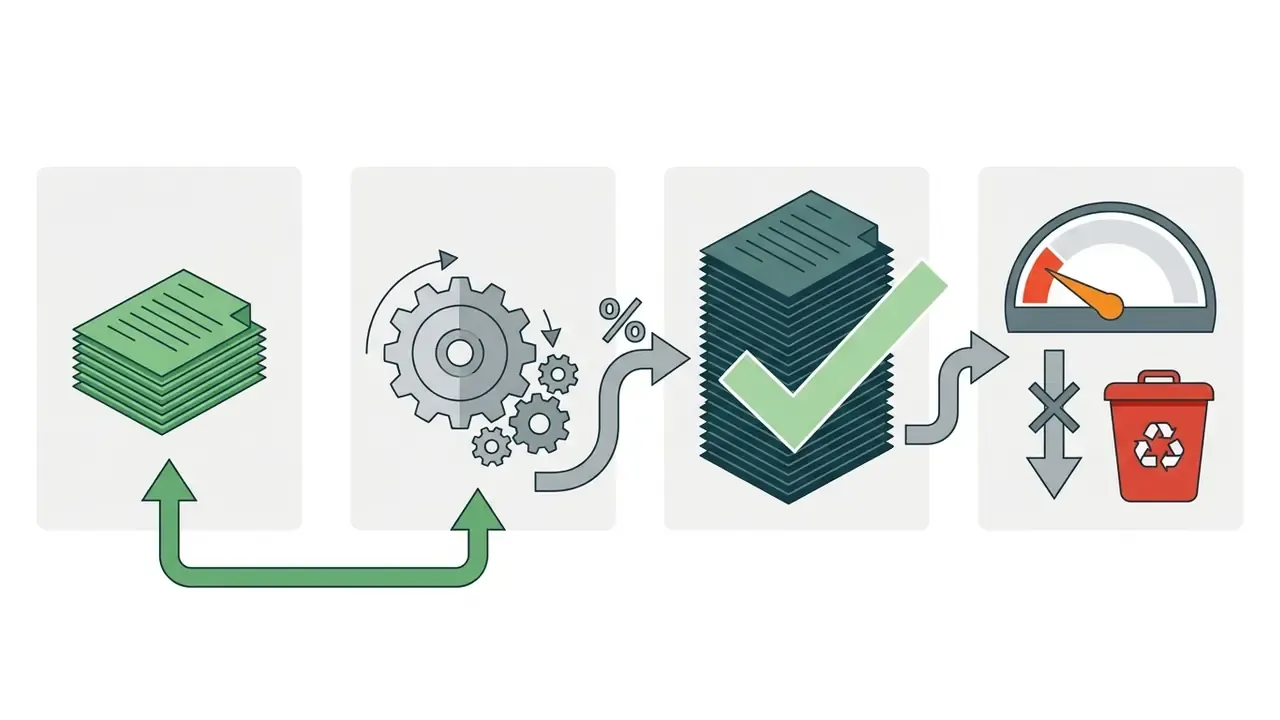
A retry budget sets a hard ceiling on total retries allowed across a service instance, expressed as a percentage of total request traffic and typically capped at 10%. If transient failures spike across several endpoints, the budget drains. Once depleted, the system blocks further retry attempts and returns errors immediately, which stops cost escalation before it compounds.
That trade-off is the crux of the governance decision: budgeting retries costs a few points of eventual success and saves an order of magnitude of spend. Whether the trade is acceptable is a risk-appetite question, not an engineering one. Say that out loud in the committee, and the conversation changes.
Attempt counts alone are the wrong abstraction, though. If ten pipeline steps each retry up to 3 times at 4 seconds per call, worst-case latency is seconds, a failure mode that only appears under load testing with failure injection. The better primitive is a deadline-based budget shared across the whole run:
import time
class TimeRetryBudget:
    """Wall-clock retry budget shared across every step of a pipeline."""
    MINIMUM_RETRY_TIME = 1.0  # don't start a retry with <1s left
    def __init__(self, max_wait_seconds: float):
        self.deadline = time.monotonic() + max_wait_seconds
    def remaining_time(self) -> float:
        return max(0.0, self.deadline - time.monotonic())
    def is_exhausted(self) -> bool:
        return self.remaining_time() <= 0
    def check_budget(self) -> None:
        if self.is_exhausted():
            raise TimeoutError("Retry budget exhausted by time limit")
def run_step_with_budget(step_fn, budget: TimeRetryBudget, max_attempts: int = 3):
    last_error = None
    for _ in range(max_attempts):
        budget.check_budget()          # fail fast instead of burning spend
        try:
            return step_fn()
        except RecoverableError as exc:  # noqa: F821  (your transient error class)
            last_error = exc
            if budget.remaining_time() < TimeRetryBudget.MINIMUM_RETRY_TIME:
                break                  # not enough time for a meaningful retry
    raise last_error
Because the budget is shared, a flaky early step naturally leaves fewer retries for later steps, which creates backpressure instead of unbounded latency compounding. It also maps cleanly onto SLAs: promise 30 seconds, set the budget to 25, keep 5 seconds of overhead margin.
Applications must also enforce absolute time limits and maximum retry counts ( or ; NIST SP 800-228 illustrates a 6-second timeout against a 5-second latency contract). Teams preparing production deployments can work through our implementation checklist to audit backoff configurations, retry every-attempt caps, and timeout settings across distributed microservices.
Circuit breaker: stopping spend during full provider outages
Backoff slows retries. A circuit breaker stops them. When a threshold of consecutive failures is crossed, the breaker opens and requests fail instantly with no network cost, then probes recovery in a half-open state.
import time
class CircuitBreaker:
    """Closed -> Open -> Half-Open state machine for external API calls."""
    def __init__(self, failure_threshold: int = 5, cooldown_seconds: float = 30.0):
        self.failure_threshold = failure_threshold
        self.cooldown_seconds = cooldown_seconds
        self.failures = 0
        self.opened_at = None
    def allow(self) -> bool:
        if self.opened_at is None:
            return True                                   # CLOSED
        if time.monotonic() - self.opened_at >= self.cooldown_seconds:
            return True                                   # HALF-OPEN probe
        return False                                      # OPEN: zero spend
    def record_success(self) -> None:
        self.failures = 0
        self.opened_at = None
    def record_failure(self) -> None:
        self.failures += 1
        if self.failures >= self.failure_threshold:
            self.opened_at = time.monotonic()
Pair the breaker with a degradation policy: fail closed on provisioning, fail open on observation. While the breaker is open, existing workloads continue against the last known-good snapshot, but new resource provisioning is held until live data returns. That prevents a tenant from racing a billing outage to spin up unattributed capacity.
def enforcement_mode(drift: float, breaker: CircuitBreaker,
                     quarantine_ratio: float) -> str:
    """Choose enforcement strictness from pipeline health signals."""
    if not breaker.allow() or drift > 0.005 or quarantine_ratio > 0.01:
        return "read_only"   # hold new provisioning
    return "active"          # full soft/hard limit enforcement
Here drift is the reconciliation drift ratio . A common variance gate is 0.5%, above which the billing window is held out of the ledger rather than published to finance.
Context checkpointing for multi-step and agentic pipelines
For chained API calls, the cheapest retry is a partial retry. Persist intermediate state after each successful step so a failure resumes from the last checkpoint instead of restarting the chain:
- Without checkpointing steps 1 to 7 succeed (350K tokens), step 8 fails, restart from step 1 (another 350K tokens). Total: 700K tokens for 8 steps of work.
- With checkpointing steps 1 to 7 succeed (350K tokens, checkpoint saved), step 8 fails, retry resumes from the step-7 checkpoint (50K tokens). Total: 400K tokens, roughly a 43% reduction, rising toward 80% in deeper chains.
Checkpointing also caps context contamination: replaying from a clean checkpoint discards the failed attempt's polluted context instead of appending it, which keeps from degrading across attempts.
A complementary tactic is model-level fallback instead of blind retry. Three attempts against the same failing model waste 200K tokens to succeed on the third; one attempt plus one fallback to a stronger model wastes 100K. The fallback costs more per token and less per success.
Integrating retry logic into API clients and distributed systems
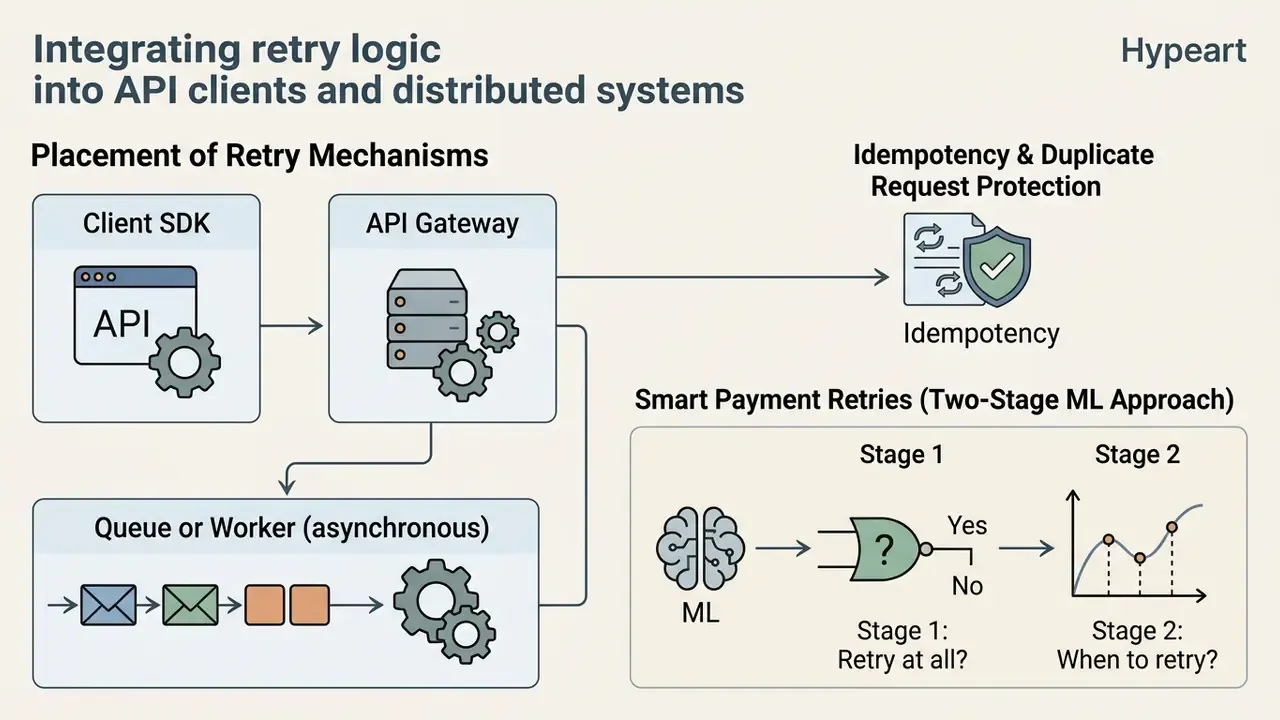
Where you embed retry logic inside a distributed architecture decides whether retries are observable, coordinated, and cost-controlled. Put retry mechanisms in the wrong layer and you get redundant loops that multiply request volume exponentially.
Architects must weigh client SDK handling, centralized API gateway rules, and asynchronous queue workers. This is an API retry and failure cost model integration decision, not a stylistic one.
Where to place the retry mechanism: client, gateway or worker
- Client SDK handles transient network disconnects locally before returning errors to application logic. Retries are client-local and happen before the error reaches application code (AWS SDKs default to the initial attempt plus two retries). Fast, but blind to what other clients are doing.
- API gateway centralizes retry policies at the system edge, synchronously and response-facing. Azure API Management exposes a
retrypolicy that re-executes child policies before the final response, and the Kubernetes Gateway API has an equivalent proposal. The gateway can intercept HTTP 503 errors and retry backend nodes automatically, hiding transient infrastructure glitches from public clients. - Queue or worker (asynchronous) decouples execution from user wait time, so retries happen after acceptance. Background workers (RabbitMQ, AWS SQS, Cloudflare Queues, which retries three times by default before DLQ routing) process failed jobs on long backoff schedules, ideal for non-real-time batch processing.
Nesting retries across multiple layers at once must be avoided outright. If a client SDK, an API gateway, and an internal microservice each execute 3 retries independently, one initial failure triggers downstream requests, causing severe overload and a 27× cost spike on that transaction. Assign retry ownership to one, at most two layers in the call path, and pair it with a circuit breaker.
«A systematic review screening 412 studies and analysing 26 identified jittered retries with budgets, circuit breaking, and adaptive backpressure as the core resilience patterns for microservices.»
Idempotency and protection against duplicate request execution
Retrying requests that alter database state requires guaranteed idempotency. An operation is idempotent when executing it many times leaves the system in exactly the state produced by executing it once.
Financial transaction integrations and payment retry systems require a unique Idempotency-Key header (typically a v4 UUID) on every API request:
POST /v1/payments HTTP/1.1
Host: api.paymentgateway.com
Authorization: Bearer sec_key_992183
Idempotency-Key: 7b9e4a21-3c8f-4d1a-8e2b-119d83a45e02
Content-Type: application/json
{
  "amount": 25000,
  "currency": "usd",
  "account_id": "acct_88321"
}
When a server receives a request carrying an existing Idempotency-Key, it skips reprocessing and returns the cached HTTP response from the first execution. This prevents duplicate card charges and ledger discrepancies during network dropouts.
«Introducing unique transaction identifiers and reconciliation journals in Visanet and GlobalPayment substantially reduced duplicate transactions and improved system reliability.»
Retention windows differ by processor and must be encoded in your retry policy rather than assumed. Checkout.com and Ratepay return the original response for identical retries within 24 hours (and answer concurrent duplicates with 409 Conflict), Adyen caps the key at 64 characters, Amazon Pay uses x-amz-pay-idempotency-key, and Helcim clears keys after 5 minutes. Retrying outside the retention window is a duplicate-charge event, not a retry. Check the provider documentation before you trust a default.
Smart payment retries: the two-stage ML approach
Fixed backoff schedules are the wrong tool for commercial charges, because payment failures are behavioural rather than technical. A retry on day 2 fails because the balance is empty; the same retry on day 6, the day after payroll lands, succeeds. A fixed schedule cannot tell the difference, and it spends the same money either way.
Production subscription systems therefore replace the schedule with a two-stage pipeline:
- Stage 1, classification: should we retry at all? A binary model estimates recoverability from transaction context (attempt number, payment method category), user lifecycle signals (account and subscription age), and engagement proxies. A measurable cohort of failures has a near-zero recovery probability; retrying them adds operational cost and zero revenue.
- Stage 2, regression: when should we retry? For transactions that clear stage 1, a gradient-boosted regressor (LightGBM performed best in reported implementations) predicts the time delta in seconds until the next attempt is likely to succeed.
Two design lessons transfer directly to any cost-sensitive retry system. First, threshold tuning beats model complexity: because missing a recoverable payment is far more expensive than one extra attempt, the decision threshold sits well below 0.5, trading accuracy for recall. Second, use only features available at the moment of failure, which avoids leakage and keeps real-time inference honest.
proba = classifier.predict_proba(features)[:, 1]
should_retry = proba >= RETRY_THRESHOLD        # tuned to business cost asymmetry
delay_seconds = timing_model.predict(features) if should_retry else None
The same framing applies to LLM retries. The question is never only how long to wait, but whether this attempt has non-trivial expected value at all.
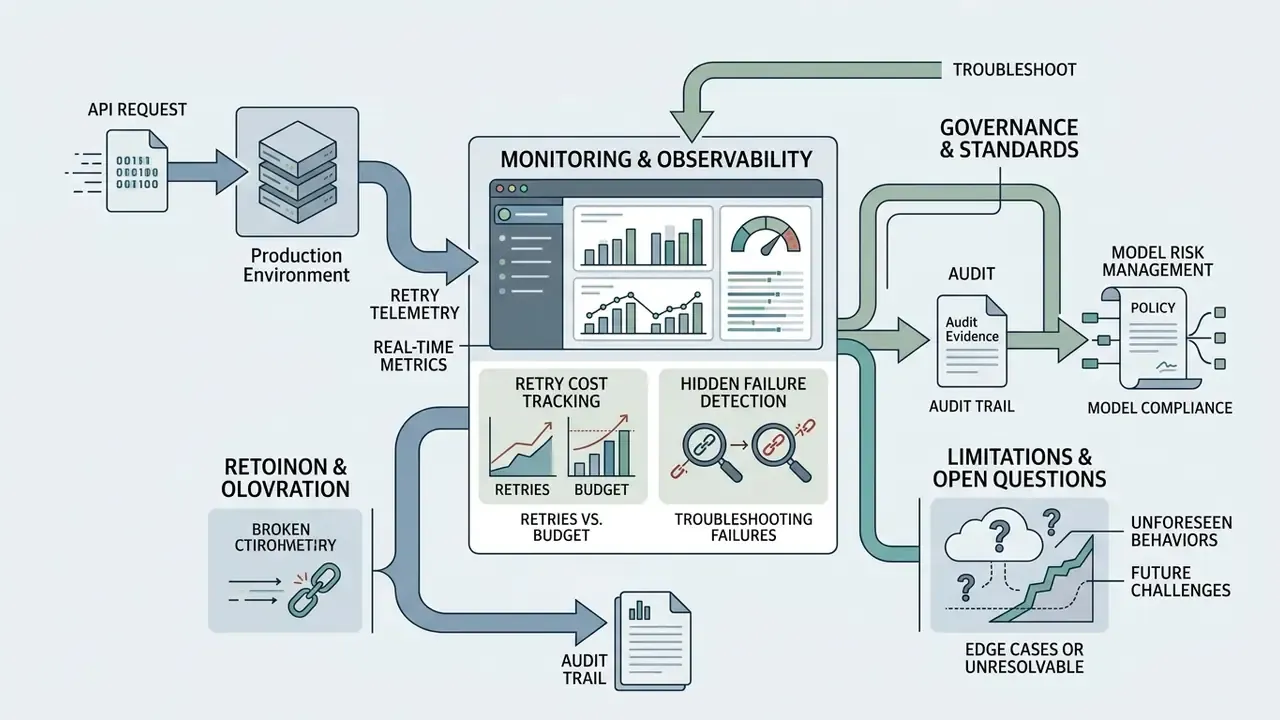
FAQ: API retry and failure cost model
How do retries affect custom LLM agents and agentic pipelines?
Far more than in chat. Agent context per request runs 50K to 500K tokens versus 1K to 10K in chat, sessions involve 10 to 100+ requests, and retries are automatic rather than human-initiated. A failure at step 7 of a 10-step chain can waste 350K input tokens, and 700K if the chain restarts from step 1 without checkpointing. Budget agent retries by wall-clock deadline across the whole run, and checkpoint after every successful step.
What is a normal failure rate for AI API calls?
For major frontier providers under normal conditions, 1 to 3% is typical. Cost-optimized or shared-infrastructure endpoints can reach 5 to 15% during peak periods. Free tiers are consistently the worst. Validate against your own telemetry, not a vendor status page.
Who owns retry budget limits inside a bank?
Treat the cap as a risk-appetite parameter. The model owner and the second-line risk function set the percentage and the approval path for changing it; platform engineering implements and monitors it. Breaches should generate a logged event, never a silent config override.
How should I handle HTTP 429 during traffic spikes?
Read the retry after header and obey it, since RFC 6585 and RFC 9110 define it precisely for this purpose. Then apply exponential backoff with jitter on top, cap total attempts, and let the shared deadline budget decide whether a retry is worth attempting at all. Adaptive client-side pacing has been shown to cut 429 volume by more than 97% versus plain exponential backoff.
Should I choose a cheap model with more retries or an expensive model with fewer failures?
Compare total cost per successful task, including retry tokens, fallback premiums, and developer idle time. A model 10× cheaper per token that fails 5× more often frequently loses once enters the equation.
What is the retry cost multiplier formula in one line?
. With , , and full context re-sent (): , so 10% above base cost in tokens alone, before latency, fallback, and human time.
Can retry storms be caused by our own architecture rather than the provider?
Yes, and this is the most common self-inflicted incident. Nested retries across SDK, gateway, and worker layers turn one failure into 27 requests. Assign retry ownership to a single layer and add a circuit breaker.
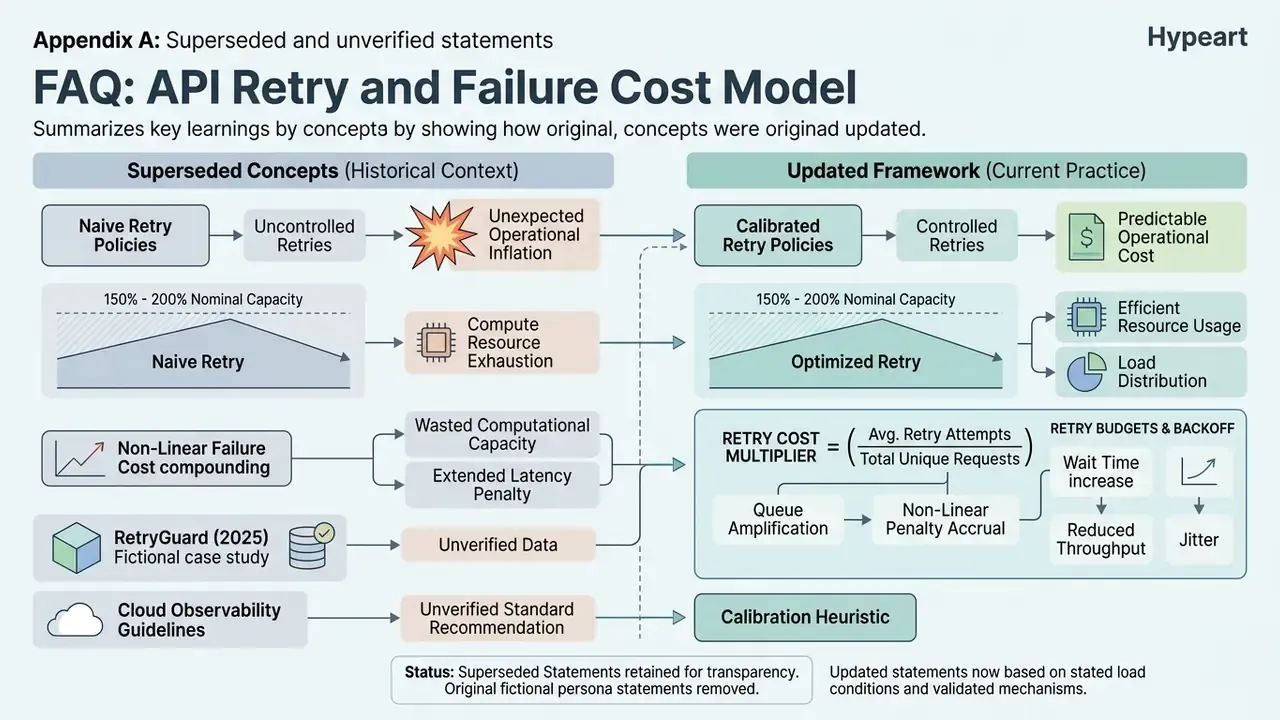
Appendix A: Superseded and unverified statements (retained for transparency)