Executive summary for risk, compliance, and engineering leadership
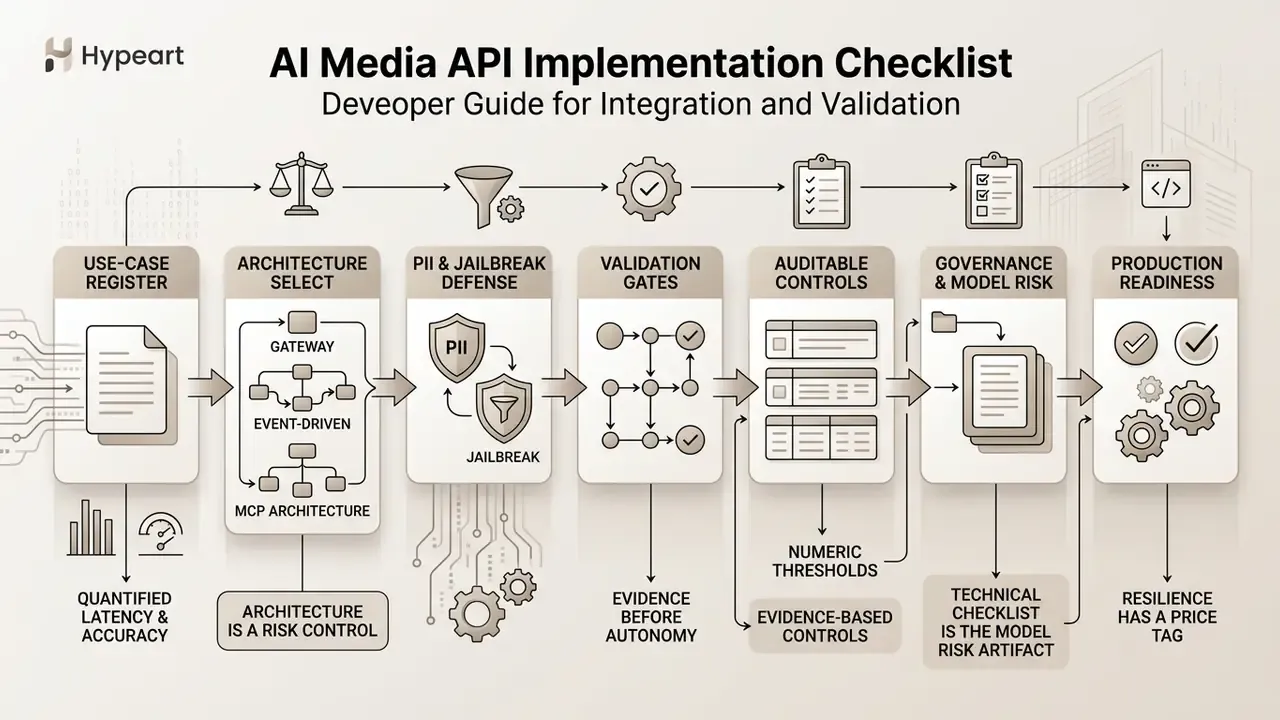
What an AI media API implementation checklist should cover
«A systematic review synthesized nine core resilience themes for distributed systems, from jittered retries to chaos validation, drawn from 26 studies of real-world production architectures.»
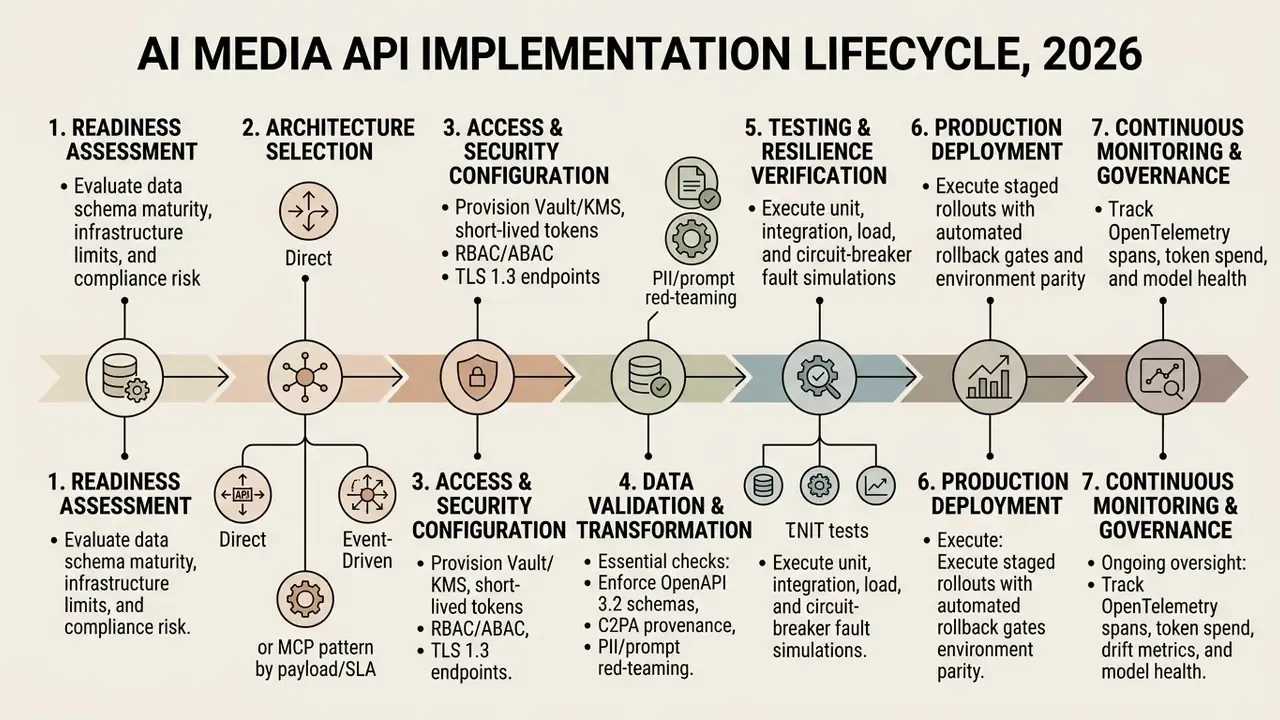
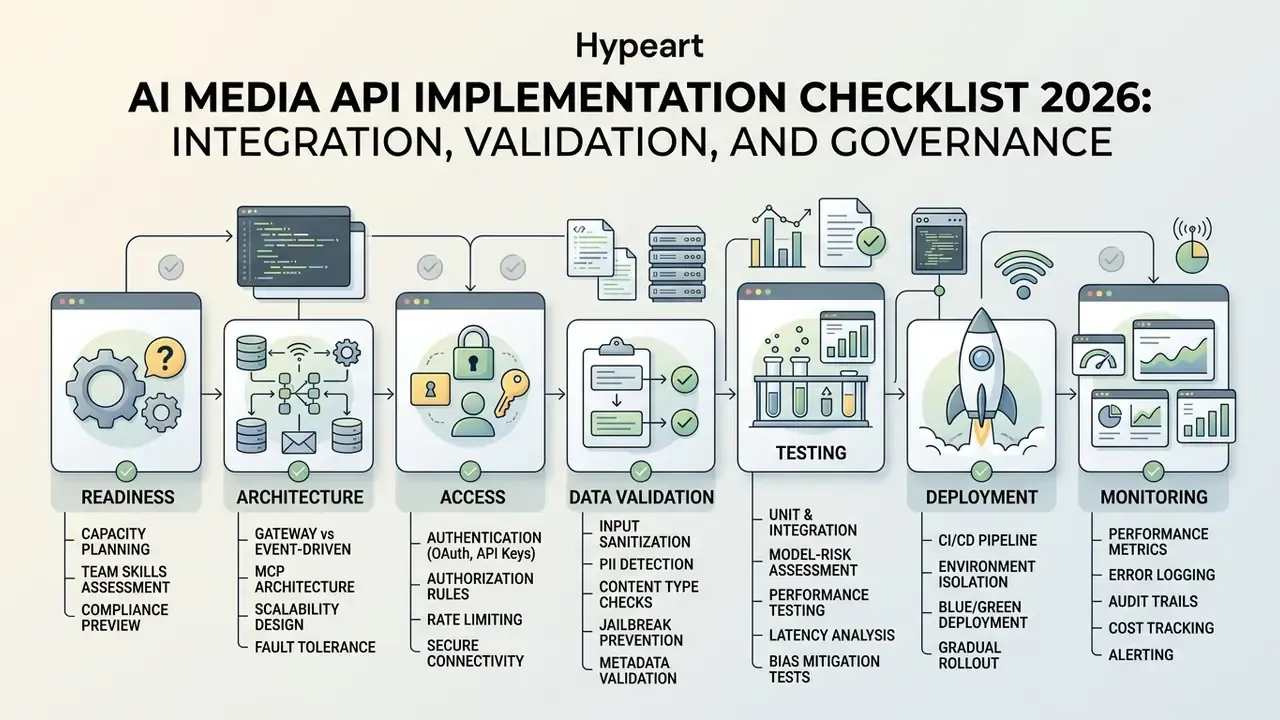
Organizing the work as a seven-stage pipeline prevents three predictable outcomes: production outages, unbudgeted API consumption, and compliance breaches. As documented in the ISO/IEC 23093-6:2026 standard for distributed media processing, defining clear technical boundaries between media analyzers and orchestrators is mandatory for multi-modal systems.
«The standard defines the syntax and semantics of data exchanged between media analysers in distributed AI media processing.»
Map the checklist to model risk management and GRC evidence
Engineering teams inside US banks and mature fintechs do not release AI media integrations on technical merit alone. Federal Reserve SR 11-7 and OCC Bulletin 2011-12 establish that any model used in decisioning needs documented development evidence, independent validation, and ongoing performance monitoring. Supervisors increasingly read generative and multimodal media pipelines as models carrying model risk. So every artifact this checklist produces should be filed as validation evidence, not left as an engineering note in a wiki nobody opens.
| Checklist stage | Artifact produced | Model risk / GRC consumer |
|---|---|---|
| Readiness assessment | Use-case register, latency and accuracy budgets, data lineage map | Model inventory owner; first-line risk |
| Architecture selection | Topology diagram, kill-switch location, gateway policy set | Technology risk; operational resilience |
| Access configuration | RBAC/ABAC matrix, key rotation logs, agent identity records | Information security; internal audit |
| Data validation | OpenAPI schemas, PII redaction test results, C2PA provenance checks | Privacy office; second-line validation |
| Testing and resilience | TEVV report, load-test evidence, adversarial red-team log | Independent model validation (SR 11-7 scope) |
| Deployment | Blue-green results, rollback rehearsal, RTO/RPO attestation | Business continuity; regulatory examiners |
| Monitoring | OpenTelemetry spans, drift dashboards, cost-per-request trend | Ongoing monitoring under SR 11-7 / OCC 2011-12 |
The mapping matters operationally. The pilot-to-production gate should be a package handover, not a meeting. When those seven artifacts land in the GRC platform with named owners and version dates, model validators can approve or reject without re-deriving the engineering context from scratch.
Regulatory references in this article are summarized for engineering planning purposes and do not constitute legal or supervisory advice.
Define media use cases and success criteria
Defining media use cases means mapping business objectives to measurable technical key performance indicators, latency bounds, and error budgets before anyone writes integration code. Teams must state clearly whether the pipeline handles synchronous interactions, such as real-time voice processing for identity verification, or asynchronous batch operations, such as archival document visual processing.
Success criteria have to cover model-level accuracy and infrastructure operational metrics together. For mission-critical voice processing, NIST defines mouth-to-ear latency as the governing quality-of-experience variable and reports timestamp-based measurement of system delay across the message lifecycle.
«Mouth-to-ear latency measurements establish a benchmark system delay of 21.85 ± 0.07 ms for real-time mission-critical audio.»
Engineering specifications should formalize parameters across four dimensions, plus one that teams almost always forget:
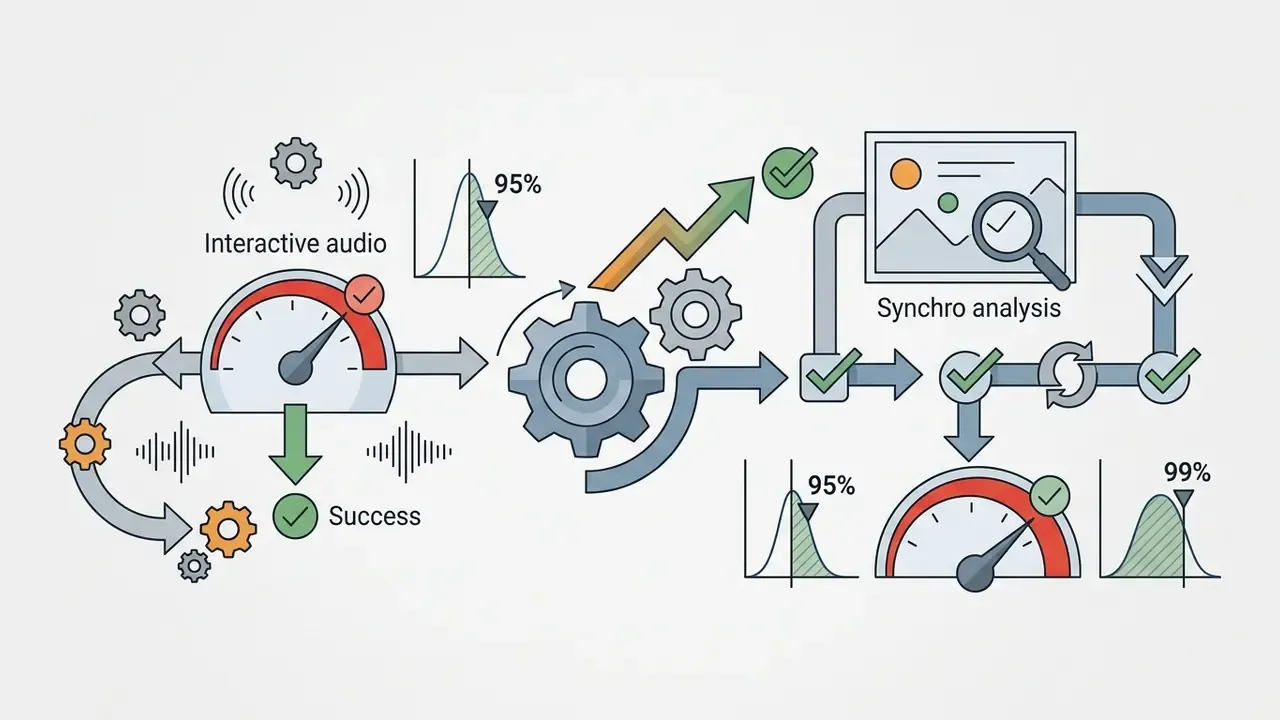

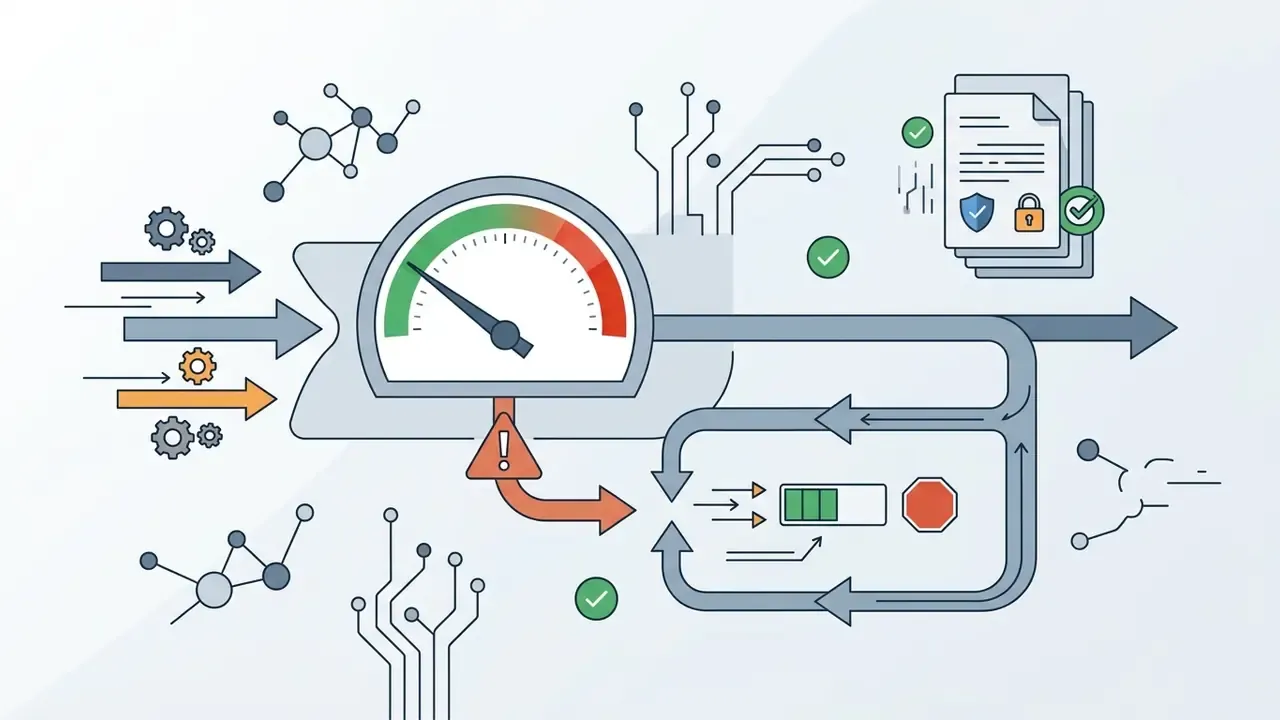
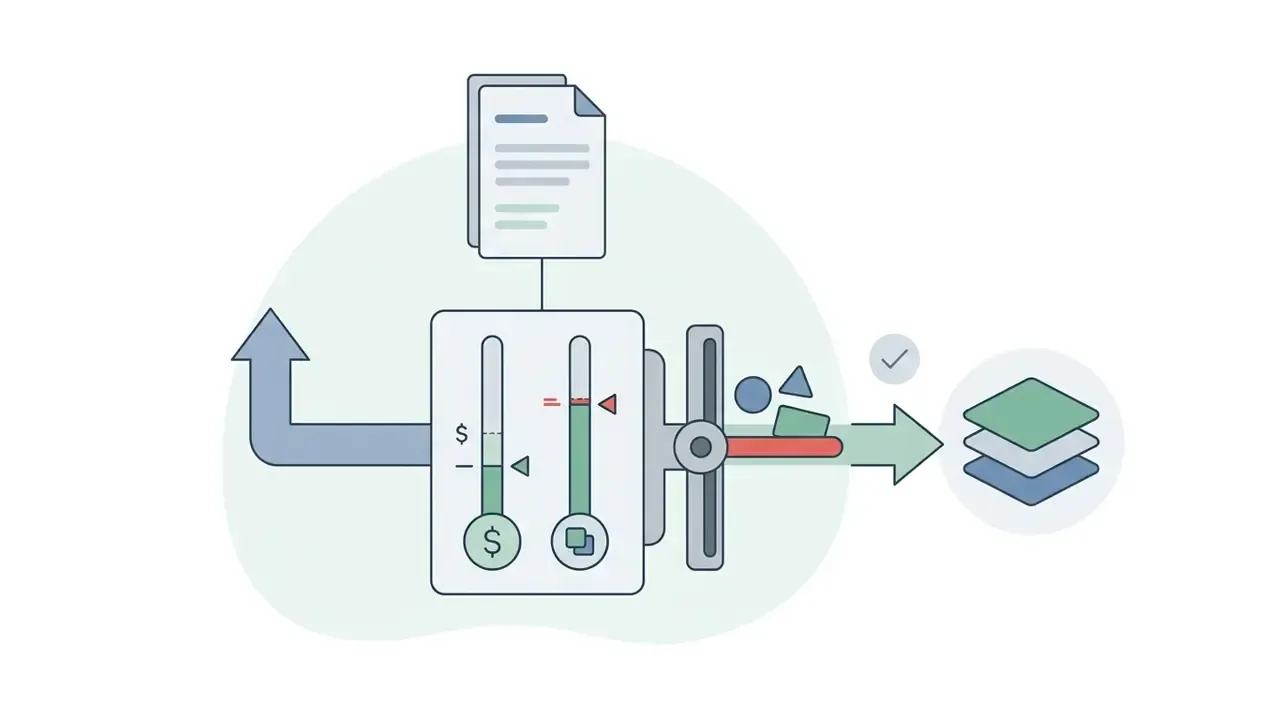
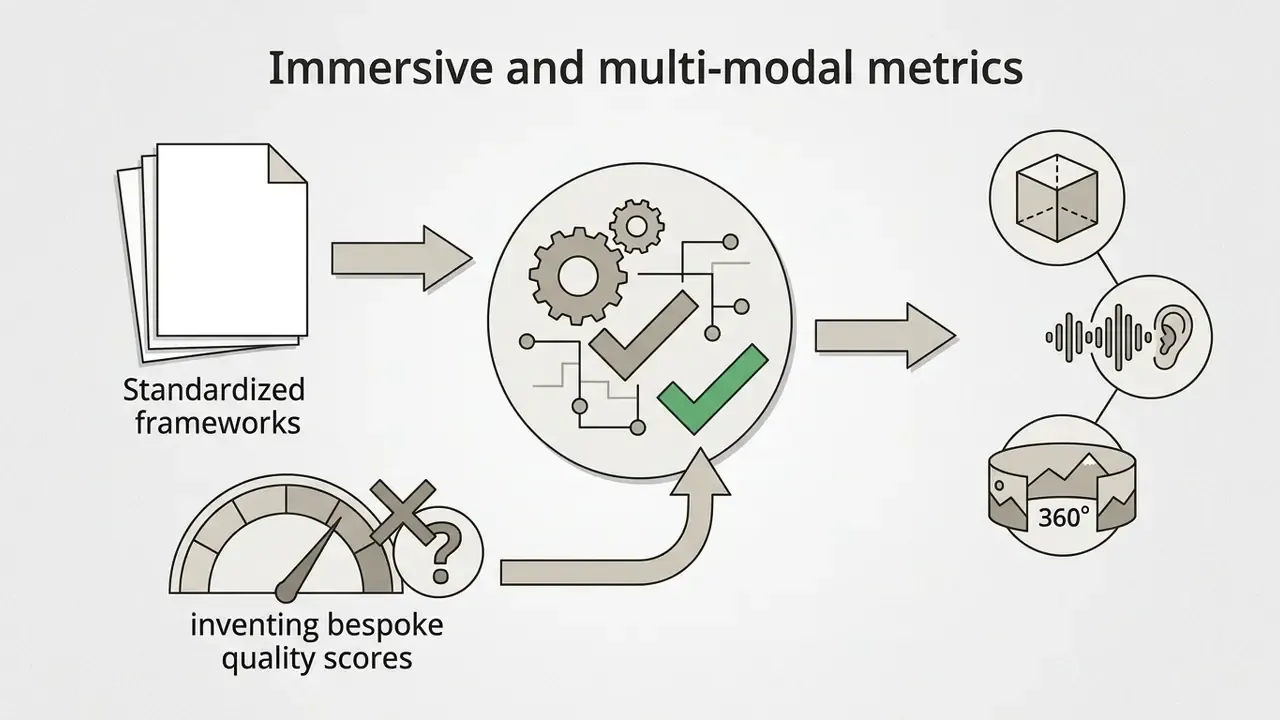
Here is an illustrative composite case. A regional fintech tried to deploy an automated identity verification agent with no explicit latency budget. Model processing delays pushed customer drop-off up by 34%. The team then set a hard P95 response limit of 800 ms and routed slow multimodal calls to an asynchronous queue. Drop-offs fell below 2%, and full audit logging survived the change. Not glamorous work. It saved the launch.
Review API documentation before development starts
A documentation review should audit endpoint constraints, supported content types, rate limits, and error schemes before application code exists. Research on retrieval-augmented generation for API documentation suggests that example-driven technical specifications improve integration correctness materially.
«Retrieval over the top-five documentation chunks increases correct API usage by 83% to 220%, with code examples contributing more than parameter prose.»
Developers working from an ai media api implementation checklist developer guide should evaluate these parameters in the provider documentation:
Reviewing an AI Video API Provider Comparison gives useful benchmarking context when you evaluate multimodal API limits, watermarking behavior, and pricing tiers across commercial vendors. One caution: vendor documentation and live pricing pages drift apart, so treat published limits as a starting hypothesis and confirm them with a sandbox test.
- Payload constraints
- maximum request body sizes (for example, a 2 GB multipart upload cap and a 17-hour maximum audio duration in production transcription APIs) and strict file-format restrictions.
- Rate limits and quotas
- per-minute request limits, tokens-per-minute ceilings, and concurrent connection caps. Commercial async media APIs frequently cap concurrency at five jobs per key.
- Error code mapping
- machine-readable 4xx and 5xx error structures, with an explicit distinction between HTTP 429 (rate limit), HTTP 413 (payload too large), and HTTP 415 (unsupported media type).
- Versioning policies
- deprecation schedules, URI versioning schemes, and backward compatibility commitments.
Assess AI readiness, media data, and integration requirements
Assessing ai readiness means verifying that existing infrastructure, data pipeline schemas, and operational governance can carry heavy AI media workloads without destabilizing the platform. Evaluate data ecosystem maturity, legal boundaries, and compute dependencies before opening a single production API connection.
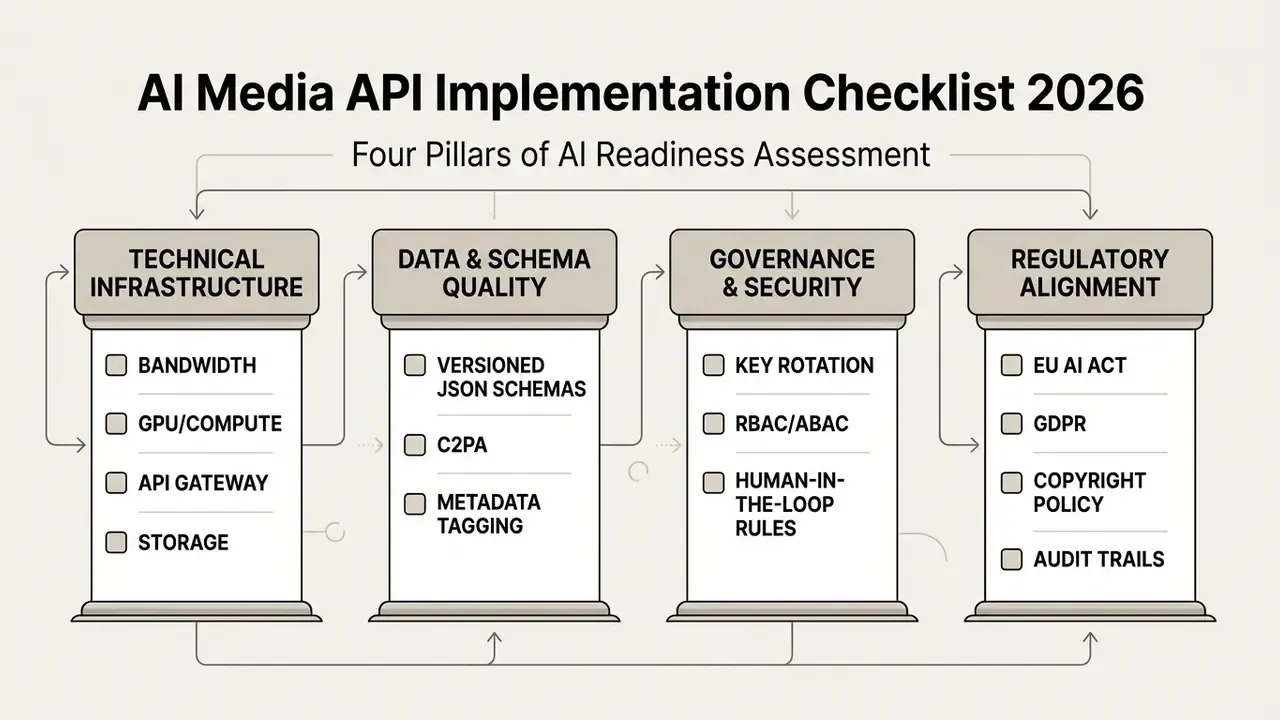
AI-ready media datasets need versioned schemas, interoperable formats, documented access layers, and continuous quality monitoring. Those obligations sit upstream of any model call. Readiness frameworks published by national data authorities and the ITU converge on five measurable data dimensions: accessibility, source capability, quality, representativeness, and labeling capacity.
Validate media inputs, outputs, and data transformation rules
Validating media inputs and outputs requires strict schema enforcement, encoding checks, and semantic mapping rules on both sides of the API boundary.
«Cloud-native APIs must execute strict syntactic input validation and protect against malicious valid input consuming model resources.»
Input pipelines should validate file headers, mime types, and byte sizes before dispatching requests to external endpoints. That is the same discipline that governs reliable photo and image processing workflows at scale. Pipelines built on OpenAPI 3.2.0 should define contentMediaType, contentEncoding, and contentSchema explicitly to enforce string-encoded payload validation, and should treat format as an annotation rather than an enforcement mechanism.
«
contentMediaType,contentEncoding, andcontentSchemavalidate string-encoded data;formatis annotation-only.»
Reference JSON Schema: MediaProcessingRequest
{
  "$schema": "https://json-schema.org/draft/2020-12/schema",
  "title": "MediaProcessingRequest",
  "type": "object",
  "properties": {
    "media_id": {
      "type": "string",
      "format": "uuid"
    },
    "content_type": {
      "type": "string",
      "enum": ["audio/wav", "audio/mp3", "image/jpeg", "image/png", "video/mp4"]
    },
    "payload_base64": {
      "type": "string",
      "contentEncoding": "base64",
      "contentMediaType": "image/png"
    },
    "callback_url": {
      "type": "string",
      "format": "uri"
    }
  },
  "required": ["media_id", "content_type", "payload_base64"]
}
For media provenance and integrity verification, validate assertions against C2PA 2.4 specifications. The C2PA framework enforces machine-readable schemas and chunk-integrity checks by verifying merkle-map hashes directly against media data buffers, and constrains encodedMediaTypes to registered IANA subtypes.
«Validation checks
merkle-maphashes against the media data buffer, and encoded media types must resolve to registered IANA subtypes.»
Output validation is a symmetrical obligation, and it is the half teams tend to skip. Structured-output guidance from commercial model providers recommends explicit JSON Schema definitions, unambiguous field names, all parameters marked required, application-side handling of optional or default values, and edge-case testing before downstream parsing. Where outputs are images, reverse-image-search and provenance verification tools add a practical second layer for detecting unauthorized brand asset reproduction.
Select the AI model and supported media services
Selecting the right AI model means balancing reasoning accuracy against inference cost, request latency, and modality capabilities. Provider selection guidance is fairly consistent on the ordering: fit accuracy first, then optimize for cost and latency, then confirm platform compatibility.
«Optimize for accuracy first, then cost and latency: use the cheapest, fastest model that still meets the accuracy target.»
Azure documentation adds that context-window size and multimodal input handling raise input-processing cost directly. Google classifies Gemini 2.5 Flash as its best price-performance tier for low-latency, high-volume reasoning. IBM's orchestration guidance frames the first decision as input type: text-only versus multimodal for images, scanned PDFs, graphs, and documents. Taken together, these published rules, not intuition, justify routing high-volume narrow media tasks to cheaper models while reserving frontier reasoning models for genuinely ambiguous inputs.
| Selection Metric | Direct Integration | API Gateway Pattern | Event-Driven Architecture |
|---|---|---|---|
| Primary Use Case | Narrow, synchronous low-volume utility calls | Enterprise multi-client API consolidation | High-volume, heavy media processing pipelines |
| Modality Fit | Single modality (for example, text-to-speech) | Mixed REST/WebSocket multi-modal inputs | Asynchronous video/audio chunk processing |
| Cost Control | Managed per-app call budgets | Centralized token caps and semantic caching | Queue-based smoothing and batch cost reductions |
| Latency Profile | Low structural overhead (direct connection) | Low overhead (plus 2-5 ms gateway proxy delay) | Decoupled (near-zero caller wait, queue async) |
Match the model tier to task complexity when deploying generative agents. Using a high-parameter reasoning model for a basic audio format conversion adds cost and latency and buys nothing. Low-latency models such as Google Gemini 2.5 Flash or OpenAI GPT-4o mini give better price-performance for real-time document extraction and structured media labeling; the Google Veo implementation guide documents comparable cost, quota, and capability tradeoffs for video-generation endpoints.
Assign ownership for development, review, and support
Clear operational ownership across engineering, information security, risk governance, and the business is what prevents unmonitored shadow AI from spreading. Ownership gaps, not model quality, drive most of the surprises we hear about.
«Organizations should define clear goals, roles, and responsibilities and implement an AI-specific risk management plan.»
Defense and audit-side frameworks reinforce the same requirement from different angles. The UK Ministry of Defence JSP 936 requires human responsibility across the AI lifecycle, with a governance chain identifying responsible persons at each level. The GAO AI Accountability Framework centers accountability on governance, data, performance, and monitoring, supported by documented technical specifications.
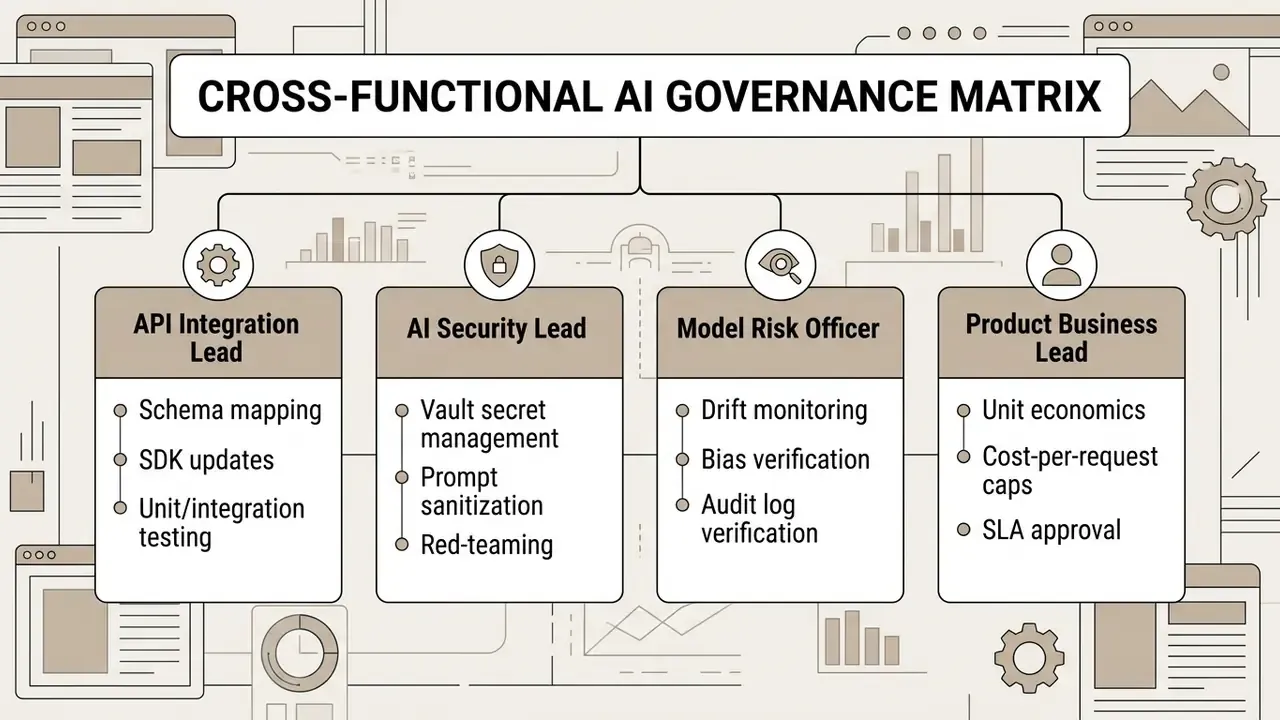
One practical detail: give each role a documented escalation path and a shutdown authority. An owner who cannot switch the integration off is a signatory, not an owner.
Author profile and technical review
Author: Marcus Hale, lead technical contributor, AI governance and model risk author. Marcus Hale, author.
Technical reviewer: Enterprise Systems and Model Risk Validation Review Group.
Documentation verification date: 19 August 2026.
Compliance baseline: ISO/IEC 42001:2023, NIST AI RMF 1.0, NIST SP 800-228-upd1, ETSI TS 104 223.
Choose an API integration architecture for AI media workflows
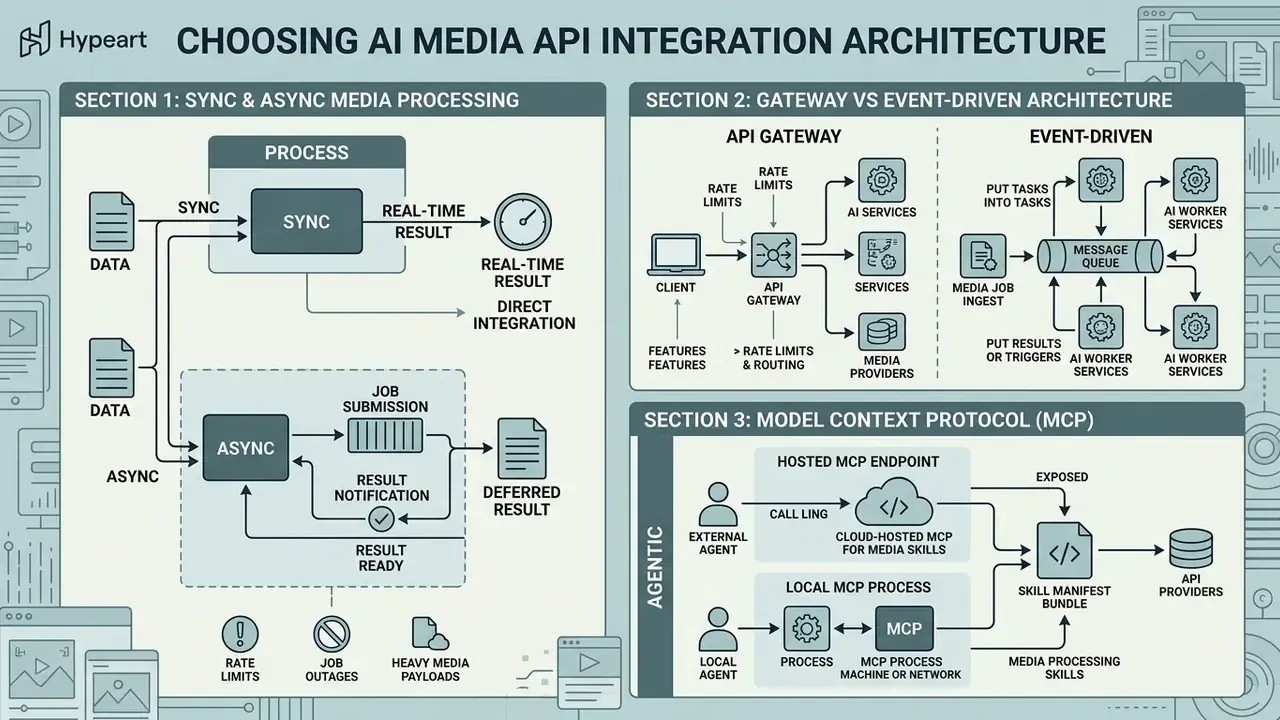
The integration architecture decides how well your platform handles rate limits, heavy media payloads, provider outages, and real-time processing demands. Engineering managers choose between direct point-to-point connections, centralized API gateways, fully decoupled event-driven queues, or agent-native protocol servers, based on operational volume and autonomy requirements.
| Feature / Metric | Direct Integration | API Gateway Pattern | Event-Driven Architecture |
|---|---|---|---|
| Access Control | Decentralized; managed per-application | Centralized OAuth2/mTLS at gateway layer | Worker-level policy enforcement via queues |
| Scalability | Hard-coupled; bounded by caller compute | High; horizontal scaling of gateway proxy | Maximum; message brokers buffer incoming spikes |
| Error Handling | In-app retries; risk of retry storms | Centralized circuit breakers and backpressure | Asynchronous dead-letter queues and retries |
| Monitoring | Fragmented application logs | Unified OpenTelemetry tracing and metrics | End-to-end event correlation tracing |
| AI Agent Fit | Simple single-agent scripts | Multi-agent platforms with REST endpoints | Autonomous multi-agent asynchronous pipelines |
Reading the table in one line: decentralized control scales the fastest right up to the moment it fails, and then it fails everywhere at once. Centralizing API management through gateways or message brokers is what stops cascading failure across the enterprise network.
«Point-to-point microservice architectures introduce severe operational security risks; gateways centralize authentication, access control, and traffic monitoring.»
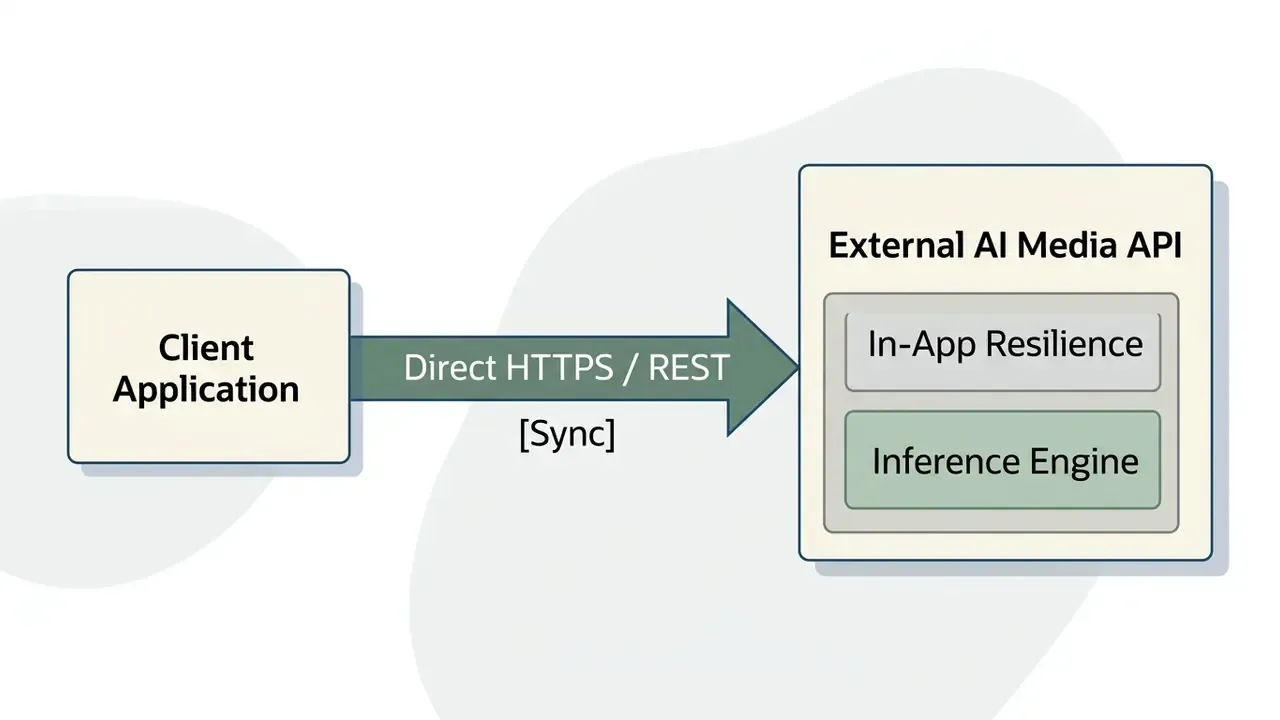
When direct integration is sufficient [Sync]
Direct integration is enough for bounded, low-volume use cases where client applications issue synchronous HTTP requests without complex multi-service dependencies. The pattern keeps infrastructure complexity and deployment overhead low, which suits lightweight internal utility tools.
Direct calls are economically justified when API consumption is billed purely per call and throughput stays predictable. NIST's small-business AI guidance makes a related point: compare the cost of a simple fix against the cost and time of a full AI implementation, and start from a focused problem. Even so, developers must still implement in-process resilience libraries such as Resilience4j or Failsafe to manage local timeouts and backoff schedules.
«Nine recurring resilience themes, including bounded retries, timeouts, bulkheads, and circuit breakers, appear across the reviewed production microservice studies.»
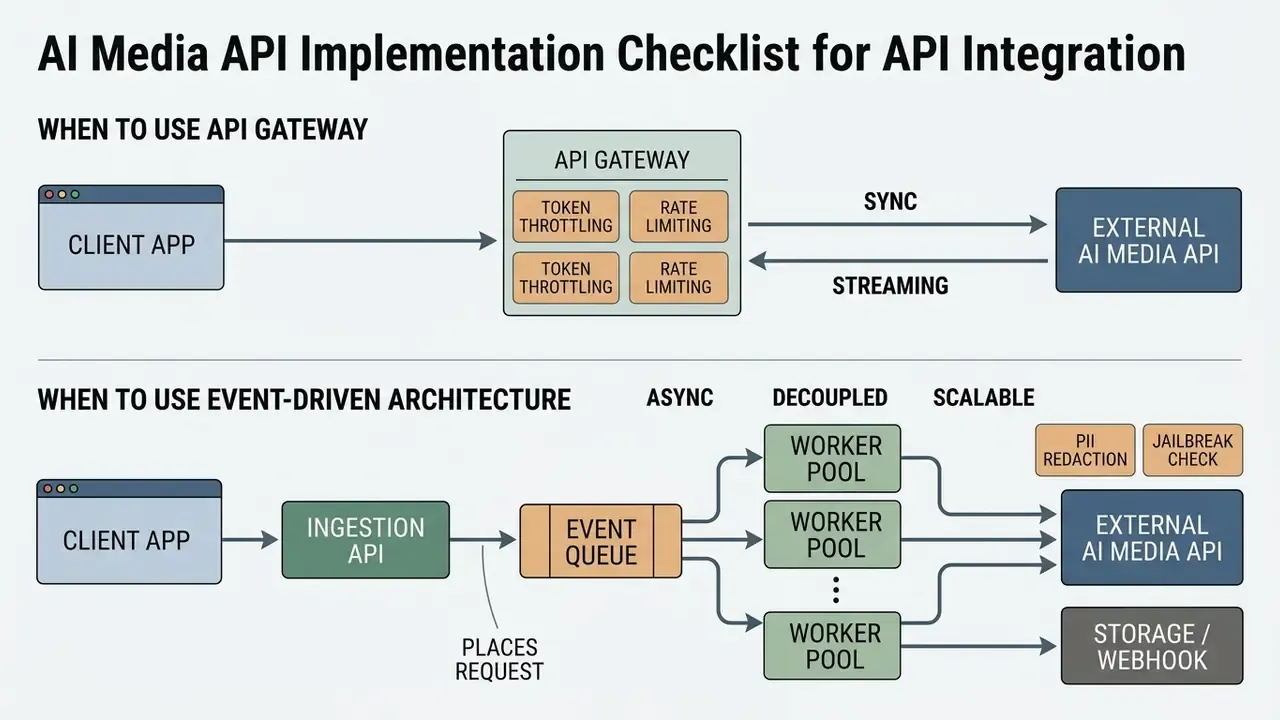
When to use an API gateway or event-driven architecture [Async] [Streaming]
A gateway or event-driven architecture becomes mandatory once throughput involves high concurrency, streaming media processing, or multi-agent orchestration. Moving to an API gateway gives you centralized key management, token-rate throttling, response transformation, and circuit-breaking control in one enforcement point.
«Response streaming is used for generative AI chatbots, large image, video, and music files, and long-running operations delivered through server-sent events.»
Event-Driven Architecture decouples media producers from inference consumers using brokers such as Apache Kafka or AWS EventBridge. Microsoft's architecture guidance names the trigger conditions precisely: multiple subsystems must process the same events, real-time lag must be minimal, and data arrives with high volume and velocity. For long-running operations, say animation and video rendering pipelines or multi-page document vision extraction, the queue absorbs incoming requests, which removes HTTP connection timeouts and stops worker pool exhaustion.
Implementing a Starter API Workflow gives teams practical boilerplate for configuring event-driven queues and handling asynchronous webhooks without rebuilding the plumbing each quarter.
Expose media processing APIs via Model Context Protocol (MCP) [Agentic]
Classical REST and OAuth 2.0 assume a human-authored client. Autonomous agents, whether Claude Desktop, agentic IDEs, or orchestration runtimes, increasingly expect native tool discovery instead of hand-written HTTP clients. For those consumers, expose gateway endpoints through a hosted Model Context Protocol (MCP) server, or publish a declarative skill manifest (a SKILL.md plus a packaged skill bundle) that tells the agent which media operations exist and how to call them.
Three deployment options, in ascending order of control:
{
  "mcpServers": {
    "ai-media-processor": {
      "command": "node",
      "args": ["/dist/mcp-server.js"],
      "env": {
        "MEDIA_API_KEY": "vault:secret/data/ai-media#key",
        "MAX_PAYLOAD_MB": "50"
      },
      "tools": [
        {
          "name": "transcribe_audio",
          "description": "Submits audio payload for async transcription with C2PA provenance validation.",
          "inputSchema": {
            "type": "object",
            "properties": {
              "file_uri": { "type": "string", "format": "uri" },
              "language_code": { "type": "string", "default": "en-US" }
            },
            "required": ["file_uri"]
          }
        }
      ]
    }
  }
}
MCP exposure is a security decision, not only a convenience. The 2026 MCP specification requires explicit user consent, enforced access controls, and data protection, and it instructs implementers to treat security-sensitive tool calls as untrusted by default. Practical hardening rules for media tools:
- Scope every tool to one capability. A
transcribe_audiotool must not inherit permission to delete media objects or rotate keys. - Bind agent identity, not human identity. Issue the agent a distinct workload identity with short-lived credentials. Static API keys are an explicit anti-pattern in current IETF agent-authentication drafts.
- Cap payloads at the protocol layer. Enforce
MAX_PAYLOAD_MBin the server environment so an agent cannot trigger a 2 GB upload by accident. - Log every tool invocation as an auditable event. Tool name, arguments hash, agent identity, decision, and confidence score belong in the same trace as REST traffic.
- Require human approval for irreversible actions. Publishing synthetic media externally, purging queues, or overriding a circuit breaker stays human-in-the-loop.
- Hosted MCP endpoint.The agent registers a custom connector pointing at your MCP server URL; the server brokers authenticated calls to transcription, generation, and analytics endpoints. Useful for internal copilots where credentials never leave your boundary.
- Local MCP process.The agent launches a signed local binary that reads secrets from Vault at runtime. Preferred in regulated environments, because no long-lived key ever reaches the agent's configuration file.
- Skill manifest bundle.A
SKILL.mdfile plus a zipped skill package describes supported actions (schedule, publish, transcribe, analyze) and their constraints. The agent loads the bundle and prompts once for an API key scoped to a single tenant.
Open question, and we should say so plainly: agent identity standards are still moving. Treat today's MCP configuration as a control you will revisit, not a settled baseline.
Design synchronous and asynchronous media processing [Sync] [Async]
Designing synchronous and asynchronous paths means setting clear boundaries based on processing duration and caller block limits. Reserve synchronous execution for low-latency payloads under 2 seconds. Enforce asynchronous execution for every long-running media job.
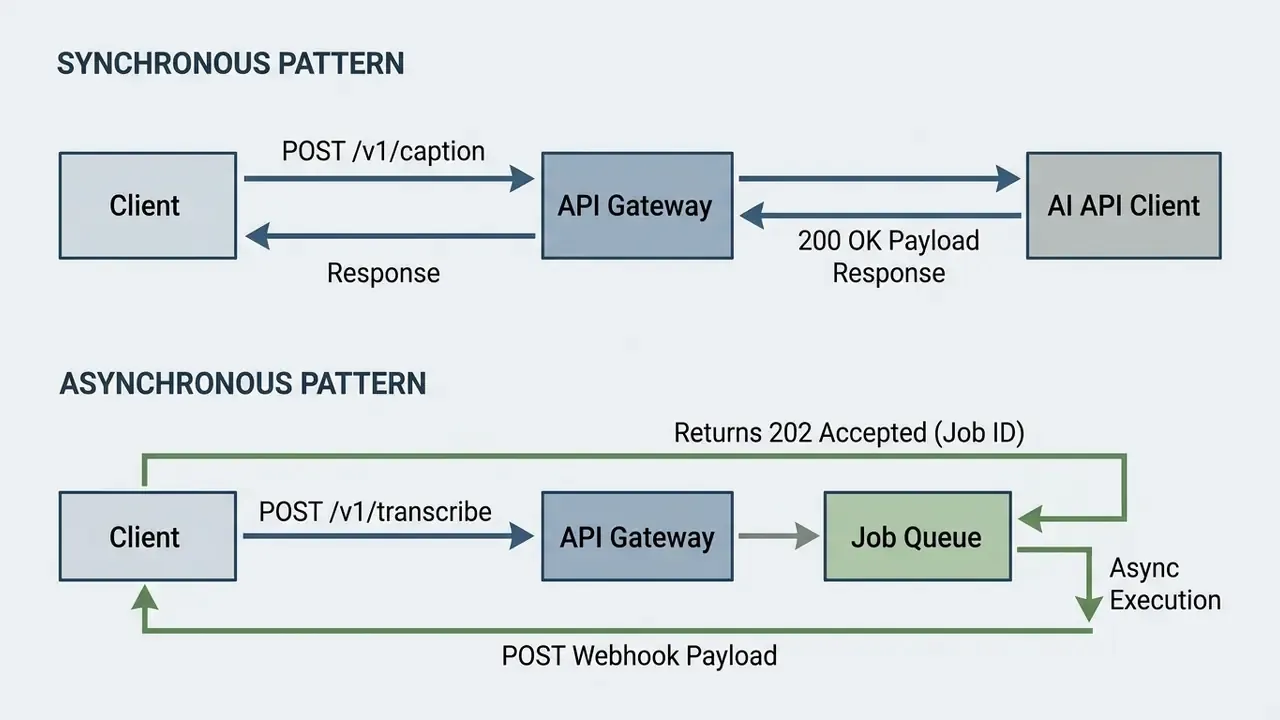
Asynchronous media processing needs a standardized job lifecycle:
- Job submissionthe client submits a payload; the server responds immediately with
HTTP 202 Acceptedand a uniquejob_id. - Status polling or webhook registrationthe client polls
/v1/jobs/{job_id}or registers a signedcallback_url. Where clients cannot receive inbound callbacks, long polling per RFC 6202 holds the request open until an event is available and responds immediately. - Completion notificationon completion, the worker posts execution status to the registered webhook endpoint using cryptographic HMAC signatures.
Configure authentication, authorization, and AI security controls
Security configuration prevents three specific outcomes: API key leakage, unauthorized access to sensitive financial media, and regulatory non-compliance. The access model must combine strong identity verification, granular authorization, and runtime output filtering.
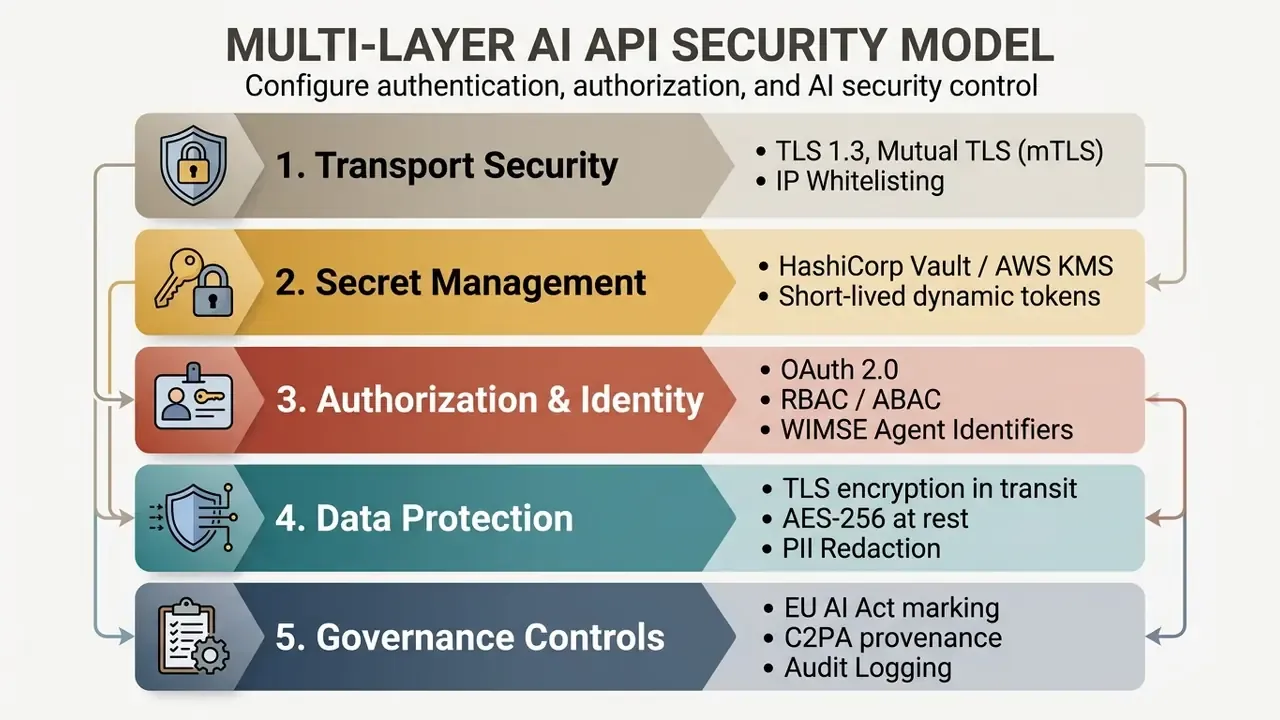
Protect API keys and manage access permissions
API keys and service credentials must never sit in application source code, client-side scripts, or container environment variables. Manage secrets through a centralized key management system such as HashiCorp Vault, AWS Secrets Manager, or Azure Key Vault, with automated dynamic rotation on a maximum 90-day cycle for provider keys.
«API request handling requires encryption in transit, authenticating the calling service, authorizing the service, authenticating the end user, and authorizing end-user access to the resource.»
Autonomous AI agents calling media APIs should operate under least-privilege Role-Based Access Control or Attribute-Based Access Control, using short-lived scoped tokens rather than static master keys. NIST IR 8596 requires that AI agents hold unique identities with bound credentials and permissions that are defined, enforced, and reviewed under least privilege and separation of duties. Current IETF agent-authentication drafts go further and state that static API keys are an anti-pattern for agent identity, recommending TPM, secure-enclave, or platform security module protection for private keys.
Prevent sensitive data leakage in media requests and responses
Preventing sensitive data leakage means scanning both incoming media requests and outgoing AI-generated outputs for personally identifiable information and unauthorized sensitive content.
«Systems using retrieval-augmented generation or generative media APIs must be tested for personal-data leakage and documented under data-minimization requirements.»
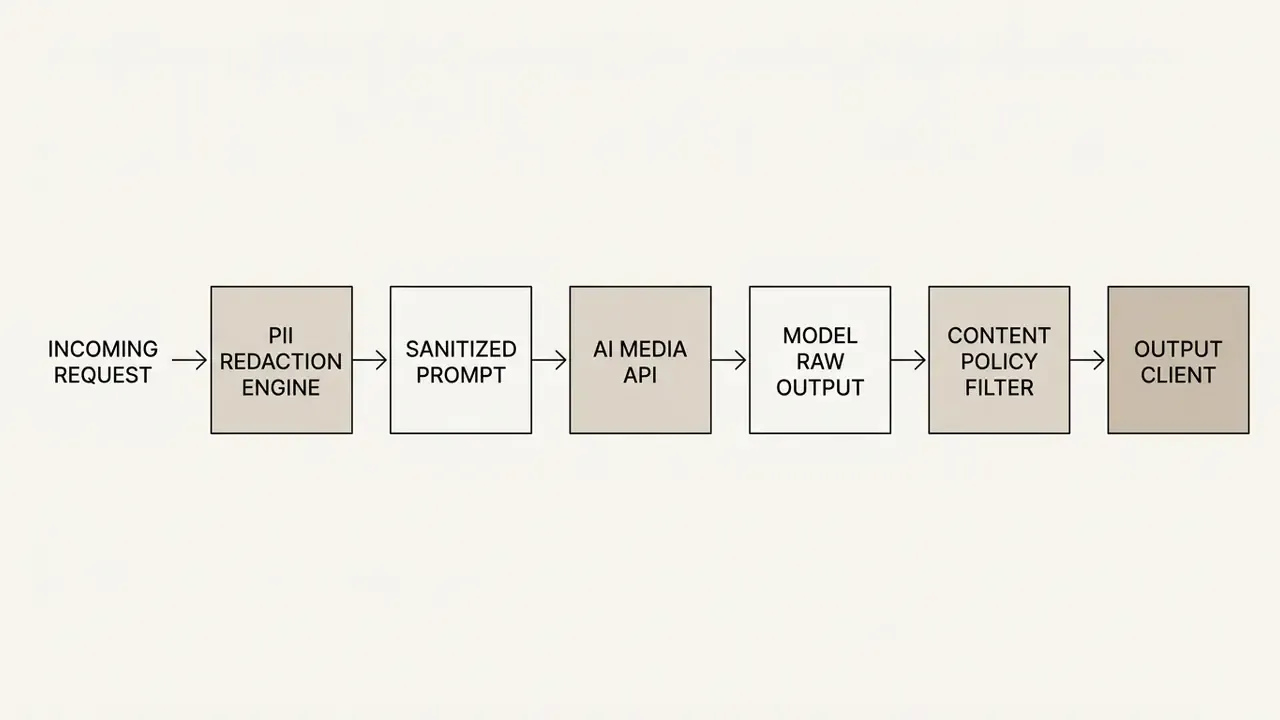
Runtime filters run two safeguard loops:
- Input sanitization strip client PII (SSNs, card numbers, personal biometric metadata) from media prompts and EXIF headers before transmission. Biometric-adjacent workloads such as AI headshot generation need explicit retention and consent handling, because facial data is special-category personal data under GDPR.
- Output validation check model-generated outputs with automated classification layers to catch hallucinated text, unauthorized brand asset reproduction, or policy-violating images. Post-inference guardrails should also scan for fabricated citations, leaked system prompts, and embedded secrets using regex plus entropy analysis.
Conceptual filtering is not auditable. Controls become examinable only when each severity tier carries a numeric detection threshold, a deterministic automated action, and an escalation SLA.
| Severity Level | Trigger Condition | Confidence / Detection Threshold | Automated System Action | Escalation SLA |
|---|---|---|---|---|
| Low | Single PII field detected in prompt (SSN / email / card number) | PII engine score > 0.85 | Redact token inline; emit user warning event; write immutable log entry | No human action; logged for 12 months |
| Medium | Repeated prompt-injection or jailbreak pattern (DAN variants, token smuggling, goal hijacking) | Sentinel classifier confidence > 0.70 | Reject request (HTTP 422); apply 15-minute IP rate clamp; temporary session suspension | Alert SecOps within 15 minutes |
| High | System prompt extraction or mass PII exfiltration attempt | Entropy analysis > 7.5 combined with signature regex match | Trip circuit breaker; revoke API key immediately; freeze agent session; raise SIEM correlation alert | Immediate paging alert; CISO notification |
Three operational rules make that matrix survive contact with production. First, guardrail overhead must stay below 100 ms at P95, or engineering teams will quietly route around it. Second, attack-signature libraries need a weekly threat-intelligence refresh, because jailbreak phrasing mutates faster than model retraining cycles. Third, every violation must preserve evidence automatically: complete prompt history, request metadata (timestamp, user ID, source IP, application identifier), and the guardrail decision log with its confidence score.
Apply governance and compliance requirements
Integrating AI media APIs in regulated markets means adhering to emerging AI legal frameworks, including the European Union AI Act (Regulation EU 2024/1689).
«Providers of AI systems generating synthetic audio, image, video, or text must mark outputs in a machine-readable format and disclose deepfake content at first exposure.»
Article 53 requires General Purpose AI model consumers and providers to maintain explicit copyright compliance policies and publish a sufficiently detailed summary of training content. Obligations for GPAI model providers apply from 2 August 2025, with enforcement exposure reaching up to 3% of global turnover or EUR 15 million. Under GDPR, transferring media payloads containing personal biometric data to third-party API providers requires explicit data-processing agreements, a documented lawful basis, purpose limitation, and documented legal grounds for cross-border processing. For US-regulated institutions, layer GLBA safeguards obligations and applicable state privacy statutes such as the CCPA and CPRA onto the same control set, and confirm that vendor zero-data-retention and data-residency options are contractually binding rather than best-effort marketing language.
Complementary transparency controls include copyright policy documentation for text and data mining opt-outs, provenance metadata retention through C2PA manifests, and immutable audit logs sized to satisfy GDPR Article 5 accountability and EU AI Act Article 14 human-oversight expectations. Teams publishing generated assets commercially should verify licensing terms per provider; Canva AI generator licensing terms illustrate how commercial-use grants vary between plan tiers.
This section is general in nature and does not replace advice from qualified legal counsel or a regulatory compliance specialist.
Critical security alert: anti-patterns to block
Build resilience, performance, and error handling into the integration
Resilient integration pipelines assume transient network failures, provider outages, and strict rate limit enforcement as normal conditions. Retry governance and performance optimization patterns are what keep both outages and surprise API bills off the executive agenda.
Handle rate limits, retries, and timeouts
Handling rate limits well means moving past naive exponential backoff.
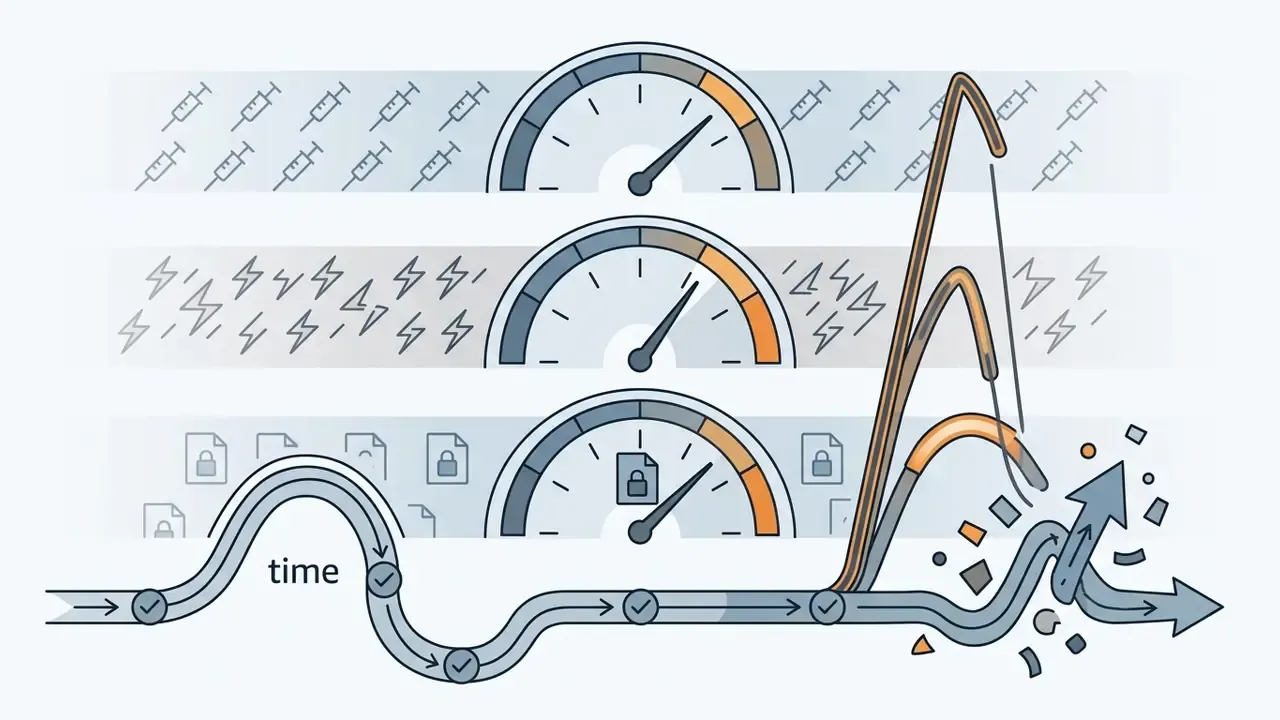
«Ungoverned client retries during provider degradation inflate resource billing by up to 10.29× baseline levels.»
«Adaptive token-bucket client algorithms reduce HTTP 429 rate-limit errors by up to 97.3% and cut retry-storm volume by 98% versus plain exponential backoff.» Source: Rethinking HTTP API Rate Limiting (2025).
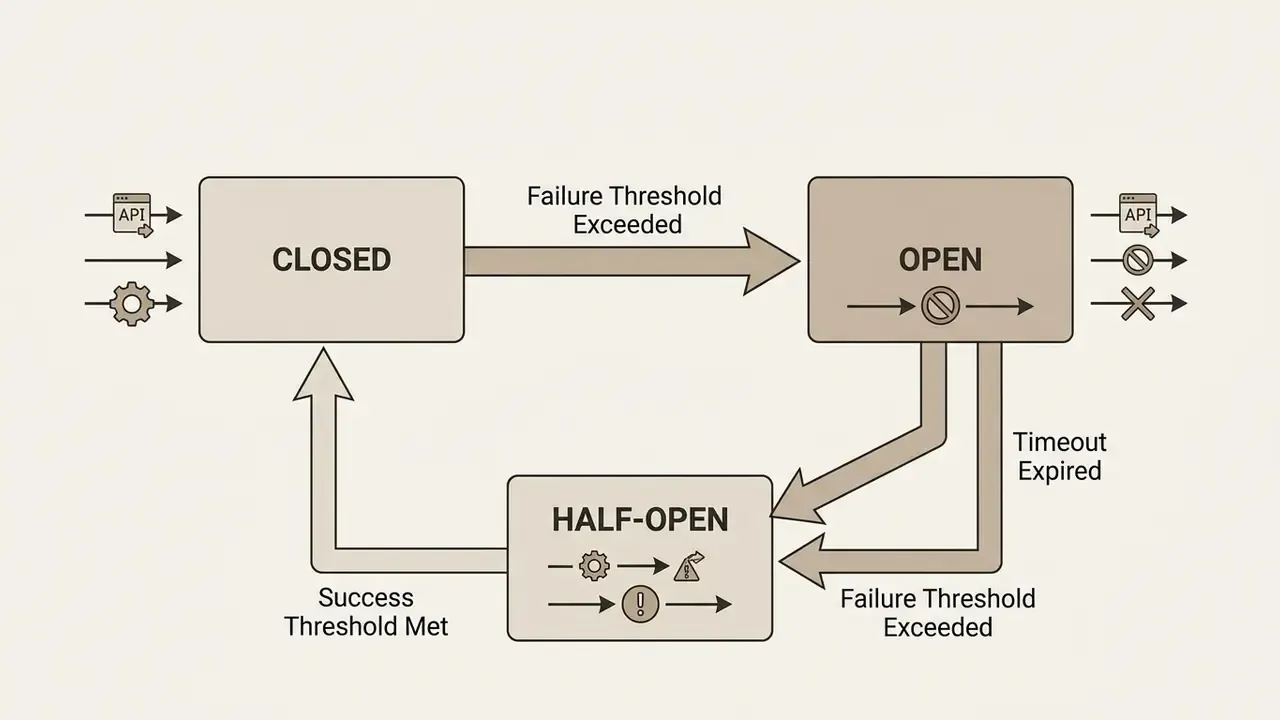
NIST SP 800-204 frames two sides of one control: rate limiting caps how often a client may call a service within a defined window and returns reset timing when exceeded, while circuit breakers stop delivery to a failing component beyond a threshold to prevent cascading failure. AWS guidance adds the client-side arithmetic: explicit request timeouts, exponential backoff, and jitter to spread retries across time.
Retry strategies should enforce exponential backoff with full jitter:
Reference implementation: full jitter exponential backoff
import random
import time
def call_ai_media_api_with_jitter(request_payload, max_attempts=4, base_delay=1.0, max_delay=16.0):
    for attempt in range(max_attempts):
        try:
            response = execute_api_call(request_payload)
            if response.status_code == 200:
                return response.json()
            elif response.status_code == 429:
                # Rate limited: Calculate exponential delay with full jitter
                calculated_delay = min(max_delay, base_delay * (2 ** attempt))
                actual_delay = random.uniform(0, calculated_delay)
                time.sleep(actual_delay)
            else:
                # Non-retryable error (e.g., 400 Bad Request, 401 Unauthorized)
                raise NonRetryableAPIError(f"HTTP {response.status_code}: {response.text}")
        except ConnectionError:
            actual_delay = random.uniform(0, min(max_delay, base_delay * (2 ** attempt)))
            time.sleep(actual_delay)

    raise APIMaxRetriesExceeded("Exhausted retry budget for AI Media API call.")
Circuit breakers sit on top of that logic. If endpoint error rates exceed 50% over a 30-second window, the circuit opens immediately and fails fast, preserving local compute. Commercial media-generation APIs already publish retryability semantics worth mirroring in client logic: generation failures and missing outputs are retryable, while content-moderation blocks, budget exhaustion, oversized images, and invalid requests are terminal.
Optimize media API performance and processing costs
Optimizing performance and inference spend relies on semantic caching, context caching, request batching, and payload compression. For repeated media prompts or document queries, a semantic embedding cache stores prior responses and avoids redundant invocations for conceptually equivalent queries.
«Semantic embedding caching reduces both LLM cost and latency by reusing responses for conceptually similar requests.»
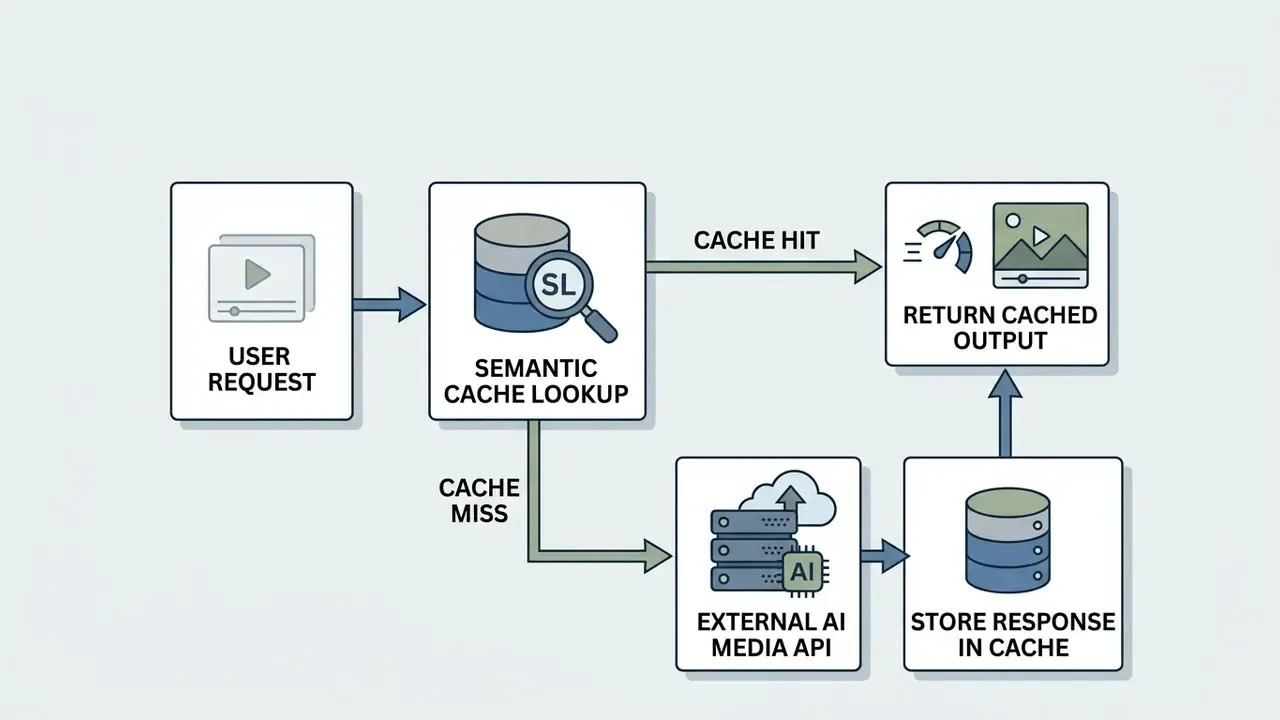
Three provider-native mechanisms are documented and directly applicable:
- Context caching for repeated media questions. Google's Gemini API reuses precomputed input tokens across repeated questions about the same media file, exposes cache-hit token counts in
usage_metadata, and applies a default TTL of one hour. - Gateway-level semantic caching. Azure API Management implements semantic caching for Azure OpenAI through paired inbound cache-lookup and outbound cache-store policies backed by an embeddings model.
- Batch endpoints for deferred workloads. OpenAI's Batch API accepts one request per JSONL line, supports video requests in JSON, and recommends remote asset references instead of base64 blobs to stay under the 200 MB batch upload limit.
Batch processing cuts token fees materially for non-real-time media workloads inside a defined 24-hour completion window. Verify the current discount percentage against the provider's live pricing page before you model savings, because published rates change between releases. And compressing media before transmission remains the cheapest optimization available; the principles covered in video compression fundamentals reduce upload latency and per-request byte cost at once.
Model risk-adjusted ROI, not raw inference cost
Pilot business cases collapse in production because they price only tokens. A defensible unit-economics model prices the control environment too.
| Cost component | Typical treatment in pilot | Required treatment for production ROI |
|---|---|---|
| Inference tokens | Fully modeled | Fully modeled, with P95 token variance, not mean |
| Guardrail inference (PII, sentinel, output validation) | Ignored | Priced per request, including sub-100 ms guardrail overhead |
| Retries and fallback model calls | Ignored | Priced at expected failure rate multiplied by fallback model cost |
| Human review and exception handling | Ignored | Priced per escalated case at loaded analyst cost |
| DLQ triage and reprocessing | Ignored | Priced per non-retryable failure |
| Observability and log retention | Ignored | Priced at 12-month immutable retention volume |
| Validation and audit effort | Ignored | Priced as recurring second-line and internal audit hours |
Two implications follow. Batch endpoints reduce token cost but push completion into a 24-hour window, so they cannot serve operations with intraday settlement or customer-facing SLAs. Segment the workload before you claim the savings. Semantic caching lowers marginal cost while introducing a staleness risk, which itself needs governing through TTL policy and cache-invalidation triggers tied to model version changes.
Log failures and define recovery actions
Structured error logging exists to shorten recovery time, not to fill a bucket. Capture enough context that an on-call engineer can classify a failure without opening the provider console.
«Failure payloads should capture machine-readable error codes, error messages, activity and run identifiers, durations, and rerun context for recovery.»
{
  "timestamp": "2026-08-19T14:32:10Z",
  "trace_id": "4bf92f3577b34da6a3ce929d0e0e4736",
  "service": "media-transcription-worker",
  "error_details": {
    "provider": "VendorA_Audio_v2",
    "status_code": 429,
    "error_code": "RATE_LIMIT_EXCEEDED",
    "retryable": true,
    "attempt_number": 3,
    "retry_budget_remaining": 1,
    "payload_bytes": 10485760
  },
  "recovery_action": "ENQUEUE_BACKOFF_QUEUE"
}
Pipelines should separate failures into two explicit categories:
- Transient failures (retryable): HTTP 429 (rate limit), HTTP 503 (service unavailable), network socket timeouts. Action: execute backoff retry.
- Permanent failures (non-retryable): HTTP 400 (invalid schema), HTTP 401 (bad key), HTTP 413 (payload too large), HTTP 415 (unsupported media type), content moderation blocks. Action: route the payload to a dead-letter queue and alert the operator.
Ambiguity here produces silent data loss and runaway retry cost together, so encode the routing decision as a table rather than tribal knowledge.
| HTTP Code | Error Classification | Primary Root Cause | Retry Strategy | Target Destination |
|---|---|---|---|---|
| 400 Bad Request | Non-retryable | Invalid JSON schema or C2PA header mismatch | Do not retry | Dead-Letter Queue (DLQ) |
| 401 Unauthorized | Non-retryable | Expired, revoked, or wrongly scoped token | Refresh credential once, then stop | Security alert plus DLQ |
| 413 Payload Too Large | Non-retryable | Media file exceeds gateway byte limits | Chunk or compress media | Application error callback |
| 415 Unsupported Media Type | Non-retryable | Container or codec outside declared enum | Transcode, then resubmit | Transformation queue |
| 429 Too Many Requests | Transient | Token-bucket or RPM ceiling exceeded | Full jitter backoff within retry budget | Retry queue |
| 503 Service Unavailable | Transient | Upstream model inference timeout | Circuit breaker evaluation | Retry queue or fallback model |
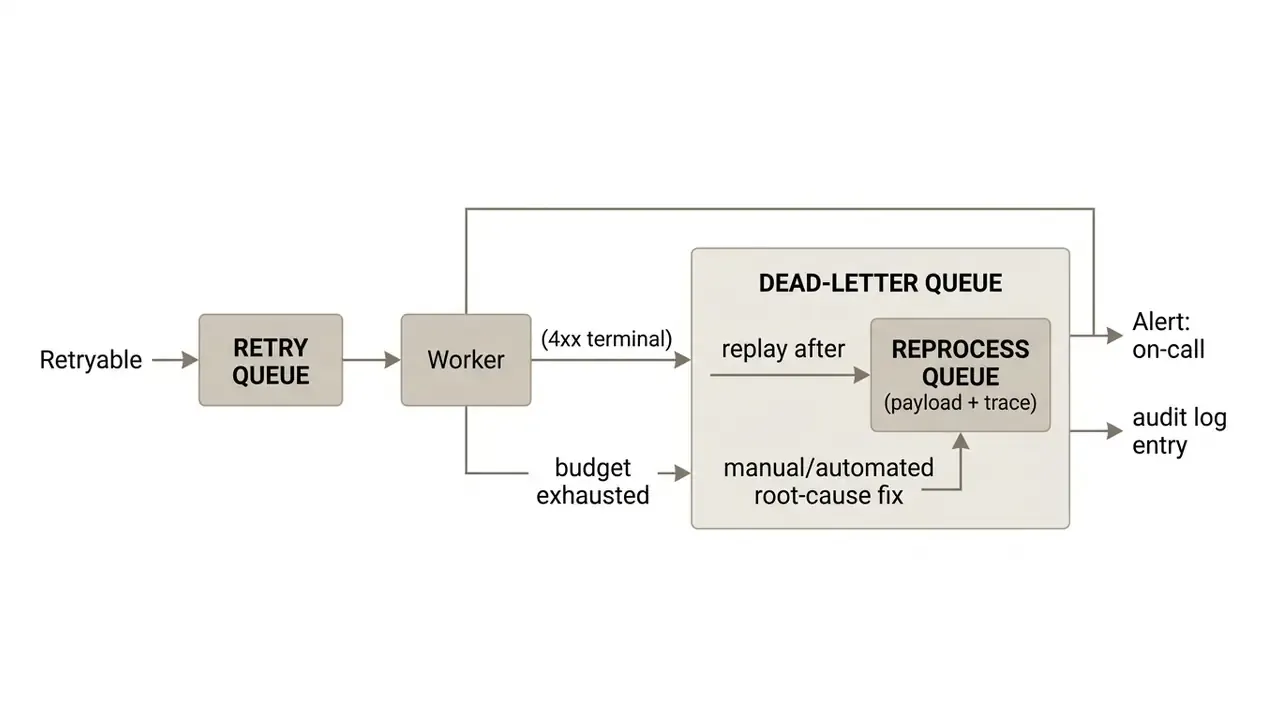
DLQ hygiene rules: retain the original payload reference rather than the raw media blob, keep the trace ID, alert when queue depth crosses a defined threshold, require a documented root-cause note before replay, and cap replay attempts so one schema defect cannot be re-amplified into a billing incident.
Validate, test, deploy, and monitor the AI media API integration
Validation, testing, deployment, and continuous monitoring should follow a formal Testing, Evaluation, Verification, and Validation framework rather than an ad-hoc release ritual.
«TEVV for deployment includes system validation, integration in production, testing, recalibration, and checks for legal, regulatory, and ethical compliance.»
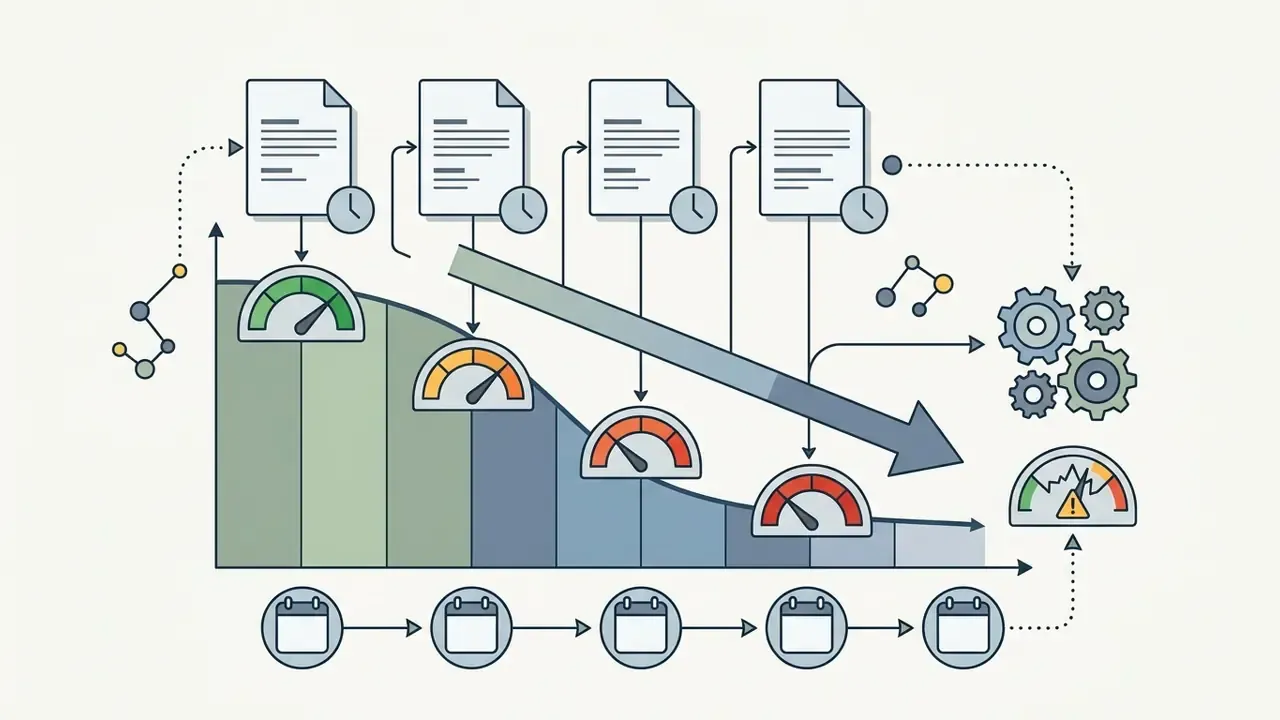
Supervisory guidance points the same way. Monitoring and change management require predefined tests and thresholds to evaluate ongoing model performance after deployment, as specified in the Monetary Authority of Singapore's 2024 information paper on AI model risk management.
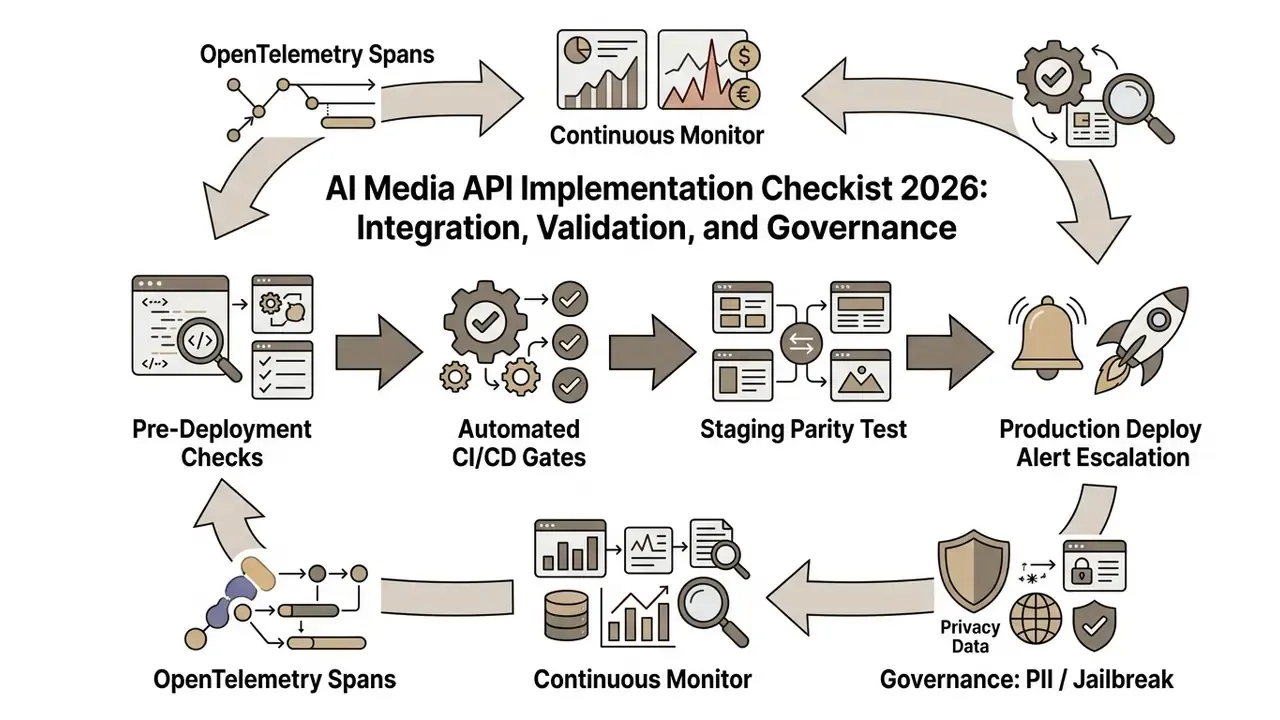
Run unit, integration, and load testing
Multi-tier test suites tailored for heavy media payloads come before production approval, not after the first incident.
«Most code should be executed during unit testing; the guidance recommends at least 80% statement coverage, plus denial-of-service and overload (stress) testing.»
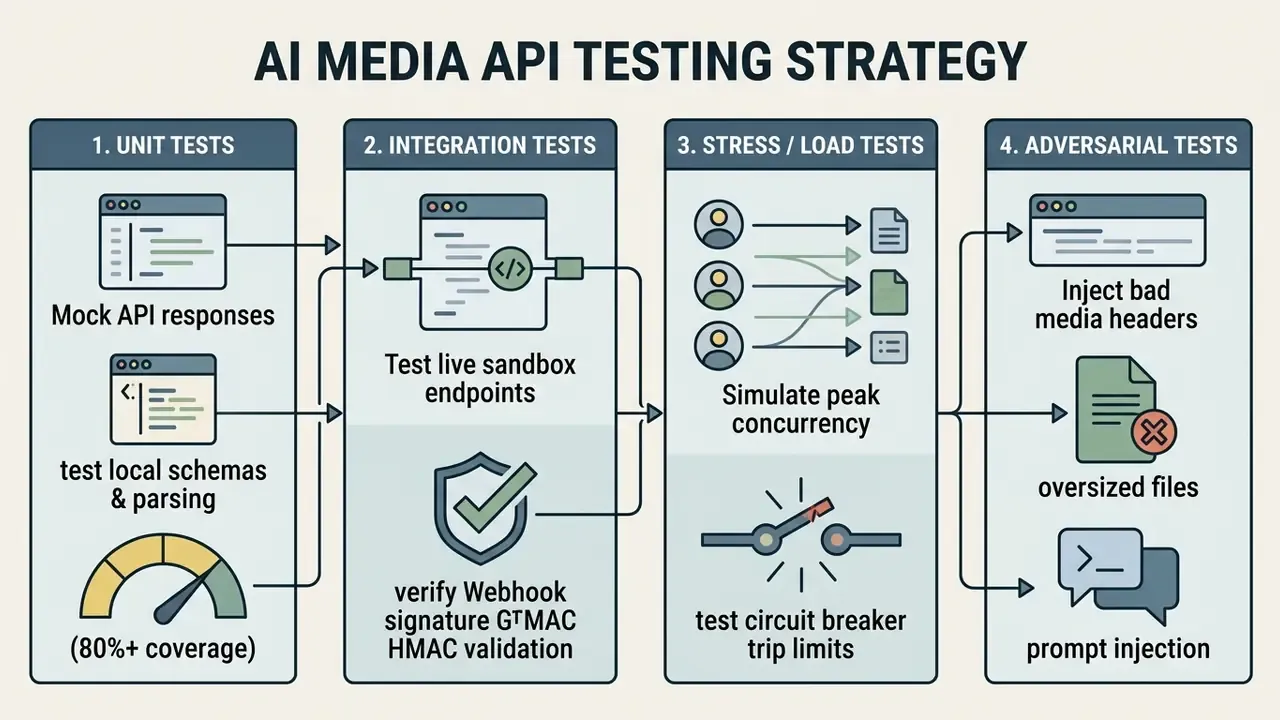
Adversarial testing deserves a named runbook, not an improvised afternoon. At minimum: execute known jailbreak families (DAN variants, evil-twin personas, token smuggling, goal hijacking) and confirm the sentinel classifier flags them above the 0.70 threshold; submit synthetic PII-laden prompts and confirm redaction happens before the request leaves your boundary; request citations to non-existent research and confirm the output guardrail blocks the response; attempt system-prompt extraction and confirm suppression. Performance validation should run at twice peak expected volume, hold added guardrail latency under 100 ms at P95, and confirm auto-scaling triggers. Then try to bypass the gateway with a direct provider call. If that connection succeeds, your control is advisory, not enforced.
An illustrative case, again composite. A financial services firm deployed a document-parsing agent without load testing large multi-page PDFs. During peak market hours, simultaneous 50 MB uploads exhausted application memory and crashed nodes in sequence. The fix was unglamorous: isolated containerized workers with strict file-size pre-checks. Memory exhaustion stopped. The lesson was cheaper to learn in staging.
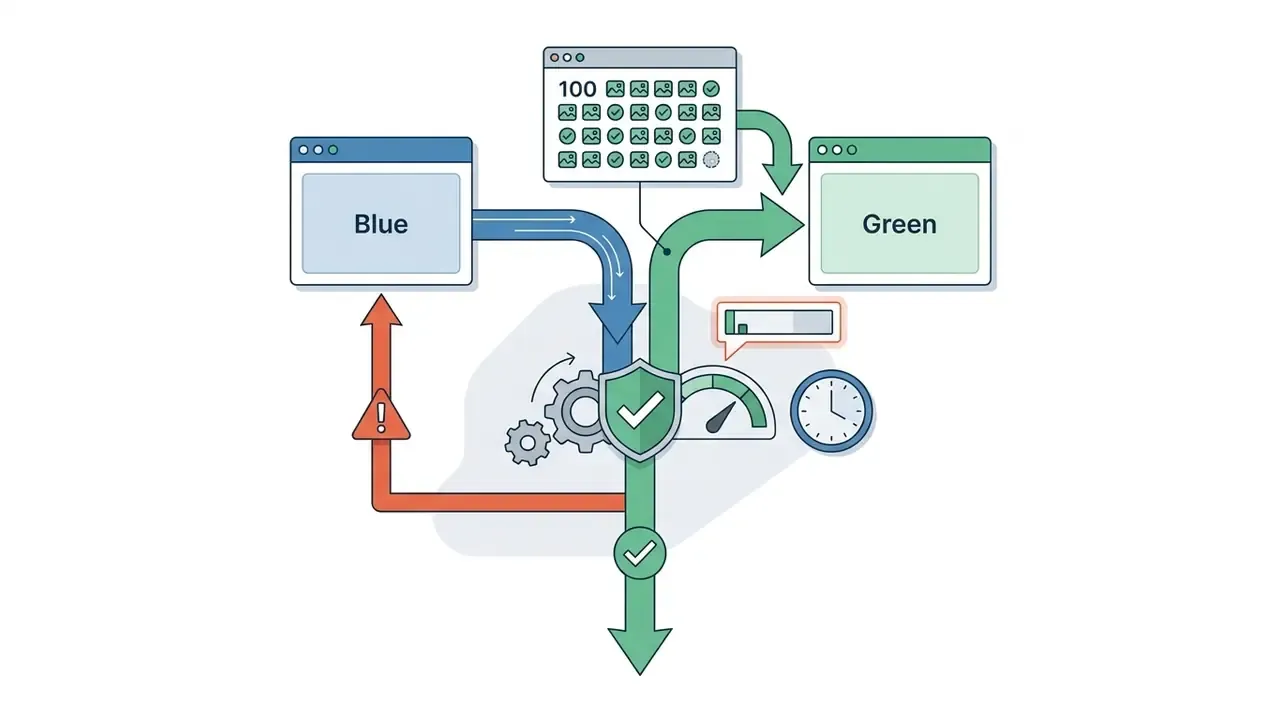
Deploy with rollback gates and disaster-recovery objectives
Deployment readiness is measured by how fast the system returns to a known-good state, not by how smoothly the release script runs. Fix four numbers before the first production cutover:
- RTO under 60 minutes for full service restoration of the media processing path.
- RPO under 5 minutes for all media state and job-status databases, verified by restore rehearsal rather than by the existence of a backup job.
- Quarterly DR failover test with documented results filed as business-continuity evidence.
Rollback must cover the model layer as well as infrastructure. Pin the previous model version, preserve the previous prompt template, and keep the previous guardrail configuration in a versioned artifact, so a rollback restores behavior and not merely uptime. A realistic phased rollout for an enterprise gateway deployment runs roughly six to eight weeks: pre-implementation requirements and architecture design, then infrastructure and monitoring, then input guardrails, then output guardrails, then operations handover.
Monitor production health and review implementation results
Production monitoring needs distributed tracing to capture end-to-end performance across multi-agent workflows spanning AI generation tooling, transcription services, and vision extraction.
«GenAI semantic conventions record span attributes for token consumption, prompt latency, model version, and per-request cost in dollars.»
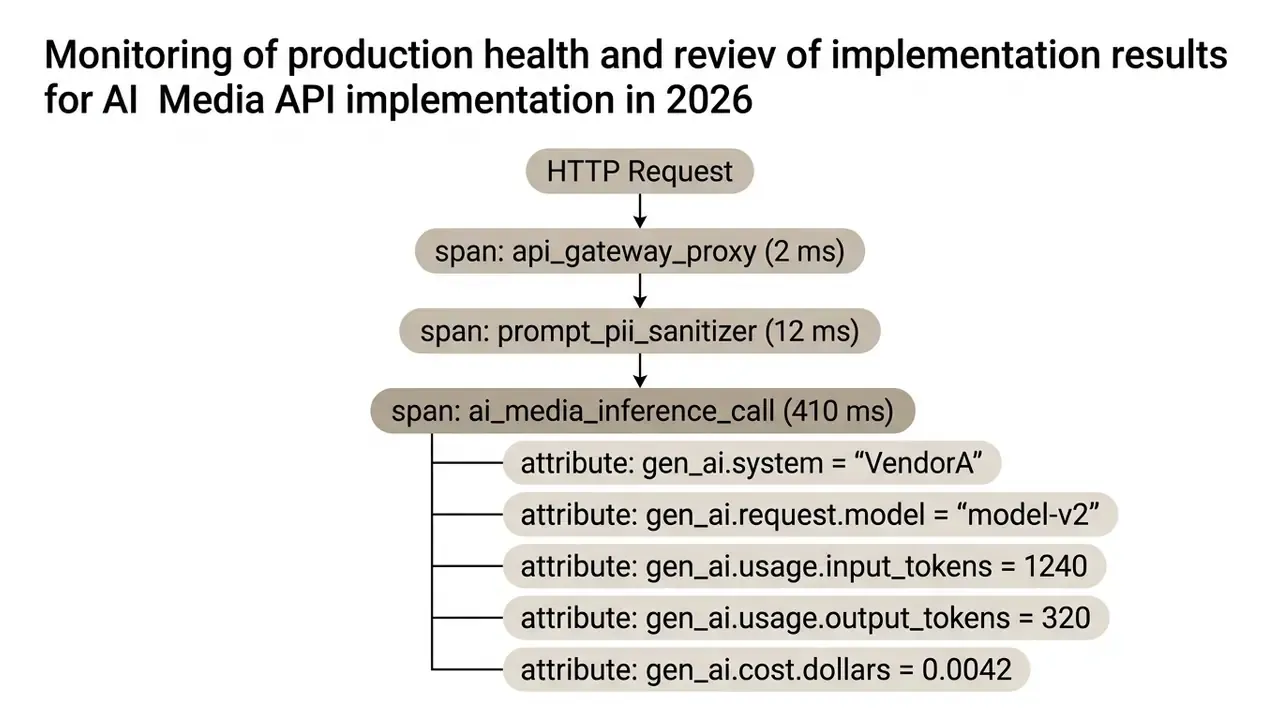
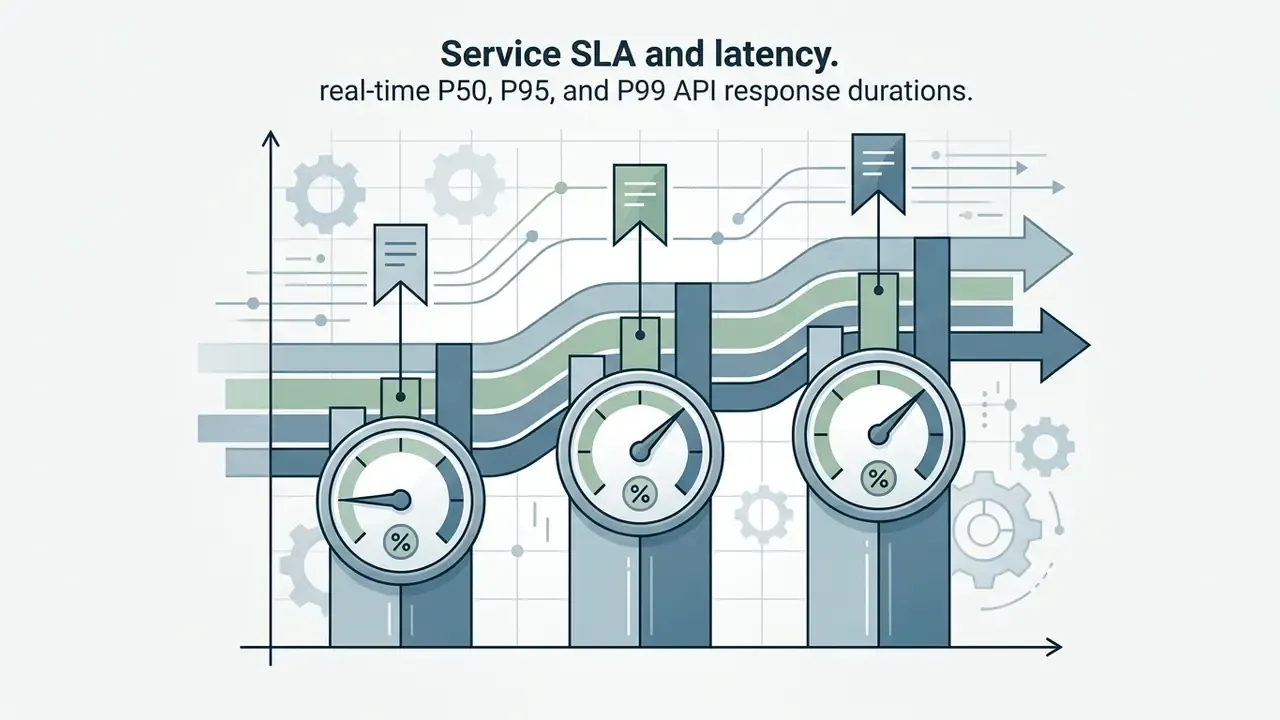
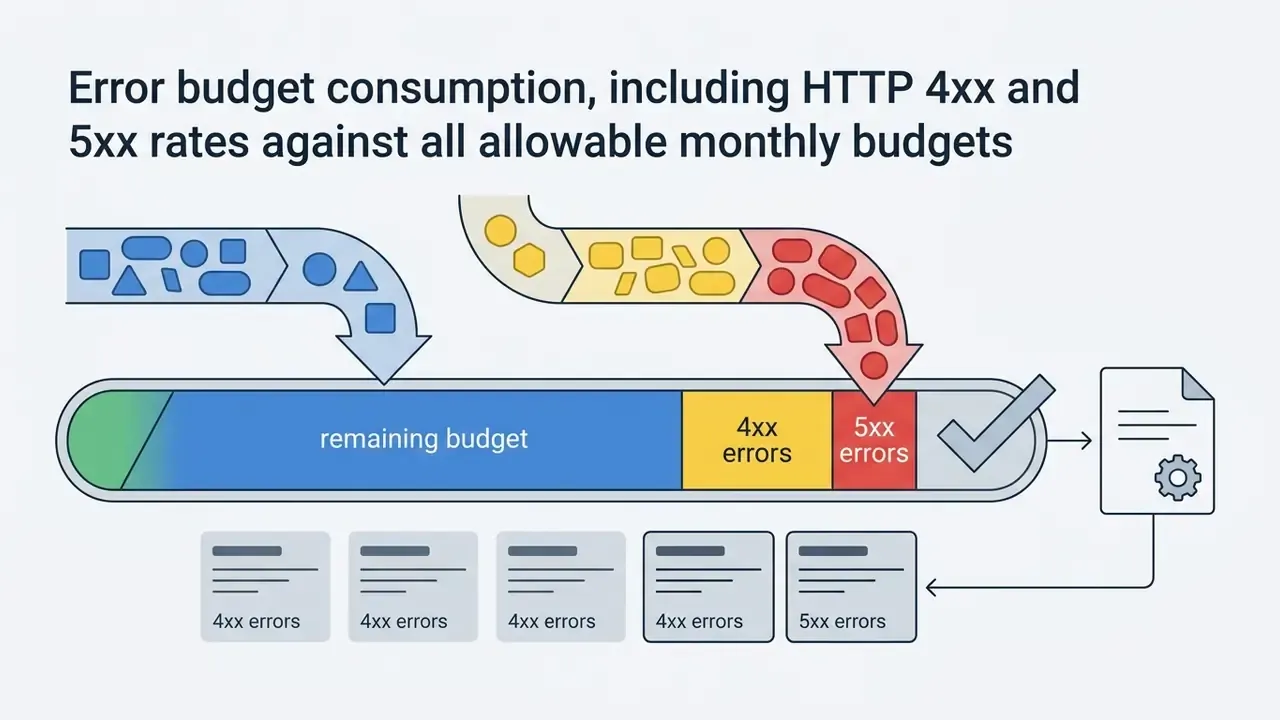
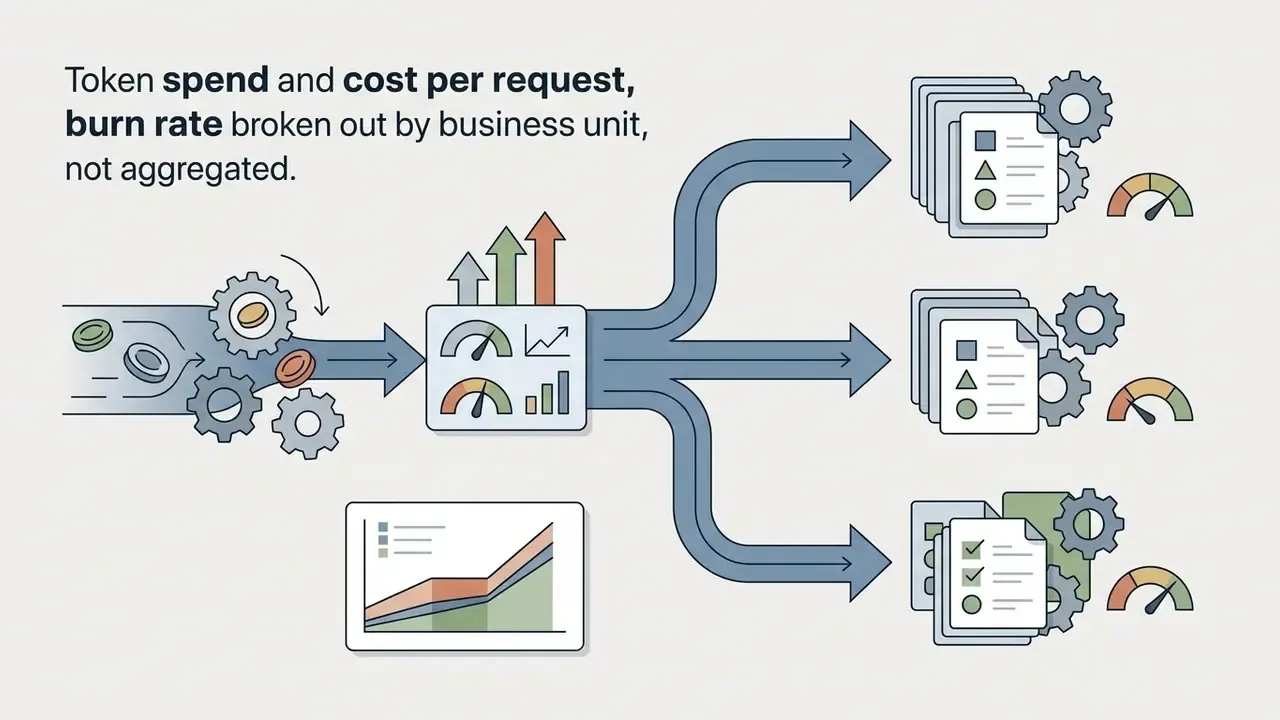
Observability dashboards should track five things at minimum:
For agentic systems, traces should capture the full call graph from user request through orchestrator, sub-agents, tool calls, and model invocations. Otherwise a failure inside an MCP tool call stays invisible to the very dashboards meant to govern it.
Pre-deployment integration checklist
This verification checklist confirms that operational, technical, and governance gates are satisfied before production release. Every unchecked item is a decision someone will have to defend later.
Checklist0 / 15
Limitations, open questions, and a safe next step
A checklist is not a guarantee. Three limitations are worth stating openly.
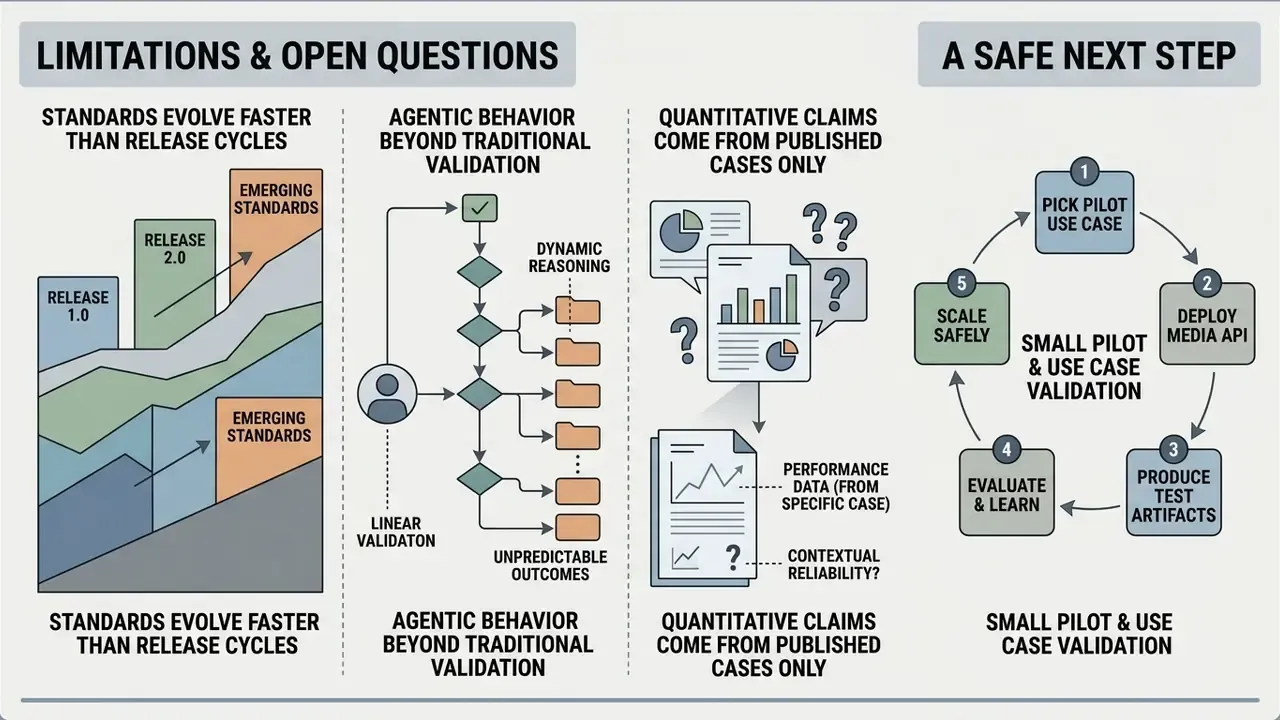
First, standards referenced here move faster than release cycles. ISO/IEC 23093-6:2026, OpenAPI 3.2.0, and the 2026 MCP specification should be re-verified against currently published revisions before you cite them internally.
Second, agentic behavior is only partly covered by traditional validation. Existing model validation practice assumes a bounded input-output relationship; an agent that chains tool calls generates paths no validator enumerated. Reproducible traces and human approval gates mitigate that gap. They do not close it.
Third, quantitative claims about cost savings, block rates, and retry-storm reduction come from published studies and vendor documentation, not from your environment. Treat them as hypotheses to test in a sandbox with your own traffic profile.
A reasonable next step is small: pick one media use case already running as a pilot, produce the seven artifacts for it, and walk the pack through a single review with second-line risk. If the pack survives that conversation, you have a repeatable pattern. If it does not, you learned it cheaply.
FAQ: model validation, audit trail, and agent accountability
How does this technical checklist feed independent model validation?
Treat each of the seven lifecycle stages as a validation exhibit. Independent validators need three things they cannot reconstruct alone: the intended-use statement with quantified success criteria, the test evidence including adversarial and load results, and the ongoing monitoring plan with thresholds. Filing those at release time turns validation from an investigation into a review.
How do we prove to an auditor that an agentic API call was safe and reproducible?
Reproducibility comes from versioning everything that shapes the output: model version, prompt or tool schema version, guardrail configuration version, and the request payload hash. Store these as span attributes alongside the trace ID, and retain the guardrail decision log with its confidence score. An auditor can then replay the decision path without replaying the media payload itself.
What is the minimum audit trail retention for AI media pipelines?
Set retention from the strictest applicable obligation, not the cheapest storage tier. In practice, security-relevant guardrail events are commonly retained for 12 months in immutable storage, while records supporting GDPR accountability and EU AI Act oversight duties may need longer alignment with the institution's records-management schedule. Confirm the figure with compliance counsel rather than defaulting to platform settings.
Do generative media APIs fall under model risk management?
Increasingly, yes, where output influences a customer decision, a disclosure, or a regulatory filing. The safest working assumption: any media model whose output reaches a customer or a regulator belongs in the model inventory with an owner, a risk tier, and a monitoring plan.
Who owns a failure caused by an autonomous agent?
Ownership is pre-assigned, never litigated after the incident. The governance matrix here assigns schema and integration defects to the integration lead, credential and prompt-injection incidents to the AI security lead, drift and validation gaps to the model risk officer, and unit-economics breaches to the product business lead. Agents inherit the permissions and the accountability of the role that provisioned them.
Can semantic caching or batching break a compliance control?
Yes, if applied blindly. A cached response can bypass a freshly updated guardrail, and a batched request can miss an intraday disclosure deadline. Tie cache invalidation to model and guardrail version changes, and exclude SLA-bound workloads from deferred batch endpoints. Summary of key implementation steps
- Audit readiness and documentation. Begin every integration by auditing provider media payload size limits, rate quotas, and error formats against a formal ai media api implementation checklist documentation baseline, then map each artifact to the model inventory.
- Architect for payload volume. Direct integration is fine for basic utilities, but high-volume or streaming media workflows require an API gateway or event-driven architecture, with MCP or skill manifests layered on when autonomous agents are the primary consumers.
- Harden access and compliance. Eliminate hardcoded credentials, enforce dynamic KMS key management, sanitize incoming PII with numeric thresholds and escalation SLAs, and embed C2PA provenance watermarks to meet global AI regulations.
- Enforce circuit-breaking resilience. Replace naive retry logic with exponential backoff, full jitter, circuit breakers, and an explicit HTTP-code-to-destination routing table that terminates non-retryable failures in a governed dead-letter queue.
- Observe spans and unit economics. Deploy OpenTelemetry to capture per-request token usage, latency distributions, guardrail block rates, and drift, and price the whole control stack when you calculate risk-adjusted ROI.
Technical glossary
- ABAC (Attribute-Based Access Control) an authorization strategy that evaluates attributes (user, resource, environment) to grant access dynamically.
- C2PA Coalition for Content Provenance and Authenticity; an open technical standard providing cryptographic attribution and provenance verification for digital media.
- Circuit breaker pattern a resilience pattern that halts calls to a failing external service once an error threshold is crossed, preventing cascading overload.
- Dead-letter queue (DLQ) a messaging queue reserved for unprocessable or failed messages, used for inspection and controlled recovery.
- MCP (Model Context Protocol) a protocol for exposing tools and data sources to autonomous AI agents with explicit consent, access control, and data-protection requirements; security-sensitive tool calls are treated as untrusted by default.
- OpenTelemetry (OTel) a vendor-neutral, open-source observability framework providing standardized APIs, SDKs, and tooling for traces, metrics, and logs.
- Risk-adjusted ROI a unit-economics model that prices guardrail inference, retries, fallback calls, human review, DLQ triage, observability retention, and validation effort alongside raw token cost.
- RPO (Recovery Point Objective) the maximum tolerable data loss window, expressed in time, for media state and job-status databases.
- RTO (Recovery Time Objective) the maximum tolerable duration between service failure and restoration of the media processing path.
- Semantic caching an optimization technique that evaluates conceptual similarity of prompts using vector embeddings to serve cached responses for equivalent queries.
- Sentinel model a lightweight classifier placed in front of the primary model to score prompts for jailbreak or injection intent above a defined confidence threshold.
- SR 11-7 / OCC 2011-12 US supervisory guidance on model risk management requiring documented development evidence, independent validation, and ongoing monitoring for models used in decisioning.
- TEVV (Testing, Evaluation, Verification, and Validation) a structured systems-engineering framework used by NIST for assessing AI model safety, accuracy, and operational risk across the lifecycle.
Editorial note: ISO/IEC 42001:2023 requires AI technical documentation covering intended purpose, deployment assumptions, technical limitations, system architecture, data-quality measures, risk management, and verification and validation records. This article is structured so those records fall out of implementation as by-products.
Appendix A: source revision notes
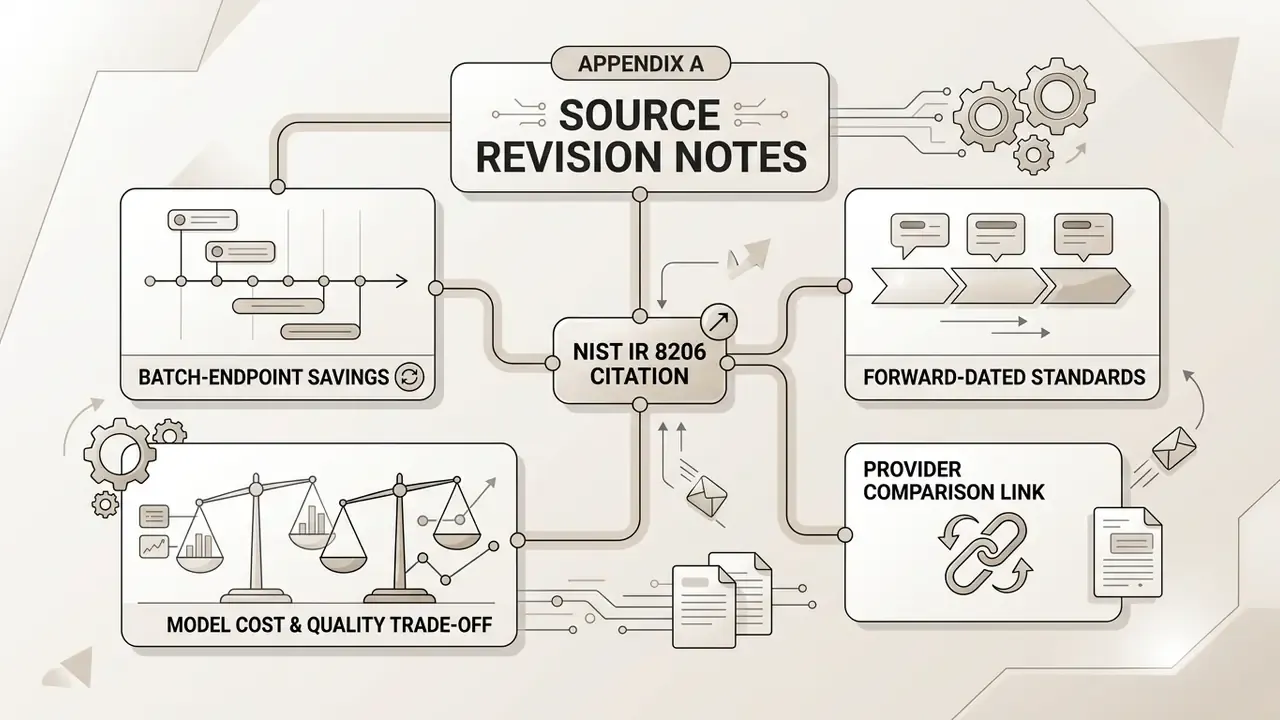
- NIST IR 8206 citation, updated. The earlier inline reference lacked a publication year or resolvable link. The corrected citation now reads NIST IR 8206, Mission Critical Voice Communications Quality of Experience, National Institute of Standards and Technology (2018, 2022 revision), and the latency figure is presented as a benchmark measurement rather than a universal requirement.
- Batch-endpoint savings, updated. The claim that asynchronous batch endpoints reduce token fees "by up to 50%" is provider- and period-specific. The revised text keeps the mechanism and the 24-hour SLA window while instructing teams to verify the current discount against live provider pricing documentation. This figure needs periodic re-verification.
- Model cost and quality trade-off, supported with sources. The prior assertion that cheaper, narrower models preserve capital while holding output quality now cites published selection guidance (accuracy first, then cost and latency; context-window cost effects; price-performance tiering by modality and volume).
- Forward-dated standards. ISO/IEC 23093-6:2026 and OpenAPI 3.2.0 are referenced as forward-planning baselines; teams implementing today should confirm the currently published revision status of each specification.
- Provider comparison link, updated. The general provider-comparison anchor now resolves to the maintained AI video API provider comparison resource.