A word ai generator is a software system, powered by large language models, that writes, restructures, or edits text from user instructions. Institutions now use an ai powered text generator to speed up document drafting, condense long reports, and remove the friction of the empty screen.
Simple enough on the surface. The governance question underneath is harder: who owns the output, and what proves it was reviewed?
Executive Summary: What Matters Before You Deploy
- What it is A word ai generator turns prompts and source documents into drafts. In 2026 the dominant enterprise implementation is Microsoft Copilot inside Word, complemented by web-based ai writing tools for short-form text.
- Where the value sits Time savings cluster in first drafts, summaries, rewrites, and template-driven documentation. Not in judgment, sourcing, or sign-off.
- Measured impact NBER survey data shows 23% of employed respondents used generative AI at work in a given week. Controlled writing experiments report task-time reductions of roughly a third with quality held constant.
- Primary institutional risk Shadow AI. Unauthorized use of public generators, unlogged prompts, and absence of the tool from the corporate model inventory.
- Procurement rule of thumb Free tiers suit non-confidential, short-form text only. Regulated documentation requires tenant isolation, zero data retention, SOC 2 attestation, and explicit commercial-use licensing.
- Legal position (U.S.) Copyright protects human-authored contributions only. Non-de minimis AI-generated text must be disclaimed at registration.
- Non-negotiable control A documented RACI, an audit trail of prompts and outputs, and a human editorial gate before anything is distributed.
Quick Start: Four Steps to Generate Text in Word
- Select document scope.Decide whether you need a brief summary, a formal memo, or a multi-page operational report. Confirm the document's confidentiality class before any text leaves your workstation.
- Supply source context.Paste reference facts, data tables, or regulatory constraints into the prompt box, or attach approved files from OneDrive and SharePoint so the model is grounded in verified material.
- Apply CO-STAR constraints.Set tone (for example: authoritative, analytical), name the audience, and impose a word-count limit plus an output format.
- Fact-check, then edit.Compare the output against primary sources, prune robotic phrasing, log the prompt and the final version, and sign off under a named owner.
What Is a Word AI Generator and Which Tasks It Solves
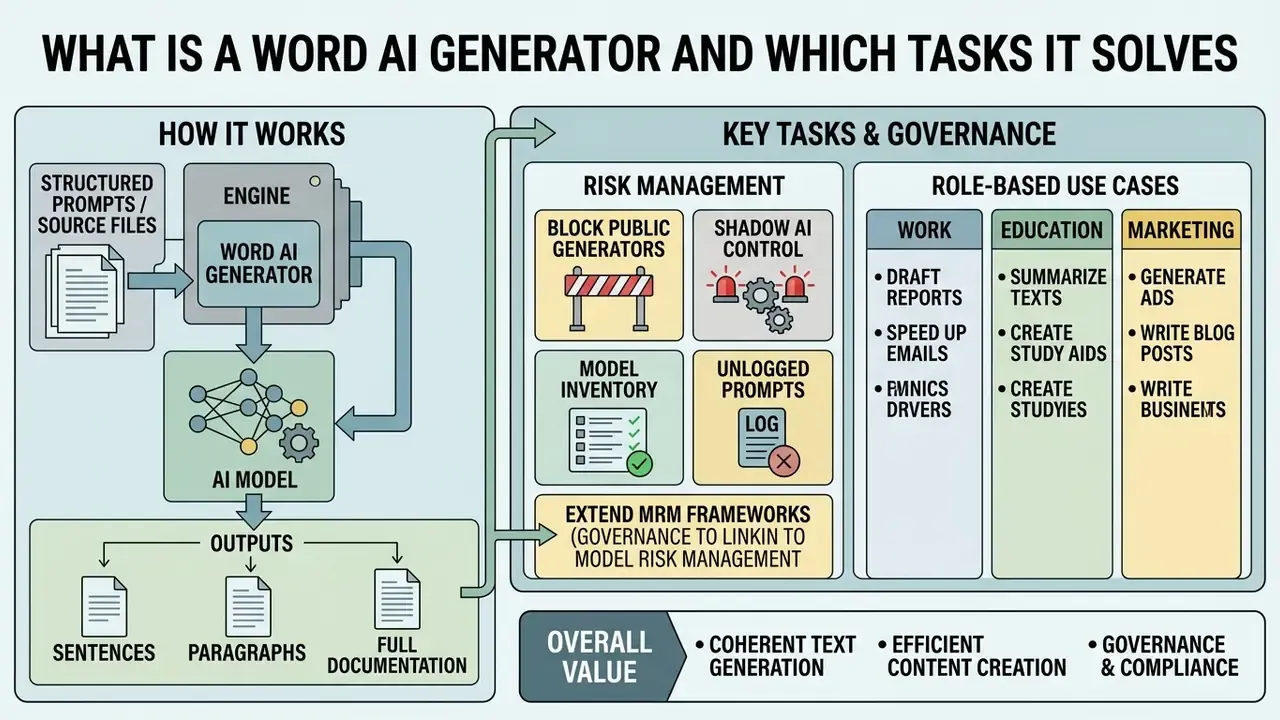
A word ai generator converts structured prompts or source files into coherent sentences, paragraphs, and full documentation. These ai writing tools act as digital text assistants built to accelerate content creation, summarize long communications, and save time across a wide range of operational workflows.
Adoption is now broad rather than experimental. That is exactly why it belongs in a governance conversation and not only in a productivity memo.
"23% of employed respondents used generative AI at work at least once in the prior week, and 9% used it every workday."
The same NBER analysis estimates that users save around 5.4% of their working hours, which maps to an aggregate labor-productivity gain of about 1.9% if every saved minute converts into output. Controlled writing experiments report sharper effects at task level. A randomized study of professional writing tasks measured a drop of roughly one third in completion time, with effort shifting from rough drafting toward editing.
So the tool does not replace judgment. An ai generator for words attacks the drafting bottleneck, letting teams move from an outline straight into critical editorial review. That is a narrower claim than most vendor decks make, and it holds up better.
ILLUSTRATIVE CASE (hypothetical, composite)

A bank risk team faced a four-day lag in turning raw audit findings into structured governance summaries. After deploying an AI drafting assistant against standardized compliance templates, draft generation fell to about fifteen minutes. Senior risk officers spent that recovered time on validation and policy enforcement instead of formatting.
Shadow AI, Model Inventory, and Unlogged Prompts
Generating Words, Sentences, and Coherent Text
Where an AI Writer Helps in Work, Education, and Marketing
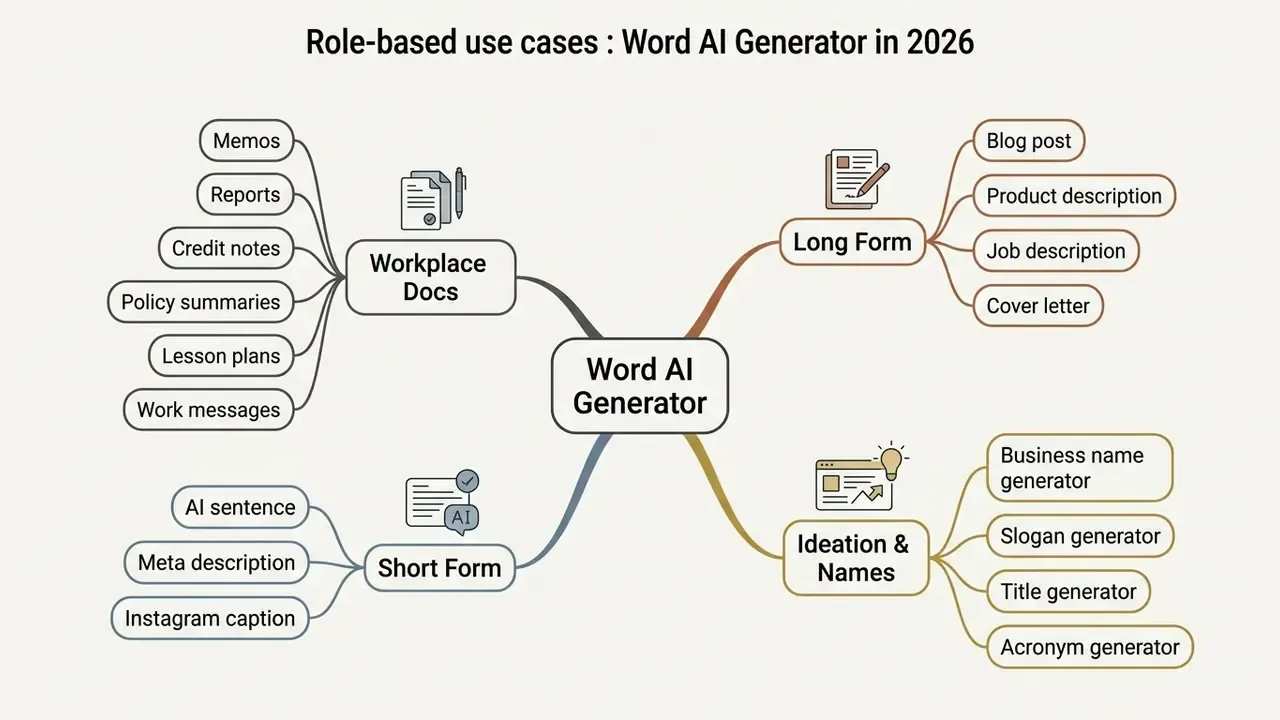
An ai generator help framework supports corporate communications, academic drafting, and customer outreach alike. Professional teams use an ai writer to prepare first drafts of a blog post, a corporate social media update, a formal cover letter, a product description, or institutional lesson plans.
In marketing and operational settings, automated text removes creative friction during campaign development. Research summarized by Stanford University (2026) holds that while these systems produce structured first drafts quickly, human oversight stays essential for brand voice, cultural context, and factual accuracy.
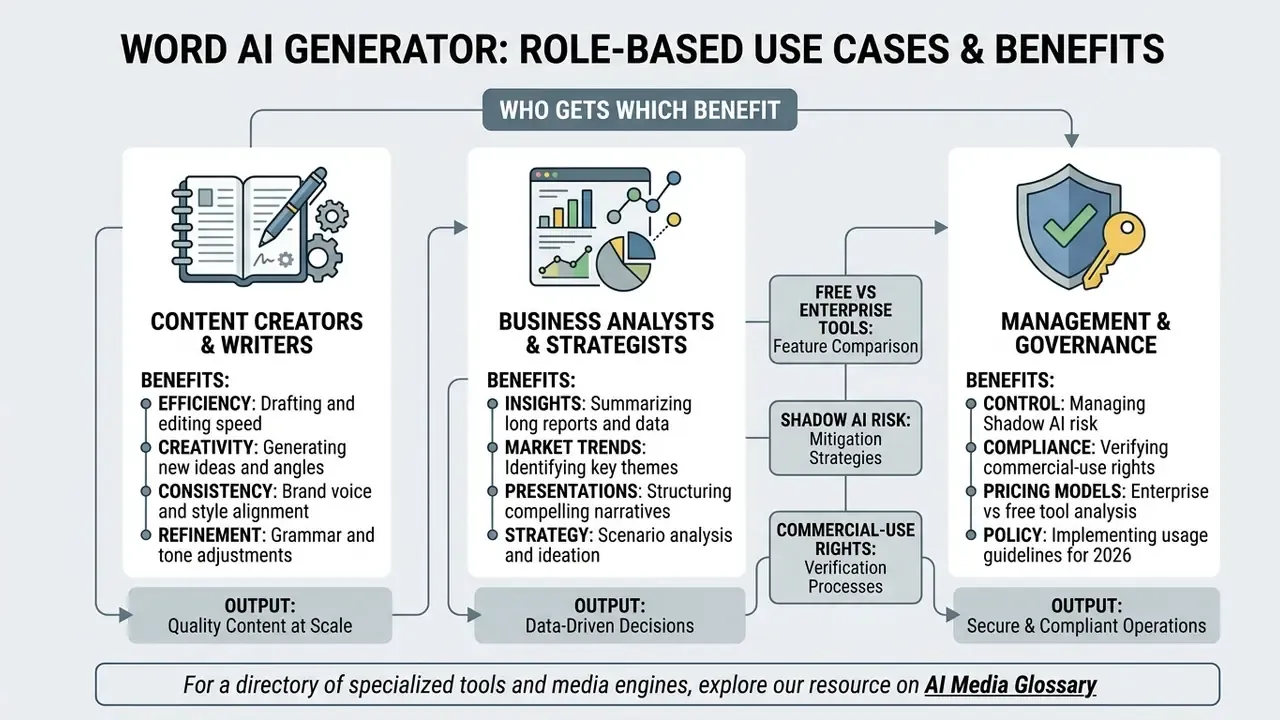
Role-Based Use Cases: Who Gets Which Benefit
| Role / user segment | Primary output needed | Recommended AI workflow | Operational benefit |
|---|---|---|---|
| Risk & compliance officers | Policy summaries, audit memos, AML procedure updates | Ground prompts in approved regulatory text files; never free-form | Large reduction in draft cycle time, accuracy preserved by source grounding |
| Model risk / internal audit | Validation notes, findings write-ups, issue logs | Structured template prompts plus mandatory prompt and output logging | Produces an auditable trail alongside the draft |
| Product marketers | Value propositions, meta descriptions, campaign variants | Prompt with brand voice plus strict length constraints | High-volume variations for A/B testing |
| Academic researchers | Literature outlines, abstract drafts | Restructure dense notes into plain-language drafts | Removes the blank-page delay in technical writing |
| Corporate communications | Executive letters, internal newsletters | Tone adjustment and sentence restructuring against a voice guide | Consistent enterprise messaging across teams |
| HR and recruiting | Job descriptions, onboarding notices | Template-driven generation with mandated inclusive-language review | Standardized postings, fewer revision rounds |
Pricing Tiers, Limits, and Commercial Use of AI-Generated Content
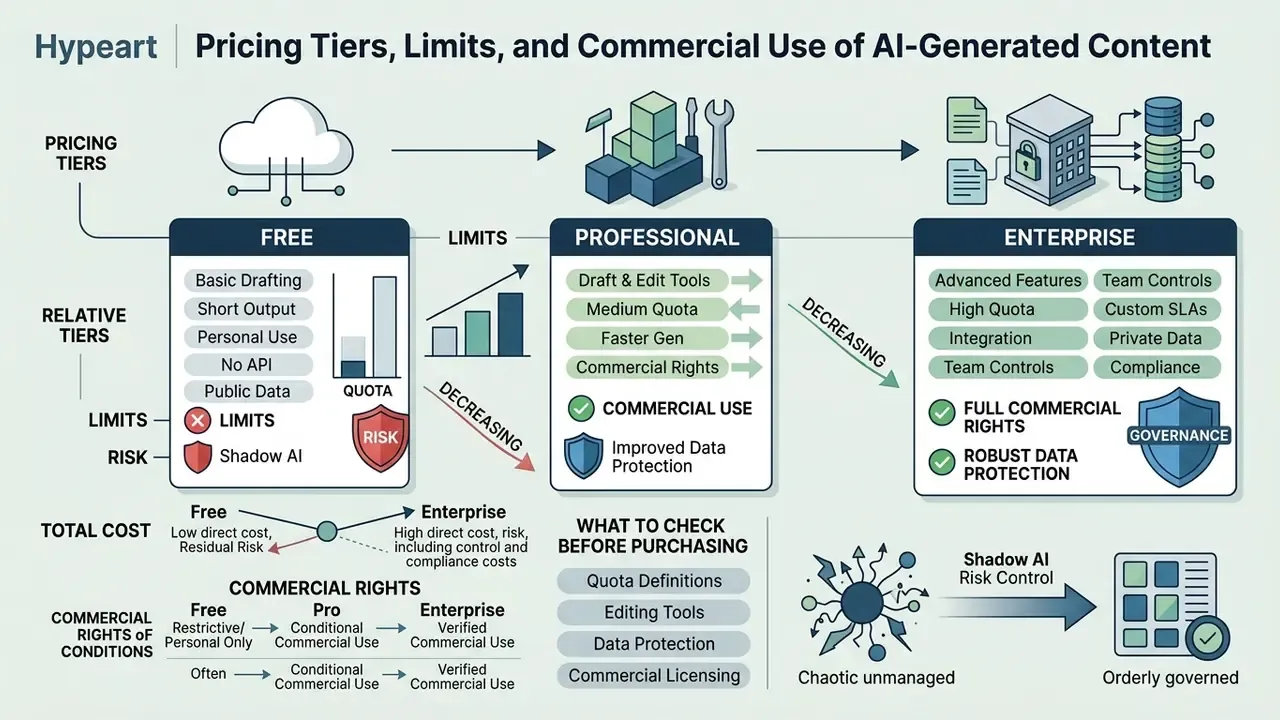
Institutional readers usually want the commercial picture before the technique. Reasonable, because the boundary between a public utility and a governed enterprise deployment decides what may legally and safely be drafted at all.
Evaluating platforms therefore means analyzing token cost structures, generation caps, data privacy guarantees, and copyright usage rights. Four dimensions, one decision.
| Feature / Dimension | Typical Free AI Text Generator | Enterprise / Paid Word AI Generator |
|---|---|---|
| Access & Authentication | Web utility; often no registration or a basic free account. | Paid user subscription or organizational M365 license. |
| Generation Limits | Strict daily or monthly caps; character length throttling. | High or flexible token allowances; dedicated API throughput. |
| Document Integration | Web text box; manual copy-paste workflow. | Embedded directly in Word, Docs, or enterprise software. |
| Editing Capabilities | Basic sentence rewriter and simple grammar checks. | Full tone control, brand voice tuning, style alignment. |
| Data Privacy & Security | User inputs may be logged for model training. | Tenant isolation, SOC 2 compliance, zero data retention. |
| Commercial License | Usage terms vary; commercial use often restricted. | Full commercial usage rights under explicit vendor terms. |
How to Compare Free and Paid AI Writing Tools
When selecting an ai tool, compare subscription tiers against quantitative usage metrics, not feature bullet counts. Paid tiers widen context windows, raise API rate limits (moving from strict free-tier quotas to millions of tokens per minute in some cases), and unlock stronger language models.
Normalize the unit of measurement before you compare anything. Vendors bill in tokens, words, characters, credits, requests, or documents processed, and a "1,000 requests per month" allowance is not comparable to a "60 AI credits per month" allowance until both are translated into your own document volumes.
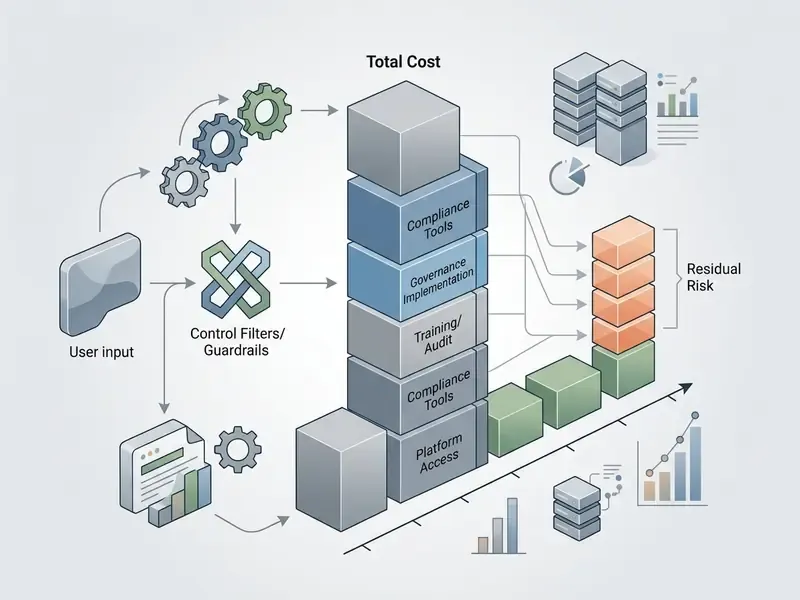
Total Cost Including Control and Residual Risk
Licence price is the smallest line in a regulated environment. A defensible cost model reads:
Total cost of ownership = licence fees + variable token or credit spend + control costs + residual risk provision.
Control costs equal review hours per document multiplied by the blended reviewer rate and monthly document volume, plus logging, storage, and periodic validation effort. The residual risk provision covers the expected cost of an uncaught factual error reaching an external document. If control costs exceed the drafting time saved, the use case is not ready for deployment. That is an unglamorous test, and it filters out a lot of pilots.
Can You Use AI-Generated Content in Commercial Projects?
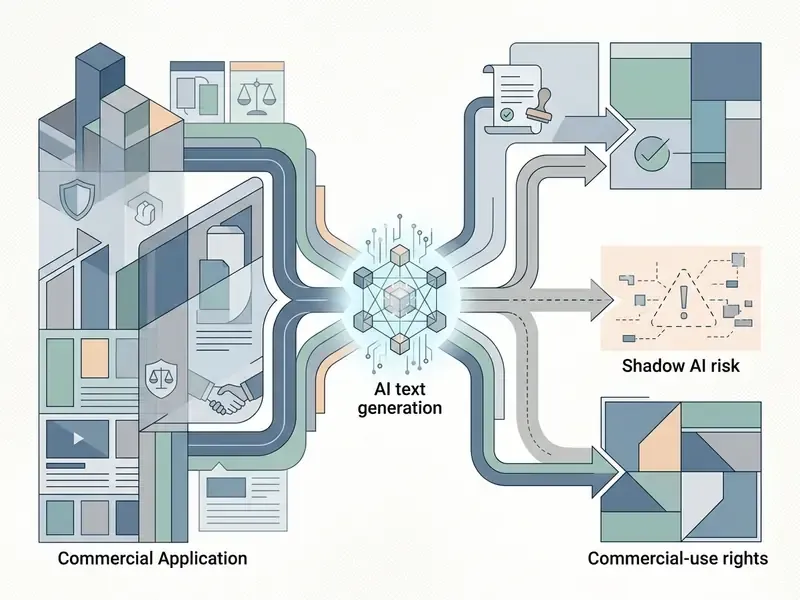
Commercial use of AI-generated text is legal in the United States. Ownership of the output is the part that gets messy. According to policy from the U.S. Copyright Office (2026), copyright protection extends only to human-authored creative contributions.
What to Check Before Purchasing an AI Generator Subscription
Before buying an ai verbiage generator free upgrade or a full enterprise subscription, procurement should work through a fixed checklist:
- Quota definitionsVerify whether limits are measured in words, tokens, or document processing requests.
- Built-in editing toolsConfirm there is an integrated grammar checker, a sentence rewriter, and style customization.
- Data protectionEnsure inputs are excluded from public model training sets, and get the zero-retention clause in writing.
- Commercial licensingRead vendor terms to confirm unrestricted commercial deployment rights.
- AuditabilityConfirm that prompts, outputs, model versions, and user identities can be exported for audit and supervisory review.
- Tenant and permission modelVerify that grounding respects existing file permissions and that no cross-tenant retrieval occurs.

Free AI Text Generator: What Is Available Free and Without Registration
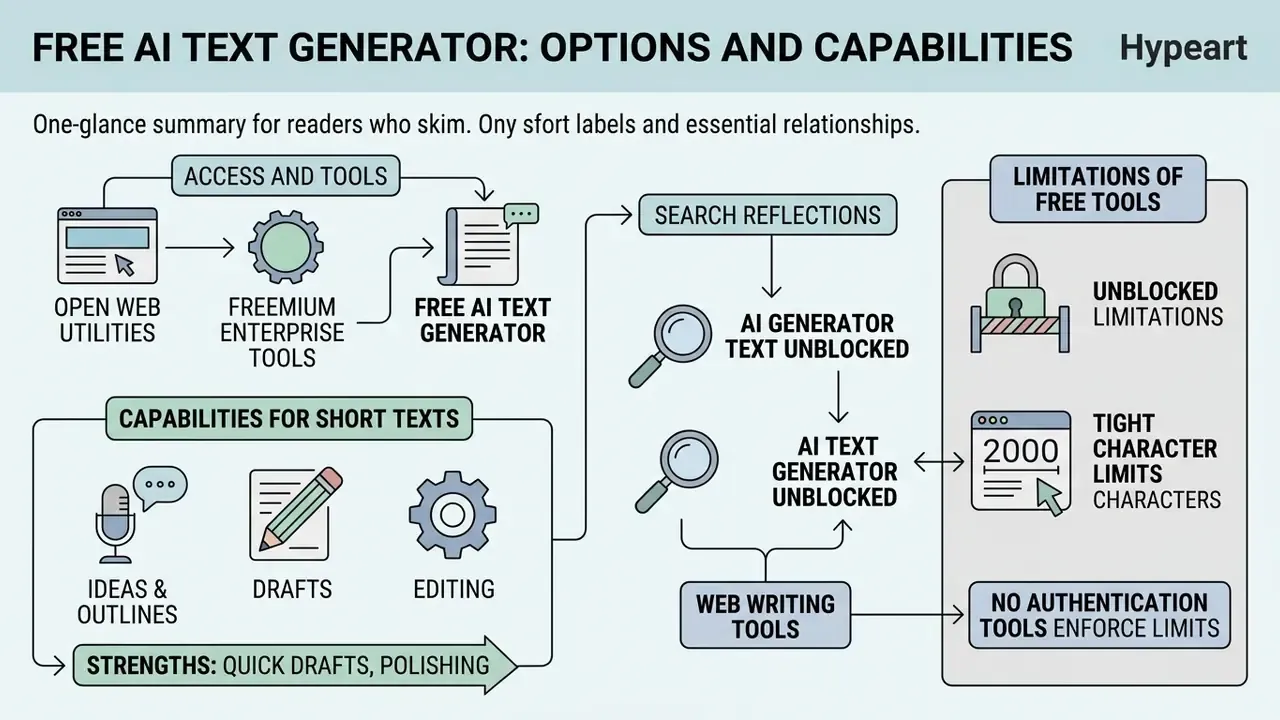
Options labelled free ai text generator app run from open web utilities to freemium enterprise tools. Knowing the functional limits helps users pick sensibly for light writing tasks, and helps risk owners state clearly which document classes must never touch them.
Capabilities of Free AI Writers for Short Texts
A free word ai generator or free ai text tool is at its best in short-form work. Users can instantly generate brief sentences, short paragraphs, social captions, and quick outline concepts with no financial commitment.
According to platform documentation from major providers (Canva, Grammarly, 2026), a free ai writer or free ai tool usually caps usage as a fixed number of lifetime or monthly generations, or limits output length. Published figures vary by vendor and change often, so read the quota from the provider's current pricing page rather than from a blog table. These entry tiers work well for testing functionality before an upgrade.
Search behaviour reflects that experimentation. Queries like google ai sentence generator or free ai information generator usually come from someone who wants one sentence rewritten, not a governed workflow. Fair use of a free tool, as long as the text is not confidential.
What AI Generator Text Unblocked Means and Its Limitations
Queries for ai generator text unblocked or ai text generator unblocked normally point to web writing tools reachable without registration, a paywall, or network filtering. Instant access, yes. The tradeoffs sit in data privacy and output stability, and the same tradeoffs apply to no-sign-up generative tools in adjacent media categories, where convenience is paid for with weaker retention guarantees.
Public free ai information generator tools that run without authentication often enforce tight character limits and promise nothing about data security. European transparency standards (EU Code of Practice on AI Transparency, 2026) also require published AI-generated content on public interest topics to pass verifiable human editorial review, whichever generator produced it.
How to Use an AI Generator in Word and Other Editors
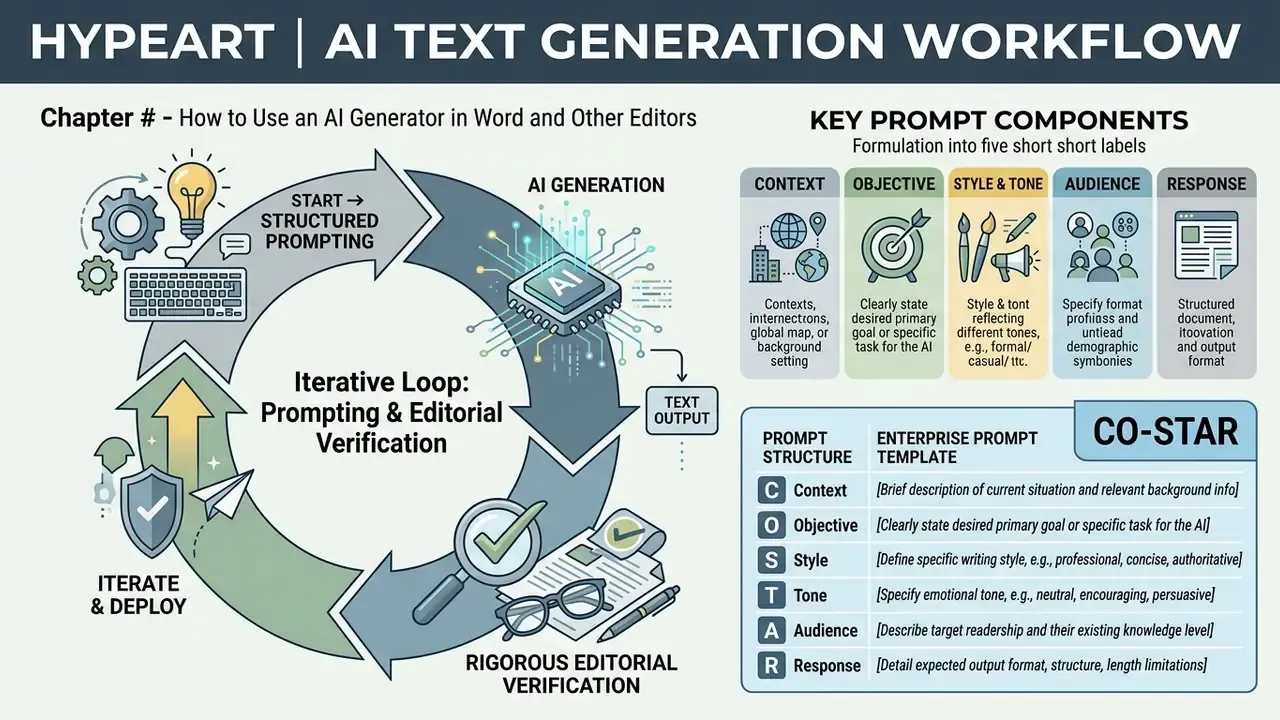
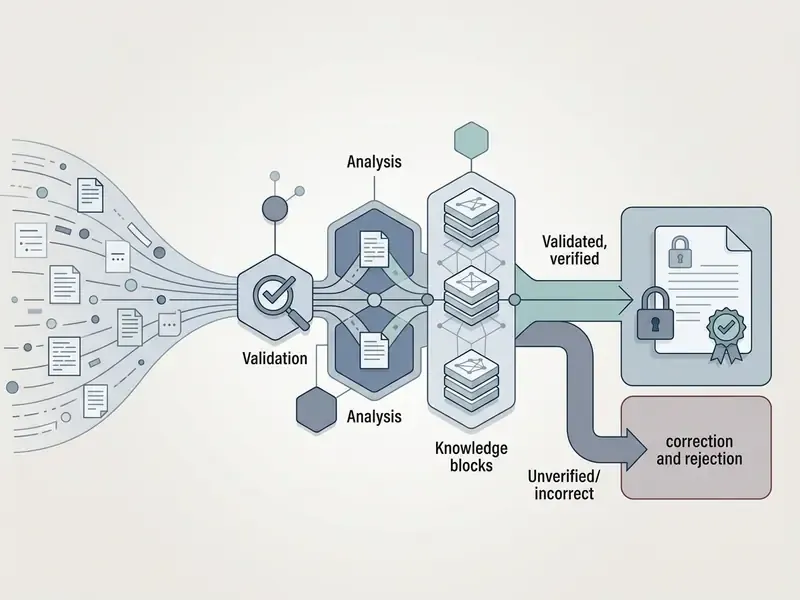
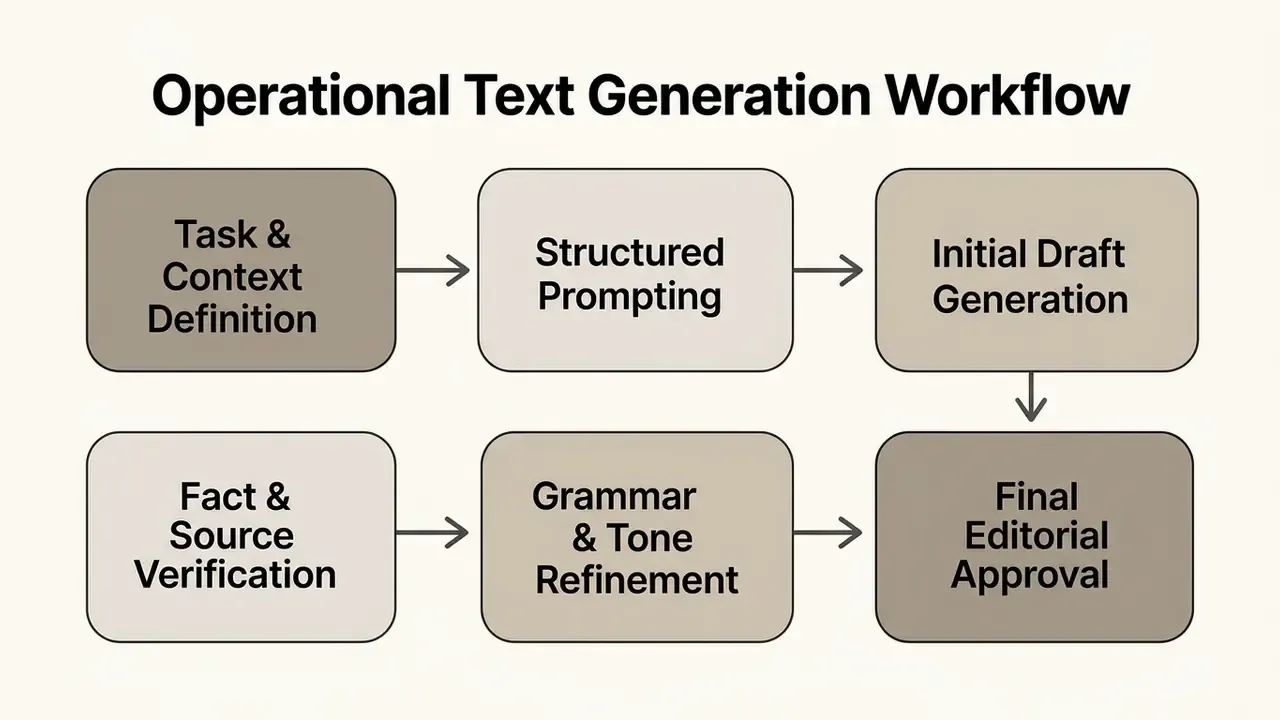
Deploying an ai generator word system well takes an iterative loop: structured prompting, then rigorous editorial verification. Teams that get results treat every output as an unverified draft until someone checks it against sources.
A study in CHI Proceedings (2024) found that writers using structured co-writing workflows completed complex argument formulations noticeably faster than independent writers, provided they kept strict control over final revisions.
How to Formulate Prompts for an AI Text Generator
Good generation depends on detailed context, explicit formatting parameters, and clear domain constraints. A solid prompt names the task, the audience, the preferred brand voice, and the required structure.
"The level of scaffolding in a prompt materially affects the quality of co-written argumentative text."
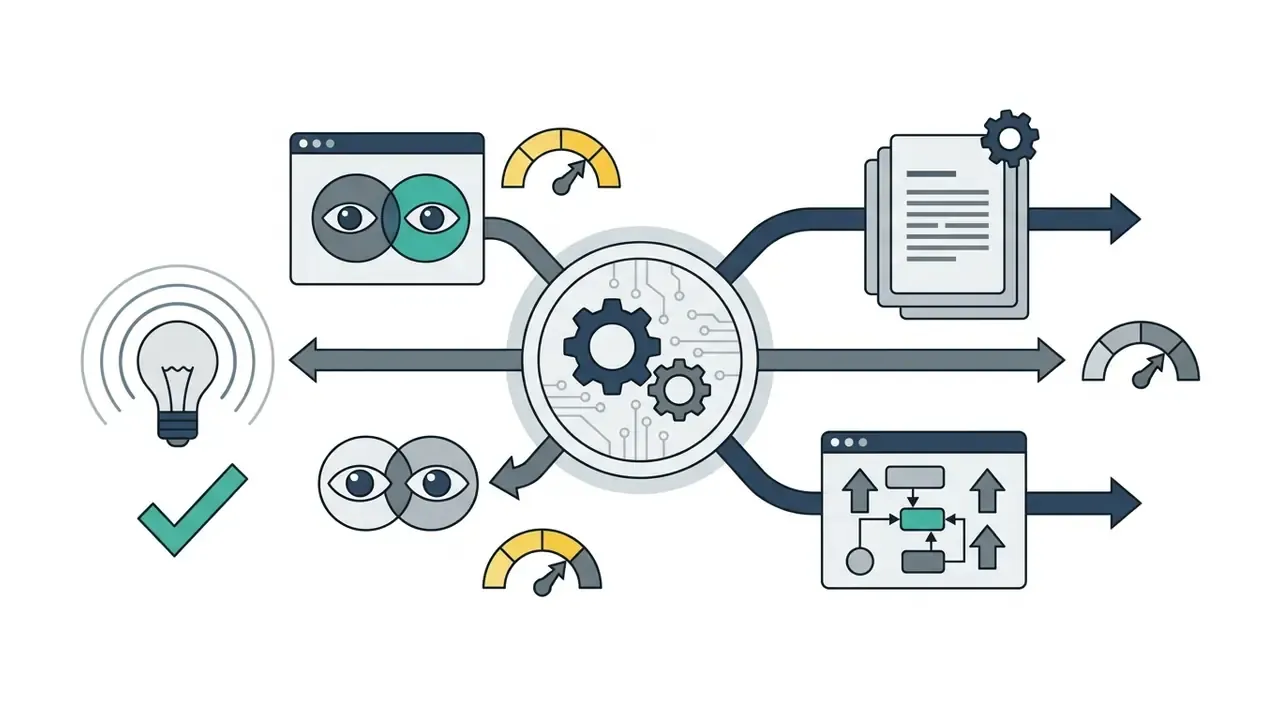
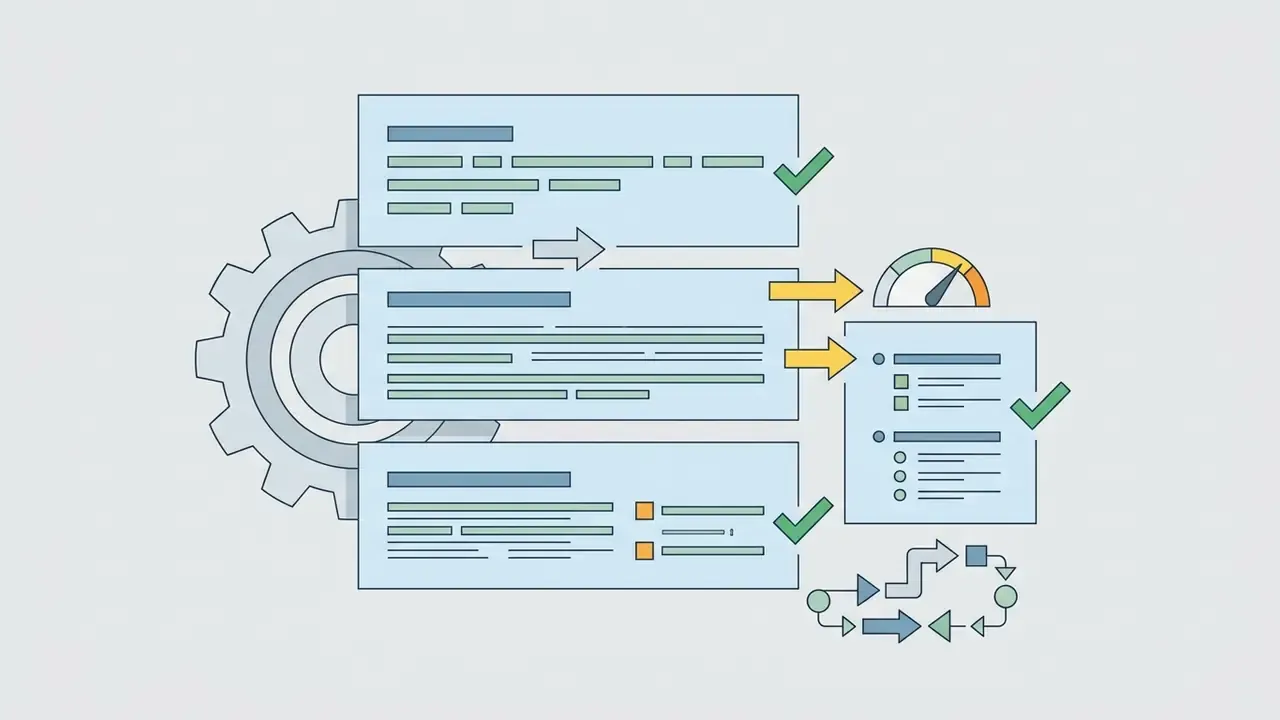
Prompt frameworks such as CO-STAR (NIST SP 1353 Draft, 2026) split a request into defined components:
An equivalent used in library and research settings is TCEPFT: Task, Context, Example, Persona, Format, Tone. It adds an explicit example slot, useful when output must imitate an approved internal template.
Ready-to-Use CO-STAR Enterprise Prompt Template
Copy and adapt this into your Word AI assistant.
Prompt structure:
- [Context]: We are launching an enterprise cybersecurity update for internal staff.
- [Objective]: Draft a three-paragraph executive memo explaining mandatory 2FA deployment.
- [Style & Tone]: Professional, urgent yet reassuring, concise (ISO 24495 plain language).
- [Audience]: Non-technical corporate employees.
- [Response]: Markdown text with bullet points for action items, no jargon, 220 words maximum.
Raw AI output versus humanized refinement:
- Raw draft: "Employees must immediately execute two-factor authentication onboarding to mitigate credential compromise vectors."
- Refined output: "Please set up two-factor authentication by Friday to keep your account secure. Follow the three simple steps below."
The second version says the same thing and will actually be read.
Second Template: Regulatory Summary with Source Grounding
- [Context]
- Attached file
AML_Circular_2026.pdfis the only permitted source. Do not add outside facts. - [Objective]
- Produce a one-page summary of new customer due-diligence obligations for the compliance committee.
- [Style & Tone]
- Neutral, precise, no persuasive language.
- [Audience]
- Compliance committee members with legal background.
- [Response]
- Numbered list of obligations, each followed by the exact source clause number. Flag anything not stated in the source as "not addressed in source."
How to Turn a Draft into High-Quality Text
Raw output needs systematic editing to enhance readability and strip structural boilerplate. Run the initial draft through a dedicated grammar checker, then apply a sentence rewriter or paragraph rewriter to the sections that read stiffly.
A specialized rewriter tool or paraphrasing tool lets editors adjust cadence and keep logical flow intact. Under ISO 24495-1:2023 plain language standards, professional text should favour familiar vocabulary, short sentence construction, and direct active phrasing.
A workable three-step sequence: run the grammar pass and accept only corrections that preserve meaning; rewrite the selected sentences or paragraphs; then compare the revision against the original for completeness before human review. Simple, and it catches the silent deletions that rewriting tools sometimes introduce.
Refining AI Patterns and Managing Detection Markers
Generative models fall into repetitive structural habits. They overuse transition words ("Furthermore," "Moreover"), drift into passive voice, and end every section with a tidy summarizing flourish. To make a document read naturally and meet institutional standards, follow these best practices:
- Vary sentence length.Models default to uniform rhythm. Alternate short decisive statements with compound sentences.
- Strip boilerplate adjectives.Cut "game-changing," "testament to," "pivotal," and "in today's fast-paced environment."
- Replace synthetic idioms with domain terms.Use the precise vocabulary your institution already uses in approved documents.
- Cut redundant openers.Delete sentences that restate the heading before delivering anything.
- Audit for AI detection markers.Run internal drafts through verification workflows that flag templated phrasing, and treat flags as rewrite candidates, not verdicts. Detectors are probabilistic and produce false positives.
- Disclose rather than disguise.Where academic, editorial, or regulatory rules require it, declare the assistance and the tool version. Transparency is the defensible position; evasion is not.
How to Work with AI Writing in Microsoft Word
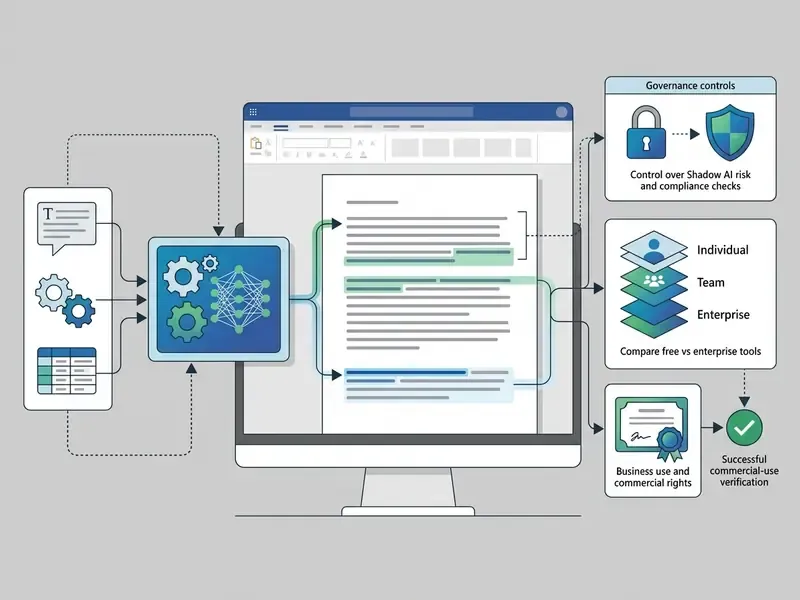
Microsoft Copilot in Word puts text generation inside the document itself. Users can draft from a prompt, reference enterprise files held in cloud repositories, and adjust tone without leaving the page.
According to Microsoft Word AI Documentation (2026), Copilot supports in-place edits through commands such as Auto Rewrite, Replace, Insert Below, and Regenerate, plus post-generation controls (Keep it, Regenerate, Discard) and prompt refinement for tone or brevity. Grounding sources include Word, PowerPoint, PDF, and TXT files stored in OneDrive or SharePoint, referenced by typing / and picking the file. Enterprise use of ai writing tools inside Word rests on existing permission boundaries, so the model reads only what the authenticated user may already open.
"Copilot users read 11% fewer emails and spent 4% less time interacting with email in a randomized trial spanning thousands of users across more than 60 organizations."
Language coverage for prompts and responses keeps expanding. Microsoft still states that Copilot supports fewer languages than the Word interface, and that quality is highest in English.
What Types of Text a Word AI Generator Can Create
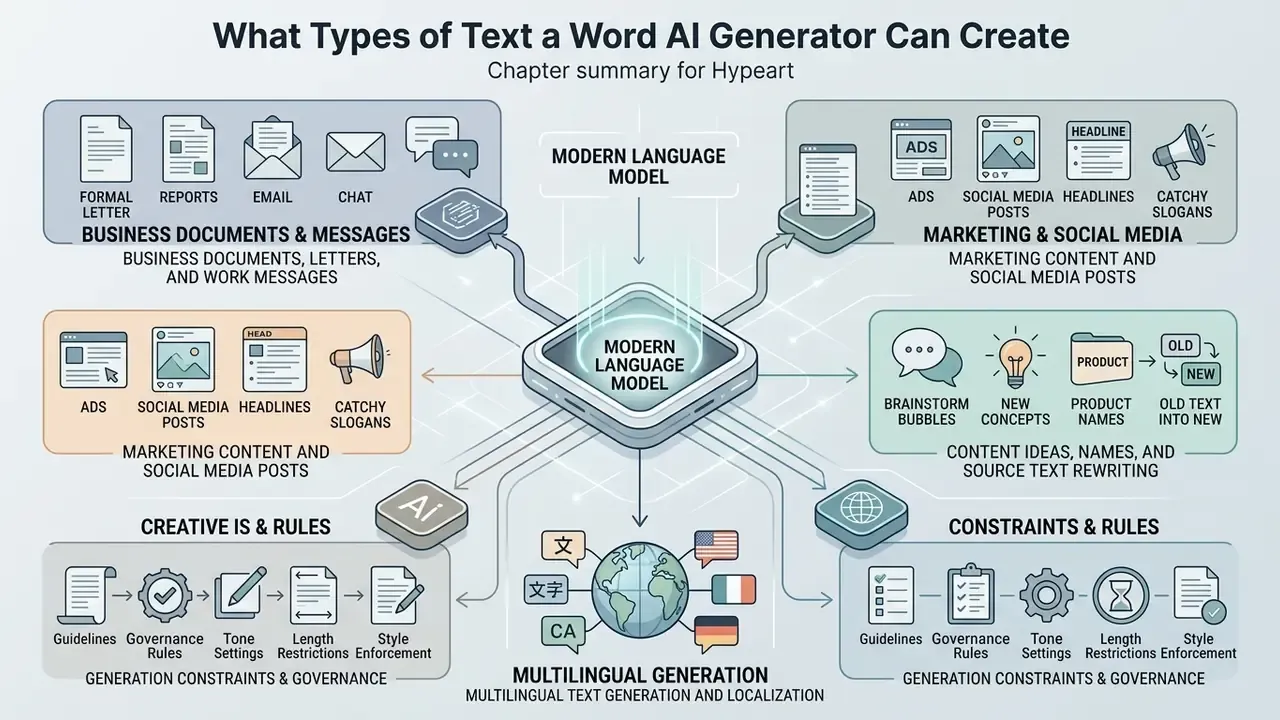
Modern language models produce a wide range of formats, from short marketing snippets to structured enterprise documentation. Knowing the output profile helps organizations match the tool to the task instead of buying a suite and hoping.
ILLUSTRATIVE CASE (hypothetical, composite)

A fintech compliance team needed hundreds of localized product disclaimers. Working from template constraints and regional regulatory text, an AI text generator produced standardized disclosures for review. Draft production time fell by roughly two thirds, with legal alignment maintained through mandatory human review of every variant.
Business Documents, Letters, and Work Messages
An ai work generator streamlines executive and administrative writing. Organizations use an ai verbiage generator to draft cover letter templates, automated letter generator notices, detailed job description listings, and routine internal messages. Federal generative-AI reference guidance groups these outputs under three verbs: summarize, expand, transform. Expansion covers first drafts of contracts, memos, presentations, responses, and RFPs.
According to workplace communication studies (Journal of Business Communication, 2025), automated message generation raises output volume, while human review remains necessary for tone nuance and interpersonal trust. Related research finds that visible heavy AI assistance makes readers doubt sincerity and authorship. Worth remembering before the next all-staff letter. Teams assessing downstream rights for generated assets can review our analysis of commercial-use conditions for AI-generated media.
Content Ideas, Names, and Source Text Rewriting
Facing a blank page, an ai help generator works well as an ideation mechanism. Tools acting as a business name generator, a name generator, or an acronym generator help teams brainstorm brand concepts and product labels fast. Clear every name candidate for trademark conflicts before use. Generators optimize for memorability, never for legal availability.
For existing material, an ai sentence rewriter or a deeper paraphrasing engine restructures dense technical prose. Baseline academic standards (Purdue OWL, 2026) stress that real paraphrasing restates the source concept in original language while keeping the underlying facts intact.
"Language models rival human authors on narrative quality but tend to reproduce well-known plots drawn from training data."
That tendency is the practical warning for rewriting workflows. Paraphrasing engines can reproduce familiar formulations closely enough to create unintentional plagiarism exposure, so originality checks belong in the same pass as the grammar check.
Multilingual Text Generation and Localization Constraints
Fluency in English is high. Deploying AI text generators across multilingual enterprise workflows, Spanish, French, German, Portuguese, Italian, needs explicit localized context.
Do not lean on direct translation prompts. Instruct the generator to draft natively in the target language's formal business register, supply a glossary of approved local terminology, and have a native-speaking reviewer sign off on regulated text. Where a document carries legal effect in more than one language, designate the authoritative version explicitly.
How to Improve the Quality of AI-Generated Text
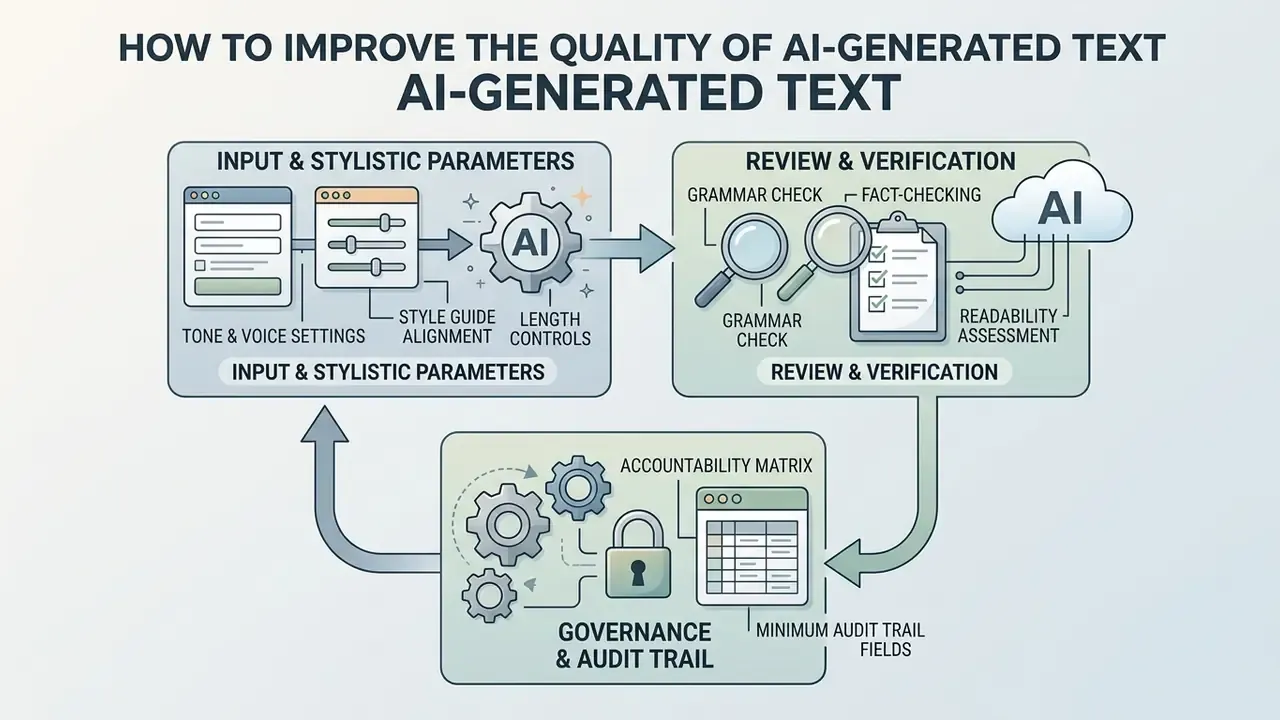
Getting high quality content out of a generator takes explicit stylistic parameters, systematic fact-checking, and alignment with house standards. Unrefined output brings generic phrasing, factual hallucinations, and occasionally subtle cultural bias.
Setting Tone, Style, and Brand Voice
A consistent brand voice requires stylistic boundaries inside every request. Define sentence complexity, approved terminology, and forbidden buzzwords once, then reuse the block.
"Autocomplete with opinionated suggestions shifted participants' expressed views toward the model's position, even when participants knew the tool was biased."
"Indian participants accepted roughly 25% of AI suggestions versus 19% for American participants, yet their writing drifted toward Western stylistic norms and lost cultural specificity." Cornell, AI Suggestions Homogenize Writing Toward Western Styles (2024). https://arxiv.org/abs/2403.12564
Both findings carry the same editorial consequence. A brand-voice prompt is not only a style control, it is a bias control. Reviewers should ask whether the model nudged the argument, not only the wording.
Guidelines from the SDSU AI Brand Framework (2026) note that voice stays constant across an institution while tone adapts to context: formal rigour in regulatory filings, accessible phrasing in customer communications. University voice guides add a third layer of operational rules. Keep copy lean, prefer short sentences, delete unnecessary words before publication.
Checking Grammar, Facts, and Readability Before Publication
"At least 60,000 scholarly articles, roughly 1% of 2023 publications, show signs of undisclosed LLM assistance."
According to Google Search Central Guidance (2026), search systems assess content on utility, accuracy, and reader value, and demote low-quality automated text that lacks human editorial oversight. The same guidance asks publishers a blunt pair of questions: do spelling or stylistic issues remain, and is AI involvement disclosed or self-evident?
Accountability Matrix and Audit Trail
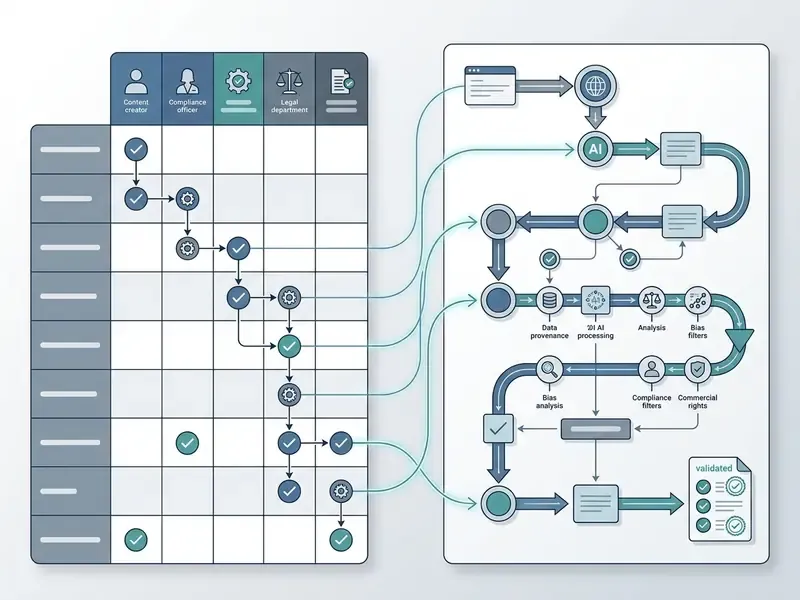
Quality control fails without named ownership. The matrix below is a starting template for regulated document workflows. Adapt the role titles to your own structure.
| Activity | Responsible | Accountable | Consulted | Informed |
|---|---|---|---|---|
| Prompt design and source selection | Document author | Business unit head | Subject-matter expert | Compliance |
| Draft generation and logging | Document author | Business unit head | IT / platform owner | Model risk |
| Fact verification against primary sources | Subject-matter expert | Business unit head | Legal (if regulated content) | Internal audit |
| Tone, brand voice, and bias review | Communications editor | Head of communications | Inclusive-language reviewer | Business unit head |
| Legal and IP clearance, AI disclosure | Legal counsel | Chief compliance officer | External counsel (if needed) | Executive sponsor |
| Final sign-off and distribution | Business unit head | Accountable executive | Not applicable | All stakeholders |
| Retention of audit trail | Platform owner | Chief compliance officer | Internal audit | Regulator (on request) |
Minimum audit trail fields: document ID, prompt text, attached source files, model name and version, generation timestamp, reviewer identity, list of factual corrections applied, disclosure statement, approval date.
If a hallucination reaches an external report, this record is what lets the institution show a control existed and pinpoint where it failed. Without it, the discussion becomes opinion against opinion.
Limitations, Open Questions, and a Safe Next Step
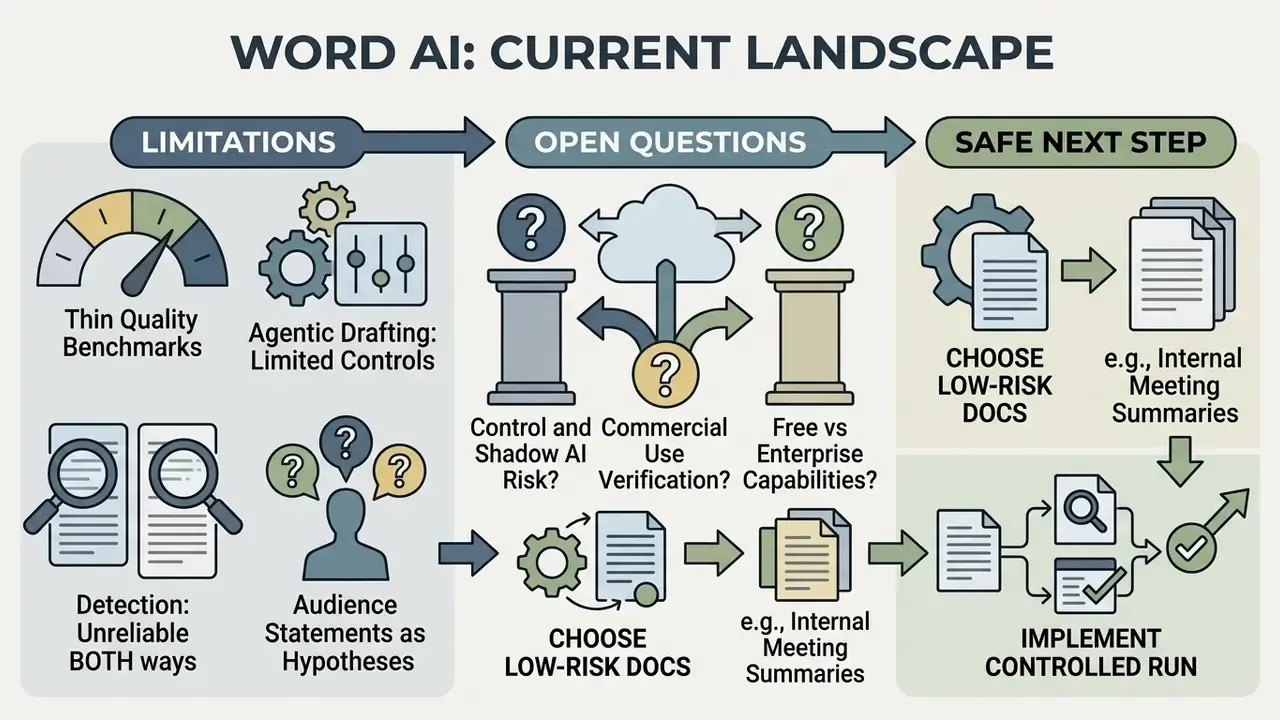
Some things in this field are still unsettled, and pretending otherwise helps nobody.
- Quality benchmarks are thin. There is no accepted public benchmark comparing drafting quality across enterprise assistants on regulated document types. Internal benchmarking on your own corpus remains the only reliable measure.
- Agentic drafting is ahead of its controls. Assistants that chain steps, retrieve files, and send output onward raise questions classical validation was not built to answer. Until escalation paths and shutdown mechanisms are documented, keep autonomy low.
- Detection is unreliable in both directions. Detectors flag human text and miss machine text. Disclosure beats detection.
- Audience statements are hypotheses. The role-based benefits above are working assumptions, to be confirmed against your analytics, interviews, and document-cycle data before they drive a budget.
A conservative next step: pick one low-risk document class, for example internal meeting summaries, run it through the full control set for a quarter, and measure drafting hours saved against review hours added. If the ratio holds, extend to the next class. If not, you learned something cheaply.
FAQ: Common Questions About Word AI Generators
Is an English AI Generator Suitable for English-Language Texts?
Yes. An english ai generator produces its strongest output in English prose. Major large language models are trained predominantly on English corpora, so their syntax, idiom, and stylistic range are most refined there.
According to NIST Evaluation Reports (2024 to 2026), text-to-text models hit their highest benchmarks for structural fluency and coherence in English. Human review still verifies facts and polishes tone, in any language.
Can an AI Generator Replace a Human Author and Editor?
No. An ai text generator works as a drafting and editing assistant, not as a substitute for judgment. It builds outlines quickly, summarizes reports, and removes starting friction. It does not hold domain expertise, emotional nuance, or contextual judgment.
"Students writing without AI assistance averaged 2.39 points versus 2.00 for the ChatGPT-3 group; the difference was not statistically significant, but the control group outperformed the assisted group." Better by you, better than me: ChatGPT-3 as writing assistance in students' essays (2023). https://arxiv.org/abs/2302.04536
Systematic reviews of academic writing point the same way. Unguided generation introduces factual errors, fabricated or mismatched citations, and generic phrasing. Keeping editorial standards high means humans guide the prompt, verify the facts, and align the copy with institutional goals. Teams benchmarking assistants across modalities may find our comparison of leading AI generation tools useful for the same evaluation discipline.
Does the Free Tier Ever Meet Enterprise Requirements?
Rarely. Free tiers fit non-confidential short-form drafting, internal brainstorming, and personal productivity. They are wrong for customer data, unpublished financials, credit files, personnel matters, or anything headed for a regulatory filing, because retention, logging, and licensing guarantees are absent.
How Do We Prove to an Auditor That AI-Assisted Text Is Reliable?
Not by asserting model quality. By evidencing process: the documented prompt, the grounded source files, the verification record against primary sources, the named reviewer, the approval date. Non-deterministic systems cannot be validated the way a scorecard is, so control effectiveness is shown through the surrounding workflow.
Do We Need to Disclose AI Assistance?
It depends on context. U.S. copyright registration requires disclaiming non-de minimis AI-generated material. Academic institutions and many publishers want a statement naming the tool and version. Public-interest publications in the EU fall under transparency commitments requiring verifiable human editorial review. Where doubt exists, disclose.
What Are the Practical Limits Inside Word?
Copilot in Word needs an eligible Microsoft 365 or Copilot licence. Prompts carry no fixed word or character cap, though very large inputs may be truncated automatically, and AI credit allowances apply on some plans. Microsoft warns plainly that Copilot can misread facts and return inaccurate output, which must be reviewed before acceptance.
Appendix A. Editorial Corrections and Source Verification Log
This log records claims revised during editorial review, kept for transparency.
| Original claim as first drafted | Verification finding | Updated wording used in this article |
|---|---|---|
| "Research by Bick, Blandin, & Deming (NBER, 2024) shows that knowledge workers spend up to 5% of their weekly hours using generative text systems, achieving average task time reductions of 37%." | The NBER paper reports adoption (23% weekly, 9% daily among employed respondents), time savings of about 5.4% of working hours among users, and an aggregate productivity effect near 1.9%. The 37% figure comes from a separate randomized professional-writing experiment, not from NBER. | Adoption and hours-saved figures attributed to NBER (2024); the roughly one-third task-time reduction attributed to controlled writing experiments, stated separately. |
| "A free ai writer usually imposes strict monthly query caps (e.g., 25 generations per account)." | Quotas differ by vendor and change frequently. No single verified universal figure exists. | Described as fixed lifetime or monthly generation allowances that must be read from the provider's current pricing page. |
| "Systematic reviews in academic writing (Journal of Academic Writing, 2025) confirm that unguided AI text generation frequently introduces factual errors." | The specific journal citation could not be verified. The underlying finding is supported by a published randomized essay study and by systematic reviews of AI in academic writing. | Supported with the 2023 ChatGPT-3 essay-assistance study (2.39 versus 2.00 points) and a general reference to systematic reviews. |
| Corporate disclosure block regarding an unresolvable third-party domain. | Off-topic for a word AI generator guide and unverifiable. Removed from the main text. | Replaced with institutional governance sections, the accountability matrix, and a limitations section. |
| Contextual links to image, video, and character generators. | Off-topic for this semantic cluster. | Internal links limited to glossary, calculators, commercial-use, compare, pricing, API, support, and litigation resources. |
| Role-based benefit claims presented as established fact. | No primary research verifies these benefits for the described audience segments. | Labelled as working hypotheses pending analytics, interviews, or verified customer research. |
General disclaimer: this article provides operational and informational guidance only. It is not legal, financial, or regulatory advice. Verify vendor terms, quotas, and licensing directly with the provider, and consult qualified professionals before deploying AI-generated text in regulated documentation.