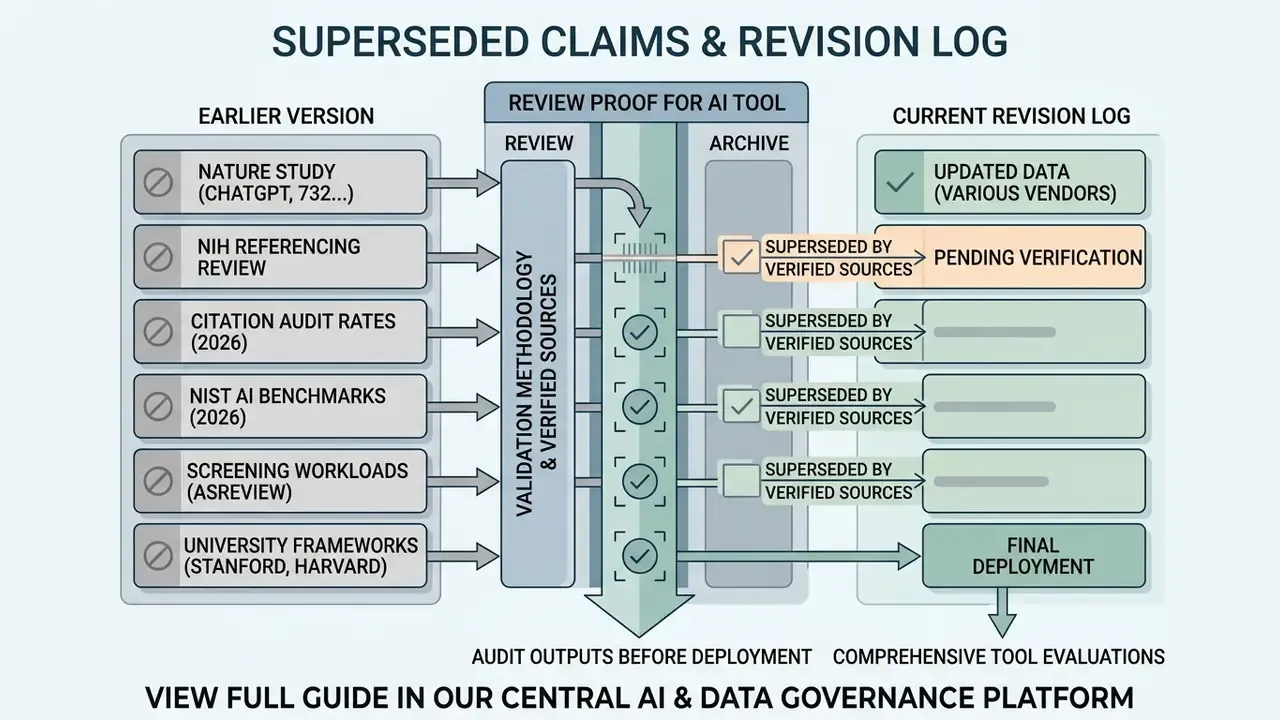
Last methodology update: August 2026. Vendor-neutral assessment: no commercial relationship exists between this editorial team and any tool evaluated below.
Executive Summary for Risk and Research Leaders
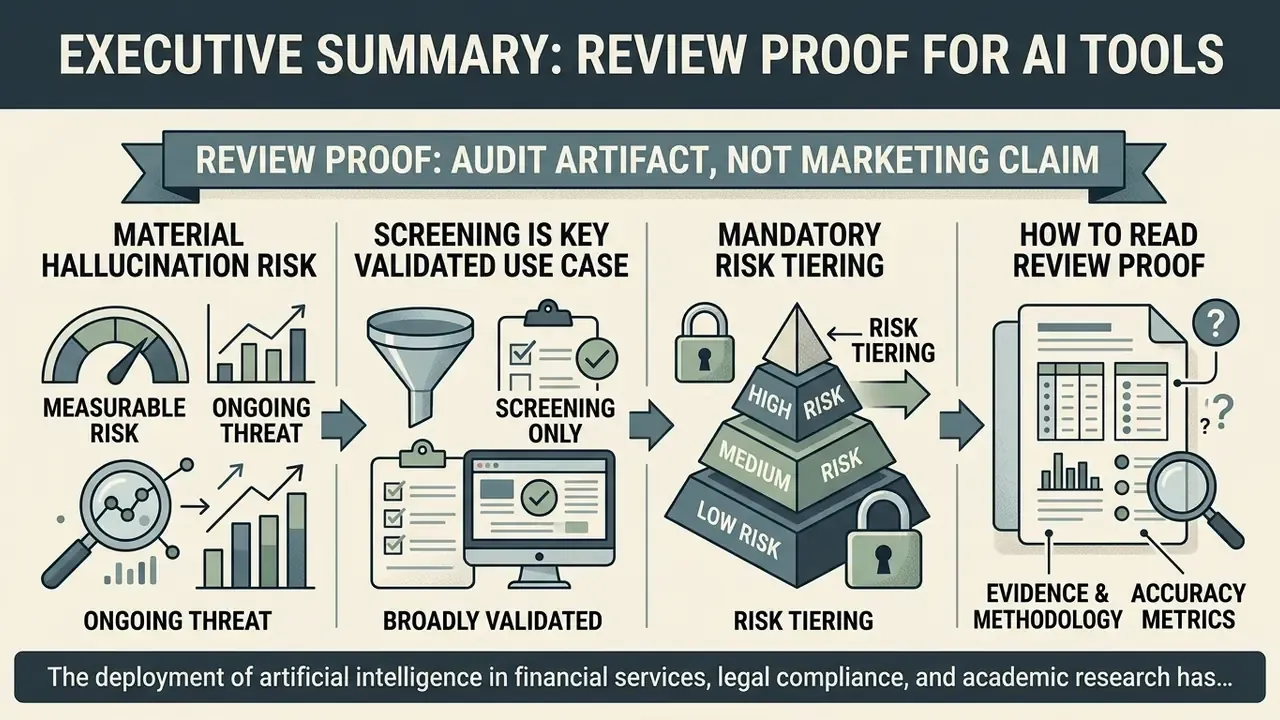
- Review proof is an audit artifact, not a marketing claim. It is the documented, reproducible evidence package proving that an AI tool performs a specific task at a measured error rate against a human gold standard.
- Hallucination risk remains material and measurable. Verified studies report fabricated-reference rates from 28.6% (GPT-4) to 91.4% (Bard) in systematic-review contexts, and up to 86% non-existent citations in controlled retrieval experiments.
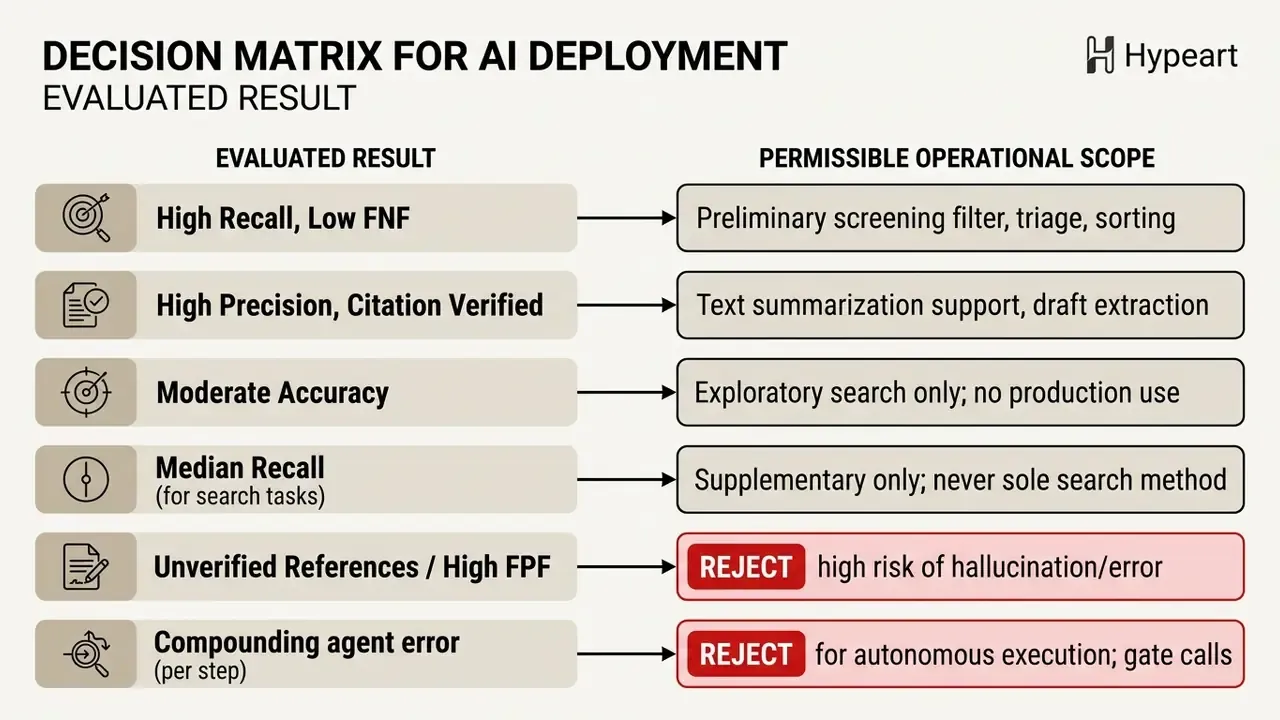
- Screening is the only broadly validated use case. Median recall of 96% to 97% for RCT identification and semi-automated abstract screening contrasts sharply with median recall of just 14% for AI-only literature searching.
- Risk tiering is mandatory. Full automation of inclusion and exclusion decisions is prohibited for Systematic Literature Reviews (SLR) and regulated model validation, yet defensible for Targeted Literature Reviews (TLR) and exploratory scoping.
How to read what follows. The article moves through one continuous line of reasoning: what review proof actually means, which categories of evidence hold up under challenge, why raw AI output cannot be accepted at face value, how to build a reproducible testing methodology, which metrics matter for accuracy and for agentic execution, how to run a fair comparison across candidate tools, how to interpret the resulting numbers against your risk appetite, and finally what to record so an auditor can repeat the whole exercise without calling you. A revision log sits at the end, on purpose.
The deployment of artificial intelligence in financial services, legal compliance, and academic research has shifted from experimental pilots to regulated production. Decision-makers now require reproducible evidence before approving generative tools, automated search agents, or machine learning pipelines. A vendor claim of high accuracy is simply insufficient for internal audit, a risk committee, or a regulatory inspection. Establishing a formal review proof for AI tool deployment provides the empirical baseline needed to validate data extraction, reference integrity, and analytical outputs.
What Review Proof Means for an AI Tool
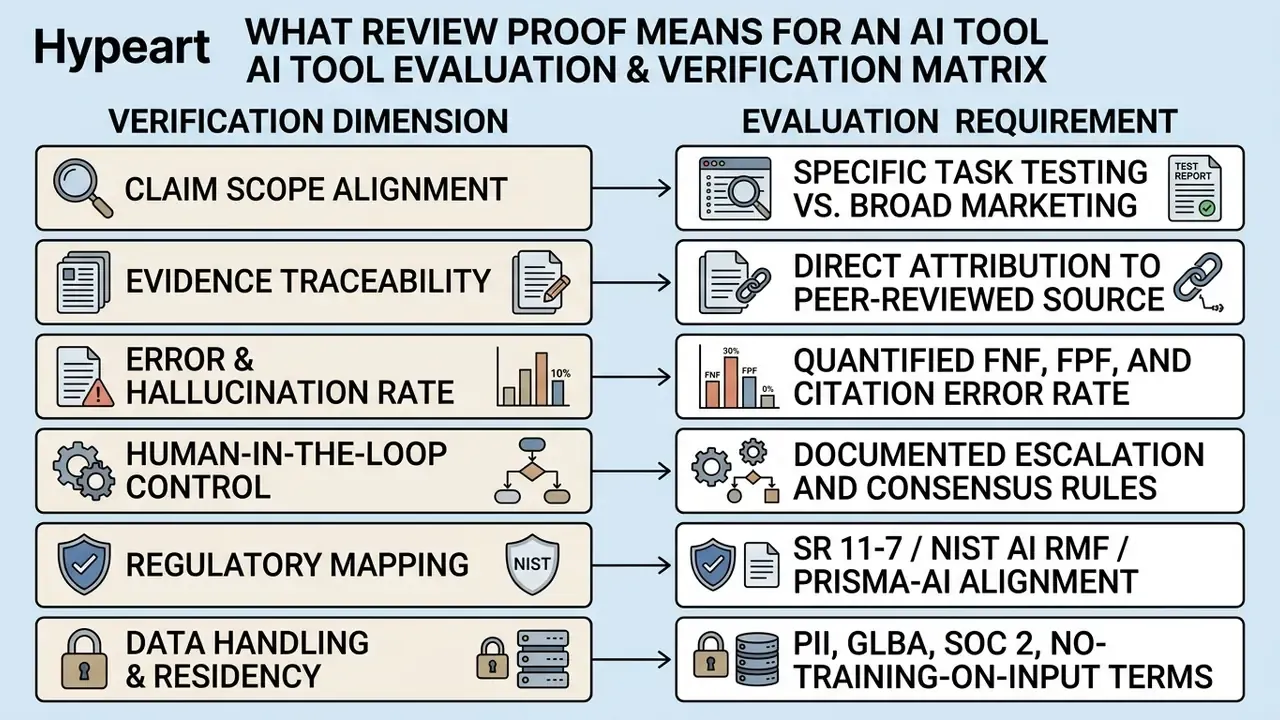
Review proof for an AI tool is a standardized, quantifiable audit trail. It verifies an algorithm's performance, precision, and operational boundaries against gold-standard human benchmarks before deployment. That empirical evaluation decides whether an artificial intelligence system is fit for purpose in research, literature review, model validation, and automated evidence synthesis workflows.
In model risk management (MRM) and enterprise AI governance, review proof draws the line between vendor marketing and verifiable capability. Broad promises about automated document analysis or instant synthesis rarely survive contact with a messy, real dataset.
"Many AI tools produce plausible outputs while systematically fabricating references or misrepresenting the literature, particularly on systematic-review tasks performed without access to structured databases."
Independent validation frameworks require three sequential checks before any claim is accepted: define precisely what is claimed, identify what was empirically tested, then determine whether the test data actually supports the claim. Benchmark success on clean datasets does not guarantee reliable execution during a live systematic review or a live model-validation task. This three-check logic is consistent with the National Institute of Standards and Technology AI Risk Management Framework 1.0 (NIST, 2023), which requires documenting objectives, scope, measured metrics, and explicit limits on generalizability beyond tested conditions. https://nvlpubs.nist.gov/nistpubs/ai/NIST.AI.100-1.pdf
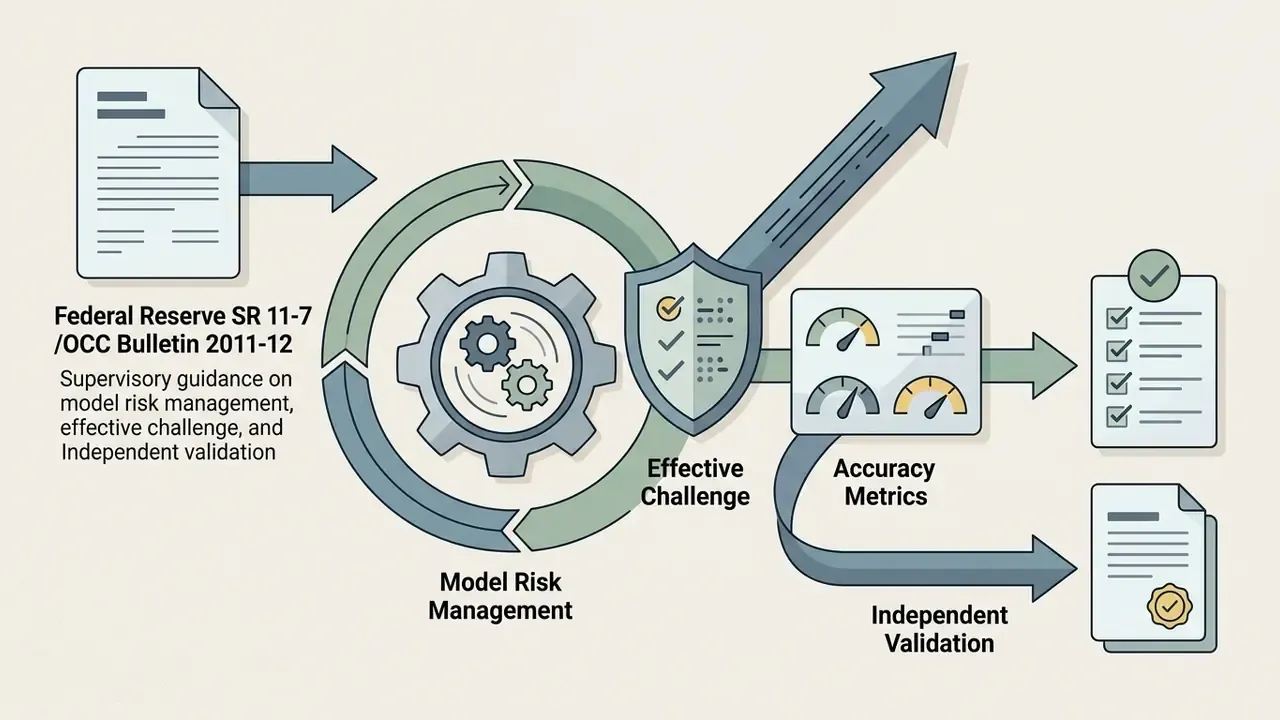
For financial institutions, none of this is new. Supervisory guidance on model risk management, the Federal Reserve SR 11-7 and OCC Bulletin 2011-12 framework, already requires conceptual soundness review, ongoing monitoring, and outcomes analysis for every model in the inventory. Generative and agentic AI tools inherit those obligations. An LLM that extracts covenant terms from credit agreements or drafts a regulatory disclosure is a model component, and it needs the same documented validation, effective challenge, and independent review as a statistical scorecard.
There is a prior question, though, and many institutions skip it: do you know how many AI tools are actually running? A review proof for one approved assistant proves little if analysts are pasting client files into consumer chatbots on personal devices. Shadow AI discovery, network telemetry, expense-report review, browser-extension inventories, and a low-friction registration path, belongs upstream of validation. An unregistered tool cannot be tested, cannot be tiered, and cannot be shut down cleanly. That last capability matters most on the bad day.
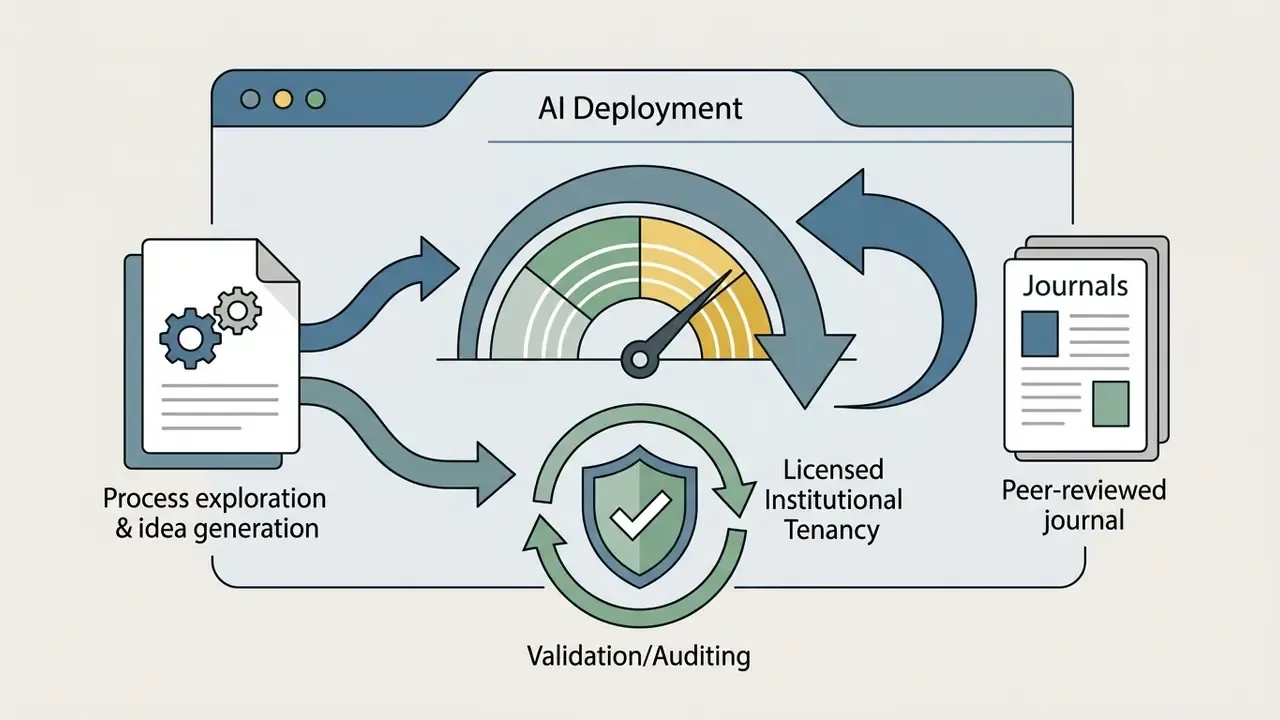
Integrating artificial intelligence into research and analytical workflows also means keeping human judgment as the final authority. According to the UK Government comparative evaluation on evidence review tools (2025), AI-assisted review pipelines show clear utility for prioritization and triage. They do not replicate full expert review or contextual critical appraisal. Independent validation frameworks therefore treat AI tools as decision-support systems rather than autonomous actors.
Leading health technology assessment and evidence synthesis bodies, including NICE (UK), the Campbell Collaboration, Cochrane, and JBI, explicitly mandate that AI tools operate as adjuncts to human expertise. NICE's position statement on AI methods in evidence generation requires that AI use be declared, justified, and critiqued by assessment groups. Institutional policies go further and require full disclosure of prompt configurations, tool versions, access dates, and algorithmic versioning in published syntheses. A 2026 Campbell Systematic Reviews "review of reviews" (Wei et al., Campbell Systematic Reviews, 22(2)) concluded that peer-reviewed evidence supports AI readiness only for human-supervised title and abstract screening, while readiness for other synthesis tasks remains insufficiently evaluated.
On platform infrastructure, one caution. If an organizational query references an unfamiliar vendor domain, say hypeart.ai, internal domain lookup as of August 2026 reveals no verified information about its legal entity, certifications, security attestations, or commercial product specifications. [Hypothetical scenario, illustrative] Proposed implementations built on such vendors should be treated as unvalidated hypotheses and put through empirical testing, SOC 2 review, and data-residency confirmation before any regulated data touches the system.
What Types of Evidence Validate AI Tool Performance
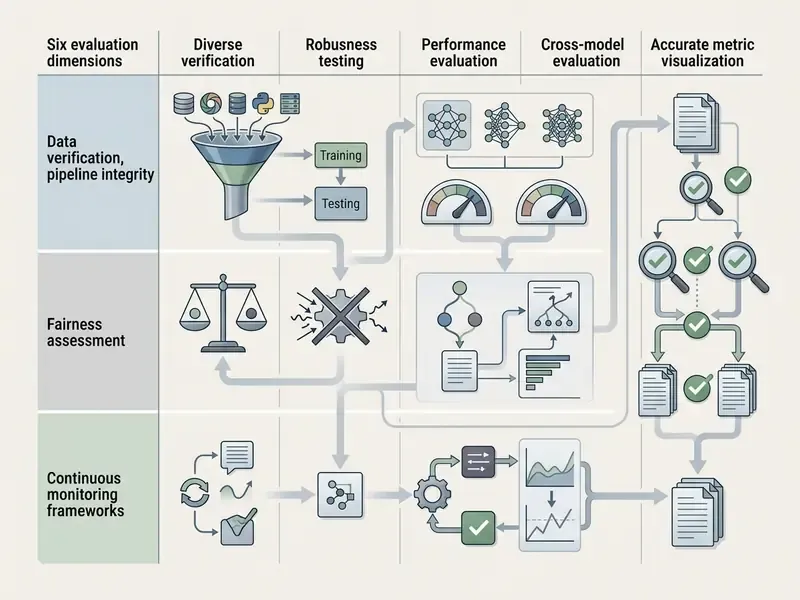
Reliable evidence about AI tool performance falls into four operational tiers. Each tier offers a different level of auditability for enterprise risk oversight and academic review.
- Peer-reviewed empirical studies published evaluations in journals such as Research Synthesis Methods, Journal of Clinical Epidemiology, or JMIR that test algorithms against standardized human benchmarks.
- Reproducible datasets publicly traceable test corpora with ground-truth labels, clear metadata, and documented versioning that permit independent replication. A 2024 methodological review defines independent reproducibility as reimplementing an experiment from published descriptions, without access to the original code or data.
- Documented use cases case studies specifying exact prompt parameters, software versioning, human oversight procedures, access dates, and step-by-step verification protocols.
- Evidence syntheses aggregated multi-study reviews that evaluate tool performance across diverse document formats and research questions.
"GPT-3.5 achieved 9.4% precision and 11.9% recall when reproducing references from gold-standard systematic reviews; its hallucination rate reached 39.6%."
Those figures explain why the hierarchy matters. A vendor demonstration sits at tier zero. A reproducible dataset with published precision and recall belongs to tier two, and it can survive audit challenge.
Formal standards back the same ordering. The ICH Q2(R2) guideline defines analytical validation through agreement with an accepted reference value, and defines reproducibility through inter-laboratory trial performance. The GOST R 59921.5-2022 standard defines analytical validation for artificial intelligence as independent verification that a system accurately, reproducibly, and reliably generates intended technical outputs from structured inputs. The FUTURE-AI framework adds mandatory testing on held-out datasets, comparison against the standard of care, and evaluation of robustness, safety, fairness, data drift, usability, and explainability. Enterprise adoption means verifying all four tiers before moving AI tools into controlled production.
Why AI-Generated Output Cannot Be Accepted Without Verification
"In a controlled experiment across 160 questions, ChatGPT generated 450 unique references, of which 86% did not exist; only 13.1% of answers were judged fully correct."
Across broader literature evaluations, hallucination rates in generated citations range from 28.6% to more than 91.4%, depending on model architecture, retrieval configuration, and prompt design. The failure mode is deceptive precisely because semantic quality and citation quality diverge:
"Across 216 clinical queries, GPT-4 answered correctly in 83.3% of cases, yet 63% of the references supplied in those same answers were fabricated."
That divergence is the core governance problem. A reviewer skimming for plausibility will approve output that is directionally right and evidentially hollow. A 2026 peer-reviewed analysis of research integrity argued that hallucinated citations in scholarly writing can constitute research misconduct when authors fail to verify AI output. In parallel, a May 2026 bibliometric analysis found that fabricated references in biomedical literature grew more than twelvefold in three years: from roughly one in 2,828 papers in 2023 to one in 458 by 2025.
The NIST AI Risk Management Framework treats algorithmic bias and hallucination as measurable operational risks to be identified and managed across the system lifecycle, not assumed away. In academic and regulatory settings, submitting unverified AI-generated content or fabricated citations can amount to research misconduct or a material control failure. Systematic human review, supported where useful by AI content detection tools as a triage signal rather than a verdict, stays mandatory to protect institutional integrity and maintain compliance.
E-E-A-T. Fact Check and Verification Criteria
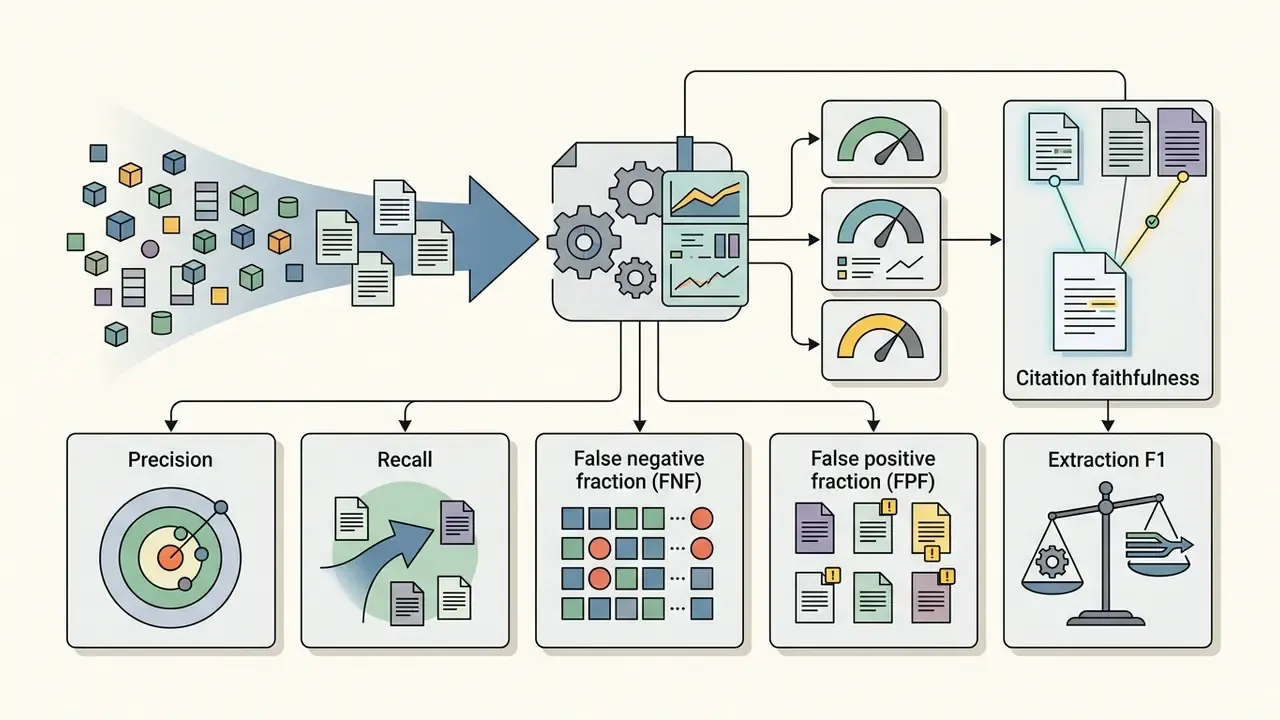
Reliability criteria for an AI tool's evidence base. To demonstrate operational fitness, the evidence package must contain: (1) a peer-reviewed evaluation source, (2) an openly described methodology, (3) a reproducible test dataset with gold-standard labels, (4) documented error boundaries (false negative fraction and false positive fraction), and (5) a defined human-in-the-loop protocol.
Review Proof Methodology for an AI Tool
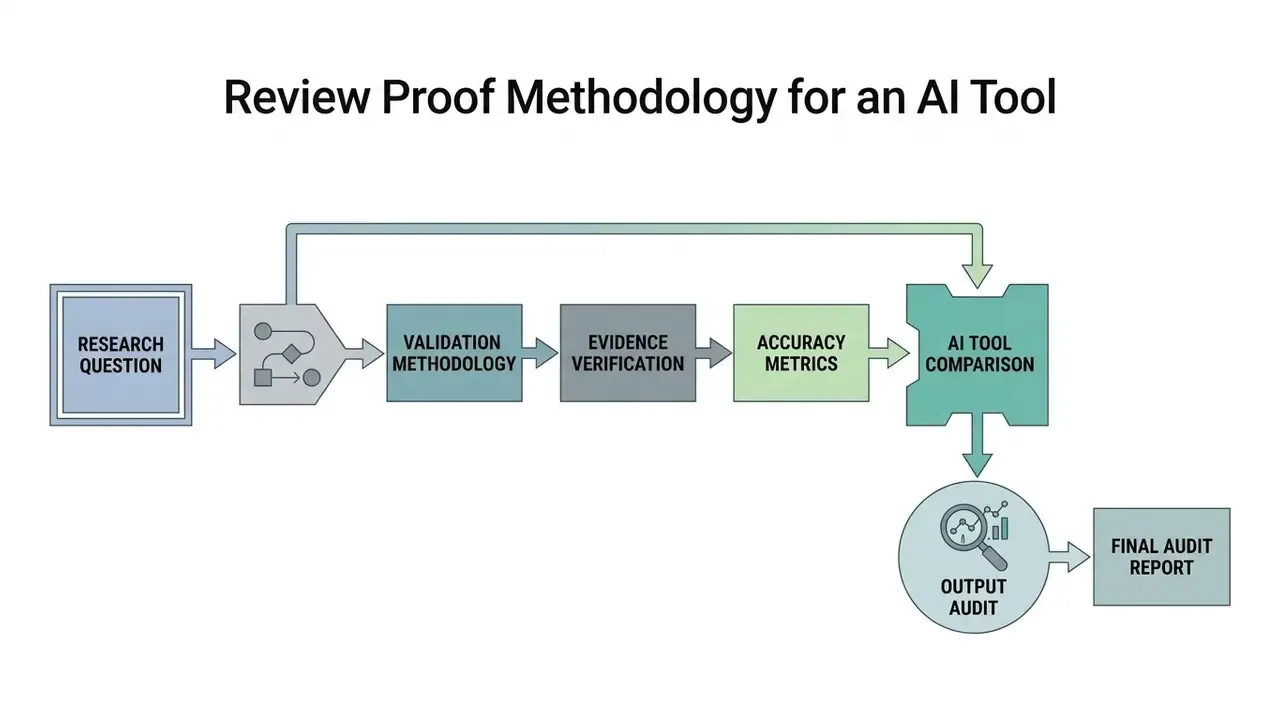
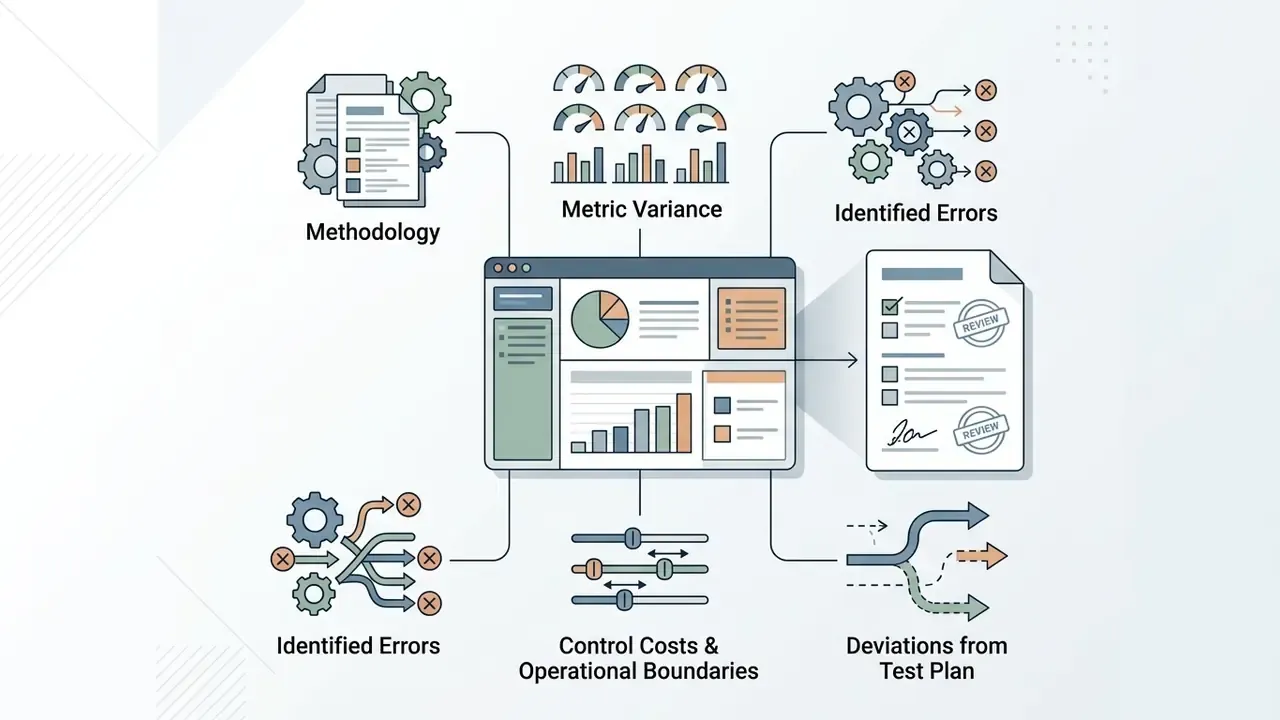
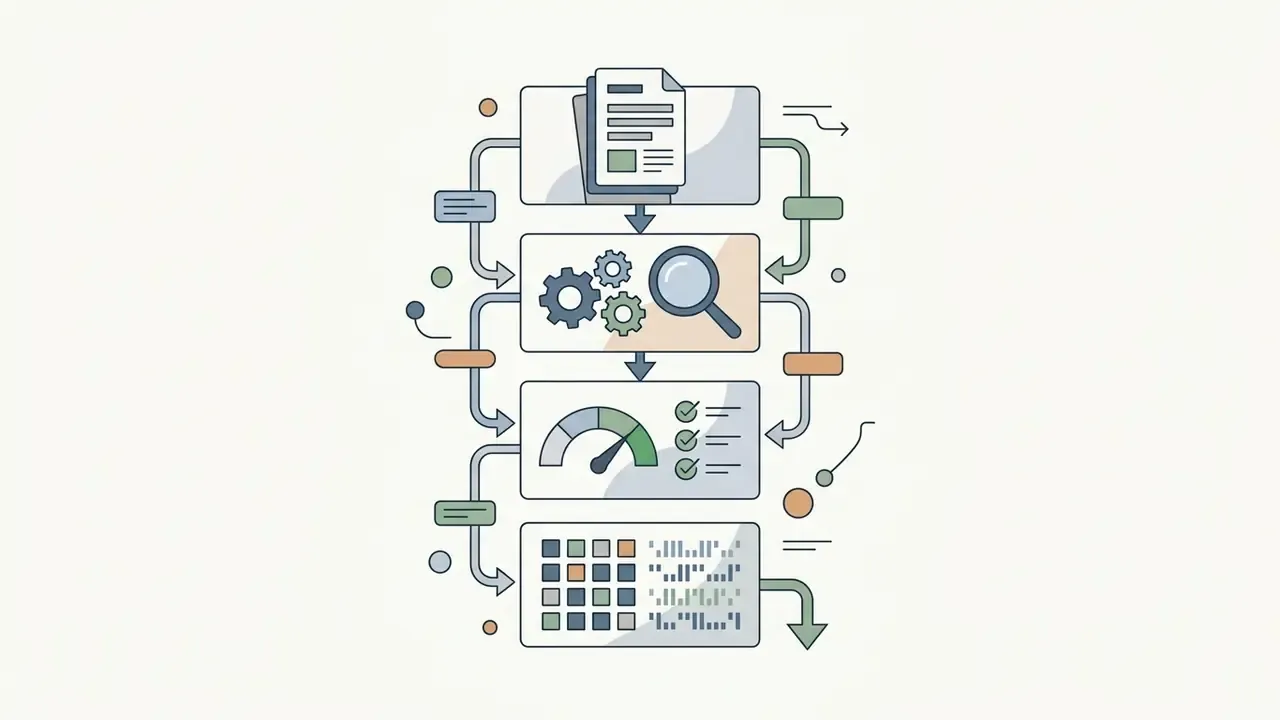
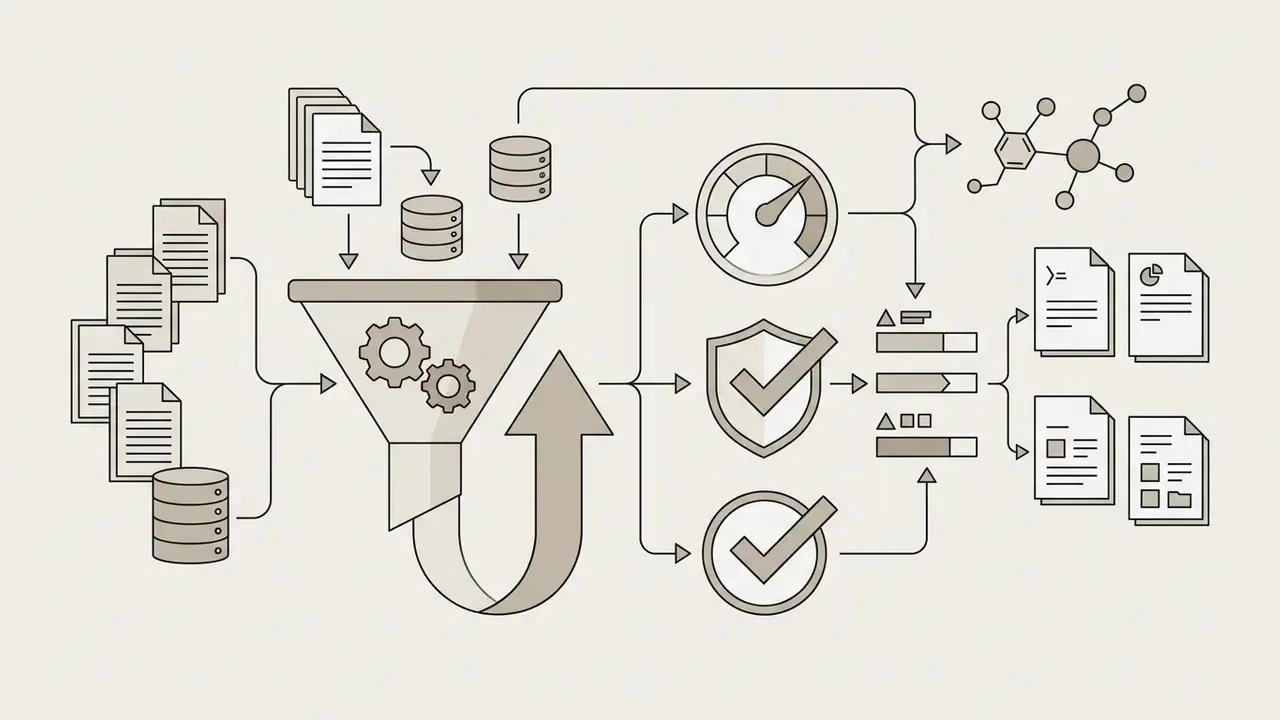
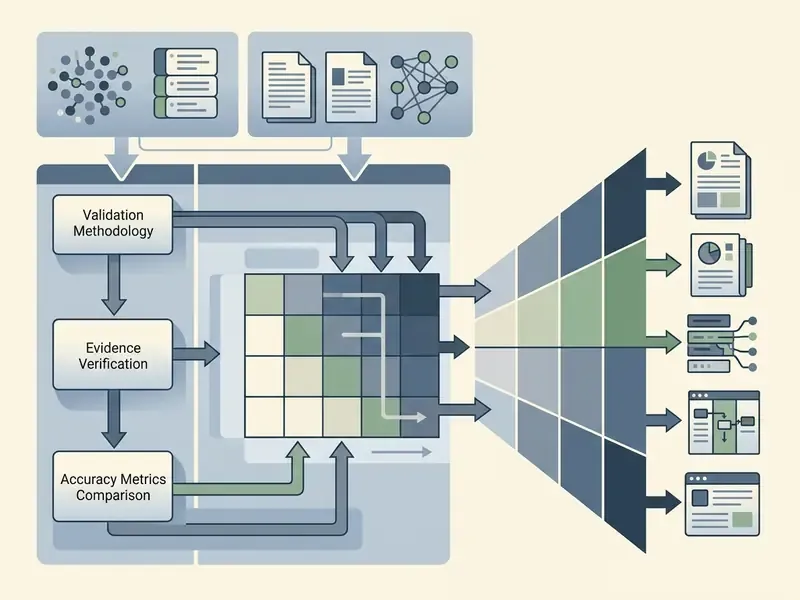
The review proof for AI tool methodology is a structured, three-stage validation framework for evaluating software quality before operational deployment: preparation and calibration, AI-assisted processing under locked parameters, and human validation with documented consensus.
Building a reproducible review proof methodology means documenting every phase of testing. Evaluators establish a baseline using an identical document corpus for both the manual and the automated pass. Structured protocols prevent configuration bias and produce metrics an audit committee can actually use. Published guidance for generative AI in evidence synthesis sets a concrete acceptance threshold: if extraction recall against the manual benchmark falls below 0.9, repeat the test with refined prompts before considering adoption.
To review additional evaluation frameworks across software categories, readers can examine our comprehensive Review Methodology guide.


Framing the Research Question and Selecting Test Materials
Evaluating an AI research assistant, or an enterprise extraction agent, starts with precise questions tied to explicit testing goals. In evidence synthesis, questions follow established frameworks such as PECO (Population, Exposure, Comparator, Outcome) or PICO. In financial and legal contexts the equivalent structure names the document class, the target field, the comparator process, and the accepted tolerance. For example: "Does the tool extract effective interest rates from 200 syndicated loan agreements at 98% or higher field-level accuracy versus a two-analyst manual benchmark?" Vague prompts produce uninformative results in both domains. Every time.
"Studies must ask concrete questions, for example whether an LLM reaches human-level accuracy when screening abstracts to identify RCTs in cardiology."
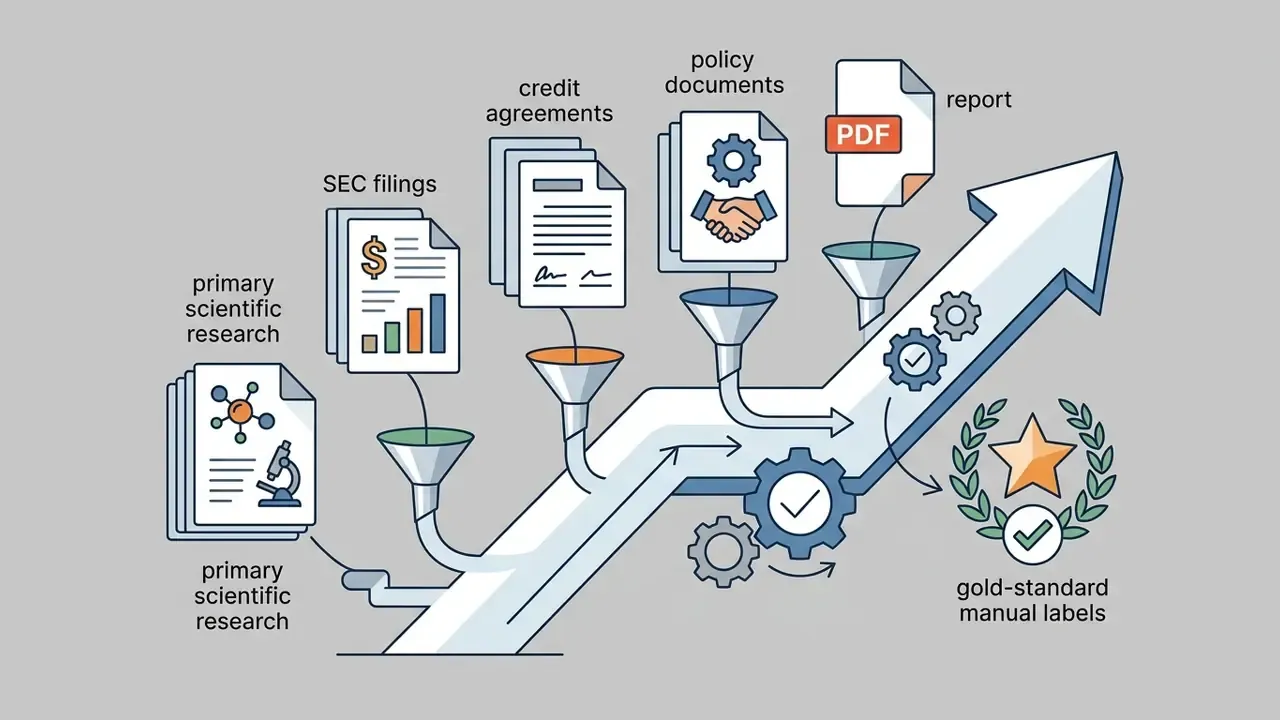
Corpus selection means picking documents that actually stress the model. Include peer-reviewed papers, literature reviews, complex tabular datasets, scanned PDFs, and for enterprise validation, SEC 10-K filings, quarterly earnings reports, underwriting files, AML alert narratives, and internal policy documents. According to Joanna Briggs Institute (JBI) guidelines, inclusion criteria must be pre-specified in an evaluation protocol, and duplicate independent selection prevents selection bias during corpus assembly. EFSA's mapping of systematic-review work (Question, Search, Screening, Appraisal, Synthesis, Certainty) offers a transferable structure for staged enterprise testing.
Project complexity shapes corpus design directly. Random sampling of titles and abstracts for a calibration set works acceptably for narrow clinical questions with few interventions. For heterogeneous domains, economic evaluations with cost, resource-use, and utility components, or mental-health literature with non-standardized terminology, selective stratified sampling is mandatory so every component appears in the calibration set. Enterprise corpora obey the same rule: a credit-risk extraction model calibrated only on investment-grade filings will degrade on distressed or non-standard documents.
Establishing the Baseline: Comparing AI Against Human Review
A baseline means comparing AI performance against an empirical reference standard built by domain experts. Human judgment is the benchmark that automated output is measured against, not the other way round.
For the comparison to hold, the same test dataset must be evaluated by human reviewers and by the AI system under identical conditions. Where only a subset carries human labels, AI scores must be computed on that identical subset. Expert annotations need explicit written guidelines to stay consistent. Statistical reliability metrics (Cohen's kappa, weighted kappa, Fleiss' kappa, or Krippendorff's alpha) should be computed to measure inter-annotator agreement among human evaluators, as specified in ITU-T FG-AI4H DEL5.3 (ITU, 2023). https://www.itu.int/en/ITU-T/focusgroups/ai4h/Documents/del/DEL05_3-A20230316-Prepub.pdf
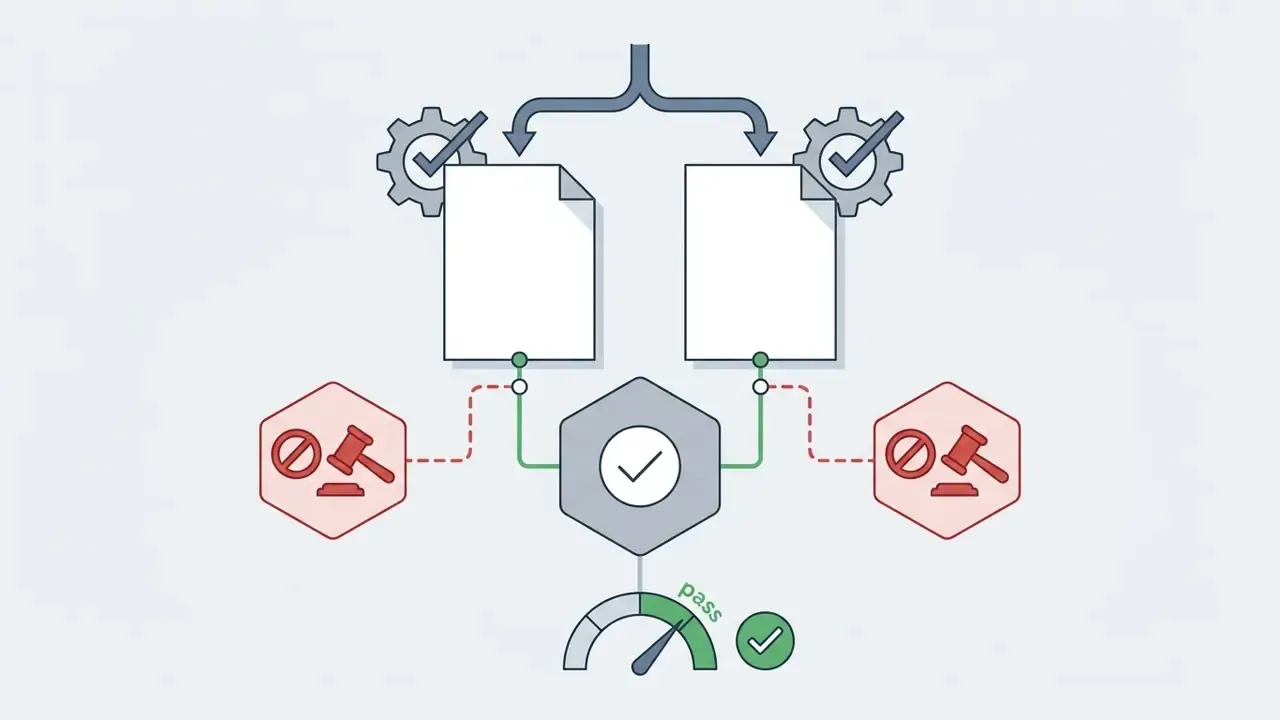
"A dual LLM-reviewer design with human arbitration on disagreement achieved 91% automation at an overall error rate of 8%."
That figure is the practical justification for human-in-the-loop architecture. Automation gains concentrate where the models agree; human cost concentrates where they diverge. Comparative evaluation frameworks recommend treating human expert judgments as gold-standard labels and scoring AI performance against those labels under identical normalization rules (Does AI help humans make better decisions? A statistical evaluation framework, Harvard, 2026). https://imai.fas.harvard.edu/research/files/ai.pdf
Control-cost calculation. A baseline is incomplete without the economics of oversight. Net benefit should be computed as:
Net benefit = (Hours saved x loaded analyst rate) - (Verification hours x loaded reviewer rate) - (API and licence cost) - (Expected error cost x residual error rate)
A tool that removes 60% of screening effort but requires 100% downstream verification of every extracted numeric field frequently lands on a negative net benefit in regulated workflows. Documenting that calculation turns an efficiency claim into a defensible business case, and it also gives Finance a reason to trust the number.
Accuracy Metrics and Output Quality for AI Tools
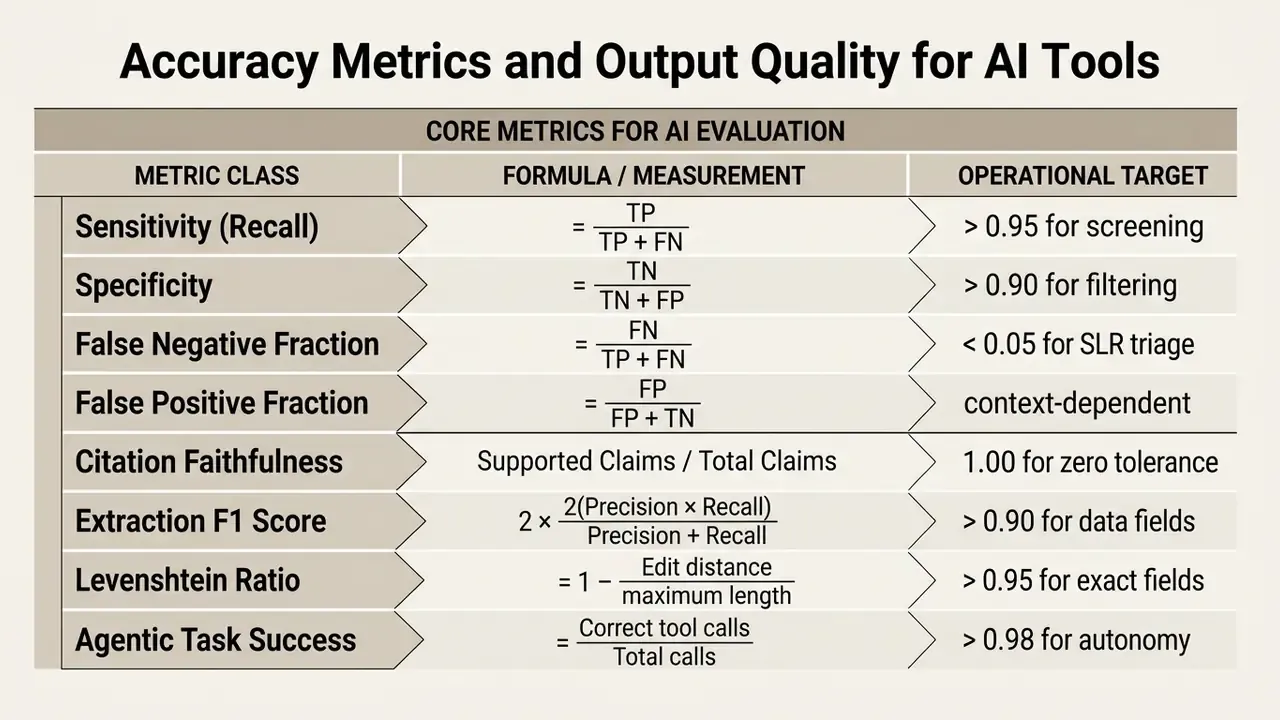
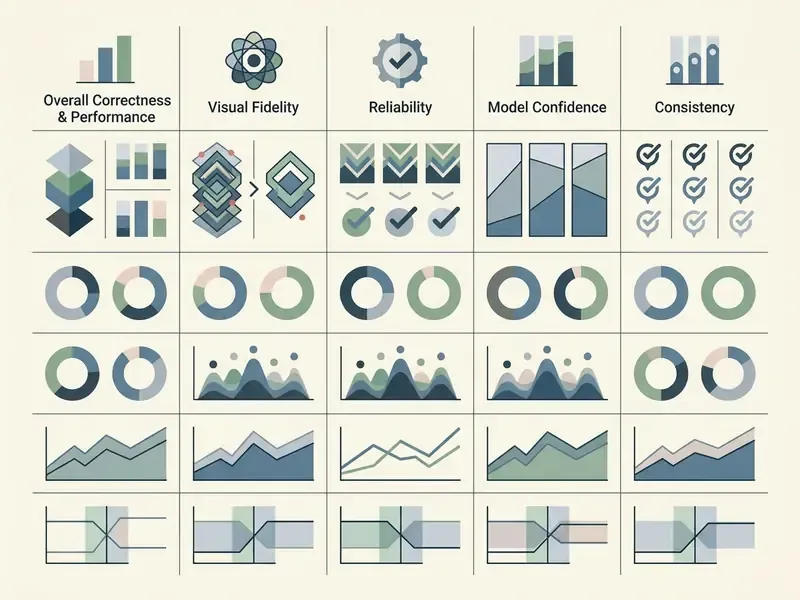
Evaluating the quality of artificial intelligence output means separating diagnostic accuracy from information retrieval performance and from data extraction precision. One accuracy percentage cannot characterize system reliability on complex research or analytical tasks.
Enterprise model risk frameworks expect computer-centered metrics alongside operational measures. Computer-centered metrics quantify error rates under controlled settings. Operational measures capture time savings, control costs, and workflow integration burden. Report both, or the picture stays flattering and useless.
Agentic AI adds metrics that classic accuracy testing misses. Multi-step agents that call APIs, query databases, or write to systems of record must also be scored on tool-selection accuracy (did it call the right function?), argument fidelity (were parameters correct?), permission adherence (did it stay inside its authorized scope?), loop containment (did it terminate?), and cascade error rate (how often does one wrong step corrupt the whole chain?). Do the arithmetic: 95% per-step accuracy across a ten-step chain yields roughly 60% end-to-end reliability. Unacceptable for regulated execution, and that calculation belongs in every agentic review proof.
One more nuance from financial operations. In KYC and AML workflows, the cost of a false negative and a false positive are not symmetric. A missed suspicious pattern is a regulatory exposure; a flood of false alerts is an operational tax on the investigations team, and eventually an alert-fatigue risk of its own. Review proof for a screening or alert-triage model should therefore report performance at the operating threshold the business will actually use, with alert volumes, analyst minutes per alert, and escalation accuracy stated next to recall. An abstract F1 score tells the committee almost nothing about tomorrow's queue.
Verifying Accuracy, Sources, and Evidence Integrity
Validating accuracy means confirming that generated text aligns with source documents and that every cited reference exists. Following the NIST AI Risk Management Framework 1.0 and its Generative AI Profile, evaluations should distinguish benchmark accuracy (performance on a fixed, known test set) from generalized accuracy (performance on unseen real-world documents), and must state explicit limits on generalizability beyond tested conditions.
"On a sample of 1,000 publications, RobotSearch produced the lowest false negative fraction, 6.4% (95% CI 4.6 to 8.9%); four LLMs achieved false positive fractions between 2.8% and 3.8%, well below RobotSearch's 22.2%."
That split matters operationally. Classical classifiers still win on recall (missing fewer relevant studies), while LLMs win on precision (producing less noise). A defensible screening pipeline therefore often chains both rather than choosing one.
Citation accuracy is evaluated by cross-checking generated references against authoritative scholarly databases such as PubMed, Crossref, or OpenAlex. Hallucination is scored by marking a reference fabricated when any two of title, first author, or publication year fail to match.
Updated (verified source).
"Citation hallucination ranged from 28.6% for GPT-4 to 91.4% for Bard across 471 references generated for 11 systematic reviews."
Atomic claim evaluation complements reference checking. Each answer is decomposed into individual claims, and every claim is labelled supported, partially hallucinated, or fully hallucinated against the retrieved context. Citation faithfulness is then the ratio of claims directly supported by retrieved source text relative to unverified statements. Because exact-match reference checks and claim-level grounding capture different failure modes, report both.
Journal authority and evidence hierarchy signals. Beyond basic DOI resolution, automated evidence verification should evaluate publisher authority. Auditing protocols can integrate API checks for SJR (SCImago Journal Rank), SNIP (Source Normalized Impact per Paper), citation counts, and quartile rankings (Q1 to Q4), mapping results onto the clinical or domain evidence hierarchy. A resolvable DOI from an unindexed, predatory, or retraction-heavy journal is not high-grade research proof. This gap is documented: a 2026 JMIR analysis of AI tools citing retracted literature found that no free-access generative system reliably detected or flagged retracted papers, so retraction status must be checked independently against Retraction Watch or Crossref retraction notices.
Evaluating Data Extraction and Synthesis
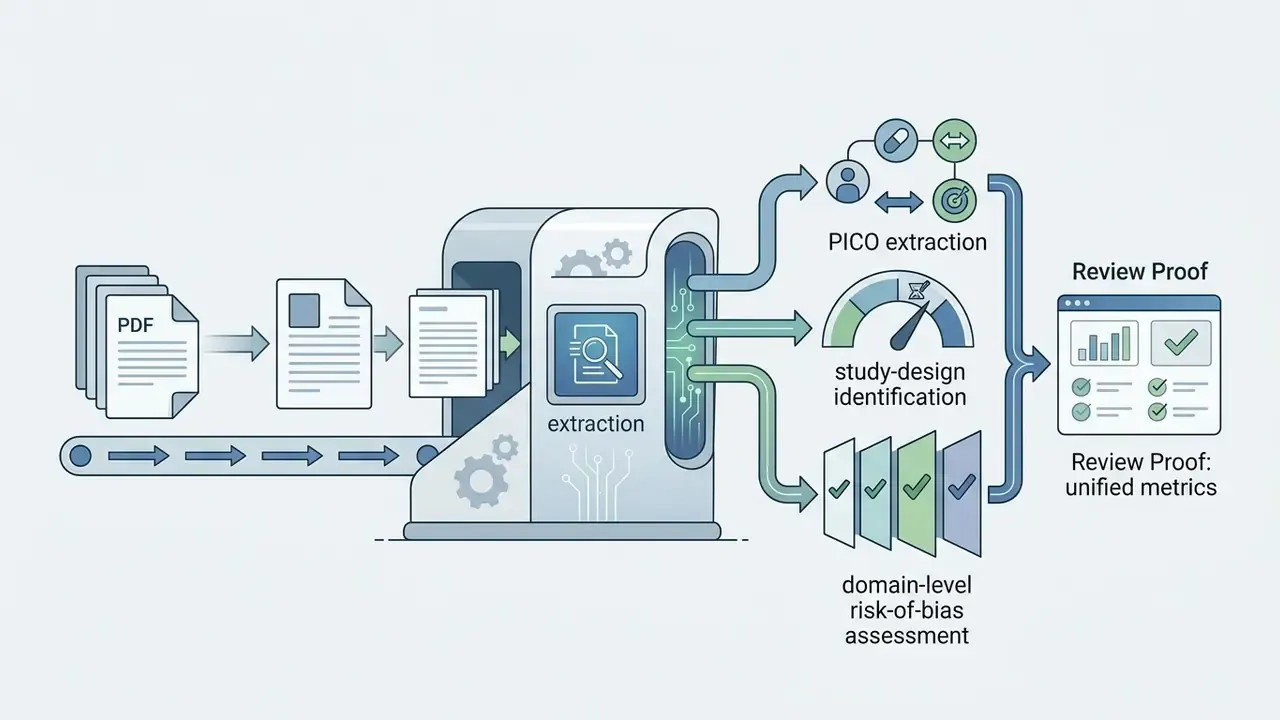
Automated data extraction from complex documents requires evaluating structural fidelity and textual accuracy together. Standard extraction forms must define explicit fields: study design, methodology, sample size, quantitative outcomes; or, in financial contexts, issuer, instrument, covenant threshold, effective date, and reported figure. JBI's manual for evidence synthesis requires a draft charting form at protocol stage, not after data collection has begun.
Extraction accuracy is evaluated with precision, recall, F1 score, and Levenshtein distance against manually verified data tables. In automated synthesis evaluations, systems are scored on sensitivity, defined as TP / (TP + FP₁ + FN), and specificity, defined as TN / (TN + FP₂), alongside variable-detection comprehensiveness, calculated as (TP + FP₁) / (TP + FP₁ + FN). Automated synthesis quality is further governed by risk-of-bias tools and structured evidence tables that discourage selective reporting.
Accuracy alone, though, understates the reproducibility problem:
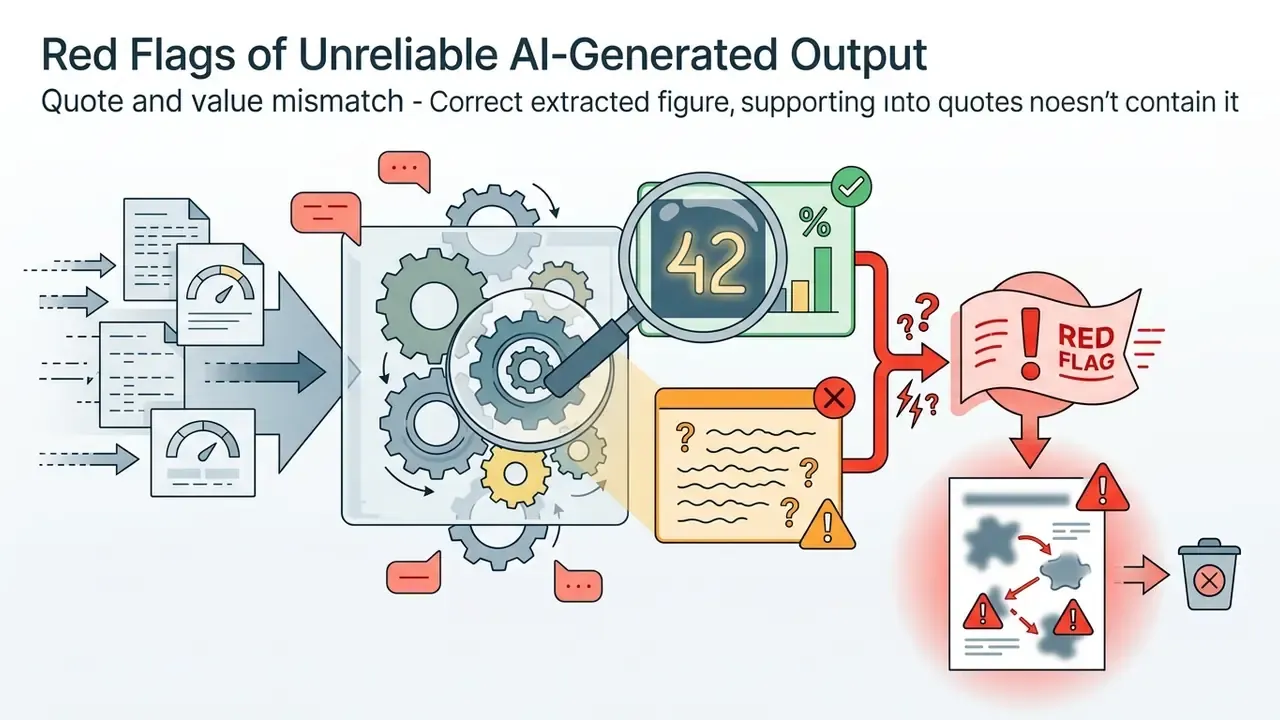
"Of 90 data-extraction prompts, 70 exceeded 87% accuracy against the gold standard; yet supporting-quote agreement was only 46%, and reasoning agreement just 30%."
The implication is precise. A tool can return the right number while pointing at the wrong sentence and reasoning from the wrong logic. For audit purposes, correct-but-unjustified output is a control failure, because the evidence trail cannot be independently reconstructed. Extraction validation must therefore score three layers, value, supporting quote, and reasoning, not value alone.
Practical experience across evidence synthesis programmes shows a clear capability gradient too. AI-assisted extraction of key study characteristics (design, country, sample size, publication year) is substantially more reliable than extraction of patient-level characteristics and endpoint data, where numeric nuance, subgroup structure, and footnoted definitions drive frequent errors. Enterprise analogues follow the same pattern: header-level metadata extracts cleanly, nested tabular financials and conditional covenant language do not.
E-E-A-T. Key Sources and Institutional Guidance


How to Compare AI Tools Against Unified Criteria
A defensible review proof comparison runs a five-stage protocol across every candidate platform: This sequence mirrors the CDUR protocol for research-software evaluation (Citation, Dissemination, Use, Research) and the classical shortlist-then-pilot approach: define functional and non-functional requirements, select candidates, then pilot the finalists in an identical environment.
- Define objective criteria and weightings.
- Standardize test artifacts (identical corpus, identical prompts, identical dates).
- Apply criteria independently by more than one assessor.
- Record empirical performance data with evidence for each score.
- Consolidate comparative scores and document the interpretation rules.
"A review of 222 studies identified 65 distinct AI tools; more than half of the publications (54.1%) appeared in 2024, reflecting a sharp rise in interest in LLMs for evidence synthesis."
With sixty-five tools in circulation and a publication base barely two years old, vendor-supplied benchmarks cannot be compared across products. Unified criteria plus an in-house test corpus remain the only reliable basis for selection.
Comparing platforms means evaluating data source coverage, citation fidelity, extraction quality, security posture, and licensing structure. Selecting the best AI research assistant depends on whether the organization needs high-recall literature searching or high-precision data extraction from proprietary PDFs. Free AI tools often impose rate limits, lack full-text indexing, or output unverified content, which makes empirical validation essential rather than optional. Teams comparing general-purpose generative platforms in adjacent contexts can also review our analysis of ChatGPT image generation versus alternatives as a template for criteria-based scoring, and consult our AI Video Tools Comparison Matrix for multimedia evaluation criteria.
| Tool / Platform | Primary Data Sources | Data Extraction Accuracy | Citation Fidelity | Free Access Tier | Human Review Requirement |
|---|---|---|---|---|---|
| Elicit | Semantic Scholar, OpenAlex, PubMed, ClinicalTrials.gov, preprints (125M+ papers) | High for structured variables (87%+); low reasoning reproducibility (30%) | High (direct linking to source quotes) | Free tier with credit limits | Mandatory for qualitative synthesis |
| Scite | Publisher indexing agreements, Unpaywall, PubMed, preprint servers (200M+ sources, 1.2B+ citation statements) | High for citation context classification | Very high (Smart Citations with Supporting/Mentioning/Contrasting labels) | Limited free trial; subscription required | Recommended for context interpretation |
| Consensus | Semantic Scholar, PubMed (200M+ papers) | Moderate to high for consensus summaries | High (claims tied to peer-reviewed papers) | Free basic tier with query caps | Mandatory for controversial topics |
| Perplexity | Open web search, academic indexing integrations | Variable (depends on retrieved web results) | Moderate (risk of preprints and non-peer-reviewed sources) | Free basic search; Pro tier available | Mandatory for scholarly work |
| General LLMs (ChatGPT-4o, Claude 3.5) | Pre-trained web data, user PDF uploads | High for text parsing; variable for complex tables | Low to moderate (28.6% to 91.4% hallucination without retrieval grounding) | Free versions available (limited models) | Mandatory (100% human verification) |
| Enterprise RAG on internal corpora | Institution-controlled document stores | High when chunking and schema are tuned | High if answers cite retrieved passages | Not applicable (build cost) | Mandatory field-level sampling |
| Agentic frameworks / autonomous workflows | Tool and API calls over internal systems | Task-dependent; compounding step error | Depends on retrieval layer | Not applicable | Mandatory; permission gating required |
| Domain-specialized financial LLMs | Filings, transcripts, market data | High for structured filings | Moderate to high with source anchoring | Rarely | Mandatory for disclosure-grade output |
Table note: performance parameters reflect empirical studies published between 2024 and 2026. Extraction accuracy and citation fidelity fluctuate with document quality, prompt structure, retrieval configuration, and database access limits. Institutional coverage figures vary by vendor page and update date.
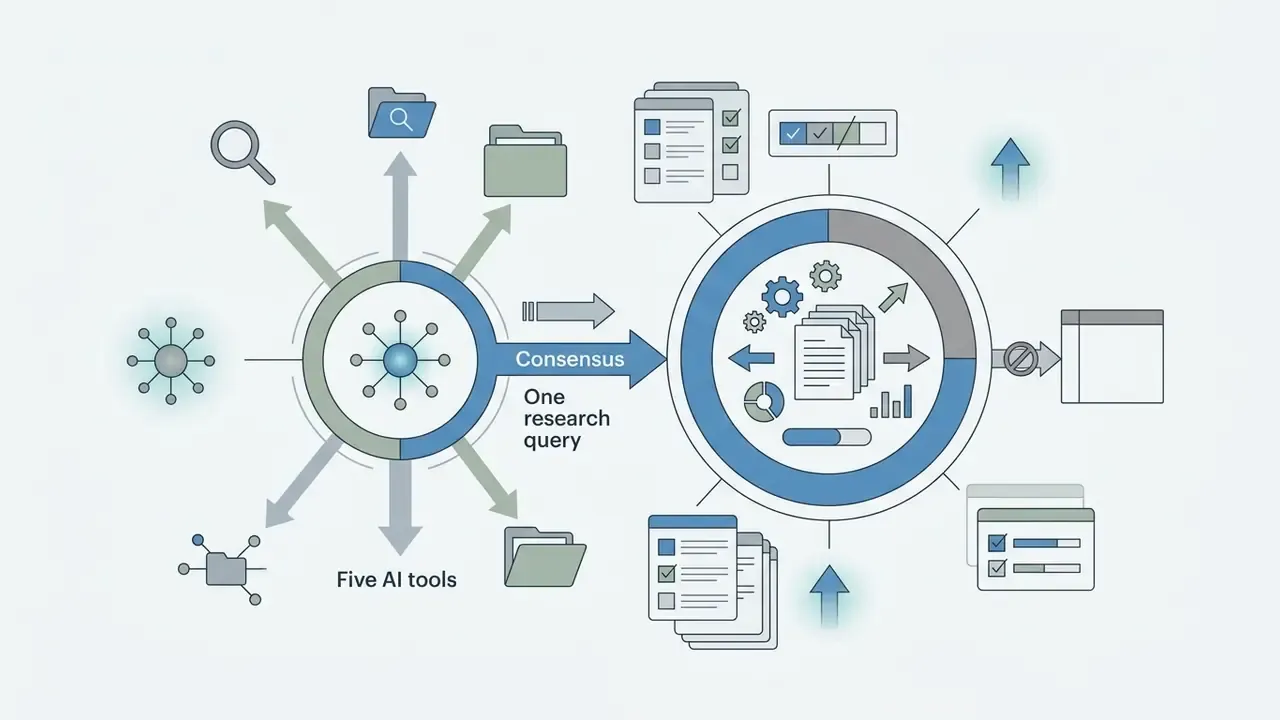
Worked Example: Benchmarking One Research Query Across Five Tools
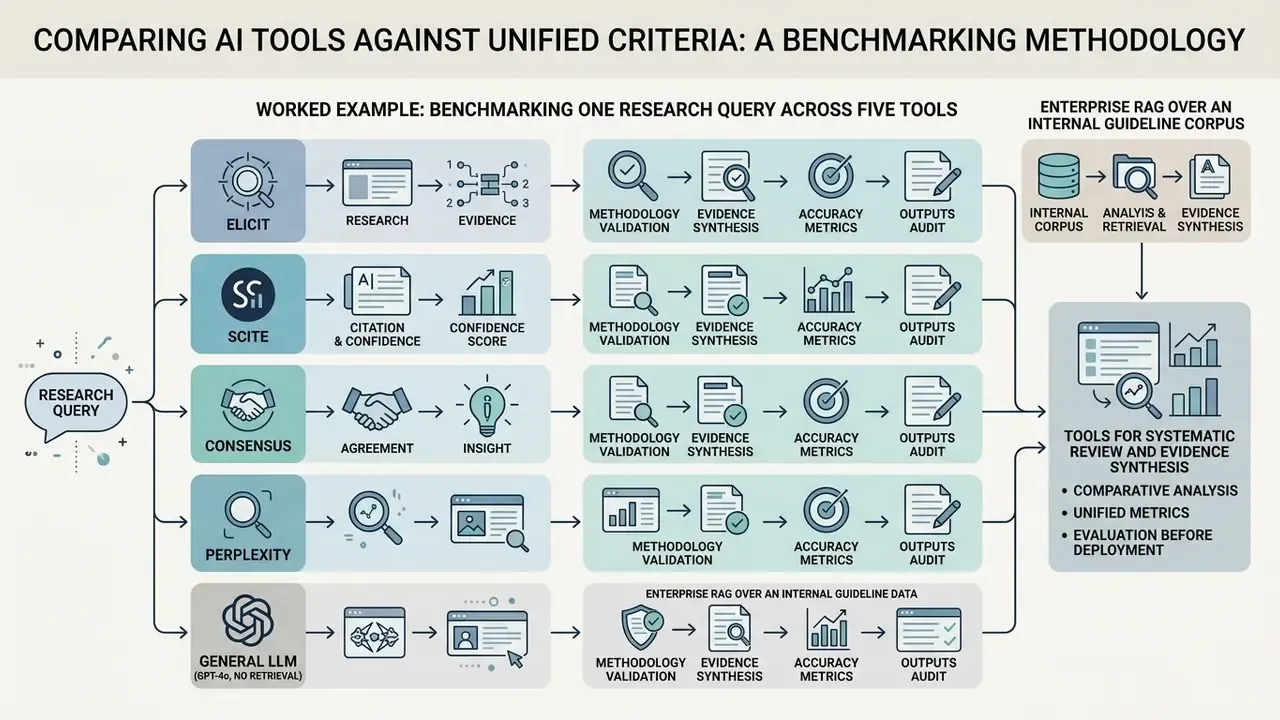
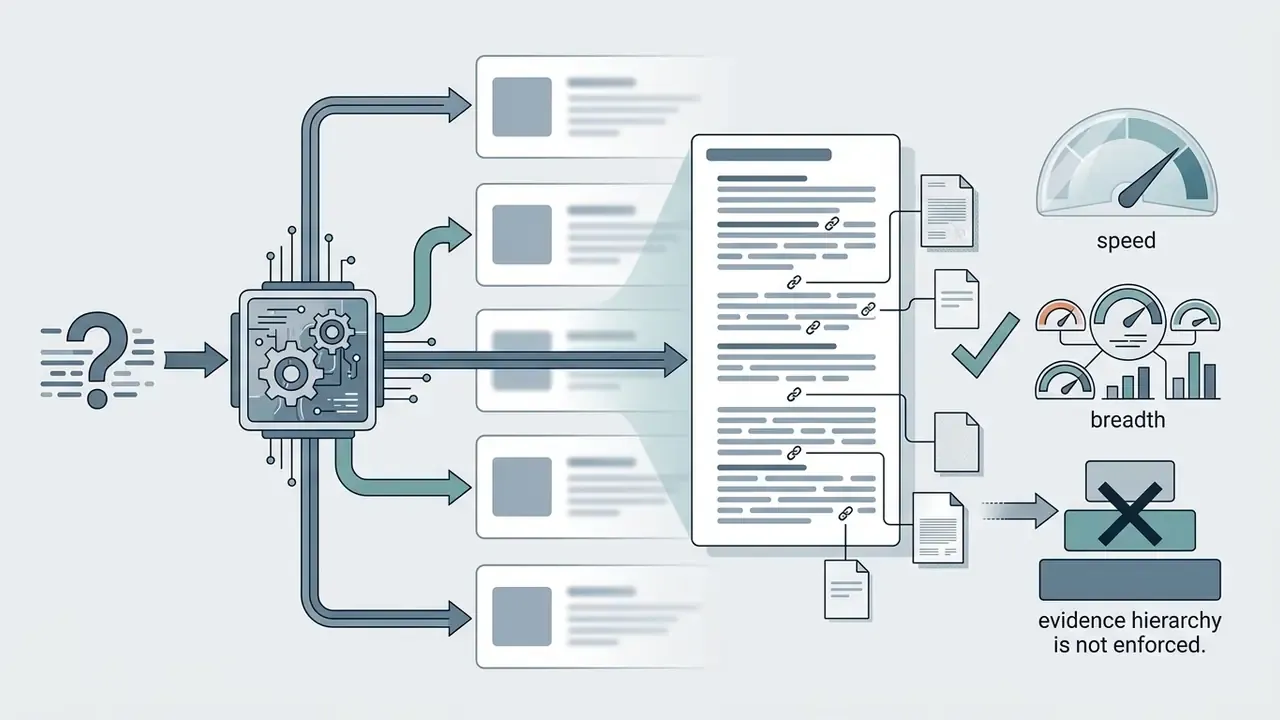
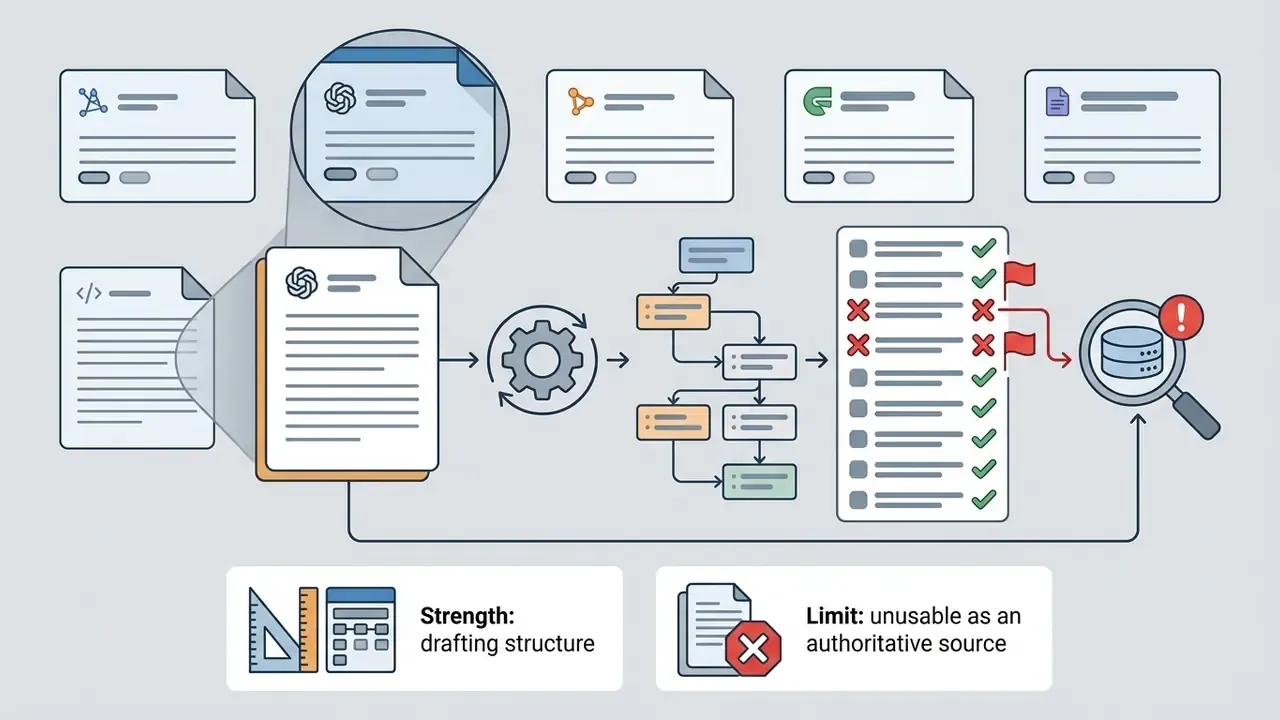
A static feature table cannot show where a tool stops being useful. Routing one identical question through every candidate does. Query: "Does metformin reduce all-cause mortality in non-diabetic adults?"
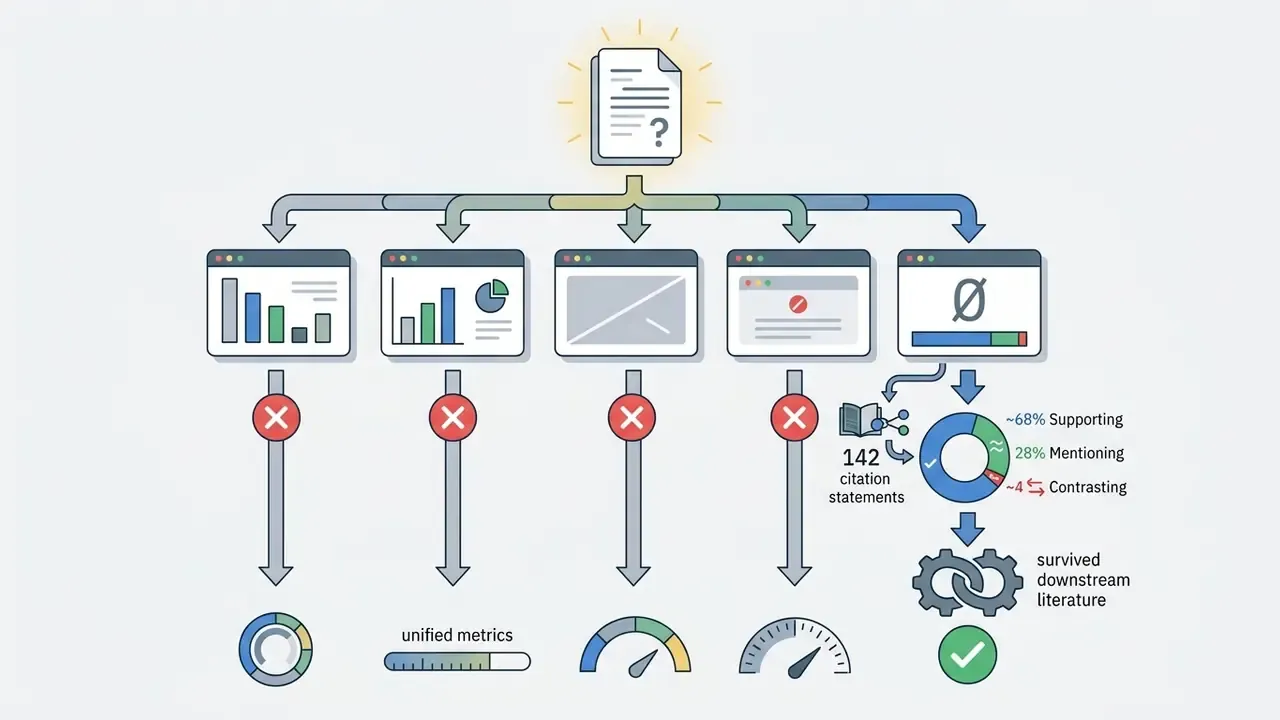
The comparison demonstrates the general rule: no single tool spans discovery, durability, extraction, and drafting. Defensible workflows chain a high-recall retriever, a citation-context validator, a structured extractor, and a grounded drafting layer, with a named human verifier at each handoff.


Tools for Systematic Review and Evidence Synthesis
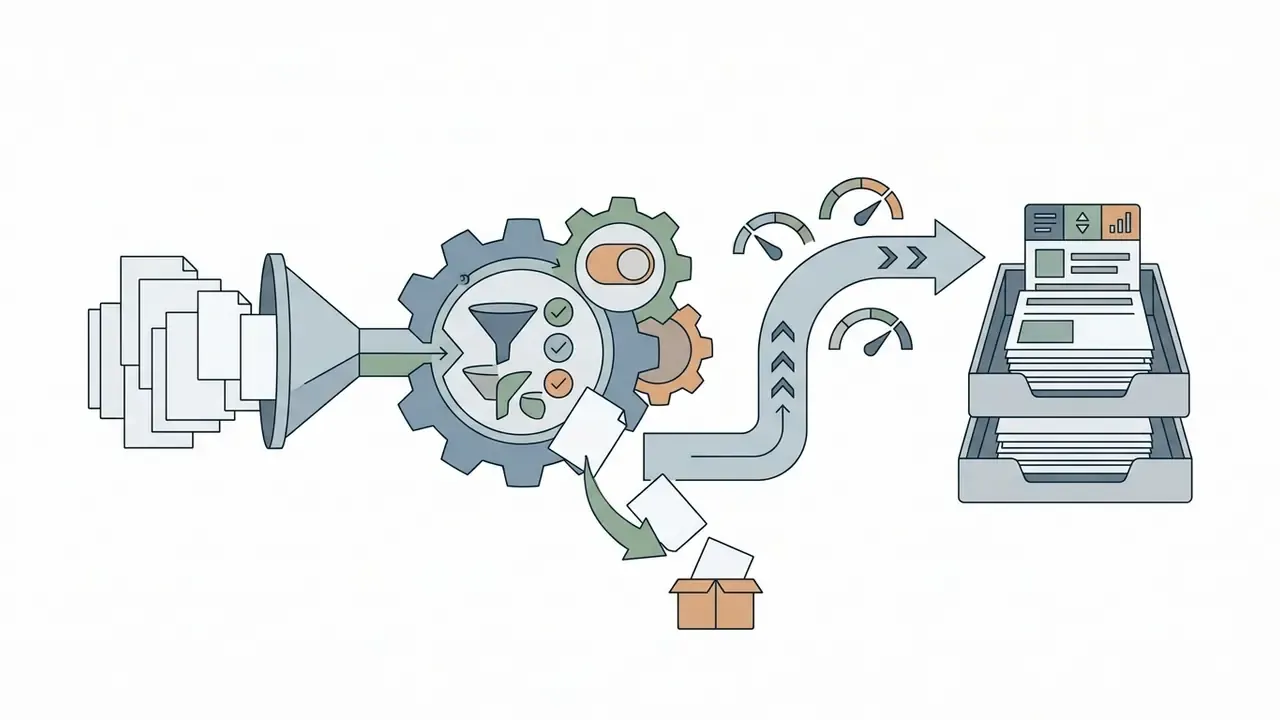
"RCT identification tools showed median recall of 96% and median precision of 79%; semi-automated abstract screening models achieved median recall of 97% with a 51% workload reduction."
Studies stress that automated systems cannot make final inclusion or exclusion decisions without human reviewer confirmation. The current institutional and open-source stack includes:
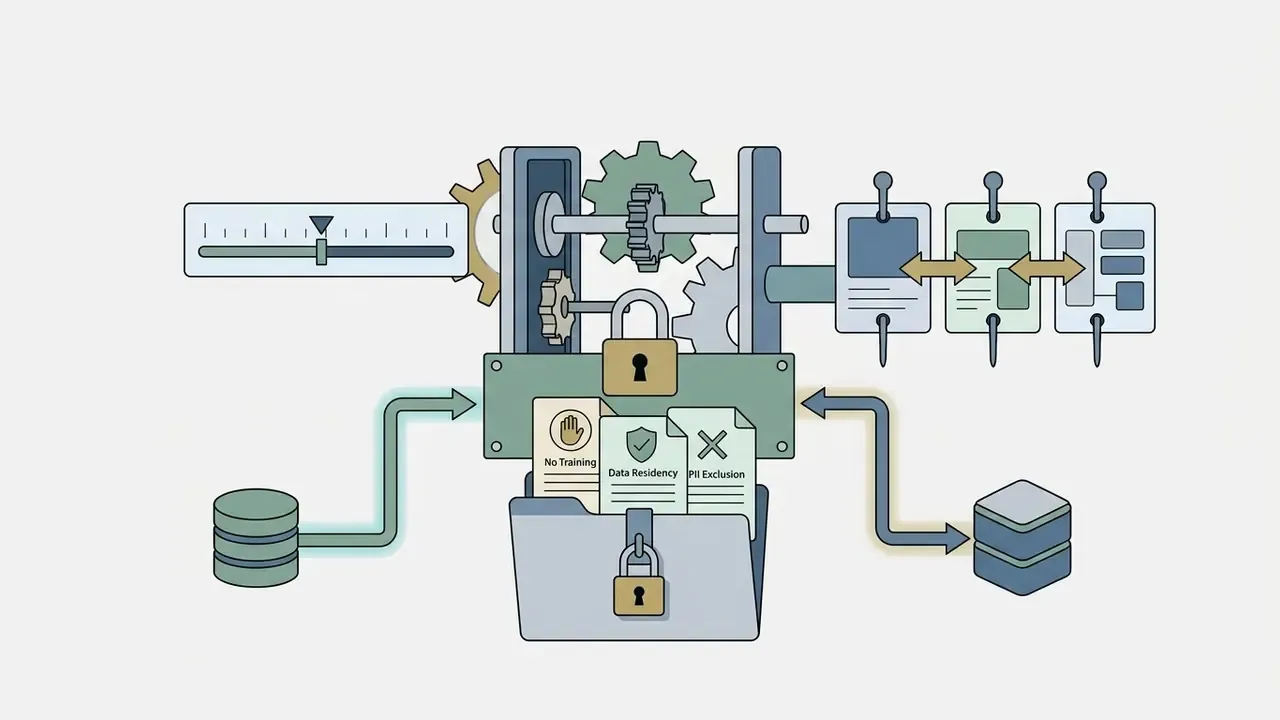
Copyright and confidentiality constraint: uploading full-text copyrighted articles into a general AI tool for summarization is prohibited by most publisher licences. Confidential customer data, PII, and material non-public information require contractual no-training terms, defined data residency, and GLBA and SOC 2 consistent controls before any upload.



SLR versus TLR Operational Protocols
Tools for Academic Research and Literature Review
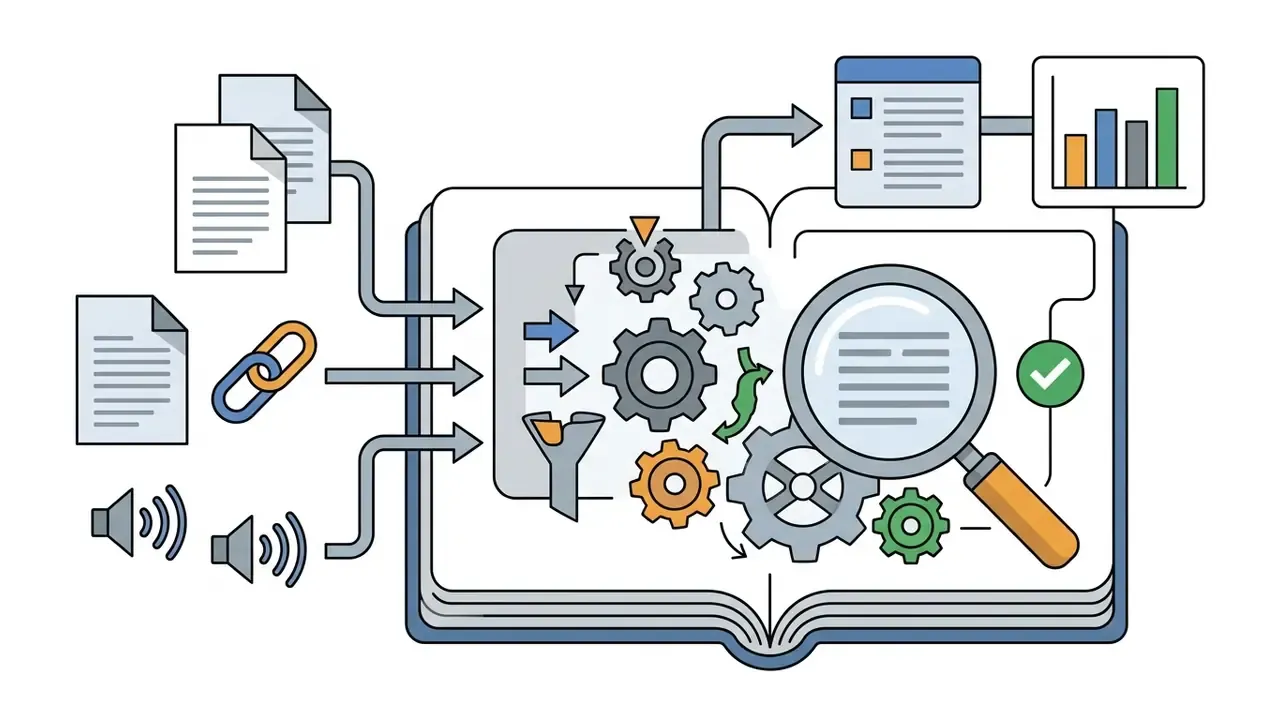
Academic research tools concentrate on paper discovery, rapid document summarization, and PDF question answering. Modern Q&A tools let researchers interrogate documents and pull out key findings, and a 2024 systematic survey of AI techniques for systematic review tasks confirms that LLMs are already deployed for screening, summarization, and cross-checking of scientific literature.
A 2025 systematic survey in JMIR AI evaluated tools such as Elicit and ChatPDF against traditional PRISMA search methods.
"Elicit achieved 51.4% extraction accuracy and ChatPDF 60.3% when identifying methodological details; both accelerate initial screening but do not replace structured review."
The study concluded that AI reading assistants accelerate initial screening and literature reviews, while traditional structured literature workflows remain necessary to guarantee accuracy and reproducibility. A 2025 review in the Journal of Clinical Epidemiology reached a compatible verdict on large language models for conducting systematic reviews: on the rise, not yet ready for unsupervised use.
The enterprise equivalent of "PDF Q&A" is document-grounded retrieval over internal corpora: credit files, policy manuals, filings, complaint logs. The evaluation logic transfers unchanged. Measure field-level extraction accuracy, quote-level traceability, and refusal behaviour when the answer is absent from the corpus. A retrieval system that answers confidently from parametric memory, when the corpus contains nothing, is more dangerous than one that returns "not found".
How to Interpret Review Proof and Test Results
"Literature search tools showed median recall of only 14% and median precision of 0.09, meaning AI-only search strategies remain unsafe for comprehensive evidence identification."
That number sets the hard boundary of the technology as of 2026. AI is a defensible prioritizer of a human-built search, and an indefensible replacement for one. Any workflow that lets a model construct the search strategy unsupervised should be treated as a failed control.
Results That Can Be Used as Decision Support
AI tools work well as decision-support aids when embedded in human-in-the-loop workflows. Acceptable support applications include:
- Prioritizing titles and abstracts during preliminary literature screening.
- Truncating screening once a pre-specified recall target is documented and audited.
- Generating initial document summaries to speed up human reading.
- Sorting large document corpora by topic relevance or study design.
- Drafting preliminary data extraction tables for human verification.
- Drafting plain-language summaries for later expert correction.
- Suggesting candidate keywords and search facets for a human-curated query.
Guidance from Veritas Health Innovation and evidence synthesis standards defines AI-assisted title and abstract screening as a seven-step workflow that keeps humans inside the review process and treats AI as support, never as replacement. A 2024 guideline-development study confirmed that active-learning tools accelerate screening in real guideline production. In these scenarios the human reviewer retains full decision-making responsibility, verifies every final data entry, and documents where AI was applied.
Red Flags of Unreliable AI-Generated Output
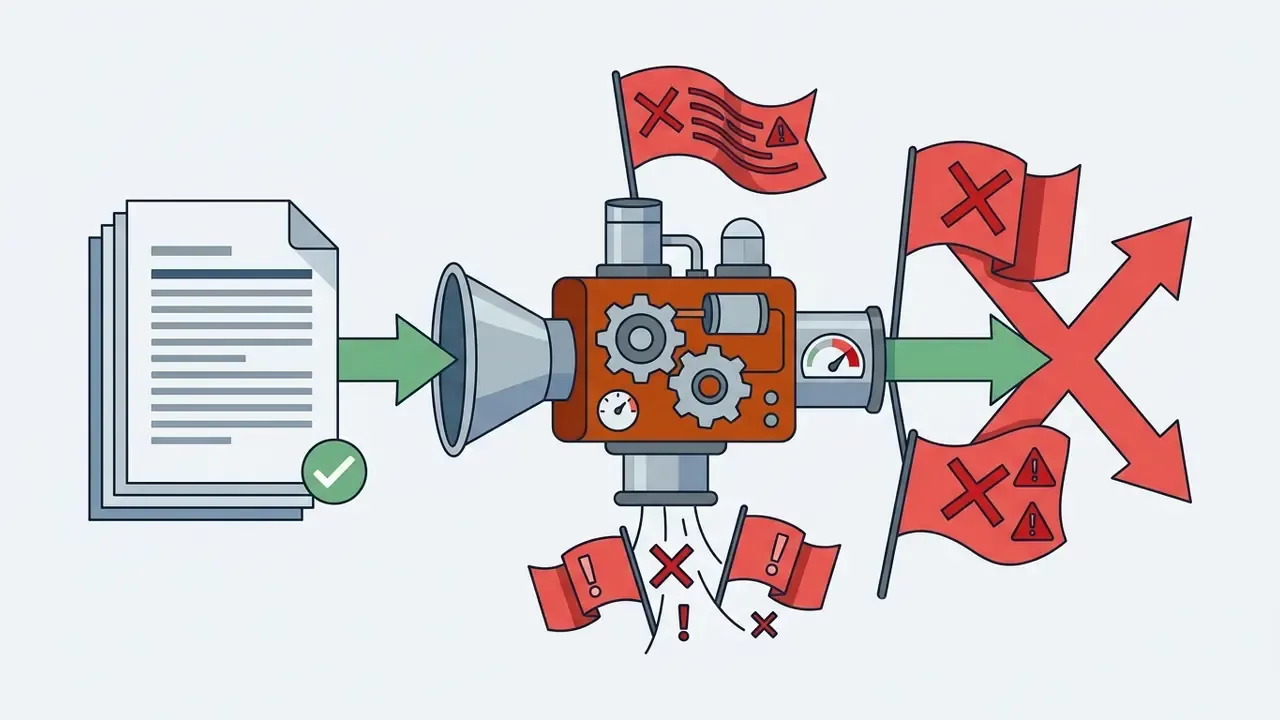
Spotting operational red flags stops unreliable output from contaminating research and reporting pipelines. Critical failure markers include:




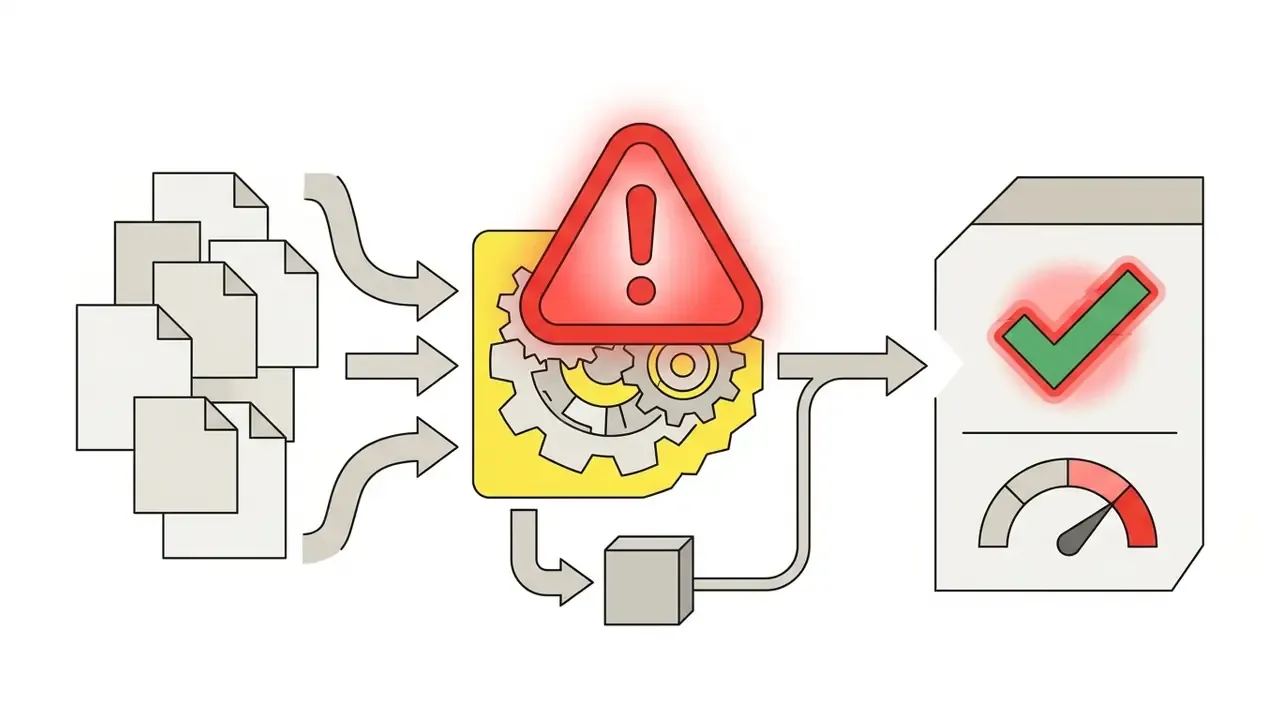
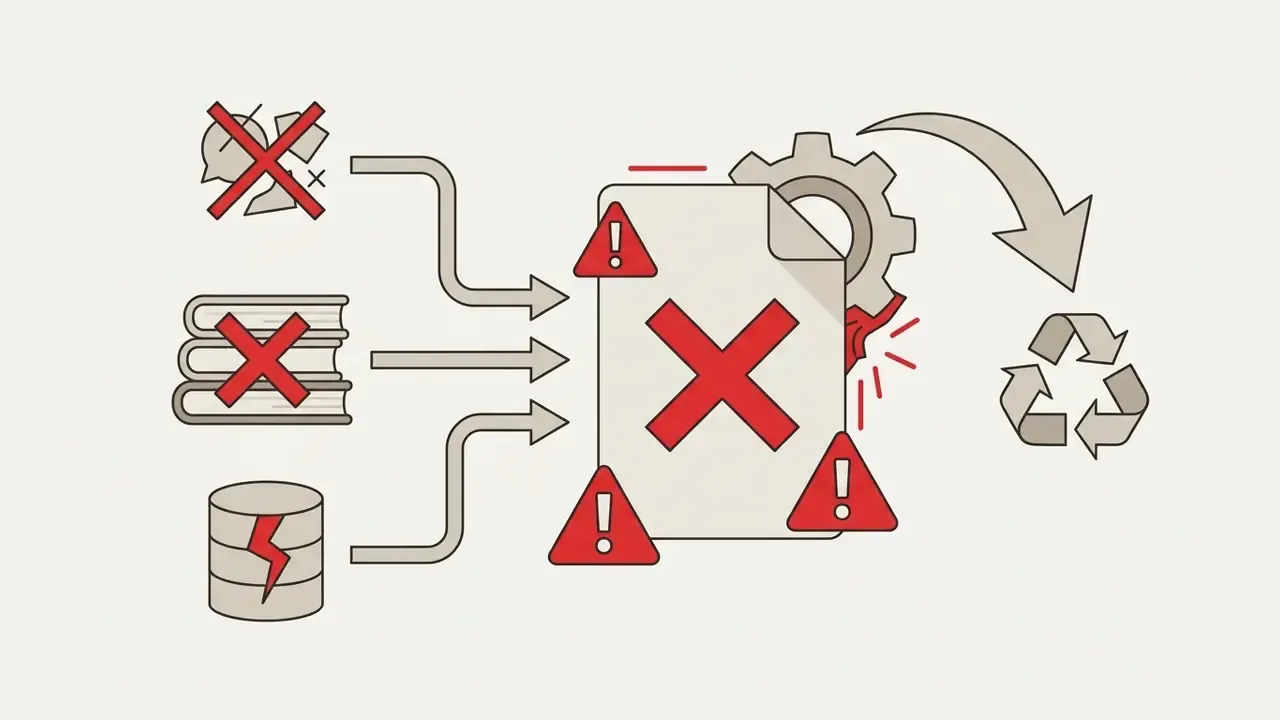
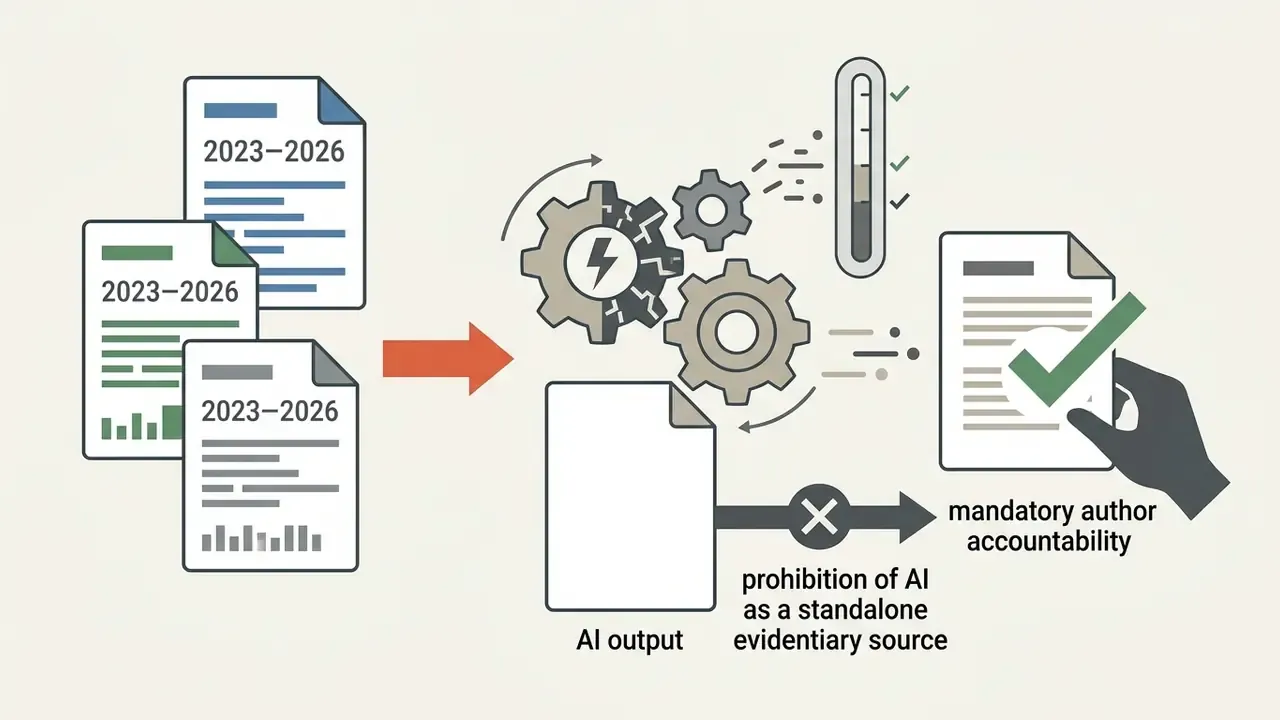
Leading scientific publishers, including Nature Portfolio, Elsevier, and Springer Nature, maintain strict policies on AI content. Nature Portfolio requires documented LLM use, human accountability, and sources for all data, including AI-generated data. Elsevier requires authors to verify accuracy and sources, because AI-generated references can be incorrect or fabricated. Springer Nature holds research communities fully accountable for all content and authorship. Authors stay fully responsible for manuscript accuracy, and unprocessed AI-generated text is explicitly prohibited as a standalone source of evidence.
"Generative AI cannot replace critical scientific judgement; researchers remain fully responsible for the integrity of their work."
Sector guidance is equally explicit about prohibited zones. The European Commission advises refraining from substantial generative-AI use in sensitive activities affecting other researchers or organisations, peer review included by name. Systematic-review guidance issued by academic medical centres advises avoiding generative AI for literature searching, unreviewed inclusion and exclusion decisions, critical appraisal, automated meta-analysis, and final manuscript text without verification. TÜBİTAK's 2026 guideline requires that all generative outputs be verified against reliable primary sources, because hallucination and algorithmic bias can fabricate or distort facts, figures, dates, references, and analysis.
E-E-A-T. Alert Box (Risk Warning)
AI-generated content is not a standalone source of scientific or regulatory evidence. Models produce both overt and subtle hallucinations, distort statistical values, and invent primary sources. AI output may be used exclusively as supporting material under mandatory human verification of every claim, figure, and citation.
The Review Proof Report: What to Record for Reproducibility
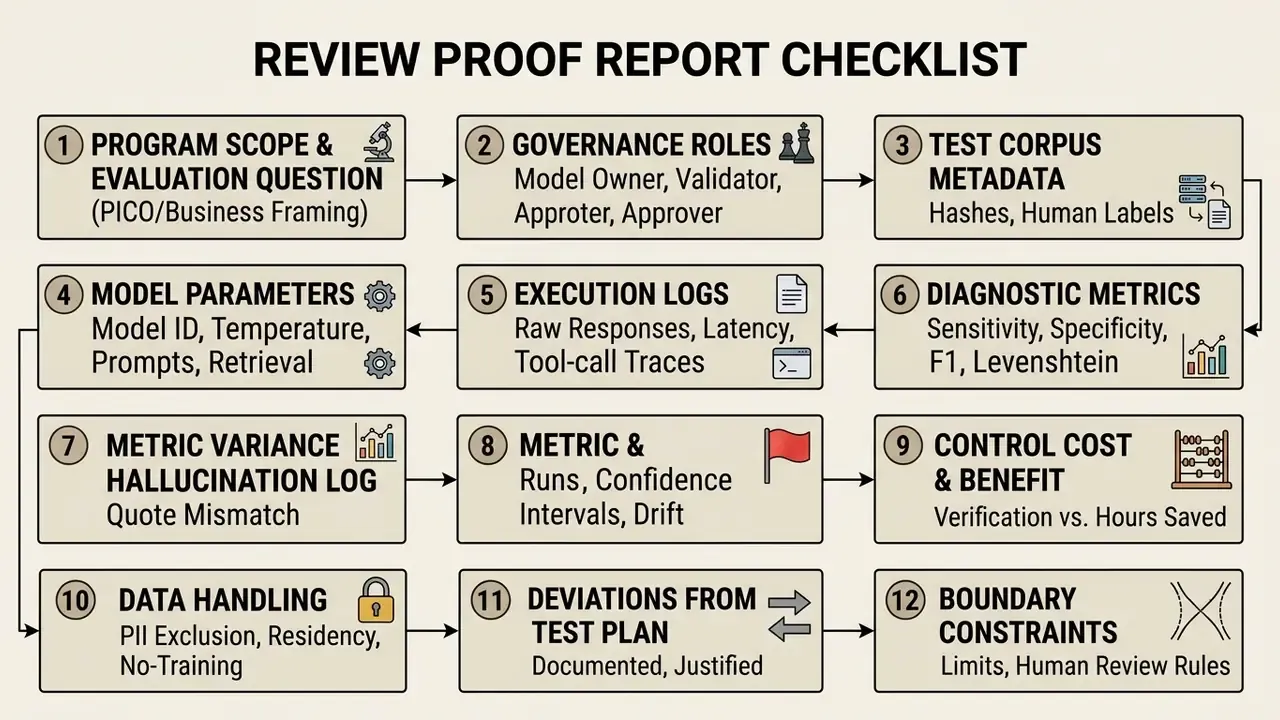
A reproducible review proof report documents the complete evaluation setup, so an independent model risk auditor can replicate and verify the results. Transparent reporting also keeps the exercise compliant with internal governance standards and external regulatory requirements.
The empirical case for standardized reporting is stark:
"Across 2,271 evidence syntheses (2017 to 2024), only about 5% explicitly reported using machine learning; roughly 90% of those that did use ML tools failed to specify whether ML features were actually enabled."
Without a fixed schema, automation use disappears from the record, and no downstream reader can reconstruct how the conclusions were reached. Emerging reporting frameworks address different layers of that problem. ReproEvalCard (ACL, 2026) defines a minimal schema for reproducing multi-stage LLM pipelines. CLEARR-AI (2024) formalizes annotation-collection and annotation-evaluation metadata. AAAI-25 reproducibility guidance requires explicit metric definitions, the number of algorithm runs, and reported variance or confidence intervals. NIST's 2026 draft on automated benchmark evaluations sets disclosure practices for benchmark setup. These frameworks differ in evaluation object (pipeline, annotation, benchmark) rather than in principle, so adopt whichever schema matches the artifact under test. Storing evaluation logs in accessible repositories keeps them auditable long term.
The information above is general in nature and does not replace consultation with a qualified specialist in model risk management, research integrity, or regulatory compliance.
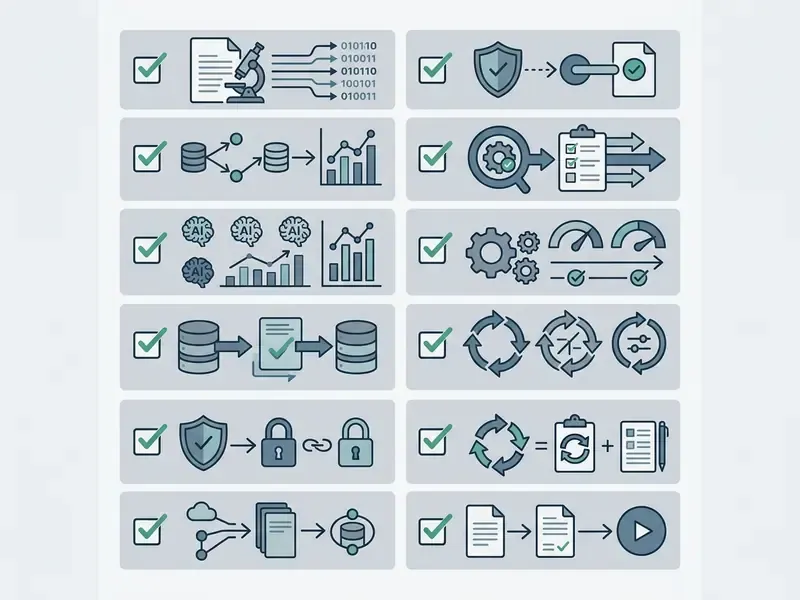
Next step: copy the twelve-item checklist above into your model inventory template and complete it for one in-scope AI tool before the next risk committee cycle. An incomplete checklist is itself a documented finding, which is arguably the cheapest finding you will ever collect.
FAQ: Questions About Evidence for AI Tools
Can AI be used for systematic reviews?
Yes. Artificial intelligence can serve systematic reviews as a decision-support system for literature search support, title and abstract screening prioritization, deduplication, and preliminary data extraction. A 2025 review found AI applied across 10 of 13 review stages, most often in literature search, study selection, and data extraction. Current Cochrane and PRISMA standards still require human reviewers to verify independently all screening exclusions, extracted data fields, and risk-of-bias assessments.
"Risk-of-bias tools showed median 71% agreement with expert assessors and a Cohen's kappa of 0.20, confirming that AI judgements about study quality cannot be accepted without human verification." Rapid review of machine learning tools for evidence synthesis (2025).
A kappa of 0.20 signals only slight agreement beyond chance. That is why fully automated systematic reviews without human oversight remain unacceptable under established scientific standards.
Can AI detection prove research or writing quality?
No. AI text detection tools cannot prove or disprove the quality, accuracy, or scientific integrity of research writing. Empirical studies published in 2025 and 2026 show that commercial AI detectors carry high false-positive rates, domain sensitivity, vulnerability to paraphrasing attacks, and systematic bias against non-native English writers. One 2026 study found lower accuracy on scientific writing than on humanities texts, and poor performance on hybrid human and AI text, concluding that detector output should prompt further inquiry rather than decide misconduct.
"Adoption of AI tools in evidence synthesis remains limited and inconsistently documented, with most applications concentrated in screening tasks." Review of automation reporting in evidence synthesis (2024).
Detection tools measure stylistic probabilities, not factual correctness, which makes them unsuitable as standalone metrics for research quality or authorship.
When is an AI tool unsuitable for accurate conclusions?
An AI tool is unsuited to autonomous execution wherever the task demands nuanced context, critical appraisal, or a high-stakes compliance decision. Restricted scenarios include:
- Autonomous peer review or critical appraisal of manuscript quality.
- Executing database searches without human-curated search strings (median recall 14%).
- Final meta-analysis calculations and statistical syntheses without expert review.
- Generating regulatory compliance disclosures or legal filings without primary source verification.
- Autonomous inclusion and exclusion decisions in an SLR or in regulated model validation evidence.
- Extraction of patient-level characteristics or endpoint data without full manual confirmation.
- Agentic execution against systems of record without permission gating and step-level logging.
In these high-risk applications, AI output must be treated as a preliminary draft awaiting full expert evaluation.
What does review proof cost to maintain?
Maintenance cost consists of periodic revalidation (triggered by model version changes, prompt changes, or corpus drift), ongoing sampled verification of production output, and monitoring for performance decay. Because vendors update underlying models without notice, a review proof carries an expiry date. Any material version change invalidates prior benchmark accuracy and requires re-execution against the same test corpus, with results appended to the model inventory record.
Does review proof differ for regulated financial use versus academic use?
Yes, in tolerance rather than in method. Academic systematic review demands near-total recall to avoid missing primary evidence. Regulated financial use additionally demands documented governance roles, effective challenge by an independent validator, data-handling attestations, and auditable retention of execution logs. The metrics are the same. The evidentiary burden and the retention requirements are higher.
Appendix A: Superseded Claims and Revision Log