Last updated: February 2026. Benchmark data current as of Q1 2026.
An AI image detector evaluates visual media to decide whether an image was produced by generative algorithms or captured by a physical camera. Working through statistical pattern recognition and raw pixel analysis, these platforms help organizations identify synthetic content, deepfakes, and manipulated visual evidence in something close to real time.
Why should a US bank or fintech care? Because a synthetic selfie, a fabricated receipt, or a face-swapped ID photo now enters your workflow through the same channel as legitimate media, and the person reviewing it is guessing more often than anyone would like.
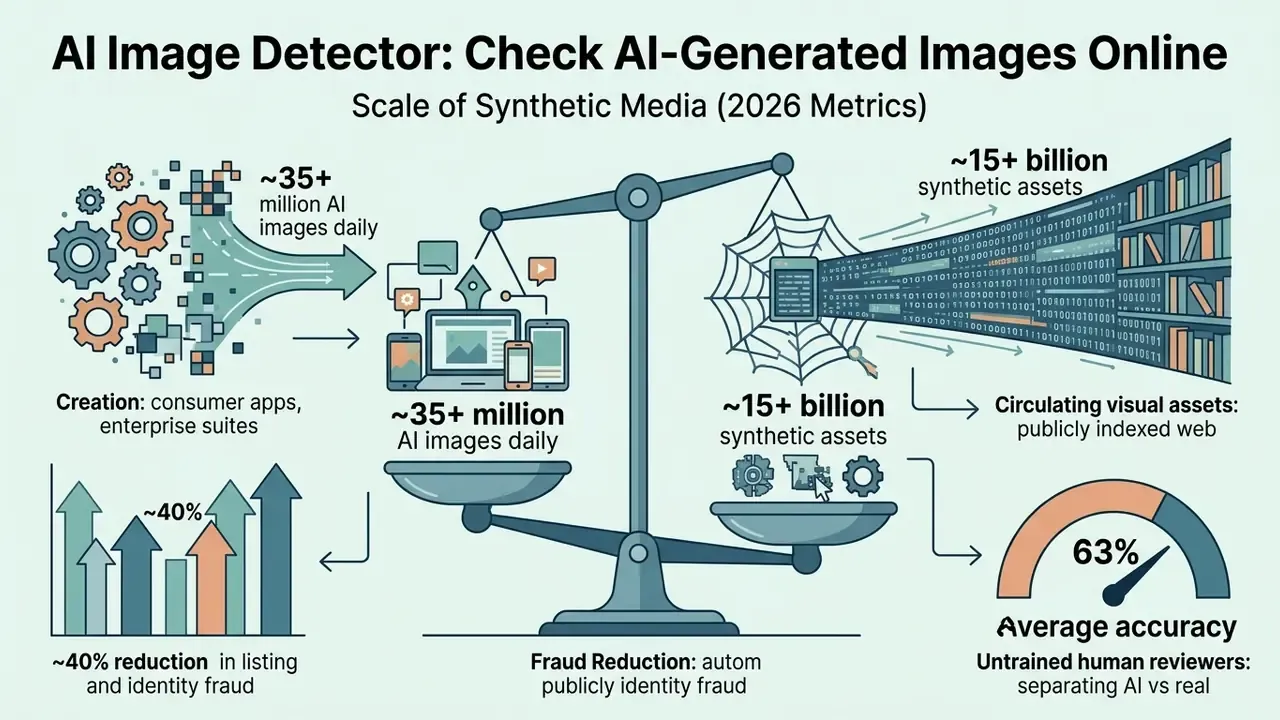
The Scale of Synthetic Media (2026 Metrics)
Executive Summary for Risk Leaders
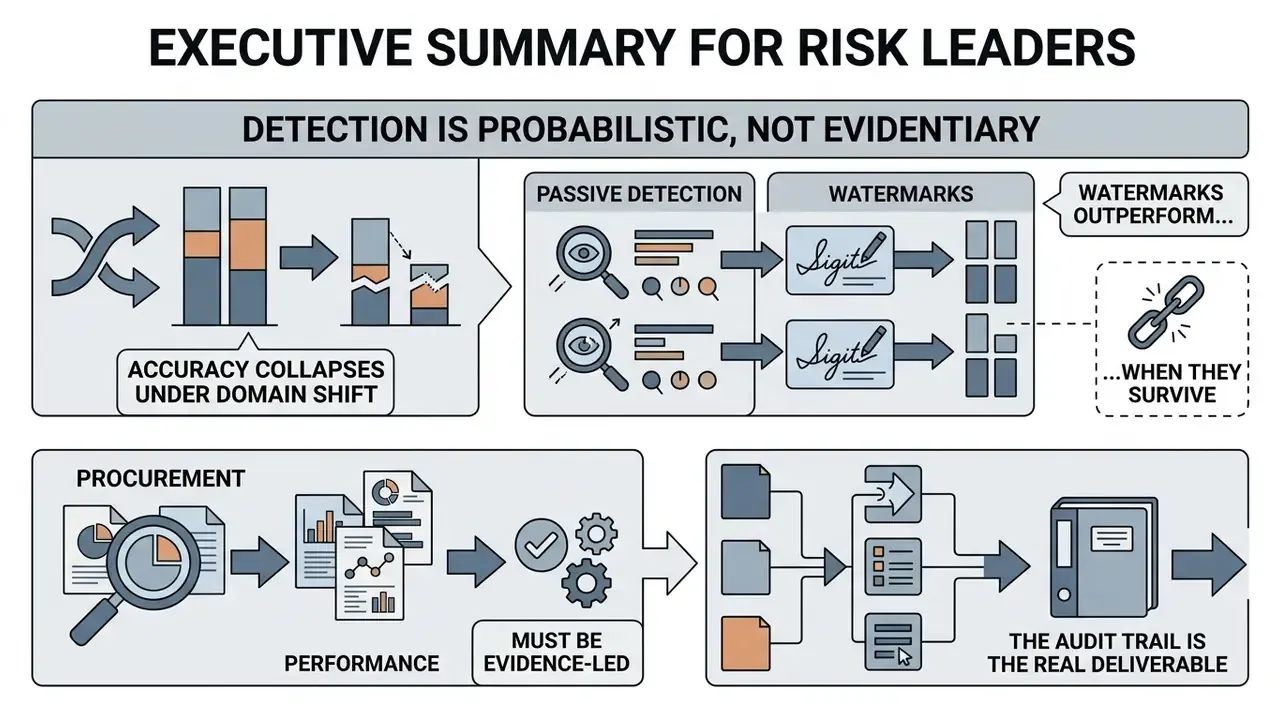
- Detection is probabilistic, not evidentiary. Confidence scores are calibrated likelihood estimates. They belong inside an evidence chain alongside provenance metadata, reverse-image lookups, and human adjudication, never as a standalone automated rejection rule.
- Accuracy collapses under domain shift. Benchmarks report 91 to 96% balanced accuracy on curated academic sets, 54 to 66% on realistic manipulations, and as low as 18 to 31% on the newest commercial generators (Firefly v4, Imagen 4, Midjourney v7).
- Watermarks outperform passive detection, when they survive. Provenance signals such as SynthID or C2PA manifests reach near-perfect decoding accuracy on matched data, but get stripped or degraded by recompression, cropping, and platform re-encoding.
- Procurement must be evidence-led. Require Zero Data Retention (ZDR), sub-second latency SLAs, per-request pricing transparency, heatmap-level reporting, and third-party benchmark evidence (GenImage, DailyBench, Ai-GenBench, ForensicHub) before signing.
- The audit trail is the real deliverable. For SR 11-7 and NIST AI RMF alignment, log file hashes, detector version, thresholds, score, heatmap artifacts, and reviewer decision for every screened asset.
How to Read This Guide
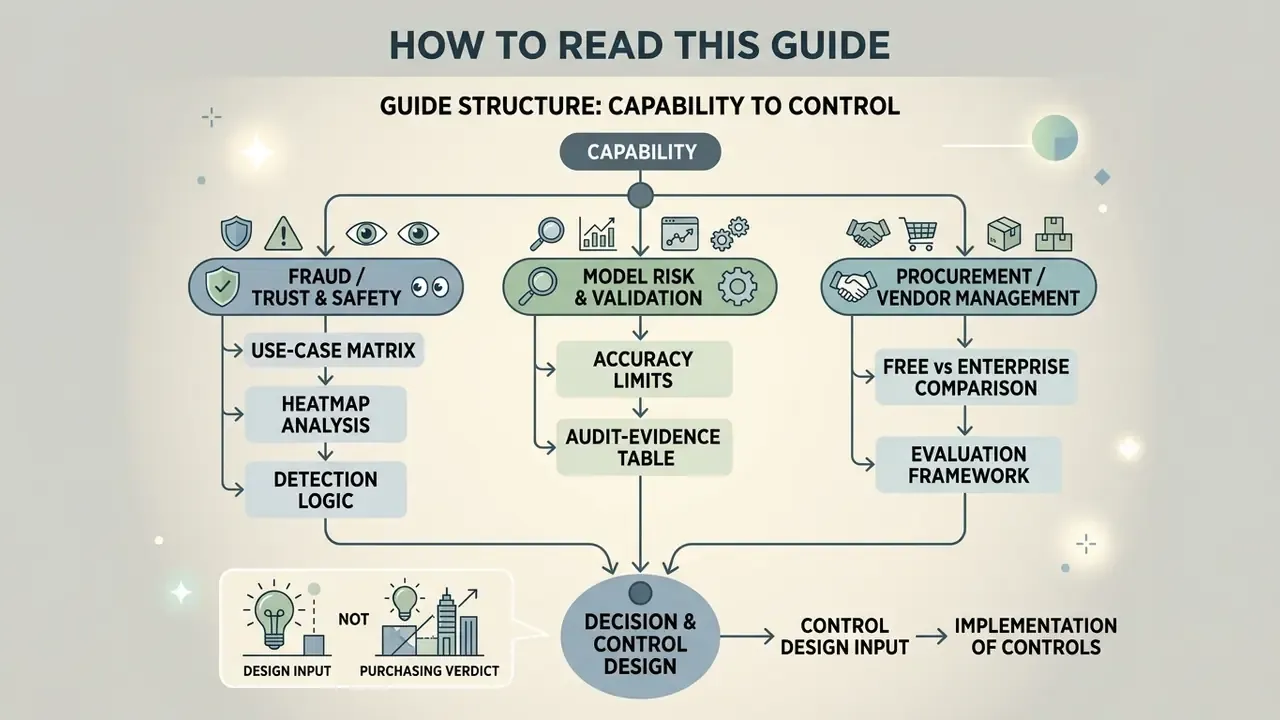
This guide moves from capability to control. First it maps what an AI image detector can actually check, then how image detection works at the pixel level, then how to run a check online in a few seconds. After that come the uncomfortable parts: accuracy ceilings, generator-by-generator coverage, commercial use cases, procurement criteria, and a FAQ for the questions your second line will ask during validation.
Three reading paths, depending on your seat:
- Fraud and Trust and Safety leads will get the most from the use-case matrix, the heatmap section, and the receipt-verification controls.
- Model risk and validation teams should start with the accuracy limits and the audit-evidence table, then work backwards.
- Procurement and vendor management can jump to the free versus enterprise comparison and the evaluation checklist.
Everything here is positioned as a control design input, not a purchasing verdict. If you want to sanity-check tool categories side by side, the AI Media Comparison hub and our AI Media Workflows library cover adjacent ground.
What an AI Image Detector Can Check
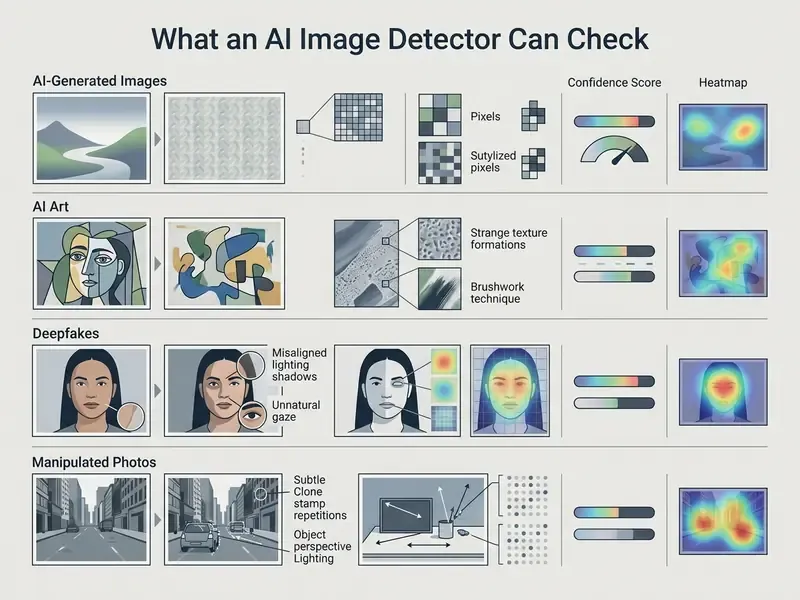
An AI image detector assesses many formats of synthetic visual content, from text-to-image digital illustrations to photorealistic face swaps and edited product media. These systems sort uploaded images into probability bands so human operators can verify image authenticity instead of arguing about gut feel.
«Detectors reach 91 to 96% balanced accuracy on GenImage, but fall to 54 to 66% on realistic manipulations.»
The gap between laboratory conditions and production traffic is the single most important number for a risk owner. It defines how wide your manual review queue has to be, and therefore how much the control actually costs.
| Visual Content Type | Primary Detection Targets | Core Forensic Indicators | Operational Decision Value |
|---|---|---|---|
| AI Art and Digital Illustrations | Synthetic artwork, anime, digital paintings | Frequency domain anomalies, unnatural stroke textures | Flag uncredited synthetic graphics in publishing and licensing |
| Photorealistic AI Photos | Fully synthetic scenes, human portraits | High-frequency noise inconsistencies, pixel aliasing | Verify camera origin in claims processing and journalism |
| Deepfakes and Face Swaps | Facial replacements, digital impersonation | Boundary blending artifacts, lighting and shadow mismatches | Screen onboarding media in KYC and identity verification |
| Manipulated Product Photos | Localized generative fill, object removal | Inpainting boundary noise, lighting discontinuity | Triage marketplace listing fraud and return claims |
| Profile Pictures | Synthetic avatars, stock replacement | Anatomical asymmetries, background grid distortion | Detect automated bot networks and fake profiles |
| Receipts and Proof of Payment | Fabricated invoices, edited totals, synthetic screenshots | OCR and layout inconsistency, font rendering breaks, arithmetic mismatch | Block fraudulent refunds and reimbursement payouts |
| Travel and Property Listings | Synthetic hotel rooms, fake rental interiors | Impossible geometry, repeated texture tiling, lighting incoherence | Quarantine fake vacation listings before payment capture |
AI Art, AI Photos and AI-Generated Content
An ai art detector online identifies synthetic artwork, digital illustrations, and photorealistic imagery produced by text-to-image generators. These tools examine underlying spatial noise and rendering patterns across very different artistic styles, which is harder than it sounds: a watercolour and a studio portrait leave almost nothing in common.
When evaluating digital art, an ai art checker asks whether pixel distributions align with natural brushstrokes or with algorithmic diffusion steps. Research on the ARIA benchmark indicates that convolutional classifiers can separate synthetic paintings and stylized graphics with high in-domain accuracy, provided they were trained on representative generative models.
«ARIA contains 140,000+ images across five categories, including paintings, anime and news photography, for benchmarking AI-art detectors.»
Structured prompt variations, though, introduce stylistic shifts that require multi-model validation. One classifier is rarely enough.
«Humans correctly identify AI images in only 63% of roughly 287,000 judgements, marginally above chance.»
This human baseline is the reason automated screening exists at all. A 63% hit rate is indefensible for payment, onboarding, or publication decisions, whereas a calibrated ai art identifier paired with structured escalation lifts the effective ceiling considerably. Note the wording: the effective ceiling, not the model's accuracy. The process does much of the work.
Consumer-side generators keep widening the input funnel too. Tools marketed as a free ai image generator app, or as a free ai girl portrait service, push millions of synthetic faces into the same moderation queues your fraud analysts monitor. The same holds for restricted categories such as a free ai porn generator, which shows up in dating and social-platform abuse reports far more often than in vendor marketing decks.
Deepfakes, Edited Images and Visual Manipulation
An ai image detector flags deepfakes, face swaps, and localized generative fill inside digital media. Facial manipulation detection concentrates on structural edge consistency, skin texture continuity, and environmental lighting coherence.
Frameworks such as the NIST Open Media Forensics Challenge (OpenMFC) separate full synthetic generation from localized image manipulation, and the distinction matters operationally. Deepfake screening inspects facial boundaries and ocular reflections to catch digital identity impersonation. Localized edits, say generative object removal or added product damage, alter low-level pixel relationships while preserving global visual context, so specialized spatial analysis becomes necessary.
«On Deepfake-Eval-2024, built from 1,191 in-the-wild deepfakes, open models reach 61 to 69% accuracy while commercial systems reach up to 82%.»
Classic visible markers documented in public forensic training material still work as secondary confirmation: mismatched skin tone at face-swap borders, inconsistent light sources and shadows, abnormal blink cadence, lip-sync drift, blurred facial contours, unnatural eye reflections, and excessively smooth skin micro-texture. Useful, but easy to over-trust. Newer generators fix these tells release by release.
How AI Image Detection Works
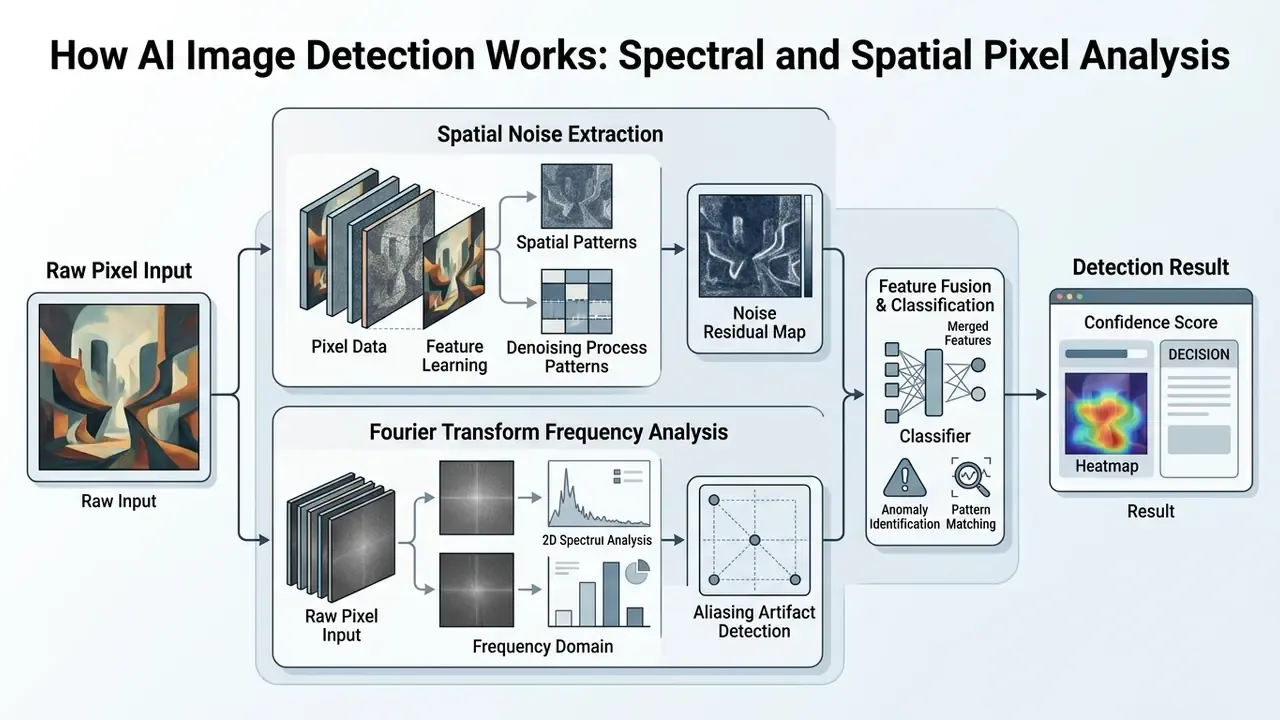
AI image detection relies on mathematical algorithms that inspect low-level pixel relationships, frequency distributions, and visual artifacts left behind by neural network architectures. Rather than reading semantic meaning, these tools hunt for microscopic rendering patterns unique to synthetic generation.
Pixel Artifacts and Visual Patterns in AI Images
Generative neural networks leave structural signatures during image synthesis: checkerboard aliasing, high-frequency spectral noise, unnatural edge transitions. An ai image detector analyzes raw pixel analysis matrices to surface these invisible footprints, using advanced spatial filters rather than anything a human eye could resolve.
Deconvolutional layers in GANs and iterative denoising steps in diffusion models generate subtle grid-like patterns across colour channels. Forensic tools apply spatial filters and Fast Fourier Transforms (FFT) to convert image pixels into frequency representations. Those transformations reveal abnormal spectral spikes and localized noise incoherence that physical optical sensors simply do not produce.
«AIDE combines CLIP embeddings with frequency patches, outperforming prior methods by +3.5% and +4.6% on AIGCDetectBenchmark and GenImage.»
Documented spectral fingerprints include abnormal dots and lines in the Fourier spectrum of GAN outputs, cloud-like blurry high-frequency regions, aliasing along high-contrast edges, jagged transitions in curved structures, and periodic grid energy that no CMOS sensor generates. If you want the underlying vocabulary in one place, open the hub and work through the imaging terms first.
Metadata, Watermarks and Their Limitations
«ImageDetectBench shows watermark-based detectors consistently outperform passive detectors across all tested image perturbation types.»
Standard camera metadata records hardware parameters such as ISO, shutter speed, and focal length, while C2PA manifests attach cryptographically signed origin trails. Social media platforms and messaging applications, however, frequently strip metadata on upload to save storage and protect user privacy.
Fact Check: Metadata and Watermarking Limits
Digital watermarking technology, such as Google's SynthID, embeds imperceptible pseudo-random signals directly into pixel latents. Watermark decoders hit high accuracy while the signal survives, but lossy compression, cropping, and re-scaling degrade readability, which is why passive pixel analysis stays in place as a secondary control.
«A PRC watermark for Stable Diffusion 2.1 encodes 512 bits with no quality degradation, and removal attacks fail without visible artifacts.»
This information is general in nature and does not replace consultation with a qualified digital forensics specialist or legal expert. Detector output alone is not admissible proof of authorship.
How to Use an AI Image Detector Online
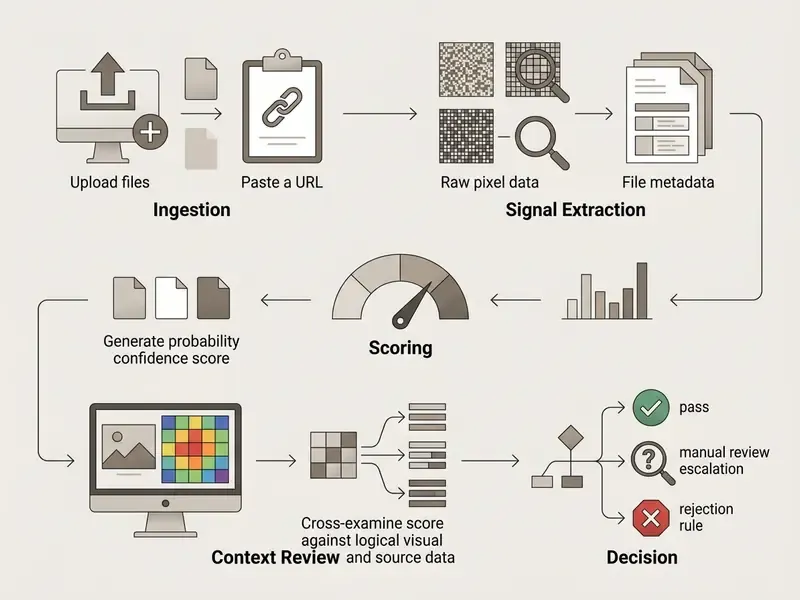
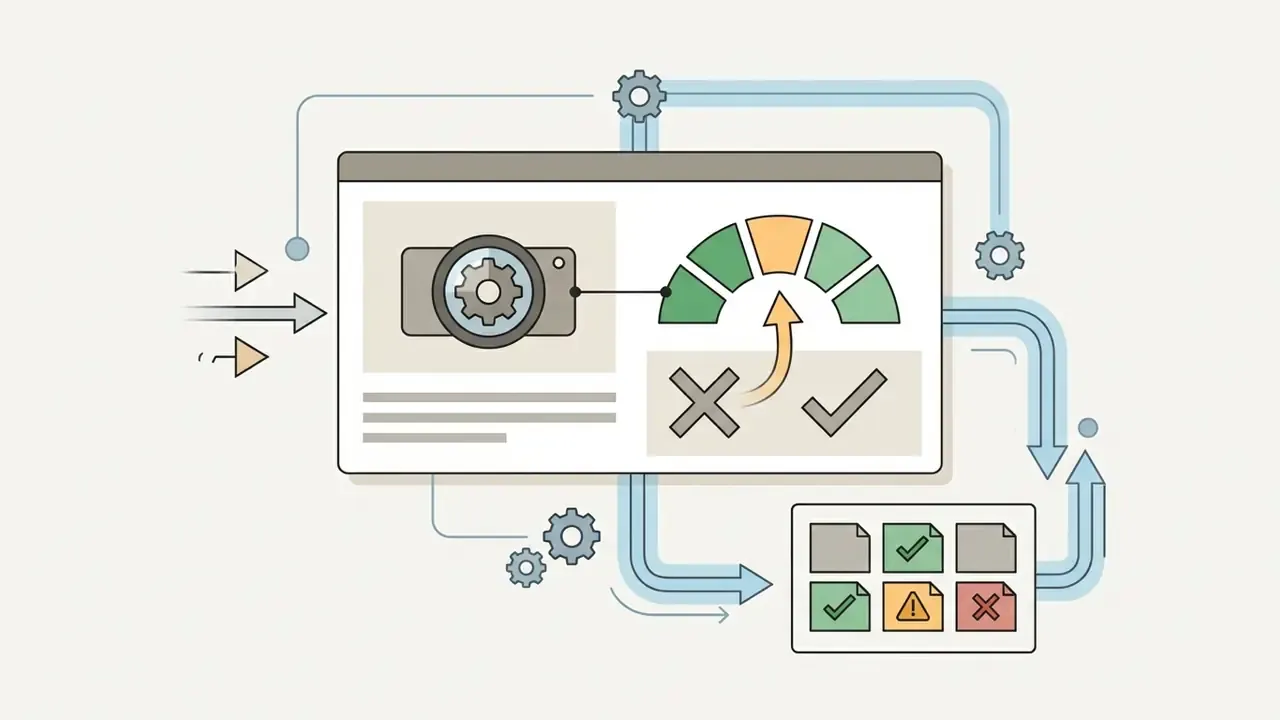
Checking visual media through an online detection service comes down to three moves: import the target image, run algorithmic spatial analysis, and interpret the output score inside an operational risk workflow. The first two take seconds. The third is where governance lives.
Upload an Image or Paste a URL
Users can submit media to an ai art detector through local file uploads, drag and drop web interfaces, or direct URL imports. Modern platforms ingest media straight from web links, including images hosted on social media or generated via tools like Bing Image Creator.
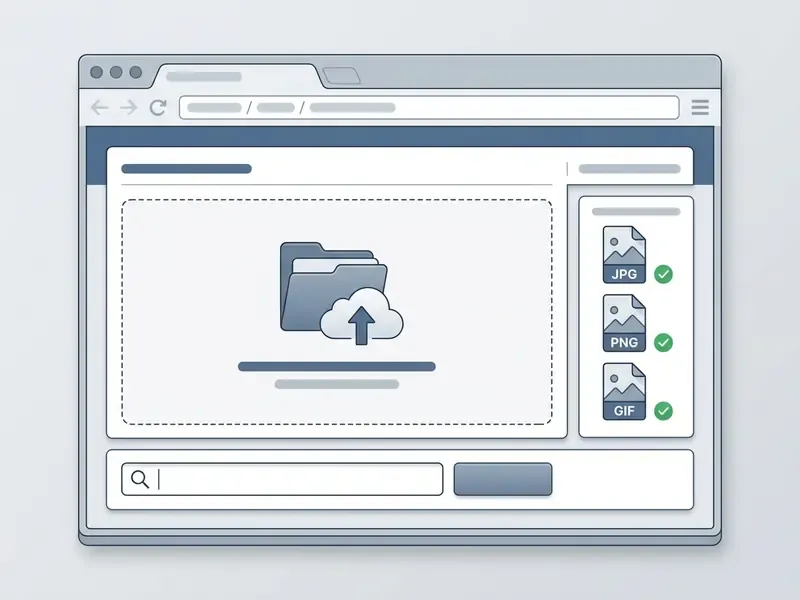
Once a file arrives, the ingestion engine decodes the binary raster data into standard RGB tensor arrays. That step normalizes resolution scales and spatial orientations, preparing the visual payload for model inference without modifying the original source file. Simply upload, wait a moment, read the result: instant results in the interface, though "instant" means roughly a few seconds under normal load.
Practical ingestion limits to verify before rollout:
| Parameter | Typical Free Tier | Typical Enterprise Tier |
|---|---|---|
| Supported raster formats | JPG / JPEG, PNG, WEBP | JPG, PNG, WEBP, AVIF, HEIC, TIFF, BMP |
| Maximum file size | 10 MB per image | 25 to 50 MB per image, multipart uploads |
| Batch behaviour | 1 image per request | Parallel batch endpoints, one result and one error per file |
| Minimum usable resolution | ~256x256 px | Face-specific models operate from 128x128 px |
| URL ingestion | Public links only | Signed URLs, object-storage pull, webhook callbacks |
One habit worth enforcing in training: always submit the original file rather than a screenshot. Screenshots re-encode the pixel array and measurably reduce detection quality. We have seen analysts paste a cropped screenshot of a receipt and then treat the softer score as exculpatory. It is not.
Browser Extensions and Right-Click Instant Analysis
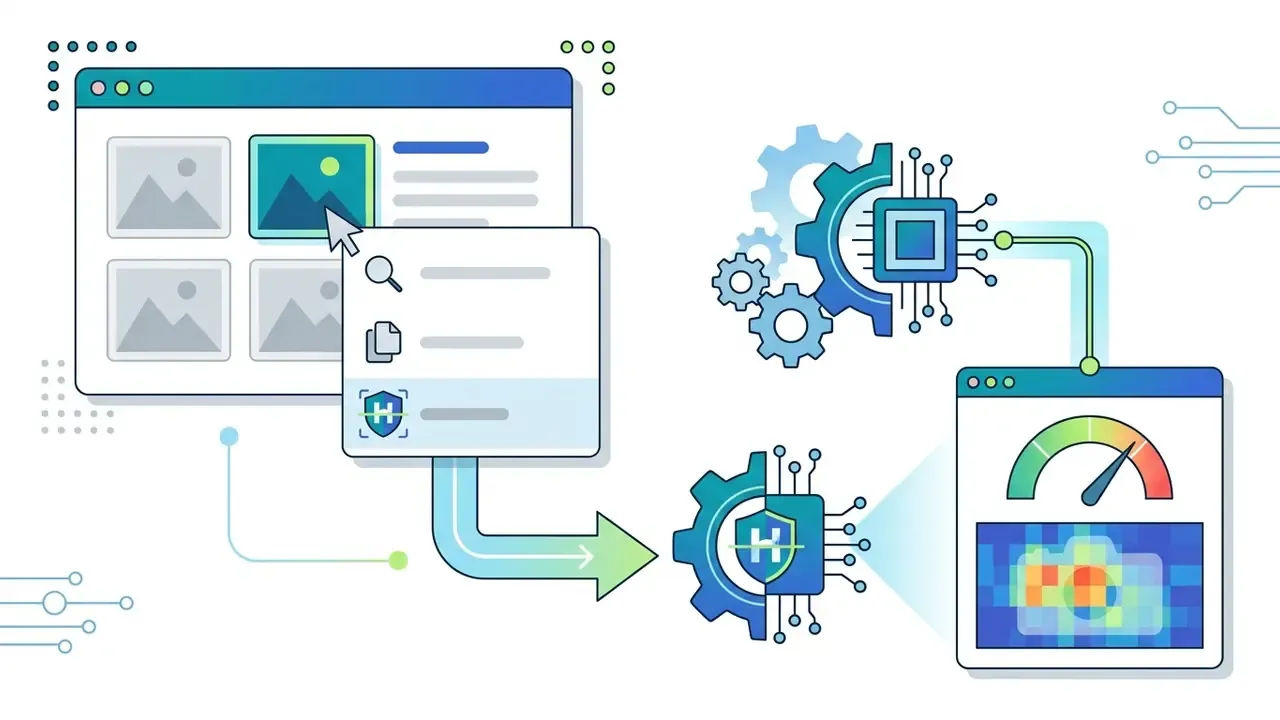
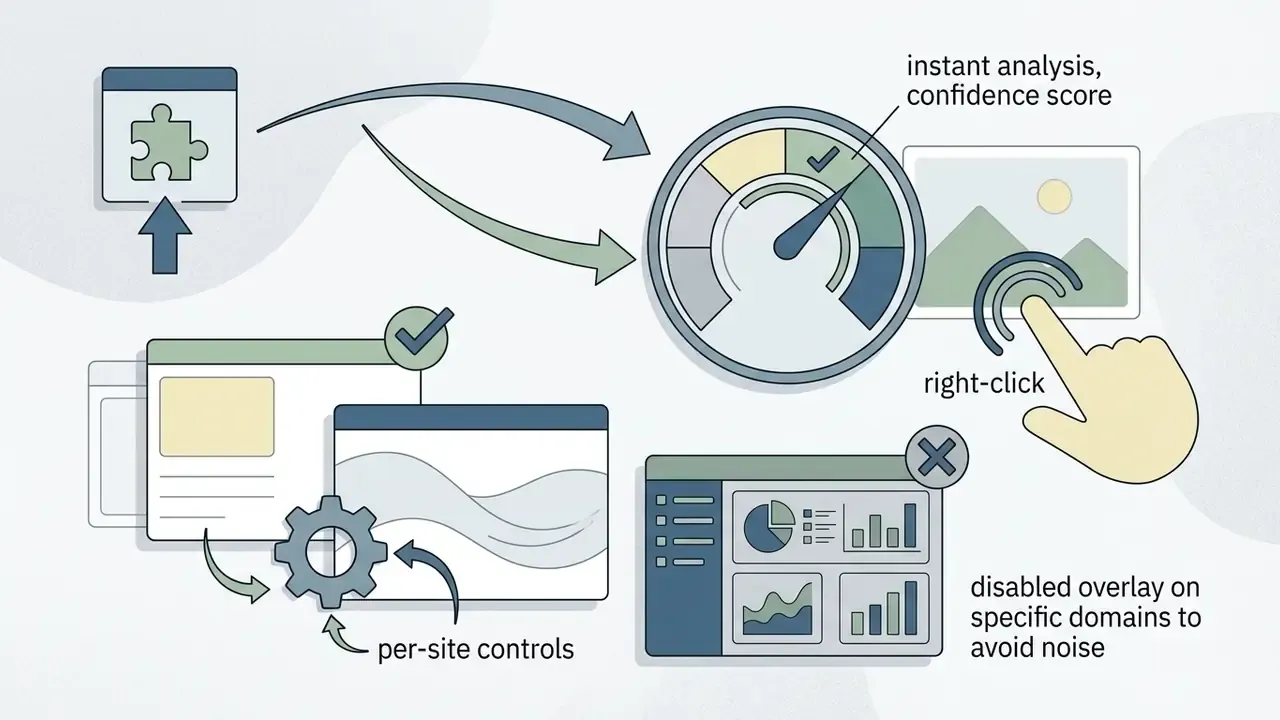
For high-volume moderation, downloading and re-uploading files by hand slows verification to a crawl. So detection platforms ship browser extensions for Chrome, Firefox, Edge and other Chromium browsers, with Safari support arriving during 2026.



Review the Detection Result and Confidence Score
Reading the AI Detection Heatmap and Zone Analysis
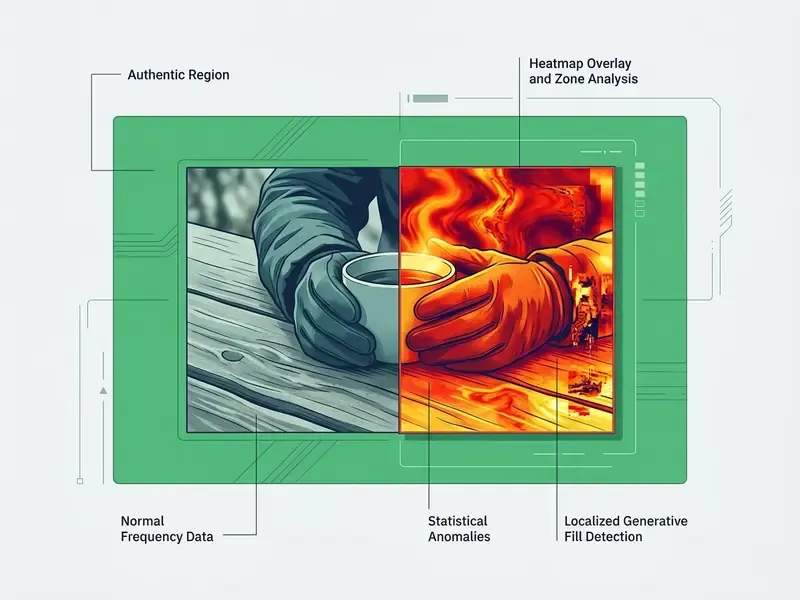
A global score answers "how synthetic is this file?" A heatmap answers the far more actionable question: "which part of this file is synthetic?" Passive spatial filters isolate localized high-frequency noise anomalies and render them as a colour-graded mask:

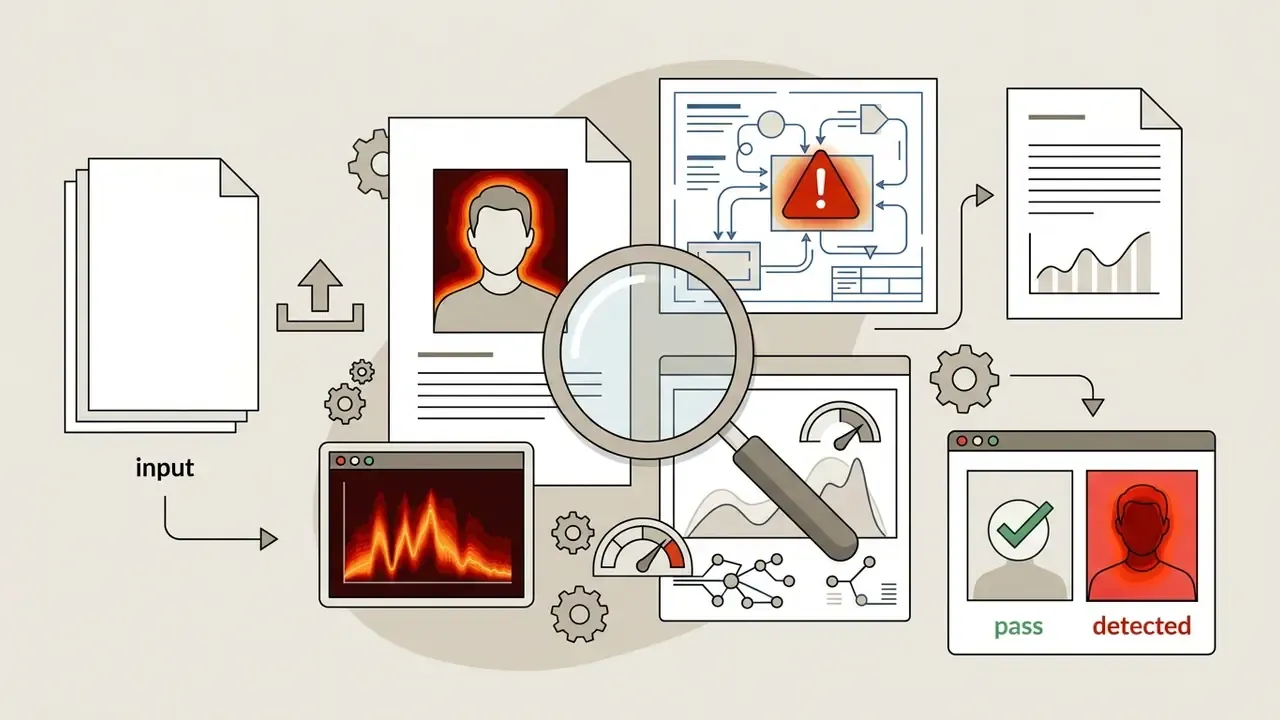
This is what makes hybrid media tractable. If a photographer applies generative fill to just 2% of the frame, removing a stray cable, erasing a bystander, adding fake product damage, the global score may sit calmly in the 0.40 to 0.60 band while the heatmap outlines the unnatural pixel boundary precisely. Refund analysts and editorial fact-checkers should therefore be trained to read the mask, not only the number. Teams that skip that training end up with a score they cannot explain in an appeal.
Accuracy and Limitations of AI Image Detection
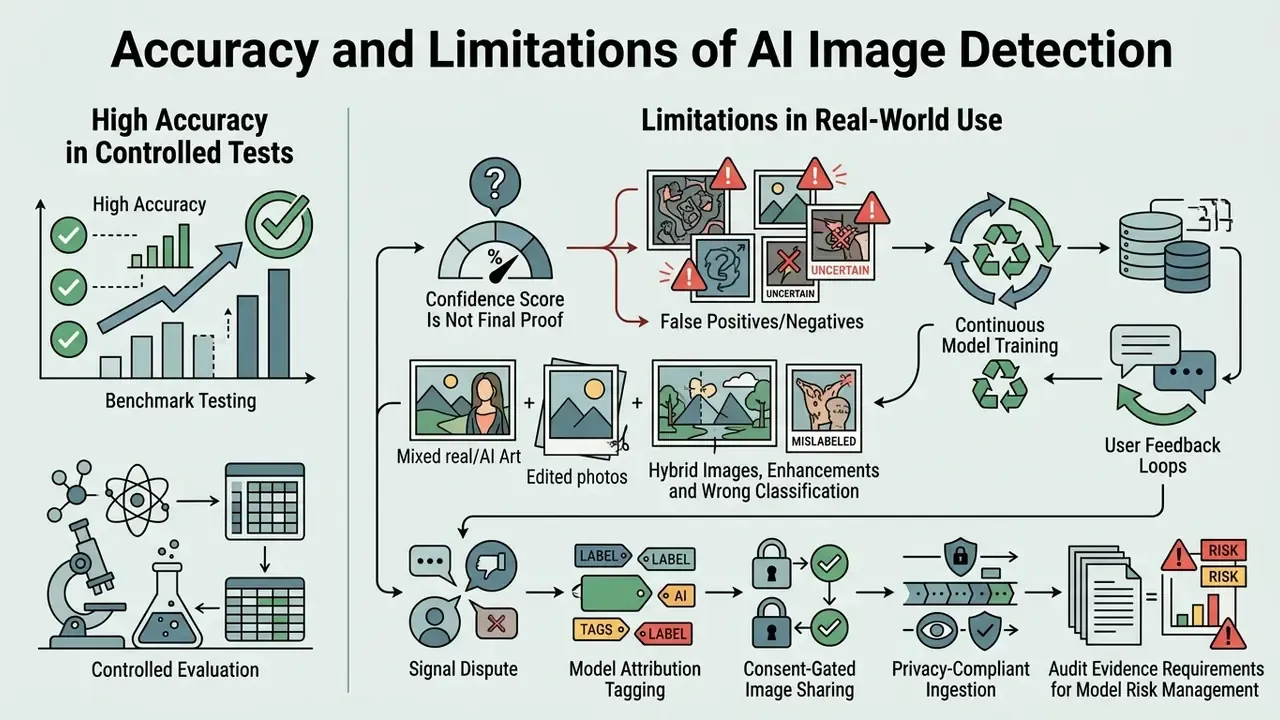
AI image detectors reach high accuracy in controlled benchmark tests. Reliability shifts, sometimes sharply, once you apply them to modified images, brand-new generator architectures, or compressed web uploads.
Why a Confidence Score Is Not Final Proof
A probability confidence score is a calibrated estimate, not absolute evidentiary proof. A well-calibrated 0.90 means roughly 90% empirical correctness across comparable samples, not certainty about one specific file. In model risk management, decisions need independent verification before automated outcomes get enforced, and legal doctrine treats probabilistic testimony as admissible only after relevance and probative-value review.
Benchmarks of passive image detectors show accuracy fluctuating with image domain shift. A 2026 benchmark study found that open-source passive detectors varied in mean accuracy from 37.5% to 75.0% across real-world test sets. That is not a rounding difference. That is two different products.
«Zero-shot evaluation of 16 detectors on 2.6M images from 291 generators showed high accuracy variance across datasets.»
NIST's synthetic-content work reinforces the point from another angle: reported detection accuracy sits at roughly 52 to 76% without post-processing, and slides to about 50 to 62% once images are compressed or resized. Out-of-distribution false-positive rates measured in 2026 robustness testing ranged from ~0.2% to 8.2% depending on generator shift, while evaluations of consumer-grade public tools reported false-positive rates on authentic photographs as high as 35.5%. So risk leaders treat confidence scores as probabilistic indicators inside a broader evidence chain, and set thresholds accordingly.
Hybrid Images, Enhancements and Wrong Classification
Hybrid media, meaning authentic camera photographs modified with generative fill, background expansion, or neural noise reduction, triggers false classifications more often than any other category.
Ordinary editing operations do the damage: post-processing filters, upscaling algorithms, consumer tools that promise free ai enhance results in one tap, and lossy JPEG compression all alter high-frequency pixel distributions. Those edits mimic synthetic generation artifacts, so an ai art spotter can issue false positives on human-created photographs, or false negatives on subtly edited deepfakes. A free ai image enhancer applied before upload is enough to move a score by a meaningful margin.
«Commercial detectors drop from >91% to ~55% accuracy under localized inpainting attacks, approaching random guessing.»
Forensic guidance on image enhancement (SWGIT) requires that every enhancement or processing step be recorded, precisely because it can change evidentiary interpretation. The same principle binds automated screening. If your pipeline resizes, re-encodes, or watermarks incoming media before analysis, log that transformation, because it is now part of the detector's input distribution. Easy to forget. Painful to discover during validation.
Continuous Model Training and User Feedback Loops
Probabilistic models meet edge cases constantly: extreme studio lighting that mimics AI-smoothed skin, heavy airbrush retouching, macro photography with unusual depth-of-field falloff. Mature platforms expose a structured misclassification review path instead of treating the score as final:
- Signal dispute reviewers flag suspected false positives or false negatives directly in the analysis panel, with the disputed verdict pre-filled.
- Model attribution tagging optional selection of the suspected generator (for example Midjourney v7, Flux Schnell, Nano Banana) plus a free-text comment field.
- Consent-gated image sharing because standard traffic runs under Zero Data Retention, the original file is retained for retraining only when the reviewer explicitly opts in.
- Privacy-compliant ingestion shared files sit in encrypted sandboxes used to retrain localized frequency classifiers, without breaching ZDR defaults for production traffic.
For enterprise buyers, the existence of this loop is itself a procurement signal. It shows the vendor measures its own error rates rather than publishing one static accuracy claim and hoping nobody checks.
Audit Evidence Requirements for Model Risk Management
A detection score becomes defensible only when it is reproducible. For teams aligning with SR 11-7 model validation expectations and the NIST AI Risk Management Framework, the detector has to emit an audit-ready record, not just a verdict.
Structure of an audit-ready synthetic-media forensic report:
| Evidence Element | Why Regulators and Validators Ask For It |
|---|---|
| File hash (SHA-256) of the submitted asset | Proves the analysed object is byte-identical to the archived exhibit |
| Detector name, model version and weights checksum | Establishes which classifier produced the score, enabling replay |
| Raw probability output plus threshold configuration | Distinguishes model output from the business rule applied to it |
| Heatmap or localisation artifact | Documents where the anomaly was detected, not only that it existed |
| Provenance findings (EXIF, XMP, C2PA, SynthID decode result) | Separates passive inference from cryptographic provenance evidence |
| Pre-processing log (resize, re-encode, crop) | Shows whether the pipeline itself altered the evidential input |
| Reviewer identity, decision and timestamp | Demonstrates human-in-the-loop control over automated outcomes |
| Retention and deletion record | Evidences ZDR or lawful-basis compliance for the stored payload |
Operationally, these records should export as structured JSON into your GRC or model-inventory system, with detector versions tracked as managed models subject to periodic revalidation. The benchmark data above explains why: an unchanged detector silently loses accuracy as new generators ship. Nobody gets an alert when that happens.
Where disputes escalate beyond internal review, the evidence bundle is also what your counsel will ask for first. Public disputes over synthetic media are accumulating fast, and our AI Litigation and Case Timelines tracker gives useful context on how these arguments are being framed.
This section describes general risk-management practice and is not legal, regulatory, or compliance advice. Validate any control design with your own second-line and legal functions.
Which AI Image Generators Can Be Detected
Current detection models cover outputs from most major commercial and open-source generative platforms. Efficacy, though, depends on model update cycles and training data coverage, which is a polite way of saying coverage lists age quickly.
Detection Coverage Across Popular AI Image Generators
Most ai art detection tools maintain signature databases for established text-to-image systems, including Midjourney, DALL·E 3, Stable Diffusion variants, Adobe Firefly, Flux, Grok, Ideogram, Bing Image Creator, Google Imagen, legacy GAN architectures, and Google's Gemini-based models such as Nano Banana (Gemini 2.5 Flash Image, with Nano Banana 2 mapped to Gemini 3.1 Flash Image and Nano Banana Pro to Gemini 3 Pro Image).
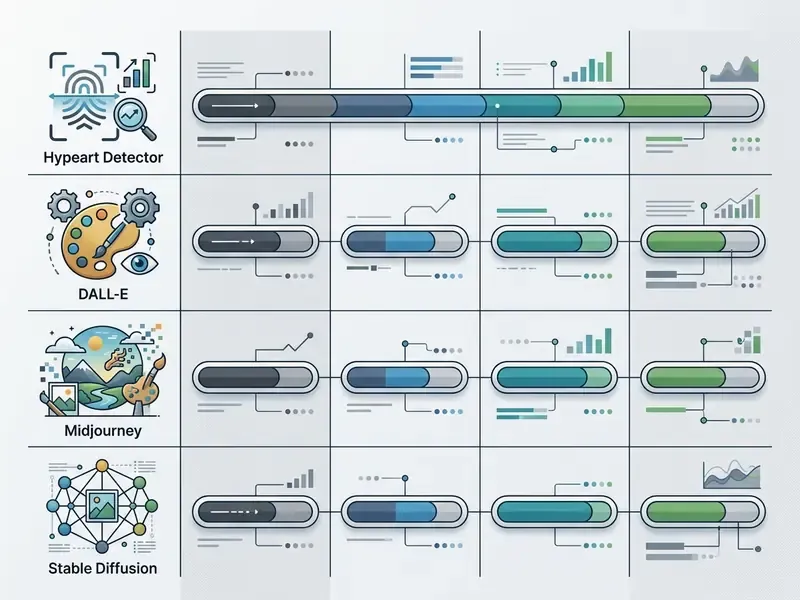
| Generative Model Family | Representative Test Efficacy | Key Artifact Characteristics | Forensic Detection Challenges |
|---|---|---|---|
| Stable Diffusion (v1.5 / v2.1) | High (>85% AUC) | High-frequency spectral grid spikes | Readily detected via spatial noise classifiers |
| DALL·E 3 | Moderate (~31 to 78% accuracy) | Smooth texture rendering, prompt alignment | Requires hybrid semantic and pixel analysis |
| Midjourney (v5 / v6 / v7) | Low to moderate (~24 to 65% accuracy) | Complex lighting, organic texture synthesis | Highly resilient to passive pixel filters |
| Adobe Firefly (v4) | Low (~18 to 40% accuracy) | Photorealistic lighting, commercial post-processing | Engineered to minimize identifiable spatial noise |
| Nano Banana (Gemini Image) | High (via SynthID watermark) | Embedded invisible SynthID digital watermark | Passive detection difficult without SynthID decoder |
| Flux.1 (Dev / Schnell) | Moderate (~18 to 30% in 2026 benchmarks) | High-resolution anatomical coherence, micro-texture realism | Flow-matching architecture requires updated spatial noise weights |
| Grok 2 / 3 (xAI) | Moderate (~55 to 72% accuracy) | Unrestricted photorealistic lighting, simulated sensor noise | Boundary smoothing reduces detectable spatial grid artifacts |
| Google Imagen 3 / 4 | High via SynthID decoder, ~19% passive | Embedded latent watermark, strong semantic alignment | Falls back to passive filters once SynthID payload is stripped |
| Ideogram 2.0 | High (>82% accuracy) | Typography rendering, sharp vector-raster transitions | Text-to-image boundary artifacts flagged by edge detectors |
| Bing Image Creator (DALL·E backend) | Moderate, backend-dependent | Inherits DALL·E smoothing plus platform recompression | Score varies with delivery-side re-encoding |
| StyleGAN / BigGAN (legacy) | Very high (>95% accuracy) | Checkerboard aliasing, facial asymmetry, background grid distortion | Standard FFT spectral filters flag artifacts almost instantly |
«VCT² tests 17 detectors on 140,000 images from SD2.1, SDXL, DALL·E 3 and Midjourney 6, and mean accuracy was only ~58%.»
On the same VCT² "hard to detect" scale, Midjourney 6 scored 93.65 while Stable Diffusion 2.1 and 3 scored 70.47 and 69.33. A direct illustration of why a coverage list should never be read as uniform accuracy across the models it names.
Why New Generators Can Affect Detection Results
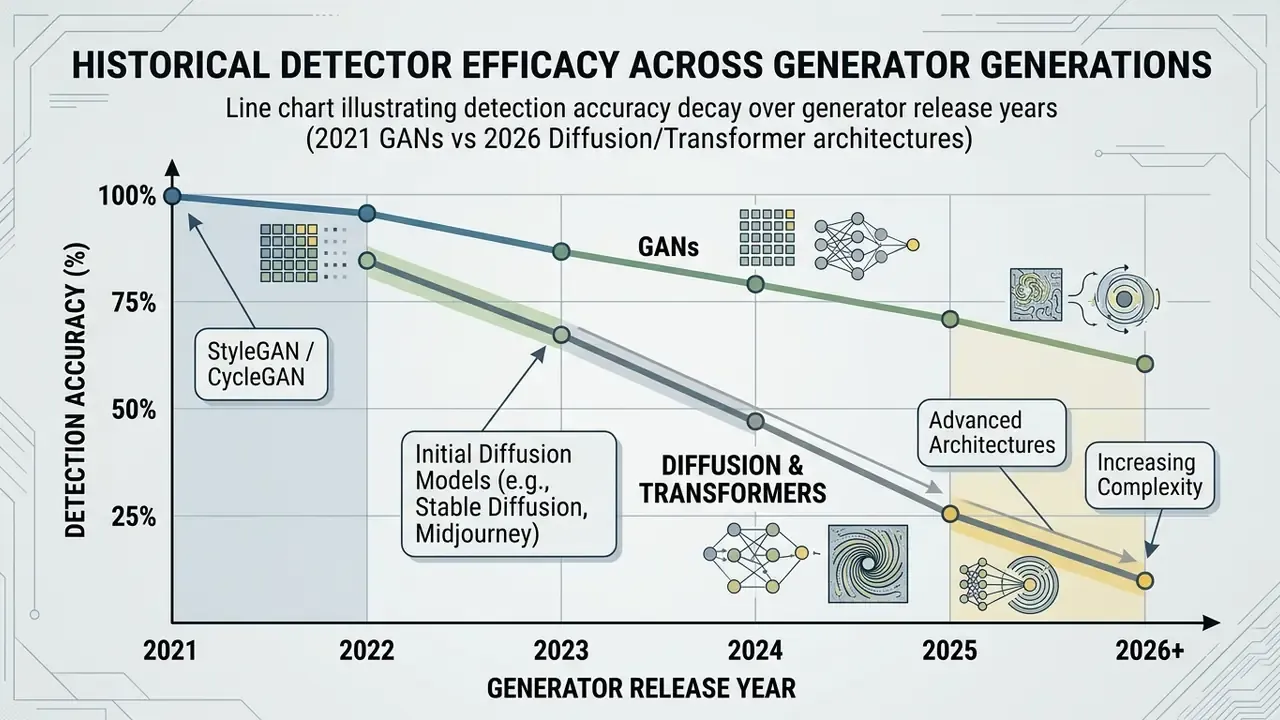
As new generative architectures appear, older classifiers decay because the weights sit out of distribution. Nothing breaks visibly. The score just gets less informative.
A 2026 empirical benchmark showed mean detection accuracy falling from approximately 79% on 2020 to 2021 GAN models down to 38% on 2024 to 2026 diffusion and flow-matching models.
«Ai-GenBench evaluates detectors incrementally across generator generations, from GANs to diffusion, exposing widening generalization gaps.»
When developers release new sampling techniques or fine-tuning pipelines, detection platforms must refresh their training datasets to capture the updated statistical signatures. Update-framework research from 2024 reported that incorporating new-generator data lifted average AUC to 0.99 with a 22.8% relative error reduction versus older update strategies. Which is exactly why dataset refresh cadence belongs in your vendor SLA, not in the vendor's roadmap deck.
AI Image Detector Use Cases for Commercial Verification
Enterprise risk teams deploy an ai art image detector to reduce financial fraud, protect platform integrity, and automate content moderation across commercial operations. The scenarios below map cleanly onto existing fraud taxonomies, which makes them easier to fund.
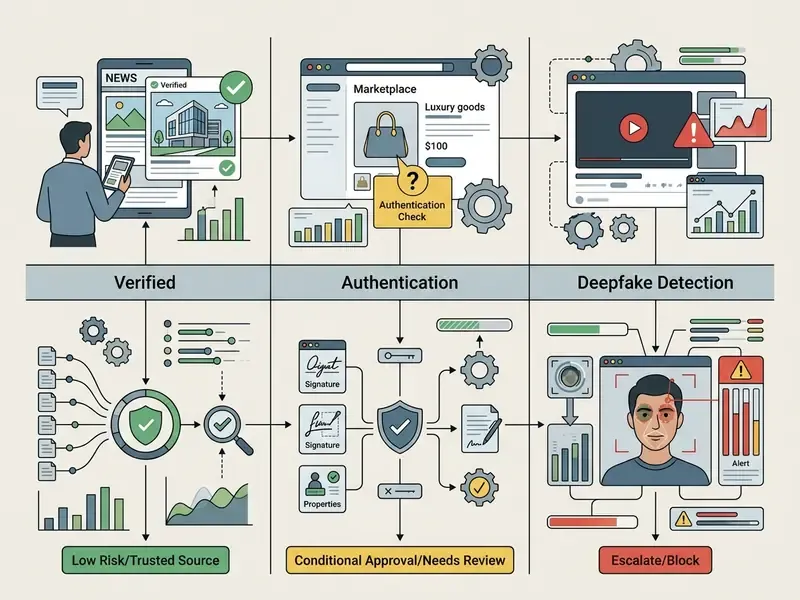
| Commercial Scenario | Visual Fraud and Risk Vector | Primary Ingestion Targets | Operational Control Mechanism |
|---|---|---|---|
| E-commerce and retail | Synthetic product damage in refund claims | Return photos, shipping receipts | Triage refund payouts, route high-risk files to audit |
| KYC and identity proofing | Face-swapped selfies, deepfake ID cards | Onboarding portraits, government IDs | Require dynamic liveness checks upon high-risk flag |
| Digital marketplaces | Fake property or vehicle listings | Real estate photos, vehicle inventory | Automatically quarantine unverified stock listings |
| Media and publishing | Uncredited AI illustrations, fake news media | Editorial submissions, wire photos | Require provenance disclosure prior to publication |
| Travel and vacation rentals | Synthetic hotel rooms, fabricated rental interiors and destinations | Listing galleries, host-submitted property media | Flag high-risk fake listings before booking payment is captured |
| Dating and social platforms | AI-generated portraits used for catfishing and romance fraud | Profile photos, verification selfies | Escalate synthetic avatars to identity re-verification |
| Insurance and claims | Fabricated accident or damage evidence | Claim photo bundles, loss documentation | Hold payout pending forensic secondary review |
Product Photos, Marketplaces and Payment Proof
«FraudBench pairs real e-commerce, food-delivery and travel photos with synthetic damage from six generative models for multimodal fraud detection.»
Combining OCR layout checks with pixel noise analysis lets automated systems flag suspicious claims before funds move. Receipt-specific controls documented by fraud-detection vendors add merchant-identity validation, PDF producer-field inspection, creation and modification timestamp comparison, arithmetic re-computation of line items and totals, EXIF anomaly detection, SHA-256 hashing, and cross-claim duplication matching. All cheap to automate. All difficult for generative tools to satisfy simultaneously, which is the part that makes them valuable.
Profile Pictures, Identity Documents and Impersonation
Financial institutions and fintech platforms embed deepfake detection inside Know Your Customer (KYC) pipelines to stop synthetic identity fraud and account takeovers.
FinCEN Alert FIN-2024-Alert004 explicitly advises financial institutions to incorporate commercial or open-source deepfake detection software into identity verification workflows.
«Detected deepfakes grew fourfold year over year and accounted for 7% of all fraud attempts.»
Screening customer selfies against facial artifact databases flags synthetic profile pictures, which keeps automated bot networks from opening fraudulent accounts at scale.
«Specialized detectors identify AI-generated faces at resolutions as low as 128x128 pixels, across both GAN and diffusion engines.»
Guidance from the World Economic Forum pushes past still-image scoring: camera-path verification, dynamic liveness challenges, transport-aware stream scoring, and temporal-consistency monitoring are all recommended to catch injected or face-swapped video before the verification session closes. Still-image detection alone will not hold that line.
How to Choose an AI Art Detection Tool for Business
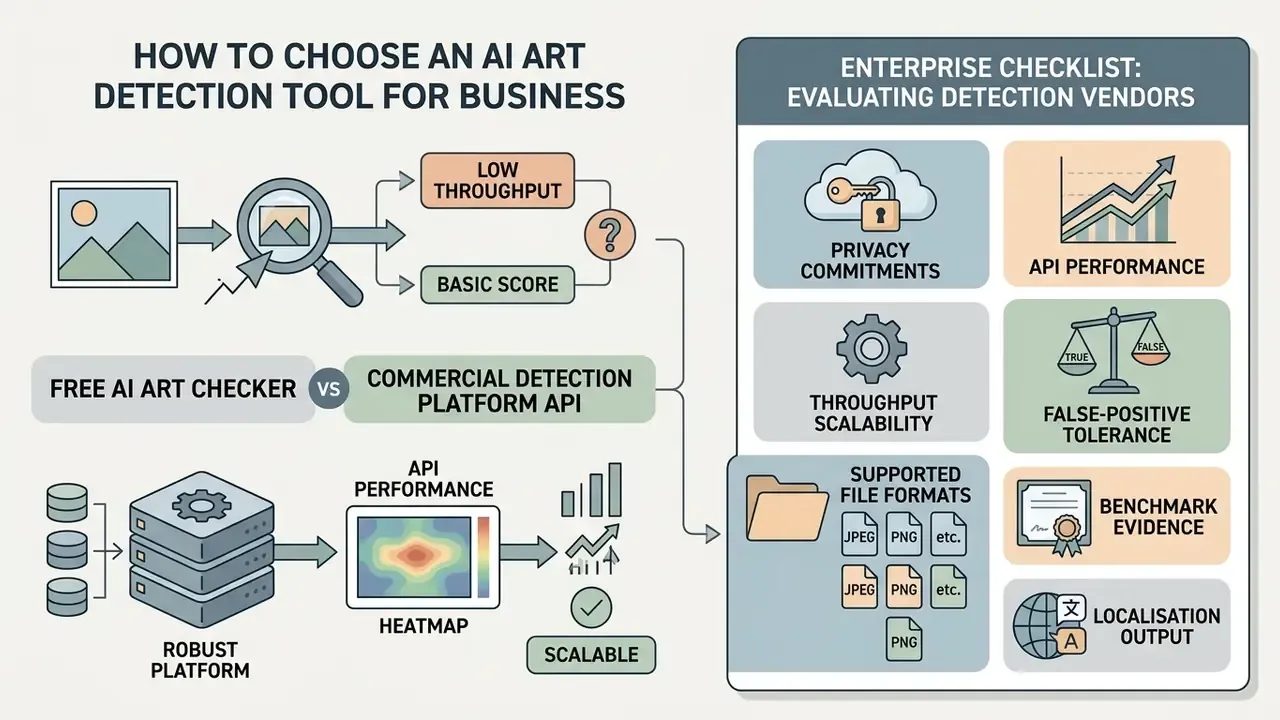
Selecting an enterprise AI image detection tool means evaluating API performance, throughput scalability, false-positive tolerance, and data privacy policies. In that order, usually, though privacy tends to become first-order the moment regulated customer media is involved.
«ForensicHub and Ai-GenBench provide standardized detector evaluation protocols with transparent methodology and reproducible metrics.»
One more governance consideration. ACM's policy statement on generative-media detection recommends that automated flagging be used only where the risk of false rejection is exceedingly low and where a human appeal path exists. That single constraint should shape your threshold design before any vendor demo, not after it.
Free AI Art Checker or Commercial Detection Platform
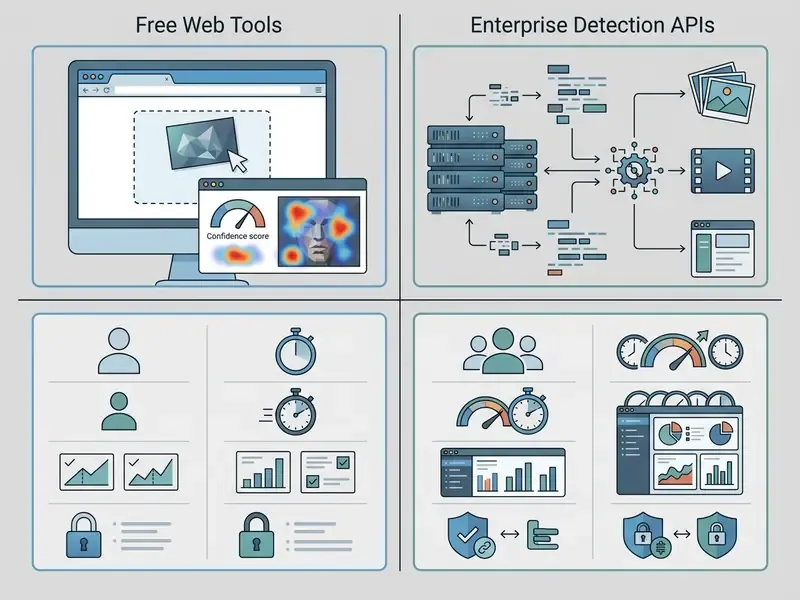
Free browser-based tools cover individual verification needs. Enterprise platforms provide scalable API endpoints, configurable probability thresholds, and SLA guarantees. Both have a place, and confusing them is how pilots quietly become production.
| Evaluation Feature | Free Online AI Art Checkers | Enterprise Detection Platforms |
|---|---|---|
| Processing limits | Rate-limited (for example 3 to 10 checks per hour) | High-volume image processing via batch API |
| Integration support | Web UI drag and drop only | REST or gRPC API, webhooks, SDKs, browser extensions |
| Data privacy policy | Public logging or variable retention | Guaranteed zero-data-retention (ZDR) options |
| Reporting granularity | Simple binary label or basic score | Detailed forensic reports, heatmaps, JSON responses |
| Cost model | Free with ad support or daily caps, often no login required | Credit-based, tiered monthly, or volume pricing |
| Total cost of ownership | Hidden cost sits in manual re-review time | Per-request price plus measurable secondary-review labour |
| Latency commitment | Best effort, seconds to minutes under load | Contractual sub-second p95 for real-time decisioning |
| Appeal and feedback loop | None or informal | Misclassification reporting, retraining pipeline, versioned models |
When modelling total cost of ownership, price three components rather than one: cost per API call, expected manual review minutes per 1,000 screened assets at your chosen threshold, and the business cost of a false rejection. That third component (abandoned onboarding, wrongly refused refund, retracted publication) is the one that rarely makes it into the spreadsheet, and the one executives remember.
An ai art checker free of charge is fine for a spot check on a single suspicious profile picture. It is not fine as an unlogged control inside a regulated decision.
API, Privacy and High-Volume Image Analysis
Enterprise applications need real-time processing speeds, multi-format compatibility, and strict data privacy standards. Not two out of three.
When wiring detection endpoints into live production workflows, verify vendor data retention practices in writing. Enterprise contracts should mandate Zero Data Retention (ZDR) so customer-uploaded media is processed in memory without being stored or used to retrain third-party models. Retention is generally policy-based per endpoint, not per vendor. It is common for one route to be ZDR-covered while a file-upload route retains payloads for a fixed window, and that detail has derailed more than one security review.
«Zero-shot VLM detectors outperformed nearly all existing methods on a 60,000-image deepfake dataset without task-specific fine-tuning.»
Enterprise Checklist: Evaluating Detection Vendors
- Supported file formats: direct ingestion of JPG, PNG, WEBP, HEIC, AVIF and TIFF.
- Privacy commitments: enforceable Zero Data Retention (ZDR) for submitted payloads, documented per endpoint.
- API performance: sub-second latency for real-time KYC and listing workflows, with defined batch parallelism.
- Benchmark evidence: vendor accuracy claims backed by public datasets such as GenImage, DailyBench, Ai-GenBench and ForensicHub.
- Localisation output: heatmaps or region masks, not only a scalar score.
- Model governance: versioned detector releases, refresh cadence for new generators, and change notifications.
- Human appeal path: documented misclassification reporting and reviewer override workflow.
- Audit export: JSON evidence bundle including file hash, model version, threshold and decision.
Broader context on the generative side of this market, including where free generative ai services fit relative to paid tooling, sits across the Hypeart AI Media library.
Frequently Asked Questions (FAQ) About AI Image Detectors
Can an AI Image Detector Check JPG, PNG and WEBP Files?
Yes. Standard AI image detectors support JPG, PNG and WEBP, the three formats that dominate web traffic. During ingestion the system decodes compressed image data into uncompressed pixel tensors before analysis. Lossy compression, such as low-quality JPEG encoding, degrades subtle high-frequency artifacts, though modern multi-scale models hold up reasonably well across standard web formats. Published results are mixed and compression-dependent: one 2026 study saw accuracy shift from 80.4% on uncompressed PNG to 94.8% at JPEG quality 95, while other evaluations recorded material reliability loss after post-processing. Operational takeaway, unchanged: analyse the original file whenever it exists.
Can an AI Image Detector Inspect HEIC, AVIF and Raw Smartphone Formats?
Yes. Advanced detectors decode HEIC (the iOS default), AVIF, TIFF and high-resolution raster files by converting the raw binary pixel payload into normalized RGB tensor arrays, then applying spatial and Fourier-domain analysis. Practical size ceilings usually run from 10 MB on free tiers to 25 to 50 MB on enterprise plans, with multipart upload for larger assets. If your intake channel silently converts HEIC to JPEG, log that conversion. It is now part of the detector's input.
How Does the Detector Flag Hybrid Images With Partial (2%) AI Edits?
Passive spatial filters isolate localized high-frequency noise anomalies. If a human artist applies generative fill to roughly 2% of the frame, removing a stray hair or deleting a background object, the global confidence score often stays in the moderate 0.40 to 0.60 band, because 98% of the pixels still carry authentic sensor statistics. The heatmap resolves the case. It highlights the specific unnatural pixel boundaries so a reviewer can judge whether the edit is cosmetic or material to the claim.
Can I Check Images Directly in My Browser Without Uploading Files Manually?
Yes. Installing a dedicated extension for Chrome, Firefox, Edge or another Chromium browser lets you run detection from a right-click context menu, or from a hover button rendered over any image on a page, with results shown inline. Extensions normally require an account with API access so usage is metered and logged. A Safari build is on the 2026 roadmap for several vendors.
Does Detection Work if EXIF Metadata or the Watermark Has Been Removed?
Yes, because passive detection reads the pixel array rather than the file header. Platforms such as Instagram routinely strip EXIF, XMP and even C2PA blocks during upload without touching pixels. Conversely, missing metadata is not evidence of synthetic origin. SWGDE guidance is explicit that metadata is supporting evidence only. Where a SynthID or C2PA payload does survive, decode it first, since provenance evidence outranks statistical inference.
How Accurate Is an AI Image Detector in Practice?
Accuracy is conditional, never absolute. Curated benchmarks report 91 to 96% balanced accuracy. Realistic manipulation sets fall to 54 to 66%. The newest commercial generators can push passive detectors down to 18 to 31%. Open-source detectors spanned 37.5% to 75.0% mean accuracy in one 2026 benchmark, and false-positive rates on authentic photographs have been measured from ~0.2% up to 35.5% depending on tool and test conditions. Treat any single published percentage as a claim about a specific dataset, generator mix and threshold.
Which AI Image Generators Can Be Detected?
Coverage typically spans Midjourney, DALL·E and GPT Image, Stable Diffusion and SDXL, Adobe Firefly, Flux, Google Imagen and Nano Banana (Gemini Image), Ideogram, Grok, Bing Image Creator, plus legacy GAN families such as StyleGAN and BigGAN. Detectability differs sharply between them. Legacy GANs exceed 95% detection via FFT filters, while Firefly v4, Imagen 4 and Midjourney v7 are the hardest classes in 2026 benchmarks.
Is My Data Secure During the Image Check, and Is There a Size Limit?
Enterprise-grade providers process submissions in memory under Zero Data Retention, deleting payloads immediately after inference and excluding them from model training unless you explicitly opt in. Verify ZDR scope per endpoint, since inline and file-upload routes frequently carry different retention windows. Free tiers commonly cap uploads at 10 MB per image with hourly or daily quotas, while enterprise tiers extend limits to 25 to 50 MB with batch processing.
What Should I Do With an Uncertain (0.40 to 0.84) Result?
Escalate rather than decide. Pull the heatmap to localise the anomaly, decode provenance signals (C2PA, SynthID), run a reverse-image lookup to test for reuse of stock or previously published media, request the original unedited file or an additional capture, and record the reviewer's rationale in the audit log. Uncertain bands exist to route work to humans, not to justify automated rejection.
What Happens if the Detector Gets It Wrong?
Report it. Mature platforms expose a misclassification form capturing the disputed verdict, an optional suspected generator, a comment, and a consent checkbox for sharing the image. Confirmed errors feed a retraining pipeline in an encrypted sandbox, while your own false-positive and false-negative rates should be tracked as ongoing model-performance metrics inside your governance process.
Can an AI Photo Detector Tell Me Who Created the Image?
No. An ai photo detector estimates whether an image is likely AI generated, and sometimes suggests a probable model family. It does not establish authorship, intent, or ownership. Attribution claims need provenance evidence, account and device telemetry, or admissions from the submitting party. Anyone selling an ai art finder that promises named authorship deserves hard questions.
Summary: Key Takeaways for Enterprise Risk Leaders
When deploying an ai image detector across commercial operations, balance automated risk scoring with human oversight so decisions stay accurate, explainable and audit-ready. Informed decisions, not faster rejections, are the goal.
Verification criteria to lock in before go-live:
Next steps: run a shadow-mode pilot on 30 days of your own production imagery, measure false-positive and false-negative rates against human adjudication, then use those internal numbers, not vendor marketing figures, to set thresholds and negotiate your SLA. Shadow mode first. Always.
Disclaimer: This article is provided for general informational purposes. AI detection scores are probabilistic estimates and do not constitute legal proof of authorship, fraud, or identity. Decisions with legal, financial, or regulatory consequences should involve qualified digital forensics, compliance, and legal professionals. Marcus Hale, author.
Explore further: browse the commercial-use library to compare options across detection, generation and enhancement tooling.