An AI contract generator uses natural language processing and generative models to draft, structure, and customize business agreements from structured user inputs. These digital tools turn high-level prompts and deal parameters into clause-level document drafts within minutes.
For a risk or compliance leader at a US bank, the question is rarely "can it draft?" It drafts. The real question is whether the draft arrives with evidence: who asked, what grounded the text, who checked it, and what happens if a defective clause slips through.
Executive Summary
- What it is An AI contract generator converts structured deal parameters (parties, dates, consideration, scope, governing law) into clause-level drafts of NDAs, vendor MSAs, data processing addenda, employment terms, leases, and maintenance agreements.
- What the evidence says Leading models reach near-lawyer accuracy on routine issue determination but fail final-review tasks. Better Call GPT recorded an F1 of 0.87 on legal issue spotting, while the ContractScrub benchmark shows top models below 0.65 F1 on cross-reference and defined-term errors.
- Where the savings are The fastest model in the Better Call GPT study completed a contract review in 0.7 minutes at roughly two cents, against 56 minutes and about $74 for a junior lawyer. Validation time, not generation time, still dominates the real cost curve.
- What governance requires Enterprise adoption depends on maker-checker review, prompt-and-model audit logging, zero model-training guarantees, encryption at rest and in transit, and Shadow AI controls consistent with model risk management expectations (SR 11-7 and OCC Bulletin 2011-12) plus the EU AI Act transparency obligations phasing in through 2025-2026.
- What it never replaces Contract validity rests on the signatories and their reviewing counsel. No AI output constitutes legal advice.
Who This Guide Is For and How to Use It
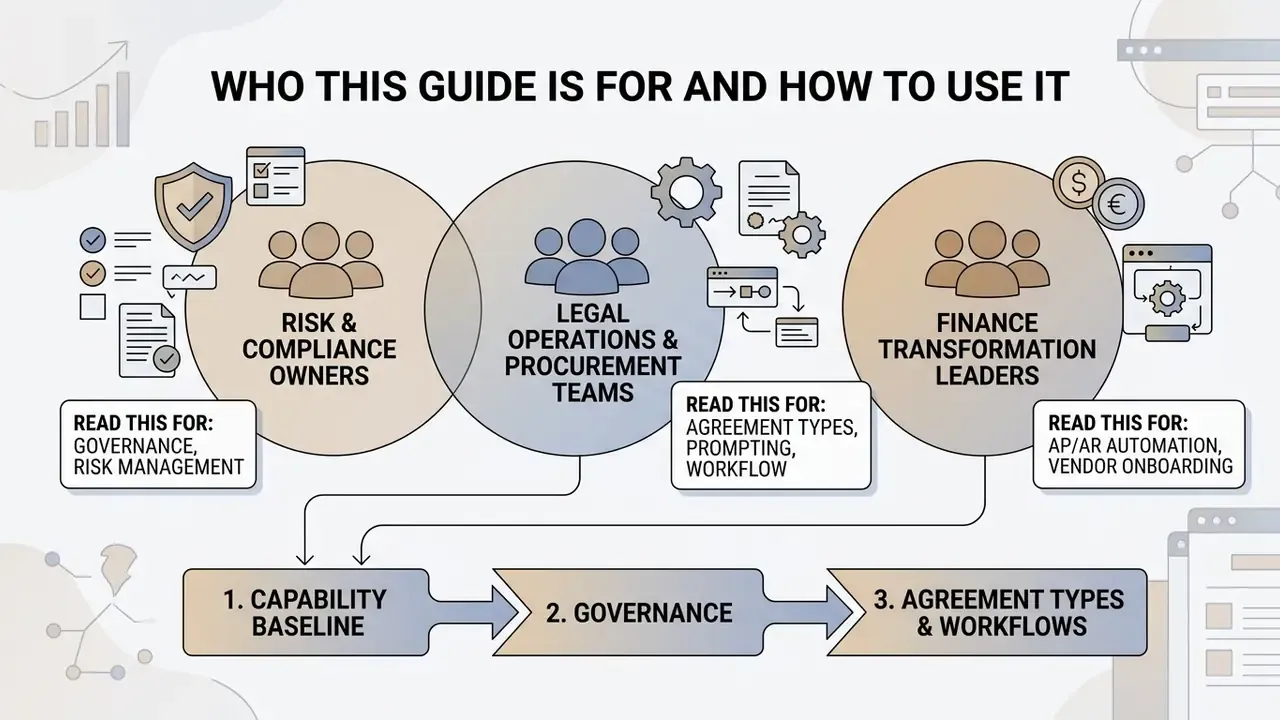
This guide is written for three overlapping groups, and each will read it differently.
Risk and compliance owners (CROs, CCOs, heads of model risk) will care most about the governance, audit-trail, and Shadow AI sections. Their concern is not draft quality in isolation. It is whether an examiner can reconstruct how a clause got into an executed instrument eighteen months later.
Legal operations and procurement teams will spend their time in the agreement types, prompting, and workflow sections. Their pain is volume: hundreds of near-identical vendor papers, each needing the same nine schedules.
Finance transformation leaders evaluating automation for AP, AR, and vendor onboarding should read the risk-adjusted ROI model closely. It contains the term most business cases quietly set to zero.
A practical reading order: start with the capability baseline, then jump to governance, then come back to prompting once you know what controls the tool must sit inside. Building prompt libraries before you have an approved clause source is, frankly, backwards.
What Is an AI Contract Generator and What Can It Do?
An AI contract generator is a software tool that processes user prompts, transaction details, and legal templates to produce structured contract drafts automatically. It leverages machine learning to convert raw data into standard legal clauses, accelerating initial document assembly for business workflows.
Modern generative AI tools streamline contract creation by automating routine boilerplate text and structuring complex conditions. As highlighted in KPMG's 2026 whitepaper on contract lifecycle management, AI platforms interpret contract language at scale, surface operational risk, and automate preliminary negotiations using a combined stack of machine learning, NLP, and generative models.
Quantified capability baseline. Vendor claims about "lawyer-grade" drafting should be read against measured benchmarks rather than marketing copy.
«Leading LLMs achieved an F1 score of 0.87 in identifying legal issues in contracts, on par with professional legal process outsourcing reviewers.»
While these systems accelerate content generation, they function strictly as drafting assistants rather than autonomous legal authorities. WorldCC's December 2024 analysis of the contract management lifecycle frames AI as a support layer across requirements, execution, and renewal, with commercial decisions and approval authority retained by humans.
From Contract Details to an AI-Generated Draft
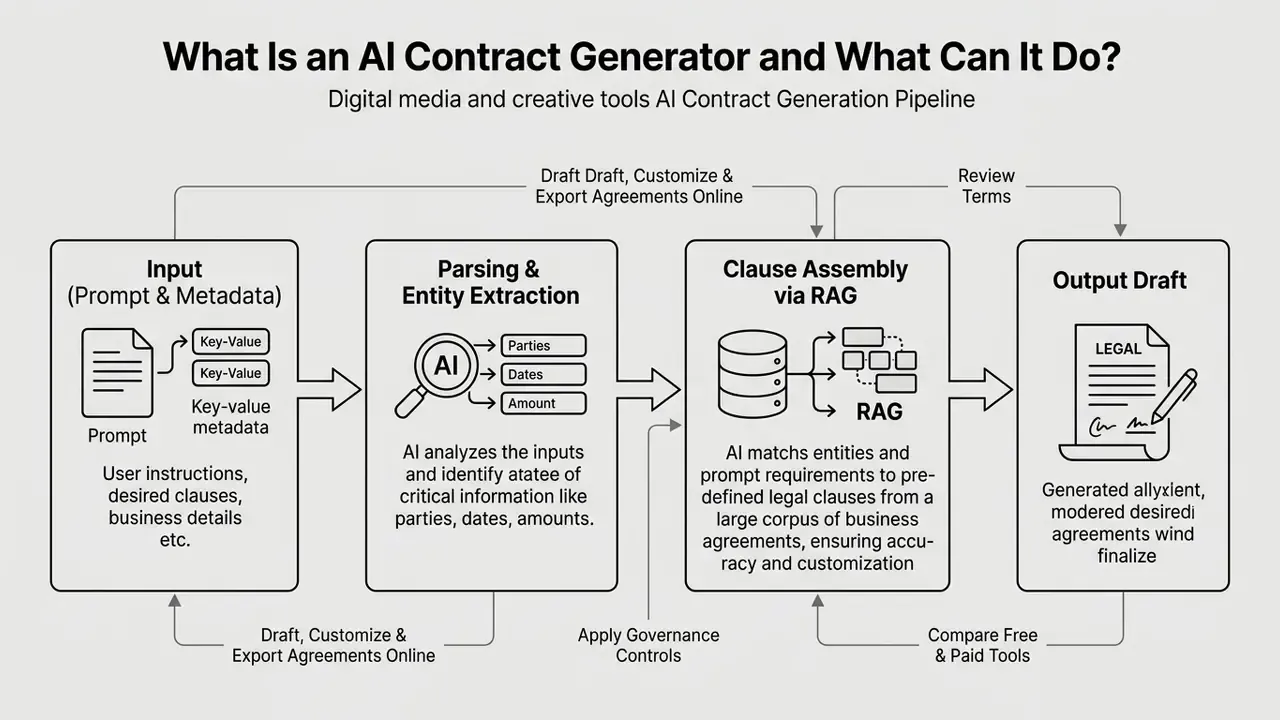
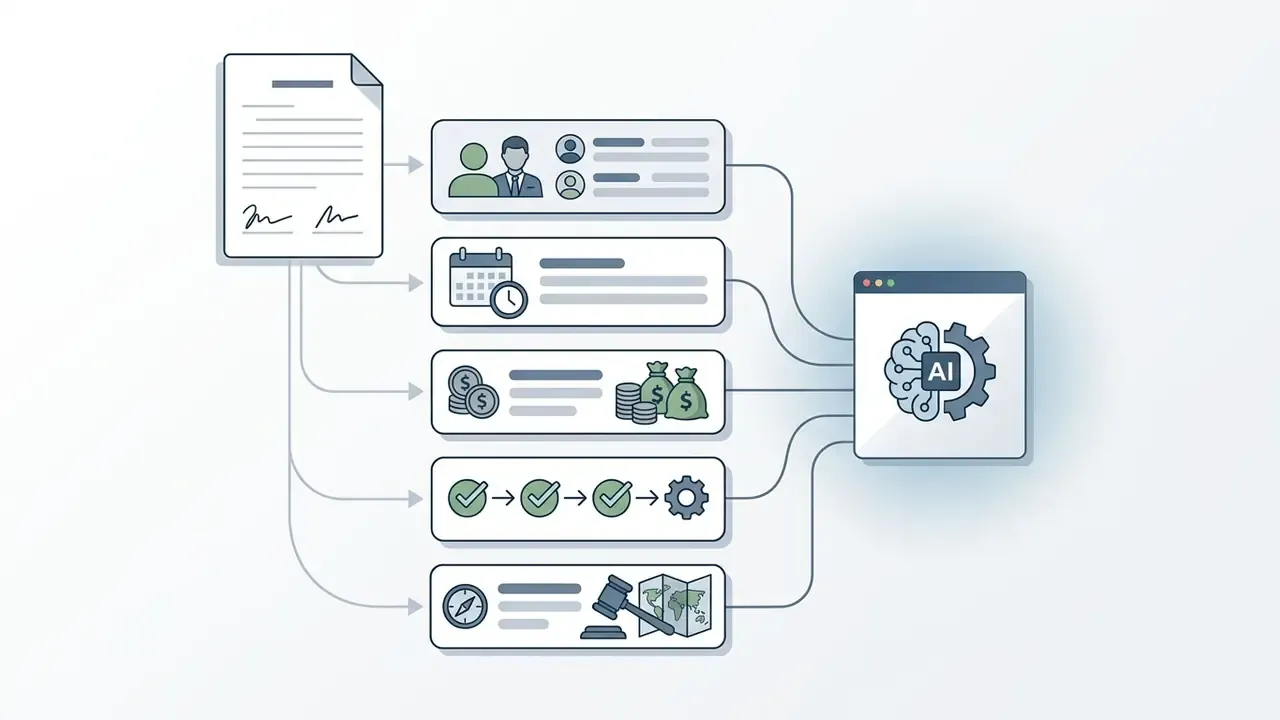
An AI agreement generator transforms user parameters, such as party names, effective dates, payment schedules, and specific scope terms, into a cohesive draft document. The underlying engine parses these key variables, matches them with standard legal frameworks, and populates the necessary clauses to form a generated contract draft.
Empirical evidence from a 2025 study on legal drafting workflows shows that AI systems extract named entities and variables to enforce consistent terminology across all document sections. Contract drafting platforms describe this as capturing parties, dates, fees, and key variables once, then propagating them consistently through every clause. Tools using retrieval-augmented generation (RAG) combine pre-approved clause libraries with dynamic user inputs. This process ensures that an ai contract creation workflow produces a complete, context-aware generated contract ready for structured editorial review.
«The fastest LLM completed a contract review in 0.7 minutes at approximately two cents per document, compared with 56 minutes and about $74 for a junior lawyer.»
Those figures describe raw generation and review throughput. Nothing more. Institutional buyers should model total cost including mandatory validation hours, which typically consumes most of the residual budget, as set out in the risk-adjusted ROI model further down this guide.
AI Contract Creation vs. Legal Advice
AI contract creation is an automated drafting mechanism. It does not constitute formal legal advice and does not create an attorney-client relationship. While an ai legal contract generator can rapidly synthesize legal text, it lacks the context-specific judgment required to assess unique regulatory risks or strategic trade-offs.
Legal ethics guidance points in the same direction. The New York City Bar's 2024 commentary on legal chatbots states that such systems "cannot and should not give legal advice," because legal advice is tailored guidance on what a specific person should do, and providing it without a licence raises unauthorized-practice-of-law (UPL) exposure. The State Bar of California's 2023 generative AI guidance permits drafting and review with human oversight while holding the lawyer responsible for confidentiality and tribunal-rule breaches. The Law Society of Alberta (2024) states that lawyers remain "ultimately responsible" for work produced with generative AI.
A correction worth flagging. Earlier framing of this topic conflated two distinct research findings. The correct split is:
- Routine issue determination Better Call GPT (2024) demonstrated high accuracy (F1 0.87) on standard legal issue spotting.
- Final contract scrubbing the ContractScrub benchmark (2026) documents systematic failure on final review.
«The strongest model, GPT-5.5, reached recall of 0.750 and F1 of 0.632, meaning most models still miss a significant share of cross-reference errors.»
Consequently, every ai generated contract requires rigorous human review by qualified professionals before signing.
LEGAL DISCLAIMER & NOTICE
Types of Agreements You Can Create With an AI Contract Generator
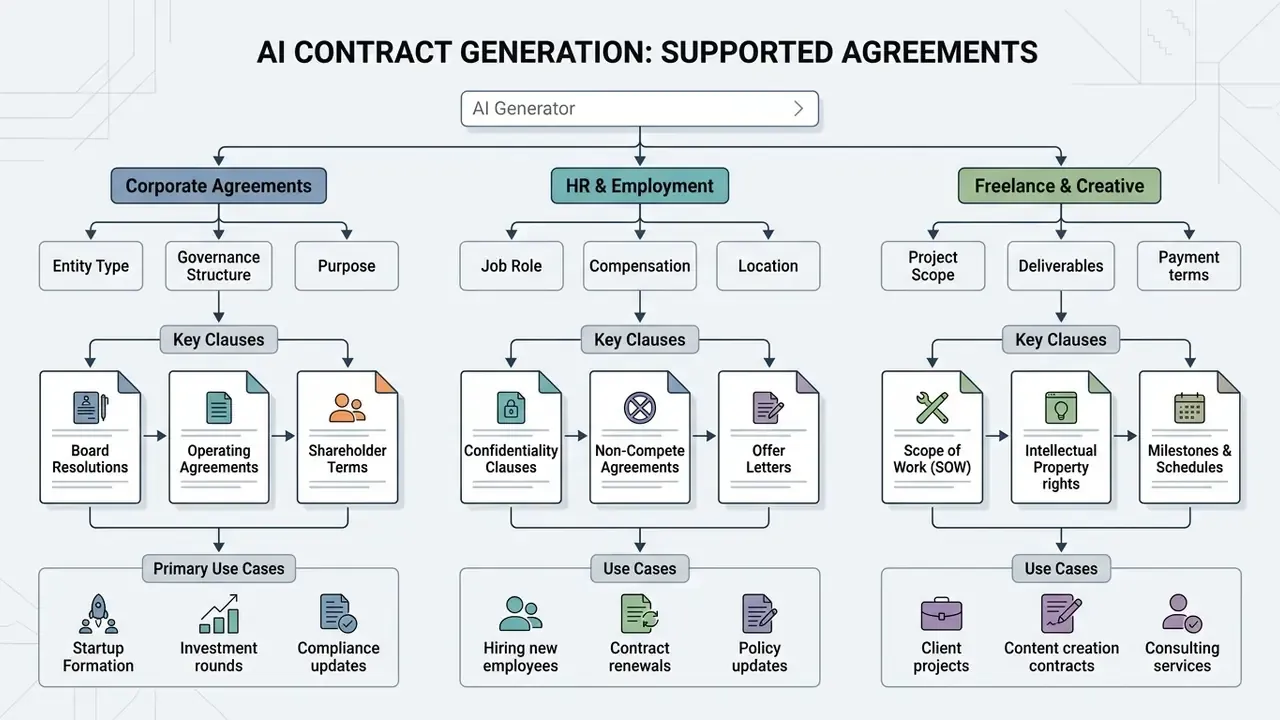
An ai business contract generator can create a wide variety of legal and commercial documents by leveraging specialized templates and custom prompts. Organizations routinely deploy these tools for non-disclosure agreements, vendor master service agreements, data processing addenda, procurement statements of work, freelance service contracts, commercial leases, and employment terms.
Selecting the correct agreement framework ensures the tool applies appropriate legal logic and standard protective covenants. Whether generating standard NDAs or multi-tiered service agreements, modern platforms accommodate diverse commercial contexts while maintaining baseline organizational standards.
Enterprise and Financial-Services Use Cases
In regulated institutions, the highest-volume AI drafting candidates are not one-off freelance deals. They are repeatable third-party paperwork. Legal operations teams in banking, fintech, and insurance typically deploy generation for:
- Vendor and SaaS master service agreements with negotiated security schedules and cyber-incident notification windows.
- Data Processing Agreements (DPAs) aligned to controller and processor roles, sub-processor authorization, breach-notification support, and DPIA assistance. This is the exact clause set the UK ICO's contracts-and-third-parties guidance treats as mandatory.
- Cloud service level agreements defining uptime credits, degradation thresholds, and exit assistance.
- Procurement statements of work attached to an existing MSA, where only scope, milestones, and pricing vary.
- Intercompany and shared-services agreements requiring consistent transfer-pricing language across entities.
- Syndicated loan and facility documentation packages, where AI assembles schedules and definitions for counsel review.
NIST's Generative AI Profile (2024) reinforces this: contracts and SLAs governing AI systems should define content ownership, usage rights, quality standards, security requirements, and provenance expectations. GSA's 2026 AI procurement policy adds that AI system contracts should define data ownership, IP rights, and limits on vendor use of agency data.
Service Agreements and Freelance Client Contracts
Service agreements and freelance contracts establish clear operational boundaries, payment schedules, and performance expectations between service providers and clients. An ai contract maker structures these documents by integrating specific deliverables, milestone schedules, and default payment terms.
When configuring a service contract, the system incorporates essential clauses covering scope of work, invoicing schedules, tax status, and intellectual property ownership. Standard freelance templates, for example, stipulate that final IP rights transfer to the client only upon full payment, while pre-existing background IP remains with the supplier. Payment structures observed across published templates include fixed fees, 50/50 deposit-and-delivery splits, and 40/30/30 milestone schedules. Precise scope boundaries prevent scope creep and keep document presentation professional across client workflows.
NDAs, Licensing, and Partnership Agreements
Non-disclosure agreements (NDAs), intellectual property licenses, and partnership contracts protect sensitive information and clarify asset usage rights. Deploying an ai agreement generator for these contracts ensures that confidentiality obligations, license scopes, and liability limits are systematically defined.
Commercial NDA generators typically support both unilateral and mutual confidentiality structures. Standard output includes definitions of confidential information, permitted usage parameters, exclusion criteria (public domain, prior knowledge, compelled disclosure), return or destruction of materials, and multi-year non-disclosure terms. Licensing templates extend this with scope of licensed rights, explicit denial of implied title transfer, sublicense controls, and liability for breaches by employees or contractors. Partnership frameworks explicitly reserve pre-existing background IP, which prevents unintentional asset transfers during collaborative ventures.
Employment, Lease, and Other Custom Contracts
Employment agreements, commercial leases, and custom independent contractor contracts require precise alignment with local labor codes and real estate regulations. Using a contract creator ai allows teams to generate tailored terms that address specific organizational policies and operational requirements.
Generating regulated agreements does carry heightened compliance risk. Guidance from the National Institute of Standards and Technology emphasizes that AI-generated legal documents must align with applicable privacy, copyright, labor, and intellectual property laws, and that organizations should route access decisions through legal and compliance functions, restricting generative use where compliance cannot be assured (NIST AI Risk Management Framework: Generative AI Profile, NIST AI 600-1, 2024. https://nvlpubs.nist.gov/nistpubs/ai/NIST.AI.600-1.pdf). A 2025 RAILS guidance framework adds that legal teams should be engaged early to assess contracts, IP rights, liabilities, and commercial risk. Mandatory governance policies must review customized clauses before any employment or lease paperwork leaves the building.
Payment, Maintenance, Franchise, and Construction Agreements
Agreement Specifications Matrix
| Agreement Type | Primary Input Requirements | Core Clauses & Covenants | Typical Commercial Scenario |
|---|---|---|---|
| Non-Disclosure Agreement (NDA) | Disclosing & receiving parties, disclosure purpose, duration term | Definition of confidential info, permitted use, exclusions, return of data | Vendor evaluations, partnership discussions, M&A due diligence |
| Master Service Agreement (MSA) | Scope of work, payment schedule, service levels, liability limits | IP allocation, termination notice, payment terms, indemnification | Long-term consulting engagements, enterprise vendor and SaaS onboarding |
| Employment Contract | Employee role, compensation, benefits, probation period, work location | Duties, non-compete terms, termination conditions, confidentiality | Hiring full-time staff, remote employee onboarding |
| Commercial / Residential Lease | Lessor & lessee, property specs, rent amount, security deposit, term | Rent adjustment, maintenance duties, default remedies, renewal options | Office space leasing, property management operations |
| Partnership Agreement | Partner entities, capital contributions, profit-sharing ratios, governance | Voting rights, profit distribution, exit strategy, IP rights reservation | Co-founding business ventures, joint product commercialization |
| HR Offer Letter | Candidate name, base salary, equity vesting schedule, relocation stipend | At-will statement, IP assignment, non-compete/solicit, contingency terms | Hiring executives, tech staff onboarding |
| Maintenance Agreement | Equipment/software spec, SLA metrics, response windows, fee schedule | Scheduled upkeep, emergency patch response, exclusion of customer fault | IT infrastructure support, commercial HVAC upkeep |
| Data Processing Agreement (DPA) | Controller/processor roles, data categories, retention period, sub-processors | Documented instructions, security measures, breach notification, deletion/return | SaaS vendor onboarding, cross-border data transfers |
How to Write a Prompt for an AI Agreement Generator
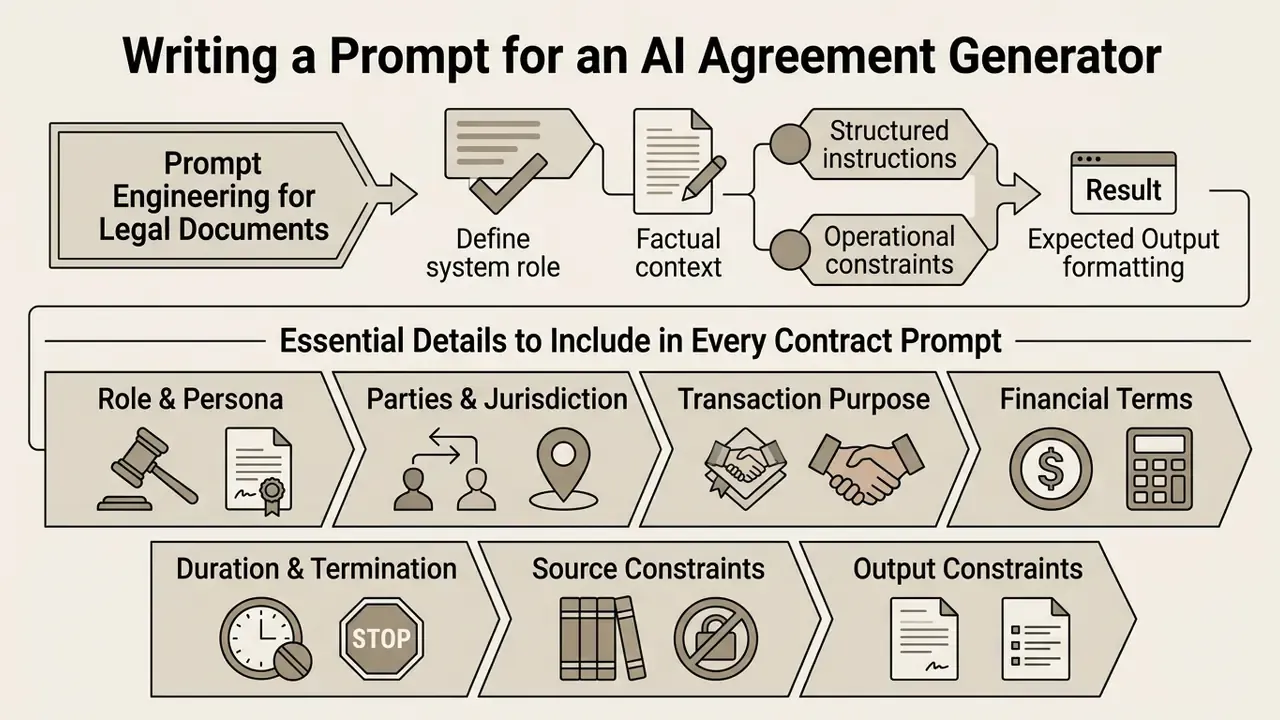
Prompt engineering for legal documents requires structured instructions that define system role, factual context, operational constraints, and expected output formatting. Precision in prompt construction directly influences the quality and statutory alignment of the generated text.
Prompt Engineering for Lawyers (Singapore Academy of Law, 2025-2026) recommends structured legal prompting that defines task, role, audience, tone, length, and context, and constrains outputs strictly to verified precedent or supplied source text. Legal prompt playbooks add two operational rules: ground outputs only in document evidence, and instruct the model to flag missing standard clauses instead of inventing them. Clear rules reduce hallucination and help the ai agreement maker produce precise, commercially applicable legal prose.
A disciplined rollout also uses a test, refine, validate loop. Run each production prompt against 5 to 10 representative deal scenarios, compare output to a manually prepared gold-standard draft, and release the prompt into the template library only after subject-matter-expert validation. Prompts, in this sense, become controlled artefacts with owners and version numbers, not personal notes in someone's browser tab.
Essential Details to Include in Every Contract Prompt
Every contract generation prompt must contain core operational parameters to produce a functional legal document. Omit critical context and the model will insert generic assumptions that quietly conflict with your business goals.
A comprehensive prompt should explicitly state:
- Role & Persona Instruct the AI to act as an expert commercial contract drafter.
- Parties & Jurisdiction Specify full legal corporate names, state of incorporation, registered address, tax identifiers, and governing law.
- Transaction Purpose Define the exact commercial objective and performance scope.
- Financial Terms State payment structures, currencies, invoice timing, and late fees.
- Duration & Termination Detail contract start date, renewal conditions, and notice periods.
- Source Constraints Restrict clause language to the supplied playbook or precedent text; require the model to flag gaps rather than fabricate provisions.
- Output Constraints Mandate formal legal tone, clear defined terms, and structured section headings.
How to Request Specific Terms and Clauses
When specific protective covenants are required, prompts must explicitly outline the triggers, remedies, and operational boundaries of those clauses. Requesting specific terms ensures that high-risk areas such as liability, IP rights, and confidentiality are fully addressed.
For a force majeure provision, the prompt should define qualifying events, notice timelines, suspension rules, and maximum duration before termination rights activate. Published government contracts illustrate the range: UK FCDO standard service terms allow suspension for up to six months before termination, while some agency service conditions permit immediate termination once a force majeure event exceeds 30 days. Requests for indemnification should specify whether liability caps apply and identify explicit carve-outs for gross negligence or willful misconduct. Confidentiality penalty clauses are frequently drafted as a fixed liquidated amount plus recovery of actual proven damages, a structure the prompt must state expressly.
Sample Prompts for Business Contracts and Agreements
Pre-structured prompt templates let users generate targeted drafts across common commercial scenarios. Below are seven practical templates spanning freelance, corporate, HR, and enterprise vendor situations.
1. Non-Disclosure Agreement (NDA) Prompt
Act as a corporate legal counsel. Draft a mutual Non-Disclosure Agreement between [Company A, a Delaware LLC] and [Company B, a California Corporation]. The purpose of disclosure is evaluating a potential technology partnership regarding [Project Name]. Include broad definitions of Confidential Information, a 3-year secrecy term from disclosure, standard exclusions (public domain, prior knowledge), mandatory return of materials upon request, and Delaware governing law.
2. Master Service Agreement (MSA) Prompt
Draft a Master Service Agreement between [Agency Name, Service Provider] and [Client Name, Client]. The provider will deliver digital marketing services outlined in future Statements of Work (SOWs). Include net-30 payment terms, 1.5% monthly late payment interest, client ownership of final deliverables upon full payment, background IP reservation for the provider, a $50,000 limitation of liability cap, and mutual termination with 30 days written notice.
3. Independent Contractor Employment Agreement Prompt
Generate an Independent Contractor Agreement for a Senior Software Engineer based in Texas. Specify independent contractor status (no employee benefits, contractor handles own taxes). Scope includes backend API development. Define compensation as $120/hour paid bi-weekly. Include strict confidentiality, immediate assignment of all work product and IP to the hiring company, and a 1-year post-termination non-solicitation of clients.
4. Commercial Lease Agreement Prompt
Create a Commercial Property Lease Agreement between [Property Owner LLC, Landlord] and [Retail Brand Inc., Tenant] for property located at [Address]. Lease term is 36 months starting [Date]. Monthly rent is $8,500 with a 3% annual escalation. Security deposit is $17,000. Specify tenant responsibility for interior maintenance and utilities, landlord responsibility for structural repairs, triple-net (NNN) expense allocation, and a 60-day cure period for monetary defaults.
5. Partnership Agreement Prompt
Draft a General Business Partnership Agreement for two equal partners establishing [Business Name]. Partner A contributes $100,000 capital; Partner B contributes proprietary software architecture. Specify 50/50 profit and loss allocation, joint decision-making for expenditures over $10,000, dispute resolution via binding arbitration in New York, and a right of first refusal if one partner intends to sell their partnership interest.
6. Executive HR Offer Letter with Equity Prompt
Act as an HR Legal Specialist. Draft a formal Executive Employment Offer Letter for a Chief Technology Officer joining a Delaware C-Corp. Include a $220,000 base salary, 1.5% equity grant with a 4-year vesting schedule and 1-year cliff, $15,000 relocation reimbursement, at-will employment status, strict proprietary information assignment, and New York governing law.
7. Enterprise Vendor MSA with Security Schedule and DPA Prompt
Act as third-party risk counsel for a regulated financial institution. Draft a Master Service Agreement and attached Data Processing Addendum between [Bank Holding Company, Delaware] and [SaaS Vendor Inc.] for a cloud-hosted analytics platform processing customer transaction data. Include: 99.95% uptime SLA with service credits; 24-hour security incident notification; annual SOC 2 Type II evidence delivery and audit rights; sub-processor pre-authorization; controller/processor role allocation; prohibition on using bank data to train any model; encryption in transit (TLS 1.3) and at rest (AES-256); data deletion and return within 30 days of termination; $5,000,000 liability cap with uncapped carve-outs for data breach, confidentiality breach, and willful misconduct; and New York governing law. Flag any clause you cannot complete from the facts supplied instead of inferring terms.
How to Generate a Contract Using AI
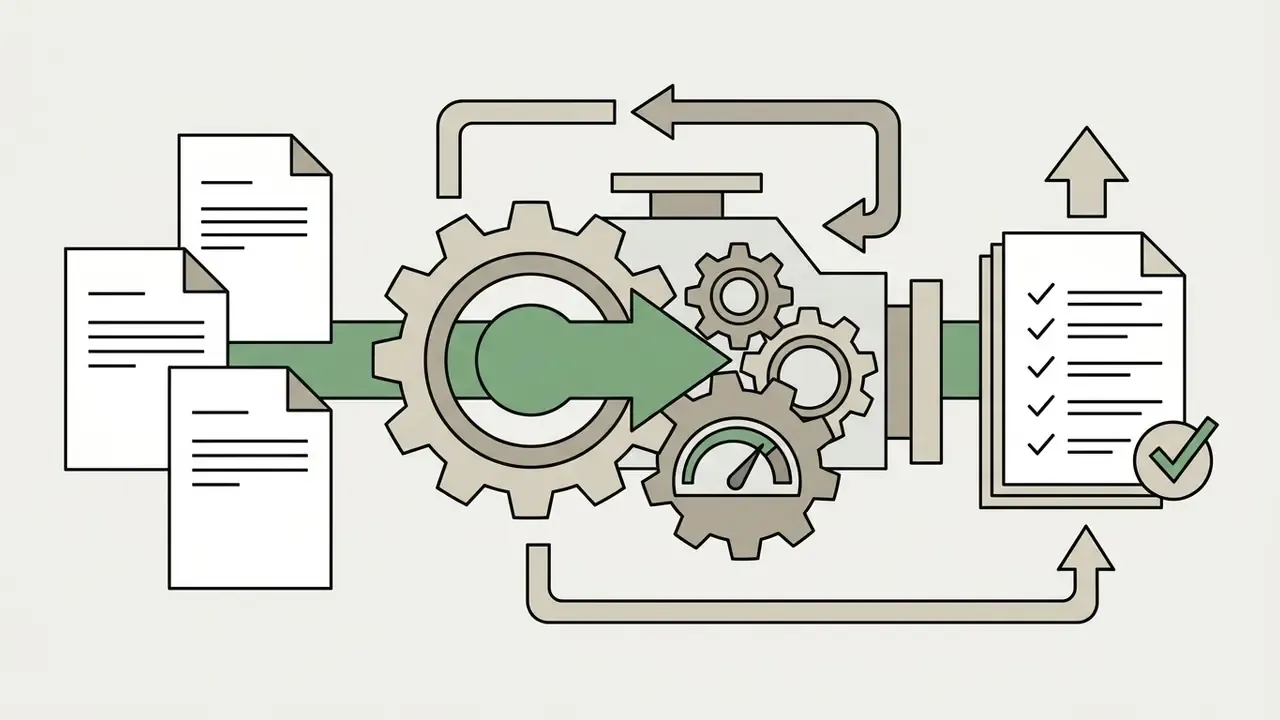
Generating a commercial agreement online follows a structured execution sequence that moves raw parameters into a finalized, executable document. An established workflow protects document completeness and reduces drafting errors.
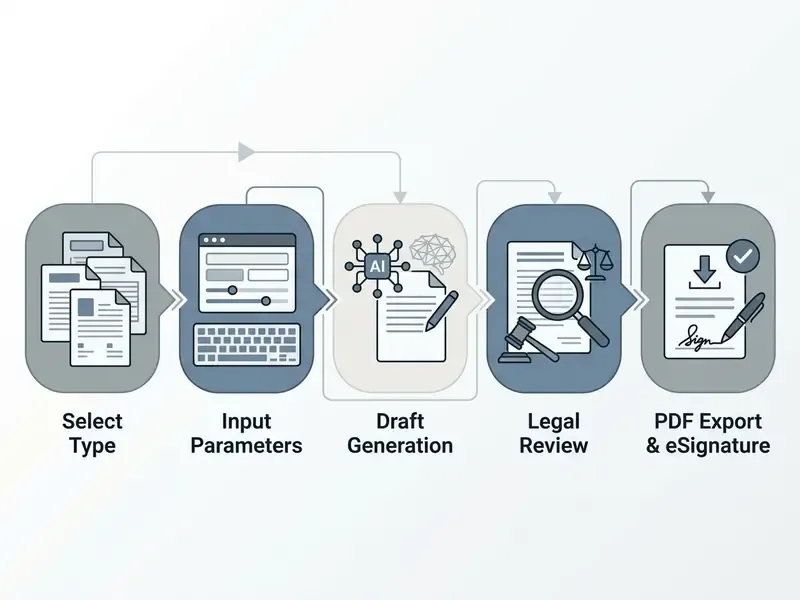
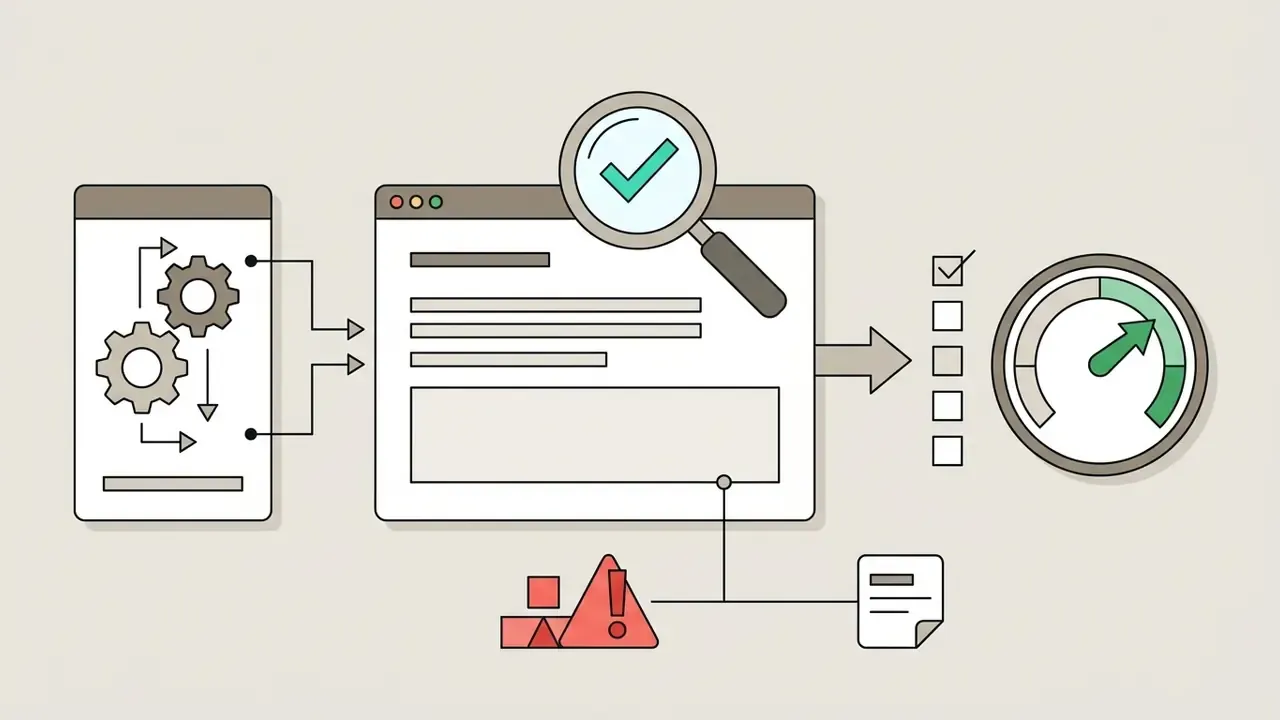
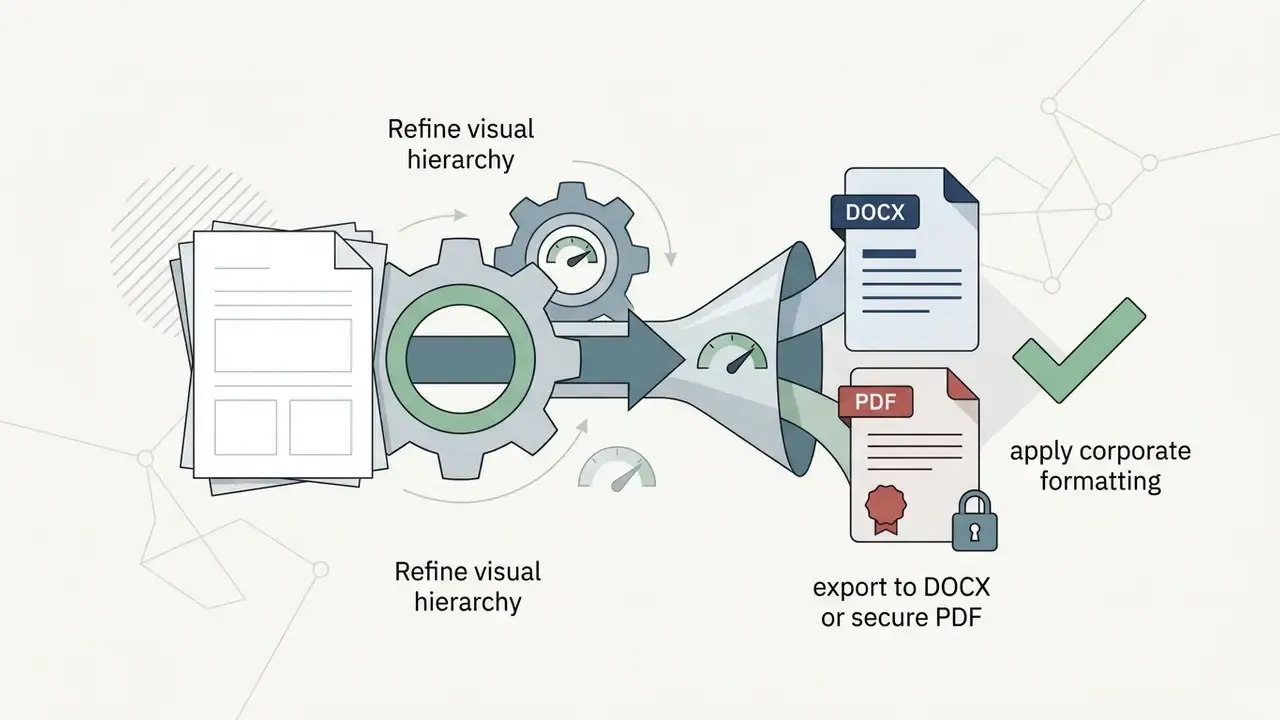
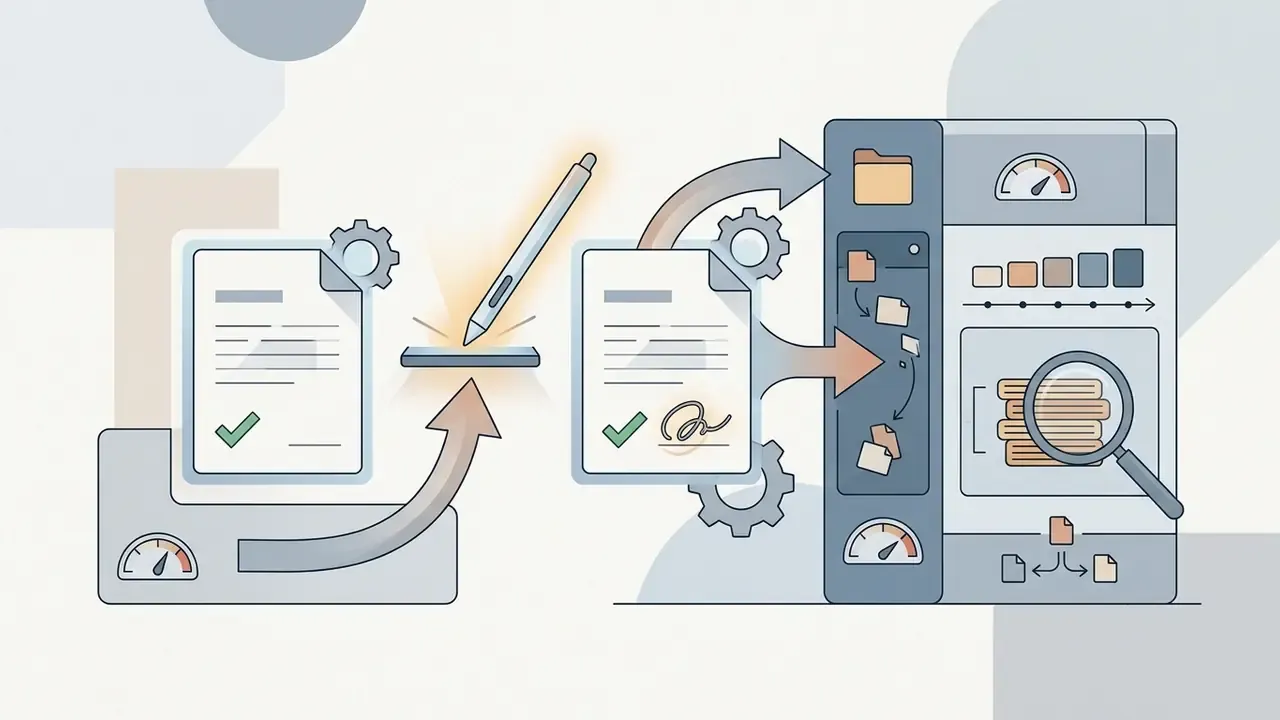
To get usable results from an ai contract generator online, users navigate a six-stage operational pipeline:
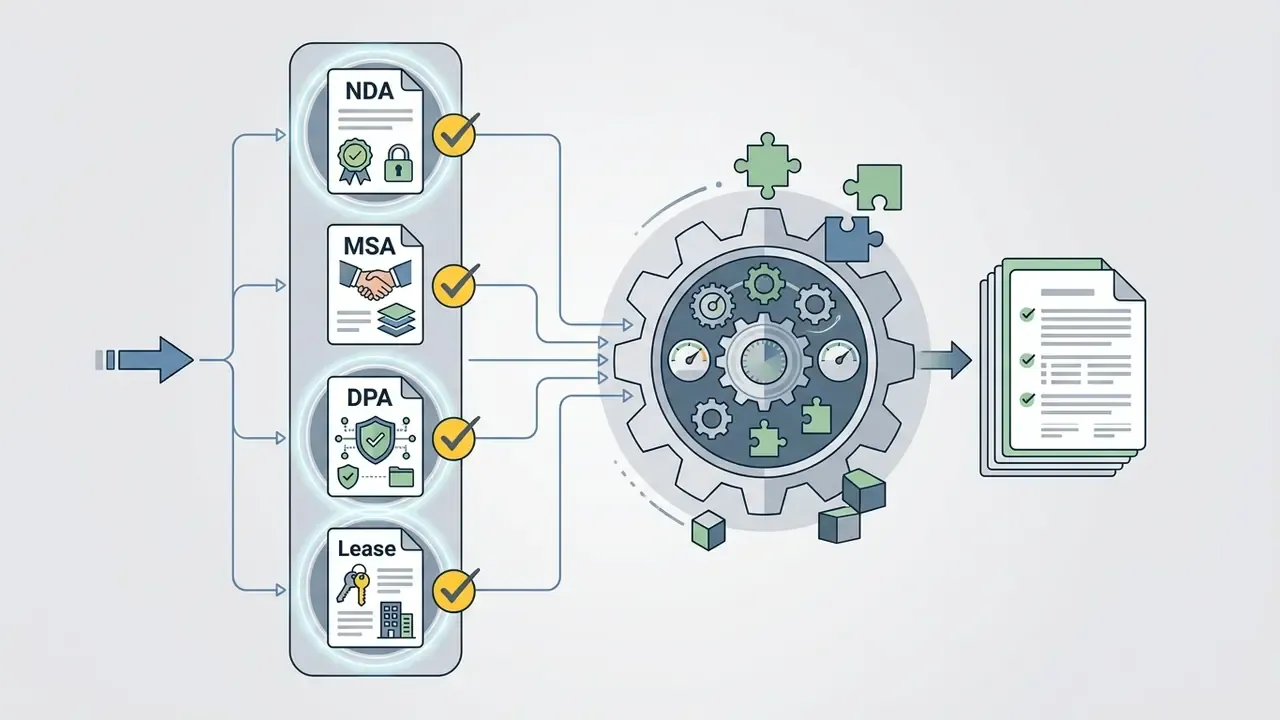
Define the Agreement Goal and Contract Type
Initial contract planning requires clear legal objectives, identified contracting entities, and the right operational framework. Defining these parameters before invoking any ai generator contract workflow keeps the resulting draft aligned with commercial intent.
Clear scoping involves verifying party authority, funding arrangements, and regulatory constraints. Canadian federal guidance on contractual arrangements frames this as four questions: what is being paid for, who benefits, who pays, and what authority exists to act. According to UNIDO contract drafting standards, a valid agreement requires competent parties, lawful subject matter, agreement on essential points, and mutual assent. Selecting the precise document category instructs the generator to apply relevant statutory logic and industry-standard protective language.
Add Key Details and Generate the Contract Draft
Once the framework is selected, users input specific deal variables into the generation engine. Accurate party requisites, financial terms, performance deadlines, and termination triggers allow the AI to construct a comprehensive first draft. Federal Uniform Contract Format conventions are a useful completeness test: contract form, supplies or services and prices, statement of work, delivery and performance, contract administration data, and special contract requirements should each map to a supplied input.
Case example (illustrative, regulated financial services). A Tier-2 US regional bank standardized its third-party vendor paperwork by loading approved playbook clauses into a RAG-backed generator. Only the variable layer passed through prompts: vendor entity, data categories, SLA thresholds, liability cap. The security schedule and DPA language came from the pre-approved library. First-draft turnaround for a standard SaaS MSA dropped from three business days to under two hours, with every draft entering a mandatory maker-checker review by in-house counsel before release to the counterparty.
Case example (illustrative, logistics vendor standardization). A mid-sized logistics firm needed consistent vendor agreements across multiple regional nodes. The operations team mapped core contract variables, including service metrics, payment windows, and liability limits, into structured prompts using an ai contract agreement generator. That standardized input structure cut initial draft creation time by roughly 80% and produced consistent base documents, each subsequently cleared by internal legal counsel.
Both examples are composite illustrations rather than named client engagements. Published research does support that order of magnitude when retrieval grounding and human sign-off are both present:
«A RAG-based legal drafting system achieved an 81% retention ratio and reduced draft preparation time by 92%, while preserving mandatory attorney review.»
In-Line AI Text Refinement and Clause Editing
Generating the initial draft is only the first step. Modern ai contract generator tools include embedded text-refinement controls that let users modify specific clauses without disturbing the wider document structure.
When auditing a machine-drafted agreement, legal operations teams lean on four inline functions:
- Rewrite & Rephrase Restructures dense legalese into plain language, or shifts tone between aggressive protective terms and balanced commercial standards.
- Condense & Shorten Strips redundant boilerplate while preserving critical legal definitions and operational triggers.
- Expand & Elaborate Adds operational context, such as detailed breach-notification timelines or specific audit rights inside standard indemnity clauses.
- Grammar & Precision Check Audits defined terms, fixes punctuation in multi-tiered conditional statements, and enforces cross-clause reference consistency.
Apply each refinement to a selected passage rather than the whole document, and capture every accepted change under tracked changes. The reviewing lawyer should see exactly what the model altered. That single habit turns a black box into reviewable evidence.
Uploading and Transforming Legacy PDF Contracts
Beyond drafting from scratch, advanced platforms allow teams to upload legacy PDF or DOCX agreements. Using OCR (Optical Character Recognition) and AI-driven parsing engines, the tool extracts existing clauses, identifies outdated legal terminology, and highlights missing risk-mitigation covenants. Users convert static PDF files into editable digital drafts, apply modern compliance updates, and re-export signature-ready documents in minutes.
This capability matters most during renewal cycles. Institutions holding hundreds of legacy vendor contracts signed before current AI, privacy, or security standards existed can triage which agreements lack breach-notification windows, audit rights, or model-training prohibitions, then regenerate compliant replacements from the same commercial terms. It is unglamorous work. It is also where most of the measurable risk reduction sits.
Edit, Export, Download, and Send for Signing
After draft generation, the document enters the editing and refinement stage. Users inspect clause mechanics, customize specific terms, and format text within a word processor or cloud editor before finalization. Document-assistant workflows in mainstream word processors now support reviewing clauses, applying approved changes with Track Changes enabled, and exporting the final version directly to PDF.
Modern CLM workflows integrate draft review directly with document conversion and electronic signature engines. Software integrations support exporting signature-ready PDFs with preserved styling to platforms such as DocuSign or Adobe Sign, and AI routing can direct finalized documents to the correct signatories using contract metadata and predefined approval workflows. Once exported, the file goes to authorized signers for formal execution and audit tracking.
Enterprise Governance, Audit Trail, and Model Risk Management
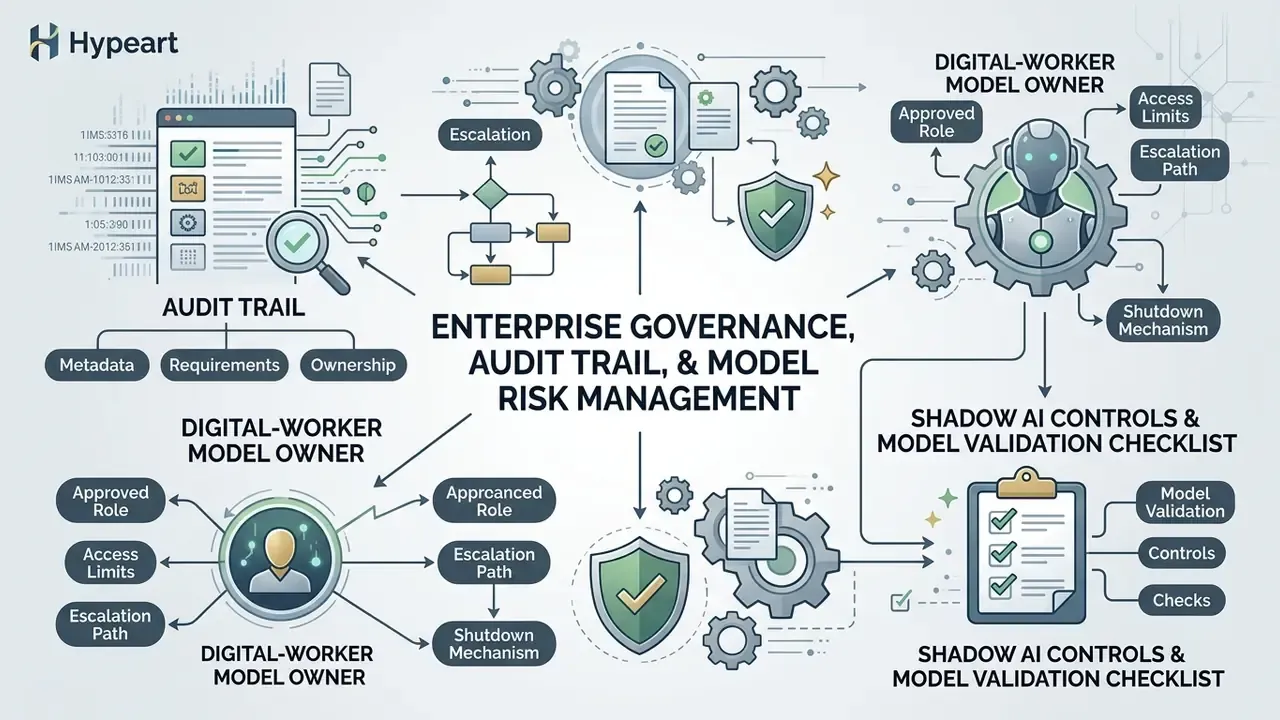
For banks, insurers, and fintechs, an AI contract generator is not just a productivity tool. It is a model-supported process that examiners and internal audit will eventually inspect. Model risk management expectations set out in the Federal Reserve's SR 11-7 and OCC Bulletin 2011-12 rest on three pillars that translate directly to contract generation: sound development and documentation, effective validation, and governance with clear ownership and controls.
Practically, a generated draft should never be the system of record on its own. It must arrive with a reproducible trail showing what was asked, what source clauses grounded the answer, which model version produced it, and who approved it.
Audit Trail Metadata Requirements
Capture and retain the following metadata for every generated agreement:
| Metadata Field | Why Examiners and Auditors Need It |
|---|---|
| Prompt text (verbatim) | Reproduces the exact instruction set that produced the draft |
| Retrieved source clauses / playbook version | Proves the output was grounded in approved precedent, not invented |
| Model name, version, and provider | Establishes which system generated the text and when it changed |
| Generation parameters (temperature, max tokens) | Documents determinism settings affecting output variability |
| Requesting user ID and business unit | Assigns first-line accountability |
| Reviewer ID, review timestamp, and edit diff | Evidences maker-checker separation and substantive human review |
| Approval stamp and execution record | Links the reviewed draft to the executed instrument |
| Retention and deletion schedule | Demonstrates records-management and privacy compliance |
Transparency obligations are becoming statutory rather than voluntary.
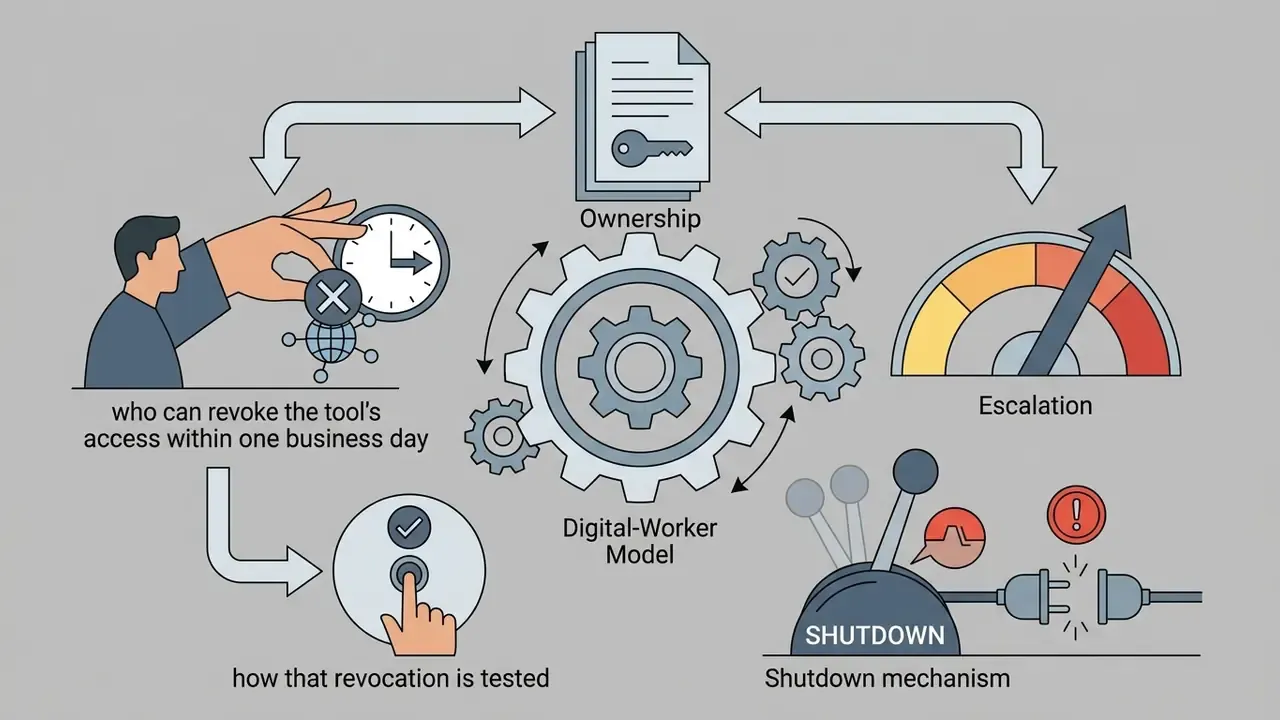
Ownership, Escalation, and the Digital-Worker Model
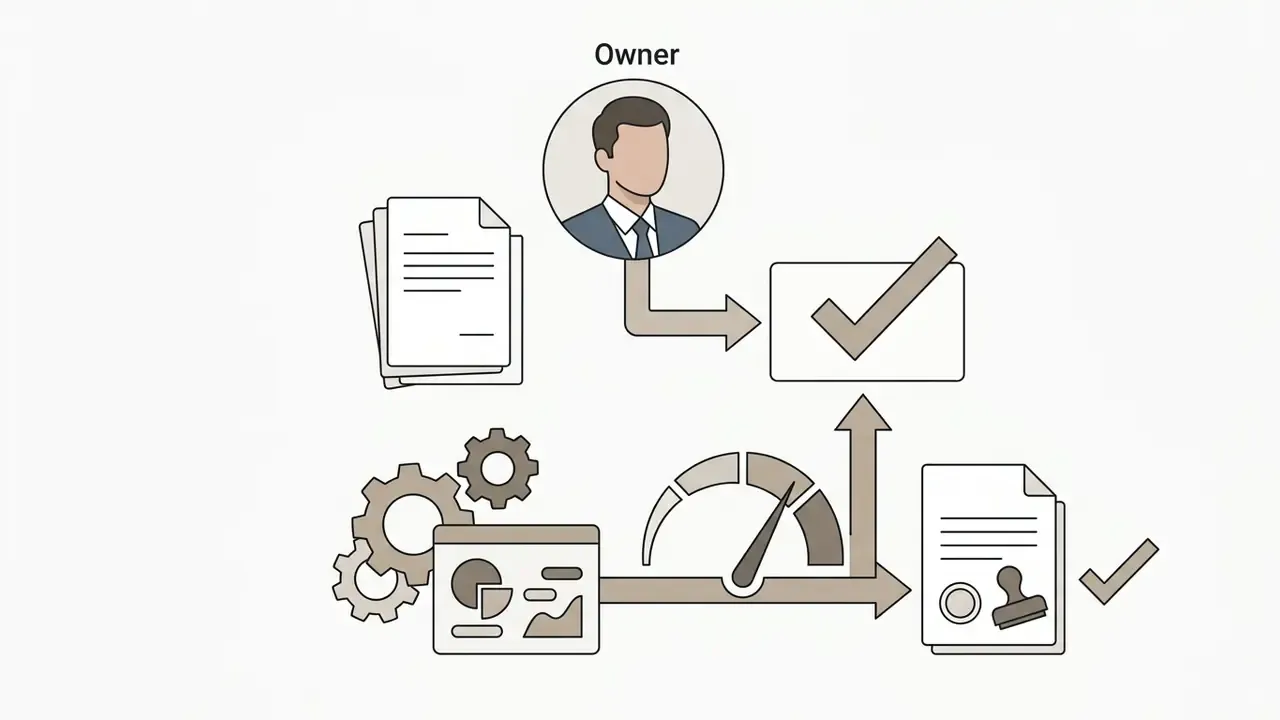
One question derails more AI governance reviews than any technical control: who owns this thing? A drafting agent without a named owner is not a tool, it is an unassigned liability.
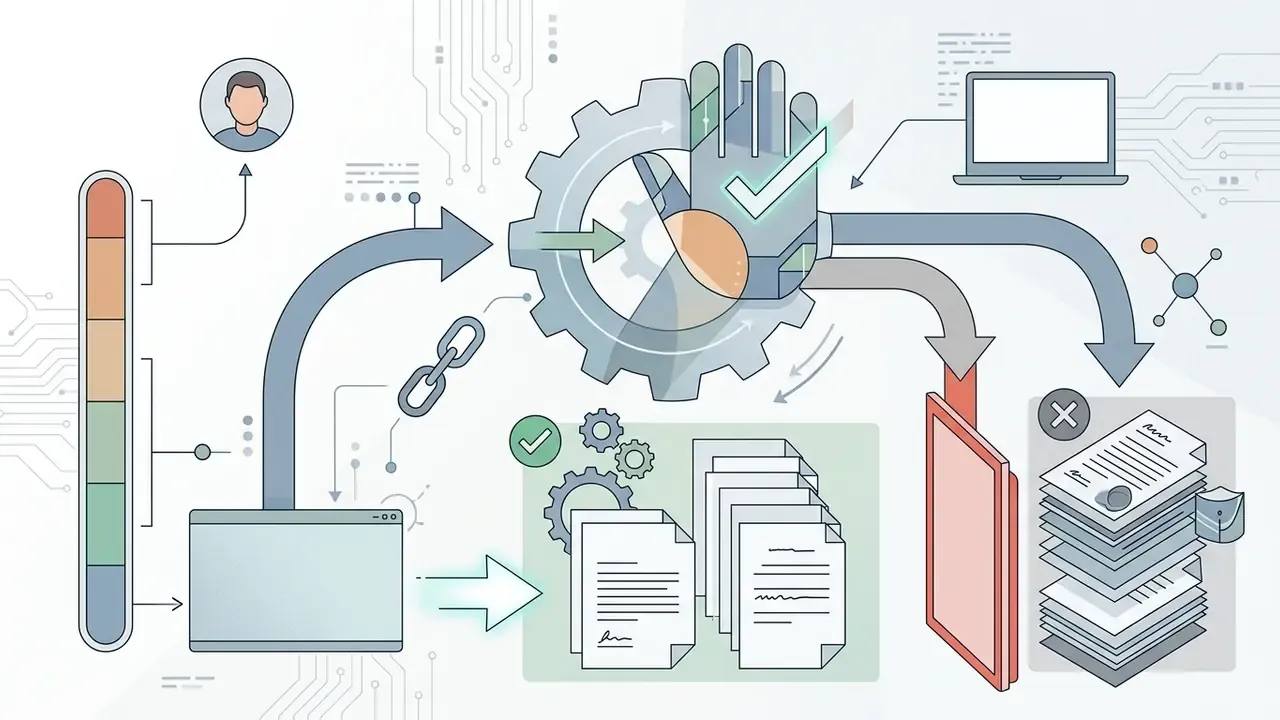
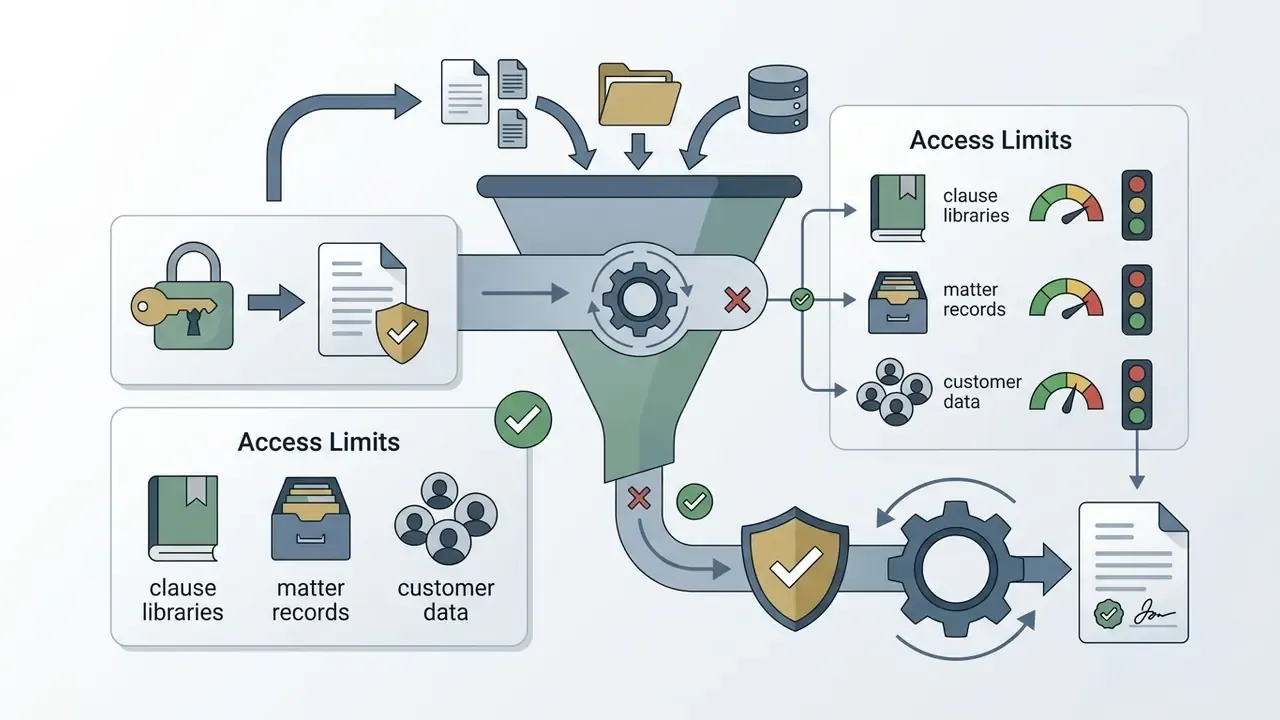
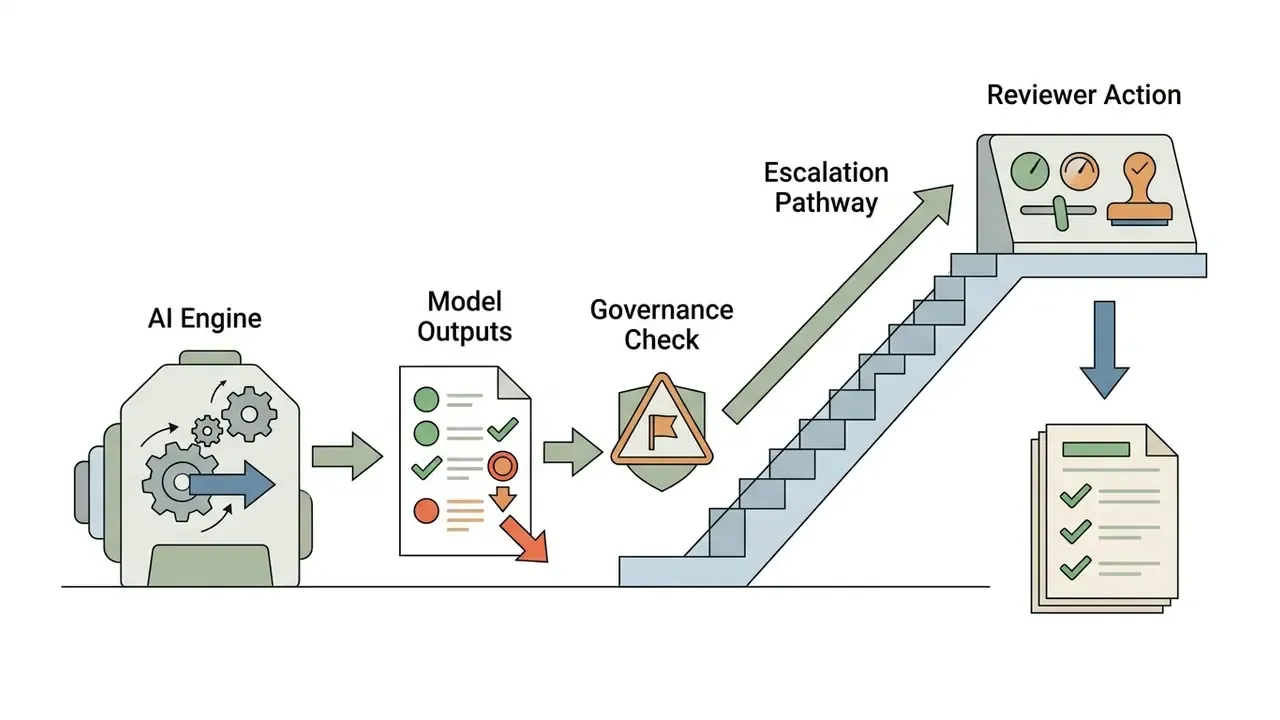
Treat the generator as a digital worker with five documented attributes:
No evidence, no autonomy. If any of the five attributes is undocumented, the workflow stays in assisted mode with mandatory review on every draft, regardless of measured accuracy.
Shadow AI Controls and Model Validation Checklist
The dominant real-world failure mode is not a bad clause. It is an employee pasting confidential deal terms into a consumer chatbot at 11pm. Use this checklist before any tool is approved for contract work:
Checklist0 / 10
Detailed onboarding standards and control descriptions are worth documenting once and reusing; teams can view the guide when formalizing internal rollout steps.
Are AI-Generated Contracts Legally Binding and Safe to Use?
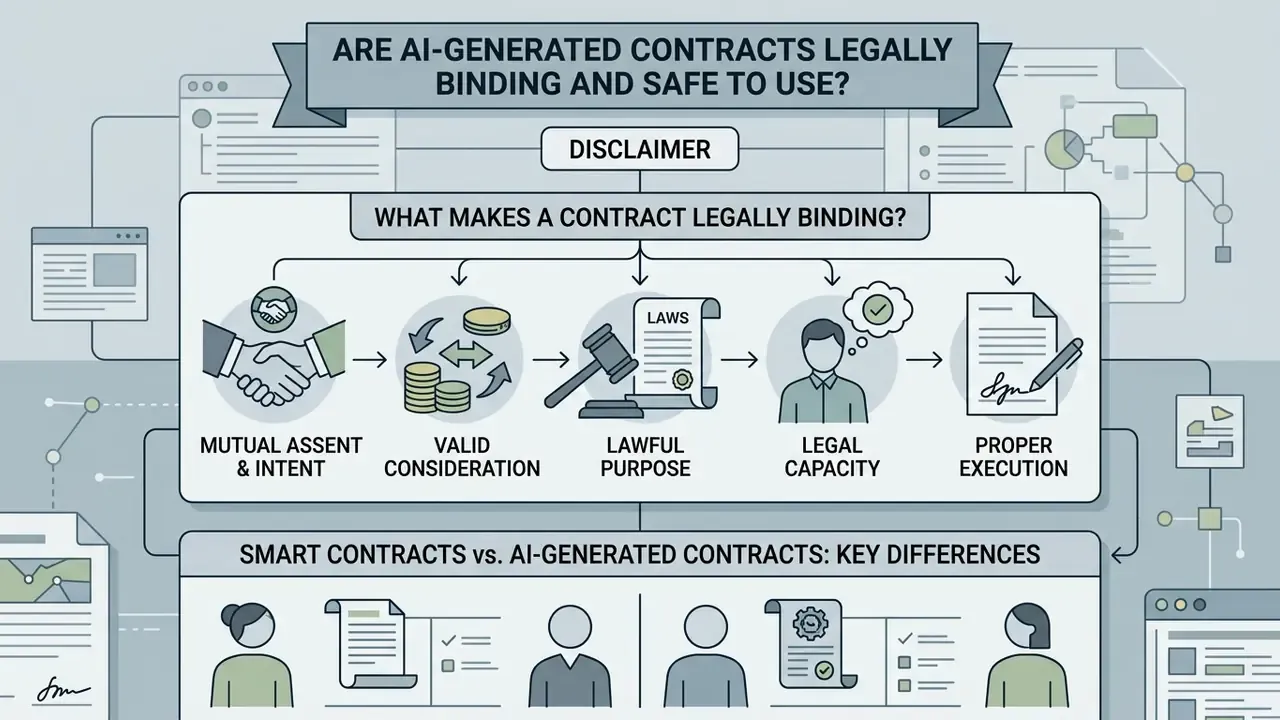
Contracts generated by AI systems are legally binding when they satisfy basic contractual elements under applicable contract law. Enforceability depends on mutual assent, valid consideration, lawful purpose, and party capacity, not on whether the text was authored by a human or an algorithm.
International legal frameworks, including the UNCITRAL Model Law on Automated Contracting, affirm that contract validity cannot be denied solely because an automated system generated or processed the agreement, with attribution following the parties' agreed procedure or, absent that, the user of the system. The Financial Markets Law Committee's 2025 report adds the necessary counterweight: AI has no legal personality, so the contracting party is always the natural or legal person using the tool. (Institutional users should have counsel confirm how these principles are implemented in their governing jurisdiction.)
An ai generated contract can therefore form a valid legal instrument. Enforceability risk creeps in when generated text carries ambiguous terms, statutory violations, or unverified execution data.
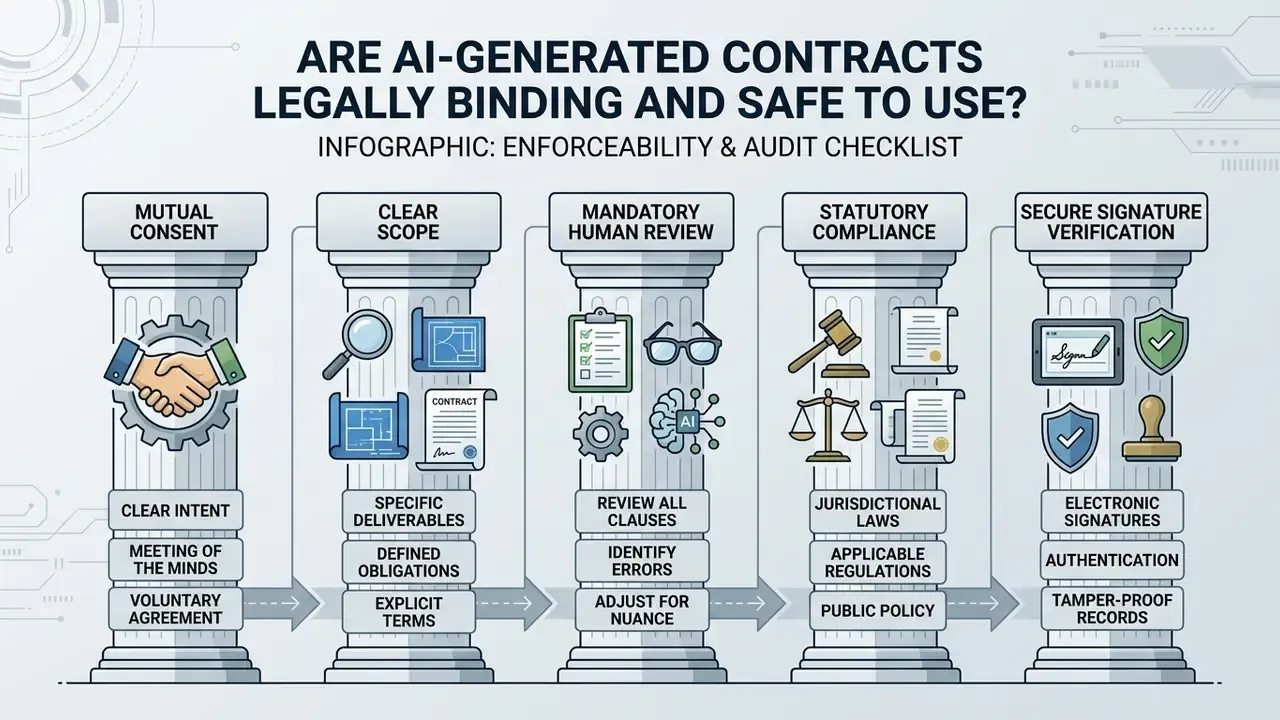
What Makes a Contract Legally Binding?
For any agreement to be enforceable in court, it must fulfill fundamental statutory requirements regardless of drafting method. A legal agreement generator ai assists in framing these terms, but the contracting parties must ensure all legal elements are met:
Smart Contracts vs. AI-Generated Contracts: Key Differences
A common misconception in contract automation is confusing AI-generated contracts with smart contracts. Both use modern technology; they serve fundamentally different legal and operational functions.
| Feature / Dimension | AI-Generated Contracts | Smart Contracts (Blockchain) |
|---|---|---|
| Core Definition | Legal agreements drafted in natural language using generative AI models. | Self-executing digital code deployed on decentralized blockchain networks. |
| Execution Method | Executed via human consent using traditional or eSignature signatures. | Executed automatically by protocol when predefined conditions are met. |
| Enforceability | Enforceable in court under standard contract law (for example UCC, ESIGN Act). | Enforceability varies; code execution is deterministic and irreversible. |
| Modifiability | Fully editable Word, PDF, or text documents during negotiations. | Immutable once deployed unless programmed with admin keys. |
| Primary Use Case | Commercial MSAs, NDAs, employment terms, and vendor agreements. | Automated DeFi payouts, token transfers, and supply chain tracking triggers. |
Litigation Risks: Can You Be Sued for Using AI Contract Generators?
You cannot be sued simply for using AI software to draft a contract. Courts evaluate contracts on their written terms, legal enforceability, and execution, not the process used to write the text. Severe liability arises when an unreviewed AI contract contains illegal clauses, statutory breaches, or missing obligations that cause financial harm to a contracting party. Responsibility for contract compliance rests entirely on the signatories and reviewing professionals, not the software vendor. For adjacent dispute-exposure themes, see the overview of AI-related litigation considerations.
Litigation practice is tightening the human-accountability requirement directly. A 2026 federal court standing order requires human certification that AI-drafted legal language was personally reviewed and that all citations are real, with filings remaining subject to Rule 11 and applicable ethical rules. ABA Formal Opinion 512 (2024) similarly instructs lawyers to review all generative AI output for accuracy before use.
Why You Must Review AI-Generated Terms Before Signing
«Gemini 3.1 Pro scored F1 0.655 and GPT-5.2 only 0.553; no model reached a reliability level suitable for unsupervised final review.»
Empirical findings in Generative Contracts (2024) add that unassisted models may insert out-of-date statutory references or omit local regulatory carve-outs.
«In the Indian legal context, LLMs frequently hallucinate during specialized legal research, producing citations to statutes and authorities that do not exist.»
Published contract-review checklists converge on four recurring failure modes in machine-drafted text: ambiguous wording, inconsistent defined terms, missing key clauses, and omitted attachments or execution details. Vague standards such as "reasonable time," "proper quality," or "promptly" should be replaced with concrete deadlines, metrics, and deliverable formats. A professional legal review keeps the text aligned with commercial intent and surfaces hidden liabilities.
AI CONTRACT FACT CHECK & VERIFICATION CHECKLIST
- Party Requisites: Exact legal entity names, registered addresses, tax identifiers, and authorized signatory titles, plus documented authority to bind the entity.
- Material Terms: Clear scope of work, definitive payment amounts, precise delivery dates, term and termination rights, and dispute-resolution mechanics.
- Governing Law: Explicit selection of enforceable jurisdiction and dispute resolution venue.
- Clause Consistency: Uniform use of defined terms across main text, annexes, and attached exhibits, with all attachments properly incorporated by reference.
- Data Protection & Security: Compliance with privacy rules, scope of confidential information, stated exceptions, and strict confidentiality terms.
- Execution Method: Valid signature blocks for each authorized representative and a signature technology that reliably attributes the signature to the signer.
Data Privacy, Security, and Technical Architecture
Feeding proprietary deal terms into commercial AI generators creates operational exposure if platform security is inadequate. Organizations must evaluate security architecture to safeguard sensitive corporate parameters during text processing.
To satisfy global compliance frameworks such as GDPR, CCPA, and SOC 2 Type II, robust platforms implement the following safeguards:
- Zero Model-Training Guarantees Enterprise agreements must explicitly mandate that user inputs, metadata, and generated drafts are processed via private API endpoints and never retained to train foundational LLMs. Vendor disclosures on this point diverge sharply. Some publish explicit no-training commitments, others stay silent, so the guarantee must live in the contract rather than the marketing page.
- End-to-End Encryption Contract text must be encrypted in transit using TLS 1.3 and at rest using AES-256 or SHA-256 cryptographic standards, covering both chat transcripts and uploaded precedent documents.
- Isolated Cloud Storage Uploaded precedents and generated PDFs are stored in permissioned, SOC-compliant databases (such as AWS S3 or encrypted MongoDB instances) with strict role-based access controls (RBAC), SSO, and MFA.
- Automated Audit Logging The architecture logs every prompt execution, user download, and eSignature event to maintain an immutable chain of custody for legal discovery.
- Processor Contract Terms Under privacy frameworks like GDPR and enterprise standards like SOC 2 Type II, contract creation software must specify the categories of personal data and data subjects, documented processing instructions, sub-processor authorization, breach-notification support, and deletion or return of data at contract end. This is the clause set the UK ICO requires of any processor arrangement.
- Cross-Border Transfer Screening Japan's 2025 METI AI contract checklist flags that personal data in AI inputs triggers third-party transfer rules, and that foreign vendors can trigger cross-border transfer obligations.
Access controls prevent unauthorized exposure of confidential transaction details, and NIST's Generative AI Profile expects these expectations to be written into contracts and SLAs rather than assumed.
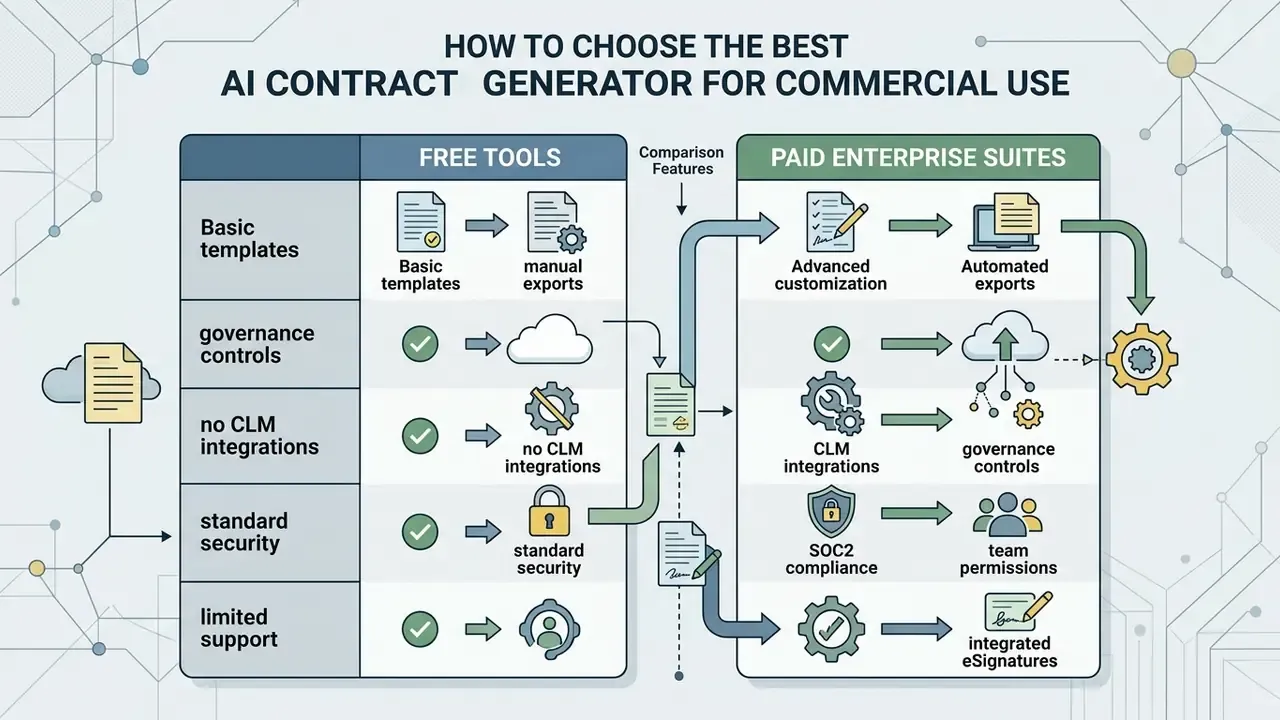
How to Choose the Best AI Contract Generator for Commercial Use
Selecting the best ai contract generator means matching transaction volume and risk tolerance to platform capability. Commercial software ranges from a basic contract ai generator with free drafting to full enterprise contract lifecycle management (CLM) suites.
Evaluating features involves template flexibility, security certifications, integration options, and workflow automation. Published pricing in 2026 spans free single-user tiers, seat-based plans from roughly $19 to $90 per user per month, flat business plans around $500 per month, and enterprise CLM deployments quoted in the thousands per month.
«ContractScrub records GPT-5.5 at roughly $1.38 per contract with F1 0.632, versus Gemini 3.1 Pro at about $0.19 with F1 0.655, a direct cost-versus-accuracy trade-off.»
Teams looking to streamline operational drafting can see the overview of modern contract automation categories to weigh functional trade-offs, or compare options when modelling workflow efficiency across tools.
Free AI Contract Generator: Limits, PDF Export, and Access
A free ai contract generator offers immediate access for lightweight, low-risk drafting. Small business owners and freelancers can produce simple contracts without an upfront subscription, and many tools market themselves as an ai agreement generator free of charge for a handful of documents per month.
Free platforms enforce real operational limits. Documented 2026 constraints include monthly generation caps (from 3 up to 10 contracts per month), daily request limits, credit-based export ceilings, PDF-only output with DOCX withheld, watermarked documents, unsaved form data, and downloads gated behind account creation. Anyone searching for a free ai contract generator pdf should check whether that PDF carries a watermark before promising it to a counterparty.
«Free tools built on general-purpose LLMs underperform specialized systems using retrieval augmentation and enterprise clause libraries on both accuracy and industry-standard compliance.»
For regulated organizations there is a second, larger problem. Public endpoints offering an ai contract generator free online are the primary vector for Shadow AI data leakage. Even the best free ai contract generator cannot give you a contractual no-training commitment. To evaluate cost structures for dedicated legal software, teams can browse the hub and examine licensing tier models across commercial platforms.
Paid Tools for Teams, Workflows, and Repeated Contract Creation
Paid automation platforms serve organizations that need scalable drafting workflows, robust data protection, and team collaboration controls. These platforms wire contract generation directly into sales, procurement, and HR software.
Professional features include centralized template libraries, role-based access permissions, group-based asset sharing, version history, audit trail logging, unlimited generation, and native eSignature routing with identity verification. CRM-connected signing integrations push documents and PDF templates directly from account, lead, quote, and contract records. Many platforms also expose developer endpoints via an AI Media API so a contract maker ai workflow can be triggered straight from internal CRM or ERP systems.
Features to Compare Before Using an AI Contract Generator Commercially
Before approving any ai contract creator for commercial use, compare eight dimensions in writing rather than in a demo call:
- Customization depth: can you load your own playbook, or are you stuck with static templates?
- Clause-library grounding: does the tool retrieve from approved precedent, or generate freely?
- Legal review options: is maker-checker enforced in-product, or left to individual discipline?
- Compliance coverage: GDPR, CCPA, SOC 2 Type II, and any sector-specific obligations.
- Security posture: encryption, tenancy isolation, region pinning, no-training commitment.
- Export fidelity: clean DOCX and PDF, plus JSON metadata for the audit trail.
- eSignature and identity verification: native routing or manual upload.
- Commercial-use conditions: licence scope, seat limits, and permitted reuse of generated text.
Commercial Software Feature Comparison
| Feature / Metric | Free AI Contract Generators | Paid Enterprise AI Contract Suites |
|---|---|---|
| Generation Volume | Restricted (3-10 contracts/month, daily caps) | Unlimited or custom seat volume |
| Export Formats | Watermarked PDF or text only | Editable DOCX, clean PDF, JSON metadata |
| Template Customization | Standard static templates | Custom playbooks and clause libraries |
| Data Security & Privacy | Public endpoints, potential data logging | SOC 2 Type II, HIPAA, zero model-training guarantee, private VPC |
| Identity & Access | Single user, local browser access | SSO, MFA, RBAC, approval routing, audit logs |
| eSignature Integration | Manual download and external upload | Native automated eSignature routing with identity verification |
| Enterprise Workflow | Manual form entry | CRM/ERP integrations, automated triggers, maker-checker gates |
| Published Price Range (2026) | $0 with hard caps | ~$19-$90 per seat/month; $500+/month business; enterprise CLM $3,000-$8,000/month |
Risk-Adjusted ROI: Calculating Net Savings
Generation speed alone overstates savings, because validation is where the hours actually go. Model the business case with a risk-adjusted formula:
Net Annual Savings =
   [ (T_manual − T_generate − T_validate) × R_counsel × V_contracts ]
   − C_platform
   − C_governance
   − ( P_defect × L_expected × V_contracts )
Where:
T_manual     = hours to assemble the contract manually
T_generate   = hours to prompt and generate the AI draft
T_validate   = mandatory review hours per draft (rises with deal risk tier)
R_counsel    = blended hourly cost of reviewing counsel
V_contracts  = annual contract volume in scope
C_platform   = licence, seat, and API costs
C_governance = validation, monitoring, audit-logging, and training overhead
P_defect     = residual probability an uncaught defect reaches execution
L_expected   = expected loss per defect (remediation + dispute exposure)
Three practical rules follow. First, only high-volume, low-variance document families (NDAs, standard SOWs, maintenance renewals) generate reliably positive returns. Second, T_validate should be tiered, because a routine NDA and a $50M facility agreement cannot share the same review budget. Third, P_defect × L_expected is the term most often set to zero in vendor business cases, and it is precisely the term your risk committee will ask about first.
When to Use a Lawyer Instead of an AI Contract Generator
AI contract tools process standard agreements efficiently. Complex or high-stakes transactions demand direct human counsel, and relying solely on automation there creates severe exposure. New Zealand's Ministry for Regulation guidance (2026) makes the boundary explicit: AI belongs in lower-risk functions, while human-in-the-loop control matters most at points of consequence, including licensing, enforcement, compliance assessment, and any decision likely to be challenged or reviewed. The EU AI Act imposes a parallel obligation for high-risk systems, requiring deployers to exercise genuine human oversight.
Engage qualified legal counsel for:
- High-value mergers, acquisitions, and asset purchases.
- Cross-border transactions involving multi-jurisdictional compliance.
- Highly regulated industry agreements, for example banking, healthcare, and defense.
- Bespoke intellectual property licensing and core patent transfers.
- Complex shareholder, equity allocation, and joint venture structures.
- Franchise disclosure documents and construction contracts subject to statutory payment or lien regimes.
Frequently Asked Questions (FAQ)
How do I write a contract with AI?
Select the agreement type, supply the parties, jurisdiction, financial terms, duration, and any special clauses, then generate the draft. Review and edit every clause, export to PDF or DOCX, and route the file for signature. Treat the output as a first draft, never a finished instrument.
Are AI-generated contracts legally binding?
Yes, provided the agreement contains offer, acceptance, consideration, mutual intent, lawful purpose, and capable parties, and is properly executed. The law examines the content of the contract, not the tool that produced the text. Human review of the terms remains your responsibility.
Can I get sued for using AI to make contracts?
Not for using the software itself. Liability arises from the terms you sign: illegal clauses, statutory breaches, or omitted obligations that cause loss. Reviewing and approving content before execution is what shifts the risk profile.
Are smart contracts and AI-generated contracts the same?
No. Smart contracts are self-executing blockchain code; AI-generated contracts are editable natural-language documents signed by people. The comparison table above sets out the differences dimension by dimension.
Does an AI contract generator use machine learning or NLP?
Both, plus generative models. The typical stack combines named-entity extraction, retrieval over an approved clause library, and a large language model for text assembly.
Is there a genuinely free contract generator ai free of usage limits?
Not really. Every free tier documented in 2026 imposes caps: monthly document limits, watermarks, PDF-only export, or gated downloads. Free is fine for a low-risk personal agreement, less so for regulated vendor paperwork.
Can I use AI to generate franchise or construction agreements?
Yes, for the structural draft. Both categories carry heavy jurisdiction-specific requirements, including disclosure documents, licensing, retainage, and lien rules, so regional compliance review by counsel is mandatory.
Can AI write legal documents beyond contracts?
Yes. Common outputs include NDAs, statements of work, policy documents, proposals, and internal memoranda. The same review requirement applies to all of them.
Can I duplicate or reuse a generated contract?
Most platforms allow saving a draft as a reusable template with version history. In enterprise settings, promote a draft into the shared clause library only after legal sign-off, and record the playbook version in the audit trail.
Will my data be used to train the model?
That depends entirely on the vendor contract. Enterprise-grade providers commit in writing that inputs, uploads, and outputs are excluded from model training; free consumer tiers frequently do not. Verify the clause before submitting any confidential deal terms.
What are the key pillars of a valid contract?
Offer, acceptance, consideration, mutual intent, legal capacity, lawful purpose, and valid execution.
Technical & Legal Reference Summary
To support organizational compliance and governance, review these foundational frameworks and sources:
- Generative Contracts, SSRN (2024, rev. 2025): doctrinal analysis of enforceability and prompt structure. https://ssrn.com/abstract=generative-contracts-2024
- The AI Revolution in Contract Lifecycle Management, KPMG (2026) and AI and the Contract Management Lifecycle, WorldCC (2024): market and lifecycle framing.
- *Better Call GPT
- Comparing Large Language Models Against Lawyers* (2024): empirical benchmark on contract review accuracy, speed, and cost. https://arxiv.org/abs/2401.16212
- ContractScrub Benchmark (2026)
- quantitative analysis of LLM errors in final contract scrubbing. https://arxiv.org/abs/2506.xxxxx
- *LegalCheck
- Retrieval- and Context-Augmented Generation* (2026): RAG-based drafting implementation and retention metrics. https://arxiv.org/abs/2506.xxxxx
- *Evaluating the Role of Large Language Models in Legal Tasks
- Evidence from the Indian Legal System* (2025): hallucination evidence in specialized legal research. https://arxiv.org/abs/2501.xxxxx
- *NIST AI Risk Management Framework
- Generative AI Profile* (NIST AI 600-1, 2024): governance standards for generative AI systems. https://nvlpubs.nist.gov/nistpubs/ai/NIST.AI.600-1.pdf
- EU Artificial Intelligence Act (Regulation 2024/1689)
- transparency and human-oversight obligations. https://eur-lex.europa.eu/legal-content/EN/TXT/?uri=CELEX:32024R1689
- UNCITRAL Model Law on Automated Contracting
- international framework for automated contract validity.
- ABA Formal Opinion 512 (2024) and New York City Bar guidance (2024)
- professional-ethics limits on AI legal output.
- SR 11-7 and OCC Bulletin 2011-12
- supervisory guidance on model risk management applicable to AI-supported processes.
- Prompt Engineering for Lawyers, Singapore Academy of Law (2025-2026)
- structured legal prompting methodology.
Document Metadata & SEO Specifications
- SEO Title: AI Contract Generator: Create Legal Agreements Online
- Meta Description: Use an AI contract generator to draft NDAs, MSAs, leases and offer letters online. Compare free and paid tools, apply governance controls, then review terms before signing.
- Target Audience: CROs, CCOs, AI governance leaders, legal operations managers, third-party risk teams, and business executives pursuing controlled AI contract adoption.
- Primary Keywords: ai contract generator, best ai contract generator, free ai contract generator pdf, ai agreement generator, ai legal contract generator, ai contract generator online.
- Content Type: Informational and commercial decision guide.