«An AI generator can model historical frequency distributions and automate ticket combinations, but it cannot alter the underlying entropy or predict the output of an independent lottery draw.»
Reviewed and updated: 2026. Game rules, published price tiers, and regulatory references were re-checked against 2026 primary sources.
Executive summary for risk and compliance readers
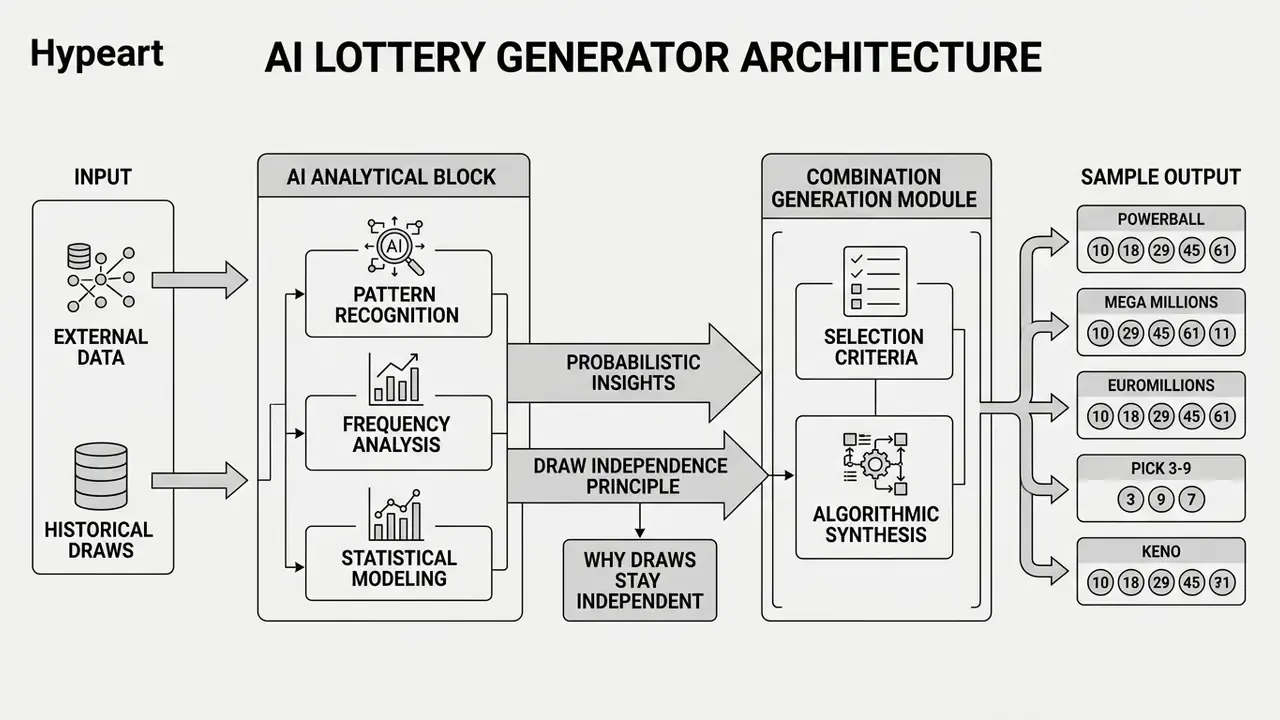
- Mechanics.An ai lottery number generator stacks two layers: a random or pseudo-random sampling engine, and a descriptive analytical layer (frequency, gaps, co-occurrence). Only the first layer produces numbers. The second one only describes the past.
- Mathematics.Draws are independent trials: . Powerball jackpot odds stay fixed at 1 in 292,201,338 per line. Mega Millions sits near 1 in 290,472,336. No model bends those constants.
- Regulation.Certified lottery RNGs must be uniformly distributed, unpredictable, statistically testable, and non-reproducible (UK Gambling Commission RTS 7; AGCO Electronic Lottery Systems standards). AI suggestion layers fall outside that certification perimeter entirely.
- Practical value.Real utility is automation: bulk line generation, forced lucky numbers, exclusion filters, wheeling templates, and non-overlapping line distribution for syndicates.
- Game formats.Configuration changes with the matrix. Dual-pool games (5/70 plus 1/24) forbid repeats. Pick-N games (Pick 2 through Pick 9) explicitly allow them (
5-5-5). Keno needs 1 to 20 selections from a pool of 80. - Risks.Two families. Behavioural: illusion of control, gambler's fallacy, loss chasing. Organisational: shadow AI, data leakage into unvetted SaaS, vendor claims of "guaranteed wins".
- Verdict.Treat any ai lottery prediction generator output as a statistically informed guess. Never as a forecast. Never as a financial instrument.
What an AI Lottery Generator Is and How It Produces Numbers
An AI lottery generator is a software system that applies statistical algorithms or generative models to output number combinations for multi-ball lottery games. Unlike a plain random selection widget, an ai lottery number generator wires in data pipelines: it reads past draw records, applies custom filtering constraints, or converts a natural-language prompt into a compliant ticket selection.
At its core, a modern lottery number generator runs those two distinct layers. Standard quick-pick systems rely on deterministic algorithmic seeds to pick lottery numbers. An ai lottery generator goes further and computes frequency weights, odd-even ratios, and number-interval gaps from historical draw datasets. The system still functions strictly as a candidate-selection interface. Output is a set of generated numbers tailored to user specifications, produced without any privileged access to future random events. There is no back door into next Wednesday's entropy.
Random Numbers vs AI Predictions: Where the Line Sits
True random lottery numbers come from physical entropy sources or certified Pseudo-Random Number Generators (PRNGs) governed by strict technical standards such as NIST SP 800-90A. A random lottery draw requires every permissible combination to stay statistically independent, uniformly distributed, and computationally unpredictable.
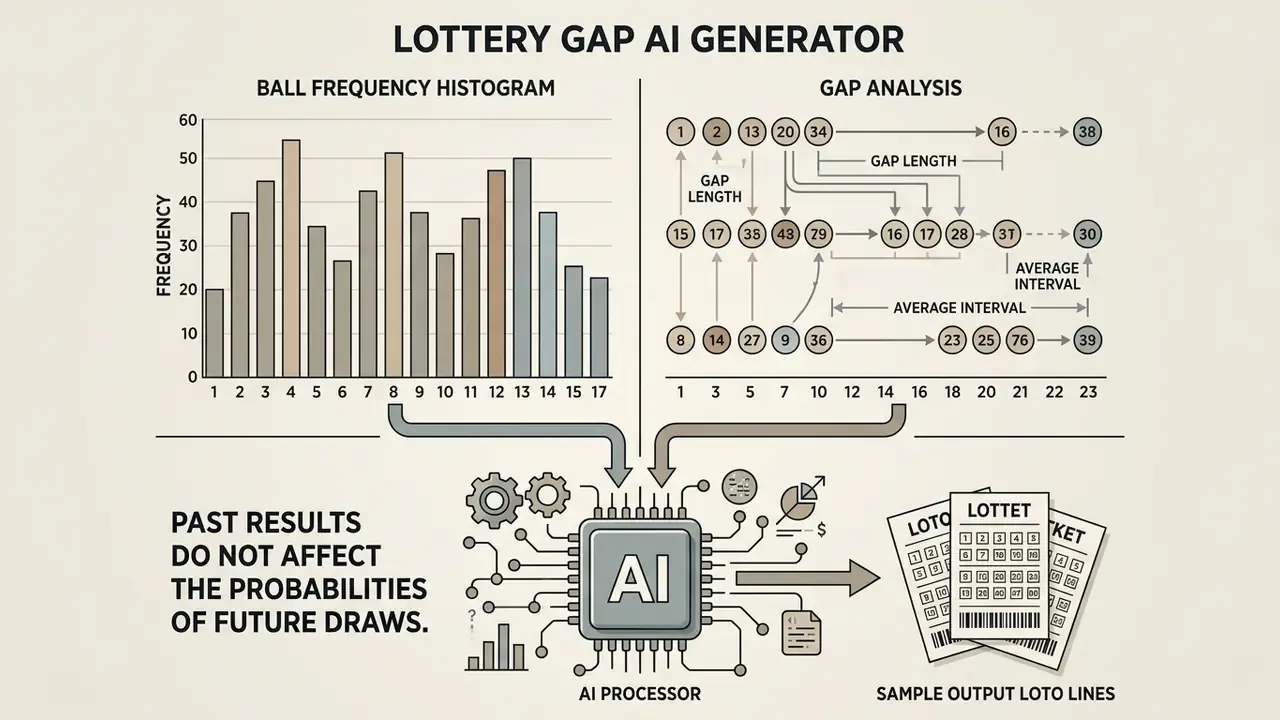
An ai generator lottery numbers model creates no physical randomness. It processes historical draw records to surface empirical patterns: hot and cold numbers, recurring pairs, positional clustering. When a user asks for AI lottery predictions, the software calculates probabilistic weights from historical frequency. That is retrospective statistical modelling, not forecasting. Historical draw data carries exactly zero mathematical influence over the next independent trial.
«RNG outputs must be uniformly distributed, unpredictable and must not reproduce the same output stream between two instances.»
Two operating modes compared (entropy versus descriptive ML):
| Property | Certified RNG / PRNG engine | AI analytical layer |
|---|---|---|
| Data source | Physical entropy or a protected seed | Draw archive, user filters |
| Mathematical task | Uniform sampling from the permitted space | Descriptive statistics, ranking, constraint solving |
| Testability | NIST SP 800-22 / SP 800-90A/B, RTS 7, AGCO | No mandatory certification of outputs |
| Predictive power | None by definition (unpredictability is a requirement) | None: no access to future entropy |
| What the user actually gets | A valid random combination | Automation, filters, volume, visualisation |
Why No Generator Can Guarantee Winning Numbers
No mathematical model and no software tool can guarantee winning numbers in a fair lottery game. Regulated lottery games are engineered as independent trials, so the appearance of a combination in past draws tells you nothing about future outcomes. Nothing at all.
From a probability standpoint, every draw satisfies the independence condition . In Powerball, jackpot odds stay fixed at 1 in 292,201,338 per ticket line, whether the numbers came from a pencil, from an ai lottery numbers generator, or from a retail quick-pick terminal. Searches for "ai lottery generator winning numbers" are, in effect, searches for a mechanism that regulators are contractually obliged to prevent.
«Every eligible Powerball combination carries an equal chance of being drawn; no external algorithm can change that fact.»
Statistical analysis of past draws can describe historical distribution traits. It cannot bend the static probability curve of independent random events. The same reasoning applies to Mega Millions, where the current matrix yields roughly 1 in 290,472,336 per line for the top prize.
A mini probability calculator you can verify yourself:
For a single-pool " of " game without repeats, the number of combinations is . For a dual-pool game, the total space is the product: .
- Powerball .
- Mega Millions .
- EuroMillions / EuroJackpot .
Any tool claiming to shrink those denominators through "AI pattern learning" is making an unsupported statement. You can check that in a spreadsheet in under two minutes, which is more due diligence than most buyers perform.
Which Lotteries an AI Generator for Lottery Numbers Can Cover
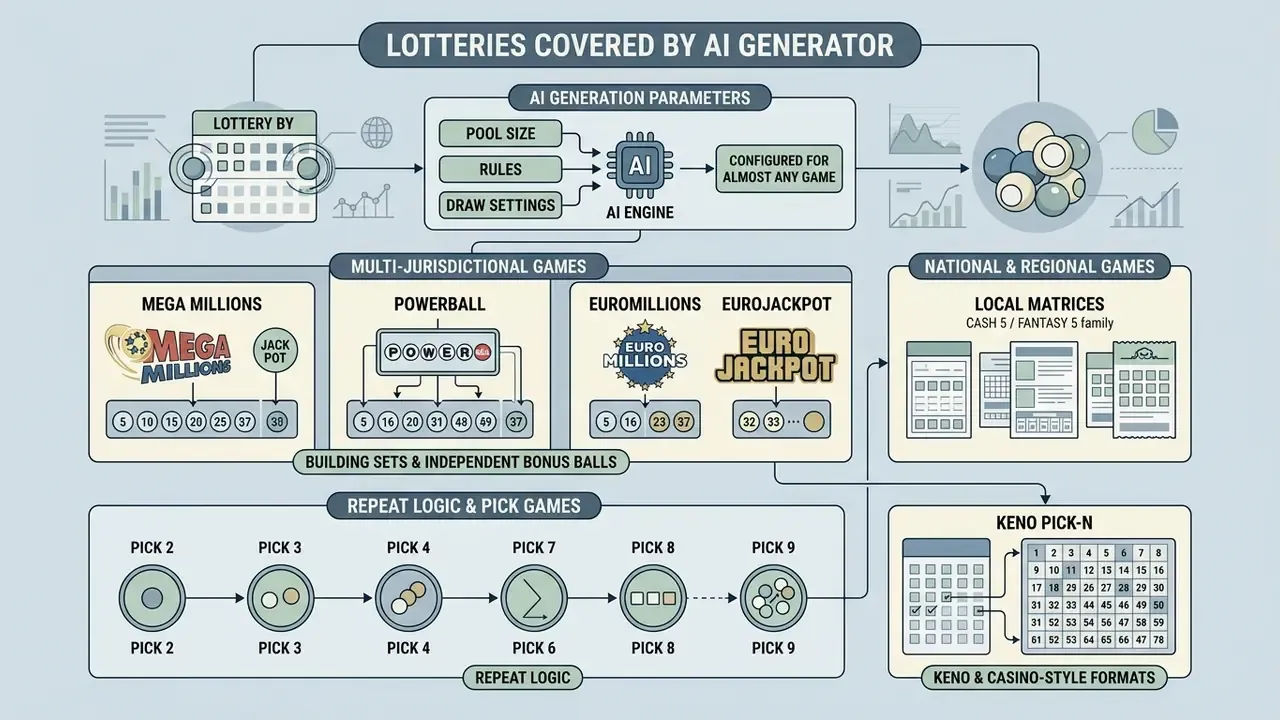
An ai generator for lottery numbers can be configured for almost any national or multi-jurisdictional game by setting pool parameters and combination rules. Modern multi-ball lottery games force tools to handle dual-pool formats, distinct main-ball ranges, and extra bonus numbers, including the powerball mega millions parameters and European Lucky Stars.
When you configure an ai generator lottery numbers workflow, you are really encoding three things: pool sizes, selection counts, and whether repeats are legal. Coverage should extend well past the four headline jackpot games: North American draw games (Lotto America, Lucky for Life, SuperLotto Plus, Lotto Max, Lotto 6/49), UK and European formats (Thunderball, Set for Life, UK Lotto 6/59), Middle Eastern products (Mahzooz, Emirates Draw Fast 5 / Easy 6 / Mega 7), Israeli games (Lotto Israel 6/37, 777, 123), Asian matrices (TOTO 6/49, Lotto 6/45 Korea, Loto 6 Japan, Mark Six, Vietlott Power 6/55), and casino-style Keno.
Repeat Logic: Generating for Pick 2, Pick 3 to Pick 9, and Keno
In classic dual-pool lotteries such as Powerball or EuroMillions, picking the same number twice inside one line is algorithmically forbidden. That is sampling without replacement, plain choose . Several formats need completely different logic:
- Each slot draws from an isolated pool of digits 0 to 9.
- The algorithm must support digit repeats, so
5-5-5,1-1-2-2and9-9-9-9remain valid outputs. - Straight-play odds are therefore in : 1 in 1,000 for Pick 3, 1 in 10,000 for Pick 4.
- Five numbers from a flexible upper limit: 1 to 35, 1 to 39, or 1 to 43 depending on jurisdiction.
- A competent generator exposes a configurable
Custom Range Maxfield, because Mass Cash, Take 5, Match 5 and Easy 5 all share the format under different names. - Users select an array of 1 to 20 numbers from a pool of 80 balls.
- The generator adapts density and spread filters so large selection arrays do not collapse into a narrow numeric band.
- In games with a bonus pool (Powerball, Mega Ball, Lucky Stars, Reintegro, Superzahl), the bonus value may legitimately duplicate a main-pool number, because the pools are drawn separately. A generator that silently strips such duplicates produces invalid statistical coverage. This is the single most common bug in free tools.
- Pick-N games (Pick 2, Pick 3, Pick 4 through Pick 9)Pick-N games (Pick 2, Pick 3, Pick 4 through Pick 9)
- Local matrices (Cash 5 / Fantasy 5 family)Local matrices (Cash 5 / Fantasy 5 family)
- Keno and casino-style formatsKeno and casino-style formats
- Bonus-ball independenceBonus-ball independence
Number Generation for Mega Millions and Powerball
The mega millions lottery and Powerball are the primary US multi-state draw games that automated tools target. Mega Millions requires 5 main numbers from 1 to 70 plus 1 Mega Ball from 1 to 24 under the official rules effective 2025/2026, with jackpot odds near 1 in 290,472,336.
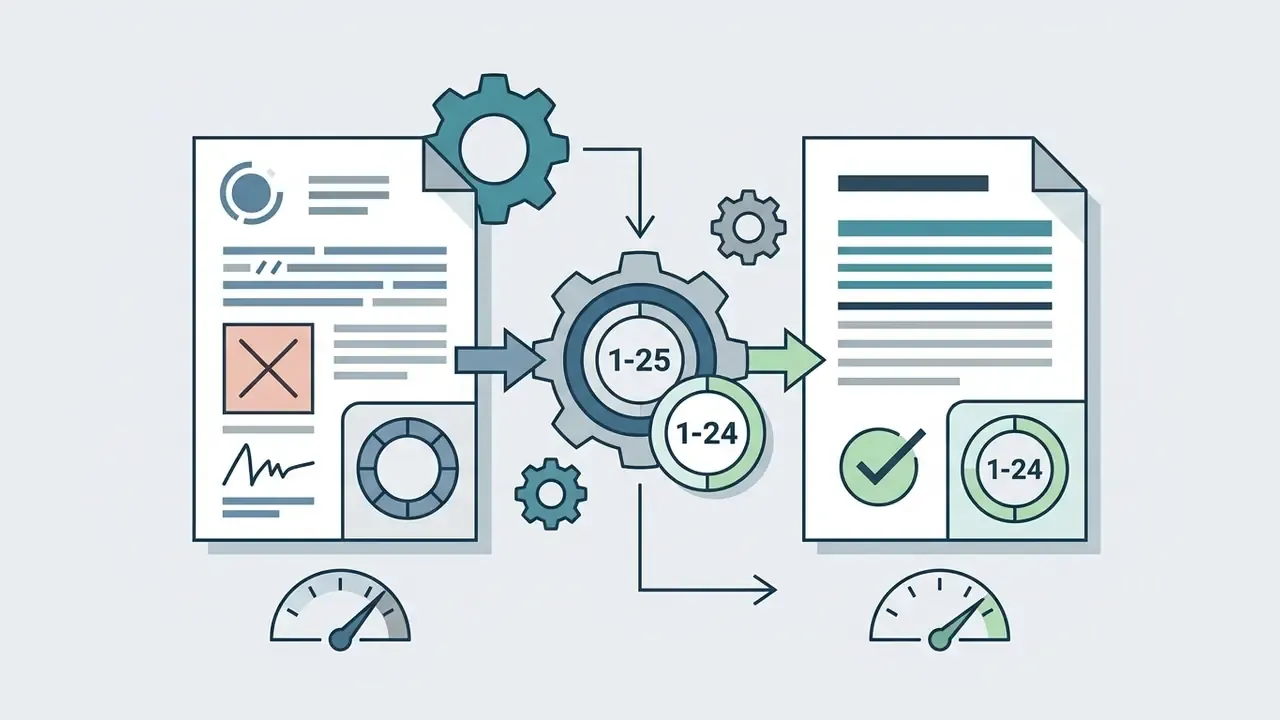
Powerball requires 5 main numbers from 1 to 69 plus 1 Powerball from 1 to 26, giving 1 in 292,201,338. An ai mega millions number generator free utility must enforce those separate pools strictly, so generated sets match the official submission matrix. Watch for one specific failure: many third-party generators still hard-code the legacy Mega Ball range of 1 to 25. Lines produced that way cannot be entered on an official play slip, and you only discover it at the counter.
Building Sets for EuroMillions and EuroJackpot
European multi-national lottery games such as euromillions and eurojackpot use a 5+2 matrix. EuroMillions draws 5 main numbers from 1 to 50 plus 2 Lucky Stars from 1 to 12, producing a jackpot combination space of 1 in 139,838,160.
«EuroMillions uses a 5-of-50 plus 2-of-12 format; the jackpot odds are 1 in 139,838,160.»
EuroJackpot shares the identical 5 from 50 plus 2 from 12 structure, but it runs across 19 European countries under national lottery implementations, while EuroMillions operates across nine operator countries plus associated territories. An ai lotto generator configured for European games has to perform simultaneous dual-pool sampling while keeping the bonus-ball ranges separate.
| Lottery Game | Region / Type | Main Numbers Range | Bonus / Extra Ball | Repeats Allowed? | Jackpot Odds | Official Rule Reference |
|---|---|---|---|---|---|---|
| Mega Millions | US / Multi-State | 5 numbers (1-70) | 1 Mega Ball (1-24) | No | ~1 in 290.4 million | Mega Millions Official How to Play |
| Powerball | US / Multi-State | 5 numbers (1-69) | 1 Powerball (1-26) | No | ~1 in 292.2 million | Powerball Official Rules |
| EuroMillions | Europe (9 countries) | 5 numbers (1-50) | 2 Lucky Stars (1-12) | No | 1 in 139,838,160 | National Lottery EuroMillions Rules |
| EuroJackpot | Europe (19 countries) | 5 numbers (1-50) | 2 EuroNumbers (1-12) | No | 1 in 139,838,160 | EuroJackpot Official Game Rules |
| Lotto Max | Canada | 7 numbers (1-52) | none | No | 1 in 33,294,800 | National operator rules (Canada) |
| TOTO | Singapore | 6 numbers (1-49) | 1 Additional Number | No | 1 in 13,983,816 | National operator rules (Singapore) |
| Pick 3 / Pick 4 | Global / state level | 3 or 4 digits (0-9) | none | Yes (e.g. 7-7-7) | 1 in 1,000 / 1 in 10,000 | State lottery play-slip rules |
| Cash 5 / Fantasy 5 | Regional (US and intl.) | 5 numbers (1-X) | Custom upper limit | No | Varies by jurisdiction | Regional operator rules |
| Keno | Casinos and lotteries worldwide | 1-20 numbers (1-80) | none | No | Varies by spot count | Venue / operator paytable |
Features the Best AI Lottery Number Generator Should Support
The best ai lottery number generator platforms combine flexible ticket generation, customisable constraint filters, and export formats that map to system entries. Instead of promising unrealistic predictions, the stronger number generator products invest in procedural control: how many lines, under which constraints, in which file format.
A validation checklist for screening out pseudo-scientific predictive claims:
- Claim audit.Does the marketing copy state or imply "increased probability of winning"? Any such claim contradicts probability theory. Disqualifying signal.
- Matrix accuracy.Are current official ranges implemented (5/70 plus 1/24 for Mega Millions, 5/69 plus 1/26 for Powerball)? Legacy ranges mean an unmaintained product.
- Repeats handling.Does the tool distinguish sampling without replacement (5/70) from digit sampling with repeats (Pick-N)?
- Randomness disclosure.Does the vendor document the RNG source, the seeding approach, or reference recognised test suites (NIST SP 800-22, Big Crush)?
- Determinism of filters.Are lucky and excluded numbers applied before final sampling, so excluded values can never appear in output?
- Export integrity.Are CSV and JSON exports column-mapped to the official play-slip structure (main balls, bonus balls, draw date)?
- Responsible-play surface.Are odds, age limits, and helpline information shown in the same language as the interface (European Lotteries Responsible Gaming Standards)?
- Data handling.Is there a published retention and processing policy for uploaded historical datasets and account data?
Eight questions. Most consumer tools fail at least three of them, usually items 1, 4 and 8.
Multiple Sets, Full Tickets, and Combination Templates
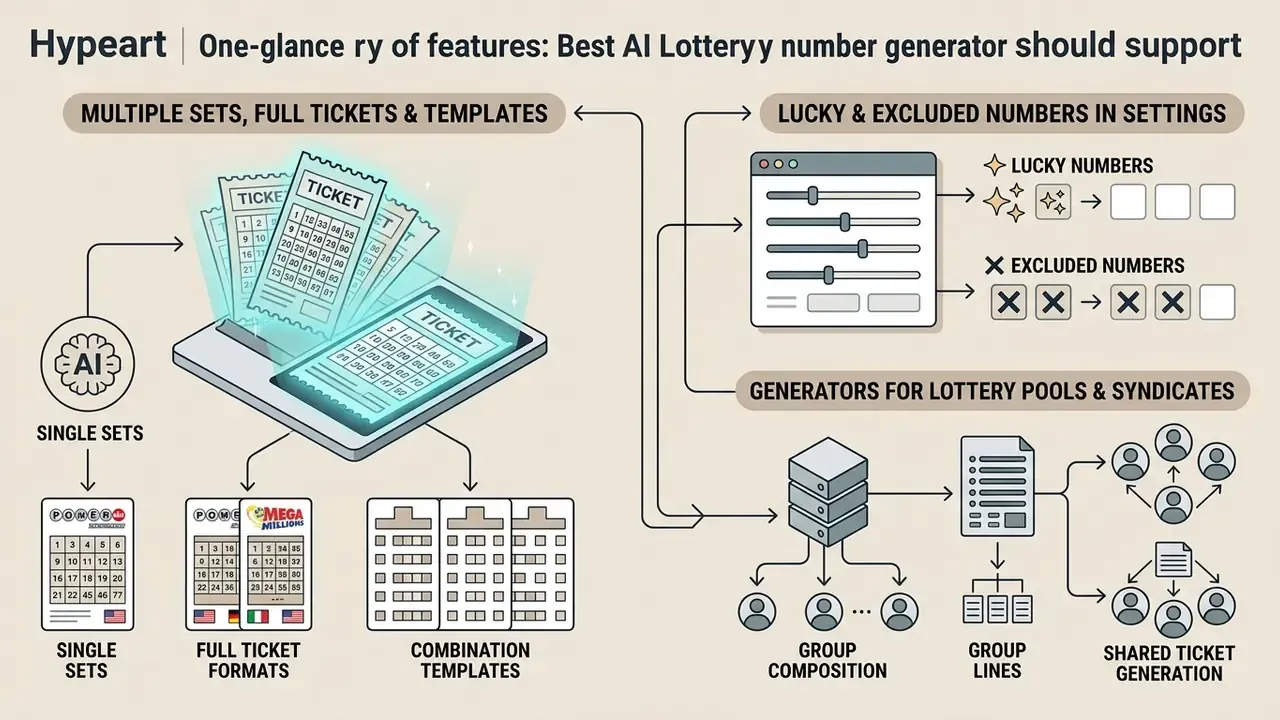
To support broader entry strategies, an ai lotto number generator needs to produce multiple sets of unique lines in one operation. Full ticket construction means both primary numbers and secondary bonus balls arrive formatted to the target game specification, ready to transcribe.
Advanced generators add combination templates: full system lines (Systemlotto) or abbreviated wheeling systems. In system play the player picks an expanded pool, typically 8 to 31 numbers, and the operator or software expands it into every simple line it contains. Under a full system, all possible combinations from the chosen set get generated. Abbreviated wheels cut that count while guaranteeing specific secondary prize coverage if a defined subset of the chosen numbers is drawn.
«Pseudorandom generators in TensorFlow and PyTorch pass the Big Crush battery of 106 statistical tests with quality comparable to C implementations.»
That finding matters operationally. The sampling layer inside an AI product is usually statistically fine, which is exactly why the weak point is never the randomness. It is the interpretation of the analytics wrapped around it.
Lucky and Excluded Numbers in Generator Settings
User-defined preference filters are the workhorse tools in modern generator software. Players want their personal lucky numbers in every output line, and they want specific excluded numbers gone, whether that means the last three draws or values outside a preferred odd-even ratio.
Constraint filters apply those rules before the sequence is finalised. The system forces chosen lucky values into the combination vector, removes excluded digits from the active sampling pool, then applies uniform random sampling to fill the remaining slots. Two implementation details separate careful tools from careless ones. Lucky numbers must be validated against the game range, since a "lucky 71" cannot enter a 1 to 70 pool. And the intersection between the lucky list and the exclusion list has to be resolved explicitly, with a visible warning, rather than silently.
Generators for Lottery Pools and Syndicates
Syndicates and group pools need software that distributes non-overlapping combination sets across participants. An ai number generator lottery platform built for group play produces distinct ticket batches to maximise total coverage of the combination space.
By removing accidental duplicate entries inside a pool, the software improves collective coverage. Group play raises the total number of lines held, which raises the syndicate's overall chance of holding a winning ticket, while the odds per individual line stay static and your share of any prize shrinks with the participant count. Legally, operator rules usually define a syndicate as an arrangement where an entry, or a combination of entry types, is divided into equal shares, with prize money apportioned equally between winning shares. The generator handles combinatorial coverage. It does not handle legal apportionment, and no spreadsheet substitutes for a signed syndicate agreement.
Past Draw Analysis and the Lottery Gap AI Generator
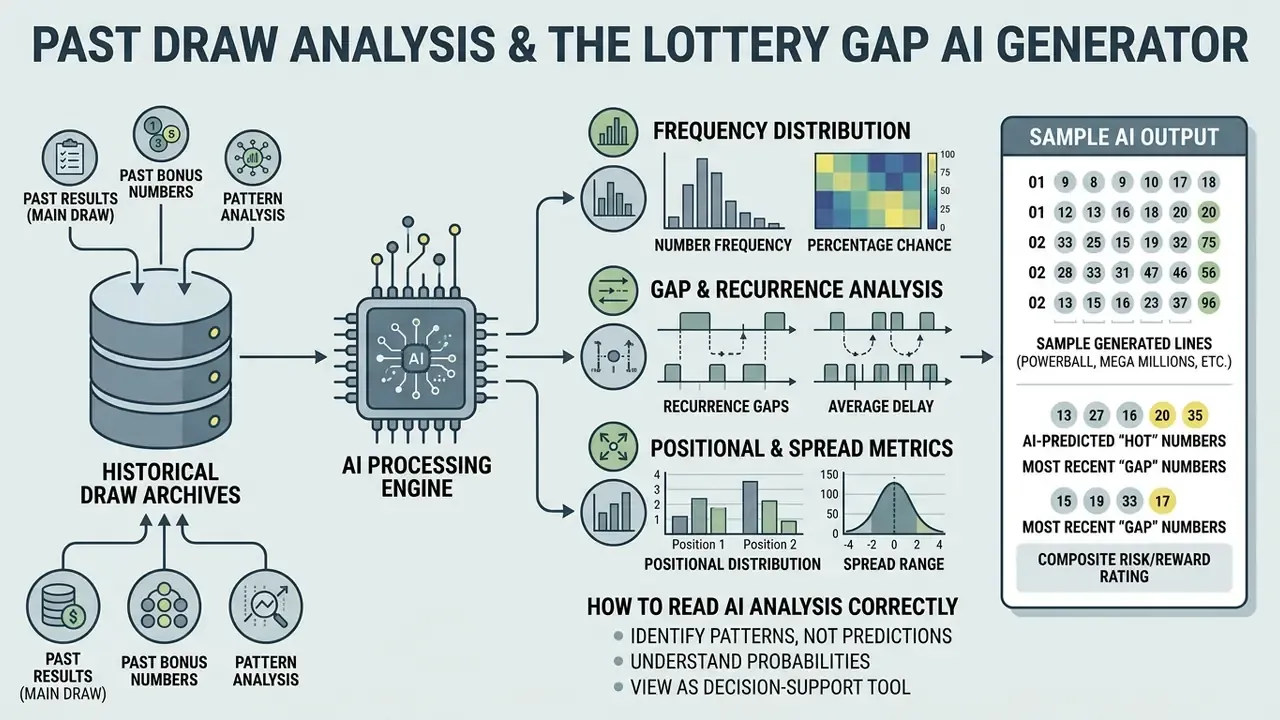
A lottery gap ai generator reads historical draw archives to compute recurrence gaps, number frequencies, and positional distribution metrics. Historical statistical analysis is genuinely interesting and mildly entertaining. It changes nothing about the randomness of a certified draw mechanism.
«Players in lower-income areas lose roughly 10% more per dollar staked, partly through popular combination choices and prize-splitting effects.»
Here is the practical meaning of "gap" that almost no tool explains. The measurable gap is not an exploitable numeric interval between draws. It is an expected-loss gap driven by which combinations crowds choose. Avoiding heavily played patterns such as birthday clusters from 1 to 31, arithmetic sequences, and calendar dates does not raise your probability of matching the draw. It can only reduce the probability of sharing a prize if you do match.
Enterprise relevance: entropy modelling as a risk-management exercise. In banks and mature fintechs, model validation guidelines demand clear risk tiering and algorithmic audit trails. That is the discipline codified in US model-risk supervision (Federal Reserve SR 11-7, OCC 2011-12) and in the NIST AI Risk Management Framework. Applied to lottery analytics, the discipline collapses into one classification decision: is the output a descriptive historical metric or a predictive claim? Descriptive metrics can be validated against a uniform baseline. Predictive claims about independent draws cannot be validated at all, so they belong in the "unsupported claim" tier and should be labelled that way in any inventory. Teams looking for structured tooling can explore the hub for API integrations and quantitative workflows.
Past Results, Past Bonus Numbers, and Pattern Analysis
Historical data modules ingest previous winning numbers and numbers from past results to derive pattern metrics. The common measures:
- Frequency distribution.How often individual main balls and past bonus numbers appeared across a selectable window: last 25, 50, or 100 draws.
- Gap and recurrence analysis.How many drawings have elapsed since a given number was last drawn.
- Co-occurrence metrics.Pairs or triplets that have appeared together in historical draw vectors.
- Positional and spread metrics.Odd-even balance, low-high split, sum-range distribution, decade coverage.
Academic audits of draw sequences, including chi-square goodness-of-fit and Monte Carlo evaluations of major 6/45 and 6/49 lotteries, keep finding the same thing: observed distributions do not deviate significantly from uniform randomness at the 0.05 significance level. In one published Romanian 6/49 audit, a chi-square statistic of 62.61 gave , leaving the randomness hypothesis unrejected.
«RNGs must pass frequency, runs and serial-correlation tests, with statistics falling inside a 99% confidence interval.»
You can reproduce the check yourself. New York Lottery datasets on Data.gov cover Powerball from 2010 and Mega Millions from 2002 in CSV, XML and JSON. Texas Lottery publishes per-drawing CSV files for both games. Running your own chi-square test against those files is the fastest way to falsify any vendor claim of exploitable bias, and it costs nothing but an afternoon.
How to Read AI Analysis Correctly
Outputs from an ai lottery prediction generator or ai number prediction generator should be read as probabilistic summaries of past events, not as forecasts. The UK Government's Generative AI Framework puts it bluntly: machine-learning analytical outputs are "statistically informed guesses rather than facts" (UK Cabinet Office, Generative AI Framework for HMG, 2024, https://www.gov.uk/).
Treating a frequency graph as a predictive indicator opens the door to two well-documented biases: the gambler's fallacy, where "cold" numbers feel overdue, and the hot-hand bias, where "hot" numbers feel primed to repeat. Both are comfortable. Both are wrong.
«Lottery players select recently drawn numbers substantially less often, behaviour consistent with the gambler's fallacy.»
«In single-prize games the gambler's fallacy dominates, whereas multi-prize lotteries more often display hot-hand effects.» Source: «Sensitivity, Safety and the Lottery Puzzle», preprint (2023). https://arxiv.org/
Analytical tools give you structured visualisations, and every valid combination still enters the next draw with identical probability. Peer-reviewed work on illusion of control reports a medium effect size (), which means the bias is measurable, persistent, and reliably triggered by interfaces that display "reasoning" next to random output. Design choices, not mathematics, do the persuading here.
Sample AI Output from a Generator Model
Input prompt:
- Analytical reasoning: Mandatory number 7 included. Even to odd balance 4:1 as requested. Excluded values (12, 34, 55) removed from the active sampling pool before selection.
- Analytical reasoning: One number from each band (1-15, 16-30, 31-45, 46-60, 61-70). Odd to even ratio 3:2. Sum 167, inside the central sum-distribution band.
How to read that correctly: both lines satisfy the stated constraints, and both sit at exactly 1 in 290,472,336 for the jackpot. The "analytical reasoning" text documents how the constraints were applied. It is not evidence about the next draw. If a user of an ai for lottery numbers generator internalises one idea from this article, let it be that one.
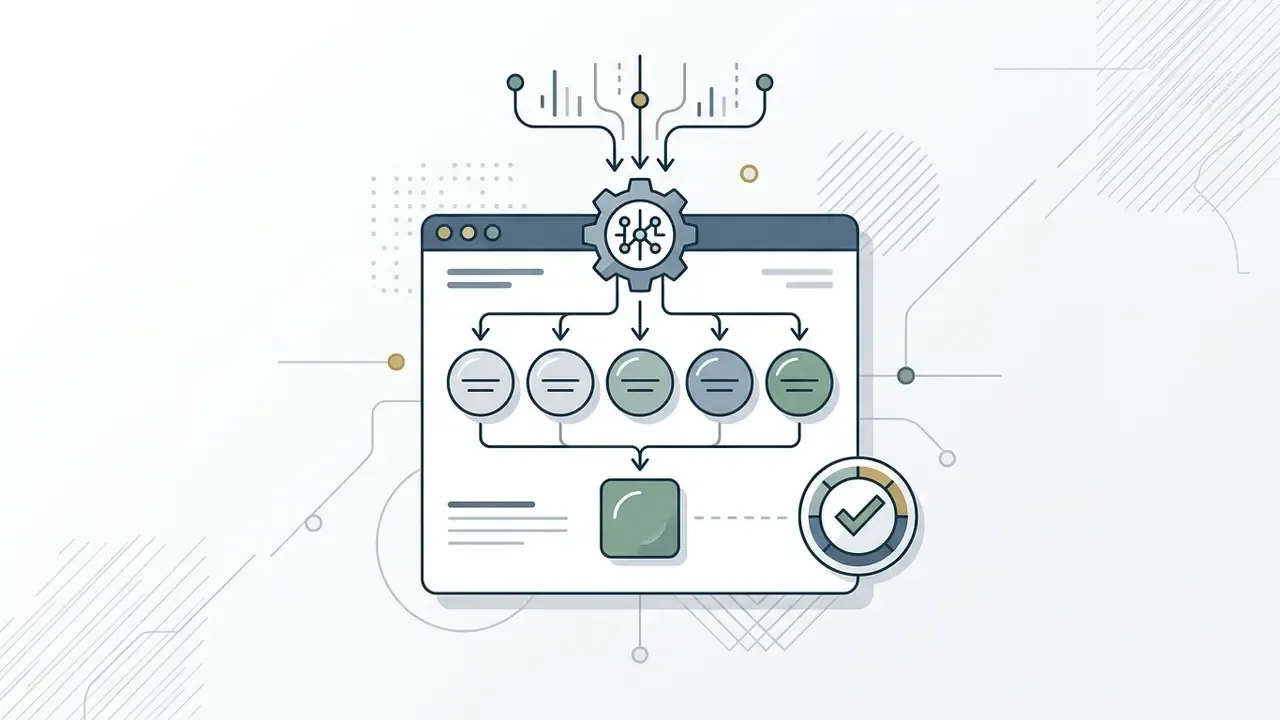
[7, 14, 22, 48, 60] | Mega Ball: 18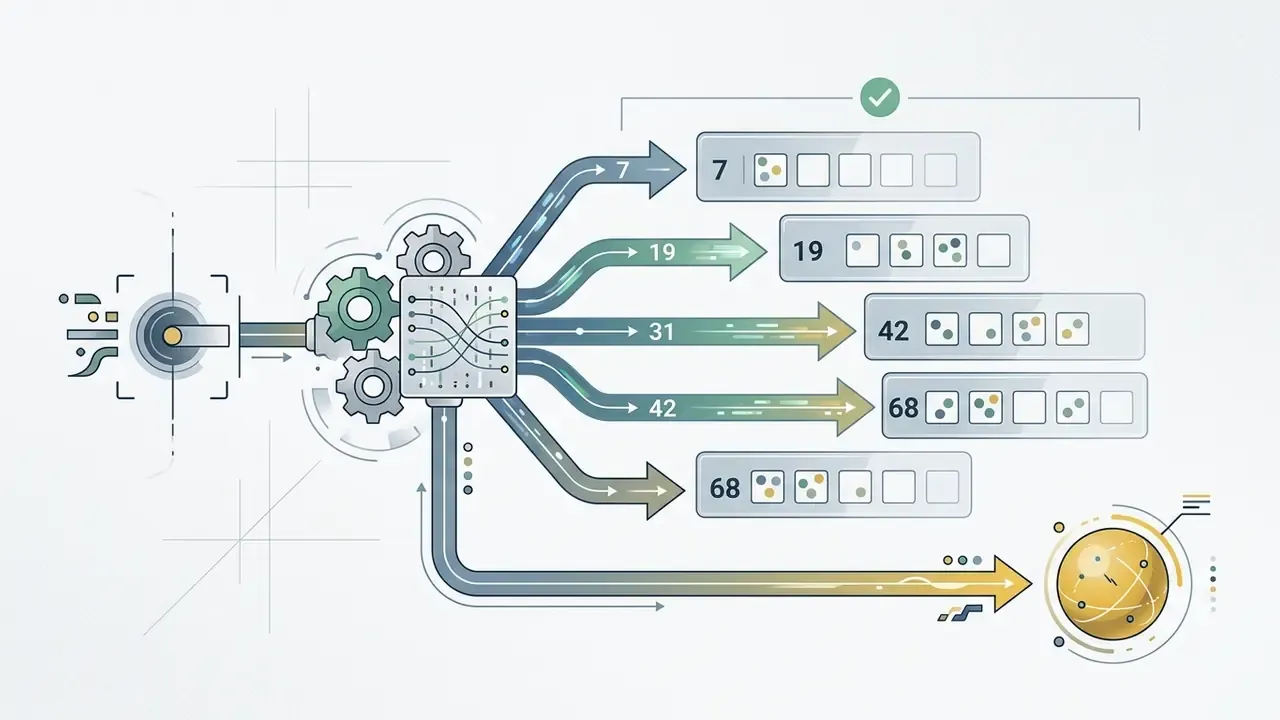
[7, 19, 31, 42, 68] | Mega Ball: 5Free AI Lottery Generator or Paid Plan: How to Compare Terms
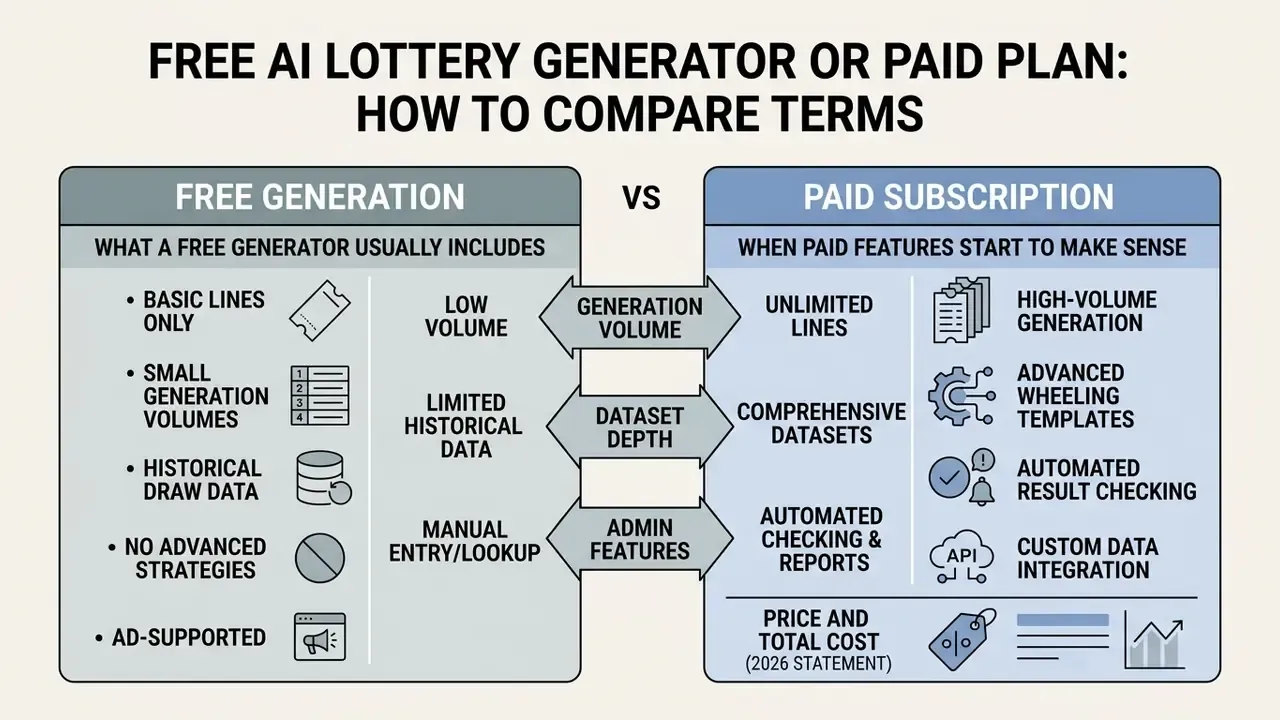
Evaluating a free ai lottery number generator against a paid subscription means comparing three things: generation volume limits, dataset depth, and administrative features. A ai lottery generator free tier usually covers standard quick-pick functions, while premium tiers target high-volume syndicate management and custom analytical exports. The gating logic mirrors adjacent software categories. Look at how quotas, watermarks, and export rights differ among free AI art generators and the evaluation questions turn out to be identical: quota, output rights, export format, data retention.
For a wider view of how subscription tiers are typically structured across software services, the AI Media Pricing page shows the same feature-gating patterns applied to technical utilities.
What a Free Generator Usually Includes
A standard ai lottery number generator free tool runs in the browser, often without mandatory registration. Typical free-tier features:
- Basic random lottery numbers generation for popular games such as Powerball and Mega Millions.
- Single-ticket or small-batch generation, roughly 1 to 5 lines per request.
- Standard odd-even and high-low balance filters.
- Simple custom options such as forced lucky numbers.
- Limited history windows (last 25 to 50 draws) and basic hot and cold lists.
Observed caps vary widely. Some services advertise unrestricted basic generation with no signup, positioning themselves as a lottery ai generator free utility. Others meter usage: 10 generations per month with 7 saved sets and 5 ticket checks, or 3 generations per day during a 7-day trial. Anyone searching for an ai lotto number generator free or ai number generator lottery free option should verify the quota before treating it as a syndicate workhorse. A tool that dies after ten lines is not a workhorse.
When Paid Features Start to Make Sense
Upgrading can be practical for organised pools or power users who need bulk administration. Paid plans typically unlock:
- High-volume generation. Hundreds of unique lines at once, without daily rate limits.
- Advanced wheeling templates. Full and abbreviated wheeling matrices with direct file export in CSV or JSON.
- Automated result checking. Saved ticket portfolios audited automatically against winning draw feeds.
- Custom data integration. Gap analysis across full historical datasets spanning decades.
Price and total cost of ownership as of 2026: paid tiers in this category generally sit between roughly $2 and $18 per month. Ad-removal options land near $1.99/month, entry analytics plans from about $3.99/month, mid-tier "unlimited generation" plans around $6.99 to $9.99/month, and deeper analytics tiers near $17.99/month. When you model total cost of ownership, though, the subscription is rarely the dominant term. The ticket spend it encourages is. A $9.99/month plan used to justify twenty extra $2 lines per week creates roughly $170/month in stake exposure, an order of magnitude above the software cost. Any honest evaluation of the best ai lottery generator has to price that second number too.
| Feature Category | Free AI Lottery Generator | Paid AI Lottery Subscription |
|---|---|---|
| Generation limits | 3-10 ticket lines per session | Unlimited bulk generation |
| Game presets | Standard formats (Powerball, Mega Millions) | Custom matrix configuration and global lotteries |
| Pattern analysis | Basic hot and cold frequency lists | Multi-variable gap analysis and co-occurrence metrics |
| Portfolio storage | Local browser session only | Cloud saving and automatic ticket validation |
| Syndicate tools | Not included | Non-overlapping line distribution for pools |
| Export formats | On-screen display, basic copy | CSV, JSON, printable ticket grid |
| Typical price | $0 (quota-limited) | ~$2-$18 per month by analytics depth |
Using an AI Lotto Number Generator Responsibly
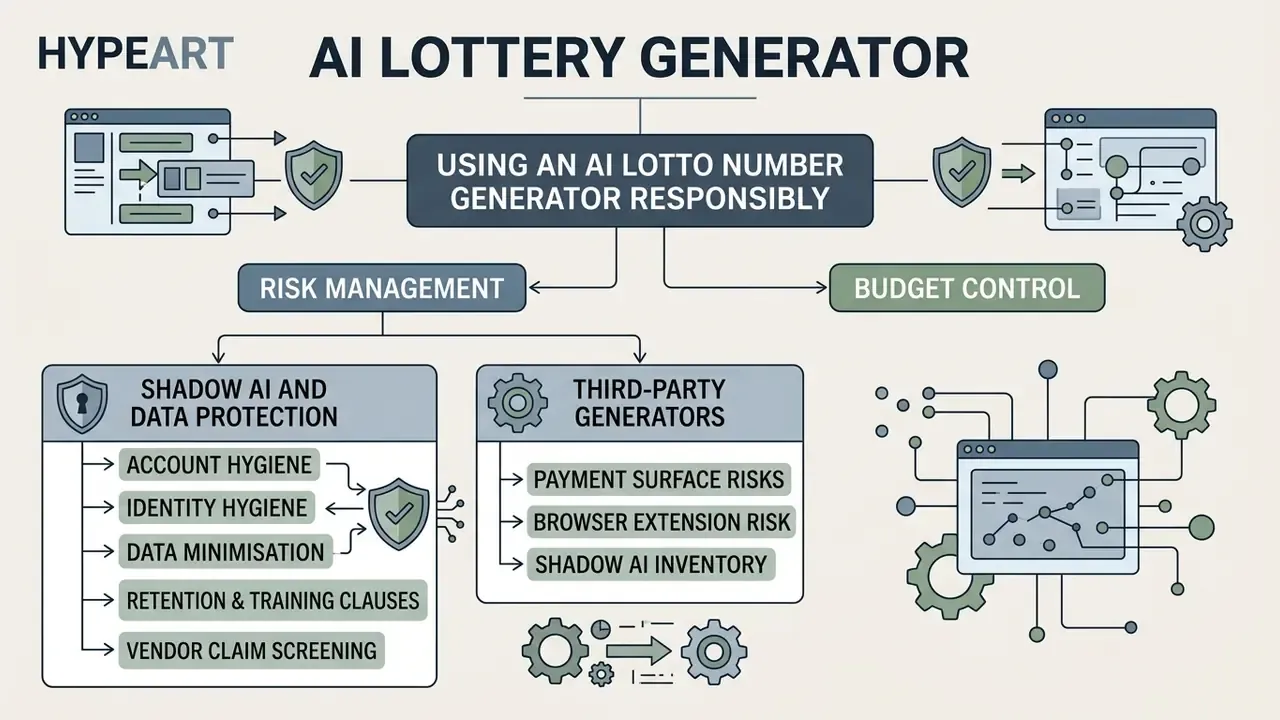
Using an ai lotto generator means holding two boundaries: risk management and budget control. An ai number generator lottery application is an operational utility for ticket creation. It is not a financial investment system, and it is not a route to profit.
For readers who want structured analytical models and decision frameworks in one place, you can browse the hub. Responsible engagement with any of these tools still rests on strict personal spending limits, set before the first line is generated rather than after the third losing draw.
Shadow AI and Data Protection with Third-Party Generators
Consumer lottery generators are ordinary third-party SaaS products. Inside an organisation, they behave like any other unvetted tool, which is to say they show up in nobody's inventory. A short assessment prevents the usual failures:
- Account and identity hygiene.Never register a personal-entertainment tool with corporate SSO or a work email. That creates an unmanaged corporate account outside offboarding.
- Data minimisation.Draw archives are public data, but uploaded spreadsheets often carry more: participant names, contribution amounts, phone numbers for a syndicate. Strip personal data before upload.
- Retention and training clauses.Check whether prompts and uploads are retained or used for model training. If the policy is silent, assume retention.
- Payment surface.Prefer plans that do not store card details with low-assurance vendors. Recurring micro-subscriptions are a frequent source of unnoticed spend.
- Browser extension risk.Extensions that "auto-fill lottery slips" usually request broad page-read permissions. Treat them as high-risk software.
- Vendor claim screening.A vendor advertising "AI predicts winning numbers" has already demonstrated willingness to make unverifiable claims. That is a decent proxy for weak governance elsewhere in the product.
- Shadow AI inventory.If the tool is used on managed devices, log it, with a risk tier, in line with model-risk documentation practice (SR 11-7 and OCC 2011-12 tiering, NIST AI RMF).
A Selection Tool, Not a Way to Secure a Win
Relying on software output to guarantee winning numbers manufactures an illusion of control, the cognitive bias where players overestimate their influence over chance outcomes. Peer-reviewed gambling research treats this bias as a core component of the cognitive model of disordered gambling, supported by meta-analytic evidence of a medium and persistent effect.
«GambleAware's 2024 survey found the share of UK adults screening at PGSI ≥ 1 rose from 13% to 16%.»
Practical habits that hold up:
- Set a fixed, non-essential budget for ticket purchases and keep it in writing.
- Never raise stakes after losing draws. That is loss chasing, and it has a name for a reason.
- Accept that random lottery numbers from an AI model carry exactly the same probability as manual selection or a retail quick-pick.
- Treat "reasoning text" attached to generated sets as interface decoration, not evidence.
- Use deposit, spend, and session limits where the operator offers them, and self-exclusion tools if control slips.
Checking the Legality of the Service and the Ticket Purchase
«Lottery draws show problem-gambling prevalence around 1.0% and scratchcards 1.8%, both below casino-style products.»
How to Generate Lottery Numbers: A Step-by-Step Scenario
An ai for lottery numbers generator workflow runs in three moves: set target parameters, generate candidate sets, validate formatting before purchase. Official draw procedures follow the same order, input population, range, selection size, run draw, which is why parameter setup always precedes generation in a compliant tool. Readers who want the execution steps consolidated can view the guide.
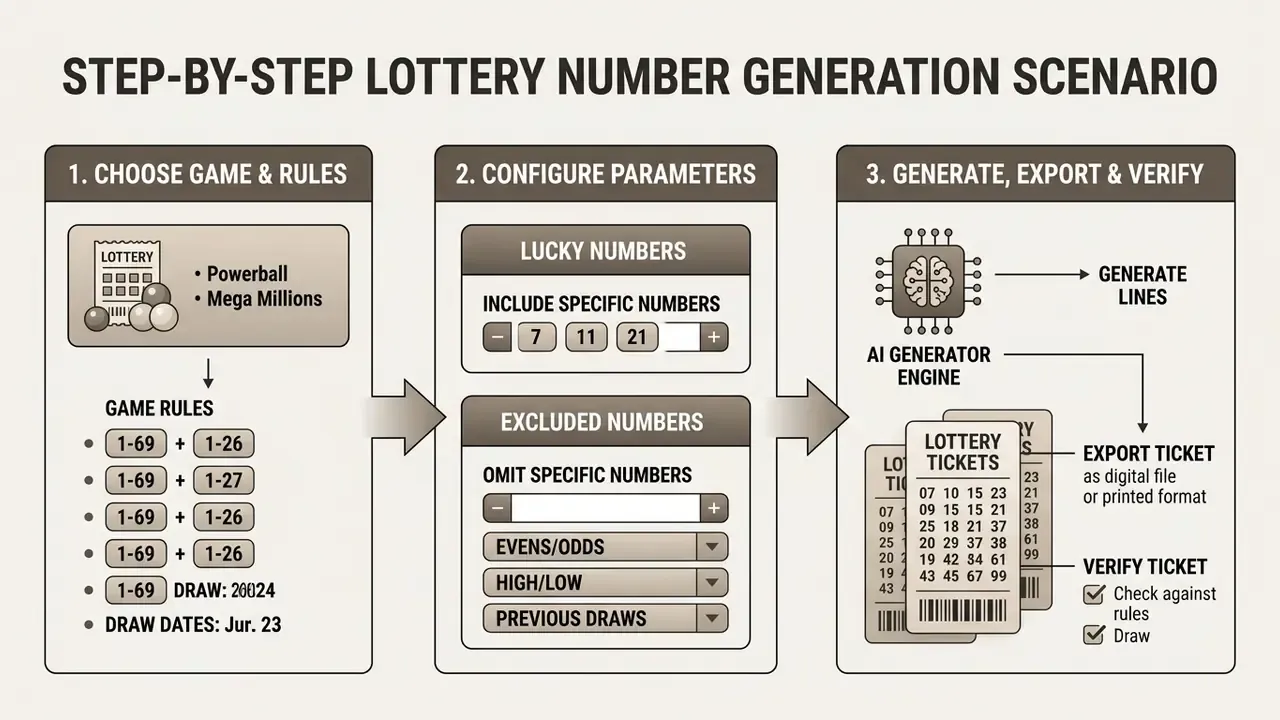
Choose the Game and Combination Parameters
- Select the target draw game in the generator interface: Mega Millions, Powerball, EuroMillions, or another matrix.
- Verify that the active ball ranges match current official rules, for example 5/70 plus 1/24 for Mega Millions.
- Set combination parameters: required lucky numbers, excluded values, preferred odd-even balance.
- For Pick-N games, confirm digit repeats are enabled. For Cash 5 and Fantasy 5 variants, enter the correct regional upper limit.
Ready-Made Prompts for Generating Numbers with an LLM
The final clause in Prompt 2 does real work. Instructing the model to drop predictive framing measurably reduces the reasoning theatre that fuels illusion of control. A small wording change, a meaningful behavioural difference.
Generate, Save, and Verify the Number Sets
FAQ: Short Answers on AI Lottery Generators
Can AI predict winning numbers?
No. Draws are independent trials, regulators explicitly require unpredictability, and no model has access to future entropy. Any "prediction" is a constrained random sample with narrative text attached.
Is a free AI lottery generator safe to use?
Functionally yes, provided you treat it as an entertainment utility, avoid corporate credentials, and read the retention policy. Free and paid tiers usually differ only in quota and analytics depth, not in randomness quality.
Do hot and cold numbers give an edge?
No. Published audits of 6/45 and 6/49 draw histories do not reject uniform randomness at the 0.05 level. Frequency lists describe the past, nothing more.
Is there any point in avoiding popular combinations?
Yes, but only for prize-sharing reasons. Avoiding birthday clusters and sequences does not change your chance of matching the draw. It can reduce the chance of splitting a jackpot if you do.
Can the same number appear twice on one ticket?
It depends on the format. Never in 5/70 or 6/49 style matrices. Always allowed in Pick 2 through Pick 9 digit games. And a bonus-pool value may legitimately duplicate a main-pool number, because the pools are separate.
Does joining a syndicate improve my chances?
Group play raises the number of lines held collectively, so the pool's overall chance of holding a winner goes up. The odds per individual line stay fixed, and your share of any prize falls as the group grows.
How many sets should I generate?
As many as your fixed, non-essential budget allows, and not one more. Volume scales exposure linearly while each line's probability stays constant.
Additional Technical Considerations and Context
For readers analysing media policy, copyright compliance, or liability in generative software, resources on AI Litigation and intellectual property give useful context on automated decision systems. Reviewing commercial use rights helps mark the boundary between consumer software utilities and regulated commercial services, a boundary that lottery tools straddle uncomfortably.
Assessing software in any regulated or probabilistic domain, whether a lottery generator, a scoring model, or an automated reporting pipeline, comes back to one principle: the software supplies structured workflow assistance, while compliance and risk ownership stay with the operator. Concretely, three artefacts should exist before a tool earns trust. First, a documented statement of what the model does and does not claim. Second, a validation record against a defensible baseline, meaning NIST SP 800-22 style testing for randomness and comparison with the uniform expectation for descriptive analytics. Third, a named human owner of the decision the output informs. Miss any one of them and you are governing on vibes.
Appendix A. Corrected and Clarified Fragments