Deploying autonomous digital workers into production requires moving beyond basic chatbots toward structured execution frameworks. To create AI agents that deliver enterprise value, organizations must integrate reasoning models, external tool APIs, persistent memory, and strict governance controls. This guide evaluates the ecosystem of an ai agent creation platform, contrasts code-first frameworks with visual no-code builders, details a step-by-step launch methodology, and provides pricing models for risk-managed deployment in 2026.
For a bank or a mature fintech, the question is rarely "can we build one?" It is narrower and harder: can we put this agent in front of a customer, a payment rail, or an examiner, and defend every action it took?
Executive Summary for Risk and Operations Leaders
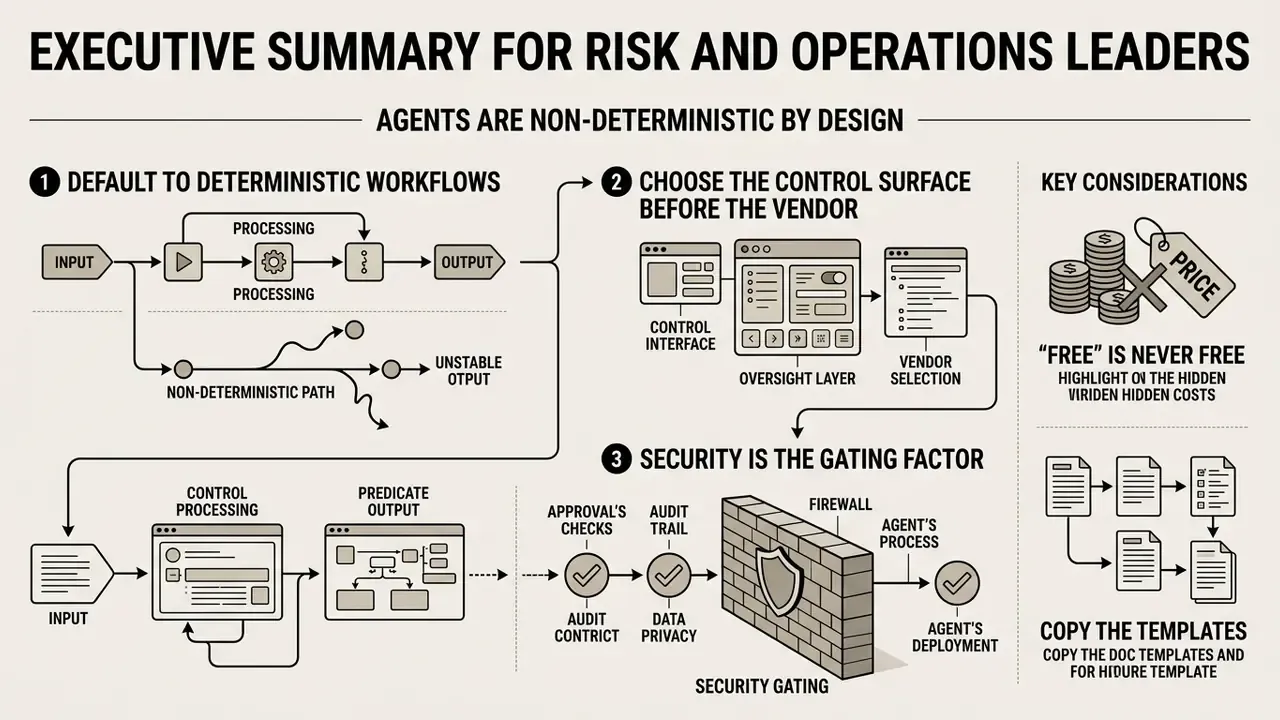
- Agents are non-deterministic by design. Traditional backtesting and static challenger-model validation break down when the execution path is generated at runtime. Model risk frameworks aligned with the Federal Reserve and OCC Interagency Guidance on Model Risk Management (SR 11-7 / OCC 2011-12) must be extended to cover prompt versions, tool schemas, and trajectory logs, not just model coefficients.
- Default to deterministic workflows. Reserve agentic autonomy for unstructured inputs and dynamic decision paths. Benchmarks show state-of-the-art agent stacks succeed on only 35.3% of complex enterprise tasks.
- Choose the control surface before the vendor. Code-first frameworks (LangGraph, CrewAI, Microsoft Agent Framework, LlamaIndex, AutoGen) and self-hosted runtimes (n8n, Flowise, local Llama 3 / Mistral) provide VPC deployment, immutable audit trails, and zero vendor lock-in. No-code canvases accelerate prototyping but constrain state management and logging granularity.
- Security is the gating factor. OWASP's "Excessive Agency" risk and MCP attack benchmarks (peak attack success rate 75.83%) mean least-privilege tokens, human approval gates, and per-action authorization are mandatory. Not optional.
- "Free" is never free. Open-source licenses cost nothing; infrastructure starts at roughly €5–$10/month for a minimal VPS and climbs to $1.50–$3.00/hour for GPU capacity, plus token pass-through, human-in-the-loop overhead, and independent validation costs.
- Copy the templates. This guide includes a production-ready system prompt, a JSON tool-definition schema, a Slack-to-CRM webhook walkthrough, and an agent production readiness checklist for model risk sign-off.
What an AI Agent Is and How It Differs From a Workflow
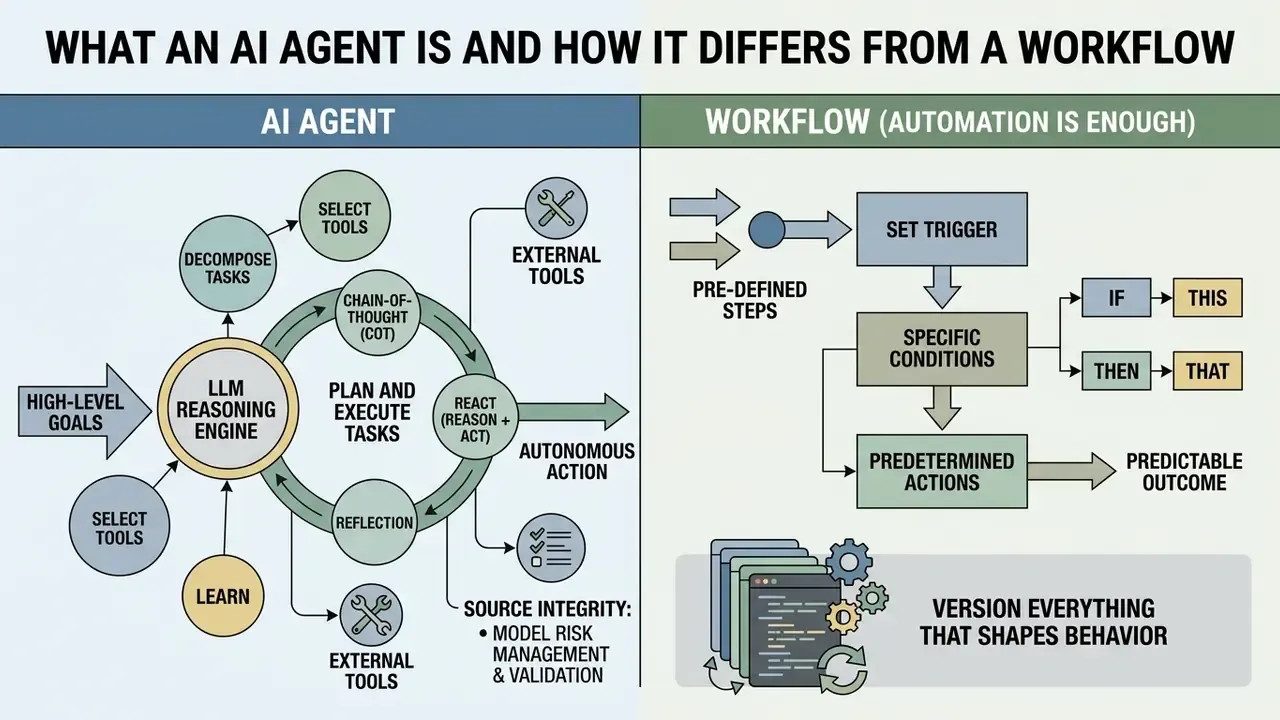
An ai agent is an autonomous software system that uses a large language model (LLM) as its central reasoning engine to decompose high-level goals, select external tools dynamically, execute multi-step tasks, and adapt its execution path based on intermediate environment observations. Unlike static automated scripts, an ai agent maker architecture relies on continuous loops of perception, planning, and action.
In late 2024, a financial compliance team attempted to automate vendor sanctions screening using standard rule-based scripts, but variations in document formats caused constant pipeline breaks. Every new corporate registry layout broke the parser. By transitioning to an ai agent create architecture with dynamic tool calls and self-reflection loops, the team enabled the system to re-parse ambiguous corporate structures autonomously. This reduced manual exception handling by 68% while maintaining full audit logging across all decision steps.
Methodological note: the 68% figure comes from a single anonymized internal deployment reviewed by our editorial desk. It is directional rather than peer-reviewed, and exception-handling gains are highly sensitive to document heterogeneity and baseline automation maturity. Published research supports the underlying mechanism rather than the specific magnitude:
«Neuro-symbolic agents with formal verification reached 27.9% constraint satisfaction versus 2.6% for purely neural models on complex, rule-heavy planning tasks.»
Organizations replicating this pattern should measure their own pre-deployment baseline for at least two weeks (six weeks for a robust estimate) using volume, handling time per unit, error rate, and escalation rate as the four core metrics. Without that baseline, any later ROI claim is a story, not a number.
How an AI Agent Plans and Executes Tasks
An ai agent plans and executes a task by combining internal reasoning traces with dynamic tool calls and environmental feedback. Frameworks such as Reasoning and Acting (ReAct) interleave explicit reasoning steps with external tool execution, allowing the system to evaluate intermediate outputs before taking its next step.
It is worth separating three mechanisms that are frequently conflated:
- Chain-of-Thought (CoT) is the reasoning trace itself, an internal decomposition of the goal into ordered sub-tasks. CoT guides the next action but is never executed as a tool call.
- ReAct (Reasoning + Acting) is the loop: the agent alternates between reasoning and an external action, observes the returned result, and repeats with updated context.
- Reflection is a post-action critique step: the agent evaluates what worked, what failed, and revises its plan before continuing. Reflection is what converts a one-shot failure into a recoverable trajectory.
When an agent receives a complex objective, it uses Chain-of-Thought reasoning to decompose the goal into structured sub-tasks. The agent evaluates its available tool definitions, such as database queries, REST API endpoints, or web scraping modules, and generates structured execution payloads. If an execution step returns an error or incomplete payload, the agent invokes Reflection mechanisms, evaluating its past trajectory to generate a corrected query or an alternate tool path. In sensitive operational environments, these action loops are gated by human-controlled checkpoints, where execution pauses until an authorized operator signs off on privileged actions. Technically, human-in-the-loop is implemented as a gated tool call: the agent emits a proposed action, the runtime suspends execution, and a human approves or rejects the operation before the payload reaches the production endpoint.
That distinction matters for governance. A "human review" that happens after the wire transfer left the building is not a control. It is a post-mortem.
AI Agent vs Workflow: When Automation Is Enough
Deterministic workflow automation is sufficient when process steps, data structures, and outcome conditions are fully predictable and can be hardcoded in advance. An agentic approach is necessary only when the execution path cannot be predefined due to unstructured inputs, dynamic environmental feedback, or multi-step decision-making requirements.
According to research on LLM planning frameworks, standard workflow automation excels at linear tasks with known data schemas, such as syncing CRM records or sending event-triggered emails. However, benchmark evidence sharply limits expectations for open-ended autonomy:
«GAIA tests 466 real-world questions requiring reasoning, web search, and tool use: GPT-4 with plugins reaches only 15% accuracy versus 92% for human respondents.»
«AgentArch evaluated 18 agent configurations: even the strongest reached just 35.3% success on complex enterprise tasks and 70.8% on simple ones.» AgentArch, arXiv preprint (2025).
Source integrity note: the AgentArch preprint identifier previously cited in this guide was a placeholder. The finding is reported here as AgentArch, arXiv preprint, 2025 without an active hyperlink until the canonical DOI is verified against the arXiv listing. Readers preparing regulatory documentation should cite the primary preprint directly once retrieved.
Therefore, organizations should default to deterministic workflows for structured operations and reserve agentic autonomy for unstructured, dynamic scenarios requiring active reasoning. Vendor guidance converges on the same split: Oracle frames deterministic workflows as giving explicit control over step sequence while invoking agents for narrow sub-tasks; Microsoft distinguishes "deterministic flow" for structured stages from "dynamic flow" for unstructured stages inside a single system; and Anthropic notes that workflows orchestrate LLMs through predefined code paths whereas agents direct their own processes and tool usage.
In practice, most durable designs are hybrids. A fixed pipeline handles intake, routing, and posting. The agent is invited in only for the messy middle: reading a non-standard document, reconciling conflicting registry data, drafting a rationale for a human reviewer.
Architectural and Operational Comparison: AI Agent vs Workflow Automation
| Dimension | AI Agent (Agentic Architecture) | Workflow Automation (Deterministic) |
|---|---|---|
| Architectural Logic | Goal-driven decomposition; plans and adapts execution paths dynamically via LLM reasoning traces. | Step-driven execution; follows hardcoded conditional branching and predefined rules. |
| Autonomy Level | Autonomous or semi-autonomous execution; selects tools and handles ambiguous inputs independently. | Zero autonomy; strictly bound to programmed triggers, routing rules, and static scripts. |
| Tool Invocation | Dynamic tool discovery and invocation based on natural language definitions and API schemas. | Static API bindings executed at pre-configured steps in a fixed sequence. |
| Error Handling | Self-correction loops, Reflection, dynamic fallback selection, and contextual retry mechanisms. | Pre-programmed exception routing; pipeline halts upon encountering unhandled exceptions. |
| Human Oversight | Human-in-the-loop approval gates for high-impact actions, continuous audit trace logging. | Manual intervention required only when fixed rules fail or data formats deviate. |
| Model Risk Validation (SR 11-7 lens) | Requires trajectory-level validation: prompt version, seed, tool outputs, and step caps must be reproducible. | Conventional input/output backtesting and rule-coverage testing are usually sufficient. |
| Optimal Use Cases | Unstructured document analysis, multi-source research, adaptive customer support, fraud and sanctions investigation. | Data synchronization, invoice routing, scheduled notifications, batch transaction processing. |
Read the table one column at a time. If your process fits the right-hand column, an agent adds cost and validation burden without adding capability.
Implications for Model Risk Management and Validation
Regulated institutions cannot validate an agent the way they validate a scorecard. Under the Interagency Guidance on Model Risk Management (Federal Reserve SR 11-7 / OCC Bulletin 2011-12), effective challenge requires conceptual soundness review, ongoing monitoring, and outcomes analysis. Agentic systems strain the third pillar, because the same input can produce different tool-call sequences on two runs.
Practical adaptations that satisfy examiner expectations:
- Version everything that shapes behavior. Prompt text, tool schemas, retrieval index snapshots, temperature, seed, and model build ID all become versioned model artifacts subject to change control.
- Validate trajectories, not just outputs. Store the full ReAct trace (reasoning step, tool call, observation) and evaluate against gold-standard trajectories, not only final answers.
- Bound the action space. Autonomy caps (maximum steps, maximum spend, whitelisted endpoints) are documented model limitations, and the sponsor is accountable for the highest permitted autonomy level.
- Export logs in a machine-readable, examiner-friendly schema. OpenTelemetry trace formats let internal audit reconstruct any decision path without vendor-proprietary tooling.
- Treat third-party agent platforms as vendor risk. OCC third-party risk management expectations apply to model hosting, data residency, and subprocessor disclosure.
One more uncomfortable point: accuracy improved faster than reliability.
«Despite accuracy gains over 18 months, agent consistency, robustness, and behavioral predictability improved only marginally.»
Choosing an Approach for Building a Custom AI Agent
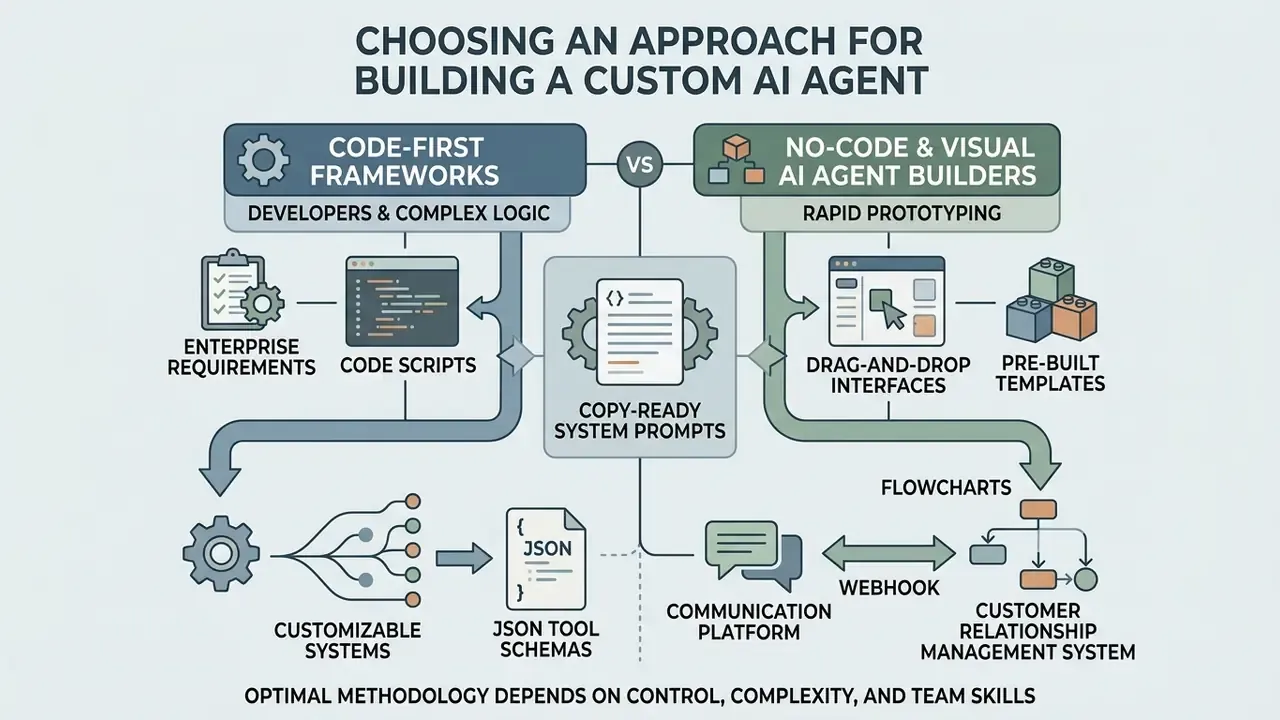
Selecting the right methodology to create custom ai agent applications depends on the required operational control, system complexity, and team technical capability. Organizations must evaluate whether programmatic developer frameworks, enterprise-managed environments, or visual no-code builders best align with their integration requirements and governance standards. Regulated institutions typically evaluate in that order, because deployment topology (VPC, on-premises, data residency) constrains vendor choice long before feature richness does.
Code-First Frameworks for Developers and Complex Logic
Code-first frameworks provide developers with programmatic control over prompt construction, graph-based state management, custom memory schemas, and dynamic tool orchestration via native code and APIs.
By leveraging frameworks like LangGraph, CrewAI, or Microsoft Agent Framework, developers can construct sophisticated multi-agent architectures featuring custom loops, parallel execution, and stateful graph routing. Code-first systems allow teams to implement rigorous unit testing, version control via Git, containerized deployment, and custom telemetry integrations. This level of technical control is essential when building complex multi-agent orchestrations or integrating proprietary enterprise databases that require bespoke access logic.
Architecturally, CrewAI and LangGraph solve different problems at different abstraction levels. CrewAI separates a Flow orchestrator (state, branching, loops, event-driven control) from a Crew of role-playing agents executing collaborative tasks, essentially a "manager plus team" model. LangGraph exposes lower-level state graph execution with nodes, conditional edges, and cyclic control, functioning closer to a decision-graph engine with precise control over state propagation and human-in-the-loop pauses. Microsoft's Agent Framework, generally available since 25 August 2026, offers production SDKs for .NET and Python with graph-based workflows, multi-agent orchestration, MCP server support, and native human-in-the-loop primitives.
A blunt selection heuristic from validation teams: if you cannot replay a run from stored artifacts, you do not have a code-first stack. You have a demo.
Enterprise Requirements for AI Agents Creation
An enterprise-grade ai agents creation approach is required when agent operations handle regulated data, interact with core financial systems, or demand high-availability service level agreements (SLAs).
Enterprise implementations require strict role-based access control (RBAC), physical or logical data boundary isolation, continuous cryptographic identity verification, and comprehensive audit logging. The NIST AI Agent Standards Initiative, launched 17 February 2026 to define open protocols for secure agent interoperability, and the accompanying NCCoE concept paper Accelerating the Adoption of Software and AI Agent Identity and Authorization (February 2026 draft) center production design on unique agent identities, minimum-necessary permissions, and credential revocation and rotation (NIST NCCoE, 2026).
Citation precision: the relevant NIST artifacts are the AI Agent Standards Initiative announcement and the NCCoE draft concept paper on software and AI agent identity and authorization. The full control catalogue has not yet been published, so detailed control language circulating in secondary write-ups should be treated as interpretation rather than published requirement. Complementary official guidance includes NIST SP 800-228, Guidelines for API Protection for Cloud-Native Systems, which mandates authentication, authorization, input validation, and rate limiting before requests reach protected services.
Cloud Security Alliance guidance adds cryptographically anchored agent identities, short-lived credentials, and strict least-privilege scoping for tool and API access, governed through enterprise IAM with the same authentication, delegation, and audit obligations applied to human users. Microsoft's enterprise guidance requires separating confidential from public data, granting agents only the specific sources needed, maintaining separate development, staging, and production permissions, and detecting anomalous agent behavior. Furthermore, enterprise platforms provide team workspaces with fine-grained permissioning, dedicated staging-to-production deployment pipelines, and centralized model risk monitoring.
If your agent authenticates with a shared service account, you do not have an accountable digital worker. You have an anonymous one.
No-Code and Visual AI Agent Builders for Rapid Prototyping
A visual ai agent builder enables rapid prototyping and non-technical workflow assembly through drag-and-drop node interfaces and pre-configured integrations. These platforms allow business analysts and operations teams to wire LLM models to external web services without writing custom code.
Visual interfaces represent tasks, triggers, and integrations as functional nodes on a canvas. Users configure model system prompts, attach pre-built API connectors (such as Slack or HubSpot), and define execution conditions graphically. Mature builders now add natural-language scaffolding (describe the workflow, and the platform assembles the nodes), versioning, preview and tracing panes, and one-click deployment. While visual builders drastically accelerate initial deployment and proof-of-concept testing, they often introduce architectural constraints regarding custom state management, fine-grained error recovery, and the granular security logging required for complex enterprise operations.
One practical selection criterion frequently overlooked by regulated buyers: does the builder ship an AI assistant that can debug the workflow itself? For non-technical operators, a built-in debugging copilot (rather than raw log inspection) is often the difference between a prototype that ships and one that stalls, and it materially reduces dependence on scarce engineering time.
Best Platforms and Tools to Create AI Agents
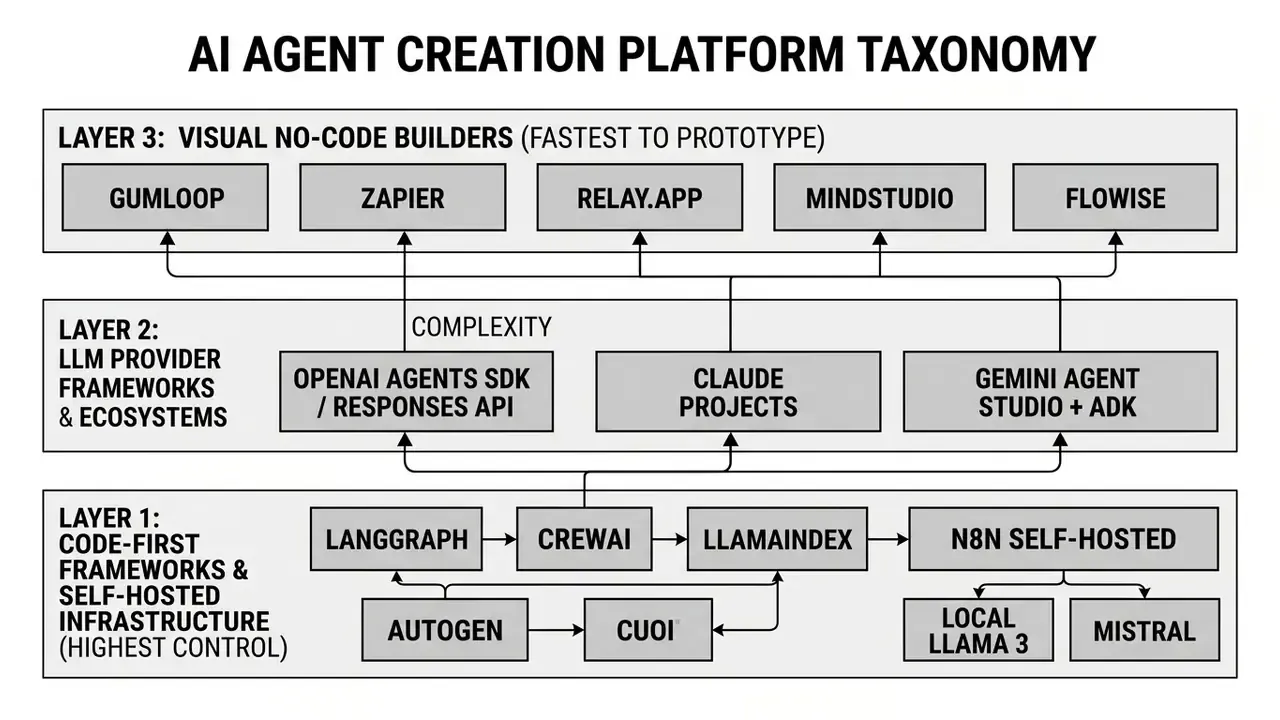
The software ecosystem for ai agent creation tools spans open-source execution libraries, self-hosted orchestration runtimes, LLM vendor studios, and visual automation platforms. Selecting the best platform to create ai agents requires matching operational demands with platform capabilities, and, in regulated environments, matching deployment topology and audit requirements first.
Open-Source Frameworks and Self-Hosted Tools for Developers
Open-source libraries and self-hosted runtimes give engineering teams full code ownership, zero vendor lock-in, and the ability to deploy within private cloud or on-premises environments. For institutions with data residency or examiner-access constraints, this is the default starting point.
- LangChain & LangGraph: LangGraph is an MIT-licensed, stateful graph orchestration framework designed for building cyclic, multi-agent decision flows with fine-grained control over state propagation and human-in-the-loop pauses. LangChain's documentation also covers self-hosted LangSmith and self-hosted deployment, so tracing and evaluation can stay inside your own perimeter (LangChain, 2026).
«ToolGym standardized 5,571 tools in MCP format: fine-tuning on 1,170 trajectories outperformed baselines trained on 119,000 examples.»
- CrewAI An open-source multi-agent framework that structures execution around role-playing agents (Researcher, Writer, Reviewer, and so on) orchestrated via explicit Flow control pipelines, with a documented Flow Orchestrator, State Management, steps, and crew pipeline (CrewAI Docs, 2026).
- LlamaIndex A retrieval-first framework purpose-built for RAG agents. It specializes in data ingestion, indexing across heterogeneous content formats, and structured retrieval, making it the natural choice for knowledge assistants, enterprise document search, and policy or contract analysis agents where grounding quality dominates raw reasoning capability.
- Microsoft AutoGen A multi-agent framework centered on inter-agent communication, role delegation, and collaborative problem solving. Agents converse autonomously to converge on a solution, which suits complex research, code review, and analysis pipelines where a single-agent loop becomes limiting. AutoGen concepts feed directly into the production-grade Microsoft Agent Framework.
- AutoGPT The project that popularized goal-driven autonomy, decomposing a high-level objective into action sequences and managing progress across extended runs. It remains a useful reference implementation for understanding autonomous planning loops and, just as instructive, their failure modes.
- n8n (Self-Hosted) A fair-code workflow automation platform offering a robust self-hosted community edition, deployable on your own machine, on-premises, or in a private cloud. It combines a visual node-based editor with native AI agent nodes, 400+ integrations, vector store connectors, and custom JavaScript or Python execution (n8n Documentation, 2026).
- Flowise An open-source visual UI for constructing customized LLM orchestration graphs and agent flows using LangChain components: node-based, self-hostable, and useful for rapid prototyping without surrendering data control.
- Hugging Face and Local LLMs (Llama 3 / Mistral / Mixtral) For workloads where no data may leave the perimeter, open-weight models downloaded from Hugging Face and served locally deliver full privacy with no per-token vendor billing and no artificial usage caps. The trade-off is hardware: acceptable latency on 70B-class models requires dedicated GPU capacity, and Hugging Face Spaces free tiers provide only limited compute. This is the standard pattern for sanctions screening, internal credit memo drafting, and any pipeline touching customer PII under strict residency rules.
Platforms for Custom Agents Built on ChatGPT, Claude, and Gemini
No-Code Platforms for Business, Marketing, and Operations
No-code visual platforms provide operational teams with accessible tools to automate cross-application workflows using embedded AI logic. In regulated organizations these are best positioned as supporting tools for marketing, internal enablement, and non-material processes rather than as the substrate for customer-impacting decisions.
- Gumloop A dedicated visual agent canvas designed for complex business and marketing operations, enabling teams to build web scrapers, content pipelines, and automated lead enrichers using modular nodes and custom model inputs. It hosts and proxies MCP servers, includes premium model access without separate API keys (BYOK optional), ships a built-in AI assistant that constructs and debugs agents conversationally, and bills credits at the organization level with unlimited seats on paid plans. Higher-end controls such as Virtual Private Cloud and AI model access control sit on the custom Enterprise tier.
- Zapier An enterprise workflow engine incorporating AI actions and agentic routing, allowing organizations to connect thousands of SaaS applications with basic reasoning steps: lead scoring, document processing, ticket routing.
- Relay.app An automation platform that treats AI agents as collaborative "teammates" that own workflows and retain activity history, designed for multi-user workflow management.
- MindStudio A visual development platform for building custom AI applications and multi-model workflows with configurable enterprise access controls.
Any ai agents maker in this category deserves the same vendor scrutiny as a core banking supplier once it holds credentials into your systems. Convenience does not lower the standard.
Comprehensive Evaluation of AI Agent Creation Platforms and Frameworks
| Platform / Tool | Builder Format | Code Surface | Target Users | Supported Models | Self-Hosted / VPC / On-Prem | Built-in Debugging / Tracing | Enterprise Audit & Access (RBAC, SSO/SAML, Audit Logs) | Base Pricing Model |
|---|---|---|---|---|---|---|---|---|
| LangGraph | Code Framework (state graph) | Code-First (Python/JS) | Software Engineers, Model Risk Eng. | Model Agnostic | Yes (MIT Open Source; self-hosted LangSmith available) | LangSmith tracing (cloud or self-hosted) | Inherited from your own infrastructure and IdP | Free Framework (managed cloud paid) |
| CrewAI | Code Framework / Flow | Code-First (Python) | AI Developers | Model Agnostic | Yes (Open Source) | Flow state inspection; external tracing via OTel | Enterprise tier adds monitoring and management | Free Framework (Enterprise paid) |
| LlamaIndex | Code Framework (RAG-first) | Code-First (Python/TS) | Data & Knowledge Engineers | Model Agnostic | Yes (Open Source) | Retrieval/eval instrumentation; callback handlers | Inherited from your own infrastructure and IdP | Free Framework (managed cloud paid) |
| Microsoft AutoGen / Agent Framework | Code Framework (multi-agent) | Code-First (.NET / Python) | Enterprise Engineering Teams | Model Agnostic + Azure OpenAI | Yes (Azure VPC / on-prem patterns) | Graph workflow tracing, HITL primitives | Azure-native RBAC, Entra ID SSO, activity logs | Free SDK (Azure consumption billed) |
| n8n (Self-Hosted) | Visual Node Canvas | Low-Code / JS / Python | DevOps, Engineers, Ops | Model Agnostic / Local LLMs | Yes (Fair-Code; on-prem or private cloud) | Execution log, step-by-step run inspector, replay | Advanced RBAC, audit trailing, environment isolation (paid tiers) | Free Community / Paid License |
| Flowise | Visual Node Canvas | Low-Code (LangChain nodes) | Prototypers, Educators | Model Agnostic / Local LLMs | Yes (Open Source, self-hostable) | Node-level flow visibility during testing | Depends on self-managed deployment | Free (self-hosted) |
| Hugging Face + Llama 3 / Mistral | Model layer (self-served) | Code-First | Privacy-Constrained Teams | Open-weight models only | Yes (fully local / air-gapped possible) | Custom instrumentation required | Fully controlled by the operator | Free weights + GPU infrastructure cost |
| OpenAI Agents SDK | API / SDK | Code-First | Software Developers | OpenAI Series | Runtime only (API dependent) | Native tracing + approvals | Enterprise: zero-retention agreements, dedicated capacity | Pay-as-you-go (Token Usage) |
| Gumloop | Visual Node Canvas | No-Code / BYOK | Marketing, Sales, Ops | Multi-model (OpenAI, Claude) | VPC on custom Enterprise tier only | Built-in AI assistant builds and debugs agents | Enterprise: RBAC, SCIM/SAML, admin dashboard, audit logs | Free plan; Pro from $37/mo |
| Zapier AI | Visual Workflow | Low-Code | Business Operations | Multi-model / Hosted | No | Zap history and error replay | SSO, user provisioning, audit logs (higher tiers) | Freemium / Task-based |
| Relay.app | Visual Workflow / AI teammate | No-Code | Cross-functional Teams | Multi-model / Hosted | No | Persistent run and activity history | Team permissioning; verify enterprise controls with vendor | Freemium / Paid tiers |
Reading the matrix as a risk owner: the two columns that decide most regulated shortlists are "Self-Hosted / VPC / On-Prem" and "Enterprise Audit & Access". Feature depth rarely survives a failed data-residency question.
For additional comparative analysis on enterprise software costs, review our detailed AI Media Pricing Guides and explore our specialized AI Media Comparison Matrices to evaluate platform trade-offs.
How to Create Your Own AI Agent: The Step-by-Step Process
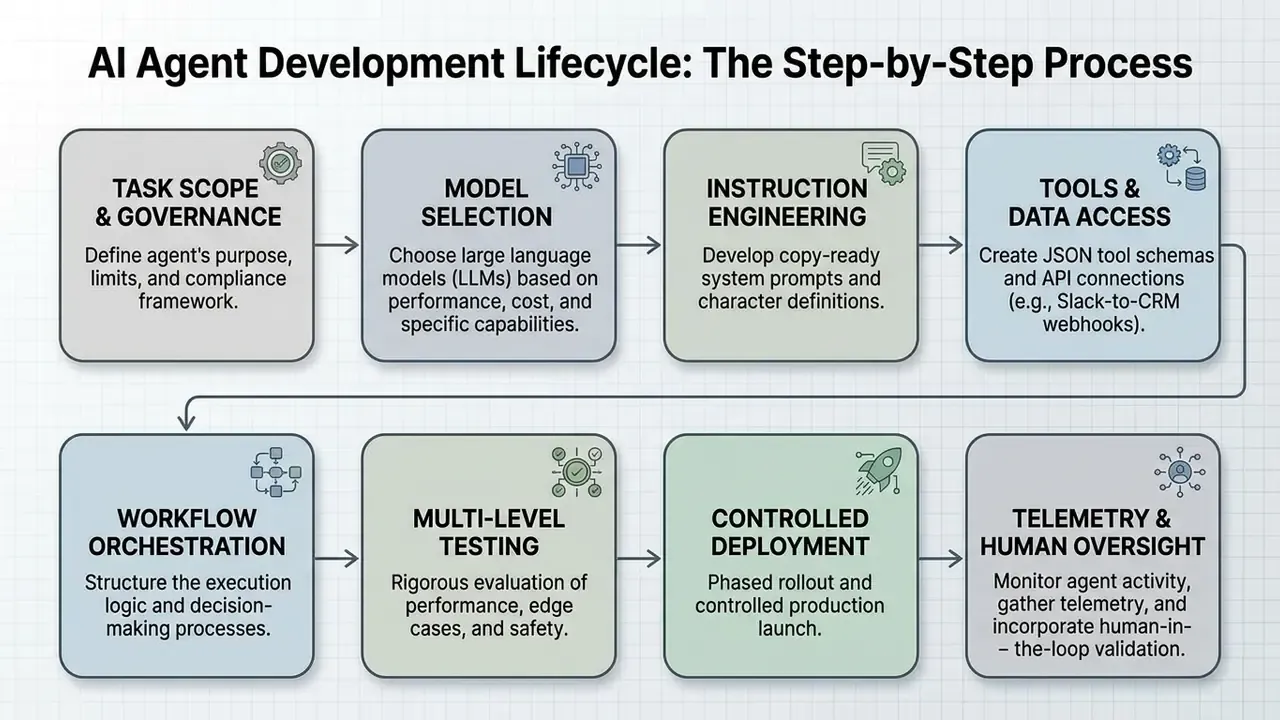
To create your own ai agent for production environments, organizations must follow a structured development lifecycle spanning discovery, architecture configuration, iterative testing, and controlled deployment. Vendor lifecycles differ in naming but not in sequence: Microsoft documents discovery, experimentation, build, deploy, and operational steady state; IBM frames it as build, deploy, monitor and optimize, manage; Salesforce splits experimentation and build into distinct phases.
Define the Task, the User, and the Agent's Operating Boundaries
The first step in ai agent creation is establishing a precise mission envelope, identifying the end user, defining success metrics, and bounding the agent's autonomous authority. As one practitioner puts it: you can only automate what you can articulate. An agent will not compensate for an undocumented process.
Organizations must classify the agent's operational scope by assigning explicit operational roles: Operator (fully autonomous execution), Collaborator (joint human-agent execution), or Observer (suggestion-only mode). This role taxonomy, used in Singapore's Model AI Governance Framework for Agentic AI, maps directly onto the degree of human control. Bounding the autonomy level involves specifying which actions the agent can execute independently (querying read-only databases, for instance) and setting mandatory human approval gates for high-impact actions such as initiating fund transfers, filing regulatory reports, or modifying user privileges. U.S. Department of Defense guidance similarly requires explicit control flows that bound autonomous planning so agents cannot deviate beyond authorized objectives, and Oklahoma's state standard requires classification by the highest permitted autonomy level with a designated sponsor accountable for purpose and operating boundaries.
The practical takeaway: write the standard operating procedure before writing the prompt. Offline SOP definition becomes the specification against which the online agent trajectory is validated. Teams that skip this step usually end up reverse-engineering policy from prompt text months later, in front of an auditor.
Configure Models, Instructions, Tools, and Data Access
Configuring the agent requires selecting the primary reasoning model, crafting system prompts, establishing secure tool definitions, and provisioning grounded data pipelines.
- Model Selection: Match model intelligence against latency and cost parameters. Use high-capability models (such as GPT-4o or Claude 3.5 Sonnet) for orchestrating complex reasoning loops, and smaller, domain-tuned models for specialized sub-task processing. For browser-driven and screen-reading tasks, multimodal capability is decisive:
«WebVoyager, built on a multimodal model, achieved 59.1% task success across 15 real-world websites, substantially outperforming GPT-4 with all tools.»
- System Instructions Write explicit system prompts that define the agent's persona, operating rules, input formats, output schemas, and strict fallback procedures when tools return errors. Keep critical rules in the system prompt rather than the user turn, be specific about output format and tone, include two to five few-shot examples, and use structured outputs or JSON mode wherever the response feeds another system.
- Tools & Data Access Connect external tools via standardized protocols such as the Model Context Protocol (MCP) or secure REST APIs. Ground the agent using Retrieval-Augmented Generation (RAG) by integrating vector databases (PostgreSQL with pgvector, for example) to provide domain-specific knowledge access. Azure RAG guidance recommends a prompt containing a system message, a labeled context block placed before the user query, the query itself, and optional few-shot examples.
Copy-Ready Template 1: System Instruction and Tool Definition
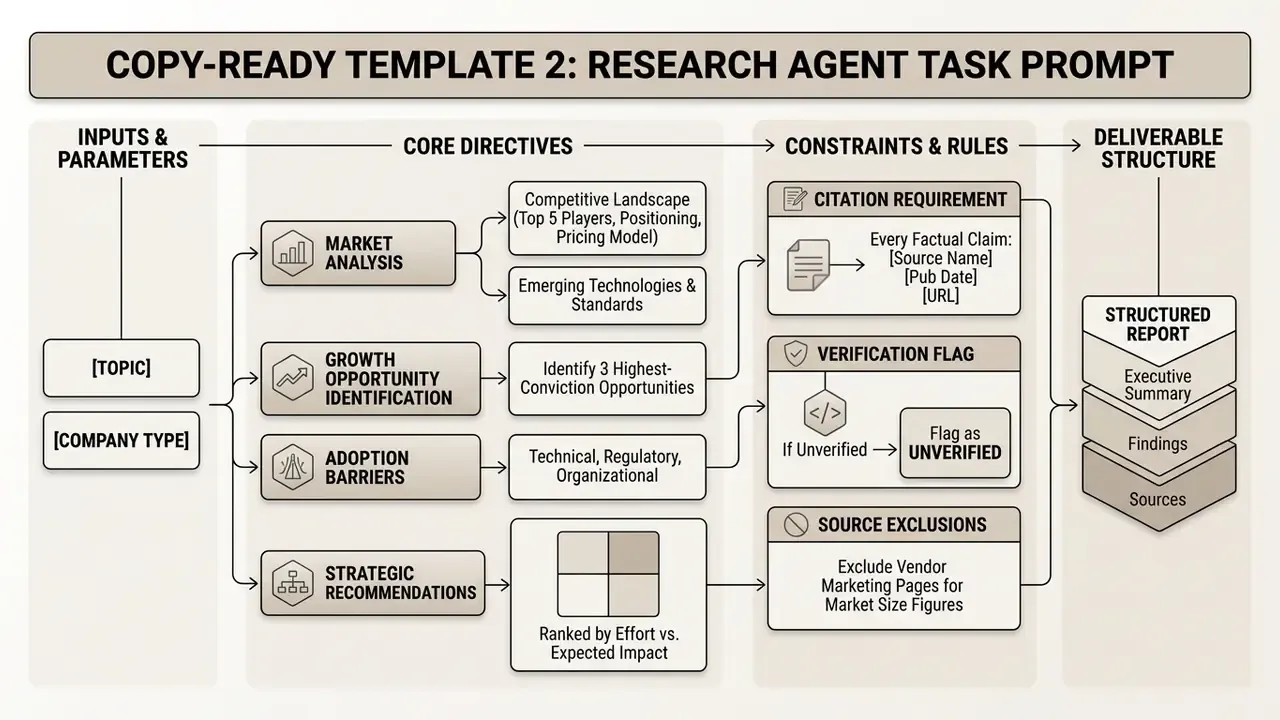
Copy-Ready Template 2: Task Prompt for a Research Agent
For research and market-intelligence agents, precision in the task prompt determines the quality of the plan the agent builds. A reusable structure:
Copy-Ready Template 3: Guardrail Configuration
guardrails:
  autonomy:
    max_steps: 12
    max_tool_calls_per_step: 3
    max_spend_usd_per_run: 2.50
    on_cap_exceeded: escalate_to_human
  tool_access:
    allowlist: [query_sanctions_db, query_adverse_media, request_human_review]
    write_operations: denied
    token_ttl_minutes: 15
  data:
    pii_redaction: enabled
    egress_allowlist: [internal-mcp-gateway.corp, sanctions-api.vendor.com]
  logging:
    trace_format: opentelemetry
    persist: [prompt_version, model_build_id, seed, tool_calls, observations, final_output]
    retention_days: 2555
    mutability: append_only
To understand how creative and media workflows evaluate model controls and licensing terms, see our guide on commercial use policies across generative tools.
Test Agent Workflows Before Launch
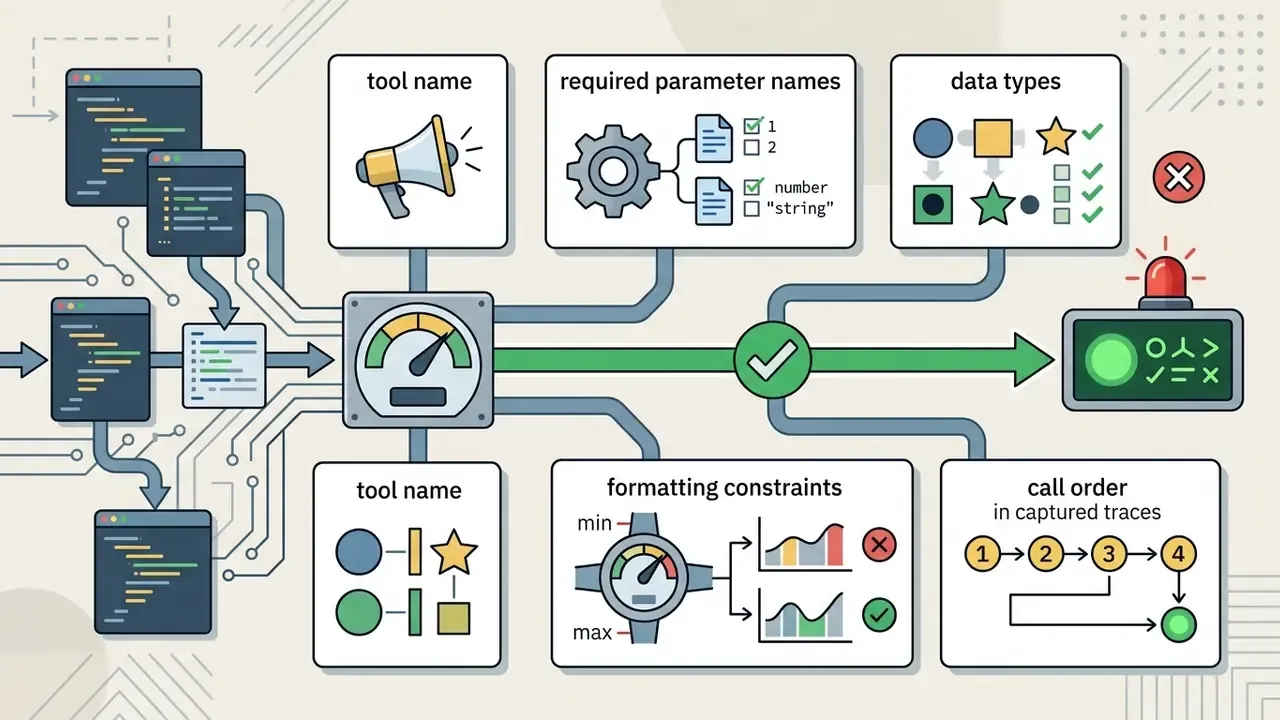
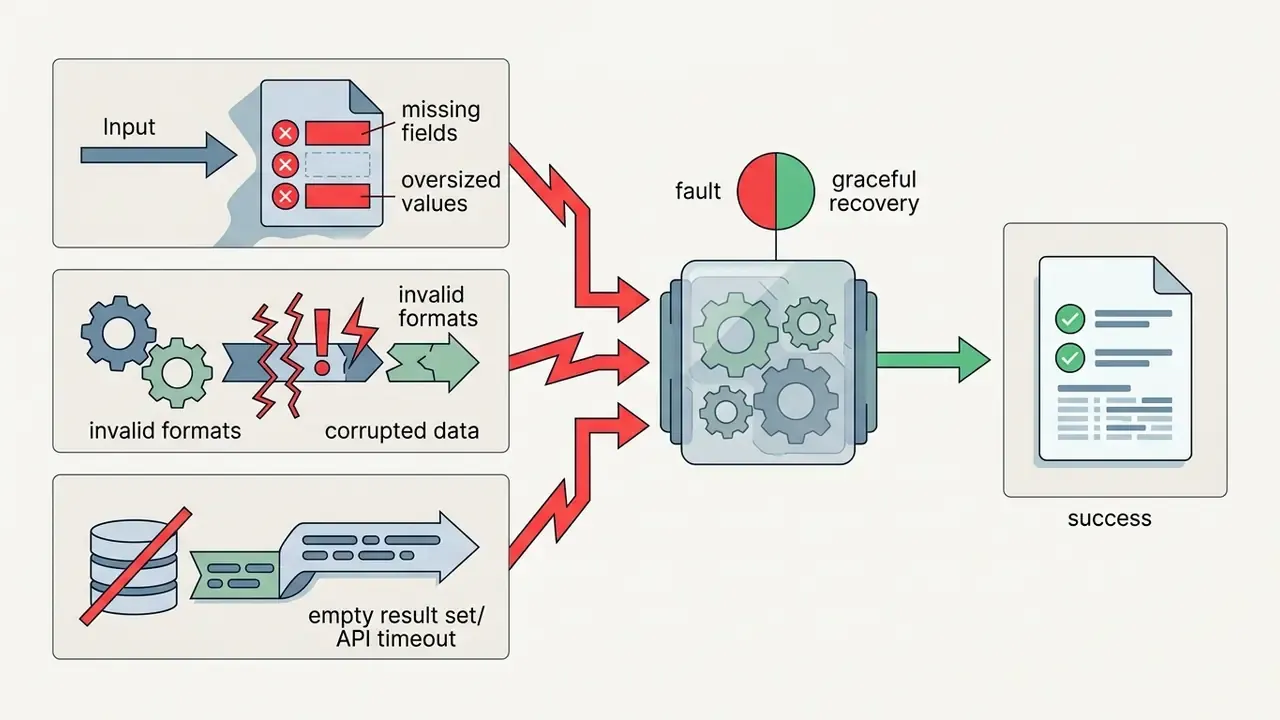
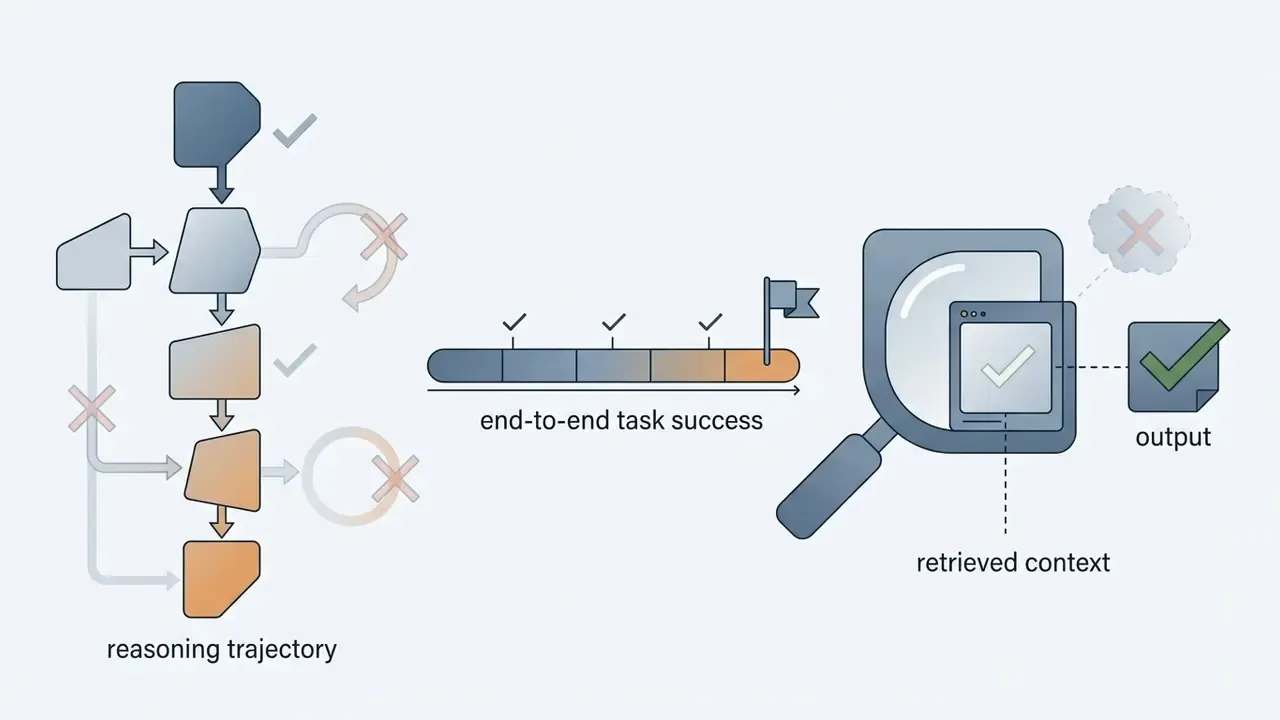
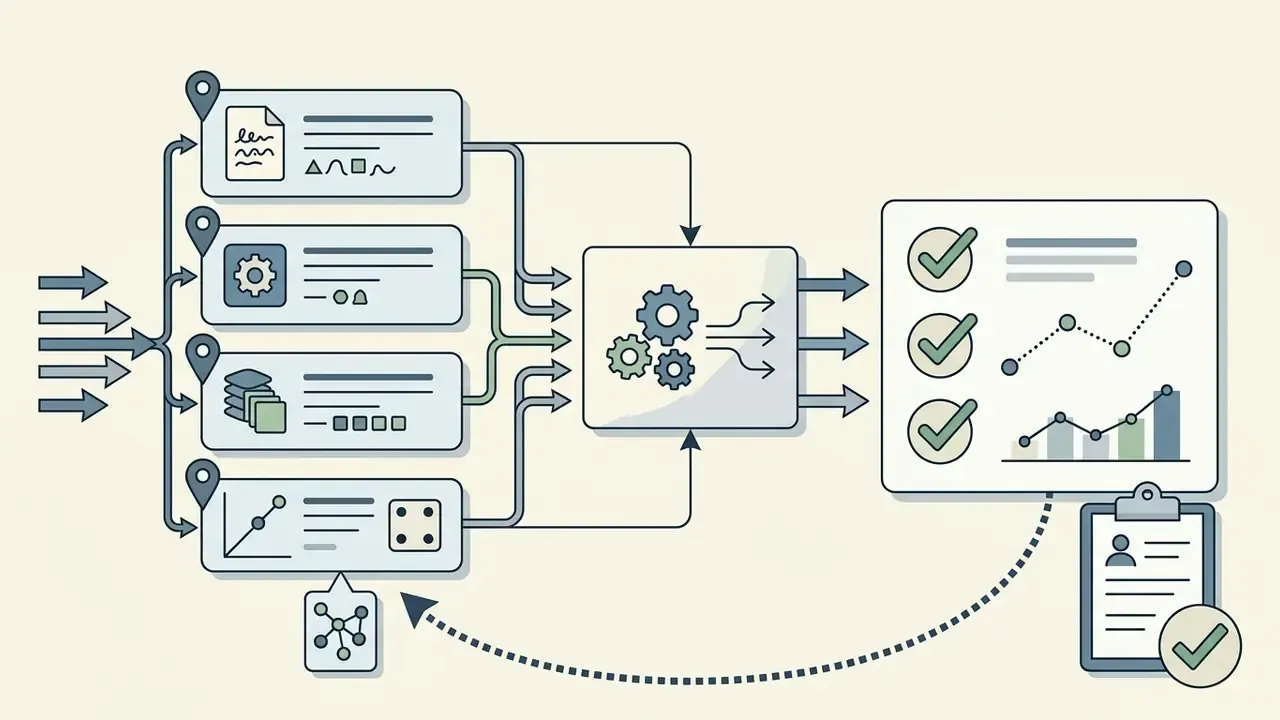
Rigorous pre-deployment testing requires evaluating agent decision paths across three layers of the trace: schema-valid tool calls, fault-injection resilience against malformed inputs, and end-to-end answer accuracy against a gold trajectory or rubric.
A large bank's financial crime unit established an ai agent maker testing pipeline prior to releasing its AML alert-triage assistant. The team implemented synthetic fault injection, simulating timeout errors, corrupted JSON payloads, empty result sets, and malformed API headers across 500 test scenarios. The suite revealed that the unhedged agent attempted infinite retry loops in 14% of failure cases. By implementing explicit step caps and Reflection error-catch nodes, the engineers brought graceful failure recovery up to 99.2% before moving the agent into a supervised production pilot.
Methodological note: the 14% and 99.2% figures derive from one anonymized internal test suite reviewed by our editorial desk and are not independently reproducible. Treat them as an illustration of the failure mode rather than an industry benchmark. Independent research confirms both the fragility and the remedy:
Agent Production Readiness Checklist (Model Risk Sign-Off)
Use this as a gate before any customer-impacting or financially material deployment.
Checklist0 / 20
Organizations calculating ROI for automated asset pipelines can model prospective costs using our AI Media Calculators, and review our technical breakdown of developer endpoints in the AI Media API Guides.
Integrations, Memory, and Deployment of AI Agents
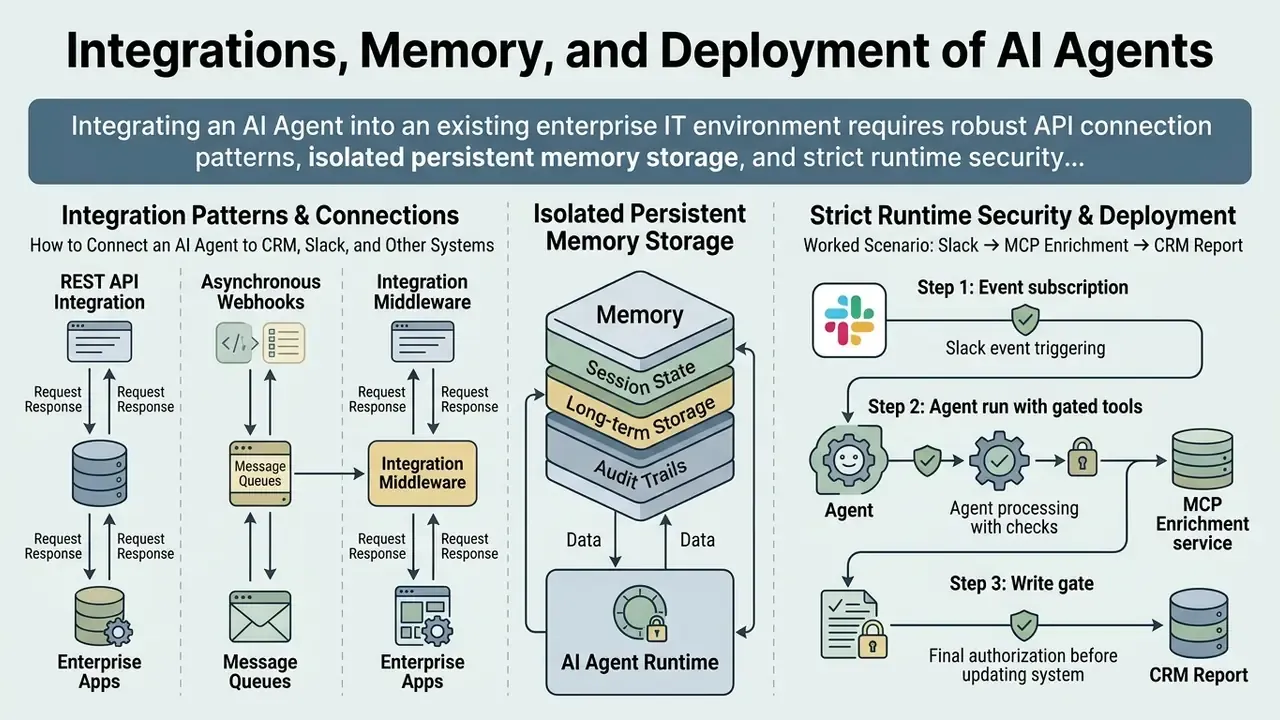
Integrating an ai agent into an existing enterprise IT environment requires robust API connection patterns, isolated persistent memory storage, and strict runtime security controls.
How to Connect an AI Agent to CRM, Slack, and Other Systems
Connecting an agent to corporate platforms such as CRM systems, Slack channels, or ERP databases is accomplished through REST API calls, asynchronous webhooks, and integration middleware layers.
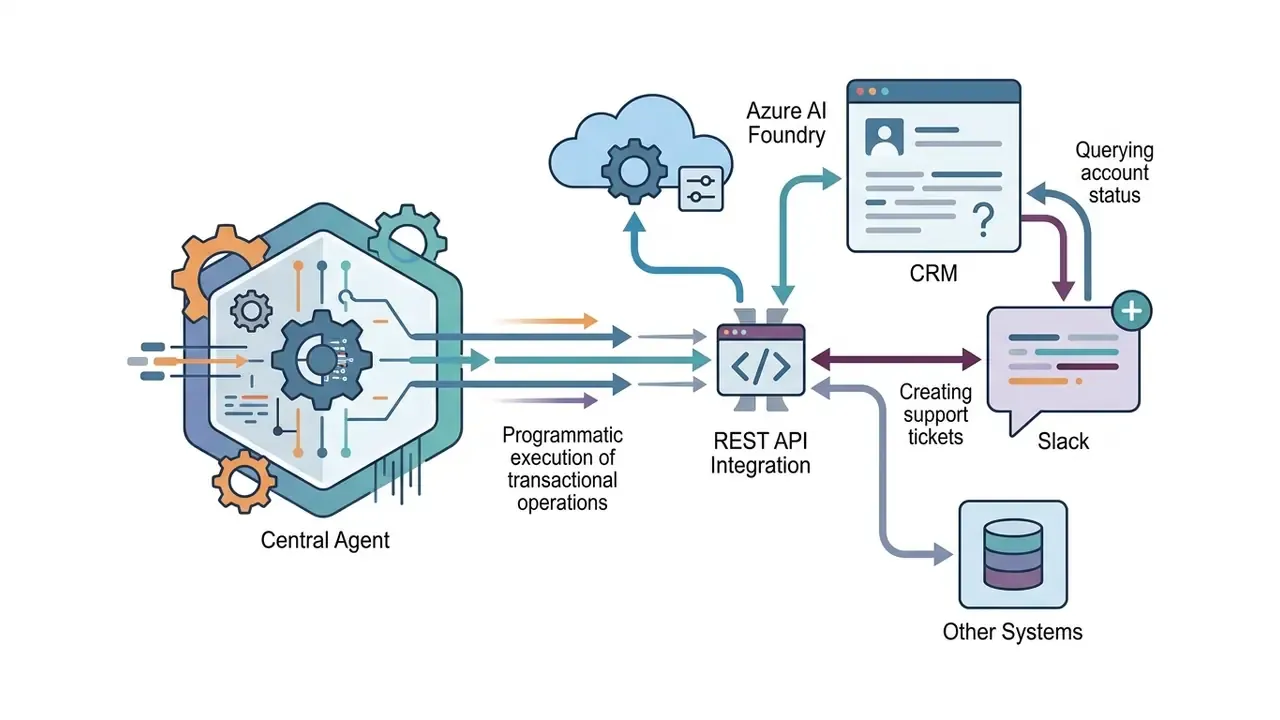
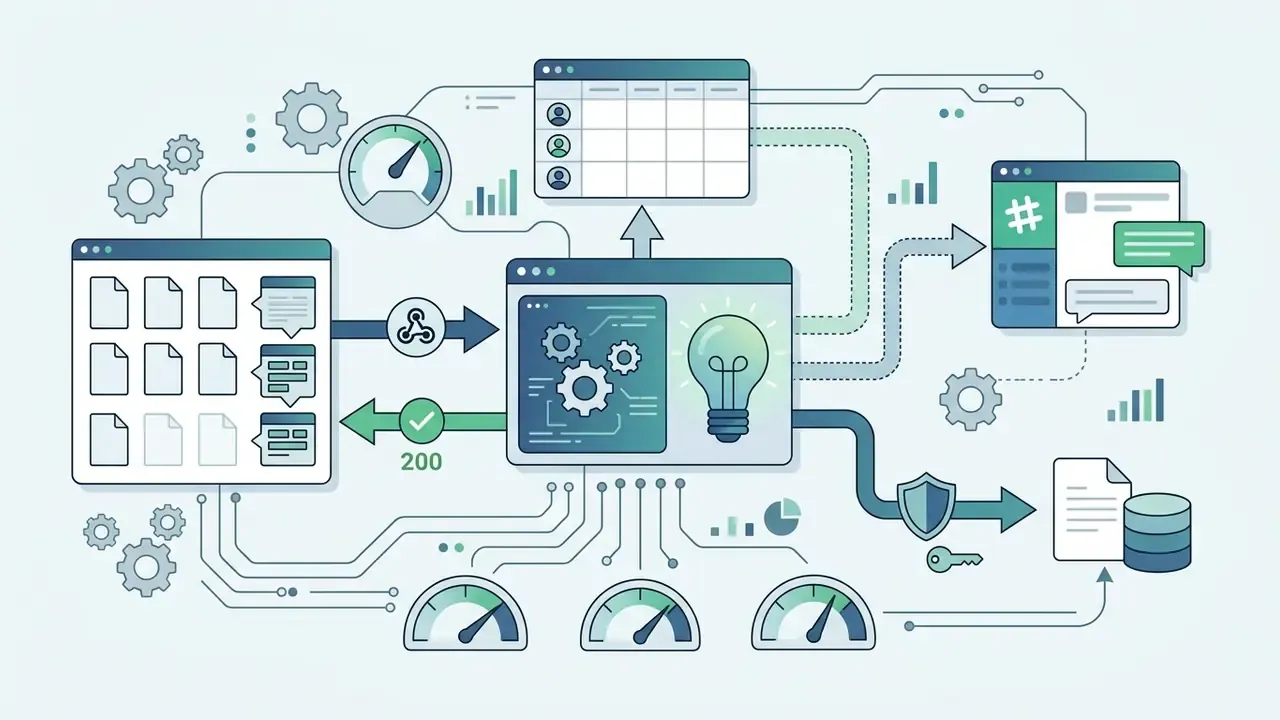
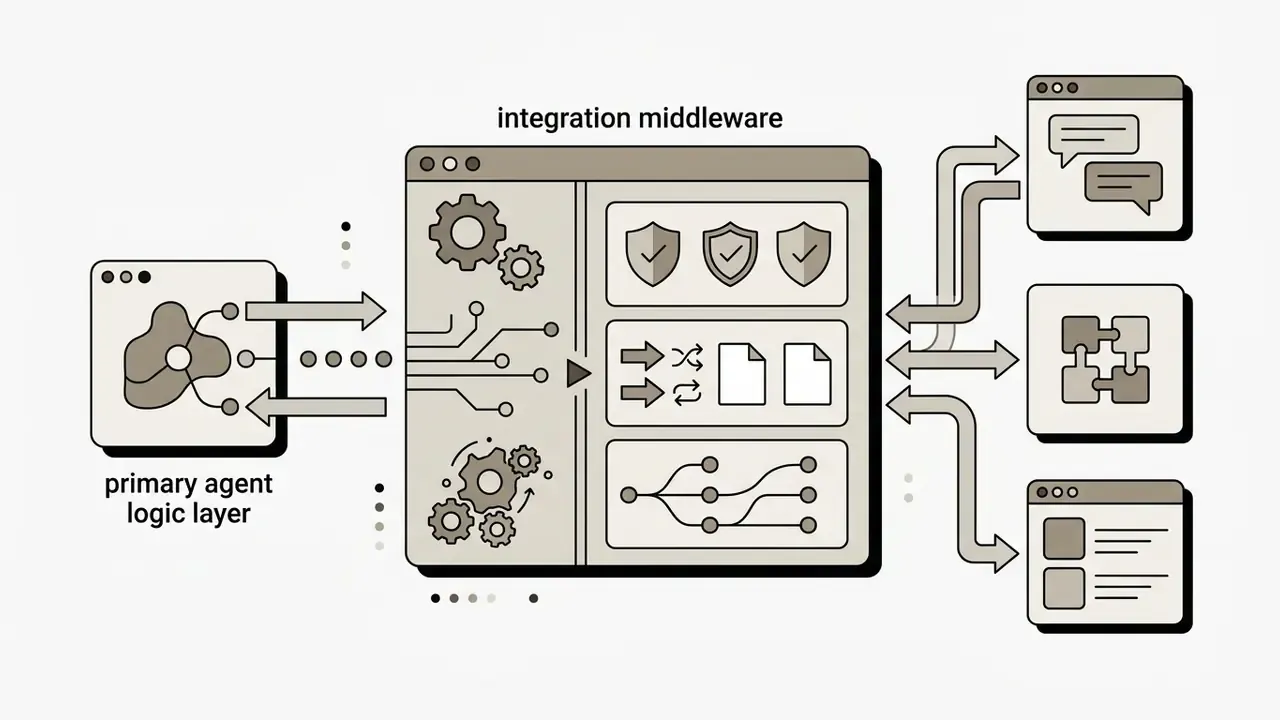
Worked Scenario: Slack → MCP Enrichment → CRM Report
The most common enterprise entry point is invoking an agent from a chat channel. Here is the full payload path for a lead-enrichment agent monitoring #lead-gen.
Step 1: Event subscription. Slack posts a message.channels event to your agent gateway. Acknowledge within 3 seconds:
// Inbound Slack event (abridged)
{
  "type": "event_callback",
  "team_id": "T024BE7LD",
  "event": {
    "type": "message",
    "channel": "C08LEADGEN",
    "user": "U04ANALYST",
    "text": "New inbound: https://example-corp.com. Worth a look?",
    "ts": "1755012345.000200",
    "thread_ts": "1755012345.000200"
  }
}
// Gateway responds: HTTP 200, empty body. Work continues asynchronously.
Step 2: Agent run with gated tools. The gateway starts an agent run, passing the channel, thread timestamp, and the extracted URL. The agent calls an MCP server to fetch firmographic data (read-only, allowlisted egress), then queries the CRM for an existing record:
// Tool call emitted by the agent
{
  "tool": "crm_lookup_company",
  "arguments": { "domain": "example-corp.com", "include_owner": true }
}
Step 3: Write gate. Creating or updating a CRM record is a write operation, so the runtime suspends and posts an approval prompt back into the Slack thread with Approve and Reject interactive buttons. Slack delivers the button press to the interactivity request URL, a separate webhook from the events URL:
// Interactivity payload (abridged)
{
  "type": "block_actions",
  "user": { "id": "U04ANALYST" },
  "actions": [{ "action_id": "approve_crm_write", "value": "run_9f3ac21" }],
  "container": { "channel_id": "C08LEADGEN", "thread_ts": "1755012345.000200" }
}
Step 4: Execution and audit. On approval, the agent executes the scoped CRM write with a 15-minute token, then posts a threaded summary: enrichment findings, matched CRM owner, confidence score, and the trace ID. Every step, including prompt version, tool call, observation, approver identity, and timestamp, is written to the append-only audit store in OpenTelemetry format.
Step 5: Failure path. If the MCP server times out, the agent retries once with corrected arguments; on a second failure it posts an escalation message and calls request_human_review rather than looping. This is the single most important guardrail in chat-triggered agents, because the retry loop is invisible to the operator until the token bill arrives.
The same pattern generalizes to CMS operations (an agent identifying stale blog posts by title year and updating them on approval), ticket triage, and WhatsApp or Telegram business channels. Only the event source and the write-gate copy change.
If a connector misbehaves in production, start from the trace, not the prompt; our AI Media Support and Troubleshooting notes cover the usual failure signatures.
Memory, Data Access, and MCP Servers
Persistent memory allows an agent to retain conversation history and cross-session context, while Model Context Protocol (MCP) servers standardize tool and database connectivity.
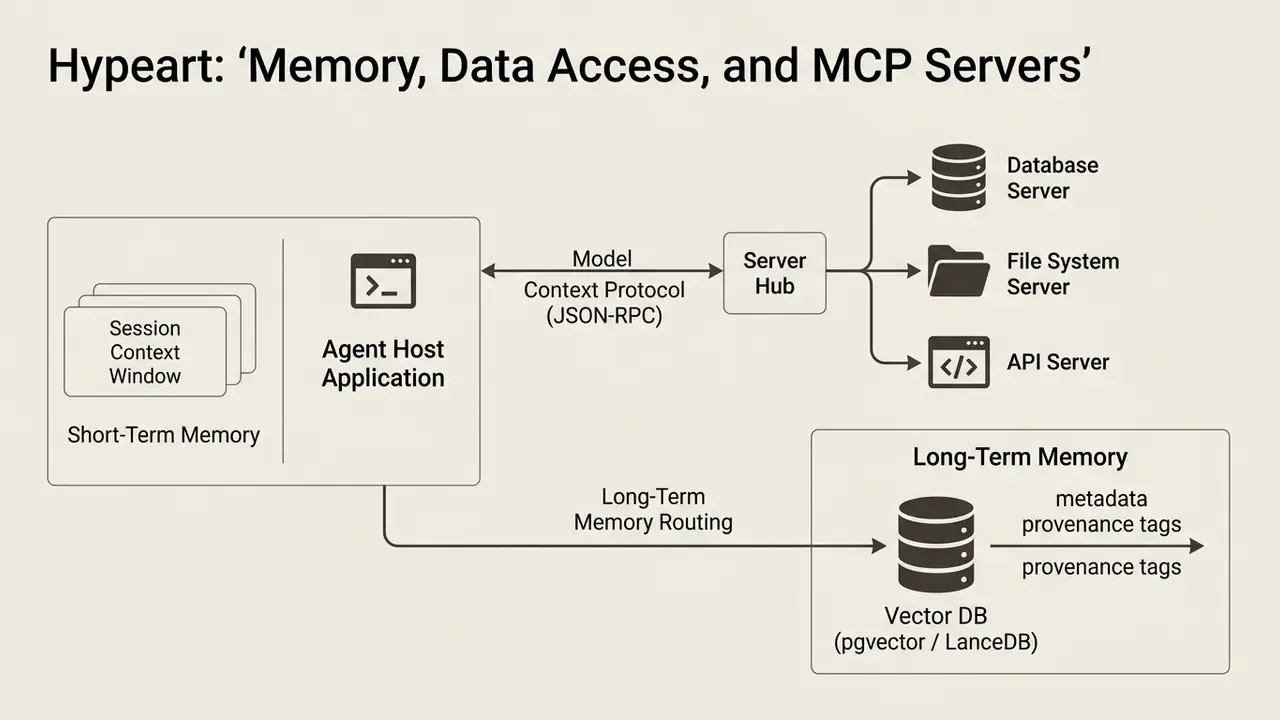
Memory is where quiet compliance failures accumulate. An agent that remembers one customer's data while serving another has become a privacy incident, regardless of how well it reasons.
- Short-Term vs Long-Term Memory
- Short-term memory stores immediate session context within the LLM window. Long-term memory utilizes vector databases (LanceDB or PostgreSQL with pgvector, typically) combined with hybrid BM25 plus vector search and temporal decay algorithms to surface recent, relevant interaction histories.
- MCP Protocol Standardization
- Introduced as an open standard by Anthropic on 25 November 2024, the Model Context Protocol uses a client-host-server architecture over JSON-RPC and is a stateful session protocol for context exchange. MCP servers expose enterprise resources, prompt templates, and executable tools through standardized interfaces, eliminating custom integration code for every tool-model pair. The authoritative requirements live in the MCP specification (28 July 2026 revision) (Anthropic, 2024; MCP Specification).
- Memory Safety Controls
- Official 2026 guidance converges on three requirements: isolate memory by user, agent, and tenant; attach intent and provenance metadata to every write; and validate on write while detecting tampering on read. Microsoft's memory-safety guidance requires ACLs, scoped tokens, and encryption at rest and in transit; AWS's Agentic AI Lens adds append-only versioned history for forensic replay and organizes memory by session, actor, and strategy identifiers with automated deletion policies. Department of Defense guidance specifies fail-safe default behavior: stop the agent and escalate uncertain cases to human reviewers.
Security and Human Control at Deployment
This section provides general information and does not substitute for advice from a qualified information security professional or legal counsel when deploying agents in regulated industries.
Deploying autonomous agents into production introduces novel risk vectors, including unauthorized API invocation, prompt injection, and unexpected data exfiltration.
The OWASP Top 10 for LLM Applications highlights "Excessive Agency" as a critical risk, where agents granted unchecked API privileges execute unauthorized database modifications or external communications (OWASP, 2025). The empirical picture is worse than most risk committees assume:
«MSB, the MCP Security Benchmark, tested 2,000 attack scenarios: peak attack success rate reached 75.83%, and more capable models proved more vulnerable, not less.»
To mitigate these risks, organizations must implement granular role-based access control (RBAC), enforce short-lived OAuth token delegation, validate every inbound request per NIST SP 800-228 (authentication, authorization, input validation, rate limiting), and deploy real-time guardrail monitors. Prompt-injection defense belongs at the API-proxy layer, not inside the prompt: treat all retrieved documents, tool outputs, and third-party content as untrusted input, and never allow retrieved text to modify tool permissions. Furthermore, high-stakes actions must mandate explicit human approval before API execution payloads are released to production endpoints, with fresh cryptographic proof of identity before each privileged call and a centralized policy decision per request.
CRITICAL SECURITY ALERT: ENTERPRISE DATA AND TOOL ACCESS CONTROL
- Enforce cryptographic identity verification and maintain immutable append-only trace logs for every prompt, tool call, and system response.
- Block autonomous execution of high-impact actions without prior approval, and test the kill switch before go-live.
For teams managing content rights across automated publishing channels, review legal frameworks in our AI Litigation and Case Timelines tracker.
Free vs Paid: AI Agent Platform Pricing and Launch Costs
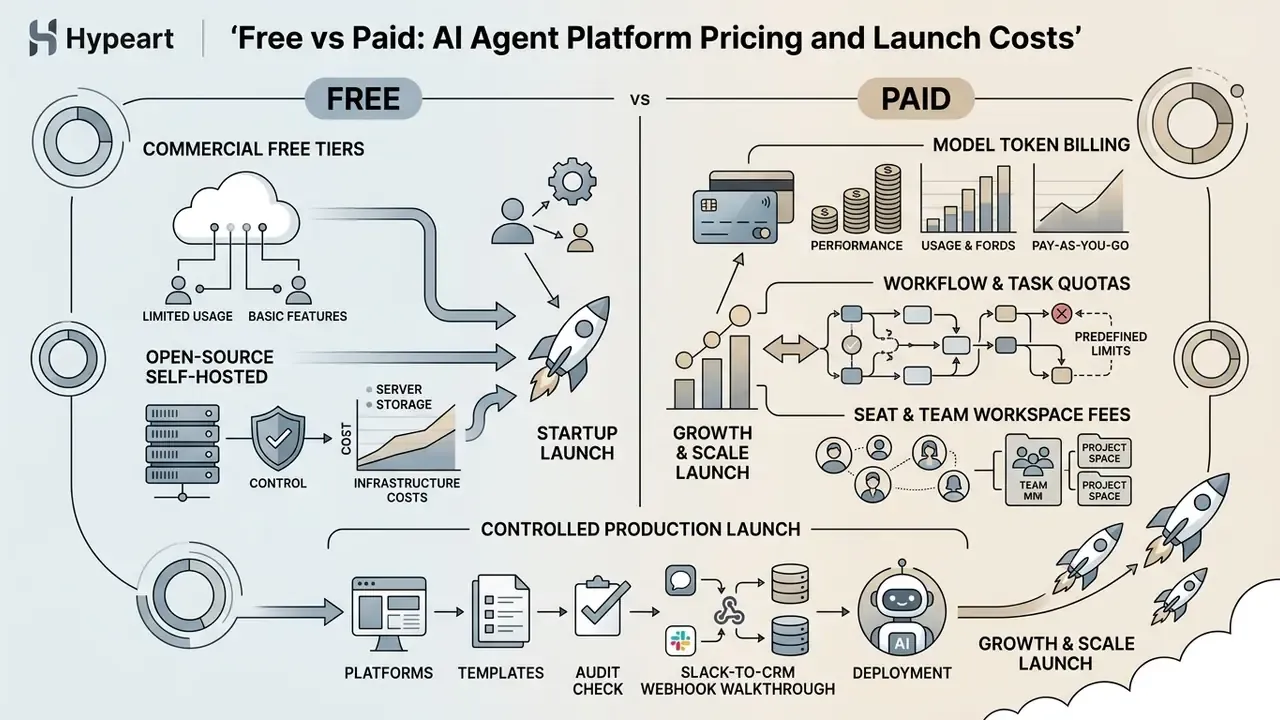
Evaluating the economics of an ai agent creator solution requires analyzing pricing models across free tiers, usage-based token charges, workflow execution quotas, and fully loaded enterprise total cost of ownership (TCO).
What Free AI Agent Creation Platforms Actually Provide
A free ai agent creation platform or open-source self-hosted tool provides accessible entry points for developers and small teams, though they carry explicit resource limitations.
- Commercial Free Tiers Platforms offering a free ai agent creator or free ai agent maker tier typically include basic visual builders, access to lower-tier models, and restricted monthly execution caps (100 tasks per month on Zapier Free; 5,000 credits per month and a single seat on Gumloop Free). Consumer assistant tiers (ChatGPT custom GPTs, Google Gemini, Microsoft Copilot) allow visual configuration and document upload but cap message volume and generally exclude programmatic API access, so the agent cannot be deployed outside the vendor's own app.
- Open-Source Self-Hosted Options Solutions like n8n Community Edition, LangGraph, LlamaIndex, AutoGen, or Flowise provide full access to core orchestration features without software license fees, and self-hosted vector stores such as Qdrant impose no usage limits or feature gates. However, the user absorbs all infrastructure hosting, vector database, and model API token costs.
What Paid Plans Charge For
Paid commercial tiers unlock high-concurrency execution runtimes, specialized enterprise connectors, collaborative workspaces, and advanced security capabilities.
- Model Token Billing Foundation model providers bill strictly on token usage. OpenAI API pricing lists gpt-4o input at $2.50 per 1M tokens and output at $10.00 per 1M tokens; higher-capability tiers are billed at correspondingly higher rates (OpenAI Pricing, 2026).
- Workflow & Task Quotas Automation platforms charge based on active workflow execution volume or credit consumption. Zapier bills per task with overage held at up to 3× the selected task limit; credit-metered platforms commonly bill overage at roughly $1 per million token credits.
- Seat & Team Workspace Fees Enterprise plans add fixed per-seat monthly charges (commonly around $50 per seat) to grant access to shared agent repositories, role permissioning, and centralized audit logging. Credit-pooled models such as Gumloop's include unlimited seats and bill consumption at the organization level instead.
- Enterprise Support & SLAs Dedicated technical account management, custom uptime guarantees, SOC 2, HIPAA, and GDPR attestations, on-premises or VPC deployment, SSO, and access control are billed via custom enterprise contracts.
How to Estimate the Cost of Agentic Automation for Your Business
Calculating the fully loaded cost of agentic automation requires evaluating initial development investments, recurring infrastructure expenses, model token pass-through charges, and ongoing governance overhead.
To determine net ROI, business leaders must compare the fully loaded cost of human execution against the fully loaded cost of agentic execution over a three-to-five-year TCO horizon. McKinsey's 2026 agent-economics guidance is explicit that value should be tracked as the fully loaded cost to finish the job, combining humans, agents, and deterministic systems, not license or token cost alone.
TCO (3–5 yr) = Upfront Development
             + Platform Licenses & Seats
             + Token Pass-Through (incl. retry inflation)
             + Infrastructure (VPS / GPU / vector DB / logging)
             + Human-in-the-Loop Review Overhead
             + Independent Model Validation & Audit
             + Change Management & Training
             + Maintenance, Monitoring & Incident Response
Four cost lines are routinely omitted from vendor business cases and should be modeled explicitly:
- Retry-loop token inflation.A ReAct agent that fails and retries consumes the full input context on every step. Estimate as
avg_steps × (input_context_tokens + output_tokens) × price_per_1M ÷ 1,000,000, then apply a failure multiplier from your fault-injection test results. A 12-step cap with a 20% retry rate can triple naive per-run estimates. - Human-in-the-loop overhead.Every approval gate consumes reviewer minutes. Multiply gated actions per month by average review time and by fully loaded reviewer cost. In high-gate designs this frequently exceeds token spend.
- Independent validation.Regulated deployments require effective challenge by a party independent of development, an internal cost center or external engagement that recurs at every material model change.
- Observability and retention.Append-only trace logs at examiner-grade retention (often seven years) carry real storage and indexing cost.
Published 2026 market ranges for calibration: entry usage-based access can start at fractions of a cent per request; mid-market custom enterprise agents cluster at roughly $40k–$150k to build, with broader project ranges of $80k–$350k; autonomous multi-agent systems reach $150k–$500k and above. Recurring operating cost scales from about $2k–$4k per month for a knowledge or RAG agent to $4k–$8k per month for transactional agents and $8k–$20k or more per month for multi-agent systems. Ranges vary by scope and methodology: some vendors quote implementation only, others full three-year TCO with operations overhead.
For ROI, establish the baseline before deployment on one named process, measuring volume, time per unit, error rate, satisfaction, and escalation rate. Two weeks of baseline data is usually enough; six weeks is robust.
Pricing Structures, Feature Tiers, and Rate Limits (Verified August 2026)
| Platform / Provider | Free Tier Capabilities | Paid Tier Entry Pricing | Model Token / Usage Costs | Infrastructure Floor | Enterprise Features |
|---|---|---|---|---|---|
| Zapier | 100 tasks/month, single-step Zaps, standard apps. | Starter from ~$19.99/mo (750 tasks); Pro tiers scale up. | Task consumption model; overage held at up to 3× plan task limit. | None (fully hosted). | SSO, user provisioning, custom app access, audit logs. |
| n8n | Self-Hosted Community Edition: free, near-complete feature set. | Cloud Starter from €20/mo; Self-Hosted Business €667/mo (annual). | Cloud billed by execution runs; self-hosted uses your own LLM keys. | VPS from ~€5–$10/mo (2 vCPU / 4 GB) for the orchestrator. | Advanced RBAC, audit trailing, dedicated environment isolation. |
| OpenAI API | Free trial credits (subject to expiration and tier rules). | Pay-as-you-go across Tier 1 to Tier 5 (usage limits $100–$200,000/mo). | gpt-4o: $2.50 / 1M input; $10.00 / 1M output. Higher tiers priced above. | None (API only); rate limits from 500 RPM (Tier 1) to 15,000 RPM (Tier 5). | Dedicated capacity, zero data retention agreements, HIPAA compliance. |
| Gumloop | 5k credits/mo, 1 seat, 1 active trigger, unlimited agents and flows. | Pro from $37/month (20k+ credits, webhooks, MCP servers, BYOK). | Credit-based consumption; premium models included or BYOK. | None (hosted); VPC on Enterprise only. | RBAC, SCIM/SAML, admin dashboard, audit logs, custom retention, VPC. |
| LangGraph / LlamaIndex / AutoGen (self-hosted) | Full framework, no license fee, no feature gates. | Managed cloud tiers priced separately by vendor. | Your own provider keys, or $0 tokens with local open-weight models. | ~$80–$250/mo production stack; $1.50–$3.00/hr GPU for 70B-class local models. | Whatever your own IdP, VPC, and logging stack enforce. |
Prices and limits above were checked against official pricing pages in August 2026 and change often. Re-verify before any procurement decision; treat this table as a shortlist filter, not a quote.
Verified Official Sources and Documentation (E-E-A-T)
- OpenAI Official Pricing & Documentation: https://openai.com/pricing | https://platform.openai.com/docs | Security: https://openai.com/security-and-privacy/
- Federal Reserve SR 11-7 / OCC Bulletin 2011-12, Interagency Guidance on Model Risk Management: consult the issuing agencies' official supervisory letters.

FAQ: Ownership, Teams, and Model Selection for AI Agents
The following answers provide general information and do not substitute for advice from a qualified intellectual property attorney or compliance counsel.
Can I create my own AI agent and claim full intellectual property ownership over its code and outputs?
Yes, you can retain full intellectual property ownership over the custom orchestration code, architecture graphs, system prompts, and proprietary data pipelines that you engineer. However, under current U.S. Copyright Office guidance, purely machine-generated outputs produced autonomously by an LLM without sufficient human creative selection or modification are not eligible for copyright protection; where AI determines the expressive elements, the work is not human-authored, and prompts alone are generally insufficient to establish authorship (US Copyright Office, 2025). Organizations must ensure that human operators contribute meaningful creative or structural input when refining agent-generated assets, and should document that contribution contemporaneously. Note separately that generated code may carry license obligations inherited from training data or from open-source dependencies the agent introduces, so run standard license scanning on agent-authored commits.
How should multi-disciplinary teams collaborate inside an AI agent creation platform?
Enterprise teams should establish dedicated workspaces with role-based access control that separate development, testing, and production environments with distinct permissions. Developers build custom tool connectors and code-first graph logic; prompt engineers and domain experts configure system instructions and evaluation benchmarks; risk officers review trace logs, security guardrails, and compliance permissions before authorizing production deployment. In multi-agent designs, assign each agent a distinct role, specialization, and objective rather than duplicating a general-purpose agent, and designate a single accountable owner for the orchestration layer. Agents shared across an organization improve fastest when the operators using them can feed corrections back into the agent definition under change control.
How can an organization migrate an agent's reasoning logic between different LLM providers without rewriting the system?
To ensure provider portability, decouple the agent's core orchestration logic, tool definitions, and prompt templates from the foundation model API layer. Using standardized protocols like the Model Context Protocol and model-agnostic frameworks like LangGraph, LlamaIndex, AutoGen, or CrewAI, organizations can swap underlying LLM providers (migrating from OpenAI to Claude, or to a locally hosted open-weight model) by updating API client drivers while preserving overall workflow structure. Execute the migration as a controlled change: run the candidate model in shadow or parallel mode against production traffic, compare trajectory-level and outcome-level metrics, shift traffic gradually, and keep a hot kill switch for immediate rollback. Re-validate prompts after every swap, since instructions tuned for one model family frequently degrade on another.
Is a free AI agent generator sufficient for commercial enterprise use?
A free tier or entry-level generator is useful for proof-of-concept testing and simple workflow automation. For enterprise commercial production, however, free tiers lack necessary security features such as role-based access control, SOC 2 Type II attestation, SAML or Okta authentication, immutable audit trace logging, VPC or on-premises deployment, custom vector database integrations, and high-concurrency rate limits. Enterprise deployments require paid infrastructure or self-hosted open-source runtimes with robust governance controls. Even then, "free license" does not mean free: budget the VPS, GPU, vector store, logging, and validation costs described above.
What does an examiner or internal auditor actually need to see for an agentic deployment?
At minimum: the model inventory entry and risk tier; the documented autonomy level and named sponsor; versioned prompts, tool schemas, and retrieval index snapshots; the validation report covering schema validity, fault injection, and gold-trajectory comparison; append-only trace logs exportable in a machine-readable format such as OpenTelemetry; evidence that human approval gates fired for every material action; and a tested rollback procedure. Reproducibility is the recurring gap, so capture seed, model build ID, and prompt version on every run. Any historical decision should be replayable months later.
How do agents change third-party and vendor risk assessments?
An agent platform is simultaneously a model host, a data processor, and an execution engine with credentials into your systems. Assess subprocessor disclosure, data residency, retention and zero-retention options, breach notification terms, model-change notification (a silent model upgrade is a model change), token and credential handling, and exit portability. Where a vendor cannot support VPC or on-premises deployment and immutable audit export, treat that as a material limitation for customer-impacting use cases.
What is the safest next step if we have pilots but nothing in production?
Pick one process with a documented SOP, a named owner, and measurable exception volume. AP invoice coding, KYC document pre-checks, and AML alert triage are common starting points because the baseline is already instrumented. Launch in Observer mode first: the agent proposes, humans decide, and every proposal is logged. After two to six weeks, compare agent recommendations against human decisions, then negotiate a narrow move to Collaborator mode with write gates intact. That sequence keeps the model risk conversation about evidence rather than ambition.
Limitations and Open Questions
Honesty about the gaps is part of the control environment.
Benchmarks measure task success on curated suites, not the specific distribution of your documents, counterparties, or customer messages. Vendor roadmaps shift, and deprecation notices in this guide were accurate as of August 2026. Regulatory expectations for agentic systems remain unsettled: SR 11-7 predates generative models, the NIST agent identity work is still in draft, and no U.S. examiner has published a definitive agentic validation playbook. Two internal case figures cited above are directional, not reproducible.
What should you do with that uncertainty? Narrow the scope, over-document the trajectory, and keep the kill switch within reach of the people who own the process. Autonomy can be expanded later. Evidence cannot be produced retroactively.
Governance Resources and Further Reading
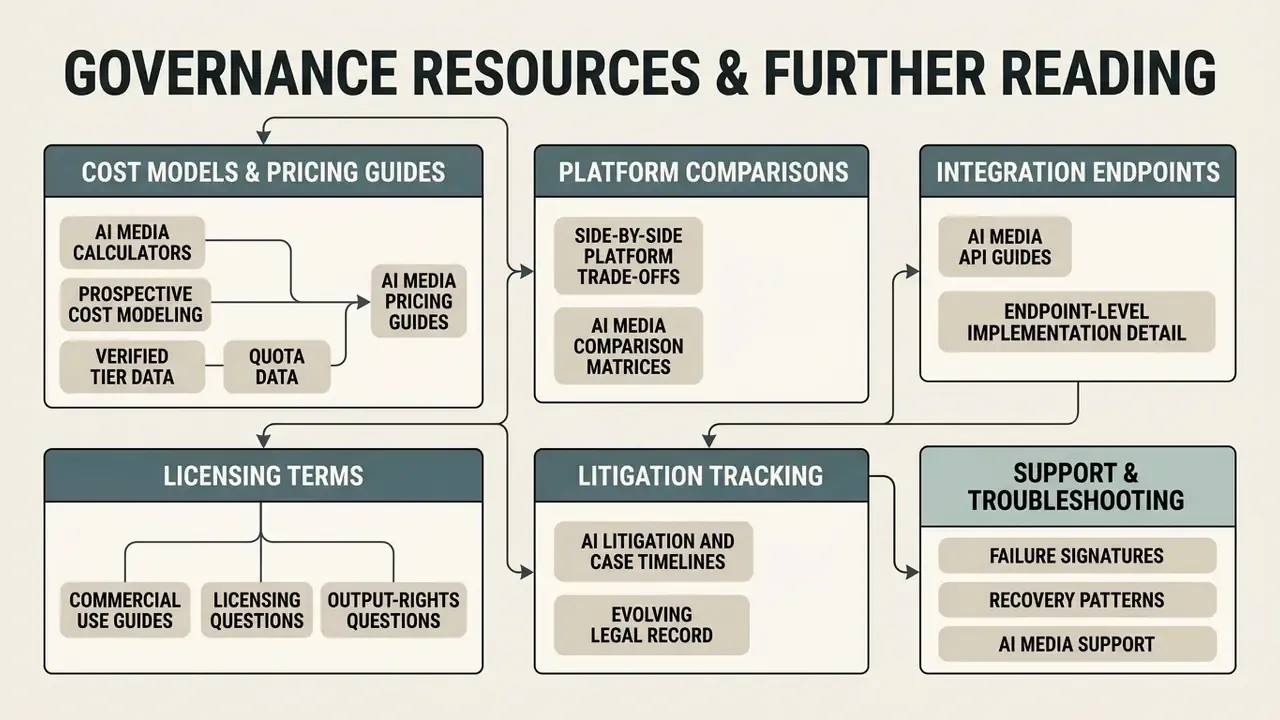
Cost models, platform comparisons, integration endpoints, licensing terms, and litigation tracking sit in dedicated hubs:
- AI Media Calculators for prospective cost modeling
- AI Media Pricing Guides for verified tier and quota data
- AI Media Comparison Matrices for side-by-side platform trade-offs
- AI Media API Guides for endpoint-level implementation detail
- commercial use guides for licensing and output-rights questions
- AI Litigation and Case Timelines for the evolving legal record
- AI Media Support and Troubleshooting for failure signatures and recovery patterns
Appendix A: Superseded Passages (Retained for Transparency)