Losing someone brings a weight that no writing tool can lift. Yet the practical task remains: a tribute has to be written, often with a newspaper cut-off a few hours away. An AI obituary generator exists to take the mechanical part off your shoulders. It helps you find the right words quickly and respectfully, at no cost in most cases, so your energy goes into remembering rather than staring at an empty screen.
Everything in 60 Seconds
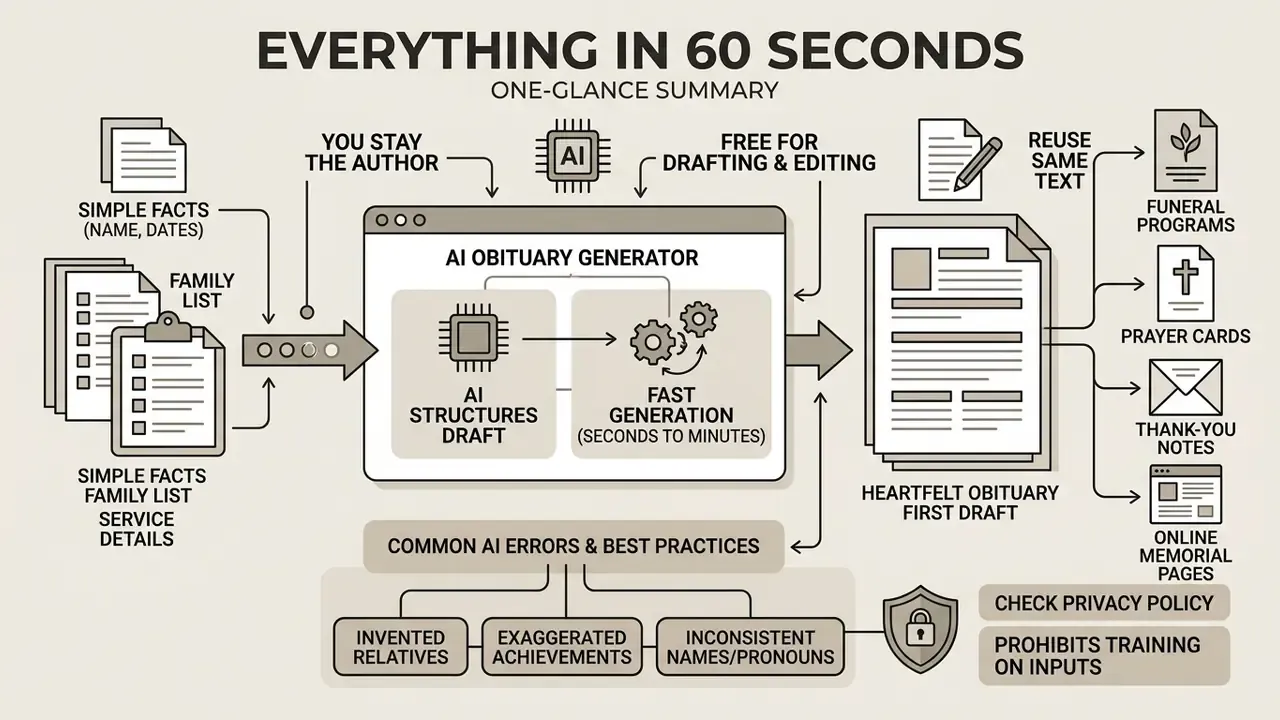
- An AI obituary generator turns a short list of facts (name, dates, family, service details) into a structured first draft in seconds to minutes.
- You stay the author. Human review is mandatory for names, dates, relationships and venue addresses.
- Most tools are free for drafting and editing. Paid tiers (roughly $10/month, $19 one-time, or about $50/year) unlock print-ready PDF and DOCX exports, memorial pages and unlimited regenerations.
- The most common AI errors are invented relatives, exaggerated achievements and inconsistent names or pronouns. A short checklist removes them in minutes.
- The same text can be reused for funeral programs, prayer cards, thank-you notes and online memorial pages.
- Before submitting sensitive data, confirm the vendor's privacy policy prohibits training on your inputs and states a retention period.
Five Ground Rules Before You Generate Anything
Think of these as the guardrails. They take one minute to read and they prevent most of the problems families report later.
- A named human signs off.One person, family member or funeral arranger, owns the final text and confirms every fact in it.
- Facts come from documents, not from memory alone.The death certificate, funeral home worksheet and a family-confirmed list of survivors are your primary sources.
- What you do not supply, the model may invent.Blank fields are where hallucinations live.
- Read the privacy terms before you type a real name.Death data and survivor data are personal data.
- Confirm you own the output.If the terms do not grant you full rights to the generated text, do not build a printed program on it.
That is the entire governance layer for a task this small. Simple, but skipping it is how a wrong middle name ends up carved into a printed order of service.
What Is an AI Obituary Generator and How Does It Help?
An AI obituary generator is a specialised artificial intelligence application that transforms raw biographical facts, family details and service information into a structured first-draft obituary. The tool helps grieving families and funeral directors get past the blank page, producing a respectful generated obituary within minutes rather than hours.
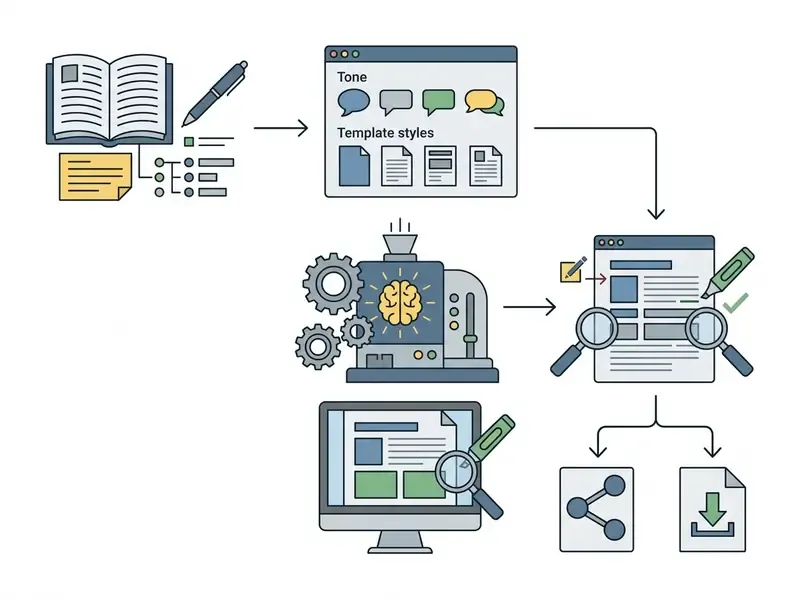
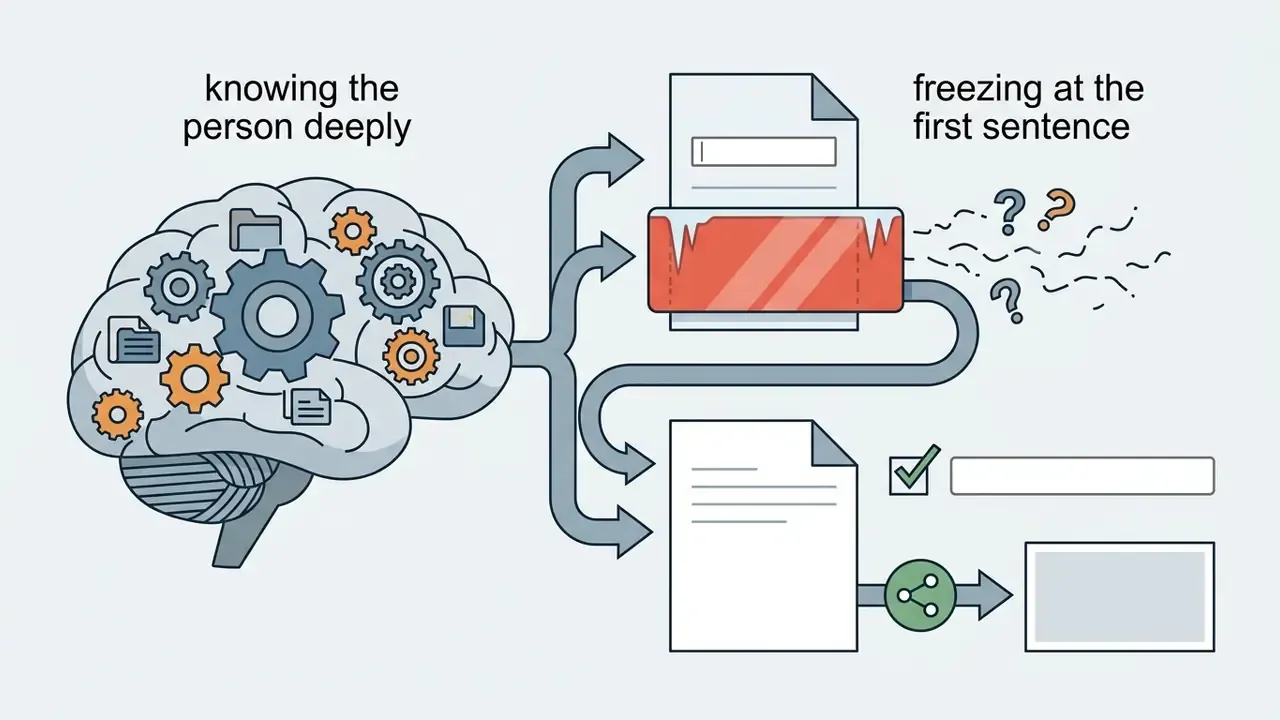
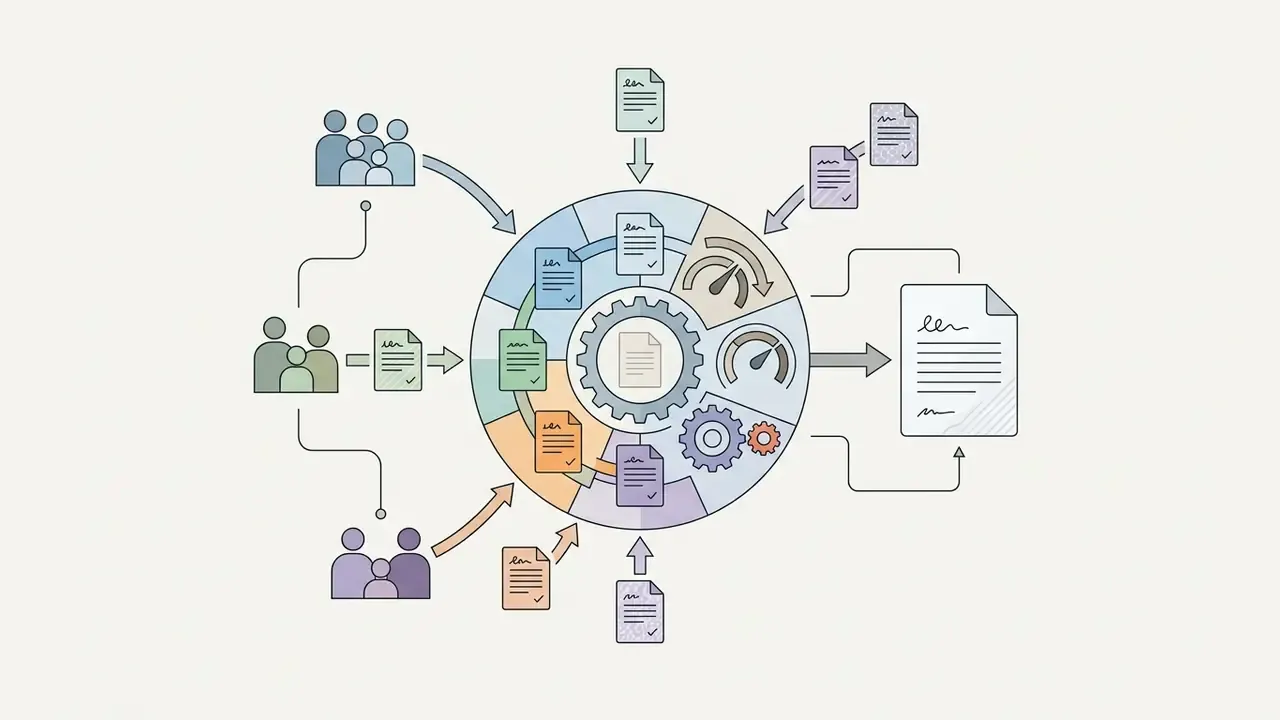
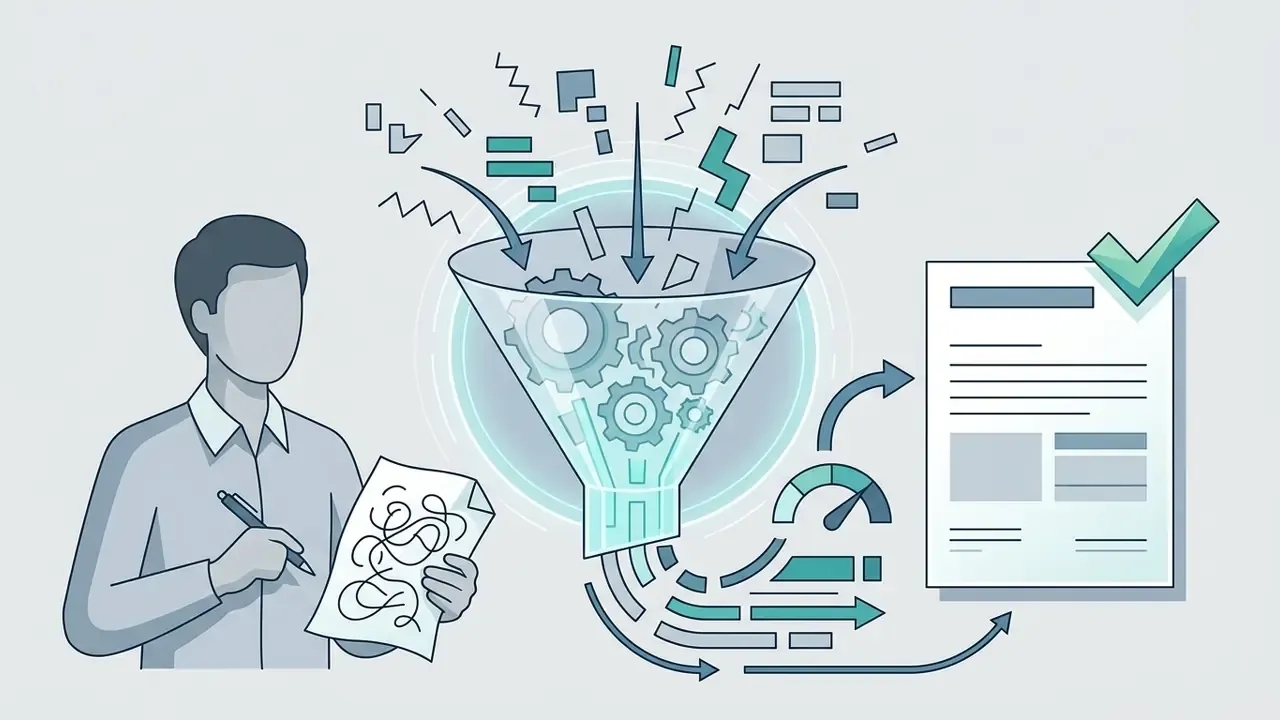
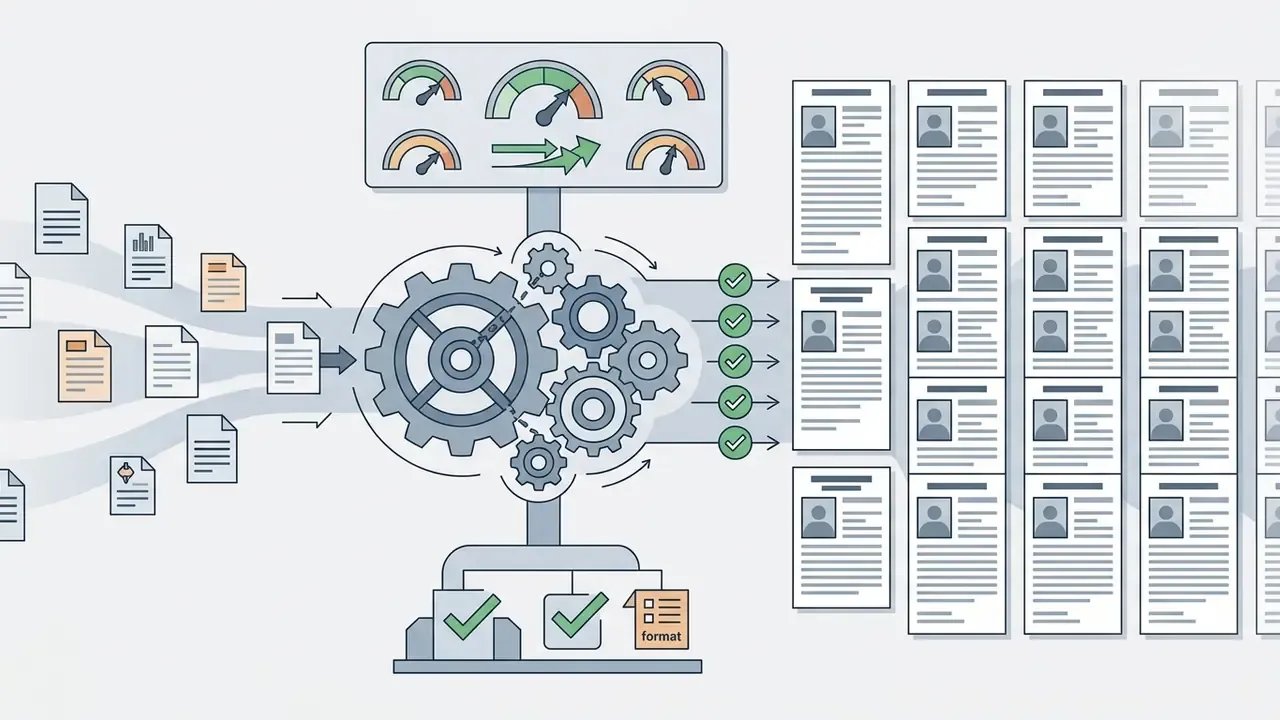
At a glance, every credible tool follows the same five-stage path. The detailed input checklist and the editing rules for each stage come further down, so nothing here needs to be memorised.



From Life Details to a First Obituary Draft
An AI writer converts unstructured life facts into a coherent draft by sorting your inputs into standardised obituary sections. Natural language processing models extract names, dates, milestones and family relations, then build a narrative around them. In practice the pipeline runs named-entity recognition over your notes, normalises dates and events, labels each fragment as a section (personal information, biographical sketch, characteristics, tribute, gratitude, family, funeral information) and only then writes fluent sentences.
The clearest documented example of how this training works comes from the bereavement platform Empathy, which built its obituary writer on a curated corpus of professionally written tributes:
"Empathy trained its 'Finding Words' model on hundreds of professionally written obituaries so it can draft a coherent tribute from a short questionnaire about the person's life."
When an AI Obituary Maker Is Useful
An ai obituary maker earns its place during acute grief, under a tight newspaper deadline, or when family members simply cannot find the words. The tool offers immediate structural scaffolding to people juggling administrative tasks while emotionally exhausted.
A 2024 study on public funeral support services reported that more than 85% of survey respondents viewed procedural AI tools positively when framed as administrative assistants (Acta Biomed, 2024). One qualification, and it is important: that survey was conducted in South Korea, and elderly respondents in particular voiced reservations. The same publication records concerns about emotional detachment and the confidentiality of family data once AI enters funeral services.
"Older respondents expressed notable concern about emotional detachment and data confidentiality when AI is used in funeral services."
There is also early experimental evidence that structured, guided conversations with an AI system can reduce acute distress after a loss:
"A single session with an AI chatbot reduced breakup-related distress by 9.23 points over seven days (d = −0.70)."
These systems also help non-native speakers navigate formal English conventions, keeping the final text respectful and grammatically clean. Multilingual generation is a documented feature: several vendors state the obituary can be produced in the family's preferred language, which matters when relatives abroad must be notified fast.
Typical situations where families reach for an obituary generator:

How to Create an Obituary with an AI Generator
Creating an obituary through an ai generator obituary workflow means entering core biographical facts, selecting a style template, then refining the generated text. The diagram above shows the sequence; this section supplies the working detail. Which fields to prepare, which questions to answer, what to verify before publication.
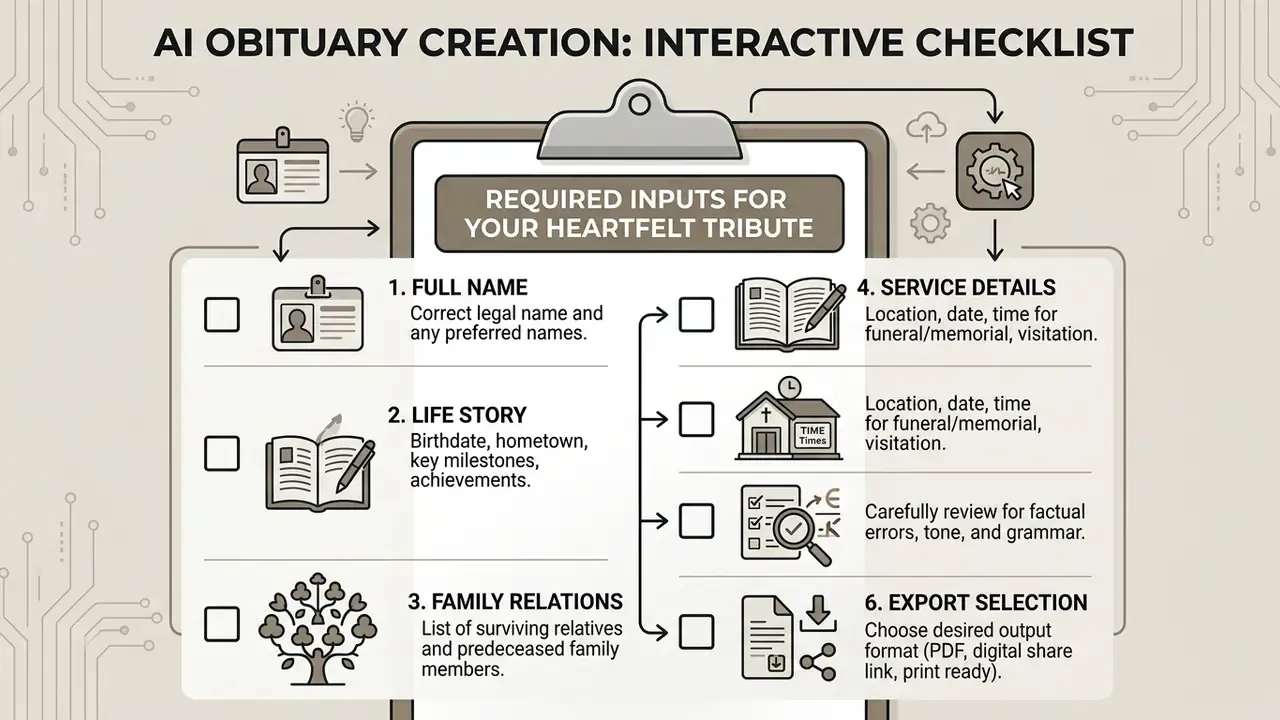
Checklist0 / 6
Enter the Name, Life Story and Family Details
Generation starts with basic factual inputs: the legal name, life milestones, the surviving family tree. Precise details let the obituary maker ai build an accurate framework instead of guessing at gaps. Funeral professionals put it bluntly: whatever you leave out, the model may try to fill in.
What questions will I be asked? Most guided generators group prompts into four blocks. Collecting these answers before you open the tool is the single biggest quality lever you have.
1. Key facts
- Full legal name, maiden name, nicknames, professional or military titles
- Date and place of birth; date and place of passing
- Age and city of residence at the time of death
- Cause of death (optional, and many families omit it)
2. Family tree
- Spouse or partner, including whether they predeceased
- Children and their spouses, grandchildren, great-grandchildren
- Parents, siblings, and those who predeceased the loved one
- Any chosen family, close friends or caregivers the family wishes to name
3. Career and service
- Education, apprenticeships, degrees
- Employers, professions, businesses founded, years of service
- Military branch, years served, decorations
- Churches, unions, clubs, charities and volunteer organisations
4. Character traits and legacy
- Hobbies, passions, sports teams, music, gardening, cooking
- A favourite saying or phrase they repeated
- One concrete memory or anecdote that captures them
- Values they were known for, plus any donation request in lieu of flowers
Complete inputs cut the amount of structural rewriting later. More importantly, they shrink the surface area on which the model can hallucinate.
Choose a Template and the Right Tribute Style
The template decides whether your final text works as a compact newspaper notice or an extended online memorial tribute. You can pick formal, celebratory or faith-based styles depending on family preference and publishing channel.
Newspaper templates prioritise brevity to fit print character limits and per-line fees, commonly landing at 100 to 200 words. Digital memorial templates allow far richer narratives, frequently 700 to 1,500 words. Choosing the right style upfront keeps the generated text aligned with its destination. Many families draft the short print version first to control cost, then expand it into a longer online tribute.
Three ready-to-copy obituary samples. Treat these as the shape of the output you should expect, then substitute your own verified facts.
Example 1: Short newspaper notice (formal and brief)
"John Edward Smith, 78, of Springfield, passed away peacefully on October 12, 2024. Beloved husband of Mary, father to David and Sarah, and grandfather of four. A retired railway engineer, John was a lifelong member of St. Paul's Parish. Visitation will be held at Springfield Funeral Home, 214 Elm Street, on October 16 at 10:00 AM. Service to follow at 11:30 AM. Interment at Oak Hill Cemetery. In lieu of flowers, donations may be made to the Springfield Food Bank."
Example 2: Traditional life tribute (faith-based)
"Mary Elizabeth Johnson (née Davis), 82, of Chicago, IL, went to be with the Lord on November 3, 2024, surrounded by her family. Born on April 14, 1942, in Rockford to Harold and Ruth Davis, Mary spent thirty years as a dedicated elementary school teacher at Lincoln Park Public School, where generations of children learned to read at her table by the window.
She married Thomas Johnson in 1965; together they raised three children and never missed a Sunday service at Grace Lutheran Church, where Mary sang in the choir for four decades. She is survived by her children Anne (Michael) Peterson, Robert Johnson and Susan Johnson; six grandchildren; and her sister Helen Moore. She was preceded in death by her husband Thomas (2019) and her brother Paul.
A funeral service will be held at Grace Lutheran Church, 88 Maple Avenue, on November 9 at 1:00 PM, with visitation one hour prior. Memorial gifts may be directed to the church's literacy fund."
Example 3: Celebration of life (warm and personal)
"Robert 'Bob' Miller, 71, lived a life full of music, laughter and relentless optimism, and he left us on January 8, 2025, still humming.
Bob played bass in three local bands, restored two ageing motorcycles that never quite ran, grew tomatoes he insisted were the best in the county, and answered every problem with the same phrase: 'We'll figure it out.' He spent 34 years as a high school shop teacher, and half the town can build a bookshelf because of him.
He is survived by his wife of 45 years, Diane; his sons Chris and Aaron; and a garage full of unfinished projects. Rather than a formal funeral, the family invites everyone to a Celebration of Life at Riverside Community Hall on January 18 at 4:00 PM. Bring an instrument or a story. In lieu of flowers, please donate to the school's music programme, or teach a kid to use a saw safely."
Notice what makes Examples 2 and 3 feel human: named places, one concrete image ("the table by the window", "tomatoes he insisted were the best in the county"), and a specific request instead of a generic sign-off. Those are exactly the details an AI cannot know unless you hand them over.
Coordinating Funeral Stationery and Digital Memorials
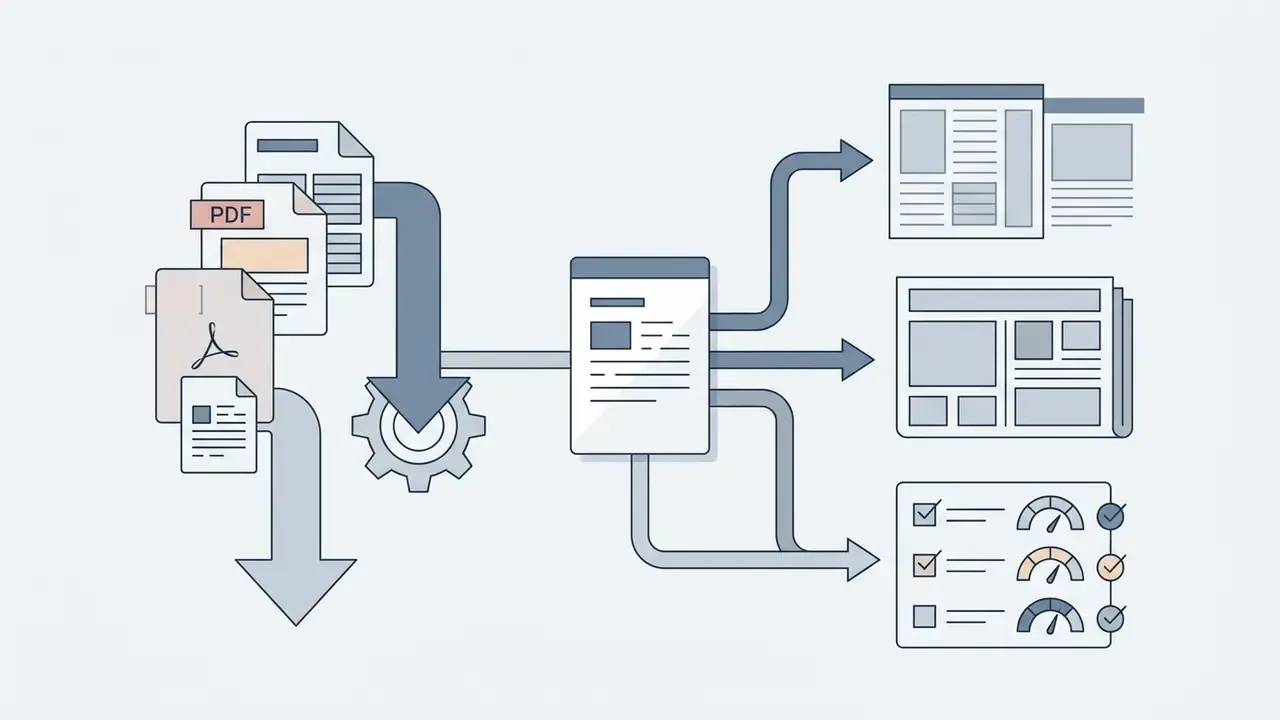
Once the obituary narrative is final, the same text can be repurposed across the other memorial assets a service needs. That saves writing the same biography three times over.
If you also need to prepare the portrait photograph, cropping it, retouching a scanned print, or correcting colour on an old photo, a general-purpose online photo editor handles this without specialist software. For a single portrait, a free photo editor is usually enough.
What Details Make a Heartfelt Obituary?
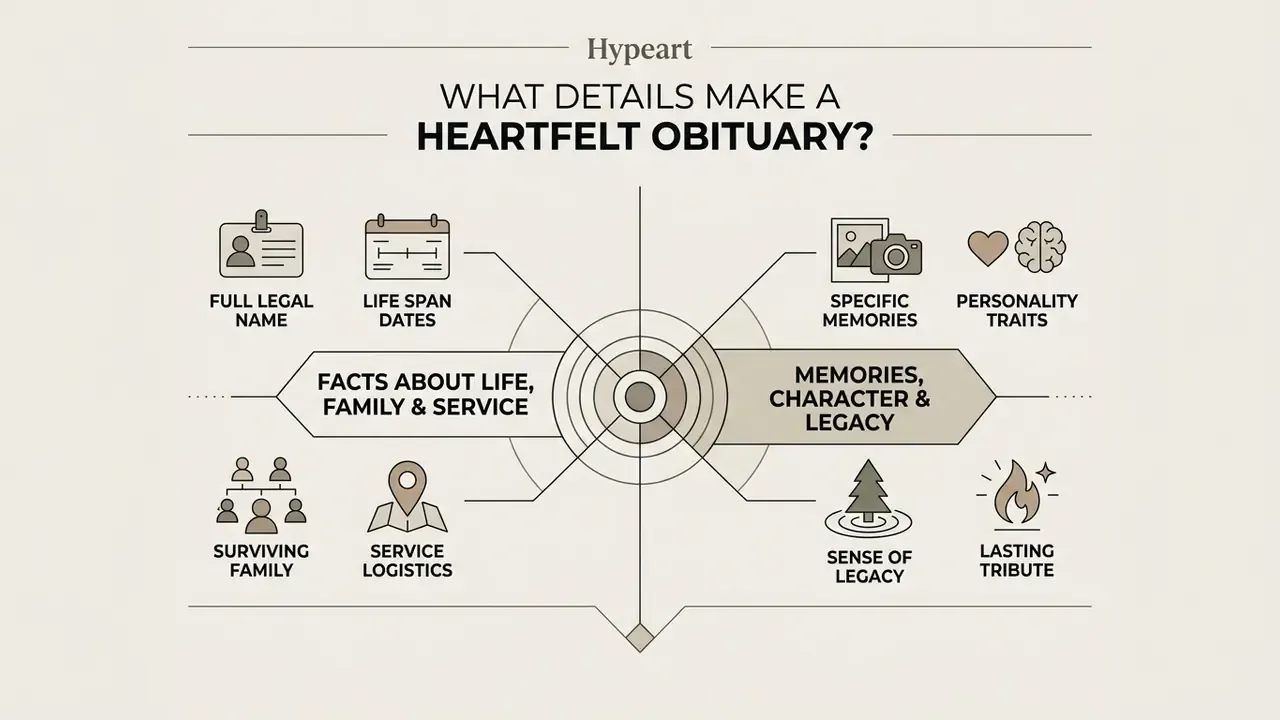
A heartfelt obituary balances verified biographical facts with specific personal memories, character traits and a sense of legacy. Structural accuracy plus qualitative storytelling is what turns a basic notice into a lasting honour for a loved one.
The stakes are higher than a printed column, because the obituary is now often the permanent digital record of a life:
"Digital technologies have radically changed the way contemporary society perceives, experiences and expresses mourning,"
Facts About Life, Family and Service
The foundation of any obituary is verified biographical detail, accurate surviving-family relationships and exact funeral service information. Accuracy across these blocks prevents confusion for attendees and protects the integrity of a public record that will outlive everyone reading it.
- Full legal nameinclude maiden names, common nicknames and professional titles.
- Life span datesstate exact dates and places of birth and passing.
- Surviving familylist spouse, children, grandchildren, parents and siblings in customary order.
- Service logisticsspecify exact date, time, venue name and full street address, plus cemetery address, officiant and any transport arrangements where relevant.
Memories, Character and Legacy That Make the Tribute Personal
Weaving in memorable stories, favourite expressions, particular hobbies and community contributions gives the narrative emotional authenticity. Showing how a person lived, and whom they changed, is what establishes a meaningful legacy.
Research on interactive digital memorials quantifies the effect directly:
"Participants who combined reading with interaction with an AI memorial showed significantly higher learning effectiveness (M = 5.48 vs 4.11; p = 0.001)."
Practical guidance from obituary-writing specialists converges on four additions that turn a fact list into a portrait: one concrete memory, one or two specific personality traits, named hobbies rather than a vague "interests", and an explicit statement of what the person valued. Name the passions precisely. Volunteer work, a choir, a workshop, a garden. Specificity is the whole trick.
How to Review and Edit an AI-Generated Obituary
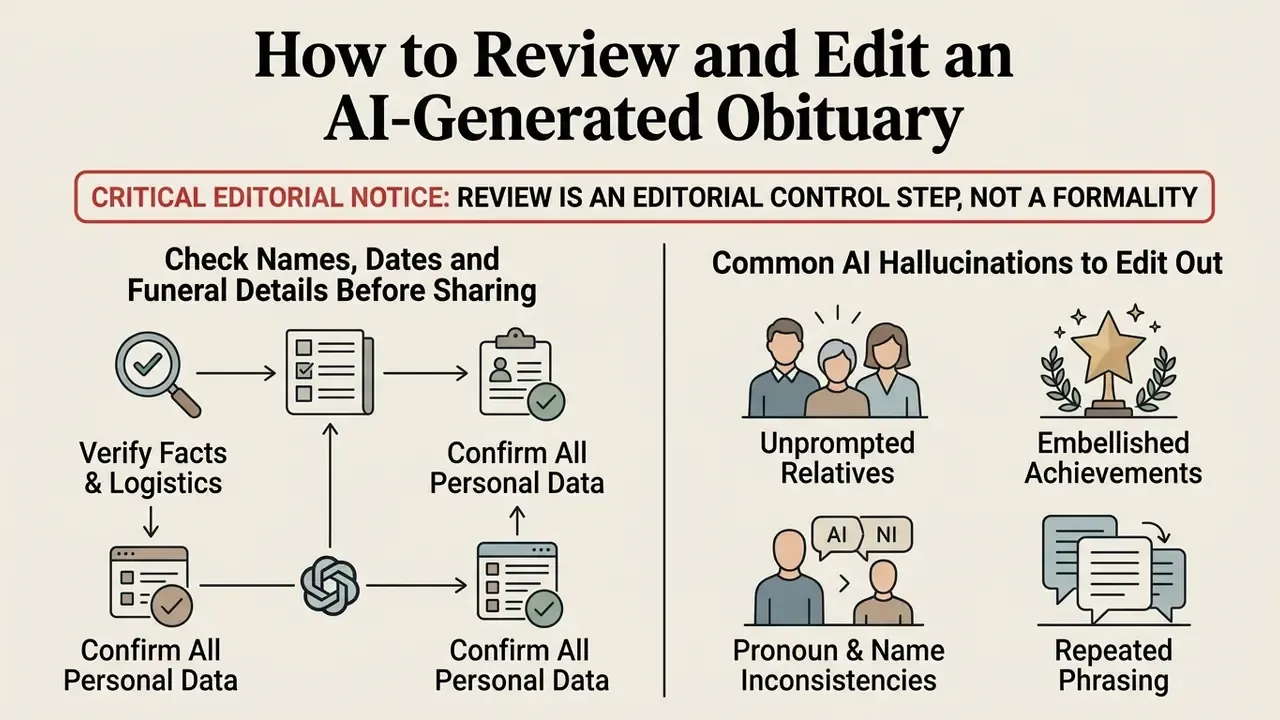
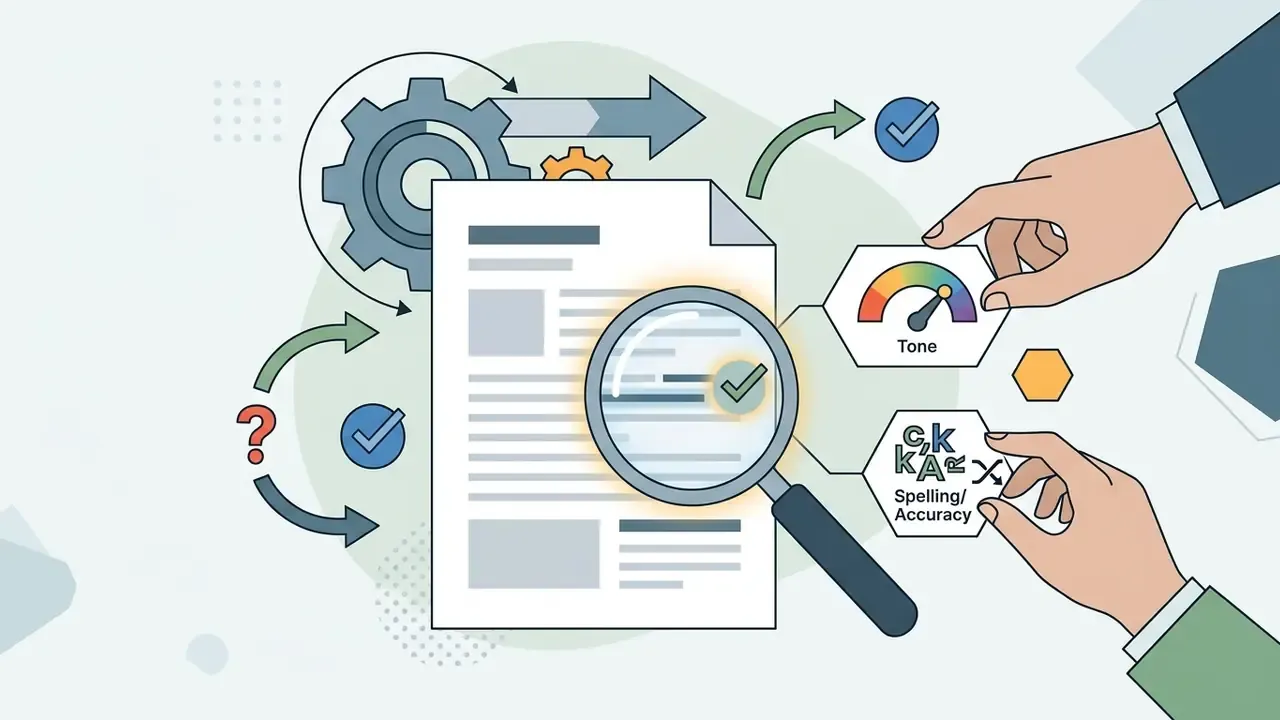
Reviewing an AI-generated obituary is an editorial control step, not a formality. Every factual statement needs systematic verification. Human oversight is what removes model hallucinations and keeps the published text accurate.
Check Names, Dates and Funeral Details Before Sharing
Verify proper nouns, life dates and service locations against official primary sources before anything is published. Language models can introduce subtle factual errors or misread complex family relationships when the inputs are ambiguous (Research Ethics, 2025).
"Key ethical risks of generative AI include data fabrication, unintentional plagiarism, confidentiality breaches, and bias inherited from training data."
Common AI hallucinations to edit out:
- Unprompted relatives. Models default to "survived by her siblings" or "and many grandchildren" even when your prompt never mentioned them. One widely circulated sample draft read "Janet is survived by her husband Richard, her children Oliver and Iris, her siblings, and many friends", yet the prompt contained no siblings at all. If Janet had none, that line has to go.
- Embellished achievements. Say "he enjoyed playing chess" and the model may upgrade it to "he won multiple state chess championships." Verify awards, ranks, titles and years of service against documents.
- Pronoun and name inconsistencies. Confirm that maiden names, preferred nicknames and pronouns stay consistent in every paragraph, including for surviving relatives.
- Repeated phrasing. Drafts often restate the same sentence about a spouse and children in both the opening and the closing paragraph. Cut one.
- Date drift. Cross-check the weekday against the calendar date for visitation and service, and confirm the venue's street address, city and state.
- Invented cause of death or medical detail. Never leave an unverified clinical statement in the text. Not once.
A four-step routine borrowed from editorial fact-checkers works well here. First, list every proper noun, date and location in the draft. Second, check each name against official records or direct confirmation from close family. Third, check each date against a calendar and against contemporaneous records such as the death certificate or the funeral home worksheet. Fourth, when two sources disagree, go back to the single primary source for that specific fact rather than splitting the difference.
On the governance question, the relevant standard is a recommendation rather than a measured outcome, and it should be read that way:
Licensed funeral professionals go a step further. Their advice is that a named human, a director, an arranger or a family member, signs off on every name, date, relationship and biographical claim before the notice is submitted anywhere. Same principle a bank applies to a model output: a documented owner, a documented check.
Keep the Voice Respectful and True to the Loved One
Refining the voice means replacing formulaic AI phrasing with authentic family language and culturally appropriate vocabulary. A respectful tone is what lets the memorial carry the real personality of the person.
To keep the writing authentic:
- Remove overly dramatic or clinical phrasing.
- Swap generic adjectives for concrete anecdotes.
- Match religious or secular language to the family's beliefs, including specific prayers, verses, or the deliberate absence of them.
- Strip promotional, sensational or falsely authoritative wording. Official editorial guidance treats these as defects, not stylistic choices.
- Read the final text aloud to one other family member before publishing. It catches what silent proofreading misses.
A note of caution about leaning too hard on AI while grieving:
"Studies of AI companions found mixed effects: increased expression of grief and interpersonal engagement, but also intensified language of loneliness and depression."
Use the generator as a drafting assistant and a way past the blank page. Not as a substitute for conversations with family, clergy or a bereavement counsellor.
Free AI Obituary Generator: What Is Included and What May Cost Extra?
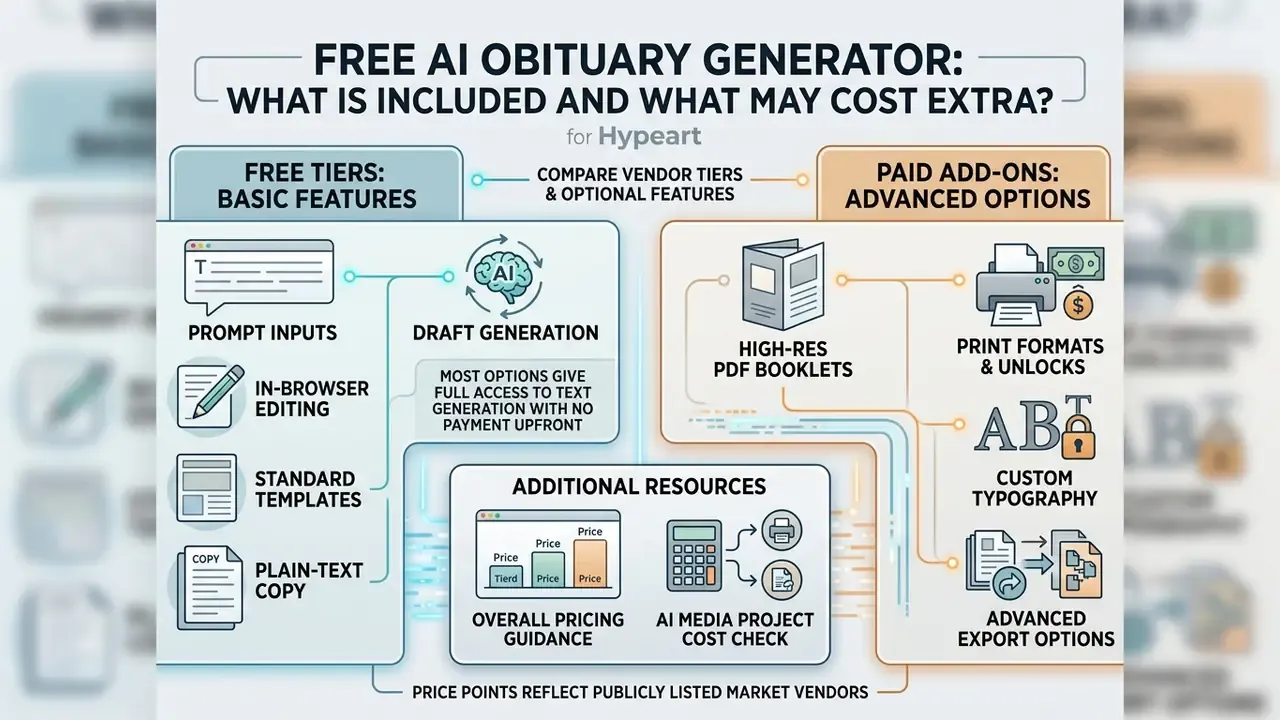
Most free ai obituary generator options give full access to text generation, standard templates and browser-based editing with no payment upfront. Knowing where the feature boundary sits helps you judge when a free obituary tool is sufficient and when a premium tier actually earns its fee.
Free Writing, Editing and Template Access
Free tiers typically include prompt inputs, draft generation, in-browser editing and plain-text copying. Rather than a market-wide claim, here is the documented example: the bereavement service Empathy offers a zero-cost obituary writer, "Finding Words", so families are not charged for basic narrative creation (TechCrunch, 2023). Other providers advertise comparable free access. FuneralFolio states its obituary maker is completely free with no account, subscription or watermark, while several competitors gate only the export step.
If you are comparing digital tools more broadly, our overall pricing guidance covers tier structures, and the AI Media Commercial-Use Hub addresses wider publishing contexts.
Downloads, Print Formats and Optional Paid Features
Advanced export options tend to sit behind a paywall: high-resolution PDF booklets, custom typography, vector print files, or hosted memorial pages with guestbooks. Sometimes a single payment, sometimes a subscription.
| Feature / Service Tier | Free AI Obituary Generator | Premium / Paid Upgrade |
|---|---|---|
| Draft generation | Full draft creation from inputs | Unlimited regenerations with priority processing |
| In-browser editing | Complete text editability | Advanced layout and typography formatting |
| Template selection | Standard formal and tribute styles | Custom memorial, print booklet and multi-language styles |
| Export formats | Plain text copy or basic draft | High-resolution print-ready PDF, Word DOCX |
| Watermarks | Some vendors watermark PDF previews; text copy is usually clean | Watermark-free print files |
| Memorial hosting | Basic digital text view | Permanent hosted memorial page with guestbook |
| Typical price point | $0 | About $19 one-time for print exports; about $10/month for unlimited generation; about $50/year for a hosted memorial site |
| Word limits | Any length on some tools; funeral-home builders may cap around 1,000 words | Higher cap or none; multi-version output |
The price points above reflect publicly listed vendor tiers observed in the market: one-time print unlocks around $19, monthly plans around $10, annual memorial-website plans in the $49.99 to $59.99 range. They change often, so confirm on the vendor's own pricing page before paying. Some services use a credit model instead, billing separately for a Letter-size PDF, a grayscale funeral-home PDF and a high-resolution PNG.
To sanity-check the total cost of a memorial media project across print and digital assets, the AI Media Calculators will get you a rough figure in a couple of minutes.
Choosing the Best AI Obituary Generator for Personal or Commercial Use
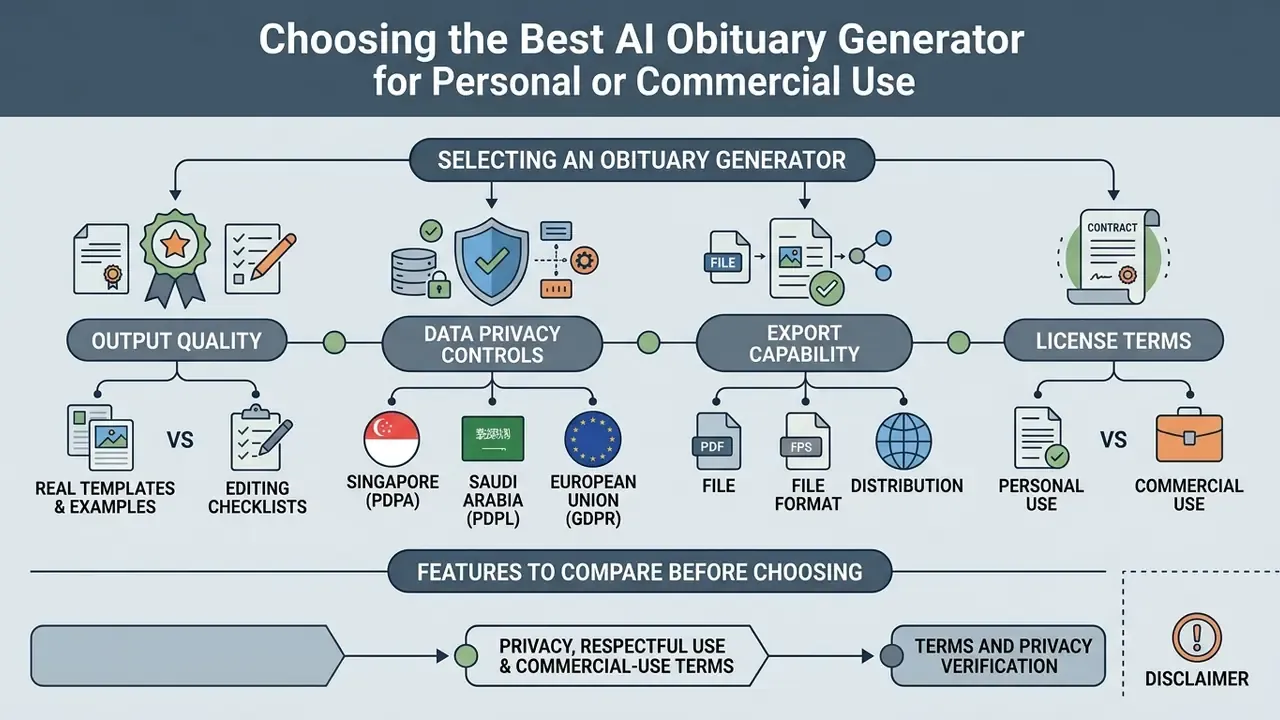
Selecting the best ai obituary generator comes down to four things: output quality, data privacy controls, export capability and licence terms. Funeral directors and media agencies have an extra obligation, since they must confirm commercial use is permitted before deploying anything at scale.
Features to Compare Before Choosing an Obituary Maker
The criteria that matter most are generation speed, template flexibility, multilingual support and clean export to Word or PDF. A flexible obituary ai generator keeps full editorial authority with you, which is the point.
A practical scorecard for comparing tools:
| Criterion | What to look for | Why it matters |
|---|---|---|
| Generation speed | Draft returned in seconds, not after a queue | Newspaper deadlines are often same-day |
| Template flexibility | Formal notice, personal tribute, faith-based, celebration of life | One tool must serve print and web |
| Language support | 20+ languages, consistent formal register | Relatives abroad, second-language writers |
| Export formats | DOCX and print-ready PDF, not screenshots | Newspapers and printers require clean files |
| Editing control | Full inline editing, regeneration, tone switching | You are the author of record |
| Word-count control | Ability to cap or expand length | Print is charged by the line or word |
| Privacy posture | No training on inputs, stated retention period | Sensitive family and death data |
| Output ownership | Terms grant you full rights to the generated text | Reuse in programs, cards, memorial pages |
| Human review workflow | Built-in approval step for funeral-home staff | Compliance and factual accountability |
When preparing a full memorial service, families usually pair an AI written obituary with tools for funeral program templates, memorial prayer cards and online guestbook setup. Teams weighing feature tiers across our reviewed categories can compare them side by side, or contact support for help matching a workflow to a specific funeral-home volume.
Privacy, Respectful Use and Commercial-Use Terms
Data protection policies must guarantee that sensitive family data and death records are handled securely and never retained for public AI training. Statutory frameworks require data minimisation and explicit consent when personal details are processed (PDPC Singapore, 2024).
Jurisdiction matters more than most families expect:
- Singapore (PDPA) a deceased person's personal data stays protected for ten years after death; disclosure and protection obligations still apply inside that window.
- Saudi Arabia (PDPL) the law applies to a deceased person's data where processing could identify the deceased or a family member.
- European Union (GDPR) the Regulation does not apply to deceased persons, though individual Member States may impose national rules. Data about living survivors named in the obituary remains fully in scope.
A concrete example of vendor restraint, which is worth naming because it is rare enough:
Some tools reduce exposure further by drafting with placeholders instead of real names and dates, letting the family substitute the real values locally.
FAQ: Common Questions About AI Obituary Generators
Can AI Help When I Do Not Know How to Start Writing?
Yes. An AI writer breaks the initial block by asking structured questions about life events, character traits and service details. Those guided prompts turn raw information into an organised, respectful first draft within minutes. Research on grief-support systems credits adaptive prompting and a calm, reflective tone with lowering agitation, while also insisting such systems disclose that they are not human and refer users to trained professionals in a crisis.
Can I Use an AI Obituary Generator to Create Different Tribute Styles?
Yes. An obituary generator ai offers selectable styles running from formal newspaper notices to detailed celebratory life stories. You can toggle between tones, traditional, warm and personal, celebratory, formal, or adjust vocabulary by hand to match family and cultural traditions.
Can I Create and Share an Obituary Online?
Yes. You can create, edit and share obituaries across digital platforms, social media and dedicated memorial pages. Modern workflows also generate QR codes for printed funeral programs, linking straight to hosted memorials, livestreams, photo albums or donation pages. For reference materials and tool indices, feel free to browse the hub.
Is an AI Obituary Generator Really Free?
Several tools are genuinely free for generation, editing and copying the text out. Charges usually start at the export step: print-ready PDF, Word download, or a permanently hosted memorial page. Before you begin, check whether the free tier stamps a watermark on the preview and whether it caps word count.
Do I Need to Disclose That AI Helped Write the Obituary?
There is no general legal requirement to disclose AI assistance in an obituary, and the family remains the author of record. Publishing and research-integrity guidance across sectors does converge on one principle though: whoever publishes the text is accountable for its accuracy. Some funeral homes log internally that a draft was AI-assisted, precisely so the mandatory human verification step is recorded.
How Long Do Services Keep the Data I Enter?
This varies widely, and it is often the least transparent part of a vendor's terms. Look for an explicit retention period, a self-service deletion option, and a statement that inputs are excluded from model training. Some tools sidestep the issue entirely by drafting with placeholder names, or by not storing submissions at all. For a funeral home holding many families' records, that is a strong signal.
Can Funeral Homes Use These Tools Commercially?
Yes, provided the terms of service permit commercial use and grant output ownership. Professional deployments should add three controls: a house style with a word-count cap, a named human verifier for every notice, and a documented data-retention policy that families can be shown on request.
What If I Do Not Like the First Draft?
Regenerate it. Most tools produce a different narrative from the same prompt, and you can steer the second attempt by adding a detail the model underweighted, or removing one it over-emphasised. Mixing paragraphs from two drafts works fine too. Treat the output as clay, not as a finished monument.
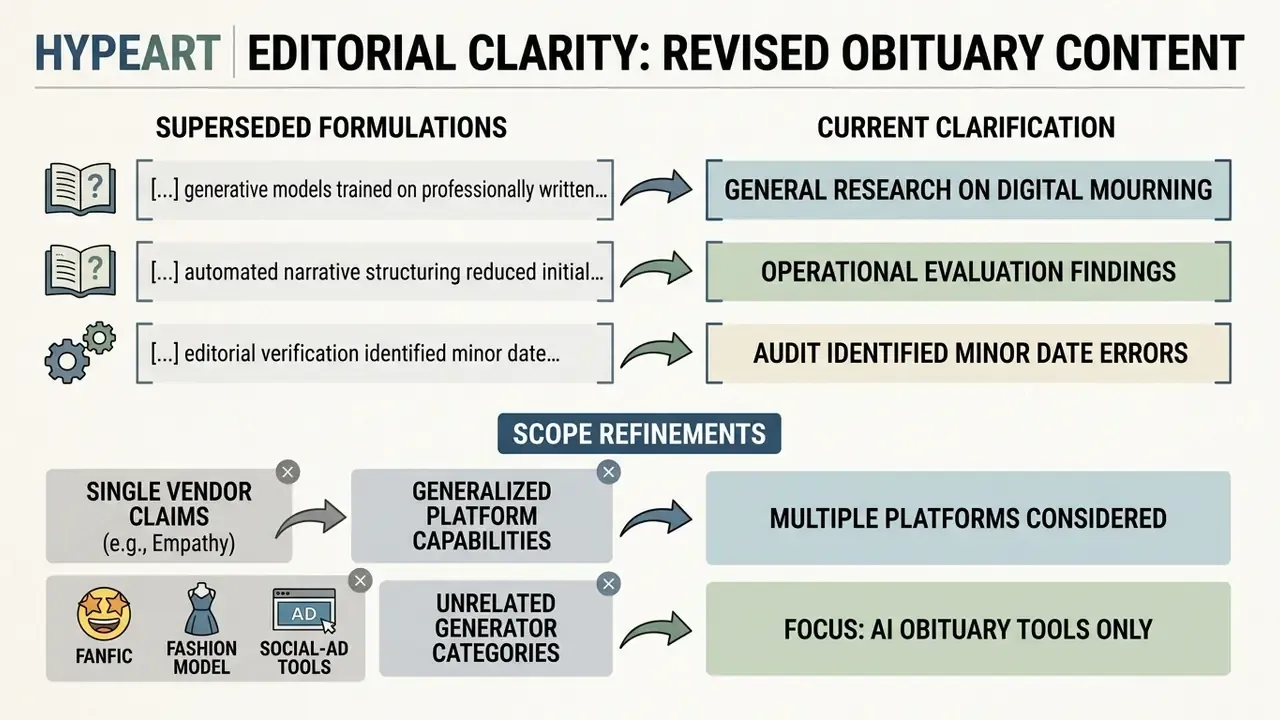
Appendix A: Superseded Formulations (Editorial Record)
About This Guide
This guide is maintained by our editorial team covering AI tooling, licensing and data governance. It is reviewed against published standards including the NIST AI Risk Management Framework: Generative AI Profile (2024), PDPC Singapore guidance on the personal data of deceased persons (2024), and peer-reviewed literature on digital mourning (Acta Biomed, 2024; ACM IUI, 2023). Commentary on model-risk controls is attributed to Marcus Hale, author. Vendor pricing and feature claims reflect publicly listed information at the time of the last update and are subject to change. Reference indices and related tool categories: browse the hub.