Last updated: 2026. Reviewed for enterprise cloud governance and model-risk management contexts.
Why should a Chief Risk Officer care about a billing unit? Because in most US banks and mature fintechs, the same meter that prices a warehouse query now prices generative AI inference. Unmonitored credit burn becomes an unbudgeted liability, and it usually surfaces on the invoice long after the model has already run.
What are compute credits: definition and meaning
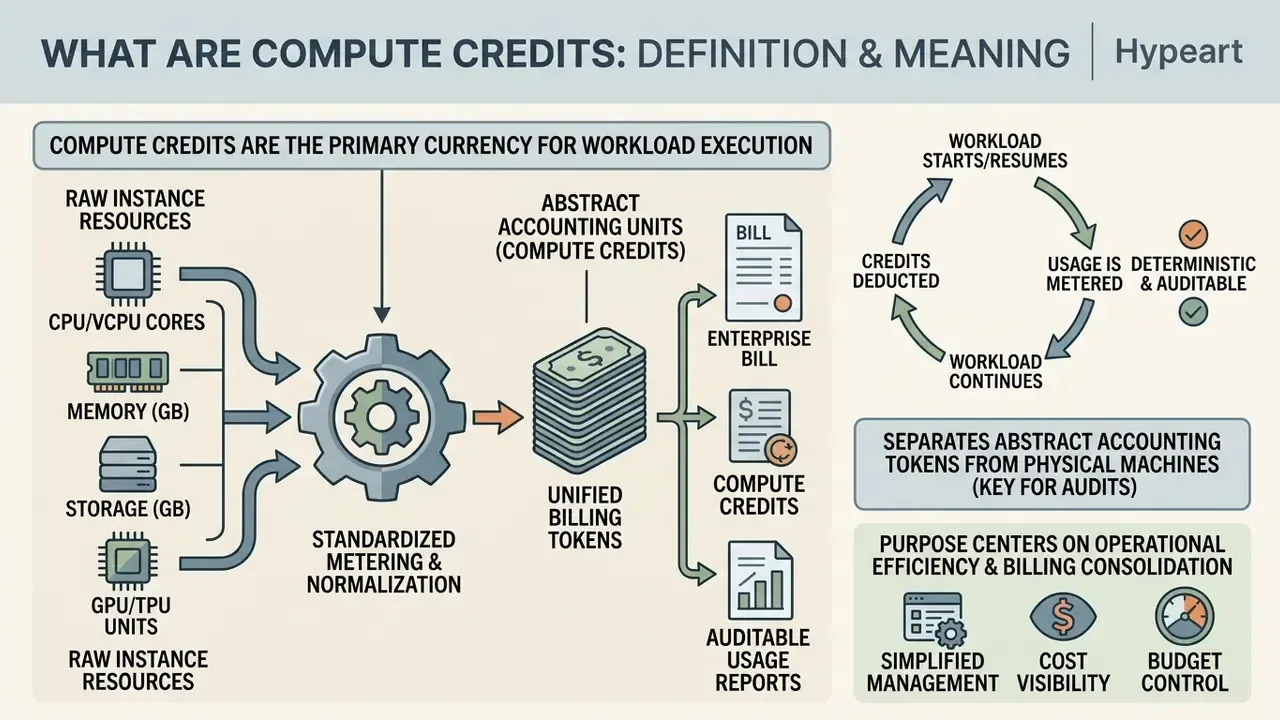
Compute credits are standardized internal accounting units used by cloud providers to measure, normalize, and bill computational resource consumption. They act as a financial and operational abstraction layer between physical hardware infrastructure and financial billing systems.
«Cloud credits are units of virtual currency used to pay for resources such as storage, compute, and bandwidth, allowing organizations to avoid large capital outlays.»
Understanding compute credits requires separating abstract accounting tokens from physical machines. At an architectural level, compute credits are not vCPUs, RAM modules, or GPU clusters. They are virtual billing meters that quantify the runtime duration and intensity of allocated computational resources. A credit is an accounting token applied to hardware consumption; the vCPU, the memory allocation, and the GPU device remain separately measurable engineering parameters.
That distinction matters in audit conversations. A validator asking "how much compute did this model consume?" is asking an engineering question. A finance controller asking the same thing is asking a billing question. Credits are the bridge, and they are an imperfect one.
The primary purpose of compute credits centers on operational efficiency and billing consolidation. Cloud providers use these units to monetize dynamic infrastructure across diverse cloud services, data processing tasks, and artificial intelligence models. This is why the same abstraction now spans data warehouses, serverless functions, and large language model inference endpoints.
«Tokens now function simultaneously as units of computation, memory use, energy expenditure, pricing, and value in AI systems.»
In modern enterprise architectures, compute credits are the primary currency for workload execution. When cloud resources run, the platform deducts credits from a prepaid balance or accrues them as line items on a monthly billing statement. This mechanism lets organizations scale workloads dynamically while keeping a unified unit of consumption across varied cloud products, from warehouse queries to AI video generators that expose the same credit logic in a consumer-facing tier.
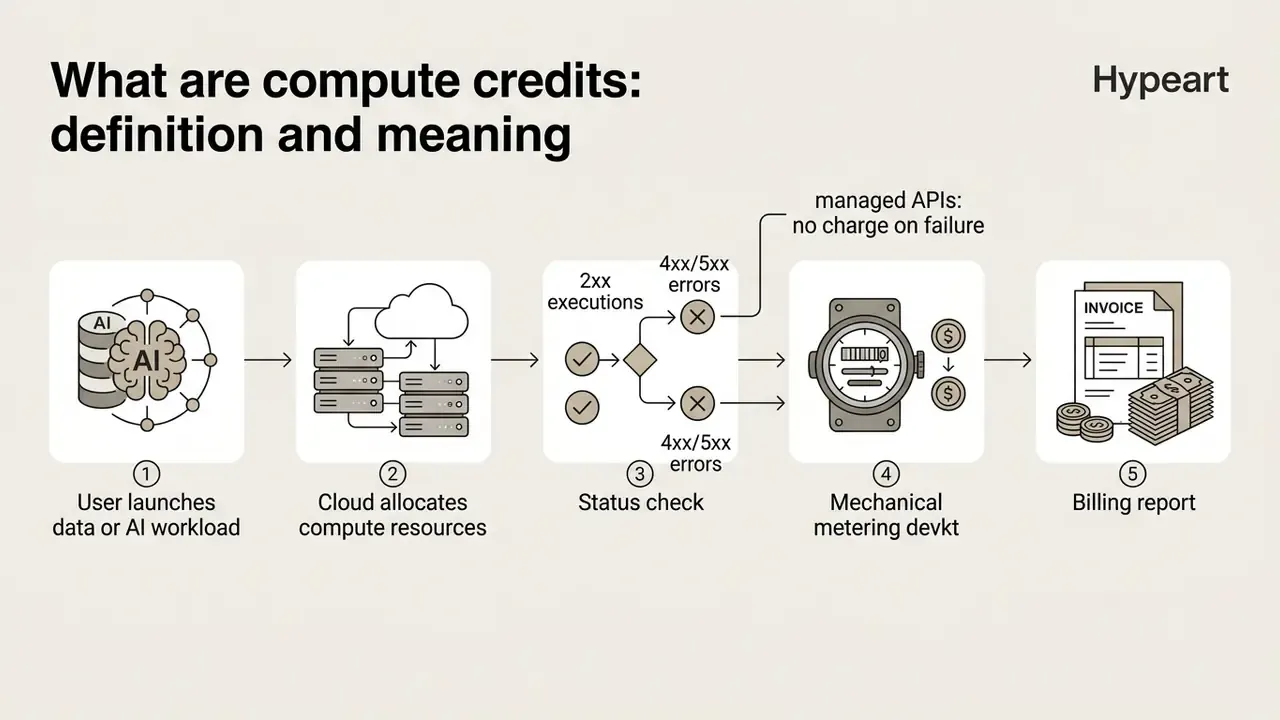
The lifecycle is deterministic and auditable: a workload starts or resumes, usage is metered while the compute node remains active, credits are deducted when the billed unit is recorded, and the final billing report aggregates consumed credits into a downloadable usage statement. Some platforms deduct at task completion rather than continuously. Task-level pipeline engines, for example, decrement credits as each task finishes and publish an on-demand CSV usage report.
What compute credits pay for in cloud services
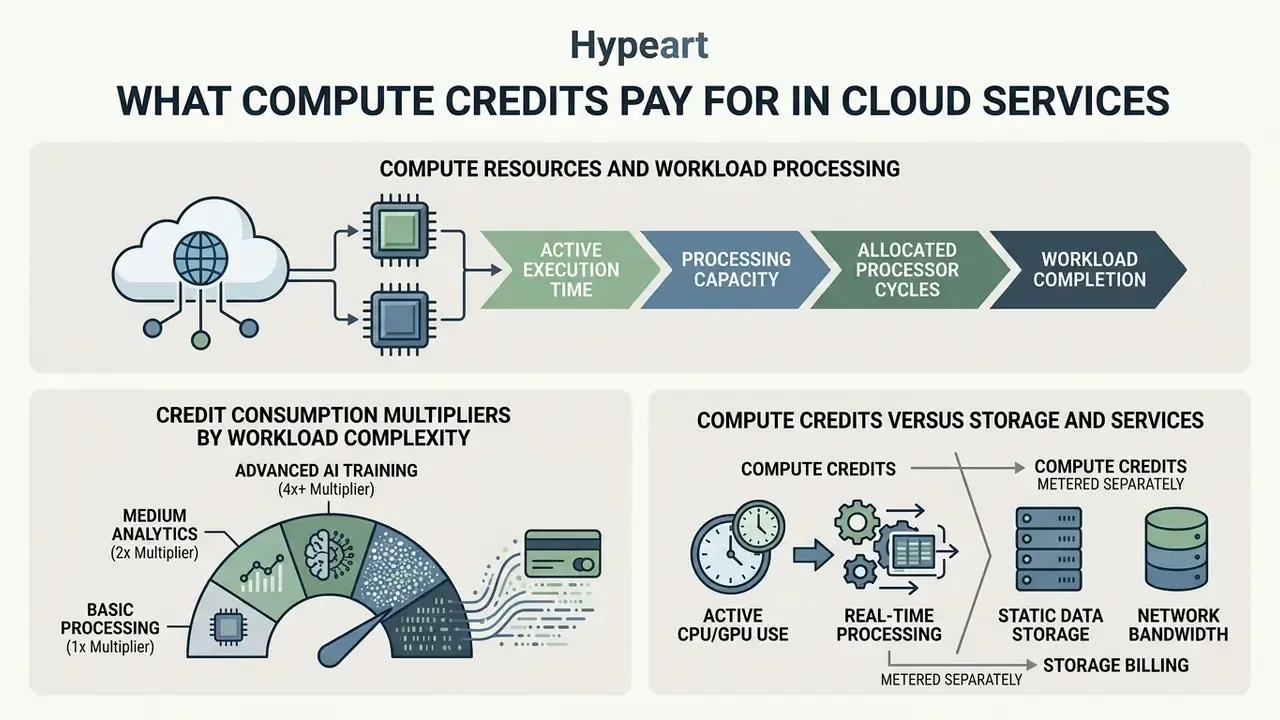
Compute credits pay specifically for active execution time, processing capacity, and allocated processor cycles across cloud services, rather than static data storage.
Cloud platforms separate active computational tasks from static asset hosting. When an application runs queries, processes analytical pipelines, or generates machine learning inferences, the platform deducts compute credits based on active processing duration. Understanding what compute credits pay for prevents avoidable friction between operations teams and executive risk committees.
Compute credit consumption multipliers by workload complexity
Not all processing tasks consume compute credits at identical rates. Cloud platforms scale credit drawdowns based on execution complexity, memory overhead, and external API calls:
| Workload category | Task description | Resource intensity | Credit multiplier rate | Billing condition |
|---|---|---|---|---|
| Standard request | Static HTML fetching, basic database queries | Low CPU / low memory | 1× baseline credit | Charged only on HTTP 2xx response |
| Dynamic execution | Headless browser rendering (JavaScript execution) | Medium CPU / high memory | 10× baseline credit | Charged on execution start |
| Advanced processing | Captcha resolution, unstructured OCR parsing | High compute / GPU | 50× to 100× baseline credit | Charged per attempted task |
| AI LLM inference | Prompt processing and token generation | Dedicated GPU cluster | Variable per 1k tokens | Charged per input/output token volume |
| ETL pipeline | Heavy join transformations on large data pools | Multi-node cluster | Based on warehouse T-shirt size | Billed per active cluster second |
This gradation explains why two workloads with identical runtime can differ in cost by two orders of magnitude. A regulated document-processing pipeline that renders dynamic portals and resolves interactive challenges will burn credits at a rate no static-query baseline can predict. Two orders of magnitude. That is the whole forecasting problem in one number.
Compute resources and workload processing
Workload processing converts raw virtual CPU time, graphics processing units, and memory allocations into billed compute credits based on runtime.
When enterprise applications run workloads, metering systems measure active instance runtime and hardware utilization. Executing background query tasks on data platforms consumes credits continuously while the processing engine remains active. Once processing finishes and the compute node shuts down, active credit deduction stops immediately.
«One AWS CPU credit equals one vCPU running at 100% utilization for one minute, or equivalent combinations of vCPU, utilization, and time.»
Different operational workloads consume compute resources at distinct burn rates. High-throughput data transformation pipelines require larger cluster allocations, which raises the per-second credit consumption rate. Knowing these operational requirements lets engineering teams tune runtime execution without breaching approved budgets.
Historical computing-cost models used the same logic long before cloud metering existed. Early federal computing standards priced a job in Computer Resource Units, a weighted measure of CPU time, I/O time, and central memory occupancy time, and charged a fixed rate per unit. Modern compute credits are a direct descendant of that weighted-consumption approach, extended to elastic infrastructure and measured service metering across storage, processing, and bandwidth.
Compute credits versus storage and cloud services usage
Compute credits bill for active processing runtime, whereas data storage is billed on retained data volume over time, and auxiliary cloud services follow separate threshold rules.
Cloud providers distinguish between active calculation and static data retention. Data storage is typically billed as a fixed monthly price per gigabyte or terabyte stored, based on average daily on-disk bytes. Compute credits, by contrast, track active compute node runtime and query execution cycles.
«Snowflake bills credits per second with a one-minute minimum each time a warehouse starts; suspended warehouses consume no credits.»
Auxiliary cloud services, such as metadata control planes or API gateways, often use hybrid metering models. Some architectures include baseline control-plane usage within standard compute credits, then charge separately once usage exceeds predefined thresholds. Snowflake, for example, bills cloud-services consumption only when daily cloud-services credits exceed 10% of that day's virtual warehouse credits, a threshold finance teams should monitor as a distinct hidden-cost trigger. Several vendors also separate credit classes: AI features may draw on dedicated AI credits, while all other platform usage draws on general platform credits.
| Category | What is consumed | Primary resources | Units / credits | Typical billing basis |
|---|---|---|---|---|
| Compute | CPU/GPU execution time | vCPUs, RAM, virtual nodes | Compute credits | Per-second or per-minute runtime of active clusters |
| Storage | Data volume retained | Object storage, block disks | Gigabytes / terabytes per month | Flat rate based on average daily volume stored |
| Cloud services | Metadata and management | Control plane nodes, APIs | Auxiliary credits / direct fee | Free up to daily baseline thresholds; excess billed in credits |
| Ingestion / transfer | Bytes processed or moved | Pipe endpoints, egress paths | Fixed credits per GB | Charged on data volume processed through the endpoint |
The practical read: a suspended warehouse holding a large dataset produces a meaningful storage bill and almost no compute bill. Teams chasing credit reductions sometimes attack the wrong line item entirely.
How compute credit usage is calculated
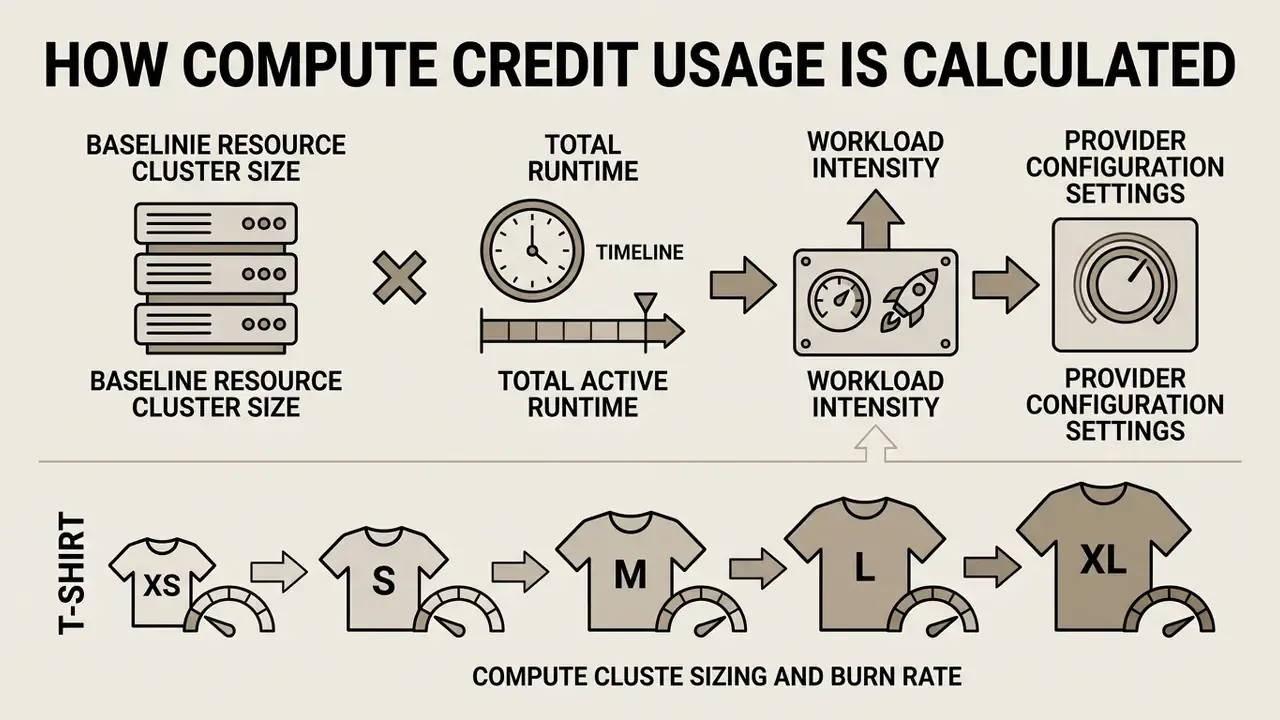
Compute credit usage calculation multiplies the baseline resource cluster size by total active runtime, adjusted for workload intensity and provider configuration settings.
Calculating compute credit usage requires tracking active cluster sizes and execution duration. Metering engines poll active resources continuously, apply minimum billing intervals, and calculate credit consumption against published rate tables.
Resource size, runtime, and data processing
Node size scales credit burn geometrically, while runtime meters usage per second, which makes cluster configuration the single most consequential cost decision an engineer makes.
Computational nodes are categorized into standardized performance tiers. Larger nodes provide double the vCPU and memory capacity of the tier below, but they burn compute credits at twice the hourly rate. So running a large node for one hour consumes the same credit volume as running a smaller node for two hours. Same credits, different wall-clock time, and sometimes very different query performance.
«AWS credits accrue as vCPU × baseline percentage × 60 minutes per hour; a t3.nano with 2 vCPU and a 5% baseline earns 6 credits per hour.»
Runtime rules also dictate minimum billing charges.
«A Snowflake XS warehouse consumes 1 credit per hour; each larger size doubles consumption, up to 512 credits per hour for 6XL.»
Compute cluster sizing and credit burn rates (T-shirt scale)
Enterprise warehouses use standardized cluster sizing to scale compute capacity. Each step up in tier doubles the underlying node count and the credit burn rate:
- Extra Small (XS) 1 server or node, 1 credit per hour (development and test environments)
- Small (S) 2 servers or nodes, 2 credits per hour (basic reporting pipelines)
- Medium (M) 4 servers or nodes, 4 credits per hour (standard production BI tasks)
- Large (L) 8 servers or nodes, 8 credits per hour (heavy data transformation and ETL)
- Extra Large (XL) 16 servers or nodes, 16 credits per hour (high-concurrency enterprise queries)
The doubling pattern continues upward: 2XL at 32 credits per hour, 3XL at 64, 4XL at 128, 5XL at 256, and 6XL at 512. Specialized configurations break the pattern. Snowpark-optimized warehouses, for instance, start at Medium and consume 6 credits per hour because of their memory-heavy node profile. Governance teams should therefore review effective size, not nominal tier names, when approving warehouse provisioning requests. A tier label is a marketing artifact; the burn rate is the fact.
Provider pricing model and product configuration
Provider pricing models dictate the dollar rate assigned per credit based on product tiers, regional deployment, and commitment discounts.
Each cloud provider sets proprietary conversion rates between credits and fiat currency. A single compute credit may carry a fixed monetary value on one platform while functioning as a variable usage index on another. Regional factors, infrastructure availability, and service-level agreements all influence the final credit unit price. Published unit prices vary dramatically across vendors and unit definitions. Some research-computing platforms sell credits at $0.10 each in packs of 100 to 1,000, while academic institutional models price a single credit above $3.00, simply because the underlying resource definition differs.
«The theoretically optimal pricing mechanism for AI services operates through a single instrument, a token cap, which simplifies user screening.»
Discount mechanics form the second half of the pricing model. Sustained-use and committed-use structures reduce effective credit prices materially: Google Cloud documents tiered sustained-use discounts of up to 20% at threshold usage, with virtual machines running an entire month reaching up to a 30% net discount. Procurement teams evaluating credit commitments should model both the list rate and the realistic discounted rate across a full billing year, then stress the assumption that projected volume actually materializes. Commitments that go unused are just prepaid waste with better paperwork.
Verified Provider Billing Documentation:
- Snowflake Documentation (2026): "Understanding Compute Cost & Credit Consumption Tables"
  https://docs.snowflake.com/en/user-guide/cost-understanding-compute
- Snowflake Documentation (2026): "Cost & Billing Guides Overview"
  https://docs.snowflake.com/en/guides-overview-cost
- Amazon Web Services (2026): "EC2 Burstable Performance Instances CPU Credit Model"
  https://docs.aws.amazon.com/AWSEC2/latest/UserGuide/burstable-credits-baseline-concepts.html
- Microsoft Learn (2026): "Azure Virtual Machines B-series CPU Credit Model"
  https://learn.microsoft.com/en-us/azure/virtual-machines/sizes/b-series-cpu-credit-model
- Google Cloud Documentation (2026): "Google Cloud Billing Architecture & Cost Management Guides"
  https://cloud.google.com/billing/docs
Compute credits pricing: how to estimate cost
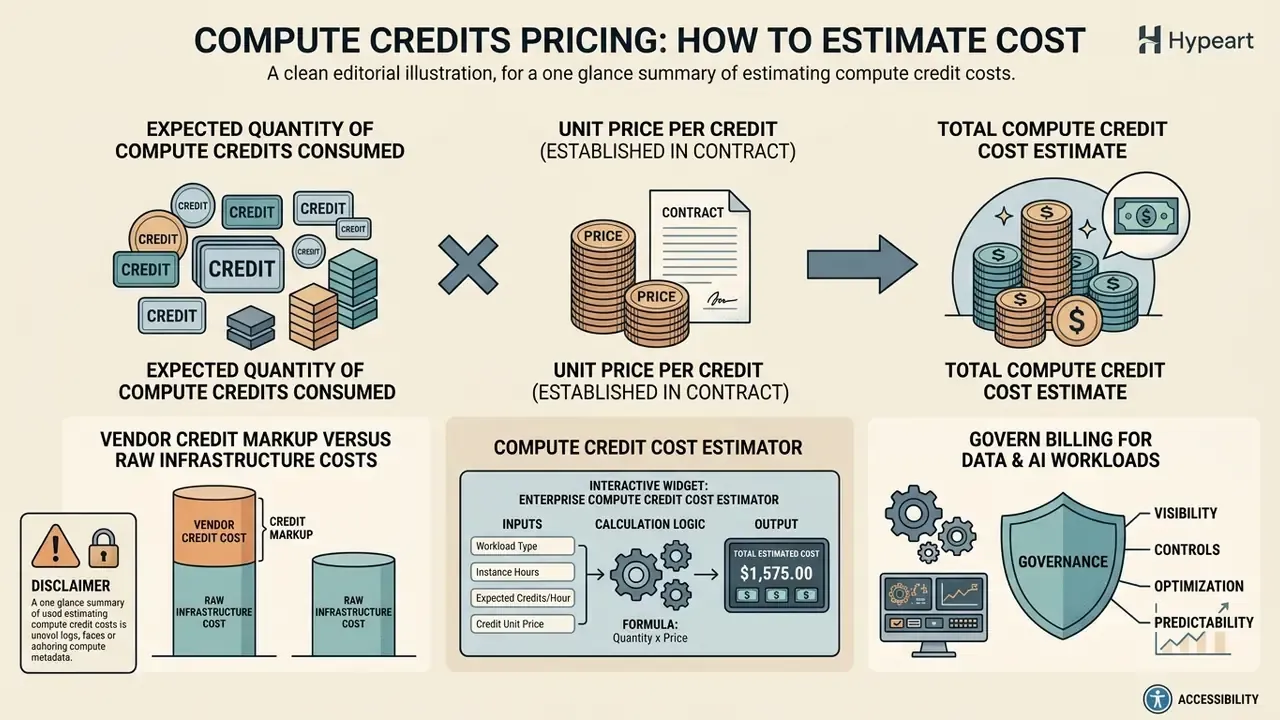
To estimate total compute credit cost, multiply the expected quantity of compute credits consumed by the unit price per credit established in your contract.
Accurate financial forecasting means converting technical usage projections into predictable budget line items. By combining workload runtime projections with contractual credit prices, finance transformation leaders can build cost models that survive a quarterly review.
Vendor credit markup versus raw infrastructure costs
To understand the true cost of compute credits, enterprise buyers should evaluate the underlying hardware markup applied by cloud platforms. Managed platforms rarely disclose which instance families sit beneath a credit tier, but performance-debugging evidence has repeatedly pointed to specific instance classes, which allows an approximate markup calculation.
| Cloud platform / warehouse tier | Equivalent cloud instance | Raw hardware cost (est. $/hr) | Credit burn rate (credits/hr) | Vendor nominal price ($/hr) | Estimated vendor markup |
|---|---|---|---|---|---|
| Snowflake Standard (XS) | AWS c5d.2xlarge (8 vCPU, 16 GB RAM) | ~$0.38 / hr | 1.0 credit | $2.00 / hr | ~5.2× |
| Snowflake Enterprise (XS) | AWS c5d.2xlarge (8 vCPU, 16 GB RAM) | ~$0.38 / hr | 1.0 credit | $3.00 / hr | ~7.8× |
| Snowflake Business Critical (XS) | AWS c5d.2xlarge (8 vCPU, 16 GB RAM) | ~$0.38 / hr | 1.0 credit | $4.00 / hr | ~10.5× |
| Databricks jobs compute | AWS m5.xlarge (4 vCPU, 16 GB RAM) | ~$0.19 / hr | 0.15 DBU | ~$0.40 / hr | ~2.1× |
Compute credit cost estimator
Teams modelling media-generation budgets alongside warehouse spend can sanity-check per-output economics with the AI Video Credit calculator before committing to a plan tier.
Example of a compute credit cost estimate
A standard enterprise estimate multiplies unit credit cost by projected usage volume across dedicated cloud products.
Consider an enterprise data pipeline running analytical queries across a cloud warehouse. If a workload consumes 500 compute credits during a processing cycle, and the contractual price is $0.25 per credit, the total cost is $125. Working through the example helps financial leaders convert abstract cloud usage into concrete operating expense, and it establishes the reusable formula: credits consumed × price per credit = billed compute cost.
Scale it up and the sensitivity becomes obvious. The same pipeline running twice daily on a Large warehouse instead of a Medium one does not cost 20% more. It costs double, before any concurrency scaling multiplies the running cluster count.
«OpenAI calculates credits as (input tokens ÷ 1,000,000) × input rate plus (output tokens ÷ 1,000,000) × output rate.»
Token-based formulas shift the forecasting variable from hours to volume of text processed. A retrieval-augmented compliance assistant answering 40,000 internal queries per month with an average 6,000-token context has no meaningful runtime budget. It has a token budget, and that budget must be modelled per use case before deployment, not reconstructed from the first surprise invoice.
For organizations benchmarking broader consumption models, comparing platform structures clarifies credit-consumption patterns. Reviewing consumer-facing credit tiers, for example how free AI video generators meter credits, watermarks, and export limits, is a fast way to see the same metering logic expressed transparently. A side-by-side view of AI Video Pricing and credit allocations makes the mechanics visible before you apply them to enterprise rate cards, where the same rules are buried in schedules and footnotes.
Using compute credits for data and AI workloads
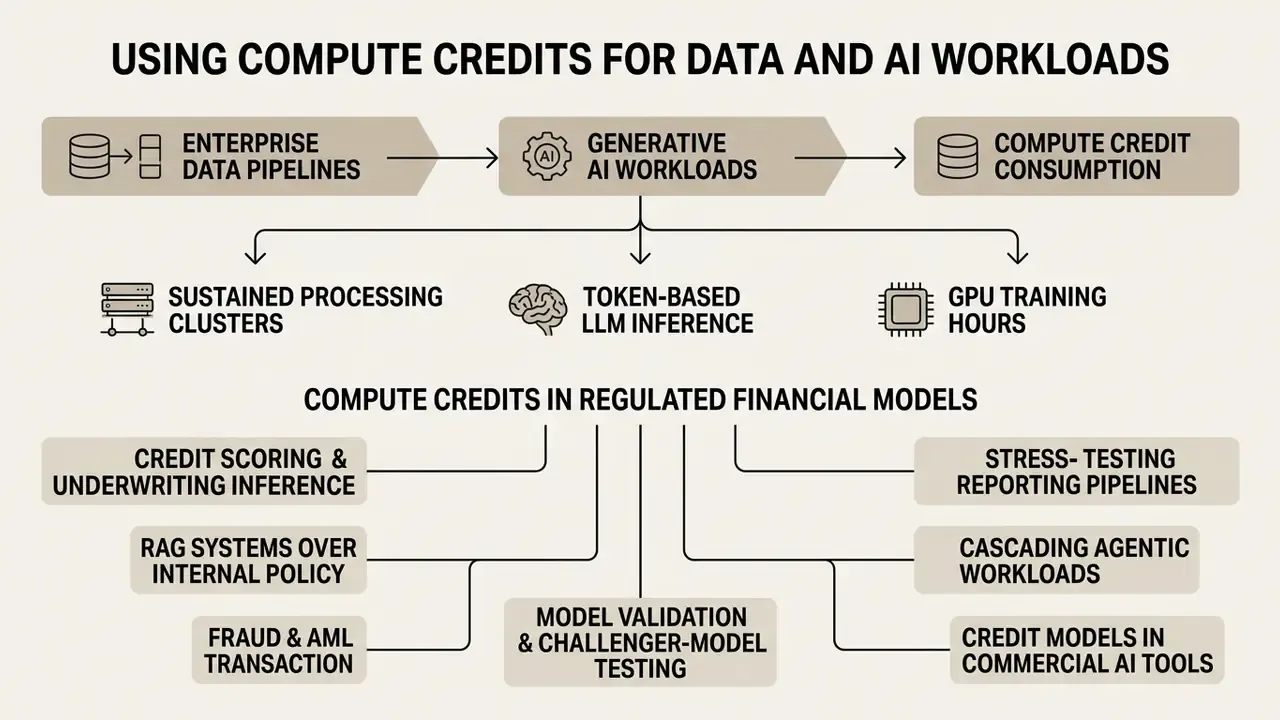
Enterprise data pipelines and generative AI workloads consume compute credits through sustained processing clusters, token-based LLM inference, and GPU training hours.
Generative AI and advanced analytics have reshaped traditional cloud consumption profiles. Unlike standard enterprise software that scales predictably with user headcount, artificial intelligence models consume compute credits dynamically based on input complexity, model size, and context window length.
In model training and validation workflows, credit consumption is driven by active GPU execution time. Published training rates on dedicated platforms run at roughly $16 to $24 per GPU-hour with an eight-GPU minimum allocation, which means a single extended fine-tuning run can dominate a quarterly budget by itself. Large-scale validation pipelines require continuous high-density compute clusters, where burn rates stay elevated for long periods. Risk management teams should set explicit validation schedules so unmonitored model testing does not exhaust quarterly credit budgets.
Inference tasks for foundation models often map compute credits to token processing metrics. Processing prompt inputs and generating output tokens consumes underlying hardware resources, which providers convert into billable credits.
«Tokens serve as a direct proxy for inference load, memory use, and infrastructure consumption, providing a natural basis for pricing AI services.»
Managing these workloads means balancing model accuracy against the financial cost of continuous token processing. Deployment runtime is a separate line item: an always-on serving endpoint burns credits per hour while online, even when request volume is negligible. Decommissioning stale endpoints remains one of the highest-return governance actions available, and one of the least glamorous.
«In distributed AI networks, the marginal cost of a token combines energy expenditure, resource scarcity, and inter-node data transfer.»
Energy and workload-profile research reinforces the same point from the infrastructure side. Training and inference behave as distinct workload classes with materially different instantaneous power draw, and sub-second power profiling shows that LLM workloads and image-generation workloads diverge sharply in consumption pattern. Credit models inherit that divergence.
Compute credits in regulated financial models
For banks, insurers, and financial-market infrastructure, compute credits are consumed by a specific set of model-driven workloads rather than by general experimentation:
- Credit scoring and underwriting inference. Batch scoring concentrates credit burn into short, high-intensity windows tied to origination cycles and month-end reprocessing.
- RAG systems over internal policy and regulatory corpora. Retrieval-augmented assistants over lending manuals, AML procedures, and supervisory guidance consume credits per token on both retrieval-context ingestion and answer generation, which makes context-window discipline a direct cost control.
- Fraud and AML transaction monitoring. Streaming inference keeps clusters continuously warm, so consumption approximates a fixed hourly run rate rather than a variable per-query cost.
- Model validation and challenger-model testing. Independent validation is compute-intensive by design. Benchmarking a challenger against a production model can multiply GPU-hours for weeks, and those hours must be budgeted and evidenced.
- Regulatory reporting and stress-testing pipelines. Large join-heavy transformations on multi-node clusters consume credits by active cluster-second, which is why oversized warehouse tiers show up disproportionately in reporting-cycle invoices.
- Cascading agentic workloads. A single orchestration request that fans out into retrieval, tool calls, sub-agent reasoning, and re-ranking can trigger dozens of downstream billable events. Institutions deploying AI agents should model per-transaction credit depth, not just per-call cost, and cap recursion explicitly.
Each category needs a documented cost owner and an auditable record of consumption, because validation compute is itself part of the evidence trail supervisors expect under model-risk-management expectations. No evidence, no autonomy. That rule applies to spending authority as much as to decision authority.
Credit models in commercial AI tools
Procurement and risk teams frequently benchmark enterprise credit terms against commercial AI tooling, where credit tiers are published openly. Comparative reviews such as those covering free AI art generators and Canva's AI generator licensing and pricing show how vendors express credit burn rates, output caps, watermark policies, and commercial-use rights. Reading those terms next to an enterprise rate card is a practical way to spot vague clauses, particularly around credit expiry, output ownership, and data-retention safeguards, before anyone signs. A structured AI Video Pricing guide is a useful reference point when you need a published baseline for negotiation.
How to manage compute credit billing and avoid unexpected cost
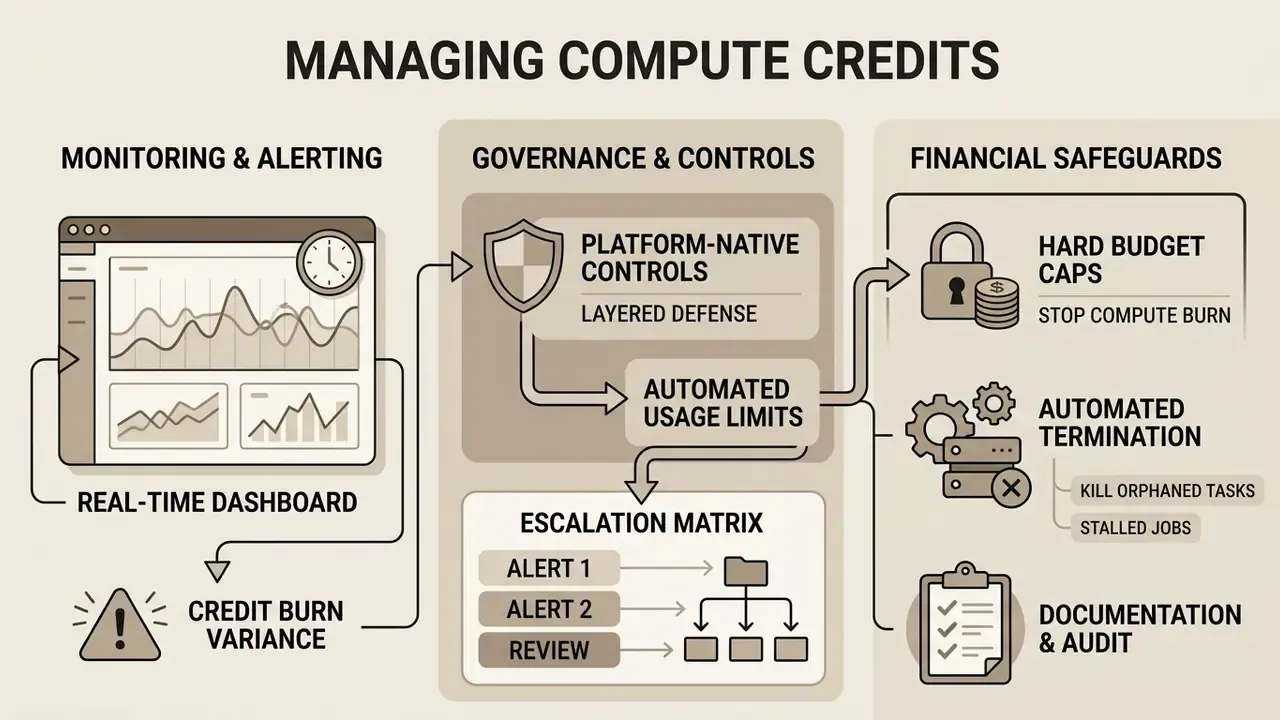
Managing compute credit billing requires real-time dashboard monitoring, automated usage limits, and hard budget caps that stop unmonitored compute burn before it compounds.
Uncontrolled shadow AI deployments and unmonitored automated pipelines represent real operational risk for financial institutions. Note on evidence: the scale of shadow AI spend is not quantified in the official provider documentation reviewed for this article, so the risk should be treated as a control gap identified through internal inventory reconciliation rather than as a benchmarked industry figure. Governance teams that reconcile their cloud instance registry against approved project lists usually surface the gap themselves: unattributed clusters, orphaned notebooks, forgotten inference endpoints.
Operational Control Checklist for Cloud Compute Governance:
1. Centralized Inventory: Maintain a unified registry of all active cloud instances and compute credentials.
2. Automated Budget Caps: Enforce hard spending limits within cloud billing management dashboards.
3. Idle Resource Reclamation: Configure automated shutdown and auto-suspend routines for inactive compute clusters.
4. Role-Based Access Controls: Restrict cluster provisioning and warehouse-resize rights to authorized engineering personnel.
5. Escalation Triggers: Establish automated alerts when credit burn rates exceed baseline projections, for example
   a 15% variance threshold as an illustrative starting point, calibrated to your own historical volatility rather
   than adopted as a fixed standard.
6. Credit-Level Audit Trail: Retain immutable logs linking every credit drawdown to a workload owner, cost centre,
   model ID, and business justification; export them into the GRC or model-inventory system of record.
7. Segregation of Duties: Define explicitly whether FinOps or the risk function approves overspend, and document
   the approval path so no single team can both provision and authorize its own excess consumption.
8. Threshold Monitoring for Auxiliary Charges: Track cloud-services and serverless consumption separately, since
   these are billed under different threshold rules than warehouse compute.
9. Pre-Deployment Cost Modelling: Require a documented credit forecast, per use case, before any model or agent
   moves from pilot into production.
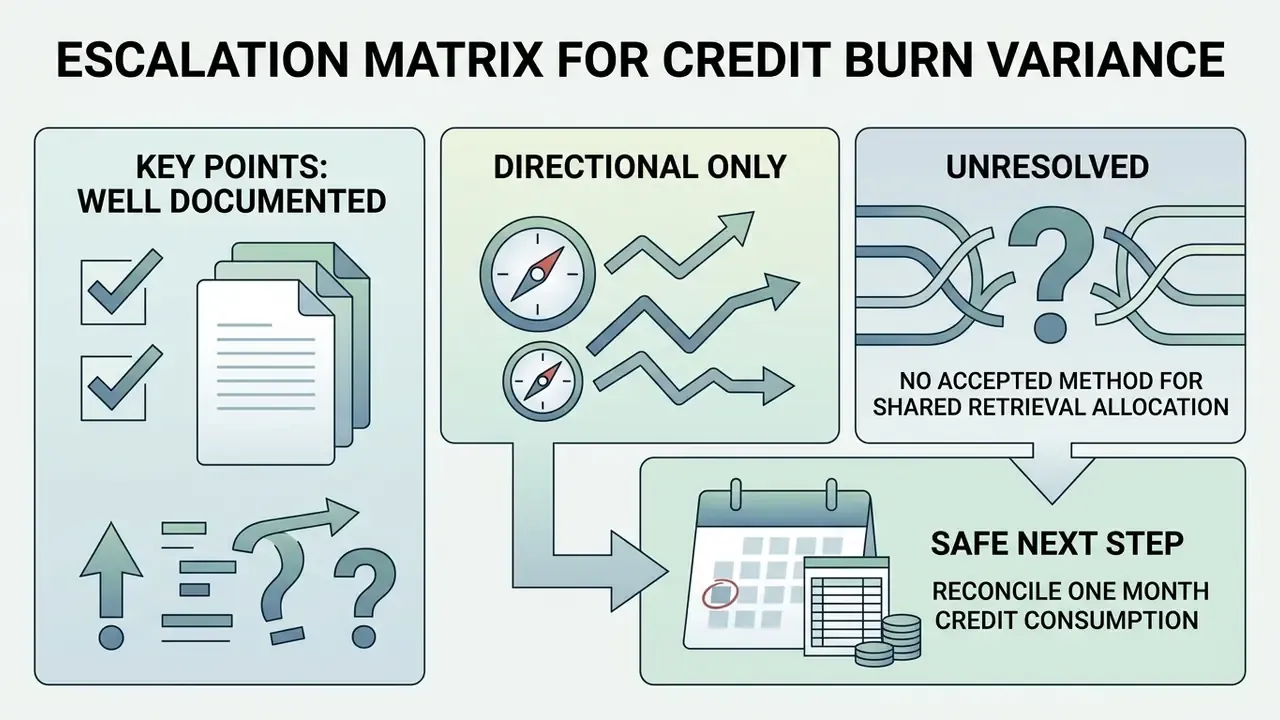
Escalation matrix for credit burn variance
| Variance vs. baseline burn rate | Owner | Required action | Documentation |
|---|---|---|---|
| 0 to 15% | Engineering team lead | Review query plans and warehouse sizing in the weekly FinOps stand-up | Logged in monthly cost report |
| 15 to 40% | FinOps plus workload owner | Root-cause analysis within 48 hours; suspend non-critical clusters | Written variance memo |
| 40 to 100% | Risk officer plus FinOps | Freeze new provisioning in the affected workspace; validate no shadow deployment | Formal incident record in GRC system |
| Above 100% or unattributed spend | CRO or model risk committee | Immediate access revocation for the affected workspace; full audit-trail reconstruction | Escalated report with remediation plan |
Real-time monitoring dashboards give finance leaders same-day visibility into credit drawdowns instead of month-end surprises.
«AWS CloudWatch tracks CPUCreditBalance, CPUCreditUsage, CPUSurplusCreditBalance, and CPUSurplusCreditsCharged, refreshed every five minutes.»
Automated termination scripts make sure orphaned compute tasks and stalled validation jobs are killed before they generate excess charges. One recurring pattern shows why it matters. A test cluster provisioned for a weekend validation run, left active after the job failed silently, can accumulate five figures of credit spend before the next monthly invoice review. Automated suspension plus a burn-rate alert would have capped that within hours.
«The Snowflake Cortex AI Cost Dashboard aggregates ACCOUNT_USAGE data, computes cost by tier and region, and visualizes spend in a Streamlit app.»
Platform-native controls should be layered rather than chosen. Google Cloud documents budgets and alerts, quota limits, and committed-use discounts as complementary levers, with billing reports tracking usage-based credits by service. Microsoft's usage-based billing controls allow per-user and per-policy monthly spending limits with threshold alerts and user-level credit consumption views. Development platforms increasingly separate plan credits from overage charges and expose both current usage and configurable budget limits in a single account-usage view.
Finally, credit governance should be documented well enough to satisfy an external reviewer. That means named cost owners per model, retained evidence of validation compute, approval records for tier increases, and a reconciliation process that ties every invoice line back to an approved workload. Cost control and model-risk control converge at exactly this point, which is the argument for owning both in the same governance forum.
Limitations, open questions, and a reasonable next step
FAQ: frequently asked questions about compute credits
What happens to compute credits if a query fails or returns an error?
In managed data-extraction and API platforms, credits are typically charged only for successful executions, commonly defined as an HTTP 2xx status code, so failed requests caused by bad URLs or unavailable endpoints are not billed. In general cloud infrastructure such as EC2 burstable instances or a running data warehouse, compute credits are consumed based on active cluster runtime regardless of whether the query succeeds. Always confirm which model applies before assuming failed jobs are free.
Do unused monthly compute credits roll over to the next billing cycle?
For most SaaS subscription plans, monthly allocated credits expire at the end of the billing cycle and cannot be carried over; closing an account generally forfeits any unused balance. Prepaid commit credits under enterprise agreement frameworks may include specific rollover or true-up terms, so the contract, not the marketing page, is the authoritative source.
What is the minimum billing interval for compute credit consumption?
Many enterprise platforms enforce a 60-second minimum charge when a compute cluster resumes or starts, then meter per second afterwards. Some services apply longer minimums for specific compute-node types, so frequent short jobs should be batched to avoid paying repeated startup minimums.
Can compute credits be transferred between different cloud accounts?
No. Compute credits are generally non-transferable and non-refundable billing units locked to the specific organizational root account, workspace, or user account to which they were provisioned. They usually cannot be moved between credit classes either, for example from platform credits to AI-specific credits.
How do compute credits differ from storage charges on the same invoice?
Compute credits bill active processing runtime and stop accruing when the cluster suspends. Storage is billed on average daily data volume retained, expressed per gigabyte or terabyte per month, and continues accruing whether or not any query runs. A suspended warehouse holding a large dataset therefore produces a storage bill and a near-zero compute bill.
Which controls reduce compute credit spend fastest?
Right-sizing clusters, auto-suspending idle warehouses, caching frequently repeated query results, capping recursion in agentic pipelines, and restricting provisioning rights to a small approved group. Architectures that separate storage from compute let each scale independently, which avoids paying credit rates for idle capacity.
Who should own compute credit budgets in a regulated institution?
Ownership is usually shared, and that is where control gaps appear. A workable split assigns forecasting and monitoring to FinOps, per-model cost ownership to the model owner, and overspend approval to the risk function. Document the split. Ambiguous ownership is the most common reason burn-rate alerts get acknowledged and then ignored.
This article provides general information on cloud billing mechanics and is not financial, legal, accounting, or regulatory advice. Credit prices, discount structures, and minimum billing intervals change by vendor, region, plan tier, and contract. Verify all figures against your provider's current official documentation and your executed agreement before making budgeting or procurement decisions.