Executive Summary
- Real unit economics beat headline prices. A subscription fee tells you almost nothing. Normalize every vendor to one metric, cost per finished 10-second 1080p clip, and the spread runs from $0.12 (template automation) to $7.00 (frontier cinematic models).
- Software is rarely the largest line item. Labor adds $180 to $375 per finished video minute; music sync licenses add $50 to $300 per track; custom executive avatars run about $1,000 per year.
- Scale changes the equation. Ten videos cost $10,000 to $50,000 traditionally versus $500 to $2,000 with an AI pipeline. One thousand localized videos cost $1M to $5M traditionally versus $50,000 to $200,000 with AI. Revisions consume 50 to 80% of the original budget in live-action versus 5 to 10% in an AI workflow.
- Enterprise buyers pay a compliance premium. Zero Data Retention, SOC 2 Type II attestation, SSO/SAML, RBAC, audit logging, private tenancy and provisioned GPU capacity all sit above self-serve pricing, and they must be modeled explicitly inside a risk-adjusted ROI.
- The cheapest optimization is not a discount. It is workflow. Drafting each shot as a $0.03 to $0.14 still image before animating the approved frame cuts wasted video credits by 65 to 80%.
How to Read This Guide
AI Video Pricing at a Glance: What You Pay for Generation
The market splits into three camps: entry-level creator tools, enterprise avatar platforms, and direct developer APIs. Buyers who want to weigh output quality alongside price can cross-reference this pricing analysis with our comparison of the best AI video generators before committing budget.
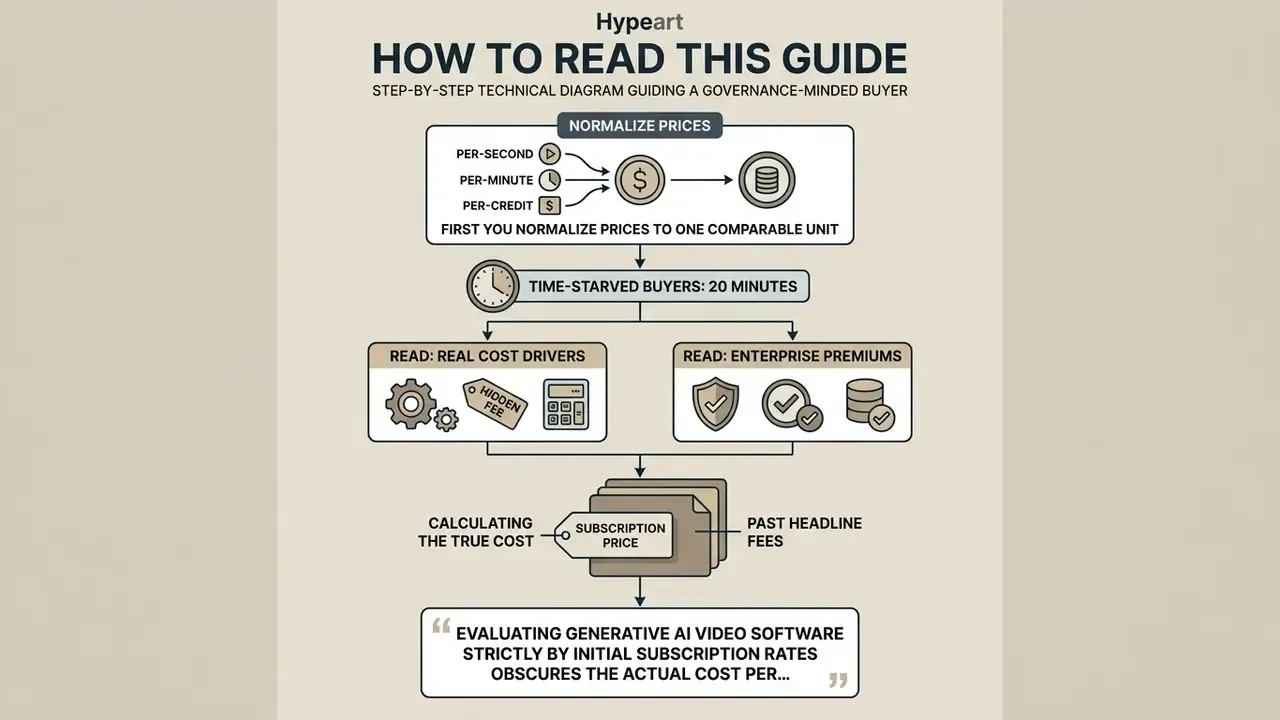
The table below outlines verified 2026 pricing paradigms, billing mechanisms, commercial scope, and, critically, a normalized cost per finished 10-second 1080p clip. That last column is what lets seconds, minutes and credits sit on one axis.
| Platform / Model Category | Pricing Model | Entry Plan Cost (2026) | Pro / Enterprise Cost | Normalized Cost per 10s Video (1080p) | API Availability | Key Capabilities | Primary Commercial Use Case |
|---|---|---|---|---|---|---|---|
| Google Veo 3.1 (Gemini API) | Per-second API metering | $0.05–$0.08 / sec (Lite) | $0.40–$0.60 / sec (Standard, audio, 4K) | $4.00 – $6.00 | Yes (Vertex AI / Gemini API) | High-fidelity text-to-video, synchronized audio, 1080p/4K | Developer pipelines, programmatic ad variations |
| OpenAI Sora 2 / Sora 2 Pro | Per-second API metering | $0.10 / sec (Sora 2, 720p) | $0.30–$0.70 / sec (Sora 2 Pro, 720p–1080p) | $3.00 – $7.00 | Yes (OpenAI API) | Complex physical simulation, high spatial consistency | High-end visual effects, cinematic concepting |
| Runway (Gen-4 / Gen-4.5) | Subscription + credit pool | $12 / user / month (Standard, annual) | $28 (Pro), $76 (Unlimited) | $1.20 (Gen-4, 12 credits/sec) | Yes (credit-metered) | Motion brush, camera control, multi-model generation | Creative agencies, social marketing scaling |
| Kling 3.0 Turbo (Kuaishou) | Subscription + credit pool | $6.60 / mo annual ($10 monthly) | $37 (Pro), $92 (Premier) | ~$1.26 (Turbo Pro, 420 credits) | Yes (via aggregators) | 1080p with native audio, 5–15 sec clips, strong motion | Budget-efficient social and promo volume |
| MiniMax Hailuo H3 | Credit-based (multi-model platforms) | Included in $9–$25/mo credit plans | $50–$100 / mo (higher credit pools) | ~$2.34 (780 credits, 2K) | Yes (API / aggregators) | Native 2K, subject reference, camera direction | Cinematic-grade brand shots |
| Flux 3 Video (Black Forest Labs) | Credit-based | From 510 credits per clip | Volume credit packs | ~$1.53 (510 credits) | Yes | Native audio, text/image/frame-to-frame | Multimodal creative pipelines |
| Luma Ray 2 | Subscription + credits | $6.99–$9.99 / month | $29–$39 / month (Creator/Team) | ~$0.90 (300 credits, 540–720p) | Yes | Physics-aware motion, image-to-video | Product motion, physically plausible scenes |
| Grok Imagine Video 1.5 (xAI) | Per-second API + consumer bundle | 5 free credits/day (app) | $0.08/sec (480p), $0.14/sec (720p) | ~$1.40 (720p, +$0.01/image input) | Yes | Fast generation, tight X/Grok integration | Rapid social iteration |
| Seedance 2.0 (FAL.ai / APIFrame) | Per-second API metering | $0.2419 / sec (Fast 720p) | $0.3034 / sec (Standard 720p) | ~$3.03 (720p); 43 credits/sec at 1080p | Yes (FAL.ai / direct API) | Audio-synced clips, granular frame controls, multi-shot | Custom app integration, automated workflows |
| Synthesia | Tiered subscription | $29 / month (Starter, 10 min) | $89 (Creator, 30 min), Enterprise custom | ~$2.96 per finished avatar minute, about $0.49 per 10s | Yes (Enterprise) | AI avatars, 140+ languages, brand kits, SCORM export | Corporate training, compliance comms |
| HeyGen | Tiered subscription | $24–$29 / month (Creator) | $149 / month (Business) | ~$0.50–$1.00 (avatar segment) | Yes | Avatars, localization, lip-sync translation | Sales enablement, localized outreach |
| InVideo AI | Tiered subscription | $25 / month (Plus, 50 min) | $60 / month (Max, 200 min) | ~$0.12 per minute-equivalent of auto-edit | No public direct API | Script-to-video, stock library, auto voiceover | High-volume SMM, rapid promos |
| Pika | Subscription + credits | $8 / mo annual ($10 monthly) | $28 / month (Pro) | ~$0.60–$1.00 | Limited | Stylized effects, short-form creative clips | Trend-driven social content |
| PixVerse | Subscription + daily credits | $10 / month | Higher credit tiers | ~$0.36 (120 credits, 720p) | Yes | Fast short-form generation | Volume short-form output |
| ImagineArt (multi-model) | Subscription + shared credits | $9–$11 / month (Basic) | $25 (Standard), $50 (Pro), $100 (Scale) | $0.36–$2.34 depending on model | Yes | 18+ video models plus image models on one credit pool | Mixed-model studios, image-to-video workflows |
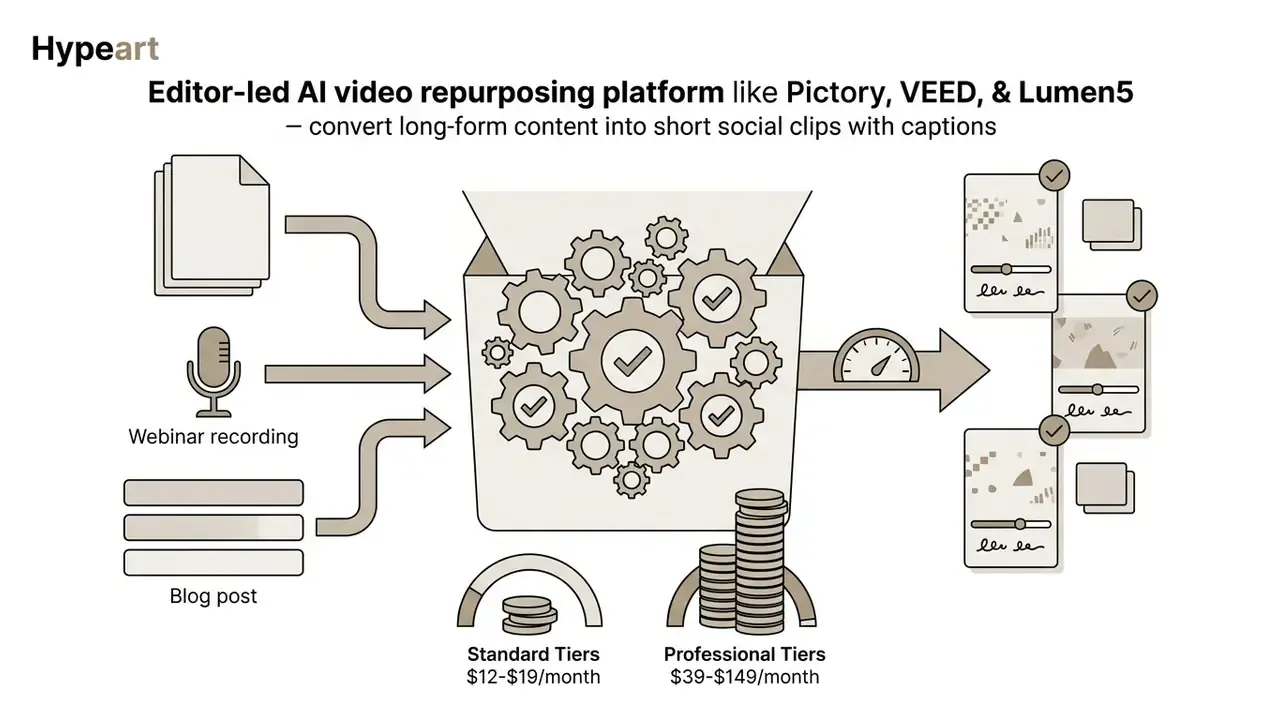
| Pictory / VEED / Lumen5 (editor-led) | Tiered subscription | $12–$19 / month | $39–$149 / month | $0.10–$0.50 (assembly, not generation) | Partial | Script-to-video, captions, stock assembly | Repurposing blogs, webinars, long-form |
Because the same money buys very different pipelines, it helps to know how prompt-driven generation differs from template assembly before you pick a tier. Our primer on text-to-video AI tools explains the generation methods referenced throughout this table. Teams that publish long-form content on social platforms should also review the YouTube editing workflow guide, because publishing overhead is a real cost line that sits outside every pricing page.
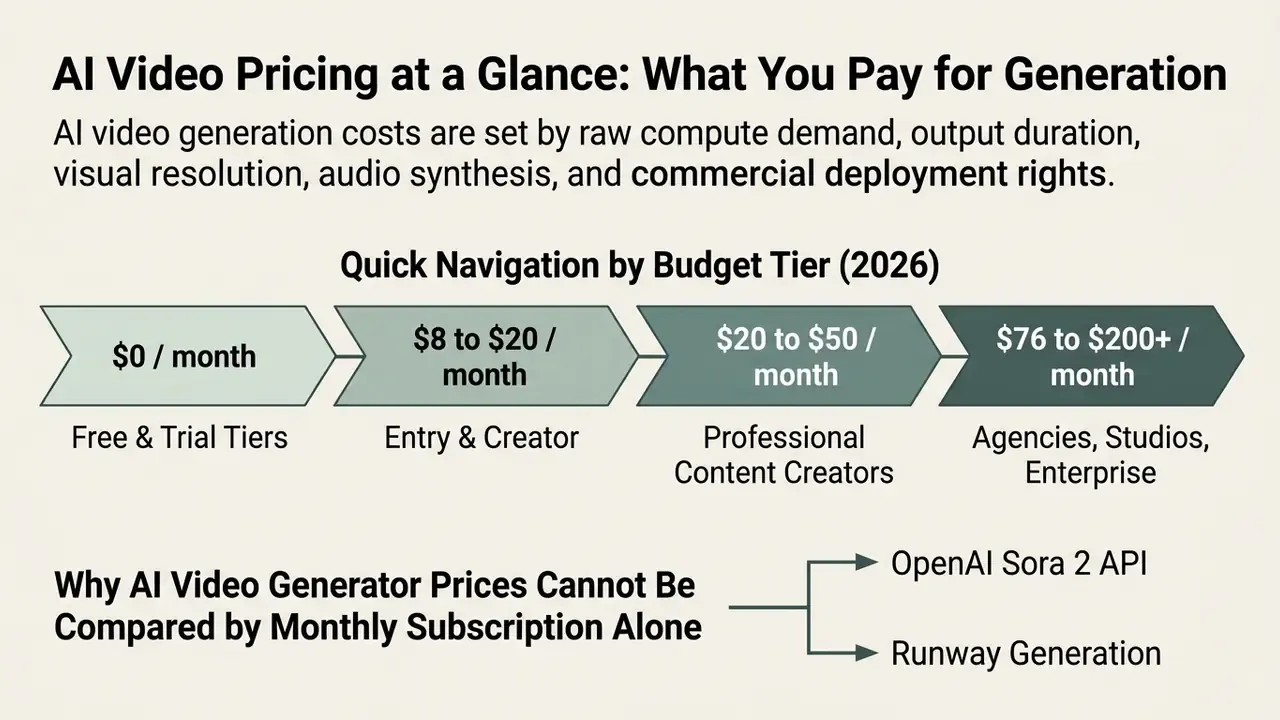
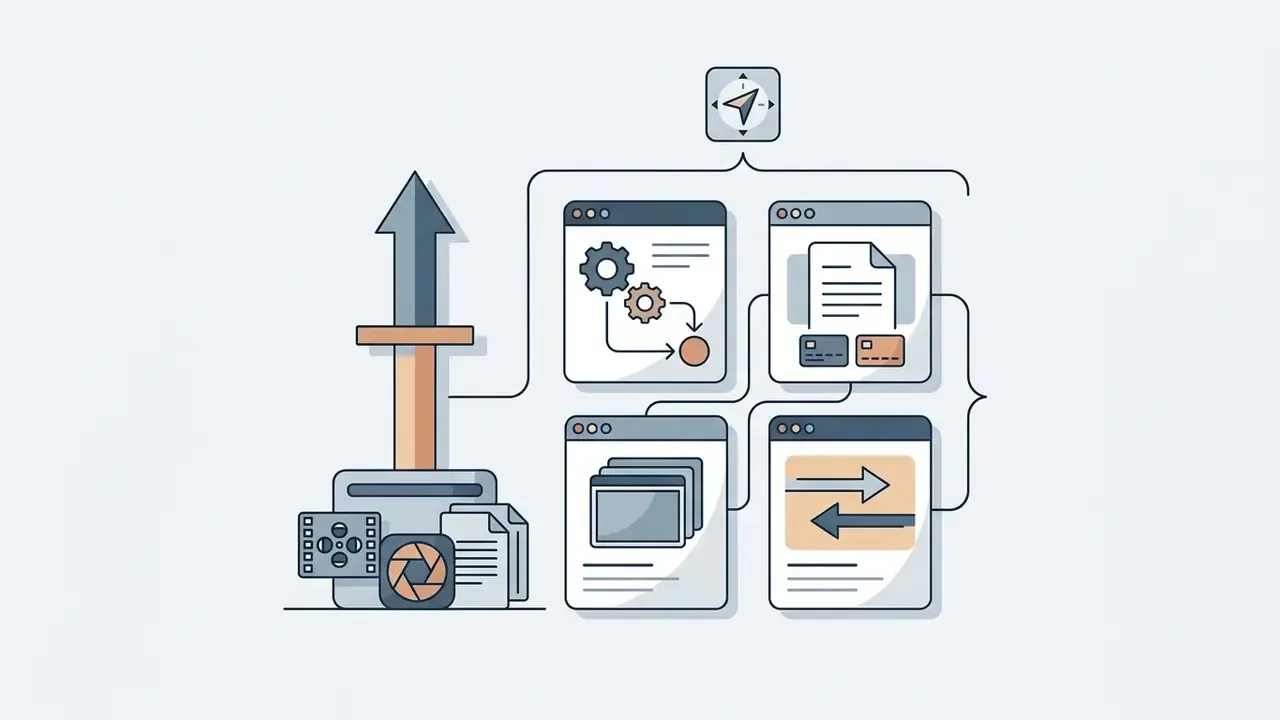
Quick Navigation by Budget Tier (2026)
Matching a wallet to a workflow is faster than reading fifteen pricing pages. The market self-organizes into four clear tiers.
Above these tiers sit enterprise agreements, where pricing shifts from list rates to negotiated per-second or per-minute commitments bundled with security attestations, data-retention guarantees and support SLAs. The section on enterprise security and governance premiums below breaks that delta down.

Why AI Video Generator Prices Cannot Be Compared by Monthly Subscription Alone
Comparing AI video platforms on monthly fees alone produces bad forecasts. Subscription tiers conceal effective output volume, model allocation and resolution limits. A $30 plan capped at 480p rendering delivers far less usable business value than a $30 plan allocating high-priority 1080p generation credits.
Underlying model compute governs the discrepancy. Research by Delavande et al. in Architectural Scaling Laws for Video Generation Energy (2026) shows that a single short diffusion-based clip consumes tens to hundreds of watt-hours.
«Video generation consumes roughly 30 times more energy than image generation and more than 2,000 times more than text processing.»
«Measured consumption ranges from 2.95 Wh for a 3-second clip to more than 3,300 Wh for a 23-second video on a large multi-GPU configuration.» — Delavande et al., Architectural Scaling Laws for Video Generation Energy (2026)
Three orders of magnitude between the cheapest and most expensive generation. That physical spread is exactly why vendors tier pricing by resolution and processing depth instead of selling flat "unlimited video":
A standardized monthly fee hides effective throughput. Organizations evaluating platforms should calculate cost per finished second at the resolution the business actually ships, then multiply by an iteration factor. The first generation is almost never the one that goes live.
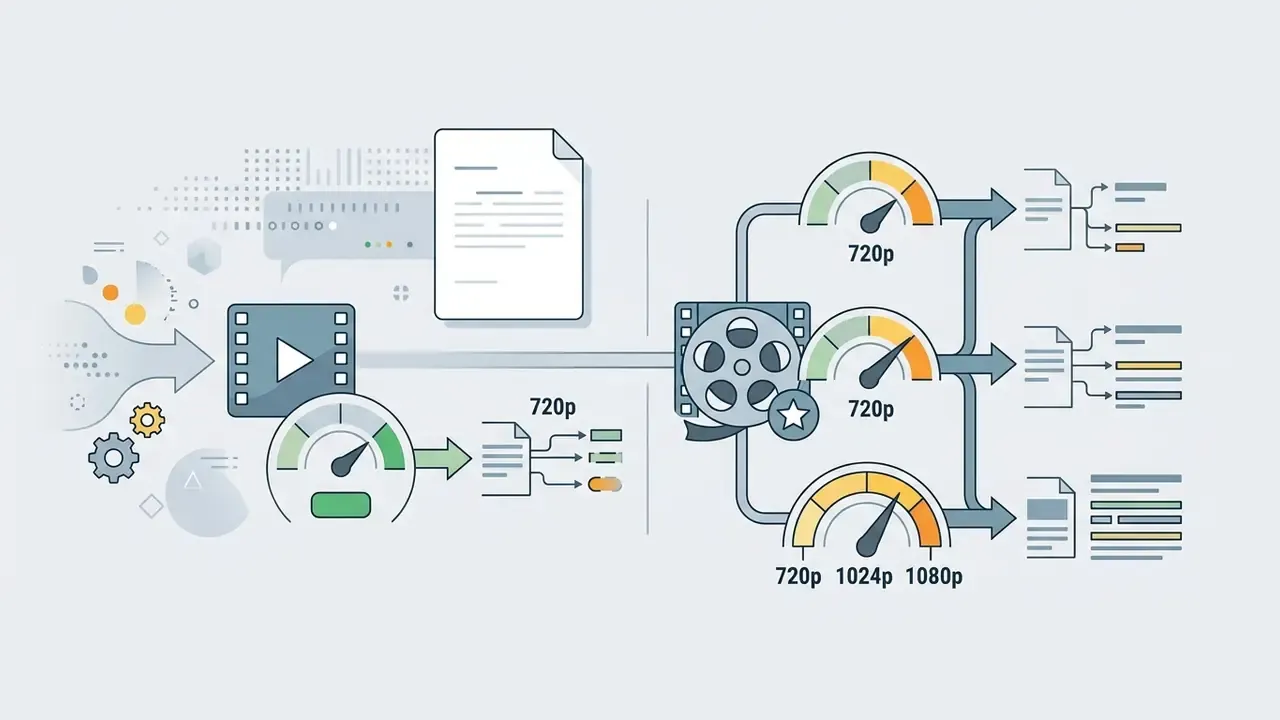
sora-2 costs $0.10 per second at 720p, while sora-2-pro ranges from $0.30 per second at 720p to $0.50 at 1024p and $0.70 per second at 1080p (OpenAI Developer Documentation, 2026, developers.openai.com/api/docs/pricing).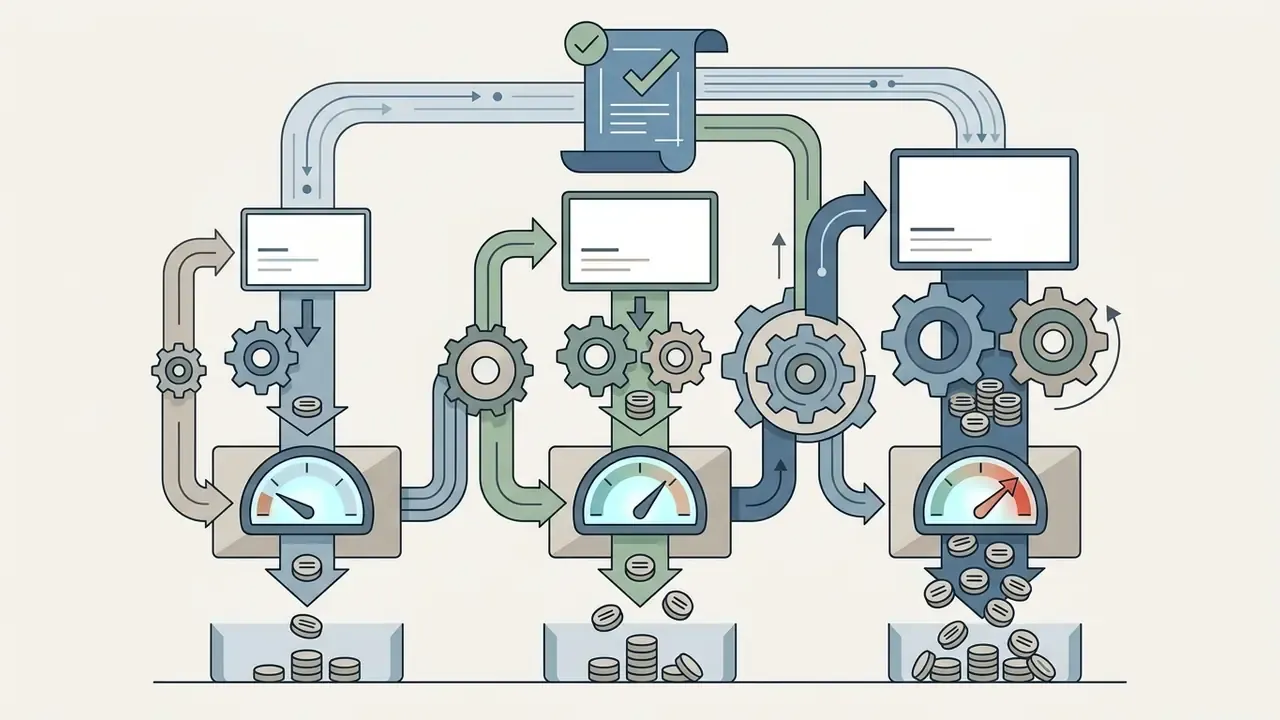
What AI Video Features Are Usually Included in the Price
Commercial platforms distribute features across tier thresholds to pull users from individual testing toward team deployment. Basic plans restrict you to standard models, watermarked exports and personal license terms. Paid tiers unlock commercial distribution rights and the heavier tooling.
Standard inclusions across paid tiers usually cover:
- Model catalog accessunrestricted selection of premium diffusion engines (Veo 3.1, Sora 2 Pro, Kling 3.0 Pro, Hailuo H3, Flux 3 Video), image-to-video modes, and reference-guided style transfer.
- Brand compliance toolscentralized brand kits, custom corporate fonts, predefined color palettes, and locked logo watermarks.
- Avatar and voice customizationcustom digital twin generation, expressive motion capture, and multi-language voice cloning.
- Operational queue prioritydedicated rendering clusters, bypass of public queue bottlenecks, and elevated API rate limits.
- Administrative governancerole-based access control (RBAC), centralized audit logging, single sign-on (SSO), and workspace asset sharing.
- Export flexibilitywatermark removal, 4K delivery, SCORM or LMS packaging for training content, and API-triggered batch export.
How AI Video Pricing Models Work: Subscription, Credits and API
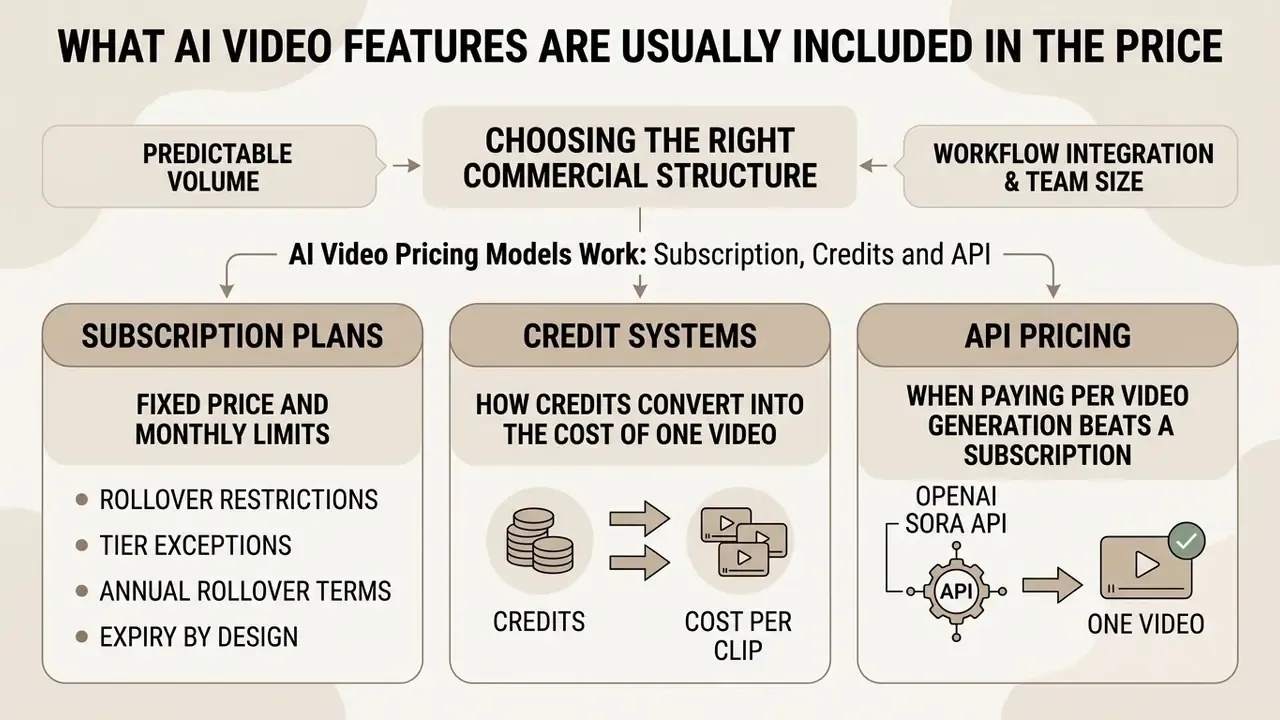
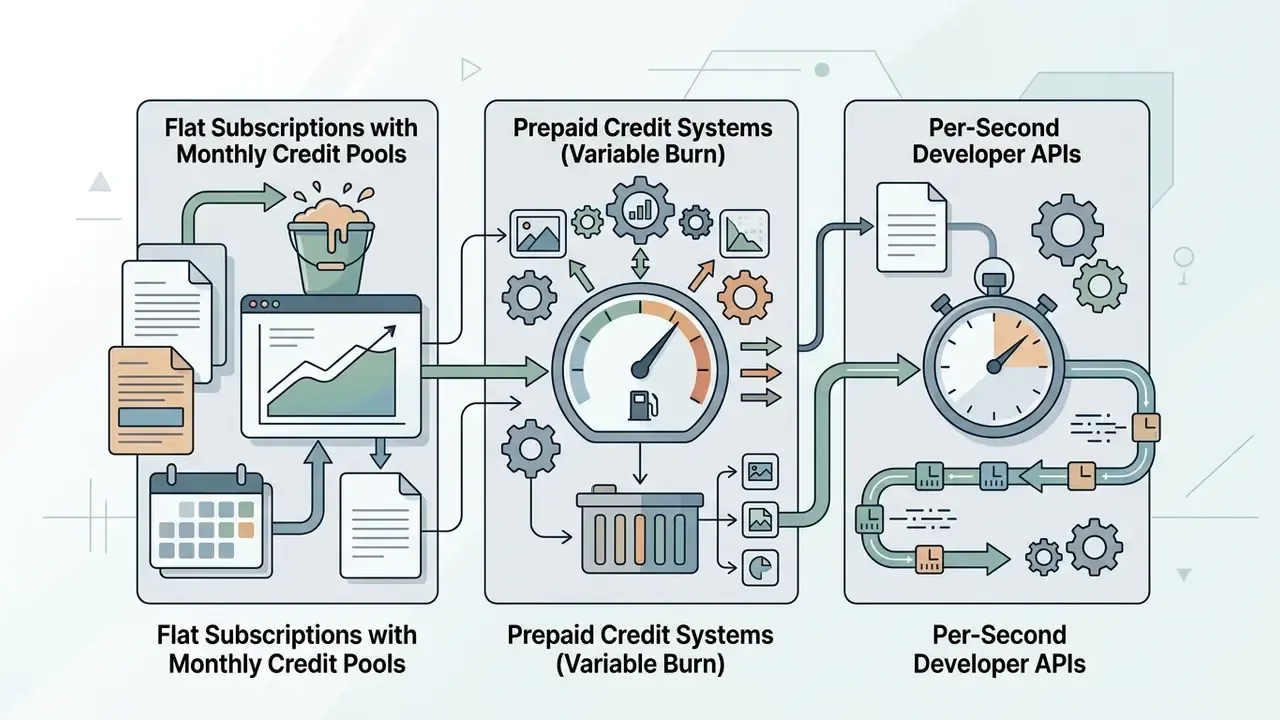
Choosing the right commercial structure depends on predictable volume, workflow integration and team size. Three billing mechanisms dominate: fixed monthly subscriptions, prepaid credit pools, and usage-based developer APIs. Readers new to the category can ground the terminology in our overview of AI video generators before mapping billing mechanics to their own volume.
Getting this right prevents paying for unused capacity and keeps operational scaling inside institutional budget limits. For plan-level detail, the comprehensive guide on AI Video Pricing and credits clarifies how credit systems map to monthly production volumes.
Subscription Plans: Fixed Price and Monthly Limits
Fixed subscription plans charge a recurring monthly or annual fee for platform access bundled with a quota of video minutes or generation credits. Entry tiers such as Synthesia Starter at $29/month or Runway Standard at $12/month on annual billing target individual creators. Higher tiers add seat licenses and workspace controls. Ecosystem bundles behave the same way: Google AI Pro at $19.99/month ships 1,000 monthly AI credits, and Google AI Ultra at $249.99/month ships 25,000.
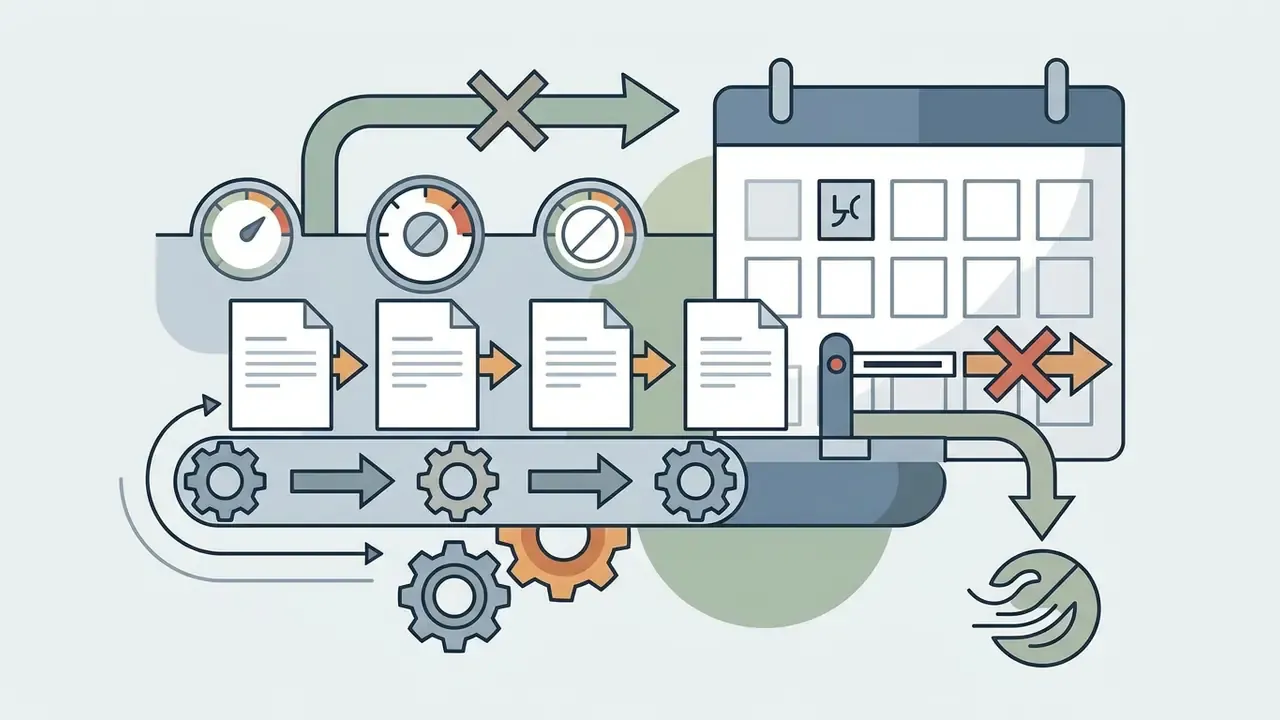
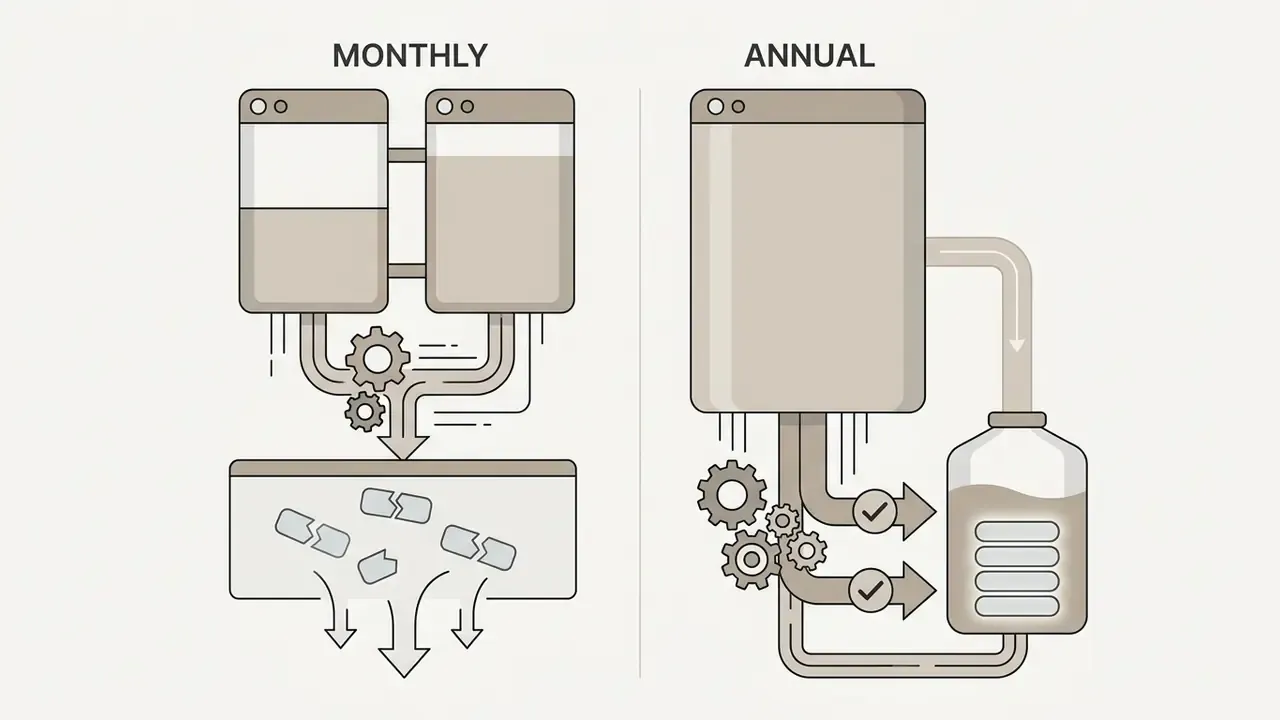
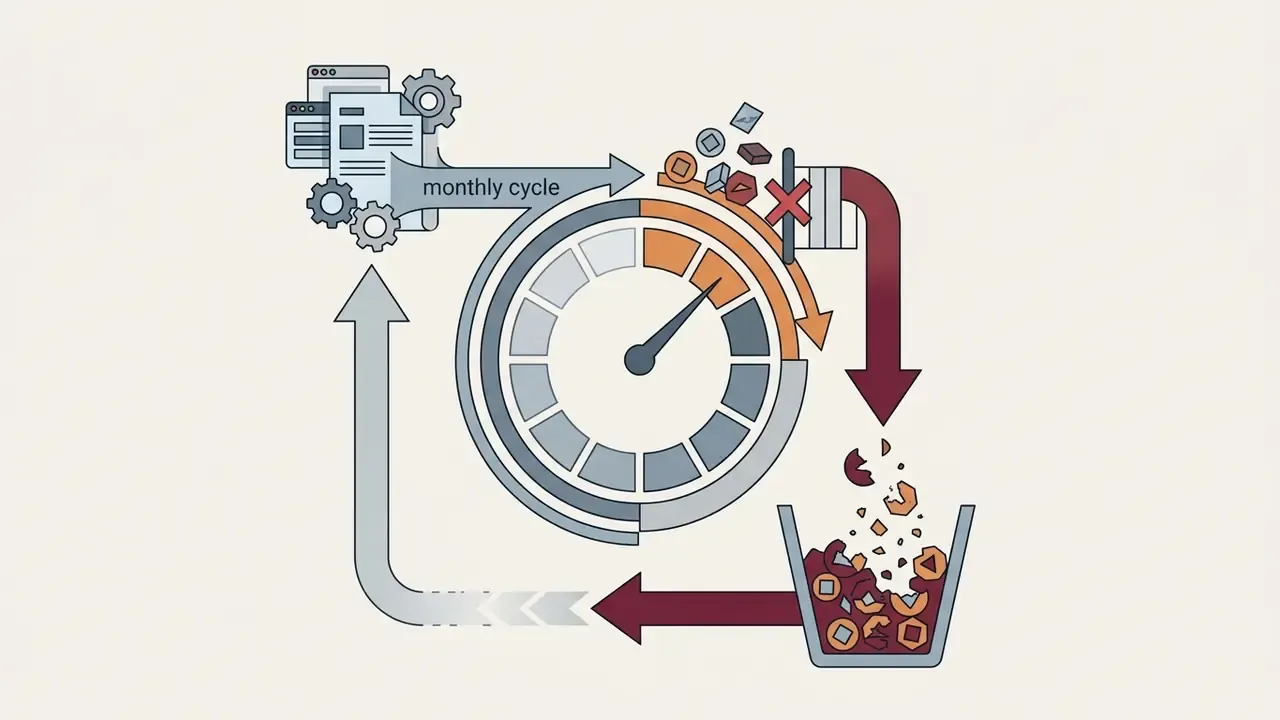
The governance question inside every subscription is what happens to unused capacity:
For finance teams the practical consequence is blunt: an annual plan's list price is not its effective price. Effective price equals the annual fee divided by minutes actually shipped. Organizations with seasonal campaign cycles routinely find a 30 to 50% gap between the two.

Credit Systems: How Credits Convert Into the Cost of One Video
Credit systems abstract compute complexity into internal platform tokens, deducting variable amounts based on duration, frame rate, resolution and the selected neural architecture. Working out the real cost per video means mapping burn rate to unit price per credit.
The standard calculation is:
Runway Gen-4 consumes 12 credits per second, while Gen-4 Turbo consumes 5 (Runway Help Center, 2026). At a standard unit price of $0.01 per credit:
- A 10-second Gen-4 Turbo video (50 credits) costs $0.50.
- A 10-second Gen-4 standard video (120 credits) costs $1.20.
Advanced models scale much harder. APIFrame vendor documentation (2026) lists Seedance 2.0 consumption at 8 credits/sec for 480p, 19 credits/sec for 720p, 43 credits/sec for 1080p, and 170 credits/sec for 4K. A 10-second clip in 4K requires 1,700 credits, or $17.00. Resolution, not duration, is usually the dominant cost multiplier.
On multi-model platforms where one credit pool covers many engines, per-clip burn rates as of Q3 2026 make the same point across vendors: Wan 2.2 at 30 credits, Seedance 2.0 Mini at 105, PixVerse v5.5 at 120, Hailuo 02 SD at 160, Grok Video at 180, Kling 2.1 Pro at 270, Luma Ray 2 at 300, Kling 3.0 Turbo Standard at 335 (720p), Kling 3.0 Turbo Pro at 420 (1080p), Flux 3 Video at 510, Kling 3.0 4K at 755, and MiniMax Hailuo H3 at 780 (2K). At an effective rate near $5 per 1,000 credits on mid-tier plans, falling toward $2.50 on higher tiers, the same "one clip" ranges from roughly $0.15 to $3.90.
Two governance notes follow. First, paying for a 1080p tier on content that will only ever be watched at 720p in a mobile feed is money spent on pixels nobody sees. Second, credit pools shared across image and video generation are structurally cheaper for iterative work, which is the foundation of the image-first drafting pattern described later in this guide.
API Pricing: When Paying per Video Generation Beats a Subscription
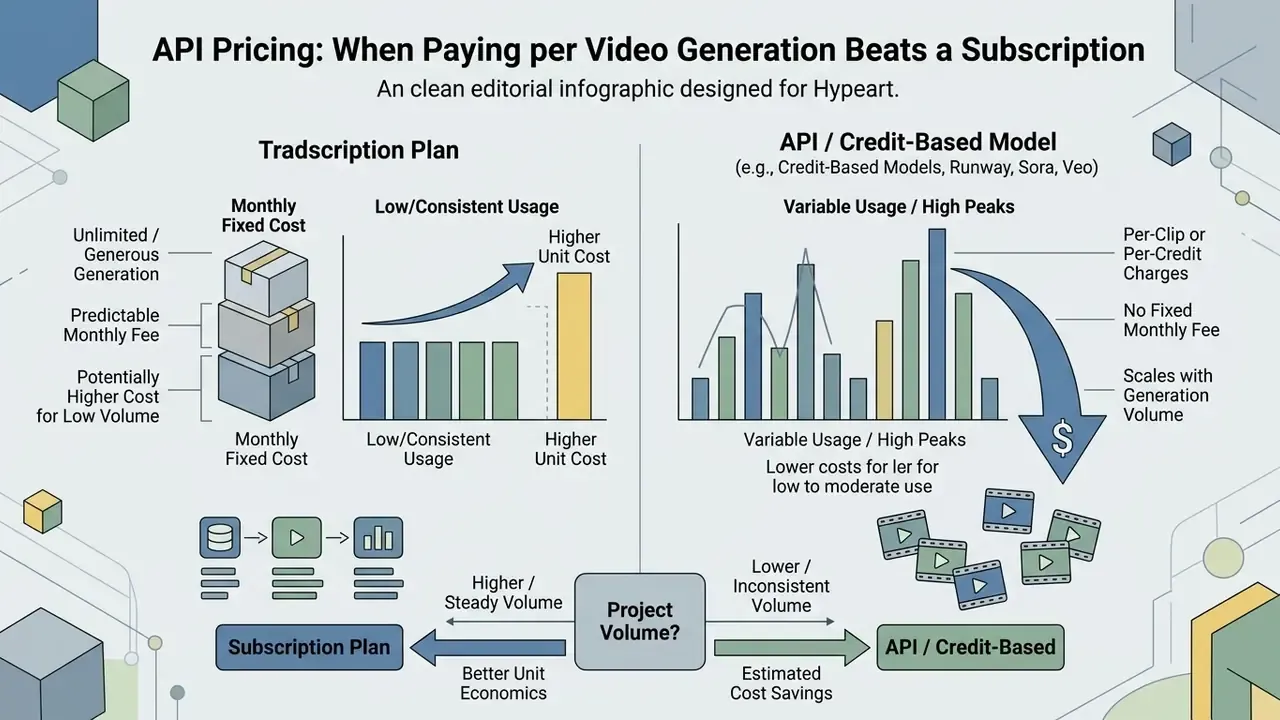
Pay-as-you-go API models charge per generated second or per processed token, with no base subscription overhead. Direct developer APIs win financially for programmatic applications, user-generated content processing, and sporadic schedules that produce under 60 seconds of video per month.
Published developer rates show the raw structure:
- OpenAI Sora API $0.10/sec for Sora 2 (720p); $0.30/sec for Sora 2 Pro (720p), $0.50/sec (1024p), and $0.70/sec (1080p) (OpenAI Developer Documentation, 2026).
- Google Gemini API (Veo 3.1) $0.05 to $0.08/sec for Veo 3.1 Lite; $0.10 to $0.30/sec for Fast; $0.40 to $0.60/sec for Standard video with synchronized audio (Google AI for Developers, 2026, ai.google.dev/gemini-api/docs/pricing). Google Cloud separately prices "video generation" at $0.20 per count against "video + audio generation" at $0.40 per count, which quantifies the audio premium neatly.
- FAL.ai (Wan 2.5 and Kling 2.5) Wan 2.5 at $0.05/sec; Kling 2.5 Turbo Pro at $0.07/sec; Veo 3 at $0.40/sec; some models billed flat per video (FAL.ai Pricing Documentation, 2026).
- xAI Grok Imagine Video 1.5 $0.08/sec at 480p and $0.14/sec at 720p, plus $0.01 per image input, so roughly $0.71 for a 5-second 720p clip.
- Creatify API $99/month for 500 credits (Starter) and $299/month for 2,000 credits (Pro), metered at 5 credits per 30 seconds. A clean example of hybrid seat-plus-meter billing.
Organizations wiring automated video creation into core product pipelines avoid idle seat licenses through metering, keeping compute expenditure aligned with actual end-user demand. Developer teams evaluating a specific stack can review the Google Veo API implementation guide for concrete limits, latency behavior and cost controls.
API rates also cannot fall arbitrarily, because the models carry heavy sunk costs:
«Training a commercial-grade video generation model costs between $200,000 and $2.5 million and requires 100,000 to 1.25 million GPU-hours.»
That capital expenditure, amortized across inference, is the floor under every per-second price sheet in this guide.
AI Video Pricing Comparison: Tools, Plans and Capabilities
| Tool / Platform | Starting Monthly Price | Pro / Business Tier | Commercial Rights Scope | API Availability | Primary Capabilities & Editing |
|---|---|---|---|---|---|
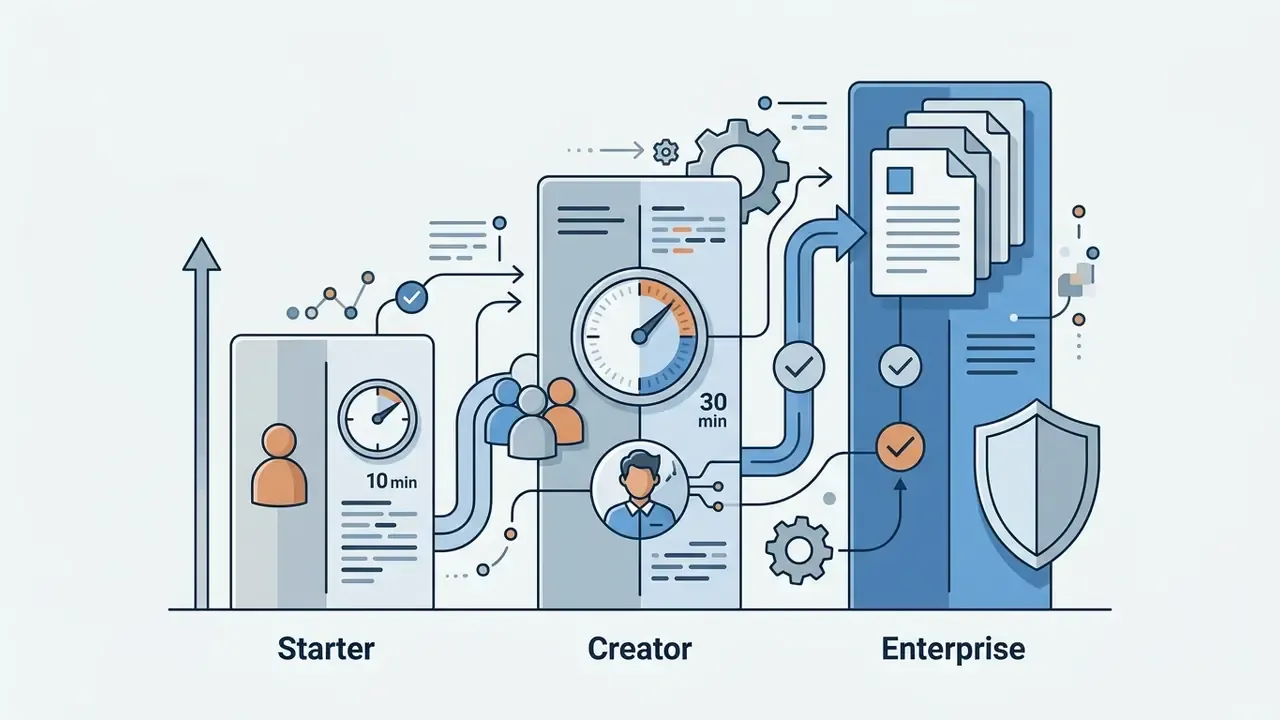
| Synthesia | $29 / mo (Starter, 10 min) | $89 / mo (Creator, 30 min); Enterprise custom | Full commercial rights on paid plans | Yes (Enterprise / developer docs) | AI avatars, 140+ languages, brand kits, interactive video, SCORM |
| HeyGen | $24–$29 / mo (Creator) | $149 / mo (Business) | Commercial rights on paid plans | Yes | Avatars, precision translation (about 10 credits per source minute), lip-sync |
| InVideo AI | $25 / mo (Plus, 50 min) | $60 / mo (Max, 200 min); Business tiers | Commercial license on paid plans | No public direct API | Script-to-video, automated voiceovers, stock footage assembly, 4K export |
| Runway | $12 / user / mo (Standard) | $28 (Pro), $76 (Unlimited), Enterprise | Commercial use restricted on Free; allowed on paid | Yes (credit-metered API) | Gen-4 / Gen-4.5 diffusion, motion brush, camera control, inpainting |
| OpenAI Sora 2 | API metered ($0.10/sec base) | $0.30–$0.70/sec (Pro tier) | Full API output commercial rights | Yes (OpenAI Developer API) | Complex prompt execution, physical world simulation |
| Google Veo 3.1 | API metered ($0.05/sec Lite) | $0.40–$0.60/sec (Standard); AI Ultra $249.99/mo | Commercial rights via Vertex AI terms | Yes (Google Cloud / Vertex AI) | Text/image-to-video, synchronized audio, 1080p and 4K |
| Kling 3.0 (Kuaishou) | $6.60 / mo annual ($10 monthly) | $37 (Pro), $92 (Premier) | Commercial licensing included on Pro tiers | Yes (via aggregators) | Turbo Standard 720p / Turbo Pro 1080p with audio, 4K tier, 5–15 sec |
| MiniMax Hailuo (02 Pro / H3) | $14.99 / mo (1,000 credits) | Credit packs and platform tiers | Commercial on paid tiers | Yes | Native 2K on H3, subject reference, camera direction |
| Luma Ray 2 | $6.99 / mo annual ($9.99 monthly) | $29 (Creator), $39 (Team) | Commercial on paid tiers | Yes | Physics-aware motion, keyframes, image-to-video |
| Pika | $8 / mo annual ($10 monthly) | $28 / mo (Pro) | Commercial on paid tiers | Limited | Stylized effects, short-form creative clips |
| PixVerse | $10 / month | Higher credit tiers | Commercial on paid tiers | Yes | Fast short-form generation, daily credit renewals |
| Flux 3 Video (Black Forest Labs) | Credit-metered (from 510 credits/clip) | Volume packs / API | Commercial per platform terms | Yes | Native audio, text/image/frame-to-frame, up to about 20 sec |
| Grok Imagine Video 1.5 (xAI) | 5 free credits/day; bundled with SuperGrok | $0.08–$0.14 / sec via API | Commercial per xAI terms | Yes | Fast iteration inside Grok/X, image inputs |
| Seedance 2.0 (FAL.ai / APIFrame) | $0.2419 / sec (Fast 720p) | $0.3034 / sec (Standard 720p) | Full API output commercial rights | Yes | Audio-synced clips, multi-shot storytelling, frame controls |
| ImagineArt (multi-model) | $9–$11 / mo (Basic) | $25 (Standard), $50 (Pro), $100 (Scale) | Commercial on paid tiers | Yes | 18+ video models plus image models on a shared credit pool |
| VEED / Pictory / Lumen5 | $12–$19 / month | $39–$149 / month | Commercial on paid tiers | Partial | Editor-led assembly, captions, script-to-video, repurposing |
Model-specific credit figures reflect published platform price lists as of Q3 2026. Re-verify before contracting, since catalogs update more often than any static comparison can track.
Fact Check and Pricing Verification (2026)
All platform pricing parameters, credit burn rates and licensing conditions in this guide reflect vendor terms published between January and August 2026. Official documentation reviewed includes:
- OpenAI Developer Documentation: Sora 2 API pricing schedules (developers.openai.com/api/docs/pricing).
- OpenAI Help Center: discontinuation of the Sora consumer web and app experiences on 26 April 2026 (help.openai.com).
- Google AI for Developers: Gemini API Veo 3.1 pricing documentation (ai.google.dev/gemini-api/docs/pricing).
- Google Cloud / Vertex AI: Veo 3.1 per-count pricing for video and video-plus-audio generation (cloud.google.com).
- Runway Help Center and Dev Docs: credit consumption rates, per-second and per-frame billing, rollover policies (help.runwayml.com).
- Synthesia Official Terms: customer service terms, plan limitations, non-refundable fee clauses (synthesia.io).
- FAL.ai and APIFrame Documentation: per-second and per-video model rates.
- U.S. Copyright Office: guidance on AI-generated content rights and digital replicas (copyright.gov).
Third-party credit tables for newer models (Kling 3.0 tiers, MiniMax Hailuo H3, Flux 3 Video, Happy Horse, Grok Imagine 1.5) are labeled as Q3 2026 platform price-list data and flagged for re-verification, because those entries come from aggregator catalogs rather than first-party pricing pages.
Tools for Generative Video: Runway, Sora, Veo and Credit-Based Models
Generative diffusion systems turn text prompts, reference images or source clips into synthesized visual output. Pricing tracks computational depth and output resolution almost linearly.
- Runway: Standard ($12/mo), Pro ($28/mo) and Unlimited ($76/mo). Standard includes 625 monthly credits; Pro and Unlimited allocate 2,250. Gen-4 video consumes 12 credits per second, so a 5-second clip costs 60 credits (about $0.60 in effective value); a 10-second 1080p Gen-4 clip normalizes to $1.20.
- OpenAI Sora 2: Access now runs through developer API endpoints, following the discontinuation of consumer web and app interfaces on 26 April 2026. Pricing scales strictly by resolution: $0.10/sec for 720p
sora-2up to $0.70/sec for 1080psora-2-pro. A single finished 10-second hero shot therefore ranges from $1.00 to $7.00 before iteration.«If 4 million users generate two 8-second videos per day for six months, total energy consumption reaches 453.8–769.5 GWh.» — Delavande et al., Architectural Scaling Laws for Video Generation Energy (2026)
That arithmetic is the clearest available explanation for why consumer-facing unlimited video products were withdrawn in favor of metered API access. The marginal cost of a viral video feed is measured in gigawatt-hours, not pennies.
- Google Veo 3.1: Integrated into Vertex AI and the Gemini API. Veo 3.1 Standard charges roughly $0.40 per count for 720p and 1080p generation with synchronized audio, scaling to $0.60 per count for 4K. Veo 3.1 Lite lands at $0.05 to $0.08 per second for draft-grade passes. Consumer access arrives through Google AI Pro ($19.99/month, about 1,000 credits) and Google AI Ultra ($249.99/month, 25,000 credits), where Flow credit examples map to roughly 100 Lite, 50 Fast, or 10 Quality videos per month on the Pro tier.
Illustrative governance scenario (hypothetical, not a verified client case). Picture a large commercial bank evaluating generative video models for marketing assets across digital channels. In the scenario, the institution starts with unmonitored testing across several tools and picks up unexpected credit overages driven by shadow usage. By centralizing model access behind controlled API calls, enforcing per-team credit caps, and standardizing on 720p for review passes before committing to 1080p final renders, the modeled per-clip compute spend falls by roughly 58% while a complete audit trail survives. This is a structured hypothesis for governance design, not a documented customer outcome. Treat the percentage as an illustrative modeling result, not a benchmark.
Budget and Professional Alternatives: Kling, Hailuo, Flux, Luma and Grok
Frontier models absorb most of the attention. Most production volume in 2026, though, runs on mid-priced engines that deliver 1080p with native audio at a fraction of frontier cost.
The procurement implication is worth stating plainly. A single multi-model subscription with a shared credit pool frequently beats three single-model subscriptions on effective cost, because iteration and model-switching happen inside one budget rather than across three renewal dates.
Budget and Professional Alternatives: Kling, Hailuo, Flux, Luma and Grok
Kling 3.0 Turbo (Kuaishou): Entry plans from $10/month ($6.60 with annual billing), scaling to Pro at $37/month (about 3,000 credits, roughly 50 videos at 1080p) and Premier at $92/month (about 8,000 credits). Turbo Standard consumes 335 credits at 720p; Turbo Pro consumes 420 at 1080p; the dedicated 4K tier consumes 755. Both Turbo tiers support 5 to 15 second clips with synchronized audio, and the only difference between them is resolution. That detail matters for teams publishing into feeds that downscale anyway.
MiniMax Hailuo H3: The frontier tier of the Hailuo family, consuming roughly 780 credits (about $2.34 on mid-tier credit plans as of Q3 2026). In many catalogs it is the only model generating natively at 2K with subject-reference and camera-direction controls. Hailuo 02 Pro sits lower at about 290 credits for 1080p, and Hailuo 02 SD at about 160.
Flux 3 Video (Black Forest Labs): A multimodal model producing video with native audio, supporting text-to-video, image-to-video and frame-to-frame generation, with clips up to roughly 20 seconds. Consumption starts near 510 credits per clip, which positions it as premium but flexible for longer single-shot narratives.
Luma Ray 2: Physics-aware generation with plans from $6.99 to $9.99/month and team tiers at $29 to $39/month. Clip consumption of roughly 300 credits at 540p to 720p makes it one of the cheapest routes to plausible object motion for product visuals.
Grok Imagine Video 1.5 (xAI): Available through consumer bundles with five free daily credits, or via developer API at $0.08/second (480p) and $0.14/second (720p), plus $0.01 per image input. A 5-second 720p clip through the raw API costs about $0.71.
Additional catalog entries worth budgeting for: Wan 2.2 (about 30 credits, 720p), Seedance 2.0 Mini (about 105), PixVerse v5.5 (about 120), LTX 2.3 (about 215, up to 2160p with audio), Google Omni Flash (about 235), Happy Horse by Alibaba (about 252, fluid lifelike motion), Seedance 1.0 Pro (about 370), and Kling 2.1 Pro (about 270).
Platforms for Avatar and Marketing Videos: Synthesia, HeyGen, InVideo and Templates
Avatar and template-driven platforms optimize for operational scale, not cinematic ambition.
«Fifty product video ads were produced for $187 in platform credits ($3.02 per video) versus traditional agency estimates of $15,000 ($3,000 per video).»
These platforms let teams produce presentation videos, training modules and social ads without camera hardware or studio lighting. Where a still-frame source beats pure text prompting, our guide to image-to-video AI tools explains how reference-driven generation changes both quality control and credit burn.
AI Video Generation vs Traditional Video Production Cost
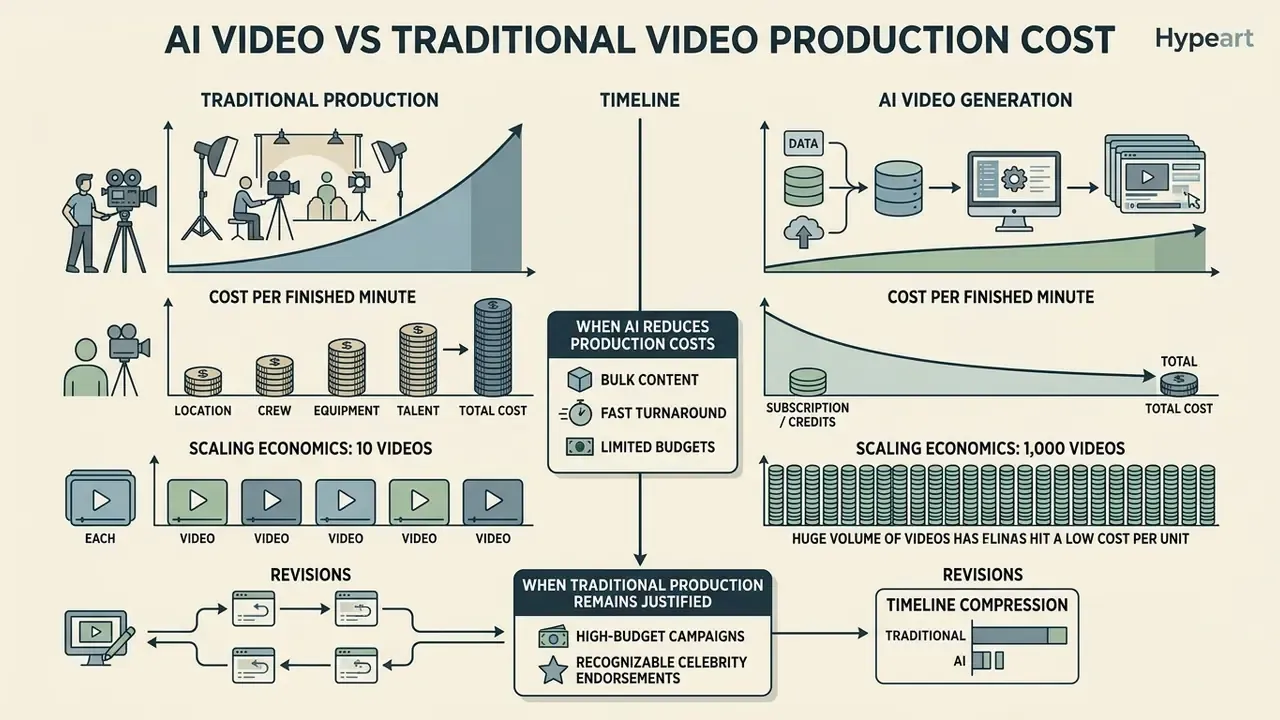
Moving from physical shoots to AI workflows rewrites production economics. For short-form social content, internal communications and localized ad variations, AI video production reduces direct spend by 50 to 96% while compressing timelines by three to ten times, typically delivering in one to two days versus two to four weeks for a comparable 1 to 2 minute video.
Traditional film production still earns its budget for flagship brand commercials, complex physical stunts, and high-budget cinematic work where human emotional nuance and physical spatial consistency are non-negotiable. Even AI-first pipelines lean on conventional post-production craft, so keep video editing tools and delivery utilities such as a video compressor budgeted alongside generation credits.
Cost per Finished Minute by Production Method
| Production method | Cost per finished minute | Typical turnaround |
|---|---|---|
| AI video generation (self-serve tools) | $0.50 – $30 | Hours to 2 days |
| Freelance video production | $1,000 – $5,000 | 1–3 weeks |
| Small agency production | $5,000 – $15,000 | 3–6 weeks |
| Full agency production | $15,000 – $50,000+ | 5–11 weeks |
The structural difference is the absence of a cost floor. A freelance shoot carries a minimum spend no matter how short the deliverable: crew call times, equipment rental days, location permits. AI generation carries no such floor, which is why the savings percentage climbs as the deliverable gets shorter and more numerous.
When AI Video Reduces Production Costs
AI workflows save the most in high-volume, repetitive or rapidly localized media tasks. Traditional commercial shoots demand equipment, locations, crews, actors and catering, all of which set a high fixed floor regardless of runtime.
Scenarios where AI video hits optimal cost efficiency:
- Social media scaling (SMM): producing 30 to 50 localized promo variations in a single afternoon. Case study data from AIContentDrop (2026) showed 50 product video ads created for $187 in platform credits ($3.02 per video) against traditional agency estimates of $15,000 ($3,000 per video).
«AI-generated video ads delivered an average 2.1% CTR, reduced CPA by 22%, and lifted ROAS from 3.1× to 4.2× versus static images.» — AIContentDrop, e-commerce video advertising case study (2026)
- Corporate training and onboarding: retailers such as Five Below used Synthesia to build localized store training videos at scale.
«Five Below produced more than 100 training videos in a year for $40,000, cutting per-video cost from $12,000 in traditional production to $400.» — Synthesia, Five Below customer case study (2026)
- Multilingual content localization: re-dubbing existing assets with AI voice cloning and synchronized lip-sync cuts localization timelines from four weeks to under two hours. For teams building the audio layer separately, our guide to AI voice generators covers language coverage and licensing terms.
- Agency throughput transformation:
«Monthly video output rose from 8 to 85 pieces and annual revenue grew from €180,000 to €792,000, with the AI investment repaid in four months.» — MindStudio, marketing agency case study (2026)
- Supplementary and internal formats: industry playbooks recommend starting with social cutdowns, internal concept videos and background elements, with a test budget of roughly 15 to 20 staff hours plus $100 to $200 in subscriptions before any pipeline commitment.
Scale Economics: 10 Videos vs 1,000 Videos, and the Cost of Revisions
Unit economics invert as volume rises. Traditional production scales linearly with crew days; AI pipelines scale with parallel compute.
| Production scale | Traditional production | AI pipeline (incl. labor) | Effective saving |
|---|---|---|---|
| 10 videos (small campaign) | $10,000 – $50,000 | $500 – $2,000 | ~90–96% |
| 100 personalized variants | $150,000 – $300,000 | Subscription + minimal personalization fees | ~90%+ |
| 1,000 localized videos | $1,000,000 – $5,000,000 | $50,000 – $200,000 | up to ~96% |
Two further metrics matter more to art directors and campaign owners than headline unit cost.
- Revision economics. Reshoots in traditional production consume 50 to 80% of the original project budget, with editors billing $75 to $150 per hour. Adjusting an AI project, whether by revising a prompt, changing a seed or swapping an avatar script, costs roughly 5 to 10% of the original spend. Pure text changes are frequently included in the subscription.
- Timeline compression. A single video moves from two to four weeks down to one to two days. Ten variations move from six to eight weeks to two to three days. Fifty market localizations move from three to four months to three to five days. Call it an 80% reduction in production timeline, which converts directly into faster campaign iteration.
Indirect cost predictability differs too. Traditional shoots overrun budgets by 10 to 20% through location permits ($100 to $1,000/day), specialized equipment rentals ($500 to $2,000/day), music licensing ($50 to $1,000/track), and post-production revisions (10 to 30% of budget). AI platform extras, meaning subscriptions ($50 to $500+/month), API integration ($0.01 to $0.10 per request) and storage ($0.02 to $0.05 per GB monthly), are smaller and far more forecastable. The notable exception is custom model development at $10,000 to $100,000+.
When Traditional Production Remains Justified
Live-action stays cost-justified when visual authenticity, complex actor interaction and exact brand asset representation are mandatory. Generative models still struggle with intricate physical object handling, multi-character spatial interaction, and absolute prompt repeatability across extended scenes.
Traditional production remains the safer choice for:
- High-budget brand campaignsflagship national television spots, where visual artifacts, facial distortion or temporal flickering damage brand equity. Film budget structures allocate 20 to 60% to production, 10 to 20% to post-production and 10 to 20% to development. Those blocks exist precisely because this level of control is required.
- Recognizable celebrity endorsementshigh-profile talent campaigns where digital replica rights, publicity rights and contract guarantees push you toward live-action shooting. The U.S. Copyright Office's guidance on digital replicas recommends licensing such rights with guardrails rather than assigning them outright, which adds legal cost to any synthetic alternative.
- Complex physical stunts and on-location shootsdocumentary work, real estate showcases and sports broadcasting that depend on authentic environments and formal above-the-line and below-the-line budget control.
- Sustained emotional narrativewhere nuanced performance carries the message, manual production still leads. Roughly 37% of brands consequently run a hybrid model, using AI for routine and variant content and live-action for flagship assets.
What Drives the Real Cost of AI Video Production
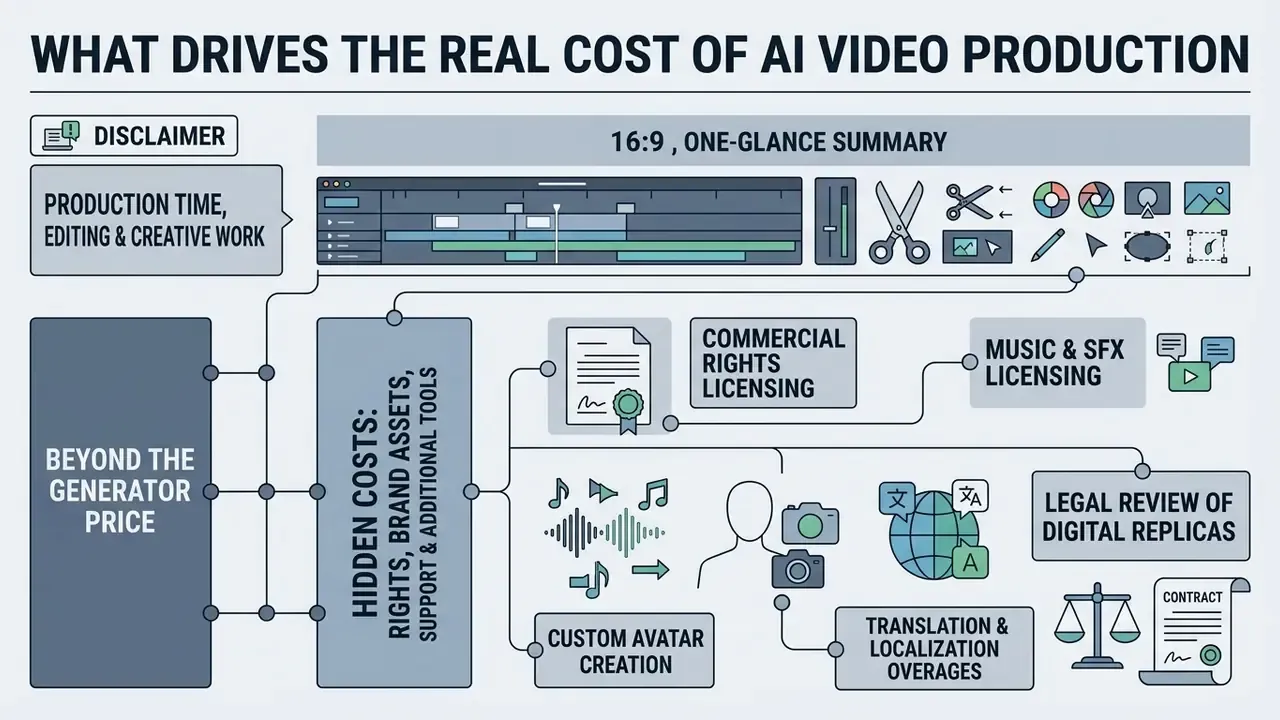
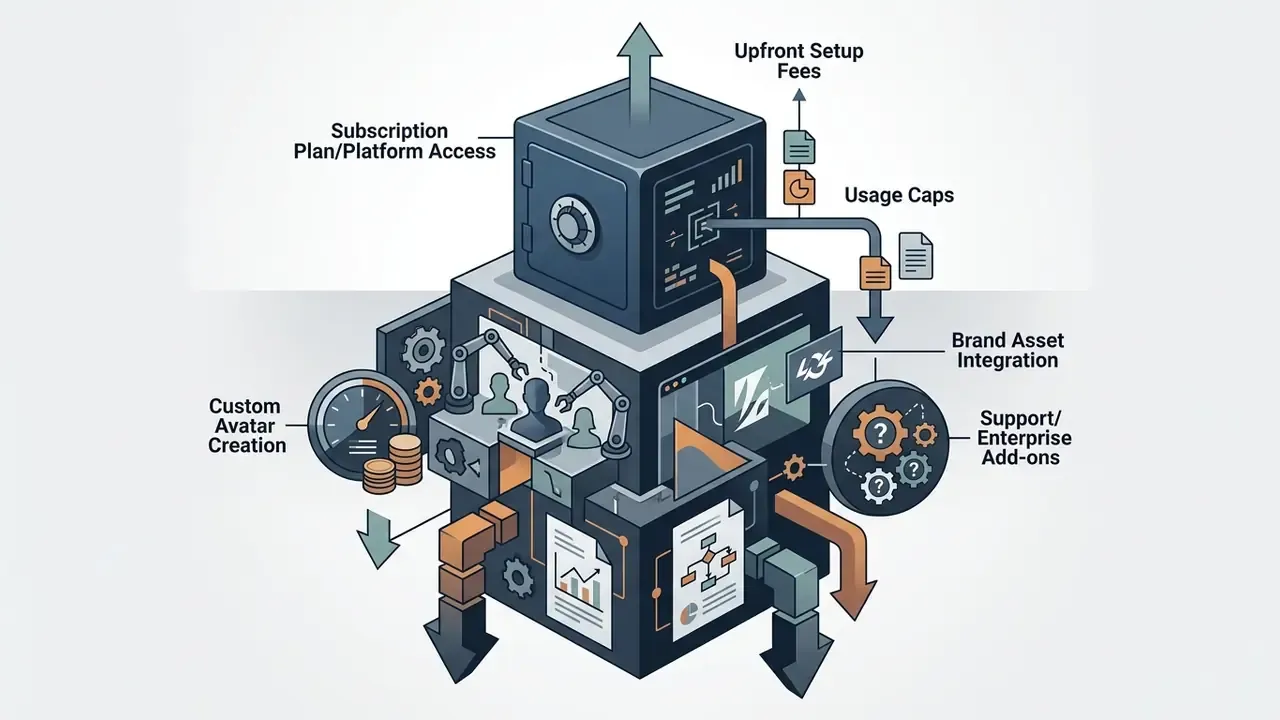
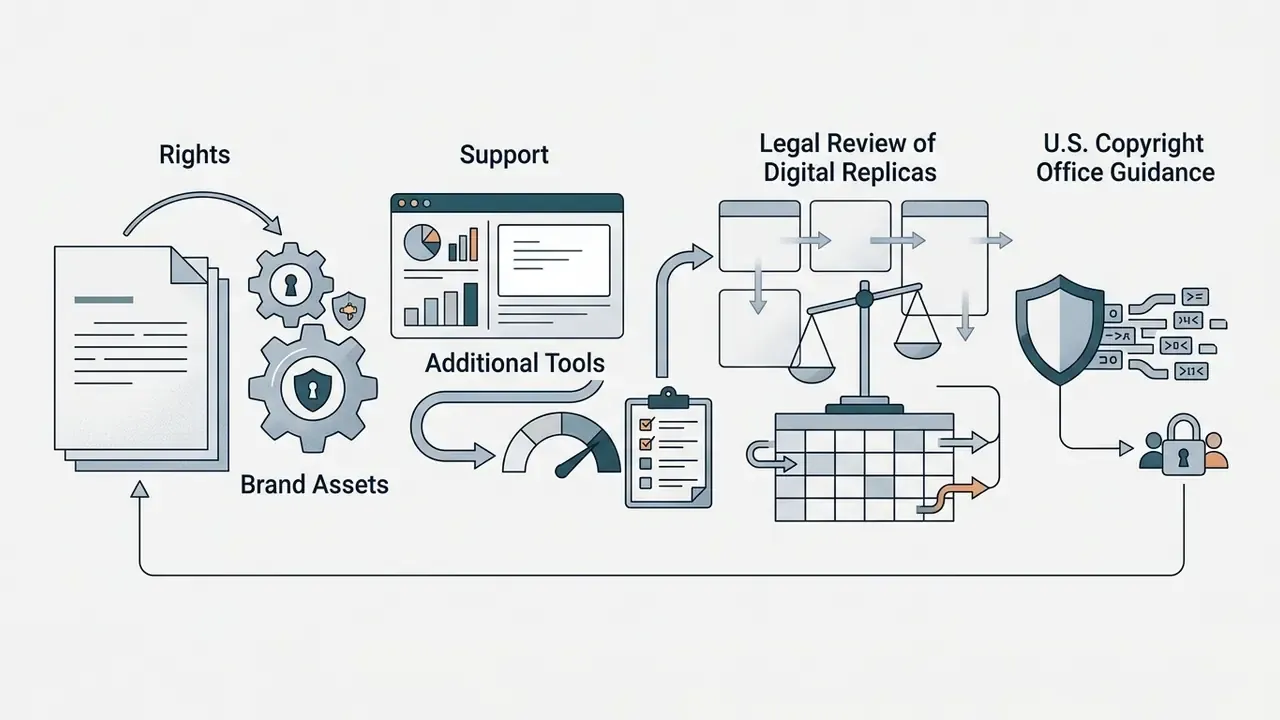
Looking only at software license cost understates the budget. Fully loaded AI video production absorbs human labor, prompt iteration, post-production editing, custom asset creation and legal clearance.
A standard 60-second commercial AI video requires non-subscription labor of roughly 2.5 hours across storyboarding, prompt generation, shot selection, audio layering and final editing. That figure comes from published 2026 professional-workflow breakdowns rather than a single audited benchmark, so treat it as a planning baseline. An independent 2026 cost-and-time analysis reports two to four hours on prompts and iteration plus 1.5 to 2 hours of total handling for a 15-second clip, which tells you effort per finished minute swings sharply with shot complexity and iteration count.
Published 2026 production analyses place total direct cost for a professional 30-second AI commercial spot between $1,000 and $5,000. Complex studio projects with custom digital replicas and post-production polish reach $4,000 to $18,000. One documented bottom-up calculation prices a single finished 60-second deliverable at $229.80 once compute, assets, voiceover, music licensing, editing labor, overhead and a revision buffer are included. A useful reminder: fully loaded cost sits an order of magnitude above raw generation cost, yet still far below agency rates. These ranges reflect vendor and practitioner estimates rather than a standardized industry survey. Model your own figures using the calculator methodology below.
Production Time, Editing and Creative Work Beyond the Generator Price
Generative tools cut shooting time and shift effort toward prompt engineering, clip filtering and post-production assembly.
«After adopting AI tooling, the agency compressed video production from 18–22 days to 1–2 days and cut cost per video from $5,200 to $720.»
Producing a refined 15-second marketing clip often means generating 20 to 30 raw 5-second variants, of which only five to seven pass quality control into the final timeline. Planning heuristics published in 2026 suggest budgeting 12 to 15 shots per finished minute, at 3 to 5 seconds per shot, with an iteration factor of three, five or eight depending on how tightly the brief constrains composition.
Labor allocation for a professional 60-second AI video breaks down roughly like this:
| Workflow stage | Time allocation | Typical output |
|---|---|---|
| Storyboarding & concepting | 30 minutes | Shot list, 12–15 shot briefs |
| Prompt generation & iteration | 60 minutes | 20–40 generations, 3–5 variants per shot |
| Assembly & timeline editing | 30 minutes | Selected 5–7 clips cut to rhythm |
| Audio synthesis & dubbing | 20 minutes | Voiceover, SFX, music bed |
| Color grading & export | 10 minutes | Delivery masters per platform |
At standard internal labor rates of $75 to $150 per hour, technical staff effort adds $180 to $375 in labor expense per completed video minute. That routinely exceeds raw software generation cost by a factor of two to ten. It is the single most under-modeled line in first-year AI video budgets.



AI Video Pricing Calculator: Estimate Your Monthly Cost and Choose a Plan
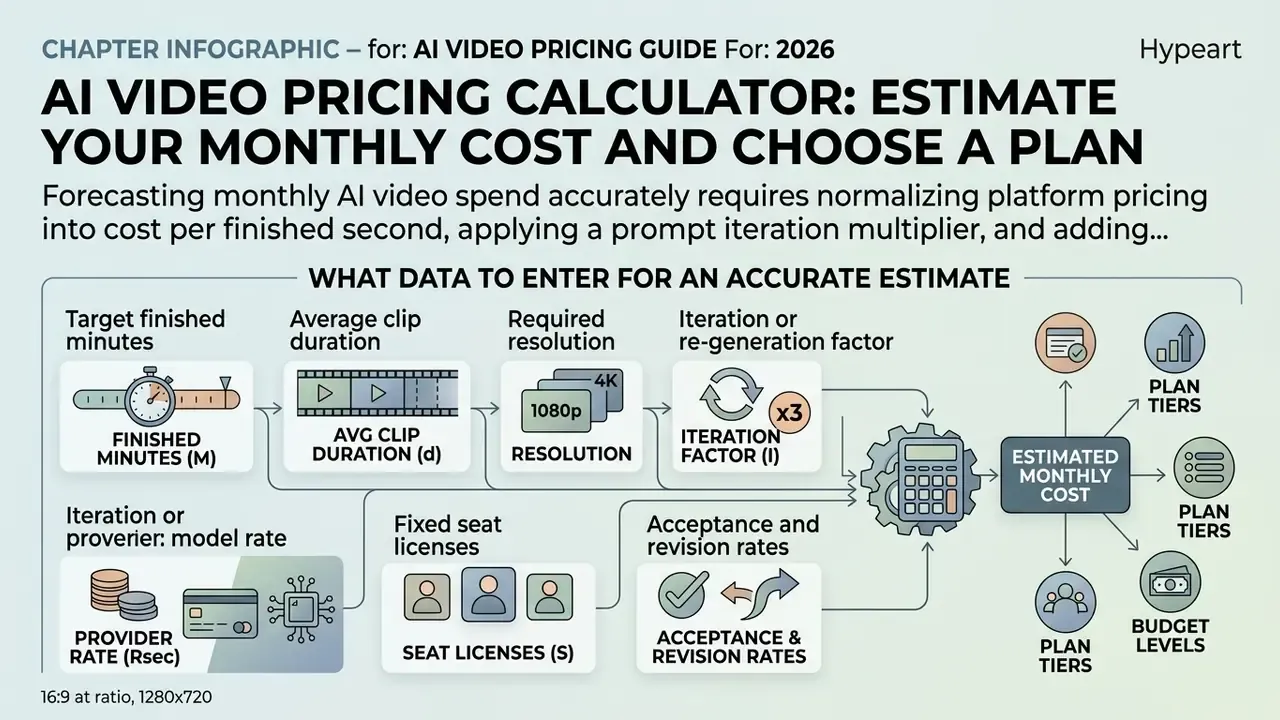
Forecasting monthly AI video spend accurately requires normalizing platform pricing into cost per finished second, applying a prompt iteration multiplier, and adding post-production overhead. To support internal budgeting and plan selection, teams can use the interactive AI Video Credit calculator to estimate credit requirements for specific resolution and duration parameters.
What Data to Enter for an Accurate Estimate
Feed these operational variables into your cost model:
- Target monthly finished minutes (): total duration of finalized, approved video required per month.
- Average clip duration (): standard length per generated shot, typically 3 to 10 seconds. Budget 12 to 15 shots per finished minute.
- Required resolution: 720p (standard), 1080p (HD multiplier about 1.5x), or 4K (Ultra HD multiplier about 2.0x to 4.0x).
- Iteration or re-generation factor (): average number of trial generations per approved clip. Baseline is 3x to 5x; complex briefs run to 8x.
- Provider model rate (): underlying model cost per second, for example $0.10/sec for Sora 2, $0.05/sec for Veo Lite, $0.40/sec for Veo Standard with audio.
- Fixed seat licenses (): monthly seat fees for workspace editors, plus enterprise security uplift where applicable.
- Acceptance and revision rates: approval rate per generated clip and post-delivery revision rate. Together they determine cost per approved video rather than cost per generation.
- Rights and audio layer: music sync licenses, voice cloning fees, translation credits per source minute.
The core operational cost formula:
Producing 5 finished minutes (300 seconds) of 1080p video with a $0.10/sec model, a 4x iteration factor and a 1.5x HD multiplier gives:
Add labor at $180 to $375 per finished minute, so $900 to $1,875 for five minutes, and the fully loaded figure lands near $1,080 to $2,055. Compute is the minority of spend at professional quality standards. Because vendor rates are versioned and time-bound, Google's Gemini API pricing page has carried rate updates valid through specific end dates, always store the rate with its effective date inside the model.
Cost-Saving Strategy: The Image-First Drafting Pattern
The highest-leverage optimization in AI video budgeting is not a discount code. It is refusing to spend video credits on composition experiments.
Animating a text prompt directly wastes 120 to 780 video credits on every failed iteration. The efficient workflow inverts the order:
- Draft the shot as a still image. Generate the exact frame with an image model, for example Flux 2 Pro (about 28 credits, roughly $0.14), Seedream v5 Lite (about 20 credits, roughly $0.10), Z Image Turbo (about 5 credits, roughly $0.03) or Nano Banana 2 (about 49 credits at 1K, roughly $0.25).
- Iterate on the still until composition, lighting, wardrobe, product detail and character likeness are right. Failed attempts now cost image prices, not video prices. On frontier models that is a 20-to-1 cost difference.
- Animate only the winner. Feed the approved frame into an image-to-video model (Runway Gen-4, Kling 3.0 Turbo, Luma Ray 2, Flux 3 Video frame-to-frame), spending video credits exactly once per shot.
Result: a 65 to 80% reduction in financial loss from rejected or unusable video generations. This pattern is also the structural argument for multi-model platforms with a shared image-and-video credit pool. Separate subscriptions force you to pay twice for the same iteration loop, once to draft and once to animate.
A secondary variant applies at the resolution layer. Run every review pass at 480p or 720p, and commit to 1080p or 4K only for the approved final render. Given Seedance-class pricing of 19 credits/sec at 720p against 170 credits/sec at 4K, five rounds of review at draft resolution cost less than one premature 4K render.
How to Interpret the Result and Choose an AI Video Plan
Test the calculated output against a handful of threshold rules to decide between pay-as-you-go APIs and tiered subscriptions. Rank options by total cost of supply, not headline fee, then check the shortlist against sustainability and affordability. That is the same sequence public-sector tariff methodologies use when selecting a rate structure.
- Output under 60 seconds per month: developer APIs such as Google Veo Lite or FAL.ai are the lowest-cost option. Direct usage stays under $10 monthly, with no fixed commitment.
- Output 60 to 180 seconds per month: a genuine gray zone, where API spend and entry subscriptions (Runway Standard at $12/mo, Kling Standard at $10/mo, Synthesia Starter at $29/mo) converge. Decide on workflow tools, templates and workspace editing controls rather than a few dollars of difference.
- Output 180 seconds to 20 minutes per month: mid-tier subscriptions dominate. Kling Pro ($37/mo, roughly 50 1080p videos) and ImagineArt Standard ($25/mo, multi-model shared credits) deliver the strongest credit-to-dollar ratios in this band.
- Output above 20 minutes per month: business plans or negotiated enterprise agreements produce real per-second savings through bulk credit discounts and dedicated rendering pools. At this volume, model cost per approved video rather than cost per generation, because acceptance rate drives the invoice more than list price does.
- Any regulated deployment: add the compliance premium before comparing tiers. A cheaper plan that cannot supply audit logs or a no-training commitment is not a valid option, whatever its unit cost.
FAQ: AI Video Pricing, Free Access and Commercial Use
How much does a single AI video actually cost?
Normalized to a finished 10-second 1080p clip: roughly $0.12 to $0.50 on template and assembly platforms, $0.36 to $1.40 on budget generative models (PixVerse, Luma Ray 2, Kling Turbo Standard, Grok Imagine), $1.20 to $2.40 on mid-tier professional models (Runway Gen-4, Kling 3.0 Turbo Pro, MiniMax Hailuo H3), and $3.00 to $7.00 on frontier cinematic models (Sora 2 Pro, Veo 3.1 Standard with audio, Seedance 2.0). Multiply by your iteration factor of 3x to 8x for realistic per-shipped-clip cost, then add labor.
Can free AI video generators be used for commercial videos?
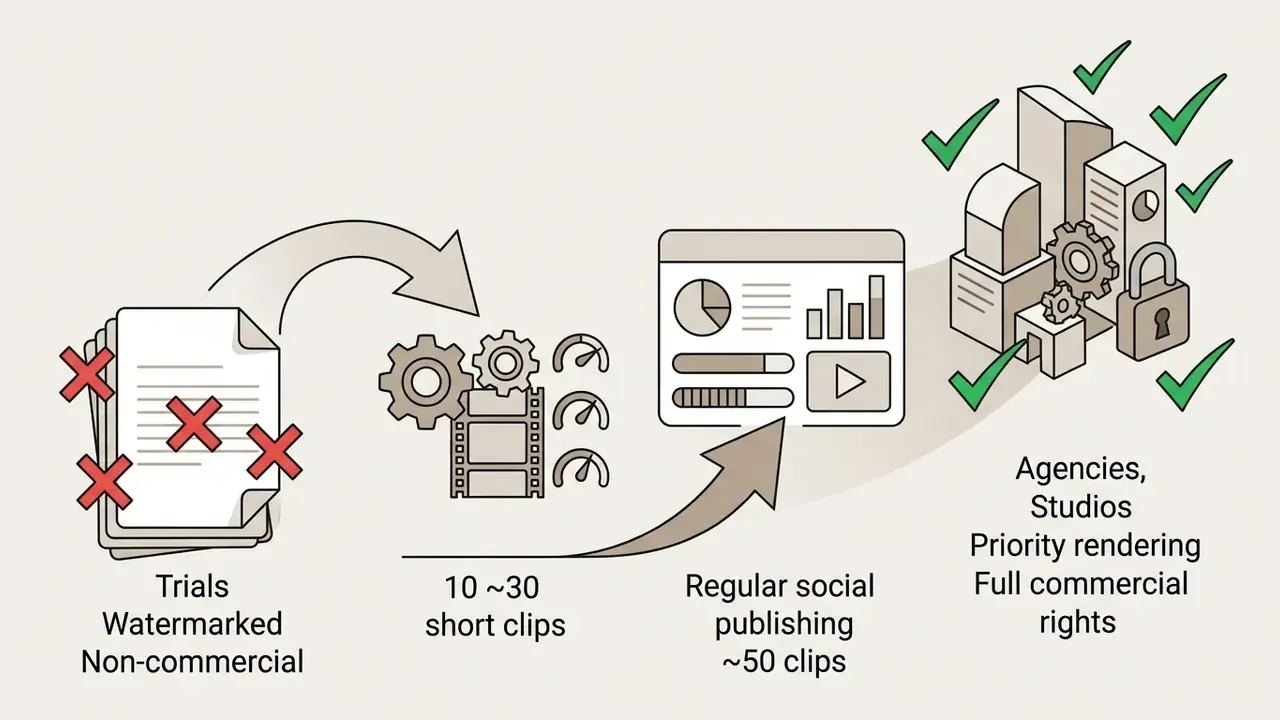
Free plans generally prohibit commercial deployment, limiting clips to personal evaluation and non-monetized testing. Free tiers from Runway, Pika and Kling embed visible watermarks, cap resolution at 480p or 720p, limit clip length, provide no priority rendering during peak hours, and retain commercial rights under vendor terms. Teams comparing these limits side by side can consult our roundup of free AI video generators for current caps and watermark policies. A few exceptions exist on design platforms:
- Canva AI Video: grants commercial deployment rights across free and paid accounts, provided the content complies with Canva's AI Product Terms and acceptable use policies. Our detailed review of the Canva AI generator covers the licensing specifics.
- Adobe Firefly Video: free daily generation quotas permit evaluation, but production commercial use requires a paid Creative Cloud subscription or allocated generative credit packs. Deploying watermarked or free-tier assets in commercial advertising without a paid subscription invites copyright claims and terms violations. Review the specific vendor licensing agreement before any ad campaign launch. The most cost-effective path for a new team is simple: treat free tiers strictly as an evaluation harness, then subscribe to the one tool that survived the test.
Who owns the copyright in AI-generated video?
Under U.S. law, copyright protection requires human authorship. Purely AI-generated output may not be registrable, and works containing AI material are registrable only where the human creative contribution is sufficient (U.S. Copyright Office, Copyright and Artificial Intelligence, 2026, copyright.gov). Jurisdictions diverge: UK provisions can protect computer-generated works without a human author for 50 years from creation. Vendor terms add a second layer, since some platforms assign output rights to the user while free or trial tiers restrict commercial use or require attribution. The contract text, not the marketing page, governs your actual rights.
Why do AI video prices and model availability keep changing?
Pricing schedules and model availability move fast, driven by data center compute costs, GPU supply constraints, architectural updates and evolving licensing regulation. Key market drivers behind price adjustments:
- Compute intensity and energy costs: video diffusion models demand enormous GPU processing power. Highly energy-intensive architectures proved economically hard to sustain at consumer scale.
«Sora 2.0 Pro consumes on average 1,313 Wh per 12-second 1080p video, the highest figure among tested models.» — Delavande et al., Architectural Scaling Laws for Video Generation Energy (2026) Combined with the 453.8 to 769.5 GWh six-month projection for mass consumer usage cited earlier, this explains the industry shift from flat-fee consumer products toward API-metered access.
- Architectural efficiency gains: next-generation models implement temporal pyramid compression, reaching up to 16.6x speedups over older architectures.
«Reducio-DiT generates a 16-frame 1024×1024 video in 15.4 seconds on average, 16.6× faster than the Lavie baseline.» — REDUCIO!, arXiv (2024–2026) These optimizations lower underlying compute cost, which lets platforms cut per-second pricing over time. Developers tracking efficient production models can review the Google Veo API for developers for current throughput and cost parameters.
- Training amortization: with commercial video model training costing $200,000 to $2.5 million and 100,000 to 1.25 million GPU-hours (Open-Sora 2.0 Training Report, 2026), vendors must recover capital expenditure through inference pricing. That caps how far rates can fall in the short term.
- Model tiering: vendors increasingly decouple basic model access from premium features, placing synchronized audio, 4K rendering, 2K frontier models and custom expressive avatars behind higher tiers. Google Cloud's split between $0.20-per-count video generation and $0.40-per-count video-plus-audio generation quantifies exactly that. To guard against surprise increases, enterprise procurement should negotiate fixed-rate annual API contracts, maintain multi-vendor pipelines with routing abstraction, cap credit usage per user group, and store versioned rate cards with effective dates. Understanding how commercial terms are maintained helps here; our Pricing Update Policy sets out that context.
What should be checked before paying for an annual or monthly subscription?
Before signing an annual or monthly contract, run this verification checklist:
Checklist0 / 8