- Channel choice is a math problem, not a preference. Open marketplaces return the highest gross price but cost 10-15% in fees plus hours of labor; mail-in trade-in portals return 45-70% of market value with near-zero friction and a guaranteed quote. Run the net-payout formula in this guide before you choose.
- Condition and completeness dominate value. Loose is the baseline, Complete-in-Box (CIB) typically sells for 2x-8x loose, and Factory Sealed can reach 5x-15x+ CIB. Consoles missing an OEM controller, power adapter, or video cable are routinely downgraded by 15%-40%.
- Compliance is part of the payout. Mail-in buyers require sellers to be 18+ with a valid photo ID and to certify sole ownership, most cover shipping only on lots of $50 or more, and U.S. marketplace payouts may be reported to the IRS on Form 1099-K.
Selling video games online comes down to one trade-off: immediate liquidity versus maximum gross resale value. You can route inventory through peer-to-peer marketplaces, specialized trade-in programs, mail-in retro buyers, or a local cash handoff. Each channel prices your labor differently. Understanding market dynamics, condition grading standards, and platform fee structures is what lets both a one-shelf seller and a high-volume reseller capture peak value while keeping shipping and payment risk contained.
Marketplace fees, trade-in terms, and console price ranges in this guide were last verified in Q1 2026. Always re-check the current fee schedule of your chosen platform before listing.
Before you start: the three numbers that decide almost everything
Most sellers lose money on details they never measured. Fix that first.
- Your net payout, not your asking price. Gross means nothing until fees, postage, and packaging come out. The formula is in the next section.
- Your condition tier, stated honestly. Loose, CIB, or Sealed is not a mood; it is a price band, and it changes offers by multiples.
- Your verified sold comps. One settled sale beats twenty hopeful listings. Toggle to Sold and filter by region and completeness.
Everything else in this guide is commentary on those three numbers.
How to Sell Video Games Online: Choose Cash, Credit, or Trade-In
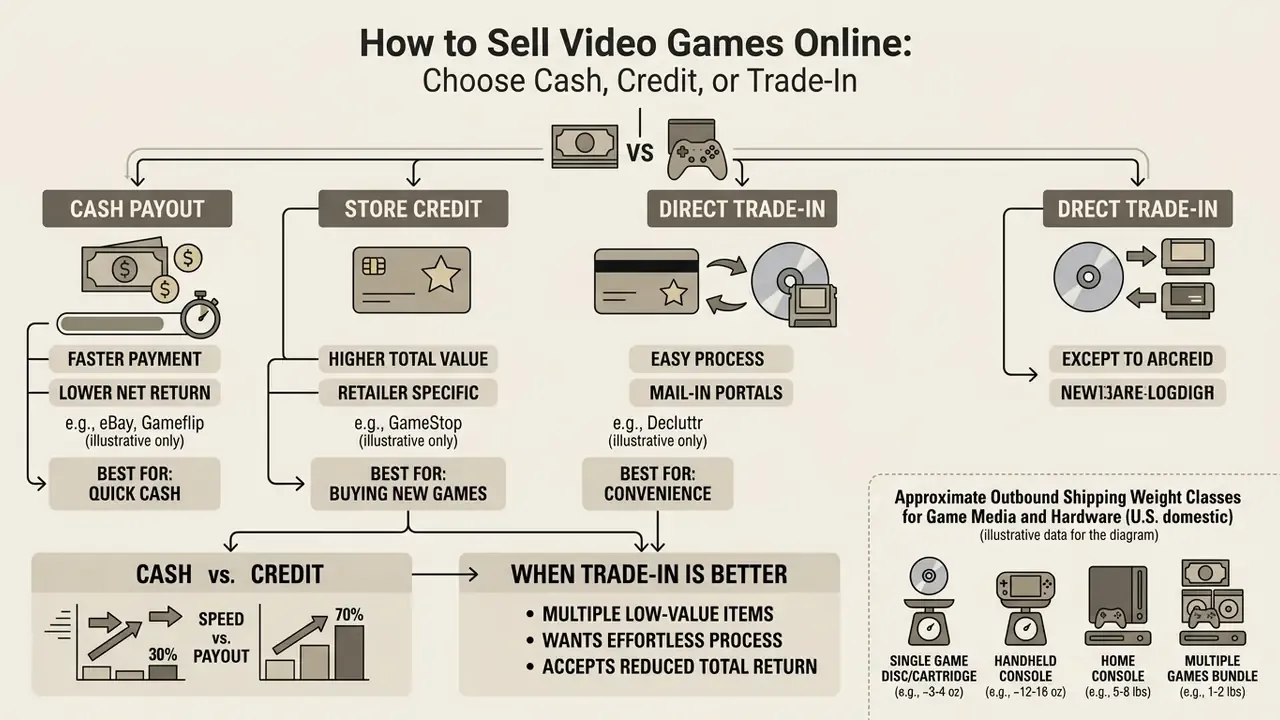
To sell video games online efficiently, pick between cash payouts, store credit, and direct trade-ins based on one question: do you want speed or total return? Direct cash sales through open marketplaces deliver maximum gross revenue, but they demand active listing management and hand back a slice in fees. Store credit incentives and trade-in workflows cut friction and raise the trade multiplier, at the cost of restricted purchasing flexibility.
Selling used games for cash versus store credit
Cash yields universal purchasing power. Store credit typically pays a 10% to 25% premium over cash. Retailers prefer issuing credit because it keeps capital inside their own ecosystem and offsets inventory acquisition costs. Published trade schedules from independent retro specialty retailers show the spread plainly: a common baseline is 60% of assessed trade value in store credit versus 50% in immediate cash, and some mail-in buyers add a flat +10% bonus when you take a gift card instead of PayPal.
If you need liquidity now, for rent, a repair bill, or simply because the money has a job waiting, take cash through bank transfer, PayPal, a physical check, or a prepaid Mastercard. If the proceeds are already earmarked for an upcoming console release or a rare title on your want list, credit buys more. One practical nuance worth knowing: several national chains issue credit on a reloadable trade card that never expires, while cash offers appear selectively and only on titles the buyer currently needs in stock. In other words, the cash option is not always on the table.
When an online video game trade-in is the better option
An online video game trade-in wins when you are liquidating mid-tier current-generation titles, bulk game lots, or common boxed software where per-listing friction eats the marginal profit. These programs let you search catalog titles, accept a fixed automated quote, print a pre-paid shipping label, and get paid once the package clears inspection.
Take a real-shaped example. A seller clearing a lot of 45 common Xbox One and PlayStation 4 titles compared individual marketplace listings against a centralized mail-in trade program. Listing each title separately would have meant more than 15 hours of photography, description drafting, and single-item packaging, plus fixed order fees on every sale. Through an automated online video game trade in portal, the same seller locked a guaranteed quote, shipped everything in two double-walled boxes, and had a verified payout within 48 hours of inspection. Lower gross, far better hourly rate.
That finding reinforces the core valuation rule of this guide: price from settled transactions, never from hopeful asking prices.
The $50 Free Shipping Threshold
Most mail-in trade platforms, including Player's Choice and CashForGamers, provide a pre-paid printable shipping label only when your submission totals $50 or more. Below that line, shipping is deducted from your payout or paid out of pocket. Some retro buyers also waive shipping when the majority of submitted games arrive complete with box and instructions, so consolidating CIB inventory into a single shipment is usually the cheapest route.
Calculate net payout before you choose a channel
Gross sale price is a vanity number. Compare channels on net revenue:
Net Revenue = Gross Sale Price − Platform Fee − Payment Processing Fee − Outbound Shipping − Packaging Cost
Worked example. A CIB Nintendo 64 title sells on a marketplace for $85. The final value fee at 12.55% plus $0.30 comes to $10.97, tracked shipping in a rigid box costs $6.80, packaging materials cost $1.20. Net revenue lands at $66.03, or 77.7% of gross. A mail-in quote of $60 in cash, with a free label and no listing labor, is therefore competitive the moment you put a price on your own hours. Not always the winner. Just competitive, which is more than most sellers assume.
Approximate Outbound Shipping Weight Classes for Game Media and Hardware (U.S. domestic)
| Item | Typical packed weight | Recommended package | Cost driver |
|---|---|---|---|
| Single cartridge (NES/SNES/GB/DS) | 4 to 8 oz | Anti-static bag plus bubble wrap in rigid mailer | Actual weight (lightest tier) |
| 1-3 disc games in cases | 8 oz to 1.5 lb | Padded bubble mailer or small rigid box | Actual weight |
| CIB retro game with box and manual | 10 oz to 1.5 lb | Rigid box only, never a soft mailer | Box dimensions |
| Bulk lot of 20-45 titles | 12 to 30 lb | Double-walled carton, layered fill | Actual weight |
| Handheld console plus accessories | 2 to 4 lb | Double-boxed with 5 cm cushioning | Dimensional weight |
| Home console (PS5 / Series X) | 10 to 16 lb | Double-walled carton, 6 cm foam all sides | Dimensional weight (L×W×H ÷ 139) |
Large, light console boxes are billed on dimensional weight, so an oversized carton quietly destroys your margin. Match the box to the 6 cm cushioning rule and stop there.
Matrix Choice: Cash vs Store Credit vs Trade-In for Video Game Resale
| Selling Format | Primary Payout Type | Relative Payout Value | Processing Speed | Listing Labor | Fee Exposure |
|---|---|---|---|---|---|
| Marketplace Direct Sale | Cash (PayPal / direct deposit) | Highest (100% of market price) | 3 to 14 days, buyer dependent | High (photos, text, support) | 10%-15% platform fees plus payment processing |
| Mail-In Trade-In (Credit) | Store credit / gift card | Moderate-high (60%-70% of market) | 48 hours post-inspection | Low (catalog search, one shipment) | No explicit fees; margin built into the quote |
| Mail-In Trade-In (Cash) | Check / PayPal / prepaid card | Moderate-low (45%-55% of market) | 48 hours post-inspection | Low (catalog search, one shipment) | No explicit fees; lower cash baseline rate |
| Local Cash Sale | Physical cash / P2P app | High (80%-90% of market) | Same day, in-person | Medium (local messaging and meetup) | No platform fees on a physical handoff |
| Pawn Shop | Physical cash, same day | Lowest (40%-50% of market) | Immediate | Very low (walk-in) | No fee; a 50%-60% discount is embedded in the offer |
What Determines the Value of Used and Old Video Games
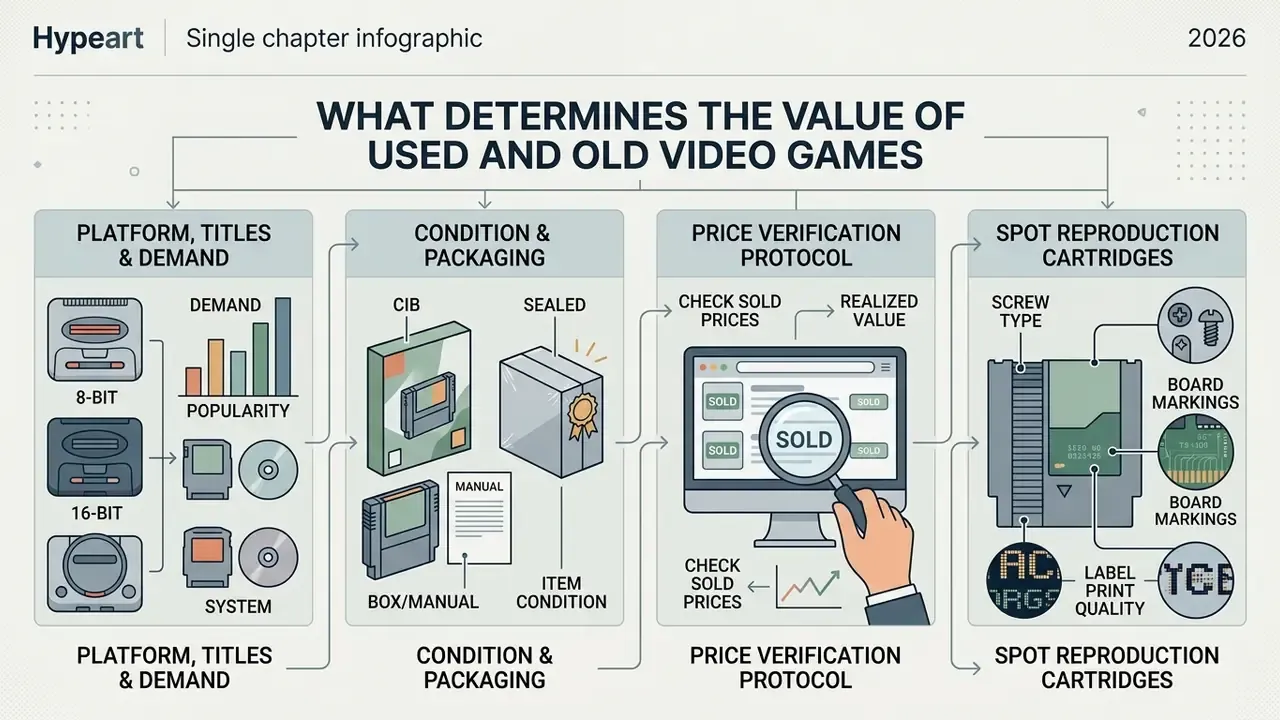
The market value of used and old video games is driven by structural software availability, platform ecosystem popularity, complete-in-box condition, and verified completed transaction data. Physical media degrades. That is precisely why complete, fully functional copies command such steep premiums on secondary markets.
Platform, titles, and demand for retro games
Platform architecture and reissue scarcity set the baseline for retro video games.
That supply constraint is persistent, and it drives intense collector demand for original cartridges and optical discs. Nintendo legacy platforms lead the premium table (NES, Super NES, GameCube, Game Boy), largely on the strength of first-party intellectual property: Super Mario, The Legend of Zelda, Metroid. Common titles printed in the millions stay affordable. Low-print-run cartridges and late-lifecycle releases are another story. Rare un-reissued NES cartridges such as Little Samson have averaged over $2,700 for loose copies on secondary markets.
PlayStation retro value is more segmented: common PS1 discs stay cheap, while long-box and CIB copies hold materially stronger prices than loose discs. Vintage Xbox titles show lower collector premiums overall, mostly because broad backward compatibility across modern Microsoft hardware keeps the pressure off original media.
Academic modelling also treats resale as something other than a drain on the industry:
Secondary-market research also quantifies feature-level effects: special editions have been associated with roughly +39% value, bundles including accessories with about +62%, while titles built primarily around online multiplayer shed roughly 10% as servers age.
Why original items, boxes, and condition affect the offer
Defects cut the other way, and hard: label tearing, surface scratching, dead save-RAM batteries, crushed boxes, sun fading, disc rot. Any one of them can halve a quote.
Fact Check / Price Verification Protocol
How to check sold prices before listing a game
Checking sold history first prevents two expensive mistakes: underpricing something rare and overpricing something common. Specialty aggregators such as PriceCharting compile verified transaction data from completed eBay auctions and their own marketplace sales, explicitly excluding unsold items and stripping out non-comparable records like reproductions, imports, and mixed lots before calculating a market price. Their published methodology separates results into Loose, Complete (CIB), Brand New, Graded, Box Only, and Manual Only tiers (PriceCharting, "How We Get Our Prices," https://www.pricecharting.com/page/methodology).
Filter by exact platform, region (NTSC-U/C versus PAL or NTSC-J), condition grade, sale date, and inclusion of original inserts. That gives you a defensible listing anchor rather than a guess. And on marketplace interfaces, toggle to Sold rather than Completed, because completed views can still sweep in unsold asks.
How to spot reproduction cartridges before you price a lot
Reproduction cartridges, "repros," are the single largest source of valuation error in retro lots. A fake Little Samson looks like a four-figure asset and is worth close to nothing. Check the following before you quote:
- Screw typemost authentic Nintendo cartridges use a proprietary 3.8 mm or 4.5 mm security bit. Standard Phillips screws are a strong red flag.
- Board markingsgenuine PCBs carry manufacturer etchings, date codes, and mask ROM chips with Nintendo or licensee part numbers. Repros commonly use a single flash chip on a blank or generic board.
- Label print qualitypixelated text, wrong fonts, glossy inkjet finishes, labels sitting slightly off-center or peeling at the corners.
- Shell tellsmismatched plastic shades, absent injection-mold codes inside the shell, missing embossed manufacturer text.
- Save behaviora cartridge claiming battery-backed saves that retains nothing, or saves through emulator-style menus, needs testing on original hardware.
Disclose any doubt in writing. Selling a repro as genuine, even by accident, is the fastest route to a forced refund plus a policy strike on your account.
Best Place to Sell Video Games Online: Compare Your Options
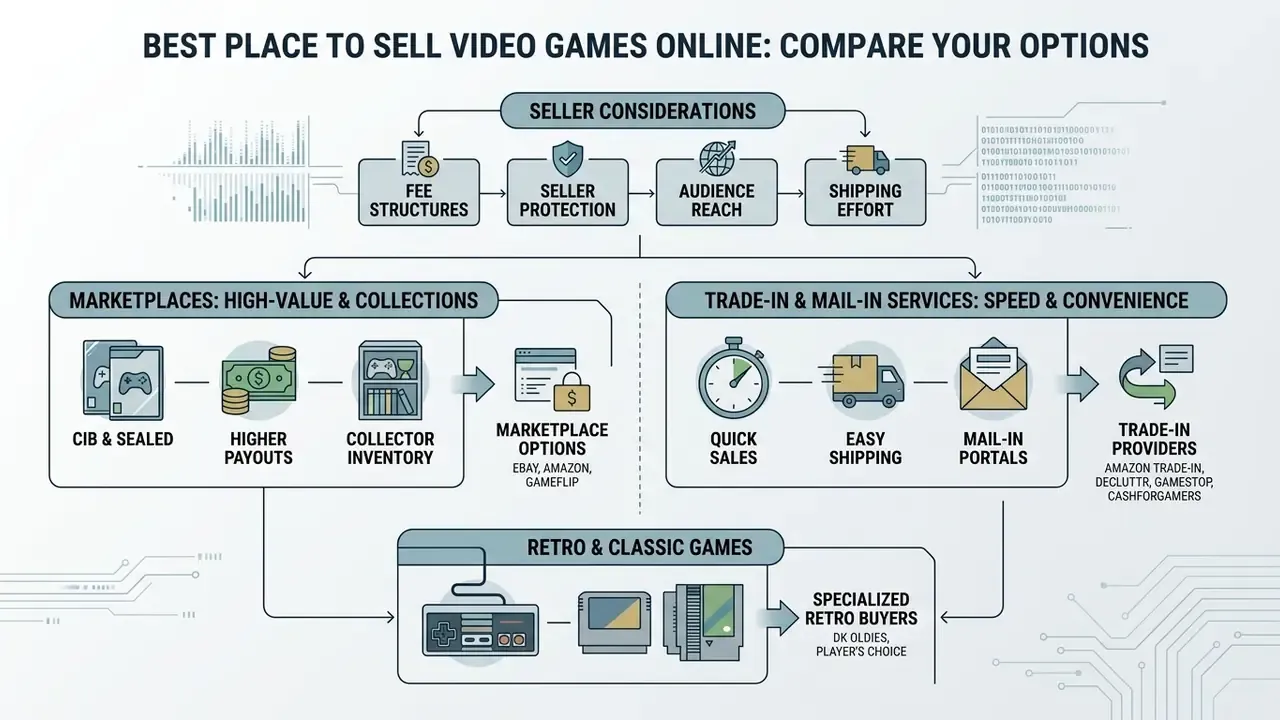
Choosing the best place to sell video games online means weighing fee structures, seller protection policies, audience reach, and shipping effort against each other. Multi-item marketplaces, dedicated trade-in retailers, specialized retro buyers, and local cash channels all solve different problems.
Comparative Overview of Online and Offline Selling Channels for Video Games
| Platform / Channel | Target Item Types | Average Seller Fees | Payout Type and Speed | Seller Control and Risk |
|---|---|---|---|---|
| eBay | Rare retro games, CIB titles, consoles, bulk lots | ~12.55% plus $0.30 per order (category dependent; store rates differ by region) | Bank payout, 1-3 business days post-delivery | High price control; medium dispute risk |
| Amazon Marketplace | Current-gen games, sealed titles, hardware accessories | 8%-15% referral plus $1.80 closing fee plus subscription or per-item fee | Bi-weekly disbursement schedule | Rigid catalog rules; strongly buyer-centric protection |
| Gameflip | Physical media, unredeemed digital codes, gaming collectibles | 8% commission plus 2% partner fee (plus 2% for digital); no listing fees | Released after buyer inspection and acceptance | Escrow protection; lower overall traffic volume |
| Decluttr | Current and recent-gen games, consoles, consumer electronics | No seller fees; instant valuation model | PayPal or direct deposit after inspection; free UPS shipping | Zero negotiation; take-it-or-leave-it quote |
| DK Oldies | Retro cartridges, retro consoles, rare CIB titles | No seller fees; buyback pricing | Check or PayPal after verification | Strong retro expertise; 120-day warranty on their own sales |
| The Old School Game Vault | 1980s-1990s NES, SNES, Genesis, Game Boy titles | No seller fees; published trade values on tens of thousands of titles | Cash or store credit after inspection | Community-oriented support; catalog-based quotes |
| CashForGamers / Player's Choice | Mixed lots, retro and modern software, systems | No seller fees | PayPal, certified check, or store credit; free label on lots $50+ | Quote locked before shipment; returns at no cost if refused |
| Best Buy Trade-In | Current-gen games, consoles, controllers | No seller fees | Best Buy gift card only, after inspection | Convenient for hardware upgrades; no cash option |
| GameStop Trade-In | Current and previous-gen working software and consoles | No explicit fee (embedded retail margin) | Immediate in-store credit, cash, or prepaid Mastercard | All trades final; lower quote; select stores only |
| Facebook Marketplace / Craigslist | Used consoles, common games, local bundles, peripherals | 0% for local pickup; fee applies for shipped checkout | Immediate cash on pickup; variable when shipped | High local speed; no platform protection on cash |
| Pawn Shops | Consoles, popular modern titles, bundles | No fee; 50%-60% discount to market embedded in the offer | Same-day physical cash | Fastest liquidity, lowest realized value |
Marketplaces for higher-value games and collections
Peer-to-peer marketplaces such as eBay, Amazon, and Gameflip deliver the highest potential gross returns on rare, high-value, or collectible games. They also demand the most from you.
eBay also offers free listings for up to 250 items monthly, while Amazon's mandatory $1.80 category closing fee applies per unit sold on video games, software, and hardware systems. The practical upshot: eBay gives better net margins on lower-priced software and specialized retro inventory, while Amazon excels at high-velocity sales of standardized current-generation releases. Note too that Amazon's listing policy forbids selling media missing essential accompanying material, so incomplete PSP, DS, or disc-based games belong on eBay or with a retro buyer instead.
Gameflip sits in a useful middle ground: no listing or membership fees, escrow released only after buyer acceptance, and genuine support for unredeemed digital retail codes alongside physical media.
Trade-in stores and mail-in services for speed and convenience
Dedicated online trade-in platforms and national retail programs optimize for speed and zero friction rather than top dollar. You accept a predetermined corporate quote and skip photo uploads, negotiations, and post-sale return disputes entirely.
- Amazon Trade-In accepted video games must include all discs or cartridges, play perfectly, and be free of cracks or major scratches; approved items convert to an Amazon.com Gift Card once inspection completes at the receiving fulfillment center (Amazon Trade-In Help, checked Q1 2026).
- GameStop immediate store credit, cash, or a prepaid Mastercard in participating U.S. and Guam locations. Trade value is set at the retailer's sole discretion, and the policy states plainly that all trades are final, with no dealer submissions accepted (GameStop Trade Policy, 2024).
- Decluttr a fully automated instant-valuation model with free UPS shipping and payment by PayPal or direct deposit after inspection. Lowest effort option for common modern titles and electronics.
- Best Buy Trade-In converts working games and consoles into Best Buy gift cards after online valuation and shipment. Not a cash channel, but efficient if you are funding a TV or a new console anyway.
- CashForGamers and Player's Choice publish per-title cash and credit values before submission, provide pre-paid USPS labels on qualifying lots, and return refused items at no cost to the seller.
Specialized retro buyers for classic and collector inventory
Because 87% of classic titles are structurally unavailable through official channels, retro-focused buyers frequently outbid generalist trade-in portals on 1980s and 1990s inventory:
- DK Oldies buys and sells retro hardware and software across Nintendo, Sega, Sony, and Atari platforms, and backs its own retail sales with a 120-day warranty, which signals how deeply incoming trades get tested.
- The Old School Game Vault publishes trade values across tens of thousands of titles from the early 1980s to the present, with strong demand for cartridge-era first-party releases.
- SecondSpin and Trade4Cash accept mixed media lots (games plus CDs and DVDs) and suit sellers clearing an entire shelf rather than a curated collection.
- PlayerUp operates in the account and in-game asset segment. Treat it with caution, since platform terms of service generally prohibit account transfers, as covered in the FAQ below.
When you are quoting rare CIB items, always test a specialist's offer against sold comps. A retro buyer paying 60-70% of market on a scarce boxed title frequently beats the net proceeds of a fee-heavy auction, once postage and your evening are priced in.
Local stores, pawn shops, and Facebook Marketplace for fast cash
Local cash sales through Facebook Marketplace, Craigslist, or an independent retro game shop deliver same-day liquidity with no platform commission and no shipping overhead. They also remove transit damage and chargeback risk from the equation. Pawn shops sit at the far end of that trade-off: they close today, but typical offers land 50%-60% below PriceCharting market value, and condition weighs heavily. Scratched, caseless discs are often refused outright.
The catch is protection. Peer-to-person cash transactions sit outside formal platform purchase protection. Facebook states clearly that shipped checkout orders carry buyer and seller protection while in-person cash exchanges carry none (Meta Help Center). U.S. Federal Trade Commission guidance for online sellers adds three concrete rules: never accept a mobile payment from someone you do not know, never deposit an "overpayment" check, and never share a Google Voice or any other verification code with a buyer (FTC, Selling Online).
So meet in well-lit public safe-exchange zones, and many police departments now host designated bays for exactly this. Check cash notes against counterfeiting. Bring a second person for high-value handoffs. Ignore any unverified third-party payment app link a buyer sends you, however normal it looks.
Sell Video Game Systems Online: Consoles and Accessories
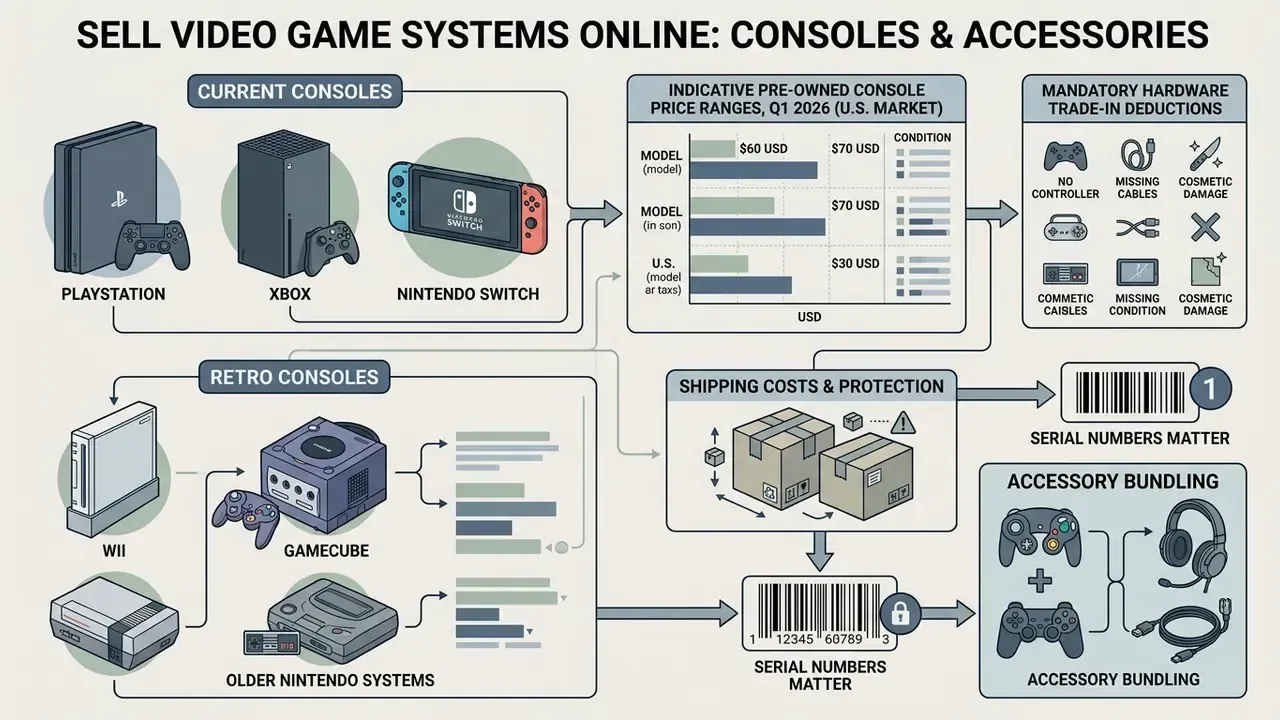
Selling video game hardware online demands more protection than software: shipping costs are higher, serial numbers matter, and accessory bundling gets complicated fast. Current-generation consoles and vintage retro platforms also behave differently on price.
Current consoles: PlayStation, Xbox, and Nintendo Switch
The ranges below are indicative and may not reflect current market conditions. Verify against completed sold transactions on your chosen marketplace before accepting or rejecting an offer.
Current-generation systems hold secondary value well, though pricing swings with model revisions and bundled storage. Aggregated Q1 2026 resale observations point to the following baseline tiers (source: Q1 2026 market resale survey of used-console listings; independent verification recommended).
Indicative Pre-Owned Console Price Ranges, Q1 2026 (U.S. market)
| Model | Observed range | Notes |
|---|---|---|
| PS5 Slim Disc | $365 - $400 | Slim revisions hold value best in the family |
| PS5 Slim Digital | $310 - $345 | Digital models discount 12%-15% versus disc |
| PS5 Launch Disc | $295 - $330 | Launch chassis discounted versus Slim |
| PS5 Launch Digital | $235 - $265 | Lowest PS5 tier |
| Xbox Series X | $260 - $295 | Steepest depreciation among listed platforms |
| Xbox Series S 512GB | $130 - $180 | Entry tier, high supply |
| Xbox Series S 1TB Carbon Black | $160 - $210 | Storage premium retained |
| Nintendo Switch OLED | $225 - $260 | Highest Switch-family retention |
| Nintendo Switch V2 | $160 - $190 | Volume model |
| Nintendo Switch Lite | $105 - $130 | Handheld only, no dock value |
Regional gaps are large. Early-2026 Hong Kong used listings showed a PS5 Disc at HK$2,300-2,800 and a Switch V2 at HK$1,000-1,400, with Switch pricing down roughly 20% year over year against a decline of about 5% for PS5. Price against your own regional sold comps, always.
Before listing any current console: run a full factory reset, wipe local user profiles, deregister the unit as primary or home system, unlink digital store accounts and payment methods, and include the OEM power cable, an HDMI 2.1 lead, and an official wireless controller. Skipping the deregistration step is the most common reason a buyer opens a case.
Retro consoles: Wii, GameCube, and older Nintendo systems
Retro hardware shows how supply limits, not launch prices, drive vintage value. The Nintendo GameCube now commands higher baseline hardware pricing than its successor the Wii, despite launching cheaper ($199 in 2001 versus $249.99 in 2006). Working GameCube systems regularly trade around $110 to $130, while mass-market Wii consoles land roughly between $70 and $170 depending on completeness and bundled accessories (Reclaim retro hardware value guide, 2026, https://www.reclaimstuff.com/value/retro-tech-and-gaming; verify against current sold comps).
Accessories deserve separate evaluation. Standalone original OEM GameCube controllers fetch $30 to $40 each on competitive fighting game demand alone. The same holds for Wii peripherals, GBA link cables, official memory cards, and RGB-capable cable sets, which routinely outperform the console itself on a per-unit basis. Before shipping any retro system, test video output on original hardware, verify every controller port, clean cartridge slots, and confirm that save batteries still hold data. Ten minutes of testing prevents most "not as described" claims.
How to Prepare and List Games for Sale Online
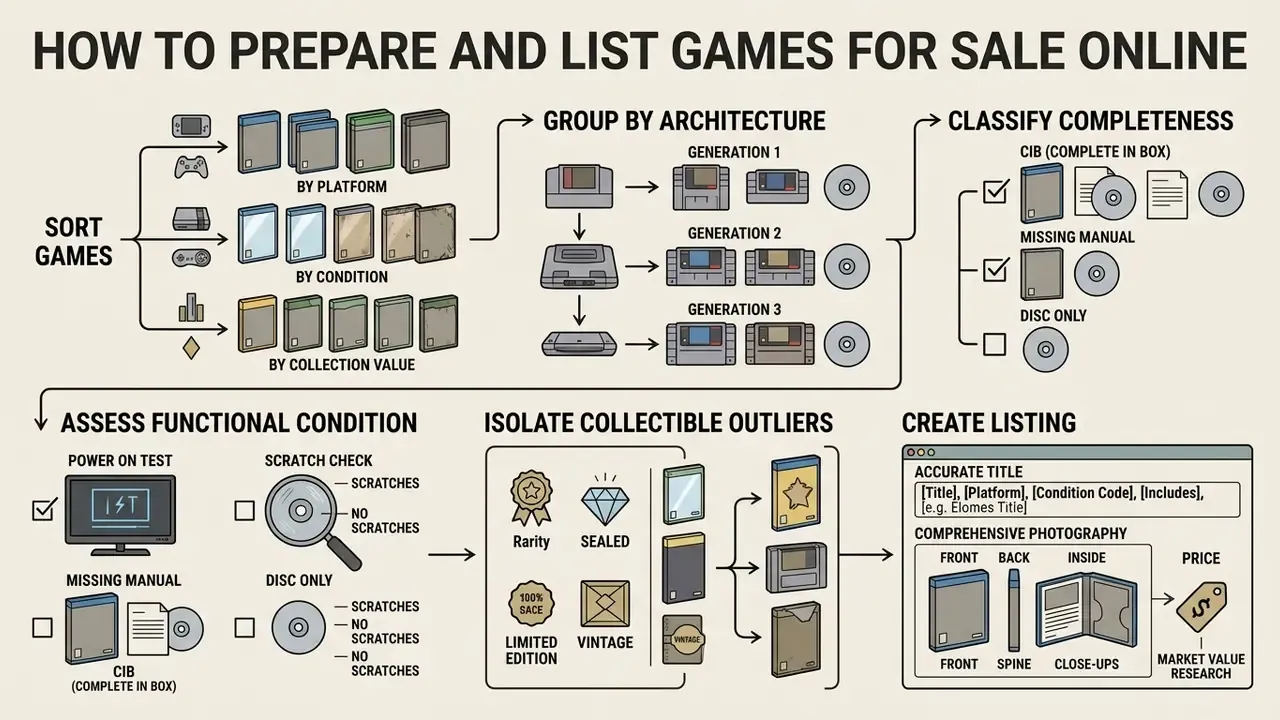
A structured preparation workflow raises proceeds, speeds up search indexing, and cuts item-not-as-described returns. Cataloging, detailed photography, and standardized title formatting do most of the work.
Sort games by platform, condition, and collection value
Before you publish anything, organize inventory into logical platform groups and condition categories.
- Group by platform architectureseparate software by console family (Nintendo Switch, PlayStation 5, Xbox 360, GameCube), recording region and variant fields alongside each entry.
- Classify completenesssplit into Loose, Complete-in-Box, and Factory Sealed, plus Box Only and Manual Only where relevant. Both of those last two sell independently, and sellers forget it constantly.
- Assess functional conditioninspect optical discs for top-layer pinholes and deep scratches. Test cartridge edge connectors for corrosion, clean contacts with 99% isopropyl alcohol, and confirm the internal save battery still works.
- Isolate collectible outliersidentify rare print runs, special editions, and high-value titles for individual listings, then group low-value common titles into bulk platform lots. Flag graded and sealed items as their own higher-value class.
Create a listing with accurate titles, photos, and price
High-converting listings need precise titles, full disclosure, and pricing backed by data rather than optimism.
Search, quote, and ship: the online selling workflow
Online Video Game Listing and Fulfillment Workflow
Checklist0 / 11
For mail-in trade-ins the sequence compresses into three stages that mirror any quote-to-shipment sales workflow. Search the buyer's catalog for your exact titles. Quote by submitting the cart and locking the displayed cash or credit value. Ship by printing and signing the quote sheet, then enclosing it in a single package with every listed item. All items from one order must travel together with the packing slip; split shipments routinely trigger re-quoting delays, and a re-quote is rarely in your favor.
Shipping, Payments, Legal Requirements, and Taxes
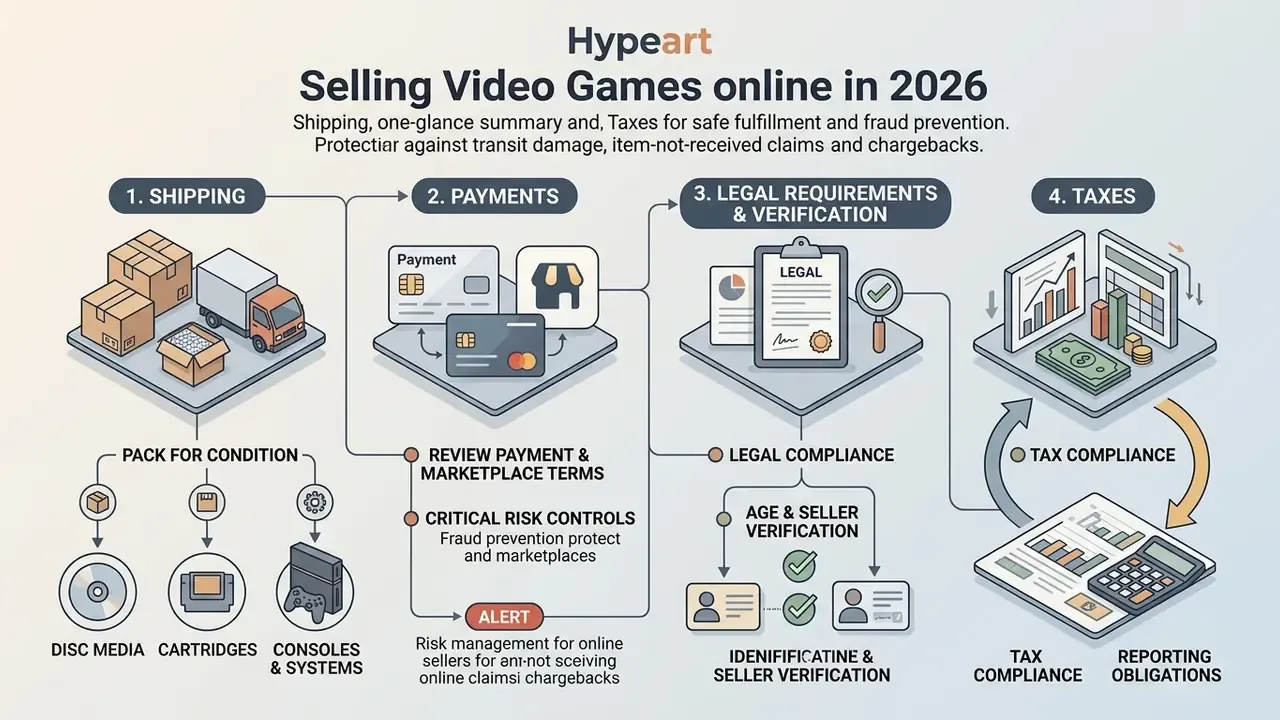
Safe fulfillment and fraud prevention protect you from transit damage, item-not-received claims, and chargebacks. Cushioning and platform payment flows are not optional details here.
Pack disc games, cartridges, and consoles to protect condition
Shipping delicate optical media, vintage cartridges, and heavy hardware means following commercial transit packaging standards, not improvising:
- Disc media make sure discs are firmly clipped onto the inner case hub teeth. Add a foam or bubble pad inside the case so the disc cannot dislodge in transit. Wrap plastic cases in two layers of small-bubble wrap and ship inside a high-burst-strength padded mailer or a rigid box. For loose discs, stack same-size discs in groups of 5 to 10, separate unsleeved discs with smooth paper, sandwich the stack between rigid boards, then wrap in one or two layers of bubble wrap.
- Cartridges enclose cartridges in anti-static bags, wrap each item individually, position them in the center of the carton, and keep at least 2 inches (5 cm) of fill material around them inside the outer box so nothing rattles (DHL electronics shipping standards, 2026).
- Consoles and systems heavy hardware needs double-walled corrugated cartons. Carrier guidance calls for outer dimensions at least 14 cm larger than the inner item, maintaining 6 cm (about 2.5 inches) of dense foam or bubble cushioning between the console casing and every interior wall, with all voids filled (DHL Packaging Guide, 2026). Remove optical discs, memory cards, controllers, and power cords before boxing to prevent internal drive damage, seal the carton with H-taping, and declare the value on the invoice, including battery details on international shipments.
Review payment and marketplace terms before you sell
Payment security is where sellers get hurt most often. Keep transactions inside official platform checkout systems that offer seller protection, and treat every request to step outside them as a warning.
Alert: Critical Risk Controls for Online Sellers
- Never accept off-platform payments. Refuse requests to move a transaction off eBay, Amazon, or Gameflip onto peer-to-peer payment apps, wire transfers, or external checks. Irreversible settlement methods leave you exposed when the deal is later challenged.
- Document system identifiers. Record console serial numbers, internal MAC addresses, and unique board identifiers in listing photos and invoices to defeat "switch-and-return" scams.
- Verify carrier insurance coverage. Buy third-party shipping insurance matching full sale value on items over $100, and confirm that the insured event, shipment channel, and limits match your actual dispatch method. Coverage follows the policy wording, not your assumptions.
- Require signature confirmation. Add mandatory signature delivery confirmation for shipments over $750 to satisfy standard marketplace seller protection requirements.
- Read the terms before dispatch. Seller protection and mail-in trade-in policies are contracts. eBay, for example, covers eligible payment disputes for "item not received," "not recognized," and "item not as listed," but requires the seller to accept or challenge within 5 calendar days. PayPal Seller Protection excludes several payment types and item categories outright.
Legal compliance, age, and seller verification
Legal Compliance and Seller Verification
Distance-selling rules add a second layer. In many jurisdictions the online product description forms the contractual basis of the sale, so console model, included accessories, power type, and completeness must be stated accurately before checkout. Age-rated titles sold online should carry an age-verification step wherever local regulation requires one.
This section is general information, not legal advice. Resale, pawn, and consumer-protection rules vary by country and state. Consult a qualified professional for your jurisdiction.
Dispute and fraud response protocol
U.S. tax reporting: Form 1099-K and hobby versus business sales
Marketplace payouts can be reported to the IRS. Payment settlement entities and online marketplaces issue Form 1099-K for payments processed on your behalf once the applicable gross-payment threshold is met, and that threshold has moved more than once across recent tax years. Two consequences matter for game sellers:
- A 1099-K reports gross payments, not profit. Shipping charges you collected, platform fees, and refunds all sit inside that gross figure. This is exactly why the net-payout formula and a per-item cost record matter.
- Personal collection versus business inventory changes the treatment. Selling personal items for less than you paid generally produces no taxable gain, though the loss on personal-use property is typically not deductible. Selling for more than your basis produces a reportable gain, and buying to resell on a regular basis is treated as business activity, with ordinary income and deductible business expenses.
Practical recordkeeping for anyone moving more than a handful of titles: log acquisition date, acquisition cost (or note "personal collection, cost unknown"), sale date, gross proceeds, platform fees, shipping paid, and packaging cost per transaction. Reconcile that ledger against any 1099-K you receive before filing. A spreadsheet is enough; the format matters far less than the habit.
This is general information, not tax advice. Reporting thresholds and rules change between tax years and differ outside the United States. Consult a qualified tax professional about your situation.
FAQ About Selling Video Games Online
Can you sell digital games online?
General information only; this does not replace advice from a copyright or licensing attorney. Generally, no. You cannot legally sell pre-owned digital game licenses or personal platform accounts. Mainstream digital distribution services, including Steam, the Nintendo eShop, PlayStation Network, and Xbox Network, grant non-transferable end-user license agreements. Under European Union case law, a perpetual standalone software licence can in principle be resold once the first acquirer makes their own copy unusable. Extending that doctrine to modern Games-as-a-Service accounts is a different matter entirely:
«EU researchers conclude that applying copyright exhaustion to digital games-as-a-service is impractical; consumer law protects buyers more effectively.» (Aren't We All Exhausted Already? EU Copyright Exhaustion and Video Game Resales in the Games-as-a-Service Era, International Journal of Law and Information Technology, 2023. https://doi.org/10.1093/ijlit/eaad009) Platform terms are blunter still: transferring or selling user accounts violates the service agreement and results in permanent suspension. Nintendo states that selling or transferring a Nintendo Account to a third party breaches the Nintendo Account Agreement, and publishers such as Supercell prohibit buying, selling, sharing, or gifting accounts outright. Digital redemption keys bought as legitimate retail cards can be resold on authorized platforms like Gameflip, provided the code is unredeemed and you disclose that status honestly.
Should you sell a collection together or list titles separately?
Listing titles separately yields higher total gross revenue. Selling the whole collection as one lot maximizes convenience and minimizes labor. Both answers are correct, depending on what your time is worth. Individual listings let you capture full market value on rare and CIB items from targeted collectors, at the cost of multiplied shipping, listing fees, and buyer messages. A single-lot sale, by contrast, requires a bulk discount, commonly 20% to 40% below the sum of individual comps, because the buyer absorbs the labor of sorting, packaging, and reselling every title. (The 20%-40% band reflects observed lot-versus-single pricing spreads and standard quote-to-order workflow economics; exact discounts vary by platform, category, and lot size, so validate against comparable completed lot sales.) The pragmatic middle path: pull high-value titles for individual sale, then bundle the low-value remainder into unified console-lot auctions.
Do I have to pay tax on money from selling my old games?
It depends on whether you are liquidating a personal collection or running a resale business, and on your local tax law. In the U.S., marketplaces and payment processors may issue Form 1099-K reporting gross payments once the applicable threshold is met. Personal items sold below their original cost generally produce no taxable gain, and the loss is usually not deductible, while sales above your cost basis, or systematic buying-to-resell, are reportable. Keep a per-item ledger of cost, proceeds, fees, and shipping. Then consult a tax professional for your circumstances.
What paperwork do mail-in trade-in services require?
Expect to print and sign the automated quote, enclose it with the shipment, and confirm three things in writing: that you are 18 or older, that the items are your sole personal property, and that you accept the buyer's final-sale terms. A valid photo ID is required for in-store trades and is frequently requested for mail-in payouts. Online quotes can differ from in-store offers because of local stock levels, condition, and missing parts, so if a retail location is nearby, printing the quote and walking in often produces a firmer number.
How can I tell whether a retro cartridge is genuine before I sell it?
Check the screw type (proprietary security bit versus standard Phillips), the PCB markings and mask ROM part numbers, label print quality and centering, injection-mold codes inside the shell, and whether battery-backed saves actually retain data on original hardware. If any indicator stays ambiguous, disclose the uncertainty in the listing instead of asserting authenticity. Buyers forgive honesty; platforms do not forgive claims you cannot support.
Is store credit always better than cash?
Financially, usually yes. Credit premiums of 10%-25% are standard, and some buyers add a flat +10% bonus on gift-card payouts. Strategically, no: credit is locked to one retailer's catalog and one retailer's pricing. Take credit when you already plan to buy from that seller. Take cash when you need liquidity or intend to shop the wider market.
Appendix A: Source and Revision Notes
Retained for transparency after the Q1 2026 editorial review:
Reference material: AI Media Glossary
- Superseded citation
- an earlier version of the digital-resale answer cited "EU Copyright Exhaustion Analysis, 2023," an unattributed reference. It has been replaced with the peer-reviewed article Aren't We All Exhausted Already? EU Copyright Exhaustion and Video Game Resales in the Games-as-a-Service Era (International Journal of Law and Information Technology, 2023).
- Figures requiring independent verification
- the $12-loose-to-$80-CIB example, the 20%-40% bulk-lot discount band, the GameCube and Wii resale ranges, and the Q1 2026 current-console price tiers come from market-tracking and resale-guide observations rather than audited datasets. Treat them as directional benchmarks and confirm against current sold comps for your region and condition tier.
- Removed section
- a previous navigation block linking to unrelated AI media resources was removed as off-topic for a video game resale guide. Remaining contextual links relate only to preparing listing photography and demonstration video files.
- Author attribution
- the commentary attributed to Marcus Hale, author. It
- Verification date
- marketplace fee schedules (eBay, Amazon, Gameflip), trade-in terms (GameStop, Amazon Trade-In, Player's Choice, CashForGamers, Decluttr, Best Buy), and packaging standards (DHL) were last checked in Q1 2026.