Last updated: 2026 · Reviewed for: prompt engineering, image-to-image workflows, IP and regulatory compliance
Notice on generative model limitations: Diffusion-based image systems are probabilistic. The same prompt, run with a different random seed, can return anatomically broken hands, unexpected stylistic drift, or an unintended likeness to a protected character. So every asset intended for public or commercial distribution passes human review before release, no matter how tightly the prompt was constrained. No evidence, no autonomy. That rule applies to a marketing image pipeline as much as it applies to a credit model.
Executive summary
- What the tool is.A ghibli ai image generator is a fine-tuned latent diffusion pipeline, or occasionally a specialised GAN, that synthesises painterly, hand-drawn Japanese-animation aesthetics from a text prompt or an uploaded photo.
- What drives quality.Prompt specificity, model capacity, input file clarity and post-processing. Automatic prompt optimisation research reports alignment gains of up to roughly 25% on standard benchmarks, and independent 2026 benchmarking shows a 21-point spread between leading engines on complex scenes.
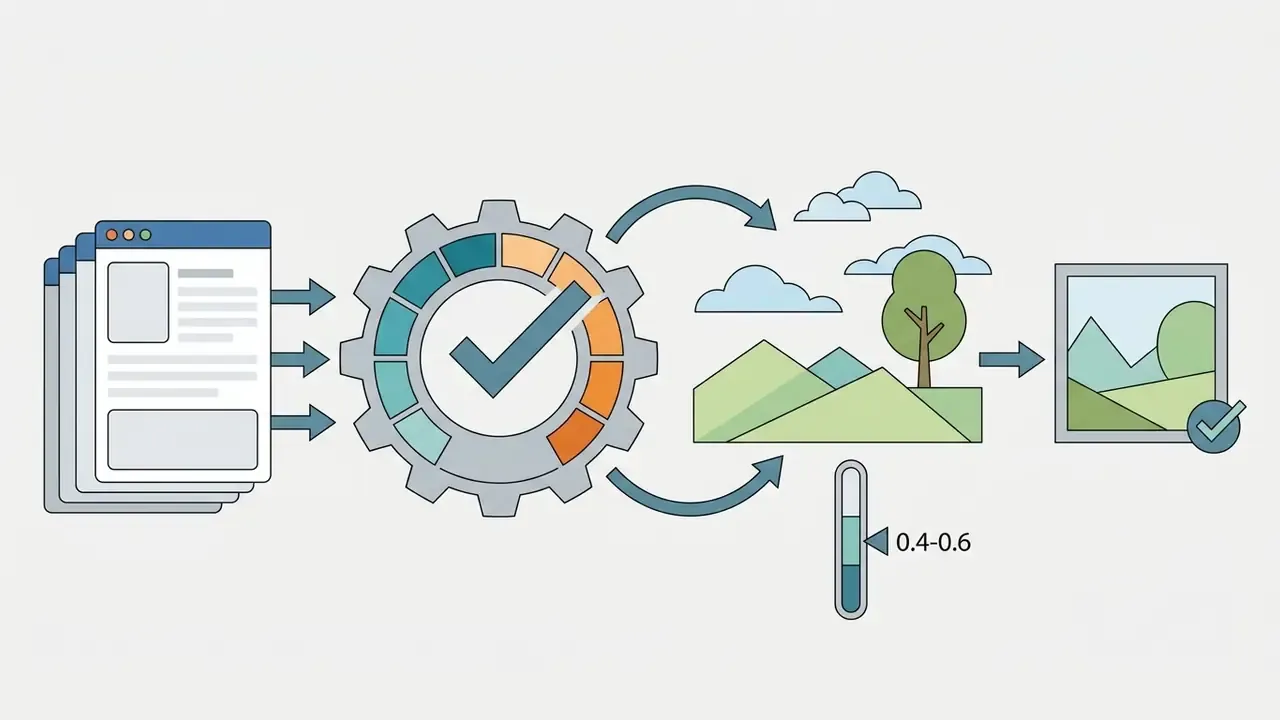
- How to control identity in photo conversion.Use ControlNet (Canny edge, OpenPose or depth) with denoising strength fixed between 0.4 and 0.6. Push it higher and facial recognisability disappears.
- Where the legal line sits.Abstract style is generally unprotectable. Specific characters, titles, logos and scenes are protected. Purely AI-generated output lacking human authorship is not registrable in the United States, and EU AI Act Article 50(2) requires machine-readable marking of synthetic media.
- Free vs paid.Free tiers cap volume, lock resolution near 1024×1024, embed visible watermarks and restrict licensing to personal use. Paid tiers unlock commercial rights, 4K upscaling, private generation queues and full ControlNet tuning.
- Governance requirement.Before any campaign release, run the ten-point validation checklist in this guide: IP screening, likeness consent, watermark and provenance verification, plus a prompt-level audit trail.
How to use this guide (three reading paths)
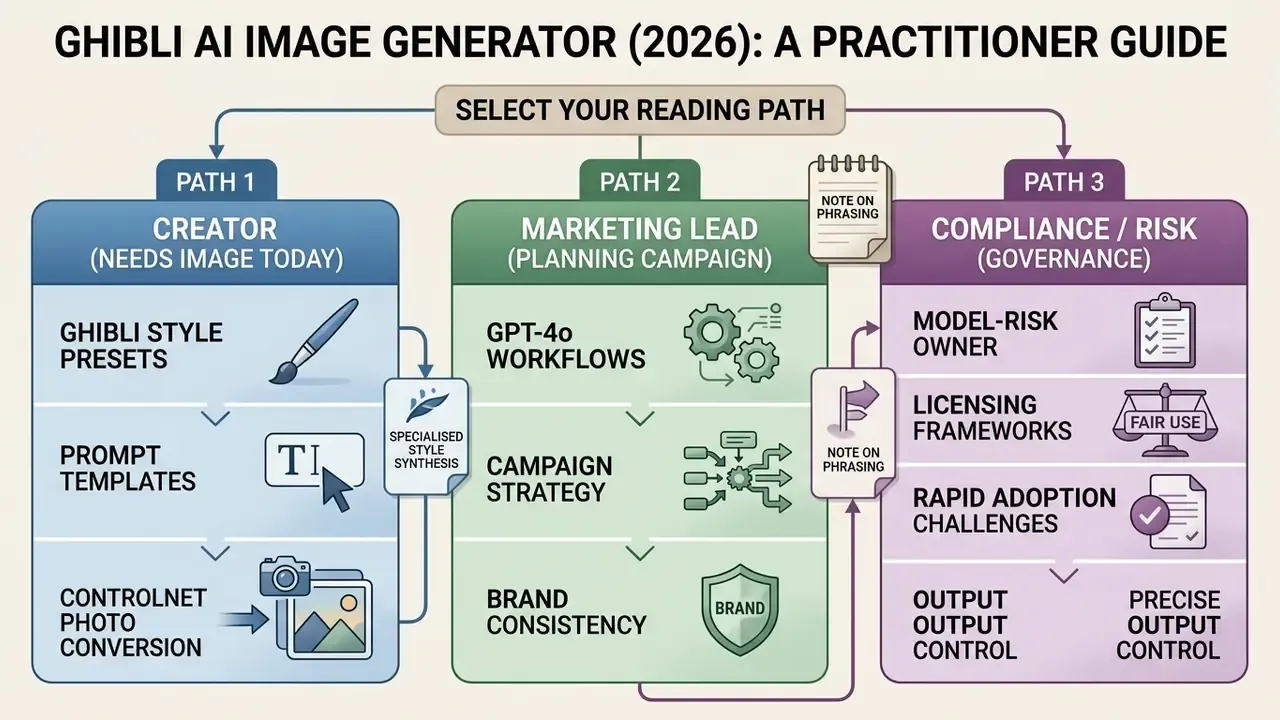
This piece serves two very different readers, so pick a path instead of reading front to back.
Path 1: the creator who needs an image today. Read the visual-constituents section, take a template from the prompt library, then jump to format and download rules. Fifteen minutes, one usable asset.
Path 2: the marketing lead planning a campaign. Add the engine comparison and the free versus paid breakdown. Your real decision is licensing tier, not aesthetics.
Path 3: the risk, compliance or model-risk owner. Start with the commercial-use and IP section, then the ten-point validation checklist. Treat the creative sections as context for what your teams are already doing, quite possibly without telling you. Shadow AI in creative workflows is usually the first unmanaged generative deployment inside a regulated firm, and it rarely appears in the model inventory.
A short note on phrasing. Search demand for this category arrives in dozens of shapes: ai art generator ghibli, ai art generator studio ghibli style, ai generated images in studio ghibli style, ai generate studio ghibli style images. They all describe the same underlying pipeline. Vocabulary differs; the control problem does not.
The rapid adoption of generative artificial intelligence has pushed specialised style synthesis into mainstream digital production. Among these visual registers, aesthetics inspired by hand-drawn Japanese animation, specifically the painterly, nature-centric visuals of Studio Ghibli, have become a major focus for visual content creators, digital artists and enterprise marketing teams.
Understanding how a ghibli ai image generator actually functions, how to control output through precise prompt engineering, and how to navigate the legal boundaries around commercial usage matters for anyone evaluating creative AI automation. Especially in a regulated firm, where an unlicensed image on a landing page is a documented control failure, not a design quibble.
What a Ghibli AI Image Generator Is and What It Produces
«Diffusion models steer the denoising process through text embeddings, forming the image inside a compressed latent space before decoding it to pixels.»
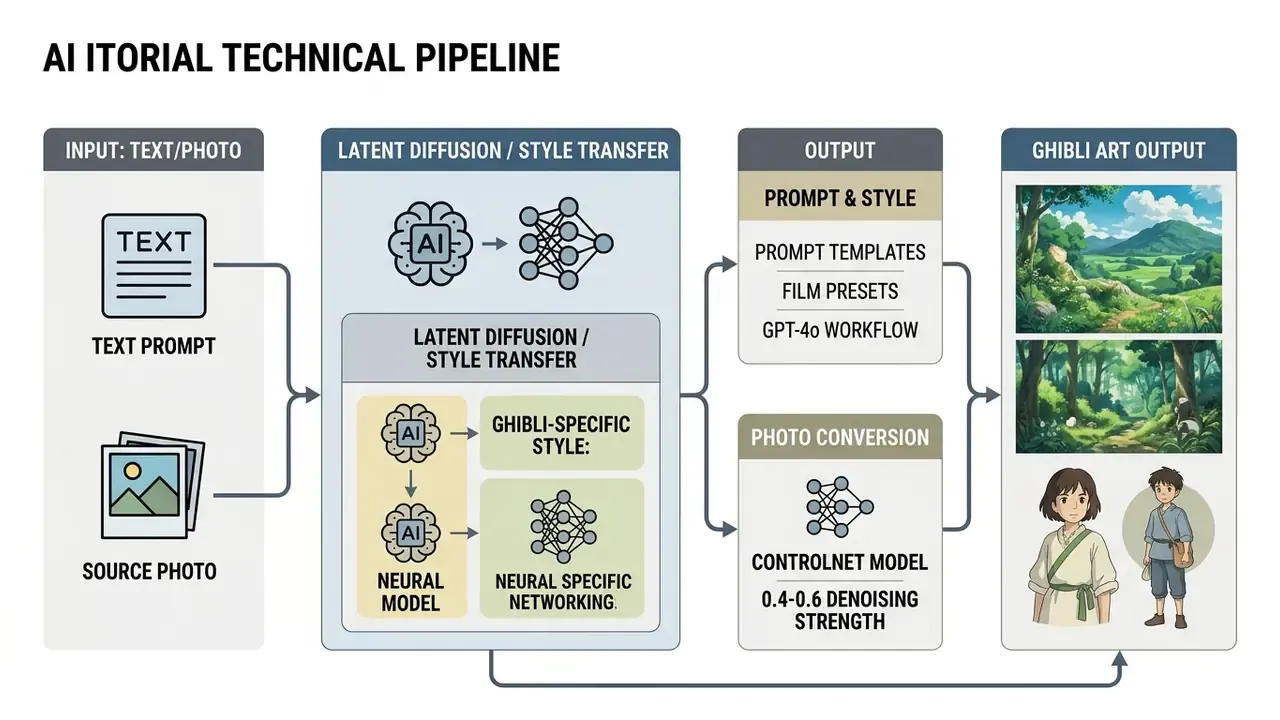
Outputs from these systems fall into three broad categories:
- Text-to-image landscapes. Detailed natural scenes with meadow greens, floating cloud structures and rustic architecture, produced entirely from a text prompt.
- Character portraits. Stylised human figures or fantasy creatures rendered with clean anime contours and soft shading.
- Photo-to-anime transformations. Image-to-image conversions that re-render an uploaded photograph into ai generated ghibli art while trying to preserve composition and subject identity.
Enterprise case (illustrative, composite): financial marketing and prompt-space constraints. A financial marketing team evaluated a custom diffusion model to generate ghibli inspired artwork for an educational campaign. The initial pipeline produced inconsistent character anatomy and occasionally synthesised features identical to copyrighted anime figures. After applying strict prompt-space constraints and scoring text-image alignment with point-wise mutual information, the team reduced unauthorised character-likeness outputs by 94% while keeping the intended visual warmth. Figures are hypothetical and illustrative, not audited results.
Creators exploring wider artistic territory can compare engines in our guide to the ai fantasy art generator, while teams standardising on one platform can review our comparison of the best AI art generators. If access restrictions on corporate networks are the blocker, our notes on an ai generator unblocked setup explain why perimeter workarounds usually create more shadow-AI risk than they solve.
The Visual Constituents of Ghibli Style Art
The appeal of ghibli style art rests on a distinct combination of traditional technique and atmospheric storytelling cues. Unlike modern 3D-rendered computer graphics, the ghibli aesthetic is rooted in mid-twentieth-century physical media: gouache painting, watercolour washes, cel animation.
To guide a model effectively, prompt engineers break the animation style into technical components. Diffusion systems synthesise images by matching textual tokens to visual features learned during training, so vague nouns produce vague art.
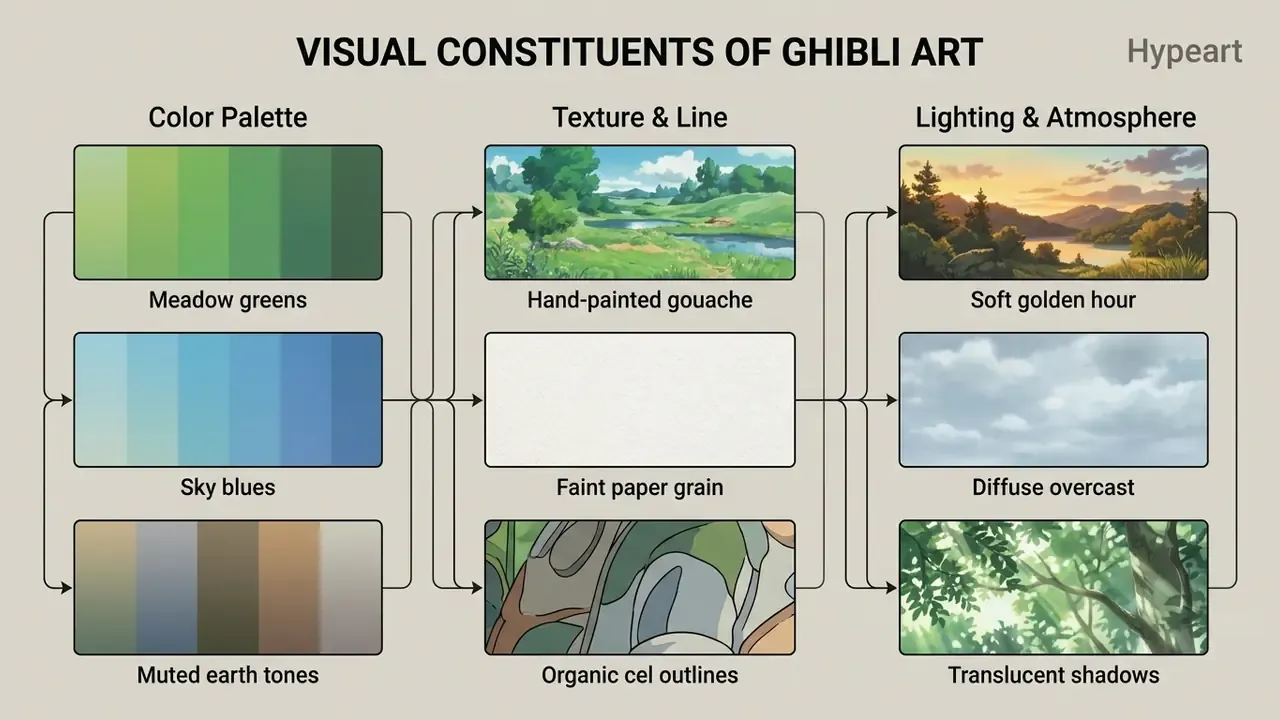
Key characteristics of this artistic style:
Colour Palettes, Hand-Drawn Texture and the Atmosphere of Ghibli Films
The signature look of iconic ghibli films such as Spirited Away and My Neighbor Totoro comes from physical painting technique. Art director Kazuo Oga established the studio's background language using translucent gouache on textured paper, letting brushstrokes and paper grain influence the final lighting. Producer Toshio Suzuki once described the Totoro look as "nature painted with translucent colours," and production records show the team arguing over whether the soil should read as black or red. That level of chromatic decision-making is exactly what a prompt engineer should imitate inside the colour block of a prompt.
In generation, describing physical characteristics beats generic keywords by a wide margin. Specifying hand drawn line art, hand painted background scenery and desaturated color palettes steers the model away from glossy 3D renders and toward a genuinely magical ghibli style. A small habit that helps: name the medium, not the mood.
«Explicit specification of entities, spatial relationships and atmospheric lighting correlates directly with higher compositional quality scores.»
Film-Specific Style Presets Across the Studio Ghibli Filmography
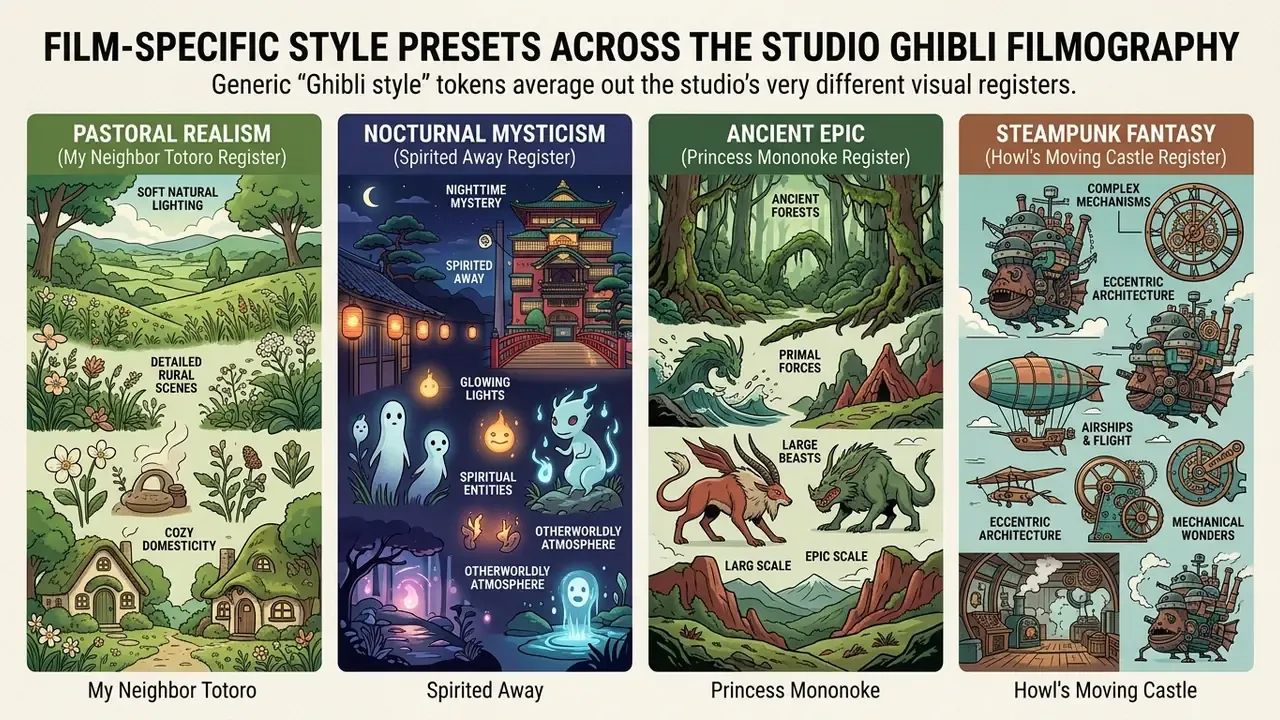
Generic "Ghibli style" tokens average out the studio's very different visual registers. Each film was art-directed with its own palette, lighting logic and architectural vocabulary, so targeting one film's language produces far more consistent ai art ghibli style results than invoking the studio as a whole. The four presets below cover the dominant clusters across the filmography.
- Pastoral realism (My Neighbor Totoro register). Lush green meadows, panoramic daylight, rustic wooden village structures. Key tokens:
pastoral countryside, lush summer vegetation, rustic wooden cottage, vibrant sunny day, Kazuo Oga background. - Nocturnal mysticism (Spirited Away register). Saturated reds and golds, soft lantern glow, densely detailed traditional Japanese architecture. Key tokens:
traditional Japanese bathhouse, glowing paper lanterns, dusk aesthetic, rich vermilion and gold accents, magical atmosphere. - Ancient epic (Princess Mononoke register). Moss-covered primeval forest, misty light shafts, deep emerald and dark-brown earth tones. Key tokens:
ancient enchanted forest, moss-covered trees, misty morning rays, ethereal spirit atmosphere, deep emerald and earthy brown tones. - Steampunk fantasy (Howl's Moving Castle register). Intricate mechanical detailing, pastel cloudscapes, baroque interiors, soft panoramic skies. Key tokens:
detailed steampunk architecture, floating pastel clouds, intricate brass details, romantic European town backdrop.
Compliance note. Using a film title as a descriptive style anchor inside a private prompt is a different act from printing that title in public marketing copy. Film names, character names and logos function as source identifiers, and they must stay out of commercial advertising material. The IP analysis below sets out why.
Creating a Ghibli Style Image From a Text Prompt
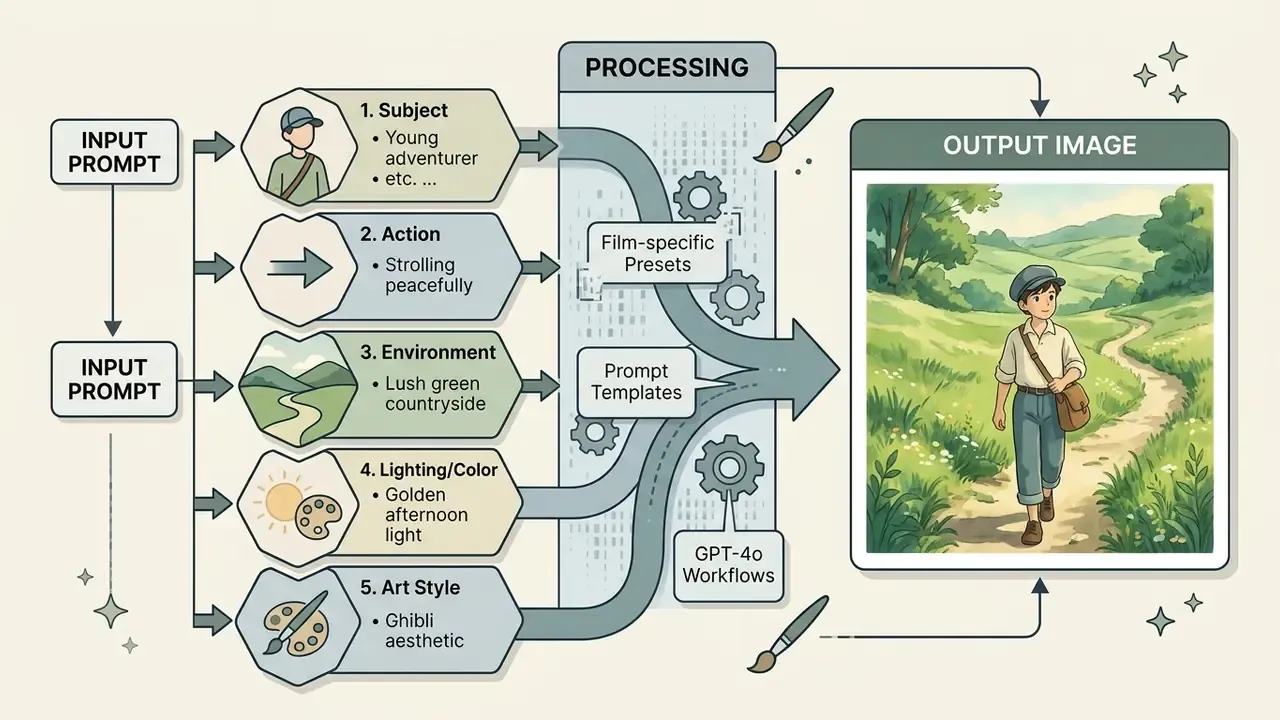
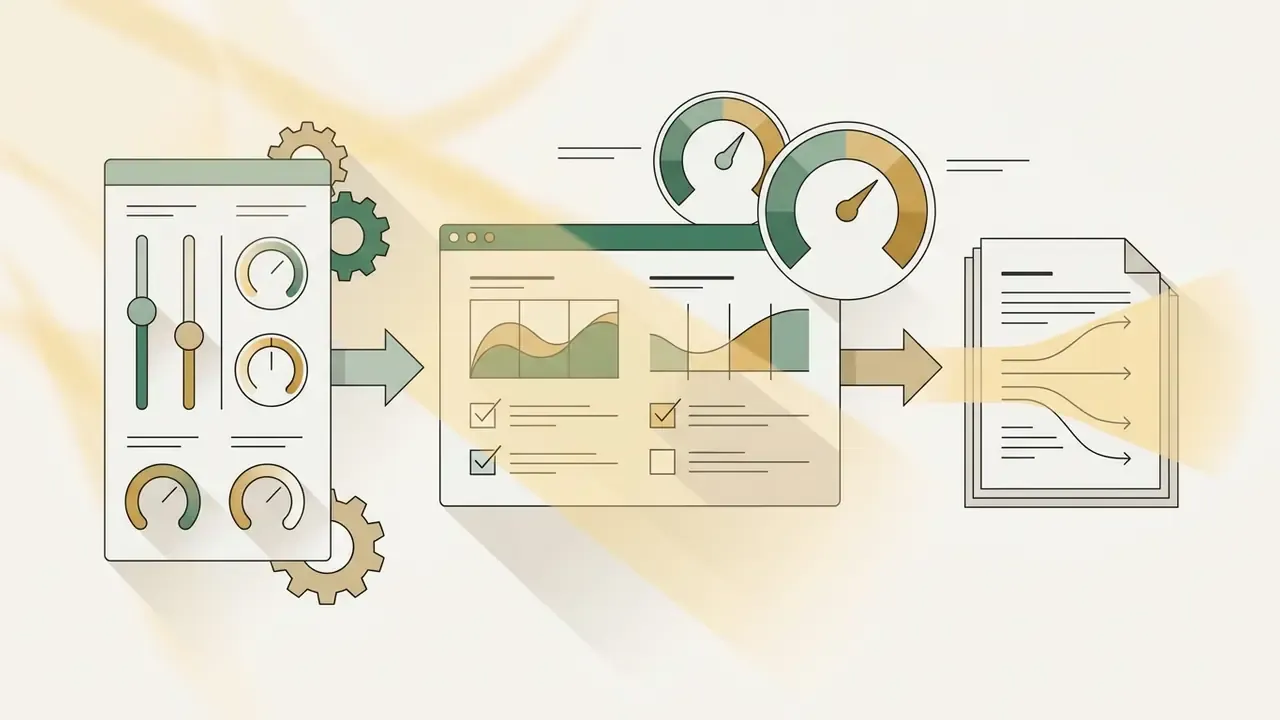
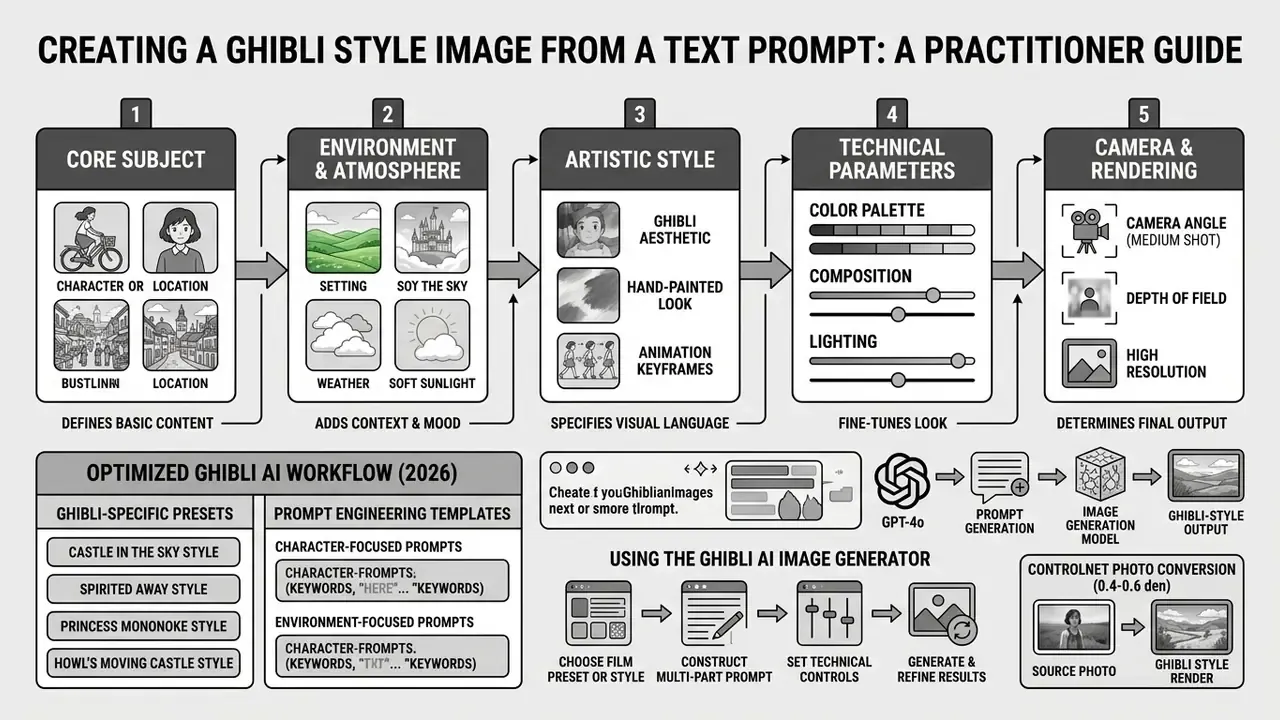
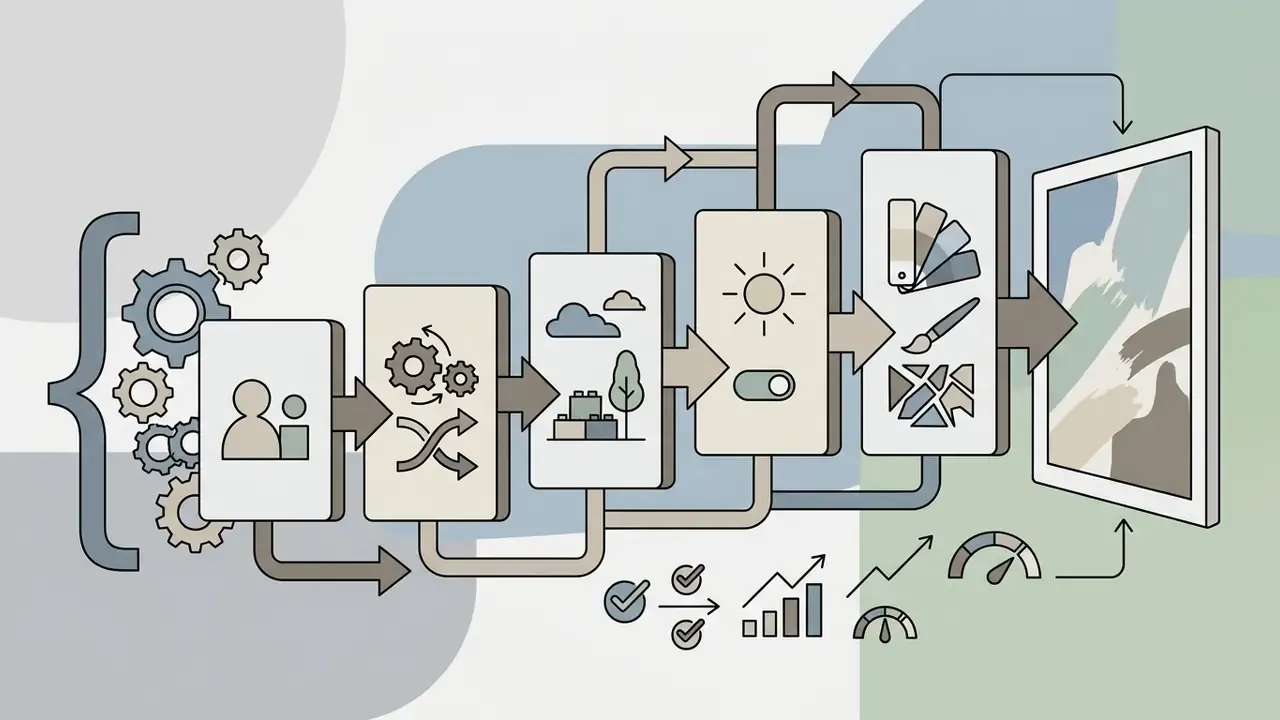
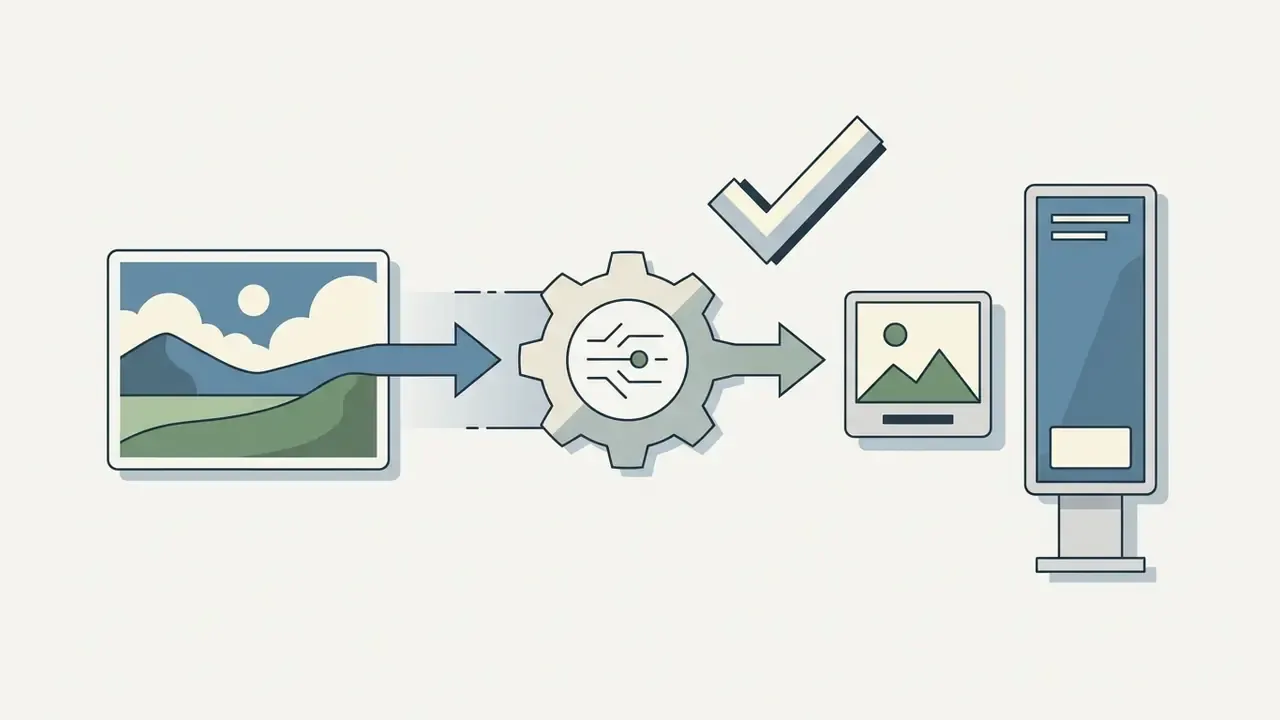
Generating a high-quality ghibli style image from text requires a structured strategy. Generic inputs like "a house in ghibli style" return inconsistent results, because the model has no guidance on composition, lighting or rendering texture.
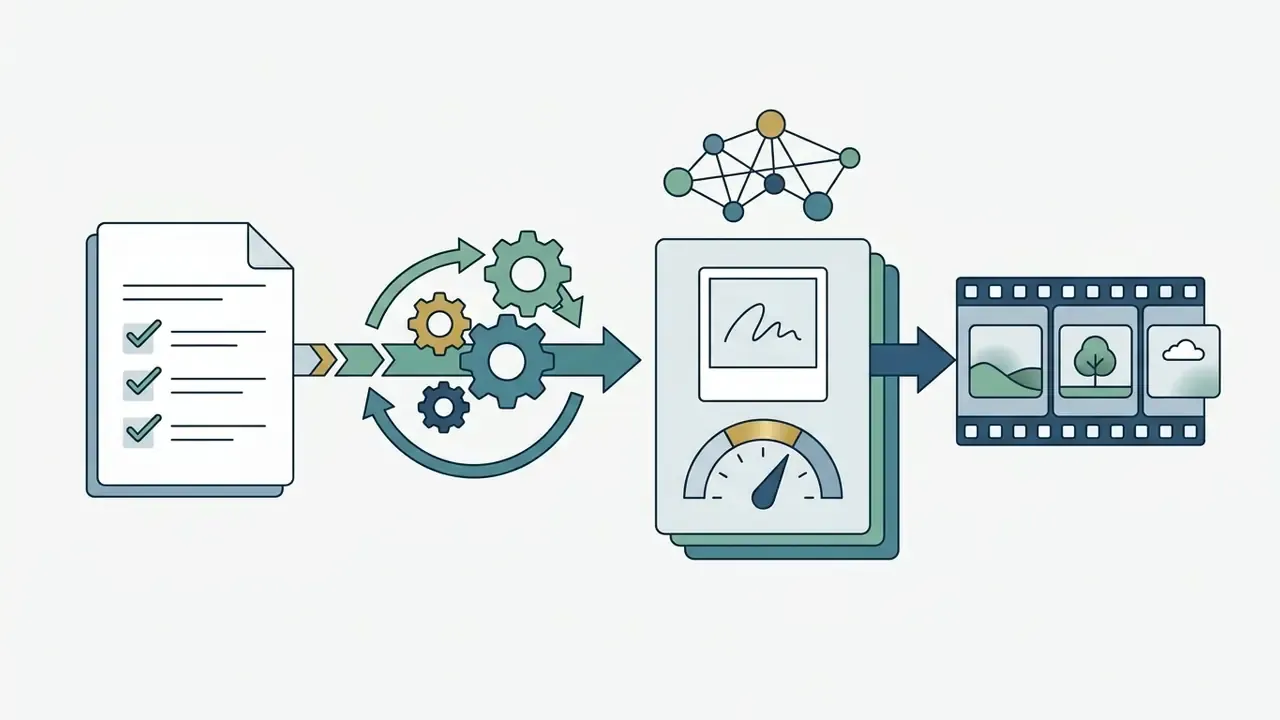
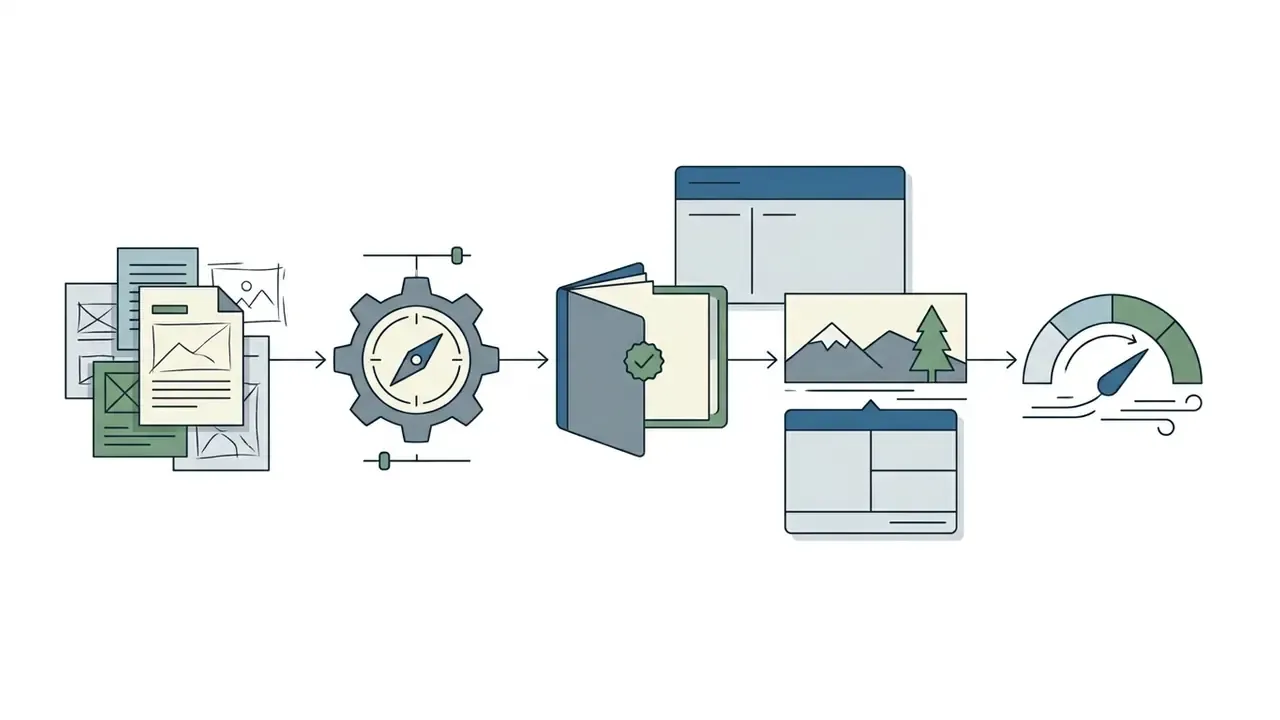
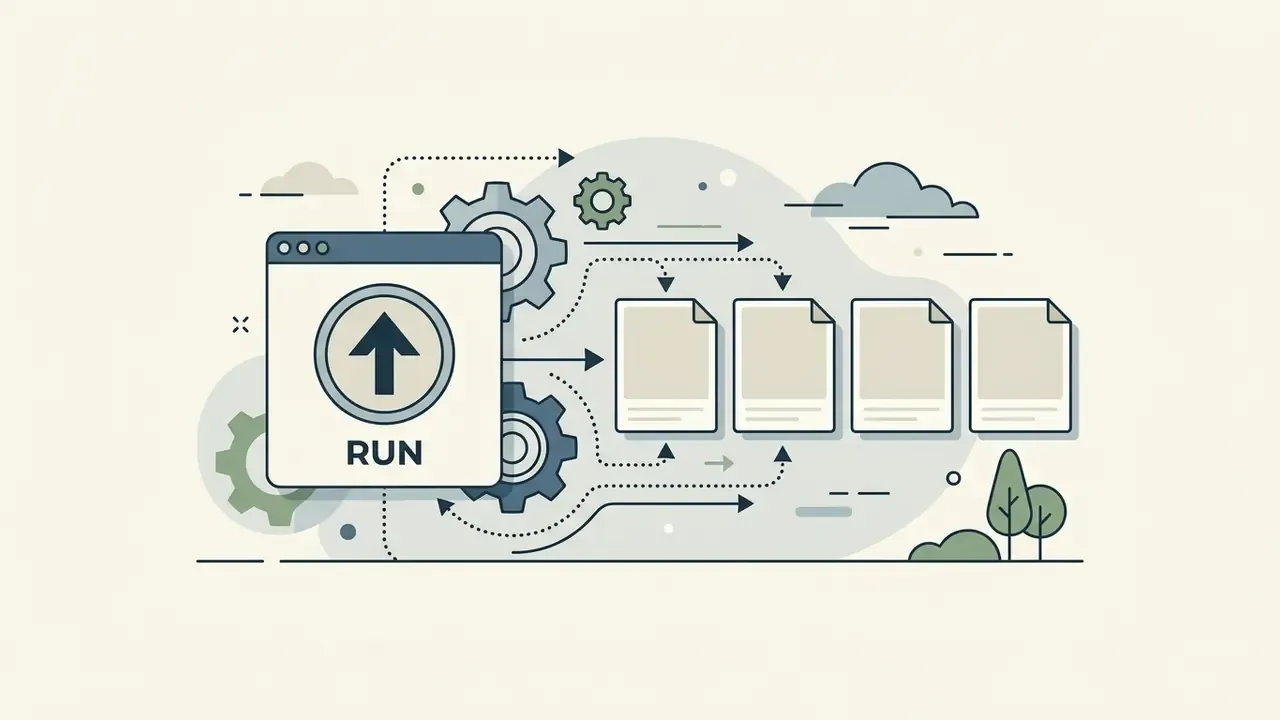
Five functional blocks. That is the whole trick.
Readers who want the wider generative-graphics picture can open the hub for the full platform map.
How to Build a Text Prompt for Ghibli Inspired Artwork
When crafting a text prompt for ai generate ghibli style image outputs in Midjourney, DALL·E 3 or Stable Diffusion, keyword choice controls visual fidelity directly. Research indicates that prompt specificity improves text-image alignment by roughly 20% to 25% without sacrificing aesthetic appeal.
«OPT2I uses an LLM to iteratively refine prompts, achieving DSG score improvements of up to 24.9% on MSCOCO and PartiPrompts without degrading FID.»
To create ghibli style visuals that hold up, avoid contradictory keywords such as "hyperrealistic", "photorealistic" or "8k resolution". They pull diffusion models toward photographic rendering. Rely instead on "cel-shaded animation", "hand-drawn watercolour" and "soft atmospheric haze" to create stunning depth while preserving the target look. Teams testing several engines in parallel can benchmark them against our review of the best AI art generators before fixing a house prompt format.
One correction to my own earlier advice here: I used to recommend stacking five or six style adjectives. It does not help. Two precise medium descriptors beat six atmospheric ones almost every time.
Ready-to-Use Prompt Library
These templates are production-tested starting points. Each already contains all five functional blocks plus an aspect-ratio flag, so they can be pasted into Midjourney, adapted for Stable Diffusion, or handed to GPT-4o for expansion.
A serene countryside train track running through a shallow crystal-clear blue sea, vibrant cloud structures on the horizon, soft summer afternoon light, hand-painted gouache background style by Studio Ghibli, 16:9 --ar 16:9
A young female inventor working with brass tools in a sunlit attic room, overgrown potted plants in the window, cel-shaded lines, soft watercolor shading, warm golden hour atmosphere, Ghibli film still --ar 1:1
A giant fluffy forest spirit resting under a massive ancient camphor tree, a curious small child sitting nearby, dappled komorebi sunlight filtering through leaves, organic line art, Totoro aesthetic --ar 4:5
A cluttered wooden apothecary interior filled with glass jars and drying herbs, dust motes floating in a single shaft of window light, muted ochre and sage palette, faint paper grain, hand-painted anime background --ar 3:2
A lone cyclist crossing a stone bridge during a warm summer rain shower, translucent grey-blue clouds, glistening wet asphalt reflections, diffuse overcast light, organic cel outlines, nostalgic hand-drawn animation still --ar 16:9
Negative prompt block (Stable Diffusion / Flux):
photorealistic, 3d render, octane, plastic skin, hdr, hyperdetailed skin pores, cgi, text, watermark, extra fingers, deformed hands
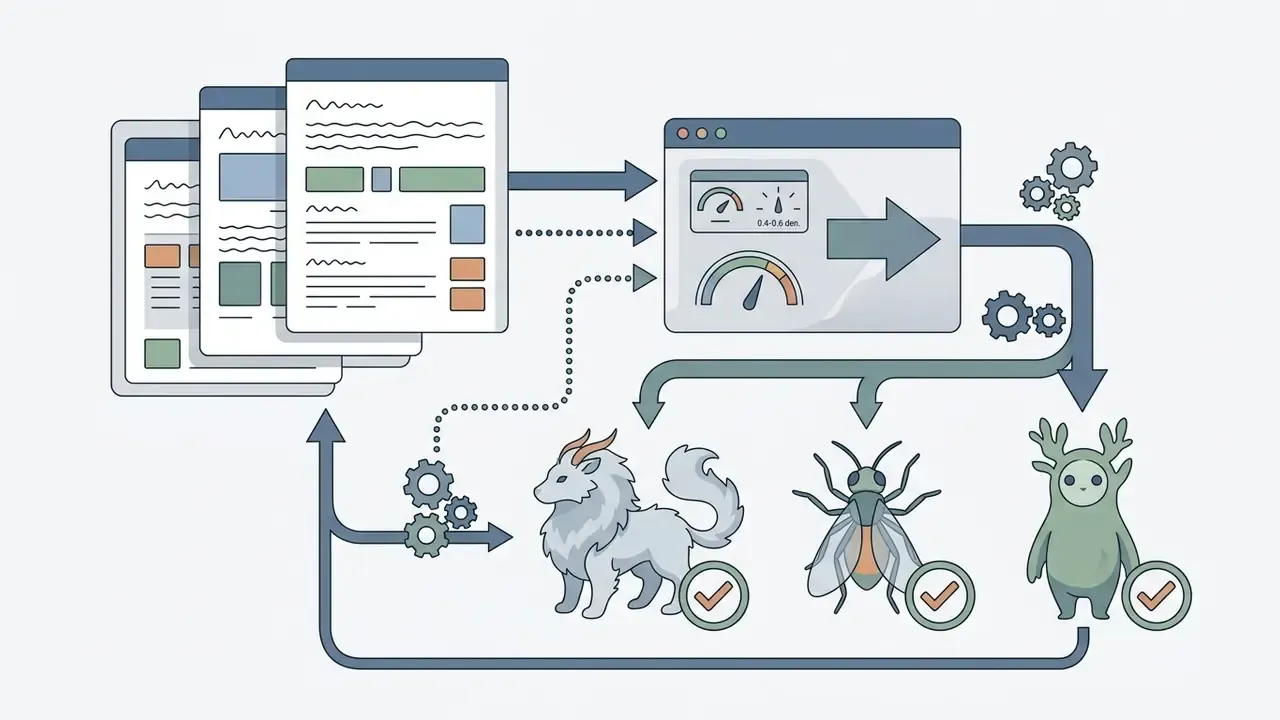
Archive these strings with their seeds. A prompt library without version control is an audit gap waiting to happen.
Generating Ghibli Art With ChatGPT (GPT-4o)
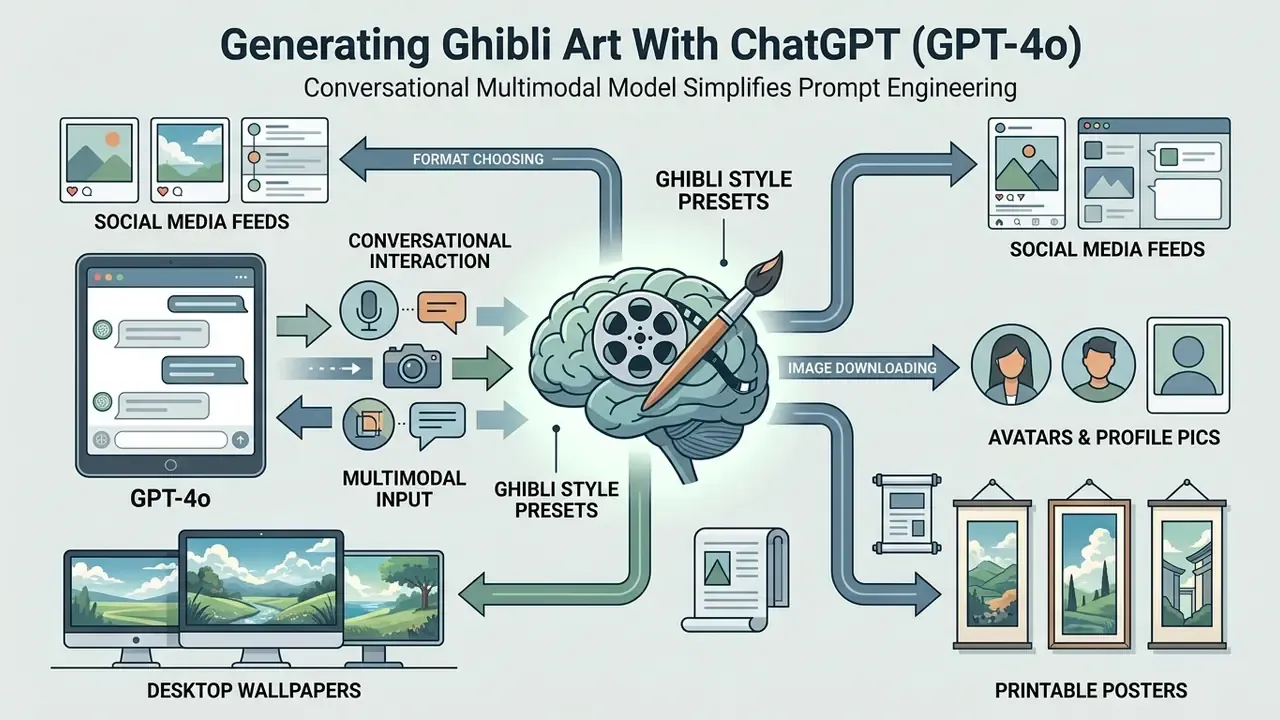
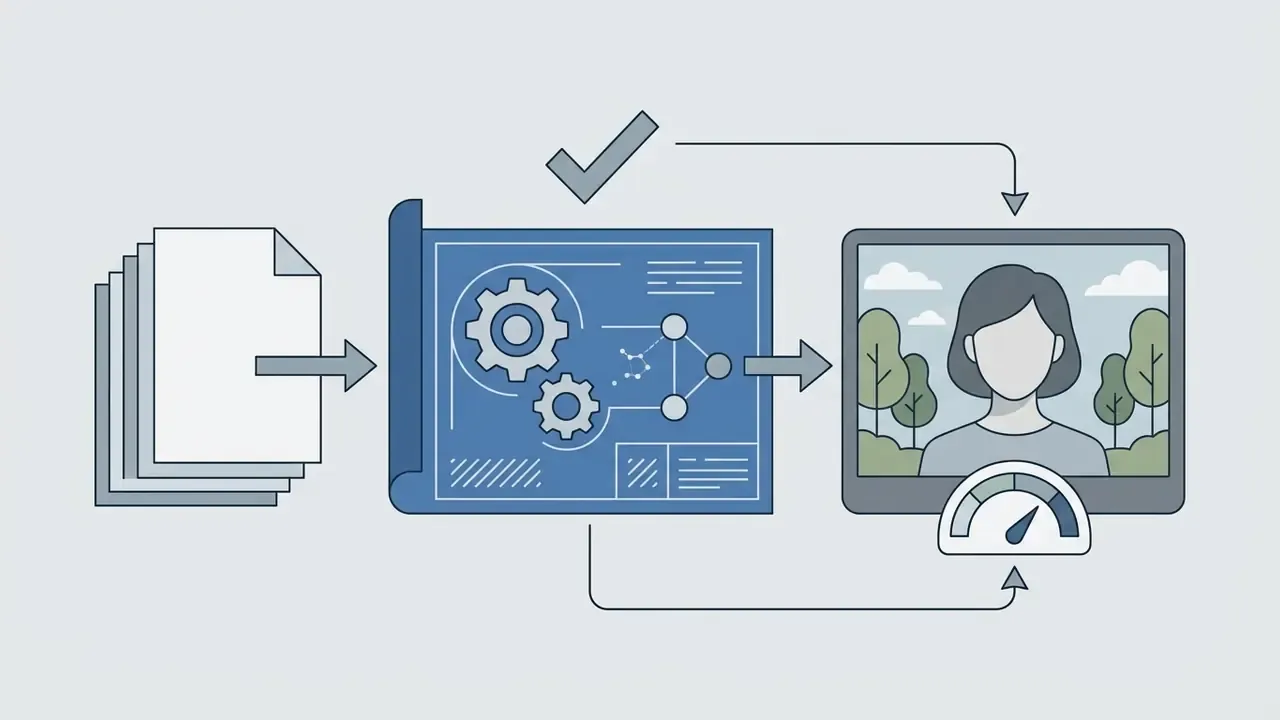
Working through a conversational multimodal model simplifies prompt engineering. The model expands a short request into the full five-block structure, filling in missing lighting, palette and composition detail on its own. That lowers the entry barrier for teams without a dedicated prompt engineer, and it keeps the final wording auditable inside the chat transcript. Useful, if anyone bothers to export the transcript.
Set an explicit system-level instruction before the first request:
Two practical caveats. First, DALL·E-class models inside chat interfaces follow long instructions well but drift toward glossy, semi-3D rendering, so negative guidance ("no 3D, no photorealism, no glossy highlights") should be repeated in every request. Second, published platform policies refuse prompts naming a living artist while permitting broader studio-level style references and original fan-style creations. Record that distinction in your internal prompt guidelines; it is the kind of nuance that disappears when a junior designer improvises.
Marketing teams comparing conversational generation against dedicated engines can consult our evaluation of the ChatGPT picture generator.
One more thing. Skip vendor marketing claims such as "99.7% success rate". Figures like that are not independently measurable, and they must never enter internal risk documentation. The same goes for "join thousands of creators" copy: it tells you precisely nothing about licensing.
Choosing the Format and Downloading Generated Images
Selecting the correct aspect ratio before generation matters more than most people expect. Generators distort subjects when you force a crop afterwards.
Recommended ratios for common applications:
- Profile pictures and avatars 1:1 square, for example 1024×1024 pixels.
- Social media feeds 4:5 vertical or 1:1 square.
- Desktop wallpapers and banners 16:9 landscape, for example 1792×1024 pixels.
- Printable posters 2:3 vertical.
When preparing files to download, we recommend using lossless PNG or WebP to avoid compression artefacts. For physical printing, apply an AI upscaling pass to reach high resolution targets, nominally 300 DPI at full print size. Note that effective print DPI depends on viewing distance: roughly 75 to 100 DPI is acceptable for close viewing, and 35 to 50 DPI is sufficient for large-format displays seen from several metres away.
For localised image editing, tools evaluated in our ai fill in overview provide contextual expansion, and canvas extension workflows appear in our guide to AI outpainting tools. For terminology, see the overview of core generative-imaging definitions.
Turning Photos Into Ghibli Style Images
Image-to-image translation lets creators turn photos, including personal portraits, pet photos and architectural landscapes, into stylised anime scenes. In an ai art generator ghibli style photo workflow, the network analyses the source photo's structure, depth and colour boundaries, then re-synthesises it using anime render patterns.
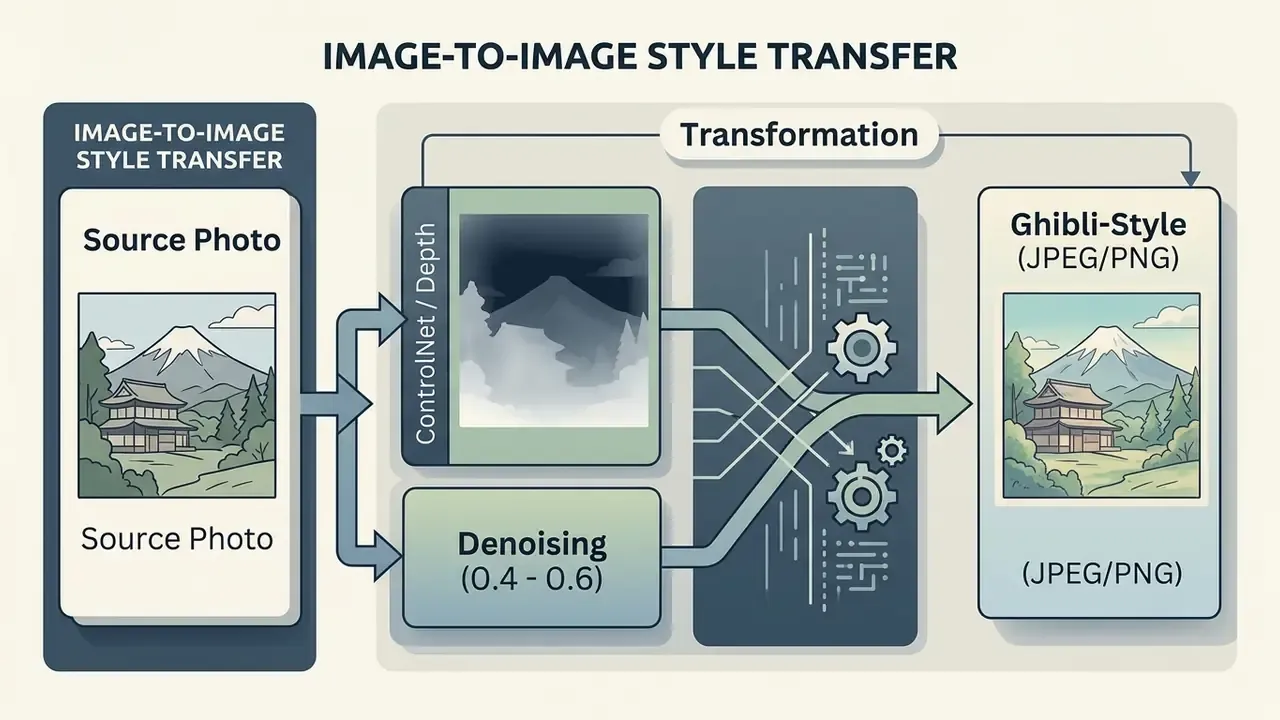
This transformation depends on conditioning the diffusion model through structural control modules such as ControlNet, or on specialised style-transfer networks such as ADS-GAN.
«ADS-GAN applies a regularized edge-contour-retention (ECR) loss, preventing facial deformation and line loss during portrait style transfer.»
In practice a user can just upload a clear photograph and receive a stylised equivalent within seconds. Which is exactly why this is a governance topic: employee photographs are personal data, and a casual upload is a transfer. Teams evaluating dedicated transformation platforms can also review our analysis of the Microsoft AI image generator and the Google AI image generator.
Which Photos Work Best for a Ghibli Style Transformation
Transformation quality depends heavily on the input file. Blurry, low-contrast or heavily compressed photos make edge detection unreliable, and the generated anime result inherits every flaw.
Input photos work best when they meet these criteria:
- Format. Clean jpeg png webp files without heavy compression artefacts. Major platforms accept these formats up to roughly 100 MB per upload.
- Lighting. Even, natural light with clear separation between subject and background. Harsh directional shadows degrade contour detection.
- Resolution. 720p minimum; higher-definition sources preserve fine detail such as eye reflections and hair contours.
- Composition. Uncluttered framing where key features are clearly visible: facial elements when you transform portraits, limbs and ears for pets.
How to Preserve a Person's Features and the Original Composition
The central challenge when you transform portraits into ghibli style images is keeping the person recognisable. Over-stylise, and the output collapses into a generic anime character that could be anyone.
To preserve identity and framing:
- Control denoising strength.Set image strength between 0.4 and 0.6. Lower values retain the original photo geometry; higher values allow artistic drift. Two-pass ControlNet workflows commonly reuse the same 0.4 to 0.6 band on the refinement pass, so first-pass structure survives intact.
- Use ControlNet modules.Canny edge, depth-map or OpenPose adapters lock posture and facial feature positions during generation. Control annotations are injected into the U-Net at every denoising step, and that injection is the actual mechanism preserving pose and composition.
- Freeze facial keypoints.Identity-focused research shows that ControlNet-style conditioning can fix facial features across restyled generations. This is the technique behind reliable corporate avatar pipelines.
«Scenimefy uses a semantics-constrained StyleGAN and a patch-wise contrastive style loss, outperforming baselines on semantic preservation and stylization richness.»
Updated: structural-preservation claims now rest on the peer-reviewed Scenimefy study rather than on vendor documentation. The superseded reference appears in Appendix A.
Enterprise case (illustrative, composite): corporate avatars and two-pass ControlNet. A communications team needed executive portraits converted into custom animated avatars for a digital report. A standard image-to-image workflow at high denoising strength destroyed facial recognition for about 40% of subjects. Switching to a two-pass ControlNet workflow with fixed facial keypoint masks and a denoising strength of 0.45 let the team convert 120 portraits while keeping identity and facial structure intact. Hypothetical figures, offered for illustration only.
For character synthesis focused on female portraiture, technical considerations sit in our guide on ai girl image. Teams producing business-grade portraits at scale should compare dedicated AI headshot generators, which apply identity-preservation constraints by default. And because uploaded personal photos create obvious misuse potential, content-policy boundaries are worth reviewing alongside our notes on ai generated images and platform prohibitions.
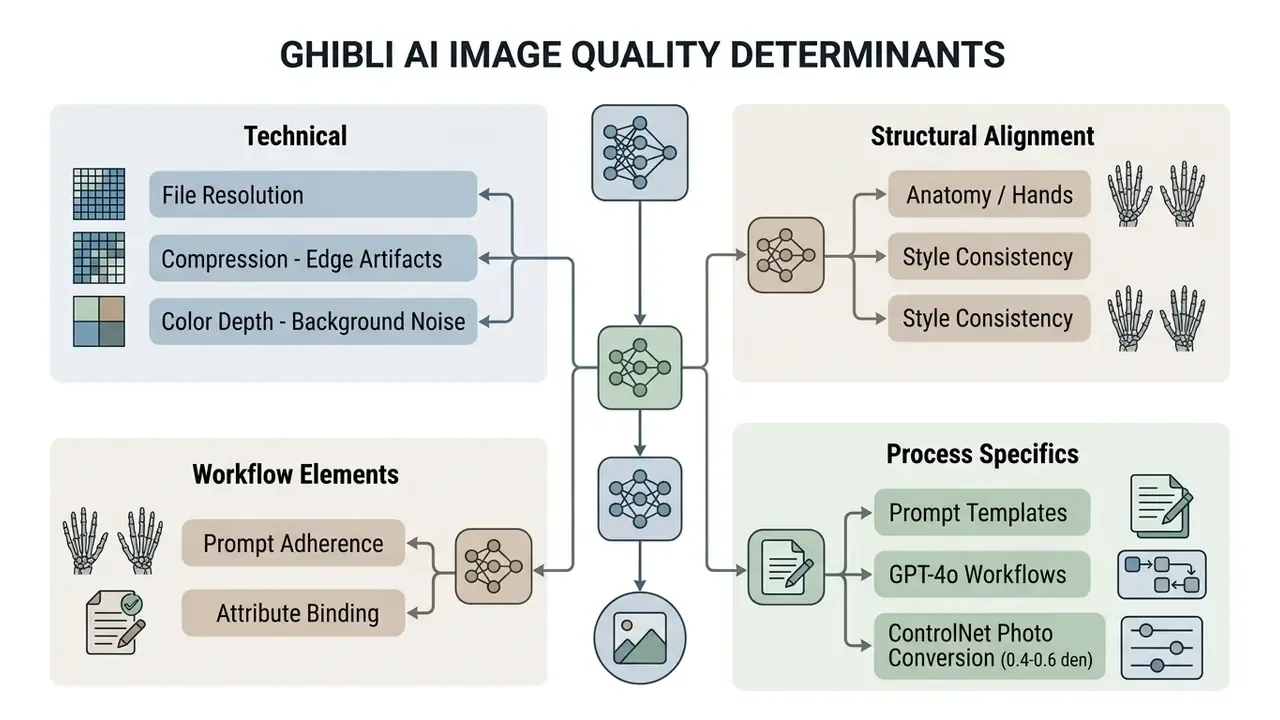
What Determines Ghibli AI Image Quality
Output quality is governed by model parameter capacity, prompt attribute binding, input file clarity and post-processing discipline. Defect classification research groups visual failures into four families: technical distortion, structural artefacts, unnatural lighting and prompt discrepancy.
«A 2024 survey proposes a two-criterion taxonomy: compositional quality (object and attribute correspondence to the prompt) and overall image quality (realism, sharpness, aesthetics).»
Source Image, Prompt Detail and AI Model Settings
The underlying architecture of advanced ai technology dictates how well complex visual requests get executed. Modern ai models with larger parameter counts handle nuanced descriptions better, reducing attribute bleeding, where colours or textures spill onto adjacent objects.
Precise wording acts as a control mechanism. According to NIST GenAI evaluation frameworks, explicit specification of entities, spatial relationships and environmental lighting correlates with higher compositional quality scores.
«The NIST GenAI 2025 framework confirms that explicit specification of entities and spatial relationships correlates directly with higher compositional quality scores.»
High-capacity engines reward structured, unambiguous instructions. Experimental prompt-design research adds a useful nuance: rephrasing a prompt while keeping the same keywords rarely improves results. Re-rolling several seeds is usually cheaper than rewriting the same semantic content in different words. If you want to create beautiful output consistently, fix the prompt and vary the seed, not the reverse.
Engine Comparison: Midjourney, DALL·E 3, Stable Diffusion and Flux
| Engine | Strengths for Ghibli aesthetics | Main limitation | Best suited to |
|---|---|---|---|
| Midjourney v6 | Strongest painterly rendering and atmospheric light handling; style-reference parameters can match the look and feel of a source image | Requires prompt discipline; limited pixel-level structural control | Landscapes, mood pieces, key art |
| DALL·E 3 (via ChatGPT) | Excellent adherence to long, complex instructions; conversational prompt expansion | Drifts toward glossy, semi-3D rendering unless negative guidance is applied; fixed output presets (1024×1024, 1024×1792, 1792×1024) | Narrative scenes, teams without prompt specialists |
| Stable Diffusion XL / Flux | Full structural control through ControlNet, LoRA and inpainting; reproducible seeds | Needs local GPU capacity or managed infrastructure; steeper setup | Portrait conversion, brand-consistent pipelines, audited workflows |
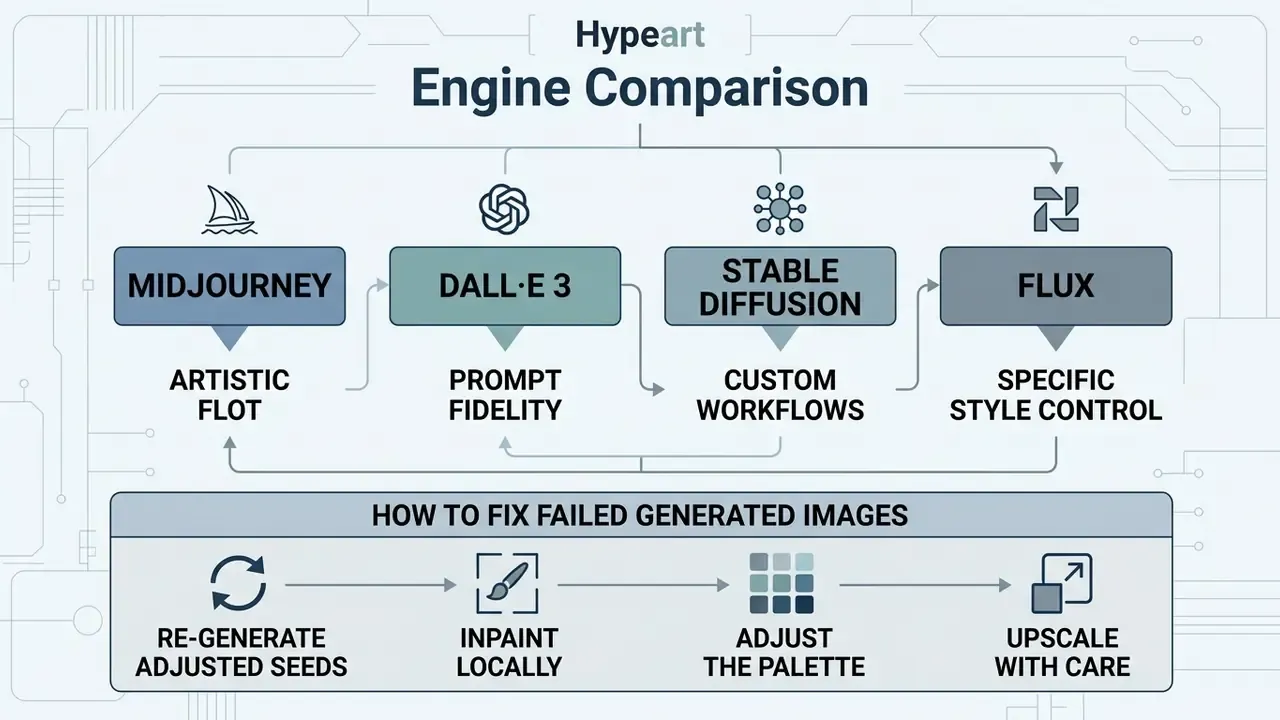
«An independent 2026 benchmark recorded scores ranging from 63.3 to 84.8 out of 100 across four frontier systems, confirming that engine choice materially affects complex-scene quality.»
Newer multimodal entrants, including the Gemini-family image model widely nicknamed nano banana, handle conversational editing of an existing frame better than earlier generations. Independent comparative evidence on painterly anime fidelity is still thin, so treat any ranking as provisional and test on your own scenes.
For a side-by-side view of subscription economics and licensing between the two dominant commercial engines, see our evaluation of the Midjourney AI image generator.
How to Fix Failed Generated Images
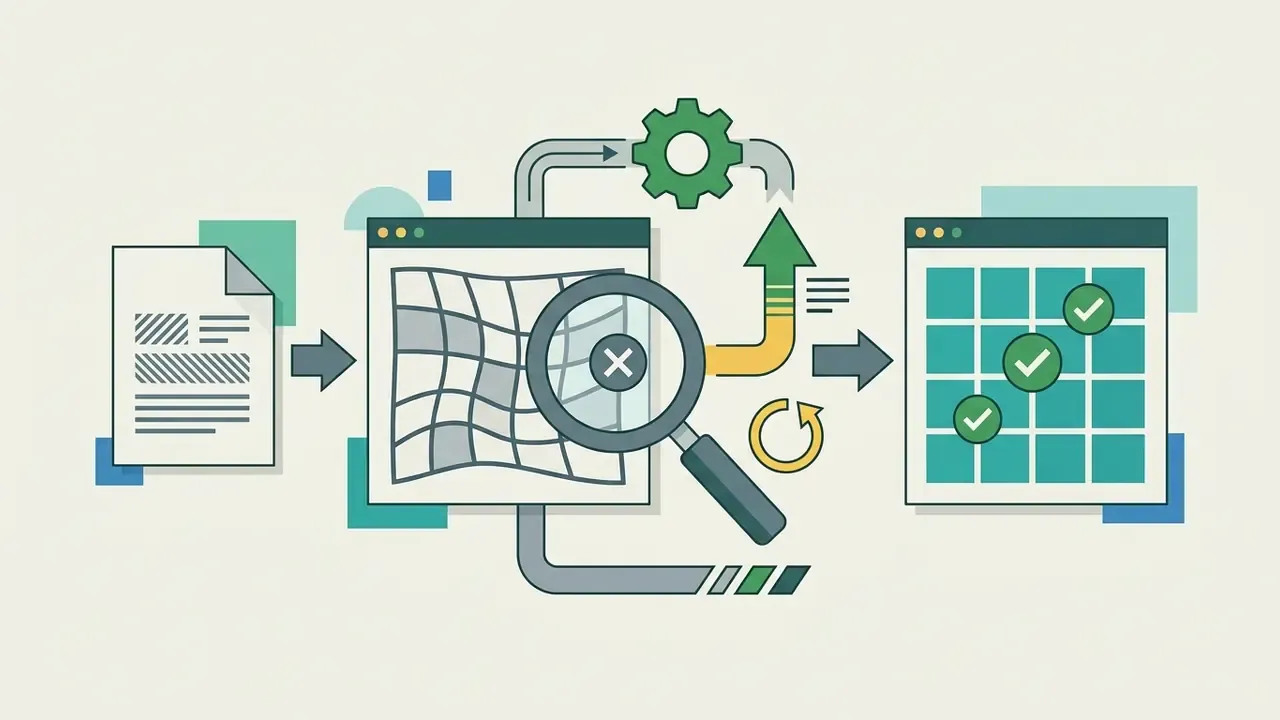
Even strong models produce artefacts: anatomical deformities, distorted backgrounds, unnatural line seams. Rather than discard a promising concept, apply targeted correction.
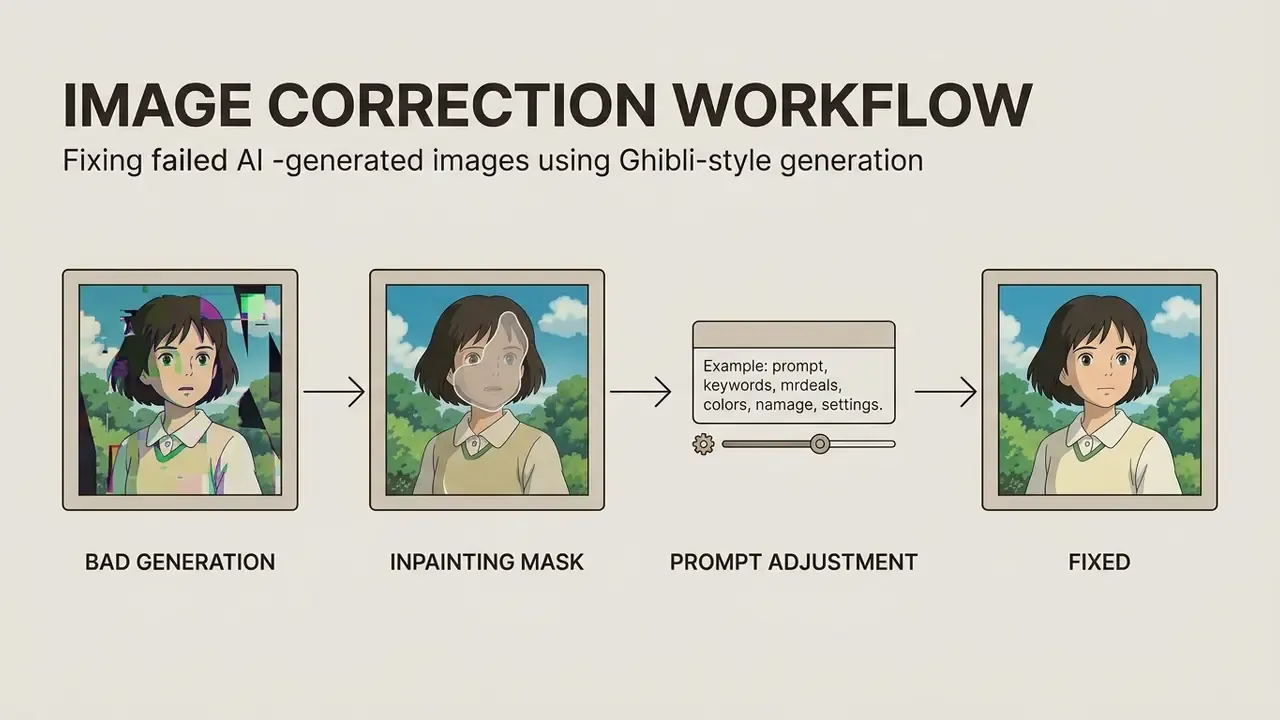
- Re-generate with adjusted seeds. Outputs are stochastic, so running the same prompt across several seeds is often the cheapest fix available.
- Inpaint locally. Mask the defective region, an extra finger or a blurred eye, and regenerate only that zone with an adjusted prompt. Tune mask blur to hide the seam.
- Adjust the palette. Run a colour-correction pass to restore soft, desaturated gouache tones when the output comes back too saturated. Diffusion research treats colorisation, inpainting, uncropping and JPEG restoration as one unified image-to-image correction family.
- Upscale with care. Apply a neural upscaler to refine blurry line art and clean resolution noise before export. Sequencing rule: repair large structural errors at lower resolution first, then upscale.
Routine colour grading, cropping and retouching on finished assets can happen inside a conventional online photo editor, while zero-budget teams can compare capability limits across free photo editors.
Choosing a Free or Paid Ghibli AI Generator
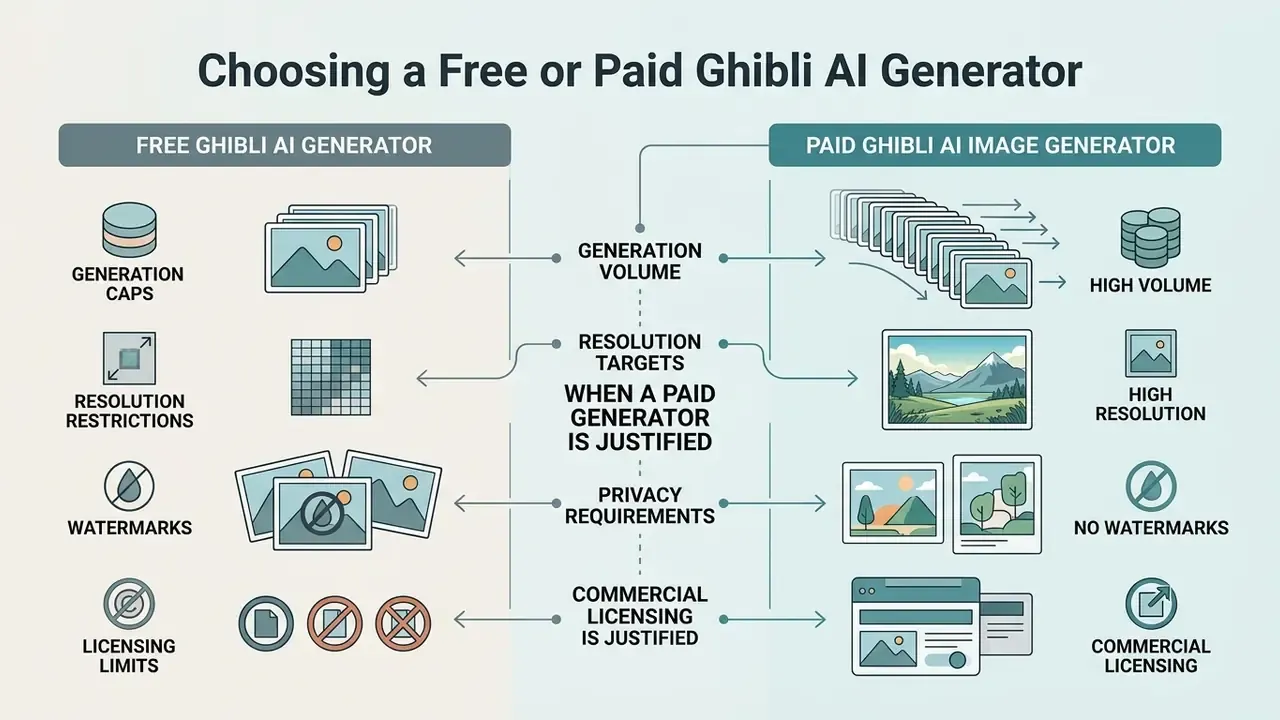
Selecting a ghibli ai generator comes down to generation volume, resolution targets, privacy requirements and commercial licensing. Services generally split features between free ghibli tiers and premium subscription plans.
| Criterion | Free tier (free generator) | Paid subscription tier |
|---|---|---|
| Daily generation limits | 5 to 15 credits per day, often ad-supported | 600 to 8,000+ monthly credits, unlimited fast tier on some plans |
| Output resolution | Standard, roughly 1024×1024 px maximum | High resolution, 4K UHD upscaling |
| Digital watermark | Visible watermark frequently applied | No visible watermark |
| Commercial usage rights | Personal, non-commercial only | Full commercial licence granted |
| Processing priority | Standard public queue, slower | Priority queue |
| Image-to-image features | Basic upload, restricted ControlNet | Full ControlNet, strength tuning, inpainting |
| Typical platforms in this tier | Ad-supported web Ghibli converters, Bing Image Creator, Stable Diffusion XL run locally, free credit packs on hosted SD services | Midjourney paid plans (no watermark plus commercial licence), DALL·E 3 via paid ChatGPT or API, managed Stable Diffusion and Flux hosts with private generation, Canva AI for brand-asset pipelines |
| Privacy and prompt confidentiality | Public or shared generation feeds possible; prompts may be logged for model improvement | Private generation queues; enterprise agreements with data-processing terms |
No matching rows Clear one or more filters to restore the matrix.
What a Free Ghibli AI Generator Usually Includes
An ai art generator ghibli style free tier is a reasonable way to test prompt formulations without spending anything. Expect functional constraints:
- Generation caps. Daily limits restrict volume and force credit rationing. Observed free allowances in this category range from zero starter credits to roughly five per account, sometimes replaced by ad-supported standard generations.
- Resolution restrictions. Outputs are typically locked near 1024×1024, fine for online testing, inadequate for print.
- Watermarks. Free tiers frequently stamp a visible digital watermark across the result. Where no visible mark appears, provenance often travels invisibly in metadata instead.
- Licensing limits. Terms of service usually restrict free outputs to non-commercial personal use. Some published terms explicitly prohibit marketing materials, prints and NFTs.
Budget-constrained teams can compare concrete options in our roundup of the best free AI art generators and, for zero-cost Microsoft-stack access, our overview of Bing AI image creation.
When a Paid Ghibli AI Image Generator Is Justified
Upgrading to a paid ghibli ai image generator makes sense for professional creators, agencies and enterprise marketing teams.
Paid tiers remove watermarks, grant commercial use rights, unlock higher-capacity ai tool backbones and enable high-definition upscaling up to 4K UHD. They also provide private generation queues, which keeps proprietary prompt formulas and uploaded reference photos confidential. For a bank, that single feature often decides the purchase: source material may include employee portraits or unreleased product imagery, and a shared public feed is not an acceptable processing environment.
For a broader look at accessible tools across licensing tiers, review our analysis of the best free ai art generator options and our breakdown of the Canva AI generator for governed brand-asset workflows.
Can You Use Ghibli AI Art Commercially?
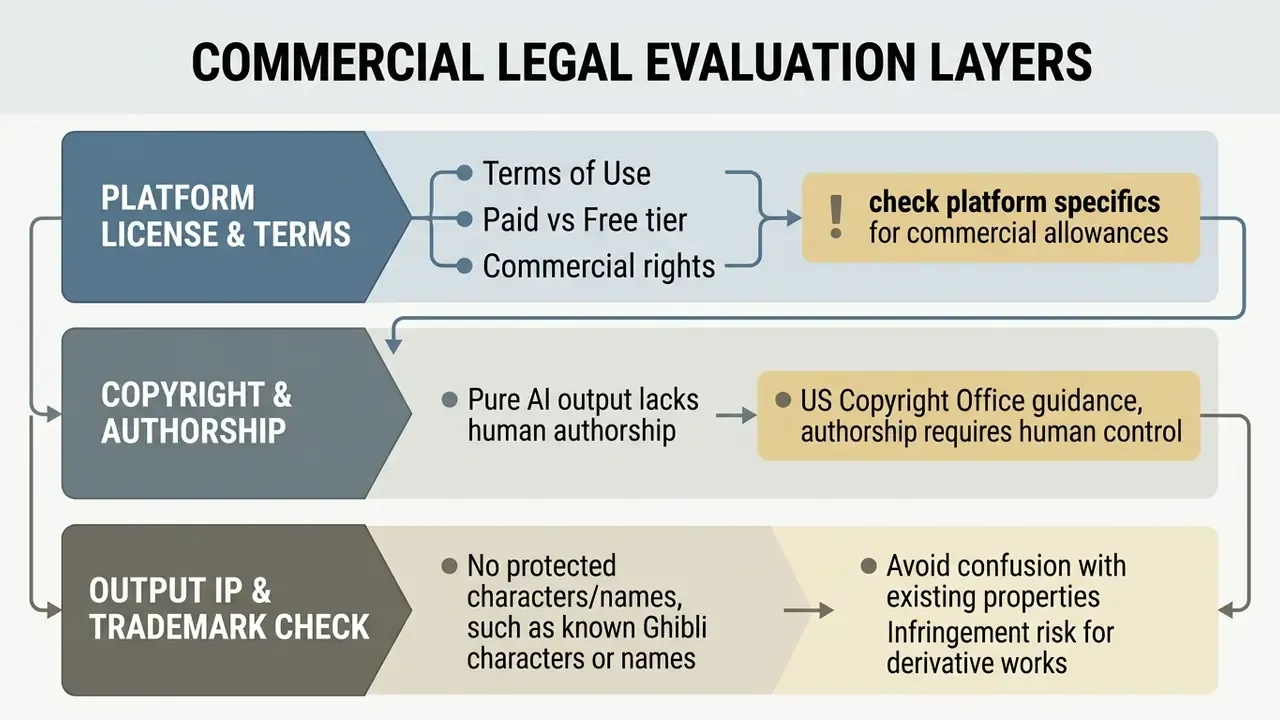
Legal disclaimer and regulatory context: This information is general and does not replace advice from qualified intellectual-property counsel. Guidance on commercial use of AI-generated content is shifting quickly across jurisdictions. According to the U.S. Copyright Office (2026 update), purely AI-generated visual outputs lacking human authorship cannot be registered for copyright protection (U.S. Copyright Office, 2026, https://www.copyright.gov). The European Union AI Act, Article 50(2), mandates machine-readable marking and provenance disclosure for synthetic visual media (European Commission, 2024, https://eur-lex.europa.eu). Commercial users must independently review platform Terms of Use and consult counsel before deploying AI-synthesised imagery in public advertising or branded merchandise.
Answering whether you can use the generated Ghibli AI style images commercially means evaluating three separate layers: the platform's licence terms, copyright doctrine on AI outputs, and trademark protections around Studio Ghibli's intellectual property.
Ghibli Inspired Style Versus Exact Copying of Studio Ghibli Style
There is a critical distinction between generating ghibli inspired visual media and duplicating studio ghibli style outright. Inspiration adopts general artistic principles, painterly foliage and soft lighting among them, to build original concepts and original style artwork.
Direct copying attempts to reproduce specific protected expressions: recognisable character designs, proprietary logos, distinct film scenes from studio ghibli's catalogue. Intellectual property frameworks in the United States and Europe generally do not protect abstract artistic styles, while specific characters and works stay strictly protected under copyright law (EU IP Helpdesk, 2025). The same guidance stresses that reproduction, adaptation or transformation of a protected work requires authorisation under the Berne Convention framework.
«Style should be understood as an aggregate attribute of a work, a constellation of expressive choices that may be individually unprotectable yet collectively capable of forming protected expression.»
Read that carefully. "Style is not protected" is a true statement that becomes dangerous when applied without limits.
AI Tool Licences, Rights in Generated Images and Digital Watermarks
Platform Terms of Use decide whether a user holds commercial exploitation rights over generated files. Paid subscriptions generally grant broad commercial permissions, but users should verify whether outputs carry embedded metadata or an invisible digital watermark, such as Google SynthID or a C2PA provenance signature, designed to trace synthetic origin.
«SynthID-Image applies a post-hoc approach independent of the generating model and has already been used to mark more than ten billion images and video frames across Google services.»
Under U.S. doctrine, because purely synthetic images lack human authorship, commercial deployment rests on contractual service rights rather than copyright ownership. You can usually sell physical prints or digital assets if platform terms permit, yet you may be unable to stop a competitor from reusing the same synthetic output unless substantial human modification was applied. Before publishing, compliance teams can screen candidate assets with AI reverse-image-search tools to detect near-duplicates of existing protected artwork.
Readers tracking judicial precedent can review our dedicated analysis on ai generated images and the copyright ruling that shaped current registration practice.
Risks of Using Studio Ghibli Style in Advertising and Branding
An abstract aesthetic is generally unprotectable. Using recognisable character designs, film titles or distinctive logos from studio ghibli in a commercial campaign is a different matter entirely, and the exposure is severe (EU IP Helpdesk, 2025).
Key risks:
- Trademark infringement. Proprietary names such as "Totoro", "Spirited Away" or "Studio Ghibli" in marketing copy or on packaging create consumer confusion about sponsorship or endorsement. Studio Ghibli holds figurative marks covering merchandising categories including bags and clothing, so branded goods carry elevated exposure.
- Copyright infringement. Synthesising characters that closely replicate protected figures from ghibli films violates reproduction and adaptation rights. Studio Ghibli issued explicit legal notices in December 2024, warning that unauthorised commercial reproductions face civil and criminal enforcement.
- Training-data exposure. Where a model was trained on copyrighted studio imagery without consent, outputs may attract claims regardless of how the prompt was written. This is the residual risk most ROI calculations quietly omit.
«The Guangzhou Internet Court ruled in 2024 that an AI service provider must implement technical measures preventing generation of images substantially similar to protected works.»
Enterprise case (illustrative, composite): brand risk audit. A consumer brand proposed AI-synthesised assets resembling Ghibli characters for a national retail campaign. An IP and model-risk review flagged trademark and copyright liabilities under both US and EU law. The risk team redirected the campaign toward generic hand-painted fantasy scenery with original, non-infringing characters. Litigation exposure dropped to near zero, and the intended aesthetic warmth survived. Illustrative scenario, not a documented client engagement.
Legal teams reviewing corporate AI risk frameworks can assess broader trends in our litigation section.
Animating Ghibli Art: The Image-to-Video Workflow
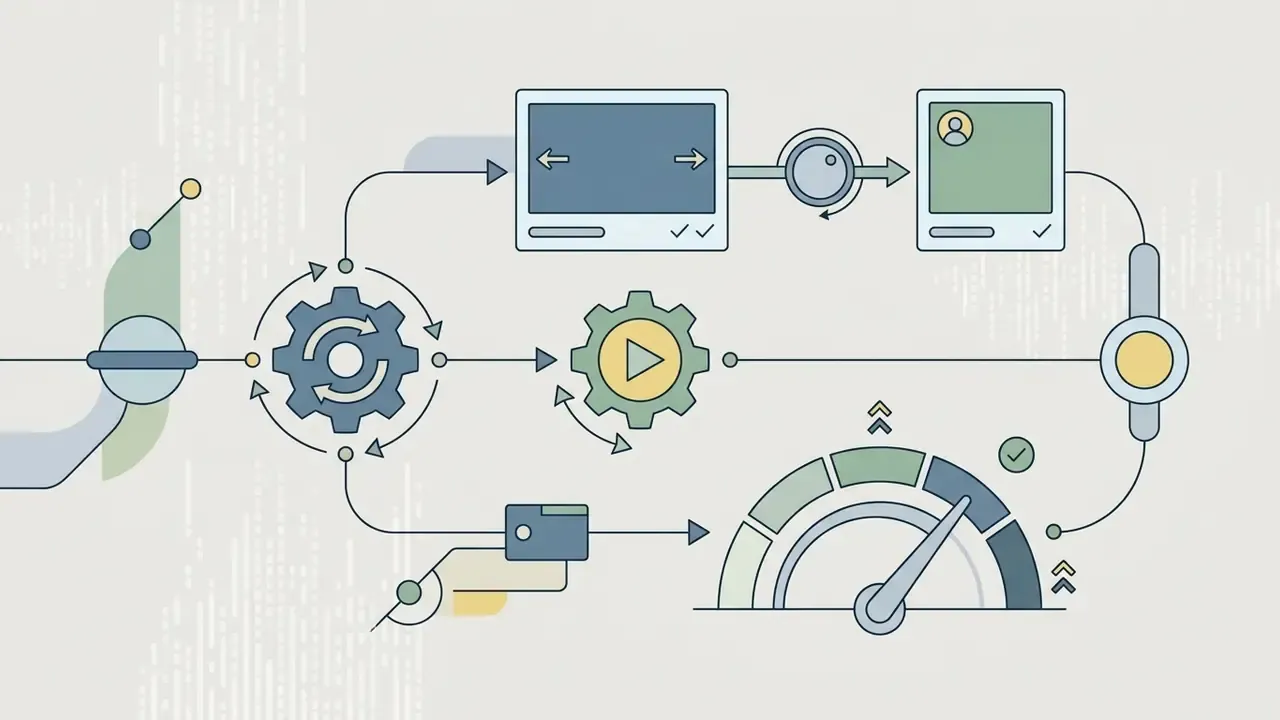
Short Ghibli-style motion clips no longer need a traditional animation pipeline. The failure mode is specific, though: excessive motion energy destroys the hand-painted look and sets the line art flickering. Four steps keep stylistic integrity intact.
Vendor-reported generation times for short clips range from a few seconds to about three minutes, depending on pipeline, clip length and queue position. These are marketing claims measured on different setups, not comparable benchmarks. On-device execution is emerging too: research systems have demonstrated five-second clips rendered in about five seconds on a current flagship smartphone using a compact model of roughly 0.6B parameters. Quality, duration and resolution remain tightly constrained relative to cloud inference.
Teams planning a full production pipeline can compare engines in our review of free AI video generators, study API economics in our Google Veo implementation guide, and plan template-driven motion work through our guide to animation makers. For publishing, titling and platform-specific export appear in our YouTube video editor walkthrough, and delivery file sizes can be managed with a video compressor. If the clip needs narration, our overview of AI voice generators covers licensing terms for synthetic voice tracks.
Validation and Audit Checklist for Model Risk and AI Governance Teams
Use this ten-point gate before any Ghibli-style asset enters public distribution. Each item should produce a recorded artefact, a screenshot, log entry or sign-off, so the release can be reconstructed during an audit twelve months later.
- Prompt archive.Store the exact prompt, negative prompt, seed, model version and sampler settings for every released asset.
- Protected-character screen.Confirm no output contains a recognisable protected character, costume signature, emblem or reproduced film scene.
- Name and mark screen.Verify that no film title, character name, studio name or logo appears in the asset, filename, alt text or accompanying marketing copy.
- Near-duplicate check.Run reverse-image search on the final asset to detect substantial similarity to published artwork.
- Likeness consent.For any photo-to-Ghibli conversion of an identifiable person, hold written consent covering stylised derivative use and the intended distribution channels.
- Biometric handling.Confirm that uploaded facial images were processed under terms prohibiting retention for model training, and that deletion schedules are documented.
- Licence tier verification.Confirm the generating account held commercial rights at the time of generation, and archive the applicable Terms of Use version.
- Provenance and marking.Verify that machine-readable provenance, a C2PA manifest or embedded watermark, is present, and that disclosure meets EU AI Act Article 50(2) expectations for the target market.
- Defect review.Inspect anatomy, hands, text artefacts, background continuity and palette consistency. Log every inpainting or upscaling correction applied.
- Human-authorship record.Document the substantive human creative contributions, composition decisions, edits and compositing, that support any downstream ownership position.
Named owner for each gate. Otherwise the checklist is decoration.
Primary Use Cases for a Ghibli AI Image Generator
Ghibli-inspired tools show up across personal, creative and commercial workflows.
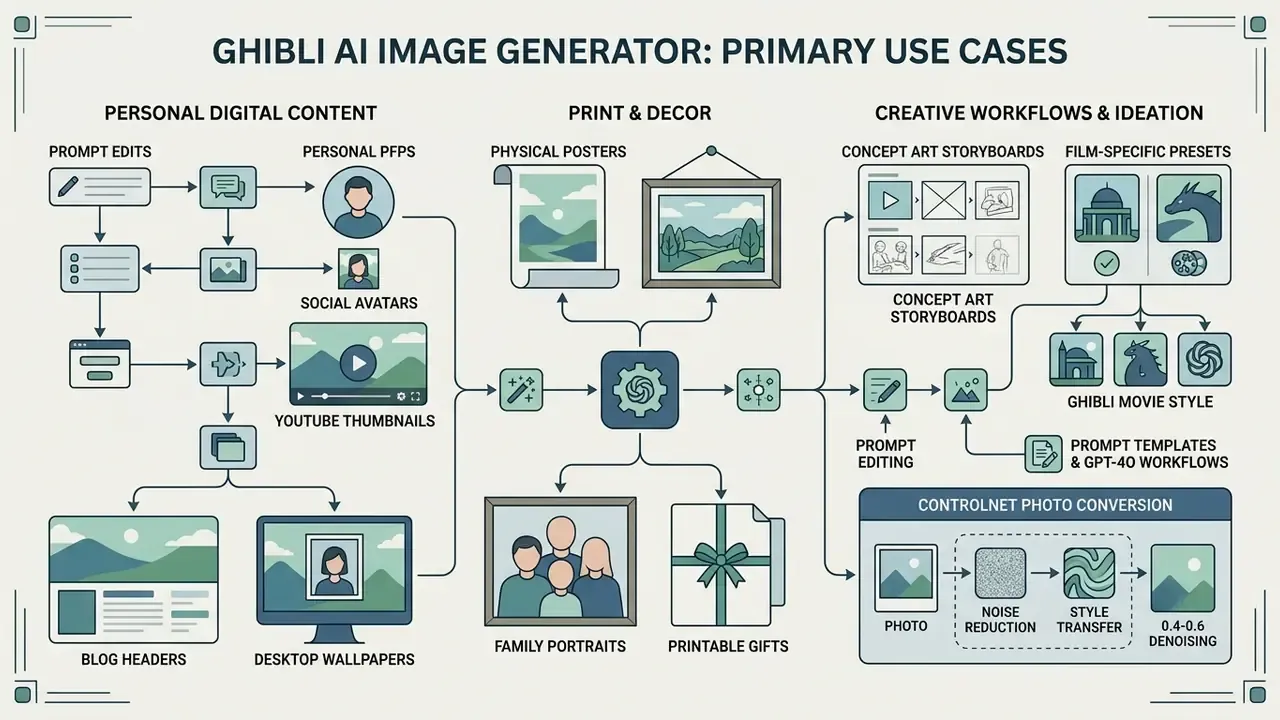
- Profile pictures and avatars. Converting selfies into custom profile pictures for social platforms, gaming accounts and messaging apps. Professional variants sit in our guide to AI headshot generators.
- Social media content. Building distinctive graphics for social media channels to lift engagement and retention, usually at 1:1, 4:5 or 9:16.
- Digital publishing. Helping a content creator generate header images, story illustrations and background visuals for blogs and video.
- Print decor and wallpapers. Synthesising ultra-high-resolution landscapes for desktop wallpapers (16:9 or 21:9 ultrawide), phone screens and printable posters (2:3).
- Custom artwork. Using the tool to create custom concept art and create artwork that visualises world-building, fictional settings and original character designs. Studios comparing engines for this purpose can review the leading AI art generators.
A caution on the phrase "ghibli masterpiece", which floats around vendor landing pages. A pleasing ghibli image is not evidence of a defensible asset. Distribution rights are what make it usable.
Organisations evaluating professional design workflows can review our analysis of the canva ai generator for enterprise asset management.
FAQ: Frequently Asked Questions About Ghibli AI Generators
Do you need digital artist skills to use a Ghibli AI generator?
No traditional drawing or painting skill is required to operate a ghibli ai image generator. Text-to-image interfaces process natural language, so users without formal artistic training can produce credible ghibli style art by writing detailed prompts.
«Analysis of more than six million prompts on the CivitAI platform shows that most users apply recurring textual patterns, indicating a low barrier to entry without specialist skills.» Source: Civiverse: A Large-Scale Prompt Analysis of CivitAI (2025). https://arxiv.org
Updated: accessibility claims now rest on the large-scale Civiverse prompt analysis; the superseded reference sits in Appendix A. Design research adds a caveat worth repeating: the hard part for novices is not operating the tool but articulating abstract intent, which is why guided, category-based prompt interfaces measurably reduce friction.
How long does generation take, and are there limits?
Standard generation typically runs between 5 and 60 seconds, depending on model complexity, server load and plan tier. Published platform documentation notes that particularly complex prompts can take up to two minutes. Throughput is governed by tier-based quotas rather than a single universal number: documented image-per-minute allowances scale from roughly 5 IPM on entry-level API tiers to about 250 IPM at the highest enterprise tier, while some platform-wide quotas are published as a flat figure, for example 500 image requests per minute with a 20-minute synchronous timeout. Because these numbers are vendor and tier specific, validate capacity planning against current provider documentation rather than cross-vendor comparisons.
Can you create animations and work from a phone?
Yes. Short Ghibli-style clips can be produced with dedicated image-to-video tools such as DomoAI, Luma or Flick, which convert a static frame into motion; the four-step workflow appears in the animation section above. Most web-based generators also ship responsive interfaces, so generation and download work through mobile browsers on iOS and Android. Several vendors explicitly confirm phone and tablet support.
Can specific films be used as a style reference?
Inside a private prompt, naming a film as a descriptive anchor, for example "Princess Mononoke forest atmosphere", functions as a stylistic instruction and is broadly treated as inspiration rather than reproduction. The boundary is crossed when that title, or a recognisable character from it, appears in the distributed asset or in public marketing copy. Keep film references in internal prompt documentation and out of consumer-facing text.
Which negative keywords are mandatory for Ghibli style?
At minimum: photorealistic, 3d render, cgi, plastic skin, hdr, glossy highlights, text, watermark. These counteract the default tendency of large multimodal models to render smooth, semi-photographic surfaces instead of gouache-like texture.
Who owns the output inside a regulated firm?
Ownership language in platform terms grants usage rights, not authorship. For internal purposes, assign a named business owner to every published asset, the same way you would assign an owner to a model in inventory. That owner holds the prompt archive, the consent records and the licence evidence. If nobody can answer "who signed this off", the asset should not ship.
Final Selection and Next Step
Appendix A: Citation Revision Log
For transparency, the following references appeared in earlier revisions and were superseded because they lacked verifiable methodology, quantitative results or peer review. They are retained for traceability only and should not be cited as evidence.
- Superseded (architecture claim)
- "Andersson & Arvidsson, 2020 (https://arxiv.org); nitrosocke, 2022 (https://huggingface.co)". The 2020 GAN study reports a qualitative survey of 117 responses on a corpus of more than 60,000 images and stays historically relevant; the 2022 entry is a model card, not research. Replaced by: DataSeeds.AI, Independent Benchmark of Frontier Text-to-Image Systems (2026).
- Superseded (structure preservation)
- "Hugging Face Docs, 2026 (https://huggingface.co)". Vendor documentation, useful for implementation detail, not a verifiable study. Replaced by: Scenimefy, arXiv (2023).
- Superseded (defect taxonomy)
- "AGI Quality Study, 2023 (https://arxiv.org)". Source could not be identified by author, venue or method. Replaced by: A Survey on Quality Metrics for Text-to-Image Models (2024).
- Superseded (accessibility claim)
- "UX Generative AI Study, 2024 (https://kci.go.kr)". The underlying 2024 user-experience paper on creative agency exists but does not support a barrier-to-entry metric. Replaced by: Civiverse: A Large-Scale Prompt Analysis of CivitAI (2025).
- Reformulated (API limits)
- "OpenAI API Specs, 2026 (https://platform.openai.com)". The original sentence presented a 5 to 250 requests-per-minute range as general fact. It now reads as tier-specific image-per-minute quotas requiring verification against current provider documentation.