- An ai cover letter generator reads your resume alongside a target job description and drafts a role-specific letter in under two minutes.
- Tailoring works. A ResumeGo field experiment across 7,287 real applications recorded a 16.4% callback rate for job-specific letters, against 12.5% for generic letters and 10.7% for no letter at all.
- Keep letters between 250 and 400 words. For ATS-driven corporate pipelines, 250-350 is the safe standard; 150-200 fits startups and LinkedIn quick-applies.
- Every draft needs human verification. Generative models fabricate titles, dates, metrics and certifications, a risk category documented formally in the NIST AI Risk Management Framework Generative AI Profile (NIST AI 600-1).
- Teams rolling these tools out at scale must settle PII exposure, Shadow AI, model-risk documentation and bias controls before deployment, not after the first incident.
Key terms used on this page
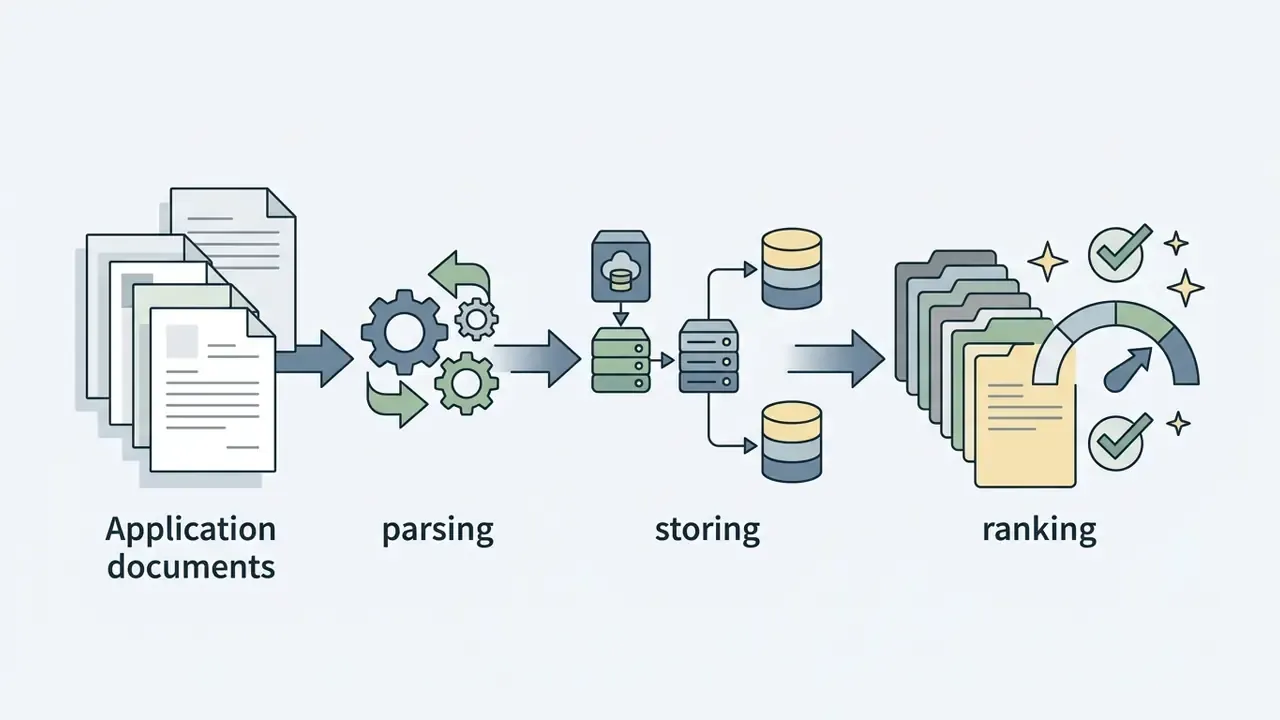
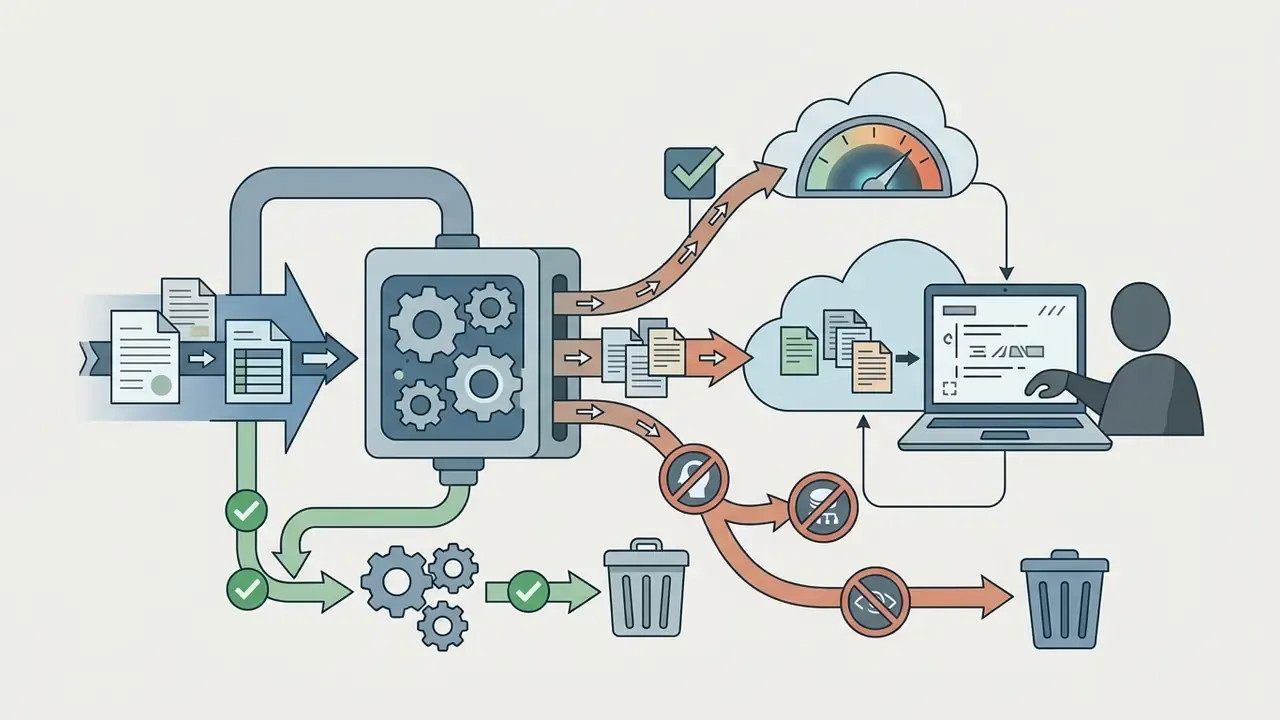
An ai cover letter generator is an automated drafting tool that analyses a candidate's qualifications alongside a target job description, then produces a customised job application letter. By linking candidate background data to specific position requirements, these tools remove the blank-page problem while keeping the document aligned with current hiring standards. That is the promise. The rest of this guide deals with what it takes to make the promise safe.
"Automation in hiring workflows must balance speed with verification. An ai cover letter generator is a drafting mechanism. Human oversight over factual accuracy is the boundary you do not move."
Marcus Hale, author.
"Edit and review created content, regardless of its source. Proofread content for factual accuracy and relevance to context." Government Generative AI Guidelines, SDAIA (2026)
What an AI cover letter generator does
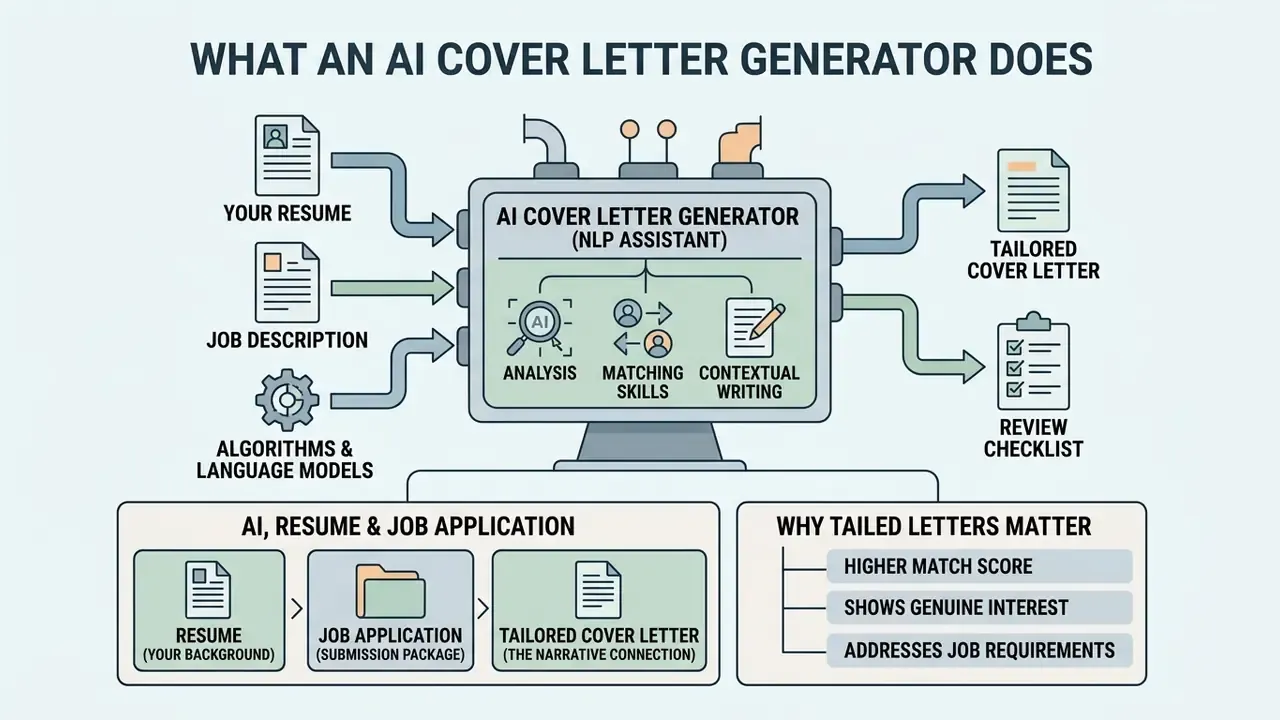
An ai cover letter generator tool works as a natural language processing assistant. It turns unstructured career history into a structured, persuasive application document. The tool reads the core responsibilities and qualifications listed in a vacancy, compares them against a candidate's documented skills, and returns a draft in seconds. Some vendors market the same function as an ai application letter generator or an ai coverletter generator; the mechanics behind the label rarely differ.
AI cover letter, resume and job application: how they work together
A working ai job application generator workflow rests on three connected documents: the resume, the letter and the portal submission itself. Vendors selling an ai cover letter and resume generator bundle usually treat all three as one dataset.
- The resume. A factual database of employment history, credentials and technical proficiencies.
- The cover letter. A contextualised narrative that translates raw resume data into an answer to the employer's stated requirements.
- The job application. Administrative data, dates and verification records captured inside enterprise systems.
When all three align, hiring managers read one consistent story across every review touchpoint. When they do not, the mismatch shows up fast. Conflicting employment dates, or a job title that grew by one seniority level between resume and letter, becomes an immediate credibility problem during evaluation. Name, contact details, dates, role title and headline qualifications must match across all three artifacts. University career guidance treats this consistency check as mandatory, not optional, before submission.
Why each job needs a tailored cover letter
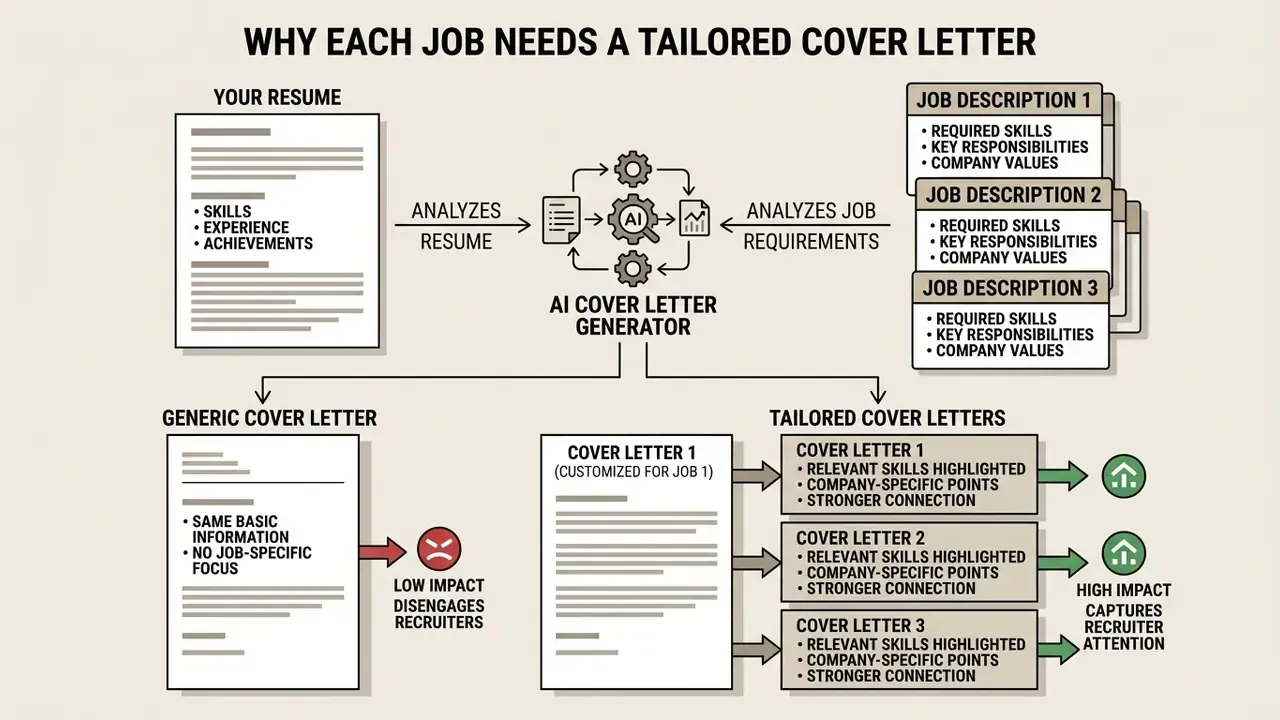
Customising an ai cover letter creator output for each application raises callback probability compared with sending the same generic text everywhere. The strongest field evidence remains the ResumeGo experiment across 7,287 real job applications: candidates submitting job-specific tailored letters achieved a 16.4% callback rate, against 12.5% for generic letters and 10.7% for applications with no letter. Roughly a 31% relative lift over generic, and a 53% lift over silence.
"Textual similarity between the cover letter and the job posting predicted interview probability even after controlling for job fixed effects."
A 2025 study by Cui, Dias and Ye on Freelancer.com found that using an ai generator for cover letter drafting increased letter-to-job alignment by 1.36 standard deviations, lifting callback probability by 3.56 percentage points.
"Access to the tool raised response probability by 0.43 percentage points, while direct usage raised it by 3.56 percentage points."
Here is the part vendors skip. The same study found that as automated tailoring spread, the correlation between textual alignment and callbacks fell by roughly 51%. Employers adapted, shifting attention to signals that are harder to fabricate: verified work history, platform ratings, measurable outcomes. So alignment still helps. It no longer differentiates on its own. Specific, checkable achievements do.
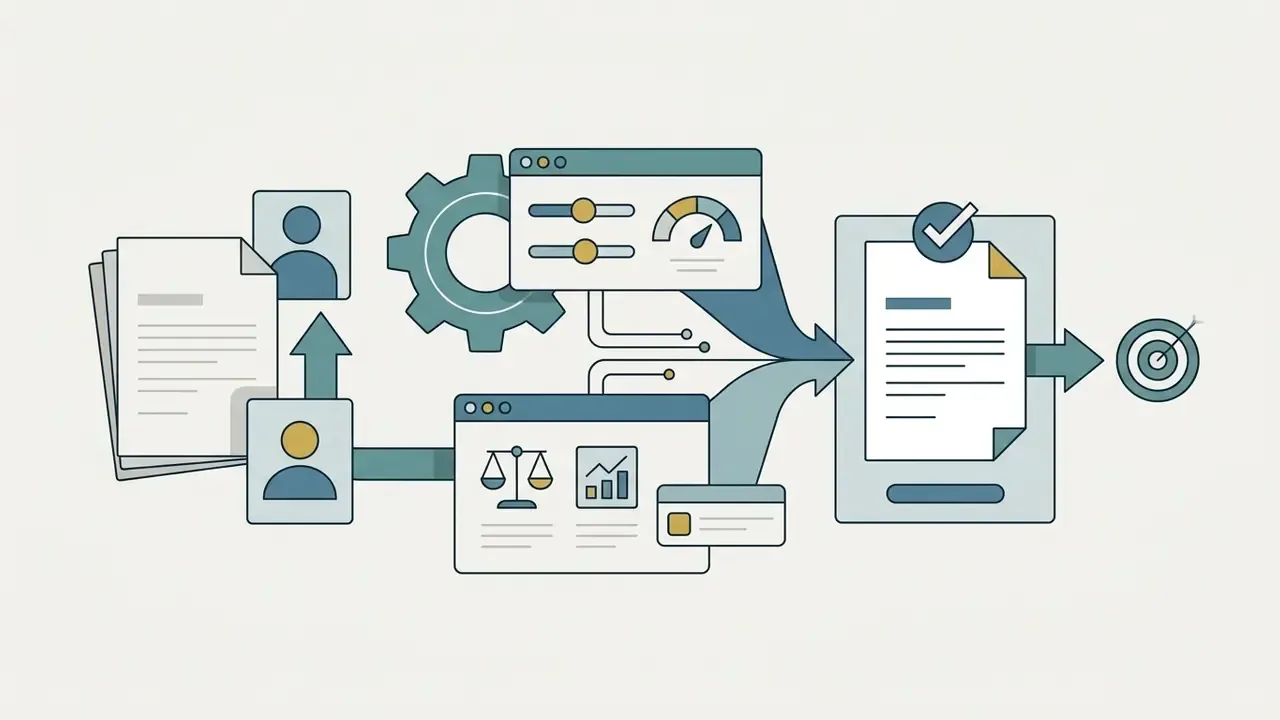
Text-labelled block diagram for accessibility, alt text: "ai cover letter generator from resume: resume and job description plus personal details flow into AI analysis, then into a generated cover letter to review and edit." Sequence of five labelled nodes, left to right: Resume / CV and Job Description feed into Personal Details, which feeds AI Analysis and Match, which produces the Tailored Letter Draft. A return arrow runs from the draft back to Personal Details, marking the human review loop.
Figure 1: Conceptual mapping of how unstructured candidate inputs combine with target vacancy data inside an AI cover letter generator.
How to create a cover letter with AI
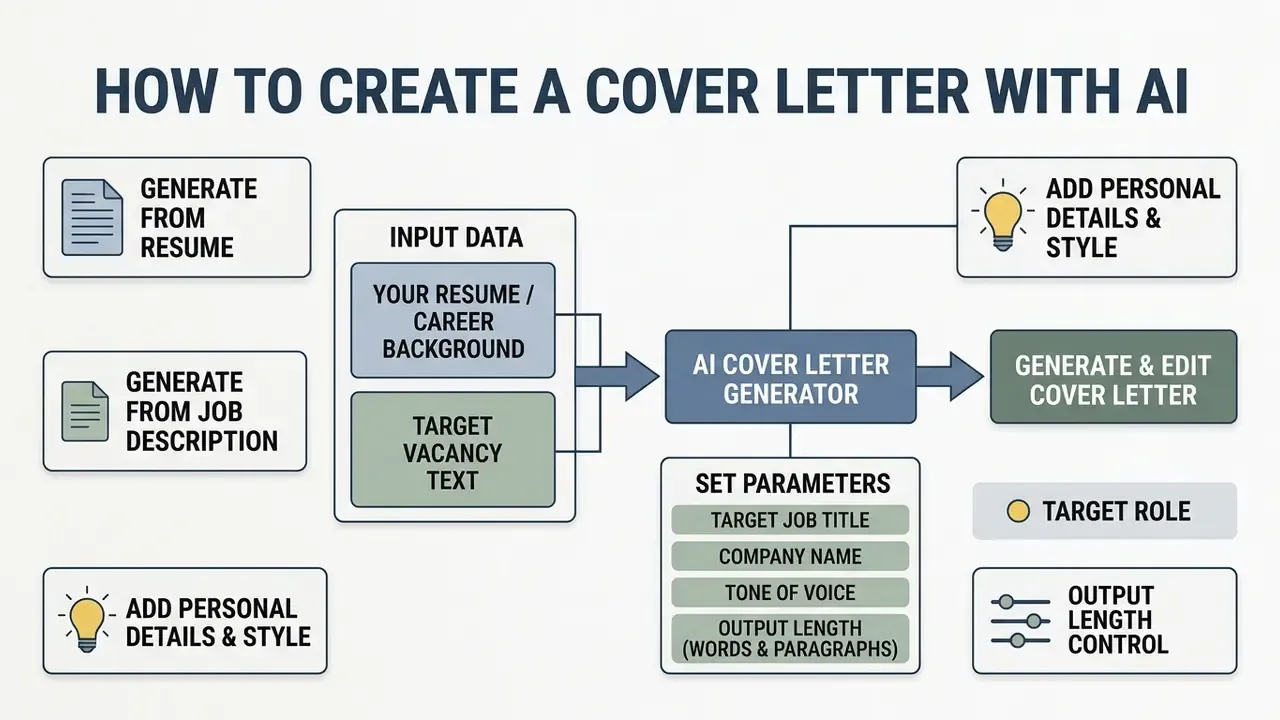
To ai create a cover letter, you supply career background plus the text of a target vacancy, set output parameters, then generate. After generation comes the part that decides everything: the review pass for factual accuracy and phrasing.
Generate a cover letter from your resume
Using an ai cover letter generator from resume means parsing structured credentials, including work history, education, certifications and technical skills, into machine-readable tokens. Serious parsers apply Named Entity Recognition and general NLP models to pull dates, job titles and measurable accomplishments. Documented pipelines run five stages: text extraction from PDF or DOCX, cleaning and tokenisation, dictionary plus NER skill extraction, tenure calculation from employment dates, and normalisation into a structured candidate profile. Tools advertised as an ai cover letter generator from resume free option usually run the same pipeline with a cap on outputs.
Research on algorithmic resume optimisation (Wiles, Munyikwa and Horton, NBER working paper) shows that rephrasing existing qualifications through automated models raised hiring rates by 8% and hourly starting wages by 10%, with no drop in employer satisfaction.
The software preserves factual claims and improves readability and framing. Nothing more than that, when it behaves.
"Access to ChatGPT reduced time spent on professional writing tasks by roughly 40% and raised blind quality evaluations by 18%."
Generate a cover letter from a job description
An ai cover letter generator from job description parses the posting line by line to isolate required competencies, core responsibilities and organisational vocabulary. The language model maps those extracted parameters onto the applicant's experience profile. Structured competency frameworks, such as the NIST NICE model that labels job content by category, specialty area and work role, show how vacancy text can be decomposed into machine-comparable attributes.
By feeding an ai cover letter generator using job description data, you get key industry terms and required credentials appearing naturally inside the first two paragraphs. That helps both the ATS and the human who reads after it.
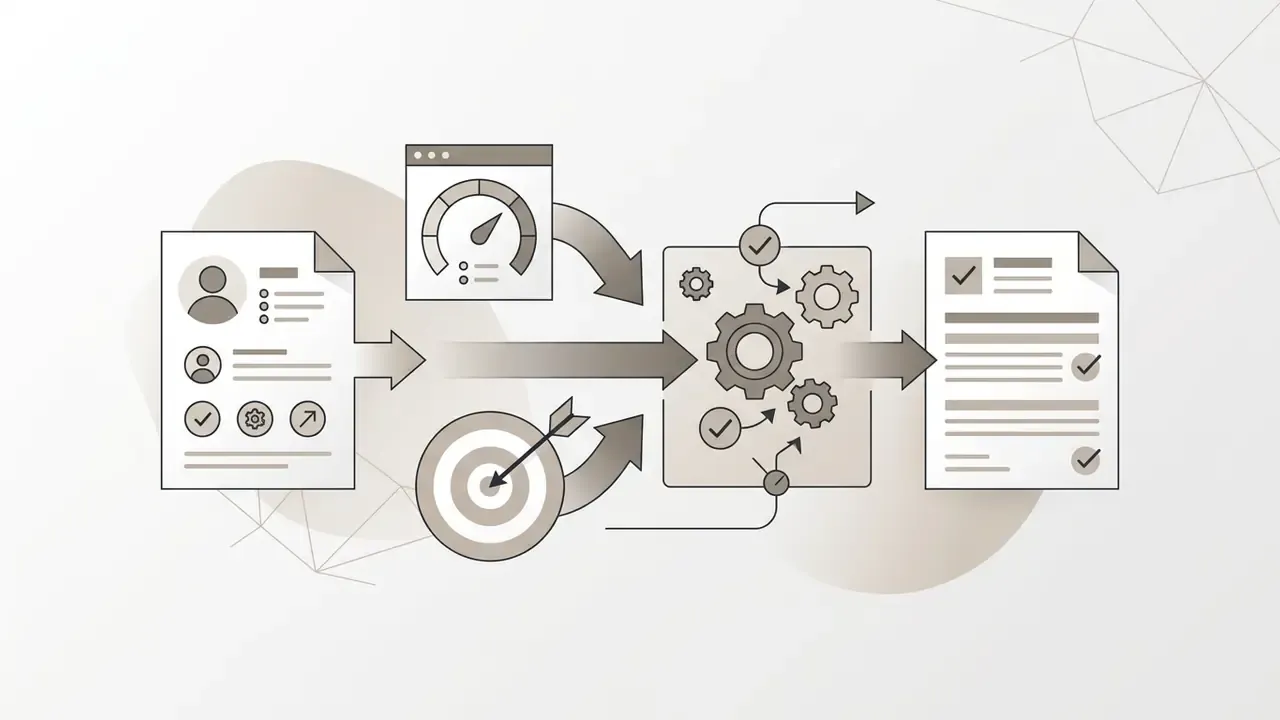
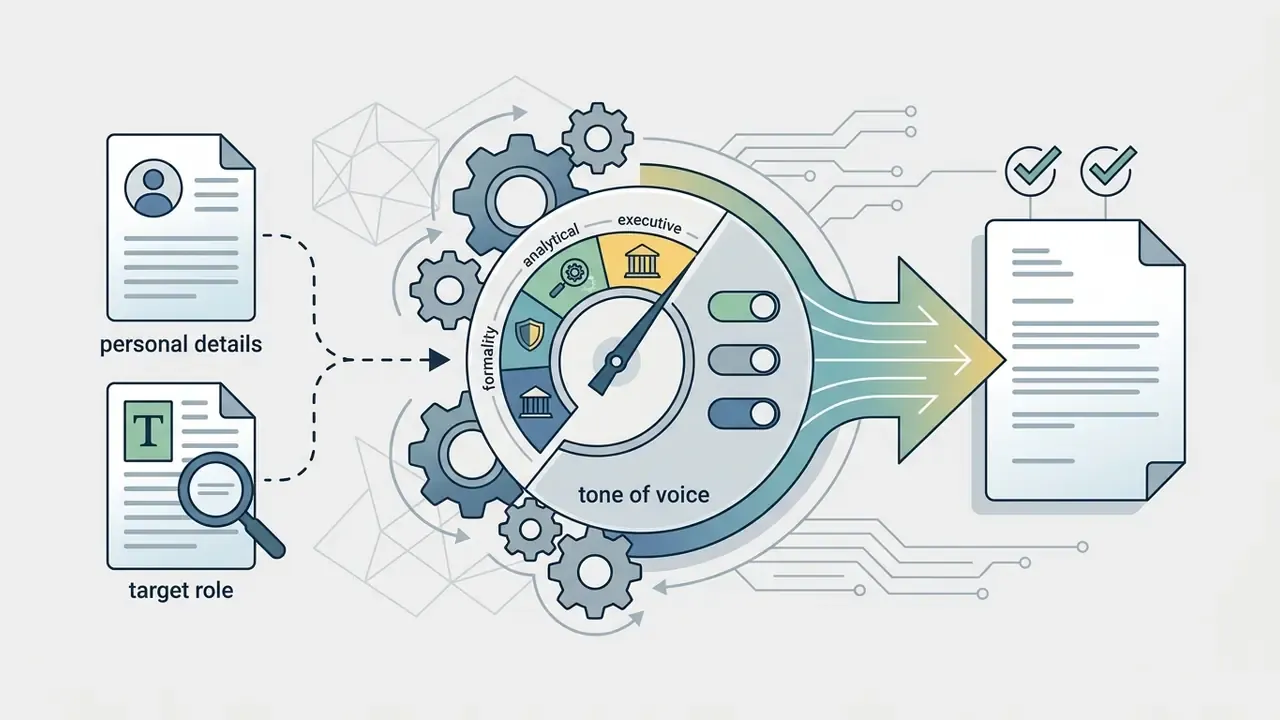
Add personal details, style preferences and the target role
Precision controls inside an ai cover letter maker let you fix structure before generation. Explicit instructions are what prevent bland output.
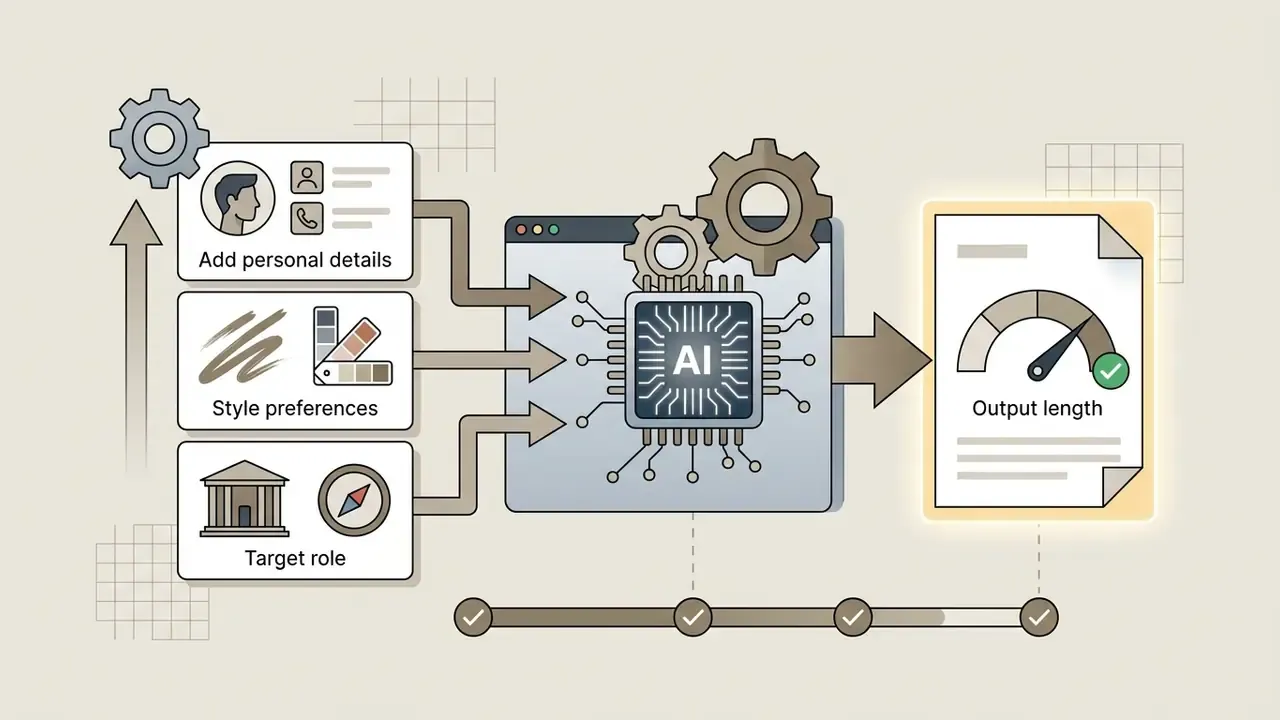
Output length: choose the right word count and paragraph count
| Format | Paragraphs | Word count | Best used for |
|---|---|---|---|
| Short | 1-2 | 150-200 | Startups, LinkedIn quick-apply, referrals, recruiter DMs |
| Standard (recommended) | 3-4 | 250-350 | ATS-driven corporate roles, banking, technology, healthcare |
| Long | 4-6 | 400+ | Academic, executive, federal and public-sector applications |
Table 1: Practical length calibration. Microsoft's cover letter guidance treats 250-400 words as the professional readability ceiling. Past 400 words in a standard corporate pipeline you lose scannability without adding evaluative signal.
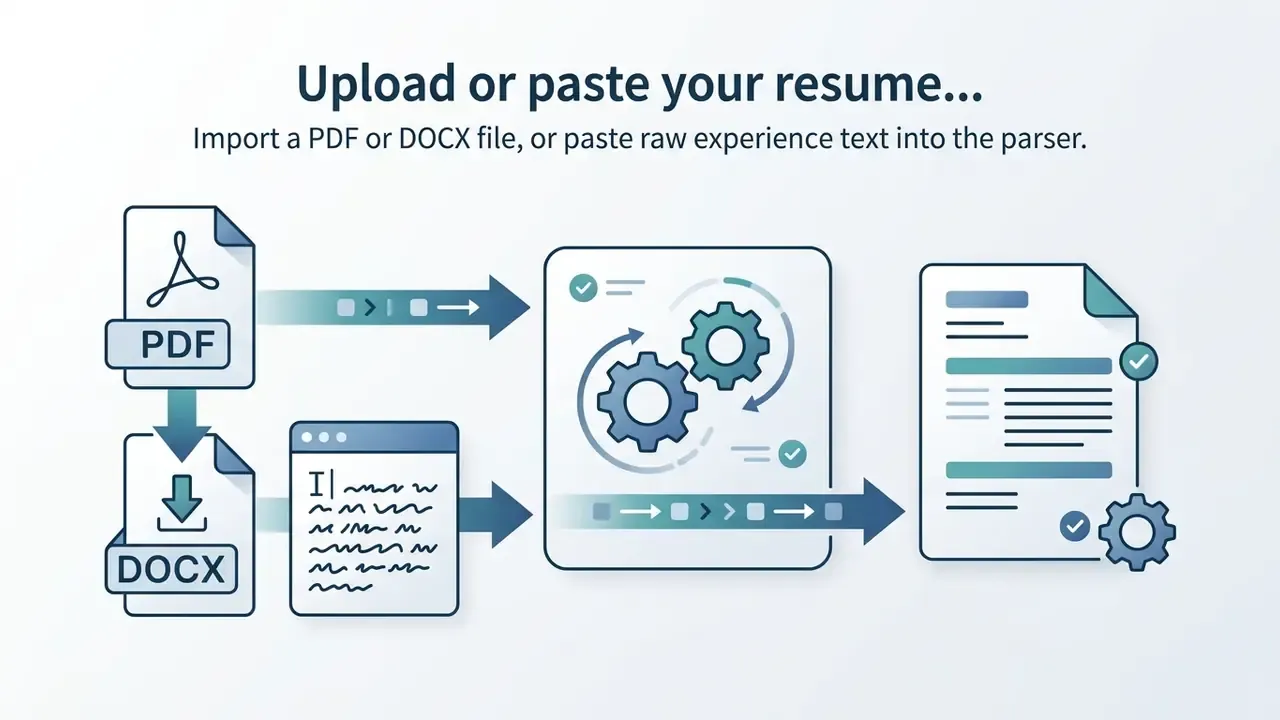
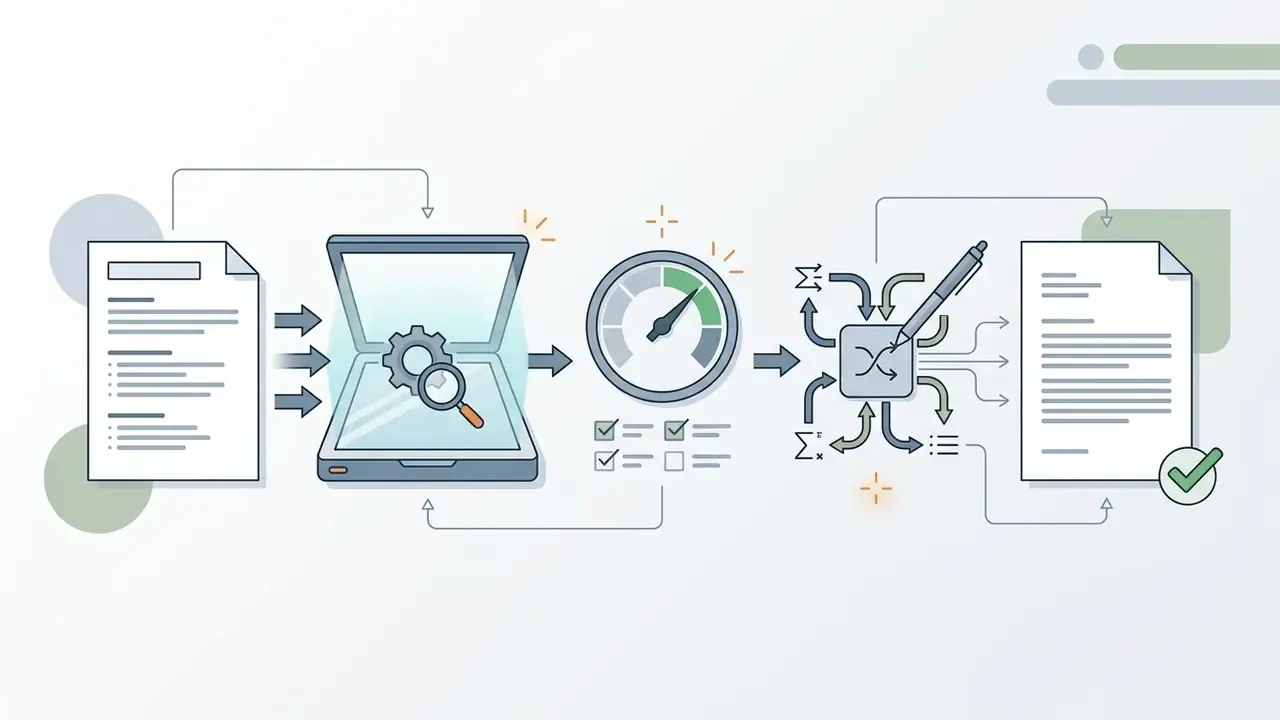
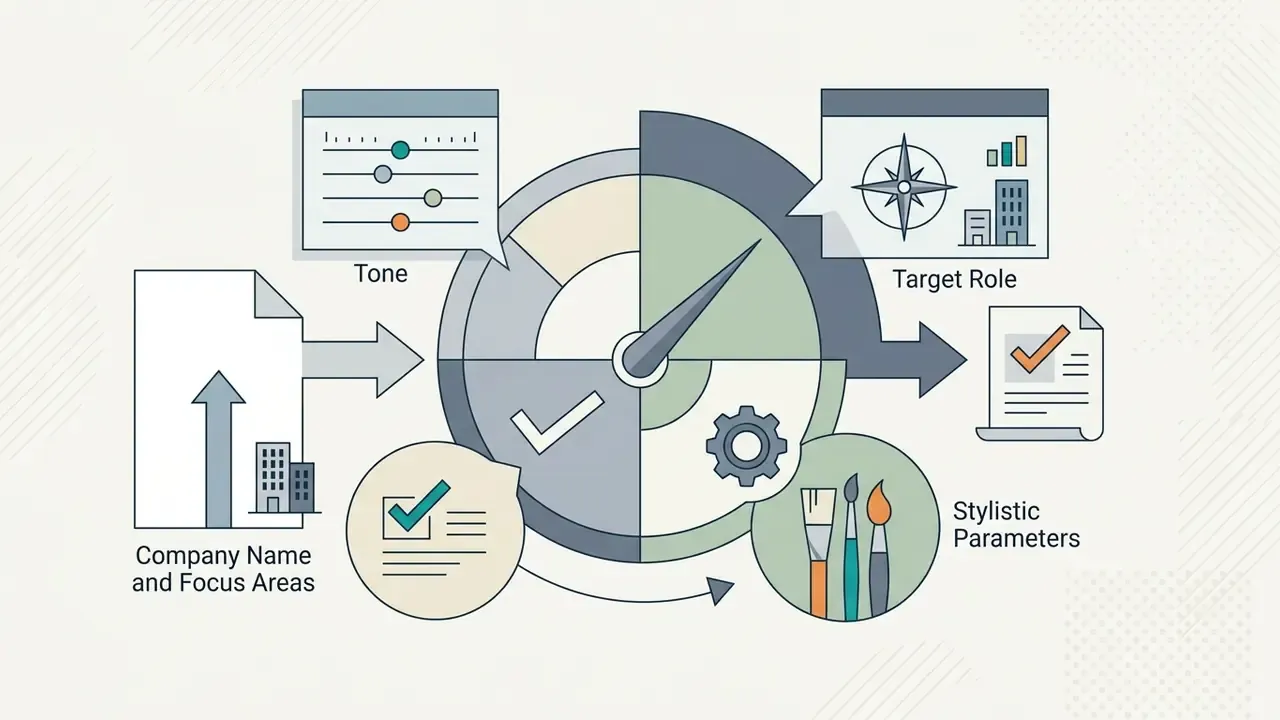
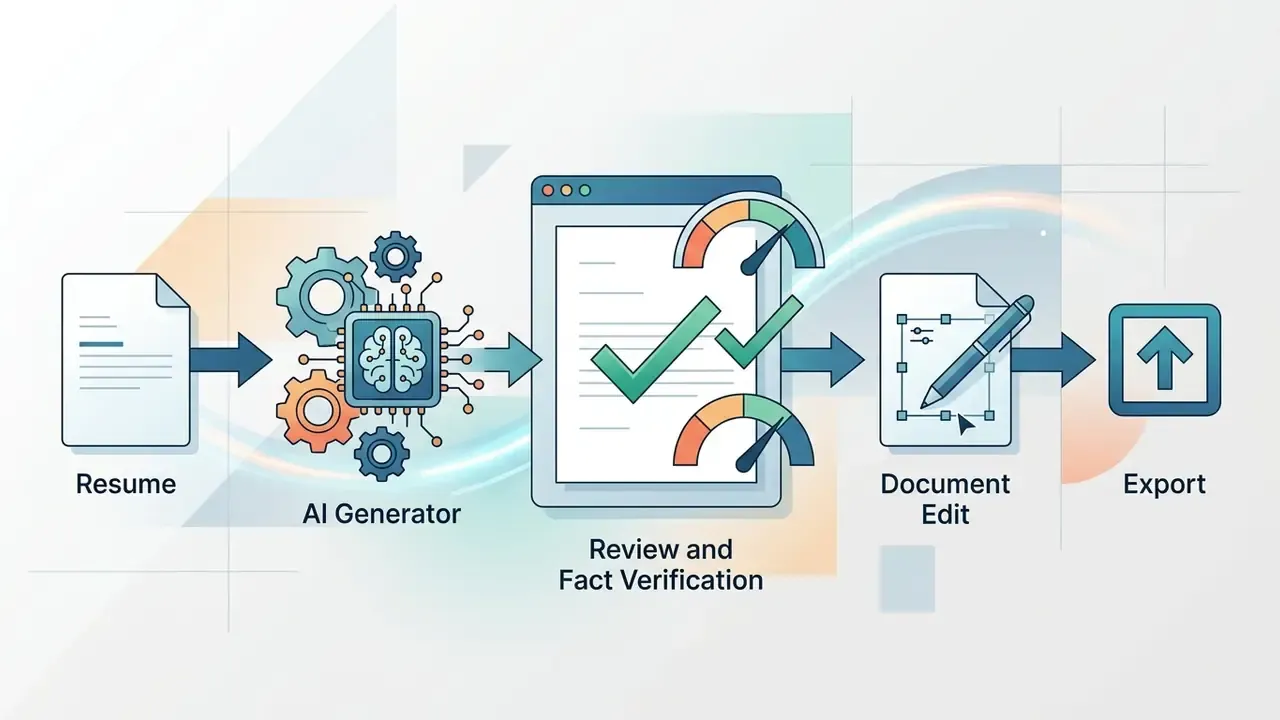
Copy-paste prompt for general-purpose AI assistants
If you use ChatGPT, Copilot, Claude or Gemini instead of a dedicated builder, put role, goal, source material and constraints into one instruction block:
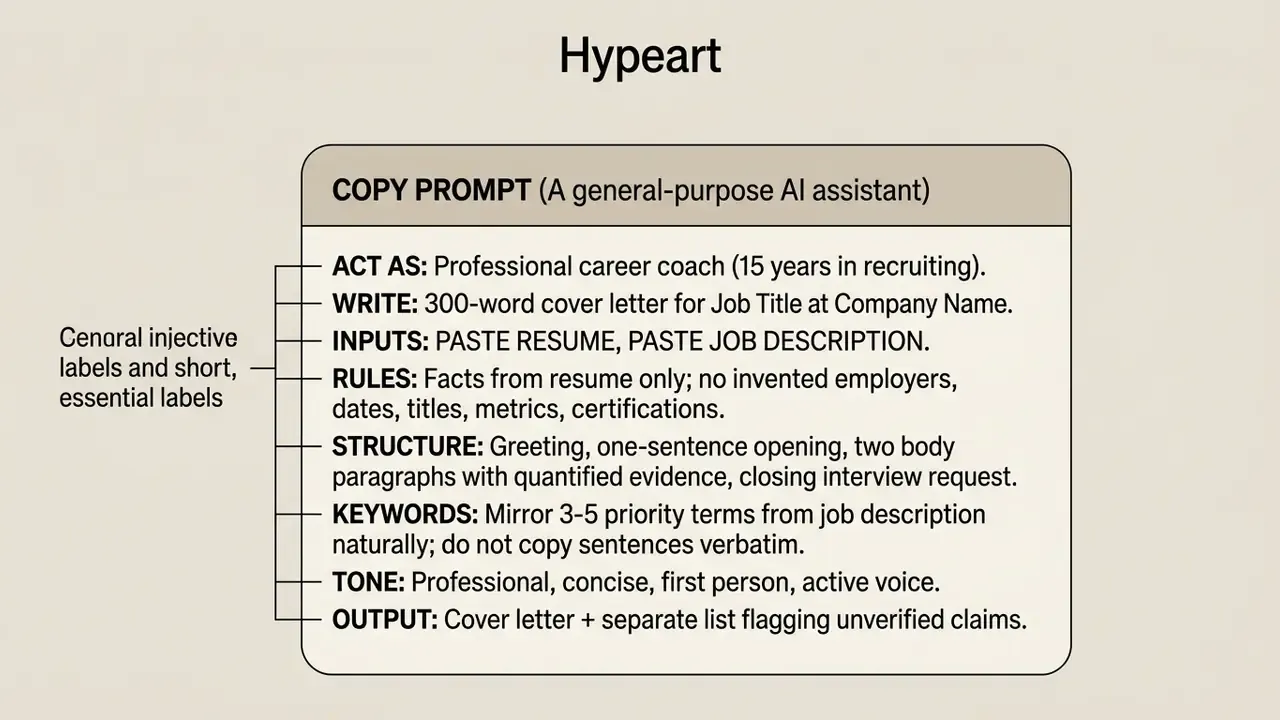
That last instruction does the heavy lifting. Asking the model to flag unverifiable claims turns a black-box draft into an auditable one, and it cuts the fact-checking pass down to a couple of minutes.
How AI tailors a cover letter to the job
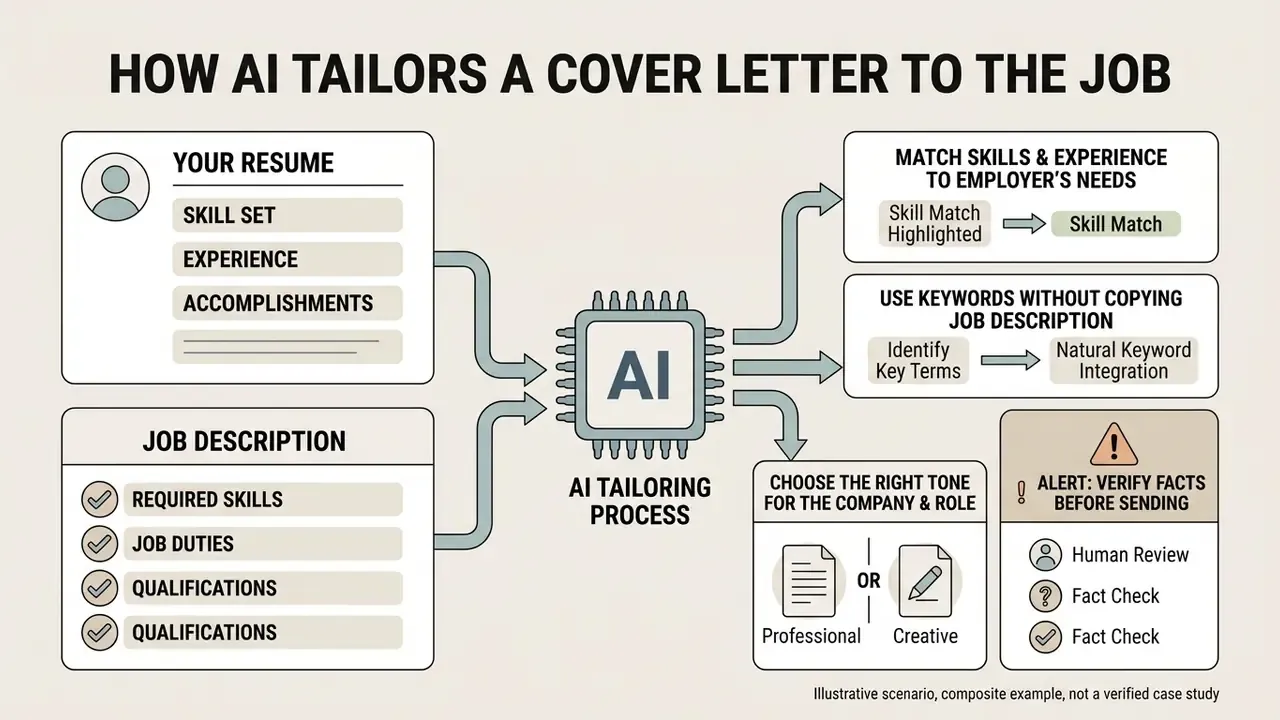
An ai cover letter generator tailors output by cross-referencing your skill set against the vacancy's stated requirements. It identifies phrasing patterns in the posting and embeds those terms into the narrative.
Match skills and experience to the employer's needs
Use keywords without copying the job description
An effective ai cover letter maker free workflow folds industry keywords in naturally and never copies the vacancy text. Parsing algorithms isolate essential concepts, things like regulatory compliance, portfolio optimisation or process automation, and rebuild them inside candidate-specific sentences. Practical guidance from Indeed and the Grinnell College career centre points the same way: use the posting's repeated terms inside complete sentences, pair each acronym with its expanded form once, and spread two to five priority keywords across the opening and body instead of clustering them in one paragraph.
Uncontextualised keyword stuffing backfires. A study of AI-assisted writing (Modifying AI, Enhancing Essays, 2024, analysis of 1,445 AI-assisted writing sessions using X-Learner causal inference) found that users who accepted generated drafts without modification lost lexical sophistication.
"Writers who accepted AI suggestions without modification showed reductions in lexical sophistication and textual cohesion."
Candidates who actively edited keyword placement kept both writing quality and a recognisable voice. The editing pass is not cosmetic.
Choose the right tone for the company and role
Tone should match the institution. Applying to a traditional bank calls for a formal, evidence-led voice. An early-stage fintech may reward directness and product thinking. Public-sector style manuals formalise the same split: authoritative register for policy and regulated contexts, plain community-facing register for consumer brands.
Research on AI-assisted writing for non-native English speakers (Tian et al., survey-embedded experiment with four conditions) found that AI-edited letters scored significantly higher on hireability and writing quality than unassisted drafts.
The model normalises syntax, clears grammatical noise and settles the register. It does not know whether your metrics are real.
Alert: verify facts before sending
Review and edit an AI-generated cover letter before sending
Reviewing an ai create cover letter free output keeps the text accurate, logical and personal. Automated generation gives you a structured baseline. Human review removes hallucinated detail and puts a person back in the document. The Coalition for Health AI's Responsible AI Checklist (2025) organises review into five dimensions that transfer cleanly to application documents: usefulness, fairness, safety, transparency and privacy.
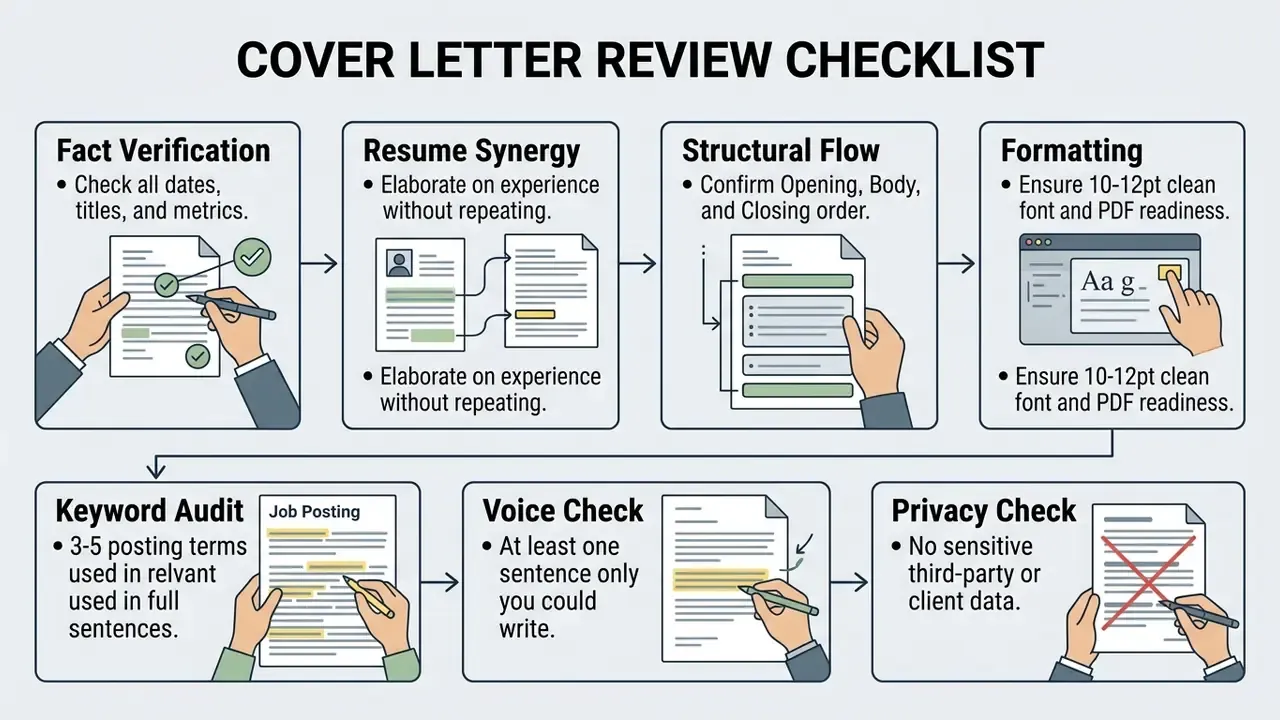
Know the screening bias on the other side of the table
Editing matters for readability, yes. It matters more because evaluation is increasingly automated on the employer side, and automated evaluators are not neutral toward machine-written text.
"Evaluator models preferred résumés generated by themselves in 67-82% of comparisons; candidates using the same model as the evaluator were shortlisted 23-60% more often."
Two conclusions follow. First, an unedited single-model draft is a coin flip that depends on which model the employer happens to run. Second, editing toward concrete, verifiable, human-specific detail is the only strategy that performs consistently across evaluator configurations. Not elegant. Just true.
Make sure the letter adds to your resume
A good letter expands on resume bullets: context, motivation, problem-solving approach. Repeating bullets in paragraph form drops the document's value to near zero for a hiring manager.
Career guidance from MIT Career Advising & Professional Development (2022) and the San José State University Career Center (2026) says the letter should complement the resume rather than duplicate it. MIT's phrasing is blunt: "try not to simply repeat your resume in paragraph form." Use the letter to explain how past performance maps onto the employer's current operational problem.
"Participants who practised with AI wrote higher-quality cover letters on a later unaided test and received hypothetical interview invitations more often."
That finding reframes the tool. Used as a drafting coach with an editing pass, AI assistance builds transferable writing capability. Used as a submit button, it degrades both the document and the skill.
Check the greeting, opening, body and closing
A standard professional letter follows a four-part model:
- Greeting.Address a named hiring manager or a specific committee, for example "Dear Hiring Committee" or "Dear Mr. Davis".
- Opening paragraph.State the role, name the referral source if you have one, and lead with a clear value proposition.
- Body paragraphs, one or two.Concrete evidence of past performance mapped to the employer's primary requirements.
- Closing paragraph.Request an interview, state availability, thank the reader, sign off formally.
How to address a cover letter when you do not know the name
Addressing accuracy is the cheapest personalisation signal available, and the one most often skipped.
| Situation | Recommended greeting | Avoid |
|---|---|---|
| Full name known | "Dear Sarah Whitfield," / "Dear Ms. Whitfield," | Guessing gender-marked titles |
| Only surname known | "Dear Mr./Ms. [Last Name]," | "Dear Mrs." unless confirmed |
| Team identifiable | "Dear Data Science Hiring Team," | "Dear Sir or Madam," |
| Committee-based hiring | "Dear [Job Title] Search Committee," | "Hello there," |
| Recruiter is the gatekeeper | "Dear Recruiting Team," / "Dear Recruiter," | "Hey guys," |
| Nothing identifiable | "Dear Hiring Manager," | "To Whom It May Concern" (last resort only) |
Table 2: Greeting selection matrix. Check the careers page, LinkedIn people search and the posting's contact footer before defaulting to a generic salutation. A named greeting takes about ninety seconds to find and instantly separates your letter from bulk submissions.
Keep the format readable and ready to download
Clean typography and standard margins keep the letter rendering correctly across applicant tracking systems and document readers.
- Fonts Arial, Calibri, Cambria, Helvetica or Times New Roman.
- Font size 10pt to 12pt body text, 14pt to 16pt for the header name.
- Margins 0.5 inch to 1.0 inch on all sides.
- Alignment and spacing left-aligned block format, single spacing inside paragraphs, one blank line between blocks, black text only.
- File format PDF for cross-platform consistency, unless the employer explicitly asks for .docx.
Teams evaluating enterprise tooling can compare options for export parameters across content platforms, and check plan tiers before committing by choosing to open the hub for current published pricing.
Cover letter templates, examples and formats
Template choice structures the details cleanly. Most ai cover letter generator free no sign up applications ship several layouts aimed at particular industries and career stages.
How to choose a professional cover letter template
Match the template to industry norms and role expectations. Conservative sectors want traditional layouts. Creative fields tolerate visual design.
- Traditional block format commercial banking, corporate finance, legal, regulatory compliance.
- Modern minimalist format technology management, fintech operations, corporate strategy.
- Creative layouts media production, visual design, brand marketing.
Three additional rules hold across published university and vendor guidance: match the letter header to the resume header, keep the document to one page, and use the same typeface family in both files.
Three copy-paste cover letter templates
Template 1: technology and modern (standard, roughly 300 words)
[Your Name] | [City, State] | [Email] | [Phone] | [LinkedIn]
[Date]
Dear [Hiring Manager Name / Data Science Hiring Team],
I am applying for the [Job Title] position at [Company Name]. Over [X] years in
[Core Field], I have shipped systems that map directly to the three priorities in
your posting: [Priority 1], [Priority 2] and [Priority 3].
At [Current/Recent Employer], I [action verb] [specific project], which
[quantified outcome, e.g. reduced p95 API latency by 35% across 12 services].
I also led [second initiative], delivering [second quantified outcome, e.g. a
28% reduction in unplanned downtime] while coordinating a team of [N] engineers.
Both projects required the same stack you list: [Tool A], [Tool B], [Tool C].
What draws me to [Company Name] specifically is [concrete, researched detail:
product decision, published engineering post, market position]. The problem you
describe in the posting as [quoted challenge] is the problem I have spent the
last [X] years solving.
I would welcome the chance to discuss how this experience maps to your roadmap.
I am available for a conversation at your convenience and can be reached at
[Phone] or [Email].
Sincerely,
[Your Name]
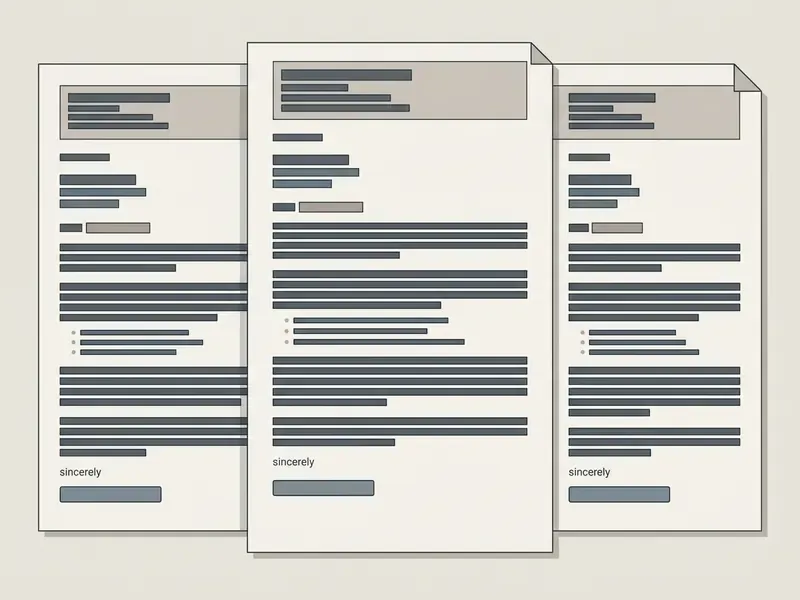
Template 2: corporate and traditional, regulated industries (standard, roughly 320 words)
Template 3: career change and transferable skills (standard, roughly 310 words)
[Your Name] | [Email] | [Phone] | [LinkedIn]
[Date]
Dear [Hiring Team / Hiring Manager Name],
I am applying for the [Target Job Title] role at [Company Name]. My background is
in [Previous Field], and over the past [X] months I have deliberately rebuilt my
skill set toward [Target Field] through [concrete evidence: certification,
capstone project, contract work, internal transfer].
Three parts of my previous work transfer directly. First, [transferable skill 1]:
at [Employer], I [achievement with metric]. Second, [transferable skill 2], which
your posting names as [quoted requirement]. I applied this when I [example].
Third, [transferable skill 3], demonstrated by [project or outcome].
To close the technical gap, I completed [Course / Certification / Bootcamp] in
[Month Year] and built [Project], which [what it does and any measurable result].
I am aware this is a transition, and I am approaching it with evidence rather
than enthusiasm alone.
I would value the opportunity to explain how a background in [Previous Field]
produces a different and useful perspective on [Target Field] problems. I am
available at [Phone] or [Email].
Sincerely,
[Your Name]
Replace every bracketed field with verified information from your own resume. Any placeholder left unfilled, or filled by a model without your confirmation, becomes a factual risk at interview stage.
Customize generated content instead of using a generic template
Unedited generic templates read formulaic and detached. Adding concrete personal metrics builds a narrative nobody else can submit. Documented personalisation methods in current research include prompt conditioning on your own prior writing samples, author-style mirroring, retrieval of your real project documentation, and, most practically, manual replacement of vague claims with numbers.
A technical program manager used an ai cover letter creator for the structural draft, then swapped out the boilerplate for operational specifics: a 28% reduction in system downtime, a $4M budget under management. Same skeleton, different document. That is the whole trick.
| Approach | Personalisation level | Keyword integration | ATS pass-through | Time required | Editing required |
|---|---|---|---|---|---|
| Generic template | Low | Manual, minimal | Low, few posting terms present | High (30-60 mins) | High (full rewrite) |
| Resume-based AI draft | Medium-high | Moderate | Medium, resume terms only | Low (under 2 mins) | Medium (fact-checking) |
| Job-description AI draft | High | Maximum alignment | High, posting terms mirrored in context | Low (under 2 mins) | Medium (personalisation) |
Table 3: Comparison of cover letter creation methods by time efficiency, personalisation quality and applicant tracking system pass-through. Read the right-hand column as the real cost: AI shifts effort from drafting to verification, it does not remove effort.
Governance, PII and Shadow AI: controls for teams and regulated employers
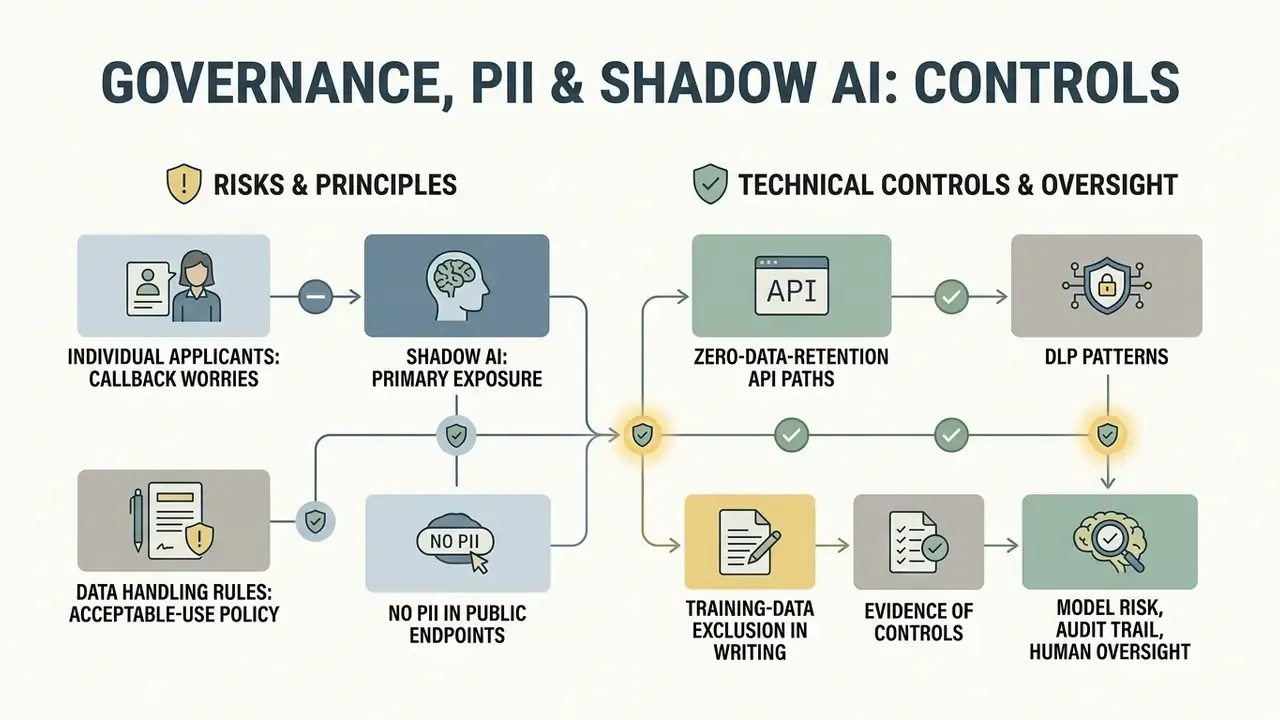
Individual applicants worry about callbacks. Risk, compliance and AI governance functions worry about what happens when hundreds of employees and thousands of candidates paste identity documents, salary history and client references into consumer-grade generators. Both concerns describe the same data flow, viewed from opposite ends.
Shadow AI: the primary exposure
Cover letter generators are among the easiest tools to adopt without procurement review. Browser-based, free, no signup, no card. Population-level measurement confirms how ordinary the behaviour has become.
If a fifth of consumer complaint text is already model-assisted, assuming your internal HR correspondence is clean is not a defensible position. The control objective is not prohibition. It is routing: give staff a sanctioned tool so the unsanctioned ones lose their reason to exist.
Data handling rules that belong in your acceptable-use policy
- No PII in public endpoints. Full names, addresses, national identifiers, dates of birth, salary history and client names stay out of consumer tiers.
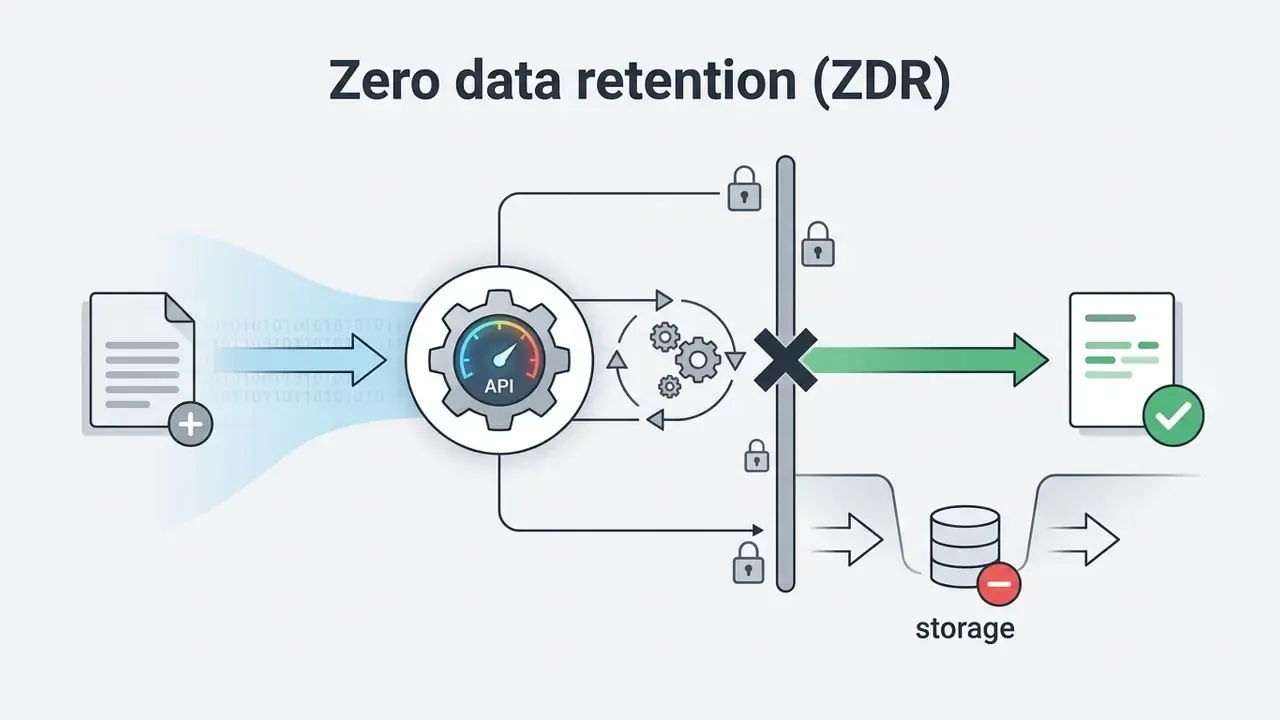
- Zero-data-retention API paths for any workflow touching candidate or employee records, with retention terms stated contractually rather than inferred from marketing copy.
- DLP patterns covering resume file uploads and clipboard egress to known generative endpoints.
- Training-data exclusion in writing. "We do not train on your data" belongs in the contract, not the FAQ page.
- Evidence of controls. SOC 2 Type II or ISO/IEC 27001 attestation, encryption at rest and in transit, documented sub-processors, and data residency that matches your jurisdictional obligations.
Anything candidate-facing also needs a clear read of the vendor's commercial use terms and, for redistributed templates or generated assets, the applicable commercial license scope.
Model risk, audit trail and human oversight
Deployment models compared
| Deployment model | Data exposure | Control depth | Typical cost driver | Suitable for |
|---|---|---|---|---|
| Public consumer SaaS (free tier) | High, prompts may be retained or used for training | Minimal, terms set by vendor | $0 direct, high control cost | Individual job seekers with no sensitive data |
| Business SaaS with DPA | Medium, contractual limits, vendor-hosted | Moderate, policy plus admin controls | Per-seat subscription | HR teams, staffing partners, non-regulated content |
| API with zero data retention | Low, no persistence, logging under your control | High, prompts, guardrails and audit logs are yours | Token volume plus engineering | Regulated workflows, candidate-facing automation |
| Private or VPC-hosted model | Lowest, data never leaves your boundary | Highest, full model and log ownership | Infrastructure plus MLOps staffing | Banks, insurers, government contractors |
Table 4: Risk-adjusted comparison of deployment options. Total cost of ownership must include validation, monitoring and review labour, not licence fees alone.
Developers building automated candidate processing can browse the hub for connectivity details, legal teams can review exposure via our litigation hub, and rollout questions usually land fastest through support.
Is a free AI cover letter generator really free?
Evaluating an ai free cover letter generator means reading the operational limits, the freemium boundary and the data policy. Plenty of platforms market free access while capping the features you actually need, usually downloads.
Free use, no signup and download limits
Services offering an ai cover letter generator free no sign up model normally let you enter details and read the draft in-browser. Common restrictions:
- Generation caps. One to three letters per month or per 24 hours. Some tools cap by hour, for example ten drafts per hour.
- Export restrictions. Plain-text copy-paste free, clean PDF export reserved for paid plans.
- Watermarking. Provider logos on free downloadable PDFs.
- Trial-only editing. Several builders allow editing during a seven-day trial, after which the saved document turns read-only until you upgrade.
Organisations planning wider deployment should read the published subscription terms and confirm data-processing commitments with the vendor's technical and legal contacts before rollout. Landing-page claims are marketing, not contract.
What to check before choosing a paid cover letter tool
Before upgrading, candidates and recruiting teams should test pricing transparency, contract commitments and privacy terms. The comparison is easier if you model annual cost per seat first; our calculators cover that arithmetic.
- Subscription terms. Clear disclosure of monthly or annual billing, renewal price after any discounted first pass, and cancellation mechanics.
- Export flexibility. Non-proprietary formats: PDF, DOCX, plain text.
- Editability. Full in-app editing before export, and continued editing after export through open formats.
- Data privacy. Explicit guarantees that uploaded resumes are not used to train public models, with retention windows written into the contract.
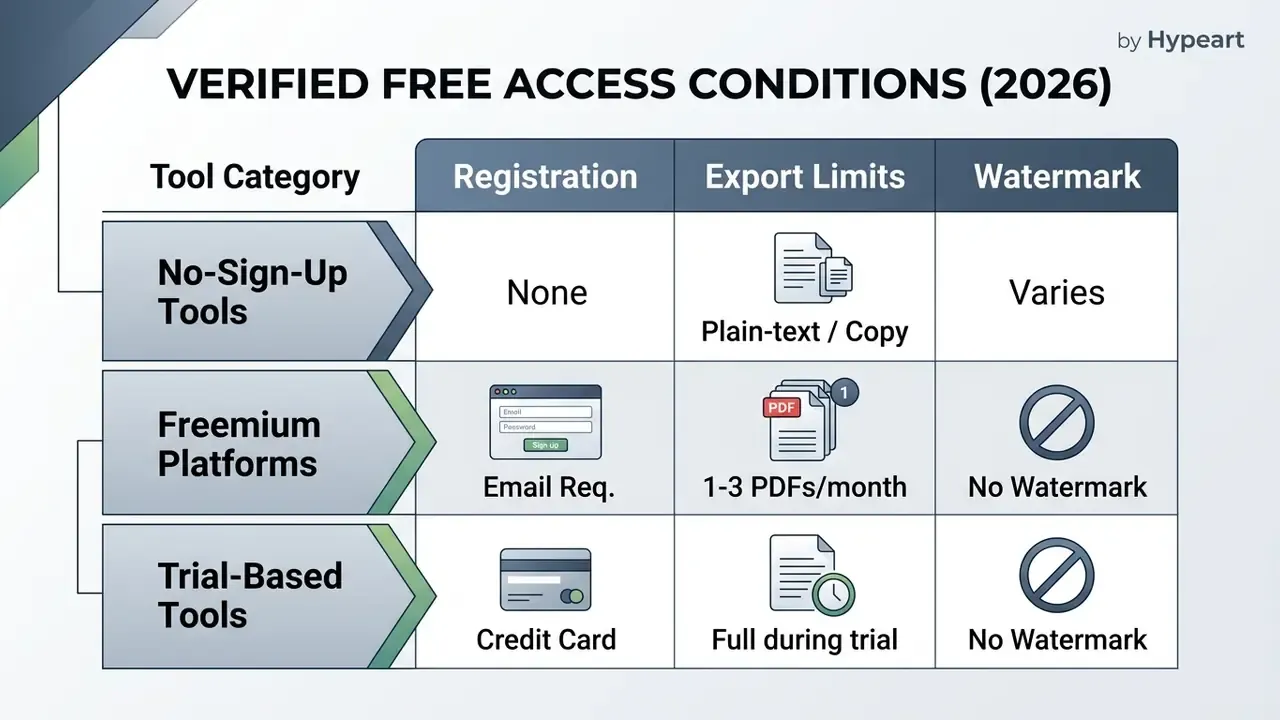
One caveat on this table. Free-tier terms change quarterly across most ai cover letter generator tools, so verify the current policy on the vendor's own pricing page on the day you buy.
Who can use an AI cover letter generator
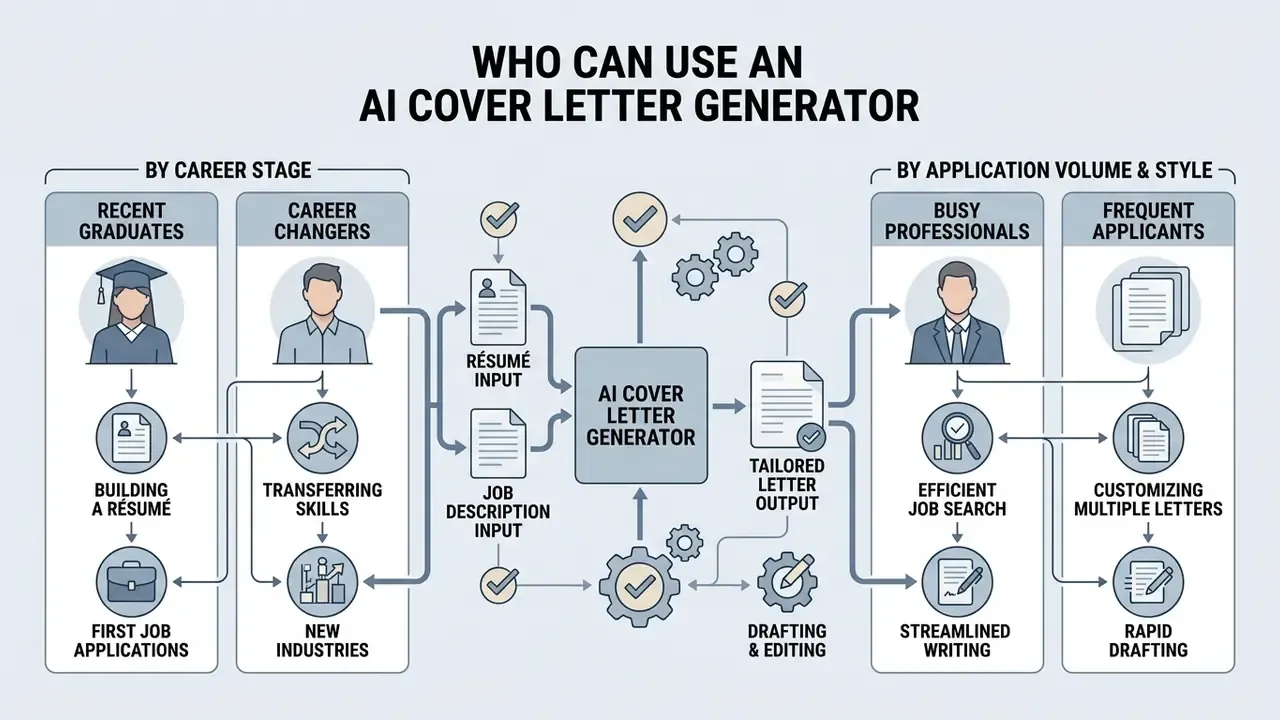
An ai job application generator helps candidates across career stages, technical backgrounds and application volumes. Automating the first draft frees effort for personalisation and interview prep, which is where offers actually come from.
Recent graduates and career changers
Graduates and career changers usually struggle with the same task: connecting past experience to new requirements. An ai create cover letter for resume workflow bridges that gap by surfacing transferable skills and framing academic projects in professional terms.
Published career-services guidance, including the Connecticut Department of Labor (2024) and the University of Tampa's AI guide, recommends AI assistance for precisely this work: translating prior-field accomplishments into target-field vocabulary, drafting transferable-skills language, rehearsing interview answers. Both sources attach the same two conditions. Never submit raw output. Never enter personal identifying information. Adoption at this stage is close to universal already: a 2026 Handshake report found more than 80% of rising seniors had used generative AI, mostly as a brainstorming partner rather than a content generator.
Benefits are not evenly distributed, though, and passive use can hurt.
The mechanism matters for job seekers too. Candidates with less access to editing support, mentors and review feedback are likelier to submit unmodified output, and unmodified output is exactly what evaluators discount. The advantage lives in the edit.
Busy professionals and frequent applicants
Active job seekers filing several applications a week can use an ai cover letter generator tool to compress the drafting stage. Automated drafting cuts tailoring time substantially, which is the point.
Illustrative workflow, not a verified case. Take a senior software architect running twelve concurrent enterprise applications. The efficient pattern is two passes: generate all twelve drafts from one resume against twelve distinct job descriptions, then spend the saved time on a single verification sweep across every letter, checking metrics, dates, client names and role titles against the master resume. Time reallocation is the real benefit, not raw generation speed. Noy and Zhang's measured 40% reduction in writing time is better spent on verification than on firing off more applications faster. Indeed's guidance adds one constraint worth respecting: one tailored document per posting, because repeated near-identical submissions can be flagged by applicant tracking systems.
Teams assessing licensing for commercial deployment can explore the hub for terms.
FAQ
Should I use AI to write my cover letter at all?
Yes, as a drafting and editing assistant. Preregistered experiments found people who practised with AI later wrote better letters unaided. The failure mode is submitting unedited output, which measurably reduces lexical quality and gets discounted by many evaluators.
How long should a cover letter be?
250-400 words in almost all cases. Target 250-350 for ATS-driven corporate roles, 150-200 for startups and quick-applies, and 400 or more only for academic, executive and public-sector applications.
How do I address a cover letter when the hiring manager's name is unknown?
Use the most specific identifiable unit: "Dear Data Science Hiring Team," or "Dear [Job Title] Search Committee." Then "Dear Hiring Manager." Only as a last resort, "To Whom It May Concern."
Will an AI-written cover letter fail an ATS check?
ATS software screens for parseability and relevant terms, not authorship. What matters is clean text, standard fonts, left alignment, no tables or images in the letter body, and two to five contextual keywords drawn from the posting.
Can employers detect AI-generated cover letters?
Detection tools are unreliable, but reviewers spot generic structure and unverifiable claims quickly. Note the documented self-preference effect as well: evaluator models favoured résumés produced by the same model in 67-82% of comparisons, which makes single-model unedited output unpredictable rather than safe.
Is a free AI cover letter generator safe for sensitive data?
Assume free consumer tiers may retain inputs. Leave out national identifiers, addresses, salary figures, client names and anything under NDA. For anything sensitive, use a business tier with a data-processing agreement or a zero-retention API path.
Do I need a different letter for every application?
Yes. Tailored letters produced a 16.4% callback rate against 12.5% for generic letters in the ResumeGo field experiment. Reuse the structure, not the content.
What should I never let AI write for me?
Credentials, certifications, employment dates, salary figures, security clearances and quantified results. Generate the framing. Supply the facts yourself. Strategic summary and next steps An ai cover letter generator speeds up application preparation and improves alignment with the target job description. To get value out of it, run an evidence-based workflow:
- Pull core responsibilities and terms directly from the target posting.
- Feed factual qualifications from an updated resume, nothing beyond it.
- Generate the first draft with explicit parameters: length, tone, role, company.
- Review for factual accuracy, personal voice, greeting precision, keyword placement and formatting.
- Log what you changed. Across ten applications the pattern of your own edits becomes a reusable personal style guide, and every future first draft starts closer to done. Combine automated generation with disciplined human review and you get professional, tailored materials for every vacancy. Institutions applying the same discipline, with documented ownership, retention limits and audit evidence, get the productivity without inheriting undocumented data, model and fairness risk. No evidence, no autonomy. That principle scales down to a single cover letter surprisingly well. General information notice: this article summarises published research and public guidance for educational purposes. It does not constitute legal, compliance, employment or financial advice. Regulated institutions should validate any generative AI deployment against their own model risk management, privacy and employment-law obligations.
Footer navigation and authority links
- For structural reference tools and term definitions, see the overview in our central glossary hub.
- For side-by-side evaluation of document and content platforms, compare options across features, export formats and licensing.
- For commercial deployment terms and licensing questions, explore the hub.
- Estimate operational software costs with our custom calculators.