Executive Summary
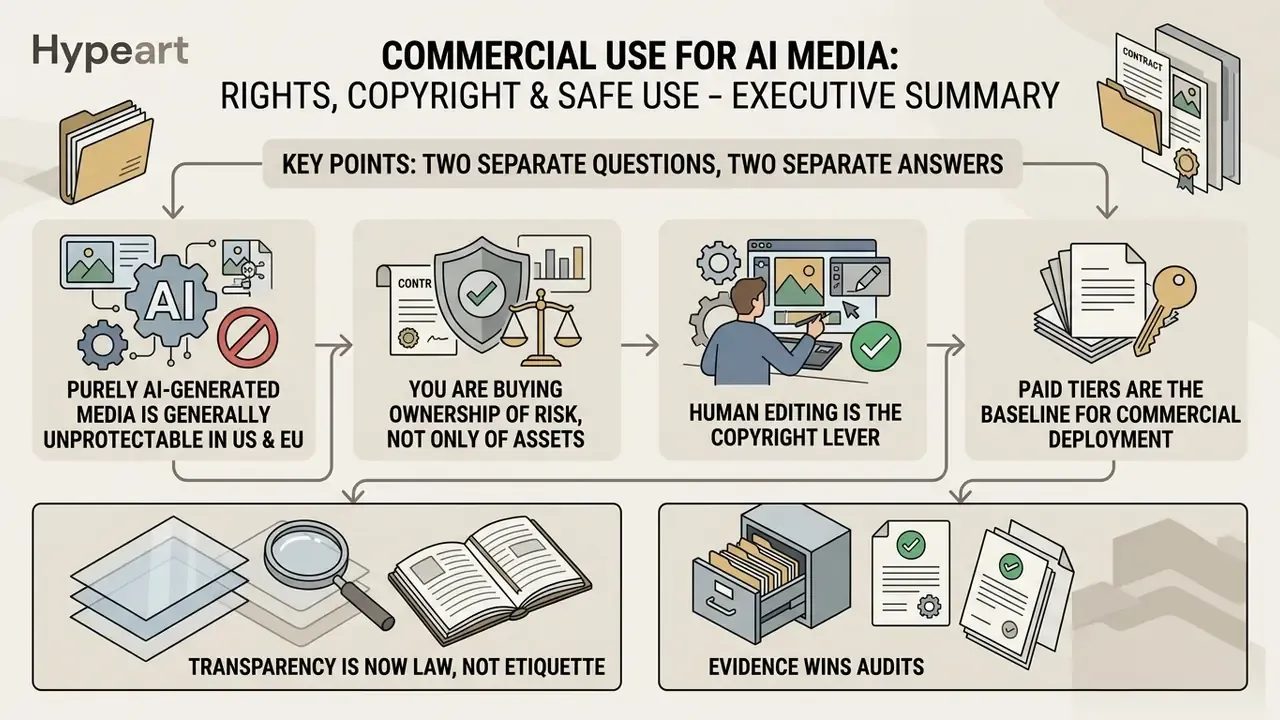
For decision-makers who need the conclusion first:
- Two separate questions, two separate answers. A commercial license from an AI vendor is a contract permitting business use. Copyright is a statutory right that requires human authorship. You can hold one without the other.
- Purely AI-generated media is generally unprotectable in the United States and the European Union. Prompts alone do not create authorship. The United Kingdom is the outlier, via Section 9(3) CDPA 1988.
- Paid tiers are the baseline for commercial deployment. Free tiers routinely restrict commercial use, publish outputs publicly, and retain prompts for model training. Revenue thresholds apply at several vendors ($1M USD at Midjourney and Stability AI; $10M USD at Liquid AI).
- You are buying ownership of risk, not only of assets. Enterprise buyers in regulated sectors should demand written IP indemnification, zero-data-retention terms, and private generation environments before any customer-facing deployment.
- Transparency is now law, not etiquette. EU AI Act Article 50 requires machine-readable marking of synthetic content, with full applicability from 2 August 2026. Disclosure intensity should scale with sector impact.
- Evidence wins audits. Log prompts, model versions, seeds, license snapshots, human edits, and reviewer sign-offs. In regulated industries, route these artifacts into existing model-risk and GRC systems instead of building a parallel, unaudited archive.
- Human editing is the copyright lever. Substantive visual transformation, documented authorial intent, composite creation, and structured brand systems turn an unprotectable output into a defensible asset.
Who This Guide Is For and What It Decides
This is a working commercial use for AI media guide written for people who sign things. Chief risk officers, chief compliance officers, heads of model risk, and AI governance leads at US banks and mature fintechs sit at the centre of the audience. Marketing and finance transformation leaders sit next to them, because they generate the assets that risk functions later have to defend.
The guide supports four decisions:
- Whether a specific use of synthetic media is commercial, and therefore whether a license is required at all.
- Whether the platform you already pay for actually grants the rights your campaign assumes.
- What evidence you need to retain so the workflow survives an internal audit or a regulatory examination.
- When and how to disclose AI involvement in customer-facing communications.
One framing note before the detail. Audience assumptions in this guide are stated as working hypotheses. They reflect published regulatory guidance and vendor terms, not proprietary survey data, and they should be validated against your own analytics, interviews, and CRM evidence before they drive budget.
What Does Commercial Use for AI Media Mean?
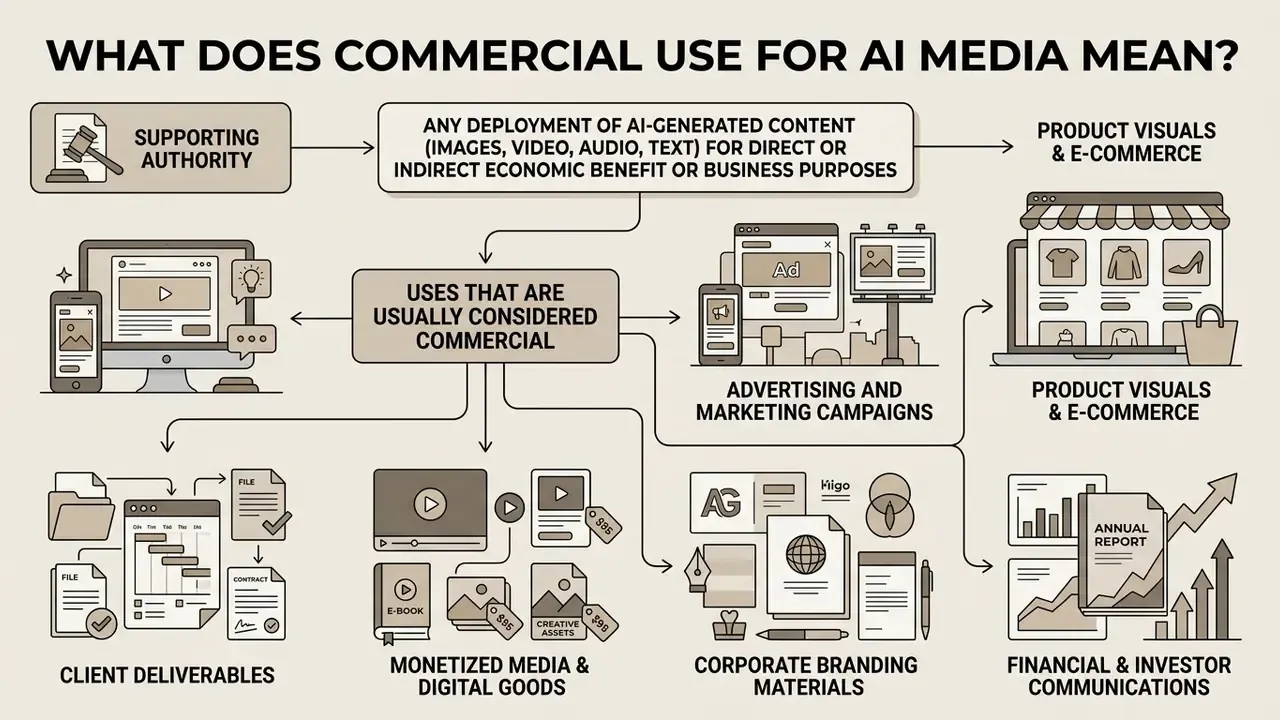
Commercial use for AI media refers to any deployment of AI-generated content, including images, video, audio, and text, for direct or indirect economic benefit, business promotion, revenue generation, or commercial service delivery. Whether a use counts as commercial depends on the economic context and operational purpose, not on the technical process behind the output.
So what is commercial use for AI media in practice? When evaluating the commercial use for AI media meaning, organizations have to look past direct sales. The commercial use for AI media definition covers synthetic media in paid advertising, product packaging, corporate branding, e-commerce listings, and client agency deliverables. Guidance from the U.S. Copyright Office and policy frameworks from the World Intellectual Property Organization (WIPO) both establish the same point: any deployment intended to promote a business, raise a product's market value, or generate client revenue sits inside commercial scope.
"Commercial use is not limited to direct sales, it extends to branding, advertising and user interfaces where AI content contributes to revenue."
Supporting authority. The U.S. Copyright Office treats the "commercial nature" of a use as an explicit statutory factor in fair-use analysis, which puts marketing, advertising, and sales collateral on the commercial side of the test by design (Copyright and Artificial Intelligence, Part 2: Copyrightability, U.S. Copyright Office, 2025. https://www.copyright.gov/ai/). WIPO adds a second point that buyers often miss: ownership of AI-assisted outputs is frequently determined by platform terms of use or a bespoke contract rather than by copyright status alone (WIPO Generative AI Factsheet, 2024. https://www.wipo.int/). Neither body publishes a single universal statutory definition of "commercial use" for synthetic media. The operative split is functional: revenue-oriented or persuasion-oriented deployment versus internal, educational, or purely illustrative use.
Teams evaluating specific platforms can start with our comparison of AI image generators that grant explicit commercial rights on paid plans.
The public versus private distinction also shapes classification. Public dissemination of AI media on commercial websites, social channels, or broadcast advertising attracts heightened scrutiny under consumer protection and intellectual property law. Internal, non-public experimentation carries lower immediate market exposure. It still requires adherence to vendor terms and data security controls, which is a point worth repeating to any team that assumes "internal" means "unregulated".
A short field example. In a financial services marketing review, a fintech team assessed an automated campaign built on synthetic promotional visuals. Auditing the asset workflow against platform terms, then replacing raw model outputs with human-modified assets, removed the unverified licensing risk before media launch. The same review turned up a second finding that is common in regulated environments. Two of the four generation tools in use had never passed vendor onboarding, which meant promotional creative for a consumer credit product had been produced inside unapproved, publicly visible generation environments. That is the part that keeps compliance officers awake.
Uses That Are Usually Considered Commercial
Commercial uses directly support business promotion, brand positioning, or revenue creation. Bringing synthetic media into corporate workflows across these categories requires explicit commercial rights from the underlying AI platform.
Typical commercial scenarios include:
- Advertising and marketing campaigns AI-generated visuals, promotional copy, or voiceovers in paid media, display ads, broadcast channels, or sponsored content.
- Product visuals and e-commerce AI-generated images on physical product packaging, digital app interfaces, landing pages, or catalogue listings.
- Client deliverables Agencies or freelancers supplying synthetic graphics, video edits, or written copy to paying clients under a fee-for-service agreement.
- Monetized media and digital goods Synthetic media inside commercial books, software, video games, paid stock libraries, or subscription publications.
- Corporate branding materials AI-generated logos, visual identities, or collateral used to market commercial services.
- Financial and investor communications Synthetic visuals for lending or investment tear-sheets, investor teasers, shareholder updates, or campaign creative promoting regulated financial products. Here commercial status is unambiguous and consumer-protection exposure is elevated, because the content may influence purchasing or investment decisions.
- Monetized channel content AI outputs in videos, podcasts, or newsletters that earn advertising or sponsorship revenue, even where the creator is an individual rather than a company.
"AI content in paid advertising is directly tied to a commercial purpose and requires explicit platform licensing permission."
Personal, Internal and Non-Commercial Use
| Scenario | Commercial purpose present? | Need to review license terms for commercial rights? |
|---|---|---|
| AI-generated image used in a paid online advertising campaign for a product | Yes, it directly promotes sales and forms part of paid media | Yes, confirm commercial use license, output ownership, and any attribution or indemnity conditions |
| AI-generated video used on a company product landing page | Yes, it supports product marketing and revenue generation | Yes, ensure rights to use the video on commercial websites and in digital products |
| AI-generated illustration shared on a personal social profile with no business promotion | Usually no, personal creative expression without clear commercial intent | Yes, mainly to avoid prohibited uses or misattribution; commercial licensing may be less critical |
| AI-generated slide backgrounds for internal staff training | Indirect at most, internal use without direct monetization | Yes, check platform terms on internal organizational use and data handling, especially if slides circulate widely |
| AI-generated diagrams inside a client pitch deck or RFP response | Yes, aimed directly at customer acquisition and revenue | Yes, full commercial rights required; internal-use assumptions do not carry over to customer-facing decks |
| AI-generated logo used as part of a client brand identity | Yes, a central commercial branding asset | Yes, verify that the platform permits trademark and branding use and that no third-party IP is infringed |
| AI-generated audio used as background music in a non-monetized personal video | Unclear, depends on whether the channel is monetized and promotes a business | Yes, check the license for audio use in user-generated content and monetization limits |
Commercial Rights, Copyright and Ownership Are Different
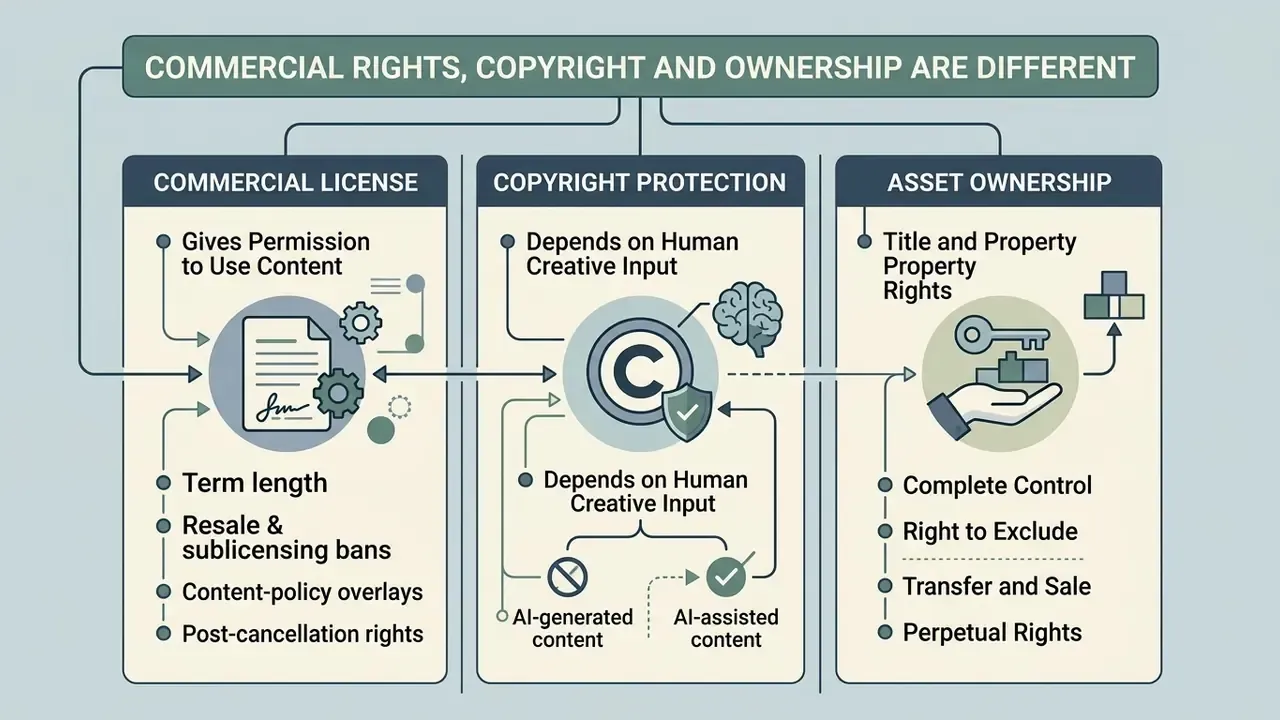
Commercial rights, copyright protection, and asset ownership are three separate concepts. Confusing them creates real operational exposure, because holding a commercial license from an AI vendor does not automatically grant statutory copyright or exclusive legal ownership of the output.
A commercial license is a contract between platform provider and user, granting permission to use generated assets in commercial activity under defined terms. Copyright is a statutory property right granted by law, giving an author exclusive rights to reproduce, distribute, display, and create derivative works. Ownership means holding title to the underlying intellectual property or the asset itself.
Because generative models produce outputs from algorithmic patterns rather than human expression, courts and regulators treat platform permissions separately from copyright eligibility. An enterprise can hold full contractual commercial rights to use an AI image in marketing while having no ability to register copyright for it, and no ability to stop a competitor from using an identical output.
The commercial consequence is concrete. Without copyright, there is no exclusivity. A brand can lawfully run a campaign on an unmodified AI visual while a competitor lawfully runs a near-identical one. For hero creative, brand marks, and any asset with standalone resale value, exclusivity has to be manufactured through human authorship. It does not arrive with the invoice.
A Commercial License Gives Permission to Use Content
A commercial license is contractual authorization from an AI platform vendor to use generated media inside commercial products, marketing, or business services. That permission is governed entirely by the provider's Terms of Service and subscription agreement.
Commercial licenses define the scope of permitted usage: geographic reach, duration, redistribution limits, monetization rights. Enterprise agreements may grant broad rights to feature synthetic visuals in client work while explicitly barring resale of raw generated assets as standalone stock files or their packaging into competing API tools. Platforms also frequently retain rights to prompts or outputs for internal model training unless the subscriber sits on a paid enterprise tier with explicit data privacy guarantees.
Common license mechanics worth auditing line by line before signature:
- Term length. Some commercial grants are time-limited, for example six-month business-use windows, rather than perpetual. That matters for long-running campaigns and evergreen product imagery.
- Resale and sublicensing bans. Transferring raw assets, redistributing them stock-style, or bundling them into an API product is prohibited under most commercial grants, even where campaign use is fine.
- Content-policy overlays. Vendors routinely forbid misleading uses, political content, legal or financial advice, and fully automated decision-making. These restrictions bind regulated advertisers independently of copyright law.
- Post-cancellation rights. Confirm whether assets generated during a paid subscription stay usable after downgrade or cancellation. Several vendors say they do. Others do not.
Copyright Protection Depends on Human Creative Input
Statutory copyright protection for works containing AI-generated material depends on the presence and degree of human creative input. Under current precedent and regulatory policy, copyright protects only original expression created by a human author.
"Copyright protects original expression created by a human author, even where the work also contains AI-generated material."
The U.S. Copyright Office and most international jurisdictions hold that purely machine-generated outputs, where the model autonomously determines the expressive elements in response to a text prompt, cannot be registered. Prompts count as unprotectable ideas or instructions.
"Given current technology, prompts alone do not make the user the author of the output, they convey ideas rather than control expressive elements."
Does Your AI Platform Allow Commercial Use?
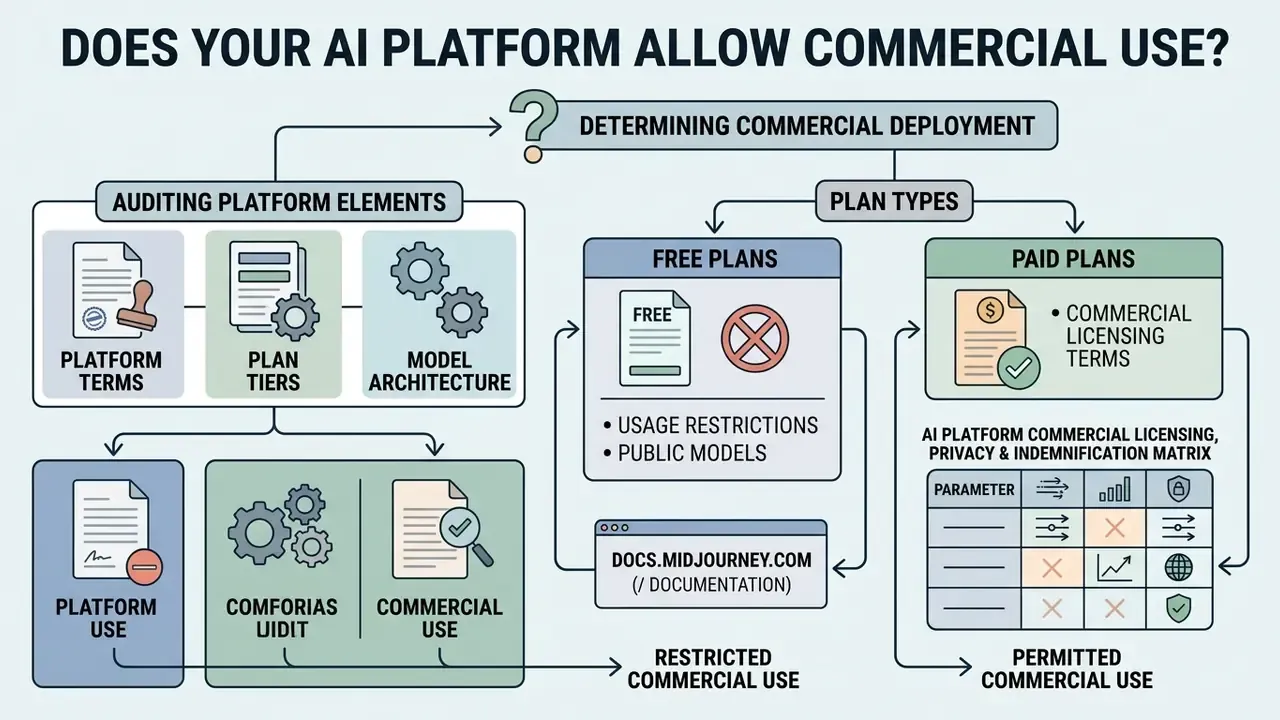
Determining whether an AI tool permits commercial deployment means auditing platform terms, plan tiers, and model architecture. Vendor permissions differ sharply between free offerings, paid individual subscriptions, and enterprise platforms.
To stay compliant, organizations should evaluate tools AI teams already use against specific criteria: explicit commercial usage grants, data retention rules, public versus private generation, and output ownership provisions. Assuming that access to a public generative tool implies commercial authorization is the single most common compliance error we see in vendor reviews. Cross-reference software capabilities against a documented vendor matrix during technical assessment. Two useful starting points are our commercial use ai tools matrix and our breakdown of AI image generators for commercial use, which maps plan tiers against usage rights.
Free Plans, Public Models and Usage Restrictions
Free plans and public generative models frequently restrict output usage to personal, non-commercial, or educational purposes. Providers use these tiers for acquisition and model testing, and reserve commercial rights for paying customers.
"Free tiers often retain prompts and outputs for model training and do not provide the confidentiality required for commercial projects."
Platforms operating free access tiers commonly apply the following conditions:
- Non-commercial output licenses. Midjourney's free-tier output licensing has historically been framed under Creative Commons Attribution-NonCommercial (CC BY-NC 4.0) terms, which bars commercial exploitation and requires credit. Luma AI states plainly that Free and Lite plans are personal-use only, with no commercial rights, and that the restriction follows content created under those plans even after a later upgrade. These terms change often, so verify the current output-license clause in the vendor's live documentation before publishing (Midjourney Documentation. https://docs.midjourney.com). Teams testing options can start with our roundup of free AI image generators and their export limits.
- Public generation by default. Free tiers generally make prompts and outputs visible to the whole community, which removes confidentiality and exclusivity in one step. For a financial institution this is not cosmetic. A public prompt can disclose an unannounced product name, a pricing structure, or campaign timing.
- Data rights and model training. Free tier terms routinely grant the provider broad rights to inspect, store, and use prompts and outputs to train future model versions. The same pattern applies to video tooling; see our overview of free AI video generators and their retention constraints.
- Revenue threshold restrictions. Some providers tier commercial grants by organizational revenue. Midjourney's Help Center states that a business grossing more than $1,000,000 USD per year needs a Pro or Mega plan for commercial use, and that paid subscribers, not free-trial users, hold commercial rights (Midjourney Help Center, 2026. https://docs.midjourney.com). Midjourney's Terms of Service, effective 23 June 2025, additionally grant the platform a perpetual, worldwide, royalty-free license to prompts and outputs.
Paid Plans and Commercial Licensing Terms
Paid tiers and private enterprise models usually grant broader commercial rights, stronger data privacy protection, and output confidentiality. Upgrading converts the relationship from a restrictive personal grant into a commercial authorization.
Paid commercial terms typically permit publishing generated assets in campaigns, embedding media in commercial software, and transferring deliverable rights to agency clients. Enterprise agreements often add private generation environments, where prompts and outputs sit outside public galleries and vendor training sets. Premium plans may also carry contractual indemnification against third-party copyright claims, which is the financial backstop most risk functions actually care about.
"Organizations should seek providers willing to offer indemnification for IP infringement, and should clarify the conditions of that protection."
For risk teams, three contractual attributes matter more than price: whether the vendor offers written ip indemnification, whether prompts and outputs are excluded from training (opt-out or zero data retention), and whether generation happens in a private or public environment. The matrix below breaks those out.
AI platform commercial licensing, privacy and indemnification matrix
| Platform / service | Access tier | Commercial use granted? | Output privacy | Data privacy / training opt-out | IP indemnification | Key restrictions and thresholds | Official terms |
|---|---|---|---|---|---|---|---|
| OpenAI (DALL·E 3 / Sora) | Free and paid | Yes | Private, account-bound | Business and API tiers exclude content from training by default; consumer tiers need manual opt-out | Available on selected business and enterprise agreements, verify in contract | Subject to Content Policy and Terms of Use; user owns output permissions and may reprint, sell, and merchandise images | openai.com/policies |
| Midjourney | Paid (Basic/Standard) | Yes on Standard | Public by default; Stealth mode on higher tiers | Perpetual, worldwide, royalty-free license to prompts and outputs granted to platform (ToS eff. 23 June 2025) | Not offered as a standard term | Companies above $1M USD gross revenue need Pro or Mega plans for commercial rights | docs.midjourney.com |
| Stability AI | Community License | Yes, under $1M revenue | User-managed | Self-hosted deployment enables full data control | Enterprise licence dependent | Organizations above $1M USD gross annual revenue require an Enterprise Commercial License | stability.ai/license |
| Liquid AI | LFM License | Yes, under $10M revenue | Private / on-prem | On-premise deployment supports zero external retention | Custom enterprise contract required | Commercial rights end at $10M USD annual revenue without a custom enterprise contract, per the published LFM License and pricing pages (Liquid AI, 2026) | liquid.ai/lfm-license |
| getimg.ai | Paid plans ($8 to $150/mo) | Yes | Private | Paid-tier generations are private to the account and shared team spaces | Review current terms, not gated behind an enterprise tier | Full commercial licensing across all paid tiers with no revenue caps; free tier is non-commercial | getimg.ai/terms |
| Recraft AI | Paid tiers | Yes | Private, vector export | Assets remain private and usable after the subscription ends | Review current terms | Commercial ownership granted on paid tiers; permits vector SVG commercial exports | recraft.ai/terms |
| Adobe Firefly | Free and paid | Yes, per current terms | Private | Outputs may not be used to train other AI models | Offered on selected enterprise agreements | Community guidance reports no material difference between free and paid tiers for image usage rights; separate content restrictions still apply | Vendor documentation, verify current terms |
Note: revenue thresholds, indemnification scope, and retention defaults change frequently. Treat this matrix as a starting point for vendor due diligence, and capture a dated snapshot of the live terms at the time of each generation. A snapshot costs a minute. Reconstructing terms two years later during a dispute costs considerably more.
Legal and Copyright Risks of Using AI-Generated Media
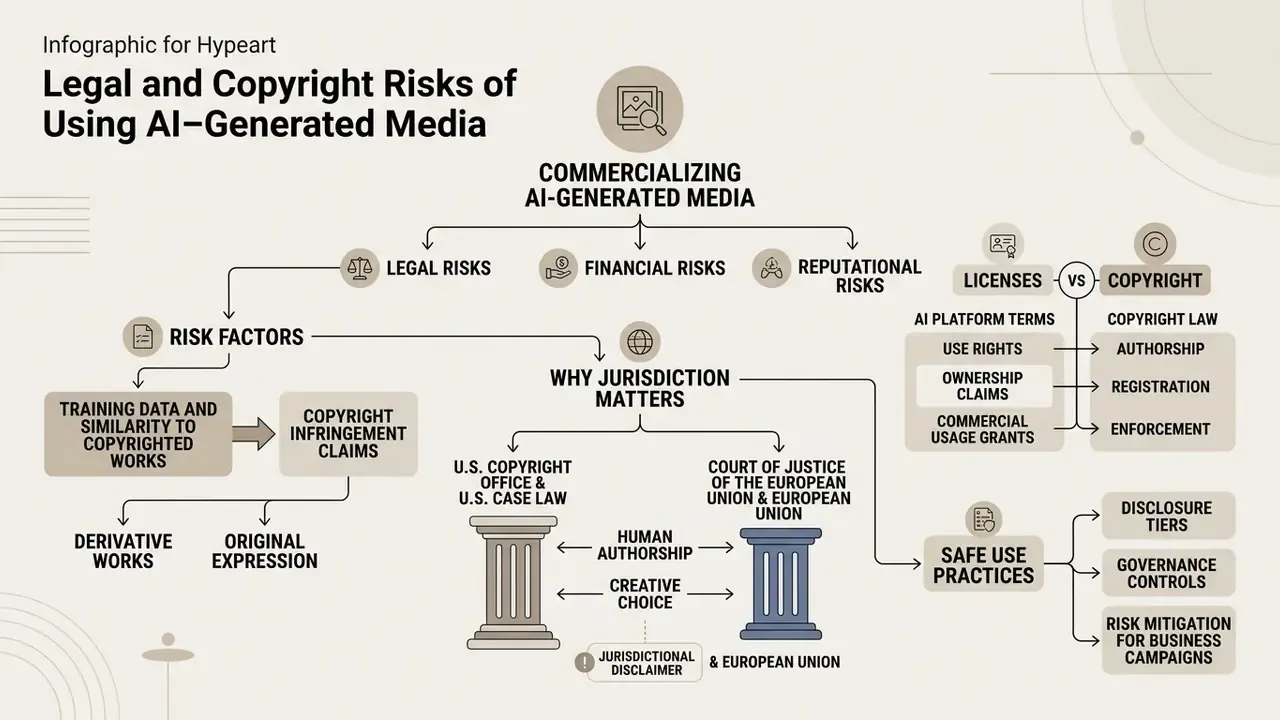
Commercializing AI-generated media carries legal, financial, and reputational risk. Generative models learn from vast datasets containing third-party intellectual property, so publishing synthetic outputs without formal review exposes an organization to infringement liability. Exposure is highest in high-volume formats such as video, so teams comparing AI video generators should weigh rights clarity alongside render quality.
Risk arrives through two vectors: the legal status of the training data used to build the model, and the substantial visual or auditory similarity between generated outputs and protected source material. Publishing infringing media in public commercial channels raises the stakes, because commercial exploitation accelerates potential statutory damages.
Training Data and Similarity to Copyrighted Works
Training a generative model involves ingesting billions of text, image, audio, or video files from public sources, many of them protected by copyright. That creates systemic risk for commercial end-users, not only for model developers.
"Training generative models entails copying protected works, an act that may infringe copyright absent a licence or exception."
Under frameworks assessed by the U.S. Copyright Office and international courts, training-stage copying and output-stage infringement are analyzed separately. Even where a vendor asserts fair use for dataset compilation, commercial end-users remain exposed if a specific output is found substantially similar to a pre-existing work.
To establish output infringement, a rights-holder must show that the tool had access to the original work, usually inferred from dataset inclusion, and that the generated asset displays substantial similarity in expressive elements. The Copyright Office is explicit that "use of the works in preparing the model is not enough"; a claimant has to show substantial similarity in the output itself (Copyright and Artificial Intelligence, Part 3: Generative AI Training, U.S. Copyright Office, 2025). Prompts that name specific artists, branded characters, or proprietary trademarks raise the probability of an infringing output sharply.
"Dozens of suits allege that copying during training violates the exclusive reproduction right; AI companies rely on the fair-use doctrine."
Screening reduces this exposure. It does not remove it. Running candidate creative through AI image detectors and similarity checks before approval turns a subjective judgement call into a documented, repeatable control. NIST's generative AI guidance points the same way, advising organizations to review training data for intellectual property issues and to implement measures that prevent, flag, or respond to outputs reproducing plagiarized, trademarked, patented, licensed, or trade-secret content (NIST AI 600-1: Generative AI Profile, 2024).
Why Jurisdiction Matters for Copyright
Jurisdiction changes both the legal status and the risk profile of commercial AI media. Operating across international markets means aligning content governance with local statutory rules, not with a single global assumption.
United States. A strict human-authorship requirement applies. The U.S. Copyright Office and federal courts (Thaler v. Perlmutter) deny copyright to purely machine-generated works. Infringement assessment relies on fair-use factor analysis and substantial similarity.
Practical boundaries were drawn in the Zarya of the Dawn decision (USCO, February 2023), where artist Kristina Kashtanova received copyright solely for human-authored text and for her selection and arrangement of visual and written elements. The underlying Midjourney images were excluded. The Office reasoned that trial-and-error prompting did not give her sufficient control over the specific visual expression. The position hardened in March 2026, when the U.S. Supreme Court declined to hear Thaler v. Perlmutter, leaving the D.C. Circuit's human-authorship rule intact. Non-human generative systems cannot hold copyright, and neither can a model's developer simply by virtue of having built it.
European Union. The emphasis is on human intellectual creation, so pure AI outputs lack protection. Separately, the EU AI Act (Regulation (EU) 2024/1689) imposes mandatory transparency, deepfake labeling, and machine-readable marking for synthetic content deployed across member states, with full applicability from 2 August 2026.
There is no bespoke EU statute on AI-output copyrightability. Eligibility is governed by Court of Justice case law. The harmonized originality standard, the "author's own intellectual creation", comes from Infopaq (C-5/08, 2009). Later rulings turned it into a working test. Painer v. Standard Verlags (C-145/10, 2011) protects a photograph where the author made free and creative choices in framing, angle, lighting, and atmosphere that express personality. Football Dataco v. Yahoo! (C-604/10, 2012) holds that intellectual effort and skill alone are insufficient without creative choices expressed in the output. Cofemel v. G-Star Raw (C-683/17, 2019) confirms that the same originality standard applies across subject matter. Applied to generative media, prompt drafting, technical labour, and iteration count confer nothing where the visual expression itself reflects no personal creative choice.
"Even where model training occurs outside the EU, offering AI services to European users brings the activity within European copyright rules." SSRN, Copyright Law and Generative AI Training (2024). https://ssrn.com/
- United Kingdom. Section 9(3) of the Copyright, Designs and Patents Act 1988 grants 50 years of protection to "computer-generated works" without a natural person author, attributing authorship to the person who made the arrangements necessary for creation. It is the notable outlier.
"Protection for computer-generated works departs from the core principle of rewarding human creativity and raises questions of consistency with international norms." U.K. Government, Copyright and Artificial Intelligence Report (2025). https://www.gov.uk/
- Cross-border implication for multinational campaigns. A single global campaign can produce assets that are protected in the UK, unprotected in the US and EU, and subject to mandatory machine-readable marking inside the EU. Multinational brands should treat the strictest applicable regime as the design constraint rather than localising rights analysis market by market. It is cheaper than reworking creative for one jurisdiction after launch.
Primary authority and legal framework references:
How to Use AI-Generated Content Commercially with Lower Risk
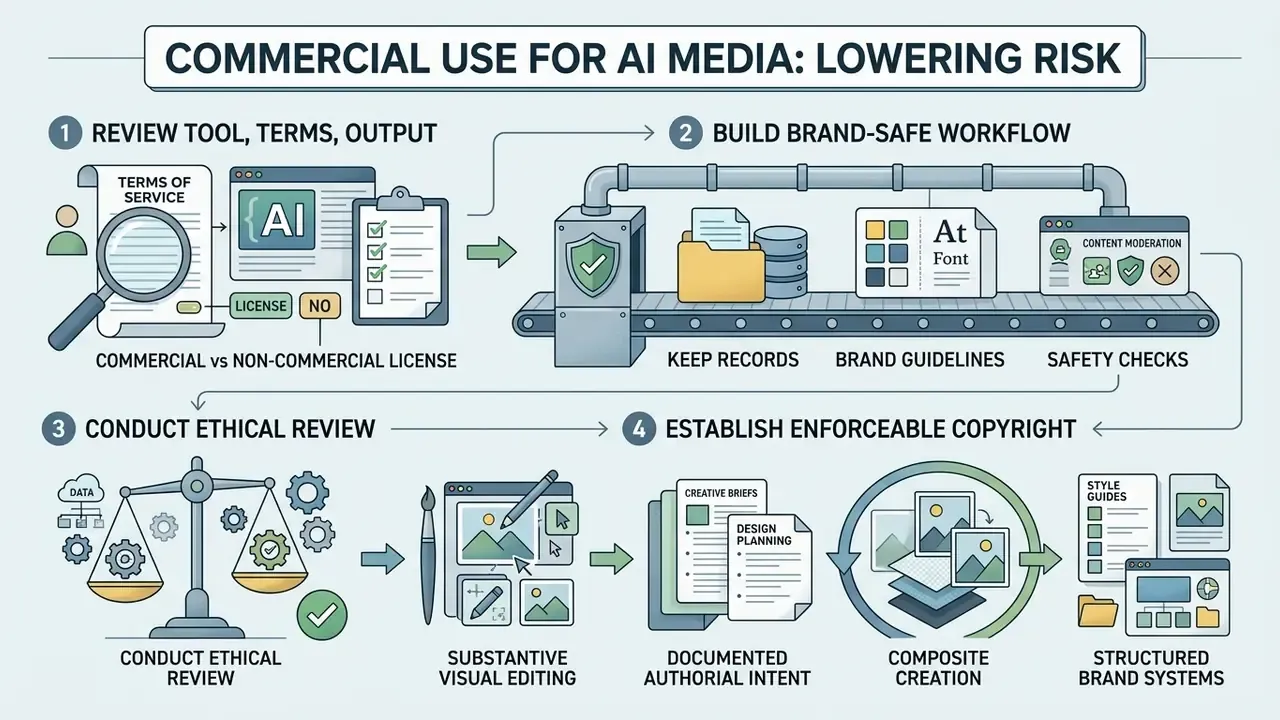
Lowering risk in commercial AI workflows means moving from ad-hoc prompting to formal governance. Organizations can use synthetic media safely by combining verified platform contracts, structured human review, technical provenance tracking, and written policy. None of that is exotic. Most of it already exists in another form inside a bank.
One illustrative case. An enterprise marketing team built an audit-ready logging framework for generated graphics after discovering that not one campaign asset could be traced back to a specific model version. By capturing exact prompts, model version numbers, and recorded human edits in a central repository, the team demonstrated compliance during an internal model-risk audit and secured ip indemnification coverage under its enterprise platform agreement. The problem it solved is the one most brands hit first: generation speed outruns the evidence trail, and the gap only becomes visible under examination.
A controls-based approach keeps commercial deployments reproducible, verifiable, and audit-ready. Embedding human intervention into the creative lifecycle also builds the defensible evidence trail that supports both brand safety and copyright claims.
Review the Tool, Terms and Generated Output Before Publishing
Pre-publication review is the primary operational check before synthetic assets reach public channels. Every asset destined for commercial use should pass a structured evaluation covering tool authorization, contractual rights, and output safety.
First, verify that the generating software sits on the approved vendor list and runs under an active paid commercial subscription. Second, inspect the file for visual or acoustic artifacts resembling protected logos, trademarks, or identifiable personal likenesses. Running reverse-image search tools and automated plagiarism checks on generated visuals adds an objective verification layer before final campaign approval.
"WIPO recommends plagiarism checks, image searches and freedom-to-operate analysis before commercial use of AI outputs."
NIST adds a systems-level requirement that teams often skip: the detection and labeling tools themselves should be tested, evaluated, and validated before deployment, not adopted on faith (NIST AI 100-4: Reducing Risks Posed by Synthetic Content, 2024). Public-sector marketing guidance converges on the same control, requiring review by at least one qualified human communicator before publication, with written disclosure where AI-generated images or video appear.
Keep Records and Build a Brand-Safe Workflow
Detailed generation records are how you verify intellectual property rights and defend commercial assets during audits or disputes. Systematic documentation turns transient outputs into accountable business records.
"Organizations should document how AI tools were trained, retain prompt records, and record the human role in the content creation process."
A brand-safe governance workflow records:
- Generation metadata: vendor, specific model version, exact prompts, seed parameters, creation timestamp.
- Licensing documentation: copies of the Terms of Service and commercial license in force at the time of generation.
- Human contribution logs: creative edits, manual retouching, layout arrangement, and composite additions performed by designers, including files produced in AI photo editors, which leave a natural audit trail of human intervention.
- Review approvals: sign-off records from legal, compliance, or brand safety authorizing public release.
Public-sector precedent already treats retention as a hard requirement rather than a nicety. Pennsylvania's Artificial Intelligence Policy obliges agencies to retain prompting and input data for audit, disclose public-facing generative AI use, and review outputs before release. The U.S. Department of Energy notes that generated inputs and outputs may themselves constitute agency records subject to FOIA and retention rules.
Checklist0 / 9
Who signs what: responsibility matrix for commercial AI media approval
| Control step | Responsible | Accountable | Consulted | Informed |
|---|---|---|---|---|
| Vendor onboarding, licence and indemnity review | Procurement / vendor risk | Legal | AI governance, information security | Marketing, brand |
| Prompt hygiene and generation-metadata logging | Creative / studio lead | AI governance | Legal | Internal audit |
| Similarity, likeness and trademark screening | Brand safety reviewer | Legal | AI governance | Marketing |
| Bias, fairness and factual-accuracy review | Compliance / marketing compliance | Chief compliance officer | AI governance, legal | Risk management |
| Disclosure tier decision and C2PA tagging | AI governance | Chief compliance officer | Legal, marketing | Internal audit |
| Final publication sign-off and record retention | Marketing owner | Chief risk officer or delegate | Legal, compliance | Internal audit, records management |
| Escalation on high IP or reputational risk | AI governance | Chief risk officer | Outside counsel | Executive committee |
Escalation should fire automatically, not at someone's discretion. Any asset that depicts a real or realistic human, references a competitor or third-party mark, supports a regulated product claim, or came from a tool outside the approved list should route to Legal and AI Governance before publication rather than after.
Four steps to establish enforceable copyright on AI-assisted media
Platform permission does not create exclusivity, so teams that need a defensible IP position have to manufacture human authorship deliberately.
- Substantive visual editing. Manual colour grading, multi-layer compositing, retouching, custom vector overlays. The closer the human contribution sits to the expressive decisions visible in the final work, the stronger the claim.
- Documented authorial intent. Layered source files (PSD, Figma), prompt-iteration history, seed parameters, and editing logs that evidence specific creative choices rather than trial-and-error prompting.
- Composite creation. Combine synthetic elements with original human-written copy, proprietary photography, commissioned illustration, custom typefaces, and owned brand design assets. Composites are registrable in respect of their human-authored components and arrangement.
- Structured brand systems. Reference images, style controls (ControlNet, style elements), and enforced brand guidelines demonstrate directed creative control instead of unguided generation.
Under both the USCO's 2025 guidance and the CJEU's Painer standard, these four steps rest on one principle. Protection attaches to the expressive choices a human made and can prove, not to the effort spent obtaining the output.
Governance in Regulated Industries: MRM Integration and Shadow AI
Regulated institutions, meaning banks, insurers, broker-dealers, and mature fintechs, cannot treat AI media governance as a marketing-department concern. Generative creative sits inside the same control perimeter as any other model output, so the evidence produced by the workflow above has to land in systems examiners already inspect.
Route generation records into existing model-risk infrastructure. Institutions operating under supervisory model-risk expectations, in the U.S. the Federal Reserve and OCC guidance commonly cited as SR 11-7, already maintain model inventories, documented validation, and ongoing monitoring. Generative tools used for customer-facing content should be registered in that inventory with a named owner, an approved-use description, and a documented review cadence. In practice that means exporting the prompt log, model version, seed, licence snapshot, and reviewer sign-off into the GRC or MRM system of record instead of leaving them in a design tool's project history. Retention should mirror the institution's marketing-records schedule, not the vendor's default deletion window. A vendor retention policy is not an audit defence.
Treat unapproved tooling as a first-order risk, not a policy nuisance. Shadow AI, meaning staff producing customer-facing assets on personal accounts and free tiers, breaks three controls simultaneously. It publishes prompts, and therefore unannounced product information, into public environments. It produces assets with no commercial licence. And it leaves no reproducible record. Countermeasures that work are structural rather than exhortative: keep a short list of approved tools with enterprise contracts and zero-retention terms, block unapproved generation domains on managed devices, provide a sanctioned internal path fast enough that staff do not route around it, and require a tool identifier field on every creative asset ticket. That last one sounds trivial. It is usually the control that surfaces the problem.
Contract for the residual risk you cannot engineer away. Output-stage infringement cannot be fully eliminated by screening, so the remaining exposure should be priced and allocated. Confirm in writing whether the vendor indemnifies IP claims, what the cap is, what conduct voids the indemnity, typically prompt-based attempts to imitate a named artist or brand, and whether coverage extends to derivative works delivered to clients. Where indemnity is unavailable, record the retained exposure in the risk register rather than assuming the platform absorbs it.
Anticipate sector-specific consumer-protection scrutiny. Beyond copyright, financial regulators examine whether marketing materially misleads consumers. Synthetic faces or voices presented as customers, testimonials, or advisers in advertising for credit, deposit, or investment products invite exactly that scrutiny. Where a synthetic human appears in regulated financial advertising, disclosure should be visible, not buried in metadata.
Transparency and Ethical Practices for AI Media in Marketing
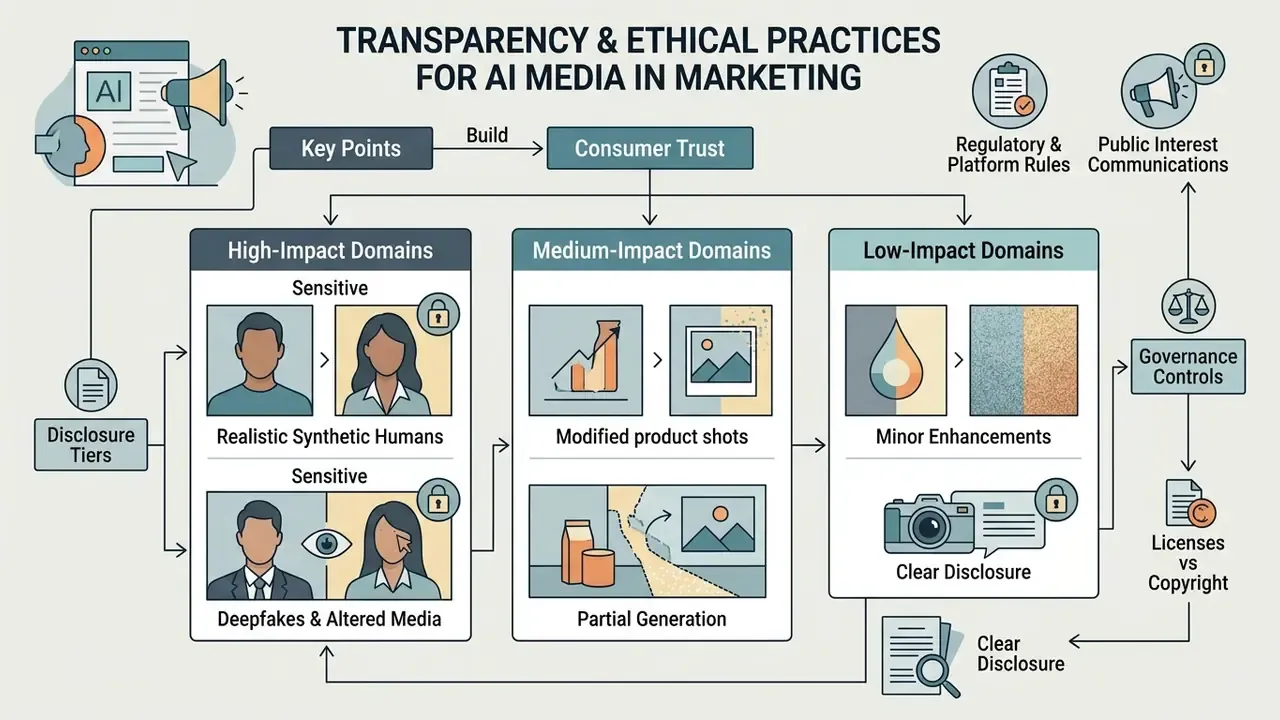
Building transparency and ethical standards into commercial marketing supports long-term consumer trust and keeps campaigns aligned with evolving advertising rules. As synthetic media grows more convincing, regulators enforce prohibitions on deceptive commercial communication more actively. Teams selecting production tooling can compare AI art generators on disclosure features and provenance support alongside output quality.
Ethical governance requires disclosing AI use in public communications and running pre-launch review of advertising creative. Marketers need to balance performance targets against responsible communication. Industry frameworks converge on a materiality test, disclose when AI materially affects authenticity, identity, or representation in a way that could mislead a consumer, while the EU imposes a broader formal marking obligation regardless of deceptive intent.
When AI-Generated Content Should Be Clearly Disclosed
Disclose AI involvement whenever non-disclosure could mislead consumers about the authenticity, origin, or nature of a commercial communication.
Key disclosure triggers:
- Realistic synthetic humans. Hyper-realistic AI faces, digital avatars, or synthetic voiceovers in consumer product reviews or testimonials. Synthetic voice work carries its own licensing layer; see our guide to AI voice generators and their commercial terms.
- Deepfakes and altered media. Depicting real individuals, public figures, or events in modified synthetic contexts, which triggers mandatory labeling under EU AI Act Article 50 and several U.S. state synthetic media statutes. New Hampshire's law, for instance, requires a clear statement that the media was generated or manipulated and that the depicted speech or conduct did not occur, with specific readability and timing rules.
- Public interest communications. Synthetic content in campaigns addressing sensitive health, financial, or civic topics.
- Regulatory and platform rules. Platform-specific disclosure duties, such as mandatory YouTube synthetic media tags or social advertising labels. India's 2025 IT amendments go further, requiring prominent labels occupying at least 10% of the visual area or the first 10% of audio duration, plus permanent embedded metadata.
"Article 50 of the EU AI Regulation requires synthetic content to be marked in machine-readable form across all member states."
"Labeling AI-generated advertising significantly affects consumer behavioural engagement; psychological engagement mediates the effect." Du, Zhang & Ge, AI-Generated Content Advertising Study (2024). https://doi.org/
Tiered disclosure by industry impact. Disclosure intensity should scale with the consequences of being wrong.
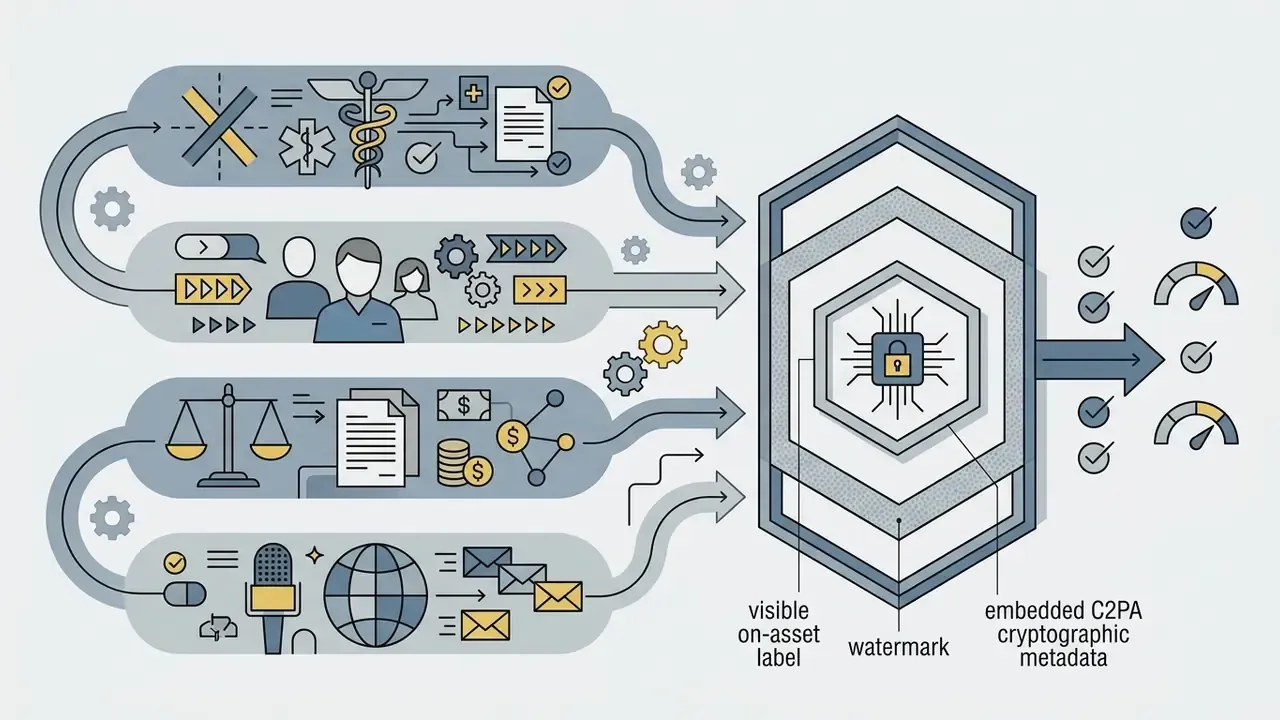
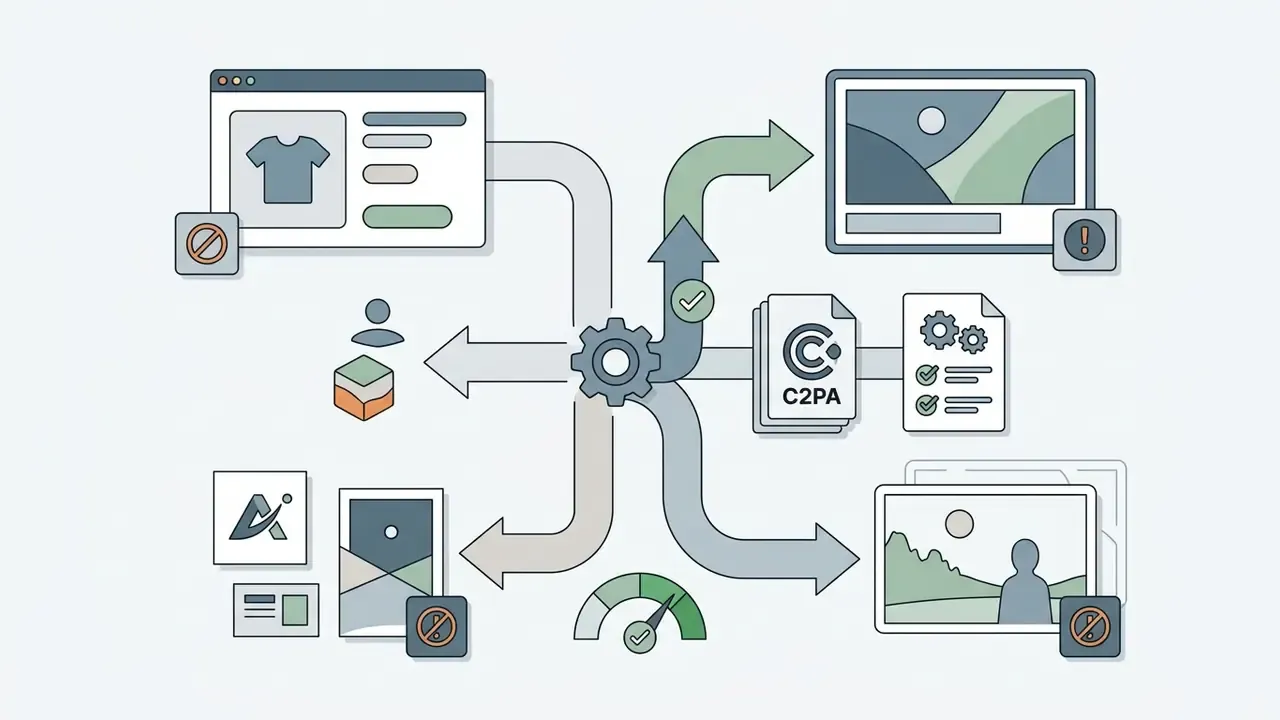
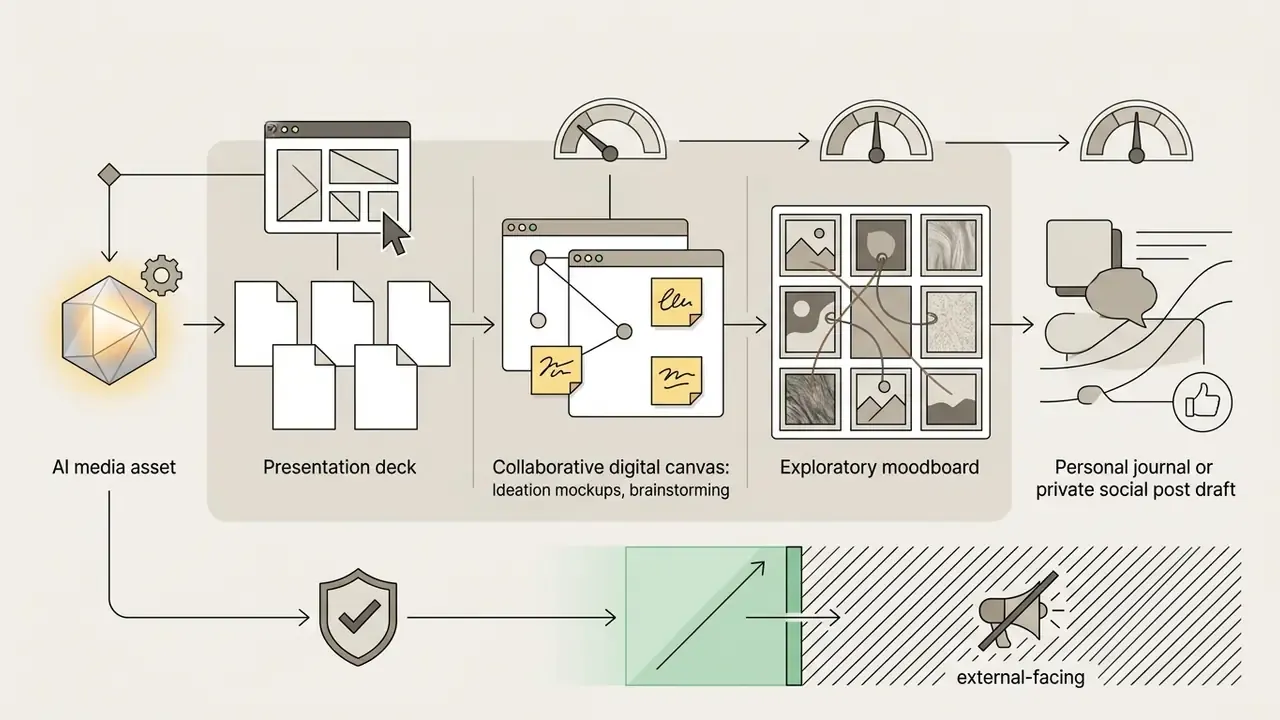
Two further variables shape the tier: how much of the content AI produced (all of it, an edit to existing material, or a change that alters meaning), and whether the change affects interpretation. Even a small edit can reverse meaning, the difference between "did" and "did not", so altering existing material warrants disclosure even where generation volume is low.
Provenance standards such as C2PA (Coalition for Content Provenance and Authenticity) allow cryptographically secure metadata to be embedded directly in the file, recording asset origin and AI modification history without cluttering the creative. NIST AI 100-4 (2024) treats metadata, watermarking, and provenance signals as complementary rather than interchangeable, since visible labels survive screenshots while cryptographic provenance survives re-encoding.
Ethical Review Before Using AI Media in Ads
A pre-launch ethical review protects brands from algorithmic bias, cultural insensitivity, and false advertising claims. Publishing unvetted model outputs exposes campaigns to consumer backlash and regulatory enforcement, and in financial services those two arrive together.
"Agencies should identify and remediate algorithmic discrimination in AI systems, documenting impacts on fairness and equity."
FAQ About Commercial Use for AI Media
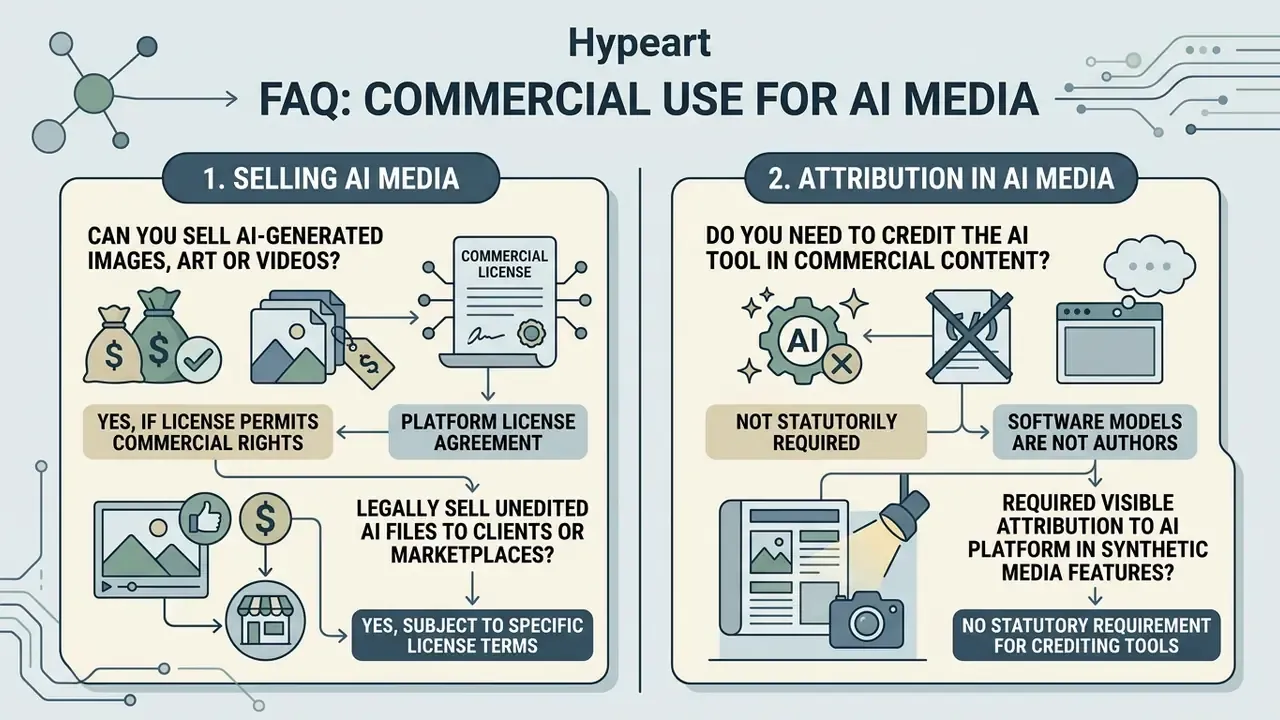
Can You Sell AI-Generated Images, Art or Videos?
Can you legally sell unedited AI-generated images, art, or video files to clients or on digital marketplaces?
Yes, provided your platform license explicitly grants commercial rights. Paid plans from providers such as OpenAI, Midjourney, getimg.ai, and Recraft allow users to commercialize generated outputs; start with our comparison of leading AI image generators to confirm which tiers include those rights. There is a limit, though. Because purely machine-generated media cannot hold statutory copyright in jurisdictions like the U.S., you cannot grant exclusive copyright ownership to a buyer or stop third parties from copying identical unedited outputs. Selling composite works with human modification gives a stronger position. Note also that some marketplaces prohibit selling AI-generated content as the primary component of a listed item, permitting it only for previews or supporting elements.
"Users may claim copyright only in their own human contribution, creative selection, arrangement, or modification of the AI output."
Do You Need to Credit the AI Tool in Commercial Content?
Are you required to provide visible attribution to the AI platform when featuring synthetic media in commercial advertising?
Statutory copyright law does not require crediting AI tools, because software models are not legal authors. Mandatory credit depends on vendor terms instead. Free tiers often require visual attribution or source tagging as a license condition, and where a free-tier output is licensed under CC BY-NC 4.0, both attribution and the non-commercial restriction apply. Paid commercial subscriptions generally waive external attribution, which lets businesses publish unbranded creative while applying internal provenance metadata such as C2PA to satisfy transparency standards. Separately, some marketplaces impose their own labeling duty. Adobe Stock, for example, requires contributors to mark content created with generative AI.
"Moral rights, including attribution, belong to human authors; AI systems are not recognised as rights holders in any jurisdiction."
Frequently Asked Questions
Can an agency assign full exclusive copyright to a client for AI-generated deliverables?
No. An agency can transfer only the contractual usage rights granted by the AI platform. Because purely AI-generated outputs cannot hold statutory copyright, exclusive copyright ownership cannot be assigned. Client contracts should state plainly that deliverables contain AI-generated elements, and should warrant contractual commercial safety rather than statutory exclusivity. Where a client genuinely needs assignable IP, for a trademark, a packaging system, or a franchisable brand asset, the deliverable should be built as a human-authored composite, and assignment should be executed as an explicit contractual act rather than assumed to follow payment.
Does internal use of AI media inside a company ever require a commercial license?
Check the terms rather than assuming. Internal reports, inter-departmental training, and process documentation are generally treated as non-commercial, but several platforms restrict organizational use on free tiers regardless of publication. The moment an asset moves into a sales deck, a proposal, a trade-show display, or any customer-facing document, full commercial rights apply. Because the same file can change category, attach license requirements to the distribution channel and record the tool used in the asset's metadata from the start.
How long should we retain prompt and generation records?
Align retention with your existing marketing-records and audit schedules rather than the vendor's default deletion window, which may be shorter than your obligation. Public-sector policy shows the direction of travel: some U.S. state AI policies require agencies to retain prompting and input data specifically for audit, and federal guidance notes that generated inputs and outputs may themselves constitute records subject to disclosure and retention rules. In regulated institutions, store these artifacts in the GRC or model-inventory system of record so they are retrievable during examination.
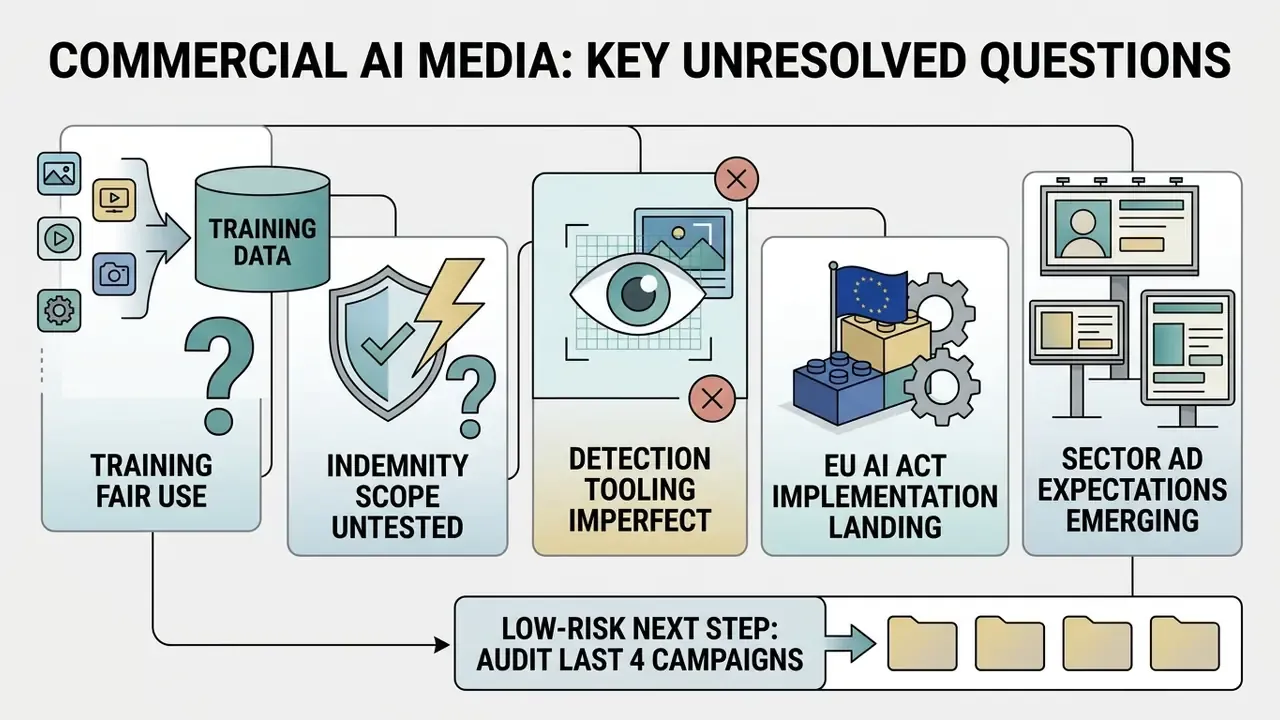
Limitations and Open Questions