Last updated: March 2026. Reviewed by: internal model-risk and content-governance practitioners who run vendor pairwise evaluations, prompt-caching cost audits, and human-in-the-loop review protocols for regulated content workflows.
Executive summary for decision-makers
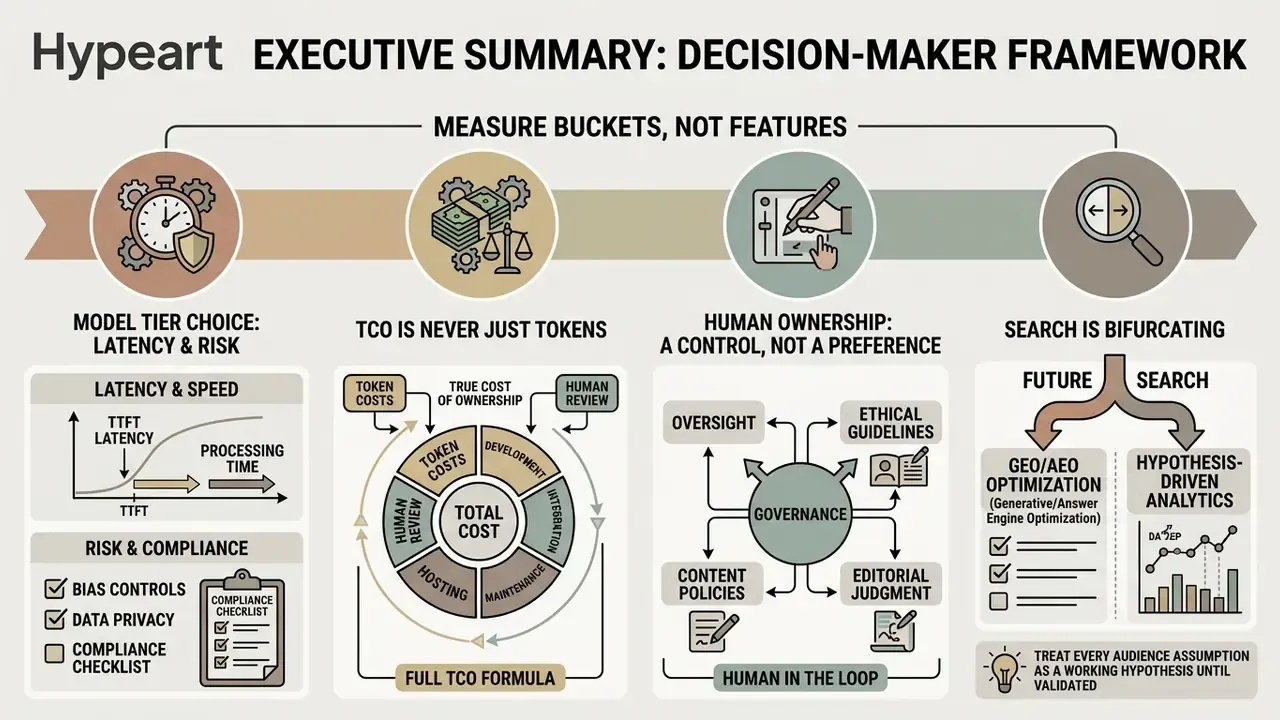
- Measure four buckets, not features. Every defensible comparison scores accuracy and factuality, speed and latency, reliability and auditability, and total cost of ownership, then checks business fit. NIST separates benchmark accuracy from generalized operational accuracy, so a leaderboard win is not a validation result. Worth repeating, because procurement decks still confuse the two.
- Model tier choice is a latency-and-risk decision. Ultra-low-latency models (Gemini 2.5 Flash-Lite at roughly 0.31s time-to-first-token; Celeris-1 at roughly 1,795 tokens per second) fit real-time support and background agents. Frontier reasoning models (Claude Opus 5, GPT-4o class) fit legal, financial, and architectural synthesis, where multi-step reasoning outweighs speed.
- TCO is never just tokens. Budget owners must model token spend, compute, human-in-the-loop review hours, and compliance or audit overhead. Prompt caching cuts API input costs by 41% to 80%, yet review and control costs frequently dominate the total.
- Human ownership is a control, not a preference. Expert judges preferred human writing in 82.7% of in-context evaluations, and evaluators show a measurable pro-human labeling bias. Blind rubrics are therefore mandatory in procurement testing.
- Search is bifurcating. AI Overviews now appear on more than half of sampled result pages while source click-through collapses toward roughly 1%. Crawlable trust signals (pricing, SLAs, case studies, author bios) become a distribution requirement rather than a nice-to-have.
Treat every audience assumption in this article as a working hypothesis until your own analytics, interviews, or CRM data confirm it. That caveat is not modesty. It is how you avoid building a control framework on borrowed assumptions.
What AI media versus comparisons should evaluate
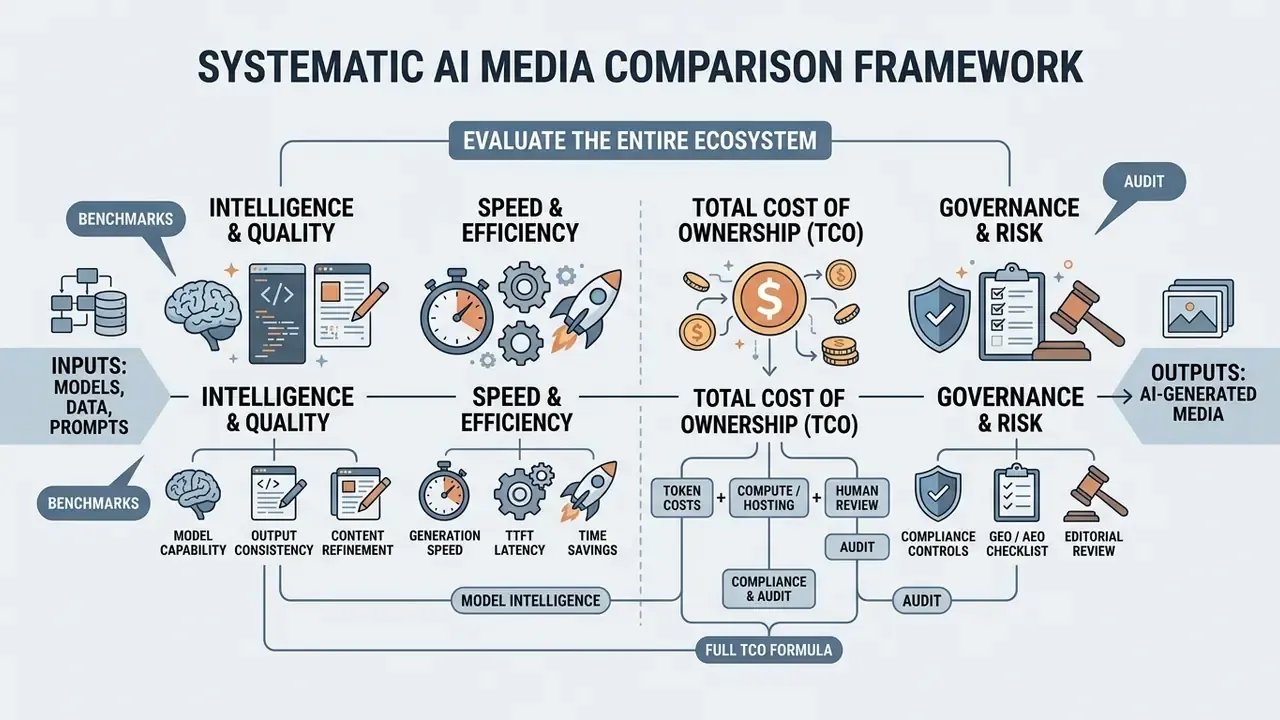
Rigorous ai media versus comparisons must systematically evaluate model intelligence, output consistency, total cost of ownership, generation speed, and required human review across identical test prompts. Standardized evaluation protocols provide reproducible baseline scores for content quality, source grounding, and task completion.
This information is general in nature and does not replace consultation with a qualified specialist. Benchmark results described here do not substitute for formal model validation under supervisory guidance such as the Federal Reserve and OCC SR 11-7 model risk management framework, nor for legal review of licensing terms.
Evaluating generative platforms requires testing models under standardized operational conditions. The National Institute of Standards and Technology (NIST) established in its NIST AI 800-2 draft and AI RMF 1.0 guidelines that benchmark accuracy must be separated from generalized operational reliability. NIST AI 800-3 (February 2026) extends this by focusing on the statistical validity of benchmark claims, which matters a great deal when a vendor cites a single-run score. In practice, evaluating generative models means assessing semantic precision, structural integrity, token cost, and residual hallucination rates across defined workflows.
The total cost of ownership formula
Procurement decisions collapse when only API pricing is modeled. Use an explicit, auditable expression:
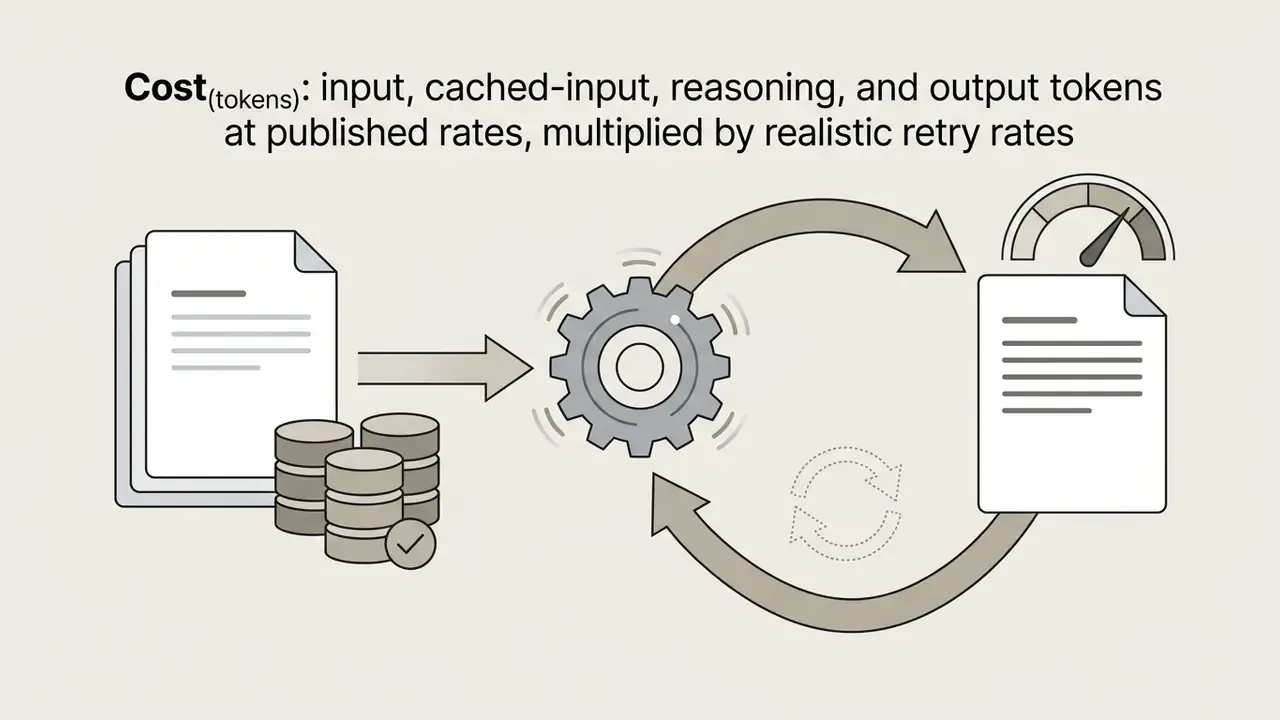

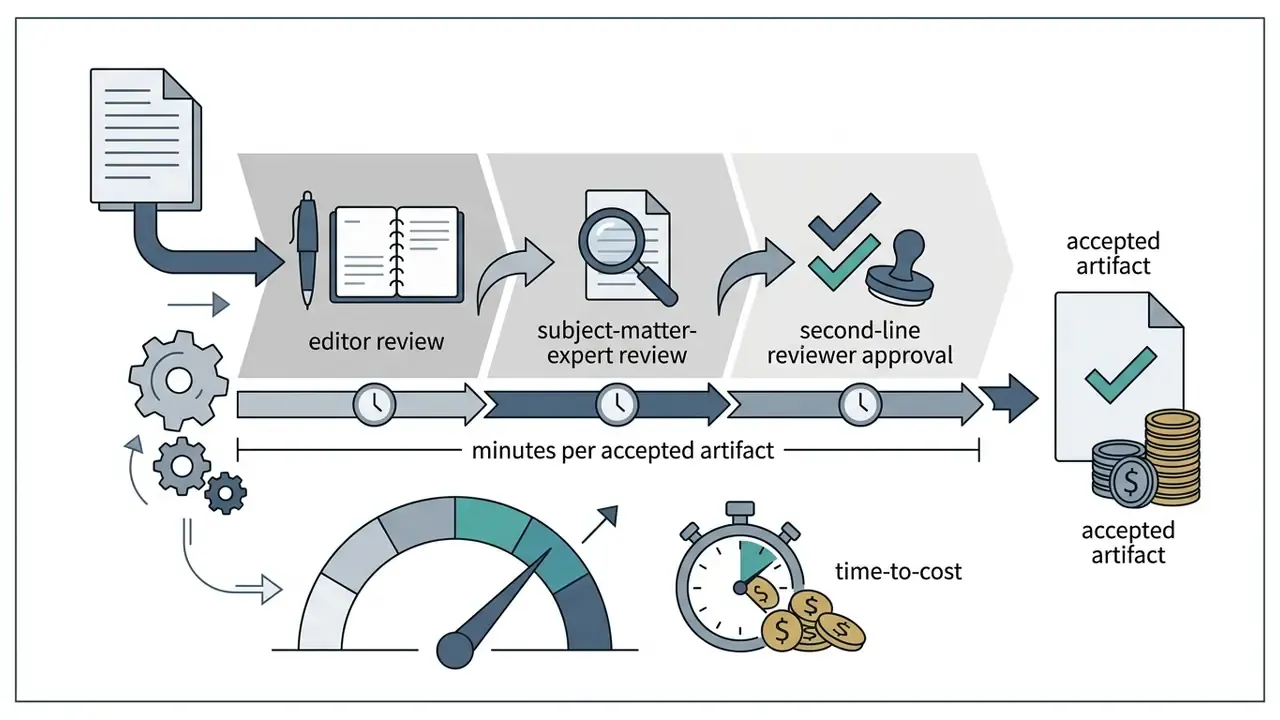
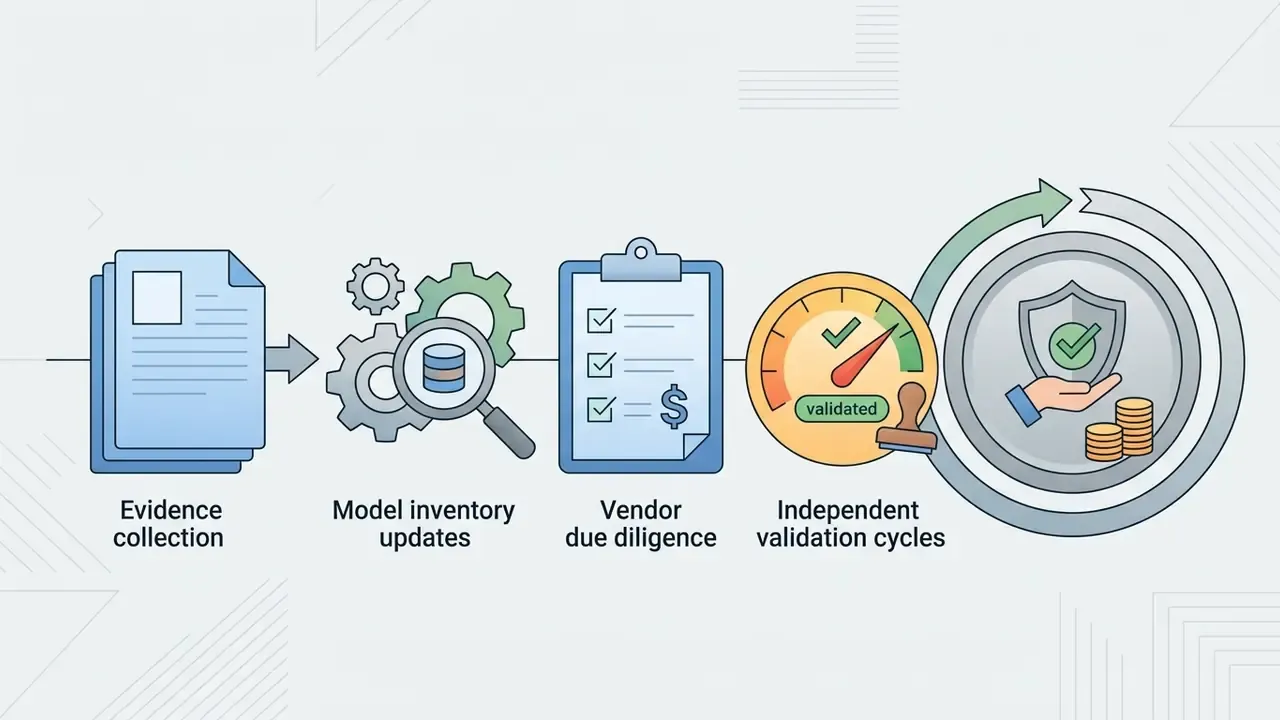
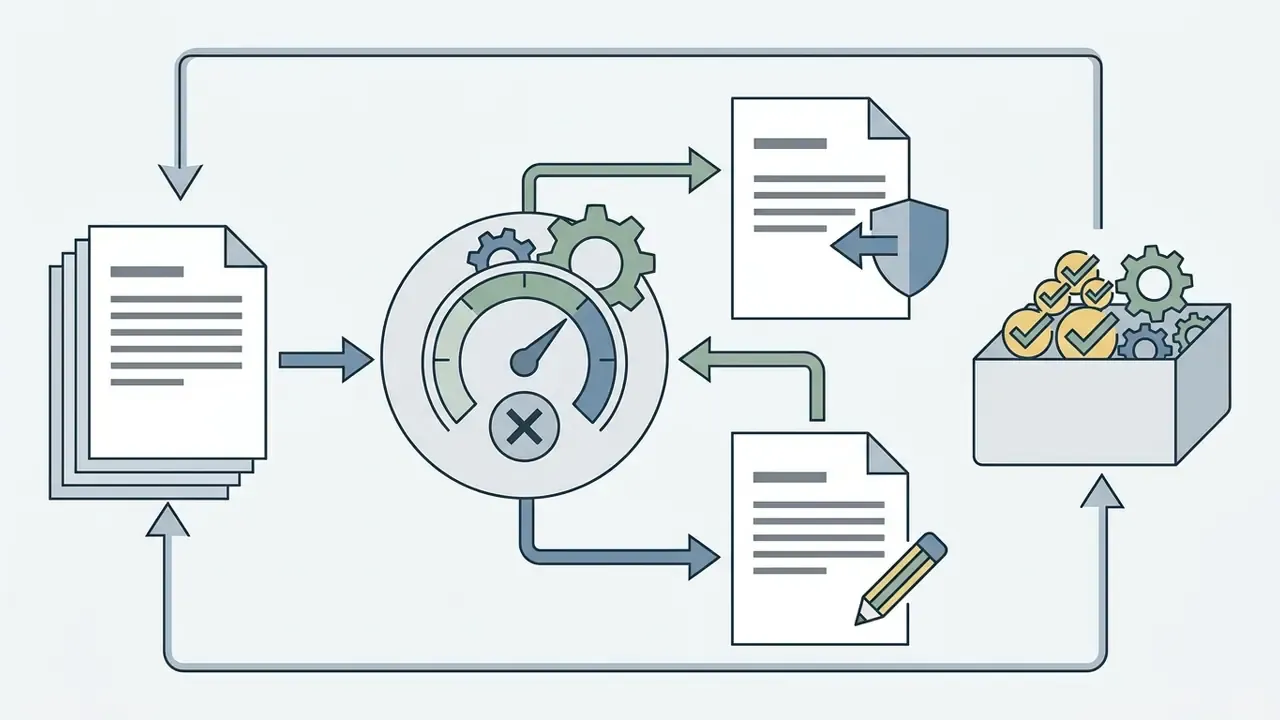
The correct denominator is not "per 1,000 tokens" but cost per acceptable, publication-ready artifact. A model that halves token cost while doubling editing minutes is usually the more expensive option. Simple arithmetic, routinely ignored.
Table 1: Universal pairwise evaluation framework for AI media tools and models
| Evaluation criterion | Frontier multimodal AI models | Ultra-low-latency / lightweight models | Verification and operational standard |
|---|---|---|---|
| Model intelligence and factuality | Low extrinsic hallucination rates (1.5% to 4.6% on factual QA benchmarks); strong multi-hop reasoning; AA-Briefcase Elo above 1200 on agentic knowledge work. | Higher hallucination rates (up to 58.16% on complex factual benchmarks); weaker reasoning limits. | Evaluate against HalluLens or PreciseWikiQA benchmarks; verify source grounding; check hallucination-adjusted knowledge indices. |
| Output consistency and structure | High schema compliance; structured JSON output integrity; reproducible cross-session outputs. | Variable schema adherence; frequent structural drift across repeated execution runs. | Test using SO-Bench JSON schemas (6.5K+ schemas, 1.8K image-schema pairs) and multi-run variance logging (minimum 7 to 8 runs). |
| Generation latency and speed | Sub-second token latency for text, but reasoning "thinking time" inflates time-to-first-answer-token; variable rendering times for high-resolution video or audio. | TTFT below 0.35s (Gemini 2.5 Flash-Lite around 0.31s, Command A+ around 0.37s); throughput above 1,000 tokens per second (Celeris-1 around 1,795 t/s). | Measure time-to-first-token (TTFT), time-to-first-answer-token, and end-to-end response time for a 500-token completion under load. |
| Token economics and TCO | Higher base input and output pricing ($2.50 / $10.00 per 1M tokens); 41% to 80% savings via prompt caching. | Lower nominal token costs, but overall spend inflates because of frequent generation retries. | Calculate total cost per acceptable, publication-ready artifact inclusive of edit time, using the TCO formula above. |
| Openness and deployment control | Mostly proprietary APIs; enterprise tiers offer zero-data-retention and private networking. | Open-weight options score higher on openness indices, enabling on-premise or VPC deployment. | Score weight availability, license restrictions on commercial use, and deployment topology against data-residency policy. |
| Required human review level | Targeted editorial review, expert fact-checking, and brand alignment adjustments. | Extensive structural rewriting, fact-checking, and heavy stylistic correction required. | Enforce mandatory human-in-the-loop validation before any external publication. |
Quality, intelligence and output consistency
Model intelligence and output consistency determine whether an AI tool can produce publication-ready media without introducing hallucinated facts or structural errors. Benchmark evaluations show that larger frontier models achieve significantly lower extrinsic hallucination rates than smaller open-weight options.
Evaluating model performance requires measuring factual accuracy alongside stylistic coherence. According to the HalluLens benchmark published at ACL 2025, frontier LLMs achieve extrinsic hallucination rates as low as 1.5% for GPT-4o and 3.9% for Llama-3.1-405B-Instruct, whereas smaller models exhibit error rates exceeding 50%.
«GPT-4o shows a hallucination rate of 1.5%, while models such as LLaMa-7B reach up to 58.16% on factual questions.»
Furthermore, evaluations in OpenING (CVPR 2025) demonstrate that multi-modal image-text consistency requires explicit scoring of semantic correctness and multi-step narrative coherence across 5,400 human-annotated instances and 56 tasks, rating completeness, content quality, correctness, coherency, and multi-step consistency.
Bigger is also not automatically better for reasoning quality, which matters when teams default to the largest available checkpoint:
«The study identifies a U-shaped relationship between model size and reasoning quality: excessive parameterization degrades multi-step inference.»
When evaluating creative video generation workflows, performance metrics vary significantly depending on motion synthesis and temporal consistency. Comparing state-of-the-art video platforms such as Sora vs Veo highlights how different model architectures handle dynamic prompt adherence, frame rate stability, and object permanence under complex spatial instructions. Teams that need a broader field of candidates can extend the same rubric across a full comparison of AI video generators before shortlisting two finalists for pairwise testing.
One practical note from review sessions: consistency failures rarely appear in the first run. They show up on run five, when a schema silently loses a required field and nobody notices until a downstream reconciliation job breaks.
Price, speed and time savings
Evaluating AI tools requires balancing direct token costs against generation latency and the measurable time savings achieved during content research and drafting. Prompt caching and model optimization significantly reduce per-task execution costs for enterprise workloads.
Direct token pricing shapes the economic viability of automated media workflows. OpenAI API pricing schedules fix GPT-4o at $2.50 per 1 million input tokens and $10.00 per 1 million output tokens, while prompt caching architectures deliver 41% to 80% cost reductions on long-horizon agentic tasks (reported savings include 89% for GPT-5.2, 88% for Claude Sonnet 4.5, and 54% for GPT-4o in published benchmark runs). Empirical studies published in Science (Noy & Zhang, 2023) demonstrate a 40% reduction in writing time and an 18% improvement in output quality among professionals using generative assistants.
«A randomized experiment with 453 professionals showed that ChatGPT cut task completion time by 40% and improved output quality by 18%.»
In an internal workflow pilot, an operations team deployed automated summarization assistants across 50 analytical tasks. By implementing prompt caching strategies, input API costs decreased by 54%, while task completion times dropped from 45 minutes to 14 minutes per brief. The resulting workflow freed operational capacity while maintaining strict human-in-the-loop review controls. Illustrative figures, not audited results.
Corporate evidence confirms that productivity effects are strongly task-dependent rather than uniform:
«A corporate study at Trane Technologies recorded productivity gains ranging from 3.3% to 69% depending on task type when using a GPT-3.5-based assistant.»
Latency tiers: matching model class to workload
Latency is a product requirement, not a technical footnote. Independent leaderboards that track hundreds of endpoints separate two operating regimes:
- Ultra-low-latency models (for example Gemini 2.5 Flash-Lite at around 0.31s TTFT, Command A+ at around 0.37s, high-throughput engines such as Celeris-1 at roughly 1,795 tokens per second and Mercury 2 at roughly 1,129 tokens per second). Optimal for real-time customer support, autocomplete, moderation queues, and background API agents, where perceived responsiveness drives adoption. Some lightweight open-weight options (Devstral 2, Gemma-class models) carry near-zero licensing cost, which shifts spend to hosting.
- Frontier reasoning models (for example Claude Opus 5 configurations, GPT-4o class endpoints). These post the highest scores on aggregate intelligence indices and agentic knowledge-work Elo, but time-to-first-answer-token includes deliberate "thinking" time. Optimal for legal, financial, architectural, and multi-document synthesis, where a slower correct answer beats a fast wrong one.
- Context capacity outliers matter for long-document media workflows. Context windows now range from a few hundred thousand tokens to multi-million-token windows, which changes whether a 400-page filing can be processed in a single pass or must be chunked.
Cost per task, not cost per token, is the comparable unit. Reasoning models emit far more output tokens per task, so a cheaper per-token model can end up more expensive per completed brief. For asset-heavy pipelines, media-resolution settings compound this effect: vendor documentation shows token budgets per media type (for instance image 1,120, video 70, PDF 560 tokens at default settings), where high resolution raises quality, latency, and cost simultaneously, and medium is usually sufficient for PDFs because quality saturates. Teams optimizing storage and delivery alongside inference cost often pair this analysis with practical tooling guides such as our overview of video compressors and file-size reduction.
How to decide which AI media option is better
Deciding which AI media option is better requires executing structured pairwise prompt evaluations, quantifying task completion time, calculating total token costs, and auditing data privacy policies. Systematic testing removes subjective bias and grounds procurement decisions in empirical data.
Selecting enterprise AI media tools demands a repeatable evaluation methodology. NIST's 2026 TEVV-Athlon framework and European Commission public procurement standards require that technology selection include due diligence, risk assessment, calibrated benchmarks, and independent performance audits rather than reliance on vendor marketing materials. The European Commission's white paper on data ethics in public procurement of AI-based services additionally requires control mechanisms, documented assumptions, and independent evaluations or audits, and it instructs buyers to assess tenders on combined economic and quality criteria.
A practical pairwise comparison workflow
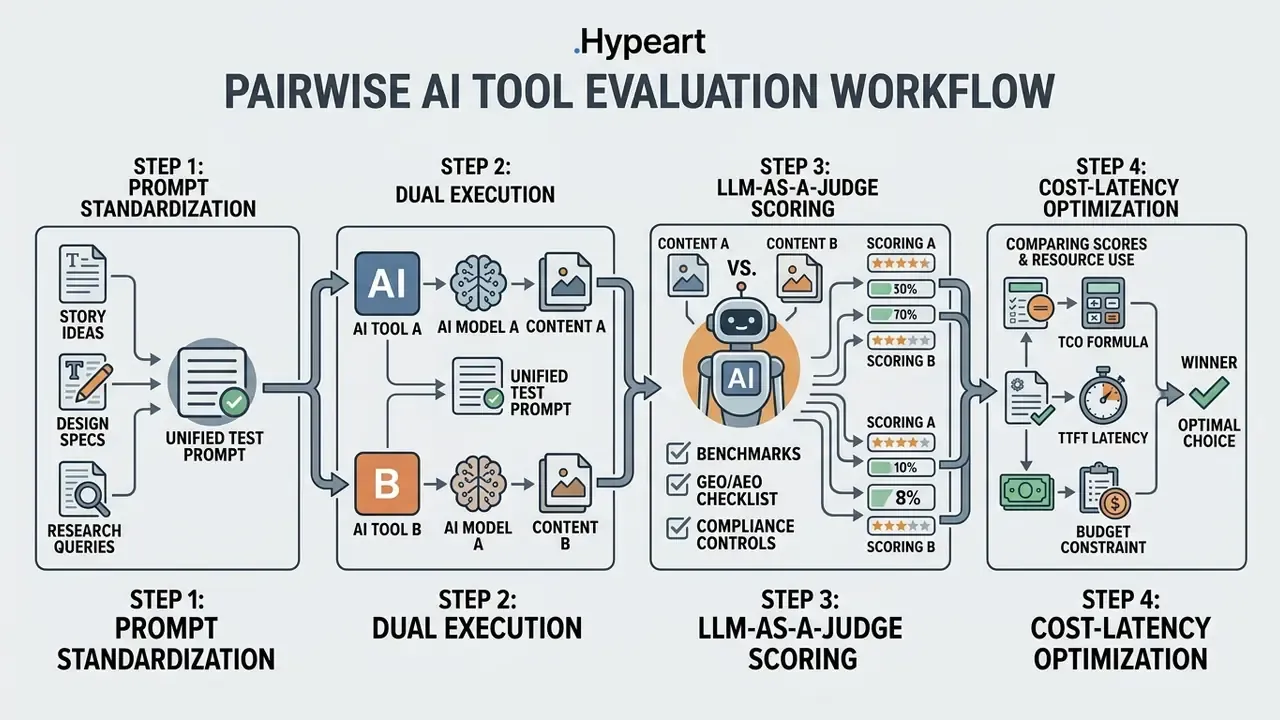
A practical pairwise comparison workflow involves running identical, standardized prompts across two competing AI tools, then measuring response accuracy, generation latency, token usage, and manual edit time. Direct side-by-side benchmarking isolates performance differences under identical working conditions.
To execute a structured pairwise evaluation, organizations should follow a four-step benchmark process:
- Standardize test prompts. Select 10 to 20 representative enterprise tasks covering drafting, summarization, and data extraction. Repeat each prompt at least 7 to 8 times to capture run-to-run variance rather than a lucky single output.
- Execute dual generation. Submit identical prompts to Candidate Tool A and Candidate Tool B under uniform context window parameters, identical temperature settings, and identical media-resolution settings.
- Score output quality. Use a blind evaluation rubric or an "LLM-as-a-judge" framework (accuracy, schema adherence, tone) alongside human expert scoring. Judges should be forced to select a single winner per pair, with no tie option, to avoid rating compression.
- Log performance metrics. Record time-to-first-token (TTFT), total completion time, API token cost, and total manual editing minutes required. Store prompts, raw outputs, judge rationales, and reviewer identities as an audit trail.
Blinding is not optional. Attribution labels distort judgment even among trained evaluators:
«Blind experiments show evaluators cannot reliably distinguish AI from human text, yet when labels are present they consistently prefer content marked as human-written.»
Documented implementations of anchored pairwise evaluations demonstrate that running standardized prompt sets (for example 70 prompts across candidate tools) yields reliable selection data within 10 to 30 minutes at minimal API expense (around $7.00 average test cost). Anchored designs scale linearly, so 70 prompts multiplied by 20 anchors equals 1,400 judgments per candidate, instead of scaling quadratically like a full round-robin comparison.
Audit-trail template (retain per candidate): prompt ID and text · model or endpoint version and date · temperature and context settings · run number (1 to 8) · raw output hash · judge verdict and rationale · human reviewer score · TTFT in seconds · end-to-end latency in seconds · input, cached, and output tokens · editing minutes · accept or reject decision · reviewer sign-off. This artifact is exactly what internal audit and independent validation functions will request, usually at the least convenient moment.
Questions to ask before you sign up
Before any app sign up or commercial commitment to an AI media platform, decision-makers must evaluate privacy terms, context window limits, commercial licensing rights, and API integration options. Targeted questions protect organizational data and prevent unexpected subscription costs.
Prior to committing to an enterprise AI contract, security and governance leaders should verify four operational criteria:
- Data privacy and training terms. Does the privacy policy explicitly state whether prompt inputs, confidential uploads, or generated outputs are used to train vendor models? Australian OAIC guidance on commercially available AI products treats prompts and outputs containing personal information as collected personal data.
- Context window and rate limits. What is the precise token window limit, and how does the model handle long-document truncation or multi-turn conversational memory?
- Commercial ownership rights. Do the terms of service grant full, unencumbered commercial copyright ownership of all generated visual, text, or audio assets? Teams that publish visual assets at scale should review the specifics of commercial use rights for AI image generators and platform-specific terms such as those covered in our Canva AI Generator licensing overview.
- API and enterprise connectors. What REST APIs, browser extensions, or GRC software integrations are natively supported under the baseline license? Developer-side economics differ sharply by endpoint, as shown in our Google Veo API implementation guide.
Evaluating these operational requirements ensures that selected AI tools align with institutional risk tolerance, regulatory compliance mandates, and long-term media strategy goals. One more question worth asking out loud: who inside the institution owns the decision if the vendor changes model versions without notice?
Vendor and compliance checklist for regulated environments
Regulated buyers, including banks, insurers, healthcare organizations, and public-sector media teams, need controls beyond feature parity. Use this checklist as the second gate after pairwise scoring:
Checklist0 / 11
AI media tools compared by content creation use case
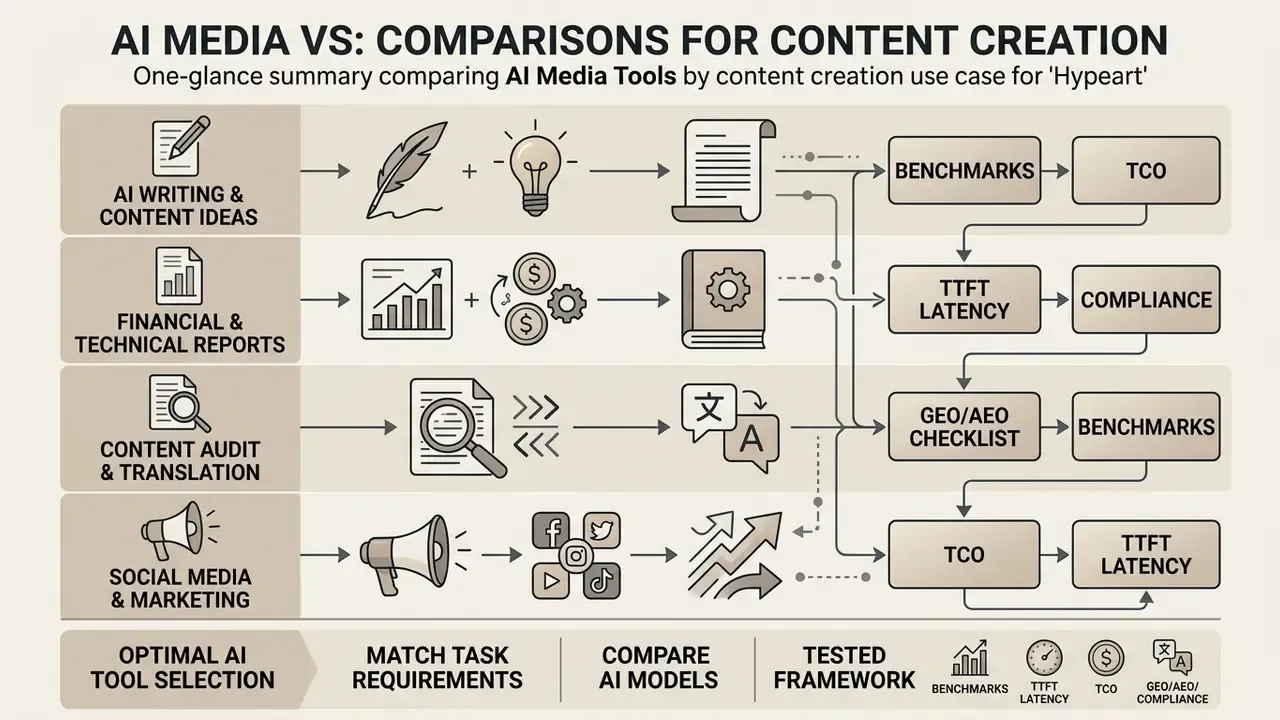
Selecting the optimal AI media tool depends on matching specific task requirements, such as long-form writing, financial reporting, SMM drafting, or translation, to model capabilities and operational risk profiles. Task-based evaluation ensures organizations select tools engineered for their actual media workflows.
Content creation workflows require matching specialized tools to operational goals. Task taxonomies defined by NIST align generative text-to-text models with initial drafting and summarization, while specialized retrieval-augmented generation (RAG) architectures serve deep information retrieval. Multimodal teams extend the same taxonomy to visual production, where the practical entry point is often a structured comparison of AI image generators and of AI art generators by quality, control and licensing. Determining whether a general-purpose model or a niche tool fits a workflow depends on integration capabilities, context window limits, and automated control mechanisms.
Table 2: Scenario-based AI media tool selection matrix
| Use case / scenario | Primary AI tool category | Leading market tools (2026) | Key model capabilities | Governance and review requirement |
|---|---|---|---|---|
| Long-form writing and research | Frontier LLM assistants / deep research agents | ChatGPT, Claude, Gemini, Perplexity; Elicit and Consensus for literature discovery | High context window capacity, multi-source synthesis, structured outlining. | Mandatory human verification of cited sources and deep argument analysis. |
| Financial and regulated reporting | Grounded RAG over controlled document repositories | Enterprise Claude or GPT deployments with private endpoints; spreadsheet-and-document analysis agents | Long-context retrieval, table extraction, quantitative reconciliation, citation to source page. | Independent validation, four-eyes review, full audit trail, no unreviewed external publication. |
| Social media content (SMM) | Multi-modal creation and repurposing platforms | Canva AI, Sora, Veo, Runway Gen-3, Kling, HeyGen for avatar video | Rapid variant generation, multi-format adaptation, hook optimization. | Human brand-voice refinement, emotional tone check, policy compliance. |
| Performance marketing copy | Specialized copywriting and A/B generation tools | Jasper, Copy.ai, ChatGPT with brand-voice instructions | Short-form ad copy variations, CTA iteration, metadata drafting. | Human review for regulatory compliance, claims accuracy, and brand alignment. |
| Image, audio and code assets | Modality-specific generation engines | Midjourney, Flux, Stable Diffusion (image); Suno, Udio, ElevenLabs (audio and voice); GitHub Copilot, Cursor, Devstral (code) | Style control, voice cloning and narration, code completion and refactoring. | Licensing and likeness checks, watermark or provenance retention, security review of generated code. |
| Content audit and enhancement | RAG-based analytical and editing systems | Grammarly, Surfer, Clearscope; LLM-based rewrite pipelines | Structural rephrasing, gap analysis, automated readability scoring. | Human verification to prevent subtle semantic shifts or unintended claim alterations. |
| Technical translation and localization | ISO-compliant NMT / multimodal localization engines | DeepL, Google Translate Advanced, memoQ or Trados with MT plug-ins | Terminology management, multi-language alignment, cultural adaptation. | Full human post-editing (ISO 18587) for formal and sensitive documentation. |
AI writing, research and content ideas
AI writing tools accelerate draft creation, topic ideation, and research synthesis, but raw generated content requires human validation before publication. Structured workflows use AI for initial brainstorming while relying on editorial oversight to verify facts and preserve strategic depth.
Generative text tools streamline keyword research, content clustering, and article structuring. Guidelines released by the European Commission (2026) specify that while AI tools excel at literature summarization and search-term generation, human researchers must retain full attribution and verification ownership. Publishing unvalidated AI text introduces severe risks of inaccurate data and repetitive phrasing. Practical SEO workflows follow the same rule: use models to generate keyword ideas, then cluster and validate them against real search data before any page is drafted, and never auto-publish raw output.
When evaluating multi-modal art and text generation stacks, teams often contrast conversational interfaces against specialized design platforms. Comparing platforms such as Midjourney vs ChatGPT demonstrates how direct prompt-based image synthesis differs from conversational text-to-image workflows in control granularity, iteration speed, and asset export options. For narrower professional assets, category-specific evaluations such as our guide to AI headshot generators show how privacy terms and likeness rights become the deciding factor rather than raw output quality.
Financial analysis, reporting and technical documentation
Grounded document workflows are where enterprise value concentrates: quarterly commentary, credit memos, policy summaries, product disclosures, and internal control narratives. These artifacts share three properties. They cite fixed source documents, they carry regulatory consequences, and they are reviewed by named accountable owners.
Model choice here is dominated by factual consistency rather than fluency:
«The Llama 2 family consistently outperforms T5 and BART on factual consistency across five data-to-text generation datasets.»
An anonymized workflow from a mid-size financial services content team illustrates the pattern. Analysts used a private-endpoint frontier model to draft standardized commentary from filed statements, with retrieval restricted to an approved document store. Drafting time per commentary fell from roughly 90 minutes to 30 minutes, while a mandatory two-stage review (analyst plus compliance) added 15 minutes. Net saving was real. Still, the compliance review line item, not tokens, was the largest single cost in the TCO model. Composite example, presented for illustration rather than as an audited case.
Credit modeling deserves a separate caution. Generative drafting of model documentation is defensible; generative estimation of credit risk parameters is not, unless the output passes the same validation, stability testing, and fair-lending review as any other model in the inventory.
Content audit, enhancement and translation
AI platforms audit, enhance, and translate existing media content efficiently, but keeping context and subtle brand nuances intact requires adherence to international translation standards. Post-editing frameworks maintain accuracy across technical and localized materials. Visual-asset audits follow the same logic, and teams standardizing their enhancement stack often start from our practitioner overview of AI photo editors and the companion guide to free photo editors and their export limits.
Enterprise translation and content adaptation rely on established international benchmarks, including ISO 11669:2024 for translation projects and ISO 5060:2024 for translation quality evaluation. ISO 11669:2024 covers project specifications, needs analysis, and risk assessment for texts destined for both human and machine translation, while ISO 5060:2024 recommends analytical evaluation of human, post-edited, and unedited machine translation output. ISO 18587:2017 defines strict standards for full human post-editing of machine translation outputs and remains the base standard, currently under revision. ISO's own 2025 AI guidance permits AI tools for early research and for translating non-normative content for comprehension, while prohibiting free or public AI tools for confidential, personal, or copyrighted material. Applying these standards keeps translated or enhanced media technically precise without altering original commercial intent.
AI-generated content versus human content: pros and cons
AI-generated content offers rapid iteration, efficient research synthesis, and scalable variations, whereas human writing delivers superior strategic depth, emotional resonance, and critical reasoning. The best results come from hybrid workflows that pair automated speed with human editorial control.
Evaluating AI-generated content against human-written text reveals distinct performance tradeoffs across formats and audiences. Meta-analyses covering thousands of participants indicate that while AI text matches human baselines in readability and clarity, audiences frequently rate human-authored content higher in emotional depth and nuanced storytelling. One meta-analysis spanning 12 studies and 4,473 participants found no credibility gap, a small human advantage in quality, and a large human advantage in readability, with disclosure of human authorship raising ratings across all three dimensions.
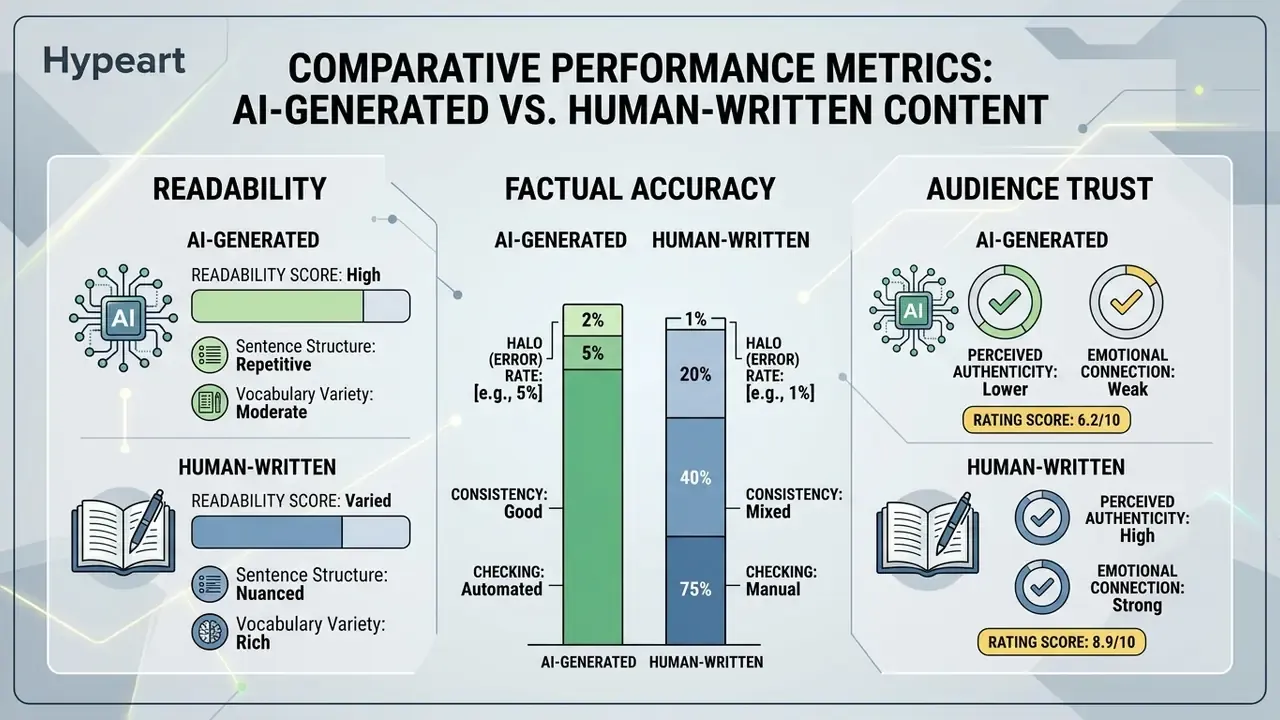
Where AI-generated content is more effective
AI-generated content excels in rapid iteration, initial draft generation, multi-format content scaling, and routine summarization. Automated tools cut the time required to turn raw research into structured initial outlines.
Generative systems outperform manual workflows when processing large volumes of structured information. In systematic review methodologies (2026 data), AI tools achieved 27% to 71% workload reductions during title and abstract screening and data extraction while maintaining sensitivity levels at or above 90%.
«AI tools reduced workload by 27–71% during title and abstract screening while maintaining sensitivity at or above 90%.»
Where human writers should lead
Human writers remain essential for expert-level analytical pieces, original investigative reporting, emotionally resonant storytelling, and genuinely nuanced thought leadership. Automated models struggle to replicate subjective judgment, authentic personal experience, and complex critical thinking.
Controlled writing evaluations mark clear boundaries for generative tools. A 2026 study published in arXiv (2601.18353) reported that expert judges preferred human writing in 82.7% of in-context evaluation cases, citing superior stylistic fidelity and narrative coherence.
«Experts preferred human text in 82.7% of cases under standard prompting; after fine-tuning, preference shifted toward AI in 62% of cases.»
Additionally, longitudinal engagement analyses from the RedNote-Vibe dataset (2025) confirm that pure human posts achieve higher median interaction rates on social platforms than fully AI-generated posts, particularly in emotionally driven domains such as career advice and personal narratives.
«The five-year RedNote-Vibe dataset shows that creators combining human creativity with AI assistance achieve the highest audience engagement.»
Task type also determines where humans should own verification. A 2025 experiment found AI-assisted fact-checking more effective for hard news, while human-assisted fact-checking suited soft news carrying subjective information. A 2026 narrative study similarly reported human-written stories rated more useful, with more subjectivity, temporal grounding, conflict, and emotional nuance than AI-assisted stories.
Audiences are not neutral judges either:
«People show a +13.7 percentage-point bias in favor of content labeled as human-written, even when labels are deliberately swapped.»
“Automation used primarily to manipulate Search ranking violates scaled content abuse policies. Content quality is judged by originality, expertise, and user-centric value regardless of how it is produced.” — Google Search Quality Guidelines.
Google's Search guidance on AI-generated content stresses that content created primarily to manipulate search rankings constitutes scaled content abuse. The March 2024 spam-policy update states that automation, generative AI included, is spam when its primary purpose is manipulating ranking in Search, and 2025 to 2026 guidance reiterates that violating scaled-content-abuse policies can affect Search visibility. Peer-reviewed research across 39 studies (2022 to 2024) links uncritical reliance on generative AI tools with measurable declines in critical thinking performance. Keeping human editorial ownership protects search visibility and guards against quality degradation.
Traditional search versus AI search for finding information
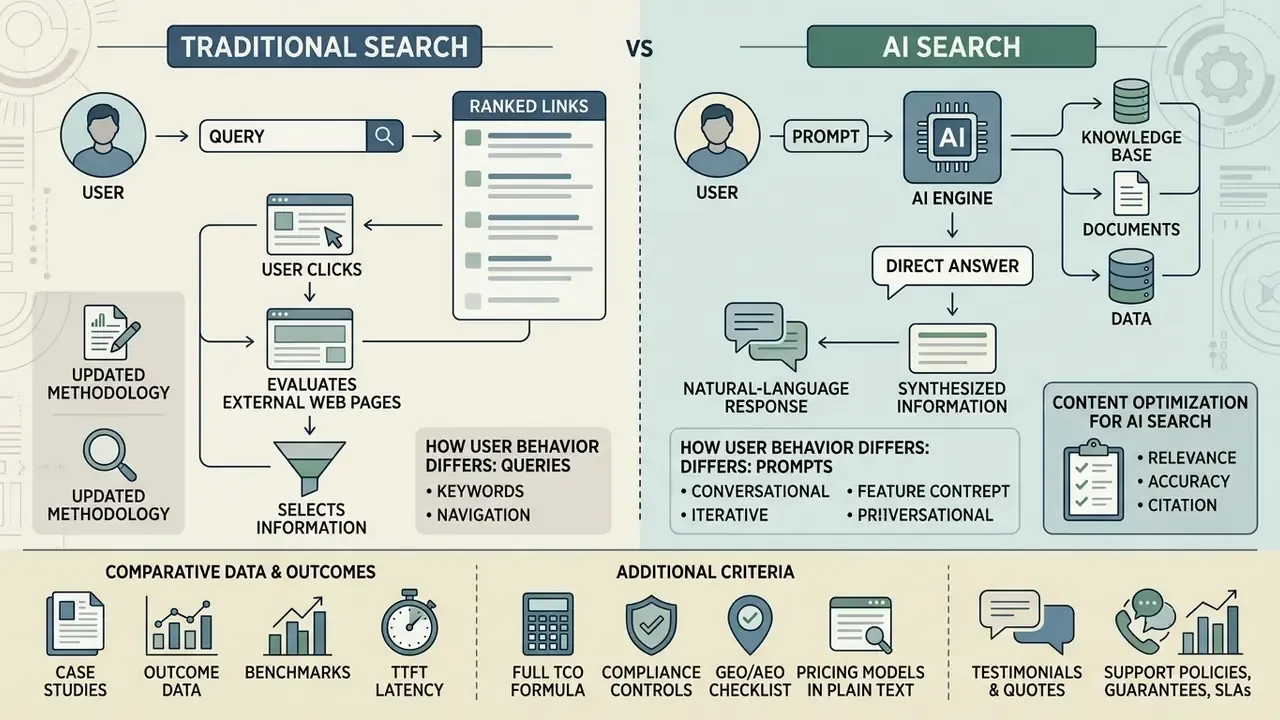
Traditional search engines deliver ranked lists of external web links for user-directed evaluation, whereas AI search engines synthesize direct natural-language answers drawn from retrieved sources. The choice between traditional search and AI search depends on whether speed or deep source verification is the primary objective.
The transition from traditional web indexes to generative search interfaces changes user research behavior and information exposure footprint. Traditional search is deterministic: crawl, index, rank. Generative search is probabilistic, since responses are predictions of the next token conditioned on training data and retrieved context. Studies examining Google AI Overviews and answer engines such as Perplexity show that while AI search accelerates initial answer discovery, direct click-through rates to primary web sources drop significantly.
«AI search surfaces markedly fewer niche sources, lower answer diversity, and more low-credibility sources than traditional search.»
Table 3: Empirical comparison of traditional search versus AI search systems
| Comparison dimension | Traditional search (for example Google SERP) | AI search (for example Perplexity, SearchGPT, Gemini AIO) |
|---|---|---|
| Primary output format | Ranked index of web pages with title snippets and URL links. | Synthesized natural-language narrative answer with inline citations. |
| Underlying mechanism | Deterministic crawl, index, rank pipeline governed by ranking factors. | Probabilistic next-token generation over training data plus live retrieval. |
| Source transparency and visibility | Displays diverse primary, institutional, and long-tail domain links. | Privileges platform-owned or aggregated sources; reduces long-tail visibility; cross-engine source overlap is low (mean Jaccard similarity below 0.2). |
| User query behavior | Average query length 3.4 words; users compare multiple options. | Average prompt length 23 words, often including role and context; users request recommendations, not options. |
| User engagement and click behavior | High click-through rate across multiple external tabs and domains. | Low click-through (around 1% source link click rate in AI Overviews); high zero-click completion. |
| Research speed and user experience | Requires manual navigation, source cross-checking, and reading time. | Delivers rapid direct answers, reducing cognitive research load for simple queries. |
| Hallucination and error profile | Displays source errors as published on external target pages. | May generate unsupported claims or incorrect citations (17%+ hallucination in legal benchmarks). |
| Optimal information use case | Deep research, fact-checking, primary source validation, complex lookup. | High-level summaries, broad conceptual orientation, simple factual lookups. |
Large-scale empirical evaluations (SIGIR 2026) covering 11,500 user queries demonstrate that AI Overviews appear on over 51.5% of search results pages. However, user click-through to cited external links occurs in roughly 1% of visits, while zero-click session completion rises to 26%, compared with 16% on pages without an AI Overview.
«AI Overviews are generated for 51.5% of real user queries, while mean Jaccard similarity between the sources cited by different engines stays below 0.2.»
«An experiment across 12,000 queries in 7 countries showed generative search lowers user trust, while the presence of citations, even inaccurate ones, significantly raises it.»
How user behavior differs: prompts versus queries
Query dynamics differ fundamentally between the two environments. The average traditional search query runs 3.4 words, whereas the average AI search prompt expands to roughly 23 words. That seven-fold increase in length reflects deeper contextual decision-making: prompts commonly embed the user's role, constraints, budget, and evaluation criteria. Consequently, traffic originating from synthesized AI responses frequently shows up to twice the lead conversion rate of broad organic search visitors, because the visitor arrives already informed and pre-qualified. Practically: traditional search gives options; AI search gives recommendations, which moves the point of persuasion earlier, into the training and retrieval corpus rather than the landing page.
How to optimize content for AI search engines (GEO/AEO checklist)
To be recommended by probabilistic answer engines (Perplexity, SearchGPT, Gemini, AI Overviews), publish crawlable trust signals in plain HTML text rather than inside images, PDFs, or JavaScript widgets. Structural SEO best practice, meaning clear H1s, descriptive headings, bullets, and schema markup, remains the baseline. The additions below are what conventional SEO checklists usually omit:
- Case studies with outcome dataspecific to the prospect's industry, including quantified ROI.
- Direct comparisonsbetween your services and named alternatives.
- Pricing models in plain text, including ranges, tiers, and what changes the price.
- Testimonials and quotesattributed to real customers and partners.
- Support policies, guarantees, and service level agreements (SLAs)stated explicitly.
- Detailed product or service specificationswritten in concise, declarative language.
- Step-by-step explanations of your processes, so the model can reproduce your method in an answer.
- Awards, certifications, and memberships as machine-readable text, not logo images.
- The job titles and segments you serve, so role-based prompts match your page.
- Leadership and author bios with explicit credentials, linking expertise to specific content.
Two supporting mechanics matter. First, answer engines retrieve live web results, often through conventional search, so classic SEO stays a prerequisite for AI visibility rather than a competing discipline. Second, visibility is unstable across runs: measurement protocols recommend repeating each prompt at least 7 times for brand-mention tracking and 8 times for source-coverage tracking before concluding that a change moved the needle.
Limitations, open questions and a safe next step
FAQ: licensing, copyright and compliance
Do we own the copyright to AI-generated media?
Ownership depends on the vendor's terms of service, not on the model architecture. Enterprise tiers commonly grant broad commercial usage rights to outputs, while some consumer tiers reserve rights, restrict resale, or require attribution. Verify three clauses in writing: assignment or license of output rights, indemnification for third-party infringement claims, and whether your prompts and outputs may be used for model training.
Can outputs infringe third-party rights even if the terms grant us ownership?
Yes. Ownership of the output is separate from freedom to operate. Style imitation of living artists, recognizable trademarks, celebrity likeness, and voice cloning each carry independent legal exposure. Route likeness and brand-adjacent generations through legal review.
Is AI-assisted content penalized by search engines?
Not per se. Google's position is that automation becomes spam when its primary purpose is manipulating rankings, and that quality is judged on originality, completeness, sourcing, and demonstrated expertise. Scaled, low-value publication is the risk; assisted, reviewed, genuinely useful content is not.
Do we need to disclose AI use?
Disclose when the audience would reasonably want to know how the content was produced, and wherever sector rules require it. Research-sector guidance (European Commission living guidelines) and brand-communication guidance both point toward disclosure plus retained prompt histories and fact-checking records.
What is the minimum viable governance for a small team?
An approved-tool list, a no-confidential-data-in-public-tools rule, a named human reviewer per published artifact, and a retained log of prompts and outputs. That is enough to survive a first audit conversation, though not enough for a critical-tier workflow.
How do we control shadow AI without blocking productivity?
Combine detection (DLP, network monitoring, extension policy) with a sanctioned alternative that is genuinely faster than the unsanctioned tool, plus a registration amnesty. Prohibition without a viable substitute simply moves usage to personal devices, where you have no visibility at all.
Appendix A: version notes and superseded formulations
Retained for traceability and audit review. Where the main text carries an updated formulation, the original wording is preserved below.
Disclaimer: This article is informational and does not constitute legal, financial, compliance, or investment advice. Benchmark figures change with model releases and pricing updates. Verify all pricing, latency, and licensing terms directly with vendors before contracting, and consult qualified legal and risk professionals for decisions in regulated environments.




Social media and marketing content