Author: Marcus Hale, author writing on AI governance, model risk management and vendor due diligence for financial services and regulated enterprises. Last updated: March 2026.
Executive Summary
- Alternatives are architectures, not logos.Before comparing ChatGPT, Claude, Gemini or Perplexity, decide on the deployment tier: public SaaS, enterprise gateway/VPC, or self-hosted. That single choice determines your data boundary, your audit evidence, and whether the tool is eligible for regulated workloads at all.
- One model cannot serve every function.In a field experiment with 750 management consultants, frontier models improved creative ideation by roughly 40% but degraded complex business problem-solving by up to 23% when trusted without domain controls (Dell'Acqua et al., "Navigating the Jagged Technological Frontier," Harvard Business School & BCG, 2023. https://www.hbs.edu/faculty/Pages/item.aspx?num=64700).
- Price the controls, not just the seats.True cost of ownership includes validation, monitoring infrastructure, DLP and residual-risk provisioning. In practice those lines dwarf the $20 to $30 per-seat licence.
- Kill Shadow AI with an equivalent, governed replacement.Blocking public tools without offering a sanctioned gateway pushes usage underground. Migration works only when the enterprise alternative is at least as fast as the tool it replaces.
- Autonomy is granted, never assumed.Agentic AI and Model Context Protocol (MCP) connectors expand model reach into CRMs and databases, so autonomy tiers, human-in-the-loop gates, kill switches and reconstructable logs must exist before deployment. No evidence, no autonomy.
Who this guide is for and what it decides
If you sign, approve or challenge AI purchases inside a US bank or a mature fintech, the question on your desk is rarely "is AI useful?" It is narrower and harder: which alternative can we run in production, with evidence, without breaching our risk appetite?
This guide is written for that decision. It assumes a reader who owns model risk, compliance, security or finance transformation, and who has to answer three questions in sequence: what deployment model are we buying, what does it cost once controls are included, and what proof can we hand an examiner afterwards.
A note on evidence. Statements about audience needs below are hypotheses until confirmed by your own analytics, interviews, CRM data or customer research. Treat them as a starting frame, not as findings.
What counts as a commercial-use AI tool alternative
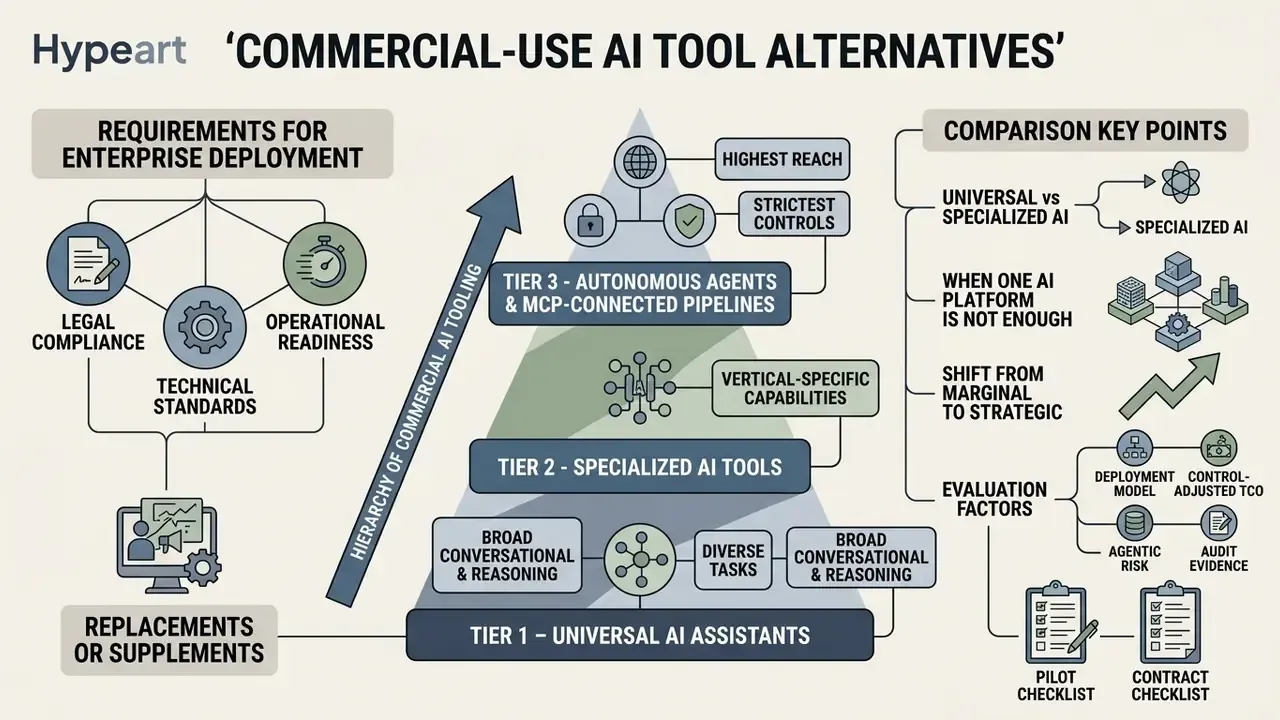
Commercial-use AI tool alternatives are software solutions that meet legal, technical and operational requirements for business deployment, serving as replacements or supplements to mainstream models. They must comply with data privacy standards, provide transparent usage terms, and align with institutional risk management protocols.
The scale of the shift is no longer marginal. Enterprise survey data indicates that "92% of organizations increased generative AI usage over the past 12 months, and nearly a third have already moved it into production" (Enterprise Strategy Group survey, reported by TechTarget, 2024. https://www.techtarget.com/searchenterpriseai/). At that velocity, most institutions are not choosing between "AI" and "no AI". They are choosing between governed and ungoverned commercial deployment.
Evaluating AI platforms for business use means distinguishing general-purpose systems from specialized software built for one workflow. Licensing terms, model training practices, data retention windows and security certifications all get inspected before anything touches enterprise operations. For general-purpose models distributed under free and open-source licences, EU guidance holds that transparency exemptions apply only when the licence genuinely permits access, use, modification and distribution, and when parameters, weights, architecture and usage information are publicly available (European Commission GPAI guidance, 2025. https://digital-strategy.ec.europa.eu/).
Figure 1. Hierarchy of commercial AI tooling: classification of AI platforms by autonomy level and integration depth.
Tier 3 - Autonomous agents & MCP-connected pipelines  -> highest reach, strictest controls
Tier 2 - Specialized domain tools (code, design, SEO, CRM analytics)
Tier 1 - Universal assistants (ChatGPT, Claude, Gemini, Perplexity)
Tier 0 - Multi-model workspace / enterprise gateway (routing, logging, policy)
Read the stack bottom-up. Tier 0 is the control plane through which every higher tier should be accessed.
Universal AI assistants and specialized AI tools
Universal AI assistants provide broad conversational and reasoning capability across diverse tasks. Specialized AI tools deliver workflow-optimized outputs for dedicated domains such as coding, design or compliance monitoring. General-purpose models act as flexible interfaces for text generation, analysis and research; specialized systems embed domain guardrails, templates and integration hooks.
According to NIST AI RMF 1.0 guidelines, general-purpose models operate as use-case agnostic systems, whereas specialized applications require domain-specific risk re-evaluation upon deployment (NIST AI Risk Management Framework 1.0, 2023. https://www.nist.gov/itl/ai-risk-management-framework).
"Generative AI improved creative task quality by roughly 40%, yet reduced performance on complex business analysis by 23%."
A general assistant can summarize financial reports or draft correspondence. A specialized tool, say a dedicated code generator or document analyzer, executes task-specific validation logic instead. Document-centric assistants show the boundary clearly: a PDF-scoped assistant that summarizes, outlines and extracts key points lives inside one workflow, while a general assistant floats across text, analysis, code and research with no workflow guarantees. Organizations end up balancing the versatility of universal assistants against the precision and auditability of task-focused tools. NIST's Generative AI Profile adds a concrete procurement control point: verify that third-party models comply with existing use licences, and align usage with laws covering copyrighted, patented, trademarked or trade-secret material (NIST AI 600-1, 2024. https://airc.nist.gov/).
When one AI platform is not enough
A single AI platform is rarely sufficient for complex enterprise operations, because heterogeneous workflows demand distinct model architectures, context limits and security controls. Real-time code generation, long-document reasoning and cited market research all need purpose-built engines operating inside one unified architecture.
Empirical research shows that using a single model across all business functions reduces output diversity and degrades performance on specialized tasks (n=750 consultants, Harvard Business School & BCG, 2023). In that experiment, frontier LLMs improved creative product ideation by 40% but degraded complex business problem-solving by up to 23% when relied upon without domain controls, and homogenized the range of ideas produced across participants.
"Using a single model across every business function narrows the diversity of generated options and weakens analytical outcomes."
Multi-platform stacks prevent over-reliance on a single failure point and let institutions map each task to the most reliable engine. Visual asset production, for instance, is better routed to specialized image generation tools than forced through a text-first assistant that treats brand-critical creative as an afterthought. Interoperability research frames the same requirement technically: a multi-platform environment needs cross-platform search and discovery plus composition of cross-platform service workflows, which is impossible when heterogeneous services cannot exchange resources without breaking workflow composition.
Here is an illustrative composite case, details removed. During a model risk assessment for a regional fintech, internal audit found that a single general LLM handling both customer communication and loan risk summaries had invented policy terms that did not exist. The team split the architecture: customer inquiries went through a strictly retrieval-augmented workflow, and loan risk synthesis was restricted to a fine-tuned, audit-logged model. Policy hallucinations stopped, and the decision traces regulators asked for became reproducible.
Deployment models: SaaS, enterprise gateway and self-hosted
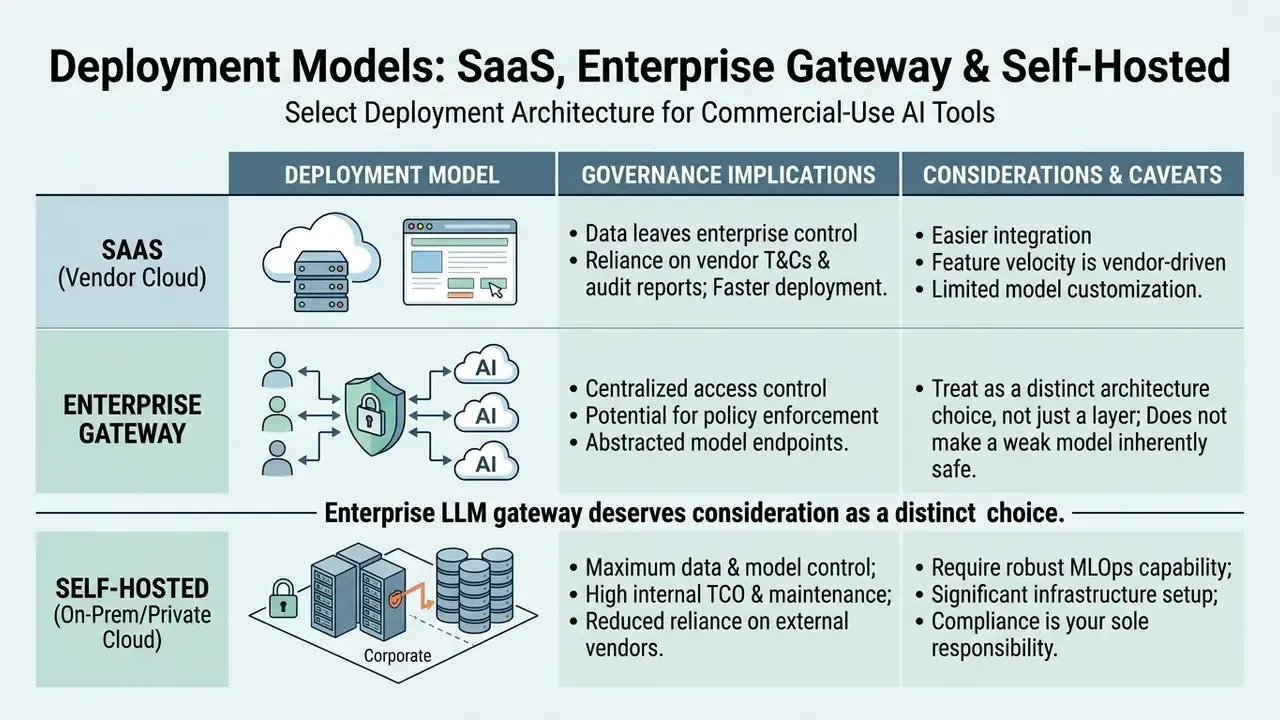
Before comparing feature lists, pick the deployment architecture. It dictates where data physically resides, who can subpoena it, and what audit evidence can be reproduced for examiners. Public-sector procurement guidance from 2025 and 2026 adds concrete selection tests for exactly this layer: explainability, data handling and retention, whether inputs train shared models, deployment model, version control, independent auditability, security certifications, and exit or portability rights.
| Deployment tier | Data boundary | Audit evidence | Typical fit | Principal limitation |
|---|---|---|---|---|
| Public SaaS (consumer tier) | Vendor-controlled; training opt-out varies by plan | Minimal; often no exportable logs | Individual experimentation, public data only | Unsuitable for PII, MNPI or bank-confidential data |
| Business / Team SaaS | Contractual no-training commitment; regional residency options | Admin console logs, SSO/RBAC records | Cross-functional knowledge work | Shared tenancy; limited log retention windows |
| Enterprise gateway / VPC | Single-tenant or private endpoint; customer-managed keys (KMS) | Full prompt/response logging, policy engine, DLP hooks | Regulated workflows, model risk tiering | Engineering effort to build routing and policy layer |
| Self-hosted / on-premises | Fully inside the corporate perimeter | Complete telemetry ownership | Highest-sensitivity data, air-gapped environments | Infrastructure, MLOps and model-refresh burden |
Table 0: Deployment architecture alternatives and their governance implications. Source: compiled from NIST AI RMF 1.0, ISO/IEC 42001:2023 and 2025 to 2026 public-sector AI procurement guidance.
An enterprise LLM gateway deserves consideration as an alternative in its own right. Instead of buying direct access to each vendor for each team, the institution places one policy-enforcing layer between users and models: least-privilege identity, runtime approval gating, reconstructable logs, exportable prompts and evaluation assets. NIST's crosswalk between the AI RMF and ISO/IEC 42001 supports this framing. AI in the enterprise is governed as a management-system control, not as an isolated software purchase (NIST AI RMF crosswalk to ISO/IEC 42001. https://www.nist.gov/itl/ai-risk-management-framework).
One caveat worth stating early: a gateway does not make a weak model safe. It makes model behavior observable, which is a different and smaller claim.
How to compare commercial-use AI tool alternatives
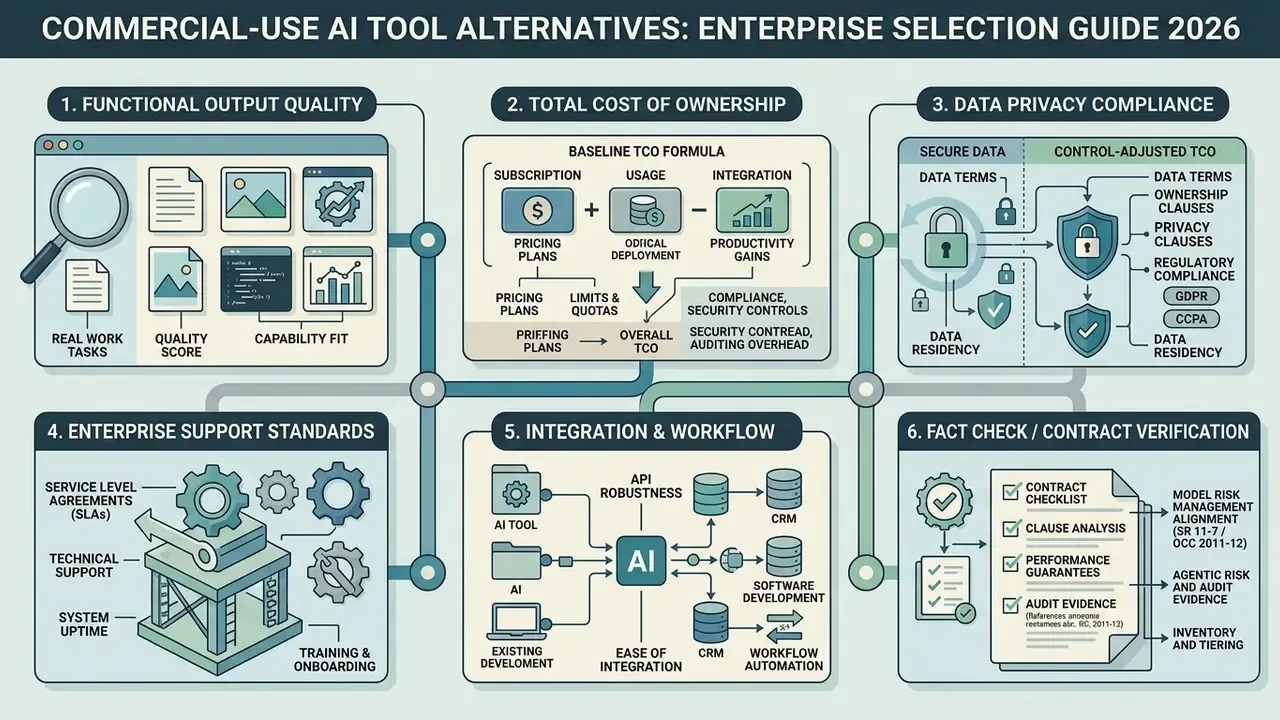
A defensible comparison spans six pillars: functional output quality, total cost of ownership, data privacy compliance, enterprise support standards, usage limits and system interoperability. Weight them against institutional risk appetite, not against feature counts. The World Economic Forum's procurement model groups the same decision into business strategy, commercial strategy, data strategy, ethics and sustainability, and governance, risk and compliance, a useful strategic scaffold that 2025 and 2026 procurement documents then translate into technical and contractual gates.
| Evaluation parameter | Universal AI assistants | Specialized domain tools | Developer & automation tools |
|---|---|---|---|
| Primary tasks | Drafting, summarization, general reasoning, open research | Task-specific content, image generation, SEO, CRM analytics | Code completion, multi-app orchestration, workflow triggers |
| Key AI features | Broad context windows, multimodal prompts, multi-language support | Structured templates, brand voice enforcement, SERP analysis | IDE plugins, custom APIs, automated triggers, JSON output |
| Pricing models | Per-user seat licences ($20 to $30/mo) or metered API rates | Seat licences, credit-based usage tiers, volume bundles | Metered usage per 1M tokens, execution credits, workspace tiers |
| Free plan | Limited message quotas, lighter base models, basic context | Time-bound trials, strict export limits, watermarked outputs | Low rate-limited API credits, sandbox environments |
| Data security | Zero data retention options, enterprise SOC 2, HIPAA addendums | Variable retention; requires verification of training terms | On-premise execution, zero-training commitments, KMS integration |
| Support | Standard ticket support; dedicated TAM for enterprise tiers | Email support, community forums, custom onboarding | SLA guarantees, dedicated technical support, developer docs |
| Integration & teams | Web interfaces, admin consoles, SSO, basic workspace sharing | Native connectors for marketing suites, export integrations | Native REST APIs, webhooks, Model Context Protocol (MCP) support |
Table 1: Comparison matrix of commercial-use AI tool categories. Source: compiled from vendor specifications and NIST AI RMF standards.
Functions and output quality for real work tasks
Functional capability must be tested by execution, on task-specific benchmarks, not accepted from a vendor deck. High-quality output means adherence to domain constraints, factual precision and reproducible reasoning under operational conditions.
For software development, benchmarks such as LiveCodeBench evaluate code execution correctness, self-repair and test-output prediction across contamination-free problem sets (LiveCodeBench, 2024. https://livecodebench.github.io/).
"LiveCodeBench measures execution correctness, self-repair and test-output prediction on contamination-free problem sets."
Single-metric evaluation is not enough. Multidimensional code benchmarks that score readability, maintainability, correctness and efficiency show that pass@1 alone hides non-functional quality defects. In textual research, long-form factuality benchmarks measure precision and supported-claim ratios across extended outputs. Score the tool on the tasks you actually run, and the residual risk becomes visible before procurement, not after.
Pricing, free plans, limits and total cost of ownership
Commercial pricing generally follows seat-based subscription tiers or metered usage based on processed tokens and execution requests. Free plans enforce low usage caps, restricted context windows and fallback to lighter models, which rules them out for production workloads. Free AI tools remain useful for scouting capability; they are not a licensing basis for regulated work.
"Mature generative AI initiatives doubled from 4% to 8% in a single year, reflecting rising production-scale spending."
Enterprise pricing evaluations must account for total cost of ownership: base subscription fees, API overage rates, control infrastructure and administrative overhead. Developer platforms offer metered pricing per million tokens alongside strict usage quotas, while business productivity suites charge fixed per-user monthly rates (Gemini API pricing, Google, 2026. https://ai.google.dev/gemini-api/docs/pricing). Model usage spikes and check billing predictability before scaling across teams.
Baseline TCO formula (commercial deployment):
TCO = (Seats x Base Price) + (API Tokens x Overage Rate) + Security/KMS Overhead
Control-adjusted TCO (regulated deployment):
TCO_control-adjusted =
    Licence/Seats
  + Metered API & overage
  + Validation & independent model review (MRM effort in FTE-hours)
  + Monitoring infrastructure (logging, evaluation harness, drift checks)
  + DLP / CASB / gateway operations
  + Residual risk provision (incident response, insurance, remediation reserve)
In institutional settings the last four lines routinely exceed the licence line. A $20 per-seat subscription that requires quarterly independent validation, prompt-log retention and DLP inspection is not a $20 tool. Procurement decisions that ignore control costs systematically underestimate the cheapest-looking option, which is how a "pilot budget" becomes an unbudgeted programme.
Data, support and integration into existing workflows
Data protection rules require that enterprise inputs and outputs stay out of foundational model training. Operational risk frameworks add end-to-end encryption, strict access controls and detailed audit logging for every interaction. NIST's Generative AI Profile also calls for periodic monitoring of AI-generated content for privacy risks, including possible exposure of PII or sensitive data (NIST AI 600-1, 2024. https://airc.nist.gov/).
For structured evaluations of platform security and architecture, teams can review the Commercial-Use AI Tools Comparison before shortlisting vendors.
Under ISO/IEC 42001 for AI management systems and ISO/IEC 27001 for information security, enterprise adoption hinges on verifiable governance controls (ISO/IEC 42001:2023. https://www.iso.org/standard/81230.html; ISO/IEC 27001:2022. https://www.iso.org/standard/27001). Major platform providers state in their commercial agreements that enterprise customer data remains customer property and is not used for model training by default (OpenAI Enterprise Privacy. https://openai.com/enterprise-privacy/; Anthropic Commercial Terms. https://www.anthropic.com/legal/commercial-terms). In the EU, the European Data Protection Board holds that a model may be treated as anonymous only where the risk of direct and indirect extraction of personal data is insignificant (EDPB Opinion 28/2024. https://www.edpb.europa.eu/). Integration capability should be validated against REST APIs, webhooks and single sign-on (SSO) protocols in your actual stack, not in a sandbox.
Fact Check / Contract verification:
Model risk management alignment (SR 11-7 / OCC 2011-12)
For banks and financial institutions, an AI tool stops being software the moment its output influences a business decision. At that point it belongs in the model inventory. Supervisory guidance on model risk management requires conceptual soundness review, ongoing monitoring and outcomes analysis, together with effective challenge by parties independent of model development (Federal Reserve SR 11-7. https://www.federalreserve.gov/supervisionreg/srletters/sr1107.htm; OCC Bulletin 2011-12. https://www.occ.gov/news-issuances/bulletins/2011/bulletin-2011-12.html).
Practical implications for AI tool selection:
- Inventory and tiering. Every use case gets an owner, a risk tier, a baseline metric, a target and a stop condition. Tooling that cannot expose logs cannot be tiered above the lowest risk band.
- Reproducible evidence. Examiners ask for reconstruction, not narrative. The platform must reproduce which model version, prompt, retrieval context and human approval produced a given output.
- Effective challenge. Independent validation needs access to evaluation datasets and exportable results, which is why "exportable prompts and evaluation assets" belongs in the contract, not in the pilot wish list.
- Change control. Silent model upgrades break validation. Require version pinning, deprecation notice periods and change logs.
- Vendor model documentation. Where the model is third-party, the institution still owns the risk. Documentation gaps must be offset by tighter compensating controls: narrower autonomy, mandatory human approval, smaller blast radius.
- KYC, AML and credit adjacency. If a generative tool drafts alert narratives, summarizes adverse media or pre-populates credit memos, treat it as decision support inside those control chains and validate it accordingly.
Eliminating Shadow AI: a migration path
Shadow AI, meaning employees using personal subscriptions to public assistants for work tasks, is the most common route to data leakage in institutions that adopted AI policy before AI capability. Prohibition alone fails. The productivity gap between the sanctioned and unsanctioned tool is exactly what created the behaviour.
A workable migration sequence:
- Detect.Use CASB/DLP telemetry, egress logs and expense-report analysis to identify which AI domains and endpoints are in active use, by which business units, at what volume.
- Classify.Separate benign public-data usage (drafting a job ad) from prohibited flows (pasting customer records, MNPI, credentials or source code).
- Offer an equivalent replacement.Deploy an enterprise tier or gateway with SSO, no-training terms, and at least the same model quality and latency. If the sanctioned tool is slower or weaker, migration fails. Every time.
- Route, do not block first.Redirect traffic through the gateway so legitimate work continues while logging begins. Hard blocks come after the replacement is live.
- Instrument DLP at the prompt layer.Inspect and mask sensitive fields before egress, and log the masking event as audit evidence.
- Train on boundaries, not on tools.Publish a one-page rule set: what data class may go where, which actions require approval, where to escalate.
- Re-measure.Repeat detection quarterly. Residual unsanctioned volume is the KPI, and sustained non-zero volume usually signals an unmet capability need rather than employee non-compliance.
Best universal AI assistants for business tasks
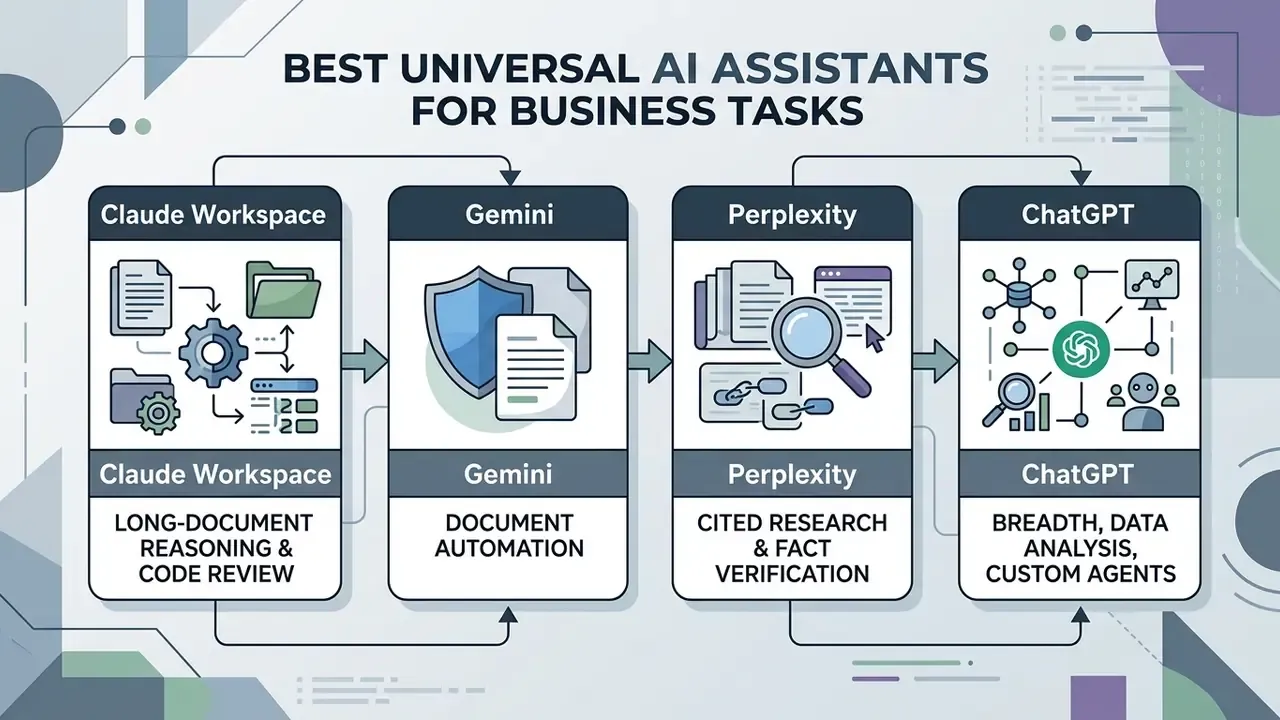
Universal AI assistants serve as the primary interface for knowledge work: multimodal comprehension, extended context windows, custom workflow adapters. Comparing ChatGPT, Claude, Gemini and Perplexity means matching model characteristics to your infrastructure and task mix, not ranking them in the abstract.
Figure 2. Positioning of universal assistants across core business scenarios.
The context-loss problem: architecture of a multi-model workspace
Running several isolated AI subscriptions imposes a switching tax. Draft in one model, fact-check in a second, ask a third for a second opinion, and you re-upload files, re-explain briefs and lose half the context on the way. Administrative motion that feels like work while producing nothing. Practitioner reviews of daily AI usage describe the same failure mode: twelve browser tabs, three subscriptions, and a copy-paste workflow that burns tokens without shipping output.
The enterprise answer is an orchestration layer, a multi-model workspace (commercial products such as HaloMate, or an internally built API hub or LLM gateway). Its defining properties:
- Mid-conversation model switching without resetting the thread, so a draft started on one model can be stress-tested by another in place.
- Persistent project context. Files, notes and prior sessions accumulate inside a project workspace, so each new conversation starts sharper than the last instead of from zero.
- One log, one policy. Because all traffic passes through a single layer, prompt logging, DLP inspection and RBAC are implemented once rather than per vendor.
- Vendor substitutability. When a provider changes pricing, limits or terms, routing changes instead of workflows.
Tier 0 does not compete with the tools below it. It makes them usable together. Skip it only if your organisation genuinely runs a single model for a single use case, a condition that rarely survives the first quarter of adoption.
ChatGPT and Claude for writing, analysis and complex tasks
ChatGPT and Claude are the leading general-purpose platforms for writing, complex reasoning and structured data analysis. ChatGPT offers feature breadth, data analysis modules and custom assistant configuration. Claude is stronger on long-document reasoning, technical writing and system prompt adherence.
"Access to a general-purpose assistant reduced professional task completion time by 37% and raised graded output quality by 0.4 standard deviations."
Anthropic's Claude supports extended context processing up to 200,000 tokens, which allows analysis of large policy documents, complex codebases and legal filings without context fragmentation (Anthropic documentation. https://docs.anthropic.com/). Claude's platform documentation also supports custom subagents with their own context window, system prompt, tool access and permissions, a direct route to bounded, auditable internal assistants. Claude's architecture emphasises safety and structured reasoning, useful for technical review; ChatGPT is the more versatile platform for multimodal ideation and custom workflow development.
"On the LongFact benchmark, Gemini-Ultra reaches 86.2% precision with F1@64 of 91.7 on long-form factual generation."
Keep that figure in mind as the practical ceiling for analytical work. Even the strongest long-form factuality scores leave a residual error band, and that band is precisely what human verification exists to catch before an output enters a decision record.
Gemini for teams in Google Workspace
Google Gemini integrates deeply with Google Workspace, embedding AI capability into Docs, Sheets, Gmail and Drive side panels. That native architecture lets teams query internal workspace files, automate document creation and synthesize cross-application data without manual context pasting.
Inside Google Sheets, Gemini helps generate complex formulas, build data summaries, charts and insights using multiple tabs as sources, and export analysis directly to Google Docs (Google Workspace updates. https://workspaceupdates.googleblog.com/). Workspace Studio lets non-technical business users build automated cross-app workflows from plain language instructions. Teams that extend those workflows into media production normally pair them with dedicated AI video generation tools rather than asking a document assistant to render footage. For organizations already standardized on Google Workspace, Gemini offers a compliant, integrated path through routine administrative and document work.
Perplexity for research with verifiable sources
Perplexity works as a real-time answer engine built for cited research, competitor analysis and evidence-based discovery. Unlike static conversational models, it combines search indexing with generative summarization and returns explicit clickable citations for verification.
In enterprise research settings, Perplexity lets teams search public web indices alongside internal knowledge repositories at the same time (Perplexity Enterprise. https://www.perplexity.ai/enterprise). Its architecture includes dedicated fact-checking tooling, including a documented Fact Checker CLI built on the Sonar API, designed to evaluate claims against current web sources. That reduces, but does not eliminate, hallucination risk in market intelligence and regulatory tracking.
"Leading long-form factuality benchmarks place top models at 86.2% precision, the reference point against which any research tool should be judged."
Obligatory caveat: citation presence is not citation correctness. Sample outputs and confirm that each cited source actually supports the claim. A linked answer carrying an unsupported inference is far harder to spot than an obvious fabrication.
| Business task | Recommended assistant | Pros | Cons / limitations | Pricing tier |
|---|---|---|---|---|
| Complex writing & code review | Claude (Sonnet / Opus class) | 200k-token context, strong prompt adherence, subagents with scoped permissions | Message throttling on top models at peak load; fewer native office integrations | Claude Pro about $20/user/mo; Team/Enterprise on custom billing; API metered per 1M tokens |
| Workspace document automation | Gemini in Google Workspace | Native Docs/Sheets/Gmail/Drive access; no-code Workspace Studio flows | Requires committing to the Google Workspace stack; value drops outside it | Bundled into Workspace business tiers; Gemini API has a free tier plus metered paid usage |
| Verifiable web & market research | Perplexity Enterprise | Real-time citations, internal plus public index search, fact-checking tooling | Synthesis depth varies on niche technical topics; citation quality needs sampling | Pro about $20/user/mo; Enterprise seat-based with admin controls |
| Data analysis & custom assistants | ChatGPT Enterprise | Broadest feature set, advanced data analysis, custom GPT/agent builder | Requires central governance to prevent Shadow AI; feature sprawl needs policy | Plus about $20/user/mo; Enterprise custom billing, typically volume-based seat minimums |
Table 2: Task-to-assistant matrix with pros, cons and billing models. Source: vendor documentation and functional capability assessment. Verify current pricing on vendor pages before purchase.
AI tools for marketing, content creation and SEO content
Specialized AI marketing tools streamline campaign execution, structured copy generation and search visibility work. They ship brand voice templates, SERP data integration and multi-channel distribution workflows. In regulated institutions the same tool classes usually get deployed one step to the left of marketing: drafting disclosures, summarizing financial documentation, assembling compliance reporting packs. The control questions do not change. Who owns the output, where does the data go, who approves publication?
Figure 3. AI content pipeline architecture: generation, optimization and distribution flow.
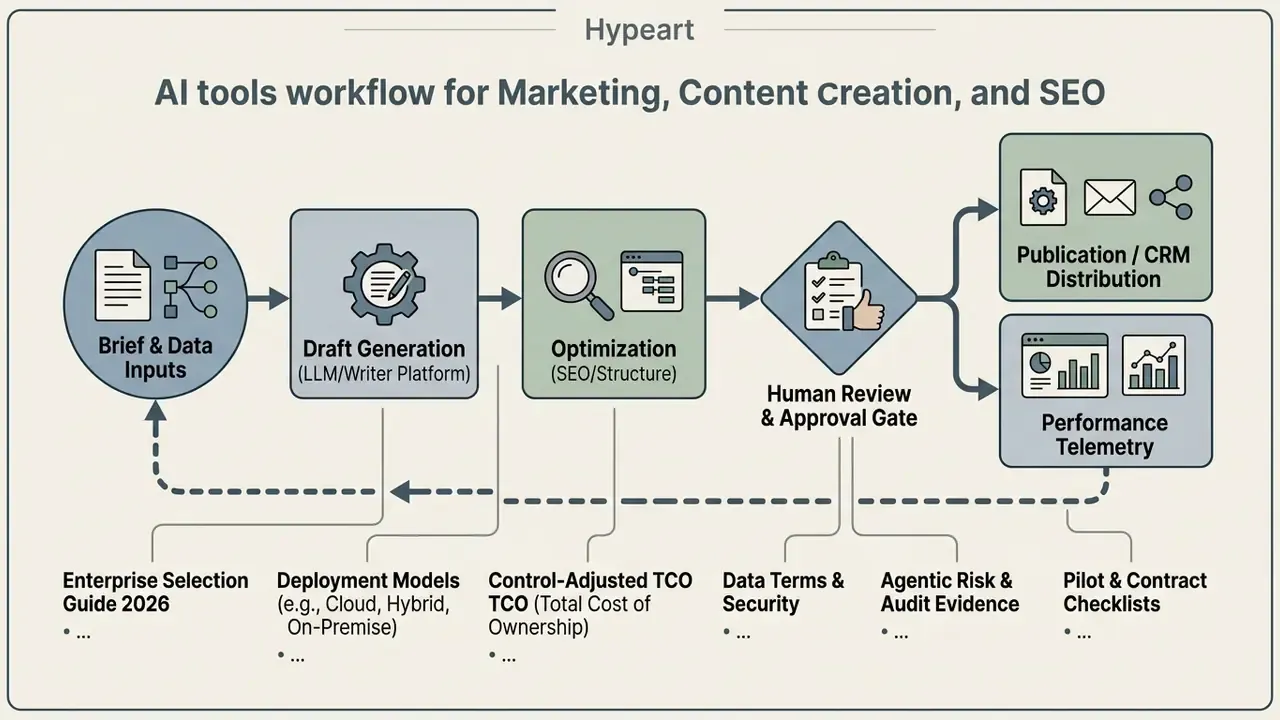
AI writing tools for blog, copy and email
Dedicated AI writing platforms such as Jasper, Copy.ai and Writesonic provide structured templates and collaborative workspaces built for marketing teams. What separates them from general assistants is workflow: status tracking, brand voice enforcement, bulk asset generation.
Positioning per vendor documentation: Jasper's official materials describe collaborative document workflows, that is write, edit, format, share and apply review status labels, across articles, emails, ads and social posts (Jasper. https://www.jasper.ai/). Copy.ai's paid plans document Brand Voice, an AI article writer, API access and bulk processing, which supports repeatable go-to-market and outreach output (Copy.ai. https://www.copy.ai/). Writesonic positions itself for article and ad generation with team and enterprise plans (Writesonic. https://writesonic.com/). Note the structural caveat: many "AI writers" are interface layers over the same foundation models, so buy on workflow value (review states, brand governance, bulk operations) rather than on claimed model superiority.
"Access to a general-purpose assistant cut professional writing time by 37% and improved graded quality by 0.4 SD across 444 professionals."
Used well, these platforms let marketing teams produce recurring email sequences, social media posts and ad variations while holding brand messaging parameters steady across campaigns.
Content optimization and SEO tools
Specialized SEO platforms such as Surfer SEO, Frase and MarketMuse use natural language processing to analyze top-ranking search results and optimize content structure. They return real-time recommendations on keyword coverage, heading architecture and semantic depth.
Google's official guidance stresses that commercial content must lead with unique expertise, sound technical structure and user-centric value, and warns against low-quality, fully automated content scaling (Google Search Central, "Optimizing your website for generative AI features on Google Search." https://developers.google.com/search/docs/appearance/ai-features). MarketMuse performs SERP gap analyses, including comparison against the top 20 search results and page-level topical gaps, to surface missing topical entities (MarketMuse documentation. https://help.marketmuse.com/). Surfer SEO groups keywords into intent-based clusters from live search data and compares ranking pages by keyword, location and device type (Surfer SEO knowledge base. https://surferseo.com/).
"AI-generated advertising copy showed no statistically significant effect on sales in the tested marketing scenarios."
Content optimization tooling helps AI-assisted material satisfy search intent while staying inside search engine quality standards. The evidence base, though, argues for AI as a structuring and research aid rather than a volume engine. Volume without expertise is the fastest way to devalue a domain.
AI tools for image, video, voice and design
Multimodal AI tools accelerate visual, audio and video content generation across marketing, corporate training and digital media. Deploying synthetic media means evaluating output resolution, brand control capability and commercial licensing rights, in that order.
Figure 4. Comparison logic for visual content generators: quality, speed and commercial risk.
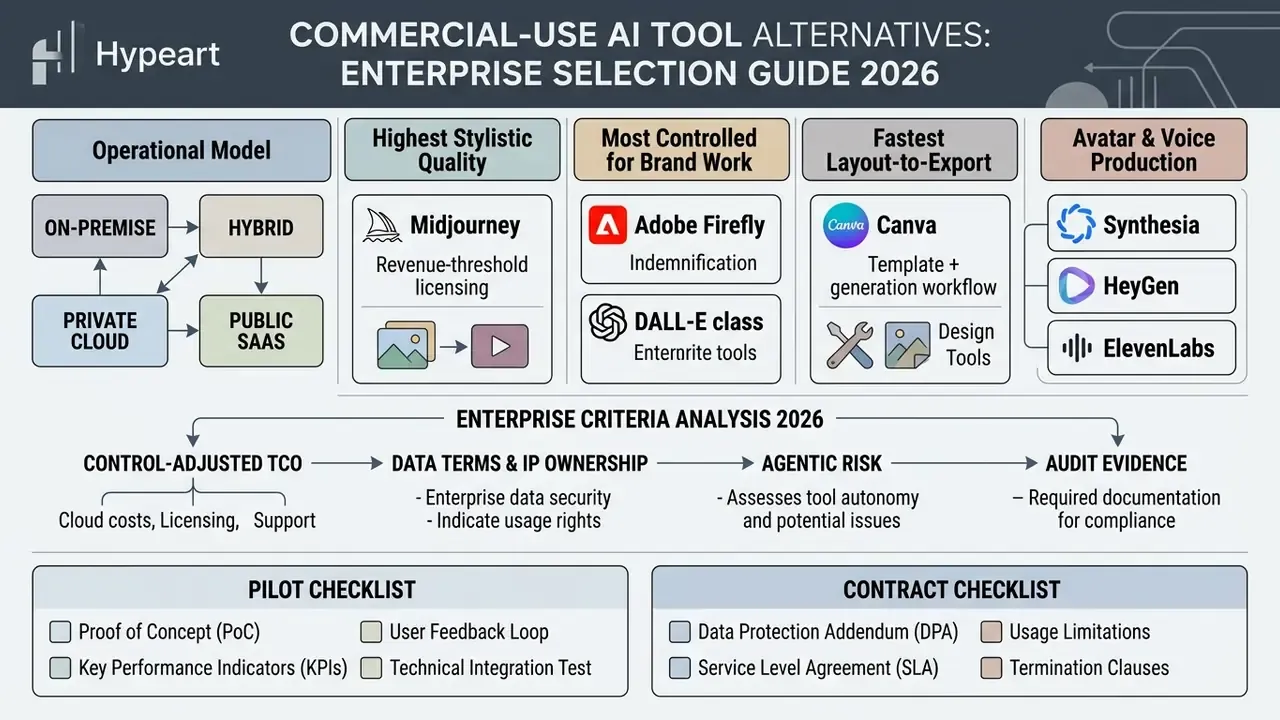
Image generation and AI design for marketing content
Enterprise visual content creation leans on advanced image generators such as Adobe Firefly, DALL-E and Midjourney, plus integrated platforms like Canva. These tools build marketing banners, product concepts and digital graphics from text prompts and baseline assets.
| Use case | Tool category | Example tool | Pros | Cons / limits | Pricing tier |
|---|---|---|---|---|---|
| Marketing banners & graphics | Commercially safe image generator | Adobe Firefly / DALL-E class | Licensed training data; enterprise indemnification (Firefly); broad stated commercial rights (DALL-E) | Strict prompt filters; API output-rate ceilings (roughly 500 to 10,000 img/min by tier for DALL-E 3; far lower on newer image models) | Bundled into Creative Cloud plans (from about $19.99/mo photography plan with generative credits); DALL-E via ChatGPT Plus about $20/mo or metered API |
| Stylized illustration | Advanced visual generator | Midjourney | Strongest stylistic fidelity | Company use requires Pro/Mega above $1M annual gross revenue; limited API integration | Paid tiers required for commercial use; Pro/Mega for higher-revenue firms |
| Corporate video & presentations | AI avatar & video studio | HeyGen / Synthesia | No studio needed; multilingual avatar delivery | Scene-length caps; credit burn per rendered minute; consent controls mandatory | Seat plus credit bundles; enterprise plans on custom billing |
| Voiceover / narration | Neural voice synthesizer | ElevenLabs / OpenAI TTS | Large voice libraries; voice design from text prompts | Character caps per request (for example 5,000 bytes on some TTS APIs); RPM limits by tier (TTS-1 roughly 3 to 10,000 RPM) | Free tier with limits; paid plans from low double digits per month; avatars gated to paid plans |
| Generative video footage | Text/image-to-video model | Runway / Kling AI / Veo class | Fast concept-to-footage iteration | Short clip lengths (for example 4, 6 or 8-second outputs, limited outputs per prompt); credit-based throughput | Free credit allotment; paid tiers from about $12/mo annually, scaling with credits |
Table 3: Visual and audio content scenarios with pros, cons and billing models. Source: compiled from vendor technical documentation; verify quotas and pricing at purchase time.
Commercial licensing policy varies sharply across image generation platforms. Adobe Firefly is trained on licensed Adobe Stock and public domain assets and offers commercial indemnification for enterprise subscribers (Adobe generative AI user guidelines. https://www.adobe.com/legal/licenses-terms/adobe-gen-ai-user-guidelines.html).
"NIST classifies generated images, video and audio as synthetic content and stresses watermarking, provenance tracking and metadata standards."
OpenAI grants full commercial usage and ownership rights for DALL-E outputs and states it will not claim copyright over API-generated content (OpenAI Help Center. https://help.openai.com/). Midjourney permits commercial use on paid tiers but mandates Pro or Mega plans for company use by organizations above $1,000,000 in annual gross revenue (Midjourney terms. https://docs.midjourney.com/). Canva combines generative models with layout tools, a controlled environment for fast ad production. For a side-by-side view of output quality and licensing terms, see the comparison of leading image generators and the free-tier alternatives review.
End-to-end pipeline for AI video content
Isolated tools produce demos. Connected pipelines produce deliverables. The stack that performance teams actually run for AI video advertising and internal training content is sequential, with a human approval gate before publication:
- Script and storyboard.Claude, or an equivalent long-context assistant, structures the narrative and converts it into per-scene prompts with consistent character, lighting and camera descriptions.
- Footage generation.Kling AI or Runway Gen-3 renders individual clips from those prompts. Because clip length is capped, commonly 4 to 8 seconds per output, the storyboard has to be written in short beats.
- Voice.ElevenLabs generates multilingual narration or dubbing, including voice cloning where documented consent exists.
- Upscaling and finishing.Topaz Video AI raises resolution and frame rate; final assembly, captions and brand overlays happen in the editor.
- Governance gate.Provenance metadata and watermarking are applied, the asset is logged with its prompt lineage, and a named human owner approves release.
Two adjacent pipelines are worth noting. For static ad production, the sequence runs brand-asset ingest, on-brand image generation, layout in a design tool, licensing check, publication. For repurposing, it runs long-form recording, transcript-based editing, clip generation, localized voice tracks. Teams working that way usually standardize on video editing workflows that keep the transcript as the source of truth.
AI video, avatars and voice for presentations and campaigns
AI video and voice platforms scale corporate communication, training content and localized advertising. Runway, HeyGen, ElevenLabs and Synthesia produce lifelike avatars, synthetic voiceovers and dynamic video edits from text scripts. Runway's pricing follows a credit model with a free allotment and paid tiers that scale credits and team features (Runway pricing. https://runwayml.com/pricing); ElevenLabs documents avatars as available on all paid plans under its image and video pricing structure (ElevenLabs documentation. https://elevenlabs.io/docs). For a broader inventory of these platforms with quotas and licensing notes, see the guides to AI video generators for business and AI voice generators.
NIST guidelines classify generated images, video and audio as synthetic content and emphasise digital watermarking, provenance tracking and metadata standards (NIST AI 100-4. https://airc.nist.gov/). Standardization work on portable avatar representation formats is also under development at ISO, which will affect asset portability between vendors (ISO/IEC standards catalogue. https://www.iso.org/).
"Watermarking, provenance tracking and metadata standards are necessary across all synthetic media."
Alternatives for code, automation and AI-powered workflows
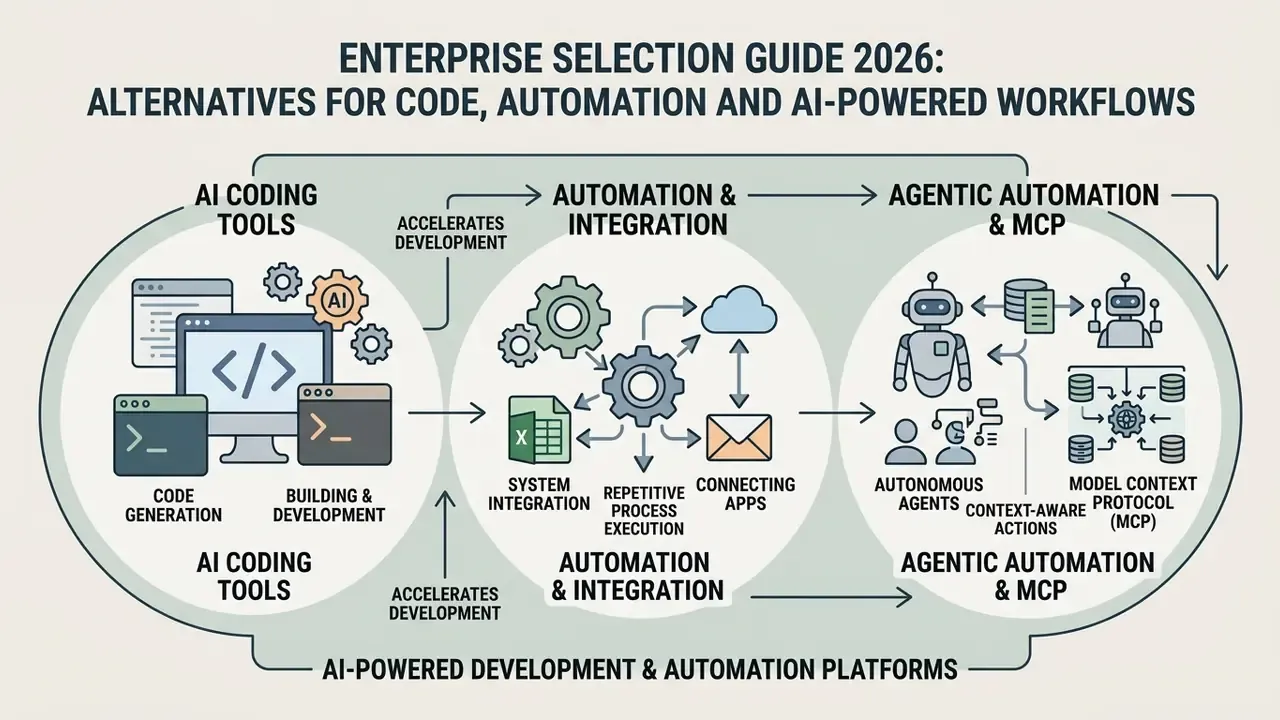
AI-powered development and automation platforms accelerate software creation, system integration and repetitive process execution. Evaluating coding assistants and automation orchestration engines means reviewing security models, API quotas and error-handling mechanisms. NIST frames the same thing procedurally: AI should enter a business process as a bounded step with explicit input and output boundaries, test-and-evaluate gates, and monitoring in operation.
Figure 5. AI workflow automation architecture: integrating LLMs into the corporate event bus.
Internal systems (CRM, ticketing, data warehouse)
        | event trigger
Automation layer (Zapier / n8n / agent runtime)
        | policy + DLP + identity (least privilege)
Model layer (LLM via gateway, MCP connectors)
        | structured output
Approval gate (HITL for critical actions) -> write-back + immutable log
AI coding tools for building and development
AI coding assistants such as GitHub Copilot, Cursor and Amazon Q Developer sit inside integrated development environments (IDEs) and deliver real-time code completion, unit test generation and automated refactoring.
Empirical studies show developers using AI coding assistants completing programming tasks up to 55.8% faster than unassisted peers (Peng et al., 2023. https://arxiv.org/abs/2302.06590).
"Across three enterprise experiments at Microsoft, Accenture and a Fortune 100 firm, completed tasks rose by an average of 26.08% among 4,867 developers."
"In a field experiment at Ant Group, CodeFuse increased code output by 55%, with statistically significant effects concentrated among junior developers." Source: BIS Working Papers (2024). https://www.bis.org/publ/work.htm
That distribution matters for procurement. If the measurable gain concentrates among junior staff, the business case is partly a training and onboarding case, and the review burden shifts to senior engineers. A control cost, and it belongs in the TCO model rather than in a footnote.
GitHub Copilot and Amazon Q include automated vulnerability scanners that block hardcoded credentials, SQL injection and path-injection patterns before code insertion (GitHub Copilot documentation. https://docs.github.com/copilot; Amazon Q Developer documentation. https://docs.aws.amazon.com/amazonq/). Cursor provides context-aware codebase indexing for multi-file edits and automated bug remediation, and publishes a security page with a vulnerability-reporting channel (https://cursor.com/security). Code-quality evaluation should not stop at pass rates: multidimensional benchmarks scoring readability, maintainability, correctness and efficiency expose defects that unit tests miss entirely.
Automation and integration between apps
Workflow automation platforms such as Zapier and n8n chain applications together and insert AI models into multi-step operational processes. These systems fire automated actions on real-time event triggers across the corporate software stack.
Zapier supports workflow connections across more than 7,000 applications and exposes a Workflow API for native-feeling integrations, so non-technical teams can build AI-driven document routers, lead triage chains and notification bots (Zapier documentation. https://docs.zapier.com/). n8n offers a node-based, self-hosted automation platform with granular control over data flow, custom model API connections and execution logging, plus AI workflows that combine LLM providers, tools and memory (n8n documentation. https://docs.n8n.io/integrations). Automation chains often terminate in generated media, which is where AI voice generators for automated narration enter the pipeline. Automated AI workflows need strict input boundaries, error-handling routes and manual approval gates on critical actions, otherwise a misfire becomes a runaway process before anyone notices.
Agentic automation and the Model Context Protocol (MCP)
https://modelcontextprotocol.io/
| Agentic risk | What it looks like in production | Required control |
|---|---|---|
| Tool execution risk | Agent calls a write endpoint (refund, email send, record update) on a misread instruction | Allow-list of tools per agent; write actions gated behind explicit approval |
| Unintended action chaining | One faulty inference triggers a cascade of downstream automations | Depth limits, per-run action budgets, circuit breakers |
| Privilege creep via MCP connectors | Connector inherits broad service-account rights across systems | Least-privilege service identities; scoped, time-boxed credentials |
| Prompt injection through ingested data | Malicious content in a scraped page or inbound email redirects the agent | Content sanitization, untrusted-input isolation, output validation |
| Loss of audit reconstruction | No record of which model version, context or tool produced an action | Immutable logs of prompt, context, tool call and approver |
| Runaway cost | Continuous agents loop on token-expensive tasks | Hard token and credit ceilings per agent and per run |
| Unclear ownership | No named human accountable for agent decisions | Registered decision owner per agent, with stop condition |
Table 4: Agentic AI risk matrix and minimum controls. Source: compiled from NIST AI RMF 1.0 governance functions and 2026 enterprise AI procurement practice.
Every agent should ship with a documented autonomy tier (suggest-only, then act-with-approval, then act-and-report), a kill switch that halts execution and revokes credentials inside a defined time window, and a replay capability so any action can be reconstructed from logs for internal audit or supervisory review. Treat the agent as a digital worker: defined owner, approved role, access limits, escalation path, audit trail, shutdown mechanism.
How to choose and pilot an AI tool before commercial use
Selecting enterprise AI tools calls for a structured evaluation method that balances operational gains against safety, compliance and budget. Run controlled pilots before committing to commercial contracts, and design the pilot so it can fail visibly.
Figure 6. Stages of AI platform piloting: from task audit to contract signature.
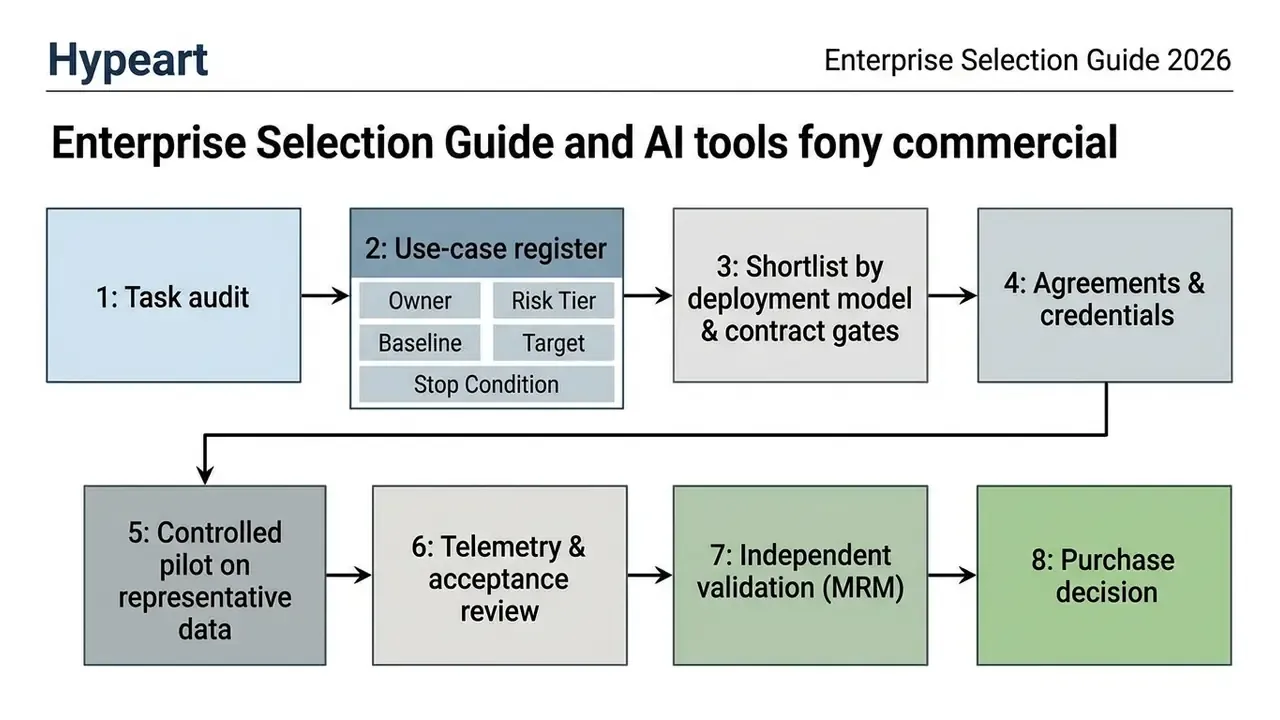
Build a list of tasks and use cases for the team
Selection starts with a task audit across business units to find high-value deployment targets. Catalogue use cases by functional role, data sensitivity level and expected operational outcome.
Method: formal use-case mapping begins by defining the system boundary, identifying primary actors and their goals by department, interviewing each role, converting goals into preliminary use cases, then deduplicating, grouping and validating against real business processes and exception paths. Structure this as an evaluation artifact rather than a wish list, following the documented pilot sequence NIST uses for AI evaluation: define scope, register the system, submit a system description, record acceptance criteria before testing begins (NIST ARIA Pilot Evaluation Plan. https://ai-challenges.nist.gov/aria). Each entry needs one owner, one baseline metric, one target, one stop condition.
"Randomized experiments show the largest AI gains on routine work: drafting text, generating code and handling customer inquiries."
Prioritizing high-volume routine tasks, such as draft generation, basic code completion or ticket classification, delivers quick payback with limited exposure. Complex, unconstrained tasks get flagged for strict human-in-the-loop oversight during initial deployment.
Test quality, pricing and limits on a pilot workflow
Before procurement, candidate AI platforms should undergo structured pilot testing on representative enterprise datasets. Pilot workflows measure output accuracy, system latency, security posture and billing transparency under realistic operational stress.
"Microsoft ran Copilot pilots across 66 large companies: randomized access cut email time by 12%, about 1.4 hours per week."
That is the realistic order of magnitude for a first-generation deployment. Meaningful, measurable, and far below marketing claims. Design the pilot to detect that scale of effect, not to confirm a narrative you already wrote.
NIST's evaluation framework specifies a testing sequence: establish test scope, execute participation agreements, supply scenario credentials, perform controlled evaluations, review logged telemetry before purchase authorization (NIST ARIA Pilot Evaluation Plan. https://ai-challenges.nist.gov/aria). Define objective acceptance criteria before launch and log confidence scores and usage metrics throughout. Regulated-sector test catalogues additionally require documentation of transparency, traceability, consistency and a final evaluation report. Verification teams should re-confirm per-seat costs, API overage charges, rate limits and data training opt-outs directly against vendor contract documentation, then re-check pricing pages immediately before signature, because tiers change without notice.
Pre-purchase verification checklist:
Limitations and open questions
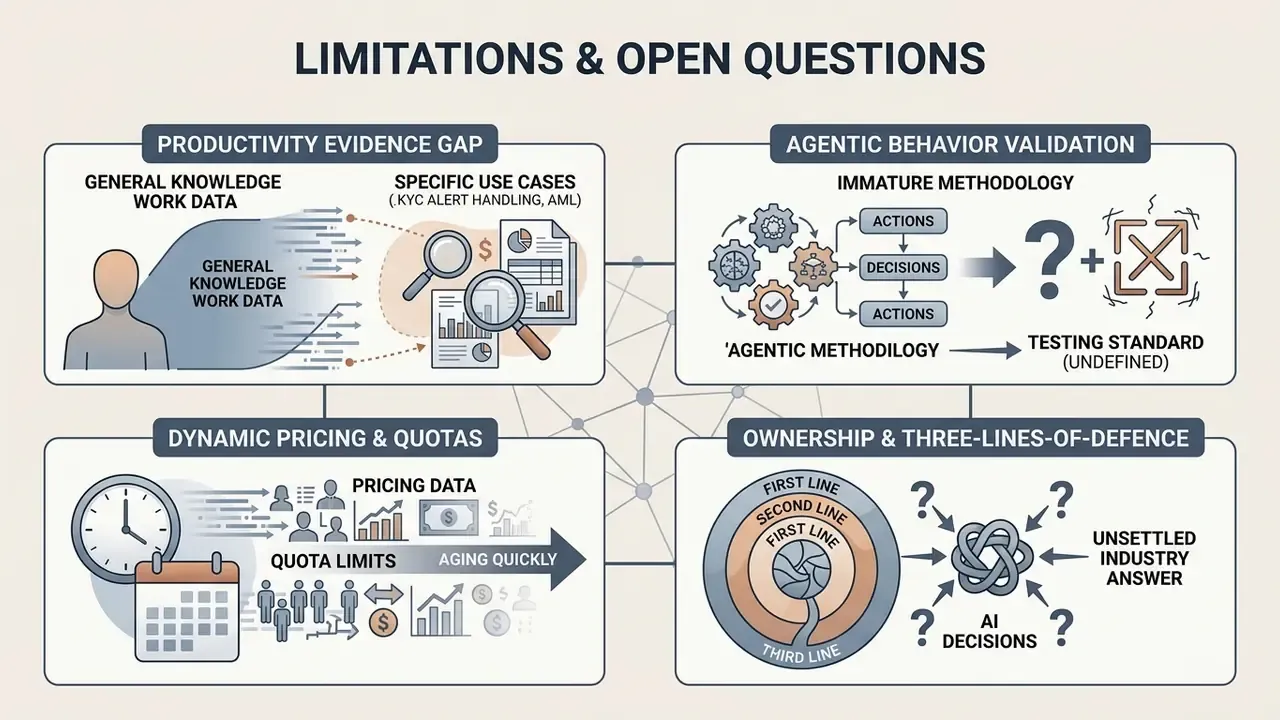
Honesty about the gaps is part of the control environment, so here is what this analysis cannot settle.
First, the productivity evidence is mostly from general knowledge work, not from KYC alert handling, AML narrative drafting or credit memo preparation. Transfer of effect sizes into those chains is an assumption, not a finding.
Second, validation methodology for agentic behavior is immature. Traditional model validation tests a mapping from inputs to outputs; an agent chooses actions over time, which existing test catalogues cover only partially.
Third, pricing and quota data ages quickly. Every number in the tables above should be re-verified at purchase.
Fourth, we still lack a settled industry answer to ownership of AI decisions inside three-lines-of-defence models. Who effectively challenges an agent? In most institutions that question is answered by whoever happens to be in the room.
FAQ: commercial-use AI tool alternatives
Can free AI tools legally be used for commercial purposes?
Some free tiers permit commercial use, but they impose hard limits on features, request volume and security. The principal risk is the absence of confidentiality guarantees: inputs may be used to train foundation models. For commercial work, use business or enterprise tiers, or API access with training explicitly disabled, and confirm output ownership in writing.
What is the difference between human-in-the-loop and human-on-the-loop?
Human-in-the-loop means a person reviews and approves every AI action before execution, for example before an email reaches a client or code merges to main. Human-on-the-loop means the AI executes automatically within defined limits while a person monitors and can intervene through a kill switch. Risk tiering decides which applies: irreversible or customer-facing actions belong in-the-loop; high-volume reversible actions can run on-the-loop with sampling.
Which deployment model should a regulated institution start with?
Start with a business or enterprise SaaS tier behind SSO for low-risk internal knowledge work, and build an enterprise gateway before extending to workflows touching customer data. Self-hosting is justified when data classification prohibits egress, or when full telemetry ownership is a supervisory expectation.
How do we prove an AI-assisted decision to an examiner?
By reconstruction, not description. Retain the prompt, retrieved context, model and version identifiers, output, and the identity and timestamp of the human approver. If the platform cannot export those artifacts, it cannot support decision-influencing use cases.
Is MCP a security risk or a security improvement?
Both, depending on implementation. It reduces bespoke connector sprawl and centralizes integration logic, and it also grants models broader reach into internal systems. Treat every MCP connector as a privileged integration: scoped service identity, least privilege, logging, periodic access review.
How should we budget for AI when the licence price looks trivial?
Model control-adjusted TCO. Licence plus metered usage is only the visible layer; validation, monitoring, DLP and residual-risk provisioning frequently dominate. A tool that cannot produce logs is not cheaper. It simply moves the cost into manual compensating controls.
Do we need a separate tool for research, writing and code?
Usually yes at the model level, and preferably no at the interface level. Route tasks to the strongest engine per task, but access them through one workspace or gateway so context, logging and policy stay unified. Conclusions and next steps Choosing commercial-use AI tool alternatives means moving away from abstract quality assessment toward explicit metrics of controllability, security and payback. No universal assistant covers every enterprise task with uniformly high reliability. The workable strategy is a hybrid ecosystem: universal language models, specialized domain tools, video editing and media production tools and automated workflows under strict model risk control, all accessed through a single governed layer rather than a dozen separate subscriptions. To move from pilots to controlled production, business unit leaders can follow this sequence:
- Audit current processes. Record every point where employees already use AI, which is how you eliminate Shadow AI, and build a register of official use cases with owners, risk tiers, baselines, targets and stop conditions.
- Define security requirements. Prohibit corporate data in model training, and mandate encryption, identity, logging and key-management standards, plus data-residency and exit rights.
- Run pilot testing. Test two or three alternative platforms on a bounded workflow, measuring time, quality and cost against pre-agreed acceptance criteria. Expect effects in the range documented by enterprise field experiments rather than vendor decks.
- Approve a control regime. Assign decision owners, configure interaction auditing, set autonomy tiers with kill switches for any agentic component, and require human verification before outputs enter business records.
- Institutionalize review. Re-validate on model version changes, re-measure residual Shadow AI quarterly, and re-price control-adjusted TCO at each renewal. A safe next step, if you are early: pick one low-risk, high-volume workflow, register it properly, and run a four-week pilot with logging on. That is enough to learn whether your control environment is ready, without betting a regulated process on it. For additional guidance on vetted commercial AI solutions, open the hub for the meta-catalog of platforms and model governance protocols.
Appendix A: superseded attributions and revised formulations
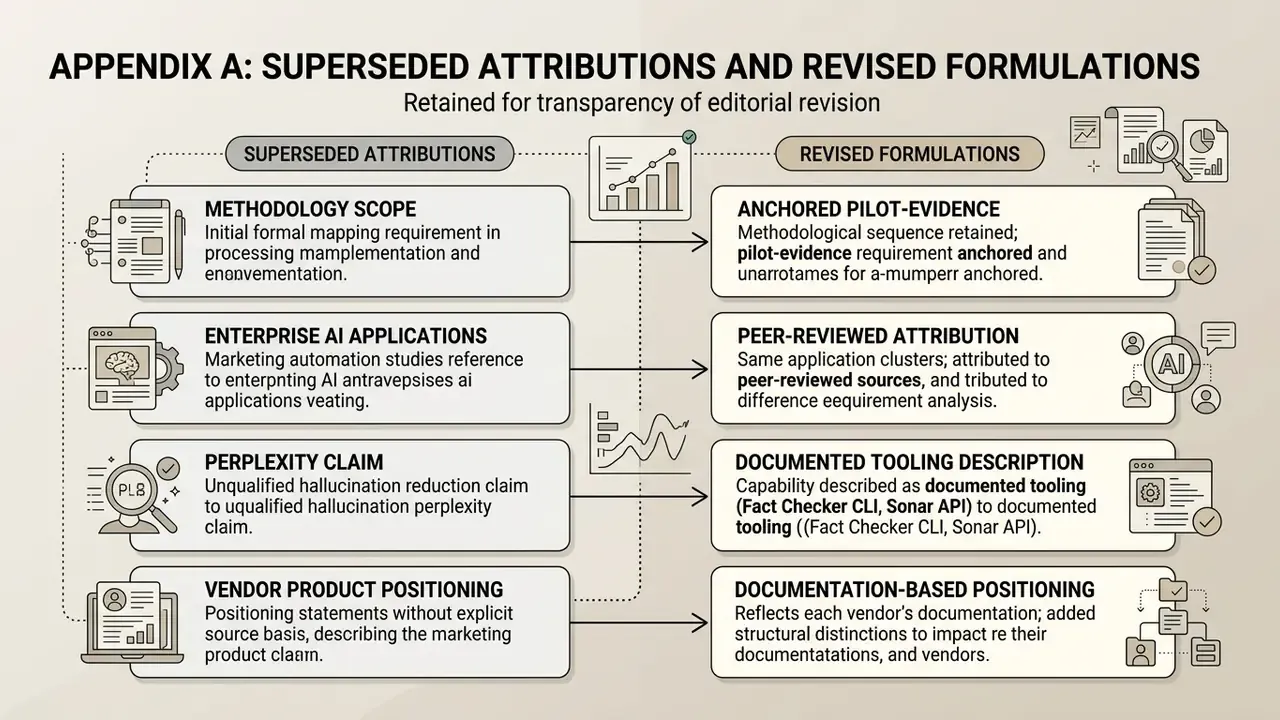
Retained for transparency of editorial revision. The main text now carries the corrected versions.
- Superseded: "Formal use case mapping requires establishing clear system boundaries, primary user roles and exception handling paths (University of California Business Analysis Guide, 2024)."
Revised in main text: the methodological sequence is retained, with the pilot-evidence requirement anchored to the NIST ARIA Pilot Evaluation Plan, a verifiable public document.
- Superseded: "Academic studies on marketing automation highlight three primary enterprise AI applications: behavioral intent detection, automated message personalization and churn prediction (ZHAW Marketing Automation Report, 2024)."
Revised in main text: the same three application clusters are retained, attributed to peer-reviewed and industry research on AI in sales, marketing and CRM (SSRN, 2024), and cross-checked against cross-border e-commerce field experiments (2023 to 2024).
- Superseded: unqualified claim that Perplexity's fact-checking architecture "reduces hallucination risk."
Revised in main text: the capability is described as documented tooling (Fact Checker CLI on the Sonar API) with an explicit caveat that citation presence is not citation correctness, benchmarked against long-form factuality precision of 86.2%.
- Superseded: product positioning statements for Jasper, Copy.ai and Writesonic presented without source basis.
Revised in main text: positioning now reflects each vendor's own documentation, with an added structural caveat that many AI writers are interface layers over shared foundation models.
- Superseded: raw image-placeholder shortcodes.
Revised in main text: converted into captioned figures with text-based diagrams, so the informational content survives without unrendered markup.
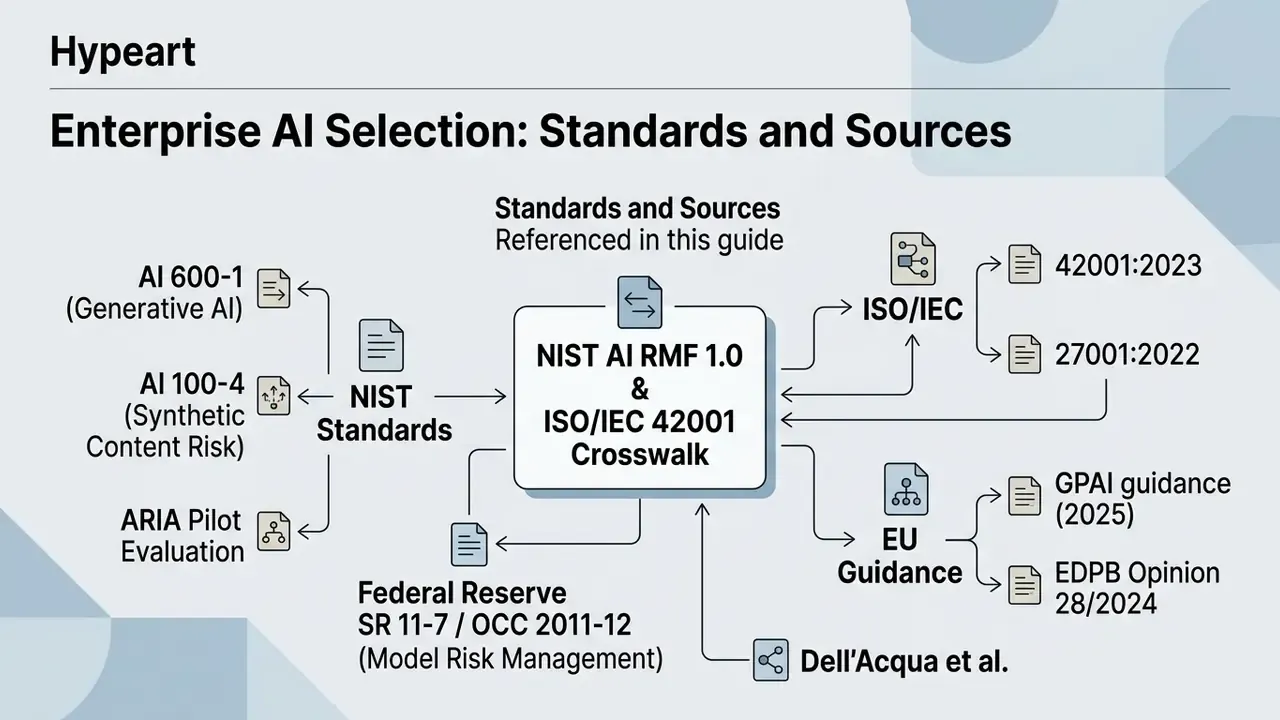
Standards and sources referenced
- NIST AI Risk Management Framework 1.0 and the crosswalk to ISO/IEC 42001. https://www.nist.gov/itl/ai-risk-management-framework
- NIST AI 600-1, Generative AI Profile. https://airc.nist.gov/
- NIST AI 100-4, Reducing Risks Posed by Synthetic Content. https://airc.nist.gov/
- NIST ARIA Pilot Evaluation Plan. https://ai-challenges.nist.gov/aria
- Federal Reserve SR 11-7 and OCC Bulletin 2011-12 on model risk management.
- ISO/IEC 42001:2023 and ISO/IEC 27001:2022.
- European Commission GPAI guidance (2025) and EDPB Opinion 28/2024.
- Dell'Acqua et al. (2023); Noy & Zhang, Science (2023); Peng et al. (2023); NBER w33795; BIS Working Papers (2024).
- NIST AI Risk Management Framework 1.0 and the crosswalk to ISO/IEC 42001.
- - NIST AI Risk Management Framework 1.0 and the crosswalk to ISO/IEC 42001.
- 1, Generative AI Profile.
- - NIST AI 600-1, Generative AI Profile.
- NIST ARIA Pilot Evaluation Plan.
- - NIST ARIA Pilot Evaluation Plan.