For a risk or finance leader, the question is narrower than "does it sound good." The question is whether a synthetic voice can enter a customer-facing channel with evidence behind it.
«In enterprise AI adoption, autonomy without verifiable controls is an operational risk. Synthetic speech engines must be evaluated not merely by auditory polish, but by measurable fidelity, data lineage, explicit consent mechanisms, and risk-adjusted governance.»
— Marcus Hale, author
Last updated: 2026. Author: AI Media editorial team, with technical review by an AI governance and model-risk practitioner.
Executive Summary for Decision-Makers
For readers who need the decision-grade version before the technical detail:
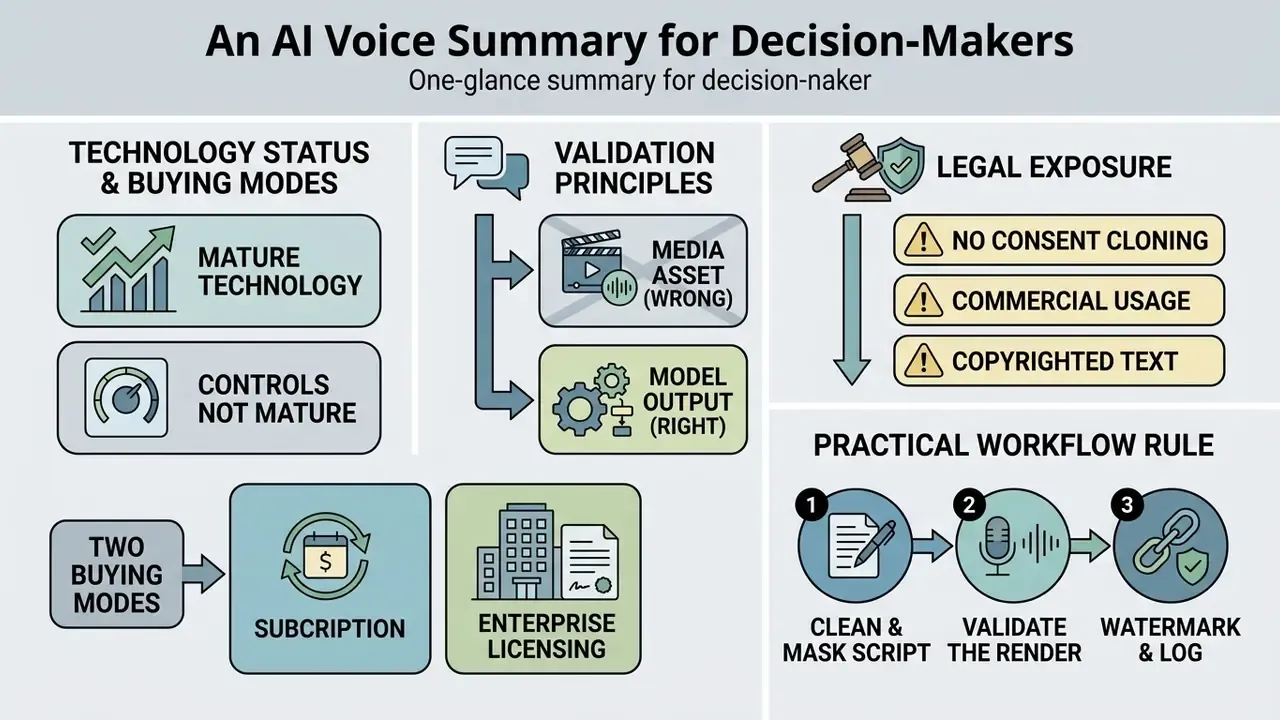
- The technology is mature, the controls are not. Neural TTS built on discrete acoustic tokens, transformer backbones, and neural vocoders now delivers speech that listeners rate close to human narration. The remaining gap in regulated industries is governance: data lineage, consent evidence, provenance marking, and measurable output validation.
- Two buying modes exist. Creator-grade browser tools optimize for speed, voice variety, and price. Enterprise-grade deployments optimize for private VPC or on-premise topologies, zero data retention, SSO/SAML, audio watermarking, and auditable logs. The character-limit comparison that dominates free-tier marketing is close to irrelevant for institutional procurement.
- Validate synthetic speech like a model, not like a media asset. Word Error Rate (WER) on re-transcription, prosody drift monitoring, numeral and ticker-symbol hallucination testing, and latency SLOs belong in the same validation framework a bank already applies under Federal Reserve SR 11-7 model risk management guidance.
- Legal exposure concentrates in three places: voice cloning without documented consent, commercial publication under a personal-use licence, and undisclosed synthetic audio in customer-facing or advertising channels.
- Practical workflow rule: clean and mask the script first, validate the render second, watermark and log third. Downloading an MP3 is the last step, not the process.
What Is an AI Voice Generator and How Does It Create Speech from Text?
An AI voice generator converts written scripts into spoken audio using computational algorithms rather than traditional voice talent recording. Modern neural text-to-speech (TTS) systems analyze linguistic patterns, generate acoustic features, and synthesize waveforms to produce generated voices that match human cadence, tone, and pronunciation.
Traditional narration needs studio space, human talent, and manual editing after every script revision. An AI audio generator from text computes speech dynamically instead. Creators, educators, and enterprise teams can generate voiceovers in minutes, update content by editing a text string, and deploy multilingual narration at scale.
Recent advances in deep learning have replaced parametric synthesis with transformer-based autoregressive and flow-matching models. Systems like MOSS-TTS, Voxtral TTS, and XTTS process discrete audio tokens to capture subtle vocal nuances, which lets models create audio from text with high intelligibility across very different domains.
«OmniVoice maps text tokens directly to multi-codebook acoustic tokens through a bidirectional transformer, supporting more than 600 languages on a 581k-hour dataset.»
Architectural emphasis differs by vendor and by goal. NVIDIA NeMo's Magpie-TTS documents an encoder-decoder transformer over discrete audio tokens produced by a neural audio codec. Voxtral TTS combines autoregressive semantic-token generation with flow-matching acoustic modeling and can synthesize from roughly three seconds of reference audio. Inworld's TTS-1 family prioritizes real-time time-to-first-byte. These are not contradictions. They are different trade-off points between latency, controllability, and fidelity, and each point carries its own operational risk profile.
Text to Speech: Turning a Script into a Finished Audio File
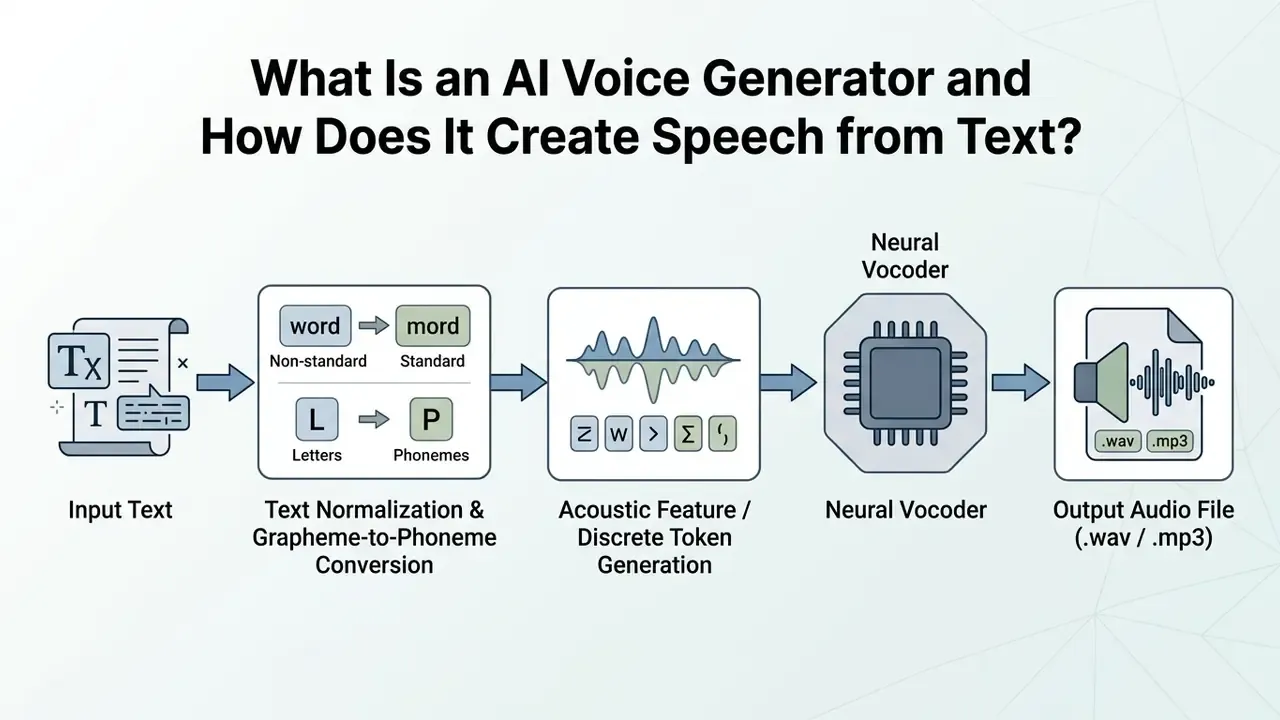
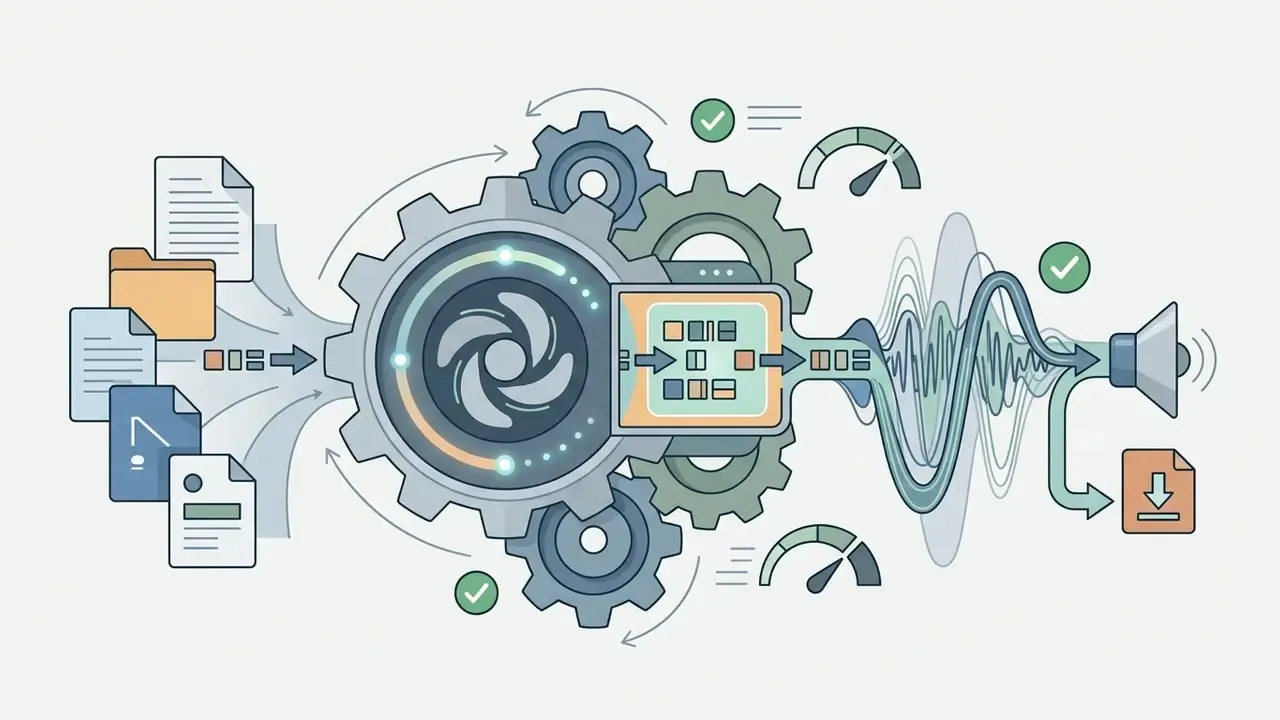
A neural text to speech system transforms a written script into synthetic audio through a structured three-stage pipeline. First, the text analysis module normalizes the raw input: expanding abbreviations, resolving numbers, converting graphemes into phonemes.
Second, an acoustic model (usually a neural transformer) maps linguistic features into acoustic representations or discrete semantic-acoustic tokens. Third, a neural vocoder such as HiFi-GAN reconstructs raw waveforms from those features. This multi-stage processing is what allows current systems to convert complex text into natural speech sound with precise pitch and duration control.
Updated evidence base. Rather than leaning on general benchmark summaries, anchor evaluation to a metric with published correlation data:
«TTSDS2 is the only one of 16 compared metrics achieving Spearman correlation above 0.50 with listener scores across every domain and language.»
Systematic review evidence stays directionally consistent: synthetic speech frequently matches human intelligibility while still underperforming on speaker likeness and perceived emotional depth (Journal of the Brazilian Computer Society, 2026, https://journals-sol.sbc.org.br/index.php/jbcs/article/download/5468/3317/30090).
AI Voice Generator, AI Voiceover, and AI Audio Creator: Different Job Scopes
The terms AI voice generator, AI voiceover, and AI audio creator get used interchangeably, yet they describe distinct functional scopes inside a content pipeline. Clarifying them saves procurement time.
- AI Voice Generator focuses on text-to-speech synthesis, converting plain text or SSML into synthetic vocal tracks.
- AI Voiceover production-ready voice narration for videos, presentations, and e-learning courses, usually integrated with timeline editing tools.
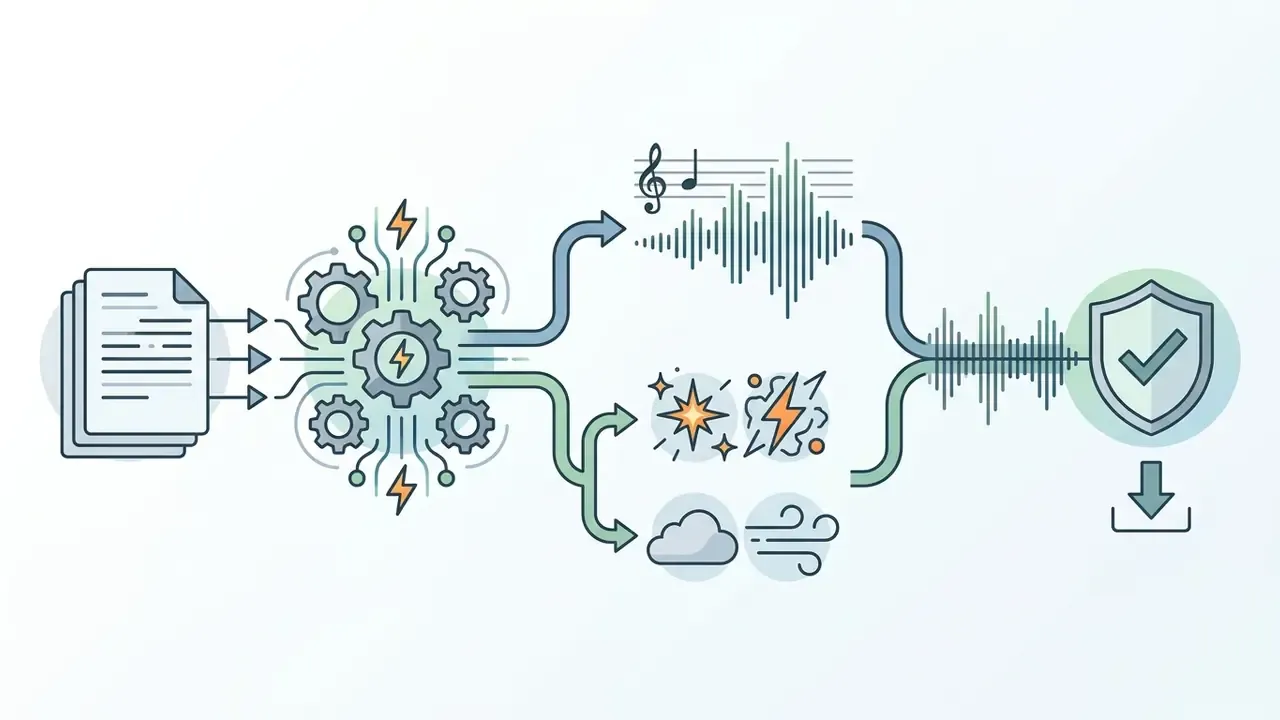
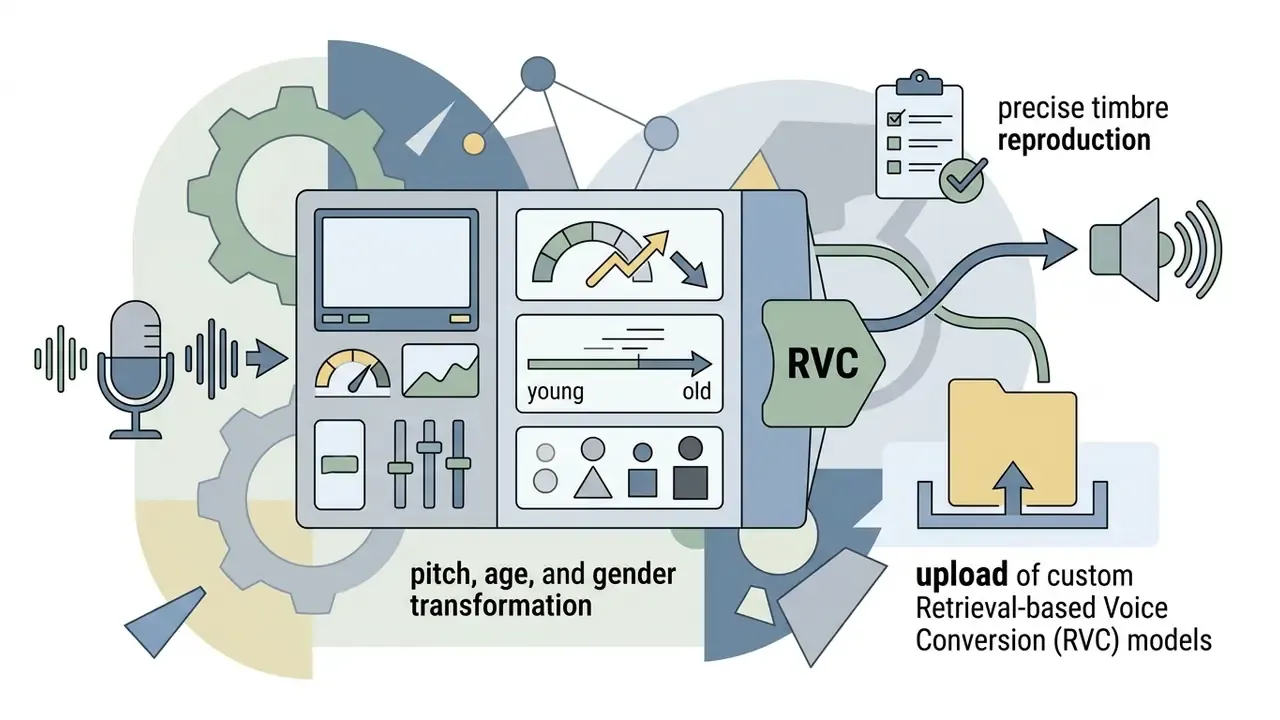
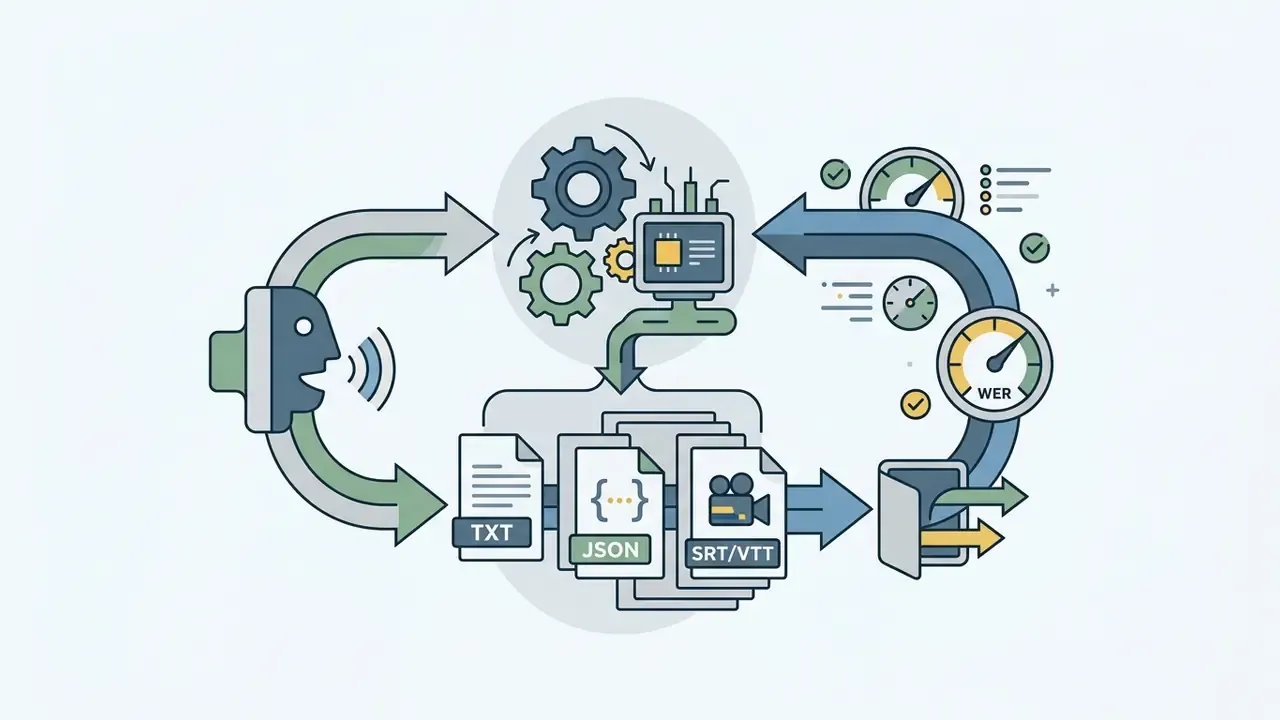
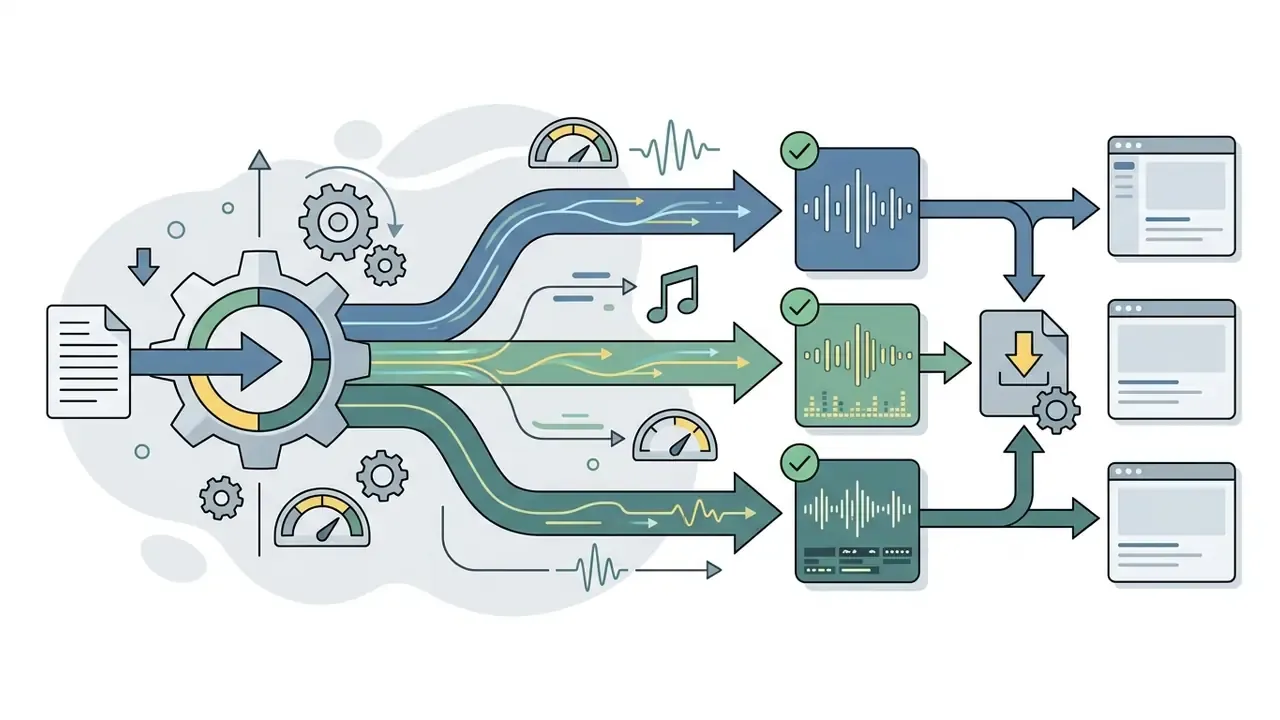
- AI Audio Creator a broader generative scope, combining speech synthesis with background music generation, sound effects, and multi-track mixing. Teams building full audiovisual pipelines usually pair this layer with AI video generators so that narration, visuals, and music are produced in one governed workflow.
You will also meet a long tail of search variants: ai app voice generator, ai audio voice generator, ai audio generator tools, plus frequent misspellings that point to the same category. They all describe the same job to be done, so do not let naming noise distort a vendor shortlist.
Extended AI audio creator functionality worth checking:
For definitions of adjacent synthetic media terms, consult our AI Media Glossary.
Supported Input Formats and File Import
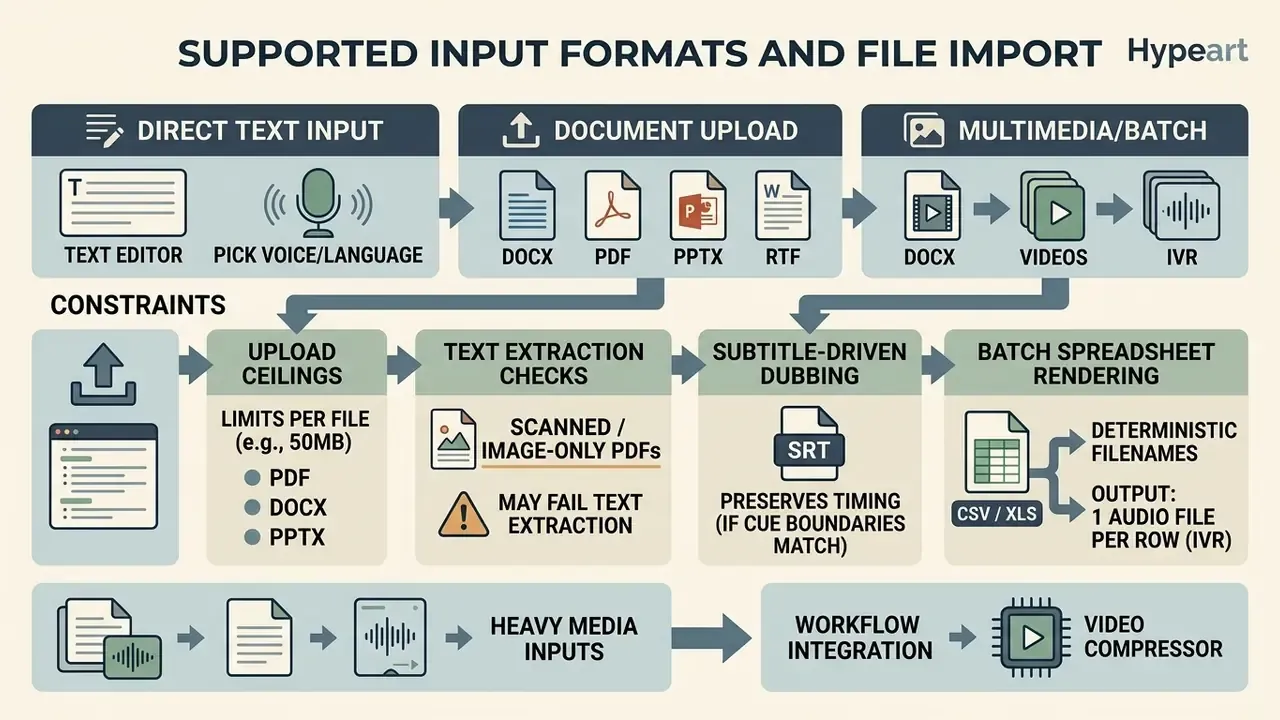
Production work rarely starts with an empty text box. It starts with a document, a subtitle file, or a spreadsheet. A capable AI audio generator online should ingest source files directly and extract text automatically.
| Input category | Formats | Typical use |
|---|---|---|
| Text documents | .TXT, .DOCX, .PDF, .PPTX, .EPUB | Long-form narration, course decks, book and report audio versions |
| Subtitle / dubbing files | .SRT, .VTT | Synchronized alternate-language audio tracks with preserved timecodes |
| Batch / IVR generation | .XLSX, .CSV | Thousands of short call-centre prompts or radio snippets rendered from table rows |
| Markup input | .SSML, .XML | Explicit control of breaks, pronunciation, prosody, and language switching |
| Image sources | .PNG, .JPG | OCR text extraction from scanned pages before synthesis |
Practical constraints worth verifying before you commit:
- Upload ceilings are usually expressed per file (commonly 50 MB for PDF, PPT, DOCX, and image inputs) and separately as a per-generation character cap.
- Scanned or image-only PDFs frequently fail text extraction. If a PDF returns empty text, run OCR first or export a text layer.
- Subtitle-driven dubbing preserves timing only if the translated file keeps the original cue boundaries. Re-segmenting a translated
.SRTbreaks lip-sync alignment. - Batch spreadsheet rendering should output one audio file per row with a deterministic filename, so IVR platforms can map prompts without manual renaming.
Teams working with heavy media inputs alongside audio often pair this step with a video compressor workflow, and long archive files may need a dedicated route to compress 2gb video before anything reaches the platform upload limit.
How to Create an AI Voice from Text: The Step-by-Step Process
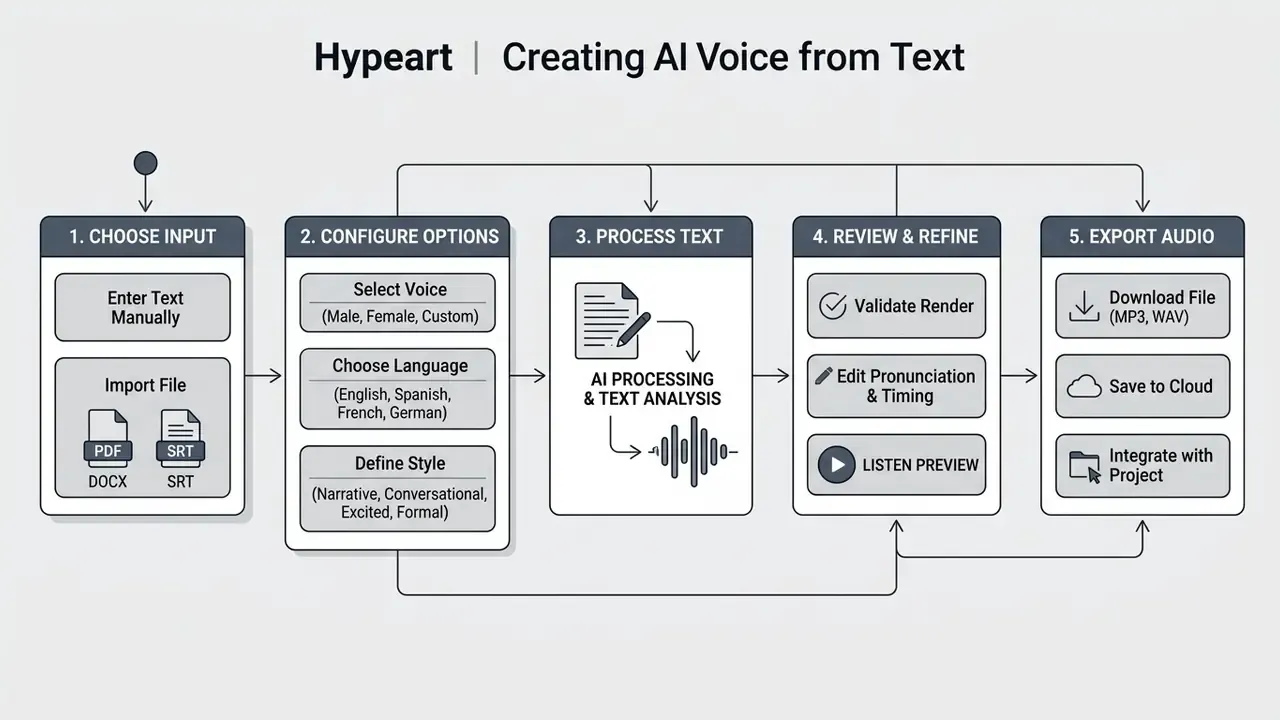
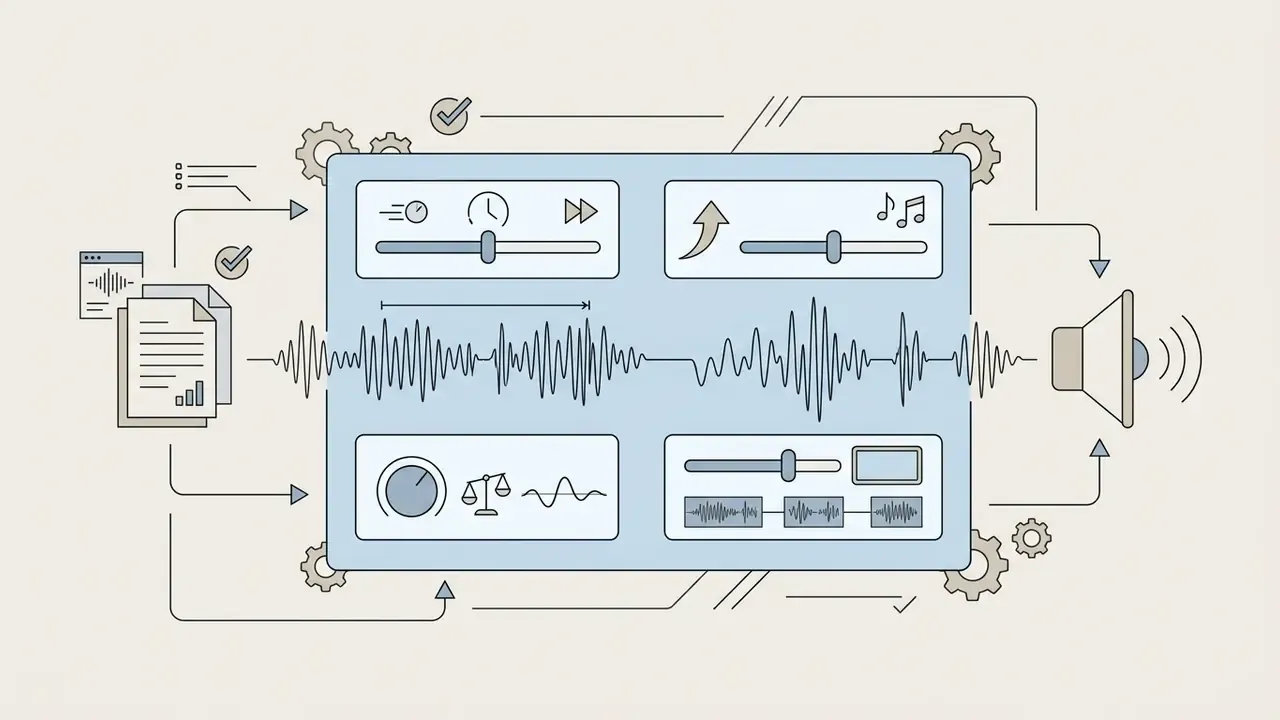
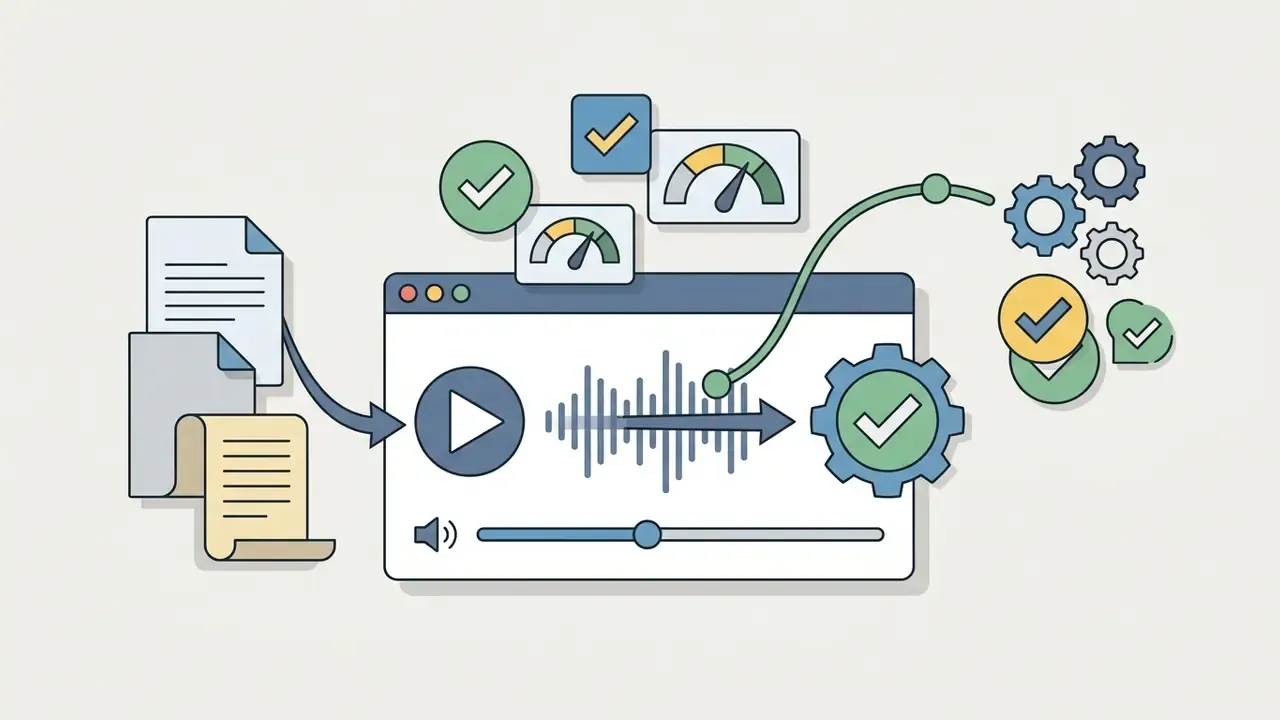
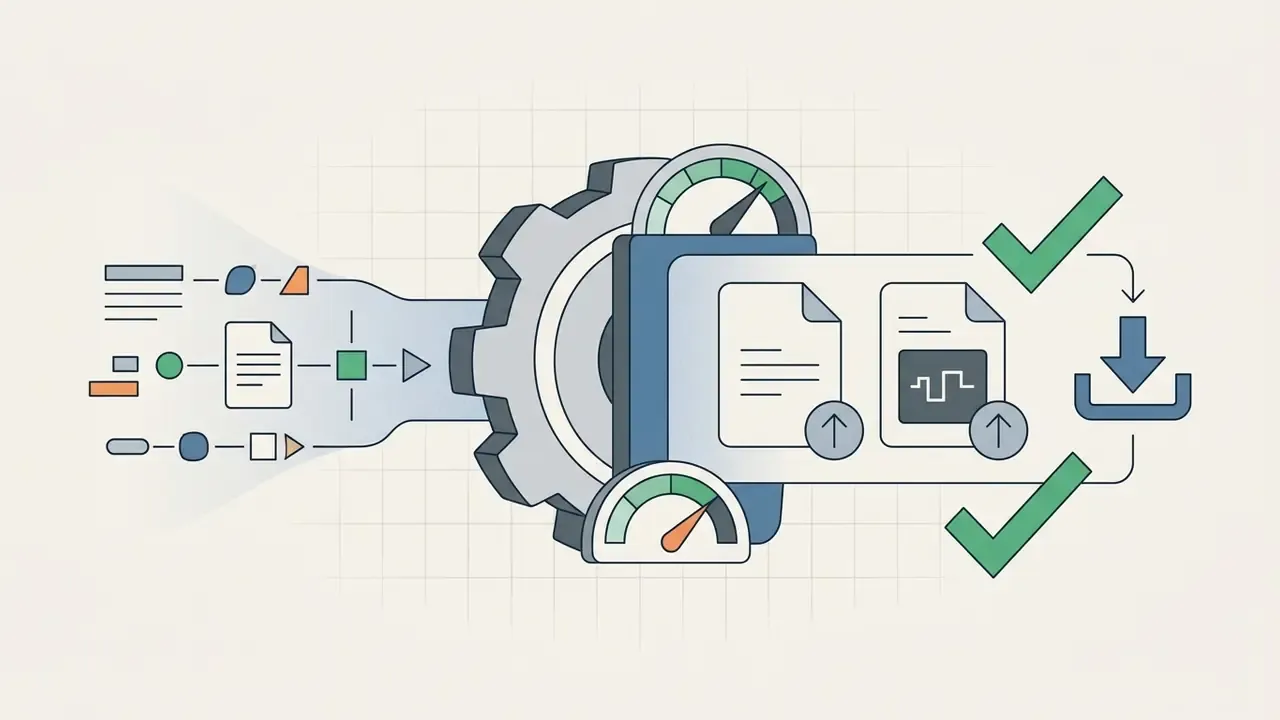
Generating audio through an AI audio generator online follows a six-step workflow built for fast iteration. You input text, configure vocal parameters, synthesize, and download the finished file inside a browser tab.
Preparing Text and Scripts for Speech Generation
Preparing a script for text-to-speech generation is mostly punctuation discipline. Neural acoustic models read commas, periods, and ellipses as instructions about pause length and intonation contour.
Split long sentences into semantically coherent clauses of roughly 10 to 18 words. Standardize numbers, spell proprietary terms phonetically, and use explicit SSML break tags where consistent delivery matters, which is most of the time in corporate or technical scripts.
«MINT-Bench shows that scripts should be split into semantically coherent segments with explicit style instructions, a key condition for correct instruction following.»
Vendor documentation converges on the same practical rules: commas and periods create short pauses, ellipses create longer ones, complete readable sentences outperform fragments, and platform-specific markup (a hash pause marker, a stress marker, or an SSML break of 500 ms) should be used only where the engine actually supports it.
Precision Speech Controls in the Editor
Beyond global sliders, production-grade editors expose per-word and per-phrase control. Three controls resolve most "almost right" renders:
- Fixed pause insertionplace the cursor at the target position and insert a timed pause from the toolbar (typical options: 0.5 s, 1 s, 2 s, 5 s). Keep pauses under roughly 20 per conversion, or per 1,000 characters, or the rhythm starts to sound staged.
- Pronunciation fixerselect a difficult word, acronym, ticker, or proper noun and supply an IPA transcription or phonetic respelling. This is the single most important control for financial and medical scripts, where a mispronounced instrument or drug name is a substantive error rather than a cosmetic one.
- Per-phrase tone tagginghighlight a fragment and assign an emotional tag (whisper, excited, business-like, serious, empathetic) without changing the whole track. A disclosure paragraph stays neutral while a marketing hook keeps its energy in the same render.
Choosing Voice, Language, and Delivery Style
Selecting an appropriate sounding voice means matching pitch, speaking rate, and tone to the project context. The official W3C specification puts the language constraint at the top of the selection hierarchy, followed by voice attributes such as name, variant, gender, and age, with prosody controlling pitch, rate, and volume (Speech Synthesis Markup Language (SSML) Version 1.1, W3C, 2010, https://www.w3.org/TR/speech-synthesis11/). Where no exact language voice exists, the specification directs the processor to the closest available variant or dialect.
«XTTS achieves state-of-the-art results in most of its 16 supported languages for zero-shot voice cloning without requiring full script recordings.»
For corporate training or financial presentations, a calm, analytically confident tone establishes authority. For narrative projects or conversational marketing, an expressive voice profile improves engagement and message retention. Academic guidance is blunt about the trade-off: intelligibility outranks expressiveness whenever the content carries obligations, such as disclosures, safety instructions, or regulatory notices.
Generation, Preview, and Audio Download
The preview phase uses temporary low-latency render files so you can test playback without burning full compute. That iterative step is where pronunciation and tone problems surface, before the expensive render.
Once verified, the engine performs full offline rendering to write the final waveform. Production teams export compressed MP3 for web distribution and uncompressed WAV for video editing or broadcast. Adobe's audio guidance recommends archiving masters as uncompressed WAV and reserving MP3 for web and portable playback, a rule that also protects future re-edits from generational compression loss.
Enterprise Security Architecture and Voice Model Validation Under SR 11-7
Consumer workflows end at "download MP3." Regulated workflows do not. Before synthetic speech reaches a customer-facing channel, whether IVR, outbound notification, voice assistant, or a published disclosure, it should pass through a controlled pipeline with recorded evidence at each stage.
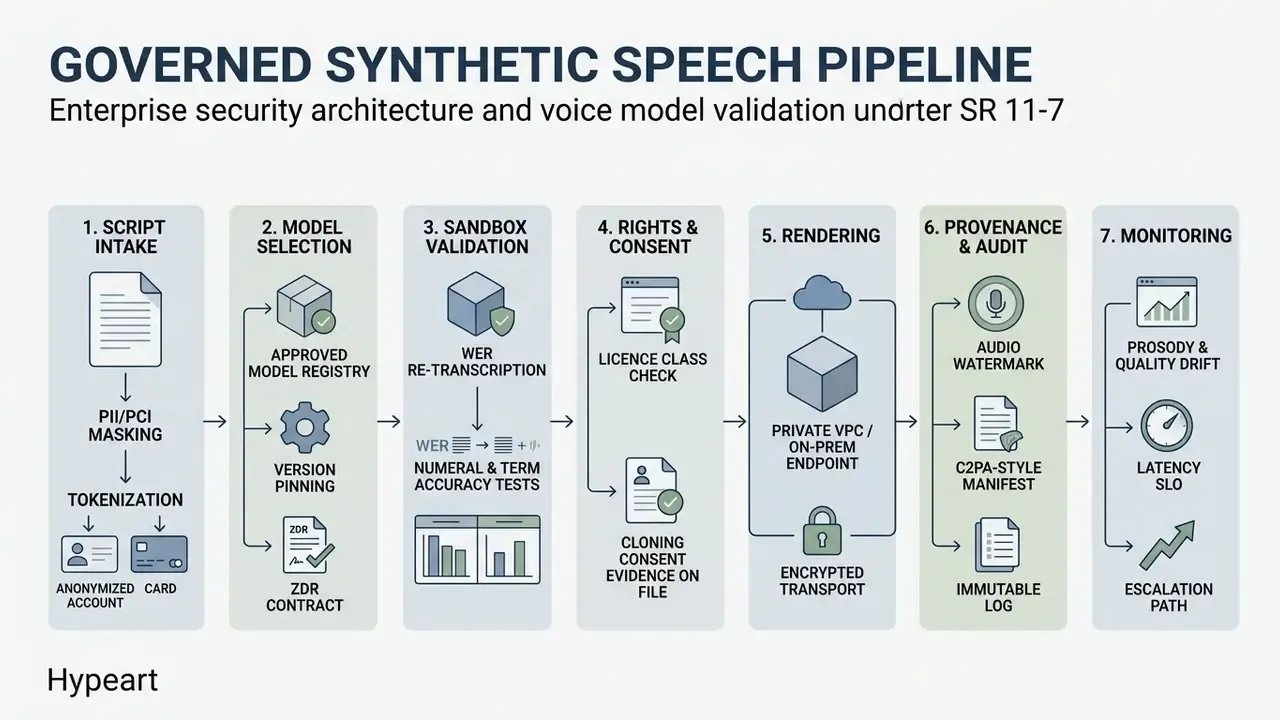
Validation metrics that belong in the model inventory:
| Control area | Metric / test | Failure signal |
|---|---|---|
| Intelligibility | Word Error Rate on ASR re-transcription of the render | WER above the approved threshold for the channel |
| Numeric fidelity | Golden-set test of amounts, dates, rates, account fragments, tickers | Any misread digit or currency unit |
| Terminology | Pronunciation dictionary regression suite | Drift after a model version upgrade |
| Prosody stability | F0 variance and pause distribution vs. approved baseline | Monotone collapse or erratic pacing |
| Latency | Time-to-first-byte and full-render p95 | Breach of channel SLO in real-time agents |
| Provenance | Watermark and manifest present on 100% of outputs | Unmarked audio in distribution |
Data protection requirements to negotiate contractually: zero data retention (ZDR) for prompts and outputs, no training on customer inputs, encryption in transit and at rest, tenant isolation, deletion-on-demand APIs, breach notification windows, and export of audit logs into the institution's GRC or model risk management system.
A voice model is a digital worker in everything but name. It needs a named owner, an approved role, access limits, an escalation path, an audit trail, and a shutdown mechanism. No evidence, no autonomy.
Deepfake and spoofing controls. Provenance marking is now the operative defence, not detection alone:
«Speech-Forensics shows that high-quality AI voice generators can evade naive detectors in several configurations, requiring specialized forensic tooling.»
Practical mitigations: cryptographic audio watermarking and C2PA-style content credentials on every synthesized asset, an internal registry of approved cloned voices, an explicit prohibition on cloning executive voices outside a documented consent process, and callback verification for any payment instruction received by voice. That last control is unglamorous and it prevents the most expensive incidents.
This section describes control practice, not legal or regulatory advice. Validation scope and thresholds must be set by your own model risk, compliance, and legal functions.
Which Capabilities Determine the Quality of AI-Generated Voices
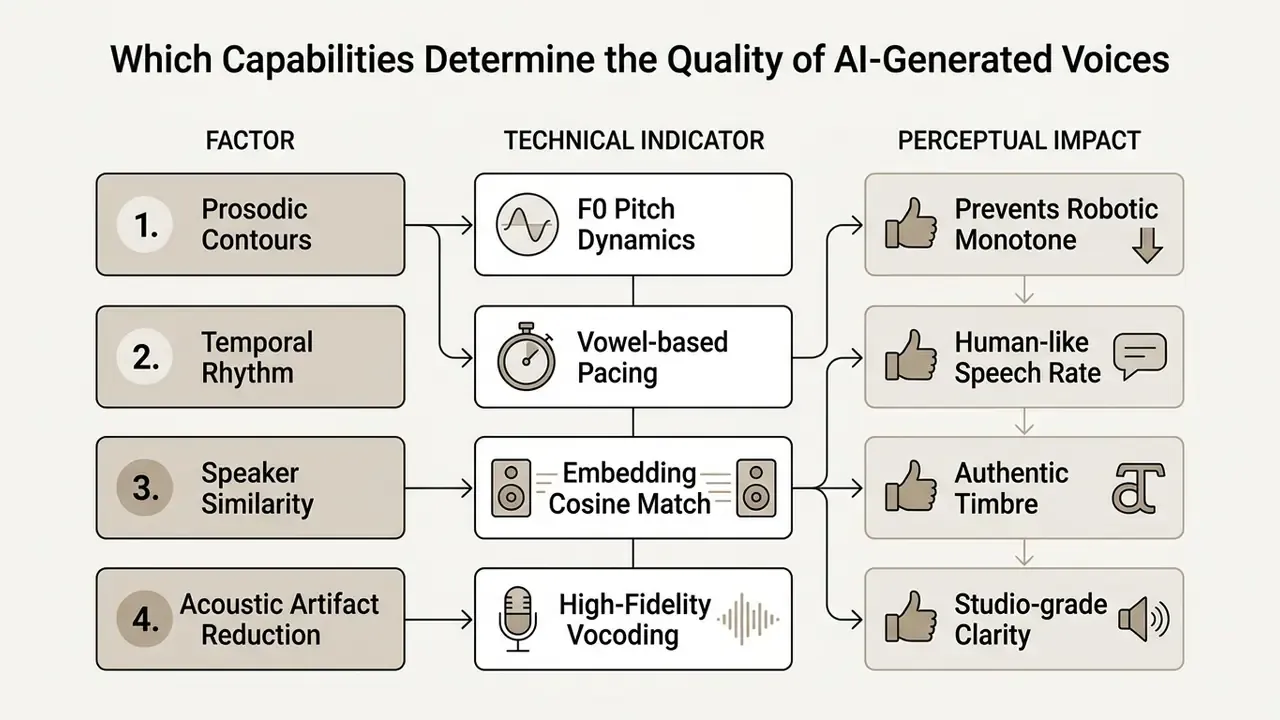
The perceptual naturalness of generated voices depends on prosodic modeling, pitch variation (F0 contour stability), speech rate, and speaker-embedding fidelity. Comparative evaluations indicate that models with finer local pitch control and flexible duration modeling achieve higher mean opinion scores (MOS) in human listening tests.
«TTSDS2 evaluates quality across four factors: general similarity via SSL embeddings, speaker identity realism, prosody, and intelligibility, correlating with human ratings above 0.50.»
Supporting evidence from listening studies is consistent: reduced F0 variation lowers naturalness ratings, and speaker-specific characteristics drive perceived similarity (Interspeech, ISCA Archive, 2025, https://www.isca-archive.org/interspeech_2025/bakkouche25_interspeech.pdf). A 2026 study of model differences found the clearest separation in speech rate, vowel-based rhythm, local pitch control, and speaker-embedding similarity (Cambridge Repository, 2026, https://www.repository.cam.ac.uk/items/e2195596-b1fe-4be0-a303-c99f85e5c76e).
Natural Sound: Speech, Pauses, and Tone
A realistic speech sound comes down to intonation and micro-pauses. Advanced neural TTS platforms model breath cues, mild disfluency, and stress placement to avoid the flat delivery of legacy rule-based engines. Interspeech research reports that adding breathing cues measurably increases perceived naturalness and empathy, which is why newer systems expose breath as an explicit control rather than a by-product of emotion modeling.
In compliance training, pauses at clause boundaries do real work: they give the listener time to attach the rule to the example. Modeling pitch variation alongside natural pause insertion increases perceived realism and listener trust across educational and informational content (Cambridge Repository, 2026, https://www.repository.cam.ac.uk/items/e2195596-b1fe-4be0-a303-c99f85e5c76e).
«Cross-speaker style transfer with an F0-matching algorithm increases perceived style intensity and speaker similarity compared with baseline methods.»
Custom Voices and Voiceover Style Control
Custom voice creation lets an organization establish a signature voice across digital channels. Using zero-shot cloning or fine-tuned speaker embeddings, systems can voice new scripts from a short reference recording. Commercial platforms typically require a clean sample of at least 30 seconds, while some hybrid research models operate from as little as three seconds at reduced fidelity. Sample quality matters more than length: mono, 44.1 kHz or higher, no background music, no compression artifacts, one speaker only.
When deploying custom voice technology, keep speaker identity vectors separate from emotion vectors. That separation is what keeps a brand voice recognizable across different emotional delivery styles.
«FaceSpeak disentangles portrait images into identity and emotion vectors, generating speech consistent with a character's visual style at satisfactory subjective quality.»
Governance note: NIST's 2024 Generative AI Profile treats voice cloning as a synthetic-content risk area tied to impersonation and fraud, and the EDPB's guidelines on virtual voice assistants recommend that voice models be generated, stored, and matched locally, with voiceprints handled as biometric data. A custom voice programme should therefore include a consent recording, a signed synthesis-rights clause, a revocation path, and biometric-grade storage controls.
Creating Dialogue and Multi-Voice Audio Conversations
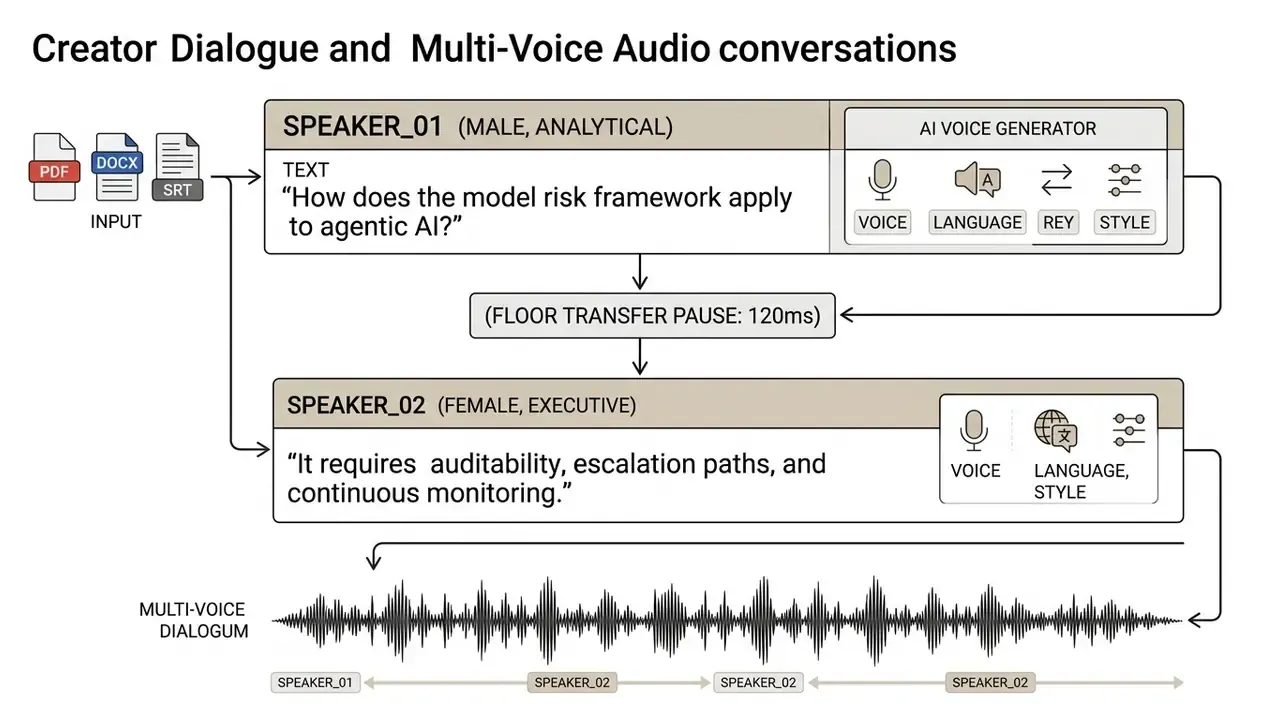
An AI audio conversation generator orchestrates multi-speaker interactions inside a single audio stream. Assign speaker tags to script turns and the platform renders turn-taking dynamics, interviews, and multi-character scenes automatically.
Dialogues, Interviews, and Chat Voice Scenarios
Multi-speaker content, whether simulated service calls, podcast interviews, or interactive AI chat voice generator scripts, depends on turn-taking precision. Advanced dialogue engines, sometimes marketed as an AI dialogue voice generator or an AI conversation voice generator, manage floor-transfer pauses automatically and insert short silences of roughly 100 to 150 milliseconds between alternating speakers.
Systems like CoVoMix and Fish Audio S2 use multi-stream semantic tokenization to process conversational turns.
«CoVoMix converts dialogue text into multiple streams of discrete semantic tokens and mixes them through a flow-matching acoustic model with a HiFi-GAN vocoder into a single channel.»
The result is natural interjections, overlaps, and conversational pacing in one synthesized track, with no manual alignment of separate speaker files in an external digital audio workstation. Documented dialogue systems now support up to five speakers per session with zero-shot cloning from a short reference clip, and vendor APIs expose speaker-index tagging plus configurable maximum-pause thresholds for merging consecutive turns.
Actor AI Voice Generator for Characters and Storytelling
An actor AI voice generator provides the emotional range needed for narrative projects, video game non-player characters, and animated storytelling. These engines support explicit emotion tagging, so a character can move from calm explanation to visible tension inside one scene.
In an enterprise context, the same multi-character capability powers interactive training that mirrors real customer interactions: a branch conversation about a suspicious transfer, a collections call, a complaint escalation, a KYC interview. Multi-voice compliance scenarios get adopted for two boring reasons. They are cheap to update, since a policy change is a script edit rather than a re-shoot. And they localize without recasting. Effect on completion rates is organization-specific and should be measured against your own LMS baseline before and after rollout; treat vendor-quoted uplift figures as unverified until reproduced internally.
Which Projects Use an AI Voice Generator
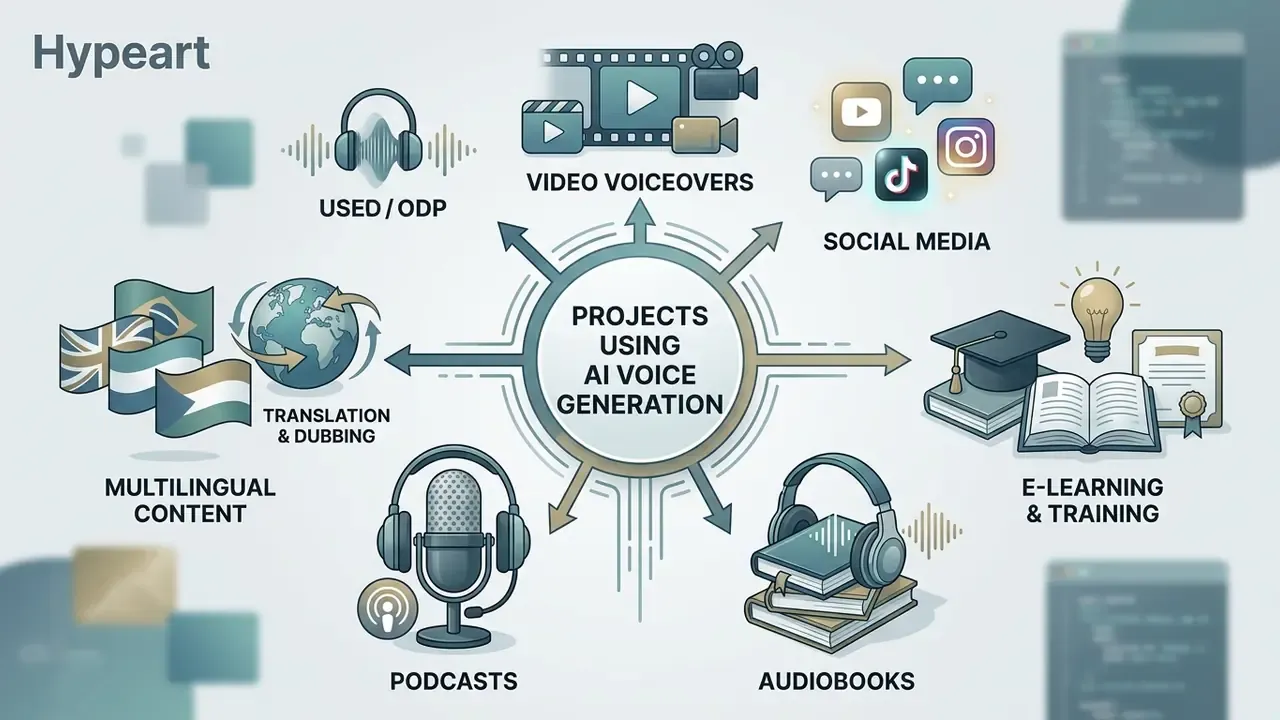
AI voice generators serve commercial, educational, and creative applications. Voice parameters and licensing depend heavily on the project.
| Project Type | Target Audience | Primary Focus | Recommended Format | License Requirement |
|---|---|---|---|---|
| YouTube & Social | General Public | Engagement & Clarity | MP3 / 48 kHz WAV | Commercial License |
| Podcasts | Subscribers | Natural Rhythm & Tone | High-bitrate MP3 | Commercial License |
| E-Learning & Corporate | Employees / Students | Intelligibility & Pacing | Uncompressed WAV | Enterprise License |
| Audiobooks | Listeners | Long-form Expressiveness | High-bitrate MP3 | Full Distribution Right |
| Localization | Global Markets | Cross-lingual Consistency | WAV / MP3 | Multi-region License |
| IVR & Call Centre Prompts | Customers | Numeric accuracy, batch consistency | 8 kHz / 16 kHz WAV, µ-law | Enterprise + telephony rights |
| Voice Agents & Notifications | Customers | Low latency, disclosure compliance | Streaming PCM | Enterprise + consent controls |
| Compliance & Risk Training | Employees | Multi-character realism, auditability | Uncompressed WAV | Enterprise License |
| Financial Reporting Audio | Investors / Analysts | Terminology precision, review trail | High-bitrate MP3 / WAV | Enterprise + review sign-off |
Two things change when the row is an enterprise channel rather than a content channel. The format constraint comes from telephony or broadcast specifications instead of platform preference. And the licence must cover the specific distribution surface, because telephony prompts and outbound automated calls are frequently excluded from generic "commercial use" language.
Podcasts, E-Learning, Audiobooks, and Multilingual Content
In long-form production, consistency across hours of audio is the hard part. E-learning platforms and audiobook publishers use neural TTS to hold uniform voice quality across dozens of modules without vocal fatigue or studio scheduling.
«Listener ratings for AI voices and professional narrators in audiobooks differ minimally, and expectations about narrator type show no significant moderating effect.»
Accessibility guidance adds a production requirement rather than a stylistic one: synthetic-voice audiobook productions should follow DAISY structural conventions, keep heading depth shallow, and disclose that the narration is synthetic.
Cross-lingual voice cloning also lets publishers translate courses while keeping the original narrator's timbre. Vendor documentation defines this as a bounded locale matrix. Google Cloud's Chirp 3 Instant Custom Voice documents transfer from an en-US cloning key into a specific list of target locales, while Dialogflow CX voice cloning lists 20+ supported locales including ru-RU, ja-JP, and ar-XA (Google Cloud Text-to-Speech documentation, 2025, https://cloud.google.com/text-to-speech/docs).
«OmniVoice supports omnilingual zero-shot TTS across 600+ languages, trained on 581k hours of open data without explicit per-language supervised training.»
The practical reading: research models demonstrate breadth, vendor contracts define what you can deploy. Validate the specific locale pair you need against the provider's documented list, not against a headline language count. Creative teams experimenting with stylized output, for example when they convert video to animated formats or convert video to live photo assets, should confirm the same licence and locale details for the audio layer.
Free and Affordable AI Voice Generators: Access, Limits, and Format Choice
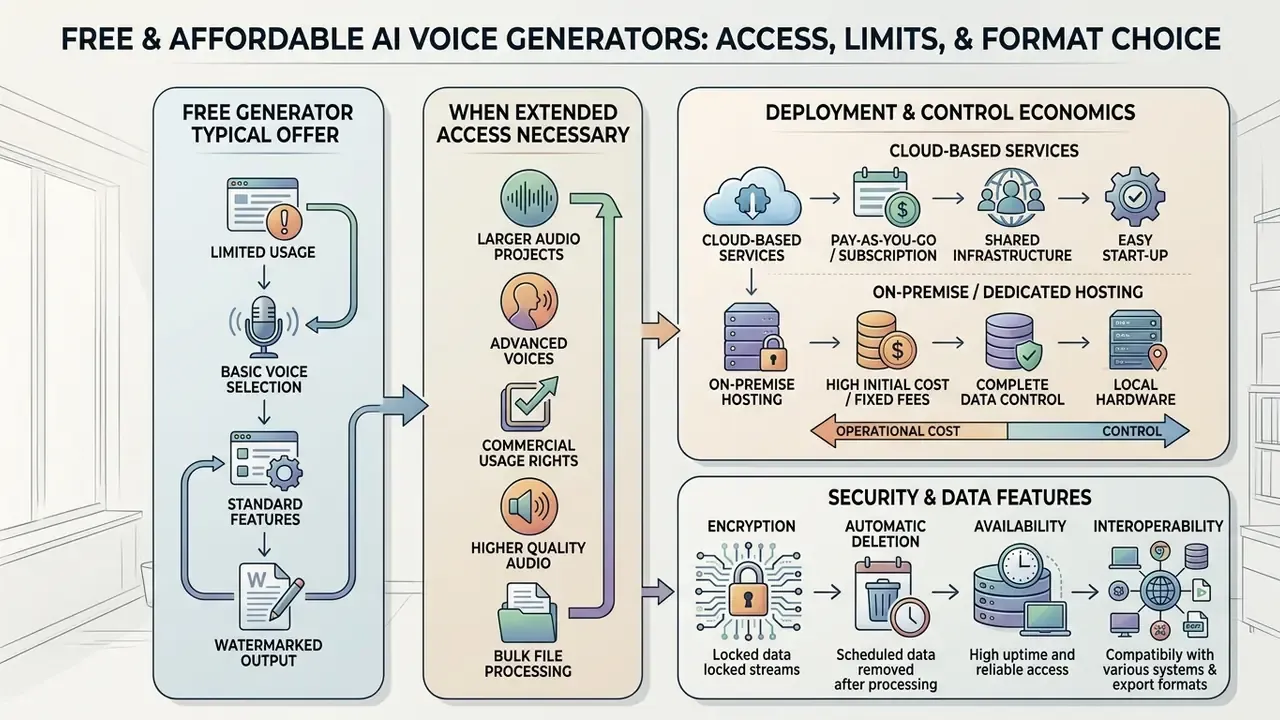
Choosing between a free AI voice generator tier and an affordable AI voice generator subscription comes down to volume, audio resolution, and commercial usage rights. Free plans are for evaluation. Production is not free.
| Feature / Limit | Free Access Tiers | Affordable / Pro Tiers |
|---|---|---|
| Per-generation cap | ~3,000 characters (often lower without login) | 20,000+ characters per generation |
| Monthly volume | ~15,000–20,000 characters, or weekly/daily quotas | 100,000 characters to unlimited |
| Available Voices | Basic / neutral voices | Premium, designed, and cloned voices |
| Audio Export Quality | Compressed MP3, sometimes watermarked | Uncompressed WAV (24-bit/48 kHz) or high-bitrate MP3 |
| Commercial Rights | Personal / non-commercial only | Full commercial rights included |
| API & Batch Access | Restricted or unavailable | Direct REST API, batch and spreadsheet rendering |
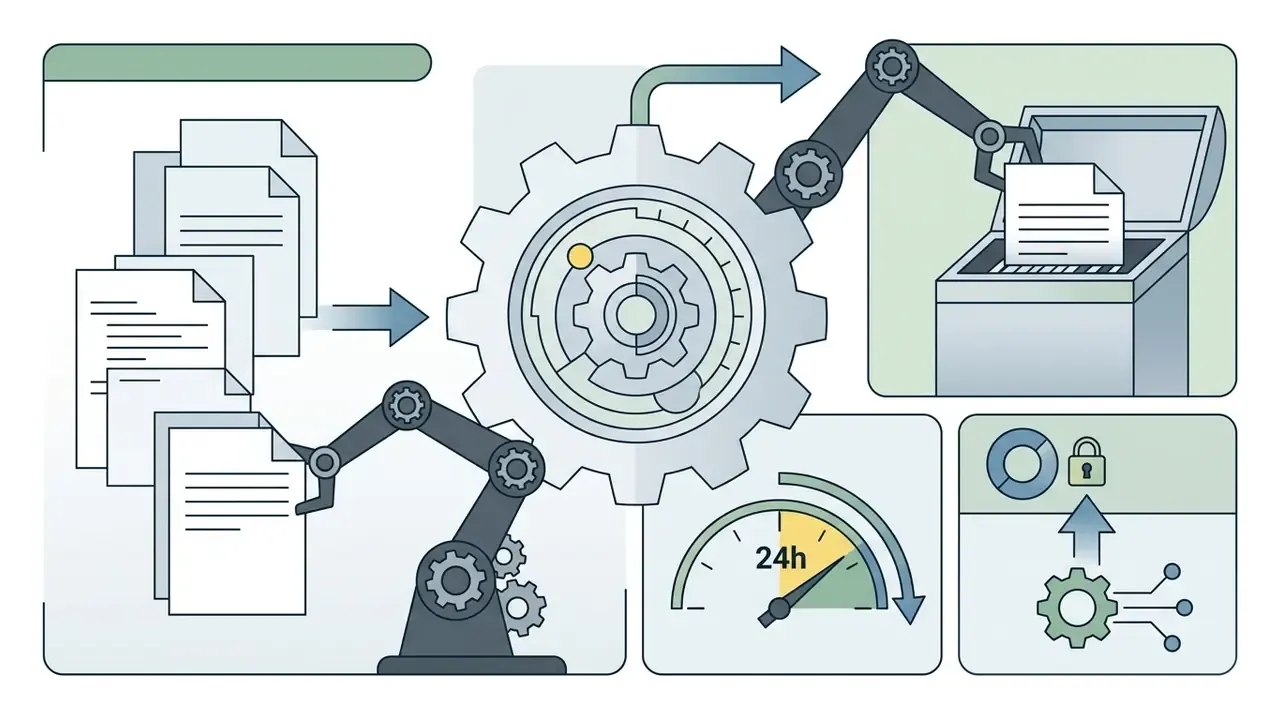
| File retention | Temporary (24–72 hours typical) | Configurable library, deletion on demand |
Readers comparing entry-level quotas across adjacent tools often benchmark against free AI video generators, where credit systems and watermark policies follow the same commercial logic. If your platform meters usage in units rather than characters, read What Are Compute Credits? before you model the annual spend.
What a Free AI Voice Generator Typically Offers
An AI audio generator free from text tier, or a create voice from text free plan, gives you basic text-to-speech under strict operational limits. That is enough to test voice quality, language support, and usability before committing capital.
Common free tier limitations:
- Strict monthly, weekly, or daily character and generation-minute quotas.
- Export limited to compressed MP3, occasionally with an audible watermark.
- Personal, non-commercial use only.
- No custom voice cloning, batch rendering, or raw WAV export.
- Short-lived storage of generated files, commonly 24 to 72 hours, with no project versioning.
When Extended Access Becomes Necessary for Audio Projects
Enterprise production, large-scale localization, and commercial marketing all require a paid tier. Extended plans lift volume caps, grant commercial licensing, unlock high-fidelity WAV downloads, and enable custom voice models. Cloud APIs behave the same way at the infrastructure level: usage beyond the documented free quota is billed per million characters, and premium voice classes (WaveNet, Studio, Neural2, Polyglot, long-form) are priced separately from standard voices.
When planning budgets, review the pricing structures and usage quotas across tiers. For technical forecasting, our AI Media Calculators help estimate resource consumption and operational expenditure with fewer surprises at renewal.
Deployment Models and the Economics of Control
| Criterion | Public SaaS | Private Cloud / VPC | On-Premise |
|---|---|---|---|
| Data residency control | Provider-defined regions | Tenant-controlled region and network | Full internal control |
| Zero data retention | Contract-dependent | Standard in enterprise agreements | Structural |
| SSO / SAML / SCIM | Often paid add-on | Included | Integrated with internal IdP |
| Audit log export | Limited | API export to GRC/SIEM | Native |
| Latency profile | Shared capacity | Dedicated capacity | Local, lowest latency |
| Cost of controls | Low licence, high review burden | Medium licence, medium review | High capex, low external exposure |
| Model refresh cadence | Fastest | Controlled, version-pinned | Slowest, fully validated |
Risk-adjusted total cost includes validation hours, legal review, watermark and provenance tooling, monitoring, and a second-provider fallback to limit vendor lock-in. Not just the subscription line item. Most business cases we see miss at least three of those five.
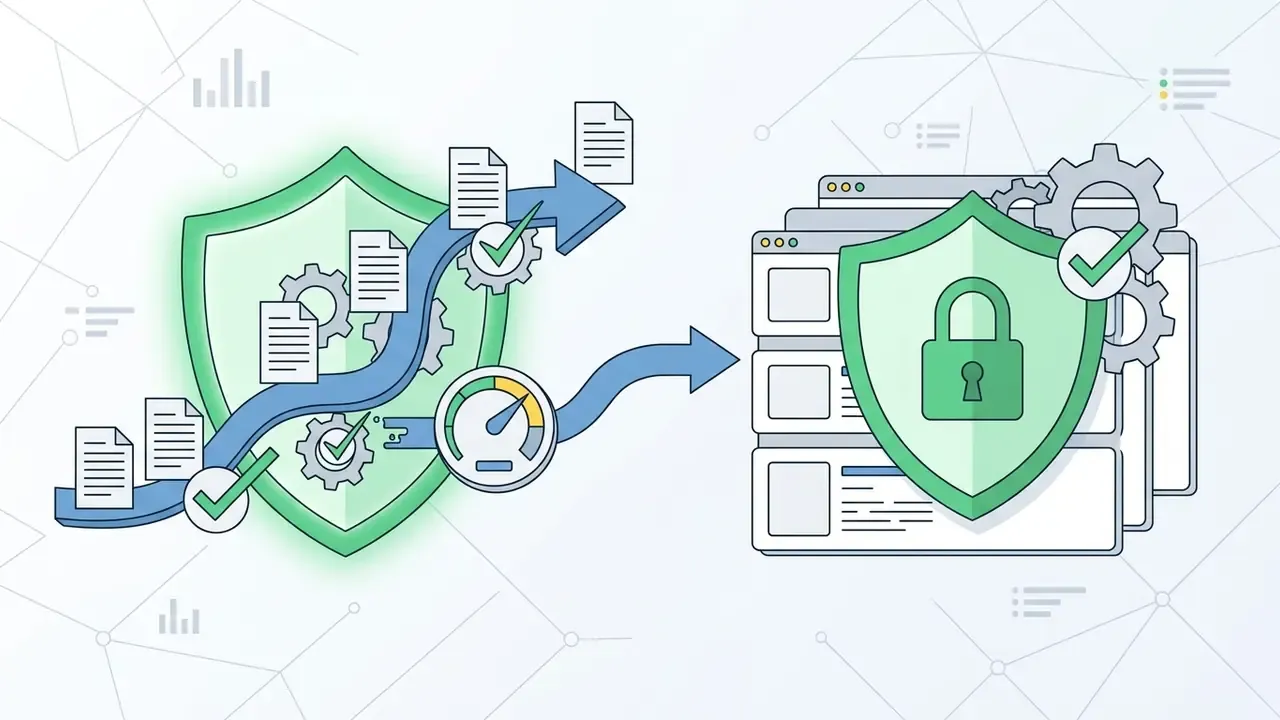
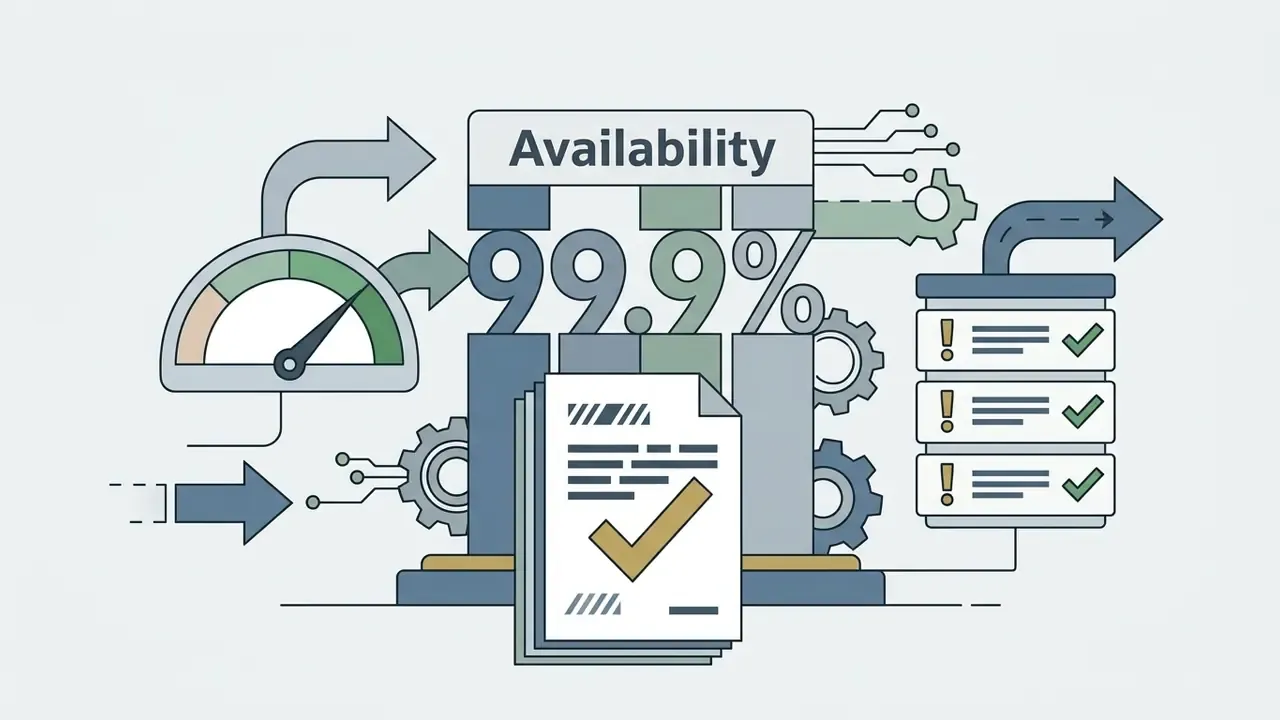
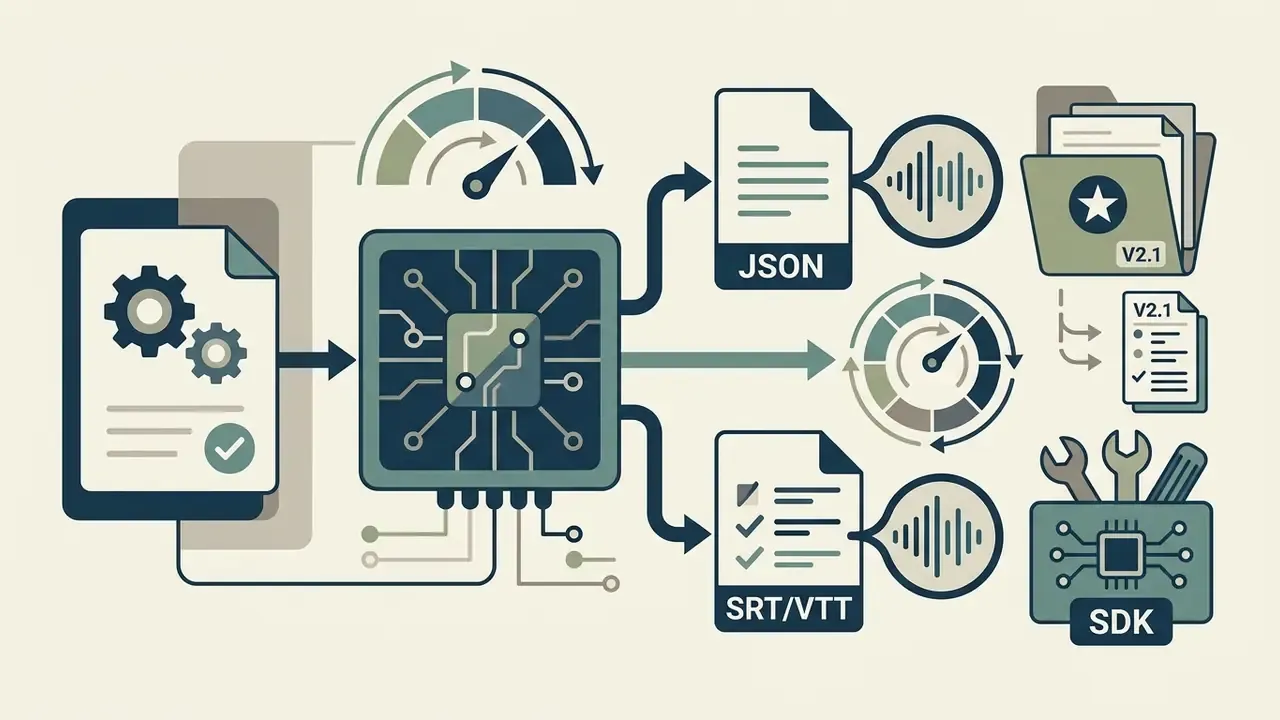
Enterprise-grade security guarantees to require in writing:
Commercial Use of AI Voices: What to Check Before Publishing
- Explicit commercial rights: confirm that your plan explicitly grants commercial rights for generated speech. Personal licences do not cover broadcasting, corporate marketing, telephony prompts, or monetized YouTube channels. Several platforms require a separate written agreement for business, enterprise, or API use.
- Voice rights and consent: unauthorized cloning of identifiable individuals is unlawful under state publicity laws and international personality-rights frameworks (U.S. Copyright Office, Copyright and Artificial Intelligence, Part 1: Digital Replicas, https://www.copyright.gov/ai/).
«Tennessee's ELVIS Act expressly prohibits unauthorized AI voice cloning and creates civil liability; China's 2020 Civil Code recognizes voice as an element of personality.» — Vocal Identity Under Siege by AI Voice Cloning (2024)
Because naive detectors can be fooled, publication controls should not rely on downstream detection. Mark the audio at generation time, log the manifest, retain the render metadata. Then the burden of proof sits with your evidence trail rather than with a third-party classifier.
For analysis of proceedings involving generative audio and intellectual property, see our coverage of AI litigation and compliance standards.
Pre-Publication Checklist: Model Risk Assessment for AI Voice Projects
Checklist0 / 12
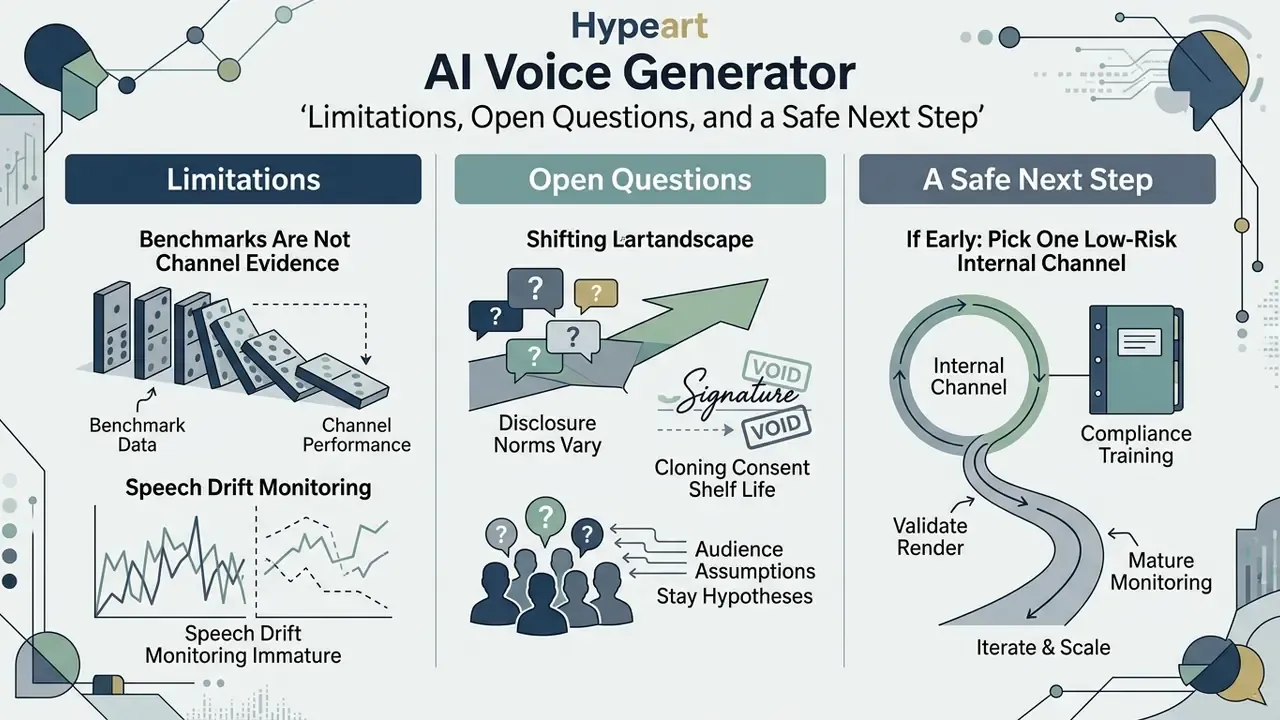
Limitations, Open Questions, and a Safe Next Step
Some of this is still unsettled, and pretending otherwise would be unhelpful.
- Benchmarks are not channel evidence. A high TTSDS2 or MOS score says little about how a model reads a 12-digit account number in a noisy telephony codec. Build your own golden set from real scripts.
- Drift monitoring for speech is immature. Most institutions have no agreed threshold for "prosody moved too far after a vendor upgrade." A reasonable interim control is to freeze the model version and re-validate before any promotion.
- Disclosure norms vary. Requirements differ by channel and jurisdiction, and guidance keeps moving through 2026. Document the rule you applied and the date you applied it.
- Cloning consent has a shelf life. Consent given in 2024 for one campaign may not cover a 2026 voice agent. Add renewal dates to the voice registry.
- Audience assumptions stay hypotheses. Every claim here about buyer priorities should be tested against your own interviews, analytics, and CRM data before it drives a budget.
A safe next step, if you are early: pick one low-risk internal channel, such as compliance training narration, run the full governed pipeline end to end, and measure what the controls actually cost. One channel, full evidence trail. That number, not a vendor deck, is what makes the second use case approvable.
Frequently Asked Questions (FAQ) About AI Voice Generators
Do I Need Special Software or Hardware to Generate a Voice?
No. Modern AI audio generator online platforms run entirely in standard browsers such as Chrome, Safari, or Edge, and perform neural rendering on cloud GPU clusters. Vendor documentation for browser-based tools states it plainly: no downloads, no local installation, desktop, tablet, or mobile.
For deeper integrations and automated pipelines, developers can consult our AI Media API Guides for direct cloud endpoints, and compare cost structures in our Google Veo implementation guide.
Are Text and Generated Audio Stored After Creation?
Retention varies by platform and account type. Most web services keep temporary session state for preview and store project files in user libraries for 24 hours to 30 days. Documented examples span the full range: some services delete uploaded text immediately after conversion while keeping registered-user library files up to a year and unregistered uploads for 24 hours; API session state may persist up to 24 hours; grounded-search prompts and outputs can be retained for 30 days.
Enterprise platforms aligned with SOC 2 Type II or GDPR let users delete uploaded scripts and generated audio on session termination and offer contractual zero data retention. Always verify retention terms before handling confidential corporate information. And never paste live customer data into a consumer-tier tool.
Can One Tool Handle Multiple Languages?
Yes. Advanced neural engines support multilingual synthesis inside a single interface. Commercial platforms typically document 16 to 150+ languages and regional accents, while research models report far broader coverage.
«MINT-Bench evaluates TTS instruction following across 10 languages: Chinese, English, German, Italian, Portuguese, Spanish, Japanese, Korean, French, and Russian.» — MINT-Bench, arXiv preprint (2026)
Cross-lingual cloning keeps a consistent character voice across markets. Still, confirm the exact source-to-target locale pair in vendor documentation before you commit a localization budget.
To evaluate tools offering multi-format translation and media generation, compare functional matrices in our AI Media Comparison Matrices overview and our ranking of the best AI video generators.
Why Do I Get a "Something Went Wrong" Error or a Failed Generation?
Usually a browser extension. Page auto-translation plugins and aggressive ad blockers rewrite the editor's DOM and break the generation request. Fixes, in order:
- Disable the translation plugin for the site and reload the page.
- Clear the browser cache, or run the generation in a private window with extensions off.
- Confirm your text is within the session character limit, commonly up to 3,000 characters for unauthenticated users.
- If a PDF returns empty text, it is probably image-only or scanned. Run OCR or upload a text-layer version.
- For API failures, check whether the prompt exceeds the model's maximum length and whether your quota for the period is exhausted.
For persistent issues, see AI Media Support and Troubleshooting.
How Long Must a Voice Sample Be for Cloning?
Commercial cloning workflows generally require at least 30 seconds of clean, single-speaker audio, and several minutes produce noticeably better timbre and prosody transfer. Some hybrid research architectures synthesize from three seconds of reference audio at reduced similarity. Whatever the length, you need documented consent from the voice owner and a contract clause covering AI synthesis rights.
How Many Pauses Should I Insert per Script?
Keep manual pauses to roughly 20 per conversion, or per 1,000 characters. Beyond that the delivery sounds staged, and stacked pauses interfere with the model's own prosodic planning. Prefer punctuation for natural phrasing, and reserve explicit pause markers for hard breaks: chapter transitions, list items, and legally required emphasis.
Footer / Site Navigation
- Explore terms and technical definitions in our AI Media Glossary.
- Calculate project resource requirements using AI Media Calculators.
- View subscription options on our pricing page.
- Get technical assistance at AI Media Support and Troubleshooting.
- Compare software solutions via AI Media Comparison Matrices.
- Access integration documentation in AI Media API Guides.
- Review legal standards for commercial use.
- Track legal developments in AI litigation and regulatory updates.