Why should a risk or compliance leader care about something as mundane as letters? Because outgoing correspondence is where model output meets a customer, a vendor, or a regulator. An adverse action notice, a fee-change letter, or a complaint response is a controlled artifact, not a convenience feature. If the draft came from a model, someone has to own it.
Last updated: 2026. Reviewed against primary vendor documentation, peer-reviewed research, and regulator guidance current at the time of publication.
What This Guide Answers First
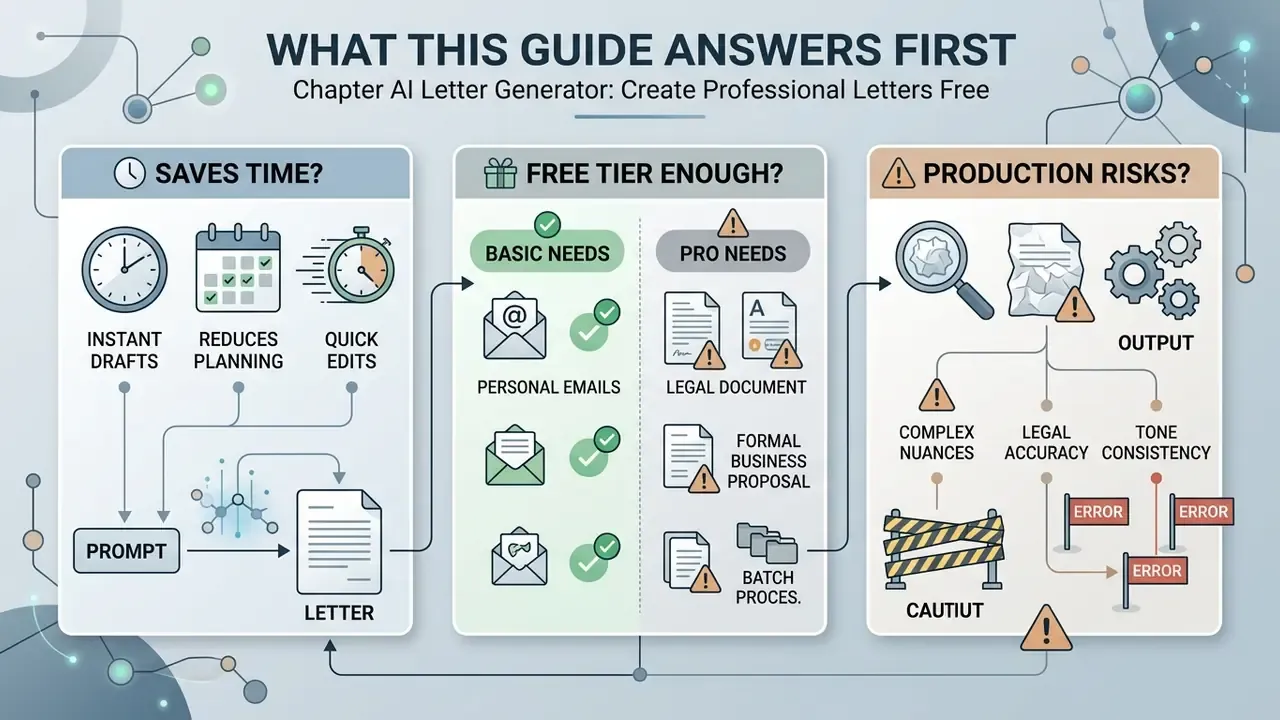
Three practical questions drive most searches for a letter generator, so here are the short answers before the detail.
- Does it actually save time? Yes, measurably. A randomized MIT experiment recorded roughly 40% faster completion on professional writing tasks, with quality rated about 18% higher.
- Is the free tier enough? For occasional personal or internal letters, usually. For regulated, customer-facing correspondence, no: you need retention controls, non-training terms, and exportable logs.
- What breaks in production? Unverified facts and missing accountability. Not grammar. The failure mode is a confident draft with the wrong statutory citation or the wrong dollar figure.
Keep those three in mind. Everything below expands on them.
What Is an AI Letter Generator?
An AI letter generator is a specialized writing assistant that creates formal, business, complaint, and personal letters based on user instructions. It operates by structuring unstructured prompts into standardized document formats, complete with formal salutations, organized body paragraphs, and appropriate closing statements.
Generic AI writers produce unstructured prose across arbitrary domains. In contrast, a dedicated ai letter writer constrains model outputs to recognized correspondence conventions. The primary objective of a letter generator is to eliminate blank-page paralysis, reduce drafting time, and ensure appropriate register and syntax across various communication scenarios.
A quick disambiguation, because the search results blur two very different tools. People typing ai alphabet generator or ai alphabet generator free are usually looking for decorative typography, monogram art, or letter-shaped image assets. That is a graphics task. An ai generator letter or ai letter maker, by contrast, produces written correspondence: text, structure, tone, sign-off. Same word, different product category.
«ChatGPT was the predominant GenAI tool in writing classrooms and was used to produce human-like text and suggestions.»
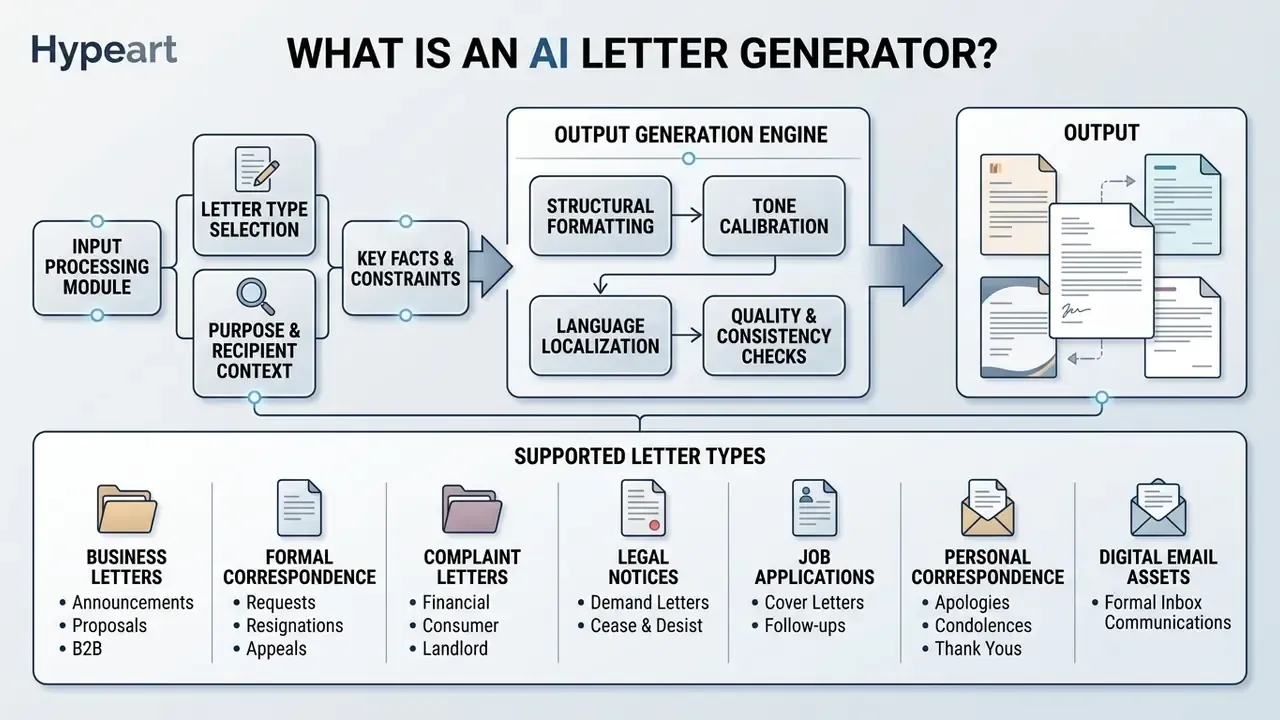
How AI Generates a Letter From Your Details
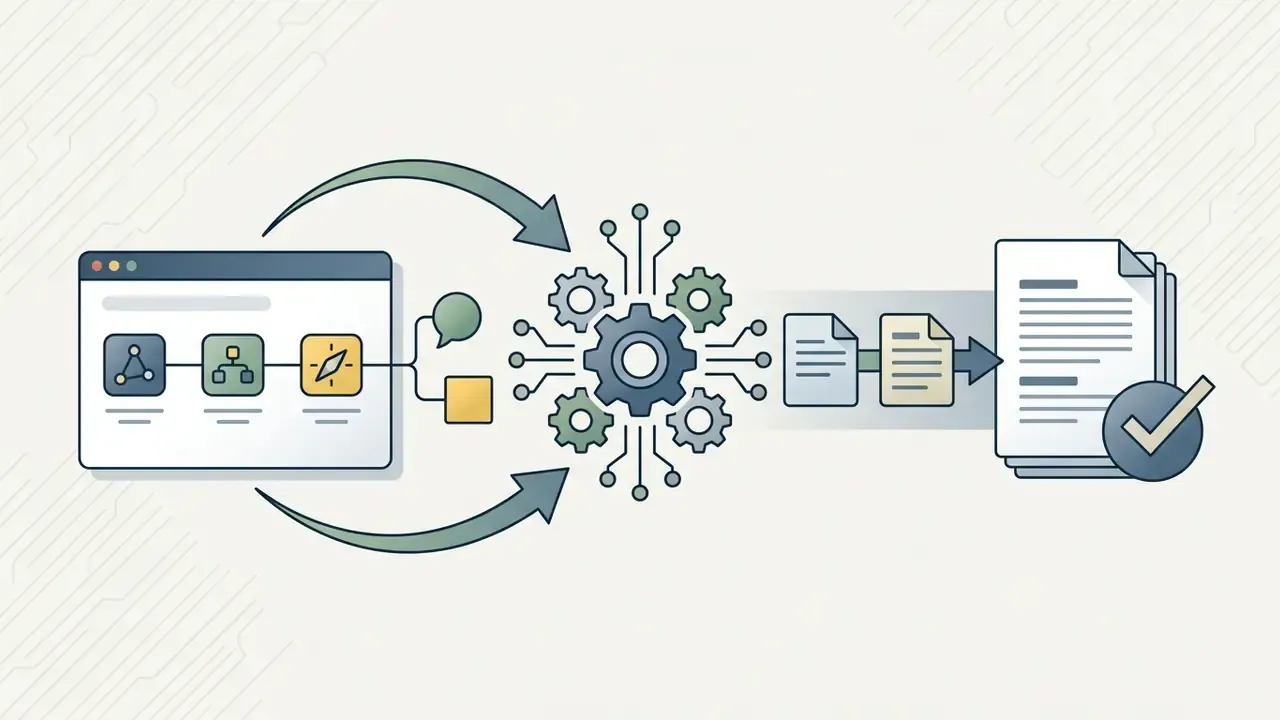
An ai generator letter creates text by processing structured parameters, such as the sender, recipient, objective, and core facts, through a conditional text-generation pipeline. In plain terms: you supply the facts, the system supplies the format. The underlying model analyzes the relationship between the inputs and applies learned patterns of professional correspondence to generate a draft in seconds.
According to technical documentation from the IBM watsonx Orchestrate ADK (2026) and enterprise automation frameworks from EY (2026), generative document workflows execute in three distinct phases:
- Instruction IngestionThe system captures user parameters, including the recipient's role, the communication goal, and specific operational facts.
- Contextual AssemblyThe system compiles these variables into an internal structured prompt containing schema constraints, formatting rules, and stylistic boundaries (Harvard University Information Technology, 2026).
- Draft SynthesisThe language model generates the corresponding text, outputting a complete letter structured into standard opening, body, and closing sections.
This multi-stage transformation enables an ai letter creator to generate context-specific drafts rapidly, replacing manual composition with an input-driven workflow.
«Access to ChatGPT decreased task completion time by roughly 40%, and independent evaluators rated output quality about 18% higher.»
The methodological detail matters here. The productivity gain was measured on realistic professional writing tasks (memos, press releases, short reports), and the largest quality improvements accrued to writers whose unassisted baseline was weakest. Which is exactly why an AI letter generator works best as a first-draft engine rather than a final-authority system. It levels the floor, not the ceiling.
Letters You Can Create With an AI Letter Writer
An ai generator for letters supports diverse communication scenarios across corporate, legal, academic, and personal domains. Specialized tools refine their underlying prompt templates based on the selected document category (DocuGov.ai, 2026; Junia AI, 2026).
Common categories supported by an ai letter maker include:
- Formal Letters Official administrative requests, institutional appeals, regulatory notices, and legal demand letters.
- Business Correspondence B2B project proposals, client policy updates, partnership inquiries, and executive announcements.
- Employment Documents Tailored cover letters, formal resignation notices, and professional letters of recommendation (Grammarly, 2026).
«AI improves the surface quality of cover letters: it reduces spelling errors and increases the formality of openings and closings.»
Specialized High-Intent Letter Templates
Beyond broad categories, most mature generators expose narrow, high-stakes templates. These carry the strictest accuracy requirements, because they may be read by an adjudicator, a regulator, or a court.
| Specialized Letter Category | Operational Purpose | Typical Contents |
|---|---|---|
| Legal Dispute & Demand Letters | Enforce contractual obligations or request financial settlement before litigation. | Demand letter, dispute notice, breach-of-contract statement, payment deadline, consequences clause. |
| Cease & Desist Notices | Formally require an individual or entity to stop infringing or unlawful activity. | Cease and desist wording, copyright or trademark infringement description, harassment notice, compliance deadline. |
| Character & Professional References | Provide third-party validation of an individual's professional or personal integrity. | Character reference, letter of recommendation, candidate vouching statement, relationship duration, concrete examples. |
| Resignation & Exit Notices | Notify an employer of departure while preserving professional rapport. | Resignation letter, two-week notice, final working day, handover offer, employment termination reference. |
| Personal Condolence & Apologies | Express formal sympathy or accept personal responsibility in sensitive situations. | Condolence letter, formal apology, sympathy note, acknowledgement of impact, offer of support. |
| Consumer & Tenancy Complaints | Escalate service failures to firms, landlords, insurers, or utilities. | Account or tenancy number, chronology, documented loss, requested remedy, response deadline. |
| Corporate Client Notices | Communicate contractual, pricing, or policy changes to customers and vendors. | Effective date, affected terms, regulatory basis, contact channel for objections. |
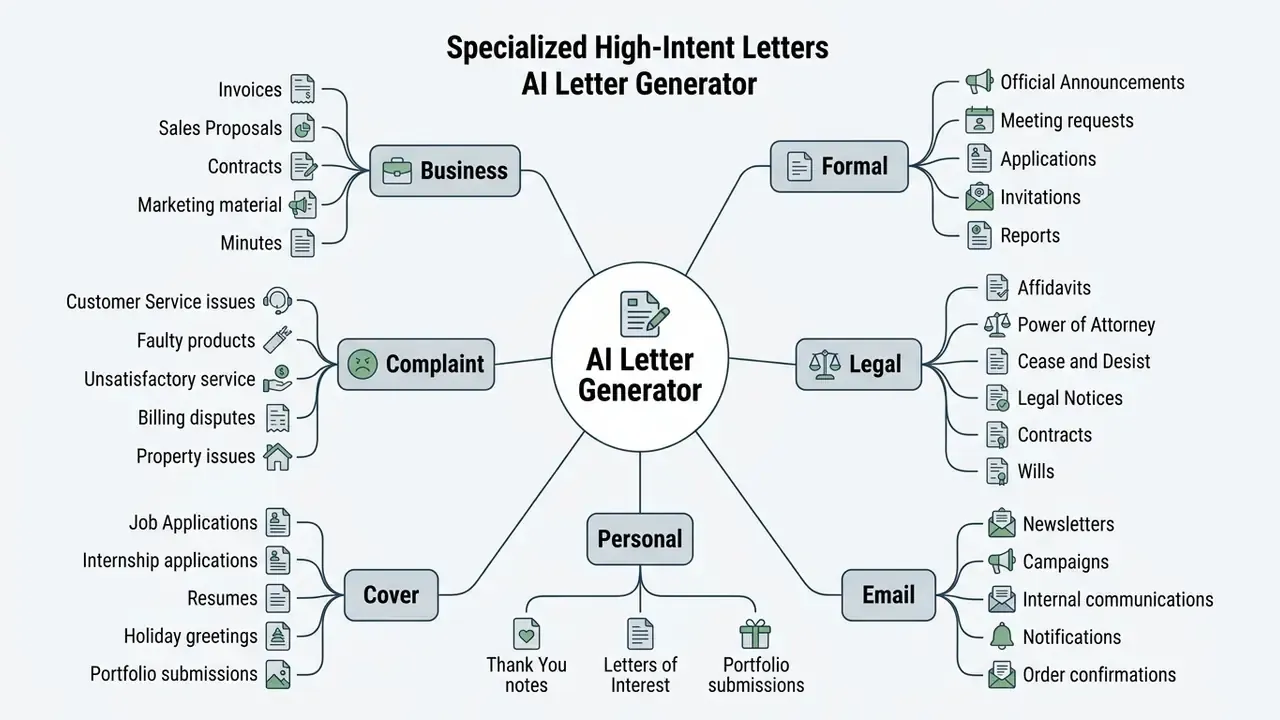
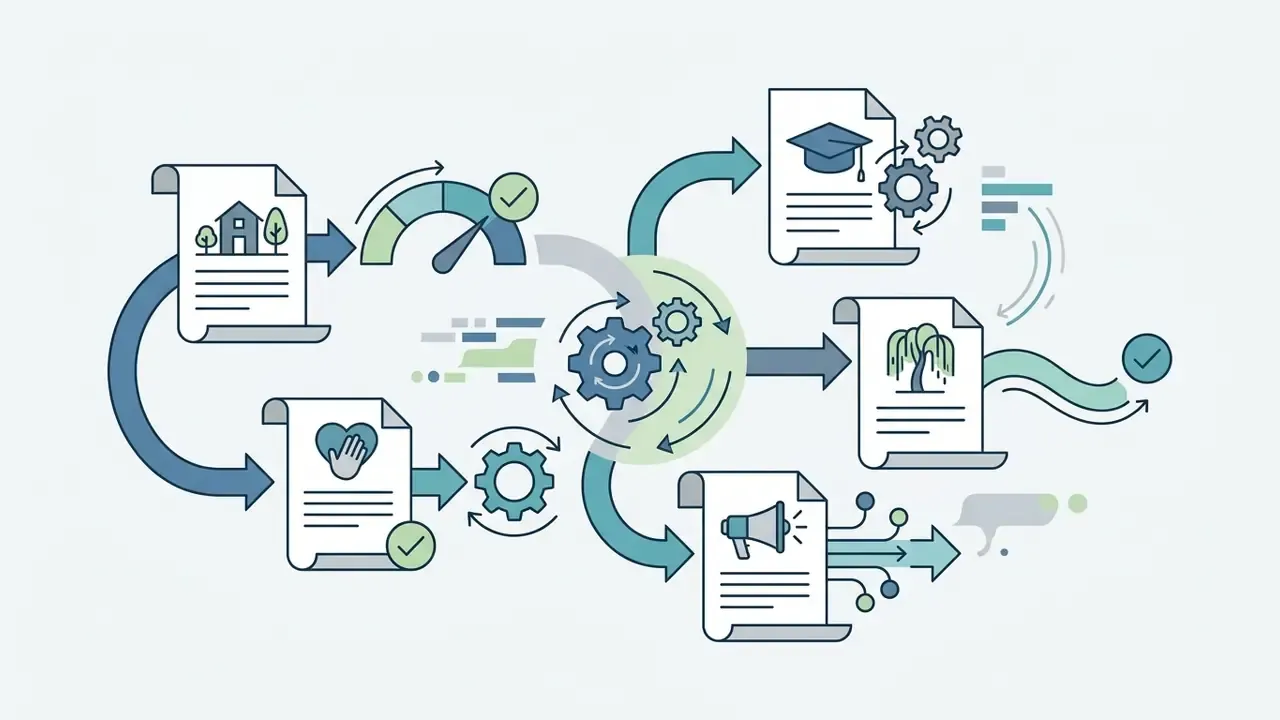
Map Overview: Node "AI Letter Generator" branches into Business (external/internal announcements), Formal (appeals, administrative requests), Complaint (consumer, landlord, banking disputes), Legal (demand letters, cease and desist), Cover (job applications, career moves), Personal (private notes, condolences, community letters), and Email (electronic formal correspondence).
How to Create a Letter With AI
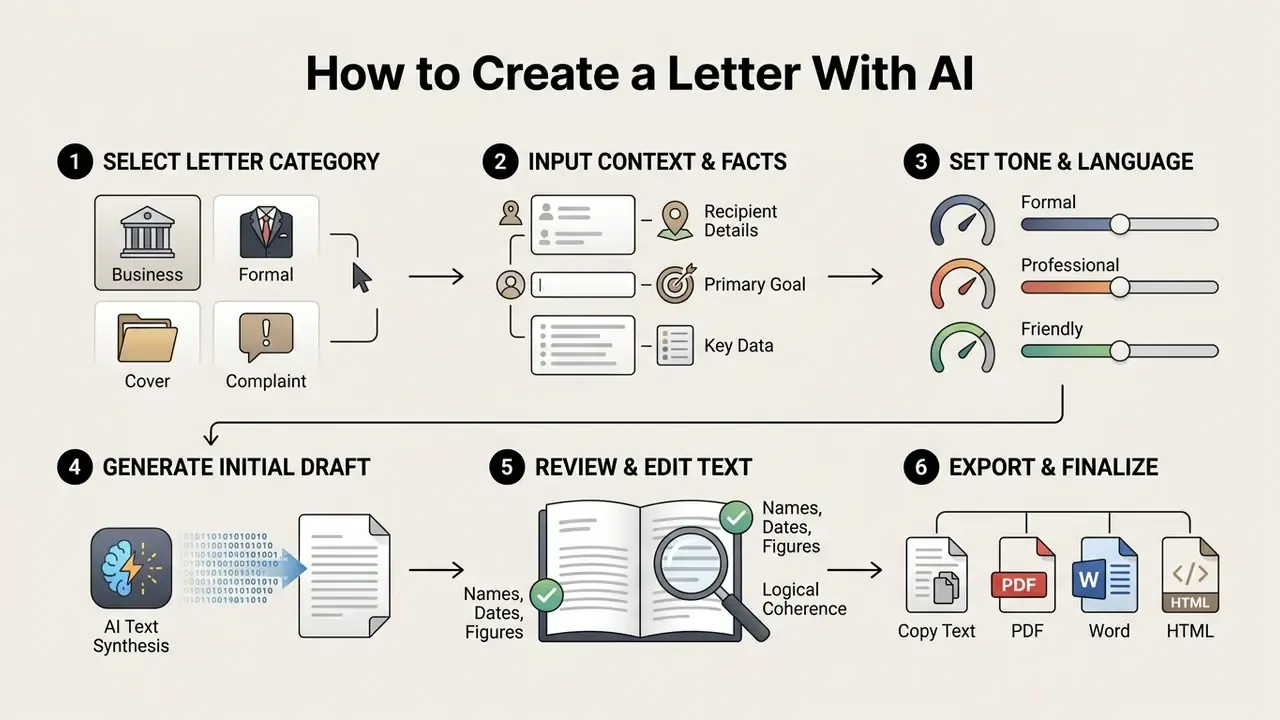
Creating a letter with an ai letter writer generator requires selecting the target category, entering accurate situational context, generating the initial draft, and editing the text for accuracy before final export. This human-in-the-loop workflow maintains user oversight while benefiting from automated text synthesis.
Add the Purpose, Recipient, Tone and Key Details
The structural quality of an AI-generated draft depends directly on the specificity of the initial input parameters. Omit the context and the model falls back on generic boilerplate, which quietly drains the letter's persuasive value.
To ai create a letter effectively, users must provide five core input fields (Australian Government Style Manual, 2026; Vanderbilt University Email Guide, 2026):
When users input these variables into an ai create letter tool, the system aligns the output with established organizational expectations.
- Primary Objective
- A concise statement explaining why the letter is being written (for example, requesting a billing correction or submitting a job application).
- Recipient Information
- The target individual's job title, organizational role, or department.
- Key Situational Details
- Specific dates, transaction numbers, project names, or reference codes necessary for context.
- Tone Selection
- The desired register, ranging from strictly formal and neutral to direct or warm.
- Target Language
- The required output language, such as English, Spanish, or German.
5-Step Generator Input Framework
To ensure maximum draft precision, complete the generator interface fields in this order:
- Field 1, Letter Type SelectionSelect the structural category (Demand Letter, Cover Letter, Complaint, Resignation) so the tool applies the correct margin, header, and salutation schema.
- Field 2, Sender & Recipient InformationEnter full names, formal job titles, and organization names to auto-populate the document block header.
- Field 3, Core Objective & FactsInput chronological events, monetary sums, reference numbers, and dates as plain bullet points. Bullets outperform prose here.
- Field 4, Tone & Style RegisterChoose Formal (legal or corporate), Assertive (complaints and escalations), Direct (business operations), or Warm (personal and community letters).
- Field 5, Output Language & LocalizationSelect the target language (English, Spanish, German, French) so the system applies native regional syntax, date formats, and courtesy conventions.
Real-World AI Generation Examples
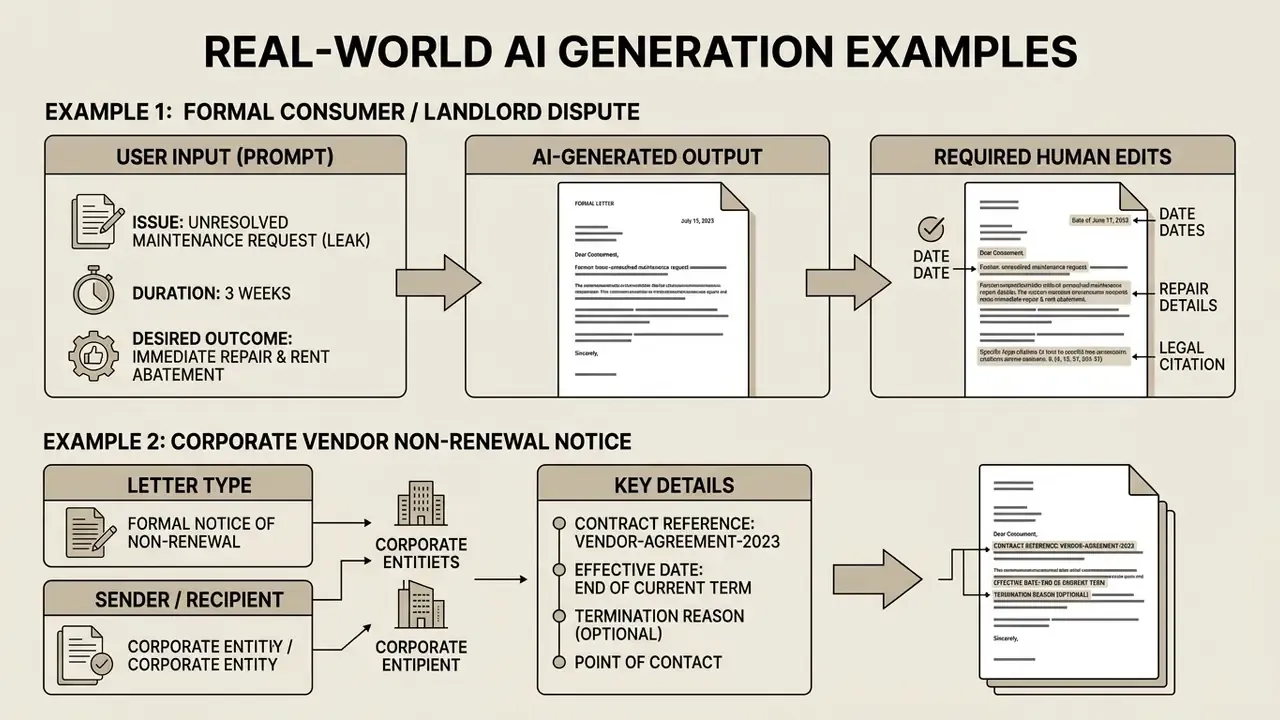
The fastest way to judge output quality is to compare a structured input against the resulting draft. The three examples below show typical generation behaviour across a legal-adjacent complaint, a corporate notice, and a personal letter.
Example 1: Formal Consumer / Landlord Dispute
User Input (Prompt):
- Letter Type: Consumer Complaint / Landlord Dispute
- Sender / Recipient: Tenant (John Doe) to Property Manager (Apex Living)
- Key Details: Apartment 4B; unaddressed heating failure since October 12; $150 temporary heater expense incurred; receipts available.
- Desired Tone: Formal, direct, legally compliant.
AI-Generated Output:
Required human edits before sending: confirm the exact statutory citation for your jurisdiction, verify the receipt total, and attach the documents referenced.
Example 2: Corporate Vendor Non-Renewal Notice
User Input (Prompt):
- Letter Type Business / Contract Non-Renewal
- Sender / Recipient Procurement Manager (Northline Logistics) to Account Director (Corvus Freight)
- Key Details Master services agreement MSA-2291; term expires March 31; two consecutive quarters of on-time delivery below the 95% SLA threshold; transition period of 60 days requested.
- Desired Tone Formal, neutral, non-adversarial.
AI-Generated Output:
Required human edits before sending: verify the schedule reference, the contractual notice period, and the delivery statistics against internal reporting.
Example 3: Personal Thank-You / Condolence Letter
User Input (Prompt):
- Letter Type Personal thank-you with condolence element
- Sender / Recipient Individual to a former colleague
- Key Details Recipient covered the sender's shifts during a family bereavement in April; sender wants to acknowledge the support and offer reciprocal help.
- Desired Tone Warm, sincere, unhurried.
AI-Generated Output:
Required human edits before sending: replace generic phrasing with one specific shared memory. That is the element AI cannot supply.
AI Letter Generator for Different Letter Types
Different correspondence scenarios demand distinct structural conventions, registers, and detail levels. An ai letter writing generator adapts its output based on the operational requirements of the selected communication type.
| Letter Category | Primary Structural Focus | Required Input Details | Key Risk Area |
|---|---|---|---|
| Business Letter | Block format, clear value proposition, explicit call to action. | Recipient title, organizational context, proposal metrics. | Overly generic value claims or missing business context. |
| Formal Request | Polite salutation, precise statutory or administrative request. | Reference numbers, policy citations, clear deadline. | Inaccurate regulatory or institutional citations. |
| Demand / Cease & Desist | Statement of right, description of breach, remedy, deadline, reserved rights. | Contract or IP reference, evidence log, statutory basis. | Overstated legal threats; jurisdictional errors. |
| Cover Letter | Alignment between job criteria and candidate background. | Job description, candidate history, target company name. | Generic boilerplate phrasing lacking personalized evidence. |
| Consumer Complaint | Chronological timeline, documented impact, requested remedy. | Account numbers, transaction dates, requested resolution. | Unverified financial amounts or missing account identifiers. |
| Personal / Condolence | Sincerity, brevity, absence of formulaic phrasing. | Relationship context, one concrete shared detail. | AI boilerplate that reads as insincere. |
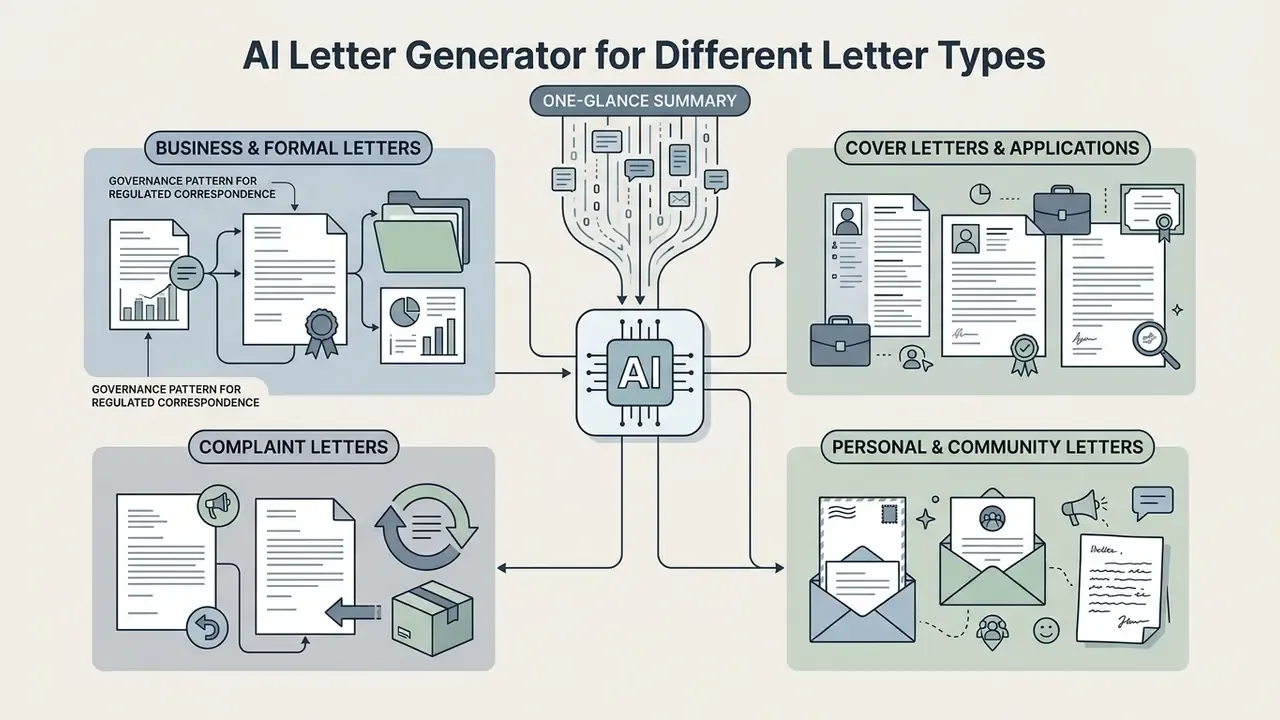
Business and Formal Letters
An ai business letter generator creates structured corporate correspondence, including partnership proposals, client notifications, and vendor communications. Formal business letters follow standard block formatting, single spacing, and left-aligned margins (Boise State University Professional Email Guide, 2026).
When using an ai formal letter generator, the user provides explicit context regarding the relationship between the parties and the desired business outcome. Empirical research published in the International Journal of Business Communication (SAGE, 2025) reveals an uncomfortable nuance for business settings: AI assistance improves grammatical correctness and surface-level professionalism, yet heavy reliance without personalization can reduce recipient trust.
«At medium and high levels of AI assistance, recipients increasingly questioned message authorship, which lowered perceived sincerity and sender confidence.»
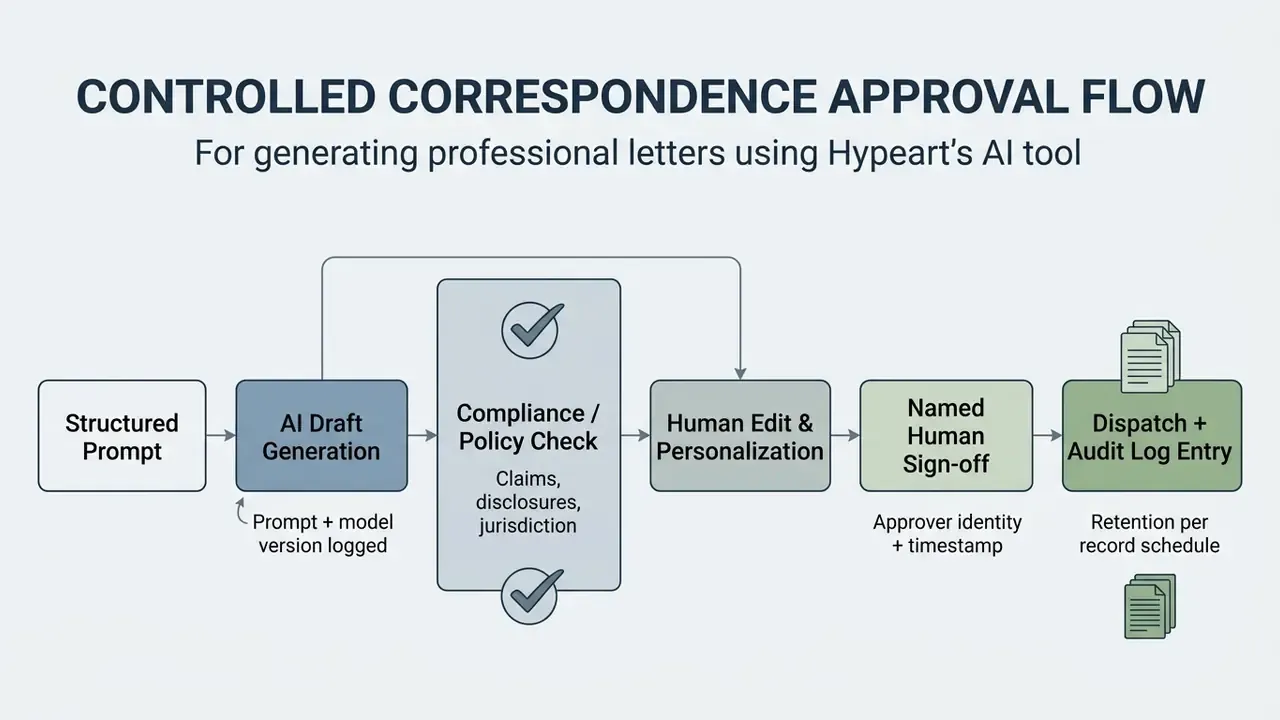
Senders must therefore ensure the generated draft includes specific operational facts, plus at least one sentence that only the sender could have written. In regulated industries this is also a governance requirement: correspondence that commits the organization to a remedy, a price, or a compliance position should carry a named human approver. No evidence, no autonomy.
Governance pattern for regulated correspondence. Financial institutions and other supervised entities typically treat generative drafting as a controlled process rather than a desktop convenience. In practice this means recording the prompt, the model version, the reviewer, and the approval timestamp for each outgoing letter, and routing consumer-facing notices (adverse action letters, fee-change notices, complaint responses) through the same review path used for templated correspondence. Where an institution operates a model risk management programme, generative drafting tools are commonly inventoried and documented in line with existing internal model governance standards, with the human approver retaining full accountability for the content. Worth stating plainly: a drafting assistant with no owner in the inventory is shadow AI, whatever the vendor calls it.
Cover Letters and Application Letters
Cover letters require aligning an applicant's professional background with specific job posting criteria. A specialized ai letter creator formats these documents into concise, one-page applications highlighting relevant experience (Purdue OWL, 2026).
A field study conducted by economists at Tilburg University (2024) evaluated the real-world impact of AI-generated cover letters during active recruitment processes. The study found that AI assistance significantly improved surface-level writing quality, reducing grammatical errors and improving formal introductory phrasing. It also found something less flattering: AI assistance alone did not increase interview callback rates unless the letter contained highly specific, human-authored evidence of personal motivation and candidate fit.
«Improvements concentrated in the less important, formulaic parts of the letter, while personal motivation and clarity of argument, the criteria recruiters value most, barely improved.»
Career development guidance from MIT CAPD (2024) recommends using an ai chat letter generator as a brainstorming partner to extract key requirements from job descriptions, while relying on human editing to inject authentic personal experiences. A practical division of labour: let the tool structure the paragraphs and mirror the posting's terminology, then rewrite the second and third paragraphs yourself with measurable outcomes from your own record. Numbers beat adjectives.
Complaint Letters, Personal and Community Letters
An ai complaint letter generator assists consumers, tenants, and clients in drafting formal dispute notices to financial institutions, utility providers, landlords, and regulatory agencies. Effective complaint letters require a clear chronological factual narrative, specific account identifiers, and an explicit statement of requested relief (FTC Guidance, 2026; ACCC Guidance, 2026).
A comprehensive study analyzing consumer complaints submitted to the U.S. Consumer Financial Protection Bureau demonstrated that LLM-assisted complaint narratives were significantly clearer and more structured than unassisted submissions.
Crucially, the research found that clearer, AI-assisted complaint narratives correlated with a higher likelihood of consumers obtaining monetary or administrative relief from financial firms.
The mechanism is structural rather than rhetorical. LLM-assisted narratives more consistently include the date sequence, the account identifier, the documented loss, and an explicit requested remedy: the four fields an adjudicator needs in order to act. For a bank complaints function, that has a second implication. Inbound volume is becoming better organized, which raises the bar on response quality and turnaround.
When drafting community or personal correspondence, such as formal inquiries to school boards, municipal petitions, or landlord maintenance requests, an ai letter generator online free tool lets users adjust tone settings so the message stays firm yet diplomatic.
The material in this section is general information and does not constitute legal advice. Consumer, tenancy, and contractual rights differ by jurisdiction; consult a qualified professional before sending a demand or dispute letter.
Professional Letter Structure, Tone and Language
Maintaining proper document structure, appropriate stylistic register, and correct localization is essential for professional correspondence. An ai formal writing generator automates structural alignment while allowing users to calibrate stylistic parameters.
Opening, Purpose, Body and Closing
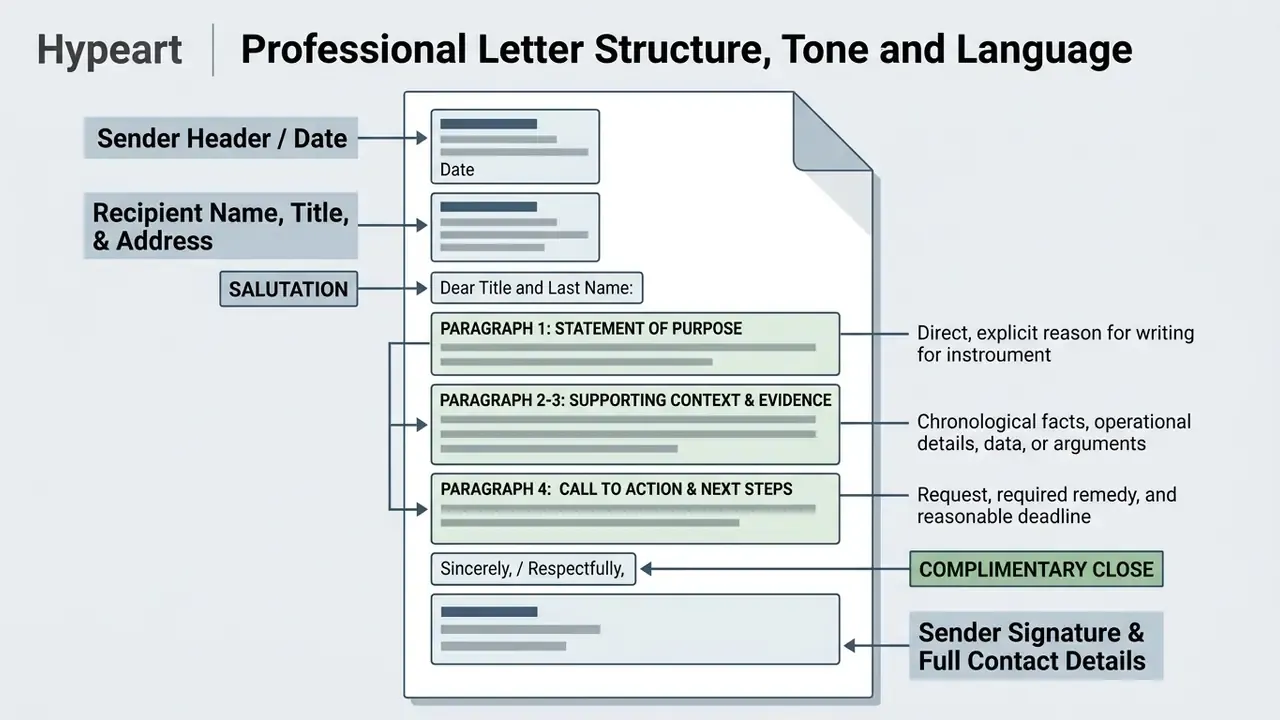
Formal corporate and administrative letters follow a standardized four-part block architecture (Thompson Rivers University Formal Business Email Guide, 2026; University of Arkansas Email Guide, 2026):
- SalutationA formal opening address, for example "Dear Mr. Davis:" or "Dear Hiring Committee:". In formal business letters, the salutation typically concludes with a colon rather than a comma.
- Statement of PurposeThe opening paragraph states the explicit reason for the letter immediately, avoiding conversational preamble.
- Body ParagraphsOne to three paragraphs containing factual background, chronological context, supporting data, or justification.
- Call to Action & ClosingThe final paragraph defines specific next steps, sets a clear response timeline, and concludes with a formal closing phrase such as "Sincerely," or "Respectfully,".
An ai generator for letter workflow keeps these structural elements correctly ordered, eliminating common formatting errors: missing subject lines, inconsistent date formats, or a call to action buried halfway through the body. Small failures, real cost. A notice whose deadline is invisible tends to get ignored.
Choose a Formal, Professional or Friendly Tone
Tone customization allows users to adapt the emotional valence and formality of a letter to match the organizational context. Modern text generation systems adjust vocabulary, syntactic density, and sentence length based on selected tone profiles.
In a randomized crossover field experiment analyzing over 16,000 workplace messages, researchers evaluated the behavioral impact of AI tone editing across corporate environments. The study confirmed that AI models consistently shift emotional tone, increasing positivity under friendly tone settings and reducing casual language under professional settings.
«Playful editing increased emotional positivity (B = +0.068) and professional editing decreased it (B = −0.041); within-sender language positivity predicted opening with OR = 2.05 and replying with OR = 3.32.»
Standard international style guides, such as the ISO House Style (2024), mandate an impersonal, objective register for technical and compliance documentation. Internal team notices or community inquiries, by contrast, benefit from a balanced, professional tone that stays approachable while asserting a clear objective.
For multilingual communication, advanced generators support cross-lingual translation and localization across English, Spanish, German, and other languages (ISO/IEC 23836:2020). Users writing in a second language gain the most from automated syntax polishing, which helps align foreign-language drafts with native business conventions.
«Generative AI reduced average writing time by 65% and raised average grades from B+ to A; ESL students showed slightly larger gains.»
How to Get Better Results From an AI Letter Writer
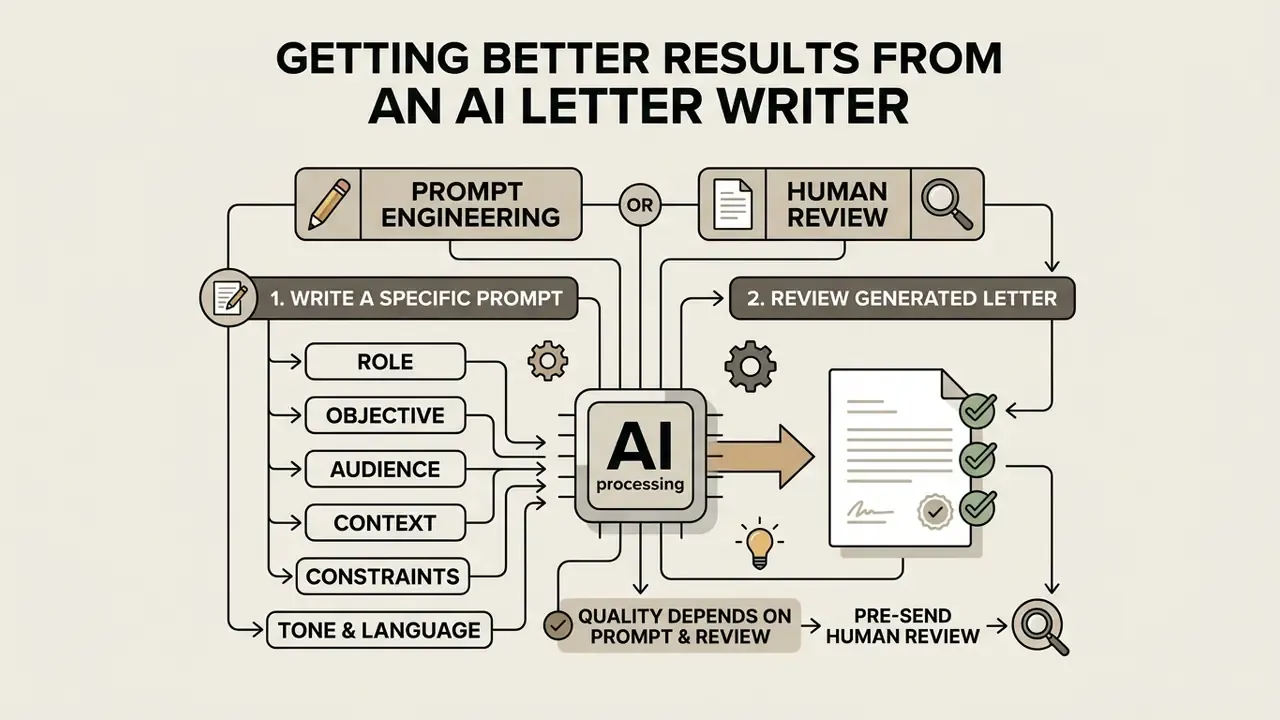
The quality of an AI-generated letter depends on prompt engineering quality and pre-send human review. Provide incomplete context and you get generic, repetitive drafts that fail to achieve their intended objective.
Write a Specific Prompt With Complete Details
To maximize draft quality on the first attempt, prompts must include explicit situational constraints rather than a bare topic description. The National Institute of Standards and Technology (NIST AI Quick-Start Guide, 2026) emphasizes that effective generative prompts define six operational elements:
- Role The perspective the AI should adopt, for example "Act as a corporate compliance officer".
- Objective The exact task to execute, for example "Draft a formal contract non-renewal notice".
- Audience The specific recipient profile, for example "Addressing a third-party logistics vendor".
- Context All necessary background details, reference numbers, and factual milestones.
- Constraints Explicit length, formatting, or terminology restrictions.
- Tone & Language The required stylistic register and localized language.
Comparative testing of prompting strategies for automated correspondence indicates that example-based prompting (supplying a short model letter alongside the instruction) tends to outperform bare template prompting on argument accuracy, tone stability, and structural compliance. Because the specific 2026 trade-journal figure previously cited here could not be traced to a verifiable DOI, we present the finding as a directional pattern rather than a precise metric. A controlled internal A/B test on your own letter categories remains the reliable way to quantify the gain.
«Input prompts have a significant effect on LLM output quality; prompts should focus on topic and style keywords with context prepended.»
Review the Generated Letter Before Sending
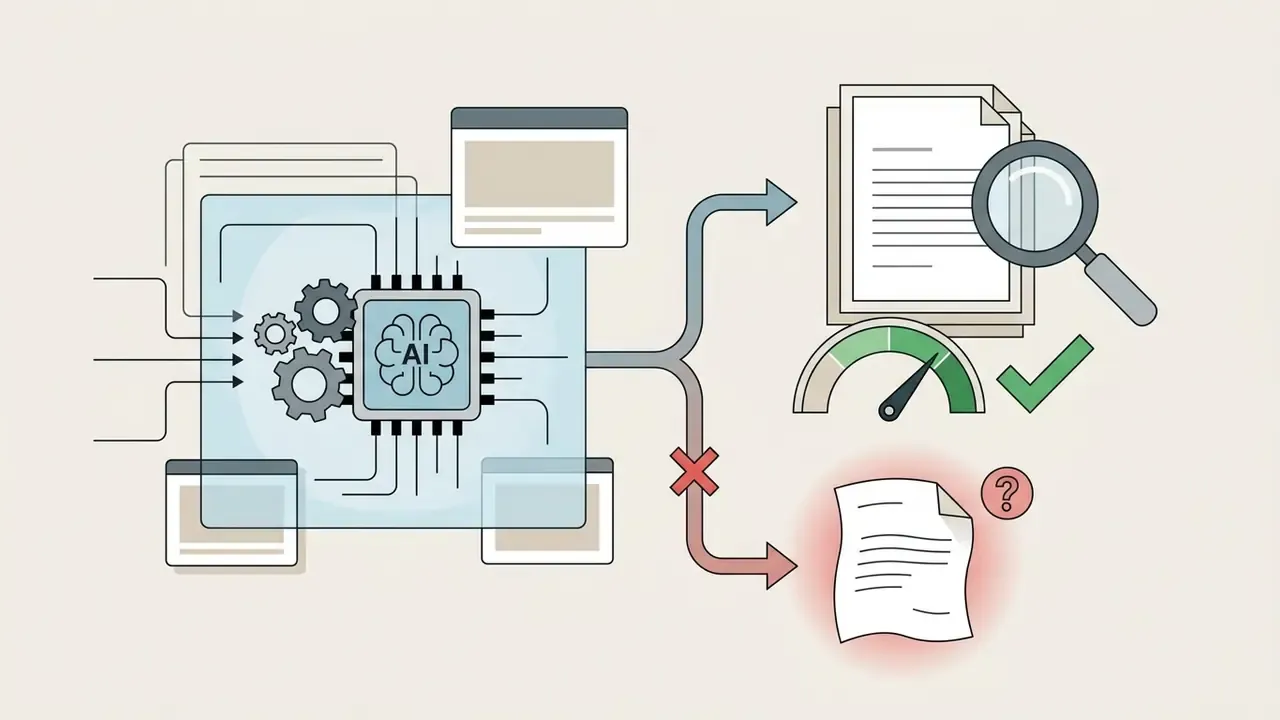
AI language models generate text based on probabilistic patterns and may occasionally introduce factual errors, incorrect dates, or unsupported claims. Pre-send human review is a mandatory governance step (Information Commissioner's Office, 2024; Hampton Generative AI Manual, 2026).
«Students reported problems with information accuracy and over-reliance on AI; instructors stressed the need to critically evaluate AI output and retain responsibility for the final text.»
Reviewing a draft produced by an ai letter writer means verifying every statement against primary source records before sending or publishing. Check names, titles, calculations, contractual references, and key deadlines. Yes, all of them.
Before transmitting or printing any AI-generated letter, execute a mandatory line-by-line verification:
- Recipient & Sender DataVerify spelling of names, official job titles, company names, and physical or email addresses.
- Dates & DeadlinesCross-check transaction dates, event timelines, and response deadlines against primary records.
- Financial & Numerical DataConfirm dollar amounts, account numbers, invoice references, and statistical figures.
- Legal & Contractual TermsEnsure cited policies, contract clauses, and statutory regulations are accurate for your jurisdiction.
- Tone & AuthenticityRead the draft aloud to confirm the phrasing sounds natural, professional, and free of generic AI boilerplate.
- Attachments & ReferencesConfirm every document mentioned in the text is actually attached and correctly named.
- Approval RecordFor organizational correspondence, log the reviewer's name, the approval time, and the final approved version.
Generate, Edit and Finalize the Text
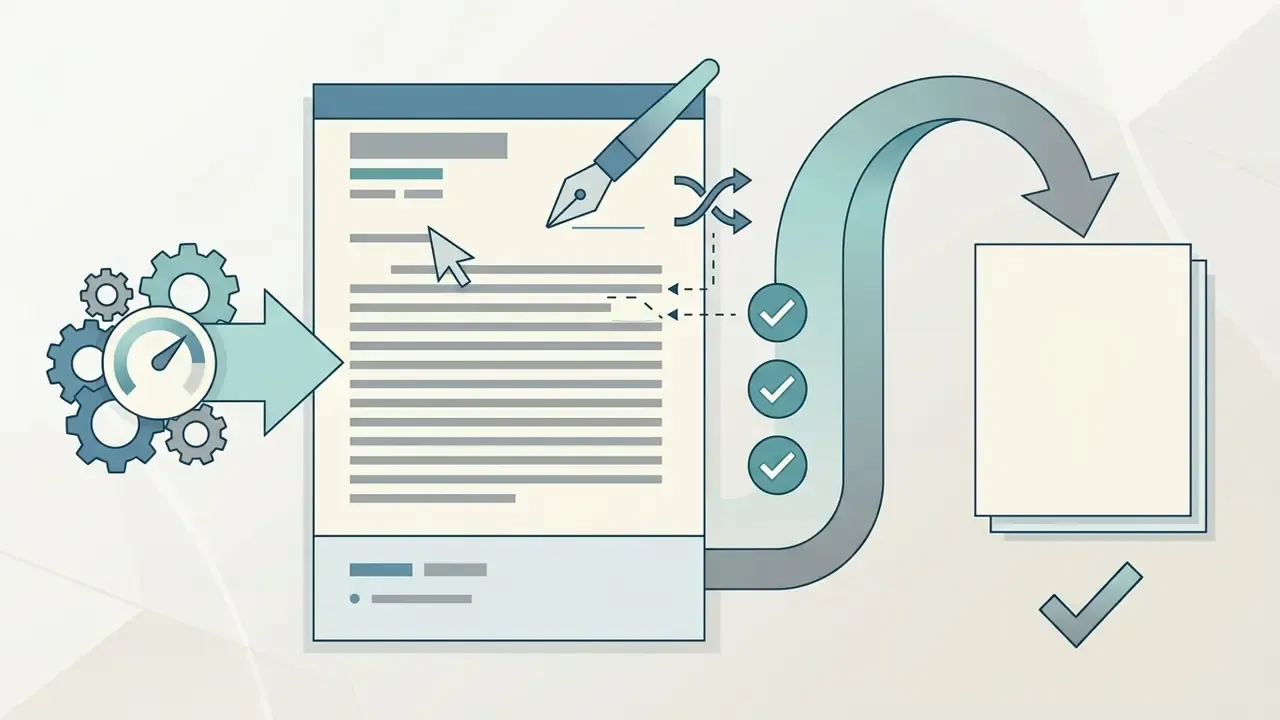
Once inputs are submitted, the ai generator for letter workflow synthesizes the text and presents it inside an interactive editor. Treat the generated output as an initial draft, never a finished product.
Operational guidelines from Microsoft (2026) and Google Workspace (2026) emphasize that AI document generation is a supportive drafting mechanism requiring human review. During the edit phase, adjust phrasing, verify factual assertions, and refine sentence structure. As the MIT randomized experiment cited earlier suggests, the speed and quality gains are realized only when a human refines the output: the model supplies the scaffold, the sender supplies the accountability.
Once review is complete, the final text can be copied into an email client or exported as a formatted file (PDF or DOCX) for distribution.
Commercial Use, Data and Safe AI Letter Generation
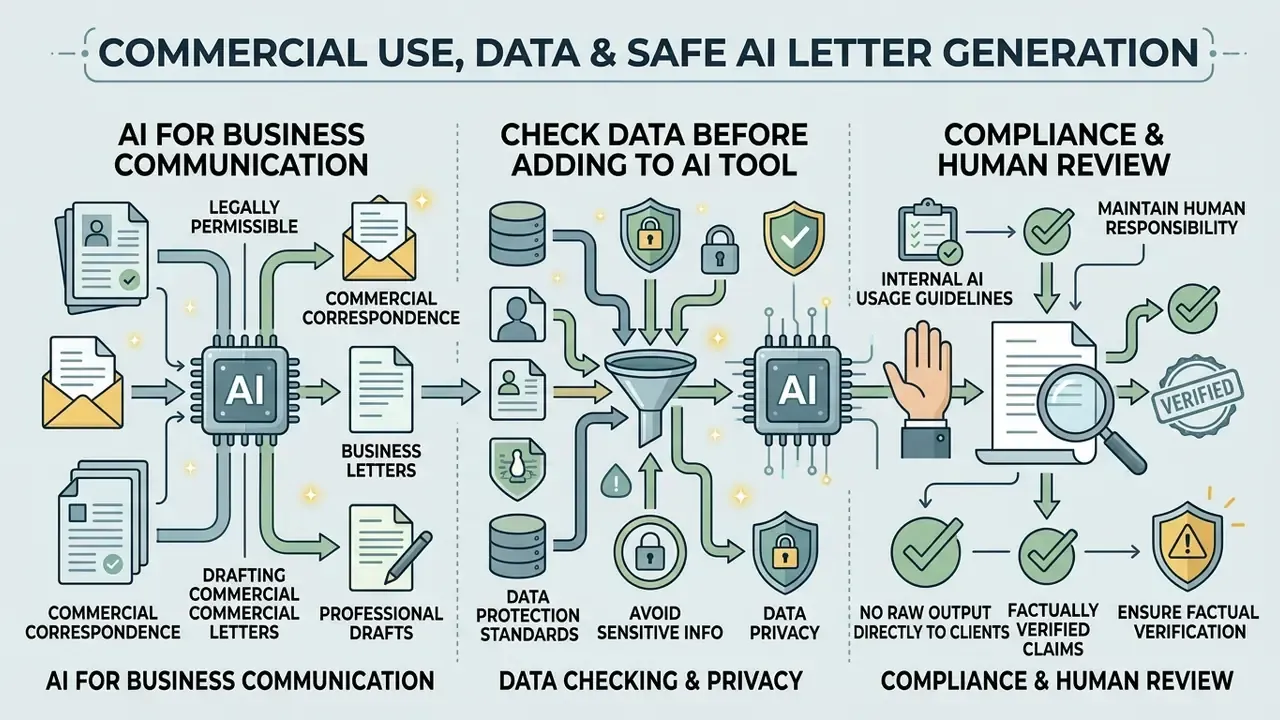
Deploying AI-generated letters in commercial and corporate environments requires adhering to data privacy standards, intellectual property rules, and organizational compliance policies.
Using AI-Generated Letters for Business Communication
Using an ai business letter generator to draft commercial communications is legally permissible across most jurisdictions, provided the final output is reviewed and approved by a human representative (Government of Canada Generative AI Guide, 2024).
«Messages with high levels of AI assistance were perceived as less sincere and less caring, even when the professionalism of the text remained high.»
From an intellectual property standpoint, the U.S. Copyright Office (US Copyright Office Guidance, 2024) maintains that pure AI-generated text lacking human creative intervention is not eligible for copyright protection. However, when a human author provides structured inputs, edits the output, and exercises creative selection over the final text, the resulting document can be safely utilized in commercial operations. Organizations using automated media components in commercial projects must also confirm full compliance with commercial use licensing requirements.
To maintain compliance in formal corporate workflows, organizations should establish clear internal AI usage guidelines:
- Maintain explicit human responsibility for all outgoing correspondence.
- Prohibit raw, unedited AI output from being sent directly to clients, regulators, or courts.
- Ensure all claims, guarantees, and contractual statements in the letter are factually verified.
- Record which tool and model version produced each draft, together with the approver's identity, so an audit trail exists for internal and external review.
- Define an approved-tool list and monitor for Shadow AI, the unsanctioned use of public generators by staff. Practical controls include browser and DLP policies that flag uploads to unapproved AI domains, an internal request path for adding tools, and periodic attestation from teams handling regulated correspondence.
This information is general in nature and does not replace legal advice. Requirements for the commercial use of AI-generated content vary by jurisdiction and document type; organizations in regulated sectors such as financial services, healthcare, and legal practice should confirm obligations with counsel and their compliance function before deployment.
What Data to Check Before You Add It to an AI Tool
Entering sensitive personal, corporate, or financial data into consumer-grade AI tools exposes organizations to serious privacy and regulatory risks. Under guidance from the U.S. Department of Health and Human Services (CMS AI Cybersecurity Policy, 2026) and international data protection authorities (OAIC Australia Privacy Act Guidance, 2024), sensitive data must never be transmitted into unvetted public AI platforms.
«Systematic reviews warn that students and staff should not upload full proprietary documents or sensitive personal data into public AI tools.»
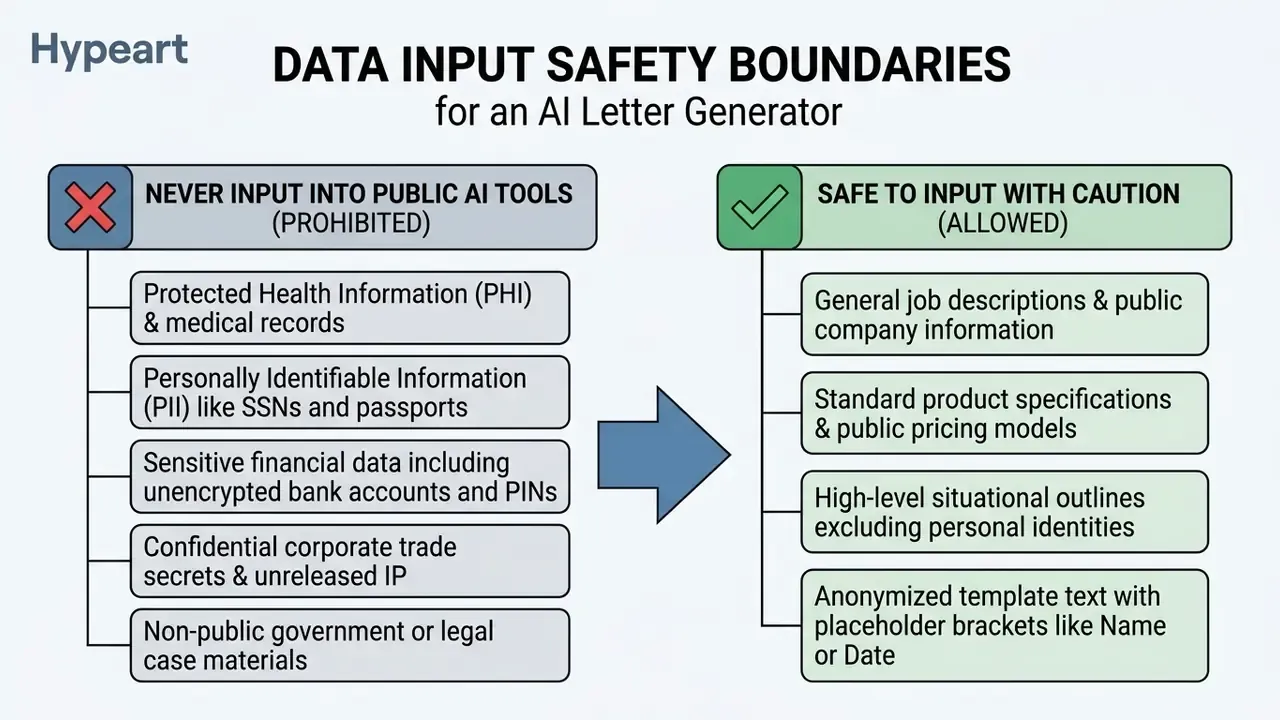
This information is general in nature and does not replace consultation with an information-security specialist or a data-protection lawyer. GDPR, HIPAA, and local regulator requirements vary by jurisdiction and by processing context.
When using an ai letter writer generator, replace specific names, account identifiers, and confidential figures with generic placeholders such as "[Recipient Name]" or "[Account Number]". Once the AI produces the structural draft, insert the sensitive data manually inside a secure local editor before final transmission. Organizations facing legal disputes regarding automated systems or media IP can consult specialized litigation compliance resources.
Is an AI Letter Generator Free to Use?
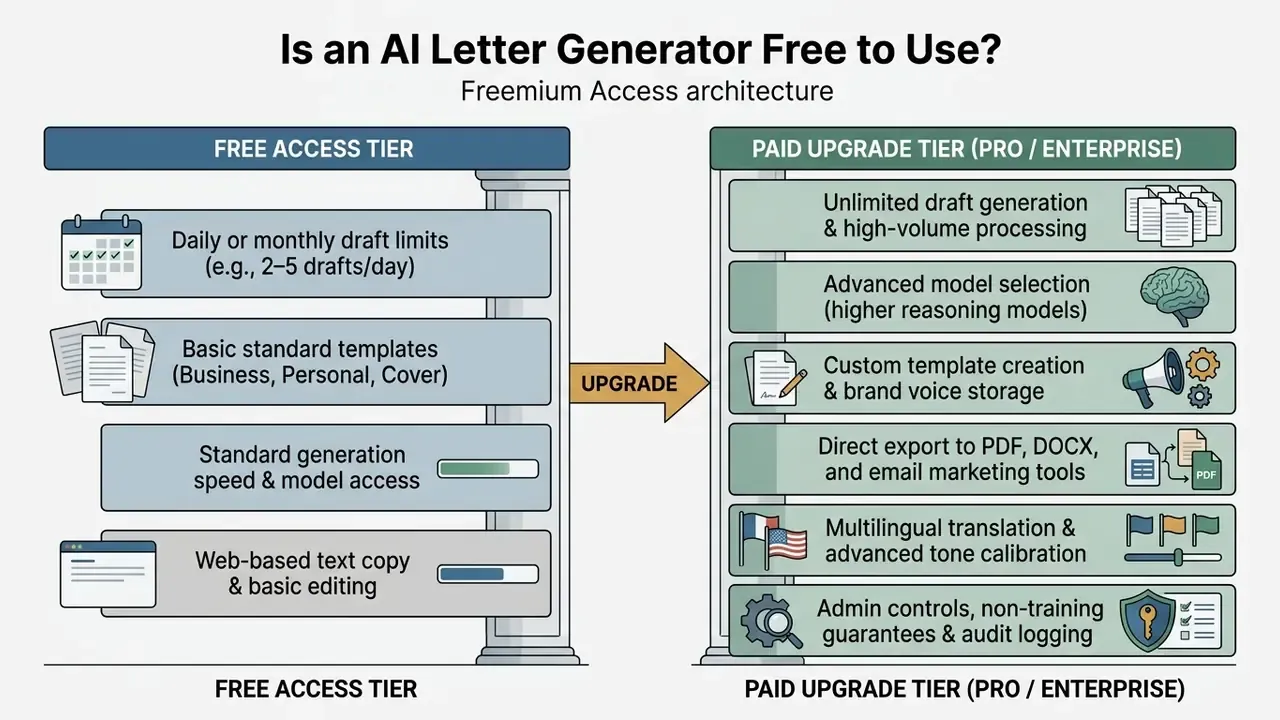
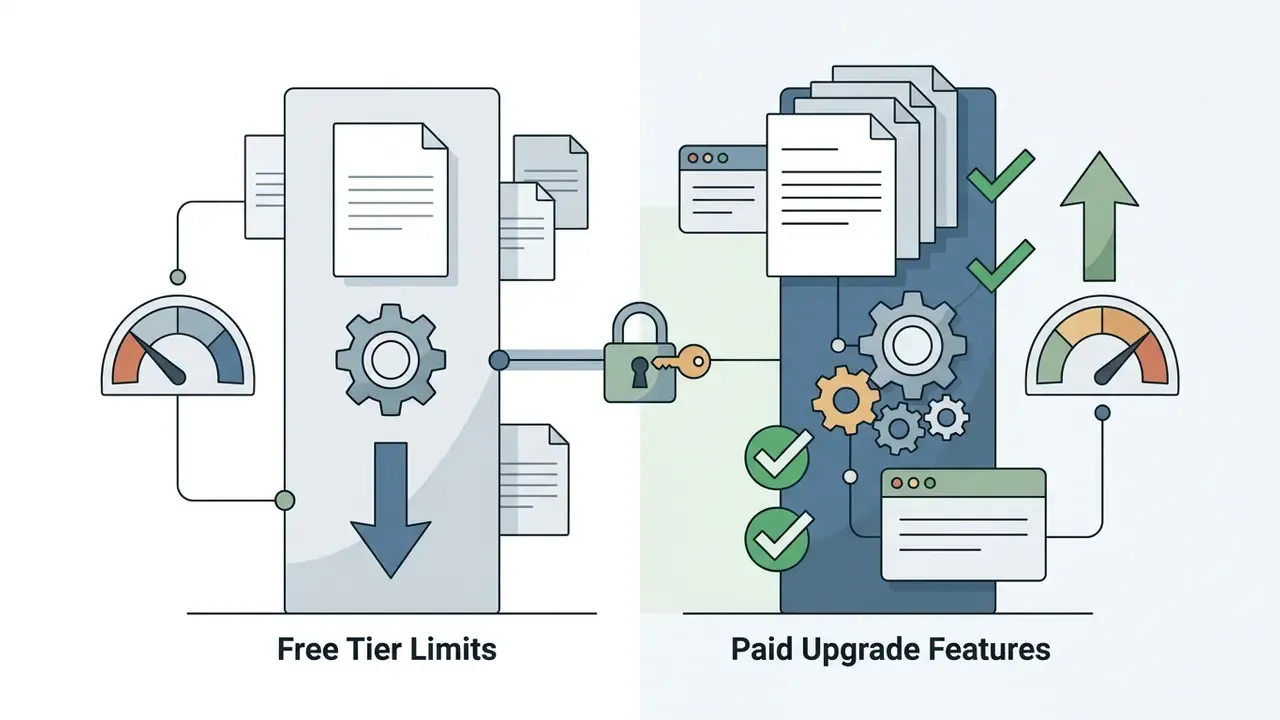
Most commercial AI letter generation platforms employ a freemium monetization structure. Users can access basic drafting capabilities at no cost, while advanced features, higher volume allowances, and specialized export options require a paid subscription.
«By August 2024, LLM-assisted content reached ~17.7% of consumer complaints and up to 24% of corporate press releases, indicating mass adoption of accessible tools.»
What a Free AI Letter Generator Can Do
An ai letter generator free tier provides essential drafting features suitable for occasional correspondence. These tools let users test core capabilities, generate basic drafts, and perform light editing without upfront financial commitment. An ai free letter generator is also a reasonable way to benchmark output quality before any procurement conversation starts.
Typical capabilities included in an ai letter generator free online offer:
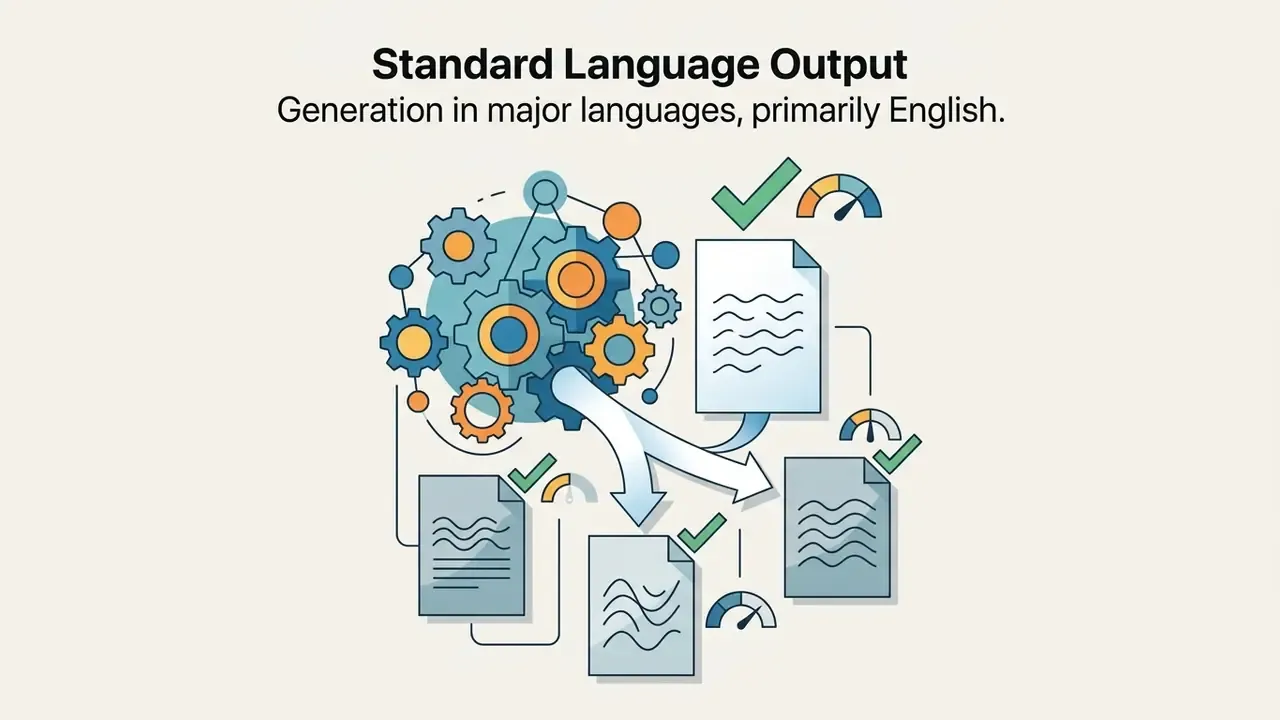
Free tiers usually enforce daily or monthly generation quotas, for instance 2 to 5 letters per day or a monthly word cap (Writemail.ai, 2026; Yuaa AI, 2026). The same capped-then-upgrade pattern shows up across adjacent categories: the limits documented for free AI video generators mirror those applied to letter tools. Marketing labels vary too, so an ai business letter generator free plan, an ai generator letter free trial, and an ai letter writing generator free tier often describe the same quota model with different wording.
When an Upgrade May Be Needed
Upgrading to a paid subscription becomes necessary for high-volume users, corporate teams, and professionals requiring advanced integration or oversight options.
| Feature / Parameter | Free Access Tier | Paid / Upgrade Subscription |
|---|---|---|
| Generation Volume | Capped (e.g., 2,000 words/mo or 2–5 letters/day) | Unlimited or high-volume enterprise allowance |
| Model Capability | Standard baseline language model | Advanced reasoning model for complex context |
| Template Library | Basic standard templates | Full library + custom team template creation |
| Export Formats | Plain text copy to clipboard | Direct export to PDF, DOCX, HTML, and email clients |
| Tone & Style Controls | Basic tone selection (Formal / Friendly) | Advanced brand voice customization & controls |
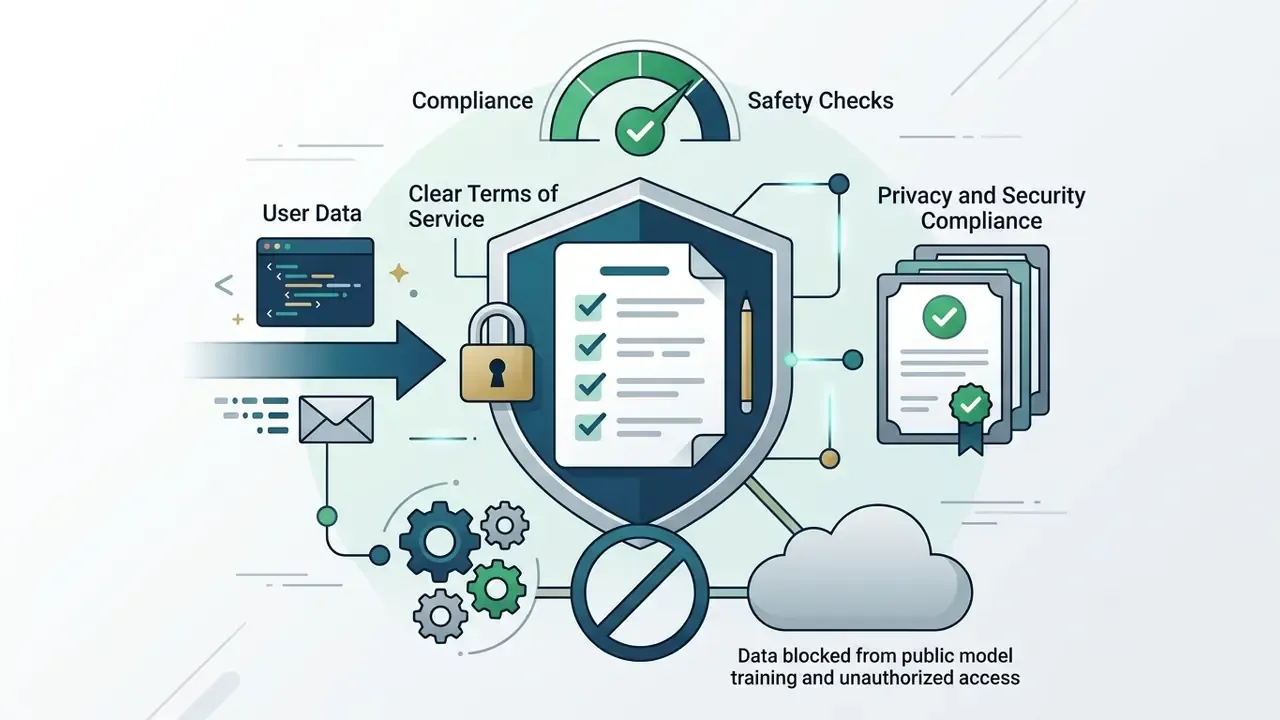
| Data Privacy Limits | Standard public data handling terms | Private workspace, non-training guarantees, SOC 2 |
| Governance & Audit | No admin visibility, no usage logs | Role-based access, retention settings, exportable audit logs |
Paid plans unlock access to advanced language models, which handle complex instructions and long-context documents more reliably (OpenAI Pricing Tiers, 2026). Professional tiers often add direct integration with document platforms, batch processing, custom brand voice alignment, and enhanced data privacy protections. Individuals evaluating commercial software options can review complete pricing details to determine cost efficiency. One caveat for regulated buyers: the audit and retention controls, not the word cap, are usually what forces the upgrade.
How to Choose the Best AI Letter Generator
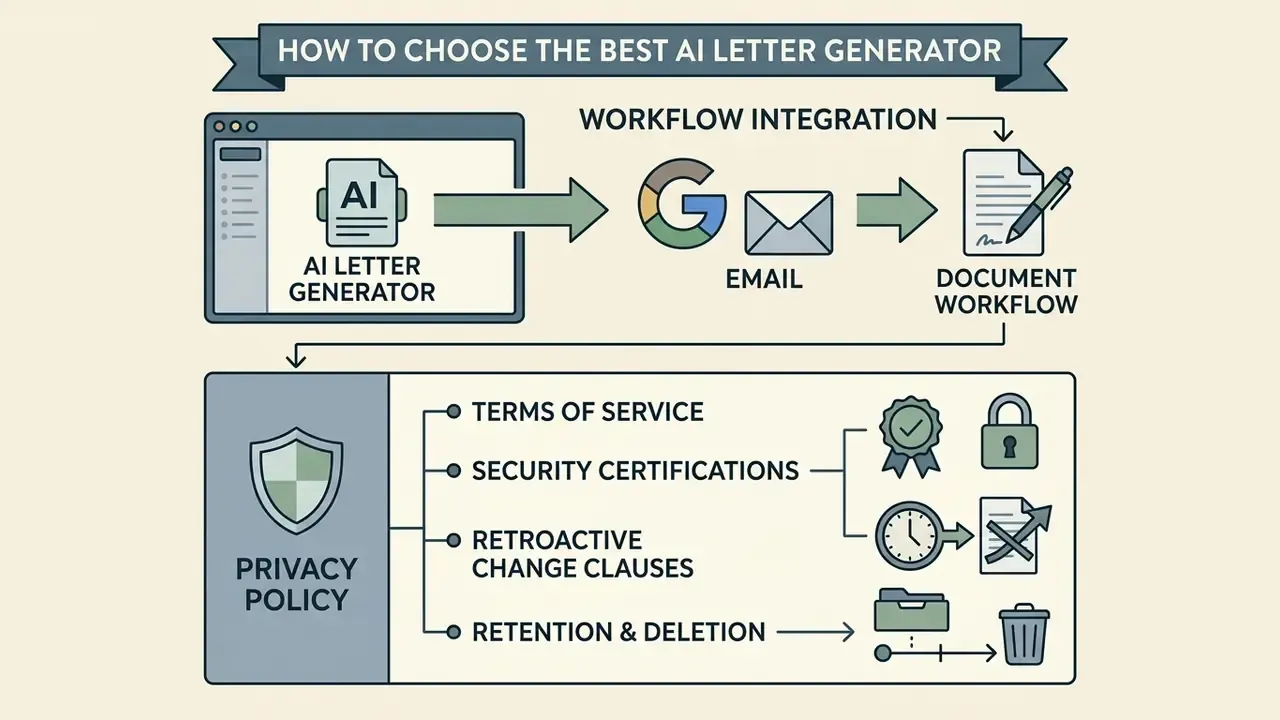
Selecting the best ai letter generator requires evaluating tool performance across core criteria: text generation quality, prompt control, workflow integration, data security, and cost transparency.
Key criteria for evaluating AI letter generation tools:
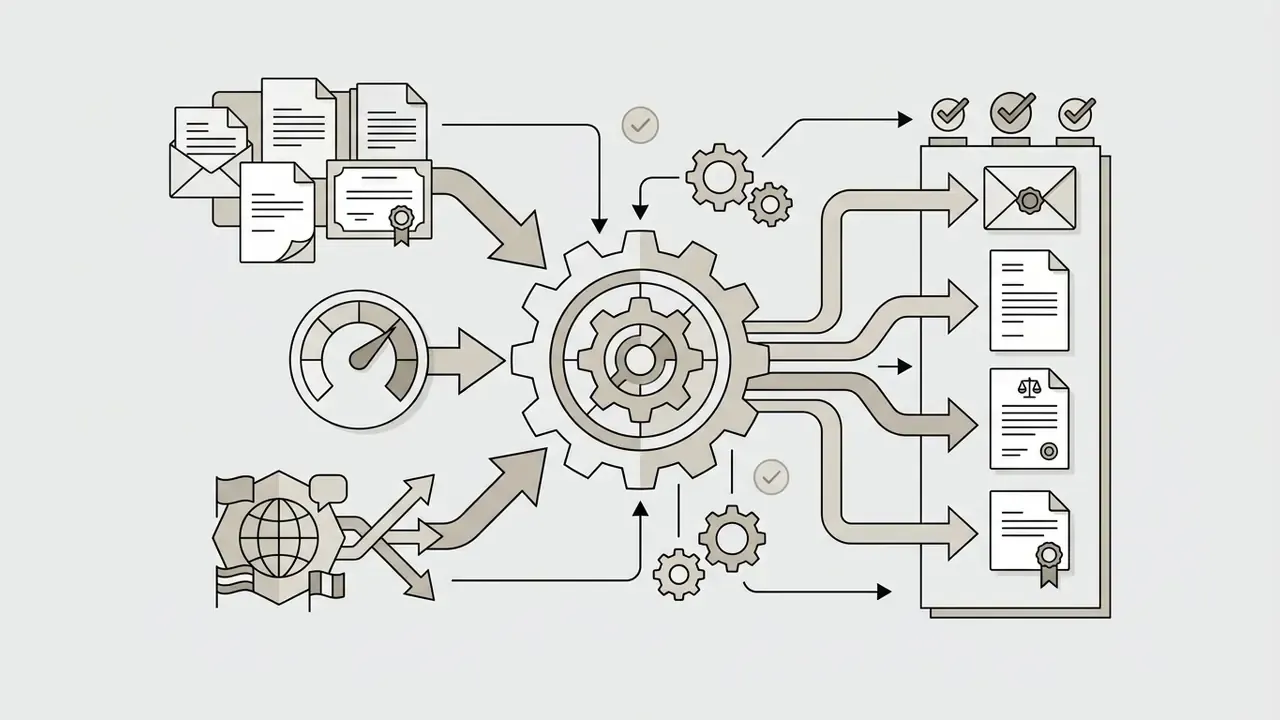
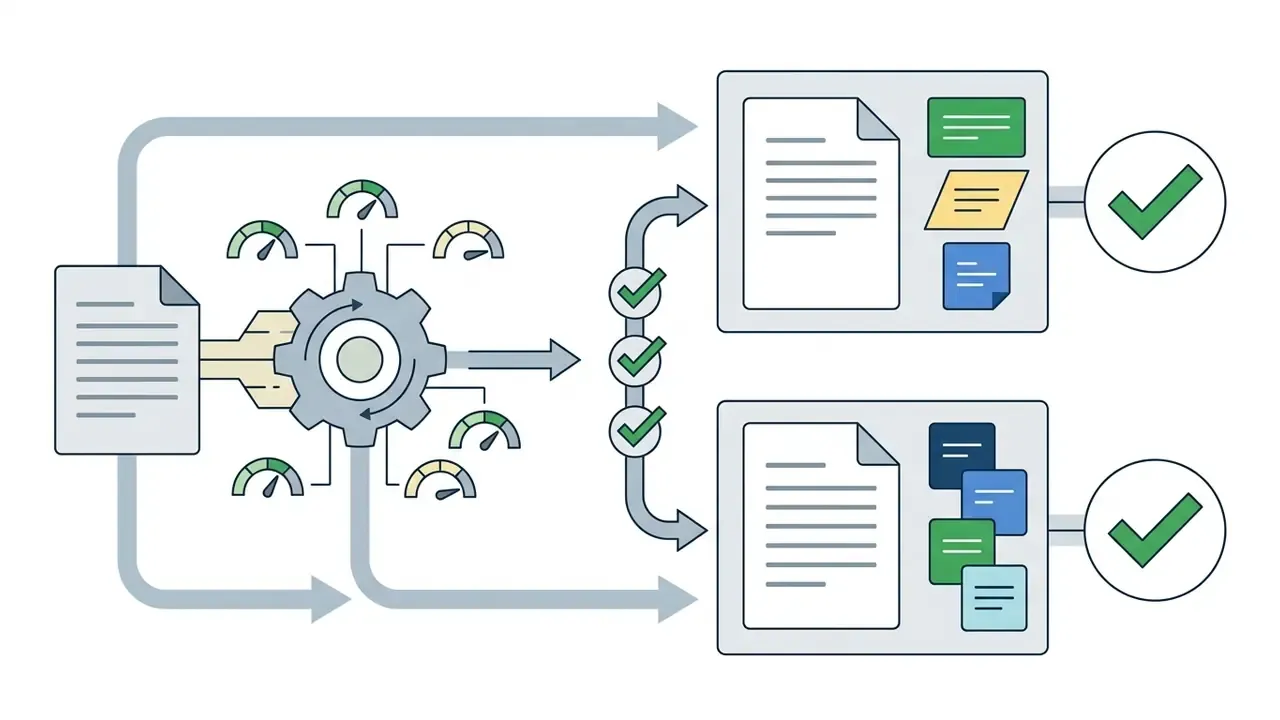
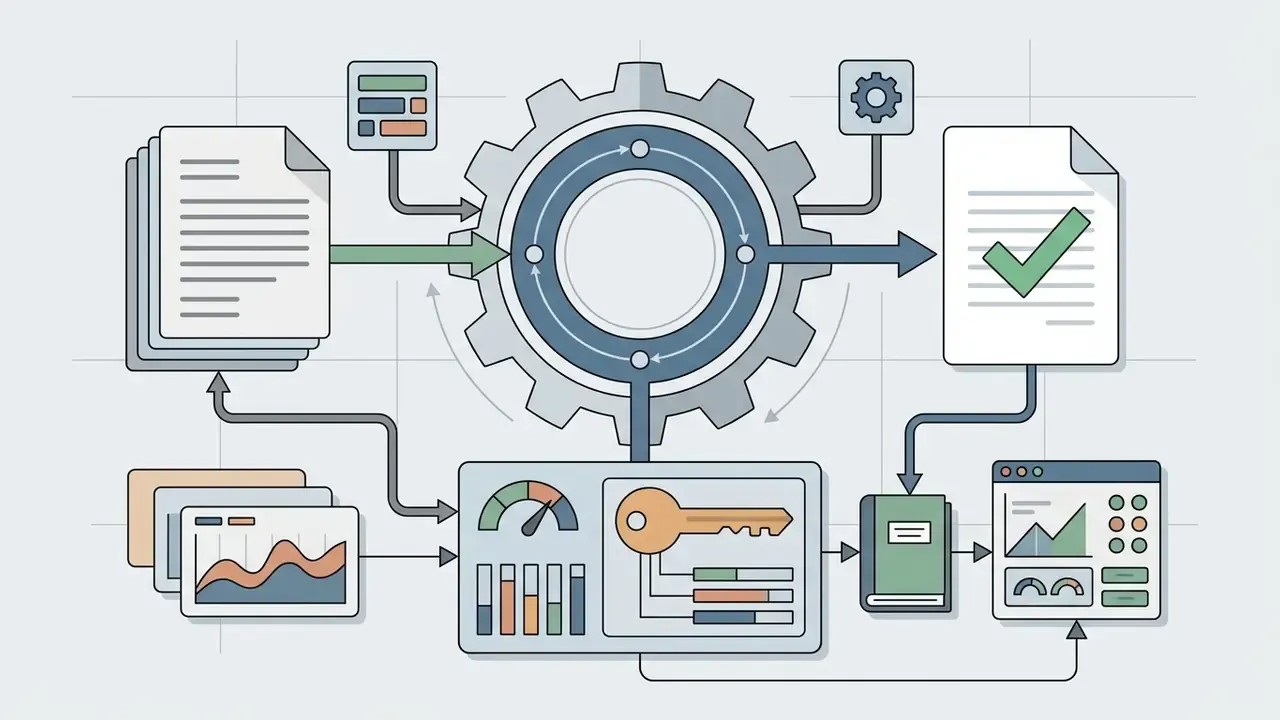
«Tools embedded in existing workflows, mail clients, document editors, CRM systems, are more likely to be used consistently.»
AI Letter Generator Google, Email and Document Workflow
Modern correspondence workflows rely heavily on cloud-based document platforms and email clients. Integrating an ai letter generator google extension or embedded assistant streamlines drafting directly inside Google Docs and Gmail.
Technical specifications from Google Workspace (2026) detail how embedded assistants such as Gemini for Workspace let users draft, refine, and summarize text directly within the compose window. Users can highlight existing draft text and request targeted adjustments, for example "make this paragraph more formal" or "shorten this call to action", without leaving the editor.
«In a randomized crossover experiment, AI editing inside the mail client reliably shifted emotional tone without directly changing open or reply rates.»
| Platform Integration | Deployment Mode | Primary Workflow Benefit |
|---|---|---|
| Google Docs Extension | Embedded sidebar / Gemini overlay | Direct text generation on the canvas without switching tabs. |
| Gmail Inbox Assistant | Native compose extension | Quick formal replies generated inside the active thread. |
| Microsoft Word Add-in | Office 365 ribbon tool | One-click formatting into official corporate DOCX templates. |
| Outlook Copilot | Mail client assistant | Drafting and rewriting within enterprise mail policy boundaries. |
| Web Standalone App | Browser dashboard | Clean workspace for complex prompt assembly and PDF export. |
| API / Automation Layer | Server-side integration | Batch generation of notices with centralized logging. |
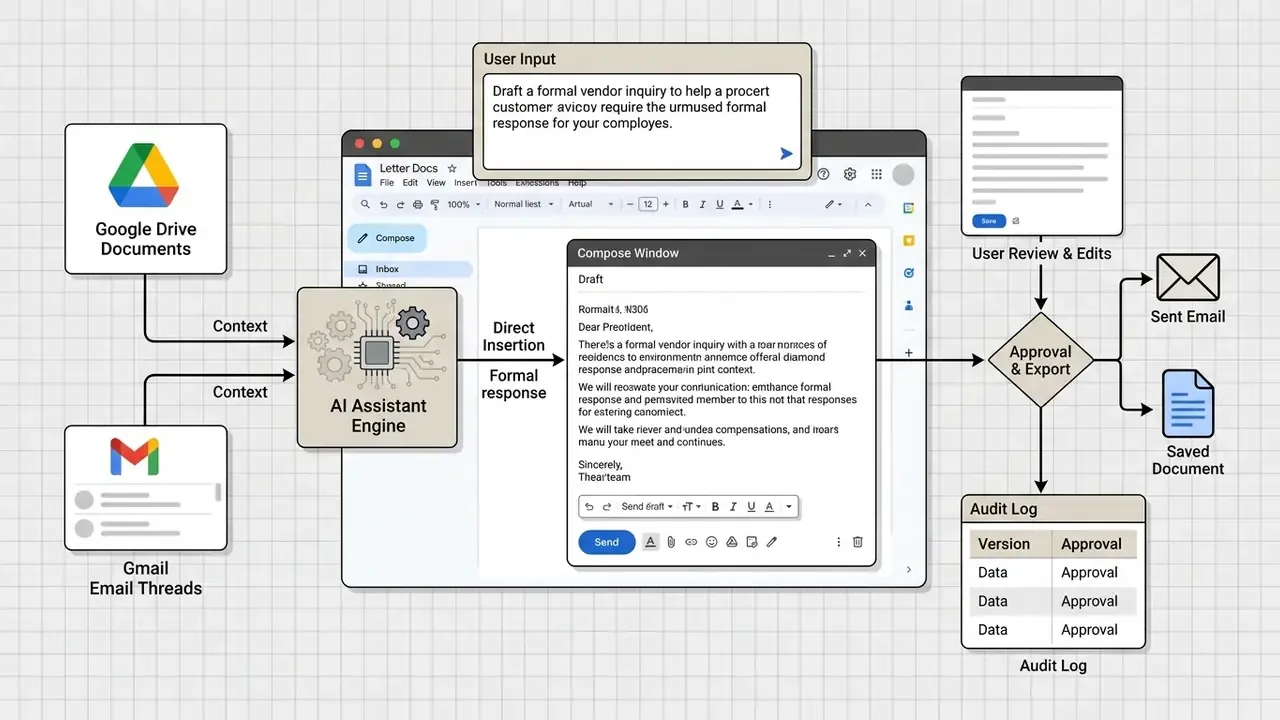
These embedded integrations reduce workflow friction by letting writers reuse stored context from emails and reference files. One caution for supervised industries: because embedded assistants can pull context automatically from Drive, Chat, and mail threads, the scope of that context should be reviewed before the feature is enabled for teams handling confidential client files. Teams interested in building custom automated generation tools can explore developer options via an AI Media API interface.
Before deploying any AI letter generator within an enterprise setting, perform a manual audit of the vendor's policy stack:
For broader technical context on digital creation tools, users can see the overview of available generation tools or explore the hub for functional evaluation resources. For platform queries and source challenges, users can contact support through standard help desk channels.
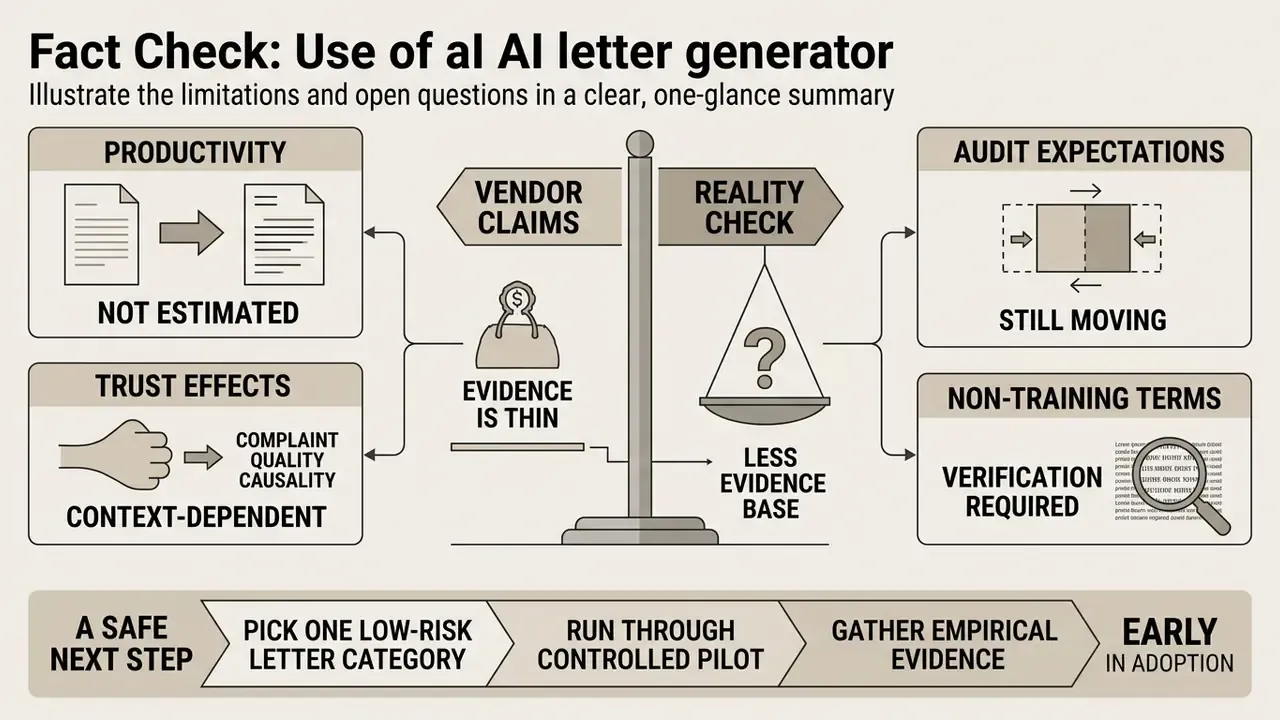
Limitations and Open Questions
FAQ: AI Letter Generator Questions
What is an AI letter generator?
An AI letter generator is a software tool that uses artificial intelligence to write custom letters, such as business letters, cover letters, formal requests, and complaint letters, based on details you provide.
Is an AI letter writer free to use?
Many AI letter writers offer free access with daily or monthly limits. Advanced features, unlimited draft generation, and specialized export options may require a paid plan.
Can I use an AI letter writer for business correspondence?
Yes. AI letter generators are widely used for business emails, client communications, and formal announcements. Always review and edit the draft before sending to ensure complete accuracy.
What information should I provide to get a good letter draft?
Specify the recipient, the main purpose of the letter, key facts or dates to include, the desired tone (formal or professional, for example), and any specific formatting preferences.
Are AI-generated cover letters effective for job applications?
AI-generated cover letters provide a strong structural starting point and correct formatting. To make them genuinely effective, add specific details about your achievements, motivation, and fit for the role. The Tilburg University field study found that surface polish alone did not raise callback rates.
Can an AI tool write a demand letter or a cease and desist notice?
It can produce a structured draft containing the statement of right, the description of the breach, the requested remedy, and a response deadline. Because these documents carry legal consequences, the statutory citations, jurisdictional wording, and evidence references must be verified by a qualified professional before sending.
Can I generate a resignation letter or a character reference?
Yes. Both are standard templates in most generators. A resignation letter needs your final working day, a handover offer, and a neutral tone; a character reference needs the length and nature of your relationship plus at least one concrete example that only you could provide.
How do I make an AI-generated letter sound less like AI?
Replace the generic opening and closing sentences, add one specific verifiable detail (a date, a number, a shared memory), shorten the longest sentence in each paragraph, and read the draft aloud before sending.
Is it safe to paste account numbers or medical details into an AI letter tool?
No, not into consumer-grade public tools. Use placeholders such as "[Account Number]" during generation and insert the real values locally in a secure editor before sending. Sensitive personal, health, and financial data should only be processed in vetted enterprise environments with contractual non-training guarantees.
Do AI-generated letters need to be disclosed to the recipient?
Requirements vary by jurisdiction and context. Canadian federal guidance requires internal disclosure of AI use to management, while EU transparency rules focus on specific public-facing content categories rather than ordinary human-reviewed correspondence. Check your own regulator's position and your organization's AI policy.
Which letter types carry the highest risk when generated by AI?
Legal notices, regulated consumer disclosures, and anything containing financial figures or statutory citations. These require line-by-line verification and a named human approver.
Is an "ai alphabet generator" the same thing?
No. That phrase usually points to decorative lettering, monogram, or typography image tools. A letter generator produces written correspondence, not letterforms.