Executive Summary
- What it is An ai python code generator turns natural-language specifications into executable Python: scripts, FastAPI/Django/Flask endpoints, SQLAlchemy models, Pandas/Polars ETL jobs, Celery tasks, Pytest suites, and docstrings.
- How widely it is used By the end of 2024, roughly 30.1% of Python functions written by U.S. developers had substantial AI generation support (24.3% in Germany, 21.6% in India).
- Where the risk sits Large-scale static analysis attributes CWEs to 16.18–18.50% of AI-generated Python files, about twice the rate observed in JavaScript. Functional correctness also outruns runtime efficiency: leading models reach roughly 65% correctness but under 50% efficiency on the Mercury benchmark.
- What to do about it Treat every generated artifact as untrusted input. Enforce sandboxed execution,
ruff+mypy+bandit/CodeQL gates, mutation-aware test coverage, dependency allow-lists against hallucinated packages, and a documented audit trail (aligned with NIST SP 800-218A, SR 11-7 model risk expectations, and EU AI Act documentation duties). - Who benefits most Data engineers (ETL, Polars/Pandas), backend teams (FastAPI, Django, Pydantic, SQLAlchemy), QA/DevOps (Pytest, Locust, CI/CD), and juniors (code explanation, traceback triage). Each group carries a distinct risk profile and safeguard, summarized in the persona matrix below.
- Commercial reality Free tiers cap context and may retain prompts for training. Enterprise tiers add zero-retention guarantees, VPC or on-premise deployment, and IP indemnification.
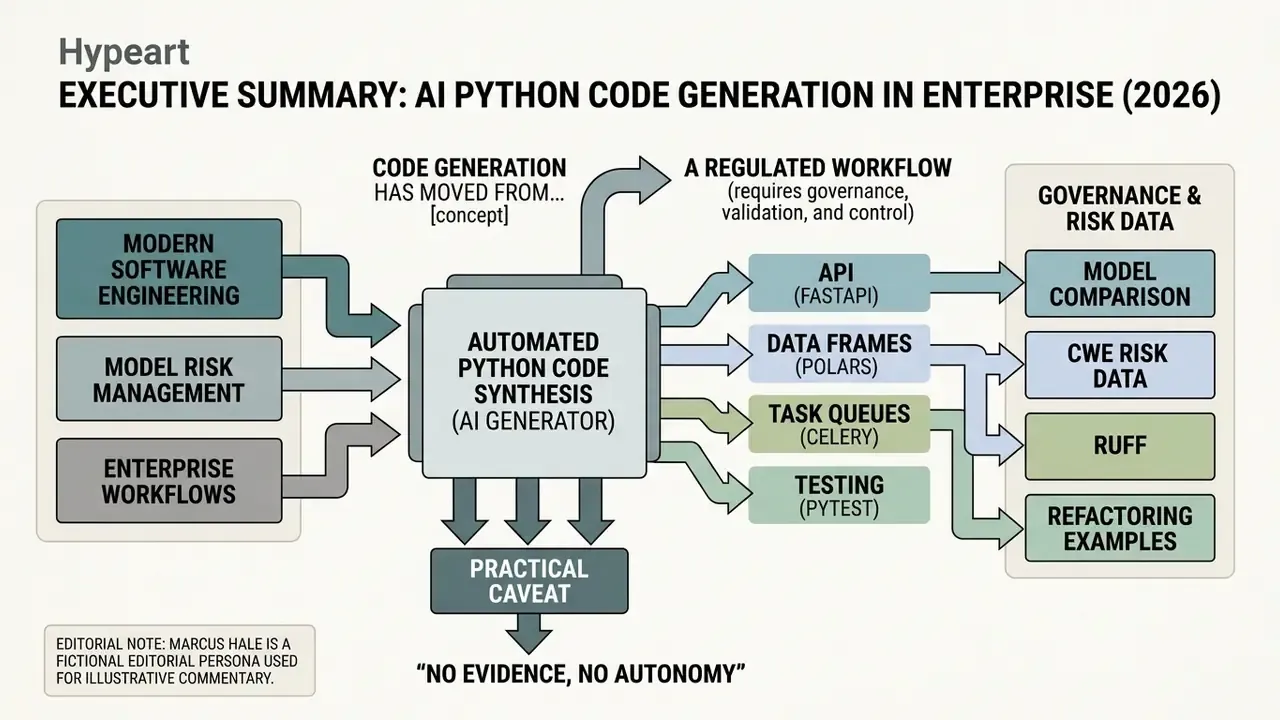
For a CRO, a Head of Model Risk, or a CCO at a U.S. bank, code generation is not a developer-tooling question. It is a change-control question. Generated Python already sits inside reconciliation jobs, reporting pipelines, KYC screening utilities, and credit-model prototypes. The code path is short. The accountability path is not.
In modern enterprise software engineering and model risk management, automated code synthesis has moved from experimental prototyping into the core software development lifecycle. An ai python code generator uses foundational large language models (LLMs) to transform natural-language requirements into executable Python scripts, web endpoints, unit tests, and technical documentation. By the end of 2024, empirical research indicates that roughly 30.1% of Python functions produced by U.S. developers received substantial AI generation support.
«By December 2024, AI wrote an estimated 30.1% of Python functions from U.S. developers, 24.3% from Germany, and 21.6% from India.»
Integrating an ai code generator for python into a regulated workflow requires governance, validation, and risk tiering. Unchecked execution of machine-generated code introduces vulnerabilities, efficiency deficits, and intellectual property exposure. Organizations building on an ai code generator python stack must balance developer speed against security and audit control. In banking, insurance, and payments, generated code that touches valuation, reporting, or customer-impacting logic falls inside the perimeter of model risk management expectations (for example, the Federal Reserve and OCC SR 11-7 guidance on model development, implementation, and use) and, in the EU, of documentation and human-oversight duties under the EU AI Act for high-risk deployments.
One practical caveat before the details. Much of the evidence below is early, benchmark-driven, and not yet replicated inside supervised institutions. Treat the numbers as directional, not as validated control effectiveness.
What is an AI Python Code Generator and What Tasks Does It Solve
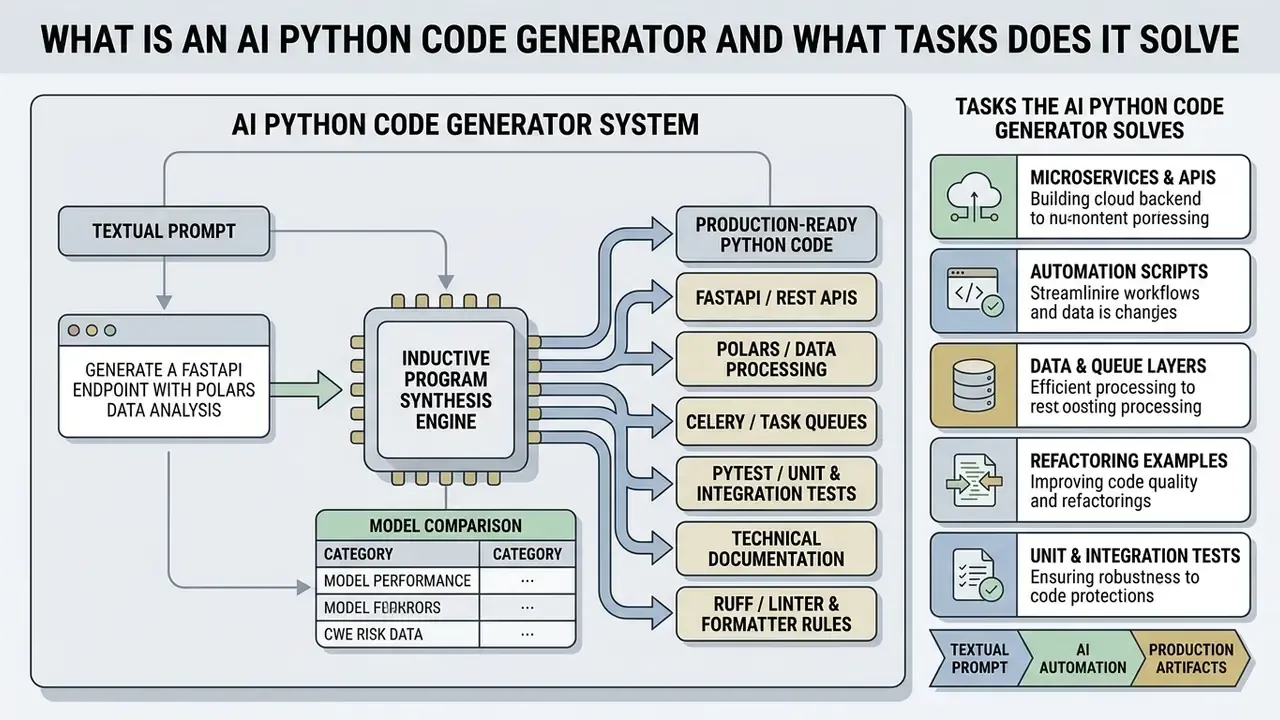
An ai python code generator is an inductive program synthesis system. It processes natural-language specifications, contextual code snippets, or prompt constraints, then outputs valid Python source code. Unlike basic auto-complete utilities that predict the next token inside an IDE, a complete python code generator ai interprets a problem definition and produces multi-line functions, architectural boilerplate, test harnesses, and docstrings.
The line between code completion, code generation, and full AI coding assistants runs through input scope and operational autonomy. Completion tools suggest line continuations from adjacent tokens. A standalone code ai generator python synthesizes new program logic directly from prose. Comprehensive assistants combine both and add conversational debugging, refactoring, and project-wide context awareness.
Why does the distinction matter for governance? Because autonomy level, not model brand, determines how much human review you owe.
From Textual Prompt to Production-Ready Python Code
Generating Python from natural language runs through an intent-parsing and token-synthesis pipeline. Modern models first decompose instructions into functional objectives and data-flow constraints, then emit syntactic constructs.
«LLM code generators act as inductive synthesizers: they accept natural-language specifications and predict the next token by attending to the entire prompt.»
Reliable output depends on prompt precision. Specify algorithmic requirements, input and output data formats, the target Python version, and external library dependencies. Prompts that state explicit pre-conditions, post-conditions, and expected edge-case behavior consistently score higher on functional accuracy across benchmark evaluations. Empirical work on code-generation guidelines shows the most frequently used prompt elements are algorithmic details (around 57% of prompts) and explicit I/O format definitions (around 44%). Those are exactly the two dimensions that decide whether the model infers the correct data flow.
Scripts, APIs, Tests, and Documentation Created by AI
An ai python script generator can produce a broad range of artifacts across the development spectrum:
- Automation scripts command-line utilities (often scaffolded with
Typerorargparse), file transformation routines, and scheduled data extraction pipelines. - REST APIs and web services asynchronous FastAPI endpoints, Flask microservices, Django models with integrated serialization, and GraphQL resolvers.
- Data and queue layers Pandas/Polars/NumPy transformations, SQLAlchemy ORM models with relationships and Alembic migrations, PyMongo CRUD operations, Redis caching wrappers, and Celery background tasks.
- Unit and integration tests suites built with
pytestorunittest, including mock objects, fixtures, and parameter sweeps. - Technical documentation Google- or Sphinx-style docstrings, inline code explanations, and Markdown architecture summaries.
«Except for StarChat, all evaluated LLMs consistently outperform original documentation in accuracy, completeness, and readability at function and inline levels.»
Evidence on generated tests is similarly concrete. The Test4Py evaluation of LLM-based unit-test generation across 183 Python modules reported average statement coverage of 83.0% and branch coverage of 70.8%. Strong scaffolding, yes. A substitute for adversarial and boundary tests designed by an engineer, no.
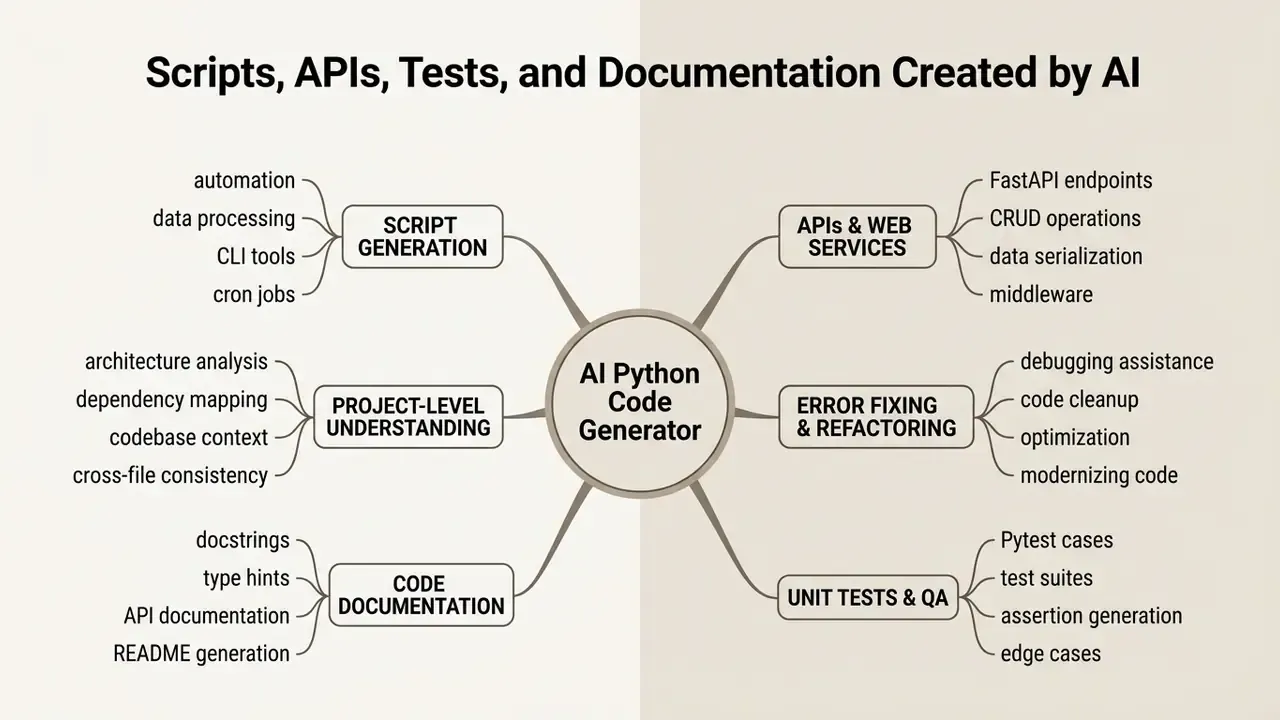
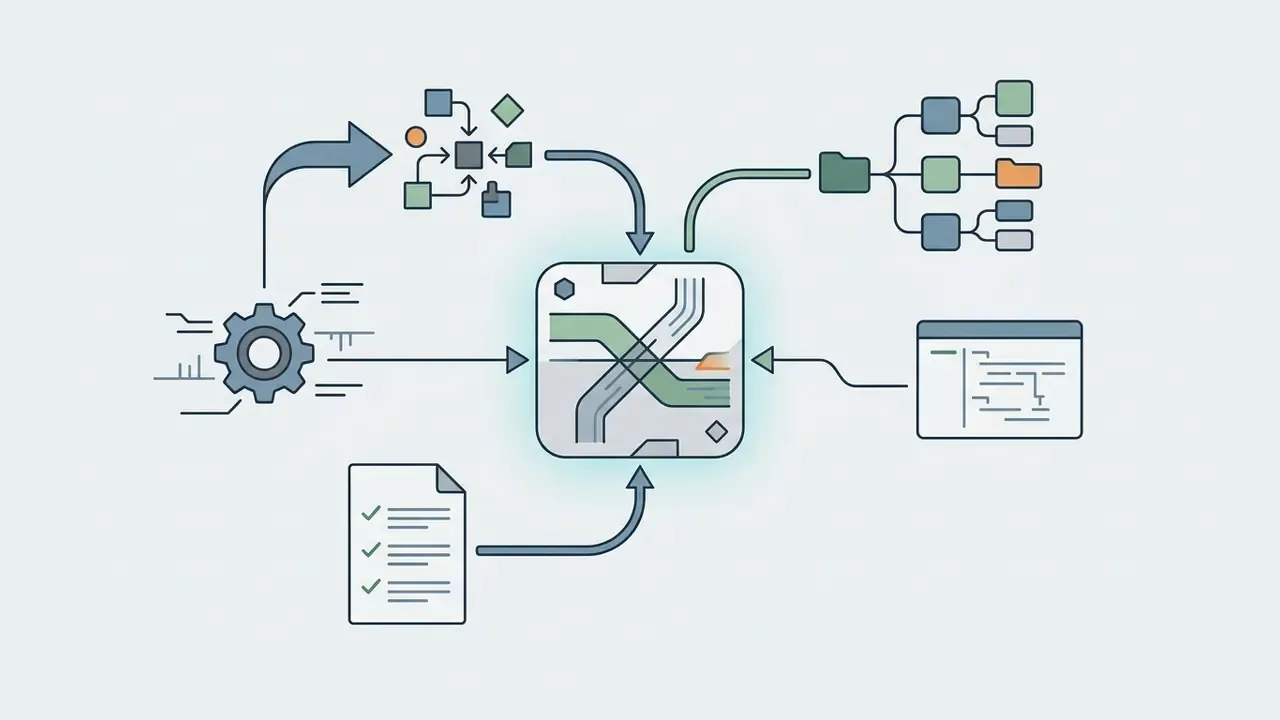
Read the map as a scope statement rather than a feature list. Each branch carries a different failure mode: silent data loss in ETL, broken authorization in APIs, shallow assertions in tests, and confidently wrong prose in documentation.
What Python Tasks Should You Use an AI Code Generator For
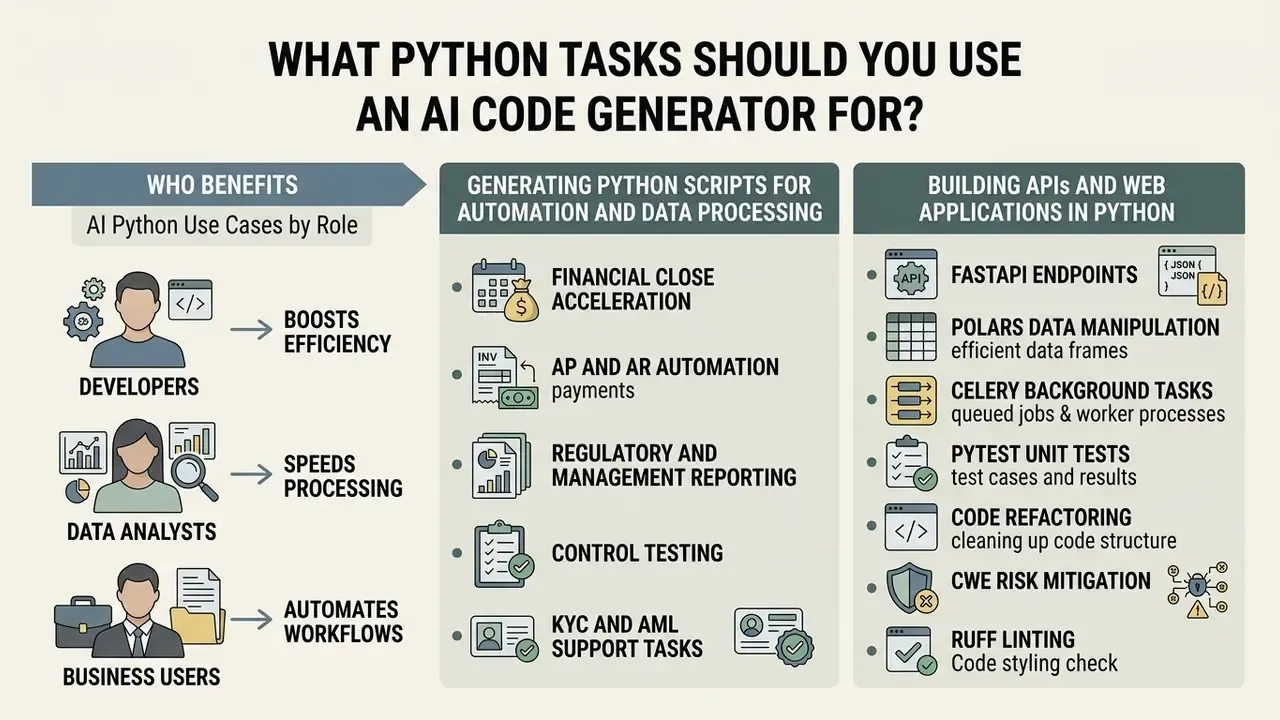
Selecting the right use cases for an ai python generator maximizes developer leverage while containing operational risk. These tools excel at structured, repetitive work with clear specifications. They still need human oversight on complex business-domain logic.
Empirical evaluations across enterprise teams show the largest productivity gains in data manipulation, API integration, and test harness construction. The gain is asymmetric, though: correctness improves faster than efficiency.
«Leading LLMs reach ~65% on functional correctness but under 50% on runtime efficiency, a gap that matters for production code.»
Who Benefits: AI Python Use Cases by Role
| Target Role | Primary AI Python Use Cases | Recommended Stack / Tools | Key Risk and Safeguard |
|---|---|---|---|
| Data Engineers & Scientists | ETL pipeline scripting, data cleaning, ML pipeline scaffolding | Polars, Pandas, NumPy, PySpark, Jupyter AI | Hallucinated package names; enforce strict internal PyPI registries |
| Backend & API Developers | Microservices, ORM models, async routes, Swagger/OpenAPI specs | FastAPI, Django, Flask, SQLAlchemy, Pydantic | Insecure auth and permission logic; require manual code audits |
| QA & DevOps Engineers | Unit test creation, CI/CD pipelines, synthetic data scripts | Pytest, Locust, Docker, Bash, Typer | Low test boundary coverage; require mutation testing |
| Junior Developers / Students | Code explanations, debugging tracebacks, syntax learning | Web generators, IDE extensions | Over-reliance without understanding; mandate manual code execution |
| Model Risk & Internal Audit | Reconciliation scripts, challenger-model prototypes, evidence extraction | Pandas, Polars, Jupyter, notebook-to-report exports | Unlogged generation; require prompt and output audit trail retention |
Generating Python Scripts for Automation and Data Processing
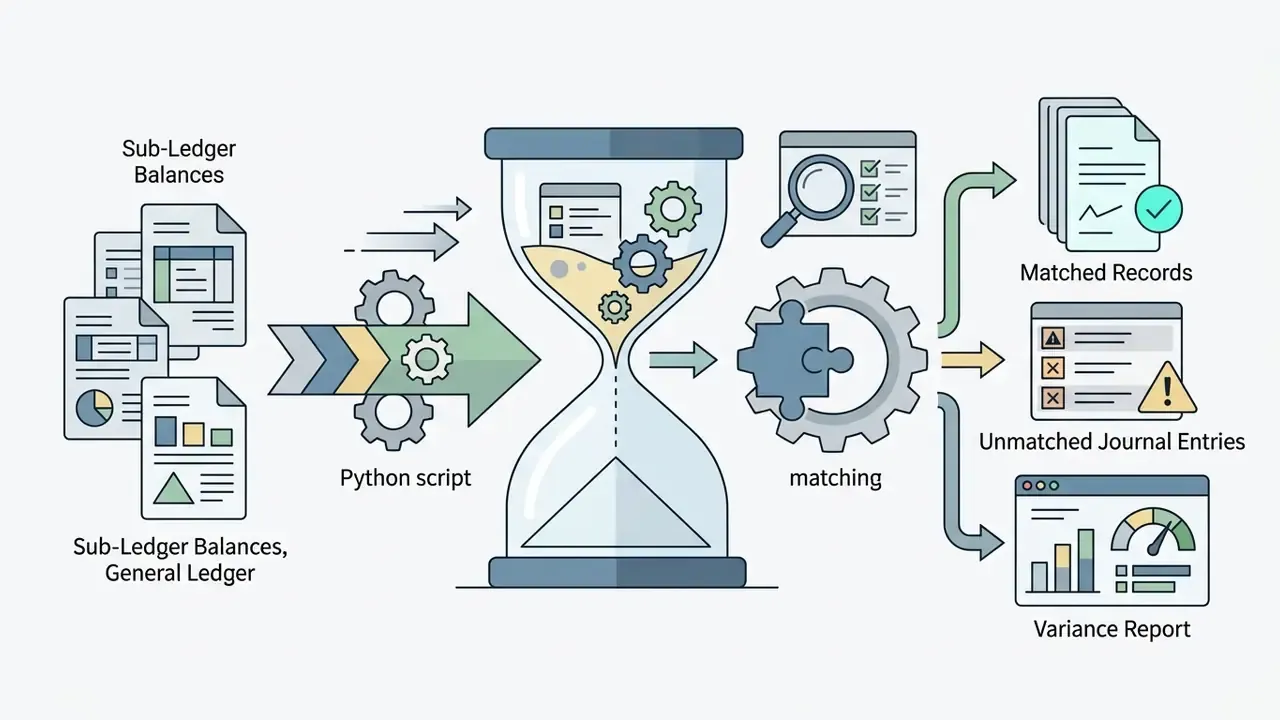
Data engineering workflows carry heavy boilerplate: file parsing, schema migration, dataset normalization. A python script ai generator converts high-level instructions into concrete data operations using Pandas, Polars, NumPy, or PySpark.
For instance, a team can prompt an ai python script generator to parse semi-structured JSON logs, filter anomalous events, and write normalized Parquet files. Frameworks such as Polars include native LLM-driven translation, so natural-language prompts execute vector-optimized transformations directly (Polars Documentation).
In one financial data reconciliation project, an engineering team used LLM-driven Polars script generation to automate daily ETL pipelines across 15 legacy database formats. They added strict schema-validation rules and automated test harnesses, cut manual script writing time by roughly 40%, and kept a complete audit trail. Illustrative, not audited: treat the percentage as an internal estimate rather than a benchmark.
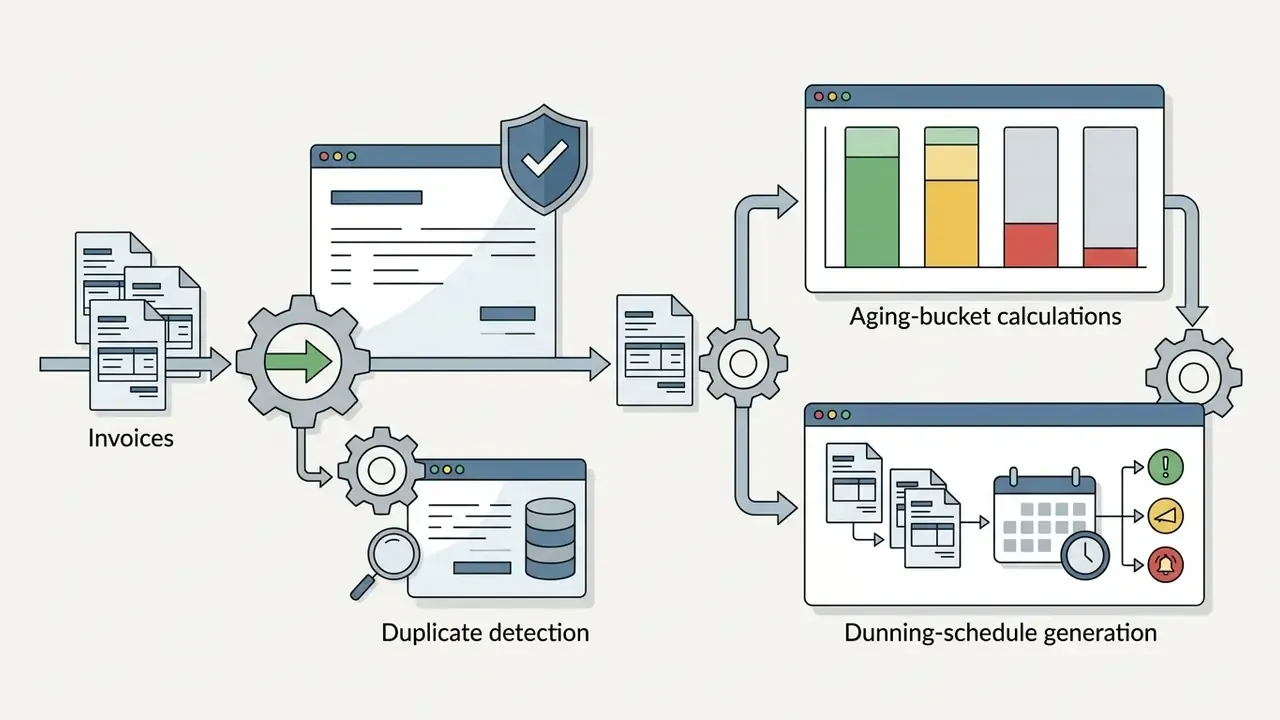
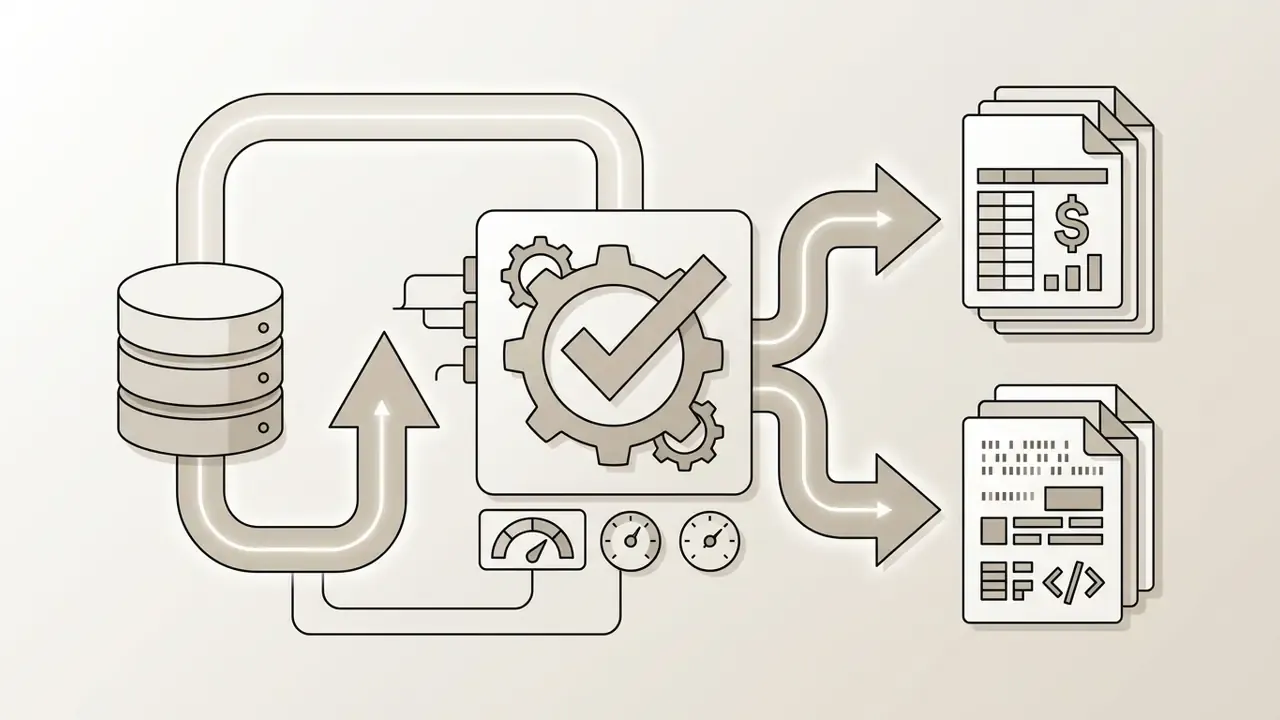
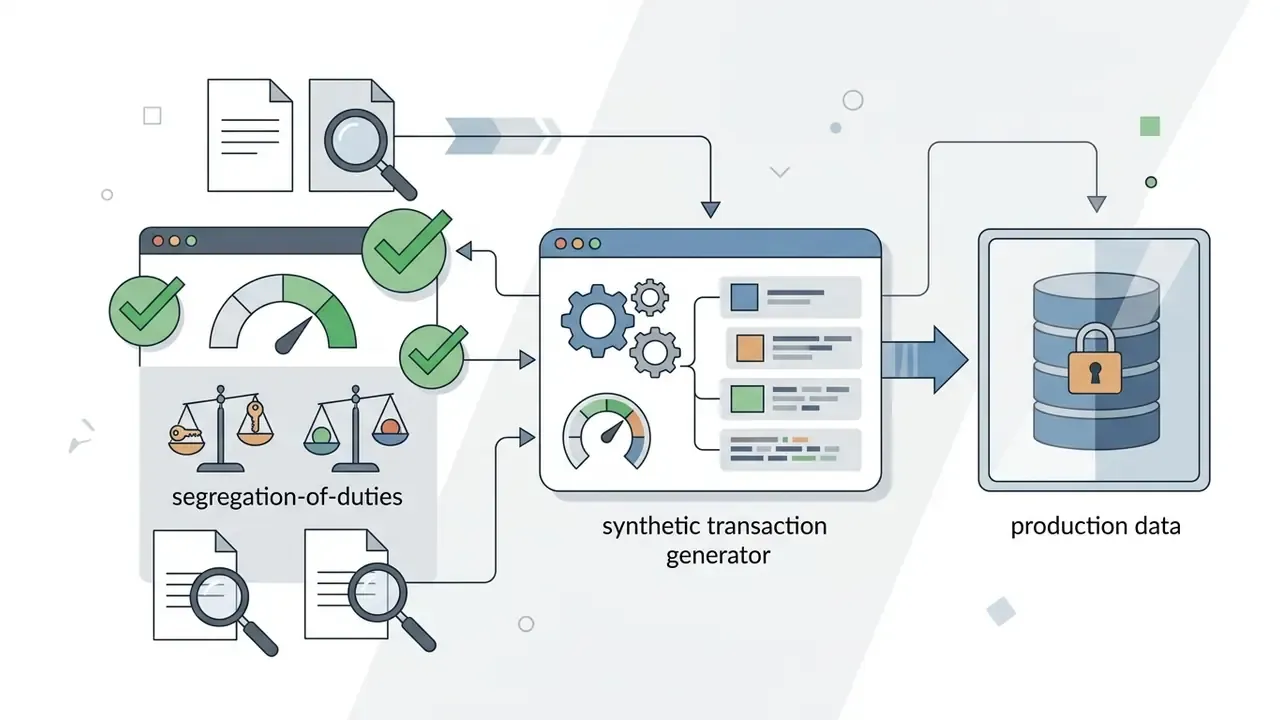
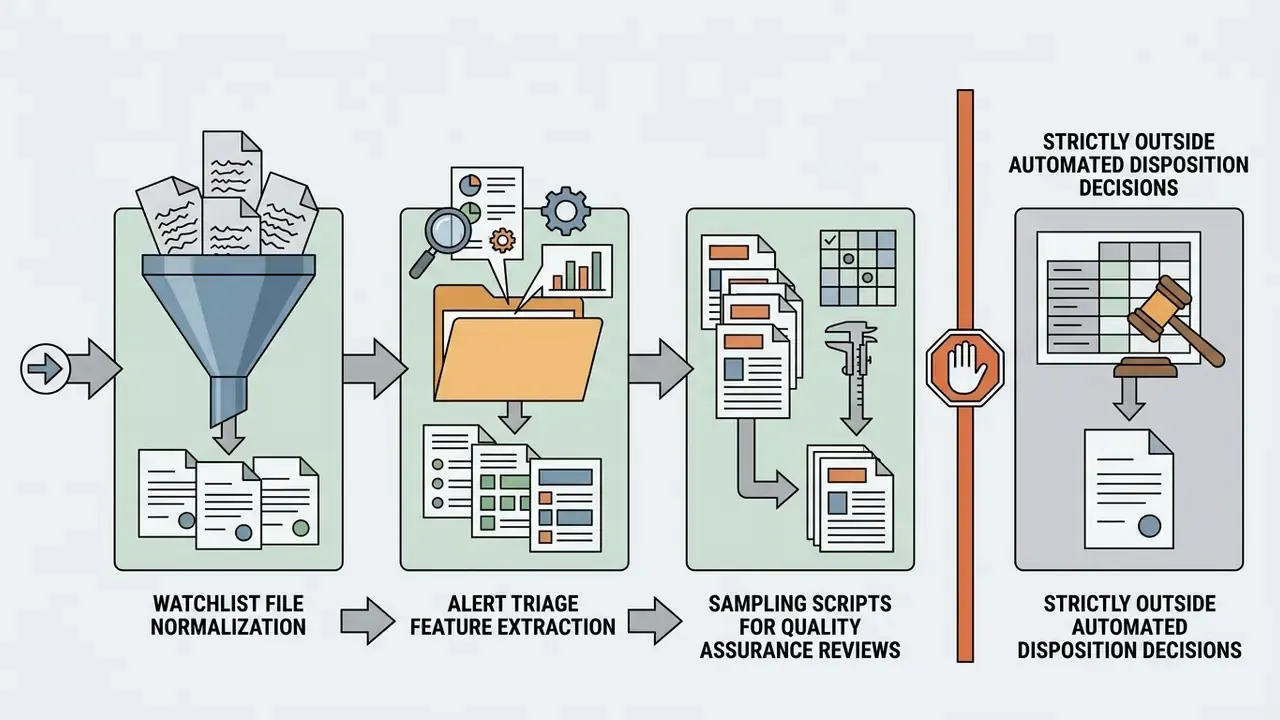
Finance-specific workloads follow the same pattern and are often the highest-ROI entry point:
Teams that want to model the run-rate cost of these pipelines before committing budget can start from our AI Media Calculators and swap in code-generation token and seat assumptions.
Building APIs and Web Applications in Python
For web services, a python generator ai can scaffold routes, request models, and database interactions. Framework choice follows latency and architecture needs:
- FastAPI: asynchronous microservices, high-throughput AI gateways, auto-generated OpenAPI documentation.
- Flask: lightweight synchronous wrappers, single-purpose utilities, simple serverless functions.
- Django: full-stack enterprise applications needing integrated authentication, object-relational mapping, and admin panels.
Using generators to draft Pydantic schemas and database models reduces structural coding errors and keeps serialization patterns consistent across services. A typical generated FastAPI slice, reviewed and hardened by an engineer, looks like this:
# AI-generated FastAPI endpoint (Python 3.12, Pydantic v2, async SQLAlchemy 2.0)
from fastapi import APIRouter, Depends, HTTPException, status
from pydantic import BaseModel, EmailStr, Field
from sqlalchemy import select
from sqlalchemy.ext.asyncio import AsyncSession
from app.db import get_session
from app.models import User
from app.security import get_current_user
router = APIRouter(prefix="/users", tags=["users"])
class UserUpdateRequest(BaseModel):
    email: EmailStr
    display_name: str = Field(min_length=2, max_length=64)
class UserResponse(BaseModel):
    id: int
    email: EmailStr
    display_name: str
@router.patch("/{user_id}", response_model=UserResponse, status_code=status.HTTP_200_OK)
async def update_user_profile(
    user_id: int,
    payload: UserUpdateRequest,
    session: AsyncSession = Depends(get_session),
    principal: User = Depends(get_current_user),
) -> UserResponse:
    """Update a user profile. Requires an authenticated principal owning the record."""
    if principal.id != user_id and not principal.is_admin:
        raise HTTPException(status_code=status.HTTP_403_FORBIDDEN, detail="Forbidden")
    user = (await session.execute(select(User).where(User.id == user_id))).scalar_one_or_none()
    if user is None:
        raise HTTPException(status_code=status.HTTP_404_NOT_FOUND, detail="User not found")
    duplicate = (
        await session.execute(select(User.id).where(User.email == payload.email, User.id != user_id))
    ).scalar_one_or_none()
    if duplicate is not None:
        raise HTTPException(status_code=status.HTTP_409_CONFLICT, detail="Email already in use")
    user.email = payload.email
    user.display_name = payload.display_name
    await session.commit()
    return UserResponse(id=user.id, email=user.email, display_name=user.display_name)
Note what a reviewer must still verify by hand: the authorization branch (principal.id != user_id), the uniqueness check that prevents a silent data collision, and the absence of stack-trace leakage in error responses. Those are precisely the paths security guidance flags for mandatory human review.
Fixing Bugs, Refactoring, and Explaining Existing Code
Beyond greenfield work, teams use a code ai generator python to maintain existing codebases. Modern tools perform AST-aware (Abstract Syntax Tree) parsing to surface logical flaws, type mismatches, and security anti-patterns.
On refactoring tasks, the model restructures complex functions to reduce cyclomatic complexity, enforce PEP 8, and apply familiar design patterns. Developers can also request line-by-line explanations of legacy algorithms, which speeds onboarding and code review. That explanation habit is quietly one of the biggest wins in audit-heavy shops.
A representative refactoring pass on legacy procedural Python:
# BEFORE: Legacy procedural implementation with magic values and unsafe key access
def process_user_data(data):
    res = []
    for item in data:
        if item['status'] == 1:
            val = item['val'] * 1.2
            res.append({'id': item['id'], 'calculated': val})
    return res
# AFTER: Production-grade AI-refactored Python 3.12+ code with type hints and Pydantic
from pydantic import BaseModel, Field
from typing import List
class UserInput(BaseModel):
    user_id: int = Field(..., alias="id")
    status_code: int = Field(..., alias="status")
    raw_value: float = Field(..., alias="val")
class ProcessedOutput(BaseModel):
    user_id: int
    calculated_value: float
TAX_MULTIPLIER = 1.2
ACTIVE_STATUS = 1
def process_user_data_optimized(raw_data: List[dict]) -> List[ProcessedOutput]:
    """
    Validates input payloads and calculates adjusted metrics for active records.
    """
    validated_items = [UserInput(**item) for item in raw_data]
    return [
        ProcessedOutput(
            user_id=item.user_id,
            calculated_value=round(item.raw_value * TAX_MULTIPLIER, 2)
        )
        for item in validated_items if item.status_code == ACTIVE_STATUS
    ]
Three improvements deserve naming, because they recur in almost every AI refactor. Magic numbers become named constants. Dictionary access gives way to a validated schema that fails loudly on malformed payloads. The transformation becomes a comprehension with an explicit return type that mypy can verify.
The same technique applies to geometry-style dispatch code, where the model typically extracts a per-shape calculator, replaces loop-and-append with a comprehension, and adds a default branch so an unrecognized shape returns a defined value instead of silently dropping a record. Documented refactoring benchmarks verify such rewrites with tests that enforce both valid parsing and preservation of intended behavior. That is the correct acceptance standard for any AI refactor.
How to Create Python Code with AI: Step-by-Step Process
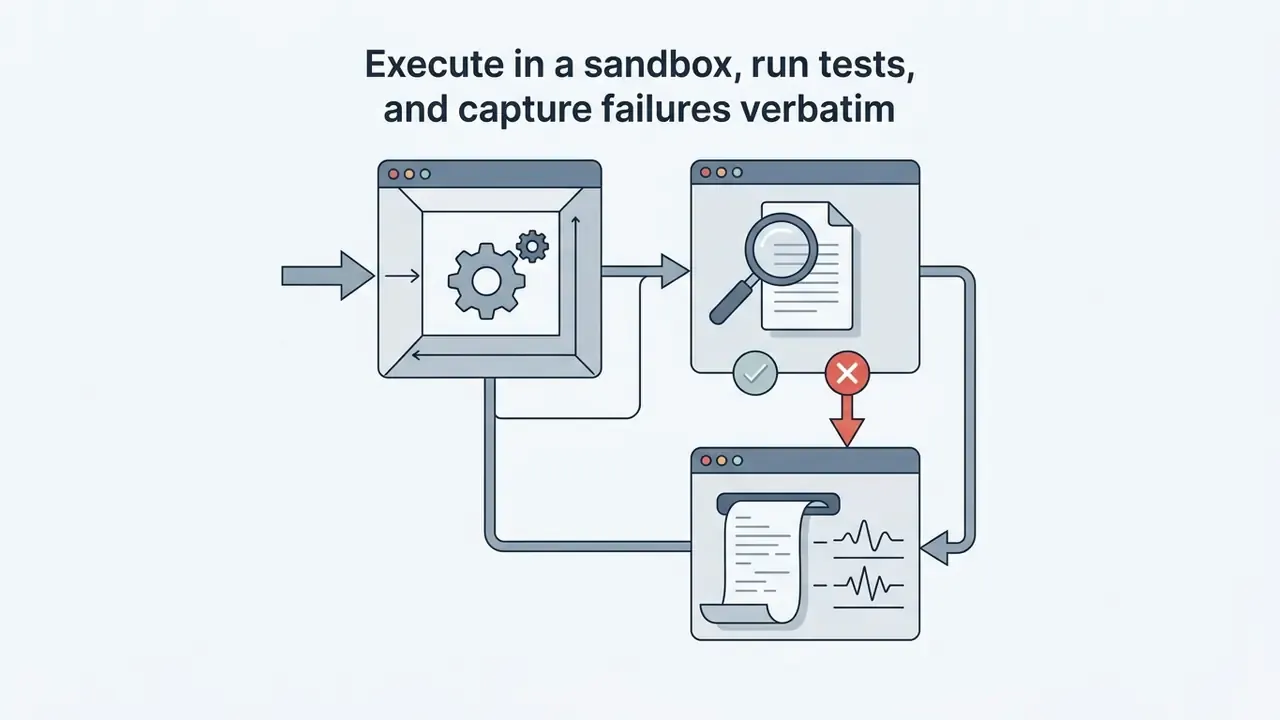
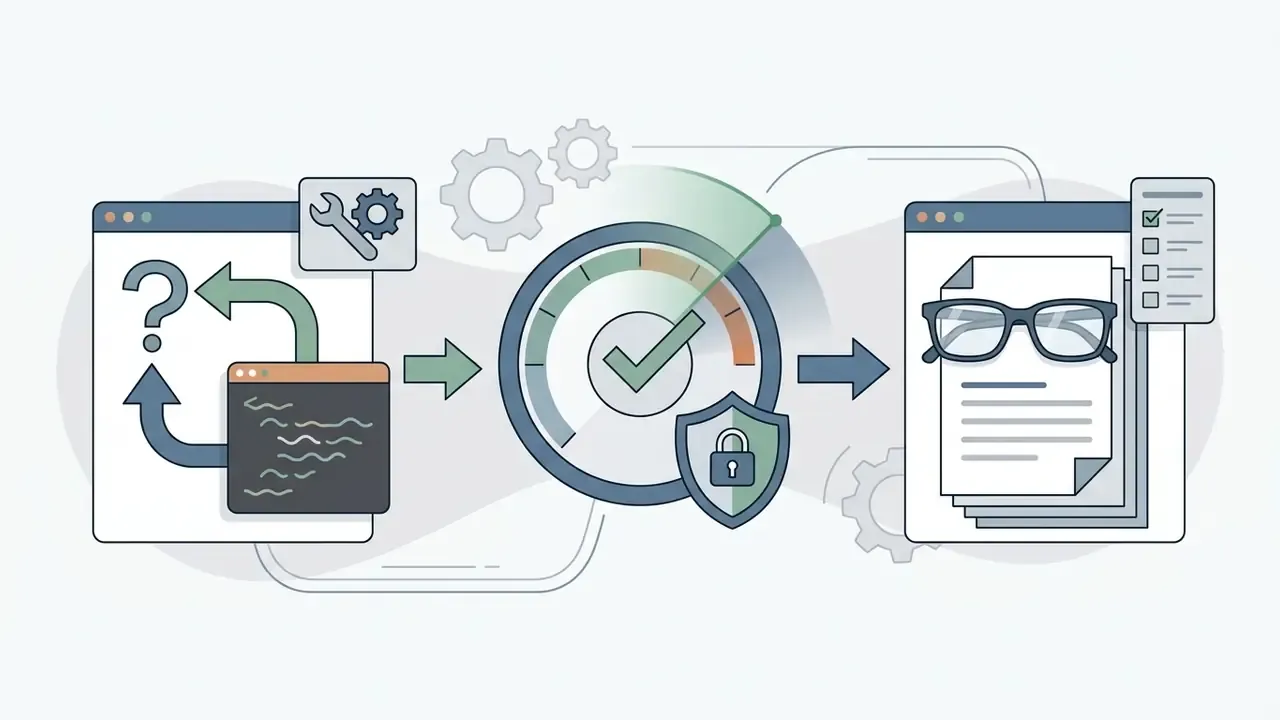
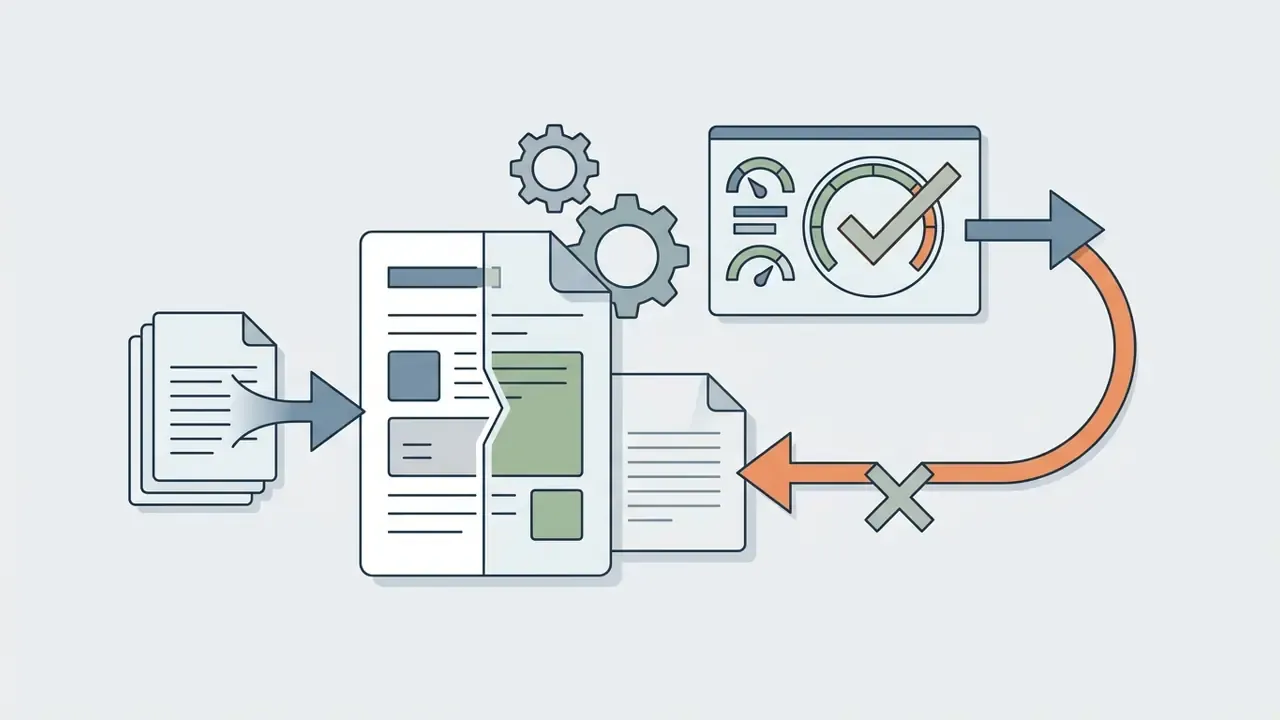
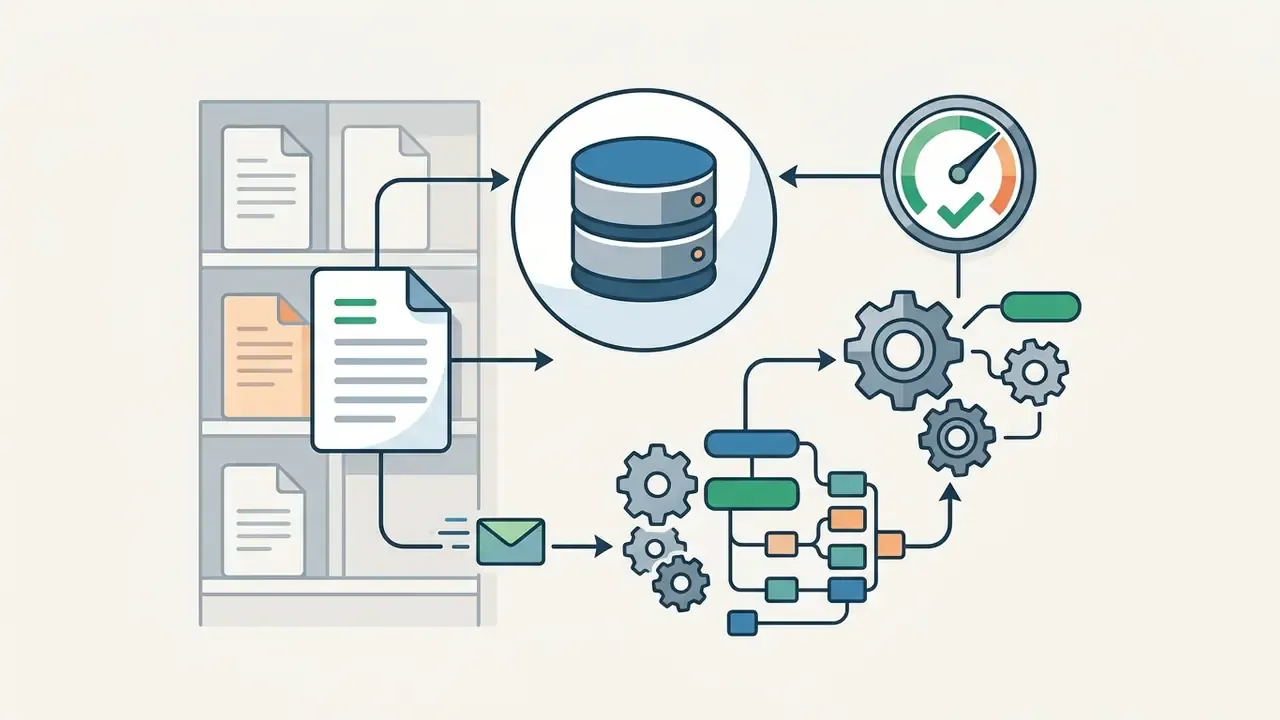
To consistently create python code with ai that is functionally correct and secure, teams should adopt a standardized generation and validation lifecycle. Single-pass prompting without structured review tends to produce runtime failures or security defects.
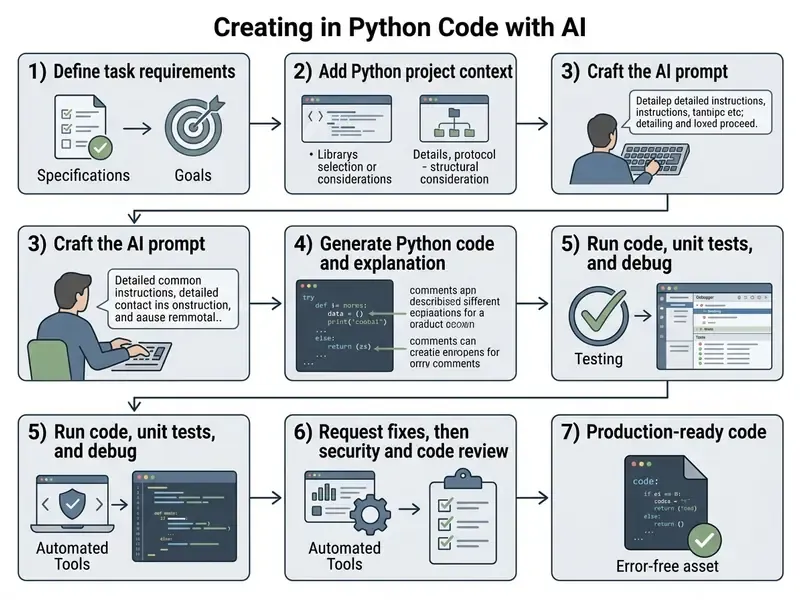
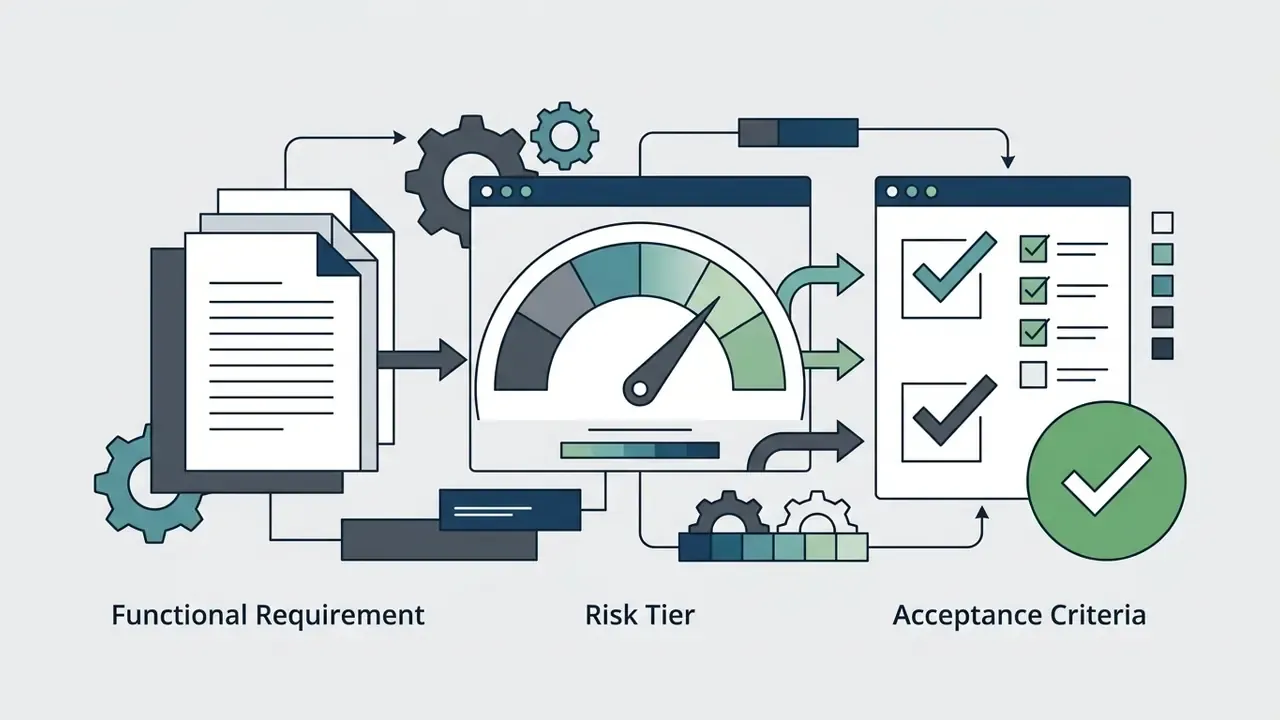
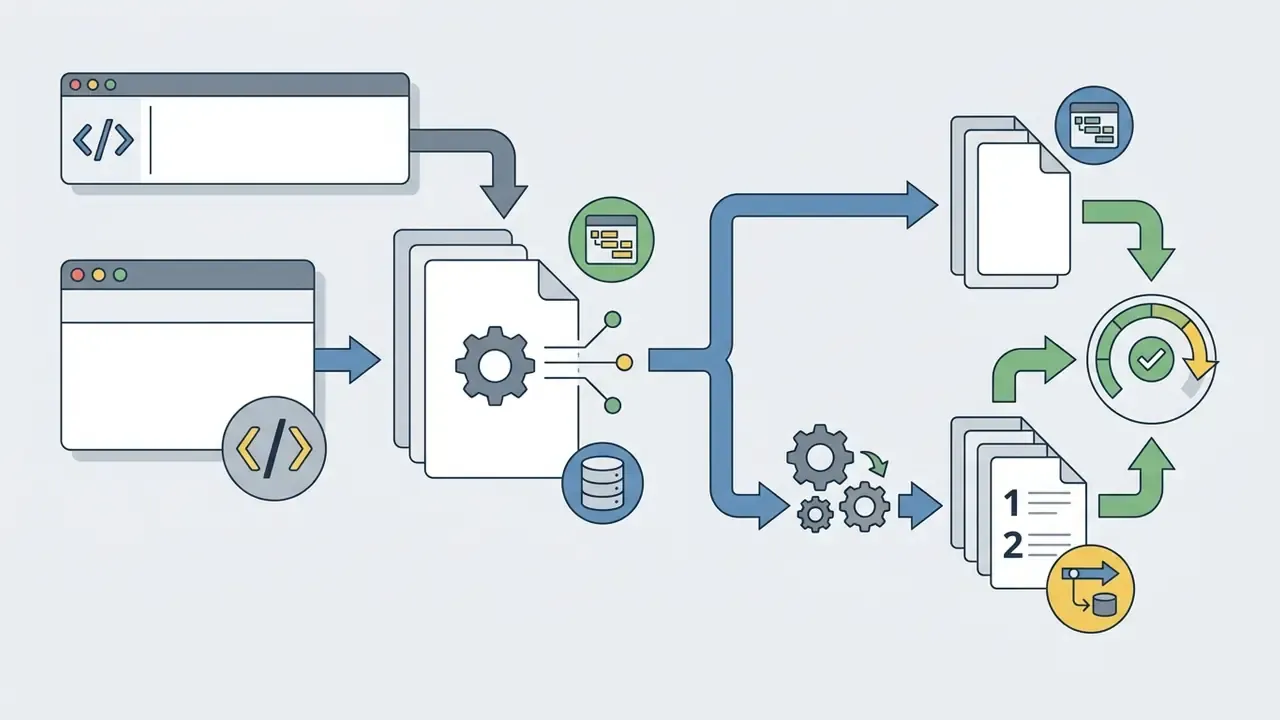
The same seven steps in text, for teams documenting the workflow in a control narrative:


Formulate the Task and Add Project Context
Effective prompts carry technical context, not ambiguous wishes. When starting a request in an ai python code generator online, include the target runtime (for example, Python 3.12), preferred framework major versions, existing environment dependencies, and explicit style rules.
Specify whether the output should use asyncio for non-blocking I/O, enforce strict type hints via typing, or avoid third-party dependencies outside the standard library. Where a library changed recently, paste the canonical documentation URL and instruct the model to follow the linked API rather than memory. That single habit suppresses most obsolete-signature hallucinations.
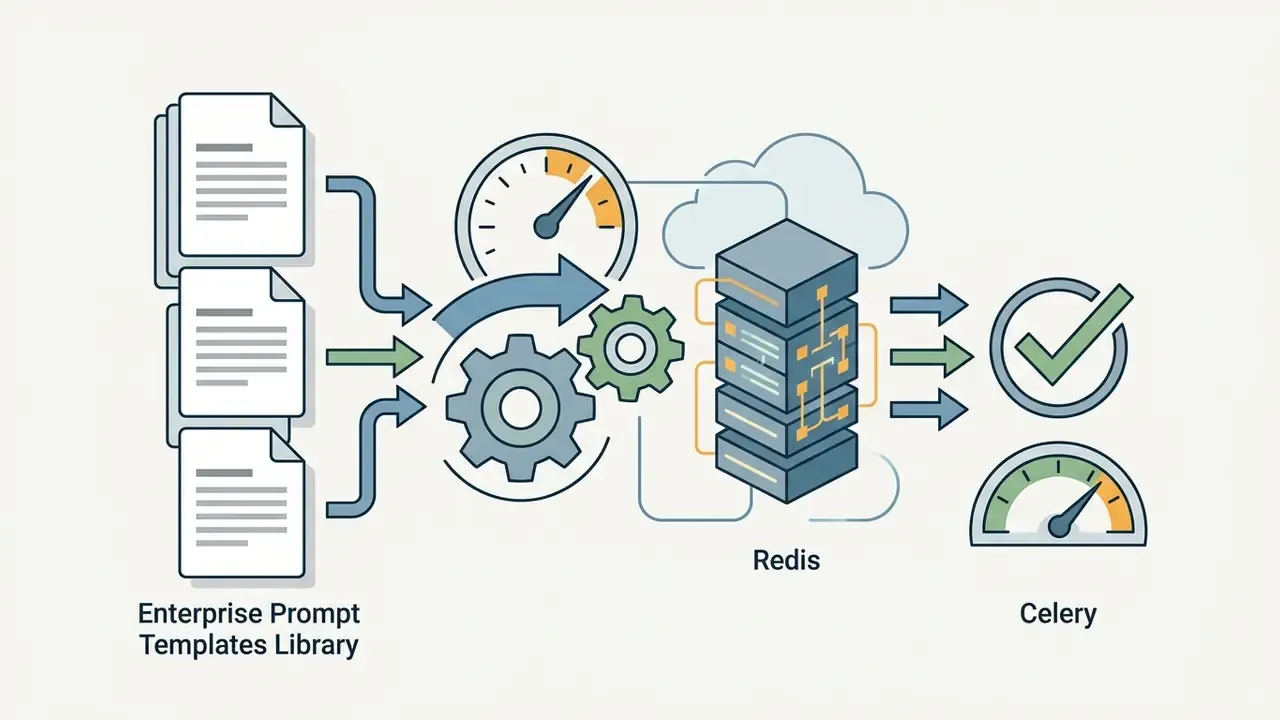
Enterprise Prompt Templates Library
To get accurate output from an ai python code generator, use context-rich structured templates instead of one-line requests:
"Generate a Python 3.12 FastAPI async route for updating user profiles. Use Pydantic v2 for input validation, SQLAlchemy 2.0 async sessions for database operations, and dependency injection for JWT auth verification. Include error handling for
404 Not Foundand409 Conflict."
"Write a vectorized Polars script to process a 5GB CSV log file. Filter entries where
status_code >= 500, aggregate request counts per minute, append a UTC timestamp column, and export the output as partitioned Parquet files."
"Create a Celery task in Python that processes batch transactional emails. Include exponential backoff retry logic (max 3 retries), dead-letter queue logging, and rate limiting using Redis."
"Generate a
pytestsuite for an external payment gateway handler. Include mock HTTP responses usingunittest.mock, parameter tests for valid and invalid card tokens, and strict type annotations."
"Define SQLAlchemy 2.0 declarative models for
Invoice,LineItem, andVendorwith one-to-many relationships, indexed foreign keys,Decimalmoney columns, and a matching Alembic migration script."
"Create a Django REST Framework API with JWT authentication and user registration. Include serializers with password validation, throttling on the login endpoint, and admin filters for the user list view."
"Implement a NumPy function computing a rolling volatility matrix from a 2-D returns array. Vectorize fully, avoid Python loops, validate array shape and dtype, and document complexity in the docstring."
"Write a PyMongo repository class with typed CRUD methods for a
documentscollection, connection pooling, and a Redis read-through cache with a 60-second TTL and cache invalidation on write."
"Build a Typer CLI with subcommands
import,validate, andexport, structured logging to stdout,--dry-runsupport, and non-zero exit codes on validation failure."
Prompt discipline is not cosmetic. Overloaded context degrades results measurably.

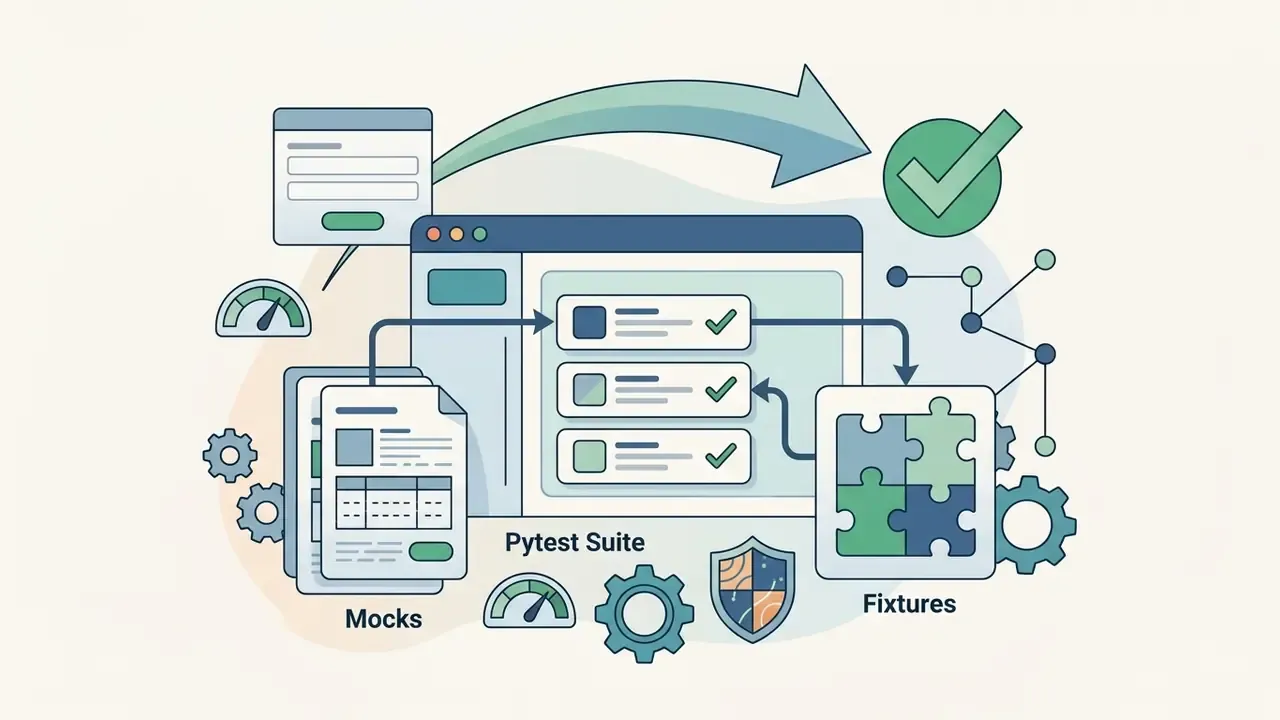
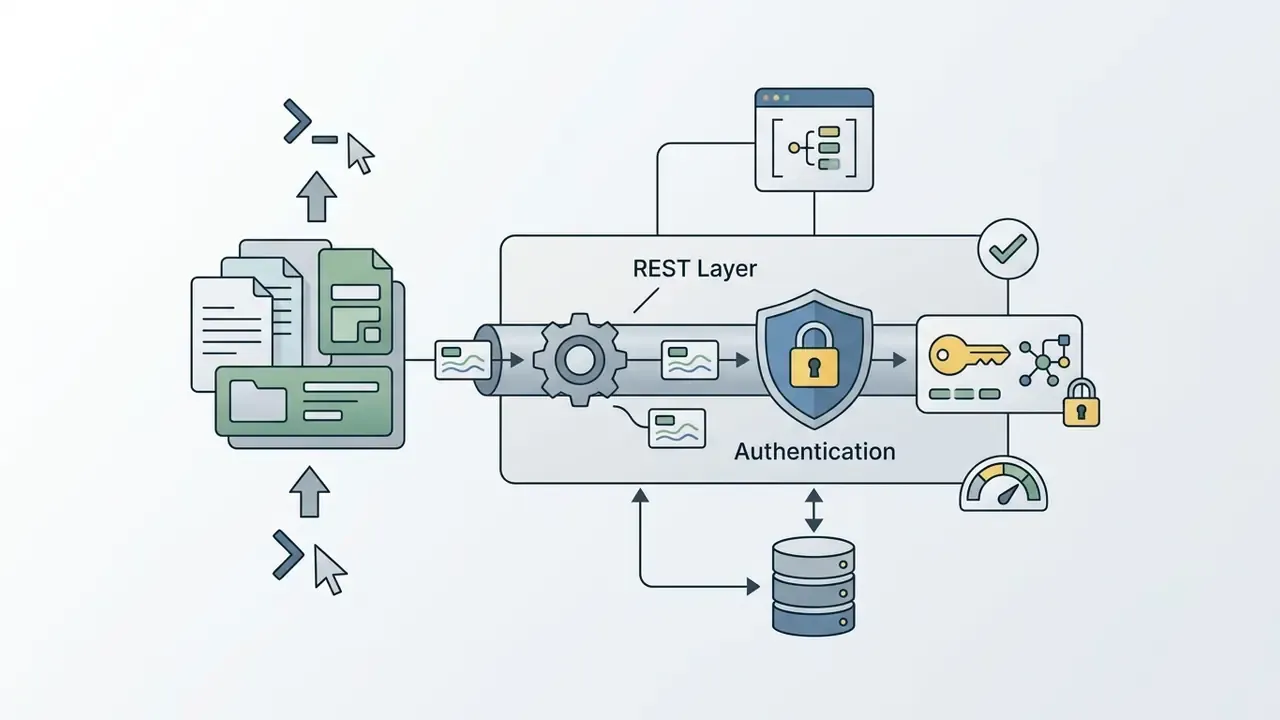
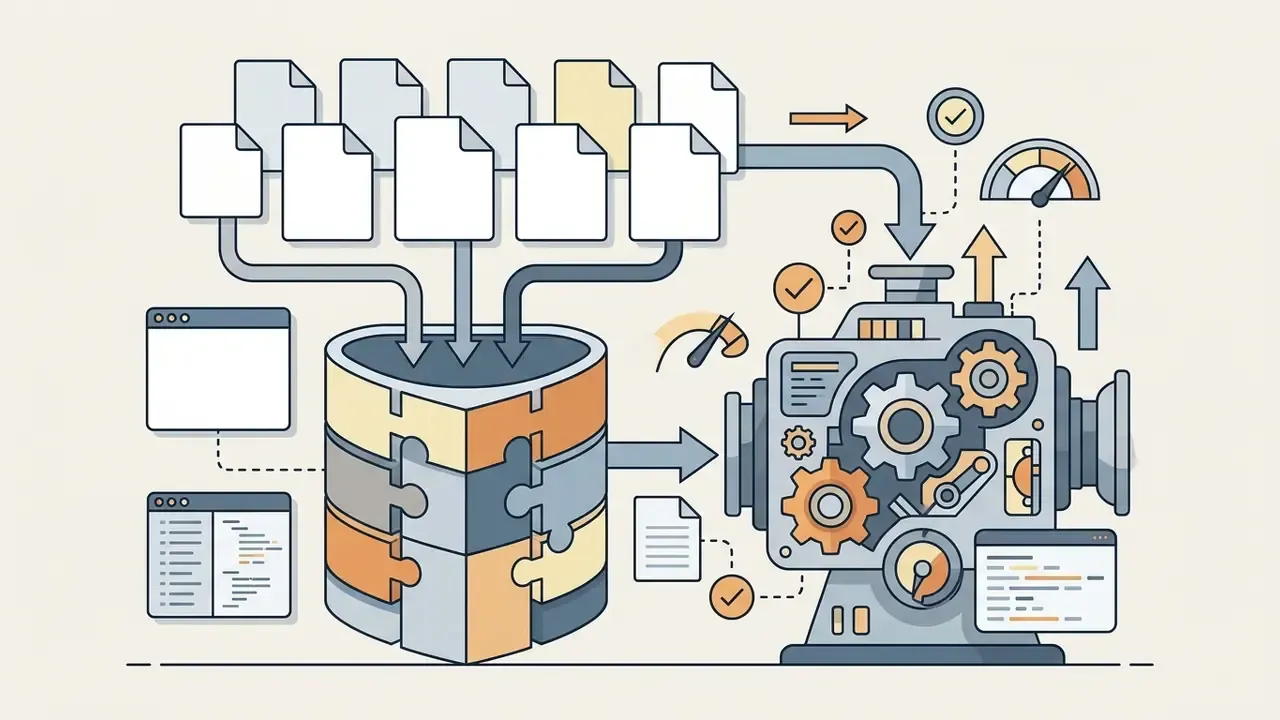
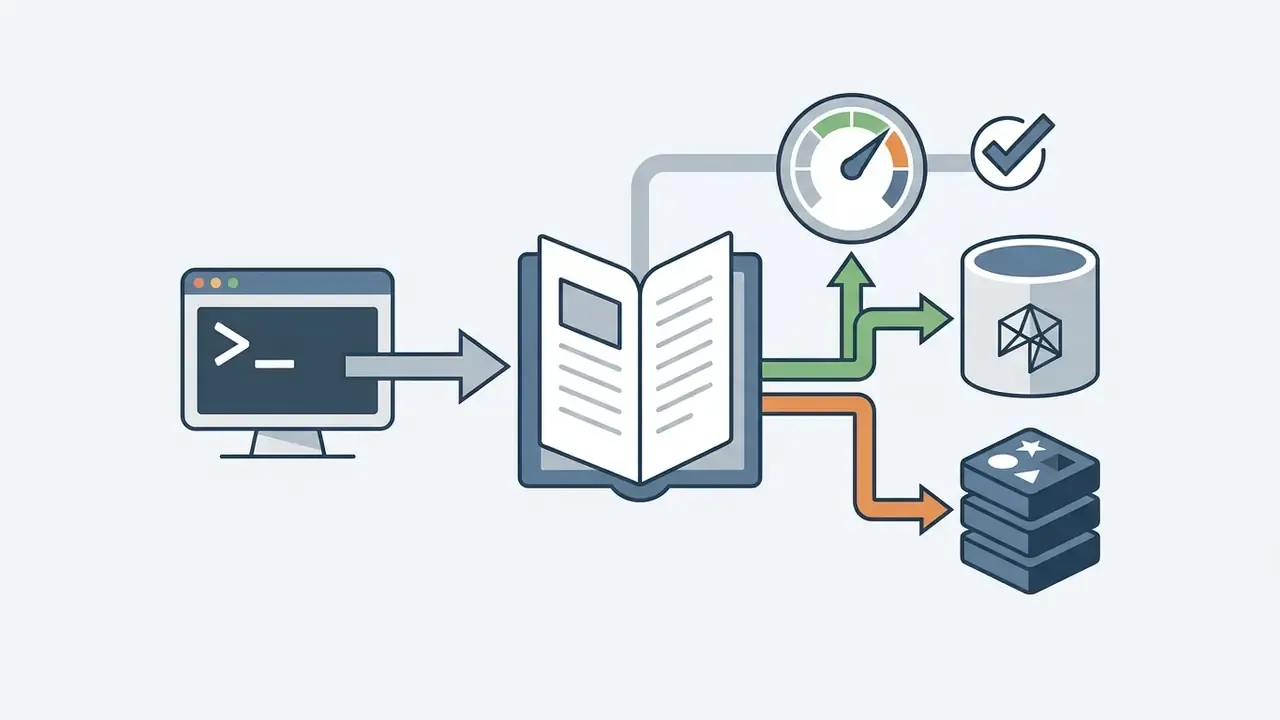
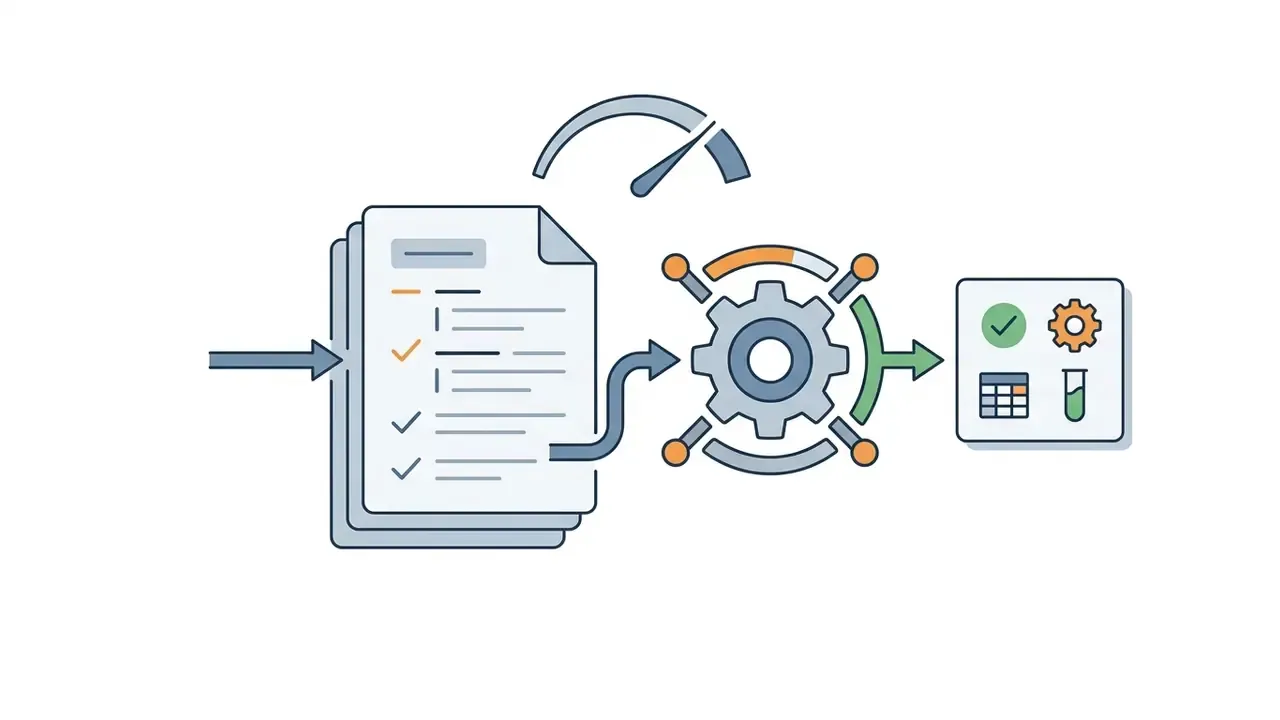
«Prompt design is critical: including too many class methods reduces test-generation effectiveness because the model's context becomes overloaded.»
Generate Code, Review Output, and Request Refinements
Once the python ai generator returns a candidate, review it against the functional criteria. If the code misses a requirement or misreads an API, feed the interpreter error output directly back into the prompt.
«A one-standard-deviation increase in suggestion quality raises the probability that a developer accepts it by 23.1% (OR = 1.231).»
Iterative loops that combine error logs, failing test traces, and the target specification let the model correct logic flaws efficiently. Debugging discipline matters here. Ask for a hypothesis about the failure rather than a "magical fix," then confirm the change did not alter business logic, break an edge case, or quietly modify the output contract.
Execute Code and Run Tests Before Production
Generated code should never move straight into production. Run it inside an isolated sandbox first: a dedicated virtualenv, a nox or tox session, a Docker container, or a temporary sub-process. That prevents unintended system access and environment corruption.
Then run the automated test suites, evaluate coverage, and complete static analysis before approving a pull request. Teams comparing tool economics across providers can benchmark integration cost patterns in the Google Veo API implementation and cost guide, which documents the same developer-economics trade-offs (rate limits, per-call pricing, quota tiers) that apply to code-generation APIs.
Approval Matrix: Who Signs Off on AI-Generated Python
| Step | Developer | Tech Lead / Reviewer | Security Engineer | Model Risk / Audit |
|---|---|---|---|---|
| Prompt authoring and context supply | Owner | Consulted | n/a | Informed |
| Sandboxed execution and unit tests | Owner | Consulted | n/a | n/a |
| Code review of business logic | Consulted | Approver | Informed | Informed |
| Auth, crypto, data-persistence paths | Consulted | Consulted | Approver | Informed |
| Tier-1 customer-impacting logic release | Consulted | Consulted | Consulted | Approver |
| Audit trail retention (prompt, model, diff, reviewer) | Owner | Consulted | Consulted | Approver |
How to Validate AI-Generated Python Code Before Production
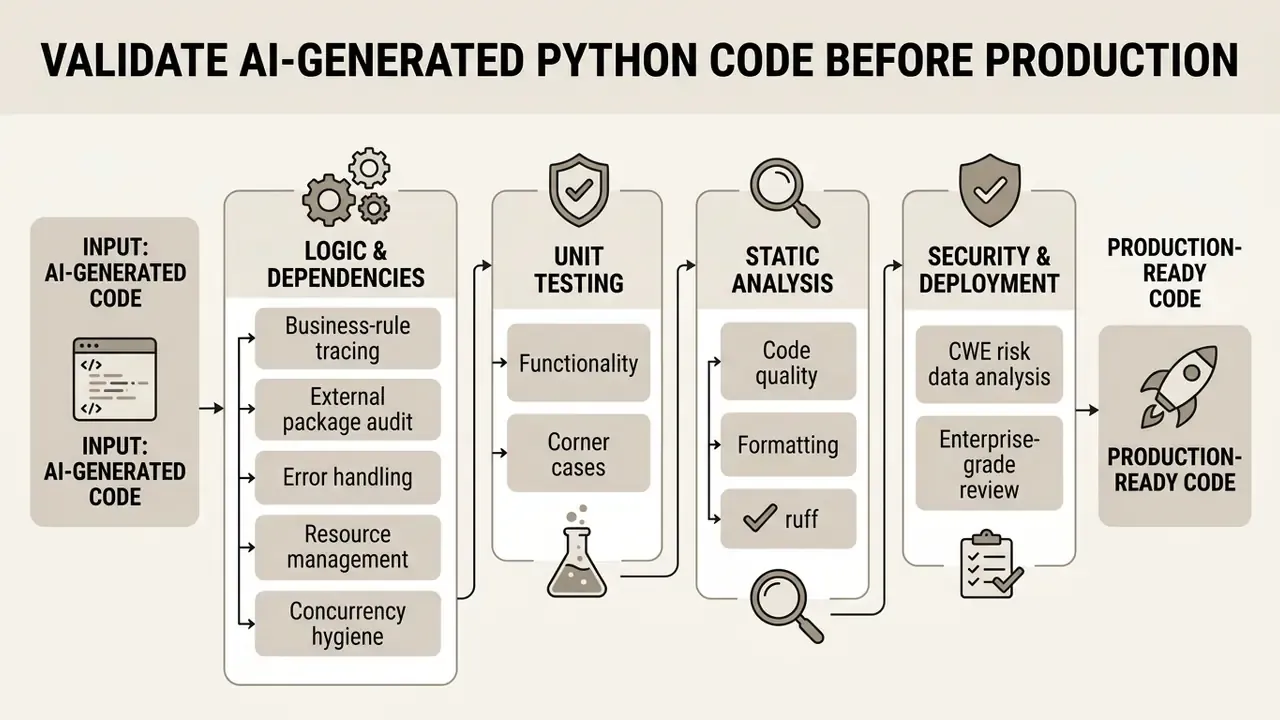
This section is general guidance and does not replace a security audit performed by a qualified information-security specialist.
AI-generated Python cannot be assumed production-ready at synthesis. Static analysis studies show that between 16.18% and 18.50% of AI-generated Python samples contain identifiable Common Weakness Enumerations (CWEs), including command injection and insecure randomness.
«Analysis of 7,703 files attributed to AI tools found 4,241 CWE instances; Python files show weaknesses in 16–18% of cases, roughly twice the JavaScript rate.»
Important: AI-generated Python code must not be deployed to production without thorough testing, dependency checks, and human code review. Static analysis studies show security weaknesses in a significant fraction of generated samples, particularly in Python, and current models frequently produce inefficient code structures even when the logic is functionally correct.
Authoritative secure-development guidance points the same way. NIST SP 800-218A (July 2024) states that AI-related code should be scanned and code-reviewed under the organization's secure-coding and code-testing policies, with findings recorded and triaged in the workflow. NIST SSDF v1.1 additionally requires validating all inputs, properly encoding outputs, and avoiding unsafe functions and calls. European guidance from BSI and ANSSI on AI coding assistants adds that generated source code should be systematically checked and understood by developers, never auto-committed, and that public code reviews may need to deconstruct both the generated code and the prompts behind it. Cloud Security Alliance research frames the operating rule succinctly: treat AI-generated code as unverified input, and tier human review by risk, with mandatory security-trained review for authorization, external API boundaries, data persistence, and cryptography.
Logic Verification, External Dependencies, and Error Handling
Validation means checking control flow against explicit business rules and security guidelines. Reviewers should focus on:
- Business-rule tracing walk the control flow against the written specification and test edge cases. AI code frequently solves an adjacent problem or silently relaxes a threshold or limit.
- External package audit confirm the model has not introduced unapproved dependencies or hallucinated package names. Hallucinated imports are an active supply-chain attack surface (dependency confusion, sometimes called "slopsquatting"), because attackers publish packages matching commonly hallucinated names. Enforce an internal PyPI mirror with an allow-list and pinned hashes.
- Error handling verify exceptions are caught cleanly, failures are never silent, and generic user-facing errors do not leak stack traces, environment variables, or connection strings.
- Resource management check that database connections, file handles, and network sockets close properly through context managers (
withstatements). - Concurrency hygiene for
asynciocode, confirm no blocking calls inside coroutines, bounded task groups, and idempotent retry behavior for Celery and Redis workers.
Unit Testing, Static Analysis, and Quality Delivery
A robust CI/CD pipeline for AI-generated Python needs layered verification:
- Static linters (Ruff): enforce PEP 8, detect unused imports, flag complexity.
- Type checkers (Mypy): validate annotations to prevent runtime
TypeErrorexceptions. - Security scanners (Bandit, CodeQL): scan for anti-patterns, hardcoded credentials, and unsafe calls such as
eval()orexec(). OpenSSF guidance for AI code assistants is explicit for Python: never callexecorevalon untrusted input, and prefersubprocesswithshell=False. - Test harnesses (Pytest): run unit and integration tests for full path verification on critical business logic, complemented by mutation testing that exposes assertions which never fail.
- Dependency and SBOM checks: run
pip-audit, verify lockfiles, and generate an SBOM so every generated import stays traceable.
«29.6% of Copilot-generated snippets contain security weaknesses, including CWE-78 (OS command injection) and CWE-330 (insufficient randomness) from the Top-25 list.»
A minimal, copy-ready validation gate:
# Automated validation script for AI-generated Python code
# 1. PEP 8 linting and complexity check
ruff check ./generated_code/ --select E,F,C90
# 2. Strict type checking
mypy ./generated_code/ --strict
# 3. Security vulnerability scanning
bandit -r ./generated_code/ -ll -ii
# 4. Dependency and supply-chain verification
pip-audit --requirement requirements.txt --strict
# 5. Tests with coverage floor
pytest ./tests/ --cov=generated_code --cov-fail-under=85 -q
Integration tests are the layer models most often under-produce, so ask for them explicitly:
# tests/test_payment_gateway.py - AI-generated Pytest suite, engineer-reviewed
import pytest
from unittest.mock import patch, Mock
from app.payments import PaymentGateway, PaymentDeclined
@pytest.fixture
def gateway() -> PaymentGateway:
    return PaymentGateway(api_key="test-key", timeout=2.0)
@pytest.mark.parametrize(
    "token,status_code,expected",
    [
        ("tok_valid", 200, True),
        ("tok_expired", 402, False),
        ("tok_unknown", 404, False),
    ],
)
@patch("app.payments.httpx.Client.post")
def test_charge_handles_gateway_statuses(mock_post, gateway, token, status_code, expected):
    mock_post.return_value = Mock(status_code=status_code, json=lambda: {"token": token})
    if expected:
        assert gateway.charge(token, amount_cents=1500) is True
    else:
        with pytest.raises(PaymentDeclined):
            gateway.charge(token, amount_cents=1500)
@patch("app.payments.httpx.Client.post", side_effect=TimeoutError)
def test_charge_retries_then_fails_loudly(mock_post, gateway):
    with pytest.raises(TimeoutError):
        gateway.charge("tok_valid", amount_cents=1500)
    assert mock_post.call_count == 3  # exponential backoff, bounded retries
While upgrading a payment gateway service, one enterprise engineering team wired static analysis (Mypy, Ruff) and security scanning (CodeQL) into the CI/CD pipeline for AI-generated code. The gate caught two command-injection defects (CWE-78) before staging, and the team reported a clean deployment record across 12 release cycles. Composite example, offered for illustration rather than as verified vendor data.
One caution for anyone tempted to replace human review with an LLM reviewer:
«On real pull requests the best model reaches F1 = 0.066, 92% below its synthetic-benchmark score; performance collapses on diffs longer than 150 lines.»
Audit Trail and Evidence Retention
How to Choose an AI Code Generator for Python
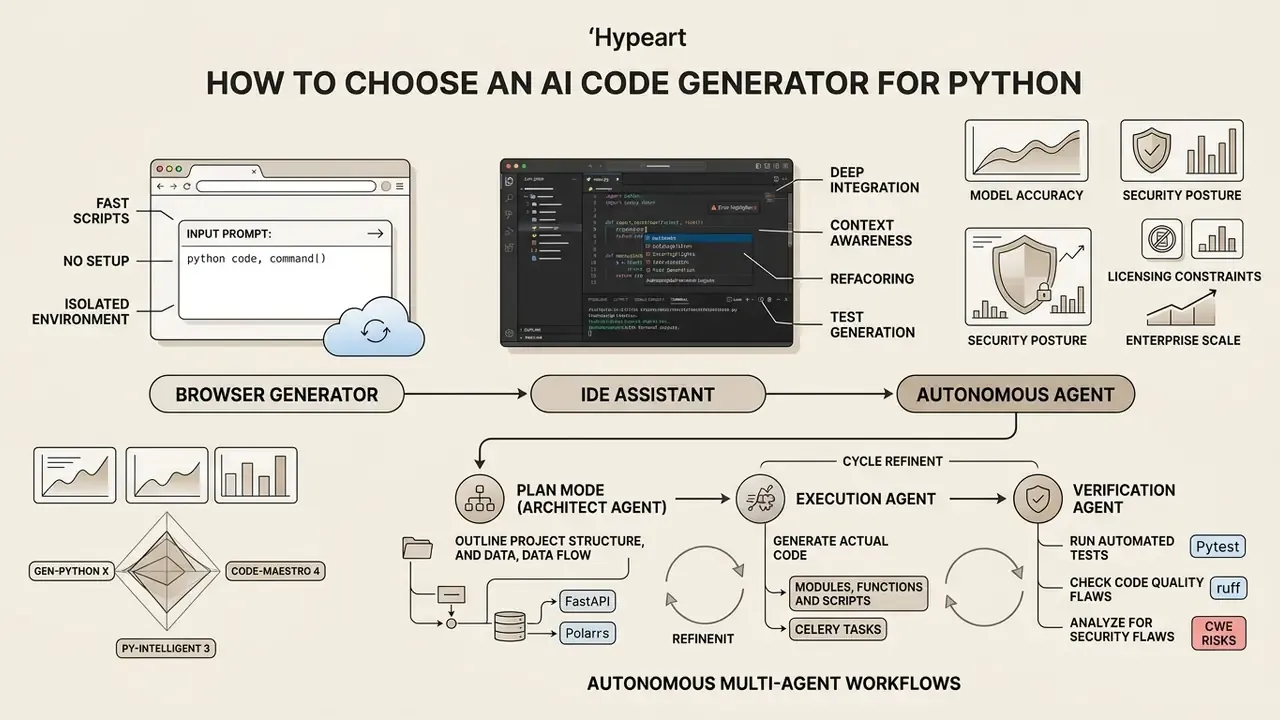
Selecting the right python ai code generator means balancing integration depth, model accuracy, security posture, and licensing constraints. Benchmark literature converges on a four-part selection frame: functional correctness, code quality and maintainability, security and privacy, and project fit.
Browser Generator, IDE Assistant, or Autonomous Coding Agent
AI Python coding tools arrive in three form factors:
- Browser-based online generators: web interfaces for standalone functions, prompt testing, or single scripts. No local setup, but no automatic codebase context either.
- IDE-integrated assistants: extensions for VS Code, JetBrains, or Cursor offering inline autocompletion, chat-based refactoring, and local repository awareness.
- Autonomous coding agents: environments (for example, Replit Agent) that plan multi-file edits, run shell commands, execute tests, and resolve build failures with limited supervision.
A risk validation team evaluated AI coding tools for internal model audit workflows. Moving from unmonitored browser generators to self-hosted IDE assistants with strict data-privacy controls removed the repository exposure path while keeping roughly a 30% reduction in code review turnaround. Again, illustrative composite rather than audited result.
«In weeks of peak Copilot usage, engineers completed 40.5% more pull requests at the same level of time invested.»
Autonomous Multi-Agent Workflows and Plan Mode
Complex architectural changes push teams past single-prompt generation into multi-agent orchestration:
- Plan mode (architect agent) analyzes the prompt and repository context to build a structured execution DAG (Directed Acyclic Graph) before touching files. The plan becomes a reviewable artifact, which is a governance advantage: a reviewer can reject an approach before a line is written.
- Execution agent writes code incrementally per planned module, respecting local dependency structures, import conventions, and existing abstractions.
- Verification agent runs local tests, triggers static analysis (Ruff, Mypy), and feeds stdout and stderr traces back to the execution agent for self-correction.
For enterprise use, constrain agents explicitly. Read-only credentials by default. No network egress from the sandbox unless allow-listed. A hard cap on autonomous iterations. A mandatory human gate before any commit, migration, or infrastructure change. Cross-language work benefits from the same pattern: multi-agent translation systems that split initial translation, syntax repair, code alignment, and semantic fixing report meaningful gains (for example, 38.5% improvement on C++ to Python in the TransAGENT evaluation), while specification-guided approaches that synthesize tests and natural-language specs before translating report up to 46% relative improvement.
AI Models and Python Code Quality
The underlying foundation model drives functional correctness, runtime efficiency, and maintainability. Benchmarks such as RACE (arXiv:2407.11470) and Mercury (arXiv:2402.07844) evaluate models across several operational dimensions:


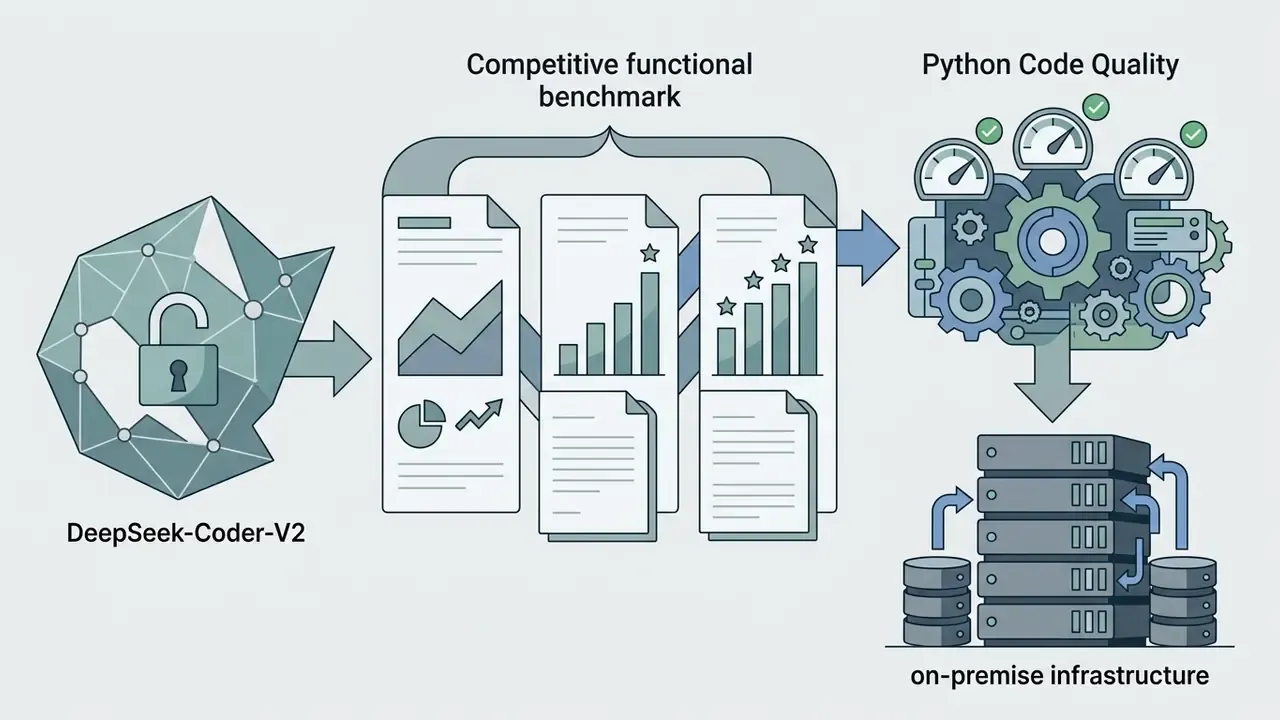
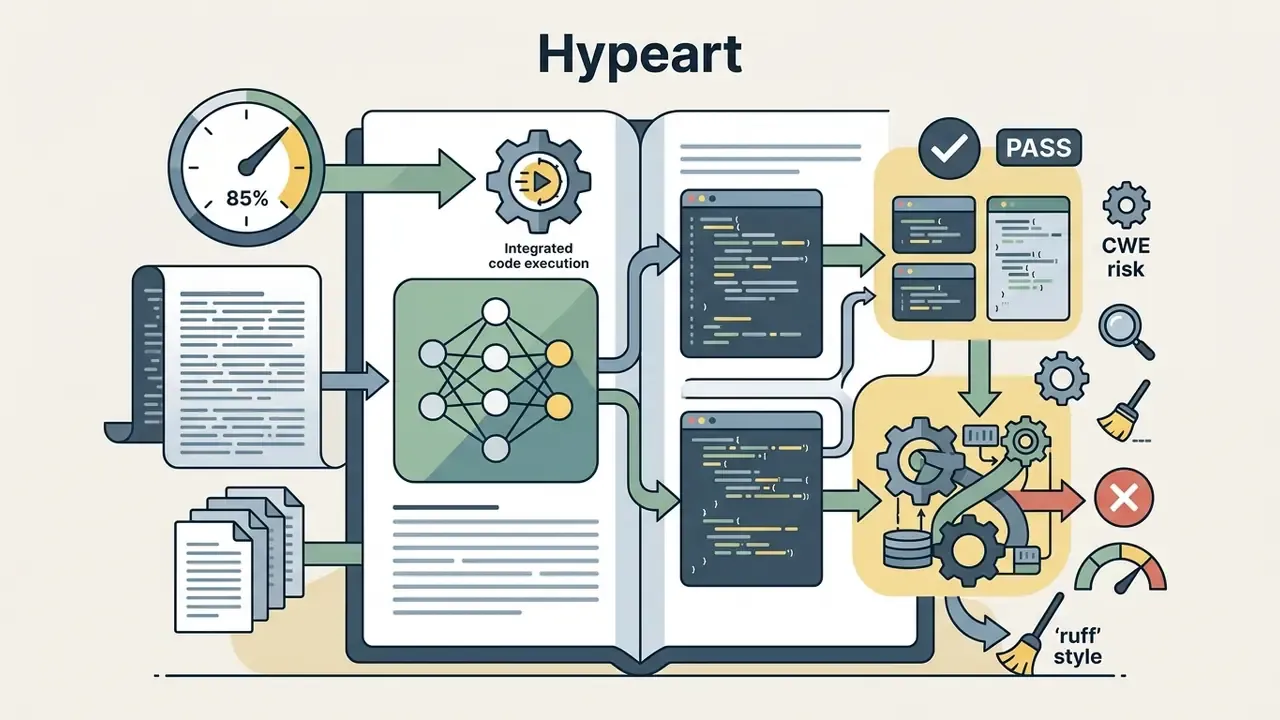
«RACE evaluates 28 LLMs across four dimensions, correctness, readability, maintainability, and efficiency, and no single model leads on all of them simultaneously.»
Buyers who want a repeatable scoring method, weighting output quality, control, price, and licensing into one decision, can reuse the framework applied in our comparison of leading AI generators by quality and control, then substitute code-specific metrics (pass@k, PEP 8 conformance, CWE density) for the media metrics.
Project Context, Web Access, and Code Execution
Enterprise deployments demand whole-repository context, not isolated snippets. Tools with workspace indexing can pull relevant function definitions, class hierarchies, and database schemas from adjacent files.
Platforms with native sandboxed execution let the model run Python internally, observe errors, and fix bugs before presenting the result. Real-time web retrieval helps the generator reference current documentation for recently updated libraries, avoiding obsolete API usage. Vendor implementations differ materially: some expose reusable execution containers that persist across calls within a session, others run strictly isolated server-side sandboxes with no internet access, and some restrict execution to Python only. These differences change your data-residency and egress analysis, so document them per tool.
| Modality | Project Context Visibility | Code Execution Support | API and Web Access | Best Suited For |
|---|---|---|---|---|
| Browser Generator | Low (pasted snippets only) | Rare (manual execution) | Optional via web search | Ad-hoc scripts, algorithm generation, learning |
| IDE Assistant | Medium to high (open files and index) | Local terminal integration | Provider-dependent | Real-time coding, unit test writing, inline refactoring |
| Autonomous Agent | High (full repository structure) | Native sandboxed environment | Integrated API and web tools | Multi-file features, dependency updates, automated bug fixing |
Short version: context breadth buys speed, and every increment of autonomy buys you a new control obligation.
Deployment Topology and Data Isolation
For banks, insurers, and healthcare providers, deployment model often decides the purchase, not benchmark accuracy:
| Deployment | Data Exposure Profile | Typical Controls to Verify | Best Fit |
|---|---|---|---|
| Public cloud API (shared) | Prompts and code leave the perimeter | Zero-retention contract, no-training clause, regional processing, SOC 2 Type II or ISO 27001 reports | Non-sensitive repositories, prototyping |
| Dedicated VPC or private endpoint | Traffic isolated to tenant network | Private link, customer-managed keys, per-tenant logging | Regulated production repositories |
| On-premise open weights (DeepSeek-Coder-V2 class) | No external egress | GPU capacity planning, model-version pinning, internal red-teaming | Highest-sensitivity code, air-gapped environments |
Free AI Python Code Generator: Limits, Pricing, and Commercial Usage
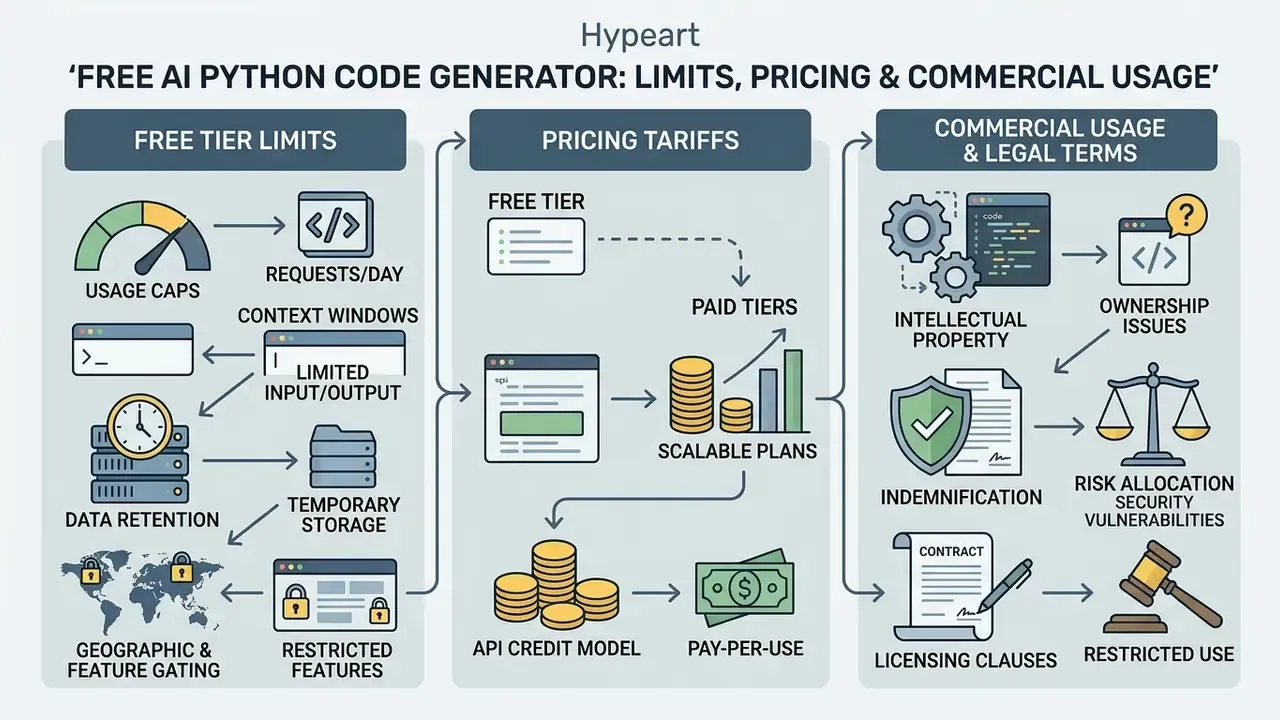
Organizations testing a free ai python code generator or ai python code generator free tier need to read the query limits, context constraints, and legal terms closely. Free access is fine for evaluation. Commercial development requires verified privacy and output-ownership protections.
What is Available in a Free AI Code Generator for Python
A python ai code generator free option, sometimes marketed as a free python ai code generator or free ai code generator python, usually grants base models with rate-limited usage. Typical limitations:
- Usage caps daily or monthly token budgets (for example, 50 to 150 generations per day), sometimes framed as credits that expire monthly.
- Restricted context windows truncated prompt limits (8k to 32k tokens) that block large-repository ingestion. Paid tiers commonly extend to 128k, 256k, or 1M tokens.
- Data retention free tiers may reserve the right to log inputs and outputs to train future public models, which is a serious problem for confidential codebases.
- Geographic and feature gating some providers limit free access to specific regions or a curated subset of models, and exclude agentic execution from free plans.
Tiered access mechanics are consistent across AI categories. Our comparison of free AI generators and their access limits documents the same credit-cap, watermark-equivalent, and export-restriction patterns that code vendors apply to context length and retention policy.
Pricing Tariffs and Commercial Usage Terms
Commercial subscriptions (Pro, Team, Enterprise) unlock larger context windows, faster generation, zero-retention guarantees, and SLA commitments. When comparing a python code generator ai free plan against a paid one, legal teams should verify:
- Intellectual property rights: confirm the vendor assigns ownership of generated output to the customer. OpenAI's Terms of Use state that, as between the user and OpenAI, the user owns the output. Anthropic's commercial terms state customers retain rights in inputs and own outputs. GitHub's Generative AI Terms state that GitHub does not own inputs or outputs. Google's Gemini API Additional Terms state Google will not claim ownership over generated content.
- Indemnification controls: enterprise plans often include indemnification against copyright claims arising from training data. Read the conditions. Indemnity is typically contingent on keeping vendor-side filtering enabled, using supported model versions, and promptly notifying the vendor of claims. It is frequently capped and excludes cases where the customer disabled duplication filters.
- Commercial licensing: ensure the terms permit embedding generated code in proprietary, closed-source products. For open-source contributions, Apache Software Foundation guidance permits AI-generated code only if the tool's terms do not restrict output use and the contributor holds sufficient rights to license it.
| Plan Tier | Typical Limits | Model Access | Context Window | Commercial Usage Rights |
|---|---|---|---|---|
| Free Tier | 50 to 150 credits per day; rate-limited | Standard or base models | 8k to 32k tokens | Non-commercial; public data training risk |
| Pro Tier (about $20 per month) | High or unlimited standard usage | Top-tier flagship models | 128k to 256k tokens | User owns output; no public training on data |
| Enterprise | Uncapped APIs; dedicated SLAs | Custom or fine-tuned models | Up to 1M+ tokens | Full commercial rights; legal IP indemnification |
Prices and quotas move quickly, so verify each figure against the vendor's current pricing page and record the verification date in your procurement file. Procurement teams mapping licensing language to actual business rights can review a worked example in our analysis of commercial licensing and export terms for AI generators, which breaks down ownership, attribution, and redistribution clauses in comparable vendor agreements.
Legal and Terms Verification
This information is general in nature and does not replace advice from qualified counsel on intellectual-property and software-licensing matters.
Before deploying AI-generated code in production, verify terms against official vendor documentation:
- GitHub Copilot GitHub Generative AI Terms confirm GitHub claims no ownership over inputs or outputs.
- OpenAI API OpenAI Terms of Use assign output rights to the user.
- Google Gemini API Google Gemini Terms state Google does not claim ownership over generated content.
- U.S. Copyright Office Copyright Guidance on AI-Generated Works clarifies that protection requires substantial human creative contribution.
Note the structural gap. A contract can assign output ownership to you while copyright law still denies protection to purely machine-authored material absent meaningful human authorship. Plan for that asymmetry when generated code is a competitive asset.
For subscription tiers and enterprise options, review current plan documentation, and consult AI litigation and legal frameworks for case-law developments affecting generated outputs.
Model Risk and Audit Readiness Checklist
Use this as a pre-merge gate for any AI-generated Python entering a regulated or customer-facing system:
Checklist0 / 12
Limitations and Unresolved Questions
Honest reporting matters more than a clean narrative, so here is what the evidence does not settle.
First, productivity numbers come mostly from telemetry and observational studies, not randomized trials inside supervised institutions. Acceptance rates and merged-PR counts measure activity, not risk-adjusted value. Second, CWE density figures derive from public repositories, where review discipline differs sharply from a bank's secure SDLC. Your internal rate may be lower, or higher, and you will only know by measuring. Third, no published framework yet defines validation standards for agentic code generation that spans multiple files and executes shell commands. Existing model-validation playbooks assume a stable artifact, not a digital worker that rewrites itself between reviews.
Fourth, an open cost question: control overhead. Sandbox infrastructure, SAST licensing, mutation testing time, and reviewer hours all belong in the ROI calculation. Programs that omit them tend to report savings that internal audit later disputes. Treat every audience assumption and vendor claim in this guide as a hypothesis until your own analytics, interviews, and CRM data confirm it.
A safe next step is narrow. Pick one Tier 2 workload, such as a reconciliation script or a report builder, run it through the full gate above for one quarter, and measure both throughput and escaped defects before widening scope.
FAQ About AI Python Code Generator
How Do We Maintain an Audit Trail for AI-Generated Code?
Log four objects per change: the prompt (including attached context files), the model identifier and version, the unmodified generated diff, and the human review record. Store them next to CI artifacts, linter output, SAST reports, and test results, in the same immutable evidence store used for release records. Where a GRC platform exists, map each merged AI-assisted change to the corresponding control (secure code review, change management, segregation of duties) so evidence can be pulled on request rather than reconstructed during an examination.
Can AI-Generated Python Code Be Used in Regulated or Customer-Impacting Systems?
Yes, with tiered controls. Non-sensitive utilities can follow standard review. Code touching valuation, pricing, reporting, credit decisions, or customer data should be handled as a change to a controlled system: documented specification, independent review, security sign-off, retained evidence. NIST SP 800-218A directs organizations to apply existing secure-coding and code-testing policies to AI-related code, and Cloud Security Alliance guidance recommends risk-tiered human review with mandatory security review for authorization, external API boundaries, data persistence, and cryptography.
Is an AI Python Generator Suitable for Beginners in Python?
An ai python generator or python ai maker works well as a learning assistant. It explains code, clarifies syntax, and demonstrates library usage. Beginners can paste a confusing traceback and get step-by-step troubleshooting.
«Less experienced developers gain the most from Copilot: they accept roughly 30% of code suggestions and complete tasks faster than without AI.» Sea Change (telemetry analysis of 934,533 Copilot users), arXiv (2023). https://arxiv.org/ftp/arxiv/papers/2306/2306.15033.pdf «A systematic review of 105 papers (2021 to 2025) records exponential growth in LLM test-generation research: from 1 paper in 2021 to 73 in 2024.» Large Language Models for Unit Testing: A Systematic Literature Review, arXiv (2025). https://arxiv.org/html/2506.15227v1 Over-reliance is the trap. Controlled-study evidence is sobering: a 2026 meta-analysis of 32 studies reported a large improvement in task performance (SMD = 0.86) but negligible gains in conceptual understanding (SMD = 0.16, falling to negative 0.03 under sensitivity analysis). Novices should write their own unit tests, run every snippet manually, and review the logic line by line.
Can an AI Coding Assistant Work with Other Programming Languages?
Yes. Most foundation models powering an ai code maker python train on multilingual repositories covering Java, C++, JavaScript, TypeScript, Go, and Rust. They translate legacy functions into idiomatic Python and convert Python routines into high-performance C++ extensions. Specialized translation frameworks beat naive prompting by combining input modalities (source code, synthesized specifications, generated tests, static-analysis signals) and by running repair loops that fix syntax first and semantics second. Reported results include a 38.5% improvement on C++ to Python translation in a four-agent repair system, and up to 46% relative improvement in a specification-guided approach across C, Go, Rust, JavaScript, and TypeScript. Quality still varies sharply by language pair, so gate every migration behind the original test suite.
Should Generated Code Be Blocked from Auto-Commit or Auto-Execution?
Yes. BSI and ANSSI guidance states that AI-generated source code should be systematically checked, not automatically executed, and not automatically committed. In practice: no agent write access to protected branches, no autonomous shell commands against production credentials, and no auto-merge rules that bypass human approval for AI-authored diffs.
How Do We Prevent Hallucinated Package Attacks?
Restrict installation to an internal proxy registry with an explicit allow-list, require hash-pinned lockfiles, and fail CI on any import that does not resolve to an approved package. Add a review step confirming every new third-party dependency exists upstream, is actively maintained, and was intentionally requested. Hallucinated names are the entry point for dependency-confusion and typosquat packages published specifically to match common model errors.
What Metrics Should We Track to Prove Value and Control?
Track productivity and quality in pairs, so gains are not purchased with defects: pull requests merged per engineer-week, review cycle time, escaped defect rate, CWE density per thousand lines of AI-assisted code, test coverage and mutation score on AI-authored modules, and the share of AI-assisted changes carrying complete audit evidence.
Internal Navigation and Resources
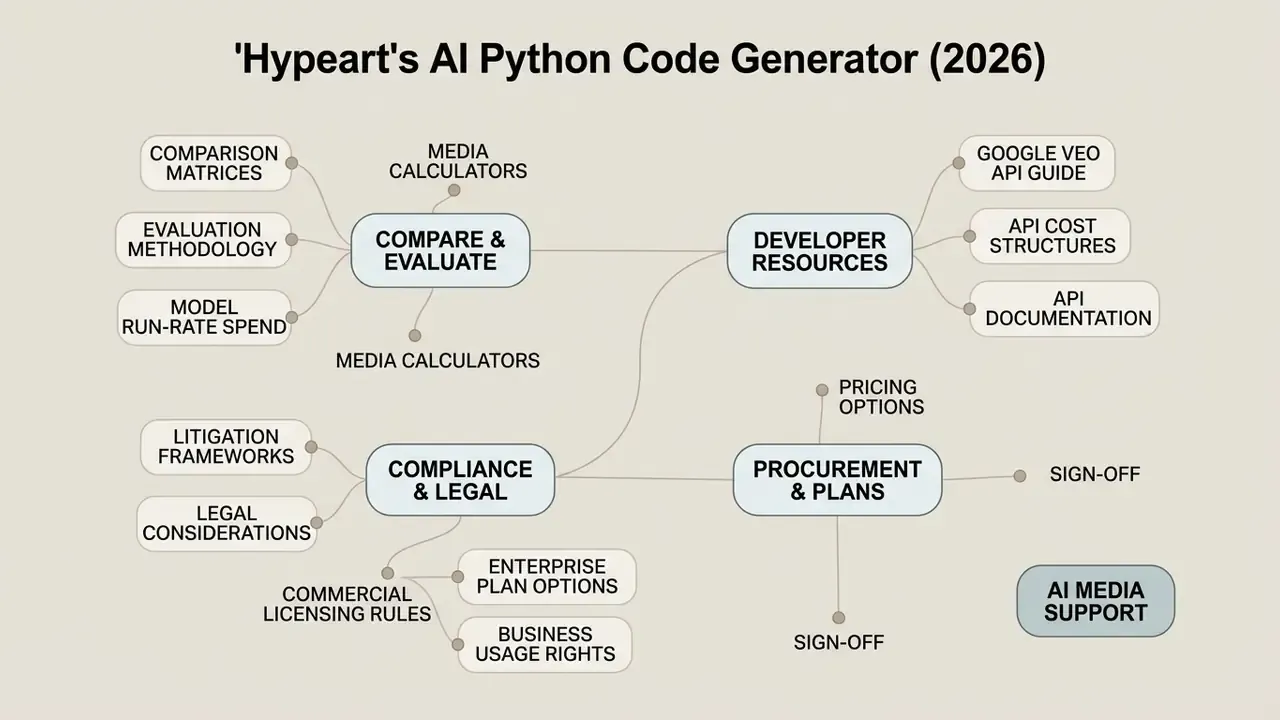
For comparative analyses, API developer guides, and commercial-use compliance across AI platforms:
- Study evaluation methodology in our AI Media Comparison Matrices.
- Review developer economics and API cost structures in the Google Veo API implementation guide.
- Examine legal considerations regarding AI outputs in AI Litigation and legal frameworks.
- Access developer API documentation for system integration.
- Model run-rate spend with the AI Media Calculators.
- Review commercial licensing rules and business usage rights.
- Consult pricing and enterprise plan options before procurement sign-off.
- For technical assistance, visit AI Media Support.
- For definitions used throughout this guide, view the guide in our central glossary of AI technical terms.