What this guide gives you at a glance
- Eight mandatory control gates , from AI project intake through licensing, privacy, bias testing, vendor due diligence, and documented executive sign-off.
- Live regulatory anchors EU AI Act (Regulation EU 2024/1689) Articles 50 and 53, NIST AI 600-1, OMB M-24-18, GDPR Article 4(11), NIST SP 800-122, and C2PA provenance standards.
- Litigation-aware IP screening , including precedent from Thomson Reuters v. Ross Intelligence and Getty Images v. Stability AI.
- Engineering-grade bias controls reweighting, adversarial debiasing, and fairness-aware training, evaluated against demographic parity metrics.
- Financial discipline a risk-adjusted ROI structure covering control costs, computational overhead, technical debt, and residual risk.
- Copy-ready artifacts a readiness checklist, a data privacy risk matrix, a vendor due diligence comparison table, and an Executive Sign-Off Memo template for your GRC or ECM system.
Control gate ownership at a glance
| Control gate | Accountable owner | Primary evidence artifact |
|---|---|---|
| Intake and technology classification | AI governance office | Intake record with model inventory ID |
| Use case and business ownership | Named business owner | Risk-tier assessment in the use-case register |
| Tool and vendor vetting | Procurement plus CISO delegate | SOC 2 Type II, ISO/IEC 27001, DPA |
| Privacy and consent clearance | Data Protection Officer | Consent records, PIA for high-risk assets |
| Licensing and usage rights | Legal counsel | Vendor terms review, IP assignment agreements |
| Accuracy and bias testing | Model risk or validation team | Groundedness scores, fairness slice results |
| Human review | Qualified subject-matter expert | Signed review log with timestamp and edits |
| Audit trail filing | Internal audit liaison | C2PA manifests, prompt and output logs |
What a B2B AI media trust checklist should verify
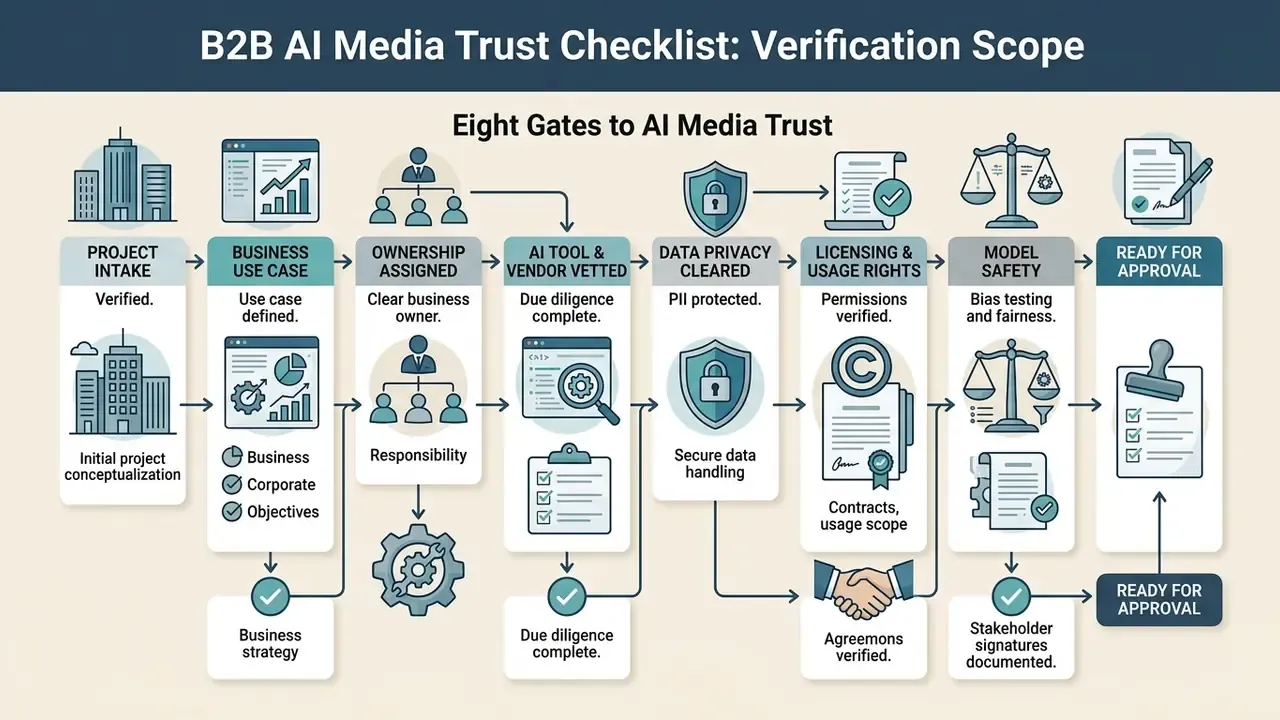
A B2B AI media trust checklist verifies the operational scope, licensing integrity, privacy compliance, model safety, vendor security, and auditability of synthetic assets before executive sign-off. Implemented properly, this control framework blocks unauthorized model use, protects intellectual property, and keeps trust and transparency claims defensible under evolving regulatory standards.
One caveat before the detail: a checklist provides structure, not judgement. It tells you which evidence must exist. It does not tell you whether your institution's risk appetite tolerates a synthetic client testimonial. That decision stays human.
Define the AI media use case and business owner
Every AI-generated media asset requires a named business owner who accepts explicit accountability for the operational purpose, risk classification, and distribution channels. Clear ownership is what keeps the asset aligned with institutional risk appetite and internal governance policy. Without it, responsible AI becomes a slogan on a slide.
«AI disclosure requirements vary by content type: trust declines more sharply in social and interpersonal contexts than in transactional ones.»
This finding matters directly for ownership assignment: risk tiering should follow the communicative context of the asset, not only its format. A synthetic voiceover in a client-facing relationship video carries a materially higher trust penalty than the same technique in an internal transactional explainer. Different owners. Different escalation thresholds.
According to the IMDA Model AI Governance Framework for Agentic AI (2026), assigning a designated use-case owner is essential to confirm that automated processes serve a legitimate business need. The business owner assesses whether the proposed asset touches sensitive customer data, commercial branding, or public interest topics. In line with the NIST AI Risk Management Framework 1.0 (NIST AI 600-1), mapping the AI system to its specific operational context establishes the baseline for risk measurement and deployment approval.
«The Map function recommends mapping AI systems to specific usage contexts and data types to understand how a change of context changes the risk profile.»
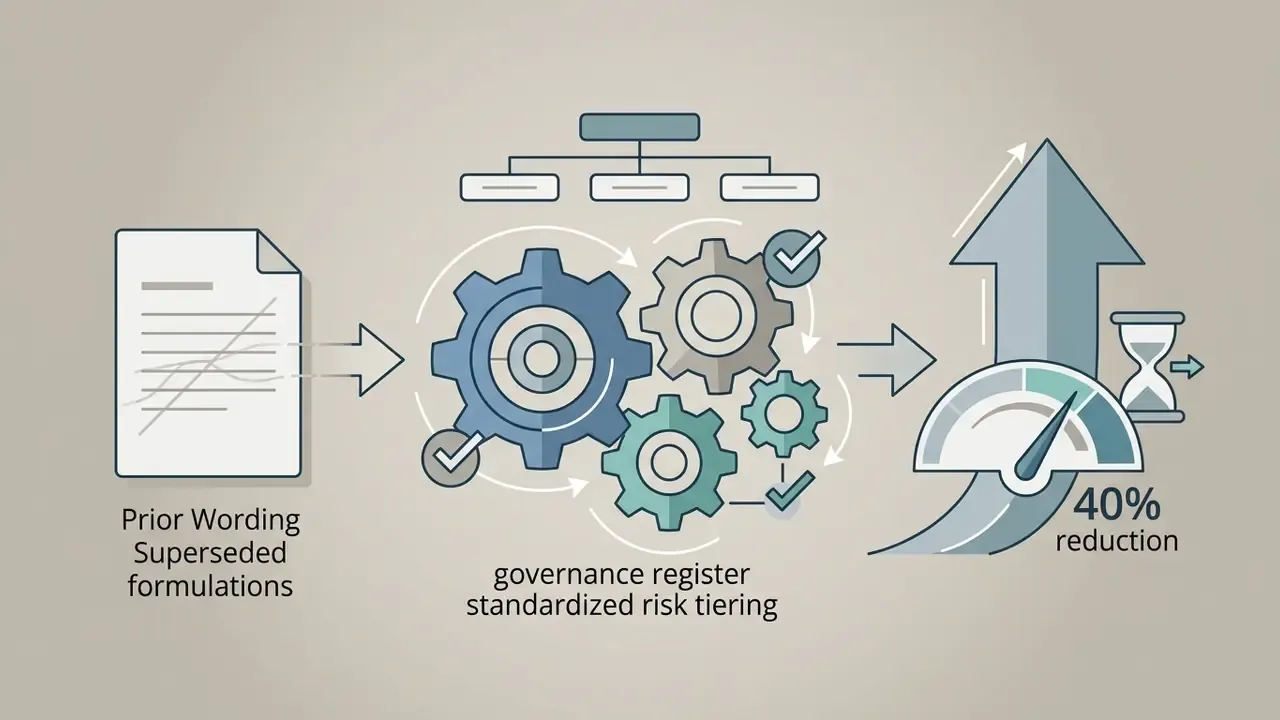
In a hypothetical regional banking scenario, a marketing team generated synthetic customer promotional videos without assigning a formal business owner. Internal audit halted the campaign because decision ownership was unclear and asset provenance was unverified. Establishing a formal governance register with designated use-case owners let the bank standardize risk tiering and shorten media compliance review cycles. The magnitude of that reduction is institution-specific, so measure it against your own baseline review times rather than importing an external benchmark. (See Appendix A for the earlier, unsourced quantitative claim.)
Set evidence requirements before approval
«Detailed disclosure of AI use reduces trust in the material and lowers subscription willingness, although it increases source-verification behaviour.»
Verify licensing and usage rights for AI-generated media
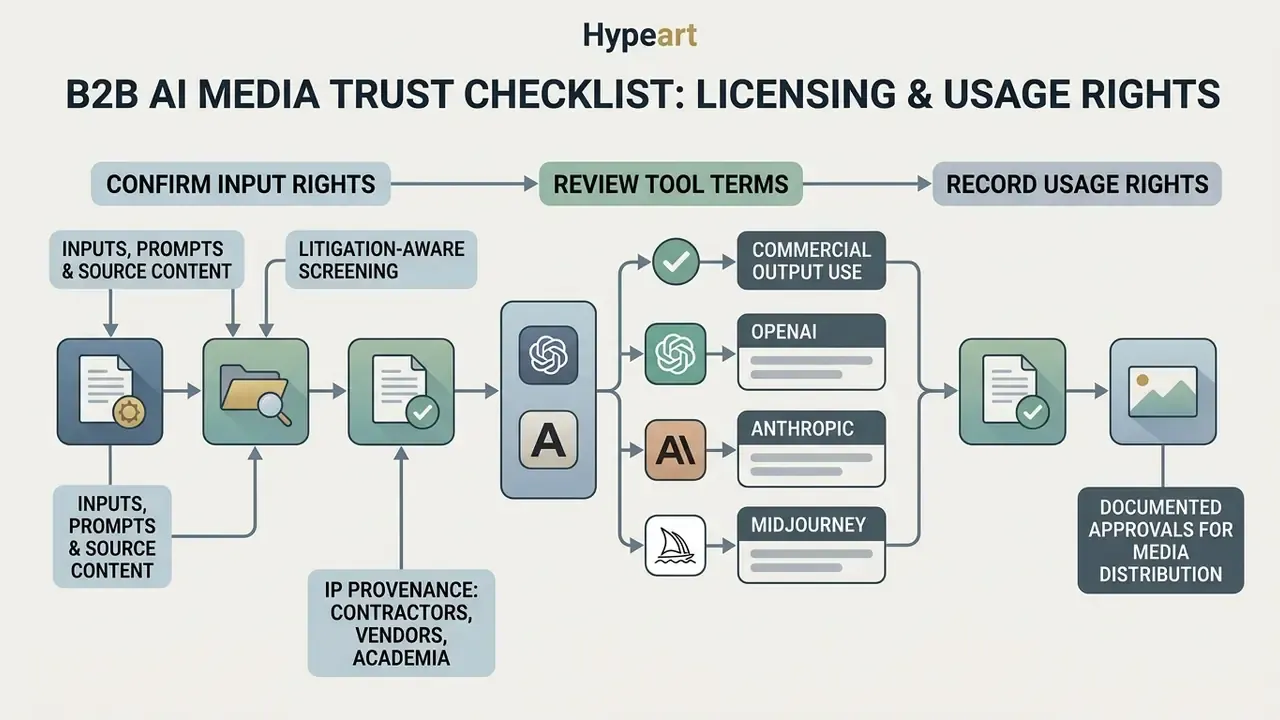
Verifying AI media licensing means confirming IP ownership of input prompts, checking vendor commercial terms, and recording the downstream rights chain. Skip the systematic licensing audit and you inherit three exposures at once: copyright infringement claims, breach of vendor terms, and loss of commercial exclusivity.
Confirm rights to inputs, prompts and source content
B2B organizations must confirm that every source image, audio file, video clip, and text prompt used as an input is proprietary, licensed, or explicitly cleared for synthetic model processing. Feeding copyrighted or unconsented third-party media into generative tools can trigger intellectual property disputes and breach commercial agreements. Teams selecting production tooling should verify commercial terms against a curated review of AI image generators for commercial use before any brand asset enters the pipeline.
Litigation-aware input screening. Infrastructure layers must mitigate active copyright litigation vectors directly. Two precedent cases define the practical deployment boundary:
- Thomson Reuters v. Ross Intelligence centres on whether training an AI legal research assistant on scraped Westlaw headnotes infringed copyright. The operational lesson: severe liability exposure when structured commercial databases are scraped for training or fine-tuning.
- Getty Images v. Stability AI, where Getty alleges training on millions of copyrighted photographs without permission, frames the dispute around unfair competition and outputs reproducing recognizable proprietary trade dress and watermarks.
Enterprise workflows therefore need mandatory input-source validation to avoid secondary infringement exposure, plus a hard rejection rule for any output containing residual watermarks, stock-agency artefacts, or recognizable third-party trade dress.
Contractor, vendor and academic IP provenance. When assets or the underlying workflow scripts originate from external vendors, freelance contractors, or university-backed research labs, formal intellectual property assignment agreements are mandatory. Audit teams must verify that University Tech Transfer Office (TTO) releases are fully executed and that contractors have explicitly assigned non-human material output rights to the enterprise. Contractors in many jurisdictions do not transfer IP automatically, so invention assignment agreements must be signed before work begins. Academic licences frequently carry exclusivity, royalty, or field-of-use restrictions that can quietly block commercial distribution of derived media.
The U.S. Copyright Office guidance (2023 to 2025) stresses that copyright protection attaches only to human-authored elements, and applicants must disclose and disclaim non-human material. Under Article 53(1) of the EU AI Act, providers of general-purpose AI (GPAI) models must publish summaries of copyrighted content used for training and maintain copyright compliance policies. B2B teams still carry their own duty: input media must not violate third-party rights or breach the consents under which the data was originally collected.
«Data available on the internet is not free for AI training: its collection must respect OECD principles of lawful and fair means, with the knowledge of the data subject.»
Review tool terms for commercial output use
Commercial output rights depend on specific vendor terms of service, and those terms differ sharply between free consumer tiers and enterprise agreements. Procurement teams must review contracts for output assignment, commercial exploitation limits, and intellectual property indemnification.
Leading vendor terms reflect distinct operational models:
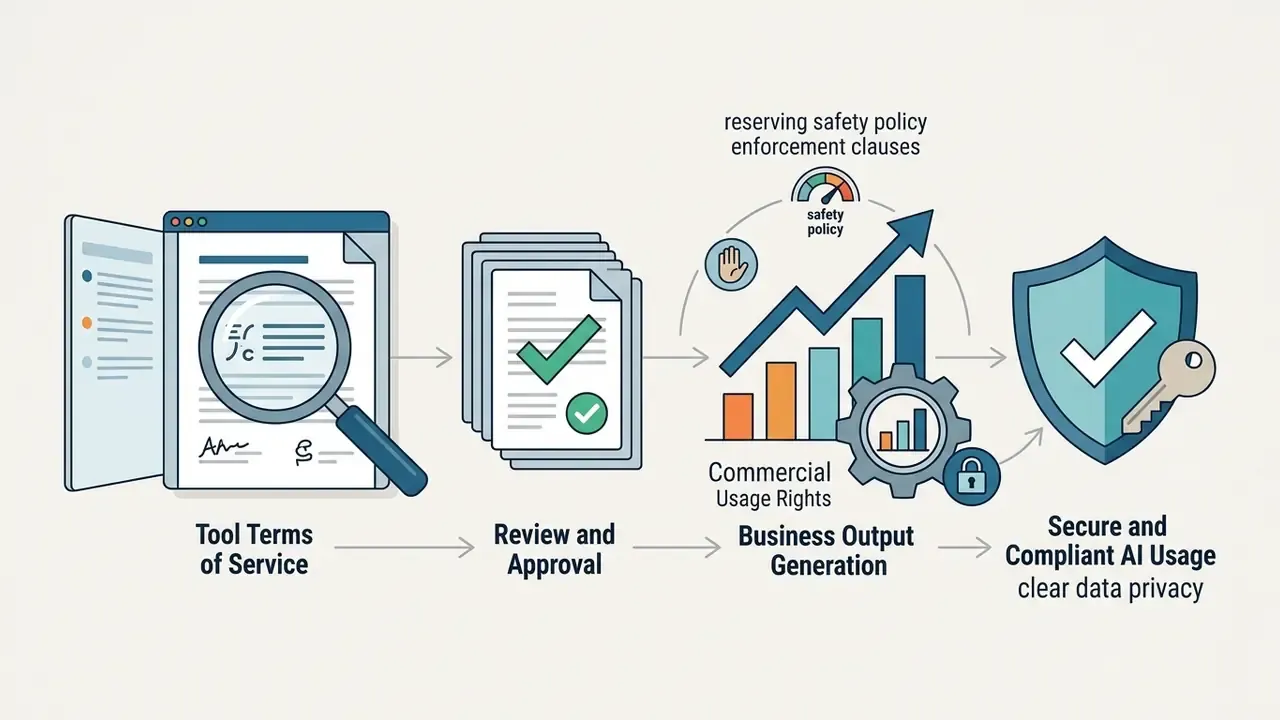


«Contracts with AI vendors must include terms on watermarking or cryptographically signed metadata to identify AI-generated audio, images and video.»
Treat that as a contractual clause, not a technical preference. If the vendor cannot commit to durable marking of synthetic outputs, the asset will not satisfy EU AI Act Article 50 machine-readable marking duties downstream. That is a procurement veto, not a nice-to-have.
Organizations evaluating multi-vendor stacks should consult a structured Commercial-Use AI Tools Matrix to compare output ownership clauses, data usage rights, and commercial restrictions across platforms, then benchmark shortlisted options against leading AI image generators to confirm that output-ownership language matches the intended distribution scope.
Record approvals for downstream media distribution
Enterprise governance requires an immutable registry of media output approvals, metadata, and C2PA provenance credentials for every distribution channel. Tracking downstream permissions is how you stop an asset approved solely for internal training from surfacing in an external marketing campaign six months later. It happens more often than anyone admits.
Standardization bodies including NIST (NIST AI 100-4) and the International Telecommunication Union (ITU, 2025) specify content provenance, watermarking, and machine-readable rights declarations as primary controls for authenticating synthetic media. Embedding cryptographic C2PA metadata directly into approved image and video assets keeps licensing claims verifiable across external business channels.
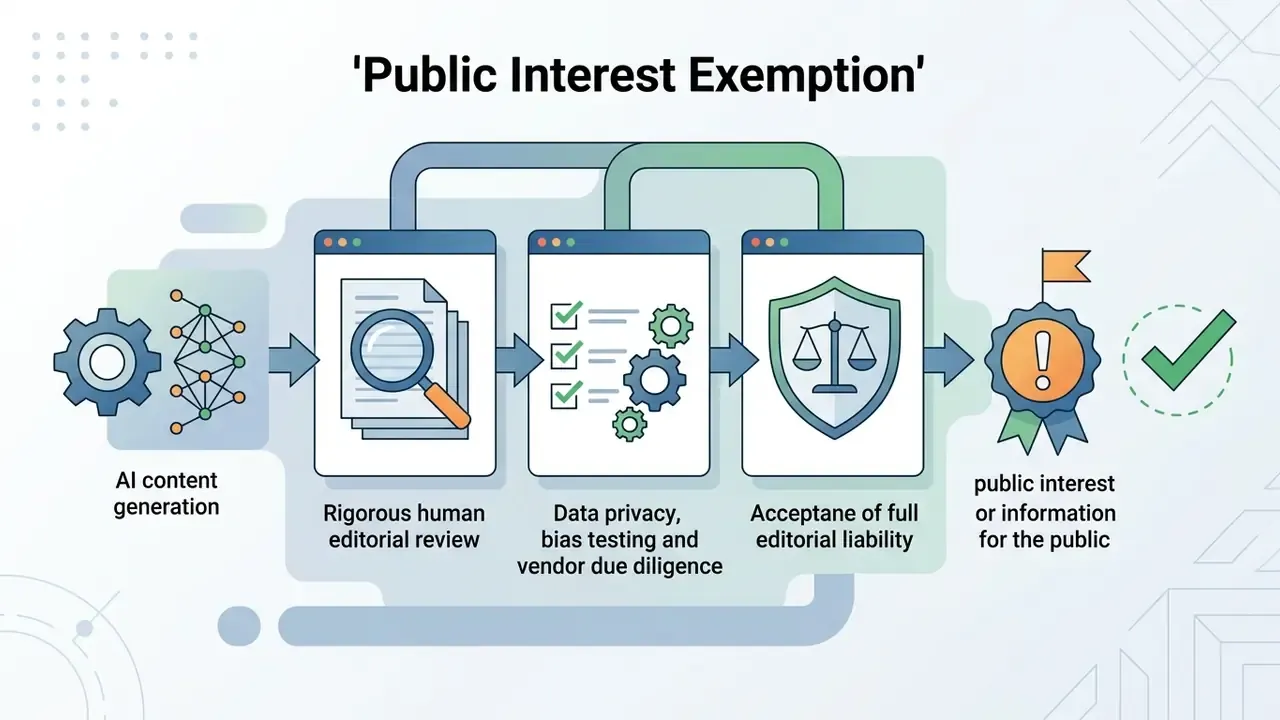
«Article 50(4) obliges deployers to disclose the artificial origin of content unless it has undergone editorial control with established editorial responsibility.»
Regulatory and legal disclaimer:
Assess data privacy, consent and confidentiality risks
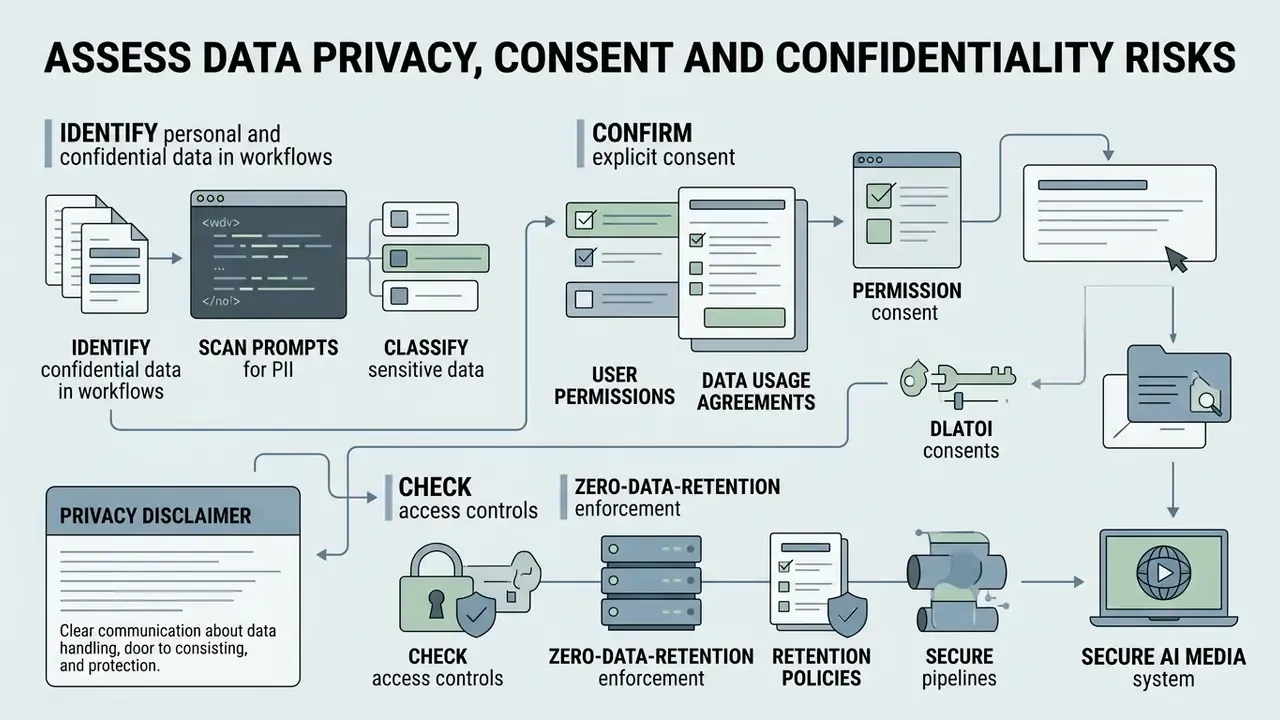
Privacy assessments for AI media must identify personally identifiable information (PII) in prompts, confirm explicit consent mechanisms, and enforce zero-data-retention agreements. Processing unconsented personal data or proprietary business intelligence in generative tools creates severe regulatory exposure under cross-border privacy law, and it is one of the fastest routes to an enforcement conversation.
Identify personal and confidential data in media workflows
Finding PII and confidential business IP inside prompts or source media is what prevents unauthorized model ingestion. Prompt engineers and media creators expose customer names, corporate strategy documents, or biometric likenesses more often than they realise, usually while trying to make the output more specific.
Under NIST SP 800-122, PII covers any information that can directly or indirectly trace an individual's identity. European Data Protection Board (EDPB) guidance under GDPR Article 4(11) requires that processing personal data, including facial images or voice recordings, rests on explicit, freely given, specific, and revocable consent. Silence, pre-ticked boxes, and broad employee waivers do not meet the statutory standard for AI model processing.
«Large language models are capable of memorising personal data and inferring personal attributes from text with high accuracy, creating risks of unauthorised disclosure.»
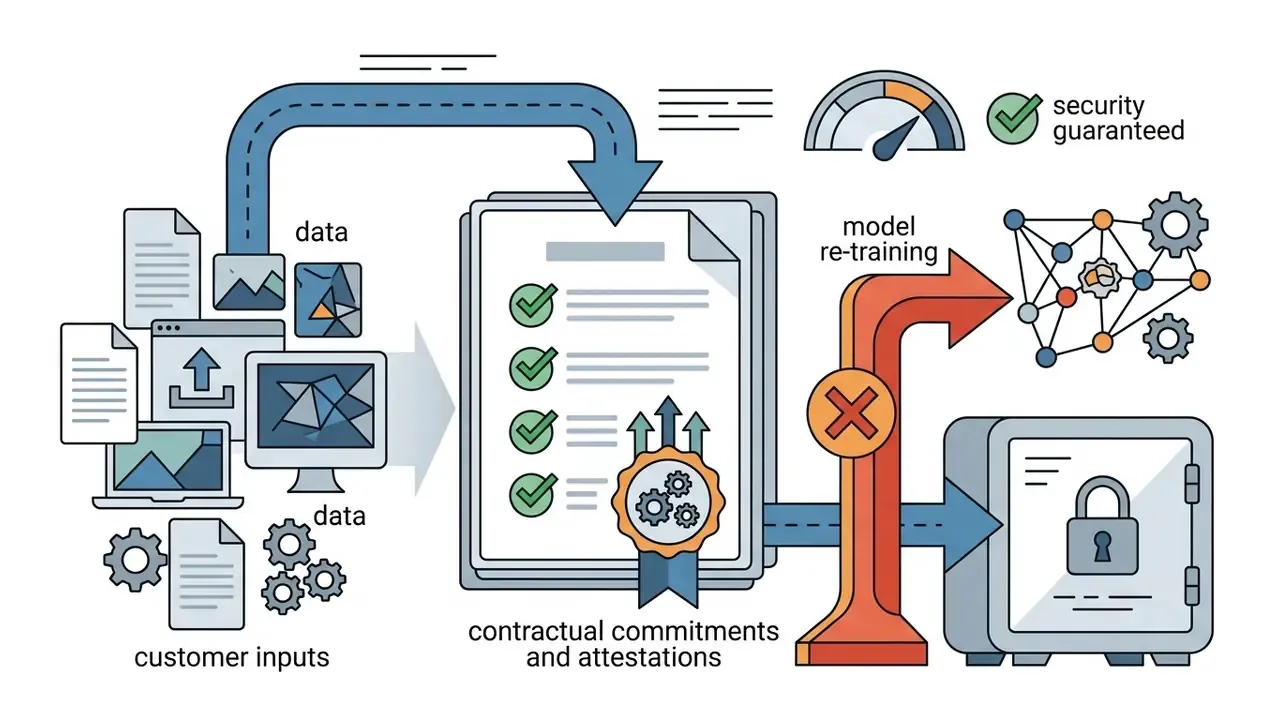
The practical implication is that consent alone is not enough. Prompt-level redaction, tokenization of client identifiers, and a contractual prohibition on re-training with customer inputs need to operate together, as one control set rather than three separate good intentions.
Check access controls and data retention practices
Robust access management for AI usage means enterprise single sign-on (SSO), role-based access control (RBAC), and contractual verification of vendor retention schedules. Preventing vendors from retaining input prompts or outputs for secondary model training is what preserves corporate trade secrets.
Guidance from the Centers for Medicare and Medicaid Services (CMS AI Guidance, 2025) and NIST AI RMF 600-1 emphasizes least-privilege access, audit logging, and zero-data-retention (ZDR) architecture for external AI integrations. Best practices here are unglamorous: mandate encryption in transit and at rest, execute Data Processing Addendums (DPAs), and require verifiable log deletion schedules. Access reviews should be periodic and evidenced, with attribute-based access control (ABAC) applied where media libraries mix client-confidential and public-tier assets. Security AI tooling helps, but only if the identity layer underneath it is clean.
| Data category and media asset | Contains PII or biometrics? | Confidential IP included? | Documented consent or legal basis | Permitted access scope | Privacy risk level | Mandatory approval level |
|---|---|---|---|---|---|---|
| Client case study video (AI-synthesized voiceover and portrait) | Yes (facial likeness, voice print) | Yes (project metrics, client names) | Explicit signed consent form on file | Public distribution, vendor ZDR API | High | Legal counsel plus Data Protection Officer plus business owner |
| Internal training deck (AI-generated workflow diagrams) | No | Yes (proprietary operational procedures) | Not applicable (internal confidential) | Internal employees only, enterprise SSO | Medium | Business owner plus CISO representative |
| Public thought leadership image (AI-generated abstract art) | No | No | Not applicable (public data inputs) | External website and social channels | Low | Marketing operations owner |
Risk matrix policy summary: high-risk workflows involving personal data or proprietary financials require a formal privacy impact assessment (PIA) and joint approval from legal, privacy, and business leads before production deployment. Medium-risk workflows need documented owner approval and an internal-only distribution constraint. Low-risk workflows may proceed on operational owner approval with the standard audit-trail entry.
Evaluate AI model integrity, transparency and human review
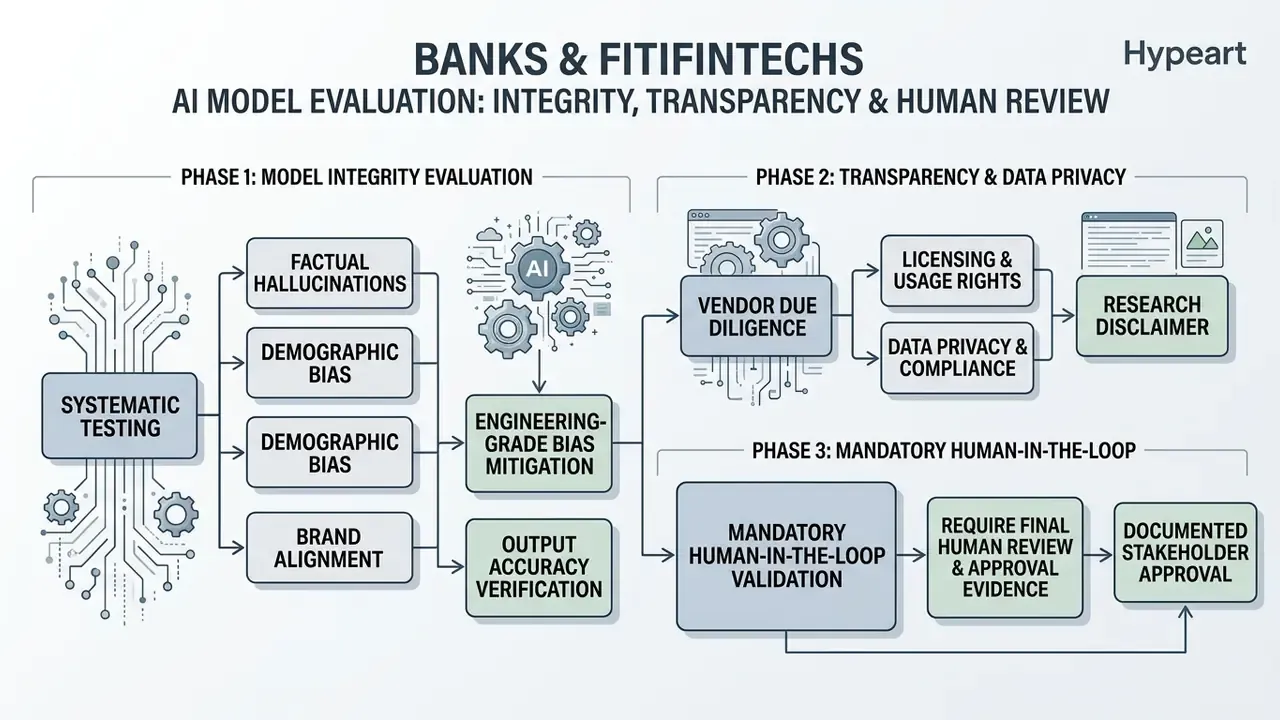
Model integrity evaluation depends on systematic testing for factual hallucinations, demographic bias, and brand alignment, paired with mandatory human-in-the-loop validation. Unchecked automated output damages brand equity, spreads false information, and can breach professional standards obligations in regulated communications.
Test output accuracy, bias and brand suitability
Testing AI media outputs requires objective scoring of factual groundedness, demographic bias audits across prompt slices, and automated style guide cross-checks. Catching inaccuracies or inappropriate representations before public dissemination is cheaper than correcting them afterwards, by a wide margin.
Engineering-grade bias mitigation. Bias mitigation needs structured algorithmic intervention before output clearance. Engineering teams should apply data reweighting to training and fine-tuning sets to correct representational imbalance, implement adversarial debiasing during fine-tuning so protected attributes cannot be reconstructed from internal representations, and enforce fairness-aware training constraints that penalize disparate error rates. Automated prompts must then be evaluated against demographic parity metrics, and against equalized-odds style slice comparisons across gender, ethnicity, age, and regional cohorts, before human editorial sign-off. Data audits come first, though. If the input corpus lacks representation, no downstream statistical correction fully repairs it.
Experimental research quantifies the risk of uncalibrated AI disclosures. A 2026 peer-reviewed conjoint study ("Feeling Iffy About Generative AI", N=683) found that disclosing AI involvement in content creation reduced perceived trustworthiness across all tasks by 0.23 to 0.62 points on a 7-point scale.
«AI disclosure significantly reduced trust in the advertisement (b = −0.34, p = 0.003) and in the organization (b = −0.38, p < 0.001) compared with the non-disclosed control condition.»
Organizational trust means in that experiment fell to 4.17 for disclosed content versus 4.69 for non-disclosed content, with the negative effect statistically significant at p < 0.001. (An earlier version of this passage reported the means without significance testing; see Appendix A.)
To reduce these trust penalties, Adobe guidance recommends Retrieval-Augmented Generation (RAG) validation, stress-testing models with unusual and culturally sensitive prompts, and automated brand cross-checks against tone of voice, product nomenclature, and banned-phrase lists. Factual assertions in AI text or voiceovers must be cross-referenced against authoritative primary sources. Every time.
Require final human review and approval evidence
Final human review means deliberate examination by a qualified subject-matter expert who accepts explicit editorial responsibility for the published asset. Human oversight supplies contextual accuracy, ethical judgement, and professional accountability that software cannot.
«Negative perception shifts following disclosure of AI authorship were mitigated when audiences saw explicit signals of human involvement and editorial control.»
EU AI Act Article 50 guidance establishes that AI-generated text published to inform the public escapes full public disclosure labelling only where it undergoes rigorous human review and a natural or legal person holds editorial responsibility. Microsoft's Responsible AI Standard v2 similarly requires structured human control mechanisms for synthetic media. ISO/IEC FDIS 42105 adds guidance on human control and monitoring, and EU AI Act Article 14 requires oversight proportionate to system risk and autonomy. Approval systems must log the reviewer's identity, timestamp, decision rationale, and any manual edits performed. The human gate must sit before the irreversible publication or distribution action, not after it.
In a hypothetical fintech case, a company introduced mandatory human-in-the-loop review for AI-generated financial summary videos. During pre-release inspection, the reviewer caught a hallucinated quarterly yield metric introduced by the voice generator. Correcting the script before release avoided a regulatory misrepresentation inquiry and, incidentally, proved the control was worth its cost. Teams standardizing this gate for motion assets should also review the capability limits and licensing constraints of AI video generators before locking a production workflow.
Check security and vendor due diligence before procurement
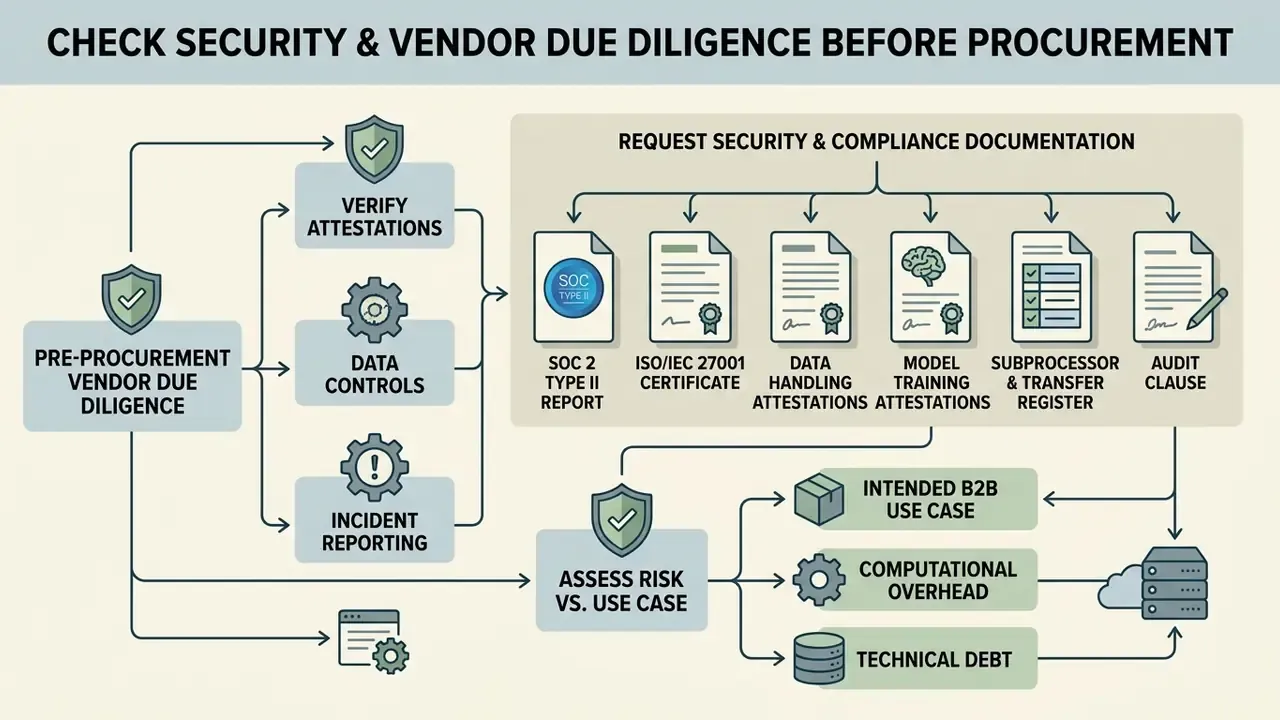
Vendor due diligence ahead of procuring AI media tools means verifying independent security attestations, data handling controls, and contractual incident reporting obligations. A rigorous due diligence checklist prevents third-party data breaches, shadow AI adoption, and supply chain exposure through subprocessors nobody registered. In regulated environments, run this gate at the procurement stage, before large-scale model testing consumes budget, and refresh it whenever the vendor changes data flows, subprocessors, model versions, or introduces AI agents with tool-calling autonomy.
Request security and compliance documentation from vendors
«Agencies must compare the performance, cost, security and trustworthiness of available generative AI solutions and conduct independent evaluations using agency-defined datasets.»
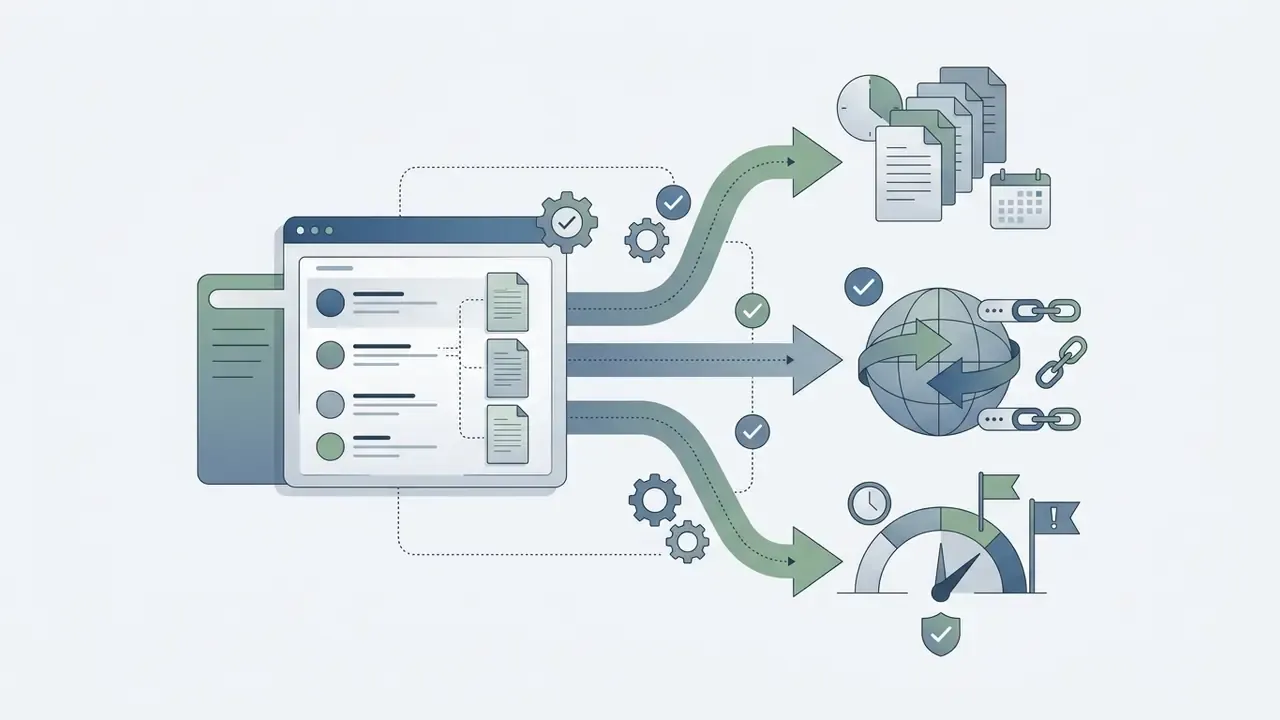
Standards set out in OMB Memorandum M-24-18 and GAO-21-519SP require enterprise procurement to verify vendor security assertions through objective evidence. Core documentation requirements:
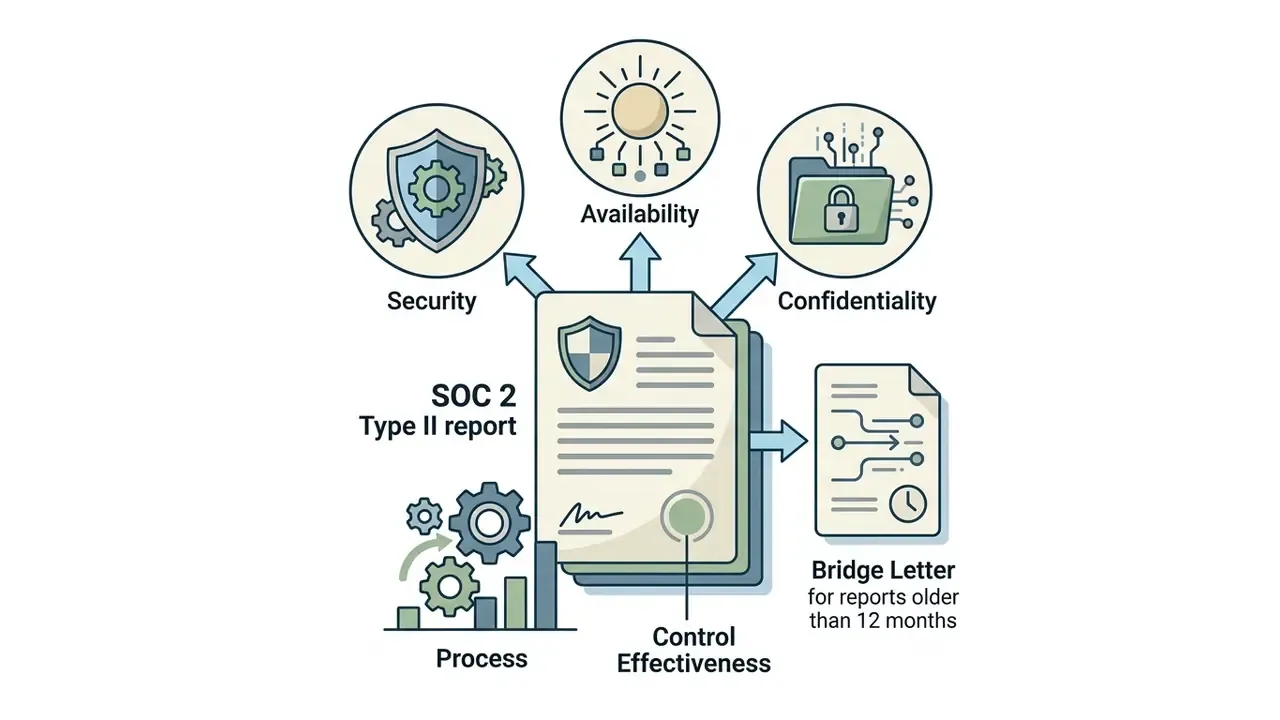
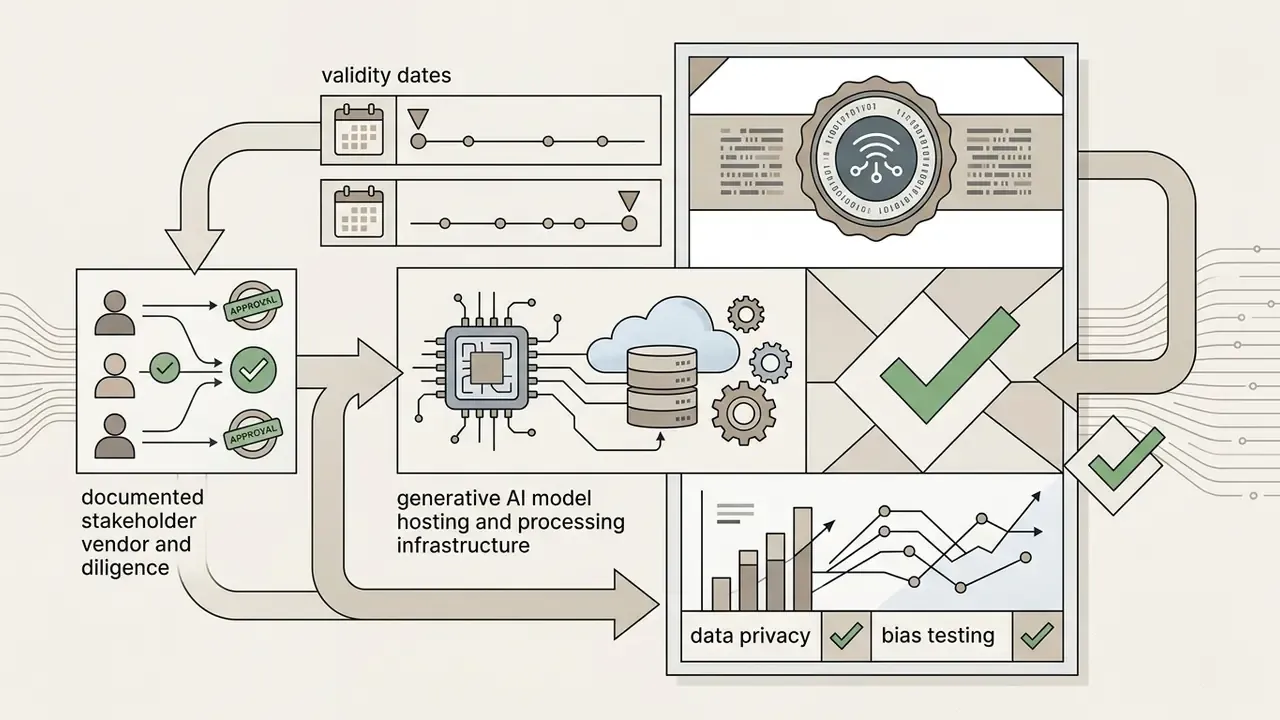

Compare vendor risk against the intended B2B use case
Vendor risk scoring maps tool vulnerabilities against the sensitivity of the underlying B2B use case and the institution's risk appetite. Comparing vendors on standardized criteria keeps under-engineered tools away from critical business data.
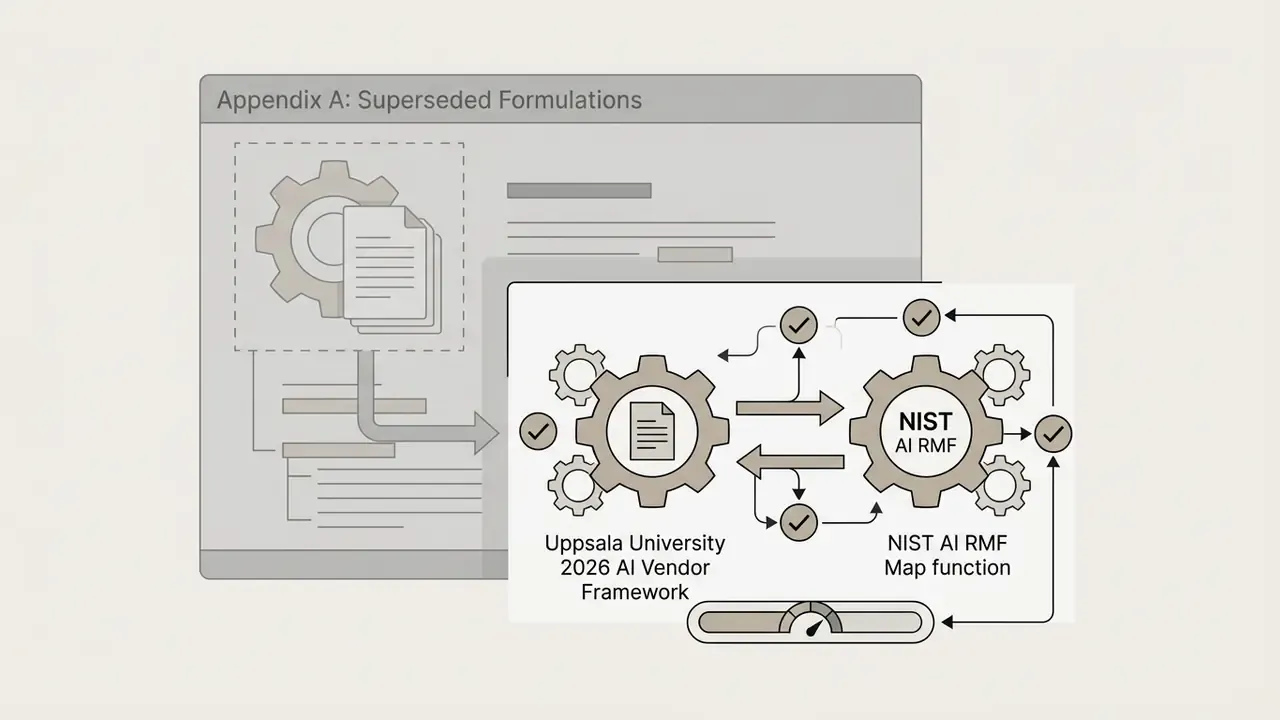
The Uppsala University 2026 AI Vendor Framework classifies deployment risk by data sensitivity (D1 to D4) and system autonomy (advisory, human-in-the-loop, autonomous). Note: cross-validate this schema against your primary methodological standard before adopting it. The authoritative anchor for context-based risk mapping remains the NIST AI RMF.
«The Map function of the NIST AI RMF recommends mapping AI systems to specific usage contexts and data types to understand how a change of context changes the risk profile.»
Low-risk internal graphics can live with standard vendor controls. High-risk client communications demand dedicated single-tenant infrastructure, zero-data-retention SLAs, and continuous vulnerability monitoring.
Computational overhead and technical debt. Beyond legal compliance, due diligence must price model latency, computational overhead, and long-term technical debt. Relying on uncalibrated third-party APIs with high infrastructure churn risks service disruption and uncontrolled inference token costs during peak distribution campaigns. Procurement scoring should therefore capture: (a) inference token cost per finished asset at forecast volume; (b) rendering latency under concurrency, which decides whether campaign SLAs are achievable at all; (c) resource forecasting for GPU or credit consumption across the fiscal year; and (d) accumulated technical debt from vendor-specific prompt formats, proprietary embeddings, and non-portable pipelines that raise switching costs. A vendor that looks cheap per token but locks your media pipeline into a proprietary format can be materially more expensive over three years.
| Evaluation criteria | Vendor A: enterprise generative media API | Vendor B: commercial cloud studio | Vendor C: open-source custom deployment |
|---|---|---|---|
| Output licensing and ownership | Full commercial assignment, zero vendor claims on output | Commercial license on paid tier, restricted resale | User retains full ownership, subject to base model license |
| Data privacy and training rules | Contractual zero data retention, no training on inputs | Opt-out required, metadata retained for 30 days | Self-hosted, zero data exposure to external parties |
| Security certifications | SOC 2 Type II, ISO 27001, HIPAA compliant | SOC 2 Type II certified | Dependent on enterprise cloud architecture |
| Synthetic content marking | Embedded C2PA metadata and imperceptible watermarking | Optional visible watermark, no metadata sidecar | Custom C2PA integration required |
| Access control support | SAML 2.0 SSO, RBAC, MFA | Basic SSO, team-level workspace permissions | Full enterprise IAM and Active Directory integration |
| Auditability and incident SLAs | Dedicated audit logs, 24-hour breach notification SLA | Standard logging, standard support response | Full control over internal audit logging |
| Computational overhead and technical debt | Predictable enterprise pricing, portable API schema, low lock-in | Credit-based pricing, moderate lock-in via proprietary templates | Highest infrastructure and MLOps overhead, lowest vendor lock-in |
No matching rows Clear one or more filters to restore the matrix.
Where motion assets are in scope, benchmark shortlisted platforms against a structured comparison of AI video generators by output quality and use case so security findings are weighed against production capability rather than judged in isolation.
Map legal requirements and AI governance obligations
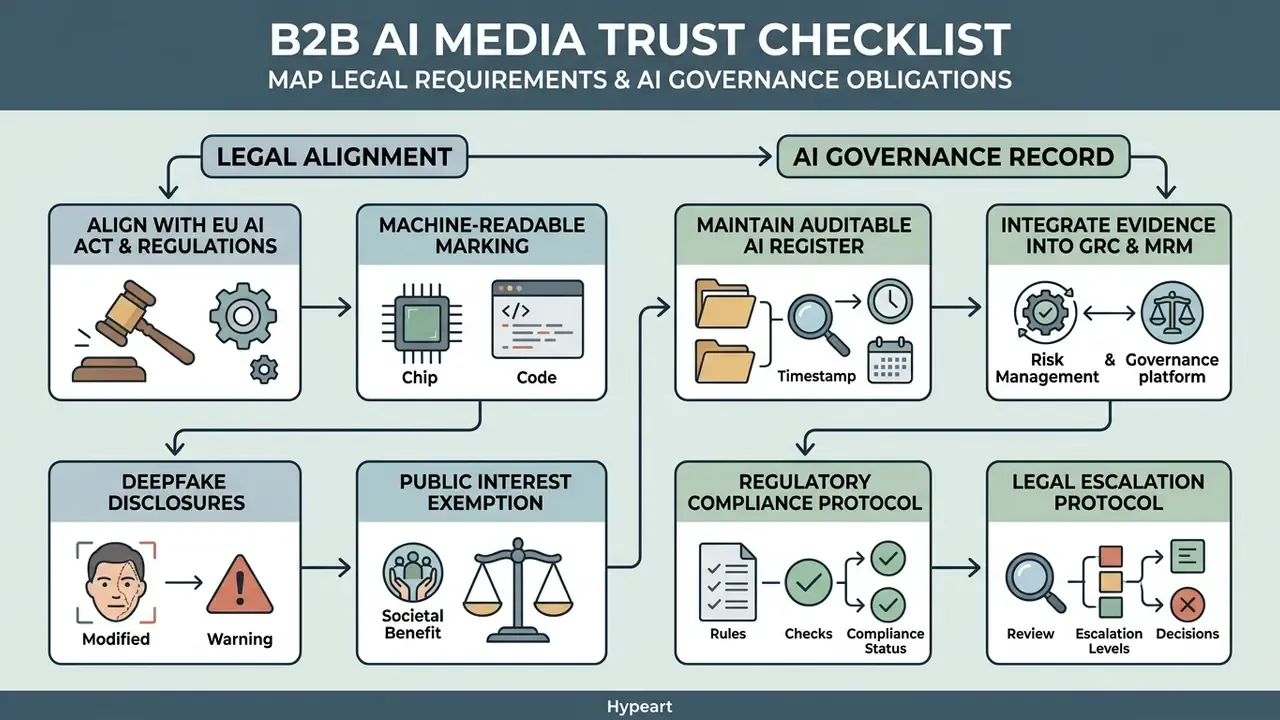
Legal alignment for AI media means satisfying synthetic content marking duties under applicable statutes and maintaining an auditable governance register. Mapping workflows against evolving AI legislation early is cheaper than remediating under an enforcement deadline.
Align the workflow with EU AI Act and applicable regulations
EU AI Act (Regulation EU 2024/1689) Article 50 mandates machine-readable marking for synthetic media and explicit public disclosure for deepfakes from 2 August 2026. Providers and deployers must implement technical mechanisms that make synthetic audio, video, image, and text content detectably artificial.
«Article 50(2) requires providers to ensure machine-readable marking of synthetic content that is effective, interoperable and robust in line with the state of the art.»
European Commission 2026 guidelines set out the core technical expectations:
The accompanying transparency code of practice adds implementation detail, including standardized labels and icons for creators, publishers, and deployers, and provides a grace period until December 2026 for marking obligations covering generative systems placed on the market before 2 August 2026.


Maintain an auditable AI governance record
An auditable AI governance record centralizes approval logs, consent records, risk tiering assessments, and tool execution history for internal audit and regulatory review. Systematic records are what demonstrate due diligence before asset release, and they are also what shorten the next examination.
«The Govern function requires documentation of roles, responsibilities and decision-making processes, including risk management records across the entire AI system lifecycle.»
Regulatory compliance and legal escalation protocol:
Create a stakeholder approval package for AI media use
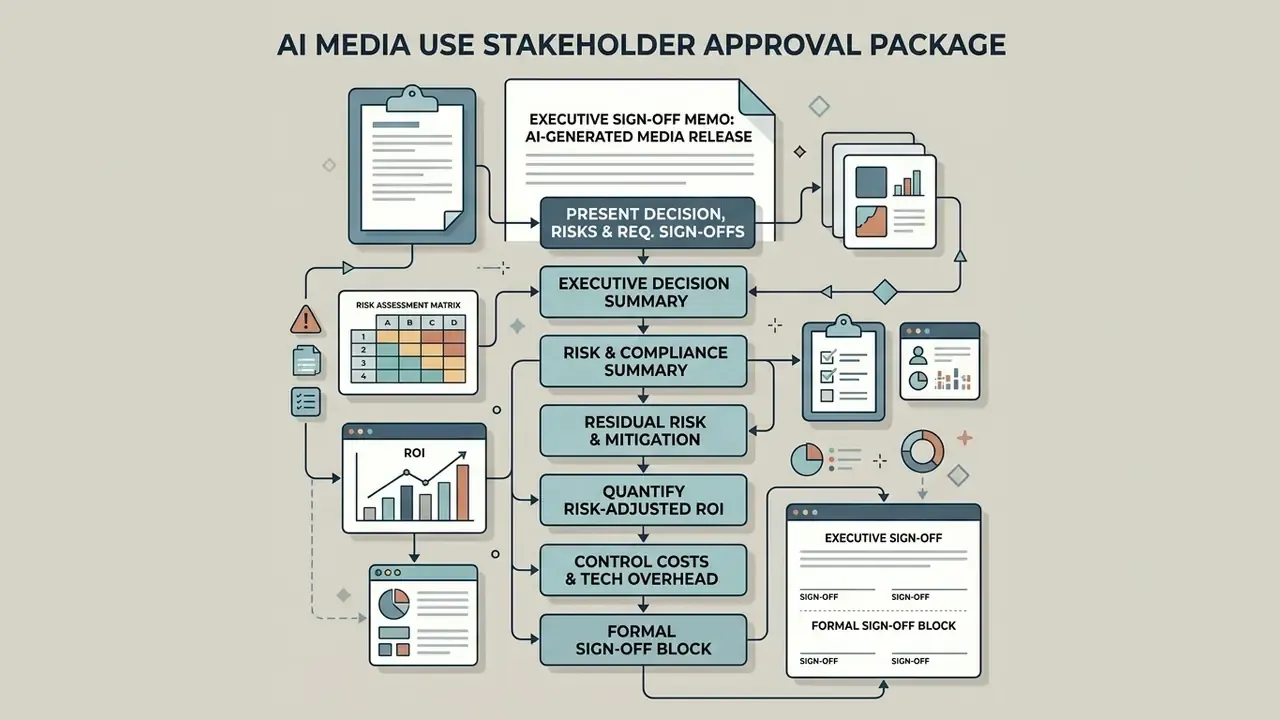
A stakeholder approval package consolidates the business rationale, risk assessment, licensing proof, and formal sign-off signatures into one executive document. A structured summary is what lets an executive committee evaluate residual risk and grant informed deployment approval, rather than approving a vibe.
Present the decision, risks and required sign-offs
The executive summary should state residual operational risk, compliance status, and the mandatory signature blocks for the business owner, CISO, and legal counsel. A standardized sign-off package keeps organizational alignment intact and enforces governance discipline as AI adoption scales past the first few pilots.
«AI disclosure reduced trust in news content by 0.23 to 0.62 points on a 7-point scale; a brief one-line disclosure preserved trust better than a detailed one.»
The governance implication is concrete: the sign-off package should specify the exact disclosure wording to be published. Over-explaining AI involvement measurably erodes trust, while a short standardized line preserves both compliance and credibility.
Modelled on established risk-acceptance templates such as CMS AI risk acceptance frameworks and the ASEAN Guide on AI Governance, the executive package must include:
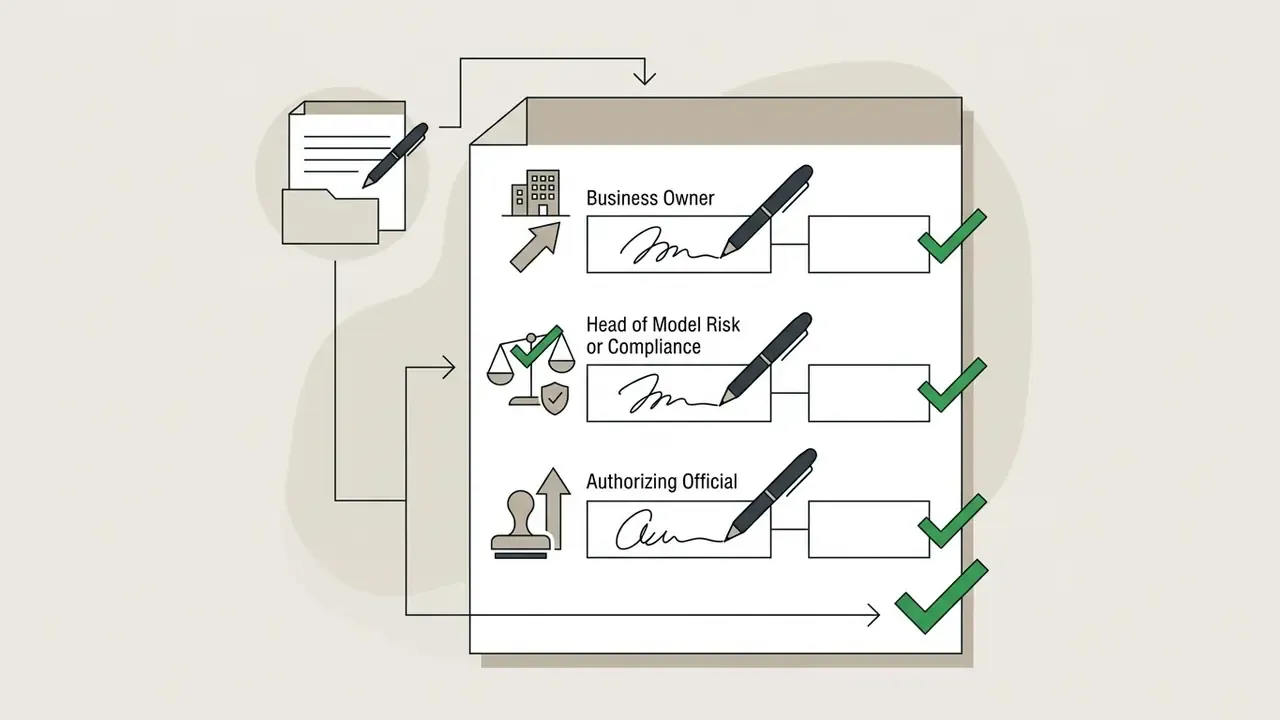
Quantify risk-adjusted ROI, control costs and technical overhead
Executive committees approve AI media programs on economics, not compliance narrative alone. So the package should present a risk-adjusted return calculation that prices both the controls and the avoided loss.
A workable structure:
Risk-adjusted ROI = (productivity gain + avoided loss) − (control costs + compute costs + residual risk exposure)
Component definitions for the finance and risk review:
| Component | What to measure | Typical inputs |
|---|---|---|
| Productivity gain | Cost of the equivalent human-produced asset minus the AI-assisted production cost | Agency rates, internal hours, cycle time |
| Avoided loss | Expected value of prevented incidents such as regulatory misstatement, IP claim, disclosure failure | Probability multiplied by estimated exposure per incident class |
| Control costs | Human-in-the-loop review hours, legal and privacy review, C2PA marking tooling, DPA negotiation, audit-log storage | Reviewer fully loaded hourly rate multiplied by assets per period |
| Compute costs | Inference token costs, rendering minutes, GPU or credit consumption, latency-driven overprovisioning | Vendor pricing multiplied by forecast volume at peak |
| Technical debt | Cost of future migration away from proprietary prompt formats, embeddings, and pipelines | Estimated re-platforming effort amortized over the contract term |
| Residual risk exposure | Trust penalty and reputational cost that controls do not eliminate | Disclosure-related trust decline (0.23 to 0.62 points on a 7-point scale) mapped to conversion or retention impact |
Two practical rules follow. First, control costs should scale with risk tier, not with asset volume: low-risk internal graphics have no business consuming the same review budget as client-facing synthetic voiceovers. Second, the trust penalty is a real cost line. Experimental evidence puts organizational trust decline at b = −0.38, p < 0.001 under disclosure, which makes the choice of disclosure wording a financial decision as much as a legal one.
Executive Sign-Off Memo template
Copy the following block into your GRC, ECM, or document-management system and attach the completed evidence package.
EXECUTIVE SIGN-OFF MEMO: AI-GENERATED MEDIA RELEASE
Document ID: _______ | Model inventory ID: _______ | Date: _______
1. Asset and use case
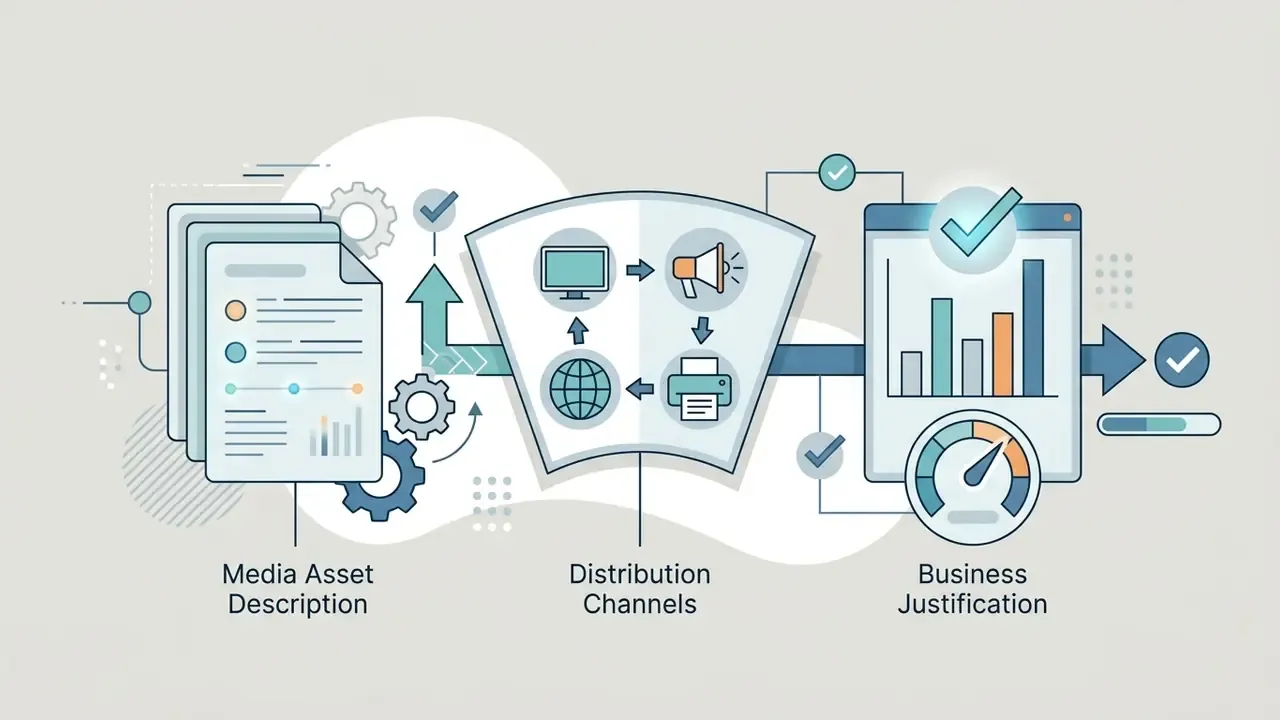
Asset title or description: ____________________
Media type: [ ] Image [ ] Video [ ] Audio [ ] Text [ ] Multimodal
Distribution channels: ____________________
Business justification: ____________________
Risk tier: [ ] Low [ ] Medium [ ] High | Autonomy level: [ ] Advisory [ ] Human-in-the-loop [ ] Autonomous
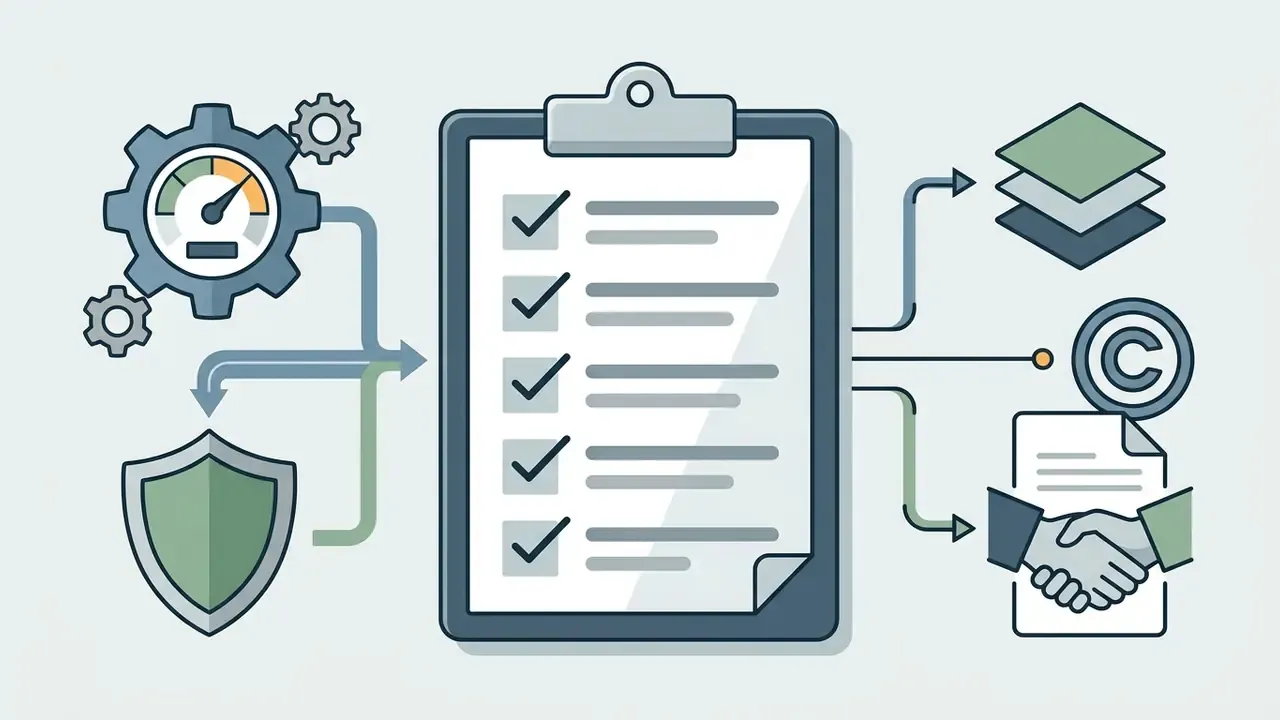
2. Control evidence (attach references)
Intake record ID: _______ | Approved tool or vendor: _______
Licensing verification: [ ] Complete, ref: _______
Input rights and IP assignment (contractor or TTO): [ ] Complete, ref: _______
Privacy and consent clearance (PIA if high risk): [ ] Complete, ref: _______
Bias and accuracy testing (reweighting, adversarial debiasing, fairness-aware): [ ] Complete, ref: _______
Human review log (reviewer, timestamp, edits): [ ] Complete, ref: _______
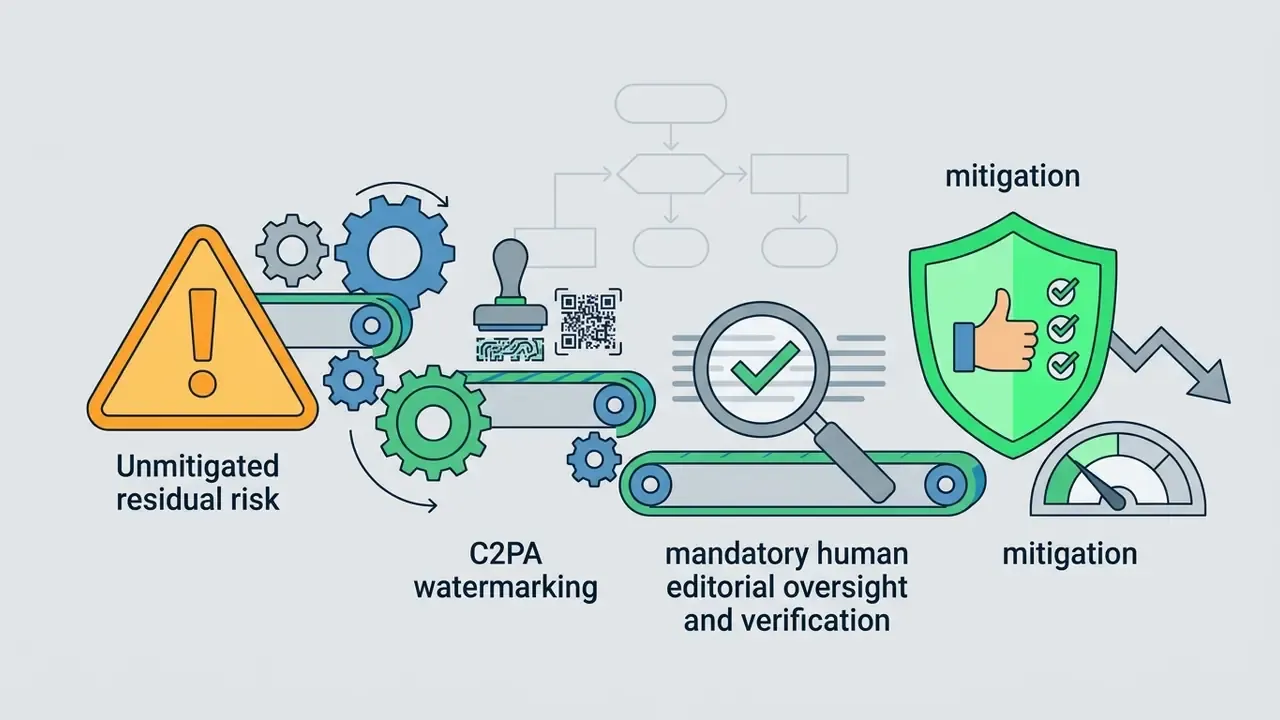
C2PA marking or watermarking applied: [ ] Yes [ ] Not applicable, justification: _______
3. Disclosure wording to be published (verbatim)
«_________________________________________________»
4. Residual risk statement
Unmitigated risks: ____________________
Compensating controls: ____________________
Estimated residual exposure: ____________________
5. Economics
Control costs (period): _______ | Compute costs (period): _______
Productivity gain: _______ | Avoided loss estimate: _______
Risk-adjusted ROI: _______
6. Approvals (name, title, signature, date)
Business owner: ____________________
Head of model risk or compliance: ____________________
Legal counsel: ____________________
CISO or delegate (if data-sensitive): ____________________
Authorizing official: ____________________
By signing, approvers confirm they have reviewed the evidence package, understand the residual risk described in section 4, and accept that risk on behalf of the organization.
Limitations and unresolved questions
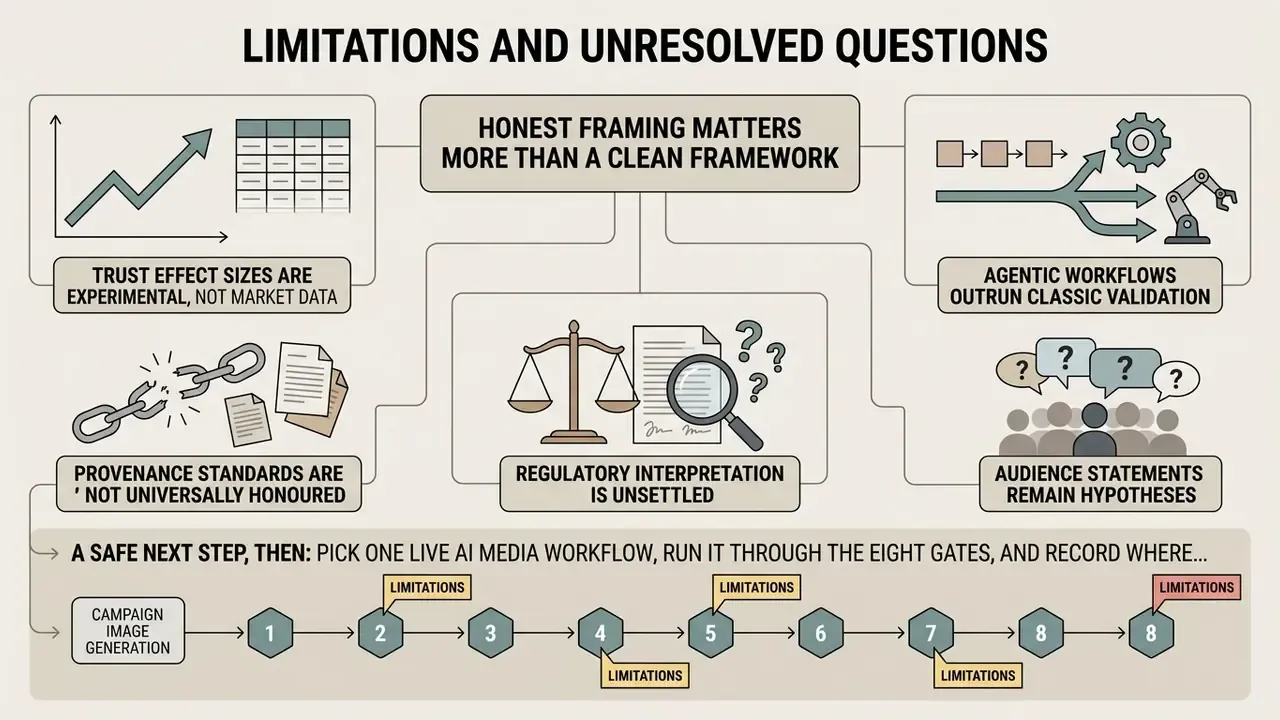
Honest framing matters more than a clean framework. Several parts of this checklist rest on evidence that is still thin.
- Trust effect sizes are experimental, not market data. The disclosure studies cited use small to moderate samples in controlled settings. Whether a 0.38-point trust decline translates into lost deposits, slower loan applications, or nothing measurable at all remains untested for B2B financial audiences.
- Agentic workflows outrun classic validation. Traditional model validation assumes a stable input-output mapping. Media pipelines with tool-calling AI agents change behaviour between runs, so conventional back-testing gives partial assurance at best.
- Provenance standards are not universally honoured. C2PA manifests survive some platforms and are stripped by others. Marking compliance therefore depends on distribution channel behaviour outside your control.
- Regulatory interpretation is unsettled. The scope of the Article 50(4) editorial responsibility exemption has not been tested in enforcement practice. Treat aggressive reliance on it as an open risk.
- Audience statements remain hypotheses. Any assumption about what your stakeholders value should stay labelled as a hypothesis until analytics, interviews, CRM data, or verified customer research confirm it.
A safe next step, then: pick one live AI media workflow, run it through the eight gates, and record where the evidence does not exist yet. That gap list is your real roadmap. Learn more by comparing your findings against the cross-industry governance benchmarks referenced below.
FAQ
Does AI-generated media qualify for copyright protection?
Only human-authored elements attract protection. U.S. Copyright Office guidance (2023 to 2025) requires applicants to disclose AI-generated material and disclaim non-de-minimis AI content, so registration claims must isolate the human contribution.
When do EU marking obligations apply?
EU AI Act Article 50 transparency duties apply from 2 August 2026, with a grace period until December 2026 for generative systems placed on the market before that date. Marking must be machine-readable, effective, interoperable, and robust.
Can we publish AI-assisted text without a public AI label?
Article 50(4) allows an exemption where the content has undergone genuine human editorial review and a named natural or legal person holds editorial responsibility for publication. That review must be logged, or the exemption is unusable in practice.
Do we need consent for a synthetic voice or likeness of an employee?
Yes. Under GDPR Article 4(11) and EDPB guidance, consent must be explicit, freely given, specific, informed, and revocable. Broad employment waivers and pre-ticked boxes do not qualify for biometric processing such as voice prints or facial likeness.
What is the single most common audit failure?
Missing IP assignment from contractors, agencies, or academic collaborators. Without executed assignment agreements, and where relevant an executed University Tech Transfer Office release, the enterprise may not own the assets running in its own campaign.
How should we handle vendor lock-in risk?
Score it explicitly during due diligence as technical debt. Proprietary prompt formats, non-portable embeddings, and bespoke pipelines all raise future migration cost even when per-token pricing looks attractive.
Who should own the checklist itself?
The AI governance office maintains it, model risk validates it, and internal audit tests it. Marketing operates within it. That separation is the point.
Appendix A. Superseded formulations (retained for traceability)

Executive sign-off and governance metadata
- Primary author Marcus Hale, AI Governance and Model Risk Lead Editor .
- Editorial review Model Risk Editorial Board (legal, privacy, and information security review).
- Last reviewed Q1 2026.
- Document baseline B2B AI media governance and risk alignment.
- Target jurisdiction United States, with cross-border EU compliance considerations.
- Primary standards referenced EU AI Act (Regulation EU 2024/1689) Articles 50 and 53; NIST AI 600-1; NIST AI 100-4; NIST SP 800-122; OMB M-24-18; GDPR Article 4(11); ISO/IEC 27001; ISO/IEC FDIS 42105; C2PA.
- Cross-industry governance hub and performance benchmarks