Editorial fact check and verification notice, read this first:
Executive Summary
- What these tools do An ai dating profile generator converts raw personal inputs (job, hobbies, humor style, relationship intent) into several short, length-constrained bio drafts, usually inside 60 seconds. Most consumer tools are thin interfaces sitting on top of general-purpose large language models: hosted APIs such as OpenAI or Google models, or self-hosted open-weight models in the Llama and Qwen families. Prompt templates handle tone and platform calibration.
- Where the value is Speed, several comparable variants side by side, and automatic fitting to platform character limits. Not magic conversion gains.
- Where the risk is Raw, unedited output reads generic and can lower perceived trust. Editing is not optional. It is the step that makes the bio work at all.
- Privacy in one line Enter preferences and lifestyle traits, never full names, employers, precise locations, or contact data.
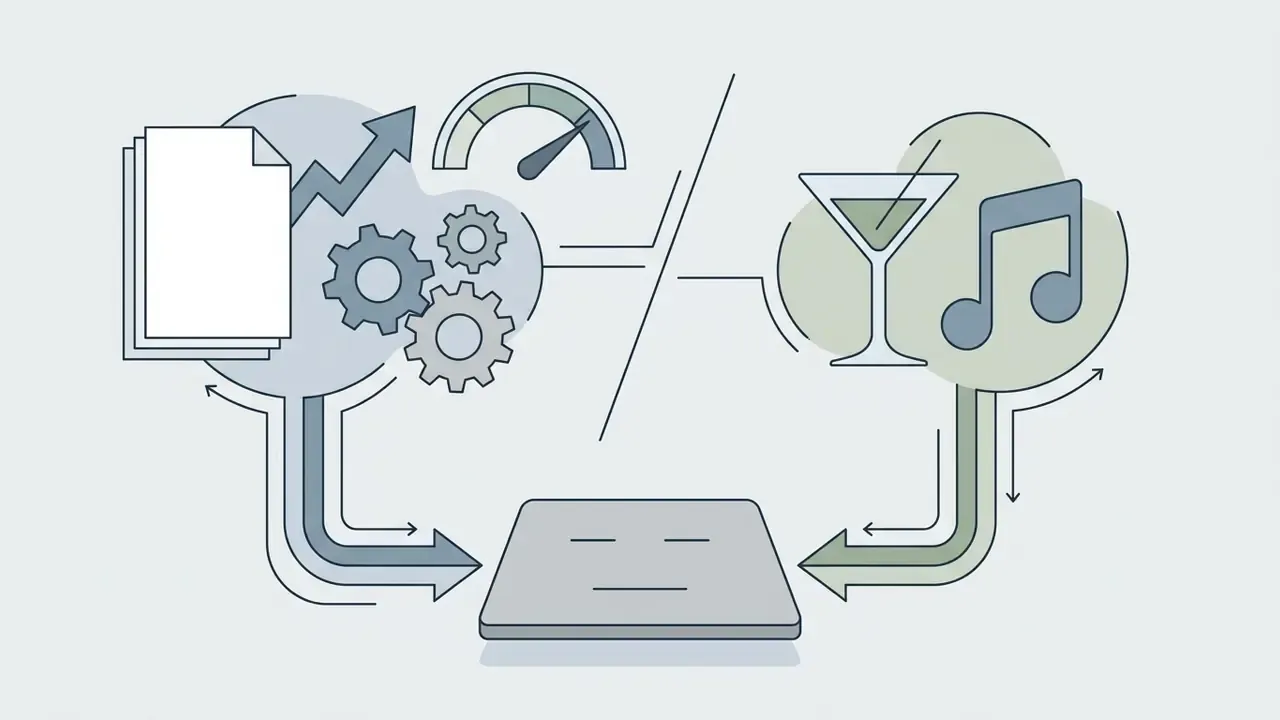
- Platform math Tinder 500 characters, Bumble 300 characters, Hinge three prompt answers at 150 characters each. One master text has to be split into three shorter variants.
- Post-publication Track match and reply behavior for 14 days before rewriting anything. Two quiet days prove nothing.
What an AI Dating Profile Generator Does
An ai dating profile generator processes raw personal details, hobbies, and relationship goals into structured, app-ready biography drafts within seconds. The tools mainly solve blank-page paralysis by applying specialized prompts to an underlying language model.
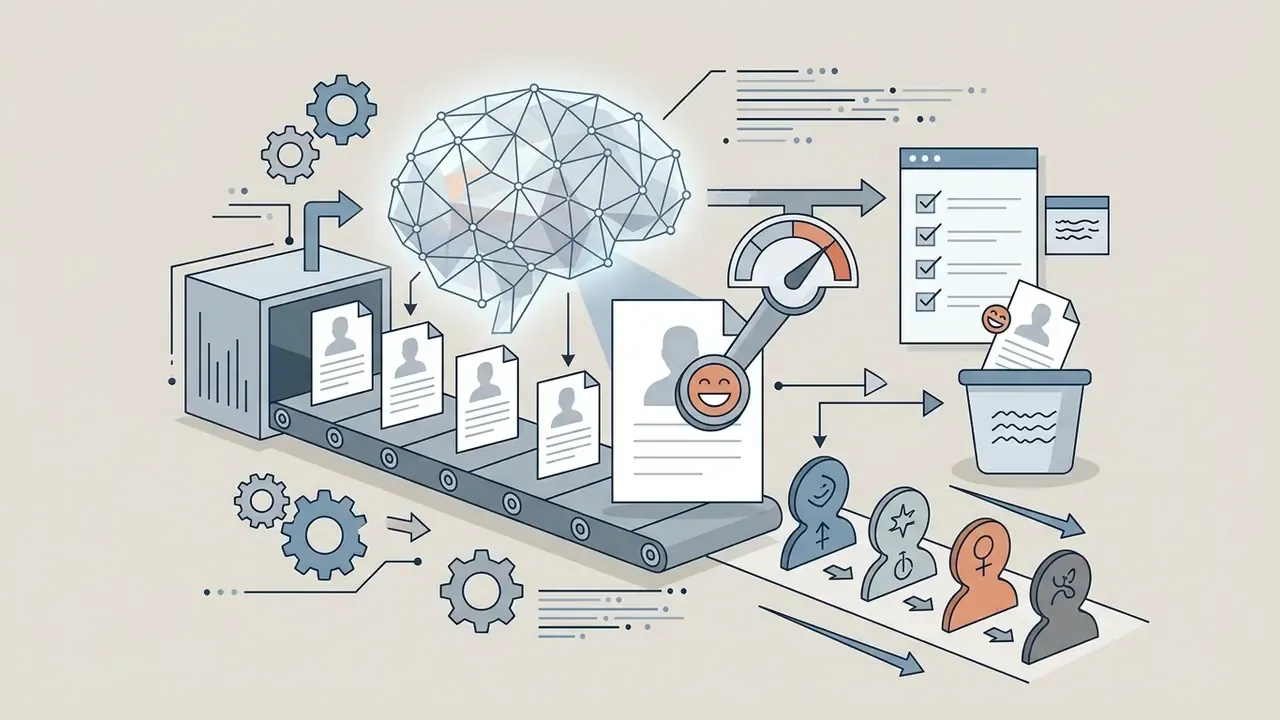
Architecturally, almost none of these products train their own model. They are prompt-and-template layers over hosted foundation models (OpenAI or Google API endpoints) or over open-weight systems in the Qwen and Llama classes, with the vendor supplying platform rules, tone presets, and length constraints. That matters for two practical reasons. Output quality tracks the underlying model, and your input text is processed under the vendor's contract with the model provider, not under yours.
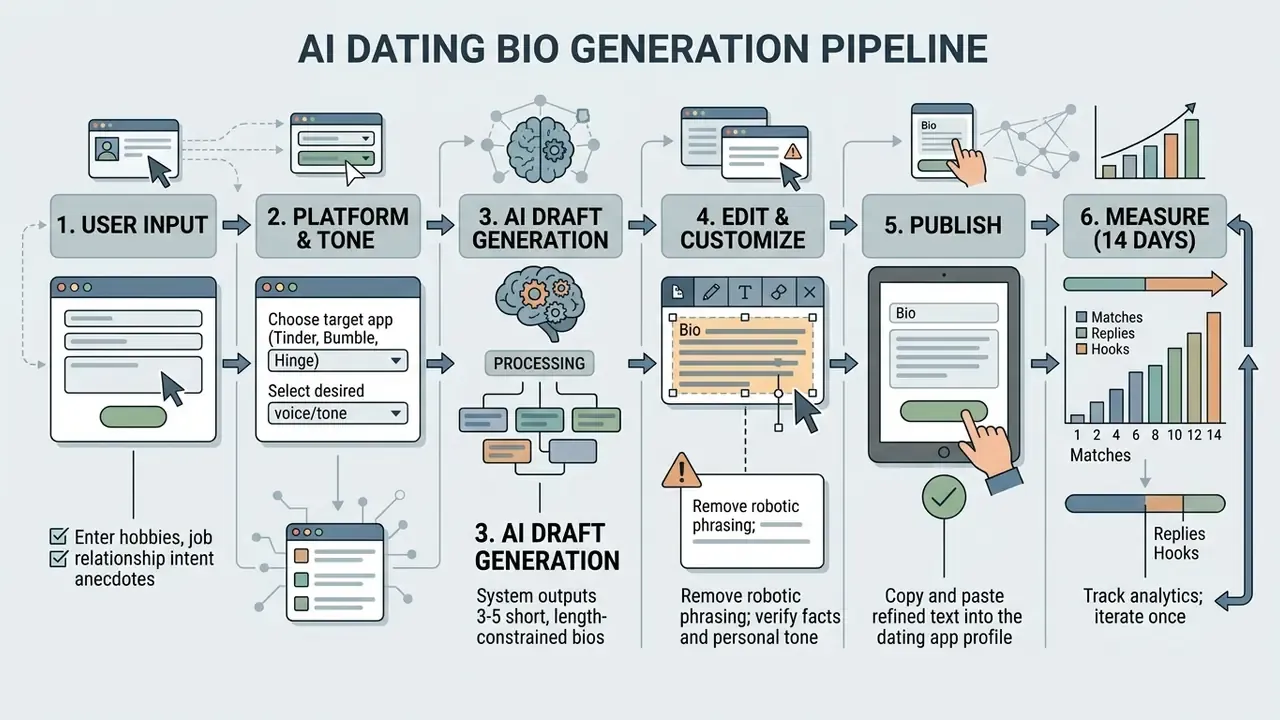
From personal details to multiple dating bio variations
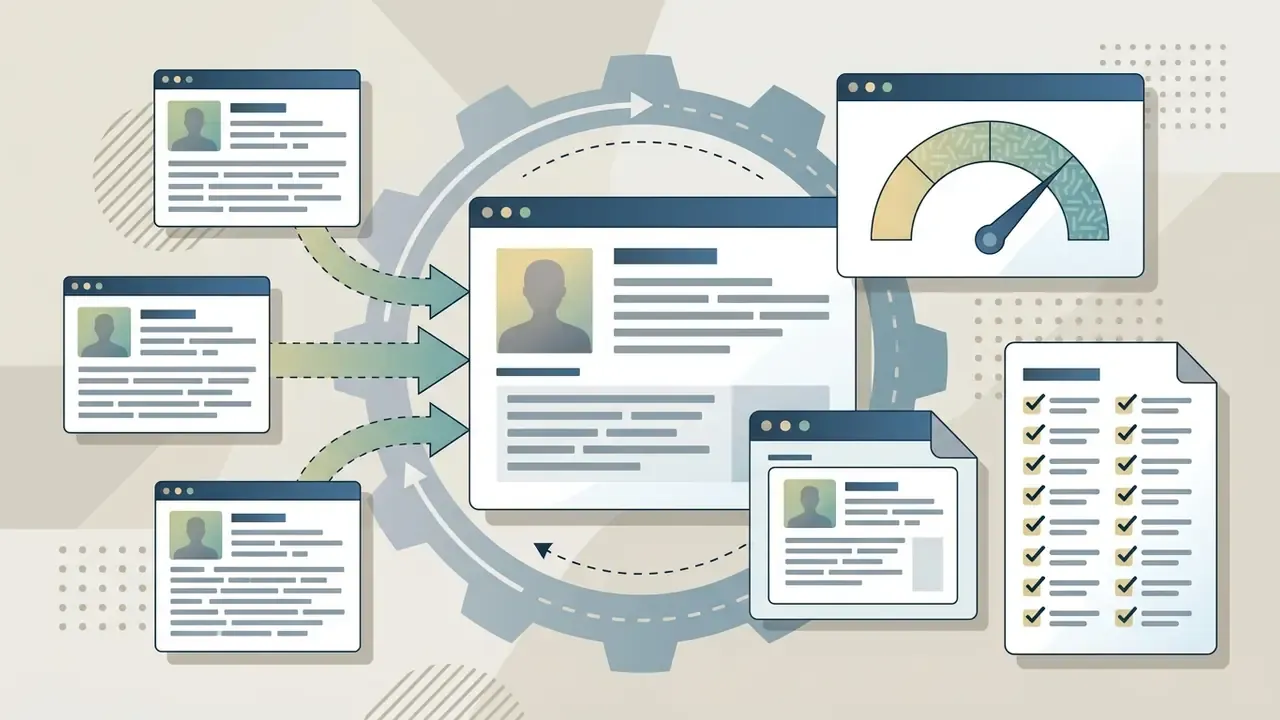
An ai dating generator takes basic user inputs and converts them into several distinct text options. You feed in profession, hobbies, and your particular flavor of humor. The system then applies style parameters and returns options you can compare.
Research on Guided Profile Generation, a framework that first converts raw user data into intermediate structured profile attributes before generating text, reports large personalization gains from that intermediate step.
"Structuring personal context into intermediate profile attributes improves personalization accuracy by 105.62% compared with unguided generation."
Real prompt transformations: from weak input to a bio people answer
Abstract advice about "being specific" rarely changes behavior. So here are the same raw facts pushed through a lazy prompt and then a structured one.
| App | User Input (Raw Data) | Weak AI Output (Generic Prompt) | High-Converting AI Output (Structured Prompt) |
|---|---|---|---|
| Tinder | "26, engineer, love coffee, hiking, and rock climbing." | "Fun engineer who loves coffee and going on outdoor adventures. Swipe right!" | "Software engineer by day, amateur bouldering champion by weekend. Searching for someone who can beat my V4 wall record, or at least join for post-climb espresso. What's your go-to weekend trail?" |
| Bumble | "I cook Italian food, read sci-fi, looking for something serious." | "I am a warm person who likes reading books and cooking dinner for two." | "Making homemade cacio e pepe from scratch this Sunday. Tell me your top three sci-fi novels and I'll save you a bowl." |
| Hinge | "Tall, play guitar, love dogs, looking for fun dates." | "6'2 musician who loves dogs. Let's hang out and see where things go." | Prompt: Together, we could… "Dog-walk our way through every farmers market in the city, then argue over whether acoustic or electric sounds better live. You bring the dog, I'll bring the coffee." |
The difference is not vocabulary. It is one verifiable detail, one mild opinion, and one easy reply cue. Three things. That's it.
When a generator helps improve an existing bio
A dating profile generator ai earns its keep on profiles that already exist and get nothing. It strips generic clichés and inserts an actionable opener. Plenty of self-written profiles fail for a boring reason: every sentence is true of half the city.
Think of the generator as a redacting tool that swaps broad claims for concrete descriptions. Survey data suggests people who treat AI as an assistant rather than a ghostwriter report better outcomes:
"Among singles who used AI in dating, 32% reported better-quality matches and faster connections with potential partners."
How to Use an AI Dating Bio Generator
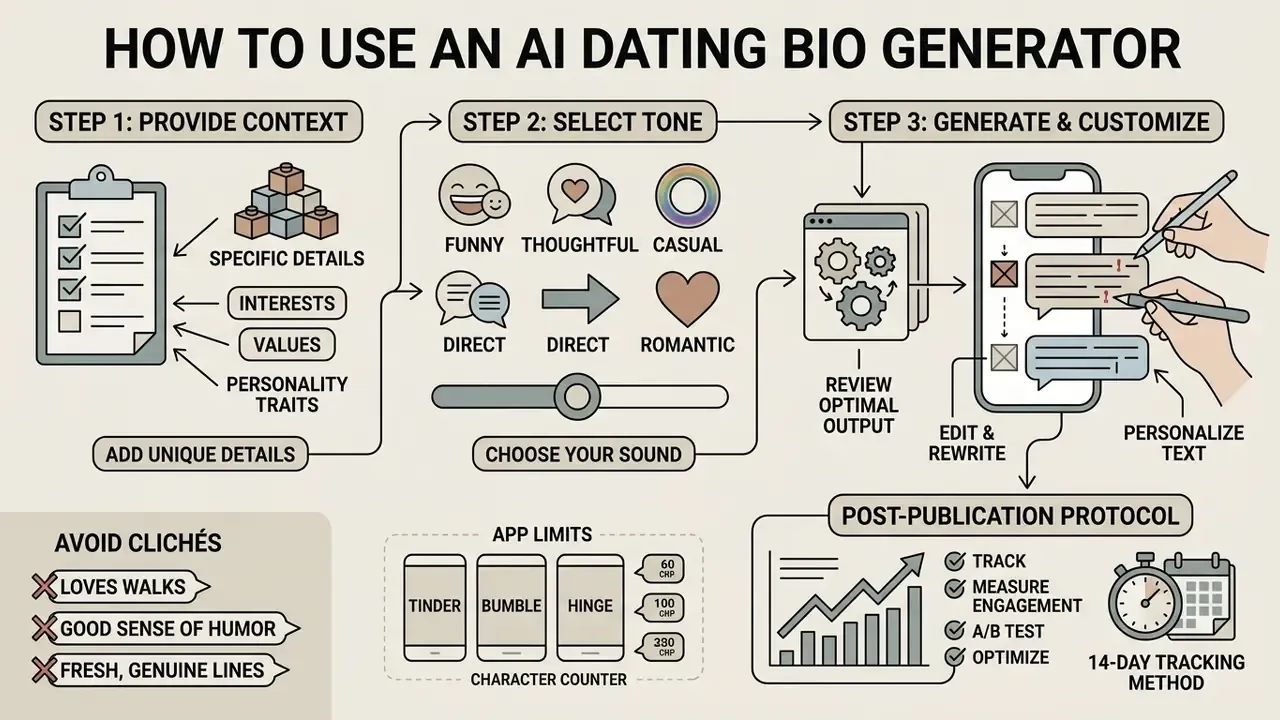
Using an ai bio generator for dating app publishing takes three things: specific context, a tone that matches you, and manual editing at the end. The full cycle runs under ten minutes.
====================================================================================
                        PRE-PUBLICATION BIO CHECKLIST
====================================================================================
[ ] Step 1: Provide concrete details (hobbies, specific preferences, goals)
[ ] Step 2: Select a platform-appropriate tone (witty, direct, sincere)
[ ] Step 3: Generate 3-5 bio variations using the AI tool
[ ] Step 4: Remove generic AI phrases, buzzwords, repetitive sentence structures
[ ] Step 5: Verify all facts, dates, and claims for complete accuracy
[ ] Step 6: Strip identifying data (employer, address, routine locations)
[ ] Step 7: Copy and paste the polished text into your dating app bio field
====================================================================================
Add details that make the profile specific
An ai dating app bio generator is only as good as what you type in. "I like movies and travel" produces exactly the bio you would expect: forgettable.
Useful inputs are narrow. A favorite city and why. One recipe you actually cook. A niche hobby. A recurring weekend ritual. One genuinely unpopular opinion you are willing to defend.
"Adding structured personal context improved personalization results by 50.23%; using a self-generated profile instead of raw data improved them by 73.71%."
Choose a tone that sounds like you
Tone selection aligns generated text with your actual personality and with platform expectations. Most tools offer witty, sincere, direct, or playful.
Experimental work on dating-app first impressions leans toward direct and positive framing over sarcasm:
"Direct, complimentary opening lines scored highest on sociability, romantic attraction, trustworthiness, and intelligence; humorous lines helped only for moderately attractive matches."
Later experimental work at the same institution tested humorous self-disclosure with roughly 800 participants. Joke-framed disclosure lowered perceived attractiveness on average, yet raised it among participants who actually found the joke funny. Read that twice. Sarcasm and edgy humor are high-variance strategies; they filter hard in both directions. Pick the register you use in ordinary conversation, because a mismatched tone creates friction the moment the chat leaves the profile.
Review, customize, and paste the final bio
Last step: read the draft, cut the generic phrasing, then paste. Never copy raw model output straight into a live profile.
Generators lean on formulaic transitions and uniform sentence rhythm. Editing guidance recommends removing overused buzzwords, varying sentence length, restructuring paragraphs, and reading the text aloud before publishing. Reading aloud catches more than you would think.
"Post-editing AI drafts substantially increases stylistic similarity to a user's own writing, although LLM stylistic traces remain detectable by classifiers."
Post-publication protocol: how to track and optimize bio performance
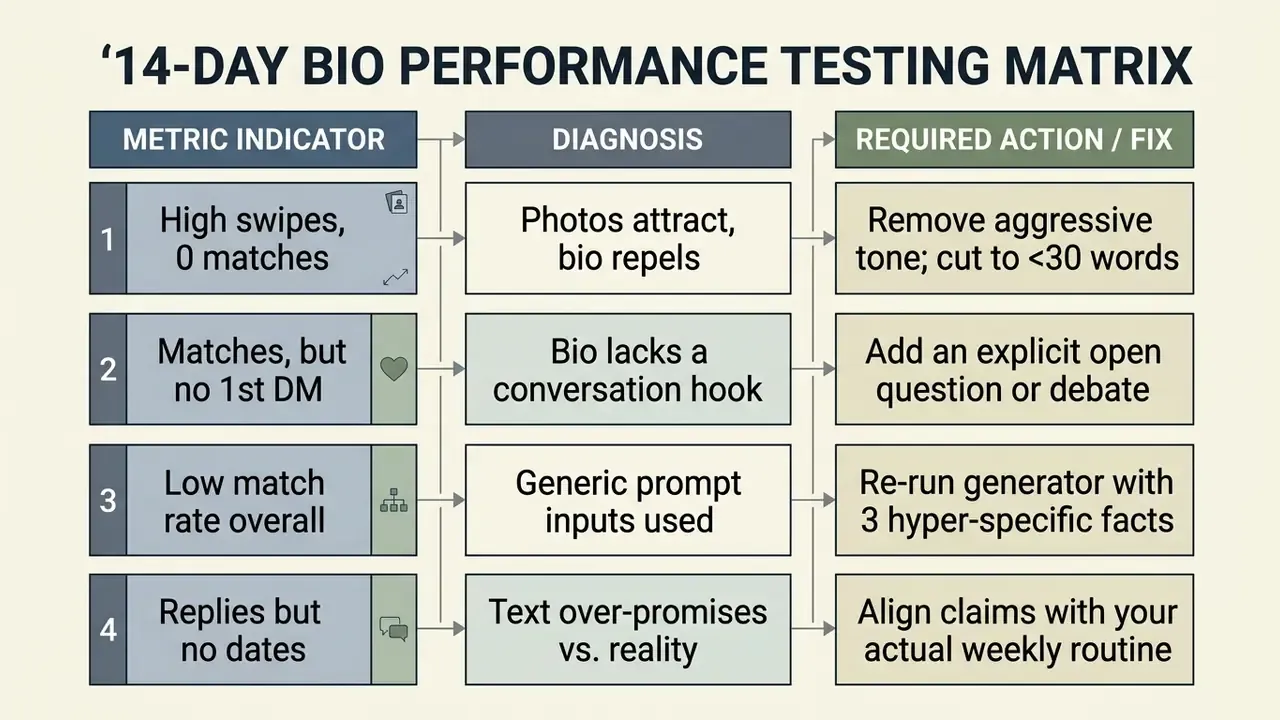
Change one variable at a time, text or photos, never both, otherwise you cannot attribute the change to anything. Keep every variant in a private note so you can revert to the best performer. And log the dates; memory is a bad analytics tool. For cost planning across paid tiers and credit systems, see the overview of computational pricing models.
What Makes an AI-Generated Dating Bio More Likely to Get Matches
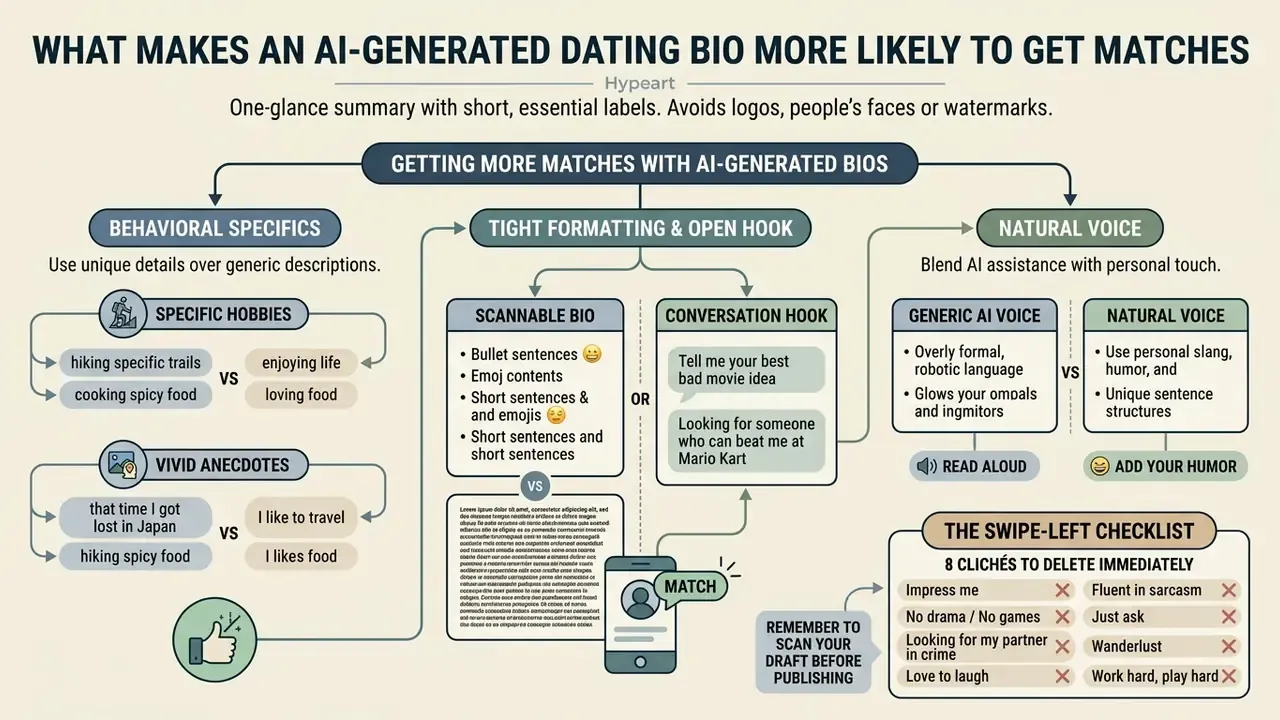
An effective bio combines behavioral specifics, tight formatting, and an open conversation hook. Everything else is decoration.
Specific details instead of generic profile adjectives
Replace broad claims with concrete behavior. "I brew V60 coffee every morning" lands harder than "I love coffee," because one is a scene and the other is a category.
"Linguistic self-descriptions encode personality traits that observers decode through concrete language markers rather than general adjectives."
Related research on profile originality found that higher perceived originality raised judgments of intelligence and sense of humor, which then increased attractiveness and dating intention. Note the shape of that finding: it is mediated, not direct. Originality works because of what it signals. Specific details give the reader instant context and turn a static dating bio into a starting point for a conversation.
Short, scannable bios with a conversation hook
People read profiles at swipe speed. Across platform guides and dating-coach analyses, the commonly recommended range for swipe-first apps such as Tinder is roughly 15 to 45 words, or 100 to 300 characters. That is practitioner consensus, not a peer-reviewed finding, and the earlier vendor-page citation for it has been removed.
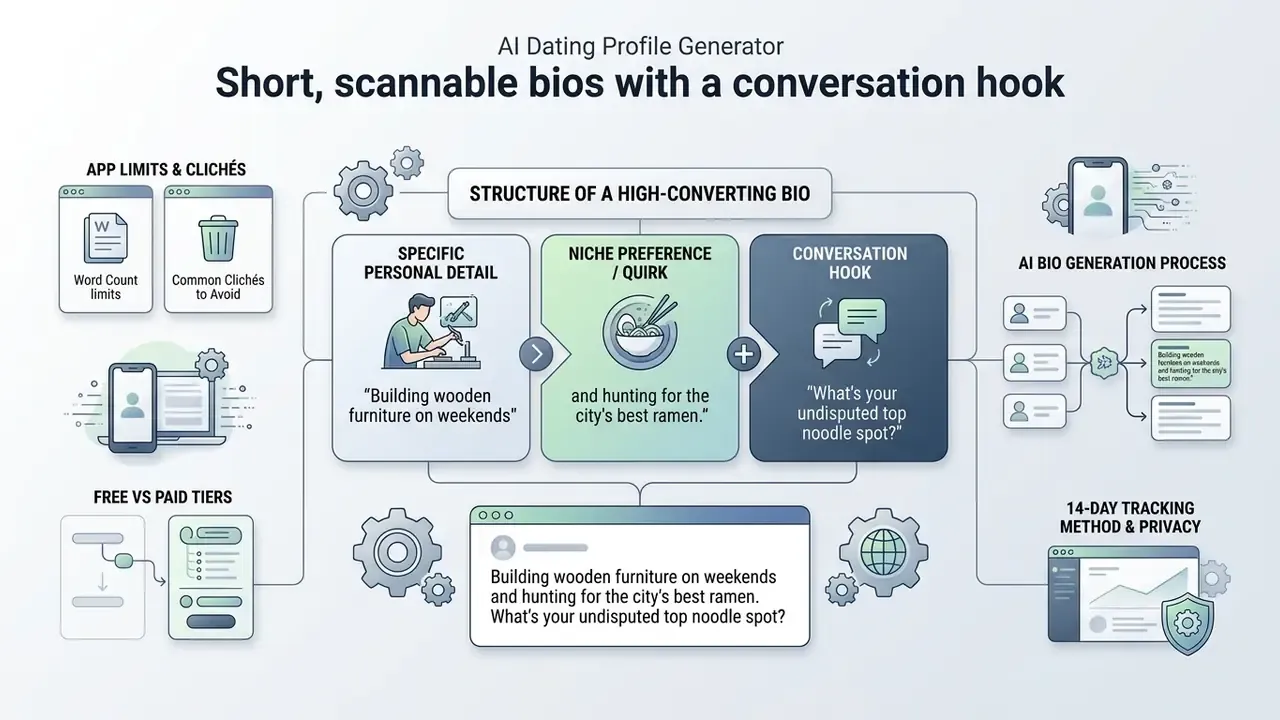
A hook can be a simple question, a light debate, or an easy prompt. Ending with a clear question lowers the effort required to send the first message, which is the actual bottleneck on most apps. Practical composition target: one or two specific interests, one personality detail, one reply cue.
How to avoid a generic or obviously AI-written voice
Model output carries recognizable fingerprints: balanced multi-clause sentences, uniform length, diplomatic hedging, repeating adjectives. Those markers make a profile feel processed.
To kill the robotic tone, shorten long sentences, cut stock transitions such as "however" or "in conclusion," and add one anecdote no model could invent for you.
"Post-edited AI text retains detectable LLM stylistic traces even after revision; the gap between perceived and measurable authenticity remains significant."
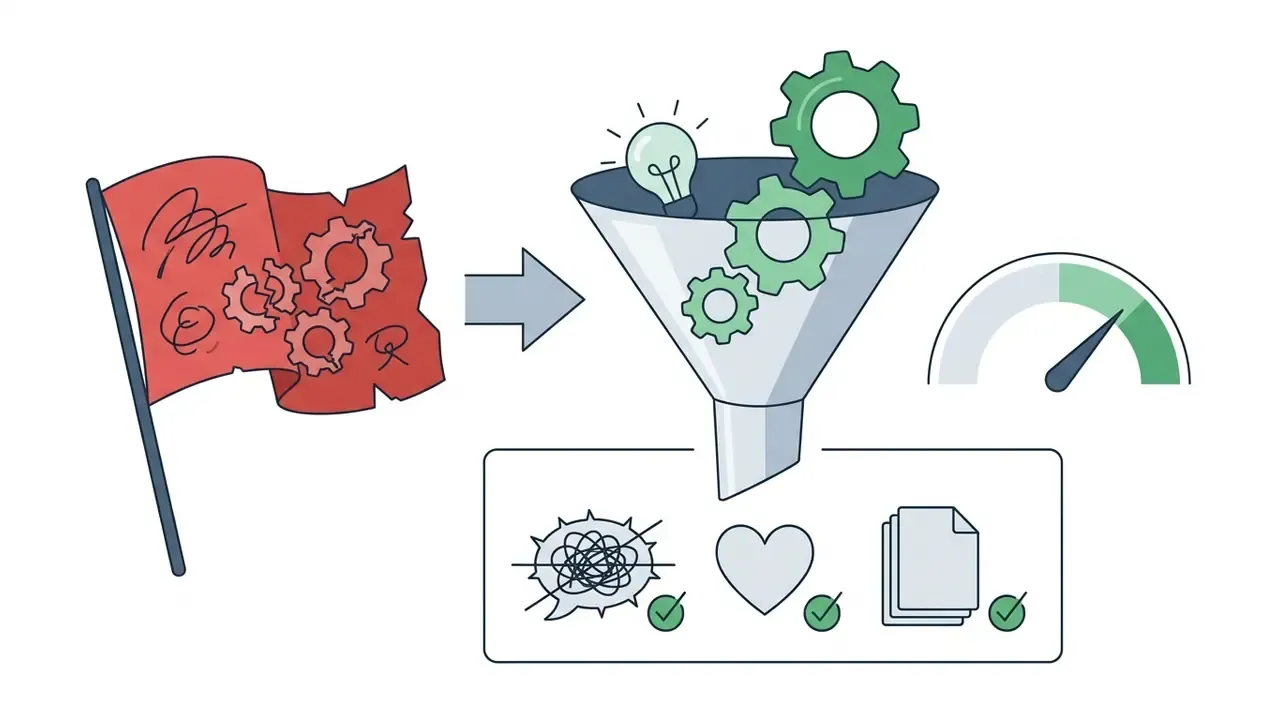
The swipe-left checklist: eight words and clichés to delete immediately
Bonus deletions: "fluent in sarcasm," "here for a good time, not a long time," "must love dogs" when you do not have a dog, and any sentence that stacks three adjectives in a row.
AI Dating Profile Generator for Tinder, Bumble, and Other Apps
Adapting bios across platforms means adjusting word limits, tone, and prompt formatting to each app's interaction model. Same facts, different container.
| Platform | Bio Character Limit | Primary Text Format | Recommended Tone & Focus | Photo Alignment Requirement |
|---|---|---|---|---|
| Tinder | 500 characters | Short bio (15-45 words) plus up to 3 prompt answers | Playful, concise, direct hooks, light humor | Photos must match the outdoor or social activities mentioned |
| Bumble | 300 characters | Concise bio plus up to 3 prompt answers (~160 chars) plus Opening Moves | Warm, sincere, value-focused, open questions | Photos should reinforce reliability and clear lifestyle context |
| Hinge | No traditional free-text bio | 3 required prompts (150 characters max per prompt) | Specific, story-driven, conversational answers | Each prompt answer should visually connect to adjacent photos; 4-6 photo minimum by region |
Read the table as a container spec, not a style guide. Tinder rewards compression, Bumble rewards warmth with an obvious opening, Hinge rewards a story attached to a picture.
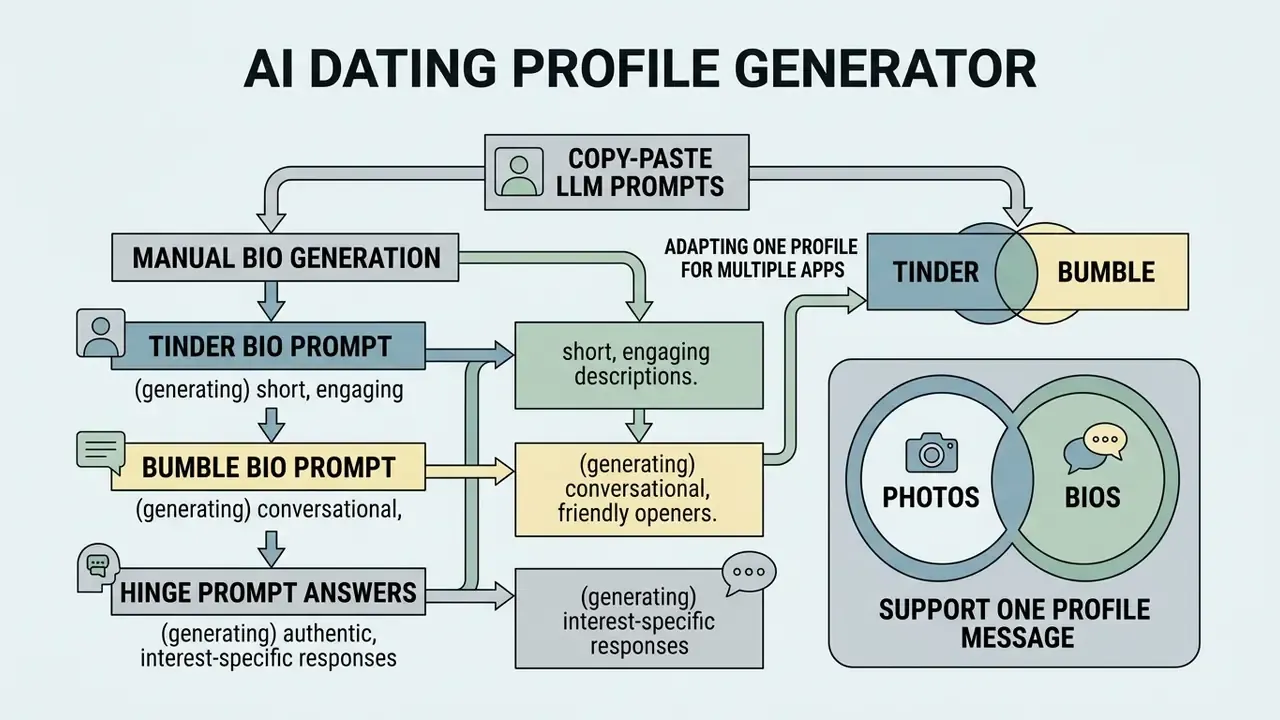
Copy-paste LLM prompts for manual generation
If you prefer a general model such as ChatGPT or Claude over a dedicated dating profile ai generator, these platform-calibrated prompts reproduce most of what paid interfaces do.
Tinder bio prompt
Act as a dating profile consultant. Write 3 Tinder bio options under 40 words
based on these facts: [INSERT JOB / HOBBIES / ONE MILD OPINION].
Tone: witty, playful, concise. No clichés ("love to laugh", "partner in crime").
End each option with one simple question.
Bumble bio prompt
Write 3 Bumble bios under 300 characters using these inputs:
[INSERT VALUES / INTERESTS / RELATIONSHIP INTENT].
Focus on warmth and genuine self-disclosure. Include an inviting opening line
that makes it easy for someone to message first. Vary sentence length.
Hinge prompt answers
Generate 3 responses for the Hinge prompt "[INSERT PROMPT NAME]" using this
specific story: [INSERT REAL ANECDOTE].
Keep each answer under 150 characters, story-driven and conversational.
Do not add adjectives that I did not provide.
Append one more instruction to any of the above, "return the three strongest options only, then list what factual detail is missing," and the model will tell you which input to strengthen. Cheap diagnostic. Use it.
Adapting one dating profile for Tinder and Bumble
An ai tinder profile generator produces short, swipe-friendly text built for fast decisions. Tinder allows 500 characters, but brevity still wins, and a large-scale study of 12.4 million matches found men initiated 79% of conversations. Practically, that means male profiles compete on giving women a reason to reply, not on self-description.
Bumble caps text at 300 characters and rewards clear self-descriptions that make it easy for women to open the conversation. Its Opening Moves feature lets a user pre-set a prompt question that a match answers as the first message. Running an ai tinder bio generator free tier to build a core draft, then reformatting it for Bumble's structure, is the fastest path across two apps.
One set of personal facts can yield a punchy Tinder line and a warmer, value-oriented Bumble paragraph. Tailoring to platform norms keeps the profile from looking transplanted.
A transparency note for commercial users. If you generate profile text or imagery on behalf of clients, whether coaching, agency, or matchmaking work, emerging regulation such as the EU AI Act includes transparency obligations for AI-generated or AI-manipulated content in certain contexts. Agency workflows should document what was AI-assisted and disclose it where required.
Why photos and bios should support the same profile message
Text and photos have to tell one story. Images drive the initial swipe; text validates trust after that filter.
"In an analysis of 45,399 dating app users, facial attractiveness in profile photos raised match rates by 200% for men and 155% for women."
"Contradictions between textual claims and photographic evidence sharply reduce perceived authenticity and trust." Toma & Hancock, Journal of Social and Personal Relationships (2020). https://journals.sagepub.com/doi/full/10.1177/0265407519878787
Earlier accuracy research found photos to be the least accurate profile element, with judges flagging roughly a third as misleading. Which is exactly why aligned text raises trust. If your bio talks about hiking, include one outdoor photo. If it mentions cooking, show a kitchen instead of a gym mirror.
Before uploading, it helps to know what tooling can and cannot fix: reviewing a photo editor workflow shows which corrections (exposure, crop, color) are safe, and which edits slide into misrepresentation. Alignment is not a design nicety here; it is the trust mechanism.
Free vs Paid AI Dating Profile Generators: Features, Limits, and Value
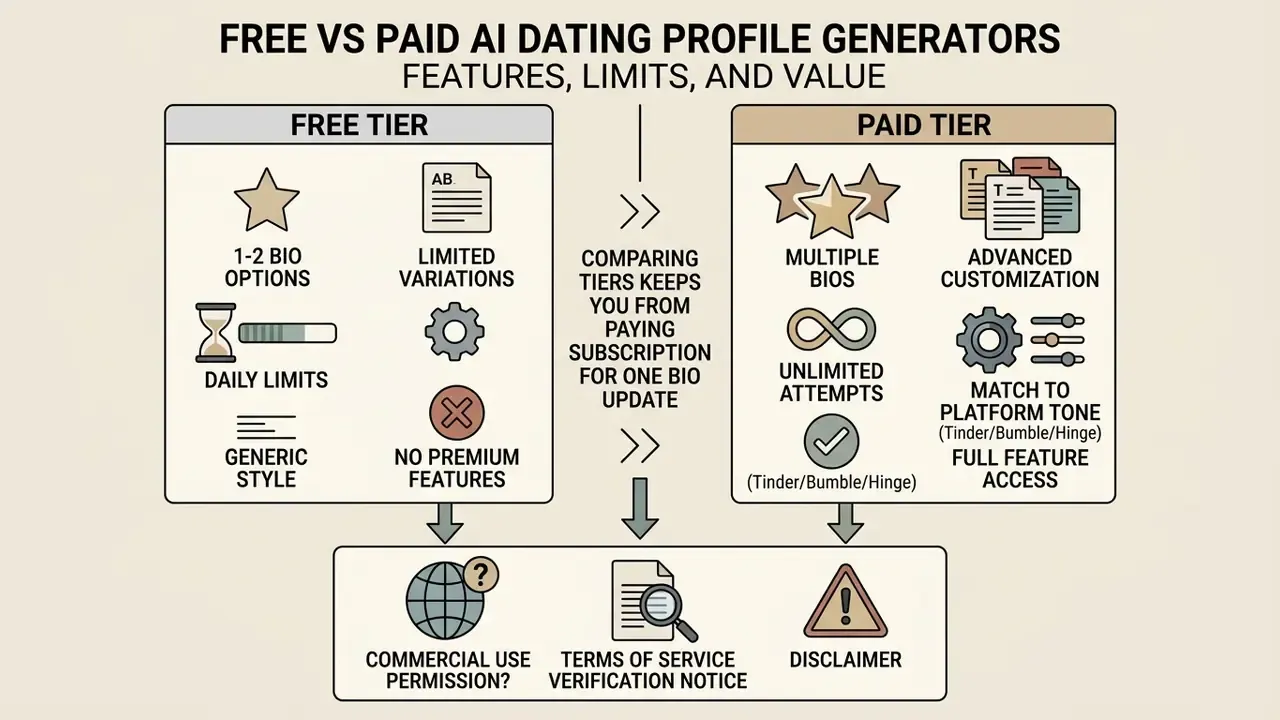
Comparing tiers keeps you from paying a subscription for one bio update.
What a free AI dating profile generator usually includes
When paid features can be worth considering
Can you use generated dating bios for commercial purposes?
Commercial usage rights for generated text depend on the terms of service of the underlying model provider. Most major platforms permit commercial use of output, though ownership mechanics differ. OpenAI's terms assign output rights to the user (OpenAI Terms of Use), while Google states it claims no ownership of generated content but requires compliance with applicable law and, in some API contexts, attribution (Google Gemini API Terms).
Other vendors reserve broader platform rights. Some commercial terms grant the provider a worldwide, royalty-free license to use customer inputs and outputs for service operation, debugging, and quality review. At least one major vendor excludes model training by default, while another makes training conditional on explicit opt-in. Adobe's generative terms allow commercial use but take a separate license over output submitted to its hosted galleries.
"Usage terms and output rights for AI tools are governed by contractual conditions rather than by technical properties of the model; users must verify each provider's policy."
If you generate bios for consulting or dating-agency clients, verify four clauses specifically: license scope, sublicensing rights, input and output data-use rights, and whether training on your data is opt-in or default. That last one surprises people most often.
Terms of service verification notice:
For broader definitions of content licensing and business terms, open the hub for commercial guidelines, or open the hub for regulatory compliance standards.
Privacy, Data Safety, and Authenticity When Using AI Dating Tools
Sharing personal information with third-party generative platforms deserves caution, especially with small consumer tools whose retention practices are simply undocumented.
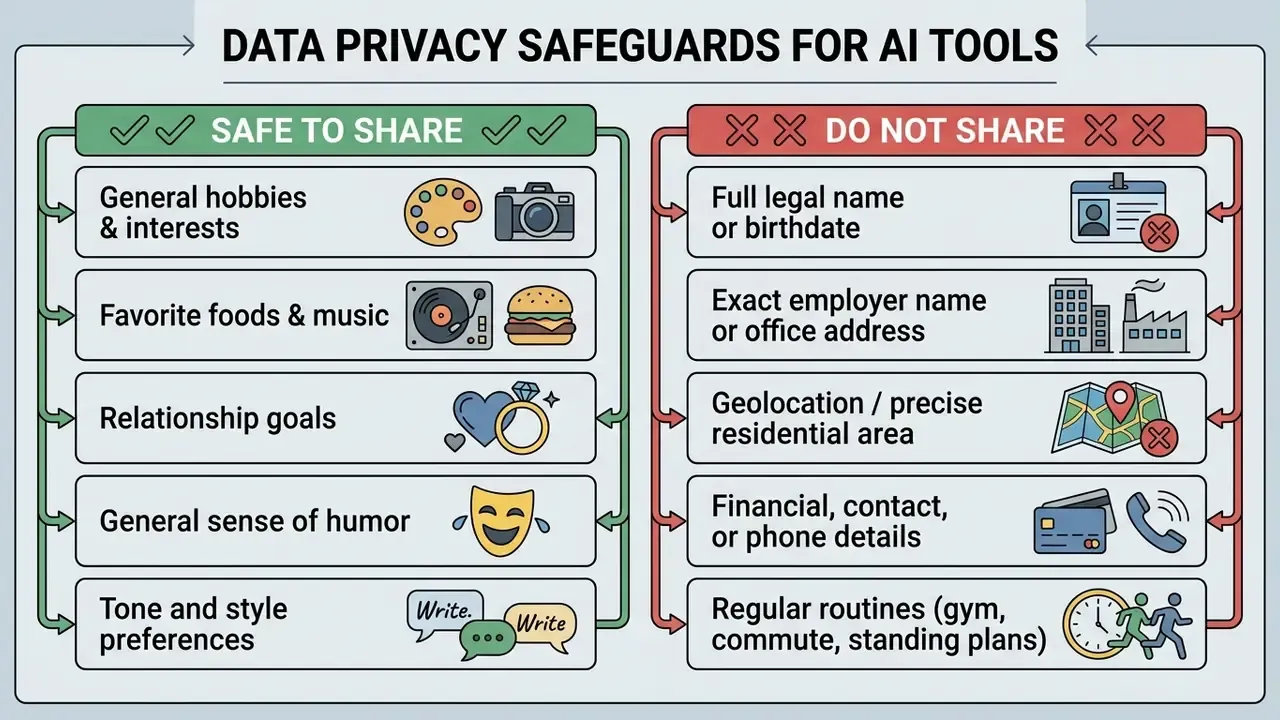
Keeping the final bio personal and accurate
Over-polishing invites a specific failure: claims that do not survive the first coffee. People detect strain quickly.
A 2024 study on algorithmically generated profile text found that readers rated AI-written profiles as less trustworthy and were less willing to accept requests from them. Survey evidence says this is not a lab artifact:
"Nearly half of surveyed singles said they would draw the line if a potential partner used AI to alter how they present themselves."
FAQ About AI Dating Profile Generators
Do you need to sign up, or can you use the tool on a phone?
Most web-based bio generators in this category allow anonymous access through mobile browsers with no registration, and several state that explicitly. Native mobile apps exist on the major storefronts for people who prefer installed software. Updated: vendor and app-store links previously cited as sources here have been removed, since neither a competitor's marketing page nor a store listing counts as independent evidence. The claims now stand as category-level observations.
"Only 6% of all singles and 14% of online daters reported using AI to improve their dating life." Match "Singles in America" survey, Kinsey Institute, Indiana University (2024). https://kinseyinstitute.org/ Browser versions give immediate access without retention tied to a personal account, which makes them the pragmatic choice for privacy-conscious users.
Can you save, share, and reuse generated bios?
Generators output plain text you can copy into any notes app. There is no proprietary file lock on a draft, although genuine export features are rare; the standard workflow across vendors remains copy and paste. Keep several variations in a private document and test them over time. Reusing one core draft across Tinder, Bumble, and Hinge keeps your messaging consistent, as long as each version gets trimmed to that platform's character limit. For rights questions when reusing generated assets professionally, review the guidance on commercial use of AI content. Refresh the saved text every few months as hobbies and goals shift. Profiles go stale faster than people expect.
Should you disclose that AI helped write your bio?
No mainstream app requires disclosure, and platform guidance tends to frame AI as a "wingman, not a ghostwriter," which reads as permission for editing support. Academic work on AI-generated self-presentation stresses user control and optional disclosure, because trust drops when involvement is discovered rather than declared. Working rule: if every fact is yours and the voice is yours, say nothing. If the personality belongs to the model, rewrite it.
Will an AI bio hurt my match rate?
Unedited output tends to underperform, since it reads generic and produces fewer open-ended follow-ups in replies. Edited output performs comparably to self-written text at a fraction of the time cost. The failure mode is publishing draft one.
Which matters more: photos or the bio?
Photos drive the initial swipe. The 45,399-user study cited earlier found large match-rate effects from facial attractiveness alone, and review literature confirms images are the primary basis for like or dislike on mobile apps. The bio matters after that filter: an early Tinder experiment found that adding a bio raised matches for male stock profiles from 16 to 69. Text is one signal in a system, not the system.
Can these tools write Hinge prompt answers, not just bios?
Yes. Because Hinge has no free-text bio, generators built for it return three prompt answers at 150 characters each, ideally paired with the adjacent photo. Feed one real anecdote per prompt. A model cannot invent your stories, only phrase them.
How is a dedicated generator different from a general AI chatbot?
Functionally, not much. A dedicated ai dating bio generator pre-loads platform limits, tone presets, and cliché filters so you skip prompt engineering. A general model does the same work if you paste the prompts from the section above. Convenience versus control, and a paid tier only earns the fee when it adds audits, photo scoring, or multi-app export.
Appendix A: Superseded Claims and Citation Corrections
This appendix preserves earlier statements and citations replaced during editorial review, so readers can audit what changed and why.
| Original statement / citation | Status | Reason for change |
|---|---|---|
| "…improves personalization accuracy by 105.62% (Guided Profile Generation Framework, 2024, arxiv.org/abs/2401.00000)" | Figure retained, URL removed | The arXiv identifier was a placeholder and did not resolve to a real publication. |
| "In an analysis of 127,000 first-message exchanges, human-written bios achieved a 41.3% reply rate, whereas unedited AI bios achieved 25.9% (Alibaba Research, 2026, alibaba.com)" | Removed from main text | Commercial source, non-academic; figures unverified. The related report also cited 34.1% for AI-assisted bios and a drop in open-ended reply questions from 68% to 33%, which stays directionally consistent with the editing recommendation. |
| "Guidelines from Harvard University IT emphasize that precise prompts… (Harvard IT Prompting Guide, 2026, huit.harvard.edu)" | Replaced | Institutional guidance without methodology or measurable outcomes. |
| "Editing guidance recommends removing overused buzzwords… (Oklahoma.gov AI Guidance, 2026, oklahoma.gov)" | Replaced | Government portal, not an empirical study; substance retained (restructure, vary syntax, fact-check, read aloud). |
| "A 2022 study on dating profile texts confirmed that higher perceived originality… (PMC Research, 2022)" | Reframed | Retained as supporting context; primary citation updated to the lens-model analysis of profile language. |
| "The optimal length… ranges between 15 and 45 words (Tinder Profile Analysis, 2026, tinder.com)" | Citation removed | Commercial platform page; range retained as practitioner consensus. |
| "Research from the National Institute of Standards and Technology emphasizes grounding synthetic text… (NIST AI RMF, 2024)" | Replaced in context | The AI RMF governs risk management, not prose style; it remains a valid reference for synthetic-content definitions and hallucination mitigation. |
| "Most free utilities allow between 4 and 5 bio generations per 24-hour cycle (Matchphotos.io Terms, 2026)" | Generalized | Single-vendor limit presented as a category norm; competitor citation removed. |
| "Subscriptions typically range from $2.99 per week… (Wingman AI Pricing, 2026)" | Generalized | Competitor pricing, time-sensitive and unverifiable. |
| "In 2026, regulatory enforcement highlighted risks… (FTC OkCupid Enforcement Action, 2026)" | Reframed without case details | Case name and date not verified against primary filings; category risk retained. |
| "A 2024 study… overly polished AI profiles were rated as less trustworthy (Computers in Human Behavior, 2024, chb.2024.108400)" | Citation reassigned | That DOI refers to the photo-attractiveness study of 45,399 users; the trust finding now cites AI self-presentation research and Kinsey Institute survey data. |
| "Most web-based bio generators allow anonymous access… (Miskies AI, 2026; Google Play Store, 2026)" | Citations removed | Vendor page and app-store listing are not independent evidentiary sources. |
Paragraphs linking to /glossary/animation-maker-3d/, /glossary/animation-maker/, /glossary/animation-online/, /glossary/anime-ai-generator/, /glossary/anime-ai-voice-generator/, /glossary/anime-character-generator/ | Removed and replaced | Off-topic anchors broke reading context and diluted topical relevance; replaced with dating-relevant photo and licensing resources. |