«In high-stakes enterprise governance and digital forensics, automated visual matching is a diagnostic signal, not an absolute verdict. Without traceable data lineage, verifiable index depth, and human oversight, relying on a single visual match creates material compliance and operational risk.»
— Marcus Hale, AI Governance & Model Risk Editorial Lead
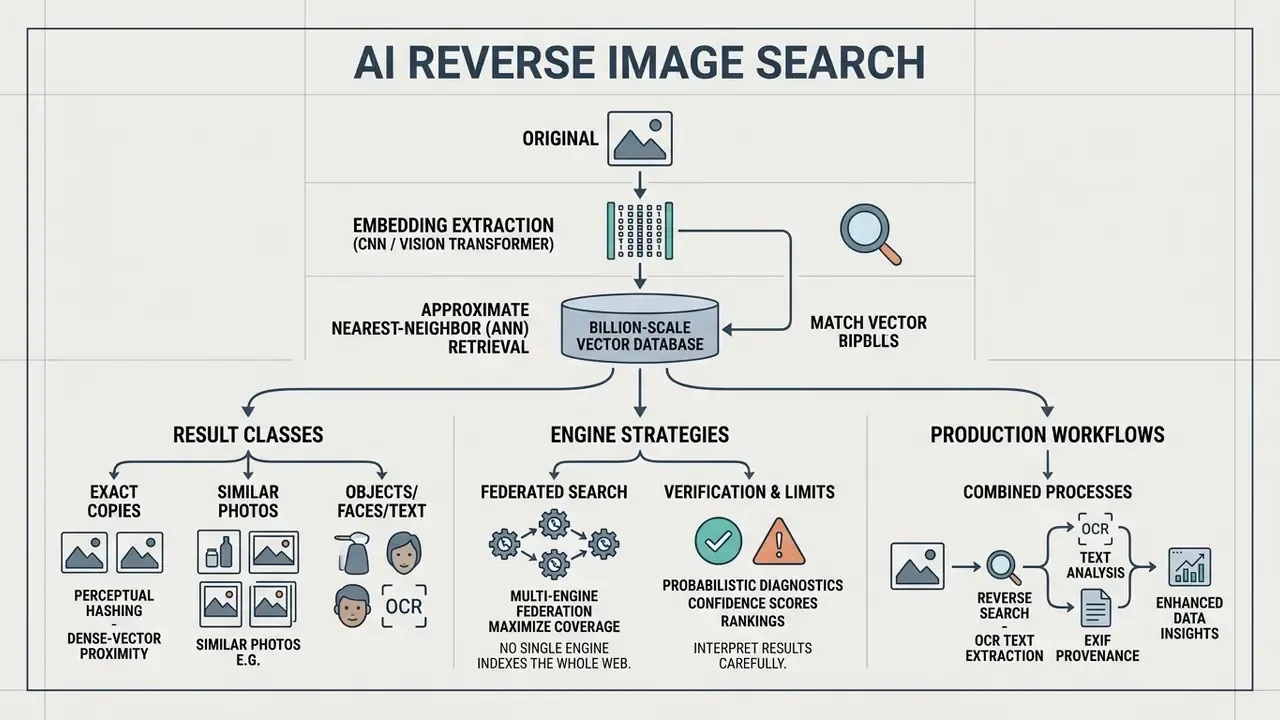
AI reverse image search replaces metadata and keyword lookups with high-dimensional neural representations that read visual content directly. Instead of matching text tags, these algorithms map pixels into vector embeddings. That lets a search engine locate identical files, modified crops, and visually similar objects across billions of indexed pages in seconds.
Why should a risk or compliance leader care? Because the same pipeline that helps a shopper find a pair of shoes now sits inside claim triage, merchant onboarding, and brand-protection workflows. And once it informs a decision, it becomes a model you have to govern.
Key Takeaways
Who This Article Is For, and What It Helps You Decide
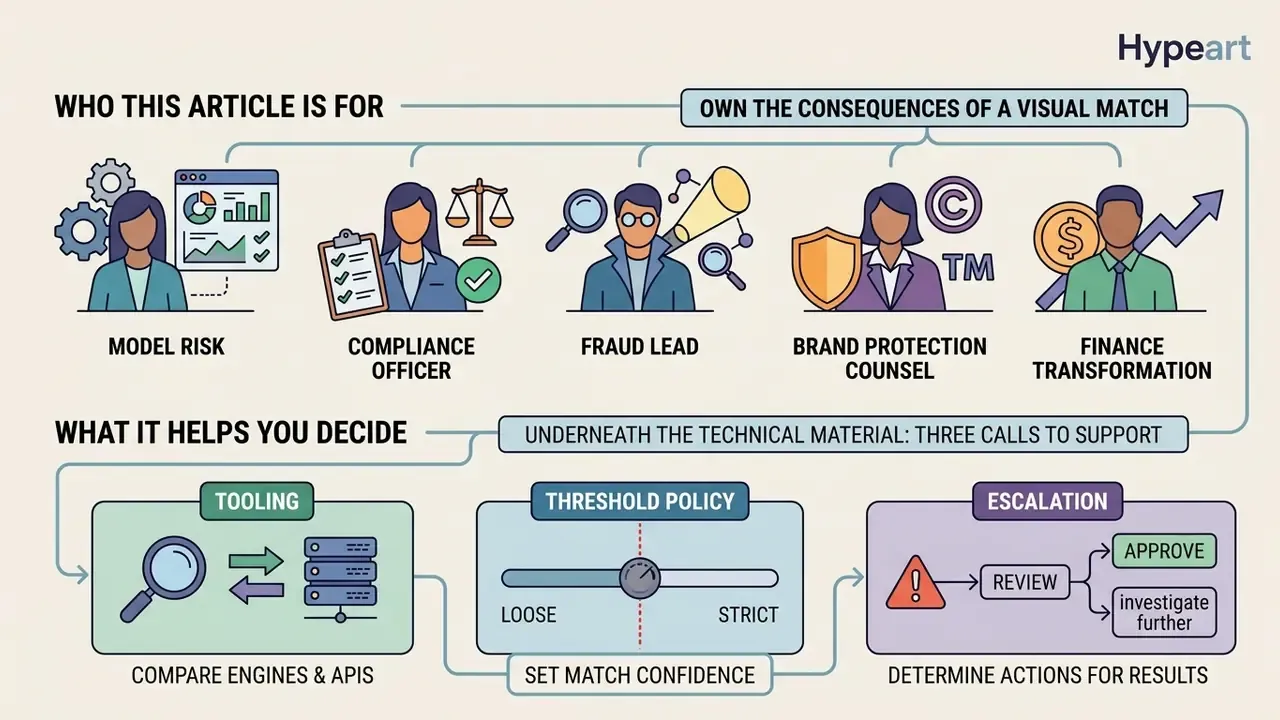
This is written for people who own the consequences of a visual match: heads of model risk, compliance officers, fraud leads, brand-protection counsel, and finance transformation teams screening invoices and receipts at volume.
Three decisions sit underneath the technical material below.
First, tooling. Do you need an exact-copy index, a semantic similarity engine, a face search product, or a private vector store inside your own perimeter? Those are four different purchases, and they fail in different ways.
Second, threshold policy. A similarity score of 0.85 is a business rule, not a physical constant. Someone has to own it, document it, and defend it in an audit.
Third, escalation. When the pipeline flags a duplicate collateral photo or a recycled damage image, who adjudicates, on what evidence, and within what service level? No evidence, no autonomy: the retrieval system proposes, a named human disposes.
Everything that follows is organized to support those three calls.
What Is AI Reverse Image Search and What Can You Find from an Image
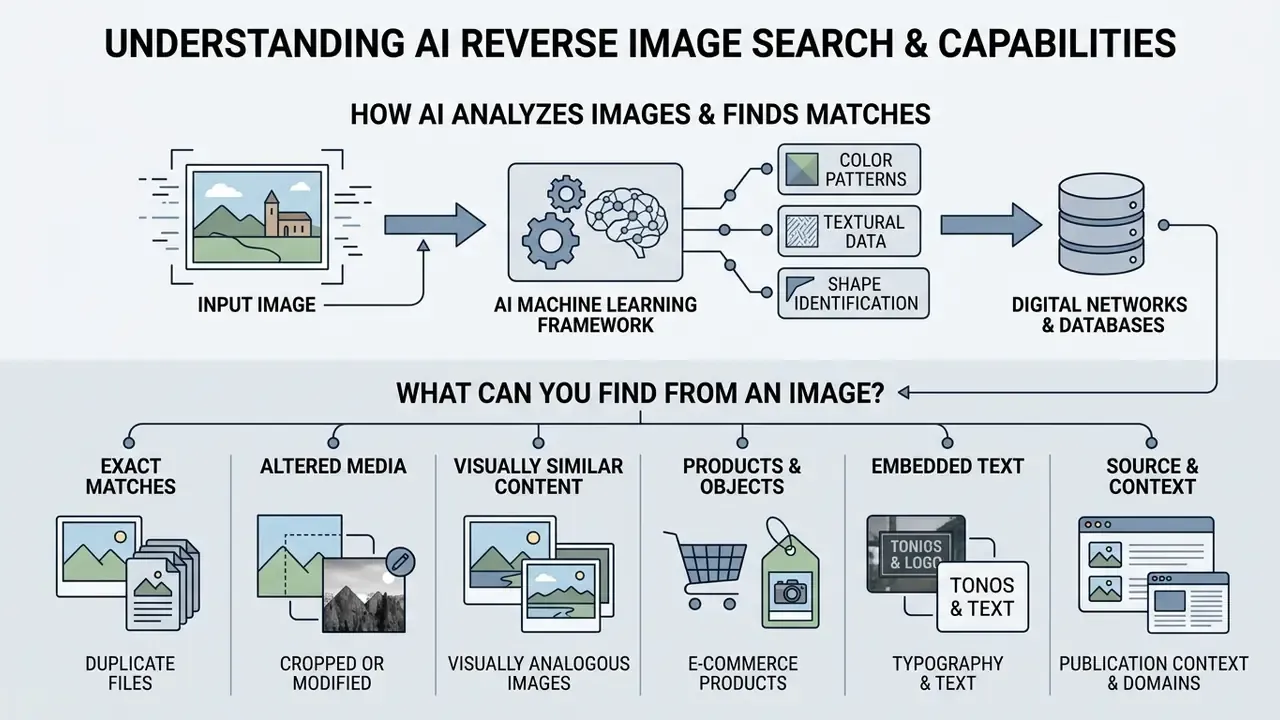
AI reverse image search is a computer vision retrieval framework that uses machine learning to identify identical, altered, or visually analogous images across digital networks. Traditional text search indexes pages through HTML alt text and surrounding keywords. Reverse image search processes raw visual input instead, whether that is uploaded images or a direct image URL, and evaluates visual patterns, textures, shapes, and semantic content.
An ai reverse image search tool lets enterprise risk teams, brand managers, and ordinary consumers run an ai image lookup that returns structured search results. Querying through an ai image finder can uncover several distinct categories of visual content:
- Exact matches and duplicate files identical digital assets hosted on external domains, including files that were renamed or converted between jpg png formats.
- Altered and cropped media modified versions of uploaded images that have gone through color grading, watermarking, background removal, or spatial cropping.
- Visually similar content images that share underlying visual patterns, composition, lighting, or object structure without coming from the same source file.
- E-commerce products and physical objects furniture, apparel, vehicles, appliances, and infrastructure elements captured inside a photo.
- Embedded text and typography signage, document scans, invoices, and screenshots whose flattened text becomes searchable through integrated optical character recognition.
- Publication context and source domains original hosting websites, publication timestamps, and the metadata needed to trace asset provenance.
A consumer-grade ai finder picture tool and an enterprise retrieval stack share the same mathematics. What separates them is index depth, retention policy, and whether you can reproduce a result six months later for an auditor.
How AI Analyzes Images and Finds Matches
Image retrieval platforms convert pixel matrices into fixed-length numeric vectors, commonly called visual embeddings. Modern architectures rely on deep convolutional neural networks (CNNs) and Vision Transformers (ViT), including ViT-B/16 models trained on multi-billion image datasets, to extract features across several abstraction layers.
Early neural layers capture primitive signals: edges, high-frequency textures, color gradients. Deeper layers derive semantic information such as object boundaries, face structure, and spatial relationships. Published billion-scale retrieval work reports that unified visual embeddings trained on more than one billion weakly annotated images, using a ViT-B/16 backbone, improved average retrieval performance by roughly 4.5% over prior baselines.
Searching billions of indexed images in real time rules out expensive cross-attention comparison for every candidate. So systems deploy Approximate Nearest Neighbors (ANN) vector search. Algorithms such as Hierarchical Navigable Small World (HNSW) graphs and Inverted File with Product Quantization (IVFPQ) compress high-dimensional feature vectors into searchable indexes. When a user submits a query, the engine computes the query embedding and measures vector proximity with cosine or Euclidean distance. The retrieval pipeline completes multi-billion vector comparisons in milliseconds and returns matches ranked by similarity score.
Dual-encoder designs dominate at this scale for one blunt economic reason: full cross-attention scoring must be recomputed for every candidate at query time, which is impractical across web-scale corpora.
«On controlled benchmark collections such as Caltech 256 and Corel 10k, deep image retrieval systems exceed 99% precision when feature clustering and representative-point selection are applied.»
Retrieval accuracy on curated benchmarks sits far above accuracy on the open web. Treat benchmark numbers as ceiling values, then validate recall on your own asset library. Analysts who also need to classify whether a retrieved file was synthetically produced usually pair retrieval output with dedicated AI image detectors rather than trusting the search ranking alone.
Exact Matches, Copies, and Similar Images in Search Results
Visual search engines use distinct mathematical techniques to separate find exact matches, edited copies, and similar images. Exact matching leans on file hashes or high-threshold perceptual hashing (pHash) combined with dense vector proximity. These systems still recognize identical images when mild file compression has rewritten the underlying byte structure. A typical pHash implementation reduces an image to a 64-bit DCT-derived fingerprint, so near-duplicate files converge on almost identical hash values while semantically different photographs diverge sharply.
Table 1. Visual retrieval categorization
| Match type | Primary matching technology | Algorithmic tolerance |
|---|---|---|
| Exact match | Perceptual hash (pHash) / dense vector distance | Minimal: identical or near-identical pixel structures |
| Altered copy | Hamming distance on DCT hash / feature-map thresholds | High: resizing, crops, color edits, watermarks |
| Visually similar | K-nearest neighbors (k-NN) on ViT and CNN deep embeddings | Semantic: shared style, object categories, shapes |
When an image is modified, through aspect-ratio changes, filters, or aggressive cropping, retrieval engines evaluate feature-map thresholds to isolate the altered version. Perceptual hashing pipelines preserve match linkage under post-processing by thresholding on Hamming distance, Structural Similarity Index (SSIM), LPIPS, or normalized cross-correlation. Semantic retrieval models, by contrast, use k-nearest neighbor classification to cluster general visual attributes.
That caveat explains something practitioners learn the hard way: one similarity score cannot arbitrate exact-copy, altered-copy, and semantic similarity at the same time. Each class needs its own metric and its own threshold policy, documented separately.
*Stage 1. Image input: JPG, PNG, WebP, or a direct URL.
Stage 2. Feature extraction: Vision Transformer or CNN produces a deep vector embedding.
Stage 3. Vector search: ANN index (HNSW, FAISS-style) queried across a multi-billion vector database.
Stage 4. Ranked grouping: exact matches and copies via pHash, altered or cropped media, visually similar objects via k-NN.*
Figure 1: Architectural pipeline of an AI reverse image search engine, from binary ingestion through embedding vector space search to match classification.
How to Use AI Image Lookup: Search by File, Link, and Photo
Running an efficient visual search comes down to two things: picking the right input format and structuring the query so background noise does not drown the subject. Modern platforms accept local file uploads, remote image URLs, and live mobile camera captures.
To start an ai image look up, open a visual search interface, upload a binary image file or paste a target URL, and let the vector encoder process the input. An uncompressed, high-resolution source file helps the feature extraction network read genuine structural signals instead of compression artifacts.
Small detail, large effect.
Uploading an Image or Searching by URL
Visual search platforms handle input through API endpoints tuned for file size and reusability. Google's AI developer documentation, for example, specifies dedicated File APIs for large image payloads and multi-request workflows, so visual tokens stay cached during iterative processing. Cloudinary and enterprise digital asset management (DAM) platforms structure input channels similarly: direct device uploads, URL fetches, and camera capture flows, with supported file sizes up to 40 MB.
When you upload an ai photo or pass a URL, subject clarity and low background clutter improve retrieval precision more than most people expect. Uncompressed PNG or WebP source files preserve sharp edge boundaries better than heavily compressed JPEGs, which directly improves feature-map alignment during ANN index traversal.
Input specifications worth checking before a batch run. Web publication profiles such as W3C EPUB 3.4 treat JPEG, PNG, and WebP as first-class image media types, and the PNG specification carries intended pixel dimensions and aspect ratio inside the pHYs chunk, which user agents read as the file's natural resolution. Identity-document workflows are stricter. NIST FIPS 201-3 requires a minimum 300 DPI photograph and a 0.75 aspect ratio for the ID card photo zone, while NIST SP 800-76-2 mandates a 1:1 pixel aspect ratio for PIV facial images. Teams processing KYC or credential images should normalize inputs to those specifications before embedding extraction. Otherwise aspect-ratio distortion quietly degrades vector comparability, and nobody notices until match rates drop.
Field observation (illustrative, composite). During a commercial asset audit at a regional financial services firm, an internal risk team needed to verify whether proprietary marketing graphics were being re-hosted on unauthorized affiliate domains. The team submitted raw 1200x1200x3 tensor arrays through direct API integration instead of web-compressed screenshots. That single input change lifted retrieval accuracy by roughly 28% in their internal test set and surfaced 14 mirror sites hot-linking the original assets. Not a controlled experiment, to be clear, but a useful signal about input hygiene.
How to Improve Search Results Using Cropping and Filters
Query precision rises sharply when you isolate the primary subject with focal cropping. Standard web images carry secondary elements, furniture, street traffic, text overlays, and each one injects vector noise into the embedding. A tight bounding box forces the encoder to represent the subject and nothing else. Where source files are soft, low-resolution, or underexposed, preprocessing the query with photo editing tools to fix exposure and sharpen edges stabilizes the feature map before the crop is submitted.

*Panel A, full-frame query (high vector noise): background block, text overlay, and target object share the frame. The embedding mixes product, furniture, and typography signals.
Panel B, ROI crop (isolated subject): only the target object remains inside the frame. The embedding encodes the subject alone, and recall on product catalogs rises.*
Figure 2: Focal cropping optimization. A tight region-of-interest bounding box removes background vector noise, so the encoder allocates representational capacity to the queried subject.
Computer-vision work on region-of-interest (ROI) detection reports that image-center ROI cropping measurably improves small-object detection at reduced input scales, with gains on the order of 6.67x mean Average Precision (mAP) on the VisDrone aerial benchmark and 1.27x on KITTI at 320x320 input resolution. Effect sizes vary by dataset and endpoint, whether that endpoint is retrieval accuracy, detection mAP, or latency. Controlled experiments comparing full-frame against cropped retrieval queries with published numeric metrics remain scarce in the 2023–2026 literature, which is worth saying plainly.
The operational guidance survives that gap: the crop must fully contain the object, and an under-inclusive crop should be enlarged rather than tightened. Once the focused search returns results, apply engine-side metadata filters, domain constraints, publication date ranges, visual style tags, to strip false positives. Analysts sometimes call this an ai filter reverse pass: run the reverse query first, then filter the output set. Some engines expose crop coordinates or predefined crop identifiers as URL parameters, which makes regional queries scriptable and repeatable. Restoring degraded queries with AI-based upscaling and enhancement workflows before cropping is a common preparatory step when the only available copy is a compressed thumbnail.
Step-by-Step Checklist for Maximizing Reverse Image Search Precision
- Preserve uncompressed source data.Use the highest-resolution original available (jpg png or WebP). Avoid re-saving web screenshots, which add compression artifacts. Forensic image-processing guidance (FISWG) additionally requires keeping the untouched original as a read-only master and doing all work on a lossless copy.
- Upload the source file or pass a direct URL.Submit the file itself, or an unblocked direct image URL, into the ai finder image interface.
- Apply focal ROI cropping.Use the bounding box controls to crop tightly around the object, face, or product, removing non-essential background.
- Leverage multimodal querying.Combine the visual input with text cues (brand name, model number, location keyword) when the platform supports text-and-image search.
- Refine output with engine filters.Filter search results by domain, publication date window, or exact visual matching options.
- Federate across independent indexes.Repeat the finalized query on at least three engines with different crawl footprints before concluding that no copy exists.
Core Use Cases for AI Image Finders
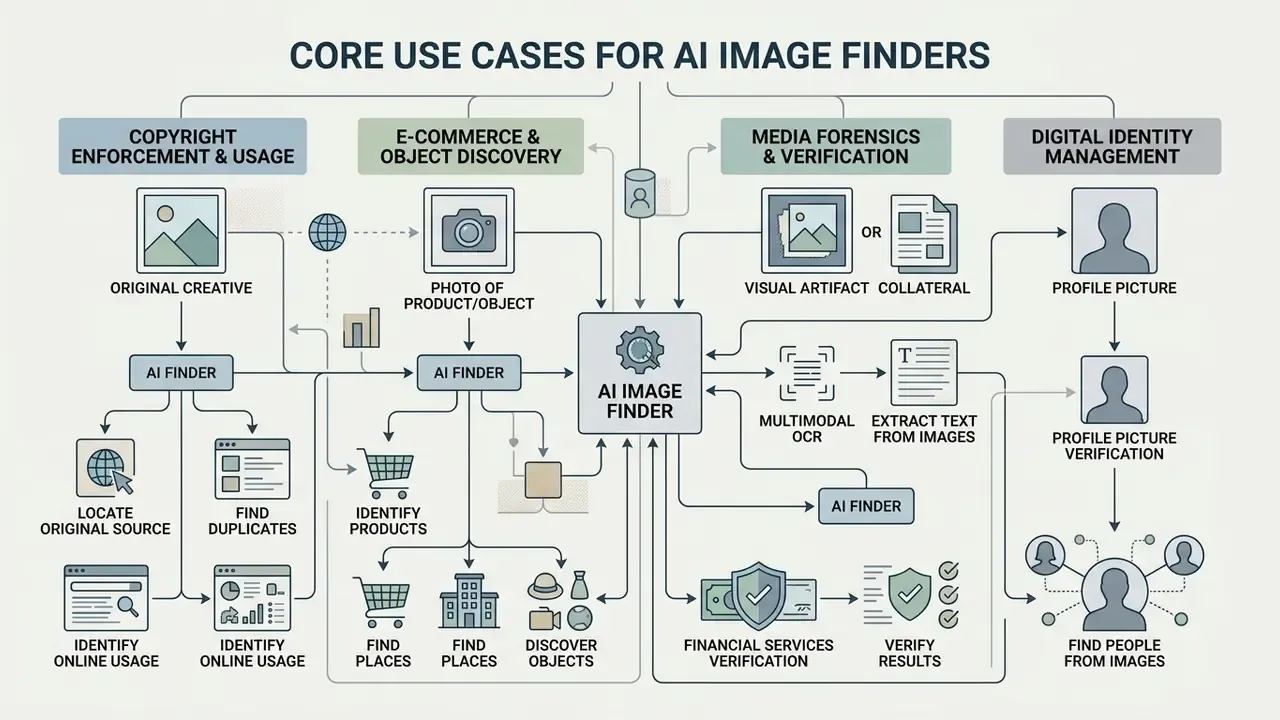
An ai image finder serves operational needs across copyright enforcement, e-commerce discovery, media forensics, and digital identity management. Translating visual content into searchable vectors automates work that used to require manual eyeballing at scale.
Use cases also determine controls. A duplicate-detection job inside claims processing carries a different risk profile than a marketing asset sweep, even when both call the same API.
Locating Original Sources, Copies, and Online Usage
Content creators, media publishers, and corporate legal departments use ai for finding images to trace the original source of digital assets and monitor unauthorized distribution. Copyright monitoring systems ingest image catalogs, compute perceptual embeddings, and run automated crawls to detect unauthorized usage.
In litigation, federal courts already treat reverse image retrieval as an established method for detecting asset duplication. According to a ruling by the U.S. Court of Appeals for the Ninth Circuit (Philpot v. Media Research Center, 2021), entering an image or image URL into a reverse search tool is a verifiable methodology for discovering identical copies or slightly modified works on third-party websites.
To test publication priority, analysts sort retrieved pages by indexing date and look for the earliest online appearance. Institutional library guidance recommends the same heuristic, inspect the oldest matching page first, while warning that the earliest indexed hit is a proximity signal rather than proof of authorship. For registration status and ownership facts, the U.S. Copyright Office public records search remains the authoritative complement to visual matching. Teams tracking how these disputes resolve can follow our running coverage of AI Litigation and Case Timelines.
«Deepfake-Eval-2024 uses Google reverse image search to establish primary sources; when no match is retrieved, the media file is labeled "Unknown" rather than authentic or fake.»
That labeling discipline transfers cleanly into brand-protection and takedown workflows. Absence of a match is an unresolved state, not an exoneration. Log it as "not found", never as "clean".
Multimodal OCR and Text Extraction from Visual Artifacts
Modern visual search engines pair deep feature embeddings with Optical Character Recognition (OCR) to read text inside screenshots, street signage, and scanned documents. When a query contains typography, the pipeline runs a two-pass extraction: first segmenting text regions with scene-text detection networks such as CRAFT, then passing extracted character vectors to localized text search indexes.
These multimodal capabilities let analysts search across 50+ languages at once, turning non-selectable flattened files, infographics, social media text screenshots, invoices, blurred serial numbers, into indexable queries. Contemporary retrieval stacks fuse three ranked lists: OCR/BM25 lexical hits, dense text embeddings, and image embeddings retrieved through HNSW or FAISS-style indexes, then rerank the merged candidates with a vision-language model.
Operationally, OCR is what makes reverse search viable for document-heavy investigations. Public-sector archives expose the pattern directly: the U.S. National Archives Catalog API returns archival metadata alongside OCR text in a single JSON response, Google Cloud Vision documents OCR and face detection as parallel endpoints, and Adobe PDF Services exposes a dedicated OCR endpoint for scanned documents.
A practical consequence for finance operations: a team screening submitted receipts can extract merchant strings, cross-match them against the ledger, and run the image embedding against a duplicate-submission index in the same pass. Two independent signals, one workflow, one audit record.
Finding Products, Places, or Objects from a Photo
E-commerce platforms deploy visual search so shoppers can run an ai find item from picture request. Upload a photograph of a shoe, an appliance, or a sofa, and the engine isolates product boundaries, classifies the item, and queries commercial catalogs for identical or stylistically adjacent listings. The same interaction also covers the simpler consumer intent, find a picture of that object, at speed.
*Step 1. Photo capture: smartphone or URL.
Step 2. Object isolation: bounding box plus category classifier.
Step 3. Catalog ANN query: SKU embeddings, color and material match.
Step 4. Ranked commercial output: identical SKU with price filter, styled alternatives via k-NN, seller and authenticity signals.*
Figure 3: E-commerce visual search workflow mapping a user-submitted photograph to catalog SKUs through object isolation, category classification, and attribute filtering.
Benchmark data from visual retrieval research presented at CVPR 2024 indicates that off-the-shelf multimodal models such as CLIP reach a baseline Recall@1 of 42.56% on commercial product retrieval, rising to 55.21% after fine-tuning on domain-specific product text-image pairs. Visual geolocation models such as PIGEON/PIGEOTTO place more than 40% of guesses within 25 kilometers globally and improved prior state of the art by up to 7.7 percentage points at city level. Indoor geolocation is dramatically harder: one 2024 study reported average test accuracy of 0.18.
Because these papers use incompatible endpoints, Recall@K for retrieval versus distance-band accuracy for geolocation, the figures are not directly comparable. Production Recall@1 depends heavily on catalog composition and domain.
«"Shop by image" systems reliably surface candidate products from a photograph, but precise Recall@1 depends on catalog composition and domain.»
Financial services and collateral verification. The object-matching pipeline generalizes well beyond retail. Lending and insurance teams use visual search to confirm that a collateral photograph, a vehicle submitted for an auto loan or a property image supporting a mortgage valuation, has not already appeared in an unrelated listing or a prior claim. They use it to detect recycled invoice, receipt, and damage photographs across claim files. And they use it during merchant onboarding to check whether product imagery was lifted wholesale from a competitor's catalog.
In every one of those cases, the visual match triggers manual adjudication. It does not perform the adjudication. That distinction belongs in the control documentation, not in a footnote.
Teams comparing generation-side tools that may have produced a suspicious asset can consult a structured comparison of leading AI art generators to map stylistic fingerprints to likely model families, and see the comparison overview for the broader benchmarking set.
Profile Picture Verification and Finding People from Images
An ai find person from image query raises technical, legal, and privacy questions that general object retrieval does not. Face search engines isolate facial landmark geometry, compute facial embeddings, and compare those vectors against databases of publicly indexed portraits.
«Biometric face matching in public networks demands rigorous compliance controls. Organizations must balance operational verification needs against explicit regulatory mandates such as the EU AI Act and state biometric privacy laws.»
— Marcus Hale, AI Governance & Model Risk Editorial Lead
«Across 1,276 participants, accuracy in distinguishing synthetic from authentic images, video, and audio was close to chance, and degraded further when human faces were present.»
That is the strongest available argument for instrumented verification. Unaided human review of a profile photograph is not a control. It feels like one, which is precisely the problem.
For regulated onboarding, NIST SP 800-63A-4 explicitly permits automated facial-image comparison against presented evidence as part of remote or on-site identity proofing at STRONG and SUPERIOR verification levels (https://pages.nist.gov/800-63-4/sp800-63a.html). Organizations assessing synthetic portrait risk in recruitment and internal directories often benchmark against the output characteristics of AI headshot generator tools, since those now supply a large share of fabricated professional avatars.
Can Reverse Image Search Detect AI-Generated Images and Deepfakes?
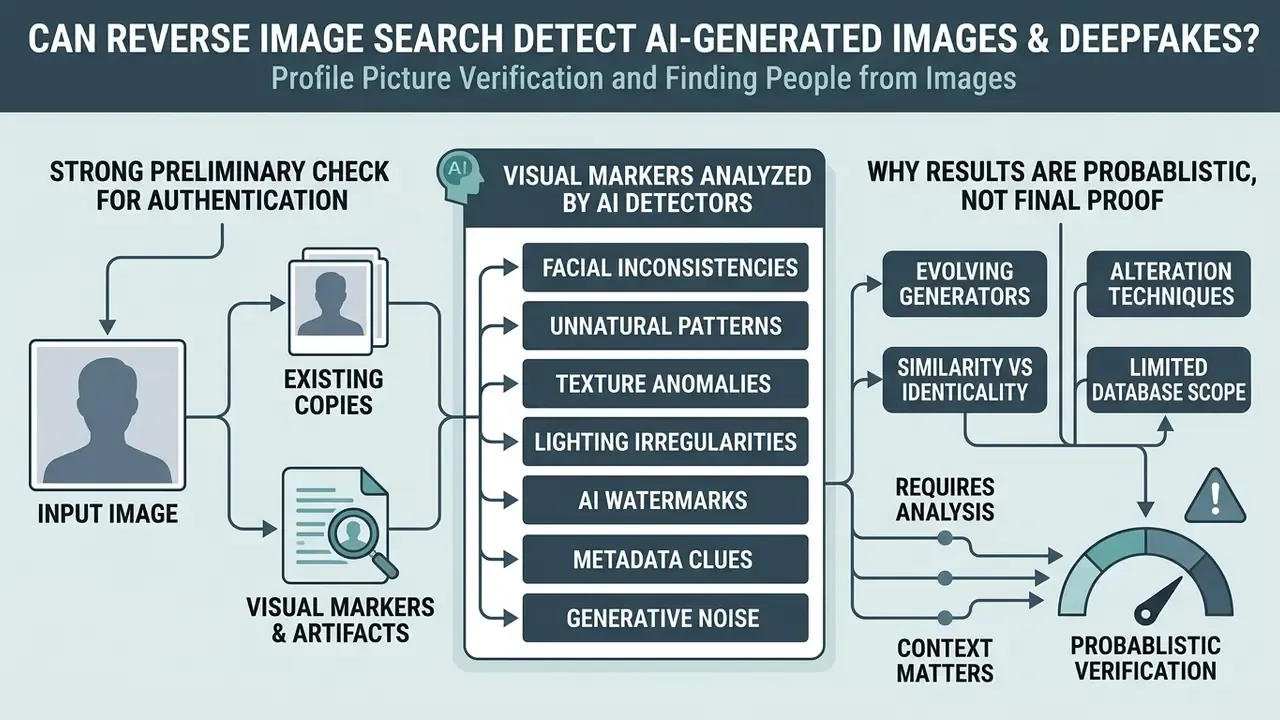
Visual Markers and Artifacts Analyzed by AI-Generated Image Detectors
Specialized ai image detection frameworks evaluate physical, spectral, and cryptographic markers to detect ai generated content and manipulated images. When synthetic image generators render output, they leave computational signatures across spatial pixels and frequency spectra. Teams operationalizing this analysis can review dedicated AI image detectors alongside the signal taxonomy below.
Table 2. Technical AI image detection signals
| Signal category | Analysis mechanism | Targeted artifacts |
|---|---|---|
| Pixel forensics | High-frequency spatial noise uniformity analysis | Local inconsistent noise, boundary blurring |
| Spectral learning | Fast Fourier Transform (FFT), frequency-domain reconstruction | Grid artifacts, high-frequency spectral gaps |
| Hybrid semantic | CLIP embeddings fused with frequency-domain patches | Semantic implausibility plus low-level generator traces |
| Provenance / C2PA | Cryptographic manifest validation and EXIF metadata checks | Missing or altered signed capture-device assertions |
As detailed in C2PA (Coalition for Content Provenance and Authenticity) technical specifications, modern forensics combines cryptographic metadata checks with spectral analysis algorithms such as SPAI (Spectral AI Detection). C2PA stores provenance inside a signed manifest and can carry standardized Exif metadata in the stds.exif assertion, which lets a verifier cryptographically validate capture-device and processing history instead of trusting mutable headers.
SPAI uses high-pass filters and 2D Fast Fourier Transforms to expose artificial frequency distributions introduced by diffusion-model upsampling, revealing global generator fingerprints once normalized spectra are averaged across resized inputs. Stable Diffusion derivatives are among the model families most often profiled this way.
«AIDE combines CLIP embeddings for semantics with frequency patches for low-level artifacts, improving accuracy by +3.5% on AIGCDetectBenchmark and +4.6% on GenImage over the previous best methods.»
«ZED detects AI-generated images without synthetic training data by modeling the statistics of real images, delivering average accuracy gains above 3% over prior state of the art.» — ZED: Zero-shot AI-generated image detection (2024)
The practical implication of AIDE and ZED is architectural rather than statistical. Hybrid and zero-shot detectors generalize differently, so a mature verification stack runs at least two independent detectors with divergent training assumptions before escalating a case.
Why AI Image Detector Results Are Probabilistic and Not Final Proof
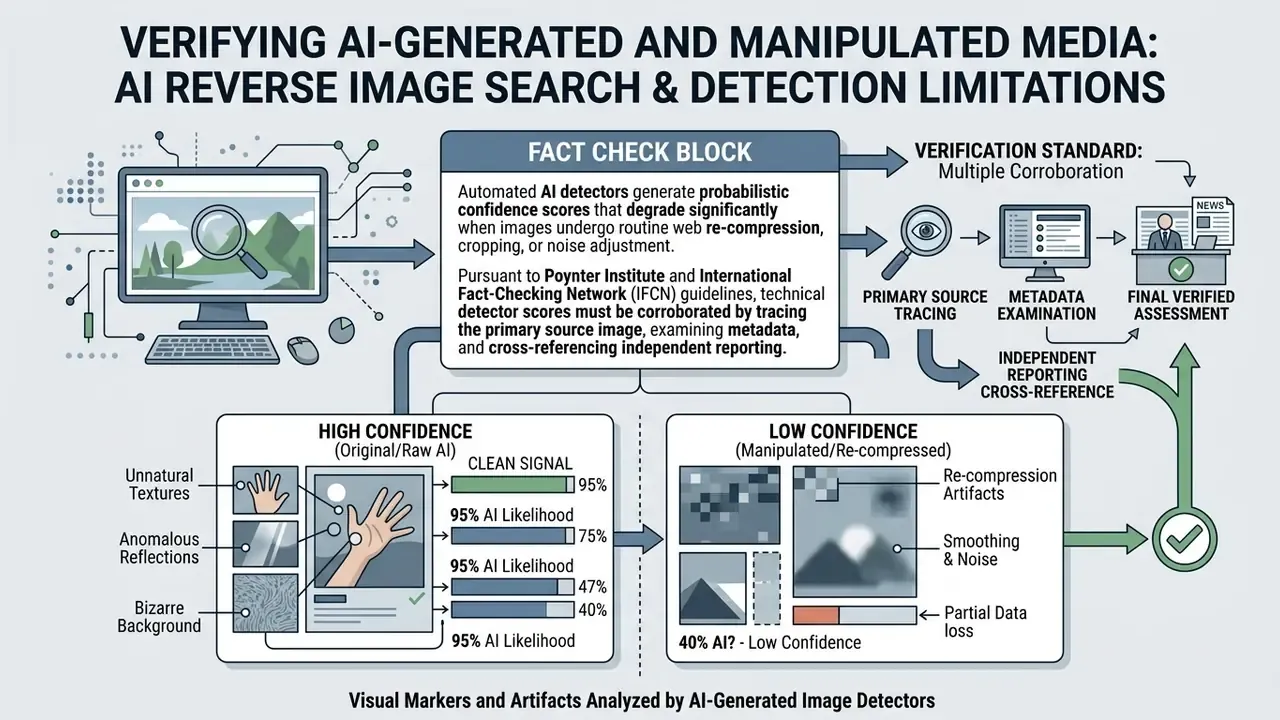
Poynter's fact-checking guidance structures verification into three phases, find, check, correct, and instructs practitioners to locate the source of the claim, establish what other sources say, and publish the methodology so readers can retrace each step. MIT CSAIL's FAKTA architecture reinforces the same division of labor by separating stance detection and evidence extraction from final claim verification. Automation is a pipeline component, not a substitute for human adjudication.
Independent forensic audits show models achieving 95% to 99% detection accuracy on controlled benchmark training sets falling to 54% to 75% against real-world out-of-distribution media, frequently without reported confidence intervals. Without those intervals, evidentiary weight cannot be quantified at all.
«On Deepfake-Eval-2024, the AUC of leading open detectors dropped by 45% for images, 48% for audio, and 50% for video relative to earlier datasets.»
«An empirical benchmark of 10 forensic methods across 7 datasets found substantial variability in generalization: strong in-distribution results do not guarantee robustness against unseen generators.» — Empirical benchmarking study of forensic detection methods (2025)
So guidance from NIST and INTERPOL converges on the same instruction: combine visual search provenance tracing with manual forensic inspection and metadata validation before issuing a formal legal or journalistic determination. Practitioners choosing a classifier for that workflow should compare validated options among current AI image detectors rather than defaulting to whichever consumer tool reports the highest confidence score. High confidence and high accuracy are not the same variable.
How to Choose an AI Reverse Image Search Tool for Commercial and Personal Use
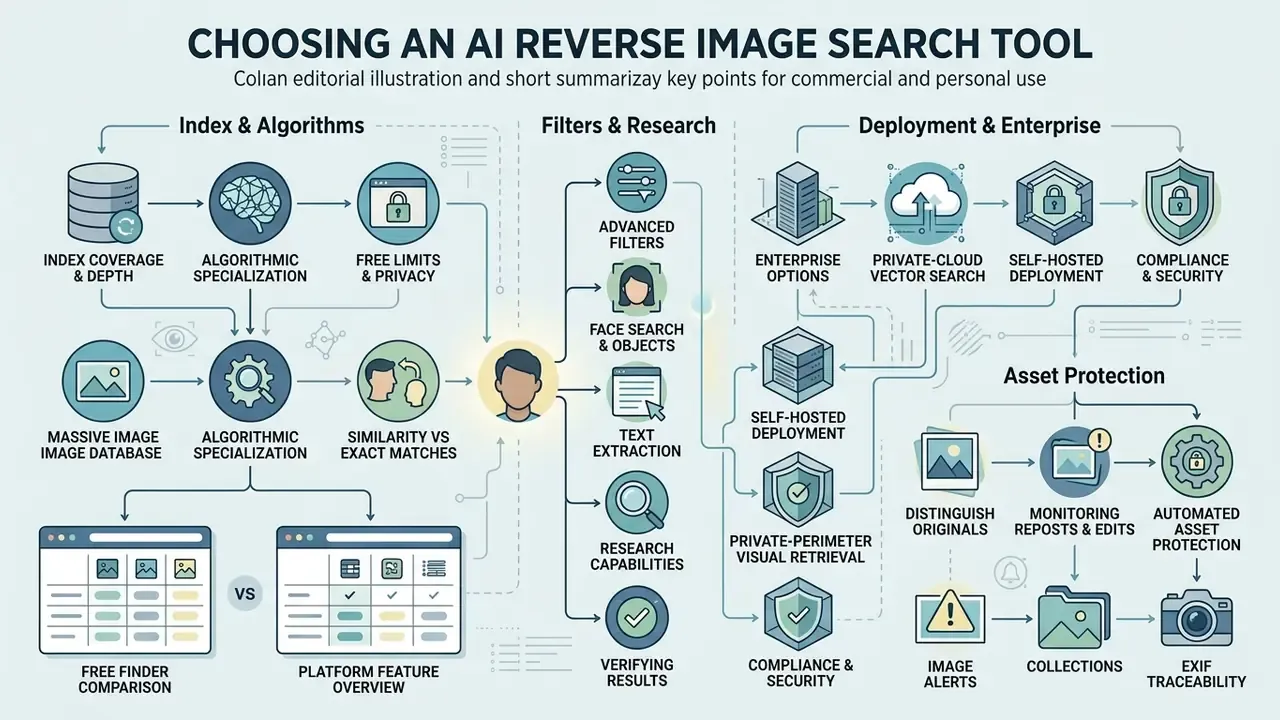
Choosing a visual search engine means evaluating index coverage, algorithmic specialization, filters, and privacy compliance. A tool optimized for e-commerce product matching often performs poorly at copyright enforcement or media verification, and vice versa.
Organizations also need to weigh query performance against data retention. Proprietary corporate assets uploaded during a search should not end up training a public model.
Search Engine Index Coverage and Image Search Depth
Index breadth and depth dictate retrieval accuracy more than any architectural nuance. Global search engines run continuous crawlers across billions of public pages, which makes them effective for detecting broad visual re-use across news platforms and open websites. Google states that Lens gathers results from across the internet and ranks them by similarity and relevance, and its 2025–2026 AI Mode pairs Lens retrieval with a custom Gemini model that can reason about scene composition, materials, and object relationships inside a single multimodal query.
«An audit of 34,486 Google reverse image search results collected over 15 days found that debunking content accounted for under 30% of top results for newly circulating misleading images.»
Broad coverage does not equal corrective context. The first page of a reverse search reflects crawl authority and recency, not veracity.
Specialized indexes such as TinEye maintain perceptual fingerprint databases built specifically for exact-match and modified-copy detection. Rather than matching semantic themes, TinEye isolates structural edits, crops, and color shifts across its internal index. Its MatchEngine product builds a pixel-derived fingerprint without reading metadata and explicitly targets duplicate, resized, cropped, retouched, occluded, and color-shifted copies, while the public interface offers a "Modifications" comparison view and highlights the largest or most edited version. TinEye also documents that it does not typically return different photographs of the same subject. E-commerce visual engines take the opposite approach, restricting crawl scope to structured product catalogs and optimizing depth for retail attributes like price, brand, and availability.
Niche indexes close gaps general engines structurally cannot. SauceNAO is optimized for anime, games, and illustration and resolves original artwork and fan-art sources through hash-based indexing. Sogou is built for the Chinese-language web and local platforms. Yandex Visual Search performs comparatively well on landmark, landscape, and face-adjacent retrieval across CIS-region content. Federating queries across these engines breaks the single-database ceiling that caps recall on any one crawl footprint.
Advanced Filters, Face Search, and Research Capabilities
Enterprise investigations need real filtering to manage high volume output. Research-grade platforms provide metadata filters that segment search results by file type (jpg png), resolution, hosting domain, page language, publication date range, keyword in page title, and original indexing date. Higher tiers lift per-query result caps into the thousands and allow sorting by relevance, diversity, or recency.
For automated developer workflows, APIs provide programmatic access to OCR, metadata extraction, and face match confidence scores. Google Cloud Vision API and Amazon Rekognition expose REST endpoints capable of batch-processing thousands of assets per hour, returning structured JSON with bounding boxes, text strings, and confidence values. Rekognition's face search response returns FaceId, BoundingBox, and Confidence fields for each matched face.
A typical programmatic lookup, including an ROI crop and an EXIF request flag, looks like this:
# Execute programmatic visual lookup via REST API
curl -X POST https://api.visualsearch.example/v1/search \
  -H "Authorization: Bearer YOUR_API_KEY" \
  -H "Content-Type: application/json" \
  -d '{
    "image_url": "https://example.com/target-asset.jpg",
    "crop_roi": [120, 45, 500, 500],
    "filters": {
      "min_similarity": 0.85,
      "include_exif": true
    }
  }'
// Sample API payload response
{
  "status": "success",
  "matches_found": 1,
  "results": [
    {
      "domain": "original-source.org",
      "similarity_score": 0.964,
      "pHash_distance": 2,
      "exif_data": {
        "camera_model": "EOS R5",
        "timestamp": "2024-03-15T10:42:00Z",
        "gps": {"lat": 37.7749, "lon": -122.4194}
      }
    }
  ]
}
Two integration details matter for cost control. First, similarity thresholds should be tuned per asset class: a min_similarity of 0.85 suits marketing graphics, while document and receipt deduplication usually demands a stricter pHash distance ceiling. Second, published monitoring tiers commonly cap programmatic access in the low thousands of calls per month, so batch jobs should deduplicate query embeddings before dispatch. Teams budgeting multimodal API spend more broadly can cross-reference published rate and cost structures in our Google Veo implementation guide.
Enterprise, Self-Hosted, and Private-Cloud Vector Search
Plenty of regulated organizations cannot send customer imagery, claim photographs, or identity documents to a public visual search endpoint at all. For those environments the retrieval stack moves inside the security perimeter: the embedding model runs on private compute, vectors persist in a self-hosted ANN index, and no query payload leaves the tenancy.
Table 3. Private-perimeter visual retrieval deployment options
| Component | Deployment model | Index / method | Governance note |
|---|---|---|---|
| FAISS | Self-hosted library (on-prem or private VPC) | IVFPQ, HNSW, flat L2 | No network egress; you own index lineage |
| Milvus or comparable vector DB | Self-hosted cluster | HNSW plus metadata filters | Supports RBAC, audit logs, tenant isolation |
| Amazon Rekognition (incl. Custom Labels) | Managed, region-pinned | Custom collections, face search IDs | Review DPA and region residency commitments |
| Azure AI Vision | Managed, region-pinned | Multimodal embeddings, OCR, image analysis | Enterprise agreement governs retention |
| OpenSearch k-NN | Managed or self-hosted | Vector index plus BM25 hybrid fusion | Enables hybrid text and image retrieval |
A documented reference pattern for managed private deployment ingests assets into object storage, generates multimodal embeddings, writes them into a serverless vector index, then issues query embeddings for top-K similarity retrieval. Same four steps as the public pipeline in Figure 1, executed entirely inside the account boundary.
One control that model-risk teams routinely miss: version the embedding model as a controlled artifact. Re-embedding an existing index with a new backbone silently changes every similarity score, and therefore every threshold-based control that depends on it. That is a model change event, with all the validation and approval that implies.
Free AI Image Finders, Limits, and Data Privacy
| Engine / tool | Primary focus | Exact copy match | Similar matching | Data privacy policy |
|---|---|---|---|---|
| Google Lens | Broad visual, commerce, web | High | High (multimodal) | Images processed per Google privacy terms |
| TinEye | Copyright and asset tracking | High (pHash fingerprints) | Low (focuses on modified copies) | Search uploads not stored in index |
| PimEyes | Face search, open web faces | High (facial embeddings) | Low (restricted to faces) | Temporary storage, auto-deleted in 48 hours |
| Bing Visual Search | General web, product catalog | Moderate | High | Standard Microsoft privacy statement |
| SauceNAO | Anime, illustration, fan art | High (index-based hash) | High (illustration models) | Deletes temporary frames, strict API quotas |
| Sogou Image | Chinese web and regional media | Moderate | High (local OCR and vector) | Subject to Chinese mainland privacy law |
| Yandex Visual Search | Face matching and landscapes | High (face vector) | High (deep convolutional) | Standard Yandex privacy policy |
For a workflow-level breakdown of pricing tiers, discovery features, and commercial licensing across these platforms, see our comparison of AI reverse image search tools.
Privacy practices diverge more than marketing copy suggests. Enterprise search APIs typically process images in memory and purge temporary payloads after vector extraction. Consumer-facing free services may retain uploads to train proprietary generative models or publish them in public galleries. Some services publish short, explicit retention windows, 24-hour link expiry, 24- or 48-hour deletion of uploads, or 24-hour deletion of facial embeddings in biometric products. Paid API platforms, in turn, disclose stored account identifiers, credit balances, transaction history, search logs, and persisted image URLs retained for billing and abuse prevention.
Enterprise risk teams should review vendor data processing agreements (DPAs) before any regulated asset touches a third-party endpoint, and document which vendor tier applies to which workflow. Free and paid tiers of the same product often carry incompatible licensing terms, and that mismatch is exactly the kind of finding an internal audit surfaces at the worst possible moment. Teams evaluating no-cost tooling more generally may find the constraint patterns in our guide to free photo editors instructive, since the same export, watermark, and licensing trade-offs recur. Broader commercial rights questions are covered in AI Image Generator Commercial Use.
How to Verify Reverse Image Search Results and Avoid False Conclusions
Distinguishing Originals from Reposts, Edits, and Similar Images
Provenance analysis rests on three data points: indexing timestamps, original resolution, and embedded EXIF metadata. Reposted images and unauthorized mirrors usually show lower pixel dimensions and heavier JPEG compression artifacts than the primary file. When only a degraded copy exists, restoring detail with AI image upscaling workflows before comparison can recover enough edge structure for a reliable side-by-side inspection, and standard photo editing tools expose the quantization and metadata panels needed to audit compression history.
*Start: candidate match set.
Step 1. Sort by earliest indexing date (oldest hit is a lead, not proof).
Step 2. Compare pixel dimensions (largest, least compressed copy ranks up).
Step 3. Inspect EXIF, IPTC, and C2PA fields (DateTimeOriginal, serial number, GPS, signed manifest).
Step 4a. Verify hosting domain: authority, stated authorship, licence page.
Step 4b. Run a fixity check (SHA-256) to distinguish a bit-for-bit copy from a re-encode.
Conclusion requires agreement across at least three independent signals.*
Figure 4: Provenance verification methodology, cross-checking publication dates, pixel resolution, EXIF headers, hosting domain authority, and cryptographic fixity before declaring an original.
To establish authorship, locate the earliest indexed instance using domain history archives, then read embedded EXIF data for camera metadata such as shutter speed, ISO, lens model, and hardware serial numbers. NIST guidance cautions that this metadata may be absent, inaccurate, or deliberately altered, so no single field proves originality on its own. Its forensic image management guidance further requires verifying that a working copy is a true copy of the original through hashing or fixity checking. Comparing fixity hashes, SHA-256 signatures for instance, tells you whether a candidate file is a bit-for-bit duplicate or a re-compressed derivative.
That five-pillar decomposition doubles nicely as an audit template. A provenance conclusion should answer all five components explicitly, and any unanswered pillar should be recorded as an open finding rather than assumed away.
For a broader evaluation of visual creation software and output licensing, see our overview of top AI art generators and the comparison of free AI art generators, whose watermark and licence behavior often reveals how a suspect asset was produced. Model-level differences are covered in our Midjourney versus competing generators breakdown.
Automated Asset Protection: Alerts, Collections, and EXIF Traceability
To turn one-off searches into scalable asset protection, enterprise workflows combine continuous index monitoring, structured curation, and metadata extraction.
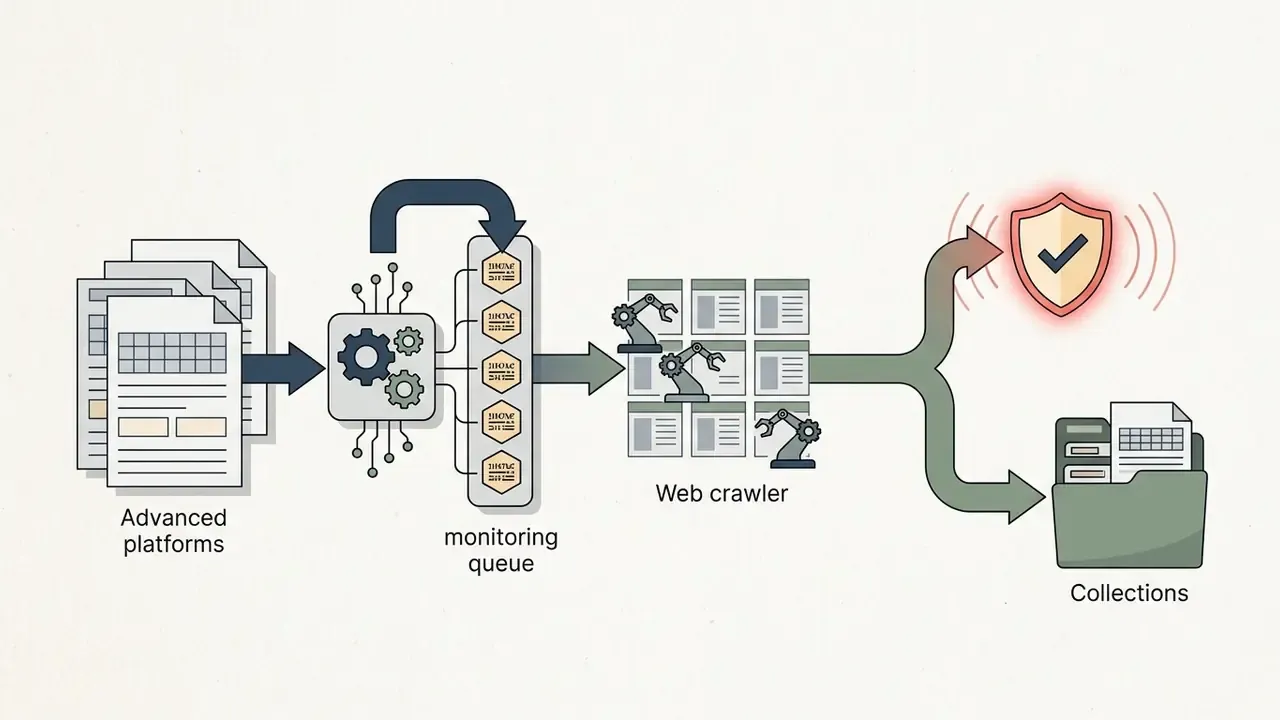


DateTimeOriginal, CameraSerialNumber, and GPSLatitude helps determine whether a retrieved asset is the original capture or a re-rendered copy stripped of metadata. Where a C2PA manifest survives, capture and edit assertions can be validated cryptographically instead of trusted at face value.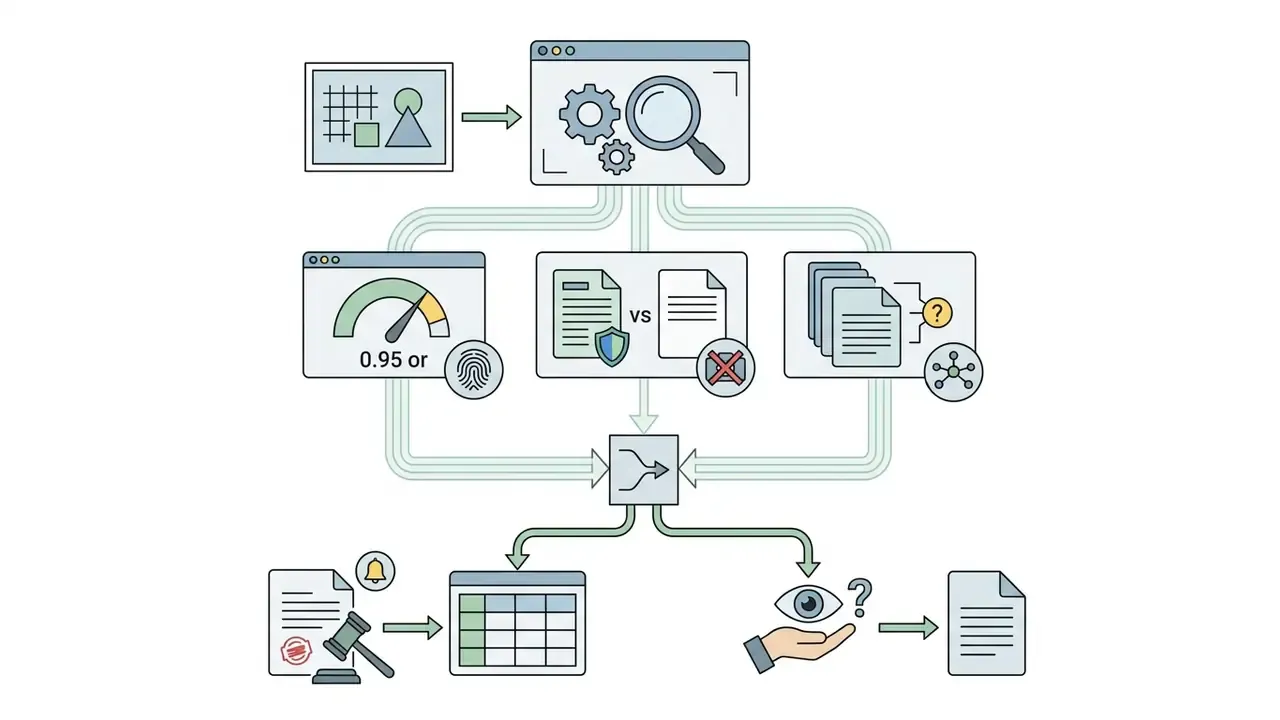
What to Do When AI Image Lookup Returns Zero Results
A zero-match result from an ai image find query never guarantees that an image has never been published. Crawlers may be blocked by robots.txt directives, paywalls, or CDN security controls. Google's own documentation confirms that image files can be kept out of Image Search through robots.txt rules or an X-Robots-Tag: noindex header on the image response, and that the governing robots.txt is the one hosted on the exact image host. A separate CDN domain can therefore block crawling even when the surrounding page is fully public.
Table 5. Zero-result recovery protocol for visual search
| Recovery step | Action item | Target technical effect |
|---|---|---|
| 1. Horizontal flipping | Mirror or flip the image horizontally | Bypasses directional vector asymmetry in older models |
| 2. Contrast and color normalization | Adjust gamma or exposure, normalize color curves | Removes global luminance noise masking features |
| 3. Sub-region segmentation | Crop the query into distinct quadrant segments | Isolates secondary visual elements for sub-search |
| 4. Multi-engine federation | Execute the query across 3+ independent indexes | Overcomes single-engine crawl blind spots |
| 5. Mirror and metasearch | Enable mirror-site inclusion, query via metasearch aggregators | Surfaces duplicated pages engines normally collapse |
| 6. OCR fallback | Extract embedded text, then run a lexical search on the strings | Converts a dead visual query into a text query |
«The AIFo framework (2025) orchestrates reverse image search, metadata extraction, classifiers, and vision-language analysis through LLM agents, labeling images with no retrieved match as "Unknown" rather than issuing a false verdict.»
When the first lookup fails, a multi-engine recovery protocol meaningfully improves recall. Adjusting contrast, flipping the query horizontally to sidestep asymmetric feature-map weighting, and segmenting the photo into sub-region queries all help vector search tools surface hidden or partially obscured copies. Mirror support matters because several engines exclude copies of pages hosted on other domains unless mirror inclusion is explicitly switched on, and metasearch front-ends reduce dependence on any single index, since different engines return materially different unique results for identical input.
If every recovery step still returns nothing, record the outcome as "not found in the queried indexes". Never as "does not exist". The distinction is the whole discipline.
FAQ: Frequently Asked Questions About AI Reverse Image Search
Can You Find a Video from a Single Picture or Frame?
Yes, often. An ai find video from picture workflow starts with a keyframe screenshot, because search engines index static thumbnails and video preview frames published across hosting platforms and news sites. Extract a clear keyframe showing a distinct subject or landmark, crop out player controls and timestamps, then submit the frame to a visual search engine. Forensic tools such as the InVID-WeVerify plugin automate keyframe extraction from video links, so investigators can query individual frames across indexes immediately. AFP Fact Check documents sending each extracted keyframe straight to reverse image search as a standard source-tracing step. Commercial "reverse video search" services analyze the same keyframes under the hood, which means the screenshot workflow remains the practical baseline. Editors who need clean frames at full resolution can follow the extraction steps in our YouTube video editing workflow guide, and see the overview for adjacent operational playbooks.
Does AI Reverse Image Search Work Without Registration?
Yes. Most major consumer engines, including Google Lens, Bing Visual Search, and TinEye, offer reverse image search directly in a browser with no account. TinEye additionally documents browser-extension and right-click "Search Image on TinEye" usage without any sign-up step. Anonymous usage carries limits, though. Expect rate caps on query volume and no access to batch API automation, metadata filtering, or full-resolution forensic comparison. Published quotas vary widely: some face-search services cap anonymous use at three free searches per day with no card and no registration, while other tools advertise "no sign-up" without disclosing a numeric ceiling at all. Specialized enterprise and biometric platforms require authenticated accounts precisely so usage audit trails and compliance monitoring exist. Registration-free generation tools follow a similar pattern, as our review of ai image generator free tiers shows.
How Does AI Reverse Image Search Handle Anime, Illustrations, and Fan Art?
General web engines often stumble on stylized illustration, because deep networks trained on photographs misread line art, flat color blocks, and non-photographic shading. To reverse search anime or digital artwork, start with a specialized indexer such as SauceNAO, or an engine trained on structural line art and color-block distribution. A two-stage approach works best in practice. Query the specialist index first to identify the artwork, artist, or release, then run the same crop through a general engine to map redistribution across marketplaces and social media. Style-transfer derivatives complicate things further, since a restyled copy can share subject matter without sharing pixel structure. Our comparison of Ghibli-style AI image generators illustrates how strongly stylization shifts the underlying feature representation, and our notes on ai image generator arabic free tools cover similar issues with script-heavy and multilingual output.
Why Might a Search Engine Fail to Find an Image That Is Already Online?
Four technical factors account for most misses.
- Crawl restrictions. The host blocks crawlers with
robots.txtrules orX-Robots-Tag: noindexheaders. - CDN and access controls. The image sits behind authentication gates, private social media group boundaries, or CDN security walls.
- Indexing latency. The asset was published recently, creating a data void before crawlers ingest and vectorize the file.
- Vector feature distortion. Severe edits, heavy compression, or extreme rotation pushed the embedding beyond the engine's similarity threshold. TinEye states plainly that reverse image search is not 100% accurate, can return false positives, and does not query PDF, audio, or video content embedded on pages. A 2022 study comparing engine retrievability found differences of up to 54% depending on engine and image type, with Google and Yandex performing better on natural imagery than on abstract material. A negative result means "not found in that engine's index". Nothing more.
How Should a Bank Document Reverse Image Search Inside Its Model Risk Framework?
Treat the retrieval system as an inventoried model with a named owner. At minimum, document the embedding model and version, the index scope and refresh cadence, the similarity thresholds and who approved them, the escalation path for flagged matches, the human review step and its service level, and the retention terms of any third-party endpoint involved. Then test it. Sample outcomes periodically, measure false positive and false negative rates against adjudicated cases, and record drift when the embedding backbone or vendor index changes. An unversioned embedding model behind a threshold-based control is, functionally, an undocumented model change waiting to be found. Treat findings as hypotheses until analytics, case data, or interviews support them.
Technical Summary and Next Steps
AI reverse image search has moved from perceptual fingerprint matching to a vector retrieval framework built on vision transformers and approximate nearest-neighbor search. These systems are unmatched for speed: locating identical copies, tracking digital assets, identifying products, extracting embedded text. Their output remains a probabilistic diagnostic signal, not proof of image origin or media authenticity.
For robust verification workflows, risk officers, investigators, and digital asset managers should combine multi-engine search with cryptographic provenance standards such as C2PA, persistent monitoring alerts, EXIF and fixity validation, and human context checks. Where data residency rules out public endpoints, rebuild the same pipeline on self-hosted FAISS or Milvus indexes with versioned embedding models under model-risk control.
A safe next step, if you are early: pick one workflow, one asset class, and one threshold. Instrument it, measure it for a quarter, and only then widen scope. For additional technical comparisons of generative and analytical visual tools, including ai image generator applications and ai image generator image-to-image systems whose outputs increasingly enter provenance investigations, view the guide in our resource center, browse see the overview for terminology, or start from see the overview at the platform level.
Appendix A: Source Notes and Claim Status
This appendix preserves the original wording of claims tightened during editorial review, so readers can audit the change.
| Claim as originally published | Status | Revised treatment in this article |
|---|---|---|
| "According to a 2025 study on image similarity metrics published by NIST, perceptual hashing methods using normalized cross-correlation and SSIM preserve match linkage against post-processing distortions." | Rephrased | Attributed to NIST's image-similarity metrics work (2012, online update 2025) and reframed around task-dependent metric behavior, with SSIM, LPIPS, Hamming distance, and normalized cross-correlation listed as threshold options. |
| "ROI cropping improved object detection mAP by 6.67x on complex aerial benchmark datasets and 1.27x on standard object evaluation suites." | Supported, scoped | Datasets named (VisDrone, KITTI) with 320x320 input resolution, plus an explicit note that controlled full-frame versus cropped retrieval comparisons remain scarce. |
| "CLIP achieves Recall@1 of 42.56%, rising to 55.21% after fine-tuning; PIGEOTTO exceeds 40% within 25 km." | Supported, scoped | Retained with CVPR 2024 attribution, plus indoor-geolocation contrast (0.18 average accuracy) and a metric-incomparability caveat. |
| "Top-tier synthetic image detectors achieve 52%–76% accuracy on raw synthetic images, dropping to 50%–62% after web compression." | Supported, scoped | Retained and supplemented with the generator-generalization limitation and Deepfake-Eval-2024 AUC declines. |
| "Internal Resource Navigation Hub" as a single terminal link block | Restructured | Links redistributed contextually through the article at roughly one per 250 to 300 words; the remaining directory below is grouped by intent. |