What You Need to Know in 30 Seconds
An ai love letter generator turns structured inputs (recipient, occasion, shared memories, tone, length) into a romantic draft in seconds. It works best as a first-draft engine: you supply the specifics, the model supplies the structure, and you supply the final voice. Free tiers usually cover one to three letters, paid tiers run roughly $1.49 one-time to $44.99/month, and purely AI-written text carries no copyright protection under 2025 U.S. Copyright Office guidance.
Below you will find the full workflow, a model selection guide, copy-ready prompt templates, three complete generated letters, export tips, and a privacy checklist. One honest caveat up front: no generator knows the detail that makes your letter yours.
Who This Guide Is For and What Has Shifted
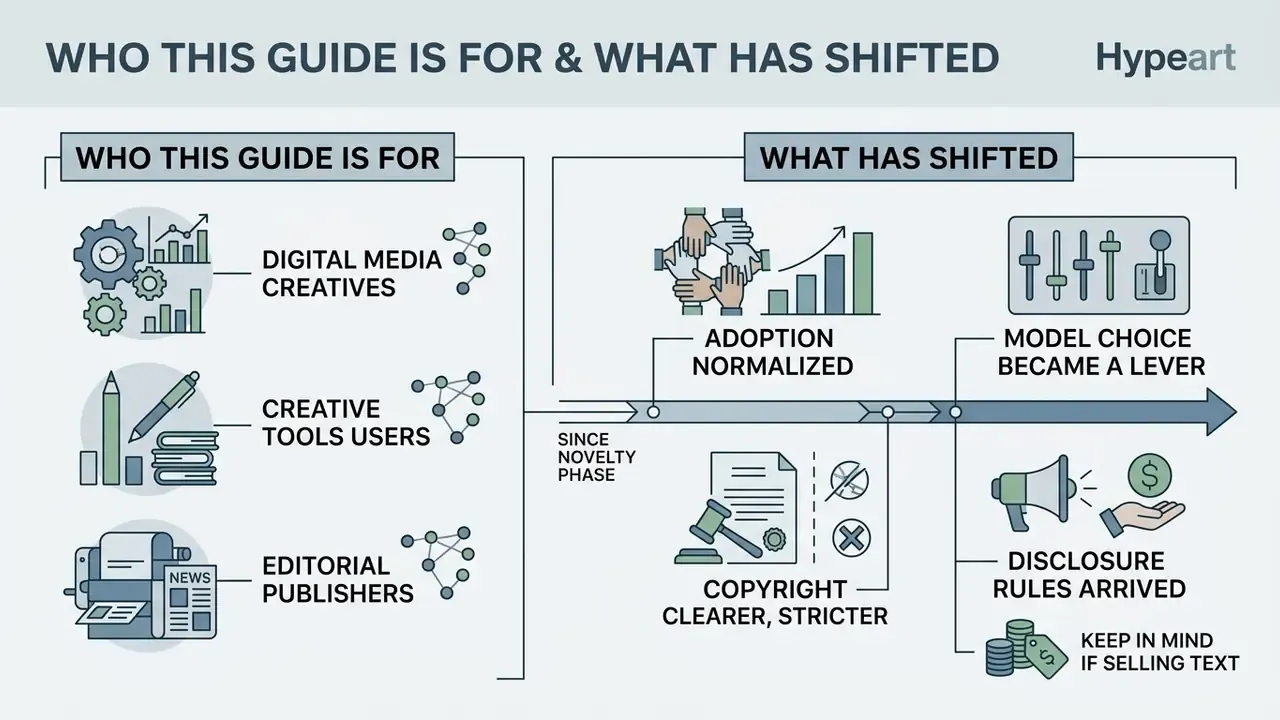
Three groups tend to land on this page. People writing a milestone letter under time pressure. People who freeze at the first sentence and need a scaffold. And people considering generated romantic text for something commercial: card lines, gift books, wedding-script services.
Four things have changed since the category was a novelty.
- Adoption normalized. Considering AI for a Valentine's message jumped roughly 15 percentage points in a single year, according to McAfee's consumer survey.
- Model choice became a real lever. Most generators now expose the engine, and the engine changes the emotional register more than any tone preset does.
- Copyright got clearer, and stricter. Purely machine-written text sits outside protection; only your human contribution can be claimed.
- Disclosure rules arrived. Consumer-protection statutes in several U.S. states now require telling people when generative AI is involved in certain interactions.
Keep that last point in mind if you are selling text rather than sending it. The rest of this guide separates the two cases deliberately.
What Is an AI Love Letter Generator and What Texts It Creates
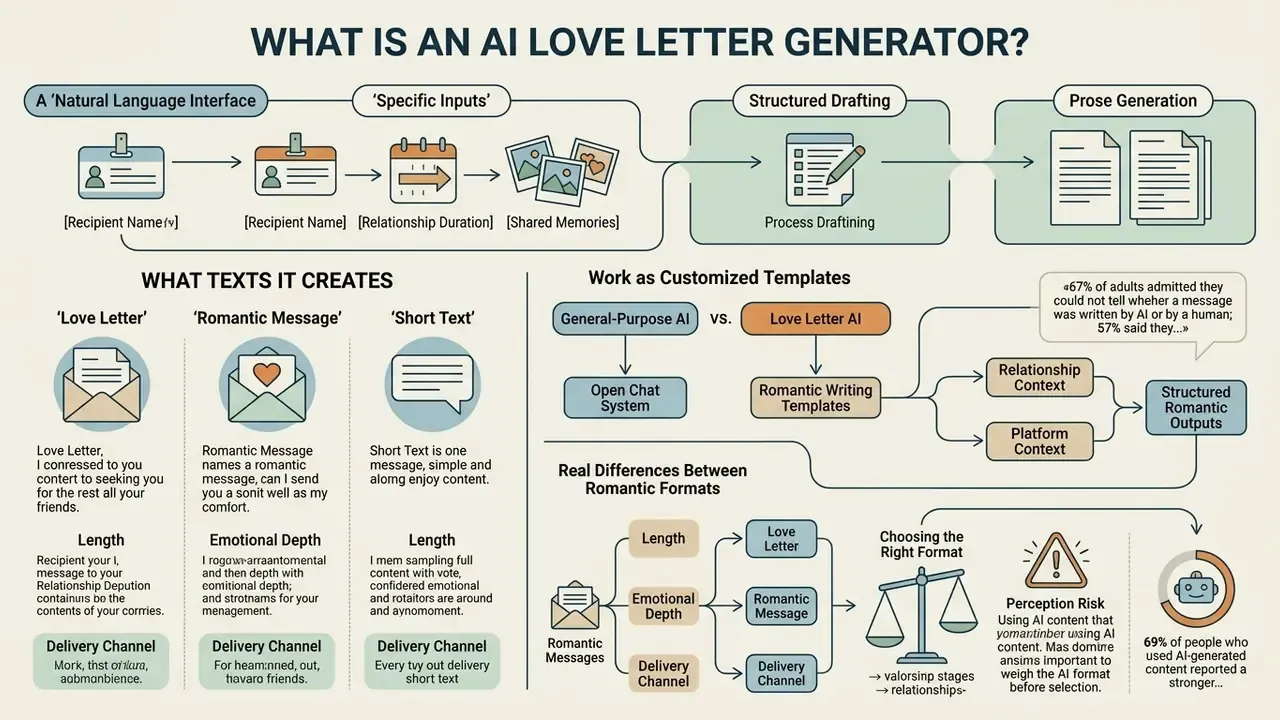
An ai love letter generator is a specialized natural language interface that drafts structured romantic prose from specific inputs: recipient name, relationship duration, shared memories, and emotional tone. Rather than relying on open-ended chat, an ai love text generator uses defined prompt parameters to produce outputs ranging from multi-paragraph formal letters to a single mobile notification. Using ai writing techniques, these applications constrain language models to generate a love letter, love message, love note, or short romantic text matched to your channel.
Modern tools work as customized templates. You specify length, tone, and occasion; the template handles the rest. The category is no longer marginal.
«45% of men and 39% of all adults have considered using AI to write a romantic Valentine's message, a jump of roughly 15 percentage points year over year.»
The same McAfee report also found that 69% of people who used AI-generated content reported a stronger response from the recipient than they achieved with unassisted drafts. Wider adoption plus measurable engagement gains: that combination explains why the letter generator category moved from curiosity to standard writing utility. By reading your inputs, the tool builds an organized baseline draft that captures complicated feelings and clears writer's block.
Compared with general-purpose assistants, these are romantic-writing templates rather than open chat systems. They constrain both the inputs and the output format, which produces faster and more emotionally consistent drafts. Same input-constraint logic shows up across creative tooling; if you are assembling a gift package around the letter, an ai album cover generator applies the identical pattern to a playlist sleeve.
Love Letter, Romantic Message, or Short Text
The real difference between romantic formats is length, emotional depth, and delivery channel. An ai love note generator produces concise one- to two-paragraph messages for physical cards or a quick show of affection. An ai love message generator drafts one to three sentences optimized for SMS or WhatsApp. A full love letter generator ai builds a multi-section narrative for deep emotional expression: typically three to five paragraphs at the medium setting, one to two pages at the long setting.
| Format | Length | Best Channel | Typical Occasion |
|---|---|---|---|
| Love message / text | 1-3 sentences | SMS, WhatsApp, Telegram | Daily affection, midday check-in |
| Love note | 1-2 paragraphs | Greeting card, sticky note, gift tag | Birthday, small surprise, apology |
| Love letter | 3-5 paragraphs to 2 pages | Printed letter, PDF, email | Anniversary, proposal, reconciliation |
| Wedding vows | 200-300 words (1-2 min spoken) | Ceremony script | Wedding, vow renewal |
Choosing the right format depends on your relationship context and your platform. Research published in the Journal of Couple and Relationship Therapy indicates that digital messaging used for affection strengthens relational bonding, while texting used to raise serious conflicts or to apologize correlated with more conflictual face-to-face communication. Long-form letters therefore stay preferred for milestones: anniversaries, serious declarations, reconciliation. Matching format to channel keeps heartfelt messages from overwhelming the person receiving them.
There is also a perception risk worth weighing before you pick a channel.
The practical implication is simple. The more intimate the format, the more human editing it needs. A generated SMS carries low relational risk. A generated proposal letter, delivered verbatim, carries a lot.
How to Create a Love Letter with AI: From Prompt to Final Draft
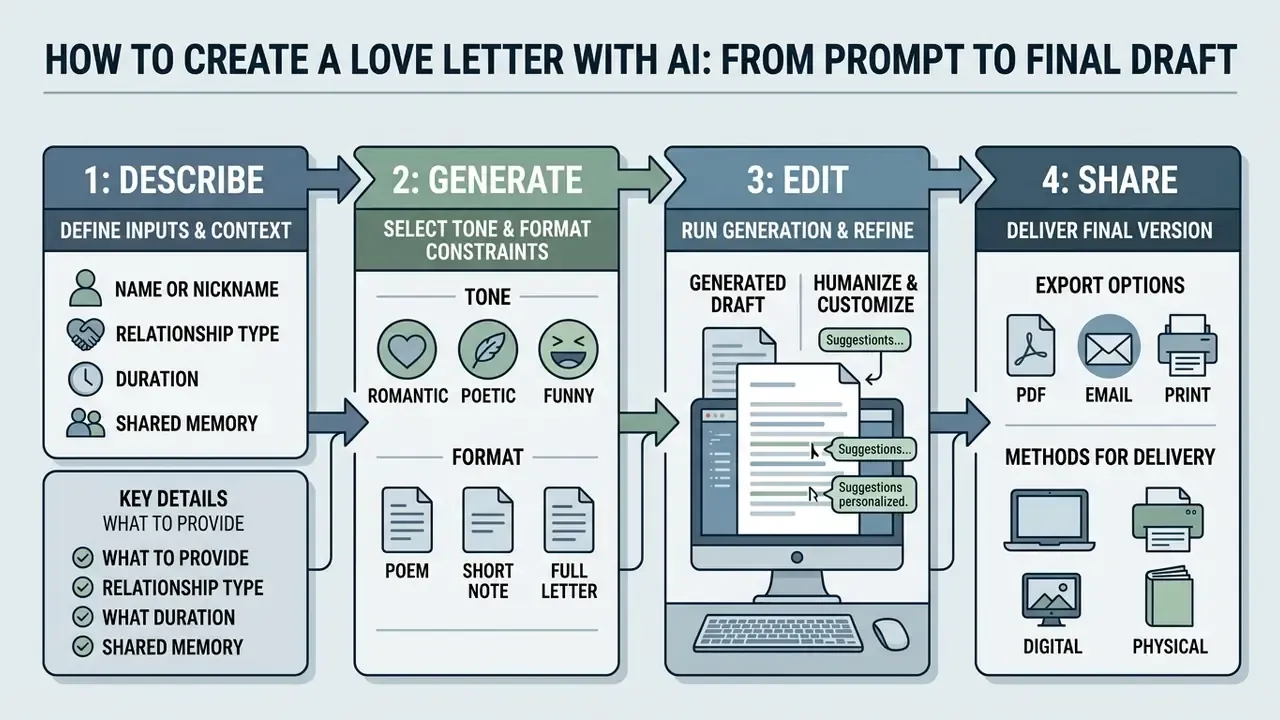
Generating a workable romantic draft follows four stages: describe, generate, edit, share. You start by entering the relationship variables (recipient name, core memories, occasion, desired tone) into the input fields. The language engine processes those constraints to create an initial draft. Then you review it, rewrite it into your own voice, and send it through your chosen channel.
That editing step is not cosmetic. Controlled experimental evidence shows unedited AI assistance leaves a detectable signature:
«Essays written with ChatGPT scored slightly lower, and an AI classifier flagged them as machine-generated more often (11.87% vs 9.96%).»
Which Details to Provide About the Recipient and Your Relationship
To generate a genuinely personal message, give the model concrete anchors instead of broad generalities. The recipient's name or nickname, the relationship duration, specific shared experiences, distinct personality traits: these ground the output in something real. When you write a love prompt, one precise micro-memory (a trip, a running joke, a daily ritual) is what stops the model from reaching for stock clichés.
A minimum set of four to six inputs produces the strongest results:
- Name or nickname. Anchors the letter to one specific person.
- Relationship type and duration. Puts the text on a real timeline.
- One shared memory. A first date, a trip, a bad meal, an inside joke.
- One vivid recent moment. Something from the last month only you two saw.
- Tone label. Romantic, playful, sincere, poetic, passionate.
- Occasion or intent. Anniversary, apology, long distance, proposal, or plainly "just because."
Leaving the memory field empty is the most common mistake by a wide margin. Without a personal spark, even a strong model defaults to interchangeable filler.
How to Choose a Tone: Tender, Romantic, or Sincere
Tone aligns the generated vocabulary with your actual relationship dynamic. A tender or gentle tone uses soft, reassuring language, good for everyday appreciation. A romantic or passionate tone leans on vivid sensory description, better suited to anniversaries. For a newer relationship, a sincere and direct tone balances warmth with boundaries and avoids declarations that land as pressure.
Research on emotional versus rational voice in smart agents confirms that emotional tone works as an adjustable relationship cue rather than a fixed style: it shifts trust and perceived warmth. Consistency matters as much as the choice itself. A letter that opens playfully and closes with a solemn lifetime promise reads as assembled, not felt.
| Tone | Best For | Avoid When |
|---|---|---|
| Tender / gentle | Daily appreciation, long-distance reassurance | Formal proposals needing gravity |
| Romantic / passionate | Anniversaries, Valentine's Day, reunions | Early-stage dating (reads as pressure) |
| Sincere / direct | Confessions, apologies, new relationships | Playful birthday notes |
| Poetic | Vows, milestone letters, printed keepsakes | Quick SMS (feels performative) |
| Playful / flirty | Ongoing relationships, casual check-ins | Apologies, serious conversations |
How to Edit and Send the Generated Text
Post-generation editing is mandatory. There is a diversity argument for it, not only an authenticity one:
«Using a single AI assistant improves text quality but reduces the diversity of ideas; two specialized agents restore originality.»
Read the output aloud to test its rhythm, vary sentence structures, and cut over-formal transitions and borrowed idioms. Check that the greeting and the sign-off match how you actually talk to this person. Then send.
A practical editing sequence:
- Replace every generic adjective with a specific noun or an observed behavior.
- Break at least two long sentences into short ones to disrupt the uniform cadence.
- Delete the first and last sentence of the draft, usually the most formulaic, and rewrite both yourself.
- Add one sentence only you could have written, holding a detail no model could infer.
Four steps. Ten minutes, maybe.
Which AI Model to Choose for Romantic Writing
Most generators now let you pick the engine, and the choice measurably changes the emotional register. Treating the model as an opaque box wastes the single most effective quality lever you have.
| Model Family | Strength for Romantic Text | Best Use Case | Watch Out For |
|---|---|---|---|
| Claude (3.5 Sonnet / Claude 4) | Natural, conversational cadence with little grandiosity | Secret-admirer notes, early confessions, apologies | Can be understated for grand milestone letters |
| GPT-4o / GPT-5 | Metaphor, imagery, sustained structure over long output | Anniversaries, wedding vows, one- to two-page letters | Tends toward flourish; needs cliché pruning |
| Gemini (3 / Pro tiers) | Strong multilingual output, structured occasion framing | Letters in a partner's native language, bilingual couples | Occasionally formal in intimate registers |
| Fast lightweight tiers | Speed and brevity | SMS, WhatsApp messages, flirty one-liners | Thin on nuance; weak at memory integration |
| Uncensored / high-intensity models | Passionate, unfiltered romantic writing | Long-term partners who ask for intensity | Overshoots into melodrama fast |
Practical rule: if the draft feels too formal, switch to a Claude-class model for conversational flow. If it feels flat and generic, switch to a GPT-class model and tighten your negative constraints. Many platforms also expose a targeted rewrite tool, where you highlight one sentence and instruct the model to "make this shorter" or "make this less poetic." Far more precise than regenerating the whole letter, and it keeps the paragraphs you already liked. Localized regeneration beats full re-runs almost every time; the same holds when you compare options across other generative tools.
Structure of a Heartfelt Love Letter: Opening, Body, and Closing
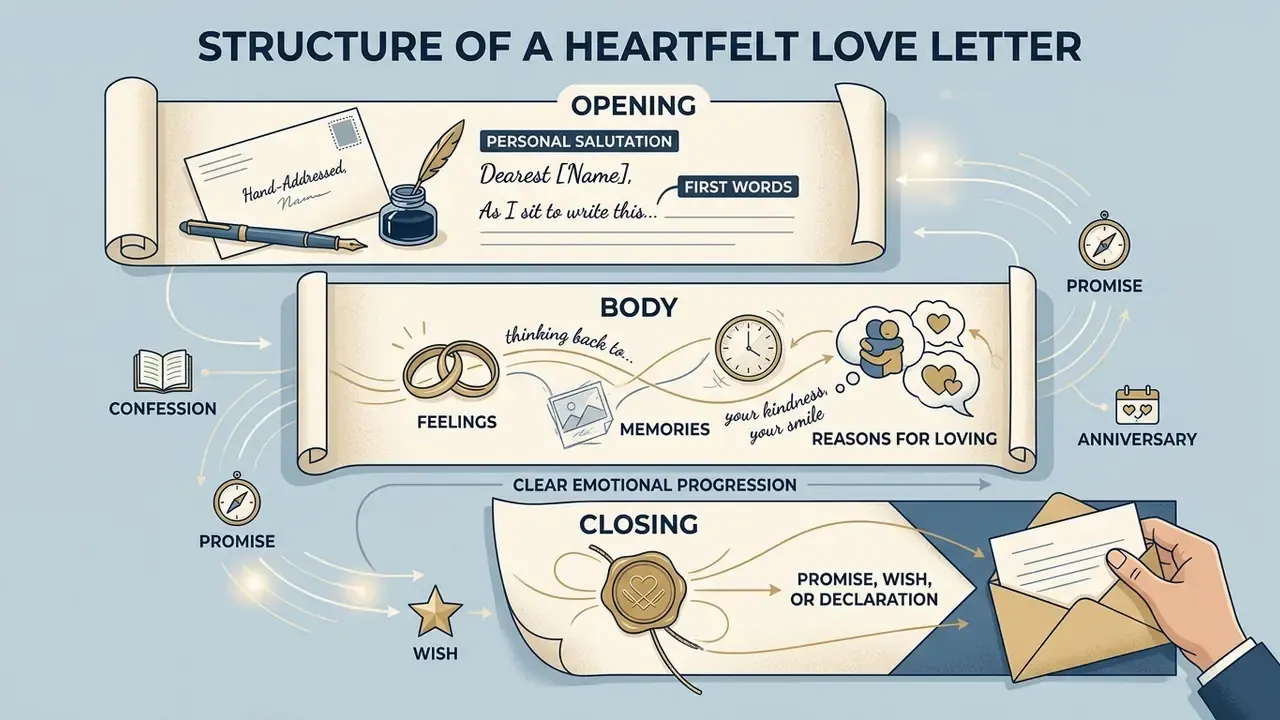
A classical heartfelt love letter rests on a clear emotional progression: an inviting opening, a grounded body, a decisive closing. That arc carries the reader from affection into reflection and then into commitment. Love letters built on this progression land harder than unstructured prose, which tends to circle.
Opening: Personal Salutation and First Words
The opening paragraph establishes intimacy through a personalized salutation and a direct statement of purpose.
«Users of AI companions place high value on being addressed by name and on references to shared context; this creates the feeling of closeness.»
Skip business-like greetings. Use a meaningful pet name or intimate address, then say plainly why you are writing. Workable openings include "To the love of my life," "To the one I always dreamed of," and simply "Dear [name]," followed immediately by the honest reason for the letter. A strong opening sets the emotional temperature for everything after it and reaches the reader's heart before any argument does.
Body: Feelings, Memories, and Reasons for Loving
The body alternates between three elements: explicit statements of affection, specific shared memories, and admiration for a quality that belongs to this person alone. Grounding your emotions in real moments, a shared hardship or a milestone you survived together, gives your claims evidence.
«AI companions dynamically mirror and amplify user affect, producing emotional synchrony; an analysis of 17,000 chats revealed this pattern.»
That mirroring mechanism explains why concrete inputs matter so much: the model amplifies whatever specificity you supply. Feed it "I love my wife" and you get generic warmth. Feed it "I love that she defends my worst career ideas and makes cacio e pepe at midnight" and it has real material to work with. Named appreciation builds a narrative that reinforces trust instead of decorating it.
A reliable body sequence: shared memory, then explicit feeling, then named quality. Repeat once or twice. Stop before it becomes a list.
Closing: Promise, Wish, or Declaration
The conclusion resolves the letter with a focused promise, a future wish, or a definite declaration. An i love you ai generator prompt strategy helps draft closing lines matched to the occasion, whether you are marking an anniversary or restating an everyday commitment. Effective closings differ by context:
- Confession direct belonging, as in "I belong to you, and shall always love you."
- Promise a stated intention plus "With all my love."
- Wish hope tied to the moment or the occasion itself.
- Anniversary gratitude plus continuity, as in "Thank you for being my person and for being my home."
Then sign off warmly, in the way you actually sign off. That is what lingers.
Real AI Generation Examples: Three Complete Letters
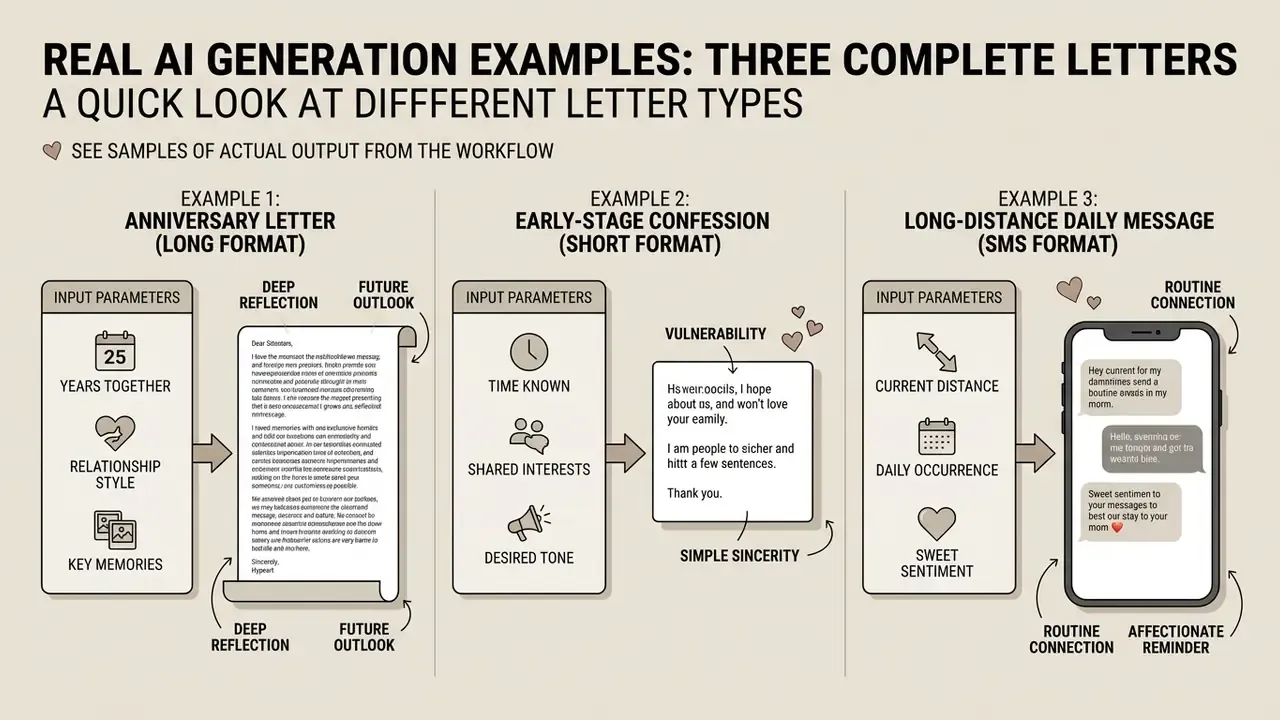
Prompts alone rarely tell you whether a generator earns your time. Below are three input-to-output examples, lightly edited exactly as Stage 4 recommends, so you can see what a realistic finished draft looks like.
Example 1: Anniversary Letter (Long Format)
Input parameters: Recipient: Sarah | Relationship: wife, 5 years | Occasion: 5th anniversary | Memory: rainy trip to Maine | Tone: deep and sincere | Length: medium.
Generated output:
Example 2: Early-Stage Confession (Short Format)
Input parameters: Recipient: Daniel | Relationship: three dates in | Occasion: after a museum visit | Tone: honest, relaxed, low-pressure | Length: 2-3 sentences.
Generated output:
Example 3: Long-Distance Daily Message (SMS Format)
Input parameters: Recipient: Mira | Relationship: long-distance partner, 14 months | Context: busy workday | Tone: warm, sincere | Constraint: under 35 words, no clichés.
Generated output:
Notice what all three share: one concrete detail, one plain statement of feeling, and not a single phrase you could paste into somebody else's relationship. That is the bar your own edited draft should clear.
Occasions for Using an AI Love Message Generator
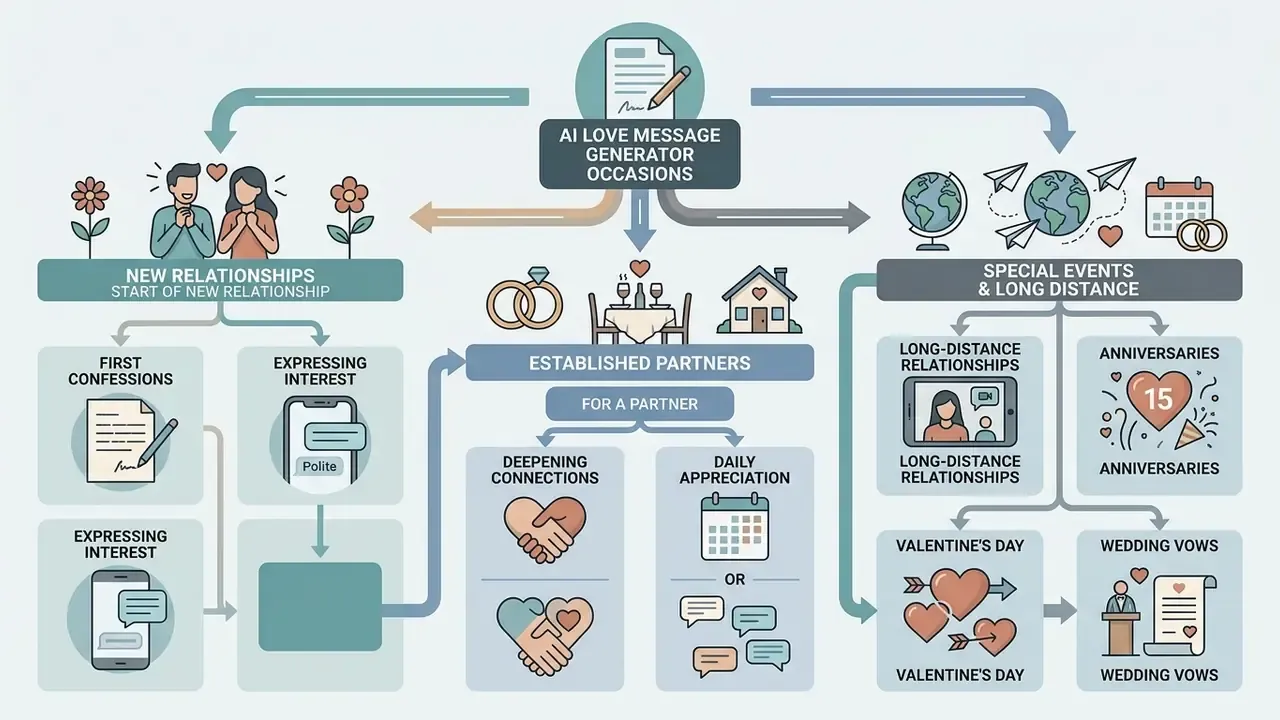
An ai romantic message generator covers a wide spread of situations, from a first nervous confession to a fifteenth anniversary. Picking the right mode lets you tailor content for apologies, long-distance connection, Valentine's Day, or a formal wedding declaration. Reading the relational context correctly is what keeps the output inside appropriate boundaries.
Confessions and the Start of a New Relationship
An early-stage confession needs a balance of vulnerability, clarity, and restraint. An ai confession generator helps you articulate feelings that are still forming, without tipping into high-pressure declarations. Early messages should carry feelings rather than facts, because emotional self-disclosure predicts intimacy more strongly than factual disclosure does.
There is a trust dimension here worth reading before you press send:
«64% of respondents expressed distrust toward a potential partner who used AI-generated images or chatbots in their dating profile.»
The takeaway is not "never use AI." It is "never let AI be the visible author." Heavy editing preserves perceived authenticity; verbatim output erodes it. If you are also worried about the visual side of someone else's profile, the same skepticism applies to generated portraits and illustrated avatars, including anything produced by an ai anime character generator.
Messages for a Partner and Long-Distance Relationships
Long-distance relationships run on consistent touchpoints that maintain emotional presence across a time zone or two. An ai love paragraph generator can build daily check-ins, morning notes, and steady evening messages sized for messaging apps. Peer-reviewed work published via PubMed Central (2021) found that in long-distance couples, more frequent and more responsive texting predicted significantly greater relationship satisfaction, an effect that did not appear among geographically close couples.
AI already sits inside that landscape more often than most people assume:
«15% of young adults in serious relationships regularly interact with AI chatbots that simulate a romantic partner.»
Anniversaries, Valentine's Day, and Wedding Vows
Milestones ask for structured, reflective prose that honors shared history and names what comes next. For anniversaries and Valentine's Day, an ai love letter generator free workflow helps compress years of shared experience into an elegant letter or a first vow draft. Vow structure is well documented: an opening, three to five first-person promises, and a closing line addressed to your partner rather than to the room, at roughly 200 to 300 words for a one- to two-minute delivery. Vow-renewal scripts usually mark elapsed time explicitly ("more than [number] years ago") and frame the text as reaffirmation.
Using AI to organize long-term commitments gives you a structural foundation. The promises themselves have to be yours. For Valentine's cards, a short poem or greeting inside the card still outperforms volume: brevity plus specificity, every time. Some couples pair the card with a short animated e-card built through an ai animation generator, which works well when distance rules out paper.
Love Letter Templates and Prompt Examples for the Generator
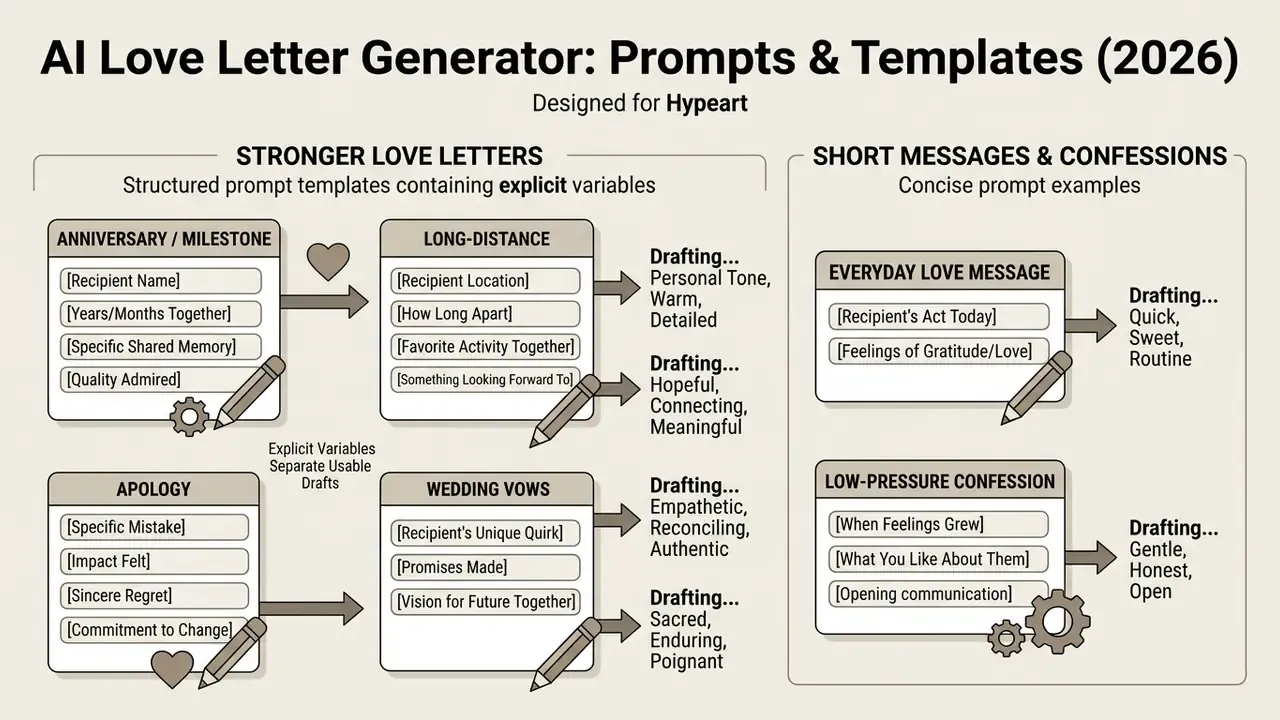
Structured prompt templates with explicit variables are what separate a usable draft from a shrug. Define the role, the context, the tone, the length, and the negative constraints (clichés to avoid), and the model steers itself.
«An enterprise study of a GPT-3.5-based AI assistant measured productivity gains from 3.3% (email) to 69% (summarization) across 63 participants.»
The same distribution shows up in romantic drafting. The gain is largest where the task is structural (organizing memories into an arc) and smallest where the task is purely expressive. Enterprise prompt-template practice from Google's Gemini Enterprise Agent Platform and Amazon Bedrock documentation (2026) confirms the pattern used below: role, plus replaceable variables, plus explicit output constraints.
Prompts for a Romantic Letter with a Personal Tone
Copy prompt template: anniversary or milestone letter
Act as a romantic letter writer. Write a heartfelt 3-paragraph love letter for my partner [Name].
Occasion: [Anniversary / Birthday / Just Because].
Key Memories: [specific memory 1, e.g., our trip to Maine] and [specific memory 2].
Tone: Warm, sincere, deeply appreciative, non-cliché.
Format: Personal opening, body focusing on shared growth and specific traits I admire, warm future-focused closing.
Constraints: Avoid phrases like "you are my everything" or "in this digital age." Keep length under 300 words.
Copy prompt template: long-distance letter
Write a 4-paragraph love letter to my long-distance partner [Name], together [X months/years].
Context: We will next see each other in [timeframe]; they are currently dealing with [situation].
Include: one shared memory ([memory]), one thing I admire about how they handle [situation], and a concrete plan for our next visit.
Tone: Reassuring, steady, quietly affectionate.
Constraints: No clichés about distance making hearts grow fonder. Do not mention "miles apart." Under 320 words.
Copy prompt template: apology letter
Write a sincere 3-paragraph apology letter to my partner [Name] about [specific situation].
Structure: acknowledge what I did without excuses, name the impact on them, state one concrete change I will make.
Tone: Accountable, calm, non-defensive. Do not be self-pitying.
Constraints: No flowery imagery. No promises I have not specified. Under 250 words.
Copy prompt template: wedding vows
Draft wedding vows for me to say to [Name] at our ceremony.
Include: an opening line about [how we met / a defining moment], 4 first-person promises based on [promise 1], [promise 2], [promise 3], [promise 4], and a closing line addressed directly to them.
Length: 220-280 words, roughly 90 seconds spoken.
Tone: Sincere with one moment of light humor.
Constraints: No references to fairy tales, soulmates, or "better halves."
Prompts for Short Love Messages and Confessions
For SMS and messaging apps, use constrained micro-prompts built for immediate impact. Word ceilings do most of the work here.
Copy prompt template: everyday love message
Write a 2-sentence romantic love message for my [partner/crush] [Name].
Tone: Sweet, playful, sincere.
Context: [e.g., Thinking of you during a busy workday].
Constraint: Maximum 35 words. No artificial or flowery idioms.
Copy prompt template: low-pressure confession
Draft a gentle romantic confession to [Name] expressing that I enjoyed our recent time together at [Event/Place] and would like to see them again.
Tone: Honest, relaxed, low-pressure.
Length: 2 sentences.
Copy prompt template: good morning note
Write a 1-2 sentence good morning message to [Name].
Include one detail: [their plan for today].
Tone: Warm, unhurried, specific.
Constraints: Under 25 words. No emojis. No "rise and shine."
One more habit worth building: keep your best three prompts in a note on your phone. Reuse beats reinvention on a Tuesday night.
Export and Formatting Best Practices
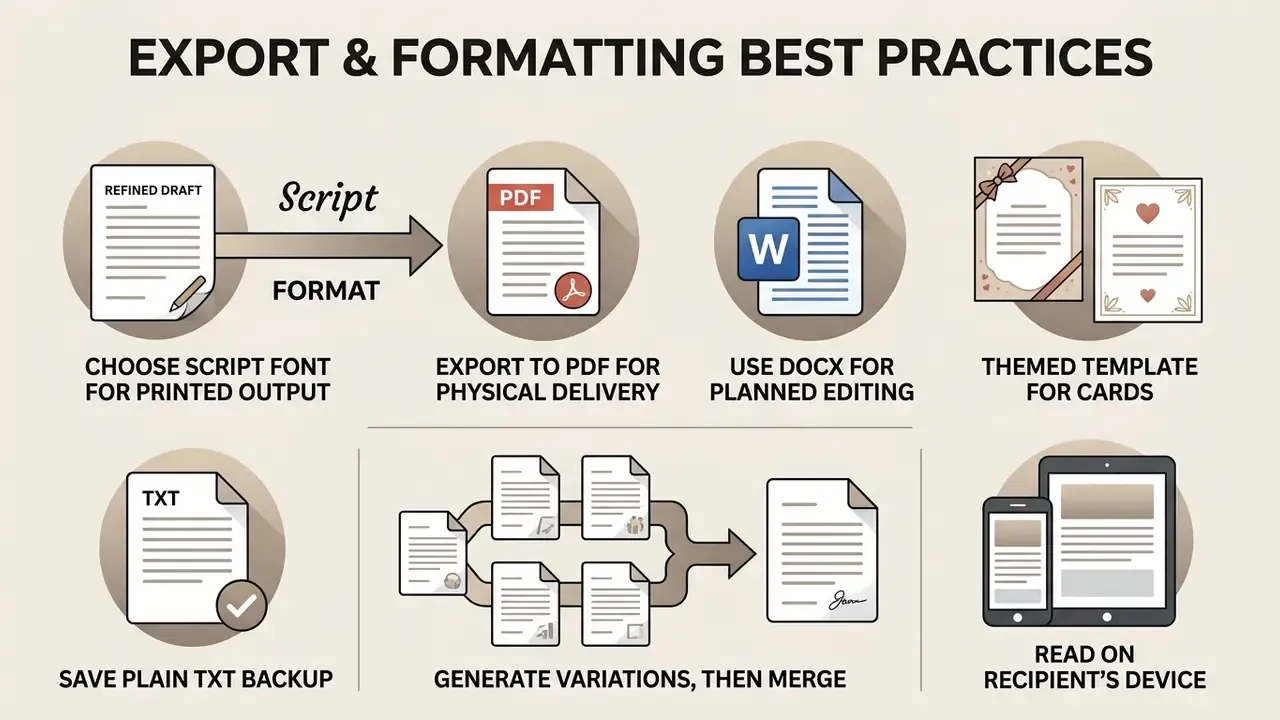
Once the draft is refined, do not send unformatted plain text. Presentation carries a real share of the emotional impact, especially for milestone letters meant to survive as keepsakes.
- Choose a script font for printed output. Calligraphic faces such as Great Vibes or Dancing Script read as deliberate; system defaults read as disposable. Keep script for short letters and switch to a readable serif past one page.
- Export to PDF for physical delivery. PDF locks layout, line breaks, and typography, so nothing reflows at the copy shop.
- Use DOCX when you plan to keep editing. A Word export preserves formatting while letting you revise offline or on another device.
- Apply a themed template for cards. Floral or minimal bordered layouts turn a text block into a card-ready object. Keep decoration subordinate to the words.
- Save a plain TXT backup. Browser tools often store history locally and temporarily. Close the tab without exporting and the letter is usually gone for good.
- Generate several variations, then merge. Three versions, best paragraph from each: that composite almost always beats accepting a single draft.
- Read the final version on the device the recipient will use. A letter that scans beautifully on a laptop can break in ugly places on a phone.
Free AI Love Letter Generators, Paid Features, and Commercial Use
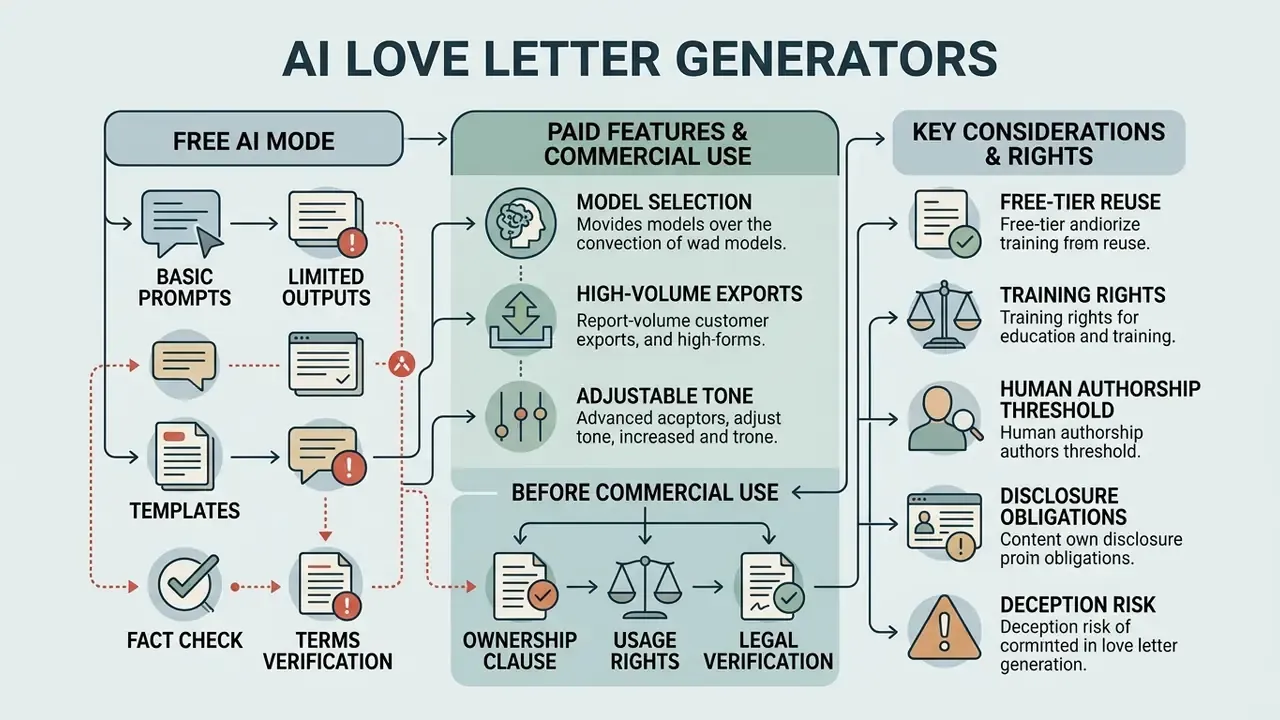
Most romantic text services run a freemium model: basic web generation at no cost, advanced models and deep editing behind a paywall. Knowing where the boundary sits between a free ai love letter generator and a paid plan keeps you from overbuying for a single anniversary.
| Feature Category | Free AI Tier | Paid Premium Tier |
|---|---|---|
| Generation limits | 1-3 drafts per day or month, or rate-limited access | Unlimited or high-volume credit allocations |
| Model quality | Standard baseline LLM (fast tier) | Advanced GPT, Claude, or Gemini class with nuanced tone |
| Customization and tone | 3-5 preset tones (Romantic, Short, Playful) | Custom tone prompts, model selection, length controls |
| Export and editing | Plain text copy to clipboard | PDF and DOCX formatting, card templates, selective rewrites, history, favorites |
| Commercial rights | Personal, non-commercial use by default | Release rights for print and merchandise, subject to terms |
Observed 2026 price points across the category (verify current terms with each vendor before you buy):
| Pricing Model | Example Structure |
|---|---|
| Freemium subscription | Free tier of 3 short notes per month; paid tiers around $9/month or $85/year, and $18/month or $165/year |
| Credit packs | Free = 1 letter; about $5 for 10 letters; about $10 for 25 letters, tax excluded |
| One-time per letter | About $1.49 per generation, optional $0.24 edit add-on, PDF download included |
| General AI writing suites | About $19.99/month standard and $44.99/month premium |
| Mobile in-app subscriptions | About €5.99 weekly, €9.99 monthly, €22.99 yearly |
There is a detection-risk dimension to commercial use as well:
«Only 24% of respondents are confident they could recognize an AI-written romantic message, creating legal and ethical risk in commercial deployment.»
What Is Typically Available in Free AI Mode
A free ai mode gives you basic access to generate standard short notes and love messages on default models. Documented free-tier patterns across the wider text-generation market include daily or monthly request caps, shorter maximum output length, access restricted to lower-tier models, and no access to premium features such as deep research modes or agent workflows. OpenAI's ChatGPT Free Tier documentation, for instance, describes unlimited everyday text chats alongside separate limits for uploads, image generation, voice, and data analysis, plus abuse-prevention safeguards that notify you when a cap is hit.
Users who need more can upgrade for longer generations, specialized tone presets, model selection, and higher thresholds without daily caps. Worth noting: in most creative tools the binding constraint on a free plan is not the feature count but the export restriction. You can write the letter; you cannot get it out in the format you want.
What to Check Before Commercial Use of Generated Text
Before you put generated romantic text into a commercial product (a published gift book, a greeting card line, monetized media), read the User Agreement and the IP licensing clauses. Five checks:
If you need documentation or a licensing question answered before launch, the support resources cover technical details, and the commercial-use licensing overview maps rights across media asset categories.
How to Make an AI Love Letter Personal, Safe, and Natural
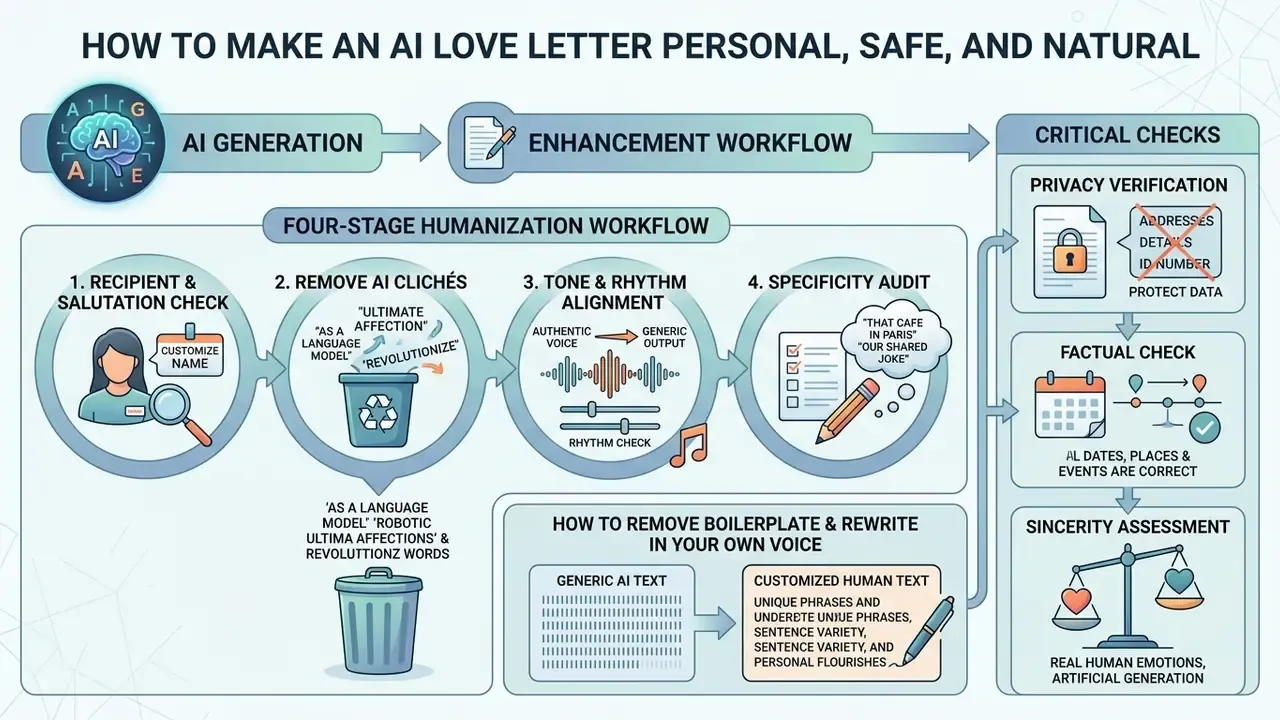
To keep a romantic letter authentic, safe, and emotionally effective, humanize the output and protect sensitive information at the same time. Sending machine text untouched risks a cold, generic message, and it damages trust badly if the recipient recognizes it.
- Recipient and salutation check. Confirm the greeting uses your actual pet name or address style, and that the letter names the right person. This mistake happens more than you would think.
- Remove AI clichés. Cut formulaic phrases: "testament to our love," "delving into," "in this digital age," "in summary."
- Tone and rhythm alignment. Read the draft aloud. Sentence lengths should vary and match how you speak.
- Specificity audit. Verify at least one detail could not apply to anyone else on earth.
- Privacy verification. Confirm no financial data, precise addresses, or identification details appear in the prompt or the output.
- Factual check. Confirm dates, place names, and event details the model may have invented outright.
- Sincerity assessment. Make sure the commitments in the text reflect what you actually feel and where the relationship actually stands.
Security context matters beyond your own draft, because AI-generated romance is also an attack surface:
«42% of global respondents and 58% of Americans encountered AI-generated fake profiles on dating sites in the previous 12 months.»
How to Remove Boilerplate and Rewrite the Text in Your Own Voice
Removing machine boilerplate takes structural and lexical work, not a single pass.
«Accepting more AI suggestions reduces the sense of control; a feeling of inclusion mitigates that loss, especially for minority participants.»
In practice the ownership problem is solved by rewriting rather than accepting. Break long, uniform sentences into a mix of short statements and descriptive phrases. Swap overused adjectives for specific memories, your own odd vocabulary, the phrasing you actually use out loud. Public-sector and vendor humanization guidance converges on five moves: vary sentence structure, replace generic vocabulary with your own, add concrete sensory or personal detail, delete stock transitions, and rewrite in short chunks so the tone stays consistent across sections.
Reading aloud remains the fastest way to catch bad pacing. A 2025 quantitative study of machine-written poetry found more natural rhythmic variation in human-authored control texts, which is exactly the uniform cadence you are trying to break. If you want a playful escape hatch from stiff phrasing, some people draft a nickname or a running joke around a shared pet, sometimes with help from an ai animal generator, then build the sentence around it.
Which Personal Details You Should Not Give to AI
To protect privacy, never enter sensitive personally identifiable information into public generation tools.
The risk in romantic AI use is cumulative, not single-event. Each draft adds context: names, dates, addresses, arguments, health details. Eventually the conversation history functions as a diary held on someone else's infrastructure. Regulatory guidance points the same way. Privacy authorities advise against entering personal information, and especially sensitive information, into publicly available generative AI tools, and recommend refraining from sharing both your own and third parties' personal data or confidential files. NIST's generative AI profile similarly directs organizations to monitor for exposure of PII and sensitive data in generated content.
Do not submit: full legal names, home street addresses, workplace addresses, precise geolocation, financial or payment data, government identifiers, medical details, or a third party's private information. Use generalized placeholders while generating ("my spouse," "our favorite cafe," "[NAME]"), then insert the real names and places manually after you copy the draft to your device. Where the platform allows it, disable chat history and training on your conversations before drafting anything intimate.
Developers wiring generation into their own applications can open the hub for technical API documentation, and anyone modeling subscription costs across several tools can browse the hub for calculation utilities.
FAQ
Can AI actually write a good love letter?
It can write a good draft. Given a name, a relationship context, one or two real memories, a tone, and an occasion, current models reliably produce a coherent letter with a proper opening, body, and closing. What they cannot produce is the one detail only you know. Expect to rewrite roughly 20% to 30% of the output.
Will my partner be able to tell it was written by AI?
Often not. McAfee's 2024 survey found 67% of adults could not distinguish AI-written from human-written text, and only 24% were confident they could spot an AI romantic message. But 57% said they would feel hurt to learn AI was involved, so the risk is relational rather than technical. Substantial editing is the mitigation.
Is it unethical to use an AI love letter generator?
Using AI to organize feelings you genuinely have is broadly comparable to using a template or a thesaurus. The ethical line falls at misrepresentation: presenting verbatim machine output as personal authorship, especially in commercial or high-stakes contexts. Regulators increasingly require disclosure of generative AI use in consumer-facing applications.
Do I own the copyright to an AI-generated love letter?
Under 2025 U.S. Copyright Office guidance, purely AI-generated text lacking human authorship is not protected, and only your human contributions can be claimed. EU Parliament research (2025) lands in a similar place. For a private letter this rarely matters. For a commercial product it matters a great deal.
Which AI model writes the most natural love letters?
Claude-class models are generally strongest for conversational, understated warmth. GPT-class models handle poetic and long-form milestone letters better. Gemini-class models do well with multilingual output. If your draft feels stiff, switch models before you rewrite the prompt.
How long should a love letter be?
One to three sentences for everyday texts. One to two paragraphs for a card note. Three to five paragraphs for a letter. And 200 to 300 words for spoken vows, which runs one to two minutes at a normal pace.
Can I use a free generator, or do I need to pay?
For a single letter, a free tier is usually enough, since most allow one to three generations. Pay when you need model selection, unlimited variations, PDF or DOCX export with styled fonts, selective rewrites, or commercial rights.
Is it safe to enter my partner's name into a generator?
Prefer placeholders. Enter "[NAME]" and "our favorite cafe" while generating, then substitute the real names and places locally after copying the text. Privacy regulators advise against entering personal information, and especially sensitive information, into publicly available generative AI tools.
Should I use AI to write an apology?
Use it to structure your thoughts, then rewrite the whole thing in your own words. Research in the Journal of Couple and Relationship Therapy associates texting used for apologies and confrontation with more conflictual face-to-face communication. Apologies are the format where authenticity matters most and machine phrasing costs most.
Footer Navigation
To explore definitions, technical guides, and comparisons across the wider editorial library, browse the hub for the full set of analytical resources.